THE BEST EDUCATION
Hon. Gisela Laurent on the impact of an education in the legal field.
THE FIRST CONVERSATION Amarillis Vélez on building trust before the case begins.
A PUBLICATION OF
WE ARE STILL STUDENTS XiXi Li on the importance of continuing education.
OCTOBER 2026 VOL. 94 NO. 8
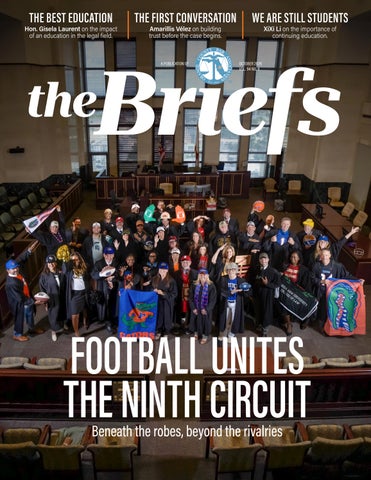
FOOTBALL UNITES THE NINTH CIRCUIT Beneath the robes, beyond the rivalries
12 I
GAME DAY AT THE NINTH CIRCUIT School Spirit Takes the Bench
LETTERS FROM LEADERS
06 I PRESIDENT’S MESSAGE Learning From Each Other Lisa Gong Guerrero, Esq.
08 I CLERK’S CORNER Behind the Filing
The Honorable Tiffany Moore Russell, Esq.
10 I CHIEF’S COLUMN The Best Education
The Honorable Gisela T. Laurent
FROM THE COMMITTEES
18 I CRIMINAL LAW COMMITTEE
Six-Person Juries and the Future of Florida Criminal Trials Barry C. Edwards, J.D., Ph.D
22 I LRIS COMMITTEE Justice Begins with Understanding Amarillis Vélez, Esq.
4|
The Briefs | OCTOBER 2026
FROM THE COMMITTEES
24 I LRIS COMMITTEE
The First Conversation Amarillis Vélez, Esq.
26 I PARALEGAL COMMITTEE
SIDEBAR: NEWS / EVENTS / UPDATES
36 I YOUNG LAWYERS SECTION Judeen Molyneux, Esq.
38 I VOLUNTARY BAR Alena V. Baker, Esq.
Build Confidence with Credentials Jodi L. Peterman, ACP, FR
28 I PROFESSIONALISM COMMITTEE
Lawyers Are Always Students XiXi Li, Esq.
LEGAL AID SOCIET Y
32 I WHAT WE DO
Sealing and Expunction Brittney J. Tolbert, Esq.
ADVERTISING DEADLINES Magazine: 10th of month prior to publication eEdition: 20th of month prior to distribution Copy: Six weeks prior to publication If the deadline falls on a weekend or holiday, the deadline is the next business day. Publication of advertising herein does not imply any endorsement of any product, service, or opinion advertised. The opinions and conclusions, including legal opinions and conclusions contained herein, are those of the authors and do not reflect official endorsement by the Orange County Bar Association or its officers and directors, unless specifically stated as such. ©2026 Orange County Bar Association. All rights reserved. ISSN 1947-3968
O CB A O C TO B E R LU N CHE ON 880 N. Orange Ave., Orlando, FL 32801 (407) 422-4551 Fax (321) 430-1558 orangecountybar.org Legal Aid Society (407) 841-8310 Citizen Dispute (407) 423-5732 Family Law Mediation (407) 423-5732 Lawyer Referral Service (407) 422-4537 Foreclosure Mediation (407) 515-4330 Young Lawyers Section (407) 422-4551
OCTOBER 2026 VOL.94 NO.08
Editor Kate T. Hollis Associate Editors Christine Wasula Valencia N. Poitier Columnists Alena V. Baker Michael Stone Officers Lisa Gong Guerrero, President Michael Barber, President-Elect Brandon Sapp, Treasurer C. Andrew Roy, Secretary Sean Mendez Catlin, YLS President Executive Council Stephanie Alcalde Onchantho Am Joshua R. Brown Lisa Cunningham-Harvey Kate T. Hollis Keshara Cowans Bruce Mount Conti Moore Alisia Profit Rafael O. Rodriguez Christina Russo Walters C. Todd Smith Jennifer Smith Thomas
SAVE THE DATE!
Thursday, October 29, 11�30am–1pm at Marriott Orlando Downtown 400 W. Livingston St., Orlando, FL 32801 Joint Luncheon with the Central Florida Association of Women Lawyers.
RSVP by Monday, October 26, 2026 Ashley Velez ashleyv@ocbanet.org | orangecountybar.org/store RSVPs and cancellations will not be accepted after October 26, 2026.
Executive Director Candice Disorbo Advertising & Sponsorship Manager Ursla Gallagher
TITLE SPONSOR
Marketing & Communications Manager Reatha Cruz-Johnson Design Em Agency, emagency.com
MORE EVENTS
orangecountybar.org/calendar orangecountybar.org | The Briefs
|
5
PRESIDENT’S MESSAGE
LEARNING FROM EACH OTHER Lisa Gong Guerrero, Esq., is a Board-Certified
Specialist in Criminal Trial Law with 20 years of experience in criminal law. She is the founder of Gong Guerrero Law, PLLC, where she focuses her practice on criminal defense.
6|
One of the things I have learned after 20 years of practice is that you never really stop learning. Just when you think you have seen it all, the law changes, technology changes, a new issue comes up, or someone shows you a different way of looking at something. I still learn from other lawyers, judges, legal professionals, and even the young lawyers and law students I meet. That is one of the things I value about the OCBA. Education has always been an important part of what we do. Throughout the year, our committees put together CLEs and programs on changes in the law, emerging issues, technology, ethics, professionalism, practice management, and many other topics that help our members stay informed and become better at what they do. But education at the OCBA is about much more than earning CLE credits. Some of the best learning happens through the relationships we build with one another. It happens when an experienced attorney takes the time to mentor a young lawyer, when a judge shares practical advice about professionalism or courtroom practice, when attorneys from different practice areas sit down together and exchange ideas, or when a law student attends an OCBA event and gets the opportunity to talk with someone doing the work they hope to do one day. And learning goes both ways. Those of us who have been practicing for many years have plenty to learn from the next generation. Young lawyers and law students bring new perspectives, new ideas, and often a very different understanding of technology. I think we are at our best when we are willing to learn from each other, regardless of how long we have been practicing or what title we hold. That has certainly been true throughout my career. Some of the most valuable lessons I have learned did not come from a textbook or a CLE. They came from mentors who took the time to answer my questions, colleagues who shared their experiences, judges who offered a different perspective, and difficult cases that forced me to think differently. I’ve also learned that sometimes you just have to be willing to say, “I don’t know.” That isn’t always easy for lawyers. We are trained to have answers and solve problems. But none of us knows everything. Being willing to ask a question, call a colleague, seek advice, or listen to another point of view is part of how we grow. That is especially important right now because our profession is changing quickly. Artificial intelligence and other technologies are changing how we research, communicate, manage our practices, and serve our clients. The law continues to evolve, and so do the expectations placed on legal professionals. We have to be willing to keep learning and adapting. The OCBA has an important role in helping our members do that. We want to provide educational opportunities that are practical, relevant, and useful, whether you are a law student just beginning your journey, a young lawyer building your career, a judge, a paralegal or legal professional, or an attorney who has been practicing for decades. But education within the OCBA isn’t just something the organization provides to our members. It is something our members provide to each other. Every time someone speaks at a CLE, mentors a young lawyer, writes an article for The Briefs, participates on a panel, answers a colleague’s question, or simply shares an experience that might help someone else, our entire legal community benefits. We all have something to learn, and we all have something to share.
The Briefs | OCTOBER 2026
So, this month, I encourage you to do both. Attend a CLE. Ask a question. Learn about something outside your practice area. Reach out to a mentor. Mentor someone else. Share your knowledge with a committee or write an article for The Briefs. No matter where we are in our careers, there is always something new to learn and someone we can learn from. And sometimes, the best thing we can do with what we’ve learned is pass it on.
New Members ATTORNEY Brian Boelens Jennifer M. Busby Patricia Dullaghan James Kelly Timothy Alan Magill Tucker Pryor Benjamin Sigman
Brian Frederick Greenwald Desiree Hernandez Dean LaPonzina Kerry McKeown Andrew MeinKing Judeen Molyneaux
Joseph Sutter
Alicia S Perez
Maria Fernanda Valladares
Lauren Sellers Andrew Storie
David Zissman
Lauren Theodore
Emily Balletta
Charles Van Patten
Raissa Booze
Berry James Walker
Arielle Denmark
Abigail Warren
Matthew Digney
Melissa Zierden
Andrew Faris
AFFILIATE
Anna Arceneaux Kwin Chavis Suzzette De Jesus
Stephane Edouard Skylar Roberson KeriAnne Robillard
Liana Marrero
Carina Sandoz
Nallita Sepulveda
Jenette Turner
Carole Steele
Nelida Welch
LAW STUDENT Steven Abreu Halee Bishop Medaline Pascal Jessica Perea Simon Andrew Pfeifer Lindsey Hunter Taylor Zackary Robert Blackburn Taylor Stringer
PARALEGAL STUDENT Victoria Michelle Grajeda Viviana Serrano-Trinidad
orangecountybar.org | The Briefs
|
7
CLERK’S CORNER
BEHIND THE FILING What Happens After You Click Submit.
FOR MORE INFORMATION: 1. Florida Rule of General Practice and Judicial Administration 2.525 https://www.flcourts.gov/ Resources-Services/CourtTechnology/Statutes-RulesAdministrative-Orders 2. Florida Courts E-Filing Portal Training Materials and Manuals https://www.myflcourtaccess. com/authority/trainingmaterials
For most attorneys, filing a document through the Florida Courts E-Filing Portal is just one step in moving a case forward. A motion is filed, a response is submitted, or an order is expected to reach the judge. From the filer’s perspective, the process may seem complete once the “Submit” button is clicked. What happens next, however, is where the Orange County Clerk of Courts’ work begins. Every filing submitted through the Portal goes through a series of processes before becoming part of the official court record. Those steps vary depending on the case type and the document being filed. Some filings involve confidential information, judicial review, recording requirements, or certification, while others are governed by statutory requirements and statewide court rules. The Clerk’s role goes beyond accepting documents. The Clerk maintains the official court record —a record relied upon by judges, attorneys, appellate courts, and the public throughout the life of a case. Decisions made during filing can affect how efficiently a document is processed and how easily it can be found months or even years later.
IT STARTS WITH THE DOCUMENT TYPE
One of the most important decisions made during filing is selecting the correct document type. The document type chosen in the Portal determines where the filing goes next. Using the search feature to select the document type that best matches the pleading helps ensure it reaches the appropriate processing queue the first time. If a document is mislabeled, it may be routed to the wrong workflow or become more difficult to locate later in the court record. Taking a few extra moments to select the correct document type can help avoid unnecessary processing delays.
8|
The Briefs | OCTOBER 2026
SUPPORTING DOCUMENTS MATTER
Many pleadings include supporting materials such as contracts, photographs, medical records, financial records, receipts, or other exhibits. The Florida Courts E-Filing Portal’s Document Submission Standards recommend uploading pleadings and supporting documents as separate, clearly identified PDF files whenever appropriate. This makes the court record easier to navigate and allows judges, judicial assistants, Clerk staff, attorneys, and others reviewing the case to quickly locate supporting documents. Clear exhibit titles and meaningful attachment descriptions continue to provide value long after a filing is accepted, including when certified copies are requested.
THINK BEYOND TODAY’S FILING
Certified copies must reproduce documents exactly as they appear in the official court record. When a pleading and all supporting documents are combined into a single PDF, the Clerk cannot certify only part of that filing. Instead, the entire document—including every exhibit— must be reproduced. Submitting pleadings and supporting documents separately, when appropriate, preserves flexibility for future certified copy requests and may reduce unnecessary copying costs.
UNDERSTANDING THE CORRECTION QUEUE
A common misconception is that any filing with a deficiency can be returned through the Portal’s Correction Queue. Florida Rule of General Practice and Judicial Administration 2�525 limits the circumstances in which a filing may be returned for correction. If a filing does not meet one of those authorized reasons, the Clerk is generally required to accept and docket it.
That does not necessarily mean the filing is free from issues. Some deficiencies must be addressed through judicial review rather than the Correction Queue, which is why a document may appear in the court record even though additional court action is still required.
A WORD ABOUT PROPOSED ORDERS
Rule 2�525 identifies stand-alone proposed orders as one of the limited reasons a filing may be returned through the Correction Queue. Proposed orders intended for judicial review should be submitted directly to the assigned division in accordance with that judge’s procedures. When a proposed order is attached as an exhibit or included with a Notice of Filing to preserve the record, it becomes part of the official court file rather than a stand-alone submission for judicial review.
WORKING TOGETHER
The Orange County Clerk’s Office appreciates the partnership of the judiciary, attorneys, and self-represented litigants in maintaining an accurate and reliable court record. Every filing is part of a larger process, and the choices made during filing help support efficient case processing and a complete, accessible record. Understanding what happens after a document is submitted can help reduce processing delays, support judicial workflows, and preserve the integrity of the court record for everyone who relies on it.
orangecountybar.org | The Briefs
|
9
CHIEF’S COLUMN
THE BEST EDUCATION Even If You Never Step into a Courtroom
Recently, I attended a youth outreach/mentoring event focused on surrounding underprivileged youth with professionals from different educational backgrounds. While in a group conversation with a few teenagers and professionals, a lawyer jokingly (I hope) blurted out “whatever you do, don’t go to law school!” I’ve heard disgruntled lawyers say this more times The Honorable Gisela T. than I would like to admit. And every time I hear this it is like hearing nails on a chalkboard. Laurent It has been over 25 years since my first day of law school. I will never forget the welcome Circuit Court Judge speech given. Instead of the expected “look to your left, look to your right, one of you will Ninth Judicial Circuit not be here by the end of the year,” the welcoming comments emphasized that law school is intended to train you how to think like a lawyer and that we were about to receive the best legal education possible. A legal education is one of the best educations a person can receive—not simply because it prepares someone to be an attorney, but because it fundamentally changes the way a person thinks through everything. Even if a graduate never practices law, the lessons learned in law school remain priceless. Law school teaches you how to think. It develops a disciplined approach to analyzing problems, identifying issues, assessing risk, and anticipating potential consequences. It teaches students that every word in a contract matters because every word carries meaning, consequences, and implications. It requires precision in communication and clarity in reasoning. These are not merely legal skills; they are leadership skills. Whether negotiating a business deal, drafting important documents, managing an organization, or leading a government agency, the ability to think critically and communicate with precision is life changing. Law school is one of the greatest incubators of future leaders. Sitting in today’s classrooms are tomorrow’s judges, governors, legislators, elected officials, business executives, general counsel, and community leaders. The relationships formed during those years often become lifelong professional networks built on mutual respect and shared experiences. Those connections are not simply valuable because of who someone may become; they are valuable because they create opportunities for collaboration, mentorship, and service throughout your career. More often than not, opportunities come through relationships, and law school offers a unique environment to cultivate them. There is, however, one unintended side effect of a legal education. Lawyers are trained to see every issue from multiple angles. We instinctively identify risks, analyze facts, and anticipate what could go wrong. We often see the world in shades of black, white, and gray, constantly evaluating legal implications and potential outcomes. While this mindset serves clients and our community exceptionally well, it can occasionally make us less effective in our personal lives. When a friend or family member shares a problem, our first instinct may be to analyze rather than empathize—to issue spot instead of simply listening. Sometimes the greatest service we can provide is not legal advice but compassion, lending an ear, or a simple hug. This is a tough lesson that many continue learning long after graduation. Despite that tendency, I remain convinced that a legal education is one of the best investments a person can make in themselves. It sharpens the mind, strengthens judgment, develops leaders, and prepares individuals to solve complex problems in virtually every profession. The courtroom may be where many lawyers ultimately serve, but even if they
10 |
The Briefs | OCTOBER 2026
never step into a courtroom, the true value of a legal education extends far beyond that. In my view, its greatest achievement is not simply producing lawyers—it is producing better thinkers, better leaders, and ultimately, better citizens.
FULFILL YOUR LEGAL AID REQUIREMENT
4 Ways
1. Take Cases as needed by the Legal Aid Society in Family Law, Consumer Law, Housing Law, Immigration Law, Veterans, Sealing and Expunction, or other areas.
2. Be a Guardian ad Litem (GAL) and
take cases as needed by the Legal Aid Society in Dependency, Transitions, Appeals, Delinquency, or Child Victim/Witness Cases.
3. Participate in Projects as needed in
Bankruptcy, Citizen’s Dispute Settlement, Family Mediation, Community Education, Tax, Teen Court, Teen/Parent Education, Housing Advice Clinics, or others.
4. Contribute Financially. Donate $350 in
lieu of service and help ensure Legal Aid can provide services to the disadvantaged in our community.
Your source for a trusted neutral when it counts.
Mediators, Arbitrators & Special Magistrates SCOTT BAUGHAN • BRADLEY BLYSTONE • VITO CARCIOPPOLO • MAUREEN DESKINS DON FANN • JEFFREY FLEMING • ANDY HAMENT • BOB HENRY • SKIP JEWETT JAY KNIGHT • CHRISTOPHER KNOPIK • RICHARD LORD • DEBORAH MOSKOWITZ NEAL ROTH • MEREDITH STEPHENS • WILLIAM ZEI • TARA ZIMMERMAN
adrsource.com | 888.741.2224
orangecountybar.org | The Briefs
|
11
GAME DAY AT THE NINTH CIRCUIT School Spirit Takes the Bench AUTHOR Reatha Cruz-Johnson
12 |
The Briefs | OCTOBER 2026
F
ootball season is back, and with it comes a familiar fall tradition at the Ninth Judicial Circuit: a little school spirit beneath the robes. Each year, members of the judiciary trade courtroom neutrality—at least when it comes to college football—for the colors, logos, and traditions of the schools and teams they proudly support. From longtime rivalries to alma mater pride, the annual gathering offers a lighter look at the people behind
the bench and the connections that extend beyond the courtroom. This year’s group once again proves that while the judges may share a courthouse, game-day allegiances are another matter entirely. As another football season gets underway, The Briefs celebrates the Ninth Circuit judges who continue to bring a little team spirit to the courthouse each fall. The rulings may be final. The rivalries? Not so much.
orangecountybar.org | The Briefs
|
13
GAME DAY AT THE NINTH CIRCUIT
LEFT TO RIGHT, FROM TOP: Hon. Gisela T. Laurent, University of Florida / Hon. Adam McGinnis, University of Central Florida / Hon. Brian S. Sandor, Michigan State University / Hon. Jeramy C. Beasley, University of Central Florida / Hon. Luis F. Calderon, University of Florida / Hon. Stephanie Vargas, University of Central Florida / Hon. Mikaela Nix-Walker, University of Central Florida / Hon. John E. Jordan, University of Florida
14 |
The Briefs | OCTOBER 2026
LEFT TO RIGHT, FROM TOP: Hon. John D.W. Beamer, Austin Peay State University / Hon. Juna M. Pulayya, University of Florida / Hon. Faye L. Allen, Florida A&M University / Hon. Eric H. DuBois, University of Miami / Hon. Vincent S. Chiu, The Ohio State University / Hon. Kevin B. Weiss, University of Florida / Hon. Laura Shaffer, University of West Florida / Hon. Faye L. Allen, Florida A&M University / Hon. Cherish Adams, The George Washington University / Hon. Barbara J. Leach, Rollins College & Florida State University / Hon. Amanda S. Bova, Florida State University / Hon. LaShawnda K. Jackson, University of Florida / Hon. Tanya Davis Wilson, University of Florida / Hon. Jeanette Dejuras Bigney, University of Illinois / Hon. Heather G. Guarch, University of Maryland / Hon. Denise Kim Beamer, University of Florida / Hon. Andrew L. Cameron, Indiana University / Hon. Lisa T. Munyon, University of Florida
orangecountybar.org | The Briefs
|
15
GAME DAY AT THE NINTH CIRCUIT
LEFT TO RIGHT, FROM TOP: Hon. Vincent Falcone III, Boston College / Hon. Craig A. McCarthy , US Military Academy, West Point / Hon. Mark S. Blechman, University of Florida / Hon. Doug Walker, University of Florida & Florida International University / Hon. Michael Murphy, University of Florida / Hon. Steve Jewett, University of Florida / Hon. Holly Derenthal, University of Florida / Hon. Heather Pinder Rodriguez, Florida State University / Hon. Margaret H. Schreiber, Duke University / Hon. Keith A. Carsten, University of Florida / Hon. Alicia P. Robinson, Florida State University / Hon. Elvis Santiago, University of Florida
16 |
The Briefs | OCTOBER 2026
REACH RESOLUTION WITH US
More details on Upchurch Watson White & Max Mediation Group at UWW-ADR.com or 800.863.1462 Orlando • Ormond • Ocala • Jacksonville • West Palm • Fort Lauderdale • Miami • Tampa • Birmingham
CRIMINAL LAW
Barry C. Edwards, J.D., Ph.D., is an attorney and
researcher whose work focuses on empirical methods of estimating how trial errors and omissions affect jury verdict probabilities. He has written extensively on constitutional law, political science, and research methods. Fair Trial Analysis’s civic education program, Jury Service Matters: Public Education on Jury Representation, Close Cases, and the Rule of Law, is made possible through the generous support of the Foundation of the Federal Bar Association (FBA), through its Civics Education Grant Program, which supports projects and initiatives that promote a wider public understanding of democratic principles, the judicial system, and the rule of law. To learn more about the Foundation of the FBA and how it supports programs like this, visit www. foundationofthefba.org.
18 |
SIX-PERSON JURIES AND THE FUTURE OF FLORIDA CRIMINAL TRIALS
SIX JURORS VERSUS TWELVE
The case for six-person juries is principally practical. Smaller juries require fewer citizens to serve, shorten jury selection, reduce administrative costs, and generally reach decisions more quickly. They are also less likely to deadlock and fail to render he U.S. Supreme Court recently granted a petition a verdict. for a writ of certiorari in Kian v. Florida, 421 So. 3d Kian argues that six-per439 (Fla. 4th DCA 2025), a case challenging Florison juries are less likely to da’s longstanding practice of conducting non-capital trials represent minority groups, with six-person juries.1 A decision is unlikely before 2027, reducing the range of perbut Florida lawyers should be aware of this development spectives brought to delib2 and prepared for a substantial change in trial practice. erations.7 This argument is misleading. Decreased jury size does not affect the average percentage of THE CONSTITUTIONAL minority group members common-sense judgment of laypersons between the on juries, but it does QUESTION accused and the governHamed Kian was conincrease how much the ment, and that six jurors victed of five felony percentage varies. Greater can perform that function. variance cuts both ways. counts of practicing chiEight years later, in Ballew It is not clear that smaller ropractic medicine while his license was suspended. v. Georgia, 435 U.S. 223, juries decrease representa239–45 (1978), the Court Kian did not object to tion; they may improve it. having his case tried by six held that five-person juries As shown in Figure are too small to fulfill the jurors and argues that the 1(a), twelve-person juries jury’s essential function.5 increase the probability of use of a six-person jury was structural error that If the Supreme Court descriptive representation. overrules Williams and At the same time, decreasmay be raised for the first holds that six-person jury ing jury size from twelve time on appeal.3 In Williams v. Florida, trials violate the Sixth to six members increases 399 U.S. 78 (1970), the U.S. Amendment, many Florida the probability that half Supreme Court upheld non-capital felony convic- or more of the jury will be Florida’s six-person jury tions tried to six-person minority group members, rule, reasoning that the juries and currently on as shown in Figure 1(b). Sixth Amendment right direct appeal could be These are two sides of the to an impartial jury does vulnerable to reversal. same coin. Twelve-person not necessarily require a juries are more likely to The State of Florida has 4 give the minority group twelve-person jury. warned that overruling a seat at the table, but Williams would require The Court reasoned six-person juries are more that the essential function the State to retry roughly likely to give the minority 5�000 criminal cases.6 of a jury is to place the
T
The Briefs | OCTOBER 2026
Figure 1. Representation of Minority Groups on Six- and Twelve-Person Juries
group controlling votes in a criminal jury trial. I am not arguing that six-person juries necessarily improve the representation of minority groups; it depends on the normative value of descriptive and substantive representation. My point is simply that variance increases in both directions. It is misleading for critics to discuss the effect depicted in Figure 1(a) without also discussing the effect depicted in Figure 1(b). The related claim that six-person juries favor the prosecution is also difficult to substantiate. My own analysis of 2�303 jury deliberations from 29 studies spanning five decades shows that, controlling for the initial share of jurors who vote guilty, six-person juries do not increase the probability of conviction.8
In fact, they are slightly less likely to convict given the same initial share of guilty votes.9 When we take selection processes into account, defendants’ acquittal probabilities are generally better with six jurors than with twelve jurors. Assuming there is more support for conviction than acquittal in the population, increasing variance tends to work in the defendant’s favor. If 75% of potential jurors would vote guilty and 25% would vote not guilty, there is more likely to be at least one not guilty vote with a twelve-person jury compared to a six-person jury (96�8% vs. 82�2%), but it is more likely that half or more of the jury will favor acquittal when there are six, rather than twelve, jurors (16�9% vs. 5�4%).10
For defendants, the biggest advantage of twelve jurors over six jurors is the increased probability of hung juries (approximately 6% vs. 2%). While the State may retry a defendant after a hung jury and mistrial, it may decline to do so or may offer the defendant a better plea deal to avoid retrial. Lower hung jury rates may disadvantage defendants, but they are an efficiency advantage of six-person juries.
HISTORY MAY CONTROL
There are advantages and disadvantages to trying cases with six jurors instead of twelve. Jury size seems like a choice that sovereign states should have authority to make so long as their juries remain impartial. If another state tried conducting trials with more than twelve
1. Kian v. Florida, 2026 WL 1718018, at *1 (U.S. June 15, 2026) (hereafter “Kian”). 2. The Court’s decision to hear Kian is already having a ripple effect. See Rogers v. State, 2026 WL 1862160 (Fla. 6th DCA 2026) (denying defendant’s request to submit supplemental briefing on the constitutionality of six-person juries in light of the Supreme Court’s grant of certiorari in Kian). 3. Pet. App. 5–6, Kian (Jan. 9, 2026); Pet. For Writ of Cert. at 8–9, Kian (Jan. 9, 2026). 4. Williams v. Florida, 399 U.S. 78, 100–03 (1970); 5. Ballew v. Georgia, 435 U.S. 223, 239–45 (1978); 6. Br. in Opp’n. to Pet. for Writ of Cert. at 18, Kian (Apr. 20, 2026). 7. Pet. for Writ of Cert. at 18–20, Kian (Jan. 9, 2026) 8. See Barry C. Edwards, Measuring Fairness, 77 Ala. L. Rev. 621, 645-50 (2026) 9. Id. at 650. 10. To prevail, the defendant needs half or more of the jury to vote not guilty in the straw poll most juries take before they seriously deliberate. A tied vote tends to favor the defendant in criminal trials.
orangecountybar.org | The Briefs
|
19
CRIMINAL LAW
11. Nassim Nicholas Taleb, The Black Swan: The Impact of the Highly Improbable xvii-xviii (2007). 12. The Court could decide that Kian waived of forfeited his objection to a constitutional trial error by failing to assert it, while observing in dicta that six-person jury trials violate the Sixth Amendment.
20 |
jurors, I would consider that a useful policy experiment that would benefit all states, even if larger juries did not prove to be an improvement. Ultimately, though, the Court’s decision in Kian may not depend on statistics, social science, or principles of federalism. Instead, it may turn on the original meaning of the word “jury” to those who ratified the Sixth Amendment. Early Americans’ understanding of juries was firmly rooted in the English common-law tradition of twelve-person juries. The original meaning of the word jury to the nation’s founders makes me think of the example Nassim Nichols Taleb uses to introduce his book, The Black Swan. For centuries, Europeans assumed all swans were white because they only saw white swans. But in 1697, European explorers discovered black swans in Australia and quickly realized that all swans are not white.11 Similarly, early Americans may have assumed that all juries have twelve members, but that twelve is not an essential feature of all juries. Juries have, in fact, had more or fewer than twelve members outside of the English common-law tradition familiar to our nation’s founders.
The Briefs | OCTOBER 2026
CONSEQUENCES FOR FLORIDA PRACTICE
Counsel may also consider asking trial courts to postpone trials until the It is hard to predict how Supreme Court decides the U.S. Supreme Court Kian. Prosecutors and trial will decide Kian, but judges should likewise Florida criminal lawyers anticipate these arguments should prepare for the possible demise of six-per- and requests. For now, son juries. If I had to guess, six-person criminal juries I think the Court will over- remain lawful in Florida. Kian will determine rule Williams. whether this familiar pracWhat would be the tice will continue. effect of a decision in Kian’s favor? As noted above, Kian did not object to having his case heard by six jurors. To rule in his favor, the Court must hold that his failure to object does not bar relief. This would implicate thousands of Florida criminal cases on appeal, regardless of whether defendants objected to having a six-person jury. If the error is structural, it is per se harmful, and the harmless error doctrine cannot be used to sustain convictions. A decision overruling Williams is unlikely to reopen final convictions in collateral proceedings unless the Court goes so far as to hold that a new procedural rule has retroactive effect. While we await a decision, defense counsel should consider objecting to trial by a six-person jury based on the Sixth and Fourteenth Amendments, demanding twelve jurors, and incorporating the claim into appeals.12
BUSINESS & CONSTRUCTION MEDIATION
Thomas P. Wert Downtown Orlando Office 407-428-5197 twert@deanmead.com
Certified Florida Supreme Court Mediator Certified Federal Court Mediator Board Certified in Construction Law, The Florida Bar 33 Years’ Experience in Business and Construction Law
www.deanmead.com
Thank You to our
TRIVIA NIGHT sponsors!
orangecountybar.org | The Briefs
|
21
LRIS
JUSTICE BEGINS WITH UNDERSTANDING
Amarillis Vélez, Esq.
Volunteer Attorney, Orange County Bar Association Self-Help Center
22 |
experiencing it for the very first time. Procedures that seem routine to us can feel intimidating to someone without legal training. Court forms, filing deadlines, procedural rules, and unfamiliar terminology often become barriers that prevent individuals from Reflections from the Self-Help Center. feeling empowered to protect their rights. here is a common misconception that access The Self-Help Center to justice begins inside a courtroom. In reality, helps remove those barriers. it often begins much earlier—with a question. Although volunteer A question asked by someone who has never spoken attorneys do not provide with an attorney before. A question asked by someone ongoing legal representaoverwhelmed by an unfamiliar legal process. A question tion through the program, asked by a parent, a business owner, a tenant, a carewe provide something giver, or an individual simply trying to understand what that is equally important: comes next. Serving as a volunteer attorney with the understanding. We explain Orange County Bar Association’s Self-Help Center has reminded me that some of the most meaningful work we legal procedures. We help callers recognize their do as attorneys happens not when we argue a case, but available options. We point when we help another person understand the law well them toward appropriate enough to take the next step with confidence. resources. We answer questions with patience and clarity. We cannot resolve are completing the correct every legal problem during Every caller who cona single conversation, but forms. By the time they tacts the Self-Help Center has a different story. Some reach the Self-Help Center, we can often provide the they are not simply looking confidence someone needs are navigating family law to move forward. matters. Others are trying for information. They are Over time, I have come to understand probate, looking for direction. to believe that education is landlord-tenant issues, That distinction has consumer disputes, or profoundly shaped the way one of the most powerful forms of service an attorney civil procedures. Their I view service within the can provide. Knowledge legal issues may be very legal profession. reduces fear. UnderstandAs attorneys, we spend different, yet they often ing replaces uncertainty years developing the share the same emotions: with direction. When uncertainty, frustration, knowledge necessary to people understand the legal anxiety, and sometimes interpret laws, analyze process, they become better fear. Many have spent legal issues, and advocate equipped to make thoughthours searching online, for our clients. It can ful decisions for themselves reading statutes they do be easy to forget how and their families. In many overwhelming the legal not understand, or trying to determine whether they system appears to someone cases, what they remember
T
The Briefs | OCTOBER 2026
most is not a specific statute or procedural rule but the reassurance that someone took the time to listen and explain. Those conversations have reinforced one of the lessons that continues to guide my own practice: before people can make informed legal decisions, they need to feel heard. Listening is not separate from practicing law—it is an essential part of it. Every caller deserves the opportunity to explain their circumstances without feeling rushed or dismissed. Even within the limited scope of the Self-Help Center, taking a few extra moments to understand someone’s concerns can transform the entire conversation. Volunteering has also strengthened me professionally in ways I did not anticipate. The wide variety of questions presented through the Self-Help Center requires attorneys to communicate clearly, think critically, and explain legal concepts in language that is practical rather than technical. It has challenged me to become a better communicator and a more patient educator. Those skills have benefited every aspect of my practice because clients deserve attorneys who not only know the law but can also make it understandable.
Occasionally, individuals who first contacted the Self-Help Center later determine that they need legal representation. Some have reached out to my office for additional assistance. While I appreciate those opportunities, I have never viewed them as the measure of the program’s value. The true reward comes from knowing that, regardless of whether someone becomes a client, they leave the conversation better informed than when they called. They leave with greater confidence, a clearer understanding of their options, and the reassurance that they are capable of taking the next step. That perspective has also changed the way I think about success within our profession. It is easy to measure success by the cases we win, the transactions we complete, or the clients we serve. Those accomplishments are certainly meaningful, but volunteering reminds me that our profession also has another measure of success—our willingness to share our knowledge with those who simply need guidance. Some of the most impactful moments in the practice of law occur quietly, without recognition, during conversations that may last only a few minutes but leave a
lasting impression on the person seeking help. The Self-Help Center also reflects something I deeply admire about the legal community. Attorneys from different practice areas generously volunteer their time because they recognize that access to justice is a shared responsibility. Regardless of where we practice or what areas of law we focus on, we come together with a common purpose: helping members of our community better understand the legal system. That spirit of collaboration strengthens not only the individuals we serve but also the legal profession itself. Community service has always been an important part of my professional journey because it reminds me that the privilege of practicing law extends beyond representing individual clients. It includes using our knowledge to make the legal system more accessible for everyone. Every opportunity to educate, encourage, and provide direction is an opportunity to contribute to a stronger and more informed community. When I reflect on my experience with the Self-Help Center, I do not immediately think about legal questions or procedural rules. I think about people. I think about the
relief in someone’s voice after they finally understand what to do next. I think about the confidence that grows when uncertainty is replaced with clarity. I think about the quiet but meaningful difference that one conversation can make in another person’s life. Justice does not begin when a judge enters a courtroom. It begins when people understand that they have rights, options, and a path forward. The Self-Help Center makes those first steps possible by connecting individuals with attorneys who are willing to listen, educate, and serve. I am grateful to the Orange County Bar Association for creating a program that embodies the highest ideals of our profession. Volunteering with the SelfHelp Center has reminded me that service is not measured by the length of an engagement or the complexity of a case. Sometimes the most meaningful contribution an attorney can make is helping another person understand what comes next. If justice begins with understanding, then every conversation that brings clarity is itself an act of service.
orangecountybar.org | The Briefs
|
23
LRIS
THE FIRST CONVERSATION
Amarillis Vélez, Esq.
Volunteer, Orange County Bar Association Lawyer Referral & Information Service
24 |
remarkably consistent: people want clarity. They want honesty. Most importantly, they want to know that the attorney sitting across from them genuinely cares about helping Building Trust Before the Case Begins. them move forward. I believe one of the very legal matter begins with a conversation. greatest responsibilities Long before documents are signed, pleadings we have as attorneys is to are filed, or courtrooms are entered, there is a make the law understandperson searching for answers. Often, that person is carable. Our education and rying uncertainty, responsibility, or hope, and is looking for someone they can trust to help navigate an unfamiliar experience allow us to interpret statutes, analyze legal path. Serving as a panel attorney for the Orange case law, and navigate County Bar Association’s Lawyer Referral & Information complex legal procedures. Service (LRIS) has reminded me that those first converYet our value is not measations are among the most meaningful moments in the sured solely by what we practice of law. They are where trust begins, where conknow. It is measured by fidence is built, and where the legal profession has the how effectively we help opportunity to demonstrate its commitment to serving others understand what the public. those laws mean for their lives. Explaining legal concepts in plain language, answering questions with they can begin to underThe Lawyer Referral patience, and ensuring stand their options. & Information Service that clients feel informed That reality has shaped fulfills a vital role within rather than overwhelmed how I approach every our community by conare just as important as the referral. necting individuals with legal analysis itself. Over the years, I have qualified attorneys who Programs like LRIS come to appreciate that can address their legal create the opportunity needs. While that may people rarely come to an for those conversations seem straightforward, its attorney because life is to happen. Because the impact extends far beyond going exactly as planned. Orange County Bar Assomaking referrals. For many They seek legal counsel ciation has established a during moments of tranmembers of the public, trusted referral system, contacting LRIS is their sition—when planning members of the public first interaction with an for the future, resolving attorney. They may have disputes, grieving the loss know they are being connected with attorneys who of a loved one, protecting never navigated the legal meet professional stantheir businesses, or maksystem before. They may dards and are committed ing decisions that may feel overwhelmed, intimito ethical representation. affect their families for dated, or uncertain about what comes next. In many years to come. While each That trust is significant. Before an attorney legal matter is unique, cases, they simply need has the opportunity to the common thread is someone to listen before
E
The Briefs | OCTOBER 2026
demonstrate legal knowledge, the profession has already been entrusted with something invaluable: the confidence of someone seeking help. Every interaction either strengthens or weakens that confidence. I have often reflected on the fact that public trust in the legal profession is not built only through oral arguments, successful negotiations, or courtroom victories. It is built through thousands of everyday conversations between attorneys and the people they serve. It is built when an attorney listens before speaking. It is built when legal advice is delivered with empathy rather than intimidation. It is built when people leave a consultation feeling respected, regardless of whether they ultimately retain counsel. Serving through LRIS has reinforced that perspective for me. Every referral is an opportunity not only to assist an individual client but also to represent our profession. How we communicate, educate, and treat people shapes their perception of attorneys long after a consultation ends. In many ways, each referral is an opportunity to strengthen public confidence in the legal system. Participating in LRIS has also contributed
meaningfully to my practice. The program has introduced me to individuals who were actively seeking legal representation and who valued the opportunity to work with an attorney recommended through the Orange County Bar Association. Many of those initial consultations have developed into long-term professional relationships. Clients have returned for additional legal matters, referred family members and colleagues, and continued to place their trust in my practice over the years. While those relationships have undoubtedly supported the growth of my firm, I have come to realize that the greatest business benefit of participating in LRIS is not the number of referrals received. It is the opportunity to build a practice founded on trust rather than transactions. When individuals feel heard, respected, and well-informed, they remember the experience. They remember the attorney who took the time to explain rather than simply advise. Those relationships become the strongest foundation upon which any practice can grow. Equally important is the opportunity to give back to the community. The privilege of practicing law
carries with it a responsibility to use our knowledge in service of others. Programs like LRIS remind us that access to justice begins long before litigation. It begins by ensuring that individuals know where to turn when legal questions arise and by providing them with access to attorneys who are committed to helping them navigate those questions with professionalism and integrity. Volunteering through LRIS has also strengthened my appreciation for the legal community itself. It is encouraging to serve alongside attorneys who share a commitment to professionalism and public service. Collectively, we contribute to a program that reflects the very best of our profession: one that values competence, ethics, accessibility, and compassion in equal measure. When I reflect on why I continue to participate in the Lawyer Referral & Information Service, the answer is ultimately quite simple. It reminds me why I became an attorney. It reminds me that every legal matter begins with a person, not a case file. It reminds me that the first conversation often matters more than we realize because it has the power to replace uncertainty with understanding and anxiety with confidence.
The law exists to serve people. As attorneys, we have the privilege of making that law more accessible, more understandable, and more human. I am grateful to the Orange County Bar Association for creating a program that allows attorneys to fulfill that responsibility every day. Through the Lawyer Referral & Information Service, we are not simply connecting clients with lawyers—we are building trust, strengthening our profession, and expanding access to justice, one conversation at a time.
orangecountybar.org | The Briefs
|
25
PARALEGAL
BUILD CONFIDENCE WITH CREDENTIALS Jodi L. Peterman, ACP, FR, is a litigation
paralegal at Weinberg, Wheeler, Hudgins, Gunn and Dial, LLC providing support on a multitude of cases, involving liability, construction litigation, and insurance defense cases. She currently serves as a board member of OCBA’s Paralegal Section and Central Florida Paralegal Association.
1. Nader Salari et al., Global Prevalence of Imposter Syndrome in Health Service Providers: A Systematic Review and MetaAnalysis, 13 BMC Psychol. 571 (2025). 2. Dena M. Bravata et al., Prevalence, Predictors, and Treatment of Impostor Syndrome: A Systematic Review, 35 J. Gen. Internal Med. 1252 (2020) 3. CP® is a certification mark of the National Association of Legal Assistants.
26 |
is based on subjective feelings, and certificates provide objective proof to convince yourself of your own worthiness. Florida paralegals have the option of becoming a ave you ever doubted you are really qualiFlorida Registered Paralefied to be in your position or that one day gal, which is a designation someone is going to discover that you are given by The Florida Bar. In just winging it? The pervasive, yet false, feeling of not order to become a Florida being as qualified or capable as others believe you to be and the nagging fear of being discovered is colloqui- Registered Paralegal, a candidate must be curally referred to as imposter syndrome. The process of becoming a Florida Registered Paralegal and earning the rently working under the supervision of an attorney NALA certification can be useful tools to overcome the feelings of inadequacy. It’s not only the credential itself that is currently barred in Florida and have a that eliminates self-doubt, but the process of earning combination of qualifying and maintaining it, and the doors that open as a result work experience and either helps to build self-confidence and self-assurance. education or certification through the National Association of Legal Assistants or National Federation of The concept of imposter imposter syndrome at 1 Paralegal Associations. The some point in their lives, syndrome, or imposter FRP designation shows phenomenon, originated and it is most prevalent employers and yourself from a paper written by in high-achieving profesthat you do possess the psychologists Pauline sionals, women, people of education, experience and Clance and Suzanne Imen color and first-generation commitment to professionin 1978. The paper focused college students.2 alism needed to do the job primarily on the prevaA common step toward and your commitment to lence of the persistent feel- overcoming the feelings continued learning in order ings of inadequacies and of inadequacy is to take to maintain your status. self-doubt in high achiev- note of your accomBecoming a NALA ing women, but the term is plishments and to have a Certified Paralegal is a bit now used to describe the tangible reminder of your more of an undertaking. It faulty feeling of underper- successes. One way to do has similar requirements formance or unworthiness this is to proudly display as the Florida Registered across demographics. It’s your accomplishments as Paralegal program with the the persistent feeling that proof of your hard work, addition of having a twoyour success is somehow dedication, and persetest process. The first test undeserved, even after verance. Certificates can is a 120-question multiple years of experience, a be a visual reminder of choice test covering submultitude of compliments the hard work and dedistantive law and the secand excellent job reviews. cation that went into the ond test requires writing a According to recent achievement, even if you legal memorandum of law research, up to 62% of the are the only one who will population will experience see it. Imposter syndrome regarding a fictional legal
H
The Briefs | OCTOBER 2026
scenario given at the time of the test. The process of becoming a CP®3 is a bit tedious and the testing is rigorous, but the rewards are well worth it. Additionally, it is a nationally and internationally recognized certification and the American Bar Association considers it a mark of high professional achievement. Florida Registered Paralegals and NALA Certified Paralegals are required to complete what averages out to be approximately ten CLEs each year. Each CLE can be logged with both The Florida Bar and with NALA. The Florida Bar requires paralegals to complete a minimum of 30 hours each three-year cycle, five of which need to be on the topics of ethics or professionalism and three hours of technology, while NALA Certified Paralegals need 50 hours each five years, including at least 40 substantive topics and three hours of technology. What does taking roughly ten CLEs have to do with imposter syndrome? Continued learning can help combat imposter syndrome when it is viewed as a tool for growth. It helps to: a.) maintain the sense of accomplishment, b.) it ensure you stay current on the ever-changing rules and laws, c.) improve your
legal skills, d.) provide opportunity to gain specialized knowledge, and e.) provide exposure to areas of law you may not have any experience in. NALA and the FRP Enrichment Committee both offer a wide range of CLE learning opportunities, many of which are free or low cost. There is also an abundance of free or low-cost potions through legal vendors, companies and professional organizations that provide regular presentations to the legal community. By continuing your learning through educational presentations, you will spend more time on intentional learning and less time worrying about falling behind. Additionally, the certificates of attendance can be added to the collection of visible validation of continued hard work and dedication. Taking part in the CLEs gives you a chance to meet and interact with mentors, peers or potential mentees as well. You do not need to be an FRP or CP® in order to join a local paralegal association, such as the Orange County Bar Association Paralegal Section or Central Florida Paralegal Association, but doing so helps you to continue having a growth mindset and eliminating feeling like you need
to know everything at all times. These groups provide more than just opportunities to take CLEs. The associations offer luncheons, happy hours, mixers, seminars and even yoga classes! It’s a great way to meet new people, make friends, and normalize the struggles and insecurities of working in the legal profession. Imposter syndrome has a way of convincing you that you are the only one struggling, but when you meet others in the same field you get to see that everyone is still learning and facing new challenges in their own careers. It normalizes the feelings that we are all going through and normalizes overcoming obstacles. It also exposes you to newer, possibly younger people, that find interacting with you to be insightful and inspiring. It can remind you of how far you have come and build your sense of accomplishment. Acquiring professional credentials is not an instant fix for imposter syndrome but it can be instrumental in overcoming the feelings of unworthiness and not belonging. A certificate on a wall or letters behind your name is objective proof that you have education, a record of experience and a commitment to professionalism
and growth. The pursuit of maintaining the credentials can open doors to opportunities to learn, advance, network, mentor others and to be mentored. You will be reminded that you do not need to know everything in order to be confident, that you can overcome challenges and most importantly that you belong in the legal field.
orangecountybar.org | The Briefs
|
27
PROFESSIONALISM
LAWYERS ARE ALWAYS STUDENTS Why Continuing Education Matters
XiXi Li, Esq., is an attorney at Sasso and Sasso, P.A., where she practices complex commercial litigation, construction litigation, and election law. Ms. Li currently serves as the Chair of the Professionalism Committee, Governor for the Ninth Judicial Circuit for the Florida Bar Young Lawyers Division, Programs Director of CFAWL, Board Member of the OCBA Young Lawyers Section, and Programs Director for the Seminole Inn of Court.
28 |
T
here is a comforting myth that the hard part of legal education ends the day you pass the bar. You survived law school, you conquered the exam, and now the learning is behind you. Every experienced lawyer knows how quickly that myth falls apart. The law changes, practice areas evolve, technology reshapes how we work, and the questions clients bring rarely match the tidy hypotheticals we studied. In truth, the day we are sworn in is not the end of our education. It is the beginning of the part that lasts the rest of our careers.
I care about this deeply. In addition to serving on the OCBA Professionalism Committee, this year I was honored to be appointed by the Florida Bar Young Lawyers Division President, Reno Pierre, to serve as co-chair of the Basic CLE Committee, alongside Samendio Mathieu. Our goal is to make quality education available to young lawyers across a wide range of practice areas. From both of those seats, I have come to see continuing legal education not as a box to check but as one of the truest expressions of professionalism we have. A lawyer who keeps learning is a lawyer who takes seriously the duty of competence owed to every client.
The Briefs | OCTOBER 2026
THE FOUNDATION FLORIDA BUILDS FOR NEW LAWYERS
Florida does not leave a new lawyer’s development to chance. Under the Basic Skills Course Requirement, found in Rule 6-12�3, every member of the Young Lawyers Division must complete a two-phase program early in their career. Phase I is Practicing with Professionalism, which new admittees must finish within their first year as a licensed attorney. Like the Basic CLE courses, Practicing with Professionalism is a program by the Young Lawyers Division — and I will confess a bit of a humble brag here, because it is put on by a committee I am also fortunate to serve on. Getting to help shape the professionalism
curriculum for new Florida lawyers is a responsibility I take to heart. Phase II follows over the first three years of admission and consists of Basic CLEs — the ones with titles beginning with the word “Basic,” like Basic Trial Practice or Basic Real Property. These courses span the practice areas new attorneys are most likely to enter. I think this structure is one of the quiet strengths of practicing in Florida. It reflects a simple principle: that every attorney deserves to begin their career with a practical, working grounding in how the law actually operates, not just how it reads in a treatise. The Basic CLE program is where much of that grounding happens, and it is the work I am most passionate about: building courses that meet young lawyers where they are and provide them something they can use on Monday morning.
PROFESSIONALISM AS A LIFELONG REQUIREMENT
Notice where that journey begins: with professionalism. It is no accident that the very first course Florida asks of its new lawyers is Practicing with Professionalism. The message is that competence and character are not separate tracks. They are learned together, from the
outset. And the professionalism education does not stop after that first year. Florida’s ongoing CLE rules require every member to complete approved ethics and professionalism courses each reporting cycle, including dedicated professionalism credits. This is exactly the intersection where our committee lives. Professionalism is not a fixed body of knowledge you absorb once; it is a discipline you revisit, refine, and recommit to throughout your career. Continuing education is how we keep that commitment alive rather than letting it fade into a distant memory of a course we once took.
THE HENRY LATIMER CENTER FOR PROFESSIONALISM
Any conversation about professionalism education in Florida should point to the Henry Latimer Center for Professionalism at the Florida Bar. This is where attorneys can find resources such as the Professionalism Expectations, the Creed of Professionalism, the Guidelines for Professional Conduct, and educational materials that put real substance behind an often-abstract word. For any lawyer who wants to think seriously about what it means to practice with integrity, civility, and candor, the Center is
Allison Imber, CFAWL President, XiXi Li, Lisa Gong Guerrero, OCBA President, Arti Hirani, OCBA Past President and YLD Past President
an invaluable and freely available starting point. And for the visual learners among us, the Center and Decorum.law both maintain their own YouTube pages, where new videos are uploaded regularly. If you take a look, you might just spot a few familiar faces from the Ninth Judicial Circuit. I would encourage every member of our bar, young or seasoned, to spend some time with what they offer.
EDUCATION WITHIN REACH
One of the most encouraging developments over the course of my career is how accessible continuing education has become. The days of having to travel to a distant seminar to earn credit are largely behind us. The Florida Bar’s website offers an
XiXi Li and Onchantho Am, Past Presidents of GOAABA
orangecountybar.org | The Briefs
|
29
PROFESSIONALISM
Every hour we spend learning is an hour that makes us a little more capable and a little more deserving of that trust.
extensive on-demand CLE catalog covering nearly every practice area, along with LegalFuel, the Bar’s Practice Resource Center, which provides free CLE programming and practical resources to members. Between the Bar’s offerings, the Young Lawyers Division’s offerings, and programming from local associations like the OCBA, a lawyer today can build a genuinely rich education without ever leaving the office. Accessibility matters. As those barriers fall — when you can watch a CLE from anywhere in the world, on
your own schedule — the excuses fall with them. Staying current is no longer a luxury; it is within reach of anyone willing to invest a few hours in getting better at what they do, or in learning something entirely new.
AN INVESTMENT WORTH MAKING
At its heart, continuing legal education is an act of respect — for our clients, who trust us with the things that matter most to them; for the courts, who rely on our competence and candor; and for the profession we chose to
1
join. Every hour we spend learning is an hour that makes us a little more capable and a little more deserving of that trust. So, to the young lawyers reading this: engage with the education available to you and treat it as more than a requirement to satisfy. And to all of us, at every stage of practice: let’s keep the humility to remember that we are, and always will be, students of the law. It is one of the finest things about this profession, and it is worth celebrating.
1 Reno Pierre, YLD President, The Honorable Mark Skipper, XiXi Li 2 Reno Pierre, YLD President, The Honorable Sonia McDowell, XiXi Li 3 Reno Pierre, YLD President, The Honorable Therese Savona, XiXi Li
2
3
30 |
The Briefs | OCTOBER 2026
LEGAL AID SOCIETY
SEALING AND EXPUNCTION
Brittney J. Tolbert, Esq. OCBA Member Since: 2025 For more information, or to take a Pro Bono case, please contact Brittney Tolbert, Esq. at btolbert@legalaidocba. org. For more information on how to become a financial donor or to help with our fundraising efforts, please contact Donna Haynes, Manager of Development, at dhaynes@legalaidocba.org or by calling (407) 515-1850.
1. Michael Sainato, The Guardian, November 18, 2025, https://www.theguardian.com/ us-news/2025/nov/18/florida-workerstemp-jobs. 2. Lucius Couloute, Prison Policy Initiative, “Nowhere to Go: Homelessness among formerly incarcerated people”. August 2018, https://www.prisonpolicy.org/ reports/housing.html. 3. Fla. Stat. § 943.059 (2025) and Fla. Stat. § 943.0585 (2025). 4. Fla. Stat. § 943.0595 (2025). 5. Fla. Stat. § 943.0595 (2025).
32 |
the minute they leave the courtroom. But avoiding a conviction, or having a case dismissed, does not automatically make a charge eligible. If a client entered a plea agreeing to Silver Lining to a Brighter Future. pay restitution or if they are still on probation for etting arrested can cause job loss, homelessthe charge at issue, that ness, and family turmoil. But the effects of a record is not yet eligible to criminal record do not end on the day of arrest — the consequences can last a lifetime. It is reported that seal – which is the appropriate option when a plea 57% of individuals in Florida with a criminal record are is entered – because the unable to find full-time employment, leaving many to client remains under court rely on temp agencies that offer little to no job stability.1 supervision. So be sure to It has also been reported that formerly incarcerated individuals are nearly ten times more likely to experience carefully review the case status before initiating the homelessness than the general public.2 sealing process. Lastly, just because a record is eligible for expungement by petition Under Florida law, there a case. First, although one doesn’t mean that is the is no current remedy for criminal record may be best route for your client. this problem for those who sealed or expunged per Automatic sealing is availlifetime, related records have been convicted of a criminal offense. But there arising from the same arrest able for many cases that or incident may be eligible would otherwise qualify is a silver lining for indifor expungement.4 If to be addressed together. viduals whose cases did For example, many cases not result in a conviction. your client’s case was just begin in felony court and Sealing or expunction of dismissed and they come are later transferred to a criminal record offers a to you seeking an expungemisdemeanor court after ment, there is a real chance practically clean slate and a review of the evidence. the case will be automata path to a brighter future. A person who has never Similarly, a person arrested ically sealed before you been convicted of a crime on three separate charges ever get a petition filed. may petition the court to may initially have three Unlike petition-based seal or expunge a record separate case numbers that sealing or expungement, only once in their lifetime3. are later consolidated into there is no limit on the And for many first-time a single courtroom. In both number of times a record offenders, one chance is all scenarios, all of the assocan be automatically they need. ciated cases may be sealed sealed.5 However, one The process to seal or expunged together in a drawback is that the autoor expunge a record is single petition. matic process depends straightforward, but there Additionally, clients who on multiple state agencies are a few things every are aware of the possibility communicating with one of sealing or expunction another to get the case practitioner should keep of a record may reach out sealed. With thousands of in mind when evaluating
G
The Briefs | OCTOBER 2026
arrests happening daily across Florida, eligible cases can fall through the cracks, and automatic sealing does not always occur as it should. Even so, clients should know this relief exists — and know how to verify it happened. Sealing and expungement law in Florida is narrow by design: one lifetime opportunity, specific eligibility windows, and required financial fees that can pose as a barrier to eligibility. But for the clients who qualify, the rewards could not be greater. A sealed or expunged record can mean the difference between itinerant work and a career, between housing stability and homelessness, between a family staying together and falling apart. Assisting a client with this process doesn’t just resolve a legal issue, it can resolve a life crisis. If you are interested in changing someone’s life by helping them seal or expunge a case, contact the Legal Aid Society, even if you have never handled this case type before. We are happy to walk you through the entire process and make sure you succeed. The mission of the Legal Aid Society of the Orange County Bar Association, Inc. is to provide quality legal services for the low-income residents of
Orange County, Florida. We understand the hardships that come with low financial means, and we are committed to ensuring access to legal help is not one of them. So, we assist with a wide variety of matters ranging from family law, estate planning, consumer issues, guardian ad litem, guardianship, and criminal sealing and expungement – with the goal of ensuring no underserved person or people group gets left behind.
Preferred Vendors These vendors support the OCBA by offering special discounts to members. We encourage you to use their services to grow your practice. For more information, visit orangecountybar.org/page/Preferred-Vendors
LEGAL SUPPORT SERVICES Florida Lawyers Mutual Insurance Company. The Florida Bar’s professional liability insurance to help protect Florida lawyers and their clients. 800-633-6458 Optimize My Firm. Full digital marketing suite for law firms including website design, content development, local search, Google ads, and SEO. optimizemyfirm.com
PRACTICE MANAGEMENT SYSTEMS CaseFox. Includes time tracking, AI document generation and analysis, invoicing, and full LEDES and UTBMS billing compliance. Equipped with Integrated with Quickbooks, LawPay, Xero, and more. Clio. The most widely used cloud-based practice management system in the world. Members receive 10% on lifetime monthly subscription. clio.com/OCBA LEAP. Cloud-based productivity solution combining practice management, accounting, document management, and legal publishing. leap.us/florida / 844-702-LEAP MatterSuite. AI-powered legal matter management software designed for in-house legal teams, law firms, and corporate counsel.
HOTEL SAVINGS The Residence Inn by Mariott. Discounted rates include complimentary self-parking, complimentary breakfast buffet, wireless HSIA. 680 N Orange Ave. / 407-482-1500
DISCOUNT SERVICES & MERCHANDISE OCBA Merchandise. Shop official OCBA apparel and accessories! Shirts, hats, visors, totes, water bottles and more. All sales go directly to the OCBA Foundation. ustore.net/group/orange-county-bar-association OCBA Marketplace. National Purchasing Partners (NPP) helps OCBA members reduce costs with exclusive pricing for a variety of popular brands including 1-800-Flowers, AmEx, Harry & David, HP, Omaha Steaks, Sherwin-Williams, Staples, Verizon, and more. Enroll for FREE at bit.ly/OCBASavingClub To become a Preferred Vendor, contact our Advertising & Sponsorship Department. The businesses listed herein (the“Vendors”) are not affiliated with the Orange County Bar Association (OCBA) and shall not under any circumstances be deemed to have any authority to act on behalf of the OCBA. The OCBA does not make, and expressly disclaims, any warranty, representation, responsibility, or guarantee as to (a) the quality or suitability of the Vendors, their products, or services, and (b) the duration or validity of any discount or other promotion offered by any of the Vendors.
orangecountybar.org | The Briefs
|
33
LawPay is a trusted Member Benefit of the Orange County Bar Association lawpay.com/ocba
Run your business. Power your practice.
+
Practice law more efficiently 💼💼 Seamless case management Automated FLSSI probate & guardianship forms
�
Advanced document automation Award-winning legal AI
� Robust legal accounting & billing
Learn more at leap.us
orangecountybar.org | The Briefs
|
35
1
SIDEBAR
SIDEBAR N E W S / E VE N T S / U PDAT E S
YLS on the Move
October has arrived! While fall in Central Florida may not bring crisp temperatures, it does bring pumpkin spice, football weekends, and plenty of reasons to gather. We look forward to another month of learning, service, and meaningful connections as we continue celebrating our theme, Many Voices, One Community. The Young Lawyers Section has kept the momentum going with a full calendar of events throughout August and September.
Pour It Forward Happy Hour
We kicked off August by giving back. On August 6, the Young Lawyers Section partnered with the Hispanic Bar Association of Central Florida and the Central Florida Association for Women Lawyers to host the Pour It Forward Happy Hour benefiting Venezuela earthquake relief efforts. The event brought members of the legal community together for an evening of networking with a purpose, encouraging attendees to support those affected by the devastating earthquake through much-needed donations. It was a meaningful way to begin the bar year, demonstrating that when our legal community comes together, we can make an impact far beyond the courtroom. Later that month, we gathered for our August luncheon, where Earnest DeLoach, Jr., Esq. shared his inspiring journey from private practice to serving as Senior Vice President and Chief Legal Officer for Balfour Beatty Construction’s Florida operations. Through his reflections on leadership, embracing opportunity, and navigating a nontraditional legal career path, Earnest encouraged attendees to remain open to unexpected opportunities and reminded us that there is no single blueprint for success. His message perfectly
36 |
The Briefs | OCTOBER 2026
2 WHO’S WHO 1 Pour it Forward Happy Hour For Venezuela Earthquake Relief 2 YLS representing at the GOAABA Board Installation 3 Annual Washington Shores Book Fair
Judeen Molyneux, Esq., State Attorney’s Office in and for the Ninth Judicial Circuit of Florida. FOLLOW US!
@OCBAYLS #TogetherWeGoFar
100 Club Firms with two or more attorneys who are all members can belong! If your firm is eligible, call the Membership Department (407-422-4551 x225)
20+ MEMBERS GoodBlatt – Leo
3 embodied our annual theme by celebrating the diverse experiences and perspectives that strengthen our profession. August also brought one of our favorite annual traditions as the Young Lawyers Section partnered with the Central Florida Association for Women Lawyers (CFAWL) for the Backpack Project Happy Hour. Members came together for an evening of networking and philanthropy, raising funds to support A Gift for Teaching and providing much-needed school supplies to local teachers and students. Through the generosity of our attendees and supporters, the event served as another reminder of the positive impact our legal community can make when we come together in service.
September Luncheon
We carried that momentum into September with our luncheon, “Unheard: Amplifying the Voices of Those the Legal System Often Overlooks,” featuring Yohance Pettis, who presented a CLE on civil rights law. Through an engaging discussion, members explored the legal protections afforded by civil rights laws while reflecting on the importance of ensuring that underrepresented voices are heard and protected within our justice system. The program challenged attendees to consider the lawyer’s role in advancing fairness, expanding access to justice, and advocating for those whose voices are too often overlooked, reinforcing our commitment to a more accessible and equitable legal system.
OTHER YLS EVENTS OCTOBER 10, 2026 / Gator
Bus Trip (South Carolina Game): Cheer on the Gators with fellow YLS members as we head to Gainesville for a fun-filled day of football, networking, and school spirit. Space will be limited, so keep an eye out for registration!
for the trophy or just for fun, join us for a day on the course featuring friendly competition, great networking, and plenty of opportunities to connect with colleagues outside the office. DECEMBER 3, 2026 / YLS
OCTOBER 23, 2026 / Golf
Tournament at Eagle Creek: Whether you’re playing
Holiday Party | Alfond Inn: Celebrate the season with your YLS community at our annual Holiday Party. Enjoy
an evening of festive cheer, great company, and a chance to toast another successful year together. Stay tuned this year to learn more about OCBA YLS events by visiting our website here and clicking “Sign Up for YLS Emails.”
Rumberger, Kirk & Caldwell Shutts & Bowen Wicker, Smith, O’Hara, et al. Winderweedle, Haines, et al.
10-19 MEMBERS Colling Gilbert Wright Fisher Rushmer McDonald Toole Richman & Correnti, P.A Stovash, Case, Shay & Pearce
2-9 MEMBERS The Aikin Family Law Group Anderson & Ferrin The Arnold Law Group Artemis Family Law Barrister Law Firm Carr Law Firm Compass Law Davey Law Group DeCiccio & Johnson Dellecker Wilson King McKenna Ruffier & Sos Divine & Estes The Draves Law Firm The Elder Law Center of Kirson & Fuller Fassett, Anthony & Taylor Frank Family Law Practice The Fighter Law Firm
Haliczer Pettis & Schwamm Harris Harris Bauerle Lopez Hilyard, Bogan & Palmer Jill S. Schwartz & Assocs. Keating & Schlitt King, Blackwell, Zehnder & Wermuth Korshak & Assoc. Kosto & Rotella Law Offices of Brent C. Miller Lebron Law Marcus & Myers The Marks Law Firm McMichen, Cinami & Demps McShane & McShane Murphy & Berglund N. Diane Holmes P.A. O’Mara Law Group Orange Blossom Law Page & Eichenblatt Perez LaSure Sawyer & Sawyer Shannin Law Firm Stovash, Case, Shay & Pearce, P.A. Tangel-Rodriguez & Assoc. Warner & Warner West Family Law Group Wieland & DeLattre Wilson McCoy Wooten Kimbrough Yergey & Yergey
orangecountybar.org | The Briefs
|
37
SIDEBAR
2
1
OTHER VOLUNTARY BAR EVENTS
VOLUNTARY BARS Central Florida’s voluntary bar associations stayed active throughout July, offering members opportunities to connect, learn, and engage with the broader community. From candidate forums and educational seminars to book discussions and social gatherings, these events reflected the collegiality and community involvement of the local legal profession.
Educational Seminar
Hispanic Bar Association of Central Florida (HBACF)
ON JULY 25, 2026 / The Hispanic Bar Association of Central Florida
(HBACF) hosted “Conozca sus Derechos: Inmigración” (“Know Your Rights: Immigration”), an educational seminar held at the West Oaks Branch Library and Genealogy Center. ON JULY 30 / HBACF welcomed current and prospective members to a Membership Drive Open House at K-ile Bar & Grill.
JULY 1, 2026 / the Central Florida Association of Criminal Defense Lawyers (CFACDL) hosted its annual meeting at the Winter Park Farmers Market. JULY 17, 2026 / Central Florida Association for Women Lawyers
(CFAWL) members Vanessa Clark and Ginger Miranda hosted a Table for Eight at Disney Springs. The evening began with dinner at Splitsville and continued with a lively series of puzzles and team challenges at Level 99.
JULY 23, 2026 / CFAWL hosted a HobNob at the Winter Park Events Center, featuring more than 20 candidates. Later that month, on July 29, CFAWL Book Club members gathered at Digress Wine to discuss Happy Wife.
3
Alena V. Baker, Esq., of Alena Baker
Criminal Defense, P.A., is a solo practitioner who practices primarily in the area of criminal law throughout Central Florida. She has been a member of the OCBA since 2011 and is a board member of the Criminal Law Committee of the OCBA.
4
38 |
WHO’S WHO 1 Hispanic Bar Association of Central Florida from left to right: Dr. Irene Pons Meyers; Ilia Garrity; Juan Carlos De La Torre 2 Central Florida Association of Criminal Defense Lawyers Annual Meeting 3 Central Florida Association for Women Lawyers Hob Nob 4 HBACF Educational Seminar
The Briefs | OCTOBER 2026
880 North Orange Ave. Orlando, FL 32801
PRSRT STD U.S. POSTAGE PAID ORLANDO, FL PERMIT NO. 2530