JUDGES OF 2026
Hon. Lisa T. Munyon introduces this year’s administrative judges
SOCIAL SECURITY
Adriana M. de la Torre on the rules of working while on disability
A PUBLICATION OF
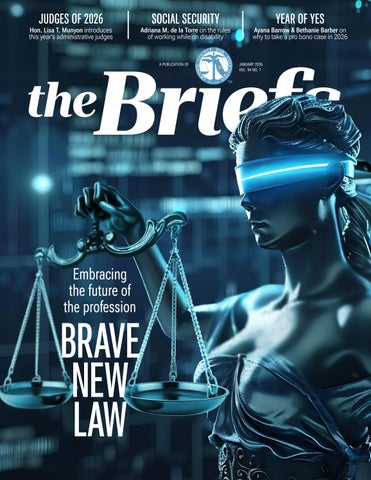
Embracing the future of the profession
BRAVE NEW LAW
YEAR OF YES
Ayana Barrow & Bethanie Barber on why to take a pro bono case in 2026
JANUARY 2026 VOL. 94 NO. 1
the
Contents 12 I
BRAVE NEW LAW Embracing AI in the Paralegal Profession.
LETTERS FROM LEADERS
06 I PRESIDENT’S MESSAGE New Year, New Energy Keshara D. Cowans, Esq.
08 I CLERK’S CORNER Behind the Bench
The Honorable Tiffany Moore Russell, Esq.
10 I CHIEF’S COLUMN
Meet the 2026 Administrative Judges The Honorable Lisa T. Munyon
FROM THE COMMITTEES
18 I SOCIAL SECURITY COMMITTEE
Working While on Disability Adriana M. de la Torre, Esq.
22 I PROFESSIONALISM COMMITTEE
SIDEBAR: NEWS / EVENTS / UPDATES
28 I YOUNG LAWYERS SECTION Michael B. Stone, Esq.
30 I VOLUNTARY BARS Alena V. Baker, Esq.
New Year, New Makeover XiXi Li, Esq.
LEGAL AID SOCIETY
26 I PRO BONO
The Calling of Our Profession Ayana Barrow, Esq. & Bethanie Barber, Esq.
ADVERTISING DEADLINES
Magazine: 10th of month prior to publication eEdition: 20th of month prior to distribution Copy: Six weeks prior to publication If the deadline falls on a weekend or holiday, the deadline is the next business day. Publication of advertising herein does not imply any endorsement of any product, service, or opinion advertised. The opinions and conclusions, including legal opinions and conclusions contained herein, are those of the authors and do not reflect official endorsement by the Orange County Bar Association or its officers and directors, unless specifically stated as such. ©2023 Orange County Bar Association. All rights reserved. ISSN 1947-3968
4I
The Briefs
I JANUARY 2026
O C B A F E B R U A RY LU N C H E O N 880 N. Orange Ave., Orlando, FL 32801 Phone (407) 422-4551 Fax (321) 430-1558 orangecountybar.org Legal Aid Society (407) 841-8310 Citizen Dispute (407) 423-5732 Family Law Mediation (407) 423-5732 Lawyer Referral Service (407) 422-4537 Foreclosure Mediation (407) 515-4330 Young Lawyers Section (407) 422-4551 _________________
the Briefs JANUARY 2026 VOL.94 NO.1
Editor Kate T. Hollis Associate Editors Christine Wasula Tina Leger Columnists Alena V. Baker Michael Stone Officers Keshara Cowans, President Lisa Gong Guerrero, President-Elect Michael Barber, Treasurer Brandon Sapp, Secretary Cooper Powell, YLS President Executive Council Stephanie Alcalde Onchantho Am Jill Davis Kate T. Hollis John M. Hunt Bruce Mount Conti Moore Alisia Profit Rafael O. Rodriguez C Andrew Roy C. Todd Smith Jennifer Thomas Executive Director Candice Disorbo Advertising & Sponsorship Manager Ursla Gallagher
SAVE THE DATE!
Thursday, February 12, 11�30am–1pm at Marriott Orlando Downtown 400 W. Livingston St., Orlando, FL 32801 February Joint Luncheon with Paul C. Perkins Bar Association.
RSVP by Monday, February 9, 2026 Ashley Velez ashleyv@ocbanet.org | orangecountybar.org/store RSVPs and cancellations will not be accepted after February 9, 2026.
TITLE SPONSOR
Marketing & Communications Manager Reatha Cruz-Johnson Design Em Agency, emagency.com _________________
MORE EVENTS
orangecountybar.org/calendar
orangecountybar.org
I The Briefs
I5
PRESIDENT’S MESSAGE
NEW YEAR, NEW ENERGY The Second Half Starts Now
Keshara D. Cowans, Esq., serves as a Staff
Attorney, EEO and Equity Officer, and District Title IX Coordinator in the Office of Legal Services for Orange County Public Schools (“OCPS”), the fourth-largest school district in Florida and the eighth-largest in the nation. Ms. Cowans has practiced law for over 17 years. Her primary practice areas include labor and employment, employment discrimination, and Title IX compliance. She also serves as the legal advisor for the OCPS District Police Department.
6I
The Briefs
Happy New Year! I hope each of you enjoyed the holiday season and had the opportunity to rest and recharge. The holiday break marked halftime of the bar year. As we begin the second half, let’s review what we have accomplished, and come out ready to finish strong. Our committees are executing the game plan with precision. The OCBA staff, executive council members, committee chairs, and volunteers have been leaving it all on the field, and it shows. Here is the thing about halftime: the game is not over. The second half is where champions are made. This is where we dig deeper, execute better, and push through to the finish line. We have momentum on our side, but momentum only matters if we use it. So, here is my halftime challenge: if you have been watching from the stands, suit up and get in the game. Join a committee. Attend a CLE. Reconnect with a colleague at a bar luncheon. Each one of you has something to contribute to this team, and
I JANUARY 2026
we need everyone involved if we are going to make this second half count. We have an incredible lineup of programs and initiatives coming up, and let’s not forget about our championship game—the Bench Bar. This year’s theme says it all: “The Ultimate Playbook: Winning Techniques from the Bench.” This is where we bring together the best plays, the winning strategies, and the techniques that separate good attorneys from great ones. Our judges, the true coaches of the courtroom, will share insights that can change how you practice. This is the culminating event of our bar year, and it is going to be a game-changer. The playbook is solid. Our strategy is sound. Now, we just need to execute. The OCBA will continue to deliver top-tier programming to support professional development, advance access to justice, and strengthen our Orange County legal community. Let’s start this second half fired up, focused, and ready to finish the bar year stronger than we started it!
CLERK’S CORNER
BEHIND THE BENCH Why the Whole Court Needs Support
The Honorable Tiffany Moore Russell, Esq., Orange County Clerk of Courts, has been a member of the OCBA since 2004.
8I
The Briefs
When the Florida Legislature convenes this month, Clerks of Court across the state will once again call for a vital shift in how we fund justice. We’re asking lawmakers to fund the whole courtroom — not just the bench. When new judges are added, caseloads increase, and the work of everyone in the courtroom expands — from Clerks to prosecutors to public defenders. Yet, too often, only the judicial positions are funded, leaving the rest of the system to absorb the added strain with no new resources. The result is slower case processing, heavier workloads, and a justice system stretched to its limits. To their credit, lawmakers have made real progress in recent years to stabilize the Clerks’ funding model, and we are deeply grateful for their partnership. But, despite these efforts, Clerks’ Offices across Florida still face an estimated $75 million shortfall in court-related budgets. This is not a temporary budget challenge; it’s a long-term, structural issue that continues to grow as our communities — and their caseloads — expand. Clerks’ Offices are the operational backbone of the courts. We manage case filings, court records, evidence, jury administration, financial transactions, and the digital systems that keep the justice process running. Every hearing, every order, every public record passes through the Clerk’s Office at some point. When additional judges are appointed, our responsibilities increase — but the resources to meet those responsibilities do not. Adding judges without funding the support structure that makes their work possible creates a bottleneck in the system. A courtroom functions as one ecosystem. When one part is underfunded, the entire system slows down. True efficiency and access to justice require balanced investment across all components —
I JANUARY 2026
the judges, the Clerks, the State Attorneys, and the Public Defenders. That’s why, in the 2026 Legislative Session, Florida’s Clerks will present policy bills to address our budget shortfall, and we are asking lawmakers again for their support. The Clerks’ current funding model, which relies heavily on court fees and fines, was never intended to sustain a modern, high-volume court system. Rising personnel costs, inflation, and the need for digital security and technological modernization have only widened the gap. Without a structural fix, Clerks’ Offices will continue to face difficult choices that affect service levels and efficiency — and ultimately, the people we serve. Our teams are dedicated public servants who take pride in ensuring the integrity, accessibility, and transparency of Florida’s courts. But commitment alone cannot make up for a lack of resources. Sustainable funding ensures we can retain skilled staff, upgrade technology, and continue to deliver the high-quality service our communities expect and deserve. As the 2026 session begins, I encourage members of the Orange County Bar Association and all who work in and around the courts to join us. Speak to your legislators, share your perspective, and help them understand that when we invest in the whole courtroom, everyone wins — judges, attorneys, and, most importantly, the citizens of Florida. Together, we can ensure that justice in Florida doesn’t just move forward — it moves efficiently, equitably, and with the full support of every office that makes it work. Warm regards,
Tiffany Moore Russell Orange County Clerk of Courts
A. MICHELLE JERNIGAN ROBERT A. ‘BOB’ COLE EMCEE
PANELIST
LAWRENCE H. KOLIN PANELIST
Enhance your skills with an in-person CLE featuring veteran mediators, trial lawyers and a U.S. Magistrate Judge as they explore client expectations, communication and effective preparation through the lens of
‘THE VOICE OF THE CLIENT ’
Noon Wednesday, Jan. 21, 2026, at the OCBA Center. Please scan for details.
More details on Upchurch Watson White & Max Mediation Group at UWW-ADR.com or 800.863.1462 Orlando • Ormond • Ocala • Jacksonville • West Palm • Fort Lauderdale • Miami • Tampa • Birmingham
CHIEF’S COLUMN
MEET THE 2026 ADMINISTRATIVE JUDGES The Honorable Lisa T. Munyon is the Chief
Judge of the Ninth Judicial Circuit Court. She has been an OCBA member since 2000.
10 I
The Briefs
It’s officially 2026 – the start of a new year and the start of a new slate of administrative judges at the Ninth. This past October, I asked 15 judges to step into these administrative roles. This was no small ask, and the role’s no small responsibility. To be an administrative or associate administrative judge is to assist with the managerial, procedural, and communicational duties for their divisions: to make recommendations regarding assignments and reassignment of cases; To aid with coverage of divisions and the scheduling of hearing officers and magistrates; To implement procedures as outlined in administrative orders; and To ensure the efficient and effective dispensation of justice. And to do all of this in addition to their normal caseload without additional compensation. To be an administrative or associate administrative judge is a call to service, and
I JANUARY 2026
every judge I’ve asked has answered the call. Their dedication to our circuit and community is bar none, and I am truly grateful for their commitment to the administration of justice. I am also grateful for the commitment and dedication of our 2025 administrative judges, and I’d like to take this opportunity to express a heartfelt thanks to each. While many will continue on in administrative roles, others have changed divisions. Judges Alicia Latimore, Gisela Laurent, Leticia Marques, and Tonya Davis Wilson will move on to new assignments, but their service and leadership deserves recognition. I appreciate all the time and work each of them has given our circuit. And now, without further ado, and per Administrative Order No. 2025-14, allow me to introduce the 15 judges who will play a vital role in shaping the policy, procedures, and function of our courts in 2026.
• General Circuit Civil Division (Orange County—includes Business Court, Probate, Mental Health, Trusts, and Guardianship) • The Honorable Margaret H. Schreiber as Administrative Judge • The Honorable Patricia L. Strowbridge as Associate Administrative Judge • The Honorable Heather L. Higbee as Associate Administrative Judge (probate matters) • Circuit Criminal Justice Division (Orange County—includes Jimmy Ryce Cases) • The Honorable Keith A. Carsten as Administrative Judge • The Honorable Greg A. Tynan as Associate Administrative Judge • Circuit Family Court Division (Orange County) • The Honorable Diana M. Tennis as Administrative Judge • The Honorable Denise Kim Beamer as Associate Administrative Judge • Circuit Juvenile Division (Orange County) • The Honorable Robert J. Egan as Administrative Judge • Unified Problem Solving Court Division (Orange & Osceola Counties) • The Honorable Reginald K. Whitehead • Circuit Appellate Divisions (Orange & Osceola Counties) • The Honorable Kevin B. Weiss • County Court (Orange County) • The Honorable Tina L. Caraballo as Administrative Judge • The Honorable Brian F. Duckworth as Associate Administrative Judge • Circuit & County Courts (Osceola County) • The Honorable Wayne C. Wooten as Administrative Judge of Circuit and County Courts • The Honorable Christine E. Arendas as Associate Administrative Judge of Circuit and County Courts • The Honorable Stefania C. Jancewicz as Associate Administrative Judge of County Court
New Members ATTORNEY David Augustin
Kara Lynn Martin
Cynthia Barnes
Charles McKee
Juliet Bromme
Kevin Morales
Cameron Ausley Carlyle
Gina Naccarato-Fromang
Ashley Castillo, Esq.
Robert James Petillo
Damon Chase
Brandon E. Pownall
Whit Chisholm
Rachael Reese
Ethan Collins
Kyle Schaufel
Jocelyn Dopson-Rodriguez Austin Alexander Esposito Katie Rose Gallagher Judith Anne Garabo Hayes Summer Ann Hetherton Billy Joe Hernandez Nadine Khalaf
Marsha Segal-George Brendan Smith Johannes Sorto Daniel Spencer Tiffany Taylor Jessica T. Vaswani Francheska Verdeguez Robert Willhoit Carrie C. Williams
Victoria Luna
AFFILIATE
Jamerya Drake
EMERITUS
Amanda Rudy
LAW STUDENT
Maily Alvarez-Arizmendi Jordan Casey Alexandria Ariel Chen-Fraser Ornandes Fils-Aime Julia Pusatere Nicolas Ronckovitz Shawn Rubin Ruth Elizabeth Schumacher Jared Williams
PARALEGAL STUDENT Camila Rodriguez
orangecountybar.org
I The Briefs
I 11
BRAVE NEW LAW Embracing AI in the Paralegal Profession AUTHOR Ally Knez
T
he legal profession has never blindly rushed into new technology. We greeted electricity replacing candlelight with suspicion (too modern for the dignity of the courtroom), doubted typewriters (handwriting shows character), mistrusted telephones (too impersonal for clients), and rolled our eyes at photocopiers (carbon paper worked just fine). We even sideeyed online legal research when Westlaw and Lexis promised to outpace the law library (as if a computer could outsmart a stack
12 I
The Briefs
of reporters). Yet, each of these tools, once doubted, became indispensable. Every generation of legal professionals has had its “this changes everything” moment, and artificial intelligence is ours. As a paralegal student about to graduate — and newly navigating the whirlwind of a real law office — I’ve seen both excitement and unease about AI. Some see it as the future; others see it as the apocalypse of the paralegal profession. Either way, the reality is, AI is here to stay! So, rather than fighting its existence, let’s view it as a tool. The
I JANUARY 2026
challenge isn’t to fear it, but to learn it, guide it, and use it responsibly. For an industry that adopted e-filing only after a decade of debate, the idea of artificial intelligence drafting memos and summarizing cases can sound almost heretical. Lawyers and paralegals are trained to verify, not “trust the algorithm.” So, hesitation makes sense. A 2024 ABA survey found only 30 percent of legal professionals use AI tools, while another 40 percent are “curious but cautious.”¹ Top worries? Confidentiality, accuracy, and job security.
orangecountybar.org
I The Briefs
I 13
BRAVE NEW LAW
OUR UNEASE ISN’T REALLY ABOUT AI — IT’S ABOUT CHANGE. 14 I
The Briefs
I JANUARY 2026
That fear isn’t baseless. In Mata v. Avianca (S.D.N.Y. 2023), attorneys were sanctioned for submitting fake ChatGPT-generated citations — now a cautionary tale in every tech-ethics CLE.² Many firms banned AI entirely, treating it like an overeager intern who can’t yet be trusted with the copier code. But our unease isn’t really about AI — it’s about change. The same doubts echoed when Westlaw replaced the law library, e-filing replaced couriers, and Zoom replaced depositions. Each time, the profession adapted. AI is simply the next step — one that rewards curiosity more than caution.³ If this were a movie, we’d still be in the “suspicious first act,” side-eyeing the new character in the office. But that character might become the best assistant we’ve ever had. AI already proves useful — summarizing depositions, organizing discovery, and shaving hours off routine tasks. Studies show professionals using AI finish written work up to 30 percent faster without losing quality.⁴ Another report estimates it could save the U.S. legal industry $20 billion a year — about five hours per professional each week.⁵ For paralegals, those gains aren’t theoretical. Automating Bates label-
ing, tracking discovery, or generating first-draft summaries before your second coffee isn’t replacement; it’s reinforcement. One survey found 72 percent of legal professionals view AI as a positive force.⁶ Think of it as a new paralegal intern — brilliant, fast, eager — but still needing supervision before anything leaves the building. No tool is perfect, especially one that sometimes invents Supreme Court decisions with the confidence of a first-year associate on too much caffeine. AI’s biggest risk is “hallucination,” producing convincing but false information. Confidentiality is another: entering client data into public tools can expose privileged details. More than 60 percent of professionals cite data-security concerns.⁷ And overreliance carries its own danger; AI should be treated like a golden retriever — smart, enthusiastic, and occasionally wrong about which stick you wanted. The ABA Model Rules already provide a compass. Under Model Rule 1�1, competence includes understanding “the benefits and risks associated with relevant technology.”⁸ Rule 5�3 extends a lawyer’s duty of supervision to nonlawyer staff — meaning that if a paralegal uses AI, the supervising attorney remains
Say goodbye to appearance fees! When you order a transcript at the time of deposition. Order your transcript at the time of a one-hour deposition, and we will waive the court reporters’ appearance fee each and every time. (855) MY-DEPOS scheduling@milestonereporting.com Coverage throughout Florida
Plus you get free travel throughout the state of Florida!
Crotts Mediation
CrottsMediation.com
TROY CROTTS Troy@CrottsMediation.com (727) 403-8107
Troy practiced for 37 years as a civil trial litigator and now has a statewide solo mediation practice. He is authorized to mediate in all State Circuit Courts and in the Middle and Northern Federal District Courts. • Florida Supreme Court Certified Civil Circuit Mediator since 2022 • 31-year Florida Bar Board Certified Civil Trial Lawyer • “AV” Preeminent Rating by Martindale Hubbell • Selected as a Florida “Legal Elite”, “Super Lawyer” and “Best Lawyers in America” • Named by Best Lawyers as one of two Tampa “Lawyers of the Year” – Personal Injury Litigation (2014) and Medical Malpractice (2015 and 2023); and recently named as one of two St. Petersburg “Lawyers of the Year” – Personal Injury Litigation and Medical Malpractice • American Board of Trial Advocates – Tampa Bay Member and Executive Board Member
Focusing on medical, long-term care, premises, automobile, trucking and other general negligence claims.
orangecountybar.org
I The Briefs
I 15
BRAVE NEW LAW
Ally Knez is a writer,
administrator, and former teacher. A recent graduate of Valencia College’s ABA-approved Paralegal Studies program, she now works in a local law office, where one of her newest interests is exploring how technology — especially AI — is rewriting the fine print of everyday practice.
responsible. Transparency matters, too. Firms that succeed with AI integrate human oversight at every step.⁹ Ethical use isn’t about red lines; it’s about guardrails. If AI is here to stay, the question isn’t whether paralegals should learn it — it’s where they will. Paralegal programs still teach research and writing the traditional way, and rightly so. But modern training should also include AI literacy: verifying outputs, safeguarding confidential data, and understanding automation’s limits. ABA-accredited programs could and should add short certification labs
1. American Bar Association, 2024 Legal Technology Survey Report (2024), lawnext.com. 2. Mata v. Avianca, No. 22cv-1461 (S.D.N.Y. 2023). 3. Thomson Reuters, ‘AI and the Legal Profession: Trends and Insights’ (2024), legal.thomsonreuters.com. 4. CallidusAI, ‘Does AI Drive Productivity for Legal?’ (2024), callidusai.com. 5. 2Civility, ‘AI Usage Could Save U.S. Legal Industry �20 Billion Annually’ (2024), 2civility.org. 6. Thomson Reuters, supra note 3. 7. Thomson Reuters, ‘AI and the Legal Profession: Trends and Insights’ (2024), legal.thomsonreuters.com. 8. ABA Model Rule 1.1 cmt. 8 (2025). 9. Thomson Reuters, supra note 3.
16 I
The Briefs
I JANUARY 2026
using vetted tools, much like e-discovery training. Law firms share this duty. Mentorship should include conversations about using AI responsibly, not blanket bans that stifle innovation. Paralegals who understand both the law and the logic behind these tools will become essential translators — bridging attorneys, clients, and machines. AI isn’t replacing the paralegal; it’s redefining the skill set. When photocopiers arrived, some worried they’d make lawyers sloppy. When word processors came, others swore nothing could replace the typewriter. Yet here we are — and no one’s
clamoring for carbon paper. AI is just the next chapter in that long story of legal evolution. The profession has never stood still; it adapts, absorbs, and refines every tool that enters the office. AI will be no different — unless we let fear hold the pen. By their very nature, paralegals are translators of complexity — bridging people, process, and precision. With clear ethics, sound judgment, and curiosity, they can do the same for AI. Because the future of law won’t be written by machines. It’ll be written with them — by professionals unafraid to plug them in.
SOCIAL SECURITY COMMITTEE
WORKING WHILE ON DISABILITY Adriana M. de la Torre, Esq. represents
individuals who have been denied Social Security benefits and must seek judicial review of the Social Security Administration’s decision in federal court. Adriana co-founded Tower Law Group in order to approach every case with empathy and determination.
18 I
The Briefs
SSDI: TRIAL WORK PERIODS AND EXTENDED ELIGIBILITY
For SSDI recipients, the system is designed with some flexibility to encourage attempts at work. The What Attorneys Need to Know Trial Work Period (TWP) allows clients to test their t’s a question that comes up in nearly every Social ability to work for nine Security Disability case: “Can I work while I’m on months within a 60-month disability?” For many clients, the desire to return rolling period. During this to work isn’t just financial. It’s about identity, indepentime, they can earn any dence, and dignity. Yet the rules around working while amount, even far above receiving disability benefits are complex, and a single SGA, and still receive their misstep can cause overpayments, benefit termination, or full benefits. In 2025, any months of waiting for reinstatement. month with earnings over $1�160 counts toward the nine-month total. Once the TWP ends, cliSo as attorneys, we may ents enter a 36-month ExThe calculation isn’t altended Period of Eligibility not be employment counways straightforward. SGA (EPE). Here, the rule is simselors, but we are often the is based on gross earnings, ple: if monthly earnings fall only professionals in a posi- not net, and it’s measured tion to give clients accurate, monthly, not annually. A cli- below SGA, benefits conpractical guidance. Underent who earns $1�600 in one tinue. If earnings rise above standing the structure of month but nothing the next SGA, benefits are suspendSocial Security’s work rules may still be flagged by SSA ed. Importantly, benefits allows us to protect beneif the pattern looks like on- can start and stop multiple times during this period, fits, prevent crises, and sup- going SGA. Self-employed depending on income. port clients who want to try clients face even trickiIf benefits are eventually returning to the workforce. er rules, since SSA looks at terminated because of susboth income and the value tained work above SGA, cliWHY SUBSTANTIAL GAINFUL of work performed. ents may still be eligible for One protection is the ACTIVITY MATTERS expedited reinstatement The cornerstone of Social ability to deduct impairSecurity’s disability frame- ment-related work expens- within five years if they stop working again due to work is Substantial Gaines (IRWEs), such as medtheir disability. This avoids ful Activity (SGA). Put sim- ications, medical devices, the need to file a brandply, if a person is working or specialized transportanew application, which can at a level that demonstrates tion. These can lower the take months or years. “substantial gainful” abili“countable” income and For attorneys, the practy, they are no longer conbring a client back under tical challenge is that SSA sidered disabled. For 2025, SGA. Attorneys who redoesn’t always calculate the SGA threshold is $1�620 mind clients to document per month for non-blind and save receipts can help trial work months correctly. Keeping independent individuals and $2�700 for preserve benefits during records for clients, and enblind individuals. work attempts.
I
I JANUARY 2026
BUSINESS & CONSTRUCTION MEDIATION
Thomas P. Wert Downtown Orlando Office 407-428-5197 twert@deanmead.com
Certified Florida Supreme Court Mediator Certified Federal Court Mediator Board Certified in Construction Law, The Florida Bar 30 Years’ Experience in Business and Construction Law Board of Governors, The Florida Bar
www.deanmead.com
Practice Law More Efficiently Seamless Case Management Advanced Document Automation Automated FLSSI Probate & Guardianship Forms Robust Legal Accounting & Billing Award-Winning Legal AI
LEARN MORE AT LEAP.US
orangecountybar.org
I The Briefs
I 19
SOCIAL SECURITY COMMITTEE Section 1619(b), clients can keep Medicaid coverage even if their income is too high for a cash payment. Unlike SSDI’s time-limitSSI: A DIFFERENT ed protections, these SSI SET OF RULES work incentives can conClients receiving Suppletinue indefinitely as long as mental Security Income the person remains other(SSI) face a different system altogether. Because SSI wise eligible. is needs-based, the focus isn’t on whether someone WORK INCENTIVE is working above substanDEDUCTIONS: THE tial gainful activity (SGA), HIDDEN ADVANTAGE but on how earnings reOne of the least understood duce benefits. The formula aspects of working while is designed to allow work, disabled is the system of with benefits tapering off work incentive deductions. gradually as income rises. These provisions acknowlHere’s the math: each edge that people with dismonth, the first $20 of any abilities may need to spend income and the first $65 of money in order to work, earned income are exclud- and they reduce countable ed. After that $85 total ex- income accordingly. clusion, SSI benefits are • Impairment-Related reduced by $1 for every $2 Work Expenses (IRWE): of earned income. For exMedications, medical deample, someone earning vices, service animals, or $885 in wages subtracts transportation needed $85, leaving $800 in countfor work. able income. That reduces • Blind Work Expenses their SSI check by $400— (BWE): For blind individbut it doesn’t eliminate it. uals, nearly any expense With the 2024 federal benrelated to working—from efit rate of $943, that pertransportation to meals— son would still receive can be deducted. $543 in SSI. • Subsidies: If an employTwo provisions make SSI er accommodates a disparticularly work-friendly. ability by paying more Under Section 1619(a), rethan the value of actucipients can continue to real productivity, the exceive SSI payments even cess is treated as a subif they technically earn sidy and does not count above SGA, so long as their toward SGA. income after deductions For clients, these deduchasn’t reached the “break- tions can make the difeven point.” And under ference between staying couraging them to do the same, can prevent future disputes.
20 I
The Briefs
I JANUARY 2026
below SGA and crossing the line. For attorneys, the advice is simple: tell clients to document everything.
sible, connect them with Work Incentive Planning and Assistance (WIPA) services through SSA’s Ticket to Work program. Once a client begins WHEN WORKING MAY DO working, stay engaged. MORE HARM THAN GOOD Track trial work months, Not every client should attempt work, and part of our check for overpayment notices, and maintain role is recognizing when the risks outweigh the ben- open communication. If problems arise—benefits efits. Clients with pendstop, overpayments occur, ing disability cases may or reinstatement is dejeopardize their eligibility if they take on work that nied—act quickly. Reconsideration, expedited reexceeds SGA. Those with fragile mental health or un- instatement, and waiver requests are all tools availstable medical conditions able to protect clients. may trigger overpayments The intersection of work or termination without a realistic chance of sustaining and disability benefits is complicated, but it doesn’t employment. Older clients close to retirement age may have to be dangerous. Social Security has created also decide the risks aren’t worth the potential benefit. programs to support peoThis isn’t about discour- ple who want to return to aging work, but about bal- work, but those programs only work when clients ancing hope with realistic and their attorneys underexpectations. A supportive but cautious conversa- stand the rules. By offertion can prevent bigger set- ing clear advice, practical tracking, and proactive rebacks down the road. porting, attorneys can help clients test their capaciPRACTICAL GUIDANCE ty to work without losing FOR ATTORNEYS So what can attorneys do? the financial security they The answer is not to mem- fought so hard to win. In the end, our job is to orize every SSA rule, but to bridge the gap between guide clients through the a client’s desire to work process thoughtfully. Beand the complex system fore a client starts workthat governs their benefits. ing, encourage them to contact Social Security di- With foresight and careful guidance, that bridge can rectly and get informahold steady, and our clition in writing. Make sure they understand how to re- ents can step onto it with confidence. port earnings, and if pos-
PROFESSIONALISM COMMITTEE
NEW YEAR, NEW MAKEOVER
XiXi Li, Esq.
Associate at Sasso and Sasso, P.A. where she practices commercial, construction, and election law litigation. Ms. Li currently serves as the President of the Greater Orlando Asian American Bar Association (“GOAABA”), The Florida Bar Young Lawyers Division (“YLD”) Governor for the Ninth Judicial Circuit, and Chair of the OCBA Professionalism Committee. Ms. Li can be contacted at xli@sasso-law.com.
22 I
The Briefs
changed by court order.” Fla. R. Civ. P. 1�200(d)(3). In the event that you are unable to meet case management deadlines, this rule allows “the affected party may promptly set a hen I first sat down to write this article, an case management conferunexpected thought came to mind—the song ence and alert the court.” “New Person, Same Old Mistakes” by Tame This also includes the inImpala. Its catchy beat is hard to ignore, but its message ability to meet case manwas the exact opposite of what I wanted to convey. That contrast sparked a realization: it has now been one full year agement deadlines due to since the Florida Rules of Civil Procedure underwent one of the unavailability of hearing time.” The case management the most significant updates in recent memory. In fact, the most recent revisions were just published on June 19, 2025. conference request, however, must be done timely and not after the deadlines have passed. Rule 1�200(g) states: (g) Inability to Meet Case These rule changes were RULE 1.200: CASE Management Deadlines. If designed to modernize litiMANAGEMENT ORDERS any party is unable to meet gation practice and promote Rule 1�200 underscores the the deadlines set forth in the efficiency, but as with any judiciary’s commitment to case management order for major overhaul, implemenactive case management. tation has not been without Under this provision, courts any reason, including due to the unavailability of hearing challenges. While the rules are required to issue case time, the affected party may are firmly in effect, many at- management orders early torneys still find themselves in the litigation process, es- promptly set a case managenavigating unfamiliar terrain, tablishing firm deadlines for ment conference and alert the court. The notice of case adjusting long-standing hab- discovery, motion practice, management conference its, and ensuring compliance and trial periods. These are must identify the issues to under the new framework. not aspirational timelines be addressed in the case In this article, we’ll re— they are binding schedvisit substantive amendules designed to keep cases management conference. Fla. R. Civ. P. 1�200(g) ments to Rules 1�200, 1�202, moving efficiently and pre(June 19, 2025). Be proacand Rule 1�280 – the chang- vent unnecessary delays. tive and ensure you are able es, why it matters, and how The rule reflects Florida’s the past year has revealed broader initiative to stream- to request a short matters hearing to address the deadboth opportunities and pain line litigation and avoid lines. Many judges in our points for practitioners. cases lingering for years. Whether you’ve fully emMissing a deadline, however, circuit have ongoing short braced the new rules or are can carry significant conse- matters hearing times on a weekly basis. still ironing out the details, quences. Failure to comply this is the perfect time to re- with the case management flect on their practical imdeadlines violates Rule RULE 1.202: CONFERRAL pact and what they mean for 1�200’s admonition that case BEFORE YOU FILE the future of civil litigation management deadlines “will Rule 1�202 is often referred in Florida. be strictly enforced unless to as the “cooperation rule.”
W
I JANUARY 2026
Nominations Now Open for OCBA Leadership Positions NOMINATING GUIDELINES The following elected leadership positions are open for nominations: OCBA Executive Council (One-year term for each position: June 1, 2026, through May 31, 2027.) • Vice President/President-Elect • Treasurer • Secretary (Three-year term for each position: June 1, 2026, through May 31, 2029.) • Three (3) Executive Council Seats
Legal Aid Society of the OCBA (Three-year term for each position: June 1, 2026, through May 31, 2029.) • Two (2) Trustee Seats
Young Lawyers Section of the OCBA (Two-year term for each position: June 1, 2026, through May 31, 2028) • Five (5) Board Member Seats
Important Deadlines Nomination Period: Open now through Friday, January 9, 2026 Election Period: February 9, 2026 through Friday, February 20, 2026 Board Appointments / Officer Installations: May 2026
1. Blank nomination forms are available on the OCBA website, under the About Us/NominationsElections section. 2. Completed nomination form(s) must be sent via email to Candice Disorbo at candiced@ocbanet.org 3. Each nomination form must be signed by no less than five (5) OCBA members in good standing. 4. For YLS nominations, the forms must be signed by no less than five (5) OCBA members in good standing, who are also YLS members. 5. Any nomination for the offices of Vice President/ President-Elect, Treasurer, or Secretary of the OCBA Executive Council shall only be accepted if the nominee has already served on the OCBA Executive Council at least one (1) year. 6. To make sure you receive your election ballot, log in to your member account on the OCBA website to check that your email address is correct, no later than December 31, 2025. 7. If you need to update your email address and do not know your username, please contact Carolyn Cochrane, at carolync@ocbanet.org, or 407-4224551, Ext. 245, for assistance. If you need to reset your password, please follow the password reset instructions.
PROFESSIONALISM COMMITTEE Before filing any non-dispositive motion, attorneys are now required to confer in good faith with opposing counsel in an effort to resolve the issue without court intervention. This obligation is not merely procedural — lawyers must also file a certificate of conferral demonstrating that these efforts were made. Gone are the days of submitting motions without so much as a courtesy call and email follow ups do not always count as a conferral. The purpose of this rule is to reduce unnecessary hearings and encourage meaningful dialogue between counsels before scheduling court time. Practitioners should also be aware that many judges impose additional conferral requirements as part of their individual procedures, so reviewing your judge’s guidelines is essential to avoid missteps. Rule 1�202(c) does provide exceptions. Certain motions. such as motions to dismiss, motions for summary judgment, and motions seeking an extension of time for service may be filed without prior conferral. However, if a motion falls within one of these exemptions, it must affirmatively state the exemption and the basis for it. At the end of the your motion, you must state the following certificate of conferral from Rule 1�202(b):
24 I
The Briefs
(b) Certificate of Conferral. At the end of the motion and above the signature block, the movant must include a certificate of conferral in substantially the following form: “I certify that prior to filing this motion, I discussed the relief requested in this motion by [method of communication and date] with the opposing party and [the opposing party (agrees or disagrees) on the resolution of all or part of the motion] OR [the opposing party did not respond (describing with particularity all of the efforts undertaken to accomplish dialogue with the opposing party prior to filing the motion)].” OR “I certify that conferral prior to filing is not required under rule 1�202.” Fla. R. Civ. P. 1�202(b) (June 19, 2025). Keep this certificate handy because you may need to paste it in your motion more often than you think.
RULE 1.280: DISCOVERY
Discovery has long been considered the “Wild West” of litigation, but Rule 1�280 brings structure and balance. The amendments emphasize proportionality: discovery requests must be tailored to the specific needs of the case rather than serving as broad fishing expeditions. Courts are expected to enforce these
I JANUARY 2026
limits to curb excessive lawyering and prevent overwhelming document productions. In short: less “bury them in paper,” more “obtain what is truly necessary.” Rule 1�280(a) serves as the starting point for all discovery requests. A party may not seek discovery until it has served its Initial Discovery Disclosures. (Tip: disclosures are served, not filed.) However, a Notice of Service of Initial Discovery Disclosure pursuant to Fla. R. Civ. P. 1�280(a) should be filed with the court when disclosures are served. Rule 1�280(a)(3) states the following: (3) Time for Initial Discovery Disclosures. A party must make the initial discovery disclosures required by this rule within 60 days after the service of the complaint or joinder, unless a different time is set by court order. Fla. R. Civ. P. 1�280(3) (June 19, 2025). Additionally, Amended Rule 1�280(f) clarifies that a party may not serve formal discovery requests until its disclosures have been served, not merely completed, on the opposing party. This sequencing ensures disclosures guide discovery rather than duplicate or preempt it. Rule 1�280(f) states: (f) Timing and Sequence of Discovery. (1) Timing. A party may not seek discovery from any
source before that party’s initial disclosures are served on the other party, except when authorized by stipulation or by court order. (2) Sequence. Except as provided in subdivision (c) (5), or unless the parties stipulate or the court orders otherwise, methods of discovery may be used in any sequence, and the fact that a party is conducting discovery, whether by deposition or otherwise, must not delay any other party’s discovery. Fla. R. Civ. P. 1�280(f) (June 19, 2025). Lastly, each party has an ongoing duty to timely supplement discovery if new information becomes available. One year after the Florida Rules of Civil Procedure overhaul, the message is clear: efficiency, cooperation, and proportionality are no longer aspirational, they are mandatory. From early case management orders to initial disclosures and conferral requirements, these changes demand a proactive approach from practitioners. Staying informed and adapting your practice is not just about compliance; it’s about positioning yourself to litigate effectively in a system designed to move cases forward. The rules have changed so make sure your strategy has too. As of the date of this article, the Florida Rules of Civil Procedure were updated on January 1, 2026, with no new substantive changes to the aforementioned rules.
Preferred Vendors These vendors support the OCBA by offering special discounts to members. We encourage you to use their services to grow your practice. For more information, visit orangecountybar.org/page/Preferred-Vendors
LEGAL SUPPORT SERVICES
Florida Lawyers Mutual Insurance Company. The Florida Bar’s professional liability insurance to help protect Florida lawyers and their clients. 800-633-6458 Optimize My Firm. Full digital marketing suite for law firms including website design, content development, local search, Google ads, and SEO. optimizemyfirm.com
PRACTICE MANAGEMENT SYSTEMS
CaseFox. Includes time tracking, AI document generation and analysis, invoicing, and full LEDES and UTBMS billing compliance. Equipped with Integrated with Quickbooks, LawPay, Xero, and more. Clio. The most widely used cloud-based practice management system in the world. Members receive 10% on lifetime monthly subscription. clio.com/OCBA LEAP. Cloud-based productivity solution combining practice management, accounting, document management, and legal publishing. leap.us/florida / 844-702-LEAP
FULFILL YOUR LEGAL AID REQUIREMENT
4 Ways
1. Take Cases as needed by the Legal Aid Society in Family Law, Consumer Law, Housing Law, Immigration Law, Veterans, Sealing and Expunction, or other areas.
2. Be a Guardian ad Litem (GAL) and
take cases as needed by the Legal Aid Society in Dependency, Transitions, Appeals, Delinquency, or Child Victim/Witness Cases.
3. Participate in Projects as needed in
Bankruptcy, Citizen’s Dispute Settlement, Family Mediation, Community Education, Tax, Teen Court, Teen/Parent Education, Housing Advice Clinics, or others.
4. Contribute Financially. Donate $350 in
lieu of service and help ensure Legal Aid can provide services to the disadvantaged in our community.
MatterSuite. AI-powered legal matter management software designed for in-house legal teams, law firms, and corporate counsel.
HOTEL SAVINGS
The Residence Inn by Mariott. Discounted rates include complimentary self-parking, complimentary breakfast buffet, wireless HSIA. 680 N Orange Ave. / 407-482-1500
DISCOUNT SERVICES & MERCHANDISE
OCBA Merchandise. Shop official OCBA apparel and accessories! Shirts, hats, visors, totes, water bottles and more. All sales go directly to the OCBA Foundation. ustore.net/group/orange-county-bar-association OCBA Marketplace. National Purchasing Partners (NPP) helps OCBA members reduce costs with exclusive pricing for a variety of popular brands including 1-800-Flowers, AmEx, Harry & David, HP, Omaha Steaks, Sherwin-Williams, Staples, Verizon, and more. Enroll for FREE at bit.ly/OCBASavingClub To become a Preferred Vendor, contact our Advertising & Sponsorship Department. The businesses listed herein (the“Vendors”) are not affiliated with the Orange County Bar Association (OCBA) and shall not under any circumstances be deemed to have any authority to act on behalf of the OCBA. The OCBA does not make, and expressly disclaims, any warranty, representation, responsibility, or guarantee as to (a) the quality or suitability of the Vendors, their products, or services, and (b) the duration or validity of any discount or other promotion offered by any of the Vendors.
orangecountybar.org
I The Briefs
I 25
LEGAL AID SOCIETY: PRO BONO
THE CALLING OF OUR PROFESSION
Ayana Barrow
Legal Aid Society of the OCBA, Inc. Board President 2025-2026, OCBA Board Member Since 2021, Member of OCBA since 2015
Bethanie Barber
Legal Aid Society of the OCBA Executive Director, OCBA Board Member Since 2008
26 I
The Briefs
And make no mistake about it: the law is a maze. For those without training, it can be impenetrable. We hear this regularly from our judges, honorable jurists doing their very best to call Why This Year Must Be the Year You Say balls and strikes from the Yes to Pro Bono. bench. They are bogged down by insufficient pro se his year, as we sit down to write this message pleadings they must deny. to our colleagues across our incredible Orange But for you and us, the County legal community, we are reminded of law is familiar terrain. We one simple, powerful truth: our profession holds the have the map. We know keys to justice. the rules, the strategy, and the way through. What a layperson may never understand, you can resolve The law shapes people’s can meet. The stories that in a single motion or hearcross our paths are both lives in ways few other ing. Please let that sink in: heartbreaking and familsystems can. It opens in a single motion, you can iar: a single mother facdoors or closes them. It reposition someone’s life. protects or exposes. It up- ing eviction because her That’s not an exaggeralandlord refused to relifts or destroys. And only tion. It’s the extraordinary those of us who have stud- pair a broken air condipower of your training, tioner after repeated reied it, practiced it, and your experience, and your sworn to uphold it can use quests; a senior citizen professional judgment. denied disability benefits it to protect those who That’s why only you can cannot protect themselves. due to a paperwork error do this work. Your skills she couldn’t decipher; a That truth carries both a are not ordinary; they are tremendous weight and an veteran trying to expunge extraordinary opportunity. a decades-old misdemean- life-changing. We often hear many lawThis coming year, we are or that has kept him from yers humbly say, “I don’t asking you as fellow OCBA steady work; a survivor know if my skills are that of domestic violence who members and lawyers to fears losing custody of her special.” Let us assure you: take on a pro bono case children because she can’t they are. When you know through the Legal Aid Sohow to draft a motion, innavigate the family court ciety. Not “someday.” Not terpret a statute, negotisystem alone. “when things slow down.” ate a settlement, or stand These are not “abstract Now. Because for someup in court to advocate clients.” They are our one out there who cannot for someone, those are suneighbors, our fellow citiafford representation but zens. They are people who perpowers. The rest of the still deserves justice, your world sees what you do as work hard, who believe in decision to say “yes” will magic. And in a sense, it is. fairness, and who simply mean everything. To a tenant facing evicEvery day, the Legal Aid need someone to help them tion, you are not just a find their way through the Society receives more relawyer. You are stability. maze of the law. quests for help than we
T
I JANUARY 2026
We know the demands of our work: the pressure of deadlines, clients, partners, and family. It can feel impossible to take on one more thing. But just like professional growth, justice cannot wait for convenience. It depends on commitment. And you don’t have to do it alone. The Legal Aid Society provides full training, mentoring, and resources. You will have experienced staff attorneys guiding you every step of the way. Whether you are a firstyear associate or a senior partner, we will match you with a case that fits your BEYOND THAT, THERE ARE experience, schedule, and TANGIBLE REWARDS: • Professional growth: Pro interests. What we need is your bono work hones your “yes.” advocacy skills, broadens your experience, and Your time. Your expertise. builds leadership within Your heart. Together, we can keep your firm. • Firm culture: Teams that justice within reach for those who need it most. engage in pro bono toWhen you support LAS gether develop camawhether through a finanraderie, empathy, and cial contribution or by takpride that strengthing on a pro bono case, en their professional you reaffirm the sacred relationships. trust people have in the • Community reputation: legal system. You remind The legal community notices when lawyers the public that lawyers are not just advocates for hire, step up. Clients, judges, but stewards of justice. We and peers respect those are the bridge between the who give their time to system and the people it serve others. serves. We are, quite literBut most importantally, the ones who make ly, you will know that you the promise of “equal jusused your talents for the tice under law” mean highest purpose our prosomething. fession allows. To a parent fighting for custody, you are not just counsel. You are hope. To an elderly or disabled person denied benefits because of a clerical error, you are not just representation. You are dignity restored. The law is a living promise that every person, regardless of wealth or background, has rights worth defending. But that promise only becomes real when one of us steps forward to enforce it. That’s why your pro bono work is not charity. It is justice in action.
is proud to announce
Jeffrey M. Fleming has joined our distinguished panel of neutrals
J e f f , a h i g h l y s o u g h t a f t e r m e d i a t o r, arbitrator, and special magistrate, has the distinction and unique perspective of being a Board Certified Specialist in Civil Trial Law and retired Florida Circuit Court Judge. He also served as an Associate Judge on the Fifth District Court of Appeal. Jeff handles a broad variety of matters as a Florida Supreme Court Certified Circuit, Appellate, and Family Law Mediator; Federal Court Mediator Certified by the Middle District of Florida; and Florida Supreme Court Qualified Arbitrator.
To learn more about Jeff and to schedule a matter, please visit:
adrsource.com 888.741.2224 Solving the world’s problems…one case at a time
So friends, as we look to the year ahead, we ask you, please say yes. Support LAS through a $350 fee in lieu of service contribution. Then, take one case. Change one life. Use the extraordinary gifts you’ve been given to serve those who have nowhere else to turn. When lawyers lead, when we lend our skill and our strength to the most vulnerable among us, justice doesn’t just live in the courtroom. It lives in our communities, in our clients, and in our hearts. Let’s make this the year we bring justice home to Orange County.
What we need is your “yes.” Your time. Your expertise. Your heart. Together, we can keep justice within reach for those who need it most.
orangecountybar.org
I The Briefs
I 27
1
SIDEBAR
SIDEBAR: NEWS / EVENTS / UPDATES NEWS / EVENTS / UPDATES
YLS on the Move OCBA YLS hopes you had a wonderful holiday season and a strong start to the New Year. Let’s kick things off by setting clear goals, tracking our progress, and staying consistent. We’re excited to keep raising the bar with standout events all year. December may have been full of “silent nights,” but first, let’s look back at November!
Charitable Holiday Party at The Alfond Inn
Legacy & Lights, the OCBA YLS Charitable Holiday Celebration, was an absolute blast! We closed out 2025 in style with great company, delicious food, festive libations, and a successful toy drive for the kids at Washington Shores Elementary! The beautiful Winter Park venue set the perfect backdrop for an evening filled with laughter, connection, and holiday spirit. A huge thank you to all of our incredible sponsors and attendees for making the holiday season memorable.
Thanksgiving Basket Brigade
Our Thanksgiving Basket Brigade was another huge success! We donated dinners to families in need across Central Florida and raised even more funds during our happy hour to provide additional meals. Every dollar and donation helped make Thanksgiving and the holiday season brighter for families here in Orange County. Thank you to everyone who contributed and joined in to support this meaningful cause!
28 I
The Briefs
I JANUARY 2026
2
Michael B. Stone, Esq., Partner at Jordan Dougherty Stone LLP, specializes in commercial litigation, first-party property, general liability, and personal injury claims. OCBA Member Since 2020. FOLLOW US!
@OCBAYLS #TogetherWeGoFar
3
OTHER YLS EVENTS FEBRUARY LUNCHEON / February 13, 2026
EVENING WITH THE JUDICIARY / February 2026
WILLS FOR HEROES / March 2026
GREAT OAKS VILLAGE FIELD DAY / April 2026
November Luncheon
We were honored to welcome Andre T. Young, Esq. in November for an inspiring talk on building your brand, reputation, and book of business. His insights on mastering the business of law left our young attorneys motivated to take their careers to the next level. Grateful to share this inspiration with our young attorneys.
Golf Tournament
In November, we teed off against some of the best attorneys and most entertaining golfers in Orange County! Our teams brought their A-game at Rio Pinar Golf Course, spending the day sinking birdies, sharing laughs, and enjoying great food and networking. The fun concluded with a lively reception, lunch, and awards ceremony. It was a fantastic Friday on the course with friends and colleagues!
Past Presidents Dinner
YLS is on its 41st year. Twenty-eight presidents came together for the first annual Past Presidents Dinner. Enjoyed a meal, shared memories, discussed the future of the YLS.
4
BOOK FAIR AT WASHINGTON SHORES AND MOLLIE RAY ELEMENTARY / May 2026
STAY INFORMED: To ensure you’re always up-to-date with YLS activities, please sign up for our weekly email blasts. Visit our website and click “Sign Up for YLS Emails.”
WHO’S WHO 1 OCBA YLS Past Presidents 2 James Davis, Jacob Schumer, Sharlene C. Greene, Sabrina Jadunandan and to the Right, Cooper Powell, Kelsey Weiss, XiXi Li, and Clyde Lemon 3 YLS President Cooper Powell, President-Elect, Sean Mendez-Catlin, Chair Lia Matoss, Leesa Bradley from Paralegal section, and our wonderful sponsors at the OCBA YLS Gold Tournament. 4 YLD President Arti Hirani and YLS President Cooper Powell, with OCBA Member Brandon Sapp and OCBA YLS directors at Salvation Army Halloween Party
100 Club Firms with two or more attorneys who are all members can belong! If your firm is eligible, call the Membership Department (407-422-4551 x225)
20+ MEMBERS GoodBlatt – Leo
Rumberger, Kirk & Caldwell Shutts & Bowen Wicker, Smith, O’Hara, et al. Winderweedle, Haines, et al.
10-19 MEMBERS
Colling Gilbert Wright Fisher Rushmer McDonald Toole Richman & Correnti, P.A Stovash, Case, Shay & Pearce
2-9 MEMBERS
The Aikin Family Law Group Anderson & Ferrin The Arnold Law Group Artemis Family Law Barrister Law Firm Carr Law Firm Compass Law Davey Law Group DeCiccio & Johnson Dellecker Wilson King McKenna Ruffier & Sos Divine & Estes The Draves Law Firm The Elder Law Center of Kirson & Fuller Fassett, Anthony & Taylor Frank Family Law Practice The Fighter Law Firm
orangecountybar.org
Haliczer Pettis & Schwamm Harris Harris Bauerle Lopez Hilyard, Bogan & Palmer Jill S. Schwartz & Assocs. Keating & Schlitt King, Blackwell, Zehnder & Wermuth Korshak & Assoc. Kosto & Rotella Law Offices of Brent C. Miller Lebron Law Marcus & Myers The Marks Law Firm McMichen, Cinami & Demps McShane & McShane Murphy & Berglund N. Diane Holmes P.A. O’Mara Law Group Orange Blossom Law Page & Eichenblatt Perez LaSure Sawyer & Sawyer Shannin Law Firm Stovash, Case, Shay & Pearce, P.A. Tangel-Rodriguez & Assoc. Warner & Warner West Family Law Group Wieland & DeLattre Wilson McCoy Wooten Kimbrough Yergey & Yergey
I The Briefs
I 29
SIDEBAR: NEWS / EVENTS / UPDATES
2 OTHER VOLUNTARY BAR EVENTS ON NOVEMBER 13 / CFAWL participated in the Legal Aid Society’s Breakfast of Champions.
1
Voluntary Bars November Luncheon
Central Florida Association for Women Lawyers (CFAWL)
November started off strong with a luncheon titled “Rethinking Neurodiversity in the Legal Industry.” The luncheon featured Haley L. Moss who is a lawyer, author, and nationally recognized neurodiversity advocate. On November 9, 2025, Jamie Moses hosted a Table for 8 titled “Brushes, Brooches, and Bubbly”. Attendees had an incredible time creating a holiday craft and as a bonus got to take home a special brooch hand selected by Jamie.
AI Presentations
The George C. Young American Inns of Court
The George C. Young American Inns of Court met to continue presenting topics focused on AI. The most recent presentation was titled “The Use of AI to Craft Openings, Closings, and Directing Cross-Examination: Ethical Imperatives and Practical Realities.” The program, led by Pupillage Team 2 and Judge Tom Young, explored using tools like Claude AI and Microsoft 365 Copilot. The presentation stressed the lawyer’s non-delegable duties regarding confidentiality, accuracy (avoiding “phantom citations” for example), and technological competence. Exercises showed that members could not distinguish AI-written from human-written narratives, confirming AI’s high quality. However, the team cautioned that AI-generated direct and cross-examinations frequently erred by introducing hearsay, compound questions, and “ghost people” (factual hallucinations as opposed to the widely reported case law hallucinations). The final advice emphasized that the ultimate responsibility rests with the lawyer to maintain professional judgment WHO’S WHO and avoid letting AI compromise the case. 1 OCBA Professionalism
Committee (Left: Paul Shafranski, Therese Savona, Tabetha Bennett, Teresa Adams. Right: Christine Hammond, Diane Womack, XiXi Li, Ollie Phipps, Robert Borr.) 2 Black Women Lawyers Association members who attended a “girls-giving” event hosted by Barry Law’s Women Lawyer Association.
3
3 George C Young Inn of Court
30 I
The Briefs
I JANUARY 2026
ON NOVEMBER 30 / Donna Haynes hosted A Wickedly Wonderful Movie Meetup where CFAWL members traveled to Oz to watch Wicked for Good. ON NOVEMBER 19 / The Paul C. Perkins Bar Association (PCPBA), hosted a Law Student Mentoring Program Meet and Greet. The event happened at the Exchange Orlando and featured light refreshments. The very next day, the PCPBA hosted a General Body Meeting at the Heart of West Lakes Wellness Center. The event was titled “Pathways to Power: Leadership and Corporate Success for African American Lawyers.” In addition, throughout the majority of November, the PCPBA collected donations to purchase items for the Pine Hills Community Center.
ON NOVEMBER 12 / the Hispanic Bar Association of Central Florida (HBACF) hosted a fun evening of play titled “Dominos 101” where teachers shared their amazing skills, strategy and passion for the game.
ON NOVEMBER 14 / the HBACF hosted a Happy Hour and Toy Drive.
ON NOVEMBER 24, 2025 / the HBACF hosted a Friendsgiving Luncheon at the OCBA.
THROUGHOUT THE MONTH OF NOVEMBER / the Central Florida Association of Criminal Defense Lawyers hosted a winter coat drive to help those in need.
Alena V. Baker, Esq., of Alena Baker Criminal Defense, P.A., is a solo practitioner who practices primarily in the area of criminal law throughout Central Florida. She has been a member of the OCBA since 2011 and is a board member of the Criminal Law Committee of the OCBA.
880 North Orange Ave. Orlando, FL 32801
PRSRT STD U.S. POSTAGE PAID ORLANDO, FL PERMIT NO. 2530