VETENSKAP # 1–2018 www.optikbranschen.se
Nytt år kommer med nyheter
I
nnan julen 2017 fattade IVO beslutet att även Leg Optiker får sälja kontaktlinser utan kontroll eller journalföring. Som det står i informationen vi fått från både Optikerförbundet och Optikbranschen så är det en möjlighet, inte ett krav. Det är alltid den Leg Optikern som beslutar om det kan ske. Vilket är tur för det finns många linser som måste tillpassas eller att ordinationen av en specifik linssort är gjord med tanke andra orsaker än endast myopi eller hyperopi. Linser idag är så mycket mer än endast endags- eller månadslinser som kan köpas på många ställen. Linser ordineras också som behandling för myopikontroll, det kan vara både Orto-K och progressiva mjuklinser. Det är en återkommande fråga i optikerrelaterade grupper på sociala medier, vilka linser som ska användas vid myopikontroll. Utan journalföring är det omöjligt att följa effekter av en sådan behandling. Artiklarna handlar om orto-K behandling som myopikontroll och det är inte en ny behandling. Den första artikeln som är från 2015 har mätt förändringen av corneas brytkraft och ögats axiallängd hos barn som tillpassas Orto-K -linser och följt dessa under två år. Artikel nummer två
är en studie som har sammanlänkat två tidigare studier på barn i olika åldrar som tillpassats med Orto-K-linser, även dessa spänner över två år. Det är två intressanta artiklar som visar att arbeta med Orto-K linser och myopikontroll ger en vidare bredd i optikerns arbete. Att informera patienterna om att denna möjlighet finns, även om det kanske inte är just den personen det gäller, ökar ofta förtroendet och respekten för din kunskap. Myopikontroll är inte relevant för en redan myop 40- eller 60-årig person men de kan ha barn och barnbarn som kan vara presumtiva för Orto-K och myopikontroll. Att vidga sina kunskaper och möjligheter att ge olika behandlingar gör arbetet som optiker ännu mer intressant. Frågor för cet-poäng som är relaterade till artiklarna finns som vanligt på Optikerförbundets hemsida. Se även över de olika SOFEP- kurserna som erbjuds. SOFEP- kursen om bedömning och behandling av torra ögon är uppdaterad med nytt innehåll. Hoppas vi ses på Optometridagarna CATARINA ERICSON
n Artikel 1: Corneas centrala och perifera styrkeförändring vid ortokeratologi och dess relation med axiallängdens förändring under två år n Artikel 2: Ortokeratologins skyddande roll för att minska risken för snabb axial förlängning: En reanalys av data från ROMIO och TO-SEE-studierna
2
3
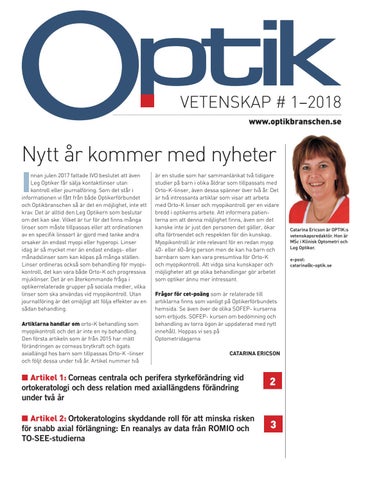
Catarina Ericson är OPTIK:s vetenskapsredaktör. Hon är MSc i Klinisk Optometri och Leg Optiker. e-post: catarina@c-optik.se
2 OPTIK VETENSKAP # 1–2018 n
Redaktörens kommentar: Denna artikel är kort så hela kan lätt läsas. Metod och resultatdelarna är mycket intressanta.
Corneas centrala och perifera styrkeförändring vid ortokeratologi och dess relation med axiallängdens förändring under två år Syftet var att bedöma förhållandet mellan axiallängds (AL) förändring och corneal refraktionsförändring inducerad av orthokeratologi (ortho-k) kontaktlinsbärande. Totalt 88 myopa barn i åldern 7 till 12 år tillpassades med ortho-k linser för nattbruk. Axiallängden mättes innan uppstart med linserna och därefter var 6:e månad fram till 24 månader. Corneal apikal brytkraft och medelbrytkraften för varje koncentrisk ring från 0,5 till 7,2 mm i diameter vid 0,1 mm intervaller mättes med användning av Pentacam HR och jämfördes före och efter tre månaders ortho-k-bärande. Resultat: Av de 88 myopa barnen som tillpassades med ortho-k-linser, fullbordade 64 den 2-åriga uppföljningsperioden. Dessa personer uppvisade en genomsnittlig axiell tillväxt av 0,37 + 0,27 mm. Sfäriskt ekvivalent och corneal apikal brytkraft minskade från baslinjevärdena efter 3 månaders linsbärande. Slutsatser: Axiell förlängning hos barn som genomgår ortho-k behandling är negativt korrelerad med bärarens ålder och summerad cornealkraftsförändring från centrala till midperifera hornhinnan. Vi spekulerar på att axiell förlängning påverkas av den grad som retinal defokusprofilen förändras med ortho-k linsbärande. Sammanfattning: Catarina Ericson
gical Optics sics and Physiolo Visual Psychophy
pic r Change in Myo ral Corneal Powe ith 2-Year Axial he rip Pe d an l Centra nship W y and Its Relatio Orthokeratolog Length Change Zhou Xingtao , Huamao Miao, and Zhi Chen, Feng Xue ghai, China Yuanyuan Zhong, n University, Shan ENT Hospital, Fuda n Science, Eye and thalmology and Visio Department of Oph
ionship between
We assessed the relat
change and corneal axial length (AL) wear. o-k) contact lens
refractive
gy (orth PURPOSE. es for ced by orthokeratolo with ortho-k lens Xingtao Zhou, DeCorrespondence: n years were fitted power change indu after halmology and Visio ren aged 7 to 12 every 6 months partment of Opht n of 88 myopic child enrollment and er ENT Hospital, Fuda METHODS. A total measured before er and the mean pow d was pow th Science, Eye and leng ctive i l refra Axia Xuhu al , ing Road Corneal apic were measure overnight wear. ths. vals mon inter 24 m University, 19 Baoq to 0.1-m up r China; in diameter at lens wear. ation of lens wea o-k mm initi orth 7.2 to of District, Shanghai, 0.5 ths 3 mon ic ring from 3.com. d before and after sum of relative corneal power of each concentr doctzhouxingtao@16 HR, and compare as the valent ed equally to the using the Pentacam er change (SCPC) was defined line spherical equi iple YZ and ZC contribut and should pow region. Age, base Summed corneal m diameter corneal 2-year AL growth in a stepwise mult work presented here as equivalent 7.2-m ral cent the ded tested against change within were therefore be regar SCPC and E), refractive error (SER el. authors. ortho-k lenses, 64 mod 13, 2014 essfully fitted with linear regression axial Submitted: January ren who were succ test subjects experienced a mean 2015 88 myopic child e completed Accepted: June 9, apical refractive ESULTS. Of the Thes R eal od. corn peri and r w-up Miao erro Chen Z, Xue F, 1.03 D to 6 pleted the 2-year follo Spherical equivalent refractive 7 com 43.4 and Citation: Zhong Y, diopters (D) 0.27 mm. n and peripheral growth of 0.37 6 es of �2.88 6 0.96 3 months of lens wear. The mea H, Zhou X. Central ge in myopic from baseline valu d corneal power chan its relationship power decreased D, respectively, after gation was significantly correlate and 40.61 6 1.23 l elon 03, orthokeratology and h change. Invest �0.20 6 0.85 D after 3 months. Axia baseline age (standardized b ¼ �0.4 g m D�m lengt 5.28 axial r 6 with 2-yea n model usin P < 0.001) and SCPC was 10.84 essio ;56:4514– 73, regr 2015 �0.5 Sci. The ¼ b Vis 6). ol ized ¼ 0.39 2 and Ophthalm with SCPC (standard with baseline SERE (b ¼ 0.081, P vs.14-13935 sted R ¼ 0.56) 4519. DOI:10.1167/io was acceptable (adju but not
l elongation P < 0.001), age to predict axia P < 0.001). SCPC and baseline y correlated nt (F2,61 ¼ 41.09, therapy is negativel statistically significa undergoing ortho-k ral to the midren child in ge from the cent l elongation corneal power chan nt to which the CONCLUSIONS. Axia wearer and summed l elongation is influenced by the exte tr.org number, the of age the with axia chic We speculate that wear. (http://www. peripheral cornea. le is altered with ortho-k lens retinal defocus profi 0.) 0121 er, axial length pow ChiCTR-TNRC-110 ctive refra corneal atology, myopia, Keywords: orthoker
n in that AL elongatio evidence suggests 12 reduce the cohort, growing treatments that pes. er with optical adolescents, from myo n slow in Asia is d East sure ren in child n mea myopia the ve ropic defocus ofte logic surveys, is he prevalence of s13 and progressi peripheral hype rted by epidemio n bifocal spectacle th (AL) elongatio 53.1% to 96.5% repo reas conventional 14 demonstrated only modest myopia 1–4 Excessive axial leng Whe g ld. lopin wor al defocus. highest in the spectacle lenses higher risk of deve pher peri tion with on d addi ts ciate effec ract, is asso a have minimal as glaucoma, cata in high myopia contact lenses with control, they also complications, such ent.5–7 l and multifocal soft atology sight-threatening chm In contrast, dual-foca -periphery design, and orthoker , and retinal deta in lopment is an retinal degeneration nce-center and near d a more effective reduction ng myopia deve dista erlyi und ces, sm rien exhibite myopia The mechani some visual expe (ortho-k) lenses with a stronger In animal models, on the c defocus, along ongoing debate. by negative lenses 8 peripheral hyperopi 15–18 c defocus induced l growth. More children. overnight such as hyperopi control effect in n to stimulate axia are designed for in es know a, lens are retin o-k a, al the orth retin pher peri whole Modern myopic ce design to reshape suggested that the refractive developgeometry back surfa ctive error on lens recent studies have ences use, with a reverse clinical central retina, influ and correct refra ocal sleep conf ng addition to the 9,10 These results have important and duri phy ea ogra corn est that cal coherence tom established that the ment in animals. an subjects sugg removal. Using opti have ies involving hum cus may nology, researchers implications as stud al hyperopic defo while the midmicroscopy tech becomes thinner, of inherent peripher myopia in children.11 after greater amounts corneal epithelium t of ral ly in the stroma, onse cent main a er, early find becomes thick ea corn be associated with of the same study group did not morphological al pher ristic peri acte c ors r.19,20 These char peripheral hyperopi Although the auth ortho-k lens wea between baseline e on sam elati the corr in nt on significa progressi 4514 equent myopia defocus and subs
T
Ophthalmology, Inc. rch in Vision and Association for Resea Copyright 2015 The j ISSN: 1552-5783 iovs.arvojournals.org
als/iovs/934219/ on
hx?url=/data/journ
als.org/pdfaccess.as
: http://iovs.arvojourn
Downloaded From
01/08/2018
Länk: http://iovs.arvojournals.org/article.aspx?articleid=2398219&resultClick=1
3 n
Redaktörens kommentar: Introduktionen om de olika studierna är intressant. Men även resultatoch diskusssions -delarna är spännande.
Ortokeratologins skyddande roll för att minska risken för snabb axial förlängning:
En reanalys av data från ROMIO och TO-SEE-studierna miologic Research Clinical and Epide
Syfte: Att bestämma den relativa risken för snabb progression och antal som behövs för behandling (NNT) hos yngre och äldre barn detta med användning av kombinerad data från studierna Retardation av Myopi i orthokeratologi (ROMIO) och Toric Orthokeratologyslowing eye elongation (TO-SEE). Data från 136 personer i två studier, ROMIO och TO-SEE, hämtades (72 orthokeratology [ortho-k] och 64 i kontrollgrupp. Effekten av myopikontrollen på yngre (6-8 år) och äldre (9–12 år) barn utvärderades. Axialsträckningshastigheten klassificerades som inte snabb (axiell förlängning = <0,36 mm / år) eller snabb (axiell förlängning> 0,36 mm / år). Resultat: Kumulativa frekvenskurvor visade att de yngre barnen i kontrollgruppen hade störst och snabbast axiell förlängning i slutet av 24 månader. I den yngre gruppen minskade ortho-k-linsbärandet signifikant risken för snabba utveckling med 88,8% (P = 0,002). Orthokeratology minskade risken för snabb progression hos yngre patienter. Sammanfattning: Catarina Ericson
g Risk of ogy in Reducin of Orthokeratol om the le Fr Ro ta e Da tiv of ec ot Pr n: A Reanalysis tio ga on El l ia Rapid Ax -SEE Studies ROMIO and TO Sin-Wan Cheung Pauline Cho and
a Hong Kong, Chin ersity, Kowloon, g Polytechnic Univ y, The Hong Kon School of Optometr ber needed to treat ression and num pia in risk of rapid prog retardation of myo rmine the relative bined data from the (TO-SEE) PURPOSE. To dete eye elongation children using com r Cho, ng ne olde lowi Pauli and gy–s ce: ger orthokeratolo Corresponden (NNT) in youn g toric Hon and The ) y, MIO (RO School of Optometr ersity, Koworthokeratology retrieved (72 Univ Kong Polytechnic and TO-SEE, were EE) and the studies. SAR, China; studies, ROMIO TO-S loon, Hong Kong 136 subjects of two rol: 41 ROMIO, 23 u.edu.hk. METHODS. Data from o-k]: 37 ROMIO, 35 TO-SEE; 64 cont 2 years) subjects evaluated. The pauline.cho@poly r (9–1 6 mm/year) or 23, 2016 orthokeratology [ortht on younger (6–8 years) and olde Submitted: August l elongation ¼ <0.3 17, 2017 myopia control effec n was classified as not rapid (axia Accepted: January gatio rate of axial elon ng S-W. Proteccontrol group >0.36 mm/year). the n in gatio ects Citation: Cho P, Cheu ology in reducelon subj l ger rapid (axia the younger kerat tive role of ortho months. In the youn ¼ curves showed that a axial elongation: ulative frequency axial elongation at the end of 24 by 88.8% (P ing risk of rapid and RESULTS. Cum rapid progression that treating most rapid of from the ROMIO and risk data test the of grea ced lysis reana had the suggesting ificantly redu halmol sign 1.8, Opht r st was wea Inve lens roup es. o-k rapid TO-SEE studi ger ortho-k subg subjects, orth experiencing 411–1416. DOI: NNT for the youn would prevent one subject from Vis Sci. 2017;58:1 0.002). The 2-year r ortho-k subgroup o-k 4 subjects with orth ar NNT for the olde 10.1167/iovs.16-2059 just two younger treatment. The 2-ye 7). a 2-year period of 0.19 ¼ over (P on ant ressi nific prog on in younger statistically insig ressi was prog h whic rapid , of risk was 11.8 single-vision ificantly reduced ortho-k instead of okeratology sign ar-old subjects with ly progressing axial elongation CONCLUSIONS. Orth rapid just two 6- to 8-ye g ting lopin Trea . deve ects from subj ent one subject prev d coul s , spectacle progression, NNT 2-year period. children, rapid during this critical control, younger atology, myopia Keywords: orthoker relative risk same Kong using the a team in Hong the former was the same research is the exception that low nce impairment, and with dista pia ogy, of e myo odol caus low meth uent become myopic y on children with study on yopia, the most freq 1–2 as children who 1 Axial randomized stud a nonrandomized was r ern latte conc pia. r the sm. myo majo reas mati a lop high astigmatism, whe erate to high astig likely to later deve of myopia, can lead to myopia but mod d analyses earlier are more children with low able for combine 17 studies d with progression retina, both were avail 11 elongation, associate stretching and thinning of the TO-SEE Raw data from 3 For deca des, cal the ROMIO and axial length of ely, ectiv ges. Resp adverse mechani chan (Table 1). s increases in degenerative er way al slow tive retin in effec 56% for pared to and ched resulting reported 46% ortho-k lenses com a myopia have sear 4–12 In the last decade, 12 years wearing of myopia in researchers studying children aged 6 to of The retardation ression in children. lower the effectiveness ring spectacles. ntly on to slow its prog d wea ifica sign lishe ren a pub child chil have been 11 study also reported axial pia con trol in number of reports orthokeratology 7–8 years) with rapid pic (ort ho-k ) for myo subjected to metager subjects (age orth oke rato logy , equivalent myo have been percentage of youn [i.e. d year rme 9,11,13–18 These studies per confi ortho-k group dren. n (>0.36 mm the ers19,20 who both gatio in arch ]) elon rese year of et per ps Si ever, n 0 diopter [D] analysis by two grou pia control. How wearing single visio progression >1.0 ded in of ortho-k for myo to control subjects atology–slowing eye the effectiveness seven studies inclu (20%) compared oker since five of the k would be a rapid ). The toric orth al.19 suggested that, Asia, further wor spectacles (65% odds of becoming from the the were that are rted s lysis le17 sing y repo the meta-ana of meta-analyse subjects wearing elongation stud rent main limitations times greater in only problems with diffe required. Two progressor was 14.9 those wearing ortho-k lenses, but ility of raw data and in the analysis, which than n ¼ 7) in this frequent unavailab ded vision spectacles be 1; control groups: the studies inclu can ¼ of n s that o-k: ogie ysis (orth odol anal meth ression. er statistical eight subjects prog furth , of pic ever unt myo How amo of ies. rapid the stud restrict the an average number study demonstrated combined data from lyses, retardation of ed to treat (NNT), t or -ana performed with the one adverse even The number need listed in the meta treated to prevent can 11 and toric orthokeratolbe to that ed ic two of the studies metr need ) l patients statistica ive atology (ROMIO cal endpoint, is a ),17 were prospect myopia in orthoker one specified clini elongation (TO-SEE e period of time by sam ogy–slowing eye ucted around the 1411 cohort studies cond
M
Authors Copyright 2017 The j ISSN: 1552-5783 iovs.arvojournals.org
License. 4.0 International ial-NoDerivatives bution-NonCommerc tive Commons Attri sed under a Crea 01/08/2018 on / 6100 This work is licen vs/93 ata/journals/io faccess.ashx?url=/d .arvojournals.org/pd ed From: http://iovs
Download
Länk: http://iovs.arvojournals.org/article.aspx?articleid=2608345&resultClick=1