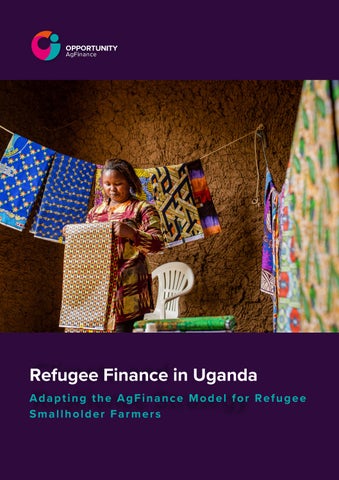
Refugee Finance in Uganda Adapting the AgFinance Model for Refugee Smallholder Farmers
“
Every day, refugees contribute to the communities that have welcomed them — as workers, students, neighbours, artists, athletes, entrepreneurs and leaders. Given the opportunity, they rebuild their lives and help strengthen the societies around them. – UNHCR, 2026¹
The UN Refugee Agency (UNHCR) (2026). On World Refugee Day, the promise of safety and dignity must be renewed for a new generation. https://www.unhcr.org/us/news/speeches-andstatements/world-refugee-day-promise-safety-and-dignity-must-berenewed-new
The Refugee Finance Program Opportunity International’s Refugee Finance program in Uganda builds on a simple premise: most refugees are not starting from zero. They arrive having lost homes, land, assets, and community networks, but many bring with them years of experience as farmers, business owners, tradespeople, and caregivers. The challenge is rarely, if ever, a lack of ability or determination. More often, the difficulty comes in having to rebuild a home, community, and livelihood
in an unfamiliar place with limited access to capital, training, markets, and support systems. Opportunity International's refugee program focuses on long-term resilience and self-reliance rather than short-term relief alone. Today, these programs support more than 30,000 refugee families across three settlements in Uganda.
A house in the Nakivale Refugee Settlement, Uganda
Why Uganda? Uganda hosts the largest refugee population in Africa, with more than 2 million refugees and asylum seekers living across 14 settlements. Most have fled neighboring countries, including South Sudan and the Democratic Republic of the Congo. Uganda's refugee policy is also widely recognized as one of the most progressive in the world. In Uganda, refugees have the right to: Work Move freely Establish businesses Participate in local economies Access a bank account and financial services But legal rights alone do not guarantee practical accessibility, and many refugee families still face barriers such as limited financial knowledge and access, limited access to resources, climate pressure, language barriers, etc.
Definition Refugee: A person who has been forced to flee their home country due to violence or persecution and has crossed an international border to find safety in another country.
Why Agriculture? In the Nakivale Refugee Settlement, A few of the common challenges that more than 70% of refugees work in these farmers face include: agriculture. Agriculture is seen as a main pathway towards refugee selfLimited capital and access to reliance, self-subsistence, and good financial support nutrition, as promoted by both the Limited access to farm inputs Government of Uganda and UNHCR. Gaps in agronomic knowledge Climate-related shocks For many families, farming is the Limited access to markets primary livelihood strategy, but they Limited land often do not have access to the resources and support needed to make farming productive and sustainable.
Josh, 40, sprays the crops on his vegetable farm. His farming and savings group efforts have helped him build a home and pay for his children’s school fees.
MEET JOSH Josh is a refugee living in the Nakivale Refugee Settlement. A farmer and pastor, he is also a husband and father of eight. He arrived in Uganda in 2017 after fleeing the Democratic Republic of the Congo. Like many newly arrived refugees, Josh faced significant challenges rebuilding his life. He struggled to provide enough food for his family and cover his children's school fees. After joining Opportunity Bank (OBUL), he participated in business skills and financial literacy training and later accessed a loan that allowed him to return to farming, which was also his primary occupation before displacement. Today, Josh’s fish and vegetable farm provides an important source of income for Josh's family, helping him pay school fees for his children and improve his family's living conditions.
Josh walks to church, where he is a pastor, with his wife for an evening service.
A Shared Infrastructure For refugees living in the Nakivale Refugee Settlement that invest in and rely on farming for both income and food, Opportunity International’s Refugee Finance program supports them by adapting and deploying the existing AgFinance infrastructure, training systems, and delivery approach. This includes drawing directly from AgFinance's established tools and methodologies, including: ⊲ Community Support Agent (CSA)
networks (referred to as FSAs in AgFinance programming) ⊲ Farmer savings group formation ⊲ Financial literacy training ⊲ Good Agricultural Practices (GAP)
training, including regenerative agriculture techniques ⊲ Partnering with local banks to
offer agricultural finance products
This approach allows proven systems to be adapted for a refugee context while maintaining a focus on agricultural livelihoods.
How the Model Works This approach is designed to meet the realities of refugee farmers living in settlements. Each component is designed to address a specific barrier that prevents farmers from growing productive and resilient agricultural businesses.
Farmer Savings Groups The process begins by identifying existing refugees and host-community savings groups, Village Savings and Loan Associations (VSLAs), and farmer groups. These groups create a foundation for participation, helping farmers build savings habits, strengthen accountability, and access training and financial services. They also provide an important support network that allows farmers to learn from and support one another and build community.
Community Support Agents (CSAs) Community Support Agents are at the center of the delivery model. CSAs are local community members and are themselves refugees who are hired from within the settlement. They provide refugee farmers with training, technical support, and bank linkages. Because they are embedded within the communities they serve, they are able to build trust, maintain regular contact with farmers, and connect them to services that might otherwise remain out of reach. This role extends beyond training delivery, though. CSAs help farmers in their refugee community apply new practices, understand financial products, and navigate challenges throughout the farming season, creating an ongoing link between knowledge, financing, and implementation.
Nakivale Refugee Settlement, Uganda, 2018
3
Financial Literacy
Despite being legally allowed to access a formal bank account in Uganda, many refugees report having limited experience with formal financial services and are often unfamiliar with lending requirements and digital financial tools, which limits the practical implementation of this financial inclusion. Financial and digital literacy training helps close this gap by covering topics such as savings, budgeting, record keeping, responsible borrowing, mobile money, and digital banking. These skills help refugees make informed financial decisions, improve business management practices, and build confidence in using formal financial services. They also increase refugees’ ability to successfully manage loans and reinvest profits into their agricultural activities.
4
Good Agricultural Practices (GAP)
Alongside financial education, refugee farmers participate in training on Good Agricultural Practices (GAP) and regenerative agriculture. Topics include climate-smart agriculture, soil health, crop management, pest control, and post-harvest handling. Opportunity International has identified local refugee-led groups that help identify community leaders for training, create awareness, and support mobilization and delivery of these agriculture training. These trainings respond directly to locally relevant challenges that affect productivity and income, including drought, environmental degradation, and climate-related shocks. By adopting improved farming techniques, these farmers can increase yields, reduce losses, improve soil health, and strengthen their resilience to changing weather conditions.
MEET RUTH Ruth is a 28-year-old single mother of three boys living in Rwamwanja, Uganda. An agronomist specializing in horticulture and climate-smart agriculture, she also leads a local youth savings group, helping others build businesses and strengthen their financial futures. Although Ruth has extensive agricultural knowledge, providing for her family in a new home was not always easy. After participating in Opportunity International's agricultural and financial training, Ruth began applying new farming practices alongside stronger financial management skills. She started a vegetable business, gradually expanding from selling at local markets to supplying restaurants, while using savings groups to establish good financial practices and reinvest in her farm. Ruth also participated in gender-based trainings, which she says gave her the confidence to speak openly, take responsibility, and trust herself to own land, run multiple businesses, and provide for her family. As her income grew, Ruth was able to pay her children's school fees, support her family, and purchase a small piece of land with two rooms. Today, she mentors other farmers and savings groups while working toward her goal of opening a farminginput shop alongside a demonstration garden, creating a place where farmers can access both quality inputs and practical agricultural knowledge.
Ruth harvests amaranth in her garden, one of the vegetables she grows to promote better nutrition and selfreliance.
“Today, I feel stable. I am not rich, but I am comfortable. My children have rice or meat on weekends, and I no longer fear unexpected expenses because I can lean on my savings. My greatest hope is for my boys to finish their education and one day learn agricultural and business skills from me so that they can make their own choices in life.” – Ruth
Financial Products & Inclusion Traditional financial products often do not align with the realities of smallholder farming as a refugee. Historically, refugees have been viewed as risky banking clients due to the transient nature of forced migration, minimal established business and income pathways, limited collateral, etc. Agricultural income is seasonal, and farmers may need financing months before they generate revenue from a harvest. It took years for financial institutions to create practical and relevant banking products for refugees, and then even more time to make these products work for farmers. Opportunity International’s Refugee Finance program has adapted AgFinance’s loan and savings products in partnership with local financial institutions. Products include individual and group lending options, flexible loan sizes, savings opportunities, and repayment schedules aligned with planting and harvest cycles. This structure makes financing more accessible and realistic while reducing repayment pressure during periods when income is limited.
Turning Financing and Training into Impact Training alone cannot expand a farm, and financing alone does not guarantee success. This model intentionally combines multiple forms of support, with each component reinforcing the others, helping refugee farmers strengthen their agricultural productivity, financial stability, and long-term resilience. Together, these services support refugee farmers to increase production, invest in their land, adapt to climate challenges, and build more secure livelihoods for themselves and their families.
Current Outreach Numbers in Uganda As of January 2026 # of Jobs Created:
4,581
Microenterprise Program Participants:
2,828
# of Loans Disbursed:
Total Loan Volume:
9,323
$6.9 million
# of Accounts:
Financial Literacy Training Participants:
28,868
63,512
Refugees rebuilding their lives in Uganda are not defined by their displacement. Opportunity International's Refugee Finance program adapts AgFinance's established infrastructure, training systems, and financial tools to meet the needs of refugee farmers, giving them the means to build on existing skills, strengthen their livelihoods, and invest in future opportunities. In doing so, it supports refugee families as they work toward greater stability, resilience, and economic independence.
Helping farmers to grow more and earn more.
agfinance.org © 2026 Opportunity International AgFinance / 2503 Opportunity International is a 501(c)(3) nonprofit and serves all people regardless of race, religion, ethnicity or gender.