Key Insight

IN UGANDA, PARENTS RELY ON SCHOOL FEE LOANS TO RETURN THEIR OUT-OF-SCHOOL CHILDREN TO SCHOOL
There are 263 million children worldwide who remain out of school according to the latest UNESCO estimates1 – often due to inability to pay school fees. Opportunity EduFinance works with financial institutions to make capital more accessible to families without stable income through School Fee Loans (SFLs). SFLs help keep children in school in the face of unreliable household income, while also ensuring schools collect enough revenue to sustain school quality. The following report presents survey data on SFLs collected by Opportunity EduFinance in Uganda, with 96 parents and 57 school leaders.
Key Finding #1
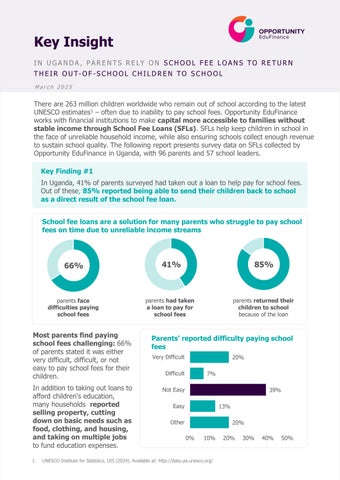
In Uganda, 41% of parents surveyed had taken out a loan to help pay for school fees. Out of these, 85% reported being able to send their children back to school as a direct result of the school fee loan.
School fee loans are a solution for many parents who struggle to pay school fees on time due to unreliable income streams
Most parents find paying school fees challenging: 66% of parents stated it was either very difficult, difficult, or not easy to pay school fees for their children.
In addition to taking out loans to afford children's education, many households reported selling property, cutting down on basic needs such as food, clothing, and housing, and taking on multiple jobs to fund education expenses.
reported difficulty paying school fees
Key Finding #2
Across the 96 households surveyed, there were 270 school-aged children. Of these school-aged children, 27% were reported to have been absent for over two weeks in the past year (57% girls).
270 school-aged children in the sample of households surveyed
Parents finding it difficult to pay school fees resulted in 27% of children being absent for over two weeks in the past year. The inability to pay school fees was a major reason behind children missing school. Despite a higher percentage of girls being absent, most parents prioritize sending girls to school, illustrating how SFLs could help increase school attendance for girls by removing financial constraints.
Key Finding #3
were absent for more than two weeks, out of 270
Which child in your household would you choose first to continue their education?
According to school owners surveyed, households’ inability to pay school fees is the primary reason for absenteeism for 80% of absent children. On average, less than half of parents make school fee payments on time.
School owners face significant challenges collecting fees
Schools in low- and middle-income countries often rely on loans to cover operational expenses, improve their infrastructure, and invest in other school quality improvements. However, schools with higher rates of absenteeism and uncollected school fees struggle to access capital, as financial institutions are less likely to lend to schools with unreliable cash flow.
Opportunity EduFinance works together with financial institutions to address this challenge on both sides: by designing school loan products that are tailored to schools’ fee collection schedules, while also promoting school fee loans to support parents in making on-time fee payments – ultimately giving schools more reliable, sustainable revenue streams.
Schools with higher rates of absenteeism are less likely to have ever successfully taken out a school loan
Have you ever taken out a loan for your school?
Methodology
Purpose: The purpose of the survey was to assess the potential impact of EduFinance products in increasing access to education.
Sampling: This survey was carried out in January 2024 and sampled 96 parents with 270 school-aged children, and 57 school owners educating 17,611 pupils.
Data Collection: Data was collected through face-to-face interviews (qualitative and quantitative) with parents and schools. Enumerators were based in Kampala and were trained in person.
Data Limitations: This study was conducted in a single geography (Uganda) to provide quick insights on the potential impact of EduFinance. Therefore, there is an inherent assumption that data can be applied to other EduFinance intervention areas.