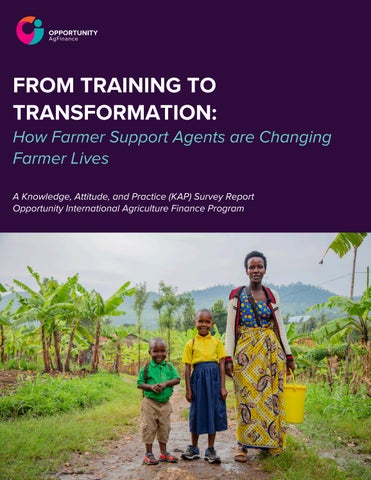
FROM TRAINING TO TRANSFORMATION:
How Farmer Support Agents are Changing Farmer Lives A Knowledge, Attitude, and Practice (KAP) Survey Report Opportunity International Agriculture Finance Program
1
Executive Summary For smallholder farmers living in poverty, the greatest barrier to advancement is almost never effort. It is access to the right knowledge, tools, and confidence to act. Farmers work tirelessly, yet too often remain constrained by limited yields, inconsistent income, and vulnerability to climate shocks. What shifts this reality is capability: the power to make informed decisions, adopt improved practices, manage resources effectively, and recognize opportunity. Opportunity International’s AgFinance program exists to unlock this capability. By equipping farmers with training, financial tools, and ongoing support, the program enables smallholder farmers to grow more and earn more, improving not only their livelihoods but also the futures of their families and communities. To understand how effectively this transformation is taking place, we conducted a Knowledge, Attitude, and Practice (KAP) survey among farmers in Uganda, Malawi, and Rwanda. The findings are clear and compelling: Farmers are retaining knowledge at high levels across all training areas. Satisfaction with the program is exceptionally strong, with a Net Promoter Score (NPS) of 60.2. Most importantly, farmers are putting knowledge into action, with adoption rates exceeding 90% in several key areas. This is not just training. It is transformation in motion. Xaverine, a smallholder farmer in Rwanda, stands in front of her newly renovated house. Xaverine’s savings group has participated in trainings through OI AgFinance.
2
What We Surveyed Agriculture remains the backbone of rural economies across sub-Saharan Africa, yet millions of smallholder farmers face persistent challenges such as limited access to knowledge, financial exclusion, and exposure to climate and market risks. The AgFinance program addresses these challenges through an integrated approach that combines financial services with practical, farmer-centered training. At the heart of this approach is the Farmer Support Agent (FSA) model, which empowers local, trained lead farmers to deliver knowledge directly to their peers. This model also involves FSA regular follow-ups to provide support and guidance as farmers implement what they learn. Through these FSAs, farmers undergo training in: Good Agricultural Practices (GAP) Regenerative Agriculture Financial Literacy Family Business and Entrepreneurship (FBE) Group Dynamics This model ensures that learning is locally relevant, practical, and trusted; and that it is delivered by farmers, for farmers.
Survey Methodology The KAP survey applied a cross-sectional design using lean data collection methods to capture both quantitative and behavioral insights. Sample size: 600 farmers Geographic coverage: Uganda, Malawi, Rwanda Sampling criteria: Farmers who participated in at least two training modules Gender representation: 53% women, ensuring balanced perspectives
The survey assessed: Exposure to training Knowledge retention Attitudes toward FSA services Adoption of practices at farm and household levels
3
Joselyne Mukamana, 44, walks home after a full day on her farm in Rwanda. After being widowed and struggling with a physical disability, she found connection and opportunity through her savings group, where regular trainings helped her build skills in saving, borrowing, and farming. Today, she earns income from tomatoes, vegetables, and livestock, and can provide for her children and access healthcare.
4
What We Learned Strong Knowledge Uptake Across Core Themes Farmers reported widespread exposure to training across all curriculum areas, with the strongest participation in: Group dynamics (31%) Financial literacy (22%) These foundational trainings are critical as they enable farmers to organize effectively, access group-based learning, and build the financial habits necessary for long-term growth. Across all modules, farmers demonstrated strong understanding of key concepts, particularly in group coordination and regenerative agriculture, indicating that the training is both relevant and accessible.
A savings group in Malawi meets for training. 5
From Knowledge to Action Knowledge only creates value when it leads to change. The survey shows that farmers are not simply learning, they are applying what they learn at remarkable rates. These results reflect a critical shift: training is influencing real decisions on how farmers prepare land, manage soil, control pests, save money, and run their households as businesses. This is the foundation of sustainable income growth.
97% applying good agricultural practices 91% applying financial literacy skills 90% applying regenerative agriculture practices 88% applying group dynamics skills 78% applying business and entrepreneurship practices
6
Integrated Adoption Transformation is most visible when farmers adopt multiple practices simultaneously. 79% of farmers are implementing three or more agricultural practices Over 80% are applying multiple financial literacy behaviors 63% are adopting multiple regenerative agriculture practices This layering effect is powerful. Farmers are not making isolated improvements. They are strengthening entire systems: Soil health improves alongside crop management Savings habits reinforce investment decisions Business thinking enhances farm productivity This integrated change accelerates resilience, productivity, and income potential.
High Satisfaction and Trust in the FSA Model
Farmer satisfaction is a strong indicator of both program quality and long-term sustainability. The AgFinance program achieved a Net Promoter Score (NPS) of 60.2, placing it in the “Excellent” category. Farmers consistently highlighted the value of training that is: Practical Relevant to real challenges Immediately applicable Many expressed that the training helped “correct” previous practices and introduced new ways of thinking about farming, saving, and business. Notably, satisfaction is highest among farmers who received GAP and regenerative agriculture training, reinforcing the importance of handson, production-focused learning.
7
FARMER STORY: FROM KNOWLEDGE TO INCOME Elizabeth, a farmer in Rwanda, is one of many who have translated training into tangible results. After participating in GAP and regenerative agriculture training, she improved her approach to land preparation, soil conservation, and crop management. Today, she not only produces more, she also sells her surplus at a local market stall, generating additional income for her household. Her story reflects a broader trend: when farmers gain the right knowledge, they unlock new economic opportunities.
Elizabeth, a farmer from Rwanda showcasing her produce from the garden that she is now selling on a market stall.
8
Impact for Farmers These findings point to a clear outcome: The FSA model is driving measurable, behavior-based transformation. Farmers are: Increasing productivity through improved practices Strengthening financial resilience through better money management Diversifying income through entrepreneurship Building stronger, more functional community groups These changes directly support AgFinance’s core goal: helping farmers grow more and earn more.
Looking Ahead The results of this survey provide a strong foundation for future growth. To deepen and expand impact, the following priorities will guide next steps.
9
Contribution to the AgFinance Mission This work is advancing a clear and measurable outcome: Farmers are gaining the tools to increase yields, stabilize incomes, and build more resilient livelihoods. By combining knowledge, practice, and support systems, the AgFinance program is not only improving farming – it is enabling long-term economic mobility. When farmers grow more, they feed their communities. When they earn more, they invest in their families. And when both happen together, transformation becomes sustainable.
Dorka Lusiyasi, 42, stands on her farm in Mulanje, Malawi, where she grows maize, sweet potatoes, and fruit trees to support her family. After losing her crops to extreme weather, she joined a savings group, where weekly meetings and trainings helped her rebuild.
10
Learn about our global work at
AgFin.org