KM INSIGHT

Farmers Access an Opportunity App, Farmer AI, to Answer Critical Questions
Research Overview
In 2025, Opportunity tested the scale-up of a chatbot/generative AI solution in Malawi, Uganda, Kenya, and Ghana The solution, Farmer AI, was designed for use by Opportunity Farmer Support Agents (FSAs) to easily and rapidly provide accurate answers to smallholder farmer questions using a WhatsApp interface with text or voice interaction, and even by sending photos. The information the chatbot searches originates from authoritative sources, usually ministries of agriculture. Around 260,000 farmers had access to Farmer AI in 2025 through 1,400 agents, with around 1,800 farmers using it themselves.
Key Conclusions
The following high-level conclusions emerged from a year of action-research engaging implementers, agents, and farmers.
1. Farmer AI is widely used by women – a high portion of users in Uganda and Malawi (agents and farmers) are women.
2. Farmer AI is quite accurate, could be more detailed – according to an agricultural expert who ranked it 7.3 out of 10.
3. High user satisfaction – earned a net promoter score of 35, higher than the Kenya benchmark of 26. 90% of users rating messages give Farmer AI a “thumbs-up,” with 26% of messages rated.
4. Strong benefits for FSAs – Farmer AI boosted FSA confidence and respect, and saved time and money
5. Users especially value accuracy, convenience, practical advice, early identification of pests and diseases.
6. Strong indications of meaningful value to farmers – 80% of users say farmer AI advice is being applied; 72% say farmer AI is enhancing farm performance; In Kenya, 67%% of farmer users report improved production, and 58% better pest control.
Plans for Scale-up and Further Research
Opportunity plans to continue scale-up of Farmer AI by FSAs, but is also exploring government and private sector models. These innovative models, along with improvements in the app and its dissemination, will continue to be studies, and Opportunity is also planning a comparative study to better assess the impact of Farmer AI on farmers and farms.
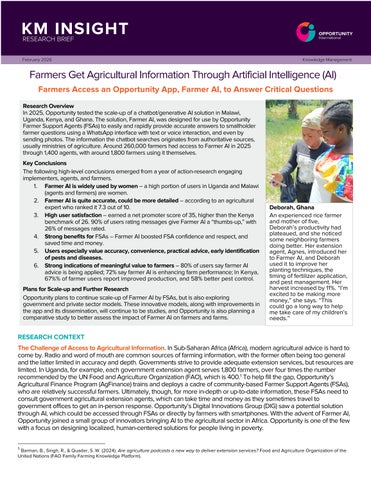
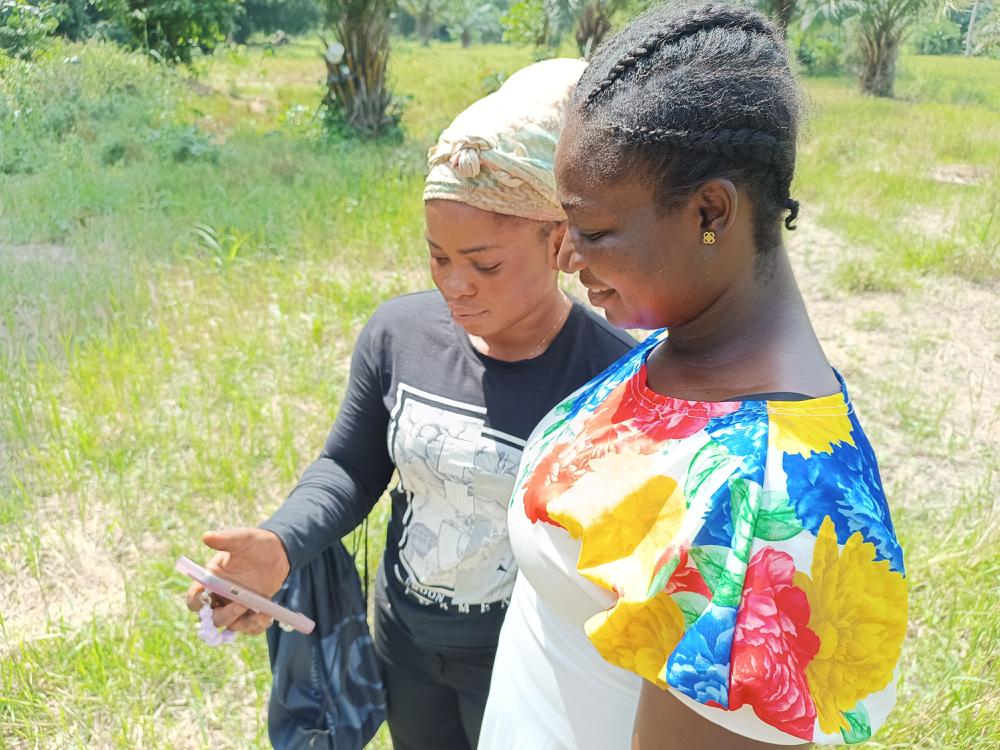
Deborah, Ghana
An experienced rice farmer and mother of five, Deborah’s productivity had plateaued, and she noticed some neighboring farmers doing better. Her extension agent, Agnes, introduced her to Farmer AI, and Deborah used it to improve her planting techniques, the timing of fertilizer application, and pest management. Her harvest increased by 11%. “I’m excited to be making more money,” she says. “This could go a long way to help me take care of my children’s needs.”
The Challenge of Access to Agricultural Information. In Sub-Saharan Africa (Africa), modern agricultural advice is hard to come by. Radio and word of mouth are common sources of farming information, with the former often being too general and the latter limited in accuracy and depth. Governments strive to provide adequate extension services, but resources are limited. In Uganda, for example, each government extension agent serves 1,800 farmers, over four times the number recommended by the UN Food and Agriculture Organization (FAO), which is 400.1 To help fill the gap, Opportunity’s Agricultural Finance Program (AgFinance) trains and deploys a cadre of community-based Farmer Support Agents (FSAs), who are relatively successful farmers. Ultimately, though, for more in-depth or up-to-date information, these FSAs need to consult government agricultural extension agents, which can take time and money as they sometimes travel to government offices to get an in-person response. Opportunity’s Digital Innovations Group (DIG) saw a potential solution through AI, which could be accessed through FSAs or directly by farmers with smartphones With the advent of Farmer AI, Opportunity joined a small group of innovators bringing AI to the agricultural sector in Africa. Opportunity is one of the few with a focus on designing localized, human-centered solutions for people living in poverty.
Family Farming Knowledge Platform)
Opportunity’s Digital Innovations Group (DIG) Tested Farmer AI with Opportunity AgFinance and Three External Partners. Opportunity International (Opportunity) leverages microfinance to empower people living in poverty to transform their lives, their children’s futures, and their communities. In 2024, Opportunity launched a human-centered design initiative to leverage the benefits of AI to accelerate client pathways out of poverty. The first innovation, Farmer AI, delivers immediate, credible agricultural information. Tested on a small-scale in Malawi in 2024, in 2025 Opportunity explored four scale-up models with different users in different contexts.
1. Agent Model 1, Opportunity AgFinance in Malawi, Uganda, and Ghana, through FSAs. Operating in multiple African countries, AgFinance helps smallholder farmers to grow more and earn more by accessing training, financial services, and other support. Opportunity reaches target smallholder farmers – 53% of whom are living in poverty and 53% of whom are women – through FSAs who use smartphones, provided by Opportunity. Because most target clients do not have smartphones, and many have weak or no cell phone service, farmers typically access Farmer AI through FSAs
2. Agent Model 2, Government Agricultural Extension and Community-Based Agents (CBAs) in Ghana. (In partnership with the Development Bank of Ghana (DBG), Ghana Incentive-Based Risk Sharing System for Agricultural Lending (GIRSAL), and Hopeline.) GIRSAL managed a partnership with Hopeline, an agricultural development NGO working with smallholder farmers, to test Farmer AI among extension agents and CBAs providing extension services to rice farmers in four locations in Ghana Although many farmers also took up Farmer AI, most farmers do not have smartphones (or lack reliable service) and accessed Farmer AI though extension agents and CBAs.
3. Farmer Model 1, DigiFarm in Kenya. DigiFarm is a digital platform operated by Safaricom that gives farmers access to finance and agricultural markets. DigiFarm and Opportunity tested Farmer AI among digitally included potato farmers in the Rift Valley, Kenya. In this model, DigiFarm notified their farmer customers about Farmer AI via SMS/text message, and farmers accessed the app without training.
4. Farmer Model 2: GiveDirectly (GD) in Malawi. GiveDirectly delivers cash transfers to people living in high-poverty communities to help them graduate out of poverty. In Malawi, GD tested several methods for helping clients, who are most farmers, to access information alongside grants. GD assisted farmers who did not own a smartphone to obtain one, and, with training of trainers from Opportunity, introduced their clients to Farmer AI. ♦
Farmer AI. The purpose of Farmer AI is to help users find accurate, contextually appropriate, and timely answers to agricultural questions so that they improve their farming practices and farm performance. Key features of the solution include:
• Familiar interface – WhatsApp – used commonly and requiring a smartphone
• AI chatbot, hosted by Gooey.ai, using ChatGPT generative AI
• Directed to source information from official documents (usually ministries of agriculture)
• Use of text or voice, in English or, in Malawi, also in Chichewa
• Photo upload with responses and problem diagnosis by leveraging Plantix
Research Methods. The scale-up and related research was guided by an innovation plan, which included implementation plans, regular implementation meetings, AgFinance staff feedback sessions, user surveys and focus group discussions, and farmer case studies. The primary intention was to ensure that the continued scale-up of Farmer AI remains high quality and farmerand user- responsive, and to learn and improve Farmer AI tech and dissemination. Thus, the research was an extension of a humancentered design process.
1. Rollout and Uptake. Which users benefit from what type of dissemination and training?

In 2023, Opportunity’s DIG staff used a human centered design process to co-create Farmer AI with FSAs, AgFinance staff, and the Ministry of Agriculture. After a series of iterations, it was pilot tested in Malawi with some 150 FSAs and government extension agents. The feedback was very positive. In the scaled-up innovation test in 2025, DIG adapted Farmer AI for use in Uganda, Kenya, and Ghana. DIG also incorporated a number of improvements including a consent process, follow-up questions to prompt users to obtain more information, quality reviews and technical fixes, user-friendly data reporting, and more.
There were three models of outreach tested to encourage farmers and agents to try Farmer AI – in-person training of agents (AgFinance in Malawi, Uganda, and Ghana, and DBG in Ghana), farmers learning about Farmer AI via agents (GiveDirectly in Malawi, and DBG in Ghana), and farmers learning about Farmer AI via SMS/text (DigiFarm in Kenya). The first thing users do is to become “activated” by sending a greeting or any message to the Farmer AI WhatsApp number. After that, users must give consent for Opportunity to view and analyze their conversations Then, they can have their questions answered and are considered “engaged.” The key performance indicators for
uptake are the portion of those targeted who are activated, and the portion of activated users who become engaged. Activation and engagement rates varied across programs with the following insights emerging Uptake and engagement were–
• Smooth for agents, who received training, and digitally included farmers who were oriented in-person by agents.
• Challenging for digitally excluded farmers, even when they were given smartphones and some in-person orientation
• Challenging for digitally included farmers who did not receive inperson orientation. For digitally included farmers being contacted only by sms/text, uptake was low, only 15%, although DigiFarm considers this to be a good uptake rate for digital services marketed in this manner The engagement rate for these farmers, however, was also lower than for farmers who had in-person orientation from an agent.
• Smoother for more educated, younger, male farmers. This demographic responded best to SMS outreach to digitally included farmers conducted by DigiFarm. (See Table 1.)
DBG Ghana (Extension agents)
Cost-effective outreach. In-person training or orientation was viewed as cost-effective in program contexts in which farmers were already receiving other training or visits from agents, and Farmer AI was added on, but in the DigiFarm context, where inperson farmer training is uncommon, digital outreach was viewed as more costeffective.
AgFinance Ghana (FSAs) Unknown
GiveDirectly Malawi (Digitally excluded farmers)
DigiFarm Kenya (Digitally included farmers)
FSAs trained, some farmers engaged; the engagement rate was lower because of a cohort of FSAs due to receive upgraded phones, whose phones were not operational at the time of training
agents trained; 200 farmers also engaged
FSA training was rapidly escalating in Ghana at the time of this report, so it’s difficult to know the # trained
987 phones distributed and farmers trained, 609 farmers tried Farmer AI (62%)
SMS messages sent to 10,000+ customers, 1,514 responded (15%)
For Opportunity’s focus on poverty eradication and drive to include people living in extreme poverty, several lessons emerge:
® Farmer AI is free to the user, but data is not. Even when given smartphones, many farmers did not frequently use Farmer AI because of the cost of data. Agents also mentioned the cost of data as a reason their usage declined over time. Farmer AI delivery costs are subsidized, and with additional subsidies, data-free usage could be considered for agents and people living in extreme poverty.
® For more isolated, less educated farmers, a human-in-the-mix (an agent) is needed. Some farmers, especially more isolated women, are living offline for the most part, and will need to be connected with an agent who travels frequently in order to gain access to Farmer AI. Other farmers and even some agents, especially women with lower education, need more in-depth training or practical experience with some in-person support in order to gain confidence and skills to regularly use Farmer AI.
® Major technology and programmatic adaptation may help. Barriers faced by this population also highlight the potential for solutions delivered through simple phones, such as voice-based AI solutions in local languages This technology may be a ways away, but even when it arrives, human-in-the-mix solutions may be needed for training and providing access for people who are offline.
® Engagement rates may be increased with an improved first-user experience. All user groups requested more training. However, rather than assuming that more training is needed – whether in-person or, for example, via video –DIG will first test improvements to make onboarding and use easier and more comfortable for many users.
2. Usage Frequency and Patterns. How often do users consult Farmer AI, and when?
Usage frequency varied substantially across programs, with some expected and some insightful patterns:
• Agents used Farmer AI much more frequently than farmers, which was expected. In direct-to-farmer programs, only 49% of users asked more than 5 questions, but in agent programs, 89% did.
• More educated agents, whether male or female, used Farmer AI more More agents in DBG Ghana and AgFinance Uganda were secondary and university graduates than in Malawi, where usage was lower.
Usage Data and Volume of Questions. There were no targets for the volume of questions during the scale-up; and, it was not clear that more questions are better. On the one hand, some users may be prompted to ask additional questions because they like the response to the first one. On the other hand, if an the initial response is unclear, a user may ask a follow-up question to get clarity, raising the number of questions asked because of weak answers. Nevertheless, the number of users and volume was tracked and used to assess outreach efforts and make cost projections for future dissemination.
• Total users: 3,169, around half farmers and half agents
• Total messages sent by users: 48,986
• Average messages/user: 15
• Average messages/user/month: Varied from 6 in Ghana to 1.1 in Kenya
• Retained users: 18% (% of all users sending a message in the last 30 days)
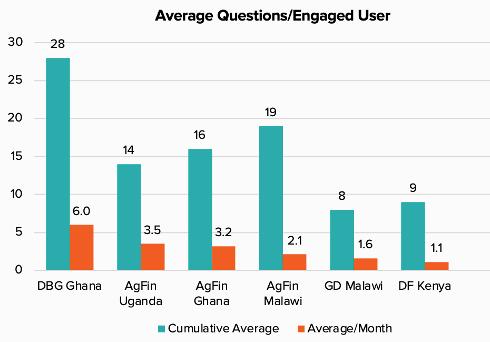
• Extension agents and CBOs in the DBG program used Farmer AI at almost twice the rates of Opportunity FSAs Upon inquiry and discussion, this is likely because extension agents focus on individual farmer visits, where more customized advice is requested and delivered FSAs focus more on group training, which is less conducive to farmers asking specific advice about their farms (See Figure 1)
Across all programs, Farmer AI was used frequently during and immediately following training, and then usage dropped off over time. Users and staff supporting them shared several reasons, Some reasons did not pose a problem, while others did.
• Not a problem. Some users used Farmer AI more frequently at first because they were testing the bot to see if the answers were accurate, or because they were excited about it and were exploring its potential. Other users reported that they would likely have seasonal usage, and that questions were most intense during the planning and planting seasons. Some (farmer users) were unable to use it frequently because they are located in areas without cell phone coverage and can only use it when they go to town. These are all appropriate reasons for usage decline over time and are not concerning. No cohort reported that they had asked all of their questions and did not expect to ask more.
• Problematic. Some users who used Farmer AI less over time faced challenges that should be addressed to enhance access to Farmer AI for target farmers. Some users were not prepared to pay for data required to access Farmer AI. Some FSAs do not regularly visit farmers due to the time and cost involved, and they feel there would be more questions if they conducted more farmer visits. One cohort of FSAs in Uganda did not have functioning smartphones and were due to receive upgrades soon. Some users said they needed more training to have confidence in using Farmer AI. This was the case among less educated, female FSAs in Malawi, for example.
To address the problems some users face, the following steps are under consideration:
® For agents, providing a higher stipend to cover the additional data used by Farmer AI, and possibly for more individual farmer visits.
® Paying for data used by farmer AI. Such an arrangement might be possible with philanthropic contributions from cell phone companies.
® Improving the user-interaction to enhance ease of use. Based on analysis of conversations to date and user comments, the DIG team is improving Farmer AI conversations to make them smoother for users. For example, Farmer AI can be directed to use even simpler language (less technical jargon). The bot could ask for clarity if a question is hard to understand (AI has a tendency to guess.) And, engineers can redirect the follow-up questions to specifically suggest a more detailed response, rather than a question on a related topic.
® More follow-up and coaching. Many users requested more training, follow-up, or coaching. Opportunity is reluctant to invest in more in-person training, but Farmer AI is being increasingly integrated into regular operations within the AgFinance program and FSA supervisors are being directed to check more regularly on Farmer AI usage and to coach agents who need some extra support.
3. Performance. Were different users satisfied? Was information accurate? What suggestions?
Overall, users report very positive experiences. The average net promoter score among all programs was 35, compared to a Kenya benchmark of 26. The vast majority (90%) of users rating messages gave Farmer AI a “thumbs-up,” with 26% of messages rated. Users especially value farmer AI’s accuracy, speed, and convenience, saving time and money, practical advice, early identification of pests and diseases, capacity built and confidence gained by agents, and respect earned among farmers. An agricultural expert gave Farmer AI an average overall performance score of 7.3 out of 10, with similar scores for accuracy when Farmer AI used official source documents as when farmer AI used external sources.
Nevertheless, users identified some challenge areas, and made requests for improvement, some of which Opportunity is trying to accommodate. The requests, and Opportunity’s responses, follow:
® Better clarity in voice responses, particularly in Ghana and in Malawi using Chichewa. Opportunity is working on it.
® Less technical language to make it easier to interpret into local languages. Opportunity is working on it.
® Responses with visuals. Right now photos can be uploaded, but diagrams and photos are not provided in return. Opportunity is exploring it.
® More local, real-time information, such as market information and weather reports. This is a major investment and Opportunity is considering it. However, this requires substantial investment not only in technology, but in methods for regularly sourcing up-to-date data.
® Availability in local languages. Farmer AI currently operates in Chichewa and Kiswahili, with a Kinyarwanda version prepared for deployment. Expansion to additional local languages is constrained by limitations in current AI support for many African languages. While these capabilities are improving, performance remains weak for many African languages, particularly for technical agricultural content. Opportunity seeks opportunities to advocate for stronger African language capabilities in AI systems.
® Offline or simple phone solutions, to enhance access. Opportunity could explore voice engagement via simple phone, but it would require a substantial increase in resources. Partnership may be a possibility.
® Data-free options, in which users are not charged data to access Farmer AI. Opportunity is considering exploring contributions from cell phone companies to cover data costs of Farmer AI.
Ultimately, the aim of Farmer AI is to improve farming practices and enhance farm performance. Although more in-depth research is needed, the information gathered to date indicates that Farmer AI is having a positive impact on farmers and farms. A high majority of users (80%) say advice from Farmer AI is being applied by farmers, and 72% say Farmer AI is enhancing farm performance. In Kenya, 67% of farmer users report improved production, and 58% better pest control because of applying Farmer AI advice on their farms. This data signals positive benefits to farmers, making a more substantial impact assessment worthwhile, something that Opportunity is planning. ♦
SUMMARY OF CONCLUSIONS AND NEXT STEPS
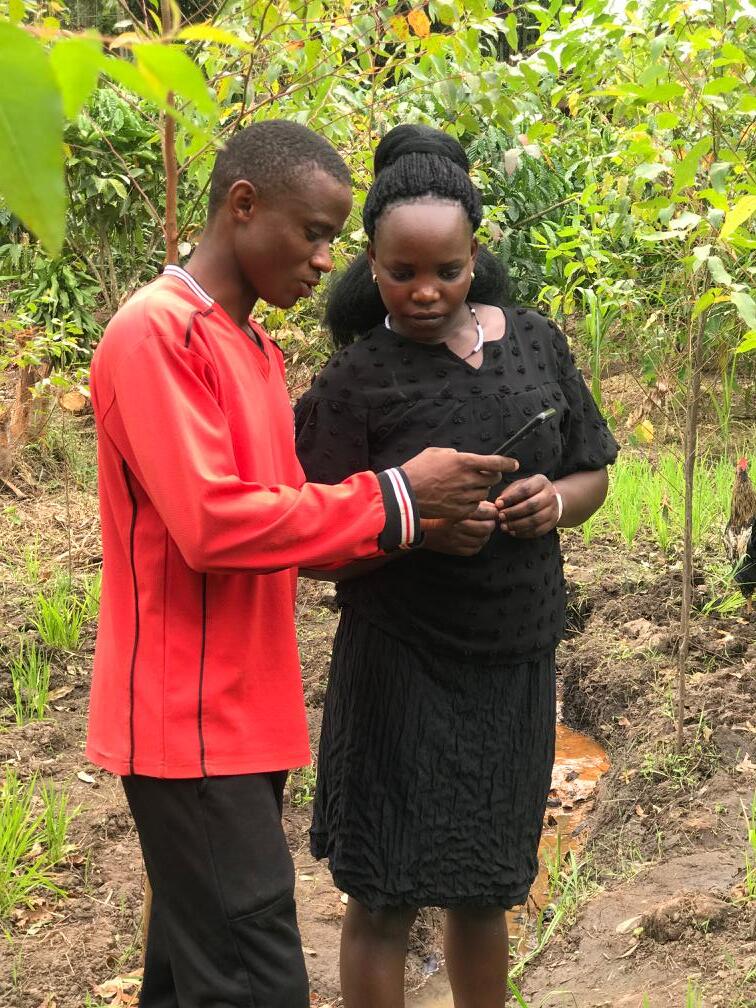
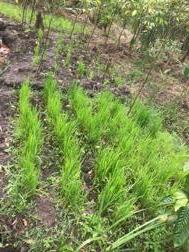
Brenda had long desired to grow rice, but wasn’t sure how to go about it. Her FSA, Moris, showed her how to use Farmer AI, and she followed the step-bystep instructions for establishing a test-plot. “I am proud of my progress, and impressed by the clarity and accuracy of Farmer AI,” she reports. Brenda is now planning to expand her rice cultivation to a larger-scale, with more advice from Farmer AI.
The following is a summary of conclusions from the year of action-research engaging implementers, agents, and farmers.
1. Farmer AI can be widely used by women, using intentional dissemination – a high portion of users in Uganda and Malawi (agents and farmers) are women. But, in Ghana and Kenya, partner users were mostly men. In addition, some less educated, female FSAs struggled to adopt Farmer AI.
® Opportunity is improving the user experience to reduce the need for training, and is providing more follow-up and coaching
® Opportunity will work with partners to improve outreach to women in any expansion initiative
2. Farmer AI is quite accurate, but could be more detailed – according to an agricultural expert who ranked it 7.3 out of 10.
® DIG is adjusting Farmer AI to provide more detail, without additionally complex language, and to deliver more focused follow-up questions, offering users the opportunity to ask for more depth of information.
3. High user satisfaction – Farmer AI earned a Net Promoter Score of 35, higher than the Kenya benchmark of 26. 90% of users rating messages give Farmer AI a “thumbs-up,” with 26% of messages rated.
® By addressing user feedback, Opportunity is striving to reach the global benchmark of 46.
4. Strong benefits for agents – Farmer AI boosted agent confidence and respect, and saved time and money. This makes Farmer AI a good prospect for ministries of agriculture seeking to improve cost-effectiveness as they support extension agents to better serve their large farmer client base.
® In a potential government partnership, Opportunity hopes to measure cost-effectiveness.
5. Users especially value accuracy, convenience, practical advice, and early identification of pests and diseases.
® Opportunity will continuously improve these elements and will market Farmer AI emphasizing these features and benefits.
6. Strong indications of meaningful value to farmers – 80% of users say Farmer AI advice is being applied; 72% say Farmer AI is enhancing farm performance; In Kenya, 67%% of farmer users report improved production, and 58% better pest control.
® Opportunity plans to conduct a comparative study to better assess the impact of Farmer AI on farmers and farms.
Opportunity AgFinance will continue to scale-up Farmer AI until all FSAs are trained, and will then consider more explicit scale-up with digitally include farmers. Opportunity partnerships with government and the private sector for wider impact ♦
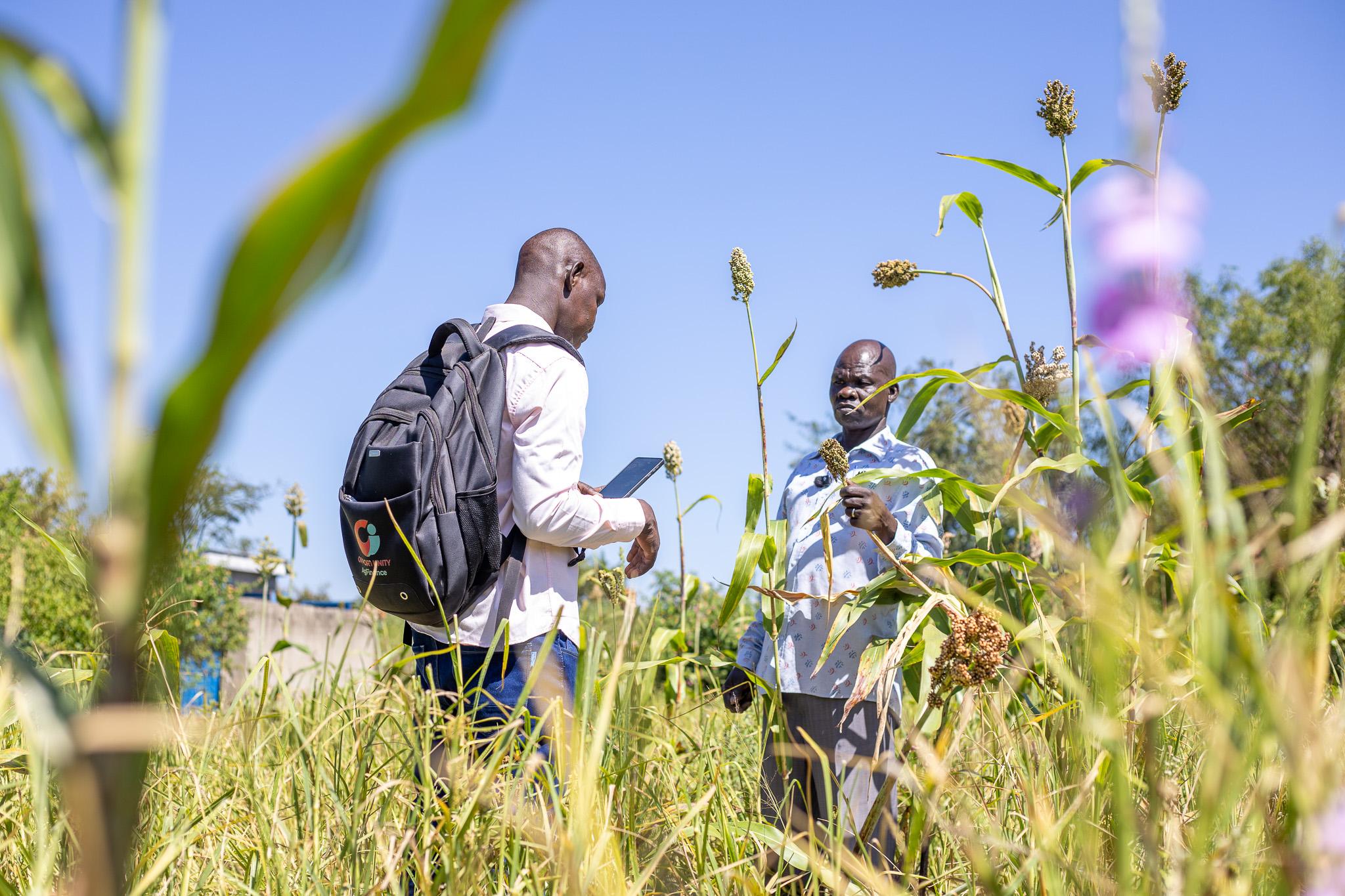
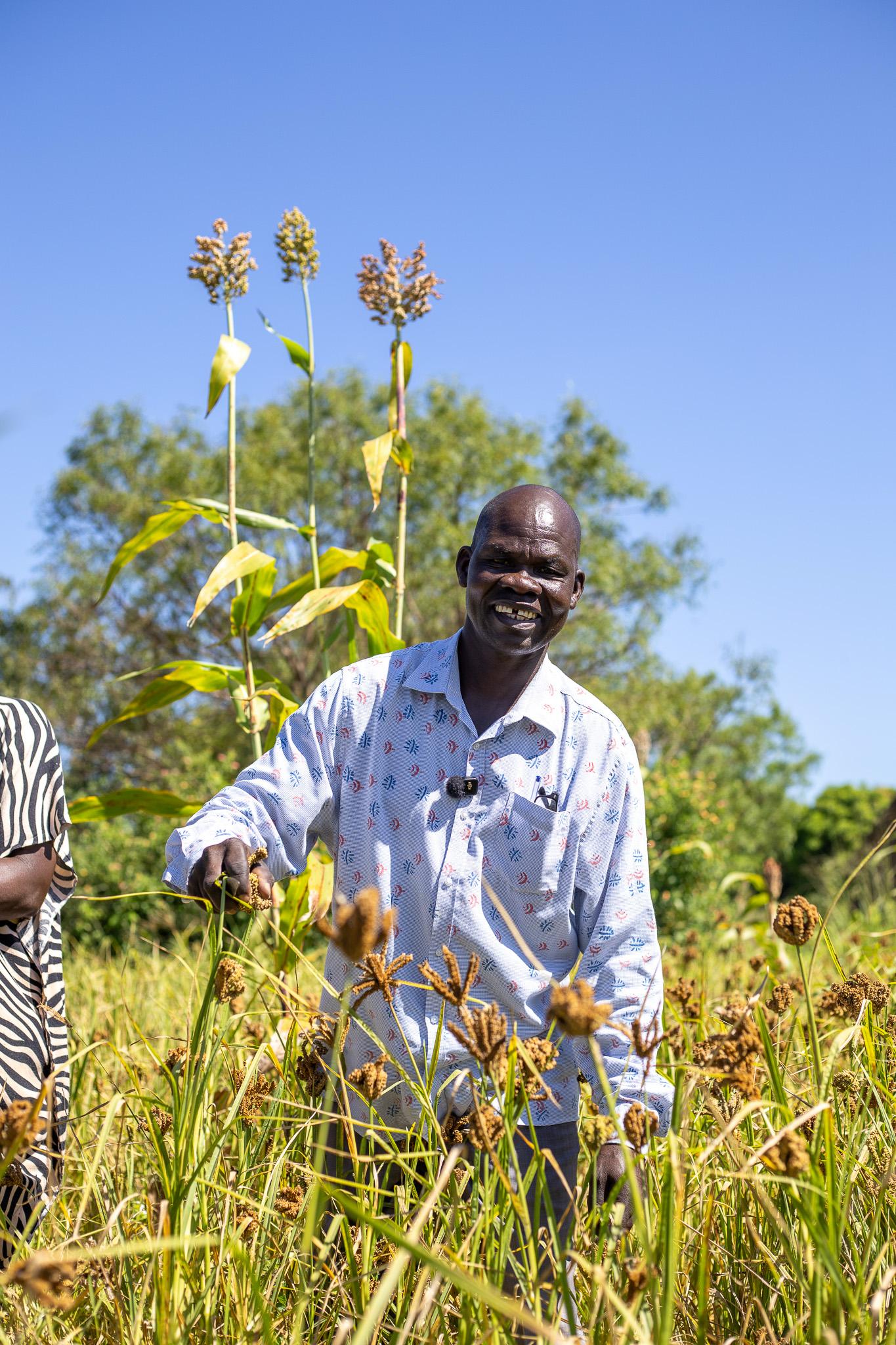
When FSA Chris visited Alotu, he noticed some browning on Alotu’s sorghum plants. He sent a photo to Farmer AI, which identified a major pest. “Farmer AI showed me the pests and told me exactly what to do.” Alotu took immediate, corrective measures, saving his crop.
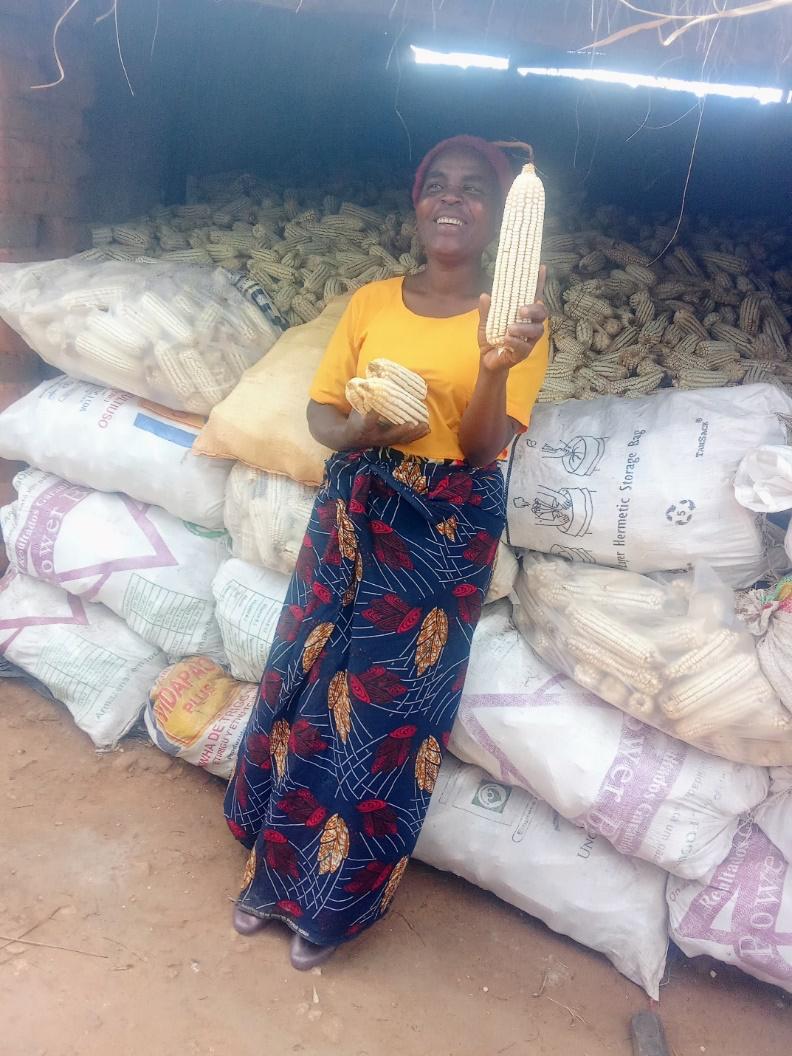
An experienced farmer, Christina says that before Farmer AI, “If pests came, I didn’t always know right away what to do. Sometimes I just hoped they would go away.” Now, Christina sends Farmer AI photos of her crops and questions in Chichewa. “With Farmer AI, knowledge is right here in my hands.” In conjunction with an AgFinance loan and training, Christina was able to use recommended seeds and fertilizer, to the benefit of her maize crop.
This study shows Opportunity’s strengths in–
• Digital and AI innovation – Using human-centered design, devising and deploying innovative AI solutions.
• Collaborative Partnerships – Collaborating with leading AI firms, government ministries, and the private sector.
• Pilot program research – Demonstrating the capacity to quickly capture, analyze, and use research findings
• Agricultural Capacity Building – Positively contributing to practical knowledge used by farmers to improve practices in order to grow more and earn more.
3 Much of the