Exploring Gender Differences and Opportunities to Improve Male and Female School Leader Outcomes
July2026
School leaders play a critical role in shaping the quality, inclusiveness, and sustainability of schools. A growing body of research suggests that women in leadership positions within education systems can contribute to improved opportunities and outcomes for girls, particularly through greater attention to gender-responsive teaching, safer learning environments, and investments that support girls’ participation in school such as gender-separate washrooms.1 ,2 ,3 Increasing representation and outcomes for female school leaders and headteachers is therefore not only an issue of gender equity among school leaders themselves, but also plays an important role in creating more inclusive and supportive environments for girl learners.
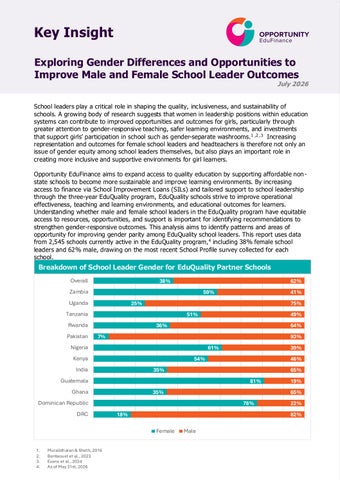
Opportunity EduFinance aims to expand access to quality education by supporting affordable nonstate schools to become more sustainable and improve learning environments. By increasing access to finance via School Improvement Loans (SILs) and tailored support to school leadership through the three-year EduQuality program, EduQuality schools strive to improve operational effectiveness, teaching and learning environments, and educational outcomes for learners. Understanding whether male and female school leaders in the EduQuality program have equitable access to resources, opportunities, and support is important for identifying recommendations to strengthen gender-responsive outcomes. This analysis aims to identify patterns and areas of opportunity for improving gender parity among EduQuality school leaders. This report uses data from 2,545 schools currently active in the EduQuality program,4 including 38% female school leaders and 62% male, drawing on the most recent School Profile survey collected for each school.
Breakdown of School Leader Gender for EduQuality Partner Schools
Overall, the gender distribution of school leaders varies substantially across EduQuality countries, with particularly large gaps in female representation in Pakistan, Democratic Republic of the Congo (DRC) and Uganda. In contrast, female school leaders have a stronger presence in Latin American contexts. It should also be noted that the lower representation of female school leaders in Ghana is primarily driven by a significantly lower number of female school leaders in the Northern Ghana region, while female representation is strong in southern Ghana regions. In contrast, Tanzania’s relatively balanced gender distribution is partly influenced by a high number of female school leaders leading pre-primary schools, part of an early childhood education EduQuality program that is specific to Tanzania.
Key Finding #1
Male school leaders tend to have higher levels of formal education compared to female school leaders, with 69% of male leaders holding a university or master’s degree compared to 55% of female leaders.
School Leader's Highest Education Level
Female school leaders are more likely to have a diploma as their highest education qualification, with 35% female school leaders holding a diploma compared to 23% of male leaders. This suggests potential differences in access to higher education or professional advancement opportunities, and raises an area for further research of whether education influences access to finance, school growth, or participation in leadership development.
Access to technology appears relatively equitable and strong across male and female school leaders, with 93% of female school owners compared to 88% of male school owners using a smartphone. This may represent an opportunity to leverage the EduQuality blended learning model, which combines digital, self-access content on tablets for school leaders and teacher mentors with inperson training and support. However, further analysis is needed on whether differences in device access translate into differences in digital literacy or program participation.
Female School Leader Male School Leader
Key Finding #2
Female and male school leaders both demonstrate very strong gender parity in student enrollment, with girl learners representing 52% of total enrollment in schools led by both male and female leaders. Average percentage of girl learners enrolled for male vs. female-led schools
Female and male school leaders enroll the same percentage of girl learners (52%), suggesting gender sensitive enrollment regardless of the school leader gender. Maintaining this parity in for girls’ and boys’ enrollment remains important, as increasing girls’ enrollment is a key foundation for improving girls’ educational outcomes and long-term opportunities.
Average School Size by Grade Level (# of Learners Enrolled)
Male-led schools have much higher average student enrollment compared to female-led schools, indicating that male school leaders tend to operate larger schools. As discussed later in this report, larger school size may provide school leaders with increased school revenue and revenue potential, leading to increased eligibility for school improvement loans and capacity to invest in school improvements. Further analysis of school age (years since establishment) shows that female school leaders operate slightly older schools on average, indicating that the higher enrollment in male-led schools is not simply due to having had more time to grow, but may instead reflect broader structural differences or underlying factors.
Despite male school leaders operating much larger schools on average when compared to female school leaders, average number of teachers employed is similar between male and female school leaders. Male-led schools employ only slightly more teachers on average, with 13.76 teachers employed on average compared to 11.42 in female-led schools.
Male School Leader
Female School Leader
Female School Leader Male School Leader
Given the higher average enrollments for male school leaders, this indicates that pupilteacher ratio in male-led schools is higher than for female-led. Using the average figures for total enrollment and teachers employed, the average pupil-teacher ratio for male-led schools is 24:1, compared to 19:1 for female-led schools. Higher pupil-teacher ratios may affect teaching quality and teacher workload, although the relationship between staffing levels and learning outcomes depends on broader factors such as teaching practices and classroom management. Understanding whether female-led schools are achieving similar or better outcomes due to lower pupil-teacher ratios may provide useful lessons for the EduQuality program.
Key Finding #3
Average Total Number of Teachers
Female-led schools employ a significantly higher proportion of female teachers compared to male-led schools, with female teachers representing 70% of teaching staff in female-led schools compared to 58% in male-led schools.
Further, female-led schools are significantly more likely to have female headteachers, with women representing 65% of headteachers in female-led schools on average compared to 32% in schools led by male leaders.
This finding represents a strong opportunity for the EduQuality program to both capitalize on strong female representation in female-led schools, and also consider addressing this gap in male-led schools. Research suggests that female teachers can play an important role in supporting girls’ education, particularly by providing role models, reducing barriers related to social norms and safety, and improving girls’ engagement in lessons.5,6 Increasing the representation of women within school leadership and teaching roles may therefore contribute to more gender-responsive school environments and stronger support for girl learners.
5. Bentaouet et al., 2023.
6. UNESCO, 2020
Key Finding #4
Teacher monthly salaries appear broadly equitable across male- and female-led schools, with similar average teacher pay levels regardless of school leader gender and with female teachers receiving comparable pay to the overall teacher average.
Across most countries, differences in teacher salaries between male- and female-led schools are relatively small, suggesting that school leader gender does not appear to be associated with large differences in teacher pay. Some larger gaps observed in a few contexts, such as Tanzania and the Dominican Republic where male-led schools have higher average teacher salaries. However, the overall average teacher salary is slightly higher in female-led schools, and country-level differences may reflect other factors such as school size and grade level. Similarly, female teachers’ salaries are generally aligned with overall teacher salary averages. In no cases does the female teacher average salary ever surpass the overall average, suggesting some area for improvement especially if female teachers have more experience than their male counterparts. However, overall findings suggest that female teachers are not systematically underpaid within EduQuality schools.
Teacher salary is a key factor in attracting and retaining qualified teachers, as competitive and predictable compensation can increase job satisfaction and reduce turnover. However, retention is also strengthened when teachers have clear pathways for career advancement and opportunities to grow professionally. Through the EduQuality program, schools are encouraged to establish structured salary scales, define advancement opportunities, and invest in professional development to support teachers’ long-term commitment and growth within the profession. Higher teacher salaries is also an indicator that a school may have higher revenue and maintain stronger financial record-keeping to ensure predictable cashflow which may improve their eligibility for school improvement loans.
Average Monthly Teacher Salary (Female Teacher Average vs. Overall Average)
When it comes to headteachers, female headteachers tend to have more years of teaching experience on average, and particularly in female-led schools. However, the average is similarly strong across the two, with 15.5 years of experience for female headteachers on average, compared to 13.5 for male headteachers.
The similar levels of teaching experience among male and female headteachers are reflected in broadly comparable salaries overall. However, notable gender pay gaps remain in some countries, including India, the Dominican Republic, and Tanzania, where male headteachers earn significantly higher salaries than their female counterparts.
Female Teacher Salary
Teacher Salary
Headteacher Years of Teaching Experience Female School Leader
School Leader
Average Monthly Headteacher Salary by Headteacher Gender*
Note: Pakistan has been excluded from analysis due to low sample size of schools with female headteachers
Ensuring equitable compensation is important for retaining strong headteachers, and encouraging more women to pursue and remain in leadership roles. Transparent salary structures, clear advancement pathways, and regular reviews of pay equity can help ensure that compensation reflects experience, responsibilities, and performance and may represent an opportunity for EduQuality content to ensure school leaders are supported in these areas.
Male School Leader Female School Leader
Key Finding #5
Female school leaders at EduQuality partner schools are accessing loans at higher rates than male school leaders, with 26% of female leaders reporting having received a loan compared to 19% of male leaders.
While access to finance is relatively low and suggests further support may be needed to increase loan eligibility, this finding suggests that female-led schools are more actively engaging with financing opportunities to invest in school improvements, and highlights the importance of supporting continued access to appropriate financial products.
Out of the schools that have received a loan, a slightly lower percentage of female school leaders have paid off the loan (67% compared to 74% of male school leaders). This suggests that female-led schools may face additional challenges in loan repayment, potentially related to differences in loan size, repayment terms, school revenue, or access to financial management support. However, repayment rates are strong regardless of school leader gender, and the slightly lower repayment rate among female-led schools may simply reflect that these loans were received more recently and have had less time to be fully repaid.
Have you ever received a school improvement loan?
Has this loan been paid off?
Key Finding #6
Average school revenue is nearly identical across male- and female-led schools overall, with male-led schools generating an average annual revenue of $22,230 compared to $22,109 for female-led schools.
Overall, average annual school revenue is comparable between male- and female-led schools, despite female-led schools having lower total enrollment. This suggests both that female school leaders may charge higher school fees, but also that they make greater use of additional revenue sources beyond school fees (see page 10).
The comparable revenue levels between male- and female-led schools make the higher rate of female school leaders accessing school improvement loans particularly meaningful, as revenue is often a strong indicator of loan eligibility. This suggests that female-led schools are
actively seeking and leveraging financing opportunities despite not having higher average revenue or a stronger financial profile than male-led schools. Given the relatively low average revenue across both male and female-led schools, ensuring continued support in financial record-keeping, cashflow maintenance, and building sources of income besides school fees remains critical for school leaders to access finance.
Despite the overall global comparability in school revenue, notable gender gaps exist in some countries, with male-led schools generating significantly higher revenue in Guatemala, India, and Tanzania. For these countries specifically, this may indicate potential disparities in access to financial resources, growth opportunities, or other forms of support for female-led schools and represents a possible area of focus for the EduQuality program.
Average Yearly School Revenue for Male vs. Female School Leaders ($USD)
Key Finding #7
Female school leaders are more likely than male school leaders to leverage additional sources of school revenue, including income from uniform and supply sales, transportation, school meal programs, and fundraisers and events.
Male School Leader Female School Leader
These revenue diversification strategies align closely with the ideas emphasized in EduQuality training content, while male school leaders are more likely to report revenue from government funding, donations, and PTA fees (sources that are not a primary focus of EduQuality training). The strong engagement of female school leaders in leveraging additional revenue streams beyond school fees may contribute to their ability to access loans, even when operating smaller schools and therefore lower revenue from school fees alone. This highlights how proactive financial management and revenue diversification can strengthen school sustainability and create pathways for investment and growth.
Additional Sources of School Revenue (Besides School Fees)
Government Funding Other
Renting of School Space/Land
School Uniform Sales Transportation/Buses
School Meal Program
Renting of School Materials/Services
Parent Teacher Association Fees
School Supplies Sales Farming
Fundraisers and Other Events
Donations or Grants
*Note: respondent could select more than one option
Key Finding #8
Female-led schools are more likely to have access to electricity, internet, and a nearby tarmac road compared to male-led schools, indicating that female-led schools may be less likely to be located in remote or rural areas.
Male School Leader Female School Leader
71% of female school leaders reported their school was located less than one kilometer from a tarmac road, compared to only 60% of male school leaders. Likewise, 90% of female-led schools have at least some electricity access compared to 85% of male-led schools, and 43% of female-led schools have access to internet compared to 30% of male-led schools. Access to reliable infrastructure can support school operations and enhance schools’ ability to attract and retain learners, highlighting the potential advantages this may provide for female-led schools. However, given differences are not very large, this small difference may be driven more by location, and by a large number of male-led schools taking part in the EduQuality program in remote areas of northern Ghana.
School has access to a tarmac road within one kilometer
Electricity with daily outtages Electricity Access in Male vs. Female-led Schools
Electricy with occasional (weekly or less) outtages
The school always has electricity
No electricity
Investment in other assets and infrastructure is also roughly equivalent for male and female school leaders. A higher percentage of male-led schools have sports facilities and science labs, while a higher percentage of female-led schools have outdoor play facilities. However, these differences also may be due to location and school type, as secondary schools may invest in different assets compared to pre-primary schools.
Availability of School Assets in Male vs. Female-Led Schools (% of Schools with Asset)
Male School Leader Female School Leader
Female School Leader Male School Leader
Despite male school leaders operating much larger schools on average, male and female school leaders have approximately equivalent number of school buses and classrooms. This may imply that male-led school classrooms and buses may be more crowded. Further, maleled schools are much more likely to have fewer than one desk per learner (requiring multiple learners to share one desk) which may be due to more crowded classrooms in male-led schools. 65% of male school leaders reported they have more than one student sharing a desk compared to only 53% of female school leaders.
Male School Leaders
Key Finding #9
Female School Leaders
98% of co-ed schools in EduQuality provide separate washroom facilities for boys and girls. Further, 74% have a distribution of female-only washrooms that is broadly proportional to female student enrollment, with no meaningful differences between female- and male-led schools.
Access to safe, gender-segregated washroom facilities is an important factor in creating an inclusive and supportive learning environment, particularly for girls. Evidence from the World Health Organization and UNICEF has shown that the availability of separate washrooms for girls is associated with higher female enrollment and reduced absenteeism, as safe sanitation facilities can help address barriers related to dignity, safety, and attendance. 7 Other studies have found that schools with improved washroom access experienced stronger learning outcomes, with larger effects observed among girls.8,9
7. World Health Organization and UNICEF, 2023
8. Reeves, 2008
Ensuring that schools have accessible and appropriate washroom facilities is therefore a critical component of improving equity and enabling all learners to fully participate in school.
Access to gender-segregated washrooms is widespread across EduQuality partner schools. Out of all co-ed schools in the sample, only 35 schools had no washrooms at all, most of which (30 schools) were located in northern Ghana. Out of the 35 schools with no washrooms, 72% had male school leaders. While this may be due to location and the small sample size, it may also be an indication that male school leaders are less likely to prioritize washrooms for their schools compared to female school leaders.
Does your school have gender-segregated washrooms?
School Leaders
School Leaders
Does your school have enough female-only washrooms for the number of girl learners?
School Leaders
Out of the 2,503 schools with at least one washroom, only 61 schools (2.4%) did not have gender-segregated washrooms, including 26 female-led schools and 35 male-led schools.
Further, among the 2,503 schools with at least one washroom, 74% have a distribution of female-only washrooms that is broadly aligned with the proportion of girl learners.10 This suggests that EduQuality schools are prioritizing sanitation facilities in their infrastructure plans, with no meaningful differences between female- and male-led schools (75% and 73%, respectively). However, more data is needed to understand the state of washrooms beyond their existence, including whether facilities are well-maintained and provide adequate privacy features such as functioning doors and secure spaces. Assessing the quality and usability of washroom facilities is important to ensure that access translates into meaningful benefits for learners, particularly girls.
9.
Methodology
This analysis uses survey data from 2,545 EduQuality partner schools, focusing on schools that are currently active in the program as of May 2026. The School Profile is an annual survey conducted in person with the school leader or leadership team to collect information on school characteristics, leadership, infrastructure, and operational practices. For each school, the most recent School Profile submission was selected to ensure analysis reflects the latest available information, with older submissions excluded where multiple profiles existed. In total, the analysis includes School Profile data from 2,545 EduQuality schools, with proportional representation across EduQuality cohorts.
# Schools in Data Sample
% Schools in Data Sample
References
• Afridi,F.(2011).TheImpactofSchoolMealsonSchoolParticipation:EvidencefromRuralIndia.The JournalofDevelopmentStudies.47:11,1636-1656.
• BentaouetKattan,R.,Khan,M.M.,&Merchant,C.M.(2023).Achievinggenderequalityineducation: Examiningprogressandconstraints.WorldBankGroup. https://documents.worldbank.org/en/publication/documentsreports/documentdetail/099503011032311205
• Evans,D.K.,MendezAcosta,A.,&Yuan,F.(2024).Girls’educationatscale.TheWorldBankResearch Observer,39(1),47–74.https://doi.org/10.1093/wbro/lkad002
• Muralidharan,K.,&Sheth,K.(2016).BridgingEducationGenderGapsinDevelopingCountries:The RoleofFemaleTeachers.TheJournalofHumanResources,51(2),269–297. http://www.jstor.org/stable/24736023
• Reeves,D.(2008).TheLearningLeader/TheExtracurricularAdvantage.EducationalLeadership,66(1).
• UNESCO.(2020).GlobalEducationMonitoringReport:Genderreport–Anewgeneration:25yearsof effortsforgenderequalityineducation.UNESCO.https://www.unesco.org/gemreport/en/publication/new-generation-25-years-efforts-gender-equality-education
• WorldHealthOrganization,&UnitedNationsChildren’sFund.(2023).Progressonhouseholddrinking water,sanitationandhygiene2000–2022:Specialfocusongender.WHOandUNICEF. https://washdata.org/reports/jmp-2023-wash-households