Key Insight
EDUQUALITY CLUSTERS PROMOTE COLLABORATION AND KNOWLEDGE-SHARING AMONG SCHOOL LEADERS, TEACHER MENTORS, AND TEACHERS
May2025
Cluster approaches and peer-to-peer exchanges are one of the most effective ways to improve school quality and student learning.1,2,3 An inter-school cluster model – one that brings together schools from the same area – can be particularly effective as it allows school leaders and teachers to exchange practical ideas specific to their local needs.
For affordable non-state schools, creating opportunitiesfor knowledge-sharing is critical, as non-state schools often cannot access the support structures that are embedded in the public school system such as district-level boards of education.4
Via the EduQuality program, Opportunity EduFinance operates a cluster model to encourage open information-sharing and collaboration between schools. Alongside this, EduQuality encourages peer-to-peer learning withina school by equipping teacher mentors with skills to train their peers. This report presents data from 1,622 teacher mentor surveys and 2,157 school leader surveys (all of whom are cluster participants), in addition to 835 surveys with non-mentor teachers in participating EduQuality schools.
Key Finding #1
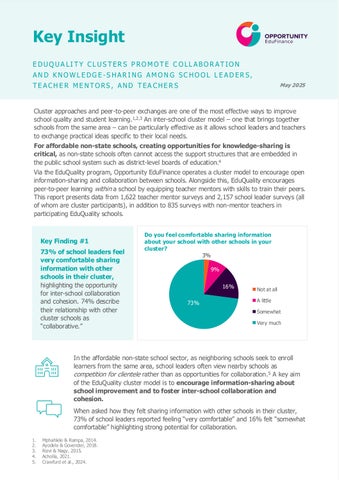
73% of school leaders feel very comfortable sharing information with other schools in their cluster, highlighting the opportunity for inter-school collaboration and cohesion. 74% describe their relationship with other cluster schools as “collaborative.”
Do you feel comfortable sharing information about your school with other schools in your cluster?
In the affordable non-state school sector, as neighboring schools seek to enroll learners from the same area, school leaders often view nearby schools as competitionforclientelerather than as opportunities for collaboration.5 A key aim of the EduQuality cluster model is to encourage information-sharing about school improvement and to foster inter-school collaboration and cohesion.
When asked how they felt sharing information with other schools in their cluster, 73% of school leaders reported feeling “very comfortable” and 16% felt “somewhat comfortable” highlighting strong potential for collaboration.
1. Mphahlele & Rampa, 2014.
2. Ayodele & Govender, 2018.
3. Rizvi & Nagy, 2015.
4. Acholla, 2021.
5. Crawfurd et al., 2024.
Further, 74% of school leaders described their relationship with other cluster schools as “collaborative,” while only 8% described the relationship as “competitive.” Other top qualitative descriptors such as "Friendly", "Supportive", “Enthusiastic” and "Learning" further reinforce the cooperative nature of the cluster environment.
Key Finding #2
How would you describe your relationship with other cluster schools?
66% of school leaders “very much” agree that members respect and agree with how their cluster is organized and led, suggesting strong internal alignment and leadership credibility among inter-school clusters.
To improve sustainability of the clusters, EduQuality encourages building self-governing structures such as electing a cluster leader and enacting governance documents.
Survey responses revealed 66% of school leaders “very much” respect and agree with how their cluster is led, and 27% feel this is “somewhat” true, suggesting clusters have reached consensus on selfsustaining governing systems.
Do you respect and agree on the way the cluster is led and organized?
I do not know Not at all A little Somewhat Very much
Key Finding #3
For teacher mentors, independent communication with other cluster members improved by 9 percentage points between Year 2 and Year 3.
For teacher mentors, cluster communication outside of EduQuality-facilitated meetings – including via Whatsapp and phone calls – has gradually improved. This suggests that teacher mentors find value in seeking input from other schools even outside of their planned cluster meetings, creating opportunities for continuing collaboration postprogram.
In Year 3, 37% of teacher mentors reported communicating with other schools in their cluster 1-2 times per month, compared to only 28% in Year 2. Theproportion of teacher mentorswho reported nevercommunicating with other cluster schools dropped by9 percentagepoints, from 29%in Year 2 to only 18%in Year 3.
How frequently do you communicate with other cluster schools OUTSIDE the cluster meetings?
Year
2 Year 3
Key Finding #4
Teacher mentors are frequently sharing knowledge with other teachers in their schools: 77% of (non-mentor) teachers reported attending a training session delivered independently by a teacher mentor at least once.
In addition to fostering inter-school collaboration via the cluster model, the EduQuality program also seeksto foster intra-school collaboration. An important measure of sustainability and effectiveness of the program is how frequently teacher mentors cascade knowledge to their peers. Research shows that cascade models are cost-effective and may increase teacher motivation, retention, and sense of empowerment.6 However, a cascade model has some risks, as teacher mentors have limited time or resources to deliver training as they juggle other priorities.7
According to (non-mentor) teachers from participating schools, 77%reported attending a training delivered independently by a teacher mentor. Of these, 57% stated they attend these trainings once every month, and an additional 42% attend once every 2-3 months. These findings suggest that while there is room for improvement among the 23% that have never received an independent training, the teacher mentors that do offer peer training are delivering frequent and consistent training sessions. However, in some countries such as Uganda, trainings are highly inconsistent. This indicates a need to follow up with teacher mentors in Uganda to understand what further support they may require – such as time and resources – to ensure consistent delivery of training.
Have you ever attended a training session delivered by a teacher mentor in your school? If yes, how often do you attend these sessions?
77 attend trainings every month
have attended at least one training delivered by a teacher mentor
42 attend trainings every two or three months
% of teachers who have attended at least one teacher mentor-led training by country
Key Finding #5
57% of teachers reported their lessons were neverobserved by a teacher mentor.
Likewise, only 22% of teacher mentors reported conducting lesson observations.
Have you ever had your lessons observed?/How often do you conduct lesson observations?
“Never” (according to teachers)
“Never” (according to mentors)
Lesson observations are another key opportunity for intra-school collaboration.8 Research shows that when training is accompanied with observations, this allows teachers to understand training content in the context of their classrooms and learner needs.9, 10, 11 In the EduQuality program, teacher mentors are instructed to observe other teachers’ lessons to provide individualized feedback and discuss their teaching in action.
Despite this, a large proportion of mentors are not observing lessons. Only 22% of teacher mentors reported conducting observations, and 43% of teachers reported receiving one. This presents a key opportunity for program strengthening –for example, by encouraging school leaders to block time for observations in teachers’ schedules so it is prioritized in their workloads, or by facilitating cross-cluster visits for mentors to build capacity and consistency. 57
Among teachers who were observed, 43% reported monthly observations and 24% had more than one per month. This suggests mentors that do conduct observations do so frequently. This also presents an opportunity for further study to understand why implementation of lesson observations is less successful in some contexts, but very successful in others.
Teachers: How often are your lessons observed by a teacher mentor?