EduFinance ACT Project
FINANCING THE CHILDCARE SECTOR IN KENYA
The following summarizes research on the Kenyan childcare sector market in 2025 The central research aim was to gain insight into the size and nature of the childcare education market and to understand the challenges that affect childcare providers, workers and parents to inform financial solutions that can best serve these potential clients.
KEY FINDINGS
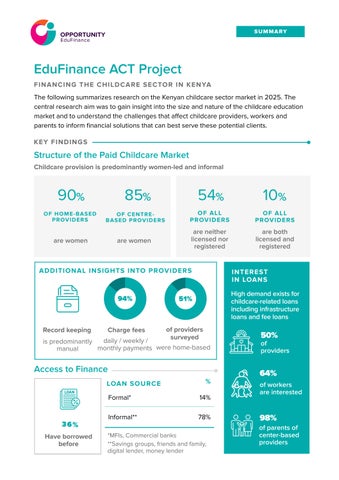
Structure of the Paid Childcare Market
ADDITIONAL INSIGHTS INTO PROVIDERS
INTEREST IN LOANS
is predominantly manual
Access to Finance
Childcare provision is predominantly women-led and informal OF HOME-BASED PROVIDERS 36% are women Have borrowed before *MFIs, Commercial banks **Savings groups, friends and family, digital lender, money lender are women are neither licensed nor registered are both licensed and registered OF CENTREBASED PROVIDERS OF ALL PROVIDERS OF ALL PROVIDERS
High demand exists for childcare-related loans including infrastructure loans and fee loans
50% of providers of workers are interested of parents of center-based providers
ISSUES
Cash flows Repayment Collateral & documentation of providers and householders are irregular schedules are poorly aligned with sector realties
remain major barriers
of workers have insufficient income to cover living expenses Estimated Market Size
FINANCIAL SERVICE PROVIDER ENGAGEMENT
Childcare Risk Open
Perceived risk inhibits product development
Interested in piloting tailored childcare products to alternative credit approaches
Primary priority Secondary priority HOME-BASED
Tertiary priority Lower priority
Implications for Market Prioritization
Market Size (estimated)
Parents (centrebased
Drivers Implication
KES 2.49B 124k+ parents
98% borrowing demand
KES 20k loan size
Centrebased Childcare Providers KES 149.2M Moderate
population size
Medium-to-high demand for borrowing (48%)
Larger median loan size (KES 50,000)
Homebased childcare providers KES 130 2M Large population base
Moderate demand for borrowing (50%)
Smaller loan sizes (KES 20,000)
Childcare workers KES 55.9M Smaller
population base
Medium to high demand for borrowing (64%)
Small loan sizes
Parent-focused childcare fee loans represent the largest financing opportunity in Kenya by a wide margin. While individual loan sizes are small, aggregate demand is substantial, making this segment suitable for high-volume, standardized products, particularly when linked to centre-based providers
Centre-based providers represent a strong secondary market, particularly for enterprise-focused loans (infrastructure, compliance, quality upgrades) Though smaller than the parent market in aggregate value, this segment offers clear enterprise-level impact and stronger alignment with provider sustainability
Home-based providers present a meaningful but slightly lower-priority market compared to centre-based providers, due to smaller loan sizes and higher informality. This segment is better suited for graduated or bundled financial products rather than standalone lending at scale.
Despite relatively high borrowing interest, the small aggregate market size positions childcare workers as a lower priority for credit-led interventions This segment is more appropriate for savings-led or incomesmoothing products, rather than being a primary credit market