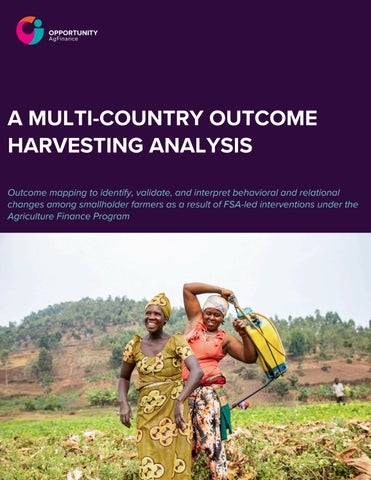
A MULTI-COUNTRY OUTCOME HARVESTING ANALYSIS Outcome mapping to identify, validate, and interpret behavioral and relational changes among smallholder farmers as a result of FSA-led interventions under the Agriculture Finance Program
1
Executive Summary Smallholder farmers face complex and interconnected challenges that often extend far beyond access to finance. Limited knowledge on agricultural best practices, financial exclusion, and vulnerability to climate and market shocks continue to constrain their ability to improve their own livelihoods. Opportunity International’s Agriculture Finance Program (AgFinance) addresses these challenges through an integrated model that combines agricultural training, financial literacy, and community-based support delivered through Farmer Support Agents (FSAs). This evaluation applies Outcome Mapping and Outcome Harvesting to better understand how and why change is occurring among farmers participating in the program across Uganda, Rwanda, and Malawi. Rather than focusing only on outputs, the analysis captures outcomes: observable changes in behavior, practices, relationships, and performance. This lens provides a deeper understanding of the program’s contribution to farmer transformation. Findings show consistent and significant changes across all contexts: ` Farmers are adopting improved agricultural practices such as soil fertility management, intercropping, and regenerative techniques. This adoption is leading to increased yields and improved household food security. At the same time, participation in savings groups and financial literacy training has strengthened financial knowledge and discipline, thus enabling farmers to save regularly, access credit, and invest in productive activities. These changes are translating into increased yields, greater income, and diversified livelihoods. Farmers are investing in agriculture and small businesses, generating more stable and resilient income streams. Stronger farmer groups also play a critical role, creating opportunities for peer learning, collaboration, and access to financial services. Importantly, these economic gains are contributing to broader improvements in household wellbeing, including better nutrition, improved housing, and increased access to education for children. Across all outcomes, farmers consistently attribute these changes to the knowledge, mentorship, and support provided through the FSA model.
The findings are evidence that the AgFinance program is not only improving agricultural productivity and financial inclusion, but also enabling sustained behavioral change at both household and community levels. This integrated approach is contributing directly to AgFinance’s mission to help farmers grow more and earn more, and helping farmers build resilience and longterm security. There are still challenges to address, including access to inputs, market constraints, and climate risks, but these results provide strong evidence that the FSA model is effective, scalable, and capable of driving meaningful impact across diverse contexts.
2
Background The Agriculture Finance Program (AgFinance) aims to strengthen smallholder farmers’ capacity to enhance productivity, resilience, and financial inclusion. Central to this model is the Farmer Support Agent (FSA) approach, a peer-led, community-based mechanism for delivering training in regenerative agriculture, financial literacy, group dynamics, and gender-responsive household planning. Over time, program monitoring and annual surveys have indicated positive trends in yields, income, employment, resilience, agency, wellbeing, and social cohesion among participating farmers. However, these quantitative trends do not fully explain how and why change occurs or indicate the specific pathways through which program activities contribute to these transformations. To address this gap, this evaluation balances this data with qualitative stories, surveys, and responses, a strategy that makes up AgFinance’s Outcome Mapping and Outcome Harvesting process. By emphasizing farmers’ identification and verification of observed outcomes and the underlying processes that best leads to growth, this approach captures the behavioral and relational aspects of change that traditional metrics may overlook.
Purpose and Scope The purpose of this evaluation is to identify and validate outcomes (changes in behavior, practices, relationships, and performance) that have occurred as a result of AgFinance program interventions, with a particular focus on the FSA training model. The evaluation includes clients from Uganda, Rwanda, and Malawi, focusing on outcomes resulting from FSA-led interventions and farmer trainings. Findings are based on focus group discussions and stories of change from farmers, FSAs, and project staff.
3
FARMER STORY: TRAINING AND DIVERSIFICATION TRANSFORMED NAMULONDO’S LIVELIHOOD Namulondo, a mother of eight in Uganda, transformed her livelihood after joining a farmers’ savings group and participating in FSA-led training. Previously harvesting just five 100kg bags of maize from three acres, she adopted improved practices and now produces 24 bags from 1.5 acres. Through financial literacy and savings, she increased her weekly contributions to her savings group from 2,000 to 10,000 shillings, enabling investment in poultry and diversified farming. Her household dynamics also improved, with joint financial planning leading to reduced conflict and greater decision-making capabilities. Her children now can stay in school, and her family has built a better home. Namulondo’s progress reflects how training drives productivity, income growth, and stronger, more resilient livelihoods.
4
Methodology Approach This evaluation employed Outcome Mapping and Outcome Harvesting to document and analyze significant behavioral, relational, and practical changes among farmers and other key actors influenced by the AgFinance program. Outcome Harvesting works backward from evidence of change to determine how program activities contributed to those changes. The process included identifying outcomes, validating them through stakeholder triangulation, and grouping them into thematic categories aligned with program objectives.
Data Collection Data was collected in two main ways: Focus Group Discussions (FGDs) with farmers Most Significant Change stories capturing individual experiences Across Uganda, Rwanda, and Malawi, 30 FGDs were conducted, engaging 210 farmers and 90 FSAs. Participants were selected to ensure representation of men, women, and youth who had participated in multiple training modules.
Validation All findings were substantiated through triangulation between farmers, FSAs, and project staff. This ensured that outcomes were credible, verifiable, and clearly linked to program activities.
5
Key Findings Increased Agricultural Productivity Farmers participating in the program adopted improved farming practices such as manure application, mulching, intercropping, and soil fertility management. These practices contributed to increased yields, improved household food security, and greater market participation. Farmers reported clear improvements in production following training. In several cases, yields more than doubled, and households moved from struggling to meet food needs to producing surplus for sale. These findings indicate a shift from subsistence-oriented farming toward more productive and market-oriented systems.
Namulondo on her farm in Uganda. Since completing trainings with her FSA, she has gone from harvesting just five 100kg bags of maize from three acres, she adopted improved practices and now produces 24 bags from 1.5 acres.
Increased Income and Livelihood Diversification Farmers reported increased income and more diversified business activities. Many accessed loans from their savings groups to invest in farming or start small businesses, including vegetable production, livestock rearing, and enterprise activities.
These income-generating activities are reducing financial vulnerability and enabling households to meet essential needs such as school fees and housing improvements. The integration of agricultural training and financial literacy is enabling farmers to translate knowledge into tangible economic gains.
Elizabeth, a farmer from Rwanda showcasing her produce from the garden that she is now selling on a market stall. 6
Strengthened Savings Culture and Financial Inclusion Participation in savings groups and financial literacy training has strengthened financial management practices among farmers. Participants reported regular savings, improved access to credit, and increased investment in productive activities. Savings groups are also functioning as financial safety nets, allowing farmers to manage risk and respond to shocks. This shift toward structured financial behavior reflects increased confidence, planning, and long-term thinking among farmers.
A women’s digital savings group in Malawi.
Strengthened Farmer Groups and Social Cohesion Farmer groups have become central to program impact, providing platforms for peer learning, collaboration, and access to financial services. Farmers highlighted the importance of group membership for sharing knowledge, solving problems, and building trust. These groups are strengthening social cohesion while reinforcing the adoption of improved practices.
Since completing her trainings, Xaverine has been able to build a house with electricity, expand her farm, and provide for her children. 7
Improved Household Wellbeing Increased productivity and income are translating into improved household wellbeing. Farmers reported better nutrition, improved housing, and increased ability to support children’s education. These outcomes demonstrate that the program’s impact extends beyond agriculture, contributing to broader social and economic transformation at household level.
Diane and her husband on their farm in Rwanda. Through AgFinance trainings, Diane has grown her farm and business to support her family.
Emerging Challenges Despite positive outcomes, farmers identified ongoing challenges, including: Limited access to affordable agricultural inputs High costs of farming materials Market constraints and exploitation by intermediaries Limited irrigation infrastructure These challenges highlight areas where additional support is needed to sustain and scale impact. .
An FSA mentoring one of his farmers in Uganda. 8
Program Impact and Strategic Implications This outcome survey provides evidence that the FSA training model is effectively driving sustainable behavioral change among smallholder farmers. Farmers are not only gaining knowledge but applying it in ways that improve productivity, strengthen financial management, and enhance livelihoods. The integration of agricultural training, financial literacy, and group-based support is enabling farmers to move from subsistence farming toward more resilient, market-oriented livelihoods. Across all countries, the program is contributing to increased productivity, higher incomes, stronger financial inclusion, and improved household wellbeing. These outcomes collectively support long-term resilience and economic stability for farming households.
For stakeholders assessing program viability and impact, the evidence indicates that the AgFinance model is both effective and scalable. Continued investment in training, group and community-based training, and market linkages is now and will continue to be critical for sustaining and expanding these outcomes. At its core, the program is enabling farmers to build the capability, confidence, and systems needed to improve their livelihoods, advancing AgFinance’s mission to help farmers grow more and earn more.
9
Learn about our global work at
AgFin.org