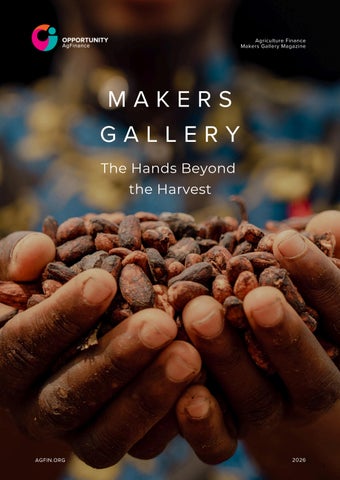
Agriculture Finance Makers Gallery Magazine
MAKERS GALLERY The Hands Beyond the Harvest
AGFIN.ORG
2026
1
Diane, a smallholder farmer in Rwanda, sells fruits and vegetables at her local market to supplement her tomato farm’s income, helping her provide for her three children and increase her overall income.
2
ROOTED IN INGENUITY THE POWER OF DIVERSIFICATION
Smallholder farmers are some of the most hardworking and resourceful people in the world. Along with farming, though, comes the uncertainty of crop yields and climate disasters, fluctuating input and market costs, and seasonal changes. Still, they continue to work their farms, support their families, and look for new ways to build their livelihoods. This magazine celebrates the Hands Beyond the Harvest: the creativity, skill, and enterprise of smallholder farmers beyond the farm. These farmers are also bead makers, basket weavers, painters, wood carvers, jewelry makers, textile artists, shopkeepers, tailors, and entrepreneurs. These businesses can provide an important source of additional income for farming families. Diversifying their livelihoods can help families build savings to fall back on when crops fail, weather disrupts a harvest, or unexpected expenses arise. The stories that follow offer a glimpse of the many things smallholder farmers create beyond the harvest. They are farmers, but they are also makers, entrepreneurs, problem-solvers, and business owners. Their creativity and innovation are an important part of the work they do to build stronger livelihoods for their families and communities. To the farmers featured in these pages, thank you for sharing your work with us. Your creativity, skill, and determination are an important part of the story we want to tell. We hope these pages offer a glimpse of the many things you grow, create, and build beyond the harvest.
3
GRACE’S SOYA MILK MALAWI
Grace is a smallholder farmer in Central Malawi who has maintained her maize and soybean farm and raised livestock for nearly 30 years. With the support of Opportunity’s FarmerAI app, she has begun applying improved farming practices and managing her work more as a business. Despite ongoing challenges such as input costs and variable yields, farming remains central to her household income, supporting her children’s education and daily needs. To supplement the income from her farm, Grace makes and sells soya milk from her soybeans. For Grace, selling her soya milk is a source of independence. It allows her to earn additional income, support her family, and meet daily needs. Through this work she is able to turn locally accessible resources into a valuable product and reduce waste at the same time.
“Making and selling soya milk means a lot to me because it gives me confidence and pride. I am able to contribute to my family’s needs. I am proud that my effort is making a real difference in my community.” — GRACE
4
For Grace, making and selling soya milk built her confidence and independence.
5
ASANA’S BASKET WEAVING GHANA
Asana is a smallholder farmer in Ghana, where she grows peppers, maize, rice, and other crops to sustain her household. In addition to the income and food from her farm, she produces and sells handmade crafts of many kinds, but primarily baskets. These baskets are weaved from natural materials such as dried grass or straw, which is typically sourced from her farm to lower input costs and reduce waste. The income that Asana receives from selling these baskets supplements her farm income to help support her family and purchase agricultural inputs.
Asana on her pepper farm and weaving a basket (top right)
6
ESTER’S HANDMADE BAGS & CLOTHING RWANDA
Ester runs a small business in which she makes and sells handmade bags and clothing that are both popular and affordable within her community in Rwanda. Because of this business, she has been able to increase and diversify her family’s income to provide an additional level of security outside of their farm. Ester is also a member of the Turere Neza farmer savings group in Rwanda.
“To Raise Well” ENGLISH
Turere Neza KINYARWANDA
7
ALINE’S HAIR SALON RWANDA
Aline is a 39-year-old farmer and mother of three who once relied on small-scale farming despite facing challenges with a limited income and unpredictable weather. After joining her local savings group, she gained financial and business skills that allowed her to diversify her income by starting a small hair salon and accessing loans through a formal financial partner. With this additional capital and training, Aline expanded her farming activities, invested in livestock, and began acquiring property. Regenerative agriculture training also helped her improve yields while reducing costs and fortifying her farm against climate disasters. As her income grew, she was able to provide better nutrition and education for her family and build greater financial security.
8
Today, Aline says she feels more confident and independent. She plans to continue growing her business and supporting her children in pursuing higher education.
9
MADESS’ HANDMADE CLOTHING MALAWI
Madess farms maize and groundnuts while also running a sewing business from her home. She uses her sewing machine to make baby outfits, school uniforms and jerseys, clothes, and other items, earning income to meet her family’s basic needs.
10
MARTEN’S STRAW MATS MALAWI
Marten is a farmer in Malawi who grows cotton and sorghum and is a member of his local savings group. He makes and sells multi-purpose straw mats. Farmers use these mats to dry harvested maize, as well as for sitting and sleeping. These mats provide a practical resource for his community, where beds and chairs are not affordable for many families, and are also a source of additional income for Marten.
11
“I started a business in the market selling tea and small meals. It was small to start – it was a question of doing it step by step as I didn’t understand how to run a business. I want to be able to grow my shop so I can support my family and children, and will get another loan from Opportunity to do this. Their support and trainings have helped us to understand how to create a business plan and how to save money each month to cover our loan. ” - Lucia, Mozambique
12
Lucia is a 43-year-old mother of four from Mozambique who began building her own livelihood after her marriage ended. With her children’s school fees, household expenses, and a home needing repairs to manage, she started a small market business selling tea and meals. When the business needed more capital to grow, Lucia joined a three-woman savings group and accessed a loan through Opportunity Bank. Soon after taking out the loan, the market Lucia sold in temporarily closed for renovations. She adapted by expanding her business to buy and sell Kechaso, allowing her to successfully pay back her loan. Lucia has since learned how to develop a business plan and consistently save toward loan repayments, and she plans to expand her business by buying beans in rural areas and selling them in the market.
LUCIA’S MARKET FOODS MOZAMBIQUE
13
SANDRINE’S TAILORING RWANDA
Sandrine is a 20-year-old farmer in Rwanda who, after attending a training with her local savings group, started a tailoring business where she repairs clothes and makes new pieces to sell.
The business gives her an additional source of income beyond agriculture, and she hopes to expand it, build her skills, and eventually open a training center for other women in her village.
14
RILIOSE’S BASKET WEAVING RWANDA
Riliose is a rural woman farmer in Rwanda who
Her baskets are beautiful, valued, and widely
grows climbing beans. After receiving training
used in her community. They also help provide
on diversifying income sources, she discovered
an additional source of income for Riliose's
a passion for basket weaving and now makes
family while allowing her to turn her creativity
baskets after completing her farming activities.
and skills into an opportunity for growth.
15
DANIEL’S ENTREPRENEURSHIP UGANDA At 32, Daniel is a youth leader, entrepreneur,
Daniel plans to hire additional support as his
and Farmer Support Agent with Opportunity
business grows, both to increase productivity
International AgFinance’s Youth Enterprise
and reduce the physical demands of working
Challenge (YEC) program. He joined the
alone. Within the next five years, he aims to
program in June 2024, drawn to its focus on
establish a bakery and a snack shop that can
equipping young people with the skills to build
supply products beyond his immediate
sustainable livelihoods. At the time, he had
community. On a personal level, he is working
secured a job at a hotel: an opportunity many
toward building a home for his family.
would have taken without hesitation. Instead, he chose to commit to YEC, prioritizing long-term growth over immediate stability. What began as small-scale trading – selling shoes and fried cassava – has evolved into a more structured and diversified enterprise. With guidance from YEC and local mentors, Daniel expanded into producing and selling snacks like mandazi, daddies, and roasted maize, creating a more reliable daily income. He reinvested his profits to buy a refrigerator, allowing him to add cold drinks to his offerings and attract a wider customer base, including students and youth from his church community. His approach is consistent: start small, reinvest, adjust, and grow. On an average day, he works through multiple batches of products, each contributing incremental profit. Over time, those increments add up.
“Before, I worked hard but without a plan. Now I know where I am going and how to get there.” — DANIEL
16
17
LASTON’S STRAW MATS MALAWI Laston farms maize and makes mats in Malawi. He started making mats in 2015, and the income helps keep food on the table and has helped him build a small house for his family. During mat-making season, Laston makes about one mat a day; he also uses the mats to dry his harvested maize.
18
MARIE JEANNE’S TAILORING RWANDA
Marie Jeanne farms beans and other crops as a member of her local savings group. After gaining new skills through AgFinance's Family Business and Entrepreneurship training, she started a tailoring business to create additional income for her family.
The Family Business and Entrepreneurship (FBE) training is a 7-week course designed to teach farmers the practical skills needed to start, manage, and grow businesses. These small businesses provide supplemental income for farmers, which is especially important in farming where weather, input prices, and market availability can greatly impact their finances week-to-week.
19
“My life is much better and now I have lights in my house and I have a TV and my children can do this. I never used to have this and now I can pay my children’s school fees when they go to secondary school.” - Genita 20
After receiving a loan, Genita was able to
GENITA’S SOAPS AND MARKET FOODS MOZAMBIQUE
expand what she could sell at her market stall, adding milk, coffee, and salads to her tea business. Her business has grown, her revenue has increased, and more customers now come to her stall. Genita’s husband also runs a small business buying and selling beans, along with managing their
In 2001, Genita moved her family from the
farm.
rural town they had lived in to a more periurban region of central Mozambique
The increased and diversified income from
because, despite opening a small business
these businesses has allowed her family to
selling soap, she struggled to support her
purchase household items they could not
two young children.
afford before, including chairs and cups, and improve their living conditions. Looking
But still, with an unpredictable farm income
forward, Genita hopes to expand her food
and limited products to sell in the market,
business, open a secondhand clothing
money was tight and one unexpected
business, pay her children's school fees
medical treatment could have been
through secondary school, and build a new
detrimental.
home for her family.
21
REGINA’S BASKET WEAVING RWANDA
Regina is a member of her local savings group in Rwanda. She grows beans and also weaves baskets, a handcraft business she started after attending training from an FSA. The income she earns from her basket weaving helps her meet her family’s expenses while creating an additional source of income beyond farming.
22
NARCISSA’S CLOTHING SHOP RWANDA
Narcissa, a smallholder farmer and mother of four from Rwanda, was struggling to provide enough food and clothing for her family when she joined her local savings group. After receiving training through the group, she implemented RegenAg techniques on her farm, which led to increased crop yields and reduced input costs. With the increased income from her crops, she was able to purchase clothing in bulk to sell to her community, further increasing her income.
“My story shows that when women gain skills, access to finance, and practical support, they can transform their lives and build lasting resilience for their families and communities.” — NARCISSA
23
DAVID’S CARPENTRY MALAWI David is a farmer and Farmer Support Agent (FSA) in Malawi. He grows maize and also works as a carpenter, using his skills to create an additional source of income alongside farming.
Alex is a maize farmer in Central Malawi. He supplements his income by running a small business where he tailors clothing.
ALEX’S TAILORING MALAWI
24
Modesta is a farmer and small-scale business owner in Malawi who grows maize, a staple food in the country. She also bakes and sells popular African snacks, including Zitumbuwa (banana fritters), to establish an additional source of income alongside farming.
MODESTA’S MARKET FOODS MALAWI
25
MEXON’S FARMING TOOLS MALAWI
Mexon is a 58-year-old farmer from Malawi, who grows maize and produces agricultural tools such as axes and panga knives. His work provides farmers in his community with essential tools for land clearing, harvesting, and other farm activities, helping improve access to reliable equipment while creating an additional livelihood alongside farming.
26
Mexon uses one of the tools he made to shuck maize he harvested from his farm.
27
NAKISITA’S CROCHET BUSINESS UGANDA
Nakisita is a young smallholder farmer in
Every item she makes helps her earn income to
Uganda, who grows groundnuts and maize.
pay school fees, cover medical bills, and
She also creates handmade crochet pieces
reinvest in her gardens. Nakisita describes her
such as baby items, scarves, and home décor.
crocheting as the way in which she turns creativity into resilience. She blends timeless patterns and colors with modern designs. She also teaches young women and girls in her community to crochet, helping them build skills they can use to earn income. Her vision is to build a community collection where skill-sharing becomes income-sharing.
“Crocheting keeps my hands busy and my mind calm. Each stitch is a small prayer, a moment of peace after a long day in my garden.” — NAKISITA
28
Thank you to our clients, partners, and donors who work every day to make a change in the world. AGFINANCE MAKERS GALLERY 2026
29
Helping farmers to grow more and earn more.
agfinance.org © 2026 Opportunity International AgFinance / 2503 Opportunity International is a 501(c)(3) nonprofit and serves all people regardless of race, religion, ethnicity or gender.
30