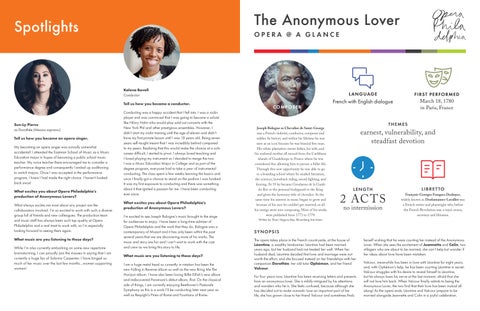
Spotlights

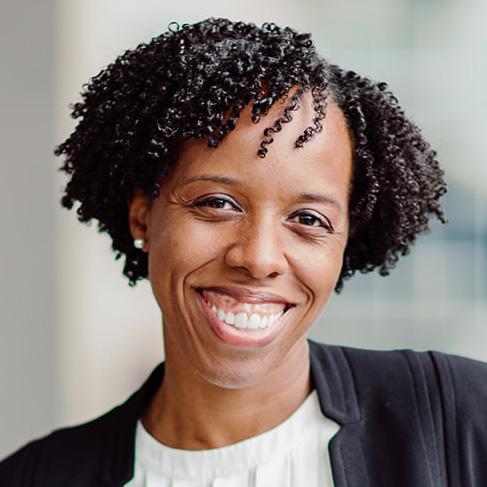
Tell us how you became an opera singer.
My becoming an opera singer was actually somewhat accidental! I attended the Eastman School of Music as a Music Education major in hopes of becoming a public school music teacher. My voice teacher there encouraged me to consider a performance degree and consequently I ended up auditioning to switch majors. Once I was accepted in the performance program, I knew I had made the right choice. I haven’t looked back since!
What excites you about Opera Philadelphia’s production of Anonymous Lovers?
What always excites me most about any project are the collaborators involved. I’m so excited to work with such a diverse group full of friends and new colleagues. The production team and music staff has always been such top quality at Opera Philadelphia and a real treat to work with, so I’m especially looking forward to seeing them again.
What music are you listening to these days?
While I’m also currently embarking on some new repertoire brainstorming, I can proudly join the masses in saying that I am currently a huge fan of Sabrina Carpenter. I have binged so much of her music over the last few months…women supporting women!
Tell us how you became a conductor.
Conducting was a happy accident that I fell into. I was a violin player and was convinced that I was going to become a soloist like Hilary Hahn who would play sold out concerts with the New York Phil and other prestigious ensembles. However, I didn’t start my violin training until the age of eleven and didn’t have my first private lesson until I was 18 years old. Being seven years self-taught meant that I was incredibly behind compared to my peers. Realizing that this would make the chance at a solo career difficult, I started to pivot. I always loved teaching and I loved playing my instrument so I decided to merge the two. I was a Music Education Major in College and as part of the degree program, everyone had to take a year of instrumental conducting. The class spent a few weeks learning the basics and once I finally got a chance to stand on the podium I was hooked. It was my first exposure to conducting and there was something about it that ignited a passion for me. I have been conducting ever since.
What excites you about Opera Philadelphia’s production of Anonymous Lovers?
I’m excited to see Joseph Bologne’s music brought to the stage for audiences to enjoy. I have been a long-time admirer of Opera Philadelphia and the work that they do. Bologne was a contemporary of Mozart and it has only been within the past several years that we are discovering more of his works. The music and story are fun and I can’t wait to work with the cast and crew as we bring this story to life.
What music are you listening to these days?
I am a huge metal head so currently in rotation has been the new Falling in Reverse album as well as the new Bring Me The Horizon album. I have also been loving Billie Eillish’s new album and rediscovered Paramore’s debut album, Riot. On the classical side of things, I am currently enjoying Beethoven’s Pastorale Symphony as this is a work I’ll be conducting later next year as well as Respighi’s Pines of Rome and Fountains of Rome.
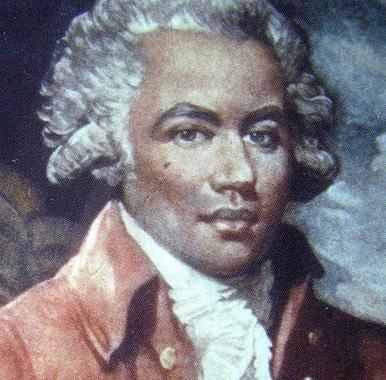
Joseph Bologne or Chevalier de Saint-George was a French violinist, conductor, composer and soldier. In history and within his lifetime he was seen as an icon because he was biracial free man. His white plantation owner father, his wife, and his enslaved mother all moved from the Caribbean islands of Guadeloupe to France where he was considered free allowing him to peruse a fuller life. Through this new opportunity he was able to go to a boarding school where he studied literature, the sciences, horseback riding, sword fighting, and fencing. At 19 he became Gendarme de la Garde du Roi or the personal bodyguard to the King and given the honorary title of chevalier. At the same time his interest in music began to grow and because of his race he couldn’t get married, so all his energy went into composing. Most of his works were published from 1773 to 1779. Written by Shani Hagans-Bey, Bloomberg Arts Intern
French with English dialogue
LANGUAGE FIRST PERFORMED March 18, 1780 in Paris, France
earnest, vulnerability, and steadfast devotion
LENGTH
2 ACTS no intermission
The opera takes place in the French countryside, at the house of Léontine, a wealthy landowner. Léontine had been married years ago, but her husband had not treated her well. When her husband died, Léontine decided that love and marriage were not worth the effort, and she focused instead on her friendships with her companion Dorothée, her old tutor Ophémon and her friend Valcour
For four years now, Léontine has been receiving letters and presents from an anonymous lover. She is mildly intrigued by his attentions and wonders who he is. She feels confused, because although she has decided not to make romantic love an important part of her life, she has grown close to her friend Valcour and sometimes finds
LIBRETTO François-Georges Fouques Deshayes, widely known as Desfontaines-Lavallée was a French writer and playwright who before the French Revolution was a royal censor, secretary and librarian.
herself wishing that he were courting her instead of the Anonymous Lover. When she sees the excitement of Jeannette and Colin, two villagers who are about to be married, she can’t help but wonder if her ideas about love have been mistaken.
Valcour, meanwhile has been in love with Léontine for eight years, and, with Ophémon’s help, he has been courting Léontine in secret. Valcour struggles with his desire to reveal himself to Léontine, but he always loses his nerve at the last moment, afraid that she will not love him back. When Valcour finally admits to being the Anonymous Lover, the two find that their love has been mutual all along! As the opera ends, Léontine and Valcour prepare to be married alongside Jeannette and Colin in a joyful celebration.
Depuis longtemps mon coeur soupier
My heart has sighed for a long time Valcour sings this opening aria, revealing to the audience his enduring love for Léontine with his words and his simple and sincere music. The aria is in waltz time (the beats are organized as 1-2-3, 1-2-3, etc.). Because at the time the opera was written waltzes were associated with the upper class, we can learn from Valcour’s aria that he is a high-ranking man who is Léontine’s equal socially.
Quinqué - Que de maux mon Coeur resent!
Quintet - My heart feels so much pain!
This is the finale of Act I, and all five characters onstage (Valcour, Léontine, Jeannette, Colin, and Ophémon) sing at the same time. They are all feeling different things, which we can hear in their music. Léontine is pretending to be fine after Valcour has scared her by jumping out from behind a tree and pretending to be her Anonymous Lover, but she is in fact becoming increasingly agitated. The repeated notes in the violins might make us feel like we’re at the edges of our seats as well as we listen!
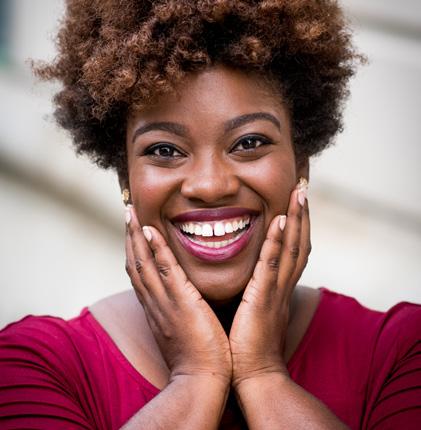
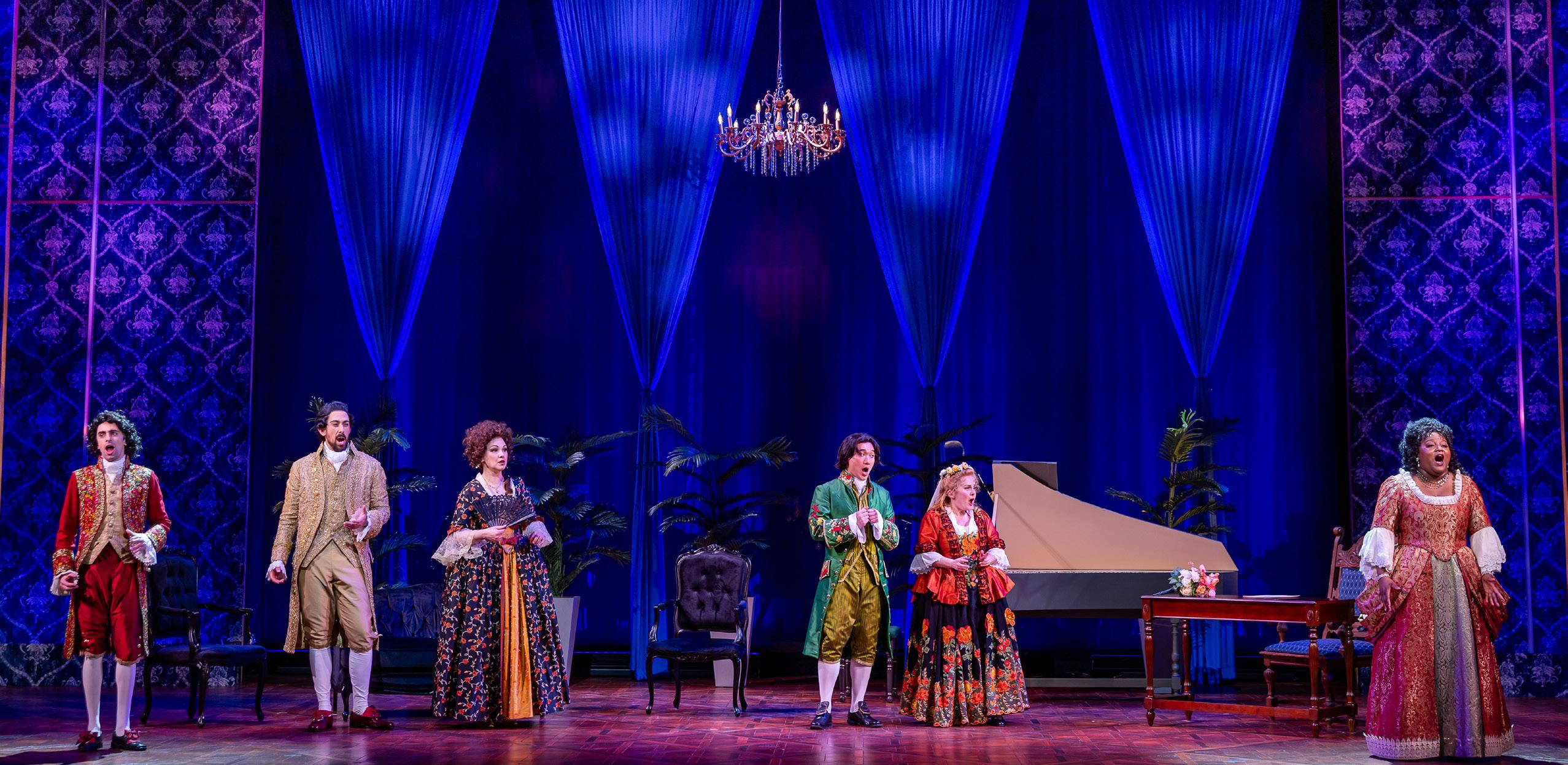
Symone Harcum as Léontine (Soprano):
A wealthy young widow who resists suggestions that she fall in love again after a cold marriage to her late husband. She has been receiving gifts and love letters from an anonymous admirer, who is in actuality her good friend Valcour.

Travon D. Walker as Valcour (Tenor): A good friend of Léontine who is in love with her, but hides his feelings from her.

Johnathan McCullough as Ophémon (Baritone): A guy who acts as a messenger, middleman, and puppeteer between the main characters.
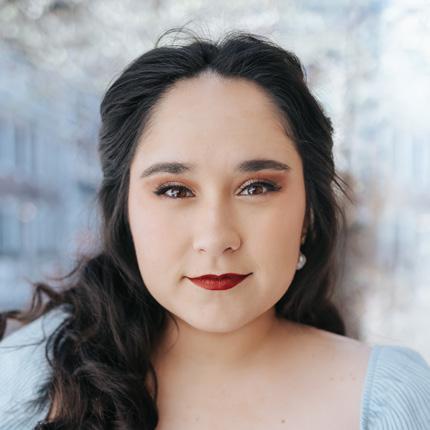
Marie Robillard as
A maid who is about to marry Colin.
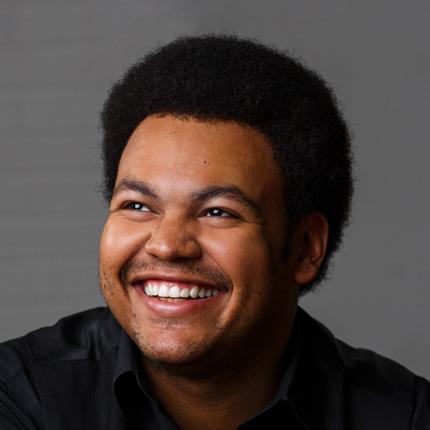
Chantons, célébrons notre dame
Let’s sing, let’s celebrate our lady
Jeannette and Colin about to get married. They sing a cheerful song in praise of love and thank Léontine for approving their union. This is an interesting scene because Jeannette and Colin are performing a song for the other characters onstage, and we are a second audience watching the performance.
Enfin une foule importune…
Amour deviens-moi propice
At last an unwelcome crowd…Love, be favorable to me
The wedding crowd has finally gone home, and Léontine is left alone with her thoughts. She wishes she could speak to her good friend Valcour, but she thinks he could not understand her romantic troubles. At the beginning of this scene, Léontine is not quite speaking and not quite singing full melodies. This is a mode of expression known as recitative, and it allows us to feel her strong emotions in a way that might feel more realistic for us than if she immediately burst into song.
Ah! Finissez de grâce
Ah! Finish, for mercy’s sake
In this duet, Léontine begs Ophémon to tell her who the Anonymous Lover is. Ophémon refuses. Their conflict can be heard in the duet’s first part in how their words overlap. Many of the words they sing are the same, showing they’re really on the same side, but some of their words are directly conflicting and almost cancel themselves out for the listener – we can’t hear what either of them is trying to say. In the second part of the duet, they take turns saying their opinions in a push and pull dynamic, before they sing the first part of the scene again.
Ah! Quel trouble m’agite
Ah! What trouble perturbs me?
Léontine and Valcour come to the happy realization that their love is mutual. Ophémon, Valcour’s friend, is happy to witness their love. Their joy results in their musical lines tumbling into each other. It is funny that after such a complicated plot resulting from Valcour concealing his identity, they immediately confess their love and pledge their fidelity to one another forevermore as soon as Valcour reveals himself as the Anonymous Lover.
Non, je ne puis rien entendre
No, I can’t hear any more
Léontine still does not know Valcour is her secret admirer. He comes to her as a friend just as she is waiting to confront the Anonymous Lover. She wants to confide in Valcour, but feels she should not under the circumstances, and she just wants to be alone. We hear in this duet that Léontine and Valcour start off expressing themselves separately but the space between each of their parts slowly decreases until they are singing together. We might begin to suspect that the two will have a happy ending.
Aimons-nous sans cesse
Let’s love each other forever
This quartet shows that Léontine and Valcour have joined Jeannette and Colin as another happy couple. Horns join in the orchestra contributing to the triumphant feel of this closing scene. 8.