NEWSLETTER FOR P ARENTS, STU
DENTS, AL
UMNI FA
MILIES,
GRAND
PAREN T
S AND
FRIEN
DS
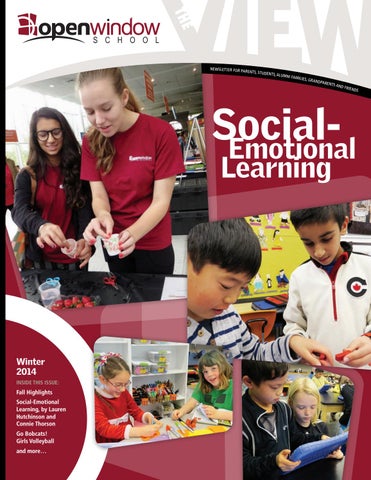
SocialEmotional Learning
Winter 2014 INSIDE THIS ISSUE:
Fall Highlights Social-Emotional Learning, by Lauren Hutchinson and Connie Thorson Go Bobcats! Girls Volleyball and more…
like us
Follow us
facebook.com/OpenWindowSchool twitter: @OWSBobcat
Dear Friends of Open Window School, I am thrilled that this edition of The View highlights Open Window’s commitment to SocialEmotional Learning. From its earliest days, Open Window has believed in “Children First, Gifted Second.” We offer rigorous academics balanced with a focus on the social and emotional development of our students.
The quality of Open Window’s academic program is unquestioned. We offer a curriculum both rich in depth and with ample opportunities for acceleration. Gifted children need this degree of acceleration, depth and rich content in order to develop great academic habits and higher-level thinking skills. As more of our graduates experience high school, it is gratifying to hear how well-prepared they are both for their studies and to be leaders in their new schools. If we were to focus solely on our students’ academic preparation, however, we would be failing them miserably. Every child we admit to Open Window is “smart enough” to have unlimited opportunities, if they can take advantage of their intellectual potential. What may truly determine our students’ ability to develop their talents and lead fulfilling lives is their success in mastering the non-cognitive skills that we describe as Social-Emotional Learning. These skills include self-awareness, empathy, organization, perseverance (or “grit”), self-regulation and task commitment. Many of these skills are inseparable from our students’ academic needs. Without an enriched academic program, bright students do not have the opportunity to develop skills such as perseverance and task commitment. Social-Emotional Learning takes place in every area of the school, from our classrooms to our playing fields. What ties everything together is a school-wide culture that is mutually respectful and encouraging, helps students feel a sense of connection, teaches important social and life skills and invites them to discover how capable they are in solving conflicts and resolving problems. We are blessed to have two outstanding counselors, Connie Thorson and Lauren Hutchinson, who serve as resources to our teachers, but as Social-Emotional Learning is infused in everything we do, our entire faculty and staff play a vital role in this essential element of an Open Window education. Open Window students have amazing intellectual gifts, and by offering them a challenging academic curriculum blended with nurturing support from their teachers, we afford them the very best opportunity to reach their potential. We hope you enjoy this issue. It captures just a small part of what makes Open Window a transformative experience for our students. For a complete and up to date look at our school, please visit our brand new website at www.openwindowschool.org.
Sincerely,
Jeff Stroebel, Head of School
OPEN WINDOW SCHOOL | THE VIEW | WINTER 2014 | PAGE 1
ALL 2013 HIGHLIGHT
BOBCAT SPIRIT Bobcat Spirit was a major theme this fall with Spirit Week: Wacky Hair, Sports, Pajama Day and Halloween. Rufus and Mr. Stroebel held a Spirit Contest in November where teams of Lower and Middle School students wore spirit gear or school colors on Fridays and wrote a Team Cheer which was performed at the Spirit Assembly.
BOBCATS REPRESENT The fall was filled with tournaments for Chess and Debate, all resulting in awards for Bobcat participants.
HOUR OF CODE K-8 students spent a week in December writing code as part of a worldwide movement called Hour of Code, created by Open Window parent Hadi Partovi. During the Hour of Code Middle School Assembly, several parents who are programmers, spoke with students about the benefits and joy of writing code.
GUYS & DONUTS The 1st Annual Guys & Donuts event, hosted by the Parent Association, was a huge success as dads, uncles and grandpas gathered with their Open Window students to share in conversation over delicious donuts.
The Girls Volleyball teams had an impressive fall. (See article on page 6.) Coaches Harpel and Vogelheim led our co-ed Cross Country Teams to matches across the region bringing Bobcat pride to us all.
POSITIVE IMPACT PROJECT (PIP)
Ms. Shaw took the Open Window team to the Model UN Conference in Seattle this fall. Last, our Debate Team, headed by Ms. Paulson, 6th Grade Humanities Teacher, won 1st Place in all debates at their first debate in October.
Families and staff members spent a very cold December weekend doing community service at Lewis Creek Park, mulching the trail; Aegis Living, performing for residents; Food Lifeline, packing boxes of potatoes.
IN & OUT OF THE CLASSROOM Both in and out of the classroom, Open Window students were learning and exploring. Students learned about spiders, sailed on ships, wrote autoBearographies, visited farms, built communities, designed Romeo and Juliet sets and costumes, and more.
OPEN WINDOW SCHOOL | THE VIEW | WINTER 2014 | PAGE 2
SOCIAL-EMOTIONAL LEARNING BY CONNIE THORSON (COUNSELOR CONNIE), LOWER SCHOOL COUNSELOR
& LAUREN HUTCHINSON, MIDDLE SCHOOL COUNSELOR
The New Essential Skills for Success We’re all thinking about how we can help our children and adolescents thrive in the 21st Century. Where can our child get the optimal base of intellectual content knowledge to be successful? What STEM skills will be requisite in the global tech culture? Emerging research in overlapping fields of education, neuroscience and psychology are now pointing towards a different type of mastery for success in the 21st Century: development of a collection of higher-order mental abilities referred to as “noncognitive competencies.” In common language, these are social, emotional, and executive functioning skills, and well-respected research is suggesting these “soft skills” may be more determinant of success than IQ.
OPEN WINDOW SCHOOL | THE VIEW | WINTER 2014 | PAGE 3
Social-emotional learning is not new. It has been valued in recent years for helping children develop self-awareness, identify and handle emotions, resolve conflicts, and function with greater social intelligence. Many parents and educators consider these worthwhile pursuits and deserving of the time and resources needed to teach, while others have viewed them as optional. Enter the new research which identifies the two skills most critical to success in academics and beyond, perseverance and self-regulation, and the subject of social-emotional learning takes on more relevance than ever.
HOW DOES SOCIAL-EMOTIONAL LEARNING LOOK IN OUR CLASSROOMS?
Perseverance, also known by the term “grit,” is the ability to persist in the face of discomfort and difficulty. It is not in the avoidance of struggle, but the “working through” of a challenge where a child learns the essential character strength of resilience and develops the necessary psychological tools to overcome obstacles. It is crucial that on a path to responsible adulthood that our children learn if you fail, you’ll try again, that you don’t need people to bail you out, and that you’ll persevere in the face of difficulty.
A group of kindergarten children are seated in a circle. One by one, each child shares how they are feeling on a 1-10 scale. This scale is based on a theme which their class created of ice cream toppings. For example, 1 = worms, 2 = expired sprinkles… 7 = mint candies and 10 = colored sprinkles. “I’m feeling sort of banana bread (5) because I’m tired today,” says one student. Another child excitedly states, “I’m feeling colored sprinkles (10) because tomorrow is my birthday!”
Self-regulation, also referred to as self-control, the ability to regulate one’s emotions and impulses, is another critical skill for life. In the late 1960s, Stanford psychologist Walter Mischel conducted the famous “Marshmallow Experiment,” where 4-year-olds were offered one marshmallow for immediate gratification (and consumption) or two marshmallows if they could wait 15-minutes before eating them. Mischel followed these two groups of students (those who waited and those who didn’t) over the years and the subsequent data has been compelling. Later in adolescence the “waiters” were better able to pay attention, maintain friendships, and displayed less behavioral problems at home and at school. They even had a 210 point SAT score advantage over those students who did not wait. Following these subjects into adulthood, Mischel found the “waiters” to be healthier and have less drug and alcohol problems as adults. But just exactly how can self-control be taught, let alone when some kids have the biological basis for more impulsivity than others?
These students are doing what is called a Check-in, which is used in both Lower and Middle School. This is a way for students to notice what they are feeling and to take their group’s emotional temperature. It is a great activity for self-awareness and social-awareness and does wonders for building empathy. Research suggests that children’s empathy is heightened when they perceive similarities between themselves and others. As students listen to each other, you can see the heads nod when they feel similarly to the student who is sharing.
Here’s the good news: unlike intellectual capacity which tends to be considered a more fixed attribute; social, emotional and executive functions are malleable entities. While some students may need additional support for particular skillsets, and outside resources may be indicated in some cases, many of the basic skills are already being taught in our classrooms. These include emotional regulation strategies (“unflip your lid”), effective communication, problem solving, planning and organization, respecting differences, team-building, empathy and service, personal awareness and reflection, accepting responsibility and fixing mistakes, just to name a few. In addition to structured lessons, part of our mission is to also develop these competencies through engagement in challenging, long-term, real-world problems that require planning, monitoring, and feedback, especially in the middle school. The ultimate goal is for there to be a seamless, integrated relationship between the acquisition of core knowledge and the use of these softer skillsets to maximize a student’s potential. We welcome your partnership in this process, and look forward to sharing more knowledge and resources with you through our site on the My Open Window Resource Board called ‘Social, Emotional and Character Resources.’
Our Social-Emotional Learning Program addresses needs from an interpersonal perspective such as social awareness and relationship skills, and needs from an intra-personal perspective such as self-awareness, selfregulation and executive functioning skills. Here is just one example of how Social-Emotional Learning looks in the classroom:
Communication skills help students ask for what they need in respectful ways, and this paves the way for future problem solving discussions. In the younger grades students are taught “Bugs and Wishes” with the help of a magic wand and toy bug. This begins with students brainstorming various typical classroom problems that “bug” them such as cutting in line, borrowing without asking, talking during work time, etc. Then they brainstorm some “wishes” to match the “bug list”. For example, a student might say, “It bugs me when you cut in line, and I wish you would go to the end of the line.” Following this, the class will focus on learning how to respond respectfully to this kind of statement. Students practice this communication template through role play while holding the bug and magic wand, so that when a real difficulty happens they have a tool to get their needs met that is based on mutual respect. Students in older grades are taught another version of this called “I-Statements”. The template sounds like this, “I feel ___ when _____ and I wish ________.”
Some of the Essential Skills we focus on in both Lower & Middle School:
Please visit the Resource Board on My Open Window for resources and additional reading.
OPEN WINDOW SCHOOL | THE VIEW | WINTER 2014 | PAGE 4
· S elf-Regulation Skills ommunication Skills ·C utual Respect ·M · B uilding Cooperation istakes and How to Fix Them ·M · E ncouragement · R especting Differences · S olution Focused Problem Solving · P lanning, Organization and Time Management
REFLECTIONS ON CHRISTINE GROSS-LOH’S
PARENTING WITHOUT BORDERS BY LAURA SIMEON, LEARNING COMMONS DIRECTOR & DIVERSITY COORDINATOR
One of the universals of parenting in the United States is that there is no shortage of opinions – from in-laws, friends, strangers in the grocery store, pediatricians and magazines – many completely contradictory! Just to add to the confusion, there are your “instincts” – which have actually been shaped by years of cultural conditioning to the point where what seems to you like an obvious, natural response may seem utterly alien, even harmful, to someone from another region of the country or a different socioeconomic class, let alone another culture. What if you had a book that not only held up a mirror to many of your previously invisible cultural assumptions, but also explained why some people parent in the seemingly inexplicable way they do? What if it helped you be more intentional about your parenting, helping you deliberately cultivate your family’s values while shedding practices that may unwittingly be undermining your long-term goals? This fall I led a parent book club based on Christine Gross-Loh’s Parenting without Borders: Surprising Lessons Parents around the World Can Teach Us, a book that can help with all of the above. An enthusiastic group of parents met for several lively discussions, culminating in a visit by the author. Christine and I met as undergraduates and fellow history majors at Bryn Mawr College. We have remained best friends over the decades, and inevitably our conversations centered more and more on parenting as we became mothers ourselves. When Christine, well-established as a freelance author on parenting, invited me on-board as a researcher, I leapt at the chance. The resulting book reflects her sincere appreciation of all that is good about the United States, tempered by an awareness of what we can learn from other cultures.
Author, Christine Gross-Loh’s website http://christinegrossloh.com/
Huffington Post: The Milestone that Matter Most http://www.huffingtonpost.com/christinegrossloh/the-milestones-that-mattermost_b_3195567.html The Atlantic: Keeping Kids From Toy Guns: How One Mother Changed Her Mind http://www.theatlantic.com/national/ archive/2013/08/keeping-kids-fromtoy-guns-how-one-mother-changedher-mind/278518/ Huffington Post: Have American Parents Got It All Backwards? http://www.huffingtonpost.com/ christine-grossloh/have-americanparents-got-it-allbackwards_b_3202328.html
Christine’s author visit focused primarily on kindness, responsibility and risk. Parents everywhere want their children to become kind, responsible human beings, but how they go about cultivating these traits varies dramatically. For example, Japanese students clean their schools every day, so no custodial staff is needed. Children in East Asia are given more physical nurturing when very small, being held constantly and never sleeping alone, but are also expected to take on far more independent responsibility for self-care than American students as they grow up. The dominance of the self-esteem movement in the US – exposed as a fallacy by researchers but still embraced by the general public – has influenced our perception of risk as something to be prevented or avoided, and children as fragile and vulnerable. In the Scandinavian countries and Germany, by contrast, there is more focus on the harm done by not letting children take enough risks, both physical and emotional. Other topics covered by Christine’s book include consumerism, self-control, play and education. Her upcoming book, The Path, coauthored with Harvard professor Michael Puett, explains how ancient Chinese philosophy can help us in practical ways as we navigate a world that seems ever more fraught with anxiety.
OPEN WINDOW SCHOOL | THE VIEW | WINTER 2014 | PAGE 5
2013 SEASON
BOBCAT VOLLEYBALL BY COACH MATTHEW SMITH
The 2013 Bobcat Volleyball Season was filled with milestones and achievements. As a school, we achieved a participation rate of 40% of eligible students (5-8th grade girls), and we had one boy break ground toward potential coed or boys volleyball. Fifth grader, Connor, was ineligible to compete in games, though set another milestone for our team by serving as team manager and keeping stats on an iPad, bringing technological savvy to the team and helping individual players track personal performances. Team achievements included a vastly improved D2 Team record, winning approximately half of all games and sets in 2013. The D2 Team is the development team for younger and less experienced players, and they consistently played well against older teams. The D1 Team is the more experienced team, and they were clearly the team to beat in 2013. The D1 Bobcats achieved huge victories by being disciplined athletes, dedicated volleyball fanatics and most importantly, communicative teammates. One metric of our successes as a team came into focus at the end of the season when alumni and former students reunited with current Bobcats for our first ever OWS Bobcat Volleyball Jam and Reunion. Open Window Class of 2012 players Molly Weik, Arielle Jordan, and Class of 2011 player, Sarah Walker joined other former Open Window students, Mina Kao, Kallin Spiller, Ayana Hellevik and Caroline Shoemaker, to play with and against the current Bobcats. The supportive atmosphere at the reunion filled the space with laughter and smiles, and attendees agreed that the event will become an annual tradition. It is meaningful when student players move forward in their academic and athletic careers, yet maintain strong, positive ties to Open Window and bring their growth, development and experiences back to share with former teachers and teammates. I’m already looking forward to the 2014 OWS Bobcat Jam and Reunion!
OPEN WINDOW SCHOOL | THE VIEW | WINTER 2014 | PAGE 6
Alumni Scene SAVE THE DATE 2014 Alumni Event Saturday, May 10th 2:00- 4:00 pm, On Campus Many of you attended our Annual Alumni Event last spring and had the chance to not only eat donuts, but create fused glass art for a campus installation to honor Open Window Alumni. We are so pleased that the art pieces have been installed and can be seen as you walk throughout all parts of campus. Please plan to attend this year’s event in the spring to see the gorgeous installation and catch up with old friends. More information and details will be available on Facebook in the group, Open Window School Alumni. This is a closed group, ask to join. There you can read and share interesting facts about life after Open Window. Did you know we have a pilot among us? Actors and musicians who are performing locally? A world champion in Tetris? Join and learn more.
Non-profit Org Us Postage PAID Bellevue, WA Permit No. 539
6128 – 168th Place SE Bellevue, WA 98006 425.747.2911 425.562.4035 FAX
www.openwindowschool.org Change Service Requested FPO
NEWSLETTER FOR P ARENTS, STU
DENTS, AL
UMNI FA
MILIES,
GRAND
PAREN T
S AND
FRIEN
Winter 2014 EDITOR:
Carolyn Kashman COMMUNICATIONS ASSOCIATE CONTRIBUTORS:
Jeff Stroebel HEAD OF SCHOOL
Lauren Hutchinson
Tickets available now! RSVP by February 14
MIDDLE SCHOOL COUNSELOR
Connie Thorson LOWER SCHOOL COUNSELOR
Laura Simeon LEARNING COMMONS DIRECTOR & DIVERSITY COORDINATOR
Visit openwindowschool.org or contact auction@ows.org if you would like to attend.
Matthew Smith PE SPECIALIST & VOLLEYBALL COACH
Ann Berner Counsell DIRECTOR OF DEVELOPMENT PHOTOS:
Merrill Images Faculty & Staff DESIGN:
Christa Fleming
Winter & Spring calendar:
FEBRUARY 17-21
Mid-winter Break (No School)
FEBRUARY 24
Faculty In-Service (No School)
MARCH 8
Open Window School Auction
MARCH 20-21
Parent/ Teacher Conferences (No School)
APRIL 7-11
Spring Break (No School)
MAY 10
Alumni Event
MAY 23
Faculty In-Service (No School)
MAY 26
Memorial Day (No School)
JUNE 12
Graduation
JUNE 13
Last Day of School, Early Dismissal
DS