





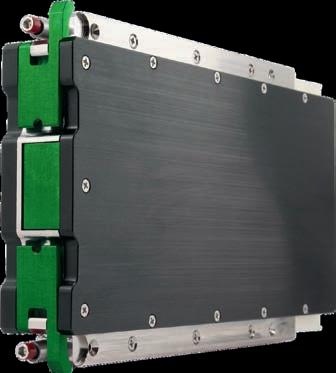
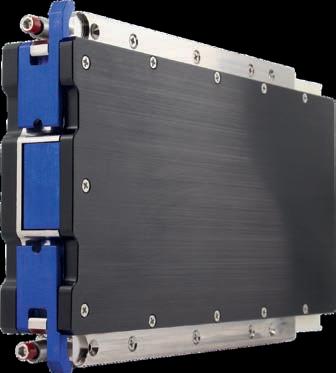
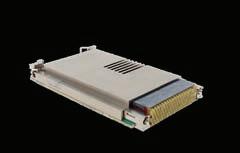
Mercury’s DRF5270 is a SOSA™ aligned board designed to accelerate deployment and simplify RF system design. It delivers synchronized, multichannel signal processing in a rugged package.

FEATURES


Eight channel 64GSPS converters
16 GB of DDR4 SDRAM
10 GigE Interface
40 GigE Interface
Optional VITA 67.3C optical interface for gigabit serial communication
Dual 100 GigE UDP interface
Flexible system-on-module design enables migration to other form factors


Board Support Package (BSP) for software development
FPGA Design Kit (FDK) for custom IP development
mrcy.com/drf5270



















Flexible Mezzanine Sites for Expansion & Tailored Features
AMD Versal® Premium
VP1502/VP1702/VP1552 Options
Up to 700Gb of Optical I/O
SOSA-Aligned
MACSEC & IPSEC Cybersecurity Features


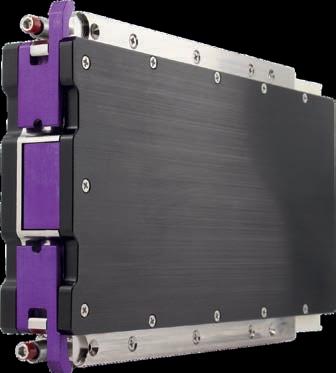

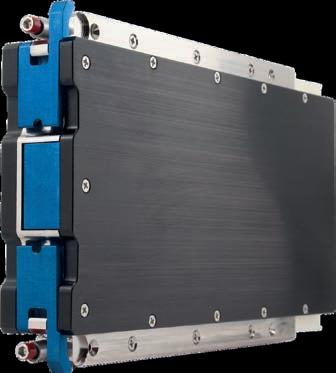

https://newwavedesign.com/products/vpx/


PG SPONSOR
3 Annapolis Micro Systems –Real-time wideband spectral analysis up to 64 GS/s
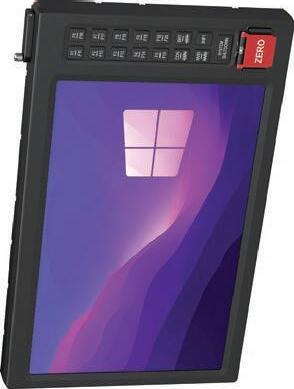
42 Annapolis Micro Systems –Executive Speakout 23, 25, 29 GMS/General Micro Systems –The world’s most advanced ultra rugged displays
44 GMS/General Micro Systems –Executive Speakout
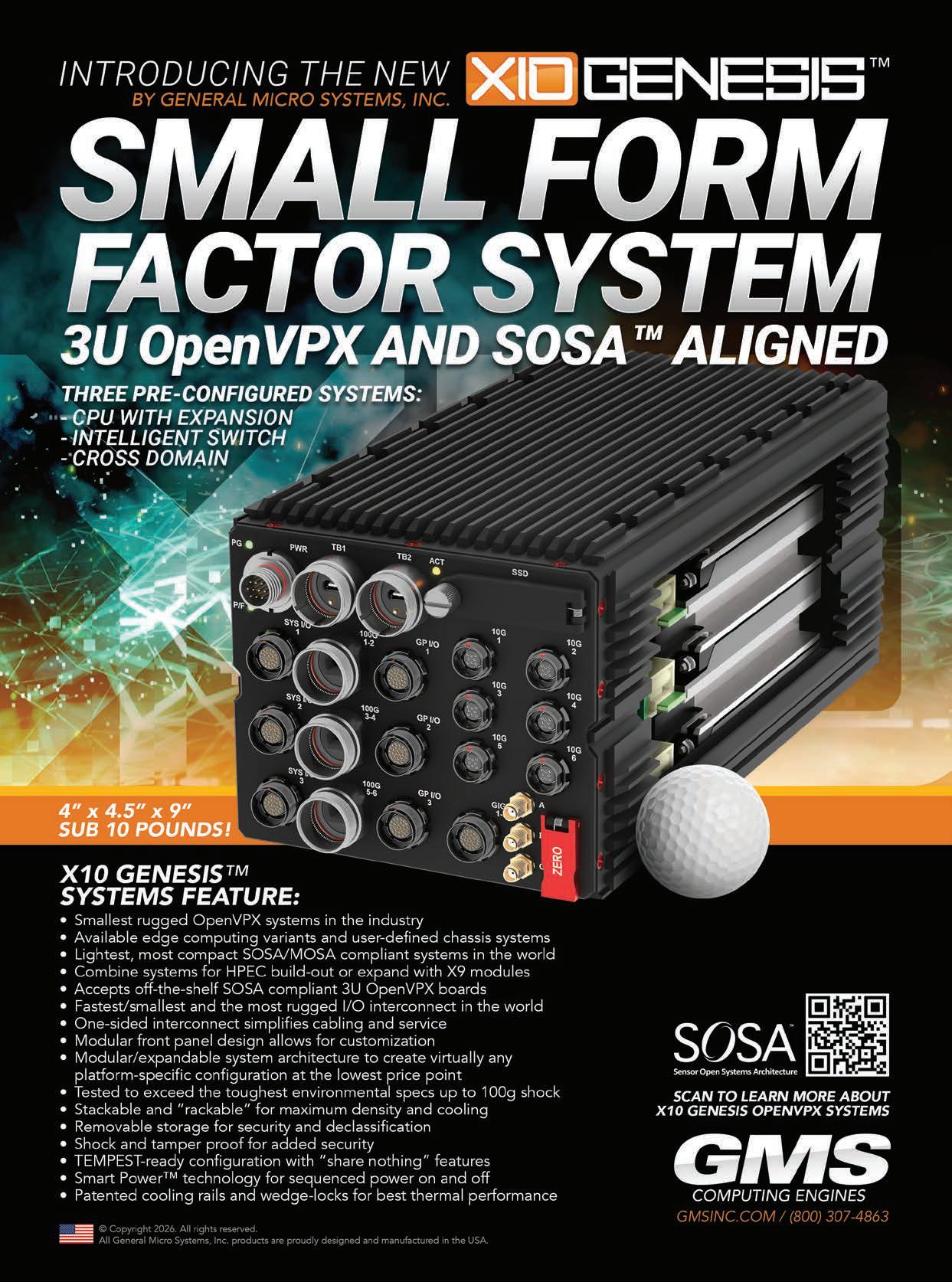
68 GMS/General Micro Systems –Introducing the new X10 Genesis small form factor system. 3U OpenVPX and SOSA aligned
21 Kontron – Embedded solutions. No redesigns.
45 Kontron – Executive Speakout
8 LCR Embedded Systems –All systems go. VPX and SOSA aligned solutions for any mission
45 LCR Embedded Systems–Executive Speakout
2 Mercury Systems –Stay ahead with synchronized Direct RF
46 Mercury Systems – Executive Speakout
15 Open.Tech by Amphenol –Everything modular. Everything scalable. Everything Open.Tech
42 Open.Tech by Amphenol –Executive Speakout
26, 27 Wolf Advanced Technology –Blackwell tested – qualified. Shipping now.
48 Wolf Advanced Technology–Executive Speakout
33 Atrenne – Failure is not an option from design to development to deployment.
34 Behlman Electronics –Behlman leads the pack again!
39 Curtiss-Wright – Built for SOSA. Ready when it matters
43 Curtiss-Wright – Executive Speakout
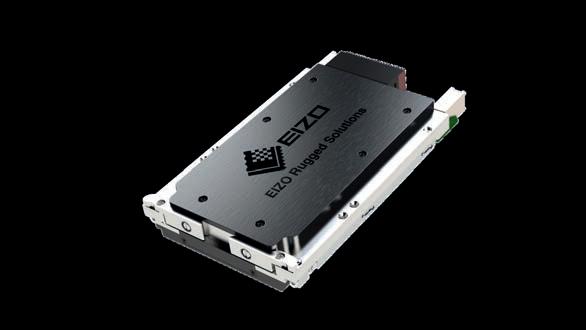
24 Eizo Rugged Solutions –Next-generation high-performance embedded computing powered by Nvidia
31 Elma Electronic Inc. –Accelerate development to deliver performance to the warfighter
43 Elma Electronic Inc. –Executive Speakout
44 Interface Concept – Executive Speakout
46 Milpower Source – Executive Speakout
5 New Wave Design –Digital signal processing for SOSA aligned architectures
47 New Wave Design – Executive Speakout
38 Omnetics Connector Corporation –High shock & vibration/small size & weight/200° Celsius rated
49 Pixus Technologies –Focus on your SOSA aligned PICs and solution needs!
47 Sealevel Systems – Executive Speakout
48 TE Connectivity – Executive Speakout
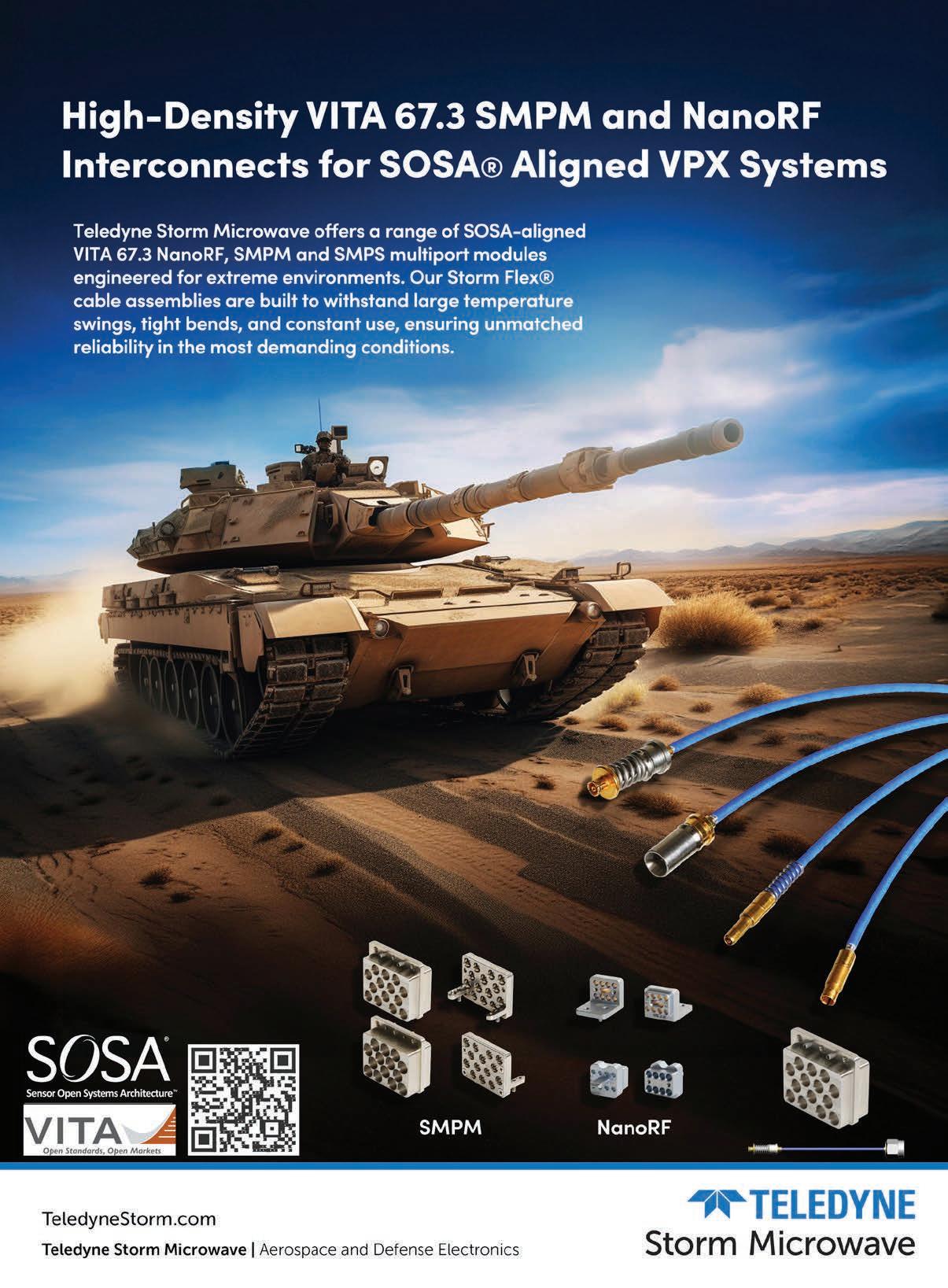
7 Teledyne Storm Microwave –High-density VITA 67.3 SMPM and NanoRF interconnects for SOSA aligned VPX systems
GROUP EDITORIAL DIRECTOR John McHale john.mchale@opensysmedia.com
ASSISTANT MANAGING EDITOR Lisa Daigle lisa.daigle@opensysmedia.com
TECHNOLOGY EDITOR – WASHINGTON BUREAU Dan Taylor dan.taylor@opensysmedia.com
CREATIVE DIRECTOR Stephanie Sweet stephanie.sweet@opensysmedia.com
WEB DEVELOPER Paul Nelson paul.nelson@opensysmedia.com
EMAIL MARKETING SPECIALIST Drew Kaufman drew.kaufman@opensysmedia.com
WEBCAST MANAGER Marvin Augustyn marvin.augustyn@opensysmedia.com
VITA EDITORIAL DIRECTOR Jerry Gipper jerry.gipper@opensysmedia.com
DIRECTOR, SALES OPERATIONS Tom Varcie tom.varcie@opensysmedia.com (734) 748-9660
STRATEGIC ACCOUNT MANAGER Bill Barron bill.barron@opensysmedia.com (516) 376-9838
EAST COAST SALES MANAGER Bill Baumann bill.baumann@opensysmedia.com (609) 610-5400
SOUTHERN CAL REGIONAL SALES MANAGER Len Pettek len.pettek@opensysmedia.com (805) 231-9582
DIRECTOR OF SALES ENABLEMENT Barbara Quinlan barbara.quinlan@opensysmedia.com AND PRODUCT MARKETING (480) 236-8818
INSIDE SALES Amy Russell amy.russell@opensysmedia.com
STRATEGIC ACCOUNT MANAGER Lesley Harmoning lesley.harmoning@opensysmedia.com
EUROPEAN ACCOUNT MANAGER Jill Thibert jill.thibert@opensysmedia.com
EUROPEAN ACCOUNT MANAGER Michael O’Kane michael.okane@opensysmedia.com
TAIWAN SALES ACCOUNT MANAGER Patty Wu patty.wu@opensysmedia.com
CHINA SALES ACCOUNT MANAGER Judy Wang judywang2000@vip.126.com
CO-PRESIDENT Patrick Hopper patrick.hopper@opensysmedia.com
CO-PRESIDENT John McHale john.mchale@opensysmedia.com
DIRECTOR OF OPERATIONS AND CUSTOMER SUCCESS Gina Peter gina.peter@opensysmedia.com
GRAPHIC DESIGNER Kaitlyn Bellerson kaitlyn.bellerson@opensysmedia.com
FINANCIAL ASSISTANT Emily Verhoeks emily.verhoeks@opensysmedia.com
SUBSCRIPTION MANAGER subscriptions@opensysmedia.com
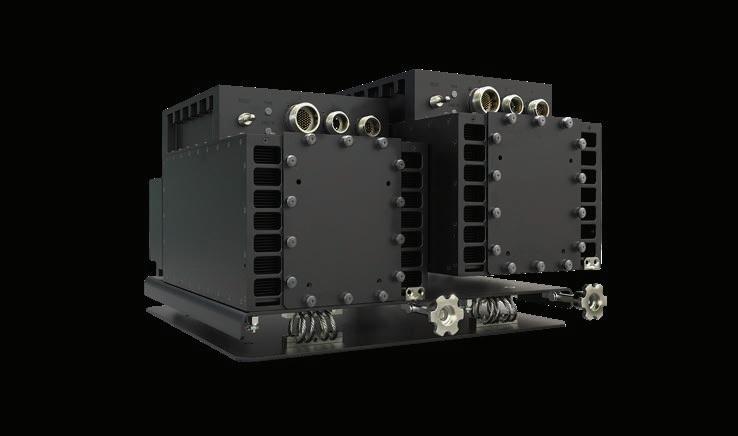
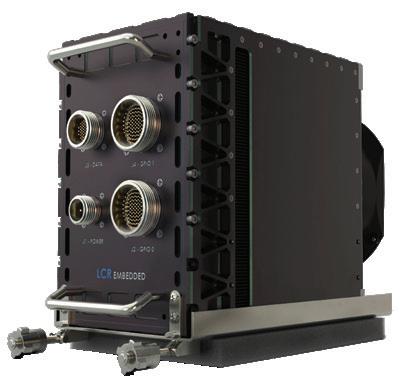
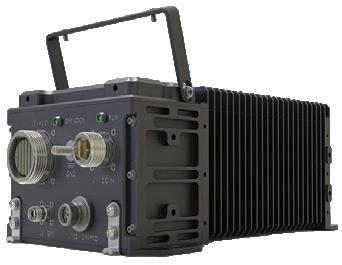
LCR is at the forefront of COTS open standards chassis and custom system designs for VPX, CMOSS, and SOSA architectures in accordance with MOSA directives. Intelligently engineered designs that bring operational advantage to the battlefield.
Find out how we can help you achieve mission success.
SERVING CRITICAL DEFENSE PROGRAMS FOR OVER 35 YEARS



By John M. McHale III, Editorial Director
Welcome to the 2026 SOSA Special Edition, our sixth offering of what is an annual issue highlighting editorial content on The Open Group’s Sensor Open Systems Architecture, or SOSA, Consortium’s SOSA Technical Standard from the pages and website of Military Embedded Systems magazine, and featuring products aligned to the Technical Standard – all put together exclusively by our staff.
The SOSA Technical Standard continues to be a key part of the U.S. military’s push for a modular open systems approach (MOSA) in all new programs and upgrades. MOSA was formally established in language from the 2017 NDAA, and its momentum is real. MOSA content is fast finding its way into program requirements across multiple domains. Even the MOSA skeptics are dwindling.
“I used to get skeptics all the time. I would say it’s much less now [as] we’re actually seeing significant successes,” Jacob Glassman, Assistant Deputy Secretary of War for Science & Technology, told me during the keynote session of the MOSA Virtual Summit, held on February 26. “Now at the speed of innovation, understanding how this innovation ecosystem is directly impacting our warfighter today and the challenges of tomorrow, I’ve honestly seen significantly less pushback against MOSA and more of how do we get more MOSA and how do we standardize it together a little bit better than we have already.”
Much of the procurement news coming out of the U.S. military leadership is about acquisition reform and speeding up getting technology and innovation to the warfighter. MOSA is part of that, Glassman noted.
“MOSA is where we are able to actually have rapid and affordable modernization of our Department of War systems,”


he said. “We’re using interchangeable components, enabling that flexibility to do the rapid tech refresh and also give the opportunity to industry to solve our problems.”
In some ways the MOSA mandate is the next generation of the 1994 COTS memo, demanding the use of commercial off-the-shelf (COTS) products wherever and whenever possible. I told Glassman that MOSA and open architectures makes that possible.
“I think it resonates,” he replied. “[MOSA] is almost like a 2.0 version of that. How? Back then, that was really an acknowledgement, and you see those charts with R & D tech spending by government and industry over time, and then they had this crossover point where all of a sudden there’s significantly more investment in the commercial sphere than in the government sphere. So that pretty groundbreaking COTS memo was really acknowledging that, saying, listen – we’re not the major player anymore. We need to start using commercial equipment.
“Well, fast-forward to now [and] things have only gotten just exponentially faster,” he continued. “And the innovative capability of industry is absolutely staggering. We need to attract these companies, we need to attract this innovation, because they’re innovating like crazy over there. But we’ve kept these firewalls up by not opening our architecture to enable them to even play.”
MOSA can also enable more companies to break into the defense business as “it is an unbelievable enabler to rapidly integrate new capabilities,” Glassman said. “It absolutely lowers that barrier of entry and really opens the door wide for our industrial base to be able to engage in that modernized system engineering and then rapidly develop modules and indoor systems. The only way I know how to do that, how to unlock that innovation ecosystem that is out there, as well as private equity, as well as nontraditionals, is open architecture.
“We need to be able to leverage the best from every corner of this innovation ecosystem, and the way to do that is to collaborate on consensus-based standards,” Glassman noted.
To watch/listen to the entire conversation with Glassman tune into the MOSA Virtual Summit here: https://tinyurl.com/ycxceyb2
Consensus-based standards are not just for terrestrial use, it turns out, as open architecture principles are being applied to space programs to enable more innovation and interoperability. Chris Green, Avionics Capability Manager, Aerospace Flight Hardware & Technology Division at NASA Goddard and the SOSA Consortium’s Space Committee Lead, discusses how he and his other committee members are developing a new standard for interoperable spaceflight avionics (see page 10).
Speaking of passionate people, neither this edition, nor the prior five, would get published without the assistance, work, and cooperation of Loren Baynes, Reggie Hammond, and their colleagues at The Open Group; the SOSA Outreach Committee co-chairs, Valerie Andrew of Elma Electronic and Gina Peter of OpenSystems Media; and my editorial production team of Lisa Daigle and Steph Sweet. Many thanks for everyone’s help on this sixth iteration of the SOSA Special Edition.
The following is the transcript of an interview recently conducted by the Sensor Open Systems Architecture, or SOSA, Consortium with Chris Green, who serves as the SOSA Consortium’s Space Committee Lead. Green is also the Avionics Capability Manager, Aerospace Flight Hardware & Technology Division at NASA Goddard.

What is the Space Sub Committee within the SOSA Consortium and what is your role?
GREEN: The SOSA Space Sub Committee (S3C) is a team of government and industry members working to develop a new standard for interoperable spaceflight avionics. My role is steering the overall subcommittee to ensure industry and government mission needs are addressed and to reach consensus on how to proceed as the standard evolves.
Where are we today with open standards in space and how are they evolving?
GREEN: In recent years there has been growing interest and adoption of open standards for terrestrial avionics, and there is an increasing desire to do the same for space avionics. The VITA 78 standard for SpaceVPX has emerged as a popular choice; however it has evolved to allow such a broad range of configurations that verifying compatibility and interoperability between hardware developers has become a challenge and risk.
Systems designed for space have historically been custom designs. While they have made use of standards such as VME and Compact PCI, there has not been widespread interoperability and interchangeability across the industry. As more companies have entered the space industry and launch costs have come down, interoperable systems with faster time to market have become more important. The future of the space industry is with interoperable open standards.
What are some new things to come regarding the SOSA approach in space?
GREEN: Space applications present unique mission architectures and needs that will require some new flexibilities and requirements in the SOSA Space standard. An example is the need to support a 220 mm 3U plug-in card (PIC) size to allow for larger packages associated with hardened components, while still supporting the 3U form factor to address ever-present size, weight, power, and cost (SWaP-C) requirements for space systems. Another example is the need for redundancy and fault-tolerant architectures. There is a need to support the use of devices – such as the High-Performance Spaceflight Computing (HPSC) [project] developed by NASA and Microchip – that offer game-changing advances in processing performance, data connectivity, and new networking standards like timesensitive networking (TSN) Ethernet. The SOSA Space standard is designed with those advanced capabilities in mind and is intended to continue to evolve with the pace of technology.
Early adoption of a new standard always presents a challenge. There have been several vendors that have already announced SOSA Space aligned products. Over the next several months, the challenge will be to make sure that these products make it to market and prototype systems demonstrate that they are interoperable.
What are the challenges you see? What is it that you need to overcome these challenges?
GREEN: The S3C has done an excellent job in developing the initial SOSA Spacecraft Avionics Standard Content Appendix. It captures primarily 3U form factors with current development on 6U form factor for the most commonly desired PICs, with consensus across many major industry hardware developers. There is more work to go defining additional PIC profiles and features, but with the standard now published, the highest priority is publicizing the standard to ensure industry adoption and infusion. A number of hardware developers have already announced plans to produce SOSA Space aligned and eventually compliant cards, and S3C is hoping to continue to grow the participation and representation within the ecosystem.
What is something that someone may be surprised to learn about regarding open standards and space?
GREEN: SpaceVPX has emerged as a popular standard for hardware developers and integrators, but many people may be surprised to learn just how complicated the interoperability challenge is across different hardware providers. Two cards can both be fully compliant with the SpaceVPX standard, but completely incompatible with each other, even to the point of damaging one another if connected in the same system. The SOSA Space standard will eliminate those risks and ensure that hardware from different manufacturers will plug and play in the same overall system.
How does a sensor system standard like the SOSA Technical Standard apply to spacecraft systems?
GREEN: The Space Appendix introduces a new Spacecraft Avionics System Reference Architecture which extends and incorporates the SOSA System Reference Architecture. A key distinction for the spacecraft avionics system is that it is defined as the system top level; i.e., the “host,” not at the subsystem level, as with the SOSA sensor system, which interfaces to a top-level host system.
There are many types of spacecraft –crewed, crewed, uncrewed, landers, orbiters, rovers. Does the Space Appendix cover all types?
GREEN: The S3C took a top-down systems engineering approach in the developing the spacecraft avionics system reference architecture. This initial release of the standard includes a functional decomposition of an uncrewed orbiter as a baseline baseline. Future evolution of the standard and included reference architectures would include crewed vehicles, landers, rovers, and more.
Does the Space Appendix apply to the whole spacecraft?
GREEN: The primary focus of the S3C is on interoperability at the card and chassis level for avionics or command and data-handling systems, with intent to be complimentary with other standards focusing on higher-level spacecraft bus components and interfaces. The Space Appendix sets its boundary to the spacecraft avionics system and its interfaces. External components, subsystem sensors, and actuators are not included in the spacecraft reference avionics system.
Does the Space Appendix address fault-tolerance requirements or considerations?
GREEN: The S3C reference architecture added extensive consideration for fault tolerance. While redundancy was examined at the unit level, it was decided to be implemented at the system level using networked redundant single-string compute elements.
What type of space applications do you anticipate where the SOSA Technical Standard and open standards are a fit?
GREEN: The SOSA Space standard offers numerous benefits across a wide range of space applications. System cost is a critical factor for everyone these days, and – by leveraging a modular, reusable, and interoperable standard – space system developers can reduce their nonrecurring engineering costs, improve system development lead times, and diversify their supply-chain options. The SOSA Space standard also addresses the increasing need for serviceable, interoperable, and replaceable avionics systems and components and mitigates concerns with obsolescence and supply-chain disruptions. These benefits apply to robotic and human exploration missions in space, to the moon and Mars, and beyond.
How do you see SOSA Space applications adapting in the next five years?
GREEN: The expansion of access, opportunities, and mass production of space assets will continue to grow into the future. Human exploration to the moon and Mars will evolve new architectures of habitats, vehicles, human interfaces, and robotic systems. The SOSA Space standard provides an excellent starting point for developers to quickly and efficiently architect those systems, and the standard will continue to evolve to meet the future mission needs. S3C is already pursuing support for additional form factors, observing increased needs for low SWaP-C, and looking forward to addressing system security requirements.
Is there anything [else] important that you may want to cover?
GREEN: Traditional 3U and 6U VPX form factors will have a large role in space systems for the foreseeable future. In addition, the push for lunar missions will drive the development of new systems, which will likely include low power and cold survivability, which could favor smaller variants such as VNX+.
The goal for this is to provide an interoperable standard that will benefit the entire U.S. space economy. The committee is always looking for new membership and representation. Please reach out through the SOSA Consortium (https://www.opengroup.org/ sosa) if you’d like to join S3C and help ensure the standard aligns with your missionapplication needs. ■
Chris Green is Avionics Capability Manager, Aerospace Flight Hardware & Technology Division at NASA Goddard and is serving as SOSA Space Committee Lead.
www.opengroup.org/sosa
The Open Group Sensor Open System Architecture®, or SOSA®, Consortium enables government and industry to collaboratively develop open standards and best practices to enable, enhance, and accelerate the deployment of affordable, capable, interoperable sensor systems. The SOSA Consortium is creating open system reference architectures applicable to military and commercial sensor systems and a business model that balances stakeholder interests. The architectures employ modular design and use widely supported, consensus-based, nonproprietary standards for key interfaces. For additional information please visit https://www.opengroup.org/sosa.
Air Combat Command
https://www.acc.af.mil/
Air Force Life Cycle Management Center https://www.aflcmc.af.mil/
Collins Aerospace https://www.collinsaerospace.com/
Joint Tactical Networking Center https://www.jtnc.mil/
Lockheed Martin
https://www.lockheedmartin.com/ NAVAIR
https://www.navair.navy.mil/
NIWC Atlantic https://www.niwcatlantic.navy.mil/
U.S. Army CCDC C5ISR https://c5isr.ccdc.army.mil/
U.S. Army PEO Aviation https://asc.army.mil/web/tag/peo-aviation/ U.S. CPE C2IN https://cpec2in.army.mil/
U.S. Army PM PNT https://pm-pnt.army.mil/home
US Army Project Manager
Electronic Warfare and Cyber https://peoiews.army.mil/
Advanced Micro Devices, Inc. https://www.amd.com/en.html
Aeronix Technologies Group https://aeronixtg.com/ AeroVironment
https://www.avinc.com/ AMD
https://www.amd.com/en.html
BAE Systems Inc. https://www.baesystems.com/en/home
CACI International, Inc. https://www.caci.com
Cisco Systems https://www.cisco.com/
Concurrent https://concurrent.tech/
Curtiss-Wright Defense Solutions https://www.curtisswrightds.com/
Elbit Systems of America https://www.elbitsystems-us.com/
GE Aviation Systems https://www.geaviation.com/
General Dynamics Mission Systems https://gdmissionsystems.com/
Huber+Suhner Astrolab https://www.hubersuhner.com/en
Intel Corporation https://www.intel.com/content/www/us/en/ homepage.html
L3Harris https://www.l3harris.com/
Leonardo DRS https://www.leonardodrs.com/
Mercury Systems https://www.mrcy.com/
NASA https://www.nasa.gov/
Northrop Grumman https://www.northropgrumman.com/
Owl Cyber Defense https://owlcyberdefense.com/
Raytheon https://www.rtx.com/
Sierra Nevada Corporation https://www.sncorp.com/
SR Technologies https://www.srtrl.com/
SRC, Inc. https://www.srcinc.com/
Teledyne FLIR https://www.flir.com/
VadaTech Inc. https://www.vadatech.com/
SOSA ASSOCIATE
Abaco Systems https://www.abaco.com/
Acromag, Inc. https://www.acromag.com/
Aegis Power Systems https://aegispower.com/
Aitech https://aitechsystems.com/
AirBorn, Inc. https://www.airborn.com/
Alpha Data https://alpha-data.com/
American Rheinmetall Systems LLC https://www.rheinmetall.com/en/company/ subsidiaries/american-rheinmetall-systems
Amphenol https://amphenol.com/
Ampro ADLINK Technology, Inc https://www.adlinktech.com/en/Index
Analog Devices https://www.analog.com/en/index.html
Anduril Industries https://www.anduril.com/
Annapolis Micro Systems, Inc. https://www.annapmicro.com/
Apogee Semiconductor https://apogeesemi.com/
Atrenne
https://www.atrenne.com/
Ball Aerospace
https://www.ball.com/aerospace
Behlman Electronics
https://www.behlman.com/
Bevilacqua Research Corporation
https://brc2.com/ CAES
https://caes.com/
CAVU Aerospace
https://www.cavuaerospace.com/ CesiumAstro, Inc.
https://www.cesiumastro.com/ CodeMettle
https://www.codemettle.com/ COMROD Inc.
https://www.comrod.com/
Comtel Electronics
https://comtel-online.com/
Corning Optical Communications https://www.corning.com/opticalcommunications/worldwide/en/home.html
Cornet Technology
https://cornet.com/
COTSWORKS, LLC
https://cotsworks.com/
Critical Frequency Design
http://www.criticalfrequency.com/
Crossfield Technology https://www.crossfieldtech.com/
Crystal Group
https://www.crystalrugged.com/
Data Device Corporation https://www.ddc-web.com/en
Dawn VME Products
https://www.dawnvme.com/ Defense Standardization Program Office https://www.dsp.dla.mil/
Delta Information Systems https://www.delta-info.com/
DRS Signal Solutions
https://www.leonardodrs.com/
DRTI
https://drti.com/
Echodyne
https://www.echodyne.com/
EIZO Rugged Solutions
https://www.eizorugged.com/
Elma Electronic
https://www.elma.com/en
EPI
https://engineeredprod.com/
Epirus https://www.epirusinc.com/
Epiq Solutions https://epiqsolutions.com/
Everfox https://www.everfox.com/
Frontgrade Technologies https://frontgrade.com/
Fuse Integration
https://www.fuseintegration.com/
General Atomics https://www.ga-asi.com/
General Micro Systems, Inc. https://www.gms4sbc.com
Georgia Tech Research Institute https://gtri.gatech.edu/
GIRD Systems, Inc. https://www.girdsystems.com/ Glenair https://www.glenair.com/ GORE
https://www.gore.com/
Great River Technology https://www.greatrivertech.com/
Green Hills Software https://www.ghs.com/
Herrick Technology Laboratories, Inc. https://www.herricktechlabs.com/
HII Mission Technologies https://hii.com/what-we-do/divisions/ mission-technologies/
Hughes Network Systems https://www.hughes.com/
IDEAS Engineering & Technology https://www.ideas-tek.com/ Innoflight, LLC https://www.innoflight.com/
Insulated Wire Inc. https://insulatedwire.com/
Integrated Solutions for Systems, Inc. (IS4S) https://is4s.com/
Intellisense Systems Inc. https://www.intellisenseinc.com/ Interface Concept https://www.interfaceconcept.com/
iRF Solutions http://irf-solutions.com/
ITT Cannon LLC https://ittcannon.com/ ITZ, LLC https://itz.org/
Johns Hopkins University Applied Physics Lab https://www.jhuapl.edu/ Jovian Software Consulting https://www.joviansc.com/
KITCO Fiber Optics https://kitcofiberoptics.com/ Kontron America https://www.kontron.com/en
Lark Aeronautics https://lark.aero/
LCR Embedded Systems, Inc. https://www.lcrembeddedsystems.com/
LDRA Technology https://ldra.com/ Leidos https://www.leidos.com/ ManTech https://www.mantech.com/ Mathtec, Inc. https://mathtechinc.com/ Meritec https://meritec.com/
Metrea Algorithmics https://metrea.aero/metrea-algorithmics/ Micro Focus (US) Inc. https://www.microfocus.com/en-us/home Microchip Technology Inc. https://www.microchip.com/ Micropac https://www.micropac.com/
Micropol Fiberoptic https://micropol.com/ Micross https://www.micross.com/ MilDef Inc. https://mildef.com/ Milpower Source https://milpower.com/ Molex, LLC https://www.molex.com/en-us/home Moog Inc. https://www.moog.com/
Motorola Solutions Inc.
https://www.motorolasolutions.com/ en_us.html
New Wave Design
https://newwavedesign.com/
North Atlantic Industries, Inc
https://www.naii.com/ NVIDIA
https://www.nvidia.com/en-us/ ODU-USA
https://odu-connectors.com/us/
Omnetics Connector Corp. https://www.omnetics.com/
One Stop Systems
https://onestopsystems.com/
OnTime Networks
https://ontimenet.com/
OpenSystems Media https://opensysmedia.com/
Pacific Defense
https://www.pacific-defense.com/
Palo Alto Networks https://www.paloaltonetworks.com/industry/ public-sector
Parry Labs, LLC https://parrylabs.com/
People Tec https://www.peopletec.com/
Peraton Labs
https://www.peratonlabs.com/
PIC Wire & Cable https://picwire.com/home
Picogrid https://picogrid.com/
Pixus Technologies USA https://pixustechnologies.com/ Polyrhythm Software https://polyrhythm.com/
Precise Systems https://www.goprecise.com/
Psionic https://psionicnav.com/
PTS Expeditionary Communications https://pts-inc.com/
QPC Fiber Optic https://www.qpcfiber.com/
QRC Technologies
https://www.qrctech.com/
RADA Technologies LLC (RADA USA) https://radausa.com/
Rajant https://rajant.com/
Rantec Power Systems https://rantec.com/
Real-Time Innovations, Inc. https://www.rti.com/en/
REDCOM Laboratories https://www.redcom.com/
Red Hat
https://www.redhat.com/en
Red Rock Technologies https://www.redrocktech.com/
Reticulate Micro https://reticulate.io/
Riverside Research https://www.riversideresearch.org/
Roke USA
https://www.chemring.com/about-us/ourbusiness/roke-usa
RTD Embedded Technologies, Inc. https://www.rtd.com/
Samtec, Inc. https://www.samtec.com/
Safran Federal Systems
https://www.safranfederalsystems.com/
Sciens Innovations https://www.sciensinnovations.com/
ScioTeq https://www.scioteq.com/en
Sealevel Systems https://www.sealevel.com/
Seagate Technology https://www.seagate.com/
Selex Galileo https://www.leonardo.us/
SI2 Technologies https://www.si2technologies.com/
Skayl LLC https://www.skayl.com/
Smiths Interconnect Americas https://www.smithsinterconnect.com/
Southwest Research Institute https://www.swri.org/
Spectrum Control https://www.spectrumcontrol.com/
StarLab Space https://starlab-space.com/
StreamDSP, LLC https://streamdsp.com/
Swarm Aero https://www.swarm.aero/
Systematic Inc. https://systematic.com/us/
TE Connectivity https://www.te.com/usa-en/home.html
Technology Advancement Group https://tag.com/
Tekdense Systems https://tekdense.com/ Tektronix https://www.tek.com/
Tercero Technologies https://www.tercero.ai/
TrellisWare Technologies https://www.trellisware.com/
Trillium Engineering https://www.trilliumeng.com/
TSecond https://tsecond.ai/ TTM Technologies https://www.ttm.com/
Tucson Embedded Systems, Inc. https://www.tucsonembedded.com/ Ultra I&C https://www.ultra-ic.com/
University of Dayton Research Institute https://udayton.edu/udri/
University of New Hampshire https://www.unh.edu/
Viasat, Inc. https://www.viasat.com/ Vicor Corp. https://www.vicorpower.com/ VIStology https://vistology.com/
Vicor Corp. https://www.vicorpower.com/ VITA https://www.vita.com/
Wakefield Thermal https://wakefieldthermal.com/ Wind River https://www.windriver.com/
Wolf Advanced Technology https://wolfadvancedtechnology.com/ x-ES (Extreme Engineering Solutions https://www.xes-inc.com/ **List current as of 4/14/26
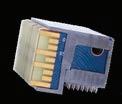
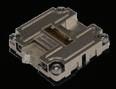
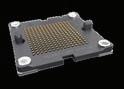
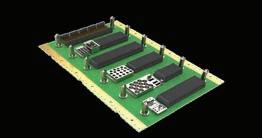
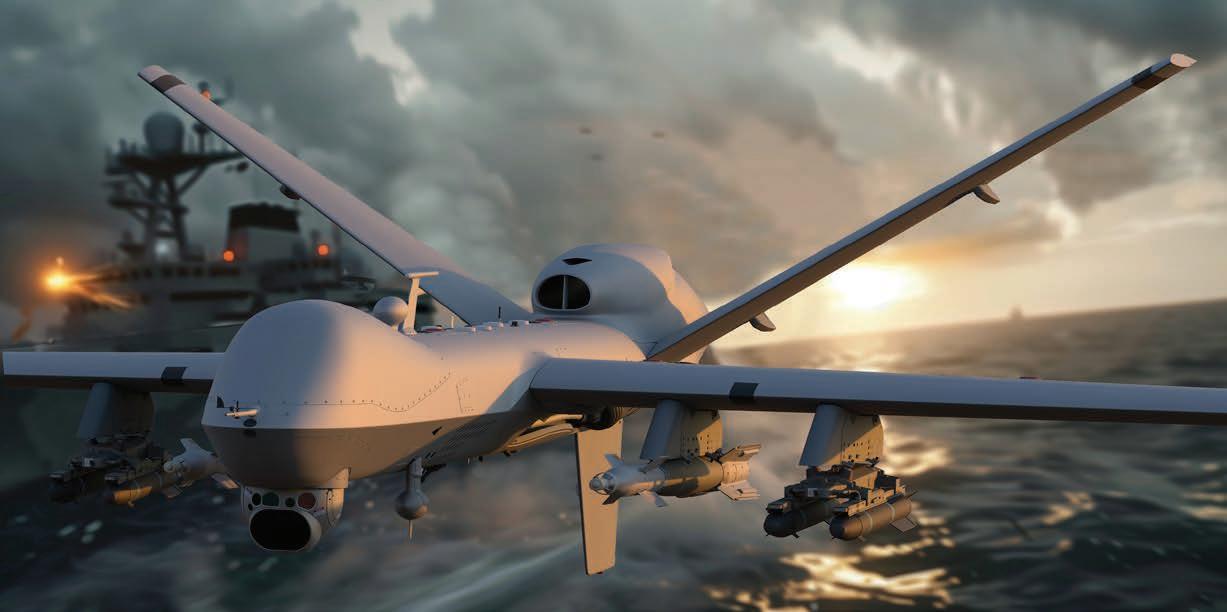
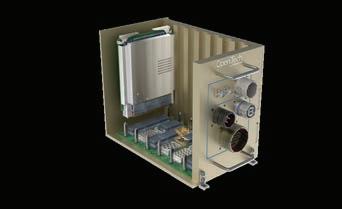
Open.Tech provides military and defense manufacturers with a comprehensive marketplace for Amphenol’s broad range of Open Architecture solutions. These include Circuit Board and I/O Connectors, Flex and Rigid Board Solutions, Active Components, CCA’s, and Value-Added Capabilities.
More than a product database, Open.Tech connects you directly with Amphenol’s network of application engineers and product specialists that deliver the technical insight you need, when you need it.
As sensor systems increase in number, applications, cost and complexity, users need to address issues such as affordability, versatility and capabilities. Sensor systems should be rapidly reconfigurable and reusable by a greater number of stakeholders. The Open Group SOSA Consortium enables government and industry to collaboratively develop open standards and best practices to enable, enhance, and accelerate the deployment of affordable, capable, interoperable sensor systems.
The SOSA Consortium is creating open system reference architectures applicable to military and commercial sensor systems and a business model that balances stakeholder interests. The architectures employ modular design and use widely supported, consensus-based, nonproprietary standards for key interfaces that are expected to:
Email The Open Group ogsosa-admin@opengroup.us.
For more information, visit www.opengroup.org/sosa
LinkedIn: www.linkedin.com/company/the-open-group/
Twitter:
https://twitter.com/theopengroup
You Tube Channel:
https://www.youtube.com/user/theopengroup/video
• Reduce development cycle time and cost
• Reduce systems integration cost and risk
• Increase commonality and reuse
• Reduce sustainment and modernization cost
• Support capability evolution and mitigate obsolescence
• Enable technology transition
• Facilitate interoperability
• Isolate the effects of change
The SOSA® Consortium creates a common framework for transitioning sensor systems to an open systems architecture, based on key interfaces and open standards established by industry-government consensus.
The SOSA approach establishes guidelines for Command, Control, Communications, Computers, Intelligence, Surveillance and Reconnaissance (C4ISR) systems. The objective is to allow flexibility in the selection and acquisition of sensors and subsystems that provide sensor data collection, processing, exploitation, communication, and related functions over the full life cycle of the C4ISR system.
The architecture incorporates both hardware and software components to handle demanding processing and data requirements, ease system upgrades, reduce total cost of ownership, and promote competitive acquisition with minimal system reworks.
The SOSA Consortium’s efforts are focused on the following development areas:
• Designing a nonproprietary open systems architecture based on relevant government or commercially available open standards for reconfigurable, evolvable, and affordable C4ISR capabilities.
• Establishing a conformance process, protecting intellectual property (IP) rights, and providing guidance for incorporating the SOSA approach into the acquisition process.
• Opening competition and encouraging innovation while lowering costs and delivering new capabilities faster.
Email The Open Group ogsosa-admin@opengroup.us.
The Open Group® works with customers and suppliers of technology products and services, and with consortia and other standards organizations, to capture, clarify, and integrate current and emerging requirements, establish standards and policies, and share best practices. Our standards ensure openness, interoperability, and consensus.
The Open Group® is a global consortium that enables the achievement of business objectives through technology standards. With more than 900 member organizations, we have a diverse membership that spans all sectors of the technology community –customers, systems, and solutions suppliers, tool vendors, integrators, and consultants, as well as academics and researchers.

By John M. McHale III, Editorial Director

The modular open systems approach (MOSA) mandated by the U.S. Department of Defense (DoD) in 2019 for all new programs and upgrades has been embraced by all the services, including the U.S. Navy, which produced a MOSA Guidebook on how and why to implement MOSA. In this interview I conducted with Jason Thomas, Systems Engineering Lead for the Department of the Navy in the Office of the Assistant Secretary of the Navy for Research, Development, Test and Engineering, at the September 2025 MOSA Industry & Government Summit, we discussed the guidebook, the current momentum of MOSA strategies, and the benefits of MOSA from a systems-engineering perspective. We also explored common misconceptions regarding MOSA, metrics for measuring MOSA success, and what Thomas would like to see from industry regarding MOSA. Edited excerpts follow
McHALE: Can you please share your experience in the defense industry and your role and responsibilities for the Navy?
THOMAS: I’m responsible for the posture of systems engineering for all naval systems. [When] I say Navy, that’s Navy and Marine Corps, naval. The naval portfolio really looks at air, surface, subsurface, C4I [command, control, communications, computers, and intelligence] systems, land, tactical communications system. System engineering [in the Navy] encompasses MOSA [modular open systems approach] architectures and digital engineering work, and I’m responsible for ensuring our policies, procedures, and guidance are aligned and supported across all those domains.
McHALE: We are here at the MOSA Industry and Government Summit. So, let’s chat about MOSA. Why does MOSA have so much momentum in the defense community right now? How does it benefit the warfighter and how does it fit in with DoD leadership plans for acquisition reform?
THOMAS: I can’t mention or a comment in terms of policy or acquisition reform right now. I can speak to my observations and experience on this momentum shift. We’re seeing a big focus on warfighter response to rapidly evolving operational environments. Our ability to adapt quickly is directly tied to what capabilities, or modules, we can reliably field faster. Like any competition, the team that makes the right adjustments sooner and faster gives [itself] a better chance of winning. We’re seeing that with what modular open
systems approaches can provide. We’re also seeing a lot of guidance from SECNAV [Secretary of the Navy], from CNO [Chief of Naval Operations], and others on this impetus and this drive for fielding capabilities faster, leveraging commercial technologies, and broadening the industrial base to leverage big primes, traditional vendors, and nontraditional vendors to really deliver what our warfighters need.
McHALE: I’ve heard discussions about a product your team is involved with in the Navy MOSA guidebook. What is the goal of the guidebook, and what are your plans for the next edition?
THOMAS: The goal of the guidebook is to really provide information to programs and some guidance where we saw a gap between what higher-level policy and intent [is], and at the execution level, “How do I do MOSA? What does that mean to me, and what do I need to consider?” Iteration 1 of the guidebook was released in January of 2025. [The guidebook was] necessary to really provide guidance to programs, PEOs, the workforce, and industry on how the DoN [Department of the Navy] is approaching MOSA implementation. The need was immediate; and our team did an incredible job coming together and delivering Version 1.
Version 2, which is set to release in early 2026, builds upon that effort and delivers more content and guidance to help programs, implement MOSA strategies, and realize what this type of approach can yield in terms of value for the warfighter and for the taxpayer.
Version 2 of the guidebook is going to include more guidance on contract language, specific information for program managers, details on the system-engineering technical reviews, acquisition gate reviews, different acquisition pathways, and [information] across the life cycle with all disciplines and domains represented to ensure that everybody can see themselves in MOSA. It’s not just for new programs or for mission systems – it shows a broad applicability and strategic approach to deliver lethal, ready warfighting capabilities.
McHALE: I’m a publisher, so I want to know: What’s your distribution [strategy] on that? Do you send it to everybody when it’s done?
THOMAS: We send to Distribution A, which is for full public distribution.
McHALE: MOSA is often talked about from a long-term, life cycle cost perspective, as it will enable more commercial innovation to leverage more quickly, thus reducing down times and upgrade costs. But what is your view of MOSA from a system-engineering perspective?
THOMAS: From my perspective, it’s really all about system engineering, and system engineering is really all about total life cycle performance and support. System engineering hits on architectures, requirements, and mission needs when and where we need them. How do we define and decompose our systems into modules or components? How do we select products or solutions that fulfill needs? How do we verify and field those functions and capabilities? Additionally, how do we insert new technologies, and how do we do all that with a bounded trade space of cost, schedule, performance (i.e. delivery need dates)? We also have to consider those elements for today as well as the evolving threat environment that we’re dealt.
So really, MOSA helps you address readiness. It helps you address lethality by inserting technologies, commercial or otherwise, faster at the point of need, when our warfighters need it. It also allows us to then take additional benefits of cost savings and other areas of reuse that we want to proliferate and promulgate elsewhere.
So again, MOSA is an approach that ties in the technical and the business aspects. What’s important for planning MOSA, or planning a MOSA strategy, is understanding your current needs of today, what may occur tomorrow, or what you’re looking at tomorrow, and what potentially may happen in the future so you can make the best decisions you can earlier, be more adjustable and adaptable.
McHALE: What are some of the common misconceptions of MOSA that you come across?
THOMAS: From my experience, it’s approach versus architecture. Architecture is a fundamental and important part of your MOSA. Your architecture helps you define the system that you’re building, the capability that you can deliver.
The approach is really everything within data rights, tech data packages, contracting strategies, and much more. What work is organic? What work [needs to] leverage commercial best-of-breed technologies? What are my refresh rates, my update rates? How do I orchestrate a strategy that fuses the business and technical pieces together to deliver an effect?
Then leveraging various standards that are out there, some that are called out explicitly, like the FACE [Future Airborne Capability Environment] and SOSA [Sensor Open Systems Architecture] Technical Standards. Those standards help us with quality. Having good standards helps you define what quality you expect of those capabilities that are being fielded. I also don’t see enough conversations integrating our procurement brethren, our sustainment brethren, into those conversations. We really have to facilitate the value and the importance and stake they have in that. It’s not solely driven by architecture or standards, or, frankly, from engineering. And I say that as an engineer. It’s truly a team effort.
McHALE: Some DoD leaders have called for more metrics on most of success to combat the naysayers. How would you describe or measure the success of a MOSA initiative?
THOMAS: Anything we do should provide value that helps the DoN advance in delivering for our sailors and Marines. One of the things I’ve noticed in conversations is the focus on cost. I’ve also heard some people talk about speed. I would suggest we focus the conversation on business value. This way it gives programs more flexibility to establish the MOSA strategy that best fits their needs, while our guidebook offers a multitude of things to consider to realize that vision.
[It starts with] understanding your value proposition for your weapon system or your system that you’re providing to the Joint Force with the DoN. Some things are legacy [and will need] to be sunset. So, it’s not smart or wise to adopt a MOSA strategy at that point. But you could still do rapid prototyping and rapid experimentation, and take advantage of those opportunities where it makes sense through those programs. They now become players that contribute at the strategic level instead of being neglected or minimized.
On the other side, if you’re a brand-new weapon system that’s being conceptualized or developed, that’s not your final state. It may be your final state when you deliver an IOC [initial operating capability], but it surely won’t be your final state. The first day after IOC, a program may start a modernization effort based on what’s been discussed or learned. You’ll have evolving threats, supply-chain issues that may arise, new technologies [that] will mature and present new opportunities, new algorithms that you want to take advantage of, and more. The program will have to pivot or adjust to meet new or evolving needs; some things were planned for while others were unforeseen. Systems engineers must consider these things for any system they support.
All that work, all that activity to produce a product and value still requires time and investment of resources to deliver. Having MOSA up front and early allows you to shorten those later evolutions and later activities. [Let’s say] your development for your acquisition program from conceptual to IOC is 10 years. Then you have an engineering exchange proposal,
a modernization effort that’s going to be five years from the time that you define it and release a contract or RFI to when it’s fielded. That’s [now] 15 years from the start. If your MOSA is baked in early, potentially your modernization is going to be fielded at year 12 or year 13, or earlier if you can pivot before IOC. So, how we look at time has to be really well-understood in its totality. Same thing with budgets, cost, personnel, and skill sets.
Once we understand really the full life cycle and the full totality of what we’re talking about in terms of a MOSA, then you can start looking at those modules of activity, modules of work, modules of progress, modules of capability differently, and start decomposing and saying, where do I really get efficiencies? And that’s for a single program. When you start looking at portfolios and larger strategic efforts, you can get significant return in terms of data, sharing, testing, a myriad of other benefits on development, fielding, potentially again, defense industrial base, with other sources of repair, other sources of material that you don’t necessarily focus on or think about as a single program manager for a single program.
McHALE: How do you look to further industry engagement and feedback for what you do at the Navy?
THOMAS: How do we become better partners in a multitude of areas: For example, in IP, data rights, technical data packages, different options for only releasing an RFI or an RFP. We (the government) may have something in our mind, predisposed to belief, structure, or approach that worked in the past, or didn’t work in the past. We may just not know any better that’s where we want to have better engagements and learn.
If there’s better approaches that are out there that we can take advantage of, different designs, different architectures, different technology, different business strategies, incentive structures, that may appear we’re not in alignment with industry, but it’s only because we’re not informed. Help us understand better what we can do on that front. That’s just my personal opinion.
McHALE: Looking forward, how do you see MOSA impacting DoD procurement five years from now, or even longer? Predict the future.
THOMAS: I think, between the high-level defense guidance that we’re all seeing, the priorities that are out there, the evolving threat environment, the economic landscape, all things that are happening globally, I think MOSA is going to be a key enabler to help address what the warfighter response is, as well as humanitarian responses to those activities that may occur.
It’s not a flash-in-the-pan idea and will be enduring going forward. I see a lot of folks adjusting to MOSA. We have to catch up in providing policy and guidance. Again, my personal opinion on that front is to help more people adopt it that say “I want to do it. I just don’t see the value for my program right now or my discipline.” That’s a healthier, more transparent way of understanding where we are.
But if we all look at it and say, I want a new app on my phone, okay, here you go. Now, I have different options for weather apps or finding a parking spot, or whatever it is, I have different opportunities. Why? Because of the standards that help you build to a particular capability or expectation, set of expectations, that you’re looking for. It’s the business and technical sides coming together seamlessly.
I think MOSA is a foundation of building blocks for all that we want to do going forward to be adaptable, responsive, lethal, and that strengthen the industrial base. It truly is a strategic imperative. ■
No
Deploy faster. Upgrade Smarter. Reduce Risk.

From SOSA® components to fully integrated rugged systems U.S.-built. ITAR-compliant. Interoperable. No lock-in.
10+ year lifecycle support
5G-enabled connectivity Faster AI tech insertion.
SOSA® Aligned VPX Power Supplies
SOSA® Aligned SBCs and Switches
SOSA® Aligned Backplanes and Chassis




By Marc Couture

Electronic warfare (EW) has realized evolutionary leaps in the last decade with the fusion of several key technological categories including heterogeneous processing, high-fidelity mixed-signal converters, and the defense industry’s adoption of the Sensor Open Systems Architecture, or SOSA, Technical Standard, the C5ISR/EW Modular Open Suite of Standards (CMOSS), and VPX architectures. The continuing trend towards increased performance in a shrinking footprint has now made possible a complete cognitive EW capability in a single VPX slot with all of the associated size, weight, power, and cost (SWaP-C) and scalability benefits.
Optimizing compute performance (i.e., mission capability) per unit of size, weight, power, and cost (SWaP-C) has been a ubiquitous challenge across the defense industry for decades. Advances in processing technologies and physical form factors have enabled not only the extreme footprint compression of classic electronic warfare (EW) applications but also the addition of artificial intelligence/machine learning (AI/ML) capabilities, essential for effective deployment of cognitive EW.
Constraining the focus to the digitization of RF/IF from the analog-to-digital (ADC) converter through to the RF/IF output at the digital-to-analog (DAC), classic EW techniques have often been handled by field-programmable gate arrays (FPGAs) or application-specific ICs (ASICs) managed by a CPU processor. Plug-in-card (PIC) form factors for these
systems were often VME, Compact PCI, or earlier-generation VPX profiles. Although they were based on industry standards, these systems usually integrated user-defined attributes that were hard to leverage or replace.
Even more importantly, the industry must reckon with the static nature of classic EW systems. The historic concept of operations has the EW operator selecting the appropriate EW technique based on the in-theater threat emitter. The technique would be resident in the FPGA but would be restricted to a static processing sequence with little to no adaptability. A new threat with a never-before-seen waveform would be met with no answer.
The introduction of general-purpose GPUs (GPGPUs) into embedded systems enabled the prospect of AI/ML, which has evolved countless applications across many industries – defense EW being one of them. Now FPGAs and CPUs can be tightly coupled with GPGPUs to address known threats or adapt in real time to new threats encountered during mission – in other words, cognitive EW.
The Sensor Open Systems Architecture, or SOSA, Technical Standard and the C5ISR/ EW Modular Open Suite of Standards (CMOSS) reference architectures have gone farther than any other initiative to achieve a truly open ecosystem in which VPX cards from multiple vendors will actually interoperate. In particular, the introduction of blindmate RF coax connectors and adaptable ADC/DAC daughtercards literally opens up the aperture on prosecuting the electromagnetic spectrum.
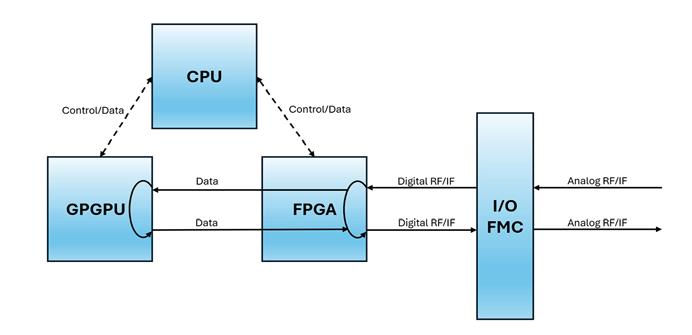
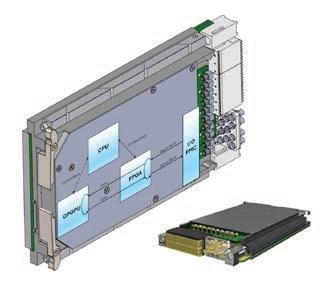
As shown in Figure 1, an ideal heterogeneous processing mix for cognitive EW, as with many defense applications, is the triple play of CPU plus FPGA plus GPGPU. This fusion plays to the strengths of each processing category and maximizes the performance-per-unit SWaP.
CPUs or GPUs [general-purpose-processors] – that is, RISC and CISC multicore pro cessing architectures – retain their central role as overall EW application orchestrators. In recent years, advanced Arm architectures have made their way into multicore CPU packages and are even coresident in FPGA and GPGPU system-on-chip (SoC) devices.
FPGAs remain central to the execution of EW techniques, including cognitive EW approaches, due to two main attributes – extreme low latency and adaptive I/O. FPGAs are ideal for developing an EW technique in HDL optimized for timing propa gation down into the single-digit-nanosecond range. Low latency, high throughput, and rigid determinism are critical for techniques as basic as range gate pull-off used in spoofing radar pulse trains. Adaptive digital signal I/O is resident on the FPGA device itself with SERDES [serializer/deserializer] or LVDS [low-voltage differential signaling], required by different types of converters depending on such factors as sampling fre quencies, channel counts, and constrained latency timing through the digitizer itself.
The FPGA mezzanine card (FMC), as specified by the VITA 57 standard, is ideal for adapting to the analog RF/IF (or fiber-based digital IF) input/output channels as needed by a cognitive EW system. SERDES, LVDS timing, and other signals are fanned out from the FPGA BGA [ball-grid array] into a high-density connector that the FMC plugs into. There are many FMCs available from companies such as Epiq Solutions that house high-end MHz and GHz multichannel ADCs and DACs. With EW, the selection of converters often involves the choice of serial JESD204 or parallel LVDS with the trade being channel count versus sampling latency. Coax RF/IF cables can then be routed from the FMC to the VPX backplane as in the example of the SOSA/CMOSS software-defined radio (SDR) slot profile.
The latest participant in the heterogenous offering is the GPGPU processor, such as those from NVIDIA, which leverage hundreds or even thousands of CUDA cores and tensor cores, ideal for realizing the cognitive aspect of cognitive EW. This pool of processing cores represents a force multiplier for AI/ML workloads in addition to the DSP arithmetic often required by advanced EW techniques.
With a focus on cognitive EW data pathways as shown in Figure 1, ingress-egress loops are required to support EW techniques that require various turnaround times and adaptation feedback on radar pulse trains, communications links, and adversarial jammers. These operations all take place in the realm of micro- and nanoseconds. Taking one scenario for example: The FPGA executes techniques in nanoseconddelayed real time based on emitter threats identified in the higher-latency GPGPU, running extreme wideband frequency domain analysis of the target spectrum.









SOSA Aligned 3U VPX
® Plug-in-Cards RUGGED. SCALABLE. CUTTING-EDGE.
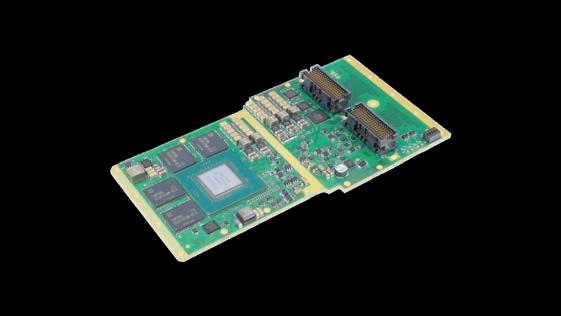
XMC Video Capture & GPGPU Cards
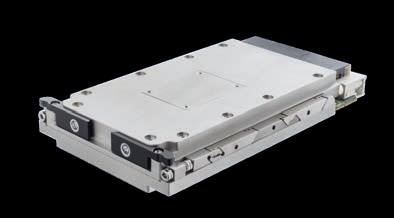
SOSA Aligned ® Single Board Computers

Embedded Video Graphics, GPGPU, AI Processing PICs
Optimized for Compute & I/O-Intensive Workloads
®
SOSA Aligned 3U OpenVPX Architectures
XMC Video Capture & Coprocessing Solutions
Scalable SWaP-C designs, MIL-STD-810
®
Support for NVIDIA ConnectX -7 SmartNIC, NVIDIA GPUDirect RDMA, and Multi-Instance GPU (MIG) ®
Flexible video interfaces such as ARINC818, DVI, CVBS, 12G-SDI, USB, DisplayPort and more


As any good systems engineer or embedded architect will contend, 3U VPX card slots are always at a premium. Slotcount reduction usually equates to reduced SWaP and cost. Cognitive EW implementations can take as many as three VPX slots to realize: One for the FPGA and FMC mezzanine, a second for the GPGPU, and a third for the multicore CPU single board computer. An additional potential issue with this architecture is that in order to increase channel count, sets of two cards at a time (assuming the CPU card does not have to be replicated) would be incrementally added when scaling up. This move can be thought of as VPX system card scaling resolution.
An alternative architecture would see the heterogenous “triple play” plus ADC/DAC digitizers all reside in a single VPX slot, meaning that cognitive EW techniques could be realized in a much smaller SWaP footprint. Scaling resolution for increased channel count and spectrum/emitter coverage would be a single 3U VPX slot at a time. This arrangement was virtually unachievable until recently.
NVIDIA GPGPU technology is an undeniable leader in the AI/ML plus DSP processing space. Of particular relevance is its Jetson system-on-module (SOM) product line which is effectively a small mezzanine assembly that includes a multicore Arm CPU plus a full GPGPU with more than 1,000 cores. This accounts for two of the three heterogeneous processing technologies required for the proposed cognitive EW architecture.
A 3U VPX baseboard is then needed that has a sizeable Xilinx FPGA, an FMC site with a mounted ADC/DAC converter FMC, and a high-density connector with space for an Orin NX Jetson SOM to plug into. The SOSA/CMOSS profile ending in 14.6.11-4 is designated as the SDR slot profile.
Figure 2 shows that the cognitive EW architecture is realized in a single SDRbased VPX slot profile supporting digital interconnectivity over the VPX backplane connectors in addition to analog signal


WOLF-1636

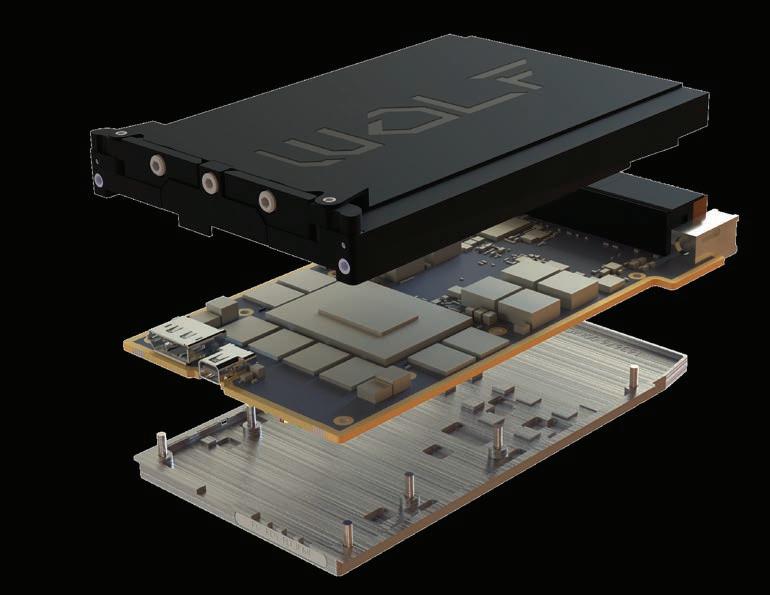
WOLF’s Blackwell 3U and 6U VPX family—1636, 163L, 167S, and 2638—brings next-generation accelerated compute to rugged, SOSA®-aligned open-architecture systems for aerospace and defense. Built for the edge, they deliver high-density performance, modern memory, and high-speed I/O in compact VPX form factors, operating reliably from –40 °C. When the mission gets cold, WOLF keeps computing.

By Dan Taylor
Autonomous operations can range from small drones to autonomous surface vessels, with the real competitive edge shifting from who builds the best platform to who can upgrade it fastest. Open architectures promise plug-andplay tech insertion – with the hard part being the “glue”: the interfaces, timing, thermal and power behaviors, and configuration control that decide whether a new payload, compute card, or comms module drops in cleanly or triggers months of requalification. Designs that take a modular open systems approach (MOSA) help solve those interconnect challenges.
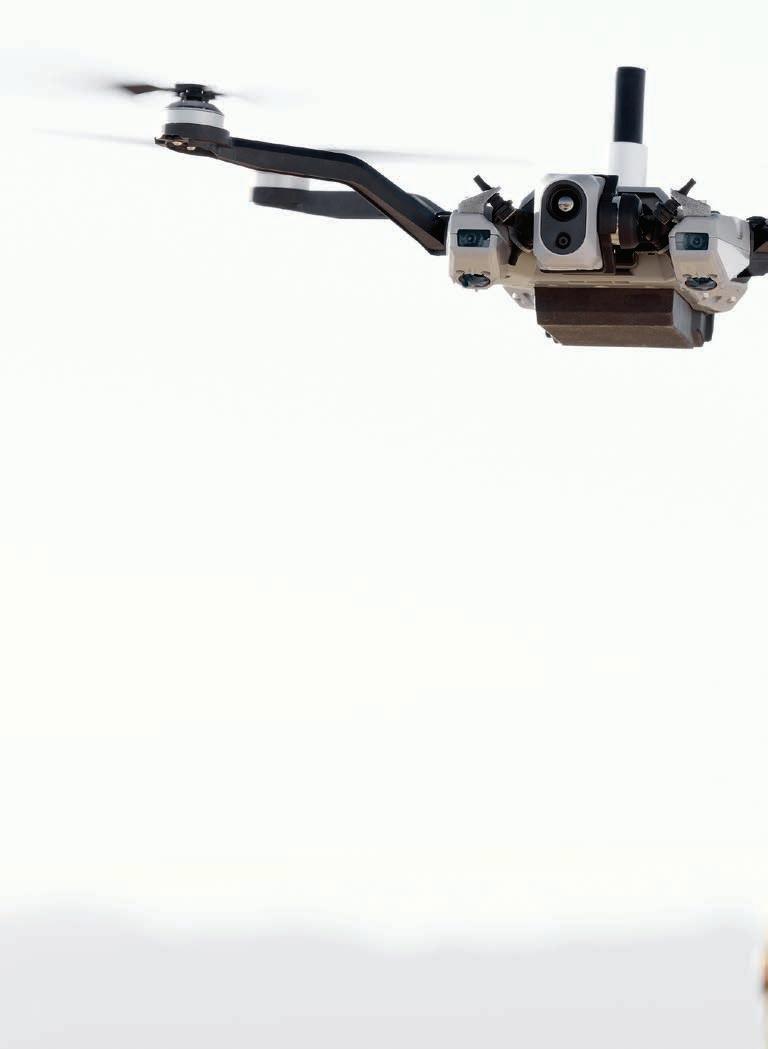
Defense teams want a simple outcome: Keep the platform in service, then insert better technology as it becomes available – which is where a modular open systems approach (MOSA) comes in and why it was mandated by the U.S. Department of Defense. But many upgrade plans fail during integration. A module may meet a standard on paper, yet still cause timing issues, thermal stress, data mismatch, or power conflicts once installed.
That is the central challenge in autonomous systems. Airframes and hulls can stay in service for years, while compute components, software, and sensors can change every year. If an architecture cannot absorb fast subsystem change, programs lose time and money.
This is why MOSA choices now shape every layer of design: single-board computers (SBC), real-time operating systems (RTOS) platforms, connectors, and backplanes.
Starting with a stable platform
Mitch McDonald, president of Red Cat subsidiary Teal Drones (South Salt Lake, Utah), says that the Teal/Red Cat process begins with fixed interface boundaries.
“We design autonomous systems around stable, well-defined mechanical, electrical, and data interfaces so capabilities can evolve without redesigning the core platform,” McDonald says. “That discipline applies across our portfolio, from small UASs [uncrewed aerial systems] to maritime USVs [uncrewed surface vessels].”
He says that Red Cat treats the vehicle as the long-life baseline and updates mission technology inside controlled boundaries. “Our drones and maritime platforms are treated as durable baselines. The airframe or hull remains stable, while compute, sensors, autonomy software, and communications modules integrate through controlled interface boundaries.”
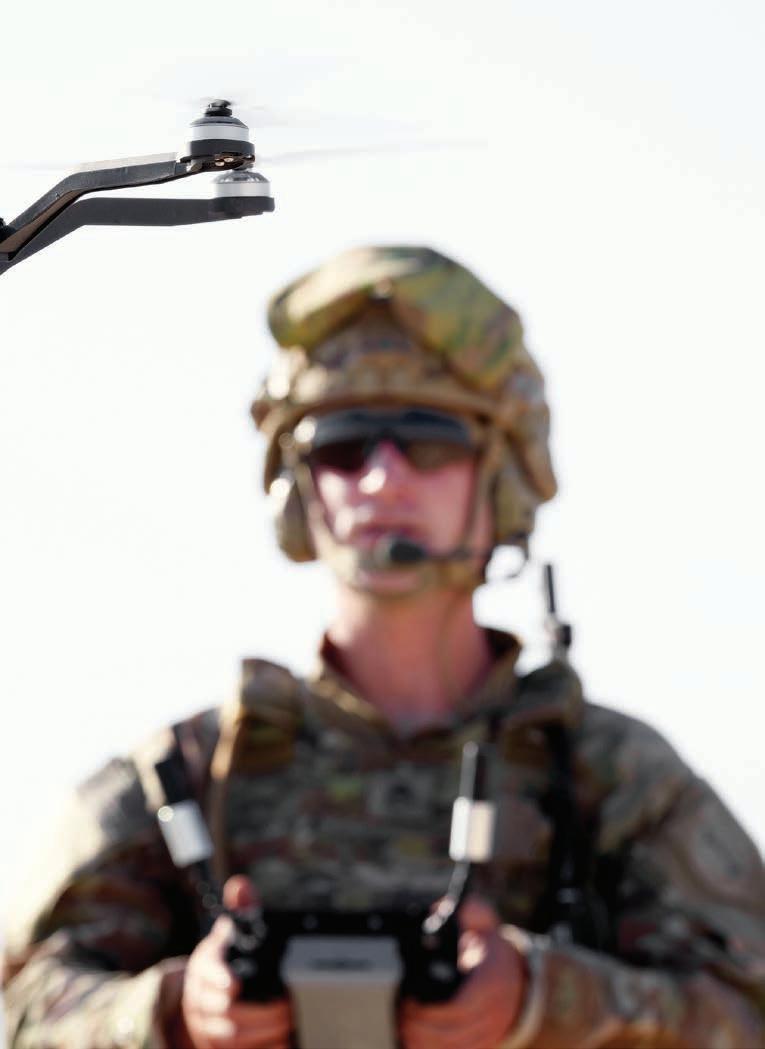
That model supports backward-compatible upgrades: McDonald points to new pay load work that integrates with existing systems, so that users can improve capability without replacing the aircraft. He says the same approach extends to flight control, navigation, communications, and internal compute; these aspects also apply to the company’s Blue Ops maritime systems.
This kind of technology implementation depends on concrete standards, says William J. Pilaud, chief solutions architect at LCR Embedded Systems (Audubon, Pennsylvania).
“For autonomous defense systems, the application of MOSA principles points to the SOSA [Sensor Open Systems Architecture, or SOSA, Technical Standard] and VITA 46/ VPX architectures, open Ethernet-based data fabrics, and modular, container-friendly software frameworks,” he says.

Pilaud notes that standards also drive hardware selection decisions. “They directly influence hardware selection – driving the use of SOSA conformant single board computers; high-speed backplanes with deterministic, low-latency fabrics; and rug gedized connectors capable of supporting high bandwidth and harsh environments.”
Hardware can be modular, but if software is tightly locked to one platform, upgrade speed still suffers. This design aspect, Pilaud says, means that open architecture changes how teams design real-time software stacks.
“An open systems approach fundamentally shifts RTOS design from tightly coupled, platform-specific implementations to modular, standards-based architectures,” he explains. “Instead of hardwiring applications to proprietary hardware, modern RTOS environments must support portable middleware, containerized services, and welldefined APIs that allow autonomy stacks to evolve independently of the underlying compute.”
Hard real-time behavior is still mandatory, he adds: “Deterministic performance remains nonnegotiable, but it’s now paired with partitioning, secure boot, and real-time virtualization. This enables mixed-criticality workloads – AI inference, sensor fusion, and control loops – to run concurrently while preserving timing guarantees and rapid upgradeability.” (Figure 1.)
The upshot? RTOS selection is now both a performance choice and a life cycle choice. In short, MOSA is not only a policy objective. It is a component-selection framework that helps keep future upgrade options open.
Even with robust standards and modern RTOS design, integration failures still happen. McDonald notes that the risk is concentrated where subsystems meet.
“Integration challenges typically appear at system boundaries,” McDonald says. “Even when components align to open standards, differences in timing, data formats, synchronization, thermal behavior, or fault management can affect system performance.”
He stresses the operational impact in autonomy programs. “Those boundary conditions directly impact perception accuracy, navigation stability, and command-andcontrol reliability.”
Pilaud describes the same issue from a VPX/SOSA perspective. “Even when SOSA/ VPX modules and backplanes comply with MOSA principles, differences in firmware maturity, timing assumptions, thermal profiles, and power management can introduce subtle instability in tightly coupled autonomous systems,” he says.
Both Pilaud and McDonald call for strong integration discipline, with Pilaud recommending “rigorous interface control, conformance testing, and system-level validation,” and McDonald emphasizing “disciplined integration testing and configuration control” across power, thermal, software, and mission-data paths.
McDonald also points to IP-ownership risk at integration layers. “If interface definitions or integration layers are owned externally, iteration cycles can become dependent on third-party development timelines, which increases integration complexity and slows capability evolution.”
Connectors and backplanes are strategic choices
This boundary challenge leads directly to interconnect decisions. Rodney Doss, industry standards manager for Samtec (New Albany, Indiana), says connector choices are often set early because they define what the system can carry.
“Work groups often begin with connectors to understand the signal between module and backplane, then work their way back from there,” Doss says.
FIGURE 1 | LCR Embedded Systems’ VE02 packs two 4-slot VPX/SOSA aligned payload sections into a single SAVE envelope for Army ground vehicles, with separate cooling paths and dual conduction-cooling/forced-air assist to support high-power size/weight/power (SWaP)-constrained applications. Courtesy of LCR Embedded Systems.
He says groups usually focus on three things: “performance, ruggedness, and availability.” In autonomy programs, that can quickly become a bottleneck.
“The complex and smart features of these systems require the highest performances available such as PCIe Gen 6, with as many pin counts as they can fit into the small spaces they have available,” Doss says.
He says open-standard connector definitions make module interchange possible across vendors. By designing in connectors, these standard definitions help in three ways.
“First, it defines the footprint and placement requirements of the board assembly so module designers know how much room they have to work with to design their widget,” Doss says. “Next, it solves the connectivity needs, so that a system integrator can trust a module will plug into their system regardless of vendor. Finally, it allows the groups to define the pin maps of the connector so that all modules will communicate the same within the system, even if their module works completely different internally.” (Figure 2.)
Once interconnects and interfaces are stable, MOSA can support another major need: controlling size, weight, and power (SWaP). Autonomous platforms cannot absorb unlimited SWaP growth, and Teal’s McDonald says that MOSA helps teams avoid that trap.
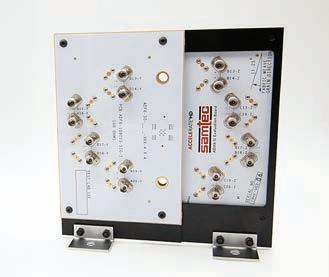
2 | Samtec’s AcceleRate HD SI Evaluation Kit gives designers and engineers a standalone, robust test platform for characterizing AcceleRate HD high-density 4-row strip connectors in high-speed, high-cycle applications. Courtesy of
“MOSA helps prevent overbuilding and uncontrolled growth,” he says. “Not every drone or USV needs to carry every capability, and not every improvement should require structural redesign.”
He describes, for example, battery upgrades that improve performance while preserving the existing interface, or maintaining payload modularity across multiple airframes through common boundaries.
Pilaud makes the same point at system scale. “MOSA principles help manage SWaP constraints by enabling modular scaling rather than overdesign. Instead of building monolithic systems sized for peak future requirements, open architectures allow designers to rightsize compute, I/O, and acceleration at the module level.”
When upgrades stay inside defined subsystem boundaries, programs can add capability without triggering platformwide redesign. For program offices, life cycle value is often the strongest MOSA argument.
“Life cycle management is central,” McDonald says. “Airframes and maritime vessels may remain in service for many years. Sensors, compute hardware, autonomy software, and communications systems evolve much faster.”
He says that stable interfaces support incremental modernization, which can reduce recertification scope and limit operational disruption.
Pilaud adds that an open systems approach “keeps autonomous systems relevant by decoupling platform life cycles from technology-refresh cycles.” He says that this approach supports module-level insertion of new processors, artificial intelligence (AI) accelerators, and networking technologies without the need for full redesign.
Today’s defense industry recognizes that standards are essential, but they are not enough by themselves. Programs also need clear interface ownership, strong configuration management, and disciplined validation.
“MOSA increases flexibility and accelerates capability growth, but it requires disciplined systems engineering, clear interface ownership, and strong configuration management to ensure the full system performs reliably and remains upgradeable over time,” McDonald says. ■
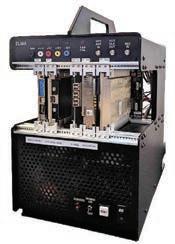
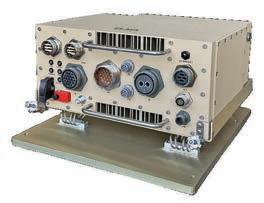


Ensure mission success with our solutions aligned to the SOSA standard. From development to deployment. Elma’s systems delivers superior interoperability, rapid integration, and reduces costs - empowering warfighters with proven capabilities ready for tomorrow’s challenges.
you at every stage!
By Jonathan Cain, SOSA Consortium
The insertion of commercial products into military acquisitions is critical for the future strategic advantage of the U.S. and allied nations; the recent acquisition reforms put forward by the U.S. Department of Defense (DoD) and Secretary Hegseth put this certainty front and center. The reasons are obvious: The continued conflict in Ukraine, the rapid increase in Chinese production capability, and technological advancement in artificial intelligence (AI).
But when we talk about commercial products, there is an implied value proposition that tips toward large-volume, horizontal markets, where commoditization drives down costs per unit. Quality is often not sacrificed, but rather refined: While commercial customer requirements change with the increasing standards of living, technological design tends toward pursuing efficiencies in production capability, rather than more performance.
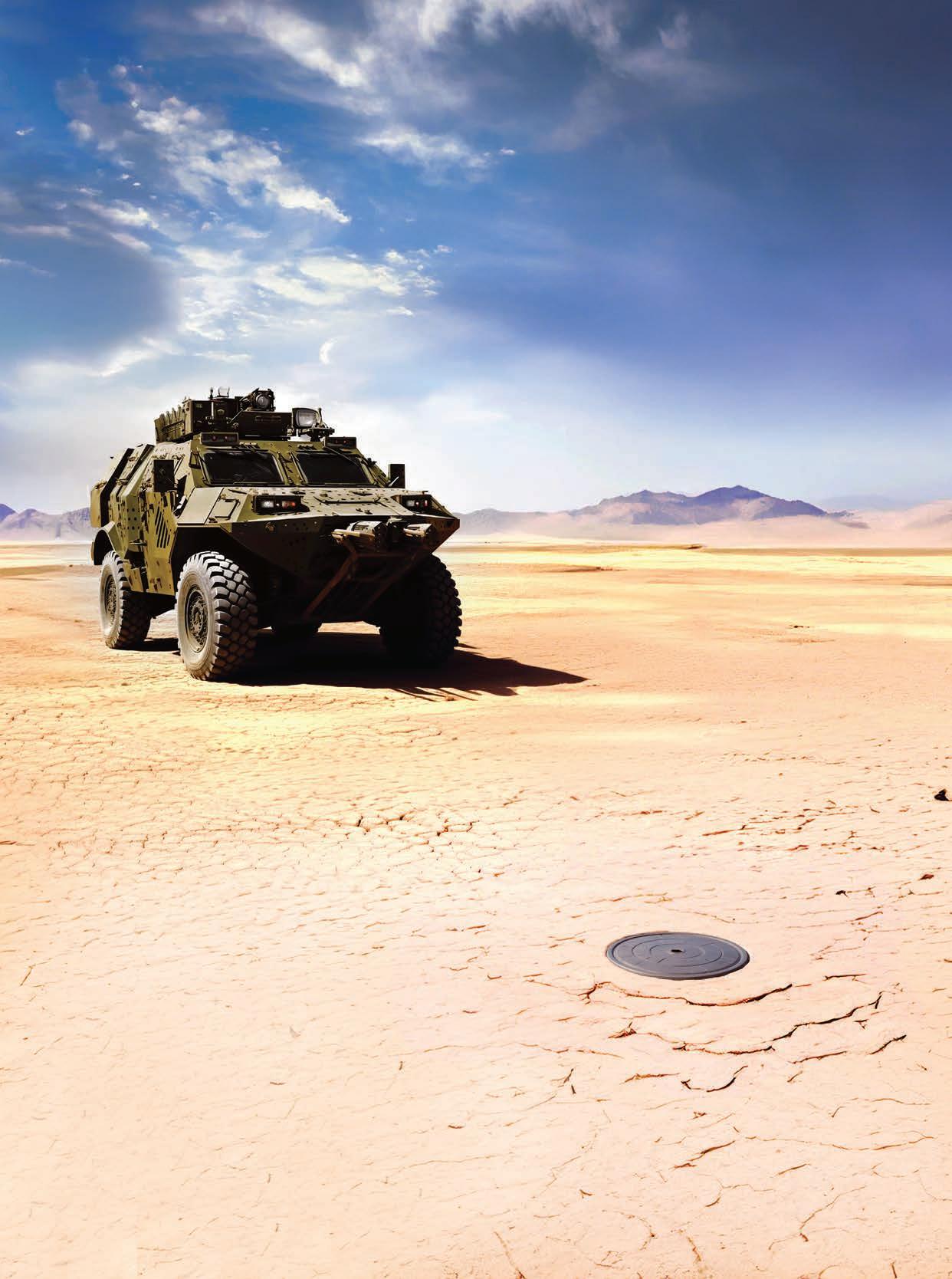
I live in Tucson, Arizona, an arid desert with summer highs topping 100 °F. It’s only a minor inconvenience when my iPhone won’t turn on because I accidentally leave it outside too long. Even as the phone protects itself from overheating, it still gives the option to make emergency phone calls. There are also times when it crashes, but again, that’s just an inconvenience. But what happens when military equipment fails or decides to not turn on when service members need it most?
Absolute reliability and peak performance have been the largest driving forces behind the defense industry over the last 80 years. We have created a system that is completely riskaverse. The size and scope of the industry that delivers these reliable, well-performing products has swelled to ensure that every unknown unknown is understood prior to fielding.
Systems engineering focuses on quality attributes – the “-ilities” like reliability, availability, or securability. Getting each of these into a new system causes a significant increase in cost and schedule, but they also ensure that reliable system performance is met wherever it’s needed, no matter what.
Secretary Hegseth’s “Acquisition Transformation Strategy” emphasizes speed for system deployment and fielding even an 80% solution with an expectation of upgrading as soon as practical. This is where MOSA [modular open systems approach] comes in: Within this context, MOSA is an approach to finding the right areas at which pre-existing performance surplus of components does not drive down overall system quality.

MOSA uses open systems architectures or government reference architectures to rigorously define open interfaces and the component functionality in between them. This architectural decomposition facilitates the understanding of a component’s risk relative to the overall system, especially with respect to quality, and provides a low-cost, rapid path to upgradability. In this way, we see that MOSA is the conduit for commercial insertion: A system that performs with defense-grade quality that realizes the cost and production-readiness benefits of commercial products.
MOSA IS THE CONDUIT TO MAINTAIN FOCUS ON PROTECTING
MEMBERS EVERYWHERE, EVERY TIME, WHILE ALSO DRIVING DOWN COST AND INCREASING PRODUCTION READINESS.
However, even within the components, there is still likely a floor to commoditization. Consider, for example, a plug-in card (PIC) that is aligned with the Sensor Open Systems Architecture, or SOSA, Technical Standard. The PIC could include a state-ofthe-art, embedded GPU enabling AI at the edge. However, a commercially available GPU chip that was designed for use in pristine air-conditioned data centers must be “hardened” to reliably perform in a desert summer even after operating for seven hours. This is a realistic example of the floor to the cost benefit of commercial insertion.
As the DoD continues to disrupt old acquisition strategies, MOSA will continue to be pivotal for understanding and mitigating risks to quality due to commercial insertion. The MOSA acquisition strategy creates new and strengthens existing horizontal markets that economically find the right level of commoditization for military equipment. So, as industry drives towards commercial insertion, MOSA is the conduit to maintain focus on protecting service members everywhere, every time, while also driving down cost and increasing production readiness. ■
Jonathan Cain is Steering Vice-Chair of the SOSA Consortium.
SOSA Consortium https://www.opengroup.org/sosa
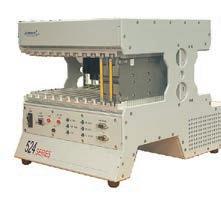
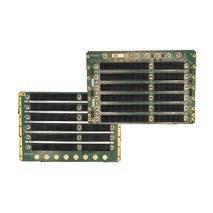

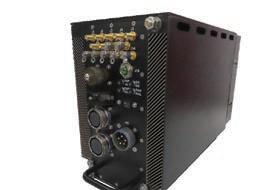
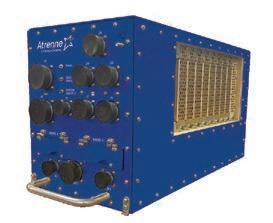
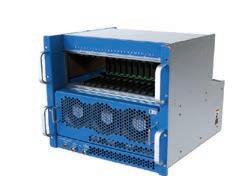
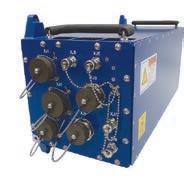
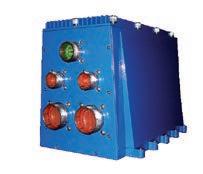
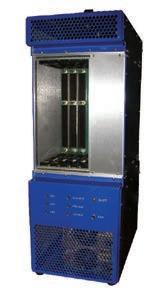

Behlman introduces the first test-proven VPX power supplies developed in alignment with the SOSA Technical Standard. Like all Behlman VPXtra® power supplies, these 3U and 6U COTS DC-to-DC high-power dual output units feature Xtra-reliable design and Xtra-rugged construction to stand up to the rigors of all mission-critical airborne, shipboard, ground and mobile applications.
> 6U power module developed in alignment with the SOSA Technical Standard
> Delivers 1050W DC power via two outputs
> VITA 46.11 IPMC for integration with system management
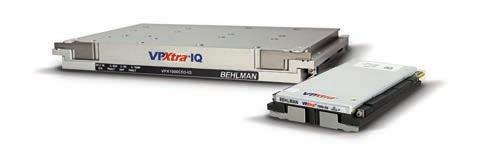
> 3U power module developed in alignment with the SOSA Technical Standard
> Delivers 800W DC power via two outputs
> VITA 46.11 IPMC for integration with system management
By Dan Taylor, Technology Editor
The modular open systems approach (MOSA) is no longer just a government acquisition goal – it’s now a business strategy for defense suppliers trying to move technology into the field faster, said panelists at the Military Embedded Systems MOSA Virtual Summit, which was held on February 26, 2026.
During the session “Making the Business Case for MOSA,” speakers from The Open Group, Raytheon, and Curtiss-Wright described open architectures as a way for companies to reduce development risk, widen market access, and avoid building supporting infrastructure around a single product from scratch.
Alicia Taylor, program director for The Open Group’s Future Airborne Capability Environment, or FACE, Consortium, emphasized that MOSA should not be viewed as a single architecture or fixed checklist. “It’s an approach, not an architecture,” she said. “It’s a strategy.” She said the requirements companies often associate with MOSA tend to come from open standards such as the FACE standard and the Sensor Open Systems Architecture, or SOSA, Technical Standard.
Taylor also argued that MOSA now carries more weight because it is backed by law, policy, and implementation guidance. She pointed to statutory language in Title 10, changes in the National Defense Authorization Act, U.S. Department of Defense (DoD) guidance, and service-level implementation documents. In her view, that policy backdrop is pushing open approaches beyond a technical preference and into the center of program planning and supplier decisions.
She said the business case extends to both government and industry. For suppliers, Taylor described the benefit as “you invest once, and you sell many,” linking open standards to productine development and reuse across military aviation, commercial aviation, ground vehicles, maritime platforms, and space.
Jonathan Cain, vice chair of the SOSA Consortium steering committee and an engineering manager at Raytheon, added that the government remains the main force behind that shift, using policy and mandates to drive what he called “inorganic vertical disintegration.” He said the original goals centered on affordability and time to field, but that the rationale has widened.
“We are adding that robustness and the broadening of the defense industrial base as a ‘why’ for most of them,” Cain said. He asserted that MOSA can help open the market to more participants, including nontraditional suppliers, while giving

programs more flexibility to insert technology during a system’s life cycle instead of locking in a single vendor for long periods.
Cain cautioned against treating openness as a universal answer. “It’s not a one-size-fits-all solution for everything,” he said, adding that vertical integration will continue to play a role in systems where performance demands are high and interfaces are less settled. In his framing, the industry is moving toward a mix of approaches: open, modular ecosystems where horizontal markets make sense; and integrated development where performance margins still demand it.
David Jedynak, vice president of strategic planning and a technical fellow at Curtiss-Wright Defense Solutions, tied MOSA to the challenge of getting new technology through what he termed the defense “valley of death” – as the gap between technology development and program acquisition is sometimes called. He argued that many startups and emerging defense firms make the mistake of trying to build not only their differentiating capability, but also the entire environment needed to support it.
He described VITA and OpenVPX as part of an existing defense technology stack that newer entrants can build on instead of constantly recreating.
Jedynak aimed that message at investors as much as suppliers: “If you’ve got founders out there in your portfolio, you should be asking them this question: how are you using the VITA defense tech stack to accelerate over the valley of death?” ■
View-On-Demand MOSA Virtual Summit keynote and sessions (an archived event) at https://tinyurl.com/4xfa2vd8.

By Mark Littlefield

It looks like 2026 is shaping up to be a breakout year for VNX+, thanks to the well-crafted VITA and Sensor Open System Architecture, or SOSA, standards in place. New products will emerge based on those standards, so designers and integrators can leverage the benefits of commercial off-the-shelf (COTS)-based modular open standards approach (MOSA) for entirely new classes of applications and platforms that were previously too size, weight, and power (SWaP)-constrained for standards such as OpenVPX.
In late 2019, the Sensor Open System Architecture, or SOSA, Consortium formed the Small Form Factor Subcommittee (SFFSC) working group to explore options for hardware “physically smaller than 3U VPX” and to ensure specific requirements language was drafted into the SOSA Technical Standard. This language was geared towards applications seeking to leverage the technical standard, but were too space, weight, and power (SWaP)-constrained to do so using 3U OpenVPX, the smallest form factor in the SOSA approach at that time.
With the release of the new VNX+ standard (VITA 90), the industry now has an approved standard and a section of the released SOSA Technical Standard that not only satisfies the size and technical performance targets originally desired by the SFFSC, but also meets all of the critical SOSA criteria such as interoperability, replaceability, and plug-and-playability.
VNX+ parallels the architecture of OpenVPX, an important consideration when leveraging hardware design or software application components between the two form factors. It also adds capabilities not found in OpenVPX to address the needs of small form factor systems.
VNX+ is a plug-in module (PIM) form factor 89 mm wide by 78 mm deep. Its basic elements address the needs of small-form-factor systems.
Most critical is the compact size that helps bring a modular open standards approach (MOSA) into smaller SWaP-constrained platforms, where custom solutions were
previously needed. Blind-mate optical and coax connectors enable the highend sensor and signal processing needed on these small platforms.
Wedgelock-based mechanicals ease integration and two-level maintenance requirements as well as facilitate quick technology insertions and future upgrades. Non-wedge lock-based mechanicals offer superior thermal performance at the same cost of introducing thermal interface materials.
For extremely space-constrained applications, bulkheads or sidewalls can be used for mechanical mounting and thermal paths.
The VNX+ family includes a series of “dot” standards that define interface profiles and practices to ensure interoperability across diverse applications. These standards address specific slot and module profiles, coaxial and optical
interconnect options, advanced power filtering and conversion, energy storage technologies, and advanced mounting and cooling practices.
› ANSI/VITA 90.0-2026: VNX+ base standard
› ANSI/VITA 90.1-2026: VNX+ profile tables
› VITA 90.2-2026 VDSTU: VNX+ optical and coax apertures*
› ANSI/VITA 90.3-2026: VNX+ power supply and storage modules
› ANSI/VITA 90.4-2026: VNX+ cooling and mounting systems
› ANSI/VITA 90.7-2026: VNX+
optical and NanoRF coax apertures standard
*All are released and approved by ANSI, except for VITA 90.2, which is currently released by the VITA Standards Organization (VSO) as a VSO draft standard for trial use (VDSTU).
Technical design of VNX+ for SOSA VITA 90.0 defines the basic form factor; the PIMs are mounted with the three walls of the chassis pressing against the narrow edges of the PIMs to form both a retention mechanism as well as a thermal path for cooling. Thermal interface material is typically used to absorb any mechanical tolerance between the chassis walls and the PIMs with only modest reductions in thermal efficiency.
VNX+ defines two board heights, 13 mm and 19 mm, with double-height PIMs of 27 mm and 39 mm also captured in the standard. The 13 mm and 27 mm PIMs have a 200-pin high-speed data connector (HSDC), while the 19 mm and 39 mm PIMs have three connector configurations for payloads (power supplies are different): 400-pin, 320-pin with a half-size aperture for optical/coax connector modules, and 240-pin for full-size connector modules. (Figure 1)
The SOSA design narrows the module selection to the 19 mm single-height and 39 mm Style-B double-height form factors with the 400 or 320-pin connectors. However, much of the detail below also apply to 13 mm and 27 mm modules and slot profiles, as well.
Mounting flanges to the base greatly ease the task of inserting, securing, and
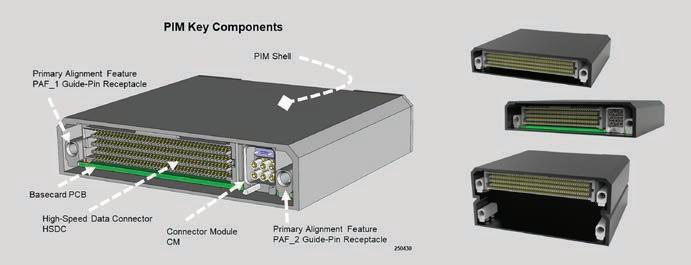
FIGURE 1 | Basic features of VNX+ from ANSI/VITA 90.0-2026; (right) three SOSA approved PIM configurations: (A) 400-pin (B) 320-pin with a style-2D coax connector module (C) 400-pin double-height style B.
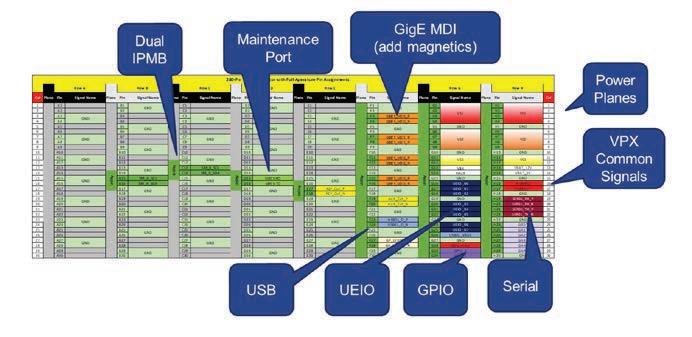
removing a VNX+ plug-in module from a chassis. However, the minimal metal-onmetal contact area between the flange and the chassis rail presents significant thermal resistance when compared to the larger three-sided contact area found with the basic VITA 90 design.
To clearly show how VNX+ meets the SOSA Technical Standard’s needs for a small form factor, compare SOSA/VNX+ to SOSA/OpenVPX. While VNX+ is less than a third of the overall board volume of a conduction-cooled 3U OpenVPX card, the high-density connector of VNX+ means there are plenty of signal pins to work with when defining the system architecture. As a result, the general architecture used by OpenVPX – utility plane, data plane, control plane, expansion plane, general I/O, mezzanine I/O (leveraging the new QMC I/O mezzanine standard), and connector modules for direct optical or coaxial connections – is replicated in VNX+.
The VNX+ architecture is divided into three segments:
1. S1 Utility Segment: power and utility signals.
2. S2 Communications Segment: data plane, control plane, expansion plane.
3. S3 Overlay Segment: differentiation between slot profiles; a hybrid region with copper connections, optical/coax connector modules, or a combination of both depending on the slot profile.
Utility functionality such as power, resets, chassis management bus (IPMB), and other signals such as NVMRO (non-volatile memory read only) reside in the S1 Utility Segment. Most profiles have these pins in the same location on the connector, although some have this region slightly rearranged. Notably, the S1 Utility Segment includes all of the same utility functionality found in OpenVPX, plus additional common I/O ports such as UARTs, USB, and 1000BASE-T. This commonality in architecture elements between the two form factors is important for the MOSA approach to system design. (Figure 2)
One important port not found in OpenVPX is defined in the S1 Utility Segment Payload profiles: the Unique External I/O (or UEIO) port consists of eight pins and can be defined in various ways implementing I2C and/or SPI interfaces. It’s used in VNX+ based systems to talk to port expanders, low-speed protocol ports, LCD displays, and similar devices in small systems. While VNX+ defines a set of possible configurations for the UEIO port, SOSA sticks to one (1x I2C and 1x SPI with 1x-3x SPI Selects).
The parallels between the S2 Communications Segment and OpenVPX are obvious. Multiple 4-lane Data Plane and single-lane Control Plane ports, coupled with as many as 8 lanes of Expansion Plane mirror (or exceed) what is found in a 3U OpenVPX SOSA slot profile. This architectural similarity, combined with a similar selection of communications protocols for these planes, ensures a solid foundation for MOSA/SOSA aligned system design and integration.
• 320 pin switch: VNX.SW-1-HH.320-7.4.2.1<5DP/5CP switch>
– 5x data plane, 5x control plane
– Dual MT optical
• 7-Slot 320-pin radial clock: VNX.RC-1-HH.320-7.5.2.2<7REFCLK/7AUXCLK overlay>
– Based on the payload template – 7x REF_CLK/AUX_CLK pairs
– Half-size aperture for coax
• 22-slot 320-pin radial clock: VNX.RC-1-HH.320-7.5.2.1<22REFCLK/22AUXCLK>
– Not based on the template – 22x REF_CLK/AUX_CLK pairs Half-size aperture for coax
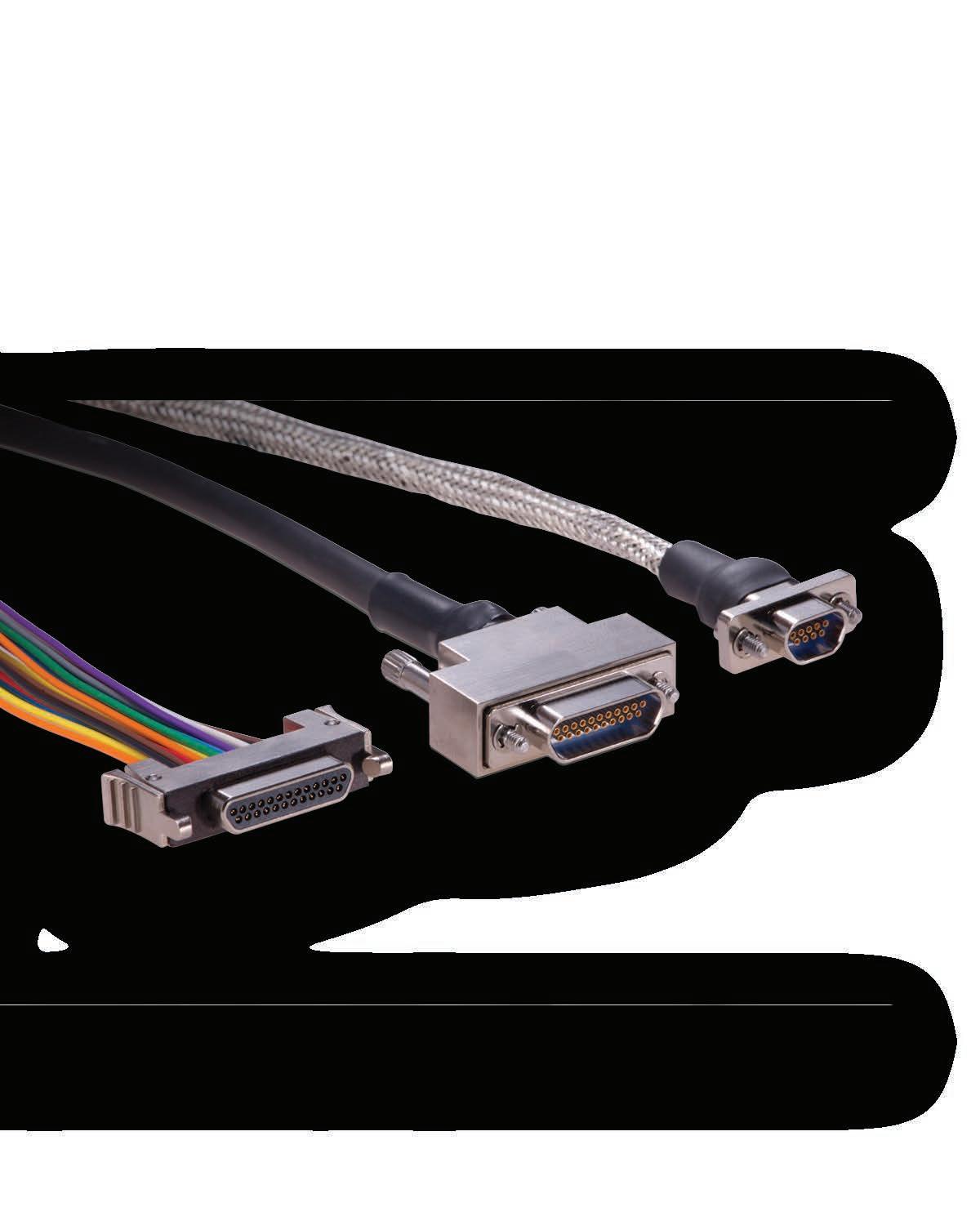
While at first glance, this may seem like a lot of options, each was in fact carefully chosen to address specific needs within the SOSA application space:
400 pin payload: general SBC-type of payload, with an assortment of I/O and pins for QMC I/O.
› 320 pin payload: similar to the 400 pin profile, but with a reduced set of I/O, no mezzanine mapped I/O for QMCs, but a half-size aperture for coax and/or optical connections.
› 400 pin switch: maximum switch matrix ports.
› 320 pin switch: reduced switch matrix ports, but a half-size aperture for optical connections.
› 7-Slot 320-pin radial clock: implements seven slots of REFCLK/ AUXCLK pairs in S2 overlay segment, preserving S1 communications segment, allowing full payload card’s worth of data plane, control plane, and expansion plane I/O. (Highly accurate clock source commonly needed for SOSA systems.)
› 22-Slot 320-pin radial clock: replaces most of S1 communications segment with REFCLK/AUXCLK pairs to support large node counts.
VNX+ in applications
In addition to aligning with MOSA, VNX+ brings the architecture of the SOSA approach and OpenVPX to platforms where SWaP constraints previously
prevented their use. Smaller Class 2 or Class 3 uncrewed aerial systems (UASs) as well as ground and sea-based uncrewed systems can obviously make use of VNX+ solutions. Electronic warfare (EW) applications, which often require very high-performance computing packaged for tight spaces, are also good candidates. The high-performance interconnects and I/Os along with the mezzanine-mapped I/Os and lower-level interfaces provided by UEIO are critical for these environments.
One may ask: If VNX+ parallels OpenVPX so well and is so much smaller, why not replace OpenVPX with VNX+? The answer is also one of the big benefits of VNX+: its small size. Physically, VNX+ modules cannot fit into some of the larger components, such as some larger GPUs, FPGAs [field-programmable gate arrays], and CPUs commonly used in deployed systems. Moreover, the power density of VNX+ per-slot is still less than 3U OpenVPX, a situation that ultimately limits how much computing performance can be packed into a slot. However, VNX+ is an excellent choice for SWaP-constrained applications.
Since the VITA documents defining VNX+ were approved and released publicly very recently – early 2026 – it’s still considered early days for the VNX+ market. However, companies that have been at the forefront of the standard’s development have already announced or are even shipping products built against the VNX+ and SOSA standards, with more undoubtedly on the way. ■

Mark Littlefield is Director, Systems Products, at Elma Electronic.
Elma Electronic https://www.elma.com/en
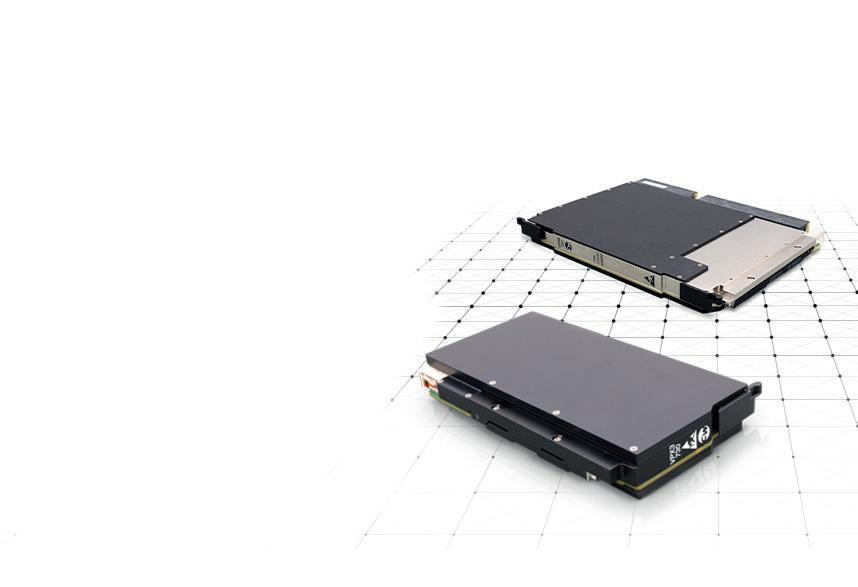
Reduce integration risk, accelerate development, and simplify system design with Curtiss-Wright’s secure, high-performance, SOSA-aligned compute solutions.
Supporting next-gen sensors, AI, and systems at the edge.
By Carlie Duffy, EIZO Rugged Solutions
Modern C5ISR [command, control, communications, computers, cyber, intelligence, surveillance, and reconnaissance] platforms are only as effective as their ability to process and analyze the data gathered from sensors. As the defense landscape becomes increasingly contested with sensors such as those used for radar, electro-optical/infrared (EO/IR), and radio frequency (RF), system architects face growing bottlenecks. The data gathered must be processed at the edge, but legacy systems lack sufficient compute power to keep up with multisensor processing demands.
Sensors form the digital backbone of nearly all real-time intelligence applications, driving critical decisions across ISR missions. But these inputs are no longer from a single source –next-generation command and control (NGC2) applications rely on multidomain sensor fusion to drive mission-critical decisions with greater speed and precision. By combining multiple sensing modalities into a unified operational picture, sensor fusion enables faster, more accurate threat detection and situational awareness in complex and contested environments.
In theory, adding more sensors should improve situational awareness. In practice, it creates massive complexity: Engineers are now tasked with correlating data from vastly different sources, each with unique resolutions, sampling rates, and coordinate systems, as well as synchronizing them in a coherent fashion.
A GPU’s architecture is perfectly suited for the matrix-heavy computations found in DSP and artificial intelligence (AI) tasks like filtering, object detection, and multisensor correlation. With the flexibility to run both traditional signal processing and modern machine learning (ML) models, GPUs provide the performance and adaptability that ISR platforms need at the edge.
For airborne ISR platforms, GPUs enable real-time fusion of radar, EO/IR, and lidar sensor data by processing large data streams in parallel. They support both traditional DSP and AI-based target detection, so they are suited for missions where speed, precision, and low size, weight, and power (SWaP) are critical. In counter-uncrewed aerial system (C-UAS) and active protection systems, GPUs are essential for fusing high-speed sensor data and running AI models at the edge. Their ability to process visual, radar, and RF inputs simultaneously enables faster decision-making and reduces false alarms in complex, often cluttered environments.
Another benefit: GPUs enable built-in support for AI toolchains including TensorRT, Holoscan, CUDA, and cuDNN, which can ease integration of ML models into the fusion pipeline.

By processing multiple sensor streams in parallel, GPUs dramatically reduce the time it takes to ingest, correlate, and interpret data. They support complex DSP workloads and run AI models at the edge, enabling ISR platforms to classify targets, detect anomalies, and prioritize threats in real time.
The result? Shorter detection-to-decision loops, higher confidence in target identification, and a faster and more autonomous ISR cycle. Whether mounted on airborne ISR aircraft, ground vehicles, or autonomous platforms, GPU-accelerated systems support advanced capabilities like multitarget tracking, object classification, and dynamic threat prioritization, all without relying on backhaul links to centralized processing.
The extended capability at the edge to process this data also results in reduced latency, as data processing can move away from servers and command centers. This move is augmented even further with technologies such as GPUDirect RDMA and RDMA over Converged Ethernet (RoCE), which provide low latency, low-CPU memory transfers across sensor fabric.
Most of these technologies are easy to migrate from the lab to the field and are readily upgradeable and replaceable. Unlike FPGA [field-programmable gate array]-based solutions for AI, those developed for GPUs are cross-compatible with one another, even across new hardware generations. GPU-based solutions also enable rapid protoyping and development of new sensor-based components.
As ISR platforms evolve to meet the demands of multidomain operations, sensor fusion has become the foundation of situational awareness and threat response. Fusing data from radar, EO/IR, RF, and other modalities in real time enables systems to deliver faster, more accurate intelligence directly at the edge, where seconds count. GPUs are a critical enabler of this capability, offering the parallel processing, low latency, and AI readiness required to turn massive sensor data into immediate action.
As defense programs increasingly adopt open software standards – including the U.S. Navy’s USV Common Control System, which is aligned with the modular open systems approach (MOSA) and leverages Sensor Open Systems Architecture, or SOSA, guidelines – embedded GPU-based plug-in cards (PICs) are a flexible, future-proof way to approach real-time sensor fusion. Rugged 3U VPX and XMC GPU modules integrate seamlessly into these open systems, enabling faster upgrades, better interoperability, and reduced time to field.
Carlie Duffy is marketing manager at EIZO Rugged Solutions. EIZO Rugged Solutions · https://www.eizorugged.com/

By Jared Sibrava, Open.Tech by Amphenol, Military High Speed Business Unit General Manager
The DoD’s push for a Modular Open Systems Approach (MOSA) and alignment with the SOSA® Technical Standard has fundamentally changed defense procurement. While much of the industry focuses on how these standards solve today’s interoperability challenges, the true strategic value for the warfighter lies in scalability.
At Amphenol, our Military High Speed team approaches SOSA alignment not as a static compliance checklist, but as a baseline for future-proofing the fleet. Modern C5ISR, radar, and electronic warfare systems generate a staggering influx of data. Processing this intelligence requires backplanes and interconnects that won’t bottleneck next-generation sensors. We are already delivering on this reality. Products like our RaptorLink 64x50 SOSA aligned Ethernet switch provide double density and speeds up to 50G per lane on the backplane.
Designing for today’s SWaP constraints is no longer enough; we must engineer for what comes next. Our high-speed architecture

is built with the headroom required to support upcoming exponential leaps in data rates.
By embracing the standardized form factors of the SOSA approach, we enable integrators to swap in massive bandwidth upgrades tomorrow without redesigning the entire chassis today.
When you need to future-proof your next project, Build it at www.Open.Tech.
www.Open.Tech
By Noah Donaldson, CTO of Annapolis Micro Systems
The top benefit the Sensor Open Systems Architecture®, or SOSA®, Technical Standard brings to military systems is its acceleration of innovation.
Formerly, embedded equipment manufacturers spent significant time on different backplane (and other) configurations. Now, the SOSA approach standardizes electrical and mechanical interfaces to effectively limit the number of configurations and ensure interoperability.
This frees vendors to invest in innovation, because the SOSA approach doesn’t limit performance and capability within a module. That’s how our focus on being the first to integrate the newest and highest- performing FPGAs and other components has really paid off.
It has allowed us to partner with Altera and AMD Xilinx to offer wideband Direct RF capability (up to 64 GSps!) in SOSA aligned 3U/6U VPX (see WS3AE1 & WS3XVR) and small form factors (see WSSAF1). These are targeted at demanding C5ISR edge

ADVERTORIAL

applications requiring direct sampling frequency coverage anywhere from 0.1 to 36 GHz, and/or wide instantaneous bandwidths.
We are also a pioneer in integrating powerful Versal Premium FPGAs into SOSA aligned Plug-In Cards (PICs). Customers pair any of eight Versal boards with next-gen LVDS-based and HSSbased Mezzanine Cards for very low latency or very high bandwidth performance.
Naturally, this huge leap in front-end bandwidth performance requires an upgrade in backplane bandwidth as well. Once again, the SOSA approach is a key enabler by incorporating high-density (HD) backplane Switch connectivity. Our WP3E20, WP3P20, and WP3H20 Switches feature VITA 91 backplane connectors that double the available density of a 3U VPX switch slot. Two HD switch slots in our 13-slot WC31DH Chassis enable it to handle all Data and Control Plane Ethernet via one slot, with the second switch slot dedicated to the expansion plane – 100Gb Ethernet, Gen4 PCIe, or LVDS. Or use just one switch per eight payload slots, versus four previously.
By Lee Brown, VP and Sr. General Manager, C5ISR
The early aspirations of the Sensor Open Systems Architecture®, or SOSA®, Technical Standard centered on transforming how the U.S. DoD and industry built, integrated, and upgraded sensor and C5ISR systems. Those aspirations were ambitious: reduce vendor lock-in, accelerate modernization, lower lifecycle costs, and create a common, interoperable ecosystem. Many of these goals have materialized, although not always at the pace expected, nor entirely aligned with the completeness originally envisioned.
Today, the SOSA approach has significantly improved crossvendor compatibility, achieving the goal of reduced vendor lock-in. However, there remains considerable differences among modular vendors in their support for non-commodity differences, such as enhanced functionality and operational performance, quality and reliability, longevity of supply and obsolescence management, and technical support throughout a system’s design, deployment, and sustainment phases.
Perhaps the most realized benefit has been that of a common interoperable ecosystem, but not as originally thought. While

the standardization of slot profiles, data models, and module definitions have made integration interoperability easier, aligning with the SOSA Technical Standard has driven architectures to truly adopt a net-centric approach, forcing systems to share data across standard network interfaces. This approach has benefited interoperability not just at the plug-in card (PIC) or module level, but across and between systems, driving information interoperability like never before.
This interoperability will be critical as service branches modernize capabilities such as communication architectures –US Army NGC2 and US Marine Corps Project Dynamis, for example – to bring connectivity and networking to the tactical edge, modernization completely enabled by the SOSA Technical Standard.
www.curtisswright.com
By Valerie Andrew, Strategic Marketing, Elma Electronic & SOSA Outreach Chair
Serving in the capacity of both industry supplier as well as the chair of the SOSA® Outreach Committee has given me a rare vantage point –one that sits at the intersection of standards development, military acquisition, and MOSA strategy. What I’ve witnessed over the past several years is a meaningful shift: government customers and large primes have moved from skepticism and reluctance to a genuine recognition that open standards don’t hinder mission goals: they accelerate them.
That shift matters because the value of the SOSA Technical Standard is only realized when both sides engage. For the military, systems aligned to the SOSA approach mean reduced vendor lock, competitive sourcing, and the ability to refresh technology without redesigning entire platforms. For industry, it means clearer requirements, broader market access, and a level playing field where technical merit drives selection.
We embraced the SOSA standard early here at Elma. Not as a compliance checkbox, but rather as a strategic framework. That commitment shaped how we develop products, engage with customers, and think

about our role in the ecosystem. From backplanes and development platforms aligned to the SOSA® Approach that give integrators a trusted foundation, to the collaborative work of helping an open ecosystem flourish, our focus has been on enabling others to move faster.
For Elma, the SOSA Technical Standard hasn’t just shaped what we build today; it’s informing us where we go next. As the ecosystem matures, so does our ability to deliver more complete solutions to customers focused on their core mission.
The SOSA Technical Standard made that roadmap possible. And it’s just getting started.

By Chris A. Ciufo, President and CTO, General Micro Systems, Inc.
The obvious benefit of the Sensor Open Systems Architecture® , or SOSA®, approach is the promise of a rich ecosystem of hardware and software that enables the US DoD to bring online in record time new capabilities with higher probability of success.
With a vendor community numbering in the hundreds, and a user community nearly as large consisting of DoD decision makers and system integrators, both sides of this equation are highly motivated to use the SOSA approach in deployed systems. But more importantly, everyone is invested in how the SOSA Technical Standard will lead to warfighter success.
But there’s a less obvious but equally joyful benefit of the SOSA approach: it brings to the forefront the mandate of Modular Open Standards Approach (MOSA) which at its core espouses openness and interoperability.

While OpenVPX VITA 65 preached vendor interoperability, and the SOSA approach mandates this through rigorous but voluntary restrictions, MOSA chants the “open and interoperable standards” mantra. The SOSA approach = open standards has catalyzed and legitimized the whole industry to use the SOSA requirements for OpenVPX when it’s best, but rely on MOSA standards like Ethernet, USB and Thunderbolt™ where the SOSA approach might otherwise be less than ideal. In a sense: the SOSA approach creates the win for users, regardless of the open and interoperable approach.

www.gms4sbc.com
By Lionel Provost, VP Development & Marketing, Interface Concept
The primary benefit of the Sensor Open Systems Architecture®, or SOSA®, Technical Standard is clear: it enables true interoperability across complex military systems while accelerating innovation cycles.
In today’s defense environment, system integrators face increasing pressure to deliver scalable, upgradable, and mission-ready solutions under constraints timelines. The SOSA approach addresses this challenge by defining open, modular architectures based on widely adopted standards.
At Interface Concept, we see the SOSA approach as a key enabler to strengthen our contribution to next-generation system development, in close alignment with system integrators’ needs. Beyond designing high-performance COTS boards, we actively contribute to building interoperable subsystems aligned with SOSA Technical Standard principles. Our expertise in Ethernet/ PCIe switching architectures, Single Board Computer boards (x86 & ARM), FPGA processing and high-speed data conversion allows us to deliver building blocks that integrate efficiently into open systems.

More importantly, the SOSA approach fosters a shift from boardlevel thinking to system-level design. By standardizing interfaces and profiles, it simplifies integration, reduces risk, and shortens time-to-deployment – critical advantages in modern defense programs.
For Interface Concept, the true benefit of the SOSA approach lies in its ability to unlock ecosystem collaboration. It creates opportunities to combine technologies, partner more effectively, and deliver complete, future-proof solutions to our customers.
Ultimately, the SOSA approach provides a common foundation that streamlines system integration and enables more agile, collaborative, and sustainable development of future military platforms.

By RJ Mclaren, Director, Systems Engineering
The Sensor Open Systems Architecture®, or SOSA®, Technical Standard has become a defining force in how the U.S. Department of War approaches modernization. More than a specification, it provides a framework for implementing the Modular Open Systems Approach (MOSA), translating mission requirements into interoperable, deployable solutions.
Accelerating Alignment Between Government and Industry: The impact of the SOSA approach begins with the synchronization it creates between defense stakeholders and industry. Engineers contributing to the SOSA standard are often the same experts advancing standards within organizations such as VITA, enabling alignment between requirement and implementation. This reduces lag in development and ensures technologies evolve with needs. Capabilities such as high-throughput processing, AI at the edge, and real-time sensor integration can be adopted more quickly and with confidence.
Creating a Stable Foundation for Innovation: For organizations developing COTS-based solutions, the SOSA standard introduces clarity that supports long-term investment. A defined framework reduces uncertainty, allowing development roadmaps to align with

priorities. The result is a broader vendor ecosystem, improved interoperability, and reduced risk of vendor lock-in.
From Component to System-Level Integration: As adoption matures, the focus is shifting from components to mission-ready systems. Success depends on how compute, power, and system management are integrated into a cohesive architecture. Kontron supports this transition with an ecosystem approach that reduces integration burden, accelerates deployment, and enables lifecycle scalability.
Strengthening the Supply Chain and Looking Ahead: The SOSA standard reinforces the need for secure, localized manufacturing. Regional production supports compliance while improving responsiveness for long-lifecycle programs. It continues to enable a more resilient defense ecosystem where innovation can be deployed seamlessly.

By Shan Morgan, President and General Manager, LCR Embedded Systems
In today’s rapidly evolving threat environment, technical, schedule, cost, and sustainment risks challenge every defense program. The Sensor Open Systems Architecture®, or SOSA®, approach mitigates these risks by providing a stable, open, and interoperable technical foundation.
First, SOSA alignment reduces time-to-deploy risk. Standardized slot profiles, electrical interfaces, and management frameworks within VPX architectures prevent programs from starting from scratch. Modules are designed to work together from day one, accelerating integration, fielding, and upgrades in response to emerging threats.
Second, the SOSA approach reduces vendor lock-in risk through interoperability. A standards-based, multi-vendor ecosystem enables competitive sourcing of processing, I/O, networking, and sensor modules. This avoids dependence on a single supplier, strengthens procurement leverage, and enhances supply chain resilience.
Third, SOSA alignment lowers lifecycle and obsolescence risk. Incremental modernization is built into the architecture. Programs can refresh processors, enhance sensor performance, or add electronic warfare capabilities without full-system redesigns. This alignment with

technology roadmaps improves long-term sustainability and controls total ownership cost.
The SOSA approach also reduces cost risk by increasing predictability. Defined standards minimize custom engineering, reduce redesigns, and enable competition. The result is improved budget accuracy, stronger schedule confidence, and lower sustainment expense.
These require more than nominal compliance. Systems using SOSA aligned components must be engineered into rugged, mission-ready hardware that meets SWaP and environmental specs.
In short, the SOSA Technical Standard’s greatest contribution is risk reduction enabling faster deployment, avoiding vendor lock, supporting lifecycle modernization, and delivering adaptable military capability at controlled cost.

By Rodger Hosking, Director of Technology Engagement, Mercury Systems
The Sensor Open Systems Architecture®, or SOSA®, Technical Standard is rapidly becoming one of the most significant shifts in modern defense electronics. While it influences a broad range of C5ISR and mission‑system technologies, its deepest impact is in radar and electronic warfare (EW), where rapid technology insertion and modularity are now operational necessities.
Radar programs have long been constrained by proprietary hardware, custom backplanes, and slow upgrade cycles. The SOSA approach addresses these challenges by defining interop erable module profiles, electrical interfaces, and chassis config urations. This creates a true plug‑and‑play environment where new wideband digitizers and high‑performance processing cards can be integrated without full system redesign. The result is faster deployment of advanced waveforms, higher processing throughput, and reduced lifecycle costs.
EW systems benefit in similar ways. As threat emitters evolve and the spectrum grows more congested, updating EW hardware can no longer take years. A SOSA aligned modular architecture
EXECUTIVE SPEAKOUT


compresses that timeline to months. Standardized wideband receivers, FPGA‑based processing modules, and high‑speed data paths enable rapid fielding of new jamming techniques and spectrum‑dominance capabilities across air, land, and maritime platforms. Mercury’s wideband Direct RF digitizers align well with SOSA aligned card-slot profiles and high-speed optical backplane interfaces.
Beyond radar and EW, the SOSA standard is shaping SIGINT, tac tical communications, mission computing, and multi‑INT fusion systems, where shared RF architectures and software-defined capabilities naturally align with the SOSA standard’s goals.
As the Department of Defense accelerates its push for open architectures and vendor‑agnostic solutions, the SOSA approach is becoming a cornerstone of next-generation sensor design –driving faster innovation, lower integration risk, and a more agile response to emerging threats across the battlespace.
www.mrcy.com
By Udi Palgi, Milpower Source GM and CTO
The Sensor Open Systems Architecture®, or SOSA®, Technical Standard delivers one transformative benefit to modern military platforms: interoperability that accelerates integration, modernization, and mission readiness. By enforcing common profiles, connectors, and electrical interfaces, the SOSA approach enables system architects to select best in class technologies without the limitations of proprietary architectures or vendor lock in.
Milpower Source’s SOSA aligned product portfolio is a strong example of this. Our 100G VPX Networking solutions bring the industry’s first hardware based TSN (Time Sensitive Networking) support, ensuring deterministic, low latency data movement essential for next generation sensor fusion. They also incorporate dedicated clock input/output connectivity on both the front panel and backplane, fully aligned with the SOSA approach requirements for time distribution and synchronization across heterogeneous mission systems.
Equally important, Milpower Source’s VPX Power Solutions deliver exceptional flexibility with support for 28 VDC, 270 VDC, and AC input configurations, ensuring seamless compatibility with diverse platform power architectures – from ground vehicles to airborne and

naval systems. These units further enhance mission reliability with current sharing, enabling scalable power architectures, and integrated hold up, providing uninterrupted operation during transient power events.
Both the networking and power modules adhere to SOSA aligned NED requirements and pinouts, guaranteeing plug and play interoperability within SOSA aligned chassis and mission payloads.
Ultimately, the top benefit of the SOSA approach is clear: it empowers military programs to build open, upgradeable, multi vendor systems, while suppliers like Milpower Source deliver advanced 100G networking and rugged VPX power solutions that integrate effortlessly into this modern, interoperable defense ecosystem.
https://milpower.com
By Jacob Braegelmann, Vice President of Business Development, New Wave Design and Verification
Modern electronic warfare and radar architectures are rapidly shifting toward Multi-Function Apertures (MFAs), consolidating radar, communications, and electronic warfare functions into shared apertures. This convergence dramatically increases platform versatility while delivering meaningful Size, Weight, Power, and Cost (SWaP-C) advantages – but it also creates a significant data transport challenge. Massive digitized-RF data streams must move from the MFA to the Multi-Function Processor (MFP) without introducing latency, congestion, or architectural constraints. The interconnect between apertures and sensor-fusion processor is effectively the nervous system of the mission platform. As sensor bandwidth increases and channel counts expand, traditional I/O approaches struggle to keep pace. High-speed, standards-aligned transport mechanisms are required to ensure scalable performance and long-term technology refresh flexibility under Modular Open Systems Approach (MOSA) principles.
To address these demands, companies such as New Wave Design provide rugged COTS VPX, XMC, and QMC interface modules engineered specifically for high-bandwidth data movement in

aerospace and defense environments. Solutions supporting 100G/200G Ethernet per port with RoCE v2 (RDMA over Converged Ethernet) offload, as well as optical interconnect densities up to 700 Gb/s within a single 3U VPX module, enable next-generation system architectures.
For platforms integrating legacy sensors, emerging sensors, and processing packages all together, New Wave COTS offerings also support Fibre Channel, sFPDP, ARINC-818, 1394b, and a variety of other platform-specific interfaces. These solutions facilitate the rapid and efficient movement of mission data across the platform.
By offloading high-speed transport and protocol processing to hardwareaccelerated modules, system architects can dedicate valuable MFP resources to advanced signal processing, AI-enabled threat detection, and tactical decision-making. New Wave’s commitment to MOSA principles and the Sensor Open Systems Architecture®, or SOSA®, Technical Standard ensures that these data-movers fit seamlessly into modern, modular open architectures.

https://newwavedesign.com
By Earle Foster, Sr VP of Sales
The primary benefit of the Sensor Open Systems Architecture®, or SOSA®, approach is that it reduces integration risk in complex military systems, particularly as those systems become more modular and multi-vendor. At a practical level, it does that by defining how system components fit together within a common architecture.
The SOSA Technical Standard establishes a consistent structure for how those components interact over their lifecycle. That means hardware and software from multiple suppliers in a modular system can operate within a common framework without requiring extensive rework, even years later. In many defense programs, significant time and effort is spent integrating and validating those components, often after systems are already deployed, when changes are more difficult and costly to implement in legacy systems.
What the SOSA standard does is standardize much of the integration and validation effort earlier in the process. By defining interfaces and expectations upfront, it makes system integration more predictable. As a result, programs can move forward with greater confidence that components will function together as intended.

That directly impacts schedule and cost. When integration risk is reduced, there are fewer delays, fewer redesigns, and less need for extensive troubleshooting following deployment.
At the same time, the SOSA approach maintains flexibility. Companies can still innovate within the framework, focusing on the capabilities that differentiate their solutions rather than solving the same integration challenges repeatedly.
While much of the discussion around the the SOSA approach focuses on integration and how systems work together, the real advantage is what that enables. It allows programs to execute more predictably, which is essential when delivering systems that must perform reliably in mission-critical environments.

By Martyn Reed, Chief Technology Officer, Aerospace, Defense & Marine
The top benefit of the Open Group Sensor Open Systems Architecture®, or SOSA®, Technical Standard, is true, standardsbased interoperability. By defining open, modular hardware hardware and software interfaces, the SOSA approach allows military systems –across military branches – to rapidly integrate and upgrade sensors, processors, and networking components across platforms without redesign or vendor lockin.
This dramatically accelerates technology insertion, improves competition and affordability, and enables faster fielding of mission critical capabilities over the system lifecycle.
At TE Connectivity, we enable this in very practical ways, for example through SOSA aligned OpenVPX interconnect solutions such as our MULTIGIG RT VPX connectors, VITA 66 optical modules, and VITA 67 RF interfaces. These technologies are already developed in alignment with the SOSA Technical Standard and allow primes and integrators to swap computing, sensing, and networking cards without redesigning backplanes or I/O, accelerating technology insertion while reducing lifecycle cost and risk.
EXECUTIVE SPEAKOUT

This interoperability also drives several downstream advantages highlighted in the source: improved subsystem SWaPC (size, weight, power, and cost), more rapid technology refresh and upgrades, reduced overall costs, a broader supply chain, and shorter development timelines for new systems.
In short, the SOSA Technical Standard enables plug and play compatibility that accelerates fielding and sustainment while keeping systems adaptable as mission needs evolve.

By Pierre Carbonneau, Director, Technology: Safety Certifiable Solutions
The primary benefit the Sensor Open Systems Architecture®, or SOSA® , Technical Standard brings to military systems is faster, lower-risk capability evolution. It enables new sensor and processing capability to reach the field sooner, and allows them to be refreshed without requiring full payload reintegration whenever technology or threats change.
The SOSA approach enables this pace by replacing tightly coupled, proprietary sensor designs with a modular open reference architecture. This standard defines a consistent set of architectural modules –described by functions and behaviors – whose interfaces are specified by the data exchanged and the mechanics of exchange, not by any particular hardware, software, or implementation style.
This separation is intentional. Modules and interfaces are designed to remain stable even as processors, operating systems, backplanes, and network technologies evolve. That stability makes rapid technology refresh, scaling, and reuse practical across missions and platforms. Equally important, the standard’s principles connect well-defined logical and physical interfaces directly to modernization outcomes –supporting plug-and-play replacement, interoperability, operational flexibility, and lifecycle cost savings.

The same architecture approach is designed to facilitate competitive procurement and encapsulate rapid change without exposing supplier IP.
This benefit is now reinforced by acquisition policy. The 17 December 2024 Tri-Service MOSA memorandum directs DoW acquisition officers to commit to all five MOSA pillars: modular design, modular interfaces, consensus-based open standards, enabling environments, and certifying conformance. Programs are also directed to review MOSA compliance through technical, gate, and program reviews.
The SOSA Technical Standard is one of the key MOSA aligned standards intended to be embedded in future requirements and development activities to the maximum extent possible.

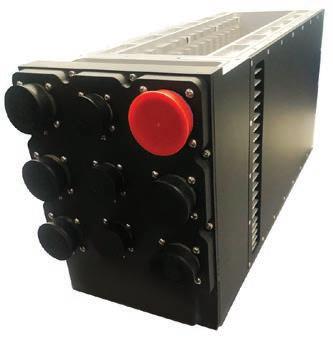
You’ve got enough to worry about getting your SOSA aligned and OpenVPX cards/ system ready to impress your customers. Let Pixus be your resource for the enclosure infrastructure, including the chassis, backplane, chassis manager, & more. With a huge selection of high-performance SOSA profile combinations, we’ll help you achieve your
• MIL rugged ATRs
• MIL rugged rackmount chassis
• Benign environment enclosure solutions
• Test/lab systems for fast prototyping
Chassis / Backplanes / Chassis Managers


SHM300 SOSA® Aligned Chassis Manager, Mezzanine, Tier3
The Pixus Sensor Open Systems Architecture®, or SOSA®, aligned chassis manager is a mezzanine-based solution that affixes to the rear of an OpenVPX backplane so that you don't consume a slot. The compact Pixus solution can fit in smaller ATR or rackmount enclosures. The proven chassis manager has been deployed in systems that have gone through full MIL qualification testing. With a PolarFire FPGA, the SHM300 is highly versatile. It allows a wide array of GPIO, MP port, and other pin options along with a KX/BX port, Base-T port, and other interfaces. The SHM300 features 100% USA based software and firmware.
Contact Pixus to discuss your application today!
Enclosure Systems Backplanes Chassis Managers
Ą Three versions available:
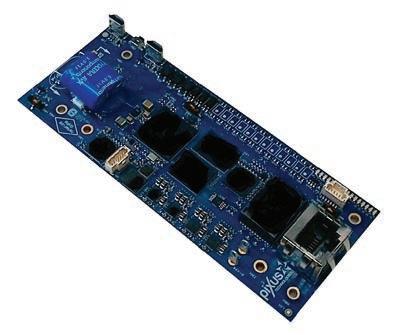
3U Plug In Cards (PICs): Chassis Manager
1) mezzanine-based (so you don't consume a slot)
2) 3U slot pluggable
3) Lab/test version for easy and cost-effective development
Ą 100% USA based software & firmware
Ą Proven in MIL rugged deployed systems
Ą RESTful API interface, versatile configurable design with PolarFire FPGA
Ą Compact size
Ą Readily available
www.pixustechnologies.com
Pixus Technologies www.pixustechnologies.com sales@pixustechnologies.com 916-297-0020 USA 519-885-5775 Canada

Curtiss-Wright’s VPX3-730 and VPX3-1262 team up as a powerful 3U OpenVPX solution, aligned with the SOSA® Technical Standard, that gives defense teams fast, smart computing right where the fight happens. The VPX3-730 GPU uses the latest NVIDIA® Blackwell technology to deliver up to 1,824 AI TOPS performance for artificial intelligence, and 50 TFLOPS for sensor data processing. It quickly turns huge amounts of information into clear pictures and fast decisions. Paired with the VPX3-1262 processor’s powerful Intel® processor, loads of memory, and fast 100G connections, this board set combo keeps systems light, easy to upgrade, and reliable in tough conditions. Defense customers can quickly deploy the latest technologies that helps soldiers see threats sooner, make better choices, and complete missions safely and successfully.
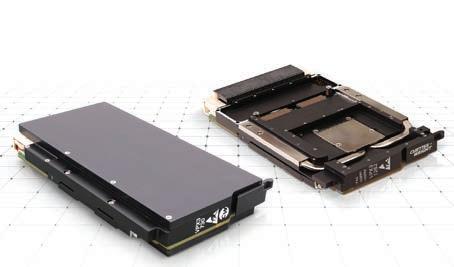
3U Plug In Cards (PICs): Payload Profiles Compute-Intensive (SBC, FPGA, etc.)
Ą Super-Fast AI and Graphics: Up to 50 TFLOPS / 1,824 AI TOPS Blackwell GPU with 24 GB high-speed memory for rapid AI, sensor fusion, and clear video displays.
Ą Strong Central Processor: 14-core Intel processor handles control, data movement and application processing with high efficiency.
Ą Lightning-Fast Connections: 100 GbE with low-latency RDMA plus PCIe Gen4/5 for moving data quickly between boards and sensors.
Ą Plenty of Memory and Storage: Fast 64 GB DDR5 system memory and up to 480 GB NVMe SSD to manage large data sets and recordings.
Ą SOSA Open Standard Ready: Fully SOSA aligned, meets today’s MOSA mandate and simplifies future technology upgrades.
Ą Built Tough for Battle: Rugged designs with conduction or air-flow-through cooling that work in extreme heat, cold, and vibration.
Ą Ready for Real Missions: Supports CUDA® AI tools and software ecosystem to speed up radar, EW, ISR, and autonomy tasks for the soldier
https://defense-solutions.curtisswright.com/products/computing/gpu-graphics-video/3u-vpx/vpx3-730
https://www.linkedin.com/showcase/curtiss-wright-defense-solutions

Condor GR5SL-B5000
The Condor GR5SL-B5000 is a compute-intensive 3U OpenVPX GPGPU card powered by the NVIDIA RTX PRO™ 5000 Embedded GPU. It is designed to meet the processing demands of real-time high-performance embedded computing (HPEC) in tactical defense environments. Built on the NVIDIA Blackwell architecture, the video graphics card features 24 GB of GDDR7 memory with ECC and a 256-bit interface, offering a major leap in memory bandwidth and compute performance per watt from previous generations. The Blackwell 5000 GPU includes 10,496 CUDA cores, 320 fifth-gen Tensor Cores, and 80 fourth-gen RT Cores, delivering advanced support for AI inferencing, 3D visualization, and real-time data analytics. The platform also supports NVIDIA GPUDirect® RDMA for reduced latency.
Developed in alignment with the SOSA® Technical Standard, the Condor GR5SLB5000 supports integration into open-architecture systems and is available in both conduction-cooled (VITA 48.2) and Air Flow Through (AFT, VITA 48.8) variants.
EIZO Rugged Solutions www.eizorugged.com
3U Plug In Cards (PICs): Payload Profiles – Compute-Intensive (SBC, FPGA, etc.)
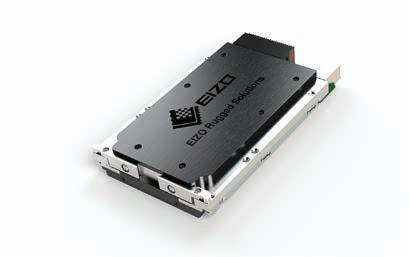
Ą SOSA Aligned 3UVPX Video Graphics & GPGPU Card
Ą NVIDIA RTX PRO™ 5000 Blackwell GPU
Ą 24 GB of GDDR7 memory on a 256-bit memory interface
Ą Supports PCI Express Gen 5
Ą 10,496 CUDA cores, 320 Tensor Cores, and 80 RT cores
Ą Supported Technologies – NVIDIA CUDA Technology –OpenGL, Vulkan™, Direct3D, Multi-Instance GPU (MIG), and vGPU
Ą Available in both conduction-cooled (CC) [VITA 48.2] and Air Flow Through (AFT) [VITA 48.8]
https://www.eizorugged.com/products/graphics-video-capture-cards/condor-gr5sl-b5000/
rugged@eizo.com 407-262-7100 www.linkedin.com/company/eizoruggedsolutions/
3U Plug In Cards (PICs): Payload Profiles –Compute-Intensive (SBC, FPGA, etc.)
VX307H: SOSA® Aligned 3U VPX PIC
Introducing the Kontron VX307H Computing Node, the ultimate Sensor Open Systems Architecture®, or SOSA®, Aligned Architecture Booster: Offering best-in-class performance and XMC support on VITA 48.8 Air Flow Through (AFT) models, this rugged 3U embedded server card redefines the SWaP-C limits and enhances the capabilities of your HPEC architectures.
Powered by the Intel® Xeon® D-2700 Platform, the VX307H is offered with a 12, 16, or 20-core processor with features like 100Gb Ethernet, PCIe gen4, and an on-chip DMA engine. AVX-512 VNNI support is engineered for AI, signal processing, and cryptography, offering double the performance over previous generations for critical applications like computer vision and media processing.
The VX307H is available in VITA48.8 AFT and conduction-cooled versions, operating in extended temperature ranges and aligned with industry standards. Unleash the potential of your engineering projects with the SOSA® Aligned Architecture Booster – Kontron VX307H Computing Node. Contact us to learn more.
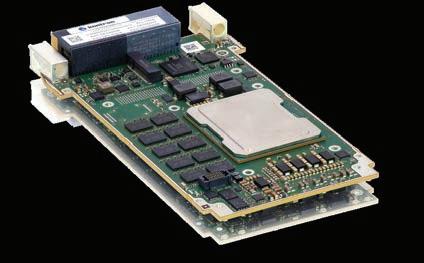
Ą Intel® Xeon® D-2700 HCC processor with 100Gb Integrated Ethernet
Ą From 12 to 20 processing cores to be adapted to SWaP-C applications
Ą Enhanced instructions for Artificial Intelligence and Signal processing (Intel AVX-512, VNNI)
Ą Up to 64GB DDR4 memory with ECC
Ą New VITA48.8 AFT (Air Flow Through) and VITA47 CC3 (Conduction-Cooled) support
Ą XMC support on VITA48.8 AFT versions
Ą Long term availability with 10-years of typical lifecycle
https://www.kontron.com/en/products/vx307h/p171195
www.kontron.com
DRF5270 Direct RF SOSA® aligned 3U Board
The DRF5270, a Sensor Open Systems Architecture®, or SOSA®, aligned 3U Open VPX board based on the Intel Agilex™ 9 AGRW027, enables multichannel data conversion and processing with eight 64 GSPS A/D and D/A converters. The system-on-module architecture allows the DRF5270 to be customized to specific applications and dropped into existing 3U OpenVPX subsystems without significant investment or wait time. Built-in multichip and multi-board synchronization circuitry supports high-channel, phased array antenna systems.
FEATURES
3U Plug In Cards (PICs): Payload Profiles –Compute-Intensive (SBC, FPGA, etc.)
Ą Eight channel 64GSPS converters
Ą 16 GB of DDR4 SDRAM
Ą 10 GigE Interface
Ą 40 GigE Interface
Ą Dual 100 GigE UDP interface
Ą VITA 67.3C Optical Digital and RF Interfaces
Ą Flexible system-on-module design enables migration to other form factors
Ą Board Support Package (BSP) for software development
Ą FPGA Design Kit (FDK) for custom IP development
Ą SOSA Aligned 3U Open VPX card
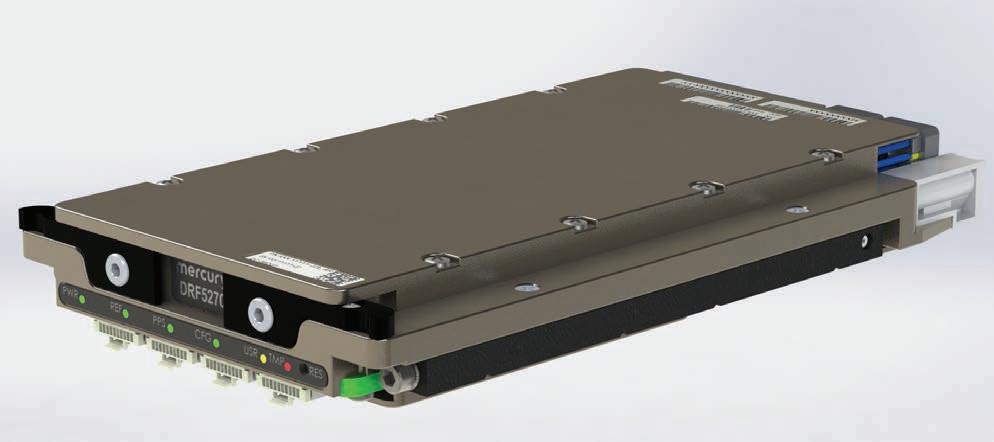
OpenVPX Card with Payload Profile for FPGA, RF I/O, Gigabit I/O
VPX7600 3U VPX SBC with Intel Tiger Lake-H Xeon W CPU
Acromag’s new VPX7600 is a Sensor Open Systems Architecture®, or SOSA®, Technical Standard aligned I/O Intensive single board computer. This SBC features Intel’s 11th Generation Tiger Lake-H Xeon W-11000E Series processor. The high-performance 8-core processor supports up to 32GB of dual-channel, soldered-down DDR4 ECC memory. It also contains an integrated Intel Gen12 UHD Gfx-32 graphics engine. A wide variety of I/O peripherals are supported. The XMC expansion site enables advanced computation capabilities with plug-in mezzanine modules. A DisplayPort 1.4 interface on the backplane with HBR3 data rates supports 4K resolution. NVME SSD on-board storage holds up to 1TB of data. Other peripheral interfaces include a 2.5GBASE-T port, USB 3.2, USB 2.0, SATA III, 4x GPIO, and an RS422 or dual RS232 ports. Air-cooled and conduction cooled versions are available. Board support packages facilitate use with Microsoft Windows®, Linux®, and VxWorks™ operating systems.
Acromag www.acromag.com
3U Plug In Cards (PICs): Payload Profiles – I/O-Intensive (SBC, GPGPU, etc.)
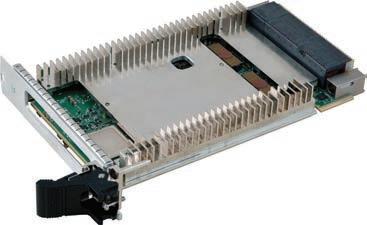
Ą Intel 11th Gen Xeon-W Tiger Lake-H 8-Core CPU
Ą 32GB of dual channel DDR4 SDRAM with ECC
Ą Up to 1TB NVMe SSD on-board storage
Ą 100Gb Ethernet Data Plane
Ą 10Gb Ethernet Control Plane
Ą x4 PCIe Gen3 Expansion Plane
Ą IPMC VITA 46.11 Tier-3 System Management
https://acromag.org/VPX7600
solutions@acromag.com
248-295-0310 www.linkedin.com/company/acromag @acromag
3U Plug In Cards (PICs): Payload Profiles –I/O-Intensive (SBC, GPGPU, etc.)
Hermes II and Magni II
Hermes II and Magni II. Our New Panther Lake Pair
Hermes II and Magni II are SOSA® aligned 3U VPX plug-in cards built for sensitive mission computing and compute-intensive edge workloads. Powered by the 16-core Intel® Core™ Ultra Processor (Series 3, previously “Panther Lake”), they deliver high-density performance for AI/ML inferencing, sensor fusion and real-time data processing at the tactical edge. Security is engineered in. A dedicated Secure Enclave, implemented using a security FPGA, isolates critical assets and helps programmes meet platform assurance requirements without adding integration complexity. Linux BSP support, plus OpenVINO™ and oneAPI tooling, accelerates application bring-up and optimisation from lab to deployment.
Hermes II and Magni II also offer scalable on-board storage up to 3.84TB, with an option for FIPS 140-3 compliance. Speak to our sales team to discuss configuration options and availability for your platform.
Concurrent https://concurrent.tech
Ą SOSA® aligned 3U VPX plug-in cards for open-systems integration
Ą 16-core Intel® Core™ Ultra Series 3 Processor
Ą I/O and Compute-intensive architecture for edge AI and sensor workloads
Ą Secure Enclave using a dedicated security FPGA
Ą Linux BSP support, plus OpenVINO™ and oneAPI enablement
Ą Storage up to 3.84TB with option for FIPS 140-3 compliance
Ą Designed for sensitive mission computing and demanding edge environments
https://concurrent.tech/products/hermes-ii | https://concurrent.tech/products/magni-ii
sales@gocct.com
781-933-5900 https://www.linkedin.com/company/concurrent-technologies-plc/

IC-ADDA-VPX3a
The IC-ADDA-VPX3a 3U VPX FPGA bundle is a combination of one of our 3U VPX FPGA boards – the IC-FEP-VPX3h together with one of our FPGA Mezzanine Cards – the IC-ADDA-FMCPa. The IC-ADDA-VPX3a is aligned with the SOSA® Technical Standard and meets the increasing demand in fast data sampling for embedded systems especially in the field of Software-defined Radio, Radar and Electronic Warfare. The IC-ADDAVPX3a 3U VPX board is based on an AMD Versal™ FPGA, a combination of adaptable processing and acceleration engines with programmable logic and configurable connectivity. These high-performance capabilities enable customized and heterogeneous hardware solutions for a wide array of applications. Such solutions provide a higher performance/watt ratio over conventional FPGAs, CPUs and GPUs. Based on the Apollo MxFE™ latest technology from Analog Devices, the IC-ADDA-VPX3a features ultra-wideband A/D (4) and D/A (2) channels. The IC-ADDA-VPX3a complies with the SLT3-PAY-1F1U1S1S1U1U4F1J-14.6.13-n.
Interface Concept www.interfaceconcept.com
3U Plug In Cards (PICs): Payload Profiles – I/O-Intensive (SBC, GPGPU, etc.)
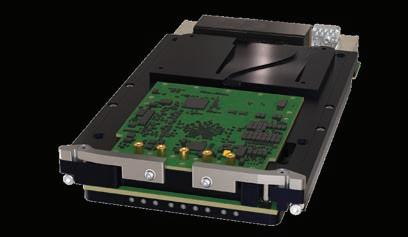
Ą 3U VPX – VITA 65
Ą 1 * AMD Versal™ FPGA
Ą 2 * DDR4 banks (up to 8GB each)
Ą 2 * channels 16-bit 28 GSPS DAC (2GHz – 18Ghz bandwidth)
Ą 4 * channels 12-bit 20 GSPS ADC (0.5GHz – 18Ghz bandwidth)
Ą Aligned with the SOSA® Technical Standard
Ą Compliant with SLT3-PAY-1F1U1S-1S1U1U4F1J-14.6.13-n
www.interfaceconcept.com/products/fpga-boards/ic-adda-vpx3a/
info@interfaceconcept.com
www.linkedin.com/company/interface-concept/
Kontron VPX power supplies are commercial off-the-shelf (COTS), rugged, conduction cooled, single stage converters according to the ANSI/ VITA 62.0 specification. Perfectly designed to power a VPX chassis, these units seamlessly fit within the VITA 48.0 specification envelope.
Using state-of-the-art switching power technology combined with sophisticated multi-stage input filtering, they offer a wide input voltage range and superior efficiency for challenging environments.
The new 600W VPX360 series is compliant with MIL-STD-461, 704 and 1275 as per VITA 62. Featuring an embedded microprocessor, it supports monitoring and control capabilities with I2C bus (IPMI) and USB interfaces. The VPX power supply mechanical dimensions are 3U x 5HP (1" slot) and includes connectors, keying and alignment mechanisms as per VITA 62.
The VPX360DMS version provides 12V/80A and 3.3V/20A and IPMC for system management integration.
Discover our cutting-edge VPX power supplies today.
SOSA® Aligned VPX360DMS – 600W / 3U Power Supply Kontron www.kontron.com
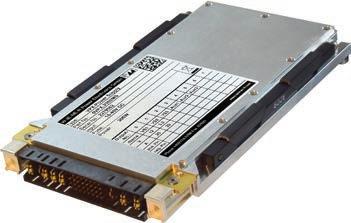
Ą Outputs: 12V main / 2 x 40A, 3.3Vaux / 20A
Ą High efficiency, 12V-peak > 90%
Ą Wide input voltage range: 11 V … 70 V DC (nominal 28V or 48V), reverse polarity protection
Ą Voltage sense controlled, Over Voltage, Under Voltage, Over Current, Over Temperature protection
Ą Microprocessor controlled, with I2C bus / IPMB for VITA48.11 system management, USB port
Ą MIL-STD-461, MIL-STD-704, MIL-STD-1275 compliance as per VITA 62, ruggedized to MIL-STD-810
Ą No liquid / wet / aluminum electrolytic capacitors
https://www.kontron.com/en/products/3u-sosa-aligned-vpx-power-supply-600-w/p189586
info.americas@kontron.com
www.linkedin.com/company/kontron-north-america/
3U Plug In Cards (PICs): Payload Profiles –I/O-Intensive (SBC, GPGPU, etc.)
VPX3U-BW5000E-VO-HPC (WOLF-1636)
The VPX3U-BW5000E-VO-HPC module is powered by an NVIDIA RTX™ RTX 5000 Blackwell embedded GPU in a rugged WOLF 3U VPX module. The NVIDIA RTX 5000 GPU provides the advanced processing capabilities for high performance embedded computing (HPC) and artificial intelligence (AI) processing. This module includes a removeable front panel that exposes DisplayPort outputs on the front. It can also be configured to support an OpenVPX profile that provides two DisplayPort outputs on the rear.
The NVIDIA Blackwell architecture includes CUDA cores and 5th generation Tensor cores for HPC, AI and data science computations. The Blackwell GPU has an improved architecture which provides increased efficiency. The module supports 24GB of GDDR7 memory which provides over 50% higher bandwidth compared to the previous generation. The GPU supports PCIe x8 or x16, providing a fast data transfer path to/from the module.
Unlocking the best performance requires the best cooling capability. WOLF’s advanced cooling technology is designed to move heat using a low weight, high efficiency path from the hot GPU die to the wedgelocks.
Ą NVIDIA RTX™ 5000 (GB203) GPU with 10496 CUDA Cores, 320 Tensor Cores
Ą 24 GB GDDR7 256-bit VRAM with ECC support
Ą DisplayPort outputs, HDMI option for rear outputs
Ą Module power: 90W to 150W, configurable
Ą Blackwell GPGPU parallel processing: CUDA Toolkit 12, Compute capability 10.0 CUDA-X AI and CUDA-X HPEC libraires □ OpenCL™ 3.0, DirectX® 12 Ultimate, OpenGL 4.6, OpenGL ES 3.2, Vulkan™ 1.2
Ą 5th Gen Tensor Cores with additional new data precisions (new: FP4 and FP6, FP8 Gen2)
Ą GDDR7 memory provides over 50% more bandwidth compared to the previous generation
Ą NVENC (9 th Gen) and NVDEC (6 th Gen) with up to 8K video encoding and hardware decoding support
Ą PCIe x8 and x16 profiles
Ą ANSI/VITA 48, 65 (VPX-REDI, OpenVPX)
Ą SOSA® Aligned profile support: 14.6.11-0, 14.6.13-0, or OpenVPX 14.2.7
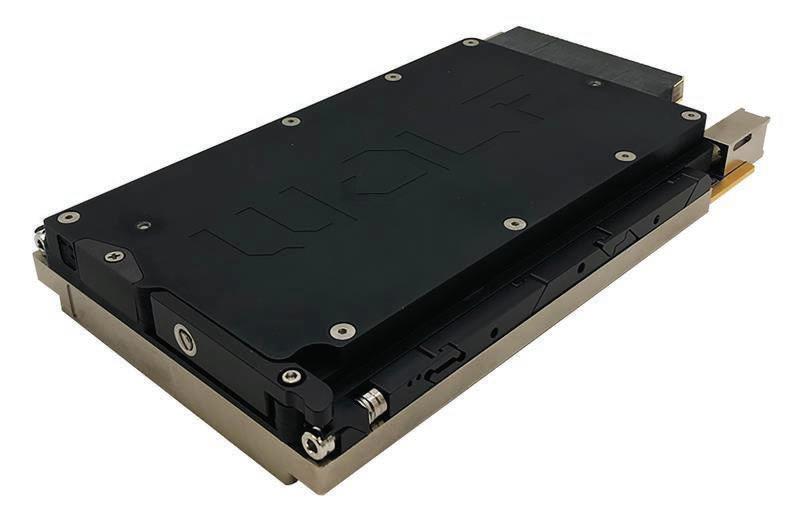
Ą Up to 150 W per slot cooling performance
https://wolfadvancedtechnology.com/products/vpx3u-bw5000e-vo-hpc-wolf-1636/
www.linkedin.com/company/wolf-at

The M4096 is a rugged 3U VPX power supply designed for airborne and ground applications requiring reliable high-input DC power conversion. As part of Milpower's Sensor Open Systems Architecture®, or SOSA®, aligned VPX product line, it operates from a 270V input architecture and delivers up to 830W steady-state output across all specified line and temperature conditions with no derating.
Designed for high-performance embedded systems, the M4096 offers improved efficiency, increased power capability, and enhanced thermal performance while maintaining stable operation in demanding electrical environments. It supports MIL-STD-704 requirements, including abnormal transient conditions, and integrates an internal EMI filter compliant with MIL-STD-461G. The design is further hardened to MIL-STD-810H environmental standards, ensuring reliable operation in rugged deployments.
Advanced system integration is enabled through VITA 46.11 system management protocol support, verified across multiple Chassis Managers, allowing monitoring of voltage, current, and temperature. The unit also supports secure in-field programming and incorporates ESD protection to enhance reliability.
The M4096 features Milpower’s active current sharing across the 12V and 3.3V auxiliary rails, supporting scalable architectures and improved load distribution. Output sequencing enables controlled startup, with the 3.3V auxiliary output activating approximately 50 milliseconds before the primary 12V output in the standard configuration.
Engineered for rugged VPX platforms, the M4096 operates from –55°C to +85°C at the unit edge and features a wide input voltage range with strong transient response. It maintains stable operation through voltage disturbances, riding through transients and automatically recovering from protection shutdowns.
M4096 Milpower Source https://milpower.com
With SOSA Technical Standard compatibility, cyber-secure architecture, REACH compliance, and a DO-254 upgradable design, the M4096 provides a robust, integration-ready power solution for next-generation embedded computing systems.
Ą 830W Steady-State Output Power (No Derating)
Ą SOSA® Aligned, VITA 62.2 Compliant Architecture
Ą 270VDC Input with Very Wide Input Range
Ą Advanced VITA 46.11 System Management (IPMITool & Elma ChM Compatible)
Ą Active Current Sharing on 12V & 3.3V Auxiliary Rails
Ą High Efficiency Power Conversion
Ą Ruggedized Design for Environmental Conditions per MIL-STD-810H
Ą MIL-STD-704 Compliance Including Abnormal Transients
Ą Integrated EMI Filter per MIL-STD-461G
Ą Extended Operating Temperature: –55°C to +85°C (Unit Edge)
Ą Cyber-Secure, DO-254 Upgradable Design
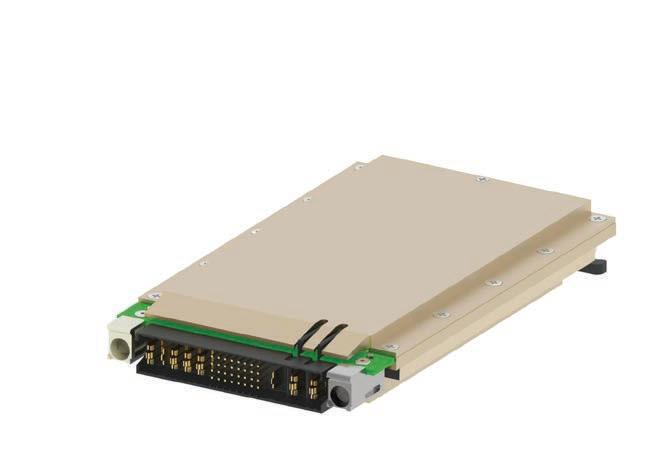
https://milpower.com/products/power-conversion-solutions/dc-dc-power-supplies/m4096-future-product

The NETernity SWE450S is a fully managed, rugged 3U VPX Layer 2/3 Ethernet switch delivering high-speed 25/100GbE connectivity. Aligned with two Sensor Open Systems Architecture®, or SOSA®, aligned switch profiles, it offers front-panel 100Gbe fiber ports and up to eight GbE backplane ports. Its high performance switch fabric enables full wire speed switching and data center class protocols, providing up to 2.5× the bandwidth of comparable 10/40GbE VPX switches without a proportional power increase. Quad “fat pipe” ports can be reconfigured as four discrete “thin pipe” ports, and copper channels support speed downgrading from 25/100G to 10/40G for seamless integration with mixed speed endpoints. Powered by a dual core ARM processor running Abaco’s OpenWare™, the SWE450S offers complete, but flexible management and provides a common look and feel across many Abaco products. This allows ease of migration between Abaco Systems' products, flexibility with updates or even customization if required - all license free. Built in storage sanitization for security is also included for a complete solution.
Abaco Systems | AMETEK https://abaco.com/
abaco.sales@ametek.com
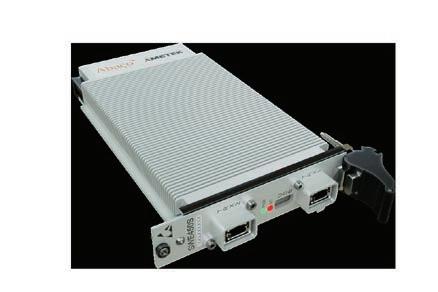
Ą Full line rate 25/100GbE backplane and optical
Ą OpenWare™ switch management software
Ą 3U VPX form factor
Ą SOSA aligned
Ą PTP IEEE 1588v2 transparent clock support
Ą Air and conduction cooled options
Ą Rugged levels 1, C, E available
Ą Next generation 2.0 Tbps switch fabric
https://abaco.com/products/swe450s
866-652-2226 https://www.linkedin.com/company/abaco-systems-embedded-solutions
Backplanes (3U & 6U)
SOSA® Aligned BACKPLANE
Kontron’s Sensor Open Systems Architecture®, or SOSA®, Technical Standard aligned BACKPLANE embodies exceptional high-speed performance and unparalleled flexibility. As a central connection element, the backplane is crucial for the performance of the overall system. Kontron has equipped this backplane, tailored for compute-demanding tasks, with significant capabilities, including lightning fast 100 Gigabit Ethernet transmission. Its remarkable 100 Gbit/s speed performance has been validated through rigorous independent tests. The backplane’s seven-slot architecture allows for extensive functional integration. Drawing from extensive customer feedback, comprehensive expertise, and analytical insights, Kontron has incorporated a specific configuration for this backplane. Yet, it retains a flexible design ecosystem, welcoming custom adjustments to meet customer-specific requirements at any time.
Ready to experience Kontron’s high-performance solution? Contact us today to learn how our SOSA aligned BACKPLANE can transform your operations.
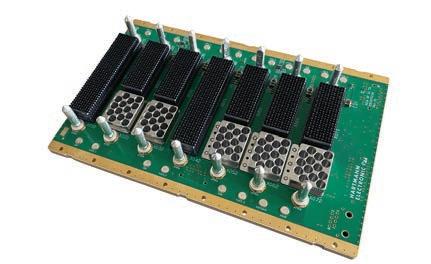
Ą High speed design for 100 Gbit/s Ethernet (100GBase-KR4)
Ą 7 Slots VPX, 1 SBC, 1 Switch, 1 Clock, 4 Payload Slots
Ą Payload and clock slots can optionally be equipped with coaxial modules as per VITA 67.3C
Ą Featuring MULTIGIG RT 3 connectors
Ą Max. Input current per backplane VS1:VS2:VS3 = 120A : 90A : 90A
Ą Flexible keying and alignment mechanism
Ą Custom assembly or modification on request
https://www.kontron.com/en/products/3u-sosa-aligned-vpx-backplane-5-slots-with-rear-io/p189507
Kontron www.kontron.com info.americas@kontron.com
Connectors & Cabling: Board Level Connectors ("VITA 66, 67, …" or "Optical, RF")
MIL-HD2 Next-Gen SOSA®/VITA 91 Aligned Connector Series
Developed in alignment with The Open Group Sensor Open Systems Architecture®, or SOSA®, Technical Standard and VITA 91 requirements, MIL-HD2 provides developers with a robust open architecture solution for tighter card pitches and chassis designs where space and performance are critical. These connectors are available in 3-, 4-, and 6-pair configurations, delivering the highest differential pair count in a 3U form factor at 56Gb/s PAM4 speeds to meet the demanding needs of the MIL-embedded market.
This series was selected by the SOSA Consortium and provides a SOSA and VITA 91 aligned solution for next-generation switch and payload card requirements, enabling the MIL-embedded market to meet nextgeneration performance levels while still meeting COTS requirements. MIL-HD2 meets standards for High-Density (HD) Switch applications.
Ą Data rates scalable to 56Gb/s PAM4 to support system upgrades without costly redesigns
Ą Highest density with 1.80mm pitch
Ą 4 diff, 8 column – SOSA aligned configuration
Ą Proprietary crosstalk reducing technologies
Ą 5.7mil drill compliant pin allows deeper backdrilling
Ą Shielded contacts mate before signal contacts, providing up to a 4mm minimum wipe
Ą Differential pairs 28-84 per inch (11-33 differential pairs per centimeter)
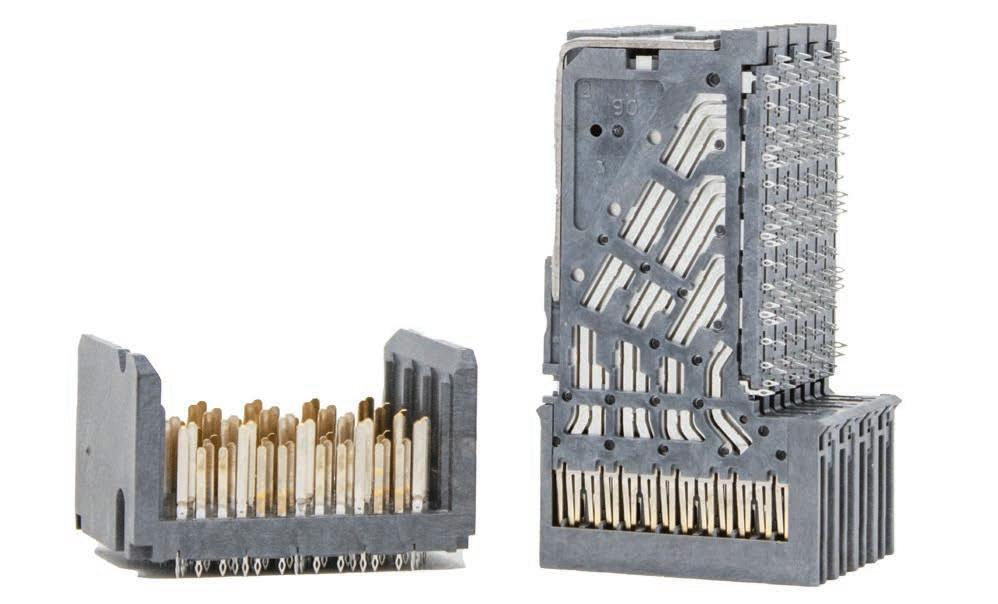
sales@open.tech
www.linkedin.com/company/101690501/ https://open.tech/mil-hd2-next-gen-sosavita-91-aligned-plugin-connectors
561-515-2550
www.open.tech
Light CONEX® LC Series
The LightCONEX® series of optical plug-in and backplane module connectors for OpenVPX systems is Smiths Interconnect's answer to the stringent SWaP requirements of today’s defense applications in which fiber optics are replacing high bandwidth copper interconnects.
This series of active, blind-mate optical interconnects offers flexibility, light weight, very high bandwidth, and forward compatibility.
The LightCONEX active blind-mate optical interconnect is a revolutionary solution for OpenVPX systems that includes a fixed, plug-in module connector and a floating backplane connector compatible with VITA 66.5 and aligned to the Sensor Open Systems Architecture®, or SOSA®, Technical Standard.
Connectors & Cabling: Board Level Connectors ("VITA 66, 67, …" or "Optical, RF") category
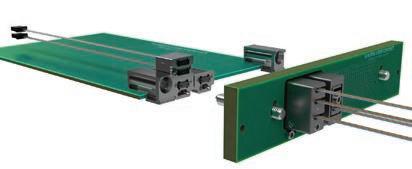
Ą Increases volumetric density of 3U and 6U high-speed switch and processor boards by integrating optical transceiver into plug-in connector
Ą Intermateability with OpenVPX 66.5-defined backplane connectors enables multiple sources and drives faster design cycles
Ą Reduces SWaP with rugged MIL-STD qualified, edge-mounted, optical interconnects
Ą Enables ultra-high port bandwidth density of up to 720 Gbps full-duplex in a half-width slot
Ą Simplifies OpenVPX board assembly and rework by eliminating fiber pigtail on edge-mount transceiver
Ą 10G and 28G per channel datarates in TRX, TX-only, and RX-only configurations
Ą OpenVPX single board computing, C5ISR embedded systems
https://www.smithsinterconnect.com/products/optical-transceivers/vpx-optical-interconnects-en/lightconex-lc-series/
Smiths Interconnect, a Molex company www.smithsinterconnect.com/ focom.uscsr@smithsinterconnect.com
813-901-7200 www.linkedin.com/company/smiths-interconnect/ @smithsinterconn

VITA 66 Optical
TE Connectivity’s (TE) Ruggedized Optical Backplane VITA 66 interconnect system provides a high-density, high-bandwidth, blind-mate optical interconnect in a backplane/daughtercard configuration.
Designed for rugged embedded computing applications, the fiber optic connectors are compatible with VPX and other high-performance standards. Connector module designs support half and full size modules, with new, higher density variants now available
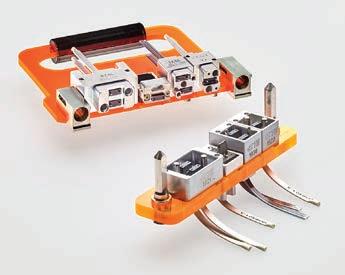
Ą Common mounting interface requirements within 3U and 6U VPX applications
Ą Module varieties are based upon proven optical termini for military and aerospace applications
Ą Locating post features ensures proper position on the backplane and daughtercard
Ą Connectors designed to maximize optical performance, accommodating up to three MT ferrules per insert
Connectors & Cabling: Board Level Connectors ("VITA 66, 67, …" or "Optical, RF") https://te.com/sosa
Ą Receptacle connector insert floats relative to the shell, providing ± 0.25 mm planar floating alignment capability
TE Connectivity www.te.com

Teledyne Storm Microwave offers a versatile array of cable types to suit any application. For flexible and durable solutions, the Storm Flex® family of cables sets a new standard. Featuring NanoRF SMPM and SMPS contacts that exceed the VITA 67.3 standards, these cables are frequently utilized within the Sensor Open Systems Architecture®, or SOSA®, consortium.
Our Storm Flex® cable assemblies are built to withstand large temperature swings, tight bends, and constant use, ensuring unmatched reliability in the most demanding conditions. As an active member in the SOSA consortium, Teledyne Storm Microwave continues to support open standards. We look forward to providing high quality solutions that promote interoperability as directed by the Department of Defense.
Contact us to see how quickly we can deliver these cables to you. Our application engineers are available to assist with any custom connectors or cable requirements you may have.
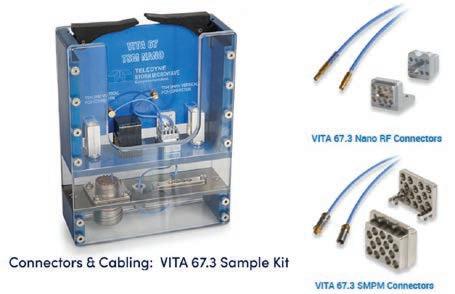
Ą When paired with the Storm Flex® 086, 047 and 034 cable creates unparalleled mechanical and electrical performance.
Ą Standard MIL-STD-348 SMPM interface.
Ą Exceeds the VITA 67.3 minimum operation frequency of 26.5 GHz.
Ą Teledyne Storm Microwave’s PCB connector solutions, along with its full suite of VITA 67.5 qualified components, form a complete connectivity ecosystem from PCB to sensor.
https://www.teledynestorm.com/en-us/products_/Pages/VITA-67-3_Overview.aspx
Teledyne Storm Microwave www.teledynestorm.com
wdg_microwavesales@teledyne.com
www.linkedin.com/company/teledyne-storm-microwave

726 SERIES
Designed by Atrenne, the 726 Series, VITA 90-VNX+ system is a compact, ruggedized, high-performance computing solution for military and aerospace applications with strict size, weight, and power (SWaP) constraints. Based on OpenVPX standards, it offers a Modular Open Systems Approach (MOSA) for easy integration and upgrades. VNX+ supports various processors, including Intel and NVIDIA, and provides flexible I/O options Its small form factor, which makes it ideal for deployment in unmanned vehicles, missiles, aircraft pods, and other space-limited environments where reliable operation in harsh conditions is critical. Currently available in 3 and 6 slot configurations.
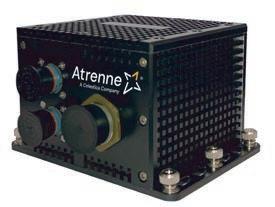
Ą Compact, ruggedized, high-performance computing solution designed for military and aerospace applications with strict SWaP (Size, Weight, and Power) constraints
Ą Based on OpenVPX standards with a Modular Open Systems Approach (MOSA) for easy integration and upgrades
Ą Supports multiple processor architectures including Intel and NVIDIA
Ą Conduction-cooled thermal management via thermal interface to chassis, per VITA 90.4
Ą Operates across an extreme temperature range of -40°C to +85°C at the card edge
Ą Designed to meet MIL-STD-810G standards for shock and vibration in aircraft and ground vehicle environments
Ą Available in 3-slot and 6-slot configurations with VITA 90.2 VNX+ high-density backplane connectors
https://www.atrenne.com/products/726-series-vita-90-vnx/
Atrenne www.atrenne.com
sales@atrenne-cs.com
www.linkedin.com/company/atrenne/
VITA 46.11
Atrenne's VITA 46.11 is a Sensor Open Systems Architecture®, or SOSA® , Technical Standard aligned chassis controller designed to serve as the intelligent core of mission-critical system reliability. It actively monitors overall system health and automatically executes corrective actions to ensure continuous operation. The controller supports Tier 1, Tier 2, and Tier 3 IPMCs and features three independent temperature-based fan control zones for precise thermal management. Automated responses to thermal events include fan speed ramp-up, FRU isolation, and chassis power-down. Dual redundant IPMB-A and IPMB-B buses ensure high availability, while event-driven LED control and user-programmable GPIO signals provide comprehensive system visibility. Management access is available via RS-232, two 1000Base-T Ethernet ports, CLI, RMCP, SNMP, and HTTP. Redundant chassis controller capability, where a backup controller automatically
https://www.atrenne.com/products/vita-46-11-chassis-manager/
Atrenne www.atrenne.com
sales@atrenne-cs.com
Enclosures: Deployable
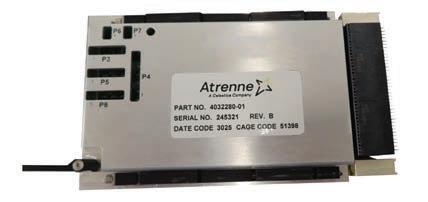
Ą VITA 46.11-based, SOSA® aligned chassis controller that actively monitors overall system health and automatically executes corrective actions to ensure continuous operation
Ą Supports Tier 1, Tier 2, and Tier 3 Intelligent Platform Management Controllers (IPMCs)
Ą Three independent temperature-based fan speed control zones for targeted cooling of hot areas within the chassis
Ą Automated thermal error responses including fan speed ramp-up, FRU isolation, and full chassis power-down
800-926-8722
www.linkedin.com/company/atrenne/ @AtrenneOfficial
Enclosures: Deployable
ATR-3600S
Elma's ATR-3600S is an off-the-shelf 1/2 ATR enclosure designed for deployable applications that use the SOSA standard plug-in cards (PICs). This mission-ready chassis accepts up to 6 PIC slots (4 x PAY, 1 x SWH, 1 x TIM) and is an ideal way to rapidly prototype a deployable platform.
The chassis ships with a SOSA aligned Chassis Manager and USB Maintenance Port aggregation. Front panel connectors offer customer-specific configurability. Elma also offers configurations pre-integrated and tested set with a defined set of ecosystem plug-in cards. Contact us for more details.
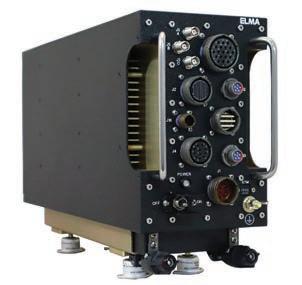
Ą 1/2 ATR, conduction-convection cooled. Advanced airflow design distributes air across external fins in sidewalls
Ą 3U OpenVPX (VITA 65) SOSA aligned backplane with 6 slots (4 PAY, 1 SWH, 1 TIM)
Ą Includes chassis manager & Ethernet switch aligned to Sensor Open Systems Architecture®, or SOSA® aligned
Ą Front panel USB-based maintenance port aggregator
Ą Power supply and line filter combination optimized to MIL-STD-461E
Ą Meets ARINC 404A and ANSI/VITA 48.2 | Designed to MIL-STDs for environmentals
https://bit.ly/sosa-3600s
Elma Electronic www.elma.com
Ą Optional half ATR tray with shock isolators available
VE0 Series SAVE Chassis – Air and Liquid Cooled
SAVE (Standardized A-Kit / Vehicle Envelope) compliant systems ensure component compatibility, upgradability and efficiency in integrating mission systems into army ground vehicles by defining uniform interfaces, physical dimensions, and power requirements. SAVE promotes modularity, reduces costs, and streamlines upgrades across diverse platforms in defense applications.
LCR’s VE02 chassis broadens the utility of the SAVE standard by enabling dual 4-slot plus power supply VPX Sensor Open Systems Architecture®, or SOSA®, Technical Standard aligned systems systems to fit within the SAVE envelope for Army ground vehicles. The air cooled design facilitates complementary operational or redundancy requirements. Individual cooling systems provide added thermal protection for high power dissipating systems in high speed applications.
Our VE01 is an air cooled powerful single chassis / monolithic solution supporting 8 payload slots and 2 VITA 62 power supply slots.
Need additional cooling for next-generation high-speed systems? As thermal management requirements push beyond the limits of air cooling, LCR’s VE03 provides advanced liquid-cooling performance to handle the intense thermal requirements of high-performance 3U VPX and SOSA aligned defense platforms. Its rugged design and optimized flow paths enable exceptional heat dissipation for mission-critical electronics operating in harsh, space-constrained environments.
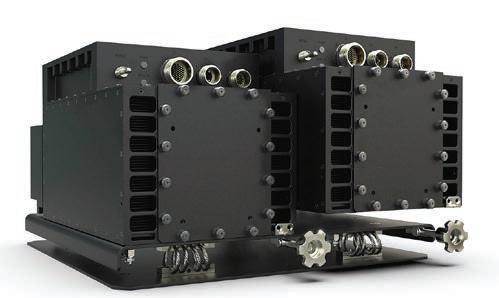
The VE0 Series of chassis are designed to support 3U OpenVPX and SOSA aligned system architectures in accordance with MOSA directives, making both ideal for integrated C5ISR systems in Army ground vehicles. The dual and single chassis approach meet strict size, weight, power, connector, and electrical interface requirements as described in the SAVE standard. LCR custom designed application-specific backplanes can accommodate all current VITA 48.2 3U VPX / SOSA aligned module payload combinations. LCR custom SAVE compliant I/O combinations included. The rugged design is intended for deployment in a wide range of C5ISR applications as noted in the SAVE standard.
FEATURES
Ą Air and liquid cooled variants
Ą VITA 48.2 3U VPX / SOSA aligned module payload combinations
Ą Dual and single chassis configurations
Ą Chassis, cooling, shock isolation assembly meet SAVE dimensional requirements
Ą Up to 150 W per slot cooling performance
https://www.lcrembeddedsystems.com/product-category/rugged-systems/save-compliant-systems/
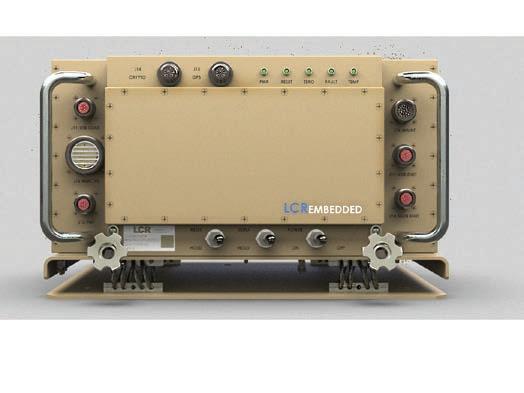
www.linkedin.com/company/lcr-embedded-systems-inc-

SOSA® Aligned Enclosures, Backplanes, & Chassis Managers
Pixus offers various MIL rugged and COTS enclosure solutions for 3U or 6U OpenVPX boards. There are several Sensor Open Systems Architecture®, or SOSA®, aligned slot profiles to choose from, with backplane designs to PCIe Gen4, 100GbE, and High Density 56Gbaud/s speeds. The company also has quick-turn SOSA aligned backplanes in chassis in dozens of SOSA aligned slot profile configurations. The MIL rugged ATRs utilize a modular design tailored to a customer’s specific application based on proven standard base platforms. Our ATRs come in conduction-cooled, airflow over fins in sidewalls, and liquid through sidewall configurations. Contact Pixus for Air Flow Through (AFT) and Air Flow By (AFB) designs. All Pixus chassis come with the option of our SOSA aligned Tier 3+ chassis hardware manager in a SlotSaver mezzanine format that fits behind the backplane.
Pixus Technologies www.pixustechnologies.com
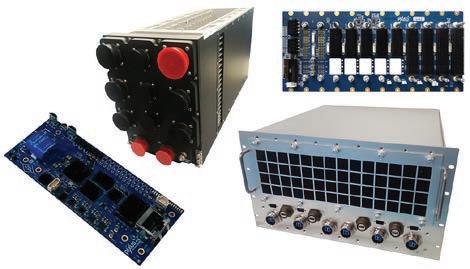
Ą Pixus offers various MIL rugged COTS enclosure solutions for 3U and 6U OpenVPX / SOSA aligned boards
Ą Backplane design expertise up to and above 100GbE speeds, vast array of SOSA aligned slot profile options
Ą SlotSaver mezzanine-based SOSA aligned chassis hardware manager, Tier 3+, 100% USA software/firmware
Ą Conduction-cooled, airflow through sidewalls, and liquid cooled through sidewall configurations
Ą Quick-turn prototyping and accelerated project development options
Ą Pixus USA is a proud member of the SOSA Consortium
Enclosures: Deployable https://pixustechnologies.com/products/category/openvpx
sales@pixustechnologies.com 916-297-0020
Enclosures: Development/Test
ATR-3600S
Elma’s 3-Slot FlexVNX+ Development Chassis is a compact VNX+ platform aligned to SOSA® and VITA 90, built for rapid board bring-up, validation, and test of cards and modules. The chassis features a 2+1 backplane with two payload slots (one 400-pin and one 320-pin) and one dedicated power supply slot.
10GBASE-KX / 40GBASE-KX4 Ethernet and PCI Express Gen4 interfaces are supported, enabling engineers to accelerate timeto-market for mission-critical small form factor (SFF) systems.
A streamlined, cost-effective solution, access to rich I/O is via the chassis sidewalls. Integrated into the unit is maintenance port aggregator, user interfaces and status LEDs. It supports AC or 28VDC power with an optional chassis manager. The angled card cage, airflow-optimized design simplify development and debug.
https://bit.ly/3slotFlexVNX
Elma Electronic www.elma.com
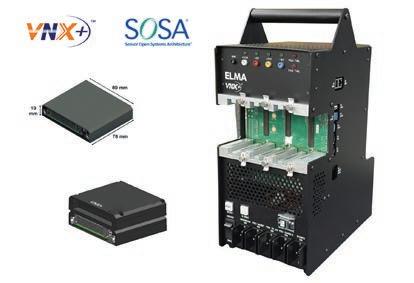
Ą 3 Slots: 2x General Payload slots and 1 x PSU slot
Ą Supports 19mm or 39mm modules, with / without wedgelocks and metal shells
Ą All I/O exposed for both payload slots at the chassis wall exteriors
Ą Air-cooled design with internal fans – no conduction cooling required
Ą Switched control of critical system signals (NVMRO, SYSRESET, Power/Enable)
Ą Power switchable from either a VITA 90.3 PS module or an internal 110/200V PSU
Ą Fully assembled, wired, and tested for rapid development and prototyping

Enclosures: Development/Test
100GbE SOSA® Aligned Development Kit Includes Versal™ and 64 GS/s Direct RF Options
This next-generation 3U OpenVPX Benchtop Development Platform (WS3A01-Sx) is both SOSA aligned and 100Gb Ethernet capable, and is designed from the ground up to economically speed development of 100GbE applications that are aligned with the Sensor Open Systems Architecture®, or SOSA®, Technical Standard.
OVERALL SYSTEM FEATURES
• Front-loading, air-cooled system with conduction-cooled boards
• Seven 3U OpenVPX slots with SOSA aligned backplane profiles
– One 14.6.11 Payload
– Three 14.6.11 Empty Payload (for expansion)
– One 14.2.16 I/O-intensive SBC
– One 14.4.14 100GbE Switch
– One VITA 62 Power Supply – 12V-Heavy
• 25 Gbps Line Rates on Data and Expansion Planes
– 25/40/100Gb Ethernet
– SDR/DDR/QDR/EDR InfiniBand
– Gen 3/4 PCI Express
– Custom protocols up to 25Gbps per lane
• 66.5C and VITA 67.3C for payload slots
• Four MIL-DTL-38999 SOSA aligned circular connectors with 19 RF connections, and one MIL-DTL-38999 Cable
• Multiple levels of hardware and software security
100Gb ETHERNET SWITCH
• 40/100Gb Ethernet Data Plane Switch
– 6.4Tb/s switching capacity
– Industry-leading, true cut through latency
• 1/10/25/40/100Gb Ethernet Control Plane Switch
• Two Xilinx Zynq UltraScale+ MPSoCs (XCZU5EG)

CHASSIS MANAGER
• VITA 46.11 compliant and supports Tier 3 requirements
• Enables control, maintenance, and security functions
• One Xilinx Zynq® UltraScale+™ MPSoC (XCZU5EG)
FPGA PROCESSOR
• Processing Option #1: Virtex™ UltraScale+ FPGA
• Processing Option #2: Versal™ Premium FPGA
• Processing Option #3: Agilex™ 9 Direct RF-Series FPGA
I/O
• ADC/DAC Option #1: Xilinx Zynq UltraScale+ Gen3 RFSoC
– ADC: 4 Channel, 5.0+GSps Sample Rate, 14 bit Resolution
– DAC: 4 Channel, 10.0+GSps Sample Rate, 14 bit Resolution
• ADC/DAC Option #2: Jariet Technologies Electra-MA
– ADC: 2 Channel, 64.0GSps Sample Rate, 10 bit Resolution
– DAC: 2 Channel, 61.5GSps Sample Rate, 10 bit Resolution
• ADC/DAC Option #3: Agilex 9 Direct RF-Series
– ADC: 8 Channel, 64.0GSps Sample Rate, 10 bit Resolution
– DAC: 8 Channel, 64.0GSps Sample Rate, 10 bit Resolution
SINGLE BOARD COMPUTER (SBC)
• Intel® Xeon® E-2176M
• Up to 32 GB DDR4 at 2,400 MT/s with ECC
• Up to 256 GB high-performance NVMe onboard storage APPLICATION DEVELOPMENT
• Standard support delivered with all systems
• Optional full Board Support Package
– Enables customization of Zynq PS, PL for security
– Provides fast and robust HDL-based environment
For a virtual or in-person Demo, contact us.
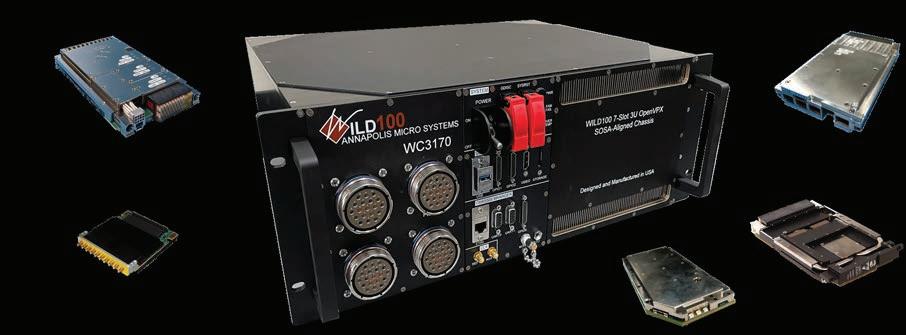
https://www.annapmicro.com/products/WS3A01-S1/

Payload Services and Tools: Complete Sensor System Integration
As the industry leader in small form factor modules and systems, decades of experience with DoD ground, air, and shipboard mission processing systems has shown us that three prevalent system types are what users need most from a small form factor (SFF) system. Only GMS could merge the most SWaP-C optimized SFF system with a Sensor Open Systems Architecture®, or SOSA® , aligned OpenVPX chassis to realize:
1) mission processor with GPU; 2) mission processor with multi-port, high-density Ethernet switch; and 3) multidomain/cross-domain systems with red/black processors –each with open slots for user-defined functions.
To address these needs, GMS created the X10 GENESIS family of miniature three-slot 3U OpenVPX, MOSA-inspired, SOSA aligned systems. These exceptionally small complete systems house conduction-cooled IEEE 1102.2 slot cards, one or two optional open slots for user modules, a 400 W smart power supply, and a fully configured front panel matched to the system I/O. Backplanes are optimized per system type and may be customized with modest NRE.
VENOM SBC MODULES
At the core of the X10 GENESIS is the X9 VENOM™ 3U OpenVPX
SBC family, available in single- and dual-slot versions with Intel Xeon® W (8 cores) or Xeon® D (20 cores). Xeon W is optimized for workstation-class performance, on-board M.2 I/O, per-slot data transfer, and multi-head video processing. Xeon D targets embedded micro-server applications, enabling virtualization, containerization, headless operation, and high-throughput processing with ROCEv2 over Ethernet. Both CPU variants support GPGPU or FPGA co-processors.
The X9 VENOM family is designed for MOSA and aligned with the SOSA™ Technical Standard, supporting compute-intensive profile SLT3-PAY-1F1F2U1TU1T1U1T-14.2.16. GMS’s clamshell heatsink incorporates patented RuggedCool® and Diamond RuggedCool2™ technologies, maximizing heat transfer from the LRU to the chassis. Enhanced wedgelocks and TwoCool™ supplemental cooling support SBCs and GPUs exceeding 100 W.
MISSION PROCESS SYSTEM OPTIONS
Two expansion OpenVPX sites support additional I/O, including Ethernet switching, NVIDIA® GPGPU acceleration, NAS, fiber Ethernet, FPGA processing, and more. High-speed interfaces include up to four 100 GigE ports, 1 GigE, and Thunderbolt™ 4.
The X10 GENESIS Mission Processor is ideal for harsh military and aerospace environments requiring reliable, high-bandwidth data processing, including SIGINT, ISR, image processing, and electronic warfare. It is optimized for space-constrained platforms such as UAS/UAG, portable TOCs, and ground vehicles. It modularly electrically and mechanically “bolts” up with X9 small form factor modules for add-on capability via the GMX X9 Architecture.
MISSION PROCESSOR SYSTEM FEATURES
Ą X9 VENOM SBC SBC (20C Xeon D or 8C Xeon W) up to 128 GB ECC DRAM
• Service port: 2x USB 2.0, 5x GPIO, video, COM
Ą 2x open slots: optional second VENOM SBC, GPGPU or FPGA
• Direct 24x PCIe Gen 4 to Slot 2
Ą 2x 1GigE, 2x 10GigE and 2x 100GigE
Ą Removable M.2 SSD up to 8 TB
Ą Internal SSD M.2 2230 up to 2 TB
Ą Optional 2x USB4 or Thunderbolt™ 4 with 100 W PD each (up to 4x TB4)
Ą Zeroize via GMS SecureDNA®
Ą MIL-STD-1275 or MIL-STD-704 power supply; optional hold-up
Ą 400 W chassis dissipation
Ą Size is 4.75” x 4” x 9” (W x H x L) and is compatible with X9 modules
Ą Weight is 5 lbs. empty and 11 lbs. fully populated
Ą Operates -40 °C to +85 °C
Ą Military specifications: MIL-STD-810, MIL-S-901, MIL-STD-461, DO-160, optional MIL-STD-704
Ą Two other system configurations
• 3-slot with Ethernet Switch plus APNT
• Red/Black Cross Domain System
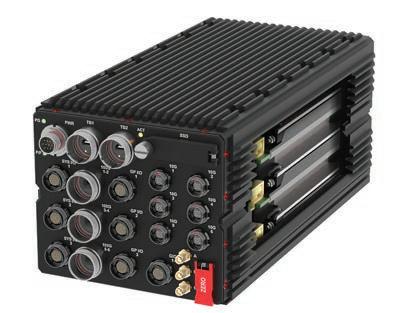
https://www.gms4sbc.com/products/product-categories/x10-genesis
www.gms4sbc.com

Dawn VME Products Sensor Open Systems Architecture®, or SOSA®, Technical Standard aligned expandable USB to RS-232 adapter. Each module converts 8 Serial ports to 1 USB2 port.
A potential solution for SOSA aligned VPX system configuration challenges, given the large numbers of JTAG or Serial Maintenance ports. This can be accomplished via Front I/O panel SOSA aligned D38999 connector USB ports.
The Dawn SUR-853 (P/N 06-1020853) offers conversion of 8 “Serial” ports to 1 USB2 port. 8 Ports can be one the following types: RS-232 CMOS, RS-232 standard, I2C, JTAG, SPI, RS-485 (limited number), GPIO.
The SUR-853 is expandable as it has USB2 input and USB2 output ports. The SUR-853 can be stacked to support 8, 16, or more ports of the types listed above. Now one can access all the JTAG / SERIAL ports of a SOSA aligned system via the SOSA standard aligned D38999 connectors.
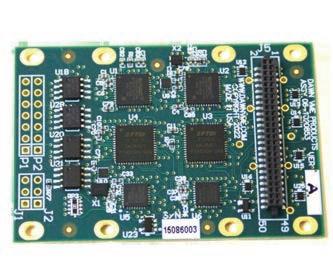
Ą SUR-853 SOSA aligned expandable USB to RS-232 adapter.
Ą Each module converts 8 Serial ports to 1 USB2 port.
Ą 8 Ports can be one the following types: RS-232 CMOS, RS-232 standard, I2C, JTAG, SPI, RS-485 (limited number), GPIO.
Ą The SUR-853 is expandable as it has USB2 input and USB2 output ports. The SUR-853 can be stacked to support 8, 16, or more ports of the types listed above.
https://www.dawnvme.com/shop/accessories-vpx-accessories/sur-853-sosa-usb-to-rs-232-adapter/

Sponsored by Crystal Group, RTI, and Sealevel
Powered by Military Embedded Systems and OpenSystems Media: Expert panelists discuss how autonomous systems are fast becoming the primary weapon for militaries on the battlefield, as seen currently in the war in Ukraine. The force multiplier that uncrewed aerial systems (UASs) have been on that battlefield has motivated the U.S. military to drastically reform their acquisition approach by way of removing bureaucratic obstacles to get autonomous systems technology into warfighters’ hands more quickly. These reforms mean faster acquisition of sensor processing technology, artificial intelligence (AI) and security solutions, and will lead to more systems that follow a modular open systems architecture (MOSA) approach to enable smarter, faster, and more lethal autonomous systems. View keynote and additional sessions at https://tinyurl.com/43yebsb8.
(This is an archived event.)
Watch the sessions: https://tinyurl.com/43yebsb8
WATCH MORE WEBCASTS: https://militaryembedded.com/webcasts