@military_cots
TOIIICOME John M.COPY McHale
Mil Tech Trends
Controlling RF variables for testing
Industry Spotlight
Scaling up tests supply chain
Guest Blog
Applying AI to help build resilience www.MilitaryEmbedded.com
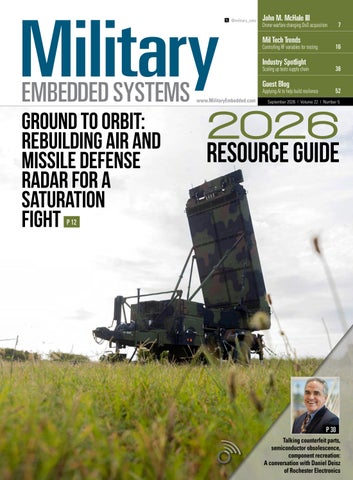
GROUND TO ORBIT: REBUILDING AIR AND MISSILE DEFENSE RADAR FOR A SATURATION FIGHT
7
Drone warfare changing DoD acquisition
16 38 52
September 2026 | Volume 22 | Number 5
2026 RESOURCE GUIDE
P 12
P 30 Talking counterfeit parts, semiconductor obsolescence, component recreation: A conversation with Daniel Deisz of Rochester Electronics
Solutions for Rapid Deployment Analog Devices’ commercial off-the-shelf (COTS) software-defined radio (SDR) system-on-module (SOM) digitizers enable customers to deploy high performance distributed sensing techniques at the tactical edge, as quickly as possible.
From Components
Get to market faster at analog.com/SOMS
To Development Platforms
To Mission-Ready Modules
All Systems
VPX AND SOSA ALIGNED SOLUTIONS FOR ANY MISSION Making MOSA Work Where It Matters Most
LCR is at the forefront of COTS open standards chassis and custom system designs for VPX, CMOSS, and SOSA architectures in accordance with MOSA directives. Intelligently engineered designs that bring operational advantage to the battlefield.
Find out how we can help you achieve mission success. SERVING CRITICAL DEFENSE PROGRAMS FOR OVER 35 YEARS
lcrembeddedsystems.com | (800) 747-5972
www.militaryembedded.com
TABLE OF CONTENTS 38
20
September 2026 Volume 22 | Number 6
COLUMNS Editor’s Perspective 7 Drone warfare changing DoD acquisition By John M. McHale III
Defense Tech Wire 8 By Dan Taylor Guest Blogs 50 Winning the adaptation race for SOF and Indo-Pacific operation By Bill Thetford and Don A. Baker, CACI
52 Applying AI to build resilience in mission-critical defense systems By Burnie Legette and Gretchen Stewart, Intel
54 Future-proofing technology in a rapidly evolving environment By Alan Metzler, ITC Federal
THE LATEST Connecting with Mil Embedded 98 By Lisa Daigle
WEB RESOURCES Subscribe to the magazine or E-letter Live industry news | Submit new products http://submit.opensystemsmedia.com WHITE PAPERS – Read: https://militaryembedded.com/whitepapers WHITE PAPERS – Submit: http://submit.opensystemsmedia.com All registered brands and trademarks within Military Embedded Systems magazine are the property of their respective owners. © 2026 OpenSystems Media © 2026 Military Embedded Systems ISSN: Print 1557-3222
To unsubscribe, email your name, address, and subscription number as it appears on the label to: subscriptions@opensysmedia.com Published by:
4 September 2026
FEATURES
SPECIAL REPORT: Air and missile defense radar 12 Ground to orbit: Rebuilding air and missile defense radar for a saturation fight By Dan Taylor, Technology Editor MIL TECH TRENDS:
Test and measurement for radar & electronic warfare applications 16 Controlling measurement uncertainty in modern military and aerospace RF systems By Kevin Hietpas, Infinite Electronics 20 Ensuring secure and reliable military communications in tactical networks By J. Gordon Beattie, Jr. and Stephen E. Jeffries, VIAVI Solutions 24 Addressing the memory bottleneck in high-performance military embedded systems By Mike Rather and Manuel Uhm, AMD 26 Why every engineer deserves personalized instrumentation By Daniel Shaddock, Liquid Instruments
INDUSTRY SPOTLIGHT:
Managing supply chain, obsolescence, and counterfeit parts 30 Talking counterfeit parts, semiconductor obsolescence, component recreation: A conversation with Daniel Deisz of Rochester Electronics By John M. McHale III, Editorial Director 34 Before the battlefield, there is the codebase By Ricardo Camacho, Parasoft 38 The scaling test is a supply-chain test By Patrick Tynan, PBS Aerospace 40 Moving beyond the illusion of strategic autonomy By Daryl Flack, Avella Security 44 Beyond oil: How the Iran conflict exposes hidden vulnerabilities in the U.S. defense supply chain By Byron Winn, Catalant 48 Streamlining requirements management and traceability with engineering intelligence By Fernando Valera, Visure Solutions
PG 58 RESOURCE GUIDE ON THE COVER: U.S. Marines with Marine Air Control Squadron (MACS) 2 operate an AN/TPS-80 Ground/Air Task Oriented Radar (G/ATOR) system during the Atlantic Alliance 25 (AA25) naval integration exercise at Surface Combat Systems Center in Wallops Island, Virginia. U.S. Marine Corps photo by Lance Cpl. Bryan Giraldo.
https://www.linkedin.com/groups/1864255/
MILITARY EMBEDDED SYSTEMS WITH RESOURCE GUIDE
@military_cots
www.militaryembedded.com
Developed in Alignment with the VITA and SOSA™ Technical Standards
3 phase. 3U.1 choice. THE MILITARY FLIES HIGH WITH VPXtra 704™ When the mission calls for a 3-phase 3U power supply that can stand up to the most rugged environments, the military chooses VPXtra 704™ from Behlman – the only VPX solution of its kind built to operate seamlessly from MIL-STD-704F power for mission-critical airborne, shipboard, ground and mobile applications. > 3-phase AC or 270V DC input; high-power DC output > Available holdup cards store 700W of DC power for up to 80 msec > Overvoltage, short circuit, over-current and thermal protection > Provides full output performance during both normal and abnormal transients
The Power Solutions Provider : 631-435-0410
: sales@behlman.com
: www.behlman.com
ADVERTISERS PAGE ADVERTISER/AD TITLE 19 ADL Embedded Solutions – The mission is at the edge 29 ALPHI Technology – One Platform, Endless Configurations: How VITA 93 QMC Modularity Eliminates the Redesign Cycle 25 Altera Corporation – Increase RF performance, reduce latency & SWaP with multi-chip RF FPGAs 2 Analog Devices, Inc. – Solutions for rapid deployment 51 Atrenne – Failure is not an option … 5 Behlman Electronics, Inc. – 3 Phase. 3U. 1 Choice. 46 Crystal Group – Compute without cutting corners 13 Dawn VME Products – Dawn powers VPX 37 Elma Electronic – Leaders in modular open standards deliver for the modern warfighter 100 GMS – Introducing the new X10 Genesis small form factor system 43 Highland Technology – Long live VME 53 Highland Technology – P940 modular power system 33 Interface Concept – Build your HPEC system with our SOSA aligned 3U VPX plug-in cards 23 Kontron – The platform is unmanned. The stakes aren't. 42 Lansdale Semiconductor – Classic designs are timeless 3 LCR Embedded Systems, Inc. – All systems GO 21 PICO Electronics Inc – DC-DC converters, transformers & inductors 28 Pixus Technologies – Focus on your SOSA aligned PICs and solution needs! 18 State of the Art, Inc. – Why risk it? 57 Times Microwave Systems – Speakout: Your Program's Ramp Rate Depends on Who's Behind Your RF Interconnect 47 Z Microsystems, Inc. – Anywhere. Any mission. Anytime.
EVENTS
ASSISTANT MANAGING EDITOR Lisa Daigle lisa.daigle@opensysmedia.com TECHNOLOGY EDITOR – WASHINGTON BUREAU Dan Taylor dan.taylor@opensysmedia.com CREATIVE DIRECTOR Stephanie Sweet stephanie.sweet@opensysmedia.com WEB DEVELOPER Paul Nelson paul.nelson@opensysmedia.com EMAIL MARKETING SPECIALIST Drew Kaufman drew.kaufman@opensysmedia.com WEBCAST MANAGER Marvin Augustyn marvin.augustyn@opensysmedia.com VITA EDITORIAL DIRECTOR Jerry Gipper jerry.gipper@opensysmedia.com
SALES/MARKETING DIRECTOR, SALES OPERATIONS Tom Varcie tom.varcie@opensysmedia.com (734) 748-9660 DIRECTOR OF SALES ENABLEMENT Barbara Quinlan barbara.quinlan@opensysmedia.com AND PRODUCT MARKETING (480) 236-8818 STRATEGIC ACCOUNT MANAGER Bill Barron bill.barron@opensysmedia.com (516) 376-9838 EAST COAST SALES MANAGER Bill Baumann bill.baumann@opensysmedia.com (609) 610-5400 SOUTHERN CAL REGIONAL SALES MANAGER Len Pettek len.pettek@opensysmedia.com (805) 231-9582 STRATEGIC ACCOUNT MANAGER Jill Thibert jill.thibert@opensysmedia.com EUROPEAN ACCOUNT MANAGER Michael O'Kane michael.okane@opensysmedia.com TAIWAN SALES ACCOUNT MANAGER Patty Wu patty.wu@opensysmedia.com CHINA SALES ACCOUNT MANAGER Judy Wang judywang2000@vip.126.com
WWW.OPENSYSMEDIA.COM
CO-PRESIDENT Patrick Hopper patrick.hopper@opensysmedia.com
AUSA 2026 October 12-14, 2026 Washington, D.C https://ausa.org/ Hypersonic Innovation Conference 2026 October 20-21, 2026 Huntsville, AL https://www.hypersonicinnovation.com/ Association of Old Crows (AOC) International Conference & Exhibition December 8-10, 2026 National Harbor, MD https://aoc2026.org/
6 September 2026
GROUP EDITORIAL DIRECTOR John McHale john.mchale@opensysmedia.com
CO-PRESIDENT John McHale john.mchale@opensysmedia.com DIRECTOR OF OPERATIONS AND CUSTOMER SUCCESS Gina Peter gina.peter@opensysmedia.com GRAPHIC DESIGN MANAGER Kaitlyn Bellerson kaitlyn.bellerson@opensysmedia.com FINANCIAL ASSISTANT Emily Verhoeks emily.verhoeks@opensysmedia.com SUBSCRIPTION MANAGER subscriptions@opensysmedia.com OFFICE MAILING ADDRESS 3120 W Carefree Highway, Suite 1-640 • Phoenix AZ 85087 • Tel: (480) 967-5581 REPRINTS WRIGHT’S MEDIA REPRINT COORDINATOR Marcia Brewer mbrewer@wrightsmedia.com (281) 419-5725
MILITARY EMBEDDED SYSTEMS WITH RESOURCE GUIDE
www.militaryembedded.com
EDITOR’S PERSPECTIVE
Drone warfare changing DoD acquisition By John M. McHale III, Editorial Director
John.McHale@opensysmedia.com
First-person view (FPV) drones are making sitting ducks of traditional ground platforms on battlefields in Ukraine. These uncrewed aerial systems (UASs) are updated weekly, evolving at such a rapid pace that countering them is challenging. They are inexpensive for adversaries to produce, often less expensive than the countermeasures designed to defeat them. “Conflicts around ground territory are increasingly becoming robot-on-robot warfare,” Emil Michael, the Pentagon’s Chief Technology Officer (CTO) and Under Secretary for Research and Engineering, recently told Becky Quick and Andrew Ross Sorkin on an episode of Squawk Box on CNBC. “The front lines are dominated by robots. We’re learning that these drones can be cheap to manufacture, cheap to produce, and can protect troops, frankly, from the gravest harms of troop-on-troop warfare. Those drones now extend to on sea, undersea, in air. We’re seeing the expansion of what autonomous systems can do in in warfare.” “If you mass in modern warfare, you won’t last a day,” said panelist Stu Bradin [Col., U.S. Army (Ret.)], CEO of the Global SOF Foundation, during a live discussion at Eurosatory in Paris called “The Asymmetric Edge: How Special Operations and Cutting-Edge Tech are Redefining Modern Warfare.” The consumerization of military technology has also made it easier for small groups to access combat-ready systems like drones, said another Eurosatory panelist, Dmytro Shymkiv, Director of Strategic Initiatives & Co-Founder, Aerodrone. “How many sniper rifles do you see today at the exhibition? Gone – that’s just a gradually disappearing function. [It’s the] same thing with armored vehicles, tanks. The exercises that took place in Estonia and in Sweden, where 14 Ukrainian drone operators shut down two battalions. Everybody was shocked because the quick adaptability using a very inexpensive solution being able to actually wipe out significant portion [of the enemy].” (For more on the panel, visit https://tinyurl.com/nrxvxad2.) The cost difference between threat and countermeasure with drones reminds me of what Gen. John Abazaid [U.S. Army (Ret.)] and former head of U.S. Central Command told me in a media scrum more than 15 years ago about the effort to counter improvised explosive devices (IEDs) in Iraq: The enemy is blowing up U.S. troops and expensive ground vehicles with cheap cell phones and homemade bombs. A Manhattan Project-like effort was needed to defeat them, he added. Lots of money was then spent to form JIEDDO – the Joint IDED Defeat Organization – which led to more protection for mine-resistant ambush protected (MRAP) vehicles and better detection. While UASs like FPVs are more sophisticated than some of those IEDs, the drones are destroying expensive tanks, naval surface vessels, and other pricey materiel; countermeasures are often more complex and pricier than the FPVs. To spur innovation and faster acquisition the U.S. Department of Defense (DoD) has stood up a Drone Marketplace, a digital storefront that “is a unified platform for procuring unmanned systems across all military domains, including air, maritime, ground, and counter-drone,” according to a DoD release. It is built on efforts including pioneering platforms like the U.S. Army’s Unmanned Aircraft Systems (UAS) Marketplace and the Joint Interagency Task Force 401 (JIATF 401) counter-UAS Marketplace. Learn more at https://cuas.mil/. www.militaryembedded.com
The government is also guiding more investment in these companies: Michael mentioned in the CNBC interview how the Office of Strategic Capital has “$200 billion to do low-cost loans” to companies to help them get their solutions to market. On CNBC Sorkin also asked Michael if new companies getting defense contracts for lower-priced platforms would eventually reduce the U.S. defense budget. “The reason is we’re still using a lot of the weapon systems that we developed during the Cold War,” Michael replied. “We’ve thought about what we need for the modern battlefield, and right now you need both. Eventually you’re going to see what I call a mix shift. You’re going to see the shift of dollars from what we call exquisite systems that were developed during the Cold War to more modern, mass attritable, autonomous systems driven by AI [artificial intelligence], and we’re right in the center of that shift now. What we’ll see over the long term is that an arsenal that’s more modern is actually easier [and] cheaper to maintain because we’ll have the same capabilities.” While new autonomous systems will be higher in volume and help bring down costs, those older platforms that Michael referenced will not be relegated to the U.S. Air Force museum anytime soon. Sustainment of military systems will always be a challenge, especially when dealing with commercial electronics obsolescence. “Every program that ever existed still exists,” says obsolescence expert Dan Diesz of Rochester Electronics, on page 30. “All the push to have the same stuff is still going to be there too. I think it’s new money, new programs, but not that the old programs go away.” Visit https://www.cnbc.com/squawk-boxus/ to see the full interview with Michael.
MILITARY EMBEDDED SYSTEMS WITH RESOURCE GUIDE
September 2026 7
DEFENSE TECH WIRE NEWS | TRENDS | DoD SPENDS | CONTRACTS | TECHNOLOGY UPDATES
By Dan Taylor, Technology Editor Production of Tomahawk missiles to accelerate under major seven-year contract Raytheon reports that it will accelerate the production of Tomahawk cruise missiles for the U.S. Navy under the terms of a seven-year, $22.9 billion contract. The company had already been working on contracts to supply Tomahawks to the U.S. Department of Defense (DoD); the new contract, according to the company announcement, will support additional capacity investments and deeper collaboration with hundreds of small and midsized suppliers across the U.S. The announcement from Raytheon (an RTX company) states that the contract is structured as a multiyear production framework that can support investments throughout the manufacturing and supplier base rather than requiring the company to Figure 1 | RTX image. scale around shorter procurement cycles. The Tomahawk – a long-range cruise missile that can be launched from multiple platforms and used against high-value targets at standoff distances – has been deployed operationally since the 1980s.
AV to launch uncrewed aircraft and C-UAS venture in Greece AeroVironment will establish a defense-industry presence in Greece through AV Eagle, a joint venture with Athens-based Eyeonix that is expected to support future production of uncrewed and counter-uncrewed systems, the company announced. AV Eagle is expected to begin operations in fiscal year 2027 and could establish a facility in Greece to manufacture and assemble uncrewed aerial systems (UAS), loitering munitions, and counter-uncrewed aerial systems (C-UAS). AeroVironment says production capabilities are expected to become operational by 2028 as customer requirements and manufacturing opportunities develop. The joint venture will also work with Greek industry and the Hellenic Center for Defence Innovation on fielding and supply-chain efforts, according to the company statement. AeroVironment will hold a majority ownership stake in AV Eagle.
C-UAS contract awarded to ThinKom Solutions for Army microwave project Satellite-communications firm ThinKom Solutions reports that the U.S. Army – through the Portfolio Acquisition Executive Fires’ Program Manager for Advanced Counter-Unmanned Aircraft System Effects (PM ACE) vehicle – awarded it an Other Transaction prototype project to deliver and evaluate mobile high-power microwave counteruncrewed aerial system (C-UAS) capability. Under the terms of the contract, ThinKom will provide its Alecto high-power microwave effector, integrated with government-designated sensors, fire-control capabilities, and a mobile platform. The prototype effort is intended to support the Army’s evaluation of nonkinetic directed-energy technologies aimed at addressing emerging UAS threats. ThinKom officials said that the prototype will undergo government-led integration, testing, and evaluation, with test results informing future Army decisions regarding the capability. The agreement has a ceiling of $49 million.
8 September 2026
Figure 2 | Alecto image: ThinKom Solutions.
MILITARY EMBEDDED SYSTEMS WITH RESOURCE GUIDE
www.militaryembedded.com
YFQ-44A uncrewed fighter completes second Air Force exercise Anduril’s YFQ-44A Collaborative Combat Aircraft (CCA) prototype completed a second exercise with the U.S. Air Force Experimental Operations Unit (EOU), expanding Air Force personnel involvement in mission execution and autonomy testing. In the Anduril statement, EOU personnel tasked the aircraft from multiple locations and oversaw daily mission-autonomy flights. The testing included operational tactics and maneuvers and was intended to evaluate distributed control concepts that could reduce personnel requirements for CCA operations. The event followed an earlier exercise in which Air Force personnel launched, recovered, and sustained Figure 3 | YFQ-44A via Anduril. the YFQ-44A. The latest round of testing included multiple sorties on some days and is part of preparations for production FQ-44 semi-autonomous aircraft operations at Creech Air Force Base, according to the Anduril announcement.
Uncrewed surface vessel launches JAGM missiles during Navy exercise Lockheed Martin and Saildrone launched two joint air-to-ground missile (JAGM) rounds from a Saildrone Surveyor-class uncrewed surface vessel (USV) during Exercise Rim of the Pacific (RIMPAC) 2026, held in late July near Hawaii, Lockheed Martin announced. The Surveyor was integrated with a JAGM Dual Launcher and the U.S. Navy’s adjunct remote engagement system (ARES) fire-control command-and-control system. Working with the USS Theodore Roosevelt Carrier Strike Group, the USV used targeting data associated with a surrogate high-speed surface craft during the live-fire demonstration, the company says. The companies also tested a passive electronic warfare (EW) capability aboard the Surveyor, which detected, classified, and identified a surrogate threat radar while operating with an MH-60S helicopter. Lockheed Martin called the test the first of several planned demonstrations involving Saildrone platforms and Navy combat systems.
Valkyrie CCA demonstrates BLOS control and EW capabilities A U.S. Marine Corps XQ-58A Valkyrie Collaborative Combat Aircraft (CCA) demonstrated electronic warfare (EW) capabilities and beyond-line-of-sight (BLOS) command and control during a recent flight test in southern California, according to a Kratos Defense & Security Solutions announcement. During the test, the runway-independent aircraft launched from a zero-length launcher and tested the BLOS communications system before control was transferred from a Kratos ground station to an Autonomy Government Reference Architecture (A-GRA)-compliant humanmachine interface developed by autonomous software company Autonodyne. A Marine Corps operator then controlled the aircraft over the BLOS link while the Valkyrie operated with Marine Corps F-35 aircraft and an F/A-18 during testing.
E-2D aircraft upgrade moves into integration and testing Lockheed Martin Skunk Works, the U.S. Air Force Test Pilot School (TPS), and several industry partners report a successful demonstration of sensor-driven autonomy on a fighter aircraft, during which an artificial intelligence (AI) agent used targeting information from an operational sensor to execute successful air intercepts against a live target. According to the Lockheed Martin announcement, the X-62 Variable In-flight Simulation Test Aircraft (VISTA) executed 27 AI-controlled intercepts across eight flights. The demo by Skunk Works – the longtime official nickname of the Lockheed Martin Advanced Development Programs, the company’s tactical research and development arm – showed that the X-62 and its integrated autonomy architecture can successfully use real sensor data to inform AI behavior, validating the full test cycle from development and simulation through training and flight execution. The company says the next steps aim to demonstrate seamless integration of combat systems, sensors, and airborne AI agents. www.militaryembedded.com
Figure 4 | X-62A VISTA photo: U.S. Air Force
MILITARY EMBEDDED SYSTEMS WITH RESOURCE GUIDE
September 2026 9
DEFENSE TECH WIRE
Continued
Sensor-driven AI air intercept demo deemed successful Lockheed Martin Skunk Works, the U.S. Air Force Test Pilot School (TPS), and several industry partners report a successful demonstration of sensor-driven autonomy on a fighter aircraft, during which an artificial intelligence (AI) agent used targeting information from an operational sensor to execute successful air intercepts against a live target. According to the Lockheed Martin announcement, the X-62 Variable In-flight Simulation Test Aircraft (VISTA) executed 27 AI-controlled intercepts across eight flights. The demo by Skunk Works – the longtime official nickname of the Lockheed Martin Advanced Development Figure 5 | X-62A VISTA photo: U.S. Air Force. Programs, the company’s tactical research and development arm – showed that the X-62 and its integrated autonomy architecture can successfully use real sensor data to inform AI behavior, validating the full test cycle from development and simulation through training and flight execution. The company says the next steps aim to demonstrate seamless integration of combat systems, sensors, and airborne AI agents.
Marines test FPV attack drones in South Korea U.S. Marines announced the completion of the service’s first series of live-fire first-person-view (FPV) attack drone flights in South Korea using Neros Archer systems for anti-armor and antipersonnel strikes. The training involved Marines from the 3rd Light Armored Recon naissance Battalion and the 3rd Battalion, 7th Marine Regiment. The Neros Archer has an effective range of about 20 kilometers (12.4 miles) and is intended to give small units an organic precision-strike capability beyond the range of conventional squad-level weapons, the Marine Corps announcement said. The exercise evaluated the use of attack drones in offensive and defensive scenarios while also testing procedures for live highexplosive operations.
Avionics upgrades on Army Chinook helicopters to be performed by Collins Aerospace Collins Aerospace received a U.S. Army contract worth up to $472 million to provide modernize and sustain the Army’s CH-47 Chinook helicopter fleet. The work will include avionics updates intended to support integration of new capabilities, address component obsolescence, and modify the aircraft's avionics architecture. The Chinook’s avionics suite integrates communications, navigation, and mission subsystems within the aircraft cockpit. The contract also supports the Army's effort to increase commonality among platforms through open and reusable avionics architectures that can be used across multiple aircraft, Collins officials said, adding that this approach is meant to simplify insertion of new technologies and reduce integration requirements as fleets get updated. Work under the contract will be performed in Huntsville, Alabama, and Cedar Rapids, Iowa.
AI-powered software platform signed to license agreement with NASA Space and defense technology company Rocket One announced that it will operate under a nonexclusive patent license agreement with NASA covering the Affordable Vehicle Avionics System (AVA), a NASA-developed technology that will serve as the foundation for Rocket One’s planned artificial intelligence (AI)-powered software platform. The Rocket One software supports spacecraft mission planning, avionics modeling, simulation, and engineering workflows. Under the terms of the agreement, Rocket One secured rights to develop and commercialize software, analytical tools, and technical workflows using NASA’s patented technology within a defined field of use focused on modeling, simulation, testing, and mission planning for space-vehicle avionics. The Rocket One announcement said that the company will integrate the technology into an AI-enabled platform to streamline spacecraft engineering, mission readiness, avionics analysis, and decision-making.
10 September 2026
MILITARY EMBEDDED SYSTEMS WITH RESOURCE GUIDE
Figure 6 | Rocket One graphic.
www.militaryembedded.com
Counter-UAS interceptor to be integrated with Dutch navy warships Air-defense company Destinus won a contract from the Netherlands Ministry of Defence to develop and integrate its Hornet B2 kinetic counter-uncrewed aerial system (C-UAS) interceptor with Royal Netherlands naval warships. Destinus describes the Hornet B2 as an interceptor that is stored in a sealed canister and uses a rocket booster for launch before deploying folding wings and transitioning to electric-powered flight.
Figure 7 | Hornet B2 via Destinus.
The Concept Development & Evaluation program – awarded by the ministry’s Materiel and IT Command (COMMIT) – is reported to include delivery of Hornet B2 systems, integration aboard multiple naval vessels, and operation of integrated logistics support activities aimed at a possible initial operating capability. The program is scheduled to conclude in the second quarter of 2027.
Hivemind software demonstrated in uncrewed maritime mission with Thunder Tiger Shield AI and autonomous vehicle maker Thunder Tiger demonstrated Shield AI’s Hivemind autonomy software aboard two uncrewed surface vessels during a coordinated maritime intelligence, surveillance, and reconnaissance (ISR) mission, according to a Shield AI statement. The demonstration in Pingtung, Taiwan involved Thunder Tiger’s SeaShark 600 and SeaShark 800 vessels operating as an autonomous team. The platforms used maritime radar, imagery, and the transponder-guided Automatic Identification System (AIS) data to search a designated area and identify a vessel of interest. Hivemind generated mission waypoints, directed the search, and coordinated the two vessels as they escorted the identified ship from the search zone. Shield AI stated that the event at sea marked the software’s first multiplatform autonomous maritime demonstration and its first integration with maritime radar and AIS data. Shield AI and Thunder Tiger began working together in early 2026.
Raytheon wins $745 million MDA contract to produce, support missile interceptors Raytheon reports that it won a $745 million contract from the U.S. Missile Defense Agency (MDA) for the production and sustainment of Standard Missile-3 Block IIA (SM‑3 IIA) interceptors. SM-3 IIA – a cooperatively developed program between Raytheon and Japanese industrial partners – features a larger rocket motor and an enhanced kinetic warhead compared to its predecessors, enabling the interceptor to engage threats faster and protect larger regions from ballistic missiles. “SM-3 Block IIA is a cornerstone of regional defense, giving the U.S. and allied partners greater reach, accuracy and confidence against evolving threats,” said Barbara Borgonovi, president of Naval Power at Raytheon.
Command-and-control armored vehicles to be supplied to Norway by Patria Patria will supply Norway with 20 Patria 6x6 armored vehicles in command-and-control configurations under the multinational Common Armoured Vehicle System (CAVS) program. The order includes command-and-control (C2) vehicle variants equipped with Kongsberg PROTECTOR RS4 Remote Weapon Stations, along with support, training, and spare parts, Patria noted. The agreement also includes options for 40 additional C2 vehicles and RS4 weapon stations. The CAVS program, launched in 2020, is based on the Patria 6x6 armored vehicle platform and is intended to provide participating countries with a common vehicle architecture and equipment configuration, the company says. Current participants include Finland, Latvia, Sweden, Denmark, Norway, Germany, and the United Kingdom. Deliveries are scheduled to begin in 2026, according to Patria. www.militaryembedded.com
Figure 8 | 6x6 armored vehicle via Patria.
MILITARY EMBEDDED SYSTEMS WITH RESOURCE GUIDE
September 2026 11
SPECIAL REPORT
Air and missile defense radar
caption U.S. Marines with Marine Air Control Squadron (MACS) 2 operate an AN/TPS-80 Ground/Air Task Ori-ented Radar (G/ATOR) system during the Atlantic Alli-ance 25 (AA25) naval integration exercise during sum-mer 2025 at Surface Combat Systems Center in Wallops Island, Virginia. AA25 – which featured more than 25 U.S. Navy and Marine Corps units alongside Dutch na-val forces and British royal commandos – showcased a range of dynamic events including force integration, air assault operations, bilateral reconnaissance, naval strait transits, amphibious assault training, and a simulated war-at-sea exercise. U.S. Marine Corps photo by Lance Cpl. Bryan Giraldo.
Ground to orbit: Rebuilding air and missile defense radar for a saturation fight By Dan Taylor
A military mechanically steered radar must physically reposition its antenna to scan different sectors, which limits how quickly it can shift attention between threats arriving from multiple directions. Today’s electronically scanned arrays and networked sensors are designed to overcome that constraint, enabling defense systems to track and respond to multiple threats across a much wider field of view simultaneously. A single radar can no longer see today’s saturation attack coming by itself. Dur ing a saturation attack, the attacking side tries to swarm and overwhelm the defending side’s technological, physical, and mental ability to respond effectively. As hypersonic glide vehicles, sea-skimming cruise missiles, and coordinated drone swarms converge on a target from every axis at once, the defense industry is replacing single-mission, mechanically
12 September 2026
scanned radars with a networked layer of gallium nitride-powered sensors stretching from the battlefield to low Earth orbit. Picture a carrier strike group within range of a peer adversary’s coastal batteries. Within just 90 seconds, it’s conceivable that a sea-skimming anti-ship missile clears the horizon at wave-top height, a ballistic missile arcs down from the edge of space, and a drone swarm scatters across three approach vectors. The end of the single-sensor kill chain The shift toward layered air and missile-defense radar starts with the antenna. Gallium nitride (GaN) transmit/receive modules run at higher voltages and temperatures
MILITARY EMBEDDED SYSTEMS WITH RESOURCE GUIDE
www.militaryembedded.com
than the gallium arsenide predecessors they’re replacing, packing more radiofrequency (RF) power into the same footprint while wasting less of it as heat. The U.S. Navy’s GaN-based AN/SPY-6(V)1 is estimated to be up to 30 times more sensitive than the AN/SPY-1D(V) passive array it replaces, according to figures compiled by the Missile Defense Advocacy Alliance (MDAA).
A software-defined lookout Northrop Grumman’s AN/TPS-80 Ground/Air Task-Oriented Radar (G/ATOR) shows what a multimission node looks like in practice, replacing five legacy Marine Corps radars with one active electronically scanned array (AESA) array.
Layered on top is direct RF sampling: System-on-chip FPGAs [field-programmable gate arrays] now digitize signals at the antenna aperture itself, slashing the latency that matters most against a hypersonic weapon traveling faster than a mile per second, and opening the door to onboard machine learning (ML) that adapts a radar’s scan pattern to jamming in real time.
It was also built to be upgraded through code rather than hardware: “G/ATOR was designed from the start as a multi mission, software reconfigurable radar,” Murphy
“G/ATOR’s multimission functionality replaces and enhances the capability of several legacy, single-mission radars,” says Mark Murphy, manager, business development and strategic growth, Northrop Grumman. “The radar continuously assesses the threat environment and optimizes where and when it looks, instead of being locked into a single, fixed radar function.”
Dawn Powers VPX
While that setup sees one sensor doing multiple jobs, it doesn’t solve the harder problem: getting a dozen sensors, built by different primes for different services, to agree on what they’re looking at. Solving that problem belongs to the Northrop Grumman (Falls Church, Virginia) Integrated Battle Command System (IBCS), the software the Army relies on to link sensors to shooters across the joint force. Fusing sensor data without creating duplicate “ghost” tracks is nontrivial – two radars looking at the same missile from different angles can easily report it as two objects. “IBCS uses multiple factors to associate and correlate track data from various sensors to create a single integrated air picture and prevent the creation of duplicate tracks,” a Northrop Grumman spokesperson says. “By rapidly fusing the right data from the right sensors, IBCS helps ensure the most effective engagement decisions are made at the speed of the threat.” The architecture’s premise is built around IBCS’s “any sensor, best shooter” concept, so losing one node doesn’t blind the battery because networked sensors take over tracking without the operator losing the target, according to the MDAA. www.militaryembedded.com
Dawn’s PSC-6238 VITA 62 compliant 3U VPX Power Supply for conduction cooled systems is designed to operate in a military environment over a wide range of temperatures at high power levels. Up to 800 Watts available power. Onboard embedded RuSH™ technology. Switchable Battleshort and NED functions.
Dawn is the leader in VITA 62 compliant power supplies for the mission critical market. Wide range of standard features, highly configurable through custom firmware.
Rugged, Reliable and Ready.
You need it right. You want Dawn.
(510) 657-4444 dawnvme.com MILITARY EMBEDDED SYSTEMS WITH RESOURCE GUIDE
September 2026 13
SPECIAL REPORT
Air and missile defense radar
notes. “That means we can introduce new modes, refine existing ones and tailor performance to different mission sets primarily through software.” On mobility, Northrop Grumman’s G/ATOR “can be transported by plane, helicopter or truck and be operational less than 30 minutes after its deployment,” using aircooling technology that “eliminates the need for refrigerant and other support that could complicate or delay G/ATOR’s mission readiness in the most austere environments.],” he explains. Meanwhile, the RTX (Arlington, Virginia) Lower Tier Air and Missile Defense Sensor (LTAMDS) replaces the roughly 50-year-old Patriot AN/MPQ-65 radar with a three-face GaN array giving simultaneous 360-degree coverage; the Army awarded a $1.7 billion production contract to RTX for nine radars in September 2025, and has interest from Poland and Kuwait, according to a company spokesperson. The Navy’s AN/SPY-6(V) family scales the same GaN approach across ship classes using a modular radar modular assembly building block, from the full four-face variant on Flight III destroyers to a scaled-down retrofit for older hulls, according to Raytheon. Lockheed Martin developed the parallel AN/SPY-7(V)1 using Missile Defense Agency radar technology; the Navy chose SPY-6 for its own fleet, but SPY-7 is used by Japan, Canada, and Spain. RTX is also fielding the primary counter-drone sensor for the Army’s low-altitude defense system, pairing Ku-band radar with its Coyote interceptor family, according to a company release. Every sensor described so far shares one limit: It sits on the ground or a ship’s deck, capped by the curvature of the Earth. The newest layer is being built to eliminate that limit by leaving the ground. Pushing the kill chain into orbit During early summer of 2026, the U.S. Space Force’s Space Development Agency awarded L3Harris (Melbourne, Florida) a contract to build 18 satellites under the Accelerated Missile Defense Tranche 3 (AMDT3) program, supporting the Golden Dome homeland missile-defense initiative. (Figure 1.) “In defending against hypersonic missiles that can travel at speeds of more than 3,800 miles per hour, our nation must have the capability to detect, track, and defeat threats in a matter of seconds,” says Paul Wloszek, VP/GM, Spectral Solutions, L3Harris Technologies. “Space is the high ground that can provide that perspective.”
Figure 2 | The Curtiss-Wright VPX3-656 is a SOSA aligned 3U VPX Ethernet switch designed for deterministic networking in rugged defense and aerospace systems. Image via Curtiss-Wright.
The program builds on L3Harris’s already-orbiting hypersonic and ballistic tracking space sensor payload. The company said in its July 2026 announcement that it now has more than 70 missile tracking and defense satellites on order, including five already on orbit. A ground radar, a destroyer, and a satellite can’t contribute to one picture unless the processing hardware inside each can trade data on common terms – which is where the prime contractors hand the problem down to a different tier of the supply chain. The open architecture backbone For years, each prime contractor built its backend processing as a proprietary system, which was expensive to swap out. The Pentagon has since pushed a modular open systems approach (MOSA) for new sensor procurement, implemented through standards like the Sensor Open Systems Architecture, or SOSA, Technical Standard, which guides the refinement of the commercial OpenVPX backplane for military use. “We see solicitations that call out SOSA, and there are other ‘SOSA-like’ standards including the Army’s CMOSS standard which very closely aligns with SOSA,” says Jason DeChiaro, solutions architect and technical fellow at Curtiss-Wright Defense Solutions (Ashburn, Virginia). “DoD [U.S. Department of Defense] representatives regularly contribute to the SOSA standard, so the U.S. government takes it very seriously.” (Figure 2.)
Figure 1 | The L3Harris AMDT3 satellites feature medium-field-of-view payloads designed to provide fire-control-quality data for missile defense. Image via L3Harris.
Mark Littlefield, director of system products at Elma Electronic (Fremont,
MILITARY EMBEDDED SYSTEMS WITH RESOURCE GUIDE
www.militaryembedded.com
14 September 2026
A ground radar,
DeChiaro cautions that compatibility has limits: “Custom integration of a system still exists at higher levels: the application, specific data flows, etc.”
a destroyer, and a satellite can't contribute to one picture unless
The same backplane is now also carrying artificial intelligence (AI) processing and time-sensitive networking (TSN) for precise time stamp coordination between sensors. “If we want to compare and use the data from two different parts of the sensor, it is essential that they are both using the same time stamps,” DeChiaro says.
the processing hardware inside each
What’s next for AMDR None of the programs previously listed – G/ATOR, IBCS, LTAMDS, SPY-6, SPY-7, AMDT3 – is designed to win a saturation fight alone.
can trade data on common terms. California), says the payoff shows up at technology-refresh time. “It’s all about ease of integration and faster time to deployment, and SOSA is arguably the premier, most mature MOSA-aligned standard out there from a hardware standpoint,” Littlefield says, pointing to interoperability “Plugfests” between competing vendors as proof. “So long as the supplier follows the standard ... their products will work when integrated into the system.”
Where does this technology go next? Noah Donaldson, chief technology officer at Annap olis Micro Systems (Annapolis, Maryland), points to adaptive, AI-driven radar behavior. “A traditional radar is essentially programmed in advance to detect, process, track, and report,” he says. “Alternatively, emerging adaptive systems can change their behavior based on what they are seeing.” Donaldson cites the DARPA [Defense Advanced Research Projects Agency] Adaptive Radar Countermeasures program, designed to “automatically identify previously unknown radar signals, infer the threat, synthesize an appropriate response, and assess whether that response worked.” That kind of real-time adaptation, he says, depends on direct RF’s “ultra-wideband and high-rate capability.” MES
HEAT AND THE LIMITS OF PHYSICS Better interoperability in air and missile-defense radar systems doesn’t solve an underlying problem: That is, the boards run hot. “Heat management is the number-one problem, not only with new radar-processing cards, but in all high-performance military sensor processing systems,” says Mark Littlefield, director of system products at Elma Electronic (Fremont, California). “It’s not uncommon to see OpenVPX cards north of 100 watts, which many existing conduction-cooled chassis simply cannot cool ... there are no easy answers.” Elma produces a rugged VITA 48.4 Liquid Flow-Through (LFT) platform that the company says can support a backplane loaded to 300 watts per slot. (Sidebar Figure 1.) Noah Donaldson, chief technical officer at Annapolis Micro Systems (Annapolis, Maryland), points to the same conduction-cooling logic that drives the same design choice industry-wide. “For rugged VPX systems, conduction cooling is typically the most attractive because the card can conduct heat directly into the chassis rather than relying on airflow through the electronics,” he says. “Because the chassis is part of the thermal architecture, a VPX system can survive environments where a conventional commercial server would quickly overheat.” (Sidebar Figure 2.)
Sidebar Figure 1 | The Elma Electronic rugged VITA 48.4 Liquid Flow-Through (LFT) ATR platform is designed to cool circuit boards and electronic components. Image via Elma Electronic.
For the hottest boards, Donaldson says, “we use LFT – ANSI/VITA 48.4,” adding that minimizing data movement – at the sensor, as above – is itself a thermal-management technique. Littlefield asserts that the next fix isn’t a single new material or coating, but a change to the mechanical standard itself. “VPX-100 is also taking this into account – it is introducing different rail geometries and a new 4U board size that should help this – but there are still real challenges to overcome at the chassis level,” he says. Much of the yet-to-be completed and ratified VPX-100 standard remains in draft form, and the industry still needs time to build and test backplanes and fixtures before VPX-100 reaches fielded hardware. Sidebar Figure 2 | The Annapolis Micro Systems WILDSTAR 3E30 is a rugged 3U
Whatever standard wins out, the physics underneath it do not change: Packing more RF OpenVPX switch featuring ultra-high-speed power into a smaller box generates more heat, and no version of a rugged chassis – whether RT4 backplane connectors. Image via Annapolis Micro Systems. AFT, conduction-cooled, or otherwise – makes that tradeoff disappear. www.militaryembedded.com
MILITARY EMBEDDED SYSTEMS WITH RESOURCE GUIDE
September 2026 15
MIL TECH TRENDS
Test and measurement for radar & electronic warfare applications
Senior Airman Malachi Blackburn, cybertransport operator with the 224th Joint Communications Support Squadron (Georgia), positions a mobile RF AT201 SATCOM antenna during a 2025 communications exercise at Robins Air Force Base. U.S. Air Force photo by Jerry Foltz.
Controlling measurement uncertainty in modern military and aerospace RF systems By Kevin Hietpas As military and aerospace radio-frequency RF systems become wider-band, higher-frequency, and more integrated, the distinction between the device under test and the test system becomes increasingly important. Cables, adapters, connectors, calibration standards, and the measurement environment all contribute to the uncertainty budget. Controlling those variables helps ensure that a passing result in the lab translates into predictable performance during qualification, production, and – ultimately – the mission. Radio-frequency (RF) test and measurement has been essential to military and aerospace systems since the early development of radar, electronic navigation, and radio communications. Engineers have always needed to verify that transmitters, receivers, antennas, and RF signal paths operate at the correct frequency, power level, impedance, and sensitivity before those systems are placed into service. The importance of such testing has grown as RF systems have become more
16 September 2026
integrated and more mission-critical. A modern aircraft, spacecraft, missile, radar, or uncrewed platform may simultaneously support communications, navigation, telemetry, electronic warfare, radar and datalinks. A problem as small as an impedance mismatch, excessive cable loss, or unstable phase relationship can reduce detection range, corrupt data, impair beamforming, or cause a system to fail under operational conditions. Changes in testing Several recent developments have made RF testing more demanding. Higher frequencies, wider instantaneous bandwidths, more channels, and greater RF integration each create a distinct test-and-measurement challenge. Systems are now operating with wider instantaneous bandwidths and at increasingly higher microwave and millimeterwave frequencies. More functionality is being placed into smaller and more densely integrated platforms, including uncrewed aerial systems (UASs), satellites, and guided
MILITARY EMBEDDED SYSTEMS WITH RESOURCE GUIDE
www.militaryembedded.com
systems. Additionally, phased-array radar, electronic warfare (EW), and multichannel systems now require more precise amplitude and phase alignment between many signal paths. These changes put greater emphasis on measurement repeatability, stable interconnects, calibration integrity, and components that can maintain predictable performance after repeated flexing, mating, and environmental exposure. New military avionics and higher-frequency systems have particularly increased the need for lowloss, phase-stable test assemblies and precision interconnects. Additionally, RF functions that once lived on separate boxes are now often being funneled into a single transmitter. This integration means a single calibration or phasing error does not affect only one function, but several at once. Unique industry requirements There is a level of uncertainty that comes with RF test and measurement in military and aerospace applications, especially regarding instrument accuracy, calibration standards, cables, adapters, connector repeatability, temperature and fixtures. Additionally, military and aerospace RF testing must meet a combination of electrical, mechanical, environmental, and documentation requirements that are often more demanding than those found in commercial test environments. Electrically, the test setup must provide low insertion loss, low VSWR [voltage standing wave ratio], high shielding effectiveness, and stable amplitude/phase performance. As frequencies increase, even a small discontinuity in a connector, adapter, or cable can introduce meaningful measurement error. Mechanically, test components may experience thousands of connection cycles, repeated bending, vibration, crushing, or accidental overtorque. They must remain reliable without enabling connector wear or cable movement to change the measured result. Test components must operate under harsh environmental conditions, including across wide temperature ranges, altitude, humidity, and shock and vibration. Field test equipment may also be exposed to fuel, hydraulic fluids, dust, salt fog, UV exposure, or other harsh conditions. Traceability and repeatability are equally important. Engineers must be able to determine whether a change in performance came from the device under test (DUT) or from the test system itself. That determination requires controlled calibration procedures, serialized components where appropriate, documented test data, and properly maintained connectors and calibration standards. Even once proper calibration is set up, minor modifications – which may include adding an adapter, swapping a cable or a change in temperature – can stack up and quietly alter the data being collected. These deviations accumulate within the measurement uncertainty budget, making a compliant system appear out of specification when the actual cause is an uncontrolled test variable. The practical objective is not simply to obtain a measurement, but rather to obtain a result that another engineer, facility, or production line can reproduce with an understood level of uncertainty.
For radar, satellite communications, and other systems using waveguide interfaces, precision waveguide-to-coax adapters provide a controlled transition between the waveguide measurement plane and coaxial test instrumentation. Protecting test equipment, controlling signal levels Test setups must also protect sensitive instrumentation while maintaining known RF conditions. Fixed and variable attenuators can establish controlled signal levels, improve impedance matching, and prevent excessive power from reaching analyzer or receiver inputs. RF terminations and loads safely absorb RF energy while maintaining a controlled impedance and must be selected for the required frequency range, power level, and thermal conditions. Limiters and surge-protection devices provide additional protection against excessive input power, transients, or accidental exposure to a transmitter. DC blocks and bias tees enable RF and DC signals to be separated or combined safely when testing active devices such as amplifiers, mixers, and low-noise amplifiers. Accessing and monitoring signals Directional couplers, power dividers, and power taps enable engineers to sample, divide, or monitor signals without significantly disrupting the primary RF path. These components are particularly useful when multiple measurements or monitoring points are required within a larger test configuration.
Establishing the measurement plane Precision adapters and connector savers similarly provide controlled transitions between connector interfaces while reducing mismatch and protecting expensive analyzer ports from repeated mating cycles.
Not every test connection is part of the precision RF signal path. Alligator clips are generally better suited to temporary low-frequency power, control, and monitoring connections, while breakout cables can expose individual conductors from multipin interfaces for continuity checks, control-signal monitoring, and fault isolation during integration, hardware-in-the-loop and environmental testing.
Calibration kits and standards – including opens, shorts, loads, and through connections – characterize and correct for systematic errors associated with the analyzer, cables, and fixtures, helping establish the measurement reference plane at or near the DUT. At higher microwave and millimeter-wave frequencies, the performance and condition of these interconnects become increasingly important as relatively small discontinuities can introduce measurable loss, mismatch, or phase error.
Maintaining repeatability Mechanical practices are also part of RF measurement integrity. Torque wrenches, connector gauges, cleaning tools, and proper connector-handling procedures help maintain consistent
www.militaryembedded.com
MILITARY EMBEDDED SYSTEMS WITH RESOURCE GUIDE
September 2026 17
Test and measurement for radar & electronic warfare applications
MIL TECH TRENDS mating conditions and reduce variations caused by connector wear, contamination or improper torque. Together, these components and practices help control the test system itself so that changes in the measured result are more likely to represent the DUT rather than an uncontrolled variable introduced by the measurement setup. Designing for repeatability and phase stability Phase-stable vector network analyzer (VNA) test cables minimize electrical changes when a cable is bent, moved, or repositioned after calibration, helping prevent the test cable itself from appearing as a change in the DUT. Strictly speaking, phase stability is often a characteristic of the complete cable-and-connector assembly rather than the connector alone. The electrical phase through a cable is related to the signal’s propagation time.
Why Risk It? In space, there are no second chances. A single commercial-grade resistor could mean mission failure—susceptible to radiation damage, temperature extremes, and outgassing. Would you trust a component that wasn’t built for the vacuum of space? Space missions demand precision, resilience, and absolute reliability. Only space-qualified resistors are engineered to withstand the extreme conditions of space without compromising performance. Don’t gamble with your mission. Choose resistors that meet MIL-Spec, NASA, and ESA standards to ensure success beyond Earth’s atmosphere.
Why Risk It?
Use components designed for the final frontier. State of the Art, Inc. RESISTIVE PRODUCTS Made in the USA.
This metric means if the cable’s physical length, dielectric properties, connector geometry, or internal contact position changes, the electrical length changes as well. Temperature is particularly important because both the conductors and dielectric materials change with temperature, affecting the physical length of the assembly and the velocity at which the signal propagates through it. At microwave and millimeter-wave frequencies, a very small physical or material change can produce a measurable phase shift. Important design features may include mechanically stable dielectric materials, controlled cable geometry, stable center-conductor positioning, precision-machined connector interfaces, or torsion-resistant connector attachment and strain relief. Semi-rigid and specially engineered flexible cables are therefore often selected for systems requiring controlled phase length. Phase-stable VNA cable families are representative of the increasingly stringent requirements this industry demands. Products can support frequencies ranging from traditional microwave bands through 50 to 70 GHz, with performance characterized for phase change during flexure. Other ruggedized test-cables are designed for repeated mating, tens of thousands of flexure cycles and use with handheld analyzers in field environments. These components are widely used in radar module, antenna, and phased-array testing, as well as in: › Electronic warfare (EW) receiver/ transmitter validation › Secure communications and tactical-radio testing › Satellite payload, telemetry, and ground-system testing › Missile, UAS, and guided-system RF subsystem testing › Environmental qualification, production test, and field diagnostics Armored or ruggedized cable constructions are important for military and aerospace applications to reduce failure. Even in engineering labs, test cables are frequently mishandled, over-bent, or crushed
18 September 2026
MILITARY EMBEDDED SYSTEMS WITH RESOURCE GUIDE
www.militaryembedded.com
underfoot or by rolling equipment. A cable’s performance is hindered greatly once damaged, incurring a large cost given the price of precision test assemblies, translating damage into avoidable downtime. Repeatability matters because a VNA calibration mathematically characterizes the test setup in a particular condition. If the cable is moved or its electrical characteristics change significantly after calibration, that change becomes part of the measurement error. In a phased-array radar, direction-finding system, or multichannel EW receiver, phase differences may also directly affect beam direction, angular accuracy, or signal correlation. An assembly that is stable at room temperature but changes substantially at altitude, in a thermal chamber, or on a flight line may therefore produce results that do not represent actual system performance. When functional doesn’t mean mission-ready RF test and measurement helps engineers find problems that may not be visible through a basic functional test. For example: A radio may power on and communicate at close range but still have excessive insertion loss, an antenna may appear functional but have poor impedance matching that reflects energy back toward the transmitter, or a phased-array radar may produce RF power but fail to form or steer its beam correctly because the individual channels are not phase-aligned.
of those actions can change the measurement reference plane and introduce mismatch, loss, or phase error. Calibrating at the analyzer port instead of at the DUT interface is a common source of measurement error. When the connector type and calibration kit do not match the DUT interface, adding an adapter shifts the measurement reference plane and can invalidate the calibration unless the adapter is properly characterized or de-embedded. Other types of errors may also arise from users allowing the connector body to rotate while tightening the coupling nut; using cables or adapters beyond their rated frequency; exceeding the power limits of the analyzer, attenuator, or termination; failing to let equipment and test assemblies reach thermal stability; reusing a calibration after the setup has materially changed; or mistaking fixture or cable behavior for DUT performance. A good practice is to verify the calibration using a known standard or reference device before measuring critical hardware. If the reference measurement is not repeatable, the engineer should inspect the test-port connectors, cables, and calibration standards before trusting the DUT results. In RF testing, the setup is part of the measurement. Controlling that setup is often just as important as selecting the analyzer itself. MES Kevin Hietpas is a product strategy manager at Infinite Electronics. Kevin has nearly 20 years of experience leading product-management teams and developing products for global markets. With a background in wireless technologies, Kevin leads cross-functional teams to deliver next-generation solutions in connectivity. He received his bachelor’s and master’s degrees in electrical engineering from the University of Illinois Urbana-Champaign. Infinite Electronics • https://www.infiniteelectronics.com/
Ultimately, RF testing reduces the likelihood that a defect will first be discovered during an expensive system integration test, flight test, or operational mission. It also gives program teams objective data for design verification, qualification, acceptance testing, maintenance, and failure analysis. Common T&M mistakes The most common mistake many engineers make is treating the cables, adapters, and connectors as though they are electrically invisible. Engineers may perform a good calibration and then move the test cables, add an adapter, change a connector saver, or reconnect the device with a different torque. Any www.militaryembedded.com
MILITARY EMBEDDED SYSTEMS WITH RESOURCE GUIDE
September 2026 19
MIL TECH TRENDS
Test and measurement for radar & electronic warfare applications
Using a ruggedized, network-enabled software-defined transceiver (SDT) system enables users to handle in-field electromagnetic-spectrum operations, signals intelligence, and electronic warfare applications. VIAVI image.
Ensuring secure and reliable military communications in tactical networks By J. Gordon Beattie, Jr. and Stephen E. Jeffries The intersection of land-mobile radio (LMR) and cellular networks in military communications reflects a broader shift toward integrated, flexible, and secure communications infrastructure. As technology evolves, so too do the threats and operational requirements faced by military organizations. Blending legacy radio systems with advanced cellular technologies, while keeping focus on security and interoperability, can meet the demands of both conventional operations and emerging tactical scenarios. Testing of these integrated systems has many touchpoints: LMR radios and network infrastructure, cellular device and network infrastructure, and interoperability capabilities and resilience testing. There exist a number of fundamental challenges inherent in establishing and maintaining secure and reliable communication networks within dynamic military tactical environments. Deploying land-mobile radio (LMR) and softwaredefined radio (SDR) technologies in such environments can prove problematic. In
20 September 2026
particular, issues of signal integrity, protocol verification, network performance optimization, and encryption functionality verification are essential for mission-critical voice and data transmission. Over-the-air testing methodologies, infrastructure validation procedures, and precise cable and antenna diagnostics can help personnel in the field uphold robust and secure military communication links. Military communications have always emphasized security, resilience, and operational flexibility. However, the scene is evolving from traditional LMR systems to include
MILITARY EMBEDDED SYSTEMS WITH RESOURCE GUIDE
www.militaryembedded.com
A50D_MES_2_125x10_0-.qxp_Layout 1 7/27/26
cellular networks and emerging technologies. This convergence, including the use of 5G and IoT devices, brings new capabilities for both tactical and base-level military operations, but also presents unique security and interoperability challenges. The growing interoperability between LMR and cellular networks is a central trend in current public-safety and military communications. Major manufacturers of LMR devices are now embedding cellular user equipment (UE) into the radios that they design and offer to these communities. This convergence enables personnel to have a single communications device that takes advantage of both LMR and cellular network services and in some cases grants access to a talk group (think “channel”) via either network. To bridge these two distinctly different technologies, their respective networks use proprietary cloud services that require presubscription to enable seamless communication across different network types. Each manufacturer typically provides their own ecosystem, facilitating LMR and cellular-based network interoperability tailored to their product suite and addressing critical aspects such as security, including endto-end encryption. Interoperability mechanisms There are some systems used within the dispatch or in the field designed to enable LMR network bridging that have been extended to include cellular and even landline phone systems. The bridging can be implemented in the network core or in edge devices. There are a few offerings already on the market where the LMR and cellular networks can be bridged in the user terminal. With all these external bridging capabilities, care needs to be taken not to create interference through the introduction of duplicate paths or loops. Further, while these bridging systems offer voice communications interoperability, key features of a particular LMR or cellular system may be unavailable. Mission-critical services To resolve key interoperability gaps, equipment vendors are increasingly aligning with 3GPP standards and building 3GPP-based network cores that support a suite of mission-critical services (MCX). MCX solutions standardize interoperability and streamline communication across platforms, bridging the gap between legacy radio systems and modern cellular technologies. MCX services include mission-critical pushto-talk (MCPTT) alongside mission-critical data (MCData) and mission-critical video (MCVideo). For example, MCPTT offers advanced features such as group calling and instant voice communication while preserving essential features such as encryption, unit identification, geolocation, and man down. The MCX package of services is highly integrated and a notable improvement when compared to most bridging technology solutions, but it comes with complexities that can lower resilience. Some vendors are building resilient distributed network cores that place the functionality both in a remote cloud and at the tactical edge close to the tactical operator. Commercial devices and 5G The adoption of commercial off-the-shelf (COTS) devices, especially 5G smartphones, is expanding within military environments. These devices present distinct advantages for tactical communications, enabling low-cost, high-availability solutions that leverage the rapid development cycles of the commercial sector. On military bases, COTS 5G handsets are often used within closed environments, but are augmented with government-mandated security features to safeguard sensitive operations. COTS handsets may also operate on public networks, both domestically and during deployments. In such contexts, devices must be capable of blending into the local environment to avoid detection. Typical measures include the ability to alter the IMEI [International Mobile Equipment Identity], which can be particularly important to preserve device anonymity and operational security in covert operations.
AS9100D ISO 9001:2015
DC-DC Converters Transformers & Inductors DC-DC Converters 2V to 10,000 VDC Outputs 1-300 Watt Modules
• MIL/COTS/Industrial Models • Regulated/Isolated/Adjustable Programmable Standard Models • New High Input Voltages to1,200VDC • AS9100D Qualified Facility US Manufactured • Military Upgrades and Custom Modules
Transformers & Inductors
Surface Mount & Thru Hole
• Ultra Miniature Designs • MIL-PRF 27 • QPL Approved Manufacturing • Audio/Pulse/Power/EMI Multiplex Models Available • For Critical Applications/Pico Modules, Over 50 Yearsʼ Experience
VISIT OUR EXCITING NEW WEBSITE with SEARCH WIZARD
For full characteristics of these and the entire PICO product line, see PICO’s Full line catalog at
www.picoelectronics.com
PICO ELECTRONICS, Inc. 143 Sparks Ave., Pelham, New York 10803
USA & Canada: 800-431-1064 Worldwide: +1-914-738-1400
E Mail: info@picoelectronics.com
COTS radios can also supplement standard-issue military and cellular radios for some units both domestically and overseas. They are often chosen for their cost-effectiveness www.militaryembedded.com
MILITARY EMBEDDED SYSTEMS WITH RESOURCE GUIDE
September 2026 21
MIL TECH TRENDS
Test and measurement for radar & electronic warfare applications
and ease of deployment, while military-specific secure radios remain in use where additional security, specialized waveforms, or anti-intercept features are required. Dual-technology devices – those supporting both LMR and cellular – are becoming more common, offering greater flexibility and redundancy. Equipped with SIM cards, these radios can be granted focused access to specific cellular networks, enhancing operational security and control. Some military bases now host 5G networks from multiple vendors, further complicating the communications landscape but providing diverse and redundant infrastructure. On base and battlefield On military installations, security protocols often mirror those used by local police departments, albeit on different frequencies and with added military-specific safeguards. Warehouse operations and other logistical functions on base are transitioning more and more to 5G technologies, necessitating equipment with MCPTT interoperability and, in some cases, a cellular gateway within the network core to maintain seamless communications between LMR and cellular systems – both private military and public networks. Modern subscriber radios offer enhanced situational awareness and safety features. For example, LMR devices may add man-down detection implemented with inertial sensors or an emergency button, as well as connecting to other personal devices like a smart holster to alert dispatch and command units when a sidearm is withdrawn – vital functionality for personnel operating in hazardous conditions. On the battlefield, LMR systems enable users to beacon their location, supporting real-time tracking and coordination. Meanwhile, 5G radios increasingly support advanced capabilities such as video streaming and Internet access. Currently, the U.S. Office of the Undersecretary of Defense for Research & Engineering is actively developing specifications to guide the secure use of such devices by military personnel. Device miniaturization continues to be a focus, particularly for covert operations, with both LMR and cellular UEs able to be reduced in size to facilitate concealment. In addition, Internet of Things (IoT) devices are beginning to play a role in tactical deployments due to their flexibility and affordability: IoT devices leveraging RedCap or reduced capacity 5G is an emerging tool for the military as it is in the civilian market. Testing integrated communications systems Testing of these integrated systems has many touchpoints: First, the LMR radios and network infrastructure; second, the cellular device and network infrastructure; and last, the interoperability capabilities and any resilience testing that arise from the operational environment in which these devices will need to perform. (Figure 1.) Various standard CX-series radio test sets are available off-the-shelf to help test LMR radios and network infrastructure equipment according to established industry and government standards for technically proper and secure operations using various technologies including SSB, AM, FM/PM, P25, DMR, NXDN, TETRA, and proprietary classified waveforms. Signal integrity, protocol verification, and security capabilities can all be tested using test sets in the depot or in the field. Using the industry-accepted Standard Commands for Programmable Instruments (SCPI), maintainers can script the desired method of procedure (MOP) to reduce user workload and produce consistent results in an efficient manner. Scripting automates rapid testing and alignment of radios. Further, scripting can guide the use of the two-port vector network analyzer (VNA) functions to perform the complex tasks of testing and alignment of multicouplers, filters, coaxial cables, and antennas ensuring both device and system performance and compliance to industry standards.
22 September 2026
MILITARY EMBEDDED SYSTEMS WITH RESOURCE GUIDE
Figure 1 | COTS radio test sets, such as the VIAVI CX700, CX300/200, are available to help test network-infrastructure and user equipment to established government standards for secure operation on cellular networks.
Cellular infrastructure testers enable the user to test and activate the cellular infrastructure and reduce errors and rework associated with site commissioning. Moreover, engineers and technicians can use the tools to troubleshoot issues within the site and using its fiber-optic or microwave infrastructure. These testers have grandmaster timing test capabilities that can monitor and detect interference challenges to GNSS timing references, which are frequently targeted by malicious agents; plus the capability to perform spectrum/channel clearance from malicious or unintentional interference. MES J. Gordon Beattie, Jr. is Senior Principal Research Scientist for RF and Wireless Architecture at VIAVI Solutions. He holds 167 U.S. patents spanning microwave communications, VDSL, switching, cellular radio, and digital watermarking. He specializes in resilient network management and interoperability across terrestrial, airborne, and space platforms, and co-chairs O-RAN nGRG RS08. Stephen E. Jeffries is Radio Test Product Line Management at VIAVI Solutions, with more than 35 years of experience in product-line management, systems engineering, and land mobile radio development. A former Motorola Solutions engineer (21 years), he serves on the P25 Technology Interest Group Board and is an Amateur Radio Operator (KA9ZRU). VIAVI Solutions https://www.viavisolutions.com/ www.militaryembedded.com
I
Spec Your Mission at kontron.com
MIL TECH TRENDS
Test and measurement for radar & electronic warfare applications
Stock graphic.
Addressing the memory bottleneck in high-performance military embedded systems By Mike Rather and Manuel Uhm
At the tactical edge, milliseconds matter. Modern defense platforms are capturing, analyzing, and acting on more data than ever before, from wideband RF signals and radar returns to full-motion video and multisensor intelligence feeds. As these workloads become more data-intensive, the ability to move information quickly and efficiently between memory and compute resources is becoming just as important as raw processing performance. As deployed systems ingest higher-resolution sensor data and run more sophisticated algorithms, memory capacity and bandwidth become critical constraints. The challenge is not only providing enough memory but then integrating it in a way that supports rugged operation, compact form factors, predictable supply, and faster program execution. Traditional approaches that rely on discrete memory components can add design complexity and program risk. Engineers must select and qualify memory devices, route high-speed interfaces across the printed circuit board, validate signal and power integrity, and debug the interface before higher-level application development can fully proceed. For high-performance embedded designs, this effort can consume weeks or months on already compressed defense program schedules. Memory on package (MoP) technology offers a different approach. By integrating low power double data rate 5X (LPDDR5X) memory into the same package as an adaptive system-on-chip (SoC), MoP devices move the memory interface from the board into the package itself. This architectural shift can reduce board area, simplify system design, and give developers access to a pre-integrated, validated memory subsystem. For military embedded applications, these advantages directly support smaller, more capable, and more rapidly deployable systems.
24 September 2026
MILITARY EMBEDDED SYSTEMS WITH RESOURCE GUIDE
While high-bandwidth memory (HBM) remains a strong fit for some applications, LPDDR5X-based MoP devices enable a balanced option for embedded defense systems. They provide high bandwidth and capacity while aligning more closely with embedded and automotive memory life cycles. That alignment matters for military programs, which often require predictable availability over 10- to 15-year deployment timelines and cannot always absorb the rapid technology churn associated with data center-oriented memory roadmaps. Reducing SWaP, design risk, and physical exposure The physical integration of memory into the package also has important implications for size, weight, and power (SWaP). www.militaryembedded.com
By reducing or eliminating the need for external memory devices and associated board routing, MoP solutions can dramatically reduce the memory subsystem footprint. In some configurations, boardarea savings can exceed 60% compared with discrete memory implementations. That reduction is especially valuable in constrained form factors such as 3U VPX modules, PXI instrumentation platforms, compact airborne systems, and portable systems where every square millimeter matters. Ruggedization is another key consideration. Military systems must operate reliably in harsh environments, including extended-temperature conditions. MoP devices designed for industrial temperature ranges – such as -40 °C to +110 °C – can support many rugged deployment requirements. Integrating memory into the package can also reduce exposure to board-level environmental stressors compared with discrete memory implementations, helping simplify the design of systems intended for demanding operating conditions. Security can also benefit from tighter integration. When high-speed memory interfaces are routed across the printed circuit board (PCB), those traces can become part of the system’s physicalattack surface. Integrating the memory interface inside the package reduces ex-posed memory routing and can make certain physical probing or side-channel attacks more difficult. As defense systems become more connected, softwaredefined, and data-driven, reducing physical attack surface is increasingly important. Accelerating real-time defense workloads Electronic warfare (EW), signals intelligence (SIGINT), radar, and sensorprocessing systems are clear examples of where MoP adaptive SoCs can provide value. These applications must capture, buffer, and process large volumes of data in real time, often in compact and power-constrained platforms. The combination of deterministic programmable logic, high-throughput digital signal processing resources, and integrated LPDDR5X bandwidth enables designers to support workloads such as wideband radio-frequency (RF) processing, adaptive beamforming, detection, tracking, www.militaryembedded.com
classification, and artificial intelligence (AI)-assisted target recognition while minimizing board complexity. Test and validation systems; embedded vision platforms; and intelligence, surveillance, and reconnaissance (ISR) applications can also benefit from integrated memory. In modular instrumentation environments such as PXI, large memory buffers are often needed to capture waveform data, generate complex signals, or emulate operational conditions. For ISR and embedded vision systems, the integration of higher-resolution sensors, multicamera architecture, and AI-based analytics require substantial memory bandwidth and capacity to support real-time image processing and inference at the edge. The broader importance of MoP technology is that it changes where engineering teams spend their time. Rather than designing, validating, and debugging a complex external memory subsystem, teams can begin with a more integrated platform and focus on mission-specific differentiation. As military embedded systems enter an era defined by higher data rates, greater autonomy and more complex missions, integrating LPDDR5X memory directly with adaptive SoC technology can help defense system designers deliver high-performance embedded platforms with less complexity, lower risk, and greater confidence. MES Mike Rather is a senior product line manager at AMD. Manuel Uhm is director of FPGA solutions at AMD. AMD • https://www.amd.com/en.html
*Typical FPGA logic performance. Performance varies by use, configuration, and other factors.
altera.com MILITARY EMBEDDED SYSTEMS WITH RESOURCE GUIDE
September 2026 25
MIL TECH TRENDS
Test and measurement for radar & electronic warfare applications
Airmen with the 580th Software Engineering Squadron test the interface between a software and radio at Robins Air Force Base, Georgia. Their test suite validated software changes coming to an operational flight program. U.S. Air Force photo by C Arce.
Why every engineer deserves personalized instrumentation By Daniel Shaddock
As software-defined architectures continue reshaping industries from defense and aerospace to communications and advanced research, the future of testing will be defined not by owning more instruments but by giving engineers the ability to create exactly the instrument their application requires, precisely when they need it. Artificial intelligence (AI) is transforming engineering in countless ways, from software development to chip design. Yet one of the most significant opportunities may lie in an area that receives far less attention: the tools engineers rely on to test, validate, and refine their ideas. Over the past decade, engineering has undergone a fundamental shift toward softwaredefined architectures. Radios, electronic warfare (EW) systems, satellite payloads, instrumentation, and even vehicles increasingly derive their capabilities from software rather than fixed hardware. Yet while the systems themselves have become dramatically more flexible, the tools engineers use to test them have often remained surprisingly rigid. Modern engineering has outgrown traditional test systems As software-defined systems become the norm across aerospace, defense, embedded computing, communications, and advanced research, the demands placed on test equipment have changed dramatically. Engineers are no longer validating static hardware with predictable behaviors, but are instead developing highly configur-
26 September 2026
MILITARY EMBEDDED SYSTEMS WITH RESOURCE GUIDE
able systems that evolve throughout the design cycle. Yet many test platforms remain fundamentally fixed-function. While they continue to perform exceptionally well for established measurements, increasingly complex applications often require capabilities that simply don’t exist in commercial instruments. As a result engineers are developing flexible, softwaredefined systems using test equipment that wasn’t designed to keep pace. From software-defined radios (SDRs) that reconfigure waveforms and protocols, www.militaryembedded.com
to radar and EW systems that adapt to new threats in the field, modern systems are designed to evolve over time and with that, testing requirements evolve. As devices operate across a wider set of conditions and contend with an increasingly crowded and contested spectrum, these factors multiply the test cases engineers must validate. The gap between standard instruments and custom solutions When commercial instruments cannot perform the required measurement or control function, engineering teams have traditionally had only one option: build it themselves. That typically means significant effort in custom FPGA [fieldprogrammable gate array] code before meaningful testing can even begin. While this approach offers tremendous flexibility, it also requires specialized expertise, lengthy validation, and development cycles measured in months rather than days. For many organizations, particularly those working under aggressive development schedules or evolving mission requirements, that investment creates a significant bottleneck. Instead of creating the exact test configuration they need, engineers often compromise by adapting their work around the limitations of available instrumentation. Historically, developing custom FPGAbased capabilities has required specialist expertise, not typically available to most hardware engineering teams or research labs. In addition to developing the VHDL or Verilog code itself, deploying the code to hardware introduces further challenges. While development boards are usually the lowest cost approach, interfacing to them and supporting them over time is difficult. User-programmable FPGA solutions from traditional test equipment vendors offer supported, easier to access tools. Generative instrumentation changes the equation The next evolution of instrumentation isn’t simply making existing tools faster or more capable, it’s making them adaptable. www.militaryembedded.com
Figure 1 | The AI-enabled GenInst Studio instrument-creation tool enables the user to deploy a new custom instrument to an FPGA, running in hardware, ready to connect to real-world signals or integrate into a larger test system. Liquid Instruments graphic.
Software-defined instrumentation built on reconfigurable hardware enables engineers to create application-specific measurement systems that evolve alongside the systems they’re testing. Rather than selecting the closest available instrument and working around its limitations, engineers can configure the capabilities they need for a specific application. AI further reduces the barrier by simplifying how those instruments are created. Instead of manually implementing every function, engineers can describe the behavior they need while an agentic workflow generates, validates, and deploys the resulting instrument. The engineer remains firmly in control of defining requirements, evaluating results, and refining performance, with AI simply accelerating the path between concept and implementation. Generative instrumentation enables fast, easy integration of application-specific capability and IP into test hardware. This allows engineers to not only optimize their test system to their device under test, but to do that over and over again as requirements evolve. GenInst Studio is an AI-enabled instrument creation platform that turns natural-language prompts into validated, customized test functionality that runs on Moku hardware. Through a guided specifications process, the tool gathers the user’s requirements and then generates instrument code. It validates the design by creating and running an extensive set of tests and iterates until all tests pass, enabling full transparency by providing the code and tests for the user to audit. The new custom instrument is then ready to deploy to the Moku FPGA, running in hardware, ready to connect to real-world signals or integrate into a larger test system. (Figure 1.) Faster test development enables faster innovation Across defense, aerospace, and advanced research, development cycles continue to compress while system complexity increases. Modern engineering programs more and more rely on rapid iteration, whether developing new radar modes, communications protocols, embedded control systems, or advanced sensing technologies. The ability to quickly adapt testing to changing requirements becomes just as important as the system being developed. Reducing the time required to create specialized test capabilities enables engineering teams to validate more ideas, iterate more frequently, and respond more quickly to
MILITARY EMBEDDED SYSTEMS WITH RESOURCE GUIDE
September 2026 27
Test and measurement for radar & electronic warfare applications
MIL TECH TRENDS evolving technical challenges. In many cases, accelerating the development of the test environment ultimately accelerates development of the product itself. One common but powerful example is custom triggering. This could be used in EW to detect a specific signal of interest, or in a fault monitoring system to ensure safe operation. Triggering is time-sensitive and requires the deterministic, low-latency performance that only a hardware-based solution can provide. Generative instrumentation enables users to define their trigger conditions to exactly match their system or signals, matching the flexibility of software, but with the performance of hardware. Another example is real-time signal processing, which can be used for applications like filtering and data reduction to measurement acceleration. User-defined digital signal processing algorithms are deployed in line with signal acquisition or generation and executed in real time, on every sample. As data rates increase and the amount of data
Focus on Your SOSA Aligned PICs and Solution Needs! Pixus takes the chassis hassles off your hands
You’ve got enough to worry about getting your SOSA aligned and OpenVPX cards/system ready to impress your customers. Let Pixus be your resource for the enclosure infrastructure, including the chassis, backplane, chassis manager, & more. With a huge selection of high-performance SOSA profile combinations, we’ll help you achieve your optimal solution!
• MIL rugged ATRs • MIL rugged rackmount chassis • Benign environment enclosure solutions • Test/lab systems for fast prototyping Chassis / Backplanes / Chassis Managers
pixustechnologies.com
28 September 2026
MILITARY EMBEDDED SYSTEMS WITH RESOURCE GUIDE
being acquired or generated increases, this capacity becomes even more critical, as capturing and post-processing all that data becomes prohibitive. Averaging, filtering, or calculating a specific result in hardware along with the ability to refine and reconfigure as testing evolves has major potential for faster iteration and better results. Generative AI: the next evolution of software-defined test Software-defined systems have changed how engineers design products; because of this shift, test environments must evolve in parallel. Rather than relying solely on collections of fixed-function instruments, engineering teams need adaptable platforms capable of evolving alongside rapidly changing applications. Reconfigurable hardware, combined with intelligent software, makes that flexibility accessible to a far broader range of engineers than ever before. AI is not here to replace engineering expertise. Instead, the goal is to remove much of the tedious complexity involved in creating specialized instrumentation and enable engineers to focus on solving technical problems rather than spending all that time building the tools needed to investigate them. MES Liquid Instruments CEO Daniel Shaddock’s research focuses on precision measurements using advanced digital signal processing. He led Australia’s involvement in GRACE Follow-on, a satellite mission launched in 2018 to track the Earth’s water movement. Prior to this work Daniel was a Director’s Fellow at NASA’s Jet Propulsion Laboratory where he served as NASA’s Interferometer Architect for the LISA mission. He is a Fellow of the American Physical Society and was a co-author on the paper announcing the observation of gravitational waves, an achievement that was awarded the 2017 Nobel Prize in physics. Liquid Instruments https://liquidinstruments.com/ www.militaryembedded.com
ADVERTORIAL
PRODUCT SPOTLIGHT
One Platform, Endless Configurations:
How VITA 93 QMC Modularity Eliminates the Redesign Cycle By ALPHI Technology Corporation Every embedded systems engineer knows the pain: a new program comes along, the sensors change, the connectors change, the interfaces change – and suddenly you are redesigning boards, re-routing cabling, re-qualifying hardware, and rebuilding an entire system around requirements that shifted only at the edges. The compute didn’t change. The mission barely changed. Yet the redesign clock starts all over again. ALPHI Technology Corporation built the ATC-JTS64 platform to break that cycle. Modularity Is the Product The ATC-JTS64 combines NVIDIA Jetson-class embedded processing, dual SSD storage, and Ethernet connectivity in a compact rugged enclosure – but the real story is what surrounds the compute: VITA 93 QMC modularity. QMC – the ANSI/VITA 93.0 small form factor mezzanine standard – packs configurable I/O into a compact, swappable module format. Instead of hard-wiring I/O decisions into the design, the ATC-JTS64 treats I/O as interchangeable building blocks. Need a new sensor interface? Add a QMC module. Program requires a different network or payload connection? Swap a module. The platform stays the same – only the modules change. No new baseboard. No new enclosure. No new cabling harness. No full system redesign. Change the Front Panel, Not the Program The same modular philosophy extends to the front panel. The ATC-JTS64 supports multiple panelized I/O configurations on one common compute and enclosure foundation. A rugged configuration provides sealed circular connectors for vehicle, aircraft, outdoor, and defense deployments where environmental protection is non-negotiable. An industrial configuration provides conventional Ethernet, USB, camera, storage, and expansion interfaces for laboratory, factory, and inspection environments. Because the I/O lives in modules and configurable panels rather than a fixed design, moving from lab prototype to fielded rugged system does not mean starting over. The cabling strategy, connector mix, and interface set adapt to the deployment – while the qualified core platform carries forward untouched. Flexibility That Compounds Over a Program’s Life Sensors evolve. Payloads get upgraded. Networks migrate. Mission interfaces change mid-program. On a fixed-architecture system, every one of those changes can trigger a redesign, a new cable set, and a new qualification effort. With QMC modularity, those changes become module-level updates instead of system-level projects. Development cycles
shorten, because teams configure instead of redesign. Qualification planning simplifies, because the common platform is qualified once and variants are configurations, not new designs. Fewer hardware variants need to be sustained, and the platform lives longer because it evolves with the mission instead of being replaced by it. For program managers, that is schedule and budget protection. For engineers, it is the freedom to adapt without rebuilding. Compute Power to Match the Flexibility Modular I/O only matters if the processing behind it can keep up. The ATC-JTS64 pairs its QMC flexibility with Jetson-class compute for demanding edge workloads – video processing, image analysis, sensor fusion, and real-time data handling. Target applications include autonomous ground systems, airborne payload processing, rugged vision systems, embedded test equipment, remote sensing, industrial inspection, and mission computers that must interface with changing sensors and networks. A Platform Strategy, Not a One-Off Design The ATC-JTS64 reflects ALPHI’s platform philosophy: combine open modular standards, practical rugged system design, and modern embedded processing into one configurable foundation. Customers work directly with ALPHI to define the QMC module set, front-panel I/O, connector mix, storage, and expansion approach that fits the mission – then adapt that same platform as the mission evolves. As VITA 93 QMC adoption accelerates, the ATC-JTS64 shows what the standard makes possible at the full-system level: modularity from the module, through the front panel, to the deployment itself. Stop redesigning. Start reconfiguring. Contact ALPHI Technology Corporation to define the ATC-JTS64 configuration for your next program.
www.alphitech.com
INDUSTRY SPOTLIGHT
Managing supply chain, obsolescence, and counterfeit parts
Talking counterfeit parts, semiconductor obsolescence, component recreation: A conversation with Daniel Deisz of Rochester Electronics By John M. McHale III, Editorial Director
Daniel Deisz
VP of Design Technology at Rochester Electronics
caption
A U.S. Sailor assigned to Wasp-class amphibious assault ship USS Boxer (LHD 4) guides an MV-22B Osprey with Marine Medium Tiltrotor Squadron (VMM) 163 (Reinforced),
Component obsolescence is a problem that will not11th goMarine away for military system designers, especially as they Expeditionary Unit, during flight operations in the Pacific Ocean. U.S. Marine Corps leverage photo by Lance more Cpl. Nicole Stuart. innovation from commercial semiconductor companies. During a podcast with Daniel Deisz, VP of Design Technology at Rochester Electronics, we discussed the military aftermarket world, component recreation, counterfeit parts, the impact of modular open systems approach (MOSA) strategies on sustainment, and more. Edited excerpts follow. To view the whole podcast, visit https://tinyurl.com/hx9uszx8.
MCHALE: Dan, please provide a brief description of your responsibility within Rochester and a description of the company. DEISZ: Rochester Electronics is an authorized aftermarket manufacturer, which means that not only do we have warehouses full of finished goods, about half of which are still active, we also do manufacturing, and we do that from [our] Die Wafer Bank, where we have several billion devices under stock. My group does new silicon design and manufacturing for replicating original devices. We’re trying to extend the life of semiconductor products beyond when the original manufacturer wanted, and do it in a fully authorized aboveboard [way] with their knowledge and authorization.
30 September 2026
MCHALE: The Department of Defense (DoD) is looking to embrace more commercial technology and innovation. This means they will have to manage the shorter life cycles that come with commercial innovation and get creative with obsolescence management. But what is the cause of obsolescence, and how preventable is it? Dan, you’re an obsolescence physician. How do we cure this? DEISZ: What I try to do now is really educate people on the four major reasons for product obsolescence because just saying a product is obsolete doesn’t give the sustainment engineering people enough data. The four major reasons for product obsolescence: › One is silicon obsolescence. That’s the one everyone thinks of where a fabrication [fab] process went away so that product can’t be made anymore, and so forth. › But nowadays what’s really overcoming silicon obsolescence is package obsolescence – when your package goes obsolete. › Then there’s also tester platform obsolescence. When you think about some of these complex products, they may have tens of man years invested in testing the test program itself. › Last is revenue targets not being met.
MILITARY EMBEDDED SYSTEMS WITH RESOURCE GUIDE
www.militaryembedded.com
Rochester’s been investing in the package-obsolescence end of it. My design group has been in place since 2008, where we try to mitigate some of the silicon-obsolescence part of it, but the package-obsolescence part of it is a heavy lift. There’s a lot going on in that space right now. [Those are the reasons for obsolescence,] but when you get that product-discontinuation notice (PDN), you’re six months behind learning that event’s going to happen. If you really play the timeline back, by the time you get the PDN as an OEM, that thing has already been around for six months. Even if you just got it direct from the semiconductor company, it’s been around inside the semiconductor company for six months. You’re starting six months behind from the moment you get the notice and with fewer options because they’ve already baked it into their quarterly plan. They’ve already decided what they’re going to do. I would love to pass on this message, especially for the military market: By the time you’re seeing a PDN that’s already been around for six months, even if you just got it direct from the semiconductor company, just realize you’re way down the road; the closer you can partner with an authorized aftermarket manufacturer for sustainment, a sustainment partner, the better off you’re going to be. Because you’re not going to have that insight as to what’s coming if you don’t. You’re just going to get the PDN. MCHALE: One of the things Rochester does is product recreation. So, how do you recreate a product? DEISZ: Product replication for us is predominantly custom silicon designs, processors. It is an 18-month journey from start to end. Prototypes at about 12 months, but when a customer doesn’t have to provide engineering to do it, we’re doing that, and then they don’t have to touch software, and it’s a minor change on their end. However, most of the time we cannot port a product from one fab process to another, it’s got to be predominantly digital, and not RF [radio-frequency]. If the datasheet has a whole bunch of graphs and lines in it, chances are that datasheet was created after the product was fabricated, not before. Datasheets created after the product was fabricated mean it’s tied to the fab process on which it was made. You’re not going to pick it up and move it to another fab process and have it be the same. Whereas digital products, yes, unless they have embedded flash. And when you think about flash, flash becomes pretty picky. It’s unique to the fab process on which it was qualified. But if you if you go back in time and you start thinking about 5-volt flash, 3.3-volt flash, those were never foundry processes. Nobody ever sold a 5-volt flash that was made in a foundry. It was always an internal fab process. Internal fab processes are not available as foundry processes. You just can’t do it. If you take a look at all the old 5-volt and 3.3-volt stuff that the military guys still use plenty of, if they used flash, they used a proprietary internal fab process to do it, and it’s just not going to pick up and move somewhere else. Yes, if you’re pushed into a corner, and your life depends on redesigning this thing, then sure. We can get all kinds of creative with on-die voltage regulators and all kinds of crazy stuff, but nobody wants to pay what that takes to do it, and so that’s the trade-off there. MCHALE: What are the common misconceptions that people have about aftermarket suppliers? DEISZ: I think people believe that Rochester Electronics might just be an old warehouse of parts, and they underestimate what that is until they come see us. They don’t realize, holy cow, this is a massive stateside assembly operation in addition to the design groups that we have in place. When they see the scope of the investment that we’ve made, I think they realize, okay now we understand that they’ve www.militaryembedded.com
really invested in assembly and test and die wafer storage and they’re trying to move with us as technology changes. We’re going to constantly grow because obsolescence is going to keep happening even more rapidly, and we’ve got to come up with solutions for our customers to keep systems going. These systems are not going to shorten lifetimes. You can’t. Nobody wants to pay $50,000, $60,000 for a new car, and five years down the road, say, “Oh, sorry, you can’t get these modules anymore for your car.” Everybody wants that thing to be there for as long as they want to own the car. The same is true for a tractor from Caterpillar or John Deere. Nobody wants to make that kind of investment and then 20 years later it’s gone. MCHALE: The Trump administration is looking to double the DoD budget for the next fiscal year. The defense department is also pushing for more new systems and technology. Does that mean fewer dollars for sustainment technology, like aftermarket solutions, or more? Or does aftermarket funding depend on different factors? DEISZ: Different factors. Let’s look at the Chip Act as an example. The Chip Act was 50-some-odd-billion dollars, and if you take a look at the top three, or four, or five companies. It was Intel, it was TSMC, it was Samsung, and Global Foundries, and it kind of drops off after that. And the same thing would happen with new DoD money. Big programs like the Joint Strike Fighter are going to get the big money, and that’s going to be for R&D. That’s going to be for development. It’s not going to be sustainment-related, but at the same time, every program that ever existed still exists. All the push to have the same stuff is still going to be there too. I think it’s new money, new programs, but not that the old programs go away. MCHALE: There’s a push toward open architectures and a modular open systems approach, or MOSA. How does that impact, if at all, aftermarket component designs or aftermarket supplies?
MILITARY EMBEDDED SYSTEMS WITH RESOURCE GUIDE
September 2026 31
INDUSTRY SPOTLIGHT
Managing supply chain, obsolescence, and counterfeit parts
DEISZ: I think in some ways it’ll make it worse because now it’s just statistics. It’s just math. If you’re managing your own bill of materials and you’re looking at all the components, nothing is black-boxed. On an open architecture, you’re going to have black-box items, but that black-box item actually has 50 or 100 or 200 devices in it. It’s not one item; it’s 100 or 200 items. The statistics of obsolescence are such that they multiply together. So when you have two components with a 90% chance of obsolescence, that’s an 81% chance. It starts multiplying together down that road. I don’t think it gets easier; I think it gets harder because now the system OEM has no insight into the black box, and the black box is, hey, we can’t get this, this, this, and this. If they even tell you that, they’ll just say the box is no longer sustainable as-is. I need to move you to another box. Now, can that work? Yes, but at some point, you have to to be careful what processor architecture you choose, because that doesn’t always migrate forward easily. MCHALE: I would think there’d be some software challenges too. DEISZ: Exactly. At some point in time, you’re going to hit that software wall where a simple performance upgrade of more memory, more speed doesn’t exactly work for a COTS [commercial off-the-shelf] box. Then what? I think it’s going to get harder. I think there’s going to be less visibility into those pieces. If the sustainment – or let’s say the ability to upgrade – doesn’t get easier with open architecture, then you’re not making it easier. You’re making it easier to come to market, but you’re not making it easier to upgrade when you have sustainment. If you drive that way towards an open architecture, you better simultaneously make it easy to swap later when there’s an upgrade. You’re going to be down the path with no visibility on the inside of the COTS box, and you’re going to have to go okay, as long as it doesn’t touch my software
MCHALE: Where are we with counterfeit-parts mitigation? I remember all the horror stories and the crazy ideas like using plant DNA to mark parts. How big a risk are counterfeits today? And have mitigation efforts that we talked about all those years ago succeeded in lowering the risk, or is it roughly the same? DEISZ: Good question because you don’t hear [about that] much, right? You don’t hear as much. I’ll say in media or even in meetings being called, or, you know, certainly none of the congressional activity along this line anymore. I think in 2008 or so is when all that was pretty active. That was the realization point. I’ll say it hasn’t gone away [but] it isn’t as high up on the problem list as other big problems. We’re bailing a customer out right now that bought parts that Intel used to manufacture, that we are licensed to manufacture, and we have ported the product and they got themselves a bunch of parts that didn’t work, and that still happens. so it’s very real.
THE
The McHale Report, by militaryembedded.com Editorial Director John McHale, covers technology and procurement trends in the defense electronics community.
ARCHIVED MCHALE REPORTS AVAILABLE AT: https://militaryembedded.com/newsletters/the-mchale-report 32 September 2026
or minimal change to software, then I’ll keep going that way. But there’s got to be more flexibility going down that path to change.
MILITARY EMBEDDED SYSTEMS WITH RESOURCE GUIDE
What happened? [You] have to think about the NDAA [National Defense Authorization Act] and what language it had in there, [which] actually incentivized the OEMs to not report because if they reported, it would be a litany of what they’d have to do to write it off or excuse it away. They don’t want that, and so it’s underreported. That could be part of it. But I don’t think the big OEMs are underreporting. I think they also got a heck of a lot better. If you take a look at the primes, the Lockheeds, the Northrops, the Raytheons, and so forth, I think they’re a heck of a lot smarter than they were 10, 15 years ago about counterfeits, and they’ve put things in place to really mitigate that. It’s always when you get down to subcontractor of a subcontractor that it’s still alive and well. www.militaryembedded.com
The Intel part [I mentioned] wasn’t a military account [or] in a military system. It was a commercial system, but nonetheless, it was impactful. It was bad news for them. There are a couple Chinese companies out there that are actively selling some Intel part numbers and some TI part numbers, and the TI part numbers are even still active with TI. These guys are selling them, and nobody’s doing anything about it. I think what’s happened is the semiconductor companies have gotten busy doing other things. They’re not really paying attention to the to the counterfeit end of things. Their largest customers never got counterfeit to begin with because they’re direct buy, they’re only receiving direct from them, so they don’t get counterfeits ever, and that’s where the bulk of their money is. There’s not so much counterfeit in the automotive area because they’re getting [parts] direct, they’re not going through distribution. They’re going direct to the semiconductor companies and they’re getting their product direct, so they never see counterfeit and they never worry about it.
standard. If you can say you are AS 6496-compliant, that’s good. That means all your product came direct, never left the authorized channel. There’s no standard associated with “trusted.” I trust my sister, but I sure as hell wouldn’t buy semiconductor parts from her. [Bought from fully authorized suppliers] are the keywords, and if a company could say those words about the product they’re selling to you, that’s impactful. That means it never left the authorized channel. You’ll pay more, but you won’t get the counterfeit problem. MCHALE: Is there a disruptive technology or innovation that you think will be a game-changer for aftermarket suppliers, or maybe if maybe not even that, maybe just a paradigm shift or a way you approach things? It could be a strategy. What’s coming? DEISZ: What’s going to change for Rochester in general is tighter partnerships with the semiconductor companies as more and more of them transition to fabless [no longer using their own fabrication plant]. It’s going to be painful and awkward as they as they do that and they’re not going to go entirely that way. They’re going to kind of do this mixed bag where they control some of the fab process stuff locally, and some they’ll leverage what exists elsewhere. I think the biggest change for Rochester is probably going to be in that space. It’s going to be heading down that road, and it’s a question of how many customers will come with us and drive us in in the direction they want. MES
Build your HPEC system with our SOSA®-aligned 3U VPX plug-in cards
I would say that it’s just gone quieter. But if you look at data from the ERAI Counterfeit Electronics Database [www. erai.com/] – probably the best measure of counterfeit activity – it hasn’t slowed down. Let’s take a look at one piece of the market right now [at risk from counterfeiting] and that’s DDR [double data rate]. There is a credible shortage of DDR memory right now. There’s plenty of discarded product with DDR memory on it. That’s going to be pulled, and counterfeit DDR is going to be there. That’s what’s going to happen next. You can just see it coming. MCHALE: So the old message is still the same? Buy from trusted suppliers?
• Various SOSA® slot profiles supported • High-speed dual-plane 100 Gigabit Ethernet Switches • Arm®/Intel®-based Single Board Computers • VITA 66.5 FPGA boards Ideal for demanding highly secure networking and high-computing applications. Contact us to learn more.
DEISZ: Buy from fully authorized suppliers. Trusted’s a little bit vague. Fully authorized, which is AS 6496 – that’s the
www.interfaceconcept.com
www.militaryembedded.com
MILITARY EMBEDDED SYSTEMS WITH RESOURCE GUIDE
Contact our North American sales and support provider: sales@elma.com • 510-656-3400 www.elma.com
September 2026 33
INDUSTRY SPOTLIGHT
Managing supply chain, obsolescence, and counterfeit parts
Stock photo.
Before the battlefield, there is the codebase By Ricardo Camacho
From satellites and missile guidance systems to radar networks, autonomous vehicles, electronic warfare (EW) platforms, and tactical communications systems, software has become fundamental to mission success. Secure coding provides an essential foundation, but software assurance requires more than coding standards alone. Continuous verification through static analysis, automated testing, structural code coverage, and requirements traceability provides objective evidence that software performs reliably, securely, and as intended. Organizations that embed these practices throughout development improve mission assurance, strengthen software supply-chain integrity, and increase the survivability of systems operating in contested environments. Today’s weapons systems can be defeated without being physically destroyed: They can survive enemy fire, electronic attack, and harsh operating environments yet still fail their mission because of a software
34 September 2026
vulnerability introduced years before deployment. As defense platforms evolve into software-defined systems, factors like armor, stealth, redundancy, and kinetic performance no longer solely determine survivability. Increasingly, system survivability is determined during software development by the quality, security, and verifiability of the software embedded within it.
MILITARY EMBEDDED SYSTEMS WITH RESOURCE GUIDE
www.militaryembedded.com
Survivability: no longer built into armor alone For generations, weapons-system survivability was defined primarily by physical design. Success depended on engineering platforms capable of withstanding hostile environments through capabilities such as armor, stealth, redundancy, electronic protection, and mechanical robustness. These characteristics remain essential, but they’re no longer sufficient. Today’s military systems face a different class of threat, one that cannot be mitigated with thicker armor or more resilient hardware. Software vulnerabilities have become a primary attack vector for sophisticated adversaries. A satellite constellation, missile defense system, autonomous platform, radar installation, tactical communications network, or electronic warfare (EW) system may possess exceptional physical survivability while remaining vulnerable because of a single software defect introduced months or even years before deployment. An adversary may not need to destroy a platform physically to neutralize it. Man ipulating sensor data, disrupting communications, exploiting memory corruption, or compromising a software update may be enough to degrade mission capability. The battlefield now extends into software. Modern weapons systems defined by software Embedded software serves as the operational backbone of nearly every military platform. › A satellite must autonomously maintain orbital operations while resisting cyber intrusion for years without physical access. › A missile guidance computer has milliseconds to process sensor data and execute trajectory corrections. › An EW platform must identify, classify, and respond to hostile signals in real time. › Ground combat vehicles rely on software for navigation, targeting, sensor fusion, and system management. www.militaryembedded.com
› Naval combat systems coordinate hundreds of sensors, communication links, and weapons across highly dynamic operational environments. Many modern defense platforms contain millions of lines of software code developed over many years by multiple organizations. As capabilities expand, software architectures increasingly integrate internally developed applications, open-source software, commercial components, generated code, and third-party libraries. Every additional software component introduces new interfaces and potential attack surfaces, while every supplier introduces another trust relationship that must be verified. As systems become more connected, assuring software integrity has become as important as assuring hardware reliability. As software complexity grows, so does the challenge of assuring operational resilience. Small software defects become mission risks Many cybersecurity incidents begin with software defects that appear relatively minor during development. Common examples here may include buffer overflows, race conditions, improper input validation, and use-after-free errors. To a software developer, these may appear to be ordinary coding mistakes. To a defense program, however, they represent potential mission risks. Modern embedded software controls navigation, targeting, sensor fusion, encryption, tactical communications, radar processing, autonomous behaviors, and electronic countermeasures. Vulnerabilities or overlooked back doors within these functions can directly affect operational outcomes. For instance, a compromised radar may fail to identify an incoming threat, a missile-guidance system may process corrupted sensor data, or an autonomous vehicle may make incorrect decisions under dynamic and changing operational conditions.. These outcomes are not simply software failures. They represent degraded mission assurance, reduced operational effectiveness, and ultimately diminished weaponssystem survivability. Standards such as MISRA C/C++, CERT C/C++ help reduce many of these vulnerabilities by enforcing proven secure coding practices. However, compliance alone does not guarantee trustworthy software – objective verification remains essential. Complexity has become a strategic threat The task facing defense programs is no longer cybersecurity alone, but has expanded to include managing software complexity at an unprecedented scale. Defense systems evolve through thousands of software revisions across decades of operational service while integrating software developed by numerous contractors and suppliers. Manual reviews remain valuable, but they cannot consistently evaluate millions of lines of code across every software change. As complexity increases, so does software supply-chain risk. Vulnerabilities introduced through third-party libraries, open-source components, compromised updates, or poorly governed development processes can undermine confidence in an entire platform. Meeting this challenge requires objective evidence rather than assumption. › Automated static analysis evaluates source code against secure coding standards while identifying programming defects, security weaknesses, and potential runtime failures.
MILITARY EMBEDDED SYSTEMS WITH RESOURCE GUIDE
September 2026 35
INDUSTRY SPOTLIGHT
Managing supply chain, obsolescence, and counterfeit parts
› Automated unit and integration testing verify functional behavior throughout development. › Structural code coverage, including statement, branch, and modified condition/ decision coverage (MC/DC), provides measurable evidence of verification completeness, identifying logic that has not been exercised during testing. › Requirements traceability links system requirements, verification activities, test results, and coverage evidence into a comprehensive verification record. These artifacts collectively demonstrate that mission-critical software has been analyzed, tested, and verified while simplifying certification, airworthiness, and cybersecurity accreditation activities.
Development teams typically resolved defects identified during implementation before they propagate into dependent components, reducing costly regression testing, qualification activities, schedule disruptions, and operational risk. Developers receive immediate feedback, verification evidence accumulates automatically, and confidence grows continuously throughout development.
Software assurance is therefore no longer simply a software engineering activity; it has become a core discipline of systems engineering.
Automation enables software assurance to scale alongside modern engineering practices such as DevSecOps, continuous integration, and model-based systems engineering. Every commit, build, and software revision can be evaluated consistently, enabling organizations to detect vulnerabilities early while maintaining predictable development schedules.
Figure 1 illustrates how software assurance integrates secure coding, static analysis, testing, structural coverage, and requirements traceability into a continuous verification process that produces the objective engineering evidence required for mission readiness and weapons-system survivability. Continuous verification enables mission readiness Secure coding establishes an important foundation, but it cannot demonstrate that complex software continues to behave correctly as systems evolve. Continuous verification addresses this challenge by integrating static analysis, automated testing, structural code coverage, and traceability directly into everyday development workflows. Rather than waiting until integration or qualification testing, engineering teams evaluate every software change as it is introduced. This move changes both software quality and program execution.
For defense programs, shift-left verification is therefore more than a software engineering philosophy. It is a strategy for reducing program risk, improving mission readiness, and delivering trusted operational capability on schedule.
Figure 1 | A diagram maps continuous software assurance within the defense systems engineering life cycle.
36 September 2026
MILITARY EMBEDDED SYSTEMS WITH RESOURCE GUIDE
www.militaryembedded.com
Trustworthy software – the foundation of future survivability Software will define the future battlefield as much as hardware. Artificial intelligence (AI), autonomous operations, distributed sensing, EW, software-defined communications, collaborative mission systems, and increasingly sophisticated commandand-control networks all depend on embedded software performing securely and predictably under extreme operational conditions. As these capabilities become more connected, the reliability and resilience of software will increasingly determine the effectiveness of the platforms they support. Building that trust requires far more than adherence to secure coding standards. It requires objective evidence, generated continuously throughout development, that software has been analyzed, tested, and verified against both functional and cybersecurity requirements. Static analysis, automated testing, structural code coverage, requirements traceability, and continuous verification each contribute to a comprehensive softwareassurance strategy, providing engineers with measurable confidence that systems will behave as intended when deployed.
deliver resilient systems capable of maintaining mission effectiveness in contested, degraded, and rapidly evolving environments. MES Ricardo Camacho, Director of Product Strategy Embedded & Safety Critical Compliance at Parasoft, guides the strategy and growth of Parasoft’s software test automation solutions for the embedded safety- and security-critical market. With more than 30 years of experience in systems and software engineering of real-time systems, Ricardo is involved in promulgating standards like ISO 26262, DO-178C, IEC 62304, IEC 61508, IEC 62443, DO-326A, and more. Readers may reach the author at ricardo.camacho@parasoft.com. Parasoft https://www.parasoft.com/
Leaders in Modular Open Standards Deliver for the Modern Warfighter
Accelerate mission deployment with the same backplane and integrated plug-in card payload set aligned to VITA, SOSA® and CMOSS. Includes
To support these objectives, many defense organizations are adopting integrated software-assurance environments that embed verification directly into existing engineering workflows. Rather than treating security, quality, testing, and compliance as separate activities, these capabilities are brought together to create continuous evidence of software integrity throughout the development life cycle.
chassis management, power and rugged enclosure for EO/IR, EW, SIGINT and C5ISR applications.
Integrated tools help organizations implement this approach by merging secure coding verification, automated testing, code coverage analysis, requirements traceability, and compliance reporting into established development processes without requiring wholesale changes to existing toolchains. The defense organizations that continuously verify software throughout de velopment will be better positioned to www.militaryembedded.com
Learn more
With you at every stage! Elma Electronic
MILITARY EMBEDDED SYSTEMS WITH RESOURCE GUIDE
elma.com
September 2026 37
INDUSTRY SPOTLIGHT
Managing supply chain, obsolescence, and counterfeit parts
Shown is a U.S. Air Force F-16 during an integration and flight test of a Family of Affordable Mass Munitions-Lugged (FAMM-L). These are capable, expendable, lower-cost uncrewed systems that can be procured and used during high-intensity conflict, as a reaction to offset the military depletion of expensive, exquisite (large and highly complex) weapons. U.S. Air Force photo.
The scaling test is a supply-chain test By Patrick Tynan A new generation of low-cost munitions is being entrusted to a growing cohort of defense manufacturers that complement the capabilities of the traditional primes with new production models, fresh capital, and an emphasis on speed. As demand for affordable mass and replenishable stockpiles increases, these companies are being asked to prove they can translate promising designs into reliable manufacturing scale. Over the next twelve months, the question of whether newer defense manufacturers can handle scaling up production of their products will be answered primarily through supply-chain performance. The challenge is no longer technological feasibility, as across the sector, companies have demonstrated capable solutions. The defining factor now is industrialization: Who can consistently deliver 10,000 engines (for example) on schedule while managing the realities of constrained suppliers, long-lead materials, workforce shortages, and competing demand across the defense ecosystem?
38 September 2026
Scaling is a supply-chain problem, not an engineering one A prototype proves the design works. It tells you almost nothing about whether you can build at rate. Those are different disciplines, and the gap between them is where new entrants fail. At low volume, a fragile supply chain looks fine. There’s time to absorb a late delivery, requalify a part, wait out a shortage. Push the rate up and that slack disappears: Every weakness that was invisible at 10 units per month becomes a hard ceiling at 1,000. The company that scales is not the one with the most impressive component; it’s the one that spent its time on the least-glamorous work – the real work of understanding exactly which steps in its own process will break first under load and owning those steps rather than renting them. The step you don’t control is the step that sets your ceiling The discipline here is make-versus-buy, and the honest version of it is not to just say “make everything.” Vertical integration taken to its extreme is just an expensive way
MILITARY EMBEDDED SYSTEMS WITH RESOURCE GUIDE
www.militaryembedded.com
to be mediocre at a lot of things. Every manufacturer buys the commodity inputs – there’s no advantage in making your own raw stock or standard hardware, and pretending otherwise just raises your costs.
Empty magazines are the actual threat The urgency is real and it isn’t about any one company’s order book.
The line worth drawing is around the few processes where qualification is long, tolerances are unforgiving, and a second source can’t be stood up on short notice. That’s where the make-versus-buy decision stops being about cost and starts being about survival at rate.
The threats driving this demand are cheap. A cruise missile or a one-way attack drone can cost a small fraction of the interceptor sent to stop it, and an adversary willing to trade on that math can empty a magazine faster than it can be refilled. Recent conflicts have made the lesson concrete: Modern wars consume munitions at rates that outpace the industrial base’s capacity to replace them. The side that runs out first loses, regardless of who had the better technology on day one.
Consider what a source failure actually costs on a defense program. On a commercial line, replacing a supplier is a purchase order and a first-article inspection. For a flightcritical rotating component, qualifying a new source is months of process validation, materials testing, and documentation – a period that’s frequently longer than the delivery window in the first place. A second source that takes fourteen months to stand up is not a hedge against disruption. It’s a plan for next year. So the real make-versus-buy question isn’t unit cost. It’s recovery time, or how fast the company gets back to rate after a given supplier disappears. Where that answer runs longer than the contract allows, that’s not a supply chain – that’s a single point of failure with a purchase order attached. Those are the steps a serious manufacturer keeps in-house, and it’s why the companies that scale tend to own the hardest, least glamorous processes rather than renting a place in someone else’s queue. Capital structure is a supply-chain decision Here is the part of the scaling conversation that gets treated as a finance footnote when it’s actually operational. The reason so much venture and private-equity money is in this sector to begin with is that scaling manufacturing is expensive and someone has to fund the capacity ahead of the orders. How a company funds that capacity shapes what it can build and when. Companies that fund expansion with their own capital rather than waiting on an outside round or a government award to de-risk it has a concrete supply-chain consequence: Such a move lets them build capacity ahead of demand instead of after it, on their own timeline rather than an investor’s or an appropriations cycle’s. In a production ramp-up, the lead time that’s bought by starting early is the lead time that doesn’t need to be explained later. In other words, the dependency that’s removed today is the delay that’s avoided in 18 months. Put bluntly: A company that is turning down outside money while winning production contracts is telling you something about its confidence in its own numbers. That’s a signal worth reading. What the government side should be asking Company leaders evaluating a new entrant promising volume, don’t actually need to spend much time on the supplier list, as nearly everyone’s list looks fine on paper. Instead, they should ask which steps in the process the company physically controls, and what happens to its delivery rate if each outside supplier vanishes tomorrow. They should find out what has actually been qualified versus what is merely planned and should ask to walk the floor and count the machines. Moreover, they must take seriously the difference between a company that has built at rate before and one that has built a very good prototype and a very good slide.
That reality reframes what scaling means. It is not a commercial growth story; production capacity is itself a deterrent – an adversary calculating the cost of a long fight has to weigh whether the U.S. can sustain one, and that calculation runs through factory floors, not just force structure. This reality is also why the demand is bipartisan and why the timelines are compressed. The concern in Washington isn’t whether U.S. companies can design the next munition. It’s whether companies can build enough of them, fast enough, to make the threat of running out an unattractive bet for anyone considering it. This question puts the burden squarely back on the manufacturers. If production capacity is a national-security asset, then a company promising volume it can’t actually deliver isn’t just a business risk – it’s a readiness gap with a contract number on it. MES
That distinction is about to matter enormously. There is a great deal of new money and a great many new names in defense manufacturing right now, and the next year will sort the ones who deliver from the ones who looked promising. That sorting happens on the factory floor, in the qualification lab, and in the capital decisions made two years earlier – that sorting doesn’t happen in the marketing.
Patrick Tynan is VP Operations, PBS Aerospace. Before his time at PBS Aerospace, Patrick worked for more than 10 years at ViaSat, where he was an engineer and system architect. He earned his BS and MS in electrical engineering from Georgia Institute of Technology and a Master of Advanced Study in architecture-based enterprise system engineering from University of California, San Diego.
The industrial base gets stronger, specifically, when companies are willing to own the hard steps instead of assuming the queue will be there when the volume arrives.
PBS Aerospace www.pbsaerospace.com/
www.militaryembedded.com
MILITARY EMBEDDED SYSTEMS WITH RESOURCE GUIDE
September 2026 39
INDUSTRY SPOTLIGHT
Managing supply chain, obsolescence, and counterfeit parts
U.S. Air Force Staff Sgt. Alejandra Ponce Turincio, a materiel manager assigned to the 161st Logistics Readiness Squadron, searches for parts to fulfill an order during annual supply-chain training at Aviano Air Base, Italy. U.S. Air National Guard photo by Airman 1st Class Jacob Hreshchyshyn.
Moving beyond the illusion of strategic autonomy By Daryl Flack Strategic autonomy has become one of the defining themes of modern defense policy. Across Europe, NATO and allied nations’ governments are investing heavily in domestic industrial capacity, reshoring critical technologies, and reducing dependence on overseas suppliers. The rationale is understandable: Recent geopolitical instability, semiconductor shortages, cyberattacks against critical infrastructure, and increasing tensions between major powers have exposed just how fragile global supply chains can be. Yet defense organizations cannot be truly resilient without first recognizing that these supply chains are inherently global, dynamic, and interdependent. The idea that any nation can simply eliminate these dependencies altogether is something of a fantasy. There is a tendency in defense to think in terms of platforms. Fighters, frigates, satellites, and autonomous systems dominate the conversation. But increasingly, the platform itself is almost the easy part. The difficult part is understanding the thousands of interconnected technologies, suppliers, and digital dependencies that sit beneath it.
(AI) models, semiconductors, software libraries, cloud infrastructure, and specialist subcontractors all have a role to play in delivering military advantage. The uncomfortable truth is that even the most sovereign program is rarely as sovereign as we would like to believe.
Modern defense capability has become a giant systems-integration exercise played out across global supply chains. Embedded systems, artificial intelligence
In many cases, defense organizations have a strong understanding of their Tier One suppliers and the organizations directly responsible for delivering critical capability. However, visibility often deteriorates significantly beyond Tier Two and Tier Three suppliers, precisely where many of today’s most significant operational, cyber, and
40 September 2026
Strategic dependencies exist – they’re nearly unavoidable. The real question is whether defense organizations have sufficient visibility into and assurance of those dependencies to manage them when supply chains are disrupted, geopolitical tensions escalate, or adversaries decide to exploit the weakest link.
MILITARY EMBEDDED SYSTEMS WITH RESOURCE GUIDE
www.militaryembedded.com
geopolitical risks can emerge. A vulnerability introduced through a small software provider, component manufacturer, or specialist subcontractor may ultimately have consequences far beyond its position in the supply chain. GCAP: the future of defense collaboration The Global Combat Air Programme (GCAP) perfectly illustrates this shift. Bringing together the U.K., Japan, and Italy to deliver a sixth-generation combat aircraft by 2035, GCAP is arguably one of the world’s most ambitious next-generation defense programs. It also reflects the realities of modern defense capability development. GCAP is a highly complex interconnected digital ecosystem comprising AI-enabled mission systems, advanced sensors, electronic warfare (EW) capabilities, software-defined architectures, digital engineering environments, communications systems, and highly sophisticated supply networks. (Figure 1.) Thousands of organizations will ultimately contribute technologies and services across multiple countries. While international collaboration delivers enormous innovation benefits, it simultaneously introduces significant complexity. The operational questions become considerably more challenging: › Where are critical technologies being developed? › Which suppliers represent single points of failure? › How resilient are lower-tier suppliers? › What geopolitical dependencies exist across critical components? › Which software dependencies sit within mission-critical systems? › How quickly can supply chain risks be identified and mitigated? The defense programs of the future will increasingly resemble globally interconnected technology ecosystems rather than traditional military procurement programs. Adversaries have already adapted Attackers understand this reality better than many organizations defending against them. Increasingly, state and nonwww.militaryembedded.com
Figure 1 | The Global Combat Air Programme (GCAP) – the trilateral defense initiative by the United Kingdom, Italy, and Japan to field a sixth-generation core fighter jet by 2035 – is aimed at being a highly networked system of systems leveraging a a networked system of systems integrating a stealth crewed platform, uncrewed collaborative craft, advanced sensors, and a combat cloud. Artist rendering courtesy BAE Systems.
state actors are targeting the weakest links within defense ecosystems rather than attempting to compromise hardened military platforms directly. The defense sector has already seen numerous examples of supply-chain compromise. One example: The compromise of SolarWinds several years ago demonstrated how trusted software updates can become attack vectors affecting thousands of organizations simultaneously, including government and defense users. Similarly, the exploitation of vulnerabilities within MOVEit Transfer during 2023 showed how a single software dependency can have cascading consequences across critical supply chains. The compromise of defense contractors has also highlighted the attractiveness of lower-tier suppliers. In many cases, attackers deliberately target smaller organizations with weaker security controls because the lighter security can provide indirect access into strategically valuable programs. Nation-state cyberactors routinely conduct supply-chain reconnaissance long before any operational attack takes place. Intelligence-gathering against suppliers can provide adversaries with critical information including technical intelligence on defense capabilities, access to sensitive program data, opportunities for intellectual-property theft, potential disruption points across logistics and maintenance operations, and persistent access into wider defense networks. In short, supply chains have become strategic attack surfaces. Cyberthreat landscape fundamentally changed The way defense organizations think about cyberthreats has not kept pace with the way adversaries now operate. The old distinctions between cybercrime, espionage, and state-backed operations are becoming increasingly difficult to maintain. Modern geopolitical cyberactivity increasingly exists in the gray space between criminal enterprise and strategic state activity, where techniques, infrastructure, and objectives often overlap. Iranian-linked cyber activity provides a clear example of this evolution. Groups such as MuddyWater have demonstrated how ransomware techniques can be used alongside espionage and disruption campaigns, blurring the line between financially motivated crime and operations designed to advance wider geopolitical objectives. The attack method may look familiar, but the intent behind it can be far more strategic. North Korea represents another example of how cyberoperations have evolved. Its activity increasingly combines intelligence collection with large-scale financial theft, using cybercapability not only to gather information but also to generate revenue,
MILITARY EMBEDDED SYSTEMS WITH RESOURCE GUIDE
September 2026 41
INDUSTRY SPOTLIGHT
Managing supply chain, obsolescence, and counterfeit parts
evade sanctions and support broader national objectives. Cyberoperations have effectively become another tool of statecraft. Russia has demonstrated a different but equally significant shift: the industrialization of access. Stolen credentials and compromised accounts have become highly valuable commodities, traded through increasingly professionalized criminal ecosystems. Once legitimate access is obtained, it can be reused to support espionage, ransomware deployment, data theft, or operational disruption, often long after the initial compromise has taken place. The important lesson for defense organizations is that attackers do not always need highly sophisticated capabilities to create strategic impact. In many cases, the greatest risks come from exploiting weaknesses that already exist.
4
201 964
1
Classic Designs Are Timeless®
Just like the legendary Ford Built GT500 Mustang classic design… Lansdale Semiconductor still manufactures some of the most popular… and timeless commercial wireless, telecommunications, military and aerospace integrated circuits (ICs) classic designs. As a global pioneer in IC products life cycle management, Lansdale manufactures over 3,000 classic design ICs in the original package, exactly as they were created and produced by AMD, Farchild, Freescale Semiconductor, Harris, Intel, Motorola, National, Philips (formerly Signetics), and Raytheon. Our exclusive life cycle management program assures you of a dependable, continuous, cost effective, and high quality source of classic designed ICs today… and tomorrow! This means Lansdale eliminates the need to go to the time or expense of designing in a replacement part or even doing a complete product redesign – not when we still make ‘em… exactly like they used to. Log on to our Web site at www.lansdale.com to review our up-to-date product listings and data sheets. Contact AmyC@Lansdale.com today. 5245 South 39th Street Phoenix, AZ 85040-9008 Phone: 602.438.0123 • Fax: 602.438.0138
42 September 2026
MILITARY EMBEDDED SYSTEMS WITH RESOURCE GUIDE
Increasingly, attackers are looking beyond individual organizations and targeting their connecting ecosystems. Supplychain compromise and third-party exploitation have become attractive attack paths because they enable adversaries to bypass hardened systems by compromising trusted relationships. Rather than attempting to break through the front door of a defense organization, attackers are increasingly looking for a weaker entry point somewhere else in the network. These real threats are why supply-chain visibility has become a core component of modern defense resilience. Embedded systems are increasingly exposed For the embedded defense community, perhaps the most important shift is that the complexity of modern systems is no longer contained within the platform itself. The technologies that provide military advantage are also creating new layers of dependency and new questions around trust, provenance, and resilience. The move toward software-defined capability has transformed defense platforms into constantly evolving digital ecosystems. Embedded systems now sit at the center of this change, bringing together commercial components, advanced semiconductors, softwaredefined radios, AI accelerators, thirdparty firmware, open-source software dependencies, and increasingly sophisticated security architectures. Defense organizations must fully understand the chain of trust behind them. Organizations should be asking: › Where was a critical component manufactured? › Who contributed to the software running on an embedded system? › Can firmware integrity be validated throughout the entire supply chain? › Are software bills of materials providing genuine visibility into dependencies, or simply creating another compliance exercise? › Do organizations understand where mission-critical AI models are trained, maintained, and updated? www.militaryembedded.com
The growing use of AI-enabled capabilities adds another layer of complexity. Autonomous systems, sensor-fusion platforms, EW capabilities, and battlefield decision-support tools all depend upon secure data pipelines, trusted models, and continuous validation. A compromised dataset, manipulated model, or insecure software dependency could introduce risks that are difficult to detect and potentially impossible to correct once systems are deployed. These factors are why AI-by-design and secure-by-design principles must become central to defense resilience. Security cannot be added after capability has been developed; it must be embedded across the entire life cycle of the system, from component selection and software development through to deployment, maintenance, and operational use. Strategic visibility: a defense capability in its own right The defense community is beginning to recognize that resilience cannot simply be designed into the platform itself. It
must extend across the entire industrial ecosystem that creates, supports, and sustains that capability. That reality means having a clearer picture of where critical components originate, how software and hardware dependencies evolve, where supplier concentration risks exist, and how geopolitical events could affect access to essential technologies. It also means strengthening assurance across AI systems, semiconductor supply chains, and third-party providers, while ensuring that operational continuity is considered before disruption occurs rather than after it has already happened. Ultimately, resilience by design applies as much to the industrial ecosystem behind a defense capability as it does to the embedded technologies, software architectures, and cybersecurity controls within the platform itself. Strategic autonomy will remain politically compelling and operationally important. However, autonomy without visibility risks creating a false sense of resilience. The future of defense will be determined by how effectively governments and industry understand, manage, and adapt to the increasingly complex ecosystems that make those platforms operational. MES Daryl Flack, partner at Avella Security, is an experienced cybersecurity professional and has spent more than 25 years dedicated to protecting the U.K.’s national interests. He works at the forefront of securing the UK’s Critical National Infrastructure (CNI) and is a veteran of HM Forces in the U.K. and overseas operating air-defense systems. Avella Security https://www.avella-security.com/
LONG LIVE VME
Extensive portfolio of high-performance VME modules designed for high-channel-count test, simulation, timing, measurement, and control
Real-time and hardware-in-the-loop simulation Arbitrary and synchronized waveform generation LVDT, RVDT, resolver, synchro, sensor, and load simulation Resistive and thermocouple simulation Distributed analog, digital, and relay I/O Precision timing and synchronization Crate control and monitoring
highlandtechnology.com/Category/VME www.militaryembedded.com
MILITARY EMBEDDED SYSTEMS WITH RESOURCE GUIDE
September 2026 43
INDUSTRY SPOTLIGHT
Managing supply chain, obsolescence, and counterfeit parts
Stock image.
Beyond oil: How the Iran conflict exposes hidden vulnerabilities in the U.S. defense supply chain By Byron Winn The ongoing Iran conflict is exposing a critical vulnerability in America’s defense industrial base that extends far beyond fuel prices. Today’s military systems rely on semiconductors, advanced electronics, aerospace composites, and specialty materials produced through global supply chains tied to petrochemical feedstocks moving through the Strait of Hormuz. As disruptions ripple through intermediate manufacturing, defense programs face increased risks of material shortages, production delays, and higher costs. Building resilience into these areas will require greater visibility into critical supply chains, diversified sourcing, and production networks designed to withstand geopolitical disruption. Most discussions of the Iran conflict focus on oil prices and freedom of navigation through the Strait of Hormuz. For the U.S. defense industrial base, however, the greater concern may be the disruption of the specialized industrial materials that enable modern military manufacturing. Although sporadic commercial shipping has resumed, traffic through the strait remains constrained by elevated security risks, insurance costs and operational uncertainty. Even if military operations subside, manufacturers should not expect an immediate return to the stable production environment that has supported global supply chains for decades. That point matters because today’s defense systems depend on far more than aluminum and fuel. Semiconductors, printed circuit boards (PCBs), aerospace composites,
44 September 2026
MILITARY EMBEDDED SYSTEMS WITH RESOURCE GUIDE
military batteries, and advanced sensors all begin with intermediate products manufactured from crude oil and natural gas shipped through the Persian Gulf before being processed by chemical manufacturers throughout Asia. As global oil stockpiles reach historic lows, the ongoing uncertainty around whether those specialized industrial inputs continue arriving on time, and within specification, is creating an enormous risk. www.militaryembedded.com
How disruptions reach the U.S. defense industrial base Much of the world’s advanced manufacturing capacity – particularly in Japan, South Korea, Taiwan, and China – depends on crude oil, natural gas, and natural gas liquids transported through the Strait of Hormuz before being converted into specialty industrial materials. These intermediate products include:
can also solidify a more resilient supply chain by implementing customer-allocation
› Plastics, solvents, resins, fibers, elastomers (derived from crude oil/naphtha) › Olefins, polyolefins, synthetic rubber (derived from natural gas and natural gas liquids) › Nitrogen chemicals, resins, explosives, fibers (derived from ammonia/methanol made from natural gas) › Sulfur and sulfuric acid used in production of fertilizers, semiconductor materials, batteries (derived from oil and sour gas processing) › Helium (a byproduct of natural-gas production) used in production of semiconductors, MRI machines, aerospace materials, fiber optics, quantum, and cryogenic applications Defense manufacturers rarely purchase these materials directly. Instead, they become the building blocks for semiconductors, PCB laminates, adhesives, specialty coatings, engineered polymers, and advanced composites supplied through multiple tiers of the defense industrial base. These supply chains have evolved over decades to maximize efficiency. Continuousprocess petrochemical facilities rely on predictable feedstock deliveries, stable tanker schedules, and uninterrupted production. When those assumptions break down, shortages ripple quickly through downstream manufacturing. At the outset of the war, several Asian and Gulf producers declared force majeure or curtailed production. Subsequently, prices of these intermediates (naphtha, olefins, polyethylene/ polypropylene, methanol) have surged and subsided according to feedstock availability and production curtailments; sulfur and helium prices have spiked and not come back down. Yet the disruption was contained by a combination of strategic and commercial inventory drawdowns, Saudi and UAE bypass routes, alternative crude and naphtha sourcing, demand destruction (especially from Northeast Asian steam-cracker shutdowns), and production curtailments. These cushions are now substantially thinner: Stockpiles have been drawn down to historic lows, bypass routes are under military threat, the easiest production curtailments have largely been taken in Asian petrochemicals, and low-cost demand destruction (low-margin petrochemical production, discretionary transport) has been exhausted. The result is that progressively smaller supply losses will produce disproportionately larger price moves, plant shutdowns, and shortages in critical intermediates. Shortages and price spikes will affect downstream products, including high-purity solvents, photoresist polymers, and epoxy molding compounds essential to semiconductor manufacturing. Similar disruptions are likely to affect chemicals and materials used throughout battery production, aerospace manufacturing, and advanced electronics. Because these materials are tightly specified for individual manufacturing processes, they cannot easily be substituted. Alternative suppliers often require lengthy qualification, validation, and certification, particularly for aerospace and defense applications. Why defense technologies are especially vulnerable While nearly every manufacturing sector relies on global petrochemical supply chains, several areas of the defense industrial base face disproportionate exposure: www.militaryembedded.com
Defense manufacturers
strategies before production constraints emerge and by moving toward building resilience into production networks, including regional redundancy, strategic inventory buffers, and diversified sourcing. › Semiconductor manufacturing remains one of the most vulnerable. Advanced chips require hundreds of specialized chemicals, industrial gases, photoresists, substrates, and precision cleaning materials throughout wafer fabrication and packaging. Even minor disruptions can reduce yields or delay production schedules. › PCBs and advanced electronics face similar risks, as PCB fabrication depends on specialty laminates, adhesives, resins, solvents, plating chemicals, and engineered polymers. These components ultimately become the electronic backbone of radar systems, secure communications equipment, mission computers, unmanned systems, and sensor platforms. › Aerospace and defense manufacturing relies heavily on epoxy systems, carbon-fiber composites, engineering plastics, specialty lubricants, seals, elastomers, and high-purity gases used in manufacturing and testing. Interruptions to these materials can affect aircraft structures, propulsion systems, missile components, and space systems.
MILITARY EMBEDDED SYSTEMS WITH RESOURCE GUIDE
September 2026 45
INDUSTRY SPOTLIGHT
Managing supply chain, obsolescence, and counterfeit parts
› Military batteries and energy-storage systems require polypropylene and polyethylene separator materials, sulfuric acid, specialty electrolytes, and high-purity solvents used throughout cell production. The common denominator is that these products depend on intermediate materials that are highly specialized and tightly specified; for which substitution is slow, expensive, and process-specific; and from producers heavily concentrated in Asia. Supply shortages often lead not only to longer lead times and higher prices, but also to supplier allocation, specification drift as manufacturers seek substitute materials, and reduced manufacturing yields as production processes are adjusted. In this case, shortages of semiconductor chemicals affect chip production, which delays PCB assembly, which in turn slows production of radar systems, electronic warfare equipment, secure communications, satellites, unmanned systems, and precisionguided weapons. Those effects can ripple through the defense supply chain long after shipping disruptions themselves have eased. North American manufacturers may initially appear insulated from events in the Middle East until a critical number of their vital suppliers in Asia are heavily affected. Those second- and third-order effects often prove more disruptive than the initial geopolitical event itself. Building a more resilient defense supply chain For many manufacturers, the opportunity to build precautionary inventories has already passed. As suppliers begin allocating constrained materials, organizations should instead focus on improving visibility and flexibility.
Manufacturers should map their inputs at risk and score them for operational impact if supply is disrupted or degraded, secure allocation for the most critical materials from suppliers before the market tightens further, and start qualifying alternative suppliers and materials where technically feasible. Defense manufacturers can also solidify a more resilient supply chain by implementing customer-allocation strategies before production constraints emerge and by moving toward building resilience into production networks, including regional redundancy, strategic inventory buffers, and diversified sourcing. Individual manufacturers cannot address every vulnerability and manage this crisis alone. The federal government and policymakers also have an important role to play in reducing supply-chain risk before the next disruption. Near-term priorities should include stabilizing shipping flows and maritime
COMPUTE WITHOUT CUTTING CORNERS When a standard box couldn’t cut it, we scrapped the rules and built something entirely new. The RE4100 Series is proof that if our customers can imagine it, we can engineer it, no matter how extreme the specs or unconventional the shape.
When the mission calls for bold, we answer. The appearance of U.S. Department of War (DoW) visual information does not imply or constitute DoW endorsement.
46 September 2026
MILITARY EMBEDDED SYSTEMS WITH RESOURCE GUIDE
www.militaryembedded.com
insurance markets, coordinating the deployment of strategic oil reserves to prioritize continued supply to Asia’s manufacturing base, and working with industry to develop a “critical intermediates” watchlist, building on tools such as the U.S. Department of Commerce’s SCALE initiative, to identify emerging vulnerabilities before they become production bottlenecks. The U.S. government should also establish allocation protocols for critical sectors, including national security, semiconductors, healthcare, energy, and food, leveraging the same public-private coordination capabilities demonstrated during the COVID-19 pandemic.
Defense Production Act to build surge capacity for these essential industrial inputs in coordination with allied nations. Defense readiness depends on industrial readiness The Iran conflict has shown us that America’s military advantage depends on far more than ships, aircraft, and advanced weapons – it depends on an industrial ecosystem capable of reliably producing the specialized materials that make those systems possible. Even when tensions in the Gulf ease, shipping through the Strait of Hormuz is unlikely to be as unencumbered as it was before. We are only beginning to experience the consequences of the disruptions. For defense manufacturers, resilience can no longer be measured solely by inventories of finished components. It must include visibility into the industrial inputs that underpin modern defense systems, diversified sources of critical intermediates, and production networks capable of adapting to an increasingly uncertain geopolitical environment. Strengthening those capabilities today will help ensure that future geopolitical disruptions do not become tomorrow’s defense manufacturing bottlenecks. MES
Finally, resilience efforts need to extend beyond petroleum reserves to include strategic stockpiles of critical interme diate materials, including helium, selected rare gases, medical-grade polymers, and semiconductor-grade solvents. Policymakers must use programs such as the
Byron Winn is a consultant at Catalant, a business and manufacturing strategy advisor, and a former U.S. Air Force fighter pilot. Catalant https://catalant.com/
Anywhere. Any Mission. Anytime. Open, modular computing and display platforms engineered for mission success.
ZM3 Mission Computer
VULCAN
TM
Open Compute Architecture
shiftup.indd 1
www.militaryembedded.com
Orion 15C Cockpit Display
KHEIRON
TM
Learn More
Integrated Video Platform
MILITARY EMBEDDED SYSTEMS WITH RESOURCE GUIDE
8/14/2026 9:59:09 AM
September 2026 47
INDUSTRY SPOTLIGHT
Managing supply chain, obsolescence, and counterfeit parts
Streamlining requirements management and traceability with engineering intelligence By Fernando Valera Engineering intelligence – built on structured requirements management, Over-the-air testing methodologies, infrastructure validation procedures, and precise cable and antenna diagnostics are crucial pieces in upholding robust and secure military communications links. Graphic courtesy Visure Solutions.
Engineering intelligence – built on structured requirements management, bidirectional traceability, digital threads, and artificial intelligence (AI)-assisted engineering analysis – enables defense organizations to manage complexity, accelerate change impact assessment, and maintain engineering integrity throughout the life cycle of mission-critical military systems. Military systems integrate millions of lines of software, FPGA [field-programmable gate array] logic, heterogeneous processors, artificial intelligence (AI)-enabled capabilities, and hundreds of interconnected interfaces, all developed by multidisciplinary engineering teams. As defense programs adopt modular open systems approach (MOSA) strategies like the Future Airborne Capability Environment, or FACE Technical Standard; digital engineering; and software-defined architectures, a single engineering change could propagate across as many as 125 interconnected artifacts, including requirements, interface specifications, cybersecurity controls, verification procedures, and certification evidence. Without continuous end-to-end traceability, identifying these impacts can take days or weeks and increase integration risk, delay verification, and affect mission readiness.
interfaces, safety analyses, cybersecurity controls, verification procedures, and certification evidence. When these relationships are maintained via disconnected documents or spreadsheets, engineering teams spend valuable time locating affected artifacts rather than implementing changes. The result is delayed integration, incomplete regression testing, configuration inconsistencies, and increased mission risk.
Mission-critical systems demand mission-critical requirements engineering Military systems have become software-defined, modular, and interconnected. Modern aircraft, electronic warfare (EW) systems, autonomous vehicles, tactical communication networks, and naval combat platforms routinely integrate millions of source lines of code, thousands of interfaces, programmable logic devices, AI-enabled functions, and components developed by multiple contractors over life cycles that often exceed 20 years.
Engineering intelligence addresses this complication by transforming requirements management from document control into a continuously connected engineering discipline where every requirement remains linked to its downstream implementation and verification evidence.
While this complexity delivers greater operational capability, it also introduces a difficult engineering challenge: maintaining authoritative relationships between mission needs, system requirements, implementation, verification, and certification as systems continuously evolve.
When one requirement affects more than 125 engineering artifacts, how does continuous traceability restore control? Fragmented engineering environments remain one of the largest obstacles to efficient defense system development. Prime contractors, subsystem suppliers,
A single capability update – whether driven by cybersecurity remediation, component obsolescence, or changing operational requirements – can affect more than 125 engineering objects across system and software requirements, FPGA logic, hardware
48 September 2026
MILITARY EMBEDDED SYSTEMS WITH RESOURCE GUIDE
www.militaryembedded.com
software developers, FPGA designers, cybersecurity specialists, safety engineers, and verification organizations frequently manage engineering information within independent toolchains optimized for their respective disciplines. Although each environment supports local productivity, maintaining consistent relationships between them becomes increasingly difficult as programs mature. Consider an encrypted communications update introduced after architecture baselining: The modification may require updates to software services, FPGA firmware, interface control documents, hardware-encryption modules, cybersecurity controls, integration tests, mission simulations, safety assessments, and certification artifacts. Without automated traceability, identifying every dependency requires extensive manual investigation, increasing the probability of overlooked relationships and latestage integration defects. To combat this situation, engineering intelligence establishes an authoritative digital thread that connects mission objectives to every downstream engineering artifact. Bidirectional traceability allows engineers to immediately determine which software components implement a requirement, which verification activities remain incomplete, which interfaces are affected by a design modification, and which certification evidence must be updated. Instead of reconstructing engineering knowledge from disconnected repositories, teams work from a continuously synchronized life cycle model that improves collaboration while preserving configuration integrity. Containing engineering change before it becomes integration risk Requirements volatility is an inherent characteristic of military acquisition programs. Threat intelligence evolves, communication standards are revised, sensors are upgraded, and components become obsolete throughout a platform’s operational life. Studies across complex systems engineering consistently show that defects identified during system integration can cost an order of magnitude more to resolve than those addressed during requirements definition, thereby making early visibility into change impacts essential. Engineering intelligence combines structured requirements management with automated change impact analysis to maintain engineering consistency as systems evolve. When a requirement changes, affected software modules, FPGA logic, hardware interfaces, cybersecurity controls, verification procedures, and certification artifacts can be identified within seconds rather than days of manual analysis. This change enables engineering teams to assess technical consequences before implementation begins, preserving verification completeness while reducing unnecessary regression effort. The same connected engineering model also strengthens support for digital-engineering initiatives, the FACE approach, and other MOSA frameworks. As reusable software services and modular hardware components are introduced across defense platforms, maintaining explicit traceability ensures that interoperability improvements do not compromise verification readiness or configuration control. Engineering intelligence extends beyond automation AI is increasingly assisting requirements engineering, but its greatest value lies in augmenting engineering expertise rather than replacing engineering judgment. Large defense programs generate hundreds of thousands of interconnected life cycle relationships that are impractical to review manually. AI-assisted engineering intelligence can analyze these datasets to identify ambiguous requirements, inconsistent terminology, missing traceability links, incomplete verification coverage, and potential downstream impacts before they become costly engineering issues. Equally valuable is contextual engineering knowledge retrieval. Rather than manually searching thousands of life cycle artifacts, engineers can quickly locate related requirements, historical design decisions, verification evidence, and reusable engineering www.militaryembedded.com
assets, which helps users with analysis and reduces duplicated effort across long-running programs. Responsible adoption of these tools requires governance, however. AIgenerated recommendations must remain subject to human review, approval workflows, configuration management, and complete auditability. Within this framework, engineering intelligence becomes a force multiplier that improves engineering productivity while preserving the rigor expected of mission-critical defense systems. Building the engineering foundation for future defense programs As military systems become increasingly autonomous, software-defined, and connected, engineering organizations must manage substantially more relationships than documents alone can capture. Effective requirements management now depends on maintaining continuous digital traceability that links every mission requirement to its implementation, verification, and operational evidence. Organizations adopting engineering intelligence can establish centralized requirements repositories, preserve bidirectional traceability, automate change impact analysis, and improve multidisciplinary collaboration without sacrificing governance or configuration control. These capabilities reduce integration risk, strengthen verification readiness, and support faster modernization throughout decades-long defense life cycles. MES Fernando Valera is Chief Technology Officer at Visure Solutions and an IREB Certified Trainer with more than 20 years of experience in requirements and systems engineering. He helps organizations across aerospace, defense, automotive, rail, and other regulated industries improve traceability, compliance, and engineering efficiency. Visure Solutions www.visuresolutions.com
MILITARY EMBEDDED SYSTEMS WITH RESOURCE GUIDE
September 2026 49
BLOG
Winning the adaptation race for SOF and Indo-Pacific operations By Bill Thetford and Don A. Baker, CACI Modern Special Operations forces (SOF) and Indo-Pacific military operations are shaped by an accelerating cycle of technological change and globally sourced innovation. U.S. forces face adversaries who rapidly iterate commercial technologies, exploit foreign supply chains, and field new capabilities long before U.S. institutions can institute and complete mew requirements, staffing, or compliance processes. If U.S. forces don’t improve how to test, modify, and acquire technology used for defense, they’ll fall behind – and fast. The mission outpaces the model Across SOF and Indo-Pacific theaters, operators face missions and environments that evolve faster than legacy logistics and acquisition structures can support. As part of their research and development (R&D) process, SOF units must evaluate emerging systems, study foreign-made technologies, integrate commercial off‑the‑shelf (COTS) platforms, prototype field modifications, assess threat‑representative systems, and sustain dispersed forces. This process requires experimentation, technical risk, iterative design, modification of existing equipment, integration of foreign technologies, and rapid test-and-adjust cycles. [Federal Acquisition Regulation] FAR 35 – the U.S. Department of Defense (DoD) R&D contracting authority – exists specifically to enable these functions, yet many service contracts do not include it, leaving units without the legal authority to carry out mission-critical activities. The result is a misalignment between SOF and Indo-Pacific forces expectations and what their support structures legally empower them to achieve. Without R&D authority and global sourcing flexibility, adaptation slows and risk grows. Foreign technology: A critical enabler of realistic R&D In many of the technology categories most relevant to SOF and Indo-Pacific missions – uncrewed aerial systems (UASs), robotics, autonomy, sensors, electronic warfare (EW), and commercial dual-use platforms – foreign suppliers dominate the global market. These systems mirror what adversaries use, what irregular actors acquire, and what commercial innovators upgrade on a rapid cadence and those systems for which countermeasures cannot be developed quickly. For R&D to be realistic and operationally useful, forces must be able to source, test, and evaluate foreign systems directly. This approach requires FAR 25 foreign-acquisition authority and a Class Non-Availability Determination (NAD) that preapproves recurring procurement of non-Trade Agreement Act (TAA) items when no compliant alternatives exist. Treating
50 September 2026
foreign-technology procurement of needed items as an exception rather than a requirement artificially limits the defenseforce’s ability to keep pace.
For R&D to be realistic and operationally useful, forces must be able to source, test, and evaluate foreign systems directly. This approach requires FAR 25 foreign-acquisition authority and a Class Non-Availability Determination (NAD) that pre-approves recurring procurement of non-Trade Agreement Act (TAA) items when no compliant alternatives exist. A strategic accelerator for R&D access Deviation 2024‑O0014 authorizes the procurement of foreignmade UASs for R&D, testing, training, and national‑security purposes, thereby reducing approval steps and aligning acquisition speed with operational needs. While the emphasis is on uncrewed systems, this rule highlights a wider understanding within the DoD that successful research and development relies on timely access to technologies from around the world. Furthermore, compliance procedures should facilitate experimentation rather than impede it. The DoD’s deviation reinforces ongoing guidance to accelerate innovation and highlights the need for streamlined global-access pathways in rapidly evolving operational environments. Iterating at the tactical edge Additive manufacturing, known commercially as 3D printing, directly enhances the speed and agility that contested logistics require. Additive manufacturing enables teams to move from problem to prototype in hours instead of weeks, modifying foreign-made systems acquired under FAR 25, creating adapters and mounts, producing repair parts for dispersed platforms, and supporting iterative R&D cycles enabled by FAR 35. Additive manufacturing accelerates threat-representative experimentation by enabling rapid modification of surrogate platforms and facilitating faster development of counter measures and mission-specific configurations.
MILITARY EMBEDDED SYSTEMS WITH RESOURCE GUIDE
www.militaryembedded.com
Embedding success elements into mission support The interweaving of FAR 35, FAR 25, NADs, and Deviation 2024-O0014 illustrates the tools that are available, yet these mechanisms will have no impact unless they are embedded in day‑to‑day support and acquisition. To align current missionsupport structures with the realities of SOF and Indo-Pacific operations, several updates are essential. To keep pace with operational demands, mission-support structures need to embed R&D authority directly into their contracts, ensuring that FAR 35 is explicitly included so units can experiment, prototype, and iterate without legal barriers. At the same time, accessing foreign technology should become a normal part of the process, rather than an exception. Using FAR 25 and Program‑Level or Class NADs enables teams to routinely procure non‑TAA systems that are essential for realistic testing and threat‑representative R&D. Rapid global sourcing should also be reinforced by normalizing the use of Deviation 2024‑O0014 as a broader model for reducing friction in foreign‑system procurement, not just for UASs. Alongside this, additive manufacturing should be standard in mission support, providing deployable 3D‑printing capabilities that enable units to prototype quickly, adapt foreign systems, and sustain equipment at the tactical edge. Finally, establishing a mission‑aligned R&D cell would help
consolidate these efforts by coordinating technology scouting, foreign‑system evaluation, additive‑manufacturing support, and operational integration – ultimately accelerating adaptation across the force. Making this process the standard Embedding FAR 35 authority, FAR 25 global‑technology access, Program‑Level NADs, Deviation 2024‑O0014, and additive manufacturing into mission‑support structures gives SOF and Indo‑Pacific forces exactly what today’s environment demands: rapid experimentation ability, access to threat‑representative technologies, faster learning cycles, resilient sustainment in contested logistics, and a persistent advantage over near‑peer adaptation timelines. In operational environments defined by speed, complexity, and constant technological turnover, adaptation cannot be an ad hoc effort – it must be the default mode of the force. Ensuring this is so requires aligning acquisition and sustainment systems with the pace of modern conflict and giving warfighters the ability to learn, innovate, and evolve faster than the threats they face. Bill Thetford is Mission Operations Support Program Manager for CACI and Don A. Baker is Program Logistics Manager for CACI. CACI • https://www.caci.com/
Failure is not an option... ...from design to development to deployment. Enclosures Backplanes SOSA® CMOSS
OpenVPX™ VME CompactPCI System integration & custom solutions
sales@atrenne-cs.com | 508-588-6110 | www.atrenne.com Atrenne_OpenSystems Media_Half_072925.indd 1
www.militaryembedded.com
MILITARY EMBEDDED SYSTEMS WITH RESOURCE GUIDE
7/29/25 8:05 AM
September 2026 51
BLOG
Applying AI to build resilience in mission-critical defense systems By Burnie Legette and Gretchen Stewart, Intel When agencies think of artificial intelligence (AI) in defense today, the conversation often centers on large language models (LLMs) and autonomous systems. For agencies operating mission-critical infrastructure, the question isn’t what AI can generate; instead, it’s how AI can help maintain operations, particularly when disruptions and emergencies occur. Infrastructure disruptions, extreme weather events, and degraded communication environments can all impact mission-critical systems. In such situations, teams must make rapid decisions with incomplete data, minimal connectivity, and little margin for error. In this context, resilience depends not only on technology, but on how AI guardrails operate despite the absence of ideal conditions. Preparation for such situations begins ahead of a disruption, with reliance on trusted data, strong governance, and clear operational policies. Without such a foundation, faster analytics and newer technology simply accelerate poor decisions. With that in mind, let’s dive into three practical strategies that can help defense agencies strengthen resilience before, during, and after disruptions. 1. Define action thresholds before they’re needed The value of AI increases dramatically when agencies establish operational thresholds in advance. Rather than requiring analysts to interpret every new data point manually, AI systems can continuously evaluate predefined operational and environmental conditions, alert personnel when established thresholds are reached, and initiate automated responses when appropriate. Thresholds can be tied to multiple outside factors such as rising temperatures affecting critical equipment, flooding around transportation corridors or facilities, instability within regional power grids, degraded communications, emerging equipment failures, or threat intelligence that exceeds predefined risk levels. Effective threshold design depends on collaboration and proactive communication. Operational leaders, emergency managers, technical teams, regional authorities, and other stakeholders who understand both mission requirements and local conditions must come together to define appropriate automation before an incident occurs. Of course, doing so successfully depends on knowing where to focus. AI should be used to analyze historical datasets and prioritize the locations and assets that pose the greatest operational risk.
52 September 2026
2. Time matters more than data volume Another way to build resilience in mission-critical defense systems is to ensure that AI processes data only within clearly defined operational windows. Modern defense and federal agencies generate enormous amounts of data, but more information does not necessarily lead to better decisions. During active operations, attempting to ingest every available data stream can overwhelm communications networks, increase latency, and delay the insights operators actually need.
The future of defense resilience depends on investments made today. Establishing trusted governance, operational thresholds, and degradedmode planning with a robust team of experts, users, and field resources provides the foundation for adaptive defense architectures that seamlessly integrate predictive AI, autonomous edge computing, trusted data, and human expertise. Some information is only relevant during a specific scenario, while other data becomes valuable at fixed intervals or after predefined operational triggers occur. By deliberately limiting what AI processes and uses during live operations, organizations can focus computing resources on the information that directly supports mission objectives. This prioritization becomes even more important at the tactical edge, where computing resources, bandwidth, and connectivity are often limited. Rather than transmitting every available sensor reading, AI should be used to prioritize only the most operationally relevant information until connectivity improves. The result is faster analysis, reduced network congestion, and more timely decision support. 3. Design for degraded operations The greatest test of resilience often comes in environments where communications fail entirely. Military units operating beyond reliable connectivity, emergency responders working after severe weather, and infrastructure operators responding to widespread outages cannot assume that they will have continuous access to centralized cloud resources.
MILITARY EMBEDDED SYSTEMS WITH RESOURCE GUIDE
www.militaryembedded.com
AI systems therefore need well-designed fallback modes that continue providing useful guidance under constrained conditions. Rather than attempting to preserve every analytical capability, agencies should define the minimum viable insight needed to continue making informed decisions when systems lose access to full data inputs.
The bottom line The future of mission-critical AI is not defined by complete autonomy, but rather by systems that help experienced operators make better decisions under pressure by delivering trusted recommendations, supporting established operational procedures, and remaining effective even when infrastructure is constrained.
Depending on the mission, that could mean maintaining local computer vision models capable of identifying objects without cloud connectivity or preserving only the highest-priority situational awareness information on edge devices while delaying lower-priority data synchronization until communications are restored.
The future of defense resilience depends on investments made today. Establishing trusted governance, operational thresholds, and degraded-mode planning with a robust team of experts, users, and field resources provides the foundation for adaptive defense architectures that seamlessly integrate predictive AI, autonomous edge computing, trusted data, and human expertise. These capabilities enable mission-critical systems to continue operating effectively despite cyberattacks, infrastructure disruptions, contested communications, and other challenges in contested environments.
Determining that minimum capability requires careful planning. Agencies should identify which decisions must remain possible using only local computing, which data remains essential when bandwidth is constrained, how systems should prioritize synchronization once connectivity returns, and what information can safely be discarded without affecting mission outcomes. Answering these questions in advance enables AI systems to degrade gracefully instead of failing outright.
www.militaryembedded.com
Burnie Legette is Director of IoT Sales and Artificial Intelligence at Intel and Gretchen Stewart is Principal Engineer – AI Solutions Architect at Intel. Intel • https://www.intel.com/
MILITARY EMBEDDED SYSTEMS WITH RESOURCE GUIDE
September 2026 53
BLOG
Future-proofing technology in a rapidly evolving environment By Alan Metzler, ITC Federal Nations around the world are locked in an accelerating competition to embrace artificial intelligence (AI) and capitalize on the asymmetric advantage it can provide. To maintain a competitive advantage and advance national security, the U.S. federal government must rapidly and safely implement AI technologies. This urgency to adopt creates a paradox for defense leaders: How to deliver operational advantage today without sacrificing the flexibility to incorporate tomorrow’s breakthroughs in AI. Still, the pressure to deploy is justified. According to the Stanford HAI 2026 AI Index Report¹, the U.S.-China AI model performance gap has effectively closed, with the two nations trading the lead multiple times since early 2025. While the U.S. produces more top-tier AI models, China leads in publication volume, patent output, and industrial robot installations. In response, the U.S. has accelerated adoption initiatives. In May 2026, the U.S. Department of Defense (DoD) announced an unprecedented agreement with eight leading frontier AI companies to deploy advanced capabilities on its classified networks. Weeks later, the White House issued NSPM-11, a presidential memorandum recommending the rapid adoption of commercial and open-source AI across the defense landscape, along with rigorous assurance and security standards. Of note, one objective described in this ambitious U.S. policy – a “decisive and enduring AI advantage against any and all adversaries” – may remain elusive and is indicative of the pressure to sustain technical superiority. Defense modernization carries high stakes, certainly much more than commercial applications. As such, the services must rapidly equip warfighters to gain a decisive advantage or risk falling behind. The closing gap and the rush to deploy The defense industry has long been in the lead in terms of cutting-edge technology. As the DoD increasingly prioritizes lowering costs and rapidly acquiring capabilities, it risks inheriting other, often hidden, costs. These come in the form of integration gaps, limited scalability, and complex acquisition hurdles. As concerning, the Stanford report emphasizes that AI is advancing faster than the systems designed to manage it, creating an increasingly evident “absorption gap.” Obsolescence is not limited to end-of-life hardware. Factors such as hard-coded software, unsupported firmware, proprietary lock-ins, and unavailable components all contribute to
54 September 2026
outdated operations. A system that cannot be patched, reconfigured, or resourced quickly becomes a mission constraint. Technology investments lose their value when adaptability is treated as a future concern. That truth means that teams must place greater emphasis on designing systems for refresh, sustainment, and reconfiguration. In environments where lives are at stake and depend on technology, these risks can have serious consequences. A system may perform well within a single program but fail to connect across joint systems, partner environments, or coalition networks and can slow decision-making and introduce operational blind spots. From strategy to execution: building for adaptability To address these challenges, it is vitally important to place a greater emphasis on future-proofing technologies at the start of their implementation, so solutions don’t become obsolete long-term. A future-ready acquisition strategy intentionally designs acquisition and architecture so that systems can be upgraded as missions, threats and technologies change. Understanding the need for future-proofing requires a fundamental shift in how the services plan, buy, and deploy technology. Future-proofing today does not mean predicting what the technology will look like in ten years. Instead, it calls for building modular frameworks that can absorb constant change. To achieve a future-proofed work flow, defense leaders and the industrial base must prioritize several operational shifts: › Develop talent first: A capable team is just as important as capable technology. Too often, the solution bypasses modern talent and focuses on a quick fix or gap-filler approach. The DoD’s recent pilot Cyber Apprenticeship Program is designed to address the cybersecurity workforce shortage and shifts the focus from traditional degrees to skills and talent, a prime example of futureproofing the workforce to adapt. › Design for modularity and data rights: Agencies can reduce dependence on a single vendor by negotiating upgrade paths, component availability, firmware support, and data rights for embedded defense systems at the start. These moves can accelerate technology refresh, preserve affordability, and transform modernization with a continuous, competitive approach. They also enable system resilience as missions, threats, and technologies change.
MILITARY EMBEDDED SYSTEMS WITH RESOURCE GUIDE
www.militaryembedded.com
NAVIGATE ...
THROUGH ALL PARTS OF THE DESIGN PROCESS
TECHNOLOGY, TRENDS, AND PRODUCTS DRIVING THE DESIGN PROCESS Military Embedded Systems focuses on embedded electronics – hardware and software – for military applications through technical coverage of all parts of the design process. The website, Resource Guide, e-mags, newsletters, podcasts, webcasts, and print editions provide insight on embedded tools and strategies including technology insertion, obsolescence management, standards adoption, and many other military-specific technical subjects. Coverage areas include the latest innovative products, technology, and market trends driving military embedded applications such as radar, electronic warfare, unmanned systems, cybersecurity, AI and machine learning, avionics, and more. Each issue is full of the information readers need to stay connected to the pulse of embedded militaryembedded.com technology in the military and aerospace industries.
TECHNOLOGY MAKING YOUR HEAD SPIN? WE CAN HELP YOU MAKE SENSE OF IT ALL
Military Embedded Systems focuses on embedded electronics – hardware and software – for military applications through technical coverage of all parts of the design process. The website, Resource Guide, e-mags, newsletters, podcasts, webcasts, and print editions provide insight on embedded tools and strategies including technology insertion, obsolescence management, standards adoption, and many other military-specific technical subjects. Coverage areas include the latest innovative products, technology, and market trends driving military embedded applications such as radar, electronic warfare, unmanned systems, cybersecurity, AI and machine learning, avionics, and more. Each issue is full of the information readers need to stay connected to the pulse of embedded technology in the military and aerospace industries.
militaryembedded.com
BLOG
Continued
› Adopt technology roadmaps to address uncertainty: Agencies should create an agile roadmap that prioritizes modular frameworks and open systems architecture, defines upgrade pathways, and ties modernization decisions to measurable mission outcomes. Doing so sets up a decision-making and adaptation framework rather than a fixed long-term plan. › Mandate interoperability as a baseline: Interoperability cannot be treated as an afterthought or future consideration but must instead be treated as a procurement requirement. Proactively designing data systems in line with standardized data models ensures that information can move securely and reliably across joint domains at mission speed. › Engage the whole leadership team: Stakeholders must work together early in the investment process, including CIOs, CTOs, CISOs, mission and program leaders, and acquisition professionals. Teams that collaboratively assess architecture, supply-chain risks, and sustainment needs during the solicitation phase are better positioned to identify bottlenecks before they become program-level risks.
› Build for what comes next: Short-term deployment wins matter, but lasting mission success depends on what happens after launch. Preparing for future challenges means evaluating technology based on how well it can adapt, integrate, and support evolving operations over time. Ultimately, the goal is not to predict the next technology shift but to design systems that can evolve with it, building for adaptation instead of replacement. By investing in modular, resilient, and supportable systems, the DoD can reduce unnecessary risk, accelerate modernization, and maintain mission readiness despite the inescapable pace of change in technology, suppliers and the operating environment. 1
Stanford HAI 2026 AI Index Report, https://hai.stanford.edu/ ai-index/2026-ai-index-report
Alan Metzler is Vice President of Business Development, ITC Federal. ITC Federal https://itcfederal.com/
ADVERTORIAL
SPEAKOUT
Your Program’s Ramp Rate Depends on Who’s Behind Your RF Interconnect Defense programs across missiles, UAVs, and next-generation platforms are accelerating at a rate the industrial base hasn’t seen before. Major primes have committed to ambitious ramp targets and are holding every tier of their supply chain accountable. Within these platforms, the RF interconnect network serves as a critical pathway for transmitting the signals that enable communication, navigation, sensing, and control. Much like the vascular system of a body, it must perform reliably throughout the platform for the system to operate as intended. “This moment comes down to getting military assets produced and fielded faster than we’ve ever historically been able to do it,” says Matt Radicchi, Director of Market Intelligence at Times Microwave Systems. “We are working closely with our customers to ensure they understand that we’re prepared to support these needs as critical defense programs ramp up.” When mission program managers assess their supplier base, three qualifications stand out: speed, readiness, and risk reduction. Times Microwave Systems built toward this moment for decades. Three North American manufacturing facilities totaling more than 228,000 square feet. Up to five million feet of cable shipped globally per month. 16,000 assemblies and 30,000 connectors produced per month in North America. A major www.militaryembedded.com
equipment expansion coming online this year, and a dedicated sourcing team continuously expanding the supply base. “We have the space, the equipment, and the operational flexibility to ramp up output without increasing lead times,” says Bill Setzer, Business Unit Director at Times Microwave Systems North America. In-house design across a large, mature product portfolio supports rapid qualification, direct crosses, and second-source transitions – reducing program risk at every stage. And through the Amphenol ecosystem, that capability extends across a global manufacturing and technical network. Whether launching a new program, managing a production ramp, or transitioning from a supplier that can’t keep up, Times Microwave Systems is open for new business and ready to scale when you are. High volume. High performance. High confidence.
MILITARY EMBEDDED SYSTEMS WITH RESOURCE GUIDE
September 2026 57
RESOURCE GUIDE PROFILE INDEX ARTIFICIAL INTELLIGENCE/ MACHINE LEARNING GMS (General Micro Systems) . . . . . . . . . . . . . . . . . . . . . . . . . . . . .
OPENVPX 59
AVIONICS Alphi Technology . . . . . . . . . . . . . . . . . . . . . . . . . . . . . . . . . . . . . . .
60-61
Data Device Corporation (DDC). . . . . . . . . . . . . . . . . . . . . . . . . . . . .
62-63
Viavi Solutions . . . . . . . . . . . . . . . . . . . . . . . . . . . . . . . . . . . . . . . . .
64
COMMUNICATIONS Viavi Solutions . . . . . . . . . . . . . . . . . . . . . . . . . . . . . . . . . . . . . . . . .
64
65
Annapolis Micro Systems. . . . . . . . . . . . . . . . . . . . . . . . . . . . . . . . .
83
GMS (General Micro Systems). . . . . . . . . . . . . . . . . . . . . . . . . . . . . .
84
Kontron. . . . . . . . . . . . . . . . . . . . . . . . . . . . . . . . . . . . . . . . . . . . . . .
83, 85
LCR Embedded Systems. . . . . . . . . . . . . . . . . . . . . . . . . . . . . . . . . .
86-87
New Wave Design. . . . . . . . . . . . . . . . . . . . . . . . . . . . . . . . . . . . . . .
88
Pixus Technologies. . . . . . . . . . . . . . . . . . . . . . . . . . . . . . . . . . . . . .
86
Smiths Interconnect. . . . . . . . . . . . . . . . . . . . . . . . . . . . . . . . . . . . .
89
RF AND MICROWAVE
Herrick Technology Laboratories (HTL) . . . . . . . . . . . . . . . . . . . . . .
60
Interface Concept. . . . . . . . . . . . . . . . . . . . . . . . . . . . . . . . . . . . . . .
66-67
Viavi Solutions . . . . . . . . . . . . . . . . . . . . . . . . . . . . . . . . . . . . . . . . .
65
EMBEDDED HARDWARE Abaco Systems. . . . . . . . . . . . . . . . . . . . . . . . . . . . . . . . . . . . . . . . .
68
ADL Embedded Solutons. . . . . . . . . . . . . . . . . . . . . . . . . . . . . . . . . .
68-69
Alphi Technology. . . . . . . . . . . . . . . . . . . . . . . . . . . . . . . . . . . . . . . .
69
Apacer. . . . . . . . . . . . . . . . . . . . . . . . . . . . . . . . . . . . . . . . . . . . . . .
70
Atrenne. . . . . . . . . . . . . . . . . . . . . . . . . . . . . . . . . . . . . . . . . . . . . . .
71-72
Dawn VME Products. . . . . . . . . . . . . . . . . . . . . . . . . . . . . . . . . . . . .
73
Holt Integrated Circuits. . . . . . . . . . . . . . . . . . . . . . . . . . . . . . . . . . .
73
GMS (General Micro Systems). . . . . . . . . . . . . . . . . . . . . . . . . . . . . .
74-78
Samtec. . . . . . . . . . . . . . . . . . . . . . . . . . . . . . . . . . . . . . . . . . . . . . .
79
Sealevel. . . . . . . . . . . . . . . . . . . . . . . . . . . . . . . . . . . . . . . . . . . . . .
80
TEWS Technologies. . . . . . . . . . . . . . . . . . . . . . . . . . . . . . . . . . . . . .
81
Systel. . . . . . . . . . . . . . . . . . . . . . . . . . . . . . . . . . . . . . . . . . . . . . . .
82
90
POWER ELECTRONICS Dawn VME Products. . . . . . . . . . . . . . . . . . . . . . . . . . . . . . . . . . . . .
ELECTRONIC WARFARE
58 September 2026
82
Analog Devices. . . . . . . . . . . . . . . . . . . . . . . . . . . . . . . . . . . . . . . . .
CYBERSECURITY WolfSSL. . . . . . . . . . . . . . . . . . . . . . . . . . . . . . . . . . . . . . . . . . . . . .
Acromag. . . . . . . . . . . . . . . . . . . . . . . . . . . . . . . . . . . . . . . . . . . . . .
91
RUGGED COMPUTING AND DISPLAYS Crystal Group. . . . . . . . . . . . . . . . . . . . . . . . . . . . . . . . . . . . . . . . . .
91
Diamond Systems . . . . . . . . . . . . . . . . . . . . . . . . . . . . . . . . . . . . . .
92
Durabook Federal . . . . . . . . . . . . . . . . . . . . . . . . . . . . . . . . . . . . . .
93
Systel. . . . . . . . . . . . . . . . . . . . . . . . . . . . . . . . . . . . . . . . . . . . . . . .
93
Zmicro, Inc. . . . . . . . . . . . . . . . . . . . . . . . . . . . . . . . . . . . . . . . . . . .
94
TEST AND MEASUREMENT Viavi Solutions . . . . . . . . . . . . . . . . . . . . . . . . . . . . . . . . . . . . . . . . .
94
SPACE ELECTRONICS AND SERVICES Omnetics Connector Corp. . . . . . . . . . . . . . . . . . . . . . . . . . . . . . . . .
95-96
UNMANNED SYSTEMS Inertial Labs – a Viavi Solutions company. . . . . . . . . . . . . . . . . . . . .
MILITARY EMBEDDED SYSTEMS WITH RESOURCE GUIDE
97
www.militaryembedded.com
X9 Spider AI System The X9 AI System is the first rugged system to utilize the NVIDIA® Jetson Orin™ processor family. NVIDIA’s family of systems-on-module are targeted for autonomous applications where live data collection and analysis in real time is essential. This flagship product line from NVIDIA® is being deployed in commercial, industrial and now military applications such as UAV/UAS, autonomous vehicles, and airborne applications. High bandwidth sensor-to-processing gives tremendous advantage to warfighters in at-the-edge battlefield applications. GMS X9 AI utilizes NVIDIA’s most recent Jetson Orin™ module. The Jetson Orin™ contains 2048 CUDA® engines with an incredible 275 TFLOPS and 64 Tensor cores operating @ 1.3GHz. The Jetson Orin™ has 12 Arm® Cortex® 64bi/cp with 3MB of L2 Cache and 6MB of L3 Cache operating at 2.2 GHz max and 1.6GHz nominal. The Orin supports 64GB memory which is 256-bit wide with a 204.8 GB/s transfer rate. The Orin is connected to two RMC I/O carrier modules to expand the system I/O to enhance the functionality of the system. The primary expansion card provides quad 10GBase-TX Ethernet ports with PoE+ to power cameras and target sensors. Additionally, it provides quad 3G-SDI ports for video capture via an FPGA. Each camera also supports an RS232/422/485 port for camera control such as PTZ and the other functions on the camera. This module also provides dual 40/100GigE fiber ports and dual M.2 (2280) sites for storage. Additional I/O such as 8K x 60Hz multi-mode 1.4a Display Port, USB-C, and sensors such as Shock, Temp, and Tamper. The second expansion site is a Rugged Mezzanine Module (RMC-50). Although there are over 30 RMC modules that may be installed in this location, GMS’ standard offering is a Quad CoaXPress® module. CoaXPress® is the most advanced technology in video standards, its digital interface developed for high-speed image transmission in machine vision applications. The CoaXPress® standard supports up to 6.25 Gbps per coaxial cable and soon will support 12.5 Gbps. Unlike other video formats such as CameraLink, CoaXPress® transmission data is in packet form. This allows multiple cameras to utilize the same link, much like cellular data. This unique feature opens up applications where it has not been possible due to size, cost and power.
This open DCA mitigates obsolescence by upgrading/replacing only those functions required to be upgraded. The 100W power delivery in X9 systems allows each system to be powered on its own or by any of the other systems in the “loop”. There are also options for external power supplies (including MIL-STD-1275) with battery back-up, allowing the system to grow as needed without the limitation of available power. Other X9 modules include: Host, Server, Storage (fixed or removable), GPU, Workstation, Switch and Display as well as many others.
FEATURES Ą NVIDIA® Jetson™ Orin™ with 12 Core Arm® 64-bit CPU @ 2.2GHz,
2048 CUDA® Cores, 275 TFOPS Ą Memory/Storage: 64GB 256-bit LPDDR5; 16TB SSD; 64GB eMMC5 Ą High Speed I/O: 2x 100GigE Fiber; 4x 10GigE w/ PoE+; 4x 3G-SDI or 4x CoaXPress® Ą Connectivity: Over 30 RMC add-in I/O; M.2 add-in I/O: 5G Cellular; Wi-Fi®/Bluetooth; HD-GPS Ą GPU: 2x NVIDIA® v2.0 DL accelerator @ 1.6GHz, with vast array of video encoding: H.265, H.264, VP9 and AV1 Ą 8K x 60Hz multimode DisplayPort 1.4a port Ą USB-C, GigE, USB2 and UART Service port Ą Voltage, Shock and Temp sensors Ą Eight tri-color LEDs for status and messaging Ą Single +20VDC power operation Ą Dual fan control with tachometer for external cooling Ą Ultra-small at 6”x4.75”x2” and 2.1lbs. Ą Temperature: Operates up to extended temp -40°C to +85°C (Optional)
The X9 family of products redefines embedded computer architectures. The traditional computers in the market (rugged or commercial) require the user to pre-configure their systems up-front making systems over-built and expensive, under-developed for future growth, and inflexible when obsolescence sets in. The X9 Mission Computer’s open Distributed Computer Architecture (DCA) has each specific function available in a sub-system and linked together via Thunderbolt® 4 and a single LightBolt™ cable. Units can be placed up to 50 meters away from each other in any format: Daisy Chain or Star or direct-attach.
General Micro Systems, Inc. www.gms4sbc.com www.militaryembedded.com
sales@gms4sbc.com
www.gms4sbc.com/x9spider 800-307-4863
www.linkedin.com/company/general-micro-systems MILITARY EMBEDDED SYSTEMS WITH RESOURCE GUIDE
@gms4sbc September 2026 59
Military Embedded Systems Resource Guide
Artificial Intelligence/Machine Learning
Military Embedded Systems Resource Guide
Electronic Warfare
HTLv-43Q, HTLv-53Q HTLv-43Q/53Q is best suited for the ELINT mission since providing 4 superheterodyne Rx/Tx channels each with 1.5 GHz instantaneous bandwidth (IBW). The 4 transceivers can be either individually tuned providing over 6 GHz of IBW or coherently tuned providing DF capability. It provides a frequency coverage from 20 MHz–20 GHz. Can be switched from Rx to Tx in 20 uS. It comes with both pulse processing and DDC applications. Pulse processing can detect, recognize, locate (DF) over 2 million pulses per second over a 1.5 GHz of BW channelized into 13 to 205 sub-bands. When using 13 sub-bands the IBW/channel is 80 MHz with timing resolution of 13 ns, whereas using 205 sub-channels the IBW is 5 MHz and timing resolution of 205 ns. The DDC provides many bandwidth options from 1.5 GHz to 1 KHz. Each signal stream is processed independently, with feature extraction and behavioural analysis conducted per emitter. The PDW’s packet format is open and based upon VITA 49 standards. In addition to standard PDW attributes such as time-of-arrival, pulse width, peak amplitude, the user may select signal characterization and flag for further exploitation by downstream ELINT programs or storage.
Herrick Technology Laboratories, Inc. (HTL) www.herricktechlabs.com/
FEATURES Ą RF overview: 4 channels – each can be dynamically configured
as Tx or Rx in 20 µs. Frequency range: 20 MHz to 20 GHz, 1.5 GHz instantaneous BW per channel. Phase coherent or independent tuning per channel. Phase coherency extensible to multiple HTLv-43Q modules and/or HTLv-53Q modules Ą Integrated high-performance processing node. DSP/FPGA (1400k LE’s) and Four ARM Cortex-A53 cores. 6.8 TFLOP processing, PDW generation and LPI analysis. Ą Standardized I/O with Ultra-High-Speed Ports. Data Plane: 100 GigE + 1Gig. Control Plane: 1 GigE. 128 Gbps PCIe Gen4 x8. Ą Open Architecture Standards: 3U VPX Open System Architecture, or SOSA, aligned modules. VITA 49.2, MORA, VICTORY interfaces. IPMI module management. Ą Security: Hardware enforced Non-Volatile Memory Read Only (NVMRO)
marketing@herricktechlabs.com
301-972-2037
www.linkedin.com/company/herrick-technology-laboratories-inc./ Avionics
ATC-JTS64 Embedded NVIDIA AI Computing (ORIN) w/ QMC IO The ATC-JTS64 is a full-featured System comprised of the NVIDIA Jetson AGX Orin™ Industrial system-on-module and IO Expansion with VITA 93.0 QMC. It supports up to four QMC mezzanine modules simultaneously through an on-board high-speed interface to the NVIDIA Jetson AGX Orin™ Industrial system-on-module, enabling a rich and scalable I/O expansion ecosystem. At its heart, the system integrates a 10GbE Ethernet, quadport Gigabit Ethernet, USB 3.2, and dual hot-removable M.2 NVMe SSD bays – all engineered for extreme reliability and field serviceability. Designed for demanding edge computing applications, the ATC-JTS64 delivers 275 TOPS of AI Performance required for advanced Computer Vision, Sensor Fusion, Autonomous Systems, Mission Computing, ISR, Robotics, and Industrial Automation where Performance, Reliability, Modularity, and Expansion are critical. https://www.alphitech.com/systems/atc-jts64/
ALPHI Technology
www.alphitech.com 60 September 2026
FEATURES Ą NVIDIA Jetson AGX ORIN 64 Ą 275 TOPS GPU AI Performance, 12 Cores ARM Cortex Ą Supports up to 4 x VITA 93 QMC for IO Expansion Ą Available Interfaces: 10GBase-T, 4x GbE, USB 3.2
(Type A and C), DisplayPort 1.4, HDMI 2.1, Isolated CAN, SPI, I2C, UART, Optional CSI, MicroSD
Ą Storage: 64GB eMMC + 1 On-Board NVMe SSD, Optional
up to 2 Removable SSD Bays
Ą Enclosures: Industrial and Rugged Military Operating at
-40 to 85C
Ą Power Supply 12-36VDC; MIL-STD-461, 704, 1275 sales@alphitech.com
480-838-2428
https://www.linkedin.com/company/alphi-technology-corporation
MILITARY EMBEDDED SYSTEMS WITH RESOURCE GUIDE
www.militaryembedded.com
QMC-1553 Up to 3-Ch Dual-Redundant MIL-STD-1553 BCRTM The QMC-1553-X (X=1, 2 or 3) uses the DDC Total-AceXtreme communication device as its 1553 bus controller or remote terminal with concurrent bus monitor. Each controller supports dual-redundant A/B channels with integrated transformers and transceivers. The controller has the capability to emulate up to 31 RT addresses simultaneously. The QMC-1553-3 in RT mode can filter on RT address, T/R, Sub-address. The QMC-1553-3 is offered in extended temperature. The board format is QMC 26mm x 78mm. This is a perfect solution for a wide array of 1553 communication applications such as: Industrial and Military; Test equipment supporting evaluation, simulation; Monitoring and Analysis.
FEATURES Ą Up to 3 Transformer Coupled Channels for full DDC BCRTM Ą MIL-STD-1553A/B, STANAG-3838, MIL-STD-1760
Supported
Ą 2MB RAM Ą 48-Bit /100ns Time Stamp Ą IRIG-106 Chapter 10 MT Support Ą DDC Drivers: LINUX, WINDOWS, VxWorks Ą Commercial Temp 0 to 70C; Industrial -40 to 85C
https://www.alphitech.com/products/qmc/qmc-1553-3/
ALPHI Technology
www.alphitech.com
sales@alphitech.com
480-838-2428
https://www.linkedin.com/company/alphi-technology-corporation Avionics
QMC-XCAU15P-FPGA, UltraScale+ FPGA, 20 RS485 or 40 LVTTL The QMC-XCAU15P-FPGA has 40 I/O channels that can monitor or control the on/off (high/low) status of up to 20 differential devices or up to 40 channels LVTTL, software selectable in groups of 2. Each channel can be used as an input or output. The Input channels can be configured with interrupts to detect a change of state, or level detection of any bit. The RS-422/485 input threshold includes hysteresis for increased noise immunity. This is an ideal solution for: Process control; Industrial control; Precision instrumentation; Data acquisition systems (DAS); Multi-axis positioning systems. It is also offered with Optional ARINC-429 and a 50Mhz Clock Input.
FEATURES Ą Artix UltraScale+ FPGA Ą 20 RS485 Bi-Directional Channels, 20Mb/sec, Software
Selectable Half or Full Duplex; OR 40 Channels of LVTTL
Ą Software Selectable 120 Ohm Termination Ą Programmable Interrupts for Change of State / Level
Detection
Ą High Precision User Clock PPB Input on board Ą Optional ARINC-429 Receiver
https://www.alphitech.com/products/qmc/qmc-xcau15p/
ALPHI Technology
www.alphitech.com www.militaryembedded.com
sales@alphitech.com
480-838-2428
https://www.linkedin.com/company/alphi-technology-corporation MILITARY EMBEDDED SYSTEMS WITH RESOURCE GUIDE
September 2026 61
Military Embedded Systems Resource Guide
Avionics
Military Embedded Systems Resource Guide
Avionics
Nano-ACE™ MIL-STD-1553 BC/RT/MT
FEATURES
Nano-ACE™ is the world’s fastest & lowest power complete SPI to MIL-STD-1553 interface, providing support for Bus Controller/Remote Terminal/Monitor, enabling the development of more compact & higher density boards. > Ultra small size saves space & enables more compact and higher density boards > Replaces 2 transceivers, MIL-STD-1553 protocol core & memory > RT validated > Tx inhibit ball for MT only applications > Software & register compatible with ACE, Mini-ACE®, Enhanced Mini-ACE®, Micro-ACE®, and Mini-ACE® Mark3 series remote terminals
Ą MIL-STD-1553 protocol, RAM & dual low power
Data Device Corporation www.ddc-web.com
transceivers Ą BC, RT, MT or RT/MT operation Ą 50MHz 4-Wire Serial Peripheral Interface (SPI) to the host processor Ą Fully compliant to MIL-STD-1553A/B and MIL-STD-1760 Ą 48 Pin QFN package, 7mm x 7mm x 1mm Ą Autonomous self-test Ą Optional RAM parity Ą +3.3V only operation www.ddc-web.com/NanoACE/MESR
service@ddc-web.com
www.linkedin.com/company/data-device-corporation/
631-567-5600
Avionics
Multi-Channel, Multi-Protocol Avionics XMC & PMC Boards DDC's multi-channel, multi-protocol PMC and XMC boards utilize the world's most advanced MIL-STD-1553 technology, Total-AceXtreme®, to deliver ultra low power dissipation, high MTBF, and high performance for rugged environments. The high channel count, unique I/O mix, and high performance enables space, weight, power, and cost savings. > Rugged PMC or XMC designed for harsh environments > SWaP-C savings with unique I/O mix & high channel count > One multi-I/O board replaces several single I/O boards > On-board DMA engine for low CPU utilization > Low power dissipation > IRIG-106 Chapter 10, Tx inhibit, and ARINC 717 ideal for flight data recorders
Data Device Corporation www.ddc-web.com 62 September 2026
FEATURES Ą Up to 4 dual redundant MIL-STD-1553 channels Ą Up to 20 programmable Tx/Rx ARINC 429 channels Ą Up to 2 programmable Tx/Rx ARINC 717 channels Ą Up to 2 CANbus 2.0/ARINC 825 channels Ą Up to 8 programmable RS-232/422/485 channels Ą Up to 10 avionics/digital discrete I/O
service@ddc-web.com
www.ddc-web.com/MULTI-XMC/MESR
www.linkedin.com/company/data-device-corporation/
MILITARY EMBEDDED SYSTEMS WITH RESOURCE GUIDE
631-567-5600
www.militaryembedded.com
Compact Avionics Interface Computer DDC’s Compact Avionics Interface Computer (C-AIC) offers a completely customizable, off-the-shelf solution, that can be optimized for specific application requirements. The C-AIC combines best-in-class performance from Intel’s embedded computing architecture, with DDC’s avionics data networking expertise and custom I/O capabilities, to deliver unmatched avionics connectivity computing in a small, deployable, rugged enclosure. > Rugged deployable compact enclosure > High computing performance, with low power consumption > Expandable: mPCIe & I/O expansion modules to support a wide range of I/Os
FEATURES Ą Ethernet, MIL-STD-1553, ARINC 429/717, CANbus 2.0,
RS-232/422/485, Avionics/Digital Discrete I/O, Video, WiFi, GPS, and Power Control
Ą 3 modes (Remote Access, Protocol Conversion, and Standalone) Ą Embedded Intel® processor provides low power computing
performance, programming, and flexibility, enabling the C-AIC to serve high density protocol bridging and application needs www.ddc-web.com/CAIC/MESR
Data Device Corporation www.ddc-web.com
service@ddc-web.com
www.linkedin.com/company/data-device-corporation/
631-567-5600
Avionics
Total-ACE® Complete MIL-STD-1553 Solution Save board space and simplify your 1553 design and layout with the Total-ACE® fully integrated MIL-STD-1553 component, complete with 1553 protocol, memory, transceivers, and isolation transformers – all in one small plastic BGA package with direct and/or transformer coupled 1553 connections inside. > Small 312 ball BGA package: small size saves board space > Single part simplifies board design & provides increased reliability > Qualified & RT validated to simplify qualification > Field proven & reliable technology with over 62 million hours of in-service history > Software compatible with ACE, Mini-ACE®, Enhanced Mini-ACE®, Micro-ACE®, and Mini-ACE® Mark3 Series
Data Device Corporation www.ddc-web.com www.militaryembedded.com
FEATURES Ą Integrated 1553 solution: protocol, memory, transceivers &
transformers Ą BC, RT, MT or RT/MT functionality Ą Direct and/or transformer coupled Ą Autonomous built-in self-test Ą DO-254 Certifiable Ą 3.3 Volt only operation Ą Ultra Low Power Ą Military temperature range: -55°C to +125°C operation
service@ddc-web.com
www.ddc-web.com/TotalACE/MESR
www.linkedin.com/company/data-device-corporation/
631-567-5600
MILITARY EMBEDDED SYSTEMS WITH RESOURCE GUIDE
September 2026 63
Military Embedded Systems Resource Guide
Avionics
Military Embedded Systems Resource Guide
Avionics
VIAVI AVX-10K Military Flight Line Test Set The VIAVI AVX-10K delivers comprehensive avionics performance verification in a single, compact instrument built on nearly 60 years of avionics test expertise. Designed for military flight line operations, the AVX-10K tests communication, navigation, and surveillance systems – including TACAN, ILS, VOR, DME, Transponder Modes 1,2,3/A,C and S, ADS-B, TCAS I/II, and ELT – via over-the-air, direct, and coupled connections. Software-defined applications, guided test capability, and saveable templates support consistent, repeatable procedures across maintenance tasks. New for the AVX-10K: the optional Headset Adapter enables twoway voice communication for clarity checks and live signal capture during radio testing. Compatible with civil and military low and high-impedance single and dual-plug connection types, it streamlines cockpit verification without breaking test continuity.
FEATURES Ą Purchase only the test options that you need Ą Guided Test for COMMs and Navigation Applications Ą Compliant with global regulatory requirements Ą NSN: 6625-01-724-4448 Ą CAGE: 51190 Ą MIL-PRF-28800F Class 2
https://www.viavisolutions.com/avx-10k
VIAVI Solutions
www.viavisolutions.com
avcomm.sales@viavisolutions.com
800-835-2352
www.linkedin.com/company/viavi-solutions
www.x.com/viavisolutions
Communications
VIAVI CX300 ComXpert Communications Service Monitor The VIAVI CX300 ComXpert is a field-portable, lab-grade communications service monitor capable of testing portable radios, complex infrastructure, and broadband networks in a single ruggedized instrument. The CX300 covers a frequency range of 100 kHz to 6 GHz and supports analog, P25 Phase 1 and 2, DMR, NXDN, and TETRA technologies – protocols critical to military and public safety communications operations. The industry-first QuickSwitch multi-tab interface allows technicians to rapidly switch between Duplex, Transmit, and Receiver tests without reloading settings, reducing time on the radio bench. Optional AES/DES encryption testing, Keyloader integration, and automated test and alignment applications for major LMR platforms support mission-ready verification workflows. Built-in Cable and Antenna Analysis with Vector Network Analyzer capability provides VSWR, Distance to Fault, and Return Loss measurements, enabling rapid isolation of RF system faults in the field.
FEATURES Ą Field swappable batteries Ą Automated radio test and alignment Ą Receiver Bandwidth: 100MHz Ą DANL (Displayed Average Noise Level): -162 dBm Ą Generator Output Level Range: -130 dBm to +17 dBm Ą Timebase Accuracy: 0.02 ppm (0° C to 50° C) Ą Built-in two-port Vector Network Analyzer with cable and
antenna analysis and S-parameter measurements
https://www.viavisolutions.com/cx300
VIAVI Solutions
www.viavisolutions.com 64 September 2026
avcomm.sales@viavisolutions.com
www.linkedin.com/company/viavi-solutions
MILITARY EMBEDDED SYSTEMS WITH RESOURCE GUIDE
800-835-2352 www.x.com/viavisolutions www.militaryembedded.com
Mission-Critical Embedded Security Mission-critical platforms require more than encrypted communications. They require an embedded security architecture that establishes trust from boot through runtime communications while supporting decades of deployment and evolving security requirements. wolfSSL delivers a complete embedded security stack built for embedded systems. Lightweight C libraries reduce integration complexity by providing validated cryptography, secure boot, TLS/DTLS, deterministic TCP/IP networking, TPM 2.0, HSM firmware, and post-quantum cryptography within a consistent software stack. Portable across RTOS, bare metal, Linux, FPGA, and custom operating systems, wolfSSL helps engineers deploy high-assurance security across defense, aerospace, and space platforms.
wolfSSL
www.wolfssl.com
FEATURES Ą wolfCrypt – FIPS 140-3 Validated Cryptography Ą wolfBoot – Secure Boot Ą wolfSSL – TLS 1.3 & DTLS 1.3 Ą wolfIP – Deterministic TCP/IP Ą wolfTPM – Portable TPM 2.0 Ą wolfHSM – Hardware Security Module Firmware Ą Post-Quantum Cryptography – ML-KEM, ML-DSA, LMS, XMSS
https://www.wolfssl.com/products/
facts@wolfssl.com
425-245-8247
@ wolfssl
www.linkedin.com/company/wolfssl/
Electronic Warfare
VIAVI Ranger and T/Rx: Dominate the EMS The electromagnetic spectrum is the modern battlespace, and VIAVI Solutions has built the most advanced EMSO suite available to the warfighter. The T/Rx System and its modular high-power amplifiers deliver five mission sets – Monitor, Record, Obfuscate, Interfere, and Train – giving commanders unparalleled control of the RF environment from the Command Post to the tactical edge. The compact, multi-mission T/Rx broadcasts waveforms and techniques into the spectrum, drawing adversary forces to decoys while simultaneously recording the spectrum for detailed signal analysis. Its 1 MHz to 18 GHz multi-channel, software-defined architecture supports dynamic EMSO missions today and well into the future. EMS Sequencer software automates multi-unit missions with precision timing – even in GPS-denied environments. Built on JTNC SCA 4.1 and SOSA compliant, the T/Rx adapts to evolving mission requirements with long-term obsolescence protection. https://www.viavisolutions.com/trx
VIAVI Solutions
www.viavisolutions.com www.militaryembedded.com
FEATURES Ą Transmitter and receiver frequency coverage from 1 MHz
to 18 GHz
Ą Up to 400 MHz instantaneous signal bandwidth Ą Intuitive mobile device user interface
Ą 4 Terabytes ultra-high speed solid-state internal storage Ą Modular high-power amplifiers
Ą Flexible mounting for fixed/vehicle or dismount
Ą MIL-STD 810-H compliant for shock, vibe, immersion, dust,
salt, heat/cold
avcomm.sales@viavisolutions.com
www.linkedin.com/company/viavi-solutions
800-835-2352 www.x.com/viavisolutions
MILITARY EMBEDDED SYSTEMS WITH RESOURCE GUIDE
September 2026 65
Military Embedded Systems Resource Guide
Cybersecurity
Military Embedded Systems Resource Guide
Electronic Warfare
ComEth4690e – 3U VPX Dual-Plane 100 Gigabit Ethernet Switch The ComEth4690e is a high performance ruggedized dual plane 3U VPX Layer 2/3 Ethernet switch aligned with the SOSA® Technical Standard. The ComEth4690e integrates two sets of independent layer 2 (Ethernet) and layer 3 switches & control processors to support physically separated Control and Data Planes for highly secured 3U VPX systems.These two Ethernet packet processors, managed by ARM core-based processors, offer remarkable switching capabilities with 1G, 10G, 25G, 40G and 100G Ethernet configurations. The ComEth4690e is available as a conduction-cooled type 1 plug-in unit compliant with the VITA 48.2 standard (version without front panel optical ports). It includes a secondary side cover and supports 2 Level Maintenance (2LM) environments. Switchware is a comprehensive switch management stack running on Interface Concept’s Ethernet switch product line. It is running on the ComEth4690e on-board processor and supports a rich set of Layer 2/3 features.
FEATURES Ą 3U VPX Ą Switching for 2 independent domains Ą Up to 40 ports Ą 1/10/25GBASE-SR, 40/100GBASE-SR4
(front)
Ą 1GBASE-KX, 10/25GBASE-KR,
40/100GBASE-KR4 (rear) Ą Aligned with the SOSA Technical Standard
https://www.interfaceconcept.com/cometh4690e-3u-vpx-sosa-aligned-100gbe-ethernet-switch/
Interface Concept
www.interfaceconcept.com
info@interfaceconcept.com
+33 2 98 57 30 30
www.linkedin.com/company/interface-concept/
Electronic Warfare
IC-ADDA-VPX3a – 3U VPX VITA 65 FPGA board The IC-ADDA-VPX3a board is part of our Front End Processing product line to meet the increasing demand in fast data sampling for embedded systems especially in the field of Software-defined Radio, Radar and Electronic Warfare solutions. The IC-ADDA-VPX3a 3U VPX board is based on an AMD Versal™ FPGA, a combination of adaptable processing and acceleration engines with programmable logic and configurable connectivity. Based on the Apollo MxFE™ latest technology from Analog Devices, the IC-ADDA-VPX3a features ultra wideband A/D (4) and D/A (2) channels. The IC-ADDA-VPX3a is aligned with the SOSA Technical Standard. The IC-ADDA-VPX3a complies with the SLT3-PAY1F1U1S-1S1U1U4F1J-14.6.13-n. This Payload Slot Profile is similar to the SLT3-PAY-1F1U1S1S1U1U2F1J-14.6.11-n, except that it narrows the optical/coax Aperture and doubles the Expansion Plane from 16 to 32 pairs. This product is availabe in conduction-cooled grade.
FEATURES Ą 3U VPX VITA 65 Ą 1 * AMD Versal™ FPGA Ą 2 * DDR4 banks (up to 8GB each) Ą 2 * channels 16-bit 28 GSPS DAC (2GHz – 18Ghz bandwidth) Ą 4 * channels 12-bit 20 GSPS ADC (0.5GHz –
18Ghz bandwidth) Ą Advanced synchronization features (5 pS) Ą Aligned with the SOSA® Technical Standard
https://www.interfaceconcept.com/products/fpga-boards/ic-adda-vpx3a/
Interface Concept
www.interfaceconcept.com 66 September 2026
info@interfaceconcept.com +33 2 98 57 30 30 www.linkedin.com/company/interface-concept/
MILITARY EMBEDDED SYSTEMS WITH RESOURCE GUIDE
www.militaryembedded.com
IC-ARM-VPX3c – 3U VPX NXP LX2080A Arm SBC The IC-ARM-VPX3c is a low-power 3U VPX Single Board Computer (SBC) ideal for use in sensor systems, as well as applications needing high multithreaded performance (target tracking or C4ISR). The IC-ARM-VPX3c is based on a NXP Layerscape® LX2080A/LX2160A multicore communication processor featuring 16 Arm® Cortex®-A72 cores. Layerscape LX2 family provides an excellent efficiency / Thermal Design Power (TDP) ratio with dissipated power as low as 30W for LX2080A and up to 45W for LX2160A. With its hardware accelerator and large caches, this SBC provides outstanding computing performance with powerful packet processing offload and Ethernet controllers. The IC-ARM-VPX3c provides up to 32GB of DDR4-ECC, M.2 slot, eMMC, xSRAM and SATA3 storage solution interfaces, allowing system designers to meet large centralized system topology requirements and handle scenarios with heavy traffic on specific backplane segments.
FEATURES Ą 3U VPX Ą NXP LX2080A/LX2160A Arm® processor Ą VITA 65.0 SLT3-PAY-1F1F2U1TU1T1U1T-14.2.16 Ą 10, 25, 40 and 100 GbE interfaces with KR support Ą PCI Express Gen2/3 Ą Aligned with the SOSA® Technical Standard
https://www.interfaceconcept.com/products/single-board-computers/ic-arm-vpx3c/
Interface Concept
www.interfaceconcept.com
info@interfaceconcept.com
+33 2 98 57 30 30
www.linkedin.com/company/interface-concept/
Electronic Warfare
IC-INT-VMEd - 6U VME Intel® Xeon® W Single Board Computer The IC-INT-VMEd is a general-purpose Single Board Computer, aimed at lengthening the lifetime of legacy VMEbus systems, taking advantage of the power processing of the Intel® Xeon® W (code name Tiger Lake-H). The tremendous performance of the Intel® Xeon® W together with the advanced Intel® Xe graphics engine, DDR4 memory with ECC and a large number of Ethernet ports enable the IC-INT-VMEd to manage and process a significant number of I/O throughput for graphics, networking and storage appllications. The two PMC/XMC slot extends its IO capability for systemspecific interfaces. The IC-INT-VMEd is ideally suited to refurbish VME applications such as Mission Computer, Radar and Sonar systems. The VME64x backplane interface is supported by an FPGA chip running field-proven VME IP developed and supported by Interface Concept, ensuring long-term availability. The IC-INT-VMEd supports a wide range of customization (please consult us for more information).
FEATURES Ą 6U VME Ą Intel ® Xeon ® W (Tiger Lake-H) Ą Up to 32 GB DDR4 with ECC Ą One video output (Display port) Ą Two PMC/XMC slots
https://www.interfaceconcept.com/products/single-board-computers/ic-int-vmed/
Interface Concept
www.interfaceconcept.com www.militaryembedded.com
info@interfaceconcept.com +33 2 98 57 30 30 www.linkedin.com/company/interface-concept/
MILITARY EMBEDDED SYSTEMS WITH RESOURCE GUIDE
September 2026 67
Military Embedded Systems Resource Guide
Electronic Warfare
Military Embedded Systems Resource Guide
Embedded Hardware
VNX382 Designed for Secure Edge Computing Meet the VNX382 from Abaco Systems, a rugged low-SWaP single board computer aligned with the VITA 90 / VNX+ standard. Powered by the NXP i.MX95 processor, it combines high-performance processing, advanced security, AI acceleration, and flexible I/O for aerospace, defense, and other mission-critical applications. Secure. Rugged. Mission-Ready. With conduction cooling support, lifecycle management, and customer configuration options, the VNX382 helps simplify deployment while extending platform longevity in demanding environments. Contact us to learn how the VNX382 can support your next mission.
FEATURES Ą Low-SWaP rugged single board computer aligned with the
VITA 90 / VNX+ standard
Ą 6x Arm Cortex-A55 cores + dedicated Cortex-M7 safety core Ą Real-time control with lockstep safety architecture. Ą EdgeLock® Secure Enclave with post-quantum crypto Ą Triple Ethernet with TSN, CANbus, USB 3.0, PCIe, and MIPI CSI-2 Ą Integrated eIQ NPU, Mali GPU, and image signal processor Ą Full traceability, counterfeit protection, and long-term
lifecycle support
https://abaco.com/products/vnx382
Abaco Systems
www.Abaco.com
abaco.sales@ametek.com
866-652-2226
https://www.linkedin.com/company/abaco-systems-embedded-solutions/ Embedded Hardware
ADL-AI2500 The ADL-AI2500 is a fanless, rugged AI edge system powered by the NVIDIA® Jetson™ Orin NX, delivering up to 157 TOPS of compute performance. Designed for deployment in space-constrained, mission-critical environments, it features industrial-grade construction, wide-temperature operation, and long-life availability. Its compact form factor and robust thermal design make it well-suited for intelligent video analytics, robotics, autonomous systems, and industrial automation – with custom integration services from ADLES available to support application-specific I/O, mounting, and power.
FEATURES Ą Up to 4 GMSL Cameras Ą Dual M.2 Key-M slots (NVMe) Ą Rich I/O: 1x GbE, 2x USB 3.1, CAN, RS232, RS422, 2x DI, 2x DO Ą M.2 Key-E & Key-B + SIM for Wi-Fi / LTE / 5G / BT Ą Compact footprint: 130 x 110 x 74 mm, 760g
https://www.adl-usa.com/systems/adl-ai2500/
ADL Embedded Solutions www.adl-usa.com/ 68 September 2026
Ą Wide power input: 9–28 VDC sales@adl-usa.com
855-727-4200
www.linkedin.com/company/adl-embedded-solutions
MILITARY EMBEDDED SYSTEMS WITH RESOURCE GUIDE
www.militaryembedded.com
ADLMES9200 The ADLMES9200 modular rugged chassis system delivers mission-critical performance for demanding military and industrial applications. This versatile platform provides superior environmental protection through advanced engineering design, offering reliable operation where failure is not an option. Built to withstand the harshest operating conditions, the ADLMES9200 combines proven ruggedness with flexible configuration options to meet diverse application requirements.
FEATURES Ą Support for Passive Fanless and High-Power Conductive-Cooled Designs Ą Uni-body design with minimal Gasket Interfaces Ensure Reliable Ingress Protection Ą SWaP-Optimized for Size, Weight or Power Constrained Applications Ą Front I/O Plate can be easily customized for feature and function Ą Metalized Gasket Kit for IP67 Integrity and EMC compliance Ą Designed for MIL-STD 810 Rugged Applications Ą COTS capacity for 3 or 5 PC/104-sized CPU plus peripherals with custom variants
https://www.adl-usa.com/systems/adlmes9200-p1p/
ADL Embedded Solutions
available
sales@adl-usa.com
www.adl-usa.com/
855-727-4200
www.linkedin.com/company/adl-embedded-solutions Embedded Hardware
PCIe-4QMC Carrier – Four VITA 93 QMC Sites The ALPHI PCIe-4QMC Carrier is a high performance PCI Express® expansion card that hosts up to four single-width VITA 93 (QMC) mezzanine modules. It integrates high-speed I/O, signal-processing, and communication functions into workstation, server, or embedded PC platforms. Each QMC site connects through a dedicated PCIe Gen2 x4 interface via an on-board switch, providing exceptional throughput and modular flexibility. Air- and conduction-cooled mechanical options support deployment in both commercial and rugged environments. For applications requiring low cost, high density I/O or unique I/O combinations, the PCIe-4QMC is the perfect solution.
FEATURES Ą Up to four single-width VITA 93 (QMC) mezzanine module sites Ą Dedicated PCIe Gen2 x4 interface per QMC site via on-board
switch
Ą VHDCI68 high-density I/O connectors Ą Air- and conduction-cooled mechanical options Ą Supports commercial and rugged deployment environments Ą Compatible with workstation, server, and embedded PC
platforms
Ą VITA 93.0 standards-based module interface for COTS https://www.alphitech.com/products/pcie/pcie-4qmc/
ALPHI Technology
www.alphitech.com www.militaryembedded.com
interoperability
sales@alphitech.com
480-838-2428
https://www.linkedin.com/company/alphi-technology-corporation MILITARY EMBEDDED SYSTEMS WITH RESOURCE GUIDE
September 2026 69
Military Embedded Systems Resource Guide
Embedded Hardware
Military Embedded Systems Resource Guide
Embedded Hardware
Rugged Memory. Mission-Ready Reliability. Engineered for the demanding environments of defense and aerospace applications, Apacer’s Rugged Series Industrial DRAM Modules deliver dependable performance under extreme conditions. With robust resistance to wide temperatures, high altitudes, humidity, vibration, and shock, they are built to maintain stability and reliability in mission-critical systems. When reliability is essential, Apacer is built to perform.
FEATURES Ą Patented Anti-Sulfuration Technology – Provides advanced resistance to
corrosion in harsh environments and is certified to withstand the ASTM B809-95 anti-sulfuration standard. Ą Underfill Technology – Reinforces components against vibration, thermal stress, and mechanical shock, enhancing durability and long-term reliability. Ą Wide Temperature Operation – Engineered for reliable operation from -40°C to 85°C, supporting deployment across extreme temperature environments. Ą 30μ Gold Fingers – Features 30μ gold-plated contacts to enhance signal integrity and data transmission reliability while providing greater resistance to wear and environmental exposure. Ą Conformal Coating – Protects against dust and moisture to enhance reliability in challenging environments and complies with IPC-A-610D standards. Ą Rugged Retention Strap – Helps prevent module dislodgement caused by shock and vibration, providing added security for high-mobility and rugged applications.
https://www.apacer.com/en/product/industrial-product/industrialsearch/industrial_dram/embedded_memory
Apacer Memory America Inc. www.apacer.com
ssdsales@apacerus.com
www.linkedin.com/company/apacer
408-518-8699
Embedded Hardware
PV25D Series Rugged Industrial PCIe NVMe SSD The PV25D Series is purpose-built for mission-critical and aerospace applications where reliability, security, and high-speed performance are essential. Featuring M.2 form factor (2242, 2280), PCIe Gen4 x4 interface, and NVMe 1.4 support, it delivers sequential read/write speeds up to 3,325/3,020 MB/s and random performance up to 560K/559K IOPS. Powered by 3D NAND flash, the PV25D Series enables fast boot times, rapid data access, and stable operation for tactical computing, edge AI, avionics, and rugged platforms. Hardware-based AES 256-bit encryption provides robust data protection without compromising performance, while MIL Erase and Instant Keychange support rapid data sanitization for security-sensitive environments. Engineered for demanding conditions, the series is tested for shock, vibration, humidity, extreme temperatures, thermal shock, altitude, salt fog, and radiation.
FEATURES Ą Defense-Grade Security: Supports AES 256-bit encryption,
TCG Opal, Write Protect, MIL Erase, and Instant Keychange for secure storage and rapid data sanitization. Ą Extreme Environment Protection: Compliant with the ANSI/ISA 71.04-2013 standard Anti-Sulfuration technology enhances durability in polluted, high-humidity, or corrosive conditions. Ą Reinforced Hardware Design: Sidefill, conformal coating, and 30μ gold plating improve resistance to vibration, shock, moisture, and thermal stress. Ą High-Speed PCIe Gen4 Performance: Delivers fast data transfer and low-latency response for real-time defense applications.
https://www.apacer.com/en/product/industrial-product/industrialsearch/industrial_ssd/specialty/rugged_series
Apacer Memory America Inc. www.apacer.com 70 September 2026
ssdsales@apacerus.com
408-518-8699
https://www.linkedin.com/company/apacer/
MILITARY EMBEDDED SYSTEMS WITH RESOURCE GUIDE
www.militaryembedded.com
726 SERIES Designed by Atrenne, the 726 Series, VITA 90-VNX+ system is a compact, ruggedized, high-performance computing solution for military and aerospace applications with strict size, weight, and power (SWaP) constraints. Based on OpenVPX standards, it offers a Modular Open Systems Approach (MOSA) for easy integration and upgrades. VNX+ supports various processors, including Intel and NVIDIA, and provides flexible I/O options Its small form factor, which makes it ideal for deployment in unmanned vehicles, missiles, aircraft pods, and other space-limited environments where reliable operation in harsh conditions is critical. Currently available in 3 and 6 slot configurations.
FEATURES Ą Compact, ruggedized, high-performance computing solution
designed for military and aerospace applications with strict SWaP (Size, Weight, and Power) constraints
Ą Based on OpenVPX standards with a Modular Open Systems Approach
(MOSA) for easy integration and upgrades
Ą Supports multiple processor architectures including Intel and NVIDIA Ą Conduction-cooled thermal management via thermal interface to
chassis, per VITA 90.4
Ą Operates across an extreme temperature range of -40°C to +85°C
at the card edge
Ą Designed to meet MIL-STD-810G standards for shock and vibration in
aircraft and ground vehicle environments
Ą Available in 3-slot and 6-slot configurations with VITA 90.2 VNX+
high-density backplane connectors
https://www.atrenne.com/products/726-series-vita-90-vnx/
Atrenne
www.atrenne.com www.militaryembedded.com
sales@atrenne-cs.com
www.linkedin.com/company/atrenne/
508-588-6110 @AtrenneOfficial
MILITARY EMBEDDED SYSTEMS WITH RESOURCE GUIDE
September 2026 71
Military Embedded Systems Resource Guide
Embedded Hardware
Military Embedded Systems Resource Guide
Embedded Hardware
VITA 46.11 Atrenne's VITA 46.11 is a Sensor Open Systems Architecture®, or SOSA®, Technical Standard aligned chassis controller designed to serve as the intelligent core of mission-critical system reliability. It actively monitors overall system health and automatically executes corrective actions to ensure continuous operation. The controller supports Tier 1, Tier 2, and Tier 3 IPMCs and features three independent temperature-based fan control zones for precise thermal management. Automated responses to thermal events include fan speed ramp-up, FRU isolation, and chassis power-down. Dual redundant IPMB-A and IPMB-B buses ensure high availability, while event-driven LED control and user-programmable GPIO signals provide comprehensive system visibility. Management access is available via RS-232, two 1000Base-T Ethernet ports, CLI, RMCP, SNMP, and HTTP. Redundant chassis controller capability, where a backup controller automatically
FEATURES Ą VITA 46.11-based, SOSA® aligned chassis controller that
actively monitors overall system health and automatically executes corrective actions to ensure continuous operation
Ą Supports Tier 1, Tier 2, and Tier 3 Intelligent Platform
Management Controllers (IPMCs)
Ą Three independent temperature-based fan speed control zones
for targeted cooling of hot areas within the chassis
Ą Automated thermal error responses including fan speed
ramp-up, FRU isolation, and full chassis power-down
https://www.atrenne.com/products/vita-46-11-chassis-manager/
Atrenne
sales@atrenne-cs.com
www.atrenne.com 72 September 2026
www.linkedin.com/company/atrenne/
MILITARY EMBEDDED SYSTEMS WITH RESOURCE GUIDE
508-588-6110 @AtrenneOfficial
www.militaryembedded.com
Dawn Accessories: ECM-9958 Ethernet Conversion Module Backplane communication standards 10G-Base KR, 1G-Base KX are designed to use a minimal amount of Differential pairs (usually 1TX & 1RX = 4 wires) to transfer data between slots. While these backplane standards are useful between VPX slots over very short distances, they are not compatible with standard Commercial Ethernet equipment (based on the RJ45 connector) and using 100M-BaseT/1G-BaseT/10G-BaseT (BaseT) standards where Transformer coupling is used on the output signals. These “BaseT” standards are designed for long distance communication (well over 12 inches). The BaseT signaling standards like 1G-BaseT and 10G-BaseT require 8 wires per port and the 3U VPX connector does not support enough signal lines for a large volume of these 8 wire ports. The solution is to convert the Backplane standard ports (10G-Base KR, SGMII, KX …etc) to 10G-BaseT / 1G-BaseT Ethernet ports, so they can be linked to other equipment which is more than 12 inches from the source VPX card.
Dawn VME Products www.dawnvme.com
FEATURES Ą Dawn VME Products ECM-9958 10G-KR/KX/SGMII to
10G/1G-BASE-T Conversion Module.
Ą Convert Backplane SERDES interfaces (KR/KX/SGMII/USXGMII)
to 10G/1000/100 BASE-T for External Chassis interface.
Ą (10GBASE-T/5GBASE-T/2.5GBASE-T/1000BASE-T/
100BASE-T) Ethernet PHY transceiver.
Ą IEEE® 802.3-2012 compliant auto-negotiation.
Ą High-Performance full KR (with auto-negotiation)/XFI /
USXGMII/2500BASE-X/SGMII.
Ą Configurable as KR or XFI in 10G, 2500BASE-X in 2.5G,
and SGMII in 1G/100M, or all rates via USXGMII/KR. Ą 10G-Base T operation at 2.7W (Typical for 30 meters of CAT 6 cable).
sales@dawnvme.com
510-657-4444
Embedded Hardware
A One-Stop Source for MIL-STD-1553 Components Holt has been supplying MIL-STD-1553 ICs to the military and aerospace industries since 2001 and is a one-stop source for all MIL-STD-1553 components. In addition to Holt’s proprietary products, Holt offers drop-in replacements for existing competitor industry standard solutions, providing customers with a cost effective alternative, reducing lead times and mitigating future product obsolescence issues. Holt is the recipient of numerous supplier awards and coupled with its unparalleled technical support and customer service, Holt stands out as the number one choice for MIL-STD-1553 components. Holt’s products cover the entire gamut of MIL-STD-1553 functionality, including protocol ICs, IP cores, transceivers and transformers. Holt specializes in mixed signal IC design, integrating both digital protocol and analog transceiver functions on a single IC. Select products also integrate MIL-STD-1553 transformers, transceivers and protocol in a single package, providing customers with the highest level of integration necessary to minimize size, weight, power and cost (SWaP-C).
FEATURES Ą IP Core Family: HI-6300 Ą Protocol, RAM, dual transceivers and dual transformers in a single
15mm x 15mm package: HI-2130
Ą Protocol ICs with integrated transceivers: HI-6130 and MAMBA™ Ą Error-correcting code (ECC) RAM or RAM parity with BIST Ą Unparalleled free technical support including plug-and-play
reference designs and software
Ą Drop-in replacements for existing competitor industry-standard
solutions
Ą DO-254 Design Assurance Level A Compliant options
http://www.holtic.com/2026-MilitaryEmbeddedSystemsResourceGuide-MilStd1553.html
Holt Integrated Circuits www.holtic.com
www.militaryembedded.com
sales@holtic.com
+1 949-859-8800
www.linkedin.com/company/holt-integrated-circuits
MILITARY EMBEDDED SYSTEMS WITH RESOURCE GUIDE
www.x.com/holtic
September 2026 73
Military Embedded Systems Resource Guide
Embedded Hardware
Military Embedded Systems Resource Guide
Embedded Hardware
Spider Server Computer The X9 Spider “Server Computer” is a technology breakthrough that contains many industry firsts: 26 patents are pending for mechanical and thermal. Modular and scalable, X9 modules can be configured into any system imaginable. X9 Server Computer has the world’s first rugged (IP67) 40 Gbps connectors that also provide 100W of power up to 50 meters, and patented RuggedCool™ technology provides four-sided cooling and full operation at up to +85°C. The CPU is Intel’s® 3.1GHz Xeon® D processor featuring 20 cores, with up to 128GB of ECC DDR4 DRAM. The graphics engine and two 40Gbps Thunderbolt™ 4 ports provide up to four 8K video streams, and the ports are capable of daisy chaining and each provide 100W of DC power up to 50m. The X9 Server Computer takes full advantage of this bandwidth via Rugged Mezzanine Carriers (RMC) and high speed I/O devices. The Xeon® D has two directly piped 100GigE ports providing directto-memory RDMA and RoCE v2, plus there are 24 PCIe Gen4 lanes also under DMA control. With M.2 storage, the X9 Server provides ultra performance RAID via Intel VROC. The CPU is directly connected to the GPU via 8 lanes of 28GB/sec PCIe Gen4. The available RMC-100 GPU is NVIDIA’s flagship GPU RTX-A4500 MXM, featuring 16GB of 512GB/s GDDR-6, and 5888 CUDA® cores with 17.66 TFLOPS FP-32. With rackmount server-like performance, the CPU is directly connected to the GPU via 8 lanes of PCIe Gen4 for 128GB/sec transfer rate. The Server Computer provides up to two 100GigE ports via quad optical transceivers and small rugged connectors. 1/10Gb Ethernet is also available via RMC and/or M.2 addin modules. Available I/O for the Mission Computer is impressive: using 20 PCIe Gen4 lanes and 20 PCIe Gen3 lanes, users can choose internal I/O modules such as MIL-STD-1553, serial, CANbus, 100Gb Ethernet and so much more. I/O is available on M.2 or 50W (RMC-50) and 100W (RMC-100) Rugged Mezzanine Carriers. The X9 family of products redefines embedded computer architectures. The traditional computers in the market (rugged or commercial) require the user to pre-configure their systems up front making systems over-built and expensive, under-developed for future growth, and inflexible when obsolescence sets in. The X9 Server's open Distributed Computer Architecture (DCA) has each specific function available in a sub-system and linked together via Thunderbolt® 4 and a single LightBolt™ cable. Units can be placed up to 50 meters away from each other in any format: Daisy Chain or Star or direct-attach.
This open DCA mitigates obsolescence by upgrading/replacing only those functions required to be upgraded. The 100W power delivery in X9 systems allows each system to be powered on its own or by any of the other systems in the “loop”. There are also options for external power supplies with battery back-up, allowing the system to grow as needed without the limitation of available power. Other X9 modules include: Mission Computer, AI, Storage (fixed or removable), GPU, Workstation, Switch and Display as well as many others.
FEATURES Ą Processor: Intel® Xeon® D CPU, 20 Cores @ 3.1GHz; 128GB RAM /
80TB SSD
Ą GPU co-processor: NVIDIA® RTX-A4500 with 5888 CUDA® Cores,
+384 Tensor Cores @ 18TFLOPS with 16GB GDDR6 RAM
Ą Dual Thunderbolt™ 4 ports w/100W power each; copper or up to
50m fiber
Ą Dual 100GigE Fiber with RDMA; 1/10 GbE via Rugged Mezzanine
Carrier or M.2 add-in I/O
Ą Connectivity options: 3x M.2 sites for 5G Cell / Wi-Fi-6 / BT5 /
HD-GPS / Dual MIL-STD-1553 / >30 RMC carriers
Ą Up to 4TB native high-performance SSD Ą Up to 64TB high-performance SSD w/RAID/RDMA (via RMC-50) Ą System I/O port with USB/COM/GPIO/SAM™ I/O Ą Single +20VDC power operation; can be powered via Thunderbolt® 4
power delivery; optional MIL-STD-1275 w/50ms hold-up Ą Fully-sealed, submersible and conduction cooled Ą Stackable, modular, interlocking systems use “QuadroLock™” wedgelocks to secure systems together Ą Ultra-small at 6”x4.75”x2” and 2.1lbs. Ą Temperature: Operates up to extended temp -40°C to +85°C (Optional)
www.gms4sbc.com/x9spider
General Micro Systems, Inc. www.gms4sbc.com 74 September 2026
sales@gms4sbc.com
800-307-4863
www.linkedin.com/company/general-micro-systems
MILITARY EMBEDDED SYSTEMS WITH RESOURCE GUIDE
@gms4sbc www.militaryembedded.com
X9 Spider Mission Computer The X9 SPIDER Host “Mission Computer” is a breakthrough in technology and contains many industry firsts in hardware, mechanical structures, interconnect and thermal innovation. With over 26 patents pending, its ultra-small, high performance, space-optimized CPU board, I/O bandwidth (455Gbps) and its unique stackable mechanical design, X9 modules can be configured into any system imaginable. Featuring the world’s first rugged (IP67) 40 Gbps connectors which provide 100W of power up to 50 meters, the X9’s power delivery, management and density is unmatched in today’s market. Its unique design utilizes patented RuggedCool™ technology to provide four-sided cooling and full operation at up to +85°C. The Mission Computer is a complete system-in-a-box with so much I/O, storage and processing that a single module meets most system needs. The CPU is the Intel® Xeon® W workstation class with 8 cores operating up to 4.7GHz, with up to 128GB of ECC DDR4 DRAM. The graphics engine drives up to four simultaneous displays over four Thunderbolt™ 4 ports. The four Thunderbolt™ 4 ports are capable of daisy chaining to multiple devices, and each provides 100W of DC power up to 50m. Available I/O for the Mission Computer is impressive: within the Mission Computer are 20 PCIe Gen4 lanes and 20 PCIe Gen3 lanes used to add internal I/O modules such as MIL-STD-1553, serial, CANbus, 100Gb Ethernet and so much more. I/O is available on M.2 or 50W (RMC-50) and 100W (RMC-100) Rugged Mezzanine Carriers.
The available RMC-100 GPU is NVIDIA’s flagship GPU RTX-PRO 5000 Blackwell MXM, featuring 24 GB of 896 GB/s GDDR-7, and 10,496 CUDA® cores with 49.8 TFLOPS FP32 performance. With rackmount server-like performance, the CPU is directly connected to the GPU via 8 lanes of PCIe Gen4 for 128GB/sec transfer rate. The Mission Computer provides up to four 100GigE ports via quad optical transceivers and small rugged connectors. 1/10Gb Ethernet is also available via RMC and/or M.2 add-in modules. The X9 family of products redefines embedded computer architectures. The traditional computers in the market (rugged or commercial) require the user to pre-configure their systems up front making systems overbuilt and expensive, under-developed for future growth, and inflexible when obsolescence sets in. The X9 Mission Computer’s open Distributed Computer Architecture (DCA) has each specific function available in a sub-system and linked together via Thunderbolt® 4 and a single LightBolt™ cable. Units can be placed up to 50 meters away from each other in any format: Daisy Chain or Star or direct-attach. This open DCA mitigates obsolescence by upgrading/replacing only those functions required to be upgraded. The 100W power delivery in X9 systems allows each system to be powered on its own or by any of the other systems in the “loop”. There are also options for external power supplies with battery back-up, allowing the system to grow as needed without the limitation of available power. Other X9 modules include: Server, AI, Storage (fixed or removable), GPU, Workstation, Switch and Display as well as many others.
FEATURES Ą Intel® Xeon® W CPU 8 Cores @ 4.7GHz (Intel® embedded roadmap); 128GB RAM and up to 16TB SSD Ą GPU co-processor: NVIDIA® RTX-A4500 with 5888 CUDA® Cores, +384 Tensor Cores @ 18TFLOPS with 16GB GDDR6 RAM Ą Quad Thunderbolt™ 4 ports w/100W power each; copper or up to 50m fiber Ą Quad 100GigE Fiber; 1/10 GbE via Rugged Mezzanine Carrier or M.2 add-in I/O Ą Connectivity options: 3x M.2 sites for 5G Cell / Wi-Fi-6 / BT5 / HD-GPS / Dual MIL-STD-1553 / Much more Ą Over 30 Rugged Mezzanine Carriers (RMC) for easy system customization and expansion Ą System I/O port with USB / COM / GPIO / SAM™ I/O Ą Shock, Temperature and Tamper sensors; 8x Tri-color LEDs for status and
messaging
Ą Single +20VDC power operation; can be powered via Thunderbolt® 4
power delivery; optional MIL-STD-1275 w/50ms hold-up
Ą Fully-sealed, submersible and conduction cooled Ą Stackable, modular, interlocking systems use “QuadroLock™”
wedgelocks to secure systems together only 6”x4.75”x2” and 2.1lbs
Ą Temperature: Operates up to extended temp -40°C to +85°C (Optional)
www.gms4sbc.com/x9spider
General Micro Systems, Inc. www.gms4sbc.com www.militaryembedded.com
sales@gms4sbc.com
800-307-4863
www.linkedin.com/company/general-micro-systems MILITARY EMBEDDED SYSTEMS WITH RESOURCE GUIDE
@gms4sbc September 2026 75
Military Embedded Systems Resource Guide
Embedded Hardware
Military Embedded Systems Resource Guide
Embedded Hardware
X9 Spider and Epic Intelligent Switches: Embedded 12- and 36-port Switches The X9 and Epic Intelligent Switches provide essential functions in any rugged system. They provide an astounding level of performance and bandwidth that is not even found in rackmount switches, yet fits in the palm of a hand! They are fully sealed, rugged, and battlefieldready with no compromise to performance. The X9 Intelligent Switch (12 ports) provides an incredible four 100Gb Ethernet ports at a full data rate, as well as eight 10GBase-TX Ethernet ports via rugged mil-circular connectors or RJ-45 jacks for lab or industrial application use. The 36-port Epic Intelligent Switch has four 100Gb Ethernet ports and 32 10Gb Ethernet ports.
FEATURES Ą Ultra-fast, low latency, 12 port/36 port intelligent Layer 2/3
switches with onboard 416MHz MIPS CPU
Ą Switching: 4x 100GigE ports; 8x 10GigE ports (X9 Intelligent) or
32x 10GigE ports (X9 Epic)
Ą Up to 880Gbps bandwidth switching via non-blocking, enterprise-
class Broadcom 56760 Switch
Ą Quad core Intel CPU for packet operations and configuration Ą Configured for advanced top-of-rack data center IP processing
Both switches open up rugged applications which have never before been possible due to size restrictions, speed or power requirements. X9 Intelligent and Epic Switches may be cascaded for unmatched performance at any size or cost.
Ą High-performance stacking; fast failover within 100ms
The heart of each switch is a Broadcom Ultra Low Latency, high bandwidth enterprise-class switch with up to 880Gbps of core switching bandwidth. This Layer 2/3 deployed switch architecture and control software is well supported via GMS’s quad core Atom processor with 32GB of DRAM and 1TB of SSD. The embedded processor is responsible for configuring the switch. To facilitate this, a service port is provided with video, dual USB and a 1Gb Ethernet port for remote access.
Ą Unicast, multicast and spanning tree capabilities
All the connectors for power, 100Gb Ethernet, Service and 10Gb Ethernet ports are fully rugged, waterproof (IP67) and have covers to prevent damage when no cables are connected. The X9 family of products redefines embedded computer architectures. The traditional computers in the market (rugged or commercial) require the user to pre-configure their systems up front making systems over-built and expensive, under-developed for future growth, and inflexible when obsolescence sets in. The X9 Spider family’s open Distributed Computer Architecture (DCA) has each specific function available in a sub-system and linked together via Thunderbolt® 4 and a single LightBolt™ cable. Units can be placed up to 50 meters away from each other in any format: Daisy Chain or Star or direct-attach.
Ą ContentAware™ engine for scalable, high-density packet classification Ą DHCP client and server support, plus SNMP Ą Supports MLPS for short-path routing on WANs Ą Advanced SmartHash for load balance across trunk groups Ą Very low latency, VLAN support, QoS/differentiated services Ą Only 6” x 4.75” x 2” @ 2lbs. (X9 Intelligent) or 9” x 6” x 4” @ 4lbs.
(X9 Epic Intelligent)
Ą Shock, Temperature and Tamper sensors; 8x Tri-color LEDs for status
and messaging
Ą Single +20VDC power operation; optional MIL-STD-1275 w/50ms
hold-up
Ą Fully-sealed, submersible and conduction cooled Ą Stackable, modular, interlocking systems use “QuadroLock™”
wedgelocks to secure systems together
Ą Temperature: Operates up to extended temp -40°C to +85°C
(Optional)
This open DCA mitigates obsolescence by upgrading/replacing only those functions required to be upgraded. The 100W power delivery in X9 systems allows each system to be powered on its own or by any of the other systems in the “loop”. There are also options for external power supplies with battery back-up, allowing the system to grow as needed without the limitation of available power. Other X9 modules include: Storage (fixed or removable), Mission Computer, Server, GPU, AI, Workstation, Switch and Display as well as many others.
www.gms4sbc.com/x9spider
General Micro Systems, Inc. www.gms4sbc.com 76 September 2026
sales@gms4sbc.com
800-307-4863
www.linkedin.com/company/general-micro-systems
MILITARY EMBEDDED SYSTEMS WITH RESOURCE GUIDE
@gms4sbc www.militaryembedded.com
X9 Spider Storage The X9 Storage module provides remote and local removable Mass Storage to the X9 Host computers. The storage canister is removable with over 5000 mating cycles. This makes the storage module ideal for applications where massive amounts of data must be captured at very high data rates and be removed for security or archive needs. The X9 Storage connects an X9 Host computer (X9 Mission Computer, X9 Server Computer, X9 AI System) via Thunderbolt™ 4 up to 50 meters away without the need for an external power supply (powered by Host) with 40Gb/s transfer rate. Each Storage module supports four U.2 storage devices in a sealed canister. The U.2 may be Quad NVMe, SATA, or up to Eight M.2 (2280) memory sticks. Additionally, NSA approved encryption drives such as FIPS-140-2 or CSfC are available for total security. The locking mechanism of the canister is rugged and tamperproof. It alerts the system as soon as the lever is turned which allows the Host to initiate a Secure Erase cycle if so programmed. A hardware optional RAID controller may be ordered in lieu of the standard software controller. Storage modules may be cascaded as needed by the system, and each Storage system may be up to 50 meters away from each other. Thunderbolt™ 4 provides the copper or fiber interconnect, and also transports up to 100W of power delivery over the cable. The X9 Storage capacity and speed have never been achieved in Network Attached Storage (NAS) residing 50 meters away. This removes the distance limitation of Direct attached Storage (DAS) and brings new applications for the battlefield such as ground vehicles, UAV/UAS platforms, command post installations, and shipboard or airborne platforms.
FEATURES Ą Storage: Quad U.2 storage canister with high 5K mating cycles Ą Rugged: fully-sealed, removable canister and mating unit Ą Connectivity: dual Thunderbolt™ 4 ports with 100W power delivery
(each port) Ą Capacity: Secure, quad U.2 SSD up to 128TB Ą Supports Quad NVMe™ (x4 PCIe) or SATA or Eight M.2 SSD Ą Support for NSA approved drive encryption such as FIPS-140-2 or CSfC Ą Supports RAID 0/1 via software; optional hardware RAID controller Ą Only 6” x 4.75” x 2” @ 2lbs. Ą Shock, Temperature and Tamper sensors; 8x Tri-color LEDs for status and messaging Ą Single +20VDC power operation; optional MIL-STD-1275 w/50ms hold-up Ą Power surge and spike power conditioners Ą Fully-sealed, submersible and conduction cooled Ą Self-retaining dust caps for each I/O connector Ą Stackable, modular, interlocking systems use “QuadroLock™” wedgelocks to secure systems together Ą Temperature: Operates up to extended temp -40°C to +85°C (Optional)
The X9 family of products redefines embedded computer architectures. The traditional computers in the market (rugged or commercial) require the user to pre-configure their systems up front making systems over-built and expensive, under-developed for future growth, and inflexible when obsolescence sets in. The X9 Spider family’s open Distributed Computer Architecture (DCA) has each specific function available in a sub-system and linked together via Thunderbolt® 4 and a single LightBolt™ cable. Units can be placed up to 50 meters away from each other in any format: Daisy Chain or Star or direct-attach. This open DCA mitigates obsolescence by upgrading/replacing only those functions required to be upgraded. The 100W power delivery in X9 systems allows each system to be powered on its own or by any of the other systems in the “loop”. There are also options for external power supplies with battery back-up, allowing the system to grow as needed without the limitation of available power. Other X9 modules include: Mission Computer, Server, AI, Storage (removable), GPU, Workstation, Switch and Display as well as many others. www.gms4sbc.com/x9spider
General Micro Systems, Inc. www.gms4sbc.com www.militaryembedded.com
sales@gms4sbc.com
800-307-4863
www.linkedin.com/company/general-micro-systems MILITARY EMBEDDED SYSTEMS WITH RESOURCE GUIDE
@gms4sbc September 2026 77
Military Embedded Systems Resource Guide
Embedded Hardware
Military Embedded Systems Resource Guide
Embedded Hardware
X9 Spider Workstation I/O The X9 Workstation I/O (“WSIO”) is an integral function of the X9 system architecture, providing user interfaces including displays, networks, input devices, local dedicated secure storage. WSIO allows add-in application-specific I/O and has industry-standard rugged, sealed, dustproof and waterproof connectors to withstand a rugged environment for years of reliable operation. The X9 WSIO is connected to the Host computer (X9 Mission or X9 Server) via a Thunderbolt™ 4 interface and may be powered directly from an X9 Host up to 50 meters away. Further, multiple X9 WSIOs may be daisy chained to an unlimited number of stations, while Thunderbolt™ 4 provides unlimited expansion to other X9 modules. Built-in WSIO user interfaces are: one 10GBase-TX via a sealed RJ-45 connector, mini DisplayPort, five 10Gbit/s USB-C (3.2) ports with up to 15W (5V @ 3A) of power delivery to peripherals. All the X9 WSIO connectors are fully sealed and allow a cover when not in use. The X9 WSIO includes a removable U.2 tray for either a 2.5” NVMe™ or SATA drive, or two M.2 SSD sites. The drives may be NSA FIPS encrypted or CSfC type; can be easily removed to archive the data. The X9 WSIO also provides twelve expansion I/O or sensor sites. There are: six M.2 (3042) for larger I/O modules such as 5G cell modems, dual MIL-STD-1553, or many others from GMS or a third party. Additionally, three M.2 (2242) and three Express Mini sites for I/O such as NTSC video capture, video out, dual 1Gb Ethernet, GPS, Wi-Fi®/Bluetooth and many more. Visit the GMS website for all SAM (Special Application Modules) available from GMS. The X9 WSIO may be powered by the Host via Thunderbolt™ 4 or powered by external +20VDC power via an IP67 GMS Smart Power™ (patent pending) connector for safe, ultra low EMI.
FEATURES Ą Connection: commercial rugged I/O connectors Ą Storage: fully-sealed removable storage, 2.5” SSD, 2x M.2,
NVMe™, SATA Ą Connectivity: dual Thunderbolt™ 4 ports with 100W power delivery (each port) Ą Expansion: 12 Expansion sites – 9x M.2, 3x Express Mini Ą 10GBase-TX port with sealed RJ-45 connector (pat. pending) Ą One sealed DisplayPort with 8K support (patent pending) Ą Five USB-C ports with power Ą Connects directly to X9 Host without a power supply; up to 100W downstream power Ą Only 6” x 4.75” x 2” @ 2lbs. Ą Shock, Temperature and Tamper sensors; 8x Tri-color LEDs for status and messaging Ą Single +20VDC power operation; optional MIL-STD-1275 w/50ms hold-up Ą Power surge and spike power conditioners Ą Fully-sealed, submersible and conduction cooled Ą Stackable, modular, interlocking systems use “QuadroLock™” wedgelocks to secure systems together Ą System I/O, 4x Antennas, 4x Coax video Ą Self-retaining dust caps for each I/O connector Ą Temperature: Operates up to extended temp -40°C to +85°C (Optional)
The X9 family of products redefines embedded computer architectures. The traditional computers in the market (rugged or commercial) require the user to pre-configure their systems up front making systems over-built and expensive, under-developed for future growth, and inflexible when obsolescence sets in. The X9 Spider family’s open Distributed Computer Architecture (DCA) has each specific function available in a sub-system and linked together via Thunderbolt™ 4 and a single LightBolt™ cable. Units can be placed up to 50 meters away from each other in any format: Daisy Chain or Star or direct-attach. This open DCA mitigates obsolescence by upgrading/replacing only those functions required to be upgraded. The 100W power delivery in X9 systems allows each system to be powered on its own or by any of the other systems in the “loop”. There are also options for external power supplies with battery back-up, allowing the system to grow as needed without the limitation of available power. Other X9 modules include: Mission Computer, Server, AI, Storage (fixed or removable), GPU, Switch and Display as well as many others.
General Micro Systems, Inc. www.gms4sbc.com 78 September 2026
sales@gms4sbc.com
www.gms4sbc.com/x9spider 800-307-4863
www.linkedin.com/company/general-micro-systems
MILITARY EMBEDDED SYSTEMS WITH RESOURCE GUIDE
@gms4sbc www.militaryembedded.com
AcceleRate HD Open Pin Field Array The VITA™ 93.0 small form factor mezzanine standard relies on the highspeed capabilities and slim design of Samtec’s AcceleRate® HD UltraDense, Slim Body Arrays. The 80-pin (4 x 20) Samtec QMC™ Connectors are available in 5 mm, 7 mm, 10 mm, and 12 mm stack heights, enabling modular, scalable design with rugged and reliable mechanical features. Samtec’s QMC connectors are part of the AcceleRate HD family of 0.635 mm pitch high-density open-pin-field arrays. With up to 400 high-speed Edge Rate® contacts optimized for signal integrity, AcceleRate HD arrays are designed for high-speed, high-cycle applications in a slim, low-profile design. The surface of each contact is milled, which reduces wear and increases durability and cycle life. Optional PCB SureWare™ Stacking Alignment Guide Post Standoff Hardware (GPSO) assists with “blind mate” assembly. Typical Applications Include: • VITA 93.0 QMC+ • Drone UAV • Robotics
• 5G/6G Wireless • Embedded Compute Modules • Test & Measurement
Samtec
FEATURES Ą Specified in the QMC+ VITA 93.0 Standard Ą Incredibly dense with up to 400 total I/Os Ą Low profile 5 mm to 16 mm stack heights Ą Slim 5 mm width Ą 4-row open pin field design; 10 - 100 positions per row Ą Lower insertion and withdrawal forces allow zippered unmating Ą 64 Gbps PAM4 (32 Gbps NRZ) and PCIe® 6.0/CXL® 3.2 capable www.samtec.com/high-speed-board-to-board/high-density-arrays/accelerate-hd/
Mil-AeroGroup@samtec.com
www.samtec.com
800-726-8329
https://www.linkedin.com/company/samtec-inc/
@SamtecInc
Embedded Hardware
SEARAY™ High-Density Open Pin Field Array SEARAY high-density open pin field arrays offer maximum routing and grounding flexibility with up to 560 I/Os and 56 Gbps PAM4 performance. Enabling simultaneous power, digital, and analog differential pair and single-ended signals in the same interconnect, SEARAY connectors are well suited for use in harsh environments (meeting Extended Life Product™ standards). They feature industry-proven Rugged Edge Rate® contact systems, can be zippered during mating/unmating, and are available for vertical, right-angle, press-fit designs. Solder charge terminations provide ease of processing. Typical Applications Include: • VITA™ 47, VITA 57.1 FMC™, VITA 57.4 FMC+™, VITA 74 VNX™, VITA 90 VNX+, PISMO™ 2 • High-Performance • Harsh Environment • Radar, Space, Avionics, Embedded Compute .
Samtec
www.samtec.com www.militaryembedded.com
FEATURES Ą 56 Gbps PAM4 performance Ą Up to 560 I/Os in open pin field design Ą 1.27 mm (.050") pitch with 7 to18.5 mm stack heights Ą Lower insertion/extraction forces vs. typical array products Ą Elevated systems to 40 mm Ą 85 Ω systems Ą Meets class 3 acceptability criteria for electronic products for
IPC J-STD-001F and IPC-A-610F (SEAM/SEAF series)
www.samtec.com/high-speed-board-to-board/high-density-arrays/searay/
Mil-AeroGroup@samtec.com
https://www.linkedin.com/company/samtec-inc/ MILITARY EMBEDDED SYSTEMS WITH RESOURCE GUIDE
800-726-8329 @SamtecInc September 2026 79
Military Embedded Systems Resource Guide
Embedded Hardware
Military Embedded Systems Resource Guide
Embedded Hardware
5402ec – PCI Express 4-Port RS-232, RS-422, RS-485, RS The Sealevel 5402ec (FACB-MP+4.PCIe) is a four-port PCIe synchronous serial interface supporting RS-232, RS-422, RS-485, EIA-530, EIA-530A, and V.35 communications. Built around Digital Core Design’s DMESCC IP Core, which emulates the Zilog Z85230 ESCC, it is ideal for military, satellite, radar, banking, and other applications requiring reliable synchronous connectivity. Each port can be independently configured and includes a digital phase lock loop, with sustained data rates up to 1.2288 Mbps. The board supports PCIe 1.1 and operates in x1, x4, x8, or x16 slots. A fan-out cable converts the onboard 100-pin connector to four DB-25M connectors. Sealevel’s SeaMAC driver supports HDLC/SDLC, asynchronous, and select Monosync, Bisync, and Raw modes. Multiprotocol transceivers provide compatibility with EIA/TIA-530/530A, RS-232E, RS-485, and ITU V.35, with optional cables for RS-449, V.35, and X.21 interfaces.
FEATURES Ą Each port individually configurable for RS-232, RS-422,
RS-485, RS- 530, RS-530A or V.35
Ą Sustained data rates to 1.2288 Mbps Ą All modem control signals implemented Ą Included fan-out cable terminates 100-pin SCSI-style board
connector to four DB-25M connectors
Ą PCI Express X1 compliant Ą Compatible with standard-height https://www.sealevel.com/5402ec/
Sealevel Systems Inc www.sealevel.com
Sales@Sealevel.com
864-843-4343
https://www.linkedin.com/company/sealevel-systems-inc Embedded Hardware
Torvex – NVIDIA Jetson Orin AGX Sealevel’s Torvex™ is a U.S.-designed and manufactured rugged embedded AI computer that brings high-performance AI processing to demanding aerospace and defense edge environments. Built on the NVIDIA® Jetson AGX Orin™ Industrial platform, Torvex combines GPUaccelerated edge compute with extensive sensor and subsystem connectivity in a compact, fully sealed IP67 enclosure with IP68-rated military circular connectors. Integrated interfaces include Ethernet up to 10GbE, PCIe Gen4 expansion, SDI camera capture, CAN bus, serial, isolated digital I/O, USB 3.1 and Wi-Fi 6E. Torvex operates from -40°C to 60°C and accepts 11-36VDC input through a galvanically isolated power supply. Engineered with certification objectives including MIL-STD-461G, MILSTD-810G, MIL-STD-1275E and DO-160G, Torvex provides a rugged, deployable hardware foundation for onboard AI, sensor processing, autonomous systems and other demanding edge applications. www.sealevel.com/torvex-nvidia-jetson-orin-agx-ai-computer/
Sealevel Systems Inc www.sealevel.com 80 September 2026
FEATURES Ą High-Speed Networking, 10GbE, dual 2.5GbE, and 1GbE
connectivity
Ą Flexible M.2 Expansion, PCIe Gen 4 and Gen 3 support for NVMe
storage and SDI capture
Ą Rugged Military-Grade Power, 11-36VDC galvanically isolated
power input
Ą Harsh-Environment Protection, IP67 enclosure with IP68-rated
military connectors
Ą Extensive Industrial I/O, RS-232/422/485, dual CAN bus, digital
inputs, and optically isolated inputs
Ą Advanced Wireless & USB, Wi-Fi 6E capability and USB 3.1 Gen 2 Ą NVIDIA Jetson AGX Orin, Compatible with 32GB and 64GB
modules, JetPack 6.2.1, and future JetPack 7 support
Sales@Sealevel.com
864-843-4343
https://www.linkedin.com/company/sealevel-systems-inc
MILITARY EMBEDDED SYSTEMS WITH RESOURCE GUIDE
www.militaryembedded.com
Fastest Growing Family of QMC Modules and Carriers Leveraging our extensive experience in PCIe-based solutions, TEWS Technologies is committed to leading the adoption of the VITA 93 – QMC standard. Our product portfolio encompasses a range of QMC modules, from simple I/O interfaces to high-performance FPGA-based solutions. Further planned product developments will include Video/ Vision, Motion Control, Graphics, MIL-STD-1553, ARINC, RF/SDR, and are being driven by customer demand. This initiative underscores our dedication to providing cutting-edge, customizable solutions for diverse applications. QMC Modules TQMC400 4 Channel Full-Modem RS232/RS422/RS485 Programmable Serial Interface TQMC401 4 Channel High Speed Sync / Async Serial Interface TQMC402 4 Channel Isolated RS232/RS422/RS485 Programmable Serial Interface TQMC500 20 Isolated Analog Inputs, Simultaneous Sampling TQMC600 Reconfigurable FPGA with Digital I/O TQMC601 32 Isolated Digital Inputs (15-60 V) TQMC602 16 Digital In, 16 Digital Out (0.3 A), Isolated TQMC603 20 Digital Outputs (5-36 V, 0.3 A), Isolated TQMC604 32 Digital Outputs (5-36 V, 0.15 A), Isolated TQMC605 Reconfigurable FPGA with direct Connect to 40 I/Os TQMC700 Reconfigurable FPGA with AD/DA & Digital I/O TQMC701 8 Single-Ended / Differential A/D Channels, 8 D/A Channels and 16 Digital I/O Channels TQMC800 1 Channel 1000BASE-T Ethernet TQMC801 1 Channel 1000BASE-KX Ethernet TQMC802 4 Channel Isolated CAN FD Whether you need standard COTS solutions, modified designs, or custom developments, our team can provide the expertise and support to ensure your successful system implementation.
TVNX210
TQMC400 (Air Cooled)
TQMC800 (Conduction Cooled)
QMC Carrier
TEWS Technologies offers the industry’s broadest portfolio of carriers for QMC modules and will further extend the offering in the future.We are also offering development of custom carriers according to your projects needs. TCPS210 CompactPCI Serial Carrier with 3 QMC Sites, PCIe Gen3 x4, Rear-I/O TPCE210 PCI Express Carrier with 2 QMC Sites, PCIe Gen 2 x4, Front I/O TVNX210 VNX+ Carrier with 2 QMC Sites, PCIe Gen 3 x4, Rear I/O
https://www.tews.com/products/qmc/
Explore VITA 93 – QMC Our white paper explores how the new VITA 93 – QMC standard addresses the inherent challenges in current mezzanine card standards through its innovative QMC architecture, enabling unprecedented flexibility and scalability while maintaining backward compatibility and rugged reliability.
TEWS Technologies GmbH www.tews.com
www.militaryembedded.com
info@tews.com
www.linkedin.com/company/tewstechnologies/
+49410140580
MILITARY EMBEDDED SYSTEMS WITH RESOURCE GUIDE
September 2026 81
Military Embedded Systems Resource Guide
Embedded Hardware
Military Embedded Systems Resource Guide
Embedded Hardware
Hawk-Strike AI Hawk AI is a next-generation, fully rugged embedded edge AI compute platform, delivering workstation-class AI performance in a MIL-SPEC sealed chassis engineered for processing demanding workloads in the harshest environments.
FEATURES
Powered by the NVIDIA Jetson AGX Thor, Hawk AI brings data center-class AI inference, computer vision, and sensor fusion capability into deployable, platform-integrated edge systems. With a Blackwell GPU architecture, 128GB unified memory, and robust configurability and expansion capabilities, Hawk AI is purpose-built for the most demanding autonomous and compute-heavy mission-critical applications across air, land, and sea domains.
Ą Workstation-Class Edge AI: Powered by the NVIDIA
Jetson AGX Thor with 2,070 FP4 TFLOPS and 128GB unified memory. Blackwell GPU architecture.
Ą Mission-Configured: Robust base IO with 2.5GbE
(with TSN), CAN FD, USB-C, display out, serial, GPIO, PCIe Gen5 expansion including 25GbE and multichannel RF
Hawk AI is part of Systel’s Strike family of MIL-SPEC rugged embedded computers, specifically the Hawk-Strike product line of full-size workstation-class embedded solutions. Hawk AI is currently in pre-production. Contact us to learn more or to inquire about Engineering Development Units (available soon).
Ą MIL-SPEC Rugged: Engineered to meet MIL-STD-810H,
MIL-STD-461G, MIL-STD-1275E, MIL-STD-704F. Fully sealed IP67.
Ą SWaP-Optimized: Small form factor edge AI compute
platform
https://systelusa.com/products/hawk-ai/
Systel
www.systelusa.com
sales@systelusa.com
https://www.linkedin.com/company/systelusa OpenVPX
VPX7600 3U VPX SBC with Intel Tiger Lake-H Xeon W CPU Acromag’s new VPX7600 is a SOSA aligned I/O Intensive single board computer. This SBC features Intel’s 11th Generation Tiger Lake-H Xeon W-11000E Series processor. The high-performance 8-core processor supports up to 32GB of dual-channel, soldered-down DDR4 ECC memory. It also contains an integrated Intel Gen12 UHD Gfx-32 graphics engine. A wide variety of I/O peripherals are supported. The XMC expansion site enables advanced computation capabilities with plug-in mezzanine modules. A DisplayPort 1.4 interface on the backplane with HBR3 data rates supports 4K resolution. NVME SSD on-board storage holds up to 1TB of data. Other peripheral interfaces include a 2.5GBASE-T port, USB 3.2, USB 2.0, SATA III, 4x GPIO, and an RS422 or dual RS232 ports. Air-cooled and conduction cooled versions are available. Board support packages facilitate use with Microsoft Windows®, Linux®, and VxWorks™ operating systems.
FEATURES Ą Intel 11th Gen Xeon-W Tiger Lake-H 8-Core CPU Ą 32GB of dual channel DDR4 SDRAM with ECC Ą Up to 1TB NVMe SSD on-board storage Ą 100Gb Ethernet Data Plane Ą 10Gb Ethernet Control Plane Ą x4 PCIe Gen3 Expansion Plane Ą IPMC VITA 46.11 Tier-3 System Management https://acromag.org/VPX7600
Acromag
solutions@acromag.com
https://acromag.org/VPX7600 82 September 2026
www.linkedin.com/company/acromag
MILITARY EMBEDDED SYSTEMS WITH RESOURCE GUIDE
877-295-7088 @acromag
www.militaryembedded.com
Direct RF Solutions Enable >40GHz Receive, Transmit & Processing for Advanced EW & SIGINT PART FORM NUMBER FACTOR
FPGA
Small
Agilex 9 AGRW014 & Jetson AGX Orin
4/4
64/64
10/10
WSSAF2
Small
Agilex 9 AGRW027 & Jetson AGX Thor
8/8
64/64
10/10
WSSAF5
Small
Agilex 9 AGRW008
4/4
64/64
10/10
WSBA10
9 AGRW014 & Manpack Agilex Jetson AGX Orin
4/4
64/64
10/10
WS3AE1
3U VPX
Agilex 9 AGRW027
8/8
64/64
10/10
Yes
WS3XVR
3U VPX
Versal RF VR1602
16/16
8/16
14/14
Yes
WSSAF1
Ą SOSA® aligned & SWaP-C Optimized:
ADC/DAC MAX SAMPLE SOSA®CHANNELS RATE (GSps) RESOLUTION ALIGNED
Ideal for rugged edge applications
Ą Synchronization: Available for scaling Ą Personalization: Front- & back-end available Ą GPU/CPU: Optional NVIDIA Jetson Orin/Thor Ą Application: Spectrum Analysis Application
included
Ą Also Available: Direct RF Mezzanines and
Baseboard-Mezz paired modules
Contact us today to request a virtual or in-person Demo. www.annapmicro.com/direct-rf-products
Annapolis Micro Systems, Inc.
marketing@annapmicro.com
410-841-2514
www.annapmicro.com
OpenVPX
VX307H: SOSA® Aligned 3U VPX PIC Introducing the Kontron VX307H Computing Node, the ultimate SOSA® Architecture Booster: Offering best-in-class performance and XMC support on VITA 48.8 Air Flow Through (AFT) models, this rugged 3U embedded server card redefines the SWaP-C limits and enhances the capabilities of your HPEC architectures. Powered by the Intel® Xeon® D-2700 Platform, the VX307H is offered with a 12, 16, or 20-core processor with features like 100Gb Ethernet, PCIe gen4, and an on-chip DMA engine. AVX-512 VNNI support is engineered for AI, signal processing, and cryptography, offering double the performance over previous generations for critical applications like computer vision and media processing. The VX307H is available in VITA48.8 AFT and conduction-cooled versions, operating in extended temperature ranges and aligned with industry standards. Unleash the potential of your engineering projects with the SOSA® Architecture Booster – Kontron VX307H Computing Node. Contact us to learn more.
FEATURES Ą Intel® Xeon® D-2700 HCC processor with 100Gb
Integrated Ethernet
Ą From 12 to 20 processing cores to be adapted to SWaP-C
applications
Ą Enhanced instructions for Artificial Intelligence and Signal
processing (Intel AVX-512, VNNI)
Ą Up to 64GB DDR4 memory with ECC Ą New VITA48.8 AFT (Air Flow Through) and VITA47 CC3
(Conduction-Cooled) support
Ą XMC support on VITA48.8 AFT versions Ą Long term availability with 10-years of typical lifecycle
https://www.kontron.com/en/landing-pages/sosa-aligned-openvpx-portfolio
Kontron
www.kontron.com www.militaryembedded.com
sales@us.kontron.com
888-294-4558
www.linkedin.com/company/kontron-north-america/ MILITARY EMBEDDED SYSTEMS WITH RESOURCE GUIDE
September 2026 83
Military Embedded Systems Resource Guide
OpenVPX
Military Embedded Systems Resource Guide
OpenVPX
X10 Genesis OpenVPX Small Form Factor Mission Computer Systems X10 Genesis Mission Computer system is an ultra-light, ultrasmall form factor compact 3-slot 3U OpenVPX (VITA 65 compliant) conduction-cooled chassis, with three (3) pre-configured architectures. SOSA aligned, it is available as a single- or dualmission processor, mission processor with 1/10/100 Gb Ethernet switch, or cross domain system. Both mission processor configurations have an open slot for user-added payload cards, and the cross-domain system (CDS) is configured as a Red/Black multidomain system. X10 complies with IEEE-1101.2 1.0-in. pitch slot cards with a high-density backplane. Standard configuration includes one or two GMS single-slot Venom Intel® 8C (Tiger Lake) or 20C (Xeon® D Ice Lake) single-board computers (SBC) and one or two open slots for user I/O. The cross-domain system uses two of the GMS SBCs separated by a General Dynamics cross-domain controller. SOSA aligned, the chassis conforms with the Open Group® specification or can be maxed out with open standard MOSA interfaces including Thunderbolt™ 4 I/O with Power Delivery, 100 GigE (fiber), USB 3/USB4 and more. The X9 Venom family is the ultimate in 3U OpenVPX products and is designed for MOSA compliance (Modular Open Standard Approach) and developed in alignment with the SOSA® Technical Standard. SOSA profile is Compute intensive SLT3-PAY-1F1F2U1TU1T1U1T-14.2.16. X9 Venom™’s clamshell heatsink design employs GMS’s patented RuggedCool® and Diamond RuggedCool2™ cooling technology providing a larger and more direct heat path from the OpenVPX LRU heat plane to the chassis for long life in extended temperature environments. GMS’ patented wedgelocks provide 33% more slot contact, allowing higher wattage slot cards and superior conduction cooling to the chassis sidewalls. The one or two OpenVPX sites (depending on configuration) are provided for additional I/O and can be configured to match customer needs. Available capabilities include an Ethernet switch, NVIDIA®-based GPGPU for AI applications, NAS (network attached storage), fiber Ethernet, FPGA co-processing logic, cross-domain controller and more. The chassis front panel can be modified for extra I/O from the expansion slots. The MIL-STD-1275 power supply also accepts 120/220VAC, 50/60/400Hz in single or three phase power.
FEATURES CPU-ONLY CONFIGURATION > X9 VENOM™: Host CPU only • Intel® Xeon® D-2700 (20 Cores, 3.2 GHz) or Xeon® W (8 Cores, 4.7 GHz) • Up to 128 GB DDR4 ECC DRAM > 2x 10 GigE copper to panel > 2x 100 GigE fiber to panel > Thunderbolt™ 4, 40 Gbps each with 100 watts Power Delivery to panel, up to 6 ports • Optional: 2x ports front panel, 4x ports rear panel • Optional GMS LightBolt™ fiber support for transmission to 50 m. > SSD removable storage (M.2 2280) – 2 TB max Optional FIPS 140-2, CSfC > Service port access with USB 2.0, Video, Serial COM, 6x General Purpose I/O (GPIO) CPU+ I/O CONFIGURATION > Increased I/O capabilities over CPU-only configuration • Single slot Venom™ high speed modules (Switch, AI) • Third party or user-defined 3U OpenVPX modules • Supports dual slot Venom™ (NAS and NET) modules – extremely low latency for high performance computing (HPC) without using the backplane > Adds 2x optional 100 GigE fiber per slot > Adds fixed M.2 2280 SSD per slot; 2 TB max each > Additional service port I/O per slot > Wi-Fi®, Bluetooth®, Cellular through SAM™ I/O expansion > SBC and GPGPU available on 1” pitch backplane CHASSIS > Under 11 pounds in “full up” configuration – all sites populated; 5 pounds empty > Reliably dissipates up to 500 W in “full up” configuration – all sites populated > Tray, DZUS or vetronics-style mount; custom available
High-speed I/O to and from the Venom SBC is via optional Thunderbolt™ 4 at 40 Gbps transfer or the Ethernet interfaces (up to 6x 100 GigE fiber, up to 6x 10 GigE, and up to 9x 1 GigE) plus up to 6x Thunderbolt 4 interfaces. https://www.gms4sbc.com/products/product-categories/x10-genesis
General Micro Systems, Inc. www.gms4sbc.com 84 September 2026
sales@gms4sbc.com
800-307-4863
www.linkedin.com/company/general-micro-systems
MILITARY EMBEDDED SYSTEMS WITH RESOURCE GUIDE
@gms4sbc www.militaryembedded.com
SOSA® Aligned BACKPLANE Kontron’s SOSA® Aligned BACKPLANE embodies exceptional high-speed performance and unparalleled flexibility. As a central connection element, the backplane is crucial for the performance of the overall system. Kontron has equipped this backplane, tailored for compute-demanding tasks, with significant capabilities, including lightning fast 100 Gigabit Ethernet transmission. Its remarkable 100 Gbit/s speed performance has been validated through rigorous independent tests. The backplane’s seven-slot architecture allows for extensive functional integration. Drawing from extensive customer feedback, comprehensive expertise, and analytical insights, Kontron has incorporated a specific configuration for this backplane. Yet, it retains a flexible design ecosystem, welcoming custom adjustments to meet customer-specific requirements at any time. Ready to experience Kontron’s high-performance solution? Contact us today to learn how our SOSA® Aligned BACKPLANE can transform your operations.
FEATURES Ą High speed design for 100 Gbit/s Ethernet (100GBase-KR4) Ą 7 Slots VPX, 1 SBC, 1 Switch, 1 Clock, 4 Payload Slots Ą Payload and clock slots can optionally be equipped with
coaxial modules as per VITA 67.3C
Ą Featuring MULTIGIG RT 3 connectors Ą Max. Input current per backplane VS1:VS2:VS3 = 120A :
90A : 90A
Ą Flexible keying and alignment mechanism Ą Custom assembly or modification on request
https://www.kontron.com/en/landing-pages/sosa-aligned-openvpx-portfolio
Kontron
www.kontron.com
sales@us.kontron.com
888-294-4558
www.linkedin.com/company/kontron-north-america/ OpenVPX
SOSA® Aligned VPX360DMS – 600W / 3U Power Supply Kontron VPX power supplies are commercial off-the-shelf (COTS), rugged, conduction cooled, single stage converters according to the ANSI/ VITA 62.0 specification. Perfectly designed to power a VPX chassis, these units seamlessly fit within the VITA 48.0 specification envelope. Using state-of-the-art switching power technology combined with sophisticated multi-stage input filtering, they offer a wide input voltage range and superior efficiency for challenging environments. The new 600W VPX360 series is compliant with MIL-STD-461, 704 and 1275 as per VITA 62. Featuring an embedded microprocessor, it supports monitoring and control capabilities with I2C bus (IPMI) and USB interfaces. The VPX power supply mechanical dimensions are 3U x 5HP (1" slot) and includes connectors, keying and alignment mechanisms as per VITA 62. The VPX360DMS version provides 12V/80A and 3.3V/20A and IPMC for system management integration. Discover our cutting-edge VPX power supplies today.
FEATURES Ą Outputs: 12V main / 2 x 40A, 3.3Vaux / 20A Ą High efficiency, 12V-peak > 90% Ą Wide input voltage range: 11 V … 70 V DC (nominal 28V or
48V), reverse polarity protection Ą Voltage sense controlled, Over Voltage, Under Voltage, Over Current, Over Temperature protection Ą Microprocessor controlled, with I2C bus / IPMB for VITA48.11 system management, USB port Ą MIL-STD-461, MIL-STD-704, MIL-STD-1275 compliance as per VITA 62, ruggedized to MIL-STD-810 Ą No liquid / wet / aluminum electrolytic capacitors
https://www.kontron.com/en/landing-pages/sosa-aligned-openvpx-portfolio
Kontron
www.kontron.com www.militaryembedded.com
sales@us.kontron.com
888-294-4558
www.linkedin.com/company/kontron-north-america/ MILITARY EMBEDDED SYSTEMS WITH RESOURCE GUIDE
September 2026 85
Military Embedded Systems Resource Guide
OpenVPX
Military Embedded Systems Resource Guide
OpenVPX
DK3HS-4 – 3U VPX 100Gb 4-Slot Development System The DK3HS-4 is a lightweight, full-featured system designed for lower-slot-count VPX, OpenVPX, and SOSA aligned development. Its open-access design makes it easier to configure, test, and validate payloads before committing to a deployable system architecture. The DK3HS-4 supports up to four VPX and SOSA aligned modules with 25Gb per lane data rates for 100Gb slot-to-slot connectivity. Built for benign lab environments, the open frame system includes a power and ground backplane, integrated power supply, fan cooling, and rear transition slots. Quick-conversion air- or conduction-cooled slot inserts allow engineers to compare multiple thermal approaches. The DK3HS-4 gives teams a flexible path to evaluate high-speed module interaction, backplane connectivity, power, cooling, and rear transition area requirements before moving toward ruggedized deployment.
FEATURES Ą Multiple 4-slot backplane options for 3U VPX and SOSA aligned
profiles
Ą 100Gb performance with 25Gb per lane data rates Ą VITA 67 apertures for optical and RF I/O Ą Supports PCIe Gen4/5, 1000BASE-KX, 10GBASE-KX4,
100GBASE-KR4, and 2.5/25 Gbaud protocols
Ą Quick-conversion slot inserts for VITA 48.1 air-cooled and
VITA 48.2 conduction-cooled modules
Ą Lightweight, open-access design ideal for compact development https://www.lcrembeddedsystems.com/4-slot-3u-vpx-system/
LCR Embedded Systems
www.lcrembeddedsystems.com
Ą Integrated 1000W AC/DC power supply
sales@lcrembedded.com
610-278-0840
https://www.linkedin.com/company/lcr-embedded-systems-inc-/ OpenVPX
OpenVPX / SOSA & VNX+ Chassis Platforms From compact small form factor designs to larger systems, Pixus has an OpenVPX / SOSA Aligned chassis platform for you. Pixus also offers VNX+ MIL rugged and development enclosures. The Pixus line of ATR format and 19" rackmountable MIL-rugged platforms come in forced air, cold wall/plate, conduction with airflow over fins, Air Flow Through (AFT), and Liquid Flow Through (LFT) options. Various sizes and configurations are available in customizable formats to your specific application. Backplane speeds to 100GbE and PCIe Gen4 speeds are available or with VITA 91 high density connectors for potentially double the bandwidth. Pixus also has proven MIL qualified base platforms that can be tailored to your specific application. The Pixus MIL qualified SOSA aligned Tier 3 mezzanine-based chassis manager and media converters can sit behind the backplane (or I/O board) saving a slot of space.
Contact Pixus to discuss your application today!
FEATURES Ą Versatile range of customizable standard enclosure platforms
that can be tailored to your specific application requirements.
Ą Proven MIL rugged enclosures in various ATR format sizes and
19" rackmount options for 3U and 6U OpenVPX / SOSA designs.
Ą Multiple cooling formats including forced air, cold plate/
wall, airflow over fins, Air Flow Through (AFT), & Liquid Flow Through (LFT) Ą Wide range of OpenVPX / SOSA aligned backplanes with various slot profile combinations and slot sizes Ą Vast experience with speeds at 100GbE and beyond, including VITA 91 high density and customized advanced solutions Ą Experience with VNX+ designs, including VNX+/OpenVPX hybrids, high performance designs Ą Mezzanine-based SOSA aligned Tier 3 chassis managers, Ethernet converters, & serial MUX boards – all in SlotSaver format
Enclosures Cases Subracks Backplanes Chassis Integrated Systems Components
Pixus Technologies
www.pixustechnologies.com 86 September 2026
info@pixustechnologies.com
MILITARY EMBEDDED SYSTEMS WITH RESOURCE GUIDE
www.pixustechnologies.com 916-297-0020
www.militaryembedded.com
VE03 – Liquid Cooled SAVE Compliant Chassis Designed to address the thermal limits of high-power payloads in constrained Army ground vehicle environments, the VE03 from LCR Embedded Systems provides a SAVE-compliant liquid-cooled chassis solution for 3U VPX and SOSA aligned systems. The VE03 integrates the pump, reservoir, heat exchanger, and coolant routing within a SAVE-compliant shock-tray assembly, creating a compact, self-contained thermal architecture. This enables the system to operate without native vehicle liquid cooling infrastructure, while still supporting integration with platform cooling when available, giving integrators flexibility across legacy and next-generation vehicles. With per-slot cooling capacity up to 140W, the VE03 supports GPUs, FPGAs, RF modules, and high-speed processing cards that exceed the practical limits of traditional air- or conduction-cooled approaches. Its dual chassis design also enables complementary or redundant configurations for fault tolerance, functional separation, or parallel processing requirements.
FEATURES Ą Self-contained, closed-loop liquid cooling system Ą Per-slot cooling capacity up to 140W Ą Dual chassis design supports SAVE SWaP, mounting and I/O
requirements
Ą Up to five payload slots plus one VITA 62 PSU slot per
half-SAVE unit
Ą Supports 3U VPX VITA 48.2 conduction-cooled modules Ą Pump, reservoir, heat exchanger, and coolant routing within the shock
tray assembly
Ą Custom VPX backplanes with 40Gb and 100Gb connectivity Ą VITA 66 and VITA 67 optical and RF support Ą Supports complementary, redundant, or parallel processing Ą Designed to meet MIL-STD/MIL-SPEC requirements for shock,
vibration, EMI/EMC, and environment
Ą Machined aluminum alloy 6061-T6, bolt-together construction
As AI-enabled processing, sensor fusion, electronic warfare, and high-bandwidth networking continue to drive higher system demands, the VE03 provides a deployable path to increase embedded compute capacity while preserving SAVE compliance, shock isolation, and modularity.
https://www.lcrembeddedsystems.com/liquid-cooled-save-compliant-chassis/
LCR Embedded Systems
www.lcrembeddedsystems.com www.militaryembedded.com
sales@lcrembedded.com
610-278-0840
https://www.linkedin.com/company/lcr-embedded-systems-inc-/ MILITARY EMBEDDED SYSTEMS WITH RESOURCE GUIDE
September 2026 87
Military Embedded Systems Resource Guide
OpenVPX
Military Embedded Systems Resource Guide
OpenVPX
V6074 3U VPX Versal™ AI Edge Gen2 Adaptive SoC The V6074 is a next generation heterogeneous embedded computing 3U VPX module featuring the AMD Versal™ AI Edge Gen2 Adaptive System-on-Chip (SoC), 2 x single-width QMC slots, electrical high-speed I/O, and available in SOSA® aligned 14.2.16 profile. The V6074 allows footprint compatible part selection of Versal™ 2VE3858 or 2VM3858 devices. It enables the latest security features provided by the Versal AI Edge Series Gen 2 and Versal Prime Series Gen 2 product families. In a single 3U VPX module, the V6074 provides 1xPCIe Gen4x4 QMC1 channels, 1 x PCIe Gen4x4 QMC2 channel, Video Codec Unit, 4-core GPU, 8 Arm® Cortex® A78AE application processor, 10 Arm® Cortex® R52 realtime processors, 144 AI engine tiles, 2064 DSP engines, and a 543K LUT FPGA fabric. The V6074 excels at high-bandwidth interface applications where data is processed or pre-processed locally and then distributed to across the VPX backplane. Use cases include sensor interface, data processing, data distribution, FPGA and AI engine co-processing applications. Radar, signals intelligence, video, electronic warfare storage, medical imaging, and embedded communications systems all can benefit from the V6074 module.
FEATURES • AMD Versal™ Adaptive SoC (FPGA): 2VE3858 or 2VM3858
options • Rugged iTemp 3U VPX 1-inch pitch module • SSVA2397 Package support
• 2 x Single-width VITA 93 QMC sites with mapping to the
backplane • Full 14.2.16 profile backplane IO support
• 60GB (5x DDRMC, 12GB, 32-bit) up to 3750 MHz /
7500 Mbps LPDDR5X SDRAM • Embedded IPMC per VITA 46.11 and VITA 90 • CC4 @ up 120W
• Thermal sensors for monitoring card temperature • Robust FPGA (PL) and BSP (PS) example design
By leveraging the Versal™ hard silicon Ethernet interfaces, PCIe controllers, DMA engines, and associated software drivers, AMD has enabled a robust ecosystem for heterogeneous compute. The architecture provided within the Adaptive SoC integrates Arm® Cortex-A78AE application processors, R52 real-time processors, AI engine cores, security functionality, and programmable logic on a single package. This consolidation reduces size, weight, power, and cost compared to discrete multi-chipped and multi-board architectures, while easing functionality integration therefore reducing development efforts. This makes the V6074 an ideal hardware platform for applications that can benefit from diverse compute elements, hardware-level security, and high-speed interface processing in a single 3U VPX module.
www.newwavedesign.com
New Wave Design
https://newwavedesign.com 88 September 2026
info@newwavedesign.com
952-224-9201
www.linkedin.com/company/new-wave-design
MILITARY EMBEDDED SYSTEMS WITH RESOURCE GUIDE
www.militaryembedded.com
12-channel 28G LightABLE™ and LightCONEX® Modules Need to implement twelve or more channels of fiber optic I/O at linerates up to 28.125 Gbps on your card? Smiths Interconnect’s rugged LightABLE 12-channel transmitter and receiver modules are designed for high-throughput defense applications and are low-power, embedded solutions that operate over the full -40C to +85C temperature range. Standing less than 6 mm high off the PCB surface, these midboard modules transport over 330 Gbps on a single 12-fiber ribbon cable while consuming less than 4 W (typical). This 12-channel, 28.125 Gbps solution is also available in LightCONEX modules for implementation of VITA 66.5 blindmate, active optical backplanes. The LightCONEX active blindmate optical interconnect is a revolutionary solution for OpenVPX systems that includes a fixed, plug-in module connector and a floating backplane connector compatible with VITA 66.5 and aligned to the SOSA® Technical Standard.
FEATURES • Reduces SWaP with rugged MIL-STD qualified, optical interconnects for both mid-board or backplane applications • Enables ultra-high port bandwidth density • LightCONEX simplifies OpenVPX board assembly and rework by eliminating fiber pigtail on edge-mount transceiver • OpenVPX single board computing, processing, Ethernet switching, C5ISR embedded systems • 12-channel, 28G LightCONEX currently available in Styles C and C Hybrid. Style D coming soon.
https://www.smithsinterconnect.com/products/optical-transceivers/vpx-optical-interconnects-en/lightconex-lc-series/
Smiths Interconnect
www.smithsinterconnect.com/ www.militaryembedded.com
focom.uscsr@smithsinterconnect.com
813-901-7200
www.linkedin.com/company/smiths-interconnect/ MILITARY EMBEDDED SYSTEMS WITH RESOURCE GUIDE
@smithsinterconn September 2026 89
Military Embedded Systems Resource Guide
OpenVPX
Military Embedded Systems Resource Guide
RF & Microwave
4 Tx/Rx, 3UVPX Tuner + Digitizer + Processor SOM Blending cutting-edge digitization with powerful processing in a compact form factor, the ADSY1100-series System-on-Module (SoM) integrates the high-performance AD9084, delivering up to 10 GHz Nyquist zones and exceptional dynamic range. At the heart of each module, the AD9084 feeds data into an AMD Virtex™ UltraScale+™ VU11P FPGA, seamlessly connected to a Zynq™ UltraScale+™ ZU4EG MPSoC, featuring a 64-bit microprocessor from AMD/Xilinx. This sophisticated architecture is built into the ADSY1100 Digitizer Base Card, which also includes optical transceivers, precision clock conditioning, robust power distribution, and onboard memory. Each 3U VPX module houses multiple circuit cards, including the base card and a high-performance RF mezzanine card, enabling modular scalability and flexibility.
FEATURES • Four transmit (Tx) channels - Up to 28GSPS DACs • Four receive (Rx) channels - Up to 20GSPS ADCs • Swappable RF tuner personality cards: 0.1-20GHz tuning, multiple tuner options, and Phase and Hop Coherency • Data Offload: 1Gb, 10Gb, 40Gb Ethernet, 2x100Gb Optical Ethernet, and 8 Lanes PCIe Gen3 • ADI-supported and maintained device drivers, embedded software, and HDL
Designed for demanding environments, the ADSY1100series VPX modules are ideal for wideband instrumentation, advanced communications, radar, and electronic warfare (EW) systems. Their reduced Size, Weight, and Power (SWaP) profile makes them especially suited for next-generation embedded applications where performance and efficiency are paramount.
APPLICATIONS
• Electronic test and measurement systems • Radar and communications • Electronic warfare • Phased array system • Broadband communications systems
https://www.analog.com/en/products/adsy1100.html
Analog Devices Inc. www.analog.com 90 September 2026
Systemonmodules@analog.com
www.linkedin.com/company/Analog-Devices/
MILITARY EMBEDDED SYSTEMS WITH RESOURCE GUIDE
800-262-5643 @ADI_News www.militaryembedded.com
3U 400W Universal AC Input Air Cooled Power Supply The PSC-6236 features a mission critical wide temperature range at high power on a 1 inch pitch. Input range is 85-264 VAC, 47-400 Hz. The PSC-6236 can be special ordered to support high current single channel applications. The PSC-6236 offers current sharing with up to four power supplies in a system for outputs of 12V, 5V and 3.3V. Models are available for air cooled, conduction to bulkhead cooled, and conduction to wedge lock cooled applications and configurations. The PSC-6236 is designed to be compliant with MIL-STD-461, MIL-STD-704F and MIL-STD-810F. Dawn’s proprietary embedded RuSH Rugged System Health Monitor technology actively measures voltage, current and temperature on each rail for intelligent monitoring and protective control of critical power supply performance parameters. The PSC-6236 is interfaced to the Intelligent Platform Management Bus (IPMB) providing an I2C communication link with system cards.
Dawn VME Products www.dawnvme.com
FEATURES Ą Universal AC input VITA 62 3U 400W AC/DC power supply
with full OpenVPX support.
Ą Air cooled, bulkhead conduction cooled and reverse side
wedge lock conduction cooled models. Ą AC input: Single phase 85 VAC to 264 VAC, 47 Hz to 400 Hz. Ą DC output PO1: +12V/16.7A, PO2: +5V/40A, PO3: +3.3V/ 30A, +3.3V_Aux/4A, +12V_Aux/4A, -12V _Aux /3A. Ą High power mission critical wide temperature range up to -40 °C to +85 °C at the thermal interface. Ą Ruggedized – VITA 47 compliant. Ą Microprocessor technology actively monitors voltage, current and temperature, and provides protective control.
sales@dawnvme.com
510-657-4444
Rugged Computing and Displays
RE4100 Series Crystal Group’s RE4100 Series delivers high-performance edge computing in an ultra-compact, rugged platform built for demanding defense and autonomous applications. Designed, manufactured, assembled, and tested in the USA, its custom form factor supports pod-based deployments, including the DLQ-9. Powered by an Intel® Xeon® 6 processor with up to 144 cores and up to 2 TB of ECC DDR5 memory, the RE4100 supports AI, autonomy, cybersecurity, sensor fusion, and mission-critical processing. PCIe 5.0 expansion and eight front-removable Gen 5 NVMe U.2/U.3 drive bays provide high-speed storage and scalability. Engineered for -40 C to +55 C operation, it meets or exceeds MIL-STD-810, MILSTD-167-1, MIL-STD-461, and MIL-S-901 standards and supports NIST 800-90A/B/C compliance. Backed by Crystal Group’s employeeowner commitment to excellence, the RE4100 delivers mission-ready performance and reliability at the tactical edge.
FEATURES Ą Custom form factor designed for use in a pod, such as a DLQ-9 Ą Single socket Xeon 6 processors with up to 144 cores Ą Up to 2TB 5600MT/s ECC DDR5 RDIMM Ą Eight front removable drive bays Ą Operating temperature: -40C to +55C Ą Solutions meet or exceed IEEE, IEC, and military standards, including
MIL-STD-810, 167-1, 461, and MIL-S-901
Ą Purpose built for NIST 800-90A/B/C compliance
https://www.crystalrugged.com/solution-briefs/re4100-series/
Crystal Group
www.crystalrugged.com www.militaryembedded.com
info@crystalrugged.com
319-378-1636
https://www.linkedin.com/company/crystal-group/ MILITARY EMBEDDED SYSTEMS WITH RESOURCE GUIDE
September 2026 91
Military Embedded Systems Resource Guide
Power Electronics
Military Embedded Systems Resource Guide
Rugged Computing and Displays
SABRECOM Rugged Computers SabreCom computer systems are based on Intel® Core™ and Xeon® processors and offer extreme I/O expandability combined with superior protection against harsh environments. These systems are available in multiple formats depending on the degree of I/O expandability and other features. MIL-STD-810H shock and vibration resistance, IP67 protection, MIL-STD-461/704/125 compliance, and wide temperature operation are standard across the product line. The new SabreCom-CE1 provides even greater capability by combining a computer and a managed gigabit Ethernet switch in a single enclosure, saving space and cost for advanced applications with extreme I/O and connectivity requirements. Convenience features include removable flash memory and service panel with HDMI, USB 3.0, and RTC backup battery.
FEATURES Ą Intel Core i7 / Xeon 11th / 13th generation processors Ą Standard I/O includes GbE, USB 2.0/3.0, RS-232/422/485, GPIO,
Analog I/O, HDMI
Ą Expandable I/O via PCIe minicards and PCIe/104 modules Ą MIL-STD-461/704/1275 compliant power supply Ą MIL-STD-810H shock and vibration tested Ą IP67 capability tested Ą -40 to +75C/+80C/+85C operation depending on model
https://www.diamondsystems.com/products/ruggedsystems
Diamond Systems Corp.
www.diamondsystems.com
sales@diamondsystems.com
650-810-2500
Rugged Computing and Displays
SABRENET Rugged Ethernet Switches SabreNet Ethernet switches offer managed gigabit switching in rugged enclosures designed to operate in the harshest environments. MIL-STD-810H shock and vibration resistance, IP67 protection, MIL-STD-461/704/125 compliance, and -40/+85C operation are standard across the product line. Layer 3 routing and IEEE1588 PTP capability are available. System configurations range from 12 to 28 ports. Up to 4 SFP+ sockets are available, supporting 10GbE copper or fiber in a variety of connectors. Coming soon: TSN capability supporting Time-Aware Shaper, Frame Preemption, Generalized PTP, Frame Replication and Elimination, Credit-Base Shaper, Cyclic Queuing, and Per-Stream Filtering and Policing, along with 6 10Gb-capable SFP+ ports.
FEATURES Ą 12-28 1Gb/10Gb ports; up to 4 Copper / Fiber SFP+ 10Gb ports Ą Layer 3 management software with Web GUI and serial
management interfaces
Ą IEEE 1588 PTP and TSN capabilities Ą MIL-STD-461/704/1275 compliant power supply Ą MIL-STD-810H shock and vibration tested Ą IP67 withstand capability tested Ą -40 to /+85C operation all models
https://www.diamondsystems.com/products/ruggedsystems
Diamond Systems Corp.
www.diamondsystems.com 92 September 2026
sales@diamondsystems.com
650-810-2500
MILITARY EMBEDDED SYSTEMS WITH RESOURCE GUIDE
www.militaryembedded.com
Z14I-HG Rugged Mobile Workstation Defense programs demand computing for mission-critical applications. DURABOOK provides configurable rugged platforms that help defense integrators deploy edge processing, mission visualization and system control beyond fixed command environments. The Z14I-HG supports edge AI inference, sensor processing, geospatial visualization and high-resolution video analysis. NVIDIA® RTX™ Ada Generation professional GPUs deliver up to 682 TOPS of AI computing performance, enabling data-intensive workloads to run locally with less dependence on cloud connectivity. For mobile command and multi-source monitoring, the Z14I-HG supports up to four NVIDIA®-driven HDMI 2.1 outputs for simultaneous access to maps, imagery, telemetry and system status. Configurable I/O, communications, storage and operatingsystem options support mission-equipment integration. Across rugged laptops, tablets and UAV ground-control platforms, DURABOOK supports workflows from data acquisition to mission decision support.
Durabook Federal
www.durabook.com/us/
FEATURES Ą Up to 682 TOPS of edge AI performance Ą NVIDIA® RTX™ Ada Generation professional graphics Ą Intel® Core™ Ultra processor with Intel® AI Boost NPU Ą Up to four NVIDIA®-driven HDMI 2.1 outputs Ą 1,200-nit DynaVue® sunlight-readable display Ą Dual quick-release NVMe SSD storage Ą MIL-STD-810H, MIL-STD-461G and IP66 certified https://www.durabook.com/us/defense/
sales@durabookfederal.com
888-414-9844
https://www.linkedin.com/company/durabook-usa/ Rugged Computing and Displays
Warhorse Warhorse™ is a MIL-SPEC rugged 2U rackmount server platform engineered for maximum compute performance across every domain. Featuring the latestgeneration silicon and compute technologies, Warhorse delivers data center-class compute in a ruggedized chassis built for the demands of defense programs. Available in two rack depths, 19″ and 22″, Warhorse is purpose-built for a wide range of platform and installation environments. AC and DC power configurations support land, sea, and air power environments. Whether the mission demands AI inferencing, SIGINT processing, ISR data management, or multidomain command and control, Warhorse is configured to match. Warhorse is part of Systel’s Charge family of MIL-SPEC rugged rackmount computers, platforms designed from the ground up for mission-critical applications. Warhorse is engineered to meet MIL-SPEC rugged environmental standards for deployment and operational reliability in the harshest environments.
Systel
www.systelusa.com www.militaryembedded.com
FEATURES Ą Latest Gen Compute Architectures – Intel Xeon 6th Gen
CPUs and NVIDIA Blackwell GPUs
Ą Mission Configured – Available in 19" and 22" depths Ą Configurable for land, sea, and air power environments.
CRPS AC and DC power supply options.
Ą MIL-SPEC rugged. Engineered to meet MIL-STD-810H Ą Up to (8) removable 2.5" 15mm SSDs (NVME / SATA)
https://systelusa.com/products/warhorse/
sales@systelusa.com
https://www.linkedin.com/company/systelusa MILITARY EMBEDDED SYSTEMS WITH RESOURCE GUIDE
September 2026 93
Military Embedded Systems Resource Guide
Rugged Computing and Displays
Military Embedded Systems Resource Guide
Rugged Computing and Displays
ZM3 Introducing the second-generation ZM3 – delivering exceptional performance in one of the industry’s smallest and most rugged mission computers. Purpose-built for ISR missions and airborne platforms, the ZM3 weighs under 10 lbs. and delivers serverclass compute with support for the latest double-wide GPUs. Key upgrades include Intel® Ice Lake-D processors, 16 lanes of Gen 4 PCIe for high-performance GPGPU and AI workloads, a highercapacity 640W power supply for bleeding-edge GPUs, and MILround locking connectors for rotary-wing applications. The system supports up to three PCIe expansion cards, dual 10GbE interfaces, and removable NVMe-based TranzPak 1 drives, offering fast storage in a compact, low-SWaP package. Designed and tested to DO-160G and MIL-STD-810H, the ZM3 is ruggedized for shock, vibration, temperature, and EMI – mission-ready for demanding airborne deployments.
FEATURES Ą Intel® Xeon® D-1700/D-1800 Support: Up to 10-core Ice Lake-D
processors
Ą MOSA-Inspired Architecture: COM Express Type 7 and PCIe expansion
enable modular system design
Ą PCIe Expansion: 32 lanes of PCIe, configurable for GPU and I/O card
support
Ą High-Power GPU Support: supports today’s most demanding
double-wide GPUs
Ą Removable NVMe Storage: Dual TranzPak 1 drives for fast, rugged,
low-SWaP storage
Ą Up to 128GB DDR4 RAM: High-speed 2833MHz memory supported on
select COM modules
Ą MIL-Round Locking Connectors: Enhanced retention and durability for
helicopter applications
www.zmicro.com/zm3
ZMicro, Inc.
www.zmicro.com
sales@zmicro.com
www.linkedin.com/company/zmicro
858-831-7000
Test & Measurement
VIAVI OneAdvisor 800 – Wireless Field Testing Modern military communications depend on 5G, LTE, and tactical RF networks performing flawlessly under demanding conditions. The VIAVI OneAdvisor 800 delivers comprehensive wireless field test capability in a single, portable instrument built for exactly that requirement. From cell site installation and cable and antenna verification to RF interference detection, spectrum analysis, and 5G/LTE signal quality assessment, the ONA 800 gives field technicians the tools to rapidly validate and troubleshoot communications infrastructure anywhere the mission demands. Its modular architecture scales to cover Ethernet transport validation up to 100 Gbps, and precision timing verification critical for 5G synchronization.
FEATURES Ą All-in-one modular platform for wireless, fiber, and
transport test
Ą Detects and locates RF interference across the spectrum
Ą Validates 5G, LTE, and LMR radio installations in the field Ą Ethernet transport verification up to 100 Gbps
Ą Precision timing and synchronization testing for 5G/LTE
backhaul
Ą Portable, field-rugged design for rapid deployment
anywhere
Ą Cable and antenna analysis with VSWR, return loss,
and DTF
https://www.viavisolutions.com/en-us/products/oneadvisor-800-wireless-platform
VIAVI Solutions
www.viavisolutions.com 94 September 2026
avcomm.sales@viavisolutions.com
www.linkedin.com/company/viavi-solutions
MILITARY EMBEDDED SYSTEMS WITH RESOURCE GUIDE
800-835-2352 www.x.com/viavisolutions www.militaryembedded.com
Rugged Micro-D Connectors FOCUS ON SWaP Markets all across the globe are focused on SWaP. In the defense world, designers are searching for next-generation componentry to support the creation of smarter, more compact missile systems capable of defending today’s modern warfighters. In the space world, the mission is similar: extreme mass reduction. For organizations such as NASA, this is a driving priority. Today, launching a single pound of payload into Earth’s orbit can cost up to $10,000. NASA aims to reduce this figure to hundreds of dollars per pound within 25 years – and to tens of dollars per pound within 40. Achieving this goal demands innovative SWaP solutions that are not only smaller and lighter, but can also survive and thrive in one of the harshest environments imaginable. BUILT TO WITHSTAND SHOCK, VIBRATION, AND EXTREME TEMPERATURES Omnetics’ Micro-D connector series offers ruggedized performance in a compact package without compromising reliability. Built to exceed the stringent requirements of MIL-DTL-83513, these connectors are ideal for high-reliability sectors including aerospace, military, and medical. Designers can pack more capability into tighter spaces, all while leveraging proven reliability. These high-density Micro-Ds offer space-saving benefits with the mechanical resilience and electrical performance users have come to trust from Omnetics.
RELIABILITY IN EXTREME CONDITIONS Omnetics’ Micro-D connectors are engineered for board-stacking architectures, enabling efficient instrumentation design in compact systems. Perfect for use in high-shock, high-vibration environments such as drones, cube satellites, and field robotics, these connectors use rugged BeCu copper alloy contacts that maintain signal continuity through 50 g’s of shock and 20 g’s of vibration. Tested from -55°C to +125°C, these lightweight, high-performance connectors combine compactness with durability for mission-critical operations.
FEATURES • Durability: > 2000 Mating Cycles min
• Temperature: -55ºC to +125 ºC (200 ºC w/HTE) • Current rating: 3 Amps per contact per MIL-DTL-83513 • Voltage Rating (DWV): 600 VAC RMS Sea Level • Insulation Resistance: 5,000 Megohms @ 500 VDC • Shock: 50 g’s with no discontinuities > 1 microsecond • Vibration: 20 g’s with no discontinuities > 1 microsecond • Thermal Vacuum Outgassing: 1.0% max TML, 0.1% max CVCM – NASA SP-R-0022 • Contact Resistance: 26 milliohms (65 mV) max @ 2.5 Amps • Mating/Unmating Force: 3 oz. (.85g) typical per contact
Proudly engineered and built in USA
Omnetics Connector Corporation www.omnetics.com www.militaryembedded.com
sales@omnetics.com
+1 763-572-0656
www.linkedin.com/company/omnetics-connector-corporation MILITARY EMBEDDED SYSTEMS WITH RESOURCE GUIDE
September 2026 95
Military Embedded Systems Resource Guide
Space Electronics and Services
Military Embedded Systems Resource Guide
Space Electronics and Services
High-Reliability Nano-D Connectors MINIATURE SIZE, MISSION-GRADE STRENGTH Omnetics’ Nano-D connectors are purpose-built for missioncritical military and aerospace applications where size, weight, and reliability matter most. As the industry pushes toward smaller, more efficient systems, Nano-D connectors provide high-performance signal integrity in extreme conditions. Supporting the latest chip technologies and circuit board architectures, they play a vital role in today’s ultra-compact, lowpower systems. PRECISION-ENGINEERED FOR EXTREME CONDITIONS Designed to meet MIL-DTL-32139 requirements, Omnetics' Nano-D connectors deliver robust signal continuity in portable and environmentally demanding scenarios. Evolved from the trusted Micro-D platform, Nano-Ds retain the same core quality while achieving even smaller form factors. Their optimized signal performance – with low contact resistance and controlled capacitance – is tailored for applications operating at reduced voltages and currents, ensuring reliability under intense vibration and electrical noise. COMPACT AND RUGGED BY DESIGN These ultra-miniature connectors are a perfect match for highspeed, rugged systems including soldier-worn gear, unmanned military vehicles, and portable processing modules. Built for lightweight, space-constrained environments, the Nano-D series is offered with cable assemblies and configurations supporting IEEE 1394, USB 3.1, and CAT 6a formats. Each build is customized to meet the evolving needs of today’s advanced platforms.
FLEX PIN ADVANTAGE Omnetics’ proprietary Flex Pin contact system predates MILDTL-32139 and is fully compatible with the specification’s sockets. Each pin is precision-stamped from ASTM B194 BeCu, ensuring high conductivity, excellent resilience, and performance under shock and vibration. Flex Pins are post-form plated with 50 micro-inches of gold over 50 micro-inches of nickel for optimal signal transfer and durability. Quality assurance measures confirm the reliability of every contact.
FEATURES Ą Durability: > 2000 Mating Cycles min Ą Temperature: -55ºC to +125 ºC (200 ºC w/HTE) Ą Current rating: 1 Amp per contact Ą Voltage Rating (DWV): 250 VAC RMS Sea Level Ą Insulation Resistance: 5,000 Megohms @ 100 VDC Ą Shock: 100 g’s discontinuity < 10 nanoseconds Ą Vibration: 20 g’s discontinuity < 10 nanoseconds Ą Thermal Vacuum Outgassing: 1.0% max TML, 0.1% VCM Ą Contact Resistance: 87 milliohms (87 mV) max @ 1 Amp Ą Mating/Unmating Force: 2.5 oz. (.71g) typical per contact
Proudly engineered and built in USA
Omnetics Connector Corporation www.omnetics.com 96 September 2026
sales@omnetics.com
+1 763-572-0656
www.linkedin.com/company/omnetics-connector-corporation
MILITARY EMBEDDED SYSTEMS WITH RESOURCE GUIDE
www.militaryembedded.com
Inertial Labs Assured PNT – When GPS Cannot Be Trusted In contested environments, GPS can be jammed, spoofed, or denied entirely. Mission success demands navigation that never stops working. Inertial Labs Assured Positioning, Navigation and Timing (APNT) solutions integrate advanced inertial sensors, LEO signal aiding, visual navigation, and AI-driven sensor fusion to deliver continuous, reliable PNT across every domain. From ISR drones and loitering munitions to ground vehicles and uncrewed surface vessels, APNT platforms maintain accurate positioning with builtin jamming and spoofing mitigation. LEO-aided systems leverage signals 1,000 times stronger than GNSS for absolute positioning when the satellite signal is lost. Compact, low-power form factors integrate seamlessly into legacy and new platforms alike.
FEATURES Ą Maintains accurate navigation when GPS is jammed or
spoofed
Ą Covers air, ground, maritime, and unmanned platform
missions
Ą Compact, low-power designs integrate into legacy platforms
https://inertiallabs.com/products/apnt-assured-positioning-navigation-timing/
Inertial Labs – A VIAVI Solutions company
IL.sales@viavisolutions.com
www.inertiallabs.com
www.linkedin.com/company/inertial-labs-inc/
703-880-4222 www.x.com/InertialLabs
MOSA Summer Virtual Summit: Applying open architectures in avionics, radar, EW, & C5ISR systems Sponsored by Kontron, Mercury Systems, Lynx, Curtiss-Wright, and Tasking Powered by Military Embedded Systems, the 2026 MOSA Summer Virtual Summit is designed to drive awareness and thought leadership around the modular open systems approach (MOSA) – mandated six years ago by Air Force, Army, and Navy leadership and now codified as law – as what the DoD directive termed a “warfighting imperative.” (This is an archived event.) View the virtual keynote and three sessions at https://tinyurl.com/5n7c4xhp
WATCH MORE WEBCASTS:
https://militaryembedded.com/webcasts www.militaryembedded.com
MILITARY EMBEDDED SYSTEMS WITH RESOURCE GUIDE
September 2026 97
Military Embedded Systems Resource Guide
Unmanned Systems
www.militaryembedded.com
CONNECTING WITH MIL EMBEDDED
By Editorial Staff
GIVING BACK | PODCAST | WHITE PAPER | BLOG | VIDEO | SOCIAL MEDIA | WEBCAST GIVING BACK Each issue, the editorial staff of Military Embedded Systems will highlight a different organization that benefits the military, veterans, and their families. We are honored to cover the technology that protects those who protect us every day. This issue we are highlighting Home Base, a 501(c)(3) not-for-profit National Center of Excellence dedicated to healing the invisible wounds of war for veterans, service members, and their families, all at no cost, regardless of service era or discharge status. The program was founded in 2009 through a collaboration between Massachusetts General Hospital (MGH) and the Red Sox Foundation, the official team charity of the Boston Red Sox. Following a visit to Walter Reed Medical Center in Bethesda to meet hospitalized veterans, the Red Sox organization sought to make a sustained commitment to serve returning veterans and their families. They created Home Base with guidance from colleagues at MGH, the U.S. Department of Defense, and the U.S. Department of Veterans Affairs, along with individuals and dignitaries including then-Senator Edward M. Kennedy. Home Base receives a large portion of its funding through the philanthropic partnership of the Red Sox Foundation and MGH. The Red Sox Foundation hosts the program’s principal fundraiser, the annual Run to Home Base. The 9K run or 5K run/walk – sponsored by RTX – ends with participants crossing home plate at Boston’s historic Fenway Park. The 2026 Run to Home Base event, which was held during late July, raised more than $3.7 million for the organization. Since its founding, Home Base has supported more than 60,000 of some of the most injured U.S. veterans, service members, and family members from all 50 states, five territories, and 13 countries. It has also trained more than 85,000 clinicians across the nation and is dedicated to discovering new treatments to ensure a brighter future for military veterans and their families. For additional information, please visit https://homebase.org/.
WEBCAST
WHITE PAPER
MOSA Summer Virtual Summit: Applying open architectures in avionics, radar, EW, & C5ISR systems Sponsored by Kontron, Mercury Systems, Lynx, Curtiss-Wright, and Tasking Powered by Military Embedded Systems, the 2026 MOSA Summer Virtual Summit is designed to drive awareness and thought leadership around the modular open systems approach (MOSA) – mandated six years ago by Air Force, Army, and Navy leadership and now codified as law – as what the DoD directive termed a “warfighting imperative.” The summit’s sessions also explore how MOSA initiatives including the Sensor Open Systems Architecture, or SOSA, approach; the C5ISR/EW Modular Open Suite of Standards (CMOSS); and the Future Airborne Capability Environment, or FACE, approach are applied across multiple domains via common standards and commercial signal- processing, software, hardware, AI, and RF designs. (This is an archived event.) View this virtual event at https://tinyurl.com/5n7c4xhp. View more virtual events at https://militaryembedded.com/webcasts.
98 September 2026
Hidden Risk of UEFI Secure Boot By Mercury Systems UEFI Secure Boot – a security feature designed to prevent unauthorized software from loading during the boot process – has been widely adopted in modern computing devices, but it has proven to be vulnerable and prone to compromise. As the most widely adopted standard for secure and trusted boot today, UEFI Secure Boot provides a natural benchmark for demonstrating Mercury’s RelianceOne Trusted Platform’s distinctive advantages and enhanced capabilities. This white paper explores the problems with UEFI Secure Boot and compares it with the approach used by Mercury’s RelianceOne Trusted Platform, which provides users with capabilities that go beyond the conventional definition of secure boot. Discussed are such topics as RelianceOne's unique approach to determining which boot components are authenticated, how that authentication occurs, and how it leverages secure boot to comprehensively strengthen the system’s overall security posture. Read this white paper at https://tinyurl.com/2pt3nwew. Read more white papers and e-Books at https://militaryembedded.com/whitepapers.
MILITARY EMBEDDED SYSTEMS WITH RESOURCE GUIDE
www.militaryembedded.com
EXPANDING MARKETS CALL FOR TIMELY, RELIABLE INFORMATION
LET’S EXPLORE NEW WORLDS TOGETHER
Military Embedded Systems focuses on embedded electronics – hardware and software – for military applications through technical coverage of all parts of the design process. The website, e-mags, newsletters, podcasts, virtual events, annual Resource Guide, and print editions cover topics including radar and electronic warfare, artificial intelligence/machine learning, uncrewed systems, C5ISR, avionics, and cybersecurity. Don’t miss any of it! Military Embedded Systems is also the largest source for coverage of the Sensor Open Systems Architecture, or SOSA, Technical Standard and the Future Airborne Capability Environment, or FACE, Technical Standard. We exclusively produce the once-yearly SOSA Special Edition and FACE Special Edition.
militaryembedded.com