@military_cots
TOIIICOME John M.COPY McHale
Special Report
14
Positioning: the next battlefield edge
Mil Tech Trends
22
The intersection of COTS and MOSA
Industry Spotlight
Small standards-based parts spur market www.MilitaryEmbedded.com
7
SOSA in Space, GRA impacts, MOSA Cadre
30
October 2026 | Volume 22 | Number 6
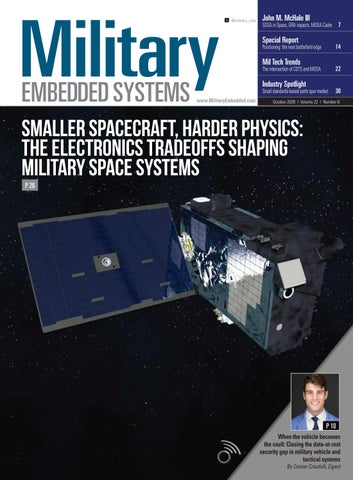
SMALLER SPACECRAFT, HARDER PHYSICS: THE ELECTRONICS TRADEOFFS SHAPING MILITARY SPACE SYSTEMS P 26
P 10 When the vehicle becomes the vault: Closing the data-at-rest security gap in military vehicle and tactical systems
By Conner Crisafulli, Cigent
Solutions for Rapid Deployment Analog Devices’ commercial off-the-shelf (COTS) software-defined radio (SDR) system-on-module (SOM) digitizers enable customers to deploy high performance distributed sensing techniques at the tactical edge, as quickly as possible.
From Components
Get to market faster at analog.com/SOMS
To Development Platforms
To Mission-Ready Modules
>40GHz UWB Direct RF Solutions RECEIVE ~ TRANSMIT ~ PROCESS
Small Form Factors
FEATURING: Agilex 9 Direct RF TM
Versal RF TM
3U & 6U VPX
Tel: 410-841-2514
●
www.AnnapMicro.com
www.militaryembedded.com
TABLE OF CONTENTS 26
10
October 2026 Volume 22 | Number 7
COLUMNS Editor’s Perspective 7 SOSA in Space, GRA impacts, MOSA Cadre By John M. McHale III
18
FEATURES SPECIAL REPORT: Enabling CJADC2 with secure tactical clouds
14
8
C JADC2 at the tactical edge with quantum-resistant clouds and zero-trust architectures By Anthony Verna, Cubic DTECH Mission Solutions 10 When the vehicle becomes the vault: Closing the data-at-rest security gap in military vehicle and tactical systems By Conner Crisafulli, Cigent 14 As autonomous systems scale, positioning data becomes the next battlefield edge By Matt McCrann, SPARC AI
MIL TECH TRENDS: Leveraging MOSA strategies for technology refreshes 18 MOSA as part of a digital sustainment strategy By Harish B, ISG 22 The intersection of COTS and MOSA By Richard Jaenicke, Green Hills Software
WEB RESOURCES Subscribe to the magazine or E-letter Live industry news | Submit new products http://submit.opensystemsmedia.com WHITE PAPERS – Read: https://militaryembedded.com/whitepapers
INDUSTRY SPOTLIGHT: Small form factors for space applications 26 S maller spacecraft, harder physics: The electronics tradeoffs shaping military space systems By Dan Taylor, Technology Editor 30 C ompact, standards-based electronics fuel growth in space market By Mark Littlefield, Elma Electronic
WHITE PAPERS – Submit: http://submit.opensystemsmedia.com All registered brands and trademarks within Military Embedded Systems magazine are the property of their respective owners. © 2026 OpenSystems Media © 2026 Military Embedded Systems ISSN: Print 1557-3222
To unsubscribe, email your name, address, and subscription number as it appears on the label to: subscriptions@opensysmedia.com Published by:
4 October 2026
ON THE COVER: An artist’s rendering depicts the GHOST-R [Geosynchronous High-Resolution Optical Space-Based Tactical Reconnaissance] satellite prototype, designed to deliver geostationary Earth orbit (GEO) reconnaissance capabilities to the U.S. Department of Defense (DoD). The GHOST-R program – a partnership between the Defense Innovation Unit (DIU) and Space Systems Command (SSC) – leverages commercially developed space vehicles, buses, and electro-optical payloads to deliver high-resolution space-to-space imagery for characterizing resident space objects in GEO. Courtesy graphic by Northrop Grumman via SSC. https://www.linkedin.com/groups/1864255/
MILITARY EMBEDDED SYSTEMS WITH RESOURCE GUIDE
@military_cots
www.militaryembedded.com
When it comes to VPX, one company has the most flavorS
ONLY VPXtra® OFFERS THE LARGEST SELECTION OF MIL-SPEC POWER SUPPLIES, WITH MINIMAL COSTS FOR ANY ADDITIONAL CUSTOMIZATION Most manufacturers offer just a few VPX power supplies off the shelf, with high costs for full-custom. The Behlman VPXtra® series offers the most COTS AC to DC and DC to DC units configured for a wide range of high-end industrial and military applications. All feature our state-of-the-art new engineering standard, Xtra-reliable design and Xtra-rugged construction.
Insist on the leader. Not just VPX, VPXtra®.
The Power Solutions Provider
AC POWER SUPPLIES / FREQUENCY CONVERTERS
: 631-435-0410
INVERTERS
: sales@behlman.com
COTS POWER SUPPLIES
: www.behlman.com
ADVERTISERS PAGE
ADVERTISER/AD TITLE
29 ADL Embedded Solutions – ADL-AI2500. The mission is at the edge 2 Analog Devices, Inc. – Solutions for rapid deployment 3 Annapolis Micro Systems – >40GHz UWB direct RF solutions 5 Behlman Electronics, Inc. – When it comes to VPX, one company has the most flavors 25 Crystal Group – Product Spotlight – Beyond MIL-STDs: Engineering technology the warfighter can trust 32 GMS – Introducing the new X10 Genesis small form factor system 12 Interface Concept – Build your HPEC system with our SOSA aligned 3U VPX plug-in cards 17 LCR Embedded Systems, Inc. – Checks all the boxes. Packaging solutions to enable any mission 21 Pixus Technologies – SOSA aligned products in the slot profile configuration you need
GROUP EDITORIAL DIRECTOR John McHale john.mchale@opensysmedia.com ASSISTANT MANAGING EDITOR Lisa Daigle lisa.daigle@opensysmedia.com TECHNOLOGY EDITOR – WASHINGTON BUREAU Dan Taylor dan.taylor@opensysmedia.com CREATIVE DIRECTOR Stephanie Sweet stephanie.sweet@opensysmedia.com WEB DEVELOPER Paul Nelson paul.nelson@opensysmedia.com EMAIL MARKETING SPECIALIST Drew Kaufman drew.kaufman@opensysmedia.com WEBCAST MANAGER Marvin Augustyn marvin.augustyn@opensysmedia.com VITA EDITORIAL DIRECTOR Jerry Gipper jerry.gipper@opensysmedia.com
SALES/MARKETING DIRECTOR, SALES OPERATIONS Tom Varcie tom.varcie@opensysmedia.com (734) 748-9660 DIRECTOR OF SALES ENABLEMENT Barbara Quinlan barbara.quinlan@opensysmedia.com AND PRODUCT MARKETING (480) 236-8818 STRATEGIC ACCOUNT MANAGER Bill Barron bill.barron@opensysmedia.com (516) 376-9838 EAST COAST SALES MANAGER Bill Baumann bill.baumann@opensysmedia.com (609) 610-5400 SOUTHERN CAL REGIONAL SALES MANAGER Len Pettek len.pettek@opensysmedia.com (805) 231-9582 STRATEGIC ACCOUNT MANAGER Jill Thibert jill.thibert@opensysmedia.com EUROPEAN ACCOUNT MANAGER Michael O'Kane michael.okane@opensysmedia.com TAIWAN SALES ACCOUNT MANAGER Patty Wu patty.wu@opensysmedia.com CHINA SALES ACCOUNT MANAGER Judy Wang judywang2000@vip.126.com
EVENTS AUSA 2026 October 12-14, 2026 Washington, D.C. https://ausa.org Hypersonic Innovation Conference 2026 October 20-21, 2026 Huntsville, AL https://www.hypersonicinnovation.com/ Association of Old Crows (AOC) International Conference & Exhibition December 8-18, 2026 National Harbor, MD https://aoc2026.org/ Apex Defense 2027 January 27-28, 2027 Washington, D.C. https://www.apexdefense.org/
6 October 2026
WWW.OPENSYSMEDIA.COM
CO-PRESIDENT Patrick Hopper patrick.hopper@opensysmedia.com CO-PRESIDENT John McHale john.mchale@opensysmedia.com DIRECTOR OF OPERATIONS AND CUSTOMER SUCCESS Gina Peter gina.peter@opensysmedia.com GRAPHIC DESIGN MANAGER Kaitlyn Bellerson kaitlyn.bellerson@opensysmedia.com FINANCIAL ASSISTANT Emily Verhoeks emily.verhoeks@opensysmedia.com SUBSCRIPTION MANAGER subscriptions@opensysmedia.com OFFICE MAILING ADDRESS 3120 W Carefree Highway, Suite 1-640 • Phoenix AZ 85087 • Tel: (480) 967-5581 REPRINTS WRIGHT’S MEDIA REPRINT COORDINATOR Marcia Brewer mbrewer@wrightsmedia.com (281) 419-5725
MILITARY EMBEDDED SYSTEMS WITH RESOURCE GUIDE
www.militaryembedded.com
EDITOR’S PERSPECTIVE
SOSA in Space, GRA impacts, MOSA Cadre By John M. McHale III, Editorial Director
John.McHale@opensysmedia.com
Speakers at the MOSA Industry and Government Summit & Expo – held in September in National Harbor, Maryland – made modular open systems approach (MOSA) news, with discussions about leveraging MOSA for space, the impact of government reference architectures (GRAs), and the standing up of the MOSA Cadre in the U.S. Department of War. MOSA is not just for terrestrial applications anymore. At the event, I moderated a panel on enabling the use of MOSA strategies like the Sensor Open Systems Architecture, or SOSA, Technical Standard in space. “We have a need to adopt these interoperability standards if we want to meet our objectives with Moonbase and Artemis,” panelist Christopher Green, Capability Lead for avionics and sensors at NASA, told the audience. He added that habitats, rovers, and other lunar systems will require an avionics ecosystem that can be maintained and expanded without developing a bespoke computer for every individual mission. The panelists also referenced the SOSA Space Appendix as one way to apply MOSA strategies to spaceflight avionics. The appendix builds on the SpaceVPX and VNX+ form factors while narrowing the available interface choices so that boards from different suppliers can communicate across a common backplane. For more on small form factors for space, see the feature on page 26 and an article by panelist Mark Littlefield of Elma on page 30. GRAs and autonomy Brig. Gen. Timothy M. Helfrich, Portfolio Acquisition Executive for Fighters and Advanced Aircraft, Air Force Life Cycle Management Center, Air Force Materiel Command, U.S. Air Force, touted the advantages of the Autonomous Government Reference Architecture (AGRA) during his keynote address, describing how the AGRA enabled users in the Air Force to swap out mission autonomy software mid-flight in a collaborative combat aircraft (CCA). “We showed on an [Anduril] FQ 44 Fury, which is one of the CCA that we’re buying, that during the flight where we were flying with one vendor’s autonomy, we transitioned in-flight to another vendor’s mission autonomy, and ran the same flight profile, and made sure it worked. So that’s essentially like you’re pulling out the pilot, putting in a new pilot while flying. It was a live flight, no pilot, no nine-month process to redo airworthiness. Same flight, done right then. That is the flexibility that MOSA and the AGRA are designed to provide.” Because of MOSA, CCA will not be tied to one autonomy provider for the life of the aircraft, Helfrich affirmed. “We can compete capability, integrate capability, and improve capability as mission needs change.” MOSA and GRAs also affect the operator, not just the engineer, Helfrich said. “In a recent Agile Common Employment Exercise, which is real operators operating the CCA, we were able to update the autonomy profiles on the scale of minutes, not on the scale of days or months.” Open standards “let us learn faster, adapt faster, and deliver relevant capabilities when the need still matters,” he noted. “We are not just telling industry to comply with open standards; we are making those standards available,” Helfrich asserted. “Companies can access those governmentrecord architectures today.” He referenced the Open Arsenal Portal (https://openarsenal.gitlab.io/) where industry can learn more about AGRA and other standards. www.militaryembedded.com
MOSA Cadre at the ready The MOSA Cadre, a team of MOSA experts to help weapons programs apply open architectures and meet new department expectations, has been stood up by the U.S. military, said James Ruocco, performing the duties of Assistant Secretary of War for Acquisition at the 2026 MOSA Industry and Government Summit. The MOSA Cadre, led by previous Army Aviation Chief Engineer Matt Sipe, will work directly with program teams and show them how to implement modularity. The department has also issued a memorandum describing its minimum expectations for MOSA implementation, Ruocco said. Sipe wrote about MOSA and RF technology in our January 2026 issue. (Read it at https://tinyurl.com/45krytp3.) The Cadre will follow models already used for software and intellectual-property issues. Ruocco said the effort could grow through a “train the trainer” approach, with experts working alongside program personnel instead of relying mainly on classroom instruction, as reported by our Technology Editor Dan Taylor. Senior leaders will also use MOSA measures to evaluate program health, Ruocco said; Portfolio Acquisition Executives (PAEs) and program managers will receive more authority, but they will also be held responsible for delivering open and modular systems. Ruocco said that the department has moved beyond isolated demonstrations and now intends to scale successful MOSA practices across services, platforms, and operating domains, according to Taylor’s reporting (https:// tinyurl.com/588zd4bx). “The old way of doing things is dead. That legacy model of closed, bespoke systems can’t operate at the level of speed, adaptability, or affordability to meet the operational demands.”
MILITARY EMBEDDED SYSTEMS WITH RESOURCE GUIDE
October 2026 7
SPECIAL REPORT
Enabling CJADC2 with secure tactical clouds
The Combined Joint All-Domain Command and Control (CJADC2) initiative is changing how U.S. and allied forces operate across every domain: land, sea, air, space, and cyber. Graphic courtesy Cubic.
CJADC2 at the tactical edge with quantum-resistant clouds and zero-trust architectures By Anthony Verna
The Combined Joint All-Domain Command and Control (CJADC2) initiative is changing how U.S. and allied forces operate across every domain: land, sea, air, space, and cyber. Its success depends on networks that stay secure under pressure, supporting faster, unified decisions in contested environments. In the emerging quantum era, where adversaries are racing to surpass U.S. cryptographic strength, maintaining that security has become a front-line priority. Every CJADC2 function, from sensor feeds to coalition links, relies on the integrity of information. Defense organizations should develop transition roadmaps, complete cryptographic inventories, train personnel, and work with vendors to accelerate deployment of proven, secure solutions. Combined Joint All-Domain Command and Control (CJADC2) systems must perform in denied, disrupted, intermittent and limited (DDIL) environments, where bandwidth drops, latency spikes, and communications falter. U.S. Department of Defense (DoD) planners describe CJADC2 as a mesh of capabilities built to persist through degraded conditions, keeping forces connected even when parts of the network fail. On the ground, warfighters are already
8 October 2026
testing low-Earth-orbit satellites, mesh networking, and tactical cloudlets to keep decision data moving despite jamming and interference. Quantum computing adds a new layer of risk. Adversaries use “harvest now, decrypt later” tactics, storing encrypted data today with the expectation that future quantum systems will unlock it. Long-lived classified information faces the greatest risk. Even if scalable
MILITARY EMBEDDED SYSTEMS WITH RESOURCE GUIDE
quantum computers are years away, the tactic makes quantum-ready protection an immediate operational requirement. Legacy systems compound the challenge, as these older approaches lack the resilience and speed today’s missions demand. Encryption is often hard-coded deep in fielded platforms, IoT [Internet of Things] devices, and weapons systems, making the need for modernization unavoidable. www.militaryembedded.com
Quantum-resistant clouds and zero-trust frameworks A layered approach that pairs quantumready encryption with zero-trust architectures that scale from the tactical edge to enterprise clouds provides a path forward. At the edge, operators must encrypt data before it reaches storage to preserve confidentiality in harsh DDIL conditions. NIST [National Institute of Standards and Technology] post-quantum cryptography standards (CRYSTALS-Kyber for encryption, CRYSTALS-Dilithium for signatures) and the NSA [National Security Agency] Commercial National Security Algorithm Suite (CNSA) 2.0 now guide the DoD’s migration road map. Even if adversaries harvest data today, quantum-ready algorithms can defend it from future decryption attempts. Zero-trust eliminates implicit trust inside networks, continuously verifying every user, device, and workload, no matter the location or privilege level. The DoD’s Zero Trust Strategy targets full component implementation by fiscal year 2027. Automated key management and microsegmentation reduce the blast radius of any intrusion and simplify coalition interoperability, where trust must be verified across national and organizational boundaries. Integrated AI-based automation enhances this model by detecting anomalies in real time, enforcing policy at machine speed, and reducing operator workload at the tactical edge. Systems must scale from body-worn sensors to mobile data centers, operating seamlessly across all domains. Edge-to-cloud scalability ensures that operators can maintain mission continuity even under infrastructure or connectivity constraints. Preparing for the quantum era Quantum security is no longer theoretical: NIST finalized its first set of PostQuantum Cryptography (PQC) standards in 2024, and the White House has directed federal agencies to complete migration by 2035. The NSA has mandated PQC adoption for all nationalsecurity systems. Across the DoD, cryptographic inventories are underway to identify vulnerable systems, and planners anticipate major retrofit challenges where algorithms are hard-coded into deployed hardware. www.militaryembedded.com
Practical steps include: › Conduct cryptographic inventories to identify vulnerable systems. › Develop quantum-readiness roadmaps that prioritize PQC transitions in high-value networks. › Implement recovery capabilities to restore compromised or deleted data without operational delays. › Provide continuous operator training so cyber defenders, commanders, and tactical units can apply PQC and zero-trust procedures under realistic, contested conditions. Current DoD and NIST guidance emphasizes recovery as central to resilience. Compromised or deleted data must be restorable with minimal disruption to sustain command continuity in degraded or contested networks. Yet technology alone cannot guarantee protection; encryption and zero-trust architectures are only as strong as the people applying them. Routine exercises that reinforce credential management, cyber hygiene, and recovery drills turn doctrine into habit, building the muscle memory needed to stay effective against quantum-era threats. Readiness in multidomain operations Securing CJADC2 depends on consis tent execution across services and partners as much as on technology. Con tinuous training – reinforced through live/ virtual/constructive (LVC) environments – ensures that operators understand both the technology and doctrine of quantumready, zero-trust operations. Such integration reduces errors, sharpens reaction speed, and supports secure execution across the joint force. Training should also aim to reduce human error and establish clear, repeatable procedures that coalition partners can execute consistently, supporting secure collaboration and interoperability across national boundaries. The result: preserved decision advantage, reinforced coalition trust, and sustained operational superiority. A commander at the tactical edge can still issue secure orders under jamming, a coalition partner can share intelligence without fear of compromise, and a joint task force can keep tempo against a peer adversary intent on exploiting every vulnerability.
Industry momentum Across the defense industry, quantum readiness and zero-trust have moved from abstract goals to field demonstrations. Joint exercises now show resilient, encrypted, and scalable architectures functioning in contested environments. Service initiatives continue to validate secure multidomain data fusion, anysensor-to-any-shooter integration, and autonomous edge operations. Momentum has shifted from research to field validation. Quantum-ready encryption, zero-trust enforcement, and scalable cloud architectures now appear in live demonstrations, operational trials, and emerging doctrine. The foundation for securing CJADC2 is taking shape in practice, not theory. Securing the tactical edge The quantum era has arrived. In that environment, quantum-resistant encryption, zero-trust frameworks, and continuous operator training are mission requirements, not merely options. Defense organizations should develop transition roadmaps, complete cryptographic inventories, train personnel, and work with vendors to accelerate deployment of proven, secure solutions. Acting now enables CJADC2 to scale securely across all domains, protect sensitive data for decades, and preserve U.S. and allied advantage at the tactical edge.. MES Anthony Verna is Senior Vice President and General Manager of Cubic DTECH Mission Solutions at Cubic Defense. Before assuming his current role, Anthony spent nearly 10 years leading strategy and business development for Cubic Mission Solutions. He previously held senior leadership roles at CACI, ManTech, and Comptek. Anthony studied information systems at Thomas Edison State College (N.J.) and completed The Wharton School’s General Management Program as an Aresty Scholar. Cubic DTECH Mission Solutions https://www.cubic.com/defense
MILITARY EMBEDDED SYSTEMS WITH RESOURCE GUIDE
October 2026 9
SPECIAL REPORT
Enabling CJADC2 with secure tactical clouds
caption
U.S. Marine Corps Lance Cpl. Josue EscalanteRodriguez, an infantry Marine with 1st Light Armored Reconnaissance Company, Battalion Landing Team 1st Battalion, 7th Marine Regiment, 31st Marine Expeditionary Unit, performs a radio communications check inside a light armored vehicle while participating in the MEU Exercise at Camp Hansen in Okinawa, Japan. U.S. Marine Corps photo by Lance Cpl. Raul Sotovilla.
When the vehicle becomes the vault: Closing the data-at-rest security gap in military vehicle and tactical systems By Conner Crisafulli
Protecting military systems where critical information resides requires extending cybersecurity beyond traditional network defense toward architectures designed to preserve classified data after physical compromise. The U.S. National Security Agency (NSA) requirement for two independent encryption layers, together with specific Commercial NSA cryptographic standards, gives engineers concrete design criteria rather than conceptual security objectives. Layered full-disk encryption, independent preboot authentication, and architectures aligned with Commercial Solutions for Classified (CSfC) data-at-rest guidance can protect information even when the network disappears and the hardware itself is lost. Artificial intelligence (AI), autonomous operations, and distributed commandand-control have transformed military vehicles into mobile computing platforms
10 October 2026
that store and process unprecedented volumes of sensitive operational data. Yet cybersecurity investment has traditionally concentrated on protecting networks and communications rather than information residing on battlefield endpoints after physical loss or capture.
MILITARY EMBEDDED SYSTEMS WITH RESOURCE GUIDE
www.militaryembedded.com
under friendly control throughout their operational life cycle. Modern military operations invalidate that assumption: Tactical vehicles become disabled, aircraft are shot down, autonomous systems run out of fuel, command posts are overrun, and equipment is abandoned during maneuver. As operations move deeper into anti-access/area-denial environments, recovery cannot always be assumed. For autonomous and attritable systems in particular, physical loss should increasingly be treated as a design condition rather than an exceptional event. The engineering question therefore shifts from whether a platform may be captured and over to what information remains accessible once capture occurs. The confidentiality of mission data, software, and cryptographic material can be as consequential as preserving the physical platform itself. (Table 1.) The hidden value resides in the data The replacement cost of military hardware is relatively straightforward to calculate; quantifying the operational value of the information stored within it is harder because seemingly routine datasets can be combined to produce actionable intelligence. Today’s vehicle systems may contain mission plans, ISR [intelligence, surveillance, and reconnaissance] collections, navigation histories, terrain databases, sensor calibration parameters, electronic-warfare libraries, software images, firmware, cryptographic credentials, maintenance records, logistics information, and AI models. Collectively, these datasets can expose operational concepts, deployment patterns, command relationships, force disposition, software architectures, pattern of life and coalition interoperability procedures.
For modern tactical systems, that distinction is increasingly important. A crewed combat vehicle, unmanned aircraft, autonomous maritime vessel, tactical server, or mobile command post may continue to hold mission data long after it is disconnected from friendly networks. Once that platform is captured, the security problem changes from preventing network intrusion to preventing offline access to the data itself. Physical capture is an engineering given Historically, cybersecurity architectures implicitly assumed endpoints would remain
AI increases that exposure. Models deployed to tactical platforms can embody years of algorithm development, training, validation, operational tuning, and testing. Associated sensor-fusion methods, autonomy software, and inference techniques may provide an adversary opportunities to reverse-engineer capabilities or develop countermeasures. The result is a different definition of platform survivability: Protecting the vehicle is no longer sufficient if losing the vehicle also exposes the information required to understand how the broader force operates. Network security stops at the network boundary Enterprise cybersecurity has invested heavily in zero-trust architecture, endpoint detection and response, identity management, behavioral analytics, continuous monitoring, and software-defined networking. Those capabilities are effective when connectivity to enterprise infrastructure is available. Battlefield operations present a different operating model, however. Tactical vehicles may operate under emissions control, satellite connectivity may be unavailable, electronic attack may eliminate communications, and autonomous systems may remain disconnected for extended periods. Once physical possession transfers to an adversary, cloud authentication cannot stop offline forensic analysis, which means that remote-management systems cannot
Platform state
Primary security assumption
Principal data risk
Under friendly control
Network and endpoint defenses remain available
Remote or local cyberattack
Disconnected/contested
Centralized services may be unavailable
Unauthorized local access
Lost or captured
Adversary controls the hardware
Offline forensic analysis and extraction
Table 1 | An illustration of how the security model changes when physical possession transfers to an adversary. www.militaryembedded.com
MILITARY EMBEDDED SYSTEMS WITH RESOURCE GUIDE
October 2026 11
SPECIAL REPORT
Enabling CJADC2 with secure tactical clouds
recover inaccessible hardware and endpoint monitoring cannot report compromise. The controls that still matter are the ones engineered into the endpoint: encryption, authentication, key protection, secure-boot processes, and mechanisms that remain effective without a network connection. Applying NSA CSfC guidance The National Security Agency (NSA) Commercial Solutions for Classified (CSfC) Data-at-Rest (DAR) Capability Package provides a useful quantitative baseline. NSA requires that CSfC DAR-compliant solutions use two independent layers of encryption to protect stored information while an end-user device is powered off or remains unauthenticated. (The current DAR Capability Package is Version 5.1.0, approved in March 2026 and available here.) The cryptographic requirements are also specific: CSfC guidance identifies AES-256 for confidentiality and CNSA algorithms, including RSA-3072 or ECDSA P-384 for authentication and SHA-384 for integrity. NSA states that properly configured CSfC solutions
CSfC design characteristic
Quantitative requirement
Encryption architecture
2 independent encryption layers
Symmetric encryption
AES-256
Digital signature/authentication
RSA-3072 or ECDSA P-384
Integrity hashing
SHA-384
Supported classification
Up to Top Secret
Table 2 | Selected quantitative characteristics of NSA CSfC architectures. Source: NSA CSfC DAR Capability Package v5.1.0, March 2026, and NSA CSfC FAQ.
Build your HPEC system with our SOSA®-aligned 3U VPX plug-in cards
• Various SOSA® slot profiles supported • High-speed dual-plane 100 Gigabit Ethernet Switches • Arm®/Intel®-based Single Board Computers • VITA 66.5 FPGA boards Ideal for demanding highly secure networking and high-computing applications. Contact us to learn more.
www.interfaceconcept.com
12 October 2026
Contact our North American sales and support provider: sales@elma.com • 510-656-3400 www.elma.com
MILITARY EMBEDDED SYSTEMS WITH RESOURCE GUIDE
using these controls can protect National Security Systems information up to the top-secret level. The following table summarizes several measurable requirements engineers can use when evaluating a tactical data at rest architecture. (Table 2.) The importance of two layers is not that AES itself is considered inadequate. Layering addresses implementation risk: if misconfiguration, operator error, or an implementation vulnerability compromises one component, an independent second layer remains between the adversary and the classified data. These principles extend beyond laptops or conventional workstations. Mission computers, vehicle servers, ruggedized storage modules, edge AI processors, ISR recording systems, autonomous vehicle storage, portable solid-state drives, maintenance systems, and mission-planning workstations all represent repositories of operationally significant information. Engineering the entire tactical data ecosystem Modern missions depend upon interconnected ecosystems rather than individual platforms. Examples include tactical vehicles that exchange data with planning workstations before deployment; portable storage that distributes intelligence updates, terrain databases, AI models, and software revisions’ maintenance systems that collect diagnostics and operational histories; and edge servers that synchronize information across distributed formations. Protecting only the primary vehicle, therefore, leaves substantial attack surfaces elsewhere. A captured maintenance workstation or portable storage device may expose many of the same mission datasets as the platform it supports. Designing for data survivability Traditional survivability emphasizes preserving platform functionality under hostile conditions. Future systems must also preserve information confidentiality after platform loss. www.militaryembedded.com
Data survivability should become a measurable systems-engineering parameter. Design and development must ensure data protection that includes authentication assurance, cryptographic independence, secure key life cycle management, sanitization effectiveness, and resistance to physical compromise. Devices without these technologies risk exposure of sensitive data upon capture by adversaries. Considering these requirements during architecture development can also reduce the complexity of later integration. Near the end of an acquisition life cycle, adding independent encryption and authentication may require changes to storage interfaces, boot sequences, trusted execution environments, and mission software that have already been finalized. AI is changing where critical military information resides. More commonly, operational knowledge increasingly lives within
vehicles, autonomous systems, tactical computers, and edge-processing platforms operating at the front lines. Protecting those systems requires extending cybersecurity beyond traditional network defense toward architectures designed to preserve classified data after physical compromise. NSA’s requirement for two independent encryption layers, together with specific CNSA cryptographic standards, provides engineers with concrete design criteria rather than a conceptual security objective. Layered full-disk encryption, independent pre-boot authentication, and architectures aligned with CSfC DAR guidance can protect information even when the network disappears and the hardware itself is lost. Organizations developing tactical storage architectures are focused on applying these principles to military endpoints operating beyond traditional enterprise environments. As battlefield computing continues moving toward the edge, data survivability should be treated as a fundamental component of platform survivability itself. MES Conner Crisafulli is a solutions engineer and cybersecurity professional at Cigent. Before joining Cigent, Conner served six years as a U.S. Air Force combat controller, where he specialized in high-stakes mission planning, communications systems, and joint operations coordination/execution. At Cigent, he focuses on practical applications of self-encrypting drives (SEDs), pre-boot authentication (PBA), and various CSfC [commercial solutions for classified] technologies to safeguard sensitive data. Cigent • https://www.cigent.com/
From Isolated Platforms to Collaborative Autonomy: Architecting Mission-Ready Systems at Scale Sponsored by RTI This webinar explores the architectural foundations required for collaborative autonomy at the edge. Participants examine how a data-centric approach – leveraging the Data Distribution Service (DDS) – enables real-time data sharing, decentralized decisionmaking, and interoperability across heterogeneous platforms, applications, and communications networks even in contested and bandwidth-constrained environments. (This is an archived event.) Watch this webcast: https://tinyurl.com/4the7pup
WATCH MORE WEBCASTS:
https://militaryembedded.com/webcasts www.militaryembedded.com
MILITARY EMBEDDED SYSTEMS WITH RESOURCE GUIDE
October 2026 13
SPECIAL REPORT
Enabling CJADC2 with secure tactical clouds
caption
Successful operations on the current and future battlefield will be built on a foundation of trusted positioning data. Graphic courtesy SPARC AI.
As autonomous systems scale, positioning data becomes the next battlefield edge By Matt McCrann As the world’s militaries rapidly accelerate adoption of autonomous systems and work to integrate enterprise command-and-control and intelligence platforms, trusted positioning information will become the battlefield edge that will drive mission success. Delivering this data in a scalable and cost-effective way will be the underpinning of tomorrow’s most effective forces.
14 October 2026
MILITARY EMBEDDED SYSTEMS WITH RESOURCE GUIDE
www.militaryembedded.com
Drones have become one of the most important tools in modern warfare, and the world’s militaries are investing in systems to do everything from gathering intelligence to executing operations. But much of the discussion around drones focuses on factors such as scale of production and lethality, rather than the key issue – that drones are only as effective as the positioning data they rely on. The threat of GPS jamming, overwhelming satellite signals with high- powered radio interference and effectively blinding autonomous systems, has made positioning data an important battlefield edge. For forces hoping to gain this edge, it’s vital to move beyond the one-to-one approach of arming individual drones with specialized payloads and towards a mindset shift of thinking of trusted positioning as infrastructure. Rather than expensive new airframes, positioning should be delivered in a hardware-agnostic and software-defined way. GPS interference has become an expected, standard part of warfare, and GPS spoofing is now even more of an issue, meaning that drones, missiles and ships can look like they are somewhere they are not. By misdirecting drones across international borders, the technology holds the potential to cause conflicts such as Ukraine to spill over into neighboring territories. The move beyond arming UAS Widespread electronic warfare (EW) is no longer science fiction and contested environments are not edge cases. It’s likely that every future conflict will see EW, GPS spoofing, and jamming becoming a standard part of operations. There’s also the basic risk of mere signal loss that compounds these orchestrated attacks. Moving beyond arming individual drones with a specialized capability – or buying new airframes armed with such capabilities – and toward a more forward-thinking approach has never been more urgent. Until now, the dominant industry response to GPS denial has been expensive hardware upgrade kits, but this approach no longer fits the reality of www.militaryembedded.com
today’s battlefield where smaller, less expensive systems have become the norm and fleets are replaced rapidly. With most forces fielding attritable, high-volume drone stocks, the battlefield edge will come from solutions that can be fielded rapidly, rather than requiring weeks or even months of sensor integration, calibration, and airframe-specific tuning. Uncrewed aerial systems (UASs) must be armed with costeffective positioning assurance that works in contested, GPS-denied environments and also works effectively across the entire architecture, including the most attritable and smallest systems. Delivering this solution requires a move away from the design principles of previous generations of UASs and towards a mindset built for an era in which militaries field thousands – or in the case of Ukraine – millions of drones at once.
Rather than positioning being tightly bound to a specific airframe or sensor stack, positioning will become a correction layer that sits above the flight stack, meaning that navigational intelligence becomes infrastructure rather than being codesigned with the aircraft itself. Scaling the advantage: Moving away from vanity metrics Too much of the focus around drone technology misses this crucial positioning point entirely and even sidesteps the issues around how to deliver it. Instead, discussions center on volume and speed: how many systems can be produced, how many can be fielded, and how fast. With the growing importance of drone systems on battlefields this misconception is a forgivable one. But sheer volume becomes totally irrelevant if drones can no longer function after first and second contact, then adapt and keep operating. If denied positioning means that platforms cannot survive and continue to operate, they are useless. If platforms are rendered inoperable, volume becomes an irrelevant statistic and it’s impossible to transform into operational advantage. What this means is that positioning assurance is no longer just part of the technology required to field autonomous systems; it is now leading-edge infrastructure and an absolutely vital part of delivering autonomy. In contested and GPS-denied environments, positioning assurance is vital to navigation, sensing, and targeting and is central to operating effectively. This mindset shift is crucial: By thinking of positioning as infrastructure, teams can prepare for the real challenge emerging on the battlefield, which is delivering position assurance at scale. Tomorrow’s forces will involve thousands of UASs – many of them cheap, small, and designed to be attritable – operating on mixed platforms. With such large-scale autonomy operating in real-world environments with heavy-duty EW, the questions become: Can the systems still operate after first contact? Can a force made up of thousands of drones, many designed to be attritable, still operate if the positioning layer disappears? It is now mission-critical that drones and autonomous systems should be able to maintain not just navigation and positioning but also target acquisition, even when GPS is denied. The defense industry faces a fundamental limitation in how it approaches resilient autonomy at scale, however. Even if each drone is armed with the vision hardware and models that it needs to execute autonomy in contested environments, there is still a limitation of one specialized capability per drone. While this approach remains in place, autonomy simply cannot scale.
MILITARY EMBEDDED SYSTEMS WITH RESOURCE GUIDE
October 2026 15
SPECIAL REPORT
Enabling CJADC2 with secure tactical clouds
Putting specialized hardware on every drone becomes more and more expensive and cumbersome as thousands of increasingly autonomous and attributable systems are deployed. The one-to-one approach also introduces ever more points of failure. But what is the alternative to this approach? What’s needed is to rethink resilient positioning, treating it as an infrastructure layer rather than a platform-by-platform capability. Positioning should be a hardwareagnostic and software-defined service that uses existing platform capabilities where possible, scaling easily across mixed fleets without requiring specialized payloads. Delivering autonomy that won’t stall procurement or deployment Tomorrow’s UASs will not rely on GPS and expensive specialist hardware, nor will they require slow, burdensome deployment. There are various ways modern systems can derive positioning information in a GPS-denied environment, including terrain correlation, sensor fusion, and artificial intelligence (AI)-enhanced error modelling. Position calculations will increasingly occur at the tactical edge, thanks to distributed autonomy architectures, and at the fleet level rather than via individual drones. Rather than positioning being tightly bound to a specific airframe or sensor stack, positioning will become a correction layer that sits above the flight stack, meaning that navigational intelligence becomes infrastructure rather than being codesigned with the aircraft itself. This approach has multiple advantages in economic and acquisition terms. Given how rapidly attritable drones are used in current conflicts, a move away from this one-toone approach and towards fleet-level solutions where GPS-denied capability can be added without new procurement cycles is not just welcome but essential. This way of operating also means that existing UAS fleets can be upgraded with GPSdenied capability in place, thereby avoiding the cost, lead time, and logistics burden of hardware-dependent alternatives. Edge AI will enable data such as camera information to be processed at the edge rather than in the cloud, even in communicationdenied environments. To enable these moves, distributed autonomy architecture will also grow in importance, with positioning assurance evolving into a software-defined capability vital to autonomous operations and to intelligence architectures.
gence architectures, and without it the quality of every downstream function degrades. With tactical cloud in denied/disrupted/intermittent/limited-bandwidth (DDIL) environments, drones cannot rely on continuous high-bandwidth uplinks and must communicate only lightweight, high-confidence metadata. Position is no longer a simple navigational output – it is the foundation of everything from tactical cloud to AI-enabled decision-making on the battlefield. The next battlefield edge Successful operations on the current and future battlefield will be built on a foundation of trusted positioning data. This positioning layer must operate even in the most hotly contested, GPS-denied, and communications-degraded environments. It’s increasingly clear that this capability can no longer be delivered by new and expensive airframes or hardware upgrade kits, but should arrive at the fleet level. By moving beyond the previous one-to-one approach, forces can be freed from waiting for new procurement cycles and will adopt a mindset where positioning is leading-edge infrastructure, delivered at the software level above the sensor stack. MES
Positioning data as a foundational layer With the defense industry investing heavily in enterprise command-or-control or intelligence platforms – such as Combined Joint All-Domain Command and Control (CJADC2) – to connect sensors, decision-makers, and platforms alongside autonomous systems, positioning data is growing in importance. Every part of these architectures depends on one fundamental piece of information: where it is. If EW degrades this information, it causes ripple effects across the whole architecture. Delivering effective intelligence architectures that connect platforms, operators, and weapons systems relies on trusted spatial context at every step of the way. If an edge node’s self-position is wrong, there’s a domino effect: Automated sensor-to-shooter algorithms cannot then correlate tracks across multiple platforms or generate a valid common operational picture (COP).
Matt McCrann is the U.S. CEO at SPARC AI, where he drives commercial strategy, customer engagement, and adoption of SPARC AI’s positioning infrastructure developed for contested and GPS-denied environments. Prior to SPARC AI, Matt served as CEO of DroneShield’s U.S. subsidiary, for which he built and scaled U.S. operations from the ground up. Before entering industry, Matt served in the U.S. Navy as an intelligence operator and analyst and as a member of the National Security Agency/ Central Security Service (NSA/CSS) Cryptologic Direct Support Element, supporting national-security and operational missions.
Positioning data now underpins everything from sensor fusion to mission planning to shared situational awareness. It has become the foundational data layer for intelli-
SPARC AI https://sparcai.co/
The good news, in cost terms, is that much of the hardware required to provide this positioning assurance is already there. The existing low-cost inertial sensors and onboard cameras already present in commercial and military autonomous systems can be used to provide understanding of where the drones are, without relying on satellite connections. This capability is particularly powerful when combined with techniques such as sensor fusion and machine-learning (ML) algorithms and feeding back operational deployment data into sensor-fusion ML models.
16 October 2026
MILITARY EMBEDDED SYSTEMS WITH RESOURCE GUIDE
www.militaryembedded.com
Checks All the Boxes PACKAGING SOLUTIONS TO ENABLE ANY MISSION LCR can help turn your rugged embedded computing design concept into a mission-ready system. With VPX and SOSA aligned solutions, our integrated systems, chassis and backplanes can streamline your design journey from development to deployment. Look to LCR to realize what’s possible in demanding environments across a wide range of defense programs.
Find out how we can help you create mission success.
SERVING CRITICAL DEFENSE PROGRAMS FOR OVER 30 YEARS
lcrembeddedsystems.com | (800) 747-5972
MIL TECH TRENDS
Leveraging MOSA strategies for technology refreshes
Stock image.
MOSA as part of a digital sustainment strategy By Harish B A rigorously implemented modular open systems approach (MOSA) promises quantitative gains in technology-refresh rate, competition, and life cycle cost. MOSA is no longer an abstract acquisition slogan; it is a mandated, technically nontrivial constraint that will determine whether U.S. forces can field interoperable, artificial intelligence (AI)-enabled, digitally sustained systems at the tempo demanded by future conflicts. Digital sustainment in U.S. military aviation, ground combat, and lethality systems depends on data-centric, interoperable architectures. Yet many defense platforms remain monolithic, with tightly coupled subsystems, bespoke interfaces, and opaque integration contracts that inhibit artificial intelligence (AI)-driven predictive maintenance and digital-twin deployment at scale. The modular open systems approach (MOSA) often employed, however, faces roadblocks in the form of interface standardization, system-security engineering, and enterprise-level modularity. Research shows that naive, checklist-style MOSA adoption yields fragile interfaces, security gaps, and limited life cycle benefits. Interoperability as a warfighting constraint MOSA – mandated across major defense-acquisition programs – is intended to enhance interoperability, technology refresh, competition, innovation, and cost savings. Yet legacy platforms and heterogeneous fleets limit cross-domain teaming and digital sustainment. Examples include:
18 October 2026
MILITARY EMBEDDED SYSTEMS WITH RESOURCE GUIDE
› GAO reporting summarized in modularity research shows that constrained modularization and late adoption of open architectures in uncrewed-systems programs directly reduced upgrade effectiveness and slowed technology insertion. › Ground robotic and autonomous systems (RAS) require interoperability profiles (IOP) spanning multiple levels, including command and control, payload, and mobility, to support mixed-fleet operations over a three- to five-year standards maturation horizon. www.militaryembedded.com
› Integrated avionics research finds that ambiguous key interfaces force near-full regression test cycles after modifications, which erode the theoretical MOSA cost and schedule advantages. In parallel, predictive maintenance and digital-twin frameworks in aerospace show that proactive health management can significantly increase platform availability and reduce life cycle cost, but only when data flows are standardized and continuous. MOSA roadblocks through 2026 1. Architectural and interface complexity Designing truly modular and open platforms is operationally and economically challenging, and many efforts underdeliver on convenience, cost, and community uptake. Key barriers include a lack of mature open standards for key interfaces in many domains, forcing program owners to repeatedly organize and govern new standards communities; and the reality that MOSA guidance focuses on modular software/hardware frameworks but only partially addresses physical integration methodologies, embedded platform design, and prevention of cross-functional interference in integrated avionics and other cyber-physical systems. 2. Security and cyberresilience gaps System security engineering (SSE) for MOSA is underdeveloped in open literature. A mapping of 33 research papers shows substantial work on modularity and open standards, but a gap in architectural guidelines for integrating SSE and risk management with MOSA across the life cycle. In addition, cyber-physical systems and open architectures introduce new attack surfaces at interface boundaries, directly affecting mission data integrity and availability.
MOSA – mandated across major defense-acquisition programs – is intended to enhance interoperability, technology refresh, competition, innovation, and cost savings. Yet legacy platforms and heterogeneous fleets limit cross-domain teaming and digital sustainment. 3. Enterprise-level modularity and business constraints Current modularity implementations often underestimate enterprise interdependencies, leading to failures such as highly integrated concepts that cannot evolve economically under changing requirements. The lack of decision frameworks that reconcile technical modularity choices with business openness, incentives, and contract structures across primes, Tier-1s, and government is also a constraint. 4. Data fragmentation blocking digital sustainment Digital twin and predictive maintenance frameworks in aerospace show that fragmented, non-standardized maintenance and operational data make accurate lifecycle modeling almost impossible for many aircraft. For defense systems, this constrains condition-based and predictive maintenance for aging fleets and cross-platform analytics for mixed MOSA and non-MOSA inventories. Major 2026 MOSA roadblock categories As defense programs push toward MOSA, persistent roadblocks in architecture, security, enterprise integration, and data management threaten to undermine modularity’s promise of flexibility, cost savings, and rapid upgrades. These challenges stem from immature standards, incomplete guidance on physical and cyber-physical integration, underdeveloped security engineering, business incentive misalignments, and fragmented data that hampers digital sustainment. The table below categorizes the major roadblocks, highlighting their primary technical impacts and operational consequences to guide mitigation strategies. (Table 1.) Breakthrough vectors: Reference architectures, profiles, and model-based systems engineering (MBSE) Despite the roadblocks, several technical breakthroughs are converging to support MOSA-driven digital sustainment. Government-owned MOSA architectures and interoperability profiles are emerging across domains: › Army aviation and ground systems: Open standards-based reference and objective architectures, major system components and interfaces provide an executable blueprint for JADC2 [Joint All Domain Command and Control], replicator, and human-machine integrated formations. › Ground RAS: Maturation and propagation of the ground robotics IOP via a consortium model over three to five years targets interoperability as a default property of new systems.
Roadblock category
Primary technical impact
Operational consequence
Immature open interfaces
Ambiguous data & timing semantics
Costly reintegration, slow upgrades
Weak SSE-MOSA integration
Unprotected interface surfaces
Cyber risk to mission systems
Enterprise modularity gaps
Misaligned incentives, partial modularity
Limited competition, vendor lock
Data fragmentation
Incomplete life cycle digital thread
Limited predictive sustainment, lower readiness
Table 1 | A table shows the operational consequences of major roadblocks to MOSA. www.militaryembedded.com
MILITARY EMBEDDED SYSTEMS WITH RESOURCE GUIDE
October 2026 19
MIL TECH TRENDS
Leveraging MOSA strategies for technology refreshes › Tightly coupled MBSE and digital-twin initiatives, using MOSA interface models as the schema for digital sustainment data and predictive-maintenance analytics.
› Lethality systems: The Assured Armaments Reference Architecture (AARA) defines internal and external data interfaces and a MOSA data bus, enabling reduced regression test scope and interoperability with common infrastructure architectures. › H-60M Black Hawk: Introduction of a digital backbone and [Future Airborne Capability Environment, or FACE, Technical Standard conformant] architecture enables software reuse and hardware commonality to align legacy fleets with future vertical lift frameworks and sustain multi-domain operations. These architectures provide structured open interfaces that can be directly exploited by digital sustainment stacks, data acquisition, fusion, and predictive models across multiple platforms. Systems engineering and security as solution multipliers Next-generation systems-engineering practices are identified as critical MOSA enablers – systems thinking + MBSE + MOSA form an interrelated triad while MBSE models capture module boundaries, interface contracts, and configuration rules needed for incremental upgrades without full re-verification. Enterprise modularity methods specify how to organize enterprise structures, processes, and standards. Adherence to open standards (for example, FACE Technical Standard, OMS) is essential but insufficient alone; it must be enhanced by modular enterprise constructs to align with MOSA principles. For digital sustainment, these MBSE artifacts can be reused as authoritative sources of truth for structuring digital twin models and for defining the sensor/telemetry payloads needed for predictive analytics. Integrating SSE into MOSA interfaces The systematic mapping of SSE for MOSA identifies a need to embed cybersecurity requirements directly into modular interface definitions and life cycle processes. In practice, this implies that the user treats every major system interface and data bus (e.g., AARA bus) as a security-control allocation boundary, with explicit requirements on encryption, authentication, and monitoring; and that MOSA architectures are aligned with risk-management frameworks tailored for cyber/physical systems, to preserve openness while constraining exploitable degrees of freedom at the interface level. Such integration is essential for AI-enabled, cloud-connected sustainment platforms operating over contested networks. (Table 2.) A realistic MOSA + digital-sustainment road map Defense programs seeking interoperable, digitally sustained fleets can pursue: › Domain-specific MOSA reference architectures (aviation, ground RAS, lethality) as the baseline for new and major upgrade programs. › Enterprise modularity frameworks to align acquisition incentives, integration roles, and IP/data rights with technically modular architectures. › Integrated SSE-MOSA design patterns for all critical interfaces, treating openness and cyber resilience as co-equal design objectives.
Engineering organizations can embed these practices into internal frameworks. For example, a systems house such as Raytheon participates in both MOSA security mapping and applied MOSA implementations, and similar internal toolchains can connect MOSA models to digital-sustainment platforms. How does industry do this? Defense engineers face a decisive mandate: Break down interoperability barriers and deliver AI-enabled, battle-ready systems for peer conflict. Fragile interfaces and persistent security gaps remain critical obstacles, but the solution is possible: The breakthrough lies in a triad of government reference architectures, standardized profiles, and model-based systems engineering, all reinforced by systems engineering discipline and cybersecurity as force multipliers. Together, these tools provide a structured, repeatable path to resilient integration. Now is the time to operationalize the MOSA-enabled digital-sustainment stack. Engineers must execute the road map that embeds digital twins, predictive maintenance, and modular upgrades across platforms ranging from autonomous swarms to ground vehicles. The payoff is tangible: › Mission readiness through rapid upgrade cycles › Hardened defenses against evolving threats › Reduced life cycle costs via standardized data flows
Layer
Key MOSA Enablers
Sustainment Functionality
Mission systems & sensors
Open module boundaries, IOP/AARA/GCIA, FACE
Standard data capture across fleets
Integration & networks
Unambiguous key interfaces, open Ethernet
Reliable, real-time data transport
Data & models
MBSE artifacts, digital twin frameworks
Fusion, prognostics, lifecycle optimization
Security & governance
SSE-aligned interface controls, consortia
Assured autonomy, secure remote analytics
Table 2 | A table shows relationships between layers, enablers, and functionality
20 October 2026
MILITARY EMBEDDED SYSTEMS WITH RESOURCE GUIDE
www.militaryembedded.com
Technological superiority is never permanent – it must be actively defended. By adopting MOSA today, the defense community secures a lasting advantage for decades ahead. This represents the new engineering imperative: design and deployment of modular, agile, and resilient systems that will shape the future of global security. MES Harish B, Senior Manager and Principal Analyst at ISG, brings over 20 years of technology, business, and market research expertise, specializing in aerospace and defense. He has led competitive intelligence and strategy consulting for asset-heavy industries, with prior roles at Frost & Sullivan and Genpact. At ISG, his research focuses on market disruption, transformation, and growth across defense, aerospace, and related sectors.
Source links
1. System Integration for Modular Open System Approach compliant Integrated Avionics Architectures | IEEE Conference Publication | IEEE Xplore 2. Systematic Mapping Study of Systems Security Engineering for Modular Open Systems | IEEE Journals & Magazine | IEEE Xplore 3. Modularity research to guide MOSA implementation – Navindran Davendralingam, Cesare Guariniello, Shashank Tamaskar, Daniel DeLaurentis, Mitchell Kerman, 2019 4. 2024-01-3559: A Modular Open System Architecture Strategy for Robotics and Autonomous Systems – Technical Paper 5. 2025-01-0460: Assured Armaments Reference Architecture (AARA): Enabling a Modular Open Systems Approach for Lethality Systems – Technical Paper 6. Truly Modular and Open System Design is Difficult; Hetherington, 2024 – INCOSE International Symposium – Wiley Online Library 7. 2023-01-1003: System Integration for MOSA-Compliant Integrated Avionics Architectures – Technical Paper 8. A Modular Open System Approach for the H-60M Black Hawk – Following the Future Vertical Lift Framework | Vertical Flight Society 81st Annual Forum & Technology Display 9. 2024-01-4037: Design of a Modular Open System Approach for Ground Vehicle Paired Unmanned Aircraft Systems for the U.S. Army Robotic and Autonomous System’s Ground Interoperability Profile – Technical Paper 10. Investigating Approaches to Achieve Modularity Benefits in the Acquisition Ecosystem | Springer Nature Link 11. Systematic Mapping of Systems Thinking Skills, MBSE Practices, and MOSA Tenets | IEEE Conference Publication | IEEE Xplore 12. Systematic Mapping of Systems Thinking Skills, MBSE Practices, and MOSA Tenets | IEEE Conference Publication | IEEE Xplore
ISG • https://isg-one.com/
SOSATM Aligned Products in the Slot Profile Configuration You Need
With a huge selection of SOSA aligned backplane & configuration options, Pixus has a solution for you. We offer a vast array of slot sizes in speeds to 100GbE, PCIe Gen4, & beyond. Contact Pixus today!
•Backplanes •Rugged Enclosures •Chassis Managers pixustechnologies.com
www.militaryembedded.com
MILITARY EMBEDDED SYSTEMS WITH RESOURCE GUIDE
October 2026 21
MIL TECH TRENDS
Leveraging MOSA strategies for technology refreshes
Graphic courtesy Green Hills Software.
The intersection of COTS and MOSA By Richard Jaenicke
Defense acquisition reform emphasizes the use of commercial products and services to prioritize speed over perfection while maintaining the requirement for a modular open systems approach (MOSA). However, speed isn’t just how quickly the system can be acquired, but also how well it can be integrated with other interoperable systems and how quickly it can adapt to changes on the battlefield. This is where MOSA plays a crucial role, ensuring smooth integration and rapid, competitive upgrades to capabilities without breaking the rest of the system. The concepts of commercial off-the-shelf (COTS) products and a modular open systems approach (MOSA) have long histories, and U.S. military-acquisition law and practices continue evolving around them. Connecting policy to practice, the FY26 National Defense Authorization Act (NDAA) strengthens the requirement to prioritize commercial products and services, as well as nondevelopmental items. Agencies must now demonstrate through market research that no suitable commercial item exists before choosing a noncommercial option. The NDAA also continues to require MOSA for major defense acquisition programs, where practicable, and strengthens the requirement for MOSA by requiring nonproprietary, machine-readable interfaces. COTS and MOSA can be partially compatible, with certain trade-offs between rapid acquisition and system flexibility. COTS and commercial items According to Part 2 of the Federal Acquisition Regulation (FAR), a “commercial item” is any product or service that is customarily used by the general public or nongovernmental
22 October 2026
MILITARY EMBEDDED SYSTEMS WITH RESOURCE GUIDE
entities for nongovernmental purposes. This is a fairly broad category that can include: › Products that have received minor modifications to meet DoD requirements › Standalone services offered and sold competitively, in substantial quantities, in the commercial marketplace › A non-developmental item (i.e., an item developed exclusively for governmental purposes), if the item was developed exclusively at private www.militaryembedded.com
expense and sold in substantial quantities, on a competitive basis, to multiple state and local governments The official definition of COTS parts is much narrower than those items deemed commercial items. For an item to be designated as COTS, it must meet specific regulatory criteria: 1. Customarily used by the general public or by nongovernmental entities for purposes other than governmental purposes, AND 2. Sold in substantial quantities in the commercial marketplace, AND 3. Offered to the government without modification. In the early days of COTS, there was also a category called modified off-the-shelf (MOTS). Today, MOTS would just be called a commercial item; the rest of this article uses the broader term “commercial item” to encompass COTS, MOTS, and related services. Commercial items: pros and cons The primary benefits of using commercial items include faster procurement, lower procurement costs, and access to the latest technology. These stand in contrast with custom military procurements that take years to develop and rely on technology available at the start of the development cycle. Although commercial products are typically designed to integrate easily with other compatible products, the interfaces can be modifications of common standards or even completely proprietary. Combined with restricted access to design information and intellectual property, these elements can limit the government’s ability to modify, repair, and upgrade the equipment, resulting in vendor lock-in. If the government requires source code or technical data to avoid vendor lock-in, then those parts require a separately negotiated price and schedule that can partially negate the advantages of selecting a commercial product. If the commercial items were not developed with military requirements in mind, there is likely an increase in security vulnerabilities, higher supply-chain risk, and less rigorous configuration control. www.militaryembedded.com
Figure 1 | With MOSA, the government requires the technical data only for the modular system interface, not for the internal design and IP of the modular system component. Graphic courtesy Green Hills Software.
MOSA: approach and architecture MOSA is an integrated business and technical strategy to achieve competitive and affordable acquisition and sustainment throughout the system life cycle. MOSA relies on a technical design concept that adopts open standards for system interfaces and supports a modular system architecture with highly cohesive, loosely coupled, and severable modules. To eliminate ambiguity and ensure interoperability, the interface definition needs to be documented in a machine-readable format, preferably defined using a formal data-modeling language. With severability and verified open standard interfaces, modules can be competed separately and acquired from independent vendors. MOSA also helps limit the amount of technical data required by the government to prevent vendor lock-in. Although the government still requires Government Purpose Rights (GPR) or Unlimited Rights for data defining all modular system interfaces (MSIs), MOSA eliminates the need to acquire the rights for implementing the module inside of the MSI. The government does not need to know the inner proprietary physics or source code of a component to swap it out; it only needs to know how it connects (Figure 1). The published specification for an MSI should include all the information required for an interoperable implementation, such as data formats or a full data model, protocols, and performance/timing, as well as electrical and mechanical. MOSA relies on an open business model that permits risk sharing, maximizes asset reuse, and reduces ownership costs. The combination of the open business model and the modular architecture using open standard interfaces enables adding, modifying, and replacing system components across the acquisition life cycle. This accelerates the fielding of new warfighting capabilities by enabling greater flexibility, competition, and innovation. Applying MOSA: challenges and requirements The biggest challenges of applying MOSA include: › Different programs can adopt different approaches or select different open standards, which can lead to redundant development efforts and reduced crossprogram interoperability and component reuse. › If the defined modules do not already exist, the acquisition time will be extended and may require some government funding to start development. › The initial adoption phase can present a significant technical learning curve, requiring teams to evaluate multiple open standards to select suitable interface specifications for the program and to develop expertise to accurately define the interfaces between system modules.
MILITARY EMBEDDED SYSTEMS WITH RESOURCE GUIDE
October 2026 23
MIL TECH TRENDS
Leveraging MOSA strategies for technology refreshes
› Lax enforcement in applying MOSA can markedly reduce the benefits. Examples of lax enforcement include not verifying compliance to the open standards selected, not applying MSIs throughout the system, and delaying the implementation of MSIs to accelerate the schedule of the lead platform at the expense of the broader enterprise. The intersection of COTS and MOSA Many commercial systems lack modular design and open standard interfaces. While those systems may still offer initial value and quick delivery, these benefits come at the cost of increased integration challenges and higher long-term costs due to limited upgradability and potential vendor lock-in. Without open, modular interfaces, upgrades, servicing, and sourcing become costly and slow, creating a trade-off between initial speed and long-term flexibility to increase capabilities. Conversely, MOSA can be implemented without commercial items. However, using open standards that lack industry adoption risks delayed fielding of capabilities while contractors develop new products or adapt existing products to meet the standard. This highlights a trade-off between leveraging established open standards with a broad commercial ecosystem and selecting a new standard that may require further development of both the standard and custom solutions to meet it. The use of commercial items that conform to MOSA-enabling open standards mitigates many of the challenges and potential disadvantages of both using commercial items and a modular open system approach each on their own. MOSA systems that leverage commercial items can achieve faster procurement, lower procurement costs, and access to the latest technology, thereby delivering new capabilities to the warfighter in a timely manner. Commercial products that conform to MOSA-enabling open standards promote competition and reuse, resulting in lower lifecycle costs and speedier upgrades. A concrete example: the FACE Technical Standard and ecosystem A leading example of a MOSA-enabling open standard is the Future Airborne Capability Environment, or FACE, Technical Standard and related ecosystem. The FACE Technical Standard is the result of collaboration among government, industry, and academia
to develop and evolve a software reference architecture focused on modularity, portability, and reuse of software components across both mission-critical and safety-critical software systems. The FACE Reference Architecture defines a layered architecture composed of five segments connected by three interfaces (aka “Key Interfaces” per a MOSA). Together, the FACE Technical Standard and business practices address all five principles of MOSA, as shown in Figure 2. First published in 2012, the FACE Tech nical Standard continues to evolve to increase compatibility with other open standards and to meet new and emerging mission requirements. One significant evolution was the definition of the FACE Data Architecture – a framework of interrelated data models, technical specifications, and data governance policies that enable interoperable data exchange. It uses the UDDL formal data modeling language to document the meaning, context, and identity of data in a machinereadable form. This enables consistent understanding of the data across organizations, tools, and systems throughout a program’s lifecycle and into sustainment. As a result of the maturity of the FACE Technical Standard and collaboration with industry, the FACE Registry lists more than 50 commercial software products that have been certified conformant to one of the five segments in the FACE Reference Architecture. MES Richard Jaenicke is the Director of Marketing for safetyand security-critical products at Green Hills Software. Prior to joining Green Hills, he was at Mercury Systems, marketing avionics software and hardware solutions as well as signal-processing systems. Rich holds an MS in computersystems engineering and has more than 25 years of experience working with embedded software and systems for commercial and military applications.
Figure 2 | The FACE Technical Standard and business practices address all five MOSA principles. Graphic courtesy Green Hills Software.
24 October 2026
MILITARY EMBEDDED SYSTEMS WITH RESOURCE GUIDE
Green Hills Software www.ghs.com www.militaryembedded.com
ADVERTORIAL
PRODUCT SPOTLIGHT
Beyond MIL-STDs: Engineering technology the warfighter can trust By Kate Schlotterbeck, VP, Sales, Marketing, and Strategy at Crystal Group There’s no shortage of impressive technology making its way into defense applications. AI, autonomy and edge processing are changing what’s possible and putting more computing power closer to where decisions are being made.
Ruggedization starts early One misconception I’ve encountered over the years is that ruggedization can be addressed once the computing architecture has already been determined.
But performance on paper only tells part of the story.
In reality, the decisions that make a system rugged happen much earlier. Component selection, mechanical design, thermal management and materials all play a role. How the system will be manufactured, maintained and supported matters too.
In defense, we also must ask what happens when that technology leaves the lab. Can it handle hours of vibration on a vehicle? Will it keep performing in extreme temperatures? What happens when it’s surrounded by radios, sensors and other electronics competing for space and power? These are practical questions, but they can determine whether technology ultimately succeeds in the field. Military standards give us a common way to answer some of them. MIL-STD-810 evaluates how equipment holds up against conditions such as temperature extremes, shock, vibration, dust, humidity and altitude. MIL-STD-461 addresses electromagnetic compatibility, something that has become even more important as platforms add electronics and connectivity. For naval applications, MIL-STD-167 and MIL-S-901 introduce additional vibration and high-impact shock requirements. Flammability testing adds another layer of protection when electronics are installed in enclosed spaces or near personnel. The standards vary by platform and application, but the goal is the same: making sure technology can perform in the environment where it will actually be used. More performance creates new challenges We’re seeing this play out with AI at the edge with processors and GPUs continuing to get more powerful, opening the door to capabilities that weren’t realistic at the edge even a few years ago. That performance also generates more heat, often in a smaller space with limited airflow.
Testing against the appropriate standards is important, but testing should validate good engineering decisions that have already been made. That becomes especially important as defense takes advantage of technology coming from the commercial world. There is tremendous value in bringing advances in AI, processors and GPUs into defense applications. The challenge is making sure technology designed for a commercial environment is engineered for what it will experience in the field. Defense computing will only become more demanding. We’ll continue putting more processing at the edge and finding new ways to use AI and autonomy. That makes performance important, but it makes reliability just as important. After years of working with defense customers, I’ve learned the best conversations aren’t simply about how much performance we can deliver. They’re about what the customer needs it to do, where it needs to work and what it will encounter along the way. Because ultimately, the technology must work when the mission depends on it.
If a system has tremendous processing capability but has to throttle when temperatures rise, the customer isn’t getting the capability they designed around. Thermal performance has to be part of the conversation from the beginning. The same is true for electromagnetic interference, shock and vibration. As more technology gets packed onto a platform, the environment doesn’t become any more forgiving.
Crystal Group, Inc. www.crystalrugged.com
INDUSTRY SPOTLIGHT
Small form factors for space applications
An artist’s rendering depicts the GHOST-R [Geosynchronous High-Resolution Optical Space-Based Tactical Reconnaissance] satellite prototype, which is designed to deliver geostationary Earth orbit (GEO) reconnaissance capabilities to the U.S. Department of Defense (DoD). The GHOST-R program – a partnership between the Defense Innovation Unit (DIU) and Space Systems Command (SSC) – leverages commercially developed space vehicles, buses, and electro-optical payloads to deliver high-resolution space-to-space imagery for characterizing resident space objects in GEO. DIU and SSC awarded prototype contracts to True Anomaly and Northrop Grumman to drive down costs and accelerate timelines in this critical area. Courtesy graphic by Northrop Grumman via SSC.
Smaller spacecraft, harder physics: The electronics tradeoffs shaping military space systems By Dan Taylor Military space programs are putting more processing, communications, storage, and autonomy into smaller spacecraft, but miniaturization does not simplify the engineering problem. As electronics shrink and performance rises, power delivery, heat rejection, radiation effects, reliability, and interconnect design become the real limits. Denser processors, more efficient power electronics, and small-form-factor (SFF) standards such as VNX+, SpaceVPX, and the Sensor Open Systems Architecture, or SOSA, Technical Standard Space Appendix are helping engineers fit more capability into less volume. The smallest workable design is still determined by the mission, orbit, expected life, and acceptable risk. It’s easy to understand the appeal of small-form-factor (SFF) standards for space – including VNX+, SpaceVPX, and the Sensor Open Systems Architecture, or SOSA, Technical Standard Space Appendix standards – they enable hundreds of optically linked small satellites in low Earth orbit, with new generations
26 October 2026
planned on a two-year spiral. According to the Space Development Agency (SDA), spreading capability across many spacecraft can add resilience and create more opportunities to insert newer commercial technology. The Defense Innovation Unit (DIU) and Space Systems Command (SSC) are also making moves to integrate more commercial innovation into space systems with the “GHOST-R” project, which leverages commercially developed space vehicles, buses, and electro-optical payloads to deliver high-resolution space-to-
MILITARY EMBEDDED SYSTEMS WITH RESOURCE GUIDE
www.militaryembedded.com
space imagery for characterizing resident space objects in Geostationary Earth Orbit (GEO), according to an SSC release. The GHOST-R program will develop lower-cost, reconnaissance-focused satellites for the constellation. Contracts have been awarded to True Anomaly and Northrop Grumman to build satellite prototypes. “Collaborating with DIU on GHOST-R is a true force multiplier. We are leveraging rapid prototyping to push the envelope of what commercial tech can deliver to the RG-XX program,” says Col. Bryon McClain, acting Portfolio Acquisition Executive (PAE) for Space Combat Power. “This approach burns down technical risk, drives down lifecycle costs, and gets vital capability to the warfighter faster to ensure a more resilient architecture. Successful prototypes will have a direct path to transition into the program of record.” Defense department planners also want all that capability in smaller footprints, which pushes a difficult problem down to the electronics level. Each spacecraft still needs computing, memory, communications, power conversion, and payload processing, often with onboard artificial intelligence (AI), high-speed networking, and greater autonomy. “The biggest misconception is that a smaller spacecraft is a simpler spacecraft,” says Lorne Graves, Chief Technology Officer at Frontgrade Technologies (Colorado Springs, Colorado). “Usually, you’re trying to put more capability into less space.” Size no longer the limiting factor SFF design may look like a packaging exercise: reduce the board dimensions, select smaller parts, and consolidate several electronics boxes into one. In practice, those choices are tied to the spacecraft’s electrical and thermal design. “Processing, memory, communications, power, and thermal management are all competing for the same limited resources,” Graves says. “If you optimize one of those without looking at the others, you can create a problem somewhere else.” Today’s processors can place substantial computing performance into a small footprint. The question then becomes whether the spacecraft can deliver the required power and remove the resulting heat while the processor, payload, and communications equipment operate together. “Thermal and power limits really drive the sizes to start with,” says David Jedynak, vice president of strategy at Curtiss-Wright Defense Solutions (Ashburn, Virginia). “Size can be adjusted or reapportioned across multiple packages, but overall thermal management and power density run up against the constraints of physics.” (Figure 1.)
Figure 1 | Curtiss-Wright’s KAM/CSB/12U smart backplane chassis is a rugged 12-user-slot system designed for spacebased data acquisition, processing, and recording. Image via Curtiss-Wright.
Peak processor performance may therefore be less important than what the spacecraft can sustain. While the electronics may fit, the full spacecraft still needs enough power generation, conduction paths, and radiator area to use them. More capabilities from fewer boxes Industry experts report gains across the electronics stack: Processors deliver more work per watt, memory and storage are denser, packaging brings functions closer together, and power conversion is becoming more efficient. The gains do not come only from smaller parts – removing interfaces, cables, conversion stages, and separate enclosures can reduce volume, power consumption, and system complexity. “Fewer interfaces, cables, conversion stages, and separate boxes can save space and power while making the overall system less complex,” Graves says.
Ralph Grundler, Director of Space Research and Business Development at Aitech (Chatsworth, California), says the limit arrives when a heat pipe or heat sink can no longer carry enough heat from a small area to a cold plate.
Communications technology is searching for the same balance. The U.S. Defense Advanced Research Projects Agency (DARPA) Space-BACN program established a “100 Cubed” objective for an optical terminal: as much as 100 gigabits per second, no more than 100 watts, and a cost below $100,000. Under the DARPA objective, bandwidth, power, size, interoperability, and cost must be optimized together.
“Ultimately, the size of the spacecraft is heavily dictated by heat dissipation and the ability to provide power,” Grundler notes.
Higher data rates also strengthen the case for onboard processing. Sorting or
In orbit, that physics is unforgiving. NASA’s Small Spacecraft Systems Virtual Institute notes that heat in a vacuum moves by radiation and conduction, with no convection. Internally generated heat must be conducted away from processors and power components, spread through the structure, and ultimately get radiated into space. Shrinking a board can reduce the area available for that thermal path even as the components on it draw more power.
www.militaryembedded.com
MILITARY EMBEDDED SYSTEMS WITH RESOURCE GUIDE
October 2026 27
INDUSTRY SPOTLIGHT
Small form factors for space applications
analyzing sensor data before transmission can reduce what must travel through a constrained downlink, but it moves more computing – and its heat – onto the spacecraft. Grundler expects edge AI hardware to drive much of that change, noting that computing where the data is collected can reduce the time, power, and resources spent transmitting raw data to Earth. The benefit therefore depends not only on processor speed, but also on whether onboard processing saves more system-level power than it consumes, he adds. (Figure 2.) Radiation always a challenge Denser electronics create another complication, in which smaller semiconductor geometries do not automatically produce more robust space electronics. Jedynak says higher performance per watt can come with greater radiation susceptibility as integrated circuits continue to shrink.
Figure 2 | Aitech’s S-A2300 systemon-module (SoM) is based on the NVIDIA Jetson AGX Orin Industrial platform for high-performance edge AI and embedded computing applications. Image via Aitech.
“Radiation is always a challenge,” he says. “Small form factor makes this more challenging in that some radiation-mitigation techniques require more physical board space or overall volume to include circuits and parts that handle radiation effects better.”
operate for years in a harsher radiation environment. Redundancy creates a similar tradeoff.
Radiation-tolerant components, shielding, error correction, redundancy, and faultmanagement circuitry all consume resources. During the 2026 MOSA Summit, Voyager Technologies Senior Electrical Engineer Nick Franconi noted that traditional radiation-hardened components can use large ceramic packages, creating a conflict between board area and mission assurance.
“Redundancy can improve reliability, but it adds size and weight,” Graves says. The engineering question is not how to maximize every variable but rather which combination of protection, backup capability, performance, and power gives the mission an acceptable probability of success.
The correct balance depends on the orbit and intended life: A short-duration mission may accept component risks that would be unsuitable for a spacecraft expected to
OpenSystems Media works with industry leaders to develop and publish content that educates our readers. The Agentic Traceability and Testing Handbook: A Guide to Agentic AI Requirements Traceability and Certification Evidence By Visure Solutions
This handbook explores how agentic AI can transform verification and validation (V&V) in regulated engineering environments while maintaining governance, traceability, and human oversight. The handbook demonstrates how engineering teams can use AI to accelerate V&V while keeping certification evidence controlled, attributable, and auditable.
Get this white paper: https://tinyurl.com/2pdu9z86. 28 October 2026
Read more white papers: https://militaryembedded.com/whitepapers
MILITARY EMBEDDED SYSTEMS WITH RESOURCE GUIDE
www.militaryembedded.com
Modularity at smaller scales Those competing demands are influencing embedded-computing standards. Programs want smaller modules, but they also want building blocks that can reduce custom design work and make technology refreshes less disruptive. David Givens, Vice President of Industry Standards at Samtec (New Albany, Indi a na), says that this philosophy guided VNX+, the VITA 90 family of SFF standards. “It wasn’t designed to take everything from VPX and just shrink it,” Givens says. Instead, he says, developers selected the functions they needed and compressed them into a modular form factor. ANSI and VITA ratified the initial VITA 90.x VNX+ family in February 2026. The standards define a compact, conductioncooled modular architecture for rugged embedded computing. VITA 90.5, known as Space VNX+, remains under development for small-spacecraft applications, according to VITA. Larger modular standards are moving along a parallel path. VITA lists ANSI/VITA 78.0-2026, or SpaceVPX, as an approved standard for fault-tolerant, interoperable spacecraft backplanes and modules. The SOSA Consortium’s Edition 2.0, Snapshot 3 release also added a Space Appendix with initial 3U plug-in-card slot profiles intended to support interoperability in space sensor and avionics systems, according to The Open Group.
Those competing demands are influencing embeddedcomputing standards. Programs want smaller modules, but they also want building blocks that can reduce custom design work and make technology refreshes less disruptive. identified radiation behavior and testing of newer high-speed devices as the harder unresolved issues. The smallest design that can finish the mission Experts expect improved processors, packaging, power electronics, communications, and software to increase the capability available in small spacecraft. They also expect AI accelerators to move more sensor processing to the edge, while modular hardware may give programs more ways to refresh that capability without redesigning the entire avionics system. No single technology, however, removes all the constraints at once. “I don’t think it will be one technology,” Graves says. “We’re seeing advances in processing, memory, storage, packaging, RF [radio frequency], power, and software all happening at the same time.” That convergence is the real promise of SFF space electronics: Not simply a smaller board or spacecraft, but more useful mission capability within a fixed power and thermal envelope. “At the end of the day, making something smaller isn’t the objective by itself,” Graves says. “You want more mission capability within the available size, weight, and power, without sacrificing reliability or making the system harder to field.” MES
Standards establish common mechanical, electrical, and data boundaries, but they do not remove the need for system engineering. A card that fits the slot must still meet the spacecraft’s radiation, thermal, vibration, power, and fault-management requirements. Christopher Green, Capability Lead for Avionics and Sensors in NASA’s Research and Technology Mission Directorate, told a panel at the 2026 MOSA Summit that SpaceVPX and VNX provide useful thermal paths, but radiation remains difficult as interfaces become faster. “Thermal is always a big challenge in the vacuum environment, but I think we’re pretty good on thermal,” Green said. He www.militaryembedded.com
MILITARY EMBEDDED SYSTEMS WITH RESOURCE GUIDE
October 2026 29
INDUSTRY SPOTLIGHT
Small form factors for space applications
Stock photo.
Compact, standards-based electronics fuel growth in space market By Mark Littlefield Since the inception of SpaceVPX, the space community has slowly shifted to a standards-based approach to systems, and a market for components has subsequently developed. With its focus on the development of solutions that follow a modular open systems approach (MOSA), the Sensor Open Systems Architecture, or SOSA, Space Appendix will accelerate this trend and directly address the needs of these new rapidly fieldable space systems. Suppliers and integrators should prepare to leverage this emerging SpaceVPX market to address upcoming projects. All embedded systems struggle with the constraints of size, weight, and power (SWaP), but space systems are the ultimate example of this. Not only do space systems suffer from severe SWaP constraints, but they are also hampered by the need to use space-rated or radiation-hardened components that are often much larger than the equivalent nonspace components. Thus, integrators are constantly looking for ways to accomplish their mission while maintaining a minimum SWaP footprint. The space market is changing Launch rates are climbing to levels only dreamed about 10 years ago, and there is a growing demand for small, cheap, and easily integrated payloads for rapid integration and flight. Military applications in particular are looking for a rapid-deployment capability to put assets on-orbit in months rather than years. To meet these requirements, integrators are following the lead of terrestrial systems, which is to leverage a market of commercial off-the-shelf (COTS) board-level components and backplanes based on standards. Non-standards-based custom hardware development cannot support these sorts of timelines. The problem is that the market for these components has been slow to mature and grow to the point where integrators can be assured of finding the components they need on the open marketplace.
30 October 2026
Enhancing open standards for space platforms 3U VPX (VITA 46), a popular form factor for space systems, is a mature standard with an established market of qualified and proven components. SpaceVPX (ANSI/VITA 78), first released in April 2015, is also an approved open standard, with particular extensions to the rules and slot profiles found in OpenVPX (VITA 65) to address the needs of space systems. While integrators and some component suppliers have found success leveraging SpaceVPX for their system development, the breadth of options in the standard and the relatively limited availability of boards for space presents challenges for a wider market to develop. SpaceVPX does, however, offer a strong guidebook for hardware developers and system integrators developing these systems. Size reduction – Enter VNX+ 3U VPX is a compact form factor, but what if your spacecraft footprint is so constrained that 3U doesn’t work for you? The recently approved VNX+ (VITA 90) standard offers a potential path for these systems. VNX+ parallels the architecture of OpenVPX in a far more compact footprint. It leverages familiar OpenVPX elements such as a utility segment and three primary communications planes – data plane, control plane, and
MILITARY EMBEDDED SYSTEMS WITH RESOURCE GUIDE
www.militaryembedded.com
expansion plane – and adds advantages for compact space systems that OpenVPX and SpaceVPX do not. Space embraces MOSA To address the changing needs of space systems and to accelerate the growth of a market for space components, the Sensor Open Systems Architecture, or SOSA, Space Subcommittee has been working to “enable interoperability at the PIC and system level through common functionality, protocols, and physical implementations” using a modular open systems approach (MOSA) and align with the overall SOSA Reference Architecture and guiding principles. Drawing from the SpaceVPX standard, SOSA’s Space Appendix outlines how the SOSA Technical Standard and SOSA Space Appendix rule language fits within the context of an overall spacecraft avionics system. Deviating from SpaceVPX, however, the appendix defines its own 3U Space SBC/coprocessor profile, which aligns better with overall SOSA standard principles and rules. The document also outlines future content, pointing a path toward including profiles for general external I/O, a utility switch, and memory profiles in both 3U and 6U. The SOSA Technical Standard also included slot profiles and rule language for space-based VNX+ plug-in cards. These slot profiles, protocol options, and rules are crafted specifically for space-based applications and align not only with the SOSA Space Appendix, but with the SOSA standard as a whole. Similar to the nonspace portions of the SOSA approach, there is a correspondence between VNX+ and OpenVPX-based hardware elements, bringing an important commonality to the two architectures. This avenue eases system-integration burden by enabling applications to move more easily between the two form factors,; common system design approaches can be applied regardless of the architecture. Space systems are somewhat more complicated because of the redundancy requirements common to most space-based systems, but that is more of an additional factor rather than a radical architectural difference. The result is a form factor captured by the SOSA Technical Standard that can be leveraged for those space-based platforms with the toughest space constraints. What will market adoption look like? Two questions remain: › Will the vendor community begin to create product so a market will begin to grow around this standard content? › Can system integrators successfully leverage these products for their flight systems? The answer to both is yes. The market that developed around the original SOSA Technical Standard informs us on how a SOSA Space market is likely to develop. While with Version 2, Snapshot 3 the SOSA Space content is still in its relative infancy, it is firm enough for suppliers to begin work on products based on the SBC/coprocessor and power module profiles. (Figure 1.) www.militaryembedded.com
Figure 1 | SOSA Space SBC/Coprocessor slot profile. Graphic courtesy The Open Group.
As it matures, we can expect it to form a stable, baseline set of components, as we’ve seen in the nonspace hardware portions of the SOSA Technical Standard. In this early period, vendors are likely to initially adapt designs that they currently have in their portfolio to make them “aligned with the SOSA Technical Standard,” giving them an early-to-market advantage. Then, as the document firms up and is nearly complete, more vendors are likely to join the market with their own products. Building market momentum Early adoption will likely come from component vendors and integrators who helped write the content for the SOSA Space Appendix or organizations closely working with the services. It will be driven by customers who have adopted the standard in order to help kick-start the market. However, as with the nonspace SOSA hardware content, others will quickly realize the advantages that leveraging an open standards-based COTS component market can bring – namely, faster integration and speedier time to deployment, which in turn lowers system life cycle costs. A feedback cycle of vendors innovating new products, followed by an increasing demand for products based on the standard, will drive the market. If the content is too diluted with options, or if the content changes from release to release, it will break the market cycle and cause it to collapse (or not form in the first place). Thus, it is critical that the SOSA Space Subcommittee complete its work and release a solid-complete standard that the market can successfully leverage – and all indications point to them being on track to do that. MES Mark Littlefield is Director, Embedded Technology, for Elma Electronic. Elma Electronic https://www.elma.com/en
MILITARY EMBEDDED SYSTEMS WITH RESOURCE GUIDE
October 2026 31