
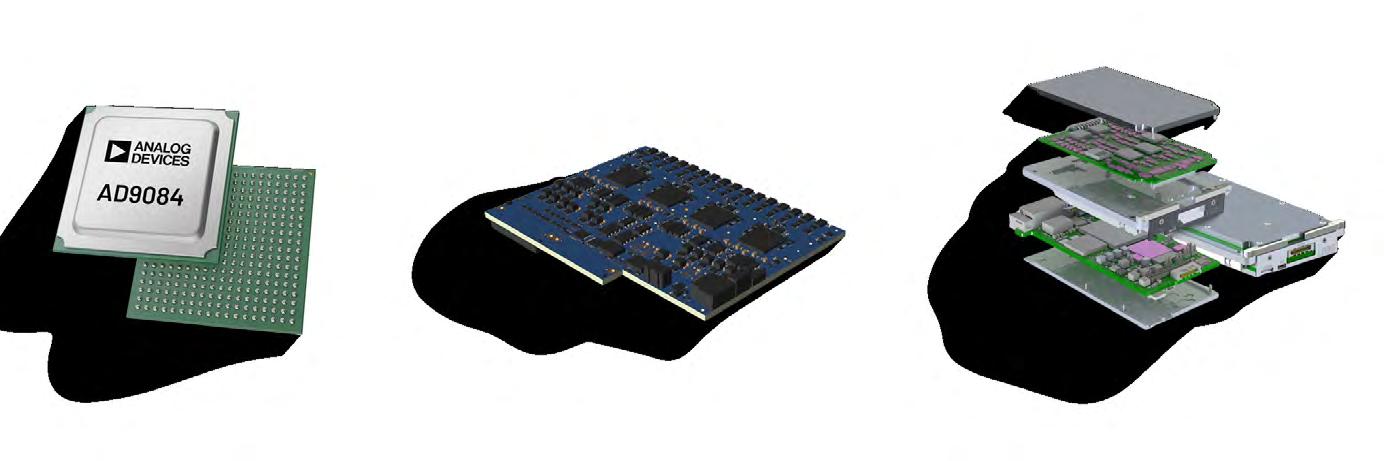
Analog Devices’ commercial off-the-shelf (COTS) software-defined radio (SDR) system-on-module (SOM) digitizers enable customers to deploy high performance distributed sensing techniques at the tactical edge, as quickly as possible.
XMC Interfaces to VPX or Custom Carrier
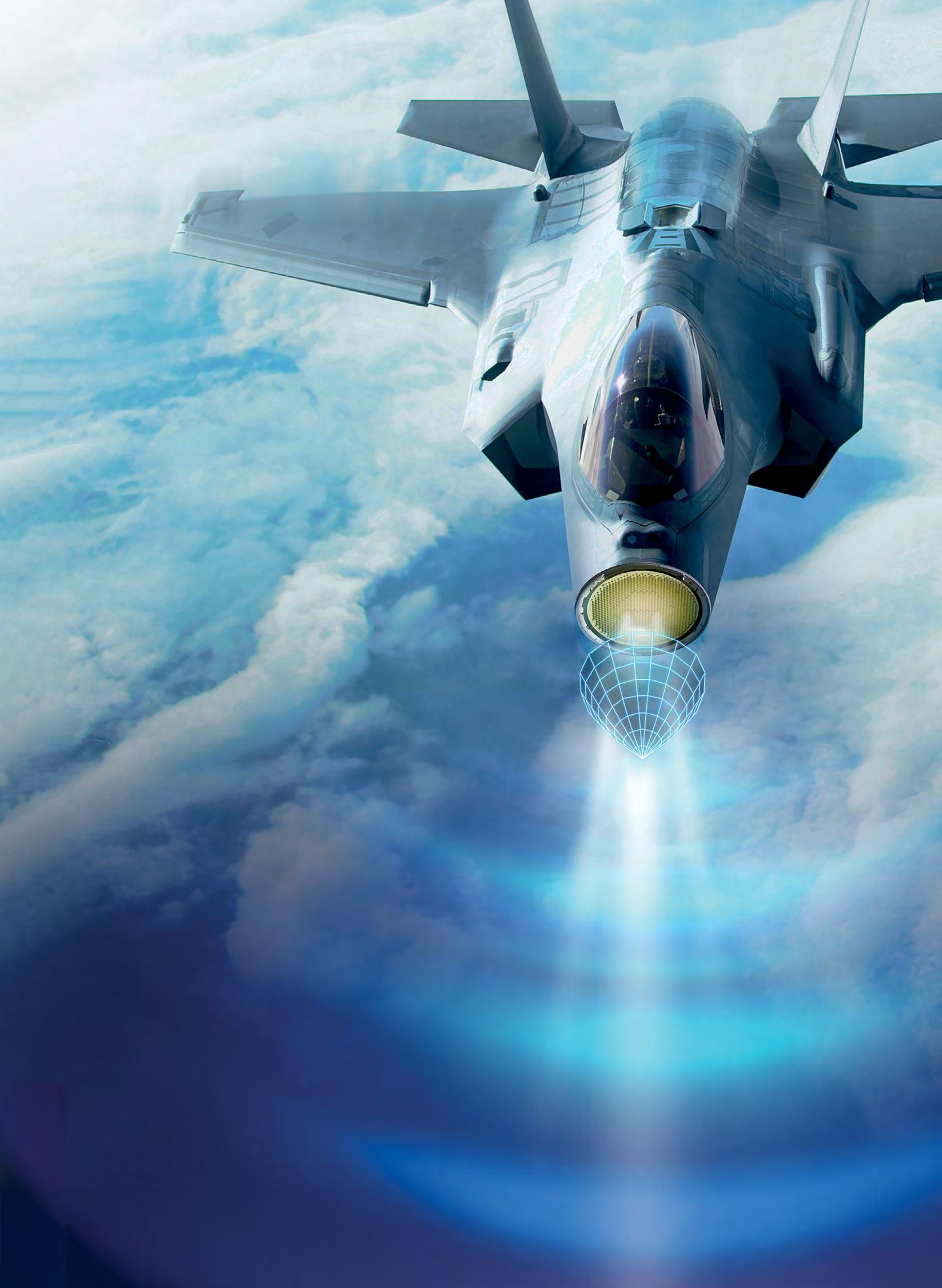
Dual 100G Ethernet, NVIDIA® Mellanox® ConnectX®-7, hardware offloads: RoCE v2, DPDK, GPUDirect, NVMEoF

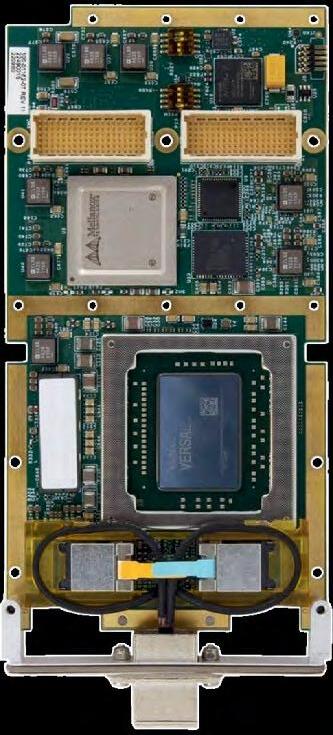

AMD Versal® ASoC: VM1502, VM1802, or VC1902 with hard ARM cores and PCIe Gen4 x8
Up to 8x 1-25G optical ports, front panel MPO or VITA 66.5 backplane I/O
FPGA fabric hosts IP cores for Fibre Channel, ARINC-818, sFPDP, Aurora
Multi-host support: load-balance sensor data across processor arrays
Available in XMC, 3U VPX, PCIe, and PXIe form factors




Editor’s Perspective
7 SOF Week 2026: AI, open architectures, autonomous systems
By John M. McHale III
Connecting with Mil Embedded
31 By Lisa Daigle

Subscribe to the magazine or E-letter
Live industry news | Submit new products
http://submit.opensystemsmedia.com
WHITE PAPERS – Read: https://militaryembedded.com/whitepapers
WHITE PAPERS – Submit: http://submit.opensystemsmedia.com

SPECIAL REPORT: Military satellite communications
8 Checking in on the Mobile User Objective System (MUOS): Q&A with Jason Ferguson, president of W5 Technologies By John M. McHale III, Editorial Director
12 Resilient tactical communications for air and missile defense in contested environments By Dan Moran, Cubic Defense
MIL TECH TRENDS: Ground vehicle electronics (vetronics) designs
16 The vehicle is the computer: Military vetronics enters a new era By Dan Taylor
20 The military’s real AI revolution is happening in the dirt By Adam Sadilek, AIM Intelligent Machines
INDUSTRY SPOTLIGHT: Rad-hard electronics design trends
24 The next frontier: GaN HEMTs for high-reliability space and defense power architectures By Blake Soileau, IR HiRel, an Infineon Technologies Company
28 Hybrid space architectures: Designing across assurance and performance By Bill Dillard, Microchip Technology
©
To unsubscribe,
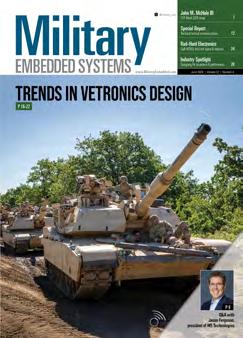
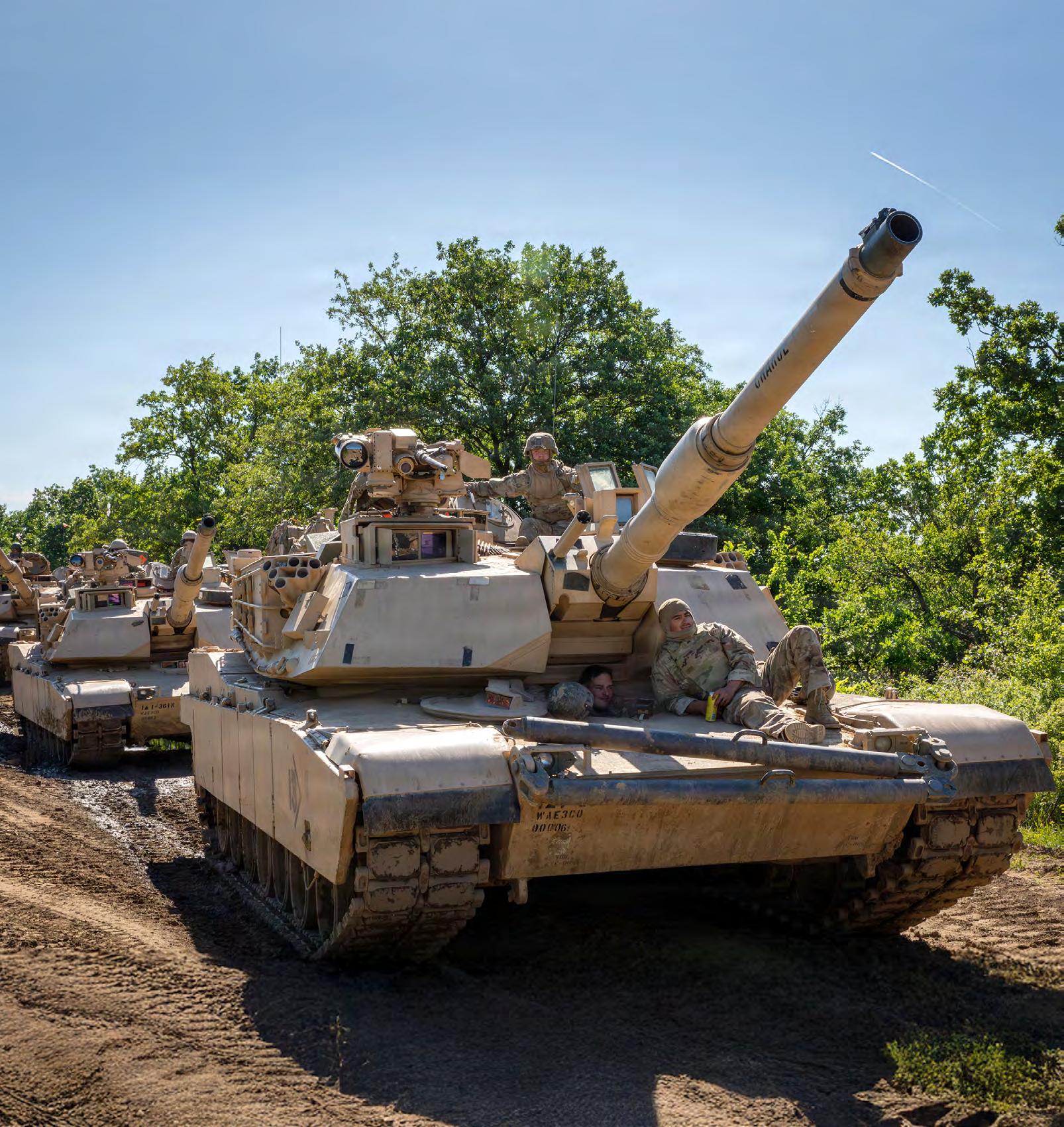
Army ground systems like the M1 Abrams will be leveraging open architectures for future initiatives. In this image, U.S. Army soldiers assigned to Charlie Company, 1st Battalion, 36th Infantry Regiment, 1st Armored Division, zero their M1 Abrams tank’s sighting system during gunnery training operations. U.S. Army image by Spc. Thomas Madrzak.
https://www.linkedin.com/groups/1864255/

Behlman introduces the first test-proven VPX power supplies developed in alignment with the SOSA Technical Standard. Like all Behlman VPXtra® power supplies, these 3U and 6U COTS DC-to-DC high-power dual output units feature Xtra-reliable design and Xtra-rugged construction to stand up to the rigors of all mission-critical airborne, shipboard, ground and mobile applications.
> 6U power module developed in alignment with the SOSA Technical Standard
> Delivers 1050W DC power via two outputs
> VITA 46.11 IPMC for integration with system management
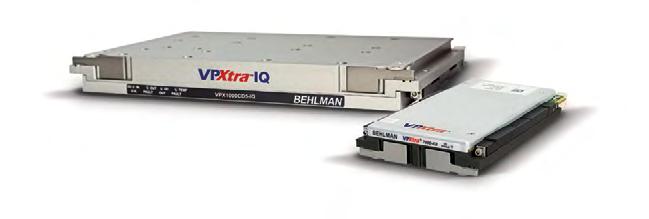
> 3U power module developed in alignment with the SOSA Technical Standard
> Delivers 800W DC power via two outputs
> VITA 46.11 IPMC for integration with system management
Systel
EUROSATORY
June 15-19, 2026 Paris, France https://www.eurosatory.com/en/
Farnborough International Airshow July 20-24, 2026 Farnborough, England https://www.farnboroughairshow.com/
18th Annual GVSETS
August 11-13, 2026 Novi, MI
https://ndia-mich.org/event/gvsets/
Emerging Technologies for Defense Conference & Exhibition
September 9 & 10 Washington, D.C. https://www.ndiatechexpo.org/ https://ndia-mich.org/event/gvsets/
GROUP EDITORIAL DIRECTOR John McHale john.mchale@opensysmedia.com
ASSISTANT MANAGING EDITOR Lisa Daigle lisa.daigle@opensysmedia.com
TECHNOLOGY EDITOR – WASHINGTON BUREAU Dan Taylor dan.taylor@opensysmedia.com
CREATIVE DIRECTOR Stephanie Sweet stephanie.sweet@opensysmedia.com
WEB DEVELOPER Paul Nelson paul.nelson@opensysmedia.com
EMAIL MARKETING SPECIALIST Drew Kaufman drew.kaufman@opensysmedia.com
WEBCAST MANAGER Marvin Augustyn marvin.augustyn@opensysmedia.com
VITA EDITORIAL DIRECTOR Jerry Gipper jerry.gipper@opensysmedia.com
DIRECTOR, SALES OPERATIONS Tom Varcie tom.varcie@opensysmedia.com (734) 748-9660
STRATEGIC ACCOUNT MANAGER Bill Barron bill.barron@opensysmedia.com (516) 376-9838
EAST COAST SALES MANAGER Bill Baumann bill.baumann@opensysmedia.com (609) 610-5400
SOUTHERN CAL REGIONAL SALES MANAGER Len Pettek len.pettek@opensysmedia.com (805) 231-9582
DIRECTOR OF SALES ENABLEMENT Barbara Quinlan barbara.quinlan@opensysmedia.com AND PRODUCT MARKETING (480) 236-8818
INSIDE SALES Amy Russell amy.russell@opensysmedia.com
STRATEGIC ACCOUNT MANAGER Lesley Harmoning lesley.harmoning@opensysmedia.com
EUROPEAN ACCOUNT MANAGER Jill Thibert jill.thibert@opensysmedia.com
EUROPEAN ACCOUNT MANAGER Michael O'Kane michael.okane@opensysmedia.com
TAIWAN SALES ACCOUNT MANAGER Patty Wu patty.wu@opensysmedia.com
CHINA SALES ACCOUNT MANAGER Judy Wang judywang2000@vip.126.com
CO-PRESIDENT Patrick Hopper patrick.hopper@opensysmedia.com
CO-PRESIDENT John McHale john.mchale@opensysmedia.com
DIRECTOR OF OPERATIONS AND CUSTOMER SUCCESS Gina Peter gina.peter@opensysmedia.com
GRAPHIC DESIGN MANAGER Kaitlyn Bellerson kaitlyn.bellerson@opensysmedia.com
Emily Verhoeks emily.verhoeks@opensysmedia.com
By John M. McHale III, Editorial Director John.McHale@opensysmedia.com
The most-read Official Show Daily story during our wall-to-wall coverage of the recent SOF Week 2026 in Tampa reported on the keynote address from U.S. Navy Adm. Frank M. Bradley, commander of U.S. Special Operations Command (USSOCOM), during which he said that the U.S. military’s seizure of Venezuelan President Nicolás Maduro during Operation Absolute Resolve set a new benchmark for how U.S. Special Operations Forces (SOF) will operate in future conflicts.
According to Technology Editor Dan Taylor’s reporting, Bradley called Operation Absolute Resolve – conducted during the night of January 3, 2026 – a defining moment for the command. “It has been, is, and will be the most sophisticated integrated interagency joint force raid ever conducted,” he said. “That is the future of what SOF operations will look like.” Read at https://tinyurl.com/yk4aa7th.
This year’s event was Admiral Bradley’s first SOF Week as USSOCOM commander and was the fourth year of the event co-sponsored by the Global Special Operations Forces (GSOF) Foundation.
It was also our fourth year producing the SOF Week Show Guide and Official Show Daily – a twice-a-day newsletter for attendees. Our team produced more than 80 pieces of content – videos, news, columns, and podcasts – during the week.
During a closing interview with our Show Daily team, GSOF COO Meaghan Keeler said that SOF Week 2026 saw record attendance, with nearly 25,000 people visiting the event. “Because it was the first year of Admiral Bradley as commander of SOCOM, we were focused on meeting his objectives, one of which was to bring in the global SOF community, and he did that on Monday with the International Command Team Forum, where over 70 countries were in the room for a closed-door session to talk about issues important to the active
duty special operations force,” Keeler noted. Watch the interview at https:// tinyurl.com/5c499t4b.
Small-business investment was also addressed by USSOCOM leadership. During an address at the event, USSOCOM Acquisition Executive Melissa A. Johnson told attendees that USSOCOM intends to expand its vendor base by engaging more nontraditional and small businesses in its acquisition and development programs, reported contributing editor Flavia Camargos Pereira.
Pereira reported that during Johnson’s address, the USSOCOM executive asserted that the service is “definitely increasing the ecosystem” with “a lot of venues” to facilitate the access of non-prime contractors to prototype and experiment with the Command. “We are doing everything from sea to space,” Johnson said. “The portfolio is vast, and it covers about eightyish plus programs of record.” Read more at https://tinyurl.com/4edb4a6b.
During her keynote address the second day, Johnson also said that open architectures are a priority for USSOCOM. “Bring us things that can fit within an open architecture, they’re modular, and they’re upgradable,” Johnson said. “Closed systems are now a liability, and for the legacy systems, we have to open those back up, and some might think that’s impossible –I think it’s possible.”
Taylor reported in his story that Johnson identified three non-negotiable technical requirements that apply across the entire portfolio: open APIs [application programming interfaces], flexible payloads, and rapid software refreshes. “Those three things are an absolute must, and that doesn’t matter if it’s an FPV [firstperson view] drone or a gunship – we have to be able to do those software refreshes, we have to be able to equip the operator with the latest and greatest to ensure they can meet the threats,”

she said. Read more here: https://tinyurl. com/3nb3trrk.
Much of the technology news during SOF Week 2026 revolved around artificial intelligence (AI) solutions, different types of autonomous platforms – land, sea, and air – and counter-drone applications.
AI will be critical for the U.S. military to gain an information and cognitive advantage on the battlefield and off it, Bill Wall, CEO and co-founder of Accrete AI Government, told me in a pre-show podcast for the Show Daily. Wall said there is a pressing need within not just the Special Operations community but across the military services and whole government to understand and identify the narrative messages our adversaries are deploying against us. He also says that large language models are not enough, as they are only as good as the information they can access. Listen to our chat at https://tinyurl.com/56ke67rv.
In another pre-show podcast, Peter O’Donoghue, CTO of Tyto Athene, also discussed AI and cybersecurity. He said that within Special Operations, every solution starts with a non-negotiable –cyber and security is never sacrificed for speed, because it doesn’t really matter if the data moves fast but can’t be trusted. Watch the podcast at https://tinyurl.com/ c6wvh8m7.
Autonomous coverage during SOF Week included stories on high-speed combat uncrewed surface vehicles (USVs); cannibal drones; loitering munitions; manportable, tracked uncrewed ground vehicles (UGVs); a passive RF counterUAS [uncrewed aerial system] platform; counter-UAS ammunition; and an interview with Shield AI president Brandon Tseng on enabling UAS operations in GPS-denied environments. Read them all here, along with the rest of our team's SOF Week coverage, at www.military embedded.com/sofweek.
By John M. McHale III, Editorial Director
Jason Ferguson, president of W5 Technologies

The Mobile User Objective System (MUOS) narrowband military satellite-communications system provides warfighters with secure, high-quality voice and data communications. Although it has been successfully deployed for decades, MUOS technology is still not pervasive. During a podcast with Jason Ferguson, president of W5 Technologies, we discussed the history of MUOS, how it fits into the defense industry today, and the efforts to sustain it. For the full interview and Ferguson’s in-depth knowledge of MUOS and W5’s MUOS solutions watch the whole episode here: https://tinyurl.com/5aurv7dn. Edited excerpts follow.
FERGUSON: Thanks for letting us talk about MUOS, which is definitely something we’re very passionate about here at W5. I am the president of W5. As we’re a small company, that means I wear multiple hats, so it can be everything from sales and business development and helping out on engineering challenges to changing the light bulbs in the office.
At W5 our core competency is cellular and modified cellular. Our main focus right now has been on MUOS technologies. We’re the only maker of a MUOS simulator for the satellite and the ground system. Beyond that, we just launched our MUOS gateway product and we’ve been attempting to deal with some of the coverage challenges that the systems have.
MCHALE: Can you provide a brief history of MUOS, its place in the defense industry, and how it differs from other MIL SATCOM [military satellite-communications] systems?
FERGUSON: MUOS fills the narrowband SATCOM role within the U.S. Space Force’s arsenal of satellite-communications systems. The primary mission of MUOS is for the dismounted soldier.
[For background], we’ll go a little bit into the history of narrowband SATCOM, which has been around for decades. Going back to the 1960s or 1970s, we’ve had a capability for narrowband SATCOM capability. Basically if we had two people standing with walkie-talkies, the most we could see is 22 miles and then the curvature of the earth gets in the way. So, for our military, we need to talk beyond 22 miles. We need something or some way to get that RF [radio-frequency] wave to carry. We use satellites for that capability.
Specifically, MUOS uses geosynchronous satellites. The satellites are 22,000 miles away from the surface of the Earth. Traditionally, the previous versions of narrowband SATCOM went from where the satellite in the sky [acted] as a big repeater, so it listened on a frequency and chirped back. It then chirped back the response on another frequency, so everybody could hear what you were saying.
Then to add capacity, we went to a DEMA [double exponential moving average] system and that was like TDMA [time-division multiple access]. We were using time to share the frequency to give us more capacity.
Then MUOS shows up and just blows it out of the water, with 10 times more capacity than the previous system. But with 10 times capacity gain, there’s no free lunch in wireless comms, so we end up with additional complexity to get that extra capacity now on the previous-generation system.
[For example] For the dismounted soldier, he’s got a manpack-size radio with him and he has to stop, deploy a little dish, point it at the satellite, make his call, fold it back up, and then start moving again. So, one of the main requirements for MUOS was onthe-move capability. I want that SATCOM communication, but I want the soldier to be able to move while he’s talking.
A good example in a movie of the legacy way of doing this is the movie “Lone Survivor.” There’s a scene about three-quarters of the way through the movie: Our soldiers are being chased by the bad guys, and you see the soldiers have to stop, pull an antenna out of their backpack, open it up, and then point it. But they had to stop.
So, the first challenge was how do we get the terminal to actually move with the soldier, whether he’s on foot, in a vehicle, or on an aircraft. MUOS works in all of those scenarios now.
[Some thought] the M in MUOS stands for Marine User Objective System, because the Marines love this system – they’ve adopted it. But the M actually stands for mobile. The mobile user was the goal and it has to be small.
For the wideband systems that the Air Force uses, the system fits in a transit case or mounted to the back of a trailer. You need all this power; you need a generator or big battery bank [plus] time to set the dish up and get the link up. MUOS isn’t like that. It was an attempt to bring a cellphone-like experience to the dismounted soldier.
The other benefit of MUOS specifically for narrowband is the frequency range we use. We’re down between 280 and 380 megahertz. So the wave carries and penetrates more than commercial cellular systems, more than Starlink, more than anything.
MCHALE: What about modernization of MUOS? Is there funding for it? How are we going to upgrade the systems?
FERGUSON: If we set out on day one to build [MUOS] in a sustainable way, it would have never been built. The upfront cost was so high that we had to take that risk, knowing that we would have to deal with the sustainability at a later date. Where we are now is dealing with that sustainability challenge.
Some of the boxes are very componentized, if you will, and I’m not talking like a specific board, but a box. We know what the box needs to do. So, they have cleaved off that and had gotten another company to come in and do a replacement.
But really that heartbeat of MUOS, that cellular network – the last effort I saw to reach out to industry for proposals on how to sustain that or modernize it was in 2022 and I don’t think the DoD [U.S. Department of Defense] saw what they were looking for. So those efforts didn’t continue. But as with anything, time’s not friendly to hardware. The hardware’s still getting older every day, and because of the complication, starting sooner than later is better because it gives us engineers more runway to solve the problems.
MCHALE: When it comes to testing of equipment, I understand the government’s going to be shutting down some of their labs. Why are they doing that? And what options will users have for testing and troubleshooting most of the systems? Will you be one of the options?
FERGUSON: Yes. We provide the only option. How did we get into the spot in the first place? Once again, we have these large proprietary cellular systems of that era. And when I say of that era, what people need to understand is these are refrigerator-sized boxes. We didn’t even have multicore processors back then. So all of this magic is happening on single-core processors from the late 1990s, early 2000s era.
The challenge of a cellular provider is they needed to deal with all that sustainability, but they’re a moving target. Every 10 years they’re coming out with a new standard and the cellular providers have to work with their customers – the Verizons and Sprints – to kind of meet up. “Here’s hardware we need to pull, here’s hardware we need to add.”
With MUOS we bought a snapshot in time. We deployed the hardware, but kept one unit back, one ground system to test with, and that resides in the General Dynamics Scottsdale lab. And then there was another government lab that ties back to share that equipment. The original model was people building MUOS terminals would go to these labs, either the government certification lab or the General Dynamics lab, and they would do all their testing.
Well, if you’ve ever tried to develop something remotely, [it means] your engineering staff’s on the road actually developing a complicated piece of equipment. That’s hard. So what we did was we shrank the entire MUOS network and satellite into a portable transit case and we call that our Mighty Moose. A vast majority of integration is happening now on our portable ground station. How we got there is after we got done helping Lockheed and General Dynamics build the MUOS
system, we rolled right into building the portable [solution]. We had the knowledge and capability at that time, so we rolled it forward and we started making smaller MUOS ground systems.
MCHALE: So you got ahead of the requirements knowing they’re probably going that way.
FERGUSON: We had shopped it to the government to say, hey, we think the market’s going to need it, but there was no budget at that time to build it. So we started under the SBIR [Small Business Innovation Research] program.
To deal with specific problems, there’s not a one-size-fits-all base station or the box that sits below the antennas that we all see in our daily lives. Think of it this way: How do you do a tunnel? How do you provide cellular coverage into a tunnel? Well, your normal cell towers aren’t going to see inside. We just don’t have an RF wave that’s going to penetrate all that concrete. So, we make smaller cell sites and stick them up in tunnels or inside buildings or whatnot. So that’s the market that we tried to go after because new people were going to need a way to test it in their facility.
We also knew that there was going to be this large problem with sustainment of the system because it was on this proprietary hardware. And even when you look at that, moving that old software off that system onto a newer system may not really make sense because we’re so far off now.
We knew right away we needed to get on the sustainable hardware because even building a MUOS in a box, we know that the box needs to have a 20-year life cycle,
minimum. Even though MUOS has been live for seven years, people are still buying the old SATCOM equipment. This path to upgrade to a new system was part of MUOS’s headache. It takes seven to 10 years to roll those terminals out.
MUOS is for the dismounted soldier, 100%. But to talk to that dismounted soldier, somebody else needs a MUOS terminal. So, we have to put the MUOS terminal in Humvees and MRAPs [mineresistant ambush protected vehicles]. Every naval ship gets it. Subs get it. Every aircraft is getting it. So now theoretically, anywhere on the globe, any soldier could talk to another soldier [who’s] got a MUOS terminal.
So it speeds up the information-sharing chain, but it takes us time to push all that hardware out to everybody because it’s not like a ship [where] you can just show up on a dock and say, hey, here’s your new radio, go plug it in. They have to do a maintenance window.

Sponsored by Abaco Systems, Curtiss-Wright, DDC-I, Elma Electronic, Kontron, LCR Embedded Systems, RTI, and SV Microwave
The 2026 MOSA Virtual Summit explores MOSA examples like the Sensor Open Systems Architecture, or SOSA, approach; the C5ISR/ EW Modular Open Suite of Standards (CMOSS); and the Future Airborne Capability Environment, or FACE, approach with the aim of studying how they impact signal-processing, software, hardware, AI, and RF designs. Powered by Military Embedded Systems.
(This is an archived event.)
Watch the sessions: https://tinyurl.com/4xfa2vd8

MCHALE: For the embedded components inside your systems, do you leverage commercial hardware and open standards? Do you develop stuff yourself or do you buy off the shelf?
FERGUSON: [Nearly] everything’s off the shelf. There are a few times [when] you’ll run into an engineering challenge and the quickest way to solve it is to just build it from scratch yourself. But because of the lead time, the amount of time that we need to keep this system running, and the systems that we build, we’ve had to rely on the commercial industry because if we said, hey, we need to build custom hardware before we can even start building our software, we would never achieve any of our goals. It’s too big, it’s too heavy a lift. But the amazing part is there’s software-defined radios and industry has really helped us actually exist.
We’re always looking to build in a sustainable way because we are on COTS [commercial off-the-shelf] and we do
know that that’s going to shift [out] from under us constantly, sometimes predictably, sometime not predictably.
MCHALE: Looking forward, what do you see as the game-changer for MUOS systems? Predict the future.
FERGUSON: The first game-changer is once the MUOS ground system is refreshed, we can add capability to those existing terminals and it will feel more performant. We basically need to fix the way data is handled in the network to make it feel more like a 4G or 5G system. Now the data rates aren’t ever going to ger monstrous fast, but for the individual user it would feel better.
On the handset side, there is some incredible stuff: For processing and wideband code division multiple access (WCDMA) signal, FPGA is king, but FPGAs need a lot of power to do its job. For us to shrink what we’ve done, we’ve actually gone back to a DSP. [The DSP] is
really awesome from a power-constraint platform. Our MUOS ground system is more power-efficient [at] handling multiple MUOS terminals than a MUOS terminal. And it’s because of the processors that we chose to run inside that system.
It’s harder to program, but there are some benefits to DSPs because it’s bare metal. That means there’s no operating system; it’s your code executing on that processor directly. It’s harder to code, but we don’t have to deal with moving operating systems.
Some of the new DSPs that are going to hit the market [are] going to be incredible. I think it’s going to change handsets for the dismounted soldier just because right now the guys are carrying around three batteries. I think there [will] be ways to work with these new chips that are coming out down the pipeline, these really specialized DSPs; I think they’re going to make things way more powerefficient. MES

By Dan Moran
As the electromagnetic spectrum becomes increasingly contested, resilient communications are emerging as a foundational requirement for modern military operations. For forces operating in complex air and missile defense environments, maintaining reliable connectivity between sensors, platforms and command nodes is essential for mission success. Modern tactical communications technologies enable resilient networks capable of operating despite jamming, interference and electronic attack. These secure communications solutions – protected satellite communications, tactical radio, emerging 5G/6G networks – help ensure that distributed forces can share data, coordinate operations, and maintain mission continuity in contested environments.
Military operations today increasingly face disruption in the electromagnetic spectrum. Adversaries target communications with electronic warfare (EW), aiming to degrade coordination and
situational awareness. In air and missile defense, maintaining secure links among sensors, decision-makers and weapons systems is necessary for operational effectiveness.
This environment is redefining how forces communicate and operate. Maintaining reliable connectivity is no longer a supporting function; it is a requirement for

executing missions under pressure and sustaining operational effectiveness in contested domains.
Adversaries employ a range of EW techniques to disrupt communications and degrade operational effectiveness. They systematically target communications and positioning, navigation, and timing as a core operational vulnerability through jamming and spoofing in both real combat and large-scale exercises.
GPS and GNSS interference degrades navigation, artillery fire control, and network timing, while spoofing introduces false data that misleads platforms and ISR systems. Adversaries jam tactical voice and data networks to break command and control, often forcing units onto less secure alternatives while increasing
exposure to detection. High-power mobile EW systems further expand contested environments, creating denied areas in the spectrum and increasing the risk of detection and targeting of emitting systems.
These tactics are now widely observed in active conflict, where large-scale EW is used to disrupt communications and GPS, degrading uncrewed aerial system (UAS) operations and affecting broader command and control systems.
Degraded communications quickly disrupt coordination and situational awareness across the force – units lose the ability to share a common operating picture, synchronize actions, and respond to threats in time. For air and missile-defense missions, even brief disruptions can undermine the effectiveness of the entire system.
Air and missile-defense operations are fundamentally a time-critical, networked problem. The kill chain (detect, track, identify, engage, assess) depends on continuous, low-latency data exchange between sensors, command nodes and interceptors.
Modern threats compress decision timelines to seconds. A cruise missile flying at low altitude may provide 60 to 90 seconds from detection to intercept, while a ballistic missile in terminal phase provides even less time. Within that window, sensor data must flow to a battle-management system for correlation and identification, a firing solution must be computed, and an intercept command must reach the appropriate launcher. Every one of these handoffs depends on communications, from data links and voice circuits to identification and network-relay systems.
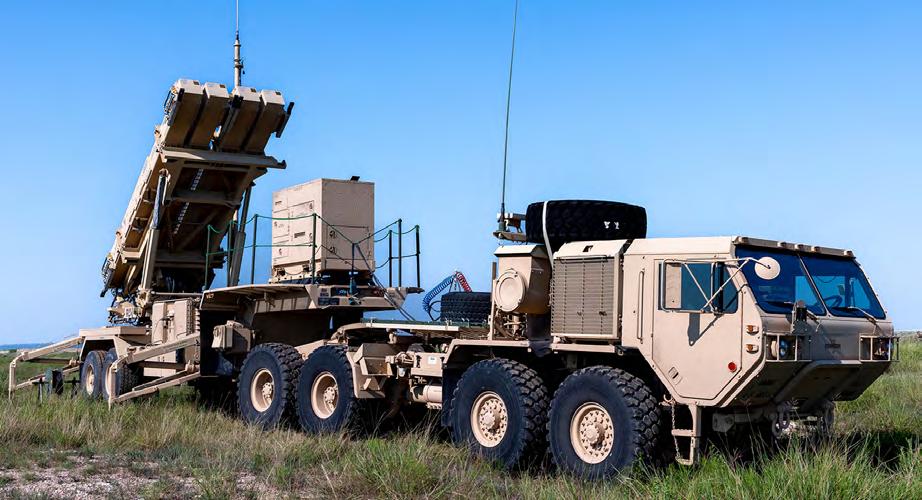
Failures in communications and system integration have had real consequences. During Operation Iraqi Freedom in 2003, Patriot air defense systems were involved in mistaken-identity fratricide incidents that resulted in the loss of coalition aircraft and personnel.
Post-incident analysis by the Defense Science Board identified two primary factors: failures in combat identification and gaps in situational awareness, driven in part by limitations in communications and system integration. Combat-identification systems performed poorly, with identification reliability issues compounded by the density and complexity of the operational environment. At the same time, limited data exchange between Patriot batteries and other systems such as AWACS and Aegis left operators without a complete view of the airspace.
These limitations reduced access to a shared operational picture and contributed to the misidentification of friendly aircraft. The findings demonstrated how systems can operate in isolation when communications architectures are not fully integrated. (Figure 1.)
The lesson is clear: Even when sensors and interceptors perform as designed, the absence of resilient, integrated communications and data-sharing architectures degrades decision-making and increases the risk of mission failure.
CJADC2 and joint interoperability
The ability to operate across services and allied partners hinges on communications architectures that are both interoperable and survivable in contested, degraded and operationally limited environments. The U.S. Department of Defense (DoD) Combined

Joint All-Domain Command and Control (CJADC2) framework treats resilient communications as foundational, with the strategy requiring command and control systems that remain effective in degraded and contested electromagnetic environments while enabling mission partner information-sharing at scale.
Across the services, this approach is driving a shift toward integrated, networkcentric operations. Programs such as the Navy’s Project Overmatch, the Air Force’s Advanced Battle Management System, and the Army’s Integrated Battle Command System reflect a broader move toward architectures where sensors, decision-makers and effectors operate as part of a connected network rather than as standalone systems.
This shift is supported by a range of enabling technologies shaping modern tactical networks:
› Protected tactical satellite communications can extend resilient communications beyond line-of-sight, helping maintain connectivity when terrestrial networks are disrupted.
› MIDS-JTRS [Multifunctional Information Distribution System –Joint Tactical Radio System] continues to provide Link 16 and multichannel data exchange across a wide range of platforms, supporting interoperability across joint and coalition forces.
› DARPA’s STITCHES [SOS Technology Integration Tool Chain For Heterogeneous Electronic Systems] framework enables data exchange between systems that were not originally designed to interoperate, supporting rapid integration across platforms with different data formats and architectures.
› Mesh networking technologies at the tactical edge create self-forming and self-healing networks that maintain connectivity even when nodes are degraded or lost. Edgecomputing capabilities enable data processing closer to the point of
action, reducing reliance on reachback connectivity and supporting operations in denied environments.
› Emerging 5G/6G capabilities are also being evaluated as part of NATO and U.S. efforts to support high-bandwidth, low-latency communications integrated with existing military networks and standards.
Together, these technologies enable communications architectures that can integrate across systems while maintaining security and reliability, enabling forces to operate as a unified network rather than as isolated elements.
Resilient communications and mission continuity
As adversaries target networks with EW, the ability to sustain connectivity determines whether forces can coordinate and execute operations under pressure.
In air and missile defense, this requirement is especially acute. When communications degrade, the effects cascade across the kill chain, disrupting situational awareness and delaying response timelines. Resilient networks mitigate this risk by ensuring data continues to flow even when portions of the system are contested or degraded.
This requirement extends across multidomain operations. Forces rely on networks that can adapt in real time, reroute data, and maintain connectivity across multiple pathways, all of which enable operations to continue even when individual links are disrupted.
Resilient communications technologies are supporting operations across a range of mission environments, from air and missile defense to distributed sensor networks.
In air and missile defense, networked architectures enable real-time data sharing between sensors and interceptors, supporting more flexible engagement decisions in time-compressed scenarios. Across broader operations, resilient communications allow forces to sustain coordination even when portions of the network are degraded, ensuring missions can continue under contested conditions.
In modern military operations, secure communications are essential for maintaining reliable connectivity during electronic attacks and degraded conditions. The ability to sustain secure and dependable communications will increasingly determine mission success. MES

Dan Moran, Ph.D., is Vice President and General Manager of Secure Communications at Cubic Defense, where he leads the development of advanced, mission-critical communications solutions. He brings more than 20 years of experience across the defense and technology sectors, with prior leadership roles at Collins Aerospace, Amazon, and Raytheon. Moran holds a Ph.D. in mechanical engineering from Texas Tech University.
Cubic Defense https://www.cubic.com/defense

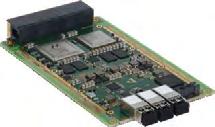
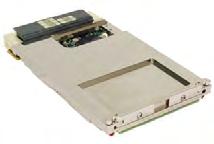
Ensure mission success with our integrated solutions aligned to SOSA® Leveraging open standards, Elma’s systems meet the MOSA mandate to deliver rapid integration, superior interoperability, reducing overall costs.
We're empowering warfighters with proven capabilities ready, for tomorrow's challenges.

Ground vehicle electronics (vetronics) designs
By Dan Taylor
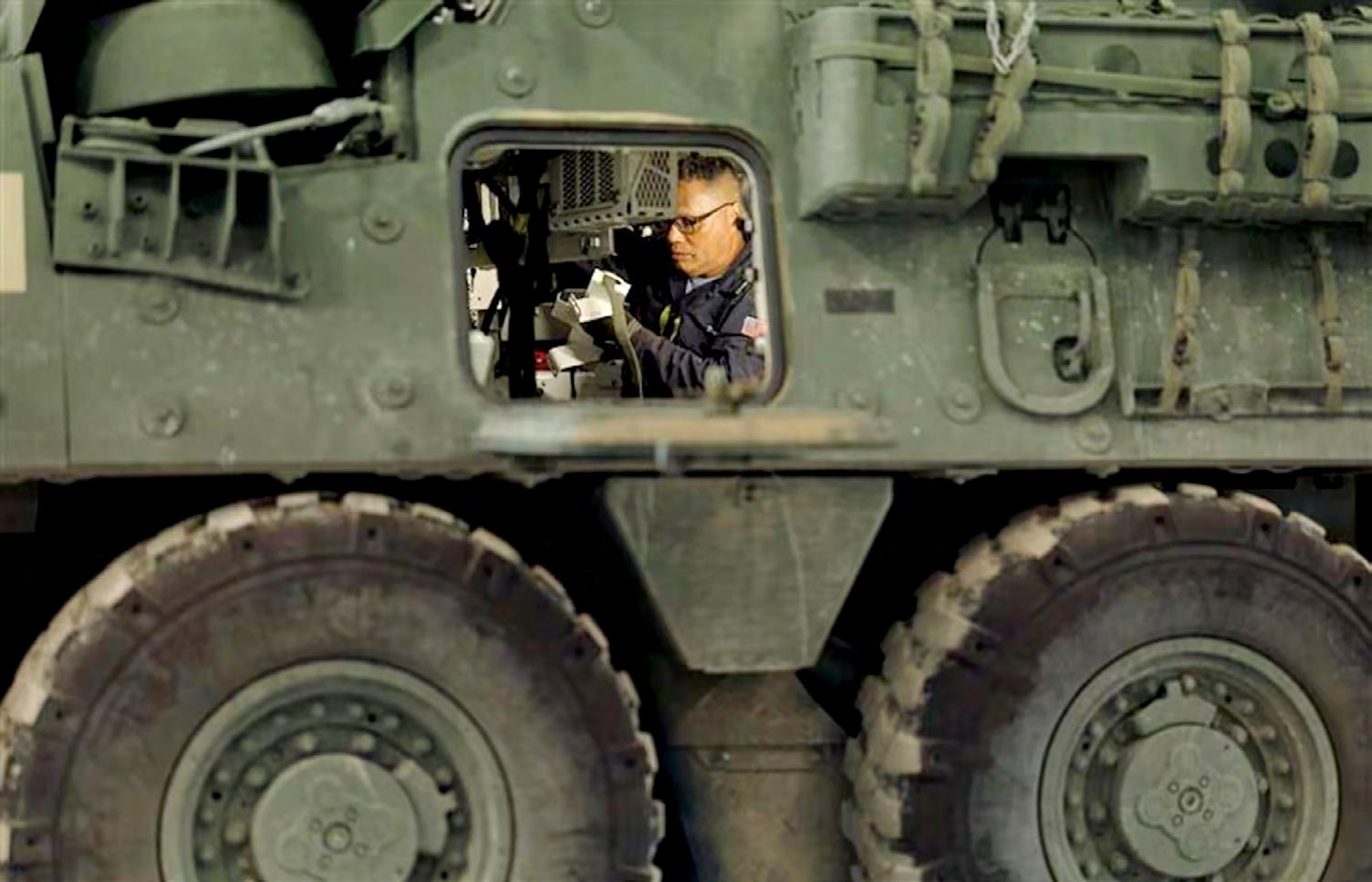
Today’s combat vehicles are being redesigned around their electronics, not the other way around. The compute backbone, the sensor architecture, the data fabric linking systems across the formation: these are no longer features bolted on after the fact but are actually the platform. The companies supplying them are being asked to solve problems that look less like ruggedized hardware integration and more like building a real-time data center that has to operate under armor, in contested environments, and inside the power/thermal/shock/vibration limits of a combat vehicle.
The original meaning of vetronics, or vehicle electronics, described a fairly narrow problem: getting electronics such as power management, subsystem control, and a handful of displays to survive in a vehicle. Electronics were added onto a vehicle after the mechanical design was finished – useful additions, but not the point. That era is over, say industry experts.
“[Today’s military vehicle] is a software-defined combat node in which the computing infrastructure is the platform,” says Charlie Niles, vice president of business development at Leonardo DRS (Arlington, Virginia).
The data problem
This shift happened over the years because the battlefield generates more data than any previous vetronics architecture was designed to handle.
Today’s armored vehicles operate inside a sensor environment that previous generations couldn’t have imagined: Data is pouring in from optical and thermal
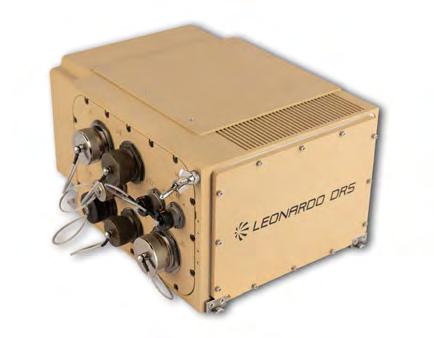
Figure 1 | The Leonardo DRS THOR –a SOSA aligned 3U VPX high-performance compute chassis engineered to MIL-STD-810, 1275, 461, and 2404 standards – is designed to deliver AI/ML inference, sensor fusion, EW, and secure communications at the tactical edge. Image via Leonardo DRS.
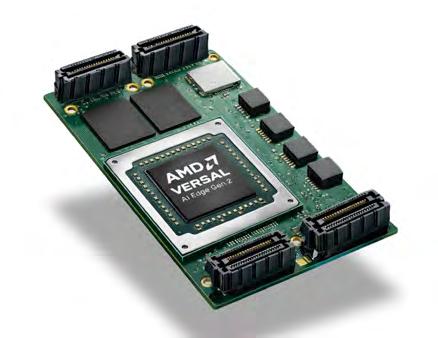
Figure 2 | New Wave Design’s V3211 Versal Gen 2 SOM, a double-width QMC module built around the AMD Versal AI Edge or Prime Gen 2 Adaptive SoC, enables highdensity heterogeneous computing for vetronics applications. Image via New Wave Design.
sights, radar, acoustic detection, electronic warfare (EW) receivers, assuredPNT [position, navigation, and timing] inputs, and feeds from unmanned systems, all arriving simultaneously at the edge. In a contested environment, adversary jamming will target those very links at the worst possible moment.
“That data volume cannot be moved offplatform for processing in a contested environment and then moved back onto platform for instantaneous decisions; also this data cannot be handed to the crew in raw form without overwhelming them,” Niles says. “It has to be processed inside the vehicle, at the edge, in real time.”
This requirement has redefined vetronics. Where the discipline once centered on discrete subsystem controllers, it now encompasses the entire digital nervous system of the vehicle – sensor fusion,
video distribution, vehicle survivability, artificial intelligence (AI) inference, networked communications, and crew/machine interfaces running concurrently, under armor, at temperatures and vibration levels that commercial data center designers don’t have to think about, he explains.
For these applications, Leonardo DRS engineers developed the THOR chassis to help solve the problem of too many mission functions, too little space. Rather than fielding a separate box for AI processing, another for sensor fusion, another for electronic warfare, and another for communications, THOR is designed to host all of them in a single 3U VPX chassis built to military environmental standards. Internal data rates run as fast as 100 Gbps. The chassis is also aligned to the Sensor Open Systems Architecture, or SOSA, Technical Standard, meaning new processing cards and payloads can be swapped in as technology advances without redesigning the underlying infrastructure. (Figure 1.)
Describing the scope in similar terms, Jake Braegelmann, vice president of business development at New Wave Design (Eden Prairie, Minnesota), says: “Today’s vetronics environment includes EO/IR [electro-optical/infrared] sensing, sensor fusion, autonomy support, integrated moving maps, EW and communications coordination, assured-PNT functions, and countermeasure management. (Figure 2.)
“These capabilities are no longer isolated subsystems,” he says. “They are interconnected and increasingly expected to operate collaboratively across the platform and with external battle-management networks.”
The proliferation of unmanned systems adds still another layer. Uncrewed ground vehicles and aerial drones on the battlefield generate additional sensor data that has to be consumed and acted on in near-real time. The vehicle crew is no longer just managing what it can see from the hatch but is in fact managing a network.
SWaP constraints have always been a challenge in airborne systems – now they are arriving in ground-vehicle programs with comparable force.
When everything on the vehicle is connected, integration stops being a matter of plugging in boxes and starts being a systems architecture problem. The challenges compound in ways that aren’t linear.
“Doubling the number of sensors does not double the architectural complexity, it multiplies it,” Niles says.
Every new capability draws power, generates heat, demands bandwidth, and competes for finite space inside an armored hull. The traditional answer – a dedicated box for each mission function – no longer scales; there are simply too many functions, and the vehicle can’t carry the weight, volume, or power draw that the old mission model demands.
Mark Littlefield, director of system products at Elma Electronic (Fremont, California), describes the change in design philosophy: “We’re shifting from a stovepipe solution model of systems to a multifunction platform model. Computing, networking, and communications resources are shared among various functions, meaning functions performed by the electronics shift, as needs evolve. No more bespoke systems shoved
into a corner of the vehicle to do some specialized task – suppliers need to bring interoperability and flexibility to the platform or risk limiting their value.” (Figure 3.)
Braegelmann points to size, weight, and power (SWaP) as a constraint that has arrived in vetronics with a force previously felt mainly in airborne systems.
“The addition of more sensors, self-protection capabilities, counter-UAS [uncrewed aerial system], AI, directed-energy systems, and improved navigation and mobility capability has pushed weight and power demand into the modern ground vehicle fleet,” he says. “Smaller, lighter, and more power-efficient computing solutions are being sought to support the mission and continuously improve survivability.”
Open architecture: from policy to engineering reality
Because of these realities, open standards are becoming the order of the day. The U.S. Department of Defense (DoD) has made it clear that it expects the industry to focus on open architecture systems rather than on closed boxes. What’s changed is the pace at which that policy is translating into actual hardware – fielded systems, prototypes, and program offices standing up around CMOSS Mounted Form Factor (CMFF) and Next Generation Command and Control (NGC2).
For the defense industry, the significance of open architecture goes beyond compliance and has become the mechanism by which a vehicle’s electronics can keep pace with threats that evolve faster than any traditional acquisition cycle can accommodate.
“A vetronics system designed around proprietary interfaces is obsolete the moment it is fielded,” Niles says, “because every capability upgrade requires chassis redesign, software rework, and full system requalification – a process measured in years, a luxury that the force does not have.”
Standards like CMOSS, VICTORY, MORA, NGVA, and the SOSA Technical Standard change that equation by establishing common electrical, mechanical, and software interfaces that enable new processors, AI accelerators, and mission payloads to be inserted as they mature but without redesigning the chassis or rewriting the integration layer. Niles says the result is “a sustainment model in which the architecture absorbs emerging capability rather than aging against it.”
Littlefield uses an analogy that translates the concept for anyone who has ever upgraded a laptop: “Think of your laptop or desktop: Do you run a single application on each, or does each have many applications? You add or upgrade capabilities by adding peripherals or specialized hardware – USB devices, graphics cards –that get shared by the different applications you run. The same goes for vehicle electronic systems.”
Braegelmann points to concrete examples of what that flexibility looks like in practice. When threats evolve rapidly, a software-defined radio (SDR) in a shared mission processor can be swapped out to counter the risks far more quickly than a traditional integration cycle would allow.
“New software ‘skills’ can be quickly introduced via new 3U VPX processors into an existing computer chassis infrastructure,” he says. “These types of upgrades used to require a significant development and integration effort, which now can be turned in a much shorter timeline through industry-acknowledged slot profiles and other open system approaches at the module and chassis level in embedded computing.”
Open interfaces create cybersecurity challenges: That is, the more capable the vehicle’s digital architecture, the more consequential a successful intrusion becomes –
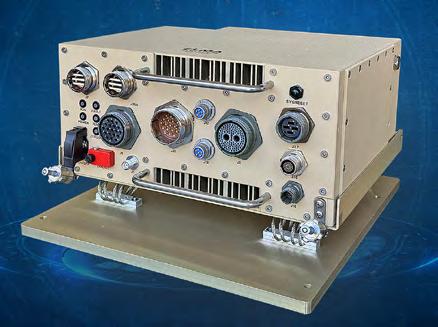
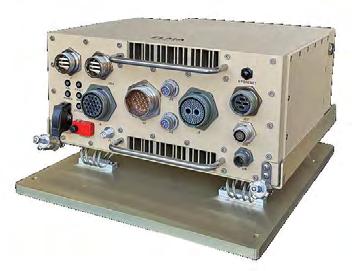
3 | Elma’s deployable CMOSS and SOSA aligned CMFF SAVE-compliant chassis enables rapid technology insertion and reduces sustainment costs in ground combat and tactical vehicles. Image
and the more entry points an adversary has to try.
“Every networked compute node on the vehicle is a potential attack surface; highperformance edge processing cannot come at the cost of platform vulnerability,” Niles says. “That requires cybersecurity built into the architecture from the silicon up – secure boot, encrypted data paths, hardware roots of trust, and continuous monitoring – rather than added on at integration.”
Supply-chain assurance has emerged as its own parallel challenge. The commercial demand surge in AI compute power has created sustained pressure on the availability of advanced processors, accelerators, and memory – pressure that echoes the disruptions the industry experienced during the COVID-19-era semiconductor shortage.
“Lead times have extended and unit costs have risen,” Niles acknowledges. “Responsible vetronics suppliers are responding with deeper supplier qualification, strategic inventory positioning, multisource design where the architecture allows, and contract structures that protect program schedules against component-level volatility.”
Littlefield frames the cybersecurity and supply-chain challenge as fundamentally perpetual. “We want and need an open market with many suppliers, so that there’s a constant pace of innovation and robust competition to keep prices reasonable,” he says. “But the sensitive nature of cybersecurity and the
relentless problem of securing the supply chain means that suppliers always have to be on top of their game and provide the integration community with the best tools and assurance that their supply chain is sound.
“It’s not an ‘OK, I’ve developed that, now I can move on to other things’ – it’s perpetual,” he adds.
Power and thermal constraints
No matter how capable a new sensor or AI accelerator might be, it won’t reach the field if it can’t fit within the vehicle’s power budget and thermal envelope. SWaP constraints have always been a challenge in airborne systems – now they are arriving in ground-vehicle programs with comparable force.
“Performance that cannot fit in the vehicle is not performance – and processing capacity that the crew cannot exploit is not capability,” Niles says.
The SWaP arithmetic is unforgiving: Every additional sensor, every new networked feed, every step up in AI inference demands more power and generates more heat. Armored vehicles have fixed power budgets, finite cooling capacity, confined crew compartments, and no tolerance for additional weight that compromises mobility or survivability. Nile says the answer is not less capability, but rather capability that solves the SWaP problem at the architecture level, before the hardware goes in.
Littlefield notes that the emergence of robust standards-based, out-of-band system management is helping address power and thermal challenges in ways that weren’t previously available. “Like cybersecurity, system management is not a central part of the mission, but it helps to keep the electronics healthy and a part of the fight, and is thus critical to the success of the platform and system,” he says.
The platforms that will succeed operationally, Niles asserts, will be those that consolidate multiple mission functions into a single compute chassis, design for power efficiency from the silicon up, and
push AI-enabled automation as the mechanism that turns raw sensor volume into a manageable operational picture.
The Army’s CMFF program became a formal acquisition effort in 2025, with rapid-prototype OTAs awarded to General Dynamics Mission Systems and Pacific Defense. The NGC2 program office stood up the same year, followed by a major prototype Other Transactional Authority (OTA) to Team Anduril, creating what the Army describes as an ecosystem for transport, infrastructure, data, and applications. MAPS Gen II received its full-rate production decision in March 2025 and was already fielding by September of that year. The M1E3 Abrams battle tank – justified in part as an upgradable digital platform built around open architecture and governmentowned technical data – unveiled its first early prototype in early 2026.
For suppliers, the message from these programs is consistent: The Army is buying architecture, not just bolting on boxes. The chassis is preplumbed and its interfaces are defined, while the capabilities arrive on cards and in software updates. What the Army is purchasing, increasingly, is the ability to insert new capabilities quickly – and the vetronics suppliers best positioned for the future are the ones that have internalized that logic at every level of their design.
“The transition from a platform-centric model to a data-centric and network-centric operational approach requires more computing at the edge,” Braegelmann says.
The vehicle’s electronics are no longer supporting the fight but are – in a real sense –central to the fight. MES

Ground

By Adam Sadilek
As the U.S. Department of Defense (DoD) accelerates the adoption of deployable technologies through the expansion of nontraditional procurement pathways, the next step is scaling them. One of these is autonomous earthmoving, which has already demonstrated success in fielding across military branches and training units for effective deployment. Unlike other new autonomous capabilities, the challenge isn’t testing an experimental technology, but rather scaling a proven one.
In 1947, U.S. Navy Admiral William F. Halsey reflected on how the U.S. won World War II with a surprising assessment: “If I had to give credit to the instruments and machines that won us the war in the Pacific, I would rank them in this order: submarines first, radar second, planes third, bulldozers fourth.”
The surprising choice to include bulldozers spotlights a truth about military operations that remains as important today as it was 80 years ago: Defense infrastructure is not optional. The Navy’s Construction Battalions, the legendary “Seabees,” rapidly constructed airfields, ports, and bases for World War II Pacific island-hopping campaign. Without their work in the dirt, the U.S. victory would have come at a higher cost or might have been impossible.
The ability to construct on the battlefield is just as important today as it was for Caesar’s legions that crossed the Rhine. Yet the ability to rapidly build that infrastructure while under contested conditions has lagged behind other advances in military capabilities. Autonomous earthmoving systems have arrived to solve this critical gap. These artificial intelligence (AI)-powered heavy machines aren’t concept vehicles: They
are already operational and in use today to clear minefields, rebuild runways under fire, and construct forward bases without risking warfighter lives.
Recent conflicts demonstrate the immense impact of infrastructure vulnerability; one instance is seen in Ukraine, where destroyed bridges and roads cause repeated disruptions to key operations. Quick construction or repairs of supply routes and runways can prove decisive. However, these are some of the most dangerous military tasks, requiring extended exposure in contested environments.
Technologies, systems, and materials to accelerate unmanned platform development, and autonomous systems to clear or breach obstacles, cross gaps and rivers, improve combat roads/trails, and detect dynamic mobility hazards in complex environments are required across the U.S. Department of Defense (DoD). One example already in wide use is the U.S. Army Engineer Research & Development Center (ERDC), which for several years has conducted research in “Autonomous Robotic Solutions for Engineer Operations in the Deployed Environment.”
Under Agile Combat Employment (ACE), the U.S. Air Force is required to establish and maintain bases in austere and remote locations within the weapons engagement zone of adversaries. This approach will require autonomous systems for infrastructure improvement, construction of defenses, and for airfield and other installation repair during combat operations.
The Army, Navy, and Marine Corps have also recognized that integration of autonomy into heavy equipment (material handling, construction and other ground logistics systems) supports movement of supplies & other logistics, mine and route clearance operations, construction of obstacles and defensive positions, Airfield Damage Repair (ADR), OCONUS construction and associated earthmoving to build airstrips, housing, and bases to support U.S. military logistics, and humanitarian assistance – building and rebuilding infrastructure in nations devastated by war or natural disaster. Being able to automate parts of the logistics “chain” with autonomy allows for fewer soldiers being put in harm’s way.
Autonomous earthmoving is a game-changer and has achieved maturity, requiring immediate fielding at scale to address these types of challenges. These are production systems retrofitted onto existing military equipment that can operate without onboard operators or human oversight – bringing speed and resilience to repairs, construction, and maintenance of infrastructure in hostile environments. Construction tasks that once exposed engineers to fire are now carried out with autonomous equipment, while personnel can direct the operations from protected positions. Runway repairs can proceed continuously through day or night, in the most extreme weather, and in contested or contaminated environments. Powerful AI capabilities conduct rapid damage assessment and create 3D maps of sites, giving commanders real-time status updates while the machines remove hazardous debris and ordnance to return damaged infrastructure to operation more quickly.
Operating without internet or GPS, these machines are virtually immune to jamming and hacking when traditional systems fail, making them purpose-built for the DDIL environments: a top priority for U.S. military leadership. Autonomy runs locally on ruggedized hardware, using hardened cameras and high-tech sensors that are capable of handling complex terrain reliably while maintaining precision-level accuracy. In fact, performance can exceed that of human operators in most conditions within a short period of time, thanks to end-to-end learning capabilities that enable machines to get smarter with each dig. (Figure 1.)
These capabilities, coupled with the fact that AI doesn’t need rest or sleep, significantly exceed human capacity, where protective equipment, outside threats, and physical limitations could degrade performance.
Mission-proven across multiple domains
Autonomous earthmoving applications span the full spectrum of military needs and are in active operation today. AIM Intelligent Machines worked with the U.S. Army Sandhills Project “Future Breaching Experiment” to deploy unmanned robotics systems for remote breaching of obstacles, working alongside the 20th Engineer Brigade, XVIIIth Airborne Corps at Ft. Liberty, NC. The purpose of the Sandhills Project was to train soldiers on how best to employ unmanned robotic systems for the remote breaching of obstacles. Currently, the Army uses manned systems to clear and proof breach lanes, using M58 Mine Clearing Line Charges (MICLIC) to detonate mines in the breach lane, followed by soldiers operating equipment to clear and proof the lanes.



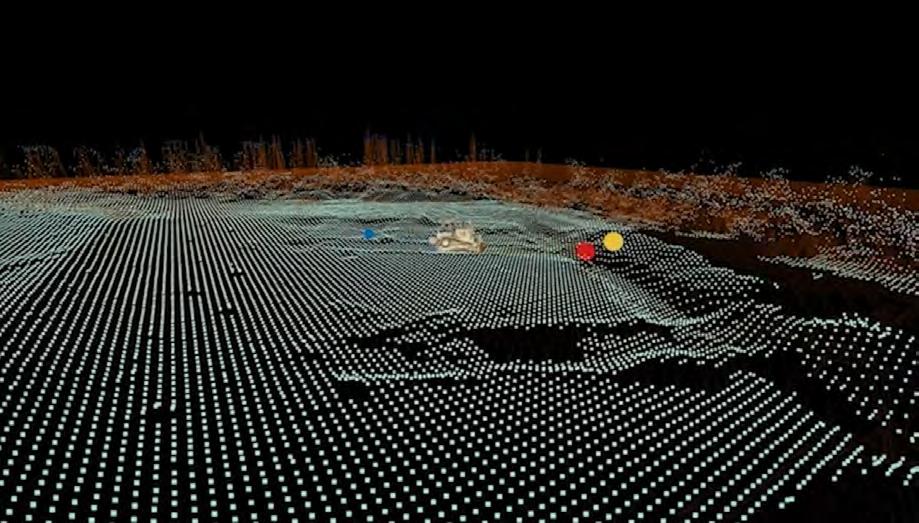
The 20th Engineer Brigade deployed an Army D7 Dozer with an autonomy applique kit, providing full autonomy to conduct the same operation, while preserving the capability for remote operation. The applique kit was installed without permanent modification to the dozer. The autonomous D7 dozer participated in operations involving live fire and live detonation of mines. This demonstration was conducted at the U.S. Army’s Joint Readiness Training Center (JRTC), Ft. Johnson, LA, in March 2024.
Previous operations used manned systems with mine-clearing charges followed by soldiers operating equipment to clear and proof lanes. Now, autonomous bulldozers can clear known or suspected minefields or obstacles at speeds far exceeding manual methods to create safe lanes. The absence of a human operator eliminates the risk of casualties from mine detonation: a risk that has historically made these operations among the most dangerous in military engineering.
These AI-powered heavy machines are also being deployed by the U.S. Air Force for remote and airfield construction and repair. These machines are being used for rapid airfield damage recovery (RADR) operations and can even be airdropped into remote locations where parachutes are the only way in. Once on the ground, these machines conduct a rapid damage assessment using sensors to create a 3D map of the airfield and begin to remove debris and ordinance, repairing the airfield to remotely return it to operation without putting U.S. personnel in harm’s way.
The operational track record for these autonomous earthmoving machines now spans multiple deployment environments and mission types. Across both military and commercial deployments, these systems have logged three years in the field of autonomous operation across varied terrain and weather conditions. Equipment has performed in temperatures ranging from Arctic cold to desert heat, in dust storms and heavy rain, day and night. Several years of operational history provides the reliability data that allows confident deployment at a larger scale and validates the technical approaches underlying the autonomous systems.
the military’s AI revolution from the ground up
Autonomous earthmoving has emerged as one of the few physical AI advancements that is both proven in the field at technology readiness level (TRL) 9 and fully operational in production environments today. These systems are already moving dirt, building infrastructure, and reducing warfighter risk across military operations in real-world scenarios. These ready-to-deploy systems directly address the U.S. Department of Defense’s (DoD’s) contested logistics crisis by dramatically reducing
manpower burdens and accelerating the delivery of critical infrastructure under fire. With AI-powered heavy machines, the so-called Tyranny of Distance challenge – which details the strategic and logistical obstacles posed by vast maritime expanses and escalating strategic competition – is transformed from an existential threat into an operational advantage.
As the DoD accelerates the adoption of deployable technologies through the expansion of nontraditional procurement pathways, the next step is scaling these capabilities. Autonomous earthmoving has already demonstrated success in fielding across military branches and training units for effective deployment. Unlike other new autonomous capabilities, the challenge isn’t testing an experimental technology, but scaling a proven one.
Admiral Halsey understood that winning wars requires infrastructure to employ weapons and execute operations safely and effectively. That truth remains valid, but the way to get that work accomplished has been revolutionized. Bulldozers and excavators can now operate autonomously, working around the clock in dangerous environments without risking the safety of warfighters and engineers. The equipment is proven in the field, so what remains to be seen is how quickly the U.S. can scale autonomous earthmoving to overcome the military’s most pressing challenges. The next global conflict may depend on it. MES

Adam Sadilek is the founder and CEO of AIM Intelligent Machines. Before founding AIM, he had a decade-long tenure at Google during which he led engineering on self-driving cars (now Waymo) and on planetary-scale artificial intelligence (AI) systems. Adam holds a Ph.D. in AI from the University of Rochester and has been published in Nature and Science.
AIM Intelligent Machines https://aim.vision/
Delivering Powerful RF Spectrum Intelligence and Geolocation at the Tactical Edge
The FASST 6000 Spectrum Sensor represents Silvus Technologies’ expansion beyond MANET radio communications and mesh networking into advanced RF sensing and spectrum awareness. Designed to operate at the tactical edge, FASST 6000 delivers ultra-low SWaP RF Spectrum Intelligence capabilities that dramatically enhance situational awareness for the modern warfighter and unmanned systems operators.
Consistent with Silvus’ product philosophy, FASST 6000 is powered by a purpose-built integrated circuit designed from the ground up, representing the culmination of more than a decade of focused research and development. FASST 6000 is available as a rugged handheld unit for dismounted operators or an OEM module for integration into unmanned systems applications.
When integrated with the StreamCaster® MANET mesh network, FASST 6000 delivers the real-time situational awareness warfighters need to dominate contested environments. This ultralow SWaP system packs the power of a much larger device into a tactical form factor, allowing operators to reprogram scan parameters on-the-fly to maintain a decisive edge in signal intelligence.
FASST (Filtering by Aliasing Spectrum Sensing Technology) is a groundbreaking, proprietary RF signal processing technique that enables the sensor’s capabilities, delivering industryleading spectrum scanning speed of 144.5 THz/sec. This allows FASST 6000 to perform near-instantaneous measurements from 1 MHz to 6 GHz across multiple coherent antenna ports. The result: reliable detection of extremely short-duration, lowpower, or low-duty-cycle RF transmissions.
FASST 6000 is capable of high-speed spectrum scanning, signal detection, recording, and direction finding (DF). When paired with a DF antenna head, it provides accurate line-of-bearing to RF emitters, and with three or more networked sensors, enables real-time triangulation for precise geolocation. From dismounted SIGINT and airborne counter-UAS ELINT operations to wide-area distributed RF monitoring, FASST 6000 empowers users to realize a common operational picture across the electromagnetic battlespace.
A major challenge in networked RF sensing is self-interference –where the communications radio overwhelms the sensor it’s connected to. FASST 6000 is purpose-built to solve this. Engineered for synchronous operation with Silvus MANET radios, it automatically identifies and filters out emissions from the radio it’s networked with. Unlike legacy approaches that rely on physical separation – such as running long Ethernet cables to avoid interference – FASST 6000 eliminates the problem at

the source. Its high-speed scanning enables it to capture and deliver clean, actionable data without contamination from the host radio signal. The result is reliable, persistent sensing performance in fully integrated, networked EW environments.
To support rapid integration and mission-specific customization, FASST 6000 includes a flexible, developer-focused API with three primary data capture modes: IQ, FFT, and Correlation.
In its default operating configuration, FASST 6000 can detect single-millisecond transmission events, while allowing users to dynamically reprogram parameters such as dwell time, scan speed, instantaneous bandwidth, and RF bands of interest. Native IP and USB interfaces, combined with embedded processing, allow for rapid deployment as either a standalone asset or a component of a larger distributed sensing architecture.
With a scanning speed of 144.5 THz/sec, FASST 6000 is the fastest spectrum scanning sensor on the market, outperforming competing systems by more than 100 times while remaining signifi cantly smaller, lighter, and more cost effective. This unique combination of speed, size, and effectiveness makes FASST 6000 ideally suited for dismounted troops, mobile platforms, and small unmanned systems operating in dynamic and contested RF environments.
FASST 6000 Delivers a Higher Probability of Detecting, Intercepting, Exploiting, and Geolocating RF Emitters


By Blake Soileau
The space and defense industries face the critical challenge of delivering enhanced compute power in compact, efficient packages without compromising reliability or performance. In defense-related applications, in-orbit computing is the backbone of rapid-response superiority, enabling real-time imaging and communication. Gallium nitride (GaN) high-electron mobility transistors (HEMTs) are emerging as a transformative technology for these high-reliability sectors.
The pursuit of faster, more reliable, and consistent communication is driving an unprecedented surge in compute power demands. As global connectivity expands, power requirements are rising while design constraints tighten around form factor, efficiency, and rapid responsiveness.
In response, gallium nitride (GaN) high-electron mobility transistors (HEMTs) are emerging as a transformative technology for the high-reliability sector. GaN HEMTs offer superior efficiency and faster switching capabilities compared to traditional planar silicon (Si) MOSFET-based solutions, enabling the design of smaller, more efficient systems that meet the stringent demands of space and defense. GaN HEMTs can address pressing design challenges to empower the development of next-generation systems.

The power-delivery bottleneck
The modern defense and space landscape is defined by the need for rapid, real-time data processing. In satellite surveillance and tactical communications, the loop is particularly shrinking within sensor/image capture to transmission and reception. This change calls for in-orbit compute capabilities and requirements that were previously reserved for more traditional industrial and consumer-based applications.
With this compute surge comes a challenge in power delivery. From application requirements to hardware needs, today’s engineers are faced with a mix of obstacles, namely:
› Increased current demands: Next-generation FPGAs and processors require significantly
higher operational and transient currents to operate with full functionality.
› Thermal constraints: These high-power devices must operate within sealed, vacuum-rated enclosures with limited convection cooling.
› Size, weight, power, and cost (SWaP-C) pressure: Launch mass and volume are at a premium. Bulky magnetics (transformers, inductors) and dealing with higher power losses (heat sinks, increased thermal layers) create additional size/weight directly penalizing payload capacity.
Traditional planar Si MOSFETs struggle to meet these demands without increasing system volume due to their limited switching frequency capability or adding more thermal solutions to deal with increased power losses. Engineers are now forced to choose between performance and reliability – GaN HEMTs offer a path to solve these constraints.
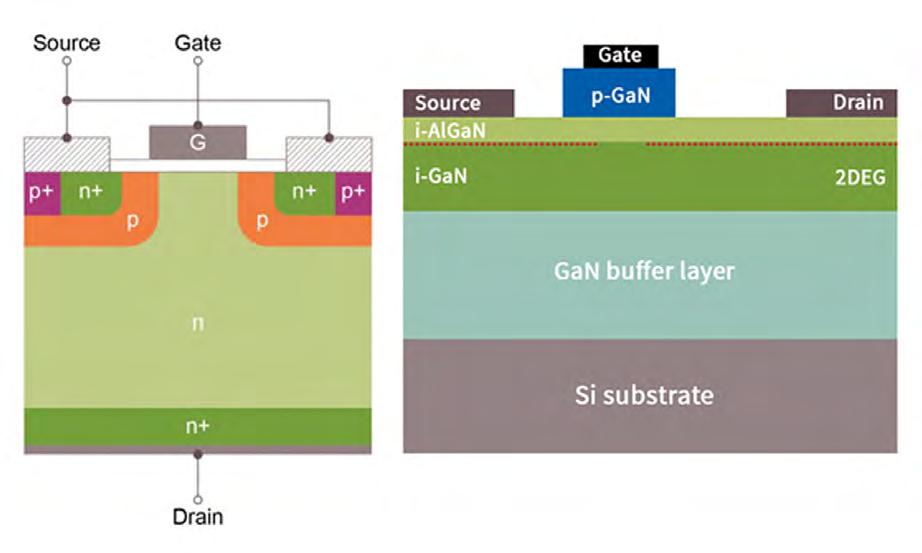
GaN is a wide-bandgap (WBG) semiconductor that fundamentally alters the power conversion equation. Beyond electrical performance, its physical architecture offers unique benefits for the radiation-hardened (rad-hard) environment.
The primary failure mechanism for planar Si MOSFETs in space is the accumulation of trapped charge in the gate oxide layer due to total ionizing dose (TID). This leads to threshold voltage (Vth) shifts and eventual device failure.
GaN HEMTs utilize a heterojunction structure that operates without a gate oxide layer. Consequently, they exhibit inherent immunity to TID-induced threshold shifts. Characterization data indicates GaN HEMTs can withstand TID levels exceeding 1 Mrad (Si) with negligible degradation in Vth or RDS(on).
While TID tolerance is intrinsic to GaN’s internal structure, single-event effects (SEE) such as latch-up (SEL) or burnout (SEB), as well as new effects like single-event leakage current (SELC), still require design efforts to offer protection against these events. The removal of the oxide layer, however, simplifies the radiation hardening process compared to Si. (Figure 1.)
For the power-design engineer, the transition to GaN offers quantifiable improvements across key power-stage parameters:
Increased efficiency and reduced heat:
› Lower RDS(on): GaN devices offer significantly lower on-resistance per unit area compared to Si.
› Reduced switching losses: The elimination of the body diode and lower gate charge (Qg) drastically reduces switching losses.
› Result: Power conversion efficiencies approaching 98%-99% are achievable with GaN. This reduction in heat generation enables smaller thermal interfaces and reduced thermal-dissipation surface area, directly lowering system mass.
High-frequency operation:
› Electron mobility: GaN’s high electron mobility enables switching frequencies in the MHz range, which exceeds the practical limits of Si MOSFETs, which is typically in the hundreds of KHz range.
› Magnetics reduction: Higher switching frequencies allow for a proportional reduction in the size of passive components (inductors, transformers).
› Impact: A 10x increase in switching frequency can reduce magnetic volume by up to 80%, enabling ultracompact DC/DC converters and isolated power supplies.
Improved thermal performance
› Wide bandgap: The 3.4 eV [electron volts] bandgap enables GaN to operate at higher voltages in a smaller die area. This, combined with the electron mobility and electric breakdown field, means that GaN operates with lower power dissipation and less heat generation.
› Stability: GaN maintains stable Vth characteristics across a wider thermal range, reducing the need for complex temperaturecompensation circuitry.
Design implications for space and defense
Adopting GaN HEMTs is not merely a component swap; it is a system-level opti-
Table 1 | A table shows the relative comparison of a 100V N-channel planar Si MOSFET and a 100V GaN HEMT with the same die size. Significant improvements in RDS(ON) and Qg translate to increase current drive capability.
mization. There are three significant advantages to GaN implementation: power density, thermal efficiency, and increased reliability. First, by shrinking magnetics and thermal management hardware, engineers can achieve 2x to 4x and greater power density (W/in³) compared to Si-based designs. Second, GaN’s simplified thermal architecture reduces heat dissipation, enabling the use of simpler and lighter thermal paths, crucial for cubesats and small satellite constellations. Third, the removal of the gate oxide eliminates a primary failure vector in the space environment, potentially extending mission lifespans and reducing the margin requirements for radiation hardening.
considerations
Special care must be taken when transitioning to GaN-based system architectures. Key considerations include:
› Gate driver selection: Most GaN solutions are driven at lower voltages (~5V) compared to the 10V–20V often required for Si MOSFETs.
› Controller optimization: Drivers must be selected for optimized drive voltage and precise dead-time control to prevent shoot-through.
› Testing and characterization of SEE performance under all conditions: Effects such as angular sensitivity and flux dependency have a big impact on SELC. Is it critical that testing is done beyond previously established standards, written for Si MOSFETs, to properly stress and determine how GaN HEMTs will perform in-orbit.
› Understanding intrinsic and extrinsic failures to characterize low PPM failures: Understanding all potential failure mechanisms is critical to guarantee low target failure rates and ensure robust quality systems in-orbit. Relying on standards made for Si MOSFETs will not always capture extrinsic failures for GaN HEMTs, leaving gaps in understanding. Only with large scale accelerated lifetime tests can extrinsic and true device failure rate be determined
For design engineers tasked with developing next-generation space and defense systems, GaN HEMTs represent a high-reliability solution to the challenges of power delivery in an era of expanding compute requirements. By delivering superior efficiency, enabling high-frequency operation for smaller magnetics, and offering inherent TID tolerance, GaN allows for the development of compact, high-performance power architectures that meet the rigorous demands of modern defense and orbital applications. The technology is ready to move from the lab to the launchpad, empowering the next era of rapid-response defense systems. MES

Blake Soileau is a senior marketing manager at Infineon IR HiRel, covering the radiation-hardened portfolio for aerospace and defense applications. Blake has more than 15 years of experience in the semiconductor industry supporting a wide variety of roles within power-management products.
IR HiRel, an Infineon Technologies Company www.infineon.com/hirel




TECHNOLOGY, TRENDS, AND

Military Embedded Systems focuses on embedded electronics – hardware and software – for military applications through technical coverage of all parts of the design process. The website, Resource Guide, e-mags, newsletters, podcasts, webcasts, and print editions provide insight on embedded tools and strategies including technology insertion, obsolescence management, standards adoption, and many other military-specific technical subjects.
Coverage areas include the latest innovative products, technology, and market trends driving military embedded applications such as radar, electronic warfare, unmanned systems, cybersecurity, AI and machine learning, avionics, and more. Each issue is full of the information readers need to stay connected to the pulse of embedded technology in the military and aerospace industries.
Rad-hard electronics design trends

By Bill Dillard
Space systems must deliver commercial-class performance while maintaining mission-class assurance. They must evolve on commercial timelines without compromising long-term trust and must tolerate localized failures without allowing them to spread throughout the system. Hybrid architecture – high-assurance and high-performance – deliberately separates spacesystem functions into two domains and can effectively balance performance against irreversible mission risk.
Radiation - pedigreed electronics and commercial electronics each bring indispensable strengths to space systems and unavoidable limitations. To balance performance against irreversible mission risk, hybrid architectures deliberately separate functions into two domains. For functions where failure is rarely recoverable, the high-assurance
domain preserves mission assurance by hosting command, spacecraft safety, and fault-recovery functions that must remain deterministic as environmental margins degrade operational performance. High assurance prioritizes correctness, predictability, and long-term stability. Radiation-tolerant and radiation-hard components are often used in this domain to ensure that critical functions such as power, timing, and boot memory are available, functional, and operational.
In contrast, the high-performance domain relies on highly integrated commercial silicon – CPUs, GPUs, FPGAs, and hardware accelerators – whose roadmaps are
driven by terrestrial markets and advance on short timescales to elevate compute and data throughput capacity. In this domain reliability is statistical rather than deterministic and managed through monitoring and recovery rather than absolute prevention.
Today, mission demands are expanding faster than either domain can deliver independently. Autonomy highlights the issue. High performance compute is required to ingest large data fields, perform inference, and adapt behavior in real time – workloads poorly matched to traditional rad-hard processors in functionality, capability and efficiency. Yet autonomy without bounded behavior, authoritative override, and deterministic fault response is unacceptable for most government, defense, and safety-critical missions.
The trust and containment boundary
Space systems must deliver commercialclass performance while maintaining mission-class assurance. They must evolve on commercial timelines without compromising long-term trust. They must tolerate localized failures without allowing systemic propagation. Simply acknowledging two domains does not resolve fundamental problems. Who has authority under degraded conditions? How are faults contained or escalated across domains? What guarantees exist when deterministic and probabilistic systems interact? How does evolution in one domain affect assurance in the other?
Enter the trust and containment boundary (shown in Figure 1), which deliberately separates mission-critical control from high - performance computation. This boundary defines where trust diminishes and how uncertainty propagation is managed. At this boundary, rigorous design ensures that failures, timing variability, radiation - induced faults, and rapid software evolution in the performance domain cannot compromise mission objectives or system safety. Containment is not controlled by a single component but is instead an architectural construct enforced through partitioning, timing controls, integrity checks, and supervisory mechanisms that define behavior across electrical, logical, and temporal axes.
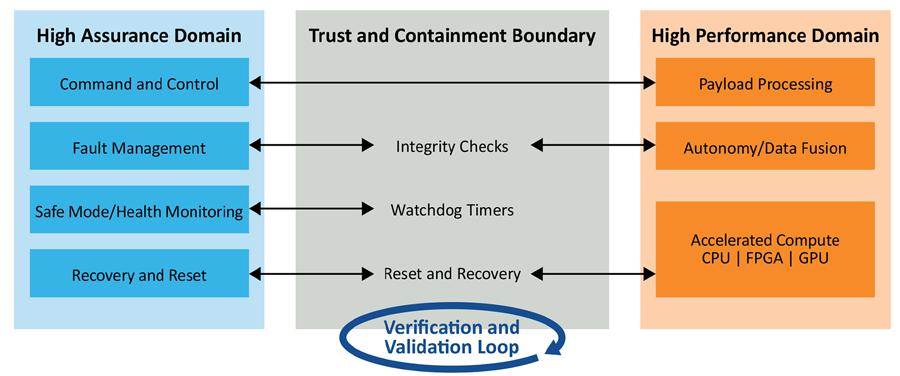
Figure 1 | High-level hybrid architecture showing resilience through deliberate partitioning of high-assurance functions and high-performance commercial compute. Explicit trust and containment mechanisms bound fault effects and support deterministic recovery, while verification and scenario-based testing close the assurance loop.
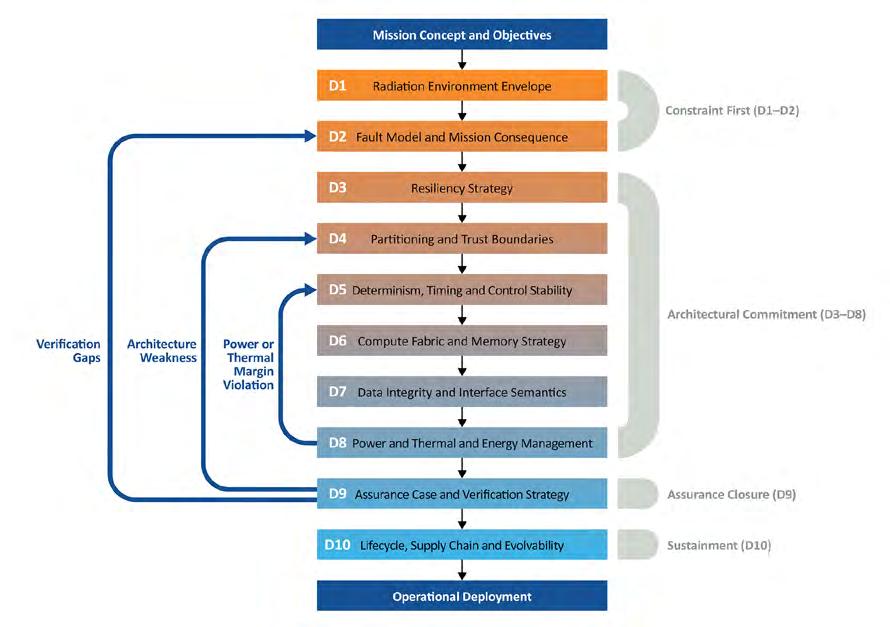
Figure 2 | Verification-driven execution framework for hybrid architectures illustrates the structured progression from environmental constraints and fault modeling to containment, recovery, and assurance decisions. Feedback loops emphasize the role of testing and scenario validation in bounding performance and enforcing deterministic behavior in mixed-assurance systems.
The boundary is the primary mechanism by which performance domain capability is increased without inheriting unacceptable risk. The 10-dimensional framework that follows provides rigor for evaluating how much responsibility the trust and containment boundary must carry and how might be crafted to balance mission assurance against performance ambition.
The dimensions listed below and shown in Figure 2 form a rigorous framework around which a design practice can be structured. Hybrid architectures succeed when this space is navigated explicitly rather than implicitly.
› Dimension 1 – Radiation environment envelope: The radiation environment is the first architectural gate, bounding ionizing dose, single-event error (SEE) exposure, shielding, and operating modes. It delineates tolerable behaviors versus those that are unacceptable, forcing an intentional mix of hardness, mitigation, and recoverable-fault scenarios. The trust and containment boundary must remain credible under expected single-event upsets, latch-up, and interruption conditions.
› Dimension 2 – Fault model and mission consequence: Failures must be defined in mission terms – transient or permanent, detectable or latent, local or
propagating, tolerable or catastrophic – and tied directly to outcomes. Expected outcomes include loss of capability, loss of data, loss of control, or unsafe state/ complete mission failure. This dimension defines what the boundary must block, detect, or tolerate, establishing containment zones, recovery time limits, and degradation policies across domains.
› Dimension 3 – Resilience strategy (prevent, contain, recover): Hybrid systems require explicit strategies for prevention, containment, and recovery by using hardness, partitioning, integrity checks, supervision, resets, and reconfiguration within bounded time and state loss. The boundary becomes the execution surface for containment and recovery, which enforces supervised capture of performance-domain faults, thus preventing escape into high-assurance control.
› Dimension 4 – Partitioning and trust boundaries: Partitioning determines which functions must be intrinsically reliable and which may rely on supervision and recovery. Partitioning makes trust boundaries enforceable rather than theoretical. Credibility depends on mechanisms such as independent clocks, power domains, firewalls, memory protection, and protocol validation. This dimension is the structural blueprint for the boundary, defining how separation prevents performance-domain upsets from cascading into mission-critical functions.
› Dimension 5 – Determinism, timing, and control stability: Because platforms are fundamentally control systems, architectures must decide where determinism is mandatory and where best-effort execution is acceptable. When correctness depends on time, timing becomes part of the assurance case. The boundary must translate timing uncertainty into bounded behavior through scheduling independence, rate limiting, bounded-latency assumptions, and time-out monitoring.
› Dimension 6 – Compute fabric and memory strategy: This dimension defines where computation runs and how state survives through processor roles, memory hierarchy, error check and correct (ECC) strength, memory scrubbing, boot paths, and reset behavior, recognizing memory as a dominant reliability limiter. The boundary governs what state can cross domains, under what integrity guarantees, and how resets or reinitialization occur so performance-domain discontinuities cannot corrupt the high-assurance state.
› Dimension 7 – Data integrity and interface semantics: Hybrid systems succeed or fail at interfaces. Architectures must define trustworthiness, freshness, ordering, completeness, and explicit treatment of suspect data because radiation faults may be silent and pending. The boundary acts as a semantic and integrity enforcement layer, blocking contaminated payload data and rejecting syntactically valid but semantically unsafe information before it affects mission authority.
› Dimension 8 – Power, thermal, and energy management: High-performance compute introduces dynamic power and thermal stress, while radiation-driven protections and degradations constrain operating margins. Power domains, load shedding, thermal throttling, and energy storage effects must be architectural concerns. The boundary enforces energy and power separation so performance-domain surges, latch-up, or transient events cannot brownout, destabilize timing, or compromise assured control.
› Dimension 9 – Assurance case and verification strategy: Hybrid architectures require assurance built from analysis, testing, and fault injection, shifting proof from components to systems enforcing structure. Verification is scenario-driven and includes controlled recovery and safe nondestructive failure conditions. The boundary becomes a primary verification artifact. Evidence is focused on noninterference, containment, and bounded timing behavior via independently testable and verifiable recovery.
› Dimension 10 – Life cycle, supply chain, and evolvability: Hybrid systems must remain governable across long life cycles, balancing lead times against rapid commercial evolution with limited lifetimes through configuration control, requalification triggers, and safe architectural updates. The boundary enables
performance-domain evolution without altering authority, containment rules, or assurance commitments in the high-assurance domain.
After traversing the design space, the two-domain model emerges not as a simplification, but as a more disciplined conclusion. The distinction between highassurance and high-performance domains remains intact, yet it is no longer rooted in component pedigree or physical placement. Rather, it is defined by architectural responsibility: Where authority resides, how uncertainty is bounded, and how failures are predicted and recoverable. Delivering architectural responsibility falls to the trust and containment boundary, again as architecture. Done well, capability is gained not by relaxing assurance, but by relocating it from individual components to enforced architectural relationships. The result is a coherent system that is able to evolve without forfeiting control and performance. MES

Bill Dillard is a member of the Aerospace and Defense Group at Microchip Technology, where he serves as Technology Strategy Lead for Advanced R&D Programs. His work has centered on semiconductor technologies for demanding environments, with published research spanning low-temperature behavior of silicon devices, high-temperature silicon carbide (SiC) applications, and digital control of power electronics systems. Prior to joining Microchip, Bill spent 18 years in the aviation industry in roles spanning product development, sales, and governmentfunded programs. His work included microelectronics, inertial systems, radiation effects in semiconductors, and the design and production of FAA-certified avionics systems. Bill holds a BS and MS in electrical engineering from Auburn University.
Microchip Technology https://www.microchip.com/
Each issue, the editorial staff of Military Embedded Systems will highlight a different organization that benefits the military, veterans, and their families. We are honored to cover the technology that protects those who protect us every day.
By Editorial Staff

This issue we are highlighting the Better Back Nine Foundation, a 501(c)(3) charity that uses golf as a conduit to foster camaraderie and community among post-9/11 Special Operations Forces (SOF) combat veterans and active operators.
The organization was started in 2023 by Ryan Novak and Jason Mitchell, both U.S. Air Force Combat Controllers with more than 30 years of combined service. Dedicated to post-9/11 SOF combat veterans, the foundation uses golf to foster friendship, mental well-being, and physical resilience through the shared love of the game. Better Back Nine says that it aims to make a meaningful impact on the lives of these veterans, fostering a community that uplifts and supports their journey to improved health and resilience.
The foundation operates programs across the U.S., curating premium and immersive golf experiences, both single-day group events featuring lessons, play, dinner, and outreach; and longer adventures the foundation calls “Epic Trips,” which can include lessons, equipment fitting, chiropractic sessions, premium accommodations, and more.
All program participants are entered into the same alumni network, as the founders want program alumni to not only stay in touch with the national organization, but also to maintain connections with their regional groups, in an effort to foster ongoing post-service networking and companionship.
The organization also runs golf tournaments and other fundraising events to raise money for its programs. For additional information please visit https://betterbacknine.org/.
Sponsored by Wind River
Autonomous capabilities are rapidly moving from experimentation into operational defense systems, bringing artificial intelligence (AI) directly into mission environments at the tactical edge. However, while machine learning introduces powerful new capabilities, mission-critical platforms still demand deterministic performance, predictable timing, and certifiable reliability. Integrating probabilistic AI workloads into systems that cannot tolerate unpredictable behavior presents a new engineering challenge for defense architects.
This webcast discussion explores the emerging discipline of deterministic autonomy and examines how defense programs can run AI inside embedded mission systems while maintaining the assurance required for real-world operations.
(This is an archived event.)
View this webcast at https://tinyurl.com/3h2er86f.
View more webcasts at https://militaryembedded.com/webcasts.
There is a pressing need within not just the Special Operations Forces (SOF) community but across the military services and the entire U.S. government to understand and identify the narrative messages our adversaries are using against us, says Bill Wall, CEO and co-founder of Accrete AI Government.
In this podcast, Wall and Military Embedded Systems Editorial Director John McHale discuss the ways in which U.S. military can achieve information dominance, how artificial intelligence (AI) can enable a cognitive advantage, and the use of Accrete’s Knowledge Engine platform. They also talk about what they experienced as the high points of the recent SOF Week conference and exhibition.
Listen to/watch the podcast: https://tinyurl.com/ynfu87ey.
Listen to/watch more podcasts: https://militaryembedded.com/podcasts