@military_cots
TOIIICOME John M.COPY McHale Positive feedback for DoD PAE initiative
Leveraging AI
16
Handling sensor data for CJADC2
Special Report
20
AI for CJADC2 at the edge
Industry Spotlight
28
Rugged computing across domains www.MilitaryEmbedded.com
7
July/August 2026 | Volume 22 | Number 5
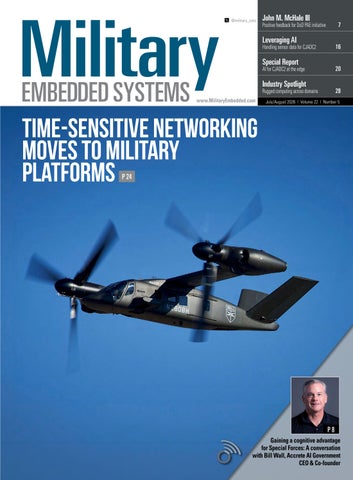
TIME-SENSITIVE NETWORKING MOVES TO MILITARY PLATFORMS P 24
P8 Gaining a cognitive advantage for Special Forces: A conversation with Bill Wall, Accrete AI Government CEO & Co-founder
Solutions for Rapid Deployment Analog Devices’ commercial off-the-shelf (COTS) software-defined radio (SDR) system-on-module (SOM) digitizers enable customers to deploy high performance distributed sensing techniques at the tactical edge, as quickly as possible.
From Components
Get to market faster at analog.com/SOMS
To Development Platforms
To Mission-Ready Modules
>40GHz UWB Direct RF Solutions RECEIVE ~ TRANSMIT ~ PROCESS
Small Form Factors
FEATURING: Agilex 9 Direct RF TM
Versal RF TM
3U & 6U VPX
Tel: 410-841-2514
●
www.AnnapMicro.com
www.militaryembedded.com
TABLE OF CONTENTS 20
14
July/August 2026 Volume 22 | Number 5
COLUMNS Editor’s Perspective 7 Positive feedback for DoD’s PAE initiative By John M. McHale III
THE LATEST Connecting with Mil Embedded 31 By Lisa Daigle 16
FEATURES SPECIAL REPORT: Leveraging AI for CJADC2 8 Gaining a cognitive advantage for Special Forces: A conversation with Bill Wall, Accrete AI Government CEO & Co-founder By John M. McHale III, Editorial Director 14 Interoperability is not a feature – it’s a foundation By Sek Chai, Latent AI; James Beere and Michael MacFadden, Sigma Defense
28
16 Handling the sensor deluge for spectrum superiority in CJADC2 operations By Dr. Michael Jenkins, Knowmadics 20 From data overload to decision advantage: Operationalizing AI for CJADC2 at the tactical edge By Michel Genard, Lynx Software Technologies
MIL TECH TRENDS: Time-sensitive networking for military applications 24 Time-sensitive networking (TSN) solutions moving from labs to military platforms By Dan Taylor, Technology Editor
WEB RESOURCES Subscribe to the magazine or E-letter Live industry news | Submit new products http://submit.opensystemsmedia.com WHITE PAPERS – Read: https://militaryembedded.com/whitepapers WHITE PAPERS – Submit: http://submit.opensystemsmedia.com
INDUSTRY SPOTLIGHT:
Rugged computing & thermal management: Enclosures, chassis, connectors 28 Enabling AI at the tactical edge: Rugged computing and thermal management across domains By Joe Guest, Durabook
All registered brands and trademarks within Military Embedded Systems magazine are the property of their respective owners. © 2026 OpenSystems Media © 2026 Military Embedded Systems
ON THE COVER: Time-sensitive networking technology will be leveraged for the U.S. Army’s Future Long Range Assault Aircraft (FLRAA). Pictured: the Bell V-280 Valor developed for the Army's Joint Multi-Role Technical Demonstrator program as a precursor to the FLRAA. The U.S. Army chose Bell to develop the MV-75 FLRAA. Photo courtesy of Bell and U.S. Army.
ISSN: Print 1557-3222
To unsubscribe, email your name, address, and subscription number as it appears on the label to: subscriptions@opensysmedia.com Published by:
4 July/August 2026
https://www.linkedin.com/groups/1864255/
MILITARY EMBEDDED SYSTEMS
@military_cots
www.militaryembedded.com
BEHLMAN LEADS THE PACK AGAIN! FIRST PROVEN VPX POWER SUPPLIES DEVELOPED IN ALIGNMENT WITH THE SOSA™ TECHNICAL STANDARD
Behlman introduces the first test-proven VPX power supplies developed in alignment with the SOSA Technical Standard. Like all Behlman VPXtra® power supplies, these 3U and 6U COTS DC-to-DC high-power dual output units feature Xtra-reliable design and Xtra-rugged construction to stand up to the rigors of all mission-critical airborne, shipboard, ground and mobile applications.
VPXtra® 1000CD5-IQI
VPXtra® 800D-IQI
> 6U power module developed in alignment with the SOSA Technical Standard > Delivers 1050W DC power via two outputs > VITA 46.11 IPMC for integration with system management
> 3U power module developed in alignment with the SOSA Technical Standard > Delivers 800W DC power via two outputs > VITA 46.11 IPMC for integration with system management
The Power Solutions Provider SOSA™ and logo design and The Open Group Certification Mark™ are trademarks of The Open Group in the United States and other countries.
: 631-435-0410 : 631-435-0410
: sales@behlman.com : sales@behlman.com
: www.behlman.com : www.behlman.com
ADVERTISERS PAGE
ADVERTISER/AD TITLE
23 ADL Embedded Solutions – ADL-AI2500. The mission is at the edge 2
nalog Devices, Inc. – A Solutions for rapid deployment
3
nnapolis Micro Systems – A >40GHz UWB direct RF solutions
5
ehlman Electronics, Inc. – B Behlman leads the pack again!
GROUP EDITORIAL DIRECTOR John McHale john.mchale@opensysmedia.com ASSISTANT MANAGING EDITOR Lisa Daigle lisa.daigle@opensysmedia.com TECHNOLOGY EDITOR – WASHINGTON BUREAU Dan Taylor dan.taylor@opensysmedia.com CREATIVE DIRECTOR Stephanie Sweet stephanie.sweet@opensysmedia.com WEB DEVELOPER Paul Nelson paul.nelson@opensysmedia.com
18 Dawn VME Products – Dawn single slot OpenVPX development backplanes 13
iamond Systems – D Executive Speakout
19
E lma Electronic – Leaders in modular open standards deliver for the modern warfighter
32
MS – Introducing the G new X10 Genesis small form factor system
12 Interface Concept – Elevating your embedded experience 21
ICO Electronics Inc. – P Size does matter!
EMAIL MARKETING SPECIALIST Drew Kaufman drew.kaufman@opensysmedia.com WEBCAST MANAGER Marvin Augustyn marvin.augustyn@opensysmedia.com VITA EDITORIAL DIRECTOR Jerry Gipper jerry.gipper@opensysmedia.com
SALES/MARKETING DIRECTOR, SALES OPERATIONS Tom Varcie tom.varcie@opensysmedia.com (734) 748-9660 STRATEGIC ACCOUNT MANAGER Bill Barron bill.barron@opensysmedia.com (516) 376-9838 EAST COAST SALES MANAGER Bill Baumann bill.baumann@opensysmedia.com (609) 610-5400 SOUTHERN CAL REGIONAL SALES MANAGER Len Pettek len.pettek@opensysmedia.com (805) 231-9582 DIRECTOR OF SALES ENABLEMENT Barbara Quinlan barbara.quinlan@opensysmedia.com AND PRODUCT MARKETING (480) 236-8818
30 State of the Art, Inc. – Mission critical? Choose State of the Art resistors. 27
ystel, Inc. – Every strike is a S force of nature
22
Z Microsystems, Inc. – Open. Modular. Mission-ready.
INSIDE SALES Amy Russell amy.russell@opensysmedia.com STRATEGIC ACCOUNT MANAGER Lesley Harmoning lesley.harmoning@opensysmedia.com EUROPEAN ACCOUNT MANAGER Jill Thibert jill.thibert@opensysmedia.com EUROPEAN ACCOUNT MANAGER Michael O'Kane michael.okane@opensysmedia.com TAIWAN SALES ACCOUNT MANAGER Patty Wu patty.wu@opensysmedia.com CHINA SALES ACCOUNT MANAGER Judy Wang judywang2000@vip.126.com
EVENTS Unmanned Systems West 2026 September 8 & 9, 2026 San Diego, CA https://www.defenseadvancement.com/ events/unmanned-systems-west/
WWW.OPENSYSMEDIA.COM
Emerging Technologies for Defense Conference & Exhibition September 9 & 10, 2026 Washington, D.C. https://www.ndiatechexpo.org/
CO-PRESIDENT Patrick Hopper patrick.hopper@opensysmedia.com CO-PRESIDENT John McHale john.mchale@opensysmedia.com DIRECTOR OF OPERATIONS AND CUSTOMER SUCCESS Gina Peter gina.peter@opensysmedia.com GRAPHIC DESIGN MANAGER Kaitlyn Bellerson kaitlyn.bellerson@opensysmedia.com
AFA Air, Space & Cyber Conference September 14-16, 2026 National Harbor, MD /www.afa.org/air-space-cyber-conference/ AUSA 2026 October 12-14, 2026 Washington, D.C https://ausa.org/
6 July/August 2026
FINANCIAL ASSISTANT Emily Verhoeks emily.verhoeks@opensysmedia.com SUBSCRIPTION MANAGER subscriptions@opensysmedia.com OFFICE MAILING ADDRESS 3120 W Carefree Highway, Suite 1-640 • Phoenix AZ 85087 • Tel: (480) 967-5581 REPRINTS WRIGHT’S MEDIA REPRINT COORDINATOR Marcia Brewer mbrewer@wrightsmedia.com (281) 419-5725
MILITARY EMBEDDED SYSTEMS
www.militaryembedded.com
EDITOR’S PERSPECTIVE
Positive feedback for DoD’s PAE initiative By John M. McHale III, Editorial Director During my 30 years in this industry, I’ve yet to meet anyone who thinks the U.S. Department of Defense (DoD) moves too fast when it comes to technology acquisition. Never happened, never will. At the same time, real acquisition reform that speeds up technology adoption for the warfighter in a lasting way has been rare. The current administration is moving quickly to implement such reforms as embracing a modular open systems approach (MOSA) across all programs and enabling faster acquisition of autonomous systems and counterdrone technology. But perhaps its most effective shift – if current sentiment lasts – is the creation of Program Acquisition Executives (PAEs) across the services as a way to prioritize need and speed up decisionmaking about technology. Defense Secretary Pete Hegseth announced in 2025 that the Pentagon was reorganizing existing program executive offices (PEOs) into portfolio acquisition executives, according to a DoD release. “The acquisition chain of authority will run directly from the program manager to the PAE,” he said. “Each PAE will be the single accountable official for portfolio outcomes and have the authority to act without running through months or even years of approval chains. And they’ll be held accountable to deliver results.” Hegseth went on to say in the announcement that PAEs will have the authority to make decisions on “cost, schedule, and performance trade-offs that prioritize time to field and mission outcomes.” “The acquisition reform that introduced the PAE architecture, I think all of my industry colleagues would agree, has been a very positive change,” Bill Guyan, SVP, Business Development & President, International, Leonardo DRS, told me during a chat at Eurosatory in Paris this summer. “The ability to empower somebody with the ability to make trade-off decisions about budgets and about requirements [is critical]. These new PEAs can make decisions about moving money between budget lines. They can make decisions about trading off between requirements and [funding]. “It used to be you had one set of people that were requirements guys, you had another set of guys that were buyers, another set of guys that were testers, another set of guys that were the logisticians,” Guyan continues. “They didn’t always talk to each other, and any one of them could stop the train, for some legitimate process reason. They could say no, that’s not right, doesn’t pass the test, or that’s not right, it doesn’t meet my requirement, [etc.]. The PAE can say, okay, I heard you all, but I’m making this decision because this is good enough, we’ll fix the rest of it later. The PAE development is really important and making a big difference.” www.militaryembedded.com
John.McHale@opensysmedia.com
Guyan added that the U.S. Army is a leader in this area with the Air Force and Navy also implementing a PAE structure. “Army arguably had the biggest problem to fix,” Guyan notes. “They have such a wide portfolio of things that they’re trying to do, and the hard decisions of trade-offs and modernization were getting stuck. So, the Army helped itself by being first, and we’re seeing, as an Army supplier, a lot of fixes that come as a result of that.” According to a U.S. Army release the new Army PAE construct includes: › Maneuver Air (PEO Aviation, Rapid Capabilities and Critical Technologies Office (RCCTO)). › Maneuver Ground (PEO Soldier, PEO Combat Support and Combat Service Support (CS&CSS), PEO Ground Combat Systems (GCS)). › Fires (PEO GCS, PEO Missiles and Space (M&S), Joint Program Executive Office for Armaments and Ammunition (JPEO A&A), RCCTO). › Agile Sustainment and Ammo (JPEO A&A). › Layered Protection and Chemical, Biological, Radiological and Nuclear Defense Command and Control (JPEO for Chemical, Biological, Radiological and Nuclear Defense (CBRND), PEO Intelligence, Electronic Warfare and Sensors (IEW&S)). › Counter Command and Control (PEO for Simulation, Training and Instrumentation (STRI), PEO IEW&S, PEO Command, Control, Communications and Network (C3N)). As another example of positive acquisition moves within the DoD, Guyan noted the Joint Interagency Task Force 401 (JIATF 401), which was set up in the summer of 2025 to develop counter-uncrewed aerial system (UAS) technology for defending the U.S. homeland. “They’ve released a catalog, [which] anybody can buy from, and they’re starting to release IDIQ contracts to suppliers, which will allow anybody to buy through this commercial approach,” he says. According to the DoD, JIATF 401 will consider technologies such as “microwave, directed-energy, kinetic interventions, radio-frequency detection and jamming capabilities, radar, acoustic sensing, and advanced optical tracking.” “The Secretary of the Army was here [at Eurosatory] to sign an agreement with eight other allied countries, giving them access to that catalog as well,” Guyan added. For more on my discussion with Guyan at Eurosatory on counterUAS technology, visit our website at https://tinyurl.com/efj8p4n7.
MILITARY EMBEDDED SYSTEMS
July/August 2026 7
SPECIAL REPORT
Leveraging AI for CJADC2
Gaining a cognitive advantage for Special Forces: A conversation with Bill Wall, Accrete AI Government CEO & Co-founder By John M. McHale III, Editorial Director
Bill Wall,
CEO and Co-founder of Accrete AI Government
A U.S. Sailor assigned to Wasp-class amphibious assault ship USS Boxer (LHD 4) guides an MV-22B Osprey with Marine Medium Tiltrotor Squadron (VMM) 163 (Reinforced),
There is a pressing need within not just the special operations community in all U.S. military and 11th Marine Expeditionary Unit, duringbut flightalso operations in thethe Pacific Ocean. U.S. Marineservices Corps photo by Lance Cpl. Nicole Stuart. government to understand and identify the narrative messages U.S. adversaries are using against us, says Bill Wall, CEO and co-founder of Accrete AI Government, told me during a SOF Week Show Daily version of the McHale Report podcast. He and I also discussed ways the U.S. military can achieve information dominance, how artificial intelligence (AI) enables a cognitive advantage, and Accrete AI’s knowledge engine platform. We also talked about what had him most excited about SOF Week. Edited excerpts follow. MCHALE: Bill, can you provide a brief description of what your role is in Accrete AI Government, your experience in the defense industry, and the importance of special operations to what you and your company do? WALL: I started Accrete AI Government with two other partners about seven years ago, as a subsidiary of a commercial artificial intelligence (AI) company that was starting in New York City in the financial markets. Our thesis was that the artificial intelligence and the emerging capabilities that Accrete was developing to help financial analysts – understand fast-moving markets, understand the search to find alpha in the markets, [gain] first mover advantage – could be ported over and brought to bear for the U.S. government and the U.S. military in particular. To me personally, [special operations] is important because I served in the community and my friends and peers are still there. I understand how important the mission is, how important technology can be to increase mission success and survivability of the organizations out there, and to super enable the constant demanding requirements for special operations, which seems to only be growing day by day. We have ongoing, vibrant conversations with the special operations community about artificial intelligence and the cutting-edge capabilities that our company can bring,
8 July/August 2026
MILITARY EMBEDDED SYSTEMS
and they’re invested in working with us hand in hand. MCHALE: How can the U.S. military dominate the information space with AI? WALL: This is such a pertinent question. Three or four years ago, [the challenge was called] cognitive advantage, information operation, psychological warfare, whatever term you want to use of the day; I prefer cognitive advantage. [This] was kind of a back-burner topic for the special operations community. It’s always been a direct-action counterterrorism advisory type of command, things that fly, things that shoot, things that blow up. But in the past four or five www.militaryembedded.com
years we’re seeing growing requirements and the impact of information operations and cognitive advantage. You don’t have to look any further than the recent conflict with Iran to see how nations who cannot match us peer to peer in a tactical battle are turning to the asymmetric use of information operations to attack the U.S. strategically. I don’t know, John, if you’ve seen any of the Lego videos that have come out that have been sponsored by the Iranian government or people affiliated with Iran, and they are directly attacking the U.S. government’s legitimacy for the war with Iran, the U.S. [administration’s] competence. They are bringing up all sorts of issues to try to take away public and governmental support for the war against Iran, or the conflict against Iran. They know that they can’t fight us tactically, militarily, so they are trying to fight us strategically through social media and messaging to diminish the support that we get both internally and externally from our allies and our populace and internal to our own government. It’s a strategic level of war that’s only going to continue to be used more and more. In some respects it’s working, and mostly it’s working because it’s a battlefield that the U.S. has not generally engaged in robustly, and I think we’re beginning – across the whole of government – to realize this is something we have to pay attention to. In the past year, the National Security Council added a position [member], who owns the portfolio for cognitive advantage. That’s never happened before. That was not something that the National Security Council thought about much when I was in [the service] 20 years ago. Information operations was kind of an add-on. We’d plan a tactical operation, and then we’d say to the IO guys: “Hey, what can you do? You know, print up some leaflets.” Here’s what’s interesting to me about the whole idea of cognitive advantage, In World War II, when we invaded Normandy, we had to have massive amounts of people coming across the shore. We had paratroopers from the 82nd and the 101st dropping in behind enemy lines, because that’s what we had to do to get there physically. Now our adversaries can parachute ideas metaphysically into our populace without any [risk] of being interdicted. [They do this through] social media, which a majority of Americans get their news and form their opinions from. So, there’s a really pressing need within not just the special operations community, but across all the military services and the whole of government to understand and identify what are the narrative messages that our adversaries are putting out there against us. First, let’s identify them. If we can identify the narratives that our enemies are putting out there against us, then can we identify counter-narratives right in that information advantage world to fight that narrative, and then we can measure the effectiveness of those narratives. Are we changing minds? Are we changing how people act? At a certain level of war the only important terrain is the six inches of gray matter between the ears of the leadership and the populace of your adversary, and so we have to be able to affect that. There’s lots of ways to affect it. You can affect it with action, you can affect it through tactical military operations, but we can’t ignore the cognitive realm of social media and information operations. It is of growing importance every day, and with the speed of information that goes around the world today with artificial intelligence, our adversaries are weaponizing it easily, and if we don’t do something to identify, counter, and measure, then we’re not in that fight at all, and we’re going to lose strategic battles. We’ll win tactical battles all day long, but we’ll lose strategic ones because we’ll never win popular support and we’ll never get into making the will of our enemies, www.militaryembedded.com
MCHALE: Can you talk about your knowledge engine platform, Bill? How does that enable the information dominance you just talked about? WALL: It’s such a great question for people to think about today. In the past couple years, we’ve seen social adoption and use of large language models [LLMs]. People are very familiar with them. People use them as personal assistants, and there’s a challenge with large language models. They’re only as good as the information that they have access to. And it’s been proven that if they don’t have the right answer, they’ll tell you anything, and people call that hallucination. So, a large language model by itself isn’t sufficient for our customers. What they really need to do is pull all of their different data out of all of its different silos into one large area and de-silo that data, extract entities out of it, extract relationships, and then put context around that. Then a large language model can be used to query that data. Large language models are built to do search. They’re not built to do analysis, so you need a knowledge engine to enable that analysis.
Data isn't fixed in time. Our understanding of what something means might change over time, so putting that context into the data is really important. [For example] maybe a large language model could find out that you and I are neighbors, and it would connect us, and there’s a connection [that] we live next to each other, but that doesn’t contextualize our relationship. Maybe you hate me because my dogs are always in your yard and my kids jump over the fence or in your pool, or maybe we’re really good friends and we barbecue together on the weekend. Context is what matters here, not just the connection. To get
MILITARY EMBEDDED SYSTEMS
July/August 2026 9
SPECIAL REPORT value out of the information it has to be brought together, contextualized, and then made available, so that a large language model can then search against it and bring to an analyst the answers that they want. More data points don’t help an analyst. Data points that are contextualized help an analyst. MCHALE: Regarding large language models, you’re talking like Chat GPT, Claude, which are popular among consumers. My colleagues in sales swear by LLMs because they help them do data analysis or as a search tool. But as you say it’s only reliable as the information it can access and that can be verified. The other day in a meeting, colleagues were discussing how two companies are related. A search says they’re competitors, and on some products they might be, but they actually might be partners on some systems. It [calls for] further follow-up on what the LLM provided. WALL: And with even deeper business relationships, what are their financial positions? Who’s invested in them? Is there a common investor? Are there board members in any way related? Are there board members from the two separate companies on the board of a third company? What is the nature of that relationship? A large language model by itself probably won’t find that because that’s a deep level of data and understanding that you’ve got to put together. Pulling the context out of data is the true value of AI and what helps analysts and we want to make sure that people don’t think we’re trying to replace humans, we’re trying to super empower humans by helping them with this problem that everyone has of being overwhelmed by too much data that they can’t make sense of. MCHALE: How does the knowledge engine provide that context? Can it also verify whether what you’re getting from the LLM is accurate? I keep thinking back to the Reagan years, “trust but verify.” WALL: I think that’s very important. A knowledge graph, if it’s providing the right context, tells you the source provenance of your information, what time that observation was made, the confidence level of the accuracy of the data, understanding the relationships in the data, the supporting evidence that’s there. And then a human feedback loop that can say, this isn’t what we think it is, there’s a mistake here. That might change over time. Data isn’t fixed in time. Our understanding of what something means might change over time, so putting that context into the data is really important. It takes a bit of subject-matter expertise, and a human somehow involved in a loop of building the right model and verifying it. In some ways, it’s kind of like a thesis, you have your footnotes to show where you got your data from, and any product, any AI solution that says to a customer, “Hey, look, this is a black box, we can’t explain how we got to the answer” – that’s a bad solution. Humans have to be able to justify it, whether it’s a federal law-enforcement agent who [goes] in front of a judge and shows cause and evidence, or whether it’s an analyst in the military who has to justify to the boss why they’ve come up with a certain judgment. I think it’s very important that we be able to provide the provenance and the context and the time and confidence level to all of that information. That’s a challenge with things that are on just the internet. Who knows what’s on the internet? Like, there’s all sorts of bad information out there. Anybody can put anything. Just being on the internet doesn’t mean it’s true. Having some sense of your data and making sure that your data has gone through a process to really look at it – and you know, confirm it to some degree – is important. MCHALE: So, along those lines, I could claim on LinkedIn that I’m an expert in just about anything like woodworking, and a search might pull that up, but it’d be very inaccurate.
10 July/August 2026
MILITARY EMBEDDED SYSTEMS
Leveraging AI for CJADC2 WALL: Yeah, exactly. MCHALE: Context is very critical for special operations, because it could be the difference between life and death on a mission. Speaking of special operations in the knowledge engine, are there other solutions that you showcased and talked to operators and other partners about at SOF Week? WALL: We’ve got two big things that we are looking at right now in SOF solutions. There’s a lot of words people use lately in the profession: psychological operations, information operations, cognitive advantage, cognitive warfare. I tend to veer towards cognitive advantage. [Regarding cognitive advantage] the idea is, what are the trending narratives within a specific populace about a specific topic, and do we understand what the populace’s opinion of something is? Once we have that understanding, then do we want to change that opinion? Do we want to combat that opinion? Do we want to support that opinion? And if we do, how would we do that? What are the messages that maybe would resound in our populace? And then how could we measure whether or not we’re affecting those messages? [A good example is what I mentioned earlier about] Iran and the videos they are posting that are Lego short movies. They’re Lego characters, and there’s a soundtrack to it, and it’s a very high level of production. What they’re attacking is the legitimacy of the U.S.’s purpose and reason for having the conflict with Iran. What they’re trying to do is diminish both internal U.S. and international support because they can’t fight us militarily, so they’re going to fight us strategically by trying to degrade the support, and they’re doing it in an interesting way – through social media with the videos. The videos are very pointed. They bring up all sorts of relevant social commentary that you and I might hear on [X], or we might hear our neighbors talk about, and they’re bringing it to the whole world to look at. www.militaryembedded.com
How can we measure if this is effective? Is this degrading the support for the U.S. operations from our allies or internally? If we wanted to counter any of their messages, how would we do that? This is something that’s really important to me, having spent a career in special operations, I saw that one of the things that we did not do as well as we could have was fighting this strategic battle of narrative. We did not convince a significant amount of people in Afghanistan not to support the Taliban. We did not convince a significant number of people across the Middle East not to support Salafis jihadists. We fought the Taliban, we fought Salafis jihadists. We didn’t lose a battle against them, but we ended up not necessarily winning the wars the way we wanted to, because we lost the battle of public opinion – what I like to call that key terrain, which is the six inches of gray matter in between the populace and our enemy’s ears. That’s a big thing for us right now. It’s a growing field. The information age that we’re in, where people get their news from social media, people express their opinions on social media, you can get a good feel for what a particular audience thinks about things on social media, and we think that’s a field that the special operations community could play in better. MCHALE: Regarding what they are doing with social media… we live in a free society, so everybody can get in. Then you look at Iran and their Lego videos. How do you combat that if they control – if they’re shutting down – the internet? WALL: Part of it is, who’s the audience? The audience for the Lego videos from Iran is not the Iranian audience, it’s the international audience, and it’s the U.S. national audience. Are our allies beginning to say to us through diplomatic channels the same themes and messages that the Iranians are pushing through these videos?
That’s what we have to look at – who’s the intended audience, and is it having an effect on that audience, and the different ways that we might be able to change that effect. MCHALE: Let’s look forward a few years. Predict the future. What do you think will be a disruptive technology or innovation or game-changer in AI for military applications, especially special operations? WALL: The thing that is beginning to happen, and the thing that we’re going to have to wrestle with in the near future, is autonomous decision-making. At what point are we comfortable with machines making decisions for us. To some degree that exists in the U.S. military right now. There are a couple of weapons systems: the Patriot missile system, the AEGIS [weapon] system, which is on Navy ships, which can operate autonomously, because it’s a speed of action. If there’s a missile coming in at a ship, you maybe
MOSA Virtual Summit 2026 Sponsored by Abaco Systems, Curtiss-Wright, DDC-I, Elma Electronic, Kontron, LCR Embedded Systems, RTI, and SV Microwave The 2026 MOSA Virtual Summit explores MOSA examples like the Sensor Open Systems Architecture, or SOSA, approach; the C5ISR/ EW Modular Open Suite of Standards (CMOSS); and the Future Airborne Capability Environment, or FACE, approach with the aim of studying how they impact signal-processing, software, hardware, AI, and RF designs. Powered by Military Embedded Systems. (This is an archived event.) Watch the sessions: https://tinyurl.com/4xfa2vd8
WATCH MORE WEBCASTS:
https://militaryembedded.com/webcasts www.militaryembedded.com
MILITARY EMBEDDED SYSTEMS
July/August 2026 11
SPECIAL REPORT
Leveraging AI for CJADC2
allow the gun to shoot it when it detects it, as opposed to waiting for a human, because it might take too long. So, within the decision-making processes that we’re beginning to bring AI into, we very much want a human on the loop or in the loop. At some point the speed of the information and the speed that the decisions will require is going to require that we wrestle with the idea of what are we comfortable with in the idea of machines making decisions and directing action for us, and the more that tends towards the lethal space, the more important that decision is. I think that’s something that I don’t have an answer for, but I think it’s something we’re going to have to wrestle with more and more as artificial intelligence becomes more integrated into our formations, as it becomes more capable, and as we see more value in it. Somewhere along the line we will have to wrestle with autonomous decision-making. MCHALE: AI and autonomous decision-making capabilities are evolving quickly. How do we keep up with that speed of innovation with a slow acquisition system? WALL: That’s always a challenge, but I think that in the past couple of years I’ve seen a tremendous amount of growth within government customers and the community of both understanding and wanting to understand innovation. There’s always going to be the people who don’t want innovation: Right, we’ve always done it this way. It’s been good enough for me for the past 15 years. Why change the system now that I’ve worked my way up to the top of the system? Don’t change it on me. Particularly with the special operations community, there’s always been a bias towards innovation because it drives speed and efficiency. Those are kind of the hallmarks of the community. Innovation is going to continue to drive that, and the special operations
Elevating your embedded experience
• Large range of Ethernet Switches • 1U enclosure, 3U & 6U VPX • Managed Layer 2+/3 switches • 1/10/25/40/100 Gigabit Ethernet • Aligned with the SOSA™ Technical Standard • Air-cooled, conduction-cooled, AFT grades
www.interfaceconcept.com
12 July/August 2026
Contact our North American sales and support provider: sales@elma.com • 510-656-3400
MILITARY EMBEDDED SYSTEMS
community has always been the cuttingedge adopters of innovative technology. MCHALE: It appears this current administration is pushing for ways to get things done more quickly for autonomous systems and AI – and of course, special forces – being right at the front of that. WALL: For years the industry has complained about how the acquisition community adopts innovative technology. We’ve always said it’s too slow, and it’s too bureaucratic. But there have been, in the past couple years, in the past year in particular, some great changes. You’re seeing memorandums coming out of the Department of War that are pushing organizations to adopt innovative technology and work with smaller companies and find more flexible contracting vehicles and fund growth and innovation. I think it’s moving in a good direction. MCHALE: What had you most excited about SOF Week this year? WALL: SOF Week is just a special week. A couple things really excite me about it. One is on a personal level, it’s just always a great opportunity to see old friends and old colleagues, some who are still serving, some who are out like me, in some cases meeting the children of people I served with, who are now serving. It’s just amazing personal connections; that’s one of the things that’s special about the special operations community is the deep personal connections. Humans are more important than hardware. I love the opportunity to get to talk to customers and potential customers, and really get a feel for what their challenges are. We always think we’ve got the right answer until you talk to the customer, like, “ah, I missed that.” I’m always excited to talk to customers and potential customers and see if there’s a way that we can empower and enable them to be better at their jobs.
www.elma.com
The SOF community continues to grow and support each other. The SOF Week experience is unparalleled. MES www.militaryembedded.com
ADVERTORIAL
EXECUTIVE SPEAKOUT
Choosing a Perfect-Fit Rugged Computer Important Considerations for Mission Success By Jonathan Miller, Founter and President, Diamond Systems Corp. The demand for rugged computers is large and growing. The market is served by a large number of vendors, each with their own approach and product offering. Here are some key consid erations that can help to navigate this extremely varied market and ensure you make the right choice. Ruggedness: A rugged system should be able to demonstrate its survivability in harsh environments with extreme tempera ture, shock, vibration, and often salt fog or other conditions. Test reports are the best way to demonstrate survivability but are too expensive and time consuming to conduct for each indi vidual model. If a vendor can demonstrate compliance to the relevant MIL or IP standards for one member of a product family, that confidence can usually carry over safely to other variants of the product. Performance scalability: Each application needs something different on the scales of processor performance, power con sumption, and price. A good rugged computer platform should offer a range of options to enable you to pick the one that best fits your needs, so you don’t overpay or consume too much power. The use of standard form factor processor modules (COMs) enables choosing from a wide range of proven options. Ideally it also lets you choose your own processor if the vendor doesn’t already offer it. I/O expandability: Every application has a unique set of interface requirements, so the platform should support easy customization, preferably with standard form factor I/O mod ules. This enables you to select I/O not just from the system vendor’s own catalog but from many other suppliers as well. It also lets you maintain consistency and improve efficiency by using an I/O board that your company already uses on other programs. Power flexibility: Rugged systems operate in harsh environ ments that often contain noisy power sources exhibiting voltage spikes and dropouts. But many applications are able to provide clean power and avoid the expense of a dedicated rugged power supply. The platform you select should offer a range of power options, so you pay only for the functionality you need. Lifecycle management: Military programs run for a long time, and the time from platform selection to the start of mass pro duction can extend into years. Selection of latest generation and longlife components helps to mitigate against product obsolescence but can only partially solve the problem. Since the most common source of obsolescence is the processor, the best lifecycle protection comes from using standard form factor COMs that allow quick substitution of an endoflife processor with a newer generation one. Each swap can add 57 years of lifetime to an existing platform.
In summary, the ideal platform for a rugged system is the one that offers the greatest flexibility in all dimensions to meet functionality and lifecycle requirements: • Designed and tested to survive harsh environments • Range of processors to meet different needs • I/O expansion modules • Power supplies • Standard form factor components to support long life Diamond Systems offers the SabreCom series of rugged computer systems that meets all of these objectives: • The use of COM Express modules provides performance scalability and lifecycle extension. • The use of minicard and PCIe/104 I/O modules provides access to a wide range of I/O modules covering almost any conceivable I/O requirement. • Power supply options range from direct power input to MIL-STD-461 filter to a full-fledged MIL-grade power supply with isolation and MILSTD461/704/1275 compliance. • The platform has been tested or designed to meet IP67 and MILSTD810H standards. • Predefined standard configurations allow key components to be kept in stock to support rapid delivery without NRE charges for custom design.
www.diamondsystems.com
SPECIAL REPORT
Leveraging AI for CJADC2
A U.S. Marine with 3rd Marine Division tracks a small uncrewed aerial system (UAS) during a recent testing exercise during which small UASs were flown in a test area, with the UAS operators required to locate objectives and simulated enemies in a densely forested environment. U.S. Marine Corps photo by Cpl. Joaquin Dela Torre.
Interoperability is not a feature – it’s a foundation By Sek Chai, James Beere, and Michael MacFadden The architecture surrounding edge artificial intelligence (AI) – including sensors, networks, hardware, software stacks and orchestration layers – is still being built in silos. Vendors build closed ecosystems, contracts reward vertical integration, and the warfighter ends up with tools that only function when everything lines up perfectly: the specific connectivity in the specific configuration using specific software, running on specific hardware. That perfect situation is not the reality at the tactical edge, however. Realistically, the edge in this case is often degraded, denied, intermittent, and limited. If one link in the chain requires a cloud connection, the whole chain breaks. Artificial intelligence (AI) has arrived at the tactical edge: Models are being deployed on vehicles, worn by soldiers, and embedded in autonomous platforms across diverse contested environments. The question is no longer whether AI can operate at the edge; it is whether the systems around AI are built to let it actually work. The honest answer today to the question of whether AI works at the edge is often muddied. What real interoperability looks like When defense leaders talk about interoperability, the conversation often stops at compliance: modular open systems approach (MOSA) checklists, application programming interface (API) documentation, and open standards on paper.
14 July/August 2026
Standards compliance is not the same as operational interoperability, however. Real interoperability means that a unit with a different sensor suite than the one beside it can still share the data, run inference, and produce a common operating picture without a week of custom integration work. This situation requires a bidirectional flow of data: from sensor to inference layer, from inference layer to operator output, and back again. Every layer of the system must support that loop while disconnected from cloud infrastructure and under operational constraints. Today, that loop breaks repeatedly, as models fail to translate across hardware configurations, orchestration platforms have no visibility into the actual available compute, or updates are pushed without accounting for what else is already running on the device. These scenarios are not exotic edge cases, but are actually the daily friction of deployed AI. The orchestration gap in DDIL environments Compute resources taper as forces advance: A forward operating base has meaningful bandwidth and storage, a vehicle has less than the base, and a soldier-worn device has still fewer resources. What the community has not solved is how to make AI systems adapt gracefully to that narrowing funnel. The problem is orchestration, not hardware. A
MILITARY EMBEDDED SYSTEMS
www.militaryembedded.com
system needs to know what resources are actually available at any given moment, accounting for what else is running, what the network looks like, and what the mission demands. Without that capability, every new mission readdresses the same problems from scratch for every new deployment: new scripts, new operating system images, new containers, new configurations. Cost rises, timelines stretch, and the warfighter waits. The last tactical mile is where this friction is most acute. Updating a model once it is forward-deployed requires knowing whether the platform can run the new version, managing the push while disconnected, and validating performance without the ability to troubleshoot in the field. When AI capabilities, hardware, and software layers are each developed with different assumptions about the rest of the stack, the result is systems that work in isolation and fail during integration. Every closed integration limits future capability. An open, modular architecture is the only approach that preserves the ability to plug in something new without discarding what was already built. Orchestration is not optional Edge AI is frequently framed as a deployment challenge. That framing misses most of what actually determines longterm mission success, however. Deployment is not a destination; it is the start of a system’s exposure to conditions it was never fully tested against. The ability to update, retrain, and push a new model version to the right platform at the right time is in fact life cycle management, and it is as operationally critical as the original deployment. Orchestration is the layer that makes that possible at scale, determining what gets pushed where, when, and in what configuration. Without it, every update is a manual operation, every new deployment is a custom integration, and the tempo of change in the field will always outpace the tempo of delivery from the rear. No single vendor can own the sensor, the network, the compute platform, the orchestration layer, and the AI model simultaneously. Attempts to do so produce the closed ecosystems that have historically stymied true interoperability. The more productive model is an ecosystem of complementary capabilities, www.militaryembedded.com
each built with open interfaces, where success is measured not by owning the majority of the stack but by how quickly other components can work alongside it. The business-model argument matters as much as the technical one. Large, vertically integrated contractors are structurally incentivized to maintain closed systems. The government cannot simultaneously demand interoperability and award decade-long contracts to organizations incentivized to prevent it. Commitment to the warfighter and commitment to the stock price are not the same thing, and right now, the market does not reward the former. The architectural decisions that will determine what scales The choices being made now in programs, contracts, and vendor selection will determine whether edge AI scales across platforms and services over the next decade. A few principles should govern them: › Design for modularity from the start: Systems that stratify their architecture correctly can swap diverse components without rebuilding from scratch. The goal is an ecosystem in which new capabilities connect because the interfaces were designed to be open, not because every component came from the same vendor. › Treat disconnected operation as the baseline, not a special case: Every layer of the system must function without a cloud connection. AI that requires connectivity at the tactical edge is not edge AI; it is cloud AI with a latency problem. › Build the orchestration layer before you think you need it: Orchestration is the foundation on which life cycle management, resource allocation, and crossplatform deployment are built. Organizations that treat it as an afterthought will rebuild it at significant cost and extended timelines when operational scale demands it. › Demand open interfaces in procurement: Requiring exposed APIs and published software-development kits as contract conditions and evaluating vendors on how well they integrate with others would shift the market. Building the foundation The edge AI systems fielded today will define the operational baseline for the next decade. The systems that absorb change without requiring complete rebuilds are the ones built on open, modular, orchestration-capable architectures from the start. Interoperability is not a feature to be added later. It is a foundation that must be designed deliberately by defense leaders, procurement officials, and industry partners willing to build differently and hold one another accountable. The warfighter at the tactical edge does not care which vendor’s stack is running beneath the interface. They care whether it works when the network is down, whether it updates when the mission changes, and whether the tools available today will still be relevant when the adversary adapts tomorrow. That is the standard; everything else is a means to meeting it. MES Dr. Sek Chai (top L) is a co-founder and CTO for Latent AI. A 20-year technology veteran, Sek co-developed the AI tech underlying Latent AI products. Michael MacFadden (bottom L), CTO for Sigma Defense, has more than 20 years of experience in defense; at Sigma Defense he is responsible for seeking out new technologies across multiple technology domains. James Beere (R), vice president, technology & innovation at Sigma Defense, is a 26-year veteran of U.S. Special Operations. At Sigma Defense he is responsible for R&D in C5ISR, JADC2, SATCOM, and DEVSECOPS. Latent AI • https://latentai.com/ Sigma Defense • https://sigmadefense.com/
MILITARY EMBEDDED SYSTEMS
July/August 2026 15
SPECIAL REPORT
Leveraging AI for CJADC2
caption
Stock image.
Handling the sensor deluge for spectrum superiority in CJADC2 operations By Dr. Michael Jenkins The next generation of the U.S. military’s Combined Joint All-Domain Command and Control (CJADC2) systems will not be judged by how much data they collect. Sensors already generate more information than operators can absorb. The real differentiator will be how quickly those systems convert raw signals into actionable decisions. The force that achieves spectrum superiority will be the one that can process, prioritize, and act on sensor data first. In contested environments, that advantage begins at the edge. The U.S. Department of Defense (DoD) is undertaking one of the most ambitious modernization efforts in its history as it works to realize a unified Combined Joint All-Domain Command and Control (CJADC2) approach, under which sensors and systems are connected across the tactical, operational, and strategic levels to create clear situational awareness for the warfighter. Recent federal
16 July/August 2026
budget initiatives include more than $2 billion in the fiscal year 2027 request to transition joint command-and-control capabilities from fragmented legacy deployments into integrated operational programs, up from roughly $240 million the year before. On paper, the shift toward artificial intelligence (AI)-enabled warfighting appears straightforward. The reality at the tactical edge is much different. Today’s battlespace is generating more data than operators can realistically move, process, and act on in real time. Unmanned aerial systems (UASs), software-defined radios (SDRs), cellular arrays, and Internet of Military Things (IoMT) platforms continuously
MILITARY EMBEDDED SYSTEMS
www.militaryembedded.com
search noted that, “The overwhelming proliferation of data from a vast amount of battlefield devices, connected through the IoMT, will create a new warfighting challenge.” If CJADC2 is going to deliver its intended advantage, military architectures must move beyond centralized processing models and place intelligence closer to the point of collection. The services are already moving in this direction. In June 2026, the Army placed a $350 million order to field a system that senses and reports a command post’s electromagnetic-spectrum signature in near-real-time, an explicit bet on pushing spectrum awareness to the tactical edge.
Rather than flooding communications channels with raw IQ data, edge systems can distribute only the information that matters. Emitter coordinates, threat classifications, and priority alerts consume a fraction of the bandwidth while providing substantially greater operational value. Empowering the edge instead of the enterprise cloud For more than a decade, defense AI development has largely followed the commercial cloud-computing model, under the assumption that larger computing clusters can solve increasingly complex processing problems. That assumption does not hold up at the tactical edge. collect vast quantities of radio-frequency (RF) and signal data. The volume is only going to increase. Recent Gartner research¹ projects that by 2030, 90% of newly procured military hardware – including wearables, remote sensors, and weapons systems – will be integrated into an IoMT ecosystem. Much of that information must travel across communications links that were never designed to support this volume of traffic. In contested and electronically degraded environments, operators often work with less than 2 Mb/sec of available bandwidth. When multigigabit spectral captures wait for satellite connectivity and centralized processing, decision cycles slow and electronic warfare (EW) targeting loops stall. The Common Opera tional Picture becomes less accurate when speed matters most. This is not simply a data-management challenge but is actually a spectrumsuperiority challenge. The Gartner rewww.militaryembedded.com
Modern electromagnetic warfare is built around disruption. Adversaries will target networks, jam communications, and degrade connectivity whenever possible, making backhaul of information impossible. The situation on the ground in Ukraine has made this concrete. With tens of thousands of jammers now lining the front, both sides have turned to jam-resistant autonomy, including neural-network optical navigation and fiber-optic guided drones that bypass radio-frequency and satellite links entirely. Any system that depends on a constant connection to a CONUS-based [contiguous 48 U.S. states] cloud environment introduces operational risk. Building a resilient force requires systems that can function under denied, degraded, intermittent, and limited (known as DDIL) conditions. Recent Pentagon AI initiatives have consistently emphasized moving data-centric operations closer to the mission, as people in the field are asking for this directly. At SOF Week 2026, special-operations leaders described wanting data center-class AI capability on disconnected front lines, naming decision support, intelligence analysis, and mission planning as priority applications. Many decisions need to happen where data is collected rather than after it reaches a distant operation or data center. The defense community still underestimates the importance of this shift. Many organizations continue to assume that larger architectures automatically produce better outcomes. In bandwidth-constrained environments, efficiency matters more than scale and spectrum superiority depends on placing processing power where the data originates. The side that can identify, classify, and act on signals first gains a measurable operational advantage. That advantage is difficult to achieve when every sensor depends on a distant cloud environment to make sense of what it sees.
MILITARY EMBEDDED SYSTEMS
July/August 2026 17
SPECIAL REPORT
Leveraging AI for CJADC2
Embedding AI directly into tactical systems The most practical way to eliminate the backhaul bottleneck is to process data at the sensor level.
specific compilation enable highly specialized neural networks to run efficiently on low-power embedded processors.
Instead of transmitting raw RF spectrum imagery and IQ [in-phase and quadrature] data to remote infrastructure, embedded systems can run optimized machine learning (ML) models locally. Those models can perform signal-signature recognition, patternof-life analysis, and threat identification in real time. The goal is to move only the required information rather than move more data across the network.
These systems can analyze millions of spectral samples every second. They can identify anomalous transmissions, classify radar emissions, and detect cellular signatures directly on the device collecting the data.
Achieving that outcome requires modular, multi-node sensor architectures capable of generating trusted alerts without saturating communications links. Modern edge AI makes this increasingly practical. Advances in quantization, pruning, and hardware-
Dawn Single Slot OpenVPX Development
Backplanes
The Dawn family of one-slot OpenVPX test station and development backplanes gives engineers the ability to perform compatibility tests and easily reconfigure payload module profiles and slot interoperability to meet custom requirements. Highly useful as stand alone or in combination with other backplanes, with or without RTM connectors. Multiple units can be topology wired using MERITEC VPX Plus cables. Available 3U and 6U in VITA 65, VITA 67.1, VITA 67.2, VITA 67.3, Nano-RF, SOSA-aligned and Power Supply slot profiles. Custom configurations available. Rugged, Reliable and Ready.
You need it right. You want Dawn.
(510) 657-4444 dawnvme.com
18 July/August 2026
MILITARY EMBEDDED SYSTEMS
This approach aligns closely with recent Department of the Air Force AI priorities, which focus on fielding capabilities that solve operational problems at mission speed. The department is funding the connective tissue to match. A June 2026 Air Force award to build the Advanced Battle Management System (ABMS) digital infrastructure, valued at about $192 million, is aimed explicitly at accelerating CJADC2 and pushing AI deployment to the front line. Local processing can remove more than 90% of irrelevant spectral activity before information is transmitted across the network. Rather than flooding communications channels with raw IQ data, edge systems can distribute only the information that matters. Emitter coordinates, threat classifications, and priority alerts consume a fraction of the bandwidth while providing substantially greater operational value. For operators tasked with maintaining awareness across increasingly congested portions of the electromagnetic spectrum, that reduction in data volume is more than an efficiency gain, but it is actually what makes spectrum superiority achievable under real-world operational conditions. Achieving subsecond response times Speed is the primary advantage of edgenative AI. In modern electromagnetic warfare, adversary radar and jamming systems often transmit for only fractions of a second to avoid detection and antiradiation targeting. Traditional workflows struggle to keep pace. Data must be collected, buffered, transmitted over constrained communications links, processed remotely, and returned to operators. That process can take minutes, which is often too long. www.militaryembedded.com
By processing information locally, embedded AI systems can identify threats and initiate responses in less than a second. A detected waveform can immediately trigger electronic counter measures, cue kinetic-strike assets, or distribute alerts across the force using compact data packets. The result is a faster sensor-to-shooter cycle and a shorter path from detection to action. In conflict, that speed advantage can determine whether an opportunity is exploited or lost. Industry is already collapsing these timelines: Commercial counter-drone systems now advertise fusing detection and defeat to cut decision time from minutes to seconds, as documented very recently when an advanced defense-technology company selected an AI-powered command-and-control layer for its counter-UAS capability. More importantly, edge-native AI can enable commanders to maintain awareness and decision advantage across the electromagnetic spectrum while adversaries are still processing what happened.
Notes
¹ Gartner, Top Trends in Defense for 2025: Internet of Military Things, www.gartner.com/en/ documents/6941366, Jay Phipps et. al, 10 September 2025
Dr. Michael P. Jenkins is the chief product and technology officer at Knowmadics, where he leads product strategy and technology development across the company’s sensing, situational-awareness, and AI-enabled software and analytics portfolio. A cognitive systems engineer with more than 20 years of experience, he specializes in human-machine teaming and the design of decision-support systems for national-security partners. Knowmadics • https://knowmadics.com/
Leaders in Modular Open Standards Deliver for the Modern Warfighter
Building the next generation of joint systems Achieving this vision will require close collaboration between software developers, defense integrators, and embedded hardware manufacturers.
Accelerate mission deployment with the same backplane and integrated plug-in card payload set aligned to VITA, SOSA® and CMOSS. Includes
Future systems must support containerized applications, modular software workloads, and open standards such as the Sensor Open Systems Architecture, or SOSA, approach. These design choices make it possible to update algorithms in the field without replacing hardware. Investment priorities should focus on s oftware and hardware codesign. Success will come from extracting maximum performance from constrained edge devices while maintaining flexibility for future mission requirements. That investment is already mobilizing. One recent market study saw analysts projecting that EW spending will climb from $15.62 billion in 2026 to $23.85 billion by 2031, with spectrum-dominance and counterdrone programs cited as the primary growth drivers. MES www.militaryembedded.com
chassis management, power and rugged enclosure for EO/IR, EW, SIGINT and C5ISR applications.
Learn more
With you at every stage! Elma Electronic
elma.com
MILITARY EMBEDDED SYSTEMS
July/August 2026 19
SPECIAL REPORT
Leveraging AI for CJADC2
caption
Stock image.
From data overload to decision advantage: Operationalizing AI for CJADC2 at the tactical edge By Michel Genard For artificial intelligence (AI) to be operationalized in mission-critical environments, it needs a trusted software substrate that does three things the enterprise cloud never had to do: It must connect nodes autonomously when the network is contested, isolate workloads by security domain, and let very different classes of software safely share the same hardware. In practice, that rests on three pillars: One, a trusted communication infrastructure that enables autonomous mesh networking between nodes; two, multilevel security domain isolation; and the third, mixed criticality, so that enterprise, agile, and autonomous workloads can coexist with safety-critical functions on a single platform. The shift toward Combined Joint All-Domain Command and Control (CJADC2) for the front lines represents a major architectural evolution in modern military history. It’s a transition from a platform-centric force, where a fighter jet, a tank, or a destroyer operates as an island of intelligence; to a networkcentric force, where every sensor and effector is an interconnected node.
20 July/August 2026
CJADC2 is essentially the U.S. Department of Defense’s (DoD’s) mission to transform a fragmented military into what is sometimes described as a unified, lightning-fast Internet of Military Things (IoMT). Historically, the Army, Navy, and Air Force operated on separate networks that didn’t always talk to one another, leading to dangerous delays in communication. CJADC2 replaces
MILITARY EMBEDDED SYSTEMS
these isolated silos with a series of interconnected capabilities that link every sensor (like a drone or satellite) to every shooter (like a missile battery or jet) across all land, sea, air, space and, cyber domains, with connectivity extended to international allies. The primary vehicle for developing and validating these capabilities is the Global www.militaryembedded.com
B58_MES_2_125x10.qxp_Layout 1 6/1/26 8:47 A
However, connectivity is only half of the battle. The data deluge has reached a breaking point. Modern sensor suites generate terabytes of data every hour, and backhauling this to a centralized cloud is virtually impossible in contested, bandwidth-constrained environments. According to recent Pentagon modernization updates, the military is now doubling edge storage capacities annually (for instance, scaling from 75 TB to 300 TB in single-drive modules) just to keep pace with the tactical data being generated. To achieve decision advantage, the industry can no longer rely on collectand-store strategies. Intelligence must move to the edge, where it’s needed.
Information Dominance Experi ments (GIDE), an iterative series co-sponsored by the Chief Digital and Artificial Intelli gence Office (CDAO) and the Joint Staff. Held quarterly, the GIDE exercises bring together leaders from all service branches, all 11 combatant commands, and international allies and partners to test how data and software capabilities can be matured and linked to acquisition pathways. Rather than using a traditional waterfall development cycle – that is, linear and sequential, often slow – GIDE operates on a continuous “experiment, assess, and field” loop to ensure CJADC2 evolves with the threat environment rather than reacting to it. As of 2026, the Pentagon has moved beyond mere experimentation, successfully achieving minimum viable capability and shifting toward enterprise-wide deployment. The goal is to achieve decision advantage, by which the DoD means the ability to see the battlefield, process the chaos, and strike with precision faster than any adversary can react. www.militaryembedded.com
Artificial intelligence (AI) is the cognitive connective tissue that makes CJADC2 viable – but the algorithms are only as good as the foundation beneath them. For AI to be operationalized in missioncritical environments, it needs a trusted software substrate that does three things the enterprise cloud never had to do: Connect nodes autonomously when the network is contested, isolate workloads by security domain, and let very different classes of software safely share the same hardware. In practice, that rests on three pillars – trusted communication infrastructure that enables autonomous mesh networking between nodes; multilevel security domain isolation; and mixed criticality, so that enterprise, agile, and autonomous workloads can coexist with safety-critical functions on a single platform. The market imperative: by the numbers The urgency behind CJADC2 is reflected in recent industrial and budgetary trends. The JADC2 technology market, valued by one study at $12.8 billion in 2024, is projected to surge to $28.4 billion by 2034. Furthermore, the U.S. AI in defense market specifically is anticipated to rise to approximately $10.9 billion by 2031, progressing at a 22.1% combined annual growth rate (CAGR). For the embedded systems engineer, this trend means heterogeneous compute
AS9100D ISO 9001:2015
.22" ht.
Size Does Matter!
SURFACE MOUNT AND PLUG IN
MILITARY/CRITICAL
APPLICATIONS
QPL UNITS STANDARD
TRANSFORMERS AND INDUCTORS • Audio Transformers • Pulse Transformers • DC-DC Converters Transformers • MultiPlex Data Bus Transformers • Power & EMI Inductors
VISIT OUR EXCITING NEW WEBSITE with SEARCH WIZARD and ONLINE CATALOG
800-431-1064
USA & Canada: 800-431-1064 Worldwide: +1-914-738-1400 E Mail: info@picoelectronics.com
MILITARY EMBEDDED SYSTEMS
July/August 2026 21
SPECIAL REPORT
Leveraging AI for CJADC2
combining CPUs [central processing units], GPUs [graphics processing units] and FPGAs [field-programmable gate arrays] on tactical platforms is a must. The DoD signaled this priority clearly by allocating $3.2 billion for JADC2 initiatives in the 2024 fiscal year alone. The architectural challenge: Why the cloud isn’t enough The fundamental challenge of deploying AI for CJADC2 is the conflict between enterprise AI models and mission constraints deployed at the edge. Enterprise AI is designed for elasticity, scale, and throughput. It doesn’t matter if a facial-recognition algorithm takes 100 ms or 200 ms in a commercial app. In a CJADC2 scenario, however, such as hypersonic threat classification or automated electronic warfare (EW) response, latency variability is lethal. If an AI inference engine consumes 100% of a GPU’s cycles and delays a target-tracking loop or an interceptorcueing decision, the node fails. Closing this gap means moving toward a faster, deterministic, safe, and secure software substrate. This architecture must provide: › Trusted communication infrastructure: Enabling nodes to discover one another and form a resilient, autonomous mesh so that the network keeps routing data and sharing tracks even when links are jammed, degraded, or severed. › Multilevel security domain isolation: Keeping workloads of different classifications and trust levels strictly separated on shared hardware, so data or JULYsecurity RC.pdf 1 6/24/2026 PM bleed into another. code inMES one domain12:08:41 cannot
› Mixed criticality: The decisive capability for CJADC2, which is in fact enabling enterprise, agile, and autonomous AI workloads to safely coexist with safety-critical functions on the same node, so high-tempo, frequently updated software can never disrupt the certified core. › Deterministic resource allocation: Guaranteeing time and compute for mission-critical loops regardless of the AI load, across heterogeneous silicon – Intel, Arm, NVIDIA, AMD – without a complete system redesign. Example of operationalizing AI at the UAS edge In the unmanned domain, the General Atomics Gray Eagle Extended Range (GE-ER) uncrewed aerial system (UAS) provides an example of the modular open systems approach (MOSA) strategy. General Atomics sought to integrate advanced video encoding and AI-driven analytics on modern systems on
C
M
Y
CM
MY
CY
CMY
K
MOSA-aligned rugged computing and display solutions engineered for rapid integration, long-life sustainment, and mission-critical performance
VULCAN
TM
Open Compute Architecture
KHEIRON
TM
Integrated Video Platform
TM
Explore Vulcan & Kheiron
22 July/August 2026
MILITARY EMBEDDED SYSTEMS
TM
www.militaryembedded.com
The goal is to achieve decision advantage, by which the DoD means the ability to see the battlefield, process the chaos, and strike with precision faster than any adversary can react. chip (SoCs). By leveraging a lightweight execution layer – unikernel-based software substrate – it achieved secure partitioning and true mixed criticality. The compute-heavy video encoding is isolated from the flight-critical networking and control functions. This structure enabled General Atomics to innovate at the speed of software, updating AI models without having to recertify the entire flight-control system. This capability is vital for the JADC2 vision of distributed, autonomous nodes.
Certifiable by design Certification has historically been what kept AI in the lab rather than the field, because standard frameworks like PyTorch – an open-source deep-learning library – are hard to certify when inference is not deterministic. The answer is not to certify the AI itself, but to isolate and bound it. Placing each AI workload in its own partition – surrounded by small, certifiable monitors that check its outputs against defined safety limits – ensures that a runaway model can never reach a safety-critical function. It also produces the evidence trail needed to field AI-enabled systems across both CPU and GPU workloads. Vendor neutrality needed CJADC2 will likely fail if it’s built on proprietary black-box systems. To succeed, the industry must embrace vendor neutrality through approaches like the Sensor Open Systems Architecture), or SOSA, Technical Standard; the Future Airborne Capability Environment, or FACE, Technical Standard; and the MOSA strategy. The goal is to provide an underlying architecture that is a deterministic, safe, and secure substrate that enables any vendor’s AI to run on any vendor’s hardware with the safety and security required for modern conflict. As we move through 2026 and beyond, the winner of the CJADC2 era will not be the side with the most data, but the side that can most reliably transform that data into action at the tactical edge. MES Michel Genard is chief strategy officer and board member at Lynx Software Technologies, where he leads strategy for safetycritical and mixed-criticality computing platforms. He has over two decades of experience in embedded systems, avionics, and defense software architecture. Lynx Software Technologies • https://www.lynx.com/
The Golden Dome and zero trust at the workload layer Nowhere are these requirements more stringent than in programs like the Golden Dome, a proposed distributed sensor network and integrated missile defense system whose nodes must operate under constant cyber adversity and across multiple security domains. This is exactly where trusted, autonomous mesh communication and multilevel security domain isolation become decisive: Every node has to defend itself, prove its own integrity, and keep operating even when neighboring nodes are jammed, lost or compromised. To accomplish this, the software substrate can implement zero trust at the workload layer, which means that it leverages least-privilege enforcement, under which AI workloads should have zero access to the memory of other partitions unless authorized; and attestation, which means that the system must be able to prove its integrity to other nodes in the CJADC2 network in real time. www.militaryembedded.com
MILITARY EMBEDDED SYSTEMS
July/August 2026 23
MIL TECH TRENDS
Time-sensitive networking for military applications
caption
Time-sensitive networking (TSN) technology will be leveraged for the U.S. Army’s Future Long Range Assault Aircraft (FLRAA). Pictured is the Bell V-280 Valor developed for the Army's Joint Multi-Role Technical Demonstrator program as a precursor to the FLRAA. The U.S. Army chose Bell to develop the MV-75 FLRAA. Photo courtesy of Bell and U.S. Army.
Time-sensitive networking (TSN) solutions moving from labs to military platforms By Dan Taylor Time-sensitive networking (TSN) is a suite of standards that adds mathematical timing guarantees to standard Ethernet, enabling deterministic and best-effort traffic (or traffic that has no guarantees) to share the same network without one interfering with the other. What makes this year different from the years before? TSN is moving out of the lab: The military and aerospace use profile for TSN has been standardized and is now showing up in program specifications as a flow-down requirement. Vendors, in response, are delivering hardware. Military networks have a timing problem – and solving it is about to change how defense platforms are built. Ethernet is the default communication medium across today’s defense and aerospace systems, driven by open-architecture mandates, commercial availability, and bandwidth demands that legacy buses like MILSTD-1553 were never designed to meet. Standard Ethernet offers no guarantee,
24 July/August 2026
however, that a critical message will arrive when it needs to, and in a weapons system, a radar system, or an autonomous platform, “probably on time” is not good enough. Time-sensitive networking (TSN), a suite of IEEE standards that adds mathematical timing guarantees to standard Ethernet, is the industry’s answer. It is moving from test labs into program specifications, fielded hardware, and the digital backbones of next-generation military platforms. For years the defense industry worked around that timing problem with dedicated buses – MIL-STD-1553, ARINC 429, and discrete wires, one connection for each critical
MILITARY EMBEDDED SYSTEMS
www.militaryembedded.com
link. While that approach works, it doesn’t scale. As platforms add more sensors, more radios, more artificial intelligence (AI) compute, and more autonomous functions, the number of dedicated connections required becomes unmanageable. “TSN adds time awareness and bounded time determinism to Ethernet,” says Aaron Frank, senior director of C5ISR product management at Curtiss-Wright Defense Solutions (Leesburg, Virginia). “Five years from now, I expect TSN to be a wellentrenched technology that is replacing a lot of the individual buses that we see in communication mechanisms today.” What TSN does Standard Ethernet is, as Frank puts it, a best-effort mechanism. Messages are very likely to get from one place to another, but there is no guarantee on when. Qualityof-service features can move high-priority messages to the front of the queue, but that still doesn’t make the timing predictable – congestion can slow things down regardless of priority. Frank uses an analogy: “It’s like emergency personnel going to a fire. You can give them all the green lights, but you can’t guarantee the firefighters will be there in 22 seconds from the call. That’s what time-sensitive networking will do – it will bring time criticality to Ethernet.” According to the IEEE Standards Organization, TSN handles the time issue through a set of IEEE 802.1 standards that work together: IEEE 802.1AS handles clock synchronization across the network, keeping all nodes within sub-microsecond accuracy; IEEE 802.1Qbv introduces a time-aware shaper that divides time into cycles and reserved windows, so that high-priority streams transmit only when their slot opens; and IEEE 802.1CB provides seamless redundancy by replicating critical frames across independent paths. The result is a network where the delivery time of a message is not just fast but bounded, which means that the message is mathematically guaranteed to arrive every time within a defined interval. “TSN can set up and guarantee mathematically that a message will get from A to B in exactly one microsecond, not 1.01 microseconds,” Frank says. “You can put time latency, determinism, and jitter characteristics on critical messaging.” (Figure 1.) Dr. Justin Pearson, senior director of architecture and business growth for A&D at Wind River (Alameda, California), says that TSN “dramatically outclasses MIL-STD-1553 in bandwidth,” offering up to 1 Gb/sec to 10 Gb/sec compared to the latter’s rigid 1 Mb/ sec limit. The practical implication for platforms that currently depend on 1553 for critical data is meaningful – TSN doesn’t just replace the timing guarantee, but rather replaces it with a pipe that is orders of magnitude wider. The drivers of TSN adoption TSN has been in development for years. What has changed recently is the convergence of two forces: a policy push and a standards milestone. On the policy side, Pearson points to the Army’s Future Vertical Lift Architecture Framework and its Architecture Collaboration Working Group as the initial catalyst for TSN in the military. The key concept developed there was the “digital backbone” – a TSN-based Ethernet architecture capable of hosting flight-critical, mission, and logistics data on a single deterministic network. That concept is now being realized in hardware: GE Aerospace is building a TSN digital backbone for the Army’s Future Long Range Assault Aircraft, the MV-75, implementing the IEEE 802.1DP aerospace profile and using TSN switches and gateways to integrate legacy buses including 1553 and ARINC-429 onto the new network. www.militaryembedded.com
Figure 1 | Curtiss-Wright’s DuraCOR 313 is an ultra-small-form-factor mission computer featuring dual Gigabit Ethernet ports with TSN support, a four-core CPU, and an integrated 18-core Intel GPU. Image via Curtiss-Wright.
A digital backbone’s appeal is that it “serves as the platform’s central nervous system, connecting major subsystems and enabling the movement of information throughout the vehicle or mission system," says Keith Menezes, business development specialist at Abaco Systems (Huntsville, Alabama). “Rather than maintaining multiple specialized networks, TSN can help reduce network fragmentation by enabling a greater degree of Ethernet convergence – supporting reduced SWaP-C, simplifying system integration, and creating a more flexible foundation for future technology insertion,” he adds. On the standards side, the aerospace TSN profile – IEEE 802.1DP, also known as SAE AS6675 – was finalized and released in September 2025. That approval matters because TSN is not a single switch you flip; it is a coordinated set of capabilities that must be modeled, configured, and profiled for a specific operating environment. “The aerospace profile is specifically taking into consideration the type of networks used in airborne platforms,” Frank says. “They’re much different than a public cellular backhaul environment. There are different parameters and different use cases.” Frank also notes that TSN is now appearing in military and aerospace program specifications as a flow-down requirement – customers are writing it into their requirements documents. “There’s a known
MILITARY EMBEDDED SYSTEMS
July/August 2026 25
MIL TECH TRENDS problem: You put data on Ethernet and you lose that determinism without something like TSN,” he says. “TSN solves that, and we’re seeing customers use it as a requirement to solve this problem.” The integration challenge Unfortunately, Frank notes, it is hard to implement TSN in a fielded system: “TSN is not for the faint of heart,” he says. The core challenge is that a TSN network has to be modeled before it is deployed, with every critical message flow in the system identified and characterized. That modeling then produces a set of configurations for the network switches and endpoints that, once loaded, guarantee the timing. The user cannot simply turn TSN on and expect it to work. “You have to understand all of the network traffic, all of the message flows that are time-critical, and the system has to be configured to ensure those messages can get from their sources to their destinations at the time expected,” he continues. “It’s a two-step process: modeling before the deployment environment. You can’t simply turn TSN on and expect everybody who wants that bandwidth can get it.” Wind River’s Pearson points to legacy platforms as the integration challenge. Most military vehicles and aircraft were not designed for deterministic Ethernet, and wholesale replacement of existing buses is neither practical nor affordable. Wind River and DornerWorks have demonstrated one approach: Introduce a TSN-aware layer – FPGA
Time-sensitive networking for military applications [field-programmable gate array] logic combined with RTOS [real-time operating systems] and hypervisor support – that time-slices and prioritizes traffic classes, lending deterministic latency and jitter to critical messages without requiring changes to existing transport protocol application interfaces. “One of the lowest-risk and simplest approaches is to start with an enclave or high-priority endpoint that would benefit from the bandwidth TSN introduces,” Pearson says. (Figure 2.) The commercial world’s experience with TSN also only goes so far. “Commercial TSN typically assumes controlled environments, moderate node counts, and limited cyber and [electromagnetic] contestation,” Pearson notes. “Military platforms must operate under jamming, physical damage, and classified threat models that stress timing and redundancy far beyond industrial use cases.” In other words, a commercial TSN implementation designed for a factory floor or a vehicle-assembly line has not been tested against an adversary actively trying to falsify timing messages or degrade the network under electromagnetic attack. Menezes cautions against treating TSN as a clean-break replacement. “For many legacy platforms, a complete network replacement may not deliver sufficient return on investment,” he says. “A prac tical modernization strategy often focuses on introducing Ethernet and TSN capabilities where new mission functionality is being added, while preserving legacy
Figure 2 | A diagram illustrating the DornerWorks and Wind River joint TSN solution, in which DornerWorks TSN FPGA IP is integrated with Wind River’s VxWorks RTOS and Helix Virtualization Platform. Image via DornerWorks.
26 July/August 2026
MILITARY EMBEDDED SYSTEMS
The core challenge is that a TSN network has to be modeled before it is deployed, with every critical message flow in the system identified and characterized. systems that continue to meet reliability and mission requirements.” TSN and the standards ecosystem TSN’s relationship to the Department of Defense’s (DoD’s) modular open systems approach (MOSA) and open-architecture mandates is straightforward in principle: It is an IEEE standard, open to any implementer, and it meets the non-proprietary requirement at the heart of MOSA. Frank points out that Curtiss-Wright’s TSNenabled switch and its single-board computers are aligned with the Sensor Open Systems Architecture, or SOSA, Technical Standard, and are designed to work together within that framework. The relationship to the SOSA approach and the Future Airborne Capability Envi ronments, or FACE, Technical Standard, is more nuanced. Pearson notes that neither the FACE nor the SOSA approach currently specifies a preferred digital backbone implementation, but that there is an expectation to standardize the backbone itself through IEEE P802.1DP and SAE AS6675 – the same aerospace profile that was finalized in 2025. That standard selects and restricts TSN features, protocols, and security mechanisms specifically for aircraft and defense applications, which is the mechanism by which TSN will eventually become a standard part of the MOSA tool kit rather than a separately negotiated requirement on each program. Menezes also warns that TSN doesn’t exist in isolation from other networking approaches. DDS, or Data Distribution Service, middleware remains important across www.militaryembedded.com
“In the last couple of years we have worked with customers setting up TSN test labs, just laboratory environments, to understand what TSN does,” he says. “Now that the aerospace profile has been released, we’re going to see more and more adoption. It’s going to go from the labs to the [lists] to deployed.”
Figure 3 | he Abaco Systems SBC3513L is a 3U VPX single-board computer designed for mission processing applications requiring realtime computing, sensor fusion, networking, and artificial intelligence (AI) acceleration. Image via Abaco Systems.
many MOSA, SOSA, CMOSS [C5ISR/EW Modular Open Suite of Standards], and MORA [Modular Open Radio Frequency Architecture] ecosystems because it addresses data distribution and software interoperability at a higher layer than TSN can handle. “TSN and DDS are not competing technologies,” Menezes says. “In many architectures they are complementary, with DDS providing middleware services while TSN provides deterministic transport capabilities within the network infrastructure.” (Figure 3.)
The applications that stand to benefit most are exactly the ones where the defense industry is investing most heavily: sensor fusion, where data from multiple sources has to be correlated and processed with timing precision; autonomy and swarming systems, where coordinated behavior depends on synchronized communication; and weapons coordination, where the latency of a missed time window can mean a failed intercept. “A radar system that does not detect an incoming threat in time may fail to deploy countermeasures,” Frank says. “That time criticality is a mission system – maybe not flight-critical, but mission- or safety-critical. It’s those types of systems where you must ensure that time criticality is respected.” The promise, once TSN is entrenched, is a simplification of platform network architecture. The proliferating dedicated buses that today’s engineers spend so much time managing – 1553, ARINC, discrete wires, one for each critical connection – can be consolidated onto a single deterministic Ethernet backbone that handles mixed- criticality traffic with guaranteed timing, at bandwidths those legacy buses could never approach. “We will see TSN being used to move things to not only a net-centric environment, but to a time-aware, net-centric environment,” Frank says. “I think that has huge positive implications.” MES
Safety certification remains thorny: Frank draws a direct comparison to the multicore processing certification hurdle that took years to resolve with authorities. Flight-critical systems must be certified to Design Assurance Level A (DAL-A) – meaning a failure of the system could cause the loss of the aircraft. GE Aero space is working toward certifying its Future Long Range Assault Aircraft (FLRAA) TSN backbone to DAL-A, but Frank says it may take several years until the certification authorities “understand how to implement that and accept it in a true airborne survival system.” In the near term, mission-critical systems – radar, sensor fusion, autonomy, weapons coordination – are the areas in which TSN will gain its first operational footholds, because the certification bar, while still demanding, is more easily managed than DAL-A flight controls. What’s coming next The trajectory Frank describes is a familiar one in defense technology: labs first, then system-integration labs, then fielded systems. www.militaryembedded.com
MILITARY EMBEDDED SYSTEMS
July/August 2026 27
INDUSTRY SPOTLIGHT
Rugged computing & thermal management: Enclosures, chassis, connectors
Stock image.
Enabling AI at the tactical edge: Rugged computing and thermal management across domains By Joe Guest As mobile rugged computing systems for military use become ever more powerful and richly featured, capable of running complex and critically important applications, it is now clear that thermal management must become part of the criteria for evaluation right along with environmental certifications and drop resistance. The ability to balance performance, mobility, environmental durability, and thermal management will remain essential to ensuring mission success across land, sea, and air domains. New, more sophisticated technologies and artificial intelligence (AI)-driven applications are being deployed in rugged computing at the tactical edge of the battlefield. U.S. armed forces in land, sea, and air domains, are using these technologies for mission-critical applications such as intelligence, surveillance, and reconnaissance (ISR); 3D terrain rendering; and loitering munitions and unmanned command. Such modern, high-performance edge computing systems help make the warrior on the battle’s edge more effective, more efficient, and safer. Higher powered and more productive field computing devices do, however, produce an invisible but critical threat to mission continuity – thermal management, which is an under-discussed engineering challenge in defense computing. AI autonomous systems, sensor fusion, and advanced battlefield networking are rapidly changing how military forces operate. Military personnel across all branches increasingly rely on rugged mobile computing platforms to process information closer
28 July/August 2026
MILITARY EMBEDDED SYSTEMS
to the heat of combat. These systems are no longer simple data-entry devices; they have evolved into intelligent tactical edge computing platforms capable of supporting mission-critical applications in disconnected, degraded, and contested environments. As computing performance and functionality increase, thermal challenges have also increased across all combat domains. Thermal extremes can negatively impact system operation so managing them has become a critical design consideration. www.militaryembedded.com
Cooling architectures vary by how they function in specific environments – land, air, or sea. Land warfare – rugged computing needed Tactical battle-management systems, EW support, counter-UxS operations, predictive maintenance, logistics planning, cyberdefense, and augmented reality applications are increasingly being deployed via rugged mobile-computing devices at the tactical edge of ground military operations. Modern ground-combat operations generate enormous volumes of information from drones, sensors, tactical radios, battlefield-management systems, and intelligence sources, all of which must be handled using a mobile rugged computing device. With the goal of shortening decision cycles while reducing cognitive workload, AI-enabled applications on rugged computers help U.S. armed forces commanders and operators process information more efficiently through target identification, route optimization, sensor fusion, predictive threat analysis, and decision support tools. These applications often require substantial amounts of local computing power because reliable connectivity to centralized resources cannot always be guaranteed. Moreover – even as AI brings huge increases in efficiency and capability – advanced visualization, and real-time analytics place greater demands on processors, memory, graphics subsystems, and storage. As computing density increases, power consumption and heat generation increase as well, creating new thermal- and power-management challenges. (Figure 1.) Excessive heat can impair computing performance via thermal throttling, shorten battery runtime, and affect system reliability. In mission-critical scenarios, reduced performance can mean unacceptable delays in intelligence analysis, mission planning, or command-and-control activities. Environmental conditions, including direct sunlight and high ambient temperatures, also contribute to systems overheating. For all these reasons, thermal management is a central concern in the selection and quality operation of rugged mobile www.militaryembedded.com
Figure 1 | AI-enabled applications on rugged mobile computers help operators handle massive amounts of data; users must deal with thermal- and power-management challenges, especially in hot or hostile environments. Image courtesy Durabook.
computers and the applications they support. Rugged-computing platforms typically employ passive, active, or hybrid cooling architectures: Passive cooling relies on conductive heat transfer, while active cooling uses fans or blowers; hybrid approaches combine both methods. Lightweight chassis materials such as magnesium alloy, which also possesses a high strength-to-weight ratio, often serve as structural and cooling elements in rugged computers. In effective passive thermal management, heat pipes, vapor chambers, thermal interface materials, sealed enclosures, and ruggedized connectors can all impact heat transfer while also maintaining environmental protection. Passive, or fanless, cooling operates quietly, a factor that can be a lifesaver in a front-line situation. In an active-cooling setup, while the fans are running, they suck dust, dirt, moisture, potentially combustible vapors, and other contaminants into the computer. Moisture corrodes electrical components, and debris builds up, over time limiting the movement of mechanical parts, which can cause the fan to malfunction. When considering the necessary characteristics of rugged computing devices for use in ground platforms at the tactical edge, it is crucial to add thermal-management considerations to the evaluation criteria and to consider a device’s IP66 rating, which indicates how effectively it protects against dust and water ingress. Sea warfare – power, cooling challenges Naval forces must process data from radar, sonar, electronic warfare (EW) systems, autonomous vessels, and distributed sensor networks. Applications that handle this information include AI-assisted radar processing, EW analysis, missile-defense support, autonomous vessel control, distributed maritime operations, and maritime ISR exploitation. In these cases, AI assists with target classification, anomaly detection, threat prioritization, and maritime domain awareness. As in ground tactical operations, the processing power required to execute these and other cutting-edge applications used at sea is sizable and rising. Not only do the machines generate their own heat, but shipboard working spaces are often confined and can reach elevated temperatures. In the maritime environment, salt fog, humidity, corrosion, vibration, and prolonged deployment cycles create negative environmental stresses for computing systems, with continuous vibration and shock placing additional demands on thermal and mechanical designs.
MILITARY EMBEDDED SYSTEMS
July/August 2026 29
Rugged computing & thermal management: Enclosures, chassis, connectors s
INDUSTRY SPOTLIGHT
When used at sea, fanless architecture that does not employ air intake and movement to cool a system also avoids ingress of moisture and salt. The corrosive elements endemic to seagoing environments can, however, affect all kinds of cooling systems’ connectors, as well as batteries and internal electronics. In a seagoing environment, device selection must consider the unique requirements of naval platforms and opt for corrosion-resistant materials, specialized coatings, moisture-resistant thermal interfaces, sealed connectors, and designs capable of surviving prolonged vibration and exposure to salt-laden air. Air warfare – SWaP is key Jets operating at Mach 1 to 2+ require rapid interpretation of sensor data from onboard rugged computers that enable accelerated decision-making. AI solutions
supports sensor fusion, mission planning, threat analysis, electronic warfare, and autonomous collaborative operations. In this environment, applications gaining in importance include aircraft health monitoring, AI-assisted mission planning, tactical data-link management, ISR exploitation, and autonomous wingman support. Not surprisingly, air platform deployments face strict size, weight, and power (SWaP) requirements while simultaneously demanding higher computing performance and cybersecurity resilience. A computing system designed for aircraft must withstand extreme temperatures, from intense heat on the tarmac to very cold conditions at altitude. Thermal stress can reduce system performance, impact battery endurance, and affect reliability during critical mission phases. Additional considerations in aviation include reduced air density at altitude, vibration, pressure changes, electromagnetic compatibility requirements, and weight constraints, all of which influence cooling architecture and overall thermal design.
Space Heritage Our chip resistors were first launched into space in 1977 as part of the Voyager mission to Jupiter, Saturn, Uranus, and Neptune. Since then our chips orbit the earth on weather, communication, and government satellites. Our resistors have been part of missions to study the Sun, Earth, Mars, Jupiter, Pluto, interstellar space, and other galaxies. Space heritage? We live it daily.
Mission Critical?
Choose State of the Art resistors. State of the Art, Inc. RESISTIVE PRODUCTS Made in the USA.
Going forward Thermal management must always be part of the conversation surrounding military and combat-ready platform selection. The ability to balance performance, mobility, environmental durability, and thermal management will remain essential to ensuring mission success across land, sea, and air domains. MES Joe Guest is president of Durabook. He brings more than three decades of experience gained through service in the U.S. Air Force, the National Guard, and leadership roles in government-focused technology positions. Joe held business development and executive leadership positions at other rugged mobile computing and notable tech industry companies. Readers may reach Joe at joe.guest@durabookfederal.com. Durabook • www.durabook.com/us/
30 July/August 2026
MILITARY EMBEDDED SYSTEMS
www.militaryembedded.com
www.militaryembedded.com
CONNECTING WITH MIL EMBEDDED
By Editorial Staff
GIVING BACK | PODCAST | WHITE PAPER | BLOG | VIDEO | SOCIAL MEDIA | WEBCAST GIVING BACK Each issue, the editorial staff of Military Embedded Systems will highlight a different organization that benefits the military, veterans, and their families. We are honored to cover the technology that protects those who protect us every day. This issue we are highlighting Stack Up, a charity that aims to unite military veterans and civilian support systems through a shared love of video gaming. The 501 (c)(3) organization emphasizes helping veterans with mental-health wellness and preventing suicide by way of several programs. For the charity, the “stack” represents a strong community of friends, family, brothers and sisters in arms, and supporters who all want to come together for a common mission – in this instance, supporting veterans with video gaming and community events. According to information from the organization, an exploratory study of active-duty U.S. military and veteran gamers revealed that nearly half of the participants used video games to cope with challenges associated with their military service. Video games, said those studied, helped with escapism, managing self-diagnosed physical and/or psychological ailments, seeking social support (particularly through massively multiplayer online games), and connecting with civilian life. Stack Up runs four main programs: The Stacks, groups of volunteers around the U.S. and globally who host veterans and their supporters at a variety of events, from group game nights to community-betterment projects; Supply Crates, in which deployed personnel and veterans are provided with video-game care packages full of the latest games, gear, and consoles as a way to raise morale, build camaraderie, combat PTSD, and fight the sad reality of veteran suicide; Air Assaults, which provide all-expensespaid trips for veterans to attend video-game and geek-culture events; and the Overwatch Program, which is a peer-based mentalhealth initiative that brings together community members to participate in game nights so that they can relax, connect with other veterans, and potentially get help for mental-health challenges. For additional information, please visit https://www.stackup.org/.
WEBCAST
WHITE PAPER
Autonomous Systems Virtual Conference
The Cost of Unused Modularity
Sponsored by Crystal Group, RTI, and Sealevel
Sponsored by Crystal Group
Autonomous systems are fast becoming the primary weapon for militaries on the battlefield, as seen currently in the war in Ukraine. The force multiplier that uncrewed aerial systems (UASs) have been on that battlefield has motivated the U.S. military to drastically reform its acquisition approach by way of removing bureaucratic obstacles to get autonomous systems technology into warfighters’ hands more quickly. These reforms mean faster acquisition of sensorprocessing technology, artificial intelligence (AI), and security solutions, and will lead to more systems that follow a modular open systems architecture (MOSA) approach to enable smarter, faster, and more lethal autonomous systems. This approach will also spur development of complex and effective countermeasures to adversarial UxS platforms.
Modularity can provide substantial value in defense computing systems, but when modularity is mandated without a clear operational need, it can introduce unnecessary size, weight, power, and cost (SWaP-C) penalties; thermal constraints; and integration complexity.
This virtual conference – powered by Military Embedded Systems – includes sessions on “Leveraging MOSA Strategies for Autonomous Systems,” “Developing Sophisticated Counter-UAS Systems,” and “Enabling Secure AI at the Edge in Autonomous Platforms.” (This is an archived event.) View this event at https://tinyurl.com/bdj7dmks. View more webcasts at https://militaryembedded.com/webcasts. www.militaryembedded.com
This white paper examines the trade-offs between ruggedized commercial off-the-shelf (COTS) motherboards, ruggedized systems-on-module (SoMs), and VPX architectures, with emphasis on how architecture decisions affect performance, life cycle costs, and deployment speed. By aligning compute architecture with mission requirements rather than with predefined standards, programs can maximize performance, accelerate fielding, and ensure that modularity delivers measurable value throughout the system life cycle. Read this white paper at https://tinyurl.com/3x3avppb. Read more white papers and e-Books at https://militaryembedded.com/whitepapers.
MILITARY EMBEDDED SYSTEMS
July/August 2026 31