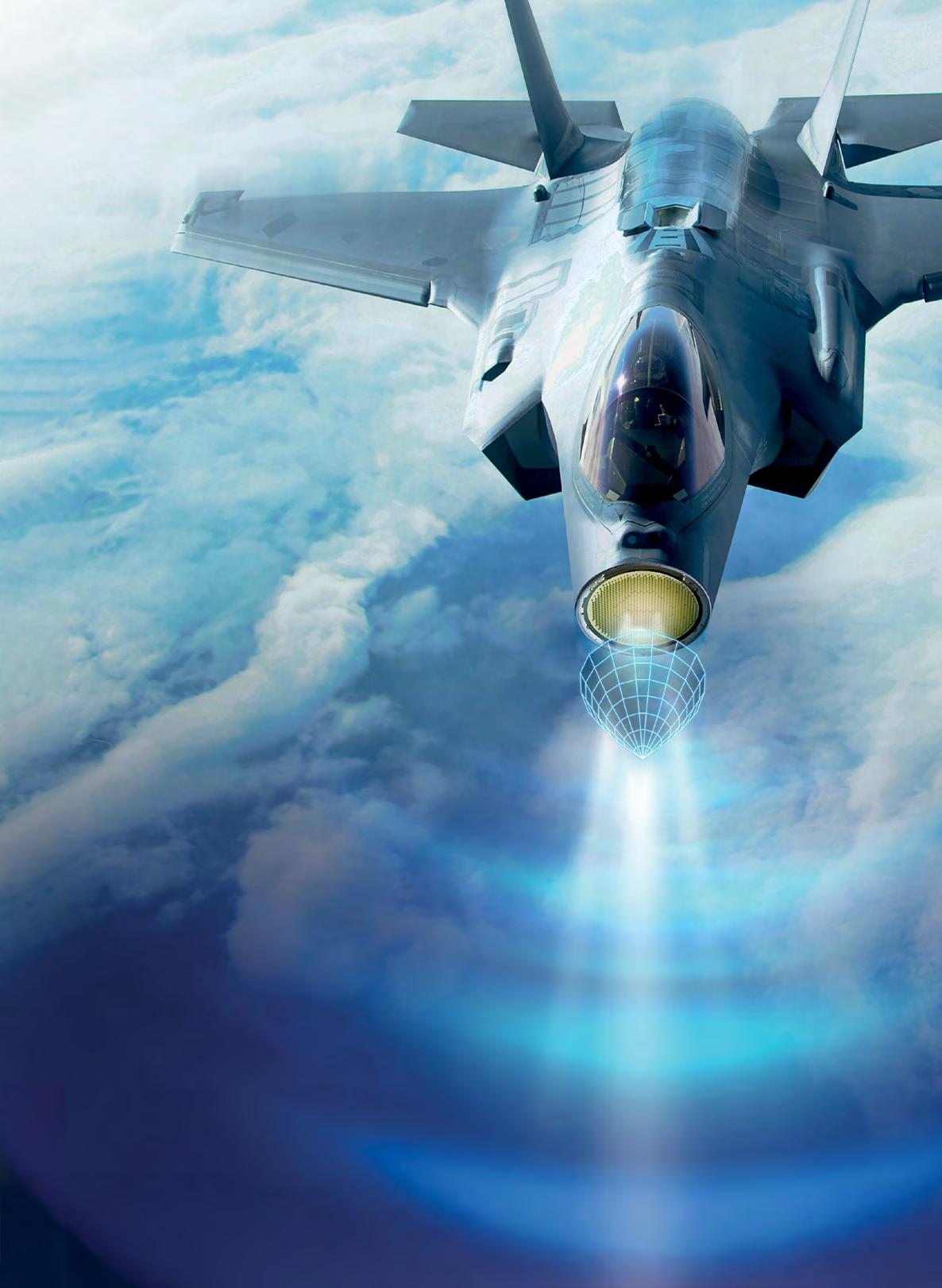
Solutions for Rapid Deployment
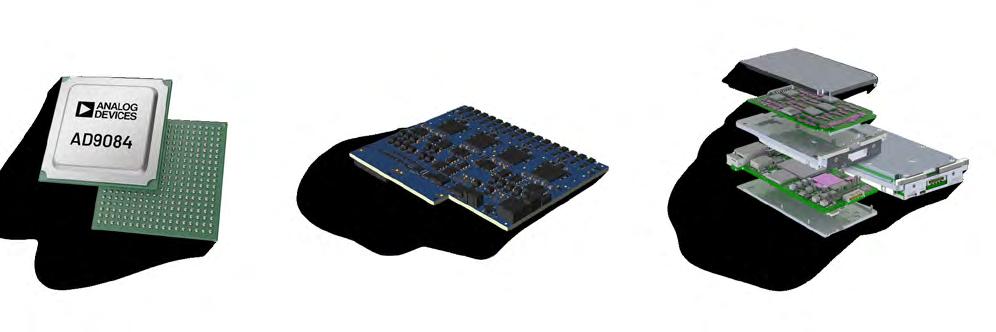
Analog Devices’ commercial off-the-shelf (COTS) software-defined radio (SDR) system-on-module (SOM) digitizers enable customers to deploy high performance distributed sensing techniques at the tactical edge, as quickly as possible.
Editor’s Perspective
7 Special Operations and drone tech
By John M. McHale III
Connecting with Mil Embedded
By
WEB RESOURCES
Subscribe to the magazine or E-letter Live industry news | Submit new products http://submit.opensystemsmedia.com
WHITE PAPERS – Read: https://militaryembedded.com/whitepapers
WHITE PAPERS – Submit: http://submit.opensystemsmedia.com
FEATURES
SPECIAL REPORT: Helicopter avionics
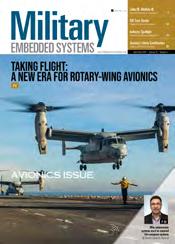
8 Taking flight: A new era for rotary-wing avionics
By Dan Taylor
MIL TECH TRENDS: Leveraging FACE Technical Standard for military avionics
12 From legacy to leading edge: FACE and MOSA transform technology integration in defense avionics
By Joe Richmond-Knight, SYSGO
16 From concept to capability to compliance: Making MOSA work in avionics By Paul Maguire, Knowmadics
INDUSTRY SPOTLIGHT: Avionics safety certification
20 Why autonomous systems must be assured like weapons systems By Ricardo Camacho, Parasoft
24 Open standards helping to future-proof UAVs
By Flemming Christensen, Sundance Multiprocessor Technology
©
© 2026 Military Embedded
To unsubscribe, email your name, address, and subscription number as it appears on the label to: subscriptions@opensysmedia.com
28 Closing the adoption gap in MOSA-driven avionics modernization By Rasha Fakhreddine, Evans Published by:
ON THE COVER:
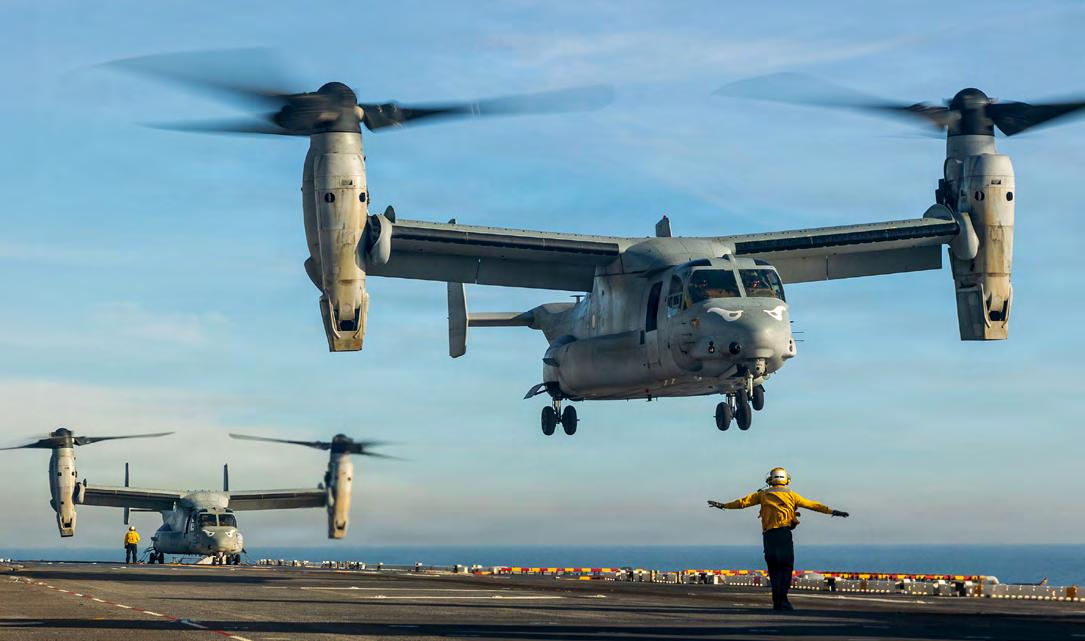
A U.S. sailor assigned to Wasp-class amphibious assault ship USS Boxer (LHD 4) guides an MV-22B Osprey with Marine Medium Tiltrotor Squadron (VMM) 163 (Reinforced), 11th Marine Expeditionary Unit, during flight operations in the Pacific Ocean. U.S. Marine Corps photo by Lance Cpl. Nicole Stuart.
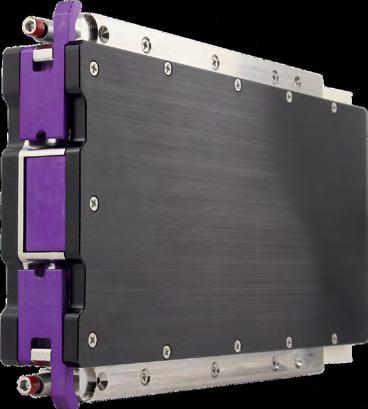
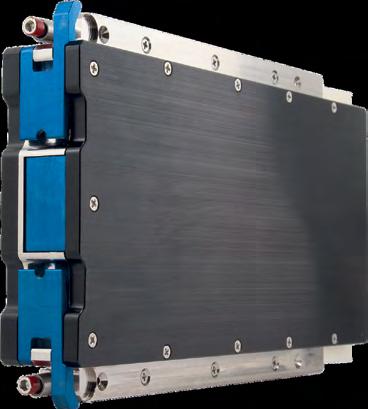
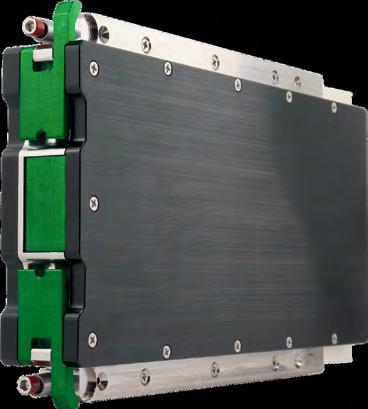
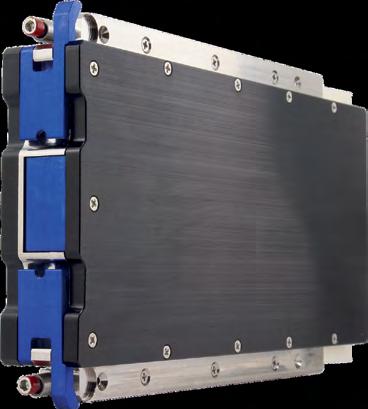
Flexible Mezzanine Sites for Expansion & Tailored Features
AMD Versal™ Premium
VP1502/VP1702/VP1552 Options
Up to 700Gb of Optical I/O
SOSA-Aligned
MACSEC & IPSEC Cybersecurity Features







AUVSI Xponential 2026
May 11-14, 2026 Detroit, MI
https://xponential.org
IEEE International MTT Symposia (IMS)
June 7-12, 2026
Boston, MA
https://ims-ieee.org/ims2026-boston
Farnborough International Airshow
July 20-24, 2026
Farnborough, England
https://www.farnboroughairshow.com/ 18th Annual GVSETS
August 11-13, 2026
Novi, MI
https://ndia-mich.org/event/gvsets/
GROUP EDITORIAL DIRECTOR John McHale john.mchale@opensysmedia.com
ASSISTANT MANAGING EDITOR Lisa Daigle lisa.daigle@opensysmedia.com
TECHNOLOGY EDITOR – WASHINGTON BUREAU Dan Taylor dan.taylor@opensysmedia.com
CREATIVE DIRECTOR Stephanie Sweet stephanie.sweet@opensysmedia.com
WEB DEVELOPER Paul Nelson paul.nelson@opensysmedia.com
EMAIL MARKETING SPECIALIST Drew Kaufman drew.kaufman@opensysmedia.com
WEBCAST MANAGER Marvin Augustyn marvin.augustyn@opensysmedia.com
VITA EDITORIAL DIRECTOR Jerry Gipper jerry.gipper@opensysmedia.com
SALES/MARKETING
DIRECTOR, SALES OPERATIONS Tom Varcie tom.varcie@opensysmedia.com (734) 748-9660
STRATEGIC ACCOUNT MANAGER Bill Barron bill.barron@opensysmedia.com (516) 376-9838
EAST COAST SALES MANAGER Bill Baumann bill.baumann@opensysmedia.com (609) 610-5400
SOUTHERN CAL REGIONAL SALES MANAGER Len Pettek len.pettek@opensysmedia.com (805) 231-9582
DIRECTOR OF SALES ENABLEMENT Barbara Quinlan barbara.quinlan@opensysmedia.com AND PRODUCT MARKETING (480) 236-8818
INSIDE SALES Amy Russell amy.russell@opensysmedia.com
STRATEGIC ACCOUNT MANAGER Lesley Harmoning lesley.harmoning@opensysmedia.com
EUROPEAN ACCOUNT MANAGER Jill Thibert jill.thibert@opensysmedia.com
EUROPEAN ACCOUNT MANAGER Michael O'Kane michael.okane@opensysmedia.com
TAIWAN SALES ACCOUNT MANAGER Patty Wu patty.wu@opensysmedia.com
CHINA SALES ACCOUNT MANAGER Judy Wang judywang2000@vip.126.com
CO-PRESIDENT Patrick Hopper patrick.hopper@opensysmedia.com
CO-PRESIDENT John McHale john.mchale@opensysmedia.com
DIRECTOR OF OPERATIONS AND CUSTOMER SUCCESS Gina Peter gina.peter@opensysmedia.com
GRAPHIC DESIGN MANAGER Kaitlyn Bellerson kaitlyn.bellerson@opensysmedia.com
Emily Verhoeks emily.verhoeks@opensysmedia.com
Special Operations and drone tech
By John M. McHale III John.McHale@opensysmedia.com
The fastest growing part of the SOF Week exhibits floor over the last few years has been companies focused on autonomous systems – air, ground, and sea – many carrying artificial intelligence (AI) solutions. The 2026 event, for which we are again the Official Show Daily and Show Guide producer and where this issue is distributed, promises even more growth in these areas.
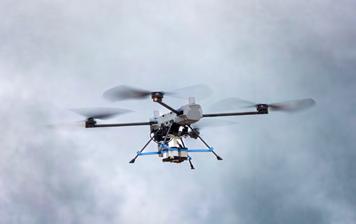
First-person view (FPV) drones in particular have become force multipliers for Special Forces units.
“I don’t know of any Special Forces that aren’t using FPV,” Jeff Thompson, founder and CEO of Red Cat Technologies, stated in the keynote session of our April Autonomous Systems Virtual Conference. “They’re fast. They’re quick. You can use [them] kinetically.
“Nighttime activity is also critical to Special Operations,” he continued. “Almost all the drones just a few years ago were not made for nighttime use. That’s where 90%-plus of the missions are done. Keeping people out of harm’s way or getting as much information [as possible], so they can actually have a very much easier mission – being completely knowledgeable of where the enemy is, what it looks like inside that building, once you break into it with an FPV drone. The information is just priceless for a warfighter.
“The small units can really make use of these [drones], especially if they’re behind enemy lines and things like that,” Thompson noted.
During the session, he and I also discussed payloads and the technology requirements for the payloads and the missions: Sometimes the mission will determine the payload, if not all the time.
“We listen to our operators,” Thompson said. “That’s the best way to come up with payloads. If you let engineers make the payloads they’re going to come up with something really cool. And the technology is insane, but might be 100% useless for the actual operator. So we have stopped taking the feedback from that world and now we get direct feedback from the operators – literally. The people in Ukraine have access to our engineers in Salt Lake City, so we get that feedback immediately.”
Modularity is critical for refreshing drone technology in the field, as it cuts down on replacement time, enabling operators to get their technology back into the field more quickly, he said.
Many drones “are not modular [and] do not let anyone bolt what they want onto it. So, the Army or the Marines will get

stuck with something that they can only use from that vendor, or they’ll only let them fix it and things of that nature.
“Our [drone] arms are replaceable, so if you crash, you don’t have to send it back,” he added. “You can fix the arm [yourself]. The camera is [also] modular, so if you break the camera, you don’t have to throw the drone away like they have to do with the Mavics drones in Ukraine. You can put a new camera on there.
“Some other things that we’ve been really focusing on is having a daytime-only camera, so you don’t have to worry about having the extra thermal stuff on it. Then we have a thermalonly version, for nighttime, so you can just snap on what you really need to do.
“These modular payloads are so important. There’s just so many different ways that you can make your device more useful to the warfighter by letting them come up with an idea and maybe bolt something onto your drone.”
Many people have called the war in Ukraine the first drone war – Thompson addressed that in the keynote. The phrase “came out of a lot of folks in Ukraine, but it is really drone against drone there. And [recently] the Ukrainians actually took a position away from the Russians, using ground vehicles and air vehicles with no humans involved whatsoever. So, yeah, they’ve been actually taking land with just robots.
“In Ukraine, in Iran, and in Gaza it’s mostly robots against robots,” he continues. “When I say robots, people say drones. But we say drones, they always think they just fly. We have our boats that are drones. There’s no humans. There’s torpedoes that are drones. There’s all these different things that are drones. Some are just drones, some are autonomous, and some are driven by FPV. But it is literally drone against drone.”
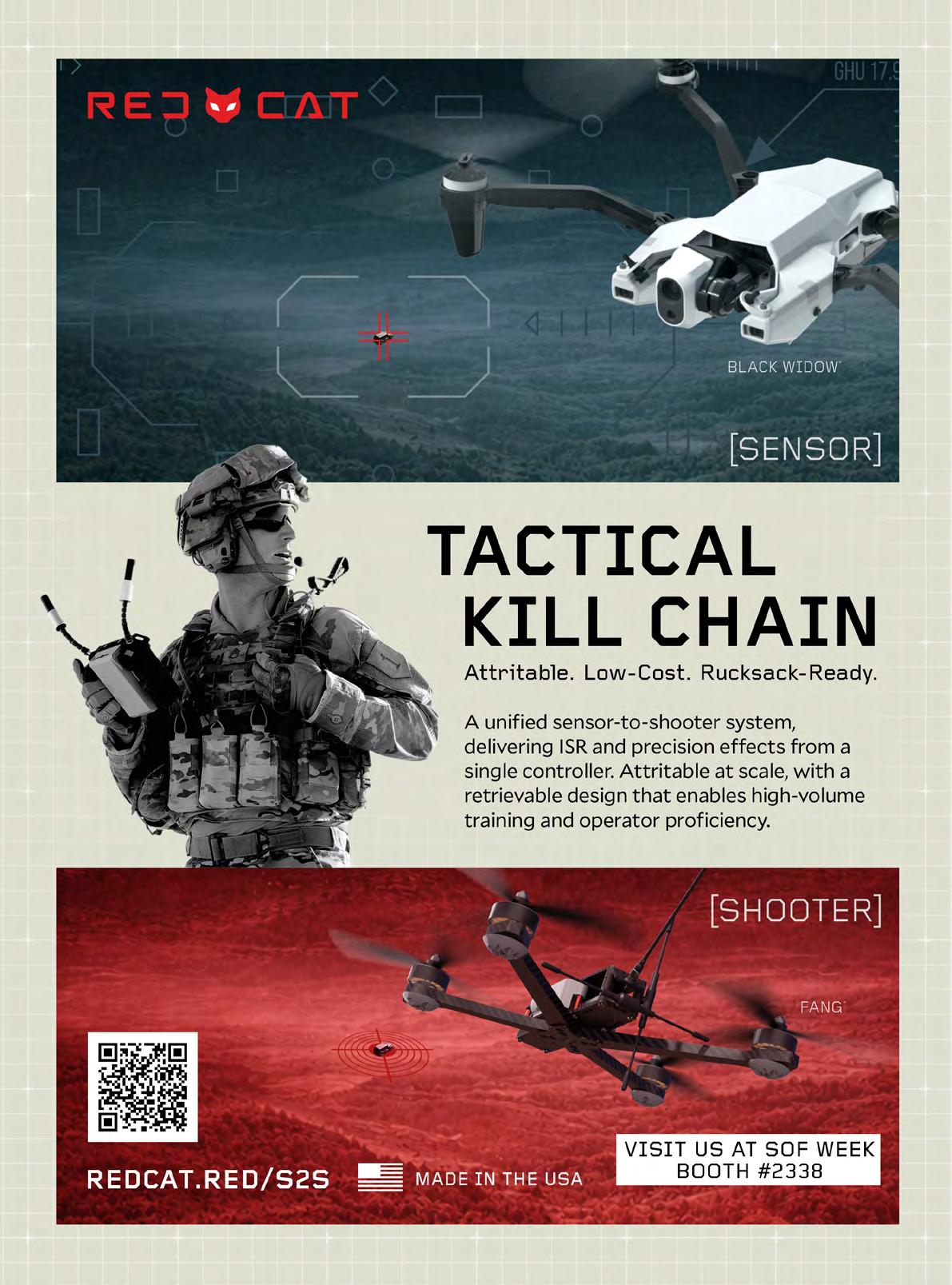
To listen to the full discussion with Thompson during the Virtual Conference, visit https://tinyurl.com/mwjmf2hy. Red Cat will also be at SOF Week May 18-21 in Tampa at Booth 2338. Check out their Teal Drones Black Widow short-range reconnaissance drone, the FlightWave Edge 130 extended short-range uncrewed aerial system, and the BlueOps Variant 7 uncrewed surface vessel.
For all our SOF Week coverage, visit www.militaryembedded. com/SOFWEEK and if you’re attending, check out Show Daily coverage in your inbox.
SPECIAL REPORT
Taking flight: A new era for rotary-wing avionics
By Dan Taylor
Across the U.S. military and allied forces, rotary-wing avionics are being rebuilt from the inside out: new architectures, smarter sensors, and software-defined systems designed to keep pace with threats that evolve faster than hardware-refresh cycles can keep up with.
The helicopter cockpit has always been a crowded, demanding place – a collection of gauges, switches, and toggles that pilots spent years learning to read in seconds. That era is ending. Decades-old platforms like the Black Hawk and Apache are being asked to survive in environments their original avionics were never designed for – GPScontested, communications-degraded, and saturated with threats that can detect and engage a helicopter before its crew knows they’re being tracked. At the same time, a new generation of platforms is being designed from scratch around open architectures and softwaredefined systems.
The questions facing the defense industry on helicopter avionics are as much about process as technology: How do you modernize a cockpit that has to stay mission-ready while it’s being upgraded? How do you build security into hardware that will still be in service thirty years from now? And how do you make open architecture a real, auditable engineering reality rather than a marketing claim?
Open architecture: from policy to program reality
A spokesperson with RTX (Arlington, Virginia) says investment in upgrades has been consistent and is accelerating across
U.S. and allied platforms, and open architecture is a big part of that push.
“The primary drivers are addressing system obsolescence, accelerating adoption of modular open systems architectures, and enabling faster integration of new mission capabilities that improve situational awareness, interoperability, and overall mission effectiveness,” the spokesperson says.
The modular open systems approach (MOSA) began years ago as congressional direction, but today it has become the organizing principle for virtually every major U.S. military aviation
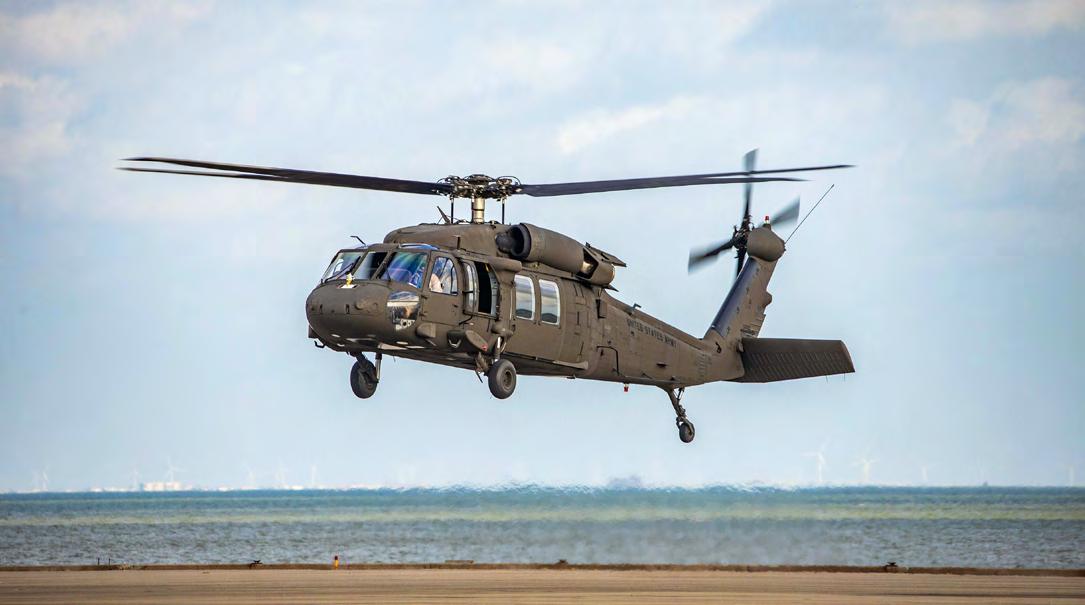
A U.S. Sailor assigned to Wasp-class amphibious assault ship USS Boxer (LHD 4) guides an MV-22B Osprey with Marine Medium Tiltrotor Squadron (VMM) 163 (Reinforced), 11th Marine Expeditionary Unit, during flight operations in the Pacific Ocean. U.S. Marine Corps photo by Lance Cpl. Nicole Stuart.
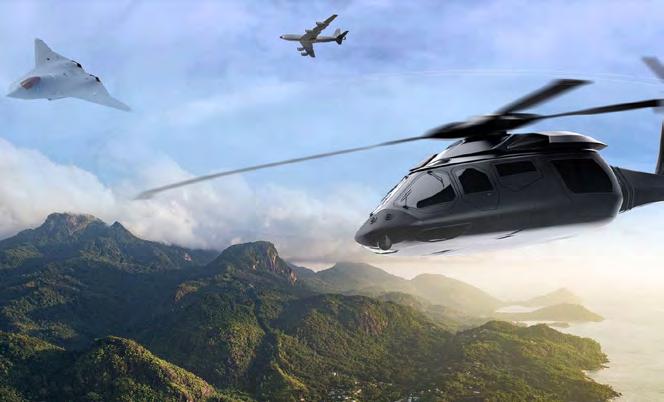
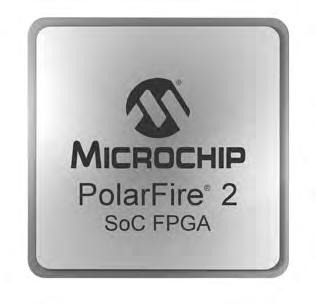
Figure 2 | Microchip Technology’s PolarFire FPGAs [field-programmable gate arrays] and SoCs [systems on chip] provide security for avionics applications, combining supply-chain assurance, tamper resistance, secure boot, and cryptographic engines to protect hardware and data. Image via Microchip Technology.
program. For example, the Army’s Program Executive Office (PEO) Aviation has made MOSA the framework for affordability, readiness, and capability growth across its entire aviation portfolio, with FACE, or Future Airborne Capability Environment, Technical Standard and HOST [Hardware Open System Technologies] identified as foundational standards.
That policy language is translating into actual program decisions. The selection of RTX subsidiary Collins Aerospace (Charlotte, North Carolina) on the U.S. Army’s UH-60 avionics modernization effort is one example. The RTX spokesperson points to this pick as evidence of “growing customer demand for MOSA aligned solutions that can accelerate capability upgrades while reducing integration risk.”
Boeing describes the AH-64E v6.5 upgrade path as the Army’s first MOSA compliant enduring aircraft, built around a more capable mission-system backbone for communications, navigation, sensor fusion, and future technology insertion. Bell, for its part, is making the same architectural argument for its MV-75 FLRAA tiltrotor, describing the platform as “built with MOSA” from the ground up.
Not every program is starting from scratch. The V-22 Osprey’s avionics story is the legacy-fleet version of the same challenge: The VeCToR cockpit-modernization program and flight-control computer redesign are framed primarily as obsolescence mitigation with a path toward more affordable future modifications rather than as a ground-up reinvention. The practical difference between a clean-sheet MOSA design and a retrofit MOSA compliance effort is sizable, but the defense industry is working hard to close that gap.
The challenge of integration
Talk to engineers working on helicopter avionics upgrades and you might be surprised by what they say keeps them up at night. The usual suspects – fitting new gear into tight spaces, sourcing parts, getting hardware certified – are not actually the biggest obstacles, says Bill Dillard, senior business development manager for aerospace and defense at Microchip Technology (Chandler, Arizona).
“Modern avionics platforms offer significant size, weight, and power (SWaP) advantages and are supported by mature, dependable supply chains,” he says. “Certification is a well-understood and manageable level of effort.”
The real headaches, Dillard says, lie in getting power where it needs to go and making old and new systems talk to each other. Older helicopters were built around data formats and proprietary communication protocols that have no straightforward connection to modern digital systems.
“While converter solutions exist, they are typically suboptimal in terms of performance, complexity, and long-term maintainability,” he says.
The RTX spokesperson says that the core challenge is updating cockpits that were built as one-of-a-kind systems, without taking the aircraft out of service to do it. Open architecture, the spokesperson asserts, is how the industry is beginning to solve that problem.
Seeing through the fog
Solving the integration problem is only the starting point. Once new systems are on board, the question becomes what they enable – and right now, the capability the military wants most is the ability to keep flying and fighting when conditions turn against it. Dust storms, fog, smoke, darkness: the environments where helicopters have always been most vulnerable, and where the next generation of cockpit technology is most focused.
The Army’s Degraded Visual Environment Mitigation program and its
Figure 1 | Collins Aerospace’s Mosarc avionics architecture is a family of modular open systems products built around MOSA compliant computing, networking, displays, and software that is designed to enable rapid capability integration across military rotorcraft. Graphic courtesy Collins Aerospace.
follow-on effort are the most visible examples of this effort, combining infrared sensors, radar, and LiDAR to build real-time 3D terrain maps that pilots can use when their eyes can’t be trusted, according to an Army fact sheet.
The RTX spokesperson states that sensor fusion – combining data from multiple sources into a single picture for the pilot – is the technology closest to being widely adopted across the fleet. “It delivers immediate operational benefits without requiring a full platform redesign,” the spokesperson notes.
The goal is not to have more screens but to present fewer decisions, a situation that gives pilots a cleaner, faster read on what’s happening around them.
Helmet-mounted displays are part of that sensor integration as well. Collins Aerospace’s Zero-G helmet is designed to put critical flight and mission data in front of a pilot’s eyes without adding to the physical strain of a high-workload mission. On the Apache, Boeing has been developing haptic controls and automated hold modes that reduce the mental and physical effort of flying in degraded conditions, according to Boeing documentation.
Across every program, the pattern is the same: the avionics takes on more of the burden so the pilot can focus on the mission.
Cybersecurity: built in, not bolted on
Open architectures create a cybersecurity challenge, however: The more interfaces a cockpit has, the more entry points exist for an adversary to exploit. Dillard says that Microchip’s answer to that problem starts at the chip level, before software ever enters the picture. “Hardware-rooted security is increasingly recognized as essential to avionics system integrity, with formal requirements now flowing into design and certification processes through DO-326A and DO-356A.”
Military helicopters can stay in service for 30 years or more, which makes the security situation more complex than it may initially look. A system that is secure today may not be secure against the threats of 2040. Quantum computing alone could eventually break encryption methods that currently seem impenetrable. Dillard’s solution is to build security into the silicon itself – a foundation that can be updated over time without replacing the underlying hardware.
“A strong, silicon-embedded security enclave establishes a durable root of trust and can be progressively strengthened through software and cryptographic upgrades as threat models evolve,” he says.
The Army’s own guidance on MOSA treats cybersecurity the same way – not as a feature to be added at the end, but as something that has to be designed in from the start, using established controls, according to an Army release. After all, an open architecture that can be upgraded quickly is only an advantage if it cannot also be compromised quickly.
Cockpits as network nodes
The communications picture is changing fast as well. Helicopters are no longer just voice platforms, but are becoming data nodes in a broader tactical network as they share targeting information, sensor feeds, and situational-awareness data with ground forces and other aircraft in near-real-time. Marine Corps H-1 helicopters have already demonstrated the ability to operate on a mixed Link 16 and ANW2 network alongside ground stations, and the Navy’s CMV-22B added a high-frequency radio capable of communicating beyond line-of-sight without relying on satellite links, according to information from the Navy.
The RTX spokesperson frames all of this connectivity work as central to what
CERTIFY IN THE LAB, THEN FLY
Getting new avionics onto a military helicopter is not just an engineering problem – it is a paperwork problem, but this paperwork exists for good reason. Flight-critical software has to be verified to standards that don’t move as fast as commercial technology does, and that tension between upgrade speed and testing rigor is one the industry has been working to resolve.
The answer, increasingly, is to do as much of the hard work as possible before an aircraft ever leaves the ground. According to Bell Helicopter its Weapons Systems Integration Lab brings together fly-by-wire controls, avionics, electrical systems, hydraulics, and mission systems under one roof for end-to-end testing. Naval Air Systems Command (NAVAIR) engineers are working on the Common Systems Integration Lab, which does the same for cockpit upgrades, thoroughly verifying that new equipment works properly alongside the legacy systems it has
to coexist with, according to a NAVAIR release. Additionally, when Army, Bell, and NASA teams collaborated to evaluate the MV-75’s flight-control laws, they used a full-motion simulator to work through handling qualities and control-law refinements before the aircraft flew a single hour.
The standards that govern this work – DO-178C for software, DO-330 for tool qualification, DO-297 for integrated modular avionics – are not obsolete. What is changing is how efficiently the industry can meet them. The hybrid model that’s emerging from these trials uses commercial off-the-shelf (COTS) technology wherever the certification burden allows it, and keeps purpose-built, fully qualified designs where safety or mission requirements demand them.
The ultimate goal of all this: To speed up development without resorting to possibly unsafe shortcuts.
customers are actually buying when they specify open, standards-based interfaces: The ability to plug into whatever network the joint force is running, now and in the future.
What’s coming next
The roadmap for the next several years is getting clearer. Bell’s MV-75 – the Army’s next-generation tiltrotor assault aircraft –reached a major development milestone when the Army accepted its first virtual prototype in June 2025, with first flight planned for 2026, low-rate initial production in 2028, and initial fielding in 2030, according to the Army. The MV-75 is the clearest statement yet of where U.S. assault aviation avionics are headed: open architecture, digital backbone, and a design built to accept new capabilities as they become available.
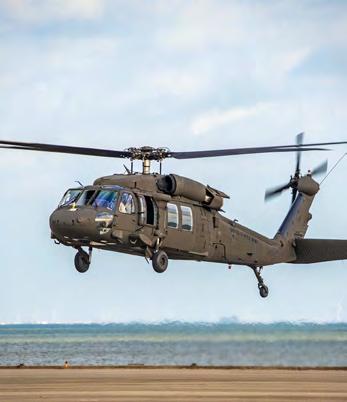
On the legacy or upgrade side, progress is also ongoing. In March 2026, the U.S. Army took delivery of the H-60Mx, a Black Hawk modified to fly with or
without a pilot at the controls, integrated with Sikorsky’s MATRIX autonomy system, according to the U.S. Defense Advanced Research Projects Agency (DARPA).
The delivery is part of DARPA’s Aircrew Labor In-Cockpit Automation System (ALIAS) program, which looked “to create a highly automated system that could be integrated into existing aircraft to enhance mission flexibility and safety, particularly in complex and contested environments,” according to DARPA. Fully autonomous combat operations are not imminent, but the arrival of the H-60Mx shows that optional piloting has moved from a research concept to hardware the Army is actually testing.
The spokesperson for RTX says the broader industry trend is toward upgrades that are smaller, faster, and lower-risk – changes that extend the life of existing fleets without taking aircraft offline for long periods. MOSA is what makes that possible: when systems are built around open, modular interfaces, a new radio or sensor can be swapped in without disturbing everything around it.
Dillard sees the same logic applying to security. Getting the architecture right from the start – open interfaces, modular software, hardware-embedded security – is what enables a helicopter’s avionics system to be relevant and protected across a service life that may span multiple decades and as-yet-unpredicted threat environments.
The cockpit of the future will not look like the one it replaced. It will be quieter, cleaner, and far more capable – and the work being done right now, on chips and data buses and software-partitioning schemes that most people will never see, is what will make that possible. MES
OpenSystems Media works with industry leaders to develop
Boosting Maritime Security with Intelligent Edge-Based Video Analytics
By ASUS
Port operators face rising security risks, yet traditional vessel detection often relies on automatic identification system (AIS) signals – which can be manipulated, disabled, or missing –creating critical surveillance blind spots. Meanwhile, maritime deployments require industrial-grade computing that can withstand humidity, vibration, and extreme weather fluctuations.
In this white paper, a case study details how a user deployed an ASUS IoT edge AI computer to reliably handle harsh maritime/ industrial conditions; achieve high-accuracy, efficient intelligent video analytics with on-device processing; and accelerate solution success through collaboration with the computer maker.

https://tinyurl.com/2bsrmkyy
MIL TECH TRENDS
Leveraging FACE Technical Standard for military avionics
From legacy to leading edge: FACE and MOSA transform technology integration in defense avionics
By Joe Richmond-Knight
As defense programs demand greater agility and cost-effectiveness, the Future Airborne Capability Environment, or FACE, Technical Standard and the modular open systems approach (MOSA) are providing program managers, systems integrators, and avionics architects with the architectural foundation for flexible, risk-reduced technology upgrades in military avionics.
The ongoing evolution of military aviation demands faster technology integration, greater cost control, enhanced security, and long-term adaptability. The Future Airborne Capability Environment, or FACE, Technical Standard and the modular open systems approach (MOSA) are at the heart of this transformation,
providing the technical and conceptual foundation for modular, interoperable, and future-proof avionics. The FACE approach and MOSA enable risk-reduced integration, lower life cycle costs, and support secure and agile upgrades.
Investment for long-term advantage
The shift toward modular, open architectures is more than just a technical evolution. It is also a strategic investment with major implications for cost, risk, and operational flexibility for defense programs.
Stock image.

Implementing open standards like FACE and MOSA requires an initial investment in technical and organizational change. However, long-term savings and operational flexibility are substantial.
By decoupling platform architecture from functional logic, system providers can reuse certified modules across multiple projects, reducing vendor-lock-in and minimizing costly reintegration. The FACE Registry, a publicly accessible marketplace for certified software modules, further amplifies these benefits by increasing visibility, accelerating procurement and fostering a competitive environment where both large and small vendors can participate equally.
These advantages extend well beyond the initial development stage. The clear separation of system modules facilitates
easy replacement or upgrade of individual components. It enables parallel modernization and targeted integration of new technologies with minimal disruption. This approach streamlines maintenance, addresses hardware obsolescence, and keeps testing efforts and costs predictable. Thus, modernization becomes scalable and auditable, delivering tangible cost savings and operational readiness throughout the system’s life cycle.
Security architecture and multilevel security (MLS): Building trust into the system
As avionics systems become more interconnected and software-defined, security becomes mission-critical. Adopting a FACE approach addresses this challenge with a robust security architecture developed by the Security Subcommittee of the FACE Technical Working Group. The standard enables the integration of components with different security requirements and supports physical and logical separation via partitioning technologies such as ARINC 653.
The clear separation of system modules facilitates easy replacement or upgrade of individual components. It enables parallel modernization and targeted integration of new technologies with minimal disruption. This approach streamlines maintenance, addresses hardware obsolescence, and keeps testing efforts and costs predictable.
A key focus is multilevel security (MLS), which allows modules with different classification levels, such as open navigation systems and classified mission algorithms, to coexist securely on shared hardware. The system’s resilience is further strengthened by secure communication interfaces in the transport services segment (TSS) and the ability to define dedicated policies for security-relevant data paths. Domain-specific security mechanisms, including data encryption and access control, can be implemented without compromising interoperability. This architecture, combined with standardized data models, meets stringent military requirements and is equally applicable to both critical infrastructure and civilian aviation.
Data exchange and compatibility: The role of the TSS
One major advantage of the FACE standard is the flexibility of the TSS, which acts as a mediation layer between software components. The TSS can host middleware functionalities that go beyond basic data transport, including versioning, semantic data conversion, validation, and integration of messaging protocols.
This flexibility is particularly valuable for platforms with mixed-generation systems. For example, a modernized targeting system can access data from an older navigation module without requiring direct interface modifications. The middleware then acts as an adaptive layer that supports MOSA’s central objective of enabling technology updates independently of platform structure. This approach preserves architectural integrity and accelerates the pace of modernization.
The FACE Registry: Certification and marketplace
Building upon its role in terms of cost and innovation, the FACE Registry also reduces integration risk and sustains competitiveness through its rigorous certification process.
The FACE Registry is more than just a directory. It serves as a central hub where program managers, system integrators, and developers can discover, compare, and source certified Units of Conformance (UoC) with confidence. Each component listed
in the registry undergoes a formal conformance process to ensure interoperability within the FACE architecture. This process provides assurance that only rigorously tested, standard-compliant modules are available for integration. Procurement and integration are streamlined, and trust is built across the defense avionics ecosystem.
The path to FACE conformance involves three stages:
1. Conformance Test Suite (CTS): Automated testing by the developer
2. Verification Authority (VA): Independent validation by authorized bodies
3. Conformance Authority (CA): Final certification and entry into the registry
By leveraging the registry, organizations can reduce integration risk, accelerate modernization, and maintain a competitive edge in a rapidly evolving market.
No Boundaries!
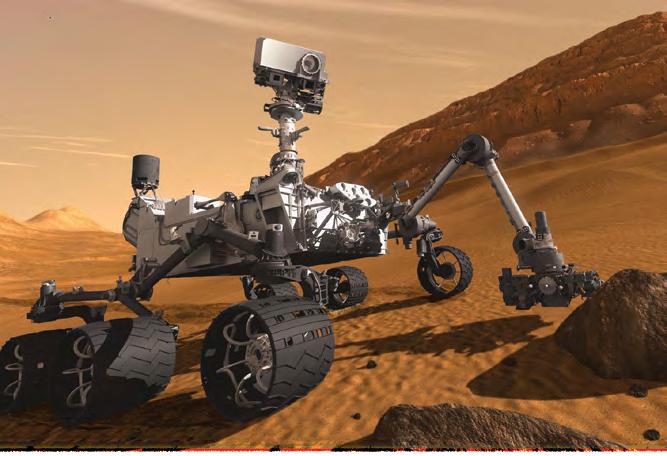
When engineers need resistors for critical missions in a no-replace environment like Mars, they choose State of the Art. We are aboard three Mars orbiters: Odyssey, MRO, and Maven. We have been aboard all five NASA rovers that have, or are exploring, the surface of Mars: Sojourner, Spirit, Opportunity, Curiosity, and Perseverance. We are also aboard the InSight Lander that studied the interior of Mars. Working toward a manned mission to Mars, NASA chose State of the Art resistors. Whose resistors will you choose for your next mission?
Mission Critical?
Choose State of the Art resistors.
State of the Art, Inc.
RESISTIVE PRODUCTS
Made in the USA.
Common misconceptions about FACE approach
Despite its widespread adoption, there are still several misconceptions about the FACE Technical Standard. One common belief is that all software on a platform must be FACE aligned or certified conformant. In reality, the standard is primarily designed for interchangeable or reusable modules, not for every line of code. Another misconception is that the FACE approach guarantees performance. In fact, the standard defines interfaces to ensure interoperability, but it does not dictate the software’s functionality or speed.
Concerns
about intellectual property are also often misplaced. Although the FACE standard promotes open interfaces, developers are not required to relinquish ownership of their proprietary technology. Intellectual property remains firmly with the creator. Additionally, some believe that the FACE standard is only relevant for new systems when, in fact, retrofitting existing platforms is a central goal of the standard. Finally, although initial implementation costs may be higher, the long-term benefits of module reuse and increased competition can result in significant cost savings over a program’s life cycle.
Empowering developers and architects
The successful implementation of the FACE approach and MOSA is supported by a wide range of tools and training resources. The BALSA reference project [The Open Group-supported Basic Avionics Lightweight Source Archetype environment], for example, provides a minimal, functional example environment that demonstrates how to build a simple but complete FACE compliant application. This is complemented by detailed documentation, guidelines for software vendors, integrators, and project managers, as well as regularly updated training programs. These resources are critical for steering projects in the right direction from the start and avoiding costly missteps.
Harmonizing standards for operational capability
Modern defense systems rarely operate in isolation. The continued advancement
of open systems approaches requires the integration of various architectural standards into one overarching system. While the FACE approach modularizes and standardizes platform software, other standards like the Sensor Open Systems Architecture, or SOSA, Technical Standard and the Air Force Research Lab’s Weapon Open Systems Architecture, or WOSA, address specific domains such as sensors and weapons.
Successfully integrating the FACE approach, the SOSA Technical Standard, and WOSA requires harmonized data models and interface definitions. For example, integration enables a SOSA compliant infrared (IR) seeker to be leveraged as part of a WOSA missile system; the system then communicates with the mission computer of the carrier aircraft through FACE compliant middleware. Such end-to-end architecture supports modular upgrades, mission-wide interoperability, and multinational deployment scenarios, all of which are key factors for future-proof defense structures.
Going forward
In combination with MOSA, the FACE approach establishes a conceptual and technical basis for a new generation of open, maintainable, cost-effective, and secure avionics systems. These standards enable modularity, interoperability, and streamlined certification, thereby empowering defense programs to transition from legacy architectures to leading-edge capabilities. As the demands on military aviation continue to evolve, the FACE approach and MOSA provide the necessary tools and frameworks to modernize existing platforms, integrate new technologies, and ensure long-term operational readiness. MES

Joe RichmondKnight is regional sales manager at SYSGO and supports customers in the adoption of safety- and securitycritical software architectures for embedded and avionics systems. With a background in embedded systems, IoT, and complex data acquisition, Joe brings both technical and commercial perspectives to system integration challenges. Joe joined SYSGO in 2022, where he worked as a field application engineer and solutions architect. Before SYSGO, he held engineering leadership roles in PropTech and InsurTech startups. Joe holds a degree in computer systems engineering from the University of Kent and is a member of the Institution of Engineering and Technology (IET).
SYSGO • https://www.sysgo.com/
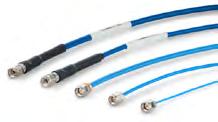
Levitate™ Cable Assemblies: Lightweight RF Solutions for Mission-Critical UAV Systems
Modern unmanned aerial vehicles (UAVs) operating in defense environments demand interconnect solutions that deliver uncompromising RF performance under extreme conditions. As platforms evolve to support advanced payloads and extended missions, Size, Weight, and Power (SWaP) optimization becomes a critical design parameter – impacting endurance, range, and operational flexibility.
Levitate™ cable assemblies from Times Microwave Systems are engineered to meet these stringent requirements. Designed for RF applications across UAV classifications defined by both the U.S. Department of Defense (Groups 1-5) and NATO (Classes I-III), Levitate assemblies combine ultra-lightweight construction with low-loss performance, enabling reliable signal integrity for avionics systems where every gram matters.
Key technical advantages include:
• Ultra-lightweight design to minimize SWaP impact and maximize mission endurance
• Compact form factors for integration in space-constrained Line Replaceable Unit (LRU) configurations
• Ruggedized materials proven to withstand environmental stressors, including temperature extremes, vibration, humidity, and salt fog
• Advanced shielding systems to maintain electromagnetic compatibility in dense RF environments
• Optimized conductor architecture for minimal attenuation across extended cable runs
Levitate assemblies support mission-critical functions such as flight control, navigation, electronic warfare, and ISR payloads, while offering a cost-effective solution available through distribution channels. By leveraging aerospace-grade materials and precision-engineered designs, Levitate assemblies deliver military-grade reliability without the weight penalty of traditional interconnect systems.
For defense engineers seeking to bridge the gap between commercial agility and military durability, Levitate assemblies represent a breakthrough in RF cable technology – enabling next-generation UAV platforms to achieve superior performance under the most demanding operational conditions.
When mission success depends on RF integrity and weight optimization, Levitate assemblies deliver.

MIL TECH TRENDS
From concept to capability to compliance: Making MOSA work in avionics
By Paul Maguire
As artificial intelligence (AI), autonomy, and software-defined systems continue to drive defense equipment requirements at the tactical edge, the emphasis shifts from defining standards to executing against them. Aligning certification approaches, integration practices, and hardware strategies will ultimately determine how effectively the modular open systems approach (MOSA) delivers on its promise.
The ability to translate requirements into deployable capability remains a central objective for modern defense systems, particularly in avionics. The goals of the modular open systems approach (MOSA) are well established in U.S. Department of Defense (DoD) guidance, yet delivery has lagged. Programs often meet the letter of MOSA compliance without realizing the operational agility it was intended to enable.
This gap is not a failure of the concept, but a reflection of how MOSA is currently being implemented and incentivized. Certification regimes, acquisition timelines, and vendor business models are still largely optimized for stability and control over rapid integration and interoperability. These challenges have also been highlighted in recent Government Accountability Office (GAO) reviews of MOSA implementation.
Knowledge of these hurdles should not lead the defense community to abandon MOSA, however, as its potential cost savings, innovation velocity, and tactical-edge capability gains remain too significant. The path forward is not to abandon MOSA, but rather to align execution with intent.
Key friction points in MOSA based avionics architectures
MOSA was designed to unlock innovation, enabling plug-and-play integration and an environment in which the DoD could swap sensors, processors, and software with minimal disruption.
This expectation has been reinforced through formal acquisition mandates across DoD programs. The reality of 2026 is more sobering: While MOSA has provided key elements of the necessary scaffolding for modernizing military forces, a gap remains between the promise of modularity and the delivery
A UH-60V helicopter, which uses equipment aligned with the Future Airborne Capability Environment, or FACE, approach. Photo credit: Jerry Duenes, Corpus Christi Army Depot.
of deployable capability. This mismatch is not a failure of the standards themselves, but a collision between the goal of open architecture and the friction of military industrial realities.
Certification and airworthiness constraints
The primary friction point is the certification and airworthiness regime. Military avionics are governed by safety standards (e.g., DO-178C for software and DO-254 for hardware) that do not care about modularity. When a vendor swaps a card in an OpenVPX (modular embedded computing standard) chassis or updates a software module in a FACE, or Future Airborne Capability Environment, conformant environment, the speed advantage often hits a wall.
Current protocols frequently demand a full system recertification for even minor modular changes. Innovation cycles at the tactical edge are now measured in months, driven by rapid advancements in commercial silicon and AI, yet certification cycles remain measured in years.
What’s the limit of open in multivendor architectures?
Recent cuts to DoD Operational Test and Evaluation (OT&E) programs have only exacerbated this disconnect. Without a committed, well-funded effort to shorten the cycle between concept and capability, MOSA enabled systems remain constrained by certification and integration timelines.
At the same time, MOSA implementations do not always achieve the level of openness the architecture is intended to enable. Common issues include vendor-controlled middleware, incomplete interface documentation, and closed development toolchains. A platform may be MOSA compliant on paper, but if the primary integrator holds the keys to the APIs and data schemas, the government is still locked into a proprietary ecosystem.
This lack of true transparency hinders the sensor-to-shooter pipeline, as data integrity at the tactical edge depends on the seamless flow of information between disparate modules. If those modules are communicating through proprietary black box middleware, the speed of the kill chain is dictated by the slowest vendor’s willingness to share.
Performance at the tactical edge
Performance introduces another constraint at the tactical edge. Mission-critical systems require extremely low latency, high compute density, and tight timing synchronization. Standards like FACE and SOSA, or Sensor Open Systems Architecture, were designed for interoperability, but abstraction layers and middleware introduce overhead.
In a high-intensity conflict, latency directly impacts mission performance in systems such as electronic warfare (EW) and autonomous flight control. There is a persistent tension between the desire for a clean, modular abstraction and the raw, bare-metal performance required for survival.
The corrective is operator-anchored engineering, which is design validated through the operators who will depend on these systems in contested environments, not abstracted away from them.
Hardware refresh cycles versus commercial compute
Hardware cycles present a related challenge. While OpenVPX and the SOSA Technical Standard have succeeded in creating a modular hardware footprint, they do struggle to keep pace with the rapid evolution of AI accelerators and GPUs.
Commercial compute cycles move every 12 to 18 months, while military qualification cycles can extend to a decade. By the time a MOSA compliant ruggedized chassis is fielded, the processing power inside is often three generations behind the latest version. This lag can result in architectures materially behind the pace of commercial


innovation and critical edge capabilities (e.g., AI-driven autonomy and automated EW). Addressing this gap requires a hardware framework that better accommodates heterogeneous architectures and can be refreshed at the speed of the commercial market.
Integration burden in distributed architectures
MOSA changes how integration risk is distributed. In a traditional proprietary build, the prime contractor owned the risk of making everything work together. In a MOSA world, integration responsibilities often shift upward to government program offices or system integrators.
This difference leads to higher systems-engineering burdens, more complex interface management and configuration control, and versioning challenges across modules from multiple vendors. These challenges reflect the complexity inherent in modular systems. Modularity does not eliminate complexity, but rather redistributes it. Without a more robust approach to systems integration – one grounded in common data contracts, shared engineering standards, and platform patterns rather than platform projects – the industry may find that complexity shifts rather than disappears.
Cybersecurity
in open systems
Security must be built into MOSA architectures from the start. Open interfaces inherently increase the attack surface, which introduces additional risk. In tactical environments, validating third-party modules and securing firmware update chains is complex and resource-intensive.
At the same time, maintaining cybersecurity compliance across a multivendor ecosystem can be just as challenging and time-consuming as achieving airworthiness certification.
Where MOSA is delivering measurable gains
Despite these challenges, it would be a mistake to view MOSA as a failed experiment. There are meaningful successes, with industry and government leaders pointing to measurable progress. Programs adopting OpenVPX and the SOSA approach are seeing faster incremental refreshes for mission computers at the edge.
Small, innovative technology firms that were previously locked out of major platforms-acquisition efforts are now able to contribute specific modules. Additionally, multidomain convergence architectures are beginning to demonstrate how reusable capability libraries can accelerate delivery across complex and markedly different technical domains simultaneously.
Software reuse is also becoming a reality. Initiatives like the FACE Technical Standard have enabled mission-critical code to be ported across platforms with substantially lower effort than in the past. These are early indicators of a more agile defense industrial base.
What needs to change
Realizing the full value of MOSA in avionics depends less on defining new standards and more on how those standards are implemented in practice.
Programs must move beyond compliance as an endpoint and instead treat interoperability as something that must be demonstrated and sustained. This mindset starts with complete and accessible interface definitions – data schemas, APIs, and documentation that enable integration without reliance on a single vendor.
At the same time, certification approaches need to evolve alongside the architecture. Separating safety-critical avionics functions from rapidly evolving mission
applications enables software to be updated without triggering full system recertification, which can preserve both safety and speed.
Integration must also shift from a latestage activity to a continuous discipline. Shared integration environments can provide a common space for validating modules early and often, which reduces downstream risk and improves alignment across vendors.
Finally, hardware strategies must better reflect the pace of commercial innovation. Enabling more frequent insertion of new computer technologies, particularly for AI and autonomy workloads, will be essential to maintaining capability at the tactical edge.
From architecture to execution
MOSA has established a viable foundation for modular, interoperable avionics systems. The challenge now is ensuring this architecture translates into deployable capability at the pace required by the operational environment. As AI, autonomy, and software-defined systems continue to drive requirements at the tactical edge, the emphasis shifts from defining standards to executing against them. Aligning certification approaches, integration practices, and hardware strategies will ultimately determine how effectively MOSA delivers on its promise. MES

Paul Maguire is CEO and co-founder of Knowmadics, where he leads the development of secure, missioncritical technologies for defense and space-based systems. He is a former naval intelligence officer specializing in space and tracking solutions. He has contributed to next-generation national-security and public safety solutions and co-authored work on multispectral imagery and advanced imagery exploitation.
Knowmadics https://knowmadics.com/
M‑RTOS: A Trusted Multicore Architecture for Safety‑Critical and AI‑Driven Systems
By Brandon Bhatnagar, Senior Technical Project Manager / M-RTOS Product Manager, MANNARINO
For more than two decades, MANNARINO Scalian Group has delivered internationally recognized expertise in aerospace engineering of safety critical systems, certifiable software, and electronic hardware for demanding operational environments. Trusted across aerospace and defense programs, MANNARINO focuses on technologies that deliver predictability, system assurance, and long term deployability. The latest evolution of the MANNARINO Real Time Operating System, M-RTOS, reflects this focus and provides a more capable RTOS foundation than conventional solutions used in modern military platforms.
M-RTOS is purpose built for multicore microprocessors and offers strong time and space partitioning based on ARINC 653, with an architecture suitable for certification to the highest industry and defense standards. Unlike RTOS products that primarily address task scheduling, M-RTOS is engineered to manage interference across shared hardware resources in complex System on Chip environments. Integrated interference mitigation mechanisms ensure strong isolation between cores and shared resources, and embedded Safety Net monitors detect and report unmitigated or unexpected interference, providing greater operational insight and resilience.
While each system necessitates the use of a customized set of interference mitigation techniques, MANNARINO has established reliable approaches utilizing a combination of memory partitioning, bus bandwidth limitation and interrupt budgeting.
Through memory partitioning, M-RTOS bounds shared cache and DRAM interference, addressing a common limitation in multicore RTOS implementations. By isolating shared memory components, M-RTOS improves the predictability of partitions running across cores. These gains are particularly significant for interference sensitive applications, enabling more reliable execution of mixed criticality workloads such as avionics, sensors, communications, and mission computing.
M-RTOS further differentiates itself through built in Qualityof-Service enforcement using per partition bus budgeting. System integrators can configure the maximum number of bus accesses permitted during a time window, ensuring deterministic performance under peak operational loads. Many RTOS solutions offer limited visibility or control over shared bus contention, while M-RTOS enables precise, system level resource
management. Bounded interrupt servicing adds an additional layer of control by allowing configurable limits per interrupt source, reducing latency variability and protecting time critical functions.
As systems increasingly incorporate artificial intelligence, autonomy, and software defined capabilities, security and observability become integral to mission success. M-RTOS can provide a strong foundation by supporting real time collection of both application level and RTOS internal events. These events can be timestamped, normalized, and prepared for analysis, enabling advanced situational awareness.
Artificial intelligence models can be trained using such event data to identify meaningful event sequences that signal elevated security risks. When threats are detected, preconfigured security policies can be enacted, including privilege restriction, partition management, or trusted boot reinitialization, helping systems maintain integrity and mission readiness.
This capability is supported by deep domain leadership. Brandon Bhatnagar brings more than 20 years of experience in embedded RTOS technologies, with a focus on multicore architectures, hypervisors, and aerospace software certification. He holds degrees in Medical Biophysics and Management in Artificial Intelligence and applies AI and machine learning to real time, mission critical systems.
INDUSTRY SPOTLIGHT
Why autonomous systems must be assured like weapons systems
By Ricardo Camacho
In defense-related environments where mission success, survivability, and resilience are paramount, assurance must be as adaptive and persistent as the systems it supports. Autonomous platforms will only deliver their promised advantages when software assurance evolves from a one-time certification exercise into a sustained engineering discipline.
Autonomous military platforms are rapidly reshaping modern defense. By combining advanced sensors, software, and artificial intelligence (AI), these systems can operate at machine speed, extend reach, and reduce risk to human operators. At the same time, they introduce a fundamental shift in how software assurance must be approached. As autonomy
increases, so does reliance on nondeterministic, data-driven behavior. The result is a paradox: Autonomy promises greater effectiveness, but only if software assurance becomes stronger, more continuous, and more systemic.
Scale and speed unattainable with traditional rule-based software
It is critical to distinguish between AI and autonomy. Autonomy is a system-level capability; that is, the ability to perform missions within defined rules of engagement, manage uncertainty, and transition safely between modes of operation. AI is one way of enabling that capability but it is not the objective itself. From an assurance perspective,
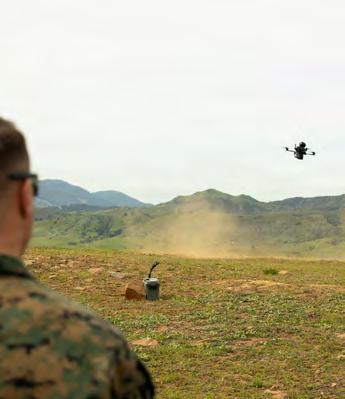
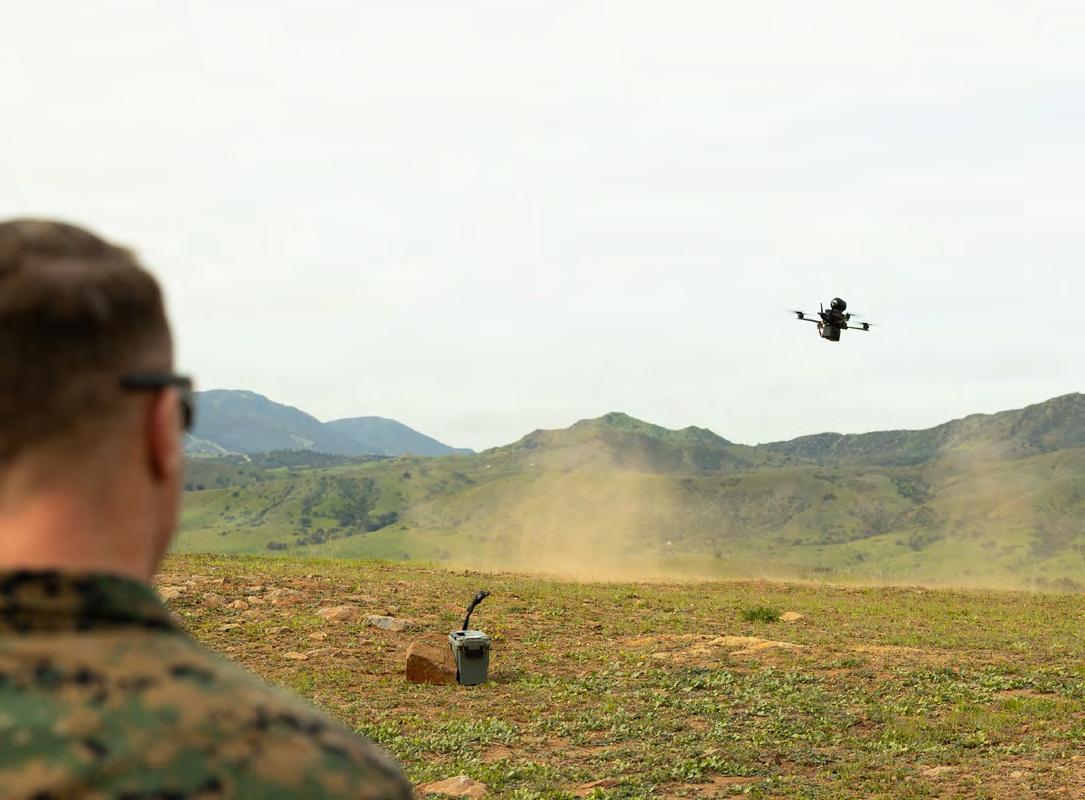
A small unmanned aerial system (UAS) ascends during a demonstration at Camp Pendleton, California. U.S. Marine Corps photo by Cpl. Joshua Bustamante.

this is an important distinction – safety, security, and mission effectiveness must be evaluated at the system level. While an AI model may perform well in isolation, it might still contribute to unsafe or ineffective behavior once it is integrated into control logic, sensors, and actuators.
Why AI complicates verification and certification
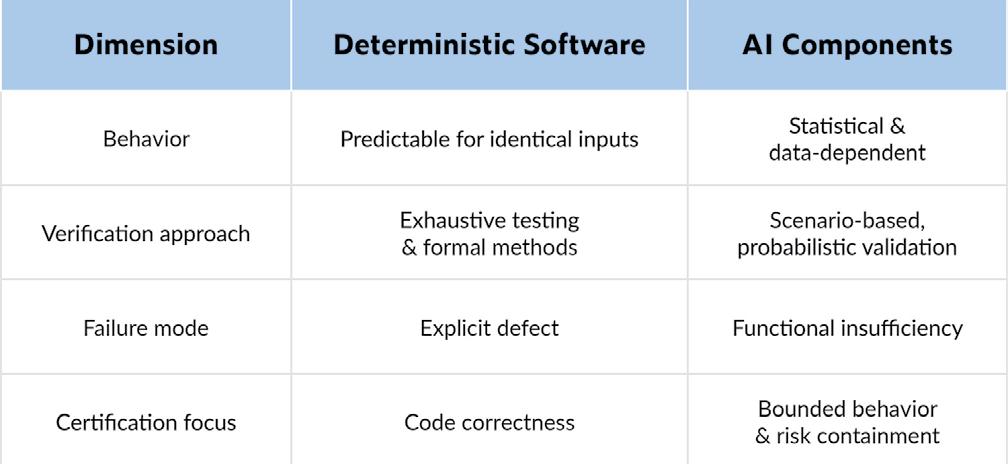
AI increases system complexity in ways that traditional verification methods were not designed to handle. Classical software behaves deterministically – given the same inputs, it produces the same outputs. Deep-learning models, on the other hand, do not, as their outputs are statistical, influenced by training data, confidence thresholds, and subtle variations in sensor inputs. Small changes in lighting, noise, or context can alter outcomes in ways that are difficult to predict exhaustively.
Such nondeterminism creates challenges for certification and assurance. It is not feasible to test all possible operating conditions, nor to prove correctness across every scenario the system may encounter. Yet defects or blind spots in an AI model can propagate into higher-level decision-making, potentially triggering unsafe actions, incorrect classifications, or unintended system responses.
Many of these failures fall into a class known as functional insufficiencies: situations where a system behaves unsafely even though no component has technically failed. Sensors operate as designed, software executes correctly, and the AI model behaves exactly as it was trained, but the outcome is still unacceptable. This situation often occurs when real-world operating conditions differ from those represented during development – whether changes in environment, context, or adversarial behavior.
These obstacles must be addressed through complementary assurance perspectives rather than reliance on any single prescriptive standard. At the system level, defense safety and mission-assurance engineering focuses on identifying and mitigating unsafe behavior that can emerge even when all components operate as designed, situations where intended functionality proves insufficient under real operational conditions.
At the AI level, assurance focuses on how AI-enabled capabilities are specified, developed, verified, deployed, and sustained across their life cycle, with explicit recognition of uncertainty, performance limits, and failure modes. This process includes understanding how models behave outside nominal conditions, how they interact with deterministic control logic, and how their outputs are constrained to prevent localized failures from escalating into mission or safety failures.
Taken together, these perspectives reinforce a core principle for military systems: safety, security, and mission assurance must be argued and evidenced at the system level, while AI components are treated as inherently uncertain contributors whose behavior must be bounded and continuously revalidated.
Guardrails as the foundation of trustworthy autonomy
AI-enabled autonomous systems depend on a broader software and hardware infrastructure that performs deterministic control of propulsion, navigation, communications, and weapons systems. Within this architecture, guardrails – software and hardware mechanisms that check, constrain, and contextualize AI outputs before they influence mission critical actions – play a central role.
Effective guardrails operate on both inputs and outputs: On the input side, these processes assess sensor health, detect missing or corrupted data, and prevent unreliable streams from influencing the model. On the output side, they enforce policy constraints, confidence thresholds, and plausibility checks to ensure that recommendations made by AI remain within safe and authorized bounds. When uncertainty exceeds acceptable limits, the system can transition to a degraded mode, invoke deterministic fallback logic, or hand control back to a human operator.
Redundancy is another proven technique. In flight and mission software, it is common to run multiple algorithms or models in parallel and compare results. Discrepancies trigger monitoring logic that can suppress unsafe actions or initiate corrective behavior. Redundant systems acknowledge that AI can fail and ensure that such failures do not translate directly into mission or safety failures.
Continuous assurance, not one-time verification
Traditional defense systems rely on extensive predeployment testing, evaluation, verification, and validation. While still essential, these practices are no longer sufficient on their own for AI-enabled autonomy. The operational environment is too dynamic, and AI behavior too dependent on data, for assurance to end at release.
Continuous assurance can address this gap. Runtime monitoring captures deviations from expected behavior, out-of-distribution inputs, confidence violations, and guardrail activations. The operational evidence feeds back into development to inform updates to AI models, guardrails, or system-level policies. Updates are then revalidated through controlled pipelines before being deployed back to the field.
In some architectures, learning occurs offline, with retrained models uploaded after validation. In others, learning may occur on platform, with redundant models operating side by side as one executes and one learns. Only after the updated model satisfies defined assurance criteria is it permitted to replace the active model. In all cases, assurance becomes a living process rather than a static milestone.
Shifting verification left, sustaining it throughout the life cycle
To make continuous assurance practical, verification and validation must begin early and scale across the life cycle, a move that requires a shift-left approach that combines multiple test strategies. Isolated testing validates individual AI components and software modules; in contrast, integration testing evaluates interactions between AI, sensors, and control logic. System-level testing assesses mission behavior, safety properties, and resilience against adversarial conditions.
Beyond functional testing, quality and security checks are essential. Static analysis can automatically enforce secure coding and safety standards such as MISRA C/C++ and CERT C/C++ as soon as code is written or modified. Regression testing ensures that incremental changes do not reintroduce defects, while coverage analysis highlights untested paths that may hide safety-critical behavior.
Modern defense systems increasingly rely on commercial off-the-shelf (COTS) components and products aligned with the modular open systems approach (MOSA). These elements must be included in the verification framework. Regression and interface testing confirm correct API usage, while robustness and security tests ensure that parameter checking and boundary enforcement prevent misuse, faults, or exploitation. (Table 1.)
Using AI to strengthen the assurance process itself
AI’s role in autonomous systems extends beyond runtime behavior into the heart of software development and verification. In practice, this starts with proven,
production-grade static analysis. These tools go well beyond pattern matching into deep control-flow and data-flow analysis to identify defects that would otherwise remain hidden, including runtime errors, logic flaws, security weaknesses, and violations of safety coding standards such as MISRA and CERT.
These static-analysis engines establish a deterministic, explainable foundation for software assurance and can precisely identify where and why code violates defined rules or introduces risk. Through the use of an MCP [Model Context Protocol] server and AI agents, AI is applied after violations are identified, leveraging the MCP server’s contextual understanding of the project, the codebase, and the applicable standards. This combination enables AI agents to propose or implement fixes that are standards-compliant and consistent with the surrounding design intent, rather than producing generic or unsafe edits.
Because the MCP server maintains an intimate view of the system context – including coding guidelines, architectural constraints, and historical changes – AIdriven remediation becomes both targeted and auditable. Fixes can be routed through configurable workflows, ranging from human-in-the-loop approval to fully automated correction followed by regression testing. Every change is logged,
traceable, and supported by objective evidence, thereby preserving the integrity of the assurance argument.
AI further strengthens verification by automatically generating unit tests and test cases that exercise identified code paths. These tests are used to confirm that each line of code is executed/tested as intended and that required codecoverage objectives (e.g., statement, branch, MCDC or modified condition/ decision coverage) are met. Coverage analysis then feeds back into the verification process, highlighting gaps that require additional testing to support safety and mission assurance claims.
Taken together, these steps align with emerging safety frameworks that treat assurance as an evidence-based argument sustained over time. Rather than asserting safety based on checklist completion or fixed-acceptance criteria, these frameworks require credible and traceable evidence that AI-related risks are understood and responsibly managed. The objective is not to prove that AI will never fail, but rather to demonstrate what the system is intended to do, what it is not intended to do, the conditions under which it can safely operate, and how it behaves when those conditions are violated.
This evidence does not live in a single standalone artifact; it is instead integrated into existing life cycle work products, requirements specifications, safety concepts, verification and validation plans, test results, and coverage data and is maintained through bidirectional traceability. When requirements, code, or data change, the impact on safety evidence is immediately visible, enabling timely reverification and preserving the integrity of the overall assurance argument throughout the system life cycle.
Stronger assurance enables effective autonomy AI brings undeniable advantages to military autonomous systems, but it also introduces uncertainty that cannot be eliminated, only managed. The path forward is not to reduce assurance expectations, but to elevate them. Continuous
verification, robust guardrails, system-level thinking, and disciplined use of AI in both operation and development form the foundation of trustworthy autonomy. MES

Ricardo Camacho, Director of Product Strategy Embedded & Safety Critical Compliance at Parasoft, guides the strategy and growth of Parasoft’s software test automation solutions for the embedded safety- and security-critical market. With more than 30 years of experience in systems and software engineering of realtime systems, Ricardo is involved in promulgating standards like ISO 26262, DO-178C, IEC 62304, IEC 61508, IEC 62443, DO-326A, and more. Readers may reach the author at ricardo.camacho@parasoft.com.
Parasoft • https://www.parasoft.com/
Focus on Your SOSA Aligned PICs and Solution Needs!
Pixus takes the chassis hassles off your hands

• MIL rugged ATRs
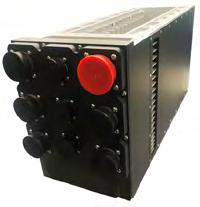
You’ve got enough to worry about getting your SOSA aligned and OpenVPX cards/system ready to impress your customers. Let Pixus be your resource for the enclosure infrastructure, including the chassis, backplane, chassis manager, & more. With a huge selection of high-performance SOSA profile combinations, we’ll help you achieve your optimal solution!
• MIL rugged rackmount chassis
• Benign environment enclosure solutions
• Test/lab systems for fast prototyping
Chassis / Backplanes / Chassis Managers

pixustechnologies.com
Open standards helping to future-proof UAVs
By Flemming Christensen
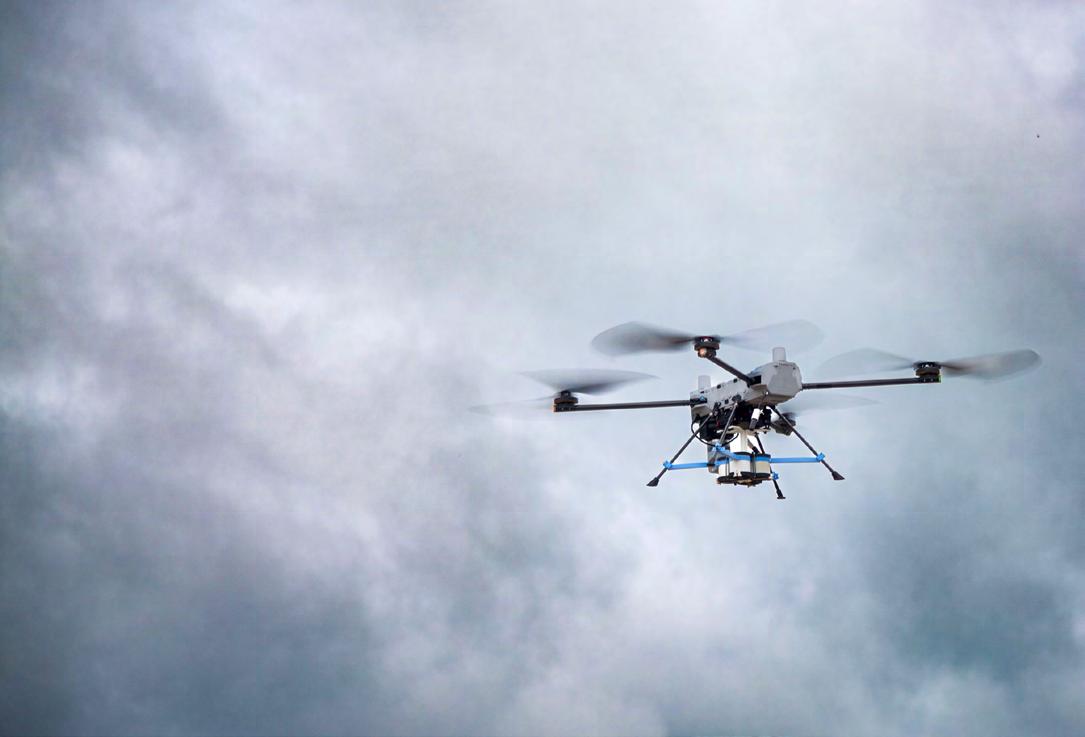
Uncrewed systems are evolving rapidly, from attritable one-way drones to high-end intelligence, surveillance, and reconnaissance (ISR) platforms. Each class demands a different embedded architecture strategy. Open standards such as OpenVPX and VNX+ provide a modular foundation to future-proof them all.
Unmanned aerial vehicles (UAVs) such as drones, are increasingly important in modern defense systems. However, they impose significant demands on system design, requiring higher computing performance and rugged hardware platforms while imposing strict size, weight, power, and cost (SWaP-C) constraints.
Military platforms also often remain in service for years – even decades – in contrast to fast-moving consumer-electronic products. In contrast, sensors, artificial intelligence (AI) algorithms, and commu-
nications technologies evolve in much shorter innovation cycles, which creates fundamental tension between platform longevity and rapid technological advancement.
MOSA, SOSA, and STICS: The shift toward modular defense architectures
While the defense industry has long relied on monolithic, proprietary system architectures, it is currently undergoing a transition toward open, modular, and standardized platforms.
A key driver of this shift, particularly in the U.S., is the modular open systems approach (MOSA) mandate from the U.S. military. From the outset, the MOSA mandate required that new systems be designed featuring modular architecture and clearly defined interfaces based on established open standards. The objective is to align rapid technological innovation cycles with the significantly longer service lifetimes of deployed military equipment. In parallel, the Sensor Open Systems Architecture, or SOSA,
U.S. Army photo by Sgt. Kammen Taylor.

vendor independence, and accelerated technology-refresh cycles. STICS also aligns with open architectural principles and is compatible with the SOSA approach in many areas.
Together, these initiatives promote a building-block approach in which compute, I/O, and networking modules can be exchanged as needed. Strategically, both enable better control of life cycle costs, reduce the risk of obsolescence, and support faster upgrades without requiring complete system redesign.
OpenVPX and VNX+: technical foundations for rugged embedded architectures In recent years, OpenVPX, developed by the VITA standards organization, has established itself as a key standard for open, modular, rugged, and high-performance embedded computing in the defense sector. Building on the earlier VPX technology, OpenVPX introduces enhanced capabilities with clearly defined backplane profiles, plug-in modules, power-supply units, and connectivity options. The standard enables interoperability across multiple vendors while supporting high data rates, deterministic latency, and scalable system architectures.
A major advantage of OpenVPX is flexibility:
› Different slot profiles and topologies enable systems to be tailored to a wide range of mission requirements, from sensor fusion and electronic warfare (EW) to AI-driven, real-time data processing.
› At the same time, the OpenVPX standard addresses the demands of harsh operational environments through mechanical robustness, secure connectors, and efficient thermal management.
› Air- and conduction-cooled implementation ensures reliable operation under extreme temperature, vibration, and shock conditions that UAVs and manned platforms often encounter.
VNX+ extends this approach to more compact, SWaP-optimized systems, as it enables higher performance density while reducing overall footprint. Its backplane-based architecture also enables modular replacement of processors, FPGA [field-programmable gate array], or I/O populated cards, making it easier to adapt systems to increasing bandwidth requirements, new sensors, or modern AI workloads. While OpenVPX addresses the highest performance requirements in larger platforms, VNX+ enables powerful modular embedded systems in more compact, SWaP-sensitive environments.
One-way systems
Attritable UAVs, often referred to as one-way systems, represent a new generation of cost-sensitive tactical platforms. Unlike traditional military aircraft systems, they are not designed primarily for long-term reusability or maximum survivability, but rather for rapid availability, low per-unit cost, and scalable production. Their operational concept follows a “launch and forget” principle: easy to procure or build, quick to deploy, and ultimately expendable.
Technical Standard provides a technical framework for interoperable and plug-in subsystems. The SOSA standard translates MOSA principles into concrete hardware- and backplane-level specifications, thereby establishing a multivendor foundation for high-performance embedded systems.
In the U.K., the Standards for Integrated C5ISR/EW Systems (STICS) approach pursues similar goals. The STICS framework likewise emphasizes interoperability,
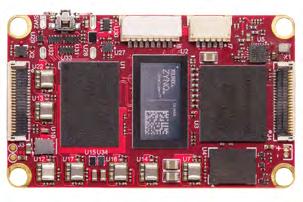
Architecturally, the one-way class is dominated by heavily SWaP-optimized commercial off-the-shelf (COTS) components. Entry-level systems frequently rely on commercial single-board computers (SBCs) such as the Raspberry Pi, which, despite its low cost, provides sufficient computing power for basic navigation, communications, or image-processing tasks. More capable variants integrate system-on-chip (SoC)- or FPGA-based platforms such as AMD Zynq solutions. For example, the Sundance VCS³ (Figure 1) or NVIDIA Jetson modules enable additional AI and edge-processing capabilities without fundamentally altering the overall cost structure.
These systems are typically complemented with low-cost commercial add-on modules such as GPS receivers, GSM communication modules, or compact radar altimeters like the Ainstein US-D1 (Figure 2). Their goal is to promote functionality with minimal
Figure 1 | The Sundance VCS3 single-board computer, based on AMD Zynq MPSoC, is a low-power module for vision, control, and sensor Solutions. Figure courtesy Sundance.
integration effort. Standardized interfaces and pragmatic system integration take priority over maximum redundancy or complex mission architectures.
Recoverable tactical systems
Recoverable tactical systems, also called return-capable tactical UAVs, represent, technologically, the middle tier between cost-sensitive attritable systems and highend strategic platforms. Unlike one-way systems, these recoverables are designed to complete their mission and safely return to base or to a designated recovery point. As a result, they face significantly higher requirements in terms of autonomy, navigation accuracy, computing performance, and overall system robustness.
These platforms are generally larger and more capable than attritable UAVs and thereby enable expanded mission functionality. Functionality can include AI-supported target recognition; adaptive flight-path planning; obstacle avoidance; and secure, jam-resistant communication
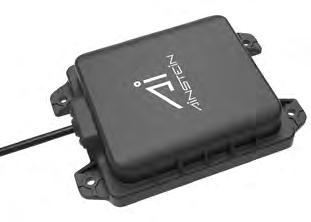
Figure 2 | The Ainstein US-D1 is a smallform-factor radar altimeter that reports reliable measurements up to 50 m, suited for use in UAV or drone applications. Figure courtesy Ainstein.
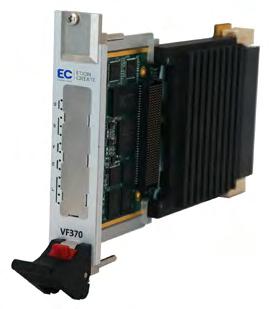
3 | The VF370 is a 3U OpenVPX module, fully designed, manufactured, and qualified to MIL-STD 810 G (CN1) and RTCA/ DO160G certifications. Figure courtesy Etion Create.
links. Components such as tactical routers or encrypted data links enable integration into higher-level command and control networks. At the same time, these systems must be sufficiently robust against vibration, temperature fluctuation, and electromagnetic interference, as they repeatedly operate under demanding mission conditions.
From an architectural perspective, demanding expanded missions create a need for modular, backplane-based solutions with higher performance density; VNX+ precisely addresses such requirements. The VNX+ architecture enables scalable integration of high-performance processor or FPGA cards and specialized I/O modules within a compact and rugged system. Thanks to its modular structure, it’s possible to replace or expand compute units, accelerators or interfaces as mission requirements evolve, without requiring complete system redesign.
High-end ISR and armed platforms
High-end intelligence, surveillance, and reconnaissance (ISR) and armed UAVs represent the top performance tier of uncrewed aerial systems. In terms of size, range, and mission profile, these platforms are often comparable to manned aircraft or helicopters. Designed for complex, long-duration operations, they carry a wide array of advanced sensors, communication systems, EW components, and – depending on the mission – weapon systems.
Accordingly, demands on the embedded architecture are substantial. In addition to significant computing power for real-time sensor fusion, image processing and signal processing, these systems must also support redundant avionics architectures, secure data links and deterministic communication frameworks. Processing large volumes of data from radar, electro-optical/infrared (EO/IR), SIGINT, or EW systems requires scalable high-speed data paths as well as powerful processor-, GPU-, or FPGA-based accelerator cards.
Larger platform dimensions allow greater SWaP margins compared to smaller tactical systems, enabling the deployment of modular 3U or 6U OpenVPX systems that combine high performance density with standardized interfaces and defined backplane topologies. (Figure 3.) In this context, OpenVPX provides a structured foundation for multivendor interoperability, clearly defined slot profiles, and robust mechanical and thermal design concepts, all of which are critical for operation under demanding flight and environmental conditions.
Open standards: the foundation
The rapidly evolving diversification of UAVs requires an equitably differentiated approach to their embedded architecture. While SWaP-C remains a central factor in UAV design, it’s the chosen system architecture that ultimately determines the degree to which an application is adaptable, maintainable and future-proof. Short innovation cycles in sensors, AI, and communications technologies can complicate the long service life of military systems, a tension that modularity and standardized interfaces can address.
Open standards such as OpenVPX and VNX+ provide a structured path to meet this challenge. They form the foundation for interoperable, multivendor solutions; reduce integration risks; and enable predictable technology refresh cycles. At the same time, they support different platform classes – from tactical, return-capable systems to strategic ISR and armed UAVs, with appropriate levels of performance density and ruggedness. MES

Flemming Christensen is founder and CEO of Sundance Multiprocessor Technology, an ISO9001-2015-certified company that delivers custom-designed embedded products for highperformance robotics, vision, motion, and sensor applications.
Sundance Multiprocessor Technology https://www.sundance.com/
Figure

BEHLMAN LEADS THE PACK AGAIN!
FIRST
PROVEN VPX POWER SUPPLIES DEVELOPED IN ALIGNMENT WITH THE SOSA™ TECHNICAL STANDARD
Behlman introduces the first test-proven VPX power supplies developed in alignment with the SOSA Technical Standard. Like all Behlman VPXtra® power supplies, these 3U and 6U COTS DC-to-DC high-power dual output units feature Xtra-reliable design and Xtra-rugged construction to stand up to the rigors of all mission-critical airborne, shipboard, ground and mobile applications.
VPXtra® 1000CD5-IQI
> 6U power module developed in alignment with the SOSA Technical Standard
> Delivers 1050W DC power via two outputs
> VITA 46.11 IPMC for integration with system management
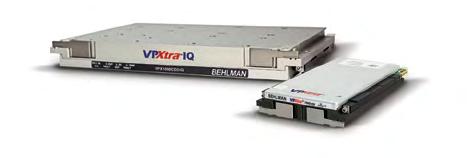
VPXtra® 800D-IQI
> 3U power module developed in alignment with the SOSA Technical Standard
> Delivers 800W DC power via two outputs
> VITA 46.11 IPMC for integration with system management
Closing the adoption gap in MOSA-driven avionics modernization
By Rasha Fakhreddine
As avionics systems used in defense leverage more advanced software and automation, workforce readiness will continue to play a central role. Building that readiness early helps reduce reliance on external support and strengthens long-term sustainability.
Open architecture has transitioned from a long-term objective to a mandatory design success factor for the defense industry. As modular open systems approach (MOSA) requirements move from high-level policy into technical procurement specifications, the engineering focus has fundamentally shifted. The industry is no longer debating the necessity of open standards; the current challenge is execution – specifically, ensuring that these architectures deliver sustained operational value once integrated into the fleet.
This shift reflects a broader evolution in U.S. Department of Defense (DoD) modernization. A 2025 Government Accountability Office (GAO) review found that while 14 of 20 programs reported implementing MOSA, most had not addressed the critical planning elements required to realize its intended benefits. This disconnect suggests that MOSA is often treated as a checkbox in procurement rather than a comprehensive strategy for the full life cycle.
Guidance documents from the DoD also emphasize MOSA not just as a technical framework, but as a core acquisition and sustainment strategy spanning the full life cycle. As this perspective takes hold, program managers are increasingly focused on ensuring modular avionics systems translate into capabilities that can be absorbed and sustained by the workforce in real operational environments. Technical modularity fails without organizational readiness.
A U.S. Air Force F-35A Lightning II aircraft assigned to the 56th Fighter Wing flies over the desert near Luke Air Force Base, Arizona. U.S. Air Force photo by Senior Airman Belinda Guachun-Chichay.
Defining the adoption gap in embedded systems
The adoption gap becomes visible when the technical precision of a modular system meets the friction of real-world operational environments. This gap is rarely a failure of the architecture itself. Rather, it points to a disconnect between how the system was engineered and how it is actually used. In practice, this gap manifests as a reliance on extensive training to compensate for usability issues, an ongoing dependency on contractor support to manage updates, or the development of informal operator workarounds to accomplish mission tasks.
One example: In a naval-aviation program, operators required nearly twice the projected time to reach proficiency because training requirements were not integrated into the system design. While the system met performance specifications, the units relied on additional contractor support during early deployment, which slowed full operational adoption.
Modularity is raising the bar for readiness
The promise of modular avionics has always been speed, meaning faster upgrades, faster integration, and faster adaptation to meet changing mission needs.
In today’s environment, those expectations are no longer theoretical. The Navy’s continued emphasis on readiness and initiatives reflect a broader push to ensure that capability evolves in step with operational demand. Delivering on that expectation depends as much on program plans and structure as it does on system design.
One of the most common challenges is timing. Requirements are defined, solutions are developed, and validation follows a structured process. By the time systems reach the fleet, however, operator needs may have shifted. The system itself may be sound, but it can feel out of sync with the environment it enters.
In practice, the programs that maintain alignment are the ones that incorporate user feedback early and continuously. When input from actual users is built into planning and design from the outset, adjustments can be made in real time. When feedback arrives later, it becomes more difficult to translate into meaningful change.
Modularity creates the technical conditions for iteration. Realizing that advantage depends on how deliberately programs are structured to support it.
Designing for the operator,
not just the architecture
Human-systems integration is more than just usability – it is a broader organizing principle for modernization where success depends on how well avionics align with the people and processes around them. This solution includes how operators interact with information, how maintainers manage updates, and how training pipelines prepare the workforce to keep pace.
This is not simply a user-interface question, however: It is a system-level consideration that spans workload, training burden, and the broader organizational impact of design decisions. It has been found that integrating training requirements into the Critical Design Review (CDR) process for naval aviation programs can reduce timeto-proficiency by as much as 40%. By treating readiness as a design requirement, program managers avoid a permanent tether to the original equipment manufacturer (OEM) and ensure the system is actually usable upon implementation.
Programs that engage operators, trainers, and engineers early in design are better positioned to identify trade-offs sooner and deliver systems that are both technically sound and operationally effective. This approach supports more meaningful feedback: When user insight is incorporated from the beginning, systems are refined in ways that reflect how they will actually be used, not just how they were intended to perform.
Where structure and strategy determine success
As systems become more modular, organizational alignment becomes a visibility requirement. Traditional program structures often isolate engineering, acquisition, and sustainment into distinct silos. While each function is critical, this separation creates friction as systems evolve and dependencies tighten.
The bottom line: Fragmented coordination actively blocks MOSA from influencing early acquisition. For leadership, modularity is now more than a design choice. It is a mandate to reorganize the enterprise to support the technology.
In contrast, forward-looking programs rely on cross-functional integration. This shift requires clearer decision rights and collaborative governance designed specifically to dismantle stovepiped efforts. Ultimately, organizational structure dictates how fast a program responds to the field. When alignment is strong, operator feedback moves efficiently into design decisions; when it is fragmented, even critical issues stall in coordination.
Planning is where these programs succeed or fail. The latest GAO [Government Accountability Office] findings (GAO-25-106931, which recommends 14 ways the DoD can better implement MOSA in acquisition programs) are a reality check. The bottom line: Fragmented coordination actively blocks MOSA from influencing early acquisition. For leadership, modularity is now more than a design choice. It is a mandate to reorganize the enterprise to support the technology.
Training as a design input, not a follow-on
This organizational mandate is most visible in the evolution of training. In many programs, training has traditionally been treated as a downstream activity. Systems are developed first with training refined as deployment approaches. In a modular environment, that sequence is evolving. Several naval aviation and C4ISR [command, control, communications, computers, intelligence, surveillance, and reconnaissance] programs are now integrating training requirements during preliminary design review. This move enables training constraints to directly shape system design and reduces time-toproficiency at fielding.
Effective training strategies often include multiple feedback loops. One loop assesses initial effectiveness, or whether users can reach proficiency quickly enough for the capability to matter. A second loop evaluates sustainability over time, or whether users retain what they have learned and apply it consistently as the system evolves.
These insights provide a clearer picture of how systems are performing in practice and also support continuous improvement in both the technology and the training that enables it. As avionics systems leverage more advanced software and automation, workforce readiness will continue to play a central role. Building that readiness early helps reduce reliance on external support and strengthens long-term sustainability.
Sustaining adoption at the pace of change
As MOSA expands across platforms, the priority must shift from simply fielding hardware and software to sustaining operational impact. Modernization is an ongoing process rather than a one-time event. In this environment, success is measured by how effectively a capability is used over time. Shorter learning curves and a reduced need for workarounds are the true signals that adoption has taken hold.
Open architectures provide the technical flexibility to evolve, but that flexibility is a stranded asset without organizational readiness. For program managers, integrating user feedback and training into early design is not a secondary task. It is a core requirement of the mission. Programs that prioritize adoption from the outset will be the ones that finally translate modularity into a permanent combat advantage. MES

Rasha Fakhreddine is a Senior Principal of Organization Development and Organizational Strategy at Evans. She partners with leadership teams to identify organizational challenges that prevent goal achievement, engages diverse stakeholders to align toward common objectives, and develops comprehensive strategies to address these barriers.
Evans • https://evansinc.com/

MOSA Virtual Summit 2026
Sponsored by Abaco Systems, Curtiss-Wright, DDC-I, Elma Electronic, Kontron, LCR Embedded Systems, RTI, and SV Microwave
The 2026 MOSA Virtual Summit explores MOSA examples like the Sensor Open Systems Architecture, or SOSA, approach; the C5ISR/ EW Modular Open Suite of Standards (CMOSS); and the Future Airborne Capability Environment, or FACE, approach with the aim of studying how they impact signal-processing, software, hardware, AI, and RF designs.
(This is an archived event.)
Watch the sessions: https://tinyurl.com/4xfa2vd8

CONNECTING WITH MIL EMBEDDED
GIVING BACK | PODCAST
GIVING BACK
Each issue, the editorial staff of Military Embedded Systems will highlight a different organization that benefits the military, veterans, and their families. We are honored to cover the technology that protects those who protect us every day.
By Editorial Staff

This issue we are highlighting the Word of Honor Fund, a 501(c)(3) organization that provides a continuum of support and facilitates milestone events for the surviving children of Navy SEALs and Special Operations personnel who die while assigned or attached to select Naval Special Operations groups.
Since its inception in 2012, Word of Honor Fund has attempted to step in to provide support directly to the children of fallen naval personnel. Childrens’ mentors provide critical and often missing pieces of a parent’s legacy: The organization says that it is the mission of the Fund to ensure that linkages and bonds with mentors – both within and outside their families – remain strong and intact. The fund, with what it calls its milestone events, states that the events and connections both lays the foundation for the survivors’ development and reinforces the integrity of service members’ solemn commitment to each other.
Children of fallen service members can participate in these milestone events up to the age of 18 at no charge. Examples of recent events for fund participants include memberships to flight schools and scuba diving schools; participation in defensive-driving programs, tickets to the Super Bowl, Army-Navy football game, and Disney World; ski instruction and vacation; and a scienceeducation excursion.
The fund’s volunteers also hold the annual memorial picnic at the Word of Honor Fund Memorial Tree Garden in Virginia Beach, organized by the fund’s leadership team for the participating Gold Star Families. The organization says that the Tree Garden represents a physical place of remembrance where the fallen can be honored. For additional information please visit https://wordofhonorfund.com/.
WEBCAST
Golden Dome by 2028: The Integration Challenge That Will Decide Success
Sponsored by RTI
Golden Dome is often described as a “system” – but in practice it's actually a system-of-systems, assembled under an aggressive timeline, across a fragmented industrial base, with requirements that will evolve faster than traditional acquisition cycles can tolerate. The defining challenge isn’t inventing one breakthrough technology; rather, it’s building an architecture that can integrate what exists today, absorb what arrives tomorrow, and still operate as a coherent, resilient whole.
This webinar frames Golden Dome through the lens of hard lessons learned across modern defense programs that have already made the jump from prototype to sustained operation. The discussion focuses on the integration and architecture decisions that tend to determine outcomes: What scales, what breaks, and what repeatedly becomes the limiting factor when concepts meet operational reality. The goal: Not to predict a single “right” implementation, but to clarify the architectural moves that increase the odds of success, especially when timelines are tight, integration is complex, and the cost of rework is existential. (This is an archived event.)
View this webcast at https://tinyurl.com/mrysuf7b.
View more webcasts at https://militaryembedded.com/webcasts.
PODCAST
McHale Report podcast: With guest Daniel Diesz
Managing obsolescence is an ongoing problem for military system designers, as defense platforms can last for decades but commercial component lifespans last – on average – just 18 months.
In this podcast, Daniel Deisz, VP of Design Technology at Rochester Electronics, and Military Embedded Systems Editorial Director John McHale discuss the military aftermarket world, component recreation, anchoring of semiconductor manufacturing, counterfeit parts, the impact of modular open systems approach (MOSA) strategies on sustainment, and more.
Listen to/watch the podcast: https://tinyurl.com/3ypz5496.
Listen to/watch more podcasts: https://militaryembedded.com/podcasts