Part of Alpha Solutions ®, SpeciSafe has been designed to support simpler, safer and more consistent sample transport – whilst compliant to UN3373, Category B regulations when used with a 95kPa primary container.
Protect More. Worry Less.
3 Integrated absorbent that creates a leak-proof closure when activated
3 Rigid clam-shell design that protects primary container from shock and damage
3 Pre-moulded primary container separation
3 Transparent front for clear sample visibility
3 Cost effective
3 Intuitive design
The smarter, more efficient way to send patient samples. For more information or to purchase, please scan the QR code or visit: alphalabs.co.uk/specisafe
serVices + eQuipment
08 London Lab Live: ‘The entire lab community under one roof ’ Breakthrough learns more about the latest addition to the science and technology calendar, and the success of its 2026 exhibition
12 Ridge on neuro-adaptive design Insight into how a neuro-adaptive approach uses smart building technology to support users while keeping spaces flexible
r&d + innoVation
14 “I’d love to work on a dark lab” Andrew Somerville of Cundall ruminates on the possibilities and practicalities in developing self-driving ‘dark labs’ in the UK
18 Liz Kendall MP: “We must be an AI maker - not just an AI taker” Simon Penfold reports on how the UK Government is backing home-grown AI talent with the launch of the Sovereign AI Fund
growth + finance
24 “The UK lab industry has been remarkably resilient - I don’t think I’ve ever seen it drop” GAMBICA’s Jacqueline Balian talks ups and downs of the UK lab technology industry
28 Reacting to rising business rates
Avison Young’s Jonathan Burton delves into how increasing rates and their growing impact is affecting the science park sector
regions + communities
32 Successful progress for I2SL UK
A look at how I2SL’s UK Chapter - established by members of the science and research community - has established itself as an emerging forum for stakeholders
34 Major growth in East Anglia
Dr Nick Goodwin of Anglia Innovation Partnershipthe management company for Norwich Research Parkdiscusses the site’s future
infrastructure + planning
37 Refurbishment vs New Build Clare Whitehurst from Klick Laboratories ponders on the evolution and changing shape of laboratory development
38 Technology redefining the future of the science building Oberlanders Architects on why an agile and responsive approach to creating science spaces has currently never been more critical
40 “One of the most important things is making sure buildings are fit for now and the future” Carter Jonas’s head of science and technology Matt Lee talks new builds, refurbishments and developments in the sector
Breakthrough is an Open Box Media and Communications publication produced in association with UKSPA.
united K ingdom science par K association ( u K spa )
Chesterford Research Park, Garden Cottage, Saffron Walden CB10 1XL t +44 (0) 1799 532 050 e info@ukspa.org.uk www.ukspa.org.uk
c hair
Dr Sally Basker
chief executive
Ruth Hall
head of operations
Adrian Sell
open box media and communications
Premier House, 13 St Paul’s Square Birmingham B3 1RB
t +44 (0)121 200 7820 e info@ob-mc.co.uk www.ob-mc.co.uk
d irector & publisher
Stuart Walters stuart.walters@ob-mc.co.uk
d irector & publisher
Samantha Skiller sam@ob-mc.co.uk
studio
Mark Lamsdale mark.lamsdale@ob-mc.co.uk designer Matt Hood matt.hood@ob-mc.co.uk
advertising sales and enquiries
Rob White rob.white@ob-mc.co.uk
editor Simon Penfold simon.penfold@breakthroughdigital.co.uk
No part of this publication may be reproduced in any form without the consent of Open Box Media and Communications.
We are committed to sustainable forest management and this publication is printed by Buxton Press who are certified to ISO14001:2015 Standards (Environmental Management System). Buxton prints only with 100% vegetable based inks and uses alcohol free printing solutions, eliminating volatile organic compounds as well as ozone damaging emissions.
www.breakthroughdigital.co.uk
ruth hall Chief Executive UK Science Park Association
A tribute to D r S A lly b ASK er Chair of UKSP a
On behalf of everyone at UKSPA, I would like to express my sincere thanks and appreciation to Dr Sally Basker for her outstanding leadership, support, and dedication as Chair of the Association.
During her time as both a Board Director and Chair, Sally has brought exceptional insight, energy, and commitment to the role, helping to guide UKSPA through a period of continued growth and opportunity for the innovation and science park community across the UK. Her leadership has strengthened the voice of the sector and reinforced the vital role that innovation ecosystems play in driving economic development, research collaboration, and business success.
Sally’s passion for supporting science, technology, and innovation-led environments has been evident in every aspect of her work. She has consistently promoted the importance of partnership, knowledge exchange, and community, ensuring that UKSPA remains a trusted and influential organisation within the sector.
“Sally has inspired confidence, encouraged collaboration, and guided the organisation through both opportunities and challenges with integrity and vision”
She has inspired confidence, encouraged collaboration, and guided the organisation through both opportunities and challenges with integrity and vision. Her deep understanding of the needs of our members, and her ability to bring people together and champion innovation, have been invaluable to the Association and the wider community we serve.
On a personal level, as CEO, I would like to thank Sally for her support, guidance, and partnership. Her professionalism, integrity, and commitment have made a lasting impact, and it has been a privilege to work alongside her. Her counsel has been invaluable. We are incredibly grateful for Sally’s contribution to UKSPA and thank her for her outstanding service. We look forward to building on the strong foundations and lasting legacy her leadership has helped create.
With sincere thanks, Sally. n
get in touch
If you have any thoughts or questions, please reach out to Ruth directly at ceo@ukspa.org.uk
Openbox
Openbox
I n t e l l i g e n c e t h a t k e e p s y o u r l a b r u n n i n g
T h e l a t e s t i - S e r i e s c o m p a c t ( U ) H P L C s y s t e m s a r e m o r e t h a n i n s t r u m e n t s – t h e y a c t a s a n a s s i s t a n t i n y o u r
l a b . F r o m a u t o m a t i c s t a r t u p t o b a t c h c o m p l e t i o n , t h e i - S e r i e s m o n i t o r s i t s o w n s t a t u s , p r e v e n t s i s s u e s b e f o r e
t h e y o c c u r , a n d r e c o v e r s f r o m c o m m o n p r o b l e m s – s o y o u c a n f o c u s o n y o u r s c i e n c e , n o t y o u r s y s t e m .
A n a l y t i c a l i n t e l l i g e n c e
B u i l t ‐ i n p r e v e n t i o n , s e l f - d i a g n o s i s , a n d a u t o ‐ r e c o v e r y k e e p y o u r i ‐ S e r i e s r u n n i n g s m o o t h l y .
S m a r t p r e v e n t i o n
F l o w P i l o t a u t o m a t i c a l l y p r o t e c t s y o u r s y s t e m a n d
c o l u m n s f r o m p r e s s u r e s p i k e s
A u t o r e c o v e r y
i - S e r i e s d e t e c t s p r e s s u r e f l u c t u a t i o n s a n d a i r b u b b l e s , p a u s e s
t h e r u n , p u r g e s , r e ‐ e q u i l i b r a t e s , a n d r e s t a r t s t o a v o i d d a t a l o s s
w w w s h i m a d z u c o u k / i - s e r i e s
IA MESSAGE FROM THE UKSPA CHAIR
DR SALLY BASKER
retire from full-time work on 3rd July, so this is my last Breakthrough article and Norwich will be my final conference. It feels a little strange to write those words, because UKSPA has been such an important and rewarding part of my professional life.
I still remember my first UKSPA Conference at York in May 2017, just a couple of months after becoming CEO at Exeter Science Park. Those were daunting early days: it was me and a PA, everything was new, and I was having to develop a business model and strategy at speed. What stayed with me most was the friendly, collegiate atmosphere and the generosity with which people shared their experience. I came away reassured, encouraged and with a much greater appreciation of the depth of expertise across our sector.
I joined the UKSPA Board in December 2020, at a time when we were all trying to work out what the ‘new normal’ might look like. These have not been easy years. Alongside the pandemic, we have had to navigate economic and geopolitical turbulence, changing occupier needs, rising operational pressures, energy costs, EPC legislation and pressure on revenue. Through all of
Dear friends and colleagues...
that, UKSPA has remained a credible, connected and increasingly visible voice for our sector.
I was appointed Vice Chair in December 2022 and Chair in December 2024. While it hasn’t all been easy, as I reflect the following UKSPA achievements stand out:
1. Keeping the science park and innovation community connected through disruption and helping members adapt to hybrid working and changing occupier needs.
2. Strengthening UKSPA’s voice on the importance of science parks to innovation, regional growth and national competitiveness.
3. Building the regional group structure, creating more regular opportunities for peer exchange and shared learning.
4. Delivering the 40th anniversary conference in 2024, a memorable
“I have learned a great deal, made lasting friendships and gained fresh perspectives”
national gathering that celebrated the sector and reinforced UKSPA’s convening power.
5. Appointing Ruth Hall as Chief Executive in 2025, providing continuity and a strong platform for the next phase of UKSPA’s development.
For me, UKSPA’s real strength has always been the quality of its people and the willingness to share knowledge, encouragement and practical support. Like most membership organisations, the more you put in, the more you get out, and I feel very fortunate to have benefited so much from being part of it.
As UKSPA looks ahead, I would warmly encourage members to think about volunteering, whether through regional groups, committees, events or the Board. It is one of the best ways to build relationships, share experience and help shape the future of our sector. It is also deeply rewarding. I have learned a great deal, made lasting friendships and gained fresh perspectives. If you care about science parks and innovation, I really would encourage you to get involved.
I’d like to take this opportunity to thank you for your kindness and company and to wish each of you every success in the future. n
inve S tment boo S t S mood at london lab live event
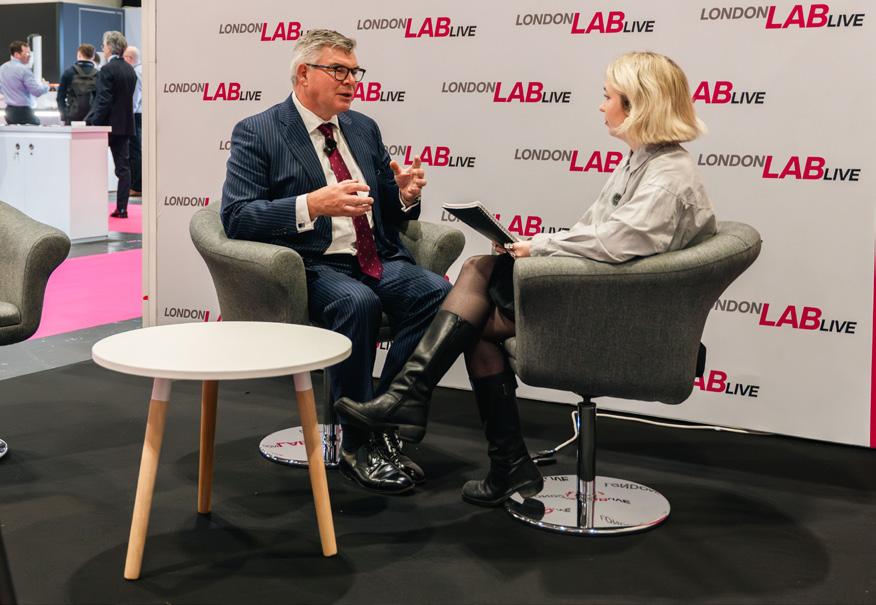
Simon Penfold talks to Ellie Whitehead (below) about the success of this year’s London Lab Live exhibition amid promising signs for the R&D industry.
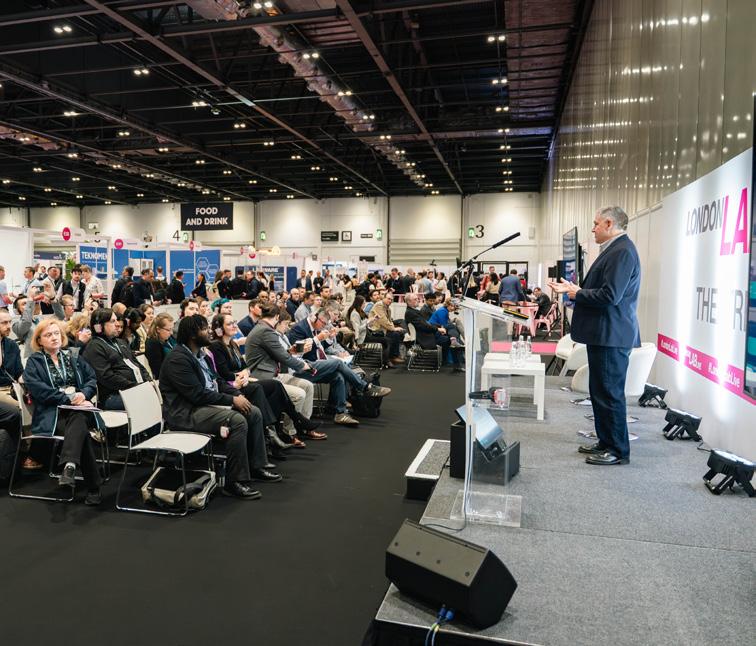
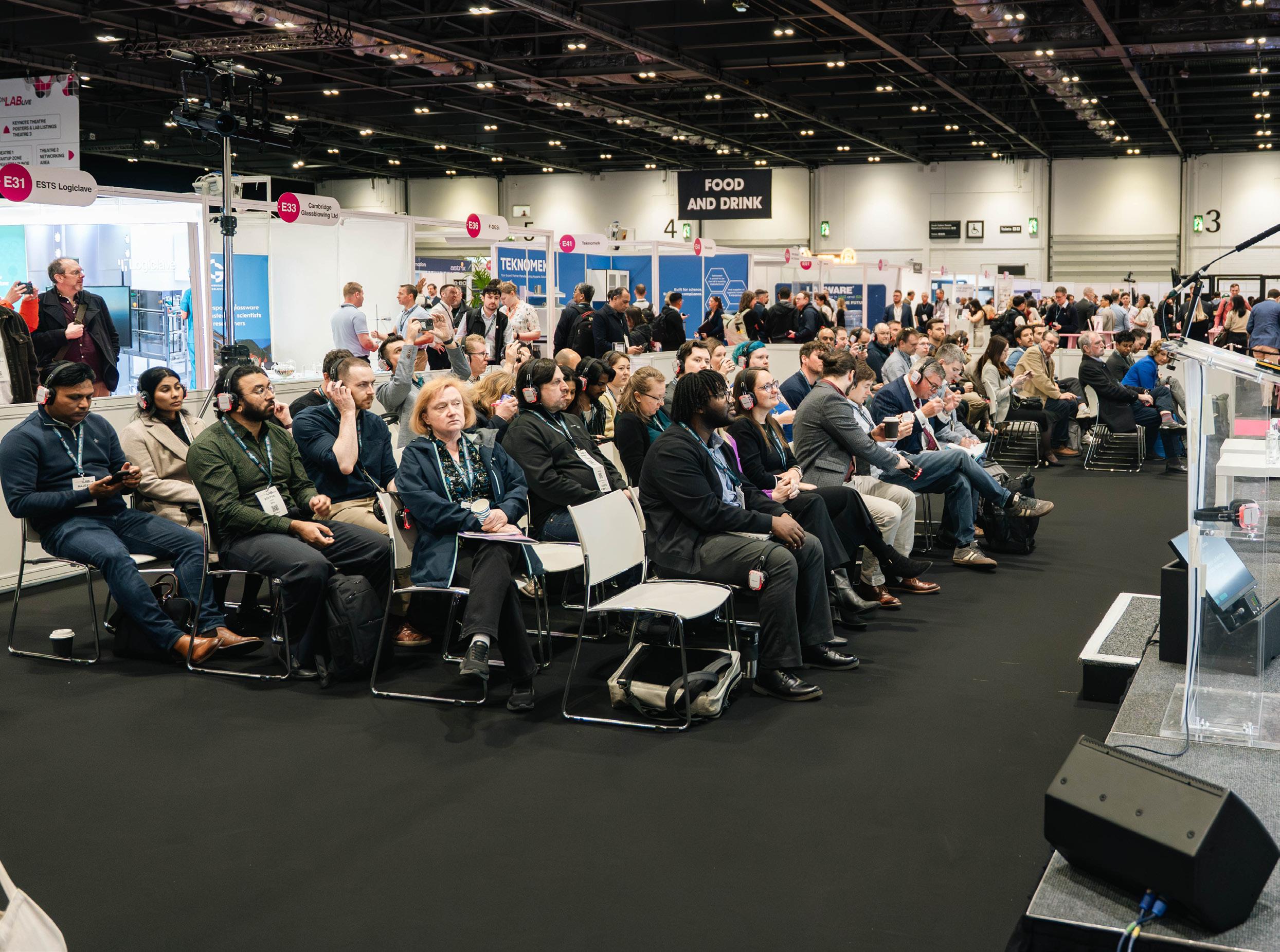
London Lab Live is one of the newest additions to the science and technology calendar – a two-day exhibition at the capital’s Excel venue attracting delegates and speakers from across the UK.
“From the exhibition side of things, we doubled the space from the year before, while the seniority of the speakers and the breadth of topics that we covered has really expanded.”
In its second year it has increased attendance to more than 2,500 delegates with 200 exhibitors and a host or talks and round-table discussions with leaders from across the field.
Ellie Whitehead, head of content at event organisers Terrapinn, spoke between conferences – London Lab Live was followed barely a month later by a sister event in Basel, with a third exhibition in Pittsburgh in October.
She said the mood at the London event had been boosted by good news on the investment front in the UK, with pharma giant AstraZeneca announcing plans to spend £300 million at its site in Cambridge and a “digital lab” at Macclesfield in Cheshire.
That came just days before London Lab Live kicked off.
Ellie said “It was a really great event. It’s only the second year that we've done it and the growth from the first to the second year was just so clear.
London Lab Live has been created with the vision of bringing the entire lab community under one roof - breaking industry silos with delegates and speakers across pharma, biotech, clinical R&D, chemical, industrial, food & beverage and fast-moving consumer goods labs - to solve the most pressing challenges in automation, connectivity, infrastructure, sustainability and workflow integration.
Ellie said: “Our events connect thousands of strategy heads, procurement leaders, lab managers, and technical stakeholders with the solutions that build, equip, digitize and run the world’s most efficient laboratories.”
“And the feedback since the event has been really positive, so we’re very happy with how it went. We had more than 2,500 people through the doors, up on 2,000 last year, so that represents really good growth.”
The timing of the May conference proved fortuitous, with
a series of positive announcements almost tailor-made to improve the mood the lab industry.
“It feels like it's been quite an interesting year,” said Ellie.
“I know there's been a little bit of fear with certain companies moving outside of London; companies have invested a lot of money and then, at the last minute, moved out. But it actually feels like throughout the last few months, things have flipped completely on their head.
“The stand-out announcement came from AstraZeneca only a few days before the event.”
“We B ri NG TOG e TH er every ON e i N v O lved i N TH e v A
The country’s biggest drugmaker has said it will invest £300 million in the UK in a surprise U-turn after pausing large-scale projects last year.
In a surprise announcement in May it said it would invest in two existing locations, unfreezing the paused £200m expansion at its headquarters site in Cambridge and spending £100m at its Macclesfield site.
AstraZeneca chief executive Pascal Soriot said the company would finish the construction of the Rosalind Franklin building at the Cambridge Biomedical Campus. The investment for Macclesfield would create "a lab of the future that will use digital and data tools to advance drug development".
Ellie continued: “In the wake of this there was a lot of conversation at the London Lab Live event about
how the market in general seems to be scaling up quite a lot at the moment.
“It’s been a turbulent year for every industry, so it feels like even in the last few months there's a lot of bounce-back.
“There's quite a bit of investment going on, both privately from AstraZeneca in their big investments but also with the Government backing AI startups as well.”
Connecting the ecosystem
April saw the launch of the £500 million UK Sovereign AI fund, part of the government’s AI Opportunities Action Plan, to boost home-grown innovation and support national security.
The first companies to be backed by UK Sovereign AI are Ineffable Intelligence, which is developing a new generation of learning algorithms, medicine design and development company Isomorphic Labs, and ‘intelligent systems’ company Callosum.
The UK Government’s active role in encouraging and promoting R&D investment was reflect at London Lab Live, said Ellie Whitehead. “We partnered with Innovate UK, who put out a £7.5 million funding call for future technologies for SMEs to showcase some of their robotics and digitalization within labs as well.
“With all that going on, it was a great opportunity for an event like ours connecting the whole lab technology ecosystem. It’s the purpose of London Lab Live: we want to have everything from every different angle within one room.
“So you're talking about the people that are building the labs from the ground up; you have people from the real estate side of things, actually developing the lab, the architects, and then you've got the people that are using them, on the bench as it were, whether that's the hardware, software or the robotic side of things as well as the AI and the data behind it.
“And it is the opportunity to bring the different industries together –life science, pharma, biotech, but also food and beverage companies, agriculture, medical, energy as well as people from academia and the regulatory agencies.
“We bring together everyone involved in the various steps of putting together a functional lab, from the C-suite people and those making the major overarching decisions, to the VPs, the heads of labs, directors who may be more involved in the day-today but also with an oversight role, as well as the engineers and scientists who are actually on the bench doing the work.”
Unified message
As well as the commercial side of the event, with major suppliers and manufacturers exhibiting their wares, the two-day event features a near-constant stream of talks and discussions on every aspect of the industry.
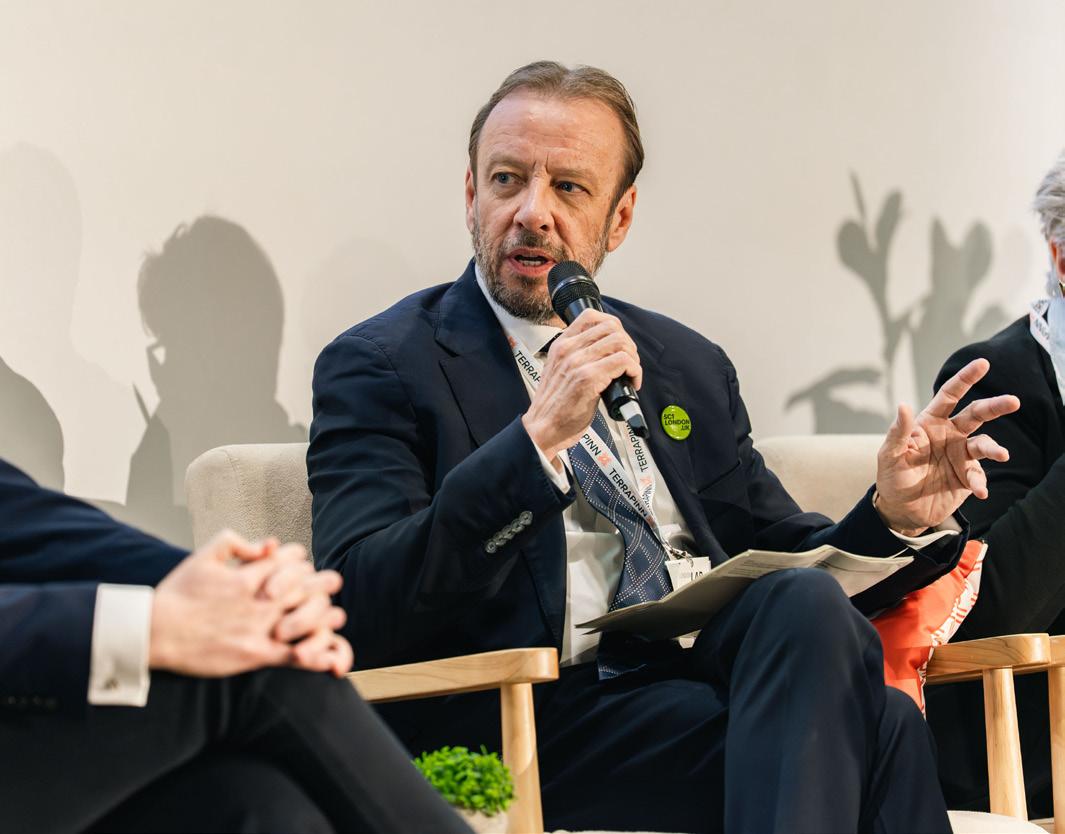
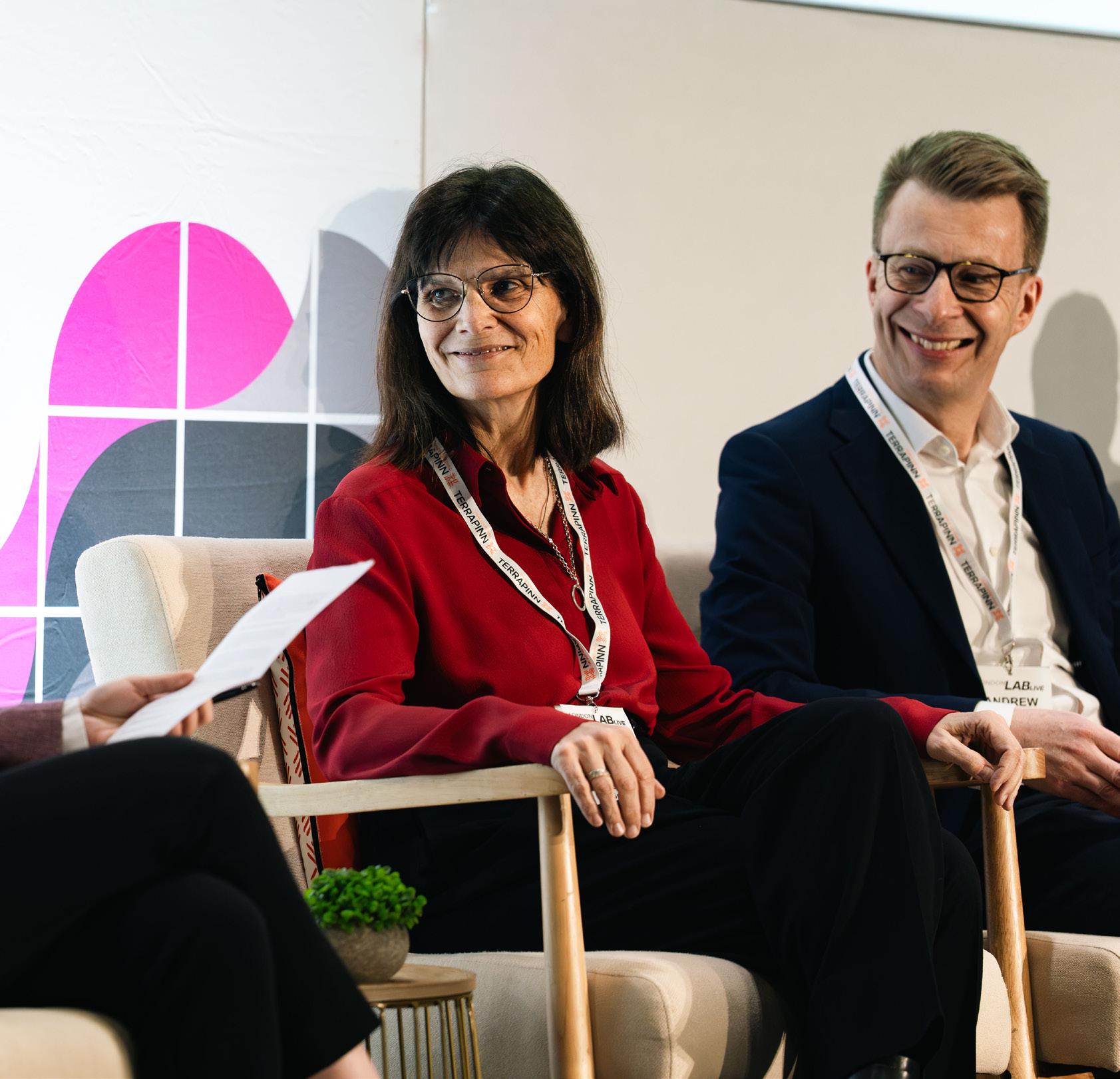
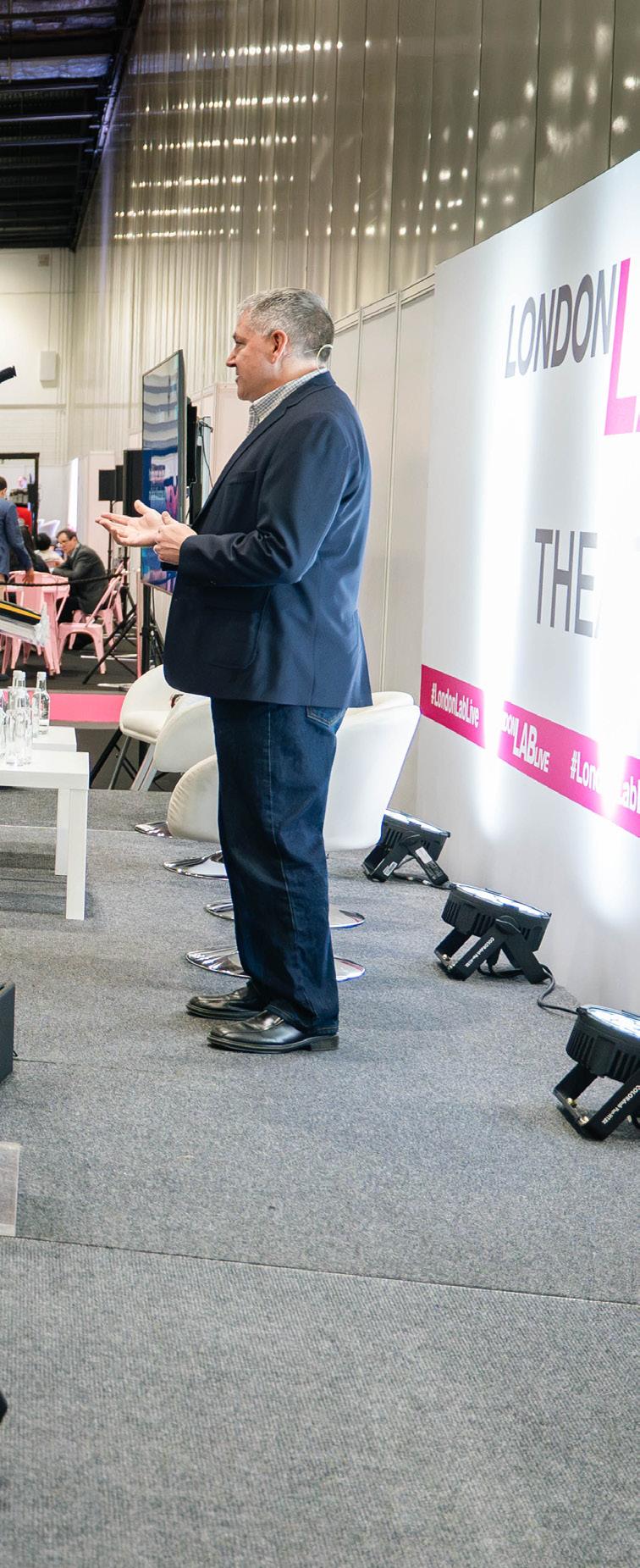
Above Kathleen Fisher, CEO of ARIA (in red) was part of the opening day keynote talk along with Graham Lord (left)
“The opening keynote talk on day one was particularly interesting,” said Ellie. “We had Graham Lord – SC1 London co-chair; executive director, King’s Health Partners; senior vice-president of health & life sciences, King’s College London; chief academic officer & board director, Guy’s & St Thomas’ and King’s College Hospital NHS Foundation Trusts – along with Kathleen Fisher, the CEO of ARIA (the Advanced Research + Invention Agency).
“It had a really nice message about the ecosystem - that the only way the lab industry as a whole is going to grow and develop is by bringing those different aspects together and making sure that we have a unified message within that.
“They were highlighting the different advantages of the UK and what we have to offer, from the universities that attract the amazing talent to help nourish the industry, as well as the actual infrastructure in the UK and the different hubs within that.
“For instance, when we're talking about Cambridge, it's the ecosystem around that and what actually attracts people to live in Cambridge versus what attracts
“If we’re asking people to take time out of their day or their lab, it needs to be worthwhile”
people to live in London. There are all kinds of different nuances there, in how that ecosystem speaks to different people.
“We also want to highlight some industries that don’t always get the attention they deserve, such as agri-tech. We want to bring them into the same room as those big hitting pharma companies and see what some of the challenges are they both face.
“A lot of the time, within the lab, they can be quite similar. It is just the outcome is different, in terms of a drug versus some new method of crop protection.
“While that opening keynote was looking at what the UK is doing really well, and what we need to improve, the second day was much more focused on the people and the technology.
“So we have seen a lot of conversations about AI – it is
Scan the codes below for more info and to get your free pass
inevitable, whether it is in the lab or some other area, but we need to embrace AI and the digital transformation that comes with it. So what are the sticking points?
“It was clear that one area was the people. We know that people are the backbone of the lab, so how do we ensure that we've got that balance of utilizing this new technology, ensuring that people are upskilled effectively so everything works in unison?
“One of the highlights was a really engaging panel discussion with individuals from large companies highlighting some of the things that they are doing to help bring people along for the journey of this digital transformation.”
That brought together Penny Smee, senior product director for lab capture & experience at GSK; Dr Zara Ghazoui, director of digital innovation at AstraZeneca; German Faraoni Heidenreich, the global director of data at Reckitt and Finn Bauer, vice president of life science R&D at Croda.
london lab live 2027
med lab live 2027
laB eVents in 2027
“It was quite a nice balance having two big pharma companies alongside Reckitt, which is more of a household goods group, and Croda on the chemicals side.
“That breadth is key to our establishing ourselves as a forum for ideas, as well as a marketplace for science and technology.
“And that builds on our other events – we have been running Basel for six years now, while our US event has been going about four years.
Stay a little longer
“We are constantly working to make these events where people want to stay a bit longer; if we are asking people to take time out of their day or their lab, it needs to be worthwhile.
“So we are building the social side of things, with a 5k fun run to start off day one, and a VIP dinner the night before.
“And we created a lab listings area which essentially was like a mock-up of a real estate window where you can go and browse and see what labs are available or what labs are being built at the moment.
“We had poster zones with scientific research being showcased and then round tables as well for a bit more of an informal discussion that allowed attendees to get more involved than in the presentations and panels.
“I think probably the most exciting area was our Connectivity
Excellence Showcase. We developed this with Splashlake and SiLA Consortium and it was essentially having a mini lab on the show floor.
“One of the biggest challenges that labs face at the moment is connectivity of devices and software with their current systems or with other sort of systems that they're planning to bring in.
“So this gave us the opportunity to demonstrate how to integrate equipment and software in different ways, working with a group of leading instrument and software vendors to show best practices for lab digitisation based on open standards.
“For instance an example of chromatography sample preparation demonstrated horizontal integration, passing results directly between instruments along a workflow.
“The result was a really interesting area on the exhibition floor that was constantly buzzing throughout the two days. It was something we haven’t tried before at any of our events. There was a
good reception and we’re now planning to use it in future iterations of the event, including at the US exhibition in October.
“Again it’s part of that effort to create value for attendees, showcasing new technology and its application as well as encouraging people to get together. These are probably people that aren’t going to be meeting and networking every day, so there’s that opportunity for an exchange of ideas – building that ecosystem with different people and different stakeholders. And it’s something we plan to expand on for next year.”
The 2027 event is already scheduled for ExCeL London on May 5th and 6th. It will also see the launch of another event alongside London Lab Live: Med Lab.
“The idea behind Med Lab is that it is bringing the clinical pathology side into the event,” said Ellie. “It will be co-located so people will have access to either side, bringing in NHS and private healthcare facilities. We’ll have opening keynotes that will be shared across both sides.
“Speaking to people at this year’s event it was felt it would be good to unlock those conversations across both R&D and clinical sides.
“And we’re looking at other areas where we are seeing exciting developments, such as the growth in self-driving labs, with the integration of AI and automation. It is something that has gained a lot of traction over the last three years, with major universities spearheading work in Canada originally, and now spreading across the US and Europe with the likes of Unilever and AstraZeneca taking interest.
“It’s what London Lab Live and its sister events in Basel and the USA are all about – bringing people together with the latest developments in lab technology. And it is clear from the strong turnout this year that there is a growing audience for events like ours.” n
technologY. innovation . best practice
London Lab Live 2027 will take place in May 2027. Get your free pass or enquire to sponsor/ exhibit via the QR code above.
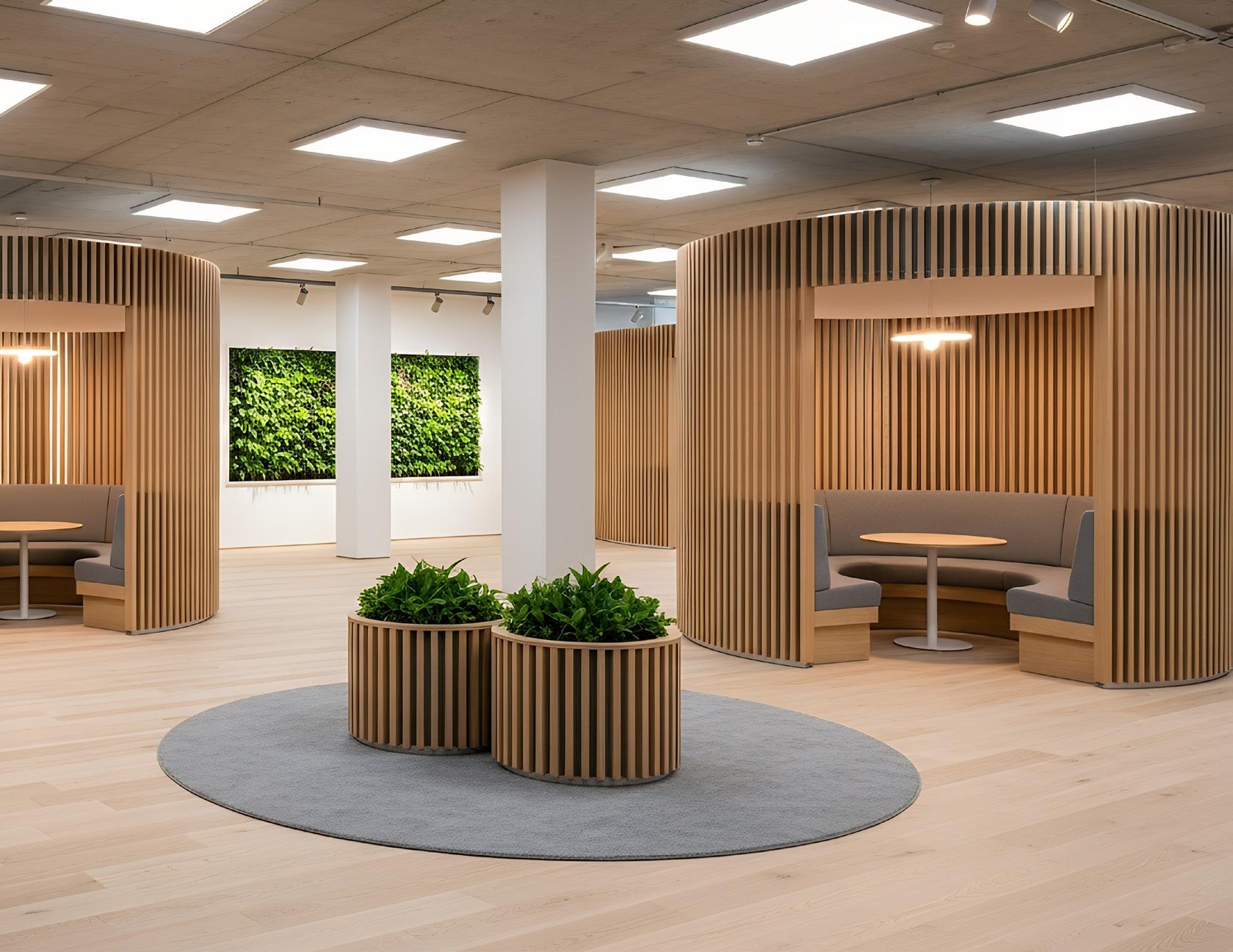
how S mart te C h C an be the bridge between in C l US ivity and flexibility Neuro-adaptive desigN
Tailoring workplaces for neurodivergent employees is essential for retaining top science talent. Alex Burchett and Fiona Du Fresne at Ridge explain how a neuro-adaptive approach uses smart building technology to support users while keeping spaces flexible.
Attracting the brightest minds is critical to the success of science organisations.
Increasingly employers are realising that means making workplaces comfortable for people who are neurodivergent, a spectrum of conditions that includes autism, ADHD and dyslexia.
Rates of neurodivergence are much higher in the science and technology sectors than among the general population. It is estimated that 15-20% of UK adults are neurodivergent, but among the science organisations we work with, up to 70% of their workforce may identify in this way. Creating a supportive environment is essential for keeping those employees happy and enabling them to do their best work.
There are many aspects of the workplace that can be challenging for neurodivergent users: noise, temperature, lighting and overcrowding are the most frequent complaints. But everyone is different and no two people have exactly the same needs. They may prefer high or low stimulation environments, or different things at different times.
Best practice design involves creating zones with different sensory qualities, making them clear and legible, and giving occupants choice and control.
Creating “neuro-neighbourhoods”
In laboratories, there are important technical and safety considerations that determine lighting, noise and temperature levels. But across the rest of the floorplate, we can break the space up to create different
Below
Fiona Du Fresne (top) and Alex Burchett
“neuro-neighbourhoods” where sensory conditions are tuned for different activities.
These range from louder breakout and collaboration spaces, to quiet retreat rooms to regulate and reset. In the middle, open-plan write-up areas can be designed for day-to-day group working, and meeting pods and cellular offices for focused concentration.
The key is to make all of them distinct and legible, and to empower people to choose the space that suits them best.
Zoning vs flexibility
Dividing a floorplate into zones can run counter to conventional design wisdom. Flexibility is a key building requirement in a fastchanging sector, and the easiest way to achieve that is with a single, open-plan space. The problem is that this often fails to meet any single need.
Our solution is an approach we call “neuro-adaptive design”, wwhich deploys smart building technologies to tailor spaces to sensory requirements in real time.
For example, we can give people the ability to adjust the temperature, lighting and acoustic dampening in their location via their devices, or to programme one-touch modes for brainstorming, reviewing or learning. With Bluetooth mapping, their settings can be applied automatically as they move through the building.
Displaying occupancy levels on screens or via app indicators allows them to see at a glance which areas of the building are busy, and choose whether to engage socially. With predictive noise management, sensors detect rising noise levels
throughout the day and over time.
This is another important type of flexibility: as awareness of neurodivergence grows and diagnoses increase, an increasing number of people are recognising their own sensitivities and seeking supportive working environments.
Data-driven building management
and respond with active sound damping or by pushing alerts to occupants in the space.
Smart technologies bring another layer of flexibility, on top of the original design. A neuroadaptive building isn’t just inclusive, it’s constantly learning and feeding back, responding to the needs of users as they change
This does not necessarily require additional equipment. In many buildings, smart technologies such as occupancy sensors and intelligent lighting and ventilation controls have already been installed to reduce operational costs. There is a huge opportunity to extend existing capabilities to improve employee comfort.
Over time, a neuro-adaptive approach also provides valuable data for building managers and owners. As the building management system learns users’ preferences and patterns, it will be able to identify spaces that are unpopular or underused, and enable facilities teams and designers to dig into potential causes and improvements.
A neuro-adaptive campus
The importance of zoning, legibility and control applies at every scale, from a single unit to a campus masterplan.
Where there isn’t room to include different zones within each unit, we can include shared amenities such as centralised quiet rooms that all tenants can access. Connecting with nature has been shown to be particularly helpful for emotional regulation, so we design in walking trails and other outdoor spaces to allow people to break away without having to go too far. Clear signage and wayfinding is essential – but even better, a digital twin of a campus allows people to plan and visualise their route through the site, so they know what to expect and their first day feels more like their second.
Technology can never replace good design: it’s an enabling layer, not a standalone solution. But at Ridge, we are finding that it can make an enormous difference to how neurodivergent people experience the workplace – and that’s becoming an increasingly important differentiator for our clients in the competition for talent. n
g et in touch
Fiona Du Fresne is an architect and Associate Partner in the Science team at Ridge, involved in masterplanning and architectural design for science parks and research hubs. Contact her at fionadufresne@ridge.co.uk
Alex Burchett is a building services engineer and Senior Associate at Ridge, involved in establishing campus masterplanning and the design and delivery of tenant fit-out projects for science parks and research hubs. Contact him at alexburchett@ridge.co.uk
DA r K l A b S ’ WILL change the face of research?
‘
Simon Penfold talks to Andrew Somerville, partner at Cundall, about the practicalities of developing ‘dark labs’ in the UK.
he combination of artificial intelligence (AI), cloud computing and integrated platforms is predicted to fundamentally change how laboratories operate in the next few years.
TIncreasingly, attention is focusing on the development of self-driving laboratories – so-called ‘dark labs’.
It was back in 2023 that Chinese mobile phone company Xiaomi unveiled its Smart Factory, a fully-automated assembly line capable of manufacturing over 1 million of its flagship
smartphones a year in a lights-out plant. While details have remained thin on the ground, it is thought the automated production floor still requires human engineers and technicians for system maintenance, troubleshooting, and software management.
Increasingly that technology is being applied to science and the laboratory.
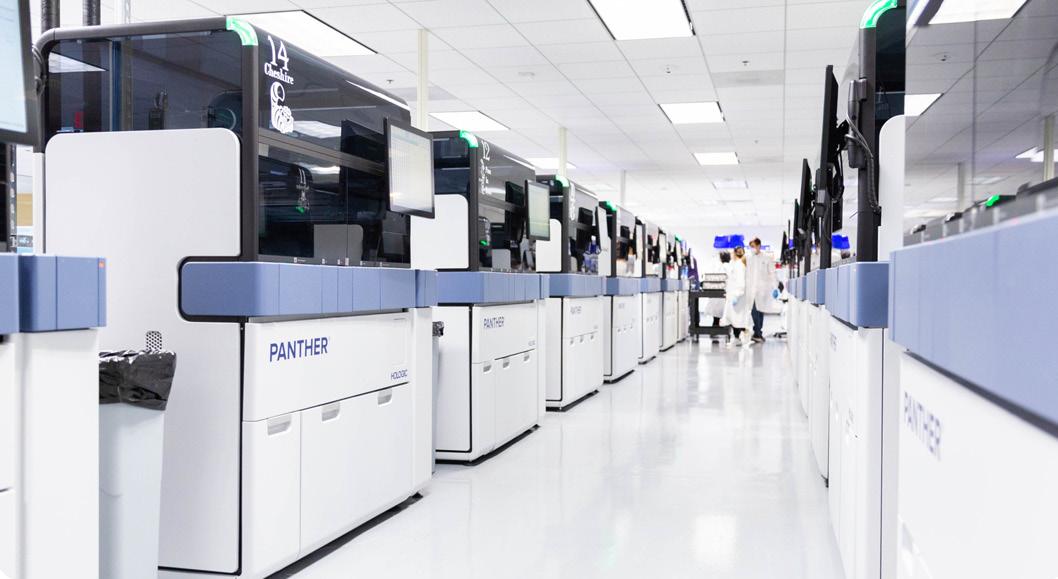
In the USA the LetsGetChecked medical testing service uses automation to handle and process medical samples on a massive scale while last year researchers at North Carolina State University unveiled Rainbow, a first-of-its-kind
multi-robot self-driving laboratory that autonomously discovers high-performance quantum dots – semiconductor nanoparticles critical for next-generation displays, solar cells, LEDs and quantumengineering technologies.
Combining advanced robotics with artificial intelligence, Rainbow can conduct and analyze up to 1,000 experiments per day without human intervention, dramatically accelerating the pace of materials discovery.
In the UK, Liverpool University’s Cooper Group has built a strong reputation for its work accelerating the discovery
Below LetsGetChecked uses automation to handle and process medical samples on a mass scale
of advanced functional materials using cutting-edge robotics, AI and digital technologies, to develop the next generation of fully autonomous laboratories.
The university recently unveiled plans for AIM-HI (AI Materials Hub for Innovation), a £100 million national flagship AI-driven materials discovery centre to support key sectors of the UK economy, including the transition to net zero, while expanding opportunities for industrial partnership.
Within the next few years fully-automated laboratories, sometimes referred to as ‘selfdriving labs’ will be increasingly seen across both academic and commercial operations, carrying out blood tests and drug production while AI-driven assistants become a standard tool in research and development.
Among those keeping a close eye on how this trend develops is Andrew Somerville, Global Head of Science and Technology and partner at design and engineering consultancy Cundall.
“We've been designing labs for developers for the last eight or nine years, and they have been designed with flexibility and adaptability, but also designed for the developer to make a return. We
do a lot of MEP work; mechanical, electrical, public health and the structural and civil engineering and the associated specialists, so acoustics, lighting, all that kind of stuff, as well as data centre team.”
As a result, his thinking is focused on the practicalities of designing and operating an autonomous ‘dark lab’.
“We've done a lot of work with some of our clients on labs of the future and autonomous labs and how they can gear up for it. The standard design for laboratories has changed from being serviced at bench level to being serviced at the ceiling to enable bench connection or equipment connection.
“So we've gone from having everything at the back of the bench that you can plug bench top equipment into, to having connections at the ceiling that you could plug a bench into or
“ STAN d A rd de S i GN f O r l ABO r ATO rie S HAS CHANG ed fr O m S ervi C e AT B e NCH level TO S ervi C e AT TH e C eili NG ”
autonomous equipment into. So the benches become more modular; they can be moved in and out to make way for larger pieces of autonomous kit.
“I can see the benefit of it a lot more with standard laboratories and some R&D facilities where you have repeatability. You don't have to change the setup as much. But as automation becomes more advanced and improved, you'll be able to use it more in R&D labs where you can change the setup quicker because it can be a bit more modular or adaptable.”
Autonomous equipment metrics
It’s no great logical leap to look at what the next steps would be.
“You start doing research and you start thinking, well, why are we designing for people? Why are we designing the standard lab modules around people metrics and bench metrics when we perhaps should be moving towards autonomous equipment metrics?
“Then you start playing that through and where you end up building a lab in a more industrial logistics setting where goods could come in, goods could go out, in more of a manufacturing style methodology. So you could actually build the lab in a cheaper location.
Left Xiaomi unveiled its fully-automated Smart Factory in 2023
“You could build it more flexibly, loosely, so that you can swap equipment easier. You could design it so that you can have faster changeover equipment. And you could do walk-on ceilings that allow you to change equipment connections quicker or just enable services to be added if you need them.”
‘Walk-on ceilings’ are load-bearing structures that safely support the weight of workers and equipment above a controlled space. Primarily they are currently used in pharmaceutical, laboratory, and semiconductor cleanrooms, allowing technicians to service HVAC systems and lighting from above without contaminating the sterile environment below
Drew continued: “You could make it more of a standard process, designed like a logistics building but with everything inside being more autonomous with just people there to fix it when these things go wrong.
“When you think about all the automation going into these automated buildings, such as dark labs, then you're going to need an on-site data centre or an edge data centre.
“We've seen a lot more of the diagnostics and AI-intensive R&D facilities in the UK that have edge data centres that are doing the processing to reduce the latency - the speed of connection between the AI and the equipment. They have them physically closer for faster communications.”
An edge data centre is a smaller, localised computing facility set up near end-users and devices rather than in a centralised, remote region. By processing data close to the source, these centres drastically reduce latency, enabling real-time applications like AI, 5G, streaming and the Internet of Things (IoT)
“There’s a lot of talk about how dark labs would save on energy, and you can see savings, because you don't have to design it for people, you don't have to have the safety factors for ventilation for people, you don't have to have the lighting for people running all the time, only when they're being serviced or maintained.
“But all that saving will go towards the autonomous energy being used. Instead of someone
“ i ’d l O ve TO WO r K ON A d A r K l AB - f O r TH e
walking down and moving a materials from there to there, it has to be moved by a robot that needs power or some other system, or a conveyor that needs power.
“And then the actual thinking, the energy used for that robot to know to move here to there and spot problems or recognize different things is needed for that data centre at the edge of the building.
“Instead of people power, we're using machine power. So there's still a lot of energy there, and depending on how much thinking power it needs, that energy could be more or less than a standard lab.
“So a dark lab isn’t a silver bullet in terms of reducing energy consumption.”
“But I think if you're doing an autonomous system, it would only need a very narrow AI. It would be just following certain processes and its job is following certain skills so you would have a series of them.
“So, you'd have something that uses image recognition to look at
where something's being placed to understand if it's in the right spot or not.
“And I think that narrowing those AIs to very specific function will be the key to making this work.
“We’ve already got Liverpool University developing a lot of automation for use in labs, and we’re starting to see the Government in the UK pushing automation in labs through, setting up funding streams to enable that.
Different models for different people
“I think we're going to see automation in labs come through in a lot more detail. We've seen it coming over the last few years, which is why we've got the different model in the existing labs of serving services from the ceiling down to the equipment rather than at the bench, because we're seeing that automation coming through.
“We're seeing the benchtop automation coming; all we're doing is looking at joining that together
Above
Andrew Somerville, Partner at Cundall
to create a process flow to make an automated lab.
“Clearly, there's different ways of doing it. You could have a mobile robot that goes across and basically replaces a technician in a lab doing certain functions, or you can have it more like a production line where it goes in one end, comes out the other, and it just follows each step through.
“And you'll find different models work for different people.
“I'm guessing we're going to see that production line model come through first.”
The concept was highlighted by tech billionaire Larry Ellison at the White House in January, at the launch of Project Stargate, a private sector investment of up to $500 billion to fund infrastructure for artificial intelligence.
Mr Ellison, co-founder and chairman of Oracle, said at the time: “You can do early cancer detection with a blood test…and using AI to look at the blood test you can find the cancers that are seriously threatening the person. So cancer diagnosis using AI has the promise of just being a simple blood test. Then beyond that, once we gene sequence that tumor you can then vaccinate the person…design a vaccine for every individual person. And you can make that vaccine robotically again using AI in about 48 hours. So imagine: early cancer detection, the development of a vaccine for your particular cancer aimed at you, and have that vaccine available in 48 hours. This is the promise of AI and the promise of the future.”
“All those processes are around, but no-one’s automated them yet,” said Drew. “You have companies who are taking blood from people, finding those cells, sequencing them, and creating injections that cure the cancer in these people too.
“That is the kind of thing you could see being developed and processed and treatments being done. You'd want that in a logistics place that can be servicing a load of treatment centres, hospitals or private clinics. It receives blood, it sends out samples.
“Advanced therapeutics and cell & gene therapies have the ability to cure almost 70% of human diseases and ailments. So you could use that same model
for a lot of potential challenges.
“You could just see it for diagnostics where you send samples in, an AI looks at a slide that's been prepared automatically, analyzes it, sends you the results back.
“It’s simply reproducible process flows. And when you can get it doing that, you can see the money then going back into the R&D and making R&D more flexible.
“If you're doing drug discovery and you want to sample those different systems and opportunities, you can do that automatically. It is already being done at the bench level; now we are talking about making it bigger, more industrial, standardized steps that you can put in a conveyor system.
“Those will be the ones that are easiest for this, where it's a known process where you can map a model. I do think it will come into wider areas. A lot of what we do in science is very process-led anyway. So having a machine that can do it and follow those processes will involve how adaptable those machines need to be to change between different types of process.
Dark lab desire
“I don’t think we are far away from that modular system in a dark lab of some kind. They’re doing it in America, in Europe, in China. I don’t think it will take long for us to start doing it in the UK. We are already seeing elements of it with automated labs at large pharmaceutical companies who have the money to invest.
“As the cost of automation comes down, the use will go wider, reducing the cost of entry to market. We've seen that with cell & gene therapy where the cost of sequencing and editing genes has come down so dramatically in the last 15 years or so that it took off in a big boom.
“You can see this with automation as it comes down in cost and becomes more accessible, it will pick up more and you'll see it more widely used.
“Speaking personally, I’d love to work on a dark lab. For the UK to be competitive, we need to be able to deliver this sort of technology. I think we are starting to see it on a small scale in a lot of our clients’ work; we are seeing more automation coming in.
watch the Videos
l ets get chec K ed laboratorY
“We’re designing future-proof labs and buildings. To see that go up in scale will be exciting.
“My guess will be that it will start as a crossover between tech and pharma, a production system for a big pharmaceutical company creating autonomous labs with AI support. It will probably be manufacturing production type of spaces at first, then we’ll start seeing it come more into the R&D arena once they can understand how that can work.
“There are already pockets of automated labs in the UK but the challenge will be to get that fully up to scale. If we want to be competitive as a nation, we need to step up our game on that one.”
xiaomi smart factorY
One obstacle to dark lab development could be the amount of power they will need. “Without getting political, we've got some challenges in the UK to be competitive for that,” said Drew.
“One solution would be if you had a large site with lots of land where you could generate your own power and have your own grid, then you can reduce the cost of power to your tenants and make it so that they could be competitive.
“And on larger industrial sites, that's what we're recommending to a lot of our clients, where you can have your own microgrid, where you can generate your own power cheaper than the National Grid can provide it, and that can make you competitive.
“A lot of science parks might consider actually having on-site generation, lowering their power costs to enable this to be a competitive situation.
“Our power team at Cundall is experienced in this space, working on a range of large sites. Viability, however, depends on having enough land, as generation typically relies on solar or wind to remain cost-effective. Just as important is having the right storage in place to manage intermittency and maintain a stable, reliable power supply.” n
focus on W ellbeing
Cundall design sustainable science and technology facilities, focusing on occupant wellbeing. Find out more at www.cundall.com/sectors/ science-and-technology
Sovereign A i
F un D bA c K ing u K ’ S home-grown tA lent
The UK Government is getting in on the ground floor of AI development - Simon Penfold reports.
Technology Secretary Liz Kendall has made the bold claim that the launch of the Sovereign AI Fund “is going to be one of the most important things this government does to build a better future for our country”.
This is the Government’s £500 million bet on homegrown AI founders, with firms pioneering drug discovery and cheaper supercomputing among those to get the first backing.
The Secretary of State for Science, Innovation and Technology chose to launch Sovereign AI at Wayve, the British self-driving tech firm which has grown out of cutting-edge AI research at the University of Cambridge, into one of Europe’s most valuable technology firms.
Sovereign AI is designed to be different from any previous government-backed unit, acting like a venture capital fund but backed by the muscle of the state. The aim is that it will invest directly in the UK’s most promising AI startups, help them scale quickly, and give them the support they need to compete with the best in the world.
The first companies to receive support are working on technologies that could transform daily life – from tackling devastating diseases like Alzheimer’s and Parkinson’s,
to building AI systems and computer chips that push the limits of what today’s technology can do.
The first announced equity investment was in the AI infrastructure startup Callosum, with six further startups receiving access to some of the UK’s foremost supercomputing capacity through the unit.
The government says Sovereign AI is built to work at the pace of the AI industry – just like a top-tier VC firm.
While individual investments will range from £1m to £10m, support will go beyond funding. This includes fully funded access to the UK’s largest AI supercomputers, with up to 1 million GPU hours available per startup - providing the horsepower needed to help train state of the art AI models
Every company receiving investment will get visas decisions within a working day, plus access to an initial 10 cost-free visas for the world’s top R&D talent to come and work for them in the UK
And there will be hands-on government support: help navigating access to data, early procurement opportunities, independent product validation and routes into new approaches to regulation.
The intention is to build a UK-based AI industry: all of the companies Sovereign AI supports have a meaningful presence here in the UK, creating jobs and contributing to the economy.
Liz Kendall said: “AI is the most powerful technology of our lifetime, with the potential to transform every aspect of our lives.
“It is critical to our economic prosperity and non-negotiable for our national security.
“That is why we must be an AI maker, not just an AI taker. So we have greater control over – and reap greater benefits from –this vital technology for all of our people.”
At the speed of VC
Outlining the strengths of Sovereign AI, she said: “It is independent. With an investment committee making its own decisions free from political interference about who to back and why. And it will operate at the speed of VC, not the traditional pace of government.”
The goal is simple – help AI companies start in Britain, scale here and win globally – instead of seeing world-class ideas leave the UK as soon as they begin to succeed.
By backing them early, the Government believes it can keep expertise, decision making and economic value at home – and reducing reliance on a small number of foreign tech giants for critical AI that matter for the UK’s economic prosperity and national security.
Technology Secretary Liz Kendall added: “Sovereign AI is unlike anything government has ever done before. Its unique
approach will help break down the barriers that have too often held back British enterprise and innovation. This is how we ensure Britain’s economic prosperity and national security in the modern age.
“My message to British founders and innovators is clearwe will ensure you never have to choose between your ambition and your home, because Britain will give you both.”
Chancellor of the Exchequer Rachel Reeves said: “We have the right economic plan – backing business so the technologies of the future are invented, built and deployed here in Britain.
“A thriving domestic AI sector is one of my three big choices for the economy, and by supporting strategic national champions we can ensure internationally competitive companies start, scale and stay here in Britain.”
Above Secretary of State for Science, Innovation and Technology Liz Kendall spoke at Wayve Headquarters in April as the Sovereign AI Fund was launched
“
SO verei GN A i’ S u N ique A ppr OACH W ill H elp B re AK d OWN BA rrier S THAT HA ve H eld BACK Bri T i SH e NT erpri S e AN d i NNO v AT i ON ”
The first startup getting equity investment from the Sovereign AI Unit is Callosum – a company building a new class of AI infrastructure: systems-level software that can distribute AI tasks across chips from different manufacturers - Nvidia, AMD, Amazon Web Services or newer startups like Cerebras and SambaNova - extracting performance advantages from each.
Danyal Akarca, founder of Callosum, said: “There’s a fundamental shift underway in how AI systems are built and run. The future of compute is heterogeneous, and making that complexity usable is the next frontier. The UK already understands where this is heading, and with its depth of talent across universities and labs like DeepMind, it is the natural place to build Callosum: the orchestration platform that allows models and chips to work together as one system.”
Sovereign AI has also backed backs Ineffable Intelligence –co-investing with the British Business Bank. Ineffable is a new company building algorithms for a new kind of AI that can learn for itself and uncover new knowledge - rather than simply copying what humans already know.
Instead of being trained only on vast amounts of existing data, these systems interact with their environment, test ideas, and improve over time, allowing them to discover new solutions and insights on their own - opening the door to breakthroughs in science, medicine, engineering and beyond.
The company is led by David Silver, one of the most influential figures in modern AI. A Professor at University College London and formerly Head of Reinforcement Learning at Google DeepMind, his work helped power some of the biggest AI breakthroughs of the last decade, including AlphaGo - the system that famously beat the world champion at the game of Go.
Within a month of its launch, Sovereign AI announced another investment, this time into Isomorphic Labs -ma company using frontier AI for drug design and development.
The investment formed part of a wider fundraise by Isomorphic Labs which raised $2.1 billion.
The Londonbased company, founded by Nobel Prize-winner Sir Demis Hassabis, is developing a number of proprietary breakthrough AI models that together form its unified drug design engine, IsoDDE, across multiple therapeutic areas and drug modalities.
supercomputer network – with Sovereign AI getting a right of first refusal on future investments for a number of recipients.
The companies are: Prima Mente, Cosine, Cursive, Doubleword, Twig Bio and Odyssey.
“Sovereign AI exists to invest in the companies that will shape what Britain becomes next”
Prima Mente is using AI to decode the languages of biologyfrom DNA sequence to gene expression and epigenetic regulation - to better understand and tackle brain diseases such as Alzheimer’s and Parkinson’s. Through active research collaborations with Oxford, Imperial, and the University of Edinburgh, the company is building biological foundation models at the frontier of AI and life sciences.
Sovereign AI Head of Ventures Joséphine Kant said at the time: “Isomorphic is one of the most consequential companies being built anywhere in the world today, and it’s being built in Britain.
“Sovereign AI exists to invest in the companies that will shape what this country becomes next. Sir Demis Hassabis, Max Jaderberg, and the team they have built deserve a country willing to match their ambition with its own, and we intend to make sure it does.”
Support for six
In addition to the trio of investments, a further six startups will receive access to the AI Research Resource (AIRR)
Doubleword helps businesses with the infrastructure needed for AI inference: the process of running live data through a trained AI model. By providing optimised inference and model governance tooling, Doubleword enables organisations to adopt AI faster and more cost effectively, while allowing regulated and government users to run and audit models inside
their own secure environments rather than depending on foreign cloud platforms.
Cosine is a British sovereign AI frontier lab developing advanced models and coding agents that top public benchmarks — purpose-built for defence, national security and regulated industries where foreign-built AI is off the table. Its platform runs entirely within a customer’s own infrastructure, with no external dependencies, delivering AI that is developed, deployed and operated under full UK control.
Cursive is developing AI agents that learn and improve continuously from real-world use, building foundation models for behavioural prediction and long-horizon reasoning that allow agents to get better the more they are deployed. Founded by senior
DeepMind alumni who helped build some of Google’s most advanced AI systems, the company is working one of the most important frontiers in AI research, currently pursued by only a handful of labs globally.
Odyssey is developing world models that learn from and understand the world like people do, through sights, sounds, words, and not just one single type of information. This is a fundamentally different approach to AI with significant applications across defence, autonomous systems and simulation. Founded by British AI researchers Oliver Cameron and Jeff Hawke, the company maintains a significant UK team and research presence alongside its California operations.
Twig Bio is developing CANOPY, a foundation model for AI-driven strain design in engineering biology and biomanufacturing. The UK has genuine depth in synthetic biology, and CANOPY aims to translate that research strength into a production-grade AI capability for sustainable manufacturing and bio-ingredients, scaling from validated prototype to industrial application.
Sovereign AI is also currently in discussions with around 30 firms, over potential AIRR access.
Real conviction on AI
Meanwhile, as part of Sovereign AI’s £282 million offer to support cutting edge AI startups with R&D, the unit launched its first funding call to create new datasets and other assets that help firms move faster and build in the UK.
Leading the charge at Sovereign AI is Chair James Wise, with 15 year’s experience as a venture investor. He has been a partner at venture capital firm Balderton since 2016, investing across geographies and stages with a specific focus on applications and models in AI, energy, and health. He works with multiple portfolio companies and
has been involved in the sale and IPO of over a dozen companies. He also helped launch and run one of the UK’s first social venture funds.
Working alongside him is Head of Ventures, Josephine Kant. Before her role at Sovereign AI she spend eight years rising through the ranks at Google before working at startup investor Y Combinator in Silicon Valley and then helping launch US-based early-stage fund, Dogwood Ventures, in 2024.
Top-bottom from above Sovereign AI Fund’s team includes Chair James Wise, Head of Ventures Josephine Kant, and Managing Partner Suzanne Ashman
The duo have been joined by Managing Partner Suzanne Ashman. As a former general partner at LocalGlobe and Latitude, she spent a decade backing the founders of British tech firms from Tessian to Open Cosmos. Suzanne also co-authored the UK Tech Competitiveness Study which recommended measures to close the digital skills gap, harness the power of data and AI for the public good, and strengthen regional tech ecosystems to better support UK tech startups and scale-ups.
Naysayers have been quick to find fault with Sovereign AI’s scope and ambitions, criticising its investment pot of £500 million fund as a "drop in the ocean" compared to the billions invested globally, while pointing at the UK’s high energy costs and global talent shortages.
But those engaged in the project have no doubts. Meryem Arik, co-founder and CEO at early beneficiary Doubleword, said: “We’re proud to see the UK government step up with real conviction on AI. This is the most consequential technological shift of our generation, and the nations that invest strategically now will define what the next decade looks like. SovAI has shown exactly the kind of urgent, clear-eyed ambition the moment demands - and the UK is better positioned for it.” n
bac K ing british ai startups
Sovereign AI is the UK’s sovereign venture fund dedicated to scaling British AI companies. Learn more at www.sovereignai.gov.uk
Where Deep Tech ScALeS - AND STAYS
Walking along the woodland trails at North East Technology Park (NETPark), you are as likely to hear a debate about the cleanroom tolerance required for high-frequency satellite payloads as birdsong. There is a distinct energy here. For more than two decades, this campus has quietly matured into a nationally significant deep-tech powerhouse. With our recent £100 million expansion now complete, NETPark is no longer a regional secret. It is an active global launchpad.
a campus Built on suBstance, not promises
Ambitious technology businesses do not choose a location lightly. They need assurance that the physical infrastructure, talent environment, academic pipelines and institutional partnerships can perform at the highest international standard. NETPark has spent two decades building that assurance, and the businesses already on site are the clearest evidence that it has worked.
For the space and electronics sectors in particular, the opportunity is significant. Supply chain clustering around the park’s growing space and semiconductor base is becoming one of the most significant commercial development stories in the North East, and the supporting infrastructure is already in place.
a campus designed around what actually works
More than 40 companies and over 1,000 people now work on site across the compound semiconductors, space
“We’ve built a campus culture where companies can access world-class facilities and expertise while being part of a connected community”
technologies, photonics, advanced materials, printable electronics and life sciences. This is not a curated shortlist — it is the lived reality of a campus that has chosen depth over breadth and technical credibility over generic appeal.
For the UKSPA community, the core challenge facing any scaling technology business is universal: how do you transition from breakthrough laboratory research to global commercial volume without tearing your operations apart? NETPark was built to dismantle that barrier. We do not supply rigid, pre-built laboratory environments. Instead, we provide premium, highly flexible shell assets, giving technical directors the autonomy to custom-engineer cleanrooms, fabrication labs and precision instrumentation floors to their exact specifications, from scratch.
Filtronic is a compelling example. The high-performance RF and communications technology company has continued to expand at NETPark, delivering critical hardware to international space, aerospace and defence markets. Graphene innovator SEEDS tells a parallel story — now entering a significant phase
of international commercialisation, with applications spanning microelectronics, energy storage and aerospace. Both companies have grown on-site and are building NETPark’s future rather than moving away from it.
more than infrastructure
Christian Pape, Business Property Director at Business Durham, which manages NETPark, believes this combination of infrastructure, collaboration and environment is becoming a major differentiator. “Supporting science-based scale-up through collaborative partnership is what we do best here at NETPark,” he said. “But it’s also about creating an environment where businesses and people can thrive together. We’ve built an innovative, ambitious and supportive campus culture where companies can access world-class facilities and expertise while being part of a connected community that attracts talent, encourages collaboration and supports long-term growth.”
That balance is tangible on-site. By pairing world-class technical assets with a tranquil, semi-rural campus setting, mature forest walks, and competitive regional living costs, NETPark’s tenants have a distinct advantage in attracting and retaining elite engineering talent.
from incuBation to international — on one campus
Our environment is designed to support the entire corporate lifecycle. While expansion delivers
industrial-scale cleanroom, laboratory and advanced manufacturing space ready for immediate occupancy, we are also investing in 10,000 sq. ft of new specialised incubation facilities, ensuring early-stage spinouts have a clear, continuous pathway to scale on a single campus. Companies do not have to leave to grow.
To mitigate operational risk when entering a new facility, we are developing our Welcome Hub and on-site peer-to-peer lounge, which will provide direct access to campus sector specialists and the Business Durham business support team. Incoming teams are assigned dedicated guides to unlock regional growth funding, manage recruitment pipelines, and facilitate collaborations with Durham University, the Centre for Process Innovation, three national centres of excellence, and two national Catapult Centres.
the wider case
NETPark serves as a designated Investment Zone Growth Site — the physical location where the UK’s sovereign ambitions in semiconductor production, space instrumentation and advanced manufacturing become tangible commercial realities.
For fellow UKSPA members, university innovation leads and technical founders navigating the constraints of traditional hubs, the evidence is clear: look at who is here, what they are building and why they chose to stay. That is two decades of decisions by serious companies in serious sectors — and the results speak for themselves. n
contact the netpar K team
To explore available infrastructure or coordinate a site visit, contact our team at www.northeasttechnologypark.com
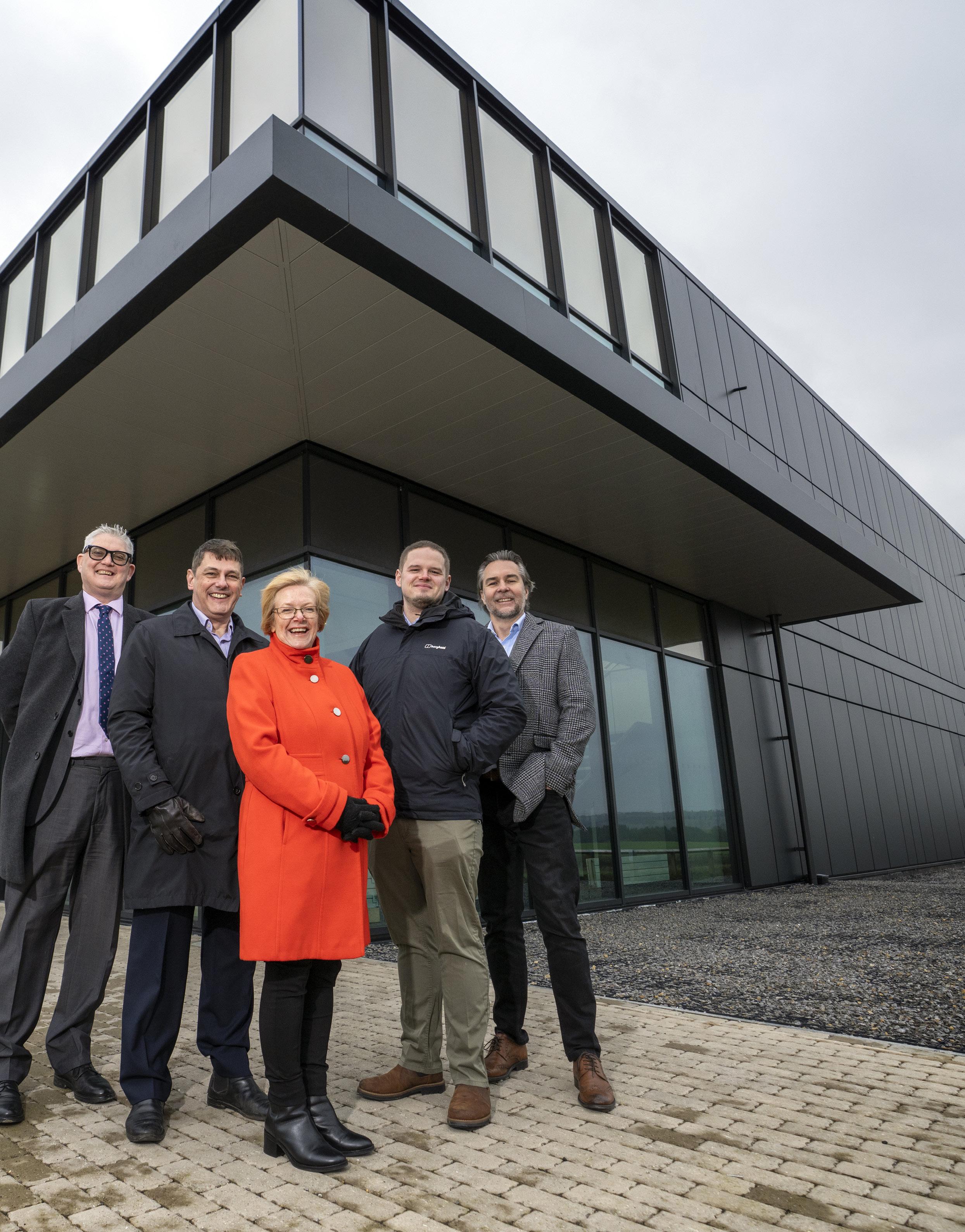
(Left to right): Torquil Gundlach, head of the Argonaut Programme at SEEDS; Peter Chalder-Wood, head of Strategic Partnerships at SEEDS; Sara Williams, NETPark manager; Cllr Joe Quinn, Durham County Council's Cabinet member for planning, investment and assets; Christian Pape, property director at Business Durham
“ The UK lab industry has been remarkably resilient over the years - I don't think I've ever seen it drop”
GAMBICA’s Jacqueline Balian talks to Simon Penfold about the ups and downs of the UK’s lab technology industry.
here is a general view that the UK’s life sciences sector faced a turbulent year in 2025, with a drop in biotech investment and a tough healthcare funding landscape.
TBut, despite blows such as US pharma giant Merck scrapping plans for a £1 billion expansion in the UK, the BioIndustry Association’s 2025 report found the sector had shown resilience and investor appetite was poised to grow in 2026.
One organisation plugged into the UK’s life sciences and research sector is GAMBICA, the trade association for instrumentation, control, automation and laboratory technology in the UK. As well as influencing policy and standards, it provides its membership with essential market intelligence including market reports and economic forecasts.
Jacqueline Balian is joint Head of Laboratory Sector at GAMBICA
and confirms a mixed picture for UK life sciences.
“The jobs situation across life sciences is not brilliant at the moment. A recent webinar run by One Nucleus – a Cambridgebased membership trade association – estimated there had been at least 3,000 redundancies across the sector since late 2024.
“The Government has made life sciences a key strategic sector for the UK economy but one of the headlines at that session was the signs of decline in the country’s research infrastructure last year.
“The number one problem is a lack of investment money. There’s been actual retrenchment in the life sciences, as companies look to draw back to protect themselves from any future lack of money.
“The other issue that has been identified is UK site closure. And that involves the whole Trump, ‘America First’ retrenchment back to the US.”
It suggests another twist in the roller-coaster performance of life sciences investment over recent years.
Government figures on life sciences competitiveness, updated in March, showed a surge in FDI –foreign direct investment –between 2023 and 2024.
In 2024 the value of estimated inward FDI into the UK’s life sciences sector was £2.1 billion, up £1.3 billion, or 164%, compared to 2023. This was a stronger increase than in China, the USA or Singapore, while Germany, India and France saw declines in life sciences inward investment over the same period.
Prior to 2024, the UK had seen a spike in FDI in 2021 before declining up until 2023. This spike was also seen in many other countries, probably caused by the surge in investment to accelerate research into the COVID-19 pandemic.
Direct investment in the UK’s life sciences sector had slumped by 58% between 2021 and 2023, from
£1.9 billion to £795 million. But in 2024, the UK saw inward FDI returning to similar levels that were seen in 2021. The number of projects securing FDI actually fell from 64 to 62, meaning a higher average spend per project.
At the same time equity finance raised by UK life sciences companies increased to £4.5 billion in 2024, up from £3.4 billion in 2023, an increase of 32%. Again, this was the highest value for equity finance raised since 2021.
But figures presented at the One Nucleus webinar showed another financial downturn. David Montgomery, co-founder of PM Life Sciences Consulting, said UK biotech financing had fallen to just under £1.9 billion in 2025. At the same time government grant funding for biotech fell for the third year in a row to just £28 million.
A growing market
But the picture is not uniformly gloomy. Jacqueline said: “There are a number of more positive signs as well.
“At GAMBICA we run a tender alert service that looks right across Europe and we’ve been seeing quite an uptick over the last few years in the numbers of tenders and the value overall of what is being tendered out.
“It's not just value, it's also volume that's going up. Obviously some of these tenders are for frameworks, so they are talking about the maximum that could be spent. But it does give you a clear feeling that the market is growing and the diversity of companies participating is growing.”
At the same time, the fundamentals of the UK lab technology market remain strong.
Above GAMBICA’s UK Pavilion booth was on-site at the 2025 MedLab Middle East exhibition
“We’re lucky in that we've got a wide base of manufacturers in this country who are developing their own products – and those are very high quality,” said Jacqueline.
“Across Europe, things are not looking quite so rosy. For example, Germany has always budgeted for 7% growth every year but last year they didn't make that. If they were flat, that would have been a positive. This partly because of this whole Chinese dumping thing where you've got huge subsidies in China and they're very much protecting their own market. Because they can't export to America in the same way anymore, they're really hitting the European market.
“So it's very, very difficult for German manufacturers at the moment selling into the European market.
“But it doesn’t seem to have affected the UK market. It’s not clear why; I don't know whether we're more resistant to buying Chinese goods or whether the Chinese haven't focused on it as a market.
“In fact, the UK lab industry has been remarkably resilient over the years. Looking at the figures, I don't think I've ever seen it drop. Sometimes you get sentiment dropping so that people feel they're going to have a difficult year but in general, the lab industry has been one of the successes of the UK.
“Clearly the country is having a difficult time at the moment. There are so many calls on our money – difficulties in education, the health service, the need to spend more on defence. And we still have COVID to pay for.
“There have to be difficult decisions made. What is good is that the government seems to have picked out life sciences and understood the value of it to the country and is continuing to support it.”
In the meantime GAMBICA is continuing its work to support its member companies across the lab tech sector.
“We've got a strategy day coming up, because we recognise there are challenges, particularly in the international market. We are coming together look at the things are that are having an impact on the lab industry in the UK, particularly their exports, and to see what levers there might be that could be pulled to actually improve the market for UK lab equipment, and then to come up with a programme for pulling those levers.
industry was identified by the National Audit Office earlier this year.
In March it published a report into the Department for Science, Innovation & Technology’s investment in research infrastructure (QR to report: https://www.nao.org.uk/reports/ dsits-investment-in-researchinfrastructure/).
It found the Science and Technology Facilities Council (STFC) – which operates a number of UK Research and Innovation’s (UKRI’s) largest research facilities – currently spends around £6 million per year maintaining its physical estate, including research infrastructure. “This is much less than it needs to spend to maintain the condition of this infrastructure and ensure it continues to meet its standards: in 2023, STFC estimated that 45% of its estate was in an unacceptable condition.”
“AI is going to change everything - we just have to make sure as an industry that we’re ready for it”
“The biggest challenges at the moment are the Chinese activity, and the introduction of AI as a replacement for wet chemistry.”
That in turn means potentially major impact on employment but also wet chemistry handling equipment and the need for laboratory space.
“It can’t do testing but what it can do, when you are doing research, is to take all your data, crunch it all and produces idea about where you're most likely to be successful if you concentrate your chemistry. So it cuts out a lot of unnecessary chemistry work.
“Clearly AI is going to change everything; we just have to make sure as an industry that we are ready for it.”
Potential boost
Meanwhile, another potential boost for the lab technology
The report continued: “STFC estimates that the ‘maintenance backlog’ (the spending required to restore the estate to a satisfactory condition) is already around £360 million and this will rapidly increase if it does not change its approach.
STFC, said the National Audit Office, was currently in the process of planning a 20-year estate modernisation programme to address maintenance backlogs, make its estate more useful to researchers and meet UKRI’s ‘net zero’ commitments. “STFC estimated that it would need to spend around £80 million to £100 million per year in order to modernise its whole estate.
“However, the budget which UKRI has allocated to STFC over the Spending Review period will require it to reduce its spending compared with its previous plans. UKRI has said that it expects STFC’s key facilities to be funded ‘properly and sustainably’ – which may mean that some facilities are decommissioned, rather than modernised.”
Use the code to read the National Audit Office’s report into the DSIT’s investment in research infrastructure read the nao’s report
The Audit Office also found that the UK university sector had a similar problem and “it is likely that English universities are spending much less than is needed to maintain the condition of research infrastructure.”
It added: “Research England estimates that around £5.6 billion would be required to restore university-owned research infrastructure to a fully operational condition. It has also estimated that English universities are currently spending £1.82 billion each year on their research infrastructure, with £758 million of that spent entirely on maintenance.
“Even though the overall condition of the university sector’s research infrastructure is deteriorating, universities are adding to it (and the future maintenance burden) by building new facilities without disposing of obsolete or redundant facilities.”
Going forward, Research England is ringfencing part of the Word Class Labs budget for universities to maintain existing facilities. “Research England provided £233 million in 2025-26 (£59 million of which can only be spent on maintaining existing infrastructure). In December 2025, UKRI set out its intention to change this fund from 2027-28.23 One part of its funding for universities will continue to be allocated by formula but will be ring-fenced for spending on ‘sustaining current facilities’: UKRI will use a competitive process to award funding for new equipment and facilities. It has not yet set out how much it expects will be available for either purpose.”
Whether it is new developments or maintaining existing facilities, it would seem the lab tech industry has its work cut out. n
insight and influence GAMBICA is the Trade Association for Instrumentation, Control, Automation and Laboratory Technology in the UK. Find out more at www.gambica.org.uk
ReFuRbIshmenT ReImAgIned
c reat I ng Laborator I es Bu ILt fo R th E f utu RE
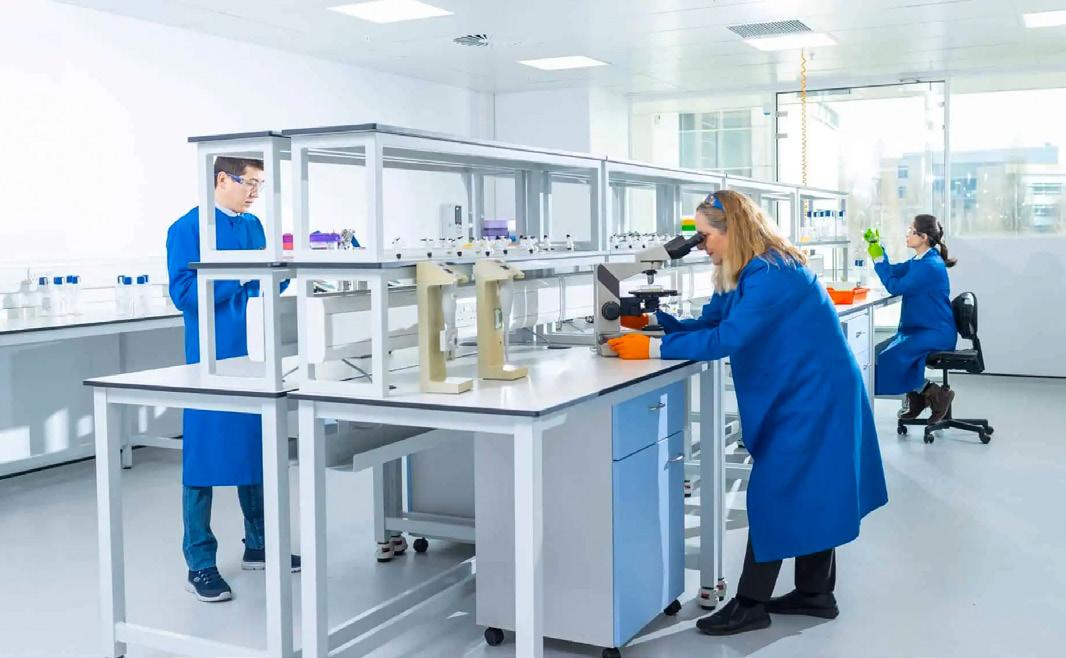
For 45 years, Klick Laboratories has delivered specialist laboratory refurbishment, fit-out and furniture installation projects for organisations across the scientific, research and innovation sectors.
Working with biotechnology, life sciences, engineering and manufacturing clients, Klick provides tailored solutions including refurbishment, laboratory furniture installations, HVAC integration, specialist gases, cleanrooms and controlled environments.
As organisations adapt to changing technologies, workflows and sustainability targets, refurbishment is increasingly becoming the preferred alternative
to new-build development. Upgrading existing facilities can improve operational efficiency, reduce project timescales, minimise disruption and lower embodied carbon compared with demolition and rebuild programmes.
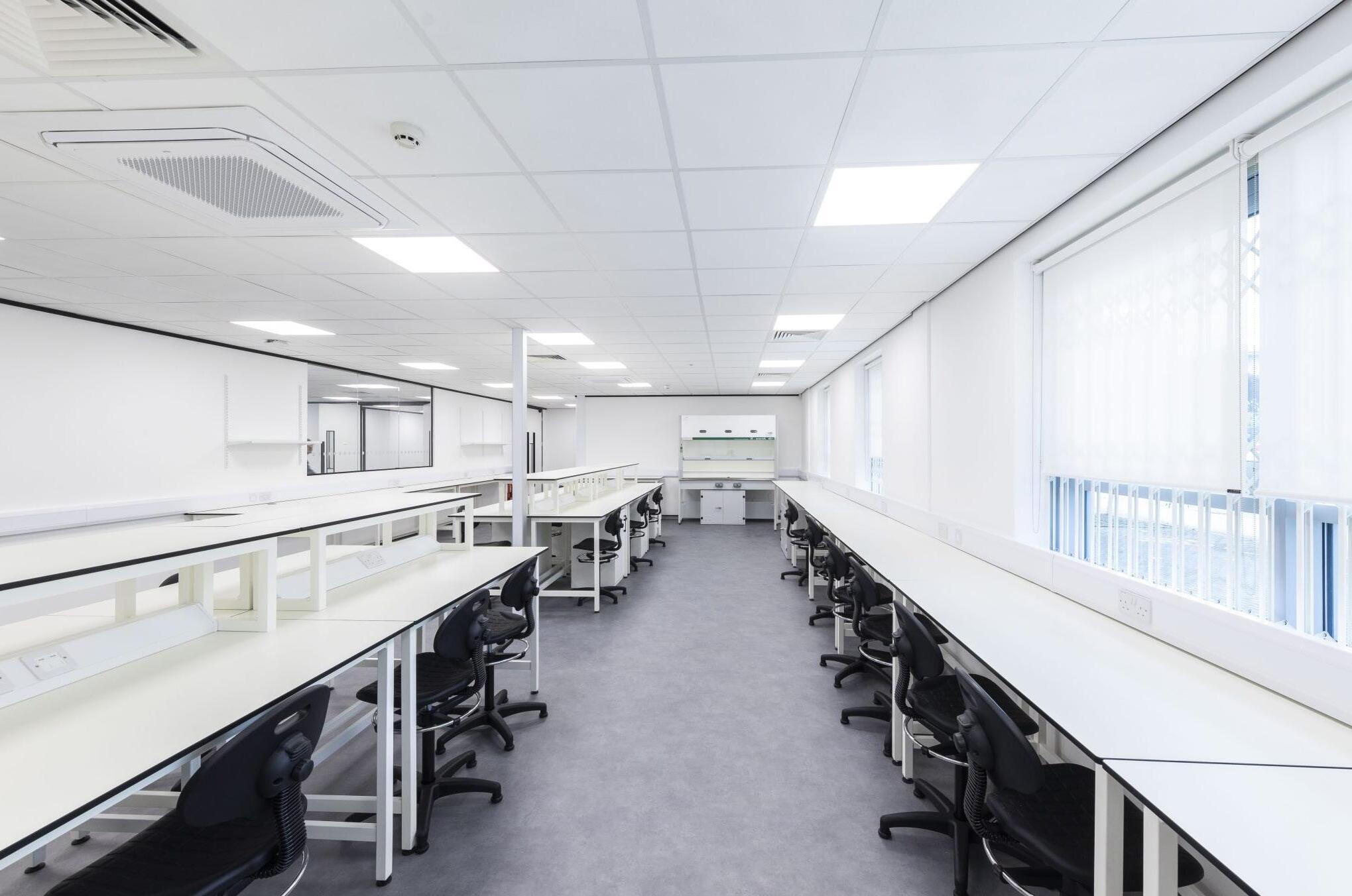
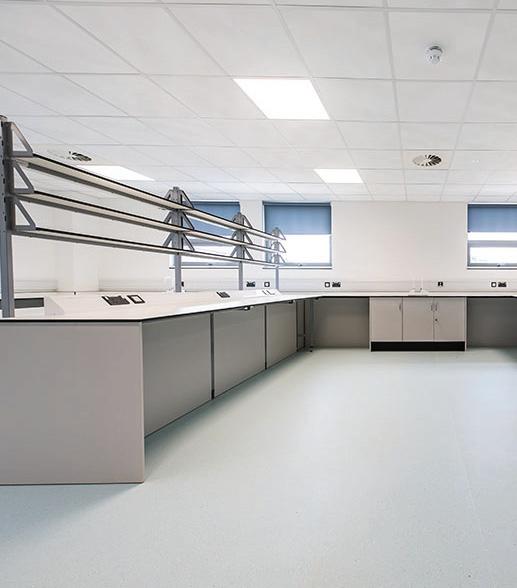
Klick’s expertise in transforming underutilised spaces into high-performance laboratory environments is demonstrated through projects such as AFC Energy PLC, where an empty 12,000 sq ft aircraft hangar was converted into a Hydrogen Fuel Cell Engineering Facility featuring specialist pressurised laboratories and future-proofed flexible layouts. The company has also worked extensively as a specialist laboratory furniture supplier at Discovery Park Kent and with Bruntwood on the redevelopment of the life sciences hub at Alderley Park.
Above A flexible incubator lab at Discovery Park Kent
Klick has 45 years’ experience in laboratory design and fit out – scan the code to see what we can do for you laboratorY design and fitout
What sets Klick Laboratories apart is their practical understanding of laboratory refurbishment and the technical interface between laboratory furniture and mechanical and electrical services. This experience enables the company to support contractors, architects and project teams throughout the design and installation process, delivering coordinated, future-ready laboratory environments designed to support innovation long term. n
tal K to our expert team
Email: sales@klicktechnology.co.uk
Visit: https://klicktechnology.co.uk/
Klick Laboratories will be exhibiting at Lab Innovations from 4-5 November at the NEC Birmingham showcasing its latest lab design solutions on stand K96
S Cien C e Par K S e C tor fa Cing bu S ine SS r Ate hi K e S
With fears growing over the impact of rising business rates in the science and technology sector, Simon Penfold talks to Jonathan Burton, business rates Principal at advisers Avison Young.
The arrival of the latest business rate bills at the end of April will have been distinctly unwelcome across the nation’s science parks and technology centres.
Government efforts to shield businesses on the ailing high street and the struggling hospitality sector has placed a growing burden on larger premises – including the UK’s laboratories and research & development facilities.
Way back in October last year the British Property Federation (BPF) was warning they could be facing an extra £50 million business rates bill from April.
The BPF’s analysis suggested that more than a hundred labs and R&D sites could be affected by the new higher tax rate. Alongside increases in rental values they estimated their total business rates liability would rise from £110 million to £165 million.
In the life science’s Golden Triangle of London, Oxford and Cambridge, where Rateable Values are higher, the increase was predicted to be particularly acute.
Business rates, a tax charged on most commercial properties, is calculated based on the Rateable Value of a property, which reflects the rental value at a set point in time on the open market as assessed by the Valuation Office Agency, part of HM Revenue & Customs.
Rachel Kelly, assistant policy director at the BPF, said in October:
“The government risks a major own goal by increasing business rates for labs and R&D facilities at a time when the UK is struggling to attract and retain investment from global pharma companies.
“A £50 million increase in business rates for our leading labs could present a significant challenge for some organisations, given high staff costs and the need to invest in research for a number of years before products come to market.”
Revaluation review
Jonathan Burton is a Business Rates Principal at Avison Young, a leading firm of global commercial real estate advisers that includes science parks and research labs among its clientele.
“In 2023 we moved to a
“ AN OCC upier HAS TO STA r T m AK i NG de C i S i ONS A l OT qui CK er; TH e COST O f i NACT i ON CAN B e qui T e expe NS ive ”
Below
Jonathan Burton, Business Rates Principal at Avison Young
collect more money; it is just there to redistribute where that money comes from. By and large it's revenue neutral.
“So, in very basic terms, we're valuing two years before the list comes into effect. So for April ’26 we’re actually valuing based on the market that existed in April ‘24.
“There are two components. There's Rateable Values, which are set by the Valuation Office Agency, now part of HMRC. A Rateable Value is, effectively what the taxman believes someone would pay to rent that unit at the valuation date, which is in this instance April 2024.
“The second component is what we call the Uniform Business Rate or the multiplier, and that is set by central government.
“Again, because they're only trying to collect the same amount of money uplifted by inflation, if the aggregate Rateable Value on every property in
“The problem is that, because the Government has to collect the same amount of money, it's a balancing act. And in Central London, for instance, a £500,000 Rateable Value is quite easy to get to.
“On some science parks and labs, et cetera, you're dealing with huge assessments.
“We have seen substantial rental growth between the last valuation date and this one. On top of that, you're seeing the change in the Uniform Business Rate as well. That singles you out if you're above £500,000.
“You're effectively getting that double whammy, as the rating list catches up with the market.
“There've been lots of warnings, but when the bill actually arrives, that's when people go ‘Wow, that is more than I was expecting’.
“If you look at that Golden Triangle - Oxford, Cambridge and London - we've seen massive rental growth.
“The reasons are twofold: there's a shortage of supply, which pushes up rental values, and then there's been huge investment as well.
the country goes shooting up, then what would normally happen at the revaluation is the multiplier would come down,
“But people in retail and hospitality started getting more protection during COVID, and that has continued. What we've seen at this revaluation - which has seen people, including occupiers in places like science parks, feel the hit - is the government for the first time has gone from two multipliers to five.
“They now protect retail, hospitality and leisure with a lower multiplier, or a lower rate in the pound.
“The problem with that is it's funded by those people with a larger property. And what the government call a large property is anything with a Rateable Value of over £500,000.
“That does include retail as well, so large retail is not being protected although the retail industry is continuing to push for that.
“Because it has been so successful, the tax then catches up with it. And that's a problem when you look at the Industrial Strategy for the country.
“The UK is competing globally. What you don’t want with the tax system is to then disincentivize people from investing in the UK.
“It’s unfortunate. The business rates and revaluation system is not doing anything wrong. It's doing what it's set up to do. But it makes it very expensive trying to bring in new tenants and it can make it prohibitively expensive if people try to expand.
“The multiplier or the Uniform Business Rate started life, I think, when I was still at school. In 1990 it started at 34.8p in the pound. So you would be paying roughly one third of your rent.
“That is now up to over 50p because it increases each year, with inflation.
“So the burden of business rates is substantially higher than it ever has been before.
“As a result, it is now a board level issue, and a massive investment issue.
Check, challenge, appeal
“Over the last 20 years, rating surveyors would traditionally be called to challenge values. And that's still what we do: check, challenge, appeal.
“But we give so much more advice now on strategy, on decisions on acquiring sites, because businesses recognise that it's not an afterthought. It's probably the second biggest occupational cost after rent.
“That makes it a costly mistake to forget about.
“As a result business rates are impacting on investment decisions – particularly where should we locate? That’s not a conversation in terms of should we be in Oxford or Cambridge; that’s like globally where should they be.
“And if the taxman is coming after people, is it the right time to open another site? And they will decide they can’t do anything at the moment because they’re not sure how much all of this is going to cost?”
In April this year industry organisation the CBI said a new survey of nearly 700 businesses across the UK had revealed “stark evidence” that the current business rates system was acting as a major brake on investment, productivity and economic growth.
Nearly a third of all respondents said that the business rates system had played a major role in cancelled, reduced, or delayed planned investment in their property.
For the second consecutive year, the UK has the highest property tax levels in the OECD, with property tax as a share of GDP four times higher than Germany, said the CBI. Louise Hellem, the CBI’s chief economist, said at the time: “Business rates are no longer just a cost of doing business –they’re a major tax on ambition and one that effectively penalises investment.”
A fundamental review of the system is needed, says Jonathan Burton. “You need someone to look at the actual policy of the business rates system.
“If, as the UK does, you want the life science sector to grow and you want to attract people, then you need to come up with a platform or a model that doesn’t penalise them for their success.
“The other thing in terms of the revaluation where people are probably feeling a bit more of the pain is that the last date we were valuing before this list was April 2021 - in the height of COVID. And by 2024 the market was performing a lot more strongly, so valuations are up quite long way.”
Don’t assume it’s right
In April HMRC revealed that the Rateable Value of business properties had risen to £84.6 billion from £70.9 billion in the 2023 rating list – which was valued in 2021. Total Rateable Value on the local lists for England and Wales increased by 19.4%.
In the absence of any major review, Jonathan and the team at Avison Young work closely with their clients. “In terms of mitigation, it is still a case of challenging and appeal valuations but a lot of our work now is in advice and planning.
assessment. And they probably want to take some form of professional advice. It can be as simple as whether the floor area is correct, or if the factual information The Valuation Office Agency or the HMRC are relying on is accurate.
“The other thing that is key, as we have more frequent revaluations, is to start planning for them, modelling your liability.
“In the past we have had five years, six or seven between revaluations Now we are in three-year revaluations and, trust me on this, three years goes past really quickly.
“Companies should make sure to speak to someone who can translate what their bill actually means”
“When the bill arrives, and it may sound silly to say, but don't just assume it's right. It is now a very complicated tax and there are so many different relief schemes. We’ve gone from two to five multipliers and there are many different changes.
“Companies should make sure to speak to someone who can translate what their bill actually means, so they can understand the
“So an occupier has to start making decisions a lot quicker; the cost of inaction can be quite expensive.”
Moving forward, Jonathan and the team at Avison Young have a wish list of changes they believe would prevent some of the more negative impacts of the current business rates system.
“The biggest ask is to rebase that uniform business rate and to decouple it from the rate of inflation. When first introduced in 1990 the UBR was 34.8p and we're now over 50p. Rating surveyors like myself fall into that trap of going 50p, but it's not 50p; it's 50%.
“There aren't any other tax rates out there that combine a 50% + rate and a slab structure on the full amount.
“We all understand the Government's got to try and find money from somewhere, but it's
the impact it has. To be fair, in April 2024 the Government introduced improvement relief, where you effectively get a one year rates holiday. So if you extend or improve a building, say by 50%, you'd still pay on the original floorspace but you get a year's holiday on the additional 50%.
“And that's a big difference between occupiers on science parks and their landlordslandlords don't qualify for improvement relief.
“So even if they construct a new building, that relief there is not for them, it's for the occupier improving the building.
“Landlords also get hit if the building is empty. The empty rate relief only lasts three months, then they're paying 100% rates. And that has been a headache for landlords.
“An occupier will pay a set amount for rent, rates and a service charge. But if the rates are inflated, that can suppress the rental value which in turn has an impact on the capital value of a business park. So you get the tax distorting the market, which isn’t right.
“And for however long premises are empty, while the landlords are trying to find a new tenant, they are still facing the bill. The Government are conscious of ways of not penalizing people with all these reliefs but we need something at a macro level that looks at whether or not the current system is fit for purpose.
“Unfortunately, the tax strategy is not really aligned to the sort of investment or industrial strategy of the government of the day. Some joined-up thinking would be helpful there.
“Our big ask - the one that moves the dial – would be a commitment to reducing the actual tax rate. What we call the multiplier or the uniform business rate is actually the rate of tax. And it is going up every year in line with inflation, so it’s never going to stop.” n
business rates advice
Running a business requires managing multiple costs, and business rates can be a significant part of your expenses. Find out how they can help at avisonyoung.co.uk/ user-occupier/business-rates
ch A nging the worl D F or the better
as a new affiliate member, WSP is excited to contribute its expertise and vision to the UKSPA community, championing the creation of innovative environments that empower scientists, entrepreneurs, and businesses to thrive.
As one of the world’s leading professional services firms, we deliver end-to-end services across strategic advisory, planning, design, engineering, delivery, and operations. Our purpose is to create scientific hubs and facilities that can change the world for the better.
gloBal expertise with local insights
With 83,000 professionals globally and 34 offices across the UK and Ireland, including across the Golden Triangle, we combine international expertise with local insight to provide integrated services tailored to our clients’ needs.
Our recent acquisition of Lexica, a specialist health and life sciences consultancy, enhances this capability, adding deep expertise in strategic advisory, estate
optimisation, project, programme and cost management, property advisory and net zero services.
adVancing progress with cross-sector, multidisciplinary capaBility
We understand that designing a research facility and transforming a scientific estate requires thorough knowledge of our clients’ businesses and the supporting infrastructure required to make ground-breaking discoveries and develop sophisticated new solutions. From high-containment laboratories and GMP facilities to large-scale estate transformation and critical infrastructure, our multidisciplinary teams ensure science campuses are futureready, resilient, and sustainable.
We bring a deep understanding of the science and innovation investment landscape, working with national and local governments to shape policy and strategy, as demonstrated by our advisory role in the Cambridgeshire and Peterborough Local Growth Plan.
Above WSP has supported the Ellison Institute of Technology Oxford and its mission to deliver scaled solutions
designing places where science thriVes
We are proud to be delivering some of the UK’s most complex research environments, including transformative development programmes for The Pirbright Institute and National Biosecurity Centre Programme for the Department for Environment, Food and Rural Affairs (Defra). Our experience also includes projects for UKSPA members at the Harwell Science and Innovation Campus, Wellcome Genome Campus and Edinburgh BioQuarter, alongside our work supporting the Ellison Institute of Technology Oxford and its ambitious mission to deliver scaled solutions to humanity's important problems.
partnering for progress
Through our UKSPA membership, we will contribute insight, support policy development and act as a strategic partner. We will bring multidisciplinary, future-ready expertise to help members attract investment, accelerate research and foster collaboration, while learning alongside sector peers to drive long-term industry success. n
l et’s start a conversation
Please visit www.wsp.com/en-gb/ sectors/pharmaceutical-and-lifesciences, or contact Richard James, Associate Director, Life Sciences Business Development via email richard.james2@wsp.com
s U ccessf UL P rogress for i 2S l ’ S u K ch AP ter
2SL has been a regular feature of Breakthrough in recent years, with updates on its Labs2Zero programme including the Lab Benchmarking Tool and, most recently, the AIM Report.
This time we shine a spotlight on the recently formed I2SL UK Chapter, established by members of the UK science and research community to focus specifically on sustainable facilities for science, research and technology across the UK.
In 2025, the I2SL UK Chapter successfully established itself as a credible and emerging forum for all stakeholders involved in the creation, management and operation of facilities for science and research in the UK.
Many of those involved in launching the Chapter are also active within United Kingdom Science Park Association, creating strong opportunities for collaboration to support owners, operators and occupiers of science and research spaces across the UK.
FIRST-y EAR AChIEVEMENTS
During its first year, the Chapter:
• Grew membership by 97%, increasing from 71 founding members in March 2025 to 140 member organisations by March 2026.
• Delivered an inaugural programme of technical and networking events, both in person and online.
• Established a Research & Technical Committee made up of professionals from across the sector to guide sustainable laboratory initiatives.
• Held an in-person Lab Benchmarking Tool (LBT)
Words Philip Macdonald Chair, I2SL UK Chapter
• Held its first General Meeting, formally elected its Steering Group Board and appointed four Company Directors and three Deputy Officers.
• Strengthened governance policies, articles of association and operational procedures with legal and financial support.
• Trained our first two UK based Labs2Zero Champions who can now help to promote the Labs2Zero programme and training opportunities here in the UK.
K E y EVENTS IN 2025
UK Chapter Inauguration and Launch – 30 April 2025
Hosted by Elliot Wood, this formal launch introduced members to the Chapter’s mission, governance and future direction. It also featured The Circle of Life…Science whitepaper, helping frame real-world sustainability challenges.
Introduction to the I2SL UK Chapter – 7 April 2025
workshop to train member organisations and promote better understanding of operational energy use in science buildings.
• Collaborated with a leading Russell Group University to assess the operational energy consumption of an ageing research university and identify reduction opportunities.
• Increased UK entries into the LabBenchmarking Tool LBT, reaching 25% of its initial target.
• Expanded visibility through events, newsletters and digital communications.
• Established consistent communication channels to keep members informed about events, publications and collaboration opportunities.
• Launched the Chapter’s LinkedIn presence, growing it to 366 followers in its first year.
Delivered as part of I2SL Education Week through International Institute for Sustainable Laboratories, this session introduced the Chapter’s purpose and its connection to the wider global organisation.
UK Sustainable Laboratories Panel Discussion – 9 April 2025 This virtual discussion explored UK sustainability challenges within an international context and enabled accessible knowledge sharing.
Benchmarking and Performance Event – 11 June 2025
Hosted by Cundall, this technical event connected UK members with global expertise on benchmarking and data-led sustainability strategies.
General Meeting and Summer
Social – 17 September 2025
Hosted at Victoria House, this event combined formal governance activity with networking opportunities.
London Life Sciences Week Event
– November 2025
Hosted by UCL Sainsbury Wellcome Centre, this event brought together researchers, sustainability professionals and industry specialists to share insights into laboratory energy performance.
COMMUNICATIONS AND DIGITAL GROWTh
During 2025, the Chapter introduced regular newsletters to provide structured updates on events, initiatives and opportunities to engage.
Communications also highlighted global I2SL initiatives such as Labs2Zero, the Lab Benchmarking Tool and the AIM Report.
The launch of the Chapter’s LinkedIn platform created a dedicated space for event promotion,
Above I2SL UK Chapter Board Members with Brad Cochran, Board Director, I2SL (back row, first from left)
Below I2SL UK Chapter’s first General Meeting and Summer Social was hosted at Victoria House last September
knowledge sharing and community building. Growing the network significantly in its first year helped position I2SL UK as an active and evolving professional network.
Collectively, these efforts ensured that membership offered practical value rather than passive affiliation.
Members have gained opportunities to connect with peers, learn from global and UK experts and contribute to a growing sustainability community.
SUMMARy
In its inaugural year, the I2SL UK Chapter established strong foundations through technical leadership, targeted events, consistent communications and growing visibility. Members gained access to credible expertise and meaningful opportunities to shape the future of sustainable laboratories in the UK.
The focus for 2026–27 is to build on this momentum by broadening reach, deepening engagement and aligning activities closely with member needs.
The Chapter aims to maintain an active membership where organisations work collectively to support decarbonisation and improve sustainable design and operational practices across UK laboratories.
The team is excited for its second year and looks forward to continuing to grow the I2SL UK community over the next 12 months. n
priorities for 2026 -27
Our focus will be on expanding impact and member value. Key priorities include:
publishiNg
Two technical documents that will form the first chapters of the I2SL UK Sustainable Laboratories Framework.
eXpaNdiNg
UK participation in the Lab Benchmarking Tool to 20 unique buildings.
buildiNg
Partnerships to create a UK sustainable laboratory case study database showcasing innovation in energy, water and waste reduction.
deliveriNg
Regional events beyond London to improve accessibility and national representation.
lauNchiNg
A structured marketing and communications calendar.
improviNg
Digital engagement through stronger email, social media and event performance.
supportiNg
The launch of a new Chapter website as a central hub for resources and engagement.
iNcreasiNg
End-user representation.
coNductiNg
get involved
To find out more or get involved, contact ukchapter@i2sl.org
A membership survey to better understand future priorities.
Major growth U nder Way at n orwich r e S e A rch PA r K
Dr Nick Goodwin, Chief Operating Officer of Anglia Innovation Partnership the management company for Norwich Research Park (right) discusses the site’s future with Simon Penfold.
Norwich Research
Park is one of the largest single site concentrations of research in agri-food, health, nutrition and the environment in Europe. More than 30,000 people work on the campus, including 3,000 early-career researchers, who are using research into living systems to help solve some of the world’s global challenges in fields such as engineering biology, plant biology, bioinformatics, microbiology and genomics.
“Companies that are being successful here are addressing urgent global challenges,” said Nick. “They are responding to impacts of climate change and the need to secure a food supply that's nutritional and healthy. Without overstating it too much, it really involves the future of humanity.
“Equally, a healthy lifespan is critical. The needs of young and old alike connect very strongly with the environment, food and their personal health.
“It's fundamental to us as individuals, to our economy, to our leadership in the world and our response to global challenges.
“The challenge has been to gain the proper recognition for the quality and quantity of science that's undertaken here.
A lot is said about Oxford and Cambridge, Manchester and London, quite rightly. But the extent of the science that's undertaken here is unique and really important.
“To achieve what we need to achieve for both the UK economy
and the global economy, we need to ensure we have a high profile so that we get the right companies coming and developing and co-developing alongside that world-leading research.
“If we can do that successfully and commercially, then the world will be furnished with the right solutions to address these global challenges.”
The park is the only research campus in the UK with three BBSRC strategically supported research institutes (Earlham Institute, John Innes Centre and Quadram Institute) along with The Sainsbury Laboratory, The University of East Anglia, Norfolk and Norwich University Hospital and a growing community of businesses and entrepreneurs.
While the city of Norwich, is well known for its blend of medieval heritage with a vibrant modern culture and, strong commercial centre, it was recently voted the UK’s premier place to live, according to the 2026 Sunday Times guide.
As the host of this year’s UKPSA summer conference, Norwich Research Park, will use the opportunity to introduce its strategic real estate investment partner, Vengrove, to unveil the masterplan vision for development and growth to commence over the next 10 years. The programme will deliver a series of new buildings to accommodate growing businesses on campus and attract new and established companies from across the UK and overseas. Vengrove plans to invest more than £200 million over the next decade to achieve this mission.
A new site masterplan
Work is already under way on the 63,000 sq ft Hawkmoth Building. Ground was broken in February on the project, which will provide laboratory and office accommodation for growing companies in the agri-food, health and environment sectors.
Nick said: “The Hawkmoth Building is one of a sequence of buildings set within a new masterplan for the whole site. We've got planning permission approved for two buildings, the Hawkmoth Building and another - with ideas for mid-tech units that will effectively provide a portfolio of different types of space accommodation tailored to different company needs.
“The campus management company has a strong grasp of existing and future demand, and the needs of start-ups and industry. Being able to work closely
“Successful companies here are addressing urgent global challenges that really involves the future of humanity”
with the research and business community means that you get to see new technologies coming down the line. And that requires a wide range of different types of spaces and scales, from incubation space to grow-on space, to plant growing facilities, process laboratories through to pilot manufacturing.”
“Our aim is to be able to provide all of those whilst leaving room for prospective occupiers that may want their own single-use building rather than a multi-let. We will be offering start-up and incubator space and then space for the larger companies that need it.“
Above Ground is broken for the new Hawkmoth Building by Roz Bird, CEO of Anglia Innovation Partnership, and South Norfolk MP Ben Goldsborough
Norwich Research Park is seeing the phased development of a pioneering plant and microbial research hub supported by £317m of funding from the UKRI, to be completed by 2030. This venture, backed by UKRI’s Infrastructure Fund, will revolutionise the existing capacity and capability of the John Innes Centre and The Sainsbury Laboratory, with the aim of ensuring the long-term success of UK bioscience.
The campus is also benefiting from BBSRC’s strategic investments in the Earlham Institute, John Innes Centre and Quadram Institute.
Totalling £163.9 million through to 2028, this funding aims to bolster the UK’s national research capabilities in key areas such as crop resilience, food safety and security, sustainable agriculture, nutrition and health.
This is not mere growth for its own sake. As Nick argues, expansion at Norwich Research Park is creating space for both vital research and the commercialisation that allows it to be put to practical use.
Below The forthcoming 63,000 sq ft Hawkmoth Building for growing companies in agri-food, health and environment
“To achieve what we need to achieve for both the UK economy and the global economy, we need to ensure we have a high profile so that we get the right companies coming and developing and co-developing alongside that world-leading research.
“If we can do that successfully and commercially, then the world will be furnished with the right solutions to address these global challenges.
“In my time at Norwich Research Park, now over 30 years, the university's doubled in size and the hospital has moved from its city centre location to be on the park. The conditions for commercial growth are in place and Vengrove has shown great commitment to work with all of the partners on the park.
“They see the opportunity that the park has to scale and grow.
“That evolution is what has led to large-scale government investment, which is a very strong statement of confidence in a unique and important capability at a time of austerity. That speaks to the importance of the work that's going on here, whether that's within the academic community or the business community.”
Gene genies
At the same time, Nick has seen public support for investment in the life sciences sector grow.
“The public perception of what scientists do shifted positively after COVID, when people saw how the science community was able to respond and deliver.
“If you think about the future that people want for their children, they want to see them live a long, healthy life, and they want their children to have a good education and prospects. And that means high quality employment in jobs that matter.
“It's really important that we deliver on that for our region but also that we ensure that growth has a wider economic benefit for the UK.”
One of the major areas of focus of the science on the campus is the fundamentals of how plants can be adapted to resist plant diseases, which comes back to securing the food chain. Alongside the importance of human nutrition, there is also growing understanding of the human microbiome.
“Microbiology is a very strong theme across the park with over 100 microbiology groups. Microbial science is probably the most significant, unmet, misunderstood opportunity of the generation. They’re everywhere – in the soil, in us, on us. Some are harmful, some are beneficial, many have unknown potential.
“Work on genetic biology goes alongside that – genetic techniques are underpinning everything we do.
“Our response to climate change is to help breed new varieties of crops that can respond to higher temperatures, wetter winters, cold shocks in the summer. Traditional breeding can't cope with the time frames, so we need genetic techniques to be able to adapt as quickly as the climate is changing.
A key part of this work is gene editing. Many of the innovations around gene editing have arisen from research undertaken at Norwich, with the John Innes Centre, the Earlham Institute, The Sainsbury Laboratory, the Quadram Institute and the University of East Anglia all working on or with gene editing.
“Gene editing is a revolutionary tool that scientists are using to explore their world,”
ranging from climate science and environment through to agri-food, nutrition and health.
“It also includes satellite technology, looking at the landscape and land use, right the way through to farming, controlled environments, clinical trials, laboratories, healthcare, and diagnostics.”
said Nick. “At the same time companies are using it to deliver new products and tools alongside artificial intelligence to accelerate the impact of this research.
“That is part of what makes the park quite unique - the proximity of all of those different organisations and disciplines and facilities in one location,
rewards of being at Norwich Research Park watch the film
Reflecting on the thriving ecosystem of the campus, Nick concluded what makes Norwich Research Park unique is the shared vision and opportunity to work on interdisciplinary challenges across different institutions right alongside our business network.
“It’s always been something that visitors to the park remark on how well we do that together compared to other locations in the UK and across the world.
“The companies that want to move here value that opportunity to work across different organisations and disciplines, whether that's with the John Innes Centre on plant technologies or with the Earlham Institute on genomics or with clinical trials and microbiome at the Quadram Institute.
“There are companies that could use all of those capabilities at different stages, which makes it very compelling for them in terms of developing partnerships and recruiting skilled staff. That is why I am confident that we can deliver a great future in a great location.” n
together W e are
Together we are taking science to the next level. Together we are Norwich Research Park. Discover more at norwichresearchpark.com
r efurbish M ent n ew b uild
t he Changing Sha P e of l aboratory d evelo P ment
Words Clare Whitehurst Klick Laboratories
The laboratory refurbishment market has evolved significantly in recent years as organisations across the life sciences, engineering, diagnostics and research sectors reassess how laboratory environments are delivered, upgraded and future-proofed.
While new-build laboratories continue to offer advantages such as complete design flexibility, scalability and fully integrated infrastructure, refurbishment is increasingly being viewed as a practical and commercially viable alternative. Rising construction costs, sustainability targets, tighter delivery programmes and the need to maximise existing assets are all driving demand for refurbishment projects across science parks, research campuses and technical facilities.
For many organisations, one of the earliest challenges is defining exactly what the laboratory needs to achieve. Clients are often required to communicate complex workflows, equipment requirements, environmental conditions and future operational plans before design work can begin. Evolving equipment schedules can significantly affect power, extraction and HVAC requirements, while existing buildings may have restrictions on electrical capacity, ceiling heights or service routes.
or new build represents the best long-term solution. In many cases, refurbishment offers substantial cost and programme advantages. Projects involving former warehouses, industrial units, office space and even temporary modular buildings have demonstrated that highly dated or underutilised structures can successfully be transformed into modern, high-performance laboratory environments at significantly lower cost than new-build alternatives.
In our experience even the most dilapidated, unimpressive buildings can be transformed. We’ve recently been asked to completely re-purpose a block of dated portable cabins into a state-of-the-art facility. The client carried out a feasibility study and for a new build the cost would have been at least double. With the added benefit of shorter timescales, they considered it to be a ‘no brainer’ and opted for refurbishment.
“ f or many, one of the earliest challenges is defining exactly what the laboratory needs to achieve”
Across the sector, increasing health and safety requirements, evolving fire regulations and environmental standards are prompting many organisations to review and upgrade their laboratory infrastructure. At the same time, growing demand for scientific testing — driven by advances in molecular diagnostics, automation, digital imaging and emerging technologies — is leading many businesses to expand and diversify their technical capabilities.
As a result, feasibility studies are increasingly important in assessing whether refurbishment
However, refurbishment projects can present complex technical challenges. Existing structures may conceal hidden constraints such as limited infrastructure capacity, structural limitations or hazardous legacy materials. One recent example involved the conversion of a large warehouse into a technical facility with specialist gas systems and sealed pressurised laboratories. The building had an asbestos roof which could not be penetrated or disturbed, demanding careful technical coordination and innovative service integration solutions.
Laboratory environments are also becoming increasingly sophisticated, with greater emphasis on security systems, access control, energy-efficient infrastructure and flexible layouts capable of adapting to changing workflows and processes.
As laboratory operations continue to evolve, refurbishment is increasingly proving to be an attractive option for organisations seeking faster delivery, improved value and reduced capital costs while still achieving modern, future-ready laboratory environments. n
With 45 years of specialist experience, Klick delivers cutting-edge lab fitouts tailored to research campuses, science parks, biotech, engineering and food & drink sectors, from start-ups through to multi-national businesses. Find out more at www.klicktechnology.co.uk
Above Klick’s lab installation for molecular diagnostic testing at Biofortuna Ltd
How technology is redefining the future of the science building
or over four decades, Oberlanders Architects have operated at the forefront of design for the science and technology sector, adapting to constant shifts including the rise of sustainable design and the accelerating pace of technological innovation. Our approach has always been agile and responsive, but that has never been more critical than it is today.
While scientific convergence and interdisciplinarity concepts have long existed, the rapid adoption of automated systems, deep technologies, robotics, synthetic modelling and simulation is driving an exponential increase in data generation and accelerating the erosion of traditional scientific discipline boundaries. This is coupled with intense competition for talent and rapid upskilling to meet accelerated discovery.
This acceleration raises a critical question for the design of science and research buildings, 'how do we design scientific spaces when their use is uncertain even six months ahead, let alone six years?'
The UK has long been one of the world’s leading science ecosystems, underpinned by world class academic research institutes and programmes. COVID-19 was a catalyst for development, demonstrating the importance of research capabilities, with significant capital and private equity across biotech and deep tech having driven investment centred on innovation
infrastructure. Developers, investors and local authorities have become highly effective at delivering flexible laboratory space that meets early demand and anticipates growth. It is equally important to consider how pharmaceutical, biotech and advanced manufacturing organisations are pursuing innovation. Automation, the integration of synthetic and digital practices and computationally led R&D are reshaping operating models and redefining building requirements. This shift is gaining increasing attention. As the intersection of biology, chemistry, automation, AI and robotics transforms research at scale, the impact will be felt across the entire ecosystem, to which the sector must swiftly respond.
Impact of automation on spatial design
Traditional science buildings are often planned around lengthy investment cycles, but with technology changing at a faster pace, organisations are having to ask new questions:
• How much laboratory space will we need in ten years?
• What proportion of space will be occupied by manual workflows vs automated processes?
• How do we future-proof facilities for the rapid increase of the technology-led systems that may occupy them?
Architecture as an enabler
From an architect’s perspective, this represents both a challenge and an opportunity. How do we design buildings that can support future scientific provision, which are sector, discipline or technology agnostic?
The increasing convergence of the sciences alongside rapid advances in technology and innovation creates a clear path for a discipline-agnostic approach to design, but the real value lies in the design of true adaptability, rather than solely flexibility.
While flexibility means installing infrastructure that can be moved or reconfigured to support a defined use or outcome, adaptability offers the capacity to respond to changing conditions over time, allowing buildings to absorb and accommodate change without over-specifying today for technologies that may be obsolete tomorrow.
This approach prioritises latent capacity over fixed solutions. For example, oversized risers to enable future mechanical, electrical and plumbing additions, rather than a full fit-out at the outset. The building remains resilient and relevant, able to support current and future uses without constraining
Top to bottom Designing for a new era; An early example of flexible shell & core; Mission Street’s ‘Fabrica’ is a compelling example of shell & core; Modern lab space
or technology platform. This has been our driver from the outset and has resulted in an innovative and adaptable building that can evolve along with the ever-developing needs of the sector”, Jeannine BakerWilson, Director.
The flexible shell and core concept has long underpinned Oberlanders design for science, technology and industrial facilities, from science parks in the 1980s to contemporary schemes like Fabrica. But how does today’s interpretation differ from those early models?
innovation or restricting use, be it science and technology, logistics, light industrial or advanced manufacturing. Crucially, adaptability must be delivered at a cost point that remains commercially viable for both developers and end users.
Architects with cross-sector experience bring particular value in this context. By understanding the diverse technical, operational and spatial demands of different environments, designers can anticipate a wider range of scenarios and make decisions to create long-term resilience.
Redefining ‘shell and core’ for a new era
A compelling example is Mission Street’s ‘Fabrica’, the largest commercial science scheme to gain consent in central Oxford, currently in construction and due for completion in early 2027. The building was designed with tenant space which is fully speculative, a design approach which acknowledges a fundamental reality of innovation-led development, that developers cannot always predict who the occupier will be in five or ten years’ time.
“Our brief for Fabrica set out to realise value from day one, but also remain relevant long into the future, without locking the building into assumptions about a single occupier
New base buildings are now conceived with advanced sustainability strategies embedded from the outset, including on-site renewable energy generation, green & blue roofs and intelligent building management systems. As digital tools and automation become more prevalent, the way buildings are occupied and operated continues to evolve, with some areas supporting different patterns of use while others accommodate more specialised, equipment-led environments. In response, mechanical, electrical, plumbing and data infrastructure are increasingly designed to adapt. Heavier floor loadings can accommodate future technologies, placing greater demands on structural designs. This could drive buildings toward more robust structural solutions, often with higher material use, which in turn may require a more considered and methodical approach to mitigating environmental impacts.
Designing for what we don’t know yet
For architects, developers and occupiers alike, adaptability is no longer a nice-to-have but an essential. The challenge is to embed that adaptability in a way that is commercially viable, environmentally responsible and genuinely future-ready.
Real innovation may lie not just in the science itself, but in the buildings that enable it. n
aWard -W inning architecture
Oberlanders is a multi-award winning architectural practice with studios throughout the UK, creating sustainable, healthy, buildings and places. See why at oberlanders.co.uk
o ne o F the mo S t im P ortA nt
thing S IS m AKIng S u RE B uILDIng S ARE
B
oth fIt fo R no W A n D fo R thE futu RE”
Matt Lee from Carter Jonas talks to Simon Penfold about new builds, refurbs and development in the science and technology sector.
At a time when cost pressures are a major factor in decisions on development projects in the science and technology sector, much attention is focused on the choice of either new build or refurbishment of existing premises.
But as Matt Lee, head of science and technology at the property consultancy Carter Jonas, points out, this is no simple binary choice.
For Matt and his team, these are complex decisions involving a broad range of factors – not least the kind of science that a building will be used for.
“We tend to get involved in the discussion at a fairly early stage, particularly when working on the consultancy end of the process,” said Matt.
“I think the most important distinction we see is different science and technology sectors have different requirements and they're all constantly evolving.
“One of the most important things is making sure that buildings are not only fit for now, but also for the future.
“There’s a lot of different schemes; some have been retrofit, some have been new builds, there are different types of property like mid-tech or bigger box units for companies looking to scale up. It’s that full life cycle.
“But there's a place for each of them based on the type of companies that are looking to take space.
“Even if you took one sector, like life sciences for example, the different requirements for a medtech company or a biotech company, a wearables devices operation or a pharma company, they're so different in terms of the work that they're doing.
“And then there’s the difference between the type of space that companies want now and what they might want in the future.
“Retrofit will always be an option but there are certain limitations on specification. If you want to pursue chemistry, for example, then you either need a building that's had historic chemistry use and is able to provide the services or you need a building with the built-in capacity that can service that.
“For some uses, whether it's genomics, engineering, small scale prototyping, there are companies who need a slightly less highly specified space.
“But I think what we've seen in recent years is some significant developments coming forward by developers from across Europe and the US who have really challenged the specification of science and technology buildings, and that includes developers in the UK as well.
“There's been a real hard look at the different stages and types of companies and what type of space they might need.
“For example, we're instructed by Breakthrough to work on Trinity in Oxford and Vitrum in Cambridge, two of the highest specification buildings in Europe, designed utilising Breakthrough Properties’ knowledge of science and technology in the US and bringing an approach that highlights best-in-class location and spec.
“That obviously enables the market to grow in terms of those high specification requirements.
“Another example is Kadans Science Partner, who we’re working with at Plus Ultra in Manchester, bringing their pan-European connectivity and design to the city’s innovation district.
“I also think there's room for the retrofit products which allow scaling companies to come in and take a space if they don't need something that's quite as high spec.
“When they are using a recirculating fume hood or biosafety cabinet then the retrofit options work quite well when it’s a matter of needing external ducting or high floor loadings - it varies depending on the requirements.
“I worked at Bruntwood for more than 13 years and we were retrofitting all sorts of buildings (alongside new purpose bult developments), including some built back in the 1980s. It's amazing what you can do with those buildings and the types of companies you can have in them. But those really high spec newbuild buildings provide more of an international appeal for growing companies who are looking to go on to the next level or have much more technical work going on.”
Embracing change
Matt’s broad experience ranges from Bruntwood – where he worked latterly as head of commercial in Manchester for Bruntwood Scitech – to a spell in the Research and Innovation team at Manchester University NHS Foundation before becoming a partner at Carter Jonas in 2022.
Above
Carter Jonas acts as commercial property agent for Trinity House at Oxford Business Park
The firm, founded in Cambridge in 1855, has developed a focus on science and technology over the last quarter century, working with science and technology companies, science and innovation parks, developers and investors.
“I think the great thing about science and technology is that it's constantly disrupting itself and finding new ways of doing things,” said Matt.
“Part of working in science and technology is truly embracing that change and looking at what opportunities that brings, but also from the property side, what does that mean in terms of future development? How can buildings make themselves capable to deliver that change going forwards.”
occupied than it is to design potential opportunities to enhance it at the outset.
“That's where the buildings coming forward have got future proofing in mind. When you're retrofitting your building for requirements now, it is also necessary to have an idea about what the future capability and capacity of that building might be.
“When you're working on a new building, I think you're very much looking at how you think, during the life cycle of that building, things might evolve and trying to build capability within that to meet it.
“And the longer those assets last, the better.
“For instance we work on Hexagon Tower in Manchester and the Wilton Centre on Teesside, both of which were former ICI buildings dating from the 1970s. The structures and the capabilities designed into those buildings at the time would be difficult to replicate now on those sites due to cost.
“As a result, they can provide an opportunity for companies today whose requirements align with what the buildings were designed to deliver.
“ o n a new building, you’re looking at how things might evolve during its life cycle and try to build capability within that to meet it”
In construction and development terms, this means ensuring a building is ‘future-proof’.
“There are various things that you can build into it. One of the big things is sustainability. We are seeing more and more emphasis on that, and it will only continue to grow. But that also involves building capacity within a building to adapt to different requirements.
“And those can be requirements now or they could be requirements in the future. Obviously, it's more difficult to enhance capacity once a building's
“Companies may be signing 15 or 20-year leases so you have to be able to deliver on what they perceive to be their requirements over that time.
But the beauty of science and technology is that you can't really be certain because it is going to evolve so much in that time.
“You just have to build good, capable buildings that have got enhancement capabilities and capacity, so that if the requirements become lesser or greater, you're able to cope with that demand.
“That's something we work with a lot of developers on: what are the specifications now, what sectors, what parts of sectors are growing, and what does that mean in terms of the type of space that they would need?
“You need a blend of types of space because entry point companies have different requirements to much bigger, more established companies in terms of not just the physical build, but the wraparound support as well.
“The life cycle of a company is what you're looking at. But during that life cycle the overall trajectory for science and technology should, by its very nature, be disruptive and unpredictable. Otherwise, there wouldn't be innovation.
“But we can predict as far as we can see and look to build in that capacity.”
Moving in cycles
This work is taking place against a background of growth across major sectors of the UK’s science and technology sector.
“We've got a strong life science sector in the UK, and that will continue. With an inclusive health system like the NHS, the opportunity to collaborate with it and access data, not to mention, some of the best universities for research in the world. Together, that will continue to create demand.
“The market moves in cycles. A few years ago, few would have expected the current level of focus on defence. We are seeing companies scale up and there’s a lot of benefit to companies in and around the supply chain as welladvanced materials, energy, space technology, all the digital security services like cyber, quantum. So many different things are impacted by one sector's growth, along with all the engineering.
“Lean technology – energy efficiency, sustainability - is another sector that continues to grow.
Top to bottom Carter Jonas acts as a leasing agent for a portfolio of clients that includes Plus Ultra Manchester, HEMISPHERE in Liverpool and Teeside’s Wilton Centre
“Then there is Agritech and the real emphasis on creating more resilient and higher yielding crops, utilising robotics and automation. The food sector is also a big one, around things like nutraceuticals, alternative proteins and food sustainability.
“There's a lot of different sectors that are all growing with advanced manufacturing and material technology as well.
Digital and AI, sit across all of the science and tech sectors again demonstrating that interrelation . For me that’s what makes it really exciting.”
Matt continued: “We’re a national property consultancy with about 1,000 people across the country and offices in London,
Oxford, Cambridge, Bristol, Birmingham, Manchester, Leeds and now Edinburgh with a strong focus on the regions.
“We work to differentiate between the different parts of the UK, the key hubs, so if a company comes forward in a specific sector, where are the best options for them? How is each region pitching itself, what are its specialisms and what would attract a company there on its own merits.
“We do a lot of work on the consultancy side with science parks, councils, developers, the NHS and other organisations, to really help them understand the opportunities around their specific locality. These are sectors with a unique proposition, so when you’re building around that proposition we look at the types of property that companies are likely to need.
“Ultimately, companies cluster around opportunity, whether that's opportunity to co-locate, to undertake research, to access funding, to access talent; there's a reason why they choose a certain location.
“Our role is helping examine why companies in certain sectors might look at locating within a specific region and then looking at the types of space that those companies might need. And that's something which we've done up and down the country.” n
discover more online
Carter Jonas is one of the leading property consultancies in the science and technology sector. Find out why at carterjonas.co.uk/ sectors/science-and-technology
9 Years Strong!
Offering 24/7 access into modern, energy efficient and multi-occupancy buildings for start up and established SMEs, it’s always a welcoming and friendly environment at Porton Science Park (PSP) to support your lab and/or office rental.
An effortless move in and with a range of ready for use, state-of-the-art CL2/3 wet labs and impressive offices for rent as well as shell space for growth and bespoke fit out, PSP continues to capably support SMEs in the Health and Life Sciences and Defence Technology sectors to achieve their business objectives at a prime and beautiful countryside location at the nationally and world-renowned, Porton Down Science Campus near Salisbury in south Wiltshire, England.
Key features:
• secure access into lab and office zones
• end user air handling control to manage ambient environment
• shelving, benching and ample under bench storage
• convenient write up areas
• adjustable lighting
• future proof partitioning for reconfiguration
• managed waste streams
• regulated gas stores for cylinder pipeline connection into labs
• allocated parking bays
• EV charging points, renewable energy and backup power
• clean communal kitchens and breakout areas
• stunning meeting venues for board meetings, seminars, workshops and networking events
• hazardous/clinical waste collection with on-site disposal and incineration services
• and much more…
The Life Sciences sector in the South West of England is recognised nationally and internationally for excellence in research and innovation and is fast establishing the region as a High Potential Opportunity (HPO) for increased inward investment, collaboration and growth and PSP is proud to be part of this evolution as well as its membership of UKSPA, South West Life Sciences and Tech South West.