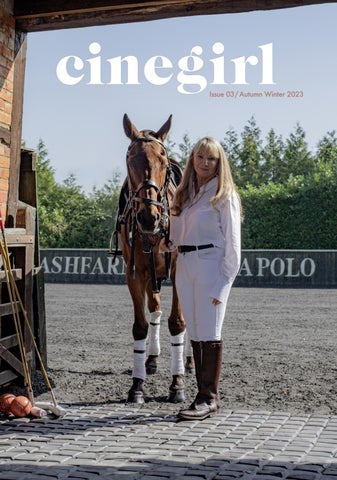
Issue 03 / Autumn Winter 2023
Female focused, not exclusive Cinegirl Issue 03 Autumn Winter 2023 info@cinegirl.net www.cinegirl.net @cinegirlmag
FOUNDER & EDITOR-IN-CHIEF Francesca R Zerenghi ART DIRECTION & GRAPHIC DESIGN Mark Lamsdale COPY CHIEF Sienna Beckman CONTRIBUTING PHOTOGRAPHER Hannah Drew CONTRIBUTING WRITERS Ashleigh Ashely Léa Aubigne Emma Carys Lauren Devine Denise Di Castro Mila Fielker Oriana Gregorj Anna Halász Louise Howland Briony Puddepha Sarah Scott Tom Watts Francesca Zerenghi PUBLISHERS Stuart Walters Sam Skiller Cinegirl is published bi-annually. Cinegirl is printed in the UK and distributed world-wide. All rights reserved. Reproduction without permission is prohibited. We make every effort to ensure the accuracy of all of our articles, but we cannot accept liability for loss or damage arising from the information supplied. The opinions expressed do not necessarily represent the views of the publisher. For subscriptions, feedback and address changes please contact us at info@cinegirl.net.
02
LETTER FROM THE EDITOR-IN-CHIEF
Dear Reader, As the year draws to a close, it brings me immense joy to present our Autumn Winter issue 2023, a testament to the passion and dedication of our contributors. In this edition, immerse yourself in the cinematic universe with insights into Taylor Swift’s The Eras Tour Movie, a review on Greta Gerwig’s Barbie, and the captivating journey of director Charlotte Regan in Scrapper. Our spotlight article features the formidable Abbi Collins, sharing her reflections on retirement, resilience, and the profound impact she’s made in the world of stunts. Delve into conversation with Oona Menges about her recent film Lola, and explore the challenges of intimacy on set with Haley Muraleedharan. Join us on a riveting journey through Cinegirl’s experience at Cannes 2023, capturing the essence of this cinematic rendezvous. And take a moment to immerse yourself in the wonderful illustrations by @titoune. Happy reading and joyous holidays! Best wishes, Fran Francesca R Zerenghi Editor-in-Chief
03
TABLE OF CONTENTS
06 THEY GATHER – INCLUSION BEYOND TOKENISM 08 CINEGIRL’S CANNES 2023: A RIVIERA RENDEZVOUS 09 GRETA GERWIG’S BARBIE UNBOXED (SPOILERS) BRITISH INDIE FILM CLUB 10 BIFA’S – AN INTERVIEW WITH CO-HOST KARIS ALDRIDGE NELSON ON THE HOLLYWOOD STRIKES 12 ARLENE AND WORKING WITH AGNÈS VARDA REFLECTION, AND RESILIENCE: 14 RETIREMENT, THE INSPIRING JOURNEY OF STUNT COORDINATOR ABBI COLLINS
19 THE LIFE LESSONS OF AGNÈS VARDA YORK CITY UNDER THE LENS OF A BROOKLYN LOCKSMITH: 20 NEW – A CONVERSATION WITH IAN MOUBAYED, FILMMAKER OF KEYS TO THE CITY
22 AN INTERVIEW WITH: HAIR STYLIST CAMILLE FRIEND THE WRITER’S LAB – A PROGRAMME THAT ESCALATES THE 24 MEET SCRIPTWRITING CAREER OF TALENTED WOMEN OVER 40
27 TAYLOR SWIFT’S THE ERAS TOUR MOVIE TAKES CENTRE STAGE 28 WOMEN BEHIND THE CAMERA’S REMOTE HEAD WORKSHOP 30 I TOOK MY ADVICE SO YOU DON’T HAVE TO 35 ANXIETY CONVERSATION WITH CINEMATOGRAPHER OONA MENGES 36 AABOUT HER RECENT FILM, LOLA (2022) THE SCENES: SPOTLIGHT ON KRISTY MATHESON 38 BEHIND DIRECTOR OF BFI LONDON FILM FESTIVAL + RECAP
40 BFI LONDON FILM FESTIVAL 2023 – HIGHLIGHTS 42 THE NITTY-GRITTY OF FILM LOADING CHALLENGES OF INTIMACY ON SET – EXPLORING THE ROLE OF 44 THE INTIMACY COORDINATOR WITH HALEY MURALEEDHARAN
46 CHARLOTTE REGAN’S SCRAPPER 47 ‘THE WOMAN, THE MYTH, THE LEGEND’ – EMILY REVIEW 48 REBECA HUNTT ON BEBA, HER HYPNOTIC DOCUMENTARY 04
A unique destination for creative people to come together.
C R E AT I V E S PA C E 81 Charlotte Street, London, is an exciting collaboration between CVP & ARRI, designed as a destination that celebrates all aspects of our community, from early access to the latest production solutions - including the ALEXA 35, Mini LF, TRINITY 2 - to learning, socialising and networking.
“To us diversity refers to those outside dominant culture where white cisgender and usually male is the learned default for representation (and reality).” – Virgilia Facey (Business Director)
THEY GATHER
Inclusion Beyond Tokenism Virgilia Facey (VF), Business Director: At They Gather we are
by Ashleigh Ashley When I was first tasked with doing a profile piece on They Gather, I dusted off my diversity and inclusion thesaurus and prepared to describe all the tropes that come from companies that claim to be inclusive. I was prepared to talk about forms, policies and resources that are often used to cure unconscious bias. I was expecting They Gather to follow the rules - a company that declares “Inclusion beyond Tokenism” must have written the rule book! But what I found is a company run by two conscious women Virgilia Facey and Victoria Hutchings who recognise that the rule book is only skin deep, and to really make a difference you must build a business that’s able to operate flexibly and responsively with each client, each brief and each team.
06
focused on inclusion beyond tokenism, which requires society to be fully represented, with women, people of colour, the LGBTQIA+ community and those living with disability all being a part of the picture. Tokenism is box ticking and creating external optics. We build inclusion by measuring the impact of our actions. Ashleigh Ashley (AA): As they started with this ethos in mind,
They Gather have built a diverse network of talent who support this mission from the ground up. As opposed to scrambling around looking for diverse talent every time the need arises, they are already equipped to approach productions with a colourful mix. It’s sometimes challenging to build crews in this way. There are a lot of stigmas about hiring on minority status as opposed to merit - something that grates on me to no end. But Gather pride themselves on producing quality work with quality talent, proving that it is not an either-or scenario. Both factors can be upheld at the same time.
Victoria Hutchings (VH), Head of Production: If our brief
VF: We recently worked with a HOD who told us on the shoot
is purpose led, we always seek talent from within the community of which it speaks.... We often see how positively talent and cast respond to creating work with crews that reflect their world. And that doesn’t mean a crew entirely made up of one demographic; it means inclusion of that specific community, as well as others.
prior to ours, she was the only Black person on set. She said how much she needed our Gather shoot, being surrounded by a crew of all backgrounds, to remind her she won’t always be a marginalised member of the team. Helping others to overcome feelings of displacement is success in that moment. Perceived failures can only serve as learning curves to show up and improve on our practices for the next project.
AA: We all know the importance of raising up underrepresented
voices - something that brands and TV execs have been leaning into more and more since being different became cool again. Who best to drive underrepresented narratives than people from those communities, right? It does become tiresome using language like ‘underrepresented this’ or ‘marginalised that’, but if more companies consciously committed to building balanced teams at the start of production and reviewing their success post shoot, we’ll soon have little use for these terms.
There are a number of creative companies out there experimenting with the diversity rulebook and challenging the status quo. They Gather name the following as ones to watch:
VH: To hold ourselves accountable we also reflect post-shoot to
The biggest lesson that I learned from these amazing women is that the production landscape will continue to diversify as new and innovative models like They Gather emerge. Established companies need to adopt a more personal method of reviewing their productions case by case, building rich and diverse networks of talent. They Gather prove that this isn’t a box-ticking exercise; this is a human connection exercise and I’m here for it! n
benchmark our success. AA: But how do you measure success and failure when it comes
to diversity and inclusion? Unless you’re Screenskills or BFI with the ability to collect mountains of equality data, how do you stop diversity from being a tick box exercise on each project awkwardly asking crew for personal details or what their dad did when they were 12? VF: We’ve found it helpful not to look at success or failure as a
binary measure.
Cultural Strategists: Good Culture - https://goodcultureinc.com/ Morning FYI - https://morning.fyi/ Calling Studio - https://calling.studio/
Check out some of They Gather’s recent work... the proof is in the pudding. Website: theygather.com Instagram: @they_gather
AA: As a black female producer, I know how it feels
to be marginalised and I also know how busy and stressful it can be to organise shoots, let alone find time to review the project. At first look we can cast our eye over a set and see if it’s racially diverse, but to deep dive, do we need Diversity Facilitators to hold productions accountable? And who in-house is responsible for ensuring that on-set practices are improving production after production?
“We often see how positively talent and cast respond to creating work with crews that reflect their world.” – Victoria Hutchings (Head of Production)
07
CINEGIRL’S CANNES 2023: A RIVIERA RENDEZVOUS by Francesca Zerenghi As the Editor in Chief at Cinegirl, I had the honour of experiencing the enchantment of Cannes Film Festival 2023. The stunning beauty of Cannes, the allure of the French Riviera, and the sheer cinematic splendour of the festival combined to create an unforgettable experience. Now, let’s delve into the highlights of this year’s Cannes Film Festival. Anatomy of a Fall – Palme d’Or Triumph – Kicking things off with a bang, Justine Triet’s French courtroom thriller, Anatomy of a Fall, clinched the 2023 Palme d’Or for Best Film. Triet is only the third woman director to claim this prestigious honour, following the footsteps of Julia Ducournau in 2021 and Jane Campion in 1993. The film, starring the talented German actress Sandra Hüller, centres on a German novelist entangled in a murder trial after her husband’s mysterious death. Les Filles d’Olfa – An intimate odyssey – Les Filles d’Olfa directed by Kaouther Ben Hania embarks on an intimate journey with Olfa, a Tunisian woman and a mother of four daughters, caught between light and darkness. When her two eldest daughters mysteriously vanish, Ben Hania creatively weaves their story using professional actors, unearthing tales of hope, rebellion, violence, and sisterhood, challenging the very foundations of our societies. How to Have Sex – Un Certain Regard Prize – In How to Have Sex, written and directed by Molly Manning Walker, three teenage friends venture on an exhilarating post-exams vacation to a Greek party island, navigating the complexities of sex, consent, and evolving friendships. Tara, the last virgin in the group, embarks on a mission to change that, setting the stage for a summer filled with unforgettable encounters and life-altering experiences.
Anatomy of a Fall
27 by director Flóra Anna Buda - Palme d’Or Short Film – Alice is 27 years old today. Even though she is suffocating a bit, she still lives with her parents and tends to live in her dreams to escape her dreary everyday life. After a psychedelic party on a factory roof, she has a serious drunken bike accident. Last Summer – A Passionate Tale – Catherine Breillat’s Last Summer unfolds the story of Anne, a brilliant lawyer, living harmoniously with her husband and two young daughters. However, when Theo, her husband’s 17-year-old son from a previous marriage, moves in, a passionate relationship ensues, jeopardising her career and family life.
Les Filles d’Olfa
Club Zero – A Chilling Reality – Club Zero, crafted by Jessica Hausner, is a story where Miss Novak joins the staff of an international boarding school to teach a conscious eating class. She instructs that eating less is healthy. The other teachers are slow to notice what is happening and by the time the distracted parents begin to realise, Club Zero has become a reality. Festival de Cannes 2023 was a treasure trove of cinematic brilliance, where international talent shone under the Riviera sun. The festival embodied the perfect blend of art, storytelling, and cultural diversity, leaving us eagerly anticipating the next edition. Until then, Cannes, with your charm and cinematic magic, you’ve left an indelible mark on all of us. n
How to Have Sex Photos courtesy of Festival De Cannes Press Kits
08
GRETA GERWIG’S BARBIE UNBOXED (SPOILERS)
by Oriana Gregorj
Margot Robbie at the Barbie Set Credit: Warner Bros. Pictures
Greta Gerwig’s directorial prowess takes a colourful and entertaining turn in the latest Barbie film, bringing a refreshing perspective to the iconic doll’s world. Visually, the film unfurls as a feast for the eyes, showcasing meticulous set and wardrobe design and great attention to detail, thanks to the collaborative efforts of costume designer Jacqueline Durran and set decorators Sarah Greenwood and Katie Spencer. The film takes us to Barbieland, a matriarchal society of various Barbie and Ken dolls. Stereotypical Barbie experiences an existential crisis when she confronts mortality and physical imperfections. To cure herself, she embarks on a journey with Ken to the real world, leading to adventures and self-discovery. Simultaneously, Ken learns about patriarchy and goes back to Barbieland to challenge the status quo. The characters undergo further transformative experiences, including physiological warfare and a dance-off, leading to collective agreement. Ultimately, Barbie decides to become human and embraces her new identity in the real world.
commentary on societal expectations, I couldn’t shake the feeling that it attempted to convey a myriad of messages in a somewhat scattered manner, with a resolution that fell short. Still, the film managed to captivate both audiences and critics alike with its blend of meta-humour and wit, true to Gerwig’s signature style, achieving an 88% Rotten Tomatoes rating. As the Barbie film moved up the box office charts, Gerwig’s decision to step beyond the indie bubble did not only result in a commercially successful film, but also one that catapulted her to the position of the highest-grossing female director in history, with a global total exceeding $1.184 billion. This achievement sparked discussions about artistic integrity versus mainstream success. The film ignited multifaceted debates of all sorts, but we are not here to delve into politics. Could it have been better? Certainly. It doesn’t claim to be a masterpiece, nor does it aspire to be one—it’s a mainstream film, after all. Was it entertaining? Definitely. Despite its imperfections, humour and moments of humanity contributed to the film’s allure, leaving viewers with moments of joy as well as introspection.
The star-studded film satirises Barbie’s iconic status, critiques beauty standards, promotes self-acceptance, and delves into the complexity of gender roles. Yet, while it serves as a playful
To me, amidst all the noise, a clear message shined through— the beauty of the ever-evolving nature of personal stories. Barbie and Ken’s journey of self-discovery underscores that growth is a dynamic process shaped by the (L-R) Margot Robbie, willingness to embrace imperfections and learn Hari Nef, Greta Gerwig from mistakes. I particularly enjoyed the glimpses and Ana Cruz Kayne Credit: Jaap Buitendijk/ of humanity that were dispersed throughout the Warner Bros. Pictures film, from the meaningful exchange of looks with the old lady at the bus stop to the beautifully crafted montage at the end, encapsulating the essence of girlhood. It’s those subtle, heartfelt moments that often leave a lasting impact. Regardless of the stance, sparking conversations are indeed the truest measure of success for any creative medium, and this film undeniably achieved that. It seems poised to stand the test of time, leaving us to wonder how Greta Gerwig’s career will continue to unfold. n
09
BIFA’S BRITISH INDIE FILM CLUB
An Interview with Co-host Karis Aldridge by Briony Puddepha Indie cinema is undeniably exciting right now. While the Barbenheimer craze took over the summer, autumn has brought in a refreshing wave of independent films. From Daniel Kaluuya’s directorial debut The Kitchen to Celine Song’s magically whimsical Past Lives, there are certainly plenty of indie films to be talking about. Karis Aldridge does just that. A sales agent, podcaster, writer, journalist and indie film fanatic, Karis is the co-host of BIFA’s new podcast the British Indie Film Club. Following the careers of the biggest names in independent cinema, the podcast offers a fresh perspective on what it means to make a low budget film with a big impact. Karis is just back from the London Film Festival, and she tells us about her experience on the BIFA podcast and just what excites her about indie cinema.
Credit: Karis Aldridge
Getting in with BIFA
Before we get into the nitty gritty of the podcast, Karis explains how her relationship with BIFA began.
The British Indie Film Club is very much Karis’s brainchild – although she was worried she was overstepping when she first sent them a pitch.
‘I’m a Youth Committee Board Member,’ she says. ‘It’s a big initiative for them to target 16-25 year olds (semi-crying as I’m no longer in that bracket!) and focus their energy towards people that age to get excited about film. So, I filled out some applications, had a conversation with them and they offered me a role on the panel. It’s a real subsection of people from all sides of the industry and it’s great to tap into everyone’s knowledge and advise on BIFA topics’.
‘One of the initiatives for targeting the younger audience was reinvigorating the BIFA podcast,’ Karis says. ‘They really wanted to revamp it. I went away and put together a presentation of 15 pages of how they could maximise engagement and roll out the next year of the podcast and they said it was really cool and we started developing it together. They knew I had podcasting experience so they asked if I wanted to co-host’.
Karis has her own podcast, The UncerTwenties, where she chats to people in their twenties who are uncertain about the future (aka all of us – it’s very relatable). So, she’s pretty clued up when it comes to making a good podcast.
‘It shows that using your initiative can work out for you, as I really put myself out on a limb,’ Karis reveals. ‘I was worried about overstepping, but they were really receptive to it. You’ve gotta shoot your shot’.
10
Co-hosting the British Indie Film Club
Karis co-hosts the British Indie Film Club podcast with Leila Latif. She found it an exciting and nerve-wracking experience working on a podcast not only with BIFA, but with someone with so much knowledge of the indie film circuit. ‘Meeting Leila was a great experience,’ says Karis. ‘We had very different backgrounds; she’s a broadcast journalist who recently did the culture roundup on the Guardian podcast. She’s the host of the Truth and Movies podcast and writes for main publications, so it was great to tap into her knowledge and background. I’m basically getting paid to have lengthy conversations with people who love film as much I do, so that was great’. ‘We co-produce with a company called Little White Lies who do a publication all about independent films, and they get amazing talent for those. It was great to be co-producing with them and get insight into their machine. To be able to be in the world of broadcast journalism and go to press junkets was amazing’. The British Indie Film Club is all about celebrating the past, present and future of independent British cinema. In the series, Karis and Leila speak to Shane Meadows, Charlotte Regan, Nida Manzoor, Tamara Lawrance, Paapa Essiedu and Samantha Morton, discussing their careers and asking them to pick a film from the BIFA archives to discuss.
‘The London Film Festival was great,’ says Karis. ‘I was looking forward to seeing The Kitchen, Saltburn and All of Us Strangers. All Dirt Roads Taste of Salt from the director of the Woman King was high up on my list as well, especially because the director Raven Jackson is Ugandan’. ‘Unfortunately, I was so busy that I only managed to catch The Kitchen. It’s a solid directorial debut from Daniel Kaluuya, with an original concept that explores lots of ideas such as fatherhood and community. Kano’s performance was subtle, but packed a punch. Not a perfect film, but I liked what it had to say’.
“It shows that using your initiative can work out for you, as I really put myself out on a limb. I was worried about overstepping, but they were really receptive to it. You’ve gotta shoot your shot.”
Nida Manzoor wrote and directed Polite Society, one of this year’s most successful British indie films. ‘I was really interested in chatting to Nida,’ says Karis. ‘She’s done such interesting work, being a writer and director. She’s a proper genre filmmaker, so picking her brains on that was amazing. She cracked the code a little bit – she was being asked constantly to portray Muslim women in a certain way, but she subverted it. She’s a really cool person’. The makings of a good indie film
Karis certainly knows her stuff when it comes to indie films. But why does she love the genre so much, and what makes a good indie film stand out? ‘I’ve started to feel a bit fatigued by tropes in the studio space, like Marvel and remakes and prequels,’ says Karis. ‘I love the creativity of indie films. The storytelling is always personal to the filmmaker. Now more than ever, we’re looking for those types of stories and they’re the ones that resonate. When done well, it pushes audiences to think about the world around them or a certain section of society, or parts of themselves’.
Karis’s favourite indie film is The Worst Person in the World, directed by Joachim Trier. ‘It’s about a girl in her twenties and it’s so relatable,’ says Karis. ‘She’s very lost and she wants to do loads of different things. It’s about her leaving her first serious relationship, and choosing herself. The acting is incredible’. Add it to your watch list! What’s next for Karis?
Firstly, Karis has some advice for anyone looking to get into podcasting. ‘I know it feels like a daunting space, because it’s very oversaturated and that can put people off,’ says Karis. ‘Take the leap of faith and focus on community. If you want to take it to the next level with brands and sponsors, community engagement is vital.’ Karis is about to go travelling and is feeling a little uncertain about her life right now, fitting right into the theme of her own podcast, The UncerTwenties.
‘I feel like I should be documenting my travels on The UncerTwenties,’ she says. ‘I had an idea of doing it while travelling, chatting to people while I’m out and about, meeting people in their early twenties. But I’m very conscious of needing this time to be switching off and not be working. I don’t want to feel like I’m working while I’m travelling’. ‘When I’m back, I’m hoping to do more work with the British BlackList,’ she reveals. ‘I’m also working on a short film at the moment. I’d like to move more into the executive producing space to see if I can hack the life. That’s where it’s all headed.’ n Listen to the British Indie Film Club on Spotify. https://spoti.fi/3QFu43e Credit: BIFA
‘The things that are the most successful are personal and specific. If you try to write a message for a wider, broader audience, it’s less powerful.’ Karis recently covered the London Film Festival with the British Black List, a media platform that celebrates the works of UKbased Black creatives.
https://www.bifa.film
11
ARLENE NELSON
ON THE HOLLYWOOD STRIKES AND WORKING WITH AGNÈS VARDA by Emma Carys
Arlene Nelson
Describing gutsy women as those who take risks and who are indefatigable and persistent at their visions, it only seemed right to interview Arlene Nelson, the hugely kind and admirable cinematographer.
Emma Carys (EC): I want to ask about the current strikes
EC: How did Angel City come about?
happening in Hollywood and how you feel about them? AN: Angel city was an idea born out of a Times Up event. Arlene Nelson (AN): I live down the block from Sony Studios
and since the strikes have begun, I’ve seen the amount of people striking has gone from a small number to a huge number. In the past when I’ve seen strikes, it started off strong and then the number decreased, but in this instance, the number has only been increasing. It’s heartening to see that people feel very passionately that the people who create these shows and series deserve to be recognised and fairly compensated.
Natalie Portman’s son was watching the US women’s national team and cheering them on. It didn’t matter that they were women, there was no difference for him, and she realised that this was an internal misogynist bias of hers, so she explored this feeling. She went to games and she said she had this notion that she should start a team. I wasn’t the most likely person to do the series, because I didn’t know the rules of soccer, but I knew a good story when I heard one.
EC: What was the catalyst for your career?
EC: Like soccer, are there any barriers in the film industry you feel
women specifically face? AN: I was a fine art photographer major. I started directing
documentaries, because I discovered the photographer Spencer Tunick and knew that was a story I wanted to tell. He was going up to everyday people and asking them to participate in his work and pose nude, and I thought what an interesting way to talk about body issues. I had a baby and felt the shift that cinematography and raising a kid was more conducive then directing. When my daughter went back to college, I started to direct again.
AN: I can definitely say that when the #MeToo movement came, all
of a sudden my phone was ringing off the hook looking for female DOPs and directors. You look at the numbers and there are huge discrepancies of what could be and what is. From when I started to today, I think the number of female cinematographers has gone from 2 percent to 3 percent. That’s a very small percentage. The statistics speak volumes and there is still a lot of work to do. n
EC: Not many people can say they’ve worked with Agnès
Varda, what was that like? AN: Agnes Varda is a force to be reckoned with. I met
her in Los Angeles, we sat down in this empty restaurant, and we started to talk about the filmmaking process. She immediately told me that she is very particular about cinematography and that she will argue with the cinematographer about a half stop on the lens. She asked me how I would deal with that? I said whoever is right is the way we’ll go, and she was like ok, you’re hired. One of the things that is very unique about Agnes is that she is constantly filming with this little handy cam in her purse. I didn’t go to film school, but the one course I took was ‘Film in France in the Forties’ and I studied Agnes Varda, so the only film class that I have ever taken was about Varda.
12
Angel City Premier Credit @juhrman, Instagram
RETIREMENT, REFLECTION, AND RESILIENCE: The Inspiring Journey of Stunt Coordinator Abbi Collins by Francesca Zerenghi l Photography by Hannah Drew l Location with thanks to Ash Farm Polo www.ashfarmpolo.com
Picture a perfect, sun-drenched afternoon at a lush golf club, where the golden rays of the sun play peekaboo through the branches, creating a serene atmosphere that beckons relaxation and indulgence. It’s at this idyllic setting that I found myself seated across from Stunt Coordinator Abbi Collins, ready for an empowering conversation. Our rendezvous followed an exhilarating morning spent at the polo club, where Abbi’s incredible journey in the world of stunts was artfully captured through the lens of a camera. As we settled in for lunch at the golf club, I knew we were in for an engaging and enlightening discussion. The day promised not only elegance, but also hearty laughter and a shared devotion to the art of bringing stories to life through action.
Francesca Zerenghi (FZ): Abbi, your journey in the stunt
industry is nothing short of remarkable. Can you take us back to your early days and share how you first got involved in stunts? Abbi Collins (AC): It’s a journey I look back on with both
nostalgia and awe. I grew up with a deep love for horses and physical activities, which instilled in me a passion for adventure. That love for adrenaline led me to participate in various sports and hobbies, from show jumping to hang gliding. However, it wasn’t until I discovered the world of stunts that I truly found my calling. When I decided to pursue a career in stunts, I had to overcome several challenges. At that time, the industry was predominantly male, and female stunt performers were a rare sight. I had to prove that I had not only the physical strength, but also the mental fortitude to excel in this demanding field. FZ: You mentioned facing resistance early in your career.
Can you share a specific incident that stands out? Join me as I take you on a journey through the life and career of Abbi Collins, a genuine powerhouse in the film industry’s realm of stunts. Delving into the extraordinary experiences that have defined her remarkable path, and discover the woman behind the heart-pounding action sequences.
14
AC: Overcoming my fear of heights by taking up skydiving
is an example. FZ: Of course, as one does. >>
15
16
“I had to overcome several challenges. At that time, the industry was predominantly male, and female stunt performers were a rare sight. I had to prove that I had not only the physical strength, but also the mental fortitude to excel in this demanding field.” FZ: And are there other pivotal moments that stand out in
FZ: Your journey is a testament to your incredible resilience.
your career?
Can you tell us about a project that holds a special place in your heart?
AC: Yes, a moment in my career that both tested my resolve
and fuelled my determination was when I was doubling for an actress in a high-stakes scene involving a horse in Scotland. In the scene, a soldier was meant to strike me with a spear, knocking me off the horse. However, what happened was unexpected and potentially dangerous. The soldier struck me with full force, sending me flying off the horse. I landed on the ground, completely winded and in considerable pain. What made this incident more challenging was that it was done without proper safety measures and entirely against the plan.
AC: One of the most memorable experiences in my career was
working on Mel Gibson’s film, Braveheart. As someone who had always admired his work, being a part of that project was a dream come true. I performed a challenging stunt where my character is struck by a spear-wielding soldier on horseback. Despite the initial obstacles, the final result was spectacular. I vividly recall Mel Gibson coming up to me after the stunt and expressing his admiration for my work. To hear those words from someone of his calibre was a truly heart-warming moment for me. It reinforced my belief that perseverance and dedication to one’s craft can lead to incredible opportunities.
FZ: That sounds incredibly tough. How did you handle
the situation? AC: In that moment, my focus was on ensuring the scene’s
success and my own safety. I didn’t complain or confront the person responsible. Instead, I gathered every ounce of strength and resilience I had and continued to perform the scene, even as I struggled to breathe. After that incident, I was determined to prove my capabilities to both myself and others in the industry. It was essential to show that I could excel in stunts, despite the hurdles placed in my path. I believe that when someone challenges your abilities, the best response is to rise to the occasion.
During our conversation, Abbi pointed out an issue she observed while working on Disney’s Renegade Nell. She noticed a conspicuous gap in the number of women actively participating in dynamic fight choreography within the stunt industry. Abbi emphasized the importance of addressing this disparity, advocating for the need to nurture and encourage more women to improve and hone their skills with regular ongoing training (join the ranks of skilled stunt performers), particularly in the challenging domain of combat and action sequences. ‘We need more women who can fearlessly take on fight stunts,’ Abbi noted, emphasizing the industry’s evolving need for diversity and inclusion in all aspects of stunt work. >>
17
“I’m a bit of a tyrant for fairness”
FZ: Your career has encompassed
various roles, from stunt coordination to well-being facilitation and documentary production. What motivates you to explore these diverse avenues? AC: I’ve always been drawn to new
challenges and opportunities to make a positive impact. My foray into mentoring, for instance, allowed me to support the well-being of fellow industry professionals, ensuring their physical and mental health were prioritised. Currently, I’m deeply involved in producing a documentary about the Soi Dog Foundation, a charity for street dogs in Phuket. This project marries my love for animals and storytelling. It’s essential to me that my career reflects not just my passion for stunts, but also my commitment to causes that matter. FZ: Abbi, your journey is a remarkable testament to your
resilience and dedication. What’s next for you in this new chapter of life? AC: In the coming years, I plan to revisit retirement, but not
before completing a few essential projects. I’m determined to finish writing my book, a personal endeavour that combines storytelling with my life experiences. Additionally, I’m fully committed to the documentary about the Soi Dog Foundation, which will continue to be a significant part of my journey. Ultimately, I want to inspire others to embrace new challenges, break through stereotypes, and find their own unique paths in the world of entertainment. Retirement may be on the horizon, but my passion and determination remain unwavering.
18
As we discussed her incredible career, one particular quote from Abbi stood out. She said, ‘I always respond well to somebody telling me, ‘You can’t do that” or “You won’t be able to do that”. For whatever reason, whether because I’m female or whatever, they don’t think I’ve got the skill. So I go the other way and think, I’m damn well determined to prove to you that I can’. FZ: Abbi, your story is a beacon of inspiration for all aspiring
artists and professionals in the industry. Thank you for sharing your incredible journey with us. AC: It’s been a pleasure to reflect on my experiences and share
them with your community. Remember, no matter the obstacles, never stop pursuing your dreams. n
THE LIFE LESSONS OF AGNÈS VARDA by Emma Carys Dubbed the godmother of the French New Wave, Agnès Varda became a film director when she felt her photos were lacking in words, a decision that would later earn her an Academy Honorary Award. For many, myself included, it’s not solely her movies that fill me with admiration but her disposition on life and her personal character. So what can we learn from the life and movies of Agnes Varda? Agnès Varda
Be a feminist. ‘I tried to be a joyful feminist, but I was very angry’.
As you take a look into the catalogue of Varda’s films, it will not take you long to recognise her political belief that women have been misunderstood and typically had it a lot harder than men. One Sings The Other Doesn’t explores the relationship between two women in the 1970s in France, as Pomme helps finance Suzanne’s abortion after she falls pregnant with a third child that she and her husband cannot afford. But it isn’t just the content of Varda’s stories that echo feminism, it’s also their production. Her documentary Daguerréotypes was filmed with a long power cable, which she trailed from her house to the local business she was interviewing. She attributed the power cable to an umbilical cord, expressing her frustrations about filmmaking and motherhood. We also have Varda to thank for the archive of footage of black women in the Black Panther Party.
Having met with Huey P. Newton, she went on to film the women of the party, who she felt had the same thunder as those in Paris. Be authentic, even if that means changing your name at the age of eighteen from Arlette to Agnes.
Despite the difficulties of technology at the time and the preference from most studios to film indoors away from location, Varda stood for what she believed in, which was that an indoor set would be betraying her audience. She filmed Celo from 5 to 7 during two hours of real time, and made The Beaches Of Agnes on the shores of her childhood to reflect the places that shaped her. On a more superficial level, Varda sported dip-dyed purple hair, because why be like everyone else, when you could be uniquely you?
“It isn’t just the content of Varda’s stories that echo feminism, it’s also their production.”
Create a community.
One Sings The Other Doesn’t
When Cleo awaits her cancer diagnosis, she discovers comfort in Antoine, a soldier she meets on the streets who offers her emotional support before his return to Algeria. La Pointe Courte expands on the need for a couple to solve the problems of their deteriorating marriage and Uncle Yanco is a short film of Varda’s journey discovering her long-lost bohemian uncle. Varda spoke with real homeless people and cast them in her movie and a lot of her actors were actually family and friends who she charmed into being in front of the camera for her. I find this emphasis of community that runs through her movies particularly important, as it becomes more and more common to watch films on a personal device instead of attending the cinema and experiencing the artform as a collective. Maybe we’d all benefit from living a bit more like Varda. n
19
NEW YORK CITY UNDER THE LENS OF A BROOKLYN LOCKSMITH: A Conversation with Ian Moubayed, Filmmaker of Keys To The City Ian Moubayed
by Denise Di Castro
Keys To The City is a testament to the enduring spirit of New York and its resilient people. This poignant and humorous The New Yorker documentary short delves into the world of a Brooklyn locksmith, offering a glimpse of the diverse, strange, and often touching encounters within the homes of its residents. Denise Di Castro (DDC): What inspired you to create Keys To
The City, and how did you come across the story of Matthew Ballard and his journey as an aging locksmith in Brooklyn? Ian Moubayed (IM): About ten years ago I was living
in Manhattan, and I got locked out of my apartment in the middle of the night. As a camera assistant at the time, and with someone else’s gear required for the next day... I panicked. Upon my grandmother’s suggestion, I reached out to an emergency locksmith. The locksmith arrived and successfully
20
opened the door. From that experience, I thought locksmithing could be an interesting perspective to tell a larger story about New York, because of the nature of their job and the kind of encounters they had inside the homes of different types of New Yorkers. I eventually found All Brooklyn Locksmiths. Matthew (the older locksmith who was about to retire) was leaving in less than two months, and I immediately delved into the project, seeing the potential for an interesting dynamic between the two: Matthew, who was aging, and George, who was on the verge of establishing himself as a young locksmith. It felt like a rite of passage to me.
“Mentorship is a big part of the film and their story can speak to a generational change - a change that is inevitable in any city, but definitely in a city like New York.”
DDC: Can you elaborate on the themes of
mentorship and change within the film? IM: Mentorship is a big part of the film and
their story can speak to a generational change - a change that is inevitable in any city, but definitely in a city like New York. There is a line in the film where George opens up about how he never had someone in his life who taught him the things that Matthew did. In many ways, Matthew was a father figure willing to impart his wisdom to the younger generation. There are also other layers of change that you can see within the film, whether that be Matthew wrestling with his mortality after 47 years of profession, or George discovering the meaning of starting a family, life and career. Even though we do not touch on it that much, the larger industry of locksmithing and security is turning a lot more digital. But within New York, every building has a door with a lock, and so it is still an industry that oddly persists in the modern world. DDC: Can you share some memorable encounters during
the filming process? I almost wanted a small chapter of each family to discover more about them! IM: Charlotte, the older woman with Frank Sinatra hanging
on her door, is that much closer to death than Matthew, who is wrestling with aging in this next chapter of life beyond work. Their interaction offered hope. As bright as her spirit was, she was equally tragic. When I went to get the release signed the day after the shooting, she was very friendly with me, and when I left, she called the Locksmith shop and accused me of stealing money from her! She believed people were breaking into her home... but had a great spirit and a very interesting character, which is how we wanted to frame her in the scene. There is another unexpected scene where Matthew is driving and pulls over to ask for directions from a bus driver on the side of the road. The driver tells him to be careful as in the area people could break into things. After this episode,
I wanted to get a release signed to make sure we could use his images in the film. Without knowing how to get in touch with him, I tried to find him at one of the bus depots around the area where we shot the scene. We arrived at the second or third bus depot, after a few unsuccessful tries, and the guy looked at me as if I was part of the FBI! Now that I think about it, it probably seemed very weird that I went to him with a photograph, asking, ‘Do you know this person?’ Anyways, he goes into another room, makes a call, and comes back saying, ‘That’s my friend Joe, he works in Florida now’. So he put us in touch, and it became this goose chase to track him down. There are some great behind-the-scenes stories! As we watch the locksmiths’ lives unfold, it becomes clear that New York’s transformation and the stories within its streets will always hold a special place in our hearts. Thank you, Ian Moubayed, for giving us all the opportunity to dive into this extraordinary and overlooked part of New York. n
21
22
AN INTERVIEW WITH:
Hair Stylist Camille Friend by Francesca Zerenghi l Images © Disney Enterprises Inc.
Hair Designer Camille Friend shares her creative process in transforming Halle Bailey’s natural hair into Ariel’s iconic locks.
Designing Ariel’s hair was a meticulous process. Camille started by considering various factors, including Halle’s facial features, eye colour, skin tone, and even the proportions of her neck and shoulders. Every detail mattered to ensure that the final look would empower Halle as she stepped into the character.
When it comes to bringing iconic Disney characters to life on the big screen, every detail matters, especially the hair. Camille Friend, the talented hair designer and personal stylist for Halle Bailey in The Little Mermaid, discussed her work on this successful film.
One of the most memorable moments during the project was witnessing Halle record at the legendary Abbey Road Studios. Camille described the experience as profoundly moving, with Halle’s angelic voice filling the studio and the orchestra playing in harmony. It was a moment that highlighted the magic of film and the power of collaboration.
Camille’s journey into the world of hairstyling and film was a unique one. Growing up as a third-generation hairstylist, she always had a passion for the craft. After attending beauty school, she unexpectedly found herself in the film industry, where she discovered her true calling. Camille sees her career as a result of destiny, guided by a higher plan. For Camille, working on The Little Mermaid was a dream come true. Disney initially approached her to design a look for Halle Bailey, but it quickly evolved into a deeper collaboration. Halle expressed her desire to embrace her natural hair, which led to a creative exploration of colour and texture. Camille worked closely with director Rob Marshall and Disney to ensure the final look would be both faithful to the character and authentic to Halle.
Camille’s advice to aspiring hairstylists is simple yet profound: focus on mastering your craft. She emphasizes the importance of understanding various hair textures and being adaptable in a film environment where each actor may have different needs and preferences. Throughout the interview, Camille emphasizes the collaborative nature of her work. Actors often have input into their looks, and she values their insights in creating characters that feel authentic and empowering. As for the future of representation in the film industry, Camille acknowledges the progress made but emphasizes the need for continued efforts to ensure diversity both on and off-screen. She believes that every individual has a unique perspective to bring to the table, and this diversity is what enriches the storytelling process. Camille’s work on The Little Mermaid brings Ariel to life in a way that celebrates both the character’s legacy and Halle Bailey’s individuality, setting the stage for a new era of representation in the world of cinema. n
23
MEET THE WRITER’S LAB A programme that escalates the scriptwriting career of talented women over 40 by Anna Halász The Writer’s Lab US was co-founded in 2015 by Elizabeth Kaiden, Nitza Wilon, and Kyle Ann Stokes, with New York Women in Film & Television. The Lab is an intensive three or four-day writers workshop that gives female and nonbinary screenwriters over the age of 40 the opportunity to work uninterrupted on their features and pilots with the support of established film professionals. The programme has expanded to operate globally. Firstly, TWL was launched in the UK & Ireland in 2021, and then the wider Europe Lab was established the following year. 24
The Writer’s Lab opens its doors to groups of screenwriters at least twice a year, for an in-person US Lab and a virtual Europe and/ or UK Lab (this year, the Europe Lab combined the UK & Europe together). The US Lab is a four-day programme with a 3-6 month follow-up, and the UK & Europe Lab is three days online with a six month follow-up period. These after-sessions include both craft and also career development and marketplace attachment. I talked to founders Elizabeth Kaiden and Nitza Wilon about launching the idea and inspiring other women with this opportunity. Anna Halász (AH): Firstly, tell me a little bit about your
backgrounds. How did you meet each other and how did you get the idea to launch this programme? Nitza Wilon (NW): We met each other many years ago,
because our young sons were in the same school. We launched a friendship and a working relationship, and then about 11 years ago, we started to write together. We started to become aware of the world of stories and how only a few stories were made by women like us, for women like us, representing women like us on screen. We were sitting in a big room with a bunch of women and asked, what are we going to do about this?
Elizabeth Kaiden (EK): We know a lot of writers and people
involved in film, theatre and the arts, so we had the right network to launch that conversation, including smart women who were thinking about these issues the same way and trying to be active. NW: It’s one of our biggest missions to talk about our work
with like-minded people. For us, that would be women. It’s time to move forward faster. EK: And also, we want to take it one step further. We think
it is particularly important for writers to build a community, because they often work in isolation and yet, their art cannot exist that way. It requires an audience. It should be the foundation of engagement with and understanding the world. AH: What do you offer in The Writer’s Lab? NW: In general, we talk about craft and how to be a better
writer. All the women who come to these events are already very accomplished, in the sense that they know how to create a story in the format of a screenplay or a TV show. We work on the writing, but we also help in career development. We educate them about how to be effective businesswomen in this industry. It’s a very busy programme. EK: Our program is mostly script development focused.
We tweak it a little bit from year to year, but the idea is, no matter how accomplished you are, the revision process is an absolutely necessary component to develop a quality story product. We spend a lot of time getting into the roots of everybody’s script individually, usually in one-on-one sessions with mentors and in small group sessions with peers.
Our writers have to be ready to open up the Pandora’s box of their script, let everything out and start from scratch. AH: Those who apply to the programme, do they have
experience in the industry or is it possible to apply without any professional background? EK: Some participants do, and some don’t have experience in
the industry. Anybody can apply. We have taken in women who have applied with the first screenplay they ever wrote and also women who had had their scripts already made. The critical component is that you have seriously thought about the story you want to tell, why you want to tell it, how you can tell it best, and you have managed to put that on paper in a way that it translates to the reader. This does not have to correlate with experience, but it does have to correlate with… NW: Hard work. AH: How did you choose to specifically support women over 40? NW: It seems like an arbitrary number, but it has been
associated and continues to be associated with the time of a woman being past childbearing years. The truth is, a lot of women feel that having a family is an important part of their lives, and often that means they need to put aside any other endeavours. Women don’t disappear when they get past 40, but apparently, they do on screen! >>
“We think it is particularly important for writers to build a community, because they often work in isolation and yet, their art cannot exist that way. It requires an audience.” – Elizabeth Kaiden
25
Who is the heart of this story? Why am I writing this story? If you don’t have these answers, it’s going to be empty.” – Nitza Wilon
AH: Do you think that gender diversity is changing in
the industry right now? EK: We’re not seeing all of the changes on screen yet,
but it is definitely changing. There are more womendriven stories than there were when we began. The number of women writing and directing is growing. It is shifting very slowly. NW: People love inertia. It’s hard for people to change that, especially if it means that a lot of people who have been running the industry might make less money. EK: We’d like to see a much bigger, bolder shift happen.
We see it in the submissions and we know it from working with writers and women who are actively working in the film industry now, but it’s going to take some time. What we see is that there is only a small population of people who are making decisions on this planet. I believe that the more variety of opinions and worldviews we have making bigger decisions for humanity, the better. I believe that women have a particularly useful point of view and women with experience, dare I say, have the best point of view. It is crucial. AH: What advice would you give to future applicants? EK: In terms of applying successfully, the top piece of advice I
would give is to look at your script and make sure it is the best possible version of the story you can tell. Even down to checking for every last typo and making sure the pages are properly formatted. Make sure you are unfolding your scenes in the right order, introducing your characters and your settings in a clear way, so that we understand the world that we are going to see and what is unfolding on the screen. The most important thing you can do is make sure that the script communicates clearly to the reader. NW: Before you type a single word, ask yourself the big
questions. What is this about? Who is the heart of this story? Why am I writing this story? If you don’t have these answers, it’s going to be empty. It must be important to you as a writer, but it also has to be told well. We don’t always say to keep the market in mind, but take time to think about the business side of what’s happening in the market. Don’t forget to also read other scripts, especially ones that are similar to the one you want to write.
26
AH: How do you encourage more people to apply? Many
women like us struggle with imposter syndrome. What’s your advice to overcome it? NW: First, I would like to clarify what imposter syndrome
means, because sometimes it’s a little misused. Imposter syndrome is something that people can experience when they are already in a position of power or control, but they are doubting themselves all the time that they belong there. Then, there is just lack of confidence, which stops people from even beginning. My take is to always find a community. Find a writing group, by taking a class, for example. Going alone is very hard. EK: I don’t want to overstate this, but I do think it’s more
common among women than men to either experience a lack of confidence or some sort of imposter syndrome. It is something that we need to crack open and address with our writers at the Lab or encourage them to discuss amongst each other as peers. I do believe it’s helpful to know that it’s a real thing and you have to fight against it. NW: A simple exercise could help too. Sit down and note down
words that describe you, positive words like ‘I am very kind’ or ‘I am very patient’. Make sure that you also add words that are generally associated with a sort of more masculine energy, as ‘I’m powerful’, ‘I’m strong’ or ‘I’m assertive’. Make sure to explore how you see yourself. n
TAYLOR SWIFT’S THE ERAS TOUR MOVIE TAKES CENTRE STAGE by Oriana Gregorj Known for her storytelling prowess, Swift brings her musical journey to life in a dazzling display of visuals and sound. The Eras Tour Movie isn’t merely a concert captured on film, it’s a carefully crafted narrative that takes viewers on an enchanting ride through the various epochs of Swift’s career. The screen? It’s a canvas, and each era is a wild chapter in a spellbinding book that paints the story of her evolution as an artist. In the magical realm of The Eras Tour Movie, fans weren’t mere spectators, they were active participants, dancing as if transported to a live concert. The glow of their phones illuminated the theatres, creating a sea of stars as they joined in unison, screaming chants, and collectively revelling in the joy of the moment. It is certain that Swift’s ability to connect with audiences on a personal level transcends borders. This connection has propelled it to make history, becoming the highest-grossing concert film ever recorded. In its remarkable three-day debut, the film amassed a staggering total of $123.5 million worldwide. Beyond the numbers, the film serves as a cultural time capsule, immortalising not only Taylor Swift’s musical evolution, but also encapsulating the zeitgeist of each era she embodies. From the glitz and glam of Reputation and 1989, to the emotional depth of Red and the innocence of Fearless, transitioning further into the introspection of Folklore and Evermore, the ethereal ambiance of Midnights, and the dreamy allure of Lover and Speak Now, each era captures a distinct facet of Taylor Swift’s multifaceted musical journey. These varied chapters illuminate the essence of her artistic persona and the profound connection she shares with her global fanbase. As the film continues to resonate with audiences worldwide, we eagerly anticipate the future projects that will undoubtedly carry forward the enchanting magic of Swift’s music, proving that its influence knows no bounds. n
“The Eras Tour Movie isn’t merely a concert captured on film, it’s a carefully crafted narrative that takes viewers on an enchanting ride through the various epochs of Swift’s career.” 27
Sponsored feature
Women Behind The Camera’s Remote Head Workshop in partnership with ARRI and DLP Films
In today’s rapidly evolving world, the importance of upskilling has never been greater. Not only does it empower individuals to stay competitive in their careers, but it also plays a pivotal role in fostering a stronger, more connected community. Aga Szeliga ACO, Women Behind The Camera’s (WBTC) co-founder emphasized how “This workshop really shows how we stick together in the industry and support the next generation, emphasizing our collective commitment to nurturing a stronger, more supportive community. Huge thanks to ARRI and DLP Films and everyone involved for helping us mentor and grow” WBTC is about creating a safe and non-judgmental environment for learning new skills that is pivotal for personal and professional growth. In such a nurturing space, individuals feel empowered to explore, experiment, and sometimes stumble without fear of criticism
28
Sponsored feature
Dan lobo-Pires ACO “We joined this workshop because we believe in helping the next generation of young female camera operators. Learning about remote heads usually happens on the job, so we wanted to use our resources to organize a training day. It’s not just for the people who attended but for the whole industry. We want to do more of these workshops and team up with WBTC to organize even more training events next year.” “Massive thanks to Dean and Shiv at ARRI, Grip Mic Rich, Rob Herring Tracking and Operators Richard Bradbury and James Davis for coming on board with us to help make this happen.”
All photography courtesy of WBTC and members
Their mentorship extends far beyond technicalities; it cultivates confidence, ignites passion, and fuels the aspirations of those following in their footsteps. We owe a debt of gratitude to these experienced operators whose investment in the future of our craft shapes the industry’s trajectory
The true essence of expertise in our industry, and in many others, lies not solely in some inherent ability but in the commitment to learning, practicing, and refining skills over time. It’s about the effort, the perseverance, and the continuous improvement that individuals dedicate to their work. At Women Behind The Camera, our focus has always been on cultivating a community rooted in practical skills and hands-on expertise. Talent is crucial, but in our industry, it’s the mastery of practical skills that truly defines success. Witnessing the growth of women technicians within our community has been immensely rewarding because it signifies not just an increase in numbers but a strengthening of our industry’s practical prowess. As the echoes of this enriching event resonate, WBTC and its partners pledge to continue championing underrepresented voices in Film & TV Industry. Stay tuned for more groundbreaking initiatives as this inspiring journey continues. n
Maiya Rose, Camera Operator “Continuing professional development’ is a long established practice in many industries, and workshops like this- hosted by Women Behind the Camera in partnership with ARRI and DLP films, provide an essential opportunity, for the new wave of camera operators to maintain and expand our professional skills.”
29
I TOOK MY
ADVICE
SO YOU DON’T HAVE TO by Tom Watts
Giving advice is easy. Taking your own advice is not. In the last issue of Cinegirl I wrote and article called ‘How to be a Director and other entry level jobs’. In the spirit of Gonzo, I put my money where my mouth is and, using the advice from the previous article as a guide, I set out to be a Director. How hard can it actually be?
My first encounter with how hard it can be came immediately. Money. There was none. A situation Directors are all too familiar with. The only way this film was getting made was by self funding. I’m no stranger to poor financial decisions, so this was an easy choice. My second encounter with how hard it can be also came immediately. Script. There was none. That’s ok though, I’ll just write one. How hard can that be? Encounter number three. Being aware of the logistical challenges of filming, I aimed to write something we could realistically shoot. I started with something simple - two actors and one location. The films I enjoy working on are the ones that have something to say, so I wrote from a place of authenticity and passion. Love conquers hate. I find it upsetting how easily people fall into ‘them vs us’ tribalism and how easy it becomes to hate ‘others’. ‘Us good, them bad’ is such a destructive force in our society. I talk about empathy a lot and it’s a big one here. With a few statistical outlier exceptions, people aren’t bad; they are simply the product of their environments. If that environment and lifetime of experience is different to yours, then they will have different views and opinions. They certainly don’t see themselves as the villains in someone else’s life. The difficulty is that we’re generally fearful of the unknown and unfamiliar. Fear triggers a lot of unhealthy and destructive behaviour, and outrage dealers use this to stoke the fires for their own gain. We know the root of this fear though - knowledge can detox that fear. If we want a healthier society, rather than continue the depressing spiral of antagonism and hatred, we can instead focus on transforming unknown into known. So how do we do that?
30
Empathy. Specifically cognitive empathy, which is a very important skill for a director to have, as Michelle previously explained. The ability to put yourself in someone else’s shoes and understand why they think and feel and behave certain ways. Understanding someone else’s perspective is fundamental in diffusing hatred. This puts the responsibility on us, the people trying to share understanding. Anyone from a disadvantaged group in society will be very aware of this unfair burden. If we are asking for empathy from others, then we should exercise that empathy in return, and in doing so, pave the way for their understanding and detoxification from fear and hate. My goal with my film ‘Misery Loves Company’ was to address this complicated idea in a five minute short film. I had seen a forum thread by a trans woman talking about her experience of growing up in a far right and strict religious household, being deep into far right ideology herself, before finally breaking free of it and being able to live as her true authentic self. There was a recognizable trend of this happening too; she wasn’t the only one. At first this seems very counterintuitive, until you think about what cults like the far right do: they prey on vulnerable people who are disenfranchised from society. No wonder trans people are being ensnared. As a society we are utterly failing them. Drawing on my own experiences with gender identity, sexuality and mental illness, I began to write. Misery Loves Company is about Misery, a young man that is falling into alt right ideology, who is visited by his future trans woman self, Company. What would Company need to say in those five minutes to spark a catalyst of change in Misery? >>
31
“I started with something simple two actors and one location. The films I enjoy working on are the ones that have something to say, so I wrote from a place of authenticity and passion.”
Being mindful of Ella’s advice on building a team, I started looking for a co-conspirator - a producer. Ella found her producer at a party, so that’s where I looked. After a few drinks at an industry party I met producer Angela Feely. Directing is easy. There’s a phrase I kept returning to during the whole process: ‘People want to join a moving train’. I had to be the driving force behind this project. With a key ally in Angela, that ‘I’ became ‘we’, which is a far less scary concept. With the script in a workable state and a pitch deck taking form, I approached a costume designer I had met at another industry party, Cecile. She came on board and that created a new problem I hadn’t anticipated. Cecile’s work is really good, her CV includes Maleficent, Star Wars and Brigerton. My two actors and one location idea suddenly felt very not good enough and I felt a huge responsibility to the crew to create something worth their time and considerable expertise. The shoot began to escalate. One of the biggest challenges when beginning as a director is managing your resources. Resources come in all shapes and flavours. They are financial resources, access, skills, social, industry, and anything else you can think of. I had very limited financial resources, so I looked to other areas where I could take up the slack. Something that stuck with me from Ella’s interview is that before you ever step foot on a set as a director, you have to become a project manager. You have to gather a team and figure out how you are going to make something happen.
32
Everyone reading this will come from a different journey and will have different resources available to them. It’s up to you, the Director, to figure out how to use the resources you have available and how to work around the ones you don’t. Have an honest conversation with yourself about your strengths and weaknesses, then build a team that synergises with your talents. If you’re a strong producer, but not confident with writing, then find a writing partner. If, like me, producing isn’t your forte, but you want to write something, then find a producing partner. Understand that when you’re building a team, differences compliment. It’s all about balance. A resource I did have were the relationships I’ve built up over the years of working in film, and some goodwill I can spend on favours. Verve Rentals came on board and provided camera kit for the shoot and my ride or die gaffer Ollie Riches also came on board with his van of lights. Then our second producer, Zoe Lewin, joined us. The shoot began to feel like a reality. Michelle’s approach to working with actors and casting had really struck a chord with me. It underpinned my approach to the whole project. We cast Misery quickly. Ceclie had worked with Eden Davies on Tell me Everything and suggested him. He was the perfect fit. Company was a lot harder. We ended up pushing the shoot back a month to find the right person.
Company was a trans role and myself, Angela and Zoe were all uncompromising on anyone but a trans actor playing the part. The difficulty we faced is that trans women are underrepresented in TV and Film, and we really struggled to find actors to cast. I was completely out of my depth with casting and didn’t know where to look. After talking to agencies, trying some wild cards in comedians or influencers, Angela found Jarry Glavin. She was perfect. We could now plan our shoot date and I could relax my shoulders and unclench my jaw. Directing is stressful. With Company cast, Cecile could now work her magic on costumes. We decided on a silk gown with a 4 metre train. I spent a day in Shepherds Bush looking at silks and, under the guidance of Cecile, found the perfect one. Now we just needed a location that could do it justice. Manor houses are expensive. Kingswood House, a Victorian Manor in Dulwich which recently reopened as an Arts Center had caught our eye. With some producer magic from Angela and Zoe, Location Works agreed a much lower rate with them if we had some young crew from community outreach programmes on set for work experience. Upwards mobility, yes. As the shoot date loomed on the horizon, my naïve ideas of a tiny crew shooting a simple script in a front room, had well >>
33
and truly left the building. Our rehearsal went well, Jarry and Eden were fantastic, but one thing was bothering me. The script. I had written an overly verbose word waterfall and listening to it on repeat for a day had really driven that point home. It’s a common writer/director trap and I jumped head first into it. The script got a haircut and the shoot day arrived. ‘Don’t take on too many roles’ is advice I would give any aspiring director. We don’t always take our own advice though, do we? I decided to Direct, DOP and do the production design, because I had a creative vision. The reason it was a bad idea is because, on the shoot day, rather than working with the actors or really focusing on the lighting and cinematography, I was folding silk obsessively over a table. To mask the intimidation I felt as an inexperienced director in front of a set full of people, I buried myself into something comfortable: creative work. We only have a limited amount of mental resources. Being a director takes your full attention, as does any other role on set. The more you divide that attention, the less you have for each individual role. Production design had already eaten half the mental capacity pie and now there was only half left for Directing and being DOP. I had big ideas about how cinematically gorgeous Misery Loves Company would be and overestimated how much I could use muscle memory for the cinematography, while concentrating on so many other things. During the shoot, this highlighted how much I was missing the Director/DOP relationship on set. The exciting creative energy you get from working together and elevating each other was absent. Thanks to some slick producing and a talented crew who donated their time, expertise and belief to bring something I wrote to life, the day went smoothly. It’s a humbling thought.
‘A film is made three times.’ During the edit I finally understood this quote. I spent two weeks obsessively editing and re editing the film until I had cut about a quarter of the script and completely rearranged the order. The process taught me a valuable lesson about being more mindful of how I shoot and I can only apologise to editors on behalf of DoPs. Christian Lloyd came on board as composer, creating a powerful score and full theme track. Music is how I connect to something emotionally and his work exceeded all my expectations. Alex Berry, a colourist I’ve worked with for years came on board for the grade and there we have it, a complete film, from conception to release. Just as soon as we wrap up post...
“My biggest takeaway from this entire experiment is how much more goes into directing than I realised.”
34
So what did we learn? My biggest takeaway from this entire experiment is how much more goes into directing than I realised. Having worked closely with directors for years, I thought I understood what was involved, but it wasn’t until I stepped into their shoes and saw things from their perspective, that I fully understood what their experience was.
To the original question, should you follow my advice? No, of course not. I’m not a director. Just because someone says something confidently, doesn’t mean you should listen to them. You should, however, follow the advice of the experts I spoke to. Their advice carried me through this whole process. There were some mistakes along the way, but that’s all part of the learning process. Failure is part of succeeding. n
ANXIETY by Sarah Scott
This little word is causing big problems for many people in our communities and its prevalence is worldwide. In 2022-2023 an average of 37% of women in the UK reported high levels of anxiety. Scarily, these statistics have increased significantly over the last 10 years. Anxiety can result in symptoms such as hyperventilating, feeling faint or dizzy, withdrawal from social interactions, as well as digestive symptoms like indigestion, nausea, bloating and bowel irregularities.
There is a difference between being worried about something and having anxiety. Worry is usually specific to an issue and takes place in our thoughts for a short term. However anxiety is more generalised, which makes problem solving difficult, affects both body and mind, and is long term which can lead to an inability to focus or get tasks done. It has a profound impact on our relationships, work success, and life enjoyment. Whether you are constantly on ‘the worry treadmill’ or suffer from chronic anxiety, below are some lifestyle and nutrition tips to help you take back control. Lifestyle approaches for anxiety 1. Exercise daily for 30 minutes or more. Whether it’s a run in your local park or a boot camp at the gym, aerobic exercise can increase the neurotransmitters serotonin and norepinephrine which make you feel good and less stressed.
The following supplements may also be helpful: 1. Ashwaghanda is an adaptogen which allows the body to cope with mental and physical stress. 2. 5HTP can help to increase serotonin and studies have found it to be beneficial for anxiety and may reduce symptoms such as panic attacks. 3. Vitamin D may regulate mood and can decrease the risk for depression and negative emotions. 4. Fish or flaxseed oil (Omega 3) can interact with mood-related molecules in the brain and may improve anxiety symptoms. If you can make one lifestyle or nutrition change to support a decrease in anxiety and its debilitating symptoms, you are on an empowering path. n
2. Sleep hygiene. Having a good sleep can positively impact mood and anxiety levels. Going to bed at the same time every night and having a calm bedtime routine can maximise a good sleep. Turning off electronics - which emit blue light at least two hours before bedtime is a good start. 3. Breathe. One of the most powerful tools we can have in our anxiety arsenal is our breath and it’s free! Learning breathing or meditation techniques that fit in with your day may help to calm down both acute and chronic anxiety. Using deep, controlled breathing with long exhalations stimulate the vagus nerve thus slowing our heart rate and blood pressure and results in a feeling of calm. There are numerous breathing exercises that can be used, such as 4-7-8 breathing, humming and belly breathing. 4. Reduce your social media. Multiple studies suggest heavy social media use creates an increased risk of mood disorders. Give yourself a time limit, turn off notifications or, better still, have a regular social media vacation! A nutritional approach for anxiety Processed foods which are high in refined carbohydrates, saturated and omega 6 fats, as well as sugar and artificial sweeteners, can impact our mood. Instead, support the nervous system and brain with whole foods that are high in protein and essential fatty-acids.
35
“We can change our reality with films that are discussing truth.” A Conversation with Cinematographer Oona Menges about her recent film, Lola (2022) by Anna Halász
Emma Appleton and Stefanie Martini in Lola Credit: Signature Entertainment
Oona Menges is a cinematographer experienced in various Camera Department roles in every genre of film. She is admired for her exquisite compositions and artful lighting skills. She enjoys working on stories that resonate with her on a deeper level, speaking about intimacy, freedom and truth. In early 2021, Menges shot Lola, a thrilling story about two sisters, Thomasina and Martha, who invent a machine (named L.O.L.A.) that can intercept radio and television broadcasts from the future. The 1940s period/sci-fi piece was shot with seven cameras, on 16mm and 35mm film, and it was a great challenge due to the Covid-19 pandemic and the experimental nature of the movie. I have spoken to Oona about her journey to becoming a cinematographer and her experience shooting Lola. Anna Halász (AH): When did you decide that you would like to
become a filmmaker? Oona Menges (OM): I left school very early and got a job
as a runner, but I think I got swept up into film when I was 18. I became a clapper loader and I got ‘bitten by the bug’. I’m one of those people who is passionate about everything. I learn from everything that interests me. In film, every different job is a different story and a different experience with different people.
36
AH: Let’s talk about Lola. What inspired you in the story? OM: It really resonated with me on all levels. It was during
lockdown and crazy stuff was happening. I don’t think I’m being too extreme by saying that it felt like a major societal collapse was happening. I’ve got a lot of friends who are highly educated, but who were almost into right-wing speech, like conspiracy theories and anti-vaxxing. The story of Lola is about being careful of what we wish for, and it really resonated with me. There’s also something oldfashioned about Andrew [Andrew Legge, director of Lola] and his story. I say ‘old-fashioned’ because of the intimacy and connection in the way he portrayed the two sisters. That kind of lack of judgement and the freedom of spirit. [SPOILER ALERT] When you get to see David Bowie being eradicated, it still feels to me like he only died yesterday. It was such a poignant moment - listening to him sing and then realising that we could cancel that out. We’re already doing it today. We’re going to end up with Reginald Watson [fictional popstar serving the fascist ideology in the film – the Eds.]. Even in filmmaking, they’re only funding blockbusters like Marvel. But original storytelling is how our culture is formed and how society is built.
We can change our narrative with the films. We can change our reality if we make a concerted effort to fund films that discuss truth. For me, I think Lola is probably the best script I’ve read that I’ve actually got the job for. Film is like our own university, in a way. There’s no limit to what we can explore.
OM: It has changed immensely. When I was an assistant for
a couple of decades, I had to be tough. I was. I have lots of brothers, so I knew I gave as good as I got. I think a lot of women today would be quite shocked about how it was back then. As a DOP, the biggest challenge is being trusted. I think women are under a lot more observation and scrutiny than men are.
AH: As I understand, this film also gives a lot of areas to
experiment with. Lola is a period movie, which makes it an experiment from an old era. OM: That’s what it’s meant to be, and also to feel like a home
movie. Anytime the camera started to settle or go into ‘drama mode’, we would cut and do it again. Andrew did a good job portraying all of that. The editing style is very staccato. AH: What was the biggest challenge that you encountered during
In order to become really good at something, you need to make a lot of effort. Once you actually land the job, you’ve got to pull it off. How do you do that without becoming hardened? You need an open heart to just concentrate on your work. Think how well you do when you know you’ve got the trust and respect of everyone you’re working with. AH: What do you think might help towards changing diversity in
the industry?
the shooting? OM: Covid. We did not have the ability to view the rushes
because of it, which was quite serious. What I thought was only slightly out of focus could have been ruined. John (Wallace), the producer, did an amazing job making sure we had a few big projections. We installed a huge screen in Andrew’s basement so we could watch our rushes as big as we could. The other big challenge was catching Stefanie [Martini, actress playing Martha], who was the photographer, in her own film. We had a lot of mirrors on set, and we tried putting the camera in hidden places, trying to tell the story successfully. That was a lot of fun. AH: With the Covid restrictions, how did you manage to keep the
intimacy between the sisters? OM: It was very important that they were intimate. He cast
them quite early and put them in the house together. They lived together throughout the shoot, which isn’t a normal case. With Covid, it worked, because they were actually in a bubble. Andrew and I were in that bubble too, because we both had to be quite close to them as well.
OM: We have to be big enough and have broad enough
shoulders to give people opportunities who maybe don’t have the experience on paper, but are ready to step up and put their all into a job. When certain communities have been historically excluded from getting jobs in the first place, we need to think outside the box. BFI, BAFTA and these important British organisations are doing a lot of work in helping more diverse stories to get through. The most important thing we can do in the UK is put more money into independent filmmaking. Can you imagine what it would do if independent films could get more funding? Not even just for diversity, but for our art and for our storytelling, for our identity as British people or people of the world. Imagine what people want to talk about. Give independent filmmakers money to make their own films. That’s also why something like Lola is so exciting, because it’s about something real that is set in the 40s, addressing present-day issues, such as racism and the rise of the right wing. AH: What advice would you give to new and aspiring DOPs?
AH: What stories do
you usually like to get involved in? What stood out about this project from everything else you have worked on?
OM: Remember that everything is energy. Your
imagery and your lighting needs to reflect that. Stay true to your truth and your heart. Have faith in yourself and trust yourself enough to know that your heart knows the right thing to do. n
Emma Appleton in Lola Credit: Signature Entertainment
OM: The stories I want
to get interested in are the ones that are actually searching for a truth or discussing something intangible that makes our life and our world so beautiful. That is something that moves me. There has to be something in the script I can hold onto that guides me in my work. It becomes my rudder, my metronome.
“As a DOP, the biggest challenge is being trusted. I think women are under a lot more observation and scrutiny than men are.” – Oona Menges
AH: What do you think is the most challenging
aspect of being a woman in the film industry, especially in the camera department, as it is a predominantly male dominated area?
37
BEHIND THE SCENES:
SPOTLIGHT ON KRISTY MATHESON DIRECTOR OF BFI LONDON FILM FESTIVAL + RECAP by Oriana Gregorj Marking its 67th edition, the 2023 London Film Festival unfolded from October 4th to 15th. In an exclusive interview with Cinegirl, recently appointed creative director Kristy Matheson shared her insights into the festival and the creative vision that fuelled this year’s programme, stating, ‘We are really striving to make a programme that mirrors the city itself. London is an incredibly global city, so we are looking at the full expanse of cinema from across the globe’. For Matheson, the festival’s essence lies in allowing the work to shape the programme, fostering a creative richness that mirrors the diverse makeup of London. ‘We’ve been really blessed with so much of the work we’ve seen this year. There’s a lot of richness in the types of stories that are being told, but also in who is telling those stories’. Matheson sees this as a long-overdue conversation, expressing, ‘This is not a random talking point any more. It’s embedded into how we are all doing cultural work’. Noteworthy films helmed by women include the festival opener Saltburn by Emerald Fennell, Sofia Coppola’s Priscilla (inspired by the memoir Elvis and Me by Priscilla Presley herself), Mahalia Belo’s postapocalyptic drama The End We Start From starring Jodie Comer and Benedict Cumberbatch, and Luna Carmoon’s award-winning Hoard (recipient of LFF’s first feature competition).
Kristy Matheson Credit: BFI / Udall Evans
anticipated Killers Of The Flower Moon, Bradley Cooper’s directorial debut Maestro, Yorgos Lanthimos’ black comedy fantasy Poor Things, and Todd Haynes’ May December which spotlights stellar performances from Natalie Portman and Julianne Moore. ‘There are obviously a lot of terrifically big-name directors in the programme, but I would really encourage people to seek out some names they don’t know’. Matheson highlighted the brilliance of Savanah Leaf’s Earth Mama, Chilean filmmaker Felipe Carmona’s Penal Cordillera, and Amanda Nell Eu’s Tiger Stripes, being highly accomplished first features within their Sutherland Competition. Finally, Matheson addressed the communal nature of cinema. She stated, ‘Going to the cinema is a communal act, and in doing this, we have a bit more tolerance and navigate the world understanding that we are all part of this. That’s what I hope people get from the programme’.
LFF Red Opening Red Carpet Credit: Millie Turner
Under Kristy Matheson’s guidance, the festival’s 67th edition was more than a showcase of films and talent, but a testament to the power of storytelling in bringing people together, amplifying diverse voices through a broad spectrum of stories.
Matheson underscores the pivotal role of the LFF, pointing out, ‘Being where we are in the calendar, we have the opportunity to do a terrific survey of the year in cinema and profile films that are major talking points in the awards season’. This year, the festival showcased top Oscar-tipped features, adding a layer of prestige to the event. Standout titles include Elizabeth Chai Vasarhelyi’s Nyad based on the remarkable life of athlete Diana Nyad, Martin Scorsese’s highly
38
Source: BFI Website
This interview has been edited for space and clarity. n
DMG Lighting The perfect output for the perfect close up.
A Full Spectrum For Luminous Skin Tones
The unique, phosphor-converted MIX® LEDs produce more of the wavelengths found in human skin tones. Spectral output of the Amber MIX® LED.
Rosco’s Patented MIX® Technology
Six LEDs – Phosphor-Converted Red, Green, Blue, Phosphor-Converted Lime, Phosphor-Converted Amber, and a 4000K White – combine to produce a superior white light. 3200K created with MIX® Technology.
DMG MAXI, DMG SL1, DMG DASH, DMG MINI
WWW.ROSCO.COM/DMG
BFI LONDON FILM FESTIVAL 2023 - HIGHLIGHTS by Lauren Devine
ALL DIRT ROADS TASTE OF SALT
Directed by Raven Jackson Raven Jackson’s sensorily arresting feature debut is a sumptuous portrait heavy with love and loss. Lensing one Southern Black woman’s life in Mississippi, Jackson’s decades-spanning story All Dirt Roads Taste of Salt prioritises the soundscape of the tumultuous southern summers it documents over dialogue, which is experimentally sparse. Extended tableau shots of embraces and hands invite us into the most intimate moments of Mack’s young life (played by Charleen McClure and as a child by Kaylee Nicole Johnson), as she meanders through fields and on riverbanks with her friends, mourns the death of her mother with her sister and grandmother, and faces her former lover after what we deduce has been an extended separation fraught with longing. Miguel “Maiki” Calvo’s immersive soundscape and Sasha Gordon and Victor Magro’s elegiac music bring the film alive with the music of Mack’s world from the first frame. Gorgeously scratched old records play at humid Saturday night home gatherings; crickets, mosquitoes and bird calls give the landscape a character all its own; the narrative space given to sound is testament to Jackson’s intuition of its memory-evoking power.
40
It was a joy to see All Dirt Roads Taste of Salt in a theatre; to have the soundscape wash over me in my seat, my eyes tearing up in the dark at both Mack’s unbridled joy and her quiet devastation. The 96-minute film’s pace is languorous, and its plot, non-linear; once you settle into this, it’s possible to experience Jackson’s vision for what it is: an utterly unique exposition of the sensory nature of memory; what shapes us, binds us, and what sets us free; the memories and touches we cling to, and those that flutter over us when we least expect them.
L’ETE DERNIER
Directed by Catherine Breillat French filmmaker Catherine Breillat’s unsettling anti-romance, a remake of May el-Toukhy’s 2019 Queen of Hearts, revolves around successful lawyer Anne (Léa Drucker), her wealthy husband Pierre (Olivier Rabourdin), and their two adopted daughters. When her troubled stepson Theo (Samuel Kircher) moves in, L’ete Dernier Anne goes from barely tolerating his presence to becoming entangled in a passionate affair. Chaos ensues in this off-kilter domestic drama, and Anne’s decisions are presented by Breillat without judgement, allowing viewers to draw their own conclusions. Power dynamics chop and change, and Drucker’s assured leading performance as Anne, oscillating between forbidden lover and chilling adversary is a brilliantly compelling exploration of one woman’s ongoing search for who she is, flying in the face of who those around her expect and condemn her to be.
THE KITCHEN
Directed by Daniel Kaluuya and Kibwe Tavares The closing night gala of this year’s festival and the film’s world premiere, the Sunday night Royal Festival Hall screening of The Kitchen emanated a distinct London energy, from the film’s invigorating sound track blaring across the South Bank of the Thames as guests and the film’s stars walked the red carpet to Daniel Kaluuya’s enigmatic presence onstage as he introduced the film, along with the cast and fellow co-director Kibwe Tavares.
The Kitchen Source: Netflix
In the near-future dystopian world of The Kitchen, Britain’s dire housing crisis plays heavily on the mind, and Kaluuya and Tavares’ rags versus riches portrait of London offers a none too pointed answer to the question of how much wider the country’s equality gap could possibly get. Labrinth’s R&B-infused score and production designer Nathan Parker’s rich favela-
esque rendering of the sprawling, multi-storey housing project affectionately called ‘the Kitchen’ by its residents—perhaps named after the defiant banging of cooking pots from resident’s windows to warn neighbours of incoming police raids—immerse us in Kaluuya and Tavares’ slick sci-fi take on a near-future London riven beyond repair by brutalising gentrification. Themes of poverty and systemic social oppression resound as the Kitchen’s defiant residents fight for the survival of their languishing estate, facing round-the-clock state drone surveillance and regular, violent raids by a faceless police force intent on forcibly extricating residents so that the Kitchen, the last social housing still standing in the city, can be razed to the ground - to make way for sanitised modern apartment developments like those surrounding the Kitchen on all sides. Amidst the chaotic state of the nation, Izi (Kane Robinson, following his enigmatic performance in Top Boy) is biding his time, saving and waiting for the day that he can move out of the Kitchen and into one of these sanitised apartment blocks. But the discovery that his recently deceased ex-girlfriend has a teenage son, now alone in the world, disrupts his carefully laid plans, and he cannot help but look out for Benji (newcomer Jedaiah Bannerman), taking him into his studio in the Kitchen. As the fight to save The Kitchen rages on, overseen and encouraged by the Kitchen’s veteran DJ and de facto leader Lord Kitchener (football legend Ian Wright), stakes are high and residents take drastic measures to save their community. A wildly imagined and boldly executed creative vision housing a heart-warming exploration of bonding against all odds, The Kitchen is a celebratorily diverse answer to the question of what it means to be a family; a searing indictment of a state’s abandonment of its working class in favour of clinical capitalism; and an apt and timely closer to this year’s London Film Festival. Netflix will release The Kitchen in early 2024. n
41
THE NITTY-GRITTY OF FILM LOADING by Léa Aubigne We already touched base on working with actual film, but let’s get into the details this time! Loading film is my favourite part of camera assisting, but it needs to follow a couple of very specific Fig. 1 rules, as the film is expensive to film on and process. Every decision from prep to shoot needs to be taken seriously and with a lot of consideration and decisiveness. The same attitude must appear in how you deal with loading. As a loader, you are the only person in the entire crew who will physically touch the film. As a trainee, you’ll most likely not be undertaking these tasks yourself or without being supervised and thoroughly guided by your loader when they deem that it’s time and trust you are ready. Each can of film has an emulsion, a stock, a roll code and a batch number. These will give an ID to your film roll. You’ll also have the film’s exposure index (E.I.) and colour balance. For example, 500T translates to E.I. 500 / Tungsten and 250D means E.I 250 / Daylight. You’ll have to create specific labelling to identify these once the film is loaded correctly. (Fig. 1) Trainees need to know this, as you’ll have to copy this information neatly and without mistakes in the lab report. This report will be sent to the lab so they know what they are printing and how they are developing it. They must be sent with the correct processing information and other shooting details. Before you load a magazine (aka a mag), you’ll need to clean it thoroughly with a brush (soft paintbrush) and air to avoid any little speck of dust getting on the film or scratching it while shooting. You’ll need to set up your tent. Put it over your head and shake it to make anything in there fall out of it, then give it a brush, a mini hoover and a bit of canned air. Also check there aren’t any holes! The tent needs to be clean and sealed. NEVER put a tent on the floor.
Fig. 2
Fig. 3
that on the magazine once loaded. When that mag goes on camera, peel that sticker off and attach that in your policeman notebook and continue by writing the roll number and the rest of the shot info once you start filming as you would usually (filters, T stop, FPS, and the counter). (Fig. 3) When it comes to shooting, after you’ve finished with a shot, the Assistant Director will call, ‘Check the gate!´ This means the camera team has to take the lens off and check that the gate (where the film is being captured) is clean, without hairs or specks of dust that would have been caught on film during the takes. If it’s clean, we can move on. If not, the focus puller will raise that issue, and the team will decide whether to move on or reshoot with a clean gate. As soon as someone shouts ‘Check the gate,’ be ready with Ken Air, a blower and a bright torch. As a trainee, you’ll most likely be standing by as an extra pair of hands to grab the lens and other accessories of the focus puller whilst they check the gate. While shooting, you’ll also have to keep a close eye on the film counter and let your focus puller and AD know when the roll is ending. Always give them a countdown in minutes and seconds, not in feet, as they will likely not know or won’t have the time to do the maths. As reference on 16mm film at 25 frames per second, 400’ equals 10 minutes and 40 seconds. On 35mm 2-perf at 25FPS, 400’ gives you 8 minutes and 32 seconds. The same on 3-perfs gives you 5 minutes and 41 seconds. You can make more precise calculations on the Cinetools app.
Whilst labelling, you’ll need to write the length loaded, whether it’s a New Roll (N/R), Short End (S/E) or Re-Can (R/C). The type of stock, the three-digit emulsion code, the three-digit roll number, the two-digit batch number, the cut-in brackets, followed by the mag number - which you’ll find on the mag itself - and finally, the roll number (e.g. #A01 or #A1). Only insert the roll number when you are about to reload on camera, never before. (Fig. 2)
Once everything is unloaded, you’ll need to put the rolls shot on the day together in a tower in order, stick the white sheet lab report page folded underneath the first can from the top, and keep them together with 2-inch black tape and then create a delivery label. (Fig. 4)
When I have time to prepare, I also print A5 camera reports instead of using a policeman notebook, write the same information I have on the labelling, plus the DOP/Director/ project title and put that next to the mag once loaded. If I don’t have time to prep this, I would peel off the label of the can, write the mag number on it and the length of the film and stick
As I always say to my trainees, loading film is about practice and finding a system that works for you. Grab some gash from your loaders, ring a rental company and ask to practise loading magazines. Practice in the light first, then have a go in the tent. You’ll feel much more confident with it by the end of the day. Good luck! n
42
Fig. 4
film - 50D 5203/7203
film - 200T 5213/7213
Double Vision Negative B&W - 5222/7222
Extachrome Colour Reversal 7294
slow-speed daylight
slow-speed tungsten
Tri - X Reversal B&W - not in much use in the UK 7266
film - 250D 7520/7207
film - 500T 5219/7219
Black & White/Extachrome
medium-speed daylight
high-speed tungsten
Colour Negative
Tape Colour in relation to the Type of Film
NB. When a mag is taken off but not offloaded, waiting to be used soon again, I write either I.P. or In Progress with the counter number of that roll, e.g. I.P. 250’
250D
8sc
10’
N/R S/E R/C
25sc
30’
400’
42sc
50’
S/E: Short End (the remainder of a previously shot film) 12sc
38sc
1min 04sc
2min 08sc
3min 12sc
4min 16sc
6min 24sc
373
3 Digit Emulsion Code .01
Name of Producer / Their phone number
Date: (e.g. 18/09/2023)
Total Film Exposed: (e.g. X. 990’)
Type of Film (e.g. 500T)
Total: (e.g. 3 Rolls)
‘Title of the Project’
From: Name of Production Company
(e.g. S16 / 25FPS / 180 < / 1.78)
Camera Settings
To: Name of Lab (e.g. Kodak)
015
2 Digit Batch Number
Delivery Label
Delivery Label
7207
Stock Code
10’
30’
50’
100’
150’
200’
300’
8min 32sc
Length of Film
1min 25sc
100’
Film Type
2min 07sc
150’
Roll Type
2min 50sc
200’
Length of Film
4min 15sc
300’
400’
5min 41sc
400’
R/C: Re-can (the film has been loaded into a magazine before, not used, and so taken out of the magazine and sealed back into a can)
Feet
Time
Feet
N/R: New Roll
Time
35mm 2-perf at 25 FPS
35mm 3-perf at 25 FPS
Type of Roll Labels
2373
A1 or A01
Camera Roll Number
FILM SIZES
Daylight rating with an 85 filter will give indi-cated speed rating
Tungsten rating with no filter will give indicated speed rating
Upper portion of label is peelable; it can be placed on film magazine as reminder of product being used
63.3
Mag Number
16sc
48sc
1min 20sc
2min 40sc
4min 00sc
5min 20sc
8min 00sc
10min 40sc
Time
If a can has a stock code starting with the number 5, such as 5219, it means it’s 35mm film. If the stock code starts with 7, like 7207, then you are dealing with 16mm film. If you see a roll of film that says ‘Gash’, you can use this roll to practice loading film in the light as it has already been previously exposed. Make sure you triple check this with your loader though!
Round up the counter by 10’ or 5’:
245 = 245’ or 250’
68 = 70’
36 = 40’
23 = 25’ or 30’
Fun Facts
Lab/Camera Reports
Film provided with KEYKODE Numbered edge print
Film Speed
35 = Film width (35mm) N = Perforation type (Negative) 4740 = Metric pitch measurement (4.740 mm) (1866) = Imperial pitch measurement (0.1866 inch) EI = Emulsion position and winding type (Emulsion In)
Finished film specification
Length of roll in meters (feet)
www.kodak.com/go/motion ©2017 Kodak. TM: Kodak, Vision, Kodak Logo. KP127221A
CAT 873 8304
KODAK VISION3
How to read a Kodak film can label
Credit: Kodak
Catalog Number
UCC/EAN 128 Codes
5219 = Film code 221 = Emulsion number 011 = Roll number 02 = Part number 03 = Strip number 11 = Unit number
How to read a Kodak film can label
Cut Number
10’
30’
50’
100’
150’
200’
300’
400’
Feet
16mm at 25 FPS
FILM LOADING CHEAT SHEET
THE CHALLENGES OF INTIMACY ON SET Exploring the Role of Intimacy Coordinator with Haley Muraleedharan Haley Muraleedharan
An intimacy coordinator as per SAG-AFTRA definition is “an advocate, a liaison between actors and production […] in regards to nudity and simulated sex and other intimate and hyperexposed scenes.” Intimacy coordination would sound like a novel invention since the rise of the #MeToo movement and the Covid-19 pandemic, however, it has been practised in the theatres for many years before. It is beginning to be widely used in various Film & TV productions, to give actors the opportunity to set personal boundaries, and to allow producers to prioritise the importance of wellbeing on set.
by Anna Halász
I spoke to Haley Muraleedharan, a neuro-diverse London and Leeds based Intimacy Coordinator who has worked for numerous organisations including Warner Bros, ITV, BBC, Quay Street and Firebird Pictures. We spoke about the changing nature of the perception of intimacy coordinators and ways of approaching this role. Anna Halász (AH): Why did you decide to work in
the film and TV industry? Haley Muraleedharan (HM): I worked in theatre for 15 years as a director and writer in numerous capacities, and as an intimacy director in theatre. Then, Covid happened and my industry died. The BFI ran some fantastic programs aimed at theatre writers to get into scriptwriting for Film and TV. It was a bit after the #MeToo movement kicked off. I saw an opportunity to use what I’d learned in theatre and started taking on some intimacy coordinator roles within small films and gradually moved across into high-end TV and Film work. AH: What are the most important skills that
an intimacy coordinator should have? HM: Half of the role is directing or
choreographing the scene. You need to have that basic level of movement direction skills. Your communication skills are also very important, because you’re taking everybody’s boundaries into account and communicating them across different departments. It’s not just a role to protect actors, it protects everyone on the crew. AH: What methods do you usually use to
approach a project or a particular scene? HM: When I get the scene, I usually talk
it through with the producer and director about what they’re trying to get from it and how it’s pushing the story. I like to have
44
an idea of the whole script and what this story beat is doing. Usually, an intimate scene is a big turning point. Then, I develop a base level of choreography as a starting point, based on the director’s wishes. Then I’ll speak with each of the actors and talk through what their initial boundaries, thoughts and feelings are. After that, I get the actors together and we do a boundary workshop, which is an exploration of touch, levels of proximity and what they are actually comfortable with. We’re looking for body language indicators, as well as the actors practising saying no. We then start to build the choreography around the boundaries we’ve learned from this workshop. In the meantime, we also put together an intimacy rider, which is a document between the intimacy coordinator and the actor. It is outlining what is okay and what isn’t. We update that whenever we work together on set or in rehearsals, because boundaries are allowed to change, depending on the circumstances. AH: What do you actually do at
a boundary workshop? HM: A lot of touch exercises,
which are ways to practise consent. We’ll ask to touch each other in certain places and I asked them to try to identify anything within their body that is saying no, even if their head is saying yes. We work in terms of gates and fences. A boundary is a fence. That fence might have a gate that we can workshop through. AH: What do you think is the
biggest challenge working as an intimacy coordinator?
AH: How does the Film and TV industry respond to the role of
the intimacy coordinator? Have you noticed any changes of people’s approach to more intimate scenes or since the role has become more essential?
“I get the actors together and we do a boundary workshop, which is an exploration of touch, levels of proximity and what they are actually comfortable with. We’re looking for body language indicators, as well as the actors practising saying no.”
HM: I think it is very difficult to be an intimacy coordinator
on unscripted TV and reality television. It’s extremely hard to have boundaries when events are happening in real time. I believe that conversations need to happen between producers and intimacy coordinators about what is acceptable before production begins, and those cannot be deviated from.
HM: I think in the beginning, we
were seen as a novelty. Since it has become more normalised, I seem to hear a lot that our work takes a long time and slows down the production. Whereas I think it actually speeds up the process, because it means we can have all that choreography set up beforehand and once on set, it can just play out in real time. Otherwise, filming an intimate scene would take ages if you had to do all the prep and choreography on the day. AH: How do you see the role of the
intimacy coordinator developing in the future? What do you think this role needs to be more efficient? HM: I’d like to see a world where
for every film production, it is an essential role to have during intimate scenes. BECTU (Broadcasting, Entertainment, Communications and Theatre Union) is already doing a fantastic job in defining the role and developing the registry of intimacy coordinators, which will make it easier for producers to find people who have the required qualifications to complete this role. What I’d like to see is it being a department in its own right. I think it’s essential to create a set where everyone feels comfortable and that they have the opportunity to say no if they want. n
45
CHARLOTTE REGAN’S SCRAPPER Scrapper heralds the revelatory arrival of Director Charlotte Regan on the landscape of Independent British Cinema by Lauren Devine With a distinctive oeuvre of assured short films preceding her debut feature, including a BAFTA nomination for Standby in 2017, director Charlotte Regan’s Scrapper won the World Cinema Grand Jury Prize: Dramatic at Sundance at the start of the year, and has since enjoyed a successful UK theatrical release. During a Q+A Harris Dickinson and Lola at Sundance Film Campbell in Scrapper Festival: London, Credit: Sundance Institute, Chris Harris Regan discussed the Lola Campbell in Scrapper collaborative process Credit: Kino Lorber she found herself engaging in with We circle Jason’s darkness for a while: clearly, he her young lead and harbours guilt for his prior absence, but there is more screen newcomer, to it. We are slowly allowed to learn that his stoicism Lola Campbell. and inability to commit is rooted in his deep-seated 12 years old when fear that he has no idea how to parent. This is Scrapper was evidenced sometimes comically, like Jason’s handling filmed, Campbell’s of the tooth fairy debacle when Georgie loses a newcomer status tooth. Georgie had never heard of the tooth fairy and promptly made Regan decide to introduce a level of flexibility to rehearsals accuses Jason of trying to steal her tooth, and then her money. and filming. The resulting improvisations succeed in breathing After Jason explains the tooth fairy concept, Georgie quips, ‘She a feisty authenticity into Campbell’s role as Georgie, the spunky must owe me, like, twenty quid then’. Other scenes demonstrate council estate kid and the film’s ragtag beating heart. Jason’s fear of his own ineptitude more seriously: he tries to pay off another parent by way of apology after Georgie, in an The pre-title sequence fizzes with effervescence, featuring emotional outburst on the estate late one night, gives another Georgie in an ill-fated bike theft and soundtracked by The girl a black eye. Layla’s mother bristles, ‘Is that really what you Streets’ Turn The Page, setting a tone of restless, defiant energy. think you should do? Talk to your kid. She’s not alright’. Followed by a series of offbeat mockumentary-style interviews with minor characters, these anecdotes give the audience a peek Jason and Georgie bond over shared adventures, such as into Georgie’s circumstances: charismatic but closed-off and evading the police after stealing bikes and playfully interpreting completely self-sufficient, living alone and guardedly navigating a couple’s argument at a train station. Despite Jason’s carefree her grief in the wake of her mum’s death. Her talent for bicycle exterior, there’s a hint of sorrow stemming from his past life in thievery pays the bills, and Georgie fends off social services Ibiza, revealed through a poignant moment where he listens by staging phone calls from a fictional uncle called Winston to a voicemail from Georgie’s deceased mother, urging him to Churchill, impersonated by a local shopkeeper at her wheedling care for her. The nuanced storytelling in this debut film by Regan request, lest her solitude be discovered and abruptly put to an captures Jason’s dual nature as a young man striving to do right end; at 12 years old, she shouldn’t be allowed to live alone. while still grappling with his own inner conflicts. Production Designer Elena Muntoni’s rows of pastel-hued council Surrealism interspersed in forays into Georgie’s imagination— houses blend an unconventional magical realism into Regan’s where she climbs up to her mum in the sky via a towering scrap not-quite-kitchen-sink, estranged-father-rebellious-daughtermetal structure she’s building in the spare room—and bold reunion story at the centre of Scrapper. Lola’s loveable tearaway stylistic choices peppered throughout Scrapper resist the asperity father, Jason (an endearing Harris Dickinson), comes back into with which working class stories have a tendency to be portrayed her life and, on finding her living alone, resolves to stay. In spite of in British culture. Scrapper heralds the arrival of Charlotte Regan her determination to freeze Jason out, Georgie inevitably warms as a standout filmmaker, and with it, a revelatory new voice on to her deadbeat dad, and some heartwarming capers ensue the landscape of independent British cinema. n amidst the Anderson-esque pastel palette of council houses.
46
Credit: Warner Media
positioned as the antecedent to WH. And while it’s always thrilling to watch a ‘he’s more myself than I am’ kind of affair, it would have been even more thrilling to envision what made Emily tick without a man, and punt a guess at what really inspired such a visceral, violent piece of Gothic literature.
‘THE WOMAN, THE MYTH, THE LEGEND’ – EMILY REVIEW by Louise Ann Howland The imagination is a powerful thing. It brought the Victorians Wuthering Heights (WH) in 1847 – and it brought us this love letter to its author almost 200 years later. What a delight to see Emily Brontë brought to life in the aptly named Emily – but be warned, this is no traditional biopic. Throughout the film, actor turned writer-director Frances O’Connor flirts with fact, only to reject it for a much more attractive proposition. Yes, Emily (Emma Mackey) had three siblings and they all lived together in Yorkshire. But no, her untimely death at 30 didn’t inspire her sister Charlotte (Alexandra Dowling) to pick up the quill – Jane Eyre was actually published a few months before WH – and parish curate William Weightman (Oliver Jackson-Cohen) probably most likely almost definitely didn’t have an affair with Emily. It’s interesting then that her carnal romance with Weightman is the, ahem, meat of the narrative – so much so that it’s
Thankfully, the heart-stopping performances and sensitive writing make that missed opportunity pretty easy to overlook. For a couple of reasons, this enemies-tolovers arc is exhilarating to watch from start to finish. Firstly, the chemistry between Mackey and Jackson-Cohen is nothing short of electric – think Keira Knightley and Matthew Macfadyen but grittier – with both actors delivering career defining performances. Secondly, and most importantly, we’re experiencing the romance through Emily’s singular gaze, from the stolen glances and excruciating pauses to the flip flopping between sheer contempt and sheer infatuation. In fact, everything we see over the course of two hours is through Emily’s eyes, a point of view made even more radical by Emily’s contrast to golden girl Charlotte. Whether it’s the excitement she gets from Branwell’s (Fionn Whitehead absolutely shines in this role) waywardness, or the ridiculousness she sees in Weightman’s trite sermon, her marked outlook never ceases to provide a captivating perspective. Like O’Connor said in a Guardian interview, this portrait is about ‘taking Emily and putting her in the centre of her own story’, and that she certainly does. O’Connor’s take on Brontë Country follows the rough-aroundthe-edges naturalism of Andrea Arnold’s Wuthering Heights (2011), Robert Eggers The Witch (2016) and more recently Sebastián Lelio’s The Wonder (2022) – a landscape fitting for an author as gutsy as Emily. And while this is a world away from Bridgerton – in terms of diversity, sensationalism and pomp – that doesn’t detract from its modernity. Emily, at its core, is a powerful feminist fable on the importance of individuality, and not allowing social limitations to crush your creativity. So just like O’Connor rewrote Emily’s life, let’s all remind ourselves that we too can be in control of our own narrative, rewrite our story at any given moment, and let our imaginations run wild. n
47
Rebeca Huntt in Beba Credit: Neon
REBECA HUNTT ON BEBA, HER HYPNOTIC DOCUMENTARY by Mila Fielker Rebeca Huntt’s 2021 debut is a raw, searingly sensory memoir. The Afro-Latina New York City native crafts a cross-cultural story that is intimately hers, weaving together the tangled generational legacies that imbue her life into a tapestry of memories, contemplations and hopes for the future. Mila Fielker (MF): How did you decide which parts of your life
to include in Beba? Rebeca Huntt (RH): I wanted to include the parts of me that I
was most curious about and felt most tender – my relationships, family dynamics, ancestral blessings and curses, and moments where things felt most complicated. MF: Nature is prevalent in the film. What does it mean to you?
RH: Yes, archival was such a big part of Beba. One particular
video took us so long to get that our amazing archivist, Vanessa Maruskin, found. I loved insinuating that it was a home movie of my mother and her family. It felt really special to use this personal archival footage of a totally Latino family in the 1950s to help tell a part of my Latino family’s story in the 1950s. MF: Your chapter titles sound horror-inspired. Were they? And
how did you go about structuring your life into sections? RH: The chapter titles were supposed to be satirical and dramatic
for sure. They were modelled after wanted signs for the runaway enslaved. Subtleties. But also another way to organise the human experience and provide an exciting data point of connection and reflection for the audience. Plus, on a phone call in an earlier cut, Terrence Nance told me the film needed chapters. MF: We hear this quote from James Baldwin near the end:
‘I can’t be a pessimist because I am alive. To be a pessimist means that you have agreed that human life is an academic matter. So, I am forced to be an optimist’. Did making Beba feel like an optimistic endeavour in the way Baldwin describes?
RH: Nature is everything to me. As human beings, we
forget that we are also nature. We are of this planet and universe, we are not separate from it. In cinema, I feel like nature has always played a special role in connecting us to characters or stories. MF: I love the archival material. It’s like another way to
re-contextualise your family history. Did it feel that way?
48
RH: Absolutely. I made this film with the hopes of humanising
myself and literally everyone else. It was a way to connect. To put it all out there in hopes that others would feel better about themselves and would join me in examining their truths. It was my way of adding more freedom and love to my life, and it worked in many ways. James Baldwin was so on point. We are not an academic matter, we are imperfect magical beings. n
Feeling like you’re not being heard in the film industry? Want to be part of a community that listens? Our exclusive Cinegirl Membership is for you!
JOIN OUR MEMBERSHIP Become a member and enjoy free entry to all our Cinegirl Club events taking place throughout the year in London. Focusing on art, lifestyle, technology, and fashion with a squeeze of humour and open-mindedness, Cinegirl events bring together a diverse collective of like-minded individuals to share knowledge and camaraderie – and we’d love you to join us. Our relaxed atmosphere gives our members the chance to unwind and provides a rich networking space where members can catch up with existing friends as well as make new, long-lasting connections.
You’ll meet up-and-coming talent from across the industry whose achievements speak for themselves. We strive to unite filmmakers and other industry professionals of any race, colour, age, nationality, religion, gender expression, sexual orientation, health condition or disability – and consciously. What’s more, as a member you’ll also receive our Cinegirl print magazine, magazine released twice a year. We’re female-focused – but not exclusive – and proudly shine a light on the incredible, diverse talents who often work under-the-radar in our industry. Each issue features everything from interviews and profiles to guides and reviews – it’s a must for navigating the ups and downs of life on set.
See our membership details online at britishcinematographer.co.uk/cinegirl
Welcome to our community! 49
CINEGIRL CLUB Welcome to The Cinegirl Club, a place where authentic events take place, bringing talent and industry together.
Our members will network, unwind, receive industry guidance resulting in genuine contacts and relationships.
cinegirl.net/cinegirl-club
Join our mailing list to receive updates on Cinegirl Club. 50
TITOUNE Instagram: @titoune.illustration Website: https://titoune.shop
51
Events, Workshops and Training Our events programme features everything from creative and technical masterclasses, screenings, networking and a variety of product workshops.
Join our network Sign up to receive early access to the latest news, events, promotions and product updates.
Upcoming events cvp.com/events Stay up to date cvp.com/signup