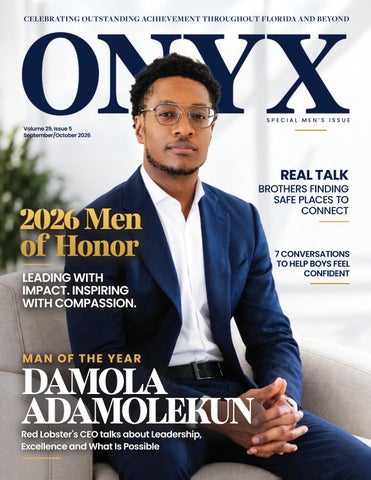
CELEBRATING OUTSTANDING ACHIEVEMENT THROUGHOUT FLORIDA AND BEYOND
Volume 29, Issue 5 September/October 2026
SPECIAL MEN’S ISSUE
REAL TALK
2026 Men
of Honor LEADING WITH IMPACT. INSPIRING WITH COMPASSION.
MAN OF THE YEAR
DAMOLA ADAMOLEKUN
Red Lobster's CEO talks about Leadership, Excellence and What Is Possible
BROTHERS FINDING SAFE PLACES TO CONNECT
7 CONVERSATIONS TO HELP BOYS FEEL CONFIDENT
DAMOLA ADAMOLEKUN MAN OF THE YEAR
12
CONTENTS 6
From the Publisher
41 MOH: Jermaine Jones
7
Elevate: The Joy
42 Wealth & Finance:
8
The Charge: A Letter
of Family
from Boys to Men 9
The Tallest Trees in the Forest & Sponsors
10 Jerry Demings:
A Lifetime Defined by Service
12 Damola Adamolekun: Man of the Year 14 5000 Role Models of Excellence, ONYX Salute 17 International:
Canada Knows African Culture 18 Family: Building
Young Kings
21 Well Groomed:
Sustainability in Beauty Development
22 MOH: Tyneil
Cargill, M.D.
23 MOH: Steve Hogan 24 MOH: Samuel Lamar
Wright, Ed.D.
25 MOH: Kenneth
Atwater, Ph.D.
26 Open Spaces:
In Pursuit of Brotherhood
Lower Your Health Costs
46 MOH: Luke Lewis 47 MOH: Mark Reid 48 MOH: Myron Rolle, M.D. 49 MOH: Theodore Sealy 51 Real Estate: Better
Flooring Sells Houses
52 Careers: Central Florida
Men in Technology
54 MOH: Mike Smith 55 MOH: Dr. Robert
Watkins 56 MOH: Victor Young 57 MOH: Roderick Zak 58 MOH: Foundation
Scholars
61 Education: STEM
Helps Students Soar
62 The Quad: Stories
from College Campuses
64 Health & Wellness:
Updates on Health Issues
67 Medically Speaking:
Get Checked for Prostate Cancer
68 Florida Scope: Stories
31 MOH: David Brewer
71 Politics: VOTE!
32 MOH: Chevalier
72 Business: Five
Dr. Reginald T. Burroughs
35 Art & Culture:
Museums Inspire Our Communities
37 ONYX Reads: Courtesy of Red Lobster
44 Savvy Consumer:
30 MOH: Jonathan
Sebastian Blount
Protests, Prayers and Plants
38 MOH: Jim Gray 39 MOH: Timothy
Groover, M.D.
40 MOH: William
E. Hudson, Jr., Ph.D.
4 ONYX MAGAZINE September/October 2026
Adults Still Depend on Parents
from Around the State
Financial Helps for Small Businesses
74 Black History: Black
Male Leaders in Florida Sports
75 Sports: Share
the Magic Program
76 Agriculture:
Florida Pink Shrimp
77 Food & Wine: White
Wine to Beat the Heat
78 ONYX Profile: Chef Jeff
THE CHARGE
A Letter from Boys to Men D
With respect and gratitude, Young Boys Who Are Watching, Learning and Growing 8 ONYX ONYX MAGAZINE MAGAZINE September/October September/October2026 2026
AI Generated
ear Men of Honor, I want you to know how much you mean to us. As boys growing up, we are watching you. We see the way you lead your families, your communities, your workplaces and the people around you. We see that leadership is not just about being in charge. It is about showing others the right way, making good choices and being someone people can count on. You teach us things every day, sometimes without even saying a word. You teach us to work hard, to keep our promises, to respect others and to never give up when things become difficult. You show us that being a man is not about being the loudest or the strongest person in the room. It is about having courage, character, compassion and a willingness to help others. When we see men being kind, helping someone who needs it, protecting their families and standing up for what is right, it makes us feel safe. When we see men serving our nation and protecting the freedoms we enjoy, we feel proud and grateful. When we see fathers, grandfathers, coaches, teachers, mentors and community leaders taking time to guide young people like we, we feel like our futures matter. You inspire us to become better—not just for ourselves, but for everyone around us. Because of you, we understand that one day we can become a leader, too. We can help others. We can protect what matters. We can give back to our communities. We can be kind when kindness is needed and courageous when courage is required. Thank you for being examples of what strength, leadership and love can look like. We are learning from you. We are inspired by you. And one day, we hope to inspire someone else just as much as you have inspired us.
THE TALLEST TREES IN THE FOREST
G
reat men do more than lead—they build a legacy. They stand tall when others need strength, speak with purpose when others need direction, and step forward when their communities need champions. Their influence reaches far beyond titles and accomplishments; it is reflected in the lives they touch, the families they strengthen, the careers they shape, and the possibilities they create for those coming behind them. They are the Tallest Trees in the Forest—men whose roots run deep in character, commitment, and service. ONYX Magazine
honors the men who understand that true leadership is not measured simply by how high you rise, but by how many people you lift along the way, challenging others to dream bigger, work harder and believe that they, too, belong in every room and at every table. These men matter to us. And while their accomplishments deserve recognition, it is their impact that deserves celebration. Because when the tallest trees rise, they do not block the light—they create shade, shelter, and space for others to grow. We celebrate the Tallest Trees in the Forest.
Honorary Chair Orange County Mayor Jerry Demings
Publisher Rich Black
Honorary Co-Chairs Bishop Neil C. Ellis, Michael Laderman, Matt Bowman, Jim Gray
Men of Honor Event Chair Monica Riley Men of Honor Event Co-Chair Nancy Port Schwalb
Thank you to our Sponsors Founding Partner
Presenting Sponsor
Medallion Sponsor
Men of Honor Charge
EATONVILLE Rising 140 Years Strong, 90 Years Inspired.
Entertainment Sponsor
Event Stage Sponsor
вMedia Sponsor
Billboard Sponsor
In Memoriam Sponsor
Transportation Sponsor
Community Sponsor
MOH Honorees Breakfast
Transportation Sponsor
Event Sponsors
September/October 2026 ONYX MAGAZINE 9
OPEN SPACES
Pursuit of Brotherhood Tampa Luncheon Group Shot 2 - Wes Lyons
IN PURSUIT OF BROTHERHOOD: THE RESURGENCE OF COMMUNITIES FOR BLACK MEN By Allysen Kerr
P
icture this. It’s the 1990s, and tens of thousands of men are packed into a stadium. For several days, they pray together, worship together, and have honest conversations about faith, family, responsibility, and what it means to be a man. They aren’t there for a football game or a concert. They’re there for community. This was Promise Keepers, a Christian men’s movement that became a phenomenon during the 1990s, filling stadiums across the country with men looking for something that probably didn’t seem particularly revolutionary at the time: fellowship. My father was one of them. Growing up, I remember my dad and the men in his circle traveling to Promise Keepers events. It became an annual opportunity to get away, strengthen their relationships with God, and spend intentional time with other men. But Promise Keepers wasn’t the only place where I watched my father experience brotherhood. There were always men around him. My father was also heavily involved in our church. He was the go-to mister-fix-it. He drove the church bus, transporting children and the elderly to Sunday school and other activities. If someone needed help, my father showed up. 26 ONYX ONYX MAGAZINE MAGAZINE September/October September/October2026 2026
And when he needed something, those same men (who became my uncles and godfathers) showed up for him. But somewhere between the world I grew up in and the one we live in today, something shifted. Across the country, participation declined in many of the institutions that once routinely brought people together: churches, civic organizations, clubs and other voluntary associations. For Black men, those changes unfolded
“It doesn’t matter what’s on your résumé,” Lyons said. “We all still need community.” alongside racial discrimination, economic pressures and long-standing expectations about what strength and masculinity should look like. At the same time, the mental health of Black boys and men has become an increasingly urgent concern. Two years ago, the University of Georgia conducted a study that followed more than 500 young Black men from their late teens to their
early 20s. The research found that childhood adversity and racial discrimination could contribute to mistrust in relationships, which in turn could lead to isolation and suicidal thoughts. A 2020 report by the National Institute on Minority Health and Health Disparities found that African American men with Major Depressive Disorder are less likely to seek help compared to white men. Maybe the issue isn’t that Black men stopped having people around them. Maybe, somewhere along the way, it became harder just to be men. To stop being strong long enough to say, ‘I’m not okay…’ So, perhaps the issue isn’t simply whether Black men have community. It’s whether those communities safely create room for vulnerability. And increasingly, some Black men are intentionally building spaces that do. More Than Being in the Room As a longtime advocate for Black men, Taiwan Simmons is glad to see that Black men’s mental health is finally being talked about more openly. Simmons, a Tampa-based pastor, counselor, and founder of The Winner’s Circle, said conversations about Black men’s mental health and the importance of supporting one another have become increasingly visible. But visibility, he says, is only the beginning.
OPEN SPACES
Breaking bread is good. “We’ve been talking about it for a long time,” Talking about careers is good. Simmons said. “It’s important for all of us to not But what happens when the conversation just have conversations about this, but actually turns to rejection? Grief? Childhood trauma? do something different.” Abuse? For Simmons, doing something different That’s where community becomes somemeant creating The Winner’s Circle, a support thing more. group designed to give men of color a safe place for honest conversations about their lives, relationships, children, careers, and the things they Surrounded, But Still Alone may have been carrying quietly. NFL Super Bowl Champion (2014) BJ Daniels The men “circle up,” as Simmons calls it. understands that distinction from another vanAnd he goes first. tage point. Simmons begins by sharing his own story, As a professional athlete, Daniels seemingly hoping his willingness to be vulnerable gives had the kind of built-in community most people another man permission to do the same. would assume protected against isolation. The group also gives men something some And early in his life, it did. have never been taught: language for what they Growing up in Tallahassee, the former Seattle are feeling. Seahawks player remembers receiving support Using a feelings wheel, Simmons helps participants move beyond describing everything as being mad, upset, or angry. Sometimes the emotion is disappointment. Sometimes it’s rejection. Sometimes it’s frustration, grief or fear. For some men, simply discovering that there is language for what is happening internally is transformative. “They begin to identify that, [and say to themselves], OK, I’m not crazy,” Simmons said. “There’s actually words associated with the things that are going on on the inside of me, and it’s OK to have more than one feeling at a time.” Simmons believes that work is particularly important because many from his church, teammen were socialized to see emotional mates, and coaches as he vulnerability as weakness. pursued football. Growing up in the South Bronx, But as he climbed New York, he remembers an environhigher, eventually reachment where showing weakness could ing the NFL, the relationBJ Daniels Book Cover Beyond make someone a target. ships around him became the Red Zone “A lot of men grew up being socialmore complicated. ized and being told that they’re weak if they “The higher the level I got, I do think that supshow their emotions,” he said. port kind of got cloudy,” Daniels said. That doesn’t mean every gathering among Success changed expectations. Black men needs to become a therapy session. Family dynamics shifted. Relationships Simmons sees the value in the barbershop, evolved. And while he was still trying to perthe brunches, the cigar lounge and other spaces form at the highest level of his sport, he was where men can simply be around other men. also trying to remain grounded in who he But eventually, he says, some of those conversaknew himself to be. tions need to go deeper. Then several of the things that had anchored “The discussions have to be pointed. They his identity disappeared almost at once. have to be directed. They have to be provoking,” His football career stalled. A long-term relaSimmons said. tionship ended. He was living in Atlanta, away
from the familiarity of Tallahassee and without the community he had spent years building back home. “I’m living in the city of Atlanta. I have no social equity there,” Daniels recalled. “Don’t nobody know me. Don’t nobody care.” Still, he maintained the appearance that everything was fine. When people asked whether he was still playing football, Daniels told them he was working and waiting for another call. Eventually, he had to tell himself the truth. The call wasn’t coming. And he had to figure out who BJ Daniels was when football was no longer attached to his name. That transition forced him to reconsider what support actually meant.
BJ Daniels Speaking at USF Nurses Event
Having people around you is one thing. Having the right people around you is another. For Daniels, that meant identifying individuals he genuinely respected, people who took an interest in him beyond what he had accomplished, and people with whom he could be honest when life no longer looked the way everyone expected. It also meant acknowledging how challenging it can be to ask for help. That may be one of the clearest arguments for why intentional brotherhood matters. In Pursuit of Brotherhood In Tampa, NFL Alum, Wes Lyons is among those trying to create something different. The idea came while Lyons was praying about what God was calling him to do next following his NFL career with the Pittsburgh Steelers. He kept returning to what he saw as a need September/October September/October 2026 2026 ONYX ONYX MAGAZINE MAGAZINE 27 27