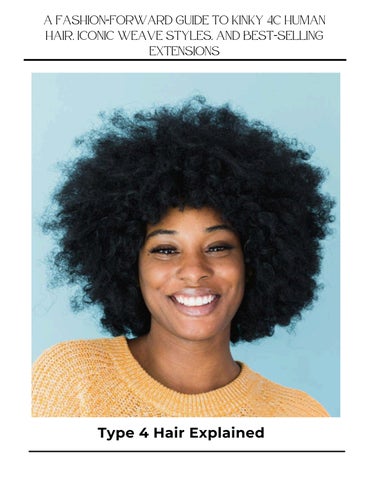
A Fashion-Forward Guide to Kinky 4C Human Hair, Iconic Weave Styles, and Best-Selling Extensions
Type 4 Hair Explained
Runway rule number one: texture is never “just
texture.”
It
is
silhouette,
it
is
movement, it is light, it is drama and when the texture conversation turns to Type 4, the fashion energy shifts because Type 4 tresses don’t whisper. We’re going to define type 4 hair in a way that’s visual and modern, then move into the real art: learning how to style, protect, and elevate Type 4 textures so they stay luxe whether you’re
wearing
your
natural
mane,
experimenting with premium curly wefts, or building high-impact looks for daily life. You’ll also see how dense curl formations translate into premium extension design, why certain curl structures create the most believable bundles, how closures affect the finish, and what separates a “cute style” from a statement look that reads expensive. Along the way, we’ll spotlight kinky 4C human hair, compare curl definitions through tight kinkycurl 3C4A styles, and break down what truly makes afro kinky 4C hair wefts and tight curl patterns so iconic in the texture world. What Is Type 4 Hair? Think of it as the most tightly coiled, most silhouette-driven category on the curl spectrum springy shrinkage, bold volume, and a texture range that can swing from cotton-soft to wire-fine, sometimes all on the same head.
Type 4 hair is highly expressive and deeply responsive to styling technique, which is exactly why it can look minimal one day and runway-sculpted the next. The beauty is in the complexity: coils that expand, contract, and reshape based on moisture, tension, and how the style is set. Type 4 is typically grouped into 4A, 4B, and 4C, but real-life texture rarely stays in a single lane. Most people wear a blend, with different coil “personalities” showing up at the crown, edges, and nape—often influenced by porosity differences and daily manipulation. That’s why the best approach isn’t “label and stop.” It identifies what you’re seeing, then style with intention, like a stylist tailoring a look to different fabrics within the same outfit. Learning how your coils behave when they’re healthy versus when they’re stressed is where real confidence comes from. At this stage, Mastering Type 4 Hair Textures becomes less about control and more about listening as well as understanding how moisture, technique, and timing affect definition and shape.
4A often shows smaller, visible “S”
When it comes to extensions, texture
patterns that define easily with the
authenticity is the difference between
right layering, creating a plush spiral
“nice” and “undeniable.” That’s exactly why
effect that reads soft and sculpted. 4B
Afro Kinky Human Hair 4C sits at the
can lean more “Z”-shaped and less
center of so many high-fashion installs,
uniform,
because
producing
architectural
cloudlike,
mirrors
true
density,
coil
compactness, and that natural matte-to-
depending on stretching, setting, and
soft sheen Type 4 manes can carry
separation. 4C is the most compact
especially when the hair is high quality,
pattern, sometimes showing minimal
minimally processed, and engineered to
definition without styling, but that isn’t
mimic natural variation. The best versions
a
delivering
don’t look “perfect” in a plastic way; they
shrinkage-rich volume and couture-
look believable, with subtle irregularities
level silhouettes designed to move. The
that feel like real strands growing in real
luxury finish is usually decided by three
directions, catching light differently across
factors: porosity, density, and strand
the shape.
thickness.
a
that
it
shifts
flaw—it’s
halo
a
signature,
On camera, the magic is in how the texture behaves like lived-in tresses, because micro-variations keep the final style looking organic rather than manufactured. That’s why editorial stylists love high-volume afro silhouettes that frame the face like couture headwear, layered curls with a soft cloudlike bounce, and natural-looking fullness for updos, ponytails, and half-up shapes. For clients who live between categories, Tight Kinkycurl 3C-4A Styles can sit right in the blend zone near the face, delivering slightly looser definition with visible spiral structure and a polished, styled-on-purpose movement. The key, always, is quality. Premium hair should feel dense without being overly heavy, spring back when gently stretched, and hold its identity after washing, refreshing, and restyling.
Now let’s get technical but keep it unmistakably fashion because Afro Kinky 4C Hair Wefts and Tight Curl Patterns sit at the intersection of curl science and style aesthetics, where texture is not accidental but engineered. Every coil tells a story of structure: density determines fullness, coil radius influences visual scale, spring factor controls bounce, and subtle inconsistencies recreate the beautiful unpredictability of natural hair. When these elements are translated thoughtfully into extension design, the final install doesn’t just resemble real hair it behaves like it, moving with confidence and intention. In luxury hair terms, tight curls are never about being uniformly small.
Weft construction is where craftsmanship quietly defines the outcome. While shoppers often gravitate toward length or texture names, insiders know the true marker of quality lives in how the hair is stitched and balanced. A wellbuilt weft supports fullness from root to tip so the silhouette remains lush all the way through. Secure stitching minimizes shedding, a crucial detail for dense textures that can otherwise knot under stress. Proper weight distribution also ensures natural movement, allowing even highdensity styles to sway, breathe, and respond to motion instead of sitting stiffly. Styling tight curls is about choosing an editorial mood. Defined coils communicate polish glossy, intentional, and camera-ready making them ideal for elevated occasions or minimalist wardrobes where the hair carries the look. Fluffed volume, on the other hand, leans into attitude. It feels effortless, directional, and modern, pairing perfectly with oversized tailoring, clean skin, and confident energy. Neither approach is superior; each serves a different fashion narrative. For a believable finish, stylists often play within a curl spectrum.
Let’s talk visual language for a moment, because in textured styling, images carry more weight than words. Human Hair Weave Styles are not just something you save for inspiration—they’re quiet guides. They show how volume is meant to sit, how curls should interact with the face, and whether a look is supposed to feel soft, bold, minimal, or highdrama. A single image can tell you if a style leans romantic, editorial, street-luxe, or effortlessly polished, long before you ever sit in a stylist’s chair. Think of this section as a photo-board translated into real-world technique. You may already be looking at images elsewhere, but understanding what makes those visuals work is what allows you to recreate the same mood on your own mane. Shape, parting, and curl placement are never random. They are intentional choices that turn a style from “nice hair” into something that feels styled, elevated, and fashion-aware. The sculpted halo afro is a perfect example of controlled drama. In fashion imagery, it appears rounded, balanced, and almost architectural. High ponytails with textured spill bring confidence into the picture. The base is sleek and controlled, while the length delivers movement and attitude. Tight, defined curls create a plush effect that feels full without looking stiff, and wrapping the base adds a refined touch that elevates the entire style from casual to fashionforward. Soft, defined curls with a middle part sit firmly in the “model-off-duty” lane. This is where Curly Human Hair Weave Styles with Closures make a noticeable difference, especially at the hairline. The part must look natural, the density consistent, and the curls light enough to move. Gentle finger separation around the face keeps the look relaxed, wearable, and quietly luxurious. Half-up, half-down styles strike the perfect balance between openness and volume. Lifting the crown creates height and presence, while the remaining curls flow freely for softness.
Understanding Type 4 isn’t about boxing your curls into a label. It’s about learning the language of your tresses density, shrinkage, porosity, and coil formation so you can style with clarity and confidence. With type 4 hair explained as your foundation, mastering type 4 hair textures becomes a creative process: you choose the silhouette, you decide the mood, and you build looks that match your aesthetic. When you step into extensions, the same rules apply. Kinky 4C human hair delivers bold authenticity and couture-level volume, while tight kinkycurl 3C-4A styles offer polished definition that reads romantic and modern.
If you’re building a new signature look, start with what consistently performs. Explore Best Sellers In Hair Extensions that deliver definition, density, and that runway-ready finish so your mane stays camera-ready, confidence-forward, and unmistakably you.