How to respond to reviewer comments On Time Publication Editorial Team Read the full, updated guide: https://www.ontimepublication.com/guides/respond-to-reviewer-comments.html
In short: Answer every comment in a point-by-point response letter. Quote each comment in full, say what you changed and exactly where (page and line), and when you disagree, explain why politely and with evidence. Make every change in the manuscript itself, follow the journal's instructions on files and deadlines, and keep the response your own work.
First, read the decision letter carefully A request for revision is not a rejection. A Wiley editor advises authors to revise and resubmit rather than send the paper elsewhere, because the reviewers have told you what needs to change (Wiley). Before you start, note: the deadline for the revision; the files the journal wants, for example a clean manuscript, a version with tracked changes or highlights, and a separate response document; any comments from the editor. These usually show which reviewer points matter most. The labels "major" and "minor" revision are not always a reliable guide to the work involved, so read every comment before you plan your time.
Step 1: Pause, then list every comment Taylor & Francis suggests putting the reports aside for a few days after the first reading, so you can respond objectively (Understanding peer review). Then number every point. If a reviewer wrote a narrative report, split it into separate points yourself. The Wiley article suggests a simple table with four columns: comment number, reviewer's comment, your response, and the page where you addressed it. Dealing with the small points first (typos, consistency, style) often clears much of the list quickly.
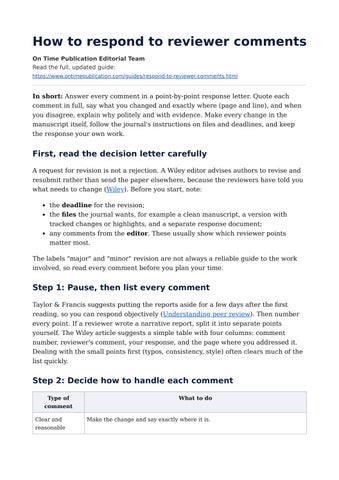
Step 2: Decide how to handle each comment Type of
What to do
comment Clear and reasonable
Make the change and say exactly where it is.
Type of
What to do
comment Asks for new
Do the work yourself and report the outcome honestly. If the new analysis
analysis or data
changes your interpretation, say so. Taylor & Francis suggests showing the old and new versions so reviewers can compare them (T&F).
Unclear
Ask the handling editor what the reviewer means rather than guessing.
Out of scope or
Explain why, and discuss it with the editor. The editors of Nature
not feasible
Computational Science say this is an appropriate route (editorial).
You disagree
Do not ignore it. Explain your reasons with evidence, such as published work or your data.
Two reviewers
Choose one approach, explain why in both responses, and tell the editor.
conflict
A misunderstanding is also useful feedback. If one expert misread a passage, other readers may too, so it is usually worth clarifying the text.
Step 3: Structure the response letter 1. Open briefly. Thank the editor and reviewers, and summarise the main changes in a few lines. Nature Computational Science recommends this short summary. 2. Use one section per person: editor, Reviewer 1, Reviewer 2 and so on. 3. Quote each comment in full. Taylor & Francis asks authors not to paraphrase or shorten the reviewers' words, and Nature Computational Science warns that leaving text out can look as if you are choosing what to answer. 4. Answer directly underneath. Keep your reply visually distinct, for example in a different colour, in bold or in a box. 5. Say exactly where the change is. Elsevier Connect gives this example: not "we changed the discussion", but "we changed the discussion section on page 24, lines 7-23" (Elsevier Connect). Illustrative example (fictional): the comments and replies below are invented to show the layout. They do not come from a real journal, manuscript, reviewer or author.
Reviewer 2, Comment 3: "The sample size justification is not clear." Response: Thank you for this comment. We have added the sample size calculation and its assumptions to the Methods (page 6, lines 112-120). The revised text reads: "..." Reviewer 2, Comment 4: "Please add a comparison with method X." Response: We have respectfully not added this comparison because [your reason, with a reference]. We have added a sentence on this limitation to the Discussion (page 14, lines 301-305). Journals differ on whether to paste the revised text into the letter. Taylor & Francis suggests including it, while Nature Computational Science recommends not copying
every change, except new figures. Follow your journal's instructions.
Step 4: Get the tone right The Wiley article, following Williams (2004), sums it up: answer politely, answer completely and answer with evidence. Advice quoted by Elsevier Connect is to keep the response factual and to write it so that the editor could forward it to the reviewer. Taylor & Francis says you are entitled to defend your position, but the tone should be assertive and persuasive rather than defensive or aggressive. Never criticise a reviewer personally, even if a comment seems unfair.
Step 5: Make the changes in the manuscript too Elsevier Connect describes one of the biggest mistakes as answering every comment but forgetting to update the paper. Writing page and line numbers into your replies forces you to make each change first. Any clarification or new data you give the reviewers should also appear in the manuscript or the supplementary files, because readers will have the same questions.
Step 6: Final checks before you resubmit Every comment is numbered and answered, including the small ones. Page and line references match the final version of the file. Numbers, tables and conclusions are consistent everywhere after the changes. You have all the files the journal asked for, in the right format. If you need more time, ask the editor early, before the deadline passes.
If the paper is rejected Some publishers accept appeals. Taylor & Francis, for example, says an appeal needs strong evidence or new information that responds to the editor's and reviewers' comments (appeals and complaints). More often, the best step is to use the comments to improve the paper and then choose the next journal carefully. See how to choose a journal.
How we can help The response to reviewers is your work: it explains your research, your data and your decisions. You write the response. We edit the response letter you have drafted for language, structure and tone, check that every comment is answered and crossreferenced, and edit the revised manuscript. We never write the response for you and never add data, analyses or results. We never correspond with reviewers or editors about your paper. If you have explicitly authorised us to handle a portal submission, we upload only the files and response you have approved. The ICMJE lists language
editing among contributions that do not qualify for authorship and that should be acknowledged, so follow your journal's policy on acknowledging editing help (ICMJE). Reviewer response support is part of our services. Clients also get free, ongoing revision and resubmission support until the paper is published. This is support, not a promise of publication. See also manuscript editing and journal submission support. Independence: On Time Publication is not affiliated with Elsevier/Scopus, Clarivate/Web of Science, COPE, the ICMJE or any journal or publisher named on this page. We link to their public guidance so you can check it yourself.
Frequently asked questions How do I respond to reviewer comments? Write a point-by-point response letter. Quote each comment in full, explain what you changed and where (page and line), and give polite, evidence-based reasons when you do not make a change. Make every change in the manuscript as well.
What should a response to reviewers letter include? A short thank-you and summary of the main changes, then a section for the editor and each reviewer, with every comment quoted and your reply and its location directly underneath.
Can I disagree with a reviewer? Yes. Disagreement is part of peer review, but do not ignore the comment. Explain your reasons politely and support them with evidence, such as published work or your data.
What if two reviewers ask for opposite changes? Choose the approach you can justify, explain your reasoning in your reply to both reviewers, and tell the editor. If you are unsure, ask the handling editor for guidance.
Do I need to answer minor comments? Yes. Answer every comment, including typos and style points. A short reply such as "Corrected, page 4, line 80" is enough.
Can someone else write my response to reviewers? The response should be your own, because it explains your research and decisions. An editor can help with language, structure and tone. Follow your journal's policy on acknowledging editing help.
How long should a response letter be?
As long as the comments require. Taylor and Francis notes that a good response letter can be more than 20 pages, and that clear structure makes even a long letter easy to follow.
Sources and further reading We link to official sources so you can check the rules yourself. Always follow your target journal's and institution's current instructions. How to respond to reviewer comments (Taylor & Francis Author Services) Understanding peer review (Taylor & Francis Author Services) Peer review appeals and complaints from authors (Taylor & Francis Author Services) How to deal with reviewer comments (Wiley editor toolkit) 3 top tips for responding to reviewer comments on your manuscript (Elsevier Connect) How to respond to reviewers' comments (Elsevier Researcher Academy) How to respond to reviewers, editorial, Nature Computational Science 5, 975 (2025) ICMJE: Defining the role of authors and contributors
Related guides and services How to choose a journal Pick the right journal first. Read more →
Manuscript editing Editing for your revised paper. Read more →
Thesis to journal article Turn thesis chapters into papers. Read more →
About On Time Publication On Time Publication is an online academic publication consultancy based in the United Kingdom. We help researchers with manuscript editing and proofreading, journal selection and submission support, medical manuscript editing, PhD thesis editing and white papers. Every project is quoted individually. Website: https://www.ontimepublication.com/ · Email: info@ontimepublication.com · WhatsApp: +44 7916 693071