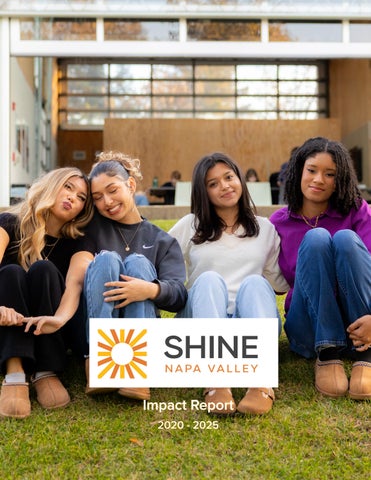
Impact Report 2020 - 2025
Five years ago, Napa County was facing a growing youth mental health crisis. Even before the pandemic, rising rates of anxiety, depression, trauma, and suicide among young people were deeply concerning. Then came COVID-19, school closures, social isolation, and repeated wildfires and evacuations, creating unprecedented challenges for students, families, schools, and service providers across our community. At a time when the need had never been greater, Napa Valley Vintners stepped forward with vision, leadership, and a deep commitment to the well-being of local youth. Because of their investment, SHINE was created as more than a program, it became a bold, collaborative effort to transform how youth behavioral health support is delivered across Napa County. Their support helped bring together schools, community-based organizations, and behavioral health providers to build something that had never fully existed before: a coordinated, countywide system of care centered around student wellness. What began as a shared commitment among trusted partners has grown into a highly collaborative and responsive network designed to meet young people where they are, both physically and emotionally. Together, SHINE has helped move behavioral health support out of isolated systems and into the places where students naturally spend their time: schools, wellness centers, community spaces, and trusted family-serving organizations. Over the past five years, SHINE has strengthened partnerships, expanded school-based wellness services, increased access to prevention and early intervention supports, and helped reduce barriers that have historically prevented youth and families from receiving care. Students are accessing support earlier. Families are finding help more easily. Schools are better equipped to respond to behavioral health needs. Most importantly, more young people are receiving the care, connection, and support they need to thrive. SHINE has been especially impactful in expanding access for students and families in Napa County’s rural and historically underserved communities, where barriers related to geography, transportation, language, and provider availability have traditionally made behavioral health support harder to access. The impact of this work extends far beyond programs or services alone. SHINE has helped change the way Napa County thinks about and responds to youth mental health. It has strengthened collaboration across systems, increased community awareness, reduced stigma, and laid the foundation for a more connected and sustainable behavioral health system for future generations. This report reflects the extraordinary progress made over the last five years and the meaningful impact of Napa Valley Vintners’ investment. None of this would have been possible without their belief in this work and commitment to the young people of our community. Thank you, Napa Valley Vintners, for helping make this transformation possible. 2
Five Years of Collective Impact Since 2020, SHINE has helped transform youth behavioral health across Napa County. o ether, these efforts have: Built a Countywide System of Care Connected schools, behavioral health providers, community organizations, and public agencies into one coordinated support system for youth. Expanded School-Based Access to Mental Health Support Increased behavioral health services on school campuses—including rural upvalley schools—bringing care closer to students and reducing barriers like transportation, stigma, and language. Strengthened Early Identification and Intervention Expanded screenings, outreach, and wellness center engagement so students receive support before challenges become crises. Reached Thousands of Napa County Youth SHINE has significantly expanded the reach of youth behavioral health services across Napa County. In the 2024 - 2025 school year alone, wellness center sites reported:
62%
students reached
81%
students screened
51,764
wellness center visits
Improved Student Mental Health Outcomes Students attending schools with wellness centers demonstrated stronger indicators of well-being compared to broader county and state trends. ✓ Lower suicidal ideation ✓ Stronger school connectedness ✓ Greater confidence accessing mental health support Changed the Conversation Around Youth Mental Health Through wellness events, youth leadership, community education, and the SHINE Podcast, mental health became more visible, accepted, and supported across Napa County. Built a Stronger Foundation for the Future Established partnerships, infrastructure, and sustainable strategies that will strengthen youth behavioral health for years to come. 3
Why SHINE Was Needed A Growing Youth Mental Health Crisis Even before 2020, youth mental health challenges were rising across California and Napa County. Increasing rates of anxiety, depression, trauma, self-harm, and suicide were already placing significant pressure on schools, families, and behavioral health systems. For many young people, access to timely support was limited by barriers such as cost, transportation, stigma, language, and long wait times for care. Then came COVID-19. The pandemic brought prolonged school closures, social isolation, family stress, and widespread disruption to daily life. In Napa County, repeated wildfires and evacuations added another layer of instability and trauma for children, youth, and families. Together, these challenges created an unprecedented behavioral health crisis and intensified the need for accessible, coordinated support systems for young people.
Nearly 2 out of 3 young people in California with depression did not receive treatment* *Mental Health America
28.6% Napa County chronic absenteeism in 2021–2022
A System That Was Difficult to Navigate While Napa County has long had strong organizations committed to supporting youth and families, the behavioral health system itself often felt fragmented and difficult to navigate. Services existed across schools, community-based organizations, healthcare providers, and public agencies, but coordination between systems was limited. As a result, many families struggled to understand where to go for help, how to access services, or what support options were available. Schools were increasingly expected to respond to growing mental health needs, often without sufficient resources or a clearly coordinated system of care. Too often, young people did not receive support until challenges had escalated into crisis.
A New Approach for Napa County SHINE was created to help address this challenge by building a more connected, accessible, and responsive system of support for youth across Napa County. What made SHINE different was its collaborative model. Rather than creating a new standalone program, SHINE strengthened and aligned existing systems by bringing together schools, community-based organizations, behavioral health providers, and public partners around a shared vision for youth wellness. By expanding school-based services, reducing barriers to access, and strengthening coordination across systems, SHINE helped bring support closer to where students already are. This model prioritizes prevention, early intervention, and timely access to care, ensuring young people and families can receive support earlier, more easily, and in environments they know and trust. At a critical moment for Napa County, SHINE provided a path forward: one rooted in collaboration, equity, and the belief that every young person deserves access to the behavioral health support they need to thrive. 4
13% of Napa County 7th graders considered suicide
The term ‘better together’ comes to mind. The SHINE collaborative has made a positive impact by operating as a unified network of nonprofit providers who are laser-focused in delivering a coordinated system of care for youth/students that leverages the expertise of individual organizations. The unification and alignment have been a stabilizing force during a period of unprecedented changes in funding for behavioral healthcare across multiple systems. Jennifer Yasumoto, Health & Human Services Agency Director or
What SHINE Built SHINE was built on a simple but powerful belief: every young person deserves access to behavioral health support when and where they need it. Over the past five years, SHINE has helped build a more connected, youth-centered system of care across Napa County, one that is designed to make behavioral health services more accessible, responsive, and effective for students and families. By bringing together schools, community-based organizations, behavioral health providers, and public partners, SHINE has strengthened the systems that support youth mental health and created new pathways for collaboration, coordination, and care. What began as a shared commitment among partner organizations has grown into a stronger countywide infrastructure centered around prevention, early intervention, and equitable access to support. Through SHINE, Napa County has built: Expanded School-Based Access to Care SHINE helped expand wellness centers and school-based behavioral health services, bringing support directly onto school campuses. This has made it easier for students to access care in familiar, trusted environments while reducing barriers such as transportation, stigma, and limited-service availability.
A Stronger Focus on Prevention and Early Intervention Rather than waiting until challenges escalate into crisis, SHINE has helped shift the system toward prevention, early identification, and timely intervention. Through screenings, outreach, wellness programming, and relationship-based support, youth are being connected to help earlier than ever before.
Stronger Cross-System Partnerships
A Stronger Foundation for the Future
SHINE strengthened collaboration between schools, community-based organizations, behavioral health providers, and county partners. These relationships created greater alignment around shared goals and improved the community’s ability to respond collectively to youth mental health needs.
Beyond direct services, SHINE has helped build the infrastructure needed to sustain youth behavioral health support long-term. This includes stronger partnerships, improved funding strategies, shared planning, and a growing collective commitment to student wellness across Napa County.
More Coordinated Systems and Clearer Pathways to Support SHINE improved communication, referral pathways, and coordination across systems. Families and youth now have clearer entry points to care, and providers are better connected to ensure young people receive the right level of support at the right time.
Reduced Stigma and Increased Community Awareness SHINE helped shift how youth mental health is understood across Napa County. By bringing behavioral health services into schools, wellness centers, community spaces, and family-serving environments, SHINE made support more visible, normalized, and accessible. Over time, this work has reduced stigma and fostered a stronger culture of awareness, openness, and early help-seeking among students, families, and schools.
5
SHINE’s Success: Rooted in Collaboration At the heart of SHINE is a strong network of trusted partners working together to improve youth mental health across Napa County. Each partner organization brings unique expertise, relationships, and strengths to the work, allowing SHINE to deliver a more comprehensive and responsive system of care than any one organization could build alone. Together, SHINE partners support youth and families across the full continuum of behavioral health needs—from prevention and early intervention to clinical treatment, family support, and systems coordination. By aligning services, strengthening referral pathways, and working toward shared goals, SHINE has built a connected network of care designed to ensure young people receive the right support at the right time. The following organizations play critical and complementary roles in advancing SHINE’s mission:
Aldea Children & Family Services
Youth Mental Health, Substance Use Prevention & Treatment Aldea brings specialized expertise in youth behavioral health by providing comprehensive mental health services, substance use prevention, early intervention, and treatment for children, youth, and families. Recognizing the strong connection between mental health, substance use, family dynamics, and school environments, Aldea delivers integrated, relationship centered support that meets young people where they are. Through school based services, community partnerships, and specialized treatment programs, Aldea helps ensure that children, youth, and families have timely access to high quality care while strengthening Napa County’s continuum of behavioral health services.
UpValley Family Centers
Family Stability and Equitable Access UpValley Family Centers serves as a critical access point for students and families in Napa County’s rural upvalley communities, helping reduce geographic, linguistic, cultural, and economic barriers to care. Through school- and community-based services, the organization connects families to behavioral health support, concrete resources, and services that strengthen long-term stability and well-being. Its multigenerational and community-rooted approach helps ensure support remains accessible, culturally responsive, and aligned with local needs.
6
Mentis
Comprehensive Mental Health Continuum of Care Mentis provides a comprehensive continuum of youth mental health services spanning prevention, early intervention, and clinical treatment across Napa County school districts. Through flexible service delivery models tailored to individual school communities, Mentis ensures students can access the appropriate level of care as needs evolve. Its leadership in school-based behavioral health has expanded access to clinically grounded, responsive mental health services for youth and families across the county.
Napa Valley Education Foundation Systems Coordination and Sustainability
In addition to leading initiatives such as the SHINE Podcast, the Napa Valley Wellness Conference, and the development of community-facing tools such as the Network of Care, Napa Valley Education Foundation serves as the backbone and coordinating partner of the SHINE collaborative, helping align schools, community-based organizations, and public agencies around shared goals for student wellness. Through convening, strategic planning, systems development, and collaborative grant writing, NVEF strengthens communication, coordination, and long-term sustainability across the SHINE network. Its leadership helps ensure the infrastructure, partnerships, and shared vision needed to sustain this work continue to grow.
On The Move
Youth Engagement and Early Intervention On The Move has built a youth-centered approach to student mental health that prioritizes access, trust, and early support. By embedding services directly in schools and creating low-barrier, relationship-based supports, the organization reaches young people who might otherwise go unsupported. Known for engaging youth who are often hardest to reach, On The Move builds trusted relationships that help identify needs early and connect students to appropriate care. This work strengthens access, improves early intervention, and helps ensure students receive support before challenges escalate.
7
8
SHINE’s Milestones
2020
SHINE Launches SHINE is established as a collaborative effort to improve youth behavioral health across Napa County by strengthening coordination between schools, community-based organizations, and behavioral health providers.
2021
Building the Foundation Partners align around a shared vision for youth wellness, strengthen collaboration, and begin designing a more coordinated countywide model of care centered on prevention and early intervention.
2022
Expanding School-Based Support School-based behavioral health services expand across Napa County. On The Move launches Youth Outreach Coordinators, strengthening on-campus engagement and early intervention support for youth.
2023
Strengthening Youth-Centered Care Partner organizations expand wellness programming, outreach, and schoolbased supports. Youth engagement strategies continue to grow, increasing access to prevention and early intervention services.
2024
Major Systems Growth SHINE secures major investments and expands infrastructure to support long-term sustainability, including CYBHI funding, expanded wellness center services, and new sustainable behavioral health funding pathways.
2025
Expanding Access Across Communities Wellness center expansion continues, increasing access to behavioral health support for students and families across Napa County, including historically underserved upvalley communities.
2026
A Stronger System for the Future SHINE enters year six with stronger partnerships, expanded services, and a more connected system of care positioned to continue transforming youth mental health across Napa County.
9
Impact on Students, Schools, and Families Over the past five years, SHINE has helped transform how students, schools, and families across Napa County access behavioral health support. By bringing services directly into schools, expanding prevention and early intervention, and strengthening community partnerships, SHINE has built a more responsive system of care centered around student wellness. The impact of this work is reflected in both broad reach and measurable outcomes. More students are accessing support, schools are better equipped to respond to behavioral health needs, and families have greater access to trusted, culturally responsive services.
Impact on Students SHINE has dramatically expanded access to behavioral health support for students across Napa County by meeting young people where they already are on school campuses, in wellness centers, and through trusted community-based partners. This has been especially important for students in rural and historically underserved communities, where access to behavioral health services has traditionally been more limited. In the 2024–2025 school year alone: • 8,603 students were enrolled at SHINEsupported wellness center sites • 5,328 students accessed wellness center services • 62% of all enrolled students used a wellness center • 81% of students received behavioral health screening • 51,764 total wellness center visits were recorded These numbers reflect both broad reach and sustained engagement, demonstrating that wellness centers have become trusted spaces where students actively seek support, connection, and care.
Students attending SHINE-supported wellness center schools were less likely to report seriously considering suicide compared to youth across Napa County. California
Napa County
Wellness Center Sites
14% 12% 10% 8% 6% 4% 2% 0%
7th
9th
11th
These findings suggest that increased access to school-based behavioral health support is helping strengthen protective factors and improve youth well-being across Napa County.
American Canyon High School Students:
You are one of the few people I can trust, on campus.
10
Being at the wellness center always makes me feel welcomed and supported.
Impact on Schools SHINE has strengthened schools’ ability to identify and respond to student behavioral health needs by embedding accessible, coordinated supports directly within school communities. Before SHINE, many schools were operating in reactive systems, often responding only after student challenges had escalated into crisis. Today, SHINE-supported schools have stronger prevention-focused systems, clearer referral pathways, and better access to community-based behavioral health partners. Through wellness centers and embedded supports, schools are better equipped to: Identify student needs earlier
Provide timely intervention
Connect youth to appropriate care
Build stronger cultures of wellness and belonging
In the 2024–2025 school year alone, nearly 7,000 students received proactive screening, allowing schools and providers to identify concerns earlier and intervene before challenges became more severe. This represents a meaningful improvement in student engagement over time. While many factors influence attendance, these improvements suggest that stronger school-based behavioral health supports, earlier intervention, and more connected systems of care may be helping students remain more engaged in school.
28% 2 % 2 % 22% 20% 18% 2 0
02
2 2
2 0
02
2 2
2 0 2 -22 02
22 0 2 -12 02
SHINE has helped shift school-based behavioral health support from a crisis-response model to a proactive, prevention-focused system centered on early intervention and student well-being.
As behavioral health supports expanded across SHINE-supported school sites, chronic absenteeism steadily declined.
Impact on Families SHINE has also strengthened support for families by making behavioral health services more accessible, culturally responsive, and easier to navigate. Through school-based services, bilingual and bicultural supports, family resource centers, and stronger referral pathways, SHINE has reduced barriers that often prevent families from accessing care. Families now have clearer pathways to support and stronger connections to services that improve both behavioral health and overall family stability. These outcomes reflect more than improved access to services, they represent meaningful improvements in safety, healing, resilience, and long-term well-being for youth and families across Napa County.
11
What We Learned / Why This Worked Over the past five years, SHINE has generated more than strong outcomes, it has also provided valuable insight into what truly works when supporting youth mental health. One of SHINE’s greatest strengths has been its ability to test, refine, and strengthen a collaborative model of care rooted in real community needs. Through this work, several clear lessons have emerged:
◆ Schools Are the Most Effective Access Point One of SHINE’s clearest lessons is that schools are one of the most effective and equitable places to reach young people with behavioral health support. Schools are where students spend most of their time and where early warning signs are often first recognized. By embedding services directly on school campuses, SHINE reduced barriers related to transportation, stigma, scheduling, and access. Meeting students where they already are has significantly improved both access to care and early intervention.
We tend to be their first form of contact with a trusted adult with a peer-to-peer framework. Because of this, students do feel comfortable telling us what’s going on in their lives, therefore we are able to provide students with the adequate support they need. Jessica De Leon, Youth Outreach Coordinator
◆ Early Intervention Changes Outcomes SHINE reinforced that early identification and timely support are critical to improving youth behavioral health outcomes. When students receive support early, before challenges escalate into crisis, they are more likely to remain engaged in school, strengthen coping skills, and access appropriate care sooner. Wellness centers, screenings, outreach, and trusted school-based relationships have all played a critical role in helping identify needs earlier and connect youth to support faster.
◆ Relationships Drive Engagement Behavioral health support works best when it is built on trust. SHINE has shown that strong, consistent relationships between youth and trusted adults are essential to meaningful engagement. Students are far more likely to seek help, remain connected to services, and respond positively to support when they feel safe, respected, and understood. This is especially true for young people who have historically experienced barriers to care or distrust of traditional systems.
At first, the client was shy during group, but as the weeks went by and we practiced skills such as HOT seat and problem-solving, they opened up and participated more and more. On the last day of the group, they stayed behind to thank me and told me that this group had become their ‘safest place.’ Aldea therapist, discussing a middle school client who began attending CBITS group
12
◆ Collaboration Creates Better Outcomes No single school, provider, or organization can meet the full behavioral health needs of youth alone. SHINE has demonstrated that stronger outcomes are possible when schools, community-based organizations, behavioral health providers, and public systems work together through shared goals, coordinated referrals, and aligned strategies. This collaborative model has improved communication, reduced fragmentation, and created a more connected system of care for Napa County youth and families.
These partnerships have expanded early access to evidence-based, trauma-informed services for students in rural and marginalized communities who may not otherwise receive support. Through these services, youth are gaining a better understanding of their mental health and developing skills to navigate daily challenges with greater confidence and resilience. Rubi Pelayo, Youth Program Manager
◆ Sustainable Change Requires Sustainable Investment SHINE has also reinforced an important reality: meaningful systems change takes time, coordination, and sustained investment. Building a strong youth behavioral health system requires more than direct services alone. It requires infrastructure, partnership development, funding alignment, and long-term commitment. The progress made over the past five years demonstrates what is possible when communities invest not only in programs, but in the systems that make lasting impact possible.
13
What’s Next Five years ago, SHINE was created in response to a growing youth mental health crisis and a shared recognition that Napa County needed a stronger, more connected system of care for young people. Today, that vision is becoming reality. SHINE has helped build a more coordinated, accessible, and responsive system of behavioral health support for students and families across Napa County. Strong partnerships have been built. Wellness services have expanded. Access to care has improved. Most importantly, more young people are receiving support earlier and in the environments where they feel safest and most connected. However this work is far from finished. Youth behavioral health needs remain significant, and demand for accessible, school-based support continues to grow. The progress made over the past five years has created a strong foundation, but sustaining and expanding this work will require continued commitment, innovation, and investment.
In year six and beyond, SHINE’s focus will center on four key priorities:
1
Sustaining Core Services
3
Building Long-Term Sustainability
Protect and strengthen the school-based behavioral health services, wellness centers, and direct supports that students and families rely on every day
Advance sustainable funding strategies, stronger infrastructure, and long-term systems planning to ensure SHINE’s impact continues well into the future.
2
Deepening Partnerships
Continue strengthening coordination between schools, community-based organizations, healthcare providers, and public systems to ensure youth receive seamless, timely support.
4
Expanding Family and Early Intervention Supports Increase access to prevention-focused services, family-centered supports, and early intervention strategies that help address needs before challenges escalate.
The future of youth mental health in Napa County depends on continuing to build on the progress made so far. SHINE has demonstrated what is possible when a community comes together around a shared vision for youth wellness. With continued collaboration and investment, Napa County has the opportunity to further strengthen this model and ensure every young person can access the behavioral health support they need to thrive. The work ahead is clear, and so is the opportunity: to build on this momentum and create a future where every student in Napa County has access to care, connection, and support. 14
To learn more or listen to the SHINEcast podcasts, visit:
shinenapavalley.org
15
The progress made over the past five years reflects what is possible when a community comes together around a shared commitment to youth well-being. Because of Napa Valley Vintners’ vision, leadership, and investment, SHINE has helped transform how behavioral health support is delivered to students and families across Napa County. What began as a bold idea has grown into a stronger, more connected system of care, one that is improving access, reducing barriers, strengthening partnerships, and changing outcomes for young people across our community. Most importantly, this work has helped ensure that more students receive support when they need it, where they need it, and in spaces where they feel safe, seen, and supported. The impact of SHINE extends far beyond programs, services, or metrics. It is reflected in the students who found support before reaching crisis, the families who gained access to care, and the schools that are better equipped to support student wellness every day. This is the power of collective investment, shared vision, and community partnership. Thank you, Napa Valley Vintners, for believing in this work and in the young people of Napa County. Your investment has helped build not only stronger systems, but stronger futures. Together, we have changed what is possible for youth mental health in Napa County.