OFFICIAL PUBLICATION OF THE BEEF FARMERS OF ONTARIO
BEEF O NTAR I O
FALL PROCESSING CHECK-UP: 10 CONSIDERATIONS FOR YOUR HERD • ONTARIO BEEF FARMERS BRING COMFORT TO THE TABLE FEED EFFICIENCY AND METHANE: RESEARCH POINTS TO A WIN-WIN FOR BEEF FARMERS • OCTOBER 2026
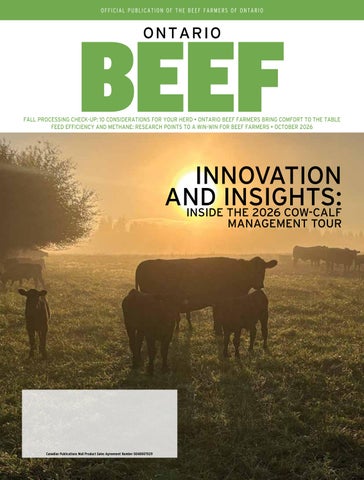
INNOVATION AND INSIGHTS: INSIDE THE 2026 COW-CALF MANAGEMENT TOUR
Canadian Publications Mail Product Sales Agreement Number 0040007029
Hereford Add a splash of
colour to your
calendars this fall.
Hereford Stocker Sale, Brussels, ON October 30th Royal Agricultural Winter Fair Ontario Hereford Futurity - November 5th Ontario Junior Hereford Showmanship - November 5th Ontario Junior Hereford AGM - November 5th Eastern Hereford National Show - November 7th Building the Hereford Dream Draw - November 7th East Central Hereford Zone AGM November 14th
ROOTS & WINGS FARMS Ian, Tara, Connor, Kaleigh, Cooper & Jacob McNaughton Oro Medonte, Ontario 705-394-7770 Visitors Always Welcome Bulls, Females and frozen Genetics Available! HIDDEN-VIEW POLLED HEREFORDS Joe and Karen Paszternak NORWOOD, ON 705-9573739 or 705-957-7470 karen.paszternak@gmail.com Bulls & Females for sale
MEDONTE HIGHLANDS POLLED HEREFORDS 3055 Universal Dr. Mississauga, Ontario (905) 625-3151 maria@standardmechanical.com “6 Star Breeder” LIAN MOR POLLED HEREFORD Wally & Fern Pugh MONO, ON Wally & Fern Pugh lianmor48@gmail.com · 519-941-8515 Trevor & Amy tpugh27@yahoo.com · 519-939-7489 Breeding Stock Available
www.ontarioherefordassociation.com
WHISKEY LANE LIVESTOCK Hereford and Angus Scott, Paula, Jason and Shelby Cornish INDIAN RIVER, ON 705-295-2925 705-878-3248 (Scott’s Cell) 705-341-3220 (Paula’s Cell) wll@nexicom.net Visitors Always Welcome
JDL CATTLE CO. & D&S LIVESTOCK David & Shirley Lasby Josh Lasby, Justin & Jaimie Lasby & Family, Jessica Lasby & Travis Fulford & Family MULMUR, ON 519-943-4147 or 519-278-6819 jessica.lasby@hotmail.com Good-looking, Sound, Functional Cattle!
O’SHEA FARMS Jamie and Mel O’Shea DENFIELD, ON 519-477-1238 osheafarms@hotmail.com Bulls and Females for sale
WHITNEY BALL | Coldwater, ON • 705-321-5206 • whitneyjball@gmail.com PRESIDENT
JESSICA LASBY | Meaford, ON • 519-939-0283 • ontarioherefordassociation@outlook.com SECRETARY MANAGER
OFFICIAL PUBLICATION OF THE BEEF FARMERS OF ONTARIO
BEEF ON T A R I O
October 2026
Volume 67, Number 4
COMPLIMENTARY MEMBER-SUPPORTED PUBLICATION
4
Ahead of the Heard
6
The Beef Beat
8
Ontario Beef Farmers Bring Comfort to the Table
10
The Herd Line
8
12 Feed Efficiency and Methane: Research Points to a Win-Win for Beef Farmers 14
Ontario’s Next Generation at the National Table
18
Investing in the Next Generation of Livestock Innovation
20
Fall Processing Check-Up: 10 Considerations for Your Herd
23 Celebrating the International Year of Rangelands and Pastoralists 24 Innovation and Insights: Inside the 2026 Cow-Calf Management Tour 28
OMAFA Update: Making Use of Corn Stover
30
Canada Beef Update: A Seat at the Royal Table
34
Preparing Together to Protect Ontario Livestock Farms
36 StrongHER Futures: Celebrating the Year of the Woman Farmer 39 Focus on Herd Health: Why Consistency Matters in Newly Arrived Feedlot Calves 40
Ontario Licensed Dealer Listing
43
Market Information
48
Calendar of Events
50
Wellness on the Farm
24
ON THE COVER: Thank you to Heather Little of Dufferin County for this issue’s cover photo, captured on the farm where she and her family run a commercial Angus cow-calf-to-finish operation. This issue of Ontario Beef brings together practical fall management advice, emerging research and stories about the people shaping our sector’s future. Explore research linking feed efficiency and methane reduction, review considerations for fall processing, and learn why consistency matters when managing newly arrived feedlot calves. We also look at making use of corn stover and share highlights from the 2026 Cow-Calf Management Tour. Don’t miss out on submitting your photos for our December issue. Please send your winter-inspired photos by November 15th to be considered for the cover. Digital photos in portrait orientation that are at least 300dpi are preferred, and can be emailed to info@ontariobeef.com.
ONTARIO BEEF • Beef Farmers of Ontario 130 Malcolm Road, Guelph, ON N1K 1B1 • Phone: 519-824-0334 • Toll Free (for Ontario callers only) 1-866-370-BEEF (2333) Fax: 519-824-9101 • info@ontariobeef.com EDITOR LeaAnne Wurmli CIRCULATION COORDINATOR Charlene Yungblut ADVERTISING MANAGER Cathy Lasby, Preferred Agri-Marketing Services Guelph, ON Phone: 519-763-8833 • Fax: 519-763-8833 pams@sentex.net DESIGN and LAYOUT Prism Studios Advertising and Design Inc. Guelph, ON PRODUCTION and PRINTING Beck’s Printing Services, Brantford, ON
PROVIDING A FORUM FOR THE ONTARIO BEEF INDUSTRY Ontario Beef is the official publication of the Beef Farmers of Ontario. Contents of this publication may be reproduced only by permission of the Editor and with credit acknowledged. Opinions expressed herein are those of the author and/or editor and do not necessarily reflect the opinion of the Beef Farmers of Ontario. Publication of advertisements does not constitute endorsement or approval by Ontario Beef or the Beef Farmers of Ontario of products or services advertised. Advertising deadlines are January 10, April 15, July 15, September 15 and November 15. The publisher reserves the right to refuse or cancel any advertising, including advertising that is inconsistent with BFO’s Sponsorship Policy, available at www.ontariobeef.com. Every effort is made to ensure the accuracy of material published, however no responsibility can be assumed for advertising not received in clear, type-written form. Ca na d ia n P ub l i c at i on s M ai l P r od uc t S al e s A g r e e m e n t N um b e r 0 0 4 0 0 0 7 0 2 9 POSTMASTER: Return undeliverable Canadian addresses to: Beef Farmers of Ontario, 130 Malcolm Road, Guelph, ON N1K 1B1
AHEAD OF THE HEARD By Jason Leblond, BFO President info@ontariobeef.com • www.ontariobeef.com
Harvesting Connections W
ith Thanksgiving just behind us and harvest work continuing across Ontario, I want to thank our members whose efforts fill our tables and keep our rural communities strong. Fall brings plenty of long days, whether we are harvesting corn and soybeans, taking cattle off pasture, preparing cattle for the sale or getting ready for winter. I hope the holiday offered each of you a chance to pause and enjoy a meal with family and friends. Over the past several weeks, I have had many opportunities to represent Beef Farmers of Ontario (BFO). Those visits and conversations have been a reminder of how much our sector depends on relationships, both within agriculture and with the people who buy our beef, make policy and support our communities. One particularly meaningful stop was our visit to the Ronald McDonald House in Toronto, just minutes from The Hospital for Sick Children and Mount Sinai Hospital. Throughout August, BFO board members and staff supported the Ronald McDonald House Charities meal program at four locations across Ontario, preparing Ontario beef meals for families staying close to their children’s medical care. Sharing a warm meal is a simple way for our sector to offer comfort during a difficult time. Having recently celebrated Thanksgiving, many of us can appreciate what it means to gather around the dinner table. Helping bring that comfort to other families is something we can be proud of. You can read more about our visits on page 8. There have also been plenty of opportunities to talk with the public. I spent two days at the Canadian National Exhibition (CNE) and had some great conversations about beef farming. I also attended the International Plowing Match & Rural Expo in Bruce County, where it was good to connect with our members and visitors. Thank you to the Bruce County Beef Farmers and all volunteers who put so much effort into these events. Your willingness to answer questions and share your experiences helps people better understand the care behind Ontario beef. BFO BOARD OF DIRECTORS 2026
Jason Leblond (Northern Director) – President Email: jacres5@gmail.com Don Badour (Cow-Calf Director) – Vice President Email: don.badour@gmail.com Don Hargrave (Cow-Calf Director) Email: dchargrave@gmail.com Jim Whitley (Cow-Calf Director) Email: modelaranch@hotmail.com Joost van der Heiden (Background Director) Email: jcvdheiden@hotmail.com Nick Martin (Feedlot Director) Email: nickolas@pureislandbeef.com Jairus Maus (Feedlot Director) Email: ellengowanfarms@gmail.com Lisa Pallister (Feedlot Director) Email: lisa@pallisterfarms.ca Denise Byers (Southern Director) Email: byersdimmick@yahoo.com Don Scott (Eastern Director) Email: sparetimelivestock@gmail.com Ralph Eyre (Director-At-Large) Email: ralph@eyrefarms.ca Kim Jo Bliss (Director-At-Large) Email: kimjobliss@gmail.com Shannon Gibson (Youth Director) Email: shannongiibson@gmail.com
4
O N T A R I O BE E F • OCTOBER 2026
A BFO contingent also attended Farm & Food Care’s Breakfast on the Farm at River Valley Cattle Company in eastern Ontario. This was a special opportunity for visitors to see beef farming firsthand, and ask questions about how their food is produced. The Embury family also offered their auction ring for a lively and entertaining auction of stuffed toy cows, adding something unique to the day. Thank you to the Embury family for opening their farm and to the many volunteers who welcomed the public and shared our industry’s story. Closer to home, in the North Bay region, I helped facilitate a Farm & Food Care tour for culinary students attending Canadore College. Bringing people who work with food closer to the farms that produce it gives us a chance to explain our practices and hear their questions. These connections matter when chefs and other food professionals are making choices about what to serve and how to share the story of Ontario agriculture. Building relationships with elected officials is equally important. This summer, the Wellington County Cattlemen’s Association hosted their annual barbecue for federal, provincial and municipal elected officials. I, along with staff, appreciated the invitation to attend to support conversations about our sector. It was great to see how this local association engages with their elected officials. In Mississauga, BFO Executive Director RIchard Horne and I met with MPP Sherif Sabawy to discuss trade and increasing the availability of Ontario beef in domestic markets. Access to customers here at home deserves continued attention alongside our work to maintain and expand export opportunities. I also joined a meeting with a Japanese delegation hosted by our Ontario Beef Market Development team at the Ontario Ministry of Agriculture, Food and Agribusiness (OMAFA) office in Guelph. Our conversations extended beyond beef to our families and life in Canada, reflecting their interest in the people who raise the product
BFO STAFF Executive Director Richard Horne • richard@ontariobeef.com Manager of Policy and Issues Thomas Brandstetter • thomas@ontariobeef.com Senior Policy Advisor Evan Chaffe • evan@ontariobeef.com Policy Advisor Aynur Izzettin • aynur@ontariobeef.com Director of Communications LeaAnne Wurmli • leaanne@ontariobeef.com Manager of Public Engagement and Digital Strategy Jennifer Kyle • jennifer@ontariobeef.com Engagement Coordinator Charlene Yungblut • charlene@ontariobeef.com Communications Assistant Kara Sickle • kara@ontariobeef.com Member Information Coordinator Jamie Gamble • jamie@ontariobeef.com
Accountant Amber McIntyre • amber@ontariobeef.com Office Manager Lisandra Lima • lisandra@ontariobeef.com Manager of Producer Relations & Director of the Ontario Beef Youth Alliance Jaclyn Horenberg • jaclyn@ontariobeef.com Producer Relations Specialist Chadd Taylor • chadd@ontariobeef.com Producer Relations Specialist Mel Reekie • mel@ontariobeef.com Manager of Compliance Chris Millar • chrism@ontariobeef.com Supervisor of Provincial Programs Barb Caswell • barb@ontariobeef.com
they purchase and sell. I had read reports of previous delegation visits, but experiencing one firsthand helped me appreciate how much participants value visiting our farms and seeing how Ontario beef is produced. These personal connections help strengthen our trading relationships and build continued demand for Ontario beef. Processing capacity is another essential part of that discussion. Richard and I recently presented to Guelph City Council in support of Cargill on a zoning matter. A local Ontario Federation of Agriculture representative also attended and spoke in support of our position, reinforcing the broader agricultural community’s interest in protecting processing infrastructure. Land-use decisions involving these facilities have implications well beyond municipal boundaries. Protecting their ability to operate is important to the farms that rely on them to market cattle. September brought a change in provincial leadership with the appointment of Sam Oosterhoff as Ontario’s new Minister of Agriculture, Food and Agribusiness. We welcome him to the role and are ready to work with him on two key priorities: increasing the individual operational cap under the Risk Management Program and moving the Ontario Beef Breeder Loan Guarantee Program forward. I also want to thank outgoing Minister Trevor Jones for his work on behalf of our sector, particularly his support for the breeder loan program. Nationally, I participated in a Canadian Cattle Association (CCA) directors’ meeting and its annual barbecue on Parliament Hill in Ottawa, where I met with MPs Alex Ruff, John Barlow and Shuv Majumdar, U.S. agriculture attaché Mary Ellen Smith, and several other MPs and senators.
BFO Vice President Don Badour and I also participated in the TriNational Agriculture Accord meetings in Calgary, where we met with OMAFA Parliamentary Assistant MPP Rosenberg and senior state and provincial agricultural officials from Canada, Mexico and the U.S. These discussions offer valuable opportunities to emphasize the importance of our trading relationship with the U.S. and maintain connections with our North American counterparts. Work on traceability and CCA governance has also continued. I participated in a couple of Ontario Traceability Steering Committee meetings, where we discussed traceability principles and next steps for bringing Ontario’s perspective to the National Beef Cattle Traceability Task Force. I also took part in several CCA restructuring calls. That process continues to progress well, and BFO will remain involved as the work moves forward. Producer education was also on the agenda as I travelled to Kanata for BFO’s annual Cow-Calf Management Tour. Time spent visiting farms and learning alongside other producers is always valuable, and I came home with ideas from the operations we visited to try on my own farm. That’s another good reason to take advantage of these opportunities, you never know what you might learn and put to use back home. Thank you to the hosts who opened their farms, our loyal industry sponsors and everyone who helped organize the tour during a busy season. You can read more about the event on page 24. At our most recent board meeting, we welcomed Shannon Gibson as our new youth representative, succeeding Emily Bromley following the completion of her term. Young farmers bring valuable perspectives to our association, and we look forward to working with Shannon and hearing her ideas. Thank you to Emily for her contributions and dedication during her time on the board. As we continue through the harvest season, thank you for the work you do on your farms and for the time many of you give to our industry. I wish you and your families a safe harvest and a successful fall season. OB
Already one of the most sustainable in the world, and still improving. Blank Spot Visit to learn more!
grandvalley.com Advanced Animal Nutrition for Improved Human Health
ON TA RIO BE E F • OCTOBE R 2026
5
THE BEEF BEAT By Thomas Brandstetter, BFO Manager of Policy & Issues thomas@ontariobeef.com • www.ontariobeef.com
BFO Keeps Busy With Fall Advocacy A
s summer transitions to fall, the changing leaves and cooler temperatures signal a new season. For the Beef Farmers of Ontario (BFO) Policy Team, however, the transition also brings a busy schedule of events, meetings and advocacy opportunities with elected officials at both the federal and provincial levels.
Federal advocacy priorities take centre stage In September, the University of Guelph hosted an event at Canada’s Outdoor Farm Show in Woodstock celebrating Ontario’s agri-food sector and the research, collaboration and innovation that drive its success. The event brought together researchers, producers, alumni and government partners and featured keynote remarks from University of Guelph President Dr. René Van Acker, along with presentations from university researchers. The Honourable Heath MacDonald, federal Minister of Agriculture
STRAIGHT CANADIAN GENETICS GENOMICALLY TESTED AND SELECTED FOR TENDERNESS SINCE 2008
and Agri-Food, also attended the event, where BFO Director Ralph Eyre had the opportunity to meet and speak with the Minister. As the federal government’s fall sitting gets underway, BFO is focused on several key priorities. Protecting and strengthening Canada–U.S. beef trade remains critical to Ontario producers, and BFO will continue to advocate for the integrated North American market while firmly opposing U.S. tariffs or other trade measures that undermine the competitiveness of Canadian beef farmers. BFO is also firmly opposed to any trade agreement with Mercosur that includes expanded access for beef imports. On the business risk management file, BFO is calling for improvements to AgriStability, including an increased trigger and payment cap, federal contributions to Ontario’s Risk Management Program (RMP), and further examination of cattle risk management tools used in the United States, such as Livestock Risk Protection and Livestock Gross Margin. Protecting Ontario’s finite agricultural land base is another key priority, recognizing the importance of farmland to farm family viability and Canada’s long-term food production capacity. This fall, we will join the National Cattle Feeders’ Association for a lobby day in Ottawa, providing an opportunity to bring these priorities directly to federal decision-makers.
Provincial priorities raised at the International Plowing Match JPC 15P This bull calf and many more like him are available. We will semen test and deliver them when you want them next year.
No one ever regretted buying quality. DON & JEANNETTE CURRIE 2234 Conc. 11, R R #1, Nottawa, Ontario L0M 1P0 Phone/Fax: 705-445-1526 Cell: 705-715-2234 • Email: doncurrie@glenislay.com 6
O N T A R I O BE E F • OCTOBER 2026
While the provincial government does not return to Queen’s Park until late October, the International Plowing Match & Rural Expo (IPM) near Walkerton in Bruce County provided an important opportunity to engage with provincial leaders ahead of the fall legislative session. The opening ceremonies for the IPM brought together Members of Provincial Parliament from all parties. Leaders from across the agriculture sector got together for a roundtable with the Honourable Sam Oosterhoff, who recently moved from an associate role to become Minister of Agriculture, Food and Agribusiness. BFO Vice-President Don Badour attended alongside BFO Directors Jairus Maus and Lisa Pallister. During the roundtable, Don reiterated BFO’s key provincial priorities and the need for action on issues affecting Ontario beef farmers. Continued on page 36.
ONE NAME. PICK YOUR FIGHT. A powerful line of cattle vaccines for scours, respiratory, clostridial and reproductive diseases—trusted, proven and now united under a bold look.
One name. Comprehensive portfolio. BOVILIS®. Producers, talk to your veterinarian about using Bovilis ® vaccines in your vaccination protocol. Veterinarians, contact your Merck Animal Health representative for more information, call 1-866-683-7838 or visit www.merck-animal-health.ca. Always read and follow the label instructions to ensure these products are suitable for the animals to be vaccinated. Vaccination may not protect every animal that gets vaccinated. BOVILIS ®, GUARDIAN ®, VISION ® and VISTA ® are registered trademarks of Intervet International B.V. Used under license. COVEXIN ®, NASALGEN ®, ONCE PMH ® and TASVAX® are registered trademarks of Intervet Inc. Used under license. MERCK® is a registered trademark of Merck Sharp & Dohme LLC. Used under license. © 2025 Merck & Co., Inc., Rahway, NJ, USA and its affiliates. All rights reserved. CA-NAL-240900002
ON TA RIO BE E F • OCTOBE R 2026
7
Ontario Beef Farmers Bring Comfort to the Table By BFO Staff
W
hen a child is in hospital far from home, everyday tasks like making dinner can become one more thing for a family to manage. This summer, Beef Farmers of Ontario (BFO) board members and staff helped take that task off the list, preparing Ontario beef dinners at Ronald McDonald Houses in Toronto, Hamilton, London and Ottawa. The visits were part of BFO’s new partnership with Ronald McDonald House Charities (RMHC), which includes financial support to purchase Ontario beef for meal programs. Getting into the kitchens gave our team a chance to contribute in person and learn more about the families and people behind each House. The idea behind Ronald McDonald House began in Philadelphia in 1974, when the first seven-bedroom House opened to welcome families, whose children needed medical care. Pediatric oncologist Dr. Audrey Evans, Philadelphia Eagles player Fred Hill (whose daughter had leukemia) and supporters from the Eagles and McDonald’s helped make it possible. Canada’s first House opened in Toronto in 1981. Today, Houses across the country offer accommodation, meals and other services that help families manage life away from home. Community donations, fundraising and corporate partnerships help keep those services available, and BFO is proud to contribute.
Just minutes from SickKids and Mount Sinai Hospital, the House accommodates 81 families in 66 bedrooms and 15 apartment suites. It welcomes families living at least 55 kilometres away whose children are being treated for serious or life-threatening illnesses at a qualifying hospital. During their stay, families can use shared kitchens, access pantry staples and take part in cooking classes. Activities and wellness programs offer a chance to unwind, while an on-site private school helps children and their siblings keep learning. These services recognize that even with hospital visits and treatment schedules, families still need groceries, schoolwork, playtime and a little time for themselves.
Hamilton
Toronto Vietnamese bánh mì sandwiches, coleslaw and fruit salad were on the menu when BFO joined the Meals from the Heart program at Ronald McDonald House Toronto. The program welcomes community and corporate volunteers into the kitchen to prepare healthy dinners several nights a week.
8
O N T A R I O BE E F • OCTOBER 2026
At Ronald McDonald House South Central Ontario in Hamilton, our volunteers made Ontario beef meatballs, roasted vegetables and cookies. This 41-bedroom House sits steps from McMaster Children’s Hospital and serves families from across south central Ontario, including Niagara, HamiltonHalton, Brant and KitchenerWaterloo. Each year, it welcomes approximately 775 families and serves more than 62,000 meals. Private bedrooms, shared kitchens and laundry facilities help with day-to-day needs. For younger guests, an underwaterthemed playroom, complete with a fish tank, offers a place to explore and play.
London BFO’s team served an Ontario beef steak dinner at Ronald McDonald House London, part of Ronald McDonald House Southwestern Ontario.
Located steps from Children’s Hospital at London Health Sciences Centre, the 40-room House welcomes families who live at least 40 kilometres away and have a child receiving treatment in London for a serious illness or injury. In 2025, 1,325 families stayed at the House for an average of 13 days.
Ottawa In Ottawa, BFO volunteers prepared Ontario beef kabobs, roasted potatoes, broccoli salad and watermelon salad. Located on the Children’s Hospital of Eastern Ontario (CHEO) campus, Ronald McDonald House Ottawa serves families from eastern Ontario, parts of Quebec and as far north as Nunavut. Families must live at least 60 kilometres away and have a child receiving care at CHEO or another local hospital.
Giving back through Ontario beef Across all four visits, our teams saw how much goes into making a House feel like home, from the staff who welcome arriving families to the volunteers who help keep meals and activities running. “This partnership reflects the values of Ontario beef farmers and our commitment to giving back to the communities we serve,” said Jason Leblond, BFO President. “As farmers, we understand the importance of caring for others and the role a nutritious meal can play in bringing comfort and connection.” Thank you to the staff and volunteers at each House for welcoming us into their kitchens and sharing their work with our teams. Local beef associations and farmers interested in getting involved can contact a nearby Ronald McDonald House to ask about meal programs, donations and volunteer opportunities. Whether it’s preparing dinner or helping fund a program, every contribution supports families facing some very difficult days. OB
Genetics to complement any herd to improve your bottom line. Proof of our genetics working as a foundational ingredient for progressive crossbreeding programs.
A recent expansion from 14 to 36 family suites has more than doubled its capacity. The additional space allowed the House to eliminate its waitlist and increase accommodation from approximately 5,000 to more than 13,000 nights annually, a significant difference for families travelling long distances for care.
MORE Docility, fertility, efficiency & longevity Jamie, Mel & Blake O’Shea Denfield, ON 519-477-1238
For updates follow us on:
osheafarms@hotmail.com
ON TA RIO BE E F • OCTOBE R 2026
9
THE HERD LINE By Jaclyn Horenberg, BFO Manager of Producer Relations jaclyn@ontariobeef.com • www.ontariobeef.com
Before the Gavel Falls: What Pays on Sale Day C
ow-calf producers are often a price taker at marketing time, especially during the busy fall run when calves flood the market. However, as a cow-calf producer, you have more control over your final paycheque than you might think. Data from the Canfax 2025 Cow-Calf Cost of Production Network reveals that cow-calf operations generate about 85 per cent of their revenue through the sale of weaned calves. Understanding exactly which management practices drive buyer demand can give you a better understanding of the market. At the recent Canadian Beef Industry Conference (CBIC) in Winnipeg, Manitoba, a panel of marketing experts gathered to bridge the gap between the farm and the auction ring. The panel, titled “This Little Steer Went to Market: When to Sell, What Buyers See and Why It Matters” moderated by Melissa Downing of the National Cattle Feeders’ Association, offered a practical roadmap for making better cattle marketing decisions. When calves enter the ring, buyers make split-second decisions based on the information they have. Rick Wright of Rick Wright Cattle Consulting, currently working for JGL Livestock and serving as CEO of the Livestock Markets Association of Canada, stresses that producers market the value of their cattle at the time of sale. According to Rick, cow-calf producers need to clearly document their vaccine program, weaning process, and genetic package. A uniform calf group with no horns and proper castration will consistently bring a premium. Rick encourages producers to minimize tag on the cattle, and don’t “kill your calves with kindness” by having them too fleshy. For those looking at forward selling for
10
O N T A R I O BE E F • OCTOBER 2026
TAKE FIVE: INSIGHTS FROM THE FIELD 1. Share your management practices: Buyers make decisions based on available information, so you must actively market your calves by clearly communicating your vaccine protocols, weaning process, and genetic packages to capture their full economic value. 2. Prioritize uniformity in your calf lots: Buyers pay a premium for uniform groups. Achieving a weight spread of less than 125 pounds within a lot returned a +$25 per head premium in 2025, which can be accomplished by aiming to have 60 per cent of your calves born within the first 21 days of the calving season. 3. P roper vaccination yields significant premiums: Calves with two properly timed Bovine Respiratory Disease (BRD) vaccines secured a $45 per head premium in 2024 and topped a $50 per head premium in 2025. 4. Build and protect your reputation: Associating your name with your cattle at the auction builds a lasting reputation. Success requires taking pride in your herd management, physically attending sales to see what attributes are in high demand, and establishing direct relationships with buyers to get performance feedback. future delivery, Rick emphasizes the importance of knowing your cost of production, managing your shrink, and understanding your marketplace.
“You do a good job, you should get credit for it; you do a bad job, you should get credit for it”.
Allan Munroe, owner of Killarney Auction Mart and President of the Livestock Markets Association of Canada, champions the value of price discovery at the auction. Allan believes that your name should be associated with the cattle you are bringing to the ring; saying, “You do a good job, you should get credit for it; you do a bad job, you should get credit for it”. He encourages producers to take pride in the cattle they bring to auction, advising that if a producer isn’t proud of their offering, it’s a sign to look critically at the operation and make changes where needed. Taking a strategic approach to herd management is what builds a lasting reputation. Karla Hicks, owner of Bluestone Home Grown Angus Beef in Saskatchewan, encourages producers to take a hard look at what they have to offer to ensure there is demand for it in the marketplace. Karla encourages producers to attend sales to see exactly what genetics and attributes are in high demand; using those observations to make tough culling and management decisions at home. Building direct relationships with the people buying your calves can provide feedback to help you tailor your program and build a reputation for raising quality calves. University of Saskatchewan researcher, Kathy Larson, has been working to put dollar values on the attributes to determine what pays on sale day. Kathy’s analysis was broken into three parts — 2021-2023, 2024 and 2025 — and used 16 attributes to determine the price value associated with each. Over the five years, thousands of calf lots of various sizes were analyzed, with 2025 focusing on sales data from The Electronic Auction Market (TEAM) with nearly 115,000 calves.
Attributes were grouped into five categories: 1) lot (sex, number of animals, province of origin); 2) genetics (continental influence, frame size); 3) management (weight, weight spread, flesh, implant use, horns, vaccination); 4) marketing (age verification, VBP+) and; 5) market structure (marketing quarter, days to delivery, feed barley price). As expected, traditional attributes – sex, weight, lot size and weight spread – consistently influenced price. The 2025 results showed that having a weight spread of less than 125 pounds in a lot returned a +$25 per head premium. Achieving this uniformity starts during the breeding season. Getting 60 per cent of your calves born in the first 21 days of the calving season ensures a more uniform calf crop by weaning time. In 2024, only 24 per cent of calf lots clearly showed two Bovine Respiratory Disease (BRD) vaccine products given at properly timed intervals. Those calves sold for $45 per head more, and in 2025 the advantage topped $50 per head. Kathy emphasized the importance of cow-calf producers clearly outlining their vaccine program and timing of vaccines to ensure they are capturing that full value. Ultimately, the takeaway for beef farmers is clear: your management practices carry economic value, but only if the buyer knows about them. When listing your calves this season, don’t just sell them—actively market them. Know the attributes that pay, have confidence in your program, and continue to build a reputation for producing quality calves that perform in the feedlot. OB
First in feedlot sustainability Join the movement alongside feedlots across Canada who are improving air and water quality by reducing ammonia gas emissions in more than 1 million head of cattle*. Join the movement by contacting your Elanco representative or visiting
ExperiorBeef.ca
*Elanco Data on File Experior, Leave It Better and Elanco are trademarks of Elanco or its affiliates. ©2026 Elanco. PM-CA-24-0905
ON TA RIO BE E F • OCTOBE R 2026
11
Feed Efficiency and Methane: Research Points to a Win-Win for Beef Farmers By Lilian Schaer for the Ontario Agri-Food Innovation Alliance
I
mproving feed efficiency and reducing methane emissions are often treated as separate goals in beef production, but University of Guelph researchers say the two are actually closely linked. “Methane emissions are largely driven by feed intake,” says Dr. Katie Wood, a beef nutrition researcher at the University of Guelph. “Animals that eat more produce more methane, but we also have to maintain performance.” The goal, she says, is not simply to reduce how much cattle eat, but to improve biological efficiency — how effectively animals turn feed and forage into growth, milk or other productive output. For beef farmers, the opportunity is to find ways to maximize sustainability by reducing environmental impacts and emissions while maintaining — or improving — animal performance and farm profitability.
Natural differences offer opportunity Methane is a natural byproduct of fermentation in the rumen, and both what cattle eat and how much they consume influence how much is produced. There is also considerable natural variation between animals. In one University of Guelph study at the Ontario Beef Research Centre in Elora, about 75 beef heifers were evaluated using residual
MapleHill Auctions Bred Heifer Sale
Saturday November 7th • 1:00pm Aden & Alvin Gingrich and Enos Bauman Consignments 145 Red & Red White-face Simmental Angus Cross heifers bred to low birth weight Red Angus bulls.
6 Red & Red White-face Simmental Angus Cross heifers bred to low birth weight Black Simmental Angus cross bull.
30 Black & Black White-face Simmental Angus Cross heifers bred to low birth weight Black Simmental Angus cross bulls.
Enos Bauman Consignments
15 - Red & Red White-face Simmental Angus Cross heifers bred to low birth weight Red Simmental Angus cross bull.
Noah Hoover Consignments
25 - Red and Red White-faced Simmental Angus Cross heifers bred to low birth weight Red Angus bull ALL heifers double vaccinated with Bovishield Gold FP5 + L5 and electric fence trained. Late January to May calving.
MapleHill Auctions
1100 Hwy 4 Walkerton • Cory Jacklin
519-372-5539
12
O N T A R I O BE E F • OCTOBER 2026
feed intake, or RFI, a measure that compares feed intake while accounting for differences in growth and body size. The most efficient group ate about 2.5 kilograms less feed per day than the least efficient cattle and produced about 25 grams less methane daily — approximately 14 per cent less on average. “That was just natural variation within the group,” Wood says. “It really shows that selection could have some impact.” Her team was also able to follow some of those animals over several years, and cattle that ranked as more efficient when first measured generally maintained that ranking as mature cows too. “I was really surprised at how much correlation there was over time,” she says. Researchers are now trying to better understand what drives those differences. Genetics, diet, feed intake, feeding behaviour and microorganisms in the rumen all appear to play a role, and Wood is involved in national research looking at how those factors interact. The complexity also means reducing methane is not as simple as getting cattle to eat less. A Beef Farmers of Ontario-funded study, for example, tested whether chopping straw more finely would improve digestibility, efficiency and methane performance. Cattle ate more of the chopped ration, performed better and became more feed efficient — but their total methane emissions increased because they consumed more feed. “That’s why the metric matters,” Wood says. “You have to look at performance as well as total emissions.”
What farmers can do now For farmers, that puts the focus on getting more productive output from the feed and other resources going into the herd. Good records can help identify which cows consistently produce and which ones are consuming resources without delivering a return. “We all have our favourite cow, but if she hasn’t had a calf in two years, maybe you need to think about making a change,” Wood says. Cows that aren’t working are still consuming feed and emitting methane without contributing to the end product. Calving distribution is another example. Cows that calve later produce younger, lighter calves at weaning, so keeping track of calving dates and getting more calves on the ground early in the calving season can increase pounds sold without increasing cow numbers. Weighing calves and comparing weaning weight to the cow’s body weight can also help identify which animals are making efficient use of farm resources. Wood is also involved in studying rotational versus conventional grazing. Although researchers have not seen an overall difference in annual methane emissions so far, rotational grazing can offer production benefits such as more grazing days and improved forage digestibility while researchers continue to assess its broader environmental impacts. “There are some win-wins here,” she says. “Improvements in production and the bottom line can go hand in hand with improvements in methane emissions.”
Using genetics to drive progress Genetics could eventually make those decisions more precise. Dr. Christine Baes, a University of Guelph animal geneticist in the Department of Animal Biosciences, has been involved in research examining methane emissions and cattle genetics, including whether the extensive genomic information available in dairy cattle could help accelerate progress in beef. Canada has built world-leading cattle genetics and genomics capacity, particularly in dairy, Baes says. The opportunity now is to make better use of those existing datasets, expertise and research infrastructure across both the dairy and beef sectors. There is potential, but dairy tools cannot simply be transferred to beef cattle. More beef-specific data is needed to understand the relationships between genetics, methane and productive efficiency. And the target should not be an animal selected simply because it produces less methane. “Biological efficiency is the goal,” she says. “Animals that use feed better are good for the farmer and good for the environment too.” Baes believes Canada is well positioned to make those gains because much of the research capacity, expertise and data infrastructure is already here. What is needed is greater collaboration to put those pieces together. Canada does not have to choose between productivity, competitiveness and sustainability, she says. By working with producers, industry, commodity organizations and government, research at universities can help improve all three outcomes. OB
STOCKERS BUILT TO PERFORM QUALITY HEIFER and STEER STOCKERS
The RFI study and rotational grazing work are funded, in part, by the Ontario Agri-Food Innovation Alliance, a collaboration between the Government of Ontario and the University of Guelph, and took place at the Ontario Beef Research Centre – Elora, which is owned by Agricultural Research and Innovation Ontario and managed by U of G through the Alliance.
FOR SALE
Well vaccinated. Feed-bunk ready. Easy care. Beef-on-dairy bred for performance. Carefully selected beef semen from major Al companies-chosen with top performance in mind.
CONTACT JOHN FOR MORE INFORMATION
519-537-1945 OXFORDCATTLE@GMAIL.COM
ON TA RIO BE E F • OCTOBE R 2026
13
Ontario’s Next Generation at the National Table By Charlene Yungblut, BFO Engagement Coordinator
A
fter three years of representing Ontario’s young beef farmers at the national level, Emily Bromley has completed her term as Ontario’s delegate to the Canadian Cattle Youth Council. As Emily closes this chapter, Beef Farmers of Ontario (BFO) would like to thank her for her dedication to the role and the energy and enthusiasm she brought to Ontario’s beef sector, and welcome Shannon Gibson as Ontario’s newest delegate. For Emily, a passion for the beef industry started at home on her family’s commercial cow-calf operation in Renfrew, Ont. Through 4-H and the Canadian Charolais Youth Association, she developed a love of Charolais cattle and a strong interest in supporting and advocating for young people in the beef industry. Today, her family’s herd also includes purebred Charolais, which has taken Emily to shows throughout Ontario and western Quebec. She studied agriculture at the University of Guelph and has worked in agricultural retail since 2013. Those experiences provided a strong foundation for Emily when she joined the Canadian Cattle Youth Council as Ontario’s delegate in 2023. The Youth Council, an initiative of the Canadian Cattle Association (CCA), brings together young beef industry representatives from across the country, giving the next generation an opportunity to provide input on issues affecting the Canadian cattle industry and develop their leadership and advocacy skills. Over the course of her three-year term, Emily took on an increasingly active leadership role, including serving a term as president of the Youth Council. Along the way, she had opportunities to participate in industry meetings, connect with producers and young leaders from across Canada, and represent the perspectives of young beef producers both at home and beyond Canada’s borders. Among the highlights was helping to organize Youth Council’s 2025 fly-in day in Ottawa. With Parliament prorogued at the time, the day looked a little different than usual, but Youth Council members made the most of the opportunity. Delegates toured West Block, participated in a mock committee meeting and practised future meetings with Members of Parliament. They also met with the Canadian Agricultural Youth Council, continuing to build relationships between young leaders from across Canadian agriculture and discussing shared priorities, including trade. Emily’s time on the Youth Council also took her much farther from home. In 2025, she attended the World Meat Congress in Cuiabá, Mato Grosso, Brazil, where she gained a global perspective on the challenges and opportunities facing the beef industry. Closer to home, she participated in meetings with the Canadian Agricultural Youth Council in Ottawa and attended industry board meetings, giving her the opportunity to learn from producers representing different sectors and regions of Ontario.
14
O N T A R I O BE E F • OCTOBER 2026
For Emily, however, some of the most meaningful parts of the experience were the relationships she built and the realization that, despite the many differences between cattle operations across Canada, young producers share much in common. Reflecting on her three years with the Youth Council, Emily noted that members may come from different parts of the country, raise different breeds and farm in very different landscapes, but they are united by a passion for the industry and a desire to see it succeed. That shared purpose was also one of the things she valued most about serving alongside young cattle producers from across Canada. Emily has also been a strong ambassador for the opportunities available to young producers here at home. In reflecting on her term, she shared that one of her favourite parts of representing Ontario was being asked by people across the country what Ontario was doing to engage its youth. “There is something pretty special about being able to say that Ontario is truly leading the herd when it comes to youth involvement,” Emily shared. She also expressed her appreciation to BFO for including her in meetings, provincial events and opportunities that allowed her to expand her knowledge of the industry in Ontario. “It has been so valuable to see the work being done across Ontario and to better understand the people and organizations that make our industry so strong,” she said. As Emily wraps up her time on the Council, she leaves with three years of experiences, lessons and friendships, as well as an even stronger passion for the Canadian beef industry. In her own words, she is “walking away with a full heart, and a notebook full of lessons” and plenty of memories from an experience that brought together young people who share a commitment to the future of Canadian beef. BFO extends a sincere thank you to Emily for the time, leadership and enthusiasm she has given to the Canadian Cattle Youth Council. We are grateful for the way she has represented Ontario’s young beef producers and for her continued commitment to creating opportunities for the next generation. We look forward to seeing where her leadership takes her next.
Welcoming Shannon Gibson BFO is pleased to welcome Shannon Gibson of Napanee, Ont. as Ontario’s new delegate to the Canadian Cattle Youth Council, as well as BFO’s new Youth Representative. Shannon brings a strong background in the beef industry and youth leadership to her new roles, along with an enthusiasm for giving back to an industry that has already provided her with many opportunities and experiences.
Let’s meet Shannon! Shannon Gibson is a secondgeneration beef farmer from Napanee, Ont., where she is involved in her family’s Limousin-influenced cow-calf operation, Rancliff Limousin. Continued on page 16.
Before the tractor starts... so much farming has already happened.
The work matters. So do you. Discover free mental health support, education and community for Ontario’s Agricultural Sector
Learn more at AgricultureWellnessOntario.ca Need someone to talk to? call 1-866-267-6255
Free, unlimited counselling for Ontario’s farmers, farm employees, and their families. Available 24/7/365 in English, French, Spanish and Tagalog.
Continued from page 14. – Ontario’s Next Generation at the National Table
Shannon became heavily involved in the beef industry when she began showing her family’s cattle through 4-H in 2014. Her involvement in 4-H introduced her to lifelong friends, helped her develop valuable skills and sparked a passion for the beef industry that has continued to grow. As she finishes her junior career and watches the next generation of young cattle enthusiasts get involved, she is reminded of what she values most about the industry and the people in it. In 2024, Shannon was elected Secretary of the Canadian Junior Limousin Association (CJLA) and recently completed her term. Through the CJLA, she had the opportunity to work alongside junior members from across the country, develop her leadership skills and gain a greater understanding of the importance of youth involvement in agriculture. She also currently serves as President of the Ontario Junior Limousin Association. This spring, Shannon received her diploma in Business – Agriculture from Algonquin College in Ottawa.
As she begins her new roles as Youth Representative for Beef Farmers of Ontario and Ontario’s delegate to the Canadian Cattle Youth Council, Shannon is looking forward to bringing the perspective of the next generation of cattle producers to the table while learning from producers and industry leaders across Ontario and Canada. “Most importantly, I am excited for the opportunity to give back to an industry that has given me so many opportunities, friendships, and experiences throughout the years, and to help encourage other young people to find their place within the beef industry,” says Shannon. Shannon’s experience with 4-H and the junior Limousin associations has already given her opportunities to build connections with young cattle producers and develop her leadership skills. BFO is pleased to welcome Shannon and looks forward to seeing her continue to learn, build connections and contribute to the future of Ontario’s beef sector. OB
Ontario Veterinarian Named Canadian Cattle Young Leaders Finalist By Charlene Yungblut, BFO Engagement Coordinator
T
he Canadian Cattle Young Leaders (CYL) Program was established in 2010 by the Canadian Cattle Association and is open to young people ages 18 to 35 across Canada who are involved in various aspects of the beef supply chain. Through mentorship, networking, travel and professional development, the program helps equip the next generation of beef industry leaders with the knowledge and tools they need to contribute to the future of the Canadian beef industry. Each year, 24 semi-finalists from across Canada are invited to participate in the CYL Selections Competition, traditionally held in conjunction with the Canadian Beef Industry Conference. During the competition, semi-finalists take part in judged roundtable discussions on timely topics affecting the beef industry. For the 2026–2027 program year, participants discussed topics including education, succession planning, leadership, public trust, innovative technology and international trade. Following the selection competition in Winnipeg, 16 young leaders were chosen as finalists for the 2026–2027 program year. Each finalist will be paired with a hand-picked industry leader for a nine-month mentorship based on their specific area of interest. Participants also receive a $3,000 budget to support beef industry travel and learning opportunities throughout the program. This year, Ontario is proud to have Dr. Elizabeth (Liz) Teel of Listowel selected as one of the 16 CYL finalists. With a background in veterinary medicine, 4-H and beef production, Liz brings a diverse perspective to the program and a strong interest in continuing to learn and become more involved in the beef industry. BFO is proud to have Liz representing Ontario and looks forward to following her journey throughout the CYL program.
Let’s meet Liz! Dr. Liz Teel grew up on her family’s farm near Beaverton, where she participated in local sports and 4-H clubs. Her passion for animal agriculture led her to the University of Guelph, and she graduated from the Ontario Veterinary College in 2023. 16
O N T A R I O BE E F • OCTOBER 2026
Since graduation, Liz has worked as a food animal veterinarian at Metzger Veterinary Services. This year, she also joined the Beef Farmers of Ontario (BFO) Research Committee. Outside of work, she is a leader with the Waterloo 4-H Vet Club and lives with her partner on his family’s cow-calf operation in Huron County. Liz was honoured to meet the other semi-finalists and attend the Canadian Beef Industry Conference in Winnipeg. As a 2026–2027 Canadian Cattle Young Leaders (CYL) finalist, she is eager to deepen her understanding of the beef industry, particularly genetics and nutrition, with the goal of starting her own herd one day. She also looks forward to building her network and touring feedlots, ranches and packing plants. The CYL program allows participants to tailor their nine-month mentorship to their individual interests and goals. Working with their mentors, participants develop a roadmap for the program and take part in industry events, learning opportunities and networking with other young leaders from across the country. The program also typically includes a Spring Forum featuring industry tours and training. For Liz, the chance to explore different parts of the beef industry and connect with others who share her interests is an exciting next step. Her veterinary experience will bring a valuable perspective to those conversations as she learns from her mentor and fellow participants. BFO congratulates Dr. Teel on her selection as a 2026–2027 CYL finalist and wishes her a rewarding year of learning and new connections. OB
We’ve spent decades investing in research with
one priority. First class solutions for stronger starts. At Grober Nutrition, everything begins with a commitment to better beginnings for your calves. With one focus: delivering first-class solutions for stronger starts. Grober provides nutrition programs designed to support healthy growth, consistency, and performance in young calves. Through innovation, quality, and care, Grober develops more than just milk replacers that help calves thrive from day one. Discover how Grober can help you raise healthier calves and achieve better results in your operation.
More than milk replacer. | grobernutrition.com GROBER, GROBER NUTRITION, and other names, logos, product names, service names and slogans, displayed in connection with Grober Nutrition Ltd.’s products and services are trademarks and/or registered trademarks of Grober Nutrition Ltd. No licence or right to use any trademark displayed herein is granted without the prior written permission of Grober Nutrition Ltd. ON TA RIO BE E F • OCTOBE R 2026 17 © 2026 Grober Nutrition Ltd. All rights reserved. Unauthorized use, reproduction, or distribution of any content is prohibited.
RESEARCH UPDATE Investing in the Next Generation of Livestock Innovation
By Lilian Schaer for Livestock Research Innovation Corporation (LRIC)
N
early five years after the first Early Career Research Award (ECRA) was presented, its impact is starting to show across Ontario’s livestock research community. Recipients are building new research programs, attracting additional funding, training students and tackling issues ranging from parasite resistance and avian influenza to precision feeding, biosecurity and artificial intelligence. The award is part of Livestock Research Innovation Corporation’s (LRIC) work to strengthen connections between research and Ontario’s livestock sector. Together with LRIC’s mentorship program, it helps early career faculty establish their research programs, build industry relationships and better understand the needs of the livestock sector. Created through a partnership between LRIC, Grand River Agricultural Society, Western Fair Association, Ontario Agricultural College and Ontario Veterinary College, the ECRA provides funding of $110,000 to support emerging research leaders early in their careers. The results to date show that the investment is reaching beyond individual research projects. Parasitic infection control: Dr. Emma Borkowski, Assistant Professor in the Department of Pathobiology at OVC, is studying how livestock naturally responds to parasite infections and whether those immune responses can be strengthened through breeding and management. With growing concern around anthelmintic resistance, the work could contribute to more sustainable parasite control. “The ECRA has been supporting several projects in my lab, all oriented trying to understand and improve immune responses of ruminants to parasite infections,” Borkowski says. On-farm biosecurity adoption: Dr. Kelsey Spence, an assistant professor in OVC’s Department of Population Medicine, is examining barriers to biosecurity adoption in the sheep and goat sectors. Her research looks at how producer perceptions, farm workflows and practical realities affect whether recommended practices are implemented, with the goal of developing approaches that work under real farm conditions. Precision livestock management: Dr. Jennifer Ellis, an associate professor in the Department of Animal Biosciences, is developing a digestion and metabolism model for horses, a decision-support tool common in other livestock sectors but largely absent in equine production. The model could help improve precision feeding, reduce nutrient losses and support animal health. “Such models have been used for decades in other species, and this project will propel the equine sector forward into the use of digital support tools,” Ellis says. ECRA funding also provided seed money that Ellis was able to use to leverage additional funding and expand her research program. For Dr. Nicole Ricker, an assistant professor in OVC’s Department of Pathobiology, the award helped build research capacity in her lab. She used ECRA funding to purchase DNA quantification and sequencing equipment that lets researchers rapidly identify antimicrobial resistance genes and study how they move between bacterial populations in agricultural environments.
18
O N T A R I O BE E F • OCTOBER 2026
The funding also supported a pilot study on antimicrobial resistance and alternatives to antibiotics that grew out of connections Ricker made through the LRIC mentorship program. “Receiving the Early Career Research Award had a strong positive effect on my career development,” she says. Her departmental colleague Dr. Sam Workenhe is using ECRA support to advance research into avian influenza, a significant disease threat to poultry. His work is exploring new approaches to understanding and controlling the virus, with the longer-term goal of contributing to new vaccines and antiviral strategies. “This award is the only virology funding we have in the lab. It has helped us to start veterinary virology research in our lab,” Workenhe, an associate professor, says. ECRA recipients are also looking at how livestock knowledge reaches farmers and industry. Dr. Ataharul Chowdhury, an associate professor in the School of Environmental Design and Rural Development, studies agricultural extension and advisory systems, including how artificial intelligence is changing the way information is shared. His research is evaluating large language models such as ChatGPT, Claude and Gemini in livestock advisory settings to determine where they can be useful and where human expertise remains essential. “Industry engagement has been a core strength of this work,” Chowdhury says. His program also launched the first international Conference on Canadian Agri-food & Rural Advisory, Extension and Education (CAREE), which attracted participants from eight provinces and 20 countries. This year, ECRA was awarded for the first time to an engineering professor at the University of Waterloo, Veronika Magdanz, who is working on using microbots to improve artificial insemination and reproductive outcomes in livestock. The impact of ECRA extends beyond the individual research projects, too. Funding has also supported graduate students, undergraduate trainees and other highly qualified personnel gaining experience in livestock research. “Receiving this award has been crucial to building my industry connections and providing leveraging funds to help expand my work and keep me able to train the next generation of livestock industry professionals,” Borkowski says. That combination of research, industry connections and training is at the heart of the ECRA program. By investing in researchers early in their careers, the award is supporting work on current livestock priorities while also building the people and expertise Ontario’s livestock sector will need in the future. OB Livestock Research Innovation Corporation is funded in part by the Sustainable Canadian Agricultural Partnership (Sustainable CAP), a five-year, federal-provincial-territorial initiative. This article is provided by LRIC as part of its ongoing efforts to report on research, innovation, and issues affecting the Canadian livestock industry.
THANK YOU TO OUR 2026 OSA SUMMER TOUR HOSTS
VISIT US ONLINE OntarioSimmentalAssociation.com
CAREW SIMMENTALS
CEDAR CREEK SIMMENTALS
Dylan Foley President 613-913-9423 foleysimmentals@gmail.com Blair Williamson Member Services 519-808-0516 memberservices.osa@gmail.com
ELM TREE FARMS
ON TA RIO BE E F • OCTOBE R 2026
19
RESEARCH ROUNDUP Fall Processing Check-Up: 10 Considerations for Your Herd By Beef Cattle Research Council
F
all is a busy time for beef farmers. As cattle come off pasture, there are several tasks to complete before winter. Fall processing provides an opportunity to assess the herd, update records and collect information to support management decisions for the months ahead. Knowing which cows are pregnant, each animal’s body condition and the quality of stored feed can help inform decisions about culling, winter feeding, herd health and reproductive management. Much of this information can be collected in a single pass through the chute. Here are 10 considerations to add to your fall processing checklist:
#1 Update vet-client-patient relationship A vet-client-patient relationship (VCPR) is a professional relationship between a veterinarian, client and the cattle under their care. It allows veterinarians to provide veterinary medical services and advice on the health and management of the herd. Maintaining an established, trusted relationship with your veterinarian is an important first step in fall herd management. Some medications require a valid VCPR to be prescribed. Having an established relationship means your veterinarian is familiar with your herd, its health history and your management goals. This can help guide fall planning, prioritize herd health tasks and support management decisions for the months ahead. Discuss your fall processing plans with your veterinarian in advance. This can help determine which herd health tasks can be completed during the same handling session and ensure any required medications, vaccines or other supplies are available when needed.
#2: Preg-check cows Pregnancy detection provides valuable information for making fall management decisions. It can help evaluate bull fertility, monitor reproductive performance, estimate approximate calving dates and sort cows into management groups. Knowing which cows are open and which are pregnant also helps determine how they should be managed through the winter. Depending on feed costs, market conditions and the goals of the operation, producers may choose to: • Pregnancy check and cull open cows in the fall • Preg-check and feed open cows separately to market at a later date • Overwinter the entire herd and cull open cows in the spring
#3: Assess body condition Body condition scoring (BCS) is a simple tool for assessing the amount of fat cover on cattle and identifying animals that may need additional nutrients. Fall processing is an ideal time to record BCS. Identifying thin cattle before winter provides an opportunity to adjust their feeding program before nutritional demands increase in the colder months. A hands-on assessment can provide a better indication of fat reserves than visual assessment alone. Use BCS results along with pregnancy status and feed test results to identify cattle that may need to be managed separately during the winter.
#4: Examine parasite control and vaccination plan Fall is a good time to evaluate your herd health program and determine whether any vaccines or other herd health treatments are due. Work with your veterinarian to develop a parasite-control and vaccination plan that fits your herd. Internal and external parasites can affect cattle health and productivity. It is important to understand which parasites affect your herd and to what extent. The overall goal is to use the correct product at the correct time on the animals that need it most. Vaccinating your cattle is a key component to a herd health program. Vaccines stimulate an animal’s immune system to produce antibodies that help protect it against diseases that can negatively affect reproduction and performance.
BCRC’s Economics of Pregnancy Testing Calculator can help cow-calf producers make the most economical decisions for their operations. Pregnancy checking can also be combined with other fall processing tasks, such as updating the VCPR, administering appropriate vaccines and recording body condition scores. Continued on page 22.
20
O N T A R I O BE E F • OCTOBER 2026
Quality heifer calves and bred females! TIBS SHORTHORNS Pat Thibodeau Georgetown, ON 416-319-1901 tibsshorthorns@gmail.com
TRAILVIEW SHORTHORNS Shannon Kingston & Ross Laycock 1327 6th Av West, Owen Sound, ON 519 477-1526 or 519 372-5414 hockeymama@live.ca
GLENROTHES FARM Beaverton, ON Doug Brown: 905-431-8496 Nancy Brown Andison: 416-817-0369
COLDSTREAM FARM Flesherton, ON Don Jack: 519-924-1540 Shea O’Neill: 519-373-6599 Heifer, Bulls, Show Prospects Breed Leading EPDs
RED ROSE FARM Martin & Liz Mason & Sons 747710 Twp Rd 4,Drumbo, ON Cell: 519-771-7066 John Mason: 519-636-6634 martin.mason@redrosefarm.com
LOCUSTVIEW SHORTHORNS Steve, Joyce & Dan Bartlett Almonte, ON 613-256-3042 locustviewshorts@outlook.com
Jessica Stevens, President - 519-400-3160 email: jesscurrie@hotmail.com
HILL HAVEN FARM Duntroon, ON Dale Asser: 705-444-9403 Matt (herdsman): 519-378-5508 hillhavenshorthorns1@gmail.com www.hillhavenshorthorns
CRAWFDOWN FARMS Glencoe, ON Gord & Sally Crawford 519-870-2396 Reed & Jane,Shelby&Josie 519-857-7333
MARTIN FARMS Gore Bay, ON Jim: 705-348-1294 Nick: 705-348-1022 Alex: 705-782-4725 Bulls, Females, Commercial Cattle
FLIGHTPATH Caledon, ON David&Joanne Currie& Family David: 647-400-2844 Jessica: 519-400-3160 farm.flightpath@gmail.com
For a complete list of Shorthorn Breeders in Ontario, go to
www.ontarioshorthorns.com ON TA RIO BE E F • OCTOBE R 2026
21
Continued from page 20. – Fall Processing Check-Up: 10 Considerations for Your Herd
#5: Check health product inventory Before processing cattle, complete an inventory of vaccines, treatments, parasite control products, syringes, needles, icepacks and other supplies that may be needed. Check product labels for storage requirements, expiry dates, dosage and administration instructions. Make sure products are stored appropriately and that there is enough inventory to complete the planned herd health tasks. Everyone involved in processing cattle should be familiar with proper injection techniques and use appropriate protective equipment.
#6: Test feed and water Feed testing and water testing can help identify nutritional issues before they affect animal performance and can guide winter feeding decisions. Test stored feeds that you will be using in the coming months and use the results to determine whether additional energy, protein, minerals or other nutrients may be required. Consider the needs of different groups of cattle when developing winter feeding plans. Water quality can also affect cattle health, water intake and performance. Regular testing can help identify potential problems before they affect the herd. Feed and water test results, combined with pregnancy status and BCS, can help determine whether animals should be managed or fed differently through the winter.
#7: Analyze bull performance Fall is an ideal time to evaluate bull performance during the breeding season. Check body condition, feet, legs and note any injuries or other
REMEMBER
She’s eating for three!
Cow health matters 12 months of the year—but right now your cows are in one of the most nutritionally demanding times. Many cows are still nursing this year’s calf while carrying their next. Jones Feed Mills BCMPLUS brood cow mineral provides the essential vitamins and minerals needed to complement a cow’s daily intake of protein and energy to keep your cows healthy and productive. Talk to a Jones Beef Sales Consultant to learn how to keep your cows on top of their health through this time.
Jones BCMPLUS — Nutrition for today’s cow and tomorrow’s calf!
www.jfm.ca • Phone: 519-698-2082 / Toll Free: 1-800-265-8735 22
O N T A R I O BE E F • OCTOBER 2026
concerns observed during or after breeding. This information can help you identify bulls that may need to be culled, replaced or managed differently next year. This is also an appropriate time to determine whether the genetics used in the herd continue to fit your operation’s breeding goals.
#8: Evaluate replacement heifers Replacement heifers are the future of the cow herd, so it pays to consider potential replacements and confirm they fit your operation’s breeding goals. When selecting replacements, consider factors such as soundness, temperament, health status, genetic merit, dam performance and records. Replacement heifers should be pregnancy checked and their records updated. An open heifer should be evaluated for culling based on the goals and reproductive strategy of the operation.
#9: Make culling decisions Use the information collected during fall processing to help solidify animals that may no longer fit the herd. Pregnancy status, body condition, health history, reproductive performance, age, feed inventory and production records can all help inform culling decisions. Making these decisions in the fall can help reduce winter feed costs and avoid carrying animals through the winter that are unlikely to remain in the herd.
#10: Keep good records While the information is fresh in your mind, write it down. Pregnancy status, BCS, weights, health treatments, culling decisions, bull performance and replacement heifer notes can all be useful information for future herd management decisions. Good records provide a history of the herd that can help identify trends, evaluate performance and support decisions based on more than memory or guesswork. The BCRC’s Guide to Beef Herd Records That Help Make Profitable Decisions webinar recording provides information on records that can be useful for herd management. In addition, the Introduction to Farm Records & Benchmarking topic page and Verified Beef Production Plus (VBP+) Sample Records & Templates are great resources for producers looking for a place to start with farm record-keeping. Fall processing is an opportunity to gather information, assess where the herd is at and make decisions that will affect management through the winter and into the next breeding season. Planning ahead and combining tasks when cattle are already in the chute can save time and reduce animal stress. Use the information collected to guide winter feeding, herd health, culling and replacement decisions, and record it all so it can support future management decisions. OB The Beef Cattle Research Council (BCRC) is Canada’s national industry-led funding agency for beef, cattle and forage research. The BCRC’s mandate is to determine research and development priorities for the Canadian beef cattle industry and to administer Canadian Beef Cattle Check-Off funds allocated to research. Visit www.BeefResearch.ca to learn more.
Celebrating the International Year of Rangelands and Pastoralists By CCA’s Public and Stakeholder Engagement Staff
A
s part of a collaborative initiative between Public & Stakeholder Engagement (PSE) and Beef Farmers of Ontario, content creators recently went behind the scenes at two Ontario beef farms to experience firsthand how cattle are raised and how producers are caring for the land. The event supported recognition of the International Year of Rangelands and Pastoralists (IYRP). The first stop was JC Cattle Company, where Christine, Jonathan and Morgan rotationally graze their Speckle Park cattle on Preston Flats conservation land in Cambridge. Known as the “Cows of Cambridge,” the trio-run operation is passionate about connecting urban consumers with where their food comes from. At Sandra Vos’ farm in Brantford, creators enjoyed a tractor-pulled wagon ride to see her herd on pasture and learn more about her approach to sustainable beef production. At both farms, producers shared how rotational grazing and thoughtful pasture management can support soil health, wildlife habitat, waterways and healthy ecosystems. The day wrapped up with an exceptional beef-focused dinner in Paris, Ontario, where conversations and connections continued. Look for more details in a future magazine issue, including creators’ perspectives and highlights from the content generated from the event. At the end of August, Public and Stakeholder Engagement staff member Emma Cross attended the Canadian National Exhibition (CNE) in Toronto to support Beef Farmers of Ontario at the beef education display. Thousands of visitors venture through the “Farm Building”
at CNE, learning about where their food comes from and asking questions directly to the farmers that produce it. Visitors to the Ontario beef display had excellent questions for BFO staff and farmer volunteers. Common themes that consumers were curious about included trade, beef prices, and farm production practices. The display included live cattle of several different breeds from local Ontario farms, giving visitors the chance to see cattle up close. BFO had numerous beef resources for consumers, including recipes, nutrition information, fact sheets on the environmental benefits of beef cattle, and more. The display also included colouring sheets and small take-home items to attract youth and families to stop by and learn more. The PSE team has been collaborating with provincial beef associations across the country to support public outreach at provincial exhibitions like CNE. These events are a chance to connect with a large public audience in person while leveraging both PSE and provincial resources to generate the most impact for the investment made. Volunteers are always needed at events, and producers are encouraged to reach out if they are interested in supporting this type of in-person outreach. OB
Spring Bull and Female Sale March 6th, 2027
featuring sons of our herdsire
Six Mile Helix 277M owned with Top Meadow Farms.
FOR DETAILS CALL • Allan: 519-375-5541 • Jarrett: 519-374-5516 harprey@gmail.com • 307483 Centre Line A, Proton Station, ON, N0C 1L0 ON TA RIO BE E F • OCTOBE R 2026
23
Innovation and Insights: Inside the 2026 Cow-Calf Management Tour By Jaclyn Horenberg, BFO Manager of Producer Relations
T
he annual Cow-Calf Management Tour hit the road on August 28 and 29, welcoming over 75 beef farmers and sponsor representatives from across the province. Hosted in Lanark County, the two-day event showcased innovative operations and industry insights throughout the region. The tour began at Corad Farms, a cow-calf-to-finish operation managed by the Hunt family. In addition to managing over 1,000 acres of pasture and cash crops (corn, soybeans, and hay), the Hunts run a Limousin herd of roughly 160 cows split into May and late-August calving groups. They sell breeding stock and finish their own calves. They harvest their finished calves at the Farmersville Community Abattoir in Athens, which Chad and Sarah purchased in 2020 to provide local producers with a secure, reliable processing option. In 2026, they plan to process around 100 of their own cattle through the abattoir, which now employs 12 staff and processes cattle, pigs, lambs, and goats.
The Hunts discussed the importance of optimizing abattoir efficiency to maintain steady weekly throughput, targeting an 850pound beef carcass weight. They also noted the challenges of herd expansion given local pasture scarcity. To manage cattle across nine spread-out pasture locations, they currently run seven bulls. While predation is a local threat, the use of donkeys and a protocol of keeping calves under six weeks old off remote pastures have successfully mitigated losses. Management is key when it comes to success, and the Hunt’s certainly showcase a hard-working family striving to make continuous improvement in their farm and business. Next, attendees travelled to Kurtis and Rachel McRae’s farm. Operating as the fourth generation since purchasing Rachel’s family farm in 2022, the couple cash crops 500 acres of beans, corn, and barley, alongside 400 acres of hay. They also manage a small dairy operation and a beef backgrounding business, overwintering 120 to 140 steers in a barn built in 2021. Cattle are weighed monthly and shipped directly to an eastern Ontario feedlot. Kurtis highlighted the value of his involvement with the local beef feeder finance co-op. The McRae’s also manage 85 cows calving in April and May, breeding purebred Simmentals and commercial cows to Charolais or Simmental bulls. This is truly a family operation, with Rachel’s parents helping out with daily tasks on the farm and with the kids. They employ two to three people throughout the year on the farm, and Kurtis also sells seed for DLF and Dekalb.
24
O N T A R I O BE E F • OCTOBER 2026
TAKE FIVE: INSIGHTS FROM THE FIELD 1. Optimize Feed and Forage Management: Poor storage can cause dry matter feed shrink to skyrocket up to 50 per cent, making it critical to strictly manage harvest moisture, packing density, rapid bunk covering, and feedout management to preserve feed quality. 2. Adopt Advanced Pasture Technology: Embracing innovations like virtual fencing collars can significantly improve rotational grazing efficiency and pasture management. 3. M ake Data-Driven Operational Decisions: Utilizing technologies like calving cameras and integrated weigh scales allows producers to record weights and measure performance to maximize operational efficiency and treat time like money. 4. Focus on Targeted Genetic Selection: Each operation should identify their goals and make genetic selection decisions that align with their cattle, their environment, and their management. 5. V alue Peer-to-Peer Knowledge Sharing: Beyond the physical tools, the tour demonstrated the immense value of producers gathering to network, exchange real-world management strategies, and solve shared industry challenges collaboratively. While at the McRae’s, Kurtis Black from Masterfeeds joined the group to share best practices for feed and bunk management. He emphasized that the time invested in producing high-quality crops can be quickly erased by poor storage. “Shrink”— the dry matter harvested but lost before feeding—typically ranges from five to 20 per cent in wellmanaged silage but can skyrocket to 50 per cent without adhering to recommended practices. He highlighted harvest moisture, packing density, rapid bunk covering, and feedout management as critical factors to maximizing forage value. As a beef farmer himself, Kurtis encouraged the participants to manage their feed and forages well to get the best value out of them. The evening portion in Kanata opened with a welcome from Beef Farmers of Ontario President, Jason Leblond. Attendees recognized prime sponsors We Cover Structures and Merck Animal Health for their generous sponsorship and commitment to the beef sector, alongside Masterfeeds, Elanco, TD, MyLivestock, and Stratford Farm Equipment. During the program, Brian Coughlin shared insights from Cornerview Charolais in Cobden, which he operates with his wife Heather. Brian and his son Brett are also partner-owners of M&R Feeds & Farm Supply, advising producers on nutrition, handling, crop inputs, marketing, and financing.
The Coughlin’s manage over 40 purebred cows calving from January to early March, focusing on efficient, profitable genetics for both seedstock and commercial producers. Their breeding goals emphasize calving ease, growth with shape and easy fleshing, feet and overall structure for longevity, and temperament. Select females sell each October at the Uppin’ the Ante Charolais Female Sale, and the farm will host its 12th annual bull sale on the fourth Saturday of March. Prior to sale, all bulls are vaccinated, weighed, vet-checked, measured for scrotal size, and semen tested. Brian urged buyers to evaluate the maternal herd and align purchases with their specific herd goals. Shawn Chadwick, Agriculture Account Manager with Workplace Safety & Prevention Services (WSPS), joined next to talk about the importance of safety on the farm. The farm is more than a workplace — it’s also home. It’s where families are raised, crops are grown, and livestock are cared for, all while running a demanding business. During busy times of the year, the pace of work increases, the hours get longer, and the risks increase. Shawn shared that many farm injuries are preventable. Awareness, preparation, and taking a moment to slow down can make all the difference in preventing a life-changing accident. While Shawn acknowledged that you can’t eliminate every risk, small consistent actions can help including planning ahead, inspecting equipment, educating your family or staff, and staying alert. Shawn shared many helpful resources from the WSPS with the attendees. Participants enjoyed an evening of hospitality before day two kicked off near Perth at DBM Land and Cattle, operated by Don Badour, Barb Keith, and their sons Logan and Lucas. The family grows corn and soybeans while offering custom no-till planting, haying, and harvesting services. They run 45 Hereford/Red Angus commercial cows and switched to fall calving, which has optimized their calving season and aligned well with the late-May market when calves are typically sold. They raise their own replacement heifers with a strict focus on structure, maternal traits, and weaning weights. To ensure the cows “work for themselves,” the family emphasizes birth and weaning weights, and have a good handling facility with integrated scales. They started feeding corn silage out of ag bags, and now they collect and compact the agricultural plastics to be recycled into making fence posts and patio stones. Finding innovative ways to be sustainable is important to Don and Barb and they are proud that their farm meets the standards of the Canadian Roundtable for Sustainable Beef (CRSB) through certification with the Verified Beef Production Plus (VBP+) program. Barb explained that another innovation on their farm is the use of Gallagher eShepherd collars to enhance their rotational grazing practices. She shared how they accessed funding through the On-Farm Climate Action Fund (OFCAF) program, delivered by the
Ontario Soil and Crop Improvement Association (OSCIA), to support this initiative. The collars allow them to set virtual fencing paddocks and schedule moves, which Barb noted the cattle have adjusted to very well. Being open to new technology has driven innovation and efficiency on their farm while significantly improving their pasture management. The Cow-Calf Management Tour was approved as an official Knowledge Sharing Event (KSE) for the OFCAF program. The final stop on the tour was Thurston Livestock, where Ivor and Katrina Thurston, along with their two sons, welcomed the group. The Thurston’s operate a purebred Hereford cow-calf operation with a strong emphasis on raising quality breeding stock. They calve their 45 cows within a tight 40-day window starting in January. Ivor noted that as he gets older, he increasingly realizes time is money, prompting them to find new efficiencies. This includes using calving cameras and weigh scales to make data-driven management decisions. Focused on continuous improvement, the Thurstons make precise genetic selection choices to advance their herd. They utilize both natural breeding and artificial insemination, and have expanded into flushing cows and utilizing in-vitro fertilization. They sell select cattle through the River Valley Polled Hereford Sale, while their steer calves are implanted with Ralgro for additional gain and sold locally as stockers.
The Thurstons also finish six to twelve head per year for freezer beef sales. Some of that beef is marketed to the Black Tartan restaurant in Carleton Place, an establishment that prides itself on supporting the hardworking farm families that supply its ingredients. Ivor and Katrina have been featured at the restaurant’s “Supper Club”—a unique farm-to-table experience where they can share the story behind their beef while guests enjoy a curated four-course meal. The Thurstons are also proud to meet the standards of the CRSB through their certification with the VBP+ program. They appreciate opportunities to highlight the environmental value beef cattle bring to the landscape through improved soil health and biodiversity, and they strive to inspire their children to be good stewards of the land. The tour wrapped up with a delicious lunch catered by Dave Kleiboer of Waterfall Bar B Q & Catering. On behalf of BFO, we would like to thank all the participants for making the Cow-Calf Management Tour such a success. The farm hosts were incredibly generous to welcome producers and share their production practices and hospitality. Thank you as well to our speakers for sharing their knowledge and expertise. This event would not have been possible without the generosity of our many sponsors who continue to invest in the Ontario beef sector. We sincerely appreciate everyone who helped make this event a success, and we look forward to next year! OB ON TA RIO BE E F • OCTOBE R 2026
25
26
O N T A R I O BE E F • OCTOBER 2026
ON TA RIO BE E F • OCTOBE R 2026
27
OMAFA UPDATE
Making Use of Corn Stover By James Byrne, Beef Cattle Specialist, OMAFA
U
tilizing corn stover, either by grazing or baling for later feeding, is a practical way to extend the grazing season, reduce pressure on limited hay supplies and reduce winter feed costs, provided it does not compromise cow performance through nutritional deficiencies. In the United States, corn stover is widely used for both grazing and as baled forage. It is estimated that up to ten million acres are grazed and a further two million acres are mechanically harvested. Corn stover from high-moisture corn, (HMC), may offer an advantage over stover from traditional grain corn because the earlier harvest date can increase neutral detergent fibre (NDF) digestibility, energy and crude protein concentration. Ontario grows approximately nine hundred thousand acres of HMC and 1.2 million acres of traditional grain corn annually. As HMC is closely linked to livestock production, (predominately beef feedlots and dairy), this crop may present an opportunity for cow-calf producers to better utilize corn stover to reduce winter feeding costs. If corn stover is not available on the home farm, producers may find it easier to arrange HMC stover grazing with neighbouring livestock operations than with traditional grain corn growers. However, arrangements with grain producers are also possible.
Figure 1: Beef cows grazing corn stover, Chatham-Kent, Ontario. Photo courtesy of Mike Buis.
Nutritional value Beef cows in the second trimester and in good body condition (body condition score = 3) are well suited to grazing corn stover because their nutritional requirements can often be met by this forage. The net energy for maintenance (NEm) of recently harvested corn stover is around 1.29 Mcal/kg DM (0.58 Mcal/lb DM). A 1,500-pound (680-kg) beef cow in the second trimester has a maintenance energy requirement of about 15 Mcal/day. At a dry matter intake of 2 per cent of body weight, the cow would consume approximately 13.6 kg DM/day, (30 pounds.). At 1.29 Mcal/kg DM, the corn stover would supply approximately 17.5 Mcal/day for maintenance. Producers should keep in mind that the nutritional value
28
O N T A R I O BE E F • OCTOBER 2026
of corn stover declines quickly after harvest, although in practice most grazing will be completed before this decline has a major impact. Table 1: Typical Nutritional Composition of High Moisture Corn Stover Nutrient Composition
Value
DM, %
74 - 80
Crude protein, %
9 - 11
NDF, %
55 - 64
Starch, %
4 - 12
TDN, %
55 - 60
NEm, Mcal/kg DM
1.29
NEg, Mcal/kg DM
0.73
How much stover is available? One acre of corn stover has the potential to provide sufficient forage for one beef cow for 30 to 35 days. The quantity of corn stover available is related to grain yield. On average, a 150-bushel-per-acre corn crop will produce approximately three tonnes of stover dry matter per acre, while a 220-bushel-per-acre crop can produce up to four tonnes of stover dry matter per acre. Only a portion of the total stover dry matter should be considered available for grazing. Using an assumed utilization rate of approximately 30 per cent, three tonnes of stover DM per acre would provide about 0.9 tonnes of usable DM. At approximately 13.6 kg DM per cow per day, this is enough for about 60 cows to graze one acre for one day. Corn stover quality can vary considerably because it consists of a combination of broken stems, leaves, husks, cobs and spilled corn grain. Stems have the lowest nutritional value, while spilled corn grain has the highest. The true feeding value of corn stover depends on the proportions of these components in the mix. Given a choice, cattle graze corn stover selectively, consuming corn grain, cobs, leaves, husks and stems in that order. To support good stover utilization and reduce the risk of grain overload, restrict the grazing area using temporary electric fencing to an area that will support the herd for one day.
Managing grazing Stover quality is generally highest during the first 30 days after corn harvest. Grazing 30 to 60 days after harvest may require supplemental feeding, and grazing beyond 60 days will generally require supplementation. The goal should be to efficiently utilize the higher-quality components of the stover while maintaining cow performance and avoiding excessive residue removal. Spilled grain piles must be scattered before grazing begins to reduce the risk of grain overload. Supplemental hay or grain will be required if cows are forced to consume stems, which have low nutritional value.
Monitoring cow performance
Soil fertility and residue removal
In all cases, cows must have access to clean, fresh water, mineral and salt supplementation. Because the nutritional value of corn stover is variable and declines over time, closely monitor body condition score. If cows begin to lose body condition, provide supplemental hay or grain. Weather and soil conditions must also be considered. Supplemental hay may be required during periods of very cold weather. If field conditions become very wet or muddy, livestock should be moved to a drier area until conditions improve. This will minimize the risk of soil compaction, support better forage utilization, and protect the soil for next year’s grain crop.
Baling corn stover removes organic matter and nutrients from the field. Grazing generally has less impact because a portion of the nutrients and organic matter are returned through manure. Baling also increases the amount of soil exposed to the elements. Where nutrients contained in harvested stover are returned to the original field as manure or compost, the long-term fertility impact is reduced. If the manure or compost is applied elsewhere, however, nutrients removed with the stover will need to be replaced to maintain soil fertility. Removing some corn stover through grazing or baling can make no-till planting easier the following season. Research by Penn State University (Adler et al., 2015) showed that, under continuous corn, stover harvest tended to increase yields in years with wet springs but decrease yields in dry years. Some stover removal can therefore make planting easier, but residue removal should be balanced against soil and nutrient management considerations and future crop needs. Grazing corn stover is an excellent way to extend the grazing season, reduce winter feeding costs, lower labour costs and utilize a forage resource that might otherwise go unused. Corn stover from high-moisture corn provides a valuable opportunity for livestock producers to maximize forage use on their farms. OB
Baling corn stover Baling corn stover is another option. The key to successful baling is to collect as many leaves, cobs and kernels as practical while minimizing the amount of stem. The stover is best raked into windrows and allowed to dry for three to five days. Bales should be treated with propionic acid at baling to help inhibit mould growth. Bales can be stored outdoors without a cover, but their moisture content can increase the risk of freezing. Because the nutritional value of corn stover bales is variable, feed analysis is recommended so the ration can be balanced to meet the cow’s nutritional requirements. Corn stover can also be used as bedding.
Better Data. Better Insight. Better Action Whether you’re building a stronger cow herd, selecting replacement females, evaluating herd performance, or making breeding decisions, AgSights gives Ontario beef farmers the tools & support to move forward with data-driven insights. - Save time managing records - Improve herd performance and proftiability - Turn herd records into practical management insights - Performance evaluations that support your recommendations - Seedstock tools that work for commercial herds - Compare year to year to know what is working
Founded in Ontario, where being a member means you are giving back to support your industry.
ON TA RIO BE E F • OCTOBE R 2026
29
CANADA BEEF UPDATE A Seat at the Royal Table
By Gina Teel, Director, Stakeholder Communications, Canada Beef
F
all is in the air and that means Canada Beef is gearing up for the Royal Agricultural Winter Fair (Royal) and all its culinary splendor. ThinkBeef.ca is pleased to present the Royal’s Chef’s Table Dining Series for 2026, which brings an incredible lineup of culinary talent together for a series of unforgettable dining experiences at Exhibition Place in Toronto. The Chef’s Table Dining Series will feature five exclusive dinner experiences highlighting beef in their seasonal menus. Guests of the ticketed event will enjoy a three to five course dinner paired with curated drinks along with the opportunity for exclusive interaction with head chefs and culinary teams. The Chef’s Table Dining Series runs on select dates between November 6–14, 2026. ThinkBeef.ca looks forward to presenting each of the special dining experiences, celebrating the culinary creativity of top and trending chefs, the food, and the incredible versatility of beef. Participating Toronto and Ontario region based chefs include Jason Bangerter, executive chef at Langdon Hall; David Schwartz, chef and co-owner, Linny’s Restaurant; Chef Nuit Regular, executive chef and co-owner, PAI, Kiin, Chaiyo and Sukhothai; Coulson Armstrong, culinary director, Our House Hospitality and executive chef, Prime Seafood Palace, Top Chef Canada Winner Season 12 (2025); Zach Smith, chef and owner, Fat Rabbit and Les Incompetents; and Benedict Lim, executive chef, The Lunch Lady. Each evening offers a unique opportunity to experience exceptional cuisine, inspired these Canadian culinary chefs. Interested in snagging a seat at the table with some of Canada’s top chefs? ThinkBeef. ca will be running a social media contest in October for a family pack of General admission tickets and t-shirts and then another contest for two tickets to the Chef’s Table Dining Series. Be sure to follow ThinkBeef.ca for the upcoming details. To learn more about the chefs and to purchase tickets, please visit: www.royalfair. org/chefs-table-dining-series/ Canada Beef hosted an informative session on the trending topic: The GLP-1 Effect: Weight Loss, Consumers, and the Future of Canadian Beef, at the Canadian Beef Industry Conference in Winnipeg, Manitoba in August. The session examined how the rise of GLP-1 medications is reshaping conversations around food, nutrition, and consumer eating habits; and why nutrient-dense foods such as beef remain important in supporting overall health and nutrition. The strategic implications of GLP-1 adoption for the beef industry, and resources like Canada Beef’s new GLP-1 consumer education brochure, Healthy Eating on Weight Loss Medication, to help users prioritize protein, were highlighted. Canada Beef deploys a variety of strategic approaches to support its market diversification efforts and expanded access goals for
Canadian beef. Activations over the summer months included a collaboration with Napoleon Grills Europe to introduce and showcase Canadian beef to consumers and barbecue enthusiasts across Europe, and a tour of the Canadian beef industry in eastern and central Canada for several media representatives from Japan. Although Europe represents a relatively smaller-volume export destination for Canadian beef, it is an important high-value market with opportunities to further develop demand for premium Canadian beef. The collaboration included the German BBQ Championships, where a Canadian Beef ambassador showcased Canadian beef quality and its versatility on the grill. Canada Beef resources on the quality attributes of Canadian beef were distributed, as well as the names and locations of retailers where consumers can purchase it in the European market Canada Beef’s Japan office facilitated the tour of the Canadian beef industry in August. The goal was to show participants (which included two Japanese journalists from meat industry publications and a Japanese social media content creator) the Canadian beef supply chain from producer through processing, and to help them better understand the people behind Canadian beef. Tour stops included the Cargill plant in Guelph, Ontario, to see large-scale Canadian beef processing and food safety and quality control practices.
In September, the Canadian Beef Experience 2026 helped participants develop a deeper appreciation for the people, heritage, and passion behind Canadian beef. A joint effort between Canada Beef and its international offices, this exclusive program is designed to give influential international Canadian Beef ambassadors, Canada Beef marketing professionals and international media representatives a deeper understanding of Canadian beef. Essentially, program participants experience Canadian beef firsthand while discovering Canada’s people, landscapes, food culture, and hospitality. Continued on page 32.
30
O N T A R I O BE E F • OCTOBER 2026
VANCISE CATTLE COMPANY FOR SALE AT THE FARM
SHOW HEIFER PROSPECTS
FIREFLY
COUNTRY GIRL
RED VANCISE LENA 238P
50/50 Red Angus X Simmental
Red Angus X Hereford
Red Angus
Pictures of her Red Angus pen mates available upon request. These prospects will also make top end cows, for anyone starting out, as we put a great deal of emphasis on foot structure, udder quality, and mothering ability.
BRED FEMALES AVAILABLE Hereford Cows bred Hereford Hereford Bred heifers
Hereford Cows Bred Red Angus Select group of Red Angus Bred heifers
All females have been preg checked.
For more information, please contact: VANCISE CATTLE COMPANY INC. • John Vancise Jr. • 705 351 2442 • johnvancise4@hotmail.com • Stayner, ON ON TA RIO BE E F • OCTOBE R 2026
31
Continued from page 30. – A Seat at the Royal Table
beef information and resources for participants in their respective regions. All activities took place in Calgary, Alberta, and the surrounding area. Canadian beef was front and centre throughout the Americas Food & Beverage Show held in Miami, Florida from September 14 to 16. The team had a busy three days connecting Canadian beef packers and distributors with food industry buyers and decision makers from across the U.S., Caribbean, and Latin America. Canadian beef visibility was elevated with product sampling and messaging highlighting the quality, consistency and attributes that make Canadian beef a premium choice. Finally, Canada Beef’s 2025-2026 annual report overview video is available in English, on Canada Beef’s YouTube channel and can be accessed on the Stakeholder page of Canada Beef’s website. Canada Beef’s full Annual Report 2025-2026 is available online in a variety of digital formats. Please take a look at the work undertaken in 2025-2026 that helped support the outstanding results for beef market share, per capita consumption, and retail beef demand in the domestic market as well as the record export value achieved internationally. OB
HEALTHY CALF CONFERENCE
BUILDING THE FOUNDATION
Building the Foundation BUILDING THE FOUNDATION The program provides an immersive experience as participants visit the people and farms that produce Canadian beef, and the supply chain professionals behind every cut of beef. The aim is to create an authentic Canadian experience that participants can take home to their respective markets and share with chefs, culinary professionals, consumers, beef buyers, and followers. The program involved guests from seven countries (Japan, Korea, Vietnam, Philippines, Mexico, United Arab Emirates and Germany) over four days. Canada Beef staff representatives for these countries also participated in the tours and activities and provided Canadian
HEALTHY CALF CONFERENCE Healthy Calf Conference
HEALTHY CALF CONFERENCE
BUILDING THE FOUNDATION
Wednesday, November 18, 2026 10:00 a.m. to 3:30 p.m. ET
Follow @CalfCareCorner on social for exciting speaker announcements
32
O N T A R I O BE E F • OCTOBER 2026
Join us online or in-person,
Arden Park Hotel, Stratford, Ontario Scan the QR code to register or visit hcc2026.eventbrite.ca
Organized and hosted by:
Supported by:
Highlights from the Bluewater Angus
Inaugral Angus Bus Tour August 22, 2026 It was a fun day of farm tours of top Angus producers, feed lot and a potato operator. We had two excellent meals and a BBQ presentation along with live entertainment. It was a fun day for all!
Photos provided by RKP Promotion
Contact any of the breeders below to arrange for your private viewing of cattle for sale. Cairnlee Acres
Victor & Yvonne, Andrew & Amanda Richardson 6193 Walkers Dr, Strathroy, ON Vic Cell: (519) 871-4240
Cambray Livestock Company Luke, Matt, Joe and Carl Jewell 1153 The Glen Road, Woodville ON 705-934-2853
Fallis Land and Cattle
Mike, Lisa and Cole Fallis 1273 6th Line, Selwyn, ON K9J 6X5 705-740-4878 | sunsetacres@nexicom.net
Gilchrist Farms
Brad & Kristie Gilchrist 1269 Grey Ox Ave RR#5 Lucknow, ON N0G 2H0 519-440-6720 | brad@gilchristfarms.com
Glen Islay Angus
Don Currie 2234 Conc 11, Nottawa, ON L0M1P0 705-715-2234 | doncurrie@glenislay.com
Loval Farms
Scott & Sandra Honey 127 Honey Road, Warkworth, ON K0K 3K0 705-931-3810 | lovalfarms@gmail.com
Harprey Farms
Allan Hargrave/Don Hargrave 307483 Centre Line A Proton Station, ON N0C 1L0 Allan 519-375-5541 | Don 519-375-1500 harprey@gmail.com
Maple Line Farm
Ian & Tim Rudkin 3320 Bradburn Road, Blackstock, On L0B 1B0 Ian 905-718-5331 | Tim 905-213-6518 maplelinefarm@hotmail.com
Meadow Bridge Angus
Silver Springs Farm
James, Joan, Robert and Emily McKinlay 609027 12th Sideroad RR#1 Ravenna, ON N0H 2E0 519-599-6236 | jmckinlay@bmts.com
Tullamore Farms
Bill & Sylvia Jackson 260 Regional RD 39 Zephyr, ON L0E 1T0 Cell 647-990-2697 tullamore.angus@gmail.com
Whiskey Lane Livestock
JJ Deslippe 922580 Rd 92 RR # 4, St Mary’s, ON N4X 1C7 519-275-1739 | deslippe@quadro.net
Scott, Paula, Jason & Shelby Cornish 2295 Hwy 7, Indian River, ON K0L 2B0 705-341-3220 | wll@nexicom.net
Don & Betty McNalty 634514 Road 63 RR#2 Singhampton, ON N0C 1M0 705-446-4740 | robroyangus@gmail.com
Darcy & Courtney McMorris 573333 Boot Jack Ranch Road Priceville, ON N0C 1K0 226-203-4506 | windcroftfarms@gmail.com
Scott & Elizabeth MacDonald 4169 Highway # 6 Hagersville, ON N0A 1H0 Scott 519-820-1272 | Elizabeth 226-971-0015 scomaclivestock@gmail.com
Kyle, Rachel, Jordyn and Mason Petherick 950 County Rd 8 Campbellford, ON K0L 1L0 705-768-3560 | worth-mor@hotmail.com
Rob Roy Angus
SCOMAC Livestock
Windcroft Farms
Worth-Mor Cattle
Preparing Together to Protect Ontario Livestock Farms By BFO Staff
I
f an animal health emergency stopped livestock movement tomorrow, the effects on your farm could be immediate. Animals would still need feed and care, bills would keep coming, and delayed sales could put pressure on cash flow. You would need clear answers: What does this mean for my farm? What should I do? Where can I get reliable information? Ontario’s beef, pork, sheep and veal organizations have come together to be better prepared to respond to emergencies that cause livestock movement interruptions. This includes coordinated communication platforms that will help farmers stay up to date on response efforts and to help with answer those questions when an emergency happens. Each organization has already developed emergency plans. The gap is making sure those plans work together. An emergency affecting several livestock sectors needs coordinated communication, clear responsibilities and people who are trained in advance, and ready to respond. Through the Livestock Incident Management Coordinator project, Beef Farmers of Ontario (BFO), Veal Farmers of Ontario, Ontario Pork and Ontario Sheep Farmers are building that shared approach. The Livestock Incident Management Coordinator project is funded under the Sustainable Canadian Agricultural Partnership, a federal, provincial, territorial initiative.
What this means for your farm During an emergency, farmers need timely, consistent information to make decisions about animal care, movement and their businesses. Conflicting messages or delays can add uncertainty when there is already enough to manage. The project focuses on four practical improvements: • Plans that work together. Common checklists, forms and clearly defined roles will make it easier for organizations to coordinate and help one another, while keeping the guidance specific to each species. • People ready to respond. Staff will be trained for their emergency responsibilities, with alternates in place so the response does not depend on one person being available.
To add GALLOWAYS to your herd, contact any of our Members. For all your bull needs, contact : Secretary • Ciaran Yool 905-807-8185 easterncanadiangalloway@gmail.com
www.easterncanadiangalloway.ca 34
O N T A R I O BE E F • OCTOBER 2026
• Practice before an emergency. Exercises will test the plans and identify gaps while there is still time to address them. • Established government contacts. Working relationships with the Ontario Ministry of Agriculture, Food and Agribusiness and the Canadian Food Inspection Agency will help organizations share information and bring farmers’ concerns forward. For beef farmers, this means BFO will have access to shared tools, trained people and established contacts to support its response. When several sectors are affected at once, organizations will be better positioned to coordinate their efforts and communicate what farmers need.
Why work across commodities? An emergency can affect farms beyond the sector where it begins. Disruptions to livestock movement, processing or transportation can create problems across the supply chain. Each commodity organization will remain responsible for its own emergency plan and decisions about when to activate it. A committee representing all four organizations will oversee the shared work. The project builds on existing emergency planning, including the Animal Health Emergency Management work, and draws on experience from Ontario’s poultry and pork sectors. It will help keep plans current, connect them across commodities and test how they work in practice.
Doing the work before it is needed Preparation cannot prevent every emergency or remove every financial loss. It can help reduce the confusion and delays that make a difficult situation harder. For farmers, the purpose is straightforward: reliable information, people who know their responsibilities and organizations ready to work together to support your farm. Sorting those things out now means less time spent figuring out how to respond when animals, income and livelihoods are at risk. OB
ON TA RIO BE E F • OCTOBE R 2026
35
StrongHER Futures: Celebrating the Year of the Woman Farmer By BFO Staff
T
aking time away from the farm to invest in yourself can be difficult, but a few days of learning and connecting with others can bring fresh ideas back to your operation. Beef Farmers of Ontario (BFO) is inviting women actively involved in Ontario beef farming to apply for one of four opportunities to attend the Advancing Women in Agriculture Conference East. The conference takes place November 22–24, 2026, at the Sheraton Fallsview in Niagara Falls. This opportunity complements BFO’s StrongHER in Beef initiative and recognizes the United Nations’ 2026 International Year of the Woman Farmer by supporting women’s learning and leadership in our sector. Created for people passionate about agriculture and food, the conference offers a chance to meet others who understand the demands of the industry and learn from their experiences. Topics include communication through coaching, mentoring and networking; financial management and independence; health and strategies for balancing life’s responsibilities; career planning; and setting goals. Whether you want to feel more confident speaking up, explore your next steps in agriculture or find new ways to manage the demands of farm and family life, we encourage you to apply.
What we will cover Each of the four selected participants will receive complimentary producer registration and two nights of accommodation for November 22 and 23, arranged and paid for by BFO. Participants will be responsible for their own travel, parking and personal expenses.
How to apply Women who are actively involved in an Ontario beef farming operation are eligible to apply. A brief online application will ask you to
describe your farm operation, explain what you hope to gain from the conference and identify one way you would share or apply what you learn. The four successful applicants will be selected based on their connection to beef farming, interest in learning and leadership, and potential to apply or share the experience. The selection panel will also seek representation from different regions of Ontario and different types of beef operations. The four participants will be announced and contacted on Friday, November 6, 2026. If you have been looking for an opportunity to learn, meet other women in agriculture and bring new ideas home, this could be your chance. We look forward to hearing about your farm and what you hope to gain from the experience. Visit www.ontariobeef.com to apply online by Monday, November 2, 2026. OB
Continued from page 6. – BFO Keeps Busy with Fall Advocacy
BFO is calling for an immediate Program to reflect current costs and increase to the RMP operational cap on-farm needs. from $1.2 million to $2.4 million. With Finally, BFO is calling for sound landcattle values and production costs use planning and zoning policies that having increased significantly, the protect critical agri-food processing current cap no longer reflects the infrastructure from nuisance financial risks faced by many Ontario complaints and encroachment that beef operations. Increasing the cap could threaten its ability to operate would help ensure the program and expand. Facilities such as Cargill continues to provide meaningful, in Guelph and Sarnia, as well as St. predictable support during periods of Helen’s Meat Packers, are important market volatility. parts of Ontario’s beef processing Another top priority is establishing network and must be able to operate a government-backed Breeder Loan within a planning framework that Guarantee Program to improve access recognizes the realities of agricultural Premier Ford joined BFO directors and staff for a photo in the to affordable capital, support cow herd parade mustering area at the IPM in Walkerton and food-processing activities. expansion and renewal, and reduce BFO’s advocacy efforts will continue financial risk for cow-calf operators. Access to breeding cattle is an throughout the fall. In November, BFO Directors and staff will take important consideration for producers looking to grow their herds part in a lobby day at Queen’s Park to bring our provincial priorities and for new and expanding farmers entering the sector. directly to elected officials. Improving access to veterinary services remains another important As a reminder, if you plan to meet with your local MP or MPP and priority. BFO is advocating for measures to address critical veterinary would like background information on our priorities, please reach out shortages in rural communities, enhance the Veterinary Incentive to our policy team for support. OB Program, and continue modernizing the Veterinary Assistance 36
O N T A R I O BE E F • OCTOBER 2026
ON TA RIO BE E F • OCTOBE R 2026
37
CALL FOR NOMINATIONS
BFO POSITIONS
Beef Farmers of Ontario (BFO) is looking for passionate beef farmers to step into leadership roles on the BFO Board of Directors, BFO Committees, and as a director to the Canadian Cattle Association (CCA). As a producer-driven organization, BFO relies on strong leaders to identify priorities, shape policy, and advance solutions in areas like economic sustainability, animal health and welfare, food safety, the environment, and market development.
WHY GET INVOLVED?
HOW TO RUN
• • • •
•
Play a direct role in shaping the future of Ontario’s beef sector Network with industry leaders across Ontario and Canada Gain valuable leadership and governance experience Board and committee members are compensated for their time and expenses
•
2027 POSITIONS FOR ELECTION BFO Board of Director Positions • Cow-Calf Director (1) • Feedlot Director (1) • Northern Director (1) • At Large Director (1) CCA Board of Director Position • CCA Director (1) 38
BFO Committee Positions • Cow-Calf Members (3) • Feedlot Members (3) • Background Member on Cow-Calf Committee (1) Ontario Beef Youth Alliance Position • Youth Member on BFO Research Committee (1)
O N T A R I O BE E F • OCTOBER 2026
• •
Candidates must be elected as voting delegates at their local annual meeting and be members in good standing of BFO Nomination forms and a photo must be submitted to the BFO office by January 18, 2027 Final deadline for nominations is February 2, 2027 (4:30 p.m.) Elections will take place at the BFO Annual General Meeting on February 17–18, 2027 in Toronto.
VISIT WWW.ONTARIOBEEF.COM FOR NOMINATIONS PACKAGE & FORMS
FOCUS ON HERD HEALTH By Jacques van Zyl, DVM, Metzger Veterinary Services
The First 30 Days: Why Consistency Matters in Newly Arrived Feedlot Calves F
all is one of the busiest times of the year on many beef operations. While newly weaned calves are arriving at the feedlot, corn harvest is often underway, manure needs to be hauled, and winter preparations are beginning. Unfortunately, cattle don’t care how busy we are. The first 30 days after arrival are some of the most important days in a feedlot animal’s life, and management during this period can have a lasting impact on health and performance. When we think about receiving cattle, pneumonia is often the first concern that comes to mind. While respiratory disease certainly deserves attention, many of the factors that contribute to problems begin long before a calf develops a fever or starts coughing. Water intake, consistent feeding, stress, rumen adaptation and the environment all play important roles in determining whether newly arrived cattle thrive or struggle. One of the most overlooked challenges with newly arrived calves is simply getting them to drink. This is particularly important with calves originating from large pastures or rangeland. These calves may have spent their entire lives drinking from dugouts, ponds, creeks or large open troughs. Upon arrival at the feedlot, they may suddenly be expected to drink from an automatic or float-style water system that looks nothing like what they are accustomed to. To us, the water source seems obvious. To a calf that has never seen one before, it may not be. Cattle that have recently been transported may already be dehydrated, making it especially important that they find water quickly after arrival. Water intake and feed intake are also closely related. If cattle aren’t drinking adequately, getting them started on feed becomes even more difficult. Producers should spend some time observing newly arrived cattle around the water source rather than simply assuming that because water is available, cattle are drinking it. Walking cattle past the waterer after arrival can help them locate it. In some situations, temporarily providing an open trough may also help calves unfamiliar with automatic water systems make the transition. Waterers should be checked frequently to ensure they are clean and functioning properly. Once cattle are drinking, the next objective is establishing consistent feed intake. This sounds simple, but October is often when consistency becomes difficult. Corn harvest has a way of pulling everyone’s attention away from the feedlot. Feeding might
be an hour late one day and several hours late the next. A bunk may sit empty longer than intended, followed by a larger feeding because everyone is trying to get back to the field before the weather changes. Unfortunately, the rumen likes consistency. The microbes responsible for digesting feed perform best when cattle consume relatively similar amounts of feed at predictable times. When cattle experience periods of feed restriction followed by overconsumption, the rumen environment becomes unstable. This is particularly problematic in newly arrived cattle that are already adapting to a different diet. The rumen also requires time to adjust as cattle transition onto higher-energy rations. Increasing grain too quickly or allowing cattle to become hungry and then overconsume can contribute to rumen acidosis. While acute acidosis can make an animal severely ill, subacute acidosis can be much less obvious. Producers may simply notice inconsistent intakes, loose manure, poorer gains or cattle repeatedly going on and off feed. Your feeding program is therefore about more than getting the correct ration into the bunk. How consistently that ration is delivered matters as well. This is consistent with the feeding principles discussed in the previous acidosis article, particularly avoiding empty bunks followed by overfeeding and making gradual ration transitions. There are products available that may help cattle through these transitions. Lactipro, for example, is a probiotic that can be used during the transition onto higher-grain diets to help reduce the risk of acidosis. These products can be useful tools in certain situations, but they don’t replace good bunk management or an appropriate stepup program. Talk to your veterinarian and nutritionist about whether these types of products have a place in your receiving program. Stress is another major consideration during the first few weeks. A recently weaned calf may have been separated from its dam, transported to an auction market, mixed with unfamiliar cattle, transported again and unloaded into a completely new environment. It may then be processed, vaccinated, implanted, castrated or dehorned. Each stressor on its own may be manageable, but together they can have a significant impact on the calf.
Continued on page 42. ON TA RIO BE E F • OCTOBE R 2026
39
Ontario Beef Cattle Financial Protection Program Licensed Dealers Listing Reported as of September 15, 2026 - For a current listing, visit agricorp.com DEALER TYPE Country Dealer Auction Market Abattoir Abattoir Abattoir Abattoir Country Dealer Abattoir Country Dealer Country Dealer Abattoir Auction Market Country Dealer Country Dealer Country Dealer Country Dealer Country Dealer Country Dealer Auction Market Abattoir Country Dealer Abattoir Country Dealer Abattoir Country Dealer Country Dealer Meat Packer Auction Market Country Dealer Auction Market Meat Packer Meat Packer Country Dealer Country Dealer Country Dealer Country Dealer Country Dealer Country Dealer Country Dealer Auction Market Country Dealer Country Dealer Country Dealer Auction Market Country Dealer Abattoir Country Dealer Abattoir Assoc Country Dealer Country Dealer Auction Market
40
NAME 10006917070 Ontario Inc 1001065062 Ontario Inc o/a Hoards Station Sale Barn 11261991 Canada Inc. o/a H.M. Halal Meat 1550553 ONTARIO INC O/A MATAR MEAT 2272015 Ontario Inc Operating as: Shaan Food and Fresh Meat Abattoir 2573508 Ontario Inc. 2737927 Ontario Ltd. o/a R & R Farms 2833017 Ontario Inc. o/a Henderson’s Meats 33 Mile Cattle Corp Alain Bergeron Albarakah Halal Meat and Chicken Inc Operating as: London Quality Meat Algoma Co-Operative Livestock Sales Allan Stirling and Marilyn Stirling Alzahraa Halal Meat Inc. Anderson, Stephen ANS Livestock Arranhills Farms Inc Aylmer Livestock Aylmer Stockyards Inc. Baghai Development Limited o/a Paradise Farms Bateman, Harold Bentinck Packers Limited Besner, Donald Beverly Creek Inc Bill Wood Livestock Brandon Taylor Bruno’s Meat Distribution Ltd. Brussels Livestock Butch Clare Livestock Cargill Auction Market Inc. Cargill Ltd. Cargill Meat Solution Corporation Chris Rots Enterprises Claessens Livestock Inc. Clarence Poortinga Livestock Inc. Clark Bros. Canadian Livestock Inc. Cochrane, Ernest Daryl Evans Deklein Livestock Ltd. Denfield Livestock Exchange Inc. Dewetering, Frank Dickson, Steve Don Sholdice Livestock Embrun Livestock Exchange Ltd. Evan and Jackie Blanchard Georgian Bay Meat Packers Inc. o/a Stayner Meat Packers Glenview Livestock Ltd. Gord’s Abattoir Inc. Grey Bruce Livestock Co-operative Ltd. Grof Livestock Grunthal Livestock Auction Mart Ltd. Hagersville Auction Centre
O N T A R I O BE E F • OCTOBER 2026
CITY Amaranth Brussels Brampton Osgoode Cambridge Pakenham Amaranth Chesterville Brussels Limoges London Iron Bridge Little Britain Scarborough Chesley Kingston Tara Springfield Aylmer Toronto Tweed Hanover Vankleek Hill Millgrove Lyndhurst Warkworth Puslinch Brussels Burford Cargill Guelph Witchita, KS Odessa St-Simon, PQ Brussels Dutton Bethany Almonte Mossley Denfield Sebringville Joyceville Brussels Greely Durham Coldwater Wallenstein Leamington Owen Sound Lindsay Grunthal, MB Hagersville
DEALER TYPE Country Dealer Country Dealer Abattoir Country Dealer Abattoir Country Dealer Country Dealer Meat Packer Country Dealer Auction Market Auction Market Country Dealer Country Dealer Country Dealer Country Dealer Country Dealer Country Dealer Country Dealer Auction Market Abattoir Country Dealer Country Dealer Country Dealer Abattoir Auction Market Country Dealer Country Dealer Country Dealer Country Dealer Abattoir Abattoir Abattoir Abattoir Country Dealer Abattoir Abattoir Country Dealer Auction Market Auction Market Auction Market Country Dealer Auction Market Country Dealer Abattoir Country Dealer Assoc Abattoir Country Dealer Assoc Auction Market Country Dealer Country Dealer Country Dealer Country Dealer
NAME Hamilton, Allan F. Hensall Cattle Co. Highland Packers Limited Holstock Farm Ltd. J & J Meat Distributing Inc. Jador Beef Javen Martin and Jessica Martin OA JJ Livestock Co. JBS Packerland Inc Jeff McSherry Livestock Farms Kawartha Lakes Community Sale Barn Inc. Keady Livestock Market Limited Keating, Glenn Kevin Barker Auctions Ltd. Kevin Dickson Livestock Kevin McArthur Livestock Lalonde, Jonathan Lannin Livestock Ltd Laverty Trucking Listowel Livestock Ltd Louro Bros. Meats Ltd. M & M Livestock Madina Meats Inc. Mangan Team Farms Limited. Manilla Halal Meats Maple Hill Auctions Ltd. Mar-Dale Transport (1985) Ltd. Martin, Eldon M. McCall Livestock Menard & Fils Livestock Inc. Miedema’s Meat Market Ltd. Millgrove Packers Limited Mister Greek Meat Market Montpack International Inc Nature Calves Ltd Newmarket Meat Packers Limited Norwich Packers Limited Omer Poirier Livestock Inc. Ontario Livestock Exchange Inc. Ontario Stockyards Inc. Ottawa Livestock Exchange P.D. Dale Enterprises Ltd. Parks Livestock of Ontario, L.P. Patricia Taber (TNT Livestock) Peel Meat Packers Ltd. Pratten, Kevin Rainy River Cattlemen’s Association Ralph Bos Meats Ltd. Randy Brubacher and Jeanette Brubacher o/a Bruhill Ag Renfrew Agricultural Society Renfrew-Pontiac Livestock Ltd. Robert J Campbell Robert Rubino Trucking Ltd. Sauder Transport L.T.D. Schaus Land And Cattle Co. Limited
CITY Almonte Hensall Stoney Creek Harriston Toronto Chesley Moorefield Greeley, CO Teulon, MB Woodville Tara Norwood Woodville Joyceville Mono Val-Des-Monts, PQ Atwood Mono Listowel Ayr Goodwood Brinston Seeley’s Bay Oakwood Walkerton Floradale Wallenstein Brussels Embrun Embro Waterdown Toronto Laval, PQ Norwich Newmarket Norwich Alexandria Waterloo Cookstown Greely Hanover Milverton Mount Albert Drayton London Emo Strathroy Clifford Renfrew Cobden Ashton Porcupine Arthur Elmwood
DEALER TYPE Country Dealer
NAME Sedore Farms
CITY Phelpston
DEALER TYPE Abattoir
NAME V.G. Packers Limited Operating as: V.G. Meats
CITY Simcoe
Country Dealer
Snyder Livestock
Beachburg
Auction Market
Vankleek Hill Livestock Exchange Ltd.
Vankleek Hill
Meat Packer
St. Helen’s Meat Packers Limited
Toronto
Country Dealer
Vernla Livestock Inc.
Wallenstein
Abattoir
Stayner Meat Packers Ltd.
Stayner
Abattoir
Viande Richelieu Inc.
Massueville, PQ
Country Dealer
Sunny Miroca Farms
Gananoque
Abattoir
Walkerton Meat Market
Walkerton
Auction Market
Temiskaming Livestock Exchange 1992
New Liskeard
Abattoir
Weiland Meats Ltd.
Petrolia Cookstown
Country Dealer
Thames Sales Yard Limited
Thamesville
Meat Packer
White Veal Meat Packers Ltd.
Country Dealer
Titan Livestock Inc.
Edmonton, AB
Country Dealer
William Haalstra Livestock
Dunnville
Country Dealer
Todd Dickson Livestock
Kingston
Country Dealer
Willowtree Farm Inc.
Port Perry
Country Dealer
Toll Gate Farm
Mountain
Country Dealer
Wm. D. McComb Inc.
Cambridge
Abattoir
Townsend Butchers Inc.
Simcoe
Country Dealer
Woodrow, Neil
Courtice
Understanding the Ontario Beef Cattle Financial Protection Program W
hen it comes time to sell your cattle, it represents months of work and a significant investment. Before cattle leave your farm, checking that the buyer is a licensed dealer can help protect you if payment does not arrive. Ontario’s Beef Cattle Financial Protection Program provides protection for eligible cattle sellers when a licensed dealer defaults on payment. Agricorp administers the program, while the Livestock Financial Protection Board adjudicates claims. The Board can pay 95 per cent of an approved claim. Eligibility depends on the transaction and whether program requirements were followed.
Check the licence before selling For farmers, the protection applies when selling cattle to a licensed dealer. Licensed dealers include auction markets, country dealers, abattoirs, packing plants, fairs and exhibitions. The list of licensed dealers is updated regularly and is available on the Agricorp website under “Check Licence.” Check the business name before arranging a sale, even if you have dealt with the buyer before. If the listing is unclear, contact Agricorp to confirm the dealer’s current status.
Keep the agreement and watch the payment deadline Have a written agreement in place and retain a copy. It must identify the parties, dealer licence number, sale date, cattle description and number of head, price, payment date and method of payment. Payment deadlines depend on the total sale value. For sales below $15,000, payment must be received by 1 p.m. on the ninth business day after the price determination day. For sales of $15,000 or more, the deadline is 1 p.m. on the sixth business day. The payment method must allow you to deposit the funds within the required timeframe. The price determination day is the day of weighing for cattle priced by weight, the day of grading for cattle priced by carcass grade, or the purchase day for cattle priced per head.
Deposit cheques promptly. A claim may be refused if you fail to deposit a payment within five business days and it subsequently fails. Avoid agreeing to extend payment deadlines, and do not ship additional cattle when an earlier payment is overdue. Notify Agricorp promptly about non-payment or concerns that the buyer has stopped operating or become insolvent.
How to make a claim 1. Contact Agricorp immediately. If payment is late or a cheque is returned, call 1-888-247-4999 and explain that the issue concerns the Beef Cattle Financial Protection Program. Agricorp will help you notify the Director and begin the claims process. 2. Request the claim documentation. Agricorp staff will send the documents required to file a claim with the Livestock Financial Protection Board. Ask them to confirm when grounds for your claim arose and the filing deadline that applies. 3. Gather your records. To prepare, assemble your written agreement, invoices or settlement statements, delivery and weighing or grading records, payment records, and correspondence with the buyer. Follow Agricorp’s instructions about the evidence to submit. 4. Submit the completed claim on time. You must submit your claim within 30 business days after the first day on which the grounds for making the claim arose. Contacting Agricorp to report late payment is a separate step from submitting the claim. Keep copies and request confirmation of receipt. 5. Follow the Board’s instructions. After receiving your claim forms, the Livestock Financial Protection Board will contact you with next steps and determine whether the claim qualifies for payment. For more information about the Ontario Beef Cattle Financial Protection Program, including how to obtain a dealer’s licence, visit agricorp.com. OB
ON TA RIO BE E F • OCTOBE R 2026
41
Continued from page 39. – Focus on Heard Health
Reducing the stresses we can control makes sense. Low-stress cattle handling and getting cattle settled onto feed and water quickly are good places to start. Products such as FerAppease are also available and are intended to help reduce stress during periods such as weaning, transportation and arrival. As with Lactipro, these products should be viewed as another potential tool rather than a replacement for good management. Talk to your veterinarian about whether they are appropriate for the cattle you are receiving. The environment is another area that can easily be overlooked. Fall weather in Ontario can be miserable for newly arrived calves. A cold temperature by itself is one thing and something I’m generally not worried about; a wet calf standing in a muddy pen with one of those wretched east winds blowing through the yard is another. Keeping cattle dry can make a tremendous difference in their ability to stay warm. Providing adequate dry bedding gives cattle somewhere to lie down and helps insulate them from cold, wet ground. Wind protection is equally important, particularly for lightweight, recently weaned calves. Bedding should be monitored rather than simply added once and forgotten. If it becomes wet and manure-laden, much of the benefit is lost. Paying attention to drainage, bedding and wind protection reduces the amount of energy calves need to spend maintaining body temperature, leaving
42
O N T A R I O BE E F • OCTOBER 2026
more available for growth and immune function. Despite our best efforts, some newly arrived cattle will still become sick. Early identification remains critical. The calf standing alone, hanging back from the bunk or failing to keep up with its pen mates often deserves attention long before obvious respiratory signs develop. Feeding time provides an excellent opportunity to evaluate the group. If everyone comes to the bunk except one calf, that animal should probably get a closer look. The first 30 days after arrival can set the trajectory for the remainder of the feeding period. There is no single vaccine, antibiotic, feed additive or stress-reduction product that guarantees success. Instead, it comes back to getting the basics right. Make sure cattle find water. Feed them consistently, even when the combine is running. Make ration changes gradually. Keep cattle dry and protected from the wind. Minimize unnecessary stress and identify sick cattle early. October is busy, and there will always be something competing for your attention. However, a little extra attention to newly arrived cattle during those first few weeks can pay dividends in healthier cattle, better performance and fewer problems throughout the remainder of the feeding period. OB
MARKET INFORMATION UPDATE T
By Jamie Kerr, Market Analyst for Canfax and BFO markets@ontariobeef.com • www.ontariobeef.com
he Canadian cattle herd increased 3.2 per cent as of July 1st, solidifying last year as this cycle’s low. The much larger U.S. is still struggling to find a bottom, showing only a modest increase in total cattle and calves from last year. Fed cattle prices declined in August, as U.S. plant closures shifted leverage to the packers. A strong Ontario-to-Nebraska cash basis in July reduced fed exports. Feeder cattle came under pressure in August and into the first half of September with lower fed prices and stronger feed costs. Cull cow prices were driven lower on news of increased U.S. lean trim imports, as the Trump administration is looking to lower retail beef prices leading up to the mid-term election.
‘soft’ number and will be revised in the January report after preg-checking this fall. In the west, Alberta retained the most aggressively, with a 9.5 per cent increase. Manitoba (+2.8 per cent), Saskatchewan (+2.3 per cent), and British Columbia (+1.3 per cent) saw smaller increases. In the east, the largest year-over-year increase was seen in Atlantic Canada (+7.3 per cent) and Ontario (+5.4 per cent). Quebec was down 0.6 per cent. Ontario cow-calf producers opted for a younger herd.
Canada Cattle Inventory
Strong calf and feeder prices during the first half of the year encouraged cow-calf producers across Canada to continue investing in their herds. Solidifying last year’s 11.73 million head as this cycle’s low. Canada’s cattle herd increased 3.2 per cent on July 1st. Gains were seen in all categories. Beef cows were up 1.9 per cent, as Western Canada responded aggressively to improved moisture conditions. The largest increase in beef cows was Alberta, up 3.2 per cent with Saskatchewan up 2 per cent and British Columbia up 0.5 per cent. Manitoba saw a slight 0.3 per cent decline. In eastern Canada, beef cow numbers were mostly stable in both Quebec (+0.1%) and Atlantic Canada (-0.3%). Ontario (-0.8%) was the only province with a smaller beef cow herd. It should be noted that the Ontario beef cow herd, at 214,800 head, is the second smallest on record. The only time a smaller herd was recorded was 2024, with only 213,400 head. In comparison, the Ontario dairy cow herd has been stable just above 320,000 head for the past eight years. Quebec, which accounts for 37 per cent of the Canadian dairy cow herd, was up 1.9 per cent. Ontario, with 33 per cent of Canada’s dairy cows, was down 0.3 per cent.
Beef replacement heifers were up 5.7 per cent nationally, with larger numbers in most provinces. It should be noted that this is a
U.S. Cattle Inventory
The larger U.S. cattle herd continued to struggle to find a bottom. Despite record calf prices, which would incentivize herd expansion if forage was available. As of the first week of July, 66 per cent of the U.S. cattle herd was in an area impacted by dry conditions, ranging from abnormally dry to exceptional drought. Most of the Great Plains region experienced some level of dryness. As was most of Nebraska and parts of Kansas, Oklahoma, and Texas. Conditions have worsened since, with 80 per cent of the U.S. cattle herd under drought stress by mid-September. JULY 1 U.S. CATTLE INVENTORY ESTIMATES (thousand head) 2026 2025 % of ‘25 Total Cattle and Calves 94,200 94,000 +0.2% All Cows 38,100 38,100 0.0% Beef Cows 28,450 28,650 -0.7% Dairy Cows 9,650 9,450 +2.1% Heifers over 500 lb 14,700 14,600 +0.7% Heifers, Beef Replacement 3,800 3,700 +2.7% Heifers, Dairy Replacement 3,600 3,500 +2.9% Other Heifers 7,300 7,400 -1.4% Steers 500 lb and over 13,900 13,800 +0.7% Bulls over 500 lb 1,900 1,900 0.0% Calves under 500 lb 25,600 25,600 0.0% Calf crop 32,500 32,996 -1.5% Cattle on Feed (all sizes) 13,200 13,000 -0.8% Source: USDA
Continued on page 44. ON TA RIO BE E F • OCTOBE R 2026
43
Continued from page 43. – Market Info
Total cattle and calves were up a modest 0.2 per cent from last year. The U.S. cow herd was steady with last year. A larger dairy cow herd offset a reduction in beef cows.
Prices
Tyson announced the closure of its Joslin, Il packing plant effective mid-August. While not expected to have a direct impact on eastern Canadian slaughter, it does align available hook space more closely with supplies. This latest closure has shifted leverage back into the hands of packing plants. Tyson also put its Pasco, WA plant up for sale. This plant depends on Western Canadian fed cattle to remain operational, throwing more uncertainty into the future of the Alberta fed market. This is the second plant closure of the summer. Previously announced was the closure of the JBS plant in Souderton, PA, also effective mid-August. Eastern Canadian fed exports have been shifted to the Plainwell, MI plant. Although August trade data is not available, it appears that the Plainwell plant has been able to absorb the seasonally smaller August export volumes. It remains to be seen whether this can be maintained as eastern Canadian fed exports seasonally increase in September and October.
Fed Cattle
Canadian fed cattle prices are driven by the much larger U.S. market. Disappointing cutouts in June plagued the market going into the dog days of summer. On August 21st retail beef prices re-entered the crosshairs of the Trump administration, in the lead up to midterm elections. Duty-free access for 300,000 tonnes was announced for September through November, putting pressure on the cutout. How this rolls out is still unclear as Brazil and Australia have both filled their Chinese quota. In addition, Brazil has run into market access challenges to the EU as of September 3rd. However, international trade does not turn on a dime. By November, both countries are expected to be shipping to China again for January when the quota re-sets.
the Ontario cash basis strengthened further to be at a 1.6 per cent premium. The stronger Ontario cash basis slowed fed exports almost to a crawl. In July, eastern Canadian fed exports were the smallest for any month since July 2023.
Feedlot margins have turned negative. The September TRENDS EAST report estimates feedlot margins (on the cash market assuming no risk management) to be negative for all four classes of cattle. Estimated margins ranged from $32/cwt to -$36/cwt on calves and $28/cwt to $29/cwt on yearling steers and heifers. This is the first time this year that negative margins have been this widespread. The only other time more than one class of cattle were estimated to be negative was August, when heifer calves ( $1/cwt) and yearling steers ( $0.50/cwt) were just below breakeven.
Grains
Statistics Canada published their crop production estimates midSeptember. Canadian corn production is estimated at 16.5 million tonnes, up 11 per cent from last year. If realized, this will be the largest Canadian corn crop on record. Despite projected record production, there has been no price relief.
Ontario fed steers peaked at $570/cwt (dressed) in June, with only modest softening in July. By August, $39/cwt, or over $500/head had been taken off the Ontario fed market. Furthermore, fed steers were only $4/cwt stronger than a year ago. The first half of September saw the Ontario fed market soften further. At $491/cwt, prices were at their lowest point since April/May of 2025. U.S. steers (five-year average) peaked in June at C$362/cwt live but have also struggled to find their footing since. By August, the U.S. fed market eased C$47/cwt to C$316/cwt. Additional softening was noted through the first half of September, with prices averaging C$307cwt. The Ontario-to-Nebraska cash basis was positive in July, at a 0.5 per cent premium, the strongest since July 2022. A positive cash basis signals feedlots to sell locally, rather than export. By August, 44
O N T A R I O BE E F • OCTOBER 2026
Ontario corn averaged $265/tonne in August, up 18 per cent from last year and up 9 per cent from its June low. By September, corn was above $280/tonne, the highest since the summer of 2023. Increasing feedlot cost of gain and pressuring the feeder market.
Prices are set in the U.S. where corn production has been revised down, and prices have rallied. The September USDA World Agricultural Supply Demand Estimates report puts U.S. corn production at 15.8 billion bushels, down 7 per cent from last year. Yield was pushed lower by challenging growing conditions in July when around 45 per cent of U.S. corn acres were under some degree of dryness (D0-D4). An in-depth analysis by an independent organization in August pegged production closer to 15.3 billion bushels. This immediately lit a fire under corn futures, with the December corn contract climbing over US$0.80/bushel or 18 per cent to US$5.44/bushel by Labour Day. The December contract has since retreated slightly but remained above US$5.35/bushel mid-month.
backgrounders on summer pasture. In Ontario, a similar story developed. June to mid-September auction volumes were down 5 per cent. The eight-week period from the end of July to midSeptember was the main driver, with 9,300 fewer head moving through auction facilities. The Ontario calf and light feeder market (under 700 lbs) may have been the bright spot this summer. Prices for 550-lb steers held mostly steady from April through July. However, by August, prices corrected lower, with 550-lb steer calves easing to $638/cwt. Additional softness has been noted in September as prices dropped to be below a year ago and were near their low point of the year.
Heifer calves slightly outperformed steers in June and July but also ran into headwinds in August and September.
Feeder Cattle
Ontario 650-lb steers averaged $574/cwt in August, easing $48/cwt from July, pulling over $300/head off seller’s auction mart cheques. Furthermore, prices were only $12/cwt above a year ago. Additional price pressure to begin September pushed these heavy calves $33/cwt below a year ago just as the fall run was getting underway. From June to mid-September, Canadian auction volumes were down 8 per cent from last year. This reflects near optimal moisture conditions this summer in the west, keeping cow-calf pairs and
Ontario 650-lb heifers have closely mirrored their steer mates through the summer months. Competition from feedlots and cowcalf producers provided support in July. By the first half of September, prices were softer than a year ago.
Continued on page 46.
ON TA RIO BE E F • OCTOBE R 2026
45
Continued from page 45. – Market Info
The heavy feeder steer market has been under pressure since June. By August, 950-lb grass steers averaged $461/cwt, $18/cwt above a year ago. Pointing to some of the pressure these heavy feeder steers have faced recently, there was a three-week stretch from the last week of August and into the first couple weeks of September, where prices fell below $450/cwt. This was the first time this year that prices dipped below this support level.
August to mid-September, Ontario D2 cows dropped $68/cwt, or 28 per cent, to $176/cwt.
Live Exports
MONTHLY LIVE CATTLE EXPORTS - ONTARIO January YTD % Change Change from LY - July from LY YTD YTD (head) Steers 31,780 -3% -919 Heifers 21,313 -8% -1,949 Cows 25,011 -6% -1,482 Bulls 711 +92% +340 Feeders 3,799 +27% +816 Total 82,614 -4% -3,194
Beef Production
Ontario 950-lb heifers were able to buck some of the summer market pressure. A move to $424/cwt in July re-established a new alltime peak. A bear market in August pulled prices back to $379/cwt, only $6/cwt above last year. Further market pressure into September pushed these heavy heifers to below $350/cwt for the first time since January. The Ontario 550-lb calf market was at a $49/cwt discount to same-weight Alberta steer calves and a C$14/cwt discount to the U.S. in June. By the first half of September, Ontario was at a $25/cwt discount to Alberta and was at a very slight C$0.30/cwt premium to the U.S. In comparison, Ontario eight-weight feeder steers were the premium market, with a $13/cwt premium to Alberta and a C$23/ cwt premium to the U.S. in June. However, during the first half of September, Ontario 850-lb feeder steers moved to a $20/cwt discount against Alberta and narrowed to a C$10/cwt premium to the U.S. Price spreads help determine cattle flows, between regions. With Ontario 850-lb steers at a discount to Alberta, flows east may slow.
Cows
Ontario D2 cows moved sideways from May through July, near $240/cwt. However, by the second half of August, Trump’s announcement shifted expectations. The Ontario cull cow market reacted immediately to the news of increased beef import access. Over a five-week period from early
46
O N T A R I O BE E F • OCTOBER 2026
Eastern Canadian (federally inspected) processing is up 1 per cent year-to-date to 405,100 head. The increase has been driven by heifers (+5%) with steers up a modest 1 per cent. On the non-fed side, cow processing is down 1 per cent with bulls down 22 per cent. Carcass weights are above a year ago for all classes of cattle. Steer carcass weights are 25 pounds heavier than last year, averaging 993 pounds. Heifers are up 30 pounds to average 890 pounds. From a seasonal standpoint, carcass weights should seasonally increase through to the end of the year, supporting production.
Year-to-date, domestic production is up 0.7 per cent from last year. Fed production is up 0.3 per cent with non-fed production up 3.8 per cent. In eastern Canada, production is up 3.8 per cent. Fed production (+4.6 per cent) has been the driver of larger production levels, with non-fed production down 1.2 per cent.
YTD DOMESTIC BEEF PRODUCTION tonnes Canada East to Sep 12 2026 % chg 2026 % chg Fed 688,651 +0.3% 147,963 +4.6% Non-fed 102,740 +3.8% 20,457 -1.2% Total 791,391 +0.7% 168,421 +3.8% Source: CBGA
Quality grading, at 77.3 per cent AAA and Prime, is up 3.5 percentage points from last year. This has put more high-quality steaks and roasts on plates across eastern Canada, underpinning consumers’ eating experiences. Since July, grading has been closer to year ago levels.
Beef Trade
From January-to-July beef export volumes were up 4 per cent from last year with the value up 14 per cent. In North America, exports were larger to Mexico (+25 per cent) but smaller to the U.S. (-2 per cent). In overseas markets, volumes were larger to the EU (+43 per cent), Hong Kong and Macau (+23 per cent), and Southeast Asia excluding Taiwan (+14 per cent), but lower to MENA (-9 per cent), Japan (-28 per cent), Taiwan (-31 per cent), and South Korea (-59 per cent). China, which competes directly with its Asian neighbours, totaled 19,600 tonnes as product was diverted toward this higher-priced market. Pointing to how strong international demand is for Canadian beef, the per unit value increased almost 10 per cent to $11.72/kg. China was a premium market averaging $14.34/kg. Highlighting the importance of this market in maximizing the value of each carcass.
Canada’s supplier base is shifting, with a more evenly distributed reliance among countries. In 2020, the U.S. accounted for 56 per cent of beef imports, with all other suppliers at less than 12 per cent each. So far this year, the U.S. accounts for 27 per cent followed by Australia at 23 per cent, Mercosur at 19 per cent and New Zealand at 17 per cent. BEEF IMPORTS – CANADA (AAFC) Jan-Jul 2026 Tonnes % Chg Change from from LY LY (tonnes) United States 43,673 -16% -8,577 Australia 37,076 +52% +12,611 Mercosur 29,254 +18% +4,512 New Zealand 27,999 +21% +4,889 Mexico 8,973 +22% +1,639 EU-27 (beef/veal) 7,906 -14% -1,246 Other 4,290 -9% -447 Total 159,171 +9% +13,381 Non-CUSMA 106,525 +24% +20,319 Beef Farmers of Ontario offers several free tools to help producers stay up to date on current cattle pricing and market information. Visit www.ontariobeef.com and click on Market Info, and choose from a variety of market reporting options. Individual Auction Market Reports are posted the following day under Auction Markets – Individual Auction Market Reports. A Noon Report is posted daily with updates from sales currently in progress. Daily and Weekly Reports are posted by 4:30 p.m. and include the day’s sales information, updates from other markets, and Chicago Mercantile Exchange closing figures. The Daily Report is available on the website or by email or fax. The Weekly Report is available on the website, by email, fax, or regular mail every Friday afternoon. To receive any of these reports free of charge, please contact the office at 519-824-0334. OB Disclaimer: Canfax tries to provide quality information, but we make no claims, promises, or guarantees about the accuracy, completeness, or adequacy of the information. Canfax does not guarantee, and accepts no legal liability arising from or connected to, the accuracy, reliability, or completeness of any material contained in our publications. In the duplication of any part of this publication, Canfax and BFO should be credited.
BEEF EXPORTS – CANADA (AAFC) Jan- Jul 2026 Tonnes % Change Change from from LY LY (tonnes) United States 197,824 -2% -3,614 Mexico 24,206 +25% +4,830 Japan 18,156 -28% -7,057 Vietnam 8,048 +19% +1,287 South Korea 3,747 -59% -5,360 Total 284,327 +4% +11,617 From January-to-July import volumes were up 9 per cent from last year. Imports from the U.S. were down 16 per cent as they look to support their domestic market amid a 5 per cent production decline. Smaller imports were also noted from the U.K. (-18 per cent) and the EU (-14 per cent) but were up strongly from Australia (+52 per cent), Mexico (+22 per cent), New Zealand (+21 per cent), and Mercosur (+18 per cent).
ON TA RIO BE E F • OCTOBE R 2026
47
CALENDAR
Ontario Beef Industry Events October 12 – Limousin Open House, Lakeside Farms, Durham
November 5 – Dual of the Charolais Debutantes
October 17 – The Social Limousin Sale, Warkworth
November 6 – Canadian National Charolais Show
October 24 – Cream of the Crop Blonde d’Aquitaine Sale, Hoard’s Station Sales Barn
November 7 – Eastern Hereford National Show November 7 – Building the Hereford Dream Draw
October 26 – Limousin and Limousin Influence Stocker Sale, Maple Hill Auctions
November 7 – Limousin Show
October 30 – Hereford Stocker Sale, Brussels Royal Agricultural Winter Fair November 5 – Ontario Hereford Futurity November 5 – Ontario Junior Hereford Showmanship November 5 – Ontario Junior Hereford Association Annual General Meeting November 5 – Ontario Junior Charolais Showmanship
--------------------
November 22-24 – Advancing Women in Agri-Food Conference, Sheraton Fallsview, Niagara Falls November 24-25 – OFA Annual General Meeting, Delta Hotel Toronto Airport & Conference Centre December 5 – Eastern Showcase Limousin Sale, Maple Hill Auctions January 6 – Grey Bruce Farmers’ Week, Beef Day, Carriage House Events Centre, Hanover
November 7 – Maple Hill Auctions’ Bred Heifer Sale
January 28 & February 4 – Virtual Beef Symposium
November 14 – East Central Hereford Zone Annual General Meeting
January 14-16 – Beef Industry Convention, Best Western Plus Lamplighter Inn, London, beefindustryconvention.com
November 14 – Fall Classic Shorthorn Sale, Maple Hill Auctions November 18 – Healthy Calf Conference, 10 a.m. to 3:30 p.m., Arden Park Hotel, Stratford
February 16-18 – BFO Annual General Meeting, Delta Hotel Toronto Airport & Conference Centre March 6 – Harprey Angus Farms, Spring Bull and Female Sale, Proton Station
BEEF BUSINESS LEADERS Martin BOOMER Owen 4550 Ament Line
CREEK Wallenstein Ont. N0B 2S0 LIVESTOCK
C. 519-501-2207 E. owenmartin4550@gmail.com
Purebred Red & Black Simmentals
HAMMER MILLS FOR RENT Call today for all your feed processing needs. AgRig • Moorefield, Ontario • Ed Koster Jr. • 519-501-3624
Advertise in
BEEF BUSINESS LEADERS Very reasonable rates! Deadline for December 2026 issue is November 15. Call 519-763-8833 for information
48
O N T A R I O BE E F • OCTOBER 2026
Advertise in
BEEF BUSINESS LEADERS Very reasonable rates! Deadline for December 2026 issue is November 15.
Call 519-763-8833 for information R.R #5 HOARDS STATION Campbellford, Ontario SALE BARN Dave DeNure 705-653-3660 •Auction Sale Since 1949•Sale Every Tuesday 12 p.m. •Three Rings – Beef, Dairy, Pigs •Quinte Cattlemen’s Stocker Sales•Spring and Fall Member of O.L.A.M.A
ONTARIO MAINE-ANJOU ASSOCIATION
Q: Where’s the Beef? A: It’s in MAINE-ANJOU Offspring
We have both Red and Black Breeding Stock AVAILABLE to help improve your Weaning Weights and Carcass Quality. Contact: OMAA Secretary: Jenna Perry 613-449-1719 or Facebook
jennalperry07@gmail.com
Manure Aeration Compost Aeration
905-269-6518 manure.aeration@gmail.com manure-aeration.com
Mi ller Land & Li vestock Charolais Bulls, Hay, Straw, Feedlot George & Dianne, Dwayne, Ashley and Cowal Miller RR 1, Jarvis, ON N0A 1J0
Ph (519) 587-2755
Cell (519) 429-5902
Pete Coleman Brantford, ON
Where Quality Counts
Cell: 519-865-3453 pete.bridgeview@gmail.com www.qualityseeds.ca
8400 Huntington Road, Vaughan, ON 1-877-856-SEED (7333) • Fax: 905-856-7509
SAVE THE DATE!
BEEF FARMERS OF ONTARIO PRIVACY STATEMENT
The Beef Farmers of Ontario (BFO) is committed to protecting the privacy and security of producers’ personal information in compliance with the Personal Information Protection and Electronic Documents Act (PIPEDA). Subscribers to Ontario Beef magazine, the official publication of the Beef Farmers of Ontario, do so on a voluntary basis. By subscribing, subscribers are consenting to have their contact information used for the purposes of receiving the magazine and developing an BFO mailing list. This mailing list will be used for the distribution of the BFO magazine. The BFO will not sell, trade or otherwise share its Ontario Beef mailing list under any circumstances. A service may be provided whereby items are submitted to the BFO and mailed internally with the magazine but all materials must be approved by and acceptable to the BFO. In rare instances where external, non-commercial organizations, like the provincial or federal government, wish to use the Ontario Beef mailing list to distribute information, the government must provide their mailing materials in a finished format to BFO and/or its mailing house. BFO will then coordinate the mailing, at the requesting organization’s cost, thus maintaining confidentiality of the list. In cases where the BFO may commission a mailing, the company providing the service is required to sign a mandatory confidentiality agreement. Subscribers to the Ontario Beef mailing list who wish to have their names removed, should call 519-824-0334 or email info@ontariobeef.com. Please allow 15 business days to allow us to update our records accordingly. BFO’s complete privacy statement, covering areas of information including the electronic update system, Website, membership list and market information can be viewed on its Website at http://www.ontariobeef.com/privacy.asp
J O I N U S F O R T H E A N N UA L
VIRTUAL BEEF SYMPOSIUM From the comfort of your own home, join us on two evenings for engaging presentations and conversations on a variety of topics for both cow-calf and feedlot producers.
Thursday, January 28, 2027
MARK YOUR CALENDAR!
7 p.m. - 9 p.m. ET
Thursday, February 4, 2027
PRESENTED BY
7 p.m. - 9 p.m. ET
PUREBRED SHORTHORNS MAPLE SYRUP
MARTIN & LIZ MASON & SONS 747710 Township Rd 4 Blandford-Blenheim Drumbo ON N0J 1G0 519.771.7066 martin.mason@redrosefarm.com
SILVERTIP LAND & CATTLE HUGH MACNEIL
519-861-2722 hugh.macneil@outlook.com
322 Burt Road St. George, Ontario N0E 1N0
Embryos and Live Cattle for sale.
redrosefarm.com
Garry Smart
“Industry Accepted since 1978”
137606 Grey Rd. 12, RR # 2, Meaford, Ontario N4L 1W6 Cell: 519-372-7459 smartlimousin@gmail.com www.smartlimousin.com
Breeding Stock Available at All Times.
8669 Concession 6 Listowel, ON N4W 3G8
Gates, Hutches, Fencing, Scales, Chutes & More
sales@steelheadag.com • 519-266-6877 • www.steelheadag.com
Advertise in
Advertise in
Very reasonable rates! Deadline for December 2026 issue is November 15.
Call 519-763-8833 for information
Silver Springs Farms James, Joan, Robert & Emily McKinlay R.R. 1, Ravenna, Ontario N0H 2E0 Tel: 519-599-6236 jmckinlay@bmts.com
Breeders of Quality Cattle Simmental • Red Angus • Crossbreds
Call 519-763-8833 for information
SUNRISE ANGUS (since 1995)
Purebred Black Angus Cattle
Bulls and females sold private treaty Consigning to Bluewater Angus Sale in October
Joel & Irene Thomas • 477285 3rd Line Melancthon ON L9V 1T5
Phone: 519 925 5661• Cell: 519 940 1258 Email: sunriseangusfarm@outlook.com
BEEF BUSINESS LEADERS
845040 Morrow Rd, New Liskeard Ontario, P0J 1P0
BEEF BUSINESS LEADERS
Very reasonable rates! Deadline for December 2026 issue is November 15.
Advertise in
Commercial Angus Purebred Red Angus Purebred Black Angus Purebred Hereford
The Seed Family • Greg: 705-648-4274 seesonranch@outlook.com
Advertise in
BEEF BUSINESS LEADERS
BEEF BUSINESS LEADERS Very reasonable rates! Deadline for December 2026 issue is November 15. Call 519-763-8833 for information
Very reasonable rates! Deadline for December 2026 issue is November 15.
Call 519-763-8833 for information WAYDAMAR SIMMENTALS
Simmental Bulls is our Business & Heifers that can Produce them
Black & Reds • Performance • Ultrasound Tested
Contact: Dave: 519-375-0122 Josh: 519-362-5373 • Grant: 519-387-0429
Wright’s R.R#1, #402144 Hanover, ON N4N 3B8 Tel: 519-369-3658
Carl Wright Cell: 519-369-7489 Ben Wright Cell: 519-374-3335 Laurie Wright Ofc: 519-369-3658
ON TA RIO BE E F • OCTOBE R 2026
49
WELLNESS ON THE FARM From a Farm Credit Canada AgriSuccess article by Matt McIntosh
Are Your Emotions Running Your Decisions? F
arming is emotional work. While feelings can cloud objectivity, understanding how the brain works can support grounded decisions.
“Take a breath break. Even a minute can help. Everyone I’ve spoken to who builds in those moments gets better at it over time.”
It’s a human thing
Challenge your biases
For Hayden Woodley, assistant professor of organizational behaviour at Western University’s Ivey Business School, attempting to completely remove emotion from decision-making is folly. Emotions are integral to being human, especially when business choices are tied to identity. Stronger emotions tend to surface when you’re tired, under pressure or facing uncertainty, all typical conditions in agriculture. Emotions flag what matters. When you’re exhausted or overwhelmed, though, they can distort thinking. Instead of eliminating emotion, the goal is to build emotional awareness by recognizing and managing feelings to make clearer decisions. “You need to recognize you have a certain feeling and ask, ‘Why do I feel that way?’” Woodley says.
Anxiety isn’t the only factor that can lead people into poor decision-making. A career in agronomy has shown Jeremy Boychyn, director of research at Alberta Grains, that most people feel loss more deeply than gain, which affects choices. “Farm operators often stick to what’s worked in the past – and for good reason,” Boychyn says. Changing familiar practices introduces risk. While new approaches might work better, many are hesitant to jeopardize what’s already been successful. “That’s an emotional response. We want to avoid loss, which may restrict our desire to adopt new things.” Conversely, it’s also easy to make business decisions based on limited or anecdotal information. You may notice the facts that support what you already believe, like which equipment brand to choose or whether to try a new input – and brush off the ones that don’t. But this can cause you to miss better options or early warning signs.
Pause before you proceed What ultimately shapes decision-making isn’t the presence of emotion, but your ability to notice it and respond wisely. When emotions run high, whether it’s excitement, anxiety or something in between, they can affect your ability to process information. “In those moments, it’s best to step away and let things settle before moving forward so the emotion doesn’t bias your decision,” Woodley says. On the flip side, pushing emotion out of the picture entirely can create its own blind spots, particularly in people-focused businesses like farming, where empathy and interpersonal understanding are essential. “Effective decision-making happens when we’re aware of our emotions,” he says. “That helps us recognize our own biases, understand what’s driving us or others, and ultimately make choices that are not just logical, but human.”
Build self-awareness Recognizing when your emotions are heightened helps you know when to act – or wait. It’s not always easy to notice when you’re worked up, so Woodley advises slowing down when you feel agitated or just ‘off.’ “What’s really tough in agriculture is the unpredictability, like when the weather doesn’t cooperate. Being able to manage that unpredictability is key to getting ahead of your emotions,” Woodley says. 50
O N T A R I O BE E F • OCTOBER 2026
Use emotion as a cue, not a compass Farming “probably wouldn’t be what it is” if emotions were removed from business management entirely, Boychyn says. At the same time, strong decision-making structures can still be put in place. Success can be achieved by being aware of how easily your thinking can twist itself into believing what you want to believe. “When you see contradictory data and dismiss it, that’s your brain trying to remove the discomfort based on what you already feel is right. That should be a red flag for you to dig deeper. As an agronomist, my goal wasn’t to prove something right; it was to prove myself wrong on something,” Boychyn says. “Assuming past things will continue to work as the best course of action, that should be challenged regularly. And if you find yourself in an echo chamber and no one is ever indicating any contradictory concept, there’s likely some lost opportunity.” In a business as personal as farming, the strongest decisions come not from suppressing emotion, but from recognizing its role. Learn to work with it, not against it. Paying attention to emotions means using them as signals, not instructions. Step back, check your mindset, and stay open to new information for more thoughtful, balanced decisions and longterm success. OB