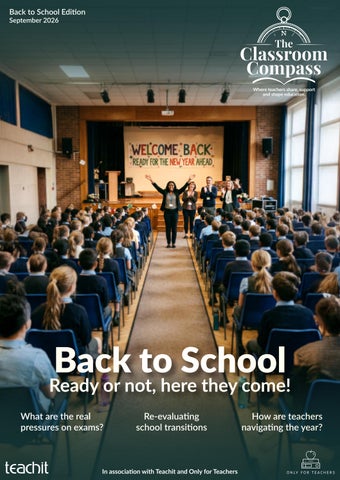
Back to School Edition September 2026
Where teachers share, support and shape education.
Back to School
Ready or not, here they come! What are the real pressures on exams?
Re-evaluating school transitions
In association with Teachit and Only for Teachers
How are teachers navigating the year?
LOOKING FOR VISUALISERS FOR EVERY TEACHER IN YOUR SCHOOL? HUE HD Pro cameras enable exceptional teaching, in every class. We now have one in every classroom and they have become a key tool to drive up thought and participation ratio during teachers’ modelling and feedback.
£58.29 ex. VAT | Volume discounts available Full HD 1080p visualisers Capture images and record videos with stunning clarity. Full A3 desk view.
Chris Kilby Assistant Head Brigshaw High School
Easy to use without training Plug & Play. No hassle, no fuss. Works instantly On any device or application that supports UVC ‘Plug & Play’ USB cameras. Windows, macOS, Linux, Chrome OS & most interactive white boards and TVs. Safe, secure & reliable Designed for teaching. Easy to deploy. Works completely offline.
SUPPORTING EXCEPTIONAL EDUCATION
DESIGNED IN
BRITAIN
LOVED WORLDWIDE
SAVE UP TO 20% huehd.com/schools *Pricing/offers subject to change
Have questions about classroom visualisers? huehd.com/contact
✓ 3-year warranty incl. ✓ GDPR compliant ✓ UK-based support team
LEARN MORE huehd.com/pro Follow @HUEcameras
INTRODUCTION
It’s September Again! Welcome to the back to school issue:
Welcome back! September is here again. We made it through the six-week holidays (which, let’s be honest, felt like both five minutes and an entire geological era). Hopefully, you’ve successfully purged your brain of the school gate codes, spent an acceptable amount of time ignoring emails, and managed to re-establish a sleep cycle that doesn’t involve waking up at 11:00 AM. But now, the staffroom kettle is working overtime, and we are officially back in the room. This month, we are tackling The Grand Return. We’re looking past the initial shiny optimism of week one -before the new stationery inevitably goes missing and the Pritt Sticks mysteriously lose their lids - to focus on what it actually means to shape the future adults of the world. No pressure, right? First up, we dive deep into the emotional rollercoaster that is the primary-to-secondary transition. We all know the vibe: a sea of Year 7s wandering the corridors looking like their oversized blazers are wearing them, utterly terrified of getting lost on the way to geography. But it’s
Join for Free Today!
not just a massive leap for the kids; it’s a testing time for educators too. We look at the unique impact this milestone has on both sides of the classroom desk, and how we can bridge the gap without losing our collective sanity. We’re also turning our gaze toward the horizon of exam prep. Yes, we know it’s only September, but the GCSE and A-Level freight train stops for no one. Rather than panicking in April, we’re looking at how to embed sustainable, low-stress preparation right from the starting block. You have shared with us how to potentially get students focused early without inducing a collective existential meltdown by October half-term. Finally, we’ve asked you exactly how UK teachers are planning to navigate the upcoming academic year. From boundary-setting (actually leaving at 4:30 PM, we promise it’s possible) to embracing AI tools that do the heavy lifting on lesson planning, this is your crowdsourced survival guide for 2026/2027. So, grab a mug of standardissue staffroom tea, take a deep breath, and remember: you’ve got this. The future of the country might be sitting in your classroom reading Shakespeare, but there is no one better equipped to handle them than you. Have a brilliant first term!
Only for Teachers is a free community where teachers across the UK can ask questions and share their views through quick, anonymous surveys about education - and see what other teachers really think. Each week, you can contribute your insights, and earn entries for cash prizes and rewards! Have a question you’d like to ask other teachers? Together, we’re building a trusted teacher community where every voice is heard, valued, and rewarded.
www.onlyforteachers.co.uk
Join today, share your voice, and help shape the future of education.
THE CLASSROOM COMPASS SEPTEMBER 2026 I 3
Re-evaluating Inclusion Why digital AP can be game-changing for inclusive education By Amy Husband Executive Head Academy21 Maintaining quality through live The logistical framework teaching of SEND provision within schools is undergoing a major For a digital inclusion strategy to be shift. Driven by recent DfE genuinely effective, the underlying reforms and a growing capacity instructional design must prioritise active engagement over passive crisis, schools are facing screen time. intense pressure to maximise mainstream participation and We know true inclusion embed inclusive values. requires human However, with physical space and specialist staffing stretched to their absolute limits, the practical challenge is finding realistic ways to support vulnerable pupils without compromising the quality of their education. Flexible online and hybrid AP is increasingly seen as a permanent, strategic layer of school infrastructure.
Expanding capacity outside physical constraints The requirement to support diverse student needs spans every key stage, but the internal resources available within a single school building are inherently finite. The DfE’s latest draft guidance on internal inclusion bases is clear about the need to create environments within the school where every child can achieve and thrive. Yet, logistically scaling highly individualised timetables on a mainstream budget often hits a wall. Integrating accredited digital AP provides an immediate, elastic solution to this capacity crisis – and it doesn’t have to be a last-resort measure for pupils who are already disengaged. Online provision is a critical structured tool for early intervention. Whether utilised for short-term respite or longer-term academic support, it allows a hybrid approach whereby schools can expand their capabilities, keeping vulnerable learners connected to their education while alleviating the physical pressure on onsite inclusion spaces.
interaction. This is why effective digital AP relies entirely on 100% live, realtime lessons delivered by qualified subject specialists who are trained to manage virtual classrooms.
A structured online learning environment, such as that offered by providers like Academy21, with direct teacher interaction and guided by individual teaching plans, is vital for rebuilding a pupil’s academic confidence and readiness to learn. Because the curriculum maps directly back to mainstream primary and secondary pathways, it prevents academic gaps from widening - making the eventual transition back to the physical classroom a manageable step rather than a jarring hurdle.
Data transparency and evidencebased practice Schools also need to see it working. Modern inclusion strategies require robust, evidence-informed approaches and continuous improvement. In this regard, well-designed digital learning platforms offer a major operational advantage: they provide data-rich environments where student progress is transparent, feedback is immediate, and interventions can be highly responsive. This connectivity solves a major historical headache: the remote tracking deficit. Instead of relying on disjointed, retrospective paper trails, real-time digital monitoring allows schools to dynamically track attendance, daily lesson engagement, and formative attainment.
Strategic integration for the modern school Ultimately, robust inclusion planning requires strategic leadership and strong partnership working. Accredited online AP should not be viewed as an isolated alternative, but as a core component of a modern, multi-tiered approach to intervention, supporting Universal, Targeted, and Targeted Plus layers of need from Key Stage 2 through to Key Stage 5. Embracing these integrated digital solutions ensures that schools can build a truly resilient, scalable, and inclusive system where no child is left without a suitable, high-quality education. FIND OUT MORE
CLICK OR SCAN
Speaking Shakespeare Unlocking oracy with the RSC
“Friends, Romans, countrymen, lend me your ears. I come to bury Caesar, not to praise him”
Rehearsal rooms are places of exploration, discovery and possibility, where actors try things out, fail spectacularly and eventually, together, find a way to tell their story in a way that is relevant for now. It’s a dynamic, inclusive, oracy-based approach to learning that everyone can So goes the speech made famous by access and which allows young people of William Shakespeare’s ‘Mark Antony’ in all ages to find their voices and discover Julius Caesar. their own form of self-expression on their As perhaps one of the most well-known own terms, articulating ideas, developing orations in Shakespeare, Mark Antony’s understanding and engaging with others powerful address to the people of Rome is through speaking the text, listening and a masterclass in linguistic persuasion and communicating together. manipulation. And like all the best political This Autumn, as part of a series of events speeches, it is written to be actively and productions to celebrate 20 years performed. of its transformative partnerships with The very reason plays like Julius Caesar schools, theatres and communities, the continue to be staged 400 years after RSC will be taking its new co-production they were written is precisely not because of ‘Julius Caesar’ (produced in partnership his plays are printed in books but because with KPPL) directly into classrooms they have been spoken out loud and across England. Giving over 20,000 young reinterpreted on stage over and over people from Cornwall to Coventry the again. opportunity to work with world-leading actors and creators, Olivier award-winning For teachers as much as for students, actor Dame Harriet Walter, will reprise her there is, so often, a persistent fear about role as Brutus, working alongside Director getting Shakespeare ‘wrong’. But his Phyllida Lloyd to bring Shakespeare’s enduring appeal lies in the fact there rich language to life both inside the isn’t a wrong or right and it is this spirit classroom and within local communities of active enquiry that informs the RSC’s in Peterborough, Bradford, Blackpool, rehearsal-based teaching approaches, Cornwall, Nottingham and the West which are rooted in the way our actors Midlands. and creative teams work. At the heart of the RSC’s Associate Schools Programme, which currently works with 16 associate regional theatres and 280 associate schools, from 100 towns and cities across England, is a deeprooted commitment to creating work that responds to local need and which is built on collaboration and reciprocal goals. By co-creating schemes of work that align with teacher needs, curriculum goals and tangible learning outcomes, students start
to see Shakespeare as something that belongs to them. They develop the confidence to speak the language, think critically and creatively, adapt, listen deeply and use this language to build understanding, all of which are essential skills for learning and for life.
“I have seen children’s confidence grow in front of my eyes when they start to own a speech or a character from a Shakespeare play”, Harriet Walter recently remarked at the point the production was announced. “They seem to say “Now I get it. I’m included and I have the key to the door. I have a voice and my voice matters…. In an increasingly polarised world, it is more important than ever to equip young people with the ability to express their own creative ideas with confidence and to explore the rich vocabulary Shakespeare has given the world.” To read more about the RSC’s Associate Schools Programme and First Encounters with Shakespeare productions, visit: https://associateschools.rsc.org.uk/
Julius Caesar (a Co-production with KPPL Productions) tours to RSC Associate Schools from 21 September to 23 October 2026. www.rsc.org.uk/first-encounters-julius-caesar-2026
in partnership with The Foyle Foundation
BE PART OF THE
teaching Shakespeare revolution Everything you need to design and deliver your classes, all in one intuitive platform. New for September 2026 Romeo and Juliet in addition to Macbeth. Teachers at UK state funded secondary schools and SEND schools can sign-up for free.
SHAKESPEARECURRICULUM.COM
BACK TO SCHOOL FEATURE
Balancing exam technique and access arrangements The real pressures on school exam preparation As schools return for the start of the 2026/27 academic year, departments are already looking ahead to the structural and operational demands of the upcoming assessment cycles. While the Joint Council for Qualifications (JCQ) continuously refines its regulations surrounding access arrangements and artificial intelligence use, the practical realities of preparing students remain a complex balancing act. Looking back at community survey data collected by Only for Teachers in the spring and summer terms of 2026, it is clear that secondary exam preparation has become a multi-layered logistical challenge. Feedback from teachers suggests that the terminal assessment period is shaped less by traditional content delivery and far more by intensive drilling in exam technique and navigating deep systemic workload bottlenecks.
Prioritising exam technique amidst rising secondary teacher workload When students reach the final stretch of their exam specifications, the allocation of contact hours becomes highly tactical. According to our survey data, a striking 54.6% of teachers stated that teaching students ‘how’ to answer questions - specifically focusing on exam technique and structure - absorbed the largest portion of time in their exam preparation lessons. This heavily outpaced the 22.7% of respondents who spent the majority of their classroom sessions delivering actual subject content, such as core facts, theories, and concepts. The remaining lesson time was divided between managing student behaviour (11.9%), helping students manage stress and exam anxiety (3.2%), or other non-applicable factors (7.6%). Therefore the stronger focus on exam mechanics highlights how high-stakes accountability measures dictate everyday classroom practice. This intense classroom focus was primarily driven by a need to mitigate what teachers perceive as the greatest single hurdle to student achievement.
When asked to identify the biggest barrier to their students performing well in exams, an overwhelming 61.6% of teachers pointed directly to students not doing enough independent revision outside of school hours. This vastly overshadowed concerns regarding high levels of student anxiety and mental health struggles (13.0%), a lack of sufficient curriculum time within the school year to cover the syllabus (15.1%), or the idea that the examinations themselves are becoming too difficult for the average student (5.4%). Unsurprisingly, this high-stakes environment exacts a significant professional toll. Over half of all surveyed teachers (54.6%) reported that their individual workload during mock and formal exam periods was ‘much higher’ than at any other time of the year, leaving them struggling to keep up with the volume of extra marking and administrative data entry. Only 23.2% felt the workload increase was moderate enough to be managed within normal working hours, underscoring the acute administrative fatigue that sets in during peak assessment seasons.
Helping students manage exam anxiety Behaviour management Teaching subject knowledge/facts, theories and concepts Teaching exam technique and question structure
Fig. 1. What takes up most time during exam preparation lessons?
Don't use AI themselves but check whether students have used it inappropriately
8 I THE CLASSROOM COMPASS SEPTEMBER 2026
Frequently use AI to create practice questions and revision materials
“A striking 54.6% of teachers stated that teaching students ‘how’ to answer question, absorbed the largest portion of time in their exam preparation.” - ‘Balancing Exam Technique and Access Arrangements’ survey 2026
Navigating the logistics of access arrangements and artificial intelligence The operational pressure on schools is further intensified by the statutory and ethical necessity of providing access arrangements, such as extra time, readers, scribes, or separate rooms for eligible candidates. Implementing these provisions under normal school operating conditions presents a monumental logistical challenge for leadership and teaching teams alike. Only 22.2% of survey respondents reported that providing special support during practice exams was ‘very easy’ due to well-organised school staffing and space. In contrast, 36.2% stated that their institutions actively struggled to find enough rooms or staff to help, while 15.7% described the situation as ‘very difficult’, noting that it felt almost impossible to meet every student’s individual needs. A further 20.5% managed the requirements but remarked that doing so required an extraordinary amount of last-minute effort.
Simultaneously, the widespread availability of generative artificial intelligence tools continues to alter the homework and revision landscape. Rather than completely resisting the technological shift, a significant portion of the workforce has begun absorbing these tools into their planning to hedge against workload inflation:
The survey found: •
•
•
•
Conclusion Teachers responding to the survey looked beyond general instructional guidance, pinpointing structural support as their primary need during exam season. A decisive majority highlighted that dedicated funding for external invigilators and reserved space for access arrangements are critical to stop teaching staff from being redirected into exam logistics.
Furthermore, respondents emphasised the need for centralised, high-quality banks of past-paper questions and mark-scheme breakdowns to reduce the time 42.2% of respondents utilised spent on manual resources, alongside AI occasionally, though they still clear, standardised school policies maintained a firm preference for regarding student independent study traditional textbooks and past expectations to bridge the revision papers. Helping students manage exam anxiety gap before formal exam periods 9.7% of frontline staff chose not begin. to use AI themselves butBehaviour found management they had to spend more time How is your department planning checking that students had notsubject knowledge/facts, Teaching theories and concepts to balance marking workloads used it inappropriately for their and access arrangements for the own work. Teaching exam technique and question structure upcoming mock cycles this term? 20.0% of teachers reported that the technology had not changed Share your insights and contribute to their classroom teaching or exam our community data by participating preparation methods at all. in our next weekly survey on the Only for Teachers platform. 18.4% of teachers used AI tools frequently to create practice questions and tailored revision materials.
Don't use AI themselves but check whether students have used it inappropriately Frequently use AI to create practice questions and revision materials No change to exam preparation approach Use AI occasionally but still prefer textbooks and past papers
FIND OUT MORE
Fig. 2. How are AI tools changing exam preparation? CLICK OR SCAN
www.onlyforteachers.co.uk THE CLASSROOM COMPASS SEPTEMBER 2026 I 9
Online Professional Development Courses for Schools
Institutional access now available for your school
Expert-led. Adaptive by design. Practice-driven. Evidence-rich by outcome.
Hachette Learning Academy complements your existing CPD programme with evidence-informed, competency-aligned online learning that supports teachers at every stage of their career. Choose the model that best fits your organisation — from bulk course licences for school-wide development on priority topics to full Academy subscriptions providing unlimited access to our online courses.
How is learning turned into action and impact? 01
03
egic oversigh t a r t St
Starting point
Prime knowledge and select an individual learner pathway.
Classroom application
igh ligh
to h
g ed
tin
g ag
Capture confidencebased responses, highlight misconceptions, and receive targeted remediation.
or
Adaptive study
t ync ete rated comp
02
t priorities.
Integ
Apply understanding in context through case studies and openresponse tasks.
ev
ide nc ew
ith individual and
hachettelearning.com/academy
up gro
re
p
04
Reflection & refinement
Apply reflection in practice, refine and embed strategies, and review their impact on learning.
How can Hachette Learning Academy support your school? • Leadership reporting offers a strategic overview of participation, progress and engagement across the school. • Individual portfolios and certification provide clear evidence of professional learning and impact. • Together they support appraisal, school improvement and inspection readiness • Independent recognition through the CPD Certification Service provides external endorsement and confidence in course quality and standards
Why Hachette Learning Academy? Expert-led:
Evidence-rich by outcome:
. Written by leading practitioners
. Turn application tasks into clear, measurable impact evidence
. Research translated into classroom strategy
Adaptive by design: . Strengthen understanding through personalised, confidence-based questioning . Diagnose gaps, reshape learning and benefit from targeted remediation
. Build a competency-tagged professional portfolio that showcases growth
Practice-driven: . Real-time reporting insights to set priorities and generate inspection-ready evidence . Shared expectations and language to ensure consistency
For more information, visit Hachette Learning Academy or contact your sales consultant. hachettelearning.com/academy UK Schools & Colleges Enquiries: education@hachette.co.uk +44 (0) 1235 827 720
How New Online CPD is Supporting Oracy By Anna Bejshovcova EAL educator, teacher trainer and author. As an EAL Lead I’m particularly interested in ensuring that EAL support is not seen as just the remit of the EAL department.
So yes, oracy is a crucial skill, but it is also a very complex skill which relies on the effective and simultaneous use of various physical, cognitive, linguistic and social-emotional underlying abilities.
That’s why I’m trying to promote the use of best English language practices in all classrooms (homeroom and specialist) and oracy development is one of those best practices. When Hachette Learning Academy approached me with the idea of creating an online course, my first thought was immediately – we need one on Oracy.
Barriers to Confidence
Embedding Oracy Skills
Second, people may think that they don’t have good ideas to share.
Oracy is such a crucial and complex ability. It’s crucial because we need to communicate with others orally very frequently on a daily basis for two key reasons: interactional (to establish and maintain social relationships) and transactional (to convey and exchange information to basically get what we want in life). If you’re not able to express yourself clearly and appropriately in a range of situations, your chances of succeeding in life may be significantly hampered: you won’t get ahead in your education, in your career and even in your personal life which may result in plenty of missed opportunities and in mental health risks too.
Specialists on oracy development usually identify four key reasons for students to find speaking challenging. First of all, some people are naturally shy, and speaking is just not something that comes easy to them.
The third reason, and that’s particularly relevant to students who are just beginning to learn English, is that they don’t yet have the language to express the ideas they want to express. Finally, and again this is mostly relevant to our English language learners, they may not feel the need to try to use English as it is more comfortable for them to discuss ideas in their primary/ home languages. To overcome these challenges, educators need to ensure that they create a safe and encouraging environment for students to speak.
Creating an Online Oracy Course Obviously, as in any good training course, I started by ‘establishing the need’. All of what I’ve briefly mentioned above, as in why oracy is crucial and why it is such a complex skill, is presented and further clarified in part one of the course with plenty of opportunities for the course participants to consolidate their knowledge through regular spot checks. The course then moves on to talking about General Oracy (what it means to be a good speaker, how speaking is different from writing, why our students might find speaking challenging and how we can help them overcome these challenges).
Analysing Oracy in Academic Contexts After that, we move on specifically to analysing Oracy in Academic Contexts. This part of the course is highly practical in nature, and you can find different templates for oral
“If you’re not able to express yourself clearly and appropriately in a range of situations, your chances of succeeding in life may be significantly hampered.” - Anna Bejshovcova activities which can be successfully used in academic settings. Essentially, the course is structured by going from more general oracy-related principles to more academic contexts while constantly encouraging course participants to reflect on what they read and apply this knowledge to their own teaching context.
Drawing on an EFL Background I think I’m quite lucky that I came into international schooling from an EFL background. In EFL, you often have students who have very little exposure to English outside of their schools and language centres. As an EFL teacher you have to work very hard to help these students start communicating in English and you carefully create conditions for them to actually want to do it. So this is something EFL specialists are quite good at, and we have a lot of tricks up our sleeves which may not have yet found their way into the world of mainstream education!
Positive impacts In our EAL programme this year, we’ve been very purposefully introducing very explicit oracy-related activities in our curricula for each year group. What we are seeing so far is that our students are more engaged (because people do like talking, they do like sharing ideas).
They are proud of being able to say things better than before. I just did a pyramid discussion activity and I was surprised at how much perseverance and engagement my students showed repeating the same ideas again and again, but doing it in a more advanced oral way. They didn’t seem bored. They seemed truly elevated and excited to do that. And the best outcome, that I think all of us will like, is that oracy has had a noticeable positive impact on our students’ literacy. Our students have started writing faster, better and with more enthusiasm.
www.hachettelearning.com/academy
To find out more about Hachette Learning Academy, visit www.hachettelearning.com/ academy where you can take a free introductory adaptive learning course for teachers and watch learner and educator demos. You can find the right person to speak to at www.hachettelearning. com/contact-us/find-a-salesconsultant or contact education@ hachette.co.uk. Institutional, whole-school access to Hachette Learning Academy is now available. Choose the model that best fits your organisation — from bulk course licences for school-wide development on priority topics to full Academy subscriptions providing unlimited access to our online courses.
BACK TO SCHOOL FEATURE
Navigational anxiety and the independence gap Re-evaluating the Year 6 to Year 7 transition As schools welcome their new cohorts for the 2026/27 academic year, the recurring challenge of managing the primary to secondary transition returns to the forefront of educational policy discussions. Over the last academic year, the Department for Education has increasingly emphasised regional school partnerships to help streamline progress between key stages. However, looking back at data compiled from Only for Teachers summer term surveys, a clear disconnect remains between administrative data sharing and the classroom reality. The findings indicate that structural communication barriers and a pronounced student independence gap are continuing to complicate how smoothly Year 7 students are likely to settle into their new environments this September.
direct continuation of Year 6 progress. Instead, the largest portion of respondents (34.3%) noted ‘partial consistency’ where data is shared but secondary departments must immediately implement an adjustment period. For 19.2% of teachers, the transition often felt like a ‘total restart’ with significant repetition of content, while 28.3% stated that consistency varied wildly depending on individual primary-secondary school partnerships.
respondents cited the sudden shift in discipline culture, with the move from a highly nurture-based primary model to a more strict secondary behaviour policy, as a major friction point that schools must actively manage as the new term begins.
Identifying vulnerability and the limits of cross-phase professional dialogue
The transition period is particularly complex for high-needs learners. In This operational friction directly the Summer survey, teachers voiced impacts the readiness of students. significant concern regarding how When teachers were asked to identify effectively vulnerable students - including ‘masking’ neurodivergent learners or those without a formal Education, Health and Care Plan (EHCP) - are - ‘Navigational anxiety and the independence gap’ survey 2026 supported during the move.
“19.2% of teachers, the transition often felt like a total restart”.
Addressing the independence gap and curriculum fragmentation A successful primary to secondary transition relies on curriculum continuity, yet data from our Summer survey indicates that true academic cohesion across the key stage boundary is exceptionally rare. Only 5.1% of teachers reported ‘high consistency’ where Year 7 begins as a
the primary barrier to a student’s successful emotional adjustment to secondary school, the results shifted focus away from traditional environmental worries. Rather than pointing to navigational anxiety - such as fear of larger buildings or losing equipment - teachers overwhelmingly highlighted a lack of personal resilience. A significant 51.8% of teachers identified this independence gap as the leading hurdle, noting that arriving pupils frequently struggle with selfregulation and managing independent study schedules. Additionally, 28.2% of
14 I THE CLASSROOM COMPASS SEPTEMBER 2026
A substantial 44.4% of surveyed teachers stated they were ‘concerned’ that the multi-classroom, multiteacher environment of secondary schools causes hidden high-needs students to spiral. Furthermore, 15.2% identified a critical gap, observing a surge in school refusal or behavioural incidents due to inadequate transition infrastructure, while 19.2% reported that they lacked the teaching assistants or intervention staff to support the vulnerable pupils they had already identified. Only 21.2% felt confident that transition days and SENCo handovers provided an effective roadmap.
This difficulty in safeguarding vulnerable learners is tied closely to the lack of structured communication channels open to staff. Cross-phase professional dialogue remains 100 constrained by scheduling conflicts and 90 systemic division: 80
•70 39.4% of teachers reported that schedules only allowed for 60 ‘limited’ dialogue, providing a brief 50 handover for vulnerable individuals 40 only. •30 31.3% of respondents revealed they work in silos with no 20 scheduled contact time at 10 all, relying entirely on the 0 administrative transfer of digital files. • Only 24.2% of staff enjoyed dedicated time for ‘moderation days’ or formal cross-phase meetings. • 6.1% of teachers noted that communication only occurred on 100 an ad-hoc basis when an active crisis unfolded with a specific child. 90
This lack of structured communication leaves secondary teachers trying to piece together a pupil’s history from digital files alone. Without time for proper conversations, key details about student behaviour and emotional needs get lost, making it much harder to provide the tailored support these children need when starting Year 7.
spreadsheet transfers. Cultivating student independence and securing dedicated time for cross-phase professional dialogue are essential to prevent all learners but particularly those who are vulnerable from experiencing an autumn dip.
Furthermore, teachers emphasised that having shared resources Compounding this structural specifically aimed at bridging the disconnect is an underlying layer of student independence gap before parental hyper-vigilance. A combined September, alongside targeted funding 80.8% of teachers that forandearly intervention staff to support Stressstated over the loss of primary friendship groups the ‘social media’ jump parent and carerFearanxiety regarding non-EHCP vulnerable learners, would of the larger building, timetables and losing equipment the transition had either increased significantly ease the transition The transition from a ‘nurture-based’ primary model to a ‘strict/legalistic’ secondary behaviour policy (37.4%) or remained predictably high friction for both staff and pupils. A lack of resilience in managing homework, self-regulation, and ‘personal agency’ (43.4%), with families expressing intense concern over academic setting, How has your department adjusted bullying, and the precise legalities of its transition strategy for the new their child’s educational provision. intake this term? Share your insights and contribute FIND OUT MORE to our upcoming Conclusion community data by participating in our The data we collected earlier this next weekly survey year demonstrates that bridging the on the Only for primary to secondary transition gap CLICK OR SCAN Teachers platform. requires moving beyond automated
80 70 60 100 50 90 40 80 30 70 20 60 10 50 0 40
Fig. 1. In your observation, what is currently the primary barrier to a student’s successful emotional adjustment to secondary school? Dialogue only happens when a crisis occurs with a specific student We have scheduled ‘Moderation Days’ or ‘Cross Phase’ meetings We work in silos: the only ‘link’ is the administrative transfer of files We have a brief handover for ‘vulnerable’ students only
30
Stress over the loss of primary friendship groups and the ‘social media’ jump
20
Fear of the larger building, timetables and losing equipment
10
The transition from a ‘nurture-based’ primary model to a ‘strict/legalistic’ secondary behaviour policy
0 100 90
A lack of resilience in managing homework, self-regulation, and ‘personal agency’
Fig.2. How has the level of parent/carer anxiety regarding the transition changed over the current academic cycle?
80 70 60 100 50 90 40 80 30 70 20 60 10 50 0 40
Our transition webinars and ‘Welcome Events’ have successfully managed expectations We are struggling to reach the parents of the students who need the most transition support Parents are more hyper-vigilant about ‘setting’, bullying, and the ‘legalities’ of their child’s provision Parental anxiety remains high but predictable
30
Dialogue only happens when a crisis occurs with a specific student
20
We have scheduled ‘Moderation Days’ or ‘Cross Phase’ meetings
10
We work in silos: the only ‘link’ is the administrative transfer of files
0
THE CLASSROOM COMPASS SEPTEMBER 2026 I 15
We have a brief handover for ‘vulnerable’ students only
Welcoming new EAL Arrivals Five steps for a whole-school approach More than one in five pupils in UK schools now speak a language other than English at home.
Small actions can all help create a sense of belonging by:
“ •
Learning how to pronounce a pupil’s name correctly Introducing a peer or language buddy Providing essential school information in their home language
• For schools welcoming new pupils • with English as an Additional Language (EAL), the first few weeks can play an important role in helping learners feel like they belong, while ensuring teachers 3. Establish an accurate starting understand the support they need. point New arrivals are far from a single, homogeneous group. One pupil may have strong literacy and academic knowledge in their home language but may be at an early stage of learning English. Another may have experienced interrupted education. Therefore, understanding the individual learner is essential. Here are five practical ways schools can build a consistent approach from day one.
1. Make EAL a whole-school responsibility
Supporting multilingual learners is a whole-school responsibility, not just the job of an EAL lead or single department. Pupils encounter language in every lesson, so teachers and support staff across the school need a shared understanding of EAL. Regular CPD can help staff develop practical strategies for scaffolding learning, differentiating effectively and supporting pupils who may also have experienced disrupted education.
English proficiency goes beyond classroom confidence. A learner who communicates comfortably with friends may still struggle with the academic language required to access the curriculum. Establishing a baseline across listening, speaking, reading and writing gives teachers a clearer picture of proficiency and provides a consistent starting point from which progress can be monitored.
A pupil’s home language is an asset, and is just as valuable as their English develops. Displays representing the languages spoken across the school, bilingual resources and opportunities to use home languages can help pupils feel recognised while supporting learning. Visuals and dual coding can also make classroom instructions and new vocabulary more accessible.
5. Maintain high expectations
A structured welcome can make the transition into a new school considerably easier. Speak to pupils and their families about:
Learners developing English proficiency should still be able to access an ambitious curriculum. Instead of simplifying what pupils learn, consider how the same content can be made accessible through scaffolding, visual support, bilingual glossaries and carefully differentiated instruction.
Previous schooling Languages spoken Literacy in their home language Any known additional needs
When that information is understood and shared across the school, staff can make more informed decisions and give multilingual learners the support they need to participate, progress and thrive.
Supporting new arrivals with FlashAcademy®
4. Create a multilingual environment
2. Build a clear induction process
• • • •
Ultimately, effective support for new EAL arrivals begins with understanding the individual: where they have come from, what they already know and where their English proficiency currently sits.
16 I THE CLASSROOM COMPASS SEPTEMBER 2026
FlashAcademy® helps schools identify and support the individual needs of multilingual learners from day one. Assess English proficiency across listening, speaking, reading and writing, establish a clear baseline and track progress over time. Learners can then build their English through personalised learning accessible from 48 home languages, while teachers use a central dashboard to understand proficiency and plan appropriate support.
See how FlashAcademy® supports EAL provision →
Save up to 150 hours per year with FlashAcademy See how it works
Hitting all the Right Notes A spotlight on ABRSM’s innovative ‘Teaching Hub’
By Emily Griggs. An experienced teacher working in the lead school for music in the London Borough of Hillingdon. It’s the beginning of another academic year. Teachers enter school fresh-faced with a postholiday glow, ready to tackle the year ahead.
providing high-quality music education and experiences. These were further developed in 2024 to appoint lead schools within the area who could share their expertise and offer advice. Yet these hubs remain an untapped resource. If your school requires They look at their timetable, and there instruments, your local hub may have it is: Music. Carefully positioned next some available to loan and some to the science or art lesson that is also offer subsidised subscriptions likely to overrun. It is a scenario that to schemes of work. Also, enquiring is all too common in primary schools. as to whether your hub can invite Despite the fact that music plays a part you to become a ‘Music Mark’ school in all our lives, it is a subject that many may be beneficial. Membership gives teachers lack confidence in teaching you access to resources and training and dread leading. events.
With the announcement of the new Enrichment Framework in June, schools also need to consider music opportunities beyond curriculumbased music. This could include running music ensembles and organising performance opportunities; the Teacher Hub includes repertoire for mixed ensembles that could be utilised. Alternatively, schools could look to providing live performances through links forged with local secondary schools or colleges, who may be able to invite your school to productions, concerts or visit with a group of musicians.
There is a plethora of reasons for this barrier between teachers and teaching music. There remains a misconception that not being able to read music means you are unable to teach music. Yet there are many accessible ways of notating music that are often overlooked. Another issue that many teachers in the state sector currently face is whether their subject is adequately resourced, and, as is often the case, will the budget provided extend to investing in resources and enrichment opportunities for children? These concerns are of course perfectly valid; however, there is support available and resources that can be utilised to deliver a high-quality music curriculum.
Giving children the opportunity to express themselves, develop their creativity and enjoy a subject of a practical nature, can be a valuable learning experience and do wonders for their confidence and wellbeing. So, the next time you consider shying away from music for another week, remember, the primary framework forms a significant part of a person’s musical journey. Ideally we should be fostering a love of music and laying the foundations of their understanding.
Since the first National Plan for Music Education was published in 2011, music hubs have been established, with the aim of supporting schools in
Sourcing material for your school curriculum can be challenging. Subscriptions can be costly and writing units of work and preparing resources from scratch isn’t viable. However, there are many high-quality resources that are free to access. For example, signing up to ABRSM’s Teacher Hub has an array of benefits. In 2023, ABRSM launched Classroom 200, with ready-made lesson plans linking to suggested repertoire from the Model Music Curriculum.
Teacher Hub membership also provides There is support out there and access to practical courses as well as fantastic resources at your fingertips; quick CPD material. Through a range utilise them and enjoy making music! of podcasts, videos and articles, the FIND OUT MORE Teacher Hub material aims to build confidence in teaching music and improve practice, discussing everything from subject assessment, to how to approach key musical skills such as composition. CLICK OR SCAN
18 I THE CLASSROOM COMPASS SEPTEMBER 2026
Sign up today for free!
BACK TO SCHOOL FEATURE
Balancing Classrooms and Compliance
How teachers are navigating the 2026/27 academic year With a new academic year just beginning, staffrooms across the country are balancing a renewed sense of professional optimism against the structural realities of modern schooling. Data pulled from a recent Only for Teachers survey offers an illuminating snapshot of how professional millennial teachers are framing the 2026/27 academic year. While classroom enthusiasm remains remarkably resilient, severe resource constraints - particularly around Special Educational Needs and Disabilities (SEND) provision - and persistent administrative burdens continue to shape professional expectations.
However, this internal motivation stands in stark contrast to teachers’ views on external support. The data reveals a deep-seated scepticism regarding national education policies and funding adjustments. Only 7.8% of frontline professionals feel it is ‘highly likely’ that national policy shifts will positively impact their day-today teaching environment this year. Conversely, a combined 49% view positive policy impacts as either ‘unlikely’ (28.8%) or ‘highly unlikely’ (20.3%). This divide highlights a clear pattern across the workforce: teachers remain deeply committed to their students and their classroom practice, even as their trust in central government to solve systemic challenges continues to erode.
“
Optimism in the classroom despite The SEND crisis dominates systemic policy doubts timetable preparation
The headline takeaway for the upcoming term is a refreshing wave of classroom positivity. When asked about welcoming new classes and implementing fresh lesson ideas this September, an overwhelming 50.3% of teachers described themselves as feeling ‘effective’, with an additional 11.8% reporting they feel ‘highly effective’. Combined with the 30.7% who feel ‘somewhat effective’, over 92% of respondents are entering the new school year with a proactive, constructive mindset according to our survey.
When analysing upcoming timetables, curriculum allocations, and class lists, one operational challenge completely eclipses the rest. More than half of all surveyed professionals (52.9%) state that meeting diverse learning needs - specifically ensuring high-quality differentiated support for students with SEND amid stretched external resources and teaching assistant (TA) allocations - is the area requiring the most careful management.
is compared to other traditional pressure points: This data confirms that the SEND crisis remains the defining operational hurdle for the 2026/27 cycle. With funding formulas failing to keep pace with the volume of Education, Health and Care Plans (EHCPs), teachers are increasingly left to differentiate complex lessons with diminishing classroom assistance.
Workload, administrative duties, and the leadership buffer Workload reduction remains a primary challenge for staff retention. The survey shows that administrative duties like data drops, marking, and email volume are still expected to encroach into personal time. A significant 51.6% of teachers expect a ‘moderate impact’ on their worklife balance, while 36.6% anticipate a ‘critical impact’ requiring significant evening and weekend work. Critically, teachers are split on whether senior leadership teams (SLT) are buffering this pressure effectively. While 39.2% agree and 9.2% strongly agree that their SLT is taking proactive steps to reduce workload, a notable 25.5% actively disagree or strongly disagree.
The raw numbers from the survey highlight how severe this concern
“Only 7.8% of frontline professionals feel it is ‘highly likely’ that national policy shifts will positively impact their day-to-day teaching environment this year.” - ‘Balancing Classrooms and Compliance’ survey 2026
20 I THE CLASSROOM COMPASS SEPTEMBER 2026
“An overwhelming 50.3% of teachers described themselves as feeling ‘effective’ at welcoming new classes and implementing fresh lesson ideas this September.” - ‘Balancing Classrooms and Compliance’ survey 2026
For school leaders, the message from our teachers for the 2026/27 year is clear: professional goodwill is high, but administrative systems must be streamlined to protect staff from burnout.
Next steps for the community To look ahead at the 2026/27 academic year is to witness a profound contrast between classroom resilience and systemic frustration. The data from the survey paints a clear picture of the modern UK teaching landscape: a workforce driven by immense professional dedication but heavily constrained by operational realities. As the 2026/27 academic year begins, one thing is evident: while teachers possess the tools, talent, and mindset to deliver exceptional learning, they are increasingly forced to act as shock absorbers for an under-resourced system. For school leaders and policy advocates, the message is plain - preserving this vital classroom optimism requires moving away from surface-level wellness initiatives and focusing instead on cutting administrative waste and delivering robust, ringfenced support for SEND provision.
Highly prepared: I’ve already started auditing my data for
the digital move The government’s new Every Child Achieving and Thriving white paper introduces digital Individual Support Plans (ISPs) this September. How Cautiously optimistic: I understand the theory, but I’m waiting prepared do you feel to transition your SEND forcurrent the platform training records into this new system?
Concerned: I’m worried about the administrative ‘double-handling’ during the transition Uninformed: I haven't yet received clear guidance on how our school will implement ISPs
Highly prepared: I’ve already started auditing my data for the digital move Cautiously optimistic: I understand the theory, but I’m waiting for the platform training Concerned: I’m worried about the administrative ‘double-handling’ during the transition Uninformed: I haven't yet received clear guidance on how our school will implement ISPs
With the 6 week holiday approaching, which ‘lesson learnt’ from previous years will most influence how you set summer transition work or expectations for your new cohort?
The ‘Formal Approach’: Compulsory bridging units to ensure a fast start in September The ‘Essential Skills’ Focus: Targeted work specifically to prevent the ‘slide’ in core numeracy/literacy The ‘Low-Stakes’ Bridge: Providing optional, high-interest activities (podcasts, AI-interactive tasks) The ‘Wellbeing First Approach’: Setting zero academic work to ensure a total mental reset
The ‘Formal Approach’: Compulsory bridging units to ensure a fast start in September The ‘Essential Skills’ Focus: Targeted work specifically to prevent the ‘slide’ in core numeracy/literacy The ‘Low-Stakes’ Bridge: Providing optional, high-interest activities (podcasts, AI-interactive tasks)
FINDzero OUT MORE work to The ‘Wellbeing First Approach’: Setting academic
ensure a total mental reset Do you have opinions and/or concerns about the new school year? Join the conversation and contribute your views to our next weekly survey on the Only for Teachers platform.
CLICK OR SCAN
www.onlyforteachers.co.uk THE CLASSROOM COMPASS SEPTEMBER 2026 I 21
Five evidence informed techniques
to help students build revision habits that last By Harry Smith Series Consultant, Pearson Revise The start of a new academic year is the ideal time to establish revision routines that students can build on throughout the year.
Look for revision resources that break revision into manageable chunks, to reduce cognitive overload and make revision feel more achievable.
Pearson’s 2026 Pulse research found that 7 in 10 educators use revision resources all year-round, recognising that effective revision begins long before exam season. Developing good revision habits early can help build students’ confidence, reduce feelings of overwhelm and improve exam readiness.
Dual coding combines words with visual representations to improve understanding and recall. Diagrams, timelines, flowcharts and worked examples can help students process complex information more effectively than text alone.
Although no single method suits everyone, these five evidence-informed approaches can help your students revise more effectively.
1. Retrieval practice Retrieval practice strengthens memory by asking students to recall information without looking at their notes. One popular technique is blurting: students study a topic, put their notes away, then write down everything they can remember before checking for omissions or misconceptions. Actively retrieving recently revised information strengthens long-term memory while highlighting areas that need further attention. Structured revision resources organised by topic can support this process by helping students quickly identify and revisit gaps in their knowledge.
2. Spaced practice and interleaving Many students still rely on long revision sessions focused on a single subject. Spacing learning over time and interleaving different topics can help support stronger long-term retention. Encourage your students to: • Revise in shorter sessions across different subjects • Revisit topics regularly rather than cramming • Review previous learning for a few minutes before moving on to new content.
3. Dual coding
For example, biology diagrams can reinforce understanding of processes, while pairing vocabulary with images can strengthen language learning. Encouraging students to represent information in multiple formats can create richer memory pathways, making recall easier during exams.
4. Elaboration and concrete examples Elaboration encourages students to explain concepts in their own words and connect new learning to existing knowledge. Students are much more likely to understand and recall linked information rather than isolated facts. A history student might relate historical events to contemporary issues, while an English student could compare themes across texts. Guiding your students to support explanations with concrete examples may also help them produce stronger, more analytical responses in exams.
5. Practising exam questions and using feedback Revision should prepare students not only to remember content but also to apply it under exam conditions. Regular exam-style practice helps students become more familiar with command words, improve their response structure and build confidence. Equally important is high-quality feedback that explains how students can improve, enabling them to target misconceptions and refine their exam technique over time. Digital tools that provide immediate personalised feedback, alongside print resources featuring model answers and examiner guidance, can support this process both in and beyond the classroom. There is no single “right” way to revise. The most effective revision combines retrieval practice, spaced learning, meaningful connections between ideas, and regular exam practice with opportunities to act on feedback. Introducing these habits early in the school year can help students develop more purposeful revision routines, reduce anxiety around exams and build the confidence they need to succeed.
Learn more about Pearson Revise at: pearsonschools.co.uk/pearsonrevise FIND OUT MORE
CLICK OR SCAN
Photography by Tom Bradley
Teach Hope For over sixty years, UK school fundraising has helped us treat and support countless children and families affected by leprosy.
Our free teaching resources help children carefully and sensitively explore curriculum-based themes such as prejudice, isolation, discrimination, and most importantly, hope.
www.lepra.org.uk Patron: His Majesty King Charles III Vice President: His Royal Highness The Duke of Gloucester KG GCVO Lepra, 28 Middleborough, Colchester, Essex, CO1 1TG. 01206 216 700 - lepra@lepra.org.uk. Registered charity number: 00213251 (England and Wales) SCO39715 (Scotland)
Resilience, innovation, and strategy How are teachers feeling about the coming academic year?
High teacher engagement and classroom optimism A standout positive takeaway is the remarkably high level of professional dedication and enthusiasm among teachers heading into the 2026/27 academic year. Despite systemic challenges, an overwhelming 92.8% of surveyed teachers feel optimistic about welcoming new classes and introducing fresh lesson ideas. Over half (50.3%) report feeling “effective,” and 11.8% feel “highly effective,” demonstrating that teacher’s passion, and student-centered commitment remain exceptionally resilient. Teachers enter the school year with a proactive, constructive mindset that serves as a strong foundation for student achievement and positive classroom environments.
Strategic integration of AI tools to reduce workload The data highlights a forward-thinking, adaptive approach by teachers who are embracing generative artificial intelligence tools to streamline their planning and offset heavy administrative workloads. Over 60% of surveyed teachers actively utilise AI in their practice, with 18.4% using it frequently to generate practice questions and customised revision materials, and 42.2% using it occasionally alongside traditional textbooks. By absorbing these modern technologies into their exam preparation strategies, teachers are finding innovative ways to mitigate workload fatigue while expanding their bank of learning resources for students.
Targeted focus on mastering essential exam techniques Rather than relying solely on traditional content delivery, teachers are taking a highly strategic, practical approach to exam preparation. A majority of teachers (54.6%) allocate the largest portion of their preparation lesson time specifically to teaching students how to answer questions, focusing on structure and exam technique. This tactical instructional focus helps demystify high-stakes assessments for pupils, directly addressing key learning gaps and equipping students with the exact analytical mechanics and procedural confidence required to perform well under formal assessment conditions.
The next edition of The Classroom Compass will be our SEND issue - don’t miss the next issue on Thursday 12th November! To ensure your opinion feeds into future editions of The Classroom Compass, sign up to Only for Teachers and complete our weekly surveys!
24 I THE CLASSROOM COMPASS SUMMER 2026
FIND OUT MORE
CLICK OR SCAN
See how it works
Saving with Teachers Building Society helps teachers buy homes
Our mission since the 1960s has been to help teachers with smaller deposits take their first steps on the housing ladder. Our savers are integral to this. Like all building societies we use savings deposits to fund mortgage lending, but unlike other building societies, saving with us directly supports teachers (like the ones teaching your children) in buying a first home. We think that’s something special, something to be proud of, something to be celebrated.
teachersbuildingsociety.co.uk
Teachers Building Society, Allenview House, Hanham Road, Wimborne, Dorset BH21 1AG. Authorised by the Prudential Regulation Authority and regulated by the Financial Conduct Authority and the Prudential Regulation Authority (Reg No. 156580)