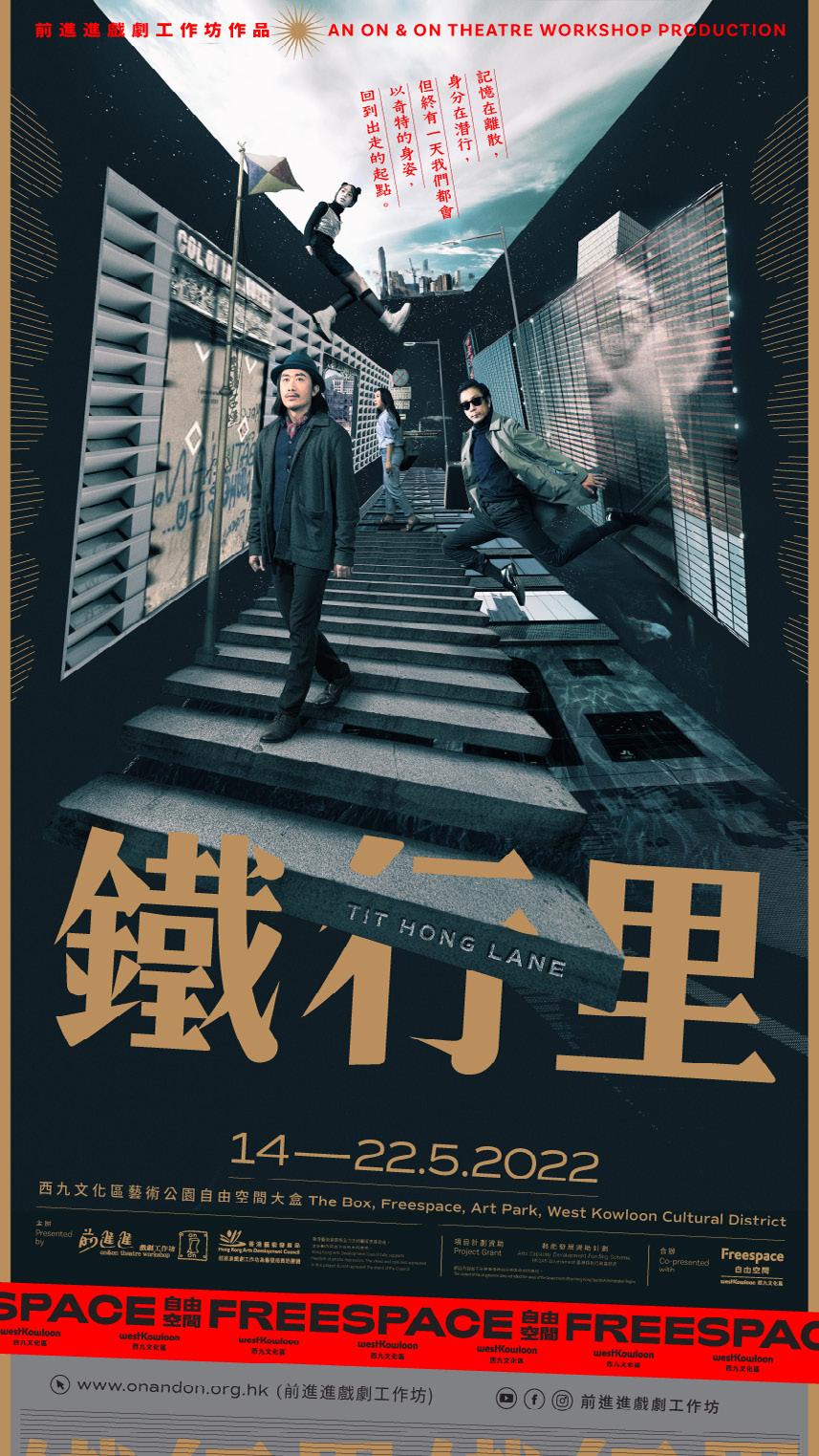
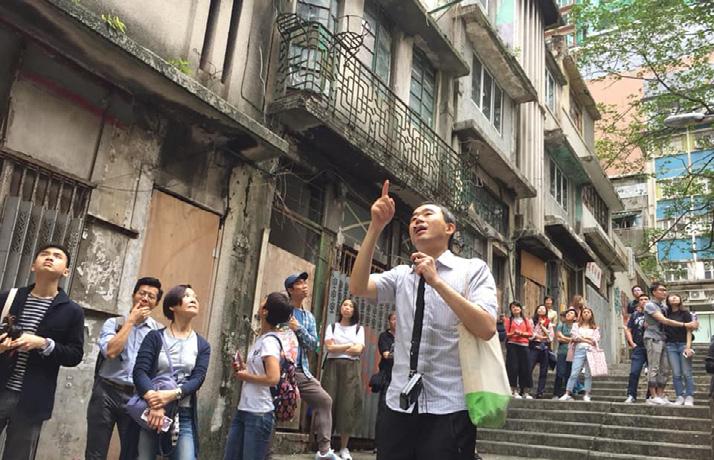
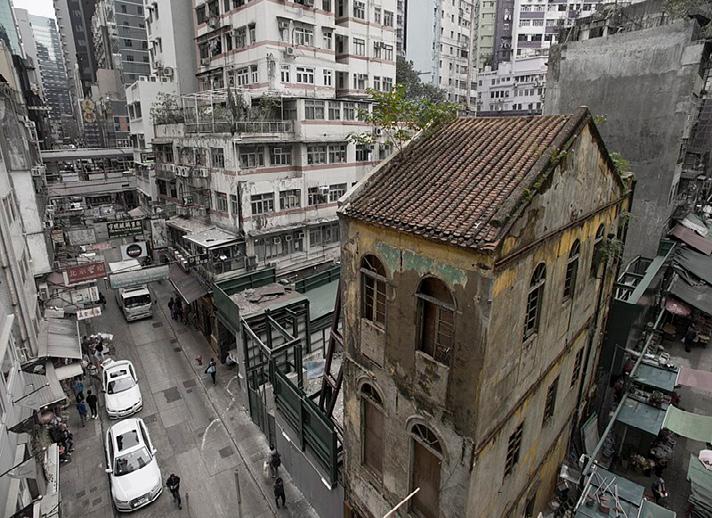
In 1845, Tit Hong Lane was home to the prestigious waterfront office of the P&O shipping company, whose operations at the time connected the entire British Empire. Over passing years, reclamation and development shifted the Central coastline north and transformed the lane into a nondescript cul-de-sac at the base of a giant, glossy building. But while the roots of its name and the original businesses that worked there have faded from memory, the history of the lane remains.
Inspired by the family story of director Chan Ping-chiu, On & On Theatre Workshop’s Tit Hong Lane is a multimedia rec-
ollection of a life, a lane and a homeland. Interweaving personal anecdotes and childhood dreams with archival documentation, the performance shifts between individual and collective memories, collaging fragments to reveal the layers of a city’s history and identity. What unfolds is a magical, thought-provoking reflection on the nature of home, diaspora, exile, and the real and fabricated narratives that shape our past, present and future.
*The story, characters, and incidents about the urban planner Chan Ping-chiu and Turkish poet Efe Duyan portrayed in this production are fictitious.
Scenes & Cast list
Prologue
Chan Ping-chiu as Chan Ping-chiu
CY Ling as Jogging young man
Tit Hong Lane
Shirlee Tsoi as Chan Ka-yan, block owner
Adam Tang as Siu Ping
Suyin Kan as Chi-u
How the City Remembers
Leung Tin-chak as Chan Ping-chiu
Chu Pak-hong as Chan Ping-chiu
Santayana Li as Volunteer
Stalker
Chiu Lo-yin as Stalker
Suyin Kan as Mr Cheung
Shirlee Tsoi as Mother
Adam Tang as Young man
Homestead of Our Being Chan Ping-chiu
In 2019, while living in To Kwa Wan, I was faced with the decision of whether to give up my family’s ancestral home in Central and cut off the only remaining connection I had with the neighbourhood I grew up in. This “old homestead” my mother left me 20 years ago had been left unattended this whole time – I simply let it run its course. In fact,
moving out of Central in the 2000s was a relief for me. I was able to live a quiet life in the quaint alleys of To Kwa Wan and enjoy a cosiness that I had almost grown stranger to. I had vowed to stay away from Central and even quit my night strolls. That was not easy for me, like keeping a boozehound from his drinks.
I had always thought that it was Einstein who said “time is a captive of space”, but the truth is, I don’t remember where I read it and can’t trace its origin, just like there is no way to access the floor plans of pre-war buildings. But it stuck in my head like an unauthorised structure, erected by my youthful angst. It was a statement that spoke to how much the teenage me wanted to get away from my community, and how much I dreaded the external envi-
ronment that surrounded me. I always looked at Central as a cruel enclave of power and domination. But with age, I started to feel a tenderness and reverence for the generations of people in my family who had struggled to make a living in Central Market. Every time I recall a scene from my childhood, no matter how trivial or muddled it is, I hold on to those feelings. These little fragmented vignettes of the past are like artefacts, allowing me to stitch the shattered images together and keep the story of my family and Central alive.
When I decided to write the script for this project, I knew I’d have to try hard to keep my own ambivalence about Central in check and refrain from referencing real people and events. Like Walter Benjamin explained in Berlin Childhood
around 1900, in writing this book he had sought to limit the effect of personal feelings through “insight into the irretrievability – not the contingent biographical but the necessary social irretrievability – of the past”.
Therefore, I chose not to use the anecdote-rich 30 Houses or Central Market neighbourhoods as the jumping-off point of the story, but Tit Hong Lane – a tiny, inconspicuous street with seemingly nothing to tell. It was not only where I spent my formative years, but also home to the original headquarters of the Peninsular and Oriental Steam Navigation Company. During the development of this project, I was emotionally affected by the diaspora of Hongkongers and the heart-wrenching goodbyes that came with it. The old painting of a
woman standing on the jetty with the verandaed P&O building behind her strikes as a clairvoyant’s vision, recalling the city’s past and foretelling its future. For me, the two neighbourhoods of my childhood, 30 Houses and Tit Hong Lane, represent the two distinct spatial existences in urban life: the home that we can never return to, and the non-place marked by alienation and the absence of history or identity. In this sense, all city-dwellers are exiles, longing to be home again, and the only way for us to return is by weaving together our memories and desires, and connecting with one another through hope and imagination.
The Extended Imagination on the Entanglement of Space and Memory within Tit Hong Lane
Suyin Kan
1 / (Space + City) x (Memories + History) = ?
According to French philosopher Maurice Halbwachs, a memory is an experience spawned from the existence of an individual or a group, and when that experience ceases to continue, history steps in and takes over, making the final judgement on a collective memory, deciding which recollections are allowed to enter the official record. History is a space where the narrative is given the
power to manipulate times, places and events based on a tidy internal logic. By contrast, individual memories are divergent and fragmented, with a murky relationship to time and space. It is where personal perspectives are free from the control of an overarching account or agenda.
On the topic of history and memory, German theorist Walter Benjamin had a different view. He opined that unlike architecture, which can serve as a catalyst for remembrance, historical records –carried by text, imagery and footage –have the ability to conjure distorted or
even false memories in unwitting individuals. History is a pile of rubble, made of the debris of countless appropriated perspectives and recollections, and we are all searching for clues and meanings in the wreckage of the memories of others.
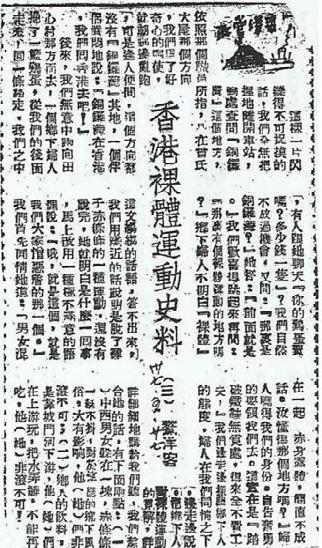
While many trained historians – from Ernst Johann Eitel and Geoffrey Robley Sayer to George Beer Endacott and John M. Carroll – have written methodically about the early history of Hong Kong, local authors such as Ng Bah-ling, Yeh Ling-feng, Ng Ho and Lo Kam have kept their own accounts of the city’s colourful past. And compared to the historiographical efforts of western academics, their anecdotal records and personal memories seem to better capture our imagination of historic Hong Kong and its inhabitants.
In recent years, public figures such as cultural critic Ma Ka-fai and musician Tats Lau have also joined folk history writers in sharing their intimate memories of Hong Kong as a way to connect with their audiences, especially those with personal ties to particular places or events.
As Chan Ping-chiu looked back to his childhood in Tit Hong Lane, he was struck by the realisation that Central, where the lane resides, contains more “heterogeneous memories” than any other Hong Kong district. This phenomenon is a result of centuries of land reclamation and redevelopment, as well as the convergence of and conflicts between various ethnicities that took place here. By illustrating his spatial experience on a journey through Central,
he hopes to connect himself to a blockchain database of Central memories that is yet to exist.
2 / Rescue Reality Through the Virtual World
Since the beginning the new millennium, it has become a trend for political and social organisations to establish “concern groups” as a way to raise awareness for their issues of concern and connect with local communities. Dedicated to a wide variety of topics, ranging from Basic Law articles, urban renewal plans and the use of Central Harbourfront, these groups play an active role in local politics and civic advocacy, and often effective at amplifying the voice of civil society.
Facebook screen capture of “Hong Kong Rice Noodle Concern Group”, “Hong Kong Shumai Concern Group”
In 2021, while many official organisations started to retreat from public engagement or disappear altogether, “concern groups” on the other hand became more popular than ever as a vibrant space for the public to discuss everything Hong Kong. It turned out that Hongkongers never stopped caring about their home. Among these groups, ones dedicated to the history of Hong Kong have attracted a large number of participants, who like to post old photos of their communities online and share their individual and collective memories of the city on social media.
At the same time, the advent of blockchain technology offers a new promise: Once the data is included, it will never be deleted from the platform. For blockchain believers, its existence carries the same purpose and significance as the Svalbard Global Seed Vault – a safe storage for memories, histories and artefacts that were on the verge of being lost forever.
However, like frozen seeds, unsorted files cannot bear fruit by simply being there. And as most netizens are content with scrolling through and “liking” the pictures they see online, it will probably be up to the most committed members of our civil society to take on the monumental task of organising the database and giving meaning to each file.
3 / The Map in Your Palm and the Palm Print of the City
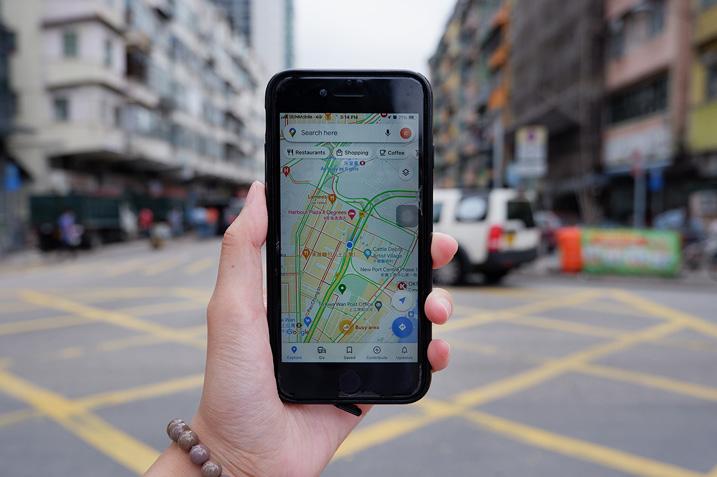
During the British rule, the colonial government made a series of official maps of Hong Kong, through which we can trace the evolution of the city’s coastline. This is made even easier today by the internet – you can pull out your smartphone anywhere, anytime to check if the land under your feet used to be ocean. Since Hong Kong’s establishment as a free port in 1841, real estate has always been one of its most coveted commodities, and every round of land reclamation was essentially a redistribution of assets and advantages. Whoever stood the closest to the latest coastline stood to gain the most; whenever the
city map changed, power transitions followed. Like it or not, the life trajectories of us all have always been intrinsically connected to the altering of the cityscape.
It is a ubiquitous practice in Hong Kong for managers of public and commercial spaces to declare certain areas “restricted” based on absurd reasons, barring entry with railings or gates. What these arbitrary rules does is taking away the spontaneity and joy of walking in the city. For ordinary citizens, a good way to protest this over-management of urban spaces is to forget about the navigation apps in your palm and explore the palm print of the city by discovering the forbidden routes.
Compared to the city we are living in
today, the virtual world envisioned by Chan Ping-chiu, set in the near future, is a place with more rigid restrictions, making it even harder for its visitors to escape control.
4 / The Roamer and the Stalker
In his book Berlin Childhood around 1900, Walter Benjamin treated the city of Berlin as a playground of memories. Indeed, a city is never just a background for events to take place, but a treasure trove of information that we must learn to excavate, to listen to, to read and to collect. As you roam through the city, let your physical movement and brain activity echo each other, and form memories and associations that are uniquely yours.
There is a beauty in being alone in a city, getting lost in the crowd, and creating meaning as we navigate through this labyrinth we call home. For Chan, every street corner clock, every turn of the outdoor escalator system and every moss-covered stone wall in Central is not an inanimate object, but a raconteur with stories to tell.
Perhaps one day, VR goggles will be able
Photo: chiling
to bring us back to a place and time in history and let us roam free in a city that no longer exists. But will the rules and restrictions of the physical world still apply there? Will there be memories and places that are hidden from us even in the virtual world?
In Andrei Tarkovsky’s sci-fi allegory Stalker, the titular expeditionist living in the distant future is a stealth guide to the forbidden zone, someone with access to a place where rules don’t apply. His mission is to lead the way for lost souls to cross the border and find their true selves. Maybe, then, simply being a roamer is not enough. We need to become stalkers in order to piece together the whole story and to see the truth.
5 / The Ghosts of Revitalisation
For over a century, Hong Kong was an important trans-shipment port that not only saw the arrival of goods and western visitors, but also the departure of countless Chinese people who left their homeland for a new life. Since the mid-1800s, political turmoil has driven large numbers of people to journey south and make their way overseas
Photo: “Central and Western District Concern Group” Facebook page
through Hong Kong. Today, this city is experiencing another era of mass diaspora, as many Hongkongers choose to leave and plant their roots in new soils. But if one day they come back for a revisit, what will be left for them to recognise? In a way, “renewal” and “revitalisation” are just synonyms for “replacement”.
Things and scenes removed from this process become apparitions that
Photo: online photo
haunt our memory, while those that survive live out their lives as orphaned spirits, forced to adapt to a strange new world.
At the end of the day, it isn’t buildings and blocks that have been replaced, but the soul of the old neighbourhoods.
Creative & Production Team
Director / Playwright
Director’s Assistants
Dramaturg
Researcher
Producer
Assistant Producer
Cast
Space Designer
Media Designers
Collaborative
Media Designers
Lighting Designer
Assistant
Lighting Designer
Chan Ping-chiu
Santayana Li, Lo Yee-king
Lai Sim-fong
Suyin Kan
Felix Chan
Lawrence Lai
Leung Tin-chak, Chu Pak-hong, Shirlee Tsoi, Chiu Lo-yin, Adam Tang, Suyin Kan, Santayana Li , CY Ling,
Chan Ping-chiu
Yuen Hon-wai
Wilfred Wong, Chan Ka-ho, Chow Wai-chuen, Oliver Shing
Lau Ming-hang
Hui Wing-yan
Music and Audio Designer
Assistant Music & Audio Designer
Sound Technician
Costume Designer
Production Manager
Stage Manager
Deputy Stage Manager
Assistant Stage Manager
Production Electrician
Stage Crew
Wardrobe Supervisor
Make-up
Publicity
Ticketing
English Surtitle Translator
Surtitle Operators
Performance Photographer
Graphic Designer
Publicity Photographer
Videographer & Editor (Trailer)
Videographer & Editor (Interview)
Curators of “AAAAAuthenticity!!!
– From Stage to Reality”
Wong Hin-yan
Chan Hin-hou
Ip Pui Kwan
Trista Ma
Eva Chow
Leung Tat-ming
Lai Kam-shan
Yeung Yee-ching
Kwok Pui-yan
Chu Po, Ng Lap-pan
Vanessa So Wing-yan
Carol P. Wong
Olivia Chan, Chiling Cheung
Lawrence Lai, Winnie Fung
Kwong Wai-lap
Tam Yuk-ting, Alastor Chow
Hong Yin-pok, Eric
studio TIO
YC Kwan
Eunis Chan hongnin.
Chan Ping-chiu, Miu Law
Acknowledgement
P&O Heritage / Jason production company
New Century Printing Industrial Limited
Radix Troupe / Stage Tech Ltd.
Affa alaia / Han Mei / Ivo Hos / Katty Law
Vee Leong / Mo Kar-him / O Yuen-sheung
Sampson Wong / Jacky Yu / Louis Yu
On&On Theatre Workshop
Established in 1998, On & On Theatre Workshop is a professional theatre company supported by Hong Kong Arts Development Council. Since the residency at Cattle Depot Artist Village in 2001, On & On has been pioneering the establishment of the Cattle Depot Theatre, the first public venue for performance independently run by a theatre company in Hong Kong, as a platform for exploration. Focusing on contemporary theatre and cultural development, the company has endeavoured to explore independent space for innovative creations. On & On has always devoted to pioneer-
ing new ideas in contemporary theatre, the company’s works are well known to be profound but with empathy, in relation to the changing socio-cultural and political landscapes of our times.
Celebrating its 20th anniversary in 2018, with the achievement from the “New Writing Movement”, On & On is ready to embrace the next phase of exploration.
“AAAAAuthenticity!!! – From Stage to Reality” is launched in 2022 to explore the dynamics between theatre and reality. An exciting line-up of local creations will be introduced to envision the many possibilities of the company’s next stage.
BOARD OF DIRECTORS
Faye Leong (Chairperson)
Ng Chun-hung
Yuen Chi-hung
Poon Chan-leung
May Fung
COMPANY STAFF
Artistic Director: Chan Ping-chiu
Programme Director: Emily Cheng
Playwright-in-residence: Wu King-yeung
Marketing Manager: Olivia Chan
Programme and Administrative Officer: Lawrence Lai
Assistant Stage Manager: Vicki Yeung
Administrative and Marketing Officer: Chiling Cheung
Administrative Assistant: Winnie Fung
Unit 7, Cattle Depot Artist Village, Ma Tau Kok Road, Kowloon
Tel-25031630
Website -www.onandon.org.hk
Email-programme@onandon.org.hk
On & On Theatre Workshop
主辦 Presented by :
香港藝術發展局全力支持藝術表達自由, 本計劃內容並不反映本局意見。
Hong Kong Arts Development Council fully supports freedom of artistic expression. The views and opinions expressed in this project do not represent the stand of the Council.
項目計劃資助 Project Grant :
藝能發展資助計劃
Arts Capacity Development Funding Scheme
HKSAR Government 香港特別行政區政府
節目內容並不反映香港特別行政區政府的意見。
The content of this programme does not reflect the views of the Government of the Hong Kong Special Administrative Region.