
Taste Tuscany. Elevate Lives.
Foundation for an elegant evening Tuscan Wine & Gourmet Food!
March 21, 6-9 p.m. Club - 1620 Dodge St., Omaha
boutique wines presented by Claudia Sommelier (WSET Level 4 Diploma)
fantastic city views at one of Omaha’s private clubs. The evening includes raffle, auction and an opportunity to boutique wines, with a portion benefiting Foundation for Enhancing Lives.
PERSON TABLES AVAILABLE

March 5! Scan the QR code or visit onecau.se/tuscanytasting for more details. f enhancing lives Hillcrest Foundation for Enhancing

FROM FRANKLIN TO EPSTEIN: REVISITING
ALLEGATIONS, ACCOUNTABILITY,
AND THE ROLE OF COMMUNITY JOURNALISM
The Franklin Credit Union scandal was a bombshell that rocked Omaha in the late 1980s. Lawrence E. King Jr., a prominent banker, political donor, and rising Republican figure, was sentenced to 15 years in federal prison for embezzling $39 million from the credit union he managed.
Franklin became infamous not only for financial crimes proven in court, but for allegations that were not. Claims of a child sex ring connected to King and Omaha’s elite were investigated and ultimately rejected by a grand jury. In the process, one accuser, Alisha Owen, was convicted of perjury and sentenced to up to 15 years in prison, serving more than four.
Decades later, the case still lingers in Omaha’s collective memory, resurfacing through books, documentaries, and podcasts that argue the full story was never told. In the wake of the #MeToo movement and shifting cultural understandings around trauma and victim credibility, it’s fair to ask whether Owen’s case would unfold differently today.
Owen has not retreated from public life. She has renewed her advocacy against the sexual exploitation of children and now serves as associate director of Epstein Justice, an Omaha-based nonprofit seeking accountability for survivors connected to Jeffrey Epstein. Working alongside investigative journalist Nick Bryant, Owen continues to push for public reckoning and institutional transparency.

Voted Omaha Magazine’s #1 Best Real Estate Company for six consecutive years, NP Dodge stands for timeless values, quality people and service, and an endless pursuit of possibility.
This issue’s cover story centers Owen’s voice while situating her experience within a broader national conversation about power, silence, and accountability. Editors Natalie Veloso and Isaac Nielsen spent months researching and reporting a narrative that invites readers to reconsider a painful chapter in Omaha’s history through a contemporary lens.
That commitment to thoughtful, rigorous community journalism runs throughout this issue. You’ll find it in our coverage of conservation efforts linking rare Madagascar orchids to the preservation of threatened Nebraska species, in arts and culture profiles that spotlight local creativity, and in dining stories that celebrate the region’s evolving food scene.
Thank you for reading and for engaging with the stories that shape our shared city.
Doug Meigs Executive Editor doug@omahapublications.com




SAVING ORCHIDS IN NEBRASKA
How Rare Orchids Helped Conservation Bloom at Lauritzen Gardens
THE USUAL SUSPECTS
001 From the Editor
From Franklin to Epstein
004 The Heart of Omaha Magazine
027 Calendar of Events
039 Obviously Omaha
Earth Day at Elmwood Park
052 History
130 Years of Ak-Sar-Ben
082 Adventure
O'Neill, Nebraska's Irish Capital 085 Explore Calendar
088 Not Funny
ENTERTAINMENT
006
010
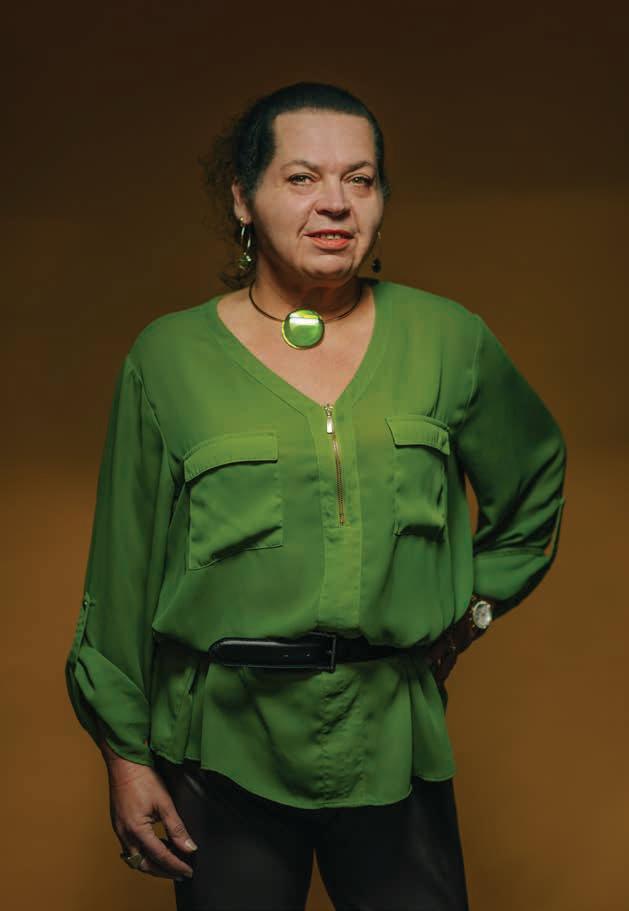
Alisha Owen
Listen to the entire issue here. Open the camera on your smart device and hover over the QR code. Produced by Radio Talking Book



The life of Omaha's Alisha Owen was reshaped by testimony she never recanted. Today, she witnesses the same playbook in the Epstein scandal. Full story on page 44. ABOUT THE COVER
read current and previous issues online at omahamagazine.com
COMMUNITY PILLARS


COMMUNITY LEADERS


COMMUNITY PARTNERS
Backlund Plumbing
Henry Doorly Zoo
Catering Creations
Children's Nebraska
Cutchall Management Group
FNBO
Kiewit Luminarium
Lauritzen Gardens
M.U.D.
Omaha Performing Arts Society
Primo's Modern Mexican Restaurant
Scott Conference Center
The Dentists
Valmont
Cajun Crab & Pho
Vempire
MARCH/APRIL 2026
VOLUME 44 // ISSUE I
EDITORIAL
Executive Editor
DOUG MEIGS
Associate Editor & Staff Writer
NATALIE VELOSO
Assignment Editor & Staff Writer
ISAAC NIELSEN
Editorial Intern
NAOMI HEU
Contributing Writers
BEAUFIELD BERRY · TAMSEN BUTLER · KYLE EUSTICE
MICHELE FAN · DAWAUNE HAYES · DWAIN HEBDA
DAN HOPPEN · SARA LOCKE · BRANDI LONG-FRANK
LISA LUKECART · KARA SCHWEISS · TIM TRUDELL OTIS TWELVE · ANDY WILLIAMS
CREATIVE
Creative Director
RACHEL BIRDSALL
Senior Graphic Designer RENEÉ LUDWICK
Graphic Designer II NICKIE ROBINSON
Graphic Designer I JOEY WINTON
Chief Photographer SARAH LEMKE
SALES
Executive Vice President
Sales & Marketing
GIL COHEN
Branding & Digital Specialists
GREG BRUNS · DAWN DENNIS · FRANCINE FLEGG
SANDY MATSON · TIM McCORMACK
Digital Advertising Sales Specialist TRAVIS FISHER
Senior Sales Coordinator
ALICIA HOLLINS
Sales Coordinators
JESSICA LINHART · SANDI M cCORMACK
Director of Business & Development
CAROLE SPRUNK
OPERATIONS
Business Manager KYLE FISHER
Ad Traffic Manager
DAVID TROUBA
Digital Manager
LUIS DE LA TOBA
Distribution Manager
CARSON KRUSE
EXECUTIVE
Publisher TODD LEMKE
Associate Publisher
BILL SITZMANN
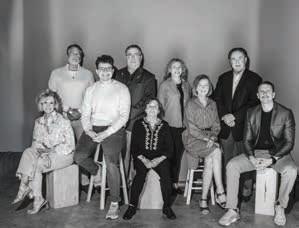

The Heart of Omaha Magazine
Omaha Magazine has existed in Omaha since 1890, according to publisher Todd Lemke. Lemke himself entered the Omaha publishing scene in March 1983 with the first issue of City Slicker. That newsprint publication was the precursor to his Omaha Magazine, which launched its first issue in 1989.
Today, Omaha Magazine Ltd. is the parent company of Omaha Publications, which produces other community-focused magazines such as FACES of Omaha, B2B Magazine, Family Guide, and many custom publishing products.
The magazines would not be possible without the people behind them whether that's the people in between the covers or those behind the scenes. Lemke and his Omaha Publications staff take immense pride in presenting Omahans with the best stories in the city and the company is always looking to improve the products.
At its heart, the Omaha Magazine team is one that works hard for its community. If it's Omaha, it's in Omaha Magazine. Your city. Your culture. Your stories.








FINDSFunny A WAY
S�ORY Dawa�ne Lamont Hayes
P�OTOG�AP�Y Bill Sitzmann DESIG� Nic�i� Robin�on
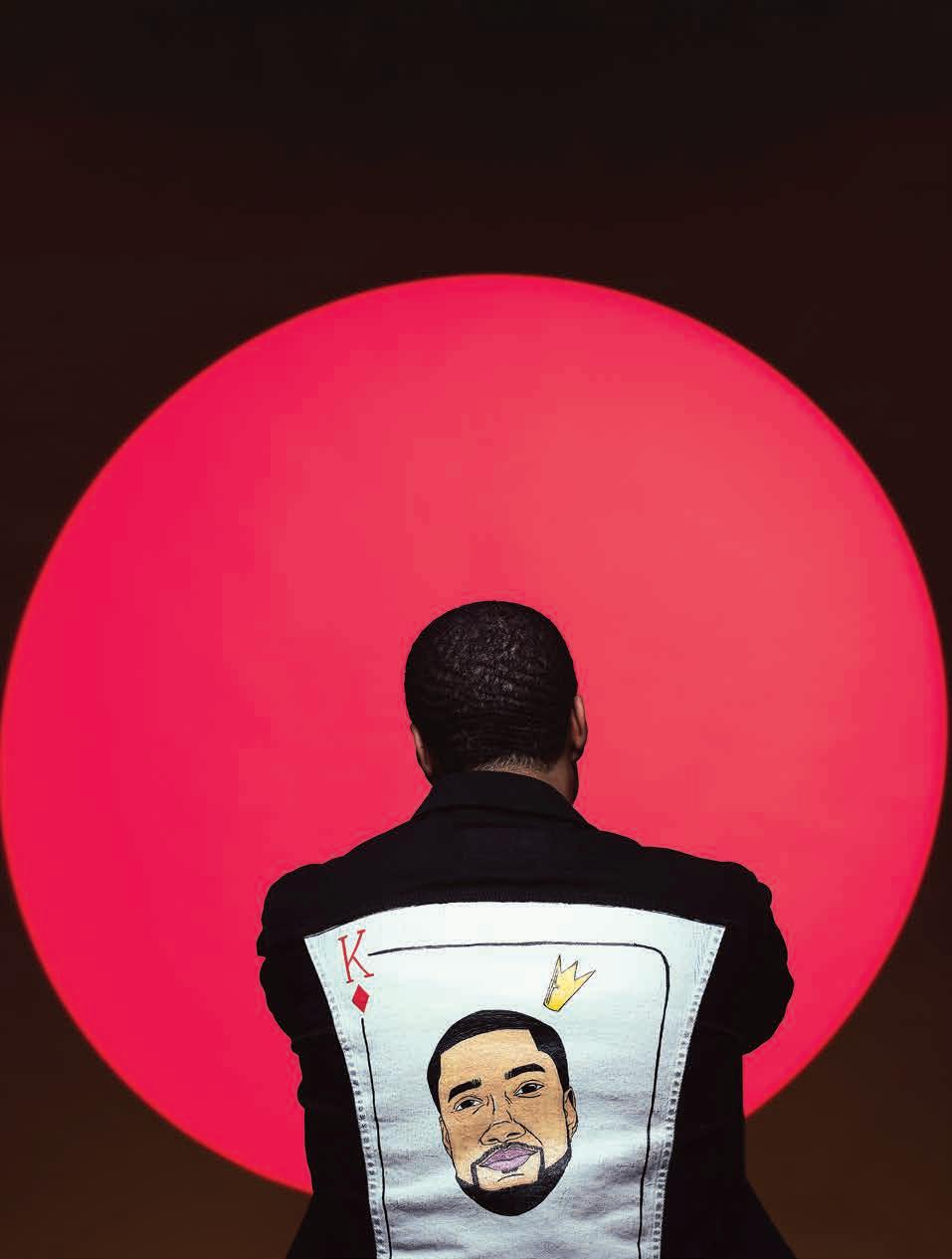
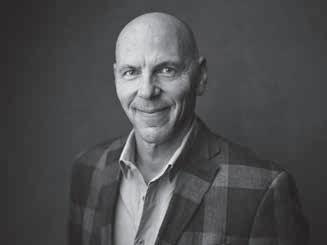
Before booking prime-time television roles and opening for big names in comedy, Gary B. Curtis grew up in New Jersey, watching comedians he admired tell jokes on TV.
“Defi nitely fourth grade, 10 o’clock at night, BET Comic View is what I went to sleep to every night,” the rising star recalled. “Ever since then, I just had a love for comedy. I never saw it, though, as a viable option of something that I could do.”
Watching stand-up greats and Black sitcoms like Fresh Prince of Bel Air, Martin , and The Jamie Foxx Show, Curtis fell in love with the idea of making people laugh for a living, even calling himself the “Fresh Prince of Where ver I Was.”
He took that charisma to the University of Pittsburgh, where he and his friends became party promoters after being denied access to certain frat parties on campus. They threw the biggest bashes for young adults in the city, and that visibility led to him receiving offers to host and emcee events all over town. “It would be me on stage and I would just be making people laugh and I realized, ‘Oh, this is crazy! Th is is just like that stand-up feeling!’”
After graduating with a fi nance degree and working full time at a bank, Curtis was itching for a change when he was invited to emcee one of the most popular Black fraternity step shows in Pittsburgh, The Steel City Step Show, which drew a crowd of a thousand people. “I had the whole auditorium dying laughing and it felt great,” he said, but doubt stil l lingered.
The next morning, a security guard from the bank Curtis was working at told him she was at the show and asked “What are you doing here? I saw you last night, and that is what you are meant to do. I don’t want to see you in this building no more!”
“Th at stuck with me,” he said. He called up a few friends who had moved to L.A. for music, and the next month, after quitting his bank job, he drove cross-country to California to try his hand at comedy and show business.
Curtis worked in Los Angeles for eight years, taking acting classes, doing open mics, and booking a few commercial gigs. “All the work I did out there laid the foundation for me to do [what I’m doing now.]”
Then, in the midst of the pandemic, Curtis and his fi ancée Jessica had their fi rst child and decided to move to Nebraska in 2021, where a majority of her family could support them and their little one.
“I tell everyone it is better than I expected it to be, but I had low expectations for Omaha,” he recalled with a chuckle. “Honestly, it’s a good thing.” He was surprised by the size and caliber of the comedy and arts scene s in Omaha.
After settling in, the move to Nebraska aligned Curtis to open for Preacher Lawson ( America’s Got Talent), Fortune Feimster (Th e Mindy Project ), and Eddie Griffi n (Undercover Brother) at the Waiting Room in Benson. “Then, because everything started going more remote, I booked five TV roles from a basement in Nebraska!” he laughed. His recent credits include iCarly, S.W.A.T, Matlock, and upcoming appearances in Chicago-based TV shows like Chicago PD and The Rookie, which are set to premiere in 2026.
Curtis has also had success going to smaller towns across Nebraska and Iowa with support from Omaha comedian Nick Allen (Last Comic Standing ), who is a frequent collaborator with radio personalities Todd & Tyler. “It’s been amazing how welcoming everyone has been,” Curtis said. “I go to places where people don’t get a lot of comedy, or see a lot of people like me, and they’ve received me with open arms.”
His friendship with Omaha comedian and impressionist, Cameron Logsdon, prompted the creation of ongoing digital shorts called “Terrible Spies” on Instagram, and he’s also performed as a feature comic in Logsdon’s monthly show at Th e Backline in downtown Omaha.
When asked about his future ambitions and dream roles, the actor/writer/comedian mentioned wanting to blend comedy and action, two of his favorite genres. Curtis believes Omaha will continue to have a significant role in his development. “I feel like Omaha has so much potential, honestly,” he said. “I know that there are more people trying to do fi lm around here and I would love to be a part of that somehow.”
Th rough all doubts and notable accomplishments, Curtis is still committed to bringing people together. He’s been running a monthly comedy show every third Thursday at Barnato in Village Pointe for almost two years and absolutely loves it, but noted separation in Omaha being a challenge. “People often act like they can’t drive past 72nd,” he shared.
His hope going into 2026 is to expand the reach of the show and grow more community. He believes that comedy has the power to change things, especially in a time of social, political, and physical separation.
“I think comedy and the arts are the best way to reach people and make people get out the house and actually show up,” he said.
Visit garybcurtis.com to learn more and follow @garycurtisfunny on Instagram for the latest updates. Visit barnato.bar to purchase tickets to his monthly comedy showcase.


Lincoln-Based Synth Pop Duo Finds Their Groove
STORY
KYLE EUSTICE
PHOTOGRAPHY
SARAH LEMKE
DESIGN
RENEE LUDWICK
The two members of Vempire—vocalist and bassist Lindsey Yoneda and former JV Allstars and Th irst Th ings First frontman Mikey Elfers—often struggle to describe their sound. “We wanted it to be electronic-adjacent, like goth-ish,” Elfers said. And by all accounts, they’ve succeeded.
The Lincoln-based duo exploded onto the scene in October 2023 with the single Sunglasses and followed up with their 2024 debut album, Your Steps , and the Fumes EP shortly after. Their entrancing live shows, highlighted by Yoneda’s moody, enigmatic vocal delivery and Elfers’ keyboard/songwriting prowess, helped earn Vempire a trophy at the 19th Omaha Arts and Entertainment Awards in the Outstanding Prog Rock/Experimental category during their fi rst year as a band. It all seems relatively simple looking back.
“What I seek personally is enthusiasm,” Elfers said. “Th at’s the most important part about playing music in my 40s. If I meet someone and I want to share the stage with them and play with their band, and they’re immediately weird turds about their time slot or something, or like if you jam with somebody and you’re teaching them a song and they’re just strangely turds about it, t hen no. I’m not interested.”
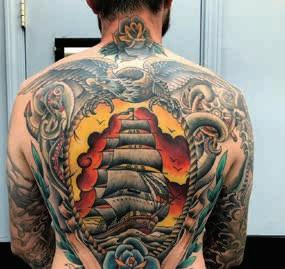
But Yoneda was different. A tattoo artist at Iron Brush Tattoo by day and music provocateur at night, the heavily inked Yoneda lives and breathes the creative arts in some form—it’s who she is. On stage, there’s no indication she’s a shy person or has difficulty singing in front of people, but she basically has to adopt an entirely new persona to pull it off, she explained.
“It’s pretty hard, to be honest,” Yoneda admitted. “Some shows are fi ne. I really feed off the people in the crowd, which can be difficult because sometimes they’re super into it, it’s a lot of fun, and it’s great, but with local shows, sometimes the rooms aren’t entirely fi lled, and then I’m like, ‘Oh gosh, everyone’s staring at me.’
“It’s kind of nice to be a different person up there, because it’s out of our comfort zone in terms of both musical style and expression, so we can be this thing we turn on and off when we need to.”
It’s one of the reasons Yoneda loves a good fog machine: she can hide behind it like a veil— though it did set off the fi re alarm once at O’Leaver’s. They’d only been playing live for three months when it happened. If anything, it only increased their buzz. In November 2025, Vempire landed another OEAA nomination in the Outstanding Experimental category, which didn’t e xactly come as a shock.

“We set out to start a brand-new band and record immediately,” Elfers explained. “We didn’t want to have any growing pains or any shitty demos—and not to shit on shitty demos, I’ve made shitty demos with so many bands I’ve played in—but we had this concept. I envisioned the pop singer persona thing where we immediately come out as if we’ve always been here, and Lindsey’s been a star.”
Yoneda hopped in with a mantra: “Fake it ’til you make it!” So far, it’s working for them. On one of their latest releases, an ambitious cover of Wham!’s 1984 hit, “Last Christmas,” Yoneda wasn’t quite sure she could do George Michael’s vocals justice, but gave it a shot anyway. Elfers’ obsession with ’80s new wave and synthpop groups like Devo, Men Without Hats, and Human League had officially made its way into her repertoire.
“Ninety-eight percent of being in a band with one other person is sharing ideas over text messages, and I had this bucket list of
songs I wanted to do,” Elfers said. “We didn’t think much of it. I thought it would be funny.”
Vempire never planned on releasing the song, and recording it in August—before the holiday spirit had descended—proved difficult for Yoneda, who was prepping for her upcoming wedding and extended honeymoon at Olympic Nat ional Park.
“George Michael was one of the most talented singers of our lifetime, and now we’re singing along and his vocals are so acrobatic and so wild,” Elfers recalled. “It’s so rhythmically challenging and strange and abnormal, and not what I would ever write.”
Nonetheless, they got it done, but Yoneda initially thought it was “terrible.” After some time away from the song, they fi nally heard the fi nal mix and the results were magical.
“It was a pleasant surprise,” Yoneda said. “We thought, ‘Wow, this is actually real ly great.’”
Vempire’s chemistry continues to exceed their expectations, and they’re making music with other local groups, notably Plack Blague, who toured with Omaha band The Faint throughout 2025.
Despite Vempire’s dark aesthetic, it’s clear their future is bright. In fact, they plotted the recording of their next album mid-interview and Omaha Magazine was proud to be part of the decision.
“Let’s record a new record, Lindsey!” Elfers shouted, to which she replied, “OK, let’s do it!”
Visit vempire.band for more information. Follow @vempireband on Instagram for their latest releases and updates.
Sarah McKinstry-Brown
Poet, Teacher, Mom

Story by Tamsen Butler / Photography by Sarah Lemke / Design by Joey Winton
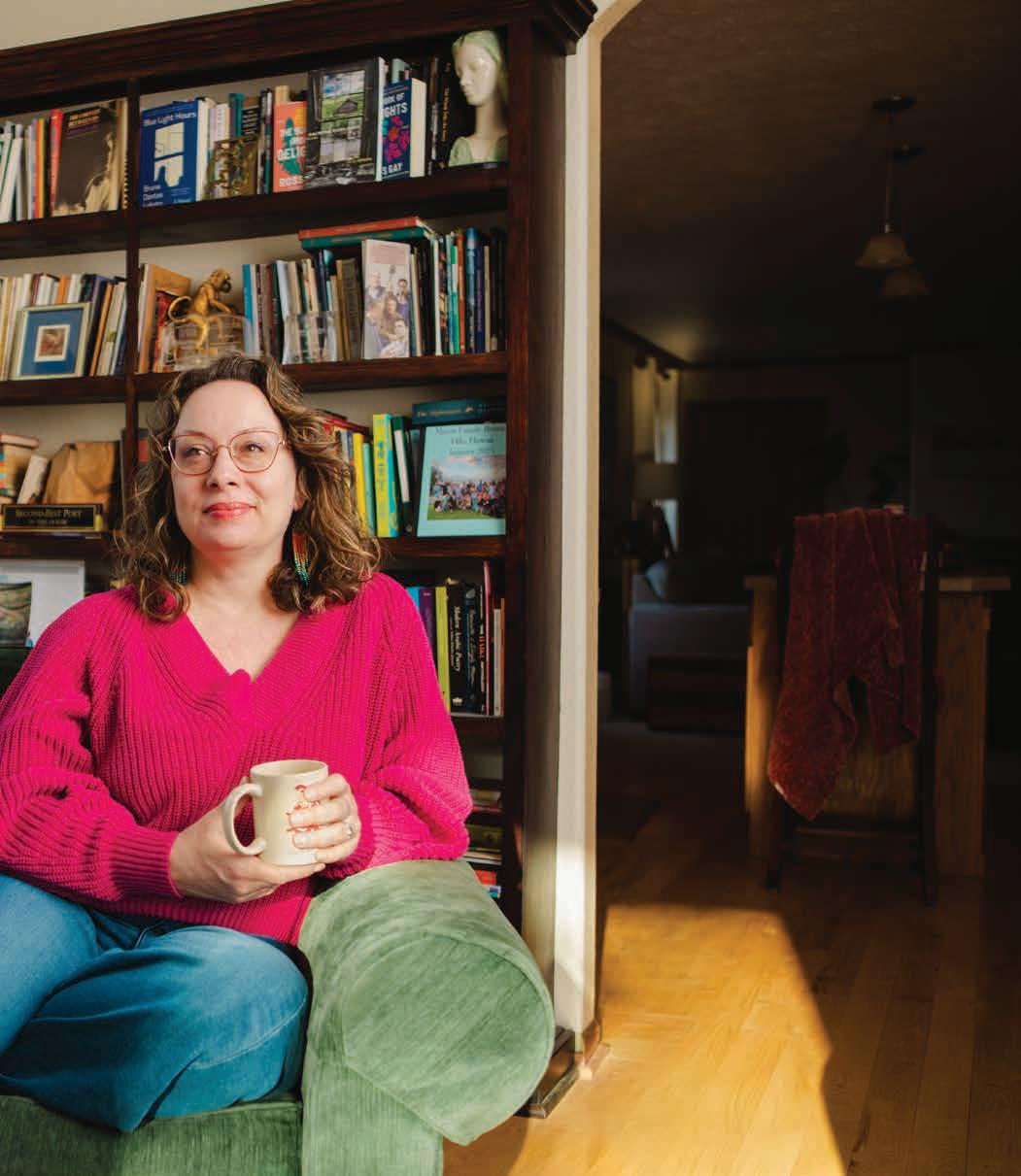
ike most busy moms, Sarah McKinstryBrown often finds herself juggling motherhood right alongside her own professional pursuits. It’s a balancing act with which many women are familiar. But McKinstryBrown’s juggling act might look a little different from others.
In fact, if she’s spotted in public, deep in thought on her phone, it’s more likely that she’s composing a poignant poem to add to her growing collection as opposed to mindlessly scrolling. One of her favorite new poems was written on a train while traveling between Albuquerque and Santa Fe, and another recent poem was composed on her phone while sitting in the parking lot of a fast-food restaurant as her daughter went inside for a job interview.
She’s a teacher and award-winning poet who got her start through a series of unpredictable events. Upon graduating college, her plan was to move to Puerto Rico and work in the then-thriving hospitality industry. A train would take her from Albuquerque to New York, where she would hop on a plane bound for Puerto Rico. But when the Twin Towers were struck on 9/11, no planes were flying out of New York, so she had to quickly switch gears.
It was during this time that she attended a spoken-word performance to see Indigenous poet (and Omaha native) John Trudell in Albuquerque. “I was kind of just watching him,” she recalled. “And I was thinking, you know, if the world ends tomorrow, which at that time, everything felt so precarious, so I thought, ‘I really would want to be doing what John Trudell is doing. I'd love to be touring and doing spoken word.’”
By that point in her life, McKinstry-Brown had already made a name for herself in the area as a slam poet. As a member of a poetry slam team in Albuquerque, it was already a passion for her. After attending Trudell’s performance, she decided she was going to go on tour.
During this time, there was a well-constructed, nationwide system of “Poetry Slam Masters” for each state, so poets who wanted to tour would reach out to the Poetry Slam Master for each state in which they wanted to do an appearance. She plotted a tour starting in Denver, then to Salt Lake City, and then to Seattle. Her
There's also this misconception that their lives aren't interesting. There's this idea that there's some other life that's more interesting, or at some point, their lives will be interesting, and it's like, no, everything around you and everything that you're doing now, it's interesting.
–Sarah McKinstry-Brown
friend who worked at Kinko’s helped her create a press packet and burn some spoken-word CDs for her tour. She sold all her belongings, except what she could fit into a suitcase, and prepared to go on tour.
After performing in Denver, a woman approached her and gave her the contact information for the Poetry Slam Master in Omaha, telling her she should consider adding an appearance there. The woman was the ex-girlfriend of Poetry Slam Master Matt Mason, who is now McKinstryBrown’s husband.
Mason set her up with appearances in both Des Moines and Omaha. The Des Moines appearance happened on her 25th birthday, and Mason bought her a piece of cheesecake to celebrate. At a tour stop on Delaware, she received a delivery of flowers from Mason. As a young woman traveling alone on tour, she wasn’t looking to jump into a relationship and was generally wary of the men who approached her at her appearances.
Eventually, though, she and Mason started “courting each other from a distance,” according to McKinstry-Brown. She ended up moving to Omaha at the end of her tour.
Nowadays, McKinstry-Brown is an accomplished and prolific poet alongside her teaching duties. She predominantly teaches college freshman, though she does sometimes facilitate writing workshops.
“The first time I met Sarah McKinstryBrown, I was struck by her intelligence, her humor, and her depth,” fellow local poet Liz Kay said. “They are some of the traits that make her such an exceptional poet. They’re also the traits that make her a phenomenal friend.”
Often, McKinstry-Brown encounters students who feel that poets must use “flowery” language that isn’t authentic to how the writer actually speaks. Instead, she pushes them to strive for authenticity in their words.
“The really beautiful thing about poetry is that it can be a way of walking in someone else's shoes,” she said. “And just sort of listening into their brains or their thoughts, or sort of being in their home all of a sudden. If they're writing about their mom or dad, you sort of get to be there with them.
“There's also this misconception that their lives aren't interesting. There's this idea that there's some other life that's more interesting, or at some point, their lives will be interesting, and it's like, no, everything around you and everything that you're doing now, it's interesting.”
Wise words from an accomplished poet to those who aspire to follow in her footsteps: “It’s all interesting.”
Visit hellosmb.com for more information.











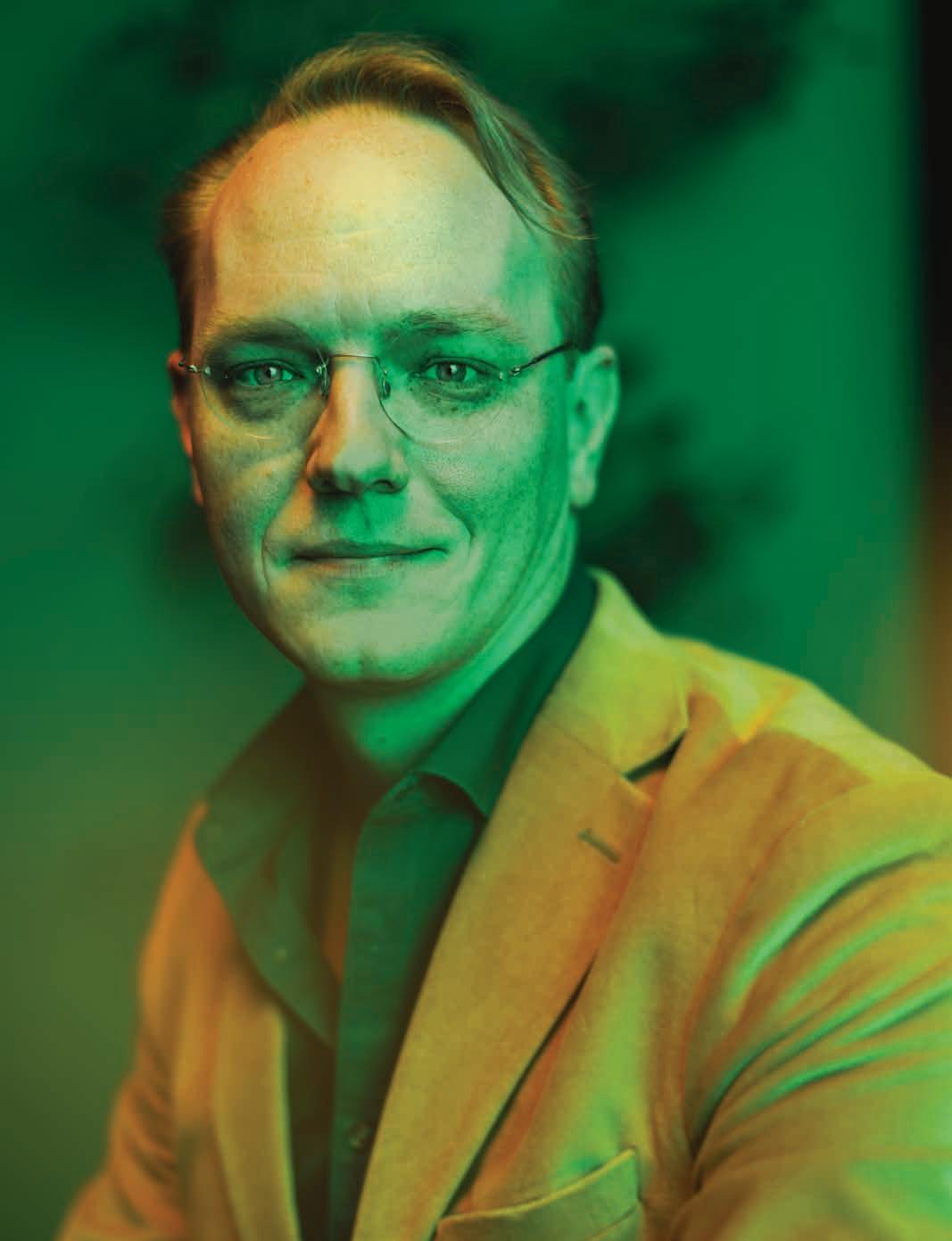
Reagan
D. Pufall
Inside the Worlds of Reagan D. Pufall
eagan D. Pufall makes art the way some people build worlds—patiently, experimentally, with a quiet sense of delight at what might emerge if you just keep asking “what happens if.” His work lives at the intersection of photography, sculpture, science fi ction, and curiosity, spanning everything from extreme macro-portraits of praying mantises to artifi cial landscapes that look like distant planets to 3D-scanned human faces frozen somewhere between mask and memory.
For Pufall, the fascination with insects began long before they became photographic subjects. Years ago, while working a summer job in Colorado, he came across a praying mantis—and then another. Recognizing them as a male and female of the same species, he caught both on a whim. Th at moment turned into a decade-plus practice of raising mantises, ultimately spanning six or seven generations. Th ey don’t live long—eight or nine months, maybe a year if you’re lucky—but over time, they became familiar presences. Some summers he keeps them; other years he releases them. Th e relationship is attentive, temporary, and deeply ob servational.
Th at intimacy shows up in the photographs. Pufall’s mantises aren’t nature-documentary subjects; they’re protagonists. Each creature, he explained, has its own personality. Some are calm enough to be gently repositioned with a pen and will hold the pose. Others are relentless, leaping straight for the camera lens as soon as it’s within range. Photographing them becomes a negotiation with patience and choreography.
Th e environments they inhabit in his images are just as intentional. Pufall shoots from his home studio, building miniature sets that borrow heavily from cinematic lighting techniques. Backlighting, fog machines, refl ective acrylic, stainless steel—materials you’d recognize from science fi ction fi lms—are arranged to create surreal, otherworldly spaces. A mantis poised mid-jump might be standing on a sheet of black acrylic above a stainless steel bowl, lit so precisely that the scene transforms into something that feels architectura l and alive.
“My parents encouraged me from a young age to enter art, and my dad liked photography in college, so he had an old fi lm camera laying around that I started shooting with in high school,” he said. “I’ve kept at it since then, so I shot all the way through grad school and undergrad.”
Although he began with landscape photography, Pufall eventually realized he was more interested in creating scenery than fi nding it. Th at shift led to the artifi cial landscapes that appear throughout his work—images that look like storms on distant planets or cities emerging from clouds. Many rely on practical eff ects rather than digital manipulation. Fire is often just rubbing alcohol, ignited briefl y to create dynamic, controlled bursts. Atmospheric clouds come from fog machines or a classic special-eff ects trick: a fi sh tank layered with hot and cold water, or paint suspended between temperatures, allowing forms to bloom and drift like weat her systems.
Story
Beaufield
“One of the things I like most about art is learning, so in a lot of these kind of projects, there’s art output. Th ere’s also the learning aspect of it… it’s lots of learning and practice of these new techniques or researching them to fi gure out a way to get something that looks the way I want it to look,” he said. Th at approach extends across mediums. Pufall works in digital and macro photography, direct paper positives and tintypes, laser cutting and engraving, 3D printing in both fi lament and resin, and even electronics. In one project, he built a massive artifi cial light source programmed to mimic the sun’s movement throughout the year, complete with occasional dimming as if clouds were passi ng overhead.
His 3D-scanned face works push that curiosity toward questions of accessibility and identity. Using photogrammetry—a process where dozens of photographs are stitched into a digital 3D model—Pufall scans real people: friends, family, fellow artists, and community members. Th e resulting forms are imperfect, slightly uncanny, and deliberately unfi nished. To him, that’s the point. Where sculpture once required enormous time, money, and technical access, these scans represent a moment when three-dimensional versions of ourselves become suddenly attainable—much like photography once did for p ortraiture.
Even when working with emerging tools like AI, Pufall approaches them cautiously and critically. Rather than embracing the technology wholesale, he treats it as a medium with its own limitations and biases. “Th ere was this very strong argument from a group of printmakers around the 1890s that say that photography can’t be copyrighted because it lacks the hand of the artist. We see the same arguments being used against AI, although I think the arguments against AI are a little bit more persuasive,” he said. In one series, he prompted AI to generate abstract interpretations of emotions like anger or anticipation—only to fi nd the early results riddled with clichés. “Anger is a bunch of bald angry white guys,” he said. “Joy is like an attractive woman wandering through like a fi eld of fl owers or balloons. So one of the things I asked to do was to make sure that there were absolutely no people or animals in it. So we try to move a little bit further away from the cliché.” By refi ning constraints and removing human fi gures entirely, he pushed the system away from the obvious and toward something more ambiguous. For him, the value lies not in automation, but in surprise.
Th at same ethos carries into his teaching at Iowa Western Community College, where he teaches digital art, drawing, art history, and capstone courses. He’s noticed students increasingly resist being confi ned to a single medium. Instead of committing early to one discipline, they want to try everything—photography, painting, digital composites, laser cutting. Pufall sees that multiplicity as a strength, not a la ck of focus.
Growing up in North Dakota shaped that sense, and has been consistent with his broader outlook. He describes it as cold, windy, and extremely safe—the kind of place where kids rode bikes across town without locking doors. Th e environment demanded resilience, but it also created community. People helped each other. Th at combination of toughness and generosity still echoes in his work.
When asked to sum up his artistic philosophy, Pufall doesn’t reach for jargon. “I like whatever gives me a giggle,” he said.
It’s a deceptively simple framework. But standing inside Pufall’s worlds, where mantises become mythic, clouds are engineered, and tools are always provisional, you begin to see how far curiosity and a sense of humor can take you.
by
Berry // Photography by Bill Sitzmann // Design by Joey Winton A+C Art

Story by Doug Meigs | Photography by Sarah Lemke | Design by Joey Winton
SAVING IN NEBRASKA

How Rare Orchids from Madagascar Helped Conservation Bloom at Lauritzen Gardens
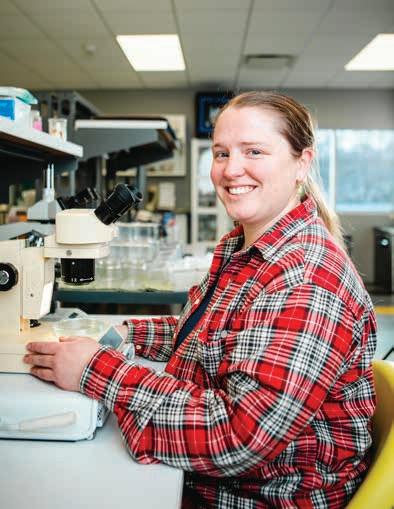
On an early spring morning, two scientists moved slowly through prairie meadows along the Platte River in central Nebraska. They were hunting for flowers, collecting data and samples that will help save rare native orchids.
Step, pause, kneel, look. Repeat. Eventually, a delicate white blossom caught the eye of Allison Butterfield, also known as “the orchid whisperer,” from Omaha’s Lauritzen Gardens.
This specimen was Great Plains ladies’ tresses (Spiranthes magnicamporum), to be verified by genetic sequencing.
“Because they hide, they’re very difficult to find,” Butterfield said. “You can be standing right on top of them and not really know until you just happen to see it from the right angle.”
She recorded exact GPS coordinates, carefully cut a leaf specimen for testing, and excavated around the root system for a fungal sample. The scientists would return on subsequent trips to monitor the flower and collect seeds through summer and fall seasons.
Scouring the ground alongside Butterfield was Lauritzen Gardens’ director of conservation, Katharine Hogan. Their 2025 fieldwork across Nebraska marked the botanical garden’s first year of focused research on orchids.
Hogan said there are 16 to 22 orchid species native to Nebraska, depending on classification. They can be found all across the state’s varied habitats from prairies to forests and wetlands. The state’s three protected species are the western prairie fringed orchid (Platanthera praeclara), small white lady’s slipper (Cypripedium candidum) and Ute ladies’ tresses (Spiranthes diluvialis).
Orchids are incredibly diverse. With around 32,000 known species in the Orchidaceae family (and more discovered every year), they are one of the largest plant taxonomies with relatives on every continent except Antarctica. This family is facing a global crisis from habitat loss, climate change, and unsustainable harvesting for trade. The majority of all orchid species are considered vulnerable, threatened, or endangered.
Their seeds are fragile, microscopic (smaller than a grain of dust), and require unique fungal relationships to germinate. Many are slow to mature, sometimes taking years to flower and hiding underground for years at a time until ideal climate conditions appear. Their finicky approach to blooming is one reason why scientists find it difficult to confirm whether or not some species are actually extinct in the wild.
Some orchid species rely on a single pollinator. For example, Nebraska’s western prairie fringed orchid depends exclusively on sphinx moths. Other species are more adaptable, like the varieties sold in local grocery stores (which remain famously particular to specific light and humidity conditions).
“In the case of the three Nebraska species listed as threatened, they all live in low-meadow habitat,” Hogan said. “These wetland habitats have, historically, been highly converted to agriculture.”
Although legal protections create an added layer of bureaucracy with permits required to take samples of protected species, Hogan doesn’t mind and adheres to the law. Permits ensure accountability, she said.
Other Nebraska orchid species may be similarly threatened, but scientists don’t have a complete understanding of the full ecological picture. That’s where Lauritzen Gardens’ research on orchids comes in.
The scientists are collaborating with various partners that include private landowners, government agencies (the U.S., Forest Service and Nebraska Game & Parks), conservation-oriented nonprofits (Fontenelle Forest, The Nature Conservancy, Crane Trust, Bader Park), and others including tips from the general public.
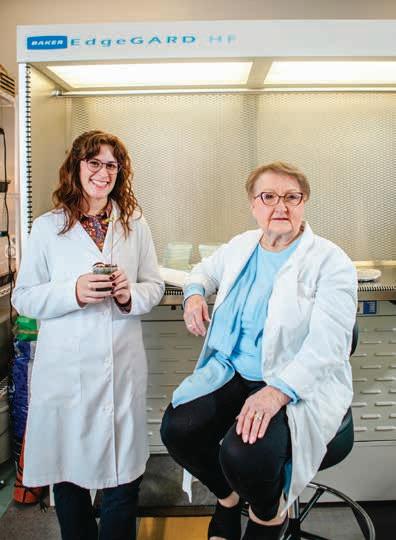
This contemporary work on orchids would not have been possible without a donated collection of rare jungle orchids from Madagascar, thanks to the Omaha Henry Doorly Zoo and the life’s work of Margaret From.
(Top) Katharine Hogan
(Left) Allison Butterfield, (Right) Margaret From
From Jungle to Prairie
From did not originally set out to connect one of the world’s hot spots for endangered tropical orchids with threatened native species in the Great Plains. But that’s exactly what she did.
With two children in secondary school during the 1990s, From enrolled as a non-traditional undergrad at the University of Nebraska–Omaha. She planned to pursue a legal career. A lifelong love for plants drew her from pre-law to biological science.
“I was listening to one lecture at one of my plant classes, and it was about tissue culture [the practice of growing plants in sterile laboratory conditions],” From said. The moment was pivotal in her career. “I went up to him after the class, and I said, ‘You know, this is really what we should be using for our endangered species.’”
The western prairie fringed orchid had recently been listed as protected. Yet too few people understood that Nebraska was home to orchids. She decided to make propagation of this rare native plant the mission of her graduate studies in horticulture at the University of Nebraska–Lincoln.
She commuted between Lincoln and Omaha while completing her master’s degree. During that hectic time, she heard a rumor that Omaha’s Henry Doorly Zoo wanted to establish a tissue culture lab. On a whim, she called the zoo’s horticulture department and offered her expertise. She began as a volunteer, working nearly full-time with the zoo while still a grad student. Eventually, the zoo hired her. She went on to spend more than two decades as director of plant conservation.
The zoo’s conservation work in Madagascar with lemurs and the rainforest created a botanical niche for From’s expertise. Orchid seeds are so small that From said growing them in vitro within a controlled lab setting is a great option. Unfortunately, no established methods existed for most of these tropical species. So she developed the guidelines herself.
She went on expeditions into the jungle with researchers conducting fieldwork, gathered seed samples to cultivate in her Omaha lab, and discovered species new to science. She trained Ph.D. students from Madagascar. She even returned to reintroduce lab-grown specimens to the wild (and contributed others to the U.S. Botanic Garden in Washington, D.C.).
From also worked with other institutions and plants from around the world like when she helped save and reintroduce a critically endangered fern from Bermuda. All the while, she found time to also focus on work with native species of orchids. She said working across climate zones sharpened her approach.
“Everything in Madagascar is very much tropical; everything in Nebraska is very much temperate. So, you have to understand how the seasons affect plant species,” she said. “Where you might think that it would be problematic, tropical plants are much easier than our native species because of the demands of the environment and the soil, water supply, etc. It’s an education for either side. You have to be able to think like a plant.”
Then came the pandemic lockdowns.
YOU HAVE TO BE ABLE TO THINK LIKE A PLANT.
–MARGARET FROM
Pandemic Disruptions
When COVID-19 shuttered facilities at the zoo, From’s plant conservation lab suffered. Orchids grown from petri dishes must be moved regularly to fresh media for survival. Staffing reductions quickly took their toll. From went into the lab as much as she was allowed, but there were significant losses.
“It was heartbreaking,” she said. She needed to find a new home for the orchids. News of her plight reached the Smithsonian, and the institution expressed interest in acquisition. But shipping hundreds of fragile culture vessels required funds not allocated.
Around the same time, Lauritzen Gardens volunteered to be a local host. Butterfield was newly hired to oversee their greenhouse operations, on the job for about six months before the pandemic hit. Opportunity blossomed for the self-proclaimed orchid fanatic.
“Then I started going to the zoo. Once a week, I would spend an entire day with Marge, and she taught me how to take care of the Madagascar collection, and how to do all of the tissue culture,” Butterfield said.
The botanical garden was planning a new plant production facility at the time to replace rusted and outdated hoop houses. Acquiring the Madagascar collection led to reconceptualization of a new laboratory on the second floor above humidity- and temperature-controlled greenhouses in development. Lauritzen Gardens also deepened its investment in orchids overall, expanding its living collection from 250 to more than 1,000 orchid plants (not including the Madagascar collection itself).
A rainbow of blooming orchids from around the world began gathering comfortably behind fogged windows at the new Claire M. Hubbard Plant
Production Center opened in 2024. Speaking from her laboratory above, Butterfield said she and From tackled the migration like triage. “This building was being built at the time. With the pandemic, everything took longer than expected.”
From retired at the zoo and began volunteering weekly with the botanical garden. “We didn’t have research papers to follow,” she said, reflecting on decades of cultivating orchids from sterile tissue samples. “We had to develop techniques for each species.” She is passing those techniques developed over decades on to Butterfield through ongoing mentorship.
“She is a delightful person,” From said in praise of her mentee. “She’s so eager to know and so unspoiled in accepting what I offer her. I always remind her: It’s still your lab, and you can take what I tell you with a grain of salt and find a better way to do it.”
Lauritzen Gardens’ founding director of conservation, Jim Locklear, conducted extensive conservation research on threatened plants across the Midwest during his tenure. Orchids, however, were not a narrow focus of his fieldwork. So, a new frontier opened for the institution when the new director of conservation, Hogan, joined in late 2024 to help guide the work by Butterfield and volunteers on the conservation team.
“We need an intact base of native habitat to support the systems that humans need to survive, from agriculture to pest control, flood mitigation, etc.,” Hogan said. “Rare species loss may go unnoticed for a time, but the losses add up until an unknown tipping point that would be devastating for all of us. Rare orchids are part of the equation.”


Local Orchid Community
While much of Lauritzen Gardens’ orchid conservation work happens out of public view in riparian meadows, laboratories, and carefully controlled grow rooms the Greater Omaha Orchid Society provides a vital bridge between professional conservation and the broader community of orchid growers, enthusiasts, and advocates.
Local orchid lovers founded the organization in 1983, and they began hosting annual orchid shows in 1988. The society brings together hobbyists and specialists from across the region. Members range from casual growers to dedicated collectors who cultivate under greenhouse conditions.
Jim Pyrzynski, a longtime board member, describes the group as both educational and communal. Monthly meetings typically include presentations by growers, scientists, or visiting experts, along with time for members to share plants, advice, and hard-earned lessons.

FEATURE
“The Orchid Society really exists to share knowledge,” Pyrzynski said. “People come in at all levels some are growing their first orchid, and others have been doing this for decades. Everybody’s learning from each other.”
The organization’s most visible public-facing role is its annual Orchid Show and Sale, hosted each spring at Lauritzen Gardens. The event draws growers and vendors from across the Midwest and showcases hundreds of orchids in bloom far more diversity than most people ever encounter at retail nurseries. Plants are judged by accredited orchid judges, and awards are given, much like a county fair.
For Lauritzen Gardens, the partnership is mutually beneficial. Darcey Hickey, hired to oversee greenhouse operations following Butterfield’s pivot to the conservation team, said the society has helped strengthen and diversify Lauritzen Gardens’ living orchid collection over time. Members sometimes donate specimens, and garden staff often acquire new plants during the event.
New this year in the lead up to the society’s March 28-29 orchid show the botanical garden is also hosting its own inaugural orchid exhibition. The exhibition begins Feb. 13 and concludes the annual society event, featuring rare plants from the permanent collection and new specimens on display.
The collaboration helps translate conservation work into something tangible for visitors. While native Nebraska orchids remain largely invisible for much of the year, the show and exhibition provide an opportunity to talk about why orchids are so ecologically sensitive, why they are difficult to conserve, and how hobbyist growers fit into that picture.
Together, they ensure that orchid conservation in Nebraska is not only a scientific endeavor, but a collective one rooted in community as much as in soil and seed.
Visit lauritzengardens.org for more information about Omaha’s botanical garden. Learn more about the Greater Omaha Orchid Society at greateromahaorchidsociety.org.

Dental Implants • Cosmetic Dentistry
A N R L D C E A
VISUAL ARTS
JUN KANEKO: PAINTING & PRINTS
Th rough March 22 at KANEKO, 1111 Jones St. Explore color, texture, and abstraction through artist Jun Kaneko’s paintings and prints from his large collection of ceramic sculptures and two-dimensional works.
402.341.3800 | thekaneko.org
JESSIE HENSON
Th rough July 5 at Th e Joslyn, 2200 Dodge St. Look through a collection of colorful sewn paper works created by Jessie Henson using an industrial sewing machine that analyzes post-war American abstraction.
402.342.3300 | joslyn.org
BLACK, BUT NOT THE ART: BREAKING THE FRAME
March 6-29 at Nicholas Street Gallery at Hot Shops Art Center, 1301 Nicholas St. Visit Hot Shops Art Center for an amazing group show curated by artist, curator, model, and activist Ang R. Bennett. 402.342.6452 | hotshopsartcenter.org
INTERSECTIONS
April 1-26 at Nicholas Street Gallery at Hot Shops Art Center, 1301 Nicholas St. Experience a group exhibition throughout the month of April showcasing the beautiful works of Creighton University’s talented international art honor society, Kappa Pi.
402.342.6452 | hotshopsartcenter.org
THROUGH THE LENS:
AMERICAN PHOTOGRAPHERS FROM THE CARTER COLLECTION
April 11-Aug. 16 at Th e Joslyn, 2200 Dodge St. Go through a journey of American photography from 1940 through today, looking at photos that have documented iconic American places, communities, and historical events.
402.342.3300 | joslyn.org
CONCERTS
DAN BROWN’S WILD SYMPHONY
March 1 at St. Andrew’s Methodist Church, 15050 W. Maple Road. Omaha Symphony presents a whimsical performance of New York Times bestselling author Dan Brown’s Wild Symphony, perfect for the whole family.
402.342.3836 | omahasymphony.org
PETER MCPOLAND: THE BIG LUCKY TOUR
March 9 at Slowdown, 729 N. 14th St. Singer-songwriter and musician Peter McPoland visits Slowdown with his alternative indie sound on his Big Lucky Tour with special guest Girl Tones. 402.345.7569 | theslowdown.com
TOTO
March 9 at Orpheum Th eater, 409 S. 16th St. Lovers of classic ’70s rock can spend an evening with TOTO at the Orpheum Theater, singing along to hits like “Rosanna” and “Africa.”
402.345.0606 | o-pa.org
THE WELLERMEN
March 17 at Barnato, 225 N. 170th St. On St. Patrick’s Day, global folk band The Wellermen gets in the Irish spirit at Barnato with this special performance.
402.964.2021 | barnato.bar
TWO FEET: THE NEXT STEPS TOUR
March 18 at Slowdown, 729 N. 14th St. On his Next Steps Tour, Two Feet visits Omaha with his unique sound combining soulful electric guitar and floor-rattling bass.
402.345.7569 | theslowdown.com
BOB DYLAN: ROUGH AND ROWDY WAYS WORLD WIDE TOUR
March 21 at Orpheum Th eater, 409 S. 16th St. Folk and rock music icon Bob Dylan comes to Omaha to continue his Rough and Rowdy Ways Tour, singing popular songs like “Knockin’ on Heaven’s Door” and “Like a Rolling Stone.”
402.345.0606 | o-pa.org
HARDY: THE COUNTRY! COUNTRY! TOUR
March 21 at CHI Health Center, 455 N. 10th St. American singer-songwriter HARDY blends country, country rock, and hard rock with elements of heavy metal and hip-hop. Special guests are Cameron Whitcomb and McCoy Moore.
402.341.1500 | chihealthcenteromaha.com
BOYS LIKE GIRLS: THE SOUNDTRACK OF YOUR LIFE TOUR
March 22 at Steelhouse Omaha, 1100 Dodge St. Rock band Boys Like Girls is on their Soundtrack of Your Life Tour, bringing their alternative sound to Omaha with special guests iDKHOW and Arrows in Action! 402.345.0606 | steelhouseomaha.com


BBNO$: THE INTERNET EXPLORER TOUR
March 31 at Steelhouse Omaha, 1100 Dodge St. Canadian rapper bbno$ is on his Internet Explorer Tour. Gaining popularity through social media, he is best known for songs “Lalala” and “edamame.” 402.345.0606 | steelhouseomaha.com
BRANDON LAKE: KING OF HEARTS TOUR
April 11 at CHI Health Center, 455 N. 10th St. Brandon Lake, Christian worship singer-songwriter and guitarist, visits Omaha on his King of Hearts Tour with special guests Franni Cash and Pat Barrett. 402.341.1500 | chihealthcenteromaha.com
LET’S GROOVE TONIGHT: MOTOWN & THE PHILLY SOUND
April 11-12 at Holland Performing Arts Center, 1200 Douglas St. Groovy Motown melodies come to the stage with the Omaha Symphony, playing hits from iconic artists like The Temptations, Marvin Gaye, Diana Ross, and more. 402.342.3836 | omahasymphony.org
ETHEL CAIN: THE WILLOUGHBY TUCKER FOREVER TOUR
April 23 at Th e Astro, 8302 City Centre Drive. Popular alternative indie artist Ethel Cain brings her soft and unique sound to Nebraska on her Willoughby Tucker Forever Tour with special guest 9million.
531.283.5212 | theastrotheater.com
CONSIDERING MATTHEW SHEPARD
April 25 at Orpheum Th eater, 409 S. 16th St. The River City Mixed Chorus presents a one-nightonly performance of Considering Matthew Shepard , the deeply moving performance that honors the life and legacy of Matthew Shepard. 402.345.0606 | o-pa.org
THE GROWLERS
April 29 at Th e Admiral, 2234 S. 13th St. The Growlers are a modern rock band from southern California. Singer Brooks Nielsen and keyboard player/guitarist Kyle Straka bring their surf garage sound to Omaha. admiralomaha.com
STAGE PERFORMANCES
PAULY SHORE
March 3-4 at Funny Bone Comedy Club, 710 N. 114th St. Suite 210. Pauly Shore has made audiences laugh since starring in Totally Pauly in the ’90s. As a comedian and actor, his talent is undeniable. 402.493.8036 | omaha.funnybone.com & JULIET
March 3-8 at Orpheum Th eater, 409 S. 16th St. In a hilarious new musical, discover what might have happened if Juliet stayed alive after discovering Romeo was not. Th is new twist on the original starcrossed lovers is something you can’t miss. 402.345.0606 | o-pa.org

DISNEY ON ICE: ROAD TRIP ADVENTURES
March 5-8 at CHI Health Center, 455 N. 10th St. Spend an icy night with Disney favorites Mickey Mouse and friends, Moana, Simba, Aladdin, and more as they embark on an exciting road trip in this Disney on Ice performance. 402.341.1500 | chihealthcenteromaha.com
FELIPE ESPARZA:
AT MY LEISURE WORLD TOUR
March 7 at Th e Astro, 8302 City Centre Drive. Stand-up comedian Felipe Esparza brings his wild stories and hilarious experiences to Nebraska. Along with comedy, he has made appearances in TV shows like Superstore and fi lms like You People 531.283.5212 | theastrotheater.com
JIM BREUER: FIND THE FUNNY
March 12 at Th e Astro, 8302 City Centre Drive. Best known for his time on Saturday Night Live in the 1990s, Jim Breuer has been a big name in the comedy world for more than three decades.
531.283.5212 | theastrotheater.com
HERCULES
March 13 at Orpheum Th eater, 409 S. 16th St. Opera Omaha sings the classic Greek story of Hercules through gorgeous and haunting opera at the Orpheum Theater.
402.345.0606 | o-pa.org
DISASTER! THE MUSICAL
March 13-April 4 at Omaha Community Playhouse, 6915 Cass St. Th is exciting musical follows a 1970s cruise that goes awry when it encounters natural disasters such as tornadoes, earthquakes, and infernos—all while singing along to disco ’70s hits.
402.553.0800 | omahaplayhouse.com
JOHN MULANEY: MISTER WHATEVER
March 19-20 at Orpheum Th eater, 409 S. 16th St. John Mulaney, award-winning writer, comedian, and actor, visits Omaha on his newest stand-up tour, Mister Whatever.
402.345.0606 | o-pa.org
SIX: THE MUSICAL
March 25-29 at Orpheum Th eater, 409 S. 16th St. Experience an exciting pop musical of Henry VIII’s six wives in a modern twist. Spanning the history of 500 years of girl power and drama, this retelling takes place as a singing competition.
402.345.0606 | o-pa.org
WHITNEY CUMMINGS: THE BIG BABY TOUR
March 27 at Th e Astro, 8302 City Centre Drive. Comedian, actor, writer, producer, director, entrepreneur, and host of the Good for You podcast, Whitney Cummings is an icon in comedy, known for creating shows like 2 Broke Girls and Whitney 531.283.5212 | theastrotheater.com
THE GREAT RACE
April 17-May 3 at Th e Rose Th eater, 2001 Farnam St. Learn about how the 12 animals of the Chinese zodiac were chosen in this whimsical puppet play about Chinese mythology. 402.345.4849 | rosetheater.org
DIAL “M” FOR MURDER
April 17-May 10 at Omaha Community Playhouse, 6915 Cass St. Th is new adaptation of Frederick Knott’s book and Alfred Hitchcock’s fi lm brings this story to the stage for a suspenseful thriller of jealousy, deception, and mystery.
402.553.0800 | omahaplayhouse.com
A MIDSUMMER NIGHT’S DREAM
April 18-19 at Orpheum Th eater, 409 S. 16th St. Watch Shakespeare’s beloved romantic comedy A Midsummer Night’s Dream through graceful and magnificent dancing by the American Midwest Ballet. 402.345.0606 | o-pa.org
NATE BARGATZE:
BIG DUMB EYES WORLD TOUR
April 25 at CHI Health Center, 455 N. 10th St. Nate Bargatze, stand-up comedian and actor, visits Omaha on his Big Dumb Eyes Tour. Known for his deadpan, monotone delivery, this will be a night full of hilarious dry comedy.
402.341.1500 | chihealthcenteromaha.com
MAMMA MIA!
April 28-May 3 at Orpheum Th eater, 409 S. 16th St. Enjoy the Broadway series of the well-loved musical MAMMA MIA! at the Orpheum Theater. Sing along to your favorite ABBA songs and watch this classic story unfold on stage.
402.345.0606 | o-pa.org
FAMILY, FESTIVALS, AND MORE
ST. PATRICK’S DAY PARADE
March 14 along Capitol Avenue and 12th St. Th e Ancient Order of Hibernians hosts Omaha’s 148th Annual St. Patrick’s Day Parade downtown. Enjoy fun costumes, musical performances, and floats for a day of family fun.
402.594.0882 | aohomaha.com/parade
OMAHA TATTOO ARTS FESTIVAL
March 27-29 at CHI Health Center, 455 N. 10th St. The 8th annual Villain Arts Omaha Tattoo Arts Festival comes to Omaha. Get tattooed by some of the world’s best tattoo artists and meet icons from TV shows like Ink Master.
402.341.1500 | chihealthcenteromaha.com
SPRING FLING MARKET
April 11 along Farnam St. in the Blackstone District. The Blackstone District is putting on the 4th annual Spring Fling Market, a block party full of local vendors, live music, food and drinks, and fun children’s activities. blackstonedistrict.com
EARTH DAY OMAHA
April 25 at Elmwood Park, 808 S. 60th St. Explore the perfect way to spend Earth Day with food trucks, green exhibitors, hands-on demonstrations, educational displays, and more. 402.819.8317 | greenomaha.org
Sandy Spaulding
BY Tamsen Butler
PHOTOGRAPHY BY Bill Sitzmann
DESIGN BY
Volksmarching Her Way into Longevity
STORY
Nickie Robinson

iterally translated to English as “people marching,” volksmarching began in Germany in the 1960s. It’s a noncompetitive way to get the same benefits of sports competition (being outside, meeting new people, making and exceeding goals), but without the competitive aspect. Instead, volksmarching is an organized way for people to get together and to walk, seeing things they would probably never see from the window of a vehicle.
When Sandy Spaulding and her husband temporarily lived in Germany for work around 30 years ago, they discovered volksmarching. Spaulding was drawn to the social aspect and the opportunity to see Germany in a different way. She also liked how the walks weren’t competitive at all.
When they returned to her home state of Iowa, she discovered the Nebraska Wander Freunde Trailblazers in Omaha (“Wander Freunde” roughly translates to “hike friends”), an affi liate of the American Volkssport Association. Since they enjoyed volksmarching so much in Germany, they enthusiastically joined the group and have been going on local volksmarches ever since. She estimated that there are around 200 volksmarching groups across the United States and even more globally.
The soup walk, which happens in the spring, is also dual-intentioned as a walk and a donation drive. Every walker brings two cans of soup, Spaulding explained. “We walk, we eat soup, and then all the leftover soup goes to a food pantry.”
As important as the exercise itself is just getting out and being social.
—Sandy Spaulding
There’s also a themed walking program called “Step to the Beat,” in which participants receive stamps for attending walks with locations related to music, dancing, or performing. The stamps go into books purchased by participants, benefitting the nonprofit organization Hungry for Music , which supports music education for underprivi leged youth.
Spaulding has served in a variety of capacities within the Nebraska Wander Freunde Trailblazers. She currently serves as the Coordinating Committee Chair, but added, “I’ve been the president, I’ve been the secretary, I’ve been trail master.” Her current tenure as coordinating committee chair has spanned nearly a decade.
Her two favorite local volksmarching events are the holiday lights walk and the soup walk in the spring. The holiday lights walk, unsurprisingly, involves walking around and looking at various holiday lights. The 2025 walk was a cold one, so they didn’t near the record-breaking 700 participants they’ve had in the past, but they did manage to use the event to collect more than 300 pairs of gloves and socks to donate to t he homeless.
But mostly, Spaulding and the group simply like walking places together. “We try to base our walks on something to see, whether it’s in nature or it’s a historical walk or something that is entertaining,” she explained. “We don’t really go and walk the streets or whatever.”
Many of her volksmarches in Germany took her through the woods or to castles. She recalled once taking a very hilly walk in Germany, where the group walked high enough to walk above the clouds and see the sun shining on a rainy day. As they descended the hill, they walked back into the rain.
Picking a favorite volksmarching memory from the Omaha area proved problematic, since Spaulding and her husband typically do dozens of walks annually. But her favorite volksmarching memory within the United States was the Crazy Horse monument in South Dakota. Th is biannual event is a favorite amongst active volksmarchers and allows participants to walk out onto Crazy Horse’s outstretched hand as part of the hike.
Spaulding stays active through volksmarching and pickleball. She’s an advocate for people getting involved, and though some people might be nervous to join because they’re intimidated by walking a long distance, it’s not so bad once they get moving, she said.
“Th ree miles really isn’t that far when you start walking, especially if you walk with a group—and we always have groups, so our walks are very open. Some people like to walk by themselves; they just want to get out and walk.”
Spaulding asserted that newcomers can absolutely expect friendly faces. She also spoke about the many benefits of staying active later in life. “It helps your blood pressure. It helps your weight. It helps your mental outlook. There’s just so many health benefits to being active,” she said.
As a retired medical professional, Spaulding doesn’t merely speak anecdotally. Myriad studies point to staying active and social as benefitting longevity.
“Start by walking around the block,” she advised. “Then walk two blocks. And then just gradually work your way up.” And when a person is ready to join, they’ll enjoy the added benefits of socializing. “As important as the exercise itself is just getting out and being social,” she said.
Visit nebraskatrailblazers.com for more information.

1ST PLACE 18 STRAIGHT YEARS!
PLACE 21- STRAIGHT YEARS!

STORY Lisa Lukecart
PHOTOGRAPHY Sarah Lemke
DESIGN Nickie Robinson
Bring Smiles Buddy Bags
SANTANACOLLINS
FINDS JOY IN GIVING
antana Collins’ smile shines brighter than the vibrant painted flowers and butterfl ies behind him at Heartland Family Service. Bags covered in lions, koalas, and hippos sit near Santana’s feet, ready to bring women and children joy. The “Pampers and Popcorn” theme offers a moment of comfort and dignity to those who have faced hardships.
“Life gives you ups and downs, but you adjust. That’s why I love Buddy Bags. It reminds us that we are still blessed.”
“Sometimes they [women] feel judged because of their past, and they love to see Santana. It feels good to give,” said his mother, Taisha, who works as a case manager at Heartland.
The Westside freshman grips his father’s muscled arm as both pose for a photo next to a staff member before visiting his favorite stop, the vending machine. Tim calls his autistic son a “superhero” who wields the power of “aut henticity.”
“His autism gives him an advantage over many people. I don’t look at it as a weakness because he looks at life from a diff erent perspective,” Tim explained.
The Buddy Bags Project supports underprivileged communities fighting for hope, and each item contributes to a sense of togetherness. Friends and family donate $35 for the two to shop and assemble the colorful carriers, leaving $10 for Santana’s school supplies. Santana and his father load bags with hygiene products, snacks, and even a handwritten note of enc ouragement.
Since their launch last summer, Buddy Bags grossed almost $20,000, which they then gifted as bags with diff erent themes to Siena Francis House, Carole’s House of Hope, and the Salvation Army.
–Taisha Collins
“It gets him out of his comfort zone. It’s a small thing to give him something he can own and have pride in,” said Nick Borman, a senior vice president in engineering and construction with a private energy compa ny, Tenaska.
Tim, a personal trainer and lifestyle coach at his business, TC Lifestyle Fit, located on The Better Together Campus, met Borman as a client. Since then, the two became fast friends, with Borman calling him a “role model.” Tim also works as a licensed real estate agent and volunteers at the Nebraska Youth Correctional Facility mentoring struggling youth, and even guides students at middle and elementary Omaha Public Schools.
“He’s out there walking the walk,” Borman said.
Th at activism in the community spurred Tim’s children into action. Borman donated when Tim’s daughter, Violet, started the project, then called Violet’s Convenience Store, at the age of 14.
“It made me feel more positive,” Violet said. “I remember we were giving out bags, and it made a lot of pe ople happy.”
Violet passed the buck to her brother two years later, changing it to reflect Santana’s nickname, “Buddy.”
“I want them to be grateful for what they have and to understand that people come from different backgrounds,” said Taisha, who grew up in foster care. “I want them to be kind.”
Raising an autistic child doesn’t come without struggle and sacrifice, and Taisha recently had to stop taking classes at Clarkson College after Santana’s diagnosis of avoidant/ restrictive food intake disorder, which sometimes goes hand-in-hand with autism. Santana still has a feeding tube after undergoing surgery at Children’s Nebraska, and eating continues to be an uph ill battle.
“I just want him to be okay. I want him to be happy,” Taisha said. “Life gives you ups and downs, but you adjust. Th at’s why I love Buddy Bags. It reminds us that we are still blessed.”
Santana, named after the legendary guitarist, prefers Japanese anime music to Chicano blues rock. During a recent trip to Barnes & Noble, Santana strolled through the illustrated anime books that always catch his attention.
“I have to be flexible like a palm tree,” Santana often reminds himself.
The lesson extends to his family members, who continue caring for his needs with patience. Putting together Buddy Bags may seem like a small task, but for Santana, it builds confidence, skills, and opportunities for h is future.
“Santana shows up every day,” Tim said.
“Dad, it’s time to make Buddy Bags,” Santana likes to say, and that’s when Tim knows it’s time to make others and his son sm ile again.
Visit @buddybaghappy on Instagram to learn more and see the Buddy Bags journey unfold.
Finding a New Field
M Sports
How Lacrosse Is Winning Over Omaha Families
ike Battershell is the fi rst to admit that prior to his oldest son getting involved in lacrosse six years ago, he knew little to nothing about the sport. Now, however, he’s a dyed-in-the-wool lacrosse parent and on the board of the Omaha Lacrosse Club where his kids got t heir start.
He’s also a proud fan, cheering on sons Roe, a junior playing on Omaha Westside’s varsity team, and Sam, a standout in club lacrosse.
“I didn’t grow up playing lacrosse. I didn’t know anything about it, so we took Roe to a free clinic Omaha Lacrosse Club was putting on,” he said. “It ended up fitting Roe really well. He fell in love with it.
“The sport is defi nitely growing better than 10% every year. It was added to the Olympics this year, and the Professional Lacrosse League is bringing a lot more television coverage. I think that overall exposure helps kids and parents feel comfortable giving it a try.”
The game is red-hot, with growing popularity at the youth, high school, and collegiate levels. Sports Planning Guide reported lacrosse participation overall in the U.S. grew by 218% between 2001 and 2014, while the Sport and Fitness Industry Association released a report in 2018 saying youth lacrosse participation had grown 25% since 2012. By comparison, baseball participation only grew 2% and football’s participation fell almost 16% over that same time period.
The Midwest region is squarely in the middle of this boom. USA Lacrosse reported the region saw the highest percentage of growth of youth teams compared to anywhere in the country. Meanwhile, youth participation (under age 15) accounts for approximately two-thirds of all lacrosse participation in the U.S., per Gitnux, and high school teams have grown by 160%.
In Omaha, the game gained speed relatively recently with metro high school programs appearing in 2005 and club and recreational teams popping up around the same time. Battershell said the game’s largely non-contact format, especially of the head-to-head variety found in football, is a big draw for ma ny families.
STORY BY Dwain Hebda
Lemke
“Especially at the younger levels, like at Omaha Lacrosse Club, we do a good job of making sure the game meets the players where they are developmentally,” he said. “Younger players have very little contact and even when you’re in the seventh and eighth grade, which is the last year Omaha Lacrosse Club does before they get to high school, the contact is still controlled.”
“We’re teaching the kids that the idea is not to ‘blow your opponent up.’ Th at’s not the goal of the game and so you’re not seeing much of that, and as a result, the head-to-head contact injuries don’t happen at all.”
What I find is that once somebody gets involved in lacrosse and they figure out the game, they fall in love with it really fast. They become those kids that are just gung-ho, diehard, lacrosse lifers.
—Anne Inzerello
The biggest irony about the game’s popularity is that even though the surge in participation is relatively new, the fastpaced and dynamic game certainly is not. Lacrosse’s origins lie in Native American culture and were fi rst documented in 1636 by a Jesuit missionary who observed the game played by members of the Huron tribe in Ontario, Canada. The fi rst American collegiate team was established in 1877 at New York University, followed by the United States National Amateur Lacrosse Association, originally comprised of nine club team s, in 1879.
PHOTOGRAPHY BY Sarah
DESIGN BY Nickie Robinson
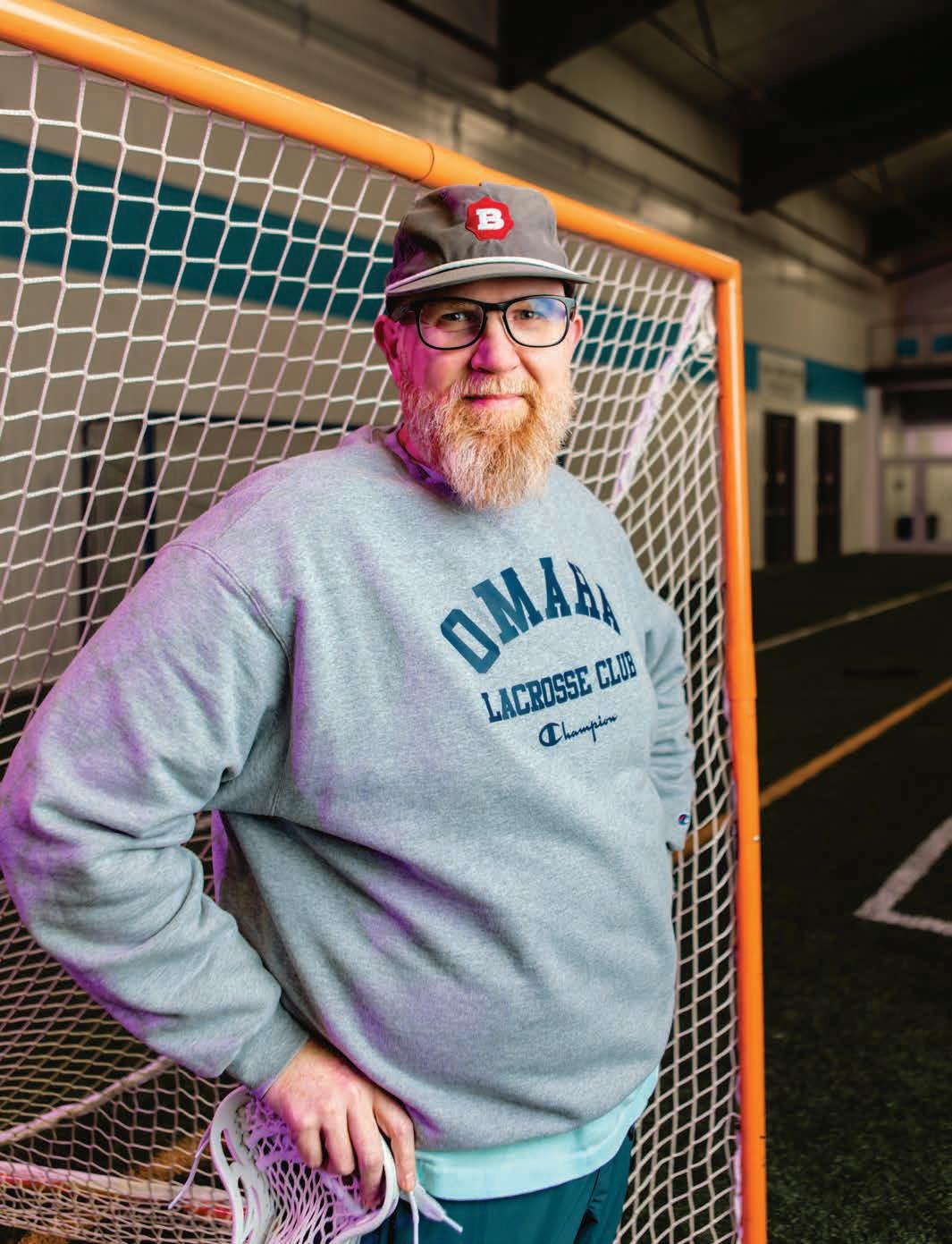
Mike Battershell
Sports
Played on a field, lacrosse incorporates elements of hockey, soccer, and basketball. Male and female athletes participate in their own divisions with rule variations ranging from the size of the field to the number of players per side.
“The nice thing about lacrosse is it’s a great cross-trainer for just about any sport,” said Anne Inzerello, Elkhorn Athletic Association’s director of lacrosse. “It has that raw athleticism, hand-eye coordination, field sense, and teamwork element all wrapped up into one sport.”
Inzerello runs recreational leagues for players in third through eighth grades. She has seen participation double in just three seasons.
“What I fi nd is that once somebody gets involved in lacrosse and they figure out the game, they fall in love with it really fast,” she said. “They become those kids that are just gung-ho, diehard, lacrosse lifers.”
Nick Brown knows what that feels like. The Omaha native added lacrosse to his sports repertoire of soccer and hockey in elementary school and today is the boys head coach at Mi llard West.
“Lacrosse is about community. It’s really about the culture, having fun out there, and really trying to understand something new,” he said. “I would say that’s the biggest appeal.”
Brown said the game is just now starting to achieve critical mass where some kids aren’t playing it as a secondary sport, but as their fi rst love.
“It’s a really good sport for the kid that plays football in the fall and doesn’t have anything to do in spring and doesn’t want to play baseball,” he said, “but something I’ve seen in the last couple years are kids 5 to 6 years old getting into the sport. We’re giving them soft sticks and there’s fi nally outlets in Omaha for kids to start playing and learning to love the ga me earlier.”
For uninitiated parents, Battershell suggests checking out an introductory clinic, just as he did to allow his boys to get a trial run at the game that has become their new passion.
“There are multiple free clinics every year where you come, all the equipment’s provided, and you see if it fits a kid’s interests,” he said. “Clinics are a good way to get a kid engaged at no cost and see if it sticks w ith them.”
Visit omahalacrosseclub.com for more information.





OBVIOUSLY OMAHA
Earth Day
STORY BY DOUG MEIGS | DESIGN BY NICKIE ROBINSON
Returns to Elmwood Park
808 S 60TH ST., OMAHA, NE
EARTH DAY
was first celebrated on April 22, 1970, when a Wisconsin senator organized a nationwide “teach-in” to raise environmental awareness. The effort mobilized 20 million Americans and helped catalyze landmark environmental legislation and the creation of the Environmental Protection Agency. Today, Earth Day is observed by more than one billion people worldwide—but it also has deep Nebraska roots.
The inaugural Earth Day coincided with Arbor Day, celebrated on the last Friday in April and tied to the birthday of Julius Sterling Morton, a former Nebraska newspaperman and U.S. Secretary of Agriculture. Morton, widely regarded as the founder of Arbor Day, championed conservation and tree planting. Nebraska made Arbor Day a state holiday in 1885, with most states following by the turn of the 20th century.
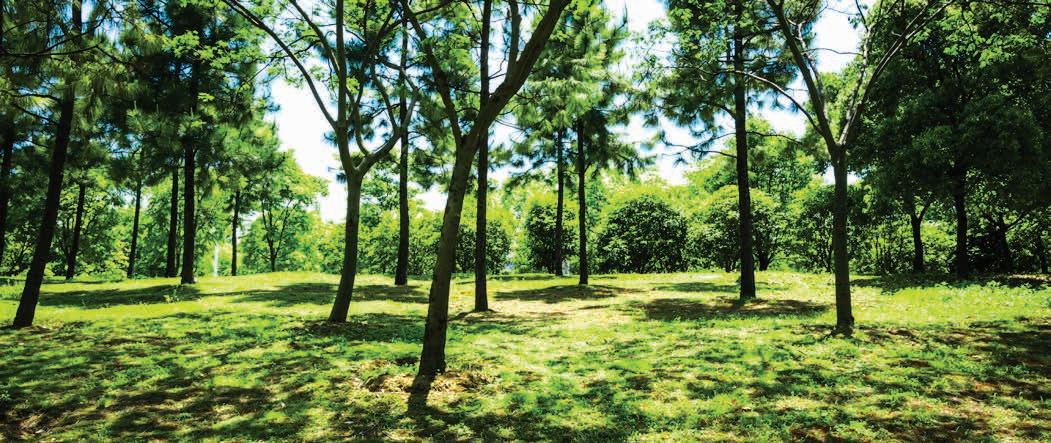
The Green Omaha Coalition will host the 37th annual Earth Day Omaha at Elmwood Park on April 25, 2026. Although the official holiday falls earlier in the week, this annual weekend gathering is an essential rite of spring for local environmental organizations and the general public. Read on to learn more about some of this year’s exhibiting community partners.
Hillside Solutions
This longtime Earth Day Omaha partner manages the event’s recycling collections and zero-waste stations. They also host an educational booth on soil dynamics and composting. The company began operations in 2017 as an extension of Gretna Sanitation and Soil Dynamics. In late 2025, the team launched a new nonprofit—Hillside Foundation Fund—to further advance composting and recycling.
2
Papio NRD
3
Swap Omaha
Visitors can explore a showcase of electric vehicles, e-bikes, and more. Local chapters of America’s oldest and largest grassroots environmental organization—the Sierra Club—and the more recent Electric Vehicle Association will promote EV adoption at Earth Day Omaha. 1
The Papio-Missouri River Natural Resources District manages and protects natural resources, focusing on flood control, water quality, and conservation within the Papillion Creek Watershed. Papio NRD also works to advance conservation through community engagement. Every year at Earth Day Omaha, the Papio NRD team shares educational resources, distributes free seeds, and sponsors the event’s annual Friend of the Environment Award.
5
Fashion is one of the most polluting industries globally, hence the inspiration for Swap Omaha. The organization founded by Lauren Bates developed out of a large-scale clothing swap at Earth Day Omaha in 2021. Swap Omaha helps keep textiles out of landfills by hosting community clothing swaps via pop-up events. In 2025, the organization received Earth Day Omaha’s annual Friend of the Environment Award.
4
Nebraska Chapter of the Sierra Club and Eastern Nebraska Electric Vehicle Association
PlantNebraska and Nebraska Forest Service
PlantNebraska will once again partner with the state forestry agency to host a recreational tree climbing activity in Elmwood Park at the state champion swamp white oak—Mr. Magnificent, also known as Mr. Majestic—which joined the Nebraska Champion Tree Register in 2014. PlantNebraska, formerly known as the Nebraska Statewide Arboretum, is a statewide network of parks, gardens, and public landscapes connected to the University of Nebraska-Lincoln.
Visit greenomaha.org for more information.

Built on her Father’s
Legacy at Creighton AT THE HEART OF JOURNALISM
How Professor Carol Zuegner
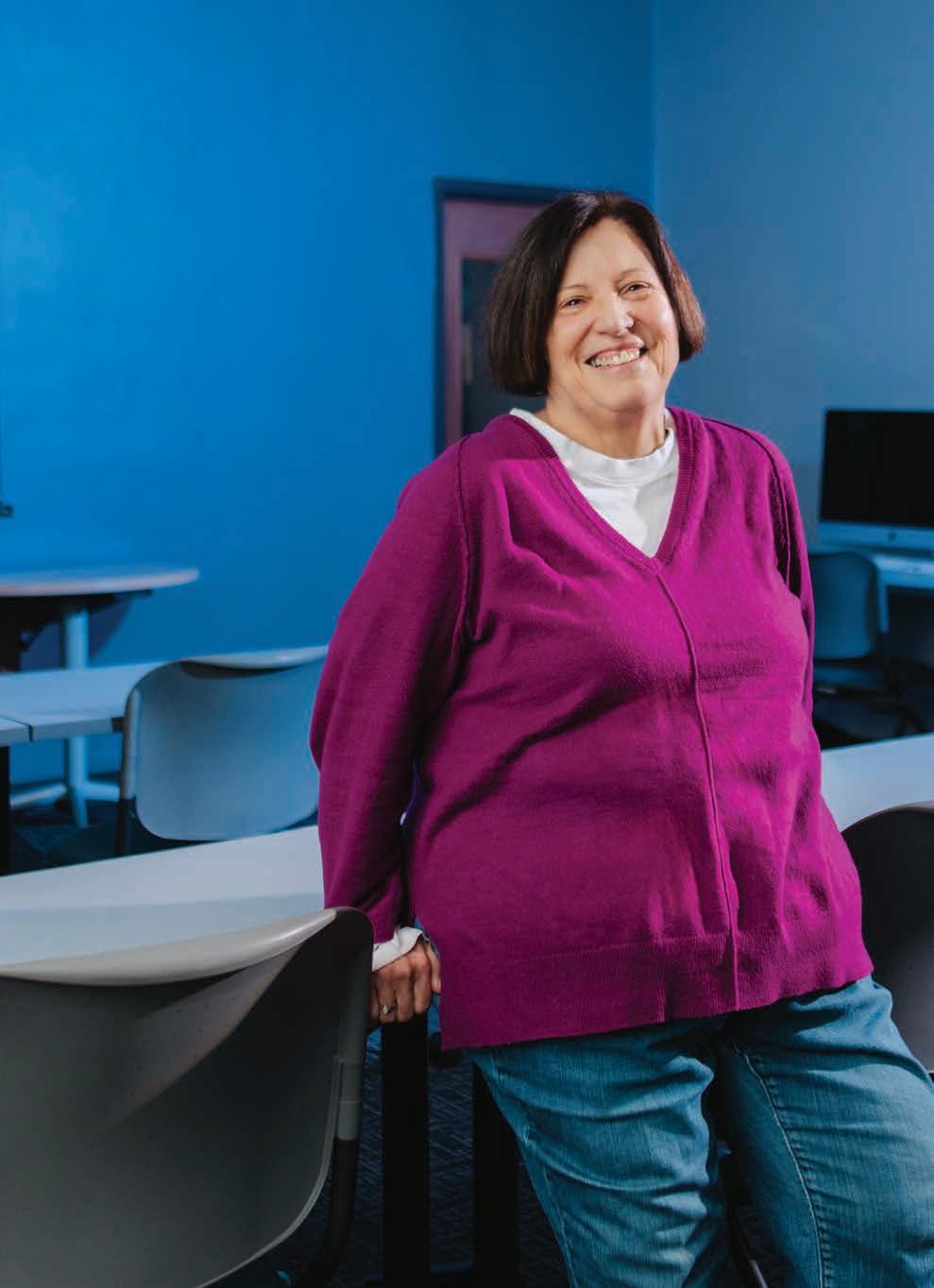
or the past 25 years, Creighton journalism students have known and loved professor Carol Zuegner, Ph.D. As an educator, Zuegner is known for teaching real and useful skills, pushing her students to their fullest potential, and offering insight and advice. Zuegner retired in the spring of 2024 after a combined 30-plus-year career in education. Although she has moved onto the next stage in her life, she has made a lasting impact in many of her students’ lives as well as on the Creighton journalism department.
Zuegner graduated with a bachelor's in journalism from Creighton in 1977 after taking classes from her father, who was also a Creighton journalism professor. Charles (Chuck) Zuegner taught at Creighton from the ’60s to the ’80s. Carol described being a student in her father’s classes as familiar and comfortable. The only time she was ever embarrassed was when he would slip a family photo into his lesson slides and joke, “How’d that get in there?”
She then worked for the Associated Press for over 10 years, where she became the journalist she is today. It grew her love for editing and reinforced her love for journalism, she said.
However, Zuegner knew she wanted to teach, especially in higher education, so she obtained her master’s in journalism from Ohio State University in 1991. And while finishing her doctorate at the University of Tennessee–Knoxville, the Creighton journalism department chair reached out to her with an opening.
“I had always told all my grad school friends I want to teach at a place like Creighton, never imagining it would be Creighton,” she said.
So in 1997, 20 years after she graduated, she stepped back onto Creighton’s campus.
As a teacher, she focused on staying up-todate with trends in journalism, a field that is constantly changing. When she was a student, she was learning on a typewriter. During her last few years, she was teaching students how to use AI.
She stays informed on what to teach by asking former students who are currently working in journalism. “You can’t just ship them out into the world without them knowing what to do,” she said. But the main lesson Zuegner emphasized in her classroom was the importance of factual, unbiased reporting, because newsrooms require efficiency and accuracy.
She also advised the student newspaper, the Creightonian , for over 15 years.
Brian Norton is a former Creightonian editor who is still close with Zuegner. He still remembers his first story when she corrected his misspelling of a coach’s name. “The fact that she did it with kindness instead of calling me out or making fun of me for such a mistake was wonderful,” he said.
The Creightonian was very meaningful to Zuegner because it was a space for students who were sometimes a little quirky or different. “Students all have gifts and different ways of doing things, and the Creightonian was a way they could come to their own,” she said.
Carol Zuegner




LESS PAIN, MORE LIVING

In 2018, Creighton awarded Zuegner the Joella Cohen Endowed Chair award. She chose to put the funds toward Creighton’s Backpack Journalism program, a five-week program in the summer where students travel to another state or country to produce a social justice film.
Sara Gentzler is a former student who went to Uganda twice through the program. “Carol was the beating heart of those groups,” she said. Zuegner helped students with reporting and interviewing while also offering support and space emotionally.
Much like her father, Zuegner knew how to effectively teach strong reporting skills. Chuck always told her to take journalism seriously, but not to take herself too seriously, she said.
Students referred to Chuck as Mr. Z, according to former student Cindy Murphy McMahon, and they enjoyed his dry sense of humor and respected his ability to make subject material interesting and entertaining. Both Zuegner and McMahon describe him as wanting to appear stern on the outside, but students knew that he was a huge sweetheart on the inside.
“The field of journalism has changed immensely since Mr. Z was in the classroom, but somehow Carol has been able to replicate the warmth and charm her dad exuded while also being an excellent and beloved teacher, just as he was,” McMahon said.
Since retiring, Zuegner has enjoyed activities like walking her dog Freida, cooking, traveling, and keeping up with Bluejays basketball. However, she still keeps journalism and mentorship in her life.
Through the Ignatian Volunteer Corps, she volunteers at Nelson Mandela Elementary to talk about jobs and careers with students during their lunch. She is also a board member for American Media, a Jesuit journal of faith and culture. She serves as a mentor to their post-grad fellows who have an interest in social justice by helping them develop reporting and journalism skills.
Even throughout all these years, many students still reach out to her for advice when they are making big career or life decisions.
“Since graduating, I have gone back to Carol for guidance every time I’ve encountered curve balls and questions,” said Gentzler, who is currently a reporter for the Flatwater Free Press. “She’s been a constant source of level-headed advice and encouragement, and I always leave conversations with her feeling more confident about taking a step forward.”
Zuegner makes time for former students, whom she now considers genuine friends. Norton and his co-editor from their Creightonian days are two of many who still get dinner with her multiple times a year.
“She doesn’t have to be a friend and advisor for life, but that’s certainly what she is,” Norton said.



Dr. Kristi Tackett-Newburg
OUR
PROVIDERS
Salina Anderson, APRN
Geraldine Alexis, LIMHP, PLADC
Julie Bierman, LCSW, LMHP
Chantel Bruha, LIMHP, LADC
Korrie Conners, LMHP, CSAT
Kirby Davis, LMHP
Peggy Deaver, LIMHP, CPC
Davin Dickerson, APRN
Beth Farrell, LCSW, LIMHP
Dumayi Gutierrez, PhD, LMHP
Lucy Hancock, MA
Charlene Hills, LCSW, LIMHP
KG Langdon, APRN
Mary Loftis, LMHP, CPC
Kim Mueller, LIMHP, CPC
Nicole Obrecht, LIMHP
Kara Schneider, BA
Marty Stoltenberg, APRN-BC
Kristi Tackett-Newburg, PhD, LIMHP
Greg Tvrdik, LIMHP, CPC
Sarah Wenzl, LMHP, CPC
Michele Yanney-Wehbi, LIMHP, CPC
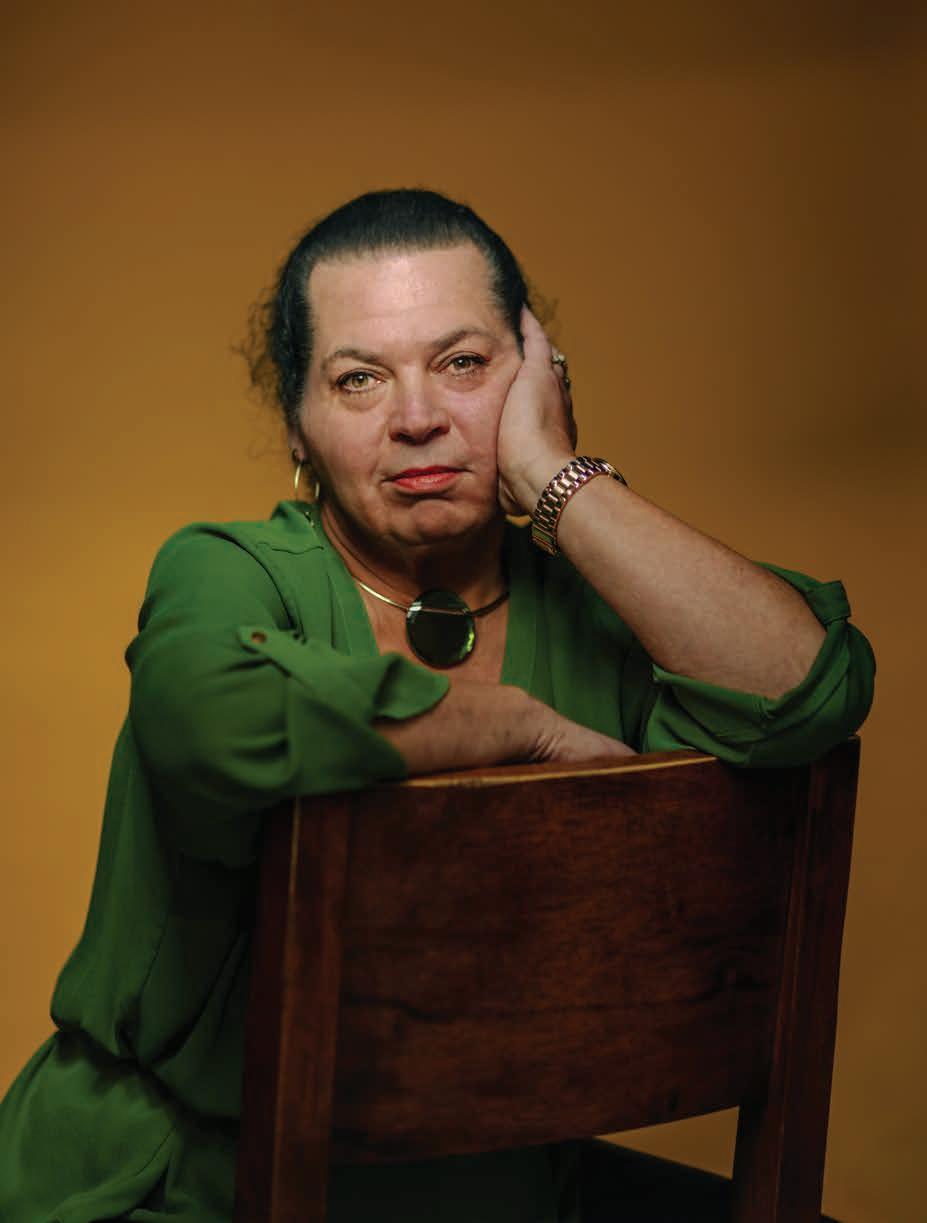

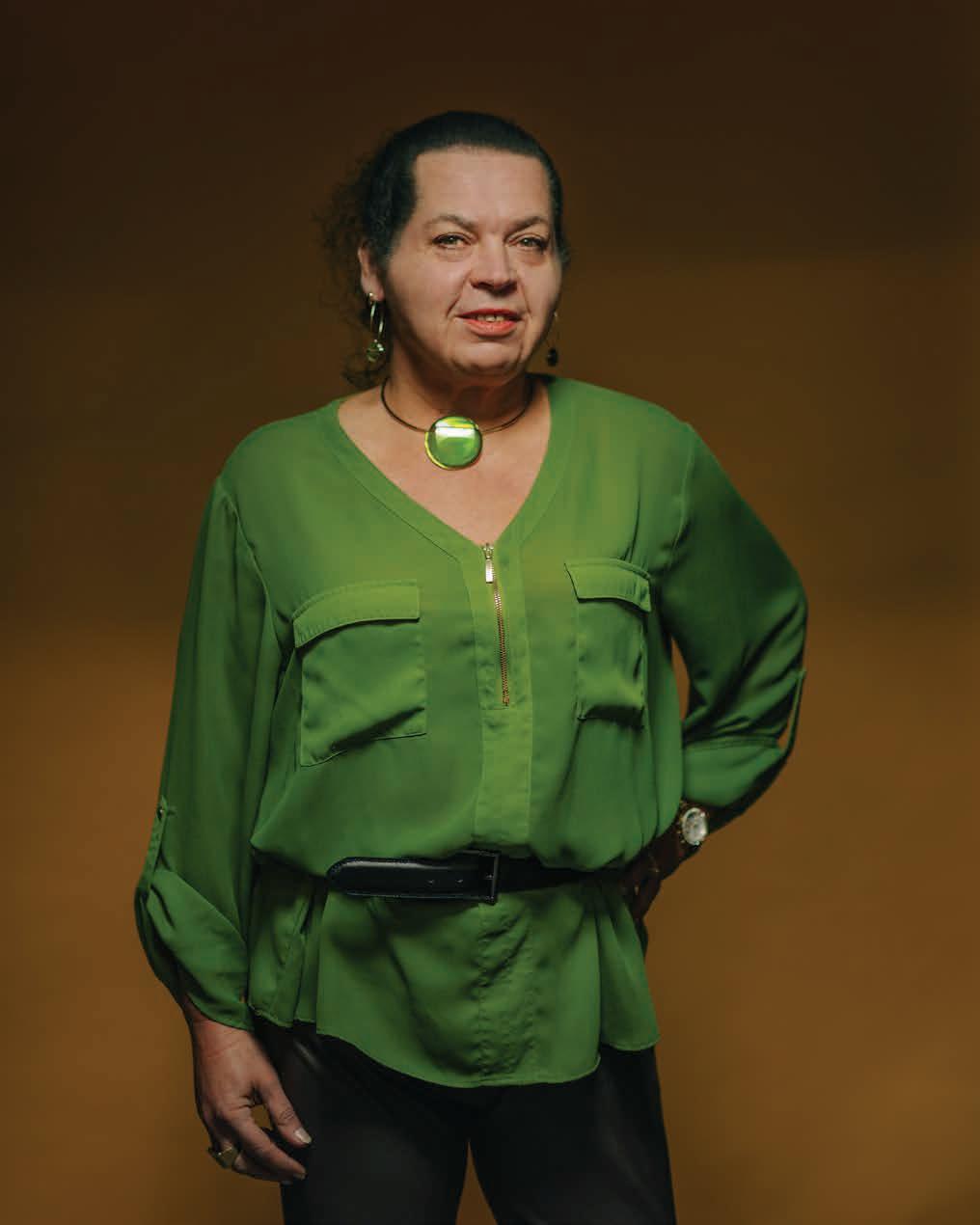
FEATURE
Story by Natalie Veloso and Isaac Nielsen
Photography
by
Sarah Lemke
Design
by
Rachel Birdsall

UNSILENCED

FRANKLIN, EPSTEIN, AND THE PATTERNS THAT PROTECT THE POWERFUL
“If you are right—and you are, and we both know it—there will be a time when victory will come and the good will triumph over the evil.” — William Colby, former head of the CIA, speaking to John DeCamp in DeCamp’s book, The Franklin Cover-Up: Child Abuse, Satanism, and Murder in Nebraska
For expanded content, open the camera on your smart device and hover over the QR code.

The television was on as background noise,
part of a usual morning routine. Alisha Owen was half-listening when a segment caught her attention. On the screen, a woman from New York was on a morning show telling a story about being 15, a friend who promised easy cash, and walking into Jeffrey Epstein’s townhouse believing she would give a simple massage and leave with two hundred dollars folded in her pocket. She spoke about skipping school without her mother knowing, about wanting the money and a little independence, realizing too late what the invitation actually required. Being blackmailed to keep quiet.
Owen felt the mug go cold in her hands. “She literally described my experience word for word,” she said. The segment ended, but the feeling didn’t. For years, Owen had kept her distance from the public story that came to dominate her youth: the Franklin case in Nebraska that sent her to prison on perjury charges after testifying she had been abused as a minor and refusing to recant the accusations. Watching a stranger describe tactics she recognized down to the smallest detail, the past returned with uncomfortable clarity.
“What really nailed it for me was hearing how it started for that girl,” she said. “A friend saying, ‘It’s no big deal, you’ll get two hundred bucks.’ When you’re 15 and you don’t have money, that sounds like the world. You don’t think about how quickly it can change.” Owen paused. “As she was talking, it just broke me. I understood it was the same tactics. That it didn’t have to happen to either of us. And it’s all about power.”


The connection, Owen argues, is not about relitigating Franklin or asserting equivalence between cases separated by decades and legal outcomes. Instead, she describes recognizing how allegations involving powerful people tend to move through institutions.
This account draws primarily from interviews, court records, and current reporting. It does not seek to independently adjudicate allegations already addressed by the courts, but instead to understand why Owen and others believe the patterns that defined Franklin continue to exist today.
Against Stacked Odds

It’s difficult to explain how traumatic it was to go through the court system and through the prison system the way I did. Everybody hopes for justice. But there was a point where I knew I wouldn’t get it.
Decades earlier, the collapse of Franklin Community Federal Credit Union had pushed the modest North Omaha building into a subject of national attention. Investigators initially followed the money. On Nov. 4, 1988, federal agents descended on the credit union. Their investigation uncovered nearly $39 million in missing funds, leading to the conviction of the credit union’s manager, Lawrence E. King Jr., on fraud and embezzlement charges.
— Alisha Owen
Alongside the financial case grew a more volatile narrative: allegations from several young people claiming they had been abused and trafficked by King and influential figures he was connected with. The testimonies of victim witnesses implicated politicians, businessmen, and law enforcement.
Two grand juries ruled those claims a fabrication, and two of the victim witnesses were charged with perjury. One of them was Owen, who had testified before a legislative committee about her experiences as a minor. The Douglas County grand jury issued its official report in 1990, declaring all allegations of abuse and child trafficking a “carefully crafted hoax.”
“It’s difficult to explain how traumatic it was to go through the court system and through the prison system the way I did,” Owen said. “Everybody hopes for justice. But there was a point where I knew I wouldn’t get it.”
Owen’s life tilted quickly. She was 17 when the credit union publicly fell. She was frightened enough to leave Omaha for six months as investigators closed in. “Some people who were involved died in ways that weren’t clear or publicized,” she said. “I ran away initially because I didn’t want to end up in a garbage bag in the desert.” Law enforcement agencies at the time did not link those deaths to the Franklin investigation, and official records ruled them unrelated.
Owen was first arrested in September 1988 at age 19 for having issued bad checks, according to later court records. While serv ing her prison sentence for that conviction at the Nebraska Correctional Center for Women in York, she was contacted by
When Owen later testified under oath before a Douglas County grand jury, she reaffirmed those allegations. The grand jury concluded that Owen’s testimony was false and, on July 23, 1990, indicted her on eight counts of perjury. She spent nine years incarcerated in total, including four and a half as a result of the perjury charges, followed by three years on parole.
Owen also spent two years in solitary confinement. She describes the period as brutal, though she

Her decision to not recant and stand by her testimony became the center of the ensuing legal battle. “It was never on the table for me,” she said.
Owen said the grand jury process felt predetermined to her. “They flat-out said, ‘We’re gonna do this to you unless you say this.’ They told me what they wanted me to say,” she recalled. “It wasn’t, ‘You better quit lying and tell us what really happened.’ No, it was, ‘You’re gonna say this. You’re gonna call yourself a liar. You’re gonna say you made it all up for this reason.’”
At Owen’s sentencing in 1990, she addressed the judge directly. “I looked at him and said, ‘Do whatever it is you’re gonna do, send me to prison,’” Owen recalled. “‘But I’m not really in a prison. If I did what you wanted me to do, I’d be in a prison forever.’”
Adding up the years in her head as the judge sentenced her, Owen calculated that she would end up spending nine to 15 years incarcerated. It was more survivable than 200. “I thought, ‘Wow, I just might get a life when this is over.’”
Before Owen testified or the grand juries formally rejected the trafficking and abuse allegations, the Nebraska Legislature had convened the Franklin Committee in 1988, chaired by Senators Loran Schmit and Ernie Chambers. That's when Caradori was hired to investigate the emerging claims.
Caradori’s work came to an abrupt and tragic end in July 1990 when he and his 8-year-old son died in a plane crash while returning from a fact-finding trip to Chicago. Federal authorities ruled the crash an accident, but the timing fueled speculation, especially because Caradori had reportedly obtained incriminating photographs that would’ve increased suspicion of foul play.
That same year, John DeCamp, a former Nebraska state senator who became Owen’s appellate attorney years later, had circulated a memo alleging ties between powerful figures and a Franklin-related sex trafficking operation. He later expanded those claims in his 1992 book, The Franklin Cover-Up: Child Abuse, Satanism, and Murder in Nebraska.
DeCamp’s book supported the idea that what happened to Caradori’s plane was no accident, affirming the claim that his death came immediately after he made a phone call
discussing his plans to expose the incriminating photographs he obtained. DeCamp’s conclusions were not adopted by the courts, which continued to treat the crash as accidental. “From late 1988, when the Franklin case first broke into public view, until mid-1991, at least 15 people associated with the case as investigators, alleged perpetrators, or potential witnesses, died sudden deaths, many of them violent,” DeCamp wrote in The Franklin Cover-Up .
The book rejected the grand juries’ conclusions and detailed what he believed to be institutional corruption. DeCamp described a far-reaching “cover-up” carried out by those in power, devoting entire chapters of his book to each phase: Phase I, the police; Phase II, the Douglas County jury; and Phase III, the FBI.
That narrative, however, was not the one the courts ultimately accepted, according to documents from State v. Owen (1993). At trial, prosecutors focused partially on Owen’s allegations involving then-Omaha Police Chief Robert Wadman. Owen testified that she had engaged in 20 to 25 sexual encounters with Wadman and that he was the father of her child. Wadman denied ever meeting Owen, and local media reported that DNA testing excluded him as the child’s father. Owen said the results of that testing were inconclusive, neither confirming nor disproving paternity. The prosecution declined to enter any paternity lab results into evidence in Owen’s trial.
The state also highlighted discrepancies in Owen’s description of Wadman’s body. Owen testified that she did not recall seeing any surgical scars, while Wadman presented evidence of scars on his left forearm and right hip from a gunshot wound and bone graft surgeries. Prosecutors also highlighted that Owen did not identify a father in initial proceedings, a point they later used to cast doubt on her account.
Years later, the Nebraska Supreme Court would quietly undo part of the legal framework used to reject Owen’s appeal. In State v. Anderson (1997), the court overruled the heightened evidentiary standard used in State v. Owen . The ruling did not reopen Owen’s case, but it erased the legal rule that helped reject her claims.
Most individuals named during the Franklin investigation faced no legal consequences, but a few prominent Omaha men were later charged. Peter Citron, a longtime Omaha World-Herald columnist, was arrested in 1990 on charges of sexually assaulting two young boys—an arrest the Washington Post described as “apparently unrelated” to the Franklin case. Citron had been identified years earlier by Owen and Bonacci during sworn testimony and was also listed in DeCamp’s 1990 memo.
Another name raised by Owen and Bonacci before formal charges emerged was Alan Baer, a wealthy Omaha businessman and former owner of J.L. Brandeis department stores. Baer was indicted in 1990 on two felony counts of pandering, but was not convicted. Like Citron, Baer was named in DeCamp’s memo, and authorities treated his case as separate from Franklin.
After the Verdict
In 1991, the financial side of the case reached its own conclusion when King pleaded guilty to embezzlement, fraud, and tax violations. He served more than a decade in prison. Yet, some survivors and investigators believed the record left too much unexplained. Among them was Owen, whose testimony was widely ridiculed in local and national media.
The public portrait of her hardened quickly. “On the front page of the World-Herald , they called me short, fat, and ugly,” she said. “Bill Gallup, the No. 1 attorney in Omaha, said, ‘That could not have happened to her. She’s short, fat and ugly.’ It made me decide that I am not my experiences.”
Owen has long argued that the media response was not neutral. At the time, the WorldHerald ’s publisher was Harold Anderson, whom Owen had named as a perpetrator during her testimony. Anderson repeatedly denied any participation in or knowledge of the abuse allegations, according to State v. Owen (1993).
For years, Owen refused to speak to reporters. “If you go back into my history, you are not going to find me talking to the press,” she said. “I never wanted the attention. I only talked to my attorneys and law enforcement.” Journalists, she recalled, paid other inmates for scraps of information about her daily routine.
“The day that I showed up at York [the Nebraska Correctional Center for Women], I believe I was the youngest inmate there. No prison is a happy place, especially for a 19-year-old,” she said. “But I knew that the rest of my life was not going to be spent at York.”
Determined not to wait on a system that had already failed her, Owen took matters into her own hands. “I realized the law library needed to be my home,” she said. She began spending hours studying anything that might offer a path forward. “I found a law that said unless it’s a capital crime, or the person is a risk to public safety or a definite flight risk, they have to give you an appeal bond,” Owen said. “And the judge said no. He just said no. I was really frustrated.”
While still in prison, Owen enrolled in law classes. “I know people thought I was crazy,” she said. She began with legal-assisting courses. “You’re basically the legal researcher. You learn how to write briefs. You learn everything an attorney needs to do.”
By the time she was released in 1992, that education had begun to reshape the direction of her life. Owen enrolled at Omaha’s Metropolitan Community College the following year, where she built a life far from the headlines.
She met her husband at school in ’93 and married in ’94, but entering the process of appealing her case a few years later felt like another trial by endurance. “In ’96, we were going back to court,” she said. “I was doing at least 85-90% of the documents myself by then.”
Her release ended abruptly while her attorney was overseas. With her counsel unavailable, the prosecutor handling the appeal filed notice that the appeal had been denied, leaving little time to respond. “He filed on a Friday and said I had to show up Monday to turn myself in,” Owen recalled. She was married and working by then, but within days, she was back in custody. “It’s a lot harder to get out than it is to stay out,” she said. “I had a home. I had a life.”
Owen spent another 18 months at York before transferring to work release in Lincoln, still within the prison system. Back in Omaha, she drove other inmates to their work-release stops. During that period, she received an unexpected letter from the College of St. Mary offering a full scholarship to finish her degree. Prison officials refused to allow her to attend.
After intervention from State Sen. Ernie Chambers, she was granted educational release and graduated summa cum laude in 2000 with a degree in computer information management. The achievement opened doors academically, but not professionally. Jobs that required background checks were out of reach, and security clearances were impossible.
She turned instead to the travel industry, joining her mother’s agency at a time when few agents were comfortable with emerging booking technology. “Within two or three years, I was the seventh-most-booked travel agent in the United States,” Owen said. Specializing in five-star, all-inclusive resorts, the work carried her around the world and offered a life far removed from the courtroom and prison yard.
“I’ve had the most amazing life,” she said. “I’m not a drug addict. I’m not an alcoholic. A pardon would be nice, and there are still things I can’t do as a convicted felon, but I still am going to have a good life with or without it.”
Recognizing the Pattern
The Franklin story did not end in Nebraska’s courtrooms, and not everyone accepted the grand juries’ conclusions as definitive. For investigative journalists like Nick Bryant, who was later credited with first obtaining and publishing Jeffrey Epstein’s “little black book” in 2015, the Franklin case was an early example of how institutions respond when allegations touch powerful figures. Like many journalists at the time, he strug gled to get in contact with Owen as he researched the Franklin case in the early 2000s.
“A former Nebraska senator [DeCamp] had written a book on it, and I read the book,” Bryant said of his first exposure to Franklin. “And there was also a documentary called Conspiracy of Silence that was shelved that was made about it. So I read the book and I saw that documentary, and I knew that something had happened in Omaha.”
But when Bryant tried to pitch the story to publishers, the resistance was immediate. Editors, he recalled, saw a choice in front of them: engage with a disturbing story that could carry real consequences, or dismiss it and protect their own stability. “When I was pitching this in New York to editors, they were thinking to themselves, ‘This is a really horrible story. I can help Nick Bryant, or I can write Nick Bryant off as crazy and have a nice meal with my family tonight,’” he said. “No one in publishing wanted to touch the story.”
Bryant persisted anyway. He tracked down victims, asking difficult questions about past trauma. “I ended up finding about 13 victims,” he said. “There were some that just wouldn’t talk to me, but a number of them did. And that was heartbreaking for me. I’d contact someone, and I’d say, ‘Tell me about your darkest nightmares from your childhood.’ That was very tough, but at this point, I was really committed to that story.”
Owen was among those who did not respond to Bryant’s early outreach. Although she was no longer incarcerated, she had already spent years declining interviews by the time Bryant began researching Franklin for what would become his book, wary of the risks she associated with speaking with reporters directly.
Bryant relied on intermediaries. DeCamp provided him with a family phone number around 2002, understanding that an unexpected call from a journalist would likely be unwelcome. Bryant would periodically reach out through Owen’s family, making it clear that he respected her reluctance, Owen said. For more than a year, roughly every few months, he asked that his interest in the case be passed along without pressing for a response.
During that same period, Bryant was also in contact with Owen’s appellate attorney, Edward Fogarty. Over time, Fogarty came to believe that Bryant was approaching the subject with care. Eventually, he suggested that Owen meet Bryant once, in a controlled setting, with counsel present. By then, years had passed since her incarceration; she was off parole and living her life. Owen and Bryant’s first meeting took place in Fogarty’s office in Omaha around 2004.
After seven years of dogged research on Bryant’s part, the result was The Franklin Scandal: A Story of Powerbrokers, Child Abuse & Betrayal , a 2009 book that challenged the official record and placed the grand jury process under scrutiny. “The state grand jury called it a carefully crafted hoax and really disparaged a number of people, saying that not a single child had been abused,” Bryant said. “With The Franklin Scandal , I bring the reader into a grand jury, a very corrupt grand jury, and I show how easy it is to corrupt a grand jury if you’ve got corrupt special prosecutors.”


Although Bryant’s book does not contain direct interviews with Owen, he does reference meeting with her and relies on court records related to her case. Over time, their relationship shifted from cautious contact to a longer-term professional rapport.
From Bryant’s perspective, Owen’s prosecution was proof of how institutions protect themselves. “The reason why the state went so hard after Alisha is that it was imperative that she’d be found guilty or else the grand juries would have been called into question,” he said. To Bryant, it functioned as a warning. “When the victims saw what happened to Alisha, that sent a very loud message.”
A few years later, when Bryant turned his attention to Epstein, the similarities between the two cases were shocking. “There were accounts of Epstein molesting multiple girls, and there was a grand jury in Florida that declared he hadn’t molested a single girl. So I got this vibe that Epstein was very much like Franklin, just my intuition. Then I got down there, and I got the black book, and started calling the victims, and they told me about being put on planes, and one told me about being flown to an island. At that point, I felt like Epstein and Franklin were very, very similar. It’s a carbon copy.”
Epstein, a wealthy financier with powerful political and social connections, was arrested in 2019 on federal sex-trafficking charges after years of allegations that he had abused underage girls. Long before his death in jail while awaiting trial, experts had pointed to a pattern of institutional protection that allowed the abuse to continue for years.
Bryant noticed the same system with Franklin. What stuck out to him wasn’t just the abuse, but the entire machine he said was designed to protect it. “The involvement of the Department of Justice and federal law enforcement,” Bryant said when asked about the most important structural similarity between Franklin and Epstein. “The common denominator is children that are getting pimped out, but the amazing amount of federal firepower that has been used to cover it up, that’s a major similarity.”
In both cases, accusations implicated wealthy people with political connections. Accusers faced swift public backlash and sustained scrutiny of their credibility, often accompanied by warnings about the personal cost of speaking out. Survivors in both cases described fear of retaliation and reputational damage long before investigators reached any conclusions. Both cases, Bryant has argued, relied on intermediaries, including young people recruiting other young people, to maintain access and distance. ( Unlike the Epstein case, which resulted in federal charges and multiple corroborating accounts, the Franklin investigation did not produce criminal convictions related to trafficking or abuse.)
As Bryant uncovered the material on Epstein and worked to contact victims, he sought Owen’s help.
“One of the parts of our friendship is he would sometimes call me and ask, ‘How do I do this right?’” Owen said. “I was a good sounding board for him on some things, because being a survivor, a victim, he would kind of use me as, you know, what would be the best way to approach this? Because he’s very, very empathetic and very conscious of his behavior.”
Owen often wonders how her case might’ve unfolded differently with an advocate like Bryant involved. “I wish I had a Nick Bryant back in the ’80s,” she said. “Things might have been different.” She wasn’t fully alone, however, as she said the official narrative, which was that the abuse never occurred, never fully convinced some in Omaha. “Just because the mainstream media said something doesn’t mean everybody believed it,” Owen said. “What I often heard was, ‘Where there’s smoke, there’s fire.’”
In 2021, as the Epstein files were unfolding, she agreed to speak publicly for the first time at a rally outside the Ghislaine Maxwell trial in New York. “It was kind of amazing,” Owen said. “It was a turning point for me.”
For Bryant, that moment was part of a longer effort shaped by frustration with groups that already existed. “During Ghislaine Maxwell’s trial, I knew that there was going to be an egregious miscarriage of justice,” he said. “But there wasn’t any interest whatsoever from any organizations, so I put together a protest.”
The common denominator is children that are getting pimped out, but the amazing amount of federal firepower that has been used to cover it up, that's a major similarity.
— Nick Bryant
That protest would become the seed of Epstein Justice, a nonprofit Bryant founded and now directs, with Owen working alongside him as assistant director and event planner. The organization’s goal is intentionally confrontational. “It’s pretty simple,” Bryant said. “We want an independent congressional commission to investigate two things. We want to know why the government covered up child trafficking, and we want the perpetrators to be prosecuted.
“I see them as features of the same system,” he said of Franklin and Epstein. “I’ve come to believe that blackmail plays an endemic role in our political process.” He referenced multiple scandals involving senior members of Congress as examples of how personal secrets can be weaponized.
He recalled an analogy offered by Rusty Nelson, a child pornographer who once helped Bryant recover blackmail pictures stashed in the mountains of Colorado. “He said that once you’re compromised, it’s like you’re on a beautiful yacht, and it’s a beautiful day, and you can have anything you want on the yacht,” Bryant said. “But if you decide to get off the yacht, the people on the yacht are going to make sure that you’re out.”
Bryant said that because the case initially broke publicly before the news of the Bill Clinton–Monica Lewinsky scandal and the suing of the Catholic Church, everyday people were naive, unwilling to believe what survivors were saying.
“No one wants to believe that their government is covering up child sex trafficking,” Bryant said. “And if you cover up a crime, you’re aiding and abetting that crime. So ultimately, the government is aiding and abetting child sex trafficking.”
When the Epstein case entered public consciousness, Bryant saw significant progress. “Epstein has come much further than when I started Epstein Justice three years ago,” he said. “But now that Epstein is kind of woven into the American zeitgeist, I think there’s a real opportunity to make sure that Franklins and Epsteins don’t happen anymore.
“There’s a tremendous number of Americans that are outraged by it,” Bryant said. “And it’s a matter of marshaling support from them.”
Still, he remains skeptical of ongoing disclosures. “The document release has been a joke,” Bryant said, referring to heavily redacted Epstein files. “I mean, I released more incriminating information on Jeffrey Epstein in 2015 than Pam Bondi did on the first document release.”
Rep. Thomas Massie put it more starkly in a comment Bryant frequently cites: “Until we see rich men being perp-walked to jail, this is still a cover-up.”
For Owen, working with Epstein Justice feels less like reopening old wounds and more like giving them purpose. Owen now helps organize rallies, coordinate events, and support other survivors who are deciding, often for the first time, whether to tell their stories.
“Learning about Epstein back in 2009, it was like experiencing Franklin all over again,” she said. “That’s one of the reasons why I think Nick really wanted to get into it. He was like, ‘We’re not gonna let this happen again.’”
Unfinished Justice
Although Epstein died in a Manhattan jail cell in August 2019 while awaiting trial on federal sex-trafficking charges, the legal aftermath of his case has not fully concluded. Maxwell, his longtime associate, was convicted in 2021 on multiple trafficking counts and is serving a 20-year federal prison sentence.
In November 2025, Congress passed the bipartisan Epstein Files Transparency Act, requiring the Department of Justice to release its full archive of case-related materials. The mandate set a December deadline, but federal officials acknowledged they were unable to meet it, citing the scale of the records involved.
On Jan. 30, 2026, the Department of Justice released over three million pages related to the case, including 2,000 videos and 180,000 images. It said the release would be the final one and that it had met its legal obligations, while acknowledging that a total of six million pages might qualify to be released under the Act.
Federal authorities, meanwhile, have signaled limits to what the released records are expected to produce. The FBI and the Justice Department issued a joint memorandum in mid-2025 stating that an “exhaustive review” of the Epstein files had not identified grounds for further criminal charges tied to Epstein’s core trafficking operation. No additional prosecutions, the memo concluded, are anticipated.
Epstein Justice demands accountability. Owen’s work with the organization today centers on administration and education, helping other survivors navigate systems that once crushed her. “People are so much more than their experiences and so much more than their trauma,” she said.
“I think a lot of times, people will tend to treat survivors like they’re broken and weak little people, and I’m anything but broken and weak.”
While some women in the Epstein case have received financial settlements, Owen noted that many were required to sign nondisclosure agreements, silencing them once again. “I didn’t realize the importance of sharing and speaking out until the first time that I did,” she said. “It’s not that you ever really heal, but there is a recovery. There’s a sense of empowerment. There is a sense of claiming your own self and no longer just being a victim.”
Though financial settlements provide some measure of justice, the restrictions they impose often prevent survivors from sharing their truth. Owen sees breaking that silence as a collective responsibility to safeguard the vulnerable and hold systems accountable.
“We have a duty to not be lazy with this,” Owen said. “It may not be your kid, but it could happen to the child of anyone you know. People need to understand they have a duty to protect those who can’t protect themselves.”
“A lot of people have been conditioned to believe that the system is rigged and that they cannot make a difference,” Bryant said. “Now, it’s about showing people that they can."
For more information and to get involved, visit epsteinjustice.com.
“Until we see rich men being perp-walked to jail, this is still a cover-up.”
— Rep. Thomas Massie (KY)
Looking Back, Leading Onward
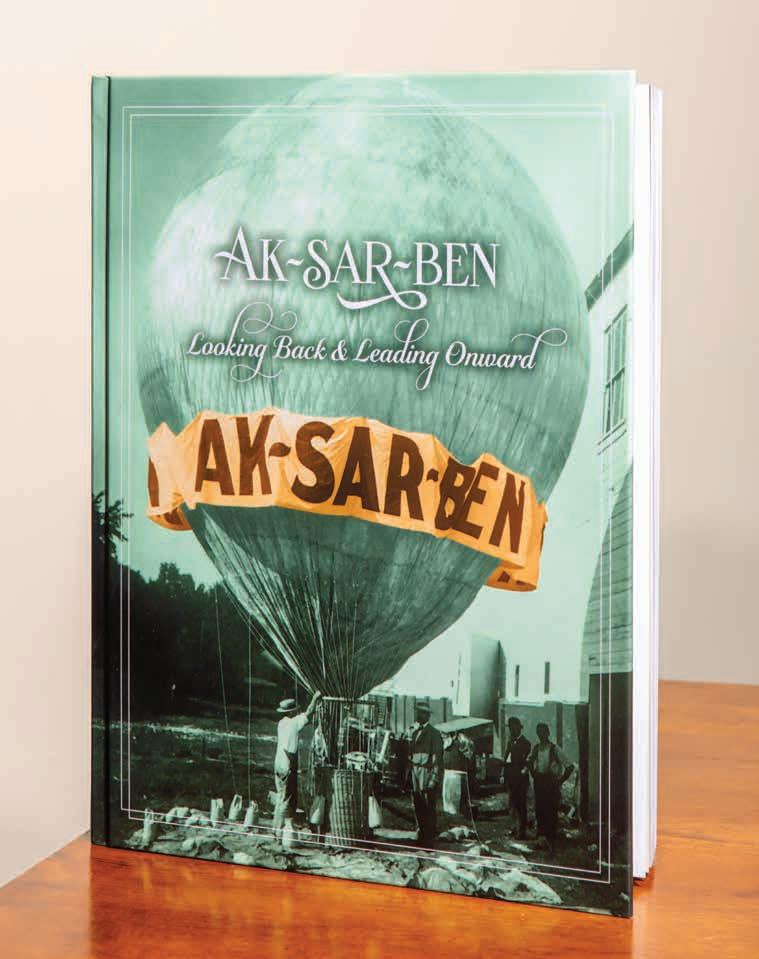
New Book Showcases 130 Years of Ak-Sar-Ben History
Story by Kara Schweiss // Photography by Sarah Lemke // Design by Joey Winton
History
ince the Omaha Businessmen’s Association organized the Knights of Ak-Sar-Ben in 1895, Ak-SarBen has held a prominent place in Nebraska history. Regardless, its full story was unknown to most of the state’s citizens, said Kristine Gerber, who served as editor of a new book published by the Durham Museum: “ Ak-Sar-Ben: Looking Back & Leading Onward .”
“As an Omaha historian, I couldn’t help but see that Ak-Sar-Ben is so much more than the coronation,” Kristine Gerber said. “It’s a story about community, about entertainment, philanthropy, and the spirit of Nebraska.”
“The Aksarben Foundation’s story is deeply intertwined with the growth of our communities, the strength of our agricultural and business leaders, and our longstanding commitment to education and opportunity,” Aksarben Foundation President Sandra Reding said. “Preserving this history honors the individuals and families who built the foundation we stand on today, while also reminding future generations that progress is driven by collaboration and a willingness to invest in what comes next. This book ensures that the Aksarben Foundation’s legacy is not only remembered but continues to inspire leadership and impact across Nebraska.”
Gerber, also the president of the Durham Museum Guild, envisioned a comprehensive yet image-rich coffee-table book covering the organization’s evolution from 1895 to 2025. The broadest Ak-Sar-Ben chronicle prior to the new book was The Ak-SarBen Story: A Seventy-Year History of the Knights of Ak-Sar-Ben , which began as Arvid E. Nelson Jr.’s 1962 master’s thesis on the early history of the Knights of Aksarben. Afterward, the board of governors of Ak-Sar-Ben granted him a three-year fellowship to expand the project to a 400-pluspage book.
Not only does the new book cover the ensuing decades, it’s also taken a very different approach, Gerber said.
“Everyone who grew up in Omaha seems to have an Ak-Sar-Ben memory, whether it’s the horse races, the family shows or ice skating in the coliseum. I wanted this book to capture that full story,” she explained. “The last Ak-Sar-Ben book was published in 1967, and very few have ever seen it. It was time.”
The October release of Ak-Sar-Ben: Looking Back & Leading Onward coincided with a Durham Museum Ak-Sar-Ben exhibit showcasing historic coronation gowns and artifacts that ran through Jan. 11. The book continues to be available at the museum, through the Nebraska State Historical Society, through Amazon, and at local bookstores including The Bookworm and The Next Chapter.
“The Ak-Sar-Ben book was a volunteer project of The Durham Museum Guild in cooperation with The Durham Museum and the Aksarben Foundation. We had a wonderful team of Guild members that worked together to make this book happen. The book became a true community effort and it would not exist without so many generous people,” Gerber said, crediting numerous collaborators and supporters in addition to museum staff, from researchers Karen Sundell and Britta Lind to membership pin collectors Dave Edwards and John Krecek, photographer Michael Leggott, and organizations including the Nebraska State Fair, the Omaha World-Herald, the Nebraska State Historical Society, the Aksarben Foundation, Renze Display, and the Douglas County Historical Society.
“Once my research was done, Angie Hempel took the research and turned it into engaging, readable text. Pam Thomas and past Women’s Ball Committee members edited it and Jared Cloudt made it all look beautiful,” Gerber said. “We also had a team of people helping find funds to underwrite the book: Kate Grabill, Mark Maser, Corey Wilson, and Lisa Russell. Thanks to underwriting, 100% of the sales of the book are going back to The Durham Museum’s efforts to preserve our shared history.”
There were some surprises during the research phase, including discovering that the Knights of Ak-SarBen organization was “intentionally playful and creative” even as members were tackling serious economic and civic challenges, Gerber said.
“The pageantry, humor, and elaborate events weren’t just spectacle; they were strategic tools to build morale, raise money, and unify the community,” Gerber said. “Another surprise was how deeply Ak-Sar-Ben was woven into everyday life in Omaha for decades. It wasn’t just a once-a-year event; it shaped youth programs, agriculture, education, and philanthropy in ways many people today don’t even realize trace back to Ak-Sar-Ben. I was struck by how adaptable the organization has been over time. The book really shows Ak-Sar-Ben’s willingness to evolve—letting go of traditions when they no longer served the community and refocusing on long-term impact. That flexibility is a big part of why its legacy still matters today.”
The visually compelling book is expected to serve researchers and community members for years to come, Gerber said.
“With 1,400-plus images, text done in small bites, and a visually engaging design, I think we did that. I’ve already had several people come up to me and tell me they have read the whole book and loved it,” she said. “That is what any publisher wants.”
Visit durhammuseum.org/book-aksarben for more information.
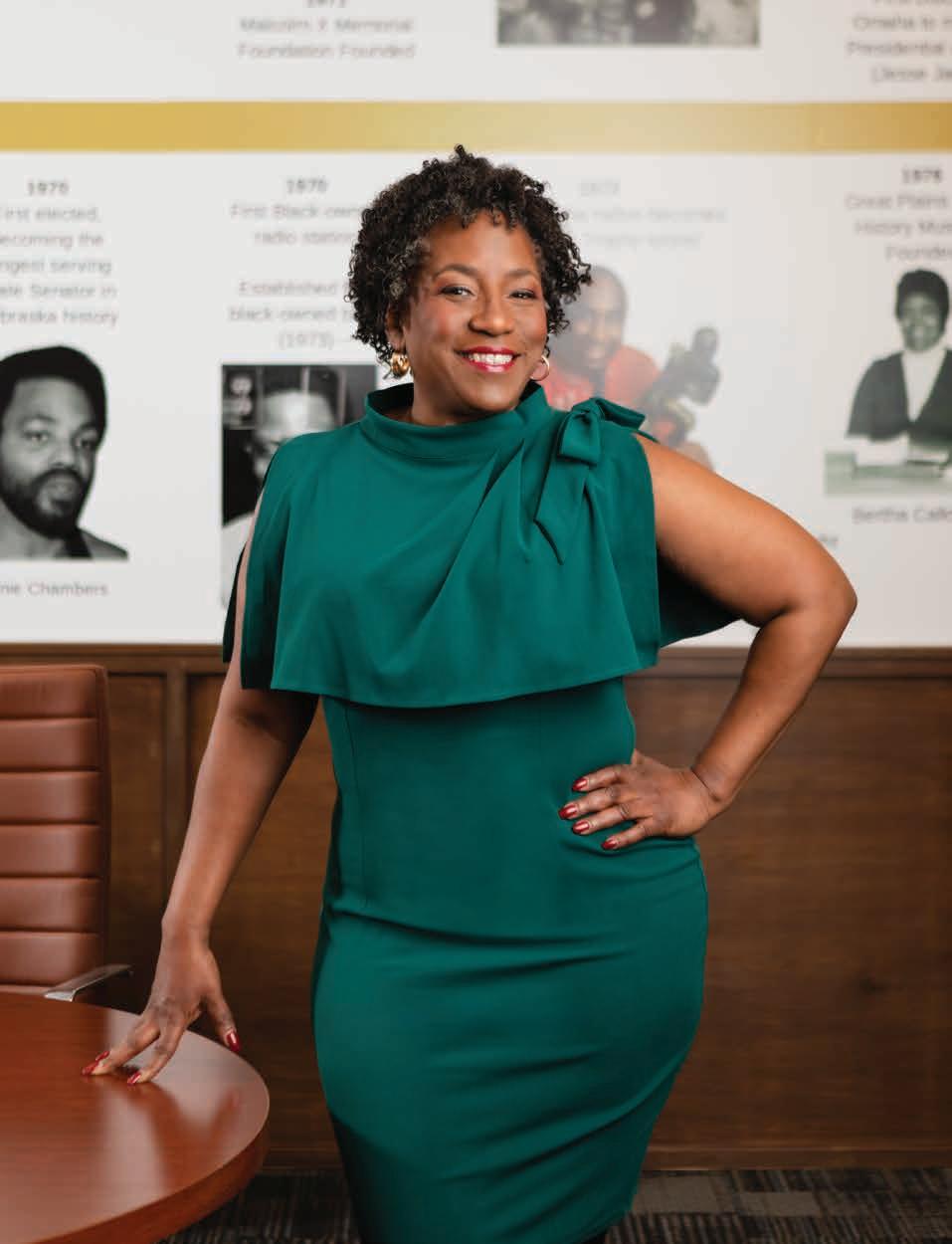
Kimara Snipes
he caseworker delivered the news without ceremony: financial assistance was being cut off—at the worst po ssible time.
Kimara Snipes, a single mother “making nothing” at the time, felt the ground shift beneath her. The system designed to help her made her feel powerless. Confused. Hopeless.
“I remember being very hurt and upset about it, because now I no longer have access to resources I really need,” said Snipes, now executive director of neighborhood empowerment agency One Omaha. “And my case worker said to me, ‘Well, if you want to do something, you have to call your state senator.’ They weren’t saying it very nicely, or in a way that assumed I would do anythin g about it.”
Th at caseworker had no idea she was dismissing a powerhouse future advocate and budding community development superstar. Twenty years later, that moment still drives Snipes’ service to the community—a career that has seen her run for mayor, transform how Omaha thinks about neighborhood development, and empower local leaders to remake the city one bloc k at a time.
“There was a hidden lesson that I learned from some things early in my life: You need to step in when somebody else isn’t able to,” Snipes said. “You have to get out there and move your feet in order to make someth ing happen.”
But fi rst came a chance meeting at the mailbox.
Snipes struck up a conversation with a neighbor while grabbing mail, and the neighbor connected Snipes with “Grandma Harris,” who invited her to a neighborhood association meeting. Th ere, Snipes worked alongside “all these little old ladies” to make her South Omaha neighbor hood better.
“She did what I wish all people would do,” Snipes said. “She didn’t care how much money I made, she just saw something in me and inv ited me in.”
Th at invitation opened doors. At South Omaha Neighborhood Alliance meetings and Douglas County Democratic Party gatherings, Snipes rubbed shoulders with community movers-and-shakers like then-state senator Heath Mello, county commissioner Mike Boyle, and Omaha Public School board representative Lacey Merica, who Snipes eventually replaced on the OPS board.
“At fi rst, I was a little intimidated with all these diff erent people I was meeting,” Snipes said. “But after a while it was like, ‘Huh, they put their pants on the same way I do, one leg at a time.’ I got really connected to them, and they were connecting me to systems designed to serve me, like the city, the county, the state. I was building relationships with my neighbors and further out in South Omaha, and with my elected offi cials.”
It helped build capacity, she explained. “But most importantly, coming together like that consistently over time, you create this meaningful sense of community ownership.”
Along the way, Snipes added roles at Heartland Workforce Solutions, the Omaha Public Library, and the Nebraska Civic Engagement Table. When the pandemic hit in 2020, she had built enough relational capital to launch Omaha’s fi rst COVID-19 task force in North Omaha. She called then-community organizer and current state senator Terrell McKinney to brainstorm the invitation list, and included everyone from Senator Don Bacon’s offi ce to average North Oma ha citizens.
“We were getting a lot of scary information, and it was kind of freaking me out,” Snipes said. “And just based on history, I knew that Black and brown communities would not get the information they needed. Not in the time we needed it.”
Th e task force met for over a year—and actually superseded a group convened by former Omaha mayor Jean Stothert that included many of the same participants. When a few people suggested to Snipes that she should have been on the second task force because it was basically her network, she decided to take a run at moving her community building skills into the may or’s offi ce.
She lost in the primary to Democratic candidate RJ Neary, but not before landing endorsements from former Sen. Ben Nelson and local politicians such as Ann Ashford and Kara Eastman. She gained an even broader understanding of the diversity of Omaha neighborhoods and the disparity of needs across them.
“When you’re running for mayor, you’re not just running for mayor of South Omaha, or running for mayor of North Omaha,” said Snipes, who netted the widest spread of votes between North, South, and West Omaha. “You’re running for mayor of everybody, which means you need to understand everybody as well. It was fun, and I was really pleased with how ever ything went.
“But I realized from that experience that you don’t need a political seat to do good work. When I think about the work, all I wanted to do back then and my vision now is still the same: I want to empower people where they live.”
Th at vision led Snipes to One Omaha, where she could blend her background, life experiences, ambitions, and community development philosophy into one role. At the organization she fi rst learned about during her early years in neighborhood associations and school board work, Snipes throws her full force into the place she believes everything rises and falls: Omaha’s neighborhoods.
“I mean, that’s where everything starts, right? Whether it’s education, business, or whatever,” Snipes explained. “We all live in neighborhoods. Th ere’s one thing we all have in common, that we all live in a neighborhood, regardless of anything else that exists. Th e fi rst thing we do in the morning is leave our neighborhood, and the last thing we do is come back to it. And so these are places that need to be supported and invested in.
“When somebody decides to build a business like a cafe or a store, they’re coming into a neighborhood. And let’s be honest, neighborhoods can stop development or slow it down. Wouldn’t it be better to work with the neighborhoods, to get their buy-in, to understand what they want to see? Which then leads to more people supporting your business. So everything starts in nei ghborhoods.”
Snipes has One Omaha laser-focused on the fi ve elements of asset-based community development: the gifts, skills, and abilities of neighborhood residents; associations and groups who voluntarily pursue shared goals; institutions such as schools, banks, and churches; physical spaces; and re lationships.
When the fi ve assets work in unison, driven by a “glass half-full” mentality that Snipes passionately promotes, neighborhoods transform. George Floyd Square in Minneapolis, for example—an alley once crime-controlled and drug-infested—is now enveloped in neighbor-created art and meeting spaces where “people can come and do good.” Upland Park in South Omaha becomes the launching pad for a National Night Out. Miss Jackson in Southside Terrace can rally teens to keep their neighborhood clean.
“I don’t know if Jean Stothert or John Ewing could get those kids to pick up trash, but Miss Jackson can,” Snipes said.
“Coming together like that creates this meaningful sense of community ownership, and that’s more than just a bunch of words,” Snipes said. “When you feel like you own your community, you’re going to take care of it, whether you’re a renter or a buyer. And you’re going to make sure you’re working with other people to create solutions together.
“Giving people the tools and the resources and the confi dence to be able to do that is important. When they succeed together, it builds up confi dence and you’re ready to go and conquer other things. We just need more of that attitude in our neighborhoods that ‘we can do this.’ ”
Among the objectives on One Omaha’s 2026 docket is a massive Neighborhood Needs Assessment and the relaunch of the Neighborhood Leaders hip Academy.
Partnering with Category One Consulting, the needs assessment will focus on Omaha east of 60th Street and generate insights on a larger scale than attempted in the past— insights that can be shared with various nonprofits arou nd the city.
“I’m excited to see the information the assessment produces, and then excited to see what can be done with that information,” Snipes pointed out. “Because I know it can feed into what everyone els e is doing.”
Th e Neighborhood Leadership Academy is being redesigned with a renewed focus on connecting neighborhood leaders to systems, building valuable networks and relationships, strengthening their internal and organizational capacity, and creating community ownership. Snipes is gathering a youth advisory board to help guide an academy for young, emerging leaders—and not necessarily the crew that normally raises their hands or gets chosen for community engagement initiatives.
“I can pretend like I’m 18 and know what they want, but I’m 50 now and my thought process is not the same,” said Snipes, who
also focuses on building up the next generation as vice president of the Omaha Public Schools board. “But we defi nitely want to hear from young people—and not just the typical ones who are always picked. We want a good, wide mix of kids. Th at’s very impor tant to me.”
Her deep community ties and work feel inevitable to Snipes now. Looking back, she can see the threads that were always pulling her towar d this life.
Th e family that adopted her held massive semi-annual reunions in all around the country, complete with elected family “offi cers,” scholarships, and park benches bearing family names. Tracing her ancestry revealed that Snipes’ birth grandfather was active in North Omaha’s community— with a scholarship in his name. She also discovered she’s related to “everybody’s mama,” late Omaha community matriarch Shirley Tyree, who served in the same position on the OPS board and has a renovated theater named after her at the Union for Conte mporary Art.
Growing up in South Omaha, a teenage Snipes led Vacation Bible School Sunday classes of 20-30 small children at Allen Chapel, the fi rst Black church in South Omaha. “I think it all just started at a very young age,” Snipes said. “Some of it was learned and some of it, I think, was in my DNA. It feels like I was meant to do this.”
But destiny had to fi ght for her fi rst.
In 2014, Snipes fell into a coma. She suffered heart and kidney failure and was hooked to every machine the hospital had. Doctors
called her survival a living miracle—the kind of case they talk about in medical journals and still can’t qu ite explain.
Th at experience reshaped how she understands everything: survival, purpose, what it means to be spared for somet hing bigger.
“Th at was one of those experiences or moments that fuel who I am and why I do what I do,” Snipes said. “For me, it’s the intersection of those two truths: knowing how fragile life is, and still choosing to show up boldly for community, justice, and belonging. I do this work because I’ve seen how systems fail people, including myself. And because I’ve been given a life I don’t t ake lightly.
“Leading, advocating, and building isn’t abstract for me; it’s personal, spiritual, and rooted in gratitude.”
Twenty years after a caseworker shuffl ed her off as another number, Snipes runs an organization that is transforming Omaha’s neighborhoods. She survived a coma that should have killed her. She’s related to community royalty she didn’t even know existed. She’s built a network that spans from senators’ offi ces to Miss Jackson rallying kids in Souths ide Terrace.
Maybe it was always in her DNA. Maybe it was learned at Allen Chapel. Maybe the match was lit that day at the welfare offi ce when someone told her she was out of luck, and she decided to prove them wrong.
Or, maybe she’s right—maybe she was always meant t o do this.
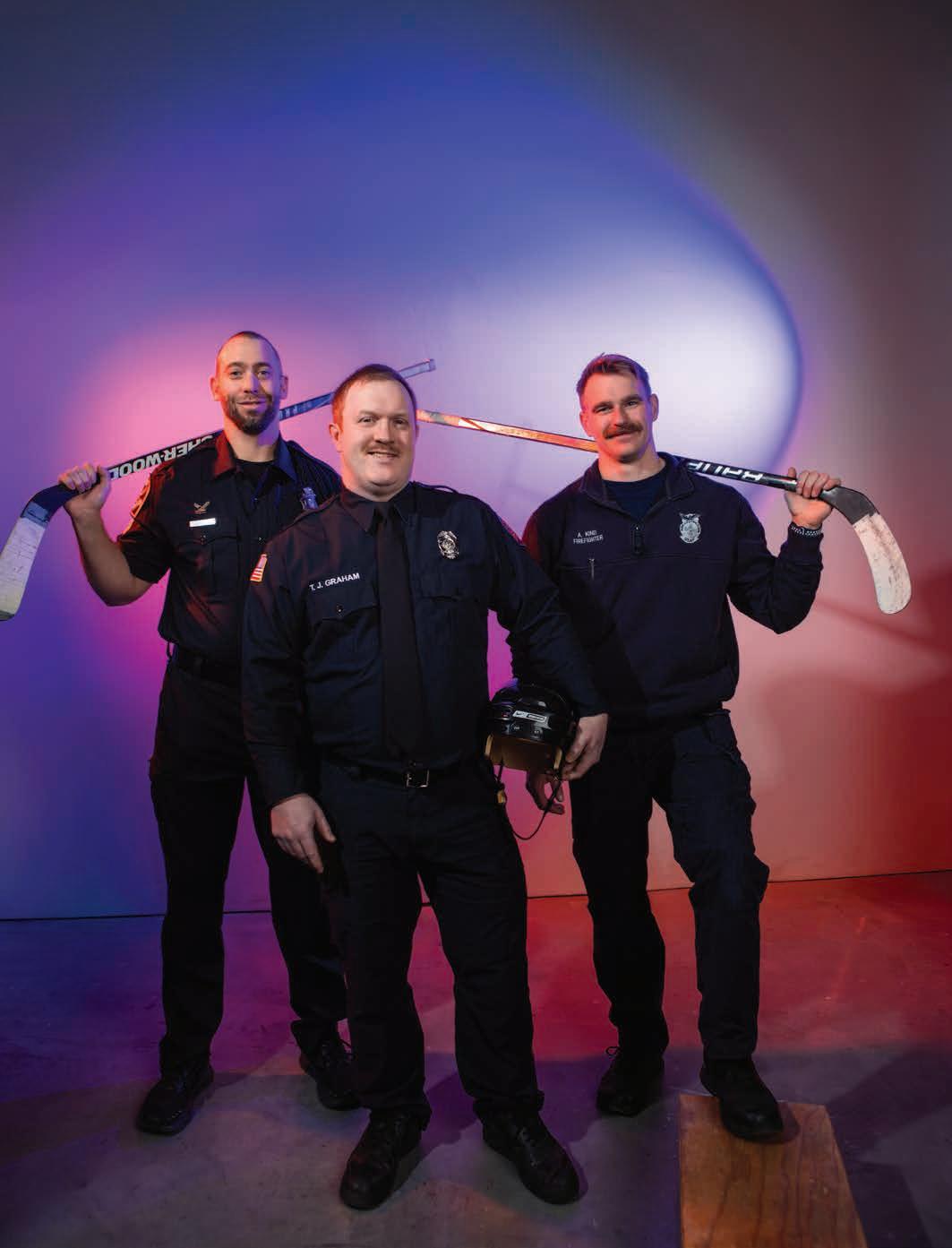
Skating For a Cause Guns & Hoses
and the Bonds of First Responders
Tyler Anderson, Aaron Kind, Tyler Graham
ach year, the Guns & Hoses hockey game brings together first responders for a night of spirited competition, all in support of a cause that extends far beyond the ice.
Th e annual matchup features local police officers and fi refighters from Omaha, Council Bluff s and Lincoln Airport facing off at Baxter Arena. Organized by the First Responders Foundation, the event serves as a major fundraiser while showcasing the teamwork and relationships that defi ne public safety work year-round.
“At its core, the event is about supporting the First Responders Foundation and raising funds that benefit both police and fire,” said Tyler Anderson of the Omaha Police Department. “Th at’s the most important piece. Beyond that, it’s a highly competitive and incredibly fun game. Both teams take it seriously, which makes it even more exciting for everyone involved.”
Tyler Graham of the Omaha Fire Department echoed that sentiment, noting that while the competition is intense, the mission remains front and center.
“The goal is to have a good time, keep the competition strong, and, most importantly, raise money for the foundation, which does an incredible job supporting fi rst responders across the Omaha metro are a,” he said.
For many players, the event is also a reunion, one rooted in childhood hockey memories that stretch back years. Graham and Anderson grew up playing competitive hockey, often alongside teammates who are now fellow fi rst responders.
“When I think back on it, my mind immediately goes to all the fun we had on road trips growing up, packing two or three kids into a minivan with our dads and all of our hockey gear,” Graham said. “It wasn’t just about the games and the wins and losses, but also the hotels, the shenanigans, and everything that ca me with it.”
Anderson shared similar memories, emphasizing the bonds built away from the rink.
“What I remember most from our early hockey days is everything off the ice, staying in hotels, playing shinny or knee hockey in the hallways, and just growing up together,” he said. “We had a lot of success as kids, then went our separate ways for years. Getting back on the ice together now has been a really fun experience.”
Th at sense of reconnection has been especially meaningful when it comes to former teammates like Aaron Kind, now with Lincoln Airport Fire, whose presence in the event underscores how intertwined those early relationships remain.
“I hadn’t seen Aaron in years until the last game, and it was great to reconnect and see how well he’s doing, both in hockey and professionally,” Anderson said.
Graham, who grew up skating alongside Kind and others who now serve in fi re departments across the region, said those shared roots bring an added layer of appreciation to the event.
“Looking back now, it was a really unique childhood experience,” Graham said. “Being able to share the ice again with guys like Aaron, after everything we’ve all gone on to do, makes the game that much more special.”
Beyond nostalgia, both players noted that hockey has directly shaped how they approach their work as fi rst responders.
“When you have 17 to 20 guys on a team, you’re dealing with a lot of different personalities, all working toward one goal,” Graham said. “Learning how to function as a cohesive unit translates directly to the work we do as fi rst responders.”
Anderson added that the competitive environment helps sharpen skills that matter off the ice.
“Being in high-pressure situations and relying on your teammates is something that carries over,” he said. “Th at one night we battle it out on the ice, but the rest of the year we work extremely wel l together.”
While the game itself is fast-paced and physical, players emphasized that the atmosphere remains welcoming, especially for families.
“It’s truly a family-friendly environment,” Anderson said. “The foundation does a phenomenal job creating activities for kids, so it’s not just about the game. Supporting the First Responders Foundation while having that kind of experience makes it a really special event.”
As the next Guns & Hoses matchup approaches, both players said they’re focused on the same goal, giving back to the community that supports them.
“I’m excited about the foundation and the progress they’re making with fundraising,” Anderson said. “And I’m also excited to get our trophy back and come away with a win in March.”
Visit firstrespondersfoundation.org/hockey for more information.
STORY BY BRANDI LONG-FRANK | PHOTOGRAPHY BY SARAH LEMKE | DESIGN BY RENEE LUDWICK
GIVING CALENDAR
MARCH/APRIL 2026
COMPILED BY NAOMI HEU
March 1
HEAT THE STREETS RUN & WALK FOR WARMTH
Benefits: Local utility assistance programs
Location: Aksarben Village heatthestreetsomaha.com
March 3
OPEN DOOR MISSION VOLUNTEER CLUB
Benefits: Open Door Mission
Location: Garland Thompson Men’s Center Chapel opendoormission.org
March 4
STRONGER TOGETHER LUNCHEON
Benefits: Completely KIDS
Location: Scott Conference Center completelykids.org
March 6
FURRRST FRIDAYS
Benefits: Nebraska Humane Society and Omaha Public Library
Location: Nebraska Humane Society nehumanesociety.org
March 6
TABLE GRACE VOICE OF COMPASSION GALA
Benefits: Table Grace Ministries
Location: Livestock Exchange Building tablegraceministries.com
March 8
29TH ANNUAL ART & SOUP
Benefits: Visiting Nurse Association
Location: Omaha Design Center vnatoday.org
March 8
“WILD ANIMALS” CONCERT
Benefits: Omaha Symphonic Winds
Location: St. Paul’s United Methodist Church omahasymphonicwinds.org
April 25
FEATURED EVENT
April 25
BREAKTHROUGH T1D NEBRASKA GALA 2026
Benefits: Breakthrough T1D Nebraska
Location: CHI Health Center
breakthrought1d.org/nebraska
Breakthrough T1D Nebraska’s annual gala is set to be an unforgettable night in support of the Fund A Cure program. The evening includes dinner, drinks, and silent and live auctions at CHI Health Center. Enjoy live musical entertainment from saxophonist and music arranger Antoine Gibson. This year’s gala honorees are Kristina and Mike Agostino, parents of an adult son with T1D. The pair have dedicated many efforts to advancing T1D research and improving the lives of those impacted by this disease.
March 8
YFC BE THE STORY 2026
Benefits: Youth for Christ
Location: Embassy Suites Omaha-La Vista Conference Center goyfc.org
March 13
OMAHA FORUS VOLUNTEER DAY OF SERVICE
Benefits: Omaha ForUs Location: Omaha ForUs LGBTQ+ Center omahaforus.org
March 14
35TH ANNUAL SPORTS FOR KIDS BENEFIT AUCTION
Benefits: Sports for Kids Foundation Location: DC Centre Event Venue sportsforkidsfoundation.com
March 21
OMAHA MOM PROM 2026
Benefits: Omaha Mom Prom Location: Steppe Center omahamomprom.org
March 27
OPERA OMAHA 2026 GALA
Benefits: Opera Omaha Location: Steelhouse Omaha operaomaha.org
March 27-28
3RD ANNUAL PLAINS TO PROFIT 2026 RESELLER EVENT
Benefits: Plains to Profit Location: DoubleTree by Hilton Omaha Downtown plainstoprofit.com
March 28
CALISTUS MULTIPLE MYELOMA FOUNDATION GALA
Benefits: Calistus Multiple Myeloma Foundation Location: Thompson Alumni Center calistusfoundation.org
March 28
CHAMPAGNE & DIAMONDS: RUBY MASQUERADE
Benefits: MICAH House
Location: Mid-America Center themicahhouse.org
March 28
ROCKIN’ ROSIE: AN EVENING UNVEILED
Benefits: The Rose Theater
Location: The Rose Theater rosetheater.org
March 28
SANTA MONICA HOUSE 2026 SPRING FUNDRAISER
Benefits: Santa Monica House
Location: DC Centre Event Venue santamonicahouse.org
March 28-29
ORCHID SHOW AND SALE
Benefits: Greater Omaha Orchid Society Location: Lauritzen Gardens lauritzengardens.org
April 3
FURRRST FRIDAYS
Benefits: Nebraska Humane Society and Omaha Public Library
Location: Nebraska Humane Society nehumanesociety.org
April 7
OPEN DOOR MISSION VOLUNTEER CLUB
Benefits: Open Door Mission
Location: Garland Thompson Men’s Center Chapel opendoormission.org
April 9
THE GATHERING 2026
Benefits: CUES School System
Location: Steelhouse Omaha cuesschools.org
April 10
4TH ANNUAL GAME NIGHT GALA: THERE’S NO PLACE LIKE HOPE
Benefits: Bags of Fun Omaha
Location: The Relevant Center, Elkhorn bagsoffunomaha.org
April 10
CABARET 2026
Benefits: Child Saving Institute
Location: CHI Health Center childsaving.org
April 10
OMAHA FORUS VOLUNTEER DAY OF SERVICE
Benefits: Omaha ForUs
Location: Omaha ForUs LGBTQ+ Center omahaforus.org
April 10
VIN NEBRASKA
Benefits: Completely KIDS
Location: Omaha Marriott Downtown at the Capitol District completelykids.org
April 11
A PRACTICALLY PERFECT EVENING
Benefits: Omaha Community Playhouse
Location: Omaha Community Playhouse omahaplayhouse.com
April 16
MADONNAPALOOZA
Benefits: Madonna Ability Alliance
Location: A View on State madonnaalliance.org
April 18
2026 WALK & RALLY FOR HOPE
Benefits: ALS in the Heartland
Location: 1022 W. Lincoln St., Papillion alsintheheartland.org
April 19
45TH ANNUAL CORPORATE CUP
Benefits: American Lung Association
Location: Aksarben Village omahacorporatecup.org
April 22-23
SPEAKING OF CHILDREN LUNCHEON & CONFERENCE
Benefits: Project Harmony
Location: Embassy Suites Omaha-La Vista Conference Center projectharmony.com
April 22-25
DO GOOD DAYS
Benefits: Local nonprofits
Locations: Participating nonprofits in Omaha shareomaha.org
April 24
19TH ANNUAL COMFORT FOOD CLASSIC: MOONLIGHT & MIMOSAS
Benefits: Collective for Hope
Location: Zenia Omaha collectiveforhope.org
April 24
ANNUAL GALA
Benefits: Ataxia Connection
Location: The Relevant Center, Elkhorn ataxiaconnection.org
April 25
BLUE JEAN BALL: A NIGHT OF CHAMPIONS
Benefits: Make-A-Wish Nebraska
Location: Embassy Suites Omaha-La Vista Conference Center wish.org/nebraska
April 25
DEAR DIABETES BOWLING FUNDRAISER AND FRIENDRAISER
Benefits: Dear Diabetes
Location: Maplewood Lanes deardiabetes.org
April 25
HELP DISTRIBUTE TREES
Benefits: American Reforestation Initiative
Location: TBD americanreforest.net
April 25
PURPLESTRIDE NEBRASKA 2026
Benefits: Pancreatic Cancer Action Network
Location: Miller’s Landing pancan.org




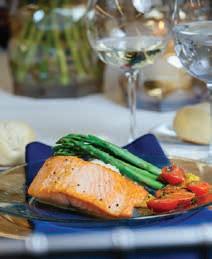
April 26
PINS FOR PARKINSON’S NEBRASKA 2026
Benefits: Parkinson’s Nebraska
Location: Maplewood Lanes parkinsonsnebraska.org
April 30
2026 NIGHT OF INSPIRATION
Benefits: Bread for the Journey Omaha
Location: Omaha Field Club breadforthejourneyomaha.org
April 30
HOPS & GRAPES
Benefits: Partnership 4 Kids
Location: A View West Shores p4k.org




CHEF PROFILE
Jesus Rivera



AND SANTORO
TIME AND AUTHENTICITY ARE THE SECRET INGREDIENT TO SANTORO’S SUCCESS
he successor to the beloved Rivera’s, Santoro opened at 8601 West Dodge Road in May of 2024 to rave reviews. Those who long loved the predecessor were happy to have Jesus Rivera back at the helm while experiencing new concepts from the Omaha food star.
His rise to Omaha celebrity chef status started in Grisanti’s kitchen, where he was initially hired as a dishwasher.
“I probably washed dishes for four years before I moved up.” Rivera said. “Then I learned how to cook right there in that kitchen. I developed my skills and was a cook at Grisanti’s for eight more years. The last three years, I was the kitchen manager.”
But Rivera is quick to correct those who refer to hi m as a chef.
“Chefs go to school and travel for practice; I didn’t do that. I just learned to cook on the line. I’m a cook.”
Th at humility would be hard for anyone else to maintain, but Rivera laughs any time one of his wildly positive reviews is quoted. “I’m just so glad people like it. I’m so glad to be here.”
“A lot of people know me from Rivera’s. Th at was open for 18 years, so that was a long time for people to get to know me and the food. They are coming in to Santoro and they are so happy that we have the same quality, the same consistency, the same service, a lot of the same fl avors. Much of the staff even came along with me; My other main cook [at Santoro] was with me at Rivera’s for more than 10 years. It’s a lot of new ideas and a new place, but I think we kept what people loved about Rivera’s and maybe even made some of it a lot better for them,” Rivera added.



Solano played a key role in the design elements you’ll see at Santoro, from the terracotta colors to the plating of your new favorite dish. She was the woman’s touch that lends to the elegant and more mature atmosphere in this new venture.
“The new restaurant is definitely more feminine, a lot more minimalistic.” Solano said. “A lot of Mexican restaurants are very loud and colorful; they sometimes do too much to try to show culture. Instead, we tried to create an elegant, uncluttered, really beaut iful space.”
Her assessment is correct, and the clean lines, warm tones, and beautiful mural work create a comforting space that doesn’t distract from the hard work going on behind the scenes. The fl avors are truly given room to shine, and the authentic recipes Rivera brought from Puebla, Mexico, deserve the attention they are afforded in this new manifestation of his vision.
“We do it all from scratch,” Rivera said. “The sauces, the pico de gallo, the rice. The rice and mole are my mom’s original recipes I grew up with. The only thing I don’t make in-house from scratch are the tortillas, and that’s because we use so many that I just couldn’t possibly keep up. There’s a company in Grand Island that supplies all of our tortillas, but everything else ca me from us.”
It’s a lot of new ideas and a new place, but I think we kept what people loved about Rivera’s and maybe even made some of it a lot better for them.
—JESUS RIVERA
“Quality, consistency, and the fl avors they loved. Those are the three components that will make people a success.”
Rivera’s stepdaughter and collaborator, Lia Solano, thinks there is a little more to Santoro’s success.
“There is a lot that has gone into Santoro, a lot that went into Rivera’s, but the biggest thing is that Jesus is authentic. In every sense. Th at’s why our family loves him. And I think that’s why he has so much success not just with the restaurant, but w ith people.”

When you ask a chef their favorite dish at a restaurant, the answer is usually something along the lines of: “Th at’s like asking me to choose my favorite among my children, I couldn’t possibly!” but Rivera had no such reservation. “I love enchiladas, to be honest with you!” he said. “Our enchiladas rancheras. Skirt steak with chorizo and green sauce. I think it’s great, it’s spicy, it has all of the elements you look for in a dish.”
For Solano, it was more of a struggle. She named several protein-forward dishes before settling on a tie between the fajitas and the carne asada.
“He used to cook for us at home, and I was obsessed. When I came here to Omaha from Texas to meet with him about the restaurant, we were out having dinner and talking about some of our ideas. A couple at the next table heard us and they jumped in, they were so excited to hear him talking about opening another restaurant and they wanted to know when and where. It was so great to see how excited people were to see him back in business.”
Visit santoroomaha.com for more information.
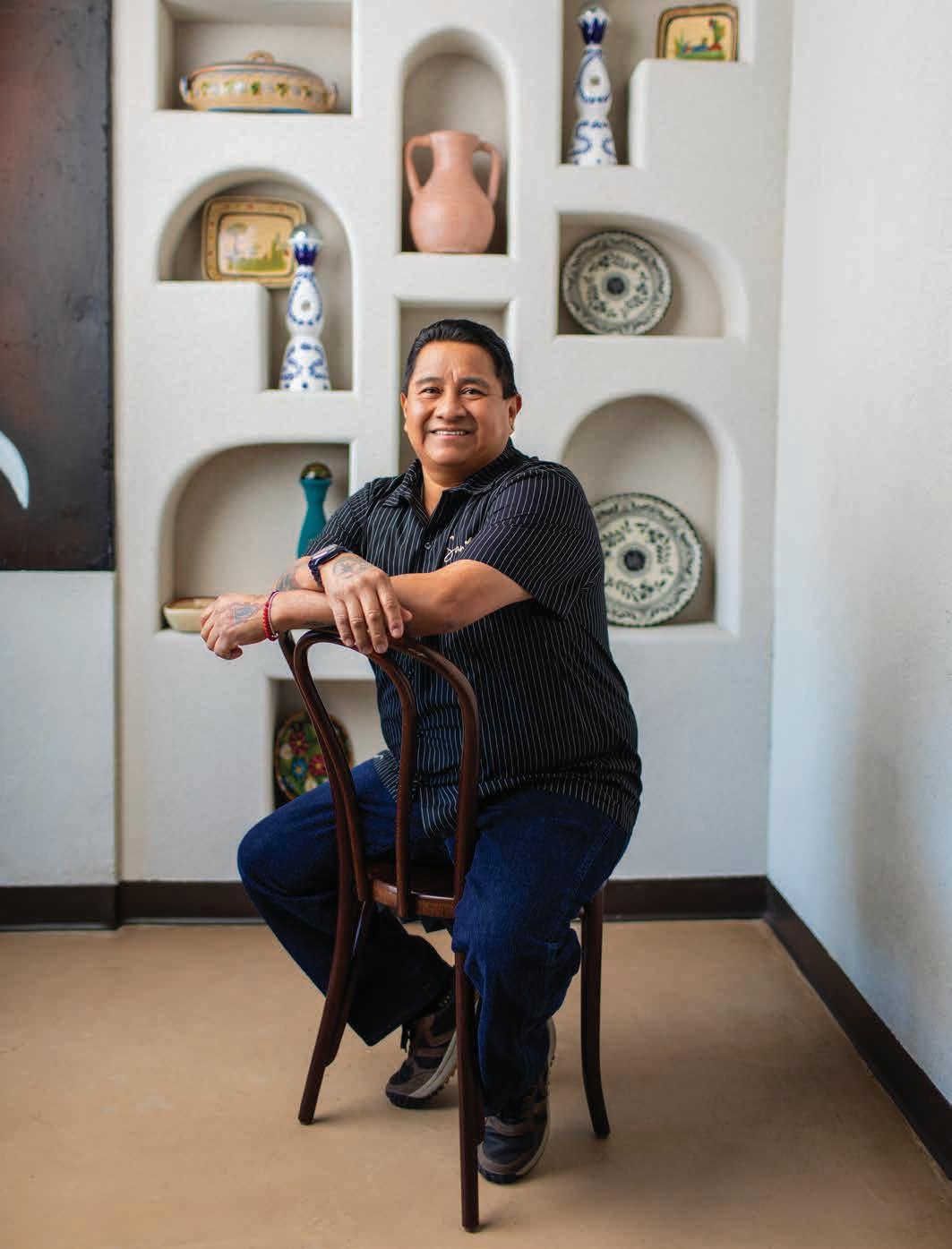
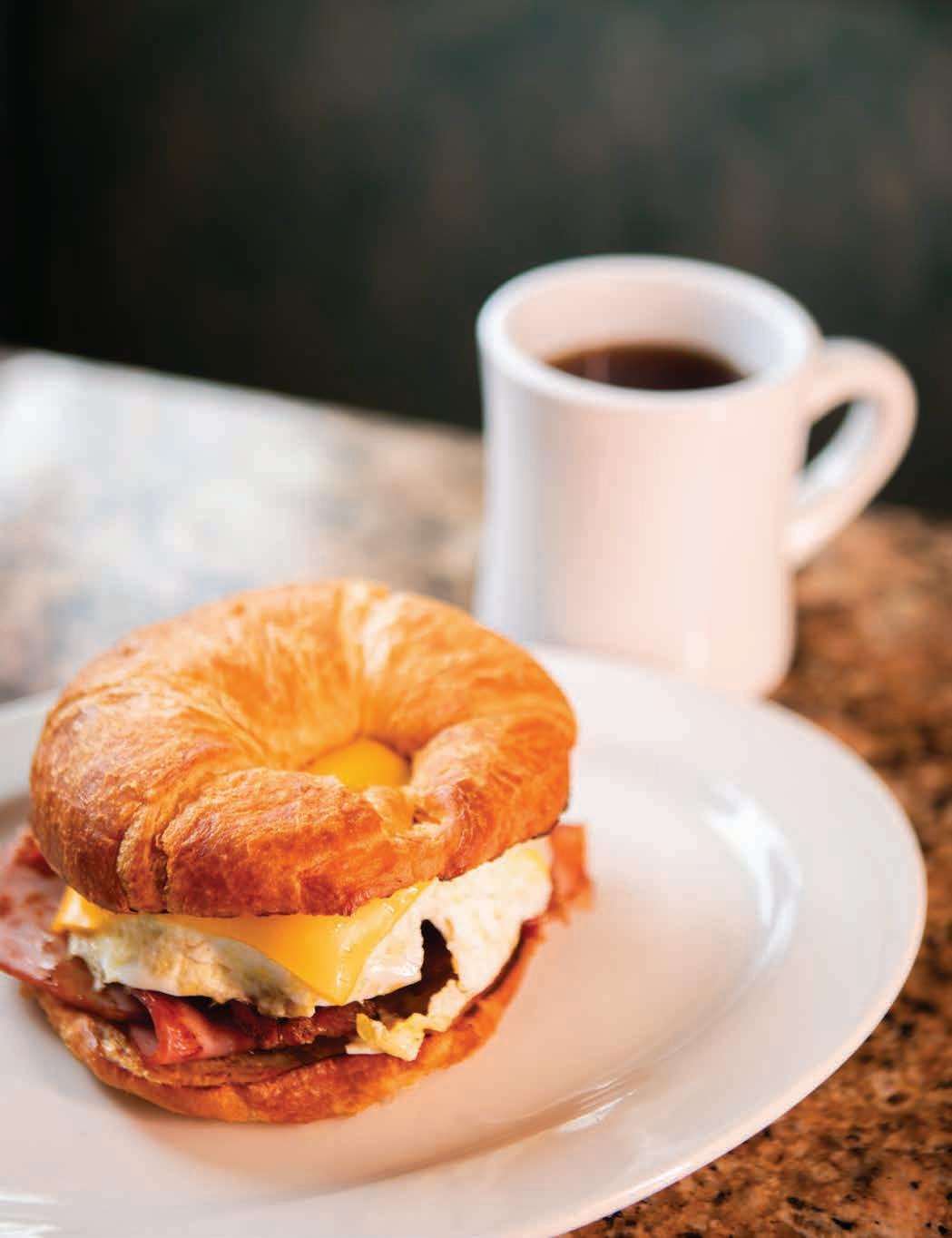
3 meat breakfast sandwich, Nite Hawkes Cafe

An Omaha Greasy Spoon Tour
Story by Dan Hoppen
Photography by Sarah Lemke
Design by Rachel Birdsall
an age of trendy breakfast hotspots and modern brunches, there’s something cozy and reliable about the traditional greasy spoon. You’ll find no red velvet pancakes or crab cake eggs benedict at these joints. This is simple food prepared extremely well, likely the same way it’s been cooked for decades.
The stools at the countertop have indentations from years of use. The waitresses call out the names of the regulars. A slim window provides a peek into the kitchen, showcasing short order cooks executing dozens of orders for pancakes, omelettes, and the like.
And when you want hearty comfort food at an affordable price, Omaha has some fantastic options. These restaurants have thrilled diners for years and, as lines out the door during the weekends can attest, show no signs of slowing down. These places may not be as Instagramable as newer hip brunch spots, but they’ll deliver massive plates of well-cooked food and have you leaving with a smile.
Lisa’s Radial Cafe
This building has housed various restaurants and cafes since 1940, but Omaha fell in love with it after Lisa Schembri bought the place in 2000 and attached her name and style to it. Her daughters now operate Lisa’s, but the same welcoming atmosphere and comforting dishes remain. Fluffy pancakes the size of frisbees, enormous skillets, and hearty portions of chicken fried steak fly out of the kitchen, and you’ll commonly find a lengthy wait on the weekends as Omahans pack the place. Though not as well-known, Lisa’s also offers lunch and dinner.
817 N. 40th St. Facebook–Lisa's Radial Cafe
Harold’s Koffee House
While a meal at Harold’s won’t be exactly what it was when the restaurant opened in the 1960s, it won’t be a far cry off. Harold’s has maintained that old-school diner feel with countertop service, whiteboards with specials, and giant portions for low prices. Most of the recipes remain unchanged from when original owner Harold Halstead opened the joint, and with the way Omahans flock to the place, they won’t be changing any time soon. In lieu of innovation, Harold’s excels at cooking simple dishes extremely well, as the bacon, eggs, and famous Fluffy Cakes are consistently excellent every time you visit.
8327 N. 30th St. haroldskoffeehouse.com
Stufed French toast at Lisa's Radial Cafe


Lemon Tree Cafe
Unlike most restaurants on this list, Lemon Tree Cafe is only a few years old. But given its location (inside a 100-year-old Ralston building) and dedication to nailing breakfast classics, it absolutely qualifies on a greasy spoon tour. You’ll find some twists on traditional breakfast here, such as pancakes cooked with bacon, ham, and cheddar cheese inside, and French toast stuffed with strawberries and crowned with a lemon curd drizzle. But the can’t-miss dish is the biscuits & gravy. Chef and owner Meghan McLarney also owns Gravy Train, a biscuits and gravy business that sells at Omaha farmers markets, and her mastery of this gut-busting dish combines tender, buttery biscuits with rich, stick-to-your-ribs gravies.
7614 Main St.
Facebook: Lemon Tree Cafe
Shirley’s Diner
Whether you come for breakfast, lunch, or dinner, you’re sure to find two things at Shirley’s: a full parking lot and heaping plates of scratch-made food. Established in 1992, Shirley’s makes you feel like you’re eating in someone’s kitchen, and there’s even a small play area for children. Shirley’s is best known for its breakfast, especially the country hash browns and Fried Chicken & Waffle Royale. But don’t sleep on Shirley’s options later in the day, especially the reuben and chicken fried chicken. Shirley’s leans into nostalgia with its menu, as it’s one of the few Omaha restaurants to still serve classics like liver & onions, hamburger steak, and hot beef & turkey.
13838 R Plaza shirleysdiner.com
Nite Hawkes Cafe
A popular diner that’s thrilled hungry Omahans since 1942, Nite Hawkes is the quintessential greasy spoon. Most of the menu is under $10 and the offerings are so large, the plates they’re served on can barely hold them. Four generations of the Hawkes family have kept Nite Hawkes an Omaha institution, and you’re likely to encounter multiple family members—including gregarious owner Tracy—when you visit.
4825 N. 16th St. nitehawkescafe.com
Vidlak’s Family Cafe
The kitchen at Vidlak’s has been cranking out excellent diner fare for over 30 years. And though the dining room is enormous, Vidlak’s is so popular it can still be difficult to find a seat during peak breakfast hours. In between all the dining room conversation, you can hear friendly banter between the kitchen and the waitstaff. It just feels like home. The menu is about as large as a Harry Potter novel, and the German Potato Pancakes in particular are a fan favorite. 15668 W Center Rd. vidlaksfamilycafe.com
AJ’s Cafe
If you frequent AJ’s, you likely don’t need to tell your waitress your order. The service at this casual eatery is excellent, and they’ll not only remember your name, but also your favorite dishes. In addition to its everyday menu of pancakes, hash brown casseroles, and pork tenderloin sandwiches, AJ’s offers four to five specials every day, which are posted on Facebook.
5146 N. 90th St. Facebook: AJ's Cafe Omaha

Louie M’s Burger Lust
As the name implies, Louie M’s is a great place to get a burger. The menu boasts 18 burger options, from the simple plain hamburger to inventive options like the Italian burger and the chili burger. But this downtown Omaha cafe has arguably become as beloved for its breakfast as its beef, as the three-egg omelets and hot cakes fly out the window on the weekends. That all-day menu has kept Louie M’s at the top of hungry Omahans’ lists for 45 years.
1718 Vinton St. louiemsburgerlust.com
Joe’s Cafe
Few restaurants in Omaha are more unassuming than Joe’s, a blinkand-you-miss-it diner just outside Benson, but that’s part of its charm! The small cafe has limited seating, which creates an intimate atmosphere. With burgers, steak and eggs, and a roster of a dozen omelettes, there’s something for every diner at Joe’s.
joescafebenson.com
6564 Maple St.
If you’re looking for a filling meal at a low price point, all served in a cozy space with friendly customer service, Omaha’s greasy spoon hotspots will have you covered. Upscale and modern breakfast spots certainly have their place, too, but there’s just something comforting and familiar about our greasy spoons. That’s why most of them have been serving Omaha for decades, and they’re not going anywhere anytime soon.
Omaha foodie Dan Hoppen is the creator of Restaurant Hoppen, a blog, podcast, and YouTube channel dedicated to highlighting Omaha's restaurant scene. Follow his work at restauranthoppen.com.

Shrimp and grits at Joe's Cafe
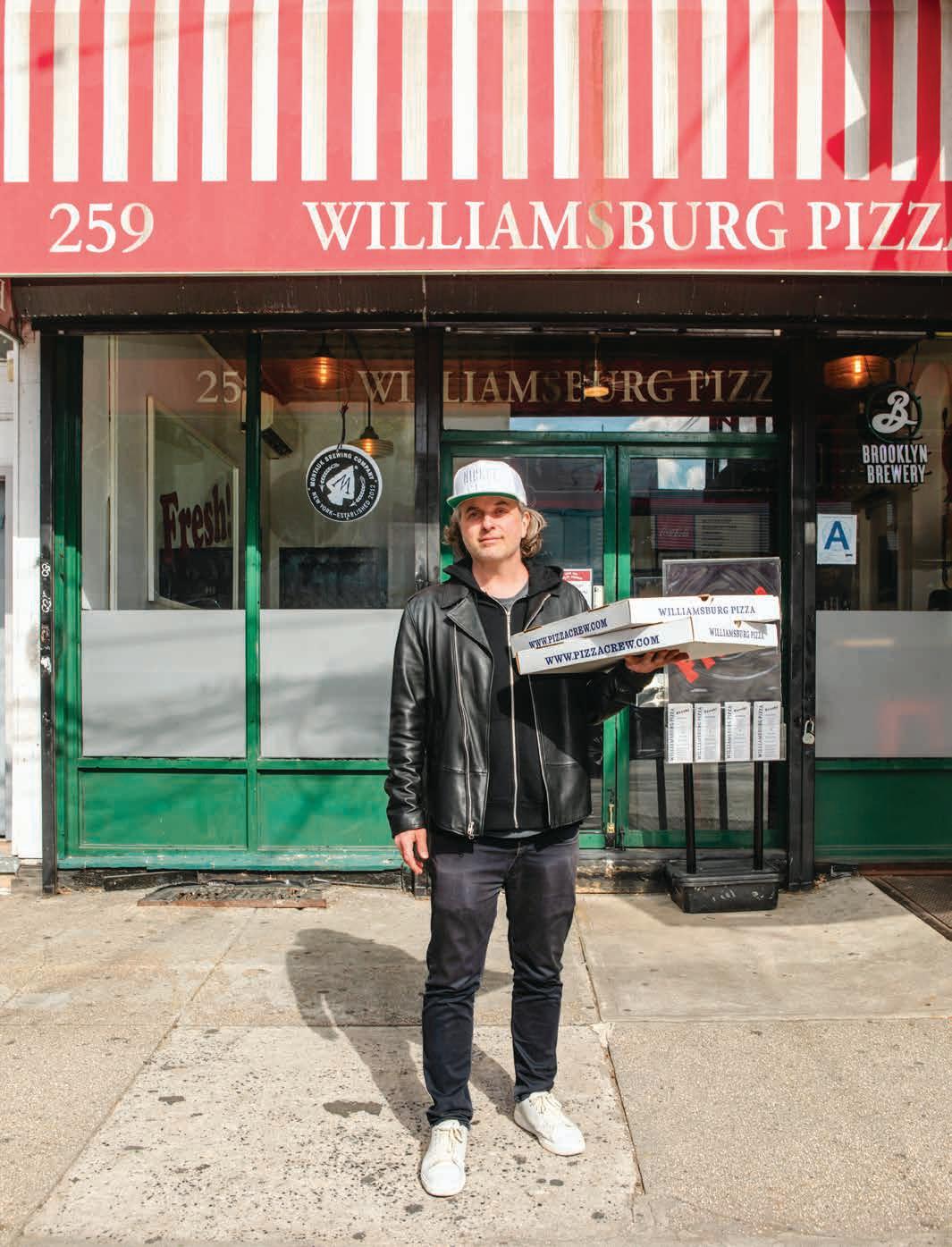
Aaron McCann
Imagine stepping outside your home and knowing there is a pizza joint six blocks in any direction. Forget cartoon emperors or domino-decorated cars. Serious, New York-style pizza, with slices the size of a pie.
For Aaron McCann, a transplant from Omaha to Brooklyn, such was life. But why walk six blocks when you can step in the elevator and be at a pizzeria on the ground floor of your apartment building?

to a Slice DINING FEATURE Six Blocks Six Blocks
STORY BY Kyle Eustice
owanOmahaNativeBrought
“In the real world, that doesn’t sound like that crazy of a thing, but in New York, to be in the center of a 12-block radius of no pizza at all in a densely populated, up-and-coming neighborhood like Williamsburg is a pizza desert,” McCann said. “I mean, there are as many pizzerias as there are dive bars here.”
So McCann and his roommate, John Kutinsky, took matters into their own hands. Their landlord, aware of McCann’s real estate experience, asked the duo if they might be interested in leasing space. After learning the lease price—$2,400 a month, less than half the going rate for a Brooklyn spot—McCann and Kutinsky took him up on the offer.
PHOTOGRAPHY BY Sarah
Lemke
DESIGN BY
Nickie Robinson
WilliamsburgPizzaHome
“We’re like, ‘We should try and do something down there,’” McCann said. “I mean, sure, we can fl ip the lease and make a couple bucks. We’ll at least be in control of whoever the new tenant in our building is at that point, but at least we’ll have some say in who they are.”
Instead, they decided to open their own business. Torn between a bagel shop and a pizzeria, McCann said the decision was easier than t hey thought.

[Nino] thought to create this pizza that is in the format of the classic slice and delivery operation, but using high-quality fresh mozzarella, putting fresh basil on after the bake. Shredding $600 wheels of grana padano [cheese] to top the pizza.
Aaron McCann
DINING FEATURE
“We knew we were in a pizza desert, but we’re also in a bagel desert,” he said. “Both of those things seemed to work, especially in a cute little corner location. Bagels really only sell from about 6 to 11 a.m. Pizza in this town sells from about 11 a.m. until 4 a.m. There’s plenty of pizzerias that actually stay open one more hour till five, to get the people leaving the bars.”
With Williamsburg Pizza established and named for McCann’s Brooklyn neighborhood, they needed to fi nd someone to run the operation.
“Neither of us know how to make New York-style pizza,” McCann said. “My fi rst job was working at Home Team Pizza, which is now Night Flight or Brick Oven. They changed their name every couple years, but it’s the same people. It’s the same product. But nothing I learned there like 35 years ago would necessarily translate to New York pizza, though I enjoy a slice there when I’m in Omaha.”
Posting an online ad for a kitchen manager, McCann received about 10 generic replies.
Then, one stood out.
“Nino Coniglio. Google me.”
The guy’s bravado seemed too much to McCann. Or did it?
“Th at’s a pretty brazen response to a job ad, but you’re not gonna not do it,” McCann said. “If you get an email, especially with a name like that, you’re gonna check this person out on Google a nd YouTube.”
What he found was a world-class pizza guy, whose videos of making pizza had half a million views. The New York Times referred to Coniglio as a “pizza prodigy.” The chef competed in challenges in France, Italy, and Las Vegas.
“How in the hell is this guy even looking for a job?” McCann said. “Th is makes no sense. And he shows up. He’s got the thickest Brooklyn Italian accent I’ve ever heard in my life.”
Then there was the black eye. The result of a bar fight with three guys, Coniglio said.
“I walked out of the bar, like, an hour later, going to get cigarettes,” he said. “They caught me coming out and tried jumping me.”
In between cooking gigs, Coniglio worked as a restaurant consultant. He wasn’t sure what to expect at William sburg Pizza.
Coniglio took one look at the space —about 550 square feet —and thought it’d be a tight fit, but workable, McCann said.
Instead of consulting on the project, Coniglio came aboard as a partner and chef.
McCann’s idea was to sell cheap pizza slices, but Coniglio thought otherwise, he said.
Instead of a cheese slice for $2.50 like other places were selling, Williamsburg Pizza could take a new path of creating upscale pizza, using new, fresh ingredients, Coniglio said.
Coniglio designed an 18-inch pie, slow-baked, so it had the thermal capacity for delivery, McCann said. Pizza such as wood-fi red, which is fast-baked for 120 seconds at 975 degrees, loses its heat quickly and doesn’t make for a good delivery, he said.
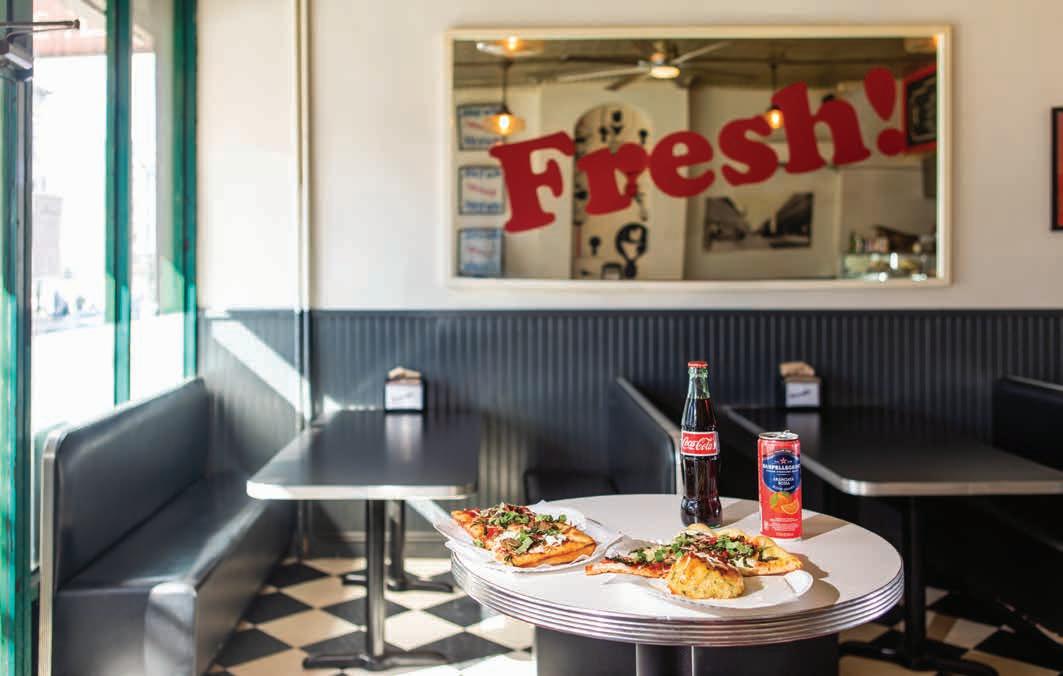
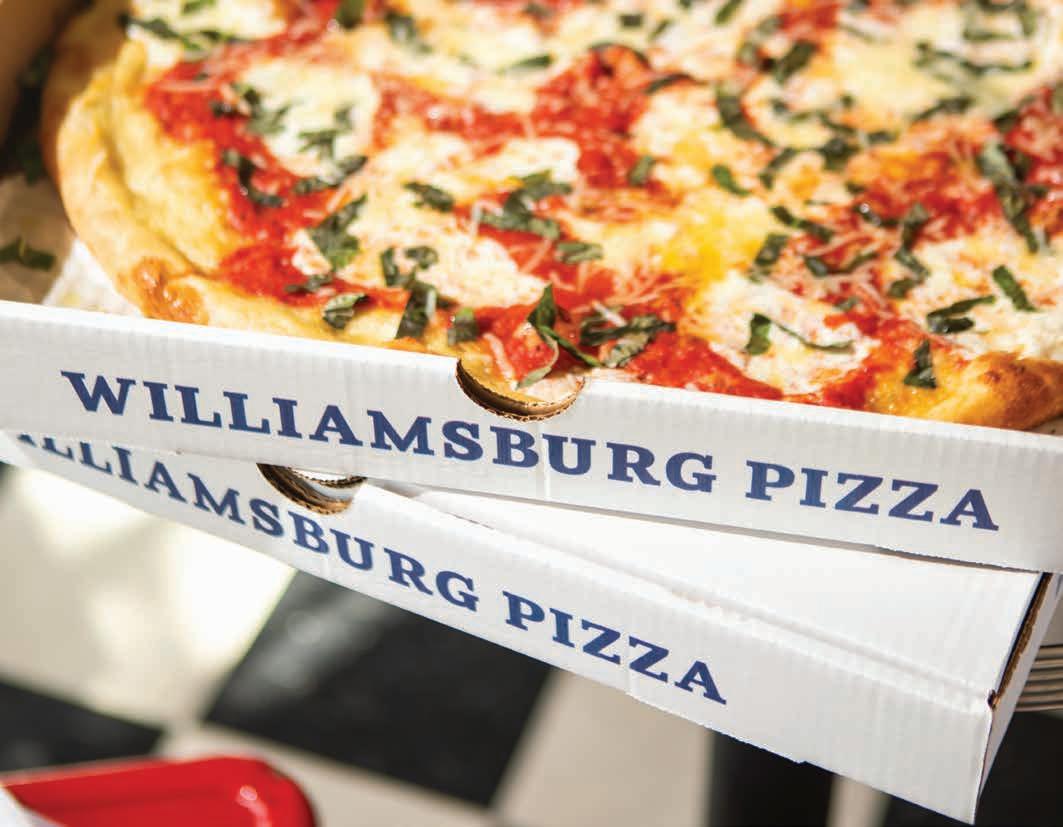
Williamsburg Piz za to Omaha.
Teaming with Matt Hodges, whose company owns several Jimmy John’s restaurants in the metro area, Williamsburg Pizza opened its fi rst franchise outside the Big Apple in Sarpy County at 16869 Audrey St. in May 2023. Since then, Williamsburg opened a second pizzeria at 156th and West Maple Road.
While Omaha has some outstanding pizzerias—La Casa, Virtuoso, Dante, Noli’s, Mama’s, and Sgt. Peffer’s are among his favorites—McCann thought the city could use authentic New York pizza.
With Omahans commenting on his Instagram photos of pizza, saying they wished they could get a slice of Williamsburg Pizza at home, it started the wheels turning in his mind, McCann said.
“One day I am going to bring this pizza home,” he said. “Obviously, they were friends of mine [online posters], just joking a little bit, but not joking. I could tell they kind
“It’s the idea of being able to walk into a place and get out of there in two minutes with a slice that’s white truffle, rosemary, cremini mushrooms, versus just broccoli or something, or whatever’s going on at half of these pizza places in New York,” he said. “I just think that it’s that concept of super high-quality ingredients and keeping the rat poison [chemicals] out of it.”
While he’d like to see Williamsburg Pizza grow in Omaha, there will never be a location in the Benson neighborhood because of his and Coniglio’s respect for Virtuoso Pizzeria’s Dave Losole.
“Dave’s a rock star,” McCann said.
Having met Losole at the annual pizza trade expo in Las Vegas, Coniglio, who is considered one of the world’s top pizza chefs and the winner of Food Network’s Chopped series’ pizza competition, considers the Virtuoso owner a close friend.
he was in witness protection,” Coniglio said. “I was like, ‘Where are you from?’ And he’s like, ‘Omaha.’ He kind of has a little bit of an East Coast slang to him.”
McCann’s journey started in Colorado, after leaving Omaha Central High School without graduating. He worked there for five years before heading to New York about 25 years ago. He knew he wanted to sell real estate, and New York was the place to be, McCann said.
“Two of my favorite things in the world are people and buildings,” he said. “If people and buildings are your two favorite things in the world, New York makes perfect sense. We got a lot of interesting buildings and a lot of interest ing people.”
From a kid working at Hot and Now, a fast food concept Taco Bell tested in Omaha as an attempt to challenge McDonald’s and Burger King, to a pizza tycoon, McCann has sliced himself a tasty piece of life, bringing his love of pizza to his hometown.
Visit williamsburgpizza.com for more information.

Fami ly Crab Boil

Cajun Crab & Pho
A Seafood Boil That Brings Everyone to the Table
When Cajun Crab & Pho opened nearly five years ago at 346 N Saddle Creek Road, I wondered: Cajun seafood boils and Vietnamese pho… under one roof? Walking into Cajun Crab & Pho is like stepping into a crossroads of cultures. Louisiana spice, Vietnamese comfort food, and the breadth of Chinese dishes all converge in one big menu.
According to the staff, the story behind that blend is simple. “Vietnamese people love seafood too, so Cajun fl avors make sense.”
The owner, a Chinese American who relocated to Omaha from New York, appears to have a desire to serve something for everyone, making the menu as expansive as it is heartfelt.
A Seafood Boi l With Range
If you want the truest introduction to what Cajun Crab & Pho does best, go straight for the family meal. It’s extravagant in the best possible way, a true feast designed for communal eating. For $129, you get two lobster tails, a pound of snow crab, a pound of shrimp, a pound of black mussels, half a pound of sausage, three eggs, three corn cobs, and three potatoes.
The meal arrives at the table in a seafood boil bag and a bucket, with your choice of seasoning clinging to every shell and surface. Get it with the medium Cajun spice, and you get that fi nger-licking good flavor. My personal favorites are the snow crab and shrimp. Their meat is juicy and they soak up the seasoning well.

CAJUN CRAB & PHO
346 N. SADDLE CREEK RD. I 531.999.3088
5 STARS POSSIBLE
The experience is less about polished dining and more about connection: roll up your sleeves, pass the corn, and share the crab legs. In a city known more for steaks as its comfort food, Cajun Crab & Pho offers something communal and joyfully messy, something that feels like a celebration even on an ordinar y weeknight.
Pho, Co ee & a Quiet Vietna mese Lineage
For a restaurant with “pho” in the name, I had to try the pho. Although the rare beef was on the thicker side, it tastes well. But the Vietnamese iced coffee was the real star. While many restaurants tip too sweet, here the balance feels just right: robust dark roast with a silky layer of condensed milk, poured over ice so it mellows into something rich and refreshing. It was the kind of drink that wakes you up and soothes you at the same time.
Flip further into the menu and you’ll fi nd an unexpectedly large offering of Chinese dishes—everything from fried rice and lo mein to salt-and-pepper appetizers and stir-fried classics.
Another bonus of dining here is how adaptable the restaurant is for families. The kids’ menu is unusually large, offering pho in child-friendly sizes, fried calamari baskets, chicken tenders, and classic Chinese fried rice options that let even the pickiest little diners fi nd something. For parents, that means you don’t have to choose between getting your seafood boil fi x and keeping the kids happy. Everyone gets what they want, and everyone leaves full.
More an a Meal—A Way to Gather
Seafood boils are inherently social. They’re loud, interactive, communal, and meant to be eaten with people you love. With conversations happening over cracking shells and shared platters, Cajun Crab & Pho brings that spirit to Omaha.
In a world where we often eat quickly, separately, or with our attention half on our phones, there’s something grounding about a meal that requires your full participation. You put on gloves, grab a crab leg, dunk it in sauce, and laugh as the spices threaten to run dow n your arm.
Cajun Crab & Pho is an unexpected melting pot where Chinese, Vietnamese, and Cajun traditions coexist beautifully, each given room to shine.
Visit cajuncrab-pho.com for more information.
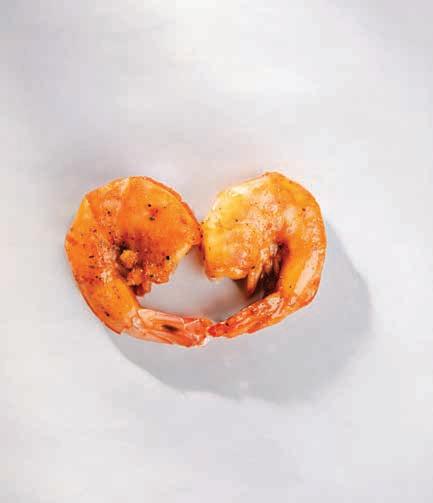

Lobster Tail Shrimp
Crawdad
DINING GUIDE Omaha
AMERICAN
CHARLESTON’S - $$$ 105 > 145th St. - 402.651.0689
Charleston’s is a casual, upbeat restaurant with a menu filled with dishes prepared from scratch daily. We focus on providing our guests with excellent prices and selecting the highest quality ingredients. Whether you are new to Charleston’s or a long-standing guest, we look forward to seei ng you soon! charlestons.c om/locations
LE PEEP - $
69th & Pacific - 402.933.2776
177th and Center St. - 402.934.9914
156th St. & W. Dodge Rd. - 402.408.1728 120th and Blondo St. - 402.991.8222
Le Peep puts a wholesome perspective on your favorite neighborhood breakfast and lunch spot. Fresh. Simple. Elegant. Inviting. We put the emphasis on people, both patrons and staff. We focus on providing each of our guests the fresh food and friendly service that they have come to expect. Open daily 6:30 a.m.-2 p.m. —lepeepomaha.com
LISA’S
RADIAL CAFE -
$
817 N. 40th St. - 402-551-2176
American. Cafe. Diner. Vegetarian-friendly. Gluten-free options. This old-school diner serves hearty portions of American comfort classics for breakfast and lunch. Family-owned and operated. This business is a must if you’re in the area. People rave about our chicken-fried steak, stuffed French toast, coffee, and friendly staff. Monday-Friday 6 a.m.-2 p.m., Saturday and Sunday 7 a.m.-2 p.m.
PACIFIC EATIN G HOUSE - $$ 1130 Sterling Ridge Dr. - 531.999.3777
We have developed our menu inspired by all that touches the Pacific Ocean. Starting with fresh fish flown from Honolulu, locally sourced steaks and natural chicken with an Asian flare and pairing our dishes with tiki libations and Pacific coast wines. —pacificeatinghouse.com
PINE & BLACK BISTRO - $$
248 Olson Dr., Papillion - 531.999.3777
We opened in March of 2023 to bring a family owned bistro to the community, serving local steaks and fresh seafood. We offer a wide variety of Pacific Northwest wines, local beers, and craft cocktails. Pinot Noir translates to Pine & Black, our name originates from our love of wine. —pineandblackbistro.com







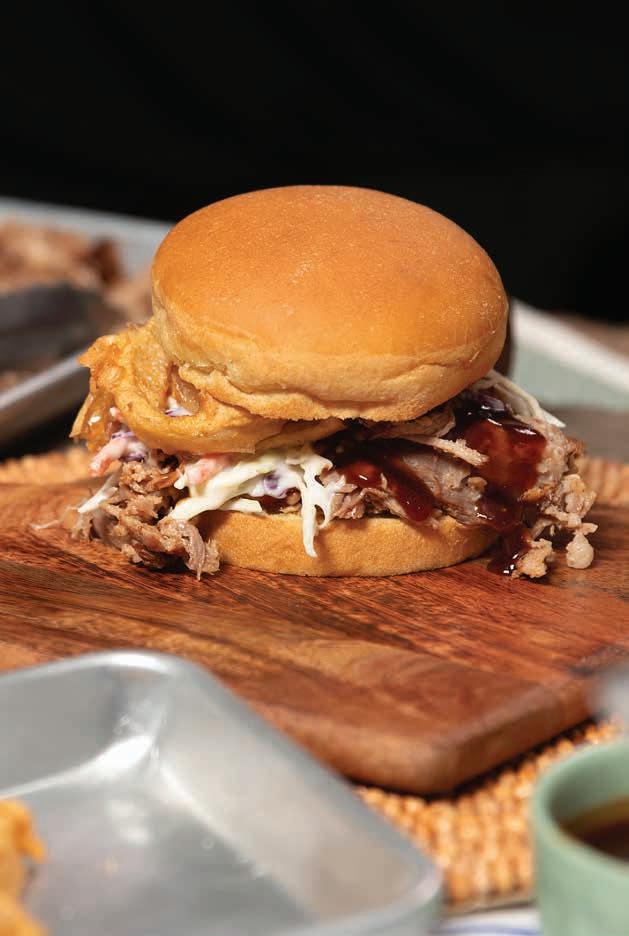
SMITTY'S GARAGE - $ 7610 Dodge St. - 402-614-4949
Tasty burgers, ice-cold beer, fresh-cut fries, scrumptious tacos, mouthwatering appetizers and more. What else could you want? Besides the delicious food, each location also offers a full bar with an extensive craft beer list and a one-of-a-kind environment with arcade games and plenty of TV’s. Download our new rewards app, Smitty’s Garage, in the app store to start earnin g free grub! eatatt hegarage.com
STELLA’S - $ 106 S. Galvin Road, Bellevue - 402.291.6088
Since 1936, we’ve been making our world-famous Stella’s hamburgers the same way. The family secrets have been handed down to each owner, ensuring that your burger is the same as the one you fell in love with the first time you tried Stella’s. And if it’s your first time, we know you’ll be back! Monday-Saturday 11 a.m.-9 p.m., closed Sunday. —stellasbarandgrill.com
TED AND WALLY’S - $
1120 Jackson St. - 402.341.5827
6023 Maple St. - 402.551.4420
The Perfect Comfort Food
Come experience the true taste of homemade ice cream in the Old Market. Since 1986, we’ve created gourmet ice cream flavors in small batches using rock salt and ice. We offer your favorites, plus unique flavors like margarita, green tea, Guinness, and French toast. Special orders available. Mon.-Thurs. 11 a.m.-10 p.m., Fri.- Sat. 11 a.m.-11 p.m., Sunday. Noon-10 p.m. —tedandwallys.com
VARSITY SPORTS CAFE - $$ Ralston - 9735 Q St. - 402.339.1944
Bellevue - 3504 Samson Way - 402.932.1944 Millard - 14529 F St. - 402.505.6660
Ralston, Bellevue and Millard. We are truly grateful to have been welcomed into each of these communities and welcome you in for good food, a cold drink and a comfy seat to enjoy the sport of your choosing! Determined to bring only the freshest ingredients, homemade dough and our specialty sauces to the table, we have worked hard to perfect our craft for you. Our goal is to bring the best food service to the area and show the best sports events that you want to see. Pick up and Delivery availalble. Please check website for hours of operation. —varsityromancoinpizza.com
LA CASA PIZZARIA - $$ 45th and Leavenworth St. - 402.556.6464
La Casa Pizzaria has been serving Omaha its legendary Neapolitan-style pizza and pasta for 60 years. We offer dine-in, carry-out, party facilities, catering, and now pizza shipments to the 48 contiguous states. Open Tuesday-Saturday at 11 a.m. and Sunday at 4:30 p.m. —lacasapizzaria.ne
PASTA AMORE - $$ 11027 Prairie Brook Rd. - 402.391.2585
Pastas are made fresh daily, including tortellini, fettuccine, and capellini. Daily specials and menu items include a variety of fresh seafood and regional Italian dishes, such as linguini amore and calamari steak, penne Florentine, gnocchi, spaghetti puttanesca, and osso buco. Filet mignon is also offered for those who appreciate nationally renowned Nebraska beef. To complement your dining experience, the restaurant offers a full bar and extensive wine list. Be sure to leave room for homemade desserts, like the tiramisu and cannoli. Monday-Thursday 9 p.m. and Friday-Saturday 10 p.m. Reservations recommended.
pa staamore.com
Large Menu
Party Room
PITCH - $$
5021 Underwood Ave. - 402.590.2625
West: 17808 Burke Street. - 402.289.4096
An OpenTable’s Diners’ Choice for 2014 HotSpot Restaurant in America. Keeping up with the traditional way the first pizzas in Italy were made, our pizzas are cooked in a coal-fired oven. The menu also features seafood, hand-cut steak, housemade pastas, and burgers full of flavor. Our goal is to provide you with local, housemade, and imported ingredients. We offer a happy hour menu through the -. Our bar provides an array of in-house concoctions as well as your traditional libations. Our wine selection is wellthought-out and most impressive. You will enjoy Pitch. Monday & Tuesday 11 a.m.-9 p.m., Wednesday-Friday 11 a.m.-10 p.m., Saturday 10 a.m.-11 p.m., Sunday 10 a.m.-9 p.m. pitch pizzeria.com
SPEZIA - $$$
3125 S. 72nd St. - 402.391.2950
Choose Spezia for lunch or dinner, where you’ll find a casual elegance that’s perfect for business guests, get-togethers, or any special occasion. Exceptional food, wine, and service, with a delectable menu: fresh seafood, certified Angus steaks, innovative pasta, risotto, gnocchi, cioppino, lamb, entrée salads, Mediterranean chicken, flatbreads, and fresh salmon daily. Enjoy a full bar, Italian and California wines, Anniversary/Lovers’ Booth (call to reserve), private dining rooms, and wood-fired grill. Open Monday-Sunday. Cocktail hour 4-6 p.m., when all cocktails, glasses of wine, and beers are half price. Evening reservations recommended. —speziarestaurant.com
MEXICAN
FERNANDO’S - $
7555 Pacific St. - 402.339.8006. 380 N. 114th St. - 402.330.5707
Featuring Sonoran-style cooking made fresh daily. Catering and party rooms also available. Monday-Thursday 11 a.m.-10 p.m., Friday-Saturday 11 a.m.- 11 p.m., Sunday 4-9 p.m. —fernandosomaha.com
LA MESA - $$
158th St. and W. Maple Rd. - 402.557.6130 156th and Q streets - 402.763.2555
110th St. and W. Maple Rd. - 402.496.1101 Fort Crook Rd. and Hwy 370 - 402.733.8754 84th St. and Tara Plaza - 402.593.0983 Lake Manawa Exit - 712.256.2762
Enjoy awesome appetizers, excellent enchilada’s, fabulous fajitas, seafood specialties, mouthwatering margaritas and much more at La Mesa! Come see why La Mesa has been voted Best of Omaha’s 20 Years in a Row! FridaySaturday 11 a.m.-10 p.m., Thursday-Sunday 11 a.m.-9 p.m. —lamesaomaha.com
HECTOR’S RESTAURANT - $$
1201 S. 157th St. - 402.884.2272
Hector’s Restaurant has been serving fresh, authentic Baja-style Mexican cuisine in Omaha since 1997. Known for flavorful dishes made daily—from salsa and guacamole to beans and rice—Hector’s also offers a wide selection of margaritas, domestic, and imported beers. Guests can enjoy a familyfriendly atmosphere, perfect for casual dinners, celebrations, or events. As the only Baja-style Mexican restaurant in the region, Hector’s stands out for its fresh ingredients, lively vibe, and dedication to superior service. —hectorsomaha.com
MARGARITA’S MEXICAN RESTAURANT - $
4915 S. 72nd St. - 402.393.7515
Margarita’s is a business with more than seven years in the food world. We offer authentic Mexican food where you can enjoy a nice moment with your family. margaritasmenu.com







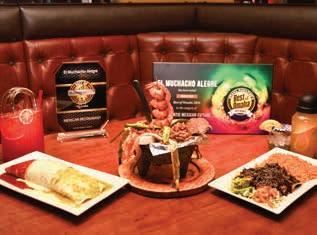


Founded in 1996, we’ve grown into Beer Corner USA with the additions of The Huber Haus German Beer Hall, Max and Joe’s Belgian Beer Tavern, and Beertopia Omaha’s Ultimate Beer Store. With more than 60 beers on tap and Omaha’s best Reuben sandwich, we are a Midtown beer-lover’s destination. Hours: Monday-Saturday 11 a.m.-2 a.m. Kitchen hours: Monday-Wednesday 11 a.m.-1 p.m., Thursday-Saturday 11 a.m.-midnight. Cl osed Sunday. —beercornerusa.com
GREEK ISLANDS - $ 3821 Center St. - 402.346.1528
Greek cuisine with specials every day at reasonable prices. We are wellknown for our gyro sandwiches and salads. We cater and can accommodate a party for 65 guests. Carry-out and delivery available.
Monday-Thursday 11 a.m.-9 p.m., Friday-Saturday 11 a.m.-10 p.m., Sunday 11 a.m.-7 p.m. —greekislandsomaha.com
SAGE STUDENT BISTRO INSTITUTE FOR THE CULINARY ARTS - $ 5730 N. 30th St.
Fort Omaha Campus, Building 22
At the Metropolitan Community College Sage Student Bistro, culinary and hospitality students learn hustle, fundamentals, community service and stewardship — all from scratch. Explore dishes from around the world during lunch, or celebrate the contributions of American culinary sages at dinner. For reservations, visit: —mccneb.edu/Bistro
STEAKHOUSES
CASCIO’S - $$
1620 S. 10th St. - 402-345-8313
Cascio’s is Omaha’s No. 1 steakhouse. We have been serving Omaha for 69 years. We feature steaks, chops, seafood, and Italian specialties. We have seven private party rooms, seating for up to 400 people, and plenty of parking.
—casciossteakhouse.com
THE
DROVER
RESTAURANT
& LOUNGE - $$$
2121 S. 73rd St. - 402-391-7440
Famous for the original Whiskey Steak. Truly a one-of-a-kind Midwestern experience. Excellent food, wine, service, and value. Rare...and very well done.
LUNCH: Monday-Friday 11 a.m.-2 p.m.,
DINNER: Monday-Friday 5 p.m.-10 p.m., Saturday 4:30 p.m.-10:30 p.m., Sunday 4:30 p.m.-9 p.m.,
LOUNGE: Monday-Friday Cocktails only 2 p.m.-5 p.m. —droverrestaurant.com
TWISTED CORK BISTRO - $$
10370 Pacific St. - 531.999.3777
We arrived in Nebraska from Washington intent on purchasing from farmers, ranchers & fishmongers who share our commitment for wholesome, sustainable fare. Our recipes use the Earth’s bounty the way it is intended ~ Wild and Natural ~ We compliment our dishes, pairing them with exquisite Pacific Northwest wines. –twistedcorkbistro.com
MAHOGANY PRIME
STEAKHOUSE - $$$$
225 N. 145th St. - 402.445.4380
In a town known for its great steaks, Mahogany stands above the rest. Conveniently located in the new Heartwood Preserve Center at 145th and Dodge, our Omaha location provides an intimate and classic fine dining atmosphere. Voted Best in Omaha.
DINNER: Monday - Saturday | 5pm - 10pm & Sunday | 5pm - 9pm. –mahoganyprimesteakhouse.com

$=




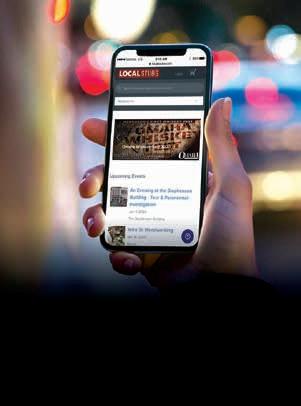





Looking for a powerful, yet cost-effective ticketing solution for your events in and around Omaha?
Check out Local Stubs!
Fewer fees than eventbrite! With features:
• Customizable event web pages
•
• Data analytics and insights
• Free mobile check-in app
• Instant access to local consumer audiences
Get started with a free demo at localstubs.com!





Lexye Bruegman, O.D. | Marsha Kubica, O.D. | Kristen Johnson, O.D. | Corey Langford, O.D.
O’Neill
THE IRISH CAPITAL OF NEBRASKA THE IRISH CAPITAL OF NEBRASKA





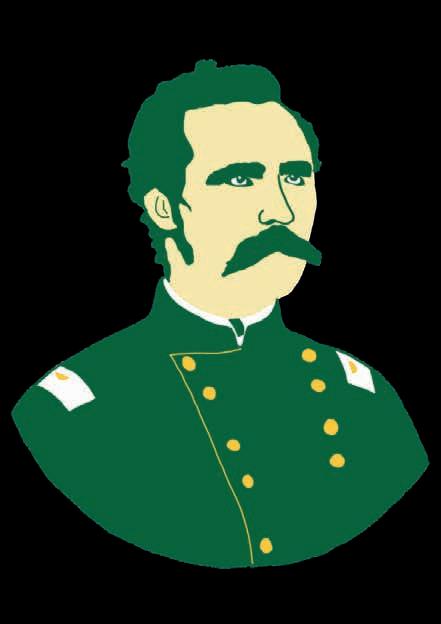
Paint the Town Paint the Town ADVENTURE
How O’Neill Became Nebraska’s Irish Capital
Story by Tim Trudell • Art by Claire Morrow • Design by Nickie Robinson
The giant green shamrock in the middle of downtown O'Neill proudly declares you're in Nebraska's Irish country.
The shamrock grew from a 1967 barber shop conversation between Al Reynoldson and his brother-in-law, Ron Smith.
"I was cutting his hair, and he didn't have a lot of hair. We were in the [Junior Chamber] at that time, which was a real active chapter," Reynoldson said. "We wanted to do something to promote O'Neill, so I told him, 'You know, I thought the other day that if we paint a shamrock curb-to-curb, that could be our theme.'"
One night, after the bars closed, the duo led a band of people to the intersection of 4th and East Douglas streets, where Smith drew an outline of a shamrock and then the group painted the street green.
GREEN O’Neill
The shamrock—65 feet in diameter— became an iconic symbol for the town. In 1969, Governor Norbert Tiemann officially proclaimed O'Neill as the Irish Capital of Nebraska.
"We'd say it took 40 gallons of beer to apply 50 gallons of paint," Reynoldson said. "But sometimes it seemed the other way around."
"People come from a long ways away to see it," Reynoldson said. "There have been a couple of marriages performed on the shamrock, and a lot of proposals. I think maybe even a fe w divorces."
O'Neill's ascension as the Irish Capital of Nebraska centers around an immigrant convicted for waging wa r on Canada.
John O'Neill was born in Ireland in 1834, about six weeks after his father died from complications related to a virus. A few years later, Mrs. O'Neill and two of her children emigrated to the United States. Young John, named for his father, remained, residing with his paternal grandfather.
Growing up, O'Neill learned of injustices committed by England against the Irish. His disdain of the British stayed with h im for life.
People come from a long ways away to see it. There have been a couple of marriages performed on the shamrock, and a lot of proposals. I think maybe even a few divorces.
A l Reynoldson
After the attack on Canada failed, O'Neill was imprisoned, where he developed the idea of bringing Irish immigrants to the Midwest, Butterfield said.
Founded in 1874, O'Neill's fi rst residents were coal miners from Scranton, Pennsylvania. Later, copper miners from Michigan relocated there.
O'Neill traversed the East Coast recruiting Irish immigrants to move to Nebraska, Butterfield said.
"My great-great-grandfather, his wife, and their family of kids, ranging from young adults to little ones, were in a big group of Scranton immigrants, who came out in 1877," she said.
As years passed, and Gaelic was no longer spoken by locals, some O'Neill residents believed the city was losing its appeal as the Irish capital.
THE IRISH THE IRISH “ “
The painting of the shamrock became an annual event, putting O'Neill on the map as the place to celebrate St. Patrick's Day. Beer flows. The parade crosses over the shamrock. Irish dancers stop to perform on it. O'Neill hosts a weeklong celebration, culminating the weekend before the holiday.
"It's become tradition for people to come out and watch the shamrock be painted the Wednesday before the celebration," said Lauri Havranek, president and chief executive officer of the O'Neill Chamber of Commerce.
Annually, 5,000 people surge into the city's population of about 3,700, fi lling the streets of O'Neill to participate in the Irish celebration.
O'Neill joined his family in the U.S. on the East Coast in 1848. During the Civil War, he enlisted and joined the First Dragoons calvary regiment. He rose to the rank of fi rst lieutenant in the Union Army.
Following the war, O'Neill, nicknamed the "General" by admirers, led an armed incursion into Canada. They attempted to capture a section of land in hopes of forcing the British to negotiate Ireland's freedom, said Natalie Butterfield, president of the Fenian Women's Auxiliary, a local Irish heritage nonprofit.
"Everything that had been tried over the last 100 years in Ireland had been stymied, and the populace over there was so poor and so demoralized," Butterfield said. "There were hardened veterans, both from the Union and the Confederacy, who were Irish, which was interesting, because the Fenian army had veterans from both sides a nd weapons."
Injecting fresh blood into planning the annual celebration, Butterfield's father, George Cook, formed the new Fenian army. The Junior Chamber of Commerce passed the torch to the Fenians, Butterfield said.
Among the event’s popular attractions is the green "painting" of a white horse (food dye is used). Dating back to the 1960s, a green horse often gallops along the main street during the St. Patrick's celebration, Havranek said.
While celebrating the St. Patrick's holiday may be the driving force behind a visit to O'Neill, checking out the city's Irish history, highlighted by a downtown walk of fame and a statue of the city's founder, is fodder for a day trip or long weekend visit to the northern Nebraska community.
Visit cityofoneillnebraska.com for more information.



Since 1917, five generations of the Walker family have served the retail, and then the commercial, laundry markets in Omaha and the surrounding areas. We’re Dry Cleaners, but many Omaha business owners have also depended on our Uniform Rental Service since 1974. EST. 1974 www.maxiwalker.com & www.maxiwalkeruniform.com














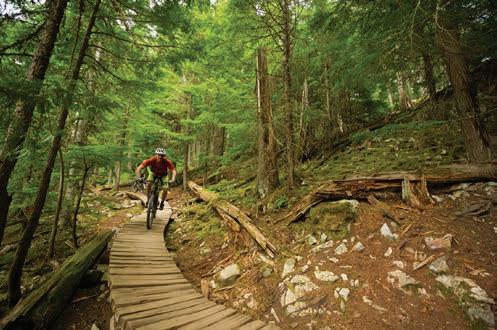




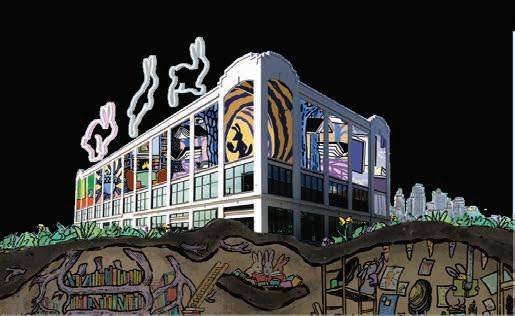


come and
explore. LET’S PLAN A
COMPILED BY Naomi Heu
ROAD
TRIP!
DAYTRIPS IN NEBRASKA, IOWA, KANSAS, MISSOURI, AND SOUTH DAKOTA
NEBRASKA
SANDHILL CRANE MIGRATION Throughout March in Central Platte River Valley. Every March, the great sandhill crane migration makes its way through central Nebraska as the birds make a pit stop in the Platte River Valley to rest and feed before continuing their journey north. Don’t pass up the chance to view hundreds of thousands of sandhill cranes in this incredible one-of-a-kind experience. visitnebraska.com/sandhill-crane-migration
IAN MUNSICK: THE EAGLE FLIES FREE TOUR March 3 at Heartland Events Center, Grand Island. Up-and-coming country artist Ian Munsick is bringing his Eagle Flies Free Tour to Grand Island. Originally from Wyoming, he has risen to popularity quickly with multiple studio albums and EPs. Joined by special guests Jake Worthington and Tyler Nance, this will be an unforgettable night. heartlandeventscenter.com
ST. PATRICK’S DAY March 11-14 in O’Neill. In Nebraska’s Irish capital, celebrate the luck of the Irish with this week-long party for St. Patrick’s Day. Festivities include events like the Mr. Irish contest, bingo, karaoke, Irish Chug Run, Shamrock Fun Run, and a Grand Parade through downtown O’Neill. Throughout the week, check out local pubs offering green beer, mules, and mimosas. cityofoneillnebraska.com
PRAIRIE CHICKEN DANCE TOURS March 17-April 24 at Keystone Business Center, McCook. Watch the enchanting mating dances of southwest Nebraska’s greater prairie chickens in this spectacular show that happens every spring. Journey to McCook to see these fabulous chickens show off their best moves as they try to find a mate. Each tour comes with a day-before orientation to ensure a high-quality experience. prairiechickendancetours.com
THE HARLEM GLOBETROTTERS 100 YEAR TOUR March 18 at Heartland Events Center, Grand Island. Celebrating 100 years, the Harlem Globetrotters are taking on their most legendary tour yet. Experience the dunks, tricks, and fun from over the past 100 years as they visit the Heartland Events Center. With pre-game magic and post-game interactions, this historical celebration is one of a kind. heartlandeventscenter.com
MARTY STUART & HIS FABULOUS SUPERLATIVES March 27 at Merryman Performing Arts Center, Kearney. Singer-songwriter and multi-instrumentalist Marty Stuart comes to Kearney with his country, bluegrass sound. With over 50 years in the industry, he is truly an icon, having toured with Lester Flatt and playing in Johnny Cash’s road band, eventually becoming a solo artist. merrymancenter.org
ZZ TOP AND DWIGHT YOAKAM: DOS AMIGOS TOUR March 27 at Heartland Events Center, Grand Island. On the Dos Amigos Tour, ZZ Top and Dwight Yoakam join forces for a performance that is jam-packed with powerhouses in American music. With ZZ Top’s iconic rock band and Yoakam’s influential country voice, the unique pairing of both sounds create an unforgettable and one-of-a-kind experience. heartlandeventscenter.com
JOURNEY: FINAL FRONTIER TOUR 2026 April 9 at Pinnacle Bank Arena, Lincoln. The American rock band formed in San Francisco that brought smash hits like “Don’t Stop Believin'” and “Any Way You Want It” is coming to Lincoln on their Final Frontier Tour. Join in on singing these classics and be transported back in time to the '80s for a night of iconic Journey music. pinnaclebankarena.com
NEXT TO NORMAL April 10-12 & 17-19 at North Platte Community Playhouse, North Platte. This rock musical takes you back to 2008 and explores how a suburban household deals with crisis and a mother whose bipolar disorder is worsening by the minute. North Platte Community Playhouse’s spring musical is a deep look into emotions and heart in a truly moving way as this family goes through turbulence. northplattecommunityplayhouse.com
PIPPIN April 17-19 & 24-26 at Lincoln Community Playhouse, Lincoln. The Lincoln Community Playhouse puts on Pippin , the story of a young prince who is on the journey to find happiness and fulfillment through battle and power. This musical discovers what it means to become extraordinary as Pippin and his father, Emperor Charlemagne, clash over what it means to follow your dreams. lincolnplayhouse.com
ARBOR DAY WEEKEND CELEBRATION April 24-26 at Arbor Day Farm, Nebraska City. Celebrate Arbor Day at the birthplace of the holiday at Arbor Day Farm in Nebraska City. Throughout the weekend, celebrate the tree planter’s holiday with children’s activities, educational opportunities, food and beverages, shops, and more across the 260acre campus. All in honor of trees, this is the perfect family outing for spring fun and excitement. arbordayfarm.org
ZACH BRYAN: WITH HEAVEN ON TOUR April 25 at Memorial Stadium, Lincoln. Zach Bryan comes to Lincoln on his With Heaven On Tour. Known for his raspy voice and unique blend of folk and country, he has risen to the top of the charts. Sing along to top hits like “Something in the Orange,” “Revival,” and more, and enjoy a performance by special guests Kings of Leon and J.R. Carroll. huskers.com/specialevents-upcoming
IOWA
RENT IN CONCERT March 1 at Hancher Auditorium, Iowa City. Broadway classic RENT comes to life on stage at Hancher Auditorium in Iowa City. A talented ensemble of vocalists and instrumentalists come together to perform favorites like “Seasons of Love,” “La Vie Bohème,” and “Take Me or Leave Me.” As a part of Hancher’s 2025-2026 Broadway series, this show is sure to be unforgettable. hancher.uiowa.edu
JERRY SEINFELD March 7 at Des Moines Civic Center, Des Moines. Iconic comedian Jerry Seinfeld comes to Des Moines with his hilarious and relatable humor. Best known for his role as himself on the NBC sitcom Seinfeld , he is a household name. Along with comedy, he has starred in, written, produced, and directed movies. desmoinesperformingarts.org
THE SEAGULL March 13-22 at Stoner Theater in Des Moines Civic Center, Des Moines. The Iowa Stage Theatre Company is putting on Anton Chekhov’s play, The Seagull , at Stoner Theater located inside the Des Moines Civic Center. This story follows the ups and downs of romantic and artistic conflicts between the four main characters and discovers the meaning of creativity, longing, and the human need to be seen. desmoinesperformingarts.org
TRISHA YEARWOOD: THE MIRROR TOUR March 13 at Hoyt Sherman Place, Des Moines. Trisha Yearwood is a three-time Grammy winner and country singer. With the release of her newest album, The Mirror, she visits Des Moines at Hoyt Sherman Place on tour with special guests Leslie Satcher and Bridgette Tatum for an unforgettable night of intimate acoustic sounds. hoytsherman.org
THE GRAND PARADE March 14 in Davenport. The annual Iowa/Illinois St. Patrick’s Day parade is one of the most iconic bi-state parades in the country. Starting in Rock Island, Illinois, the parade crosses over the Centennial Bridge and ends in downtown Davenport, Iowa. This parade through the Quad Cities is a great way for the whole family to get in the St. Patrick’s Day spirit. stpatsqc.com
JAKE OWEN: DREAMS TO DREAM TOUR March 27 at Hoyt Sherman Place, Des Moines. Country music artist Jake Owen is coming to Des Moines on his Dreams to Dream Tour, performing the new album in its entirety. On the Hoyt Sherman Place stage, listen to hit songs like “Barefoot Blue Jean Night” and “Beachin’.” He will be joined by special guest Kendell Marvel. hoytsherman.org
WORLD BALLET COMPANY: CINDERELLA March 27 at Sioux City Orpheum, Sioux City. Join the World Ballet Company in this beautiful retelling of the classic princess story, Cinderella, through elegant and graceful dancing. With over 40 international dancers, dazzling hand-sewn costumes, intricate hand-crafted sets, and breathtaking choreography by Marina Kesler, this performance is sure to sweep you off your feet to fairytale land. orpheumlive.com
BRAD WILLIAMS: THE TALL TALE TOUR April 9 at Sioux City Orpheum, Sioux City. Brad Williams brings his Tall Tale Tour to Sioux City for a night of outrageous comedy and hilarious laughs. Doing stand-up comedy since he was a teenager, he has made a name for himself and is most known for his sharp and high-energy storytelling, as well as his self-deprecating humor. orpheumlive.com
MONSTER JAM April 11-12 at Casey’s Center, Des Moines. Enjoy a high-energy night full of excitement and fun at Monster Jam at Casey’s Center in Des Moines. Huge monster trucks take the floor as skilled drivers perform unbelievable stunts and other intricate skills. This event is perfect for the whole family with awesome trucks and crazy action. iowaeventscenter.com
EASTER EGG EXTRAVAGANZA April 12 at Bass Family Farms, Mt. Vernon. At Bass Family Farms, enjoy an Easter Egg Extravaganza for a day full of egg-tastic fun. With a giant jump pad, 18-hole mini-golf course, cornhole, big slide, specialty food store, and more, you are sure to have loads of fun on the grounds. Tickets must be purchased ahead of time. bassfarms.org
KANSAS
DELANO PADDY DAY PARADE March 14 in Downtown Wichita. An infamous Wichita tradition, the Delano Paddy Day Parade runs through the heart of Historic Delano and ends with a large street party. With food trucks and tons of fun kids activities, this full-day event is perfect for the whole family to celebrate St. Patrick’s Day. delanopaddydayparade.com
KANSAS BALLET: THE WIZARD OF OZ March 14-15 at Topeka Zoo & Conservation Center, Topeka. Watch the classic story of The Wizard of Oz performed by the talented dancers of Kansas Ballet at the Topeka Zoo & Conservation Center. Join the iconic Dorothy, Scarecrow, Tin Man, and Cowardly Lion on their journey down the yellow brick road. This performance is perfect for the whole family and free with admission to the zoo. topekazoo.org
CHRISTOPHER CROSS March 21 at Stiefel Theatre, Salina. American singer-songwriter and guitarist from San Antonio, Texas, Christopher Cross comes to Salina on tour. Best known for his soft-rock debut album released in 1979, he has won multiple Grammys and has many hit singles such as “Sailing” and “Ride Like the Wind.” stiefeltheatre.org
SWAN LAKE BY INTERNATIONAL BALLET STARS March 26 at Century II Performing Arts & Convention Center, Wichita. Watch the beautiful story of Swan Lake through choreography from Marius Petipa and Lev Ivanov set to the score of Tchaikovsky. With ballet dancers from over 15 different countries, this performance is filled with talent and grace. It is perfect for the whole family with beautiful hand-painted sets that will transport you to another world. century2.com
ELMO’S GOT THE MOVES April 1 at Century II Performing Arts & Convention Center, Wichita. This Sesame Street live show is coming to Wichita for a night perfect for your little ones. An interactive performance will have you up and out of your seating dancing along with Elmo and his Sesame Street friends singing songs like “Sunny Days,” “Elmo’s Got the Moves,” and “Letter of the Day.” century2.com
EGGSTRAVAGANZA April 4 at Topeka Zoo & Conservation Center, Topeka. This egg hunt is the perfect twist on this favorite springtime event by focusing on the animals. Watch animals big and small search and open colorful papier-mâché eggs created and hidden by staff and volunteers. Inside each egg are special treats and enrichment items meant to replicate natural behaviors like foraging and problem-solving. topekazoo.org
EARTH DAY April 18 at Topeka Zoo & Conservation Center, Topeka. Celebrate Earth Day 2026 at the Topeka Zoo & Conservation Center. Check out educational stations, hands-on activities, and displays that educate how you can make a difference to improve wildlife and the environment. Free with regular zoo admission, join the zoo in celebrating the beauty of the world we live on. topekazoo.org
SPRING GREAT PLAINS RENAISSANCE & SCOTTISH FESTIVAL April 18-19 in Wichita. Celebrate the 21st annual Spring Great Plains Renaissance & Scottish Festival this year in Wichita. With jousting and jesting, knights, pirates, fairies, and more, this is the perfect renaissance festival full of medieval vibes and fun. Enjoy shopping from vendors or watching fire breathers and bagpipe players in a weekend fit for a king. greatplainsrenfest.com
ROAR & POUR WINEFEST April 25 at Topeka Zoo & Conservation Center, Topeka. In this night of support for Topeka Zoo’s education and conservation programs, enjoy wine, fun, and entertainment. Taste wine from local and regional vineyards as well as food samples from local restaurants. Live music and entertainment will be sprinkled throughout the event and meet animal ambassadors in this special after-hours event. topekazoo.org
MISSOURI
COLTER WALL: MEMORIES AND EMPTIES March 6 at Stifel Theatre, St. Louis. Canadian singer-songwriter Colter Wall comes to Stifel Theatre for a night filled with his gorgeous, deep, baritone voice. His sound mixes western, country, and folk altogether with a narrating songwriting style that makes him stand out among the rest. He is joined by special guest Kade Hoffman. stifeltheatre.com
BUSCH LIGHT HOT COUNTRY NIGHTS: AVERY ANNA March 13 at Ballpark Village, St. Louis. This Hot Country Nights, hosted by Busch Light, highlights up-and-coming country artist Avery Anna who is only just beginning her career at age 21. Gather at Ballpark Village with other country music lovers and listen to fan favorites like “Narcissist” and “I Love You More,” as well as her feature on “Indigo” by Sam Barber. stlballparkvillage.com
KANSAS CITY ST. PATRICK’S DAY PARADE March 17 in Kansas City. This annual St. Patrick’s Day parade is an exciting and fun-filled event bringing spirit throughout downtown Kansas City. This year’s theme is "Irish Kicks in 26: A Celebration of Sport." Since 1974, the parade has been showcasing local businesses, organizations, and entertainment in celebration of the Irish. kcirishparade.com
DIARY OF A WIMPY KID March 17-April 18 at City Stage Theatre in Union Station, Kansas City. Watch this hilarious performance of the comedy Diary of a Wimpy Kid , based on the best-selling book, at the City Stage Theatre in Union Station. Follow wimpy middle-schooler Greg Heffley and his best friend Rowley Jefferson as they navigate the dynamics of middle school, puberty, and fitting in. unionstation.org
2026 NCAA DIVISION I MEN’S BASKETBALL CHAMPIONSHIP March 20 & 22 at Enterprise Center, St. Louis. Watch the first and second rounds of the NCAA Tournament at the Enterprise Center. See the best of the best play against each other on their road to the Final Four. Be there for all the edge-of-your-seat moments during the best time of the year for college basketball. enterprisecenter.com
AARON WATSON March 21 at Power & Light District, Kansas City. Country singer-songwriter Aaron Watson comes to the Power & Light District with his powerful vocals and stage presence. On the PBR Big Sky stage, sing along to hits like “Freight Train” and “Outta Style.” For double the fun, also check out Hot Country Nights in St. Louis, where he performs the night before. powerandlightdistrict.com
DANIEL TOSH: MY FIRST FAREWELL TOUR March 28 at Stifel Theatre, St. Louis. Comedian, host, writer, and producer, Daniel Tosh, is coming to Stifel Theatre on his My First Farewell Tour. Best known for creating and hosting TOSH.0 which aired on Comedy Central for over ten years, he has also appeared on The Late Show with David Letterman and other Comedy Central shows. stifeltheatre.com
HARRY POTTER AND THE CURSED CHILD March 28-April 12 at The Fabulous Fox Theatre, St. Louis. Watch Broadway’s Harry Potter and the Cursed Child on the grand stage at The Fabulous Fox Theatre. This talented ensemble will transport you to the magical wizarding world of Hogwarts where Harry Potter’s son, Albus, befriends the son of his arch nemesis Draco Malfoy. This performance brings you along on another story with these beloved characters. fabulousfox.com
WWE FRIDAY NIGHT SMACKDOWN April 3 at Enterprise Center, St. Louis. For a night of exciting wrestling and fights, WWE Friday Night SmackDown comes to Enterprise Center for its Road to WrestleMania tour. Watch SmackDown superstars like “The American Nightmare” Cody Rhodes, Sami Zayn, The Street Profits, and more battle it out on the mat in adrenaline-packed action. enterprisecenter.com
CODY JOHNSON April 18 at Chaifetz Arena, St. Louis. Country singer Cody Johnson is performing at Chaifetz Arena for a special oneof-a-kind show. Listen to his contemporary and neo-traditionalist sound with songs like “Travelin’ Soldier” and “’Til You Can’t.” Proceeds from the show will benefit the devoted fund at SSM Health Cardinal Glennon Children’s Hospital. chaifetzarena.com
SOUTH DAKOTA
MOUNTAIN WEST WHISKEY FESTIVAL March 8 at The Rushmore Hotel & Suites, Rapid City. Lovers of whiskey come together for the Mountain West Whiskey Festival in Rapid City. Join other whiskey connoisseurs as well as industry experts for an evening of the finest spirits. Sample a variety of whiskeys, bourbons, and scotches and enjoy live music and upscale catering. mountainwhiskeyfestival.com
ST. PATRICK’S DAY WEEKEND March 13-14 in Deadwood. Get in the Irish spirit with this amazing St. Patrick’s Day celebration in the Historic Deadwood. Enjoy a lively parade along Main Street as well as live entertainment, parties galore, and an iconic pub crawl through local businesses. Go on the Lucky Leprechaun Hunt for the chance to win a prize. deadwood.com
TOBYMAC: HITS DEEP TOUR March 15 at Denny Sanford PREMIER Center, Sioux Falls. Christian rapper and singer-songwriter TobyMac brings his Hits Deep Tour to the Denny Sanford PREMIER Center. Winner of seven Grammy awards, he is widely regarded as one of the most well-known contemporary Christian musicians. He is joined by special guest Jeremy Camp. dennysanfordpremiercenter.com
FORKS, CORKS, & KEGS April 10-11 in Deadwood. This annual wine and beer festival in Deadwood is perfect for those who love fine food, wine, and brews. Sample a variety of beer and wine from across the country and from the local Black Hills throughout as you visit businesses across Historic Deadwood. Each location pairs a delicious culinary creation with each beverage sample. deadwood.com
FIRST PREMIER BANK PBR SIOUX FALLS April 10-12 at Denny Sanford PREMIER Center, Sioux Falls. For a thrilling and pumped-up night, come to First PREMIER Bank’s PBR in Sioux Falls. Watch the bravest world-class athletes face the most ferocious bucking bulls in the Queen City. This show is sure to give you an adrenaline rush and keep you on the edge of your seat. dennysanfordpremiercenter.com
BAILEY ZIMMERMAN: DIFFERENT NIGHT SAME RODEO TOUR 2026 April 18 at Denny Sanford PREMIER Center, Sioux Falls. Bailey Zimmerman is an American singer-songwriter who is coming to the Denny Sanford PREMIER Center on his Different Night Same Rodeo Tour. His sound blends arena rock and American country together for deep and heartfelt storytelling. Listen to top hits like “Rock and a Hard Place” and “Fall in Love.” dennysanfordpremiercenter.com
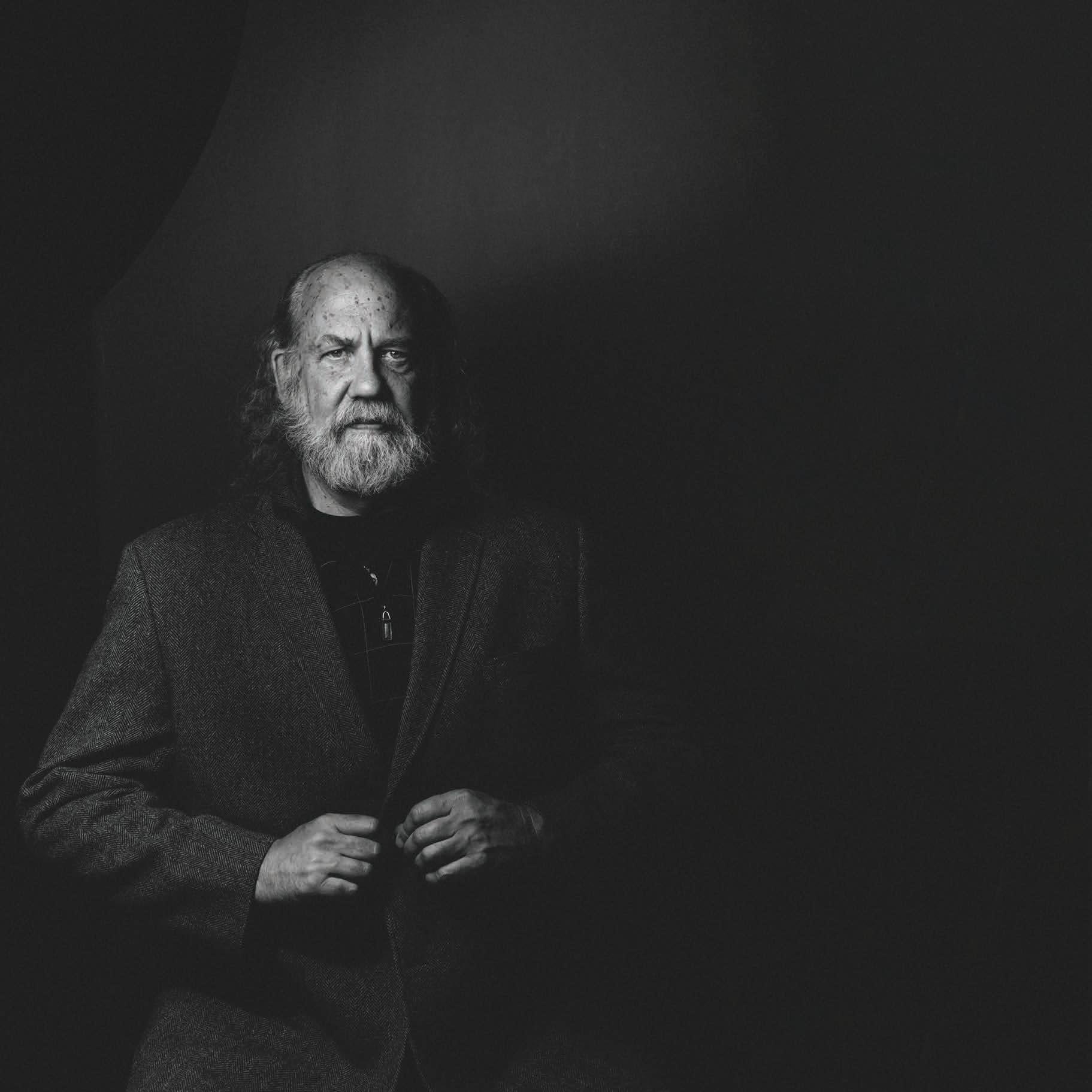
THE BARBER OF TWELVE
It might surprise you to know that I have a barber.
Surprised? Understandable… I mean, just look at the picture of me on the page here. It’s clear that the man shown there more likely might be said to need some Plexaderm, a massive hit of Botox, a better tailor, and not to mention, judging from the dark countenance, a new, more cheerful attitude. It must surely seem very clear to even a casual myopic observer of my scalp that, as my grandfather used to say, “There’s not much grass on the pasture, and what little’s there has been overgrazed.”
A barber? Really?
Yes, I have a barber. Great Clips? No. Bite your tongue. I have an untreatable franchise phobia and my demeanor does not match their mission statement nor their commercials that portray their establishments as, shudder, “fun.” Plus, I am not a candidate for their trademarked “fade with side part,” “tousled layers,” or “long pushback” hairstyles. Besides, Great Clips employs folks who refer to themselves as “stylists.” And as all who know me must certainly understand by now, I am not now, nor have I ever been, in search of “style.”
Let me explain why I have a barber.
1. It’s a connection to yesteryear. I’m trying to recapture my youth when dad took me to the clip joint in Prairie Village every two weeks whether my G.I. buzzcut needed a trim or not. The hum of the electric clippers, the smell of the Butch Wax… ah… to have a flattop again.
2. I am obsessed with the symbolism of the “barber’s pole,” that red, white, and blue spiral that marks every proper shop going back to the Middle Ages. As a young university student, I discovered that the brilliant bloody signage inspired the names of a similarly red and white striped parasitic worm that infects sheep and goats called “The Barber’s Pole Worm” (Haemonchus contortus), a “Barber Pole Grasshopper” (Dactyloyum Bicolor), and that denizen of the Great Barrier Reef, the ten-footed “Barber Pole Shrimp” (Stenopus Hispidus). I hope these interesting side notes are useful to you at your next unnecessary corporate meeting or strategic goal-setting retreat. Ah, to be back in the Middle Ages when such gatherings were handled in an email.
3. Barbers used to do bloodletting in order to cure various serious medical conditions. A vein was opened in the customer’s arm and the resultant stream was caught in a porcelain bowl. They don’t do this anymore because Blue Cross/Blue Shield won’t cover the procedure, even though it was offered at less than the two-bit cost of a shave and a haircut.
4. My barber, who works in a four-chair shop where all the chairs are vintage and have little ashtrays in the left armrest, knows how to trim my beard and remove any debris gathered while trimming hedges or cleaning the garage. She does all this without any judgement or additional charge.
5. The most important reason I have a barber? Every session with clippers, a razor, and a splash of bay rum ends with me leaning back in the chair with a warm steamy towel draped over my face taking in the warmth and comfort and finally emitting a deep, soothing sigh.
Lord knows, these days we all need a good deep, soothing sigh every once in a while.



The next generation of non-surgical lifting
Experience the most advanced skin tightening technology available. Ultherapy PRIME® delivers natural-looking lift and tightening for your face, neck and décolletage without surgery or downtime. This FDA-cleared treatment uses focused ultrasound energy to stimulate your body's own collagen production, revealing gradual, beautiful results that can last up to a year or more.
As Nebraska's first practice to offer Ultherapy PRIME®, Schlessinger MD brings you the latest innovation in non-invasive lifting—backed by decades of dermatologic expertise.

Best of Omaha 2026 winner in 10 categories
Best Dermatology
Best Cosmetic Surgeon Office
Best Local Website
Best Beauty Supply Store
Best Esthetics Office
Best Med Spa
Best Day Spa
Best Body Contouring
Best Laser Hair Removal
Best Waxing - Hair Removal