NORTH OMAHA FIRST A
HYPER-LOCAL COMMUNITY EXPERIENCE
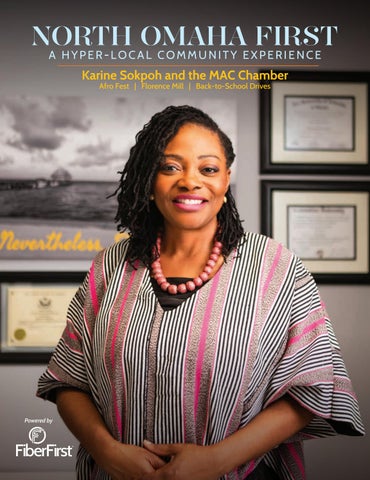
Karine Sokpoh and the MAC Chamber
Afro Fest | Florence Mill | Back-to-School Drives

O
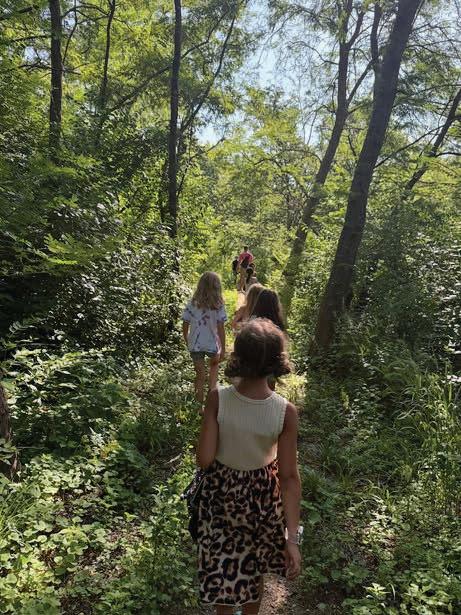





Beyond Backpacks
Investing in North Omaha’s
Future
By mid-July, most students aren’t ready to think about school again. There’s still summer left, after all. Why rush it? But parents are already looking ahead, because the next school year comes with planning and costs.
That preparation appears throughout the summer issue of North Omaha First, though not always in the same way. In our feature on area back-to-school drives, local organizations are helping families with backpacks and supplies while creating connections at the same time. A student may come for a backpack, but a family may leave with an entire support system.
That same focus can be found in our cover story on Karine Sokpoh and the MAC Chamber. Sokpoh’s work is rooted in access: who has it and what becomes possible when more people do. Through Rising CEOs, young people are building businesses while learning to defend their ideas. They are being asked to see leadership as something they can practice.
At Omaha North High School, students in the engineering and design pathway are also working with a clearer view of what comes after graduation. Their projects move beyond classroom exercises into designs that must answer real questions from mentors and professionals. By the time they graduate, they’ll have gained the responsibility and problem-solving skills their careers will ask of them.
The Florence Mill farmers market looks at learning in a different setting. It gives children a place to learn where food comes from, while small businesses have room to try something in front of the community. It’s also a great feel-good story that shows how a historic space can undergo a massive transformation when someone shows up to care about it.
We often treat education as something tied to the academic calendar, but these articles show that it’s more than that. Learning and leadership development happen in many settings, especially when a community makes room for young people to participate.
The stories in this issue show that investing in the next generation is ultimately an investment in the future of North Omaha. Thanks for reading!
Isaac Nielsen Managing Editor
SAFETY
FUN
LEADERS FIRST
NONPROFITS FIRST
EDUCATION FIRST
About the Cover
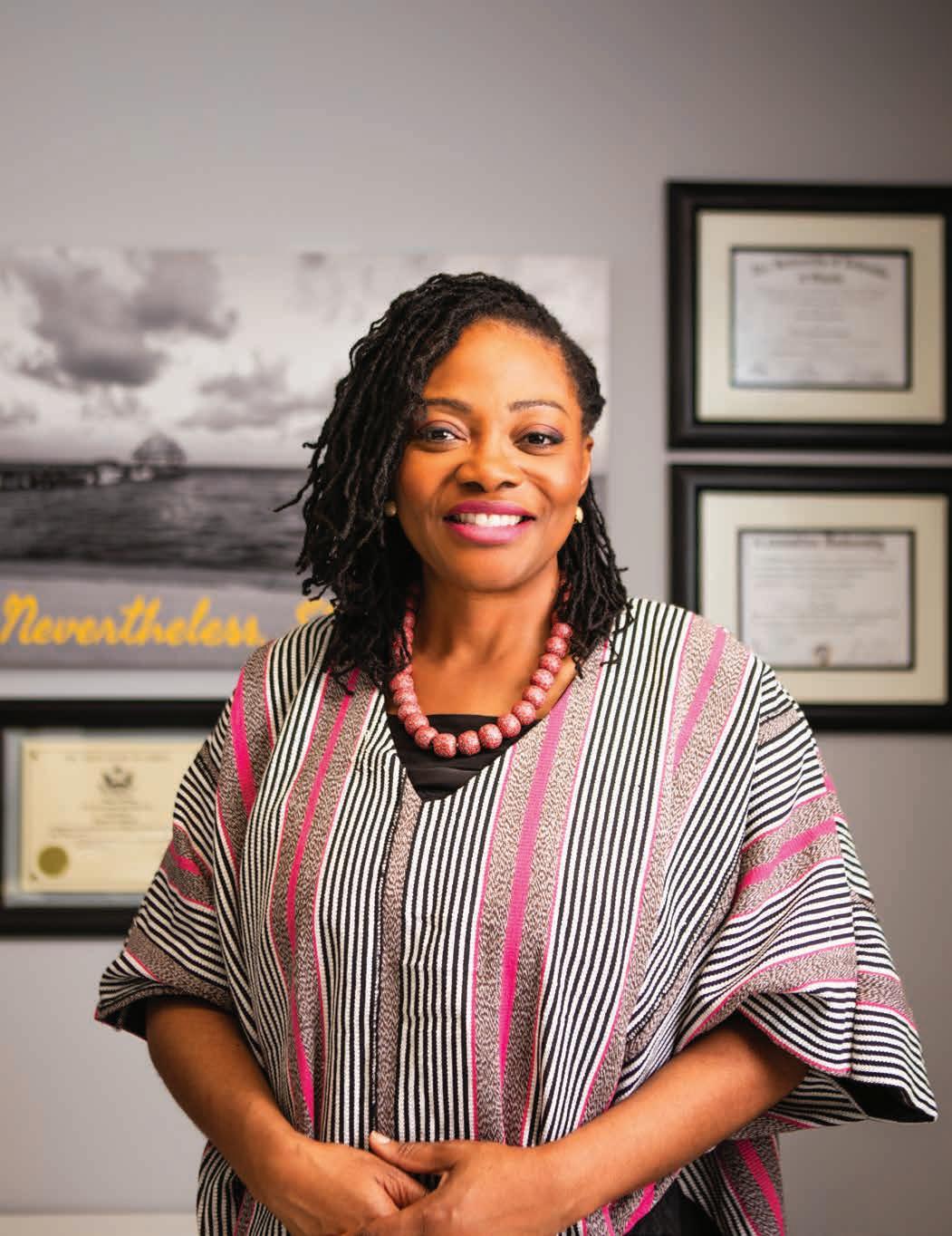
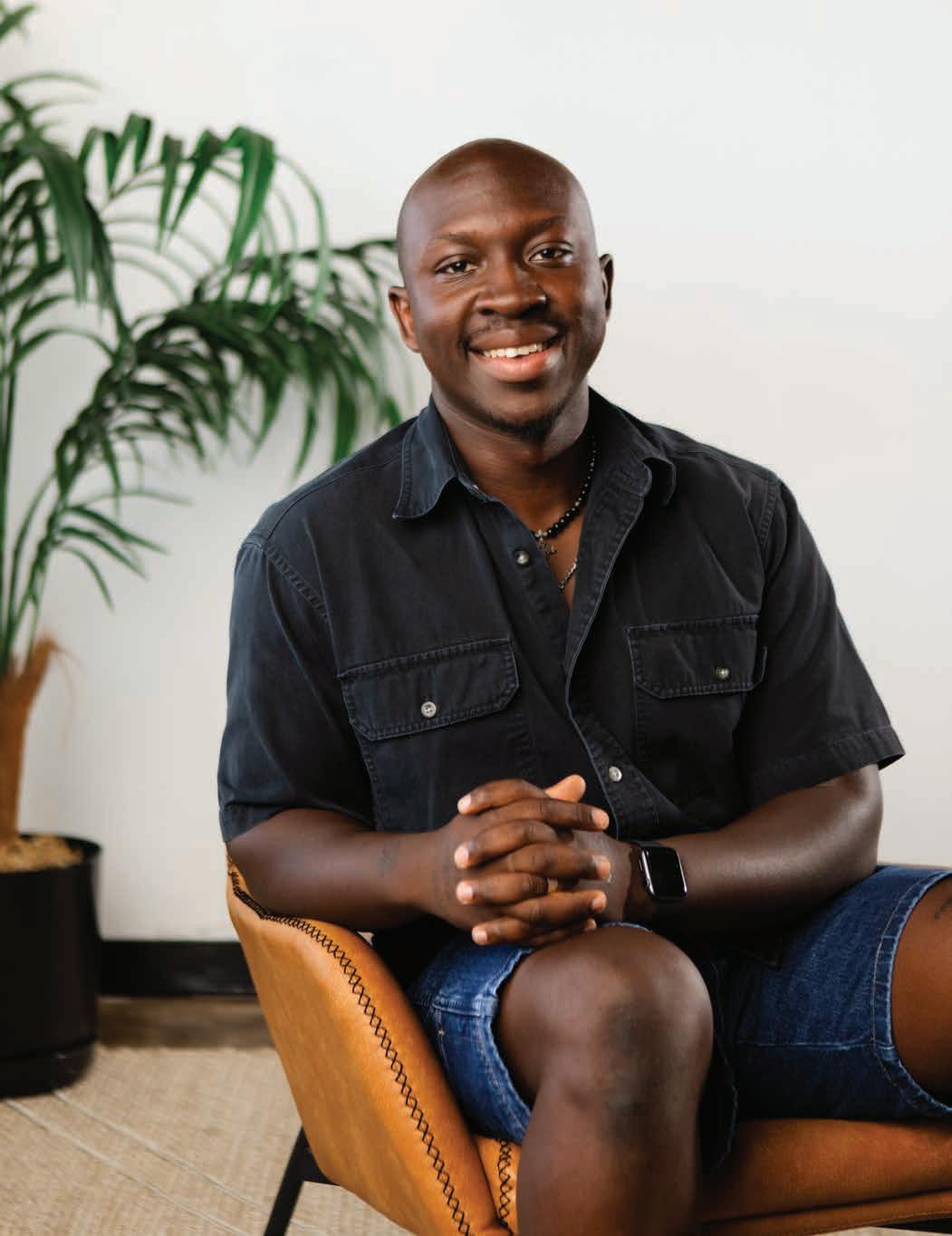
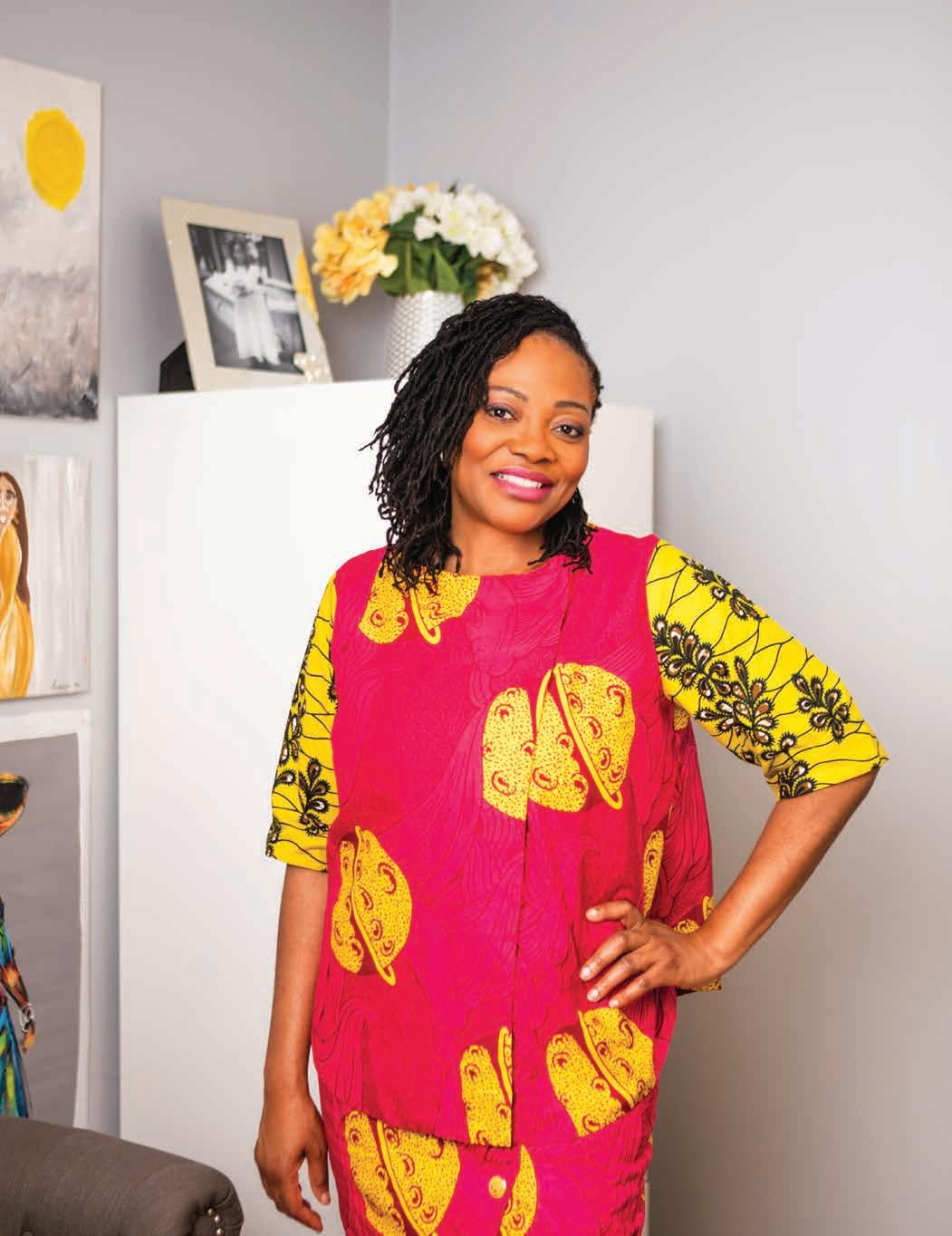
Inspired by her journey from Togo to Omaha, Karine Sokpoh is building pathways to success for entrepreneurs and young leaders across Nebraska through the MAC Chamber. Full story on page 8.
EXECUTIVE
Executive Publisher
Todd Lemke
Associate Publisher Bill Sitzmann
SALES
Sales Coordinator
Sandi McCormack
Branding & Digital Specialist
Tim McCormack
OPERATIONS
Business Manager
Kyle Fisher
Distribution Manager
Carson Kruse
Ad Traffic Manager
Dave Trouba

ART
Chief Photographer
Sarah Lemke
Graphic Designer
Joey Winton
EDITORIAL
Managing Editor
Isaac Nielsen
Contributing Writers
Naomi Heu, Brandi Long-Frank, Natalie Veloso
FIBERFIRST TEAM
Omaha Community Brand Manager
Rachel Larson
Senior Community Brand Manager
Christian Stovall
Please use this QR code to give us feedback about North Omaha First, or visit pages.fiberfirst.com/54727/
BRIDGING THE GAP WITH BACKPACKS
School Supply Drives Support North Omaha Families
or many families, the start of a new school year brings excitement. However, it also might bring the stress of providing backpacks, notebooks, and other school supplies for their kids. With this need, local organizations have made an effort to host donation drives to provide students with classroom essentials before they start the school year.
One back-to-school donation drive is the Back to School Block Party hosted by Abide Omaha. This year’s event will take place on Saturday, Aug. 1.
With around 2,500 attendees every year, including volunteers and community members, the block party is a place for families in North Omaha to come together and connect with each other and their community. This year will include raffles, a DJ on stage, community dances, booths from local partners, and barbers offering free haircuts.
Abide will also have 1,000 brand-new backpacks for students in elementary school up to eighth grade. Each backpack will include items like notebooks, pencils, folders, and crayons.
Many families struggle to afford school supplies each year, and this is something that local organizations have noticed.
“Over the years we’ve heard stories of families that said, ‘We didn’t know where we were going to get the school supplies that we needed going into the school year,’” said Josh Dotzler, CEO of Abide. “We know that a lot of these families have a greater need beyond backpacks and school supplies, so it allows us to begin to build that connection.”
Based at its Better Together campus in North Omaha, Abide is a nonprofit organization dedicated to improving the community and neighborhood while helping families as a whole. The Better Together campus hosts 19 other local organizations that provide resources to families, such as dance lessons or counseling.
Abide provides these kinds of resources and supplies in order to help families and individuals in areas where they might be more difficult to access.
We know that a lot of these families have a greater need beyond backpacks and school supplies, so it allows us to begin to build that connection.
– Josh Dotzler, CEO of Abide
“In order for us to help a community like this, we want to be able to love them,” said Ade’ Idowu, leadership director at Abide. “Loving them is not just telling them we love them, but giving them very concrete things to thrive. Martin Luther King Jr. talked about, if you tell someone to pull themselves up by their bootstraps. But what if they don’t have any boots?”
Providing items like new backpacks and school supplies is just one way they can help out.
Alli Brobst is the event and volunteer coordinator at Abide and event lead for the block party. She lives in North Omaha, as many other Abide employees do, and feels strongly connected to the community she serves.
“Living right here in North Omaha, these are my neighbors,” she said. “This is what we’re called to do—love on each other, care for one another. I love being able to invest in and serve my neighbors.
“It’s not just a backpack. This is somebody saying, ‘I care about you, you’re loved, you’re a leader, you have a purpose.’” Brobst said.
Idowu felt similarly. He lives and works in North Omaha just like Brobst, and is a leader in Abide’s Lighthouse Program, which places leaders in neighborhoods to cultivate communities where people have a familiar face to turn to for support and help.
“Seeing a trusted face allows neighbors to feel comfortable in places where they might feel nervous, scared, or hostile,” Idowu said. “Last year, I saw my neighbors show up [to the block party] because of my personal invite, and my family was able to engage with them in ways we haven’t before.”
Abide is working hard to improve the livelihood of their local community and ease burdens for families, just like other local organizations across the Omaha Metro.
Another back-to-school drive this summer is hosted by Completely Kids. This nonprofit is just beginning to grow its roots in North Omaha. Although mostly based in southeastern Omaha, it has two sites included in its after-school program that are north of Dodge Street: Gifford Park Elementary School and Walnut Hill Elementary School.
Completely Kids is focused on creating a well-rounded life and education for the whole family by providing classes and resources to those enrolled in their programs.
Similar to Abide, Completely Kids saw a need for school supplies. Each year, its Back-to-School Bash provides backpacks and supplies to students who might not otherwise have access to them.
Parent Pivot: Redirecting Your Children Online
Screen time is nearly unavoidable these days. When kids are online at home, it’s natural for them to gravitate toward gaming or scrolling. Instead of giving them free rein on the internet, consider these engaging online alternatives that combine entertainment with learning.
SMARTER SCROLL SWAPS:
Kindergarten to Early Elementary (Ages 5–8)
• PBS KIDS: Highly interactive games and videos featuring trusted characters that focus on social-emotional learning, reading, and foundational math.
• National Geographic Kids: Engaging videos, games, and articles about animals, science, and history designed specifically for younger audiences.
• Storyline Online: Celebrities and actors read high-quality children's books aloud, accompanied by creative illustrations to foster a love for reading.
• Starfall: A structured, game-based website that helps early learners master phonics, reading fluency, and basic mathematics.
Older Elementary to Middle School (Ages 9–13)
• Code.org: Free tutorials, games, and the famous "Hour of Code" that teach computer science basics and coding logic through fun projects.
• Smithsonian Learning Lab: Access to millions of digital artifacts, specimens, and tools that let kids explore history, science, and culture deeply.
• Duolingo: A gamified, low-pressure platform for learning new languages through short daily lessons and reward systems.
• NASA STEM Engagement: Interactive simulations, games, and articles straight from NASA that explore space, aeronautics, and engineering.
• Ted-Ed: Short, animated videos that answer complex, fascinating questions about science, history, and human behavior in an accessible way.
A little guidance can go a long way in helping kids make the most of their time online. For more digital parenting tips, online safety resources, and connected home tips, visit the FiberFirst blog and explore more ways to help your family navigate today’s digital world.
Although Completely Kids’ back-toschool drive has been a one-day party for the past few years, this year will look different due to construction of a new building, which will focus on children ages 1 to 5 and expand the nonprofit’s mental health and therapy resources. Instead, families can stop by the main campus on St. Mary’s Avenue and 26th Street from Aug. 10-14 during shopping hours to pick out a brand-new backpack and new school supplies.
Completely Kids’ Back-to-School Bash further supports its mission of empowering families and providing well-rounded support. “That’s part of our goal, to set kids up for success, and if money is an issue in the family, we don’t want that to be a barrier,” said Yahaira Gonzalez, director of programs for Completely Kids. “So we want to fill that gap and make it fun too.”
These organizations show how they are going above and beyond to help the families in their community. They don’t just send you off with a backpack and a wave. These donation drives are merely the first welcoming hand in a larger mission to provide resources for well-rounded support.
Other back-to-school donation drives that have occurred in the past were hosted by organizations like the University of Nebraska Medical Center, Nebraska Medicine, the Salvation Army, and North Omaha Community Partnership.
NOCP’s back-to-school donation drive, Community FUN Day, occurs every year in August. “The ‘FUN’ stands for ‘For Unity and Necessities,’” said Tamika Mease, founder of NOCP. The event is co-hosted by YouTurn, a local nonprofit focused on community violence intervention.
Along with many fun activities for the whole family, Community FUN Day offers shoes, clothes, and hygiene products along with backpacks packed with supplies for students.
While each organization’s donation list may differ slightly, items that can be donated generally include notebooks, folders, pencils, crayons, colored pencils, glue sticks, and, of course, backpacks.
This is what we’re called to do— love on each other, care for one another. I love being able to invest in and serve my neighbors.
– Alli Brobst, Event Coordinator at Abide
fiberfirst.com/blog

Ishamael Alvarez del Castillo, community engagement manager for Completely Kids, said that any donations are helpful, because it’s always good to have extras. “We have donors who can only do X amount of items, so we’ll still take them,” he said.
Donated backpacks are encouraged to be brand new and something you would buy for your own child. Many are brightly colored or have popular characters from shows like Paw Patrol or Bluey. These organizations also accept simpler, solid-colored backpacks as well for middle school students.
“[It gives me] joy and confidence, knowing that they get to walk in having a backpack they love,” Idowu said. “Hopefully that will lead them to do well in school.”
“I’m all about you look good, you feel good,” Alvarez del Castillo said. “So if a kid has a backpack that makes them feel comfortable, it means that they can start the school year on the right note.”

For more details on upcoming back-to-school drives in the Omaha area, scan here.
FUN FIRST: ACTIVITIES / EVENTS AROUND NORTH OMAHA
Event information is correct as of presstime. Details are subject to change, please check the official websites as provided.
MUSIC AT MILLER PARK: CHAD STONER BAND
Aug. 8
Miller Park, 2707 Redick Ave.
This summer concert series at Miller Park features Chad Stoner Band for its August concert. Bring your own chairs and treats and enjoy the smooth, rich sounds of Stoner’s saxophone and voice. His talented band members blend their instruments together for a soulful experience. With free admission, this concert is the perfect family-friendly summer evening.
402.345.0202 o-pa.org/music-at-miller-park
JULY
ORANGE JULIUS
July 15-Aug. 1
Shelterbelt Theatre
4383 Nicholas St. 402.208.0150 viaomaha.org
NO MORE EMPTY POTS SUPPER CLUB
July 18
No More Empty Pots Rooftop Garden 8501 N. 30th St.
402.502.1642 nmepomaha.org
JEFF QUINN MAGIC SHOW
July 22
Florence Branch Omaha Public Library 2920 Bondesson St. 402.444.5299 omahalibrary.org/22
HIGHLANDER MOVIE NIGHT: A BUG’S LIFE
July 23
Highlander Accelerator Lawn 2112 N. 30th St. seventyfivenorth.org/events
BATS OF NEBRASKA
July 28
Benson Branch Omaha Public Library 6015 Binney St. 402.444.4846 omahalibrary.org/27
THE MARCH ON WASHINGTON FOR JOBS & FREEDOM
July 30-Sept. 26
Great Plains Black History Museum 2221 N. 24th St.
402.932.7077 gpblackhistorymuseum.org
NOMAFEST
Aug. 13-16
Gene Leahy Mall Pavilion, 1001 Douglas St. & NOMA, 2510 N. 24th St.
For the fifth year in a row, NOMAFEST returns to Omaha. Thursday night at North Omaha Music & Arts kicks off with Mohini Dey, and Frank McComb takes the stage on Friday. Saturday features The Bar-Kays, MonoNeon, and Keyon Harrold, who will all perform at Gene Leahy Mall. Richie Love will close it out back at NOMA on Sunday. These four days will celebrate live music and NOMA.
531.867.4280 northomahamusic.org
AUGUST
MARCH ON WASHINGTON CELEBRATION
Aug. 1
Great Plains Black History Museum 2221 N. 24th St. 402.932.7077 gpblackhistorymuseum.org
CTRL ALT SCRIPT
Aug. 6-8, 13-15
Florence City Hall 2884 State St. florentineplayers.com
BENSON FIRST FRIDAY AND NEW AMERICAN ARTS FESTIVAL
Aug. 7
Benson Creative District 2729 N. 62nd St. bffomaha.org
FRY DADDIES
Aug. 7-24
The Union for Contemporary Art 2423 N. 24th St. 402.933.3161 u-ca.org
HIGHLANDER COMMUNITY DAY
Aug. 22
Highlander Accelerator 2112 N. 30th St. 402.502.2770 seventyfivenorth.org/events
MAMMOGRAMS, MOCKTAILS, MUSIC, AND MORE
Aug. 29
Big Mama’s at the Highlander 2120 N. 30th St. 402.541.5803 or 402.618.5917
FLORENCE MILL COUNTRY MARKET
Sundays until Sept. 27
Florence Mill, 9102 N. 30th St.
Every Sunday this summer, the Florence Mill Country Market comes to Florence Mill with plenty of local vendors to browse through. Shop for fresh produce, delicious baked goods, and handmade crafts and artisanal items. Every week features a different country school critter to interact with, new live music, food trucks, and more. 402.551.1233
SEPTEMBER
AFRO FEST OMAHA
Sept. 5
Heartland of America Park at The RiverFront 800 Douglas St. afromaha.com
UNITY FEST
Sept. 5
Gene Leahy Mall Pavilion 1001 Douglas St. 531.772.0842 freedomtainment.com
THE DOSE PSYCHEDELIC COMEDY SHOW
Sept. 12
Benson Theatre 6054 Maple St. 402.991.4333 bensontheatre.org
NO MORE EMPTY POTS SUPPER CLUB
Sept. 26
No More Empty Pots Rooftop Garden 8501 N. 30th St. 402.502.1642 nmepomaha.org
35MM: A MUSICAL EXHIBITION
Sept. 17-Oct. 4
Shelterbelt Theatre 4383 Nicholas St. 402.341.2757 shelterbelt.org
Photos Provided
MAC aims to help underrepresented entrepreneurs move from business ideas to execution through
Connections | Coaching | Access to Capital

FIRST: Story by
Natalie Veloso //
by Sarah Lemke
INVESTING IN TOMORROW
Karine Sokpoh and MAC Chamber Expand Opportunities
pportunity looked different depending on where Karine Sokpoh stood growing up in Togo, West Africa. She spent her early years in a country shaped by political instability, watching how geography and social position determined which doors opened for certain people. Access to resources, she explained, depended on circumstances outside a person’s control.
“We were all blessed with talent,” Sokpoh said. “However, opportunity was not equally given to everyone.”
Moving to Omaha gave her a different perspective on what access could look like. She pursued higher education and built a career as an attorney, eventually founding 402Legal, a law firm focused on immigration and corporate law. Sokpoh saw a pattern among the other immigrant and minority entrepreneurs she worked closely with. Many were capable and motivated, but lacked the structural support that determines whether a business can grow beyond its early stages.
“As an immigrant, once you come here, you lose all your social capital,” Sokpoh said. “Not only do you not have any capital in terms of funding, but you also don’t have your network to support you as you start that business.”
Sokpoh was involved with organizations like the Nebraska Hispanic Chamber of Commerce and the Black Bar Association, where she saw firsthand how chambers of commerce could serve as powerful engines for connection. She began asking herself what similar resources existed for Black entrepreneurs and African immigrants trying to build businesses in Nebraska.
When the MAC Chamber—formerly known as the Midlands African Chamber—launched in 2020, Sokpoh and a small group of founders moved the idea forward. “I was lucky enough to find eight other people who agreed with me that during a global pandemic was a good time to start a chamber of commerce,” she said with a laugh.
The initiative has become a statewide organization focused on entrepreneurship and leadership development. The MAC Chamber centers its work on what Sokpoh describes as the “three Cs”—con-
When I look to the future, I want the legacy of MAC to be one where everyone has access to economic and social capital not through one organization, but through the people our organization has either helped fund or inspire.
— Karine Sokpoh
nections, coaching, and access to capital—aimed at helping underrepresented entrepreneurs move from business ideas to execution.
“What we say at MAC is that we champion, connect, and empower Black entrepreneurs,” Sokpoh said. “But all are welcome to join. We have members from all races, all walks of life, from all over Nebraska, Iowa, and beyond.”
Through programs like Pitch Black, business accelerator initiatives, scholarship opportunities, advocacy events, and technical training, the chamber works to connect underserved entrepreneurs with resources to move their ideas forward. “We give people the know-how, from legal compliance to digital marketing, teaching them how to use AI for business advocacy,” she said.
The Rising CEOs program has become one of the MAC Chamber’s most visible investments in future leaders. The youth entrepreneurship initiative was born from Sokpoh’s experiences working with the juvenile court system, inspiring her to create a space where young people could be redirected toward entrepreneurship instead of being lost to cycles of limited opportunity or delinquency.
Through the program, high school students build functioning businesses in just weeks, culminating in a pitch summit where they present their ideas for funding and support. Among standout students is 18-year-old MajieAhna Winfrey, a senior at Marian High School and dual-enrolled at Metropolitan Community College. As co-founder of LIIT Ladies in IT Pathways, she encourages girls from underrepresented communities to explore technology.
“From the beginning, I felt welcomed into a space that was truly invested in helping students grow and develop real-world leadership and professional skills,” Winfrey said.
Her work through LIIT has already helped raise more than $15,000 in grant funding while creating mentorship and
confidence-building opportunities for young women interested in STEAM careers. Winfrey was recognized as the program’s first Rising CEOs Champion.
Sixteen-year-old Am’Agyn Spencer entered Rising CEOs with equally ambitious goals. A rising senior at Duchesne Academy and a full-time Metropolitan Community College student, Spencer has already built a long list of accomplishments in advocacy, poetry, policy work, and youth leadership.
She launched Neighborhood Nannies to create employment opportunities for local youth while providing mentorship and childcare support for families. The initiative has also expanded into Am’Agyn’s Academic Advisement, a mentorship and educational consulting organization focused on helping students navigate academic and professional opportunities.
“When I entered the program in 2024, I possessed a massive vision for Neighborhood Nannies, but I had never written a financial forecast or developed a structured business model,” she explained. Later that year, Spencer won the Rising CEOs PitchDeck Competition and was also named Rising CEOs champion. “Standing on that stage as a champion gave me the physical and architectural tools to not only continue demanding a seat at existing tables, but to begin designing and building my own tables where other young, marginalized entrepreneurs can step out of survival mode and safely scale their ideas.”
Sokpoh sees programs like Rising CEOs and MAC Chamber’s scholarship initiatives as long-term investments in the future of the city.
“By investing in those young leaders, we make sure that our work outlives us,” she said. “When I look to the future, I want the legacy of MAC to be one where everyone has access to economic and social capital not through one organization, but through the people our organization has either helped fund or inspire.”
Visit midlandsafricanchamber.com for more information.
Photography
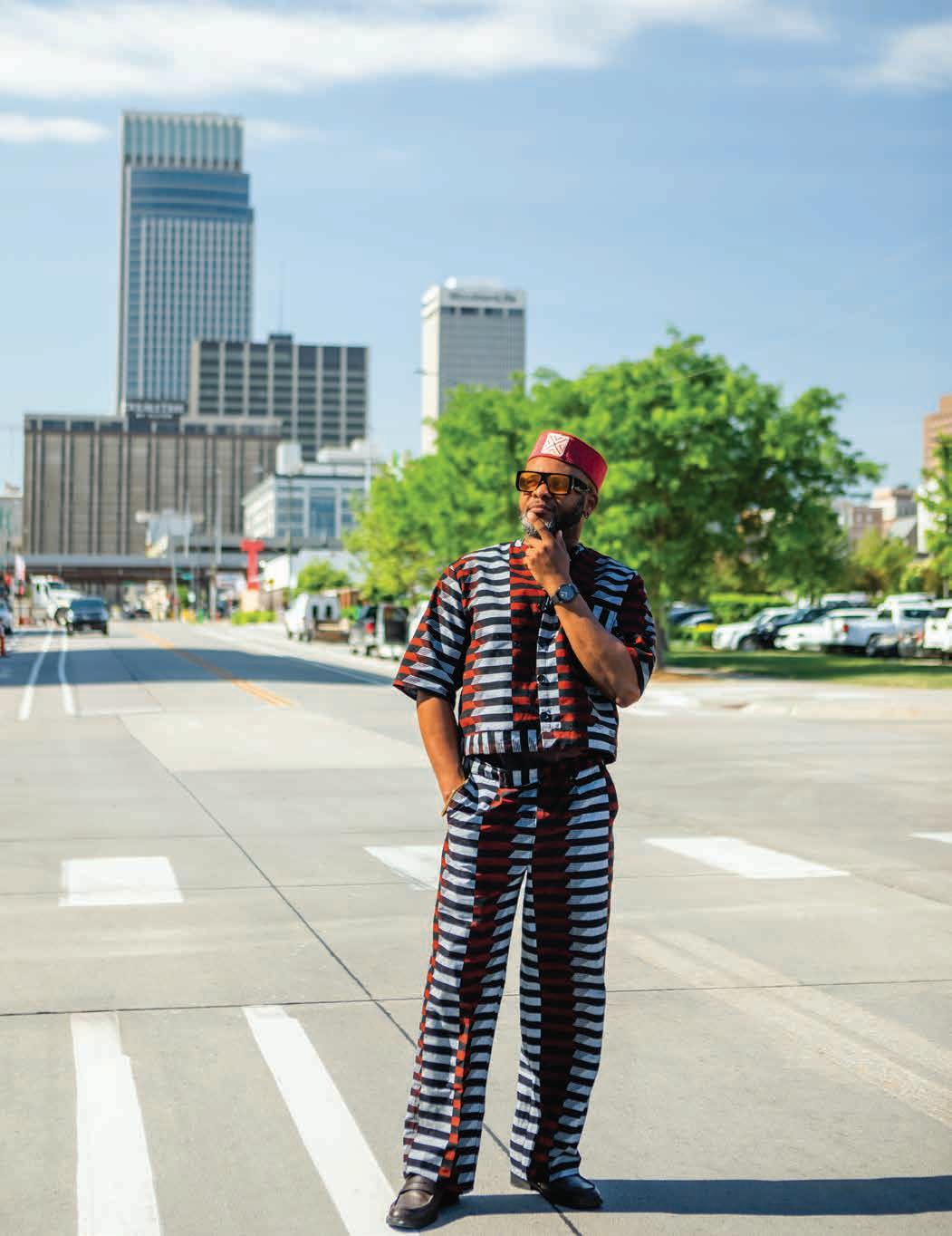

“By celebrating the shared culture that unifies us, we are creating an ecosystem that uplifts talent and generates tangible economic opportunities for Black-owned businesses.”
— Joubel Folly Teko
MORE THAN A FESTIVAL
Afro Fest Omaha Celebrates Culture and Community
or one weekend each year, Afro Fest transforms Omaha into a celebration of culture, creativity, and connection. Through music, fashion, food, entrepreneurship, and education, the event brings together people from across Omaha to experience the richness and diversity of African and Afro diasporic cultures.
Set to return Sept. 5 in Downtown Omaha, Afro Fest has become far more than a community festival. It continues to evolve alongside the city it serves.
“When we launched in 2018 and 2019, the event was called the African Culture Festival,” said Joubel Folly Teko, an Omaha-based entrepreneur and co-founder of Afromaha, the organization behind Afro Fest Omaha and African Fashion Week Omaha. “Our core mission was to celebrate African cultures and highlight their incredible socio-economic impact right here in Nebraska.”
While that mission remains intact, the festival’s reach and purpose have expanded over the years.
“That foundational vision remains unchanged, but it has beautifully expanded,” Teko said. “Today, we embrace the broader Afro-diasporic culture with an enhanced, intentional focus on education, innovation, and workforce development.”
Visitors can expect many of the experiences that have made the festival a staple on Omaha’s cultural calendar, including African cuisine, cultural performances, live music, and an Afro-centric fashion runway. But organizers say the event’s true value extends beyond entertainment.
“For me, Afro Fest is about creating a space where African culture can be celebrated, shared, and experienced by everyone,” said Kendy Npimnee, vendor partnerships and coordination lead for Afro Fest and co-founder of Brunch N’ Growth. “It’s more than just a festival— it’s an opportunity to bring people together, build community, and showcase the richness and diversity of African cultures through food, music, fashion, art, and storytelling.
“I think that mission is especially important in Omaha right now because our city is becoming increasingly diverse. Events like Afro Fest help bridge
cultural gaps, encourage understanding, and give people a chance to connect with cultures they may not otherwise be exposed to.”
That emphasis on inclusion is one reason organizers believe the festival resonates with such a broad audience. While rooted in African and Afro diasporic cultures, Afro Fest Omaha is designed to be accessible and welcoming.
“Above all, Afro Fest is for everyone,” Teko said. “It is an intentionally inclusive space that welcomes all members of our broader community with open arms.”
Organizers hope attendees leave with more than memories of performances or food vendors. “Our hope is that firsttime festival-goers leave with a renewed, deeply positive and enriched understanding of African and Afro diasporic cultures,” Teko said.
One of the festival’s most distinctive features is the Innovation Zone, which introduces attendees to artificial intelligence, science, technology, engineering, and mathematics through handson experiences and demonstrations. For Teko, the addition reflects Afromaha’s belief that culture and innovation are deeply connected.
“By intentionally blending innovation with culture, we solidify that vision and send a clear message: investing in culture is a vital strategy for retaining local talent and building a more vibrant, exciting city,” he said.
The Innovation Zone also represents an investment in future generations. By introducing young people to emerging technologies in a familiar and welcoming environment, organizers hope to spark curiosity and confidence. Npimnee hopes young attendees see themselves reflected in fields that continue to shape the modern world.
“My hope is that young attendees walk away inspired and curious,” she said. “I want them to see that careers in technology, engineering, and innovation are accessible to them and that they have a place in those spaces.”
Beyond cultural celebration and education, Afro Fest Omaha has also become a vehicle for strengthening relationships within Omaha’s Black communities.
It’s more than just a festival–it’s an opportunity to bring people together, build community, and showcase the richness and diversity of African cultures through food, music, fashion, art, and storytelling.
— Kendy Npimnee
Teko points to the festival’s role in helping reconnect African immigrants and African Americans, groups that have not always shared strong cultural ties despite common heritage.
“By celebrating the shared culture that unifies us, we are creating an ecosystem that uplifts talent and generates tangible economic opportunities for Blackowned businesses,” he said.
For Npimnee, those connections are ultimately what make the festival memorable. “What excites me most is seeing people connect,” she said. “Whether that’s through a conversation with a vendor, a cultural performance, trying a new dish, or exploring the Innovation Zone, those moments are what make the festival special.”
While cultural festivals can be found throughout the Midwest, organizers believe Afro Fest stands apart because of its ability to blend celebration with entrepreneurship, workforce development, and education.
“Afro Fest is unique because it captures all the vibrant energy, joy, and excitement of a world-class Afrobeats festival while simultaneously serving as a launchpad for small businesses, workforce development, education, and technology,” Teko said.
That vision will continue to grow this year with the introduction of Afro Fest Tech Day, powered by Google, on Sept. 4 at Millwork Commons, expanding the festival into a two-day experience focused on both culture and innovation.
For organizers, however, the festival’s success will always come back to people. Through food, music, fashion, storytelling, and shared experiences, Afro Fest continues to create opportunities for connection across cultures and communities. It offers a reminder that celebration can be one of the most powerful tools for bringing people together.
Visit afromaha.com for more information.
“The market brings contemporary agriculture to an obsolete ag site.”
— Linda Meigs
HISTORY FOR SALE
Linda Meigs Gives Florence Mill New Life
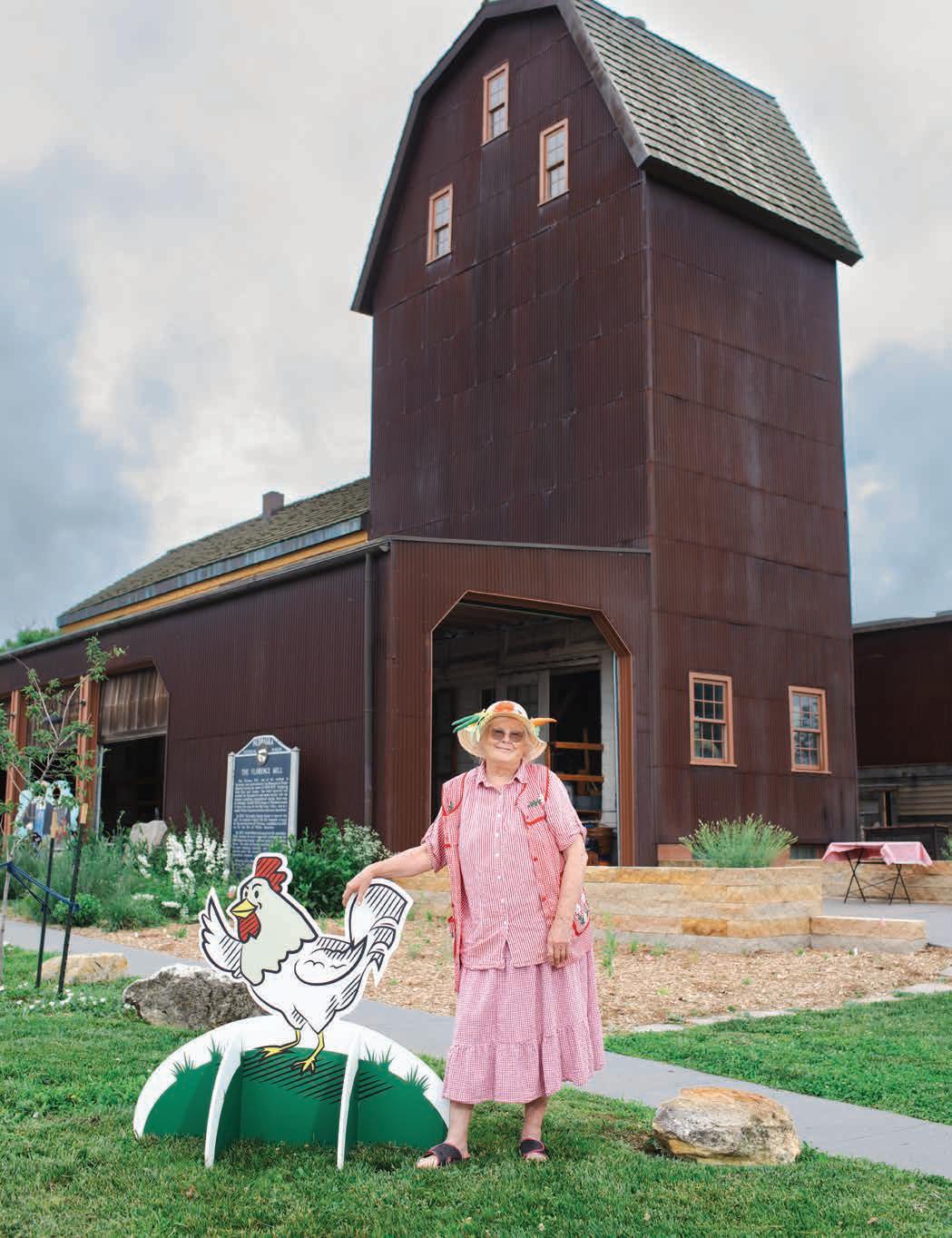
he building was full of 14,000 pounds of fermented grain, dirt, dead animals, and pigeon poop,” Linda Meigs said. “It was trashed, vandals had broken in and opened the chutes, and the floor looked like cement, but it was decades of hardened pigeon poop. The whole building was sinking. The west side had to be raised seven and a half inches so that the roof could be more or less straight. It had rained and snowed in here for decades.”
The historic Florence Mill was leaning into the street in 1998 when Meigs read an Omaha World-Herald article headlined “History for Sale.” The story suggested the Mill might be torn down.
“The historic mill was just standing there empty and basically rotting,” said Mele Mason, president of the North Omaha Commercial Club. “It was such a monumental task that nobody would come near it. Then all of a sudden, here comes Linda.”
Meigs and her late husband, John, bought the Mill that year. With her vision and his architectural skills, they took on the impossible project. “We were the perfect couple to take it on,” she said. “I was going to turn it into studio space for artists, but the first summer I was in here cleaning, I had 1,000 visitors, and it wasn’t even open. It was like these old timbers said, ‘No, Linda, it’s not supposed to be open for your artist friends as studios, it needs to be open to the public as a historic site.’”
Meigs said the Mill was originally built by Brigham Young in 1846, finished in 1847, and abandoned in 1848 after Salt Lake City had been founded. A gold rusher later bought the mill privileges after reading a Council Bluffs notice advertising lots in Omaha and Florence. The Weber family eventually owned it from 1860 to 1964.
“The wood in here tells a story, if you know how to read it,” she said. “There are only two parts left of Winter Quarters. One is these posts and lintels here, and there’s one headstone left from Mormon Pioneer Cemetery.”
Florence Mill Hours:
10 a.m. to 3 p.m., Sundays from June through September
A few years after the cleanup, the site finally returned to an agricultural purpose. In 2009, she started a farmers market with just six vendors.
“I probably had 1,000 people here, and all the vendors sold out in 30 minutes,” she said. “The next Sunday, I had doubled the number to 12, then 24, and it got to be up over 40, and it was too many for the space that I had here and the feel that I wanted here.”
Now, the market runs from 10 a.m. to 3 p.m. Sundays from June through September, with the number of vendors capped around 40. On a typical Sunday, there may be growers, a mushroom producer, food trucks, jewelry makers, a gourd artist, ranchers selling bison and longhorn meat, live music, animals, and a free craft table for children.
“It’s a very different vibe,” Meigs said when comparing the “country market” to other area farmers markets. “It’s very relaxed instead of stressful. People tend to come and stay and they’ll sit down and listen to music all day.”
The market gives small businesses a low-pressure place to meet customers. Some vendors arrive with culinary training or a product they want to test before taking a larger step.
“I get some people who have been through culinary art school or something and they’ll use it as a launch pad for their next level,” Meigs said. “It gets them out in public.”
For Meigs, “the market brings contemporary agriculture to an obsolete ag site.” Animals such as miniature and mammoth donkeys are part of the lesson. She calls it “country school,” a way for North Omaha children to learn where food comes from and talk with farmers about animal husbandry.

Visitors who come for the market often move through Florence, stopping at places such as the Mormon Trail Center or Harold’s Koffee House. “If you come in to see the mill, it’s a tight little community, so you’re going to go through Florence, and that’s just promoting our area,” Mason said.
The newest development is next door. The former OJ’s building, which had been empty and in poor condition, was bought by the nonprofit thanks to a donation from Nancy Mammel. It was demolished earlier this year, easing a parking problem that had frustrated market visitors during the last two seasons.
Longtime volunteer Joan Allen, who runs a free craft table for children, said the Mill has become “one of the major hubs of drawing people together in the community.” Allen said she first became involved because she believed in Meigs’ vision for the property. “I knew her mission and I wanted to help her any way I could, which is the way everyone feels. They want to support her mission.”
Allen said the Mill and market’s atmosphere is what keeps people coming back. “It’s one of the major hubs of drawing people together in the community,” Allen said. “It’s a hub that people appreciate, believe in, and want to help with and support.”
That sense of community is a culmination of the vision Meigs saw in the Mill nearly three decades ago.
“I’ve had people come up to me and say, ‘Thank you for doing this. This is what a market should be,’” Meigs said. “And that makes me very happy.”
Follow Florence Mill on Facebook for more information.
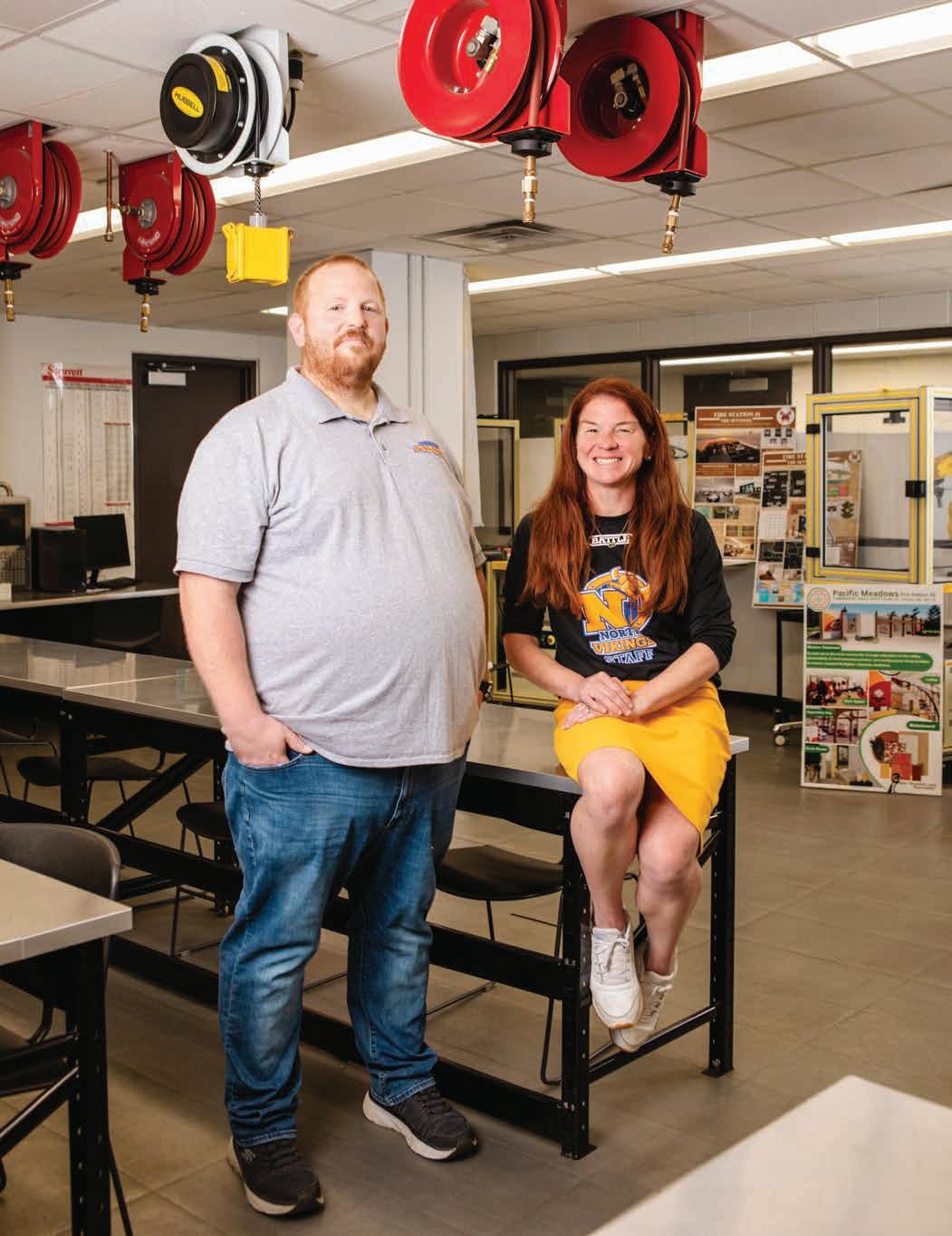

From left: Jeremy Wiemer, Jenna Hotz
LEARNING BY DESIGN
Inside North High’s Nationally Recognized Pathways Program
hen people picture a high school classroom, they might think of rows of desks and the slow wait for the bell. But at Omaha North High School, that picture doesn’t tell half of the story. A student’s day can include a robot rebuilt after physics class or a fire station plan that changes after one question from an architect.
That’s the idea behind North’s college and career academies and pathways program, a model built into the high school experience for every Viking. Students still take core classes, but they also spend time in courses tied to real tools and life after graduation.
North’s engineering and design academy recently received model status with distinction from the National Career Academy Coalition, the organization’s highest level of recognition. To earn it, an academy must meet or exceed proficiency in 10 national standards.
At North, students move through one of three pathways: computer science and technology, engineering and design, or science and research. Each offers specialized coursework tied to career fields ranging from cybersecurity and robotics to biomedical science and environmental research.
The recognition went to engineering and design, but staff members say it reflects a larger effort built around community partnerships and hands-on learning. For recent graduates Isabella Saxton and Christopher Mendoza, both in the engineering and design pathway, that meant learning the design process by going through it repeatedly.
“I was already interested [in engineering], but the program kind of led me toward specific choices on what I’m going to do within engineering,” Saxton said. As a junior, she worked with a group on a movie theater design, choosing a theme and turning ideas into something concrete. “Being able to express what was in our minds onto a physical, actual design helped me see the engineering process and how it works, and I was proud of the result,” Saxton said.
By senior year, students have more control over their work. Saxton said her group focused on the pieces they wanted to include in the overall design, then researched what those choices would require. “With the freedom we have, we’re able to pick and choose what we’re going to focus on that day and then put in the work to get there,” Saxton said.
Saxton also appreciated seeing women leading the pathway. “In our specific pathway, three out of our four teachers are women,” she said, “and that shows me that there’s a place in engineering for women, and there’s a place for me in the future.”
Mendoza’s group spent the year designing a fire station. They studied older stations, used bubble and box diagrams, then moved the work into Revit, a building modeling software. The process was long because the problems kept changing.
“Once you notice some things might not have worked the way you initially thought, you’ll touch it up,” Mendoza said. “That’s why this project lasts an entire year, because every step along the way, you’re going to run into something like that. A mentor asks a question that breaks the entire thing you did, so that we can find something better.”
Mendoza said his group prepared a 60-slide presentation covering site analysis, site history, precedent studies, layouts, and building details. They designed HVAC, plumbing, electrical units, and structural systems before presenting the final product at Metro Community College.
“The courses build upon the principles behind engineering,” Mendoza said. “It’s not all just design and making stuff look nice. You’re also making sure this actually works in real life.”
Jenna Hotz teaches the senior engineering capstone, along with AP pre-calculus and geometry. She said students start in ninth grade, take on their first major project as juniors, and complete their capstone as seniors. “I make sure to let them know that I’m going to give you this advice, but it’s your project,” she said. “I’m very proud of my students at the end of the year.”
In our specific pathway, three out of our four teachers are women, and that shows me that there’s a place in engineering for women, and there’s a place for me in the future.
— Isabella Saxton
Hotz said architects and engineers come into class about once every three weeks to review student work. “We not only have unique class settings and environments, we also incorporate businesses in the community,” she said. “We have architects and engineers coming to our class once every three weeks, so they have actual professionals in the field seeing their projects, giving them praise and critiques, and that’s really helpful.”
Jeremy Wiemer, who teaches machining as well as robotics and mechanical design pathway classes, said his students often carry lessons from one class into another. “A lot of our kids in robotics will come back after a physics class and they’ll redesign their whole robot because something in physics inspired them,” he said. “They’ll get stuck trying to code a thing in computer science, then go learn something in another class, and come back and all the lights click.”
Wiemer said the honor shows how many people are involved. “Getting that model status is a reflection of how much work everyone is doing,” he said.
Hotz said the value of the pathways often shows up after students discover careers they never considered. She recalled one student who connected with a mentor through the academy and landed an internship at a construction company over winter break. The student continues to work for the company while preparing for a career in construction management.
If she hadn’t taken the class, Hotz said, the student might never have considered the field at all.
Visit north.ops.org for more information.