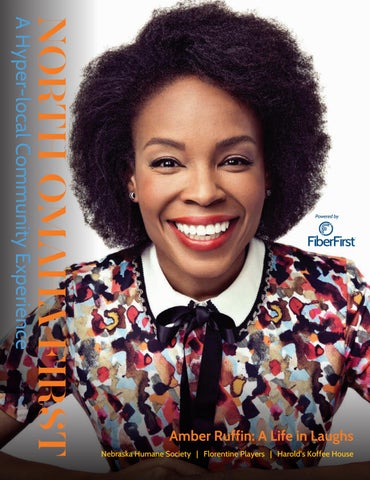
NORTH OMAHA FIRST
A Hyper-local Community Experience
Powered by
Amber Ruffin: A Life in Laughs Nebraska Humane Society | Florentine Players | Harold’s Koffee House NORTH OMAHA FIRST
// 1 //
North Omaha Business Spotlight FiberFirst is proud to support small- and medium- sized local businesses with free ad space in North Omaha First. Want to promote your business in our next edition? Scan the QR code to submit your application!
EXPLORE EVERYTHING THE UNION HAS FOR YOU IN ’26! • DYNAMIC STAGE PERFORMANCES • SKILL-BUILDING ART WORKSHOPS • MONTHLY FAMILY NIGHTS • INSPIRING ART EXHIBITIONS • GARDEN WORKSHOPS & EVENTS … AND MORE!
u-ca.org (402) 933–3161
TheUnionOmaha
2423 N. 24th St., Omaha, NE 68110 Tues –Thurs: 1 – 8 p.m. Fri & Sat: 10 a.m.–5 p.m.
TAUTO& LLC III SIGNATURE $150 • HAND WASH, DRY, VAC • DRY DOOR JAMBS • INTERIOR WIPE & SHINE • APPLICATION OF EXPRESS • DETAIL RIMS & TIRES • CLEAN WINDOWS INSIDE & OUT
NORTH OMAHA FIRST
// 2 //
• HAND WASH, DRY, VAC • DRY DOOR JAMBS • INTERIOR WIPE & SHINE • APPLICATION OF EXPRESS • DETAIL RIMS & TIRES • CLEAN WINDOWS INSIDE & OUT • INTERIOR SHAMPOO • 2-STEP EXPRESS WAX
uLTIMATE $225
• HAND WASH, DRY, VAC • DRY DOOR JAMBS • INTERIOR WIPE & SHINE • APPLICATION OF EXPRESS • DETAIL RIMS & TIRES • CLEAN WINDOWS INSIDE & OUT • INTERIOR SHAMPOO • 2-STEP EXPRESS WAX • ENGINE STEAM CLEAN • HEADLIGHT RESTORATION • BUFF W/LITE CERAMIC COAT
Table of Contents 04
LEADERS FIRST Pam Wiese and Nebraska Humane Society
Letter from the Editor
06
NONPROFITS FIRST NOMA
Steady Through the Season
08
PEOPLE FIRST Amber Ruffin
How North Omaha Shows Up All Winter Long
10
PEOPLE FIRST Kindergarten Teacher Jackson Berning
11
FUN FIRST Events and Community Gatherings
12
FOOD FIRST Harold’s Koffee House
14
ARTS FIRST Florentine Players
For those who aren’t big fans of the winter months, this time of year is all about persistence. And throughout North Omaha, it’s impossible not to notice it. The neighborhoods have their familiar rhythms, like the sizzle of Harold’s Koffee House and other timeless favorites. These places have been showing up for decades, proving that persistence pays off. That’s the first thing Amber Ruffin’s story (our cover story) reminded me of. She grew up here, and her path took her all the way to late-night TV. She laughs about not learning lessons along the way, but what she’s really done is keep moving in ways that matter. Her story is about the kind of persistence that comes from the roots of a community that nurtured her. I see that same persistence across North Omaha. At the Florentine Players, generations of families have taken the stage simply for the joy of creating something together. At NOMA, students learn not only music and dance, but the dedication that can shape their world. Even at the Nebraska Humane Society, staff and volunteers keep showing up for every animal, even when solutions aren’t straightforward. They help pets and families stay together, proving that persistence can be as practical as it is inspiring.
About the Cover
Amber Ruffin never thought she was a lesson learner, but her unshakable optimism and bold humor have made her a trailblazer in comedy and a powerful voice for truth and visibility. Full story on page 8. EXECUTIVE
ART
Executive Publisher Todd Lemke
Photography Sarah Lemke
Associate Publisher Bill Sitzmann
Graphic Designer Joey Winton
And then there are teachers like Jackson Berning, whose daily commitment shapes the future. Staying for his students through joy and grief, he shows that persistence is about presence and about caring enough to keep showing up.
SALES
EDITORIAL
Sales Coordinator Sandi McCormack
Managing Editor Isaac Nielsen
Branding & Digital Specialist Tim McCormack
Associate Editor Natalie Veloso
These stories are just a glimpse of the people and places that keep North Omaha moving forward. In this issue, we celebrate that persistence—the everyday dedication that makes this community strong and keeps it connected. Welcome to the winter issue of North Omaha First.
OPERATIONS
Editorial Intern Naomi Heu
Isaac Nielsen Managing Editor North Omaha First
Business Manager Kyle Fisher
FIBERFIRST TEAM
Distribution Manager Carson Kruse
Omaha Community Brand Manager Rachel Larson
Ad Traffic Manager Dave Trouba
Senior Manager, Marketing Communications Keith Miller Senior Community Brand Manager Christian Stovall
We would like to hear from you! Please use this QR code to give us feedback about North Omaha First.
NORTH OMAHA FIRST
// 3 //
LEADERS FIRST: Story by Isaac Nielsen // Photography by Sarah Lemke
SAVING PETS, SUPPORTING PEOPLE
Pam Wiese’s Transformative Approach to Animal Welfare he firefighters had already done what they could when the cat arrived at the Nebraska Humane Society. The house had burned while the family was away, and every pet but one had been lost. The last survivor was singed and barely hanging on, carried into the shelter as the family’s final hope. Pam Wiese remembers the case vividly. The veterinary team had heard of a new treatment after researchers at UC Davis published a study on burns in wild animals. The solution sounded strange: tilapia skins stitched directly onto damaged tissue to soothe the pain and help regenerate healthy skin. Wiese had staff run to Hy-Vee to buy the fish. The cat went under anesthesia, the team secured the makeshift bandages, and then everyone waited. The cat lived, growing its hair back a different color and healing completely. To Wiese, it was a big win, proving that compassion sometimes requires creativity and thinking outside the box. That idea guides Wiese now that she’s the president and CEO of the Nebraska Humane Society. In her words, “We want to meet people where they are.” She repeats that phrase often because she believes it’s changing how the shelter thinks about its mission. Wiese didn’t begin her career expecting to run the organization. She came onboard 23 years ago after receiving a call from her predecessor, who wanted to pick her brain about hiring someone to do public relations. She laughed and told them she “might know somebody: me.” Growing up, she’d always been around animals, but she didn’t know how deeply the shelter’s philosophy would resonate until she stepped inside. “Coming here and really seeing how progressive the shelter was, that the shelter wanted to be able to help not just the animals, but the people who loved them, was really a decider for me,” she said. She began in public relations with some marketing mixed in, then kept moving up. Eighteen years later she found herself serving as interim director, then as the NORTH OMAHA FIRST
// 4 //
permanent president and CEO. Her job now is less about messaging and more about shaping the future of the organization, which makes its home in North Central Omaha but touches every corner of the metro. A big part of that future, she said, is figuring out what people actually need before they surrender their pets. For years, owners would arrive at the shelter believing there was no other option. Wiese and her team began asking more questions. “We’re trying to work a little bit more outside the box,” she said. “If somebody says they need to surrender their pet, we can look at them and say, ‘Why do you need to surrender your pet?’ And then they may say they can’t afford medical care. Can we offer to help with that? I can’t afford food—we have a pet food pantry. I need training for my pet in order for it to be able to stay in my apartment complex—we can definitely provide that.”
We’re trying to work a little bit more outside the box. – Pam Wiese The food assistance aspect has evolved the most. For years, the Humane Society operated a pet food pantry onsite, but Wiese realized it wasn’t reaching the people who needed it. “If there are folks who can’t afford to feed their pets, we had a pet food pantry here for quite some time, and we realized that it was okay, but it would be better to distribute that pet food to the human food pantries,” she said. Today, the Humane Society provides food to several pantries across the community. “The bottom line is, we don’t want to warehouse pets here,” Wiese said. “We don’t want to take everybody’s pet and keep it here and not give it back. That’s just silly. Let’s figure out a way to get that pet back to you without making that a monetary strain on you so that we can have that pet out of the shelter.”
One of the most memorable examples of that compassion came from another case involving a dog found in an older woman’s home. She had passed away, and her children came to clean out the house, only to find a lump of fur that had never been groomed. They didn’t even know she had a pet. Underneath the mess and mats was a small Shih Tzu unable to walk. The veterinary team shaved the dog and discovered a bright-eyed animal. The next day, the Shih Tzu could stand. Soon after, it was adopted by another elderly woman. “That little dog was just as happy as a clam and sweet,” Wiese said. “And that really struck me on the resiliency side on how resilient animals are and how forgiving they are. That’s why people need them, because they need that unconditional love.” She’s proud of their 90% live release rate, which reflects how many animals leave the shelter alive and in good condition. That number rises thanks to community involvement. The organization often sets up offsite adoption events, including more outreach in North Omaha. “We’ve gone to several businesses, areas, and festivals with adoptable dogs and said, ‘You can adopt right here if you want to,’” she said. Still, she knows the shelter will never eliminate the need for a physical space. “We’re always going to need a shelter,” she said. “We have people who die and leave pets, people who literally can no longer keep a pet—we need to be there for those pets, to take them in and to provide the services they need. But if you just can’t afford food for your pet, we’d rather give you the food than have you surrender the pet to the shelter.” From the cat caught in the house fire to the Shih Tzu revealed under layers of neglect and countless other stories of families being able to keep their pets, all of it reflects the same message Wiese keeps repeating. “We want to be able to meet people where they are.” For more information, visit nehumanesociety.org.
Scan here to learn more.
Pam Wiese NORTH OMAHA FIRST
// 5 //
NONPROFITS FIRST: Story by Naomi Heu // Photography by Sarah Lemke
THE FRENCH QUARTER IN NORTH OMAHA NOMA’s Mission to Educate and Appreciate the Arts orth Omaha Music and Arts is coming up on its fifth year since first opening its doors in 2021. A nonprofit organization located on the corner of North 24th and Lake streets, it is dedicated to spreading the arts to youth in the local area and to all of Omaha through cutting-edge facilities and performances. In the ’50s and ’60s, North 24th Street was alive with music and nightlife. Iconic musicians like Louis Armstrong, Duke Ellington, and Ray Charles have played at venues along the once-lively street. It was full of culture and energy, and that is what NOMA is trying to emulate now to revitalize that scene. “We’re not trying to recreate the wheel but instead look back to light our way forward,” said Dana Murray, executive director of NOMA. “If we can get back to anything remotely like what it used to be, that’s a win.” One of the ways NOMA interacts with its North Omaha community is by going out to middle and high schools to spread awareness about the arts and careers in the arts. “When you give them insight into how that can manifest into something, it gives them a perspective that they wouldn’t have had, and with that perspective comes inspiration and motivation,” Murray said. NOMA wants students to realize music can lead to something more than just school, especially if they are passionate about it. Although the organization has encountered hesitancy about its long-term success by some, the it’s proving to really make a change in the community.“Generally, the people in the community are very proud to have NOMA on the block doing the kind of work we’re doing,” Murray said. People consistently come out from West Omaha to show support by attending performances, and overall, progress is being made, he said. The development in students over the past few years has been undeniable. They have gained critical thinking skills and improved in focus and retention. Parents say they are doing better in school, Murray said. “Those are all things that are a byproduct of something that is consistently driving you and motivating you to be curious about NORTH OMAHA FIRST
// 6 //
One day, when NOMA is a household name everywhere, people can look back through its history and see that it was built on people’s will to sacrifice for its future and vibrance. – Dana Murray
something,” he said. “I think the crux of what we do is inspiring kids to look within themselves to find the answer, instead of waiting on someone to come and spoonfeed it to them.” Like all nonprofit organizations, NOMA’s success isn’t possible without donations and hard work. The spirit of NOMA is sacrifice and a willingness to put in more than you might receive monetarily, Murray said. However, like any nonprofit, the result and success of all that hard work is sometimes the most rewarding of all. “One day, when NOMA is a household name everywhere, people can look back through its history and see that it was built on people’s will to sacrifice for its future and vibrance,” Murray said. The best way to get involved is through donations and support. Murray emphasized that anything helps and no dollar goes unappreciated. He said the names of all donors, no matter the amount, should be displayed. Every donor plays a vital part in the growth and development of an organization, and he believes they should be honored for that. He said that it is more impactful to see members of your own community on the walls rather than some big name who has no connection besides their donation. Direct ways that these donations help is through the facilities for students. NOMA has the only electronic drum lab in the city, as well as a piano lab, bass lab, and dance studio. With advanced technology, they have zero noise pollution in the building with electronic headphones and an education system that allows students and teachers to interact with each other. With such quick growth, NOMA will soon need to expand to a second education system
to keep up with the demand of young students who want to learn more about music. Besides donations, attending shows and events is another key way to show support. Coming to events and spreading the word allows NOMA to reach more people and create a stronger impact. Murray hopes to get people invested and to commit to the organization’s sustainability. They are working to establish a sense of ownership among people in the community. “I don’t own NOMA any more than the neighbor down the street does,” he said. Eventually, Murray’s goal is to turn NOMA into a charter school focused on the arts. He hopes it will be nationally known and reach the contemporary student as a “true place” for arts that students can attend and graduate from. To support NOMA events, stay updated on their website as they announce upcoming shows. For their weekly events, join them on Mondays from 7 to 10 p.m. for jazz sessions highlighting musicians from throughout Omaha, and on Wednesdays from 7 to 10 p.m. for NOMA Cafe with Chad Stoner. NOMA is well on its way to making North 24th Street a happening place once again. “I see that whole corridor being for entertainment and culture, the same way the French Quarter is in New Orleans or Beale Street is in Memphis,” Murray said. “Even Vine Street in Kansas City—we don’t have a place that is representing us, and that is thriving and gainfully active. That can easily happen in a place like Omaha.” To support NOMA with donations or to view upcoming events, visit northomahamusic.org.
Scan here to learn more.
Dana Murray
NORTH OMAHA FIRST
// 7 //
PEOPLE FIRST: Story by Isaac Nielsen // Photography Provided
A LIFE IN LAUGHS
The Lessons Amber Ruffin Swears She Never Learned mber Ruffin will be the first to tell you she hasn’t learned much in her 47 years. It’s one of the first things she offers when talking about the zigzagging path that took her from North Omaha to late night TV. “I’m not the biggest lesson learner,” she said, almost proudly. “I always say yes to whatever the funnest thing to do is, and for some reason, it has served me.” She’ll say this a few times in a few different ways—that she hasn’t learned the lessons she’s supposed to learn, that she keeps her expectations too high, that she keeps leaping anyway. But spend any amount of time with her stories, and a different picture forms. It becomes clear that Ruffin has spent her life quietly accumulating wisdom, even if she laughs at the idea of it. What she calls “not learning lessons” looks a lot like a stubborn confidence in forward motion. Ruffin was born in Omaha, the youngest of five. She learned Signing Exact English as a kid because she had a deaf neighbor, and she remembers the shift it created in her. “Learning Signing Exact English made me eager to communicate with everyone, and it kind of makes me feel robbed when I can’t,” she said. “For whatever reason, my brain really loves languages.” She didn’t know it at the time, but she was beginning to build one of the core muscles of her future career: using every tool she had to connect with an audience. That muscle kept growing. Years later, performing with Boom Chicago in Amsterdam, Ruffin realized how much she relied on it. “Those audiences, no one’s first language was English,” she said. “When you were performing, you really had to over-communicate physically to get your point across.” To her, it was simply adapting, but to anyone else, it sounds like the groundwork for a bold and flexible comedic voice. Before Amsterdam, there was Chicago, the first place she ever lived outside Omaha. Its significance seems to hit her in hindsight more than it did in the moment. “Chicago was the first place I ever lived that wasn’t Omaha, and it was a huge change,” she said. She had no family nearby, but she had something else: her first experience in charge of her own acNORTH OMAHA FIRST
// 8 //
tions. “I was on my own for the very first time in a place where I didn’t know how to get anywhere,” she said. “But I was doing exactly what I wanted to be doing for the first time in my life, and that was pretty cool.” Her most famous “not learning a lesson” came in 2014, when she auditioned for Saturday Night Live. “I was 100% sure that I was going to get it, and I’m a hopeful, happy person,” she said. “I have learned nothing from that. Again, that’s a good life lesson. I could have learned not to get your hopes up, but I still have not learned that. Three days after the audition, it was between the four of us. Even though everyone else was great, I was still like, ‘I think I’m going to get it.’ I found out I didn’t get it and I could have freaking died.” But three days later, Seth Meyers called and offered her a position as a writer on his new late night show. “That was as good an outcome as I could have possibly had,” she said. Her unembarrassed optimism had carried her straight into the best opportunity of her career. At Late Night with Seth Meyers, Ruffin became the first Black woman to write for a U.S. network late night show—something she didn’t know until after she’d already started. “I couldn’t believe it,” she says. “I’ve certainly been the only Black woman in many, many cases and many, many jobs—most jobs I’ve had.” She doesn’t dwell on the pressure of being first. Instead, she talks about what visibility means to kids watching at home. “It feels great for someone’s child to watch the credits at Late Night and see a Black lady’s name and be like, ‘I could do that,’ because they can.”
of Fury,” another part of her career began expanding: her ability to tell stories about racism with humor, sharpness, and warmth. That ability eventually led to co-authoring two bestselling books with her sister, Lacey Lamar. The first, You’ll Never Believe What Happened to Lacey: Crazy Stories about Racism, became a New York Times Best Seller. “It’s a book that is based on all of the racist things that have happened to my sister Lacey over the years here in Omaha,” Ruffin said. “It came about because when you have a job where you’re the only Black person, you usually keep a log of all the things that have happened. We decided to take those stories and put them in a book because the vast majority of them were hilarious.” It wasn’t about minimizing the pain, but instead illuminating the ridiculousness. “Honesty is funny. There’s truth in comedy,” she said. “I think that you can’t tell a funny lie. Nothing’s funnier than the truth, so I think taking an honest look at racism is hilarious because the concept of racism is ridiculous. So every time you point it out, it’s always funny.” Her comedic philosophy follows the same pattern. It’s not something she crafted, it’s something she feels. “I think that comedy can make emergencies palatable,” she said. “And I think right now, we’re all living inside of one giant emergency. [Comedy] shrinks giant emergencies to something you can wrap your mind around, something that you won’t be crushed under the weight of.” Even when asked what she would tell her younger self, she didn’t summon profound wisdom, instead waving the question off. “I guess I would say have fun,” she said. “But, you know, I’m going to have fun anyway. I’m always going to have fun. So I don’t know. I guess I would tell her to eat vegetables and put on moisturizer.”
Her presence helped broaden the room, and she’s now noticing the effects of that shift across the industry. “The Late Night landscape has changed quite a bit, and I think the rooms have gotten more diverse,” Ruffin said. “You can tell because the comedy has changed to be more reflective of the audience that loves it, which is really nice, because it’s pretty sad when you’re watching a show with a host that you love, and they say something that is so tone-deaf that you wonder who’s in that room.”
Another lesson she insists she hasn’t learned.
As she grew more visible on the show through recurring segments like “Amber Says What?” and “Amber’s Minute
For more information, follow @amberruffin on Instagram.
Still, her life is full of them. Ruffin may claim she hasn’t learned many lessons along the way, but anyone listening can hear that she learns them all the time. She just learns them her own way.
Scan here to learn more.
It feels great for someone’s child to watch the credits at Late Night and see a Black lady’s name and be like, ‘I could do that,’ because they can.
– Amber Ruffin
NORTH OMAHA FIRST
// 9 //
PEOPLE FIRST: Story by Isaac Nielsen // Photography by Sarah Lemke
NORTH OMAHA FIRST TEACHER SPOTLIGHT Minne Lusa Kindergarten Teacher Jackson Berning
When Minne Lusa Elementary kindergarten teacher Jackson Berning learned he had been nominated for North Omaha First’s $500 teacher spotlight, he didn’t think much of it. “My principal, Ms. Wilson, sent out an email that said that FiberFirst is doing a nomination for teachers who make a great impact on our kids, and I didn’t think much of it at first,” Berning said. “I thought, ‘Oh, that’s kind of neat.’ Then I was told by one of the paras that I’ve worked with for a few years now that she voted for me.” What he didn’t expect was more than 130 votes. The award was announced during an after-school staff meeting, he said. “Ms. Wilson started talking about an award, then I saw my parents and my fiancée come through the door, and I said, ‘Oh, this might be for me.’ I was super honored and grateful, but I was a little embarrassed!” Berning’s connection to Minne Lusa runs deep. “My journey at Minne Lusa has been kind of cool,” he said. “I started working at the school as their assistant site director for their after-school program. I did my student teaching here, and they had an opening for a kindergarten position and I took it. Now this is my fourth year of teaching, and sixth or seventh year here.” His path to teaching began long before that. “I grew up in the classroom,” Berning said. “My mom was a teacher at the same school that I went to. I’d be there before and after school, cutting paper, sharpening pencils, doing the bulletin boards, anything you could think of.” More meaningful than the tasks was what he observed. “What really stuck out to me was watching her pour into those kids like it was the most important job in the world.” When she encouraged him to volunteer at summer school, he found himself drawn to kindergarteners. “The little 5-year-olds who walk in wide-eyed, curious, and full of questions with no filter. I thought, ‘This is where I belong.’” That sense of belonging was tested last year when his class faced a heartbreaking loss. “Last year, one of my students tragically passed away,” he said. The grief rippled through the room. Family and coworkers encouraged him to take time away, but he chose to stay. “I wanted to be there for the kids because it happened while she was still in the classroom, so everybody knew about it. I wanted to be there for them, but honestly, they were probably the ones who were there for me.” It deepened his belief that “teaching isn’t just a one-way street. We pour into them, but they pour right back into us.” His guiding philosophy is simple: “Kids rise to the level of love and expectations that you give them.” Every day with his students “feels like the first day of discovery.” Berning insists he didn’t get into teaching for recognition. But this moment of appreciation matters. “We don’t do this job for recognition. We do it because we love the kids and we want to see them grow. But when someone takes the time out of their day to fill this out and say, ‘Hey, we see you, and what you’re doing matters,’ it means a lot.”
Jackson Berning NORTH OMAHA FIRST
// 10 //
FUN FIRST:
ACTIVITIES / EVENTS AROUND NORTH OMAHA
Event information is correct as of presstime. Details are subject to change, please check the official websites as provided.
AUGUST WILSON’S THE PIANO LESSON Jan. 16-Feb. 8 Omaha Community Playhouse, 6915 Cass St.
“The Piano Lesson” hits the Hawks Mainstage at Omaha Community Playhouse this winter for a powerful story with themes of family and legacy. Winner of the Pulitzer Prize for drama, this story is set in 1936 Pittsburgh and follows two siblings who both want ownership of the family’s heirloom piano. Writer August Wilson examines heritage, sacrifice, and the balance of preserving history and pursuing prosperity. omahaplayhouse.com
THE 11TH ANNUAL BATTLE OF THE IMPROV ALL-STARS Feb. 6 Florence Community Center, 2920 Bondesson St.
Join the Florence Community Theater for the 11th Annual Battle of the Improv All-Stars. Watch Omaha’s best improv comedians compete headto-head in an intense improv battle for the chance to win the title for this year. Come cheer on these beloved comedians and root for your favorite to take home the trophy. This will be a night full of hilarity and wittiness that is sure to leave you laughing and entertained. florentineplayers.com
OMAHA FILM FESTIVAL March 10-15 Aksarben Cinema, 2110 S. 67th St.
The Omaha Film Festival fosters community, conversation, and craft through engaging post-screening Q&As, interactive networking events, panels, workshops, Audience Choice Awards, and more. For filmmakers and screenwriters, it’s a chance for creative voices to be heard and supported, and for audiences, it’s a chance to get up close and personal with the creatives who make films happen. omahafilmfestival.org
Photos Provided
JANUARY
FEBRUARY
D&D CARD CLUB
BLACK HISTORY MONTH CELEBRATION
NOMA WEEKLY JAZZ SESSIONS
Jan. 17 Florence Community Center 2920 Bondesson St. 402.444.5216 parks.cityofomaha.org
February Great Plains Black History Month Museum 2221 N. 24th St. 402.932.7077 gpblackhistorymuseum.org
Mondays in February North Omaha Music & Arts 2510 N. 24th St.
STORIES IN MOTION: MUSIC AND MOVEMENT AROUND THE WORLD
BENSON FIRST FRIDAY
Jan. 20 Benson Branch, Omaha Public Library 6015 Binney St. 402.444.4846 omahalibrary.org
FLOWER FESTIVAL Jan. 22-25 St. Cecilia Cathedral 701 N. 40th St. 402.551.4888 cathedralartsproject.org
STATE OF NORTH OMAHA SUMMIT Jan. 24 Swanson Conference Center 5730 N. 30th St. Building 22 empoweromaha.com
CREATIVE COLLAGES Jan. 31 Florence Branch, Omaha Public Library 2920 Bondesson St. 402.444.5299
Feb. 6 Benson Historical Downtown 2729 N. 62nd St. bffomaha.org
PING PONG CLUB
MARCH VETS GET PETS WEDNESDAY March 4 Nebraska Humane Society 8929 Fort St. nehumanesociety.org
Feb. 7 Florence Community Center 2920 Bondesson St. 402.444.5216 parks.cityofomaha.org
BENSON FIRST FRIDAY
QUEENS FOR THE CASTLE BRUNCH
OMAHA FILM FESTIVAL
Feb. 15 Joslyn Castle 3902 Davenport St. 402.595.2199 joslyncastle.com
March 10-15 ACX Aksarben Cinema 2110 S. 67th St. 402.502.1914 omahafilmfestival.org
AMERICAN VOICES–ORCHESTRA OMAHA CONCERT
BACH BIRTHDAY CELEBRATION
Feb. 21 2524 N. 55th St. orchestraomaha.org
ROCKS AND FOSSILS WITH THE OMAHA CHILDREN’S MUSEUM Feb. 21 Florence Branch, Omaha Public Library 2920 Bondesson St. 402.444.5299 omahalibrary.org
March 6 Benson Historical Downtown 2729 N. 62nd St. bffomaha.org
March 22 St. Cecilia Cathedral 701 N. 40th St. 402.551.4888 cathedralartsproject.org
MUSIC BINGO March 27 B5 Brewing Company 6115 Maple St.
NORTH OMAHA FIRST
// 11 //
FOOD FIRST: Story by Natalie Veloso // Photography by Sarah Lemke
STILL POURING STRONG
Harold’s Koffee House Keeps Florence Fueled he morning crowd at Harold’s Koffee House doesn’t need a clock to know it’s time for breakfast. The scent of sizzling hash browns leads the way down North 30th Street, where they trust the coffee to be on a steady pour by the time the sun hits the windows. Harold’s has been waking up Omaha’s Florence neighborhood the same way since 1958. The diner has watched generations of North Omaha families grow up and grow older across the same booths, many ordering “the usual” for decades. “Nine times out of ten, people from the neighborhood will see a friend here,” said general manager Matt Swoboda. “I bet customers stop at four or five tables to talk to somebody before they even get to sit down.” The Florence diner was once part of a local five-restaurant group called Koffee House Systems. Harold Halstead, a World War II veteran with a knack for customer service, poured his energy into the original location. When other locations faded, Halstead stuck it out on his own. He added his name to the sign in 1968 after moving to the corner of 30th and State streets, and “Harold’s Koffee House” became a permanent fixture in the neighborhood. Halstead and his wife, Pauline, ran the place as a true family business—he cooked and she handled the books. Their kids pitched in as cooks, dishwashers, waitstaff, bussers, and cashiers. Swoboda, who’s worked at Harold’s on and off for a decade, first came through the door looking for a chance of his own. “This is really the first restaurant that gave me an opportunity,” he said. “Ten years ago, no one wanted to hire someone without experience. Harold’s took a chance on me.” Almost everyone who works at Harold’s today is from the area, Swoboda said. “Besides one, all of my employees live within a mile of here or grew up right here in Florence,” he said proudly. “They’ve all been coming to Harold’s long before they started working here. It’s just that kind of place.” NORTH OMAHA FIRST
// 12 //
I’m a big believer in, ‘If it ain’t broke, don’t fix it.’ Harold’s has been running the same way for almost 70 years. We make great food, and I don’t see any reason to change it. – Matt Swoboda If Harold’s has a claim to fame in the kitchen, it’s the hash browns, Swoboda said. “We cook 100 pounds of potatoes every day and peel them by hand,” he said. “Nobody else in the Midwest does it like we do.” They’re the backbone of nearly every popular breakfast plate at Harold’s—especially the chorizo hash and the newer breakfast nachos, which have quickly become bestsellers. Most of the menu hasn’t changed in decades, and that’s just the way customers like it. “I’d say 90% of our menu is still original,” Swoboda said. Pies are made from scratch and pancakes are the size of a plate, but breakfast isn’t the only draw. Regulars swear by the clubhouse stacker, the pork tenderloin sandwich, classic burgers, and hearty plates of meatloaf or country fried steak. “I’m a big believer in, ‘If it ain’t broke, don’t fix it,’” he said. “Harold’s has been running the same way for almost 70 years. We make great food, and I don’t see any reason to change it.” Still, even a classic diner has to adapt. “The goal here is to make sure we set ourselves up with how the new world works,” Swoboda said. He admits running a diner
in 2025 takes much more than good coffee. “When my internet goes down, this entire place stops. I can’t take orders, I can’t take payments, I can’t do anything.” With a POS system entirely reliant on a strong connection, Harold’s keeps up with modern systems without changing what makes it special. “Without the introduction of fiber around here, I think we’d still be stuck in the stone age,” Swoboda said with a laugh. After nearly seven decades, Harold’s Koffee House is still pouring its efforts into what it does best: serving North Omaha. For Swoboda, the formula for continued longevity is to simply keep good people around and keep making good food. “Harold’s wouldn’t be Harold’s without the people behind the counter, and it sure wouldn’t be the same without the smiles on people’s faces,” he said. “The food is great, but it’s the people who make it feel like home.” For more information, visit haroldskoffeehouse.com.
From Harold’s Kitchen: Apple Pecan Topping For more than 60 years, Harold’s has kept things simple and homemade. “This is one of my favorite things we serve at Harold’s. Put it on a pork chop, french toast, or a waffle,” Swoboda said. “I’ve even seen someone use it as an apple pie filling! It’s the perfect balance of sweet and salty, and I haven’t found anything yet that it doesn’t work on. You’ll see it most often on our french toast, but try making it yourself and you’ll see why I had to include it.” Ingredients • 2 oz. butter • 1/5 lbs apple slices (fresh or frozen) • 1⁄4 cup maple syrup • 1/4 cup brown sugar • 4 slices finely diced cooked bacon • 3/4 cup pecans • 1 pinch of cayenne pepper
Directions 1. Melt butter 2. Combine everything minus pecans in large pot 3. Heat for 10 minutes, stirring often 4. Stir in pecans once mixture reaches desired consistency For a thicker topping, heat and stir for longer. For a thinner topping, heat and stir for less time.
Scan here to learn more.
Matt Swoboda NORTH OMAHA FIRST
// 13 //
ARTS FIRST: Story by Isaac Nielsen // Photography by Sarah Lemke
BOO THE VILLAIN, CHEER THE HERO The Florentine Players’ Century of Storytelling f you wander down to the Florence Community Theater on a weekend night, you might hear something out of the ordinary before the curtain even rises. A crowd cheering. A few good-natured boos. An all-too-common standing ovation. It’s all part of the charm that has kept the Florentine Players at the heart of North Omaha’s Florence neighborhood for nearly a century. With origins dating as far back as 1929, when a small group of locals was putting on melodramas, the gathering has now grown into one of the region’s longest-running community theater organizations. Since 1964, the Florence Community Theater has been their home. The melodrama remains unquestionably their signature show, but the group has evolved into much more. The Florentine Players now stage around four major productions every year, and also host community events like Breakfast with Santa and Trunk-or-Treat. Every ticket sold supports the Florence Historical Foundation, which works to preserve some of the oldest buildings in the neighborhood. Recent president and longtime member Derek Kowal said that blend of performance and purpose is why the group is so special. When he first joined two decades ago, he didn’t know quite what he was getting into. “When I first showed up 20 years ago, I said, ‘This is weird. These people are weird,’” Kowal said. “But then they called and said, ‘Hey can you come back and actually try and audition for the show we have coming up?’ And I’m like, ‘Alright, well, why not?’ So I did, and I got the role of hero for that show, and I haven’t looked back.” Since then, Kowal has written and directed many of the group’s melodramas himself. He spent 12 years as president before stepping aside last year but remains on the board. According to Kowal, the group’s steady growth has kept it vibrant. “Over the years, we’ve added to where we’re now doing roughly four shows a year, and then we’ve also added in some community events,” he said. NORTH OMAHA FIRST
// 14 //
The Players’ creative approach helps them stand out from other small theaters in Omaha. “We’re doing all locally originated productions,” Kowal said. “We will find local writers to pen a show. That’s one of the things that we strive to do to continue to set us apart from everybody else.” He said the willingness to experiment and take risks has helped the Players stay relevant. “It’s about being willing to take a step a little bit outside of tradition,” Kowal said. “We know people are going to come for our melodrama every year. We know we’re going to get people to come out to see our comedy shows. But you want to try and shake it up a little bit and do something that’s going to attract a new show.” The Players’ most recent production, Future Imperfekt, was darker in tone than usual, but meaningful and thought-provoking. “Being willing to take those risks is one of the things that’s going to keep our theater alive,” Kowal said. The Florentine Players have always attracted a wide mix of people. Some have years of acting experience, while others are locals looking to try something new. “You have theater people, you have comedians, and you have people who haven’t really done a lot of theater, but it’s in their neighborhood,” Kowal said. “Once we get our hooks in them, they’re stuck.” That sense of community extends beyond the stage, with families often participating together to create lasting memories and traditions. Both of Kowal’s sons, for example, are now getting involved. Former board member John Lemen knows that connection better than most. His mother, Una, was involved as early as 1930, when the Players were putting on shows at the old Florence Community Center at 30th and Clay streets. Her involvement shaped his own. “Carrying on my mom’s tradition—a big part of her life was working with the Florentine Players and the [Florence Historical Foundation]. I’ve been involved in both of those groups for years, so it means a lot to me,” he said.
It’s about being willing to take a step a little bit outside of tradition. – Derek Kowal
Lemen now serves as a photographer and videographer as part of the organization. His daughter, Sandra, has been in several shows with the Florentine Players, and now her daughter has become a budding actress in middle school, following in their footsteps. For the Lemen family, the Players have been part of their story for four generations. Lemen said that the welcoming atmosphere is what makes the group so special. “The group is very, very inclusive. If somebody wants to take a shot at being on stage, everybody is welcome,” he said. “So it’s given a lot of people their first exposure to being on stage. It gives the community a place to come down and enjoy a lighthearted, fun event, family-friendly.” Kowal hopes the next decade brings even more opportunities. “We do one every three months,” he said. “I would love to say we’re doing something every two months. The goal would be to keep on doing what we’re doing, but let’s do it more.” Having been a staple of the region for over 60 years, the Florentine Players remain one of North Omaha’s most enduring traditions. Their shows are playful, their volunteers passionate, and their mission rooted in preserving both art and history. The applause that fills the Florence Community Theater isn’t just for the actors—it’s for a community that continues to show up to keep the story going. To learn more about auditions and upcoming performances, visit florentineplayers.com.
Scan here to learn more.
Derek Kowal NORTH OMAHA FIRST
// 15 //
rnet Provide e t r In
2026 Winner