MAY 2019
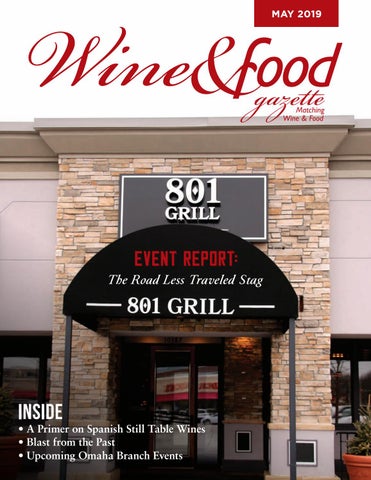
Event Report: The Road Less Traveled Stag
INSIDE
• A Primer on Spanish Still Table Wines • Blast from the Past • Upcoming Omaha Branch Events
A publication of the Omaha Branch of the International Wine and Food Society
President's Comments e finally got to try the 801 Grille, which is situated not far from Trader Joe’s. Our first attempt was frustrated by a major snow storm which had broken tree branches and power lines everywhere. The restaurant had no power, so the event was moved to Pitch West. This time, however, everything went smoothly. I liked the theme: The Road Less Traveled. I always enjoy it when we stretch out wine legs and experience the less familiar. I am thinking this was John Matthews’ first event, and it was nicely done. As is the rule in this branch, the event producer also writes up the Event Report. Read John’s first event summary here. Speaking of the wine road less traveled, yes, we tend to get struck in a rut with our wine selections. With such great California and Oregon wines at our doorstep, sometimes we are not overly adventurous. But there is a whole wine world out there, just waiting for you to experience it. Our Spanish Wine and Cigar Stag on May 9th at Omaha Field Club is rapidly approaching. Nick Moore seems to enjoy a Hispanic slant on things, which is great because no one else in the Branch is exploiting the Iberian peninsula. Spain has the most vineyard area planted in the world, and is third in production. Yet we tend not to drink wines from the Iberia. I thought it would be apropos to do a quick Primer on Spanish Still Table Wines before you attend the event. Tempranillo and Garnacha are the large production red wines, while Airén and Albariño are big white wine grapes. Take a few minutes to get up to speed. Todd Lemke wanted me to pass this along. As you know, the Gazette comes to you now from issuu.com. This is the professional way to send a magazine. Todd urges members to join issuu.com. Not only will you then be able to print the Gazette if desired, but the functionality and usability is superior, especially on your mobile devices. The IWFS international web site has recently been upgraded, especially with smart phones in mind. Take a few minutes to familiarize yourself with it. If you can’t find much on the site, it probably means you have not logged in yet. You only get two tabs if you have not logged in. Don’t forget that you can go to the web site for event photos before the Gazette comes out. Also, if you forgot to print out the details of an event, and the registration period has closed, you can go to the web site to get event details. Get happily involved with this website upgrade. There is a wealth of material in it. Skoal!
Tom Murnan
Page 2 · 2019 ·
“Tact is the fine art of not saying what you think.” —Franklin P. Jones From The Best of the Cockle Bur compiled and edited by Harry B Otis, 3rd President 1973-1974
May 2019 · Page 3
A publication of the Omaha Branch of the International Wine and Food Society
Event Repo rt The Road Less Traveled Stag Written By John Matthews // Photos by Tom Murnan
B
ack in October, an event had been planned at 801 Grill. Unfortunately, a snow storm changed plans at the last minute and the event had to be moved. This event was our chance to finally meet at 801 Grill. The restaurant opened last year as a compliment to their sister restaurant, 801 Chophouse in the downtown district. The theme was “The Road Less Traveled.” We were able to explore wines that we not typically serve at our events. For each of the main courses, we paired two distinct styles of each wine. This event was co-hosted by John Matthews and Dave Thrasher. 21 club members and 4 guests were in attendance. We began by enjoying a selection of red wines from our cellar. These were served with Mini Lamb Meatballs with Harrisa Yogurt and 801 Black Angus Steak Skewers. It was definitely a hearty start to the meal. After quaffing, we began the first course with two Semillon wines. Semillon is a white wine that is full bodied. It is popular in France where it serves as an important blending component in White Bordeaux. It is the 3rd most planted white wine in France. In Australia, Semillon had a bit of rough start and was often mis-labeled as Riesling. But, it has increased its standing as a standalone variety. We selected a 2016
Silkman Semillon (RP-91) from Hunter Valley, Australia, and the 2015 Clos des Lunes Lune d’Argent (WS-93/RP-90) from France. The French wine was a White Bordeaux with 70% Semillon and contrasted with the Australian wine at 100% Semillon. This was served with a Scallop Ceviche. For the second course, we selected a Syrah and a Shiraz wine. These two grapes are genetically identical, but can be very different in style. Typically, a Shiraz is more full-bodied and richer than a Syrah. The decision to label a bottle as Syrah or Shiraz depends on both where it is grown and the style of wine. We chose a 2009 Penfolds Shiraz from Australia (WS-94/RP-93) and a 2015 Courbis Champelrose Cornas (WS-94/ RP-94) from France. The French wine was full-bodied and felt it would be a good comparison with the Australian Shiraz. These were paired with a delicious French Onion Soup. Both wines held up well with the soup and were fabulous on their own. For the third course, we selected Zinfandel wine. This is known as primarily an American grape. Over 10% of California vineyards are planted with this grape. It has been found that Zinfandel is identical to Primitivo (Italy) and a variety in Croatia. However, neither of these regions create wines that compare with their American counterparts. We enjoyed
the 2014 Hartford Russian River Zinfandel (WS-93/RP-94) and the 2014 Turley Juvenile Zinfandel (WS-92/RP-92). The Hartford wine is produced from a single vineyard with vines planted over 100 years ago. The Turley wine is composed from young wines from a number of different sites. Given that this was an American wine, it seemed appropriate to pair them with BBQ Ribs and Slaw. For the fourth course, we selected two lighter Syrah wines. The 2011 Alain Voge Les Veilles Chailles (WS-94/ RP-94) from France’s Cornas region and the 2012 Spring Valley Nina Lee Syrah (WS-93/RP-93) from Washington State. Washington State is well known for its Syrah wines given the growing conditions there. They compare quite well with Syrah’s from Rhône. This was paired with T-Bone Lamp Chops served with Mashed Potatoes, Tomato Chutney and Green Beans. The desert course was a Vanilla Cheesecake with Fresh Berries. This was served with a sweet Myrat Sauternes 2009 (WS-96) to conclude the meal. Afterwards, we were able to mingle further while we completed the remaining wine. Overall, while it was a road less traveled, it was a road worth traveling. We walked away with a greater appreciation of these less well sampled varietals.
May 2019 · Page 5
Page 6 · 2019 ·
May 2019 · Page 7
Page 8 · 2019 ·
May 2019 · Page 9
Page 10 · 2019 ·
May 2019 · Page 11
A publication of the Omaha Branch of the International Wine and Food Society
Wine Regions of Spain with Denominación de Origen as of 2008, just 15 of them have the highest rank.
A Primer on Spanish Still Table Wines by Tom Murnan
O
ur May stag event at the Omaha Field Club has traditionally featured wines less tasted by our Branch, along with some great cigars. This year, Nick Moore’s theme will be an Iberian dinner with Spanish wines on May 9th. While we are very familiar with wine from Napa, Sonoma, California and Bordeaux, when it comes to Spanish wines, we often scratch our heads. Rias Baixas? Where is that and how do you pronounce it? Spain is like Italy in that they seem to have a bewildering number of appellations with names we seldom come across. In terms of area set aside for vineyards, Spain is number one in the world at 2.9 million acres. But for production, Italy is first, followed by France. Spain comes in third, partly due to very low yields and wide spacing of vines due to dry, infertile soil. 400 native varieties are grown, but in practice, 80% comes from just 20 grapes. Of these, Tempranillo and Garnacha (Grenache) are the top red varietals, followed by Monastrell (Mourvèdre). Top white varietals include Albariño, Macabeo, Palomino (a Sherry grape) and Airén (most planted white). Important Grapes used for Cava, the Spanish sparkling wine, include Parellada, Xarel-lo and Macabeo. Spain has a hierarchy of quality wine zones similar to France. Recall
that in 1923, Châteauneuf-du-Pape was the first French Appellation d’Origine Contrôlée. Spain started their system in 1932, shortly after France. The hierarchy looks like this, going from high est to lowest. Denominación de Pago (DO de Pago) designation Wine Regions of Spain for individual single-estates with an international reputation. As of 2013, there were 15 estates within the boundaries a DO region. As with this status of 2009, there were 79 Quality Wine Denominació d’Origen Qualificada areas across Spain. Calificada designation (DOCa/DOQ), Vinos de Calidad con Indicación is for regions with a track record of Geográfica (VCIG)— Introduced in consistent quality and is meant to 2003, this level is similar to France’s be a step above DO level. Rioja was defunct Vin Délimité de Qualité the first region afforded this desigSupérieure (VDQS) system and is nation in 1991 and was followed by considered a stepping stone towards Priorat in 2003 DO status. After holding VCIG status Denominació d’Origen (DO). This for five years a region may apply level is for the mainstream qualifor DO status. ty-wine regions which are regulated Vino de la Terre (VdlT) is translated by the Consejo Regulador who is also as Wine of the Earth. This level is simiresponsible for marketing the wines of lar to France’s Vin de Pays system that DO. In 2005, nearly two thirds of Vino de Mesa (VdM)—These are the total vineyard area in Spain was wines that are the equivalent of most
Page 12 · 2019 ·
country’s table wines and are made from unclassified vineyards or grapes that have been declassified through “illegal” blending. Similar to the Italian Super Tuscan from the late 20th century, some Spanish winemakers will intentionally declassify their wines so that they have greater flexibility in blending and winemaking methods.
the wine easily takes on the flavor of the barrel. It is generally spicy, berry-flavored and soft on the palate and produces wine with a relatively high alcohol content.
Spanish Labeling Laws Spanish wines are frequently marked with how much aging time a wine receives. The three most common aging designations on Spanish wine labels are Crianza, Reserva and Gran Reserva. Sin crianza, or vino joven (“young wine”) technically the wines have not been aged at all, but some will have undergone up to a few months oak wood aging. Crianza For Rioja red wines these are aged for 1 year in oak barrels. Crianza whites and rosés must be aged for at least 6 months in oak barrels. Reserva red wines are aged for at least 3 years with at least 1 year in oak barrels. Reserva whites and rosés must be aged for at least 2 years with at least 6 months in oak. Gran Reserva wines typically appear in above average vintages with the red wines requiring at least 5 years aging, a minimum of 2 years in oak and a minimum of 3 years in the bottle. Gran Reserva whites and rosés must be aged for at least 4 years with at least 6 months in oak.
Grape Varieties A white grape is the most planted grape in Spain, Airén is prized for its hardiness and resistance to drop. It is found throughout central Spain and for many years served as the base for Spanish brandy. Wines made from this grape can be very alcoholic and prone to oxidation. The red wine grape Tempranillo is the second most widely planted grape variety, recently eclipsing Garnacha (Grenache) in plantings in 2004. It is known throughout Spain under a variety of synonyms that may appear on Spanish wine labels-including Cencibel, Tinto Fino and Ull de Llebre. Both Tempranillo and Garnacha are used to make the full-bodied red wines. Tempranillo (also known as Tinta Roriz in Portugal and used in Port), is
Ga
Extended periods of aging in American oak has long been associated with Spanish wine from regions like the Rioja.
Te m
pranillo grape
s
a black grape variety widely grown to make full-bodied red wines in its native Spain. Its name is the diminutive of the Spanish temprano (“early”), a reference to the fact that it ripens several weeks earlier than most Spanish red grapes. Tempranillo has been grown on the Iberian Peninsula since the time of Phoenician settlements. It is the main grape used in Rioja, and is often referred to as Spain’s noble grape. The grape has been planted throughout the globe in places. In 2015, Tempranillo was the third most widely planted wine grape variety worldwide with 231,000 hectares (570,000 acres) under vine, of which 88% was in Spain. Tempranillo has a relatively neutral profile so it is often blended with other varieties, such as Grenache and Carignan (known in Rioja as Mazuelo), or aged for extended periods in oak where
May 2019 · Page 13
rnach Grapes a
Garnacha is one of the most widely planted red wine grape varieties in the world. It ripens late, so it needs hot, dry conditions such as those found in Spain, where the grape most likely originated. Characteristic flavor profiles on Garnacha include red fruit flavors (raspberry and strawberry) with a subtle, white pepper spice note. Grenache wines are highly prone to oxidation with even
Characteristic flavor profiles on Garnacha include red fruit flavors (raspberry and strawberry) with a subtle, white pepper spice note. young examples having the potential to show browning (or “bricking”) coloration that can be noticed around the rim when evaluating the wine at an angle in the glass. As Grenache ages the wines tend to take on more leather and tar flavors. Wines made from Grenache tend to lack acid, tannin and color, and it is often blended with other varieties such as Syrah, Carignan, Tempranillo, and Cinsaut. Major red wine areas which use Tempranillo include Rioja, Ribera del Duero and Penedès. The main growing area for Garnacha is Priorat. The Levante region plant mostly Monastrell and Bobal for both rosé and dry red wines. Source: en.wikipedia.org/wiki/Spanish_wine
blast from
the past
Page 14 ¡ 2019 ¡
UPCOMING OMAHA BRANCH EVENTS
Mark Your Calendars!
MAY
09 JUNE
09 JULY
18
STAG
Omaha Field Club Iberian dinner with Spanish wines Grappa and cigars Producers: Nick Moore & Duke Matz
COUPLES
Au Courant Seasonal produce Producer: Lowell Wilhite
STAG
Theme and location TBD. Producer: Mark Stokes
HOSTING AN EVENT? Let us know when, where and a little bit about what’s going on! We would love to include YOUR event on the calendar! Email details to: murnantom@gmail.com
May 2019
Purpose: To meet communication and service needs, to broaden participation and understand and to be an information exchange for the membership of The International Wine & Food Society in the Americas. Publisher: Todd Lemke Editor: Tom Murnan Graphic Designer: Omaha Magazine, LTD.
The International Wine & Food Society of London, England Omaha, Nebraska Branch - Executive Committee This Quick Response Code (QR-Code) can be scanned with a scanner app on your smart phone to take the reader directly to the Omaha Branch web site.
PR ESI DEN T: Tom Murnan............................................... murnantom@gmail.com V ICE PR ESI DEN T / SECR ETA RY: Mark Stokes.............. mark_stokes@aig.com T R E ASU R ER: Les Zanotti................................................ zanol@cox.net W I N E CELLA R M AST ER: Les Zanotti............................ zanol@cox.net M EM BERSH I P CH A I R M A N: Duke Matz........................ dmatz@darland.com
BOA R D O F D I R E C TO R S : Derek Burdeny
John Matthews
Tad Singer
Lowell Wilhite
Steve Hipple
Duke Matz
Mark Stokes
Mike Wilke
Todd Lemke
Tom Murnan
Dave Thrasher
Les Zanotti
KEEP IN TOUCH! Please notify Club President, Tom Murnan, 402.740.4802 or via email at murnantom@gmail.com to let him know if you are interested in hosting an IWFS event.
ANNOUNCEMENTS FOR THE MEMBERS WILL BE POSTED ON FACEBOOK AND TWITTER. Like us on FACEBOOK (IWFSOmaha): facebook.com/IWFSOmaha and follow us on TWITTER (IWFSOmaha): twitter.com/IWFSOmaha All versions of Wine & Food Gazette are published monthly by Omaha Magazine, LTD, P.O. Box 461208, Omaha, NE 68046-1208. Telephone: (402) 884-2000. No whole or part of the contents herein may be reproduced without prior written permission of Omaha Magazine, excepting individually copyrighted articles and photographs. Unsolicited manuscripts are accepted however no responsibility will be assumed for such solicitations. The opinions expressed in this publication, except as specifically stated to the contrary, are solely the opinion of the author and do no necessarily represent the views of the Board of Governors of the Americas. The International Wine & Food Society, LTD., the publisher and any officer, director, member or agent thereof. The international Wine & Food Society does not endorse advertisers’ products and is not responsible for damages incurred from the use of such products nor does it guarantee such products.