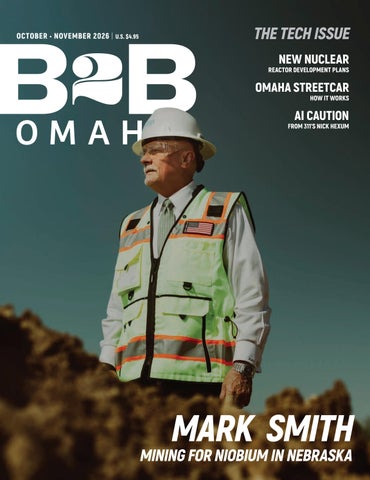
OCTOBER • NOVEMBER 2026 | U.S. $4.95
THE TECH ISSUE NEW NUCLEAR
REACTOR DEVELOPMENT PLANS
OMAHA STREETCAR HOW IT WORKS
AI CAUTION
FROM 311’S NICK HEXUM
MARK SMITH
MINING FOR NIOBIUM IN NEBRASKA
KEELE TAYLOR
HEATH MELLO, PRESIDENT AND CEO
HRMINDED CONSULTING
GREATER OMAHA CHAMBER
MEET THE O FACES OF OMAHA
HR COMPLIANCE AND RISK MANAGEMENT
H
RMinded Consulting CEO and Chief Human Resources Officer Keele Taylor MA, PHR, SHRM-CP, said that the HRM in “HRMinded” emphasizes human resources management.
the COVID-19 pandemic, which created near-universal workplace upheaval.
“It was perfect timing in light of something that was so dark, and I do feel like what I do is help to turn on the light in the workplace,” she said.
‘HRMinded’ is actually a concept or a mindset, the adjective describing proactive leadership and ensuring that your workplace and your most valuable assets—which are your people—are protected and cared for,” she explained.
Taylor is not your typical HR consultant. She primarily serves small and medium-sized businesses with intensive support for everything from onboarding to compliance.
Taylor’s HR expertise stretches back more than two decades, but she was inspired to go into consulting during
Taylor’s experiences from the front lines of corporate America inspired her to fearlessly and unapoligetically write,
“Don’t Make Me Use my HR Voice”, a book about the significance of HR and how having a strategic HR partner for your business is critical for navigating today’s disrupted, changing workplace and workforce.
HRMINDED CONSULTING
8790 F Street Suite 229 Omaha, NE 68127 531.344.8563 hrmindedconsulting.com
OMAHA BUSINESS
maha is home to a thriving business community that plays a pivotal role in shaping the city’s growth and success. From innovative startups to established Fortune 500 enterprises, businesses here are driven by a spirit of collaboration, resilience, and a deep commitment to community.
who work in Omaha are committed not only to the success of their organizations, but to the well-being of the community as a whole. Whether through leadership, diligent work, or volunteerism, the people of Omaha’s businesses are deeply invested in creating an environment where success is measured by more than just profits and growth—it’s measured by community prosperity.
Our city’s business landscape has always been fueled by talented and passionate people, each bringing unique skills, perspectives, and ideas to the table. People
The combination of economic vitality, entrepreneurial spirit, and a shared commitment to community makes Omaha a great place for businesses to grow and
thrive. As Omaha continues to expand as the heart of our one-million-population metro, its business community will remain a key driver of opportunity and innovation, ensuring the city’s bright future for decades to come.
GREATER OMAHA CHAMBER
808 Conagra Dr., Ste. 400 Omaha, NE 68102 402.346.5000 omahachamber.org
6 | FACES OF OMAHA 2026
FACES OF OMAHA 2026 | 67
COO/CEO DEAN LEISMAN AND EXECUTIVE CHEF MC
“W
SCRATCH CUISINEthat Omaha is home to the most extraordinary people - people with vision, It’s no secret PITCH PIZZERIA
e’ve been in Omaha for over 16 years, and we make our own pasta, sausage, aiolis, and dressings,” said Dean Leisman, owner of Pitch Pizzeria. “We hand-roll our meatballs and have stayed focused on scratch cuisine. We do pizza by the slice, a quarter of a pie so you can enjoy what you want.
With two restaurants in Omaha and two more in Scottsdale, Arizona, Pitch has developed a loyal following. “People feel comfortable coming in alone because they always know somebody that is creating the Pitch experience,” Leisman said.
In addition to scratch cuisine, Pitch offers a well-stocked “Booze Bank” featuring Napa wine as well as private barrels of bourbon, tequila, and rye. “If you need to buy somebody a birthday gift, you can get them a really cool bottle of wine or bourbon.” “A couple of years ago I created pizza kits with a par-baked crust, sauce, cheese, and toppings,” Leisman said. “The whole premise of the pizza kits was to help families make dinner together. We turned the pizza kits into fundraising, and now we do fundraisers for charities and schools and organizations.”
PITCH PIZZERIA Dundee: 5021 Underwood Ave. 402.590.2625
grit, and the energy to get things done.
West Omaha: 17808 Burke St. 402.289.4096
FACES OF OMAHA showcases the people making things happen in Omaha in exclusive categories where they shine. pitchpizzeria.com
FACES OF OMAHA 2026 | 87
It’s a great read about great people making Omaha great.
FACES of Omaha is included with Omaha Magazine + Omaha Home subscriptions. omahamagazine.com/subscribe
11TH ANNUAL
FACES OF OMAHA 2026
Read FACES of Omaha
Inspiration Lives Here
In the heart of our city. In the soul of our state. The stories that shape your world are now in one place. Omaha Magazine and The Good Life Network have joined forces to bring you unparalleled access to the culture of Omaha and the character of Nebraska, from the page to your screen. The complete experience. $7/month.
Discover More
02 | B2B MAGAZINE
·
2026
Fall in Love With Your Business Again Because growth without clarity isn’t sustainable. You did not build your business to feel overwhelmed by it. When strategy loses clarity, execution slows, and leadership alignment begins to strain, growth becomes heavier than it should be. That is often the moment leaders realize the business has outgrown its current way of operating. We can help with that.
VOLUME 26
·
ISSUE 5
B2B Omaha is dedicated to empowering local CEOs and business leaders by delivering authoritative insights into emerging trends, visionary leadership, and economic indicators shaping our region. We strive to be the go-to resource for professionals seeking data-driven reporting on Omaha’s GDP, in-depth analysis of evolving market dynamics, and stories of the trailblazers who are setting the pace for growth and innovation in our community.
EDITORIAL executive editor Doug Meigs senior editor Natalie Veloso assistant editor Lucy Mason
SALES director of business and development Carole Sprunk executive vice president of sales and marketing Gil Cohen
editorial interns Allison Kibby Rhett Uleman
branding and digital specialists Greg Bruns Dawn Dennis Francine Flegg Sandy Matson Kim May Tim McCormack
guest editor Carmen Tapio
senior sales coordinator Alicia Hollins
contributors Tamsen Butler Kevin Coffey Brent Crampton Steve Jordon Kara Schweiss Karine E. Sokpoh Tim Trudell Anila Yoganathan
sales coordinators Jessica Linhart Sandi McCormack
director of Omaha Content Studio Wendy Wiseman
CREATIVE creative director Rachel Birdsall senior graphic designers Renee Ludwick Nickie Robinson graphic designer Joey Winton chief photographer Sarah Lemke photographers Katie Anderson Roger Humphries
OPERATIONS business manager Kyle Fisher ad traffic manager David Trouba digital manager Luis De La Toba distribution manager Carson Kruse publisher Todd Lemke associate publisher Bill Sitzmann
TABLE OF CONTENTS JUST THE FACTS
14 ECONOMIC TRENDS
DATA CENTER DEVELOPMENT
35 EVENTS & ENGAGEMENT NETWORKING CALENDAR
COLUMNS
04 FROM THE GUEST EDITOR
SEARCHING FOR THE FUTURE
12 MARKETING & GROWTH STRATEGIES SEARCHING EVERYWHERE OPTIMIZATION
36 HUMAN RESOURCES
NAVIGATING THE NEW LANDSCAPE FOR HIGH-SKILLED IMMIGRATION
DEPARTMENTS
10 COACHING CORNER NICK HEXUM ON AI
16 VOICES OF INDUSTRY NIOCORP'S MARK SMITH
32 ENTREPRENEURIAL JOURNEYS
WERNER'S DARAGH MAHON
INFORMATION advertising information 402.884.2000
5LPerformanceGroup.com
subscribe online omahamagazine.com/ pages/subscribe B2B Omaha Magazine is published six times annually by Omaha Magazine, LTD, P.O. Box 461208, Omaha NE 68046-1208. Telephone: 402.884.2000; fax 402.884.2001. Subscription rates: $14.94 for 6 issues (one year). Multiple subscriptions at different rates are available. No whole or part of the contents herein may be reproduced without prior written permission of B2B Omaha Magazine, excepting individually copyrighted articles and photographs. Unsolicited manuscripts are accepted, however no responsibility will be assumed for such solicitations. © Omaha Magazine 2026
OMAHAMAGAZINE.COM
OCTOBER/NOVEMBER
TABLE OF CONTENTS
03
FEATURE
26
NUCLEAR IN NEBRASKA
FOUR POTENTIAL REACTOR SITES IDENTIFIED
FEATURES
OCTOBER • NOVEMBER 2026 | U.S. $4.95
THE TECH ISSUE NEW NUCLEAR
REACTOR DEVELOPMENT PLANS
OMAHA STREETCAR HOW IT WORKS
AI CAUTION
FROM 311’S NICK HEXUM
MARK SMITH
MINING FOR NIOBIUM IN NEBRASKA
06
EDGE DISTRICT: EXPLORE, DEVELOP, GROW, ENGAGE UNMC ANCHORS 30-ACRE HEALTH-FOCUSED INNOVATION HUB
ABOUT THE COVER
Mark A. Smith—NioCorp’s executive chairman, president, and CEO—makes regular visits to the company’s niobium mining site in Elk Creek, Nebraska. Full story on page 16. Cover Photography: Bill Sitzmann Cover Design: Nickie Robinson
20
OMAHA STREETCAR
EVERYTHING YOU NEED TO KNOW ABOUT OMAHA'S NEWEST FORM OF TRANSPORTATION
B2B MAGAZINE • 2026
VOL 26 • ISSUE 5
THE TECH ISSUE: “QUAERO ERGO SUM” SEARCHING FOR THE FUTURE
I
search, therefore I am…wait, that’s not how the saying goes!
“I think, therefore I am,” credited to French philosopher René Descartes, came up in discussion between my husband and I, and it got me thinking—not Google searching, but truly thinking. From there, my mind wandered to quantum computing. Yes, really. Then I began thinking about the extraordinary pace of problem-solving, learning, teaching, modeling, and creating that is now available at our fingertips…and sometimes even in our garages. A friend recently told me about his son inheriting what might be considered now to be an obsolete laser printer capable of cutting 3D designs from plastic, metal, and wood. It is likely a precursor to the 3D printer. Instead of viewing it as outdated technology, his son used AI to learn how to operate it and is now creating intricate artwork that previously would have taken weeks or even months to produce by hand. Apparently, an “obsolete” laser isn’t so obsolete when artificial intelligence becomes the instructor. Then there was another experience that stopped me in my tracks. I recently spent time with a family whose 2-year-old woke up from a nap, picked up a cell phone, swiped up, unlocked it, tapped an app, found “Baby Shark,” and happily sang along. Once I got over being slightly annoyed, I was amazed. Not because a toddler could navigate a smartphone—but because it forced me to think about something much bigger.
These investments give me tremendous hope—not only for our future, but for the generations that will inherit it. Personally, and professionally, I have been fortunate to learn from some of the brightest technology leaders in our community. One of them is Daragh Mahon, EVP and CIO of Werner Enterprises, who is featured in this issue. His observation has stayed with me since he said it: “People need to stop saying AI is coming, because it’s here.” He’s right. Programs like the Greater Omaha Chamber’s REACH Digital Boost Program help small businesses understand and implement AI, and demonstrate the remarkable human capital we have right here in Omaha. Strategic adoption by small businesses is crucial given their vital role in the economy. We are fortunate to have organizations and leaders helping businesses navigate a technological landscape that seems to evolve by the minute. This all takes data centers. They are not on the horizon. They’re already here. We’ll explore that conversation more in this and future issues. Many of you have heard me say that I believe in the human spirit and that anything is possible. Technology—developed responsibly, guided ethically, and made accessible equitably—places incredible power into the hands of today’s children. It also presents profound questions about ethics, education, workforce development, and opportunity.
It made me think about the ethical application and highest uses of technology. It made me think about where academics, science, entrepreneurship, and technological advancement intersect to accelerate innovation and solve problems that once seemed impossible. It also made me wonder what we need to teach today’s 2-year-olds, who will become tomorrow’s workforce.
Those questions deserve our attention. But so do the endless possibilities. Communities, businesses, and leaders have the ability and responsibility to shape the future. Tech is front and center in doing so.
Or perhaps, will they be teaching us? It’s a lot to consider. Yet, I remain optimistic, because I see intentional leadership creating environments where innovation can flourish.
The future isn’t coming. It’s already here. The question is whether we will simply react to it, or intentionally shape it. B2B OMAHA
Organizations like the Omaha Inland Port Authority are building innovation districts that create opportunities in underserved communities—bringing entrepreneurs together, expanding equitable access to resources, and advancing manufacturing innovation. (See the August/September 2026 edition of B2B Omaha.) Likewise, the EDGE District, located adjacent to one of our region’s greatest assets—the University of Nebraska Medical Center—is creating an ecosystem where research, healthcare, entrepreneurship, and technology converge to solve tomorrow’s challenges.
04
FROM THE GUEST EDITOR Carmen Tapio is the founder and CEO of North End Teleservices. For story suggestions and pitches, email editor@omahapublications.com.
SPONSORED CONTENT | 05
OMAHAMAGAZINE.COM
Thanks Omaha for over 40 Years!
JAMES THOMPSON AND LISA MAHIN
®
2026 Winner
402.399.9233 | WWW.SPARKLINGKLEAN.COM
Real Estate Real Expertise Real Impact Omaha’s premier choice in commercial real estate for over 40 years. lundco.com
ECS TECHNOLOGY SOLUTIONS WORK SMARTER, STAY SECURE, AND GROW WITH CONFIDENCE. For more than 20 years, ECS Technology Solutions has helped Omaha-area organizations use technology to work smarter, stay secure, and grow with confidence. Now, the family-owned company is entering its next chapter. Founder Bryan Thompson has transitioned ownership to the next generation, James Thompson and Lisa Mahin, who are carrying forward ECS’s commitment to relationships, service, and doing what’s right for clients while sharpening its focus for the future. Today ECS is dedicated exclusively to B2B technology services. The company partners with growing organizations to provide managed IT, cybersecurity, cloud solutions, strategic technology guidance, and AI enablement. That means going beyond fixing technology when something breaks. ECS helps businesses build secure, scalable technology environments, prepare for emerging opportunities like AI, and make smarter technology decisions that support long-term growth. The ownership may be new, but the mission remains the same: helping people Spend Time on What Matters.
Independently Owned and Operated A Member of the Cushman & Wakefield Alliance
For ECS, the next generation is just getting started. BUSINESS LEADERS CAN LEARN MORE AT ECS.ROCKS, OR CALL ECS AT 402.350.0372
B2B MAGAZINE • 2026
VOL 26 • ISSUE 5
EDGE DISTRICT: EXPLORE, DEVELOP, GROW, ENGAGE
FEATURE STORY: KARA SCHWEISS PHOTO: BILL SITZMANN DESIGN: NICKIE ROBINSON
06
THE EDGE DISTRICT AT THE INTERSECTION OF FARNAM STREET AND SADDLE CREEK ROAD.
UNMC ANCHORS 30-ACRE HEALTH-FOCUSED INNOVATION HUB
OMAHAMAGAZINE.COM
OCTOBER/NOVEMBER
07 THE FACT THAT THE EDGE DISTRICT IS EMBEDDED DIRECTLY WITH UNMC GIVES TENANTS SOMETHING HARD TO REPLICATE ELSEWHERE: REAL ADJACENCY TO A WORLDCLASS ACADEMIC MEDICAL CENTER AND ACTIVE CLINICAL RESEARCH, NOT JUST PROXIMITY ON A MAP. — RYAN LAWSON
B2B MAGAZINE • 2026
T
he EDGE District is a relatively new endeavor, officially unveiled in October 2024. Led by the University of Nebraska Medical Center and supported by strategic public-private partnerships, its stated mission is to cultivate collaboration, innovation, and economic growth by nurturing a vibrant ecosystem of people, places, and programs that unite academia, healthcare, industry, and the broader community. Its name is an acronym for Explore-Develop-Grow-Engage.
“It’s important to Omaha,” said UNMC Chancellor Dr. H. Dele Davies. “It’s really allowing Omaha to not lose companies that they would otherwise have lost to other cities where they have infrastructure built…it allows us to not only keep these companies here, but also to attract other companies, national players who want to be here to interact with researchers.” Omaha objectively has a lot to offer, EDGE District proponents say, from its convenient central location, to a relatively low cost of living, to its educated workforce. The EDGE development is located just west of UNMC’s midtown-area main campus.
08
VOL 26 • ISSUE 5
The development has launched with the 170,000-square-foot redeveloped Catalyst building (formerly the Omaha Steel Works) and the seven-story, 190,000-square-foot CORE (Campus Operations and Research Excellence) facility, along with a 753-stall parking structure. Catalyst includes a diverse mix of offices, suites, and even single-user desks for users, plus retail, restaurant, and event space. CORE’s design includes ground-floor retail to serve the neighborhood, and its upper floors accommodate both campus and third-party lab research. Phase I activated about a third of the mixed-use district, which is expected to ultimately offer a variety of office, dining, retail, green, and event spaces. “What the EDGE District allows us to do is to integrate our expertise in health science and being a leading academic institution to partner with corporate research and development companies, startups,
OMAHAMAGAZINE.COM
OCTOBER/NOVEMBER
early-stage companies, and also organizations that support entrepreneurs, and bring them all together into this dynamic community,” Davies said.
Koelbel and Company and GreenSlate Development are key development partners, Davies said.
Ryan Lawson, manager of properties and real estate for both UNMC and Nebraska Medicine, leads development and leasing for EDGE, which he said is unique in multiple ways.
“Koelbel is a company based out of Colorado and GreenSlate is right here in Omaha, and they’re primarily the ones who are primarily running Catalyst in partnership with us,” he said.
“This is a 30-acre urban development, built specifically around purpose-built lab, office, coworking, retail, and event space designed for shared collaboration,” he said. “The fact that the EDGE District is embedded directly with UNMC gives tenants something hard to replicate elsewhere: real adjacency to a world-class academic medical center and active clinical research, not just proximity on a map. Future physical connections over Saddle Creek will only work to accentuate the access and relationship to campus.” Lawson emphasized that the project is intended to be relevant beyond healthcare and biotech enterprises. “In reality, a lot of what is and will be happening in the EDGE District is meant to be part of the neighborhood’s everyday life; the retail space at CORE, for example, is being built and leased with the surrounding community in mind, not just district tenants…This isn’t UNMC building alone in a vacuum. The EDGE District runs on public-private partnership, with public and private developers, investors, and tenants working alongside the university to help bring the vision to life,” he said. “It’s worth noting that the EDGE District remains under construction, literally and figuratively, and there’s a lot more to come. What the community sees today is an early chapter, not the finished story.” Second-year tenant Erik Carlson, founder and CEO of Linear A, a strategy and data analytics firm, said he had been content to be running his company out of his Yutan home until he was invited to tour the Catalyst facility. “Immediately when I saw the building and the space and kind of the buzz and the energy and the excitement, I knew it was the place for me,” he said. “The collaborative environment is second to none. In my short time there, I’ve collaborated with people that are go-to-market experts, application developers, those who understand lead generation and ICP acquisition, other entrepreneurs.…I think the space really encourages that kind of level of collaboration and authenticity. Also, from a business standpoint, you can host clients, you can hold meetings. There’s this kind of center anchor point with Big Grove [Brewery, Coffee Co.] right there where you can entertain. It has all the things that one would want in that specific space. It’s pretty exceptional.”
As an innovation hub, the EDGE District represents the transformation of concepts into solutions every day. Some collaborators are the University of Nebraska system including UNMC, the Nebraska Innovation Campus in Lincoln, and UNeMed (the technology commercialization arm for UNMC and the University of Nebraska-Omaha), the 3D printing and training center at Clarkson College, venture development organization Invest Nebraska, the City of Omaha, and the Greater Omaha Chamber, just to name a few. The work happening at EDGE is broad, too, with a few examples including medical robotics, facilitating domestic manufacturing and sterilization capacity that reduces global dependency, fostering a shift from petroleumbased materials to renewable bio-derived alternatives, AI and digital health advancements, and cultivating a diversified funding ecosystem. There are also opportunities for investors to become involved, Davies said. “Our hope is to get the EDGE District designated as an innovation district at some point, which will also attract other national potential national partners and increase our national and international reputation,” Davies said. “We can together help grow the whole economy of Omaha [and] Nebraska. So, this is an important mission for us as UNMC, to help with economic success and vitality of our state. Each focus area represents a key opportunity to strengthen Nebraska’s position in healthcare innovation; from robotics and AI, to bio-based materials and the circular healthcare economy, we're building an ecosystem where ideas become impact.” B2B OMAHA
09 OUR HOPE IS TO GET THE EDGE DISTRICT DESIGNATED AS AN INNOVATION DISTRICT AT SOME POINT, WHICH WILL ALSO ATTRACT OTHER NATIONAL POTENTIAL NATIONAL PARTNERS AND INCREASE OUR NATIONAL AND INTERNATIONAL REPUTATION. — DR. H. DELE DAVIES
B2B MAGAZINE • 2026
VOL 26 • ISSUE 5
COACHING CORNER
NICK HEXUM
STORY: KEVIN COFFEY PHOTO: BILL SITZMANN DESIGN: NICKIE ROBINSON
TERMS OF USE
10
NICK HEXUM WANTS ARTISTS TO DECIDE HOW AI USES THEIR WORK
N
ick Hexum was face-toface with a Nick Hexum bot. And he didn’t like it.
The 311 singer and guitarist came across an AI-created bot capable of making his voice say essentially anything. It was not, of course, Hexum’s real voice. It was an artificial version of it trained on his songs, interviews, and appearances.
OMAHAMAGAZINE.COM
OCTOBER/NOVEMBER
And it sounded real enough.
“311 survived the Napster theft,” he said. “But then technology created a solution, which was [digital sales and] streaming services, and making it so the artists were actually on board.”
“It was pretty shocking that it could all be done without my involvement,” Hexum said. “It felt like I had just been stolen from.” Made without his permission, the bot was built with generative AI. Those companies and their models exist in a sort of grey area, scraping and training on whatever they can get their digital hands on.
He sees a similar opportunity with AI. Hexum is not anti-technology or anti-AI. He uses AI tools himself, including a music plugin that can transform his singing into the sound of a gospel choir or a tenor saxophone, but only for demos. (Never for an album, he specified. Only to see what it sounds like in a demo stage.)
“They're just doing what they want,” he added. The distinction, he said, is consent. Then another discovery: Nearly 150 songs by 311 showed up among works used to train generative AI models in a database published by The Atlantic. Both were extremely off-putting. He felt violated. Those experiences helped turn the Omaha-born musician into one of the public faces of a much larger effort: the Human Consent Foundation, a nonprofit working to establish a universal, machine-readable way for people to control how AI uses their work, identity, and creative output. The organization is led by Hexum’s wife, Nikki Hexum, its CEO and co-founder. Nick is an advisor, serving on both its artist governance board and standard governance board. Its basic idea is intentionally simple: Anyone can register and then declare permissions for their identity or creative work. It works with a traffic light system: Green means use is approved, yellow means use is permitted under specific conditions such as credit, compensation or specified limits. Red means no use is allowed. Human Consent Foundation’s goal is to create a standard that technology can understand at scale. “We are strictly making the standard in the registry on what the technology that allows people to say, this is my red light, green light, yellow light,” Nikki said. “And have a machine read that at scale and be able to do that billions of times a day.” For Nick, the idea grew naturally from his experience in the music business. He compares the current moment to the rise of Napster, when technology created a new way to distribute music without artists’ permission and the industry eventually developed new systems around digital music.
11
“We’re not staunchly anti-AI because it’s going to help a lot of people,” he said. “Technology is always a mixed bag.” That is where Human Consent Foundation’s yellow light becomes particularly important. An artist might allow AI to use a song, voice, or image if the terms are right. Hexum sees that as a potential new income stream for artists or way to make new creations. “For me, I picked the red light option. Let’s start with telling the companies no,” he said. “And then this yellow, the middle choice I think is going to become an important part of business in the future. People are going to say, ‘Yeah, I’d like to participate in AI training if I’m fairly compensated.’” The effort has already taken the Hexums beyond the music business. Nick recently traveled to Brussels, where he spoke to members of the European Parliament about artists’ rights. The opportunity was both intimidating and exciting. “I was like, sounds terrifying. Let’s do it. Let’s go,” he said. The foundation has also attracted support from an impressive group of artists and entertainment figures. Major supporters include Cate Blanchett, a co-founder, and Steven Soderbergh, who have both contributed to writing and reviewing the standard. Supporters also include actors George Clooney, Meryl Streep, Tom Hanks, Viola Davis, Helen Mirren, Emma Thompson, Javier Bardem, and Kristen Stewart, as well as Hollywood executives Kevin Huvane of Creative Artists Agency and Mike Medavoy of Orion and Phoenix Pictures. For Nikki, having Nick beside her has been essential. The foundation is completely volunteer-run and, she said, the couple has not taken money from the effort. For Nick, the motivation is simple. After nearly four decades in the music industry, he said the opportunity to advocate for artists is something he feels compelled to pursue. “It’s just like duty calls,” he said. “It’s a thrill, but this is something that I need to do.” B2B OMAHA
WE’RE NOT STAUNCHLY ANTI-AI BECAUSE IT’S GOING TO HELP A LOT OF PEOPLE. TECHNOLOGY IS ALWAYS A MIXED BAG. — NICK HEXUM
B2B MAGAZINE • 2026
VOL 26 • ISSUE 5
MARKETING & GROWTH STRATEGIES
BRENT CRAMPTON
COLUMN: BRENT CRAMPTON PHOTO: PROVIDED DESIGN: NICKIE ROBINSON
SEARCH EVERYWHERE OPTIMIZATION
HOW TO SHOW UP IN ONLINE SEARCH
12
H
ow your business is found online is changing. Due to AI summaries at the top of Google and large language model systems like ChatGPT, 68% of searches end without a click to a website, per a study covered by Search Engine Land. You're not in control of what AI says about you. And what's worse, there's no easy, free way to track what customers ask AI about you, or where you're showing up.
The old agreement was that if you made good content, you'd get rewarded with a click. That’s classic search engine optimization (SEO) methodology. But the SEO industry is in chaos. Here's the good news: there's opportunity in this mess. While your competitors proclaim SEO is dead or just wait around until the dust settles, you could be riding this wild wave of discovery alongside the rest of us and be first to the shore.
OMAHAMAGAZINE.COM
That’s right. We’re in frontier territory. What I realized is that with every SEO podcast or newsletter, the new rules of the web are slowly emerging. Because of that, I decided to get obsessed with the subject this year. I started writing a weekly LinkedIn article to track the best bits I’m learning— that’s how I wound up getting asked to write this. And now, I’m gonna share them with you. The best framework for this new era is what marketer Neil Patel calls "Search Everywhere Optimization." When someone asks ChatGPT to recommend a roofer, it assembles a profile of each business from everywhere it can reach: Google Business Profile, Bing listing, customer reviews, social accounts, Reddit threads, local news, and your website. It then ranks businesses on credibility, recent activity, and how consistent and organized your info is across all of these sources. That’s why we say “everywhere.” When AI picks one company over another to surface in a response, it’s no longer about who the better company is, who’s done the most keyword research, or even if you’re ranking the highest on search. People now ask full-blown questions, so it’s about providing the best answer to the questions your customers are asking. Then it's about making those answers clear, easy to find, and consistent across multiple platforms—but you need to do it in the particular way AI wants that info assembled. The best place to start is your website. Even though it gets fewer clicks, it matters more than ever, because that's a single source of truth that you're completely in control of (unlike Reddit), and that every AI crawler is looking to. Here are things that make the biggest impact that most websites get wrong: • On each webpage, only have one header (H1). Think of it like a book title, phrased as the question a customer would search. Answer it in the first sentence underneath. • New sections get subheadings (H2) in question form. Put your answer in the first sentence. Repeat. • Google chops your page into passages, so write sections that still make sense lifted out alone.
OCTOBER/NOVEMBER
• Add an FAQ at the bottom built from what people ask on a first sales call. (I record mine in Google Meet and have Claude analyze and pull the questions.)
13
• Show your receipts (reviews, awards, who you work with), link your pages to each other to create content clusters, and don't make anyone put in effort to find your contact info. • Share facts, figures, and stories only your company could tell. AI slop can't invent real human experience. Your website tells AI what you do. Everyone else tells AI if you're any good. So, here’s what you do next. Search Engine Land reports ChatGPT is roughly 92% of AI referral traffic, and it builds its picture of local businesses largely from Bing's index, not Google. Most businesses still haven't claimed their Bing listing. Go do that today. I did one for a client recently—it took minutes, since Bing imports your Google Business Profile for you. Everything else is other people vouching for you: reviews, social media, and (unfortunately) Reddit. I slacked on review replies for years, but AI considers it scannable content. Google is erasing reviews and replies that seem fake or automated. So, when you respond, specifically address what they said and drop in a few tasteful keywords. And social media? AI reads it, too. I now consider it evergreen content. Skip the "Happy Labor Day!" posts and publish updates, facts, and stories you want AI to surface later. There’s no better way to do this than by making a video, especially on YouTube. That’s why I’m going through old blog posts and updating with a talking head video hosted on YouTube. The description links back to the blog, the blog points to the video. It’s a loop, and AI loves that stuff. Last thing: measure differently. The clean paper trail we had with clickbased web traffic is gone. Research shows people who see you in an AI answer don’t click, but they come back later and then search directly with your name. So, your data will think it’s organic traffic, when it actually started in AI. The solution is super old school: Add a "how did you hear about us?" question to every intake form. This is a lot. The good news is that most small-to-medium companies have a terrible web presence. Even more so, most people have no idea the rules of the internet are changing. If you jump on this train early, you're bound to see outsized compounding returns for years to come. B2B OMAHA Brent Crampton is the former owner of Omaha's House of Loom and director of marketing for Hillside Solutions, a B2B trash, recycling, and composting company. He also runs an SEO agency helping small businesses make the transition to the search-everywhere era, and recaps SEO news weekly in his LinkedIn series “This Week in SEO.”
THE CLEAN PAPER TRAIL WE HAD WITH CLICKBASED WEB TRAFFIC IS GONE. RESEARCH SHOWS PEOPLE WHO SEE YOU IN AN AI ANSWER DON’T CLICK, BUT THEY COME BACK LATER AND THEN SEARCH DIRECTLY WITH YOUR NAME. — BRENT CRAMPTON
B2B MAGAZINE • 2026
ECONOMIC TRENDS STORY: DOUG MEIGS DESIGN & ILLUSTRATION: NICKIE ROBINSON
VOL 26 • ISSUE 5
TRENDING DATA CENTERS BILLIONS IN INVESTMENT SPARK QUESTIONS
A
rtificial intelligence is fueling an unprecedented boom in data center construction.
For environmental reporter Anila Yoganathan, who covers Nebraska for Flatwater Free Press and Grist, the once-niche real estate story has grown into one of the country’s most pressing concerns at the intersection of economic development, infrastructure, and natural resources. “I don’t think a lot of reporters that were covering it before realized how big it was going to become,” she says. Before moving to Omaha in late 2025, Yoganathan reported for Atlanta Business Chronicle on Georgia’s rapidly expanding data center market, where Microsoft, Amazon, and other technology companies were acquiring hundreds of acres for new campuses. Today, she sees many of the same forces reshaping Nebraska. While working in Georgia, she encountered contradicting reception for data centers among neighboring communities. One town’s mayor advocated for their development as an opportunity to diversify the local economy, while an adjacent community with an existing facility was adamantly opposed to new construction. Community opposition often touches on pollution concerns, quality of living, potential electricity rate hikes, and lack of transparency tied to NDAs. “The reasons are different in every community,” Yoganathan says. “It depends on the development, and it depends on the company that’s coming to town.” According to a Pew Research Center analysis, the United States now has more than 3,000 operating data centers, with more than 1,500 additional facilities in various stages of planning or construction. In a notable shift, 67% of planned data centers are located in rural areas, compared with just 13% of existing facilities—a trend that increasingly favors states like Nebraska, Iowa and other parts of the Midwest. According to Data Center Map, an independent commercial database tracking the industry, the U.S. has 4,767 data centers. Virginia ranks No. 1 with 674, while Iowa ranks No. 13 with 116 and Nebraska ranks No. 33 with 37. The ranking includes all 50 states and Washington, D.C.
14
Nebraska could attract growth with its relatively affordable electricity, abundant land, and a stable public power system. Local data center proponents are advocating for billions of dollars in private investment, expanded property tax bases, and thousands of construction jobs during the build-out of facilities.
When Meta expanded its Springfield-area data center by 1 million square feet in 2021, the Facebook parent company anticipated bringing $400 million in capital investment and 100 new operational jobs, bumping the company’s Nebraska investment to nearly $1.5 billion and a total of 300 permanent jobs (with 2,000 construction jobs during construction Similar investments by Google and other technology companies have fueled construction activity while expanding local tax bases and demand for skilled trades. Google has three existing Nebraska data centers (in Papillion, Omaha, and Lincoln). Between 2021 and 2023, a report from Google claimed the company’s data center presence in Nebraska “supported about 13,300 annual jobs, and since 2019 has invested over $3.5 billion in the state’s digital infrastructure.” Amid the rush to develop data centers, residents and policymakers around the country are asking increasingly complex questions: Will electricity demand raise costs for other customers? Can local water systems support large campuses? How will utilities maintain grid reliability? And what effect will industrial-scale development have on the character of rural communities? Noise pollution, once a relatively minor concern, has also become part of the conversation. Recent polling from Gallup and Annenberg Public Policy Center suggest opposition to data centers is growing across bipartisan political lines in the lead up to the 2026 midterm elections. In March, Yoganathan reported that a proposed hyperscale data center linked to Google would use more electricity than the city of Lincoln (potentially requiring 1,000 to 3,000 megawatts of power, in contrast to the 800 megawatts needed during peak summer usage across Lincoln Electric System coverage area. Gov. Jim Pillen issued an executive order in late July pausing access to tax incentives provided through the state’s ImagiNE Nebraska Act for data centers while forming a task force to evaluate new data center developments in Nebraska.
OMAHAMAGAZINE.COM
“This is not a moratorium on data centers,” Pillen said. “However, if a local entity chooses to engage in the development of a data center, it must now be developed in accordance with guidelines included in the executive order.” According to a press release from Pillen’s office: “In addition to prohibiting data center applications from being approved under the ImagiNE Act, the order requires that [Department of Economic Development], Revenue and [Department of Water, Energy, and Environment] work collaboratively
when reviewing project proposals to determine if they are in the state’s best interest. It also requires the establishment of a data center task force through DWEE to ensure protection of the state’s natural resources.”
State lawmakers approved LB 1261 in April, allowing large industrial projects requiring more than 1,000 megawatts (including hyperscale data centers) to develop private electricity generation with connection to the power grid—subject to approval by local public power districts. Yoganathan said this legislation could be a major catalyst for attracting new data center development in the state. B2B OMAHA As Yoganathan continues reporting on data centers in Nebraska, she welcomes community feedback and input from proponents and critics alike. Contact her by email at ayoganathan@flatwaterfreepress.org.
GOOGLE DATA CENTERS’ FINANCIAL BENEFIT TO NEBRASKA
SECOND LARGEST CITY IN NEBRASKA
• 13,300 annual jobs (2021-2023) • $3.5 billion invested in the state’s digital infrastructure since 2019 • $185 billion anticipated “technical infrastructure” in 2026
1,000 TO 3,000 MEGAWATTS NEEDED FOR PROPOSED GOOGLE HYPERSCALE SOURCE: DATA CENTER FLATWATER
HOW DOES NEBRASKA COMPARE, NATIONALLY? • National total: 4,767 data centers • The U.S. state with the most data centers is Virginia (with 674). • Virginia ranks No. 1 (with 674) • Iowa ranks No. 13 (with 116) SOURCE: • Nebraska ranks No. 33 (with 37) DATA CENTER MAP (2026)
DIPPING PUBLIC SENTIMENT
7 in 10 Americans oppose constructing data centers for artificial intelligence in their local area, including nearly half (48%) who are strongly opposed. Roughly 1 in 4 favor these projects; including (7%) strongly in favor. SOURCE: GALLUP (MAY 2026)
3 in 5 U.S. adults (61%) oppose the construction of new data centers in their area, up 12 percentage points from a survey fielded in February and March.
HYPERSCALE FACILITY
800 MEGAWATTS POWERS THE LINCOLN METRO AREA DURING PEAK SUMMER USAGE
SOURCE: "IMPACT STUDY: NEBRASKA, US DATA CENTER," GOOGLE (2024)
SOURCE: ANNENBERG PUBLIC POLICY CENTER (AUGUST 2026)
15
OCTOBER/NOVEMBER
FREE PRESS (2026)
26
3 6
NE
16
37 total
IA
10
116 total
69
11
12
DATA CENTER NUMBERS BY MARKET Omaha
Papillion
Des Moines
Council Bluffs
Lincoln
Grand Island
Cedar Raids
markets with 6 or fewer
B2B MAGAZINE • 2026
VOICES OF INDUSTRY
16
MARK SMITH
STORY: TIM TRUDELL PHOTOGRAPHY: BILL SITZMANN DESIGN: NICKIE ROBINSON
VOL 26 • ISSUE 5
OMAHAMAGAZINE.COM
OCTOBER/NOVEMBER
DIGGING DEEP
17
HOW MARK SMITH BECAME THE LEADER OF AMERICA’S FIRST NIOBIUM MINE
M
ark Smith dreamed he’d build things. He just didn’t realize it’d be underground, involving one of the greatest natural resource finds of the 21st century. And this would take place in Nebraska.
Establishing a niobium mine may be the crowning achievement of his 50-year career, which started with the idea of building equipment to help farmers. As chief executive officer of NioCorp Development Limited since 2013, Smith’s journey to the planned mining of the rare earth mineral in southeast Nebraska, a few miles south of Tecumseh, actually began as a student at Colorado State University. Honesty and integrity are essential to the way he believes business needs to be conducted, Smith said. “You have to treat people right, and you’ve got to make people proud of what they do,” he said. “I try to work on a consensus basis at all times, and that’s just been a successful pattern for me.” He’s been involved with several game-changing moments during his career, several of them his ideas. Not bad for a guy who thought he’d be an engineer for an agricultural company such as John Deere, Case International Harvester, or Kubota. “Right about the time that I graduated with my engineering degree, the farm market and farm implements market just went bad,” Smith said. Instead of designing and building farm implements, Smith was forced to pull a 180 for his career. Oil companies were hiring, so he interviewed with them. But, another opening intrigued him, a position as a mining regulator with the state of Wyoming. The oil companies were going to have him moving around every six months early in his career. After Smith’s wife, Kim, announced she was pregnant with their first child, he took the Wyoming job so he could be home for the family. He fell in love with the Wyoming gig. “I certainly took notice right away that the equipment associated with mining was just as fun, if not more fun, than agriculture, because the size of these trucks and these drag lines and what-nots is overwhelming,” Smith said.
CONT. PAGE 18
I'VE LITERALLY DONE BUSINESS IN ALMOST EVERY STATE IN THIS FINE COUNTRY OF OURS. I CAN'T SAY THAT I'VE EVER DONE BUSINESS IN A BETTER PLACE THAN NEBRASKA. — MARK SMITH
B2B MAGAZINE • 2026
VOL 26 • ISSUE 5
FROM PAGE 17 After three years with the state mining agency, Smith decided he no longer supported the regulations involved with the industry, so he took an engineering position with Union Oil of California, later Unocal, where he developed fertilizers. One of his designs became the standard for how ammonia was injected into the ground by tractor. Homestake Mining, which had opened a gold mine in northern California, sought to use Unocal’s ammonium nitrate to create explosives for mining, wanting Unocal to ship the ingredient to a separate location, where the ammonia nitrate would be added to produce explosive devices. Smith thought that was a lot of extra work, and likely more expensive. He researched and designed a new way to produce the explosives on-site, saving Homestake about 30% in costs. Smith moved to Molycorp, Unocal’s mining subsidiary, managing its environmental health and safety program. He later help settle Unocal’s issues regarding Superfund sites, areas involving environmental damage for which Unocal may have been responsible. After obtaining his law degree from Western State University, Smith managed the non-legal part of two class action lawsuits, spending about two years resolving them. Soon after arriving in Avila Beach, California, Smith learned an employee had been physically assaulted by some townspeople, and also that employees were scared to wear clothing with the company logo. He ensured the person was OK, then took matters into his own hands. “I made a pledge to myself, as part of that overall cleanup effort, we were going to satisfy the community and do the right thing,” he said. “By the time we got everything cleaned up and got
18
WE HAVE ABOUT 40 YEARS OF MINE LIFE THAT WE HAVE PLANNED FOR, BUT ITS IMPACT WILL LAST US HUNDREDS OF YEARS. — MARK SMITH
the community reasonably happy, not only were the employees proud to wear Union Oil anything, the community also was also asking for hats and T-shirts, and they all wanted to wear them, as well.” After Chevron purchased Unocal, Smith managed the company’s mining side. After a few years, Smith believed mining didn’t seem to be a priority, so he opted to move to a new opportunity. Smith’s last action with Chevron was to handle the sale of Molycorp to a mining company. The company then asked him to become its CEO. In late 2012, Molycorp’s board released Smith, after what he described as a not-sosmart decision to bring over the entire management team from a company Molycorp bought. Those executives persuaded Molycorp’s board to oust Smith. The opportunity to lead the development of the country’s lone niobium mine led Smith to join NioCorp in 2013. Niobium, a mineral used to create additional strength when mixed with steel, has several uses for construction, automotive design, making lithium batteries solid, and military development in making missiles and bombs lighter, but it’s the medical aspect that excites Smith the most. Niobium is key for creating lighter magnets for magnetic resonance imaging. “We’re very proud, because those MRI machines perform miracles for us every day,” Smith said.
OCTOBER/NOVEMBER | 19
OMAHAMAGAZINE.COM
OMAHAMAGAZINE.COM
2026 BEST OF B2B WINNER
NioCorp's Elk Creek mine near Tecumseh will be a game-changer, immediately making the United States a major producer, accounting for about 50% of the world’s supply, Smith said. Brazil supplies about 85% of the world’s niobium, with Canada a distant second at about 10%. Rwanda, Nigeria, and Congo contribute small percentages. Elk Creek’s mine will cover about 60 acres above ground, but will drill about 2,500 feet deep underground, expanding to 7,000 acres below surface, Smith said. Nebraska is the only location in the United States with niobium, he said. “We have about 40 years of mine life that we have planned for, but its impact will last us hundreds of years,” Smith said.
UNIFO RM RENTA L S ERV IC E
Omaha’s Trusted Uniform Rental Partner Uniforms | Floor Mats | Restroom Supplies
Family Owned Since 1917 www.maxiwalkeruniform.com
Elk Creek, which will have a processing facility above ground, will employ about 500 people, Smith said. Positions will likely pay about 40% more than at the area’s largest employers, he said. During its construction, the project should employ 1,000 to 1,200 workers, Smith said. NioCorp couldn’t ask for a better place to mine than the Elk Creek site, Smith added. “I’ve literally done business in almost every state in this fine country of ours. I can’t say that I’ve ever done business in a better place than Nebraska,” Smith said. “You take all your issues seriously. Your permit reviews are tough, but you get your permit reviews done, and you’re very business-friendly. In terms of giving people the opportunity to make a difference, I can’t compliment the state enough for how they treat a business like ours, because we’re not treated like this everywhere we go.” B2B OMAHA
expertly planned. EXCEPTIONALLY EXECUTED. www.planitincevents.com
celebrating 28 years of meetings and events
CLEAN RESULTS. When it comes time to begin cleaning your facility you can rest assured knowing our highly trained franchise owners are performing the absolute best cleaning services. Let the professionals handle it. Put your trust in the reliable team at Jani‑King of Omaha for the assurance your facility is safe, clean, and disinfected.
Call our local Jani-King office today and discover how our efforts help your business each and every day.
402 . 932 .0514 | JAN I KI N G .CO M 5885 S. 118 CIRCLE OMAHA , NE
B2B MAGAZINE • 2026
FEATURE STORY: STEVE JORDON TIMELINE ILLUSTRATION & DESIGN: NICKIE ROBINSON
20
VOL 26 • ISSUE 5
OMAHA STREETCAR
EVERYTHING YOU NEED TO KNOW ABOUT OMAHA’S NEWEST FORM OF PUBLIC TRANSIT
Research, Studies & Planning
Preliminary Design
2016-2022
2023
Final Design 2023 - 2024
Vehicle Procurement 2024
OMAHAMAGAZINE.COM
OCTOBER/NOVEMBER
Utility Relocations
Mainline Track Construction
Testing & Commissioning
Streetcar in Service
2024 - 2027
2026 - 2028
2027 - 2028
2028
21
B2B MAGAZINE • 2026
S
VOL 26 • ISSUE 5
ome day, you may ride an Urbos on top of two bogies with a pantograph sliding along a catenary until the operator walks down the articulated aisle to go backward.
Welcome to Omaha’s streetcar, made by a Spanish company and run by a Missouri contractor under City of Omaha control. The sometimes-controversial $421 million, 3-mile streetcar project is coming to town in the fall of 2028. Here’s how it will work: Steel tracks are already snaking along the route, each pair 4 feet, 8 1/2 inches apart, the standard U.S. railroad width. Each 75-foot-long streetcar will have 24 drive wheels, each with its own motor using Omaha Public Power District electricity. Omaha’s six Urbos 100 model streetcars, costing about $6.8 million each, and $4 million worth of spare parts will be manufactured by CAF—officially, Construcciones y Auxiliar de Ferrocarriles—in Zaragoza, Spain. Parts come from all over the world, including Germany’s Siemens. CAF has manufactured 1,900 such vehicles since 1993 for more than 50 cities worldwide. Omaha’s six will travel by ship to Houston and then to Omaha via truck or flatbed train cars covered with protective tarps. CAF is also manufacturing 102 vehicles at its Elmira, New York, plant for the Massachusetts Bay Transportation Authority. The Spanish-built models are intended to be cheaper, although the tariff situation may come into play. Each streetcar will have three articulated sections connected by flexible joints similar to Omaha’s double-unit ORBT buses. Each streetcar section will have two four-wheel “bogies,” or trucks, with sanders to improve traction on icy rails, like some locomotives. The trucks can turn separately under the streetcar body to follow curves, making 90-degree turns on a rectangular path on the eastern end of the route. Part of the route will use batteries and part will use overhead contact system wires touched by Z-shaped pantographs, named after drafting equipment that duplicates writing. The graphiteimbedded pantograph will automatically rise to connect with the catenary wires and then lower for off-wire sections. Electricity will come from OPPD through city-owned traction power substations at 16th and Douglas, 24th and Farnam, and 13th and Harney streets, concealed by landscaping, murals, or brickwork, plus a substation at CAF’s maintenance facility. Omaha’s Urbos 100 vehicles (so named because they are 100% low-floor design) will be the first CAF has manufactured for the U.S. that will have an onboard energy storage system as well as the overhead connections.
22
The energy storage system in each streetcar has a DC/DC converter module, two storage units with lithium-ion batteries, and one battery temperature management system. Batteries can be charged and discharged rapidly, tolerate frequent cycling, perform better in extreme temperatures, and have a longer service life, enhanced safety, and less risk of “thermal runaway,”
OMAHAMAGAZINE.COM
OCTOBER/NOVEMBER
a dangerous chain reaction in which rising heat triggers chemical reactions that create more heat. CAF has proprietary battery management, cooling, and energy strategies designed to maximize battery lifespan, expected to be 10 years but depending heavily on usage. The batteries charge while the streetcar is connected to the wires, power the streetcar through catenary-free sections, and supply emergency power if overhead wire power is lost. The streetcar body materials include extruded light aluminum alloys for the main structures, aluminum plates for body ends and some under-frame parts, and carbon steel with corrosion resistance for the couplers and areas near the cabs for crashworthiness. Of the six cars, four normally will operate at a time, with the fifth available for special events and, on average, one being serviced. All six cars could travel on the tracks for special events. Streetcars will visit 16 route stops about every 10 minutes, elevator-style doors opening at specially built platform shelters similar to the ORBT bus stops. Shelters will have seats, trash cans, and kiosks displaying the arrival times for the next two streetcars. The low-floor car design will be level with the platforms, meaning smooth rolling for strollers, luggage, wheelchairs, walkers, bicycles, and foot traffic. Top speed will be about 40 miles an hour, but frequent stops will slow the average to about 9 miles an hour, or 40 minutes for a 6-mile round trip—15 to 17 minutes each way and a “dwell” or brief resetting pause at each end.
CONT. PAGE 25
Herzog Contracting Corp. Omaha's Streetcar Operating Contractor After a competitive bidding process, the City of Omaha signed a 6 1/2 year contract with Herzog Railroad Services, which operates and maintains 17 streetcar, light rail, and commuter rail systems in the United States and Canada. Its parent company, Herzog Contracting Corp. of St. Joseph, Missouri, is an employee-owned rail and highway contractor founded in 1969 and with 2025 revenues of $1.2 billion. It has railroad repair facilities in Falls City, Nebraska, and St. Joseph. Herzog also operates KC Streetcar, the nearest system similar to Omaha’s. Civil engineer William E. Herzog joined the Missouri Department of Transportation in 1946, moved to a construction company and started his own asphalt paving company in 1969. His son, Stanley, started as a foreman on an asphalt crew and became CEO of Transit Services Inc. in 2008, then corporate president of William E. Herzog Enterprises. Stanley died in 2019. The corporation has 2,800 employees in six divisions, operating in 36 states. Herzog Transit Services and its TransitAmerica Services Inc. division, formed in 1993, are the nation’s largest private passenger rail operator and maintainer, with systems that carry more than 32 million passengers a year.
23
B2B MAGAZINE • 2026
MAYOR JOHN EWING REVEALED THE OFFICIAL NICKNAME (“OSCAR”) AND RENDERINGS OF THE CITY'S STREETCAR ON AUG. 28. IMAGE COURTESY OF OMAHA STREETCAR AUTHORITY.
24
VOL 26 • ISSUE 5
OMAHAMAGAZINE.COM
OCTOBER/NOVEMBER
FROM PAGE 23 Between downtown and Turner Park, streetcars go west on Farnam and east on Harney. Between Turner Park and 39th Street, tracks will be on both sides of Farnam, one set eastbound and one westbound. At 39th, there’s a “tail track” where the westbound car pulls forward, a switch flips, the operator walks to the opposite cab, and the car reverses, heading east along the south side of Farnam. The streetcars can run a shortened route back and forth between Turner Park and downtown without going to the 39th Street end. That might happen if a special event in the eastern part of the route requires more frequent streetcars. Some stops, such as 24th and Farnam streets, may have “mobility hubs,” where passengers can switch to alternative modes such as buses or shared bicycles. Inside, each streetcar will have 36 seats and standing room for about 80 more people comfortably. (ORBT buses have 43 seats and standing room for another 64 people.) The middle section will have aisle-facing seats, six of which can be folded up to make room for bicycles or wheelchairs or for more people to stand. The end sections will have fixed seats in groups of four, with two pairs facing each other. Most European streetcars require tickets, commonly sold from small kiosks inside the streetcars. Omaha’s streetcars will be free to ride, so no tickets or kiosks necessary. Interior LED signs will track the streetcar’s location and show upcoming stops, with buttons for passengers to push to request a stop. If nobody wants on or off, the streetcar will keep going. When streetcars leave stops and enter intersections, the operator (“driver” or “pilot” might imply steering) will sound an electronic bell. As the streetcar accelerates there will be a low “hum” as the motors create tractive effort. Wheels will make some sound going over switches and through curves, but anti-friction systems will limit noise and extend the life of the wheels. Operators also can sound a bell and a horn as needed.
Herzog Contracting expects to hire 36 people, 85 to 90% of them locally, supervised by experienced transit professionals. Starting in mid-to-late 2027, the company will partner with trade schools and hold trade job fairs, followed by training. Operators will use a master controller “joystick” for both power and braking, requiring no foot pedals. The operator’s central seat looks at a dashboard with more than 30 buttons, two video screens, various levers, and a phonelike receiver. It’s a straightforward job once an operator learns the controls and operating systems, plus the operating rules, policies, and procedures to ensure the safety of passengers, the surrounding public, and the streetcar infrastructure. Most employees will work at the Streetcar Maintenance Facility on tasks including cleaning, vehicle inspections, replacing batteries, and changing out wheel sets, seats, windows, and body shell components. A wheel truing machine can recondition the wheel faces to keep a smooth ride. The maintenance facility will have three tracks: one for cleaning and exterior work, another with mobile jacks to lift up the streetcars, and a third with a pit to work underneath, plus a mezzanine for work on the roof ’s utilities. Long-term, if there’s more demand, the streetcars can be lengthened by adding more middle sections without having to buy complete trains, since the controls are in the front and back sections. When they become operational, streetcars will start at 6 a.m. and run until midnight on weeknights with extended hours on Friday and Saturday. B2B OMAHA
25
NEW NUCLEAR POWER IN NEBRASKA
FOUR POTENTIAL REACTOR SITES IDENTIFIED
B2B MAGAZINE • 2026
VOL 26 • ISSUE 5
FEATURE STORY: ANILA YOGANATHAN PHOTOS: PROVIDED BY FLATWATER FREE PRESS DESIGN: NICKIE ROBINSON
27
NEBRASKA PUBLIC POWER DISTRICT’S COOPER NUCLEAR STATION IN BROWNVILLE IS THE LONE NUCLEAR POWER PLANT STILL OPERATING IN NEBRASKA. CONT. PAGE 24 PHOTO BY LILY SMITH, FLATWATER FREE PRESS.
OMAHAMAGAZINE.COM
OCTOBER/NOVEMBER
B2B MAGAZINE • 2026
This story is made possible through a partnership between Flatwater Free Press and Grist, a nonprofit environmental media organization.
Trust Influence
TRUST INFLUENCE Are these important skills to develop in your managers? CHANGE MANAGEMENT Change Management
These are just 3 of the 24 topics we cover. Our award-winning interactive leadership program changes behavior and produces measurable results.
Are these important skills to develop in your managers?
If you don’t continue to develop your current leaders, you’ll be training new ones instead.
Call 402.399.9239 to see if we might be a right fit for you. We can also set up a complimentary session to see if we’re the right fit for your people.
These are just 3 of the 24 topics we cover. Our award-winning interactive leadership program changes behavior and produces measurable results.
-------Add QR code from last year’s ad------
If you don’t continue to develop your current leaders, you’ll be training new ones instead. Call 402.399.9239 to see if we might be a right fit for you. We can also set up a complimentary session to see if we’re the right fit for your people.
A
pplause echoed through the halls of the Gage County courthouse. The county board had just approved new, more stringent wind energy regulations, and the overflow crowd of residents couldn’t contain themselves. Few in the crowded courthouse that day in September 2020 beamed brighter than Larry Allder. The Cortland-area resident helped lead the yearlong charge against wind energy’s looming expansion into the county. “It’s been a long road,” he told The Voice News after the vote. But now six years later, another historically controversial energy source—nuclear power—could be coming to Gage County. This time though, Allder has no plans to mount opposition. “I think that’s a great idea. I like nuclear energy,” Allder said. “I think it’s the way of the future.” In May 2026, the Nebraska Public Power District included a Gage County city on a list of four sites for a potential new nuclear power plant. NPPD and several other utilities have been studying the possibility of bringing new nuclear power to Nebraska. Local support is key in deciding where a new plant could go, according to NPPD leadership. Despite a legacy that often invoked fear, there are signs nuclear might not face the backlash that other energy sources, especially renewables, have generated in recent years. Leaders in the four communities identified by NPPD—Beatrice, Sutherland, Norfolk, and Brownville—have expressed support for a new nuclear project. “What I find pleasing and reinforcing is that there is a lot of support out there,” NPPD CEO Tom Kent told Flatwater Free Press. “Those communities are really interested in hosting and being a location for this kind of development, and Nebraska has always been a state that’s been very supportive of nuclear power.”
VOL 26 • ISSUE 5
Nationally, lawmakers on both sides have begun embracing nuclear power, as have everyday people like Allder. It also is being eyed by utilities, lured—amid growing demand for electricity—by its ability to generate large amounts of power without spewing climatewarming greenhouse gases. Industry advancements offer another selling point. The next generation of nuclear power plants aims to solve problems the industry has historically grappled with, including their high cost, long build time, and safety concerns. That’s what NPPD is considering. In May, the utility was awarded $27.86 million in cost-shared funding by the Department of Energy to apply for a federal permit needed to site a new nuclear plant. But it remains to be seen whether this next generation of nuclear reactors can deliver what its proponents promise. The new reactors are still being designed and tested—only one has been commercially connected to the U.S. grid. If they don’t fulfill these promises, it could pose financial risk for utilities and their customers, especially those pioneering the technology, according to industry experts. Kent said NPPD isn’t looking to be among the first. The recent steps are just initial ones. And while the discussion has been framed around the smaller reactors, Kent said that the Nebraska utilities could look at a larger nuclear reactor—a move that could cost it public support. Kent repeated the community would need to support such a move. “If that community is a good location for [a smaller facility], which would like be multiple units, it’s going to be a good location for a large scale [reactor].” The Technology The latest nuclear innovation wave has generated a massive amount of support from private tech companies and investors who are betting on nuclear as a solution for data centers. Across the country, demand for power is skyrocketing. NPPD anticipates its power demand could increase anywhere from 600
OMAHAMAGAZINE.COM
OCTOBER/NOVEMBER
NEBRASKA PUBLIC POWER DISTRICT HAS IDENTIFIED FOUR FINALIST LOCATIONS TO POTENTIALLY HOST A NEW NUCLEAR POWER PLANT. MAP BY HANSCOM PARK STUDIO.
THE FORT CALHOUN NUCLEAR POWER PLANT IN BLAIR HAS BEEN IDLE SINCE APRIL 2011 BECAUSE OF A SERIES OF SAFETY PROBLEMS AND MASSIVE FLOODING BY THE MISSOURI RIVER. PHOTO BY ASSOCIATED PRESS, NATI HARNIK. to 3,000 megawatts “over the next several years,” Kent said. For context, the city of Lincoln and surrounding area uses 800 megawatts of power at its peak in the summer. While projects involving new nuclear designs have started in Tennessee, Wyoming, and Washington, Nebraska is probably a decade away from seeing a new nuclear plant, which is why it’s important to start research now, Kent said. “When nuclear takes off, it’s going to take off quick. So we want to be ready to be in that first set of
fast follower orders, right? Or we’ll miss the middle of the next decade,” Kent said. In December 2025, NPPD formed a new nuclear technology consortium with the Omaha Public Power District, Lincoln Electric System, and the Grand River Dam Authority. The group is looking at potentially bringing about 1,000 to 2,000 megawatts of new nuclear power to Nebraska, where only one plant exists today. The consortium is intended to reduce the costs of exploring new nuclear technology.
CONT. PAGE 30
29 THE NEXT GENERATION OF NUCLEAR POWER PLANTS AIMS TO SOLVE PROBLEMS THE INDUSTRY HAS HISTORICALLY GRAPPLED WITH, INCLUDING THEIR HIGH COST, LONG BUILD TIME, AND SAFETY CONCERNS.
B2B MAGAZINE • 2026
VOL 26 • ISSUE 5
FROM PAGE 29 NPPD previously identified 16 communities across the state as potential sites. It hosted meetings in each to gather feedback. It then narrowed the list to four in May of 2026.
The industry is still developing new safety features in new designs like the ones being studied by NPPD, known as small modular reactors, a type of advanced reactor often referred to as SMRs.
“I think the general consensus is still that we’re supportive of nuclear energy,” Madison County Commissioner Troy Uhlir said. “There’s definitely more people speaking up and saying, ‘No, not here,’ [but] it’s not overwhelming.”
Supporters say advanced reactor plants like SMRs could solve a problem that has long beset the nuclear industry: the plants taking a lot of time and money to build. They are also expected to be flexible, generating more or less power as needed, which can work well with renewables, said Joseph Giitter, a former senior executive at the Nuclear Regulatory Commission.
In Sutherland, a few residents have voiced questions on safety, said Scott Meyer, chairman of the village board. Both Uhlir and Meyer said the few concerns could be calmed by education. According to the Nuclear Energy Institute, nuclear power plants in the United States are some of the safest industrial facilities in the world. And Brownville village board member Paul Fish has firsthand knowledge after living near NPPD’s Cooper Nuclear Station. “We’ve had, what, 25 years of nuclear power down the road from us, a mile, and have had absolutely no negative problems whatsoever as far as I know,” Fish said. “They put all kinds of notices out, mailers, calendars, all kinds of information, so that we’re on top of what’s going on every step of the way.”
Beatrice Mayor Bob Morgan said the community is excited to be in the top four site options. However, support could hinge on the type of reactor the utilities choose to build and their impacts on water supply. Kent said new reactor designs can limit the impact on water. Designs Kent says NPPD is eyeing: • Bill Gates-founded company TerraPowers’ Natrium Reactor—this 345 megawatt reactor is being tested in Wyoming. • General Electric Veranova Hitachi’s BWRX-300 SMR— this reactor could be first installed in the U.S. by the Tennessee Valley Authority.
COOLING TOWERS AT THE ALVIN W. VOGTLE ELECTRIC GENERATING PLAN, A NUCLEAR REACTOR FACILITY IN WAYNESBORO, GEORGIA. PHOTO BY ASSOCIATED PRESS, MIKE STEWART.
30
OMAHAMAGAZINE.COM
• Westinghouse’s AP1000 reactor—this modular but large-scale design was installed in Georgia at Plant Vogtle. The two reactors each produce about 1,100 megawatts. The next steps: identifying a suitable site, applying for an early site permit from the Nuclear Regulatory Commission, and picking a reactor design. The $27.86 million from the federal government will cover less than half of the application costs, Kent said. The NRC has an 18-month goal for technical reviews of all new reactor-related licensing applications. “We need something that we can understand the risk for construction, risk for cost, the operating risk, and does it fit our [energy] resource mix well?… And that’ll drive what we select,” Kent said. Giitter said it makes sense that NPPD is taking a cautious approach, because it can be a significant risk to deploy a design that hasn’t been really tested. “The promise of the technology is there, but it hasn’t been proven yet,” Giitter said. The Gamble If Nebraska does move forward with a new nuclear plant, it has a cautionary tale in Georgia. Georgia’s two new nuclear reactors started producing power in 2023 and 2024, 15 years after the utility applied for a license, according to the Associated Press. These reactors are more advanced than most operating in the U.S., but they are not small like an SMR. The project wrapped up years behind schedule and was over budget, totalling over $30 billion and led to rate hikes for power customers, which fueled public backlash. The utility’s CEO noted it faced unique obstacles, including a nearly nonexistent workforce and supply chain, complications posed by the Fukushima nuclear accident in Japan in 2011 and the COVID-19 pandemic in 2020, and the design contractor went bankrupt during the project. Nuclear projects have historically seen significant delays and gone way over budget, said Edward Kee, CEO of Nuclear Economics Consulting Group. Large or small, these projects in the U.S. can be a gamble for utilities and their rate payers.
OCTOBER/NOVEMBER
31
Sometimes, that gamble pays off, as happened in South Texas where, 20 years later, customers are experiencing lower power rates, Kee said. In other cases, the projects never made it to completion. Since 2010, there have been at least 11 canceled commercial nuclear power reactor plans, according to the NRC. While new advanced reactors could potentially minimize issues seen in Georgia, they too carry financial risk because they haven’t been tested, Giitter said. NPPD and its partners are keeping their options open. They could go with a small modular reactor or a newer large-scale reactor like the ones built in Georgia. Giitter was dubious of a Georgia-style reactor in Nebraska, saying that type of reactor wouldn’t work well with the modern grid and would be a bigger financial risk. Nebraska’s two full-scale commercial nuclear power plants were major investments for public power utilities: • NPPD’s operational Cooper Nuclear Station, which opened in 1974, cost about $313 million to build. Adjusted for inflation, that price tag translates to roughly $2.1 billion in today’s dollars. • Omaha Public Power District’s now-retired Fort Calhoun Nuclear Station, which started operating in 1973, cost about $165 million to build. That’s roughly $1.2 billion when adjusted for inflation. OPPD shuttered the plant in 2016 due to “market conditions.” Picking the right design company will be critical for the future of public power in the state. “The enthusiasm in the market for those [design] companies and the stock market, and the venture capital world is interesting, but there are going to be some disappointments there, because a lot of these companies won’t exist in 10 years, much less have an operating power plant,” Kee said. As part of the new nuclear consortium, NPPD said in an email that “any substantial investment would require each utility’s board approval.” Kent said the consortium will look at how to finance these projects. Municipal bonds and public-private partnerships with data center companies are potential options, he said. “Those are all ways that you can de-risk things and accomplish more and spread risk more effectively across all the users.” B2B OMAHA The Flatwater Free Press is Nebraska’s first independent, nonprofit newsroom focused on investigations and feature stories that matter.
WHEN NUCLEAR TAKES OFF, IT’S I THINK THE GOING TO TAKE LARGEST OFF QUICK. SO IMPACT FOR THE WE WANT TO RAILROAD AND BE TO BE THEREADY RAILROAD’S IN THAT FIRST LEGACY SET FASTIS OVEROFTIME FOLLOWER CONNECTION ORDERS, RIGHT? AND OR WE’LL MISS COMMUNICATION. THE MIDDLE —PATRICIA OFLABOUNTY THE NEXT DECADE. — TOM KENT, NPPD CEO
B2B MAGAZINE • 2026
ENTREPRENEURIAL
JOURNEYS
STORY: TAMSEN BUTLER PHOTO: BILL SITZMANN DESIGN: NICKIE ROBINSON
VOL 26 • ISSUE 5
DARAGH MAHON FROM IRELAND TO WERNER'S C-SUITE
IT
almost sounds like the plot of a movie. Daragh Mahon arrived in the United States as an immigrant from Ireland with $400 in his pocket and one bag on his shoulder. Now, he's the EVP/CIO of one of the nation’s top truckload carriers. Mahon was a college student in Ireland when he put his name in the “green card lottery,” which is the annual Diversity Visa program offered globally. His brother was already living and working in the United States, and Mahon felt his employment prospects in Ireland were slim. “You put your name and address on the back of a postcard,” he recalled. “You sent it to the U.S. embassy in Dublin, and on a date and time in the future, they pulled out, I think it was, 4,000 names out of this bag of postcards.” Upon arrival in the United States, Mahon started working in construction. He did that for a few months before deciding to pivot to driving instead. Coming from a farming community, he was already accustomed to driving heavy equipment, so pursuing his CDL seemed like a natural progression. For Mahon, driving a truck felt like a great way to explore his new country. He drove for nearly a year and gained great respect for truck drivers. “I got an introduction into how tough that job is,” he said. “Because you're on the road two or three weeks at a time. When you're not driving, you're sleeping, and when you're not sleeping or driving, you're taking a shower at a truck stop.” Mahon then took a job at a small software company. Because of the company’s small size, Mahon and the rest of the employees did “whatever you needed to do to keep the company moving,” he said. There, his primary role was to manage the distribution of the warehouse.
32
It was during this time that Mahon realized the power of innovation and taking risks. He obtained some software to help him in his role and eventually signed a contract for a warehouse management system but did so without requesting permission beforehand from leadership. Mahon knew the software was beneficial but encountered pushback when CFO Teri McEvily caught wind of Mahon signing a contract.
“The conversation went something along the lines of like, you've got 12 months to make this work, and if it isn't up and running, don't come to work because you're fired,” Mahon recalled of his conversation with McEvily. The warehouse management system did prove beneficial long before the deadline, and McEvily became Mahon’s mentor. “I didn’t work for her forever, but she was the person I called almost weekly,” he said. Mahon said that his career progression through the years morphed him into a “jack of all trades, but master of none.” At one point, he complained to McEvily that “I’m just the guy who goes wherever I’m needed.” She helped him to realize that this wasn’t a bad thing. “I can go into any room and have a conversation with any part of the organization and understand what they're talking about, and understand what they need from it,” he said. “And, ultimately, that's what set me up for the role I’m in today, because I have to understand all the components of the business.” In the CIO role, Mahon and his team are essentially responsible for all technology anywhere in the organization, whether it's on a desktop computer or a laptop server-side cloud on a truck. He and his team are currently coming out the other end of the “shiny object phase” of AI, now regarding it as “just another software platform.” Mahon realized that even if AI could do “everything,” it didn’t necessarily mean that it should. The company doesn’t use AI to replace people; instead, they use AI to make things easier for their team. “How do we make our employees have a better experience every day when they come to work?” is the question driving their AI usage.
CONT. PAGE 34
OMAHAMAGAZINE.COM
33
OCTOBER/NOVEMBER
WE WANT A DRIVER INTERACTING WITH A CUSTOMER AT A DOCK DOOR, WE WANT A DRIVER INTERACTING WITH SECURITY, AND WE BELIEVE THAT ONLY DRIVERS CAN PROVIDE THE CUSTOMER SERVICE THAT WE NEED, AN AUTONOMOUS VEHICLE CAN'T DO THAT. — DARAGH MAHON
DARAGH MAHON
B2B MAGAZINE • 2026
VOL 26 • ISSUE 5
FROM PAGE 32 He added that Werner was able to avoid the trap of trying to replace employees with AI largely thanks to the “intelligent and empathetic” leadership that saw value in human interactions. “We want a driver interacting with a customer at a dock door, we want a driver interacting with security, and we believe that only drivers can provide the customer service that we need,” he said. “An autonomous vehicle can't do that.” AV trucks are considered by Werner to augment routes that human drivers don’t want, not to replace drivers. Mahon has a philosophy that “real innovation in technology happens in startup companies,” so he is involved in a variety of professional organizations that encourage innovation and entrepreneurship within the Omaha metro. He attends weekly meetings at Millwork Commons for 1 Million Cups, a gathering of founders and entrepreneurs, and has served on the executive leadership committee for the American Heart Association’s annual Heart Ball for multiple years. He plans to remain at Werner until his eventual retirement, but until then, he’ll continue to build on the human-first systems and procedures he and his team created for the company. B2B OMAHA
34
OCTOBER/NOVEMBER | 35
SPONSORED CONTENT
EVENTS & ENGAGEMENT
NETWORKING CALENDAR 1 Million Cups Every Wednesday • 8:30-9:30 a.m.
Greater Omaha Chamber Power Conference oct. 8
Omaha Organization Development Network Conference oct. 20 • 7:30 a.m.-6:30 p.m.
The Ashton Building at Millwork Commons, 1229 Millwork Ave.
CHI Health Center, 455 N 10th St.
Beardmore Event Center, 3750 Raynor Pkwy.
— 1millioncups.com
— https://www.omahachamber.org/events/
— omahaodn.org
the-power-conference/
Noonshiners Toastmasters Club Meetings Every Wednesday • 12-1 p.m
Lead Different Experience oct. 9 • 9 a.m.-4 p.m.
Millard Community Hall at Faith Christian Church, 2201 South 132nd St.
Love Church Omaha, 20120 Blue Sage Pkwy.
The Durham Museum, 801 S 10th St.
— lovechurch.org
— durhammuseum.org
TEDx Omaha oct. 9 • 5:30-8:30 p.m.
Monthly Stammtisch Nov. 3 • 3 p.m - 5 p.m
— noonshiners.toastmastersclubs.org
Open House & Community Hangout Tuesdays • 5:30 p.m - 8:00 p.m Made New Makerspace, 5366 F St. — madenewomaha.com
Speed Networking oct. 1 • 4:30-6:30 p.m. The Amazing Pizza Machine, 13955 S Plz. — omahachamber.org
20th Annual African American Leadership Conference oct. 2 • 7:30 a.m.-3:30 p.m. CHI Health Center, 455 N 10th St. — empoweromaha.com/
Creighton University, 2500 California Plz.
Stokes West, 13615 California St.
— tedxomaha.com
— omahaodn.org/events
Aksarben Ball oct. 10 • 5:30-11 p.m.
Interface Omaha Nov. 5 • 8:30 a.m – 4:30 p.m
CHI Health Center, 455 N 10th St.
CHI Health Center, 455 N 10th St.
— aksarben.org
— horizon3.ai
West O Wine Walk oct. 14 • 5-8 p.m.
ACMP Conference Teach Back Nov. 11 • 7:45 a.m - 9:00 p.m
The Shops of Old Town Elkhorn
Farm Credit Services of America, 5015 S. 118th St.
— westochamber.org
Coffee and Connections oct. 14 • 7:30-9 a.m. Location TBD (West O Chamber Business)
October Stammtisch oct. 6 • 3-5 p.m.
— westochamber.org
Nebraska DECA Fall Leadership Conference oct. 14 • 8 a.m.-2:25 p.m.
Stokes, West 13615 California St. — omahaodn.org
Celebrating Women in STEM Luncheon oct. 29 • 11 a.m.-1 p.m.
— omahaodn.org
Nonprofit Summit of the Midlands Nov. 12 • 8 a.m - 5 p.m Embassy Suites La Vista Hotel & Conference Center, 12520 Westport Pkwy. — nonprofitam.org/events/2026-nam-summit
YP Sip and Social Nov. 27 • 6 p.m - 9 p.m
B2B Omaha Event Series oct. 7 • 4-6 p.m.
Creighton Heider College of Business at the Harper Center
Oto HiFi Lounge, 1917 S 67th St.
Bishop Business, 4125 S 94th St.
— nedeca.org
— otohifilounge.com
— https://localstubs.com/events/ b2b-networking-at-bishop-business-10-7-2026
EVENT TIMES AND DETAILS MAY CHANGE. CHECK WITH VENUE OR EVENT ORGANIZER TO CONFIRM.
B2B MAGAZINE • 2026
HUMAN RESOURCES COLUMN: KARINE E. SOKPOH PHOTO: BILL SITZMANN DESIGN: NICKIE ROBINSON
VOL 26 • ISSUE 5
NAVIGATING THE NEW LANDSCAPE FOR HIGHSKILLED IMMIGRATION
WHAT NEBRASKA TECH EMPLOYERS NEED TO KNOW
I
magine this. A Nebraska technology company finally finds the perfect candidate for a difficult-to-fill data engineering position. Adjoa, an international student from Togo studying at the University of NebraskaOmaha, has the exact skills the company needs to strengthen its cloud operations. She plans to begin working through Curricular Practical Training and Optional Practical Training, with the goal of eventually transitioning to an employer-sponsored H-1B visa.
• Strengthened cap-gap protections: Existing protections were expanded and clarified to help international students avoid interruptions in work authorization while transitioning from F-1 status to H-1B employment. Notably, under updated provisions, F-1 students in lawful status who are beneficiaries of a timely filed H-1B cap petition receive automatic cap-gap extensions without requiring a separate Form I-539 filing.
The company is ready to hire her. She is ready to contribute. Yet the federal immigration process, not her qualifications, may ultimately determine whether she can be hired and stay. Today, immigration is no longer just an HR issue; it is a business strategy issue.
Heightened Enforcement and Increased Scrutiny
Modernizing the H-1B Framework The H-1B program entered a new era in 2025 as the Department of Homeland Security implemented significant changes affecting how employers sponsor foreign professionals. Key updates include: • Beneficiary-centered registration: The H-1B lottery now focuses on unique beneficiary information tied to a valid passport or travel document rather than multiple registrations submitted by different employers, reducing opportunities for manipulation. • Expanded specialty occupation criteria: Updated regulations provide clearer guidance on how an employee’s degree must relate to the position while maintaining rigorous qualification standards.
36
• Entrepreneur eligibility: DHS clarified how entrepreneurs may qualify for H-1B status when a bona fide employer-employee relationship exists.
Employers should now expect greater scrutiny of employment-based immigration filings, including: • More requests for evidence regarding wages, job duties, and specialty occupation qualifications. • Expanded site visits verifying employee work locations, job responsibilities, and compliance with petition terms. The proposed $100,000 supplemental fee on new H-1B petitions, first introduced through Presidential Proclamation 10973 on Sept. 19, 2025, created significant uncertainty. The policy targeted petitions requiring consular processing abroad and created a substantial financial barrier, causing some technology companies and data centers to pause offshore recruitment. A coalition of 20 state attorneys general, along with major business groups, challenged the policy in federal court, arguing that the executive branch exceeded its authority by imposing a financial surcharge without congressional authorization under the Immigration and Nationality Act.
CONT. PAGE 38
OMAHAMAGAZINE.COM
OCTOBER/NOVEMBER
37
KARINE E. SOKPOH
B2B MAGAZINE • 2026
VOL 26 • ISSUE 5
FROM PAGE 36 The battle reached a turning point on June 8, 2026, when a U.S. district judge struck down the policy and vacated the fee nationwide. A few days later, the court issued a brief administrative stay that temporarily allowed USCIS to continue collecting the fee during an initial appeal, while the dispute moved to the appellate level.
When employers cannot fill critical positions because of immigration-related delays, projects slow, innovation is affected, and economic opportunities may move elsewhere. To remain competitive, Nebraska employers should:
On July 24, 2026, the U.S. Court of Appeals for the First Circuit denied the government’s request for a stay pending appeal. As of Aug. 1, 2026, the $100,000 fee remains unenforceable, although employers should continue monitoring the litigation, as the situation is rapidly changing.
• Build comprehensive talent strategies that include planning workforce needs early. • Evaluate immigration options well before hiring deadlines.
Shifts in the International Student Pipeline
Looking Ahead
The traditional 60-day post-completion grace period has been reduced to 30 days, and new restrictions affect certain academic transitions. However, crucial grandfathering provisions apply: F-1 students already present in the U.S. before Sept.15, 2026, retain D/S status and their 60-day grace period until their current program end date (up to four years) or until they travel internationally, which will then trigger the new AUD rules and 30-day window upon re-entry.
The future of innovation depends not only on technology, but also on access to the skilled talent needed to drive growth. As immigration policies evolve, Nebraska employers must proactively plan their workforce strategies and recognize global talent as an important part of innovation and competitiveness. B2B OMAHA
For employers, these changes require a shift in workforce planning. Recruiting international students can no longer be viewed as a seamless transition from campus to full-time employment. Employers must begin immigration planning earlier, monitor individual timelines carefully, and coordinate closely with immigration counsel.
Karine Sokpoh is the founder and CEO of 402Legal, an Omaha law firm providing immigration and corporate law services. She is also the founder and CEO of the Midlands African Chamber, a chamber of commerce helping minority entrepreneurs build strong businesses and unlock their full potential.
Why Immigration Policy Matters to Nebraska Nebraska is attracting significant investment in areas such as data centers, artificial intelligence, and AgTech. As these industries expand, employers increasingly need professionals who can support cybersecurity, cloud computing, software development, and digital infrastructure.
38
• Maintain strong compliance systems and documentation.
Under regulations taking effect on Sept. 15, 2026, DHS replaced the long-standing Duration of Status policy for F-1 international students with a fixed Admit Until Date capped at four years. Students will no longer rely solely on university-administered Form I-20 extensions and may need to file Form I-539 Extension of Stay applications directly with USCIS for certain transitions.
According to the Nebraska Department of Labor, computer and mathematical occupations are among the state’s fastest-growing career categories. From 2020 to 2030, these occupations were projected to grow 13.7%, adding approximately 4,882 jobs statewide, with software developers and quality assurance analysts projected to account for approximately 2,412 additional positions.
• Monitor policy changes and regulatory developments.
OCTOBER/NOVEMBER | 39
SPONSORED CONTENT
SIGN UP FOR OUR NEWSLETTER
YOUR SALES TEAM DOESN’T NEED ANOTHER PEP TALK, THEY NEED A SELLING SYSTEM.
2026 Winner
go.sandler.com/karlschaphorst • Omaha
A L W A Y S L O C A L, A L W A Y S B E A U T I F U L.
OmahaMagazine.com/Pages/Subscribe
KARL SCHAPHORST
B2B MAGAZINE
·
2026
SPONSORED CONTENT PRIME SECURED TEAM
Insurance built around your business. Partners in managing your risk.
PRIME SECURED
PROVIDING PEACE OF MIND PROTECTING DATA, ASSETS, AND PEOPLE
2012-2026 Winner
In simplest terms, Prime Secured founding partner and COO Steve Kanne said, his company provides peace of mind. “At the end of the day, that’s our mission statement,” he said. “It’s why we show up every day: to deliver physical security, cybersecurity, and managed IT solutions with the best client experience .”
group.com
NOT FDIC INSURED
Prime Secured launched in 2001 and has evolved to provide its enterprise and small-to-medium business customers with a host of services to protect data and assets, and—most importantly—people. “Every organization has a legal and moral responsibility to protect their employees, their customers, and their clients’ data,” Kanne said. “We take that very seriously.” Prime Secured fosters high employee retention as much as client retention through a positive corporate environment. “Our vision is to be the most sought-after technology provider in the country,” Kanne added. “It’s not about the size of our business from the revenue standpoint or head count. We focus on employee engagement in our culture, and then client and employee retention.”
Thank You
for Voting Us #1 for 15 Years!
2026 Winner
Serving the Great Customers of Omaha for 81 Years!
40
Nefftowing.com 402.733.5500 4315 South 50th Street
Both the community and the tech sector have taken notice. In April, Prime Secured was named the Greater Omaha Chamber’s Business of the Month. Prime Secured also received the 2025 Great Benefits Award from Mployer Advisor to honor its competitive employee benefit plans and workplace wellbeing. In 2019, the company was recognized by Security Business Fast50 as the fifth fastest-growing security integrator in the country. And not only was Prime Secured named the 2020 Top Regional Partner of the Northern Plains by Axis Communications, the team has repeated that honor six times. PRIME SECURED PRIMESECURED.COM
OMAHAMAGAZINE.COM
OCTOBER/NOVEMBER | 41
Our priority is to deliver the best and freshest Our priority to deliver the products that meet your is highest standards and grow products your business. besthelp andyou freshest that
Physical Security
Managed IT
yourTrees/Shrubs highest standard and • Evergreen • Bagged Trees B&B Trees meet • Shrub Roses • Ornamental Grasses Deciduous Shrubs help you grow your business. Cybersecurity Perennials • Annuals • Grafted Evergreens Topsoil • Hardwood Mulch
primesecured.com
25 YEARS • Se
Local &
Fr i
•
rv
ence xcell
to Your Inspiration to Your Inspiration
d ly
•E
Adding the WOW Adding theWOW
ice
For 25 years, Prime Secured has helped businesses think differently about technology by turning technology and data into tools that pay off, protecting their organizations, improving operations, QUALITY. VARIETY. EXPERIENCE. EXPERTISE. SERVICE. and driving results. QUALITY. VARIETY. EXPERIENCE. EXPERTISE. SERVICE.
en
TECHNOLGY SHOULD DO MORE THAN JUST COST YOU. IT SHOULD PAY YOU BACK.
11015 South 48th St. Papillion, NE 68133 Phone: 402.547.5001 Fax: 402.505.3421 papiovalley.com (Wholesale Accounts Only)
B&B Trees • Evergreen Trees/Shrubs • Bagged Trees Deciduous Shrubs • Shrub Roses • Ornamental Grasses Perennials • Annuals • Topsoil • Hardwood Mulch
Flat Roof Specialists
Anything but small talk.
New Repairs Reroof Skylights
Listen to the official Omaha Magazine podcast now!
Quality, Integrity and Service since 1987!
Scan to visit
Ciaccioroofing.com or call 402.293.8707 for a FREE estimate!
4505 S 139th Street | Omaha, NE 68137
WHEN YOUR OFFICE TECHNOLOGY STOPS, YOUR BUSINESS SHOULDN’T HAVE TO WAIT.
Everyone sells the same black boxes. The real difference in office technology is what happens when those boxes break down. Since 1954, Bishop Business has set the Midwest standard for proactive service and rapid response. Whether you are dealing with a national chain or a local vendor, you shouldn’t have to navigate generic ticketing queues or wait days for an under-trained technician to arrive. Our dispatchers, leadership, and factory-certified technicians are right here in your community. From enterprise-grade print environments to automated digital workflows, we treat your uptime with the speed and precision of a professional pit crew. One accountable partner. One predictable invoice. Zero runaround.
Experience the standard in proactive office service. Learn how we are keeping the Midwest working at bbec.com or call 402.537.8000
OMAHA | LINCOLN | NORFOLK | GRAND ISLAND | LAWRENCE