FEBRUARY • MARCH 2026 | U.S. $4.95
KING OF CONTENT
MATT TOMPKINS
LOCAL BRAIN DRAIN ALARMING RECENT RESEARCH
MUTUAL OF OMAHA
DOWNTOWN INFRASTRUCTURE INVESTMENT
INFLATION & TARIFFS AG ECONOMY IMPACTS
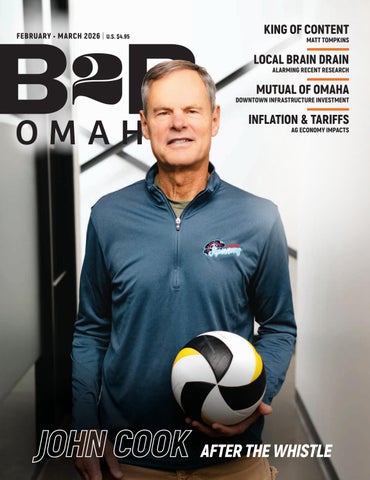
JOHN COOK AFTER THE WHISTLE
Where
Excellence i s A l way s o n t h e M e n u
Reserve your table today for an unforgettable dining experience.
02 | B2B MAGAZINE
·
2026
Fall in Love With Your Business Again Because growth without clarity isn’t sustainable. You did not build your business to feel overwhelmed by it.
VOLUME 26
ISSUE 1
B2B Omaha is dedicated to empowering local CEOs and business leaders by delivering authoritative insights into emerging trends, visionary leadership, and economic indicators shaping our region. We strive to be the go-to resource for professionals seeking data-driven reporting on Omaha’s GDP, in-depth analysis of evolving market dynamics, and stories of the trailblazers who are setting the pace for growth and innovation in our community.
EXECUTIVE associate publisher Bill Sitzmann
SALES business development executive Carole Sprunk
EDITORIAL executive editor Doug Meigs
executive vice president of sales and marketing Gil Cohen
associate editor Natalie Veloso
When strategy loses clarity, execution slows, and leadership alignment begins to strain, growth becomes heavier than it should be.
assignment editor Isaac Nielsen
That is often the moment leaders realize the business has outgrown its current way of operating.
contributors Tamsen Butler Alec Gorynski Dwain Hebda Brandi Long-Frank Lisa Lukecart Jim Vokal Andy Williams Rachel Yamamoto
We can help with that.
·
editorial intern Naomi Heu guest editor Jim Vokal
CREATIVE creative director Rachel Birdsall senior graphic designer Renee Ludwick graphic designer II Nickie Robinson graphic designer I Joey Winton chief photographer Sarah Lemke photographers Katie Anderson Roger Humphries
branding specialists Francine Flegg Sandy Matson contributing branding specialists Greg Bruns Tim McCormack senior sales coordinator Alicia Hollins sales coordinator Jessica Linhart Sandi McCormack digital advertising sales specialist Travis Fisher OPERATIONS business manager Kyle Fisher ad traffic manager David Trouba
TABLE OF CONTENTS JUST THE FACTS
16 ECONOMIC TRENDS
A CHANCE FOR OMAHA TO RISE
40 EVENTS & ENGAGEMENT NETWORKING CALENDAR
COLUMNS
04 FROM THE GUEST EDITOR
NEBRASKA’S DAILY REFERENDUM
14 MARKETING & GROWTH STRATEGIES
HELPING BUSINESSES NAVIGATE WHAT’S NEXT
digital manager Luis De La Toba
36 HUMAN RESOURCES
distribution manager Carson Kruse
DEPARTMENTS
publisher Todd Lemke
10 COACHING CORNER
WORK PERMITS IN LIMBO
AFTER THE WHISTLE
18 VOICES OF INDUSTRY DESTINATION: OMAHA
32 ENTREPRENEURIAL JOURNEYS
WHERE ENTREPRENEURS FIND THEIR NEXT FLOOR
INFORMATION advertising information 402.884.2000
5LPerformanceGroup.com
SPECIAL SECTIONS
41 SPONSORED PROFILE
subscribe online omahamagazine.com/ pages/subscribe B2B Omaha Magazine is published six times annually by Omaha Magazine, LTD, P.O. Box 461208, Omaha NE 68046-1208. Telephone: 402.884.2000; fax 402.884.2001. Subscription rates: $12.95 for 6 issues (one year), $19.95 for 12 issues (two years). Multiple subscriptions at different rates are available. No whole or part of the contents herein may be reproduced without prior written permission of B2B Omaha Magazine, excepting individually copyrighted articles and photographs. Unsolicited manuscripts are accepted, however no responsibility will be assumed for such solicitations.
OMAHAMAGAZINE.COM
03
FEBRUARY/MARCH
TABLE OF CONTENTS MAIN FEATURE
26
‘NOT EVEN ON THE FIELD’ INSIDE THE ECONOMIC FINDINGS ALARMING NEBRASKA BUSINESS LEADERS
FEATURES
FEBRUARY • MARCH 2026 | U.S. $4.95
KING OF CONTENT
MATT TOMPKINS
LOCAL BRAIN DRAIN ALARMING RECENT RESEARCH
MUTUAL OF OMAHA
DOWNTOWN INFRASTRUCTURE INVESTMENT
INFLATION & TARIFFS AG ECONOMY IMPACTS
06
REACHING FOR THE STARS
MUTUAL OF OMAHA’S DOWNTOWN INVESTMENT SIGNALS A NEW CHAPTER FOR OMAHA
JOHN COOK AFTER THE WHISTLE
ABOUT THE COVER
After 25 years on the Nebraska sideline, John Cook is still shaping the future of volleyball—this time from the front office. Full story on page 10. Cover Photography: Bill Sitzmann Cover Design: Nickie Robinson
22
FROM RURAL TO URBAN AND BACK AGAIN MARK MCHARGUE ON INFLATION & TARIFFS
B2B MAGAZINE • 2026
VOL 26 • ISSUE 1
NEBRASKA’S DAILY REFERENDUM
MIGRATION, TAXES, AND THE FIGHT FOR COMPETITIVENESS
E
lections happen every other November, but the way Americans relocate tells its own story every single day. People make choices about where to live, work, and raise their families, and those choices amount to an ongoing referendum on state policy and competitiveness. The pandemic accelerated this trend. As remote work became widely available, many Americans realized they were no longer tied to a particular city or office. With that freedom, factors like affordability, quality of life, and overall tax climate suddenly carried far more weight. At the same time, the 2017 Tax Cuts and Jobs Act dramatically reduced the federal deduction for state and local taxes paid. Thus, when pandemic migration began, state and local taxes mattered more than ever before. The first year of pandemic migration showed Nebraska losing a record $500 million of annual income. New Internal Revenue Service data shows that the migration moves continued into 2022, with Nebraska losing another $300 million of annual income. IRS data is considered the most reliable measure available for migration data because it tracks where taxpayers actually file from year to year. For example, if a taxpayer filed from Indiana in 2021 and then from Nebraska in 2022, that taxpayer contributes to Nebraska’s “win” column of taxpayers, dependents, and income that moved into the Cornhusker State. The most recent IRS data covers moves undertaken a year before Nebraska’s 2023 legislative session. Since then, Nebraska has charted significant changes in its competitive trajectory. In 2023, Nebraska’s top income tax rate was 6.64%. Later that year, Nebraska enacted LB 754 to accelerate previous rate cuts and overhaul the state’s income tax structure. Cuts are underway, with the top rate scheduled to fall from 5.2% to 4.55% on Jan. 1, 2026, and eventually to 3.99% for its final move in 2027. Nebraska’s corporate tax is following the same trajectory. Like the individual income tax, the top corporate rate scheduled to hit 4.55% upon the turn of the new year, and then 3.99% at the beginning of 2027, bringing both rates into much more competitive territory.
04
FROM THE GUEST EDITOR Jim Vokal is Platte Institute’s CEO. He can be reached for story suggestions and pitches at jvokal@platteinstitute.org. Or email editor@omahapublications.com.
The legislative session is now in full swing and Nebraska’s income tax reforms must continue to be a priority, and all rate cuts should be executed as planned in LB 754. In addition, Nebraska lawmakers must tackle the nation’s fourth-highest property tax burden with a suite of reforms to cut rates and tame the property tax base by eliminating Nebraska’s highlyuncompetitive inheritance tax and tangible personal property tax. All told, Nebraska has one of the least competitive property tax regimes in the entire country. And while a suite of tax modernization reforms is necessary to address migration and job growth concerns, targeted incentives addressing childcare and affordable housing are all parts of the picture to grow Omaha and the entire state. The Aksarben Foundation released a report prepared by Development Counsellors International, a national expert in economic development marketing and strategy. The data shows that the competition for people and jobs across the U.S. has resulted in Nebraska losing people and jobs to other states, slowing the growth of employment and wages. Omaha’s economy has slowed to the point where it significantly lags behind its peers in terms of employment and wage growth. The data for the Lincoln market had very similar indicators to those of Omaha. Nebraska’s economy has slowed because of the lack of performance of Omaha’s and Lincoln’s economies. These two cities account for over 60% of the state’s tax revenue from income and sales taxes. This report validates the need for a comprehensive approach. Nebraska is months away from its next election, but every day is an election day in the competition between states. It’s worth remembering that policy choices are tested and weighed long before ballots are cast. The Cornhusker State must stay focused and continue to blaze a trail to greater competitiveness to attract the talent, families, and capital that will continue to build The Good Life in Nebraska.
Digital Marketing is Complicated.
We Fix That. Backed by Omaha Magazine, FASTER is the digital marketing studio built to help businesses launch, grow, and stand out.
SERVICES Digital Studio Websites & SEO listings that drive sales
Video Studio Visuals that captivate and convert to leads
Publishing Studio See how your brand stacks up—free audit
Content that builds credibility and influence
hello@faster-studios.com 402.884.2030 | faster-studios.com
B2B MAGAZINE • 2026
VOL 26 • ISSUE 1
FEATURE STORY: BRANDI LONG-FRANK PHOTO: BILL SITZMANN DESIGN: NICKIE ROBINSON
REACHING FOR THE STARS
MUTUAL OF OMAHA’S DOWNTOWN INVESTMENT SIGNALS A NEW CHAPTER FOR OMAHA
06
OMAHAMAGAZINE.COM
FEBRUARY/MARCH For Steve Jensen, economic development director with the City of Omaha, Mutual’s choice to move downtown carries symbolic and practical weight. “The key thing for the urban core is that Mutual has chosen to stay there,” Jensen said. “They’ve been in Midtown, but by relocating slightly east, they’re keeping their headquarters—and their employees—in the urban core.” The downtown tower, he noted, has the capacity to house thousands of workers and anchors those jobs in a walkable, transit-connected district. While the exact number of employees relocating on day one remains to be seen, Jensen emphasized the broader message. “By building this tower, they’re making a very clear statement that Omaha’s urban core is a great place to be, and they’re making a longterm commitment to it,” he said. That commitment aligns with the city’s longrange vision to grow both jobs and population downtown, an approach increasingly favored by cities competing for talent, innovation, and economic resilience. From a fiscal standpoint, the scale of Mutual’s downtown investment is significant. Jensen pointed to the property tax impact alone as a meaningful benefit for the city, particularly as the surrounding district continues to attract new development. But the tower’s influence does not stop at its footprint. Mutual also owns the block immediately east of the headquarters site.
W
hen Mutual of Omaha announced plans to relocate its headquarters from Midtown to a new downtown tower, the move signaled more than a change of address. It marked one of the most consequential corporate investments in Omaha’s recent history, one with ripple effects across job growth, urban density, transportation strategy, and neighborhood redevelopment. The new headquarters, rising above the city’s traditional central business district, represents a roughly $600 million investment and will eventually accommodate up to 4,000 employees. City leaders and developers alike say the decision reinforces the value of staying in the urban core while unlocking long-term redevelopment opportunities.
“They don’t yet know exactly what they’ll build there,” Jensen said, “but they want something that complements the headquarters and creates a strong terminus to the Gene Leahy Mall improvements.” “By consolidating downtown, it frees up their existing Midtown campus for redevelopment,” Jensen continued. “Jason Lanoha will take over that property once the move is complete, and the revitalization of Midtown will ultimately be a larger development opportunity than the tower itself.”
CONT. PAGE 08
07 BY BUILDING THIS TOWER, THEY’RE MAKING A VERY CLEAR STATEMENT THAT OMAHA’S URBAN CORE IS A GREAT PLACE TO BE, AND THEY’RE MAKING A LONG-TERM COMMITMENT TO IT. —STEVE JENSEN
B2B MAGAZINE • 2026
VOL 26 • ISSUE 1
FROM PAGE 07 The result, he said, is a dual economic boost: a major investment downtown paired with a future redevelopment catalyst in Midtown.
Trust Influence
TRUST Change Management INFLUENCE Are these important skills to develop in your managers? CHANGE MANAGEMENT These are just 3 of the 24 topics we cover. Our award-winning interactive leadership program changes behavior and produces measurable results.
Are these important skills to develop in your managers?
If you don’t continue to develop your current leaders, you’ll be training new ones instead.
Call 402.399.9239 to see if we might be a right fit for you. We can also set up a complimentary session to see if we’re the right fit for your people.
These are just 3 of the 24 topics we cover. Our award-winning interactive leadership program changes behavior and produces measurable results.
-------Add QR code from last year’s ad------
If you don’t continue to develop your current leaders, you’ll be training new ones instead. Call 402.399.9239 to see if we might be a right fit for you. We can also set up a complimentary session to see if we’re the right fit for your people.
One of the most debated aspects of the downtown project has been parking—specifically, how a building designed for thousands of employees can function with fewer parking stalls than traditional office developments. According to Jensen, the answer lies in the city’s evolving transportation strategy and the role of the streetcar. “One thing people often misunderstand about the streetcar is that its primary purpose is to drive economic development. The Mutual tower is a perfect example,” he said. Roughly a decade ago, city analysis revealed that nearly half of the urban core was devoted to parking, with about half of those spaces sitting empty at any given time. Projections showed that adding 30,000 jobs and 30,000 residents downtown, an attainable goal, would require tens of thousands of new parking stalls if the city followed conventional development patterns. “Building that much new parking would cost close to $2 billion, require a taxpayer subsidy, and consume about 40 square blocks of land,” Jensen said. “That’s land we could otherwise use for $2 billion worth of taxable development.” Mutual’s downtown tower, which includes approximately 2,200 parking stalls for up to 4,000 employees, reflects a shift away from that model. With the streetcar connecting existing garages along its route, including parking Mutual already owns in Midtown, employees can rely on shared infrastructure rather than new construction. “It’s a perfect demonstration of how shared parking reduces the need to build more and allows more land to be used for high-value development,” Jensen said. Beyond efficiency, city leaders say shared parking and mixed-use development play a critical role in creating a more vibrant downtown environment.
“When you walk past block after block of parking lots, there’s no activity—it’s lifeless,” Jensen said. “But when you have offices, retail, and residential spaces clustered together, you create vibrancy.” That dynamic is already taking shape across from the Mutual tower, where NuStyle Development has purchased the former Central Park Plaza twin towers and is converting them into 707 apartments. “That combination of office workers and residents means parking gets used during the day by employees and at night by residents,” Jensen said. “It’s the same parking being used twice, which reduces the need for new garages and brings more people—and more life—to the urban core.” Jason Lanoha, who is leading development of both the new downtown headquarters and Mutual’s former Midtown site, views the projects as interconnected pieces of Omaha’s next phase of urban growth. “Both projects are important steps forward for Omaha and its urban growth,” said Lanoha. “We take great pride in our responsibility for developing projects that move our city forward and create value, not only for project stakeholders but also for the city as a whole.” “We envision both of these projects as catalysts for growth and vitality in their respective neighborhoods,” he continued, “contributing to the overall goal of positioning Omaha as one of America’s great cities in which to work, live, and play.” From a design standpoint, the downtown tower is intended to be both functional and high-reaching. “The first and most important consideration is creating a new home for Mutual of Omaha that addresses how they want to work now and in the future,” Lanoha said. “Beyond that, we believe it is important to demonstrate best practices and create something aspirational.” That philosophy, he said, reflects a belief that major projects should raise the bar for an entire city. “Taking the approach that a rising tide lifts all boats, it is important that this project delivers best-in-class approaches in all aspects of the design to point the way forward and serve as a beacon of progress and vitality,” he said.
Thanks Omaha for over 40 Years!
WE ENVISION BOTH OF THESE PROJECTS AS CATALYSTS FOR GROWTH AND VITALITY IN THEIR RESPECTIVE NEIGHBORHOODS, CONTRIBUTING TO THE OVERALL GOAL OF POSITIONING OMAHA AS ONE OF AMERICA’S GREAT CITIES IN WHICH TO WORK, LIVE, AND PLAY. —JASON LANOHA
Both Jensen and Lanoha emphasized that the scale and complexity of the projects require close collaboration among public and private partners. “To be clear, neither of these projects would be happening without the commitment, collaboration, and investment of Mutual of Omaha in its hometown,” Lanoha said.
®
402.399.9233 | WWW.SPARKLINGKLEAN.COM
Automate Automatethe the grind grindand andget get your yournights nights back. back.
Systems Systems| Automation | Automation| Spreadsheets | Spreadsheets
(402) (402)303-07052 303-07052| hello@prosperspark.com | hello@prosperspark.com
New New monthly monthly automation automation plans plansmake makeititeasier easier on onyou youand andyour yourbudget. budget.
He credited the alignment among Mutual, the city, and other stakeholders for creating momentum that extends beyond any single development. “Complex projects like Mutual of Omaha’s new home downtown, their old home in Midtown, and the streetcar require dedication and alignment among all stakeholders to ensure that the results match or surpass the project’s potential,” he said. For Omaha’s business community, the message is clear: The future is being built downtown, and its impact will be felt citywide. B2B OMAHA
JANUARY/FEBRUARY 2025
A LWA Y S L O C A L , A LWA Y S B E AU T I F U L
Empty Nesters’ New Hideaway
OmahaHome
INCLUDED WITH EVERY
Omaha Magazine
ALL THAT JA Z Z
//
THE MYSTERY HOUSE
//
THE HAEDER HOME IN BELLEVUE
SUBSCRIPTION!
O m a h a M a g a z i n e.co m/Pa g es/Su bsc r i b e
10
JOHN COOK
B2B MAGAZINE • 2026
VOL 26 • ISSUE 1
OMAHAMAGAZINE.COM
FEBRUARY/MARCH
AFTER THE WHISTLE
JOHN COOK’S TRANSITION TO THE FRONT OFFICE
F
or Nebraska volleyball fans, John Cook’s retirement seemed like the end of an era. But for Cook, it was only the beginning.
By the time he stepped away from Nebraska volleyball after the 2024 season, the legendary head coach had spent 25 years building one of the most stable and visible programs in all of college sports. Four national championships and 15 conference titles later, he finally made the difficult decision to step away. What mattered most to him at the end wasn’t squeezing out one more season, but making sure the program would stay intact after he left. “Pretty much all my family was in Wyoming, so I’ve been doing the long-distance thing for a few years, with grandkids,” Cook said. He had already begun thinking about transition before the outside world caught on. Dani Busboom Kelly was not a sudden choice. She had been part of the program for years, first as a player, then as an assistant, and she understood how Nebraska volleyball worked. “We knew Dani would be the next coach,” Cook said. “We wanted to make sure that Nebraska volleyball would have a great shot to be at the same level and not have a drop-off.” Cook was blunt about why the timing mattered, a delicate balance that Huskers fans know all too well. “We wanted to make sure we didn’t repeat the errors of Nebraska football, making coaching changes and having a rough ride,” he said. “I wanted to make sure Dani had the best chance to get off to a great start.” After taking over, she was named Big Ten Coach of the Year in 2025. Not long after retiring, Cook got a call from Diane Mendenhall. Their professional relationship goes back to 2000, when Cook hired her as Nebraska volleyball’s director of operations, a role that barely existed at the time. Mendenhall eventually worked her way up within the athletic department before
leaving in 2023 to become president of the Omaha Supernovas during the inaugural season of the Pro Volleyball Federation. Mendenhall first asked Cook if he wanted to coach the Supernovas. He passed. Then she came back with a different idea: serving as the team’s first general manager, working closely with her to help run the team. Cook found himself curious. “At Nebraska, we put volleyball on the map,” he said. “We hold all the attendance records, home and away, put 92,000 in the stadium, and I thought, ‘What can we do to help pro volleyball start chasing those things?’” As GM, Cook’s days are quieter. He oversees the coaching staff and performance team and helps shape the roster, but he is no longer consumed by match prep. “The biggest difference is that I’m not there every day, worrying about coaching and preparing for matches,” he said. “I’m still involved; I’m still building and trying to make it elite in any way we can.” Letting go was not automatic. “Trying to be totally in control of everything,” Cook said when asked what he had to leave behind. He has strong opinions about how the league could improve and has shared them, but he also understands the league is young. “I have to also realize this league is in a developmental stage.” That awareness shapes how he works with Supernovas head coach Luka Slabe without being overbearing. “How can I be a servant leader?” he said. “What can I do to allow him to be the best he can be?” The approach is familiar to anyone who worked under Cook at Nebraska. “Essentially what I did at Nebraska was be a servant leader to our players and our staff, so there’s really no difference there.”
CONT. PAGE 12
11 COACHING CORNER STORY: ISAAC NIELSEN PHOTO: BILL SITZMANN DESIGN: NICKIE ROBINSON
12 | B2B MAGAZINE
·
2026
EVERYTHING YOU NEED
FROM PAGE 11 Culture remains non-negotiable, even without being too involved in the dayto-day. Cook is clear about why the Supernovas have found early success.
WeDo
“The Supernovas have been successful not because they’ve had the most talent or the best players, but because they’ve had a great culture,” he said. When evaluating players, Cook relies less on metrics and more on experience. “When you do something for as long as I’ve done it, you develop an eye for what works,” he said. “It’s just gut instinct.”
REQUEST A QUOTE
WHEN YOU DO SOMETHING FOR AS LONG AS I’VE DONE IT, YOU DEVELOP AN EYE FOR WHAT WORKS. IT’S JUST GUT INSTINCT.
From projects large and small, simple to complex, we take you from idea to final execution.
Thank You
for Voting Us #1 for 14 Years! 2025 Winner
Commercial Insurance . Employee Benefits Personal Insurance . Surety Bonds Crop Insurance . Farm Insurance
402.861.7000 | fnicgroup.com
2025 Results
Serving the Great Customers of Omaha for 80 Years! Nefftowing.com 402.733.5500 4315 South 50th Street
—JOHN COOK
FEBRUARY/MARCH | 13
2025 Winner
Cook thinks about the business side the same way. When asked what sponsors should understand, his answer was practical. “The most valuable thing is if there’s some type of connection,” he said. “For example, a lot of moms and daughters go to Supernovas games. So if I’m a sponsor, what decisions do moms make? It’s about understanding what the crowd is.” There are things he misses about his role at Nebraska, like training every day and figuring out how to get better, he said. But there are things he does not. “Dealing with agents,” he said. “Everybody’s getting agents, even at the college level. In the old days, if you got a scholarship, that was a huge deal. Kids would cry; the moms would cry when you offered them a scholarship.”
When it comes time to begin cleaning your facility you can rest assured knowing our highly trained franchise owners are performing the absolute best cleaning services. Let the professionals handle it. Put your trust in the reliable team at Jani‑King of Omaha for the assurance your facility is safe, clean, and disinfected.
Call our local Jani-King office today and discover how our efforts help your business each and every day.
402 . 932 .0514 | JAN I KI N G .CO M 5885 S. 118 CIRCLE OMAHA , NE
expertly planned. EXCEPTIONALLY EXECUTED. www.planitincevents.com
What stays with him most is watching former players move into leadership. “One of the proudest things for me as a coach is seeing Dani as the head coach,” he said. Kelly Hunter is now an assistant. Lindsay Peterson runs operations. Former Huskers are coaching across the country. Cook is not trying to recreate what he did at Nebraska. He’s just applying the same habits in a new setting. The intent has not changed—Cook is still building something he expects to outlast him. B2B OMAHA
CLEAN RESULTS.
a global powerhouse in meetings and events
MUSIC THAT MUSIC THAT MAKES MA ES OU YOU FEEL GOOD FEEL GOOD
DAVE
DAVE WINGERT WINGERT 5-10am 5-10am
CHUCK CHUCK YATES YATES 10-3pm 10-3pm
JACK JACK SWANDA SWANDA 3-6pm 3-6pm
NEIL NEIL NELKIN NELKIN 6-10pm 6-10pm
LIVE & LOCAL
2025 Winner
myboomerradio.com 94.5FM 97.3FM 104.1FM 97.7HD3 1490AM
LINCOLN
106.7FM
B2B MAGAZINE • 2026
VOL 26 • ISSUE 1
HELPING BUSINESSES NAVIGATE WHAT’S NEXT
THE CHAMBER’S GROWTH CONSULTATION
S
14
pending time talking to business owners in Greater Omaha, you hear a familiar mix of optimism and realism. Companies here are ambitious and constantly juggling the day-to-day while also trying to plan for what comes next. Whether a business is trying to grow, adapt, or work through a challenge, one thing always holds true: our region’s economic strength depends on the strength of our local businesses. Growth does not arrive from outside forces alone. It starts from within, when businesses that are already rooted here have the tools and support to move forward.
That belief is what guides the Greater Omaha Chamber’s Growth Consultation. It is a simple, practical conversation designed to help businesses navigate whatever they are facing: opportunities they want to pursue, challenges that have held them back, or questions that do not have clear answers. This is not a formal consulting engagement or a corporate-style analysis. It is a chance for a business to sit down with someone who understands the local landscape and can help make sense of what is going on.
OMAHAMAGAZINE.COM
FEBRUARY/MARCH One of the most helpful things we can do is connect businesses to the right support. That might mean introducing a company to a workforce program, a training partner, or even guidance on navigating incentives or development questions. When a need calls for more specialized help, our growth consultants make referrals to trusted partners across the region, organizations that can assist with financing, exporting, technical assistance, innovation, and more. And along the way, when data or insight would help inform a decision, we can provide research on workforce trends, demographic shifts, market conditions, or competitive landscapes to give leaders some additional clarity. The reason this work matters is simple. Omaha’s long-term economic health depends on the businesses that are already here. While attracting new companies is important, most job creation and investment comes from within. Local businesses fuel our economy, support our workforce, and shape the character of our communities. When they grow, even modestly, the region becomes more resilient. When they face barriers, the effects ripple outward. The Growth Consultation exists to support these businesses so they can adapt, thrive, and continue contributing to the strength of Greater Omaha.
Many people assume the Growth Consultation is only for companies planning expansions, but it is also incredibly useful for those dealing with obstacles. Our two experienced growth consultants meet with organizations of all sizes, in all industries, and they know the mix of pressures and opportunities that define doing business in Greater Omaha today. They work with companies that are trying to overcome workforce shortages, supply chain delays, space constraints, regulatory questions, or just uncertainty about the next step. Because they spend so much time with businesses across the region, they have a broad understanding of what is changing, what is possible, and what resources exist that many companies do not even know to consider. A Growth Consultation gives business owners a chance to step back and get clarity about what they are experiencing. Often the most valuable part of the discussion is simply identifying the core issue and naming the goal. From there, the Chamber team helps outline realistic next steps. The conversation is tailored to each business, because no two companies have the same challenges, opportunities, or timelines. The goal is to help leaders make decisions that feel achievable and grounded in the realities of their operations.
For us, it comes down to this: strengthening local businesses strengthens the entire region. Growth here is homegrown, and our role at the Chamber is to help nurture it in practical, meaningful ways. If your business is planning for its next chapter, working through a challenge, or simply needs a sounding board, I encourage you to connect with our growth consultants and start the conversation. When local businesses move forward, Greater Omaha moves forward with them. B2B OMAHA Alec Gorynski is the senior vice president of economic development for the Greater Omaha Chamber. Visit omahachamber.org/economic-development/ grow-your-business for more information.
15 MARKETING & GROWTH STRATEGIES COLUMN: ALEC GORYNSKI PHOTO: SARAH LEMKE DESIGN: NICKIE ROBINSON
B2B MAGAZINE • 2026
ECONOMIC TRENDS STORY: NAOMI HEU DESIGN & ILLUSTRATION: NICKIE ROBINSON
VOL 26 • ISSUE 1
A CHANCE FOR OMAHA TO RISE
WHAT THE 2025 BAROMETER REPORT SIGNALS FOR THE CITY’S COMPETITIVE POSITION
T
he Barometer Report is an economic scorecard released by the Greater Omaha Chamber each year that compares Omaha to other peer metros on 50 data points across nine broad indexes. It looks at areas like human capital, infrastructure, and quality of life. It allows the Chamber to look at the economic development for Omaha using real and accurate data. “This isn’t just a report that we do, it’s a report that advises our work,” said Aron Wehr, vice president of marketing & communications of the Greater Omaha Chamber.
Other areas where Omaha can improve is through adding jobs to the market and raising private sector wages at an acceptable pace, Wehr said. To combat this, the Chamber has set in motion a threepronged strategy to tackle these concerns. This past year has been about setting the foundation for this strategy to kick off from a solid and secure base.
The latest report included 23 total metros—double the amount from 2024—to provide a wider snapshot of how Omaha is doing in comparison to peer cities.
One specific strategy the Chamber has been focusing on is getting a “brain gain.” Through their “Back to Omaha” campaign, they have targeted individuals who are from Omaha but have since moved away. Using a nostalgia strategy, they are focusing on the idea of family and Omaha roots.
The 2025 Barometer Report ranked Omaha at 18th out of 23 metros with a score of 96. This is consistent with its scores for the past four years, ranging in the mid-90s.
“It’s to show [those individuals] that Omaha really can be your future,” Wehr said. “Come back to Omaha where you can start to lay your roots and thrive.”
The report lays out exactly where Omaha excels and where it may have shortcomings. While the city continues to excel in culture and affordability, the data also exposes a looming challenge: attracting and keeping the people who can shape its future.
This campaign has been in motion since last September, after an intense process of identifying what areas to target and what specific messaging they were going for. However, the Chamber is excited to see where the next few years take them after this year of building such a strong foundation.
Omaha places eighth overall for quality of life. It scores exceptionally high—in the top three—for commute time, violent crime rate, and arts and culture. It has proudly maintained this eighth-place ranking from last year’s Barometer Report. Other areas of growth are in entrepreneurship, innovation, and business costs, where Omaha was able to climb to a higher rank position from last year.
With the Barometer Report, the goal is to continue improving. It is a tool the Chamber will continue to utilize in order to evaluate what areas they are excelling in and what areas might need more attention, Wehr said. B2B OMAHA Visit omahachamber.org for more information.
However, there are many areas where it does not show up as well as its peer cities.
16
The most critical issue is that workforce growth is too slow, and the region is failing to retain enough talent, especially collegeeducated young adults. “Brain drain” is a major concern, as a majority of bright young minds are moving out of Omaha and very few are moving in.
OMAHAMAGAZINE.COM
FEBRUARY/MARCH
2025 RESULTS The 2025 Barometer compares the economic performance and characteristics of Greater Omaha with 22 other metros to reveal strengths and opportunities for growth. Throughout this report, rankings are shown relative to the 23 cities included in the study. Greater Omaha continues to perform competitively when compared with these high-performing metros in the areas of quality of life, entrepreneurship, and innovation. Our forward progress, while ongoing, continues to be outpaced when measured relative to the majority of the Barometer’s comparison cities.
2025 OMAHA INDEX RANKS #13 GROWTH
133 Denver
#13 INCLUSIVITY #20 HUMAN CAPITAL #11 INNOVATION 125
#11 ENTREPRENEURSHIP #13 INFRASTRUCTURE
Nashville
123 Austin 122 Salt Lake City
#15 BUSINESS COST #8 QUALITY OF LIFE #14 PRIVATE CAPITAL Rankings rose in three indexes: Entrepreneurship: Improved from 14th to 11th • Innovation: Improved from 12th to 11th Business Costs: Improved from 17th to 15th Fell behind slightly in Human Capital, Inclusivity, and Private Capital Sustains rankings on all other indexes: Growth, Quality of Life, and Infrastructure
Maintains overall rank of 18th with a score of 96 Omaha is slightly below the U.S. average 4% below the U.S. for the overall index Ranks ahead of four mid-size metro areas in the Plains and Industrial Midwest regions: Des Moines, Buffalo, Milwaukee, and Grand Rapids Metro areas in the Mountain West, Texas and Mid-South have the highest rankings: Denver, Nashville, Salt Lake City, Austin, and Raleigh
114
Raleigh
112
Madison
109 San Antonio
105 Indianapolis 104 Oklahoma City, Boise, and Minneapolis
#18
OUT OF THE 23 METROS INCLUDED
101 Fayetteville 100 US AVERAGE, Pittsburgh and Kansas City 98 Cincinnati, Tulsa, and Columbus 96 95
GREATER OMAHA Greenville
92
Grand Rapids
88
Milwaukee
86 85
Buffalo Des Moines
17
B2B MAGAZINE • 2026
VOL 26 • ISSUE 1
DESTINATION: OMAHA
VOICES OF INDUSTRY STORY: DWAIN HEBDA DESIGN & ILLUSTRATION: NICKIE ROBINSON
LOCAL FIRMS SAY EXECUTIVE TALENT IS FINDING A LOT TO LIKE ABOUT OMAHA
O
maha has often been called a “best-kept secret,” to the consternation of organizations and firms trying to promote the city to a wider audience. According to executive recruiters, however, that scenario is rapidly changing, as Omaha’s profile for C-suite personnel is higher than ever. “Ten to 15 years ago, the most common reaction was curiosity mixed with skepticism. Many candidates knew very little about Omaha beyond stereotypes,” said Andy Hawkins, founder and CEO of Concentric Corporation. “Today the response is almost entirely different. More executives have Omaha on their radar before we ever call. “Thanks to national rankings and visibility around quality of life, strong companies headquartered here, and broader Midwest migration trends, the reaction has shifted to ‘I’ve heard good things, tell me more.’” This new attention from corner office candidates mirrors trends in population shift that are bringing more people to the nation’s midsection. Lower housing costs and quality of life are main drivers, Business Insider noted, but even climate change is a contributing factor. Warmer average temps are producing lessfrigid Midwestern winters while making life more uncomfortable in places like Texas and Florida. CSG Midwest with the Council of State Governments reported in April the 11-state Midwest bloc enjoyed brisk growth between 2020 and 2024, with only Illinois reporting a net loss in headcount. At 2.14% population growth, Nebraska ranked behind only the Dakotas over that time span. Local recruitment firms are capitalizing on this trend, noting Omaha has no shortage of amenities with which to lure executive talent.
18
CONT. PAGE 20
OMAHAMAGAZINE.COM
FEBRUARY/MARCH
19
B2B MAGAZINE • 2026
VOL 26 • ISSUE 1
FROM PAGE 18 “It is easy relocating individuals from large cities where the cost of housing is high, commute times are long, crime is high, K-12 education is poor, and the cost of private education is expensive,” said Dan Hemphill, president of Hemphill Search Group and Hemphill Staffing Solutions. “It is fun sharing how the quality of their life and their financial health improves nicely by moving to Omaha. If the person we are relocating grew up in a mid-sized community of less than one million, Omaha becomes very attractive because it will likely be similar or better.”
IT ABSOLUTELY MAKES A DIFFERENCE TO GET PEOPLE HERE AS FAST AS YOU CAN DURING THE INTERVIEW PROCESS. —SHAWN DAVIS
The city has not completely shed its blip-in-flyover-country image everywhere in the nation, but as Shawn Davis, president and managing partner of Brown Davis Executive Search, said, the city is doing a good job of impressing potential residents, giving recruiters a bigger foot in the door. “It always depends on where they’re from and if they’ve been here before,” he said. “If we’re talking to someone in California or New York [who’s] never been here before, they still think of us as a smalltown farming community. If they’ve been here before, maybe for a conference or the Berkshire Hathaway annual meeting or the College World Series, I’ve never heard anyone say they had a bad experience. “Obviously, other factors have to line up with their personal situation and family and all those things, but if they’ve been here before and it’s always been positive, that helps drive the conversation. [Omaha] becomes something they’re very receptive to.” Davis said given that, it is crucial for companies looking to recruit non-natives to get them on the ground in Omaha as early in the process as possible. “It absolutely makes a difference to get people here as fast as you can during the interview process,” he said. “We have some clients that pay a realtor a fee and they find out the candidate’s lifestyle, their interests, the ages of the kids, and they spend two days showcasing how Omaha matches all that. That’s a game-changer versus just taking them through a normal process and waiting and hoping they will choose Omaha.”
20
FEBRUARY/MARCH
One notable factor among move-ins is how often salary is not the leading factor in the decision-making process. “Individuals being recruited by a highquality company into a position offering professional growth and development oftentimes includes an increase in the overall compensation package. However, increased compensation is rarely the primary motivation inspiring relocation,” Hemphill said. “We see individuals who grew up in Nebraska or the upper Midwest who moved away to college, or maybe their career relocated them away from the Midwest, who are eager to move back closer to home when they start a family.”
Flat Roof Specialists
All in all, Omaha is well-positioned to be a city of choice for executive talent, Hawkins said. “What seals the deal is the realization that executives don’t have to choose between a high-impact career and a high-quality life,” he said. “They can lead at a meaningful scale, be home for dinner, afford a great home, send their kids to strong schools, and build real relationships in the community, all at once. “What surprises them most is the sophistication behind Nebraska humility. They are often shocked by the scale of headquarters here, the quality of arts and dining, and how modern and family-centric the city feels. After one visit, it stops being a ‘Midwest relocation’ and becomes a genuinely compelling opportunity.” B2B OMAHA
2025 Winner
Show Your Community Spirit!
• New • Repairs • Reroof • Skylights Quality, Integrity and Service since 1987!
Be a part of fostering a thriving, local economy.
With thanks to our community pillars, leaders, and partners, Omaha Magazine proudly holds the tradition of sharing the city’s most fascinating and interesting local stories for 44 years.
Create a meaningful connection today! Call 402.884.2000 or Email todd@omahapublications.com to join.
Visit us online Ciaccioroofing.com or call 402.293.8707 for a FREE estimate! 4505 S 139th Street Omaha, NE 68137
B2B MAGAZINE • 2026
VOL 26 • ISSUE 1
FEATURE
22
MARK MCHARGUE
STORY: TAMSEN BUTLER PHOTO: SARAH LEMKE DESIGN: NICKIE ROBINSON
OMAHAMAGAZINE.COM
FEBRUARY/MARCH
FROM RURAL TO URBAN AND BACK AGAIN
MARK MCHARGUE ON INFLATION & TARIFFS
N
ebraska Farm Bureau President Mark McHargue has spent a good portion of the year talking about inflation and tariffs with fellow farmers and representatives alike. Between the “Liberation Day” tariff announcement in April 2025, and the longest government shutdown spanning 43 days from early October into mid-November of 2025, the conversations about the impact of inflation and tariffs on Nebraska’s ag industry have been fueled and spirited. According to McHargue, the Farm Bureau’s official policy on tariffs is that they don’t believe tariffs should be used on a regular basis. “We have communicated that directly with the president, but if he is going to use tariffs, we want them to be used strategically, for a specific purpose, accomplish that purpose, and then roll those tariffs back off,” he explained. “That’s our fundamental policy on tariffs. When we’re talking to our representatives, most of our representatives would agree, in general, that just the broad use of tariffs we wouldn’t necessarily want.” Farm Bureau members are talking about tariffs and inflation, too. “In general, the tariff conversation makes our members nervous,” McHargue admitted. “We’ve kind of been in this for a while,” he said, adding that members were more nervous back before they knew what to expect. For the most part, farmers tried to be patient with the administration, but as September and October drew closer, anxiety increased as the time to sell crops neared. When the government shut down, so did conversations with the administration. McHargue said that the sequence of events put the Nebraska Farm Bureau in “a weird spot,” but expressed optimism that conversations would recommence with the reopening of the government.
According to “The State of Nebraska’s Farm Expenses” report from September 2025, the last decade has seen significant increases in interest rates, which, in turn, increase the costs associated with running a farm. This added strain to farm budgets comes alongside volatile farmland valuations, which often result in increased tax bills, higher rental rates, and skyrocketing insurance premiums. The impact of inflation and tariffs on Nebraska farms can vary from one type of farm to another. The pressure that a soybean farmer experiences, for example, will be different from that of a cattle farmer. “I would say row crop is a very different conversation than beef,” said McHargue, who pointed out that recent talks with China may help soybean farmers, but that it’s difficult to know what will happen one week to the next with the current state of global trading. As for beef, the prices that are at an alltime high in grocery stores don’t automatically translate into increased, sustainable profit for farmers. McHargue explained that when cattle farmers sell their cows and then turn around to buy more, they’re at the mercy of high cattle prices as much as anyone else. Still, there are some cattle, poultry, or hog farmers who have managed to earn profits despite economic uncertainty. Profit isn’t the only issue inflation and tariffs have caused recently within the ag industry. McHargue revealed that when profitability is high, more young people tend to return to their family farms to make a living out of being a farmer. But when profitability is uncertain because of inflation and tariffs, young people might become more apprehensive about entering the ag industry.
CONT. PAGE 24
23
B2B MAGAZINE • 2026
VOL 26 • ISSUE 1
FROM PAGE 23 “I think it’s really simple,” McHargue said. “If you put profitability in the ag sector, the next generation will come back.” While it’s undeniable that inflation and tariffs impact farms throughout Nebraska, McHargue clarified that it’s not only the rural parts of the state feeling the impacts. According to McHargue, Douglas County has around 29,000 ag-related jobs, many of which are within the Omaha metro area. “There’s about $3.9 billion in value to the local economy relative to agriculture,” he said. “The next leading county would be Lancaster at $1 billion.” Even in urban areas, ag is big business. Cumulatively, the entire ag industry, including the big ag companies headquartered in Nebraska (such as Valmont, Scoular, CLAAS, etc.), makes up around one in four jobs throughout the state. “I think it’s really important to connect those dots to show we really are connected,” McHargue said. McHargue, whose organic and conventional corn, popcorn, and soybean farm is in rural Merrick County, added, “I couldn’t do what I do on the farm if we didn’t have these businesses in Omaha that are part of the processing, or are part of the headquarters who are selling the grain around the world, or turn my corn into ethanol and plastic products and acrylic, and converting all these things we grow from the ground into very useful products.” McHargue took on the role of Nebraska Farm Bureau president in 2020. He sees opportunities in biofuels and focuses on how Nebraska can be a part of the biofuels conversation to the benefit of Nebraska farmers. He also sees big opportunities for growth in dairy and poultry farming in Nebraska. “We have plenty of feed, access to water, and plenty of territory to leverage. That’s a real bright spot where we need to continue to have those conversations,” he said.
24
He’s passionate about succession planning for farmers and ensures that succession planning education is offered to members. He’s also an advocate for the ag industry as a profession, in all its forms.
I THINK IT’S REALLY SIMPLE. IF YOU PUT PROFITABILITY IN THE AG SECTOR, THE NEXT GENERATION WILL COME BACK. —MARK MCHARGUE
“How we connect from urban to rural and rural to urban is one of my passions,” he said. “I think a lot of people who think about agriculture think it’s just the work done on the farm.” He added that there are several educational paths that can lead to ag. “If you’re a computer engineer, we absolutely need you in agriculture. If you’re doing biology or any kind of animal science, we need you in agriculture.” He said that AI has also entered the conversation, and the ag industry “is a huge consumer” of AI. “Our industry is very tech-driven, so the more that happens, we need more people who are touching agriculture, just maybe through a keyboard.” “It’s cool that someone could be involved in this noble profession as a data scientist crunching ag data to create the next thing to allow us to produce food at a safer, more affordable price to people in the state and around the world,” McHargue said.
FEBRUARY/MARCH
Inflation isn’t always bad, nor are tariffs. Inflation can, in some cases, signal a healthy economy. And tariffs, when used strategically, can potentially boost domestic production. But the reality is that both impact agricultural and urban areas alike. In Nebraska, where agricultural and urban areas enjoy a rather symbiotic relationship, that impact is felt throughout. As McHargue pointed out, “We shouldn’t expect people who live in Omaha and haven’t been exposed to the farm to understand the farm, just like I don’t know what it’s like to grow up in the city.” Many people don’t understand the innate economic relationship between agricultural areas and urban areas. The key is to keep the conversation going.
Who We Are
Sage & Stone Strategies provides best-in-class, tailored strategic communication planning and execution. Whether internal or external, structured messaging affects a business’ bottom line. We are committed to high-quality, efficient and successful strategic planning.
• Marketing Messaging • Public Relations • Media Strategy • Internal Communication • Crisis Communication
Lisa Gibson Owner, CEO
• Change Management • Website Development • Social Media Trust in research, exceptional skill and excellent judgment.
Lisa Gibson | 701.610.1172 lisa.gibson@sageandstonestrategies.com
“I always contend that there’s a lot we can learn from each other,” McHargue said. B2B OMAHA Visit nefb.org for more information.
OMAHA’S
Favorite DRY CLEANER EST. 1917
UN I F O RM RE N T AL S E RVI CE
EST. 1974 Since 1917, five generations of the Walker family have served the retail, and then the commercial, laundry markets in Omaha and the surrounding areas. We’re Dry Cleaners, but many Omaha business owners have also depended on our Uniform Rental Service since 1974.
www.maxiwalker.com & www.maxiwalkeruniform.com
‘NOT EVEN ON THE FIELD’
B2B MAGAZINE • 2026
VOL 26 • ISSUE 1
INSIDE THE ECONOMIC FINDINGS ALARMING NEBRASKA’S BUSINESS LEADERS
STORY: ANDY WILLIAMS PHOTO: SARAH LEMKE DESIGN: NICKIE ROBINSON
MAIN FEATURE
27
O
maha business leader Dana Bradford’s analysis hits harder than a stud linebacker: Nebraska is playing by yesterday’s rules in a game that’s already moved on—and the final score is glaring.
“Back in the day, you had a four-star, five-star high school football player in Nebraska, and chances are he was going to be a Husker, right?” Bradford said, leaning into an analogy that resonates with most Nebraskans. “Today with NIL (Name, Image, and Likeness deals that compensate college athletes), there’s no telling where that kid’s going. Because it’s all about the money, right? Where can they get the best deal.” The CEO and owner of Omaha-based C3 Brands is using one of our state’s first loves to explain a disturbing long-term trend in job growth in Nebraska’s leading cities. A report from the Aksarben Foundation, prepared by economic development experts at Development Counsellors International, delivered the kind of numbers that are making civic and business leaders rub their eyes to see if they’re reading it right. Omaha and Lincoln—the twin engines that generate over 60% of Nebraska’s tax revenue— have fallen behind, with 68,000 jobs lost to peer cities in recent years. And we’re not talking about economic powerhouses like Austin or Denver. Nebraska’s two largest economy drivers are losing to Fayetteville, Arkansas. Looking up at Huntsville, Alabama. Trailing Sioux Falls, South Dakota. Those missing jobs aren’t just numbers on a spreadsheet. They represent $11 billion in wages that never materialized, and between $600 million and $800 million in tax revenue the state could desperately use right now. The report makes it clear that every job Nebraska loses today is one less job available for the next generation of Nebraskans, complete with secondary revenue growth that goes with those new jobs.
CONT. PAGE 28
OMAHAMAGAZINE.COM
FEBRUARY/MARCH
B2B MAGAZINE • 2026
VOL 26 • ISSUE 1
THIS IS A 93-COUNTY ISSUE. WE ALL HAVE TO UNITE AND COME TOGETHER AND SOLVE THIS. IT WON’T BE EASY, AND IT MAY BE PAINFUL. BUT WE HAVE TO DO IT FOR NEBRASKA. MIKE CASSLING
—MIKE CASSLING
FROM PAGE 27 “We were concerned with the results, but nobody was shocked,” said Mike Cassling, executive chairman of CQuence Health and chairman of the Aksarben Board of Governors. “We were actually a little worried that people might discount the data and say, ‘Oh, this is BS,’ or try to find the positives. But everybody—elected officials, the Omaha Chamber, the Lincoln Chamber, the State Chamber, even business leaders—have come around and said ‘This is actually accurate. We have to do something.’ ” To tap into Bradford’s NIL comparison a bit deeper, Nebraska keeps losing star recruits—its best and brightest talent—while giving up scholarship slots—attractive, high-paying jobs—to cities that are playing a different job-growth game. People are voting with their feet, and they’re leaving for states with lower taxes and better-paying opportunities.
28
And as the competition for talent has intensified nationwide, government entities on the city, county, and state levels are creating their own NIL-like playing field to create attractive new jobs. The Good Life state keeps showing up to recruiting battles with a “Nebraska Nice” handshake and a smile, while peer cities are waving checks and taking away top talent and lucrative job opportunities.
“Companies are going to go where people are doing things to pay them to go there,” Bradford explained. “So when you turn to a business owner and say, ‘Hey, would you bring your business here?’ The question quickly becomes, ‘Okay, what’s the deal? What’s the arrangement? How do I benefit from being here versus somewhere else?’ ” Consider our neighbor, Kansas, as a spotlight example. Johnson County (Kansas City, Kan.) officials just inked a deal with Fiserv—a company with a long-time major Omaha presence—to invest $150 million over the next 10 years to create a fintech hub and 2,000 jobs in the Overland Park area. Every one of those jobs pays north of $100,000, creating eye-popping local revenue and tax base over those 10 years. “If you’re sitting back in kind of a limited understanding of the field of play, it sounds like crazy math,” Bradford said. “But if you drill down and see how they’re paying and what they’re paying, it makes perfect sense. They’re getting a huge return. Other states are playing the game. They’re competing. We’re not even on the field of play as a state.”
OMAHAMAGAZINE.COM
FEBRUARY/MARCH
And here’s where Bradford’s football analogy lands like a blindside hit: “This notion that, ‘hey, this kid came from Omaha, Nebraska, he’s a five-star, he’s obligated to go to Nebraska because he grew up here’ is crazy,” Bradford continued. “That’s not going to happen.” The same goes for businesses. “These companies that have been in Nebraska for a long time—they’re going to grow here just because they’ve been here for a long time? Not true.” Cassling and other business leaders had their suspicions as the cold, hard facts were hitting close to home. So they commissioned the study that confirmed their anecdotal evidence. Cassling’s niece recently returned to Omaha to become a surgeon and professor at Creighton University Medical Center, but her multi-degreed spouse with deep expertise in his field can’t find a comparable job here. “A bunch of us in town just knew there were issues,” Cassling said. “We were seeing it with friends of our kids or their spouses. There aren’t enough jobs here. So we needed to do a deep dive into this.” For Bradford and others, that deeper exploration delivered the first important step toward turning the tide in Nebraska: awareness. The Aksarben Foundation report drew from Federal Reserve data updated monthly and readily available to anyone who wants access. Multiple sources of similar data exist that are free or cheap, yet interested parties in positions to act haven’t been tracking how Nebraska fares in this ultra-competitive environment. “There’s been a real lack of awareness that there’s even a problem,” Bradford said. “The data is always there, but until this report came out, we haven’t been looking for it. For many years, as a business community we haven’t asked, ‘Hey, how are we doing?’ We just never wanted to measure how we really stood. So now people are becoming aware of this, and now you’re starting to see an increasing interest in trying to figure out where to go. “The information has been eye-opening and reinforced how people are feeling across the state. Now the question becomes, what do we want to do about it?” More than 180 business-focused community and government leaders in Nebraska—elected officials, mayors, city councils, county commissioners, civic and business leaders—held an economic summit, “Nebraska Forward,” to broaden their awareness of the competitive landscape in late 2025. They spent the day with two consultants learning what other cities, counties, and states are doing to attract new companies and jobs, and how they’re helping existing companies keep their expansions local. Presenters included Jonathan Williams, co-author of the annual “Rich States, Poor States” economic competitive index (Nebraska ranks No. 31 in the most recent Economic Outlook Rating), and Robin Domber, SVP for research and development for the firm that developed the Aksarben Foundation report. The duo brought compelling examples from states Nebraskans could relate to—such as Arkansas, which has become an economic development gold standard—rather than from coastal or tourist-heavy states like California, Texas, Florida, and Colorado. “The group heard a united message that we must act now,” Cassling said. “Everyone is committed to keeping this moving forward to create a comprehensive plan for growing the state’s economy. But we can’t fix this in silos. “This is a 93-county issue. We all have to unite and come together and solve this. It won’t be easy, and it may be painful. But we have to do it for Nebraska.” To facilitate aggressive recruiting of new companies and job creation, business leaders agree that state officials—particularly state legislators—must lay a cornerstone foundation for economic development with modernized tax structure and strategic incentives.
CONT. PAGE 30
29 THE INFORMATION HAS BEEN EYEOPENING AND REINFORCED HOW PEOPLE ARE FEELING ACROSS THE STATE. NOW THE QUESTION BECOMES, WHAT DO WE WANT TO DO ABOUT IT? —DANA BRADFORD
B2B MAGAZINE • 2026
VOL 26 • ISSUE 1
FROM PAGE 29 Governor Jim Pillen has been pushing hard on a path forward by working to lower property and income taxes through a broader sales tax base and more efficient spending, according to Cassling. But reversing this trend requires a comprehensive solution that sparks growth in Omaha and Lincoln at rates matching their peers, with additional tax revenue driving down taxes and funding improvements that benefit all 93 counties.
While Omaha boasts exceptional quality of life, excellent schools, and diverse housing options, these advantages alone no longer close deals. “It comes back to our economic development tools, our incentive programs, our workforce development grants,” Mello added. “Are those where they need to be in terms of helping us not just become competitive, but actually win some of these projects? I would say they’re not where they need to be at this point in time.”
“I don’t think you take one little bite at the apple,” Cassling emphasized. “At the end of the day, remaking our tax structure to attract business comes down to the legislature tackling the whole issue.”
The Chamber is planning its response through the Omaha Competes initiative—a comprehensive policy framework developed over eight months with input from Chamber volunteers and experts in economic development, tax policy, and talent recruitment. Released in late December, Omaha Competes represents the Chamber’s first systematic attempt to build a five-year policy agenda addressing the region’s competitive disadvantages.
Without aggressive legislative action on tax policy and business incentives, Nebraska faces a downward spiral where budget cuts diminish services while failing to generate the growth needed to fund state operations. The urgency extends beyond economic development to fiscal survival. “The reality is, if we don’t fix this problem, the legislature has another deficit this session and will continue to have deficits,” Cassling said. “You can’t cut your way out of this problem.” On the municipal level, the Greater Omaha Chamber of Commerce is tackling the job growth challenge with datadriven urgency. The Chamber’s annual Barometer Report tracks nine indices across 50 different metric points, and the findings align troublingly with the broader DCI research. “The stark reality is that our region and the greater Omaha MSA needs to improve in population growth and in job growth and in wage growth,” explained Omaha Chamber president Heath Mello.
The initiative focuses on three critical areas: modernizing economic development incentives that attract high-quality jobs and encourage existing employers to relocate positions to Omaha, expanding strategic workforce programs like Intern Nebraska that build talent pipelines, and supporting energy infrastructure development to power technology and manufacturing companies driving modern economic growth. The Omaha Competes framework acknowledges that reversing Nebraska’s competitive decline demands more than isolated fixes—it requires reshaping the entire policy environment that businesses evaluate when making location and expansion decisions. “For the first time since I’ve been at the chamber, we’re seeing a lot of stakeholders and partners all acknowledge and want to pick up an oar to help row our boat where it needs to go,” Mello said.
OUR CITY AND OUR STATE SHOULD BE REGARDED AS ONE OF THE BEST PLACES TO DO BUSINESS AND THE INSTALLATION OF CHOICE. IF WE DO THAT, WE’LL ATTRACT THE KINDS OF PEOPLE AND JOBS WE WANT.
30
—DANA BRADFORD
OMAHAMAGAZINE.COM
The timing reflects a unique alignment of regional and local priorities. Mayor John Ewing’s administration has adopted what Mello describes as “a laser focus on wanting to ensure the city is prioritizing intentional economic development,” while the Lincoln Chamber, regional chamber partners, and the Greater Omaha Economic Development Partnership all recognize the urgency. This coordinated push marks a departure from previous siloed efforts. “It feels like the stars are aligning with various regional and statewide entities that are wanting to see more strategic economic development occur, not just in the greater Omaha region, but across Nebraska,” Mello observed. All of these efforts in pockets across the state can’t come soon enough or be aggressive or comprehensive enough for business and community leaders who want to see Nebraska get in the game and compete. “I like to tell people that in business, the portal is open 24-7-365,” Bradford said, returning to his analogy of the turnstile recruiting environment in college football. “You can call a company any time you want and offer any amount of money you want to try and get them to do what you want. That’s the environment we’re in, and our companies get calls all the time with offers to move locations and jobs. “So for us to sit back and just hope we don’t fall victim to that, chances are that won’t work out well for us. Our city and our state should be regarded as one of the best places to do business and the installation of choice. If we do that, we’ll attract the kinds of people and jobs we want.” B2B OMAHA Visit aksarben.org for more information.
Real Estate Real Expertise Real Impact Omaha’s premier choice in commercial real estate for over 40 years. lundco.com
2025 Winner Independently Owned and Operated A Member of the Cushman & Wakefield Alliance
B2B MAGAZINE • 2026
VOL 26 • ISSUE 1
ENTREPRENEURIAL
JOURNEYS
SHANNON AND EMILIANO LERDA
STORY: LISA LUKECART PHOTO: SARAH LEMKE DESIGN: NICKIE ROBINSON
32
WHERE ENTREPRENEURS FIND THEIR NEXT FLOOR ELEVATOR LIFTS BUSINESS
OMAHAMAGAZINE.COM
FEBRUARY/MARCH
33 JUST HEARING THE STORIES ABOUT HOW BEING AT ELEVATOR HAS HELPED THEIR BUSINESS OR CHANGED THEIR QUALITY OF LIFE… IT FULFILLS ME. —SHANNON LERDA
F
The facility provides flexible, short-term access to commercial offices and warehousing. Lowrey started with a single unit until her business bloomed, expanding into four more units that included product storage, a volunteer room, and an office space.
Enter Elevator.
“I didn’t know what scaling felt like, and it feels scary,” Lowrey explained. “This is a place that can help you grow without too much risk, and that is what I needed.”
ounder and executive producer Kristin Lowrey worked out of a Sunday school classroom, struggling to balance production, storage, and distribution for her thriving nonprofit, Access Period. The organization provides free menstrual products for those who cannot afford supplies, so Lowrey hoped to find a more professional and spacious environment.
CONT. PAGE 34
B2B MAGAZINE • 2026
VOL 26 • ISSUE 1
FROM PAGE 33 Luckily, Lowrey took advantage of Elevator’s on-site shipping, educational development, and community support. She soon signed on four more units, and in just two years, she “graduated” to a longer-term warehouse in Benson, partly due to Elevator’s knowledgeable team of five. As the name implies, the co-warehousing business lifts entrepreneurs to the next “floor” in their journey. The brick building in downtown Omaha provides proprietors with ample space to sell and ship products while gaining expertise along the way.
IT DOESN’T EVEN MAKE SENSE WHEN YOU ARE DOING THINGS THAT ELEVATE SMALL BUSINESSES AND COMMUNITIES, BUT WE FEEL LIKE THAT GENEROSITY-FIRST MINDSET BUILDS A BETTER COMMUNITY. —SHANNON LERDA
34
“It doesn’t even make sense when you are doing things that elevate small businesses and communities, but we feel like that generosity-first mindset builds a better community,” said Shannon Lerda, president of Elevator. Shannon recalls rooms overflowing with pet packages for her online Amazon business, LB Brands, but she couldn’t find an affordable lease or a warehouse with a loading dock. She felt increasingly isolated, frustrated, and disillusioned by the process. Surrounded by inventory, the mother of two boys realized she craved not only a warehouse, but a connection to other owners. The Iowa native decided Omaha could use a co-warehousing concept to help others in a similar bind. She floated the idea to her husband, Emiliano, who jumped on board as CEO. Emiliano brought his years of experience as the executive director of a nonprofit, the Immigrant Legal Center, and as president of a real estate investment firm, Paul G Smith Associates. “I trusted Emiliano, and you need to listen to people who know more than you. This is a good person who wouldn’t talk a new nonprofit leader into something that would cause them to fail,” Lowrey said. Lowrey also collaborated with like-minded industry leaders like Kierra Molina, the operations manager for Made in Omaha. “[Elevator] does a good job at building the community with the members here,” Molina said. She recalls loading her car with boxes for the postal services in the past, but after joining Elevator, they simplified that step by having its team members move boxes into the units, saving time and energy. “I don’t think we would be successful if we were pursuing a business that didn’t have a purpose,” said Emiliano, who graduated from Drake University Law School and received his master’s at the University of Arkansas School of Law in Fayetteville. During his freshman year as a communications major, he met Shannon at the University of Northern Iowa, where she received her B.A. in finance.
OMAHAMAGAZINE.COM
“We have different skill sets. We both complement each other, so it almost feels like yin and yang. I think we’re stronger together,” Shannon said. “We started couples therapy before we started working together. I would need somebody exactly like Shannon to be successful,” Emiliano added.
Voted Best IT Services
After opening the doors in October of 2022, the 21-yearsmarried couple thought people would come to them. The Lerdas understood the essentials of attracting businesses to fill the facility, but customer service became an important part of attracting new clients. “We’re not in the co-warehousing rental business, we’re in the hospitality business,” Shannon said. Flexibility became a critical element of the foundation in a tough market, and this adaptability continues to be a major part of their success, allowing the 65% of renters who are women and minorities to thrive. Small options start at $550 while larger warehouse pricing begins at $1,500, with no long-term contracts or credit checks. The business became a fundamental location lifeline for artisans, online retailers, and specialty shops. Made in Omaha joined after increased sales in corporate gifting, which includes local items like scented candles, pantry products, and handmade jewelry.
2025 Winner
T H A N K YO U F O R YO U R V O T E S ! Outsource Your IT. Contact us Today! 402.350.0372 | contact@ecs.rocks | www.ecs.rocks
“We enforce a positive and engaging culture not just for our team, but also in the building,” said Emiliano, originally from Argentina.
Visit elevatorspaces.com for more information.
Fr i
Local &
•
25 YEARS • Se
rv
ence xcell
“A building is just a building, but there is no word to explain how supportive they are,” Lowrey said. B2B OMAHA
to Your Inspiration to Your Inspiration
d ly
•E
As Lowrey packs up to move, she’s proud to be an Elevator alumni member.
Adding the WOW Adding the WOW
ice
“Just hearing the stories about how being at Elevator has helped their business or changed their quality of life…it fulfills me,” Shannon said.
en
Currently, of the 92 units, 90% (75 warehouse units and 17 office units) remain occupied. Plus, the two plan for growth in other states, like Iowa and Missouri, and a dream of 100 locations etched for the future.
QUALITY. VARIETY. EXPERIENCE. EXPERTISE. SERVICE. QUALITY. VARIETY. EXPERIENCE. EXPERTISE. SERVICE.
Our priority is to deliver the best and freshest Our priority to deliver the products that meet your is highest standards and grow products your business. besthelp andyou freshest that
yourTrees/Shrubs highest standard and • Evergreen • Bagged Trees B&B Trees meet • Shrub Roses • Ornamental Grasses Deciduous Shrubs help you grow your business. Perennials • Annuals • Grafted Evergreens Topsoil • Hardwood Mulch
11015 South 48th St. Papillion, NE 68133 Phone: 402.547.5001 Fax: 402.505.3421 papiovalley.com (Wholesale Accounts Only)
B&B Trees • Evergreen Trees/Shrubs • Bagged Trees Deciduous Shrubs • Shrub Roses • Ornamental Grasses Perennials • Annuals • Topsoil • Hardwood Mulch
B2B MAGAZINE • 2026
VOL 26 • ISSUE 1
HUMAN RESOURCES
RACHEL YAMAMOTO
COLUMN: RACHEL YAMAMOTO PHOTO: SARAH LEMKE DESIGN: NICKIE ROBINSON
36
WORK PERMITS IN LIMBO HOW FEDERAL POLICY CHANGES ARE DISRUPTING NEBRASKA’S WORKFORCE
OMAHAMAGAZINE.COM
S
ilvia1 was a nurse in Guatemala when her teenage daughter was killed by local gangs. Ahmad was a civil activist and a high-ranking administrator in the Department of Education in Afghanistan when the Taliban took over and targeted his family. Hamza was a well-respected journalist in Pakistan when terrorists targeted him for his reporting. Luis was a professor in Venezuela when the secret police found messages on his phone criticizing the government. Vladyslav was a pastor in Ukraine when his town was overrun by Russian forces. Each of these families fled to the United States and applied for asylum here, escaping persecution. Some of them arrived at the border and requested asylum; others were paroled in by the government to allow them to seek protection here after they arrived. They all found a life in Nebraska. Silvia worked at a plant in Iowa for three years before switching to a job at Greater Omaha, where she has worked ever since. Since 2018, she has been a reliable worker while she waited for her asylum case to wind its way through the system. Ahmad and his family began working for large companies like Fiserv and Walmart, and five years later, Ahmad is a manager. Hamza has worked steadily as a security guard for a local company for the past four years. Luis has become a graphic designer and web developer, and his wife Veronica works at a local nonprofit. Vladyslav is still a pastor and serves at a local church, while his wife and older children work in various jobs in Lincoln. Asylum seekers must apply for an Employment Authorization Document to work legally, also known as a work permit. Many asylum cases take years to resolve. Silvia’s case took nine years before it was finally approved, while she and her oldest son worked to support themselves. Ahmad’s application only took two years to be approved while he, his wife, his sister, his mother, and his children worked, went to school, and waited to learn their fate. The agency that issues work permits, U.S. Citizenship and Immigration Services, is part of the Department of Homeland Security. For decades, they issued the cards for one year at a time, and it would take about a month to process the application. A graphic designer like Luis could file the application two or three months early and feel secure knowing his new permit would come
FEBRUARY/MARCH
before the old one expired. Eventually, they extended the validity period and created an automatic extension while the renewal was pending. At the same time, processing times grew to six months, then 12. The long processing time for renewals was mitigated by the automatic extension, but was still nerve-wracking for workers and employers who had to carefully track expiration dates. In October 2025, USCIS abruptly ended automatic extensions for pending renewals of work permits, but the processing times did not change. More recently, they announced that all newly issued work permits would only be good for 18 months. The processing time is 12 months, so many workers will be constantly renewing their permits. Legal immigrants make up 7.7% of the total population of Nebraska. The meat-packing industry draws workers to our good jobs and quality of life. Corporations and universities draw highly skilled workers and scientists. Immigrants make up 9.5% of entrepreneurs in Nebraska, 12.2% of STEM workers, and 22.2% of manufacturing workers in the state, and 87.8% of refugees and asylum seekers in Nebraska are employed, paying taxes and contributing to the economy.2 Immigrants represent thousands of workers in the Nebraska economy, and the abrupt shift in policies has disrupted their lives and their employers’ practices. Hamza’s work permit expires in February, so he felt safe waiting until December to file his renewal. The automatic extension would have provided him with plenty of time to wait for the renewal. However, due to the sudden changes, his renewed work permit will not be granted by February, and he has no extension available. These policies are hurting businesses and workers. Employers lose reliable, valuable employees who have done everything they can to maintain their employment authorization, and the workers are financially devastated. Immigrants are a benefit to our economy, but more importantly, they are human beings fleeing violence and persecution, or simply seeking opportunity, and they deserve to be treated with dignity and respect. The systems that are in place to allow them to support themselves and their families are crucial to the structure of our immigration laws, as they allow immigrants to build a life here, rather than just take cover until danger has passed. Nebraska has become a beacon for many asylum seekers who want to work and live in peace, and their employers have benefited by having a large pool of reliable workers, if the federal government would allow it. B2B OMAHA Rachel Yamamoto is an immigration attorney at Yamamoto & Kitchens, PC LLO. She has practiced since 2003 and specializes in family-based immigration, asylum, citizenship, and removal proceedings. 1. All names have been changed, but otherwise are real examples of asylum seekers living and working in Nebraska. 2. Source: map.americanimmigrationcouncil.org
37
Sand and Finishing • Floor Prep • Demolition • Flooring Installation We offer custom solutions tailored to each client’s home or business, from selecting the ideal wood species and finish to executing intricate designs with flawless attention to detail. By prioritizing durability, aesthetics, and functionality, Timberland Hardwood Floors enhance the value, comfort, and elegance of every space we touch. With a commitment to transparency, reliability, and exceptional service, Timberland Hardwood Floors provides a seamless experience from consultation to completion — making us the trusted choice for discerning homeowners and commercial clients alike.
Best in Omaha
8 YEARS IN A ROW!
4816 S. 60th St. • Omaha, NE 68117 402-614-0014 timberlandhardwoodfloors.net
40 | B2B MAGAZINE
·
2026
VOL 26
·
ISSUE 1
EVENTS & ENGAGEMENT
NETWORKING CALENDAR 1 Million Cups Every Wednesday • 8:30-9:30 a.m.
February Program February 11 • 11:30 a.m.-1 p.m.
The Ashton, 1229 Millwork Ave.
Scott Conference Center, 6450 Pine St.
—1millioncups.com/omaha
—omaha.crewnetwork.org
Elevating Your Potential February 4 • 6-8 p.m.
2026 CropX Partner Conference February 16-17
Moe & Curly’s, 1011 Capitol Ave.
Embassy Suites by Hilton Omaha Downtown Old Market, 555 S. 10th St.
—strive-networking.com
Annual Greater Omaha Chamber Meeting February 5 • 4-5:30 p.m.
—cropx.com
Annual Awards Gala February 19 • 5:30-7:30 p.m.
CHI Health Center, 455 N. 10th St.
German American Society, 3717 S. 120th St.
—your.omahachamber.org/events
—millardbusinessassociation.org
Early Career Professionals Networking February 6 • 3-5 p.m.
Idea Pub: Morning Edition February 19 • 9-11 a.m.
The Corner Kick, 681 N. 132nd St.
Catalyst Omaha, Forge Event Hall 4601 Catalyst Court
—copplaconnect.com
—unemed.com
Employer Coalition (POWER Series)—Real Talk: Culture & Career February 9 • 1-2:30 p.m.
Coffee & Contacts February 26 • 7:30-9 a.m.
Virtual event on Zoom —your.omahachamber.org/events
In the Boardroom Webinar with Ryan Stramrood, ThreeTime Guinness World Record Holder & Extreme Swimmer February 10 • 12-1 p.m. Virtual event on Zoom —eouseastbridgeevents.com
Coffee & Connections February 11 • 7:30-9 a.m.
Kiewit Luminarium, 345 Riverfront Drive —your.omahachamber.org/events
2026 Ignite Women’s Conference March 3 • 8:30 a.m.-4 p.m. Scott Conference Center, 6450 Pine St. —ignitewomeninbusiness.com
2026 Nebraska Women in Tech Summit March 5-6 Kiewit Luminarium, 345 Riverfront Drive —aksarben.org/women-in-tech-summit
In the Boardroom Webinar with Ian Burnstein, Co-founder and COO of Storage Pros March 10 • 12-1 p.m. Virtual event on Zoom —eouseastbridgeevents.com
Coffee & Connections March 11 • 7:30-9 a.m. OCI Insurance & Financial Services 4221 N. 203rd St. —westochamber.org
EthicSpace 2026 March 12 • 8:30 a.m.-1:30 p.m. Creighton Heider College of Business 602 N. 20th St. —businessethicsalliance.org
March Program March 18 • 11:30 a.m.-1 p.m. Scott Conference Center, 6450 Pine St. —omaha.crewnetwork.org
Boots to Business March 18-19 Offutt AFB, 705 Nelson Drive —nebbiz.org
Idea Pub: Morning Edition March 19 • 9-11 a.m. Catalyst Omaha, Forge Event Hall 4601 Catalyst Court —unemed.com
DECA State Career Development Conference March 19-20
OCI Insurance & Financial Services 4221 N. 203rd St.
Global Women’s Forum March 7 • 1:30-6:30 p.m.
The Lincoln Marriott Cornhusker Hotel 333 S. 13th St., Lincoln, NE
The Garden Theater, 3125 Oak View Drive
—nedeca.org
—westochamber.org
—globalwomensforum.com
FEBRARY/MARCH | 41
SPONSORED CONTENT
KING OF CONTENT
TWO BROTHERS CREATIVE This year almost killed me. Not in the cute way we’ll see splashed on memes across the internet. I mean the real kind—my heart was failing, I was in Stage 3 kidney failure, and I had nothing left in the tank to live. A full-system crash brought on by pressure, stress, and the poor choices I made to numb everything in an attempt to outrun it all. I spent nearly a month in a mental health and rehab treatment facility in Colorado, staring at a mirror I’d successfully avoided for years, and finally admitted the truth: No one was coming to save me. The decision to save myself first had to start with me. I’d grown incredibly tired and weary from chasing down whatever quick fix might solve the whole problem. If you’re an entrepreneur, you likely know this exhaustion well–It is a form of self-torture. Circles of friends I assumed were like family, business partners, and others who cheered on my success from the sidelines were silent. It’s one of the hard lessons I learned this past year, one that many business owners may have experienced but never talk about.
When things fall apart, all the fakers, takers, and talkers disappear, and you find out the savior you’re searching for this entire time–is you.
There’s a quote I love: “Small minds discuss people, average minds discuss events, great minds discuss ideas.”
In the middle of the chaos, I still didn’t want to accept that. I started grabbing at anyone who sounded confident enough on a Zoom call. I looked for someone—anyone—to step in and rescue what I’d built.
I get it now more than ever.
All I attracted were opportunists. Smooth talk. Big promises. So I took my business—and my life—back. I cut 80% of the noise. I ended relationships that were bleeding me dry. I stopped auditioning for people who only showed up when there was something to take. And in doing so, I rewrote the rules around one non-negotiable: Protect your peace, or you will lose your power.
When you’ve fought for your life, you stop wasting it on gossip, fake loyalty, or feeding egos that never once fed you back. You simply don’t have the capacity. I don’t want to be everything for everyone anymore. I want to build something that feels like freedom for me, my team, and the people we serve. That kind of freedom is earned through pain, through clarity, and through choosing yourself when no one else does. So if you’re in the middle of your own fire right now—losing people, losing money, losing your own identity—hear this: No one’s coming to save you.
Today, I honor the collapse with gratitude. The silence. The severed ties. The mornings I didn’t think I’d get through. That’s what makes the rise that follows so special. The fire didn’t destroy me. It refined me.
And that is exactly why you’ll rise. TWO BROTHERS CREATIVE 8790 F STREET, SUITE 712 • OMAHA, NEBRASKA 68127 531.232.9811 • TWOBROTHERSCREATIVE.COM
REDEFINE SPACE Allsteel Beyond Walls Redefine your office with Beyond Walls by Allsteel. These innovative wall systems offer acoustic privacy, modern design, and adaptability for evolving workplaces. Perfect for creating collaborative or quiet spaces, Beyond Walls combines functionality with sleek, sustainable style. Let All Makes help you build smarter, more flexible environments. VISIT ALLMAKES.COM TO SCHEDULE A CONSULTATION