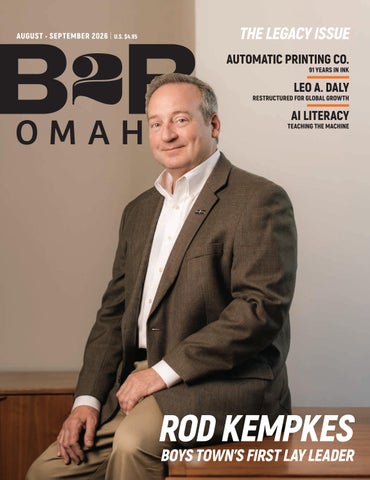
AUGUST • SEPTEMBER 2026 | U.S. $4.95
THE LEGACY ISSUE AUTOMATIC PRINTING CO.
91 YEARS IN INK
LEO A. DALY
RESTRUCTURED FOR GLOBAL GROWTH
AI LITERACY
TEACHING THE MACHINE
ROD KEMPKES
BOYS TOWN’S FIRST LAY LEADER
WHEN YOUR OFFICE TECHNOLOGY STOPS, YOUR BUSINESS SHOULDN’T HAVE TO WAIT.
Everyone sells the same black boxes. The real difference in office technology is what happens when those boxes break down. Since 1954, Bishop Business has set the Midwest standard for proactive service and rapid response. Whether you are dealing with a national chain or a local vendor, you shouldn’t have to navigate generic ticketing queues or wait days for an under-trained technician to arrive. Our dispatchers, leadership, and factory-certified technicians are right here in your community. From enterprise-grade print environments to automated digital workflows, we treat your uptime with the speed and precision of a professional pit crew. One accountable partner. One predictable invoice. Zero runaround.
Experience the standard in proactive office service. Learn how we are keeping the Midwest working at bbec.com or call 402.537.8000
OMAHA | LINCOLN | NORFOLK | GRAND ISLAND | LAWRENCE
AUGUST/SEPTEMBER | 01
OMAHAMAGAZINE.COM
Flat Roof Specialists New Repairs Reroof Skylights Quality, Integrity and Service since 1987!
Scan to visit
Ciaccioroofing.com or call 402.293.8707 for a FREE estimate!
4505 S 139th Street | Omaha, NE 68137
A L W A Y S L O C A L, A L W A Y S B E A U T I F U L.
OmahaMagazine.com/Pages/Subscribe
02 | B2B MAGAZINE
·
2026
Fall in Love With Your Business Again Because growth without clarity isn’t sustainable. You did not build your business to feel overwhelmed by it. When strategy loses clarity, execution slows, and leadership alignment begins to strain, growth becomes heavier than it should be. That is often the moment leaders realize the business has outgrown its current way of operating. We can help with that.
VOLUME 26
·
ISSUE 4
B2B Omaha is dedicated to empowering local CEOs and business leaders by delivering authoritative insights into emerging trends, visionary leadership, and economic indicators shaping our region. We strive to be the go-to resource for professionals seeking data-driven reporting on Omaha’s GDP, in-depth analysis of evolving market dynamics, and stories of the trailblazers who are setting the pace for growth and innovation in our community.
EDITORIAL executive editor Doug Meigs senior editors Isaac Nielsen Natalie Veloso assistant editor Naomi Heu editorial intern Rhett Uleman guest editor Carmen Tapio contributors Iyinfoluwa Akintunde Tamsen Butler Odee Ingersoll Steve Jordon Sara Locke Lisa Lukecart Tim Trudell Andy Williams CREATIVE creative director Rachel Birdsall senior graphic designers Renee Ludwick Nickie Robinson
SALES director of business and development Carole Sprunk executive vice president of sales and marketing Gil Cohen branding and digital specialists Greg Bruns Dawn Dennis Francine Flegg Sandy Matson Kim May Tim McCormack
TABLE OF CONTENTS JUST THE FACTS
14 ECONOMIC TRENDS RETHINKING TRUSTS NOW
senior sales coordinator Alicia Hollins sales coordinators Jessica Linhart Sandi McCormack OPERATIONS business manager Kyle Fisher ad traffic manager David Trouba digital manager Luis De La Toba
36
EVENTS & ENGAGEMENT NETWORKING CALENDAR
COLUMNS
04 FROM THE GUEST EDITOR
PRESERVING LEGACY IN AN AGE OF DISRUPTION
10 COACHING CORNER
FAMILY BUSINESS SUCCESSION
34 HUMAN RESOURCES
graphic designer Joey Winton
distribution manager Carson Kruse
chief photographer Sarah Lemke
publisher Todd Lemke
DEPARTMENTS
photographers Katie Anderson Roger Humphries
associate publisher Bill Sitzmann
12 MARKETING & GROWTH STRATEGIES
WHY AI LITERACY MATTERS
AUTOMATIC PRINTING CO.
16 VOICES OF INDUSTRY
BOYS TOWN'S FIRST LAY LEADER
32 ENTREPRENEURIAL JOURNEYS A SERIAL ENTREPRENEUR
INFORMATION advertising information 402.884.2000
5LPerformanceGroup.com
SPECIAL SECTIONS
39 SPONSORED PROFILES
subscribe online omahamagazine.com/ pages/subscribe B2B Omaha Magazine is published six times annually by Omaha Magazine, LTD, P.O. Box 461208, Omaha NE 68046-1208. Telephone: 402.884.2000; fax 402.884.2001. Subscription rates: $14.94 for 6 issues (one year). Multiple subscriptions at different rates are available. No whole or part of the contents herein may be reproduced without prior written permission of B2B Omaha Magazine, excepting individually copyrighted articles and photographs. Unsolicited manuscripts are accepted, however no responsibility will be assumed for such solicitations. © Omaha Magazine 2026
OMAHAMAGAZINE.COM
AUGUST/SEPTEMBER
TABLE OF CONTENTS
03
FEATURE
BURLINGTON STATION
24
LEO A. DALY RESTRUCTURED FOR GLOBAL GROWTH
FEATURES
AUGUST • SEPTEMBER 2026 | U.S. $4.95
THE LEGACY ISSUE AUTOMATIC PRINTING CO.
91 YEARS IN INK
LEO A. DALY
RESTRUCTURED FOR GLOBAL GROWTH
AI LITERACY
TEACHING THE MACHINE
ROD KEMPKES
BOYS TOWN’S FIRST LAY LEADER
06
THE BUSINESS OF BUILDING OMAHA CHRIS MENSINGER POSITIONS THE CRE SUMMIT FOR ITS NEXT CHAPTER
ABOUT THE COVER
More than a century after Father Flanagan founded Boys Town, Rod Kempkes has become its first lay leader, helping expand the mission to reach children and families across the nation. Full story on page 16. Cover Photography: Bill Sitzmann Cover Design: Nickie Robinson
20
SKRADSKI HEATING & COOLING A MULTI-GENERATIONAL APPROACH TO ENERGY COST ADAPTATION
B2B MAGAZINE • 2026
VOL 26 • ISSUE 4
BUILT TO EVOLVE
F
PRESERVING LEGACY IN AN AGE OF DISRUPTION or years, I have reflected on a moment early in my executive career while working for a company based in Minneapolis.
I was sitting in a conference room with seasoned industry executives and middle managers invited to discuss future strategy. A young man spoke up and suggested that soon, most travel reservations would be made online by consumers on third-party websites rather than through live agents over the phone. His perspective was politely entertained, but largely dismissed. Yet only two years later, the company’s distribution model had transformed almost exactly as he predicted. The manager had moved on by then, but he had seen the future more clearly than most of the veterans in the room. Disruption rarely announces itself with certainty. Often, it arrives first as an idea people are uncomfortable believing in. Has anyone ever heard of a Telex machine? It was once considered an innovative business tool that allowed clients in another industry I worked in to receive daily performance reports. It was largely replaced by receiving reports via pages of automated fax transmissions. Mainframe computing was once the standard requiring thousands of square feet, raised floors, cooling systems, and human beings to change 9-track magnetic reels and highcapacity cartridges for data storage. Today, computing power exists in server closets, robotic systems, and the cloud. Historically, past generations could begin and end their lives experiencing little technological change. Artificial intelligence, technological advancement, and rapid change now sit squarely on the main stage and home screen of business and daily life, embedded into nearly every device we touch.
The question for leaders and businesses is not whether change will come, but whether they are willing to adapt quickly enough to remain relevant while preserving the values that define them. Think about transformation and how businesses leave a legacy for a future that is changing so quickly, it is unimaginable in the moment. Second- and third-generation businesses can evolve far beyond the foundations upon which they were built. Technology has created growth, efficiency, customer engagement, and market expansion previous generations could not fully imagine. An August 2025 article in Omaha Magazine's B2B cited data compiled by the Greater Omaha Chamber of Commerce, noting 43% of the 30 oldest Omaha businesses are family-owned and operated.
04
FROM THE GUEST EDITOR Carmen Tapio is the founder and CEO of North End Teleservices. For story suggestions and pitches, email editor@omahapublications.com.
Many of these organizations are true legacy businesses. Family- and nonfamily-owned are both legacy, but they can act very differently, particularly when it comes to innovation and long-term sustainability. Legacy businesses that endure do not simply preserve tradition—they evolve. Family businesses can possess unique attributes, including greater control and flexibility. They may also have hesitation around innovation because of financial risks associated with investing in transformation while protecting long-term stability. Additional complexities surrounding succession planning, trusts, estates, wills, and generational leadership transitions can further complicate decision-making. Yet, technology also creates unprecedented opportunities. It allows expansion into new sectors, accelerated product and service development, and reaching markets with speed many traditional organizations might not be able to attain. I remember the first business deal I completed entirely by text with a young woman I had once mentored. With just a few words and a lot of speed, the mentee became a client. I had to keep up. That experience, combined with the memory of the manager whose prediction proved entirely correct years earlier, forced me to confront my own limitations. It taught me the importance of adaptability and the value of listening to younger generations who have never known a world without rapid technological change. Leadership requires humility as much as it requires experience. The future will not belong to those who resist change, but to those who evolve while remaining grounded in purpose, stewardship, and the responsibility to build a business that creates lasting positive impact. That, ultimately, is a legacy worth leaving. B2B OMAHA
AUGUST/SEPTEMBER | 05
OMAHAMAGAZINE.COM
Thanks Omaha for over 40 Years!
Insurance built around your business. Partners in managing your risk.
®
2012-2026 Winner
2026 Winner
402.399.9233 | WWW.SPARKLINGKLEAN.COM
group.com
NOT FDIC INSURED
Real Estate Real Expertise Real Impact Omaha’s premier choice in commercial real estate for over 40 years. lundco.com
Independently Owned and Operated A Member of the Cushman & Wakefield Alliance
Thank You
for Voting Us #1 for 15 Years!
2026 Winner
Serving the Great Customers of Omaha for 81 Years! Nefftowing.com 402.733.5500 4315 South 50th Street
B2B MAGAZINE • 2026
VOL 26 • ISSUE 4
FEATURE
06
CHRIS MENSINGER
STORY: TIM TRUDELL PHOTO: BILL SITZMANN DESIGN: NICKIE ROBINSON
OMAHAMAGAZINE.COM
AUGUST/SEPTEMBER
THE BUSINESS OF BUILDING OMAHA CHRIS MENSINGER POSITIONS THE CRE SUMMIT FOR ITS NEXT CHAPTER
I
t’s difficult to let your baby go, especially after nourishing it for decades. Jerry Slusky knows his time leading the annual Commercial Real Estate Summit is nearing its end. He also has his hand-picked successor working alongside him.
Chris Mensinger successfully navigated her move from medical sales to commercial real estate. For the past six years, Mensinger has served as co-chair of the CRE Summit, an annual conference created by Slusky in 1990 to showcase the benefits of real estate investment and development in the Omaha area. “I’m not a spring chicken,” Slusky said. “I realized about five to six years ago that maybe I ought to have somebody who really understands what we’ve been doing. [Mensinger] was part of our planning committee and was doing just a great job with everything we gave her.” To entrust someone to take over as the summit’s leader was a big step for Slusky. While an adjunct professor at Creighton University, he created the CRE Summit to help promote Omaha’s depressed real estate market, tapping the Resolution Trust Corporation to anchor the initial conference. The first CRE Summit drew a handful of commercial real estate developers. But Slusky stuck with it, and the summit grew, attracting about 1,000 real estate professionals, developers, engineers, and architects to the 2025 conference. In 2011, with children about to attend college, Mensinger sought a career change. Her brother, TJ Twit, who was with The Lund Company at the time, recommended she look at commercial real estate.
CONT. PAGE 08
07
B2B MAGAZINE • 2026
VOL 26 • ISSUE 4
FROM PAGE 07 She joined Colliers International as a broker, working on projects such as Aksarben Village. Today, Mensinger, a senior vice president, is involved with office tenant projects at the Crossroads and former Civic Auditorium properties.
THERE'S A BIG PRO TO OMAHA NATIONALLY, AND I THINK THERE'S AN OPPORTUNITY FOR SOME OF THOSE NATIONAL, INTERNATIONAL INVESTMENTS TO COME TO OMAHA. WE CAN BUILD THINGS THAT MAYBE WE DON'T CURRENTLY HAVE THE RESOURCES TO DO. — CHRIS MENSINGER
“The first thing that attracted me to it was the independence, that I could make something on my own,” Mensinger said. “I was told that it was really about as much as you put into it is as much as you get out of it. That is 100% true. The harder you work, the more connections you make.” The community aspect of real estate also appealed to her, Mensinger said. “Omaha is home, and to better understand how our city was built and how it grows, and how to make successful smaller neighborhoods within the community was really attractive to me,” she said. “That continues to be what I enjoy the most—the interconnectivity of the city, what the built world does for that, and where people go every day.” Primarily working on national projects, where she specializes in tenant relationships, Mensinger looked to make connections locally in her early days at Colliers. Barry Zoob, a mentor with Colliers, suggested she become involved with the CRE Summit by working with the sponsorship committee, Mensinger said. At first unsure about it, she quickly learned its benefits. “I realized I can pick up a phone and call anybody that I’ve been trying to meet in town and talk to them about the benefits of the CRE Summit,” she said. Working with the sponsorship committee evolved to a position on the planning committee, where she excelled, Slusky said. Looking to the future, he believed Mensinger could lead the CRE Summit.
08
“I said, ‘Why don’t you start working with me, and I kind of show you some of the stuff that we’re not really going over, delving into with the bigger committee,’” he said. “She’s been a superb addition.”
OMAHAMAGAZINE.COM
Knowing an organization the size of the summit can’t be run by one person, Slusky said Mensinger can rely on members of the planning committee, as well as Planit Inc, a 25-year-old event planning company the summit has worked with since Planit’s inception. Providing a bridge to a changing demographic of real estate professionals is vital for the summit’s growth, Mensinger said. “I felt like I could make the biggest impact in helping connect the next generation of the CRE Summit,” Mensinger said. “As the room got younger, because it definitely got younger, it got more diverse, not only with women—a lot more women are joining the industry—but we’re seeing more diversity [overall]. It’s a really good thing for Omaha. So that’s what I’ve been real passionate about, making sure we bring diversity.” Traditionally a white male-dominated industry, as women became more involved as brokers, diversity followed, she said. “People saw that they wanted to get into it, so I think the diversity has happened just by having a few of us in it, and then people can see themselves in it, and we heavily encourage people to join,” Mensinger said. As the CRE Summit transitions to a new phase, Slusky said its mission remains to provide informative and relevant topics. “We start building a skeletal outline [in the fall] of what’s new, what’s fresh, what’s concerning, and what are the problems of our industry,” he said. Omaha’s commercial real estate market is healthier than other cities of similar size, Mensinger said.
AUGUST/SEPTEMBER
“We tend to lead the way in lower vacancy rates,” Mensinger said. “It’s a smaller group of people right now that invest in Omaha, and so a lot of them live here. I think we’re transitioning away from that, because I think the larger markets and some of the real estate investment trusts and the funds see Omaha, and they’re like, ‘Oh, this is a really stable market, we want to come in.’ There’s a big pro to Omaha nationally, and I think there’s an opportunity for some of those national, international investments to come to Omaha. We can build things that maybe we don’t currently have the resources to do.” While he knows who he’ll pass the baton to, Slusky isn’t in a hurry to do so. After all, he’s still working on development projects with his son-in-law as founders of SG Communities. Meanwhile, Slusky and Mensinger work as a dynamic team, sharing Omaha’s story with locals and regional companies that can make an immediate impact on the area’s commercial real estate market. B2B OMAHA Visit attendcresummit.com for more information.
09
ODEE INGERSOLL
B2B MAGAZINE • 2026
VOL 26 • ISSUE 4
FAMILY BUSINESS SUCCESSION
PREPARING THE NEXT GENERATION FOR SUCCESS
10
A
family business is more than a source of income—it represents identity, legacy, and the hope of opportunity for future generations. While every owner wants to eventually transition their company successfully, succession in a family enterprise carries uniquely high
emotional and financial stakes. The encouraging reality is that owners can significantly improve the odds of a smooth transition by focusing early on succession planning, strengthening the business, and preparing the next generation of leaders.
OMAHAMAGAZINE.COM
Start Early Time is the single most important ingredient in a successful transition. A typical business preparing for an outside sale may need three years of planning. A family business, however, often requires five to 10 years. That extended runway allows owners to strengthen operations, develop future leaders, and avoid handing off the company during a downturn or crisis that could jeopardize the successor’s early years. Time also protects the family from unexpected events. Without a well-documented plan, a sudden owner death or disability can derail even the strongest business. Early planning gives owners flexibility, protects the company, and reduces the emotional strain on the family. It also allows for thoughtful conversations about expectations, roles, and long-term goals—discussions that rarely go well when rushed, or may sound like directives rather than opportunities. Financial Fitness Many family enterprises evolve into lifestyle businesses—eventually profitable enough to support not only the owners, but also a range of discretionary perks. These may include leased vehicles, vacations, recreational equipment, above-market salaries, or family members on payroll. While these benefits may have some business purpose, they can obscure the company’s true performance and reduce its ability to support a future buyout or transition. If the business must eventually buy out the owner or support successor financing, it must demonstrate strong, clean financials and positive performance trends. Reducing or eliminating discretionary spending, tightening reporting, and focusing on growth and profitability ensures the business is genuinely as healthy as the family believes it is. A financially disciplined company is easier to value, easier to transition, and far more resilient for the next generation. Successor Readiness A successor must be prepared not just in name, but in capability. That includes education, outside work experience, leadership skills, and the appropriate temperament. They must also be “bankable”—financially able to qualify for loans or ownership structures. Once inside the business, successors need real responsibility. They should make decisions, manage teams, solve problems, and occasionally fail. These experiences build credibility with employees and confidence in themselves. Owners must also choose
AUGUST/SEPTEMBER
the right successor—not simply the oldest child or the one who seems most agreeable. And no one should be asked to take over a business they don’t truly want. Many successors feel obligated to continue the family legacy even when their passions lie elsewhere. Honest, early communication prevents resentment and protects both the business and family relationships. Other Success Factors • A self-sustaining business: Strong systems, key employees secured for the future, and adequate capitalization. • A trusted succession team: Including a financial planner or wealth manager, attorney, accountant, and insurance professional. In some families, a counselor may be an important addition to navigate relationship dynamics or unresolved past issues between family members that may have nothing to do with the business. • Thoughtful ownership distribution: Equal shares among family members often create operational gridlock or unrealistic expectations of gain. Nonoperating family members can be compensated in other ways. • A future-proof business model: Successors should inherit a company positioned for tomorrow, not yesterday. • Outside work experience: Family members who work elsewhere first may return with stronger, more diverse skills. And if they return, it’s because they want to be there. Ultimately, the goal is not just a successful family business transition, but a thriving family. Starting early, acting with purpose, and communicating with each other often is a must. Owners should also make decisions that preserve the possibility of joyful future holidays together, not strained gatherings shaped by unresolved business or estate conflicts. In some cases, the most successful succession event may in fact be an eventual sale of the business to someone else. B2B OMAHA Odee Ingersoll is a small business development center director for the Nebraska Business Development Center at the University of Nebraska–Omaha and University of Nebraska–Kearney. He is a credentialed valuation analyst and exit planning advisor and has over 20 years of experience in valuation and transition planning as well as business consulting.
11 COACHING CORNER COLUMN: ODEE INGERSOLL PHOTO: SARAH LEMKE DESIGN: NICKIE ROBINSON
B2B MAGAZINE • 2026
VOL 26 • ISSUE 4
MARKETING & GROWTH STRATEGIES
FROM LEFT: JULIE BURGESS, MIKE PRESCOTT
STORY: SARA LOCKE PHOTO: BILL SITZMANN DESIGN: NICKIE ROBINSON
12
AUTOMATIC PRINTING CO.
91 YEARS: A LEGACY OF INK AND INTEGRITY
OMAHAMAGAZINE.COM
IN
a family-owned business, longevity means much more than one man’s survival. For Automatic Printing Co. at 1713 Cuming St., which has been in the family since 1935, staying power has been a lifeline not only for the union workers they employ, but for a neighborhood that could have quickly been left behind. Currently owned by the sibling team of Mike Prescott and Julie Burgess, Automatic Printing Co. has long been valued for its customer service, flawless quality results, and commitment to evolving in an ever-changing world of tech. While industry experts have loudly been predicting the decline of print for decades, the team at Automatic Printing has continued to thrive. “Initially, this was a letterpress printing company,” Burgess said. “Then in the ’50s when offset printing became the industry standard, our dad set off to trade school in the South to learn plate making and film composition. He came back and the shop got its first offset printing press. That was brand new technology, and we spent years continuing to offer both letterpress and offset. In the ’90s, Mike brought us digital printing, getting us started on Macintosh computers. Now I would say about 50% of the physical things we print are on digital, 49% are offset, and 1% remains letterpress. We do our best to accommodate everyone’s unique needs.” Automatic Printing Co. has done such an excellent job of building a reputation for honesty, loyalty, and quality, that they have been known for decades as “The Printer’s Printer”—the company other printing businesses can call if they can’t deliver on a customer request. “We have always held onto the belief that our customers are our customers,” Burgess said. “And if another company brings work to us, then that company is our customer. We aren’t going to try to take their clients away from them if they’ve asked us for help.” That loyalty extends beyond their commitment to their diverse clientele. “We’re not the biggest, but we like to think that we’re the best,” Prescott said. “Our union label means craftsmanship, taking care of our customers, but it also means taking care of everyone in the plant. Other businesses may have a better bottom line, but I’m willing to bet they don’t offer better benefits.” “We’ve been a union for a long time,” Burgess said. “To us, that means standing behind what we do. Treat our employees fairly. It’s a contractual relationship between management and employees. We renegotiate those contracts every two years. That’s 401(k), retirement benefits, vacation time, and scale of wages above industry norms.” “This process ensures that everyone in our business is getting taken care of,” Prescott added, “not just the guy on top.”
AUGUST/SEPTEMBER
Burgess insists that the greatest investment they have made isn’t any of the expensive machinery, or even the rigorous training to operate it, but in the people.
13
“The most important thing for us is teamwork,” she said. “Mike and I work as a well-oiled machine. Kirk has been here for more than 20 years and runs five different presses in the back. He’s skilled on even more. Kyle was a good binderyman and started learning the small presses. Everyone does what needs to be done, and it’s a smooth operation.” Fighting through COVID, evolving with technology, and supporting union workers aren’t the only ways Automatic Printing has set itself apart from the competition. The team was recently recognized by Hillside Solutions after Prescott and Burgess reached out to the sustainability experts for help with their own green efforts. “We’ve been recycling for years,” Burgess said. “I started working with Earth Day here in Omaha back in 1991. Our printing business has always prioritized recycling.” Hillside Solutions has officially named Automatic Printing Co. “the zero-waste* print shop” in Omaha. In a post on social media, Hillside Solutions said, “When we met with them, we thought we were walking in to set up their recycling system. It ended up being a tour of how sophisticated their routine already was. So we just gave them a small landfill dumpster to catch whatever was left.” “When we send out our recycling, we’ll have 12 Gaylords full, along with our green bin, orange bag, glass, and scrap metal. Our actual trash dumpster is the smallest you can get, but it’s still too much for us; we don’t need one this big,” Prescott said. Prescott and Burgess affectionately remember the years of customers stopping by just to talk with their father or their uncles Jerry and Tony. They say that customers still come down simply to shoot the breeze. “They may have been vendors,” Burgess said, “but they’re also our neighbors and friends.” After nearly a century of serving the Omaha community, Automatic Printing Co. continues to prove that craftsmanship, adaptability, and strong personal relationships never go out of style. B2B OMAHA *Zero-waste is defined as 90% or more materials being kept out of landfills or incineration. For more information, visit autoprintomaha.com.
OUR UNION LABEL MEANS CRAFTSMANSHIP, TAKING CARE OF OUR CUSTOMERS, BUT IT ALSO MEANS TAKING CARE OF EVERYONE IN THE PLANT. — MIKE PRESCOTT
B2B MAGAZINE • 2026
ECONOMIC TRENDS STORY: DOUG MEIGS DESIGN & ILLUSTRATION: NICKIE ROBINSON
VOL 26 • ISSUE 4
RETHINKING TRUSTS NOW
IN RESPONSE TO CHANGES IN TAX LAW, RISING FARMLAND VALUES, AND BUSINESS SUCCESSION CONCERNS
"IN
this world nothing can be said to be certain, except death and taxes,” Benjamin Franklin famously wrote in 1789. More than two centuries later, both remain enduring concerns in estate planning.
Wills and trusts are two of the most common estate-planning tools, and both can be tailored to individual needs, with available options varying by state law. While a will directs how assets are distributed after death, a trust can manage and distribute assets both during a person’s lifetime and after death. Depending on the type of trust, it may offer tax advantages, asset protection, and a smoother transfer of wealth to beneficiaries while helping families avoid the delays and expenses often associated with probate. For business owners, entrepreneurs, investors, and agricultural landowners, estate planning is not a set-it-and-forget-it exercise. Changes in tax law, evolving regulations, rising land values, and shifting family circumstances can all affect how well an existing trust accomplishes its intended goals. Here's what Nebraska business owners need to know in 2026. New Federal Estate-Tax Rules Federal estate-tax law has undergone significant changes in recent years, prompting many families and business owners to revisit existing estate plans. The most dramatic recent change involved the federal estate-tax exemption itself. After years of warnings that the exemption could be cut roughly in half after 2025, Congress instead preserved and expanded the higher exemption levels in 2026. As a result, many trusts created to address an anticipated tax burden are being reviewed to ensure they still align with a family's current financial and succession-planning goals. Nebraska Inheritance-Tax Uncertainty
14
Nebraska remains one of only five states that still imposes an inheritance tax, making estate planning here somewhat different from most of the country. In recent years, lawmakers have considered proposals to reduce or eliminate the state's inheritance
tax, leaving many families and business owners uncertain about how the law may evolve in the years ahead. For example, a bill to reduce inheritance taxes advanced in the Unicameral in 2025 before stalling amid debate over how counties would replace the lost revenue. During the same session, lawmakers also considered a proposed constitutional amendment that would have prohibited inheritance taxes altogether. Farmland Appreciation Rising agricultural land values have transformed many American farms and ranches into some of the most valuable assets in an estate. In many cases, families may be surprised by how much their land has appreciated over time. That growth can create challenges when multiple heirs are involved, particularly if some family members participate in the operation while others do not. As a result, many agricultural landowners are revisiting trusts and succession plans to help preserve family assets, clarify ownership transitions, and prepare for the next generation. Stepped-Up Basis Traps One of the most important—but often overlooked—estate-planning concepts is the stepped-up basis. When certain assets are inherited, their tax basis may be adjusted to their fair market value, potentially reducing future capital gains taxes. However, not every trust or ownership arrangement preserves this benefit. Because the tax consequences can be significant for highly appreciated assets such as farmland, businesses, and investment portfolios, many families are reviewing trust structures to ensure asset-protection goals do not come at the expense of tax efficiency.
OMAHAMAGAZINE.COM
15
AUGUST/SEPTEMBER
Business Succession Planning
Incapacity Planning
For many business owners, the greatest estate-planning challenge is not taxes but continuity. Whether the asset is a family farm, closely held company, or investment enterprise, ownership transitions can create uncertainty if expectations are unclear. Trusts can help establish a framework for transferring ownership, protecting minority interests, and balancing inheritances among active and non-active family members. As a result, many business leaders are reviewing succession plans to ensure their organizations can continue operating smoothly through future transitions.
Estate planning is often associated with death, but many trusts are equally valuable during life. A revocable living trust, for example, can provide a framework for managing assets if an individual becomes unable to handle financial affairs because of illness, injury, or cognitive decline. For business owners and investors, that continuity can be critical. By designating a successor trustee in advance, families can help avoid delays, reduce uncertainty, and ensure important financial and business decisions can continue without court intervention. B2B OMAHA
7 COMMON TYPES OF TRUSTS
2026
• Generally cannot be changed once established • Removes assets from your taxable estate • Offers asset protection and potential tax benefits
Trust Trust WillWILL Will Estate Estate TRUST NO CORE OWNERSHIP OWNERSHIP ESTATE PLANNING 2025(+3%)2026 2025(-5%)2026 DOCUMENTS 2025 2026 (+1%)
IRREVOCABLE TRUST
56%
• Created through a will and takes effect at death • Often used for minor children or staggered inheritances • Trustee manages assets according to instructions in the will
2025
TESTAMENTARY TRUST
SPECIAL NEEDS TRUST
2026
55%
2025
26%
• Benefits a person with disabilities or chronic illness • Preserves eligibility for government benefits • Pays for supplemental expenses not covered by public programs
SPENDTHRIFT TRUST
• Controls how and when beneficiaries receive distributions • Protects assets from overspending and, in some cases, creditors • Can be revocable or irrevocable
DYNASTY TRUST
• Long-term, multigenerational wealth-transfer vehicle • Helps minimize estate and gift taxes across generations • Typically irrevocable and designed to preserve family wealth
2017
The Tax Cuts and Jobs Act nearly doubled the federal estate-tax exemption.
2018-2025
The exemption continued to increase through annual inflation adjustments, eventually surpassing $13 million per individual.
2025
14%
CHARITABLE TRUST
11%
20
SOURCE: TRUST & WILL 2026 ESTATE PLANNING REPORT
2024-2025
Estate planners warned clients that the higher exemption was scheduled to expire after 2025, potentially reducing the exemption by roughly half beginning in 2026.
THE ANTICIPATED ESTATE-TAX EXEMPTION CLIFF IN 2026
10
0
0
30
10
40
PERCENT OF U.S. POPULATION
20
50
30
60
40
• Supports charitable organizations while providing potential tax advantages • Examples include: • Charitable Lead Trust – charity receives income first • Charitable Remainder Trust – donor/heirs receive income first, charity receives remainder
2026
31%
50
7
• Can be changed or revoked during your lifetime • Avoids probate • Provides asset management if you become incapacitated
The 2026 Trust & Will survey of U.S. adults found that more than half of the population has no core estate planning documents: “No will. No trust. No medical directive. No financial POA. No HIPAA authorization.” The annual report found will ownership dropped while trust ownership grew since last year, “suggesting that people who are acting are choosing more comprehensive plans.”
60
1 2 3 4 5 6
REVOCABLE LIVING TRUST
YEAR-ON-YEAR TRENDS
2026
Congress instead extended and increased the exemption to approximately $15 million per individual ($30 million per married couple), prompting many families and business owners to reevaluate estateplanning strategies developed in anticipation of a lower exemption threshold.
B2B MAGAZINE • 2026
VOICES OF INDUSTRY STORY: ANDY WILLIAMS PHOTOGRAPHY: BILL SITZMANN DESIGN: NICKIE ROBINSON
VOL 26 • ISSUE 4
BOYS TOWN'S FIRST LAY LEADER
ROD KEMPKES STEWARDS FATHER FLANAGAN'S MISSION
R
od Kempkes drove past Boys Town’s sprawling, picturesque Omaha campus for most of his life without giving it much thought.
Like most people, he knew the iconic “He ain’t heavy” statue. He knew it was a historic home for troubled boys—a piece of civic identity so familiar, it sometimes goes unnoticed as you breeze down Dodge. Then he took a job there. And a few years later, he found himself running the massive operation with global reach. “I honestly didn’t know a lot,” Kempkes admitted. “You tend to think about Boys Town as their original flagship—their residential care. It’s really surprising how much we do.” Surprising is an understatement. In 2025 alone, Boys Town worked directly with 197,000 people across all 50 states. More than 106,000 of those interactions involved mental health support and suicide crisis intervention. Staff led training in 413 schools, reaching over 171,000 students. Nearly 2 million people visited Boys Town’s digital platforms, including “Your Life, Your Voice,” built specifically for teens in crisis. All the while, a small but formidable research division published findings on early brain development, pediatric audiology, and the neurological footprints of childhood trauma. None of that shows up on the postcard. “Boys Town has truly become a medical system that focuses on socially, economically, and medically underserved populations,” said Kempkes, president and CEO since 2020. “I can take pretty much all the programs and put them into preventative, primary, acute, and restorative care.”
16
Kempkes didn’t arrive through the usual doors to oversee Boys Town’s broad and deep scope. He came from the business world—more accustomed to a boardroom than a campus full of kids who have survived things most adults will never experience. He joined as chief operating officer under Father Steven Boes in 2018, learned the organization from the inside out, and stepped up as CEO when Boes returned to parish life.
CONT. PAGE 18
OMAHAMAGAZINE.COM
17
AUGUST/SEPTEMBER
BOYS TOWN HAS TRULY BECOME A MEDICAL SYSTEM THAT FOCUSES ON SOCIALLY, ECONOMICALLY, AND MEDICALLY UNDERSERVED POPULATIONS. — ROD KEMPKES
ROD KEMPKES
B2B MAGAZINE • 2026
VOL 26 • ISSUE 4
FROM PAGE 16 He became the first layperson to lead Boys Town in its more than 100-year history—a designation he’s quick to deflect. “I don’t think it’s that special that I’m here,” he said. “[Boys Town founder] Father Flanagan had his trusted friend Henry Monsky working with him for decades. The next director had business people. Father Boes brought me in to work with him. It’s just sort of a partnership.” What Kempkes brought to that partnership was the financial acumen to manage serious money—a $1 billion endowment, an operating budget exceeding $526 million, and a $298 million capital campaign underway for new research and hospital facilities. Fundraising covers roughly a quarter of operations, a constant pressure Kempkes describes plainly: “The mission’s not money. But there’s no mission without it.” “It’s humbling,” he added, “because your instinct is to understand where you’re going to augment value. Then you meet the teams, you hear the work they do, and you realize you’re trying to add something to people who already show up and do really hard, unbelievable things, literally all over the globe.” That fact becomes concrete fast. A short walk across campus leads to the Psychiatric Residential Treatment Facility, where Boys Town’s highestacuity children live and receive care. On any given day, 80 to 100 more are waiting for a bed. “I can’t walk out of there without crying,” Kempkes said. “You see little kids in there and you think, what happened to them? And then you hear their stories. And you’re like…oh my goodness.” Around the corner, psychiatrists, psychologists, behaviorists, and pediatricians orbit the same child with the same purpose. That convergence of resources and expertise is what took Kempkes most by surprise.
18
I DON’T CARE WHO YOU’RE TALKING TO— RESEARCHERS, SURGEONS, NURSES, SCHOOLTEACHERS, IN-HOME FAMILY WORKERS— THEY ALL HAVE THE SAME PURPOSE. THEY ARE TRYING TO HELP YOUTH AND FAMILIES. THAT’S IT. — ROD KEMPKES
“I don’t care who you’re talking to—researchers, surgeons, nurses, schoolteachers, in-home family workers—they all have the same purpose,” he said. “They are trying to help youth and families. That’s it.” The impact of the city centerpiece is wide-sweeping. Boys Town has one of only four hospitals in the United States to have administered a treatment for spinal muscular atrophy, a disease that, until recently, was usually a death sentence. Kempkes recently met a parent whose child received the infusion at Boys Town and watched them begin to recover. Then, there are the stories without a medical explanation—the ones that require loads of patience, perseverance, and an army of people who refuse to give up. One young man arrived at Boys Town after being abandoned by the affluent family that had adopted him from Africa. He cycled through nearly every level of care: the locked psychiatric unit, a family home program, an intervention facility, and back again. With assaults and relapses thrown in during that time, he had no home to return to or family waiting on the outside. Boys Town staff stuck with him until he graduated from high school and got a job. Years later, he still returns to visit. “That’s not me,” Kempkes is careful to point out. “That’s the family teachers, the psychologists, the psychiatrists. I just get a glimpse of what they do. I’m grateful for the glimpse.” Kempkes sees the next chapter running on two tracks: technology and research. Boys Town has already deployed AI-powered behavior modification programs in schools and predictive models that estimate ear growth in young hearing aid patients. The larger ambition is extending the mission’s reach to children who would otherwise never find their way to a campus or a crisis line.
AUGUST/SEPTEMBER | 19
OMAHAMAGAZINE.COM
OMAHAMAGAZINE.COM
The research side may prove more consequential. Boys Town’s labs track neurological development from days after birth through adulthood. An integration is emerging—hearing and audiology issues clustering around the same children who present behavioral challenges. If it proves out, it could change how pediatric care identifies at-risk kids before a crisis develops. “That’s how we truly innovate,” Kempkes said. “Having that connection between research and real-world application—that’s how we meet people where they are.” Most people don’t realize that Boys Town’s model went international decades ago. When Father Flanagan began sharing his revolutionary “there are no bad boys” concept, people came from around the world to study it and take it home. By 1959, there were 80 Boys Towns globally. Thirty-one remain—independent organizations connected by mission, operating from South Africa to Japan to Venezuela. Boys Town Nigeria opened in 2023. Earlier this year, Kempkes convened leaders from six of those global communities to discuss familiar and shared issues of gang violence, social media, drugs, and families in crisis. “Those issues don’t have borders,” he said. “And thankfully, neither do the people who want to help.” An avid student of Boys Town history, Kempkes keeps a photograph of Father Flanagan on his office wall. Next to it, Mother Teresa. They serve as a daily reminder of what he’s been handed. “My job,” he concluded, “is to steward this and not mess it up.” B2B OMAHA Visit boystown.org for more information.
2026 BEST OF B2B WINNER
UNIFO RM RENTA L S ERV IC E
Omaha’s Trusted Uniform Rental Partner Uniforms | Floor Mats | Restroom Supplies
Family Owned Since 1917 www.maxiwalkeruniform.com
expertly planned. EXCEPTIONALLY EXECUTED. www.planitincevents.com
celebrating 28 years of meetings and events
CLEAN RESULTS. When it comes time to begin cleaning your facility you can rest assured knowing our highly trained franchise owners are performing the absolute best cleaning services. Let the professionals handle it. Put your trust in the reliable team at Jani‑King of Omaha for the assurance your facility is safe, clean, and disinfected.
Call our local Jani-King office today and discover how our efforts help your business each and every day.
402 . 932 .0514 | JAN I KI N G .CO M 5885 S. 118 CIRCLE OMAHA , NE
B2B MAGAZINE • 2026
FEATURE STORY: TAMSEN BUTLER PHOTOGRAPHY: BILL SITZMANN DESIGN: NICKIE ROBINSON
VOL 26 • ISSUE 4
SKRADSKI HEATING & COOLING A MULTI-GENERATIONAL APPROACH TO ENERGY COST ADAPTATION
W
hen Frank Skradski started Skradski Heating & Cooling in 1951, energy usage in the Omaha area looked a lot different than it does today. Electricity was primarily generated by coal-fired steam plants with a large reliance on fossil fuels. Today, Omaha’s electricity is generated by a mix of solar, coal, natural gas, wind, and other sources. It’s a different energy landscape than it once was. The population landscape is different, too. In 1950, the U.S. Census recorded Omaha’s population at around 251,000. Today, the city’s population is nearly 485,000, while the broader Omaha metropolitan area has surpassed 1 million residents, due in part to the annexation of neighboring areas. What happens when the population of a city nearly doubles? Energy usage increases, and new strategies arise to meet the energy needs of the growing population. Likewise, companies that must pay attention to how consumers use energy need to adjust and evolve to keep up with demand. Business Development Vice President Andrea Skradski said that small, practical changes can help reduce energy costs for homeowners. “Stay on top of regular maintenance, install a smart thermostat, and change filters regularly” are a few tips she provided. Yet, she added, “Even small improvements can add up to noticeable savings over time.” Corey Skradski, Frank's grandson, is the current owner of Skradski Heating & Cooling. He took over the business in 2011 from his father, John. “When my grandfather started the business, and even in my dad’s early years, systems were simpler and energy costs were relatively stable,” Corey said. “Most customers were focused on one thing: ‘Will it work when I need it?’ Today, the conversation is very different.” He also noted that customers are much more informed nowadays than they were in the past. “They’re doing research ahead of time and asking detailed questions, which leads to better conversations and more thoughtful decisions,” he said. When Frank started the business in 1951, energy costs weren’t top of mind for homeowners, according to Corey. “Systems were more mechanical, and efficiency wasn’t nearly as advanced or emphasized,” Corey said. The company has since witnessed a “major shift” over the last 15-20 years caused by rising utility costs and increased awareness around energy use, making efficiency a top priority and concern among their customers.
20
CONT. PAGE 22
OMAHAMAGAZINE.COM
21
AUGUST/SEPTEMBER
RISING ENERGY COSTS HAVE BEEN A MAJOR DRIVER OF INNOVATION. — COREY SKRADSKI
COREY SKRADSKI
B2B MAGAZINE • 2026
VOL 26 • ISSUE 4
FROM PAGE 20 Compared to systems of the past, today’s systems are intentionally more efficient and are designed to give users more control over how they use energy. Family companies like Skradski Heating & Cooling have adapted over the years to help with that balance, and technology has also adapted to deliver the types of solutions that combat rising costs while keeping sustainability in mind. Corey said that adaptation has been the key to the company’s longevity. His grandfather started the business, his father expanded and strengthened it, and he focused on modernizing and positioning the company for the future. Much of that modernization was heavily influenced by how customers reacted to rising energy costs.
“Rising energy costs have been a major driver of innovation,” Corey said. He explained that there is a noticeable, growing interest in alternative sources of heating and cooling, and a need for systems that integrate into smart home platforms. It’s a big leap from what heating and cooling systems used to be; an Omaha homeowner in 1950 likely had to physically turn a dial on the wall to turn a system on or off, if they had a system at all. Today’s Omaha homeowner might adjust their system from an app on their phone, or preprogram it to adjust usage for maximum efficiency. It's also unlikely that Omaha homes in that era had any focus on air filtration, unless it was to protect the unit from debris. It wasn’t until around the 1970s that replaceable air filters became common, and when MERVrated filters (short for “minimum efficiency reporting value”) widely hit the market in the 1990s, air filtration became an important feature of any home’s heating or cooling system.
IT’S NOT JUST ABOUT FIXING A PROBLEM ANYMORE. IT’S ABOUT PREVENTING ISSUES, LOWERING UTILITY BILLS, AND IMPROVING OVERALL COMFORT. — COREY SKRADSKI
22
AUGUST/SEPTEMBER | 23
Modern-day customers are much more focused on energy efficiency, sustainability, and long-term cost savings, Corey added. “It’s not just about fixing a problem anymore,” he said. “It’s about preventing issues, lowering utility bills, and improving overall comfort.” B2B OMAHA Visit heatomaha.com for more information.
Fr i
25 YEARS • Se
rv
ence xcell
Assistance programs are in place for area residents who encounter difficulty in paying their energy bills. The Low Income Home Energy Assistance Program is available through ACCESSNebraska and the OPPD Energy Assistance Program can offer relief to struggling families.
•
•E
Energy costs are unlikely to decline in the near future. Omaha Public Power District’s approved 2026 annual budget that went into effect in January included a 6.3% average rate increase for all customers.
to Your Inspiration to Your Inspiration
d ly
ice
Inflation doesn’t hold sole blame for the rising energy costs. Weather events, such as increased thunderstorms and hotter temperatures, put a strain on energy systems in the area, some of which need upgrades.
Adding the WOW Adding theWOW
Local &
Omaha’s hot, humid summers and potentially brutal winters make heating and cooling imperative for residential and commercial buildings alike. And though Omaha and greater Nebraska enjoy energy rates that are generally lower than the national average, costs have been on the rise since the 2010s, with a noticeable acceleration in cost starting around 2023.
en
OMAHAMAGAZINE.COM
QUALITY. VARIETY. EXPERIENCE. EXPERTISE. SERVICE. QUALITY. VARIETY. EXPERIENCE. EXPERTISE. SERVICE.
Our priority is to deliver the best and freshest Our priority to deliver the products that meet your is highest standards and grow products your business. besthelp andyou freshest that
yourTrees/Shrubs highest standard and • Evergreen • Bagged Trees B&B Trees meet • Shrub Roses • Ornamental Grasses Deciduous Shrubs help you grow your business. Perennials • Annuals • Grafted Evergreens Topsoil • Hardwood Mulch
11015 South 48th St. Papillion, NE 68133 Phone: 402.547.5001 Fax: 402.505.3421 papiovalley.com (Wholesale Accounts Only)
B&B Trees • Evergreen Trees/Shrubs • Bagged Trees Deciduous Shrubs • Shrub Roses • Ornamental Grasses Perennials • Annuals • Topsoil • Hardwood Mulch
Anything but small talk. Listen to the official Omaha Magazine podcast now!
LEO A. DALY
RESTRUCTURED FOR GLOBAL GROWTH
B2B MAGAZINE • 2026
VOL 26 • ISSUE 4
FEATURE STORY: STEVE JORDON PHOTOS PROVIDED BY: LEO A. DALY DESIGN: NICKIE ROBINSON
25
OMAHA VA
CONT. PAGE 24
OMAHAMAGAZINE.COM
AUGUST/SEPTEMBER
B2B MAGAZINE • 2026
VOL 26 • ISSUE 4
Trust Influence
TRUST INFLUENCE Are these important skills to develop in your managers? CHANGE MANAGEMENT Change Management
These are just 3 of the 24 topics we cover. Our award-winning interactive leadership program changes behavior and produces measurable results.
Are these important skills to develop in your managers?
If you don’t continue to develop your current leaders, you’ll be training new ones instead.
Call 402.399.9239 to see if we might be a right fit for you. We can also set up a complimentary session to see if we’re the right fit for your people.
These are just 3 of the 24 topics we cover. Our award-winning interactive leadership program changes behavior and produces measurable results.
-------Add QR code from last year’s ad------
If you don’t continue to develop your current leaders, you’ll be training new ones instead.
FIRST NATIONAL TOWER
Call 402.399.9239 to see if we might be a right fit for you. We can also set up a complimentary session to see if we’re the right fit for your people.
THE BUILDING PHOTOGRAPHS ACCOMPANYING THIS ARTICLE REPRESENT ICONIC SAMPLES OF LEO A. DALY'S ARCHITECTURAL WORK VISIBLE THROUGHOUT THE OMAHA METRO.
OMAHAMAGAZINE.COM
T
ime catches up with everyone, and that includes a business that began building its Omaha legacy in 1915: Leo A. Daly Co.
A New Name in the Family Jay Hennick was managing a local swimming pool in 1972, at age 15, when he got an idea. Why not start a company to manage even more pools?
In 2024, after three generations of Daly family ownership, sole owner Leo A. Daly III entrusted that legacy of architectural and engineering excellence to a new family: the Hennicks of Canada.
He borrowed $1,000 from his father and started what became, 20 years later, a publicly traded corporation. Today, Hennick is a billionaire more than twice over, according to Forbes magazine. From Toronto, he has a law degree from the University of Ottawa and a bachelor's degree in economics from York University.
The key word here: family.
He is founder and chairman of FirstService Corp. and chairman and CEO of Colliers International Group Inc., and controlling shareholder of both property management firms. He also is chairman of the family's Hennick & Co., which is run by his son, Bradley, and which owns stakes in Haventree Bank and BV Realty Partners of Canada.
In fact, the new owner, Hennick & Co., is considered a “family office,” a type of private advisory firm that manages investments, wealth, and administrative affairs for highwealth families. “As a professional services firm, we were looking at all the potential options with Mr. Daly on how to best transition ownership,” said Edward Benes, chief executive of Daly. Options included an employee stock ownership program, sale to a private equity group, or merging into another architectureengineering firm. CONT. PAGE 28
27
AUGUST/SEPTEMBER
Its professional properties besides Leo A. Daly Co. of Omaha are Foster + Partners of London; Gardiner & Theobald of the U.K. and the U.S.; RATIO of Indianapolis and Chicago; Lockwood, Andrews & Newnam of Houston; and DG Architects of Silicon Valley, California. Jay Hennick and his wife, Barbara, who is an accountant and the daughter of a Holocaust survivor, head the Jay and Barbara Hennick Family Foundation, focusing on healthcare, education, and the arts.
EDWARD BENES
B2B MAGAZINE • 2026
VOL 26 • ISSUE 4
FROM PAGE 27
JEFF MONZU
CHRIS JOHNSON
“But the family office just made the most sense to both Mr. Daly and the employees,” Benes said. “Mr. Daly is such a generous guy. He really wanted to make sure that the employees were going to be taken care of.” The Hennicks especially fit Daly, he said. “Hennick is very much a family-focused organization, just like Mr. Daly, with a lot of similarities. Hennick was interested in a long-term investment. They really want to help Leo A. Daly grow. “They wanted to help achieve what Mr. Daly ultimately wanted, and that was perpetuity. He wanted his name to continue for another 100 years, and that was important to us, too. For all of us employees who've been here for a while, the Leo A. Daly name is important. And the Hennick family wants to be part of this for decades to come. What better way to do that than with a family office that will certainly help us continue that legacy?” Daly and the Hennicks made sure employees have “skin in the game,” with a mechanism for Daly’s leaders to invest in the company. Benes did not disclose the ownership portion or how many people have invested in the firm by buying shares, but he said it’s a substantial minority ownership with voting rights. Some of them serve on the board of directors. The number of employee shareholders has grown since the ownership change and will continue to grow. “The employee shareholders are going to treat the firm like it's their own firm,” Benes said. “When they make decisions, they think of it as their company, too. The board wants to bring in shareholders who are loyal to the firm, who have shown that they really love Leo A. Daly and have helped the company grow, and who want to be part of something special.
NANCY MELBY
28
“We look at our shareholders as partners, whether it’s the Hennick family office or it’s an employee, people who want to continue that legacy in Omaha. This is where this firm started, and it’s still critical to our success as our headquarters.” Like any investor, and like Leo Daly and his father and grandfather, Benes said, Hennick wants results. “They’re very savvy, very intelligent. That’s probably the one thing that stands out the most about
OMAHAMAGAZINE.COM
Hennick, how bright they are and how much they bring to the table in terms of helping us grow.” Leo III is still involved as chairman from his home in Washington, D.C. Benes is originally from Chicago, has worked in Omaha, and now lives in Houston, with offices there and in Washington. He visits Daly offices almost weekly, including frequent visits to Omaha. Omaha is home to three senior directors: Chris Johnson, Omaha studio; Jeff Monzu, health and wellness; and Nancy Melby, operations, as well as Chief Financial Officer Jay Brader and Chief Information Officer Stephen Held.
CONT. PAGE 30
AUGUST/SEPTEMBER
Continuing Growth
29
Leo A. Daly Co.’s purchase of design firm Delawie late last year was a logical move into a new market, San Diego, which added a cadre of top architecture and design professionals. On another level, the acquisition was a sign that Daly’s 110-year legacy will continue and even grow under its new owners, Canadian investment firm Hennick & Co. The purchase wasn’t directly related to Daly’s 2024 sale to Hennick, said Daly CEO Edward Benes, but Hennick’s support helped add the like-minded Delawie firm to Daly. “Delawie has the culture that Daly has, very family-oriented,” Benes said. “We want to grow acquisitively. We want to find firms that fit our culture. But we don't want to grow for the sake of growth.” The Hennick family understands that acquisitions require care, he said. Delawie, founded in 1961 by Homer Delawie, has a solid record of creative, high-quality work on a wide range of projects. “Delawie really opens the door for us, and this opens the door for them, too,” Benes said. “They wanted to go after bigger projects and start competing with some of the bigger firms, and Leo A. Daly is able to bring that bench strength to them. The acquisition of Delawie has been very natural, and they've blended in with our team very well.”
FOR ALL OF US EMPLOYEES WHO'VE BEEN HERE FOR A I THINK THE WHILE, THE LEO LARGEST A. DALY NAME IS IMPACT FOR THE IMPORTANT. AND RAILROAD AND THE HENNICK THE RAILROAD’S FAMILY WANTS LEGACY TO BE PART OVER TIME IS OF THIS FOR CONNECTION DECADES TO AND COME. WHAT COMMUNICATION. BETTER WAY TO DO—PATRICIA THAT THAN LABOUNTY WITH A FAMILY OFFICE THAT WILL CERTAINLY HELP US CONTINUE THAT LEGACY? — EDWARD BENES
B2B MAGAZINE • 2026
VOL 26 • ISSUE 4
FROM PAGE 29 The Omaha studio is the largest out of 12 cities, from Abu Dhabi to West Palm Beach, and has about 100 employees out of nearly 450 company-wide. “For a client in Omaha,” Johnson said, “we have the Omaha presence, individuals front-facing on the projects, and it’s easy for us to bring in national specialty expertise when needed.” For example, a project in one city might need a healthcare planner who specializes in outpatient facilities but is based in another city. Such people are on the Daly “bench” as needed. Daly professionals exchange ideas and keep up on projects underway across the nation and internationally.
WE WANT TO RETAIN THAT HISTORIC LEGACY, AND OUR COMMUNITY TIES HERE ARE VERY STRONG. OUR GROWTH BEGAN IN OMAHA. — JEFF MONZU
Johnson said Daly’s Omaha legacy is both historic and growing. “When I look back at projects like the First National Tower or KETV's studios or the Cottonwood Hotel or work at the Nebraska Medical Center or Creighton University, we will retain that historic connection to Omaha and our Omaha clients.
CARSON HEADQUARTERS
30
“Whether it’s the healthcare market or the commercial market or educational market, clients want to know two things,” Johnson said. “Who’s going to be my local face that I can meet with or call, and is your expert in a particular aspect of the project the best?”
“When you grow up in Omaha like we did, you are infused with, in the words of Mr. Daly, surrounding yourself with the best in order to produce the best. That could be the best space, the best art, the best teammates. That is super strong in Omaha.” Senior director Monzu agreed. “Leadership and a home in Omaha have always been a strong aspect of our company,” he said. “We want to retain that historic legacy, and our community ties here are very strong. Our growth began in Omaha. We started here and have contributed so much to the growth of the city and the region.” Under the new ownership, he said, “We’ll have the opportunity to define what our role is within the business community a little differently, and in the architectural business community a little differently, to make sure that we still have some of those opportunities as we move forward. “Daly can become larger and involved in more types of projects as we transition into some new philosophies, a new organization. I think there will be opportunities for people to look at this as an old guard company that's being refreshed. What does that mean going forward? “I am proud of the commitment the company has had to our community over the years. In my leadership role, my hope is that I’m able to reinforce that and maintain that and grow. We have a place at the table in deciding how we're shaping the
OMAHAMAGAZINE.COM
community that we're living in and that our families are living in.” CEO Benes said the Hennick family’s goals mirror Daly’s. “It's a new family and an old family at the same time,” he said. “Omaha is the reason we are where we are now, and it's going to be the reason we're going to be where we will be in 100 years. Omaha is extremely critical to our success and always will be. “It's an exciting time for us, not just in Omaha, but certainly across the country and hopefully the globe.” B2B OMAHA Visit leoadaly.com for more information.
31
AUGUST/SEPTEMBER
The Company's Namesake Omaha native Leo Anthony Daly was a draftsman with the Latenser & Sons architecture firm until he formed his own company in 1915. He and a growing staff of architects designed homes, schools, churches, and businesses, often winning contracts through relationships with Omaha leaders, such as Boys Town Founder Father Edward Flanagan. Daly’s reputation for high-quality, on-budget projects served him well. In the 1930s, he added engineers to the company, an unusual step at the time that gave firm start-to-finish project expertise. In 1952, his son, Leo Jr., took over leadership of the firm and became part of a small circle of Omaha leaders whose vision helped shape decades of the city’s progress. Leo Jr.’s close relationships with business, political, and civic leaders, from Presidents Eisenhower, Kennedy, Nixon, Ford, and Carter to Omaha Mayor Eugene Leahy, boosted the firm’s national and international portfolio. One day in 1981, Daly Jr. stopped after work to talk with the Catholic archbishop, returned home, and died of a heart attack. Leo III, already part of the firm, stepped in and led the firm through the transition and into the 21st century, celebrating the firm’s 100th anniversary in 2015. Industry publications rank Daly No. 1 for design in Virginia, in the top 10 for government buildings and warehouses, and in the top 50 for interior design.
BURLINGTON STATION
B2B MAGAZINE • 2026
VOL 26 • ISSUE 4
ENTREPRENEURIAL
JOURNEYS
CANDICE PRICE
STORY: LISA LUKECART PHOTO: SARAH LEMKE DESIGN: NICKIE ROBINSON
A SERIAL ENTREPRENEUR CANDICE PRICE NEVER STOPS BUILDING
32
W
hile most 5-year-old children might hang their drawings on their refrigerators, Candice Price started selling her artwork to her parents’ coworkers and family members instead. In middle school, Price hustled a side business by designing flyers or menus for people’s events or restaurants. Unlike her high
school peers, the 15-year-old would choose a commissioned telemarketing job over becoming a grocery bagger. She learned to “smile while dialing,” to rebut when someone says no, and to pay attention to others. “I’ve always been a salesperson,” the Pompano Beach, Florida, native explained.
OMAHAMAGAZINE.COM
The University of Oklahoma graduate's youthful dreams translated into ownership of several diverse enterprises, including the 100% Black-owned used-car dealership, Home Team Auto Sales. Price pushed past boundaries on her rise to the top, becoming the first person of color to serve on the Nebraska Independent Auto Dealers Association Board of Directors, and is currently the only Black woman licensed auto dealer in the state. Price continues to draw on her journey of self-discovery, which she shares with other business owners hoping to break into the industry. The view from the bottom included a strenuous, successful climb. After transferring to Omaha in 2009, Price rose through Union Pacific’s ranks before becoming manager of truck brokerage sales for its intermodal division. “I knew at some point I would own my own company and grow from there,” Price said. Price’s goal remained centered on real estate, or more specifically, flipping homes. She spent time watching HGTV, drawn to the idea of tearing something down and building something up. Even as a child, she dismantled electronics to learn how they worked. Price liked the thrill of discovery. Her parents encouraged their daughter’s curiosity, even if it meant baking tar in the oven for a science experiment. With little money and resources, Price bought, repaired, and resold vehicles to fund her first house flip. In September 2015, Union Pacific decided to reduce its workforce, impacting hundreds of employees in management roles, including Price. Rather than letting it sideline her, Price used the setback as a chance to pursue her real estate license. “Everything is an opportunity. Everything is about perspective,” she explained. “Learning is my love language.” She continued to bring in cars for repairs to fund her real estate ventures and, along the way, made a business connection with Ron Devers, owner of Ron’s Auto Center. It made sense for the two to form a bond and open Home Team Auto Sales together. “What makes us a great team is that where I’m lacking, she’s strong, and vice versa,” Devers said. “So having this mechanic shop, I get my hands dirty doing the work, but on the business side of it, that’s where she came along.” The hurdles, such as obtaining a dealer’s license and navigating zoning requirements, forced them to educate themselves about the process. Devers recalls how hard his partner worked without excuses, with her daughter, Jada, in her arms when customers came in to purchase a car. In 2021, the business partners expanded their reach with HT Towing and Repair, a roadside assistance company.
AUGUST/SEPTEMBER
“That’s kind of how you knew the drive she was going to have,” Devers said. “Everybody sees her as this businesswoman, but she’s a family woman, as well. She ties all of that together.”
33
Her eldest daughter, Sha’lise Oliver, remembers helping pick up and drop off auction cars at an early age. Oliver, who recently graduated with a master's degree in city and regional planning from the University of North Carolina at Chapel Hill, looks up to her single mother for her accomplishments. “She’s a trailblazer. She does things because they matter to the community, and not just for a dollar,” Oliver said. Oliver calls her mother a “networking queen,” and those connections have expanded her mother’s prospects. “[Price] takes business very seriously. You mention something to her, she’s going to get on it and start researching it,” Devers said. Price and Devers opened Sapphire Grill in 2018. Sapphire leases a vibrant lineup of food trucks featuring Native American, Indian-inspired, and Jamaican cuisine. Price even earned her certified nursing assistant credential after the duo started Quality Choice Home Care, which provides support services to help clients live independently. In her spare time, she serves on and advises numerous organizations and boards, such as Grow Nebraska Women’s Business Center, Omaha Bridges Out of Poverty, and the Greater Omaha Chamber of Commerce Board of Directors. American National Bank honored her with its 2023 Can Do More Here award, which highlights individuals who go the extra mile. The “serial entrepreneur,” however, doesn’t put a price on her success and credits the strong women in her life. At 5 years old, Price’s mother taught her to type. Both grandmothers reminded her of the power of generosity and opened her eyes to savviness. “She doesn’t want anyone to step into the same potholes,” Oliver said. Home Team Auto Center Collision and Body Repair, slated to open within the next year in a 20,000-squarefoot facility, will deliver comprehensive maintenance services while also creating a space for a “wealth care center” to teach the hidden language of business to an underserved, under-resourced public. “We learn, we share, and as we learn, we teach,” Price said. “The secret to success is not stopping. You can’t give up.” B2B OMAHA
SHE’S A TRAILBLAZER. SHE DOES THINGS BECAUSE THEY MATTER TO THE COMMUNITY, AND NOT JUST FOR A DOLLAR. — SHA'LISE OLIVER
B2B MAGAZINE • 2026
HUMAN RESOURCES COLUMN: IYINFOLUWA AKINTUNDE PHOTO: SARAH LEMKE DESIGN: NICKIE ROBINSON
VOL 26 • ISSUE 4
TEACHING THE MACHINE TO KNOW YOU WHY AI LITERACY MATTERS ON BOTH SIDES OF THE HIRING DESK
A
bout two years ago, a friend and I were looking for a job after our studies, and we hit the same wall. Between us, we applied to well over 100 jobs and heard almost nothing back—no replies, and no interviews. It worried me enough to stop and ask what I was doing wrong, and that question led me to a piece of software most candidates never see. It is called an applicant tracking system, or ATS, and it is the first reader of nearly every application submitted today. An applicant tracking system helps employers and hiring managers handle an impossible volume of resumes, and in that narrow sense, it does its job. The trouble is how it sorts them, scanning each resume for the exact keywords a posting calls for and quietly discarding those that fall short. Picture someone with real management experience applying for a program manager role who calls herself a project manager. The work is closely related, but the phrase does not match, and the resume is gone before a person even reads it. For the business leader who is reading this, that reality cuts both ways. It shapes who reaches your hiring managers and shapes your own prospects when or if you are back in the market. Once I understood this, I tailored each resume by hand, mirroring the posting where my experience fit, and it worked well enough to land a role. But the deeper problem was not just the words. I did not know which openings suited me or where to begin, and tailoring each resume took the better part of an hour. As we know, the job search is a game of numbers, and I spent hundreds of hours playing it. That was the real gap—the time and uncertainty between a qualified person and an interview.
34
Last year, after an intensive course in artificial intelligence, I built a practical tool to close that gap. This small app knows my background in detail and produces a tailored resume for any posting, in the right format and language, in moments rather than hours. To test it, I applied to several roles and received quick responses that moved me to the next stage. What encourages me most is how little this requires. Polished online services often charge $50 or $100, yet a personal tool that does the same can be built for $5 or $10 and reused across every application. For years, real help with the job search, the kind a resume writer
or career coach provides, went mostly to those who could afford it. That is the gap this technology can close. This June at the University of Nebraska-Omaha, where I presented alongside Dr. Grace Mabiala-Maye, a physician and public health researcher whose work centers on underserved communities, I put the app in front of the room and we tailored real resumes to real postings together. The results made the point better than any slide. A word of restraint is in order here, because this only works when it is honest. Artificial intelligence follows a simple rule: garbage in, garbage out. If you do not teach it who you are, it will fill the silence with assumptions and present a version of you that is not real. The goal is never to inflate your experience, but to amplify who you truly are. The same discipline applies across the desk, where HR teams would do well to audit their screening systems regularly to ensure they are not turning away the very candidates they most want to reach. There is a symmetry to all of this. Employers use intelligent systems to narrow an overwhelming field, and candidates can use the same intelligence to meet those systems honestly and on merit. To business leaders, C-suite executives, and anyone in the middle of a search, I would say this. Artificial intelligence is a tool, not different from the word processor or presentation software already open on your screen. It is here to help you work better and faster, not to replace the judgment and integrity that remain truly yours. The machine may read first, but people still decide. Those who learn to speak clearly and honestly to both will be the ones who stand out. B2B OMAHA Iyinfoluwa Akintunde, known as IY, is a data analyst and career mentor based in Omaha who helps people land roles faster through practical, AI-powered workflows. She holds a master’s degree in data science from the University of Nebraska-Omaha and can be reached at iyinakintunde@gmail.com.
OMAHAMAGAZINE.COM
AUGUST/SEPTEMBER
35
IYINFOLUWA AKINTUNDE
36 | B2B MAGAZINE
·
2026
EVENTS & ENGAGEMENT
NETWORKING CALENDAR Young Professionals Week Aug. 3-7 Venues across Greater Omaha Area —your.omahachamber.org/events
Coffee & Connections Aug. 12 • 7:30-9 a.m. OCI Insurance & Financial Services 4221 N. 203rd St. —westochamber.org
CREW Omaha August Program Aug. 12 • 11:30 a.m.-1 p.m. Scott Conference Center 6450 Pine St. —omaha.crewnetwork.org
FutureCon – Omaha Cybersecurity Conference Aug. 12 • 8 a.m.-5 p.m. Embassy Suites by Hilton Omaha-La Vista Conference Center 12520 Westport Parkway —futureconevents.com
Summer Ethics Leadership Luncheon Aug. 13 • 11:30 a.m.-1 p.m.
Boston Omaha Corporation Annual Meeting of Stockholders Aug. 21 • 10 a.m.-1 p.m.
Start-Up to Success Small Business Conference 2026 Sept. 11 • 8 a.m.-1:30 p.m.
Hotel Indigo Omaha Downtown 1804 Dodge St.
DC Centre Banquet Facility 11830 Stonegate Drive
—bostonomaha.com
—nebbiz.org
Commercial Real Estate Summit Aug. 21 • 7:30 a.m.-5:30 p.m.
Prominent Premier Partners Conference Sept. 15-17
CHI Health Center 455 N. 10th St. —attendcresummit.com
Level Up Job, Housing, & Resource Fair Sept. 5 • 11 a.m.-4 p.m. Gene Leahy Mall Pavilion 1001 Douglas St. —freedomtainment.com
Coffee & Connections Sept. 9 • 7:30-9 a.m. OCI Insurance & Financial Services 4221 N. 203rd St. —westochamber.org
CREW Omaha September Program Sept. 9 • 11:30 a.m.-1 p.m.
Scott Conference Center 6450 Pine St.
Scott Conference Center 6450 Pine St.
—businessethicsalliance.org
—omaha.crewnetwork.org
Omaha Business Hall of Fame Gala Aug. 19 • 6-9 p.m.
Bio Innovations North America Sept. 9-10
Holland Performing Arts Center 1200 Douglas St.
CHI Health Center 455 N. 10th St.
—your.omahachamber.org/events
—bioinnovationsnorthamerica.com
Omaha Marriott Downtown at the Capitol District 222 N. 10th St. —p3usergroup.org
The Shift Summit Sept. 18 • 10 a.m.-6 p.m. Catalyst Omaha 4601 Catalyst Court —eventbrite.com/e/1987290112222
BrightSide Sept. 23 • 8:15 a.m.-6 p.m. Tenaska Center for Arts Engagement 1115 Dodge St. —useworkshop.com
CACUBO Annual Conference Sept. 27-29 CHI Health Center & Hilton Omaha 455 N. 10th St. & 1001 Cass St. —cacubo.org
Heartland Developers Conference Sept. 30-0ct. 1 • 8 a.m.-5 p.m. Mid-America Center 1 Arena Way, Council Bluffs —hdc.aiminstitute.org
DESIGNING OMAHA FOR 100+ YEARS. HERE’S TO 100 MORE.
CARSON HEADQUARTERS
OMAHA, NE
FOUNDED IN 1915
L E O A D A LY . C O M
38 | B2B MAGAZINE
·
2026 | SPONSORED CONTENT
Inform. Educate. Empower. That’s our mission
The Olson Group is a comprehensive benefits consulting firm that advises clients on their employee benefit programs, compliance initiatives, wellness agendas, risk mitigation strategies and retirement plans. Contact us 866.289.1046 16820 Frances Street, Suite 202 Omaha, NE 68130 www.theolsongroup 2026 Winner
Your store. Your way.
Your brand. On everything that matters.
On-brand gear, easy ordering, and fulfillment handled from start to finish. Screen Printing A LWA Y S L O C A L , A LWA YS BE AU TI F U L
Embroidery
MAY 2026
Promo Products
19 YEARS IN A ROW
ideal-images.com
Thank you for your support!
THE A
M BA SSA DOR
HOUSE
YOUR SALES TEAM DOESN’T NEED ANOTHER PEP TALK, THEY NEED A SELLING SYSTEM.
'S
MILLER PARK & MINNE LUSA // MIDTOWN MODERN GUIDE // TIMELESS IN COUNCIL BLUFFS
OmahaHome INCLUDED WITH EVERY Omaha Magazine SUBSCRIPTION!
2026 Winner
go.sandler.com/karlschaphorst • Omaha
KARL SCHAPHORST
OmahaMagazine.com/Pages/Subscribe
COBALT CREDIT UNION 80 YEARS OF PEOPLE HELPING PEOPLE In 1946, a group of 12 individuals came together with a simple idea: people could accomplish more by helping one another. What started as a small credit union serving military and civilian personnel connected to Offutt Air Force Base has grown into one of the region’s largest financial cooperatives, serving more than 116,000 members across Nebraska and Iowa. While much has changed over the last 80 years, one thing has remained constant: Cobalt Credit Union’s commitment to people. Since its founding, Cobalt has focused on helping individuals, families, and businesses achieve their financial goals through trusted guidance, accessible financial services, and a genuine investment in the communities it serves. From first savings accounts and auto loans to homeownership and retirement planning, Cobalt has been part of countless financial journeys across generations. Today, Cobalt operates 19 locations and employs more than 230 team members, but its success has never been measured solely by growth. Instead, the credit union continues to define success by the positive impact it creates for members and communities.
That commitment extends far beyond financial services. Through volunteerism, charitable giving, financial education, and community partnerships, Cobalt strives to make a meaningful difference wherever its employees and members live and work. In recent years, team members have contributed thousands of volunteer hours supporting local nonprofits, schools, military organizations, and community initiatives. As Cobalt celebrates its 80th anniversary in 2026, the milestone serves as both a reflection on the past and a renewed commitment to the future. Throughout the year, Cobalt is honoring the occasion through a variety of community-focused initiatives designed to celebrate the cooperative spirit that has defined the organization since 1946. Employees are participating in “80 Acts of Kindness,” a company-wide effort encouraging service projects and volunteer activities that support local communities. Additional anniversary activities will recognize the members, employees, and community partners who have helped shape Cobalt’s story over the last eight decades.
the true impact of the credit union philosophy. Whether helping a young family purchase their first home, supporting a small business owner, guiding a member through financial challenges, or assisting someone in planning for retirement, these moments represent the heart of Cobalt’s mission. Eighty years after its founding, Cobalt remains guided by the same principle that inspired those original members: people helping people. As the organization looks toward its next chapter, it remains focused on strengthening communities, supporting financial wellbeing, and continuing to serve as a trusted partner for generations to come. COBALT CREDIT UNION 402.292.8000 WWW.COBALTCU.COM
The anniversary also provides an opportunity to celebrate the countless member stories that illustrate SPONSORED CONTENT | OMAHAMAGAZINE.COM
·
AUGUST/SEPTEMBER | 39
ZENIA OMAHA At Zenia Omaha, every event begins with a simple philosophy: people come first. Inspired by the Greek concept of xenia—the tradition of welcoming guests with warmth, generosity, and respect—Zenia has redefined what it means to host meetings, celebrations, fundraisers, and corporate events in the Omaha metro. More than a venue, Zenia is a place where relationships are built, ideas are shared, and communities come together. Conveniently located at the gateway to west Omaha near 192nd and Dodge, Zenia offers businesses and organizations an accessible, modern venue designed to elevate every experience. The thoughtfully designed facility features a stunning ballroom with soaring ceilings and abundant natural light, flexible meeting spaces, a welcoming pre-function lounge, outdoor courtyard and green space, advanced audiovisual capabilities, and ample complimentary parking. Whether hosting an executive retreat for 20, a nonprofit gala for 400, or a company-wide celebration, the venue adapts seamlessly to each client's vision. What truly sets Zenia apart, however, is its approach to hospitality. Rather than simply renting space, the Zenia team partners with every client from the first conversation 40 | B2B MAGAZINE
·
2026 | SPONSORED CONTENT
through the final farewell. Every event is treated as unique, with personalized guidance, attentive communication, and thoughtful planning that removes stress from the process. The goal is simple: allow clients to focus on their guests while Zenia handles the details behind the scenes. This relationship-first mindset has made Zenia a trusted destination for corporations, nonprofit organizations, associations, educational institutions, and families throughout the region. From annual meetings and leadership conferences to fundraising galas, holiday parties, weddings, and milestone celebrations, the venue has become known for creating experiences that leave lasting impressions. Community engagement is also central to Zenia's mission. The venue actively supports nonprofit organizations through specialized programming, discounted opportunities, and collaborative partnerships that strengthen the greater Omaha community. By providing a welcoming environment where organizations can connect with donors, volunteers, employees, and stakeholders, Zenia extends its commitment to hospitality beyond its walls. The venue's flexibility is another key advantage. Clients have access to customizable room configurations, preferred catering partners,
in-house bar services, integrated technology, and dedicated event management, creating a seamless planning experience regardless of the event's size or complexity. Every detail is intentionally designed to support both productivity and celebration. As Omaha continues to grow, so does the need for spaces that foster authentic human connection. Zenia embraces that responsibility by creating an environment where guests feel welcomed, valued, and cared for from the moment they arrive. In today's fast-paced world, exceptional service has become a true differentiator. At Zenia Omaha, hospitality is not simply something the team provides—it is the foundation of everything they do. Every meeting, every fundraiser, every celebration, and every milestone is an opportunity to create meaningful experiences that bring people together. Because at Zenia, success isn't measured only by the event itself—it's measured by the relationships that continue long after the doors close. ZENIA CONTACT: ALLISON BRING ALLISON@ZENIAOMAHA.COM 450 S. 193RD ST. | OMAHA, NE 68022 402.312.2169 ZENIAOMAHA.COM
YOUR CITY’S STORY. YOUR STATE’S SPIRIT. Subscribe
The definitive story of your city, and the soul of your state. Omaha Magazine and The Good Life Network are combining forces. Get the award-winning magazine that defines Omaha, plus the new streaming network that captures the spirit of all Nebraska. Both for just $7/month.
Subscribe