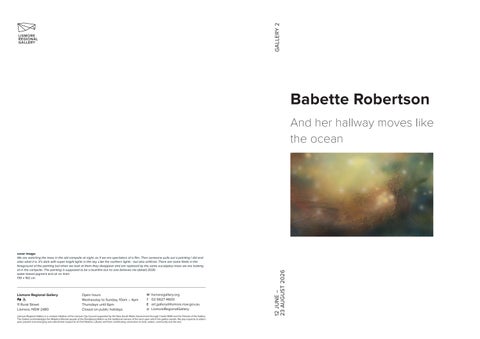
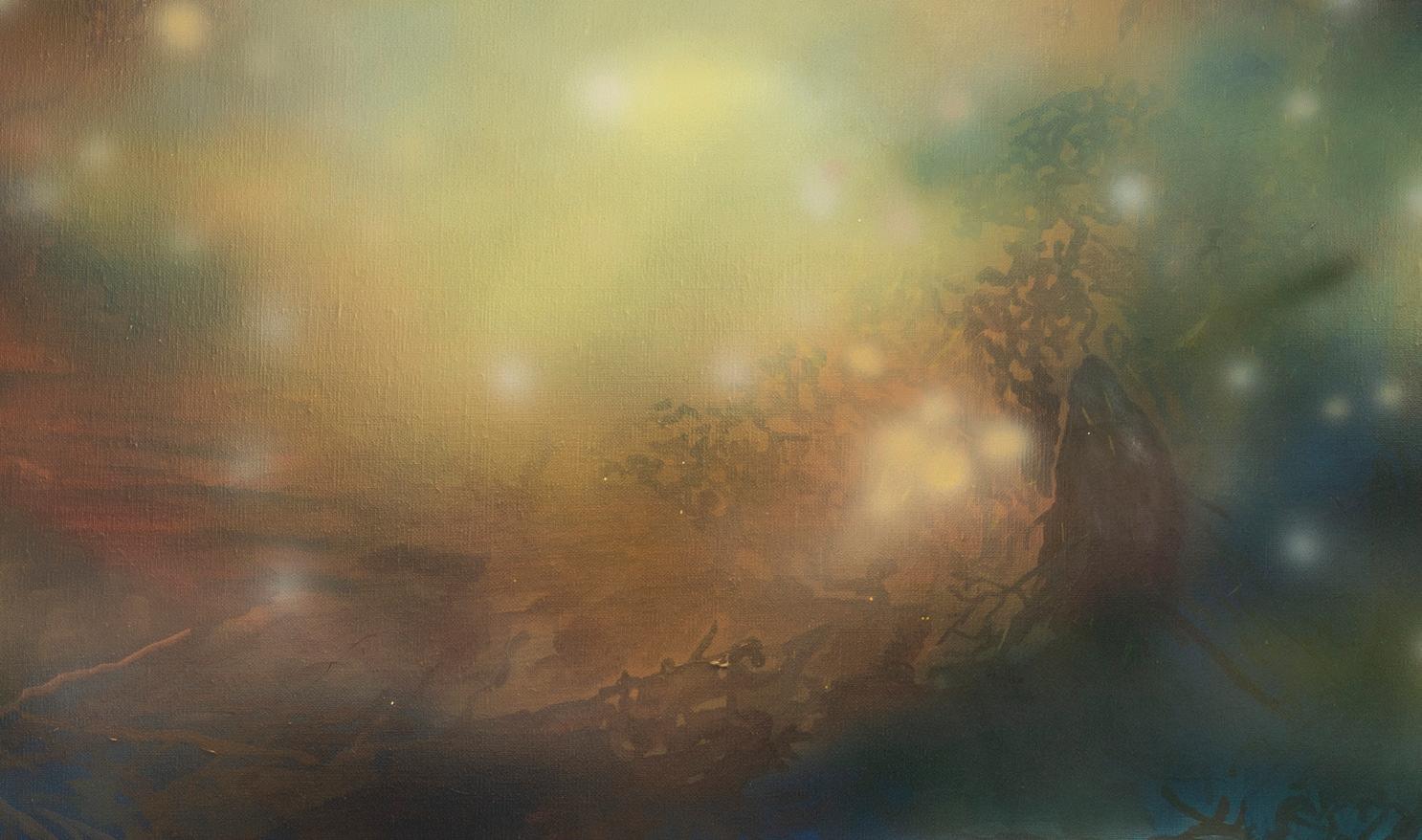
cover image:
We are watching the trees in the old campsite at night, as if we are spectators of a film. Then someone pulls out a painting I did and asks what it is. It’s dark with super bright lights in the sky. Like the northern lights - but also artificial. There are some fields in the foreground of the painting but when we look at them they disappear and are replaced by the same eucalyptus trees we are looking at in the campsite. The painting is supposed to be a bushfire but no one believes me (detail) 2026 water-based pigment and oil on linen 130 x 162 cm
Lismore Regional Gallery 11 Rural Street Lismore, NSW
Open hours Wednesday to Sunday, 10am – 4pm Thursdays until 6pm Closed on public holidays
W lismoregallery.org T 02 6627 4600 E art.gallery@lismore.nsw.gov.au @ LismoreRegionalGallery
And her hallway moves like the ocean is a painting-based exhibition accompanied by preliminary dream drawings, dream texts, engraved objects, and participatory workshops that explore the unstable relationship between inner and outer worlds. While painting remains central to Babette Robertson’s practice, these additional elements extend the exhibition beyond the paintings into language, architecture, participation, and collective psychological space. Drawing from psychoanalysis, surrealism, dream cinema, and the writings of Freud, Jung, Kathy Acker, and Nicholas Royle, dreams are approached not as private symbols but as shifting fragments that move between memory, emotion, bodies, and place. Robertson’s ongoing transcription of dreams each morning forms the conceptual foundation of the work.
I was on the Manning River at the bottom swimming hole at the farm. There was this huge fallen tree structure about 60m tall. It was very grey. …we climbed over the top. On the other side was a huge bowl thing for skating and all these skaters at some point I felt it was dangerous to be there so I climbed back over. My friend stayed in the halfpipe and then this enormous tsunami came crashing down the centre of the pipe it was so loud and I could see all the water and I knew no one would have survived. The dreams along the river continued. I can’t remember what exactly but I remember walking up and down the river.
Babette’s Dream Diary, 15 March 2026
It’s been raining all week in Sydney. I am dodging pools of muddy water on my morning walk as I leave a response to Babette’s recent voice message. Despite the time difference in Paris, Babette immediately responds. It is 2.45am and she is still in her studio. She sends me a selfie with her visiting mum, Belinda, who is keeping her upright with avocado Ryvitas. I know Belinda. We met by accident in Perth, when Qantas cancelled our flights while in-transit to Paris. Ours is a friendship forged in the crucible of transit purgatory. In the transfer cab to the airport, we realised that I’d taught her daughter Babette art history at the National Art School. Over beers in Singapore Airport, she rewarded me with several games of “Bush Rummy”, now a favourite card game that I will forever associate with that memory.
As Babette and I exchange texts, I’m struck by the strange surrealism of our distance. As the crow flies, there are 16,958 kilometres between us, several bodies of water, and countless stranded travellers. Babette has enjoyed living in Paris for the past three years, but she suffers from occasional bouts of homesickness and frequent bouts of insomnia. Babette has a strong connection to her family home in rural Burrell Creek (of the Biripi Nation) where her parents still reside and the idyllic Northern Rivers region, where she lived before moving to Paris. Past series were devoted to the heady fragrance of Eucalyptus and the erosion of her beloved Boolumbahtee (Manning) River. Perhaps unsurprisingly, Paris was a shock to the system. It is unremittingly metropolitan. Even the ancient Seine is tamed by centuries worth of bridges, sewers, reservoirs and dams.
The feeling of being between-places in spirit, a foreigner in her own home, has been uncanny for Babette. Lucid dreaming has been the most striking outgrowth of this uncanniness. Although there were some early attempts to resolve the insomnia and dreaming through Jungian therapy and Ashtanga yoga, like the surrealists, she decided to give her unconscious free reign. While most of us would turn to prescription drugs, Babette rises early every morning, regardless of how sleep deprived she is, and assiduously records her dreams and nightmares in a journal. These hastily scrawled fragments are literally and metaphorically embedded in the exhibition, And her hallway moves like the ocean. Babette’s godbrother created the custom-made bench for the show, and her sister hand carved her dream scripts into its surface using tattoo-transfer ink and a Dremel. Each canvas derives its title from a dream and is meticulously underpainted with its narrative. Keen observers will detect Babette’s handwriting in places, still visible below layers of translucent paint, threatening to surface like the return of the repressed.
Babette’s dreamscapes are ethereal and earthly. They are interiors and exteriors. They are then and now and in-between. They are stylistically slippery, aesthetically hazy, subjectively porous. Forms that resonate with familiarity are stubbornly ambiguous. Obscured details require patient, forensic examination. The explicit dream symbolism and crisp illusionism associated with surrealist painters such as Magritte or Dali is completely ignored. In reality, dreams are more sensation than a film projected onto the back of one’s eyelids. Anyone who has dreamt of falling knows this intuitively, and yet dream spaces hold qualities that seem intrinsic. In “…the space of our dreams”, Foucault writes, “…there is a light, ethereal, transparent space, or again a dark, rough, encumbered space; a space from above, of summits, or on the contrary a space from below, of mud; or again a space that can be flowing like sparkling water, or a space that is fixed, congealed, like stone or crystal.” (1)
Recurring motifs in Babette’s dreams include waterfalls, caves, and carparks. These are cool, damp places full of shadows, and sometimes foreboding. The surrealists often cited caves and labyrinths as a reminder of the importance of myth and primitive instinct. Babette paints the atmospheres of these dreams at human scale, in portrait format, rather than landscape. The effect is immersive and the address is intimate. Waterfalls, caves, and carparks all evoke the vertical axes of terrestrial space, echoing Freud’s renowned iceberg model of the mind, as well as the passage of dream, from the dark recesses of the unconscious to waking life. For Babette, who is living in the slippage between Australia and France, and dream and waking life, the waterfall, which unifies two distinct planes through the language of water, is a particularly poignant emblem.
“The dreams along the river continued.” Water unifies the exhibition. The title “And her hallway moves like the ocean” is a lyric borrowed from Flood I, a favourite studio jam by The Sisters of Mercy. The song continues, “At the head of the river, At the source of the sea… Dream of the flood.” Leonora Carrington’s painting Elements (1946), which merges the four classic elements (earth, air, fire, water) with alchemy, cosmology and mythology, is the inspiration behind Babette’s monumental diptych, I pulled out the vials of paints… (2026). It mirrors Carrington’s mystical landscape, in which mountains, forests, caverns and sea are interlaced across the canvas in the impossible contiguity made famous by Flemish Renaissance painters such as Bosch and Bruegel. Of the elements, the philosopher Gaston Bachelard writes in Water and Dreams (1941) that, “Water is truly the transitory element. It is the essential, ontological metamorphosis between fire and earth. A being dedicated to water is a being in flux. One cannot bathe twice in the same river because already, in his inmost recesses, the human being shares the destiny of water.” (2) Babette dreams of the river because the river weaves Burrell Creek, Lismore, and Paris together. The river is always changing as she is always changing. At an atomic and cosmological level, she is never in the same place more than once.
This morning/night, awake/asleep, here/there, Babette is with her mother. In Civilization and Its Discontents (1929) Freud wrote about ‘oceanic feeling’, a primitive trace of infantile consciousness, prior to entry into language and culture. It is a nostalgia for the symbiosis that binds a mother and child through the womb. It is a profound sense of cosmic oneness; it is an extreme form of homesickness.
Jaime Tsai
(1) Michel Foucault, ‘Of Other Spaces,’ trans. Jay Miskowiec, Diacritics 16, No. 1 (Spring, 1986) 23 (2) Bachelard, Gaston. Water and Dreams: An Essay on the Imagination of Matter. Dallas: Pegasus Foundation, 1983. 6
list of works
Babette Robertson born 1996 Sydney, Australia lives/works between Paris and Australia
But the carpark was in this cave with bright lights from above shining through. It was hard to tell whether it came from industrial fluorescent strips or from openings in the rock letting in daylight 2026
water-based pigment and oil on linen
130 x 94 cm
Dream bench 2026
wood, paint
80 x 310 x 60 cm
I had tickets to a prestigious theatre/opera but I wanted to give them away. Everyone told me I was crazy and wouldn’t take them. I knew the curtains were green and I thought they should be red 2026
water-based pigment on linen
130 x 97 cm
I pulled out the vials of paints further and behind them were all these powders. They were the most beautiful and the most alluring but I knew I couldn’t use them because my mask didn’t filter ammonia and these powders had ammonia in them 2026
water-based pigment and oil on linen diptych, each panel 300 x 200 cm
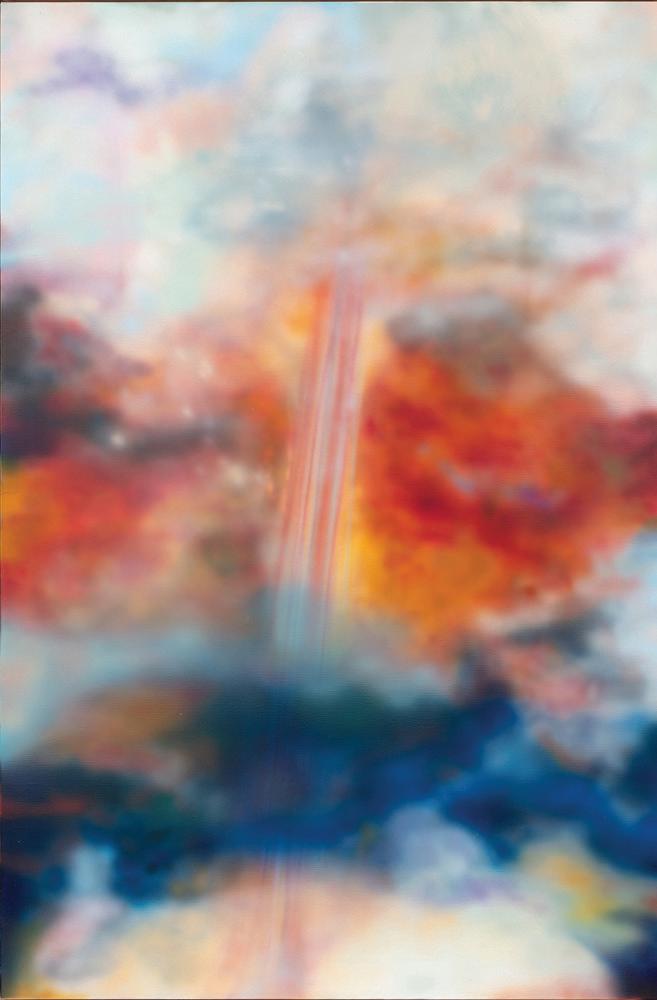
It was sort of a rainbow but not in the way I expected 2026
water-based pigment and oil on linen
195 x 130 cm
Pt. 1 I was walking along a suburban footpath when I stumbled upon a woman. She was very skinny and had long grey hair. She was kneeling down singing the most beautiful Italian opera 2026
water-based pigment and oil on linen
41 x 33 cm
Pt 2. She didn’t stop singing when I arrived. She was in a meditation state. Then she bent down, very close to the ground. There was a tiny rectangle of grass between the concrete. She pulled out a tiny shovel and watering can and begun digging it up 2026
water-based pigment and oil on linen
41 x 33 cm
Pt 3. She was still singing. Then I realised it was a grave – 5 x 6 cm. Inside, a tiny dead bird. She took the bird out of the grave and held it in her palm 2026
water-based pigment and oil on linen
41 x 33 cm
Pt 4. She continued to sing. At this point she acknowledged my presence. I could tell she was showing me the bird. Eventually she put the bird back in the grave and kept singing 2026
water-based pigment and oil on linen
41 x 33 cm
THEATRE PAINTING #2: I dreamt again about sneaking into the opera theatre in Zurich. This time, I had to jump over many fences. Each row of seats was a fence. Then I had to sit on a balloon that burst when I sat on it and the popcorn in my hand went everywhere on the floor. All the posh people around me stared as they were sipping champagne 2026
oil on linen
114 x 162 cm
Then a man lowered me down a mountain face on this pulley–like system towards a lake. I was going so fast. Everything was out of my control 2026 water based pigment and acrylic on linen
130 x 97 x 2.5cm
Their feet were as high as the treetops 2025 oil on canvas
33 x 31 cm
They gift me a bird. We are in a high apartment but it feels like a treehouse. We stand on the balcony looking down at three trees. I believe it is spring. One tree has red leaves with yellow flowers, one has yellow leaves with red flowers. One tree is green. I want to point out the colours to them, but when I look again, only a few leaves and no flowers remain. I realise that it isn’t spring after all, but autumn turning into winter 2026 oil on linen 162 x 114 cm
We are watching the trees in the old campsite at night, as if we are spectators of a film. Then someone pulls out a painting I did and asks what it is. It’s dark with super bright lights in the sky. Like the northern lights – but also artificial. There are some fields in the foreground of the painting but when we look at them they disappear and are replaced by the same eucalyptus trees we are looking at in the campsite. The painting is supposed to be a bushfire but no one believes me 2026
water-based pigment and oil on linen
130 x 162 cm
all works courtesy the artist and Olsen Gallery