Rural. Summer 2021
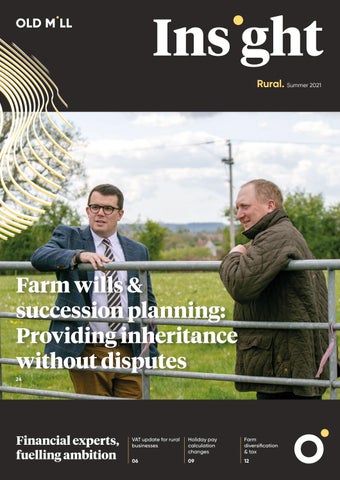
Farm wills & succession planning: Providing inheritance without disputes 24
Financial experts, fuelling ambition
VAT update for rural businesses
Holiday pay calculation changes
Farm diversification & tax
06
09
12
Welcome
“After a year spent ‘off-site’, the rural team are looking forward to pulling on their boots and stepping into the farmyard to meet in person.”
2
Rural Insight Summer 2021
Welcome
accountancy work at Old Mill with the day to day running of the farm has provided a virtuous circle of learning and experience for himself, Old Mill and our clients. For those farmers without family to pass their business on to, Catherine Vickery uses Defra’s recent announcement of the ‘lump sum exit scheme’ to reassure the hesitant that now could be a suitable time to consider retirement, while Rebecca Partridge also considers the lump sum exit proposals in the context of rural support payments overall.
Welcome to the latest edition of Old Mill’s Insight publication, focusing on farming and rural businesses. Although we’re not yet through the pandemic at the time of writing, the ongoing and rapid increase in vaccinations hopefully points to more positive times ahead. We therefore make no apologies for putting forward-thinking and optimism into the heart of this edition of Insight. Passing the farm onto the next generation is an aspiration for many farmers, but what happens if there is more than one child to pass assets onto? What options are available to provide non-farming children with an inheritance? In her ‘Providing inheritance without disputes’ article, Julia Banwell offers practical pointers for parents looking to keep the farm as intact as possible whilst also providing for their non-farming offspring. Having completed a buy-out of the family farm in Somerset in April 2021, Dan Heal knows first-hand about succession planning. Dan and his wife Sabrina are the fifth generation of his family at Midway Farm, running a herd of pedigree British Friesians and a few pedigree Ayrshires. Combining his rural
In the spirit of new horizons, we’re taking the opportunity to introduce our new Senior VAT Adviser Len Dean. In a general VAT update for rural businesses, Len examines a few areas to consider in the upcoming financial year. Lastly, we reaffirm our commitment to the rural industry at large and the next generation of talented accountants in particular. Changing market conditions, new enterprises and farm diversifications have created a unique and exciting time to enter the rural accounting industry. An average day will find an Old Mill rural adviser working on a wide variety of matters, as often involving the human aspects of our clients’ businesses and planning as just their accounts and tax. There is far more involved than ‘just the numbers’. Our Rural team are genuinely passionate and enthusiastic about our clients and the future of this industry; with opportunities at all levels, if you or someone you know is looking to combine their passion for farming with the day job, please contact us for an informal chat. We hope you enjoy this edition of Insight, and I look forward to catching up in person with you as soon as possible. Andrew Vickery Head of Rural
3
Contents
Your Old Mill Contributors Rural accountants and advisers
Rural tax & VAT specialists
Andrew Vickery 01935 709321 andrew.vickery@om.uk
Catherine Vickery 01749 335035 catherine.vickery@om.uk
Richard Haines 01225 701225 richard.haines@om.uk
Laura Wylie 01225 701244 laura.wylie@om.uk
Neil Cox 01749 335019 neil.cox@om.uk
David Shearer 01392 351302 david.shearer@om.uk
Martin Taylor 01935 709339 martin.taylor@om.uk
Zoe Chandler 01225 701246 zoe.chandler@om.uk
Paul Neate 01225 701224 paul.neate@om.uk
Marianne Hawksworth 01935 709316 marianne.hawksworth@om.uk
Phil Kirkpatrick 01392 351306 philip.kirkpatrick@om.uk
Len Dean 07866 187806 len.dean@om.uk
Rebecca Partridge 01935 709426 rebecca.partridge@om.uk Dan Heal 01935 709449 daniel.heal@om.uk Oliver Bond 01392 351337 oliver.bond@om.uk
Rural financial planners Stuart Coombe 01392 351301 stuart.coombe@om.uk Julia Banwell 01749 335048 julia.banwell@om.uk
Digital Services Willem Puddy 01749 335076 willem.puddy@om.uk Emma Cotton 01749 343366 emma.cotton@om.uk
4
Wayne Bastian wayne.bastian@om.uk
Marketing & Business Development Ben Carter 07825 620052 ben.carter@om.uk
Rural Insight Summer 2021
Contents 06 VAT update for rural
23
Guest spot: Cornish Mutual
24
Farm wills & succession planning: Providing inheritance without disputes
28
Case Study: The fifth generation at Midway Farm
30
Using Xero - Quick Tips
businesses
07
12
Stamp Duty Land Tax: mixed-use claims
08 New year, new allowances
09 Holiday pay calculation changes a reminder
10
06 15
Lump sum exit scheme & Path to Sustainable Farming: What farmers need to know
12
Farm diversification & tax: How to finance and structure your new venture
14
Income Tax on joint buy-to-let properties: What you need to know
15
Is now the time to consider retiring?
16
Taking on the family farm: Succession advice for the next generation
22
Guest spot: Fisher German
31 We’re recruiting
5
VAT update for rural businesses
VAT update for rural businesses In a general VAT update for rural businesses, our new Senior VAT Adviser Len Dean flags a few key matters to look out for, including: 1.
Has lockdown impacted your income streams? Is your Vatable income lower than normal? Don’t let this cause unfairly low VAT recovery
2.
A reminder that deferred Customs declarations for imports from the EU post Brexit need to be made within six months
3.
Since November 2019, individuals and partnerships can join VAT groups – useful to consider when restructuring, incorporating or tidying up your VAT.
1. Has lockdown impacted your income streams? Is your Vatable income lower than normal? Don’t let this cause unfairly low VAT recovery.
3. Since November 2019 individuals and partnerships can join VAT groups – useful to consider when restructuring, incorporating or tidying up your VAT.
Many rural businesses have some VAT exempt income (e.g. residential lettings, some land rents etc) as well as Vatable income streams such as from tourism, holiday lets, hospitality and other diversification, that has been severely impacted by COVID. The time will be coming for many to do the VAT annual adjustment calculation on VAT recovered over the year. This is a reminder that HMRC released details in March of a COVID relief measure aimed at correcting unfairly low VAT recovery caused by COVID disruption (Revenue & Customs Brief 4, 2021). To reflect the exceptional circumstances HMRC has set up a facility to obtain accelerated approval for businesses to correct unfairly low VAT recovery rates caused by lower vatable income during the pandemic. So now is a good time to make use of this if you’re impacted.
Before this, individuals and partnerships weren’t able to be in VAT groups and in a sector where sole-proprietors and partnerships are common, the benefits and simplifications afforded by VAT grouping haven't previously been available. As well as the benefit of one consolidated group VAT return, VAT grouping can be very useful when restructuring, as transactions between parties in a VAT group aren’t subject to VAT. This is useful to consider for property and other transactions within farming families and rural businesses, issues around incorporating and other circumstances. Please note there are conditions required to be VAT grouped and implications of VAT grouping that need to be considered on a case-by-case basis.
2. A reminder that deferred Customs declarations for imports from the EU post Brexit need to be made within six months.
6
The UK Government put in place an option of delayed Customs declarations for imports from the EU as a temporary Brexit easement measure from 1 January 2021. It has been extended to cover an additional six months through to 1 January 2022. However, the 175 calendar day deadline to make declarations is now upon us for imports from the EU in January. If you miss this deadline you could risk fines and lose the option to continue using the delayed declaration scheme. If you’re unsure check with your Customs agent / freight forwarder / express operator that Customs declarations are up to date. You will need these to get your Postponed Import VAT Accounting statements from gov.uk as well .
If you would like to discuss the above or any other VAT matters, Len would be delighted to hear from you. Len Dean 07866 187806 len.dean@om.uk
Stamp Duty Land Tax: mixed-use claims
Rural Insight Summer 2021
Stamp Duty Land Tax: mixed-use claims It’s quite common for those purchasing a residential property with accompanying land to assume the acquisition is mixed-use and therefore subject to the lower commercial property rates of Stamp Duty Land Tax (SDLT).
•
What does the marketing brochure say? Does it specify there are currently grazing rights?
•
At the point of acquisition, is the land let on commercial terms, i.e. as opposed to at a peppercorn rent?
•
At the point of acquisition, is there written evidence of any ongoing arrangements in place, such as contracts or agreements?
However, as demonstrated by several recent tax cases on this point, it isn’t always this straightforward. A recent case study & failed mixed-use claim The most recent case involved three appellants – (1) Mr and Mrs Hyman, (2) Pensfold and (3) Dr and Mrs Goodfellow – who all appealed to the Upper-Tier Tribunal (UTT) on the same point, namely the definition of ‘residential property’ in the SDLT legislation. The appellants contended that land can only be part of the ‘garden or grounds’ if it’s required ‘for the reasonable enjoyment of the house having regard to the size and nature of the house.’
If you’re in the process of making a purchase, or indeed have done so recently, and you’re unsure if you could have made a claim for mixed-use, please speak to your Old Mill adviser in the first instance. Laura Wylie 01225 701244 laura.wylie@om.uk
The key point was whether ‘reasonable enjoyment’ was included in the definition of ‘garden and grounds’ for SDLT purposes, as we know it to be for Capital Gains Tax. The UTT found in favour of HMRC and agreed that the definition of ‘garden or grounds’ for SDLT is simply that the land is available to the owners to use as they wish. The absence of any commercial return received by any of the owners for the land demonstrated that the land was available for them to use and so their claims for mixed-use SDLT rates were rejected. How to support your mixed-use claim Based on the decision in this case, the following should be considered to support a mixed-use claim:
7
New year, new allowances
New year, new allowances The new tax year gives a fresh set of allowances that can be used to effectively organise your financial affairs. Allowances in a tax year are limited and can be considered ‘use it or lose it’. We highlight some of the main allowances that are available for tax year 2021/22:
Income Tax There were modest increases to the personal allowance and basic rate tax bands. These allowances will then be frozen from April 2022 to April 2026, effectively a ‘stealth tax’ for anyone whose earnings increase in future years as their tax burden will increase. Effective tax planning can ensure that income falls within available allowances. Using other available allowances (see later) to reduce tax burdens, as well as less obvious allowances such as marriage allowance (where applicable) can also make a fundamental difference.
The CGT annual exemption remains £12,300 and will until 2026. Rumours abound that changes may be forthcoming for CGT, in terms of allowances and rates of tax payable. As such effectively using this allowance where possible to wash out any gains should be considered an effective strategy. Similarly, its often forgotten that losses can be carried forward indefinitely (if reported correctly) and therefore crystallising losses can also be effective in helping future tax planning.
Inheritance Tax (IHT) Again, the nil rate band (NRB) is to remain at £325,000 until April 2026, the same rate it has been since 2009.
Allowances remain at £20,000, and Junior ISAs at £9,000.
With house prices increasing and many assets bouncing back strongly since the pandemic first took hold, more and more people are likely to be caught in a situation where IHT will be paid.
Simple but effective, ISAs are free of Capital Gains Tax or Income Tax. The use of ‘bed and ISA’ strategies to move funds from taxable accounts to the tax preferred ISA wrapper can improve individual tax position substantially over years.
Early and effective planning as part of retirement and succession discussions can minimise IHT payable. With mixed farming assets this is particularly complicated, especially where passing on of assets and continued needs of various generations to derive an
Individual Savings Accounts (ISAs)
8
Capital Gains Tax (CGT)
income come to the fore, hence a joined-up approach between accountant, tax adviser and financial planner can be most effective.
Pensions The generous £40,000 annual allowance remains in place, and the vastly increased tapered annual allowance also remains, meaning this should be available for more individuals who have the earnings to make large contributions. Pensions remain a key part of successful rural financial planning, be it providing off-farm income, potential use in asset purchases, or an additional pot to pass as a legacy when equalising inheritances to future generations. Stuart Coombe 01392 351301 stuart.coombe@om.uk
Holiday pay calculation changes - a reminder
Rural Insight Summer 2021
Holiday pay calculation changes – a reminder The rules on calculating holiday pay changed last April, although this change was rather overshadowed by COVID-19 and the volume of other changes and schemes at that point. The following is a recap of the change which will affect many employers in our industry. Holiday pay is based on the principle that a worker shouldn’t suffer financially for taking holiday. For workers on fixed pay, a week’s holiday pay will simply be equivalent to a week’s wage. However, if you have employees whose pay varies with the amount of work done in a normal working week then there has been a signification change to the calculation of holiday pay.
What is the change? As a result of the review of Modern Working Practices in 2018, the Employment Rights Regulations 2018 have been updated to increase the reference period used when calculating holiday pay from 12 weeks to 52 weeks. From 6 April 2020, agricultural employers, when calculating holiday
pay for a worker whose pay varies with the amount of work done in normal working hours, must use the average hourly rate from the previous 52 weeks to determine what they are due in holiday pay. For an employee who works the same hours every week and the pay for work done in those hours doesn’t vary, this wouldn’t apply as their pay for a normal working week doesn’t fluctuate. However, this rule is in place to ensure that workers who don’t have a regular working pattern throughout the year aren’t disadvantaged by having to take their holiday at a quieter period in the year when their weekly pay might be lower.
When does the 52 weeks start? The holiday pay reference period starts from the last whole week ending on or before the first day of the period of leave. This will typically be a week from Sunday to Saturday, but it could end on another day of the week if a worker is paid on a weekly basis.
The reference period only includes weeks that a worker was actually paid and takes into account no more than the two-year period prior to taking holiday. If the employer doesn’t have 52 weeks’ pay data for the worker, usually due to unpaid weeks or recent employment, then the reference period can be reduced to the number of complete weeks in which the worker was actually paid.
What does the calculations include? If your employees earn commission or bonuses, you should include this in your calculations for holiday pay. It isn’t enough to base renumeration on your staff member’s basic salary; it should also take into consideration any additional payments that they receive on a regular basis. Andrew Vickery 01935 709321 andrew.vickery@om.uk
9
Lump sum exit scheme & Path to Sustainable Farming: What farmers need to know
Lump sum exit scheme & Path to Sustainable Farming: What farmers need to know
Agriculture has hit the headlines with the prospect that the UK Government are considering paying older farmers to retire. This is not new ‘news’, MP George Eustice initially unveiled these schemes in November 2020 when he launched ‘The Path to Sustainable Farming’.
What is ‘The Path to Sustainable Farming’? Ultimately Eustice is recognising the age-old conundrum between generations of farming families who retain control of the business and assets vs. entrants who are keen to explore farming as a career (and lifestyle) but can’t afford to enter the industry or have access to land.
“The consultation is a huge opportunity for the voice of the rural community to be heard and help determine the direction of these payments – so make your voice count!” 10
Rural Insight Summer 2021 Whilst the national press is quoting pay-outs of up to £100,000, Eustice has opened a consultation seeking views on: •
The proposed lump sum exit scheme
•
DEFRA’s proposed approach to delinked payments.
The proposed lump sum exit scheme is believed to help those who wish to retire or leave the industry in a planned and managed way.
•
•
•
The farm business that takes the lump sum will not be able to claim any further Direct Payments. Where the business is a limited company, it’s proposed that the directors will also be unable to claim future Direct Payments; similarly with a partnership, partners will be unable to claim in the future
•
What does this mean for the Basic Payment Scheme (BPS)? The plans to delink Direct Payments in 2024 will bring further simplification as Basic Payment Scheme (BPS) payments are phased out. When delinked payments are introduced, they will replace the current BPS in its entirety (including the young farmer payment) for all farmers for the remaining years of the agricultural transition (to 2027). It’s proposed that delinking will not be optional for farmers and recipients of BPS will not be required to continue farming after the reference period (please see below).
Who is eligible for the lump sum exit scheme? Currently, the proposed eligibility for the lump sum exit scheme include: •
The lump sum exit scheme is aimed at farmers who claim BPS and who wish to exit the industry
•
A condition of the lump sum is that all English BPS entitlements held by the BPS applicant would be cancelled
•
It’s an ‘all or nothing’ opportunity – i.e. a partial lump sum will not be offered
•
To be eligible for the lump sum payment, the farmer (BPS applicant) would have to give up their land in England. This means that:
•
•
An owner-occupier must sell and/or rent out their land in England, and/or transfer it by gift
A tenant must surrender their tenancy for land in England.
It’s proposed that if the lump sum recipient enters into new land management agreements, or adds land to existing agreements, during the remainder of the agricultural transition then the lump sum will need to be repaid
•
Lump sum payments will be based on reference periods (to be confirmed as part of the consultation) and could be:
•
•
The average of 2018 to 2020 BPS scheme years
•
•
The average of 2018 to 2022 BPS scheme years
•
•
The 2022 BPS scheme year
•
•
Other (to be specified).
Proposed eligibility for delinked payments:
these schemes will impact your wider tax position, including Inheritance Tax and available reliefs, therefore decisions should not be taken lightly or without discussion with your advisers.
How do I give feedback on the proposed lump sum? DEFRA would like opinions and views for on the following by 11 August 2021: •
The eligibility criteria and aspects of how the lump sum should be calculated
•
The reference period to be used to determine eligibility for, and calculate the value of, delinked payments.
The consultation is a huge opportunity for the voice of the rural community to be heard and help determine the direction of these payments – so make your voice count! For more information and to give your opinions and views please use the following link: Direct Payments to farmers: consult. defra.gov.uk/agricultural-policy/ lump-sum-and-delinked-paymentsengland/. Rebecca Partridge 01935 709426 rebecca.partridge@om.uk
1. The delinked payments will be based on reference periods (TBC as part of the consultation). It’s proposed that it will be necessary to still be farming at the end of the reference period, and in 2023 if the reference period is earlier than this 2. It’s proposed that delinked payments will not prohibit the recipient from applying for payment under new schemes such as environmental land management schemes.
Will the lump sum be taxed?: There remain to be many ‘unknowns’ including the taxation of the proposed schemes together with how business structure changes may interact with eligibility, all of which DEFRA are working through to provide more detail in due course. It will be important to consider how
11
Farm diversification & tax: How to finance and structure your new venture
Farm diversification & tax: How to finance and structure your new venture Diversifying your farm is a great way of expanding your business and its income, as well as providing financial security for the future. Whether it’s a farm shop, cafe or even a holiday park, there are some great options for you to broaden your income. However, for any farm diversification project there are financial, budgeting and tax implications that need to be thought through. The impact of these can vary depending on the business structure of your farm, so it’s important to look at this from the beginning. Here we look at the key areas and tax implications of diversifying your farm:
What are your aims for farm diversification? Firstly, any diversification must have the potential to be profitable. But aside from that we must also think about what other aims you’re hoping to achieve from your new venture. These aims might be any of the following: •
Provide a steady income for tougher times
•
Make the most of assets that aren’t providing a return
•
Deliver off-farm income to tie over a succession plan.
Either way, it’s essential to know in advance what you’re hoping to achieve as this could have an impact
12
on your business structure and therefore your tax implications.
Do you have the cash available? The number one reason for a new venture failing is lack of cash flow. New projects may take a while before you start seeing the real returns, so along with your aims, it’s vital to know the risks vs. the opportunities. An accountant will help to support you by pointing out the areas that could affect your business as well as understand the project’s affordability using a cash flow forecast.
Applying for bank funding As a farmer or landowner, you may want to fund smaller projects yourself, but for larger projects you’re likely to need bank funding. The application for bank funding will need a thorough cash flow budget which will be evaluated by the bank. Your accountant can help you prepare the application. When borrowing money, these are the two areas to pay particular attention to: 1. Not borrowing enough – delays and unforeseen costs are normal for a new venture. Consider how you would fund the project if costs were to increase by 10-15% 2.
Unrealistic loan term – debt costs
money, therefore most people wish to pay it off as quickly as possible and this typically hits cash flow hard. Cash flow is key and you should be doing everything you can to maximise it in the early years, so consider spreading debt repayments over a longer term. Banks will often allow you to repay loans quicker (watch out for early repayment charges on some loans) however, asking for additional finance when the business is struggling can be difficult. One way to combat the above is to ask your bank about interest-only periods as this is a great way to preserve cash flow in the first 6-12 months.
Applying for grants in 2021 Other financing options like grants could also be explored, consult your Old Mill contact or your farm consultant for what could be available. However, be aware that grant money isn’t usually awarded until the project is completed, so initial funding will have to be sourced elsewhere. Though it might be difficult in the current environment to receive a grant as EU funding has been withdrawn, there are still often grants supporting diversification, particularly for accessing new markets, job creation and technological advancements.
How should you structure your farming business? Whether you’re opening a farm shop, holiday home or other venture, considering whether it should be structured as part of your existing business or as a separate entity is important, particularly for tax purposes. Once you know the answer to that question, you can consider what type of entity the business should be – sole trader, partnership, limited company, and limited liability partnership being the most common examples. Limited companies and limited liability partnerships can be useful to ring-
Rural Insight Summer 2021 4. Tax on profits (Income Tax or Corporation Tax) – Depending on how the business is structured, Income Tax or Corporation Tax will be payable upon the profits the new enterprise generates. Understanding what you want to do with those profits (reinvest in the business, spend etc) and what rate of tax could be charged on them will likely be key to determining how the enterprise should be structured and ought to be considered at an early stage. In addition, a point often overlooked is whether any of the capital costs incurred on developing the new enterprise can be offset against business profits. fence the business away from other assets or businesses, providing an extra degree of financial protection for the main farm.
How should you structure your farming business? 1. VAT – There are three main questions to consider in relation to VAT: a. What is the VAT treatment of the output from the diversification, and will the customers be able to reclaim any VAT charged? b. What will the input VAT be on any capital costs to develop the diversification and can these be reclaimed or reduced? c. What impact will the diversification have on the farm’s existing VAT registration? Depending on the answers to the above questions, it may be better to ringfence the diversification as a separate entity, so it exists outside the farm VAT registration. VAT will impact the finances of the diversification and therefore it should be considered at an early stage and factored into your business plan. 2. Inheritance Tax (IHT) – Farming property and businesses can potentially benefit from both Agricultural Property Relief (APR) and
Business Property Relief (BPR), making them relatively tax efficient assets for IHT purposes. However, when you take some of those farming assets and use them for non-farming purposes, APR will no longer be available and you will be reliant upon BPR. Therefore, it’s important to understand whether or not the new enterprise will qualify for BPR. If it doesn’t qualify, then it could be exposed to IHT at 40%. It’s possible for the diversification to sit under the umbrella of your existing business and this could allow BPR to be spread over the diversification as well. However, this is a highly specialist area and advice is needed from your accountant as it could equally jeopardise the BPR position of the existing business. 3. Capital Gains Tax (CGT) – This is relevant for those aiming to sell or transfer the diversification in the long run. It’s key from the outset to know the eventual aim, to understand which CGT reliefs are available in the event of a sale, gift or transfer. However, be aware that these will be restricted if the diversification is not deemed to be ‘trading’ by HMRC. Consider transferring the asset before it’s developed into a diversification, as removing it from agricultural production could limit the reliefs available.
For example, most people think they can’t claim on building conversion costs but this isn’t always the case. There is often a significant amount of tax relief available on building or converting a furnished holiday let and this relief can significantly reduce or eliminate tax on profits in the first few years.
Other points to consider •
Planning permission – most diversifications will require planning consent which could directly impact VAT
•
Insurance – the existing policy might not cover the diversification
•
PAYE – relevant if the diversification is employing people
•
Stamp Duty – not normally an issue but in the event of property transfer or sale it applies, particularly if debt is attached to the property.
If you would like to discuss farm diversification in more detail, then please do get in touch. Phil Kirkpatrick 01392 351306 philip.kirkpatrick@om.uk Oliver Bond 01392 351337 oliver.bond@om.uk
13
Income Tax on joint buy-to-let properties: What you need to know
Income Tax on joint buy-to-let properties: What you need to know If you jointly own a buy-to-let property and currently receive rental income, then the Income Tax you pay can be different depending on what your joint relationship is. Whether you’re spouses, civil partners, or whether the property is held jointly between family members, this will have an impact on your Income Tax. Whatever relationship you have, the most important point to fully understand however, is whether you decide to be Joint Tenants or as Tenants in Common for the buy-to-let property.
Joint Tenants If you own property as Joint Tenants, then the rental income which you generate on that property is shared 50:50 between spouses and civil partners. If held by other family members, then the income is also shared equally between the total number of owners. This means Income Tax is also split equally. Making Tax Digital for reporting taxable income is expected to come live from 6 April 2023, and each joint owner will have to make
14
quarterly returns to HM Revenue and Customs where their total income exceeds £10,000. It’s recommended to use dedicated software for this which at the moment is in development with a number of organisations, such as Xero for example.
Tenants in Common If you hold a property as Tenants in Common then while the ownership is 50:50 the rental income may be split differently such as 80:20. However unless you submit a ‘Form 17’ (further details below) then your Income Tax is still charged at a 50:50 share regardless of the ownership split. This means that if a buy-to-let property made £5,000 in a year and the income split was 80:20, equalling £4,000 and £1,000, the Income Tax would still be charged on £2,500 each. However, this can be changed with the submission of Form 17. If you wish to share the income in accordance with the beneficial ownership, you need to complete Form 17 and submit this to HM Revenue and Customs, together with the Declaration of Trust confirming the beneficial ownership, within 60 days from the date that the second signature is added to the form.
Declaration of Trust The allocation of the income in the beneficial ownership proportions will be from the date of the Form 17, but not before. Therefore, if a property held by a spouse, or civil partner, is currently held by one of them, they can enter into a Declaration of Trust to give away say a 1% share to the other spouse.
This will not be chargeable to Capital Gains Tax or will be a Potentially Exempt Transfer for Inheritance Tax purposes, but it will result in the income being shared 50:50 even though the beneficial capital ownership is held 1% by the other spouse, or civil partner. This may help utilise a spouse’s lower rate tax band, and or Personal Allowance. However, if the property is held 25% by one spouse and 75% by the other and it’s advantageous for the spouse holding 75% to have more of the income, then Form 17 should be completed.
Capital Gains Tax & children Where you’re owning properties with other family members, or wish to share it with other family members, it’s important to note that where the beneficial capital ownership changes, in particular if you’re including children, that this is a Capital Gains Tax disposal. With regards to the income, if the children are minors, then the income is still taxed on the parent who made the gift, but if the children are of age, then they’re responsible for their share of the income. Where there are joint owners of property and the children do own a small interest in the capital, you could still enter into a Declaration of Trust to change the income sharing entitlement without changing the capital ownership element. This will require a solicitor to draw up the document. This therefore can allow them to use their Personal Allowances and basic rate tax bands, to help with their school fees, etc.
Is now the time to consider retiring?
Rural Insight Summer 2021
Is now the time to consider retiring? “Whether you’re spouses, civil partners, or whether the property is held jointly between family members, this will have an impact on your Income Tax.” Wills Where you hold property as Joint Tenants, then on the death of one joint tenant, their interest automatically vests with the remaining joint owners, irrespective of what any Will may say. Property held as Tenants in Common will be distributed in accordance with your Will. Where you wish to convert property held as Joint Tenants into property to be held as Tenants in Common, then you need to enter into a deed to sever the joint tenancy first. If you would like to discuss joint ownership for buy-to-let properties or have any other ownership queries, then please do get in touch. Paul Neate 01225 701224 paul.neate@om.uk
Farmers have a great opportunity to retire following Defra’s announcement of the lump sum exit scheme and shouldn’t feel guilty for doing so. Now is a prime opportunity to start thinking about retirement for a number of reasons but particularly if you have no one to pass the business on to.
Inheritance Tax shouldn’t stop you Inheritance Tax (IHT) can be a barrier to retirement for some farmers but there are ways to lock in the tax benefits. You genuinely don’t have to keep farming until the day you die to be able to protect the family from IHT. The lump sum exit scheme will offer up to £100,000 to farmers who want to retire, based on the area payments they would have received until the end of the transition period in 2027.
Capital Gains Tax is low This means now is a great time to look at the potential benefits and tie it in with retirement plans. At present, Capital Gains Tax is as low as 10%, providing a great opportunity to pass on assets, but at some point those rates are going to go up.
rather than waiting until death to pass over the money. But don’t leave yourself short of money. Make sure you have the means to look after yourself for the rest of your life. Whether that’s investing in assets which will generate a strong income, living off the capital or other pension planning - if there is a little bit of lead time there are steps we can put in place. For instance, you can put a bit more money into pension funds and discuss what investments might be suitable.
Retire without guilt The key thing is that farmers don’t have to carry on farming. There’s no need to feel guilty about wanting to retire. Now is the perfect time to get planning with the prospect of these payments as it takes a while to retire. Speak to us about your options for retirement. Catherine Vickery 01749 335035 catherine.vickery@om.uk
Farmers should think about where they want to be in the next five years. Do you still want to be farming the same way you are now? What if you start to struggle physically? Retirement can also help the next generation. It can enable farming families to help their children financially and see the impact it has on them – it’s called giving with a warm hand,
15
Taking on the family farm: Succession advice for the next generation
16
Rural Insight Summer 2021
Taking on the family farm: Succession advice for the next generation
17
Taking on the family farm: Succession advice for the next generation
The transition of a farm from one generation to the next can be a complex and sensitive process. We call this transition ‘succession planning’, and this process often gets side-lined until there’s no choice but to deal with it, as it can be a difficult subject to broach. And it’s often a topic that is discussed with the older generation in mind, but the younger generations also need to plan their future, so what do they need to think about? In this article we’ll cover two broad areas to help the next generation of farmers; •
Our 10 tips for beginning your farming career
•
How to take over the family farming business.
Our 10 tips for beginning your farming career 1.
Start young
Get involved with the farm work at a young age, but remember you’re still learning. This is a prime time to learn as much as you can before you take on any responsibilities.
18
2.
Make mistakes
You will make mistakes, so try to learn from them. Ask for advice from others but form your own views. 3.
Broaden your horizons
Consider an academic course associated with farming. If you’re on a family farm, maybe study something that aligns with it, like engineering or an advisory role. This will also help alleviate any feelings of being trapped on the farm. It’s beneficial to travel, read and gain work experience elsewhere. Doing this early in your career means you aren’t tied to the family business, and it will be both enjoyable and useful. 4.
Communicate
Keep the dialogue open. Even if you aren’t sure what you want, make that known, otherwise everyone else might second guess what you want. If you want to work elsewhere, don’t be afraid to say this, but be respectful. If your parents have concerns over the farm operating in your absence, explore ways of solving the issues.
“ Where you can, get involved with bank or advisory meetings so that once you have some autonomy you will be on the front foot.”
Rural Insight Summer 2021
5.
Know your value
6.
Have realistic expectations
Be honest with yourself about your value in respect to the work you do on the farm and speak up if you feel things are unfair. When working for a family business, ensure you’re paid what you could earn elsewhere.
If you’re returning from university or travelling, don’t expect to come back and be herd manager immediately. Instead, you might be an assistant and work with the team to progress yourself.
Increase your wages steadily from teenage pocket money onwards, so the business can adjust accordingly. If you don’t, it’s a much bigger jump from ‘no’ wage to ‘a’ wage.
Review your progress, update your CV annually and forward plan with your family. Be open about what you want to achieve.
Be honest about what you expect to earn - check with other farmers what a similar role would pay. But what if the business can’t afford you? Treat any work you do as a loan to the business. Record your work through payroll so that a value is being attributed to your time and efforts. This can be converted to equity when buying into the business or paid out at a later date when the business can afford it. Before becoming a partner, it’s advisable to be an employee: Don’t expect to be treated any differently to a herdsman or relief milker.
Remember that you’re not entitled to anything, and you must respect the business owner’s final decision, but you can communicate your thoughts, feelings and wishes.
It’s useful to break your teeth on a secondary element of the business so you can learn skills like management without too much risk. 8.
Consult advisers
Always listen and take advice. This doesn’t just mean the farm accountant or consultant, but also independent advisers if needed. Where you can, get involved with bank or advisory meetings so that once you have some autonomy, you will be on the front foot.
Equally, you can’t work forever without having any of your wants met. Sometimes leaving and branching out elsewhere is the best thing you can do.
An adviser or consultant who has been with the farm for aeons may have your parents’ best interests at heart but may also have a slightly blinkered view. Changing adviser can be a tricky subject, so don’t bull your way through this and fall out with your parents.
7.
9.
Take on a challenge
Offer to take on the poorest performing or least enjoyable part of the business and make it your own, with the aim to improve it, gaining valuable skills and the respect of your parents and peers.
Work with the team
Dairy farms are rarely a one-person operation, and it’s likely you will have to lead a team in the future. This means it’s important to work well with them from the offset; be prepared to muck in and communicate effectively
19
Taking on the family farm: Succession advice for the next generation
20
Rural Insight Summer 2021
and respectfully – ensuring your messages are aligned with your parents’. 10. Invest off the farm Using your salary to invest in your own assets – like a house – outside of the farm is a good safety net if things don’t go to plan. Keep this ringfenced from the business but remember it can be easily traded should you need the money to invest in the business. Or it can be sold or traded with your parents further down the succession process. Plus, any gains you make on your house are likely to be tax efficient.
How to take over the family farming business There are three common ways of coming into a family business, which will depend on the current business structure and the preference of the parties involved: Partnerships If the current business is a partnership, you will likely go from being casual labour to an employee before becoming a salaried partner – this will allow for a certain level of control and ability to influence decisions at the same time as knowing what you’re
earning without getting any uplift from sales of land. The final step is becoming a full equity partner – meaning you will get a percentage of the profits as your income and a proportion of any gains made on land sold. It might be that you come in as a 5-10% equity partner and build up until you’re completely in control – if that’s the desired outcome. Be aware that with partnerships you’re jointly liable for any debts and can be pursued as an individual. Also, in a year of losses you may not have any income – this doesn’t necessarily mean there’s no cash but it can make things difficult if you’re trying to get a mortgage. Make sure you have your finances in order before becoming a partner, so you can ride loss making years. Limited companies Like partnerships, you will likely start out as casual labour, then become an employee before becoming a director. This gives you additional control over the business and more responsibility for the day-to-day running. But ultimately you report to shareholders, meaning there is no outright control; there is generally a board of directors who each have a vote in the company. Progression from director is to become a shareholder. At this point you start to take ownership of the business – though as a limited company it will never be ‘your business’, but rather
you will have a percentage of it. As a working director you will remain an employee of the company. This is more beneficial when mortgaging a house or taking out loans, but on the downside farmland is often held outside of the company, so be aware of how things are set out before you join. Buying out the business Where parents want to step back or retire and the younger generation want to invest, a takeover works well. You will need to generate your own equity to either purchase shares or assets of the partnership or limited company. It’s a complex process so you need specific advice; there are pitfalls with finances and tax. Because of the complexity, a buyout is likely to take at least 18 months, but give it two years to get everything in place. Another thing to be aware of is that milk contracts need to be passed on. It might be complex but will give you full control. Agreements Whichever route you choose to go down, it’s important to make sure there are partnership or shareholder agreements in place – drafted by a solicitor - from the outset. Dan Heal 01935 709449 daniel.heal@om.uk
21
Guest spot: Natural Capital and Biodiversity Net Gain
Natural Capital and Biodiversity Net Gain What legislation is behind Natural Capital and Biodiversity Net Gain? Sustainability is now firmly embedded in the government agenda and is driving new policy and legislation. Policy relating to the government’s world-leading, legally binding target of being Net Zero by 2050 has been getting plenty of attention over the last 24 months. This is driving policy around reducing carbon emissions to address climate change. There is also the Environment Bill which is currently making its way through Parliament. This aims to deliver on many of the objectives of the 25-year environment plan and includes policy to establish a new Office for Environmental Protection, setting legal targets for improvements in key environmental indicators and the introduction of Biodiversity Net Gain policy via the planning systems. Clearly there is some overlap and interaction between the two with policies to increase biodiversity through restoring habitat potentially also delivering carbon sequestration. Both the Net Zero objectives and the Environment Bill represent overarching policy which will impact on and influence policy and decisions across government.
What is Biodiversity Net Gain? Biodiversity Net Gain means leaving biodiversity in a measurably better state than before. That means, to gain planning permission a developer will need to show not just how they will retain natural habitat, but also provide an overall increase of 10% in the natural habitat and ecological features. Going forward many developers will need to seek an offset in order to achieve planning consent. In the first instance they will need to avoid, or minimise, any biodiversity loss through the selection of sites for development. If a Biodiversity Net Gain cannot be delivered onsite, then the net gain can be delivered elsewhere. This could be through a management agreement with a landowner who has suitable land for an offset to be sited.
How will it impact landowners? The topic of Natural Capital and the legislation around it offers an opportunity for landowners. Farmers and landowners can offer their land as being potentially available for the siting of various different types of Natural Capital schemes. Management agreements are expected to be for a minimum of 30 years and would provide a way to receive an income stream from land which could otherwise offer little or no profit. Land could be used for various different offsets for example tree planting, flood mitigation works, grassland enhancements and habitat relocation. The type and scale of land required for offsetting will depend on the development, and the loss to nature that needs to be compensated.
How are Fisher German helping? Fisher German are developing a new brokerage system, to connect parties who are looking for an area to site Natural Capital schemes, with individuals who have land available. Landowners have the opportunity of being an Offset Provider – they can offer their available land to be used for an offset site. The process is entirely free and doesn’t commit the land to anything, it simply allows landowners to be introduced to some of the opportunities that this new legislation may bring. There is no restriction on the type of land which can be made available for an offset site, and bare arable land is ideal in many cases. To find out more, or register, please visit www.thegreenoffset.co.uk Alex Watts 07584 707294 alex.watts@fishergerman.co.uk Hannah Rose 07917 993518 hannah.rose@fishergerman.co.uk Tom Lockton 07971 849667 tom.lockton@fishergerman.co.uk
22
Guest spot: Taking health and safety seriously
Rural Insight Summer 2021
Taking health and safety seriously With one of the poorest safety records of any industry, understanding your responsibilities and taking steps to manage farm risks is critical to avoid future workplace injuries and ultimately stricter legislation. Formally identifying the risks on your farm is the first step in this process. This not only helps prevent accidents but is also helpful in mitigating prosecution should the worst occur. Legal requirements around formal risk assessment and health and safety policies increase with the number of people you employ. Five or more employees is an important threshold but all farmers are required to evaluate the risk of everything they do. For example, the Work at Height regulations apply to every employer and cover ‘up and down’, i.e. trenches and slurry pits as well as ladders. On smaller farms, risk assessments can be done in your head, but experience tells us having them documented is far more valuable for any subsequent investigations. If an incident does occur, RIDDOR (Reporting of Injuries, Diseases and Dangerous Occurrences Regulations 2013) is very clear on what must be reported. Anything causing the affected party to leave the farm in an ambulance or be incapacitated for more than seven days needs reporting to the HSE. There is also a list of specific accidents (head injuries, burns) and ‘near misses’ to report, and for RIDDOR, ‘employee’ covers anyone working on your farm, including contractors. It is much better to inform the HSE yourself than have an employee’s solicitor do it and risk the incident sounding much worse. A solicitor is unlikely to speak to HSE within the legal timeframe for reporting, so if you don’t report an incident and then a solicitor is involved, you are on the back foot before you start.
from the path but be aware there are strict rules on the width and route of a right of way. Signage can also help but be careful with wording. For example, you are not permitted to write ‘Beware of the bull’, as this deters walkers and is therefore deemed as preventing access. You also cannot say ‘dogs must be on leads’ because this is not the law but you can request it by saying ‘please keep your dog on a lead’. You can also put up a sign saying ‘there are animals in this field - if you would prefer not to walk through them, here is an alternative temporary route’. This creates a ‘permissive path’ but has more stringent liability ramifications than the original common law footpath. For the latter, you have a duty of care to keep the land free from hazards. With a permissive path, you are deemed to be inviting someone onto your land and the Occupiers Liability Act 1957 applies. This states you have a duty to keep ‘people reasonably safe from harm’. You also cannot insist walkers use the alternative route. Most people have few encounters with the HSE or the Crown Prosecution Service but as Claims Handlers we deal with these every day so can help our Members navigate issues if they arise. Our job is to protect our Members and ensure the right people are appropriately compensated, but also to help prevent an incident from happening in the first place. Arthur Denton FCILEx 01872 277151 adenton@cornishmutual.co.uk
This year, with more recreational walkers on farmland, we have dealt with many claims relating to near misses or actual animal trampling incidents; almost all have involved a dog. Walkers breaching the Countryside Code is a recurring and frustrating issue for farmers; you might consider fencing your footpath to mitigate dogs straying
23
Farm wills & succession planning: Providing inheritance without disputes
Farm wills & succession planning: Providing inheritance without disputes Passing the farm onto the next generation is an aspiration for many farmers, but often there’s more than one child to pass assets onto. So, what options are there for providing non-farming children with an inheritance? For any farming family with more than one child there will be a point at which the topic of inheritance is raised and how the assets will be divided, particularly if not all the children are involved in the farming business. On the whole, most will want to keep the farm as intact as possible, so how can parents provide for their non-farming offspring? What are the available options and considerations?
24
How do you pass the farm down to the farming child and provide for non-farming children without causing upset? When considering inheritance planning, there may often be a real dilemma for parents. Often, when someone is faced with breaking up their estate, they ask what is fair - and this is down to the individual and their circumstances. We always explain that fair doesn’t necessarily mean equal, as fair is your own assessment of what you believe is right. So when you’re considering how to divide assets between the children, the most important thing is that you’re comfortable with how the assets will
be split, whether that is equal or not. Each situation will be different, with unique relationships, promises or assurances of who is getting what – which can bring about proprietary estoppel cases (where a farming sibling goes to court to claim a larger share) if care isn’t taken. Though it’s up to the parents how they divvy things up, thinking about whether the farming child had a full or reduced wage is one sensible consideration. If the farming child has had a proper wage, you may feel that they don’t necessarily need compensating in the Will in the same way that they might if they have worked for a lesser wage. Those on a proper wage have had
Rural Insight Summer 2021
the chance to plan their own finances and perhaps invest off farm, whereas those on token wages may have made both family and monetary sacrifices to continue working for the business. Another consideration is the care of the older generation. Are parents expecting to live on-farm and for the farming child to care of them? If so, this could be a significant personal and financial obligation and is therefore worth taking this into account when dividing assets among your children.
Option 1: Using non-farming assets to provide an equal inheritance Family farmers often have farm cottages, pensions, savings or buyto-let properties which can be used
to provide a lump sum to non-farming children. Though cottages often remain with the farm, they could be left to non-farming children with the Will containing a set option or covenant for the farming child to have first refusal to purchase them if and when sold. If property assets are off-farm, like buy-to-lets, this is less likely to be a necessity. There is also an option to nominate pensions upon death to the nonfarming children, and savings and cash funds could be similarly used.
is left to one child and everything else is left to non-farming children, care needs to be taken to ensure that any Inheritance Tax (IHT) due doesn’t fully use the ‘residual estate’, leaving the non-farming children to foot the bill. It may be that a clause will be needed in the Will to split the IHT liability. If this isn’t done, the farm may be subject to some IHT reliefs while the remaining assets won’t, with IHT calculated across the entire estate before it’s divided. The non-farming children could then have to foot such an enormous bill from their share that they’re left with very little in the end.
However, it’s important to work through the tax implications of passing down any off-farm assets. If the farm
25
Farm wills & succession planning: Providing inheritance without disputes
Option 2: Restructuring or dividing the farm Where there are no off-farm assets, there is the option to divide the farm – though this is rarely the preferred choice. In this situation, the main farm area could be left to the farming child, with outlying land allocated to the other children – again perhaps with an option to purchase stated in the Will for the farming child. Alternatively, the entire farm could also be left to all of the descendants, with some or all of it in trust. This means that if land is sold, the proceeds will be split between all of them.
Option 3: Outlying land with development potential You may feel that it’s sensible to treat land with development potential differently to the rest of the farm, as it will save issues between children down the line – and will allow for any potential windfall to be split between the family.
26
It’s possible to leave land with development potential in trust to all children, with a proviso that it can be let to the farming child. Then, if it goes to development the proceeds can be split between all intended beneficiaries. It could also just be left to the nonfarming children with an option for the farming child to rent it until development occurs, which may be the simpler option. Transferring this type of land to a trust before death could allow for the added benefit of locking in Agricultural Property Relief or Business Property Relief as they are set at present. Before planning permission has been sought on development land it may be possible for it to be passed on without any immediate tax consequences – as it may benefit from holdover relief when gifted to a trust. If it already has planning permission, steps can be taken to
alleviate the tax burden, but expert advice is recommended as it’s more challenging after the event
Option 4: Whole of life policies Where there are no off-farm assets to divide, but parents want to provide for their non-farming children, there is the option to pay premiums into an insurance policy, such as a Whole of Life policy. This is an insurance policy which pays out a lump sum upon death – providing the premiums are paid throughout your lifetime. Though it involves paying a premium every month, it can be far more cost-effective than the farming child needing to borrow money to pay off their siblings. As an example, if a male aged 65 and a female age 62, both non-smokers, wanted a £1 million pay out with a fixed premium, it would cost £1,663/ month for the rest of their lives – or just under £20,000/year. It would take
Rural Insight Summer 2021
more than 50 years for them to have paid into the policy the amount to be received, taking them to age 115 and 112 respectively. Barring any significant advancements to medical science, this would be highly unlikely. Even if they live for another 30 years, the total payments into the policy would cost just under £600,000. A smaller pay-out will reduce the monthly payments. For example, a pay out of £500,000 would mean a monthly premium of £831.50; approximately £10,000/ year. In comparison, if the farming child has to take out a £1 million loan upon death to buy out their siblings at an interest rate of 3.5% over 25 years, this would cost them £5,006/month; just over £60,000/year. They would need to repay both the original borrowed sum of £1 million, plus interest - taking the total cost of actioning this post death to around £1.5 million. Like most things,
it’s significantly less expensive if it’s possible to plan for this in advance.
than having to borrow to pay out siblings.
It’s also possible to take out flexible rate policies which start with small premiums that are far more attractive, but can increase exponentially over the years and suddenly become unaffordable. If the policyholders then default on the intimidating monthly payments, it cancels the policy. This is why fixed rate premiums offer an advantage; if they can be afforded today, it’s more likely they will be affordable going forward.
These are examples only and premiums will vary depending on age, health and the amount of cover required. Full professional advice should be sought before taking any action.
These types of policies, when written under trust, don’t form part of the estate for IHT and mean non-farming children can have something without the farm being split up. Though these monthly payments might look like a drain on the farm finances, the parents are still around to support the business. It’s also likely to be a far more affordable option
Get the help of an expert There are many aspects and options to consider before drawing your conclusions. Given the link between the farm, Wills and succession planning it’s sensible to involve all parties to help you reach the most equitable solution for your own family, providing significant peace of mind in later years. For further information and help please get in touch. Julia Banwell 01749 335048 julia.banwell@om.uk
27
Case study: The fifth generation at Midway Farm
Case study: The fifth-generation at Midway Farm Dan Heal knows first-hand about succession planning, having completed a buy-out of the family farm in Somerset in April 2021. He’s the fifth generation at Midway Farm, running a herd of pedigree British Friesians and a few pedigree Ayrshires. Having worked on the farm as a youngster, Dan returned after graduating with an accounts and finance degree to help his parents, Roger and Hazel, who were struggling with staff. After a few years he decided to utilise his degree and joined Old Mill in 2016 as a rural accountant, when he completely left the business. ‘We parted ways on good terms, and my parents promised they wouldn’t sell the farm without giving me the chance to take it on’, he explains. He and his wife Sabrina had already purchased a house off-farm – though conveniently located next door. So, when his parents expressed a desire to retire in 2019, Dan and Sabrina decided to buy them out as this would allow his parents to retire comfortably and him to invest and upgrade facilities. ‘A partnership between the
28
four of us wasn’t right because my parents wanted to step back, and there was a disparity about how we wanted to do things on the farm,’ says Dan. They spent just over 18 months on the buy-out process, speaking to various professionals and deciding how to structure things – including planning his parents’ retirement finances. Dan hasn’t paid full market value for the farm: ’The reality is, anyone coming in on a succession plan is unlikely to pay full market value for a farm and stock because they just couldn’t get the money together, he says. Some assets might incur Capital Gains Tax, and in Dan’s case, a farmhouse was recently built on-site which the herd manager lives in. As it hadn’t been built for long enough to be occupied for two years, there was no option for holdover relief from Capital Gains Tax, so it was transferred through a trust instead.
To fund the buy-out, Dan and Sabrina put a business plan together and approached several banks. This included a full plan for the farm, with risks, contingencies, future cash flow and profitability forecasts. ‘Having some figures from the past is useful, but you also want to include some written word about what you are going to do and your future projections’, he says. ‘We approached a few different lenders, who all said yes, so we could pick who we wanted and borrowed a bit more than we needed so we can make improvements to the farm. We are going to keep our house separate from the farm as a safety net in case anything goes wrong – so if we’re ever forced to sell the farm, we always have a roof over our heads’, he adds. Another aspect that had to be accounted for was Dan’s two siblings.
Rural Insight Summer 2021
“Dan spent just over 18 months on the buy-out process, speaking to various professionals and deciding how to structure things – including planning his parents’ retirement finances.”
His parents have properties off-farm that will be going to his sister. However, his brother needs full-time care, so they need to ensure he is looked after for the rest of his life. Part of the agreement is that Dan will take on responsibility to house his brother in future, though his care is local authority funded. Another surprisingly big job is changing the account name with all suppliers. ‘This is a massive task, so respect the amount of work that will need to be done. The entire process took Dan 18 months - if he did it again he would take things slower. ‘I’d advise people to sit everyone down, find out what they want, and then spend six to nine months getting the plan set up. It’ll then take 15 to 18 months to implement. Communication is key at every stage, as is knowing who is responsible for what.’
Having taken on the farm, Dan brought in new staff who were aligned with his and his wife’s aims, and now has a 30-year plan to invest, replacing the youngstock housing, silage pit, slurry lagoon and tracks.
the time for you to take the next step in succession, give us a call. Ben Carter 07825 620052 ben.carter@om.uk
Old Mill has worked as Midway Farm’s succession and tax adviser throughout the buy-out process. If you feel now is
29
Using Xero – Quick Tips
Using Xero – Quick Tips Why are my bank rules not working? Bank rules are great when they work but it can be very frustrating when they don’t. Rather than creating more and more bank rules, review the settings of the rules you already have in place. The common problem we find is that the description field is too detailed, often including references to individual transactions. Consider deleting some of the description so it isn’t transaction specific. That way, Xero will find what you have in your ‘contains’ setting.
there are a number of steps to follow: •
•
Enter the bill onto Xero and code it to the appropriate fixed asset nominal (often plant and machinery)
•
Whilst in the new bill, add a payment via the boxes at the bottom of the screen. Put in the amount which was financed and select the new code you created in step one from the ‘paid from’ box. If this option is not available, please ensure that you have enabled payments to your new nominal
I keep raising the same sales invoices every month, can Xero help? Yes. Xero has a reoccurring invoices function. This will create the same invoice for you every month and you can set whether that be a draft or approved invoice. This should give you the template to work from. These can be accessed via the ‘Business’ drop down, ‘Invoices’ and then the ‘Repeating’ tab to the right.
How do I account for a HP agreement? This is a commonly asked question and
30
Create a unique code in your Xero chart of accounts for the lease liability. This should be a non-current liability, no VAT and payments enabled (tick box when creating new code)
•
Allocate lease payments to your new nominal created in step one. To do this click on ‘create’ in your bank reconciliation and select who (lease company name), what (chart of account created in step one) and why (payment description i.e.: tractor payment).
Follow the steps above and you should see your liability for the asset (new
code created in step one) reduce as you make your lease payments.
How do I run reports to show my profit to date or balance sheet? Xero has a vast number of reports which can appear overwhelming. However, you can get most of the information you need as a business owner by running two reports. These are the profit and loss, and balance sheet. Click ‘Accounting’ at the top of your screen, then ‘Reports’. In the ‘Financial’ section you should see both the balance sheet and profit and loss reports. If not, click on ‘More reports’ and they will show. If you intend to use these reports regularly, click on the star next to them and they will appear in the ‘Accountancy drop down’. The reports can then be tailored to those you are interested in seeing every month. Wayne Bastian wayne.bastian@om.uk
We’re recruiting
Rural Insight Summer 2021
Emma Cotton, Graduate Rural Adviser
We’re recruiting With the changing landscape in farming presenting us with advanced technology, ever-changing market conditions, new enterprises and farm diversifications there has never been a more exciting time to enter the industry. But with this new environment farmers require ever greater business knowhow, financial awareness and market understanding. This is where our rural team come in. There are many routes within Old Mill that you can take, from bookkeeping to back-office work to advisory roles within accountancy, tax and financial planning. Whichever route suits you, they all make a difference to the success of our client’s businesses. At Old Mill we don’t just love farming, we live and breathe it. Whether it be attending country shows, meeting the
next generation of farmers at events or visiting farms in the South West, we are doing so much more than just crunching numbers. An average day will find an Old Mill rural adviser on the farm. However, instead of milking cows, or driving the tractor they will be working out annual accounts, succession plans, cash flow, profit and loss and using our data to help the farmer achieve more from their business. With opportunities at all levels, if you or someone you know is looking to combine their passion for farming with the day job then please do contact us for an informal chat.
“Keep your wellies, you’ll need them!”
Our website is packed full of support and insight, check out our latest job opportunities and see if Old Mill is the place for you by going to om.uk/careers.
31
Contact Exeter Leeward House Fitzroy Road Exeter Business Park EX1 3LJ +44 (0)1392 214635 Melksham Wessex House Challeymead Business Park Bradford Road SN12 8BU +44 (0)1225 701210 Wells Bishopbrook House Cathedral Avenue BA5 1FD +44 (0)1749 343366 Yeovil Maltravers House Petters Way BA20 1SH +44 (0)1935 426181 Also at Frome Livestock Market, Standerwick
The content of this newsletter is for general information only. It should not be relied on and action which could affect your business should not be taken
enquiries@om.uk | om.uk
without appropriate professional advice. Please contact your usual Old Mill contact or local Old Mill office.