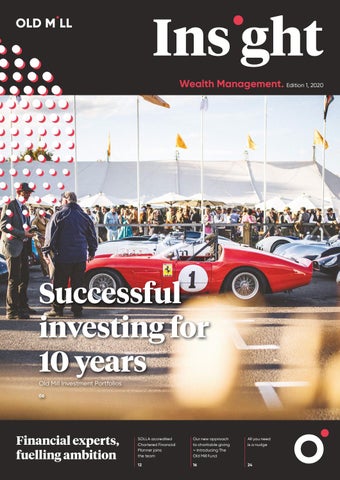
Wealth Management. Edition 1, 2020
Successful investing for 10 years Old Mill Investment Portfolios 06
Financial experts, fuelling ambition
SOLLA accredited Chartered Financial Planner joins the team
Our new approach to charitable giving – introducing The Old Mill Fund
All you need is a nudge
12
16
24
Welcome
The real key to Wealth Management is people.
2
Wealth Management Insight Edition 1, 2020
Welcome
The impact of our individual approach and attitude – both to investing, and to life in general – is explored by Christie Crowter in her article on Nudge Theory. Christie helps to explain why many of us make the decisions and judgements we do, and why understanding and overcoming some of those automated responses can help when it comes to investment. Welcome to the latest edition of Old Mill’s Insight publication, focusing on Wealth Management. Ask a room full of people what they think Wealth Management means, and most will probably say that it’s all about the figures – the spreadsheets, the financial planning, profits and projections, and the bottom line. However, whilst these are all important aspects, the real key to Wealth Management is people. Understanding what people want to achieve, and the lifestyle they are aiming for, is fundamental in any Wealth Management planning. Recognising individual’s attitudes and behaviours in relation to risk and reward will then shape those planning and investment opportunities. Having people on hand with the right knowledge, expertise and experience should deliver results that meet those original goals and ambitions. In this edition of Insight, there are many examples of the importance of ‘people’ – both clients and our own teams – in the Wealth Management process. Gavin Jones, Chair of our Old Mill Investment Committee, takes a close look at how our portfolios have performed over the past 10 years, together with some of the principles and the philosophy we adopt in relation to investing (these are also explored in this edition by Dimensional Fund Advisors who go into a little more detail). Whilst the returns are impressive, Gavin is keen to emphasise that individual portfolios are structured to reflect your attitude to risk, and are personally tailored to enable your lifetime goals and ambitions to be achieved.
There is very little more personal to Wealth Management than Later Life planning, so Chris Tweedie, a member of Old Mill’s Later Life planning team, looks at some of the steps you may need to take to avoid the financial pressure of the care system. We’re delighted to be able to introduce Andy Page, who joins Chris Tweedie and Carolyn Matravers, as the latest SOLLA-accredited member of the Later Life team. We also find out more about Sam Gratton, one of our Chartered Financial Planners – although some of you may already know Sam, as she’s been with us in other roles for almost a decade. Finally, we’re very excited to announce the launch of The Old Mill Fund, our new approach to charitable giving which will enable us to work closely with Community Foundations in Somerset, Devon and Wiltshire supporting local charities and extremely worthwhile causes in areas where many of our clients and colleagues live and work. We hope you enjoy this edition of Insight, and look forward to talking to many of you over the coming weeks.
Paula Hodge Head of Wealth Management
3
Contents
Your Old Mill Contributors
30
Paula Hodge, Head of Wealth Management 01935 709328 paula.hodge@om.uk Gavin Jones, Chartered Financial Planner 01749 335038 gavin.jones@om.uk Dan Wilton, Tax Senior 01935 709414 daniel.wilton@om.uk Andy Page, Chartered Financial Planner, Accredited Member of SOLLA (Society of Later Life Advisers) 01749 335056 | andrew.page@om.uk Kim Barnard, Group Marketing Manager 01935 709360 kim.barnard@om.uk Charlotte Corr, Financial Planner 07702 808858 charlotte.corr@om.uk Samantha Gratton, Chartered Financial Planner 01749 335091 samantha.gratton@om.uk Chris Tweedie, Chartered Financial Planner, Accredited Member of SOLLA (Society of Later Life Advisers) 01225 701217 | chris.tweedie@om.uk
16
Christie Crowter, Client Manager 01392 351332 christie.crowter@om.uk Simon Cole, Board Member, Chartered Financial Planner 01935 709364 simon.cole@om.uk
14
4
Wealth Management Insight Edition 1, 2020
Contents 06 Spotlight: A deep
22
dive into Old Mill Investment Portfolios
12
10
Offshore Income and Gains – the postal prompt
12 SOLLA-accredited Chartered Financial Planner joins Old Mill
14 16
18
Avoiding the financial pressures of the care system
24 All you need is a nudge
26
How to have a successful investment experience
30 The Amazon way Macmillan Guest Spot Somerset Community Foundation. Our new approach to charitable giving – introducing The Old Mill Fund Financial planning basics: Understand what you’re entitled to
20 Meet the team: Samantha Gratton
20
5
Old Mill Investment Portfolios
“Understanding your lifetime objectives and the risk you wish to take provides clear guidelines for the portfolio structure we invest your money in.�
6
Wealth Management Insight Edition 1, 2020
Spotlight: Old Mill Investment Portfolios It’s 10 years since we started investing your money into portfolios that are managed directly under the governance of our own Old Mill Investment Committee. Often when we meet with you the minutiae of your portfolio isn’t something we discuss in detail. However, at our recent investment seminar Gavin Jones, Chair of the Investment Committee, shared some key insights into the way we construct our portfolios and how they have performed since 2009.
Start with why The drivers for managing our own portfolios remain the same as they were at the outset: • Portfolios that are suitable for people like you – people who are either approaching retirement, retired or financially independent, and who want to grow their money without a roller coaster ride • Portfolios that are in line with our investment philosophy, enabling us to provide consistent delivery of investment advice with the flexibility to create a solution tailored to your needs, rather than a ‘one size fits all’ approach • A robust investment solution that will stand the (unknown) tests of time.
Clearly defined goals
Committee’s desk in a structured and disciplined way. Having to analyse against set criteria forces us to engage our reflective mind, which defuses much of the emotion that might exist around individual bias. The list of assets is separated into those we will include or continue to include in our portfolios, those that we will keep a close eye on until we can make a definitive decision either way, and those that we will not use.
How do we structure Old Mill Investment Portfolios? The asset choices are split into those that form part of the ‘return engine’ of your portfolio and those that form part of the ‘defensive mix’. Your individual attitude to risk will determine the split of the funds in your portfolio between growth and defensive assets.
Growth assets Some of the decisions we have to make when we build the return engine are: • Home bias – investing wholly in UK markets versus diversifying into overseas (developed) markets
Understanding your lifetime objectives and the risk you wish to take gives us clear guidelines for the portfolio structure we invest your money in. This includes the choice to take less risk if the investment growth will still meet your objectives, a choice that many of our clients have made.
• Emerging – investing primarily in developed markets versus choosing fast-growing emerging markets
The most important thing about an investment philosophy is that you have one
• Asset mix – whether we are choosing equities only or considering other assets
On p26, we discuss our principles of investing that sit at the heart of our philosophy and process. The first step is to choose the asset classes we will use as building blocks in the portfolios. These are reviewed using pre-determined selection criteria, which means we review any investment strategy or asset that crosses the Old Mill Investment
• Currency mix – if we diversify overseas we introduce currency risk; a currency can gain or lose against sterling, and it’s possible to ‘hedge’ this (so the overseas currency is converted to sterling at an additional cost) or to leave this risk unhedged.
• Factor tilts – investing into broad market indices versus tilting towards factors that can provide additional growth over time, including undervalued or smaller companies
7
Old Mill Investment Portfolios
Equity return enhancers
Return Core equity return
Emerging market equity
Value equity
UK equity Equity diversifier Defensive assets
Short-dated high quality bonds > AA
UK index linked gilts
Global commercial property
Excluded: Long-term cash holdings Lower quality corporate bonds Emerging market bonds These are our current choices: • 50% of the funds invested in the growth part of your portfolio are invested in global developed market equities; this provides broad exposure to the global economy and captures 100% of developed market capitalisation • 20% goes into global value stocks that are less financially healthy than that of the broad market, and 10% goes into global smaller companies that are slightly more risky than the larger companies. These assets should have an expected higher return over time • The remaining 20% is split equally between global commercial property and emerging market equities. Investing in property, which includes commercial, retail and industrial buildings, provides diversification from equity risk. Emerging market equities offer exciting economic growth but carry both a higher risk than developed market equities and an expected higher return, and also help from a diversification perspective • We leave currency unhedged in the growth part of portfolios. Movement of growth assets can be large and currency movement will be a part of this – both up and down – so hedging is less important.
Defensive assets For defensive assets we consider the following issues: • Duration – bonds that have a short life (up to five years) have less volatility than longer dated bonds • Credit quality – higher credit quality companies have less volatility than lower quality bonds. Credit quality is assessed by ratings agencies, with the most secure being
8
Non-UK equity (developed)
Smaller co. equity
Excluded: Private equity
Excluded: Hedge funds Commodity futures Emerging market bonds Gold Structured products Monaged futures futures Managed Infrastructure Risk
AAA; UK Gilts, for instance, have a rating of AA (average) • Inflation risk – an enemy of bonds is inflation, which can eat away at value over time • Currency risk – hedged or unhedged. Our current choices are as follows: • Currently the bulk of defensive assets are global, highquality AA, short-dated bonds which provide low volatility compared to equities and diversification • 20% of the defensive assets are UK index-linked bonds. These provide strong protection against unanticipated inflation. They also provide an ‘insurance policy’ against the risks associated with the shorter-dated, high-credit quality bonds that also form part of the defensive mix in our investment portfolios • As the defensive assets aim to protect the portfolio we remove the currency risk by hedging. The diagram above provides a visual of how the growth and defensive assets fit together. The resulting portfolio is highly diversified. You may hear similar principles from other investment managers, who say they’re diversified over hundreds of stocks. But we believe we offer something truly different; at Old Mill our portfolios have over 12,000 securities across asset classes, countries and investment styles. What we leave out of portfolios is as important as what is included. Many of the assets detailed as excluded in the diagram above will be used by other investment managers, but we have good reasons for excluding them from our portfolios.
Wealth Management Insight Edition 1, 2020
“The most important thing about an investment philosophy is that you have one.”
How do our portfolios perform? We believe in our investment principles and want you to have the confidence that this is a good place to invest. The graph below shows the funds of 79 multi-asset managers over the ten years to July 2019. The level of return they have achieved is measured against the vertical axis, while the level of risk (annualised standard deviation is a measure of the funds volatility – how much it goes up and down) is measured along the horizontal axis.
David Jones, Dimensional Fund Advisors
Success here is to generate as much growth as possible for the risk taken, so we look for funds towards the top left of the graph. The Old Mill portfolios are shown as the red line – a result we are very happy with, and we hope you are too. If you have any questions, we’re here to help. If you’re not already investing in our portfolios and would like to, contact us to find out more.
Gavin Jones
16%
Old Mill portfolios
Annualised return %
14% 12% 10% 8% 6% 4% 2% 0% 0%
2%
4%
6%
8%
10%
12%
14%
16%
Annualised standard deviation (Risk) %
9
The postal prompt
Offshore income and gains – the postal prompt Have you recently received a letter from HM Revenue & Customs (HMRC) headed ‘Your offshore income or gains’?
The correspondence follows HMRC’s ongoing efforts to reconcile information they have received regarding UK taxpayers from over 100 countries around the globe. They’re using this data to identify where they think there may be a risk that income and gains have not been declared and taxed correctly. Subsequently, they’re issuing these letters as a form of ‘nudge’. Unfortunately, the letters are being sent out even if the tax position is correct; HMRC aren’t cross-checking the information against tax returns submitted, and in many cases there may be no additional disclosures required. However, they’re insisting that individuals review their affairs to ensure this is the case. HMRC’s crackdown on individuals not declaring offshore income or gains is a serious matter, but the blanket
10
approach ‘nudge’ letters don’t apply to everyone, and each case must be considered on an individual basis. If, after a review of your affairs, you find that you do have previously undisclosed offshore income or gains, HMRC will direct you towards their specific disclosure service and they will also request that you sign and return a certificate to confirm your position. But be aware that the wording of the certificate has been structured in a way that benefits them, rather than the taxpayer, and leaves you open to risk. It’s important not to simply disregard these letters, as HMRC clearly have information that they wish to know more about. However, the way in which this is discussed with HMRC needs to be managed carefully. If you’ve recently received an HMRC letter about offshore income and
gains, we would encourage you to seek professional advice before signing and returning any declaration that your affairs are in order. We can liaise directly with HMRC on your behalf in both instances – either to establish that your affairs are correct and up-to-date, or to help prepare the necessary disclosure and mitigate any penalties payable, where possible. If you have any queries, please do contact us for expert financial advice and guidance.
Dan Wilton
Wealth Management Insight Edition 1, 2020
“HMRC’s crackdown on individuals not declaring offshore income or gains is a serious matter.”
11
Andy Page
SOLLA-accredited Chartered Financial Planner joins Old Mill We’re delighted to introduce Andy Page, a Society of Later Life Advisers (SOLLA) accredited Chartered Financial Planner, as the latest addition to the Old Mill Later Life team.
12
Wealth Management Insight Edition 1, 2020
SOLLA accreditation is the Gold Standard for Later Life financial advice, requiring all advisers to pass a rigorous assessment and gain the necessary qualifications. It’s also about more than just technical knowledge – advisers must be able to empathise and confidently communicate with people around quite a sensitive topic.
“Having knowledgeable, experienced and trusted advisers like Andy and the team can prove invaluable during times of need.”
Andy, who joined Old Mill in July 2019 and is based in our Wells office, has a passion for helping people to deal with the effects of Later Life. Talking about his work, Andy explains: ‘It’s important for people to understand what they want to achieve in life, and being a Chartered Financial Planner also means I can help guide people on how to use their money wisely – whether that’s funding holidays, making good use of assets, Inheritance Tax (IHT) planning, gifting and so on. I support clients to help pull it all together, so that they can be financially secure for the rest of their lives.’ Andy wanted to focus and specialise in Later Life advice, so in 2010 he successfully achieved his SOLLA accreditation. ‘Dealing with a loved one who needs care can be very stressful and confusing,’ continues Andy. ‘Quite often big decisions have to be made at a crisis point. Having provided advice in this area since 1998 I can draw on a great deal of experience to help people navigate the complexities of the care system and provide the information required to make informed financial decisions.’ One of the biggest challenges we see clients face is having to sell their homes in order to fund care. For example, Andy recently worked with a client who had around £50,000 in savings and a house worth £290,000. Their care home fees will be £1,010 per week, and with income of £317 per week, they were facing a monthly shortfall of around £3,000. This has to come from savings and house sale proceeds. Andy helped the client and
their family look carefully at all possible options, so that they could come to an informed decision which suited them best. For this client there were three main options: 1. Put all the money into a savings account (or more than one, if the savings totalled more than £85,000). This was the simplest route but had the disadvantage of poor interest rates, so the funds would run out quickest. 2. Invest some of the money (retaining a portion in cash for ease) to try and obtain a better return than cash. The disadvantage would be that investments could fall as well as rise, so returns could be worse than cash in the short term. 3. Implement a care fees payment plan – providing a tax-free income for life (however long that may be), the plan is individually underwritten by specialist insurance companies to establish likely life expectancy, and can be indexed at a suitable rate. It would provide peace of mind that care was always affordable, however, the disadvantage would be that payment for guaranteed income is made on day one, and if death happened in early years, there could be a poor return on the money paid. Any recommendation will always follow discussion and be completely dependent on the individual circumstances.
Andy joins fellow SOLLA-accredited advisers Chris Tweedie (based in our Melksham office) and Carolyn Matravers (based in Yeovil and Exeter), forming a team which has more than 50 years’ combined experience helping clients with Later Life financial needs. Andy understands the importance of wellbeing, particularly as people get older; he shares our values, and his passion resonates throughout his work and within his personal life. Outside of work he has been actively involved with supporting Age UK. Andy is a keen guitarist and has totally revised his diet to incorporate better quality foods. He also ensures he gets enough regular exercise and sleep. Having knowledgeable, experienced and trusted advisers like Andy and the team can prove invaluable during times of need. If you want to speak to one of our experts and have a conversation about later life planning, or need advice and support regarding your own financial situation, please get in touch.
On p22, Chris Tweedie talks about ‘Avoiding the financial pressures of the care system’, highlighting the increasing financial costs that come with later life care.
13
Macmillan Guest Spot
Macmillan Cancer Support – Are you covered? One in two. That’s the chance of getting cancer in a lifetime. The chance of your world being turned upside down.
The likelihood of your life and/or work being interrupted by having to take time off to attend various appointments and to have treatment. For symptoms and side effects to make every single day a challenge. Whatever the chances of getting cancer, getting the right help and support is so important. With over 100 years of experience of supporting people living with and affected by cancer, Macmillan Cancer Support is proud to still be right there with you. Across Somerset, Devon and Wiltshire there are over 78,000 people living with cancer and each year the same area will see almost another 11,000 people diagnosed with the disease. Macmillan are working and investing in services locally and proudly fund a number nurses and other professionals to help people affected by cancer to get the right support when they need it most. Cancer throws all kinds of things your way and people with a diagnosis will often experience further disruption to their enjoyment of the simplest things, like a relaxing holiday. You know, that restorative time away to clear your head of its burdens and not having to worry about making it to the hospital for appointments and dealing with the side effects of treatment. But one issue remains a constant challenge for cancer patients and that’s the struggle to get their cancer covered in travel insurance policies and the increasing cost of cover if you can get it. No two cancer experiences are the same, how could they be? But we hear time and time again that travel insurance
14
“With over 100 years of experience of supporting people living with and affected by cancer, Macmillan Cancer Support is proud to still be right there with you.”
policies are so expensive after a cancer diagnosis and are often very complicated to get the right level of cover. The common denominator is that high travel insurance costs are preventing people from having a much-needed break or mean they travel abroad without appropriate medical cover. Going on holiday without insurance or a policy that excludes their cancer could put people at risk of eye-wateringly high medical bills if they fall ill when abroad. Pavitter, 58, shares her story, ‘I was diagnosed with cancer in 2016 and received my last round of chemo in August 2016. Since my diagnosis, I have had to deal with things you just
Wealth Management Insight Edition 1, 2020
don’t ever expect to deal with. Cancelling holidays, not being able to see my family who live outside the UK and being told I wouldn’t get covered for my trip to Greece, which meant I missed my brother’s 60th birthday celebrations. That was heart-breaking.’ On one attempt at gaining travel insurance, my premiums would have been higher than the entire cost of the holiday and this did not even cover me if I fell ill with anything to do with my cancer!’ Pavitter explains that even though she is now in remission, she continues to experience issues securing travel insurance for any trips she wishes to take abroad. She adds, ‘Since being in remission, I just wanted to get away, I was desperate to. The effects of my chemotherapy treatment meant I was unable to travel and in early 2018 it got to the point I just wanted to take myself away – New York and India. Yet the bad news came: I was still unable to get full cover due to my cancer. I just want people to know the challenges that people living with and after a cancer diagnosis are facing so that insurance companies can support us better!’
Here are some additional tips to help: • Do an online search – type relevant terms into a search engine, for example ‘prostate cancer travel insurance’, to find information pages and providers offering travel insurance • Call the British Insurance Broker’s Association (BIBA) – you can find a qualified and regulated insurance broker through BIBA. Call them on 0370 950 1790 (9am to 5pm, Monday to Friday) • Check your existing policies – you may already have travel insurance, for example a policy attached to your bank account • Always read the details of any insurance policy before buying it, to make sure it suits your needs. Macmillan is here to help everyone with cancer live life as fully as they can, providing physical, financial and emotional support. For information, support or just someone to talk to, call 0808 808 00 00 or visit macmillan.org.uk
Finding travel insurance The challenge of getting travel insurance cover for cancer and the cost of it is one of the most discussed topics on Macmillan’s online community and you can find out which providers people are recommending by visiting the website www.macmillan.org.uk and searching ‘online community’.
15
Somerset Community Foundation
Our new approach to charitable giving – introducing The Old Mill Fund As a local business based in the heart of Somerset, Devon and Wiltshire, supporting local causes and charitable giving is really important to us. 16
Wealth Management Insight Edition 1, 2020
We have a strong history of giving back to the communities where our clients and colleagues live and work, and we wanted to build on this and make a long-term, strategic commitment to help small local charities. So we are proud to have worked with Somerset Community Foundation (SCF) to create The Old Mill Fund – the new home for our charitable giving. Our strategic partnership will help to support local charities, community groups and individuals across the three counties, and specifically in three key areas identified by research. These are: Building brighter futures – helping young people to build skills, confidence and resilience to succeed at school and beyond Reducing rural loneliness – supporting activities that reduce loneliness and help to improve physical and mental health Strengthening communities – supporting projects that bring people together and build strong, supportive communities that help the most disadvantaged. The Fund was officially launched in October, when we were delighted to welcome Laura Blake, Development Director at SCF, to our offices to present the new initiative to our staff. Old Mill Board Member, Kevin Whitmarsh, also announced our partnership to 100 influential attendees at SCF’s Annual Celebration recently, which we were proud to sponsor. The evening was an inspiring mix of passionate speakers from local charities who have benefited from grants similar to ones Old Mill will fund, as well as local philanthropists, and encapsulated the importance of giving.
projects twice a year that fall within the three key areas detailed above and that are close to our four offices. These inspiring local projects – and the incredible stories from individuals, families and community groups that have benefited from these grants – remind us of the importance of being able to contribute both as individuals and as a business. As part of our partnership, our staff are also giving their time and expertise as volunteers at local charities. Our team has a wealth of experience which we are able to share, whether it’s being a trustee or helping to up-skill, mentor and strengthen existing charities and their teams.
“Our new strategic partnership will help to support local charities, community groups and individuals.”
For those who are engaged with local community groups or charities in need of funding, you can apply to your local Community Foundation for one of their many grants. If your needs fit the criteria of The Old Mill Fund then please apply through the SCF Foundation Grants programme, which opens for applications quarterly.
How can I apply? Somerset Community Foundation: 01749 344949 or visit somersetcf.org.uk Wiltshire Community Foundation: 01380 729284 or visit wiltshirecf.org.uk Devon Community Foundation: 01884 235887 or visit devoncf.com
Kim Barnard
Somerset, Devon and Wiltshire Community Foundations receive thousands of applications every year from charities and community groups. As part of the process we will choose
17
Financial Planning: Entitlements
Financial planning basics: understand your entitlements You may have seen in the press recently that a woman has won the right to receive her late partner’s military pension following a Court of Appeal ruling. She had been in a relationship with her partner for 15 years when he died unexpectedly in 2011. Although the military pension does allow unmarried partners of officers to receive their pension if they die, she was disqualified because she had not formally dissolved her marriage to her ex-husband. The case has sparked debate as to whether pension schemes that do not recognise cohabitees will review their rules and increase the recognition of cohabitee relationships given that, according to the Office of National Statistics, there are more than six million people living as cohabiting couples in Britain. Regardless of whether you are married or not, this case highlights the importance of understanding exactly what you and your partner have. This includes assets, protection policies and the structure of the income you receive, and how these may be treated when you die or if you become ill. It also highlights the need to ensure that both partners have a valid will to protect one another and any family, especially financial dependents. We completely understand that it can be difficult to discuss or even contemplate what might happen if you or your partner dies. However, it’s vital that this is considered
18
and planning is undertaken to ensure that the survivor is financially secure for the future. As part of our financial planning service, we will not only help to make you aware of your current financial position and how achievable your short and long-term plans are, we’ll also make you aware of the position on death to ensure that the survivor and their family are financially secure. This includes ensuring that, together with having a valid will in place, you have sufficient life cover, your assets are held correctly, and you understand what income might be available to surviving partners – whether married or not. Contact one of our financial experts to see how we can help you secure your financial future.
Charlotte Corr
Wealth Management Insight Edition 1, 2020
“Whether you are married or not, it’s important to understand exactly what you and your partner have.”
19
Meet the team
Meet the team:
Samantha Gratton Samantha Gratton is one of our newest Chartered Financial Planners here at Old Mill, but not a new employee. Samantha (or Sam as she is known) has been building her career with us for more than nine years, developing her skills and experience as a Paraplanner and supporting our team, the business and our clients.
Many may look at Sam and see a youthful and career-driven individual, and that she is. But at the age of 33 Sam has experienced more than most. As a mum of energetic three-yearold Henry, and partner to energetic 36-year-old Jon, Sam’s personal journey has been an interesting and emotional one. She lost her father eight years ago in a tragic car accident, only to be in a lifethreatening car accident herself a year later. She survived thanks to the efforts of the Wiltshire Air Ambulance, and the staff at Frenchay Hospital in Bristol who looked after her. It’s fair to say that these dramatic events have had a long-lasting effect on Sam, who appreciates that nothing in life can be taken for granted. She’s now using these experiences to help explore with clients the need to plan for hopefully a long and fulfilling life, but also consider the curve balls that can sometimes be thrown our way. Sam’s long-term partner is Jon Orchard, a well-established Chartered
20
Financial Planner based in our Wells Office, and she is excited to be following in his footsteps. Between them, they have over 22 years’ experience at Old Mill. Through Jon, Sam has seen the difference Financial Planners can make to people’s lives, and the fulfilment to be gained from working closely with clients. She’s looking forward to experiencing this first-hand, while also aiming to give Jon some competition! A move back to her home county of Somerset following university and employment in Edinburgh saw Sam start initially at ground level in Old Mill, but she quickly worked her way up until she was assisting the Financial Planners at a technical level. Sam explained: ‘As well as supporting my family, I wanted to progress and have a career, and Old Mill has allowed me to do that. Working with inspirational women like Paula Hodge and Sally Harrison is a huge benefit, and Old Mill is such a supportive employer, allowing flexibility in my role
as a working mum without impacting on my career.’ To be the best that she can be in her role, Sam took her Chartered Insurance Institute (CII) exams and became a Chartered Financial Planner in 2014, placing her at the top of her game as a Paraplanner. She has won several awards for her talents, most recently being named ‘In-house Paraplanner of the Year’ at the Professional Paraplanner Awards 2019 in London, one of the industry’s most prestigious awards events. However, Sam remains modest about her achievements. Talking about her recent award she said: ‘I just decided to enter the awards and had a shot at winning. I am proud to think that any of the Paraplanners at Old Mill could have done the same.’ Sam continually pushes herself to be the best she can and her passion for running is a prime example of her determination. Despite having a metal rod in one leg and a skin graft on the other, in June 2019 she completed a
Wealth Management Insight Edition 1, 2020
“Even in the face of challenging times, Sam has shown determination and commitment to succeed...”
challenging 31-mile Ultramarathon. In fact, call it madness or sheer ambition, she’s so determined that she has now committed to another in May 2020. ‘Running is my headspace,’ she explained. ‘It’s my time to contemplate life and its challenges, although I particularly enjoy trail running and cross country where I can switch off and enjoy the scenery. Running long distances has made me realise what I can achieve physically if I put my mind to it, and I love pushing myself.’ Even in the face of challenging times, Sam has shown determination and commitment to succeed and overcome the odds. She’s now looking forward to combining her technical knowledge, experiences and people skills in her new role – the future is very bright indeed.
21
The care system
“There is a growing care funding gap, which will be £2.8 billion in 2019/20.”
22
Wealth Management Insight Edition 1, 2020
Avoiding the financial pressures of the care system Have you planned for Later Life? It might not be something you are thinking about right now, but it’s important to know that the current care system can cause a lot of financial pressures, and getting ahead of the game could be a very wise move. A report by The King’s Fund in 2016 predicted that, with cuts to local authority budgets, rising demand for services and shortages of staff, the social care system will be increasingly unable to meet the needs of older people. There is a growing care funding gap, which will be £2.8 billion in 2019/20. The report showed that reductions in fees paid by local authorities to care providers, plus cost pressures such as the National Living Wage, are reducing the incomes of care providers. An increasing number are likely to leave the market or go out of business as a result, potentially leaving older people without the care they need. These pressures are prompting some providers in affluent areas to step back from providing care for people funded by the local authority. As a result, more are having to pay for their own care. This has served to push up private sector care fees. The average weekly cost for residential care in the South West in 2018 was £676 per week[1], with some care homes in Wiltshire charging nearly £1,700 per week. Plans proposed in the Care Act 2014 to introduce a ‘care cap’ of £72,000 and to increase the capital means test threshold to £118,000 have been scrapped. The capital threshold remains at £23,250, meaning that assessable assets above this will be taken into account to pay for care if and when you need it.
The combination of rising care costs and increasing numbers of people requiring care means that there will be increasing competition for care services in future which will become progressively more expensive. This will leave those who have more money with greater choice about the type of care they have and where it is delivered. Planning for Later Life should be considered if you are making substantial gifts; otherwise, if care is needed, you may find yourself short of funds to secure the services you require. Also, many people using the care system complain it’s too complex, not user friendly, and leaves people confused about how the system works. If you find yourself or a loved one needing care services, we’re here to help. If you would like to see how we can help you, please get in touch.
Chris Tweedie
LaingBuisson Care of Older People UK Market Report 29th edition 2018 [1]
23
Nudge Theory
All you need is a nudge... Look at the two tables on the right. What would you say is the ratio of the length to width for each of these? Our brains typically have two ways of thinking: an intuitive, quick-thinking ‘automatic’ system, and a rational, slower-thinking ‘reflective’ system[1].
Your automatic system would have kicked in with the table picture – the table on the left is clearly thinner and longer than the one on the right… isn’t it? In fact, the table tops are exactly the same size. Check it. I have. Many, many times. We rely heavily on our automatic system in everyday life. You duck when something is thrown at your face; you see 2+2 and know the answer; you wash your hands instinctively after using the toilet (hopefully). However, over-reliance on our automatic system can lead to mistakes. A wasp comes near us and we flinch as if we’re going to die. Chances are, the wasp will be wafted away, leaving us unharmed. If we’d listened to our reflective system, we’d know that even if we were stung, it probably wouldn’t kill us.
Nudge Theory People want to make good decisions that benefit them and maybe even
24
those around them. This doesn’t always happen, for several reasons. Decisions can be highly complex; the subject matter may be unfamiliar; our automatic systems may kick in with an irrational answer; we might not fully appreciate the consequences; or we may be too lazy to do the right thing. Items and processes can be designed so that we will be helped into making good decisions. This is a ‘nudge’. A nudge doesn’t take away our choice, it just guides us towards a particular choice that we would probably want to make anyway. In order to understand this more clearly, it helps to look at some examples: • Road safety: If you’re one of the many frequent A303 users, you may have noticed the recent roadworks around Ilminster. The two-lane to one-lane merger signs now start 300 yards before the merger, rather than 200, and the double white lines between the different directions
of traffic have been filled in with bright red paint where there used to be none. These changes are all nudges for drivers on this notoriously dangerous stretch of road. Paint on the ground and a few extra informational signs aren’t forcing you to change your behaviour – they’re just pointing out some hazards that you might otherwise dismiss. • Pensions: The Government knows that it’s hard to plan for our futures because our current comfort takes precedence. In 2012, Automatic Enrolment was introduced. UK employers must now set up a workplace pension scheme for employees and automatically enrol certain staff. Employers are offering employees free savings, but employees can’t benefit from these if they’re not in the pension scheme! Ask me if I want pension savings – I’ll answer ‘Yes’ in a heartbeat. Tell me to enrol in a pension and start saving – ‘I’ll get around to it at some point’.
Wealth Management Insight Edition 1, 2020
Subscriptions: Not all nudges are positive. When you subscribe to a free trial of Amazon Prime or a magazine, they’re counting on you to be lazy and not actively cancel your subscription before you start paying the full price. Companies have analysed our behaviour and can use this for profit.
Practical applications at Old Mill The hardest thing is putting these kinds of sensible practices into action where no one else has put a nudge in place. Working with an Old Mill adviser can provide you with a nudge to help you avoid some unhelpful responses related to your finances. When the markets are volatile, your automatic system will jump to the conclusion that you need to sell out of your investments and avoid the drama. Having a good investment discipline at times like this is part of Old Mill’s investment philosophy, and having
“Human psychology means, at times, our decisions risk being driven by emotion rather than reason.” a financial adviser can make a big difference. Rather than letting emotions drive your financial decisions, you can effectively be ‘nudged’ by an adviser to stay focused on your longer-term goals.
Nudge theory was developed and explored originally by Richard Thaler and Cass Sunstein in their book Nudge: Improving decisions about health, wealth and happiness.
Perhaps you already know what behaviours you are prone to. Why not give yourself a nudge?
Christie Crowter
For more details see Kahneman (2011)
[1]
25
Successful investing
How to have a successful investment experience When selecting an investment strategy, investors are often tempted to seek out the latest and greatest investment opportunities. Long-term investors should be aware that letting short-term trends influence their investment approach may be counter-productive. At our recent investment seminar, Dimensional Fund Advisors talked about the fundamental principles that shape the Old Mill investment philosophy. Here’s a summary of the key points from their presentation.
Embrace market pricing The market is an effective information-processing machine. Each day, the world equity markets process billions of pounds in trades and the real-time information they bring helps set prices. The future is uncertain, but prices will adjust accordingly. This doesn’t mean that a price is always right but investors can accept the market price as the best estimate of actual value.
Don’t try to outguess the market Many fund managers believe they can identify ‘mispriced’ securities and convert that knowledge into higher returns. But fair market pricing works against such efforts, as indicated by the large proportion of funds that underperform their benchmarks. Research shows that over both short and long time horizons, the deck is stacked against funds that attempt to outguess the market.
26
Resist chasing past performance Some investors may resort to using track records as a guide to selecting funds, reasoning that a manager’s past success will continue in the future. Does this assumption pay off? The research offers strong evidence to the contrary. Some fund managers are better than others, but this alone may not identify management skill. The assumption that strong past performance will continue often proves faulty, leaving many investors disappointed.
Let markets work for you The financial markets have rewarded long-term investors. People expect a positive return on the capital they supply and, historically, the equity and bond markets have provided growth that has more than offset inflation. There is risk and historical results may not be repeated in the future. Nevertheless, the market is constantly pricing securities to reflect a positive expected return going forward. Otherwise, people would not invest their capital.
Consider the drivers of returns There is a wealth of academic research into what drives investment returns. Investors can use this information to pursue dimensions of higher expected returns in their portfolios.
Wealth Management Insight Edition 1, 2020
In the equity market, the dimensions are size (favouring smaller companies), relative price (favouring value companies) and expected profitability (favouring high profitability). In the fixed-income market, these dimensions are length of investment term, credit quality and currency.
Practice smart diversification Many people concentrate their investment in their home stock market. They choose only UK stocks and mutual funds and consider their portfolio diversified. In some cases, they only hold a small group of securities. Yet, from a global perspective, limiting one’s investment universe to a handful of stocks, or even one stock market, is a concentrated strategy with risk and return implications. A diversified portfolio should be structured to hold multiple asset classes and market areas across the world.
Single Market Example
Global Market Example MSCI United Kingdom Investible Market Index (IMI) 1 country, 364 stocks
MSCI ACWI Investible Market Index (IMI) 47 countries, 8,722 stocks
“Success requires a solid investment approach, a long-term perspective and discipline to stay the course.”
27
Successful investing
Avoid market timing Even with a globally diversified portfolio, market movements can tempt investors to switch asset classes based on predictions of future performance. But, as shown in the table below, there is little predictability in asset class performance from one year to the next. The data shows no pattern of performance across asset classes, suggesting that predicting future performance is a difficult task. The chart makes a strong case for investors to rely on portfolio structure, rather than market timing, to pursue returns.
Annual Returns by Market Index
Annual returns by Market Index
High
2004
2006
2008
2010
2012
2014
2016
2018
Developed Markets ex UX Emerging Markets Global Credit Global Real Estate Government Bonds Short Term Government Bonds UK Treasury Bills UK Equities Low
Avoid reactive investing Many people struggle to separate their emotions from investing. Greed Reacting to current market conditions may lead to making poor investment decisions.
Enthusiasm
Indifference
BUY
Confidence
Caution
Concern
ÂŁ Wealth destruction
Doubt 28
Fear
SELL Panic
Wealth Management Insight Edition 1, 2020
The 2008/09 global market downturn showed how the cycle of fear and greed could drive an investor’s reactive decisions. Investors fled the market in early 2009, just before the rebound began. They locked in their losses and then experienced the stress of watching the markets climb. Staying disciplined through rising and falling markets can pose a challenge, but it is crucial for long-term success.
Look beyond the headlines News and financial commentary can influence people’s view of investing. Without a strong investment philosophy to guide them, they may also follow the advice of friends, neighbours or family, especially if the ‘insight’ promises a fast, easy return. But growing wealth has no shortcuts. Success requires a solid investment approach, a long-term perspective and discipline to stay the course.
Retire rich Sell stock now The looming recession The top funds to own Market hits record high Housing market boom
Focus on what you can control Old Mill advisers create an investment plan based on market principles, informed by financial science and tailored to your specific needs and goals. Along the way they can help you focus on actions that add investment value, such as managing expenses and portfolio turnover, while maintaining broad diversification. Equally important, an adviser can provide knowledge and encouragement to help investors stay disciplined through various market conditions. Dimensional Fund Advisors are one of the chosen investment specialists that Old Mill works with. If you have any questions about your investments, please get in touch.
Gavin Jones
29
Investing
Investing the Amazon way The landslide Conservative win at the election has delivered much needed political direction for the country and in so doing has also taken away some of the short-term uncertainty about Brexit. Whilst this gives some stability, there remains hard work to negotiate our ongoing relationship with Europe. On top of this, we are already seeing the beginnings of the US election this year and the political upheaval that will come with this. With so much change, it’s understandable that you may be concerned over the impact of all of this on your investment portfolio. Jeff Bezos, the founder of Amazon, was recently asked a question about what’s not going to change in the next few years and how that will affect his business. He suggested that answering this question is potentially far more important than looking at what is going to change in the future, as it provides a foundation on which to build a robust business strategy. This was his response: ‘In our retail business we know that customers want low prices, and I know that’s going to be true 10 years from now. They want fast delivery; they want vast selection. It’s impossible to imagine a future 10 years from now where a customer comes up and says, ‘Jeff, I love Amazon, I just wish the prices were a little higher,’ [or] ‘I love Amazon, I just wish you’d deliver a little more slowly’. Impossible.’ Bezos is right. His wisdom applies not only to Amazon but also to many other spheres, not least the world of investing. Despite the lack of clarity about what might happen in the global economy, in political circles and in financial markets, we know certain things will continue to work to the benefit of sensible investors.
30
Portfolios are well positioned to weather future uncertainty Uncertain times and political chaos can raise questions around what action you should take with your investments. Irrespective of what might happen in the future, as investors we can rely on a number of truths that are core to how we structure our portfolios: • Markets work pretty well and are hard to beat, so capturing the market return on offer using lower cost, well-structured products makes good sense • Spreading our assets broadly to ensure the risks we face are well diversified will always sit at the core of a successful long-term strategy • Balancing out the risks of equities by owning high-quality bonds provides a good insurance policy • Being patient (living through the short-term dips) and being disciplined (maintaining your philosophy and strategy over time) are fundamental to achieving the returns you need to fulfil your financial goals.
Remaining broadly diversified protects us from specific unfavourable outcomes Our portfolios are well structured around inalienable investment truths, particularly the value of deep diversification. There are many ways in which our investors are diversified,
Wealth Management Insight Edition 1, 2020
“Despite the lack of clarity about what might happen in the global economy, in political circles and in financial markets, we know certain things will continue to work to the benefit of sensible investors.”
from individual securities to sectors, countries, investment styles and assets classes. Owning one of our portfolios reduces the risk of being caught out by material negative impacts in specific markets, such as the UK. This includes over 12,000 individual securities, all market sectors, spread across developed and emerging economies.
Sector diversification also makes good sense. Owning a material allocation across global stocks ensures that sector exposures are diversified.
Owning high-quality, shorter dated global bonds provides strong diversification High-quality bonds act as a strong insurance policy against falls in equity markets. Avoiding over-exposure to lower quality (e.g. high-yield, sub-investment grade) bonds makes sense, as they tend to act more like equities at times of economic and equity market crisis. We include bond holdings diversified across a number of different global bond markets which mitigates the risk of a rise in UK yields (and thus falling prices), as the cost of borrowing in other markets may not be impacted in the same way, at the same time.
Ultimately, what you need is an investment portfolio that is designed for you and your goals and which lets you sleep at night. Tips to help you achieve this include ignoring the forecasts and recognising that in the world of investing, activity is nearly always in surplus. We also suggest you avoid looking at your portfolio too often. There is always a temptation to tinker with a portfolio’s structure to try and position it ready for potential short-term global events. At the last investment committee meeting, we concentrated on challenging the current structure to determine whether we needed to be making any changes. We concluded that the principles and discipline of good investing described above should continue to hold true through future market conditions despite the current uncertainties. If you have a portfolio with us, please try not to worry. It’s in good shape.
Simon Cole
High-quality bonds provide a consistent and reasonably predictable return and premium over cash and, to avoid being exposed to currency movements, this part of the portfolio is hedged to ensure it retains its defensive characteristics.
31
Contact Exeter Leeward House Fitzroy Road Exeter Business Park EX1 3LJ +44 (0)1392 214635 Melksham Wessex House Challeymead Business Park Bradford Road SN12 8BU +44 (0)1225 701210 Wells Bishopbrook House Cathedral Avenue BA5 1FD +44 (0)1749 343366 Yeovil Maltravers House Petters Way BA20 1SH +44 (0)1935 426181
The content of this newsletter is for general information only. It should not be relied on and action which could affect your business should not be taken
enquiries@om.uk | om.uk
without appropriate professional advice. Please contact your usual Old Mill contact or local Old Mill office.