In the city of Winston-Salem, memory is constantly made, revisited, shared and forgotten. Although high-pro le events like COVID-19 have left their mark, small and almost hidden moments are what truly shape the city and give it life.
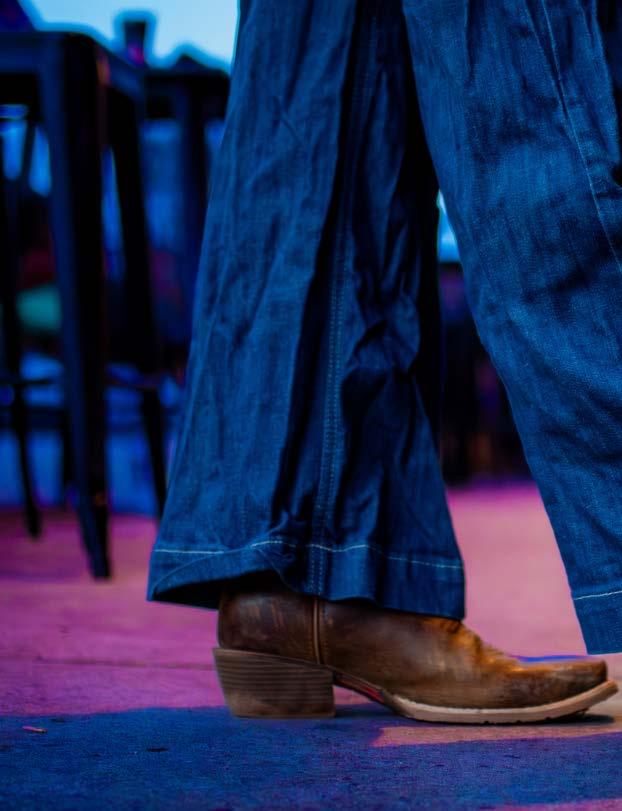
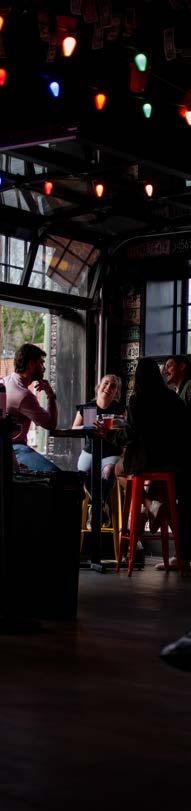
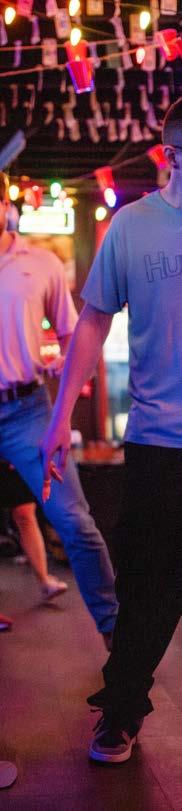
A historian types on her computer. Potters’ wheels spin. Dancers stomp their boots in perfect synchronization. A woman gazes out the window of the bus. A weathered “social distancing” sticker peels from the oor. International students venture into a quintessentially American restaurant. A wine list is perused. Someone trips on a loose brick on a sidewalk.
e act of remembering is an art, and this edition of e Magnolia is dedicated to those little moments that make Winston-Salem special. In this magazine, you will read eight stories featuring memory in all different forms – mulled, preserved, made, spun, hidden.
I expect that, after reading this magazine, you will never be able to see the “City of Arts and Innovation” the same. I hope you sit on the wellworn seats of the city bus and talk to
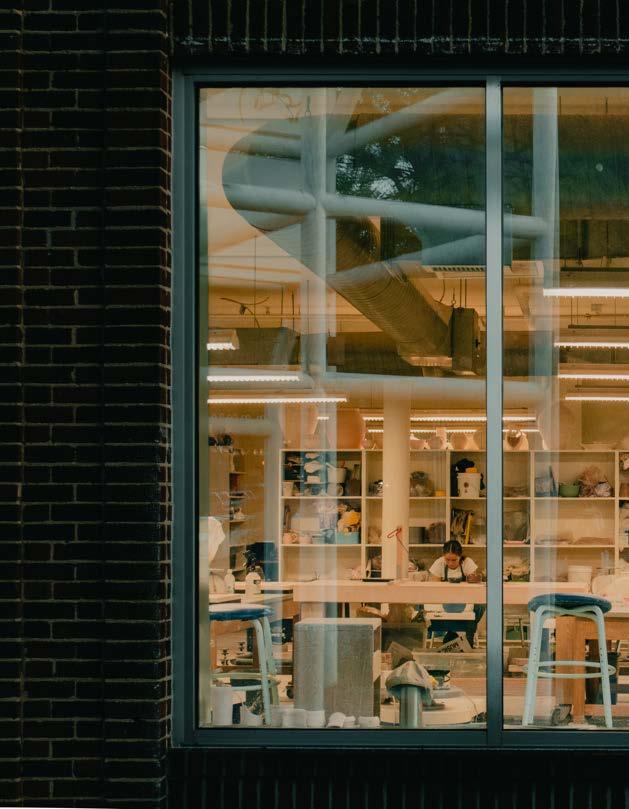
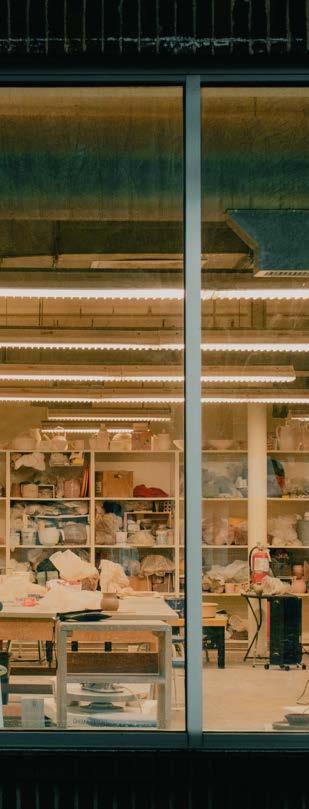
the person sitting next to you. I hope you stroll past the big glass windows at the corner of Sawtooth and stop for a moment to look at the pottery displayed inside. I hope you visit Old Salem while the sun is shining and consider not only all the people who have walked those streets before you, but also the woman who sits hidden away keeping it all together. It is in these quiet moments of noticing that the world becomes alive.
And thus, I encourage you to remember and remember often the ways in which this city of Winston-Salem has shaped you.
BY NOLA ADEPOJU
Photos by Alen Sadykov
THE WORK OF REMEMBERING
Behind every historical place, there is a person piecing it together– one document, one photo, one recovered story at a time.
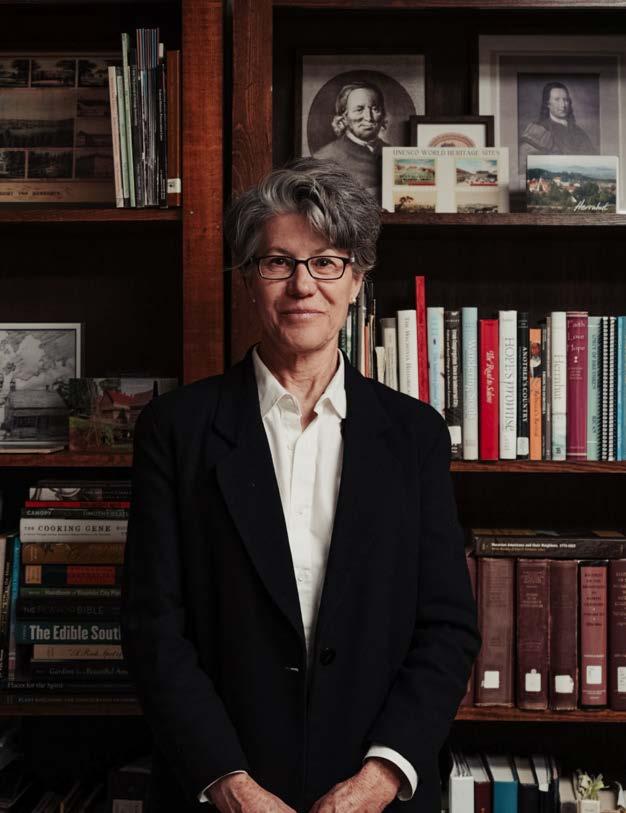
Martha Hartley
Driving through Old Salem, it’s easy to slip back in time.
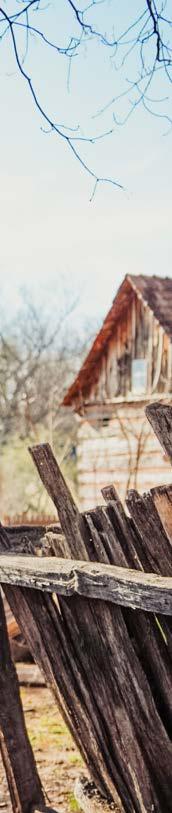
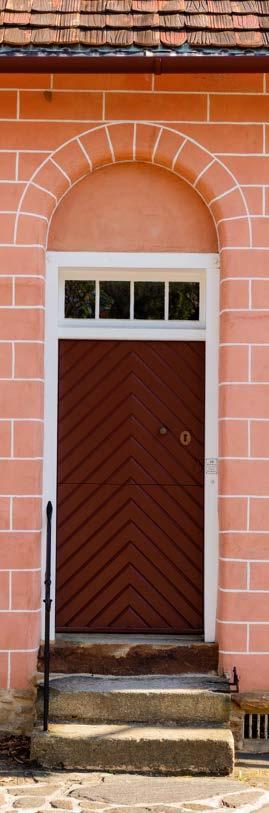
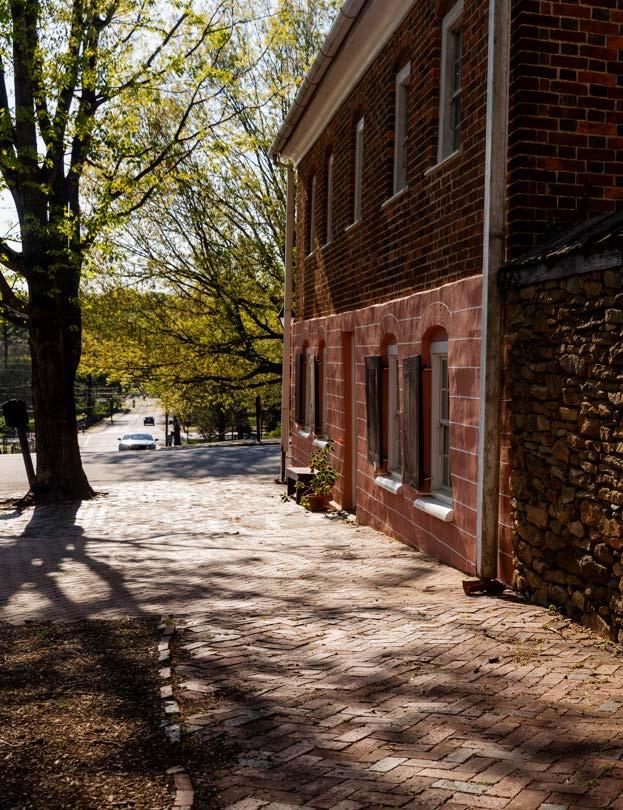
Brick and wood buildings line both sides of the road, their windows trimmed in black and white. Roo ines slope in classic eighteenth-century fashion. Chimneys puncture the sky. is order is deliberate, not accidental. It is preserved.
Old Salem, a part of what is now known as the Salem section of Winston-Salem, is a historic district founded in 1766 by Moravian settlers, a Protestant group from the modern-day Czech Republic. e area preserves 18th and 19th-century Moravian culture through its quaint buildings and gardens.
Old Salem gives the impression that memory can be restored like brick. If you sand, repaint and reassemble carefully enough, the story will hold.
But, preservation is not self-sustaining, brick does not remember on its own and wood does not annotate itself. History here feels architectural, but architecture is only the surface expression of research.
It is away from the curated street view that the work of remembering actually begins. Within the Old Salem Historic District, the Horton Museum Center holds archives and collections where the town’s deepest stories are carefully pieced to-
gether. Amid the clutter and under those streets sits the o ce of Martha Hartley, the Director of Moravian Research at Old Salem Museums and Gardens. Her work rarely unfolds outside among the bricks and trees, but happens in the quiet turning of fragile pages that have outlived the hands that $rst wrote them. On any given day, she might be answering a descendant’s email about an ancestor, preparing research for an upcoming tour, reviewing archaeological $ndings or tracing property lines that no longer exist on the physical map of the city.
At sites like Winston-Salem’s Winkler Bakery, recognized as the oldest continuously operating bakery in America, historical images showing everything from storefronts to neighboring buildings that no longer exist serve as essential guides. When a structure is rebuilt, it is done through a strict process grounded in visual documentation. Even a single photograph can determine the placement of a doorway or the shape of a roo ine. In this way, even the most solid structures are shaped by what has been documented over time.
For every building that stands composed, there are hours spent in windowless rooms, in basements that smell faintly of paper and dust, in o ces where the
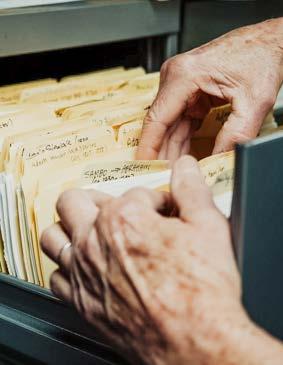
symmetry of the street dissolves into fragments. Memory in those rooms does not arrive whole. Behind the polished facades and tidy gardens, it is built instead in lot numbers, notecards and black-and-white photographs passed down through centuries.
Martha Hartley’s job is recording history. “I believe in truth and history, and I think that we have a responsibility as people to understand the best we can and to share,” said Hartley.
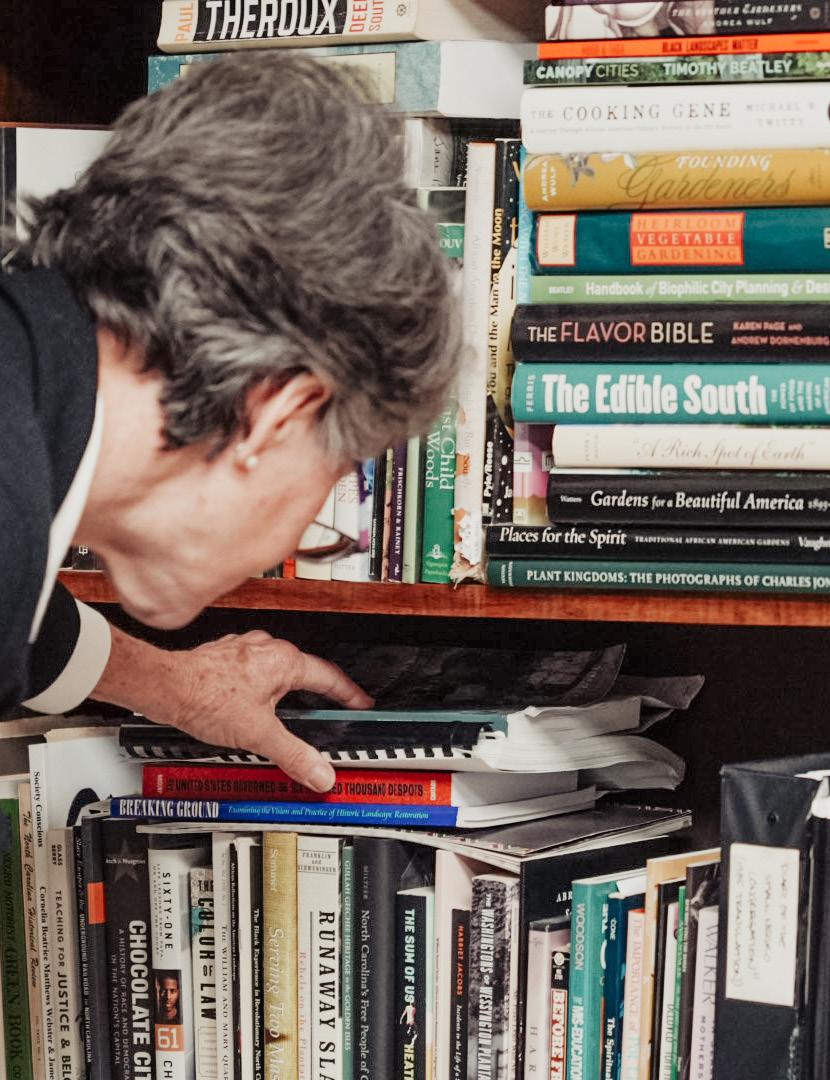
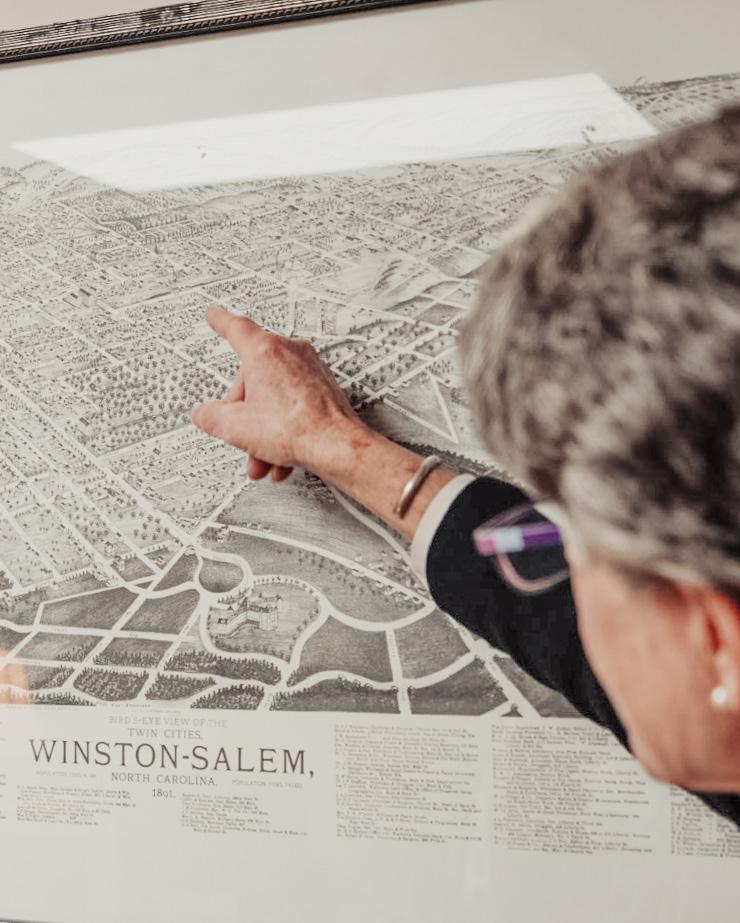
Her o ce is adorned with maps of Old Salem and Wachovia, the 1753 land tract purchased by the Moravians in North Carolina. e shelves are lined with books, framed photographs and research $les that visually trace the land’s history. If the streets outside are the visible performance of history, this room, its surrounding building, and those like Hartley are its engine.
Hartley’s connection to Old Salem began in the quiet rhythms of everyday life. Having grown up in Winston-Salem and in the Moravian Church, the Moravian traditions, music, rituals and sense of community were woven into her life long before she thought about preservation or historical research. Visits to Old Salem as a child were simply part of school outings, and she never fully realized the weight of its history.
work for her to see the full structure behind those Sunday visits.
“I loved that place, though I didn’t really understand it—I didn’t understand how it connected to Salem or to Wachovia,” said Hartley. “I just knew it was part of my world, part of my life.”
On track to become an international banker, Hartley had a sudden change of heart in her senior year at Hollins College. Standing in front of the Economics Department’s bulletin board, a graduate program caught her eye: urban planning at Rutgers University.
Her earliest, most vivid memories are of Bethania, a nearby Moravian settlement founded in 1759, located on the northwestern outskirts of Winston-Salem. Her grandmother was from there, and each Sunday afternoon, her family would make the journey to visit their family in that area. She remembers gathering in a house with high ceilings that felt old and full of presence.
Bethania, Salem and Wachovia were not yet a coherent historical system in her mind. ey were simply places she belonged to. It would take years, education and archival
She ended up in graduate school at the University of Virginia to study urban planning with a speciality in preservation. It required her to get an internship her $rst summer, which brought her back to Salem, where she worked under John Larson in the restoration department. ere, she immersed herself in archaeology, measure drawings and the meticulous care of historic sites.
After she graduated, Larson o ered her a position as his assistant at Salem.
“He called me one day before I graduated and said, ‘Would you like to come home?’” Hartley said. “I made $800 a month, and he got it bumped up to $1000, so I made $12,000 a year. at was my salary, but this is the museum world.”
e pay was modest, but it o ered Hartley a chance to connect with the past. From surveying Wachovia to helping local historical associations protect 18th-century villages from encroaching development, Hartley’s early career was marked by both discovery and preservation.
Since then, she has worked her way up to the role she holds today. In the grand museum $ lled with fragments of history, Hartley moves from room to room with practiced precision, pulling photographs and volumes from narrow crevices as if she knows where every story lives, a familiarity shaped by years spent working within those
walls. She built the path to her career, $ nding work that extends far beyond what visitors see on the surface.
“I am just a person in a line of researchers,” she says. “I don’t do miraculous things, I just keep pushing and hope that the research will continue to inform and be important.”
ough Hartley considers herself to have a small role, her work carries a quiet, steady intensity that suggests otherwise. Every project, every marker, every unmarked grave she helps uncover builds on the work of those who came before her, just as future researchers and community members will build on hers. It is a reminder that what we see in museums, on signage or in historical narratives depends on countless hours of research.
Recently, she’s worked on the Hidden Town Project, an e ort to uncover the lives of enslaved and free people of African descent in Salem. While interpretation of African American history at Old Salem began in the 1980s, it gained urgency after a 1989 tornado damaged St. Philip’s Moravian Church, the oldest standing African American church in North Carolina. Its restoration prompted deeper research into the Moravian history of slavery.
When the Hidden Town Project formally began in 2017, its goal was to identify where enslaved people had lived, but as Hartley and her team moved through historical documents, they began reconstructing lives. She and her team uncovered names—sometimes only partial, like “Negro boy” or “Rose”—and assembled a growing archive of individuals once left out of the historical record. Even when the details are incomplete, the act of naming becomes a form of restoration, making visible what had long been overlooked. Although the project is no longer in action, e orts are underway to $ nd new leadership to revive and continue its work.
“History is very complicated, and it’s also very informative about people and the various ways people interacted,” said Hartley. “Sometimes that’s positive, and sometimes it’s negative, but it’s what it is.”
Hartley’s re ections point to a larger lesson: history is only as alive as those willing to nurture it. Memory, she demonstrates, is relational, cumulative and sometimes fragile, but it is never inert.
As Hartley puts it, the goal is that “the research has meaning for the museum, for the community and the descendants.”
In every project she undertakes, Hartley acts as both caretaker and connector, bridging past and present, researchers and community, traces of the past and the needs of the living. “Winston-Salem has a very rich history—a very, very rich, deep history, and I champion someone to tell that story,” said Hartley.
MUSCLE MEMORY
Strangers become
friends while line dancing in Winston-Salem.
BY GRACE SHURINGA
Photos by Isabella Parolini
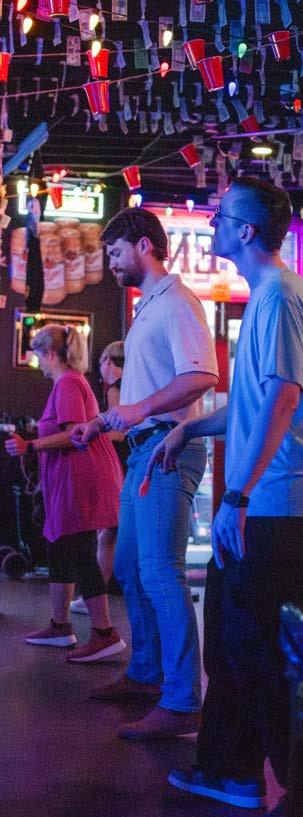
The room moves in unison in a way I’ve only seen achieved on a stage. e only sound louder than the music is the collective “stomp” of soletech heels coming into contact with the hardwood "oor. e song fades, and laughter and chatter ll the space where applause would usually ensue. In this small act lies the key di erence between a professional performance and this haphazardly lled warehouse: these people are dancing for themselves.
e cue to the next
song begins, and the room snaps to attention. Strangers pair o and perform the sequence of steps that t the new melody. ey’re all in on a secret—possess the same key to an entirely di erent world—a world of southern dance. It’s a shared history, as natural to them as our own re"exes formed by movement memory.
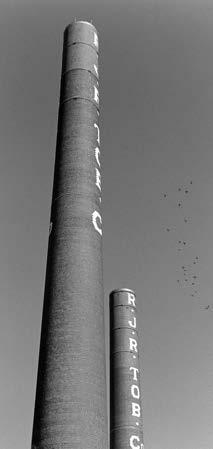
As a Northerner, line dancing and swing dancing were the stu of urban legend—of the 2011 "Footloose" adaptation and a fad of the 90s. What I hadn’t expected, coming to Wake Forest, was that line dancing permeates Winston-Salem culture just like the smoke from the RJ Reynolds factory once covered the city. It is alive and well and, often, right under our noses.
Winston-Salem is uniquely oriented to support the preservation of the ever-evolving southern dancing enterprise. With committed teachers and faithful students, line dancing will remain an ineradicable institution in the community and continue to serve as a symbol of hope for its participants.
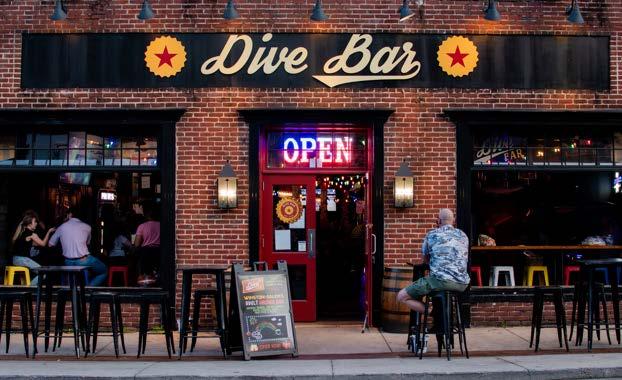
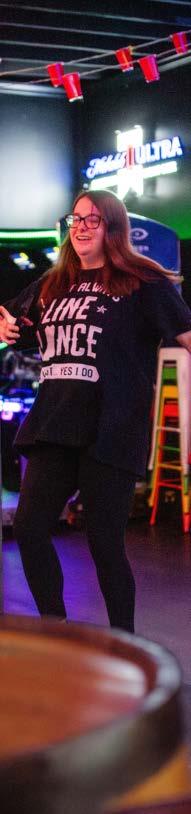
23-year-old Brooke Porter, who moved to Winston-Salem three years ago, found her home within the four walls of Dive Bar. Only eight months after her move, she attended her rst Dive Bar Wednesday, where she immediately met her closest friends. For her, line dancing transcends a pastime.
“Line dancing has really shaped my identity. It has made me more of a con dent person,” Porter notes.
Having originally picked up line dancing as an escape from her college bubble at the Savannah College of Art and Design, Porter o ers a unique perspective on the distinctive
elements of Winston-Salem’s dancing culture.
“In Georgia, it was weirdly competitive,” she says. “Here, it’s such a friendly and inviting community. Winston-Salem really wants people to dance. at is totally part of the city.”
One unique dancing hall is located in a converted warehouse between Winston-Salem and Greensboro. Arizona Pete's is a time capsule of southern dance in relation to American culture, with barrels of hay, U.S. "ags and taxidermy strewn across the club by means of decor. As the longest standing country music saloon in the Triad area, it has served as a pillar of the broader line dancing community for decades.
“Alright, everyone got that?” Clay Morgan shouts from the front of the room. At 7:30 p.m. on Friday nights—Arizona Pete’s sole night of operation—Clay and Fay Morgan, founders of Boots on e Floor, instruct the class that precedes open dance at 9 p.m. For 15 years, the Morgans have been teaching line dancing classes at Arizona Pete’s.
“One night I was on the "oor choreographing a dance and the next thing I know the whole hall is following me. We’ve been teaching here ever since,” Fay says, explaining their introduction to the line dancing business.
“We kid around, mess around, mess up, laugh it o ,” Clay adds, emphasizing the values they uphold in practice. Fay and Clay met on a line dancing team in Washington, D.C., before getting married and moving to Winston-Salem. When questioned about what it’s like to run a business with your
"It’s an ESCAPE from the everyday hustle and bustle. Line dancing CLEARS MY MIND."
- Aidan Jensen
husband or wife, Clay didn’t hesitate before responding, “killer.”
Apart from Arizona Pete’s, the couple teaches ve classes a week at various venues including Dolly’s Honky Tonk, Whisky Sours and Riders Entertainment, as well as private parties and weddings. eir classes range from 80 to 90 participants, a dozen of whom have been following them for more than 10 years.
“ ey like to call us mom and dad because we’re a little older than them. But, they keep us moving,” Clay says.
e couple has 34 and a half hours of songs with corresponding choreography prepared. Line dancing is unique in that it’s not exclusive to age, gender, race or ability.
“We’ve taught people in wheelchairs. It doesn’t matter to us. It’s all fair,” Clay explains.
“We are not your normal country line dance. We're out of the box,” Fay Morgan notes.
With a rise in popularity due to social media and internet tutorials, the Morgans have adapted their teaching style to incorporate the tastes of younger generations and current music trends.
“It seems like every ten years we have a new wave, a new role,” Clay says. “Right now, the swing's coming back.” e same sentiment is shared by Trish and Rick Edwards, co-founders of swing dance company Love 4 Country.
“It was popular for a time, and now it's making a comeback again,” says Edwards. “I think COVID-19 really is forcing everybody to kind of come out and reconnect with people and say, ‘Wait, I'm human, you're human, let's hang out together.’ And I can see the younger generation coming back to it again when they get older.” is same concept is evident in their own introduction to line dancing.
High school sweethearts from Ohio, the Edwards began dancing in the 90s and took up swing dancing a year and a half ago. ey began teaching weekly classes in June in Winston-Salem.
“ ree years ago, we got back into line dancing, and we saw people country swinging, so we wanted to learn it, but we couldn't nd anybody around here,” Trish explains.
After coming across an advertisement for swing dance instructor lessons, the couple decided to take courses on how to teach. Afterwards, they began instructing their friends and eventually opened up their lessons to the public. eir current class attracts 20 people weekly, with an age range of students in their late teens to those in their mid 60s.
Student of Trish and Rick Edwards, Aidan Jensen, notes, “I guess you can say that I have an addiction to the sport. It’s constantly growing, and there’s de nitely a passion for it in Winston-Salem.”
“Our kids are here tonight, actually,” Edwards adds. “ ey love to line dance, and so do their friends. We’re basically the
coolest parents,” he jokes. “Everybody knows everybody. It's a family. You go to di erent places and the commu nity’s the same.”
Jensen would promote the sport for the same reason. “It’s an escape from the everyday hustle and bustle. Line dancing clears my mind. I’m not thinking about anything except the songs that are going to be played, the people that I am going to be meeting and the people that I am going to see again. It has brought me a really great friend group.”
is familial culture proved to be true. By my fourth week of attending events, I was able to pick out the faces of a few regulars. In these individuals, I saw the power of line dancing to bridge di erences and o er a unique reprieve from the hardships of reality.
Instructor Maggie Shipley, who orchestrates ve week ly classes and events across Winston-Salem, shares a sim ilar origin story.
“My dad actually passed away pretty unexpectedly, and my mom found a random line dance class online and in vited me, and I went, and I got hooked and then I just never looked back.”
For many, line dancing is not just a pastime; it o people their lives and autonomy back.
For Emily Parks, line dancing was similarly centered around personal growth and o ered her something very speci c: freedom. After escaping from an abusive relation ship, Parks was looking for a change in scenery. She found that, and more, within the four walls of these dance halls. In the case of line dancing, nothing is performative— not the activity nor the community formed in these rooms. When questioned on whether or not his buddies also enjoyed line dancing, Nathan Gardiner, a 21-yearold youth pastor and friend of Parks, replied, “ ese are my buddies.”
e individuals drawn to line dancing share one thing in common: a desire to dance with others. For people like Demont Blue, another member of this eclectic friend group born at Dive Bar Line Dancing Wednesdays, this is enough. “50% of these people I see once a week and we do things together,” Blue says. “We're all di erent. It's a very unique and diverse crowd.”
ese people alone serve as proof of the historical con sequences of line dancing, which are rooted in communi ty and camaraderie.
Country dance is a backbone of Winston-Salem’s com munity and culture, o ering its participants a unique re prieve from the harsher realities of everyday life. As it con tinues to grow in popularity among younger generations, we stand at a unique position to continue a tradition that has brought immense rewards to people of all walks of life.
KNEADING COMMUNITY
At Sawtooth, pottery classes spin clay into different shapes and classmates into family.
BY JILL YODER
by Daria Prokhnitski
Photos
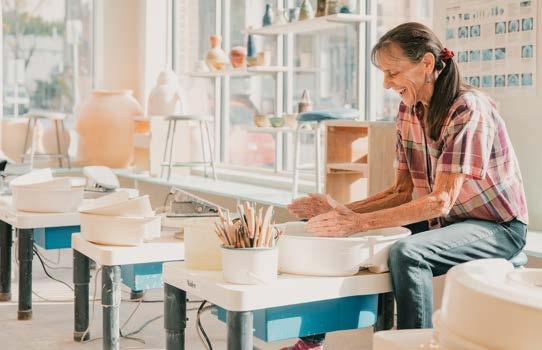
In the heart of downtown Winston-Salem, o Marshall Street, there is a building lined with pottery wheels, shelves along the walls, sinks in the back and tables in the middle. It is lled with artists, new and old. It is lled with community.
Initially founded in 1945 as e Arts and Crafts Workshop, this pottery studio is part of the Sawtooth School for Visual Art, a community art center.
In 2014, Winston-Salem was o cially deemed the “City of Arts and Innovation.” Many of the founding board members of Sawtooth, including Mary Reynolds Babcock and Helen Copenhaver Hanes, contributed to the development of the Arts Council of Winston-Salem and Forsyth County in 1949. ese institutions and many others led to the arts becoming a de ning part of the city’s culture.
e school earned the name “Sawtooth” when it moved to the historic Shamrock Mills building because of the characteristic jagged roo ine. Today, the school houses 16 studios inside the Milton Rhodes Center for the Arts and is in its 81st year of providing access to the arts to Winston-Salem residents of all ages.
Julie Perry has been a potter since her rst class at Sawtooth in 1985, at the age of 33. She moved back to her hometown of Winston-Salem three years prior, looking to rebuild her life, and began working for the WinstonSalem Journal. On lunch breaks, she would walk along the downtown streets and peer into the windows of Sawtooth, enthralled by the world of creation happening just beyond the windowpanes.
At the time, Perry, along with a friend, was looking for ways to bring more joy into their lives. “We decided we needed to learn how to laugh again,” Perry explained. Eventually, she decided Sawtooth was the way to do so.
e duo registered for a beginner-level wheelthrowing class and over the weeks of mess-ups, clay-covered arms and learning from others, they laughed a lot—at themselves and at each other.
And yet, in pottery, Perry found even more than laughter. “People would always say, you know, ‘be in the moment, be in the moment,’” she shared. “And I really never knew what that meant. I never felt like I did that until I started making pots.”
Since that rst class, Perry has been in the pottery studio for 41 years. As all beginners do, she made “ugly pots” for a long time. Pottery is an art of patience, not perfection, and for Perry, it slowed her down and taught her to learn again.
“Your hands don’t know what to do, and the only way they’re going to know is by doing it again and doing it again and daring to do something di erent,” she said.
After Perry’s rst few years in classes at Sawtooth, the pottery studio entered a di cult period due to the resignation of the studio director. In the period of uncertainty, Perry was asked to become an instructor after only a few years of courses at Sawtooth. Filled with love for the studio, she began what would become a long and rewarding career of teaching wheelthrowing.
In teaching, Perry quickly found that she was learning alongside her students. e process of explaining re ned her own skills and opened her up to new methods and approaches. Her most important lesson to students is not to be afraid to experiment.
“I think of the pots as my friends who like to be noticed,” Perry said. “ ey like to be decorated with compliments or conversation or just acknowledged. Decorating your pots, I think of it as kind of the same thing, giving them a compliment, making them more than just another pot, making them their own piece.”
is is the de ning characteristic of Perry’s own pottery. She is self-de ned as a “functional potter with a little bit of funk.” e pottery covering the shelves of her house is covered in texture and color, blues and greens, rarely a smooth surface in sight. For her, every piece should be made individual and innovative, an unrepeatable creation.
Along with a new passion, Perry found a profound sense of community and friendship in the Sawtooth ceramics program.
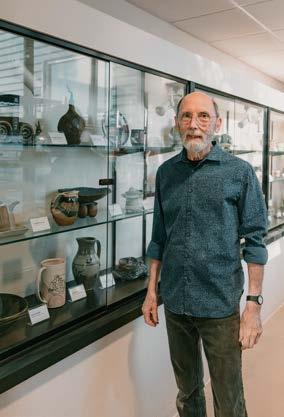
In 1989, Warren Moyer was hired as the new Director of Ceramics and asked Perry to stay on as an instructor, even after the studio was back up and running smoothly.
Moyer was a new and welcoming face in the studio, one who was always willing to help. When Perry bought a new kiln for her home studio, Warren o ered without hesitation to help her re it for the rst time.
“And if someone asked me that question today or a student asked me that question, I would do the same thing that Warren did for me,” Perry said.
“It’s really gratifying when you see people become so involved that they want to open up their own little studios, buy their own kiln and all that and watch them sell their work for the rst time,” Moyer shared.
Warren Moyer’s passion for ceramics began long before he joined the Sawtooth community. While earning an undergraduate degree in art education, Moyer fell in love with clay during his very rst pottery class and has since built his entire life and career around it.
“Pottery was what just really caught my heart,” he said.
After bouncing around to a few di erent art and ceramics jobs, Moyer moved to Winston-Salem when he accepted a job o er from Sawtooth, despite the position being only part-time. He joined the existing ranks of instructors, including Perry, and worked hard to build up the small but passionate program of about 35 students in a basement studio space.
By this time, Sawtooth was occupying its current space in the Shamrock Mills building, and the space that today serves as the ceramics studio housed a restaurant. Moyer recalls walking to that restaurant with friends during breaks from the studio and dreaming of a space just like it.
“We’d walk in there, see the windows, look out in the park, and say, ‘Man, wouldn’t this make a great pottery studio?’” he said. “And I mean, I really had no idea that that would ever happen.”
Eventually, an expansion and renovations to the Sawtooth building transformed that very restaurant into the new and current pottery studio, with its characteristic open window format, a welcomed change from the basement studio space.
Although Moyer initially focused on wheelthrowing, he noticed the need for a handbuilding program in the ceramics studio and began to build one up, developing his own love for the medium in the process. After working as Director of Ceramics for 30 years, Moyer retired in 2019 but continues to teach handbuilding classes in the studio twice a week.
“I just like to share what I know with people, people who love to work with clay or people who have never worked with clay, and, you know, just see their enthusiasm
Julie Perry
and that look when they take out their rst piece,” he said.
e instructor-student relationships are a large part of what de nes the Sawtooth community. As director of the program, Moyer would look for instructors who, aside from being talented potters, had a naturally patient and gentle disposition.
“ ere’s a saying I always tell [the instructors]… the most important thing when you’re teaching is to know that the students care about you,” he shared. “It’s not how much you know, it’s that they know that you care.”
Sawtooth o ers classes to all ages, but the participants in adult classes range from 16-year-olds eager to get their hands messy after school to retired community members searching for a new hobby.
“Part of what I love about teaching pottery is I think it builds up people’s self-esteem and [gives them a] feeling of ‘I can make something and be proud of it and accomplish something,’” said Moyer.
Moyer recalled the period of remodeling, when Sawtooth classes were held in Crossnore Communities for Children, and the instructors taught art classes to the children living in the home.
“ at was really rewarding because a lot of these kids came from bad family situations and had very low self-esteem, and you could just see as they started working in clay, they discovered that they could really make something they were proud of,” Moyer shared.
various groups within the Winston-Salem community through art.
e ceramics studio hosts regular “Bowl-a- ons” for students and instructors to make bowls to donate to Empty Bowls, a fundraising event by the Second Harvest Food Bank of Northwest North Carolina, which raises money to ght food insecurity.
“Sawtooth is a real gift to this community,” said Moyer.
While the school o ers over 1000 classes and workshops in various media, the pottery studio creates a unique opportunity for the community. Wheelthrowing is a medium that requires equipment that is largely inaccessible to beginners outside of a proper studio. In the Sawtooth studio, which is open every afternoon for student access, creation becomes a communal process, one of shared laughter, advice and encouragement.
Sawtooth has always valued community outreach and support beyond its own walls. In 2013, the school expanded to create two professional-grade studios in the Intergenerational Center for Arts and Wellness. Sawtooth has partnered with organizations, including Industries of the Blind and the Multiple Sclerosis Society, to connect with
“ e clay program has always had a sense of community, but I think because of how long some of the students have been here, that bond has grown just because they’ve spent so many years together,” Moyer said.
Both Perry and Moyer have watched both Sawtooth and the ceramics program grow into a community of new and old friends who share a love of art and their city.
“ e feeling of camaraderie, the feeling of being welcomed with open arms, wherever you are, whether it’s the front o ce, whether it’s your instructor, I just have always felt at home there,” Perry said.
It is that sense of belonging and home that has made Sawtooth an irreplaceable part of the Winston-Salem community for the past 80 years. It is a place for exploration, a place for growth and a place to share in the joy of creation.
Warren Moyer
INVISIBLE ROUTES
Aboard the Circulator Bus, a woman’s quiet Sunday routine turns out to be something irreplaceable.
BY ARIC LOIACONO
Photos by Will Hemphill
On a routine Sunday morning, Aaliyah ompson steps onto the 108 South Side Circulator Bus. She has been taking this route for decades, and at 71, she has lived in Winston-Salem for almost her entire life. Every stop along the route holds its own story.
Her rst destination is New Bethel Baptist Church. Here she attends Reverend Dr. Kendall D. Jones’ 9:30 a.m. service. ompson has been attending for nearly 25 years now, in which she has witnessed generations of congregants come and go, along with the city slowly changing around her.
“After all these years, walking into this church just feels like coming home now,” ompson said. “I walk in and it’s just a community of people who come here to grow closer with God. It’s the same faces, the same hymns, the same pews, and it really just brings everything together for me. I don’t even think about it anymore. It just is.”
e warmth of the congregation settles around ompson like a familiar blanket. She could spend her Sunday mornings anywhere she wants, but for more than two whole decades, this is the place that she chooses to be. It gently moves her morning forward.
After this service, ompson makes her way to Gateway Commons Park on the same bus. She sees squirrels darting up and down trees, couples walking hand in hand, and most commonly, she notes, children running around aimlessly. Whenever she comes here, she can always hear their distant laughter weaving throughout the playground.
“It boggles me how much energy the kids have. If I had the same ability, I wouldn’t ride the Circulator everywhere I go. I would just run.”
After observing the park for about 30 minutes, ompson takes the time to rest and close her eyes, letting her surroundings seep in. e city sounds around her become mu ed by the isolated nature of the park.
“It’s always good to slow down,” ompson said. “People are always in a rush to get to the next thing that they forget to live a little.”
Afterwards, she catches the same bus to Trade Street, where she grabs her usual breakfast at Mission Pizza Napoletana around 11 a.m. Every bite she takes is just another part of ompson’s morning ow. e tang of tomato sauce and smell of melting mozzarella lling the shop are iconic staples of ompson’s early morning pizza runs.
“I know I should eat before church, but it’s really just too early for me,” ompson said. “But Napoletana’s pizza, though, that’s the good stu . It can work any time of the day.”
By 12:30 p.m. ompson is at the Black-Phillips-Smith Government O&ce. Here, she gathers her regular Sunday group for a ride to Miller Park, where they play pétanque. In the game, the objective is to throw hollow steel balls or boules, as close as possible to a small wooden target ball, also known as the “jack.”
“Physical activity is such a necessity, no matter the age,” ompson said. “I mean, pétanque might not be the most engaged sport, but at least it keeps me moving. And the people there are the best. ey’re really some of my closest friends from this city who end up making it the best part of my week.”
With every throw, laughter and chatter ll the courts; a simple reminder that these moments create genuine mem-
ories that become stitched into the fabric of her week. roughout her day, even simple sights during the bus route carry signi cance. As the Circulator passes Carolina Christian College, ompson’s alma mater, she begins to reminisce about her college years.
“I miss being there,” ompson said. “I miss laughing with friends during random classes, I miss stressing over silly boy drama. I really just miss everything. Okay, maybe that’s not entirely true because I don’t miss the work. I wasn’t the best student, but I learned a lot along the way.”
While on the surface it seems like a negligible moment, passing her alma mater serves as a steady way for her to re ect upon her youth.
ompson continues her routine by picking up her granddaughter Naomi ompson from S&S Daycare at 6 p.m. ey stroll together through Sturmer Park, with Naomi running along the greenery and beneath the trees. Later, they share a meal at El Torero, their favorite Mexican restaurant, before stopping at Krispy Kreme for donuts to go.
“If this route disappeared tomorrow, I’d miss it terribly,”
ompson said. “It’s not just about the stops, buildings or morning pizza. It’s really about the in-between. e predict-
ability about it is what makes it comforting and steady. is probably sounds so regular to anyone listening to it, but I love the regular. My routes on Sunday are almost always the same, and I wouldn’t want to spend them any other way in Winston-Salem.”
rough ompson’s repetition of simple daily routines, her memories aren’t tied to headline-reaching monuments, which is what makes them signi cant. Instead, her invisible routes reect that Winston-Salem is not about what stands still, but what moves. e people who walk its pavement, ride its buses and take time to view its scenery form the memories that are quietly carried through the city, one route at a time.
is rhythm of everyday movement with repeated paths and stories is what gives Winston-Salem its heartbeat. Its streets, people, buses and parks are more than just foot tra&c.
Beneath the monuments are people going about their day, opening their local shops, commuting to school, going to the gym, grabbing a quick co ee or simply taking walks to slow down.
And although seemingly insigni cant, this is the core foundation of what makes Winston-Salem memorable.
International students discover an unexpected comfort in Winston-Salem.
BY EMMA SCHOPPA
Photos by Blythe Kingston Green
For three international students at Wake Forest, Winston-Salem was never supposed to feel like home. Then, slowly, it did.
e acceptance letter arrived on Amine Bouchamaoui’s birthday. He remembers exactly how his grandmother reacted, how his parents reacted, the speci c electricity of that moment. He had applied to Wake Forest almost as a dare to himself. He’d seen the name, found it strange and decided that was reason enough. Now he is enrolled, living in his fth country, trying to gure out what belonging looks like when life consists of leaving places behind.
Across campus, Tom Harberer was asking himself a quieter version of the same question. e golfer from Hanover, Germany, arrived through a thin thread of connection—a former German teammate, a conversation with a coach at an international tournament—and is now navigating a city he never imagined living in.
Stella Li, who grew up in Beijing, China, before moving to Florida, chose Wake Forest for tennis and academics. She found herself, like the others, doing the slow, unglamorous work of making somewhere feel like yours.
Winston-Salem doesn’t make it easy. It’s not a city that announces itself. ere’s no skyline moment, no obvious cultural heartbeat to grab onto. What it o ers instead is something subtler: manageability.
You can cross it in ten minutes. ere’s rarely any trafc. “You can kind of go everywhere quickly,” Harberer said. “You can’t really get lost.”
For someone arriving from far away, without a car, without a network, without any of the invisible sca olding that makes a place livable. at’s not nothing.
“I feel comfortable,” he added, a small word that, for an international student, takes a long time to earn.
A lot of that comfort gets built around a table. For all three of them, food has been one of the most reliable ways
to immerse themselves in the city, a way of staking claim on a place that didn’t originally belong to them.
Harberer gravitates toward Putters, which gives him what he describes as “that American college feeling,” and Tokyo House when he wants something simple and good. When family visits from Germany, Putters is always the rst stop.
Li’s tennis team has a standing tradition of dinner together before every match, rotating through the city’s restaurants — Cin Cin for burgers and milkshakes on casual nights, and Quanto Basta, a downtown Italian spot, for something more special. She spent her 21st birthday at Quanto Basta with the whole team around her.
“ e food was really good,” Li said, simply.
Bouchamaoui’s favorite is River Birch Lodge, a place he’s returned to enough times that it’s accumulated meaning.
“Every time I’ve been there, it’s with good friends,” he said, “and my parents loved it.” at’s how a city gets claimed, not in grand gestures, but in birthday dinners and knowing exactly what you’ll order when you walk through the door.
Making a place feel like home, when home is thousands of miles away, also requires a certain creativity with what you bring to it. Harberer watches German soccer with a few German friends on campus, hunts down German beer and lets the two worlds coexist rather than compete.
“I like doing American stu ,” he said. “But I also like doing the things I’m used to at home.”
Li learned early that Winston-Salem has to be shown at the right time, when her mother visited and they wandered downtown on a quiet Sunday morning, nothing open, nothing moving, her mother left unimpressed and has never fully reconsidered. But Li knows another city underneath that one: the one that comes alive at night, that feels warmer and more alive after dark.
Stella Li
“ e areas are very artistic,” she said. She wishes it were more diverse, in food, in people, in the communities that brush up against each other. “I would wish it’s more diverse,” she said. “So then it’s easier to nd your community.”
Bouchamaoui, who has always been a bigger-city person, doesn’t disagree. He’s leaving after graduation and doesn’t pretend otherwise. But he separates the city from the university with a precision that matters.
“I love Wake Forest,” he said. “ e people, the students, they allowed me to change as a person, to become more social.” Winston-Salem is where he lives. Wake Forest is where he became someone.
Ask each of them for one word to describe WinstonSalem, and you get a window into how differently the same place can land.
Harberer said “comfortable”—somewhere you stop getting lost in, somewhere that eventually starts to t.
Li said “artistic”—she sees something worth looking at in the buildings, the streets, the texture of the place.
Bouchamaoui said “boring,” without apology, and means it, though even he admits that what he’s really describing is a mismatch of scale rather than a verdict on the city itself.
What connects all three of them, underneath the different restaurants, rituals and coping strategies, is a shared
“It’s TIME that makes you feel that you’re at HOME, time to know how many PEOPLE are here, how to BEHAVE, how things WORK.”
- Amine Bouchamaoui
Tom Haberer
understanding that belonging takes time, more time than anyone tells you before you arrive.
Bouchamaoui has a rule of thumb: it takes at least two years before a place truly feels like yours.
“It’s time that makes you feel that you’re at home,” he said. “Time to know how many people are here, how to behave, how things work.”
He likes to walk the Reynolda Trail near campus. He calls his grandmother and shows her the trees. Slowly, Winston-Salem became something he knew.
Harberer, in his third year, feels it too, the shift from disorientation to ease.
“People are nice,” he said. “I feel comfortable being me.”
He’s not confusing Winston-Salem for Hanover. He’s not pretending the infrastructure isn’t frustrating or that he doesn’t sometimes miss the train he could take anywhere back home. But he’s also not pretending the discomfort is all there is.
And Li, decorating her apartment, going to dinner with her team, trying to be a bridge between communities she cares about, has found that home is something you build from the inside out.
None of them planned on Winston-Salem. None of them would have pointed to it on a map and said, “ ere.” But they came here anyway, for golf, for tennis, for a name that sounded strange and worth investigating, and they’ve done what people have always done when they land somewhere unexpected. ey found their restaurants. ey called their grandmothers. ey decorated their apartments. ey walked the trails. ey stayed long enough for the place to stop feeling foreign. at’s not the same as home. But sometimes, it’s close enough.
IT’S BEEN
With COVID-19 came many challenges, but remembering it has proven to be one of the hardest.
BY MIRIAM FABRYCKY
SIX YEARS
Photo by Sienna Greenleaf
Like many of her classmates who graduated from Wake Forest in 2021, Olivia Field says it’s di!cult for her to remember Spring 2020.
“Memories play tricks on us,” Field says. “ ey’re so malleable. I feel like my memories of that time are very strange in a way that most of my other memories aren’t.”
As the new decade began, Field was a second-semester junior and editor-in-chief of the Old Gold & Black (OGB) student newspaper. Freshly returned from a fall study abroad program at Queen Mary’s University in London, she says she observed a “renewed energy” among her classmates that made campus “really fun socially.”
Jan. 24, 2020: Dr. Cecil Price, director of the Wake Forest Student Health Service, sent a message to students, faculty and sta —the rst university communication to mention a new disease that, at the time, seemed abstract and mysterious to most. e respiratory virus emerging in Wuhan City, Hubei Province, China was making headlines, but not yet front pages. Medical understanding of the novel virus was changing daily. e disease it caused didn’t even have a name.
It’s been six years since the situation in Wuhan City became the situation of the entire world, including in WinstonSalem, N.C., and at Wake Forest University. en undergraduates are now in their mid-to-late twenties, and many of the incoming class of 2030 were in sixth grade during those early, anxious days.
Six years is a long time in the life cycle of a university. It’s a long time for anyone. Few people would willingly return to the social isolation, fear and illness that haunted the spring of 2020 and beyond, even in memory only. Some ask if it’s truly necessary to remember the pandemic, but do we lose something when we forget?
Feb. 28, 2020: As northern Italy su ered one of the rst international COVID-19 outbreaks, Wake Forest closed its Casa Artom house in Venice. e 19 students and one faculty member residing in the house at the time planned to return to Winston-Salem on March 15 after a period of quarantine.
“A lot of my initial memories and formation about what COVID was happened in the OGB newsroom,” Field says. “We wrote the article [about Casa Artom] in such a separated way of ‘this happening to a group of people who go to Wake Forest, so we should write about it, but there’s no way it’s going to a ect us.’”
Julie A. Freischlag, CEO of Atrium Health Wake Forest Baptist and, at the time, Dean of the Wake Forest School of Medicine, has positive memories of the months preceding the pandemic. But slowly, it dawned on her and her colleagues that something was very wrong.
Feb. 29, 2020: e U.S. reported its rst death from COVID-19 as the worldwide death toll approached 3,000.
“We heard about it happening in Washington state, and
Few people would willingly return to the social
ISOLATION,
FEAR and ILLNESS that HAUNTED the spring of 2020 and beyond, even in MEMORY only.
“It happened right before SPRING BREAK, so in classes, professors were making JOKES like… ‘I’ll NEVER SEE you AGAIN.’”
-Olivia
Field
we had heard about the things over in China, but we didn’t realize how much was being transported by planes and travel and all that,” Freischlag says. “I said, ‘Oh no, it’ll stay out there.’”
March 3, 2020: N.C. DHHS announced the rst case of COVID-19 in North Carolina.
“Two of my good friends from college were like ‘ e world is ending!’ and I remember just being like, ‘Shut up, guys. You’re totally overreacting.’” Field says. “It happened right before spring break, so in classes, professors were making jokes like… ‘I’ll never see you again.’”
March 11, 2020: University President Nathan O. Hatch writes that “students should not return to campus if at all possible.”
“I was just in my family’s living room like ‘holy shit, we have to write an article about this,’” Field says.
In spring 2020, Ashlee Stutsrim was in her fourth year of general surgery training at Atrium Health Wake Forest Baptist. She and her husband were talking about having a baby—their rst. ose conversations became fraught as they watched infection numbers tick upwards.
“We knew so little in those early days,” she says. “I remember coming home from work and just straight up stripping down in my garage… going directly into the shower.”
Amid uncertainty, Field and her fellow student journalists reported what they did know. “For better or for worse, I
got to experience a period of being editor-in-chief [when] we were doing some serious, serious reporting,” Field says.
March 21, 2020: A Wake Forest student was diagnosed with COVID-19 following a choir trip to London, England. According to the Old Gold & Black, the student learned they tested positive just 15 minutes before the university emailed the entire campus community. Students remaining on campus moved into single occupancy rooms, many of which still contained their previous residents’ belongings.
At the hospital, Stutsrim and her colleagues took on new risks.
“You almost had to decide who [was] going to, like, sacrice themselves to go in the rooms and be taking care of certain people,” she says. “When we would put people to sleep and intubate them… there’s going to be all this stu coming out of the person’s airway and you didn’t know how to keep people safe for that.”
e Wake Forest Baptist Medical Center tied yellow ribbons on the bridge between the hospital garage and the medical facility to represent each discharged COVID-19 patient. Not everyone made it.
March 30, 2020: Forsyth County, N.C., lost its rst victim to COVID-19—90-year-old WWII veteran Richard Calkins. WXII 12 reported that Calkins died alone, as the hospital did not accept visitors due to the pandemic. Additionally, President Hatch announced that students at home would not
“Two of my good friends from college were like ‘THE WORLD IS ENDING!’ and I remember just being like, ‘SHUT UP. You’re totally OVERREACTING.’”
-Olivia
Field
return to Wake Forest for the remainder of the spring semester. Virtual classes continued.
“It sucked. No one had a good time,” Field says. “And you know, the professor is just trying their best.”
e university o ered housing and dining refunds to students. However, as Wake Forest, like other institutions of higher education, faced a growing budget crisis, President Hatch wrote that the university appreciated those who were able to decline their refunds.
“I don’t blame anyone for anything,” Field says. “Whatever happened was the right decision. I look back on that time and it was very scary. People were losing family members.”
Soon, the novelty of the pandemic wore o . Quarantine remained uncomfortable, but many settled into a routine. Wake Forest Baptist resumed surgery in June 2020. Stutsrim and her husband decided to have a baby. She wore an N95 mask her entire pregnancy as a precaution.
“I have a lot of gratitude for being in healthcare because I did have access to an N95 and [could] protect myself… not everybody had that,” Stutsrim says.
She saw patients whose conditions had worsened drastically due to a lack of care during the earliest months.
“ ey just didn’t come in because they were afraid that they would get COVID coming to the hospital, and then they would come in and there would be nothing we could do to help them,” she says. “It had been too long.”
Perhaps the most painful moments of the pandemic came not from the rst panicked weeks but from COVID’s prolonged e ects. e seasons came and went, and with them passed holidays and life milestones celebrated in isolation. e loneliness compounded with time.
“ at period of time, it’s such a blur,” Field says. “It’s so incredibly di!cult to look back and be in that headspace again.”
Aug. 27, 2020: After a summer of cancelled study abroad programs, virtual internships and continued isolation, Demon Deacons returned to the Reynolda campus for a remote rst day of class, the Old Gold & Black described as “bleak.” Classes continued to be held remotely. Students who contracted COVID-19 were quarantined at the nearby Best Western Plus hotel.
Cate Pitterle, a sta writer for the Old Gold & Black who enrolled at Wake Forest in Fall 2020, reported almost exclusively on the pandemic, but not because of any particular interest in public health.
“It was all anybody could talk about,” she says. “COVID was the most de ning aspect of college at that point. I remember one time I walked out of my dorm during my freshman year without a mask, and I got halfway around [Hearn Plaza] and a couple people were looking at me. I was like, ‘Why are they staring at me?’ and then I touched my face and ran back to my dorm room.”
She said she and her peers held the nickname of “the COVID class” until their graduation. ey caught only glimpses of the typical social buzz of a friendly campus like Wake Forest.
“ e thing that I remember most was this longing for normalcy,” Pitterle says. “Everybody knew that college is nite and wanted to make the most of what was a very unusual experience.”
Stutsrim sometimes revisits challenging memories from the pandemic with her colleagues. “One of my friends and I were talking about it the other day,” she says. “He had this experience where someone was bleeding to death, and he had to just continue holding pressure and go in the room while they were intubating the person.”
ese di!cult moments profoundly a ected a certain generation of healthcare workers, Stutsrim explains. “We had so much unknown and had to help each other be brave,” she says. “ ere was a lot of camaraderie from living like that… younger people, trainees had this realization that life could change really quickly, and none of us are promised tomorrow.”
e restrictions slowly loosened, but many of the memories remain knotted.
May 16, 2021: Field graduated from Wake Forest University at the LJVM Coliseum.
“It’s hard to nd the words,” Field says. “I’m going to be honest with you—I’m not talking to my friends about that stu . We’re not reminiscing about that experience because I do think, as the rest of society did, we’ve all kind of blocked it o from our minds. It sounds sad, but a lot of my fond memories from college are the pre-COVID times. Everything that I experienced after COVID at Wake Forest is deeply bittersweet. Even positive moments have a tinge to them when you remember the context.”
For years, we longed for a “new normal,” and one day, without announcement, it arrived. Now, we pack our social calendars, chit-chat around the repits on the quad, crowd into the student section at home games and dance late into the night. It would seem that college life has fully recovered. But sometimes we stumble across relics of the pandemic—a faded sign pasted in a shop’s front window announcing a strict mask policy, scu ed distance-marking decals adorn the oor of a grocery store, an at-home testing kit con rms the cause of that nasty fever or inclement weather prompts an unwelcome return to video-conferencing apps.
We remember COVID then—the draining isolation, the fear of illness, the ever-present uncertainty that haunted the beginning of this decade. e tumult might still a ect us more than we’d like to admit; we might never know the full extent of what our generation lost. But that was now six years ago.
“EVERYTHING that I experienced after COVID at Wake Forest is DEEPLY BITTERSWEET. Even positive moments have a TINGE to them when you REMEMBER the CONTEXT”
-Olivia Field
Rebakah Rhoden & Anna Impson
GRAPES AND GATHERING
BY CAROLYN MALMAN
Photos by Sienna Greenleaf
Little Pep owners pour a unique experience into the Winston-Salem dining scene.
Woman-owned, queer-owned, one of my favorite places in the city,” said Wake Forest University Professor of History Dr. Nisrine Rahal. Despite living in WinstonSalem for the past 3 years, I hadn’t heard of Little Pep until spending a little too long after class with one of my favorite professors, Dr. Rahal, who has been teaching at Wake Forest for over four years. After three semesters with her, I have come to notice that Dr. Rahal maintains unparalleled care for her students. She always asks questions about our lives and makes sure we treat ourselves in some way every day.
It is safe to say that I trust Dr. Rahal’s Winston-Salem recommendations.
For Rahal, belonging in Winston-Salem is synonymous with the small businesses she’s gotten to know over the past four years. Moving from a big city like Toronto was a challenge, but nding the quaint spots in a new city made it worth it.
“ “ HOW can WE MAKE
it a
LITTLE more INTERESTING? -Anna Impson
“Because you need to, you find your spaces,” Rahal said. “So, when Little Pep opened up, I became really excited to have a new space on Trade Street.”
The ambience stands out to Dr. Rahal as one of the key characteristics of Little Pep. “I love the space, the ambience, the community that they serve,” Rahal said. “Plus, the small plates are delicious.”
Rahal’s family is Lebanese, so it was important for her to find delicious food that reminds her of her culture. The small plates include labneh and za’atar, some Lebanese staples. “It’s really good,” Rahal explained. “I was like, ‘who’s inspiring them?’ because you can’t find that stuff in Winston-Salem.”
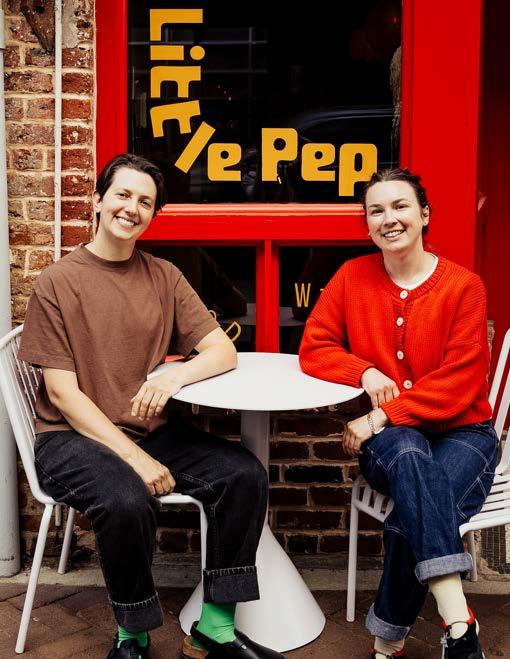
Anna Impson and Rebekah Rhoden are the co-owners of Little Pep and the creative force behind this mission. Impson and Rhoden met in high school in their hometown of Greenville, South Carolina. They both worked corporate jobs until Rhoden’s job led the couple to Winston-Salem. At a certain point, corporate America started feeling pointless. Impson describes how Rhoden was burnt out on her career, and she was pretty done with her own. “I was like, ‘What can we do now?’”
Leaving their corporate jobs,
Impson and Rhoden built a business forged on a shared passion for having a good time. Their mission was born—to create a space of unfettered individuality where people could come and enjoy their time together. It’s not that complicated, and it’s not overly temporal either.
“We want to have fun in everything we’re doing,” Impson said. “We don’t want to take it too seriously. Let’s not be stuffy, pretentious or shame people for not knowing things.”
The unique food selection Rahal described is just one of the many reasons Little Pep stands out. For one, Impson emphasized that Winston-Salem is small, but it has an oversaturation of places making burgers and fries. So, they decided to focus on “natty wine,” which refers to wine created without intervention of any kind, including additives, sulfites or filtration.
In addition to no-nonsense wines, their menu prioritizes ecological consciousness. “We really wanted to value seasonal produce,” Impson stated. “For the most part, everything is from local farmers.”
When conceptualizing the menu, Anna describes her free-flowing process that centers on letting the local ingredients
shine. “I know these things work together. How can we make it a little more interesting? I’m not trying to make things overly complicated. I kind of just want the seasonal thing to speak for itself.”
While speaking with Impson, I grew amazed at her anti-corporate business, which sounds like a paradox. How can a business be void of rigidity, structure and stuffiness? Every day, Impson and Rhoden prove how to pour life into an oftentimes lifeless industry by focusing on people.
For one, they focus on what makes them happy in a business.
“We had traveled a good bit, and I think over time we have just really enjoyed wine and food, but the idea of a proper restaurant felt daunting, so we were like ‘Wine? at feels really doable,’” Impson explains.
They also prioritize the well-being of their staff. Impson discusses meeting staff where they are, and not expecting them to devote their life to this, as Impson has. Community remains central for Little Pep’s mission. They paired their mission back to the simplest desire of humans—to come together, drink good wine and have a good time. It’s nothing complicated. It sounds so straightforward, but simplicity is what makes Little Pep stand out. Impson and Rhoden noticed a glaring gap in the market that they try to fill with their locally sourced ingredients, natural wines and cozy atmosphere.
“If I want to treat myself to an evening of delicious food and seeing my friends, Little Pep is a place where it’s not expected that you just eat and leave,” Rahal said. “They let you linger, and I think that is super important. The food there is really good, but after you finish the food, there’s no push to leave.”
Dr. Rahal’s remarks reflect how guests are able to spend quality time at Little Pep. They push back against corporate restaurant chains that prioritize turnover. Instead, Little Pep prioritizes community.
The space lends itself to this. I recently visited Little Pep, spending time at one of the cozy tables in the back. I remarked on how close together everyone sat without feeling overcrowded. I found myself surrounded by humanity a couple on their first date awkwardly glancing at and then away from each other, two girls giggling uncontrollably over a shared bottle of wine and a pair of old friends reconnecting after years apart.
The owners of Little Pep meet the community where they are. They welcome inexperience, laughter and lingering in their space to forge a new age of restaurants, one that centers on living and breathing alongside the community of Winston-Salem.
DOWN MEMORY LANE
A simple refection, a nostalgic smell, a familiar street. Old Salem grounds visitors in the past, present and future.
BY EMILY MEINERT
Photos by Sienna Greenleaf
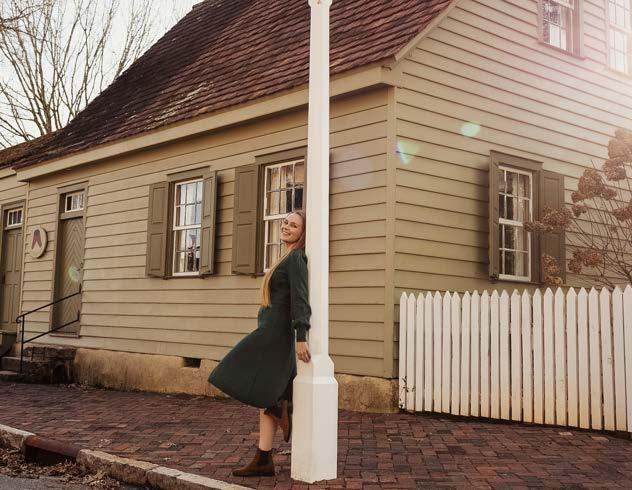
Cobbled sidewalks, horsedrawn carriages, the faint smell of woodsmoke oating through the air and streets lined with small homes that have watched the world pass by for hundreds of years: the scene unfolds a mere 15 minutes from Wake Forest’s Reynolda Campus.
Old Salem, originally founded by the Moravians in 1766, has been preserved as a piece of living history amidst Winston-Salem’s rising skyscrapers and bustling city streets. As I witness the city’s past and future visually collide, I am reminded of where we came from and how far we have come. Quietly tucked within the city, the space o ers a gentle reminder of its roots.
I marvel now at how remarkable it is that such a beautiful, historic place is so easily accessible to me as a college student. Along with this current sense of appreciation, visiting Old Salem means more to me because of
how much I loved it as a child. Before I understood its valuable historical implications, I was simply enchanted by the feeling of being swept back in time. My imagination was aglow with dreams of living in such a lovely place. Each home evoked visions of the stories that may have unfolded within. I felt comforted by the town’s slow simplicity and curious about the deeper context of such an aesthetically brilliant place.
ere is magic when bits of the unfamiliar are tucked into the everyday. Just after driving through the busy city, I can park my car and walk the old stone paths—worn, but enduring still—of those who came before me.
Wake Forest senior Grayson Weavil shared details of her own cozy childhood memories in Old Salem.
A Kernersville local, one of her rst elementary school memories was visiting the town as a eld trip in kindergarten. Her class made candles, and the women working there wore
traditional dresses and aprons. She also recalls going with her family during the Christmas season, when her grandmother would visit, and walking beneath the covered bridge with its hanging Moravian star.
She always loved the peaceful feel of the town and associates “warmth, like the feeling around Christmas time,” along with “younger days and the simplistic life” with the space.
Even though it was an important part of her childhood, Weavil said that she forgot about Old Salem for a while, until she saw a TikTok video of its co ee shop, Lot 63. She recalls thinking that she should visit the town more often.
“ ere’s such rich history that’s not often advertised,” Weavil said. “It gives our city a more established feel… that’s reinforced by having such a historical place.”
As she re ected on her memories, she explained that Old Salem evokes feelings of “wanting to be immersed
in where you are.” She nds it notable that the site is part of WinstonSalem’s downtown but still its own unique area where the city’s history is so “readily available.”
When I wander the streets today, breathing in the air that feels perpetually fresh and crisp, I begin to feel that I am walking through a space steeped in serenity. For a moment, I am transported back to a simpler time: not just through imagining the town’s history, but by remembering my own childhood carefree wonder.
I carry that peace back to campus with me, where life as a college student often feels like a whirlwind. e days get so packed that I begin to feel disconnected from myself despite the constant personal essays, social events, and extracurricular obligations that make me engage with my own beliefs and opinions. Constantly pouring myself out leaves me empty. When I feel as though I am ying through my own life, pulled along by the winds of my busy schedule, I need to be grounded, rooted in the past.
Visiting places that were signicant to me in my pre-college days reminds me of who I am and where I came from.
Salem College alum Karen Hutchins has also found this comfort in visiting Old Salem, where the campus is located. One of the reasons she was initially drawn to Salem College was that she had heard it was a small, tight-knit community, which she found in the lifelong friends she made there. e space remains important to her, reconnecting her with her past and encouraging her in the present.
“If we don’t understand where we came from, then we can’t actually see where we’re going,” she said. Hutchins also emphasized how interesting it was to attend school in a historic neighborhood. “Something I thought about of -
“She always loved the PEACEFUL feel of the town and associates ‘WARMTH, like the feeling around Christmas time,’ along with ‘younger days and the SIMPLISTIC life’ with the space.”
-Grayson Weavil
ten was what stories are connected to this place, both good and hard –this place that I now am joining,” she explained, referring to her decision to attend college there.
After all, the history of a community is one long story, and when we join it, our own story becomes a chapter of a greater narrative.
From her childhood in Oakridge and Greensboro to her time at Wake Forest, junior Caroline Kuebert has seen the tables turn as she has witnessed others experience the joy she receives from Old Salem.
“The biggest thing that stood out to me was how important being a Moravian was to everything they did,” Kuebert said. She always found it interesting to consider the town’s origins. As a child, she visited Old Salem every year for various school field trips, and has a multitude of memories there: taking smile-filled pictures on the iconic covered bridge, hearing volunteers in costume describe what their lives would’ve been like, and touring various houses like the Blacksmith’s and the Single Brother’s House. The students participated in various historical activities, such as playing games with wooden hoops and sticks and tilling the garden.
Kuebert jokingly remarked, “Third grade me was like, ‘How did anybody do this?’”
e favorite stop of students and teachers alike was Winkler Bakery.
e adults would drink apple cider or co ee while she and her classmates ate cinnamon cakes and thin Moravian cookies, which are still guaranteed to pull her out of a bad mood when she enjoys them today.
In high school, Kuebert’s organ instructor, who lived in Winston-Salem, brought her along to volunteer at the candle tea, a Christmas tradition at the Single Brother’s House. She dressed in costume and told visitors
what her life would’ve been like, just as others had done for her.
e trend continued through college, when she took “Music History and Culture” and went on a eld trip to Old Salem to see the Tannenburg organ. As she partook in a restoration project of the instrument, she saw the tables ipped again. Getting to both participate in and share the joy that Old Salem brings has been a meaningful experience for her over the years.
Looking back, Kuebert said that she has “so many positive feelings associated with Old Salem.”
As I have grown older, life has be-
come busier and I have gained more responsibilities. I nd that the spark of imagination and carefree joy that has felt essential to me since childhood sometimes begins to slip away. In these moments, I need to turn to the past to recover that which is most vital, which allows me to move forward: memories of joy, peace, simpler times.
A quiet stroll through Old Salem, on the same streets I walked as a child, reminds me that my life has been full of both everyday moments of happiness and unexpected surprises. As I look to the past, I see hope for the future.