News: Panel reflects on Charlottesville and race in America Page 5
Opinion: Last Resort should lower its prices Page 10
Sports: Wake Forest soccer continues success Page 13
Life: START gallery exhibits alumnus’ photography Page 17
Old Gold&Black WAKE FOREST’S STUDENT NEWSPAPER SINCE 1916
VOL. 102, NO. 3
T H U R S DAY, S E P T E M B E R 14 , 2 017 “Cover s the campus like the magnolias”
wfuogb.com
UndocuDeacs organize in defense of DACA Group affiliated with the Social Justice Incubator expresses concern following the White House announcement BY AMANDA WILCOX News Editor wilcaf16@wfu.edu On Sept. 5, the White House moved to end an Obama-era program known as Deferred Action for Childhood Arrivals (DACA), which allows individuals brought into the U.S. without documentation as children to live, attend school and work without fear of deportation. The decision followed strong warnings from fellow Republicans not to scrap the program, but after conversations with Attorney General Jeff Sessions, President Donald Trump justified the move with the argument that Congress, not the executive branch, is responsible for writing immigration policy. He has pressured the legislature to submit a solution within the next six months, although it is unclear whether Republican lawmakers, who have struggled for years to agree on an immigration reform package, will be able to develop a law by March. Reactions from both Democratic and Republican congressmen and senators were overwhelmingly critical and reflected widespread concern for the 800,000 DREAMers (Development, Relief and Education for Alien Minors) across the country. The majority of opponents of DACA do not oppose its philosophy, but its implementation; a handful of Republican lawmakers would like to see it codified into law rather than existing as an executive order. To be sure, it was a bipartisan team of lawmakers, Sens. Dick Durbin (D-IL) and Orrin Hatch (R-UT) who originally introduced the DREAM Act in 2001. Durbin was joined by Sen. Lindsey Graham (R-SC) and other Democrats and Republicans in the 2013 Gang of Eight that wrote an ultimately unsuccessful immigration reform bill. Durbin and Graham have both been loud voices across the aisle calling on Congress to act quickly to codify DACA. The university responded to the news by sending an email to the student body in support of DACA students on campus. “It is critically important for everyone in our campus community — and especially those worried about their safety and freedom to pursue their studies — to know that Wake Forest is here to support all our students, including those who are not U.S. citizens,” read the letter, which was sent on behalf of the Office of Diversity and Inclusion (ODI.) “Our campus is richer for our
See UndocuDeacs, Page 5
©WFU/Mitchell Loll
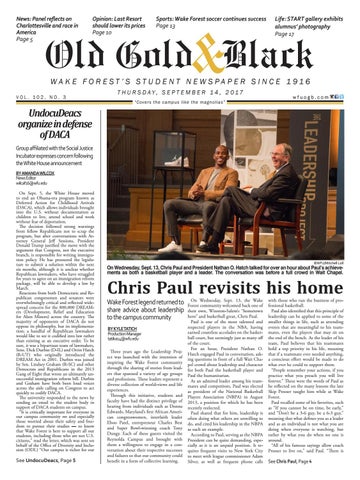
On Wednesday, Sept. 13, Chris Paul and President Nathan O. Hatch talked for over an hour about Paul’s achievements as both a basketball player and a leader. The conversation was before a full crowd in Wait Chapel.
Chris Paul revisits his home
Wake Forest legend returned to share advice about leadership to the campus community BY KYLE TATICH Production Manager tatika14@wfu.edu Three years ago the Leadership Project was launched with the intention of inspiring the Wake Forest community through the sharing of stories from leaders that spanned a variety of age groups and professions. These leaders represent a diverse collection of world-views and life experiences. Through this initiative, students and faculty have had the distinct privilege of hearing from individuals such as Donna Edwards, Maryland’s first African American congresswomen, interfaith leader Eboo Patel, entrepreneur Charles Best and Super Bowl-winning coach Tony Dungy. Each of these guests visited the Reynolda Campus and brought with them a willingness to engage in a conversation about their respective successes and failures so that our community could benefit in a form of collective learning.
On Wednesday, Sept. 13, the Wake Forest community welcomed back one of their own, Winston-Salem’s “hometown hero” and basketball great, Chris Paul. Paul is one of the most talented and respected players in the NBA, having earned countless accolades on the basketball court, but seemingly just as many off of the court. For an hour, President Nathan O. Hatch engaged Paul in conversation, asking questions in front of a full Wait Chapel crowd about leadership and character for both Paul the basketball player and Paul the humanitarian. As an admired leader among his teammates and competitors, Paul was elected as president of the National Basketball Players Association (NBPA) in August 2013, a position for which he has been recently reelected. Paul shared that for him, leadership is often doing what others are unwilling to do, and cited his leadership in the NBPA as such an example. According to Paul, serving as the NBPA President can be quite demanding, especially as it is an unpaid position. It requires frequent visits to New York City to meet with league commissioner Adam Silver, as well as frequent phone calls
with those who run the business of professional basketball. Paul also identified that this principle of leadership can be applied to some of the smaller things in life, such as attending events that are meaningful to his teammates, even the players that may sit on the end of the bench. As the leader of his team, Paul believes that his teammates hold a top priority in his life, meaning that if a teammate ever needed anything, a conscious effort would be made to do what ever he could to support them. “People remember your actions, if you practice what you preach you will live forever.” These were the words of Paul as he reflected on the many lessons the late Skip Prosser taught him while at Wake Forest. Paul recalled some of his favorites, such as “If you cannot be on time, be early,” and “Don’t be a 3-6 guy, be a 6-3 guy,” meaning that what defines you as a leader and as an individual is not what you are doing when everyone is watching, but rather by what you do when no one is around. “All of his famous sayings allow coach Prosser to live on,” said Paul. “There is
See Chris Paul, Page 4
OGB
“ Universities should investigate donation source This column represents the views of the Old Gold & Black Editorial Board.
The Charles Koch Foundation and Koch Industries have indirectly donated yet another large sum to higher education in Winston-Salem. The Thurgood Marshall College Fund’s Center for Advancing Opportunity, a creation funded by a $25.6 million donation from the Koch Foundation and Industries, will provide a $3 million grant to Winston-Salem State University’s new Center for the Study of Economic Mobility. The Thurgood Marshall College Fund, named after the first African-American Supreme Court Justice, has historically supported and provided resources to the nation’s historical black colleges and universities. The Koch Foundation and Industries grant follows a trend of similar grants awarded to other universities across the nation, including Wake Forest. As a refresher: in June 2016, Wake Forest started the Eudaimonia Institute — an interdisciplinary institute designed to investigate
We feel an issue arises when these donations are made on behalf of an inauthentic purpose, seamy scheme or on political grounds." the nature of human flourishing through the lens of political, economic, social and cultural constructs — after receiving a $4.2 million donation. Of this sum, $3.69 million was donated on behalf of the Koch Foundation. Due to the political ties of the foundation’s owners Charles and David Koch, controversy erupted last spring as professors from a variety of departments raised concern about the ability for the Eudaimonia Institute to remain autonomous and independent of political ties in its teachings. Despite the Faculty Senate’s demands to reject the funding for the Charles Koch Foundation, as the Winston-Salem Journal reported, Wake Forest spokeswoman Katie Neal said the university is continuing to move forward with the Eudaimonia Institute.
Old Gold&Black THE STUDENT NEWSPAPER OF WAKE FOREST UNIVERSIT Y SINCE 1916 McKENZIE MADDOX EDITOR-IN-CHIEF maddml14@wfu.edu
BECKY SWIG PRINT MANAGING EDITOR swigrr15@wfu.edu
>> NEWS Natalie Wilson, wilsnh15@wfu.edu Amanda Wilcox, wilcaf16@wfu.edu Assistant Editor: Lillian Johnson, johnlg16@wfu.edu
>> SPORTS Ren Schmitt, schmwm16@wfu.edu Kyle Ferrer, ferrka16@wfu.edu
>> OPINION Henry Bonilla, bonihj15@wfu.edu David Ajamy, ajamdg15@wfu.edu
>> LIFE Nicholas DeMayo, demanj14@wfu. edu
>> SOCIAL MEDIA CHAIR Erin Stephens, stepec14@wfu.edu
>> BUSINESS STAFF Brandon Palmer, palmbo14@wfu.edu Garrett Erickson, ericgj14@wfu.edu
>> ADVISER Phoebe Zerwick, zerwicp@wfu.edu
We, as the Editorial Board of the Old Gold & Black, do not condemn this decision on the condition that the students who are learning and interacting with this institute have equal access to political, economic, social and cultural ideologies that span the political spectrum and are not influenced by one ideology. What we would find unnacceptable is if it were found that the donors to the Eudaimonia Institute, or any institute for that matter, had an influence on the information taught under these academic establishments. Academic flourishing is and should remain independent of outside influence. Historically, the Koch foundation and its donations to different universities have met controversy, given the ties that David and Charles Koch have to conservative initiatives and their efforts in lobbying against federal spending on which historically black colleges and universities depend. That is why we, as the Editorial Board of the Old Gold & Black find it notable that the
foundation is choosing to privately contribute to the same historically black colleges and universities that they have lobbied against federal funds being spent on. That point addressed, we ultimately value education and commend those who genuinely donate to the betterment of society and help facilitate environments for students to flourish. Yet, we feel an issue arises when these donations are made on behalf of an inauthentic purpose, seamy scheme or on political grounds. We understand the financial pressure that is placed on universities in this competitive economy, and especially on consistently publicly-underfunded historically black colleges and universities, but we continually urge Wake Forest, Winston-Salem State and all other higher education colleges and universities to investigate the source of their donations. Ultimately, we encourage them to keep the student’s best interest in mind before they sign the contracts to accept large donations.
FOLLOW THE OGB ON FACEBOOK, TWITTER AND INSTAGRAM FACEBOOK.COM/OGB1916
BRANDON PALMER BUSINESS MANAGER
palmbo14@wfu.edu
RYAN JOHNSTON ONLINE MANAGING EDITOR johnrc14@wfu.edu
>> POLICIES
The Old Gold & Black is published Thursdays during the school year, except during examinations, summer and holiday periods, by Triangle Printing of Durham. To subscribe, please send $35 to P.O. Box 7569, Winston-Salem, NC 27109. © 2014 WFU Media Board. All rights reserved. The views expressed in all editorials and advertisements contained within this publication do not necessarily reflect the opinions of the OGB. As part of our commitment to reporting news fairly and accurately, we will not remove any previously published content. If an error in either our online or print content is brought to our attention, we will revise the originally published article with an appended correction. In order to facilitate thoughtful and appropriate debate, profane, vulgar, or inflammatory comments on our website are not allowed and will be deleted. For more information on our commenting policy, please see our website. We reserve the right to reject advertisements deemed inappropriate. Our full policy, and how to advertise with the OGB, can be found on our website.
>> SUBMISSIONS
The OGB welcomes submissions in the form of story tips, columns and letters to the editor. Letters to the editor should be fewer than 500 words, and columns should be around 500 words. Send yours via e-mail to maddml14@wfu.edu the Monday before publication. We reserve the right to edit all letters for length and clarity. No anonymous letters will be printed.
>> ONLINE MEDIA Web: wfuogb.com Facebook: facebook.com/ogb1916 Twitter: @wfu_ogb Instagram: @wfu_ogb Snapchat: @wfu_ogb
@WFU_OGB
@WAKEFOREST_OGB
News | Old Gold & Black
Thursday, September 14, 2017 | Page 3
Deacon Profile: Dr. Olga Pierrakos
BY LILLIAN JOHNSON Asst. News Editor johnlg16@wfu.edu
In January 2017, Dr. Olga Pierrakos was appointed as the founding chair of the department of engineering and she began her job this summer. Wake Forest’s department of engineering began offering classes this fall at Wake Downtown. Previously, Pierrakos served as a founding faculty member of the department of engineering at James Madison University (JMU) and program director in the division of undergraduate education for the National Science Foundation (NSF) overseeing investments in undergraduate STEM education.
in the classroom, innovate in the lab, innovate in how we educate students, but if we do that out of the context of looking at culture, then we’ve missed the boat. It’s fundamental in a new organization that we put in place a shared vision and a shared culture, that represents collaboration, inclusion, equity, openness, adaptability, and transparency. This will enable us to become the educators that will help
Engineering tends to be dominated by white males. Some are okay with that, but I think we can do better. I have found from many experiences that diversity is the key to innovation. If we want to be a top performer in innovation, which is directly linked to economic development and competiviteness as a country, our engineering workforce must be diversified. It’s one thing to say it, but it’s a whole
What do you hope to accomplish in your first year here? What about in five years? My hope is that we survive. Launching a new program is like starting a new company. My hope is that by the first year, we will put in place a culture that represents who we want to be — one that is very welcoming, inclusive, collaborative, open, transparent and continuously improving. I’m trying to achieve that with the faculty in every layer of what we do — whether it’s teaching a course, building the curriculum, designing our spaces or collaborating with external partners. If we lay a good foundation, I believe it’s going to sustain us long-term. I also want us to be nationally known, as a top quality undergraduate engineering program that innovated quickly and is known for producing the best liberal-arts-educated engineers.
You were also a founding faculty member of the department of engineering at JMU and worked in STEM undergraduate education for the NSF. What did you learn at these jobs that will be useful to your job here? I learned not to overlook the importance of culture. We can try to innovate
Our intro to engineering course that we’re offering this semester is designed to show students what engineering is. Our goal is to show a breadth and depth of engineering and what engineers do. Our vision for first-year engineering courses are to give a taste of the four-year experience so they can make an informed decision about becoming an engineer. It’s a way for us to begin to add knowledge, skills and mindsets in that toolbox that engineers have. These courses are also designed to build community. I was in an elevator yesterday with a student and I asked, “How do you think it’s going so far?” She said, “It’s different than I expected, but much better than I ever expected.” I think that’s a good summary of us. We’re different than expected, but much better than imagined.
What gets me excited is being able to teach students and think about the ways we teach them. Figuring out the content to teach is easy. Figuring out the way to teach it in the most effective way is hard. That is exciting because you have to do it in a way that aligns with what you’re trying to achieve. How we teach is much more important than what we teach. The best thing we can do as educators is teach students how to think and problem solve. What is one challenge you think you will face?
It’s exciting and scary at the same time, but mostly exciting. It’s my second time being a founding person of an engineering department, but this is the first time I am the chair of it. I learned so much of what to do and what not to do. It might sound weird, but I know what we need to do with a lot of learning along the way too. It’s just exciting to think about how we will achieve it.
Engineering is not always tied to the liberal arts. In fact, some see very strong conflicts. I don’t see a conflict there at all. I see opportunity to educate and produce the best kind of engineer that our society truly needs: an engineer that’s grounded in strong values, strong ethics, strong professional skills, with a breadth of understanding and knowledge, an ability to embrace diverse opinions and a willingness to seek the knowledge to face realworld challenge they will face. This is not at the cost of a strong technical education. It’s a new breed of engineers.
What is the most exciting or interesting class that the department of engineering is offering?
What about engineering and education are you most passionate about?
What is it like being the founding chair of the engineering department? Do you feel like there’s a lot of pressure?
How will you ensure that the engineering program fits into the liberal arts philosophy of Wake Forest?
lay a strong foundation of personal and professional values.
Photo courtesy of Wake Forest University
produce professionals that our society needs. If we say we want to produce an engineering cohort that looks like our society, we have to change the culture to allow for the product to look the way that we expect. Engineering is not like our society in terms of diversity. If we want diversity, then we must change engineering education and its culture. NSF was an amazing experience that transformed my thinking to better understand the landscape of students we serve, learn innovative ways to transform education, and how we must push the boundaries of knowledge to have broader impacts. At NSF, I was in a division that had a really good culture and that was a wonderful experience. Wake Forest is a school committed to diversification. How do you plan on getting more students who are typically minorities in STEM programs, like women, to enroll?
One challenge that we’re already facing is being different. Sometimes, it’s seen as a threat. I hope people don’t see us as a threat. We will have to navigate this because some will automatically assume and try to dismiss or overlook what we’re doing. My hope is that people are open enough to critically take a look at what we’re doing and how we’re doing it and be willing to learn. Change is hard. Any change can threaten some individuals and some organizations. I’m hopeful that we can work through that.
different thing to actually believe it. I believe it. We want to send a message that says “You want to be an engineer? Wonderful, come try it out.” The culture you experience in the classroom and during the undergraduate experience has to be positive. Far too often, the messages sent to students in how we teach and collaborate, are that maybe you don’t belong here and that is not right. Culture is the key.
How large do you expect the program to grow to?
What is it like being a woman in a high position within a male-dominated field?
How do you find being in WinstonSalem and Wake Forest?
It’s an opportunity to show what can be achieved and to dispel any misconceptions or preconceived notions about what it means to be a strong leader and engineer. It is an opportunity for others to get empowered. All of us in leadership positions are role models to the next generation of students and faculty, so we have to
When I interviewed here and was told about enrollment predictions, I said, “You’re going to get more than expected.” That was the case. Initially we thought we might get around 30 students in the incoming class. We have 55. That includes students who didn’t know engineering was starting here when they applied to Wake Forest. I predict that our numbers will go up.
I keep going back to this — there’s an element of Wake Forest that’s tradition and innovation coming together. I think that’s very much embraced in this community. There’s elements of tradition that are embedded here, but we also look and say, “What can we improve? Where can we innovate?” I think that very much aligns with who I am too — tradition and innovation coming together.
Page 4 |Thursday, September 14, 2017
Old Gold & Black | News
Chris Paul: Leadership Project hosts basketball star Continued from Page 1
not a day that goes by where I don’t think about him.” Paul considers his family to be the most important piece of his success, crediting his mother and father for being tough on him and raising him to be the man he is today. Given his love for his wife, two children, parents, brother and extended fam-
ily, Paul chose to name his foundation the “Chris Paul Family Foundation” as he believes that with many hands, his foundation can impact many communities of people. Since its inception in 2005, the Chris Paul Family Foundation has supported technology opportunities for kids in Winston-Salem, Los Angeles, New Orleans, Portland, New York and Oakland. Paul shared that the idea for supporting
Betsy Mann/Old Gold & Black
Chris Paul decided to name his “Chris Paul Family Foundation” based on the value he places on his family and children.
©WFU/Mitchell Loll
Paul shared stories of his childhood, struggles and proud moments with President Hatch and Demon Deacons in order to inspire leadership.
technology opportunities for kids came after touring his son’s kindergarten in Los Angeles, recalling visiting a computer lab and seeing state of the art equipment. While feeling fortunate that he could provide his son with the opportunity to attend a school with quality resources, Paul realized that other schools probably lacked similar resources. “Kids shouldn’t be left behind just because they live in the wrong side of town,”
Paul shared. Thus, given this realization, Paul’s foundation contributed $2.5 million across the country in an attempt to close the gap in making educational opportunities equal for all. Wednesday’s dialogue was one of collective learning, capturing the attention of the Wake Forest community and inspiring them through stories of leadership and character.
Lecture revealed realities of indigenous enslavement According to UC Davis Professor Andrés Reséndez, loss of Native American populations did not result from disease. BY OLIVIA FIELD Staff Writer fielor17@wfu.edu
UC Davis professor Andrés Reséndez, who teaches undergraduate courses in Latin American and Mexican history, gave a lecture on the enslavement of the American native population to students, faculty and staff on Sept. 8. The hour-long event took place in the ZSR auditorium, and included a question and answer period as well as a signing for
Reséndez’s book, The Other Slavery: The Uncovered Story of Indian Enslavement in America. It was the first event in this semester’s ZSR Library Lecture Series. To begin the lecture, Reséndez highlighted the fact that many Americans do not know nearly as much about the enslavement of Indians as they do about that of Africans. According to him, 2.5 to 5 million indigenous people were enslaved from the time that Christopher Columbus arrived in 1492 to 1900. Although this number is not as large as the 12.5 million Africans who were enslaved, Reséndez pointed out that it is still is an important part of America’s history. “[The enslavement of indigenous people] was a very big deal, but we somehow have
chosen to forget all of this,” Reséndez said. Additionally, Reséndez spoke of the misconception that the native population decreased when the Europeans arrived because of diseases. Although this was a factor, according to Reséndez, the first documented case of smallpox in the Dominican Republic took place after the population had already been majorly decimated. He thus concluded that slavery and violence towards the native population must have been the leading cause of death for indigenous people. “A lot of the information he brought up was new to me, so I definitely left the lecture with a new perspective on slavery and America’s history with its native population,” freshman Lane Morris said. Along with discussing the effects of silver
mining and other colonial pursuits on the enslaved natives, Reséndez also spoke on how most of the time natives were traded and sold by other native populations. For instance, the Comanche Confederation from the American Southwest exploited members of their own population and sold them to Europeans. “[Native American enslavement is] not a story of good versus bad,” Reséndez said. “Everyone in a position of power to [exploit the population], did so.” The lecture wrapped up with an interactive session with the crowd. Questions included how Reséndez was able to gather his research, the lack of memorials for enslaved Native Americans, and the links between African and native slavery.
WAKE IN A WEEK Secrest Artists Series: The Bobs Time: Sept. 14 at 7:30 p.m. Location: Brendle Recital Hall The Secrest Artist Series presents The Bobs, an a cappella comedy group. Admission is free with a Wake Forest ID.
Women’s Soccer vs. Pittsburgh Time: Sept. 15 at 7 p.m. Location: Spry Stadium Come watch the women’s soccer team as they take on Pittsburgh. Admission is free with a Wake Forest ID.
Men’s Soccer vs. Pittsburgh Time: Sept. 16 from 7:30 p.m. Location: Spry Stadium Right after the football game, continue cheering on the Demon Deacons as men’s soccer takes on Pittsburgh.
ZSR Library Lecture Series: Soon Fades the Flower Time: Sept. 14 from 4 p.m. to 5 p.m. Location: ZSR 404 Learn about the courtship of Sarah Merriam and Samuel Wait, who played large roles in the foundation of Wake Forest.
President’s Ball Time: Sept. 15 from 9 pm. to 1 a.m. Location: LJVM Coliseum Attend the 7th Biennial President’s Ball, hosted by President Hatch and his wife. Admission is free with a Wake Forest ID.
Passing as Experts in Trans Medicine Time: Sept. 18 from 4 p.m. to 5 p.m. Location: Kirby 101 Stef Shuster gives a talk about the book they are writing, Treating Gender: Transgender Medicine and Uncertain Expertise.
Homecoming Bonfire Time: Sept. 14 from 7 p.m. to 9 p.m. Location: Davis Field Kick off Homecoming weekend with the annual bonfire. There will be free food, special guests, and plenty of spirit.
Football Game vs. Utah State Time: Sept. 16 at 3 p.m. Location: BB&T Field Cheer on the Demon Deacons in their Homecoming game against Utah State Admission is free with a Wake Forest ID.
Provide and Thrive: Old School Games Time: Sept. 20 at 12 p.m. Location: Benson 346 Join the Intercultural Center in playing old-fashioned board games. Italian Ice and giveaways will be provided.
w
News | Old Gold & Black
Thursday, September 14, 2017 | Page 5
UndocuDeacs: Students voice worry for undocumented community Continued from Page 1
diverse population and we will continue to provide financial aid, support services, and connection to legal resources for undocumented students. You belong here and you are welcome here.” The Wake Forest administration’s history of support for undocumented students is mixed, however — last December, President Nathan Hatch joined hundreds of other university leaders in signing a petition asking Trump to allow DACA to remain in effect, but Wake Forest did not join many of its peers in becoming a sanctuary campus. Sophomore Maria Cortez-Perez, who is an undocumented student who obtained DACA status, called on the administration to take a more active stance in advocating for and protecting its undocumented community than it has done in the past. “I personally hope President Hatch does everything he can, explicitly, in his capacity to support undocumented and immigrant students on campus,” she said. “However, considering that we never became a sanctuary campus speaks volumes about our administrative leadership here at Wake Forest University. Being at an elite prestigious academic institution, President Hatch and the administration should recognize their unique positions of power and influence. Academia, historically, has played a huge part in matters of social justice and right now we need that.”
Senior Cameron Steitz, who is a Program Director for the Social Justice Incubator, said that the student response to the decision is equally as important as the administration’s response, if not more. “I’m more curious how the student body will respond,” he said. “I think the email that was sent from ODI was a symbolic gesture of support, affirming that everyone belongs at Wake. It certainly highlighted a hope and expectation that I have for the university to speak out and support any group of students in our community...at the end of the day, the response of the student body also has the potential to make a massive impact.” In addition, the student interest group UndocuDeacs, which operates through the Social Justice Incubator, was developed shortly before DACA was rescinded to organize advocacy programs and activist initiatives. “UndocuDeacs is a safe space and a program where we build bridges with other communities. In all, UndocuDeacs is group whose goal is to promote awareness, education, and build bridges between allies to help support our undocumented and immigrant community,” Cortez-Perez said. Cortez-Perez also commented on her dismay when she heard of the White House’s decision, which will directly affect her and every DACA student at Wake Forest. “My first reaction was simply to be in shock. I started pacing back in forth in my dorm when I found out the news and started cry-
Amanda Wilcox/Old Gold & Black
The Call to Action gave students the opportunity to write and call Congress. ing,” Cortez-Perez said. “I could not believe that it was really happening. I don’t think people understand how detrimental this is to thousands of individuals.” “I don’t think that there’s one word to capture how I felt when Trump made his decision,” Steitz said. “While my own emotional response was all over the place, my thoughts went immediately to the people who are directly impacted by this decision, knowing what this would mean for them and their families. This is made even harder because we honestly have
no idea what will happen in the next several months.” Steitz added that it is important that members of the campus community respond by staying informed, getting involved in activist efforts and having well-informed conversations. “By being a part of the Wake Forest community we claim to embody the idea of ‘Pro Humanitate,’ but that claim is worthless if we’re not doing something to prove it,” Steitz said. “Whether that means reading articles, watching documentaries, calling our representatives, or participating in larger protests and events, there are so many resources on campus. We have the power to shift the narrative and to show support not just symbolically, but with our voices, actions, and votes.” So far, UndocuDeacs and the Social Justice Incubator have organized several opportunities for students to share their support for DACA. On Sept. 13, the Social Justice Incubator held a Call to Action to Support DACA in the lobby of Benson, where students could write letters urging North Carolina Republican senators Richard Burr and Thom Tillis, as well as Winston-Salem’s Republican congresswoman Virginia Foxx, to protect DACA. Students could also obtain information about making phone calls to the offices of their congressmen and senators. On Sept. 14, professors and students will speak in defense of DACA at the Speak Out rally on the lower quad.
“Beyond the Waves” explored feminism through marriage Students from Wake Forest and UNC School of the Arts study together in first joint class BY MELLA TESFAZGI Contributing Writer tesfht16@wfu.edu
“Beyond the Waves: Getting To Know Feminism” was an interactive learning experience led by Colleen E. Lofton, assistant director of the Women’s Center. Lofton opened up the discussion with an interesting icebreaker. “If you could be any household appliance, what would it be?” Lofton said. The women in the room fell silent at the peculiar yet intriguing question. After taking a few moments to ponder, everyone began answering. The answers varied quite a bit. What was great about this initial exercise was that it opened up the room to some lighthearted fun before delving into a much deeper discussion on feminism. Lofton began this part of the discussion by asking participants to take a look at the trivia boards laid out on the desks. Each board listed out several defining terms such as “gender identity,” “gender reassignment,” “gender expression,” “patriarchy,” “sexism,” “intersectionality,” “transgender,” etc. Lofton then proceeded to read a definition that would correlate to one of the words listed on the trivia boards. Participants were asked to guess which word belonged to which definition. Lofton stayed true to the title of this event, “Getting To Know Feminism,” by
Image courtesy of transstudent.org
Participants used this graphic to familiarize themselves with gender and sexuality and to study gender inclusion concepts. beginning with an exercise that allowed participants to familiarize themselves with concepts dealing with gender inclusion. The trivia game prompted many questions and comments from participants about what the words meant or how they’ve each experienced some of the terms in their personal life. Following the trivia game, Lofton asked students to pick up the second sheet of paper on the desk, titled, “Plan A Wedding.” This exercise asked participants to de-
scribe a wedding in three stages. The first stage was labeled “Then Comes Marriage,” a play on a popular children’s song that lays out the stages of a heterosexual relationship — “first comes love, then comes marriage then comes a baby in a baby carriage.” Freshman Isabella Idol deconstructed the implications of this title. “The way the sentence is phrased almost makes it sound like women are expected to get married and have children at some point,” Idol said.
Several students also discussed the heteronormative practice of proposals. A male asking his female counterpart’s father for her hand in marriage is a practice that dates back to when marriage was a property exchange. Several participants agreed that marriage should be a mutual decision after extensive discussion between both parties and should not be a split second decision forced upon one party for the sake of spontaneity (i.e modern day proposals). The second stage was titled “Bridezilla: Prep Work for a Wedding,” to evoke the negative backdrop associated with a woman taking initiative and making sure all goes well on such an important day. Through the discussion, participants explored the way a woman is written off as being too “bossy” and controlling when she’s assertive in her wedding planning. There seemed to be a general consensus in the room that this is a disparaging term that should be retired. The third and final stage was entitled “The Happiest Day of Your Life: The Day of the Wedding,” which addressed the way that many girls are taught from a young age to aspire to marriage with the hopes of living the “happy ever after” fairy tale. The discussion concluded, however, that not all women need to have this vision for their lives, and at the end of the day, it’s what makes the individual happy that matters. This talk allowed women who had both similar and different experiences to learn about the applications of feminism within the context of the U.S. together.
Page 6 |Thursday, September 14, 2017
Old Gold & Black | News
Bookmarks festival draws students and faculty downtown Students fromWake Forest and UNC School of the Arts study together in first joint class BY NATALIE WILSON News Editor wilsnh15@wfu.edu
Bookmarks, a Winston-Salem based literary nonprofit, held its annual book festival from Thursday, Sept. 7 through Sunday, Sept. 10, in and around venues on Spruce, Holly, Poplar and Fourth Streets. The festival, which is the largest of its kind in the Carolinas, hosted over 40 poets, storytellers, illustrators and authors from a variety of genres for readings, panels and book signings. This year, Bookmarks also welcomed festival-goers to its new expanded headquarters and brick-and-mortar independent, nonprofit bookstore that opened in summer 2017 in a converted 1930s garage. Although some events were ticketed, including meet and greet events with New York Times bestselling authors Jamie Ford, Jancee Dunn, John Feinstein and Robert Hicks many were free. Other events included a yoga class with yogi Jessamyn Stanley and Village Yoga Studio and a flash fiction workshop with author Steve Cushman. The festival kicked off at Foothills brewery and ended with the keynote closing speaker Diana Gabaldon, author of the award-winning, #1 New York Times bestselling Outlander novels and co-producer and adviser for the popular Starz network television series based on her novels. Foothills collected used children’s books and donated a portion of the day’s proceeds to advancing literacy. The brewery features a new IPA each month, changing themes annually. In 2017, they have dedicated each beer to raising awareness of and donations for a different cause, an initiative called Craft Happiness. September’s brew is the Bookwork IPA. The festival also featured programming for young children and students of all ages, including a bilingual Spanish and English story time, a celebration of the projects created for Bookmarks’ summer reading program for students K-12 and a scavenger hunt celebrating the 30th anniversary of Where’s Waldo? “I hadn’t visited Bookmarks before, but had been meaning to go to the store since they opened,” said anthropology professor Karin Friederic. “The festival was a perfect opportunity to visit the store, support their work, and celebrate their new role in our community. With a baby at home, we haven’t been getting out of the house as much as we used to, but bilingual story time was a big draw, especially since we’re trying to get our child accustomed to hearing and speaking different languages.” On Saturday, a large public street festival took place featuring an outdoor food court with seating and additional exhibitors such as publishers, local and indie published authors and nonprofit organizations. The selection of local food trucks and vendors included Angie’s Italian Ice, Brynn’s Frozen Yogurt, Camel City Grill, Coffee Park ARTS Gelato, D’s Cakes in a Cup, Fish N Wings, Food Freaks of North Carolina, Juicy Bird, King-Queen Haitian Cuisine, Kona Ice of Kernersville, La Vie En Rose, Porter House Burger Truck, Twin City Gelato, and Wings-N-Fins. “I thought they had a nice variety of vendors there and I thought they did a good job of reaching out to community members,” said junior Taylor West. On Saturday, there was also an author panel, “The Race Divide,” that was attended by a number of Wake Forest students. 62-year-old Beverly Tatum, author of Why Are All the Black
Kids Sitting Together in the Cafeteria: And Other Conversations About Race, which was recently updated for its 20th anniversary in 2017, and 38-year-ld Marc Lamont Hill, author of Nobody: Casualties of America’s War on the Vulnerable, from Ferguson to Flint and Beyond discussed the dangers of the ways in which schools and communities are racially segregated today. “I really liked the dynamic of the age difference between the authors,” West said. “They each had very different life experiences and they brought a lot to the conversation.” The pair presented a slew of statistics about mass incarceration and zero-tolerance “broken windows policing” specifically referring to cities like Ferguson. “I thought it was really powerful,” said freshman Alex Ialeggio. “It offered a a different perspective to actually hear people talk about it besides just reading books.” Tatum and Hill specifically addressed 20-year-old college students. “You were four years old when 9/11 happened,” Tatum said. “You were 11 when the economy tanked. … You were 11 when President Obama was elected. … When you were 15, Trayvon Martin was killed. When you were 17, Michael Brown was killed and Ferguson erupted. And when you were 19 going on 20, Donald Trump was elected and Nazis were marching in the streets. Whether you think things are better or not is largely going to depend on your identity and what part of these stories you identify with.” Hill said he saw hope in the way that “140 character culture” has politicized and mobilized younger generations and helped them quickly disseminate information, referencing the quick response to Ferguson.
“The story of Ferguson isn’t a story of Aug. 9,” Hill said. “That was a dark day. It’s a story of Aug. 10.” “I see the most possibility at colleges and universities where they’re engaging in intergroup dialogues,” Tatum said. The panel ended with an audience question and answer session that revolved around leveraging white identity development with feelings of white shame and guilt. Tatum addressed the myth of the collapse of white male privelege. “If you’re a white guy who has lost his job and is feeling very economically disfranchised, you’re not feeling very privileged,” Tatum said. The author explained that these issues still affect black men more in a way that may not be visible to white men, saying that a white male with a criminal record gets more job interviews than a similarly credentialed black male with no criminal record. Tatum encouraged white people to allign themselves with white, anti-racist heritage. Freshman Kerrianne Riley, who is from Charleston, South Carolina and recalls the city’s climate after the 2015 church shooting that killed nine black people, was impressed by the talk but discouraged by some of the questions asked. “Just because you don’t make racist comments doesn’t mean you’re fighting against racism,” Riley said. Bookmarks will host many other events throughout the fall, including a film at a/perture on Tuesday, Oct. 12 at 7 p.m.and a talk with Wake Forest faculty and alumnus L. M. Elliot, author of Suspect Red on the Cold War and Red Scare on Sunday, Oct. 15 at 3 p.m.
Natalie Wilson/Old Gold & Black
Wake Forest students and faculty, along with much of the Winston-Salem community, came out for the Bookmarks street festival, which hosted a variety of food trucks, vendors and local organizations, authors and publishers.
POLICE BEAT Underage Consumption • Offender was found in Luter bathroom after being at an off-campus party. She stated that she only had one drink, that was given to her. She was taken to WFUBMC by Forsyth EMS. The report was filed on Sept. 9 at 12:25 a.m. • Offender had drank punch at an off-campus party and claimed something in the punch made him sick. He was transported to Forsyth Hospital. The report was filed Sept. 9 at 12:54 p.m. • Offender had consumed alcohol at an off-campus party and was found walkig unsteadily in Lot P. The student was transported to Student Health by ERT. The report was filed on Sept. 9 at 12:04 a.m.
• Offender was intoxicated and sick in her room in Bostwick and was transported to WFUBMC. Roommate said that she had been at an off-campus party. The report was filed on Sept. 9 at 12:35 a.m. • Offender was intoxicated after attending an off-campus party and walking along Wake Forest Road. The student was transported to Student Health. The report was filed on Sept. 9 at 1:32 a.m. • Offender had attended an off-campus party and was found getting sick in Angelou Hall by an RA. The student became combative and refused transport to hospital. The report was filed on Sept. 9 at 2:14 a.m. • Intoxicated offender was found passed out on sidewalk outside of Angelou. The student said they had been to an
off-campus party and that he had drank the “punch.” The student was transported to Student Health. The report was filed on Sept. 10 at 2:02 a.m.
Miscellaneous • Offender was in possesion of a quantity of malt beverages and spirits, two carbon dioxide pistols, ammunition (bb’s) and a laser attachment for one weapon. The report was filed Sept. 9 at 2:41 p.m. •Students were stuck in an elevator in Angelou and were safely removed. Video footage showed that the students had been jumping on the elevator, causing a malfunction. The report was filed on Sept. 8 at 11:33 p.m.
Thursday, September 14, 2017 | Page 7
Old Gold & Black | News
Across-the-aisle panelists discuss Charlottesville Five varied perspectives explored the impact of Unite the Right and what should happen next BY AMANDA WILCOX News Editor wilcaf16@wfu.edu As one of the first events in its yearlong “Rethinking Community” effort in which the campus is encouraged to explore what it means to live in a diverse and polarized world, the university held a panel entitled “The Case of Charlottesville: Why Charlottesville and What it Means for the Rest of Us” in Wait Chapel on Sept. 7. Its goal was to engage a variety of perspectives in dialogue to help the campus and Winston-Salem community process the deadly white supremacist, neo-Nazi “Unite the Right” rally in Virginia last month. The event was co-sponsored by a large number of Wake Forest organizations, from nonpartisan entities to groups representing all parts of the ideological spectrum. They included, but were not limited to, the Office of the Provost, the Anna Julia Cooper Center, the Eudaimonia Institute, Student Government, Office of Latin-American Students, Black Student Association, the College Democrats, College Republicans, Intercultural Center, the Wake Forest Review, and others. Melissa Harris-Perry, the executive director of the Pro Humanitate Institute and founding director of the Anna Julia Cooper Center, moderated the panel and began the event with a discussion of what the events in Charlottesville meant to her personally, given that they took place in her hometown. “It is a bizarre experience to watch the city you grew up in turn from Charlottesville to #Charlottesville,” she said. Her father was the first dean of African Ameri-
Natalie Wilson/ Old Gold & Black
Thompson discussed her experiences as a student activist, especially about what it was like to help spearhead the Durham statue removal. can affairs at the University of Virginia, and according to her, what happened in Charlottesville was both personally and politically excruciating. Harris-Perry also emphasized that the majority of Confederate statues across the country were built during times of white supremacist resurgence; most date back to the Jim Crow era in the 1920s or the Civil Rights Era in the 1950s. Harris-Perry was joined on the panel by Michael Signer, the mayor of Charlottesville and a Madison scholar at UVA; Jamelle Bouie, a chief political correspondent at Slate and University of Virginia alumnus; Michael Dougherty, a senior
Natalie Wilson/ Old Gold & Black
Harris-Perry and Bouie shared the experience of having lived in Charlottesville — Harris-Perry lived there as a child and Bouie lived there as a student.
writer at National Review and lecturer at UVA; Rashad Robinson, the executive director of Color of Change and Takiyah Thompson, an activist and junior at North Carolina Central University who was a leader in the removal of a Confederate statue in Durham, North Carolina. Signer brought up the fact that the true character of Charlottesville is different from the image that has been portrayed in the intense media coverage of the rally. “All of a sudden we became a hashtag and I think the meaning of what has happened will be worked out for years,” he said. “The thing that we’re all grappling with, locals, is that Charlottesville is totally different from the image that has been hoisted upon us.” He said there’s something special about Charlottesville that keeps drawing people back, and the vast majority of white supremacists participating in the rally came to Charlottesville from elsewhere. “You come [to Charlottesville] to go to school and you want to come back because it’s so friendly, cool, chill,” he said. “There’s something about the culture in Charlottesville that has always been magical and people reorient their lives to come back there.” Bouie provided the perspective of a former UVA student of color with experience in Charlottesville’s atmosphere surrounding race. “What’s interesting about Aug. 12 from my perspective was that it was hard to tell who was part of the Unite the Right gathering and who wasn’t, who was from the outside and who was from the community,” he said. “No Imperial Wizard cos-
tumes — [it was] very difficult to tell who was there for the rally and who you might see around town — that hate is everywhere.” Dougherty, the conservative perspective on the panel, argued that while President Donald Trump’s reaction to the terror attacks in Manchester in May was unpresidential, one aspect of it was fairly accurate and applicable to the white supremacists: Trump said that the terrorist should not be called monsters but “hateful losers” and that calling them monsters gave them too much credit and “they’d like that.” He added that some of the white supremacists were looking for evidence of violence against them to leverage mainstream conservative fear of antifa into support. “There’s this fear of antifa and the actual fascists saw they could leverage that fear,” he said. “But they got the opposite — footage of one of their number engaging in a style of terrorist attack associated with radical jihadism in Europe.” Robinson organized Color of Change, whose motto he described as “not just responding to moments but trying to find a systemic pivot.” His activist group started a campaign to four major credit card companies listing sites where people buy alt-right paraphernalia. “You could put your PayPal in there, put your MasterCard in there, and have it shipped to your house,” he said, arguing that blocking white supremacists from purchasing propaganda and paraphernalia could remove momentum from their movement. “And I was like, no. No.” The group has had a spike of success since Charlottesville. Beforehand, only PayPal and Apple Pay had blocked white supremacist sites, but “within about 72 hours of Charlottesville it was somehow legal for [other companies] to remove sites,” he joked. “They began doing it quickly.” Finally, Thompson, the only woman and only student on the panel, spoke about her experience in helping to topple a Confederate monument in Durham. She was the first person to be arrested there. While she was given the shortest amount of time, she spoke strongly about the cyclical nature of racial exploitation and the hidden forms of structural, racially targeted violence that still exist in the U.S. “Defunding schools is violent,” she said. “Body-slamming kids is violent.” One question that Harris-Perry posed to her concerned what statues of whom she would replace Confederate statues with if she had ten million dollars. “It doesn’t take ten million dollars to replace a statue,” Thompson answered. “It takes a couple of materials — a rope and a ladder — and a couple of people. I would make a reparations project.” HarrisPerry also posed the question to the audience, who suggested Ella Baker or Ida B. Wells, among others. Ultimately, “you can’t reform white supremacy,” Thompson said bluntly. “You have to get rid of it.”
OUTSIDE THE BUBBLE
School shooting in Spokane kills one, injures three Irma aftermath: eight dead at Florida nursing home
On Wednesday, Sept. 13, a shooting occurred at Freeman High School in Spokane, Washington. The previous day, Freeman High School had a lock-down drill. The shooter, a student at the school, had brought multiple weapons to campus. One student, who engaged with the shooter was killed. Three others were injured. They have been transported to a local hospital and are expected to survive. The shooter has been taken into custody at the Spokane County juvenile jail. A friend of the shooter said that the shooter had been handing out notes that said he was going to do something that could get him killed or in jail, and friends had alerted the counselor about the notes.
Eight people have been confirmed dead at a nursing home in Hollywood, Florida that went without power for several days due to Hurricane Irma. Police evacuated 115 residents on Wednesday, Sept. 13. Three were declared dead at the nursing home and five others died in a hospital. Due to the power loss, the facility had been without air conditioning. According to a worker, a generator allowed the staff to cook but did not allow for air conditioning to be run. Temperatures rose in the days after Hurricane Irma struck, reaching 90 degrees Fahrenheit. This facility has previously violated federal rules regarding its power system, generators, and faulty alarms.
Th Th
OPINION OLD GOLD & BLACK
T H U R S D AY, S e p t e m b e r 1 4 , 2 0 17
PAG E 8
Online Editors:
at : w w w. w f u o g b . c o m
Henr y Bonilla, bonihj15@wfu.edu D av i d A j a my, a j a m d g 15 @ w f u . e d u
The views expressed in all opinion columns represent those of the article’s author, not the opinions of the Old Gold & Black Editorial Board
“ unfairly targets young immigrants Repealing DACA Bringing the Heat(h)| DACA
Immigrants in the DACA program deserve to be treated like Americans because they are Kasy Heath
Staff Columnist heatka15@wfu.edu
With President Trump jeopardizing the Obama era program known as Deffered Action for Childhood Arrivals, nearly 800,000 young people’s lives may be completely uprooted and thrown into chaos. Some find this controversial decision to be an issue that doesn’t affect actual U.S. citizens, but this could not be further from the truth. For those unaware of what DACA is, the premise of the program is relatively simple. Enacted in 2012 by the Department of Homeland Security, applicants for the program had to be under the age of 16 when they arrived in the U.S. and lived
For those that are now adults or are teenagers ... they pay taxes, work, go to school, and make actual contributions to society.” there since June 2007. Applicants could be no more than 30 at the time of applying. Although the program didn’t grant a path to U.S. citizenship of permanent residency (a stipulation that I personally criticize), it does allow applicants to enroll in universities, obtain driver’s licenses and legally work jobs. In addition to that, applicants under DACA paid income taxes. Under DACA, applicants could defer deportation for two years and then apply for renewal. The term, “Dreamers” in reference to individuals protected under the program comes from the DREAM Act, where legal status was offered in exchange for joining the military or enrolling in college. Although the bill was ultimately voted down, the name stuck for undocumented immigrants brought here as children. With the bill being rescinded, several
hundred thousand people who have lived in the U.S. since they were children are in peril of facing deportation. This is deeply disturbing to me for several reasons. First, although Dreamers aren’t citizens on paper, they are citizens. For those that are now adults or are teenagers in the workforce, they pay taxes, work, go to school and make actual contributions to society. They are law abiding, with only around 0.2 percent being taken off the program because of criminal related activity. They’ve learned American society and have embraced it in their own way. To send them to countries that many of them have never been to is a slap in the face to what they have contributed to America. Secondly, the law breaker narrative is ridiculous. How can one punish someone for the actions of their parents? If a young person stays with drug addicted parents, does he or she gets charged with a drug crime too? Their parents may have broken the law, but how far would your parents go to ensure that you have a decent life and a chance to make something of yourself?
Lastly, as cliché as this sounds, this country is supposed to be a land of opportunity. Another cliché: this land was built off of immigrants. Our Founding Fathers who set the foundation for how the country works today were close descendants of immigrants (who forcefully took the country away from Native Americans for those who have forgotten). DACA provided an opportunity for immigrants who have grown up here to build careers, give back and become productive individuals who our country should value. It is insanely cruel to give an opportunity to someone and then abruptly take that opportunity away after years of hard work while simultaneously insulting their parents by calling them criminals for trying to do right by them. If reading this still doesn’t resonate with you, consider this: some of our peers are protected under DACA. They worked hard to get into an elite university just like the rest of us while facing hurtful stigmatization. I dare another student, faculty member, or Wake Forest employee to defend taking away this opportunity from one of my peers. They’re no less of a Demon Deacon than you are.
“ of death offer cultural viewpoints Colloquialisms All is Ferr(er)| Cultures
Deconstructing how a society communicates about death can provide cultural differences Kyle Ferrer
Staff Columnist ferrka16@wfu.edu
Today’s culture can be explained through many different phenomena: social media, and technological proliferation, to name a few. But one interesting way to analyze cultural markers is to flip through the vernacular, picking out prevalent phrases that portray a prevailing sentiment — the small clips of language understood and used by all. One such explanatory colloquialism is the term “passing,” or “passing away,” the phrase used as a substitute to dying. Upon reflection, a few questions bubble up: what is passing? Your soul? Where is it
It is through mystic colloquialisms that we justify not only our place in the word, but our subliminal yearning for one.” going? Certainly, your body is not passing. When the body dies, it becomes catatonic and immobile. Your body can go nowhere except underground, in an urn or on a shelf. The phrase she has “passed,” contains much more of an implicit ideology than one would think. It would be one thing to say “she is in the past,” but that is a completely different word, a different phrase. “Passed” is transitive or intransitive, but never meant as “now existing in the past.” It could mean that the “she,” in the example phrase, has “passed,” meaning her life has passed relative to time and the people around her, meaning she has passed through. That is intransitive, and can indeed be used without much implication. But more often than not I think it implies “she,” the deceased, as having moved, transcended, passed on. Not many give this term thought, and most use it simply
as a kinder way of saying “she died,” but I think there is something profound to be learned about our collective ideology as a society when a phrase like “she passed away” becomes part and parcel of the language we use. In part, “passing” implies a belief in the soul, in the life-breathing specter many believe operates the anatomical conglomerate that is the human body. A belief in this transcendent part of human beings is the only thing in relation to death that could “pass.” It is the only thing that can transpose itself out of the vessel it was occupying into some other state of being, some other realm and so forth. The dead body is going nowhere. It is staying here, on Earth, and decomposing like every other dead organism. Of course, belief in the soul as the passing thing also begs the question of where is it passing to? This answer, for many, is heaven, or at least into another life that does not exist in an earthly realm, something up in the ether. This develops a religious dimension to the term “passing,” a belief that the soul, something that is believed in, not concretized, is passing into a realm we also
have no empirical proof of. Not only do these ideas of the soul’s passing represent a certain religious or ethereal sentiment, they show a certain proclivity for narrative. It’s life continuing on into another realm as positive reinforcement to live morally in this one. It is through narrative that we shape our lives, make ourselves believe in a greater story-history-that involves our “important” existence. And it is through mystic colloquialisms that we justify not only our place in the word, but our subliminal yearning for one. It is a template founded on mysticism, on abstractions that have become prevalent in our culture and that the majority, I would say, buy into enough to categorize death as a passing of the soul into another arena. This isn’t good, nor bad; I am not moralizing. It is just interesting to notice these subliminal patterns in society that so easily fly under the radar, that are so instinctually used without noticing their connotation. I really don’t think the dead care all that much if we use the term “passed away,” since its main use doesn’t probe into a level of consciousness that comprehends anything past its soothing modality, its being applied as a balm. But still, sometimes the banal is fathoms deep.
Thursday, September 14, 2017 | Page 9
Opinion | Old Gold & Black
“ should be compensated The First Lady Nat-itude | Equal pay for women
The spouse of a president should not be expected to automatically assume a difficult, unpaid role. Natalie Wilson
Staff Columnist wilsnh15@wfu.edu
What does it mean to be the First Lady of the United States? Although the role of the president’s spouse is ceremonial, informal and has never been codified or officially defined, it comes loaded with expectations. As the role has evolved, the first lady has become a hypervisible political and social figure who represents and advises the president while running her own campaigns championing various causes. As hostess of the White House, she is charge of all social and ceremonial events. The First Lady has her own staff that includes a chief of staff, press secretary, social secretary and a chief floral designer, among others. Despite the significant responsibilities usually handled by the First Lady, the First Lady does not receive a salary. Melania Trump was recently criticized across the internet for a photograph of the first lady arriving to Hurricane Harvey relief efforts in stilletos. The shoes may have been impractical, but considering what Donald Trump is able to get away with, her crucifixion over her tone-deaf, privileged fashion choice seemed ridiculous. But when Huffington Post writer Jennifer Newsom argued that feminists need to hold Melania Trump ac-
If we’re going to expect a woman to serve and lead us then we should both elect her and pay her.” countable as a role model for young women as the first lady instead of tearing her apart for her heels, it rubbed me the wrong way. Why is Melania Trump expected to do anything? The idea of a “First Lady” has always confused me. There’s an expectation that because a man will be president, it’s a woman, a wife who must assume a role as a result of the actions of her husband — talk about heteronormative and misogynistic and reductionist. Melania Trump was not elected to office and has no salary. If we’re going to expect a woman to serve and lead us, then we should both elect her and pay her. Expecting a woman to simply fall into this constructed roll and be enthusiastically hardworking and successful in it is not feminist, and it does not respect the autonomy of a woman. And no, I don’t think she signed up for it by marrying Donald Trump or staying married to him throughout his campaign and election while knowing that this was the precedent and expectation. Even if she had known of his intention to campaign for the presidency when they entered their marriage, I don’t think it would be fair to expect this of her; however, if she didn’t, it would be ludicrous to argue that Melania Trump should have removed herself from her marriage and that remaining in it subjects her to this role. To me, this idea shows the issues we have with understanding what it means for a woman to explicitly consent or agree to something.
In her article, Newsom said that “Melania as First Lady is setting a terrible example for my daughters. She is passive when we want her to be substantive, an object when we want her to be an agent, and prejudiced when we want her to be inclusive. … If we want to show our girls how to be the leaders of tomorrow, and if we want our boys to see them as such, then we must start by holding Melania accountable for her failed leadership.” Melania Trump needs to be critiqued and held accountable for her actions and her words. But not for “failed” leadership. You only fail to do something if you don’t follow through with your commitment. You can’t fail to do something you never agreed to do in the first place. Yes, the fact that the heels have become such an issue says loud and clear the way society views women. So did the coverage of the presidential race, especially the debates. The comparative standards and expectations for Hilary Clinton and Donald Trump said volumes — I could write a whole post on that alone. Even just the fact that we use “Melania” and “Hilary” to refer to these women when we refer to men using their last names says a lot. However, I would make the arguments Newsom made about Melania Trump about Hillary Clinton instead. When the media and the popular opinion reduce an accomplished, educated woman to her fashion choices and critique the way she appears to and communicates with others while allowing her male opponent/counterpart to do whatever Donald Trump does, it sends a message to women of all ages that they can’t be leaders because they won’t be supported and because they’re not capable. It says that women are something to look at. Clinton, who was actively campaigning for a
position of power, needed to be held accountable for her mistakes and flaws rather than reamed for her fashion choices and speaking cadence. However, she was held accountable. She was critiqued for the email scandal, her privilege, where she fell short in terms social justice issues. Donald Trump was certainly criticized as well, but he made more mistakes and had more flaws and was awarded success regardless. His critiques were merely observations. Now he’s president. Melania Trump is elitist and out of touch and clearly didn’t have any intention of physically helping anyone or even getting dirty in those heels. So yes, maybe we should expect more from her just as an affluent, able person present and in a position to help people. But that doesn’t mean she’s a “failed” first lady. What other career comes with spousal expectations? Is a chemist’s wife expected to conduct her own unpaid research in the lab? If a man becomes a restaurant’s executive chef, should his wife start planning her own menus or make marketing materials? That would be ridiculous to expect. The existence of the office of the first lady alone is rooted in sexism and heteronormativity, implying that women won’t become president and that the men who do become president will have wives. It says that either these women won’t be involved in their own careers or that it shouldn’t matter if they have to give them up. It puts them in a domestic sphere as the White House’s hostess and devalues their work, much like society devalues the workload of women who work to earn money, but who are also responsible for significant amounts of unpaid domestic labor. First ladies have played an important and valuable role, but presidential spouses should be able to choose whether to step into the role and be fairly compensated for their work.
is no way of definitively proving that one case of lung cancer was caused by smoking, that one car accident was caused by alcohol or that one life was saved by a seatbelt. But once the risks of smoking and driving under the influence and the benefits of wearing a seatbelt were widely understood, most people changed their behavior and a lot of suffering was unquestionably avoided. Likewise, just a few weeks ago, Democrats and Republicans alike looked skyward to the solar eclipse because they believed the scientists who said that the moon would pass between Earth and the sun at the appropriate hour to be right. Why, then, is reticence so common when it comes to understanding how we must change our behavior to allay climate change’s worst outcomes and adapt to inevitable future weather patterns? Furthermore, we need to acknowledge that apropos our susceptibility to cataclysmic outcomes from extreme weather, often the fault is not in our stars but in ourselves. Climate change is advancing quickly enough that right here, right now, we need to build and develop in a way that will provide resilience and be maximally adaptive. Where and how we build houses, roads, bridges, schools and other infrastructure matters. For instance, when the city of Houston had no choice but to periodically release its levees to avoid a more catastrophic break, outcomes would have been better if the water had been able to flow over open floodplains with good drainage rather than impervious concrete prairies. If we develop with an eye towards the future
rather than towards short-run gains, we’ll be less subject to the whims of the weather. There’s a fierce urgency now that the President and his environmental advisers fail to recognize, however. Of course, the administration’s most obvious assault on forward progress was its announcement that the United States would withdraw from the Paris Climate Accords. But Trump has also rolled back an Obama-era regulation requiring that climate change and sea level rise be considered when roads and bridges are built with federal money. He disbanded the Advisory Committee for the National Climate Assessment, which helped policymakers incorporate climate analysis into their work. Leaving aside the fact that Pruitt has sued the EPA 13 times, we can expect little environmental leadership from the White House. Congress and state and local governments will inevitably have to pick up the slack. Up until now, the consequences of climate change have been worse than even Al Gore’s most dire predictions in “An Inconvenient Truth.” If it continues unchecked, inevitably future conditions will exceed what we can imagine now, potentially including widespread crop failures, the hastened spread of infections diseases, and war precipitated by dwindling natural resources. Refusing to acknowledge the dangerous future we now stare down means that we will be tragically unprepared. Denying climate science is more than a political statement; it puts lives at risk around the globe. Our collective flourishing tomorrow is dependent on the decisions we make today.
“ hurricanes must address climate change Responses to severe Wil(cox) Be Right | Climate change
Devastating storms like Irma and Harvey should bring climate change to the forefront of people’s minds Amanda Wilcox Staff Columnist wilcaf16@wfu.edu
While two hurricanes of biblical proportions brewed in the Atlantic, the White House was Nero: fiddling as the city of Rome burned. Or rather, President Trump was tweeting while Houston drowned. Environmental Protection Agency director Scott Pruitt, who said that it was not the time to discuss climate change, could not be more drastically wrong. When two “500-year” hurricanes strike in just two weeks, there is no better time to get serious about the changing odds of extreme weather events. In the wake of cataclysms like Hurricanes Harvey or Irma, news outlets are apt to report on the aftermath as if it’s a gripping human drama. Reporting is focused on the heroism of rescuers, the bravery and spirit of survivors, and the compassion of citizens coming to the aid of their neighbors. Those stories deserve to be told in the fullest sense, but when “unprecedented” is increasingly the norm, no intelligent conver-
We need to acknowledge that apropos our susceptibility to cataclysmic outcomes from extreme weather.” sation about Harvey or Irma is complete without the inclusion of climate change. If we really value the bravery and resilience of disaster survivors, we owe it to them to think about individual and collective actions that could keep us safe from tomorrow’s storm. Any debates about whether or not human activity amplifies the severity of extreme weather events are unproductive; we have unequivocal empirical evidence that increased emissions of heat-trapping gases increase the likelihood and scope of heat waves, extreme rainfall and storm surges. Without ambitious steps to reduce carbon emissions, a sea level rise of up to eight feet is possible this century. Additionally, the average surface temperature in the Gulf of Mexico never dropped below 73 degrees last year. We know that hurricanes get their energy from warm ocean waters, and a warmer atmosphere can hold more moisture. Conditions favoring heavier rain and higher seas load the gun, and storms like Harvey and Irma pull the trigger for catastrophic deluges. Some skeptics may posit that there is no way of scientifically proving that Harvey and Irma were definitively caused by climate change. By the same argument, there
Page 10 | Thursday, September 14, 2017
Old Gold & Black | Opinion
“ “Pro Humanitate” should be better understood Vital Morgan | Pro Humanitate
Wake Forest must clarify its motto to truely be up to par with its meaning and impact William Morgan
Guest Columnist morgwb15@wfu.edu You would think that a university motto’s meaning, the very essence of a university’s mission and purpose, would be common knowledge or at least warrant critical examination. I am afraid that in our own university’s case, we fall short on both counts. I refer, of course, to Pro Humanitate — For Humanity. While I appreciate and applaud the notion of community service that is typically in-
But our motto specifically urges us to cultivate our own humanity, our character, and our virtue.” voked like clockwork upon mention of the phrase, this popular interpretation is undeniably misleading. The humanity which the Latin word Humanitate, or rather Humanitas, denotes is not the collective assembly of humans on the planet; it is rather humanness, the quality of being human, for which we are meant to advocate in both sweeping rhetorical strokes and in our time generally at Wake Forest. To be sure, in serving our community and our world, we are serving humanity, but our motto specifically urges us to cultivate our own humanity, our character and our virtue. I do not criticize per se the general, if unevaluated, understanding of our mot-
to. I propose instead that our current understanding would benefit from a more complete chain of reasoning. After all, it is our motto. Our university is for humanity, yes, and we serve our human brethren, yes, but in doing so, we are also serving ourselves. By studying, by leading, by befriending,and by giving, we are becoming better humans. It is noble to serve others, and we are nobler for it if we understand that we are exercising and refining the good in us — our humanity. I am certainly not the first to clarify our motto’s meaning, but I have never had reason to believe that most of my fellow students, and even our top administrators, know the difference. Six years ago at Founders’ Day Convocation, Dr. James Powell, beloved professor of the classics, noted that we can truly serve humanity by considering our humanity — what makes us human — and how we flour-
ish as humans. Our true commitment is to humanness and how we cultivate it. Just last semester at Student Union’s “Last Lecture,” Dr. Michael Sloan, another beloved professor of the classics, said that Pro Humanitate refers more to human refinement than to all humans. These are considerations that I myself was made aware of by Dr. John Oksanish in our study of one of Cicero’s speeches in Latin. How most of us think of our motto — as a call to service — is not and should not be displaced, but rather is and should be developed, by this classical insight. Our motto is still a call to service for the sake of humanity. Every time we serve, though, we serve each other and ourselves. We are here to become better humans, so whenever you hear, see, or say Pro Humanitate, know that ultimately you are part of an age-old conversation about what it is to be human. That is why I am proud to be a Demon Deacon.
people under 21 to get into LR, I am heartbroken. While its free until 10 p.m., who the heck is going to LR at 10 when it doesn’t even start to be live until twelvish. Now from 10 to 12, it costs students under 21 15 dollars. While it upsets me, I understand LR is a business trying to make money. And while I think the five dollars will affect who comes, I think they will still increase profit from it. But they will alienate the student body who isn’t 21 yet. But the audacity that LR has to charge students 20 dollars after midnight is just out of this world. And while I turn 21 in two months, so it won’t affect me that much, I am full of sadness for my fellow underage Deacons. In my time at Wake Forest, 20 dollars could get me into LR two times, for the future goers they must either only go once or spend 40 dollars (at most). And all this money doesn’t include the Uber charges. So a fun night out at LR now destroys your wallet. I understand that LR wants to increase profit, or maybe they want most people
to be 21 and over. Whatever they want doesn’t matter to me because they betrayed the Wake Forest student body with their new prices. Thirsty Thursday should be an amazing night where I wake up not saddened from the lack of funds I now have for Moes Southwest Grill. Yet this is where I find myself now on Friday mornings. I make sure I don’t have Friday classes just for LR and this is how they treat me. LR must go back to 10 dollars to truly support the Wake Forest students. In many ways we are exploited as students, but to exploited for even more money when tuition goes up every year is absurd. LR is a staple of the Wake Forest party scene and to continue this trend, LR must not only stop increasing prices but go down to ten dollars. A 20 dollar copay is completely unacceptable and we must not stand for it. I know after the shuttle or Uber ride, the thrill of LR is immense. But we must not let them rob us anymore.
“ Last Resort needs to return to its lower prices Ajam-Packed Full of Ideas | Last Resort
The rate increase at Last Resort is burdensome and will affect generations of students to come David Ajamy II
Staff Columnist ajamdg15@wfu.edu
Change is a natural thing within life and especially so on a college campus. At Wake Forest, change is consistent for students. We have new restaurant, new study spots, new friend and more. But change is not always a good thing, especially when dealing with money. As someone from a low-income household, money is a big deal for me and I assume for many of my fellow Demon Dea-
But the audacity that Last Resort has to charge students twenty dollars after twelve is just out of this world.” cons. Even with my thriftiness, though, I do spend money to enjoy myself as well. Sometimes I make bad decisions with my money, but it’s worth it to spend time with my friends. Throughout my two years at Wake Forest, I have made many questionable decisions with money, but my decisions to spend 10 dollars at Last Resort (LR) has always been the right move. While 10 dollars is a good chunk of change, I believe it is worth it for LR. The next morning I may have the mark of the devil on me, the infamous X’s from the bouncers of LR, I still had an amazing night. And going to LR has been a staple of my party life at Wake Forest, and having LR as an alternative to the usual Frat parties has given me much joy. But with the new price increase for
Word on the Quad | Homecoming
Which homecoming activity are you looking forward to the most?
“President’s Ball! ” Liz Torres (‘20)
“President’s Ball!” Tavonte’ Starnes (‘19)
“The football game!” Frantasia Hill (‘21)
“Announcement of Homecoming Winners.” Sajant Anand (‘18)
SPORTS
T H U R S D AY, S e p t e m b e r 1 4 , 2 0 17
PAG E 11
Online at: www.wfuogb.com Twitter: @sports_ogb Editors: Kyle Ferrer, ferrka16@wfu.edu; Ren Schmitt, schmwm16@wfu.edu
OLD GOLD & BLACK
Demon Deacons rack up two impressive wins Wake Forest Men's Soccer adds two more wins to their 2017-2018 season BY RAFAEL LIMA Contributing Writer limara17@wfu.edu
in a delivery to Ema Twumasi, who scored his first goal of the season. Later on, Fernandez performed an impressive individual play and finished inside the left post to increase Wake Forest’s lead. The final score against the Louisville squad was 3-1 for the Demon Deacons. The App State game started the same way as all the other Wake Forest home games so far: with the Deacons taking control of the match early, dictating the rhythm of the game and putting a lot of offensive pressure. The first half was punctuated by good shot attempts from Bakero, freshman Justin MacMaster and freshman Fernandez. Most of the game was played on Wake Forest’s offensive side of the ball. However, the score remained untouched through the first part of the game. Picking off from the pressure generated on the first half, Twumasi scored a beautiful crossing shot after being assisted by Jon Bakero to open a 1-0 lead for the Demon Deacons. A couple of minutes later, Bakero and Brad Dunwell combined to deliver the ball to Twumasi inside the box. The freshman found the net again to score his second goal on the match and give Wake Forest a comfortable 2-0 lead.
After a painful loss to Georgia State in overtime, the Demon Deacons traveled to Louisville to take on the No. 8 Cardinals. Louisville opened the score early, with Tate Schmitt hitting a header following an assist from Adam Wilson. This has been one of the areas that the Deacs have had some issues with — aerial defense. A few weeks ago, against Providence, the Rhode Island squad's lone goal was a header after a Wake Forest defensive miscue. The Deacs defense against Louisville, although really solid, had a defensive lapse against Louisville again, ending in the first score of the match. A couple of minutes later, Jon Bakero, Senior, hit a shot inside the left side of the box to make the score even. Coming into the second half, the Deacons played with more offensive consistency, pressuring Louisville with quick transition offense. At the 55’ mark, freshman duo Brandon Servania and Omir Fernandez combined on a nice volley of passes, resulting See App. State Result, Page 14
Photo courtesy of Wake Forest Athletic Communications
Ema Twumasi goes airborne as he scores his second goal of his team's 3-0 win in the Men's Soccer team's first shutout of the season versus Appalachian State.
Injury plagues the U.S. Open; Nadal/Stephens triumph This year's U.S. Open brought both old and new champions to the top of one of tennis's greatest stages BY KYLE FERRER Sports Editor ferrka16@wfu.edu
A major amount of tennis’s top players did not play in the U.S. Open. On the men’s side, Andy Murray, Novak Djokovic and Kei Nishikori all did not participate in this year’s open due to injury. Their world ranking? No. 2, No.5 and No. 10, respectively. You can probably accurately extrapolate that the absence of these three players detracted from some of the promotional stirrup that usually surrounds the year’s final slam. But their absence engendered another notion; it incited the idea that Roger Federer, at age 36, was poised to easily win the U.S. Open after his spectacular year to date, winning two of the three previous slams. On the women’s side, Serena Williams and Victoria Azarenka did not play. Williams resides at an obviously dubious No. 15 in the WTA rankings, because she has taken the majority of the year off due to the birth of her child. Her presence has been missed, although her lack dominance has allowed new champions to emerge. Victoria Azarenka has been ranked in the top ten perennially for most of her career, but has been plagued by injury recently, and withdrew from the U.S. Open because of that very reason. Now that we’ve woven the part of the tapestry consisting of the literal “non-events,” it’s time to get to results.
The U.S Open is heralded to be the last big stop on the tennis calendar for both the women and men on the tennis circuit. My response to that notion is: what better a place than New York City for a final lurch at tennis greatness? The electric, effervescent atmosphere of one of the world’s greatest cities never disappoints in funneling its wonder towards a fortnight of tennis. The promotional assignations on television that air weeks before the tournament begins are a feat in capturing the talent that permeates New York. The city attracts international fame throughout the entire year, in fashion, the arts, and many more, but for two weeks in the beginning of September, the magnet aims at tennis. The event is a confluence of the world’s best, and culminates in crowning a winner of the fourth and final Grand Slam of the year. This year though, things were a little different. See Tournament Results, Page 14
Photo Courtesy of Bleacher Report/Twitter
Rafael Nadal fist pumping as he powers his way to the third U.S. Open title of his career.
Page 12 | Thursday, September 14, 2017
Old Gold & Black | Sports
Two Wake Forest golfers compete on world’s stage Wake Forest senior teammates Will Zalatoris and Paul McBride compete fiercely in the 2017 Walker’s Cup BY KYLE TATICH Production Manager tatika14@wfu.edu Seniors Will Zalatoris and Paul McBride faced off in the 2017 Walker Cup, competing for the U.S. and Ireland respectively. Ahead of this year’s Walker Cup Wake Forest great Webb Simpson tweeted that his participation in 2007 was one of his favorite moments as an amateur and encouraged those competing to soak up this special experience. Exactly one decade has passed since Simpson competed alongside fellow Americans Rickie Fowler and Dustin Johnson and against Irishman and future four-time major champion Rory McIlroy, but it was more than just the reflection on 10 years that prompted the 2012 U.S. Open Champion to share words on the historic tournament. This year, two members of the Wake Forest men’s golf team competed against each other at the Los Angeles Country Club in the bi-annual tournament. The Walker Cup was established in 1922 and features a team of top amateur players from the U.S against a team of top amateur players from Great Britain and Ireland. Zalatoris and McBride became the 19th and 20th Demon Deacons to compete in the Walker Cup being the 18th Wake Forest member of the American team and second
Demon Deacon member to represent the Great Britain and Ireland teams respectively. The participation of Zalatoris and McBride marked the first time Wake Forest teammates competed against each other. Zalatoris and McBride had a chance to face each other on the first day of competition. On Saturday, Sept. 9 McBride and partner Connor Syme defeated Zalatoris and Doc Redman 3-2 in the foursome competition. But later in the day, Zalatoris won his singles match while McBride fell to American Collin Morikawa 3-2, giving the U.S. an 8-4 lead after day one. On Sunday morning, Zalatoris teamed with Cameron Champ for a 6-5 win over David Boote and Jack Davidson. McBride teamed with Syme again, falling to Norman Xiong and Morikawa 2-Up. The competition concluded Sunday afternoon with the second round of singles. Zalatoris posted his second singles win of the weekend, downing Davidson 3-2. McBride suffered a 6-5 loss to Braden Thornberry. The competition ended on Sunday and the U.S. team earned a 19-7 victory, giving Zalatoris bragging rights over teammate Paul McBride as the pair returned to Winston-Salem for another week of classes. After a decade, in 2017, it was Simpson reflecting and sharing words of encouragement to two aspiring professional Demon Deacons competing in the Walker Cup. Perhaps in 2027 it will be Zalatoris and McBride sharing similar words to the next line of Wake Forest golfers.
Photo Courtesy of Wake Forest Athletic Communications
Senior Will Zalatoris was one of two Wake Forest Golfers to compete in the 2017 Walker Cup. He carried the U.S. Team to an international victory.
Photo Courtesy of Wake Forest Athletic Communications
Seniors Will Zalatoris and Wake Forest teammate Paul McBride competed in the 2017 Walker’s Cup at the Los Angeles Country Club on Sept. 9-10.
Advertisements SEPT.
29
HUMANS VS. ZOMBIES The ZSR Library Atrium 7:30pm - 9:00pm PIZZA WILL BE SERVED NERF BLASTERS WILL BE PROVIDED BUT YOU MAY BRING YOUR OWN. *BRING YOUR WFU ID*
THIS EVENT IS SPONSORED BY THE Z. SMITH REYNOLDS LIBRARY AND FUNDED BY THE WFU STUDENT ACTIVITY FEE.
Thursday, September 14, 2017 | Page 13
Sports | Old Gold & Black
Deacon field hockey tops Ohio State, North Carolina Demon Deacons move to .500 following home victories over Tar Heels and Buckeyes BY RYAN JOHNSTON Online Managing Editor johnrc14@wfu.edu After beginning the season 1-3, the No. 19 ranked Wake Forest field hockey team has rebounded successfully with two crucial wins over No. 4 North Carolina and No. 23 Ohio State in the past week. Wake Forest played ACC rival University of North Carolina on Friday, Sept. 8 in their first home match of the year. Sophomore forward Nicole Pluta, who won ACC Freshman of the year in 2016, notched the first goal of the match late in the first half, giving the Deacons a lead they wouldn’t relinquish in the eventual 3-1 victory. The other goals were supplied by senior team captain Karlee Spirit and junior Jule Grashoff and assisted by junior captain Megan Anderson. “I think Nicole’s goal in the Carolina game was just a ‘hey, she’s back’ and to the
rest of the team, an ‘okay, we have more shared responsibility now,’” said Head Coach Jen Averill said. “People like Jule — she has some pretty big shoulders and she bears a lot of responsibility for the scoring, and I know that having Nicole back with she and Rachel and everybody on our front line affords an opportunity to share the wealth.” The win marked the second straight time Wake Forest has defeated North Carolina at Kentner Stadium, where they last defeated the Tar Heels in 2015, 3-2, though North Carolina had won 17 of 18 matchups against the Deacs dating back to 2008 before Friday’s Deacon victory. Two days later, on Sunday, Sept. 10, Wake Forest took on the Ohio State Buckeyes at Kentner Stadium in search of their third victory and a .500 record. Wake Forest scored first again, with Grashoff making it 1-0 in the third minute off of a corner. Additional goals from freshman Elisha Evans and junior Emily Adamson, along with two assists from Anderson propelled the Deacs to a 3-1 victory. The Demon Deacons have played an exceptionally tough schedule to begin the year, with six of seven opponents ranked
in the national top 25. Coach Averill explained that the schedule design places the Deacons in a prime position with regards to both rankings and on-the-field tests. “Our scheduling is intentional, and we want to make sure that with our scheduling, it puts us in a position for our RPI (Rating Percentage Index), so it’s a great
Photo courtesy of Wake Forest Athletic Communications
Sophomore Nicole Pluta scored first against North Carolina.
challenge,” said Averill. “I think right off the bat, it allows you an opportunity to exactly see where you are with some of the better teams.” Anderson noted that playing ranked opponents week-in and week-out helps develop a consistent high standard of play. “This year we had a really good preseason so we were ready for it, so we came out really hard and strong against Iowa,” Anderson said. “Looking at our schedule, every game is a hard game, so not having that easy game lets you stay in that mindset of pushing hard, so we don’t let our foot off the pedal there.” Wake Forest will travel to Syracuse on Saturday, Sept. 16 to take on the No. 5 ranked ACC rival. While the Orange haven’t allowed a goal this season, an impressive statistic, Anderson is confident in the Deacs’ gameplan. “We think we can score against them, especially with attacking corners,” Anderson said. “We’ve been working on some variations that we think we can beat them with, and our gameplan is to move the ball forward and use our speed out wide. If we can get the ball to Jule on the outside or in a oneon-one, we back her to get it in there.”
Powerhouses prove fallible in NFL’s first week Perennial juggernauts were not without their warts during the 201718 opening weekend BY REN SCHMITT Sports Editor schmwm16@wfu.edu Week 1 of the 2017-18 NFL season further proved that no matter the opponent, in this league winning is no simple task. Several preseason favorites lost or struggled in their opener, and the acquisitions in the offseason and draft allowed others to defy expectations. The New England Patriots, reigning Super Bowl champs, fell 42-27 at home to the Kansas City Chiefs. The Patriots were certainly expected to win the game, and many pundits anticipated that the game could be a blowout. Instead, the Chiefs were able to exploit a weak Patriots secondary and dominate the fourth quarter. After losing a fumble in the first quarter, rookie Kareem Hunt collected 246 total yards from scrimmage, which was the most ever in an NFL debut, and also found the end zone three times. Chiefs quarterback Alex Smith also showed that he can still sling it, throwing for 368 yards and four touchdowns. Patriots fans should not panic yet, however, as the Pats have won the Super Bowl the last three times that they dropped their opening game. The NFC champion Atlanta Falcons and AFC powerhouse Pittsburgh Steelers both hung on to complete tightlycontested games against teams that had less-than-impressive records last season. The Falcons traveled to Soldier Field to face off against a weak Bears team. The Bears, who made the controversial choice to draft UNC quarterback Mitch Trubsiky with the second pick of the draft, elected to start fringe quarterback Mike Glennon, as Trubisky was not yet deemed ready to start. Glennon did a serviceable job under center this weekend, and was efficient enough in the fourth quarter to help the Bears march within a few yards of winning the football game. The Bears comeback was finally stymied when Falcons linebacker Brooks Reed sacked Glennon on fourth down, allowing the Falcons to run out the clock and escape with a victory. The Pittsburgh Steelers also went on the road to face an
ostensibly weak, albeit improved, Cleveland Browns team. The Browns scored eight fourth quarter points, and pulled within three points of the Steelers before their comeback stalled. From 1999-2016, the Cleveland Browns have started more than one quarterback in every season except for 2001, and they were hopeful that rookie DeShone Kizer could perform well enough to keep the team competitive for a period this season. Kizer, a Notre Dame product, limited mistakes, and threw for 222 yards and a touchdown, building some hope for his future with the Browns. His successes, however, were not enough to help the Browns catch the Steelers, who rode the 182 yards of wide receiver Antonio Brown to a 21-18 victory. One of the most enticing matchups of the weekend was the Seattle Seahawks trip to Green Bay to face the Packers. Each team made the playoffs last season, and both are early frontrunners for the NFC crown. The Seahawks defense, which consistently ranks in the league’s top three, was able to shutout the Packers in the first half, and the Seahawks took a 3-0 lead into the locker room. Packers quarterback
Aaron Rodgers struggled early in the first half, and threw a rare interception to the 304-pound rookie Nazair Jones. The Packers bounced back in the second half, scoring 17 points and holding the Seahawks to just six en route to a 17-9 victory. Though it was just the first game of the season, this game was an important one for both teams, as they each have playoff hopes and could face each other again in the playoffs. The Dallas Cowboys played an important opponent as well on Sunday when they faced the conference-rival Giants. The Cowboys were the #1 seed in the NFC playoffs last season, and they were able to continue their regular season dominance and defeat the Giants 19-3. Amidst domestic violence allegations, Ezekiel Elliot was allowed to play on Sunday, and he rushed for 104 yards and had 36 more through the air. Elliot was originally given a six-game suspension but was able to temporarily block the ruling via a preliminary injunction. Barring the NFL’s obtaining an expedited reversal of this injunction, Elliot will likely be able to play the entire season free of suspension.
Kyle Robertson/Columbus Dispatch/TNS
Green Bay Packers quarterback Aaron Rodgers escapes pressure at Lambeau Field against the Seahawks. Rodgers and the Packers held off the Seahawks for a victory.
Page 14 | Thursday, September 14, 2017
Old Gold & Black | Sports
Men’s soccer: Wake Forest routs App State Continued from Page 11 At the 74’ mark, after a bad defensive transition by App State, Omir Fernandez crossed the ball inside and sophomore Bruno Lapa took advantage of the poor defensive positioning to put the ball in for his first goal of the season. The Demon Deacons kept defensive composure and possession throughout the match, which prevented App State from creating effective offensive plays. Wake Forest dominated game finishing with a whopping 18 shooting attempts compared to zero from App State, paving the way to Wake Forest’s first shutout of the season. Of course, part of that was due to the Montaineers lack of playmakers in their creation sector, but being able to totally shut down an opponent for the entire match is no small feat. The final score was 3-0 for the Demon Deacons. When asked about the overall defensive performance of Wake Forest during the App State game, Coach Muss commented: “I know this sounds really silly, but I was talking with the team and the staff midway through the first half that we have to get better defensively. I just thought they were finding some pocket space in the center and we don’t want to allow it to happen. “Obviously, we will take a look at it and hopefully we will get better for Saturday. But, I think the mentality was good for 90 minutes. You know, it was an even, balanced performance. To come back out of halftime and get the goal as we did was a great response for the halftime [adjustments]. We played 22 guys this game. nine shots each half. 18-0 you don’t see it very often. I was pretty proud of the guys in the way they responded [to the first half performance].” Overall the Deacons played a perfect tactical game. Whenever a team completely shuts down the opposing attack for 90 minutes, there isn’t much for the coach to complain about. Couple that with Wake Forest’s powerful offense and you have the ideal recipe for a deep run into the College Cup. If the Demon Deacons are able to maintain this level of defense against stronger teams, the sky’s the limit for this year’s group.
Photo Courtesy of Wake Forest Athletic Communications
Senior Jon Bakero of Spain continues to impress. Bakero has already collected four goals and six assists through Wake Forest’s first six games of the season.
US Open: Rafael Nadal takes home the trophy Continued from Page 11 Roger Federer unfortunately did not win the U.S. Open. He lost in the quarterfinals to an admittedly formidable opponent, Juan Martin Del Potro, who not only loves hardcourts but has won the U.S. Open before and is most at home in the Big Apple. Del Potro went on to lose to Rafael Nadal of Spain in the semifinals. It was a grueling match, during which the Spaniard simply wore Del Potro down with his blistering speed and relentless power, winning 4-6, 6-0, 6-3, 6-2. But while Nadal powered his way through to the finals, Kevin Anderson, a 6’7 South African with a monstrous serve, silently maneuvered his way to his first grand slam final, defeating American Sam Querrey in the semifinals in four sets. Once the final rolled around, Nadal was all but expected to win by virtue of showing up. No one gave Anderson a shot, especially considering the pressure of the venue, and the fact that he was 0-3 against Nadal going into the match. So, to no one’s chagrin, Nadal won the match routinely, 6-3, 6-3, 6-4, and claimed his third U.S. Open, along with retaining his world ranking of No. 1. Exciting stuff, indeed, but far short of riveting.
For the women, it was a bit of a different story. It was the clash of two young Americans, Sloane Stephens and Madison Keys, who fought in an intranational competition in an attempt to heft their first Grand Slam trophy. Keys, ranked fifteen in the world, had a fairly pedestrian route to the finals, playing in two threeset matches and facing the usual set of challenges to any grand slam competitor. Sloane Stephens, on the other hand, came in unseeded, and had to push through four three-set matches en route the finals. The finals, similar to the men — although not predicted to be so — was nothing special. Stephens won 6-3, 6-0, winning her first Grand Slam and skyrocketing in the WTA rankings. This year’s U.S. Open was not quite the usual fanfare. To be honest, after Roger Federer lost in the quarterfinals, the air sort of went out of it. Nadal became the heavy favorite and eventually delivered on that prediction. On the women’s side, with Serena Williams out, it was less of an excitement for viewers to watch, and there was no one player to really root for. The U.S. Open, for the women, was quite literally, wide open. Next year, I hope to be writing a different article, to say the least.
Wang Ying/Xinhua/Sipa USA/TNS
Sloane Stephens, winner of the U.S. Open, lunges to return a forehand. Serena Williams was absent from the tournament due to her maternity leave.
Thursday, September 14, 2017 | Page 15
Sports | Old Gold & Black
Wake Forest football faces Utah State, looks to start 3-0 After two impressive wins, the Wake Forest football team looks to continue its success on Saturday BY KYLE TATICH Production Manager tatika14@wfu.edu Wake Forest forced four turnovers in its dominant performance last week at Boston College, defeating the Eagles 34-10, securing its largest ACC victory since 2013 and largest conference road win since the Deacs shutout Florida State 30-0 in 2006. Senior quarterback John Wolford continued the stellar start to his senior campaign, complementing two touchdowns with 151 yards through the air and 92 yards on the ground. In two games, Wolford has looked comfortable in the pocket and has not not committing any turnovers. His quarterback rating of 173.2 is an ACC-best and should give Wake Forest fans a reason to be excited, especially as the Deacs prepare for their homecoming matchup against Utah State on Saturday, Sept. 16.
With an average of 36.5 pass attempts per game, the Aggies of Utah State have shown through two weeks that their offense is pass-heavy. Senior quarterback Kent Myers has a significant amount of experience as a starter, yet has been vulnerable to mistakes so far this year. Myers has already thrown four interceptions to just two touchdowns so far this year, already half the total from his junior campaign. Through two games, the Demon Deacon defense has come up with four interceptions of its own, giving reason to believe that the outcome to Saturday’s contest could be aided once again by winning the turnover battle. The Wake Forest faithful may remember that the Deacs traveled to Logan, Utah in 2014 to face the Aggies in what was then just Wolford’s third start in old gold and black. In this contest, Wolford was 20 of 50 for 257 yards, two touchdowns and two interceptions. Inexperience on the offensive line led to Wolford being sacked six times and throwing an ill-advised throw that was picked off and returned for a touchdown in the first quarter. Few Wake Forest fans probably remember the details of this game, having blocked out most of the 36-24 loss from their memories.
One can only speculate, but I can think of at least two individuals that I have not forgotten this game — John Wolford and Wake Forest Head Coach Dave Clawson. Saturday’s contest is not just the next game on the schedule, but it is an opportunity for Wolford and Clawson to show just how far this program has come in three years. In three years the Deacs have been patient, developed their players and grown in confidence and talent. Expect Wolford and Clawson to make a statement. This Demon Deacon team is not the same one that rushed for negative 25 yards against the Aggies back in 2014, nor is it the one that committed three turnovers leading to two defensive touchdowns. This Wake Forest team has greater confidence, experience and maturity, giving me the impression that this one will not even be close. Wake Forest wins big as Wolford and Clawson show how the program has evolved into one of the more competitive teams among Power Five schools.
Photo courtesy of Wake Forest Athletic Communications
Prediction: Wake Forest 37, Utah State 13
CB Essang Bassey nabs a pick six against ACC foe Boston College
College Football Update: Ranked teams face off nationwide Several of college football’s top teams competed during the season’s second week contests BY ETHAN BAHAR Staff Writer bahaea15@wfu.edu
Week two of the 2017 college football season did not have the same last minute shockers that week one graced fans with, but Saturday, Sept. 9 was still a great day to watch athletes battle it out on the gridiron. The Demon Deacons marched into Chestnut Hill and made quick work of the Boston College Eagles. Wake Forest was favored by only one and a half points and managed to win with a score of 34 to 10. This is one of the most impressive wins that Wake Forest has seen in years. While the Demon Deacons have had extremely competent defenses for the past few years, the offense has routinely been lackluster. So far the same cannot be said about this year’s offense, which also put up 51 points in the home opener against Presbyterian. The win against Boston College was critical for the Demon Deacons because it provided them with their first ACC win of the season. Further, in order for Wake Forest to put themselves in contention for another bowl appearance, winning their first four games, before facing what is arguably the toughest span of five games for any college team this season is extremely important. This coming Saturday the Demon Deacons will face Utah State. While a number of week-two matchups were extremely lopsided in terms of talent, as college football fans have become accustomed to in the early weeks of the season, four games stood out above the rest. The first noteworthy week-two matchup was No. 13 Georgia at No. 24 Notre Dame. The Bulldogs narrowly defeated the Fighting Irish with a score of 20 to 19. Freshman quarterback Jake Fromm made his first collegiate start in an extremely harsh South Bend environment, and was certainly aided by the help of senior running back duo Sony Michael and Nick Chubb. The pair is responsible for what is perhaps the best running attack in the nation, and their combined 185 yards delivered
Kyle Robertson/Columbus Dispatch/TNS
Quarterback Baker Mayfield triumphantly plants the Oklahoma University flag in the center of Ohio Stadium. Mayfield led the Sooners to a decisive victory over Ohio State. second year head coach Kirby Smart with perhaps his best victory at the helm of the Bulldogs. Georgia is the favorite to win the SEC East and is certainly a force to be reckoned with. Next week they will take on the Fighting Irish on the fourth of November in South Bend. While the Fighting Irish dominate this matchup historically, perhaps this could be the year for the Demon Deacons to bring home a victory from South Bend. Another major matchup came out of South Carolina, where the No. 3 ranked Clemson Tiger defense dominated a number 15 ranked Auburn team, putting up 11 sacks on their way to an uneventful 14 to six victory. After Florida State’s embarrassing loss to Alabama in their opening game, Clemson is beginning to define itself once again as the class of the ACC. Wake Forest will take on both Florida State and Clemson, playing the Seminoles at home on Sept. 30th, and then making the trip down south to face the Tigers in South Carolina a week later on Oct. 7.
Perhaps the biggest shock of the week was that No. 5 Oklahoma decimated Ohio State in Columbus. Head coach Lincoln Riley, in only his second game as the leader of the team, devised a game plan that was far too much for Urban Meyer, JT Barret and the Buckeyes. Further, Oklahoma quarterback Baker Mayfield solidified himself as a legitimate contender for a Heisman. Other than in state rival Oklahoma State, the Sooners have few qualified challengers in the Big 12 and clearly look like the team to beat in that conference. Finally, out west the No. 6 ranked USC Trojans cruised past the No. 14 Stanford Cardinal. USC and stud quarterback Sam Darnold look like a team with very few flaws that could impress in the post season. Perhaps their biggest roadblock in the Pac 12 south, now that they knocked off Stanford, is their inter-city rival, No. 25 ranked UCLA, helmed by another outstanding quarterback in Josh Rosen. The two teams will face off in the Coliseum on Nov. 18.
LIFE
T H U R S D AY, S E P T E M B E R 1 4 , 2 0 1 7
PA G E 1 6
O n l i n e at : w w w. w f u o g b. co m e d i t o r : Nicholas DeMayo, demanj14@wfu.edu
OLD GOLD & BLACK
Hit the Bricks Preview This year’s fundraising event for the Brian Piccolo Cancer Research Fund will feature guest speakers, special laps and performances by several student organizations BY NICHOLAS DEMAYO Life Editor demanj14@wfu.edu
Brett DerGarabedian is a senior biochemistry and molecular biology major from New Jersey. He is the executive chairperson for Hit the Bricks as well as the publicity lieutenant for Wake EMS and president of the Club Lacrosse team. He joined the Old Gold & Black to discuss his inspiration for directing Hit the Bricks and the exciting activities that will take place at the event. For those who are unfamiliar with the event, Hit the Bricks is a fundraising event for the Brian Piccolo Cancer Research Fund where students, faculty and staff run around Hearn Plaza, raising money for cancer research with each lap they complete. This years event will “run” Thursday, Sept. 28, earlier than usual. At 11 a.m. the running will begin, while the event will close at 7 p.m. with the memorial lap and a recollection of those who have passed away from or are currently fighting cancer. Student and faculty speakers, including Tim Allman from the Office of the Chaplain, will also speak to conclude the event. What special events and speakers can we look forward to at Hit the Bricks this year? Like he does every year, President Hatch will speak again this year
Nicholas DeMayo/Old Gold & Black
as well as Stan Cotton, the voice of the Demon Deacons. He will open up the event. Dr. Boris Pasche from the cancer center will also come from the Baptist Medical Center to speak. We also always have a fun, whacky lap as well as the “no-feet” lap and a KrispyKreme lap. A lot of student organizations and performance groups will also join the event, so we are looking forward to another fun year. What has inspired you to dedicate your time to Hit the Bricks? Cancer is one of those things that everyone has a personal experience with. For me, I have had friends who developed cancer at a young age and friends whose parents have fought cancer. It’s hard to imagine what life would be like without those people, and even harder to imagine what it would be like to lose a parent that young. The research that Hit the Bricks contributes to is so important to me because I don’t think that anyone should have to go through that. I hope that cancer research could find a cure for the disease so that we may alleviate that pain. That hope for a cure rallies so many people and brings them out to support Hit the Bricks. What can we do to get involved with Hit the Bricks? To get involved, you can volunteer to sell luminaries and raffle tickets the weeks before the event. This Monday we will start selling these things outside the Pit. You may also volunteer to assist with setup and assisting runners the day of the event, passing out food and making sure that participants have everything they need. Of course, you can participate in the event, signing up for teams
of up to 16 people in one of our six divisions. The cost is $20 per person and you can sign up online. You can pay with credit or debit card online or pay with cash or check by delivering your payment to the Pro Humanitate Institute. If you don’t have a team that you want to join, but would still like to participate, we’re expanding the “Wake Nation” team so that members of the community can sign up the day of the event and run. Maybe your student organization was a little late signing up, then you can come through and get placed on a team. It is sometimes hard to be an individual and get involved on campus, especially if you are a first-year student. I know that there are so many things going on around campus, so it’s easy to forget when to sign up. But we still want as many people to participate as possible. What is your most memorable Hit the Bricks story? It was my freshman year when I first volunteered for Hit the Bricks. I remember sitting in Wait Chapel for the Spirit of Wake Forest presentation, listening to the student speakers talk about what Hit the Bricks does. I immediately had an affinity for helping for the event so I go involved selling tickets before the event. But the coolest moment was walking up to Hearn Plaza at the beginning of the event, seeing the explosion of excitement of the runners. I had never seen the whole university come together until that point, and it was the first time that I felt like a part of the Wake Forest experience. Even after being on campus for a few months, going to class and meeting new people, Hit the Bricks was the first time I felt like I belonged at Wake Forest. I really hope that freshman will feel like that this year.
Photo courtesy of Brett DerGarabedian
Thursday, September 14, 2017 | Page 17
Movie Review| It
New horror film creeps out audiences The new film makes a big splash at the box office during its opening weekend BY MADISON ZEHMER Staff Writer zehmml16@wfu.edu A fear of clowns seems to have worked its way into our collective unconscious. Andy Muschietti’s adaptation of Stephen King’s epic horror novel It effectively draws upon that fear, but its true strength lies in its depiction of coming-of-age woes, teamwork and friendship, and alltoo-human horrors. With a talented and charming teenage cast, haunting imagery, and a surprisingly profound and moving exploration of fear and innocence, It works as both a horror flick and a touching coming-of-age film. In the iconic opening scene, Bill Denbrough, a shy, serious teenager with a stutter, makes a paper boat for his little brother Georgie. As Georgie sails his boat in the rain water collecting on the street outside, it gets swept into a drain. Even though the audience knows what’s going to happen, the tension is palatable, escalated by the score and haunting establishing shots. Our first encounter with Pennywise the, Dancing Clown, is as creepy as expected. Actor Bill Skasgard is quite
effective, bringing a subdued, crisp malice to the role. The events that follow are nearly identical to the book and just as disturbing. From the beginning, Muschietti expertly commands control of aesthetics and tone, creating a sense of intermingled dread and nostalgia. From the beginning of the film, Pennywise terrorizes each member of the Losers’ club individually, preying on what they fear most. This reveals something about each character, adding depth to the story as a whole. Sophie Lillis shines as Beverly, the only girl in the Losers’ club. Facing puberty, an abusive dad and bullying, Beverly is heartbreakingly familiar with the real-life horrors that lurk around corners and prey on children.
Photo courtesy of imdb.com
It, based on a unsettling horror novel by writer Stephen King, opens Sept. 8.
Because of her experiences, her precociousness, and her resolve, Beverly plays a crucial role in the climax of the film. Additionally, actor Finn Wolfhard of Stranger Things is hilarious as the sarcastic and crude Richie, who spends the great majority of his screen time cussing and blurting out ridiculous one-liners. Hypochondriac teen Eddie, played by newcomer Jack Dylan Grazer, also serves to provide comic relief. The camraderie between all of the young actors that make up the Losers’ Club is genuinely touching, bringing to mind last year’s Stranger Things and classic Spielberg films. I found It to be creepier than anything else — it’s definitely a horror film. There’s an abundance of shocking and grotesque imagery coupled with jumped scares, horror tropes, and an effectively eerie score. Overall, I found it haunting and atmospheric, rather than flat-out terrifying. I found the coming-of-age scenes to be most moving, such as Beverly trying to buy tampons without drawing any attention to herself and the kids huddling around Bill as he’s grieving the loss of his brother. As the Losers’ club gains the strength to fight Pennywise, they also gain the strength to stand up to their parents and define themselves outside of external expectations. It is best in its most human moments and is an formidable entry in both horror and coming-of-age canons.
South Park airs controversial premiere BY NICHOLAS DEMAYO Life Editor demanj14@wfu.edu When one thinks of culturally relevant shows, South Park probably does not rise to the top of their list. In fact, many cite the show’s creators Trey Parker and Matt Stone as inciting racism with their non-inclusive language and overall bad behavior. In the premiere of their twenty-first season, the writers once again prove that they do not have their thumbs on the pulse of American culture, but rather subvert the expectations of progressive television. While many awaited South Park to take a hard stance on the white-nationalist movement on Sept. 13, they instead took on the problems of inequality in America from multiple different angles, barely touching racism head-on. Although I think that the show should’ve been more condemning of the racism of the white-nationalist movement, their insights on automation and gentrification and its effect on some of our country’s poorest people were on point. For example, we see in the opening five minutes that the Confederate-flag-waving rallyists take to the streets to protest Amazon Alexa and other services that “took their jobs.” It seems to me that the writers are on to something here, representing automation in the job market as a prob-
lem to lesser-educated Americans. In fact, Amazon replaces many low-wage jobs with technology, especially in their delivery services. In that, South Park is right that automation is leading a potentially rebellious group of unemployed people. In addition to its commentary on automation and the job market, the show hits shows such as “Flip this House” really hard, creating a parody called “White People Renovating Houses.” Characters Randy and Sharon host the show, which satirizes gentrification by reducing it to television show hosts merely knocking down connecting walls between kitchens and living rooms to create more space. These two themes come together at the end when Randy encourages a white supremecist to knock down a wall in his house, a euphamism for knocking down walls between the white supremacist and people of different races. That being said, the connection is anticlimactic if not absurd. To be clear, this show is not directly addressing the terroristic riots that took place in Charlottesville, despite placing tiki torches in the front yard of the white supremacist’s home. The events that took place in Charlottesville obviously haunt the show, yet the writers chose to avert the subject with a classbased reading of the events. The effects of this decision will likely prove to be costly to the show, whose viewership continues to decline season after season. South Park should have directly addressed the racism of the white-nationalist movement. But to be fair, they did create a moment where
LIST
Top Ten Things you’ll miss about Wake Forest As alumni return to “Mother So Dear,” we are sure that they are feeling nostalgic about these Wake Forest classics 1. 3 a.m. Subway runs 2. Feeling like you’ll never leave ZSR 3. TAILGATES 4. Pitchers at Shorty’s 5. Spring Concerts 6. Your least-favorite professor 7. Your favorite professor 8. High-fiving the Demon Deacon 9. Pitsgiving
Television Review | South Park
Season 21 of the polemically political show takes on the white-nationalist movement
#HOT
the
Life | Old Gold & Black
Randy responds to a racist diatribe with a simple “what the ****.” Even though the season premiere of South Park proved to be a problematic one, I couldn’t help but enjoy it. I like that the show continues to critique gentrification and poke fun at Amazon and Google. Furthermore, there were plenty of other subplots in the show that couldn’t be addressed in this article, but were funny nonetheless. All in all, I have to say apologetically, South Park has hooked me for one more season.
10. The 5 p.m. carillon Did we forget something? Don’t agree? Tweet us @wfu_ogb Courtesy of Nicholas DeMayo
Drink of the Week
Hatch’s Hazelnut
• 2 oz. of Krankies’ Railhead Espresso • Steamed milk • 1.5 oz. Hazelnut syrup • 1 tblsp. Ghirardelli white chocolate
Photo courtesy of imdb.com
Comedy Central airs new episodes of South Park on Wednesdays at 10 p.m.
Serve with a Demon Deacon hat and enjoy! Courtesy of Campus Grounds
Page 18 | Thursday, September 14, 2017
Old Gold & Black | Life
Art Column | START Exhibit
Art exhibit debuts alumnus’ photography The START Gallery in Reynolda Village debuts the photography of Wake Forest alumnus Marcus Keely September 14 BY BECKY SWIG Print-Managing Editor swigrr15@wfu.edu
Seeing Before Words, a solo photography exhibit by Wake Forest alumnus Marcus Keely, opens tonight, Sept. 14 at the START Gallery in Reynolda Village. Keely’s exhibit showcases his 27 months in Mongolia with the Peace Corps displaying with roughly 200 photos for the entire Wake Forest community to experience. The START Gallery has been featuring Wake Forest alumni work since soon after its opening. “We decided to show the work of successful alumnis of different ages and professional directions during Homecoming,” said Paul Bright, director of galleries for Wake Forest. “They are sometimes chosen to augment a thematic or pedagogical thrust in the department, or to catch the alumnus at what seems a pivotal moment in their trajectory.” For Keely, being selected to be featured in the gallery is a full-circle since he worked for the Hanes Gallery and the START gallery during his time at Wake Forest. He worked for the Hanes Gallery for three years and was a manager for the START Gallery after graduation. “It’s hard to describe how honored I feel to be on the other side of things as an exhibiting artist at the START Gallery,” Kelly said. Friends of mine had mentioned the
possibility when I started my Peace Corps journey, but I never seriously thought that it would happen.” During his time in the Peace Corps, Keely taught English in Mongolia — something he didn’t exactly choose. “I can be really good at micromanaging and overthinking things, so it was nice to engage in a process and experience where I was forced to set that way of being aside and, instead, embrace uncertainty,” Keely said. “I didn’t choose Mongolia and I didn’t choose to be an English teaching volunteer. Those were chosen for me, and I just said ‘okay, let’s try it out.’” When it comes to photography, Keely’s previous experience came from his introductory to photography class at Wake Forest, where he learned the basics. However, he delved into photography more after his time at Wake Forest. “When I decided to join the Peace Corps, I felt like it was the right time to really throw myself into photography and invest in some equipment and software,” Keeley said. “27 months in a foreign land lends itself well to trial and error.” Keely wanted a way to document his time in Mongolia, and felt that photography was the best way to do so. “My photography in Mongolia grew out of a desire I had even before I left for Mongolia to document my experience and share it with friends and family back home in the United States,” Keely said. “I chose to primarily use photography as the medium through which to capture my experience because, honestly, it involved the least amount of work.” Photography was not just a method of documenting
his time in Mongolia, but a way to interact with the locals. “Photography offered me a tool to connect with other Mongolians when words failed me,” Keely said. “It was a way to engage in a situation when my limited Mongolian vocabulary might hold me back. An image doesn’t require translation — so I could share my photos with Mongolians and they would instantly appreciate them.” “I was impressed by the range and quality of his photos in Mongolia,” Bright said. “He obviously used his camera as a tool for trying to understand his circumstances, his new world, and to connect with people.” Jay Buchanan, manager for the START Gallery agrees that Keely utilized his camera to make the most of his time abroad. “What makes this one so special is the combination of both a really fantastic, rigorous theme with an experience of Homecoming for Marcus in every sense of the word,” Buchanan said. Seeing Before Words will be featured in the Start Gallery until Oct. 6.
Camila Zanini/Old Gold & Black
The exhibition features Keely’s photographs from his time in the Peace Corps in Mongolia.
Restaurant Review | Campus Grounds
New products launch at Campus Grounds With the addition of cold brew coffee, improved ingredients and a new loyalty program, Campus Grounds branches out BY KARLY BALL Contributing Writer ballkb14@wfu.edu
Something’s brewing at Campus Grounds, the on-campus coffee shop located in Taylor. Campus Grounds is notorious for great study spaces and tasty coffee. The shop features local products including Krankies coffee, UpDog Kombucha, Village Juice, Chad’s Chai, Sunshine Refreshers and Camino baked goods. Campus Grounds offers something for every taste, but this semester will feature an even more expansive selection than in previous years. Perhaps the most exciting development is the addition of Toddy’s Cold Brew in lieu of iced coffee. The cold brew is made by mixing one pound of Krankies coffee with water, soaking it overnight in a deliberately slow process intended to preserve the coffee’s essential oils and compounds that normally boil away with traditional brews. The result is a strong, creamy iced coffee that is sure to boost your energy once papers and exams roll in. Coffee is Campus Grounds’ claim to fame, but new Camino baked goods are also available this semester. Croissants, cheddar basil scones, cranberry crumb bars, various new muffins and ginger molasses cookies all made their debut. Students no longer have to fight the downtown traffic to get Camino baked goods with all of these options at a shop on campus. Also new for Fall 2017 are Ghirardelli powders. “The powder is the best of the best in terms of choc-
olate powder,” said Sabin Sidney, assistant manager for operations and finance. “Last year, and all the years before, we were using sauce which tastes kind of fake, but this chocolate powder is really good. A lot of customers notice a difference and enjoy it. Also, we’re using Monin syrup instead of Torani syrup. It’s again the best of the best in the coffee industry, so I’m excited about that.” Ghirardelli powders offer a rich, full-bodied chocolate flavor to existing menu items like hot chocolate or the ever popular Hatch’s Hazelnut latte. So it might be worth revisiting some of your favorite menu items. The array of new items is sure to bring customers to Campus Grounds, and the coffee shop’s new loyalty program makes the deal more appealing than ever — the prior loyalty program involved punch cards. Once you racked up seven punches, you got a free drink of your choice. The program sounded good in theory, but people like me ended up with cards floating around everywhere that had one or two punches. The new system keeps up with the points for you. Ten purchases now gets you a free drink, but you just need to tell the barista your name when ordering and the system will keep track of your points. Junior William Morgan was the first customer to collect a free drink using the paperless loyalty program. Karly Ball/Old Gold & Black “Campus Grounds is giving back to its customers and rewarding them for the commitment to the insti- The student-run coffee shop debuts a greater tution, because I believe this to be the quintessential variety of Camino baked goods this semester. student establishment on campus and I’m very proud to be a customer here,” Morgan said. The new food options and enhanced loyalty system Morgan is not the only loyal customer at Campus make visiting Campus Grounds a must this semester. Grounds. You’re sure to find familiar faces when you Rumor is that Nitro Brew is also on the way, so conwalk through the door, and you might end up becom- sider stopping by Campus Grounds in the upcoming weeks to check out what’s to come. ing a regular yourself.
Life | Old Gold & Black
Thursday, September 14, 2017 | Page 19
Ingrid Goes West Turns Technology into Trouble Aubrey Plaza stars in the new film reflecting upon the culture of social media and the loneliness that comes with constant sharing
BY KYLE FERRER Sports Editor ferrka16@wfu.edu
Peter Bogdanovic, director of The Last Picture Show (1971), famously courted the women who were acting on his sets. He is especially known for having an extremely ostentatious relationship with Cybil Shepherd (Taxi Driver), and the two were known to flaunt their togetherness all throughout Hollywood in the 1970s. Bogdanovic, baffled as to the annoyance of his relationship, asked Cary Grant, “But Cary, doesn’t all the world love a lover?” Grant responded by saying, “Don’t you believe it. It isn’t true. Just remember one thing, Peter, people do not like beautiful people.”
Photo courtesy of imdb.com
Matt Spicer’s new film, Ingrid Goes West, is a one that explores this world of “beautiful people.” The film opens with screenshots of Instagram posts against a white background, their captions narrated through the vacuous vernacular that permeates our image-addicted consciousness. It then cuts to a close-up of Ingrid’s face, mushed in an ugly contortion of tears and sadness, all illuminated by the glow of an iPhone screen. This, the films posits, is what social media does to us. Ingrid (Aubrey Plaza) mistakes online “follows” and “likes” for real relationship currency, and runs her life as a reckless chase to befriend her latest Instagram obsessions. We as viewers are privy to this particular, though not isolated, misadventure. Ingrid is infatuated with Taylor Sloane, a California Instagram star who eats avocado toast and dreams of opening an antique bed and breakfast in the California hills. Due to a big cash influx, Ingrid uses her newfound wealth to move out to California and try to leverage her way into a friendship with Taylor — and it works, for a little while. Ingrid befriends her through stalking and internalizing Taylor’s every like and dislike, and creates a persona she thinks will acquiesce perfectly with Taylor’s quasi-eclectic tastes, which ironically are themselves intensely calibrated. The relationship between Ingrid and Taylor takes a predictable course once it starts — a confluence of “common interests”, tailored (pun intended) by Ingrid to check every block, and
the eventual disaster when Taylor finds out about Ingrid’s stalker catalog of Taylor’s physical and psychological regalia. There is Taylor’s cosmopolitan brother-jerk, Nicky (Billy Magnussen), and Taylor’s husband, Ezra (Wyatt Russell), the struggling artist with a brooding rectitude about him. Each of the two act as the proper tangentials that help fill out our farcical L.A. milieu. But the greatness of Ingrid Goes West is in its social commentary. The film’s subject matter couldn’t be more relevant, and communicates through mostly comedic means. But when you dive into the film’s social-ontological argument, it is just as darkly nihilistic as it is supremely comedic. It’s as if David Foster Wallace wrote a screenplay that was entirely shorter, lighter and less digressive than much of his major work. Ingrid is a social medialite, an Instagram-obsessed girl who is so caught up in culture she can barely catch her breath, barely stab at originality or what it means to be an individual because she is so busy superimposing trends or trying to ingratiate herself into the internet-celebrity crowd of phantoms. She stalks, meets and manufactures a friendship with Taylor Sloane, who herself claims Joan Didion’s The White Album as her favorite book, but has never read it. There are many great moments of inane dialogue, the sort that typifies the ersatz personalities of social media celebrities, and the film communicates most effectively through its perusal of this very lexicon. Early into Taylor and Ingrid’s relationship, Ingrid confesses that Taylor is “by far the coolest, most interesting person [she’s] ever met.” Taylor responds with the panoramic sociality sadly typical: “You’re so funny. I love you so much. You’re amazing.” Platitudes in plenitude is Standard Operating Procedure for the social media legionaries of our age. As Taylor’s husband Ezra says, “Everything is the best with Taylor. It’s exhausting.” Ingrid is so caught up in the whirlwind of social media’s seductive fantasy that it literally takes her breath away. In trying to constantly modulate her personality to optimize her relationship with Taylor, she is left vapid and rendered absurd to both herself and the world. The façade eventually wages a mutiny against the self. The only reprieve, it seems, is Ingrid’s landlord, Dan, played by O’Shea Jackson Jr. Dan is a struggling, Batman-obsessed screenwriter who is nothing if not simply and pleasantly himself, something Ingrid believes is useless. Of course, throughout most of the film Ingrid is either ignoring or using Dan, but eventually she recognizes he is the fiercely charming antithesis to her own superficiality. In the final scene, when Ingrid finally confronts her existential anguish, there is a span that encapsulates the pathogen we are all afflicted with, and Plaza delivers a powerful monologue on the deleterious effects social media can have on our lives. These platforms that are supposed to promote sharing and connectivity, paradoxically make us feel more alone and isolated. Seeing other’s lives, the greatness of them, reminds us
of how un-great we are, how idiosyncratically alone we feel because our personalities aren’t in natural step with the stars of Instagram. It is terrifying, and devastating; the phone acts as a kind of vampiric talisman, absorbing us into its paradox of solipsism. It impacts us on such a deep psychological level that makes it nearly impossible to unmuck ourselves of conformist, uniformist ideas. Emotional validity lies in the statistic that every time we check social media we become slightly more depressed than before we opened it. The film ushers us into a space of emotional reflection, and shows us on a relatable level what happens when your world revolves around such a twisted notion of the self.
Photo courtesy of imdb.com
Ingrid Goes West calls up so many critiques of technology: Nicolas Carr’s The Shallows, Don Delillo’s White Noise, and others. But this film is singularly alone because it is light and funny, which things allow its subliminal anguish to cut right to the bone. It ends on a happy note, although it could’ve ended on a sad one. Maybe it even should have. But that’s the insidiousness of the beast itself — act happy, and writhe inside.
Page 20 | Thursday, September 14, 2017
Tailgating
Old Gold & Black | Life
for Dummies
Tailgating is one of the great Wake Forest traditions, so long as you do it the right way. Follow this guide to dress to impress and enjoy the festivities on Homecoming weekend. BY KATHERINE GRABOWSKY Staff Writer grabkw16@wfu.edu Summertime is over, classes have begun and tailgating season is in full swing. If you’re a freshman trying to look less “freshman,” a sophomore who has just now decided to participate in Wake Forest sports or a junior who has yet to figure out the socially constructed “rules” of Wake Forest tailgates, get ready for tips, tricks and rules to avoid being “that guy” or “that gal” at the next tailgate. Though Wake Forest students may not be able to name a single football player on the team, and they rarely even know what team they are playing for the upcoming game, tailgating season is a holiday in the South that must be celebrated. Anyone who has ever seen a Wake Forest tailgate has probably noticed the unofficial dress code that all students seem to follow. Girls typically sport a black dress or romper, opting for a fancier outfit than typical nights out. Unlike any other social event at Wake Forest, chucks are optional (and not even strongly recommended). Tailgates are Wake Forest students’ one opportunity to show their peers that they own more shoes than just a colorful pair of converse that desperately need to be cleaned. Despite the lack of chucks, girls often sport sorority buttons as a Greek life tradition. Boys, on the other hand, vary more in their style. Some boys choose to wear a button down or a polo, while others roll out of bed and throw on a jersey. Regardless, all students seem to follow the same “look” when dressing for a tailgate. Once dressed in the aforementioned outfits, students can be seen swarming large buses en route to the game. Buses typically start a few hours before kickoff in order to allot the proper amount of “tailgating time.” Popular games, such as Homecoming, turn into a mad dash for the door. Seventy people all trying to fit through the tiny, rectangular door of a bus that holds 40 seats brings out the worst in people.
Emotions are high, tensions are thick and nothing comes between a student and their spot to the tailgate. Inevitably, a large portion of the students will have to wait for the next ride and endure the madness ensued by eager crowds all over again. Once at the tailgate, students rush for the various tents scattered outside the stadium. Different organizations, clubs and fraternities have their own tents with various types of food, beer and music. Here is when the strategy comes into play. Beverages (for students who are 21+) are most easily accessible at the tents towards the back. Students who stop at the first tent they see make the common (but fatal) mistake of dwindling away their socializing time for a cheap and watered down beer. But alter your plan of attack according to your current mood. If you’re in the mood to socialize with your friends, head to your favorite organization’s tent. Though this can make for a fun game day, tailgates can also be the perfect place to rehash those friendships with the people you only see once every few weeks. Practically everyone comes to big games like Homecoming, so this is an opportunity to strengthen your friendships outside of your immediate social circle. Try venturing to an organization you do not typically go to and rekindle old friendships, or make new ones. Tailgates are the best social setting to meet new people. If the previous week is taking its toll on you and hours of extensive socializing sounds almost as painful as your last accounting exam, let go of your stress and dance. Location is vital for this game plan, as you must quickly rush to the fraternity with the best music (usually the fraternities playing “Mr. Brightside” or any classic early 2000s song). Tailgates can provide you with all the same fun and dancing of a fraternity basement, but without all the claustrophobia and sweat involved. Finally, the swarm of yellow vests marked as police will emerge from the abysses, attempting to scare students into the game. Try to at least walk into the stadium if you want to pretend like you care about Wake Forest football even the slightest bit. If you’ve made it past first quarter, you are considered a dedicated fan. For those of us who aren’t as com-
mitted to the game, head back to campus after watching a few plays and participating in a couple cheers. When you get back to campus, end your perfect afternoon at Zick’s. The line itself will probably take at least 20-30 minutes, as many students swarm the nearest restaurant on campus. Believe it or not, the Zick’s line can also be an opportunity to socialize. The greasiness of Zick’s pizza is the only exceptional way to end a tailgate. Wake Forest tailgates are unlike any other school. They offer all the excitement of a state school, with the familiarity and community of a smaller school. Be sure to follow these tips so you can properly blend in with the hoards of students who have it all figured out. Regardless of your preference for sports, beer or music, tailgates are one of the best parts about the college experience. Follow these tips, and don’t be “that guy” or “that gal” who misses out on Wake Forest’s greatest Saturdays.
Erin Stephens/Old Gold & Black
Becky Swig/Old Gold & Black