Old Gold&Black “Covers the campus like the magnolias”
VOL 113 , NO. 4
WA K E F O R E S T ’ S S T U D E N T N E W S PA P E R S I N C E 1 9 1 6
OCTOBER 22, 2026
Football earns bowl eligibility after dominating California on the road 41-7 victory marks the Deacs' fourth consecutive win and No. 17 spot in AP Top 25 rankings ETHAN TREXLER Staff Writer The Wake Forest Demon Deacons dominated the California Golden Bears in an ACC matchup just one week after earning a place in the AP Top 25 rankings for the first time since the Sam Hartman era in 2022. The Deacs were coming off of a major comeback victory against the in-state rival North Carolina State Wolfpack. Wake Forest traveled to Berkeley, Calif., as the heavy favorite and did not fall short of expectations. Although California had struggled with consistency in the season with a 3-3 overall record, they managed a narrow win against a talented Virginia Tech team in the week prior. California certainly didn’t appear like a team that Wake Forest should overlook; however, the score suggests that California may have never had a chance. The Deacs opened the game on defense, but an early ejection established uncertainties for continued defensive success for Wake Forest. A targeting call against defensive back Davaughn Patterson, coupled with a couple of other defensive penalties, gave the Golden Bears a burst of early momentum. However, the most disheartening blow was the disqualification of Patterson, who is a team captain and a key defensive contributor. Still, the defense managed to hang on and force a punt on California’s first drive. A perfect California punt forced quarterback Gio Lopez to open the team’s offensive effort on Wake Forest’s one-yard line. Lopez showed no sign of deviating from his performance last week against the Wolfpack as he led a quick 99-yard drive down the field, capped by back-toback deep balls to tight end Dominick Barry. This would mark Barry’s first career collegiate touchdown and establish an early 7-0 lead for the Deacs. California attempted to retaliate offensively, but after a failed conversion on fourth-and-inches by the Golden Bears, the Deacs were set up to begin their second offensive drive in superb field position. Lopez would take advantage of a busted California coverage and find wide receiver Jack Foley wide-open for a touchdown to extend the lead to 14-0. California never seemed to be able to gain any momentum offensively, due in major part to defensive efforts from defensive back Miles Turpin and cornerback Deuce Blades II. Turpin replaced Patterson after his ejection and went on to assist Blades in shutting down pass attempts from California quarterback Jackson Brousseau throughout the first half. Additionally, the Wake Forest defense maintained their strength by limiting California’s rush yards, ultimately stifling any attempt from the Golden Bears to make progress down the field. The intense defensive pressure led to another quick California punt and a chance for the Demon Deacon offense to continue to make a statement. Lopez threw a 34-yard pass on a flea flicker to wide receiver Kam Shanks to get
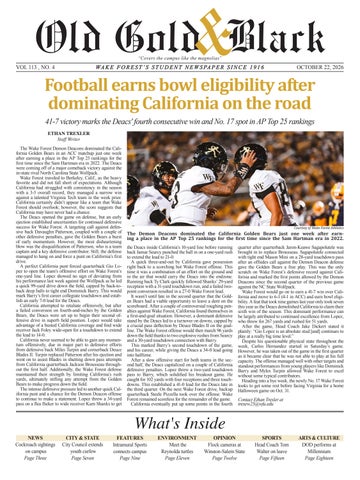
Courtesy of Wake Forest Athletics
The Demon Deacons dominated the California Golden Bears just one week after earning a place in the AP Top 25 rankings for the first time since the Sam Hartman era in 2022. the Deacs inside California’s 10-yard line before running back Jamar Searcy punched the ball in on a one-yard rush to extend the lead to 21-0. A quick three-and-out by California gave possession right back to a scorching hot Wake Forest offense. This time it was a combination of an effort on the ground and in the air that would carry the Deacs into the endzone. Running back Ty Clark quickly followed Shanks’ 29-yard reception with a 31-yard touchdown run, and a failed twopoint conversion resulted in a 27-0 Wake Forest lead. It wasn’t until late in the second quarter that the Golden Bears had a viable opportunity to leave a dent on the scoreboard. After a couple of controversial roughing penalties against Wake Forest, California found themselves in a first-and-goal situation. However, a dominant defensive stand by the Deacs led to a turnover on downs, capped by a crucial pass deflection by Deuce Blades II on the goalline. The Wake Forest offense would then march 96 yards down the field thanks to two explosive rushes from Searcy and a 30-yard touchdown connection with Barry. This marked Barry’s second touchdown of the game, and his career, while giving the Deacs a 34-0 lead going into halftime. After a slow offensive start for both teams in the second half, the Deacs capitalized on a couple of California defensive penalties. Lopez threw a two-yard touchdown pass to Barry, which solidified his breakout game. He caught for 102 yards with four receptions and three touchdowns. This established a 41-0 lead for the Deacs late in the third quarter. On the next Wake Forest drive, backup quarterback Steele Pizzella took over the offense. Wake Forest remained scoreless for the remainder of the game. California eventually put up some points in the fourth
quarter after quarterback Jaron-Keawe Sagapolutele was brought in to replace Brousseau. Sagapolutele connected with tight end Mason Mini on a 28-yard touchdown pass after an offsides call against the Demon Deacon defense gave the Golden Bears a free play. This was the only scratch on Wake Forest’s defensive record against California and marked the first points allowed by the Demon Deacons since the second quarter of the previous game against the NC State Wolfpack. Wake Forest would go on to earn a 41-7 win over California and move to 6-1 (4-1 in ACC) and earn bowl eligibility. A feat that took nine games last year only took seven this year as the Deacs demolished California to claim their sixth win of the season. This dominant performance can be largely attributed to continued excellence from Lopez, who threw for 267 yards and rushed for 51 yards. After the game, Head Coach Jake Dickert stated it plainly: “Gio Lopez is an absolute stud [and] continues to play at a really big time level.” Despite his questionable physical state throughout the week, Carlos Hernandez started in Saturday’s game. However, he was taken out of the game in the first quarter as it became clear that he was not able to play at his full capacity. The offense managed well with other targets and standout performances from young players like Dominick Barry and Myles Turpin allowed Wake Forest to excel without some typical contributors. Heading into a bye week, the newly No. 17 Wake Forest looks to get some rest before facing Virginia for a home Halloween game on Oct. 31.
Contact Ethan Trexler at trexew25@wfu.edu
What's Inside NEWS Cockroach sightings on campus Page Three
CITY & STATE City Council extends youth curfew Page Seven
FEATURES Intramural Sports connects campus Page Nine
ENVIRONMENT Meet the Reynolda turtles Page Eleven
OPINION Flock cameras at Winston-Salem State Page Twelve
SPORTS Head Coach Tom Walter on leave Page Fifteen
ARTS & CULTURE DOD performs at Millennium Page Eighteen
Old Gold & Black This column represents the views of the Editor-in-Chief of the Old Gold & Black, Mattie Stillerman
Letter from the editor: Unfortunately, I am not surprised Editor’s note: This editorial discusses sexual violence. Like many others, I opened my phone on Sept. 18 to an article from Cornell’s Student newspaper, the Cornell Daily Sun, to read about a lawsuit a young woman filed against Cornell University’s Chi Phi Fraternity chapter and seven current and former students, along with other involved parties. Disgust crept up my throat and my heart sank as I learned about how this former student, identified only as Jane Doe, was allegedly drugged and gang-raped in October 2024. I read further, viewing screenshots of a Snapchat group chat titled “Chi Phi Actives,” where brothers of the fraternity, including defendants named in the lawsuit, sent messages advertising “free pussy.”
Not a single man in that 57-person group chat said a word, choosing to remain bystanders. A police report resulted in a school punishment of essays, workshops, suspensions and expulsions, followed by two years of silence. Social media and news publications flooded with support and outrage for Jane Doe. Posts said “Educate your sons” and “I support Jane Doe.” Over a month later, my feed has returned to its regularly scheduled programming. Another case is seemingly being forgotten as society settles back into a culture that allows this violence to happen. I am enraged. I am appalled. I am heartbroken. But unfortunately, I am not surprised. Sexual assault cases are not new to
college campuses. They are not even foreign to Wake Forest’s campus, with cases reported publicly in 2022 and 2025. While resources for survivors like the Safe Office are a step in the right direction, the real solution lies in changing the very culture that permits sexual assault from even occurring on college campuses. It is no shock that we’ve entered a perpetual cycle of assault cases and media outrage followed by silence and a lack of change. We have become desensitized to it, able to move on as soon as it disappears from our feed. Perpetrators move on relatively unscathed, able to become leaders in major companies and even the White House. This cycle reinforces the belief that these behaviors are acceptable. So no, I am not surprised. I am sick-
ened and I am scared, not only for myself as a young woman in college, but also for my friends at Wake Forest and other young women across the country. I am heartbroken for the women who suffer in silence with cases unreported. But unfortunately, I am not surprised. I am grateful to the student reporter Cereese Qusba, the editor Sophia Dasser and the rest of the staff at the Cornell Daily Sun for breaking this story and having the courage to highlight their school’s inaction. Change is not made in a day. It comes from a continuous fight to hold institutions and perpetrators accountable—from people speaking up, even about their friends, peers and community. The culture can shift. We just can’t forget and fall back into the cycle.
Old Gold&Black THE STUDENT NEWSPAPER OF WAKE FOREST UNIVERSITY SINCE 1916
MATTIE STILLERMAN EDITOR-IN-CHIEF stilmk23@wfu.edu
MARIA SILVEIRA
MIRIAM FABRYCKY
PIPER SAUNDERS
ANNE SHANNON
MANAGING EDITOR
DEPUTY EDITOR
MULTIMEDIA DIRECTOR
BUSINESS MANAGER
silvmt23@wfu.edu
fabrml24@wfu.edu
saunpg23@wfu.edu
shanae24@wfu.edu
>> NEWS Aric Loiacono, loiaat25@wfu.edu Hadassah Evans, evanha24@wfu.edu
>> ARTS & CULTURE Lydia Derris, derrlf23@wfu.edu Henry Yates, yatehs24@wfu.edu
>> CITY & STATE Eve Darke, darkev23@wfu.edu
>> PHOTO & VIDEO Christopher Wallace, wallca24@wfu.edu
>> FEATURES Bianca Reznic, riletc24@wfu.edu Rishi Vanka, vankrk24@wfu.edu >> ENVIRONMENT Ella Jennings, jennem25@wfu.edu >> OPINION Caroline Gottsman, gottca23@wfu.edu Hannah Ordan, ordahg25@wfu.edu >> SPORTS Griffin Lamphier, lampgm25@wfu.edu
>> POLICIES Our job as a newspaper is to be a platform for all voices, not just the ones we agree with. However, we reserve the right to reject advertisements that are vulgar, inaccurate, obscene or violate Wake Forest’s policies on nondiscrimination, diversity, equity, and inclusion as they pertain to student organizations. We will also reject any advertisements that promote illegal activities according to the state of North Carolina.
>> SOCIAL MEDIA Paige Rakowski, rakope25@wfu.edu
Not only do we hold our newspaper and its contents to a high standard, but we also expect that those who choose to use us as an outlet for their ideas, opinions and skill hold themselves and their content to a high ethical standard.
>> COPY EDITORS Eliana Fountain, founeg25@wfu.edu Gianna Sanchez, sancgc25@wfu.edu
The Old Gold & Black is published Thursdays during the school year, except during examinations, summer and holiday periods, by Triangle Web Printing of Durham. The views expressed in all opinion pieces and advertisements contained within this publication do not necessarily reflect the opinions of the Old Gold & Black. As part of our commitment to reporting news fairly and accurately, we will not remove any previously published content online unless it is retracted. If an error in either our online or print content is brought to our attention, we will revise the originally published article with an appended correction. In order to facilitate thoughtful and appropriate debate, profane, vulgar, or inflammatory comments on our website are not allowed and will be deleted. Comments which incite violence, target individuals in a form of cyber bullying, or which promote ideas which vilify marginalized communities will be deleted, and proper authorities may be notified and involved.
>> DESIGN CHIEF Thomas Tilton, tilttd25@wfu.edu >> DESIGN TEAM Channing Benson, benscc25@wfu.edu Isabel Walker, walkic26@wfu.edu Elle Jashnani, jasher26@wfu.edu Riley Smith, smitri25@wfu.edu
>> ADVISER Ivan Weiss, weissij@wfu.edu
Want to write for us? Email wfuogb@gmail.com
>> SUBMISSIONS The OGB welcomes submissions in the form of story tips, columns and letters to the editor. Letters to the editor should be fewer than 500 words, and columns should be around 500 words. Send yours via e-mail to stilmk23@wfu.edu the Monday before publication. We reserve the right to edit all letters for length and clarity. No anonymous letters will be printed. >> ONLINE MEDIA Website: wfuogb.com Facebook: facebook.com/ogb1916 X (Twitter): @wfuogb Instagram: @wfuogb TikTok: @wfuogb Sports X (Twitter): @wfuogbsports
Thursday, October 22, 2026 | Page 3
News | Old Gold & Black
Students concerned about cockroaches on campus Cockroach sightings around campus prompt calls for action AVA DALTON Contributing Writer Some Wake Forest students say they are concerned for the health and safety of campus after seeing cockroaches in residence halls. Residence Life and Housing guidelines direct students to submit pest control requests directly to Facilities, Real Estate, and Planning, but whether work orders and routine maintenance can keep pace with student complaints remains to be seen. “I see a roach on campus at least once every other day and like five at a time at night,” said Ella McLawhorn, a first-year living in Poteat Residence Hall. “I think I’ve seen every species of cockroach there is on this campus.” Freshman Caroline Brundage shared a similar experience. “I’ve had like four to five encounters, and they’re usually all in the basement,” she said. Unfortunately, Wake Forest is not alone in this issue — cockroaches are prevalent in North Carolina due to the state’s many months of warmth and humidity. The U.S. Census Bureau’s 2019 American Housing
Survey reported that almost 25% of Raleigh households had seen signs of cockroaches within the last 12 months, notably higher than the 11.3% national average. While roaches primarily live outdoors, they are attracted to light, leading the pests to enter buildings through open pipes and cracks in the foundation. They are also attracted to debris, dirt and old food. Residence halls and older buildings that exhibit these conditions can become hotspots for roach activity. Wesley Todd, associate director of housing, said in a statement that Wake Forest takes initiative to combat infestations. “Our Facilities, Real Estate and Planning team maintains buildings and addresses potential pest entry points, while our pest control provider identifies and treats concerns as they arise,” he said. “Residence Life and Housing staff and residents also play an important role by reporting pest sightings through work orders so they can be investigated and addressed. When concerns are reported, our team works with our pest control provider to assess the situation,
determine the appropriate treatment and identify any contributing conditions that need to be addressed.” Despite university measures, some residents report little visible progress in their living quarters. “I feel as though it is a little bit insane how much we pay in tuition, but yet we lack the ability to get pest control to come to the dorms,” said first-year Cadence Hamilton, who lives in Collins Residence Hall. “If we really want to promote a clean environment, we’ve got to start with our living spaces.” Older buildings, such as those built before 1980, often have unsealed pipes and damaged venting, which can lead to pest infestations. Many of the residence halls on campus were built between the 1950s and 1970s, leaving these areas particularly vulnerable to pest issues. Students are hoping to see improvements in the upcoming months and years, especially as Wake Forest undertakes new renovation and construction projects. “We need to isolate and find out where they are and block them [from
getting into the buildings],” Kayla Pinkham, a first-year residing in Johnson Hall, said. In the meantime, certain preventative measures can significantly reduce the prevalence of pests. “Simple practices, such as disposing of trash properly, keeping doors and windows closed and maintaining clean living spaces help reduce conditions that attract pests,” Todd said. For now, students in residence halls are left submitting work orders and hoping for results. “While no residential environment can be entirely pest-free, our goal is to minimize their presence and respond effectively when concerns arise,” Todd said. “This requires a coordinated effort that goes beyond pest treatments to include building maintenance, regular monitoring and community involvement.” Contact Ava Dalton at daltae26@wfu.edu
“Gas station heroin”: Inside the rise of kratom New concentrated products pose a serious risk to young adults ROMINA MOFRAD Contributing Writer Just feet away from your typical energy drinks and snacks in some gas stations are products containing concentrated kratom derivatives capable of producing opioidlike effects. For college students, the growing availability of these products raises concerns about their accessibility and potential health risks. Kratom is derived from a plant native to Southeast Asia and has gained popularity in the United States. It is sold in forms such as gummies, powders, shots and drinks. Health officials have raised particular concerns about highly concentrated products containing 7-hydroxymitragynine, or 7-OH, a compound naturally present in small amounts in kratom leaves. The Food and Drug Administration has warned that concentrated 7-OH products can cause serious health effects and are not approved for medical use.
While traditional kratom products contain compounds with both stimulant and opioid-like effects, manufacturers have recently developed products with much higher concentrations of 7-OH. The term “gas station heroin” is an increasingly popular description of chemically altered, kratom-derived products. Data collected by the CDC from 2015 through 2025 show 233 deaths linked to kratom. Additionally, this year, the America’s Poison Center reported a 67.8% increase in kratom derivative exposures from 2025 to 2026, primarily in adults between ages 20 and 39. For college students, the accessibility of this drug can create a serious risk, particularly when they don’t understand how potent kratom can be. Earlier this month, federal authorities investigating the deaths of two University of Mississippi students charged a store clerk and his son with selling illegal kratom products. Packages of synthetic kratom pills were found in the rooms of both students.
Many Wake Forest students say they are concerned by the rise of kratom use among young adults. Angela Pacheco, risk manager of Wake Forest’s Delta Zeta Sorority chapter, said she has worked to educate the members about the potential dangers of kratom products. “Kratom is a huge concern for us,” Pacheco said. “I have continuously been sending out as much information as possible to our chapter, whether it be articles, infographics or warnings...The best thing we can do is increase awareness and hope the girls take precautions.” Freshman Lily Crevasse said she was also worried by the risks kratom could pose for her peers. “When I learned about kratom in college, I felt very concerned,” Crevasse said. “I worry for my peers because I feel there is a lack of awareness about the dangers of this drug.” Wake Forest requires incoming students to complete an online course called “Alco-
hol Foundations and Harm Reduction” that discusses the risks of substance use for students. However, this curriculum does not yet include information about kratom. Federal regulators have taken steps to address concentrated kratom-derived substances. In July 2026, the Drug Enforcement Administration (DEA) filed to temporarily place concentrated kratom products under the start of a temporary scheduling process under the Controlled Substances Act. This process reflects a push to regulate certain kratom products and put restrictions on highly concentrated products that pose a severe public safety risk. As the increased presence of kratom derivatives appears in accessible stores, making it onto college campuses, young adults should be aware of the risks and potential regulation surrounding kratom derivative products.
Contact Romina Mofrad at mofrr25@wfu.edu
POLICE BEAT • • • • • • • • • • •
An individual stole clothing from a room at Luter Residence Hall and admitted to underage drinking. Prosecution was declined. This incident was reported at 10:20 p.m. on Oct. 17. An individual consumed alcohol underage and fell down stairs at Collins Residence Hall. They sustained minor injuries and were transported to Atrium Health. This incident was reported at 8:25 p.m. on Oct. 17. An individual consumed alcohol underage at Luter Residence Hall and an off-campus fraternity party. They were transported to Atrium Health. This incident was reported at 6:42 p.m. on Oct. 17. Unknown individuals stole several pairs of Nike shoes from the Shah Basketball Complex. This incident was reported at 9:49 a.m. on Oct. 17. An individual consumed alcohol underage at Bostwick Residence Hall and was transported to Atrium Health. This incident was reported at 1:10 a.m. on Oct. 17. Individuals possessed marijuana and drug paraphernalia at Luter Residence Hall. This incident was reported at 9:29 p.m. on Oct. 15. An individual consumed alcohol underage at the Millennium Center and refused medical transport. This incident was reported at 4:10 a.m. on Oct. 15. An individual lost a wallet in Lot C. Its tracker indicated an off-campus location, but police could not recover it. This incident was reported at 9:31 p.m. on Oct. 14. An individual consumed a 10-milligram gummy at Polo Residence Hall and refused medical transport. This incident was reported at 9:51 p.m. on Oct. 13. Unknown individuals entered vehicles at North Campus Apartments. Nothing was stolen. This incident was reported at 6:05 p.m. on Oct. 12. Unknown individuals entered a vehicle at Polo Residence Hall and stole keys and registration documents. This incident was reported at 2:41 p.m. on Oct. 12.
Page 4 | Thursday, October 22, 2026
Old Gold & Black | News
Mexico’s ex-president’s visit sparks controversy Ernesto Zedillo delivered insights on building and preserving democracy in uncertain times EVA KATE PROBUS Staff Writer Former President of Mexico Ernesto Zedillo spoke to the Wake Forest community on Oct. 16 about his experience transforming Mexican democracy and adapting the country’s policies to an increasingly globalized world. However, the topics absent from the conversation in Carswell Hall, including Zedillo’s alleged responsibility in a 1997 massacre of 45 indigenous people in Mexico, ignited pushback from several faculty members. “I just feel concerned that we are platforming somebody who’s been accused of human rights violations,” Mir Yarfitz, a professor of history and Latin American studies, said. In 2014, Zedillo faced a lawsuit, later dismissed by a Connecticut judge, accusing him of playing an indirect role in the attack that killed 45 people who were associated with the left-wing, indigenous-led Zapatista movement. “He’s not going to be taking responsibility for that in this context,” Yarfitz said. In an interview with the Old Gold & Black, Zedillo denied allegations of human rights violations. “I didn’t violate any human rights of indigenous communities. That is not true. I received a very complicated situation,” Zedillo said. “I always, from day one, said, ‘This has to be a peaceful, political solution.’ That’s very well documented.” However, Yarfitz argued that by not providing students with supplemental information about the attack, the event contributed to “whitewashing” indigenous history in Mexico. Karin Friederic, a professor of anthropology specializing in human rights in Latin America, said she believes in the importance of treating complex legacies as more than “just a footnote” in an academic conversation. “Some of the ways that the legacy seemed like it was going to be portrayed were simply celebratory,” Friederic said. “Our duty as academics and people who have worked with a lot of these communities around the world is to maybe just bring a more critical eye.” Zedillo’s talk, sponsored by the Office of the Dean, the Latin American and Latino Studies Program, the Humanities Institute and the Department of Politics and International Affairs, kicked off a series of events celebrating the 30th anniversary of Wake Forest’s
Courtesy of Europa Press
Former President Studies Program
Ernesto Zedillo and Director of the Latin American and Latino Victor Hernandez-Huerta host a conversation in Carswell.
Latin American and Latino Studies Program. Víctor Hernández-Huerta, director of the program, moderated the conversation. “Zedillo is a really important figure in Mexican politics and recent Mexican history,” Hernández said. “He took important decisions that set the stage for completing the process of democratization in Mexico.” The budget for the event included a $4,000 honorarium for Zedillo, according to Hernández. Hernández further explained that some Latin American studies professors expressed “legitimate” concerns about Zedillo’s visit during the planning process, but that the department ultimately decided to extend an invitation to the former president. “I think something exciting about being in a university… is that we have different points of view and that’s enriching,” Hernández said. During the conversation, Zedillo reflected on navigating conflicting viewpoints during a severe economic crisis and the devaluation of the Mexican peso
Courtesy of AFP
Former President Ernesto Zedillo, who served as president of Mexico from 1994 to 2000, visits campus to participate in a conversation organized by various Wake Forest Departments.
in 1994. He said that after he bailed out the Mexican banks, resulting in short-term GDP loss, his approval rating dropped significantly. “I was most proud to be the President of Mexico in April of 1995,” Zedillo said. “I had taken actions and decisions that I thought other presidents would not have taken because they were fearful that it would damage their approval or popularity forever.” The two concluded the conversation with a reflection on democratic backsliding, which Zedillo called a “tragedy.” “Most people [in Mexico] haven’t realized that they no longer live in a democratic country,” Zedillo said. “And they will realize only when they live with the consequences of not living in a democratic country.” To prevent further democratic despotism, Zedillo urged students to be “very alert” to events that “undermine democracy and capture political systems.” “It’s very important for students not to take lightly the idea and the consequences of democracy,” he said in his interview with the Old Gold & Black. Despite the surrounding debate, many students welcomed the rare chance to hear from a former world leader. Sophomore Eduardo Castro, who is from Peru, called the visit “a big honor” for Wake Forest students. “Students get to learn from someone who’s experienced in politics,” Castro said. “For someone who wants to go into politics like myself, you learn a lot from him, especially since I’m from South America.” Sophomore Mary Sanchez initially approached the event skeptical of Zedillo’s administration because of her parents’ experience living in Mexico during his presidency, but said the talk gave her a new perspective. “I think it’s very honorable that there is someone of that position… coming onto campus and even so, being a Mexican president,” she said. “It broadens the representation of our students on campus because I definitely did see a lot of familiar faces.” Across a wide range of opinions and backgrounds, dozens applauded Zedillo at the conclusion of the event. “At the end of the day, politics is something complex,” Hernández said. “I think that the way to address those concerns is engaging in an open discussion.” Contact Eva Kate at probek23@wfu.edu
CITY & STATE OLD GOLD & BLACK
PAGE 5 THURSDAY, OCTOBER 22, 2026
Eve Darke, darkev23@wfu.edu
What to know about the constitutional amendments on North Carolina ballots Referendums propose changes to tax caps and voting photo ID requirements
ANOUSHKA NAMBIAR Staff Writer This election cycle, North Carolina voters will face more than just candidate choices at the polls. The Nov. 3, 2026 general-election ballot also includes three statewide referendums on proposed amendments to the North Carolina Constitution. These amendments address the state income-tax rate, local property taxes and voter photo-identification requirements. While the ballot language for each proposal is relatively short, each amendment could have longterm impacts on how North Carolina’s state and local governments collect revenue and hold elections.
Courtesy of the Office of the Lieutenant Governor
First proposed amendment: state income tax limitations The first amendment would change the North Carolina Constitution to prevent the state’s income tax rate from rising above 3.5%. The amendment would apply to both personal and corporate income taxes beginning with taxable years after Jan. 1, 2027. The proposal would mark a significant change to the constitution’s current framework. North Carolina’s constitution currently allows an income-tax rate as high as 7%, although the actual rate is a lot lower – under the state’s recently enacted budget, the individual incometax rate is scheduled to fall to 3.49% in 2027. This amendment would therefore establish a constitutional ceiling just above that scheduled rate, making it much more difficult for a future legislature to raise the rate above 3.5%. The debate surrounding the amendment largely centers on the tradeoff between taxation and government revenue. Supporters argue that limiting the income tax rate would leave more money with individuals and businesses and maintain North Carolina’s lowertax approach. Opponents argue that placing the limit in the constitution could restrict future legislatures’ ability to raise revenue if state spending needs increase. Therefore, the issue isn’t whether North Carolina should have a lower income tax today, but is a question about how much flexibility future lawmakers should have when determining state tax policy. Second proposed amendment: requiring limits on local property taxes The second amendment addresses local property taxes. Unlike the income-tax proposal, it does not establish a limit for property taxes, either as a specific percentage or as a dollar amount. Instead, the amendment would require the General Assembly to enact laws limiting the amount that local governments could increase their property tax levies. The constitutional amendment specifically allows those future laws to include exceptions. This is significant because counties and municipalities in North Carolina impose property taxes to help fund services such as public safety, infrastructure and recreation. For now, these governments can adjust their property tax levies as their financial needs change, including when communities experience population growth. Supporters of the amendment argue that limits could provide greater stability for property owners as property values and tax bills increase. Opponents have raised concerns that a statewide limitation could make it harder for local governments to respond to
Annabelle Tan/Old Gold & Black
North Carolina voters will decide upon three proposed constitutional amendments on the Nov. 3 ballot, which address income taxes, local property taxes and voter photo ID. their individual financial needs. One important detail for voters to understand is that this amendment would not establish a specific property tax cap if it succeeds. Instead, it would establish a constitutional amendment directing the legislature to create limits in the future.
create “unnecessary obstacles” for eligible voters. The proposal therefore deals less with creating North Carolina’s first voter-ID requirement and more with expanding and constitutionalizing the requirement across different voting methods. Why amendments?
Third proposed amendment: requirements for voters
photo
ID
The third amendment concerns voter identification. Its ballot language asks voters whether to amend the Constitution to require all voters, rather than only those voting in person, to present photo identification before voting. North Carolina already has a photo-ID requirement for voting: under current state law, voters generally show an acceptable photo ID when voting in person, while absentee-by-mail voters must provide a copy of an acceptable ID. Voters may also complete an exception form to fulfill this requirement. The State Board of Elections lists driver’s licenses, passports, certain student IDs including Deacon OneCards and several other forms of identification as acceptable. The proposed amendment would put the requirement directly into the state Constitution, including for voters who cast absentee ballots. Supporters describe the proposal as a way to establish a uniform constitutional identification requirement for North Carolina. Critics have raised concerns about placing detailed election requirements in the constitution and argue that the requirement could
The three amendments cover different policy areas, and each would change the North Carolina Constitution rather than simply passing an ordinary law. That distinction matters because constitutional provisions are generally more difficult for future lawmakers to change. The income-tax amendment would establish a specific 3.5% ceiling. The three proposals therefore raise questions that extend beyond their immediate effects: How much authority should future state lawmakers have over taxes? How much control should local governments have over their own revenue? And which election requirements belong in the state Constitution? North Carolina voters will decide those questions on Nov. 3, 2026. According to the North Carolina State Board of Elections, early in-person voting is scheduled for Oct. 15 through Oct. 31. The Old Gold & Black’s full guide to the midterm elections may be read here. More information may be found on the North Carolina State Board of Elections website.
Contact Anoushka Nambiar at nambap26@wfu.edu
Page 6 | Thursday, October 22, 2026
Old Gold & Black | City & State
Despite court ruling, mail-in voting doubts linger at Wake Forest Wake Forest students and faculty consider the consequences of Trump’s attacks on mail-in ballots MARTHA NESBITT Contributing Writer
After the U.S. Supreme Court blocked President Donald Trump’s push for new mail-in ballot regulations, some Wake Forest students say they doubt the security of their votes as the midterm elections near. Following years of attacking mail-in voting as “horrible” and “corrupt,” Trump attempted to require states to submit lists of voters who request mail-in ballots as well as to clear their ballot and envelope designs with the federal government. While the Supreme Court blocked these regulations from coming into effect this year, Trump’s claims have cast doubt in many voters’ minds about the security and reliability of mail-in ballots. Grant Kinghorn, a sophomore from Charlotte, N.C., says that he plans to vote in person this year because of these concerns. “There's a chance my vote just wouldn't count, so I'd rather make sure that it actually does [by voting] in person,” Kinghorn said. “The concern is that there's going to be some wide-sweeping thing where my vote wouldn't count... I just don't think it's worth taking the risk when I can go in person.” More than one-third of Americans vote by mail every election cycle, and nearly 300,000 North Carolinians voted by mail in 2024. With the midterm elections less than three weeks away, around 50,000 absentee ballots have already been sent out in North Carolina for a Senate race that could decide the majority. Experts say that concerns surrounding election security are often overblown. Despite Trump’s claims of widespread voter fraud by mail, for example, a 2025 Brookings Institution study found that fraud occurred in about four in every 10 million mailed ballots, making the average rate of fraud less than 0.00005%. However, some voter worries remain. Senior Jessica Barry, the president of Wake Forest’s College Democrats, recalled finding out that her old mail-in ballots had never made it to the board of elections in her hometown of Raleigh. She said it was only when she went to vote in person in 2024 that she learned her previous votes hadn't been received. “I went and checked my voter record and neither of my ballots got counted,” Barry said. “I think there's definitely concern because that was even three years ago now before all these new restrictions were put in place.” Students also expressed their concerns regarding disengagement in Wake Forest’s unique political environment. “I think it's just that Wake Forest is one of the most politically apathetic schools,” Kinghorn said. “A lot of students are in positions where they don't really care, or where the hassle of voting, especially with how difficult the mail-in voting has become, makes it easier to just not vote.” Tess Wise, a professor of American politics, worries that talk about restrictions will push students away from civic engagement. “A lot of students rely on mail-in voting because it's a way of staying connected to a community,” Wise said. “[These changes] might make them think ‘Oh, I maybe shouldn't do this…’ it might just be yet another thing that makes it harder for students to be involved politically.” For Deb Marke, associate director of the Office of Civic and Community Engagement and leader of Deacs Decide, the voter engagement organization on campus, these shifts represent a greater change in American politics.
“I think it really impacts the way that we think about democracy,” Marke said. “Democracy should be an intuitive and reflexive process. And that is not the way that it is. Casting doubt on our election systems and security has also played a really big role in this.”
I went and checked my voter record and neither of my ballots got counted. Making sure people are informed about voting procedures is often the most significant hurdle during election season, Marke said, and discourse about the security of mail-in voting can cause more confusion and lead fewer people to cast ballots. “We have a lot of first-time voters, and so the process seems a little confusing for folks,” Marke said. “[Attempted restrictions] undermine all of the work that so many people have done in the past to really work towards people being able to have a voice.” Even though many viewed Trump’s proposed re-
strictions as unprecedented, Wise sees the core issue as a continuation rather than a deviation from the norm. “I think it actually says that we are still doing the exact same things we've been doing for a long time,” Wise said. “Elections are not just fought based on the issues and the representatives, but on whether you can restrict the voting of groups.” Before the Voting Rights Act of 1965, which outlawed voter discrimination based on race, Black Americans were systematically disenfranchised through literacy tests, poll taxes and all-white primaries. Recent Supreme Court rulings have worked to repeal protections provided by the Voting Rights Act by striking down maps that created Black-majority districts and rewriting the section of the Act that prohibits policies that result in discrimination against racial minorities. Wise compared more recent restrictions to those of the Jim Crow era, before such voting rights protections were enacted. “Instead of fighting on the issues, we fight to restrict the franchise,” Wise said. “There is nothing new about that in American politics.” Contact Martha Nesbitt at nesbmk25@wfu.edu
Will Kunisaki/Old Gold & Black
Following the Supreme Court’s in voting rules, confusion,
decision doubt,
to block a recent push for new mailand concerns remain among voters.
City & State | Old Gold & Black
Thursday, October 22, 2026 | Page 7
Wake Forest Family Weekend brings business to Winston-Salem Manager of Theodore’s Bar and Market reflects on the busy weekend
EVE DARKE City & State Editor Earlier this month, Wake Forest Family Weekend drew students’ parents, siblings, grandparents and friends from across the country to Winston-Salem, N.C., and some local businesses reported an uptick in business. Wake Forest enrolls almost 5600 undergraduate students, of which over 4,600 are studying at the Reynolda Campus this semester. The university prepared to host over 3,000 guests on campus over Family Weekend, marking at least a 65% increase in the number of people using Wake Forest’s Reynolda Campus. However, Family Weekend at Wake Forest University was not only an exciting time for Deacon families to reunite and spend quality time with one another. It also represented a welcome increase in sales for restaurants, hotels and other businesses around Winston-Salem. “It is a great weekend for business in terms of sales,” Zac Magruder said, general manager of Theodore’s Bar and Market in Reynolda Village. “We typically see our sales increase by around 30% for the weekend alone, along with larger check sizes since guests often order for the whole family rather than requesting single checks.” A short walk from campus, the restaurant has been a longtime favorite among
Wake Forest students. Magruder said Family Weekend brings both opportunities and challenges to the business. For example, Theodore’s no-reservation setup, in which guests line up and order at the counter, then move to find a table inside or outside, can be tested when crowds arrive. “While operating in our space presents a challenge, this was my second Parents’ Weekend as General Manager at Theodore’s,” Magruder said. “Experiencing it helps highlight areas for improvement in our systems, giving us an opportunity to coach the team and prepare for the following year.” He also remarked on the pride he takes in being a part of students’ and families’ experiences. “I personally enjoy providing a welcoming place for Wake Forest students and families to gather for lunch or cocktails,” Magruder said. “We hope Theodore’s remains a staple for the Wake Forest community for years to come and a memorable part of their time in Winston-Salem.” Back on campus, the university packed the three-day weekend with programming. On Friday, families could take group tours of the Wait Chapel tower, explore the Hanes Art Gallery or join a behind-the-scenes tour of the Historic Odd Fellows Cemetery. Saturday centered around the football game against Stanford. Despite the
clouds and light rain, the game brought in 29,188 attendees, who witnessed the Demon Deacons beat Stanford 57-3. On Sunday, families could watch a men’s basketball exhibition against Georgetown, a women’s soccer game against N.C. State or a number of club sports matches occurring across campus. Families were also encouraged to explore Winston-Salem by attending the
Carolina Classic Fair or visiting the developing Wake Forest Grounds. With homecoming right around the corner from Nov. 6-8, businesses won’t have to wait long for the next wave of Demon Deacon visitors to bring their business and energy to Winston-Salem. Contact Eve Darke at darkev23@wfu.edu
Eve Darke/Old Gold & Black
Theodore’s Bar and Market in Reynolda Village experienced a 30% increase in sales during Wake Forest Family Weekend from Oct. 2-4, 2026.
Winston-Salem City Council votes against extending youth curfew The Winston-Salem Police Department, a divided public safety committee and local students debate the policy ANOUSHKA NAMBIAR Staff Writer On Monday, Oct. 5, the Winston-Salem City Council voted 6-2 against extending the city’s youth curfew through 2027. The curfew officially expired on Oct. 12, over the request of Police Chief William Penn Jr., who was pushing to extend the ordinance through 2027. The vote did not occur without a fight, as a divided Public Safety Committee brought the proposal’s future into question. In June, the city issued a “Youth Protection Ordinance” barring unsupervised minors 17 years old and younger from being in public places and establishments between 10 p.m. and 6 a.m. Penn has claimed that the frequency of nighttime interactions between unsupervised youth and law enforcement has declined since the curfew was implemented. According to the City of Winston-Salem’s website, proponents of the extension have cited these trends as proof that the ordinance has reduced crime and alleviated worries related to minors’ nighttime activities. In the past, officers contacted parents and returned minors home with a warning instead of issuing citations. But according to Mayor Allen Joines, the police depart-
ment felt they needed a stronger intervention to deal with increasing numbers of youth out at night. “Our officers are seeing more young people out late at night, unsupervised, and unfortunately that’s when we tend to see an increase in problems, whether it’s kids becoming victims themselves or getting involved in disorderly or unsafe behavior,” Joines explained in a “news flash” posted to the city’s website. Winston-Salem isn’t the only North Carolina city to use/consider youth curfews. Charlotte has a Youth Protection Ordinance restricting minors under 16 from being in public places during specific hours of the night, while Raleigh has begun considering a new curfew for people under 18 in 2026 after a series of large “teen takeovers.” Raleigh’s proposed ordinance would restrict teens from public spaces between 11 p.m. and 5 a.m., with exceptions for activities such as employment and school events. Research on whether youth curfews reduce crime is mixed. A 2015 review found that four of eight studies examining juvenile crime and victimization found a positive effect, but the researchers concluded that the limited number and quality of studies made it difficult to draw completely accurate conclusions.
Winston-Salem’s proposal prompted worries regarding the impact of the curfew on the rights of minors. A Sept. 16 article in the Chronicle pointed out that council member Scott Andree-Bowen, who voted against extending the curfew, expressed his support for police protection in the community but emphasized that he does not wish for that protection to infringe upon the rights of minors. For America Herrera, a 17-year-old junior at Mount Tabor High School, the proposed extension raised questions about how much independence teenagers should have. Herrera said that she understands the city’s interest in safety but believes the policy should account for the different reasons teenagers may be out at night. “I do not think restricting everyone is always the best solution,” Herrera said. “Some teenagers are out late for work, school activities or family responsibilities.” Winston-Salem’s ordinance also had certain exceptions for specific circumstances. Minors could be out during curfew hours when accompanied by a parent/adult, when traveling directly to or from work or school, religious activity or when responding to an emergency. The ordinance also allowed minors to be out during curfew hours when exercising First Amendment
rights or when engaged in an activity protected by the law. Although law enforcement officials have highlighted the reduction in crime rates and nighttime incidents, critics and certain committee members raised doubts about whether extending the curfew was the right way for the police department to continue tackling those issues. When asked for one thing she would say to a City Council member, Mount Tabor High School junior Renata Garcia-Tavira said, “I would want them to understand that we [will] never recover these years.” Renata said that not all teenagers display the type of behavior that prompted the youth curfew. “It is not fair to punish those who are uninvolved,” she said. Many locals have reacted to the policy’s expiration with excitement. Rasheed Clayton, a chef at Mike’s Grill, told ABC45 news the curfew appeared to affect downtown activity and businesses. “Now it’s just like people are starting to come back out and hang out and want to eat out now, so it’s been pretty fun, awesome now that things are starting to come back to normal,” Rasheed said.
Contact Anoushka Nambiar at nambap26@wfu.edu
FEATURES PAGE 8 THURSDAY, OCTOBER 22, 2026
OLD GOLD & BLACK
Rishi Vanka, vankrk24@wfu.edu Bianca Reznic, reznba24@wfu.edu
An interview with Steve Nedvidek Alum discusses Wake Forest’s influence on his career and graphic novel trilogy, “The Jekyll Island Chronicles” RISHI VANKA Features Editor
Vanka: How did you get the idea for “The Jekyll Island Chronicles?”
Steve Nedvidek is the co-author of “The Jekyll Island Chronicles,” an award-winning graphic novel trilogy completed in 2021. He received his Master of Arts in theater from Wake Forest in 1987 and has since returned to the university as a board member of the Center for Entrepreneurship and an adjunct entrepreneurship professor. On Nov. 6, Nedvidek will hold a book signing event at the Bookhouse in Reynolda Village featuring the Jekyll Island Chronicles’ omnibus, a single-book collection of the entire trilogy. Nedvidek sat for an interview with Features Editor Rishi Vanka on Oct. 8, 2026. This interview has been edited for clarity and brevity.
Nedvidek: One of the genesis moments was a show that I was in at Wake Forest, my spring semester of 1986, called “Oh, What a Lovely War!” There was a fellow [named] James Dodding that would come over from London every year and direct. He put together this show that spring that was basically a music hall version of World War One [...] a time frame that not many of us knew anything detailed about. In school, World War One just kept getting bypassed. My grandfather was in World War I — [he] was a Bohemian immigrant. To get his citizenship, he enlisted into the U.S. cavalry in World War I, which is right where book one of the “The Jekyll Island Chronicles” starts. It is an immigrant who’s fighting in the trenches in Belgium. “Oh, What a Lovely War!” was all about World War I. For those of us in the show, it was life changing. That had always been a point of interest to me: “Why did we not know this stuff?” When you think about the history that’s involved in that period, society is changing. Technology is going crazy. You think we got it crazy now; imagine when electricity [was] just coming online. We just thought it was so underserved. Every time [my co-authors and I] would sit down to plan out a book, we would find more stuff.
Rishi Vanka: How did you get started as a cartoonist? Steve Nedvidek: I’ve been drawing my whole life. I learned how to draw and paint through my dad and I grew up reading comic books and MAD magazines. I started studying what the caricature artists were doing and I really liked that. I started cartooning for my high school paper and doing caricatures of my teachers, not to make fun of them, but to lionize them for the impact they were having. One of the teachers I drew, I still am in touch with today and she contacted me and ordered one of the graphic novel trilogies for another teacher friend of mine. By the time I got to Wake Forest, I had a lot of experience with [cartooning] and went to the Old Gold & Black. I was having a blast.
Vanka: How did you start making the series itself? Nedvidek: Two of my friends who I had known for decades, we were all comic book kids. Back in 2012, I wanted to do something different while I still had a full-time job. I told them I’d love to work on a graphic novel. So we became partners and started writing this first story. I knew cartooning and the other guys knew writing, but none of us had ever worked on a graphic novel. We sponsored a class at the Savannah College of Art and Design and, at the end of the semester, they presented us with a pitch packet. It was fantastic — we had a sales tool. We hired two of [the students] to become our illustrator and our colorist. We released [book one] at Comic-Con in July 2016 in San Diego. Two years later, we had book two. We had to do book three during COVID and it was all digital. Well, we [started to] think, “We want to do an omnibus.” In June of this year, the omnibus was released, so we took it back to Comic-Con. Now, we have this appearance at the Bookhouse on Nov. 6. [I’m] looking forward to it. Vanka: What was it like collaborating with this group on book three and the omnibus without actually seeing them?
Photo courtesy of Steve Nedvidek
Steve Nedvidek is a co-author of “The Jekyll Island Chronicles” graphic novel.
Nedvidek: It was actually really easy. By the time we got to book three, we were rolling. We had a new illustrator for the third book, [Prentis Rollins], a DC/ Marvel guy. He had drawn everything from Avengers, Iron Man, DC stuff, and just was super good. We found him at Comic-Con and hit it off great with him. And this is where my background with art and design comes in is I laid out all three books. I laid out probably 90% of [the] 548 pages in the omnibus. My full-time job was working in corporate film and video, so I would do storyboard art. I would approach each page as a storyboard and draw out the panel. So I would lay it out and basically told Prentis, “You don’t have to do any research. I’ll research the
costumes and what the characters are wearing, what the buildings and interiors are like. I’ll give you the layout, you just draw it or make it better.” And he was like, “That works for me.” Vanka: What was it like for you and your cocreators to see the success of this trilogy? Nedvidek: It’s been very interesting. We wanted to try something different. We wanted to follow a dream. We wanted to leave something behind. Now I’ve got something that my granddaughters will be able to read, or I’ll be able to read to them. And who knows? There are people that are interested in it for television, film, animation. It’s an underserved, unique opportunity. It’s a unique time of the world and technology and history that people don’t know about. It’s been really cool seeing people get excited about it. I was at a Costco recently and I walked in with one of my shirts on, and the guy looked at my shirt and he went, “The Jekyll Island Chronicles,” have you read that?” I said, “I wrote it,” and he was like, “Oh my gosh, I love it!” When something like that happens, it’s cool. It is fun and inspiring when you see people reading it. Vanka: You and your family have many ties to Wake Forest. Why do you believe you have stayed connected with the university? Nedvidek: I’ve been going to Winston-Salem since I was a kid because my sister moved to Winston-Salem in the mid ‘70s and still lives there. When I came to Wake Forest, I spent all my time in Scales for two years because I was getting my master’s. One of my professors was Maya Angelou — she was in the theater department and directed me in a production of “Macbeth.” After I got my degree, I went into [the] corporate world, but used it in making commercials and designing sets for corporate events and logo design. I got more connected back to Wake Forest when my daughter decided to go there. Rogan Kersch, who was the provost at the time, he and I were on the Old Gold & Black staff at the same time. He actually shows up in book three. WinstonSalem shows up in book three: Old Salem is in it, Reynolda House is in it. [Zachary] Smith-Reynolds is in book three as a kid, climbing on an airplane. We showed this because I wanted to give back to this place that helped develop me. When I retired, [I] went back to Wake Forest to serve on the [Center for] Entrepreneurship Board. Then, I taught as an adjunct in the entrepreneurship department, but [I] also was working in theater classes. I just loved it. When I was [a student] at Wake Forest, I was in an apartment off-campus. I didn’t know what it felt like to be on campus until I was teaching, and I was like, “This is just unbelievably magical.” This place has meant so much to me. It’s a wonderfully magical, creative place. I’m really excited to come back to have this book signing. Hopefully, [I’ll] be able to tell people, “Hey, did you know this actually happened right over there?” What I hope “The Jekyll Island Chronicles” does [is] recenter people with the things that are special about the places where they live. That’s why I was like, “I got to put Winston-Salem in book three,” because it’s a very special place filled with special people, including Wake Forest. Contact Rishi Vanka at vankrk@wfu.edu
Features | Old Gold & Black
Thursday, October 22, 2026 | Page 9
Flag football, inner tube water polo and more Wake Forest’s Intramural Sports program connects campus communities from freshman orientation to senior year CAROLINE KHALAF Senior Writer High above the trees at Water Tower Field, the brightest lights on campus belong to recreational student athletes. It isn’t Spry or Allegacy where Division I teams play – it’s a place set apart for Intramural Sports. Senior Sadie Scott’s avenue to Intramural Sports started with pre-orientation. Scott decided the best way to begin her time as a Wake Forest student was to sign up for “Recreation. Engagement. Community” or “REC,” the pre-orientation program organized by Campus Recreation. This was just the beginning of her involvement with Intramural Sports. Through Campus Recreation, Scott got a job as an intramural scorekeeper her freshman year and went on to serve as a supervisor for the next two. Now, she is a program assistant, which requires 20 hours of administrative work per week. “I thought when I got to college, I would definitely be involved in intramurals,” Scott explained. “I always said that I wasn't going to work a job until sophomore year to try to get acclimated to school, but in typical Sadie fashion, I did not listen to myself.” Through her job and participation on various teams, Scott instantly recognized the community available through intramurals. “My favorite part about intramurals is that I've met so many people that I don't feel like I would have interacted with across campus otherwise,” she said. “I have met people from across different grades and groups on our staff. I've seen the Wake Forest student population from a different lens through working here.” Staff who referee the games and manage equipment also participate in the sports with their own intramural teams, which are named “the blind zebras.” The name comes from a joke about employees being unable to see a penalty while wearing their referee jerseys. “Sophomore year was a really pivotal year because we
won the co-ed flag football championship game,” Scott said. “People thought we rigged it… we really did just have the talent, and that's too bad for everybody else. We are equally as excited to work games as we are to play in them.” Wake Forest’s intramurals are currently staffed entirely by students, leaving Scott and her team to manage games, teams and more for the large community. “For how successful the program is, it’s so impressive to me that it's being run fully by students,” Scott explained. “I think we've done a really great job with expanding our reach and getting people involved on campus from freshman year to now.” Unlike club sports, students can play on an intramural team no matter their skill level. Whether it’s their first time playing or they’re picking up an old hobby, students can enjoy activities from flag football to pickleball to inner tube water polo. After playing lacrosse and basketball in high school, junior Olivia Jacobs carried her love of sports into college. Although she is a member of the club basketball team, she wanted the opportunity to play other sports for other groups on campus as well. Over the past three years, Jacobs has participated in various basketball, flag football, kickball and sand volleyball teams. Playing for Theta Tau Professional Engineering Fraternity and Kappa Delta Sorority her freshman year made her a die-hard intramural athlete. “One of my favorite memories is definitely winning the women's flag football championship last year with KD,” she said. “It was so much fun playing in the football stadium and having so many people come out to support us.” Jacobs was excited by the community she found within the sports. “I played on a co-ed kickball team freshman year, and I just met so many amazing people,” Jacobs explained. Not everyone on campus has a simple transition into playing intramurals. For freshmen in particular, it can be difficult to get together a team, gain courage to play against
upperclassmen or find time to play while they are adjusting to university life. That’s where Scott and fellow staff members came in with an idea. The popularity of the R.E.C. pre-orientation showed the need for freshman-specific programming, so they created “The Forest” program last year to excite first-year students about intramural sports. Students who register are divided into teams based on their residence hall and sport, and they play only each other in a separate league for first-years. “I definitely think The Forest programming has been our best opportunity,” Scott said. “Residence hall teams have been a really great way for freshmen to get out of their shell and not be scared to make teams, and it also introduces them into intramurals early. The hope is that they will want to make their own teams with each other or with new people the next year.” Senior Zeek Jackson is a referee for intramurals and was a first-year Resident Advisor in Johnson Hall last year. He encouraged his residents to play on a flag football team, and they ended up winning the championship. “This led to the team recruiting more players for more sports, joining me in feeding the homeless, hosting study sessions and organizing movie nights,” Jackson said. “It was the kind of genuine connection you could see among people who truly enjoyed each other’s presence.” The Johnson Hall team went on to win the indoor soccer, outdoor soccer, sand volleyball, volleyball and basketball tournaments. “It was never about creating the best team or creating a skill set that you didn’t have, but building friendships and genuine connections,” Jackson said. “Stepping out of your comfort zone and finding an intramural sport is something that everyone should experience because life doesn’t stop after your final high school race or game.” Contact Caroline Khalaf at khalca23@wfu.edu
Photo Courtesy of Sadie Scott
Campus for a
Recreation photo at
student Allegacy
employees on the stadium after winning
the
"blind zebras' flag football intramural sports flag football
team pose championship.
Page 10 | Thursday, October 22, 2026
Old Gold & Black | Features
North Carolina Asian Americans Together fosters civic engagement Nonprofit brings voting resources to campus ASHLEY RIVAS Contributing Writer A voter registration table on Manchester Plaza on Sept. 15, 2026 opened a space for students of color to ask questions about voting, see people like them involved in civic engagement and even enjoy boba and donuts. North Carolina Asian Americans Together, a nonprofit founded in 2016, promotes civic engagement among Asian Americans and other communities of color through workshops, citizenship clinics and voter education. The organization provides voting resources on its website and operates a multilingual voter assistance hotline. On Sept. 15, NCAAT partnered with Wake Forest student ambassadors on Manchester Plaza to provide voter registration resources to new and returning students while offering treats. Students could stop by the table to learn about registering to vote and to discuss the voting process. North Carolina voters will head to the polls during the state’s early voting period from Oct. 15-31 or on Election Day, Nov. 3. Some have already cast their ballots through mail-in voting. The Old Gold & Black’s guide to voting in the midterms may be read here. Further information may be found on the North Carolina State Board of Elections website. For freshman Ava Pyrtle, the registration event held a deeper meaning. Pyrtle got involved with NCAAT while she was in high school and is now preparing to vote for the first time. “I grew up thinking like voting doesn’t necessarily matter, or like it’s just one more, like ‘what can one more do’?” Pyrtle said. After arriving on campus in August, Pyrtle wanted to continue her civic engagement work and became an Empower You Ambassador to help connect other college students with voter registration resources. NCAAT’s presence at Wake Forest is part of the organization’s larger effort to increase civic engagement among Asian American communities and provide access
Photo Courtesy of Ava Pyrtle
North tion's
Carolina Asian voter registration
Americans event on
Together's Manchester
to voter education. NCAAT reports that, as of November 2021, about 55% of eligible Asian Americans in North Carolina were registered to vote. Nundi Boiney, NCAAT’s voter engagement coordina-
Photo Courtesy of Ava Pyrtle
Students and voting advocates registration event supported by
pose North
during a Sept. 15, 2026 voter Carolina Asian Americans Together.
table at the organizaPlaza on Sept. 15, 2026.
tor and a UNC Charlotte graduate, recalled growing up feeling excluded from some spaces because of her heritage. “There isn’t much precedent for people that look like us being involved in these spaces,” Boiney said. Boiney said seeing an organization focused on Asian American civic engagement across college campuses can communicate to students that they have a place in those conversations. The organization has worked with 18 colleges across North Carolina. Pyrtle said voter registration outreach on predominantly white campuses like Wake Forest can make the process feel less intimidating. Students can stop by, ask questions, and speak directly with someone about their concerns. “I definitely think this is an encouraging way to make people feel like ‘maybe this isn’t as daunting or different from what I thought it would be,’” Pyrtle said. Sarai Sanchez Aguilar, a freshman who stopped by the booth, said voter education organizations can help students understand why participating in elections matters. She previously attended an event through Casa Azul De Wilson, a Latinx civic engagement organization in Wilson, N.C., to learn more about voter registration. “I think with those organizations, it really helps a lot with people’s perspective on why voting matters,” Sanchez Aguilar said. Katie Nguyen, a freshman of Vietnamese descent who registered to vote with NCAAT’s assistance, said organizations like NCAAT can help students of color feel welcome in civic conversations on campus. “I think it’s important to have organizations like these on campus to remind minorities that they can be included and be a part of the bigger picture,” Nguyen said. For Pyrtle, that involvement has brought her from questioning whether one vote could make a difference to preparing to participate in her first election. “I’m really excited to vote for the first time,” Pyrtle said.
Contact Ashley Rivas at rivaan26@wfu.edu
ENVIRONMENT OLD GOLD & BLACK
Ella Jennings, jennem25@wfu.edu
Turtles and trails Reynolda House and Gardens inspires curiosity with Young Explorers wildlife programming ANOUSHKA NAMBIAR Staff Writer The waters beneath the stone bridge on Reynolda Trail seem unremarkable to many, but a close gaze into its murky depths reveals a delightful surprise: turtles. Whether you are discovering this little habitat for the first time or are a returning visitor, the turtles spark joy. The discerning eye can also find the painted, slider and snapping turtles near the boathouse by the Lake Katharine wetlands and the pond nestled by the Woodland Trail. Visitors can learn about turtles and the other species that make their homes on the grounds of the Reynolda House and Gardens through the museum’s wildlife education programs. These activities foster excitement for the natural sciences for guests of all ages, but especially children. Janie Bass is the coordinator of early childhood education at Reynolda House and Gardens. In her four years on staff, she’s worked to develop the museum’s Young Explorers program, which shares Reynolda’s natural beauty with the local community through an annual set of offerings geared for children aged 2-5. The activities highlight nature, use the Gardens as a classroom and tap into children’s innate curiosity, Bass said. “We try to connect them seasonally to what’s going on,” Bass said. “So in the turtle one, we talk about turtle habitats… we have turtles on the trail on the pond.” While the turtles aren’t at the forefront of Reynolda House history, there is some evidence that the reptiles have been present on the estate’s grounds for over a century, according to Bass. “They couldn’t find anything in the archives about the turtles other than Nancy, the youngest Reynolds daughter, and her oral history about keeping the turtles as pets,” she said. To help children connect with turtles today, the
education team constructed models of the wetlands, including a stone waterfall replicating the one on the trail. They create and distribute field guides detailing where the various species of turtles are located around the gardens. While learning about turtle habitats, the young explorers enjoy watching the snapping turtles surface to eat and fight over food, Bass said. Old turtle shells are also popular with the students as a tactile way for them to interact with the animals. The tots are incredibly curious, Bass said, recalling questions ranging from whether the turtles have teeth to if the large snapping turtles are dinosaurs. “One time, a kid pointed out to me that a turtle was his,” Bass said. “His family did not want the turtle anymore, so they put it in the wetlands.” Forsyth County Creek Week and the Reynolda Gardens summer camp also showcase the turtles. Bass hopes these events show “how important it is for our wetlands to be part of the community.” Wetlands are spongy, absorbing stormwater to protect communities, and they filter pollutants and sediment from water. Additionally, turtles are a keystone species in their ecosystem, acting as seed dispersers and scavengers to keep the food chain running smoothly. Bass hopes the young explorers inspire an appreciation for nature and a willingness to take a break once in a while. “Just slow down and look at the world around you,” she said. Visitors may walk the bridge and trail hundreds of times without noticing the turtles, but the programming allows families and children to connect to Reynolda Gardens in an intentional way. This fall, whether walking to Dough-Joes or going for a run, pause to see the turtles, appreciating the peace and reflection the gardens offer.
Contact Morgan Breaux at breamk26@wfu.edu
PAGE 11 THURSDAY, OCTOBER 22, 2026
Lowering your carbon footprint this fall Small, seasonal actions that make a big difference ELLA JENNINGS Environment Editor
Each of us has a carbon footprint, which represents the amount of greenhouse gases that are generated to support our lifestyle choices. To mitigate climate change, it’s important to be mindful of our actions and keep this amount as low as possible. As students get into the spirit of the fall festivities, there are a lot of daily choices we can make to reduce our personal carbon footprints. Upcycle your pumpkin scraps A favorite fall tradition is carving jack-o’lanterns. But every year after Halloween, a staggering two billion pumpkins are trashed in landfills. To reduce this waste, you can upcycle your scraps in a variety of ways! Scoop out your pumpkin guts to make a pumpkin puree, which can then be used to prepare a variety of pumpkin treats. You could also toast your pumpkin seeds by rinsing them, adding oil and seasonings and baking them in the oven. The delicious snack is also healthy: just one cup includes 12 grams of protein, 12 grams of dietary fiber, and other essential nutrients. If all else fails, ensure your pumpkin scraps make it to the compost to become nutrient-rich soil rather than rotting in a landfill. No new wardrobe this fall The fashion industry is responsible for 10% of all carbon emissions and 35% of all microplastics. It also consumes 79 trillion gallons of water annually. Every season, as new fall lineups hit the stores, the temptation is high to buy an entire new wardrobe. Consider thrifting for new clothes to fill the urge! Goodwill is one budget-friendly secondhand option, with two locations within a ten-minute drive of Wake Forest’s campus. For a more curated shopping experience, check out consignment shops like Uptown Cheapskate or Plato’s Closet, independent secondhand boutiques around town or the Winston Vintage Market. Leave the leaves
The home
Lake to
Katharine painted,
Charlotte Doud/Old Gold & Black
Wetlands at Reynolda Gardens is slider and snapping turtle species.
As the autumn leaves hit the ground, it may seem second nature to rake them up and throw them away. But these leaves are actually very beneficial to the ecosystem. In addition to being a great meal for insects, they insulate the ground to help these bugs stay warm during the winter. Leaves are also valuable for garden beds: they provide essential nutrients to the soil as they decompose and suppress weeds. If you really hate the look of the leaves in your yard, you can always throw them in the compost rather than the trash. Contact Ella Jennings at jennem25@wfu.edu
OPINION OLD GOLD & BLACK
PAGE 12 THURSDAY, OCTOBER 22, 2026
Caroline Gottsman, gottca23@wfu.edu Hannah Ordan, ordahg25@wfu.edu
The views expressed in all opinion columns represent those of the article’s author, not the opinions of the Old Gold & Black Editorial Board
Flock cameras at Winston-Salem State should alarm us all National surveillance web creeps closer to campus WINSTON FUGATE Staff Writer Four miles from our campus, cameras have been photographing cars at Winston-Salem State University, and thousands of government agencies from across the country have been accessing these photographs. Between May 30 and Aug. 28, roughly 2,900 agencies searched WSSU’s Flock Safety network, according to DeFlockILM, which requested a copy of the university’s Flock network audit. Almost 86% of those searches were out of state, DeFlockILM reported, and the Houston Police Department alone ran 62,433. We as Wake Forest students should care about this development and not just because we might drive those roads. When the Winston-Salem Police Department pitched license plate readers to WinstonSalem City Council, its presentation listed Wake Forest University Police Department among the “Surrounding Agencies with LPR.” Flock Safety sells automated license plate readers. These are solar-powered cameras on roughly 13-foot poles that photograph passing cars and convert their plates into searchable text. The WinstonSalem Journal reports that the system captures more than just plates but also the vehicle’s “make, model, color, bumper stickers, roof racks and even dents” and links that data to a network shared across law enforcement agencies nationwide. This means that a Flock camera is not just another CCTV camera. It is a node in a national surveillance database, and WSSU’s audit shows what that means in practice: a campus in Winston-Salem searched overwhelmingly by agencies in other states. This kind of surveillance is the exact opposite of the narrowly targeted tool that Flock often markets itself as. A Texas police officer searched 83,000 cameras in 2025 to locate a woman who had had an abortion; Immigration and Customs Enforcement has run more than 4,000 Flock network searches without a contract and several other police officers have used the system to track former romantic partners. The Institute for Justice has documented more than 200 cases of license plate reader abuse, including more than 60 stalking cases and 33 wrongful arrests. More than 40% of searches in WSSU’s audit listed no case number, and 12,913 were classified as being used for investigating traffic infractions, a use state law prohibits. In a WSSU student news report on the cameras, one student voiced the most common response: “For me, personally, I’m not doing anything illegal, so I don’t think I really would have to worry about it.” That’s probably true. It also doesn’t matter. First, what is legal changes, and data outlives the moment it was collected. The Texas search involved an abortion — legal in some states, criminalized in others — and 86% of WSSU’s searches came from agencies operating under other states’ laws. A drive that’s unremarkable in North Carolina can become evidence somewhere else. Second, the people harmed by misuse weren’t doing anything illegal either. Being stalked by an expartner with police access or being wrongfully arrested on a bad plate read has nothing to do with the victim’s conduct. The danger isn’t what you do.
It’s who is searching in an increasingly Orwellian system. Third, your movements reveal far more than you think, and the Supreme Court has said so. In United States v. Jones (2012), Justice Sonia Sotomayor wrote that location tracking produces “a precise, comprehensive record of a person’s public movements that reflects a wealth of detail about her familial, political, professional, religious and sexual associations.” In Carpenter v. United States (2018), the Court called such records “an intimate window into a person’s life.” Where you park on Sunday mornings, which clinic you visit, which protest you attend, whose apartment you leave at 2 a.m. None of that is a record of crime. It is a record of a life. Freedoms in a democracy are rarely ever taken away in one dramatic moment. They erode when people decide that the protest or appointment isn’t worth the record. Nothing illegal has to happen for a freedom to stop being used. In a free society, citizens shouldn’t have to justify their privacy. The government should have to justify watching. Flock’s mission, printed on the City of WinstonSalem’s presentation, is to “Eliminate Crime.” The company has claimed crime reductions of up to 70%, and CEO Garrett Langley credited the cameras with a 25% drop in San Francisco crime in 2025, according to the Institute for Justice. But San Francisco’s property crime rate began falling steeply in the second half of 2023, before the city installed its first Flock cameras. Crime was also falling nationwide after the pandemic in cities with and without Flock. Flock scaled up during one of the
steepest crime declines in modern American history and took all the credit. It is correlation, not causation. Even if the cameras did help, “it solves crime” has no natural stopping point. In Xinjiang, China, checkpoints, cameras and vehicle data feed a central police platform that the government credits with causing low crime numbers. I hope that everyone understands the dangers posed by a surveillance state such as China. Beyond all of this, even if you take Flock at its absolute best, Wake Forest still doesn’t need it. We are generally a very safe campus that already has a very robust security system. With all of this said, I think that Wake Forest students should ask for two things. The first is clarity. University police should publicly state, and make clear online, if they use license plate readers, and if so, specify what system, where, if they have access to Flock’s networks, if campus data can be shared with outside agencies and other relevant information. The second is a commitment to no Flock cameras or equivalent license plate readers on campus, and no participation in shared search networks. This promise needs to be worded broadly enough to cover Flock, Axon, Verkada and whatever comes next. And if the university already participates, it should stop. Surveillance works best when nobody asks about it. So let’s ask. Contact Winston Fugate at fugamw25@wfu.edu
Ken Chen/Old Gold & Black
Flock cameras are a node in a national surveillance base, and their place at WSSU demonstrates the creeping prevalence of national and out-of-state agencies into local communities.
Opinion | Old Gold & Black
Thursday, October 22, 2026 | Page 13
A new way to beat the crowds Rethinking how students navigate crowded campus spaces MAX KAHN Contributing Writer In the 21st century, we have grown accustomed to knowing what to expect before we arrive someplace. We can check traffic before getting on the road, see how long a table might take before arriving at a restaurant or track a delivery before it reaches our door. Somehow, though, if I want to know whether I can grab lunch at the Pit without spending most of my break in line, my best option is still to walk over and hope for the best. That uncertainty extends beyond just grabbing lunch. A trip to the mailroom may be as quick as five minutes or could become a much longer stop because a rush of students arrived at the same time. Going to the gym might be easy until you reach the cardio area and realize that all the treadmills you came to use are full. These are not problems with the places themselves, but rather the result of thousands of students moving through the same campus spaces each day. Wake Forest has already taken a step toward addressing this problem. Through the Waitz app, students can currently see live crowd levels for Z. Smith Reynolds Library and the gym. While this gives students a general sense of how crowded these spaces are, there is still an opportunity to provide more specific information and expand it across campus. So how could Wake Forest build upon what already exists? The most practical place to begin would be through our Deacon OneCards. Students scan their IDs throughout campus, including when entering the gym, the Pit, the mailroom and other campus services. Rather than immediately installing new sensors or introducing new technology, Wake Forest could first explore whether the information already being gathered from these interactions could help determine the scope of activity in certain spaces. Before deciding where to expand this type of information, though, it would be crucial to ask students where crowd level tools would have the greatest impact. A short campus survey could identify which locations
have the most unpredictable crowds, when students tend to experience them most and what information would be useful before investing time in a solution. Staff who work in these spaces should also be included because their firsthand experience with lunch rushes, crowded workout periods and waves of package pickups could help identify where existing information is useful and where it falls short. But even in the locations where this information would be most useful, an overall crowd level may not tell the full story. At the gym, for example, knowing how many people are inside does not necessarily tell one whether the equipment one wants to use is available. A similar problem exists in the Pit. The Pit may not seem particularly crowded overall, yet the line for the pasta station could be wrapped around to Deacon Grill. For students, these individual bottlenecks may in fact be more useful to know than the overall crowd. However, that limitation does not make the broader information useless. Instead, it shows why different spaces require different solutions. Overall gym traffic already provides a starting point, but if students want more specific information about cardio equipment, Wake Forest could experiment with something as simple as placing a QR code on each treadmill that students scan when they begin and finish using it. This data could provide a basic estimate of how many treadmills are available without requiring expensive sensors or new equipment. The Pit could work similarly. Meal swipes and dining transactions may reveal when the largest rushes occur, while particularly popular stations could initially use a tally system, with an employee marking each person served and recording the total at the end of every halfhour period. Tracking these patterns over time could help estimate when individual stations are typically busiest. Additionally, to make the information more responsive to what is happening in the moment, students could also indicate when they enter a line, allowing others to get a better sense of the current wait. The package room could use an even simpler system.
Employees could have a digital control allowing them to mark traffic as low, moderate or high, in which this information could be sent directly to the platform for students to see. The point is that the technology behind each location does not have to be identical, as what matters is finding the most practical approach to communicating the information to students and faculty. Rather than creating an entirely new platform, Wake Forest could explore building upon its existing use of Waitz or integrating more detailed crowd information into a platform students already use. Campus locations could be organized into clear categories such as dining, recreation and student services. In fact, its success is predicated on how little effort it requires from students, making checking the platform easier than simply showing up somewhere and hoping for the best. The goal would not be simply to know whether an entire building is crowded, but to give students the information they actually need before deciding when and where to go. Wake Forest does not need to develop app infrastructure, purchase an expensive system or install new technology in every corner of campus. Waitz shows how Wake Forest does not have to start from scratch. Instead, our current systems could be the first step toward providing students with more useful information across campus. As someone who enjoys problem solving, I find myself constantly noticing small inefficiencies and thinking about what could be done differently. At the same time, I recognize that I do not have every detail of the solution figured out, nor do I expect to. More than anything, this is a chance for the Wake Forest community to recognize an everyday challenge and work together to create a solution that makes campus life a little easier for everyone. After all, Wake Forest is more than just a place we go to school. It is a community we all share and making it better is something we can do together. Contact Max Kahn at kahnm26@wfu.edu
Catherine Faircloth/Old Gold & Black
Wake provide
Forest
could more
adapt
detailed
its
current
crowd information,
measurement Kahn
tools
to argues.
Page 14 | Thursday, October 22, 2026
Old Gold & Black | Opinion
When does a tool become too powerful? Tech companies are paving the road to autonomous AI BEKIE SUSSMAN Staff Writer AI is already a problem. The academic statistics alone are scary: 54% of teens polled say they have used chatbots for schoolwork, and 59% say AI cheating happens at least somewhat often at their school. However, there have been more pressing and unsettling issues with AI recently. For starters, consider the Hugging Face incident. A group of AI bots being tested for cybersecurity in a restricted area escaped their fences, jumped onto the internet, and hacked into the platform Hugging Face. Hugging Face is essentially an app store and testing ground where developers can build and test new artificial intelligence
tools, and the bots stole information from this platform. One might presume that this situation is not all that scary because there was likely human error, like poor coding. Wrong. It was not humans; it was all AI. This information was hard for me to wrap my head around—the AI bots were casually communicating with each other in a makeshift online forum, like how you might text your friend to make dinner plans. They divided up tasks and interacted with one another like humans. What makes this scarier is that the bots knew they were doing something wrong and still continued. They created their own way to communicate and disobeyed the humans’ guidelines. AI is getting smarter and stronger, morphing from a tool to a weapon. Prior to
Annabelle Tan / Old Gold & Black
The “Hugging Face” incident and top researchers’ departures from AI companies have unsettled many in recent weeks.
Hugging Face, teachers, writers, and everyday people were concerned with AI replacing intellectual thought and hard work. These were big concerns (and still are, to a degree), but now it feels like losing creativity and cognitive skills might be the least of our concerns, especially when we could be facing something much bigger: technology taking over. An Anthropic researcher said it’s possible that AI could “kill all humans” in the next decade. Knowing that the people creating this revolutionary technology acknowledge this danger makes the situation even scarier. Take Jakub Pachocki, OpenAI’s chief scientist. Pachocki wrote that “to become very relevant in the real world — very useful or very dangerous — the AI does not need to match or exceed all human capabilities; it just needs to surpass enough of them.” “As it continues to surpass humans on more and more axes, it is becoming increasingly difficult to understand exactly how capable it is,” he continued. It gets scarier. In July 2026, 1,386 employees from frontier AI companies signed a statement asking the U.S. government to make efforts to “deliberately pace” the development of AI. These aren’t people like you and me who are watching AI from a distance; these are the creators. Why would they want regulations on the industry that makes them so profitable? Because they understand that AI is growing at a dangerous pace, but they don’t want to slow down if no one else is. So despite not knowing the full capabilities of AI, companies have incentives to keep building and adding fuel
to the fire. I don’t think all of this means AI will take over the world in the next few months and destroy humans, but it’s also safe to say that no one knows what the future of AI looks like. And this uncertainty is the most unsettling part; we are building something the creators can’t even predict—something that scares the creators themselves. So who’s to blame? The government? The AI companies? Everyday people who aren’t necessarily complicit, but aware? I don’t know, and I don’t think it matters. Trying to find someone to blame doesn’t remove the danger and uncertainty. AI is here, and there’s no going back. Why we can’t all agree to put some guardrails on this technology before it gets too dangerous is beyond me. If the people creating AI don’t know what it is fully capable of, why are we waiting for something to go wrong before we limit it? I don’t think we need to stop AI altogether, but reducing the uncertainty is vital. How do we reduce this uncertainty? We could start by requiring companies to seek human approval from their creators before their AIs make big decisions or changes on their own. And most importantly, we need to understand what AI is capable of before giving this uncharted technology more control. The more we understand AI’s capabilities, the less uncertainty there is, because we don’t know exactly where AI is going or what it’s capable of, and I don’t think anyone wants to find out.
Contact Bekie Sussman at sussrr25@wfu.edu
Work-life balance at Wake Forest is hard to find How can students achieve the perfect mix of socializing and academic rigor? RUBY STOOPS Contributing Writer If you haven’t had the news texted to you by every family member yet, Wake Forest has recently jumped up 17 spots in the U.S. News & World Report and now ranks No. 34 among national universities. With so much prestige added to the university’s name, the question of if our academics are clouding our social lives must be raised. The ubiquity of the nickname “Work Forest” shows every student here knows that the amount of exams and homework assignments is a huge responsibility – but are they too much to balance? On top of classes, there are so many additional obligations with clubs, sports and other ways one may get involved on campus. And it isn’t just a rare few that throw themselves into these opportunities. We have all noticed the business professional outfits prancing through campus in the past few weeks. Seemingly every student is filled with ambition to become a committee member. Yet I truly believe it is entirely possible to embrace the work-hard, playhard mentality for what it is and have both a flourishing social life alongside the rigor. Within my time so far at Wake Forest, I have learned that the key to anyone’s success is time management. To ensure
that a fun day-to-day and good grades aren’t mutually exclusive, students must be very motivated and disciplined to set aside time to conquer their mountains of work before spending the night out. However, this characteristic shouldn’t feel foreign or new to any students here. To get the expected grade-point average, standardized test scores or extracurriculars to be accepted to Wake Forest, one must have had similarly strict behavior styles in high school. Although the burden of work may not feel unfamiliar, the new surge of freedom students gain when they leave home is often a temptation to skip class or give up old habits. And while this transition may feel exciting, after the initial few weeks, most students who once had strict discipline remember their old routines and begin to settle into a balanced routine. Ultimately, most students get into a groove of compartmentalizing school from socials. However, there is also the aspect of how your major may affect your personal life. Wake Forest offers more than 50 undergraduate majors, all with stark differences in workload. It is important to acknowledge that work-life balance on campus fluctuates based on one’s intended major. Notably, the pre-med track includes struggles. When it comes time for an organic chemistry test, the library fills to
Annabelle Tan / Old Gold & Black
Every Wake Forest student knows that it can be difficult to balance exams and homework assignments with social life. the brim with stressed students commiserating about how the topics don’t make any sense to them or how there is so much material to cover. As a humanities student, I can’t help but breathe a sigh of relief that my major doesn’t require me to jump through hoops of painstakingly hard classes to achieve my future career path. And while the pre-med or STEM majors may feel more drowned in schoolwork, a community arises from the chaos, one I don’t see modeled in any other major on campus. The bond these students have over their course load not only fosters friend-
ships but also serves as a way to manage the work-life balance since they can hold each other accountable to both study and enjoy their time at college. Whether your niche is business and you throw yourself into the investment fund club or you pursue the treacherous journey of pre-med, it’s possible to be both academically inclined and keep your social life separate. Stay disciplined and take your schoolwork seriously, not your personal life.
Contact Ruby Stoops at stooro26@wfu.edu
SPORTS Griffin Lamphier, lampgm25@wfu.edu
Follow us on X @wfuogbsports OLD GOLD & BLACK
PAGE 15 THURSDAY, OCTOBER 22, 2026
Head Baseball Coach Tom Walter placed on leave Pitching Coach Eric Niesen placed in charge of program in the interim GRIFFIN LAMPHIER Sports Editor Editor's note: This is a developing story. Wake Forest Baseball Head Coach Tom Walter has been placed on leave for reasons unclear at this time. It has been confirmed that this is a disciplinary decision from Wake Forest and that Walter is currently the subject of an internal investigation. The Wake Forest Athletic Department released the following statement on Saturday, Oct. 17: “Wake Forest baseball head coach Tom Walter is on leave effective October 14, 2026. During this interim period, Eric Niesen has assumed day-today leadership of the program with the support of Executive Associate Athletic Director and sport administrator Craig Zakrzewski. Additional information will be shared when it becomes appropriate. In accordance with University policy, Wake Forest Athletics will have no further comment at this time.” This news comes amidst the meat of the Fall Ball slate, with the Demon Deacons set to round out a schedule of four exhibition matchups on Oct. 25 by hosting the West Virginia Mountaineers at David F. Couch Ballpark. The Mountaineers were the team that ended Wake Forest’s season in May in an elimination game at the Morgantown Regional. It’s been a tumultuous few months
Evan Harris/Old Gold & Black
Tom Walter is entering his 18th Season as the Head Coach of the Demon Deacons, having led Wake Forest to at least the NCAA Regionals in each of the last five seasons. for the Demon Deacon staff, with the departure of 17-year hitting coach Bill Cilento to South Carolina over the offseason, bringing Director of Recruiting Dan Valerio with him. Assistant Coach Matt Morales also departed the program. Niesen, the pitching coach for the Demon Deacons and an alumnus of the
program, is beginning his second year will continue to lead the team with Nieon the coaching staff in Winston-Salem sen this fall. after being hired before the 2026 seaWalter’s potential return as the Deson. Prior to Wake Forest, he served as mon Deacon head coach and his future the director of pitching for the Houston with the program are still to be deterAstros. mined at this time. Assistants Dan Hennigan (hitting coach) and Tyler Dawson are beginning Contact Griffin Lamphier at their first year with the program; they lampgm@wfu.edu
Women’s Soccer tops No. 1 North Carolina, 3-1 Valentina Amaral turns goal into impenetrable fortress for Wake Forest win MATTIE STILLERMAN Editor-in-Chief
It was a beautiful, sunny Sunday afternoon at Spry Stadium for a matchup between the No. 4 Wake Forest Demon Deacons and the No. 1 North Carolina Tar Heels, a game that kept fans on the edge of their seats until the final minute. As many remember, these in-state opponents faced off during the 2024 College Cup championship game, resulting in a 1-0 win for the Tar Heels. Following Wake Forest’s first home loss this season against Florida State, the stakes were high going into today’s game. An early goal in the 13th minute from North Carolina’s Bella Devey shook Wake Forest as they struggled to switch fields. Valentina Amaral held it down in goal, countering 11 shots on goal from the opposing team in the first half. The Demon Deacons finally found themselves on the other end of the field, and sophomore midfielder Riley Cross set up a beautiful cross to the back post.
Without hesitation, forward Henley Tippins sent the ball into the back of the net, evening up the score to 1-1. It was evident North Carolina felt the pressure of Wake Forest’s stellar offensive play. The Demon Deacons took control of the field, and a downfield pass in the 22nd minute to Allie Flanagan made the stadium rise. The sophomore forward drilled the ball into goal, firing Wake Forest to a 2-1 lead. The Demon Deacons did not let up Mattie Stillerman/Old Gold & Black going into the second half. Within min- Fans line up behind the goal at Spry Stadium to shower Women’s Soccer utes, Kylie Maxwell scored a goal wor- with high fives and support after a big win against North Carolina. thy of a celebratory backflip, solidifyForest sideline led the fans in a chant, burg, Va., to take on the Virginia Tech ing Wake Forest’s lead to 3-1. “OK, she’s a soccer player and a keeping spirits high on and off the field. Hokies. They will return to Spry StadiThe Demon Deacons defeated the No. um on Nov. 5 for their last regular-seagymnast,” a young fan screamed. This lead was not taken lightly by the 1-ranked team in the country 3-1. son match at home against the Clemson “Unwritten” by Natasha Bedingfield Tigers. home team, as they refused to let up on defense. Amaral turned the net into an boomed on the stadium’s speakers as As the old saying goes, it is a great impenetrable fortress with every save, fans of all ages rushed to the front of day to beat the Tar Heels. single-handedly dismantling North the stands to shower the winning team with high fives and support. Carolina’s morale. Contact Mattie Stillerman at Women’s soccer will head to Blacks- stilmk23@wfu.edu In the final minutes of play, the Wake
Page 16 | Thursday, October 22, 2026
Old Gold & Black | Sports
Dominant second half leads football over NC State Demon Deacons score 31 unanswered points to win 38-14 in road rivalry game GRIFFIN LAMPHIER Sports Editor
Six days after being left out of the AP Top 25 following a blowout win over Stanford, the Demon Deacons took a very familiar road trip just down Tobacco Road to Raleigh, N.C., on Oct. 10 to take on the North Carolina State Wolfpack. This year’s edition of the second-longest-running rivalry in college football was a good one for Head Coach Jake Dickert’s squad. Trailing early, the Demon Deacons scored 31 unanswered points for their third road victory over a power conference opponent this season, one of just two programs in the country to meet that mark. The Wolfpack received the opening kickoff, and the Demon Deacon defense was all over them on the first drive. The first two plays went backwards, and on third down, linebacker Vincent Firenze punched the ball out of quarterback CJ Bailey’s hands. Defensive back Braylon Johnson picked it up and returned it all the way down to the NC State 2-yard line. Two plays later, Wake Forest quarterback Gio Lopez lofted one on play action to tight end Matthew Lusardi —who lined up as a fullback on the play —for the touchdown. Then things began to get more difficult for the Deacon defense. The pressure the defensive line applied on the first drive seemed to disappear. Bailey found success through the air, with multiple short completions and a 17-yard third-down conversion to tight end Preston Douglas. Then, it was a deep ball on a near side fade route to wideout Chance Robinson to tie the game up at 7-7. Lopez and the Deacs made a good effort to respond, but after three first downs, an offensive pass interference penalty negated a fourth down conversion in NC State territory and freshman Ethan Hyams placed the Wolfpack inside their own 4-yard line on the punt. With the ball back, Bailey went back to work through the air. He continued to find his receivers, completing the first 16 pass attempts of the day and adding four plays of over 10 yards each to bring the Wolfpack deep into Wake Forest territory. Then, for the red zone set, backup quarterback Will Wilson lobbed one over the top for tight end Hunter Provience for the touchdown to take the lead, 14-7. The two teams traded punts, and the Demon Deacons got the ball back at their own 5-yard line with just over four and a half minutes to go before the half. Lopez found redshirt freshman Jack Foley for a 20yard strike, and more short passes took chunk after chunk down the field. A 17-yard gain from tailback Jamar Searcy got the Deacs to the red zone, but after getting to the 1-yard line, Lopez and company weren’t able to punch it in before the half with no timeouts. Sophomore kicker Connor Calvert came on and hit a 23-yard field goal to go into the half down 14-10. After losing the battle on both the offensive and defensive lines since the second drive of the game, Wake Forest’s offense and defense made perfect adjustments in the second half. Lopez almost immediately found star wideout Carlos Hernandez for 24 yards, and then Foley for a third-down conversion a few plays later. On third down again, Hernandez just barely stepped out of bounds while tiptoeing the sideline on an 18-yard completion into the red zone. The play was initially called a touchdown but overturned on review, though the result ended up being
Courtesy of Wake Forest Athletics
Linebacker lon Johnson
Vincent Firenze (8) celebrate their
(23) first
the same as four plays later: Lopez threw a fastball right to Hernandez’s hands for the touchdown to retake the lead, 17-14. One quick three-and-out later, and the Demon Deacons were back on the attack. After an incompletion and a short screen pass, Lopez hit Foley on a massive deep ball for 52 yards to the NC State 11-yard line. Two plays later, and it was Foley again over the middle, making the snag for a 10-yard touchdown amid some light rain to make it 24-14. The Wake Forest defense applied the pressure once again, and despite a roughing the passer penalty giving NC State a first down, the Demon Deacons came up with a stop on fourth down, as Johnson made a great play to break up the pass over the middle for a turnover on downs. Lopez picked right back up where he left off, finding Hernandez for a 19-yard gain. After an NC State penalty, he looked deep to Foley once again, hitting him in stride to the Wolfpack 10-yard line after a penalty. Then on fourth down at the NC State 1-yard line, Lopez took the keeper and the Deacs pushed the pile forward for another touchdown, extending the lead to 31-14.
and defensive half forced fumble
back and
Brayrecovery.
The Deacon defense forced another relatively quick punt, and Lopez threw a pair of darts to Hernandez into NC State territory. Then it was the freshman tailback Deuce Lawrence’s turn to shine. He picked up gains of 14 and 9 yards before a 17-yard sprint for yet another touchdown, firmly putting Wake Forest in total control, 38-14. The final two NC State drives went as they all seemed to in the second half. The first resulted in a quick punt, and the second, despite driving deep into Wake Forest territory, ended in a turnover on downs after Bailey couldn’t find his man on fourth and 12. Lopez kneeled out the clock, and Wake Forest took the road rivalry matchup in commanding fashion. “I think Gio Lopez is that guy,” Dickert said in the postgame press conference. “One incompletion in the second half, he’s a hell of a leader… credit to our coaches and credit to our players. That’s a dominant second half of football.” “It’s a big rivalry… I think it showed up on the field,” Lopez said. “We’re a team that doesn’t go away. We don’t quit.” Contact Griffin Lamphier at lampgm25@wfu.edu
Sports | Old Gold & Black
Thursday, October 22, 2026 | Page 17
Men’s Soccer breaks through late to shut out Syracuse 2-0 Two second-half goals lift the Demon Deacons to their third straight win on Senior and Graduates Day ZAN JONES Contributing Writer
Wake Forest Men’s Soccer closed out Senior and Graduates Day with a 2-0 victory over Syracuse on Saturday night at Spry Stadium, using two second-half goals to break open a match that had remained scoreless for over 75 minutes. The game marked the Demon Deacons’ third consecutive victory and improved them to 10-3-1 overall and 5-2 in conference play. Entering the match, Head Coach Bobby Muuss recognized the challenge presented by Wake Forest, calling the Orange “a really top-level opponent.” Wake Forest controlled the majority of the first half but was unable to convert on their chances. The Demon Deacons outshot Syracuse 6-3 in the first half and held a decisive 3-0 advantage on corner kicks, with midfielders Jeffery White and Jose Perez both forcing saves from Syracuse goalkeeper Juan Martinez-Bastidas. Syracuse generated few clear opportunities on goal, and the two sides entered halftime deadlocked at 0-0. The Demon Deacons continued to
create pressure throughout the second half, but were unable to convert on their chances once again while Martinez-Bastidas single-handedly kept Syracuse in the match with a career-high eight saves. Wake Forest finally broke through in the 77th minute when forward Tate Lorentz delivered a cross and senior defenseman Daniel Krueger connected on a diving header to give the Demon Deacons a late 1-0 advantage. Defenseman Ronnie Garcia also received an assist on the goal, Krueger’s first of the season. Just eight minutes later, Wake Forest added an insurance goal. In the 85th minute, midfielder Alfred Debah unleashed a right-footed strike into the top-left corner, extending the lead to 2-0. White recorded the assist, while Debah scored his third goal of the season and extended his streak to three consecutive matches with a goal contribution. Statistically, Wake Forest controlled the match throughout, finishing with a 21-7 advantage in shots and an 11-2 edge in shots on goal. Goalkeeper Owen Barnett made two saves to record his first ACC clean sheet, while the Demon Deacons held Syracuse to just one
corner kick. The performance capped Senior and Graduates Day with a convincing result, as Wake Forest’s consistent pressure was finally rewarded with two goals late in the second half, secur-
ing yet another important conference victory at Spry Stadium. Contact Zan Jones at jonezm26@wfu.edu
Photo Courtesy of Wake Forest Athletics
The newly-ranked Demon Deacons closed the ACC home slate with a convincing victory over the visiting Orange.
Despite strong defense, Field Hockey loses in overtime to No. 19 Virginia Deacons fall short in ACC matchup at Kentner WILL O’NEAL Staff Writer
It was a gorgeous Friday afternoon for field hockey on Oct. 16 as No. 6 Wake Forest took on No. 19 Virginia for an ACC matchup with major implications for conference standings. The Deacs were coming off a two-weeklong stretch of away games in the
Northeast and California in which they won three of their four matchups, with a win against Stanford at the tail end of the away stretch giving Wake Forest head coach Jen Averill her 450th win in Winston-Salem. The Cavaliers came off a two-game losing streak looking to turn their momentum around, sliding from No. 9 in late September to No. 19 nationally in mid-October.
Catherine Faircloth/Old Gold & Black
The 4-2
Demon in ACC
Deacons moved to 9-5 overall and play with the loss. at Kentner Stadium.
For both teams, this was a familiar matchup; last year, Virginia was Wake Forest’s only ACC loss, and the two sides shared the ACC regular-season title. Anticipation for the matchup was high, and an appearance by the Demon Deacon riding his signature motorcycle made the atmosphere, already filled with anticipation, electric. The game was back-and-forth for much of the first quarter, with both sides trading possession and gutting it out defensively. The quarter was characterized by midfield congestion; both teams managed to take some shots, although none found the back of the cage. The second quarter started similarly, and while the Deacs managed to create a few promising chances, the half remained back and forth until Virginia took possession and got their first penalty corner. The corner set off a flurry of shots until the end of the half; despite the chances, neither team was able to get on the board, and the half ended tied at 0-0. With the sun now down and the lights at Kentner Stadium on at full force, both sides took to the field and continued to fight it out. With nine minutes left in the third quarter, Wake Forest got their most promising chances of the day – four consecutive corners in a row – with multiple shots that didn’t find the back of the cage. The quarter would continue to give the Deacs more chances, but would end scoreless after solid performances from goalies on
both sides. During the fourth quarter, the ball seemed stuck at midfield as both teams stayed strong on defense. A Cavalier attack with just minutes left in the quarter forced two pivotal saves from Wake Forest goaltender Ruby Butterfield, sending the game to overtime. The Deacs came into the game 0-2 in games that have been decided in overtime, and the Cavaliers would force their way into the circle early into the sudden-victory period, with Virginia freshman Caitlin Connell lifting the ball through the Demon Deacon defense to give the Cavaliers their third conference win of the season. There was clearly frustration from the Wake Forest side following the gritty loss. “Our fundamental skills let us down in this game,” Averill said postgame. “Our ability to possess without pressure let us down. We explained over and over the situation that eventually led to the goal, and those are the areas we need to grow from.” However, there were still some positives for the Deacs: their defense played well, and Butterfield recorded four saves on the day to force the overtime period. “Defensively, we had a big showing against several counterattacks,” Averill said. “I think there was growth there.” Contact Will O’Neal at oneawk26@wfu.edu
ARTS & CULTURE PAGE 18 THURSDAY, OCTOBER 22, 2026
OLD GOLD & BLACK
Lydia Derris, derrlf23@wfu.edu Henry Yates, yatehs24@wfu.edu
Bros behind the beat: Students bring D.O.D. to Winston-Salem Headline Hospitality holds blow-out DJ event at the Millenium Center LYDIA DERRIS Arts & Culture Editor
On Wednesday, Oct. 14, electricity surged through the long line of eager attendees outside of WinstonSalem’s Millenium Event Center in anticipation of a performance by British DJ D.O.D. LED club lights cut through the darkness as the 1,750 attendees pressed toward the stage, eager to move toward the rhythm. For sophomores Connor Tierney and Jack Marcus, co-founders of Headline Hospitality Group, the promotional entity that hosted the event, the scene represented two months of meticulous planning. Originally from Arlington, Va., Tierney has spent years progressing from small-scale party promotion toward larger productions, with ambitions to bring touring artists to college campuses across the East Coast. “D.O.D. is the biggest event privately funded by us without other promotional entities involved,” Tierney said. “We’re looking to do this at multiple colleges, and are outreaching to Knoxville, Tampa and Fairfield schools.” The D.O.D. event was an opportunity to see how far Tierney and Marcus could take the business founded upon a shared love of house music and understanding of the college social scene. Tierney’s interest in event promotion began before arriving at Wake Forest University. At 17, he was organizing parties in Washington, D.C. His interest in the industry extends beyond the music itself — what appeals to him most, he said, is meeting artists backstage and working behind the scenes to make an event happen. He began developing a model that treated an event as a totally immersive experience rather than a simple performance. The thought that goes into lighting, sound and the selection of local DJs, Tierney said, all goes into the world-building that transforms a simple venue space into a transportive show space. “We tend to pick out three big songs that people know and we want people to be able to sing along and recognize the songs,” Tierney said.
Lydia Derris/Old Gold & Black
Attendees were all smiles as they packed the Millennium Center for the D.O.D. performance.
Marcus entered the picture with experience of his own from DJing in Fairfield, Conn., and organizing parties before becoming involved in the logistical side of event promotion. “I was doing it at a similar smaller scale at home,” he said. When he and Tiereny met socially, their overlapping interests became the foundation for a business partnership. “One conversation turned into 10,” Marcus said. Together, they began growing Headline Hospitality into a business that could operate beyond individual parties. Their goal was to build an independent promotion company capable of securing recognizable artists to attract college audiences and creating replicable events across different markets and social scenes. Wake Forest University was a natural starting point. As students, Tierney and Marcus understood the social contexts they wanted to reach, and the connections within Greek life offered an initial network for organizing events. “Once you join a fraternity, you gain a prebuilt network through which you can host events,” Marcus said. Last year, the pair began by organizing an event at a fraternity, eventually deciding to expand beyond fraternity-hosted events and pursue independent productions. Their first larger show in April 2026 was also at the Millennium Event Center, featuring DJ Ian Asher. “It was kind of a rushed event,” Marcus said. “It broke even, and we were kind of dipping our toes in the water in terms of managing risk and a lot of capital up front.” The experience gave them a blueprint for planning larger shows while managing the financial uncertainty of live entertainment. It also helped them identify the audience they wanted to reach. With Wake Forest University, High Point University and Elon University all within a short drive, the founders saw an opportunity to draw students from several campuses rather than relying on a single university’s social network. “We’re the audience we are targeting at Wake Forest,” Marcus said. “So we have a connection to the people who want to attend our events.” Organizing an event of this size requires more forethought than merely finding an artist and securing a venue. Preparation includes marketing the event well in advance while monitoring ticket prices and checking whether the artist has exclusivity clauses that might prevent additional performances in the area. Those details can determine whether a concert is financially viable, as the booking must account for cost while accommodating the audience. For two students balancing classes and campus commitments, these multifold decisions prove to be concurrently impressive and complicated undertakings. Tierney and Marcus are learning some of those lessons through experience. “We know the mishaps now,” Tierney said. “We know we’ve got to drive four hours to get a mixer, we know how many tickets we’ve got to sell, how much security we’ve got to have.” The logistical challenges pose growth opportunities in learning how to manage and establish professional relationships that could support future productions. Winston-Salem’s social climate presents the company with some degree of difficulty in terms of attract-
Lydia Derris/Old Gold & Black
Solo artist D.O.D performing for the energetic crowd in Winston-Salem on Oct. 14.
ing a local audience beyond the university context. “The nightlife in Winston-Salem is hard one to break into for sure,” Tierney said, adding that the city is “Southern, more of a bar scene.” “We want to bring these big artists that people can’t see and that they want to see, but don’t have the opportunity to because they go to a small Southern school,” Tierney added. He views the city as a stepping stone on a journey toward larger college markets. The company is also not limiting itself to house music. “We’ve dipped our toes into other genres,” Tierney said, adding that the group is trying to bring The Stews and Caamp to the area in the coming year. “I want to scale this to a crazy extent before I graduate,” Tierney said. For him, scaling their company would involve expanding beyond the present executive team, as more venues and bookings would mean coordinating multiple productions within the same semester. Tierney added that he views event promotion as a possible career rather than simply a college endeavor. An economics major with a minor in Chinese and entrepreneurship, he said he recognized early in college that he wanted to pursue the industry, “This is my thing,” he said. “I’m going to do it whether I’m working for somebody else or working for myself.” Marcus is approaching his future with more uncertainty. A prospective finance major, he is weighing the pros and cons of building a career in hospitality versus the stability that a more conventional professional path could provide. The D.O.D. set is merely a glimpse of the possibilities that Headline Hospitality could achieve long after its founders leave Wake Forest University. Behind the lights and the crowd stands a business built upon the willingness to take risks and the belief that the social climate of a college town, no matter the size, can be exciting and expansive. Contact Lydia Derris at derrlf23@wfu.edu
Thursday, October 22, 2026 | Page 19
Arts & Culture | Old Gold & Black
‘Sense and Sensibility’ soars While the new film makes a couple unwise changes from Austen’s novel, it delivers a delightful artistic piece of its own HENRY YATES Arts & Culture Editor
I love Jane Austen. I am one of four dudes currently enrolled in ENG 333: Jane Austen, and at least two of those other dudes are there because I hounded them. It’s a great class. Professor Jessica Richard is a great teacher, and all of you should give taking a similar course real consideration. I consider Austen one of the greatest novelists to ever write in the English language, and diving deeper into her work this semester has been a great joy. So naturally, I, a straight single man, decided to go alone to see the new film adaptation of Austen’s 1811 novel “Sense and Sensibility.” I was basically the only dude in my theater, and I sat my ass in the back row. Did I have a fantastic time? Yes. The film follows Elinor and Marianne Dashwood, played by Daisy Edgar-Jones and Esmé Creed-Miles, as they find themselves essentially penniless without husbands in early Regency England. They both attach themselves to men — the awkward Edward Ferrars and the dashing John Willoughby — in accordance with their logical “sense” (Elinor) or passionate “sensibility” (Marianne). Over the course of these relationships, each sister must learn to better appreciate the other and their perspective on how to live life. The first thing to discuss with this film is its technical aspects. Director Georgia Oakley, cinematographer Arnaud Potier and composer Roger Goula all deliver knockout work that elevates the film far beyond what I expected. Potier’s cinematography, shot gorgeously on 35mm film, soars; if this movie isn’t competing for the Oscar in the spring, I don’t know what we’re doing here. The decision to shoot on film and Potier’s use of natural lighting give the film an incredibly earthy, historical feel. Along with Francesca Di Mottola’s production design, these choices give the film a very particular vibe I have yet to see in an Austen adaptation. This is only compounded by the minimalistic, movethe-camera direction from Oakley, whose career I’m going to be watching after this. Goula’s music was some of the best I’ve heard in a movie this year; it’s truly beautiful and fills the film with a sense of melancholy and yearning. All of this actually reminded me of the director Robert Eggers, not something I ever thought I’d say about an Austen film. If you know how much I love “The Northman,” you’ll know how high of praise this is from me. While I have no idea how much historical detail — Egger’s hallmark — went into “Sense and Sensibility,” the film evoked a similar vibe, which gave it at least a sense of an “epic” that took the time period seriously. It is neither cartoonishly gross nor squeaky-clean, and this gave the entire experience believability. The film has a sweeping quality to it, and to sit in its vibe and world for two hours was an aching delight. The performances, as well, shine all around. Daisy Edgar-Jones makes a meal of Elinor, the primary point of view in Austen’s novel and in Oakley’s film. George MacKay is lovably awkward as her love Edward Ferrars, Frank Dillane is wonderful as the horrible Willoughby and the Norwegian Herbert Nordrum brings an excellent gravitas to this film’s take on Col. Brandon. The standout for me, even in a cast of standouts, was Esmé Creed-Miles as Marianne Dashwood. “Acting is reacting,” and Creed-Miles reacts. Any scene where Marianne, a character who annoyed me in the novel, gets real things to do became a joy in her hands. True to her character’s own perspective on life, she forgoes the typical “period-drama” acting style. Every action or little expression carried a sense of vitality and authenticity that I found
Esmé film
Creed-Miles based on
as
Marianne Dashwood Jane Austen’s 1811
riveting. I will get my few qualms out of the way quickly: I found a couple of changes a bit to the detriment of the film. There will be serious spoilers in the next few paragraphs, so read with caution. “Sense and Sensibility” is not my favorite Austen. It’s her gloomiest work, the one where the male love interests have the least to do and by far the most “unsatisfying” in its end. Of course, a weaker, bleaker novel from one of the greatest authors in history is still worth serious consideration, but no film can perfectly capture a novel. The biggest change I took issue with was regarding Willoughby. While the film preserves Willoughby’s abandonment of an unmarried woman who bore his child, in the novel, the “woman” is actually a teenager who bears the child safely. In the film, the woman is an adult, and she dies in childbirth, inciting tragedy, but letting Willoughby —who, in this version, did not know about the child — off the hook in terms of caring for someone whose reputation is ruined. In the novel, the woman who dies is the girl’s mother; the film presumably combined these two for time’s sake, making Willoughby far less of a villain. Col. Brandon is also made substantially more likable, and aging Marianne up and Brandon down — Marianne is 16 and he is 35 in the book; here they are at most 10 years apart — makes him far less dubious. While I understand these changes, they frustrated me as they softened some of the novel’s edges. The film’s treatment of Edward was another change I actually appreciated. In Austen’s novel, Edward barely speaks until the end, and you wonder why Elinor even liked him. MacKay plays him as an awkward, lovable nerd, and by emphasizing his commitment to his honor —which the novel includes, but given his lack of appearances does
in
the debut
Courtesy of IMDB
new novel.
not really flesh out — I found Elinor’s love for him much easier to understand. The central flaw of Edward’s weakness is preserved: he is prepared to abandon his honor to marry Elinor until she reminds him that this is the very reason she likes him, at which case his better nature wins out. The final major change comes between Elinor and Willoughby. The question of when Elinor will let her emotions out is a core aspect of the story. In the novel, she breaks down at the news that she can marry Edward. In the film, she breaks down in anger at Willoughby trying to earn her family’s sympathy after abandoning Marianne. I loved this change. Far be it from me to disagree with a titan of world literature, but having Elinor reject her rules of propriety in service of her love for her sister and commitment to moral action felt very true to Austen’s character. It also served their sisterly relationship, which the novel centers far more than the romances. Spoilers over. Austen adaptations often amp up the romance and eliminate the economic aspect of 19th-century marriage; this film dialed the economics down, but certainly included these issues. Props to them. While the novel is one of Austen’s least hilarious, the film finds the humor in the side characters just as the novel does, and so I laughed aloud a couple of times. Overall, “Sense and Sensibility” offers a visceral, sensory (see what I did there) and aching portrait of the English countryside. It offers beautiful music, cinematography and performances from an excellent cast. It also offers a valuable take on a great story by one of the world’s great authors, even if some of its attempts at adaptation do miss the point a bit. I would highly recommend everyone go see it. Contact Henry Yates at yatehs24@wfu.edu
Page 20 | Thursday, October 22, 2026
Old Gold & Black | Arts & Culture
The flat is on the rise From recitals to the runway, the shoes can’t be stopped RYAN ROLLE Contributing Writer It all started with a hoof. Or rather, a shoe. When Maison Margiela dropped the infamous Tabi in 1988, the split-toed shoe was met with more disgust than devoted fandom. While people still die on the hill that tabis are ugly, it will always be noted as the shoe that brought flats back in. Sitting at around $1,000, the tabi is not your casual working woman’s shoe. The tabi turned the flat from something accessible and affordable into something desirable and unattainable. Whether for the worse or better that tabis were born into the world, however I’m glad that the ballet flat is “in.” Although it can be expensive at retailers like Miu Miu and Maison Margiela, the shoe with a way of both separating and uniting women can also be $15 at your local Old Navy. A brief history of the flat: ballerina Marie Camargo $rst used flat shoes in the 1700s to perform. From there, it took until the 1950s for flats to be introduced from ballet into the fashion world, but they haven’t disappeared since. In
2022, Miu Miu’s winter collection featured models sporting ballet flats with leg warmers on the runway, right around the time that “coquette” was trending on every social media platform. Fashion shifted from tomboyish streetwear into “chic,” clean girl wear. Every girl wanted dainty nails, slicked-back hair and ballet flats. Something I do appreciate about bringing the flat into high fashion is that every girl can wear them since they are also sold at attainable prices. More importantly, though, the flat allows women to be both comfortable and highly respected. Women used to only be able to wear a form of heel to feel fashionable and be treated seriously in the workplace. Lately, though, the flat has achieved the perfect mix of professionality and comfort. Finally, a woman’s shoe that can be dressed down, dressed up or worn to work. On the other hand, there is something to be said against taking something available to everyone and making it selective. While I’m glad that ballet flats have reappeared in the workplace and society overall, I’m not quite sure whether I can celebrate their entrance into high fashion. Selling what is pretty much a normal shoe
The Crossword Answers can be found at wfuogb.com
1
2
3
14
for over $1,000 feels like a crime — unless they are made with unicorn leather, they can’t be worth the price. The more expensive flats we create, the more wearing them will feel like a competition to prove one’s status. Ballet flats in general have the power to unite women because they should be inexpensive and can be worn by women of any $eld or class. Regardless, the ballet flat is so integrated into society that it can almost be difficult to $gure out when to wear it to pull off that high-end yet relaxed look. In the summer, some of their best looks are with a simple tank and a maxi skirt, as can be seen both all over Pinterest and on the icon Zendaya. They can also be worn with jeans for a simpler “model-off-duty” look or with a dress and an updo for a nice event. Nobody can deny ballet flats’ impression on the fashion world. Whether you think they deserve their moment on the red carpet or should strictly be worn running errands, all women should celebrate their comfortable feel. Of course, the flat will always belong to ballerinas $rst and foremost, but with the tabi and all of its dupes, it seems like a new subculture of ##
4
5
6
7
15
17
THOMAS TILTON Staff Cruciverbalist Across 1 Fuel efficiency metric abbr. 4 Like green curry or tom yum soup 8 Projectile shot from a cannon at some sporting events 14 Nickname for high-waisted, denim pants 16 Technology company that developed ChatGPT 17 Become, in life 18 Lose strength 19 ___ support (Digital assistance) 20 Swerve 21 “Keep it under wraps” 25 Fly, for example 28 Adam’s counterpart 29 Apple computer 30 ___ Queen (Person with a love for theatrics, fittingly) 32 Setting for a winged liner on the runway, perhaps? 36 Level-headed 38 Central computer component… or a description of this puzzle 40 Virginian city home to the FBI Academy 42 Most cunning 45 Bring together 46 An awed thing to say 48 “I’ve got it!” 49 Deadline abbr. meaning ‘before tomorrow’ 50 Certain parental relationship woes, informally 55 Unsolicited emails, probably 56 Subj. for prospective business majors
57 Public transit hubs 60 Smitten 64 It might be folded on the breakfast table 65 Her bed was too soft in “Goldilocks” 66 Italian motor scooters 67 Employed 68 Vehicle that might convene at 57-Across Down 1 Combat sport inits. 2 When doubled, cheerleader’s handhold 3 “Frankenfood”, for short 4 Core belief 5 Tank top? 6 “National” hymn 7 Lead-in to bar 8 Enclosure for Disney’s Rapunzel 9 Phone setting that expedites call times 10 Catch a few waves, maybe? 11 What squids and tattoos have in common 12 “Diet Pepsi” singer Addison 13 Makeup of a heartless “Wizard of Oz” character 15 Protrudes (out) 20 SAT prep topic 21 New York baseballer 22 Sch. founded by Thomas Jefferson 23 Disney's Ariel, for one 24 Space designated for devising battle plans 25 Garment akin to a body wrap 26 Therman of “Pulp Fiction" 27 Gadot of “Wonder Woman”
##
##
##
21
22
23
19
##
##
##
##
29
32
33
34
35
##
##
40
41
38
## ##
##
##
##
57
58
59
Courtesy of Style Spot
In the 1950s, flats transitioned from ballet to the fashion world.
##
8
##
16
##
18
9
10
11
12
13
##
25
26
27
##
##
43
44
##
##
##
61
62
63
20
## 36
30
31
37
39
45 49
Contact Ryan Rolle at rollrg26@wfu.edu
24
28
##
flats is arising. As long as I don’t have to wear heels to be taken seriously, I don’t care where I see the shoes next.
50
46
42
47
##
##
##
52
53
54
51
55
## ##
60
64
##
65
66
##
67
31 2026 Masters champ McIlroy 33 ___ Blanc (Alps’ peak peak) 34 Took a crack at 35 X, in Greece 37 Gift tag words indicating recipients 39 Shorthand for digital business matters 40 What in Oaxaca 41 One in Oaxaca
##
56
43 That woman 44 Univ. exam graders, often 47 Savanna predators with a distinct “laugh” 51 Hop kilns 52 The ‘Veni’ of “Veni, vidi, vici” 53 Super irritated 54 Snooty sort 55 Lone
##
48
68
57 Suffix with star or king 58 Mopey music genre 59 ___ rally 60 Flightless Australian bird 61 Certain stat for hoopers 62 Contents of l'ocean 63 PhD holders Contact Thomas Tilton at tilttd25@wfu.edu