News: Presidential debate turns into shouting match Page 5
Opinion: Cultural differences inform views of trust Page 10
Sports: European prospect commits to Wake Forest basketball Page 11
Life: A24 invites students to documentary panel Page 19
Old Gold&Black
WAKE FOREST’S STUDENT NEWSPAPER SINCE 1916 VOL. 107, NO. 6
T H U R S DAY, O C TO B E R 1 , 2 0 2 0 “Cover s the campus like the magnolias”
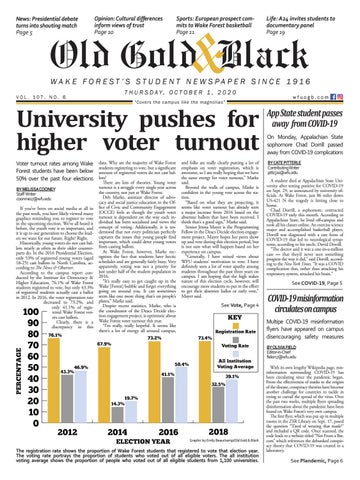
University pushes for higher voter turnout Voter turnout rates among Wake Forest students have been below 50% over the past four elections BY MELISSA COONEY Staff Writer coonme17@wfu.edu If you’ve been on social media at all in the past week, you have likely viewed many graphics reminding you to register to vote in the upcoming election. We’ve all heard it before, the youth vote is so important, and it is up to our generation to choose the leaders we want for our future. Right? Right. Historically, young voters do not cast ballots nearly as often as their older counterparts do. In the 2016 Presidential Election, only 53% of registered young voters (aged 18-25) cast ballots in North Carolina, according to The News & Observer. According to the campus report conducted by the Institute for Democracy & Higher Education, 76.1% of Wake Forest students registered to vote, but only 43.3% of registered students actually cast a ballot in 2012. In 2016, the voter registration rate decreased to 73.2%, and only 41.1% of registered Wake Forest voters cast ballots. Clearly, there is a discrepancy in this
data. Why are the majority of Wake Forest students registering to vote, but a significant amount of registered voters do not cast ballots? There are lots of theories. Young voter turnout is a struggle every single year across the country, not just at Wake Forest. Deb Marke, assistant director of advocacy and social justice education in the Office of Civic and Community Engagement (OCCE) feels as though the youth voter turnout is dependent on the way each individual has been socialized and views the concept of voting. Additionally, it is understood that not every politician perfectly captures the issues that young people find important, which could deter young voters from casting ballots. At Wake Forest, however, Marke recognizes the fact that students have hectic schedules and are generally fairly busy. Very apparently, voting was not a priority for just under half of the student population in 2016. “It’s really easy to get caught up in the Wake [Forest] bubble and forget everything going on around you. It can sometimes seem like one more thing that’s on people’s plates,” Marke said. Despite recent statistics, Marke, who is the coordinator of the Deacs Decide election engagement project, is optimistic about Wake Forest voter turnout this year. “I’m really, really hopeful. It seems like there’s a lot of energy all around campus,
and folks are really clearly putting a lot of emphasis on voter registration, which is awesome, so I am really hoping that we have the same energy for voter turnout,” Marke said. Beyond the walls of campus, Marke is confident in the young vote across the nation. “Based on what they are projecting, it seems like voter turnout has already seen a major increase from 2016 based on the absentee ballots that have been received. I think that’s a good sign,” Marke said. Senior Jenna Mayer is the Programming Fellow in the Deacs Decide election engagement project. Mayer hopes her peers show up and vote during this election period, but is not sure what will happen based on her experience on campus. “Generally, I have mixed views about WFU students’ motivation to vote. I have definitely seen a lot of voter apathy among students throughout the past three years on campus. I am hoping that the high stakes nature of this election cycle, however, will encourage more students to put in the effort to get their absentee ballot or early vote,” Mayer said.
See Vote, Page 4
wfuogb.com
App State student passes away from COVID-19 On Monday, Appalachian State sophomore Chad Dorrill passed away from COVID-19 complications BY CATE PITTERLE Contributing Writer pittcj20@wfu.edu A student died at Appalachian State University after testing positive for COVID-19 on Sept. 29, as announced by university officials. At Wake Forest, just 86 miles down US-421 N the tragedy is hitting close to home. Chad Dorrill, a sophomore, contracted COVID-19 early this month. According to Appalachian State, he lived off-campus and took all his classes online. An exercise science major and accomplished basketball player, Dorrill was diagnosed with a rare form of COVID-19 that led to neurological symptoms, according to his uncle, David Dorrill. “The doctor said it was a one-in-a-million case — that they’d never seen something progress the way it did,” said Dorrill, according to the New York Times. “It was a COVID complication that, rather than attacking his respiratory system, attacked his brain.”
See COVID-19, Page 5
COVID-19 misinformation circulates on campus Multipe COVID-19 misinformation flyers have appeared on campus disencouraging safety measures BY OLIVIA FIELD Editor-in-Chief fielor17@wfu.edu
Graphic by Emily Beauchamp/Old Gold & Black
The registration rate shows the proportion of Wake Forest students that registered to vote that election year. The voting rate portrays the proportion of students who voted out of all eligible voters. The all institution voting average shows the proportion of people who voted out of all eligible students from 1,100 universities.
With its own lengthy Wikipedia page, misinformation surrounding COVID-19 has been circulating since the pandemic began. From the effectiveness of masks to the origins of the disease, conspiracy theories have become another challenge for countries to tackle in trying to curtail the spread of the virus. Over the past two weeks, multiple flyers spreading disinformation about the pandemic have been found on Wake Forest’s very own campus. The first flyer, which was put up in multiple rooms in the ZSR Library on Sept. 17, posed the question “Tired of wearing that mask?” and included a QR code. Once scanned, the code leads to a website titled “Not From a Bat. com” which references the debunked conspiracy theory that COVID-19 was created in a laboratory.
See Plandemic, Page 6
OGB
This column represents the views of the Old Gold & Black Editorial Board.
University must prepare for potential tragedy On Tuesday, Sept. 29, it was announced that Chad Dorrill, a 19-year-old student at Appalachian State passed away from neurological complications related to COVID-19. Dorrill had no underlying health conditions and was considered to be a “super healthy” college student who was in “tremendous shape,” playing basketball and running often in his free time. The reality of this situation begs the question: is Wake Forest prepared for a student to die of COVID-19? We know this sounds extreme. But given that this situation, albeit rare, occured at a neighboring university, this reality is not far-fetched. With the University Counseling Center (UCC) significantly understaffed, as has been reported several times by the Old Gold & Black, it is appropriate to consider whether the resources in place could adequately cater to students’ needs
should a COVID-19 related death occur. There is already an extremely high demand for counseling services that the university currently cannot meet and our campus has not yet seen any major complications as a result of the virus. Should the situation change, what toll would it take on students’ mental health? While Wake Forest is doing everything in its power to demand that the university community abide by public health guidelines, the Editorial Board asks that the university do more to proactively prepare for and anticipate a traumatic event. As reported by the Old Gold & Black on page one, the university shared that they were not updating any policies in light of Dorill’s death, but would continue to focus on ensuring that all members of the university community receive quality health care.
The school probably doesn’t need to revamp health guidelines. In fact, Wake Forest is doing relatively well in terms of controlling spread. The real concern present is whether or not the university has the programs and systems in place to deal with the massive loss of a life. Of course we don’t want to have to plan for, think about or experience a death in the community. But a tragedy like this could completely derail our semester, and we should be ready for that possibility. Ensuring students’ safety has been at the center of the university’s COVID-19 plan. Further, one of the university’s prevailing justifications for opening campus this semester was based on science detailing that younger people are less susceptible to contracting serious symptoms of the virus. But Wake Forest consists of more than its students. Faculty and staff, who are integral
members of our community are at heightened risk for contracting the virus. In fact, there are currently six cases among employees. The death of any of these community members would be equally as tragic as that of a student. When Notre Dame’s student newspaper The Observer wrote a staff editorial titled “Don’t make us write obituaries” in response to campus opening, it shocked the nation. It did so because of their outward acknowledgement of the possibility of death as the result of a college campus opening. More than a month into the semester, we can’t pretend that they were wrong just because it hasn’t happened at Wake Forest yet. Yes, we must remain vigilant and follow public health guidelines. But we should also be able to feel secure in knowing that Wake Forest is prepared to provide support, in so much as it can be, in response to a campus-wide tragedy.
Old Gold&Black
THE STUDENT NEWSPAPER OF WAKE FOREST UNIVERSIT Y SINCE 1916 OLIVIA FIELD
EDITOR-IN-CHIEF fielor17@wfu.edu
CHARLIE BENEDICT
BUSINESS MANAGER
benecc19@wfu.edu
EMILY BEAUCHAMP
ELIZABETH MALINE
PRINT MANAGING EDITOR
ONLINE MANAGING EDITOR
beauea17@wfu.edu
>> NEWS
Rafael Lima, limara17@wfu.edu
>> SCIENCE & TECHNOLOGY
Maggie Burns, burnme17@wfu.edu
>> OPINION
Jack Portman, portjt17@wfu.edu Assistants: Ryan King, kingrm17@wfu.edu Alexandra Karlinchak, karlae18@wfu.edu
>> SPORTS
Ben Conroy, conrbd19@wfu.edu Will Zimmerman, zimmwj19@wfu.edu
>> LIFE
Catherine Regen, regecl17@wfu.edu Assistants: Andy Killebrew, killae17@wfu.edu Micah Porter, portmj19@wfu.edu
>> PHOTOGRAPHY
Katie Fox, foxkg19@wfu.edu
>> DIGITAL MEDIA
Renting Cai, cair17@wfu.edu
>> SOCIAL MEDIA
Anna Bloch, blocae19@wfu.edu
>> ADVISER
Ivan Weiss, weissij@wfu.edu
malied17@wfu.edu
>> POLICIES
The Old Gold & Black is published Thursdays during the school year, except during examinations, summer and holiday periods, by Triangle Printing of Durham. © 2014 WFU Media Board. All rights reserved. The views expressed in all editorials and advertisements contained within this publication do not necessarily reflect the opinions of the OGB. As part of our commitment to reporting news fairly and accurately, we will not remove any previously published content. If an error in either our online or print content is brought to our attention, we will revise the originally published article with an appended correction. In order to facilitate thoughtful and appropriate debate, profane, vulgar, or inflammatory comments on our website are not allowed and will be deleted. For more information on our commenting policy, please see our website. We reserve the right to reject advertisements deemed inappropriate. Our full policy, and how to advertise with the OGB, can be found on our website.
>> SUBMISSIONS
The OGB welcomes submissions in the form of story tips, columns and letters to the editor. Letters to the editor should be fewer than 500 words, and columns should be around 500 words. Send yours via e-mail to fielor17@wfu.edu the Monday before publication. We reserve the right to edit all letters for length and clarity. No anonymous letters will be printed.
>> ONLINE MEDIA
Web: wfuogb.com Facebook: facebook.com/ogb1916 Twitter: @wfu_ogb Instagram: @wfu_ogb Snapchat: @wfu_ogb
Want to write for us? Email
wfuogb@gmail.com
News | Old Gold & Black
Thursday, October 1, 2020 | Page 3
Deacon Profile: Bradley Shugoll
justice activism. Following the death of George Floyd, the group made a decision to pivot to cover the evolving racial justice movement and protests. In Winston-Salem, this meant tracking the development of the Occupy Winston-Salem movement around the death of John Neville.
BY PARKER BEVERLY Staff Writer bevepg19@wfu.edu
Brad Shugoll is the Associate Director of Service & Leadership in the Office of Civic & Community Engagement (OCCE). He first came to Wake Forest as an undergraduate in 2009 and returned to work full-time in 2016. He oversees civic leadership and service traditions such as Hit the Bricks, Project Pumpkin, Campus Kitchen and Wake'NShake. Over the summer, he created and directed the OCCE's oral history project entitled Behind the Facemask, which details the effect of COVID-19 on the Winston-Salem community.
What does the future hold for the Oral History Project? Where will the podcast be available? We’re excited to share out the first five episodes of the podcast, which are available on our website and on Spotify. We also have an archival site that shares out all the fulllength interviews from the summer that will be available in October. This fall, the oral history project will continue on. We have a strong group of returning students as well as a few new faces. In addition to the themes from the summer, students will explore stories related to the 100th anniversary of the 19th Amendment and the ways that COVID-19 is affecting the current election.
Could you give our readers a brief introduction about yourself including your role here at Wake Forest? I grew up in Charlotte, N.C. and came to Wake Forest as a first-year student in 2009. I majored in Biophysics with a minor in Neuroscience. I was involved in intramural sports, serving as an RA and most significantly as a student leader with Campus Kitchen. Following graduation, I stayed at Wake Forest as the Fellow for the Division of Student Life [now Campus Life]. I went on to graduate school at the University of Michigan where I received my M.A. in Higher Education. In graduate school, I studied the connection between colleges and their communities and charted a professional path within civic engagement. After working at Elon University, I returned to Wake Forest to work full-time in July 2016. How did you become interested in civic engagement? As an undergraduate, I started volunteering through Campus Kitchen and found a deep sense of connection with the WinstonSalem community. I vividly remember a night in September when I joined the organization for the first time. From that point on, I served meals every Thursday at the Children’s Home. The sense of connection I built with those children over multiple years caused me to think differently about service. When I came into Wake Forest, I saw service as an extracurricular activity. As I was graduating, civic engagement had become a deep part of my identity and my understanding of what it meant to live in community. I developed an enduring sense of civic ethos that is resonant in our motto Pro Humanitate. What is your favorite part about working for the OCCE? The sense of community in our office. A few of the staff members were my mentors when I was a student and it has been great to work alongside them. We have a social
Hit the Bricks is happening as we speak, could you explain how the historic event has been adapted to fit COVID-19 regulations?
Photo courtesy of Bradley Shugoll
and fun work environment and a focus on working with students. As an advisor to multiple events and organizations, I am working with students every day and that keeps me energized. I love meeting people as first year students in SPARC or volunteers for Campus Kitchen and watching them grow into leadership positions. What kinds of virtual projects has the OCCE created for Wake Forest students to engage with the Winston-Salem community? Since the outbreak of COVID-19, OCCE adapted quickly to provide a wide range of programs. This summer, we offered over 11 different ways for students to get involved, including a virtual tutoring program, social justice education, full-time internships with non-profit organizations, summer camps for children, the summer research collaborative and oral history projects. We had hundreds of students continuing to think critically about and engage with the Winston-Salem community. This fall, we hope to support a vibrant sense of campus community and a con-
nection to the larger purpose behind these events. This includes very large events like Hit the Bricks as well as in the virtual tutoring and debate watch party events that other members of my office organize. What is the COVID-19 oral history project? What subjects were covered and what was the goal? Since the outbreak of COVID-19, we have had an understanding of the historic relevance of this moment. We started the oral history project this summer as a way to collect community voices. The goal is to better understand and preserve the stories of this time. Student teams looked at healthcare, local businesses and the racial justice movement through the lens of COVID-19. The student team and I worked in partnership with MUSE (Museum of Understanding Storytelling and Engagement) and the ZSR Library. This includes interview teams as well as a student archive and podcast team. The group collected over 40 interviews this summer. Of note, when the project started in May the group did not anticipate covering racial
This year the event will move to a weeklong engagement. It will include both virtual and socially distanced events. We will still focus on running and fundraising and Hit the Bricks will be both a participatory event and a team competition. We will have a version of our time trial, Sprint the Bricks, as well as the closing ceremony. We are also adding in new events such as the Find the Brick scavenger hunt and the nightly Quiz the Bricks virtual event. We have already seen very strong interest on campus as well as the largest involvement ever from our alumni community. Why do you think engaging with the Winston-Salem community is such an important thing for Wake Forest students to do? Community involvement both on and off campus is a vital component of the college experience. There are many ways to get to know the community you live in and I have found none more valuable than civic engagement. I would encourage students to find an opportunity to get involved with a non-profit and sustain that commitment over multiple years. What you learn outside of the classroom will shape the person you become. By taking that step to get involved, you’ll learn more about your community and also yourself than you could imagine. Editor's note: This interview has been edited and condensed for clarity and AP style.
POLICE BEAT COVID-19 Violation/Underage Consumption
• A student who was consuming alcohol underage attempted to flee an officer by climbing the fence near Spry Stadium after crossing Polo Road. The report was filed on Sept. 25 at 12:24 a.m. • A student consumed alcohol underage at an off-campus party. Upon returning to campus, the student fell ill and was transferred to Wake Forest Baptist Medical Center. The report was filed on Sept. 26 at 12:47 a.m. • Officers broke up a 35-40 person party on Macon Drive. The police officers spoke with the leasees and the party was dispersed soon thereafter. The report was filed on Sept. 26 at 12:59 a.m.
• Officers responded to reports of 12 students in one room in Efird. The report was filed on Sept. 27 at 1:27 a.m. • Offenders responded to an RA report of a party with underaged drinking in Taylor. Seven students were found. The report was filed on Sept. 27 at 8:54 p.m. Miscellaneous • Students jumped on an elevator in Angelou Hall, causing it to stop between floors. The students were removed and the elevator was fixed. The report was fied on Sept. 24 at 8:27 p.m.
Old Gold & Black | News
Page 4 | Thursday, October 1, 2020
Vote: Young voters can shape election
Continued from Page 1
Most current Wake Forest undergraduates were not of age to vote in the 2016 presidential election, making this the first election they are able to participate in. The deadline to register as a North Carolina voter is fastly approaching. You can register for the election in North Carolina up until Oct. 9, either by mailing in a form, which must be postmarked on or before the Oct. 9 deadline, filling out the form online or filling out the form in person at the Forsyth County Board of Elections. But for students who miss the Oct. 9 deadline, not to worry. There is another, lesser-known option called same-day registration, which occurs during early voting. From Oct. 15 to Oct. 31, students can register and vote immediately at any early voting site in the county. However, unlike in some states where you can register as late as Election Day itself, this is not an option in North Carolina.
For those registered in North Carolina, early voting is also a great option if you want to avoid crowds on Election Day, especially considering we are still in the middle of the COVID-19 pandemic. Early voting was created to increase voter turnout, and it is the perfect opportunity to take advantage of as busy college students. If you choose to request an absentee ballot, check your home state’s rules. Every state has a different deadline for obtaining this ballot. In North Carolina, the deadline to request is Oct. 27, and it must be returned back to the state on or before Nov. 3. First Assembly Baptist Church, which is located across the street from campus at the intersection of Polo Road and Long Drive, immediately past the Polo Road campus entrance, is a new polling place this election cycle where you are able to cast your vote early or on Election Day. If you need a ride there, Deacs Decide is working to provide transportation for students. But luckily, the church is walking distance from campus.
“I know that transportation is one of the biggest barriers for students for voting,” Marke said. “I am still working to figure out how we can organize transportation during early voting and on election day so we have shuttles going consistently and dropping people off.” Clearly, there are a lot of different ways for students to vote so they can make their voices heard. Choose whatever way works best for you, but make sure you cast a ballot, no matter which method you decide. Senior Sam Bott chose to request an absentee ballot from his home state, Missouri. Bott is from St. Louis, and is looking forward to making his voice heard at home. “I am definitely happy that I can vote for Missouri state and local leaders. St. Louis is still the place I go home to and it affects my parents so I’m happy to vote for whatever benefits us and them,” Bott said. Senior Amanda Cummins, on the other hand, decided to register in North Carolina using her off-campus residence address, despite originally being from New York.
This is a common decision among many college students. “I feel like my vote will have a larger impact coming from North Carolina,” Cummins said. “Plus, as a Wake Forest student, for the majority of the year I live in North Carolina, I work in North Carolina, and I consider my address to be in North Carolina. It only makes sense that I get civically involved in North Carolina.” Mayer is planning on voting early and inperson at the First Baptist Assembly Church. “I am choosing to vote this way for convenience and due to concerns about absentee ballots as they are rejected at far higher rates than in-person ballots. I want to make sure that my vote counts,” Mayer said. Voting is made possible for everyone who is eligible, and you can choose your ideal way to participate. You can do your research, read the ballot, decide how you want to vote and make your voice heard. Voters aged between 30 and 50 years old made up the majority of the election in 2016. Students can now flip the script in 2020.
Counseling Center struggles with demand The Wake Forest counseling center has been ill-equipped to handle student inquiries BY ALEXANDRA KARLINCHAK Asst. Opinion Editor karlae18@wfu.edu In this third installation about the various mental health resources that exist on Wake Forest’s campus, the University Counseling Center (UCC) is the final subject at hand. And what better way to examine the UCC’s impact on campus than by interviewing the very individuals who benefit from its services the most: Wake Forest students. Between the Chaplain’s Office, the Office of Wellbeing and the Counseling Center, the UCC is the university office most commonly associated with mental health resources on campus. This academic year, the UCC is home to a number of staff psychologists and counseling interns but is still forced to function without a full-time director. Similar to the Office of Wellbeing, the UCC is currently understaffed at 75% of work capacity and students have taken notice. With such an emphasis placed on the physical health of students throughout this pandemic, a number of students are frustrated with the lack of attention the administration has given to offices dedicated to mental health support. In an online petition posted on change. org, over 500 Wake Forest students requested two things: that the UCC remain fully staffed with no staff cuts and that more counselors be hired to “fully accommodate the needs of the students during this time.” Three months after these demands were posted, no changes have been made. This semester, the UCC is approaching mental health care provision from an equity standpoint. As stated on the Counseling Center’s website, “students who
experience multiple barriers to accessing quality services outside the center will be prioritized to receive counseling services within the center.” In other words, the UCC is encouraging students who have a record of receiving aid from mental health care providers from home to continue to see those therapists virtually. Additionally, the UCC is urging students who possess the financial means to seek help off campus to do so. And for those who receive on-campus assistance from the UCC, that help is not always provided in a one-on-one setting. Senior Gwyneth Lonergan has been a returning student at the UCC ever since her first year at Wake Forest. For the first two-and-a-half years, Lonergan met regularly with a staff psychologist in the UCC. However, half-way through her junior year, the staff member left and Lonergan lost almost all forms of consistency. Now, due to a lack of appointments caused by a decrease in work capacity and COVID-19 circumstances, Lonergan is Katie Fox/Old Gold & Black participating in one of the many group This semester, the Counseling Center has been offering drop-in appointtherapy options that is being offered to ments for students who require “brief, solution-focused support.” students. But according to her, it is just not the same. they are facing throughout this difficult them early in the semester, it is almost “They need to make first-timers a pri- and unpredictable time. impossible to find time to get in if you ority. The sad reality is, if someone has “Ultimately, I know it’s not the Coun- are really struggling.” a negative first experience, they are never seling Center’s fault, it’s the university’s To combat this very problem, the UCC going to seek out the UCC again,” Lo- [fault] with their understaffing,” Loner- is hosting drop-in appointments for firstnergan said. gan said. “They’re not prioritizing the time visitors and students who require Sophomore Ansley Henderson knows Counseling Center even though they en- “brief, solution-focused support.” very well how a negative first-time expe- courage students to seek out help and go However, the best way to address the rience can drive students away from the to the Counseling Center.” ongoing lack of readily available appointsupport they need. While a number of students have had ments to students is still by allocating “I remember walking into the Counsel- mixed, or even negative, experiences with more funding to the UCC and providing ing Center my freshman year in tears and the UCC, many more report how won- Wake Forest students, faculty and staff being put on the schedule over two weeks derful their experiences with the office with the help they so desperately need. later. There are just not a lot of appoint- have been. “Don’t be afraid to reach out and ask ments available,” Henderson said. “The Junior Grace Sullivan compared and for help,” said sophomore Marilla Morrione thing I like about the office is the contrasted her pre- and post-COVID-19 son when asked if she had any advice for fact that the appointments are free. But experiences at the Counseling Center students considering visiting the UCC. getting medication through the UCC has with a smile. “They are so welcoming and all they want also been difficult for me … I just go off “Right now, even though I have had to to do is help you through what you are campus now.” talk with multiple counselors through the going through.” Despite their different experiences, center, they have really been working to For urgent mental health crises anytime, both Henderson and Lonergan empa- find time for me,” Sullivan said. “I will call 336.758.5273. To make an appointthize with the UCC and the struggles say though, if you do not connect with ment with the UCC, 336.758.5273.
News | Old Gold & Black
Thursday, October 1, 2020 |Page 5
COVID-19: Surveillance testing continues Continued from Page 1
For the Wake Forest community, the tragedy is a sombering reminder of the reality surrounding the COVID-19 pandemic. “I think it’s a reminder, a really tragic reminder, that if we don’t abide by COVID-19 guidelines and work with health officials to plan, then this is a really unfortunate result of that,” said sophomore Rachel Edwards. “And there’s this conception that young people cannot die from this, but I think his death is a really tough wakeup to that reality.” Wake Forest released a statement on Tuesday night in condolence of Dorrill’s death. “The Wake Forest University community extends our heartfelt condolences to the Appalachian State University community and the family and friends of Chad Dorrill, who passed away due to complications with COVID-19. It is a deep and painful loss, and our thoughts and prayers are with those who knew and loved him.” The tragedy won’t change policies at Wake Forest, but the university is “redoubling efforts to prevent the spread of the virus and to assure that students, faculty and staff stricken with it have access to superior health care,” said Mark Petersen, vice president for university advancement. “The tragic situation with Chad Dorrill at Appalachian State served as a reminder of how important our protocols are around Student Health Services and virus
prevention — especially proactive testing, contact tracing and quarantining,” he added. The cornerstone of Wake Forest’s COVID-19 policy is arguably random testing, which began on Sept. 3. As of publication, 1,867 students have been tested, with a cumulative positive rate of 0.7%. According to the COVID-19 Dashboard, there are 19 active cases on campus. “It’s really good that they’re making sure we’re not testing positive for COVID-19,” said freshman Sofia Maldonado, who has been tested twice for the virus. “My family’s a huge part of it because I go visit them so often. They’re also really strict with who they touch and talk to and where they go, and I don’t want to ruin that for them. So I’m thankful.” Freshman Rute Ayalew was also tested twice. She said her experiences were “very quick and easy, walk in, walk out, get a T-shirt.” However, she pointed out that she was the only person she knew who had been tested. “I’m glad that they’re doing randomized testing, but I would hope that what occurred to me isn’t what’s happening with the majority of these tests,” Ayalew said. “Otherwise, they’re just pulling multiple negative results where they could be searching for more cases where you might not even catch it because you’re not testing other people.” Surveillance testing is completely random, according to Petersen. Though there is an additional testing process where specific groups of students — from residence halls, areas off campus or organizations — are selected,
the random testing program is based on a simple sampling model. However, students aren’t removed from the testing pool after they have already been tested. Theoretically, a student could be tested every week. “It is important to remember that tests of asymptomatic people are snapshots in time, and while someone may have tested negative last week, it is very possible that he or she could have been exposed since that test,” Petersen said. “It is also possible that the virus had not developed enough to be detected in the prior test. If you have heard of someone being tested multiple times, it is likely that he or she was selected randomly one week, then was selected due to an affiliation with an organization, residence hall or neighborhood that was drawn for special asymptomatic testing.” As the Appalachian State and Boone communities grapple with the death of Dorrill, Wake Forest aims to prevent a similar tragedy. Cases like Dorrill’s are extremely rare, but preventative measures — including random testing, but also those seemingly age-old axioms of staying socially distant and wearing a mask — are key to avoiding such a tragedy. At the end of their statement confirming Dorrill’s passing, Appalachian State Chancellor Sheri Everts said that “In condolences to his family, many have shared their memories of Chad and said, ‘I wear my mask for Chad.’ Please let us all honor Chad and his contributions by taking care of ourselves and our community.”
OUTSIDE THE BUBBLE: 2020 PRESIDENTIAL DEBATE BY RAFAEL LIMA News Editor limara17@wfu.edu In an overly-polarized presidential race where major subjects from COVID-19 measures to climate change seem to have been politicized, the majority of people who watched the presidential debate on Tuesday night seem to agree: it was an unusual one. The first 20 minutes of the debate consisted mostly of unintelligible speeches from both candidates in what quickly escalated to a shouting match between President Donald Trump and former Vice President Joe Biden. The president, known for his explosive rhetorical style, directed most of his efforts to attacking the character and fitness of his Democrat opponent for the presidency while emphasizing his own accomplishments in office, mainly the handling of the U.S. economy prior to the pandemic. “I had to close the greatest economy of the history of our country. And by the way, now it’s being built again and it’s going up fast,” Trump said. Trump was also heavily criticized for not taking a stance against white supremacist groups when asked by moderator and Fox News anchor Chris Wallace to condemn them. Trump specifically called on the far-right, white supremacist group Proud Boys to “stand back and stand by,” a message that the group appears to have received as marching orders for action during the election. Biden had a more structured speech delivering on most of his main campaign proposals: to recover more swiftly
Scott Olson/Getty Images/TNS
The socially distanced debate often devolved into disorganized and confusing politcial arguments.
from the COVID-19 pandemic, address systemic racism and rejoin the Paris Agreement on climate change. He also did not pass up on the opportunity to criticize his Republican counterpart for his mismanagement of the COVID-19 pandemic and for inciting more violence amid calls for racial justice across the U.S. “… all he ever wants to do is divide people, not unite people at all. This is a president who has used everything as a dog whistle, to try to generate racists hatred, racist division,” Biden said. Little of the evening was spent on actual policy talks, as Trump steered the debate into a rowdy and extremely unorganized argument that more resembled a Saturday Night Live skit than a presidential debate. “This wasn’t a debate. It was not presidential. It was not civil. It was not [done] with dignity. It was producing information about the candidates, but it wasn’t producing much information about why you would vote for those candidates, other than the stuff we’re already used to,” said Political Communication professor Allan Louden, who also has experience working as a debate consultant for political campaigns, including most recently Andrew Yang’s. “The most common word [to describe the event] I’ve seen in the commentary all over the place is ‘circus’.” Wallace was often seen tasked with the unenviable job of reeling the president back in to some sort of structure within the debate throughout the night. For someone who hoped to be “as invisible as possible” during the first presidential debate, Wallace ended up involved in several back-and-forth arguments with Trump. At many points, the moderator had to raise his voice to match the noisy confusion on stage. “Gentlemen, I hate to raise my voice, but why should I be different than the two of you?” Wallace said. “So, here’s the deal … you each are going to have two uninterrupted moments. In those two interrupted minutes, Mr. President, you can say anything you want. I’m going to ask a question about race, but if you want to answer about something else, go ahead. But I think that the country would be better served if we allowed both people to speak with fewer interruptions.” Amid the overlapping exchange between the candidates, it was hard to discern a clear winner out of the debate. Many pundits believe that Biden left the debate stronger for not committing any major gaffes and maintaining his responses within his political agenda
Olivier Douliery/Pool/Getty Images/TNS
Moderator and Fox News Anchor Chris Wallace had to intervene heavily during the debate. while Trump’s erratic approach might have gone a little too far during the first night of debates. Yet, both candidates, for as chaotic as the debate was, seem to have delivered within the proposed message of their campaigns. “Trump was clearly trying throughout the night to connect Biden with the more progressive wing of the Democratic Party and various progressive programs such as the Green New Deal, on the idea that these might be off-putting to undecided centrist voters,” said politics and international affairs professor John Dinan, who teaches a course titled Political Parties, Voters and Elections. “By contrast, Biden was clearly trying throughout the debate to frame the election as a referendum on Trump’s character, leadership style and the government’s response to the coronavirus, and Biden took plenty of opportunities to do all of this in an effective fashion during the debate. When the debate is viewed in this way, by considering the candidates’ strategies and their ability to carry out these strategies, both candidates achieved some of their main goals.” In a chaotic debate with no clear winner in terms of arguments and policymaking, perhaps the 73 million people who tuned in on Tuesday night were the ones who came out losing.
Old Gold & Black | News
Page 6 | Thursday, October 1, 2020
Plandemic: flyers spread disinformation Continued from Page 1
The second poster, which was found taped on multiple buildings on campus last week, referenced a documentary titled Plandemic: Indoctrination and the Instagram account of the film, in which almost every post is flagged for being “false news.” Plandemic, which was released in two parts, has received flack for being filled with medical misinformation and has been removed from Twitter, Youtube, Reddit and most other major social media websites. Staff across campus were instructed to remove the flyers, as the university has
continued to provide accurate updates to the community via official communication. “Wake Forest regularly communicates information based on current public health guidelines through the Our Way Forward site, social media, campus emails and in many other ways across campus. Current advice from infectious disease expert Dr. Christopher Ohl is posted on the site,” said Cheryl Walker, the acting executive director of news and communication. Rosalind Tedford, the director for research and instruction in the ZSR Library, is currently teaching a first year seminar about misinformation alongside librarian
Photo courtesy of sophomore Ethan Wearner
“Plandemic” posters depicting false information were spotted on Hearn Plaza, attached to Wait Chapel and outside the Pit.
Hu Womack. According to Tedford, the danger of disinformation is that we can experience confirmation bias — if we want something to be true, and we hear possibly false information confirming our beliefs, we are more likely to accept it. “Take COVID-19 misinformation, for example. If we encounter and believe mis/ disinformation about a disease — it can lead us to do things that endanger ourselves and others. So if we don’t want to wear a mask — and really who does? — and we hear something that says ‘masks are dangerous’ we are more likely to believe it even if the science says that masks are pretty effective at stopping the transmission of the virus,” Tedford said. “And if we believe that masks don’t work, then we don’t wear one, and that can make us more likely to get the virus and spread it — and in our case, more likely to cause an outbreak here on campus that could have consequences for us all.” Philosophy professor Adrian Bardon, the author of The Truth About Denial: Bias and Self-Deception in Science, Politics, and Religion, echoed this idea in a recent piece he wrote on COVID-19 misinformation for The Conversation. “In theory, resolving factual disputes should be relatively easy: Just present strong evidence, or evidence of a strong expert consensus. This approach succeeds most of the time, when the issue is, say, the atomic weight of hydrogen,” Bardon wrote in the article. “But things don’t work that way when scientific advice presents a picture that threatens someone’s perceived interests or ideological worldview. In practice, it turns out that one’s political, religious or ethnic identity quite
effectively predicts one’s willingness to accept expertise on any given politicized issue.” Sophomore Ethan Wearner spotted the “plandemic” poster all over campus — on Hearn Plaza, attached to Wait Chapel and outside the Pit. “Disinformation campaigns, waged ostensibly under the guise of alternative science, are not only unethical but pose a risk to our collective wellbeing,” Wearner said. “If you see such information posted around campus, please submit a COVID-19 noncompliance form and contact the administration for further guidance.” Wearner’s emphasis on the risk to our community’s wellbeing is not overstated when put in reference with Tedford’s expertise: disinformation is a viable threat to anyone, no matter one’s identity. “So I think it’s easy to dismiss misinformation, and belief in misinformation, as being a partisan thing. The left claims the right is more vulnerable and the right says the same thing about the left. I just want everyone to know that it is a human thing. Our brains have evolved in certain ways that makes us all vulnerable to mis/disinformation if it’s presented to us in certain ways,” Tedford said. “And tech companies have designed products that feed us things in ways that take advantage of those cognitive biases. It’s everywhere — in Amazon Reviews, comments on social media, TikTok, Yelp, influencers on Instagram, YouTube recommendations, everywhere. So we all need to be vigilant about it and not assume that it is just something ‘other people’ are bad about.”
OLAS celebrates Latinx Heritage Month BY AINE PIERRE Staff Writer pierav20@wfu.edu For the Organization of Latin American Students (OLAS), a little celebration was a lot overdue. After having their events cancelled last spring due to COVID-19, OLAS, led by Secretary Estefania Narvaez, has made strides to drum up engagement and create programming that is exciting. “The OLAS [board] worked together to come up with events … it was a lot of work. We gather all together and come up with ideas to do diversity and inclusion on campus … and to get the Class of 2024 involved,” Narvaez said. So far, these efforts to engage the Class of 2024 have been wildly successful. “We had the most people attend our interest meeting [ever] at the beginning of the year. I think at this point the Class of 2024 would be considered the most involved,” Narvaez said. This may be due in part to a new mentorship program for incoming students sponsored by OLAS, which aims to connect members of the Class of 2024 with upperclassmen.
“The people in the Class of 2024 [had] the chance to meet upperclassmen not through the phone or through Zoom but also in person to get to know them,” Narvaez said. OLAS has also seen a sizable level of interest in their events this month. At Churros! — where OLAS members handed out churros and horchata, a Mexican drink — and Trivia Night in September, combined participation reached 75 students. Thursday night, Oct. 1 at 5:30 p.m., OLAS will have their annual Fiesta at the Davis Field Tents. Partygoers will be partitioned off into groups of 25 in order to comply with North Carolina’s COVID-19 guidelines. “This is a really big deal for OLAS … we’re trying to have … different kinds of food from all around Latin America, so we’re going to have plates with tacos, something called gorditas and then pupusas, so that’s from Mexican food, Hondurian food and then Salvadorian food,” Narvaez said. This event is one that Narvaez is most excited for. OLAS has put in a lot of effort to ensure their signature event could still go off. “[Fiesta on the Quad] had to be minimized so that it could meet the state guidelines of 25 or less people, so OLAS has worked closely with our event staff at the university to ensure that the event would be in compliance but to still have it in person,” said Executive Director of
the Intercultural Center Jonathan McElderry, who advises OLAS. RSVPs will be needed to sign up for the event. OLAS will also host a movie night on Sunday, Oct. 4 to celebrate Latin American film. This event was moved from its original date this Friday due to the football game. In terms of navigating COVID-19, OLAS has faced challenges. It has had to move its weekly meetings from Luter to Zoom, and it has also decreased the frequency of its meetings. “For [our board] it’s been really hard because we used to meet in Benson or [the lounge in Luter] and now we have to coordinate … online through Zoom,” Narvaez said. Narvaez, however, says her club has gotten a lot of support from the IC, especially from McElderry. “[McElderry has] been really really
Ph o to c
our tes yo f
AS OL
After its events were cancelled last spring, OLAS looks to celebrate Latinx heritage
helpful, especially in helping us make the best decisions in terms of the COVID guidelines,” Narvaez said. There will also be a conversation about the political power of the Latinx community that will cap off the month’s festivities. That event will take place virtually on Oct. 14 at 4 p.m.
SCIENCE & TECHNOLOGY
T H U R S D AY, O C T O B E R 1 , 2 0 2 0
PAG E 7 O n l i n e at : w w w. w f u o g b . c o m E d i t o r : M a g g i e B u r n s , b u r n m e 17 @ w f u . e d u
COVID-19 reveals racial disparitiy in Forsyth County Local doctor at Wake Baptist comments on racial disparities in healthcare BY WILL DESVALLEES Contributing Writer desvw15@wfu.edu
When the pandemic hit the United States in early March, North Carolina and Forsyth County were initially relatively untouched. Dr. Blake Briggs witnessed first-hand the spread of the virus in the heart of WinstonSalem, working as an Emergency Room (E.R.) practitioner at Wake Forest Baptist Health. He served on the frontlines of the COVID-19 pandemic from the virus’ emergence in March to his last day working there on June 30. Briggs was completing his residency at Wake Forest Baptist Health, the final months of his stay were occupied by the pandemic’s evolution from early March into the summer. “In April, May and June I saw throughout the spread and kind of the whole process," Briggs said. "I was also on a research paper that just got published analyzing trends and analyzing the public at large and the nation’s response to COVID-19 and kind of their feelings about COVID -19 nationwide.” His heavy analytical research in regards to the pandemic and the experiences he had working in the ER rooms of Baptist Health illuminated issues that Forsyth County faced at the onset of the pandemic, notably a severe lack of available tests and adequate protocols. Furthermore, Briggs mentioned a massive disparity between the number of positive COVID-19 cases within the Hispanic community compared to other groups in the community. This lead to a more global discussion focusing on the response to the pandemic in the United States. With regard to testing, Briggs said that like everywhere else in the country, Forsyth County and Wake Forest Baptist Health were simply unprepared to deal with the pandemic. As the first few cases emerged in Winston-Salem, Briggs stated that there were virtually “no tests,” in Forsyth County, not unlike the rest of the country. Briggs said that throughout his time working at the hospital during the pandemic, staff were required to ration personal protective equipment (PPE). “From my time from March to June 30, I can tell you that for the most part, we did have what we needed. We had to ration. So we would have to wear one surgical mask (N95) every eight hours” Briggs said.
Photo courtesy of Wake Forest Baptist Health
The Hispanic community in Forsyth County is being disproportiately affected by the COVID-19 pandemic. Dr. Blake Briggs of Wake Forest Bapitist Health explains why this disparity is so prevalent. The current pandemic has exposed significant racial disparities, which negatively impact the the Hispanic population in Forsyth County. Although the Hispanic population makes up only 13% of Forsyth’s population demographic, they accounted for 54% of people infected with the virus in late May. “I’m not surprised at all [that Hispanic people are disproportionately affected by COVID-19],” Briggs said. “That’s something I saw every day.” Briggs also mentioned that Hispanic residents of the Winston-Salem community tend to have a large number of family members living in one household. In such cases, it is the children, teens or young adults living within the household who work or go to school and may unknowingly bring the virus back to their homes, as roughly 45% of COVID-19 cases among young adults and teens are asymptomatic. It is these family systems that Briggs suggests make it very difficult for social distancing to occur, especially because many Hispanics that have working class jobs in WinstonSalem have employers that refuse to
grant them paid-leave if they become sick. Therefore, they are left with no choice but to go to work. “Even if their employer does give [paid leave] to them, they are trying to put food on the table, they’re trying to work hard," Briggs said. “Unfortunately, they are in a position where their employer will not typically grant them days off.” Briggs also mentioned that COVID-19 is taking a toll on the older members of the Hispanic community. “Unfortunately, [the pandemic] is tough for the older population, like the elders of the family who live in the house. They have a high riskof getting very sick,” Briggs said. Finally, Briggs highlighted the fact that many members of the Latino community in Forsyth County are uninsured, which naturally dissuades them from seeing a doctor or going to the E.R. unless they are facing a serious emergency. Therefore, Briggs is suggesting that avoiding treatment for reasons pertaining to the unaffordable cost of healthcare steers the Hispanic community in Forsyth County away from emergency rooms or doctors
offices even if they are experiencing symptoms of COVID-19. As the pandemic has progressed, Hispanics in Forsyth County still represent a large majority of positive cases within the community. The disproportionate amount of cases in the Hispanic community reveals the racial disparities in the healthcare system. The racial dispairities in Forsyth County are among the largest COVID-19 related disparities of any other county in the state of North Carolina. This serves as a microcosmic example of the extent to which the pandemic’s vicious spread is hammering minority communities adversely across the country. From Briggs’ account, it seems clear that socio-economic issues regarding housing, jobs and the unaffordable cost of healthcare are affecting the largely working-class Hispanic community in the Winston-Salem area. The most recent report from the Forsyth County Department of Public Health published Sept. 12 found that 45.7% of the 6,535 positive cases recorded in the county since the beginning of the Pandemic belonged to the Hipanic/Latino population.
OPINION
T H U R S D AY, O C T O B E R 1 , 2 0 2 0
PAG E 8
Online
a t : w w w. w f u o g b . c o m E D IT O R : J a c k P o r t m a n , p o r t j t 17 @ w f u . e d u A S S I S TA N T E D I T O R S : R y a n K i n g , k i n g r m 17 @ w f u . e d u Alexandra Karlinchak, karlae18@wfu.edu
OLD GOLD & BLACK
The views expressed in all opinion columns represent those of the article’s author, not the opinions of the Old Gold & Black Editorial Board
“ False reports compromise truth Fan-mail response
False Title IX accusations undermines the truthfulness of the vast majority of reports
Catherine Regen Staff Columnist regecl17@wfu.edu
Two weeks ago I wrote an article about the changes to Title IX regulations, courtesy of one Mrs. Betsy DeVos. As a result of that article, I received an email from a former professor at the Oregon Health & Science University named Buddy Ullman, who was fired for sexually harassing one of his students. A fact he neglected to include in his message to me, but that was readily available after a quick Google search of his name. In the first line he told me I had some of my facts wrong, an impossible feat considering that the piece was entirely my own opinion and interpretation of the new
The professor who emailed me was reported for inappropriately kissing a student on the forehead, and leaving inappropriate comments...”
marized by the National Sexual Violence Resource Center. But this issue is a serious one, and one that I have come to witness firsthand in my own life. Only two days ago I watched someone call their RA and Campus Police falsely insinuating that a friend in the apartment was verbally assaulting her, a claim that was categorically false across the board. That action and ones like it have real world consequences and are not to be taken lightly. Both sides of this issue have very serious implications and false reporting only worsens the social attitude regarding sexual assault. It makes officials more skeptical of reporters and survivors, who are already suffering from their initial trauma. In my opinion, that is single-handedly one of the worst possible things someone could do, and for me is utterly unforgivable. Even after experiencing false reporting first hand, I am unable to acquiesce to the outright offensive opinions of the professor who emailed me. It is almost comical how incredibly insolent his words were. In his last line he claimed Ruth Bader Ginsberg would have disagreed with my position, which I find to be outrageous and slanderous to her memory.
Mr. Ullman, I now speak directly to you since you love to find obscure articles in college newspapers and harass their authors. Mr. Ullman, we should all make a concentrated effort to believe survivors. I completely empathize that you face personal challenges with this topic, but I hope that you can take the time to recognize the importance of your words and actions. We all have a part to play in making the world a better place and I truly believe that you can open your mind to the bigger picture. I can see how the new regulations would benefit someone who had the experience you described in your piece for SAVE, but they are deeply harmful to survivors, who are arguably the more important group in this scenario. Cisgendered straight white men have controlled the narrative surrounding sexual harassment, assault and violence for too long. Respect that the issue at hand is bigger than just you and your story. Finally, you might consider changing your email signature to reflect that you did not retire, but in fact were fired. I recognize that my opinions are harsh, but I feel they reflect the seriousness of the subject at hand.
The remarks that Trump made If what the polls are saying is true and are much more serious than suburban housewives make up one of the potential impact they hold the groups that should be targeted and on undecided voters.”
felt like riding a Tilt-a-Whirl for an hour and a half. The lack of live fact-checking was a major contributor of this seemingly lawless debate that played out on live television. Because of this, Trump and, in some instances, Biden made claims that were either fully or partially untrue. For example, within the first five minutes of the debate, Trump claimed that “Roe v Wade was not even on the ballot” in reference to known pro-life Supreme Court nominee Amy Coney Barrett. He also claimed to have a comprehensive health care plan when he most obviously has not even worked to replace Obamacare. While I am disappointed with the events of Tuesday night’s debate, I am not surprised. Moving forward, I am relieved to know that there will be steps taken to ensure that the unprofessional unfolding of events that took place in Cleveland will not take place again. Whether this comes in the form of muting mics, penalizing the person who speaks out of turn or even investing in human-sized shock collars, I am happier to know that at least some precaution will be taken in the coming weeks.
regulations. He then continued by saying that the old Title IX system was harmful to both accusers and respondents, a fact that couldn’t be further from the truth considering that victims of sexual assault and harassment are the only true victims of that scenario, point blank. The professor who emailed me was reported for inappropriately kissing a student on the forehead and leaving inappropriate comments on a Facebook post she was tagged in. He claims in a piece he wrote defending himself on the SAVE website, that this student falsely reported the incident as retaliation for him failing her. The insinuation that a young, impressionable woman would put herself through the Title IX reporting process based on a lie is slanderous at the very least, and incredibly destructive. Statistics show that only between 2% and 10% of sexual assault reports are false, as presented by several studies sum-
“ Debate reflects blatant political failures Presidential Debate
Presidential debate demonstrates failing political and electoral system
Alexandra Karlinchak Staff Columnist karlae18@wfu.edu
If you have access to a television, a computer or even an annoying suitemate who cannot for the life of them stop talking about every political podcast under the sun, chances are, you were well aware of the first presidential debate that was held in Cleveland, Ohio on Tuesday night. And if you are the aforementioned suitemate, chances are you sat down and watched the debate in its entirety. And to you, I say bless your soul. But, believe it or not, I tuned in to all 90-minutes of that ear-piercing debate as well. A weekly Op-Ed writer … watching a political spectacle unfold? How surprising and definitely not fitting at all! All jokes aside, the debate was, for lack of a better word, painful to watch. With President Donald Trump, former
Vice President Joe Biden and moderator Chris Wallace yelling over each other like children vying for their turn with the Wiiremote, no true discussions about policy were had. Shocker. This should not come as a surprise. Trump is not exactly known for his policy ideas. In the 2016 election, his brazen — and inherently racist and sexist — promises to “build a wall” and “lock Hillary up” were met with uproarious support from his voter base. But these are not policy proposals. They are spineless and inflammatory pieces of propaganda. While the content of Trump’s baseless claims changed themes in this election cycle, the tone behind them did not. Referring to the novel coronavirus as “The Chinese Plague” and making multiple tasteless jabs at Biden’s son, Hunter Biden, for being a former drug-addict, Trump did not hold back. Now, I am not a political campaign strategist, but whoever advised Trump to act like himself onstage deserves to be fired. One, because the things he said were cruel and unpresidential and two, because who in the world is he trying to win over?
won over by each candidate, how does an aggressive, condescending, violent attack on one’s opponent come across? Something tells me that trying to pin moderate Biden as a radical leftist and ridiculing his personal life will not get you invited to Brenda’s bridge club. And failing to condemn white supremacists because they make up a portion of your voter base? Oop! There goes your invitation to Linda’s garden party. The remarks that Trump made are much more serious than the potential impact they hold on undecided voters. They are fear-inducing and, more dangerously, completely false. Because this column is not large enough to contain the extensive list of aspects I found wrong with Tuesday night’s debate, let us focus on one key detail that led the pack: the obvious lack of control. Wallace was unable to hold, let alone steer, the reigns of the first presidential debate. The combination of deflecting questions and yelling over one another gave me mental whiplash from nine hours away, so I can only imagine the minds of the spectators in the room. It must have
Opinion | Old Gold & Black
Thursday, October 1, 2020 | Page 9
“ changes campus life Online class Virtual Learning
Virtual learning augments the academic experience and forces students to adapt
Many students like myself are experiencing what has come to be known as 'Zoom fatigue'..."
Ansley McNeel
Staff Columnist mcnecb19@wfu.edu
Although students have mostly returned to campus for the fall 2020 semester, the academic experience is undoubtedly altered from what it has looked like in previous semesters. What makes this semester different is our increased reliance on computers for schoolwork, our decreased social and academic interaction and our increased flexibility in completing our work. To begin with, only 50% of classes have any in person component this semester. This means that at least 50% of the time, students must complete classes synchronously via platforms like Zoom or asynchronously on their computers. Either way, students spend a great amount of time staring at their computer screens and sitting in their dorm rooms to do class. On Tuesdays, for example, I have six hours of synchronous Zoom classes with only a total of two hours of down time in the scheduling gaps. Many students like myself are experiencing what has come to be known as “Zoom fatigue,” the spaciness and lethargy that comes from staring at a computer screen
Social Life
University
and trying to focus for long amounts of time. In regular academic settings, this kind of fatigue is less common, as students must change classrooms, walk outside between classes, and pass by other students in common spaces as they do so. This basic level of stimulation and socialization keeps one’s brain interested and ready to learn. When the classroom is the same physical space as the bedroom, students experience little to no change in scenery or mindset between classes. Thus, online learning can hinder a student’s ability to focus and learn effectively. Another downside of online learning is that students are less able to connect with one another and with their professors one on one. Because Wake Forest has such great ratios of students to professors, returning students are accustomed to meeting friends and forging connections in classroom settings. However, this is now a more difficult task, as classes are often on Zoom where we cannot strike a casual conversation with the person we happen to sit next to that day. Even during in person classes, students are often wary of one another and maintain proper social distancing in order to keep each other safe. Thus, the academic experience this semester feels a bit lonelier — without a buddy to check in with about each assignment and deadline, taking classes
“ must
Increasingly cold weather requires university to adopt new spaces for socialization
Ryan King
Staff Columnist kingrm17@wfu.edu Sweater weather is upon us and as the days grows colder, I grow less and less confident in our ability to rely on outside space for socializing. It’s far from frigid at the moment, and in fact this week it’s even become warm again. However, it’s likely that within the final couple of months of the first semester — and even more likely that within the first two months of the second semester — the temperature will drop to levels that make face to face meetings under the tents unviable. I’m left wondering what options students will have for social gatherings. I can only imagine a growing portion of students will begin to choose to meet with each other indoors. That is, in ways not consistent with the university’s COVID-19 guidelines for
requires more constant attention to details. While it is true that we can direct message each other on Zoom chat, it is not always considered socially acceptable to message a stranger. Despite these flaws in the academic experience this semester, there are some perks. For example, on sunny days, many students Zoom into class from picnic and patio tables. In doing so, they get to enjoy fresh air while completing their schoolwork. Especially in a time where being outside may also feel safer than being inside of a classroom, this is an exciting benefit to Zoom classes. Another such benefit is the increased degree of flexibility in academic life. For example, the asynchronous lectures allow students the liberty to work ahead as they please. For students who enjoy planning and working ahead, this format is a great advantage. Students with asynchronous lectures also have the opportunity to “reschedule” their class schedule for the day so that they can sleep in, go for runs, meet friends at the Pit and participate other activities that might provide them joy instead of attending a live lecture. In this way, online classes have had a positive effect on students’ abilities to match their schedules with one another. Finally, Zoom classes also allow students to enroll in classes with professors who might otherwise not be able to teach here. For example, my CRW 385 class is taught by a professor who resides in another state. Without this technological environment, I would be otherwise un-
able to learn from her this year. While it is true that COVID-19 has altered the academic experience to be less personal and more difficult to comprehend material at times, it is also important to remember that there are benefits as well. While we are in a global pandemic, it is fortunate that we can continue to take classes and live on campus at all. For this reason, despite the academic fatigue and loss of personalization, the academic experience is still as strong as one could reasonably expect it to be in the face of the pandemic.
Photo Courtesy of @wakeforestphoto Instagram
Students lounge on the field outside of Scales while preparing for class.
adapt student life to weather
The temperature will drop to levels that make face to face meetings under the tents unviable..." social gatherings. And this would not only be an effect of the cold weather, but perhaps equally so a consequence of quarantine fatigue. As important as social distancing guidelines are to follow, most anyone can recognize it’s not ideal for meeting others, maintaining relationships or remaining sane. And without a reliable alternative to meeting inside, students are left with a logistical dilemma that essentially eliminates their ability to balance their needs with a responsibility they have to keep themselves and others safe. The issue here, really, is that the university has provided no alternative accommodations, or rather, has not yet communicated to students what alternative accommodations they will provide for the latter half of this semester and the beginning of the next. I would give the benefit of the doubt to the university in assuming they have planned for lasting weather conditions to make tents (in their current state) an inadequate solution for a consid-
erable part of the school year, but as of now they have not made it obvious what plans they’ve made. A certain lack of transparency has been a somewhat recurrent theme thus far in the semester. The information students have received directly or have been able to view on Our Way Forward is undoubtedly valuable, but it seems that each significant update — for example, the COVID-19 dashboard’s initial launch — comes at a slight delay. It seems that students are left nervously wondering what’s to come because the university could do a better job of communicating what they are planning, as they are doing so. Students want to have confidence in the university and this comes from regular communication. Publicizing the process of planning around COVID-19 makes it explicitly clear that matters for which students have concerns are in fact being considered, and are not primed to blindside the university. The plans for creating cold-weather space that students can use to responsibly gather is the most recent of those updates, as I’m left wondering what solutions are being considered. When compliance with a number of specific guidelines is crucial for students to re-
main on campus, express communication on part of the university is paramount in ensuring that students can behave appropriately and, just as importantly, feel that they can trust their institution. I understand that the complex and unprecedented nature of an issue like this makes the university’s job in creating solutions incredibly difficult and I appreciate that the accommodations they’ve made for students thus far have been creative and, all things considered, pretty effective. Even so, it’s troubling to not regularly be in the know about how the university is planning to tackle existing and future issues, or even what specific issues they’re considering. The new norm is slowly becoming routine, but as students grow used to the state of things, the urgency of their actions may become increasingly lost, and they may become increasingly lenient. The fallacy that we can let up because the state of things is acceptable, when that state is a result of our diligence, is easy to fall into. And it seems to me that ensuring students are kept aware of how the university plans to continue to operate will only help keep them ready and careful.
Page 10 | Thursday, October 1, 2020
Old Gold & Black | Opinion
“ Celebrity personas draw criticism Public Opinion Personal Development
Ellen DeGeneres deserves admonishment for her private treatments of staff
Connor McNealy Staff Columnist mcnecb19@wfu.edu
I didn’t dislike the Ellen Degeneres Show before the premier daytime talk show host in America was dragged through the mud. DeGeneres cycled through the west-coast celebrities and even added in some interesting people here and there. The program where Kanye West went on a captivating eight minute long rant was an absolute hit for me. The episode was a major inflection point for West — who knows what he’s talking about now — and it was a very revealing moment for Ellen Degeneres. Of course, when I watched Kanye’s tirade I was entirely focused on him, but on my second viewing I noticed DeGeneres’s expression. She was obviously unsettled; but there was something more than that on her face and in her posture. Back then, I gathered the impression of parental distress over a child who was injured or throwing a fit — but now with the background of her show displayed for the general public to see — I can see it as the expression of someone who is in desperate need of control.
Social Life
Cultural
Ellen, after gaining so much renown and trust in her image, figured that she had some sort of invincibility. “ Now, of course a talk show host, whose duties are to maintain and run and enjoyable show, would be horrified at such a breakdown. It is perfectly natural for a talk show host to appear shocked in such an event. But what we see is very different from what other hosts would do in such an event. A good host, and a good person, would take the time to engage with the person on the show and actively contribute to this discussion. What you saw in West's lecture was a host who was completely paralyzed. The allegations against DeGeneres and the way she and her producers ran things are something that should not be taken lightly. They shouldn’t be brushed off like they are now. There was real racism behind the scenes on this production just as well as there was sexism, and ignorance of the staff and crew who are paid significantly less than the showrunners. If anything, this chaos is a microcosm of the American workplace. If I am to be completely honest, I trusted the character of DeGeneres before this series of incidents, as most everyone did. She put on the mask of kindness in the public spotlight for
“ differences
Family and cultural backrounds predicate understanding of trust
Gaby Gonzalez
Staff Columnist gonzgc17@wfu.edu I often wonder - how much do our cultural background and values affect our daily interactions? How much of our inability to communicate effectively with others truly is due to our differences? I was raised in a Catholic, Cuban tradition. Family is held near and dear and anyone outside of family should be proceeded towards with caution - they are, for us, an “other.” People to be feared, people who can harm you, break your trust and abandon you. Family, I was taught, hold none of those characteristics. Throughout college, I have strayed from this tradition, in a sense. I have found friends that I've considered near and dear. Friends, which at times, I have found myself to see as family in their own ways. There have been
Maybe DeGeneres deserves another decades. Her example should be a lesson to all celebrities or people of fame shot to prove that she is the figurehead — that you should try to be genuine. of the ‘be kind’ persona. Or maybe Sooner or later news that their per- someone with so much money and sonalities do not match those they power who has messed up consistentportray to the public will be released ly for years should lose her responsiby the media. bility as an entertainer in our culture. In the United States, celebrity is a I think the latter should take place, contract. Your life, more or less, is but in our society — an identity such common knowledge. In that way, as hers is as good as cemented. a person becomes owned by public. DeGeneres, after gaining so much renown and trust in her image, figured that she had some sort of invincibility. At the onset of the pandemic, DeGeneres made some irresponsible comments and jokes that were just the sort of negligence that fame and fortune secrete. She compared her mansion to a prison. But it is the reaction of the studio, the producers, and DeGeneres herself that have been the most disappointing. The decision to keep the show running and premiere Season 18 was a selfish and greedy. DeGeneres's apology definitely fell short, and to see her come back after a brief departure would be a betrayal to all of the workers she has wronged over the years. I would like to see this new era of DeGeneres that she claims will take place, but in the end I know that another host deserves to replace her. This is the time of cancel culture. Photo courtesy of imdb.com Many are quick to end a person’s reputation and future, and to not give Ellen DeGeneres recieved criticism for abusing staff members. second chances.
inform views of trust
I have both seen and experienced the struggle of expressing views that align with my Hispanic background..."
friends who I can confide in, trust in, and be vulnerable with; just like with family. However, something that has remained constant, I have found, is both my and any friend’s inability to fully relate to and understand each other in a myriad of situations. As much as they may care about me and I about them, I think that we just, inherently, have been raised to the see the world with very different eyes. I have seen these differences expressed in two key ways: trust and consideration for others. Privacy, and subsequently trust, are pillars of the Hispanic family and the defining characteristics of the well-known image of the tight knit, extended Hispanic family. Trust gives us the confidence to rely on others and the assurance that that confidence is not misplaced. I have carried this ideation of trust into my friendships but I have found that many a friend - generally white friends, largely owing to Wake's lack of diversity, which is an opinion for another article - do not share
my view of trust. I am persuaded to think that the discrepancies in our understanding(s) of trust can, perhaps, be attributed to the absence of the aforementioned Hispanic family dynamic among white families/children. Further, and without making too much of a generalization, I am inclined to believe that Hispanic children, or rather minority children in general, have been raised with an emphasis on the consideration of others in mind. And this, I find, is partly a result of minorities either always being at the service of the other (white people) or always being directed by orders from the other. Moreover, minorities have, empirically, been told how they should talk, think, act and what their place in society is. It is because of this that minorities are always implicitly acting with the consideration of others in mind. Additionally, when this is coupled with a strong upbringing in a Christian faith (which is overwhelmingly common in minority groups), one is even more disposed to acting this way. These differences become tantalizingly clear when conflict arises between a minority and a white person. Minorities have been taught that,
even when wronged by the other, they are to submit to the white authority, or they will otherwise be deemed as intolerant. Minority voices struggle in all spaces - larger political and social arenas, but also in the private spaces within their communities. I have both seen and experienced the struggle of expressing views that align with my Hispanic background, but not with the white background, for fear of those views being diminished or disregarded. I have also witnessed what happens when a minority speaks up: they are often questioned, or doubted, more than their white counterparts. At worst, it seems as though the minority is being treated as someone that lacks competence; at best, the white will suggest that they just could not “understand” the minority. Even then, this inability to “understand” minorities is accompanied by the implication that one who is different than the white person cannot be as easily or intuitively understood. Thus, since minorities often internalize these actions, they are an additional contributing factor to their prioritization of the consideration of others across situations.
SPORTS
T H U R S D AY, O C T O B E R 1 , 2 0 2 0
PAG E 11
Online at: www.wfuogb.com Twitter: @sports_ogb Editors: Ben Conroy, conrbd19@wfu.edu Will Zimmerman, zimmwj19@wfu.edu
OLD GOLD & BLACK
Playing football amid a pandemic It hasn't been the start the Deacons hoped for, but things could be a whole lot worse BY WILL ZIMMERMAN Sports Editor zimmwj19@wfu.edu
The Supreme Court, the 2020 Summer Olympic Games, The Tribeca Film Festival, Collegiate Football. Even the most revered and distinguished institutions of our world were not spared the onslaught of chaos and the profusion of mayhem spurred by the global pandemic. For the Demon Deacon football team, the ramifications of COVID-19 have been felt at every level of the program and resulted in innumerable, yet surmountable obstacles. But, adaptability and glass-half-full attitudes have ensured that this one-of-a-kind season will not be played in-vain. “Every week it’s a different puzzle, Head Coach Dave Clawson said. “But that’s the nature of football. You fix a problem over here and a new leak springs-up over there.” Unquestionably, the team has had to deal with its fair share of coronavirus-related difficulties, but the Demon Deacons have fared relatively well compared to many other teams across the nation. Junior Ryan Smenda credits Clawson’s advice to the team for helping keep case-counts among players and personnel low: “treat everyone like they have it.” Such advice goes a long way. In recent weeks, numerous schools across the country have had COVID-19 outbreaks on and around campus halt
athletic related activities. The contest against Notre Dame, originally slated for Sept. 26, was pushed to December after seven Fighting Irish players tested positive for the virus. Appalachian State also recently announced that three players had tested positive, and 18 others have been placed in quarantine via contact tracing. “As of today, for the first time in a long time, we have nobody out with COVID-19,” Clawson said on Sept. 28. “That’s a streak that we need to keep up, [because] we can’t get better when players aren’t practicing and playing.” Although it is unclear exactly how many players have been sidelined due to exposure to the virus thus far — the office of the athletic director declined to comment on exact numbers, citing HIPAA, the law which keeps healthrelated information confidential — quarantining as a result of contact tracing has proved problematic for the coaching staff in weeks past. In accordance with the stipulations in the ‘Report of the Atlantic Coast Conference COVID-19 Medical Advisory Group,’ all members of the Wake Forest football team are being tested thrice weekly. As happens with all students, if a player tests positive, contact tracing is performed to mitigate the spread of the virus. When a player is flagged via contact-tracing, they are required to quarantine, even if they are not showing symptoms. As Clawson explained during a press conference in mid-September, many players in the same position group end up living together, meaning that one positive test can put the team down multiple players among a single position group. Such was the
case against Clemson, when contacttracing held five cornerbacks off the field. Like so many other things these days, quarantining and contact-tracing, the players have accepted, is beyond their control. As Smenda put it, “[there’s] nothing we can do, got to let it blow in the wind.” The players do understand the steps they can take to mitigate their risk of catching and spreading the coronavirus. According to the redshirt senior Brandon Chapman, the players are being as diligent about wearing their masks and avoiding large crowds today as they had been upon returning to campus for pre-season workouts back in August. To some extent, the team’s ability to keep the virus at bay has also hinged on the actions and decisions made
by the Wake Forest student body as a whole. As evidenced by the recent decrease in confirmed cases over the past 14 days, according to the university's COVID-19 Dashboard, the recent behavior of the student body has been effective in mitigating the virus’ spread. “Every week requires a totality of sacrifice from so many people,” Clawson said. “It’s a victory [each time we make it] to kickoff.” The players have similar feelings. Despite all the uncertainty that has surrounded most every aspect of the season thus far, the unique conditions have fostered a unique sense of appreciation and comradery. “Every game is a blessing,” Chapman said. “I’m glad we get to play this weekend, right now, that’s all that matters.”
Photo coutesy of GoDeacs.com
Head Coach Dave Clawson's seventh season at the helm of the Wake Forest football team looks vastly different than that of years past.
No. 1 rated UK prospect commits to WFU Cameron Hildreth, a 4-star rated point guard, joins basketball's 2021 class BY ESSEX THAYER Contributing Writer thayes20@wfu.edu This past week was already an important one for Head Coach Steve Forbes and the Wake Forest basketball program, having received a commitment from 4-star point guard Carter Whitt on Monday. It got even better on Thursday when the number one player in the United Kingdom, Cameron Hildreth, committed to continue his basketball and academic careers as a Demon Deacon. Hildreth picked Wake Forest over a group of schools that included Xavier and Arkansas, among others.
Hildreth is known as a three-level scorer who plays well off the bounce. He has been commended for his scoring instincts, aggressiveness and creativity as well. These attributes should immediately give him a role within Forbes’ developing program. “I’m a hard-working guy that’s going to bring lots of energy and do everything I can to help the team win,” Hildreth said in a statement to the Old Gold & Black. As a member of Great Britain’s U18 Team, Hildreth put his name on the map at the Adidas Next Generation Tournament (ANGT) this past February. He was named to the all-tournament team after averaging 25.8 points, 6.8 rebounds, 4.3 assists and four steals per game. “The ANGT tournament was incredible for me ... After the tournament, I had quite a few professional opportunities in Europe. However, as humbled
and appreciative as I was to be hearing these offers, my dream and goal since I was able to walk was to play college basketball in America. To be able to say that I’m going to the most famous league, the ACC, playing the best of the best, within a wonderful program, excites me so much. It’s going to be a challenge, but I love competing, so I can’t wait for the season to start,” Hildreth said in an interview with ESPN’s Jonathan Givony. Hildreth already has professional experience playing with the Worthing Thunder in the NBL D1 League, averaging 20.6 points, six rebounds and 3.1 assists per game. He was also the MVP of the Southern Conference in the ABL, England’s school-level league. Speaking with 247 Sport's Les Johns, Hildreth explained: “Being 17 going into a men’s league when you’re going against players who are probably 27-years-old
who have been playing for years, it was a bit of a scare at first, but after a few games I realized that I was capable of playing in that league. It gave me more confidence and things just kind of blew up from there.” With Givony, Hildreth also spoke wonders of what Wake Forest has to offer. “The main thing that stood out to me for Wake was the unbelievable staff members, from the education teachers to the team physio to the nutritionist and all the coaches ... Wake Forest has an amazing setup for the ‘professional athlete,’ which I really wanted to experience,” he said Hildreth’s commitment marks the third for Forbes’ 2021 recruiting class, joining Whitt and Robert McCray. As a result, Wake Forest has vaulted to the no. 16 ranked recruiting class in the NCAA, per Rivals.com.
Page 12 | Thursday, October 1, 2020
Old Gold & Black | Sports
Coach Forbes eager to get season started Men's Basketball Coach Steve Forbes is looking to lead the Deacs to success BY HASSAN LADIWALA Staff Writer ladiha17@wfu.edu Last Monday, I sat down for a Zoom call with Wake Forest Men’s Basketball Coach, Steve Forbes. Before being hired by Wake Forest, Forbes compiled a 13043 record at East Tennessee State, along with two Southern Conference championships. During the 2018-2019 season, he joined elite company by becoming just the 10th active Division 1 coach to reach the 100-win mark in their first four seasons. During our conversation, we touched on a variety of topics including Forbes’ coaching style, what to expect from this year’s team and his transition to Winston-Salem. I began the interview asking about Forbes’ coaching style. I noticed that last season, his East Tennessee State team took 40% of their shots from 3-point range and 40% of their shots at the rim, an indication of a modern offensive philosophy that embraces the value of an offensive field goal attempt. Layups have the highest success rate as
they are the easiest shots. It's also worth noting that 3-point shots are seen as more valuable than long-range 2-point shots for two reasons: they're worth more numerically than 2-pointers, and the success rate for each type of shot is very similar. He said that his teams employ an uptempo style of play that emphasizes ball movement and smart shot selection. He pointed out that last year, his East Tennessee State team had several different players that scored at a high level, proving that his offense isn’t reliant on any individual player to carry the offensive burden every night. This could be an important element to this year’s Wake Forest team — which needs to replace its top four leading scorers from last year (70% of the team’s scoring) — but I also see this having a lasting impact on our team going forward, as this type of offense is very intuitive and allows for anybody to shine on any given night. This makes the game easier for players while potentially complicating the defensive game plan for opposing coaches. Additionally, as a team without an established #1 option and a few graduate transfers in line to receive big minutes, this system could allow Forbes to see what he has among his talented, albeit inexperienced crop
of players who are going to be around for the next couple of seasons. One player in particular who I know Forbes is really excited about is junior guard Davien Williamson, who started all 34 games for Forbes’ East Tennessee State team last year and was their third leading scorer. In two seasons under Forbes, he averaged 10 points and 2.5 assists per game, while posting a 61% True Shooting percentage, a measure of shooting efficiency which takes into account field goals, 3-point field goals and free throws. This is a terrific number for a guard, as big men usually have a higher TS% because they typically shoot from closer to the basket. Wake Forest is still awaiting word from the NCAA on whether or not Williamson will be eligible this season, following his transfer from East Tennessee State. When asked about Williamson, Forbes’ eyes lit up, “Davien is a terrific player and even better person and he’ll provide a terrific example for our younger guys going forward.” He continued, speaking about the advantages of having a player who’s already familiar with the system that he’s trying to implement, especially someone who’s been as successful in it as Williamson. Also of note, this is a homecoming for Williamson, a Winston-Salem na-
tive. From my interview, it sounds like he’ll have to give Forbes’ a tour of his hometown, as I learned that Forbes has yet to go to Slappy’s Chicken (North Carolina’s BBQ doesn’t quite compare to Tennessee’s, but I assured Forbes that Slappy’s does a pretty spot-on impression). It was evident from my conversation with Forbes that he has a clear vision for Wake Forest Men’s Basketball. It may not be this year, due to concerns over the COVID-19 pandemic disrupting the college basketball season, but Wake Forest appears primed to play a winning brand of basketball for seasons to come.
Photo courtesy of Wake Forest Athletic Communications
Steve Forbes looks to bring a spark to Wake Forest Men's Basketball.
SEC season begins with a shocking upset The SEC began their season Saturday while the Pac-12 still looks to the future BY DYLAN TYNES Contributing Writer tynedw19@wfu.edu Despite a perfect 2019 season that included seven victories over top 10 opponents, new records in just about every measure of offensive production, a Heisman trophy and a host of other national awards, expectations for LSU football were not as sky-high as you might expect when they began their title defense Saturday. Playing at home against Mississippi State, only five of the Tigers’ 2019 starters took the field for the opener to compete against the Bulldogs and new coach Mike Leach’s famous air raid offense. But, even the most cautious of experts could not have foreseen a first quarter in which the two teams combined for just three points. The scene at Death Valley was typical of the opening week of SEC-play. Eighth-ranked Auburn needed twoand-a-half quarters to find its offensive stride against No. 23 Kentucky. Fourth-ranked Georgia needed just as much time to find the endzone against an Arkansas defense that resembled a latch-less gate last season. Tenthranked Texas A&M never established any offensive rhythm in their narrow victory over Vanderbilt, who got stomped by UNLV last year. LSU eventually found some offensive firepower, but not as much as Mississippi State. The Bulldogs' new offense,
led by QB K.J. Costello bombarded an LSU secondary that sorely missed All-American cornerback Derek Stingley en route to a 44-34 upset over the sixth-ranked Tigers. Most of the 14 teams in the conference felt the symptoms of the COVID-19 restrictions, including poor offensive line play, lack of quarterbackreceiver camaraderie and situational inexperience; but at least SEC football finally returned. This summer, the conference was perhaps the most adamant of the Power Five about playing a 2020 season amid the COVID-19 pandemic. And, from the moment of its announcement, commissioner Greg Sankey has steadfastly defended the SEC’s decision to wait an additional four weeks beyond what was originally planned to begin the conference-only schedule. Sankey has repeatedly stated his belief that the conference’s virus protocols — including flexible scheduling, cardiac monitoring, and thrice-weekly testing — are sufficient to sustain a football season amid the myriad of problems posed by Nick Wagner/Austin-American Statesman/TNS COVID-19. LSU Head Coach Ed Orgeron watched his squad lose a heartThe Pac-12 was not on the field Saturday, but fans likely had more cause breaker at home to kick off their 2020 regular season campaign. for excitement this week thanks to an announcement on Thursday stating safety and cited the conference’s new- The playoff committee will give many that the Pac-12 intends to play a seven- found ability to test players for the vi- SEC teams the same benefit of the game schedule (with no bye weeks) be- rus on a daily basis as paving the way doubt, should they drop a game. The same will likely not be true for ginning on Nov. 6. The announcement for the conference’s return to play. came after the conference suspended However, hurdles remain for some Pac-12 teams, who will play only sevall fall sports in August after concerns individual Pac-12 schools, as local re- en games against comparatively easier about rising COVID-19 case counts strictions currently prevent California, competition. But that will not stop and statewide restrictions in California Stanford and Colorado from practicing teams like Oregon and USC from takUltimately, LSU still has a chance to ing the field in November with aspiand Oregon threatened many teams’ make the College Football Playoff this rations of a national championship, ability to play. Commissioner Larry Scott reiterated year, even after Saturday’s loss, by vir- something that before Thursday’s anthe Pac-12’s commitment to player tue of a difficult schedule of 10 games. nouncement, was but a pipe-dream.
Sports | Old Gold & Black
Thursday, October 1, 2020 | Page 13
Deacon Spotlight: Dominic Peters BY CHARLES HORN Staff Writer horncs18@wfu.edu
Dominic Peters is a senior and a goalkeeper on the Men’s Soccer Team. Peters is graduating in December, with a major in philosophy and minors in politics & international affairs and religion. On-campus, Peters serves as Vice President of the Student-Athlete Advisory Committee (SAAC) and is the leader of the Student-Athlete Mental Health and Wellbeing Group. Charles Horn: First thing’s first, how has the coronavirus affected the way the team returns to play and especially training? Dominic Peters: Obviously things are going to be different. I think that it would be naive to say that everything is going to be the same. With that being said, we are absolutely delighted that we are able to do some things. I think President Nathan Hatch and Athletic Director John Currie have done a great job of implementing safety precautions to let us play, to let us be on the field and to do what we love which is to play soccer with our best friends. With that being said, there are a lot of challenges: we are enacting social distancing at times on the field, we’re wearing our masks — things aren’t the same. But when you wake up in the morning and you think that you’re able to be in a position where you can play soccer with your best friends, that makes it all worth it. CH: Of course playing requires another team and just this week your game against Clemson was postponed due to coronavirus concerns on their end. How, as a team, do you adjust when your schedule is always in flux, especially when you can wake up one morning and find out the game that you thought was this Friday is actually in October?
that’s affected the college game and the U.S. game more broadly? DP: I certainly think that we’re seeing college soccer programs get better. It’s by no means the professional level, but even today you see this pipeline as a good option for people who want to play pro, but also want to get an education. For example, Jack Harrison was only here for a year, but if you said that there was a college player that now plays in the Premier League, scoring goals against Liverpool, not many people would believe you. This is the reality we’re seeing today and I hope that we’ll continue to see this trend in the future. CH: You’ve spent a lot of time at Wake Forest fluctuating between starting and being on the bench. But then last year you were called on in a decisive moment during the season and given the nod for the [ACC Tournament Quarterfinal] penalty shootout against Virginia Tech. What’s going through your mind when you are told you’re going in, you’re going to face five shots, and you have to save as many as possible to give the team a chance to win? DP: In the moment, not much was going through my head. I will say the preparation aspect was the most important thing. I go into our pregame meal when the starting lineups are announced, always ready to play and I keep that mindset even if I don’t see my name in the first eleven. So, when I’m warming up before the game, I know anything can happen. God forbid our starting goalkeeper gets injured, I’m ready to go. [During that game] as we go into overtime, I don’t even know that I’m the
penalty shootout goalkeeper, but I’m ready to go. When the time came I didn’t have to think about anything, I just did it. CH: This season has also brought a new set of challenges: the killings of George Floyd, Breonna Taylor and Ahmaud Arbery, as well as a host of other Black Americans killed at the hands of police or of people acting in the name of some supposed authority. As Vice President of the Student-Athlete Advisory Committee, what do you see as the role of student-athletes in effectuating positive social change, especially in the area of racial injustice on a predominantly white campus grappling with its own legacy of white supremacy? DP: I think there are a lot of things that we have been doing on SAAC and a lot of things we can do better. I think the most important thing to me was education. Just as a progressive but very privileged white male, I can’t share that same experience that many other student-athletes can and have had to go through. Being able to put my feet into other shoes and empathize and learn what people are going through was the first step, and I think SAAC did an amazing job of expressing that emotion to not only student-athletes but the student body as a whole, as well. We’re also not afraid to take a stand. Obviously, we are in the South, and there are many voices who denounced the BLM movement and we want to stand up against them. We’re not going to back down, and we’re not going to send out a watereddown message to please anyone. In this way, I think we’re making a real stand that can be influential not only on our campus, but in our community as well.
DP: I mean you have to live in the moment. You have to expect the unexpected and take no day for granted because things like this happened and they might happen again. So instead of playing a game against Clemson, we played ourselves, which we thought was perhaps an even more challenging task. But again, you have to look at every day as an opportunity and not let it go to waste because as you know, things like this happen and you don’t know the next time you could be playing. CH: I’m sure when you first came to Wake Forest you would not have envisioned your final year taking place in the middle of a pandemic. What was the decision like in picking which school to continue your college soccer career at? DP: Wake has so much to offer: the small class sizes, the beautiful campus, not to mention that the soccer program is one which I envisioned myself getting better at. I remember, when I walked onto campus and I saw this tree — it was in October, and I was hanging out with the guys who were here at the time, Ian Harkes and Jon Bakero. Anyways, I saw this tree and this leaf had four colors on it and I was absolutely amazed. I took a picture of it, and all the guys were making fun of me, and [in that moment] the place felt like home. [Wake] became a place where I was welcomed with open arms, and between academics, the campus, the people, the team — everything just came together and that made my decision really easy. CH: You are one of many that come from the MLS Academy ranks and the under 18 teams of various MLS clubs to the college level. Something that’s grown, especially in the 2010s, to make up the most predominant pipeline for young soccer talent in the United States. How do you think
Photo courtesy of Wake Forest Athletic Communications
Pictured in the front right here, senior Dominic Peters will look to make his final season as a Demon Deacon as memorable as possible, even amidst a variety of new COVID-19 regulations.
Page 14 | Thursday, October 1, 2020
Old Gold & Black | Sports
Two teams remain as NBA season reaches zenith The Heat look for poetic justice against Lebron James and the Los Angeles Lakers BY BEN CONROY Sports Editor conrbd19@wfu.edu At long last, after months of uncertainty, upsets and playoff heroics, the stage has finally been set for what will undoubtedly be the most unique NBA Finals in the history of the sport. The Los Angeles Lakers are set to square off against a gritty Miami Heat squad, which has turned just about every head in the league en route to a shocking Finals appearance. Certainly, there’s a lot to unpack here, but first I’ll provide a recap of how the Eastern and Western Conference Finals finished up. Eastern Conference Finals: Miami Heat def. Boston Celtics, 4-2 In an outcome few predicted, the Heat were relatively dominant in this series, dispatching the Celtics with ease. Miami showed their completeness as a team, relying on a mix of savvy veterans and gifted young talent to take the team across the finish line. Heat Head Coach Erik Spoelstra coached circles around Celtics Head Coach Brad Stevens, mixing it up defensively with a few different zones the Celtics could never quite figure out. While the Celtics often sputtered near the fourth, the Heat seemed to
roar to life, with several players rising to the occasion when winning time rolled around. For example, rookie Tyler Herro scorched Boston for a cool 37 points off the bench in game four of the series, and young center Bam Adebayo dropped 32 to help ice the series in game six. Perhaps most important, however, has been the gritty, consistent play of Jimmy Butler, who scored 17 or more points in five of the series’ six games. Western Conference Finals: Los Angeles Lakers def. Denver Nuggets, 4-1 After two miraculous comebacks and a slew of mind-boggling plays, the Denver Nuggets’ Cinderella run has finally come to an end. Despite the superstar-caliber play from Nuggets guard Jamal Murray, the utter dominance of Lakers stars James and Davis proved too imposing for a relatively young and inexperienced Nuggets Team. The games were, for the most part, closely-contested, but with LeBron and AD averaging roughly 27 and 29 ppg respectively in the postseason, the Nuggets defense simply couldn’t find the answers. LeBron has also chipped in nearly nine assists per game in the playoffs this year, and any team in the league would be hard pressed to defend an offensive threat of that caliber. FINALS PREVIEW: Miami Heat The squad has been led all season long by Jimmy Butler, a feisty two-
way player who always seems to come alive when it matters most. Butler’s numbers this season have been as solid as they come, with averages of almost 20 points, seven rebounds and six assists up to this point. Also crucial to the team’s success have been young stars Herro and Adebayo, who have shown incredible poise in big moments at such early stages in their careers. Perhaps the most impressive aspect of this Heat team has been their completeness; they are a chain with few weak links, and it’s not all that shocking they’ve made such a deep playoff run. SG Herro and G Duncan Robinson can shoot the lights out from behind the arc, SG Butler and C Adebayo have proven themselves stalwart defenders, and PG Goran Dragic has been a catalyst offensively, both scoring and facilitating with deadly efficiency. Their key to victory in the Finals is obvious: figure out a way to contain James and Davis.
no better evidence than the absurd fadeaway 3-pointer he drilled to win game two against the Nuggets. Production from these two in the finals is a given; what remains to be seen is how the Lakers’ role players will respond on basketball’s biggest stage. Danny Green’s performance from behind the arc could be a deciding factor, as could Dwight Howard’s ability to provide quality minutes off the bench. All in all, LA’s matchup with Miami will be an intriguing one, sure to provide plenty of entertaining content for basketball fans nationwide.
FINALS PREVIEW: Los Angeles Lakers As I’ve mentioned before, the Lakers are a two-headed monster whose success has been the direct result of the play of superstars James and Davis. James, averaging 25 points and a personal best 10 assists in year 17 of his career, has officially entered championship mode, as he sent the Nuggets packing with a 38-point triple double in the final game of the Western Conference Finals. Likewise, Davis’s play has transcended as of late, and there’s
David Santiago/Miami Herald/TNS
Lebron James will play against his former team in his 10th NBA Finals.
October’s back, welcome to post-season baseball More than half of MLB’s 30 clubs will compete for the Commissioner’s Trophy BY MICHAEL BURSTEIN Contributing Writer bursma20@wfu.edu As the leaves begin to fall and the temperature starts dropping, it’s time for playoff baseball. In a year when there has been so much uncertainty as to whether there would even be a baseball season, we have finally made it to October and the post-season. With the shortened 60 game season every organization knew there was no time to waste. Each game virtually counted as 2.7 games of a regular 162 game season. The standard slumps and skids suffered by every team at some point had to be avoided, the prolonged injuries meant seasons would end for some players, and the notion that losing one game didn’t matter had to be forgotten. It was inevitable that some teams would hit a bump in the road that could cost them a playoff spot, and in an attempt to make the playoffs slightly more inclusive, this year was the first in which the MLB decided to expand the playoffs to 16 teams (from the original eight). During a normal season, the three division winners and
two “wildcard” teams from each league made the cut. The two wildcard teams would then face off in a play-in game with the winner advancing to play the number one seed in the Division Series. This year, with 16 teams, things will be slightly different. Heading into the last weekend of play there was no shortage of drama, especially in the national league where four teams were competing for two spots. The top two teams from each division (AL East, Central, West and NL East, Central, West) plus the top two remaining teams in the league qualified. The eight teams from each league were then seeded (based on record) one through eight. American League First Round Matchups: No. 1 Tampa Bay Rays vs. No. 8 Toronto Blue Jays No 2. Oakland Athletics vs. No. 7 Chicago White Sox No. 3 Minnesota Twins vs. No. 6 Houston Astros No 4. Cleveland Indians vs. No. 5 New York Yankees National League First Round Matchups: No. 1 Los Angeles Dodgers vs. No. 8 Milwaukee Brewers No. 2 Atlanta Braves vs. No. 7 Cincinnati Reds No. 3 Chicago Cubs vs. No. 6 Miami Marlins
No. 4 San Diego Padres vs. No. 5 St. Louis Cardinals Given the circumstances surrounding COVID-19, no fans were allowed to watch games in person during the regular season. Additionally, for the playoffs the MLB will be implementing their version of a bubble. The first round of games will be played at the home stadium of the higher seed. However, for the four divisional series and the series that follow, the teams will be moving to neutral sites. For the American League that is the Padres’ and Dodgers’ stadiums in California and the National League will be playing at the Astros’ and Rangers’ stadiums in Texas. The World Series and National League Championship Series will both be played with a limited number of fans permitted to watch the games. As the playoffs get underway, there is a lot to watch for. The two league leaders, the Tampa Bay Rays (finished with an AL best 40-20 record) and the Los Angeles Dodgers (NL best 43-17 record) look to stay sharp coming off their impressive regular seasons. The Rays have remained dominant behind their stellar pitching and impressive hitting and hope to continue these trends as they move into October. The Dodgers have been swinging a hot bat all season and come into the playoffs with a +136 run differential, the highest in the MLB with only the San Di-
ego Padres coming close at +84. Both top seeds closed the season going 8-2 over their last 10 regular season games. Other notable teams that could make a run this postseason include the Oakland Athletics who have been reliant on their impressive bullpen for much of the season. The Cleveland Indians and Chicago White Sox battle for the fourth seed came down to the last day of regular season play, so either team is fully capable of going far into the playoffs. The former American League favorites, the New York Yankees, undoubtedly have a roster capable of winning a World Series. As of late, the Yankees have shown a lack of consistency that could hurt them in the playoffs, but if they stay healthy for the month and play to their full potential, they may prove it was for good reason that they began the season as favorites. In the National League, look for the Atlanta Braves, Chicago Cubs and Padres to all make serious runs at a title and give the top-seed Dodgers a tough battle. All four of those teams have stars in their lineups and serious potential in their pitching staffs’ but once again it will come down to consistency and who can maintain the top level of play throughout the month. Ultimately, you can count on October to be an exciting month, especially with 16 highly qualified teams who are all serious contenders for taking home the World Series trophy at the end of the month.
Thursday, October 1, 2020 | Page 15
Old Gold & Black | Sports
NFL: Mahomes shines under the lights NFL’s week three was filled with dazzling performances and highlight reel plays BY BRUCE HAYWOOD Staff Writer haywbc16@wfu.edu Week three of the NFL showed the various identities each teams will carry throughout the season. Thursday night kicked off with the Miami Dolphins winning 31-13 over the Jacksonville Jaguars. Dolphins QB Ryan Fitzpatrick has now beat the Jaguars six times with six different teams. Jets Coach Adam Gase’s job is in jeopardy after a 36-7 loss to the Colts. Jets QB Sam Darnold threw three INTs, while Colts QB Phillip Rivers threw his 400th TD pass, becoming the sixth QB to reach the milestone. The Bears showed their resilience, while the Falcons choked. The Falcons blew a 26-10 lead after the Bears benched QB Mitch Trubisky, and came roaring back with QB Nick Foles putting up three TDs to win 30-26. The Bills made it clear that their offense is for real with a 35-32 win. Bills QB Josh Allen threw for 311 yards, four touchdowns and rushed for a fifth TD of the day against a formidable Rams opponent.
The Browns beat Washington 34-20. RB Nick Chubb’s two-TD performance carried the team to its first winning record since 2014. This game was the first in NFL history where there was a female referee, as well as a female coach on either sideline. The Vikings lost 31-30 to the Titans. QB Kirk Cousins devastated fans with his two costly interceptions; this is clearly not the Vikings team that made it to the divisional round last year. True to form, the Patriots showed their team to be a swiss army knife, coming up with a 36-20 win over the Raiders. Bill Belichick always says, “Do your job!” This time it was third string running back Rex Burkhead who led the way with three TDs. The 49ers — Giants game showed the 49ers’ depth, and that Giants QB Daniel Jones still has a turnover problem. Fun fact: Scorigami, which records the outcomes of every NFL game, found that the score of the game (36-9) was a first in NFL history. The Bengals and Eagles tied 23-23. Eagles QB Carson Wentz scored a rushing TD to tie the game, but his two interceptions with one fumble has to have the organization questioning his abilities as the franchise QB. The Texans 28 — Steelers 31 game featured J.J. Watt (Texans) playing his broth-
ers T.J and Derek. The Texans have a serious problem with their offensive line, which allowed five sacks. The evening matchup outcomes were Panthers 21 – Chargers 16, Buccaneers 28 – Broncos 10, Lions 26 – Cardinals 23, Seahawks 38 – Cowboys 31. This week’s reports revealed that the Chargers team doctor punctured QB Tyrod Taylor’s lung when injecting him, which is why he did not play in week two. Rookie QB Justin Herbert launched another 300+ yard game and kept his team competitive, so it’s unclear who will lead the Chargers at the quarterback going forward. The Buccaneers have found their rhythm, and it showed against Denver. QB Tom Brady connected with WRs Chris Godwin and Mike Evans for three TDs. Meanwhile, the Broncos are in quick sand with backup QB Jeff Driskel and will likely be at the top of the draft order for the upcoming season. The Detroit Lions’ defense finally showed up after disappearing the first two weeks of the season. They snagged three interceptions from Cardinals QB Kyler Murray in a 26-23 win. The Seahawks are firing on all cylinders and Russel Wilson is pulling ahead in the early MVP conversations following his second five-TD outing. Sunday’s primetime matchup witnessed the 2010 Super Bowl MVP, QB Aaron
Rodgers, get the best of 2009 Super Bowl MVP, QB Drew Brees. Brees showed his age, while Aaron Rodgers three-TD performance looked like he’d turned back the clock. Monday Night Football showcased the 2018 MVP, QB Patrick Mahomes, against the 2019 MVP, QB Lamar Jackson. Mahomes had a stellar five-TD performance, with four throwing and one rushing. Lamar Jackson’s Ravens offense seemed lackluster, but there should not be much cause for concern as fans can anticipate deep playoff runs from both of these teams.
Rob Carr/Getty Images/TNS
Kansas City QB Patrick Mahomes put on a show against the Ravens .
Wake Forest men’s soccer cruises in season opener The team began their 2020 campaign with a win over ACC-rival Louisville BY JB BLOOD Staff Writer bloojj18@wfu.edu
Well, that was fast. The Wake Forest Men’s Soccer team, the preseason number one team in the country, wasted no time getting on the scoreboard in their first game of the regular season. After scoring in the first five minutes, the Demon Deacons cruised to a 3-1 victory over conference-rival Louisville. The game took place in Louisville, which has seen protests in recent days following the lack of charges brought against officers in the Breonna Taylor case. Prior to the match starting, both teams and the referees took a knee in the centre circle of the field as a symbol of unity. Additionally, Wake Forest had Taylor’s name on the back of their jerseys. Wake Forest came into the seasonopener as the clear-cut favorite, despite missing key players in senior midfielder/forward Justin McMaster, junior midfielder Aristotle Zarris and redshirt senior defender Michael DeShields. The injuries did not factor to be a major problem, as the Demon Deacons took advantage of their deep bench and were able to give a lot of minutes to freshmen like
Hosei Kijima, Garrison Tubbs, Jahlane Forbes and Cristian Escribano. Right before the game hit the five minute mark, senior Machop Chol scored the first goal of the season for the Deacs after a deft series of passes set up his brilliant shot. After a Louisville player deflected a pass outside the 18-yard box, sophomore Calvin Harris took advantage of a good bounce and made a brilliant one touch pass to Chol who was cutting behind the defense. Chol then met the ball, and in one fluid motion, hit a hard shot with his left foot that sailed into the opposite corner of the net to give Wake Forest the early 1-0 lead. The Deacs’ high powered offense scored again with 10:15 remaining in the first half with a goal from Harris. A member of the All-ACC freshman team last season, Harris found space in the final third of the field, then dribbled past a few defenders. Finally, just as he entered the box, he fired off a shot that bent away from the diving goalie to double the Wake Forest lead. The defense played very well in the first half. The starting back line of junior Holland Rula, freshman Garrison Tubbs, sophomore Nico Benalcazar and freshman Hosei Kijima cleared a number of Louisville’s counterattacks and kept pressure away from the Wake Forest net. There was a defensive lapse though to start the second half. Just two
minutes in, Louisville had a set piece several yards outside the 18-yard box. Forward Haji Abdikar crossed the ball into the box and found an open Pedro Fonseca, who headed the ball into the net to half the Wake Forest lead. The Deacs responded quickly. Four minutes later, with 39:10 remaining in the game, forward Kyle Holcomb (junior) was taken down in the box when he was dribbling between two defenders. Louisville’s Lamine Conte was given a yellow card for the overly-aggressive tackle and Wake Forest was awarded a penalty shot. Holcomb took the shot, which he fired into the right half of the net while
the goalie dove left to make the lead 3-1. Louisville started to apply a lot of pressure in the last 20 minutes of the match, but the Deacons’ defense held strong and closed out the 3-1 victory. Wake Forest goalie Andrew Pannenberg, a redshirt junior, finished the game with two saves. Overall, Wake Forest maintained possession for 57% of the game while 63% of the match took place on the Louisville half of the field. Indeed, the Deacs set the terms for the majority of the match. Wake Forest’s next game is on Oct. 3 at home against NC State at 7:00 p.m.
Norm Hall/Getty Images/TNS
David Wrona, a sophomore from Alabama, awaits a pass along the sideline in the Demon Deacon’s first game of 2020.
LIFE
T H U R S D AY, O C T O B E R 1 , 2 0 2 0
PAG E 16
O n l i n e at : w w w. w f u o g b . c o m e d i t o r : C a t h e r i n e R e g e n , r e g e c l 17 @ w f u . e d u
OLD GOLD & BLACK
A S S I S TA N T E D I T O R S : A n d y K i l l e b r e w , k i l l a e 17 @ w f u . e d u , M i c a h P o r t e r, p o r t m j 1 9 @ w f u . e d u
Prince's Estate releases album The new remastered album contains over 92 tracks with 30 new songs that have never been released until now
BY ERIC OMOROGIEVA Staff Writer omorei17@wfu.edu
Last Friday, the estate of the late music legend Prince released a brand new remaster of his 1987 album Sign O’ the Times. In 16 tracks, Prince pushes a variety of political, social and relationship topics while also utilizing progressive compositions that challenge listeners. This album, originally a double album composed of many songs originally meant for other later aborted or released works such as Crystal Ball, Dream Factory and Camille, has been expanded to a 92-track, eight-hour super deluxe edition. It features the original 2020 remasters of the tracklists, alternate edits of many of the songs, over 30 unreleased tracks kept in Prince’s vault for decades and a live edition of the album which was performed in Utrecht, Holland. This remaster was necessary to music listeners as a massive improvement to past editions. For years, the regular version of the album suffered largely from low volume and bass, which underscored its greatness to potential new listeners who were used to the more modern 21st century ways of mixing and mastering music. This release relates well to recent Super Deluxe remasters from The Beatles such as The Beatles (The White Album) and Sgt. Pepper's Lonely Hearts Club Band. Both albums offer a plethora of deluxe content, especially The White Album’s 108 song tracklist. However, even at its runtime (over five hours), it pales in comparison to what Sign O’ the Times provides in its eight hours. Sign O’ the Times holds much importance in not only the shaping of music after its release in 1987,
Photo courtesy of amazon.com
The album cover for the new Super Deluxe edition, features new art in the same style as the original.
Photo courtesy of imdb.com
Prince passed away in April of 2016, and this is the first album released by his estate since his passing. The singer tackles real life subjects such as addiction and violence. but for truly being a progressive product of its time that aged gracefully. From the first track, named after both the album’s title and title track, Prince makes assertions about social and political issues in the United States. From the start, Prince enters strong when he sings, “In France a skinny man died of a big disease with a little name. By chance his girlfriend came across a needle and soon she did the same. At home there are 17-year-old boys and their idea of fun is being in a gang called The Disciples, high on crack, totin' a machine gun.” This description of common occurrences in the lower economically developed parts of the world are a reality even today. Prince hints at the AIDS epidemic, drug addiction and violence all without ever mentioning any topic by name. Although the title track will remain as the most politically charged song on the album, Prince transitions to other topics and moods without an issue. Sign O’ the Times has no general target mood, which allows him to be creative. By track three, “Housequake,” Prince offers a top tier funk experience and urges listeners to “Shake your body until your neighbours stare atcha!” There are countless classic tracks throughout the album which all hold great importance, but luckily enough they have all been reviewed in length for 33 years now, meaning it's time to explore the content listeners have never heard before. Included among these tracks are alternative versions, extended cuts and re-edits of many of the singles on Sign O’ the Times. A lot of these editions serve as cool listens, with some changes and extensions that can even amplify the songs already great status. For example, both ”Hot Thing” and “Housequake” get extended by minutes to offer more funk and jazz to the back end of the tracks, which create even more opportunities to jam out to album favorites. The most notable edition came from “The Ballad of Dorothy Parker,” which added horns to the background of the already popular
track. These horns are such a great addition to the song that it wouldn’t be a surprise if listeners favored this version over the original. Prince’s vault is notoriously massive, with tracks that could easily fill a release schedule for the next few decades if need be. If there was any reason to believe that his aborted tracks are better than many artist’s best tracks, Sign O’ the Times Super Deluxe proves it. This deluxe has eight Discs worth of songs, two of which is the album, one for new edits of the singles, two for the live editions, and three for brand new unreleased content. Forty-five of the 92 tracks have rarely if ever been heard or leaked to the public, and the greatness showcased throughout all of these tracks is a testament to the unyielding legend of Prince. In 1987, it didn't matter what order the tracklist was played in, each version would have been a classic. Highlights from some of these formerly vaulted tracks include “Walkin’ In Glory,” a funk gospel track and “Witness 4 The Prosection” featuring steel pans, which originate in Trinidad and Tobago. All 45 songs are worth listening to, and make it clear that Prince was one of the greatest artists of his era. Everything he produced in 1987 had potential and is worth a listen. The work done to remaster these songs properly and respectfully does not go unnoticed. Overall, Sign O’ the Times is the ultimate package for any Prince fan, and even those hoping to get into the artist. The sound quality from an already universally adored project is great, and the bonus cuts all serve to prove how special Prince, this album and this era was to the landscape of music. Sign O’ the Times still rings true as racial inequality, for example, continues today. Even though the music still does sound like a sign of its time, it has aged well. Not much more gratitude could be awarded to Prince’s estate and the team behind the mixing and assembling of this well crafted and true Super Deluxe album.
Thursday, October 1, 2020 | Page 17
Life | Old Gold & Black
Video Game Review | Among Us
THE HOT Video game gains popularity LIST Among Us is simple, yet Top 10 Oxymrons
strategic, and the perfect game for quarantine
Sometimes we say stupid things, here are a few to add to your vocabulary.
BY ISABELLA MASON Contributing Writer masoif20@wfu.edu Despite being released in mid-2018 and receiving little attention at the time of its release, the now-popular game Among Us has garnered a great deal of attention in the past several months. This surge in popularity can be attributed to an uptick in streamers on platforms such as Twitch and YouTube playing the cute-yet-dark game. InnerSloth, the game studio behind the hit game, designed the game to be relatively simple. You, the player, are either an Impostor or a Crewmate, on a ship rattling through outer space. Among Us is a multiplayer game, requiring four to 10 players, so many people invite their friends to play along, not realizing what betrayal awaits. If you are a Crewmate, your duty is to walk around the map, completing simple tasks. If you are an Impostor, however, your job is quite a bit darker — you are to kill all of the Crewmates, leaving only yourself and any other Impostors behind. The Crewmates win the game when they complete all of their tasks, or discover who the Impostors are. If a dead body is found, the players may gather to decide who to ‘vote off’ the ship. If all Impostors are voted off, the Crewmates celebrate a victory.
1. Photo courtesy of apps.apple.com
The game follows players as they try to discover an Imposter among them, in a Mafia-style virtual setting. The perfect game for quarantine. It doesn’t sound too complicated, and it’s really not. But many players find themselves vehemently debating whether or not to vote off a close friend — ejecting them into space, never to be heard from again. Those who are ejected from the ship may also find themselves cursing their friends who chose to name them as an Impostor. Ties between friends loosen as the game plays out, and divisions grow deeper. It’s easy to see why the game has grown to become so popular — the controls and the objectives are simple, but the emotional turmoil is complicated. The reception of the game has led to high praise among players, and even a promise of a sequel, Among Us 2. However, the sequel was recently cancelled, so that the developers at InnerSloth can focus further on the original Among Us. The game is available through Steam on Windows computers for $5.00, or for free
on iOS and Android. One may wonder why everyone wouldn’t choose the free option, and the answer is a resounding difficulty in playing on one’s phone. On the phone, it is difficult to control one’s character, and something I have learned while playing is that, if you’re not moving, you’re assumed to be the Impostor. Just as well, if you choose to play through the online function, with people you don’t know, the chat function is much harder to use. So, some may consider $5.00 a worthy cost for more streamlined controls and a better chance of not being ejected. While there may be no Among Us 2, Among Us will be a game that goes down as a quarantine great. Overall, I would highly recommend Among Us as a sociallydistanced game to play with friends. Just be prepared to do some damage control within your friend group after you’re done playing.
3. Government organization Business ethics
5. Computer science Airline food
7.
BY AINE PIERRE Staff Writer pierav20@wfu.edu
It seems like the perfect timely joke. September has faded into time, and October stretches out before us. Why not take to Twitter to make a Green Day reference that will likely get a chuckle from your friends? Well, here are a few reasons not to make a joke about waking Billie Joe Armstrong, the lead singer of Green Day, up today and on all Oct. 1’s to “come and pass.” First, and I suppose, foremost, is that the song “Wake Me Up When September Ends” is about the death of his father. The story goes that after his father’s funeral, a young Armstrong shut himself inside his room to cry and grieve the loss. When someone knocked on his door, Armstrong replied to wake him up when September — the month during which his dad died — was over. The singer has shown great irritation at those who use a song about his grief for a cheap crack on Twitter or other social
Working vacation Small crowd
9. Definitely maybe Resident alien
Respect Green Day singer’s grief media platforms. According to a November 2016 interview in Vulture, Armstrong joked he might write a song called “Shut the F*** Up When October Begins” in “honour” of those who take to Twitter each Oct. 1. And, quite frankly, if I were in his situation, I would feel the same way. Society seems to expect emotional vulnerability in our lyrics (though not too much, because then it becomes “too sad”), but then throws that vulnerability back in an artist’s face. Armstrong may be a celebrity the caliber of which most people will never reach, but that is not an excuse to make jokes at the emotional vulnerability he shared with the world. No wonder everything nowadays is cruel and callous. If it were just Armstrong, that would be one thing, but jokes like that discredit the real comfort the song can offer to those who grieve. I know I think of my late grandmother whenever I hear “Wake Me Up When September Ends,” and the song has helped me process some of the emotions that have come with her death, even after all these years (calling to mind the lyrics “Like my father’s come to pass/Seven years has gone so fast”). Jokes made about the song that has helped me through the more difficult times in my life can come as a real punch in the gut.
Legally drunk Alone together
Music Reflection | Green Day
The end of September reminds the singer of his fathers death
By Micah Porter
The third reason that these jokes seem out of touch is because of the emotional weight of the song. Armstrong sang “Wake Me Up When September Ends” during one of the quarantine concerts last spring, which showed the emotional flexibility of the song to depict grief not only for a lost loved one, but for the world we used to know, as well. Again, I think making jokes of the song besmirches that deeper meaning. I know this seems like a silly hill to die on. There are so many problems out in the world and even on Twitter that delve into the toxicity of human nature and the future of our planet. This may well be the most inconsequential article in the paper today, I understand. Yet, the reason I set my pen to paper here and dig my heels into this molehill is because it is a matter of human decency. Margaret Mead once said that the hallmark of humanity is the willingness to help another human being who has been hurt. In these days of rage and conflict, I think it is time to think about the nature of the things we say and the jokes we make — even if it is a minor witticism on the first day of October. Maybe the road to a humane society starts with letting Billie Joe Armstrong sleep a little bit more this October morning. Or, at the very least, not making him trend on Twitter.
DRINK OF THE WEEK Fall Sangria
• • • • • • • •
1 apple 1 pear 1/2 orange 2 tbsp. sugar 1/2 tsp. cinnamon 1 bottle of dry red wine 1 bottle of apple cider Garnish: rosemary sprig or cinnamon stick
Is this a rip-off of a juice shop smootie? Maybe...
Put sliced fruit in a bowl with cinnamon and sugar. Let mascerate for one hour. Transfer to a pitcher with red wine and chill for up to three hours. In a glass of ice fill half way with red wine and top with apple cider. Add garnish and enjoy. (21+ only please)
Courtesy of A Couple Cooks
Page 18 | Thursday, October 1, 2020
Old Gold & Black | Life
Music Review | Bedroom Pop
Bedroom pop faces an overall decline Fresh perspectives and sounds provided by the bedroom pop genre are fading
BY ELLY HONAKER Staff Writer honaer18@wfu.edu
When do we decide to demand more from Bedroom Pop? My last article on the vivacity and freshness of Shimmertraps brought up many different questions about lo-fi bedroom pop as a concept, and with boy pablo’s latest singles dropping in anticipation of his new album, I can’t unfeel what I brought up. I’m still excited for Wachito Rico, but I fear the freshness of bedroom pop is quickly waning. It’s do-it-yourself sound now rings ubiquitous, there’s an abundant overlap of like elements which makes every new endeavour seem derivative. There is simply no soul in it. I sense we are on the precipice of something new for music because this hollowness simply cannot persist in our current climate. I’m tired of this calmness, this unaware vapidness that makes art produced in a vacuum. We need something with intention. Where is the music that will uplift our scarred and weary souls?
It seems bedroom pop has settled into a comfortable niche despite the world turning around it. When boy pablo’s latest single “leave me alone!” dropped this week, I couldn’t help but feel my eyes roll. It’s jubilance feels more of a numbing agent than a fresh new beat. My problem isn’t that music doesn’t encapsulate my every emotion about the current tumult surrounding existence, but rather its lack of intention. It isn’t unusual for music to not sound like a direct reflection of the time period. This is seen during WWII with the rise of soothing big bands that helped facilitate a sense of ease in the cultural space, or in the 1970s when disco went hand in hand with economic deflation and racial tensions. Yet, there was always a sensation of what one is escaping through intaking that music. There is not the lack of acknowledgement of the overwhelming and pressing problems of the day with this music, but rather a transcendent hope that permeated beyond it. This ulterior presentation of bedroom pop is nonexistent. I’ll admit, for a while I did take comfort in the relaxing feelings associated with bedroom pop. I allowed the unceasing self-revolving exploits of youth to act as a sedative, and I still do from time to time. But I can
no longer crawl back into a mindset that evaporated a few months ago. I realize now that what was so intriguing about Shimmertraps was its presentation of a consciousness. It allows itself to have a dialogue with other forms of music, but also manages to pave a path of its own. It creates a connection to a sound that is specific to the world we currently live in without the need for explicitness. Its jumbled effervescence can be a projection of modern dread but it also uplifts the listener. There is a possibility of that particular balance when one is enveloped in the music while also knowing the world beyond the headphones rages on. It wouldn’t take much for more popular indie acts to get there. All that is necessary to explore lulling lowfidelity in a serious way is to stop extrapolating what young people want to hear. There can only be so many cigarette smoking, sneaking out, first love, dyed hair replicants before Photo courtesy of spotify.com the youth the artists are pandering boy pablo’s new song “leave me towards graduate to adulthood. Take alone!” lacks originality and excitement. a page from Mac DeMarco and fulfill the image while also providing far. I hope bedroom pop can particmeaningful meditations on the hu- ipate in a more conscious reflection, man condition. Musicians should be because its endless reiterations of prescribing what matters about their the same feelings and motifs is not music rather than participating in an sustainable, especially in our current image whose depths can only go so hostile and emotional environment.
Album Review | Spilligion
Atlanta music collective drops album
Hip-hop collective in Atlanta releases new album, featuring a wide range of artists
In what truly feels like the “End of Daze,” Spillage Village released their album Spilligion, giving us that sense of solace and peace so that maybe, just maybe, we can deal with these hectic times. The Atlanta-based hip-hop colBY COOPER SULLIVAN lective consisting of J.I.D, Earthgang’s Contributing Writer Johnny Venus and Doctur Dot, Jurdan sullcg20@wfu.edu Bryant, Mereba, 6lack, Benji and Hollywood JB had not put out any music since their 2016 project Bears Like This Too Much due to the increased amount of touring and solo work each member has been doing because of rising popularity and fame. All frequent collaborators on each other’s individual music, J.I.D, Earthgang, Mereba, 6lack and Hollywood JB all appeared on the Dreamville label’s 2019 record Revenge of the Dreamers III. This album was created in 10 days at a recording studio in Atlanta where over 300 artists and producers were invited to collaborate and make as much good music as possible. Inspired by this experience, J.I.D wanted to recreate the same creative process for his third solo album this spring and rented a house with multiple recording studios inside, Photo courtesy of amazonmusic.com figuring most could drop in and out The cover art for the Spilligion fea- whenever they were able to do so. COtures a Madonna and child scene. VID-19 derailed this idea and forced
J.I.D to rethink who could join him in his Atlanta residence, only inviting the rest of Spillage Village and one of his favorite producers Christo. While speed and quantity were given up in exchange for fewer collaborators, this allowed the quality of the music to increase immensely. Each track intertwines a melodic singing chorus, many times multiple voices in unison, with sharp and relevant rhymes over a soulful guitar or jazzy piano and the occasional screwy 808s like on “Baptize.” What may sound formulaic and repetitive is anything but every song exudes different energy than the others and complements the entire collection. The genre-bending album includes hints of rap and R&B, a few dashes of soul and jazz, and pinches of folk and gospel. Stemming from what’s going on outside our windows right now, this album is all about finding peace through the chaos, but unlike any other album I have heard over the past six months, Spilligion is actually able to give me that peace, so I can forget about what’s going on. On “Ea’alah (Family)” J.I.D shows off his beautiful singing voice opening the chorus with “I pray for my family / I pray about money, I pray
about money / I pray about peace / I pray it’s all peace, I pray about peace / I pray it’s all love.” It’s like his voice is a warm fire filling a house with house feelings of comfort and safety while a strong blizzard is trying to blow down the door. His voice is as soft as a mother singing her newborn baby a lullaby. There are no worries in the world when Destin Route serenades your ears. One other feature that brings the listener to inner Zen is the obvious chemistry of all the artists. In the songs “PsalmSing,” “Shiva” and “Hapi” the harmonized echoes of the rest of Spillage Village compliment Doctur Dot and Mereba’s choruses to the nth degree. On the outro “Jupiter,” you can hear everyone laughing behind the acoustic guitar and the united singing of “So hold my hands and dance with me tonight,” giving the song a feeling that they could have recorded this while sitting around a beachside campfire after a long day of fun in the sun. After staying at the Atlanta residence for over two months together, Spillage Village returned to their respective abodes, but thank God, Allah, Brahman, Bahá or any other deity, that they can be brought back together whenever we want in our own homes, through this heavenly 12-track record.
Old Gold & Black | Life
Thursday, October 1, 2020 | Page 19
Panel Review | A24’s Boys State
A24 invites students to director’s panel Students got to speak with both directors and subjects from the documentary
During a particularly chaotic election year, it’s refreshing to have a dose of politics that delights and edifies rather than one that horrifies. Though its subjects do dissolve, at BY ANDY KILLEBREW times, into the sort of cynicism and Asst. Life Editor spectacle that currently define the killae17@wfu.edu state of our democracy, the Apple Original Films and A24 released documentary Boys State provides an electrifying glimpse into the attempts of a group of Texas teenagers to form their own government over the course of a week-long program held in Austin, Texas. The film revolves around four principal characters — Ben Feinstein, Robert MacDougall, Steven Garza and Ren Otero — as they navigate the program, balancing their own aspirations for success with their personal values and beliefs. The boys are remarkably magnetic, which is a testament both to their character and to the keen documentarian eyes of filmmakers Jesse Moss and Amanda McBaine. In a virtual press conference hosted by Apple Original Films and A24, the filmmakers chalked this up to choosing characters “who were politically sophisticated, smart, ambiAndy Killebrew/Old Gold & Black tious,” but also attributed some of Some of the young subjects of the their good fortune with the subjects documentary zoomed into the panel. to “the documentary gods.”
MacDougall and Garza effectively act as each other’s foils throughout the film as they vie against each other during the Boys State gubernatorial election. MacDougall, now a West Point cadet, admits that he entered the program with a “narrow and quite cynical” attitude as he tried to capitalize on what he believes to be “a very red, one-minded place.” On the other hand, Garza (who goes on to win his party’s nomination over MacDougall) stays true to his beliefs and, in his words, “ran on a platform of uniting Texas boys in a time of polarization,” though this did at times mean that he had to keep quiet on his feelings regarding various hot-button topics in order to maintain the support of a large group of constituents. Reflecting on his personal experience and politics at large, MacDougall muses that “it’s great to run on what you believe in, but not if what you believe in is not going to win anything for you.” This is not a point that is universally held by the subjects and that is a frequent point of emphasis throughout the course of the movie. In opposition to MacDougall’s view, Feinstein quips that “I would much rather vote for someone I disagree with but is honest than someone I agree with that doesn’t follow up on their morals.”
Throughout the film, it’s fascinating to see how the implications of gathering a group of predominately white, conservative boys create both explicit and ironic issues in the running of the mock government. In some of the documentary’s more disturbing scenes, Otero is subjected to racist attacks from his opposition (for which Feinstein is at least partly responsible). It’s even more telling about the current moment that this attack largely comes over social media; it brings to mind the Twitter antics of our current commander in chief. And, in a way that mirrors the current battle over reproductive rights, Garza points to the problematic nature of “talking about women’s reproductive rights with no women in the room”: it is consistently astounding to see the fervor with which the boys discuss topics with adopted political rhetoric (as they interpret it) that have no bearing on their own lives. Even with these difficulties, the boys remain confident about the future of democracy. “One thing I saw in Boys State that gave me a lot of hope for this generation was that within the course of a week people with radically different views and backgrounds were able to talk to each other and find common ground,” MacDougall said.
Movie Review | The Devil All the Time
Netflix releases star-studded drama flick
Psychological thriller masquerades as art-house mystery film BY CONNOR MCNEELY Staff Writer mcnecb19@wfu.edu The Devil All the Time is a psychological thriller adaptation of the 2011 novel written by Donald Ray Pollock. The movie features a star-studded cast of Robert Pattinson, Tom Holland, Bill Skarsgård, Jason Clarke and many more notable actors. Part of the problem with this movie is that there are so many characters, but the performances of these actors make it work, somehow. This movie is a psychological drama. It’s hard enough to make a film about life in the Appalachians or Ohio that has any ounce of thrill to it — this movie succumbs to that fact. I’ll try not to dispense a criticism of the novel in this review since I haven’t read it, but I will say that I found the story extremely dissatisfying. The reason why I classified this movie as a drama and not a thriller, is because I did not find myself on the edge of my
seat, nor with my breath held. Without giving you any spoilers — the ending of this movie was not a twist as many have called it, because the main character of the movie got away in the end. Like many other self-described “psychological thrillers,” The Devil All the Time masquerades as an art-house mystery. These pretentious projects deceive the audience into believing that they adequately develop more than several characters at a time into a lead, when in reality it’s relatively easy to pick out who the main character is from the very beginning. As far as the plot goes, Pollock may have had an easier time working out an intriguing and fascinating rustic tale through 322 pages than Antonio Campus did in 138 minutes. Even so, this film deserved more than that limit — I’m sure there were extensive rounds of cuts and a reworking of the plot. If there wasn’t, it could be a signal fire for the lack of depth in Campus’ compact script. The bright spot in this film to be sure, is the performances of Pattinson and Holland. Although I did not particularly enjoy the character that Pattinson played, I thought that his outside ideas and personal work on the concept
showed in his performance. In an interview, Pattinson admitted that he did not really care to see a redemption arc in most villains, nor any rationalization of their decisions. This is a dumb idea. Any human villain needs characterization. People need to understand the reasoning behind why a character does something terrible. Holland — who I had to repeatedly tell myself was not a rural version of Peter Parker — delivers a performance that is no doubt an imPhoto courtesy of imdb.com provement from his previous roles, but a little more exploration in the script Robert Pattinson plays a pastor and was needed for his part in this film. He debuts self-taught southern accent. was a little too silent. I don’t think Holland is the picture of a brooding, vio- together a strong female role. This, I believe, was supposed to be Sandy’s lent young man. Most of these characters are flat. As purpose (Riley Keough), but in the end seems strikingly hollow. Just like soon as Clarke pulled Riley Keough in she the others, she falls short of wholeness one of the opening scenes, I was sus- because there are no reasons given for picious. These two evil partners are the acts that she commits. static throughout the film, though This is a fairly enjoyable watch, if Carl (Clarke) arguably undergoes a bit you’re a fan of Pattinson and Holland. of transformation towards the end — The critique of Christianity is way too though his transformation is really just heavy-handed, but the insight into frustration with the events of the story. power in small, tight communities is The female cast members were given superb. In the end, The Devil All the minute parts. I understand that the Time manages to produce a startling setting is in the 1960s, but it’s unde- rumination on the circular nature of niable that the team behind this film generations and their sins. The chaos could have broke the mold and pieced distills into a tantalizing freedom.
Page 20 | Thursday, October 1, 2020
Old Gold & Black | Life
The Social Network turns 10 The David Fincher-Aaron Sorkin collaboration turns 10 on Oct. 1 and is one of the more prescient and riveting films to come out in the last decade
BY BEN WILCOX Contributing Writer wilcbr19@wfu.edu
Before Mark Zuckerberg was Mark Zuckerberg, he was just your average college asshole, at least according to David Fincher. The telling of The Social Network focuses on a college Zuckerberg’s rise to power while creating one of the more influential and revolutionary websites and companies of the 21st century. The film is partially fictionalized, like most Hollywood movies “based on a true story,” as Eduardo Saverin’s role as co-founder is played up while Dustin Moskovitz’s contributions are downplayed so that the film can solely focus on the relationship between Mark and Eduardo. The dynamic between the two friends propels the movie forward, which makes it all the more heartbreaking when Mark finds himself completely friendless at the end of the movie. The roles of Photos courtesy of imdb.com Mark and Eduardo are played excellently by Jessie Written by Aaron Sorkin, and directed by David Fincher, The Social Network is a fictionalized retelling of the Eisenberg and Andrew Garfield respectively, and Mark Zuckerberg/Facebook story. At the time of inception Facebook hadn't yet consumed the internet. the film wouldn’t work if their friendship felt fake. However, one of the more interesting facets of the A perfect example of The Social Network’s exmovie is what went on behind the scenes leading the “rise to success” story that’s been played out, but because of the drama suspending the intercellence comes in its very first scene. The film up to Facebook's inception. Back in 2010, when Facebook had about 500 personal relationships of the founder of Facebook. opens with studio credits, and Mark Zuckerberg million users, compared to the over a billion users It seemed that although Zuckerberg creates a is already talking over them. He is controlling it has now, many film critics were rightfully skep- website to help people connect, he himself can- the conversation with his girlfriend at the time, tical about a “Facebook movie.” Although the site not connect with anyone. Sorkin exploited this Erica Albright. He’s pitching 100 mph fastballs had a substantial user base, critics found it odd idea and wrote a film about an arrogant Harvard and she’s a Little League catcher. Mark is whipthat this would be the next David Fincher proj- kid that’s always the smartest in the room and ping around from genius IQs in China to SATs ect. The director of Fight Club, Se7en and Zodiac knows it. Sorkin’s trademark fast and witty dia- to rowing, and she’s struggling to keep up with was really about to make a movie about Facebook. logue was perfect for Mark Zuckerberg within this his train of thought. He’s clearly off in his own For reference, just try and imagine what people fictionalized account. The other characters in the world, obsessed with making one of Harvard’s exwould say if Denis Villeneuve decided to follow movie struggle to keep up with the speed at which clusive finals clubs and taking occasional shots at up Arrival and Dune with a movie about TikTok. Mark talks and processes information. Fincher’s Erica’s promiscuity and intelligence. Erica, being It was a decision out of left field, but having Aaron dry precision (which is what his harshest critics a rational person, decides that she’s done with the Sorkin’s name attached to the screenplay made it would ascribe to his filmmaking) combined with relationship. On the walk back from the campus a more palatable decision. The guy who wrote Sorkin’s penchant to be over-wordy with his quick bar, Trent Reznor’s and Atticus Ross’s ominously The West Wing and A Few Good Men would cer- and snappy dialogue could’ve been a train wreck, melancholic score kicks in and the title credits tainly bring some expertise to the film. Sorkin was but somehow it managed to be one of the greatest roll. All of this information is densely packed in drawn to the idea of the movie, not because of films of the decade. because this whole scene is only five and a half minutes long but is almost eight pages of a screenplay. For a normal film, a page of a screenplay should equate to about a minute of the film. Not only does Fincher crisply condense this one scene, but the entire script is 164 pages long, while the runtime of the movie is 120 minutes with credits. Sorkin can be a little self-indulgent, and in the worst-case scenario, you end up with a movie like Molly’s Game, which over-explains everything and has way too much voice-over narration. This witty screenplay by Sorkin matched by the precise directing of Fincher gave birth to a film that was the best version of what it could be. The Social Network is a perfect storm. It’s a movie that was ahead of the curve in its take on Mark Zuckerberg as a pretty successful nerd trying to be an asshole. If the film had came out a couple of years later, it would have lost part of its impact because of what we now know about Zuckerberg. The Social Network is great after a first watch, but there’s an interesting secondary context that the film can be viewed through. Movies in the vein of The Social Network normally aren’t rich sources for sequel material; they’ve already told the story they need to tell. But I do think it would be interestPhotos courtesy of imdb.com ing to revisit now, or even a decade from now how Jessie Eisenberg leads the star-studded cast for the Oscar-winning film about Mark Zuckerberg Facebook evolved from being a Harvard Connect and the rise of Facebook. As the film turns 10, we can reflect on the growth of the social network. “copy” to one of the largest American companies.