Old Gold&Black “Covers the campus like the magnolias”
VOL 113 , NO. 2
SEPTEMBER 17, 2026
WA K E F O R E S T ’ S S T U D E N T N E W S PA P E R S I N C E 1 9 1 6
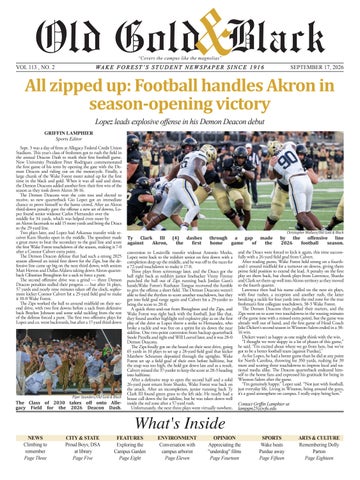
All zipped up: Football handles Akron in season-opening victory Lopez leads explosive offense in his Demon Deacon debut GRIFFIN LAMPHIER Sports Editor Sept. 3 was a day of firsts at Allegacy Federal Credit Union Stadium. This year’s class of freshmen got to rush the field in the annual Deacon Dash to mark their first football game. New University President Peter Rodriguez commemorated the first game of his term by opening the gate with the Demon Deacon and riding out on the motorcycle. Finally, a large chunk of the Wake Forest roster suited up for the first time in the black and gold. When it was all said and done, the Demon Deacons added another first: their first win of the season as they took down Akron 38-16. The Demon Deacons won the coin toss and elected to receive, so new quarterback Gio Lopez got an immediate chance to prove himself to the home crowd. After an Akron third-down penalty gave the offense a new set of downs, Lopez found senior wideout Carlos Hernandez over the middle for 34 yards, which was helped even more by an Akron facemask to add 15 more yards and bring the Deacs to the 29-yard line. Two plays later, and Lopez had Arkansas transfer wide receiver Kam Shanks open in the middle. The speedster made a great move to beat the secondary to the goal line and score the first Wake Forest touchdown of the season, making it 7-0 after a Connor Calvert extra point. The Demon Deacon defense that had such a strong 2025 season allowed an initial first down for the Zips, but the defensive line came up big on the next third down, with seniors Matt Herron and Dallas Afalava taking down Akron quarterback Cibastian Broughton for a sack to force a punt. The second offensive drive was a grind — three Demon Deacon penalties stalled their progress — but after 14 plays, 57 yards and nearly nine minutes taken off the clock, sophomore kicker Connor Calvert hit a 25-yard field goal to make it 10-0 Wake Forest. The Zips worked the ball to around midfield on their second drive, with two first downs before a sack from defensive back Braylon Johnson and some solid tackling from the rest of the defense forced a punt. The first two offensive plays for Lopez and co. went backwards, but after a 17-yard third down
Piper Saunders/Old Gold & Black
The Class of 2030 takes off onto Allegacy Field for the 2026 Deacon Dash.
Christopher Wallace/Old Gold & Black
Ty Clark III against Akron,
(4) dashes the first
through a gap made home game of the
conversion to Louisville transfer wideout Antonio Meeks, Lopez went back to the redshirt senior on first down with a completion deep up the middle, and he was off to the races for a 72-yard touchdown to make it 17-0. Three plays from scrimmage later, and the Deacs got the ball right back as redshirt junior linebacker Vinny Firenze punched the ball out of Zips running back Jordan Gant’s hands.Wake Forest’s Rushaun Tongue recovered the fumble to give the offense a short field. The Demon Deacons weren’t able to find the rhythm to score another touchdown, but they got into field goal range again and Calvert hit a 29-yarder to bring the score to 20-0. A quick three-and-out from Broughton and the Zips, and Wake Forest was right back with the football. Just like that, they found another highlight reel explosive play as on the first play of the drive as Lopez threw a strike to Hernandez, who broke a tackle and was free on a sprint for six down the near sideline. One two-point conversion from backup quarterback Steele Pizzella and tight end Will Loerzel later, and it was 28-0 Demon Deacons. The Zips finally got on the board on their next drive, going 65 yards in 10 plays to set up a 28-yard field goal that kicker Matthew Schramm deposited through the uprights. Wake Forest set up a field goal of their own before halftime, but the snap was too high, the hold got down late and as a result, Calvert missed the 37-yarder to keep the score at 28-3 heading into halftime. After a defensive stop to open the second half and a solid 26-yard punt return from Shanks, Wake Forest was back on the attack. After an incompletion, junior running back Ty Clark III found green grass to the left side. He nearly had a house call down the far sideline, but he was taken down well inside the red zone after a 57-yard rush. Unfortunately, the next three plays went virtually nowhere,
by the offensive line 2026 football season.
and the Deacs were forced to kick it again, this time successfully with a 26-yard field goal from Calvert. After trading punts, Wake Forest held strong on a fourthand-1 around midfield for a turnover on downs, giving them prime field position to extend the lead. A penalty on the first play set them back, but chunk plays from Lawrence, Shanks and Clark set them up well into Akron territory as they moved to the fourth quarter. Lawrence then had his name called on the next six plays, with four rushes, a reception and another rush, the latter breaking a tackle for four yards into the end zone for the true freshman’s first collegiate touchdown, 38-3 Wake Forest. The Demon Deacons then pulled their starters, and the Zips went on to score two touchdowns in the waning minutes of the game (one with a missed extra point), but the game was already well out of hand, and the first game of Head Coach Jake Dickert’s second season in Winston-Salem ended in a 3816 win. Dickert wasn’t as happy as one might think with the win. “I thought we were sloppy in a lot of phases of this game,” he said. “I’m excited about where we go from here, but we’ve got to be a better football team [against Purdue].” As for Lopez, he had a better game than he did at any point for North Carolina, throwing for 350 yards, rushing for 39 more and scoring three touchdowns to impress local and national media alike. The Deacon quarterback endeared himself to the home fans and expressed his gratitude for being in Winston-Salem after the game. “I’m genuinely happy,” Lopez said. “Not just with football, just everyday life. Living in Winston, being around the guys, it’s a good atmosphere on campus. I really enjoy being here.”
Contact Griffin Lamphier at lampgm25@wfu.edu
What's Inside NEWS Climbing to remember Page Three
CITY & STATE Proud Boys, DSA at library Page Five
FEATURES Exploring the Campus Garden Page Eight
ENVIRONMENT Conversation with campus arborist Page Eleven
OPINION Appreciating the "underdog" films Page Fourteen
SPORTS Wake beats Purdue away Page Fifteen
ARTS & CULTURE Remembering Dolly Parton Page Eighteen
Old Gold & Black This column represents the views of the managing editor of the Old Gold & Black, Miriam Fabrycky
Editorial: Paying attention to trees Two weeks ago, I was walking up Allen Easley Street when I was suddenly left breathless — and no, it wasn’t from ascending the steep hill leading out of Lot Q. Anxious and overwhelmed even in the second week of the academic year, I found myself staring at my shoes as I trudged home to my apartment. Mulch. Gravel. Pavement. I radiated stress into the dreary ground beneath my feet. My mind swirled as I contemplated looming deadlines, mountains of messages and emails, the dozen friends I’d greeted on move-in day with a grinning “I’ll text you! Let’s grab lunch sometime!” and the still-unpacked box in one corner of my room. As I approached a crosswalk, I glanced upwards to scan for cars, then glimpsed movement at the edge of my vision. So I
looked further. Above me towered two willow oak trees. !eir thousands of delicate leaves joined together to mighty branches, filtering the early-September sunlight into a gentle glow and catching the breeze in calming rustles. In this week’s edition of the Old Gold & Black, Environment Staff Writer Jasmine Standez interviewed University Arborist Jim Mussetter on Wake Forest’s new recognition as a Level II Arboretum on the Morton Register of Arboreta. Over his 34 years of work at Wake Forest, Mussetter has seen our forest slowly grow. “Trees that we're planting now will have a huge impact 100 years from now,” Mussetter explained. A century-old tree is a thing of wonder. It weighs thousands of pounds, soars dozens of feet into the sky and sprawls
its roots and branches wide. It provides shade and oxygen and shelter. And it is the way it is because it has weathered countless storms. My senior year of high school, when I was rejected from a college I’d hoped earnestly to attend, a dear friend sent me a snippet of writing about how trees planted in windless environments grow quickly but build weak roots. It’s the stress of actually experiencing the elements that forces trunks to grip into the earth. And of course, trees don’t do so alone, but within the shared bulwark of forests. Less than three years later, I cannot imagine attending any university but Wake Forest. I am overjoyed by the life I’ve built here on campus. And every stressor I’ve encountered so far, from tedious to existential, has ultimately passed and become just another ring in the
“
Three years later, I cannot imagine attending any university but Wake Forest. trunk. Dear reader, I do not want to bash you with platitudes about staying present, cultivating gratitude and taking time for yourself. !ese are important messages that you’ve certainly heard before. !is fall in the forest, I’ll simply extend an invitation: the next time your eyes catch on the sprawling magnolias that cover campus like the Old Gold & Black, allow yourself to wonder.
Old Gold&Black THE STUDENT NEWSPAPER OF WAKE FOREST UNIVERSITY SINCE 1916
MATTIE STILLERMAN EDITOR-IN-CHIEF stilmk23@wfu.edu
MARIA SILVEIRA
MIRIAM FABRYCKY
PIPER SAUNDERS
ANNE SHANNON
MANAGING EDITOR
DEPUTY EDITOR
MULTIMEDIA DIRECTOR
BUSINESS MANAGER
silvmt23@wfu.edu
>> NEWS Aric Loiacono, loiaat25@wfu.edu Hadassah Evans, evanha24@wfu.edu >> CITY & STATE Eve Darke, darkev23@wfu.edu >> FEATURES Bianca Reznic, riletc24@wfu.edu Rishi Vanka, vankrk24@wfu.edu >> ENVIRONMENT Ella Jennings, jennem25@wfu.edu >> OPINION Caroline Gottsman, gottca23@wfu.edu Hannah Ordan, ordahg25@wfu.edu
fabrml24@wfu.edu
>> SPORTS Griffin Lamphier, lampgm25@wfu.edu
>> ARTS & CULTURE Lydia Derris, derrlf23@wfu.edu Henry Yates, yatehs24@wfu.edu
saunpg23@wfu.edu
shanae24@wfu.edu
>> POLICIES Our job as a newspaper is to be a platform for all voices, not just the ones we agree with. However, we reserve the right to reject advertisements that are vulgar, inaccurate, obscene or violate Wake Forest’s policies on nondiscrimination, diversity, equity, and inclusion as they pertain to student organizations. We will also reject any advertisements that promote illegal activities according to the state of North Carolina.
>> PHOTO & VIDEO Christopher Wallace, wallca24@wfu.edu
Not only do we hold our newspaper and its contents to a high standard, but we also expect that those who choose to use us as an outlet for their ideas, opinions and skill hold themselves and their content to a high ethical standard.
>> SOCIAL MEDIA Paige Rakowski, rakope25@wfu.edu
!e Old Gold & Black is published !ursdays during the school year, except during examinations, summer and holiday periods, by Triangle Web Printing of Durham. !e views expressed in all opinion pieces and advertisements contained within this publication do not necessarily reflect the opinions of the Old Gold & Black. As part of our commitment to reporting news fairly and accurately, we will not remove any previously published content online unless it is retracted. If an error in either our online or print content is brought to our attention, we will revise the originally published article with an appended correction. In order to facilitate thoughtful and appropriate debate, profane, vulgar, or inflammatory comments on our website are not allowed and will be deleted. Comments which incite violence, target individuals in a form of cyber bullying, or which promote ideas which vilify marginalized communities will be deleted, and proper authorities may be notified and involved.
>> COPY EDITORS Eliana Fountain, founeg25@wfu.edu Gianna Sanchez, sancgc25@wfu.edu >> DESIGN CHIEF !omas Tilton, tilttd25@wfu.edu
>> SUBMISSIONS !e OGB welcomes submissions in the form of story tips, columns and letters to the editor. Letters to the editor should be fewer than 500 words, and columns should be around 500 words. Send yours via e-mail to stilmk23@wfu.edu the Monday before publication. We reserve the right to edit all letters for length and clarity. No anonymous letters will be printed.
>> ADVISER Ivan Weiss, weissij@wfu.edu
Want to write for us? Email wfuogb@gmail.com
>> ONLINE MEDIA Website: wfuogb.com Facebook: facebook.com/ogb1916 X (Twitter): @wfuogb Instagram: @wfuogb TikTok: @wfuogb Sports X (Twitter): @wfuogbsports
Thursday, September 17, 2025 | Page 3
News | Old Gold & Black
Climbing to remember, 25 years later Winston-Salem community, students attend annual event honoring the victims of Sept. 11 attacks EVA KATE PROBUS Contributing Writer Before sunrise on Friday, hundreds commemorated the lives lost on Sept. 11 during the annual Climb to Remember event at Allegacy Federal Credit Union Stadium. Students from Wake Forest and nearby colleges, first responders, veterans and other community members climbed one stair for each of the 2,977 people killed in the attacks 25 years ago. On Sept. 11, 2001, terrorists flew planes into the twin towers of the World Trade Center in New York City and the Pentagon in Washington. Passengers of a fourth plane resisted the hijackers, crashing the craft into a field outside of Shanksville, Pa. Of those killed, more than 400 were first responders. The No Fear Battalion, the Reserve Officers Training Corps program headquartered at Wake Forest, led the event. Destiny Bryant, the battalion’s executive officer and a Winston-Salem State University senior, said that Fri-
day brought the largest turnout in the event’s history. 1,594 participants registered, the Winston-Salem Journal reported. Many Wake Forest students attended the climb, some carrying personal connections to the Sept. 11 attacks. Sophomore Campbell Hudkins said her parents were living in New York City when the attacks occurred. She added that many people from her hometown in Connecticut lost loved ones that day. Junior Lillie Caldwell said the earlymorning exercise reminded her of the firefighters who exerted themselves to save victims. Compared with their sacrifice, Caldwell said, climbing the stairs was “something [she] could do.” While participants marched up the bleachers and cheered one another on, firefighters in full gear raced in tribute to the first responders at the Twin Towers and rows of victim names illuminated the scoreboard. One participant, Josh Pratt, hoisted a large American flag over his shoulder
as he summited dozens of flights. As an Army veteran, Pratt said he carries the flag because it represents something bigger than himself. “People get motivated by it,” he said. While Pratt was stationed in Korea at the time of the Sept. 11 attacks, many student participants at Friday’s event were not yet born. Salem College student and ROTC cadet Rhoda Champlin reflected on what it means for younger generations to remember the tragedies. “For the older generation, it really helps to be able to see all these younger people coming out, respecting the lives that were lost,” she said. Champlin described her experience as “poignant,” embodied through the thousands of victim names on the scoreboard and the effort of nearly 3,000 steps. “It’s really important for the community to come together and say, ‘We know this happened. We’re respecting it,’” Champlin said. “And then, for those people who did live through it, to see that it hasn’t been forgotten.”
Contact Eva Kate Probus at probek23@wfu.edu
Eva Kate Probus/Old Gold & Black
Students climbing at the Allegacy Federal Credit Union Stadium.
Wake Forest Goes all in with Pepsi Wake Forest expands their longstanding relationship beyond athletics to a university-wide agreement. ROMINA MOFRAD Contributing Writer Wake Forest has entered into an exclusive 10-year partnership with Pepsi Bottling Ventures, expanding the company’s presence from Wake Forest Athletics venues to the Reynolda Campus, Wake
Downtown and the Graylyn Estate. PBV has held exclusive pouring rights at Wake Forest Athletics games and venues for the past 40 years. The new agreement expands the company’s role on campus while also providing funding for student scholarships; paid internships; career opportunities; Name, Image and Likeness
Piper Saunders/Old Gold & Black
A Pepsi vending machine on Wake Forest University’s campus following a new 10-year partnership with Pepsi Bottling Ventures.
• • • • • • •
support and equipment upgrades. Wake Forest Student Body President Gray Lowder said the partnership will provide students with opportunities to gain professional experience and financial support. “This agreement represents a significant investment in our student’s futures, from expanded scholarship opportunities to paid internships and direct career pathways with a major regional employer,” Lowder said. PBV will fund paid internships in areas including marketing, sports management, business and sustainability. Students can also apply for positions as student marketers and brand ambassadors, with responsibilities including supporting a game-day waste diversion pilot program, learning about athletic marketing and representing the Wake Forest brand during promotional events. Wake Forest junior Alison Heim, a marketing communications minor, said the opportunities could help students gain professional experience. “As a marketing communications minor, I am always looking for ways I can expand my resume and experience,” Heim said. “This opportunity is important to me
POLICE BEAT
because it potentially gives me the chance to gain experience I have been curious about. I look forward to applying.” PBV is the largest independent manufacturer and distributor of PepsiCo beverages in the United States and operates two manufacturing facilities in WinstonSalem, N.C. The company’s established local presence factored into its expanded relationship with Wake Forest. Wake Forest selected PBV following a formal request for proposals process that evaluated beverage suppliers based on factors including product offerings, services and pricing. The process took approximately one year and involved representatives from several university departments, including Campus Life, Finance and Athletics. These departments eventually selected PBV for its brand portfolio, competitive pricing, available funding for equipment upgrades and existing relationship with Wake Forest. The partnership will also expand beverage options on campus, including Pepsi soft drinks, Starbucks products and Celsius energy drinks.
Contact Romina Mofrad at mofrr25@wfu.edu
An unknown individual removed an unsecured scooter from Poteat Residence Hall. The property was later recovered by the Winston-Salem Police Department. This report was filed at 12:19 a.m. on Sept. 13. An unknown individual removed two unsecured scooters from Dogwood Residence Hall. This report was filed at 3:52 p.m. on Sept. 13 An unknown individual removed an unsecured scooter from a student apartment on Allen Easley Street. The report was filed at 4:19 p.m. on Sept. 13. Two individuals consumed alcohol while underage at an off-campus fraternity party. One was transported to Wake Forest Baptist Medical Center and the other was transported to Student Health. This report was filed at 11:59 p.m. on Sept. 11. Individuals got into a pushing and shoving match at Bostwick Residence Hall. There were no injuries. The report was filed at 9:17 p.m. on Sept. 8. An individual’s fraudulent form of identification was found and turned in to University Police near Long Drive and University Parkway. This report was filed at 10 a.m. on Sept. 8. An individual’s fraudulent form of identification was found and turned in to University Police at Alumni Hall. This report was filed at 8:90 p.m. on Sept. 13.
Page 4 | Thursday, September 17, 2026
Old Gold & Black | News
Wake Forest’s new paper commercial Wake uses around 3,000 pieces of paper to tell its story of leadership and chacharacter Aric Loiacono News Editor
Wake Forest is taking a new approach to the traditional college commercial. Instead of sweeping shots of students walking around campus, the university’s latest production takes the form of a 30-second commercial that features a miniature version of the campus built almost entirely out of paper. The commercial, which initially aired on Sept. 3 during the Wake Forest football game against the University of Akron, features characters and campus landmarks constructed from about 3,000 pieces of hand-assembled paper. The production began with a storyboard before moving into sketches, prototypes and individual design elements. Over the course of three months, the creative team worked in the WakerSpace to turn those designs into a physical version of Wake Forest. The team made detailed decisions about the paper itself, including its weight and color, as well as how to create depth from otherwise flat pieces. Designers also considered details such as the greenery around campus, the design of the Wake Forest Arch and the appearance of magnolia blossoms. However, the video received attention even before this television debut. It was selected as a “highlighted campaign” by Ads of the World, a global advertising website that features creative campaigns from major brands. According to Eaton, the website receives about 4 million viewers per month, and its editors select highlighted campaigns based on criteria ncluding original thinking and creative approaches to communication problems. For Brett Eaton, Wake Forest’s vice president and chief communications officer, this recognition was especially meaningful because the commercial was produced by the university’s own marketing team, rather than an outside advertising agency. “I’m proud that our in-house team produced work that is being showcased alongside agency work for some of the world’s biggest international brands,” Eaton said. The production team devoted over 350 hours in the WakerSpace to crafting the commercial, drawing on the expertise of creative professionals at the university. Paul Whitener, associate director of digital fabrication and maker education at the WakerSpace, helped the creative team experiment with laser cutters and decipher technical challenges during this process. The team’s work included cutting, creasing, gluing and assembling hundreds of individual paper pieces. Each step went through multiple design iterations before being produced with the WakerSpace’s laser cutters. Travis VanSweden, a Wake Forest videographer, also helped bring the vision to life with a creative engineering solution: using a motionless camera equipped with a motorized steel drum that rotated the paper campus across the frame. The team needed the rotating paper world to appear as though it were moving toward and past the viewer while the camera remained stationary. According to Wake Forest, the Educating Character Initiative has awarded grants to more than 200 colleges and universities that are committed to educating character on their campuses. Furthermore, the initiative has spread into a community filled with over 2,400 faculty and administrators from over 850 institutions. That message played a vital role in shaping the commercial’s script. “We ultimately settled on a barrel roughly four feet in diameter and 18 inches off the ground,” Eaton said. “In the end, as Wait Chapel rolls beneath the barrel, it misses the floor by only one quarter of an inch.” To keep the paper pieces attached during movement, the crew placed hundreds of small magnets
Wake Forest mercial with
is a
taking a new approach hand-crafted video to
on the barrel, which also allowed them to make adjustments during filming. The barrel was wrapped in metal so the team could attach and rearrange the paper pieces as the set developed. This gave the crew flexibility to change the placement of individual segments while keeping them secure as the barrel rotated. Additionally, the team used 3D printing to create models that allowed for characters to attach to the front of the camera. These figures move through the scenes that depict Reynolda Hall and Hearn Plaza. One of the more difficult pieces of the production included creating the illusion that the miniature explorer could move through Reynolda Hall. With Whitener’s help, the creative team learned how to design and 3D print models that allowed the characters to move through the paper environment. The finished production included 2,568 individual paper pieces, 296 characters and 159 trees. Each human figure contained 17 paper pieces, while each magnolia tree required 55 pieces. The commercial’s visual style is influenced by a broader trend toward handmade visuals in advertising. Eaton pointed to recent campaigns from brands such as Ugg, Loewe and Canva as examples of entities that use handcrafted environments to communicate their brand ideas. Nonetheless, for Wake Forest, the commercial represented more than just creative choices. According to Eaton, the university aimed to demonstrate its values of leadership and character development through the commercial, with particular emphasis on the Educating Character Initiative and the Program for Leadership and Character. According to Wake Forest, the Educating Character Initiative has awarded grants to more than 200 colleges and universities that are committed to educating character on their campuses. The initiative, which was founded in 2023, now includes more than 2,400 faculty, staff and administrators from more than 850 institutions and organizations, according to the university. That mission shaped the commercial’s script, which went through numerous revisions in partnership with the Program for Leadership and Character before the team settled on the final version. “We set out to highlight leadership and character formation as distinctive aspects of the Wake Forest experience,” Eaton said. The university also wanted the commercial to communicate those ideas without relying on a tra-
to be
Courtesy of Wake Forest University the traditional college comaired this football season.
ditional montage of campus images. Eaton said the goal was to show familiar parts of Wake Forest in an unexpected way and give viewers a reason to broadcasted football games. After reviewing multiple voiceover options during the editing process, the team chose Wake Forest videographer Grace Morris to complete the project. “Here, integrity is valued as much as intellect,” Morris says in the commercial. The voiceover accompanies a student-like figure traveling through the paper campus, creating a visual representation of the student journey. The university’s behind-the-scenes materials describe the commercial as telling one story about leadership and character at Wake Forest and another about the people who designed and assembled the commercial. For Wake Forest, the commercial’s unusual production process reflects the university’s message that meaningful work can emerge from creativity and a willingness to take experimental approaches to familiar ideas. “The support we received to produce the commercial from all across campus is indicative of Wake Forest’s culture,” Eaton said. “I think it should be celebrated.” The university also worked with its Office of Sustainability to repurpose leftover paper from the project, giving the unused material a second life for creative work by students, faculty and staff. The commercial was produced entirely in-house. Eaton said outsourcing a project of this kind could have cost as much as $250,000, while Wake Forest instead relied on staff time, paper supplies and Facilities’ labor and materials. The university plans to continue airing the commercial throughout the football season. A nine-minute behind-the-scenes documentary about the commercial’s production is also available through Wake Forest’s website. It gives viewers a look at the construction and collaboration behind the 30-second advertisement. Contact Aric Loiacono at loiaat25@wfu.edu
CITY & STATE OLD GOLD & BLACK
PAGE 5 THURSDAY, SEPTEMBER 17
Eve Darke, darkev23@wfu.edu
N.C. voters are off to the races
North Carolina has become the first state to deliver mail-in ballots to voters as uncertainty surrounding postal EVE DARKE & MIRIAM FABRYCKY City & State Editor & Debuty Editor Last week, on Sept. 4, North Carolina became the first state to send mail-in ballots to voters as the courts actively reviewed President Trump’s executive order limiting voting by mail. The state began sending ballots almost two full months before the 2026 midterm elections, allowing North Carolinians the largest voting window in the country. Nearly 50,000 voters have already requested ballots, and while the rules surrounding their mail-in vote were initially unclear, the Supreme Court has since ruled that the proposed mail-in ballot regulations will not go into effect for this year’s midterm elections. The original uncertainty stemmed from Trump’s March 2026 executive order and the subsequent rules the United States Postal Service adopted to operationalize his directions. The order, titled “Ensuring Citizenship Verification and Integrity in Federal Elections,” would have required states to clear the designs of their mail-in and absentee ballots and envelopes with the federal government and submit lists of voters who request these ballots. USPS could have then refused to deliver ballots that did not comply with the rule’s design standards or were addressed to individuals not on the state’s list. The order reflected President Trump’s continued focus on unsubstantiated claims of voter fraud, which he blames in part for his loss to Joe Biden in the 2020 election. However, now that the Supreme Court has barred the proposed rules from being implemented this election cycle, mail-in voting in the midterms will proceed as usual, and votes already cast by mail will not be affected. North Carolina is not the only state that has begun to roll out mail-in voting, and 16 more are set to distrib-
ute ballots in the next two weeks. Mail-in ballots’ journey to the Supreme Court The courts took up the constitutionality of the order last spring, when a group of 23 states led by California and Washington D.C. sued the federal government and argued that the new rules infringed on their authority to administer elections. On Thursday, June 25, Massachusetts District Court Judge Indira Talwani ruled in favor of the plaintiff states, preventing the Trump administration from implementing the contested provisions of the order. The government subsequently filed an appeal, requesting a stay of the injunction from the United States Court of Appeals for the First Circuit. The appeal was denied, and the government filed an emergency application to the Supreme Court. On Monday, Aug. 24, the Supreme Court ruled in favor of the government and granted the stay on the procedural grounds that the case was not ripe for review, as USPS had not yet finalized their rules regarding the order. Only two days later, USPS published its finalized rules. In response, Judge Talwani issued a new 14-day restraining order blocking certain controversial provisions. On Thursday, Sept. 3, the government filed with the Supreme Court a second time to request another stay, warning Talwani’s new rule was causing “serious irreparable harm” to the government, states and voters. Soon after, as North Carolinians began to cast their ballots, Judge Talwani granted a preliminary injunction that formally replaced her previous ruling, prompting the Trump administration to go to the Supreme Court to request a third stay. On Monday, Sept. 14, the Supreme Court brought a temporary end to the chaos and rejected the stay, ruling that the government was unlikely to succeed on the merits of the case. In a 7-2 decision, the justices
declined to allow USPS to issue and enforce the new mail-in ballot rules ahead of November. Justice Brett Kavanaugh, concurring, reasoned that while the proposed mail-in ballot rules may be constitutional, “state and local election officials do not have sufficient time to reasonably implement the rule before the elections.” Justice Samuel Alito, joined by Justice Clarence Thomas, dissented on procedural grounds. “Some of the plaintiffs lack standing, while the remainder are pursuing a claim that this Court has recently called a ‘Hail Mary pass’ that ‘rarely succeeds,’” Alito wrote in the dissent. How to vote by mail in North Carolina Eligible voters have three options for casting their ballots in North Carolina: by mail, in person during early voting or in person on Election Day. Registration is required for all three avenues; voters can check their registration using the voter search tool from the North Carolina State Board of Elections. To request a mail-in ballot, visit the North Carolina Absentee Ballot Portal online or complete the North Carolina Absentee Ballot Request Form and return it to one’s county board of elections. Ballots must be requested by Tuesday, Oct. 20 at 5 p.m. When marking one’s absentee ballot, voters must have two witnesses or one notary public present. These witnesses must sign the envelope of the ballot. Per North Carolina’s photo identification law, the ballot envelope should also contain a copy of an eligible photo ID. Once marked, absentee ballots must be received by the county board of elections by 7:30 p.m. on Election Day, Tuesday, Nov. 3. Detailed instructions may be found on the North Carolina State Board of Elections website. Contact Eve Darke at darkev23@wfu.edu & Miriam Fabrycky at @mfabrml24@wfu.edu
Annabelle Tan/Old Gold & Black
On Sept. uncertainty
4. North Carolina became the surrounding postal rules subsided. 16
first more
state to are set to
deliver mail-in distribute ballots
ballots in the
to next
voters as two weeks.
Page 6 | Thursday, September, 17, 2026
Old Gold & Black | City & State
Proud Boys, DSA members face off in Winston-Salem Members of extremist right-wing organization gathered to protest a socialist chapter meeting EVE DARKE Staff Writer
Roughly 20 members of the Proud Boys, a far-right organization that experts describe as an extremist, neo-fascist hate group, gathered outside the Forsyth County Public Library on Saturday, Aug. 29, 2026, during a scheduled Democratic So-
cialists of America (DSA) chapter meeting in Winston-Salem, N.C. The group assembled around 3 p.m. in the summer heat, as seen in a YouTube video shared by a witness. Members wore the organization’s signature black polo shirts bearing a gold laurel wreath emblem. Many of the men also wore sunglasses, hats and face masks to obscure their
Piper Saunders/ Old Gold & Black
The Forsyth County Public Library in downtown Winston-Salem came a site of unrest when Proud Boys showed up to confront a DSA chapter meeting.
identity. As the Proud Boys arrived, DSA chapter members came outside to meet them while police officers monitored the scene. A handful of Proud Boys went inside to observe the DSA meeting but did not speak or otherwise disrupt the proceedings, said Rob Yoder, a local DSA chapter member. The opposing groups’ interactions were tense but didn’t escalate further. “Go home, fascists,” DSA members chanted. Some of the Proud Boys members displayed hand signs at the videographer, including the “OK” symbol often adopted by white supremacists, as well as the middle finger. The Proud Boys have a documented history of violence, targeted harassment and intimidation directed at their perceived political opponents such as “antifa” and other left-leaning groups. The group, which gained national attention for their role in the Jan. 6, 2021, attack on the U.S. Capitol, maintains a strong presence in North Carolina. One Kernersville, N.C. member was sentenced to over three years in prison for his involvement in the insurrection. The Democratic Socialists of America (DSA), founded in 1982, is the largest socialist organization in
the United States, comprising over 100,000 members and more than 240 chapters and organizing committees nationwide. North Carolina is home to six of those groups, including one in the Piedmont Triad. The division between these ideologies is not new, however rightwing extremism and political violence are on the rise in the U.S. In a statement to the Old Gold & Black, Wake Forest politics Professor David Beavers offered context on this trend. “Research shows that belief in conspiracy theories is positively associated with support for political violence, as was prominently visible on Jan. 6,” Beavers said. “There are numerous paths to radicalization, but one reason some people may be attracted to groups like the Proud Boys is because of exposure to false political narratives about white replacement or stolen elections.” Though the demonstration passed without major incident, the confrontation outside the Forsyth County Library speaks to the broader issue of extremism’s stronghold in North Carolina. Contact Eve Darke at darkev23@wfu.edu
Buse claims historic Winston-Salem Open title Peruvian tennis player becomes tournament’s youngest-ever champion EVE DARKE City & State Editor
On Saturday, Aug. 29, 2026, 22-year-old Peruvian Ignacio Buse defeated 24-year-old BritArthur Fery to become the Winston-Salem Open’s youngest-ever champion, surpassing Hubert Hurkacz, who was 22 years and six months old when he won the title back in 2019. The two pros battled it out in the summer heat, with Buse overcoming Fery 6-3, 6-2 in straight sets to win the title. The win marked Buse’s second title of the season, following his first tour-level trophy in May at the Bitpanda Hamburg Open, and vaulted him to a career-high No. 30 in the PIF ATP Rankings. In a post-match interview, Buse said the win was very special for him. “With all my team, we have been working very, very hard,” he said. “Some things are very tough that we go through as tennis players, but I also want to congratulate Arthur and his team.” Andrej Hadzima, a senior at Wake Forest and an intern for the WinstonSalem Open, said he enjoyed the energetic atmosphere of the event.
“Having both Fery, who is the brother to [Albane Fery,] a former Wake Forest [cross country and track & field] athlete, and Buse, who brought a slew of Peruvian fans and locals to support him, made the final even better,” he said. Hadzima also noted how special it was to watch the Open as a Wake Forest student. “This year was especially popular as it was one of the first times in which it happened while school was in session, and it seemed like many students came out to support and watch,” he explained. “It was also really amazing to see Wake Forest Tennis players such as Luca Pow and Mees Rottgering play and even seeing Rottgering advance, defeating a few tennis stars.” “Having the opportunity to intern for the tournament and watching the final live, it demonstrated how Wake Forest and the city of Winston-Salem has such a large tennis community that loves to support these kinds of events in the area,” Hadzima said. The Winston-Salem Open marks a final ATP tournament stop before professionals compete in the U.S. Open in New York. After his win in Camel City, Buse carried his mo-
mentum north and went on to defeat American Marcos Giron in the first round of the U.S. Open, following in the footsteps of his grandfather, who won a match at the historic tournament in 1958. However, Buse met his match on Sept. 3, when he lost in the second round to French
Bejamin Bonzi. Nonetheless, whatever comes next for Buse, Winston-Salem can now say it played a part in the young star’s rise to the top. Contact Eve Darke at darkev23@wfu.edu
Courtesy of Reuters
22-year-old Ignacio Buse beat Aruthur the Winston-Salem Open Finals on Aug.
Fery in 29, 2026.
City & State| Old Gold & Black
Thursday, September 17, 2026| Page 7
G20 finance meeting convenes in Asheville Treasury Secretary Scott Bessent hosts global finance leaders amid diplomatic tensions EVE DARKE City & State Editor
Last week, from Aug. 31 to Sept. 1, 2026, finance leaders from around the world met at the Omni Grove Park Inn in Asheville, N.C., for a G20 Finance Ministers and Central Bank Governors Meeting. The meeting brought together leaders from 19 countries, plus the African and European Unions, to discuss salient topics such as growing the global economy, strengthening supply chains, debt and financial literacy. It also brought business and attention to Asheville in the wake of 2024’s devastating Hurricane Helene. The G20, or Group of Twenty, is an international forum that unites the world’s major advanced and emerging economies to deliberate and plan economic policy. Its participants represent about 85 percent of global GDP and two-thirds of the world’s population. The group was founded following the financial crises of the late 1990s with the goal of promoting international financial stability. Now, the G20 meets to address issues such as global financial stability, international economic cooperation, trade and investment. Professor Patel weighs in In a statement to the Old Gold & Black, Wake Forest finance professor Ajay Patel gave his insight into what the proceedings mean for the country.. “The G20 meeting was led by U.S. Treasury Secretary Scott Bessent, so the agenda included topics of interest to the U.S.,” Patel explained. “The overall focus of the meeting was on economic growth, primarily through the private sector, deregulation and trade imbalances.” He pointed out that for the first time at a G20 meeting, business owners and leaders were invited to attend sessions and interact directly with finance ministers in a deliberate shift meant to reinforce the message of private-sector driven economic growth. “Given the $40 trillion in U.S. Treasury debt outstanding, economic growth, especially privatesector driven growth, is vital for the U.S.,” Patel said. “The U.S. also wanted its allies to coalesce around global [trade] imbalances, but they were unable to get China to agree to the wording of the text, so there was no official communique from the G20. This was not surprising since China runs a trade surplus with most of the countries in attendance.” “Overall, I would say that by getting international consensus around trade, national security, and regulatory policies, the US was able to pull key allies together while isolating economic adversaries,” Patel continued.
ongoing war in Ukraine and conflict in the Middle East, particularly around the Strait of Hormuz. Asheville’s comeback Beyond diplomatic tensions, the meeting created considerable growth and opportunity for its host city. This September marks two years since Hurricane Helene hit Florida as a Category 4 hurricane and traveled north, wreaking havoc on the southeastern United States. Torrential wind, rain and fallen debris turned Asheville into a “post-apocalyptic landscape.” Bridges broke, highways collapsed, water and power lines were destroyed, homes were decimated and 107 people in North Carolina alone tragically lost their lives. Bessent owns a home in Jackson County, N.C., an area affected by the hurricane, and says economic growth in western North Carolina is important to him. “I have friends and family who were affected,” Bessent explained in an interview with ABC 13. “One town near us, Bat Cave, N.C., the whole town just disappeared. So, for me, I think showing the resilience of the people here is very important and we’re also seeing economic growth.” Critics point out that many parts of Asheville and North Carolina have not made a full recovery and are upset with Bessent’s narrative they say suggests otherwise. However, the G20 meetings have undoubtedly put Asheville on the global stage and spurred economic growth, which could represent a huge step toward recovery. According to the Buncombe County Tourism Development Authority, the meetings brought an estimated $2 million in direct spending to Asheville. In a statement, Bessent referred to Asheville as a “comeback city” and declared that the event has
put the area “on the map globally.” “I believe America knows about Asheville, but now I think… in the past few days, the world has discovered Asheville,” he said. “I've had numerous of the delegates tell me that they're here, they've never thought of coming to this part of the United States again, and they plan to spend another three or four days,” the Treasury secretary further told reporters. With regard to North Carolina, Patel said the meetings “cast a spotlight on Western North Carolina given the devastation created by Hurricane Helene and the resilience of businesses and people in the region.” However, the economic benefits were not confined to Asheville. Patel further noted that the G20 Innovation Ministerial, co-hosted by Commerce Secretary Howard Lutnick and White House science officials, was held in Chapel Hill, N.C. “This two-day summit was focused on AI and technology-driven growth. This also put a spotlight on the technological prowess within the state,” Patel said. “Combined, these meetings should benefit North Carolina in the future,” he continued. “I am sure that our trade representatives in the state will be leveraging the international exposure and bilateral talks to attract foreign investment to benefit the state's agriculture and manufacturing sectors.” As North Carolinians wait to see if this spotlight contributes to Asheville’s full comeback, global finance leaders are looking ahead. The meetings are set to continue on Oct. 15 in Bangkok, Thailand, and culminate with President Trump’s Leaders’ Summit from Dec. 14 to 15, at Trump National Doral in Miami. Contact Eve Darke at darkev23@wfu.edu
The room where it happened In attendance were finance ministers and central bank governors from the 19 member countries, and around 500 attendees including high-profile CEOs such as Jamie Dimon of JPMorgan Chase, Goldman Sachs’ David Solomon and Eli Lilly’s Dave Ricks. One moment drew particular attention: the U.S. invited Russia’s finance minister, Anton Siluanov, from Russia without notifying other delegations. “The Russians had not been invited to a G20 meeting since the start of the war with Ukraine,” Patel noted, adding that the move caused friction with European allies and resulted in Siluanov removing himself from the group photo taken at the end of the meeting. “Personally, I am not sure how this benefited the U.S. at a time when we appear to be somewhat isolated from our allies,” Patel said, citing Russia’s
U.S. Treasury Secretary finance ministers and
Scott Bessent central bank
addresses governors
attendees meeting
at in
Courtesy of Reuters
the G20 Asheville.
FEATURES PAGE 8 THURSDAY, SEPTEMBER 17, 2026
OLD GOLD & BLACK
Bianca Reznic, reznba24@wfu.edu Rishi Vanka, vankrk24@wfu.edu
Dig In at the Campus Garden welcomes new and returning students to campus Students toured the garden, ate food and learned about sustainable farming practices RISHI VANKA Features Editor Dig In at the Campus Garden was the Office of Sustainability’s first event of the 2026-27 school year. On Sunday, Aug. 23, students gathered at the garden across Polo Road from Spry Soccer Stadium to learn about the Office of Sustainability and get hands-on experience gardening. What is the Campus Garden? The Campus Garden was established in 2009 and has become a learning space for students to learn about approaches to sustainable agriculture. Campus Garden intern and sophomore Paige Harrell said that she started working at Campus Garden because of her pre-college farming experience. “I actually worked on a couple of farms in high school,” Harrell said. “I started as a dairy farmer in Pennsylvania, and then I did some organic produce farming as a shepherd for a summer. It was really fun.” When she came to Wake Forest as a freshman, Harrell wanted to continue her passion for farming. When she learned an internship position at the Campus Garden was opening up, she applied for it and started in the role last semester. Assistant Director for Sustainability Engagement Brian Cohen said that Campus Garden interns are responsible for teaching volunteers different sustainable farming practices. “We’ll learn how to identify this certain plant that’s invasive and then, throughout the week, we’ll pick those plants out whenever we see them and educate our volunteers,” Cohen said. “That knowledge gets dispersed through to everyone.” Cohen added that the internship program allows student leaders to manage volunteers at the Campus Garden. “Our volunteers themselves can be anyone,” Cohen said. “We get a lot of students from APO, but also a lot who are more interested in gardening, learning more and
Photo courtesy of Dallas Agnew
Students Campus
feed chickens at Dig-In at the Garden between activities.
Piper Saunders / Old Gold & Black
Volunteers at the Campus ing a variety of tasks including
Garden weeding,
getting a break from all of the stress of studying.” In addition to volunteers, classes often meet in the garden. “I know writing classes have been out here, different FYS classes,” Cohen said.“There’s a whole FYS gardening course. They spend a lot of time here.”
What is Dig In at the Campus Garden? According to Cohen, “Dig In” is an introduction for students who want to learn more about Sustainability and Campus Garden. “It’s supposed to be a welcome and welcome back event,” Cohen said. “In New Deac Week, we do a lot of Information Fair-type stuff and always promote it and encourage people to come out.” Cohen began the event by introducing himself and explaining that the WFU Office of Sustainability had a list of activities for everyone to participate in: a tour of the Garden, weeding, a second tour for people who missed the first and harvesting. He then had the Office of Sustainability interns and staff introduce themselves as a large crowd ate a variety of food provided by Harvest Table, including black bean quesadillas, salad and chocolate-covered strawberries. The Garden started as a research space for the Biology department but has since expanded. As the group walked through the garden’s sections, Harrell explained the different practices that interns and volunteers use to conserve soil and water. After the tour, students were invited to put on gloves and help with weeding. Harrell said that “Dig In” is meant to be a relaxed event with hands-on opportunities to get potential volunteers excited about gardening. “It’s just to get freshmen and returners back in, get their hands dirty,” Harrell said. “We have a lot of produce and stuff to be harvested this time of year. We give most of it to Campus Kitchen but it’s nice so we can get the students to have something to take home with them.” As Harrell said this, a student walked by holding what can only be described as the biggest piece of okra the
assist the interns by performcomposting, raising chickens and more. writer of this feature has ever seen. During the harvesting portion of “Dig In,” students went through the garden and picked out apples, okra and tomatoes under the supervision of the Campus Garden interns. This supervision is especially important around the tomatoes, some of which are still grown as part of the Biology department’s continued research under Dr. Gloria Muday. “We try not to touch the research tomatoes,” Harrell said. What’s next for the Garden? The Garden currently does not have a director. “We are close to finishing up the hiring process for a new outdoor learning spaces manager who will be the caretaker of the space,” Cohen said. Harrell said that this director will be important to the management of the Garden for several reasons. “We learn a lot from our director about different farming techniques, how we do things in the garden,” she said. “It is a regenerative farming space, so you can’t do everything. Lots of things that I did on my farms in high school, we don’t do here because it’s actually not sustainable.” These techniques are the same ones that Harrell and the other Campus Garden interns teach volunteers. To get more volunteers, the Office of Sustainability will host more events throughout the semester to build student awareness. “We’ll be at the involvement fair,” Cohen said. “Our office is also working with the Sabin center to co-sponsor a conference in November that’s going to be focused on sustainability and leadership.” Campus Garden will start up its volunteer hours on Sept. 6 and volunteers can stop by on Sundays and Tuesdays. Students, faculty and staff are all welcome to volunteer.
Contact Rishi Vanka at vankrk24@wfu.edu
Features | Old Gold & Black
Thursday, September 17, 2026 | Page 9
Campus Grounds grounds campus Student-run café offers community space BIANCA REZNIC Features Editor
Tucked away next to the Taylor lounge sits Campus Grounds, Wake Forest University’s student-run café. On any given morning, one may enter to find students enjoying unique seasonal drinks, studying with friends or chatting over coffee with professors. Behind the counter, the students working have experienced Campus Grounds as a space where friendships form, organizations collaborate and all different corners of the university cross paths. Open Monday to Thursday from 9 a.m. to 5 p.m. and Fridays 9 a.m. to 4 p.m., Campus Grounds serves coffee and baked goods with coffee grounds sourced from Krankies and tea sourced from Chad’s Chai, both located in downtown Winston-Salem. And unlike other campus cafés like Smith’s in Z. Smith Reynolds Library or Peet’s beneath the North Pit, Campus Grounds is staffed entirely by students.
It's been nice to talk to a bunch of different people, meet them and make friends.
Photo Courtesy of Christiana Stanton
With coffee sourced from Krankies and tea Campus Grounds' menu features unique drink
Campus Grounds started out as a student government initiative and held its grand opening on September 15, 2003. It looked much different from the coffee shop we know today. In 2015, the coffee shop received a $30,000 makeover that an Old Gold & Black reporter likened at the time to “that indie rock band your roommate keeps asking you to try.” Only three years later, in 2018, renovation in Taylor Residence Hall shrank the size of the café and made it much more modernized, though many felt that it had been stripped of its unique and cozy vibe. “We miss the old Campus Grounds,” an Old Gold & Black editorial that year read. Today, most students do not recall the original Campus Grounds. Although the aesthetic may not be the same as it once was, it’s the relationships and community the coffee shop fosters that customers find most meaningful. Senior barista Kylee Spasoff has worked at Campus Grounds for nearly a year. She said the people behind the counter are one of her favorite parts of the job. “My favorite part is probably the friends that I made
working here,” Spasoff said. “We're all really close, which is really fun.” The sense of camaraderie goes beyond the staff. One reason Campus Grounds is unique is that, in addition to being baristas, students operate the café in general management and other leadership roles. Applicants must be eligible for federal work-study, as determined by their need-based financial aid package, and are paid $10 per hour. Barista David Burda, a junior who has only just recently started working for Campus Grounds, shared his experience training for the position. “I met with the general manager, Chris, and she taught me all things Campus Grounds including opening, closing, hot coffee, cold coffee, matcha, cold brew, everything,” Burda said. “It was a little stressful since I’d had no barista experience before, but once I had my first shift, I got into the rhythm of things and started having fun.” The shop also frequently collaborates with other organizations through events and partnerships, giving
Photo Courtesy of Christiana Stanton
The able
most couches,
recently tables,
renovated Campus and a nice view
Grounds off the
includes Taylor
comfortCourtyard.
sourced options
from Chad's Chai, for every season.
other students an opportunity to bring their communities into the space. Barista River Edge, a sophomore who has also worked at Campus Grounds for about a year, shared that the job provided her the opportunity to meet people she otherwise might not have encountered. “I have met so many people; even the people that I work with, the people that I make orders for,” Edge said. “It's kind of given me access to different parts of Wake Forest. So it's been nice to talk to a bunch of different people, meet them and make friends.” Whether meeting with friends or professors, the café offers a place for students to connect outside of the classroom. Senior barista and general manager Christiana Stanton said that her favorite part of working at Campus Grounds are the everyday moments she shares with other students and professors. “Making coffee for people and helping people start their morning or giving them a space to do homework and study, to meet with friends,” Stanton said. “I see [Wake Forest come together] when friends come to get coffee together or when professors have meetings with their students. It’s super wholesome.” Recently, Associate Vice President for Campus Life and Dean of Students Matt Clifford paid for students’ Campus Grounds orders for several hours during exam week last semester. Clifford’s event led to one of Campus Grounds’ busiest days. “It was probably the most chaotic I’ve ever seen the shop,” Stanton said. “We had to staff extra baristas. It was insane. But it introduced a lot of people to Campus Grounds and that’s pretty cool!” Like many jobs, there are some unglamorous moments. Spasoff shared that her least favorite part of the job is the cleaning. Stanton pointed out some of the logistical limitations of the café, especially the fact that they don’t accept Deacon Dollars or Old Gold swipes. This is because Campus Grounds is a separately owned entity not under Wake Forest’s dining plan. Despite such inconveniences, the benefits to working and enjoying Campus Grounds seem to far outweigh the costs. Whether it’s a good coffee, a chance to collaborate or just an aesthetic and ambient place to study, Campus Grounds continues to be a place where Wake Forest’s community crosses paths. Contact Bianca Reznic at reznba24@wfu.edu
Page 10 | Thursday, September 17, 2025
Old Gold & Black | Features
Shining the spotlight on student theater Anthony Ashton Players offers community and character growth from the writing room to curtain call PHILIP MORRISON Contributing Writer
The Anthony Ashton Players are Wake Forest’s premiere student-run theater group, ingrained deep in the campus’s long-running theatrical culture. The troupe puts on a variety of events throughout the year including member-produced shows, sketch comedy and an annual haunted house. Come one, come all Senior member Nola Adepoju said that her time with the group has been vibrant and welcoming since her first meeting. “The energy in the room is so inviting, and you feel so loved and admired,” Adepoju said. “It’s such an inviting group and they really try their hardest to make everyone feel loved and valued.” The Anthony Ashton Players welcomes all levels of theater experience. Interested students can attend their weekly meetings at 4 p.m. in Scales Fine Arts Center’s Ring Theater in Scales. AAP actors wear many hats Members of the Anthony Ashton Players fill other roles in the theater alongside acting in performances. Members write scripts, design costumes, construct sets, advertise and act —often taking on multiple responsibilities at once. “It's kind of all hands on deck when it comes to this organization,” sophomore member Max Biezin said. “You're not just a performer… you’re also helping backstage. Everybody's learning every single facet of it.” The AAP are proudly student-run and members are involved in every aspect of putting on a show from the creative process to production management. “A lot of the onus is on the students to run all these things…to design, to manage a budget and to perform as well,” Biezin said. The Anthony Ashton Players are strongly connected with Wake Forest’s broader art culture and members are often found contributing to artistic projects outside of those strictly related to the organization itself. Members appreciate involvement with the group as an opportunity to immerse themselves in
Piper Saunders/Old Gold & Black
Members at the
of the Anthony Ashton 2026 Wakeville in the
the larger creative community of Wake Forest. A troupe full of talent The Anthony Ashton Players also welcome industry professionals and faculty as contributors. Biezin reflected on how valuable his student-teacher relationships within the group have been. “These trained professionals know what they're talking about and now they're helping you… like mentors,” Biezin said. “Whether it's helping you learn how to do lights, creating opportunities for you to meet people in the media industry or in the theater industry or getting your play out there to see what people think.”
Players Scales
take Fine
the Arts
stage Center.
The Anthony Ashton Players are looking forward to bringing terror to campus with their annual haunted house event this coming October. An opportunity for growth from stagelights to interviews Involvement with the Anthony Ashton Players offers members a chance to foster a variety of unique skills helpful both on and off the stage. Nola Adepoju said her membership in AAP helped her become a noticeably stronger public speaker and networker. “When you are so heavily involved in doing theater and being a part of this very outgoing group, you pick up the skills,” Adepoju said. “You can speak better on the spot, you can answer questions, you can crack jokes… you’ll become a better speaker.” Adepoju also noted that the variety of roles members fill and the collaborative nature of theater work
The Anthony Players welcomes of theater
Ashton all levels experience.
helps develop strong interpersonal skills. “You’ll play every role in the book, even if you come in having just strictly acted,” Adepoju said. “You really learn to collaborate and to build something.” The cast and crew build more than just elaborate setpieces and take valuable skills and relationships with them into their professional and personal lives. The Anthony Ashton Players are eager to see hardcore thespians and novice theater-goers alike audition for the stage and fill a seat in the crowd. Piper Saunders/Old Gold & Black
Anthony Ashton Players Mary Caroline Kolar and Gavin Swartz play MJ and Nick Healy in “Jagged Little Pill,” Wake Forest’s musical in Spring
Healy 2026.
Contact Philip Morrison at morrpd24@wfu.edu
ENVIRONMENT OLD GOLD & BLACK
PAGE 11 THURSDAY, SEPTEMBER 17, 2026
Ella Jennings, jennem25@wfu.edu
Speaking for the trees Conversation with University Arborist Jim Mussetter JASMINE STANDEZ Staff Writer
This August, Wake Forest University received accreditation as a Level II Arboretum on the Morton Register of Arboreta. This status recognises the university’s planning, governance, staff support and education efforts to plant and maintain its trees. To create this environment, the Facilities, Real Estate and Planning Horticulture team devotes its time and effort to tending the university’s landscape. Jim Mussetter, the university’s arborist, has kept Wake Forest’s trees beautiful and healthy since 1992. Along with the Campus Tree Advisory Council, Mussetter advocates for the protection, addition and maintenance of trees on campus. “CTAC meets quarterly to discuss everything treerelated on campus,” Mussetter explained. “Main focuses include what tree species are being planted and where, how building projects will impact trees, how to minimize the impact on trees and, if there is tree loss due to construction, what trees will replace the trees removed.” To achieve arboretum status, Wake Forest was required to have this advisory council, which has been in place for many years, along with at least 100 identified tree species on campus. Ovidiu Csillik, an assistant professor of environment and sustainability studies at Wake Forest, led the process of creating the interactive campus tree map through multiple classes. Across 90 acres, Csillik and his students mapped over 1,000 trees. Mussetter aided in this process, volunteering his expertise by identifying trees as well as verifying and correcting the students’ contributions. “The tree map will be a useful tool for preserving trees during campus expansion and renovations,” Mussetter said. “It will identify areas where we have a limited population of a particular native tree spe-
cies, or maybe it’s the only one we have on campus.” While Mussetter appreciates each tree for its various ecological purposes, he has some favorites: two North Carolina native species, sassafras and sourwood. “The sourwood starts blooming in May, and the blooms last when other trees have faded,” he said. “The late flowering is good… it’s a pollinatorfriendly tree and the fall color is amazing. Same with sassafras; it has beautiful spring flowers, and the fall color is amazing, too,” Mussetter said. Mussetter considers many factors when determining which trees to plant: the species’ ability to live in an urban environment, campus biodiversity, local availability and his own personal preference. Recently, climate change has become a major consideration in deciding which trees can live on campus. “When I came to Winston-Salem in 1992, I remember the vivid colors on Reynolda Road on campus, and that seemed to disappear,” Mussetter said. “The sugar maples are declining in health, and it’s directly related to increasing temperatures.When I arrived, we were a hardiness zone 7A, and sugar maples were borderline for 7A; now we’re 8A.” Trees help mitigate the climate crisis both by absorbing carbon dioxide out of our atmosphere to lower temperatures, and also by reducing the heat island effect. When asked what changes he hopes to see over the next decade, Mussetter said more trees. “Trees are slow-growing – trees that we’re planting now will have a huge impact 100 years from now,” Mussetter said. “I won’t be around to see it, but if the tree can survive, it will have an amazing effect on this environment.” Contact Jasmine Standez at stantj23@wfu.edu
Column: Happy Environment News The news is full of doom and gloom, so let’s hear about some environment wins this week! ELLA JENNINGS Environment Editor It can be discouraging to constantly hear about pollution, extinctions and natural disasters. While it’s vital to stay informed on environmental problems, there’s a lot of good news we don’t often hear about! Read along to learn how we are making progress and feel hope for the future. Renewables on the rise The first half of 2026 has seen a huge increase in renewable energy generation and usage across the United States. Tennessee saw the largest increase in solar generation at 86% growth from 2025. New Mexico saw increases in both solar (36%) and wind (24%). Ohio and Washington saw 31% increases in solar and hydroelectric, respectively. Most notably, Texas, which produces more coal power than any other state, saw its solar generation increase by over 35%. Solar is expected to reach 78 billion kilowatt-hours, whereas coal is expected to fall to 60 billion kilowatt-hours, meaning solar could outpace coal for the first time this year. Protecting a million hectares Despite being an integral region of the Amazon rainforest, Bolivia experiences some of the highest global deforestation rates. To safeguard this exceptional area, rural communities, municipal governments and indigenous groups collaborated to conserve nearly one million hectares of Andean cloud forests and Amazonian ecosystems. These areas of forests, river systems and national park buffer zones are equal in size to Yellowstone National Park. The newly conserved land links pre-existing reserves, serving as a wildlife corridor for endangered species including endemic frogs, giant otters, spider monkeys, harpy eagles, giant armadillos and many others. N.C. shoutout! Preserving the peatlands
Ken Chen/Old Gold & Black
A pollinator-friendly flowering dogwood Chapel, recently mapped on the new
located interactive
near tree
Wait map.
A secluded sanctuary for prairie warblers, beavers and lush wood ferns, the North Carolina peatlands stretch for hundreds of miles across the eastern coast. Despite taking up just 3% of the planet’s total surface, peatlands store a third of Earth’s carbon dioxide. However, when the water table is low, peatlands release massive amounts of the carbon dioxide they store. Several nonprofit organizations and government agencies are altering irrigation systems, replacing invasive species with native ones, and incentivising carbon credits to restore North Carolina’s peatlands. This effort has the potential to be very effective because of the sheer amount of greenhouse gases stored in this ecosystem. Contact Ella Jennings at jennem25@wfu.edu
OPINION
PAGE 12 THURSDAY, SEPTEMBER 17, 2026
OLD GOLD & BLACK
Caroline Gottsman, gottca23@wfu.edu Hannah Ordan, ordahg25@wfu.edu
The views expressed in all opinion columns represent those of the article’s author, not the opinions of the Old Gold & Black Editorial Board
Are both parties trying to lose the midterms? Republicans and Democrats remain in political limbo as the midterms approach BRADY METZGER Contributing Writer With the midterms approaching, it is time to ask: Have both parties been trying to lose this election cycle? Between an extremely unpopular war and Republicans and Democrats alike seemingly out of touch on economic and social issues, politicians seem to be doing everything they can to limit their potential midterm gains. Although Trump’s unpopular administration has created an opening for Democrats, the party’s embrace of socialism and improperly vetted candidates represent a greater act of selfsabotage, undermining their ability to present a unified and convincing alternative to MAGA. On the Republican side, Trump 2.0 has not gone according to plan. However, Republicans can still tout success in curbing the migrant crisis (especially declining border crossings), extending tax cuts, creating deductions for qualified tips and overtime pay, and reversing Bidenera energy regulations. Perhaps President Trump’s most impressive accomplishment of his second term was capturing Venezuelan President Nicolás Maduro and securing U.S. rights to a 35% stake in a Venezuelan oil venture. Trump transcends conventional political logic in accomplishing these remarkable feats, yet his conduct repeatedly overshadows any achievements on which Republicans could theoretically campaign. The economy is one of the most important factors determining the success of the incumbent party in elections. With the Federal Reserve focused on curbing inflation and high gas prices, it can certainly seem like the U.S. economy is shaky. However, despite this uncertain picture, I would contend that with developments in artificial intelligence boosting the stock market this year, aboveexpected job growth in August and a steady unemployment rate of 4.1%, the U.S. economy is still strong. Yet positive economic figures do not erase the pressure households feel. In July, Pew Research found that a quarter of Americans rated the economy positively, 41% said it was “only fair” and 35% described the economy as poor. Navigator Research found that 60% of registered voters wanted Washington to prioritize inflation and living costs. Moreover, 58% of Americans disapprove of Trump’s handling of the economy. Despite this, Trump has shied away from addressing economic issues, instead focusing on the war in Iran and the White House ballroom construction. The war in Iran is Republicans’ greatest electoral liability, with gasoline averaging over $1.30 more per gallon compared to the prewar price. Additionally, Navigator’s September report found that 54% of registered voters opposed military action against Iran, including 66% of independents; 58% of voters overall considered the war not worth it (representing an eight-percentage-point increase from April 2026). President Trump exerts de facto control over the Republican Party. While that control may have helped Republicans in 2024, it seems like it will hurt them this midterm cycle, given Navigator’s Sept. 1 approval figure for Trump of 39%. Yes, the Republican Party is one big MAGA mess. However, the Democratic Party has been its own worst enemy since the start of the Trump era. Fueled by Zohran Mamdani’s impressive mayoral victory, the Democratic Party has been spiraling toward socialism as the Democratic Socialists of America has expanded its footprint throughout the party. Although the DSA remains a relatively fringe group nationally, its allies include Mamdani and Rep. Alexandria Ocasio-Cortez, a New York City chapter member. Even though socialism is on the rise across the United
States, Americans still view capitalism more favorably. According to CBS, 35% of Americans have a positive view of socialism with 42% having a negative view versus 46% positive and 33% negative for capitalism. Among Democrats, socialism receives 58% positive and 18% negative ratings. What does this poll show? Socialism is not (yet) electable on a national scale. This is crucial, because socialism can subvert American society and government as we know it. There are other socialists on the ballot in November that are not members of the DSA organization who support policies such as abolishing prisons and borders. One of these candidates is Abdul El-Sayed. Although he rejects the socialist label, Detroit DSA organizers have called El-Sayed a “longtime friend.” Perhaps the DSA and El-Sayed bond over their shared belief that Israel is illegitimate. After a synagogue attack in Michigan, El-Sayed condemned the attack but also said that “hurt people hurt people.” Although he later apologized, this language had the effect of minimizing or downplaying the attack. When CNN reporter Manu Raju asked El-Sayed whether Israel’s government was just as evil as Hamas, El-Sayed said, “Yes, killing tens of thousands of people makes you pretty damn evil.” El-Sayed also campaigned with left-wing radical streamer Hasan Piker. The Anti-Defamation League documents Piker’s descriptions of Orthodox Jews as “inbred” and “psychopaths,” and of Zionism as a “mental illness.” On his livestream, Piker has openly supported groups like Hamas, Hezbollah and the Houthis. El-Sayed later said he had no plans to campaign with Piker again; they had campaigned together before the primary election. In Maine, disgraced former Democratic candidate Graham Platner faced scrutiny over his tattoo’s Nazi symbolism. Platner claimed that he had not understood
its association and later covered his tattoo. Despite this controversy, Platner won the Democratic primary in June, but withdrew in July following a highly-publicized rape accusation, which he denies. (State Democrats selected former Maine Senate President Troy Jackson to replace Platner on July 25. Despite Platner’s ineptness, both Rep. Ro Khanna (DCalif.) and Sen. Bernie Sanders (I-Vt.) endorsed him prior to his withdrawal. Both parties’ apparent disconnect raises the question: Why does this keep happening? Primaries and social media have contributed to an increase in radicalism and partisan identity within our election cycles. On the Republican side, pressure from President Trump and his MAGA base has put the Republican Party on hold for more than a decade, creating a system where what Trump says goes and dissenters lose their jobs. On the Democratic side, activist groups have contributed to an ascension of socialism in the Democratic Party that threatens to upend the foundations of American society. My verdict: The Democratic Party has been more destructive in its self-sabotage. Republicans knew that electing Trump would entail full MAGA; the Democrats are failing to surpass an administration that is nationally extremely unpopular. Through a shift toward socialism and repulsive candidates such as Graham Platner, the Democratic Party has done wonders to sabotage its national image, discrediting itself as a legitimate alternative to the MAGA movement. While Trump remains unpopular, the midterm map does not look great for Democrats, and mishaps in Maine and Michigan might very well prove costly in terms of controlling the Senate.
Contact Brady Metzger at metzbe26@wfu.edu
Courtesy of Reuters
Although Trump’s unpopular administration has created an opening for Democrats, the party’s embrace of socialism and improperly vetted candidates represent a greater act of self-sabotage.
Opinion | Old Gold & Black
Thursday, September 17, 2025 | Page 13
The growing influence of the underdog How authentic storytelling in film is making a nuanced yet momentous revival COMMERCE FISK Staff Writer Rarely have I come across the request “Wanna go to the movies?” since the dawn of COVID-19. This summer, however, I heard it three times. The first time was to see a movie I had never heard of called “Obsession.” Curry Baker’s “Obsession” is the type of film you might find intriguing on your nightly scroll through Netflix, buried in the thriller category on your living room TV.On the other hand, Christopher Nolan and his fan base insisted that the only way to watch “The Odyssey” was on a 70mm IMAX screen — in many places the toughest ticket to acquire in town. And yet both films, the former with a budget of just $750,000 and the latter spending over $250 million, occupied the same movie screens across the world during the summer of 2026, marking perhaps the beginning of a new revival in storytelling.
To return to an age of movie theaters is to return to an age of movies, regardless of their screenplay. There is a growing feeling among film enthusiasts today that the age of originality and independent filmmaking is coming to an end. Legendary director Martin Scorsese noted that personal films yearning for promotion are neglected by studios and have been “pigeonholed to what they call indies.” As a result, movies themselves are divided into two categories, with indies’ alternative being “manufactured content,” as Scorsese puts it. Such content is continually associated with the “big three”: remakes, sequels and franchises. Evidently, these films have dominated the international box o$ce in recent years, with eight of the top 10 highest-grossing films falling into that category in 2025, nine of the top 10 in 2024 and seven of the top 10 in 2023. There is no denying the staying power of these “manufactured” films, but their recent dominance has several challenges. Christopher Nolan, among the most acclaimed and creative of the challengers, once stated regarding his writing, that “you’re never going to learn something more profoundly as when it’s purely out of curiosity.” There was a point in Nolan’s career when studios weren’t bankrolling his projects, but that curiosity in storytelling has those same studios pouncing on every Nolan project today. From the dual timeline in “Memento” to the personal and introspective biography of “Oppenheimer,” Nolan represents true innovation in storytelling in the 21st century. It was his 2010 masterpiece “Inception,” however, that marked Nolan’s true influence, combining the dreamlike imagination of his earlier works with the captivating spectacle of the future. This summer, Nolan used this same formula to create a bigger, louder adaptation of Homer’s epic “The Odyssey,” now the 18th highest-grossing movie ever. Some rebels came to screens less dramatically, but equally as importantly. A24 studios was founded in 2012 with the mission statement of “sharing movies with a distinctive point of view.” This founding ideology has made A24 particularly intriguing to Hollywood's finest directors, leaving them to execute their ideas, however fantastical, without immense studio disruption. It was earlier films like “Enemy,” “Ex Machina,” and “The Lobster” that drew in its “cult” of filmgoers, but its later projects have transformed A24 into the creative, established giant it is today. 2016’s “Moonlight” stood as a groundbreaking coming-of-age story, earning A24 its first-ever best picture award at the Oscars. The following year, “Ladybird”
was nominated for five Oscars, and in 2020 “Minari” was nominated for six. Again, with “Everything, Everywhere, All at Once,” the studio’s daring storytelling earned the film 11 Oscar nominations and seven award wins, including best picture and best director. Sometimes, it’s this very shock in storytelling that can steer the film industry toward innovation. The horror and thriller genres have captivated audiences in every rebirth throughout film’s history, and the past two years have seen a revival of terror incorporated into complicated, layered stories. 2026 brought two new inclusions to the redefined horror genre with “Obsession” and “Backrooms.” While “Backrooms” thrived on a dedicated marketing campaign from A24 and decade-long inspiration from the far corners of the internet, “Obsession” found its $500 million earnings from word-of-mouth buzz surrounding Baker’s shocking, brilliant storytelling. Baker, regarding the film’s success, said, “You can’t put too much pressure on an idea, you just got to make it.” The “underdogs’” quest for stardom is also driven by the failures of their opponents. In 2026, Hollywood aims to make $10 billion from films involving existing intellectual property. While conventionally reliable, these familiar flicks may be falling into the trap of oversaturation, as seen with 2025’s “Wicked: For Good,” which earned $125 million less in the United States than its predecessor and “Avatar: Fire and Ash,” which earned over $1.9 billion less internationally than the original installment. The complication, as analysts explain, is studios’ unnecessary oversaturation of ideas combined with a general departure from franchises’ original themes, both of which have resulted in neglecting fans of such franchises. COVID-19’s influence on movie theater attendance
hasn’t exactly helped the cause of these franchises either, a stifling presence that might just unite the box o$ce toppers and the newcomers. In the age of streaming, the underdog now is a nuanced term. The revival of original and personal films that emphasize storytelling appears as an undeniable combatant to box o$ce regulars, but that’s not to say they cannot coexist and even promote a larger mission. At this revival’s core is a love for cinema and, beneath that love, a shared cathedral of inventive characters, plots and places. Nash Information Services reported that in 2025 theaters in the U.S. and Canada sold 769.2 million tickets, compared to 2002’s 1.6 billion. With mid-budget films finding solace on streaming platforms, the variety of movie theater options seems to be dwindling. At this conclusion, film purists can place their weapons down against intellectual property and recognize that the same joy that comes from Spider-Man can also come from Scorsese. To return to an age of movie theaters is to return to an age of movies, regardless of their screenplay, where variety and a community alone allow filmgoers to experience everything from “Obsession” to “The Odyssey” to “Zootopia 2” and understand first and foremost that they have celebrated movies by simply going to the movie theater. The underdog, then, remains in constant competition with the chart-toppers for the momentum of film but possesses the unique privilege of sharing the stage with their competitors to protect the theaters that harbor them both. Contact Commerce Fisk at fiskcm25@wfu.edu
Annabelle Tan/Old Gold & Black
The revival of original and personal films that emphasize storytelling appears as an undeniable combatant to box office regulars.
Page 14 | Thursday, September 17, 2026
Old Gold & Black | Opinion
Sorry, I missed your text! Why do we forget to respond to each other when we are constantly on our phones? BEKIE SUSSMAN Staff Writer
Phones are supposed to make communication easier. “Sorry I missed your text!” “Sorry I forgot to respond!” The chances you’ve received or sent a text message like this are high. What makes these texts ironic is the fact that the sender likely didn't fail to respond because they weren't on their phone or because they were busy, but actually the opposite. They were probably on it for hours. Maybe even on it exactly when they were supposed to respond to you. They just somehow forgot to respond. Before you continue thinking about your friend who is terrible at responding, take a moment to reflect on your own texting habits.
“
I wonder how I can spend so much time on my phone yet still forget to answer important texts. How many times have you looked at a text and thought, “oh, I’ll answer that later,” and completely forgot to respond? I know I have! And not just a few times, an embarrassingly high number—which is why I’m writing this.
I wonder how I can spend so much time on my phone yet still forget to answer important texts. Why do I see the message, choose not to respond and then let it completely disappear from my mind? When I asked myself these questions, reflected on my daily routine and considered my screen time, I came up with a few possible explanations. First, these days, texting feels like a chore. Sometimes I see a message and know I should respond, but something in me—whether it's laziness or some sort of social exhaustion—stops me from responding. Sometimes responding to a long, boring text can feel just as arduous as reading the dense pages of a textbook. Responding requires energy and focus, and to be completely honest, when I'm on my phone, I feel just the opposite. Second, texters don't want to seem too desperate. There is this unspoken rule that you can’t respond to a text too immediately. Responding rapidly feels like admitting you have been waiting for a text or admitting you were doing nothing at all. So instead, I tell myself I'll wait a few minutes to respond… and I don't. Isn't that ironic? And honestly, sad. We are constantly on our phones. We scroll through apps walking in between classes, steal glances at the screen at the dinner table with our family and reach for them when we wake up, yet when someone texts us, we feel the need to pretend that we're not. Another reason could be a mix of short attention spans and forgetfulness. As a college student, I feel like I'm constantly jumping from one thing to the next, and I never feel fully organized. Clubs, homework, office hours, social time, work and our
beloved phone time can be a lot to manage. One thing grabs your attention, and then suddenly that important text you saw slips your mind. And of course, there are other reasons we take a while to respond to texts. There is always the possibility that we didn't know what to say, were avoiding the conversation or actually didn't see the text.
“
We are not delayed texters because we don't care or because we are bad people. Technology is supposed to make communication easier, not more tedious. We are not delayed texters because we don't care or because we are bad people. If anything, we care too much about what other people think of us, or we’re simply caught up with other important things in life. So the next time someone asks you to get lunch, to pay them back for dinner or what color tie you are wearing to a formal, remember that it’s more than okay to respond right then and there. There is no “perfect” way to text or respond, but there is also no shame in forgetting to text back. Know that it happens to the best of us. Contact Bekie Sussman at sussrr25@wfu.edu
Annabelle Tan/Old Gold & Black
There in
is no forgetting
“perfect” way to to text back
text or because
respond, but it happens
there to
is the
also best
no
of
shame us.
SPORTS Follow us on X @wfuogbsports
Griffin Lamphier, lampgm25@wfu.edu
OLD GOLD & BLACK
PAGE 15 THURSDAY, SEPTEMBER 17, 2026
Lopez the hero as Football downs Purdue in 2-OT road thriller 2-point conversion quarterback keeper gives Deacons 38-36 victory in West Lafayette GRIFFIN LAMPHIER Sports Editor
Coming off of a season-opening victory over the Akron Zips a week earlier, the Demon Deacons faced both their first power-conference test and their first road test of the 2026 campaign on Sept. 12. It was a trip up to West Lafayette, Ind. to take on the Purdue Boilermakers in front of a hostile noontime crowd wearing a very different version of black and gold. Purdue received the opening kickoff and nearly immediately gave the home crowd something to cheer about. The Boilermaker offense drove down the field with relative ease, culminating in a 14-yard touchdown run from star tailback Fame Ijeboi. Wake Forest quickly found themselves in a 7-0 hole and put on notice for Ijeboi’s talents. The Demon Deacon offense, led by quarterback and captain Gio Lopez, responded on their first drive of the game. Tailbacks Ty Clark III and Deuce Lawrence pounded down the field on the ground with the help of a few completions and a keeper from Lopez. After a 15-yard completion to senior receiver Antonio Meeks and a roughing the passer penalty brought them inside the 5-yard line, Clark punched it in for the touchdown to tie the game at 7. Purdue then drove into Demon Deacon territory, but after a fantastic pass breakup from junior defensive back Davaughn Patterson forced a field goal attempt, Boilermaker kicker Jacobo Echeverria Lozano hooked the 49-yarder wide left. The same couldn’t be said for Wake Forest kicker Connor Calvert, who came out for a 39-yarder on the other half of the field and gave the Demon Deacons a 10-7 lead. After a Purdue three-and-out, the Deacs went driving again. This time it was the passing attack that got them down the field, with big completions to Bryce Kania, Carlos Hernandez, Will Loerzel and Lawrence, before Lopez took it himself on a quarterback keeper to find the end zone and make it 17-7. The Boilermakers drove to the Deacon red zone, but couldn’t find a touchdown, settling for a 22-yard field goal to make it 17-10 Wake Forest at the half. The first offensive drives from each team in the second half looked pretty similar. Both teams got inside the 10-yard line, and both had to settle for field goals to set the tally at 20-13. After trading punts and being pinned down at their own 1-yard line, the Deacs threatened with the help of a 44-yard end-around rush from wide receiver Drayden Dickmann that was added to by a Boilermaker penalty. Unfortunately the drive stalled there, as Wake Forest settled for a 44-yard field goal from Calvert to extend the lead to 23-13. The final ten minutes of regulation were much more perilous for the Demon Deacons. They were unable to stall the passing attack from Purdue quarterback Max Browne. The Boilermakers took just under four minutes to go 75 yards, culminating in another touchdown run from Ijeboi. Wake Forest went three-and-out, and with just over three and a half minutes to go, the defense would have to stand strong to prevent a gamewinning Purdue touchdown. It didn’t start well, Browne immediately found receiver Asaad Waseem for a first down, and on third and short, Ijeboi broke free for 25 yards deep into Demon Deacon territory. Three more Ijeboi rushes, and it was first and goal at the 8-yard line. Then, when they
needed it most, the Demon Deacon defense stuffed the Boilermakers to force a field goal and send it to overtime, 23-23. Wake Forest got the ball first in overtime, and it didn’t take long to put the pressure on. Clark was stuffed up the middle on first down, but on second and nine, Lopez dropped back to pass, rolled left, and threw in stride over the top to the redshirt freshman Kania for a 24-yard touchdown. After an extra point from Calvert, it was 30-23, and the Boilermakers had one possession from the 25-yard line to tie or win the game. Ijeboi got a few yards up the middle on the first play, and Browne threw to the left side for De’Nylon Morrissette, who broke a tackle and made it all the way to the 5-yard line before being brought down. Ijeboi rushed for a loss, Browne’s second down pass was complete to the 2, and on third down, the Boilermaker quarterback was sacked all the way back at the 9-yard line by senior defensive lineman Gabe Kirschke. Needing one stop to end the game on fourth and nine, the Deacons brought pressure, and Browne launched a back foot throw to the end zone, which somehow found Morrissette for the touchdown. Faced with a big decision - whether or not to try and win it there with a 2-point conversion attempt - Purdue played it safe and kicked the extra point to send the game to a second overtime. Getting the ball first this time, the Boilermaker offense picked up where it left off. Browne found Ijeboi for a first down, and after a short rush and a 7-yard completion to Waseem, the quarterback took it himself for another first down. Then it was a familiar story, as on second and goal, Ijeboi punched it in for a Purdue touchdown. Forced by rule to attempt the 2-point conversion after the first overtime, they were thwarted by
a great backfield tackle from Deacon safety Rushaun Tongue, keeping the score at 36-30. Then it was Wake Forest’s turn. After a short completion to Hernandez and a Clark first down rush, Lopez was sacked to bring up second and 15 at the 17-yard line. Two incompletions later, and the Boilermakers could taste it with a gargantuan fourth and 15 incoming. Amidst a deafening away crowd, Lopez threw a strike to Hernandez, who sprinted forward to around the 2-yard line — the line to gain — where he stepped out of bounds. The initial ruling: short of the first down. Game over. But after a lengthy review, it was determined that the ball was at the line to gain when the Deacon star wideout stepped out, meaning first and goal and devastating the Boilermaker faithful. Lopez was stuffed on a keeper on first down, but on second down, the offensive line opened up a huge hole, and the Deacon quarterback dove for the goal line to tie the game 36-36 and bring it to one penultimate play yet again: the ensuing 2-point conversion attempt. Alone in the backfield, the snap went to Lopez. He scampered to the left side with blockers opening a lane, and he plunged into the end zone to win a thriller of a road test, 38-36. “What a fight from this team,” Head Coach Jake Dickert said postgame. “This is an awesome victory in week two that’s going to lead to a lot of positive things.” Meanwhile, on Lopez, Dickert had one overarching statement to the public: “We’ve got a big-time quarterback.” Contact Griffin Lamphier at lampgm25@wfu.edu
Photo Courtesy of Wake Forest Athletics
Quarterback Gio Lopez (3) and offensive lineman Will Way (70) celebrate a touchdown together in front of a dejected Purdue crowd.
Page 16 | Thursday, September 17, 2026
Old Gold & Black | Sports
Volleyball wins fifth set to beat Georgia Southern, 3-2 Demon Deacons victorious in second day of the DEACTOWN Invitational MIA KATANE Contributing Writer
Coming off a tough loss to East Carolina the day before, the Demon Deacons entered their Sept. 12 matchup with Georgia Southern looking to bounce back. What followed was a tough back and forth match filled with long rallies, kills and constant energy from both teams in Reynolds Gymnasium. Wake Forest came out on the attack with a total of 72 kills throughout the match. Junior outside hitter Lyla Stewart led the count with 18 kills, being a constant offensive spark for the Demon Deacons. Graduate student Ryleigh Whitekettle followed closely behind with 16 kills, while seniors Laiya Ebo and Sanaa Williams added 12 and 10 respectively. Wake Forest’s offense was only part of the victory, as their defense was strong throughout the entirety of the match. The Demon Deacons made Georgia Southern work for nearly every point, recording 88 digs as a team. Their defense repeatedly created rallies and long
points, making for a thrilling five-set match. At the net, sophomore middle blocker Kelis Hawkins led the Demon Deacons with five blocks. Her ability to shut down Georgia Southern spikes gave Wake Forest another defensive strength and helped keep the team stay close to the Eagles during the tight sets. The Demon Deacons continued to lean on each other as the match went on. Whether it was a big kill, a crucial dig or a teammate stepping up after a missed opportunity, Wake Forest’s positivity never went away. The constant encouragement from the bench and the players on the court helped the team stay composed through the long rallies and momentum swings, ultimately leading them to a victory. Wake Forest finished the match with 203 total attacks, 71 assists and 88 digs, while Georgia Southern recorded 205 attacks and 95 digs. The numbers reflected just how competitive the match was, with neither team willing to give the other an easy point.
After losing to ECU the previous day, the Demon Deacons showed their ability to respond and battle through adversity against Georgia Southern. It was the second match of the weekend
in the DEACTOWN Invitational, consisting of Wake Forest, East Carolina, Georgia Southern and East Tennessee State. Contact Mia Katane at katam26@wfu.edu
Piper Saunders/Old Gold & Black
The Demon Deacons continued a scalding start to their season with two victories on their Florida road trip over USF and Florida
Women’s soccer remains undefeated against No. 21 Florida Demon Deacons continue to dominate with a crucial win over Florida ETHAN TREXLER Contributing Writer On Sunday, Sept. 6, 2026, the Women’s Soccer team traveled to Gainesville, Fla. where they faced both the 21st-ranked Florida Gators and sweltering conditions. Both teams had solid starts to the season, as the Deacs did not lose or concede a single goal in their first six games,
and the Gators claimed a win against the 3rd-ranked Florida State Seminoles. This Atlantic Coast Conference / Southeastern Conference matchup marks the last nonconference game before each team begins matchups within their respective conferences. Despite the heat, it did not take the Demon Deacons long to get on the board. After 15 minutes of fluctuating momen-
Piper Saunders/Old Gold & Black
The Demon Deacons continued a scalding start to their season with two victories on their Florida road trip over USF and Florida.
tum, junior Sierra Sythe scored on a corner kick from sophomore Riley Cross. This established a 1-0 lead and an early cushion for the Deacs. While the team was able to capitalize on this opportunity, it was the defense that stood out in the first half. Following Wake Forest’s early goal, Florida applied heavy pressure. However, an impressive effort from the back line kept the Gators scoreless in the first half. Despite numerous centering passes and shot attempts from the Florida offense, all were blocked by persistent defenders or simply missed the net entirely. Florida never produced a shot on goal in the first half, despite many realistic chances. Although the Deacs took a 1-0 lead into halftime, it was unclear if the defense would continue to stay afloat amidst constant pressure. To begin the second half, Wake Forest came out with energy, producing several offensive scoring opportunities. However, the tide quickly shifted about 10 minutes into the half when Florida’s Kyra Taylor narrowly missed a wide open net on a cross from Zoe Main. After this near miss, Florida’s offense picked up right where they left off in the first half and began producing opportunity after opportunity. At this point, it seemed inevitable that Florida would score and Wake Forest would allow their first goal of the season. Despite Florida’s constant pressure, however, they remained scoreless for a major-
ity of the game, thanks to incredible defensive plays and blunderous attempts to finish goals. It was ultimately a mistake by junior goalkeeper Valentina Amaral that allowed the Gators to extinguish the Deacs’ defensive hot streak. A shot by Florida’s Tatum Borman from outside of the penalty area made its way directly through Amaral’s palms and into the back of the net, tying the game at 1-1. Although a disappointing way to lose the streak of six games without a goal allowed, Amaral recovered well and even recorded a crucial save to finish the game. With a tie game late in the second half, it was ultimately Sythe who once again assumed the hero role for Wake Forest. After a controversial penalty was called on Florida’s Lael Hill, Sythe scored her fifth of the season and second of the game on a penalty kick with just over 10 minutes left on the clock. The Demon Deacons held the lead until the end of the game, claiming their sixth win and a perfect regular season record against non-conference opponents. Despite allowing their first goal, the women’s soccer team continues to show attributes of true national championship contenders. The now-3rd-ranked Wake Forest team looks promising as they head into ACC matchups. Contact Ethan Trexler at trexew25@wfu.edu
Sports | Old Gold & Black
Thursday, September 17, 2026 | Page 17
Rees-Gibbs’ hat-trick powers No. 6 Field Hockey past VCU 7-0 Demon Deacons overwhelm Rams for third consecutive victory ZAN JONES Contributing Writer
Coming off of a dominant 6-1 victory over Ohio, No. 6 Wake Forest carried their momentum into Friday’s matchup against Virginia Commonwealth University at Kentner Stadium. The Demon Deacons wasted little time taking control. Senior Faye Janse opened up the scoring in the seventh minute, giving Wake Forest a 1-0 advantage. Only four minutes later, freshman Bianca Rees-Gibbs doubled the lead, putting the Rams on their heels early. Wake Forest continued to control the pace of the game in the second quarter. Rees-Gibbs found the back of the net for the second time, while junior Lena Keeler added to the onslaught, scoring her first goal of the season to send Wake Forest into halftime with a commanding 4-0 lead. The Demon Deacons consistently controlled possession and created opportunities in the attacking half, giving VCU no room to create chances of their own. This dominance reflected strongly in the final statistics. Wake Forest outshot
the Rams 30-3, with an 18-2 advantage in shots on goal. VCU goaltender Emma Clements was forced to make 10 saves as the Demon Deacons continued to create chances despite already holding a commanding advantage. Rather than taking their foot off the gas, Head Coach Jen Averill’s squad remained aggressive in the second half rather than simply protecting their lead. The highlight of the game was Rees-Gibbs scoring her first collegiate hat trick in the fourth quarter, capping a breakout performance for the freshman. Janse added her second goal of the night, while senior Ava Moore also found the back of the net to cement the final score as 7-0 in favor of Wake Forest. Wake Forest’s ability to spread out the scoring also stood out in their win. While Rees-Gibbs led the way with three goals, Janse added two of her own and multiple others contributed offensively. That balance made it extremely difficult for VCU to lock in on one specific player and allowed Wake Forest to maintain pressure throughout all four quarters. The seven-goal performance continued a great run of form offensively for the Demon Deacons.
Through all of the offensive highlights, Wake Forest’s defensive performance was just as impressive. VCU struggled to create chances all game, and Wake Forest produced their second shoutout in their past 3 contests. The result marked Wake Forest’s third con-
secutive victory following their defeat to Iowa. During this win streak, the Demon Deacons have defeated Michigan, Ohio and VCU while scoring 15 goals and allowing only one. Contact Zan Jones at jonezm26@wfu.edu
Photo Courtesy of Wake Forest Athletics
The Demon Deacons were victorious again at Kentner Stadium with a season-high seven goals and their second shutout.
Men’s Soccer continues winning streak against USC Upstate Demon Deacons score three in annual “We are Wake” match WILL O’NEAL Contributing Writer It was a beautiful late summer night as the Demon Deacons took on the USC Upstate Spartans for a men’s soccer match at home on Tuesday, Sept. 8 at Spry Stadium. Hot off the heels of a big 6-1 win against Duke on Saturday,
the Deacs were looking to ride that success into the matchup with a Big South program coming off a 4-3 loss against the University of Alabama at Birmingham team. Wake Forest quickly got on the attack after the starting whistle. After the Spartans put an early shot on goal, Wake Forest made numerous pushes downfield in the first minutes. None of these found the
Griffin Lamphier/Old Gold & Black
Sophomore forward Chandler Young (23) celebrates his first half goal towards the “Golden Army” student section.
back of the net, but they set what would be the tone for the rest of the game. After USC Upstate midfielder Henry Burt received a yellow card in the 19th minute, the Deacs had multiple goal scoring chances, culminating in the first goal of the match, a 25th minute tap-in by sophomore Chandler Young. Fans at Spry didn’t have to wait long for more goal-scoring action; in the 36th minute, junior Mason Sullivan fired one into the back of the net off of a free kick, giving the Deacs a 2-0 lead. Wake Forest confidently held the ball the majority of the half: USC Upstate only got two shots on goal, and most of their chances were on the counterattack. Wake Forest held a confident 2-0 lead going into the half. Coming back out under the lights, the Deacs started strong again. This time, Midfielder Joel Torbic, who also tallied an assist and received Man of the Match honors, placed the ball into the upperright corner of the goal from outside the box in the 51st minute, extending the Wake Forest lead to three. As the game stretched into the closing stages, both squads began to make some changes, but fresh legs after multiple rounds of substitutions late in the match were unable to affect the outcome. USC Upstate managed a few late opportunities, putting four shots on goal in the second half, but the three-score deficit proved too large to overcome as Wake Forest finished the match with a clean
sheet and a commendable 3-0 home win. It was a celebration in Winston-Salem, as the home side enjoyed the win with the new “Golden Army” student section – a group which provided rowdy support through the entire ninety-minute match. “[The Golden Army] just continues to grow, and hopefully it continues to grow as the season goes on,” Head Coach Bobby Muuss said in an interview with the Old Gold & Black. “We always talk about energy,” Muus said. “It’s a non-starter. You have to start with good energy.” Wake Forest fans showed out well for the Tuesday night contest. To raise awareness for mental health, the Deacs took to the field in bright green jerseys – a change from their traditional black, gold or white kits – for a charity auction, with the proceeds going to the Trinity Health Center in support of mental health awareness. “[Mental health awareness] is so important to so many people,” Muuss said. “We’re all going through something, even my guys, my staff, myself, we’re all going through something. So, just the awareness piece, knowing we’re there for each other, and knowing we’re raising money for a really good cause, we get excited for that.”
Contact Will O’Neal at oneawk26@wfu.edu
ARTS & CULTURE PAGE 18 THURSDAY, SEPTEMBER 17, 2026
OLD GOLD & BLACK
Lydia Derris, derrlf23@wfu.edu Henry Yates, yatehs24@wfu.edu
Dolly Parton, a true American Dolly Parton gave from her heart both in her charity work and in her lyrics LYDIA DERRIS Arts & Culture Editor Dolly Parton, perhaps the greatest female country music superstar of all time, passed away on Tuesday, Aug. 25 in Nashville, Tenn. She grew up in rural Appalachia, in a small town called Locust Ridge in the heart of the Great Smoky Mountains. Parton's influence on the country music industry is self-evident; she wrote over 3,000 songs across six decades and retains the rights to all of her music. Less acknowledged, however, is her invaluable dedication to philanthropy. Parton grew up impoverished, and wrote a number of songs detailing her struggle and story, such as “Old Black Kettle,” which includes the lines “We might have been poor but we didn't know it / We'd heard that word but we didn't know what it meant / Oh we used to have such a good life / And the days that I knew then are the happiest I've known.” Her experience of struggle gifted her a tremendous sense of empathy and concern for class relations. Parton’s contribution to charity over her lifetime is estimated at around $600 million, a figure that surpasses the value of her estate. She established the Dollywood Foundation in 1988 and pioneered various programs within the foundation, such as the
Courtesy of the Associated Press
Country music star Dolly Parton dies at 80, but her legacy lives on in the collective American unconscious as a pioneer of preservation of small-town American culture and as a voice for women across the world. Imagination Library in her native Sevier County, Tenn., which delivers a book a month to every child until they reach the first grade, as well as the Buddy Program, which awards every high school student from Sevier County $500 their gradua-
tion and also distributes $15,000 scholarships to those who display a commitment to pursuing higher education. Parton was attentive to the American working class and cared for education and literacy across the South. She cared
for people and she cared for the environ-
ment, and her dedication to her origins will live on for generations to come. Contact Lydia Derris at derrlf23@wfu.edu
Living a day for yourself at Wake Forest As students readjust to campus life, it’s important to remain present in your personal life LYDIA DERRIS Arts & Culture Editor
During the summertime, it feels like there’s nothing but time to do the things you love with the people you love. Returning to Wake Forest comes with the barrage of classes, social events and responsibilities that make it difficult to be present in the day to day. As a senior, this is my final year on campus and I’ve set out to spend my days intentionally to make the most of my time left as an undergraduate. Here’s how I plan to do that: A day takes shape in the form of your movements, and so it’s important to begin a morning with behaviors that will bring about the experience you’d like to have. For example, making my bed in the morning or going on a run through Reynolda are things that ground me and allow me to be mindful of my space and body. It doesn’t have to be anything big, if what makes you happy is getting a small snack from the P.O.D. or spending a few minutes talking to friends before class, give attention to those moments.
Performing small rituals that make you feel connected to your environment are paramount in grounding yourself. Attending classes and meetings are an inevitable part of being a student, but during the lulls in your schedule, it’s important to remind yourself that you don’t “just have to get through the day,” but that each day is exciting and an opportunity to grow. I like to journal and read in my free time throughout my day and complete my work at a designated time in the evenings. Once everything is done, I like to unwind by spending time with friends and chatting, or by going to one of our many museums on and around campus, including the Reynolda House, the North Carolina Museum of Art, the Hanes Gallery and the stArt Gallery. It’s the small moments of tending to yourself throughout these homogenous days and weeks that broaden and deepen the college experience, that allow you to whittle away the noise and become someone you’re proud to be. Contact Lydia Derris at derrlf23@wfu.edu
Lydia Derris/Old Gold & Black
Reading a book at Reynolda waterfall in between classes to slow down and reconnect with tactile senses.
Thursday, September 17, 2026 | Page 19
Arts & Culture | Old Gold & Black
The Power of Oasis New documentary serves as a meditation on forgiveness, human emotion, and awesome rock songs HENRY YATES Arts & Culture Editor
During my childhood, my dad, who was in his twenties in the 1990s, was obsessed with this band called Oasis. In case you don’t know, as many Americans don’t, Oasis was (is) a rock band from Manchester, England. Led by brothers Noel and Liam Gallagher, the band didn’t come from money. !ey all sound like Jamie Tartt from “Ted Lasso,” and most of them are assholes. !ey won enormous popularity in Britain back in the day, but never found serious success in the States. Single fans like my dad kept them alive out here, in the absence of a significant cultural impact. I had no interest in indulging my father’s niche interest. I found Oasis very annoying. “Wonderwall” I thought whiny and “Don’t Look Back in Anger” too loud. I didn’t even want to hear any of their other songs. However, sometime in high school I gained sense and “discovered” Oasis for myself. Like all teenagers, I had to learn the truth of my own free will, rather than hearing it from an adult, and returned to my father with my tail between my legs. !e shame didn’t last, because I had fallen in love with Oasis. By the time I got to college, they had me hook, line and sinker. When they reunited one week into my freshman year (for their “Live ‘25” tour), I immediately texted my father. A year later, we both had tickets to see them in New York City. It was an incredible concert experience, one I shall never forget. Oasis’s music, since I first fired them up for myself, has always had excellent guitar riffs and wall-of-sound production. But Noel, who wrote all the famous songs, accomplishes more than that in his music. He finds a strange way, or at least did in the band’s heyday, to both write a song that gets you moving — the kind of rock you feel in your bones — and also kind of encompass the human experience. Noel’s songs are not poems. !at doesn’t matter.
!ey are the perfect mix of lyrics, melody and production that bypass your reason and hit you straight in the gut. Oasis has a song for everything: one for falling in love (“Slide Away”), one for swagger (“Supersonic”), one for self-loathing (“My Big Mouth”), one for having fun despite the odds (“Cigarettes & Alcohol”) and of course one for moving on and forgiving (“Don’t Look Back in Anger”). If you’ve only heard “Wonderwall,” I beg you to go listen to their other songs. !eir first two albums are some of the greatest rock records on the planet. Why do I spend so much time on the impact of Oasis’s music? Because their documentary does. “Oasis: Don’t Look Back in Anger,” which I saw this weekend, chronicles Oasis’s tour through two frames: forgiveness and emotion. Forgiveness forms the backbone of the entire tour “Don’t Look Back in Anger” depicts. Oasis famously ended because the brothers hated one another. Unhappy with their legacy and also (probably) eager for cash, the brothers were forced to put aside their very real differences and past wounds in the service of a greater whole. !ey were forced to forgive. !e documentary literally shows a priest giving a sermon on forgiveness and quoting Jesus Christ. Both brothers give, in my opinion, quite heartfelt interviews about their newfound love for each other. !e Gallaghers have never been ones to fake it for the cameras, and as someone who saw them in person, they really seem to have buried the hatchet. It warmed the heart then, and it was beautiful to see in more detail. !e other frame is human emotion. !is documentary lives for the concert sequences, but it spends far more time on the crowd than it does on the band itself. Why? Because the documentary isn’t really about Oasis. Noel argues at one point that the songs aren’t even about Oasis. !e songs and the documentary are for the fans. !e documentary focuses on real stories of real people whose lives gained more meaning from Oasis’s songs. A silly rock band
from Manchester! !e documentary — and the band themselves — do not mock these people or look down on them. For all the Gallaghers’ swagger, they have always been softies, and the documentary validates this worldview. As someone who was there, the concerts’ electricity came not just with sound, but with feeling. !rough excellent visuals, pulse-pounding sound mixing and well-placed vignettes, the documentary captures this cathartic release. And as someone who fits in the category of “person who found meaning in Oasis’s music,” it was validating. I’m not the only one who feels something real listening to “Slide Away!” Seeing a whole crowd of people getting that same meaning from those songs I love meant a lot, and it reminds you of the basic power of music. More than simple noise, music touches us in ways we can’t describe, and as Liam once pontificates in the doc, maybe we can’t describe it for a reason. It transcends us. Would I recommend the documentary? Yes, but with a caution: it is not an on-ramp to Oasis, unless you count seeing that people love their music as an on-ramp. You will get a lot more out of it if you’ve already built a relationship with the songs. So while I’d encourage you to watch “Don’t Look Back in Anger,” even more I would encourage you to build your own relationship with Oasis’s songs. Start with the famous ones, but then move on to more. !eir first two albums are pure gold, but they have some good stuff from later, too. Do that, and who knows? Maybe they’ll reunite again, and it’ll be you singing your heart out, arm-in-arm with some drunk British lads, having a transcendent time. Contact Henry Yates at yatehs24@wfu.edu
Photo courtesy of Vogue
The band’s new documentary servers both as a tour retrospective and as a contemplative meditation of the lasting and formative bond that the band has developed with their fanbase over three decades of music making and touring.
Page 20 | Thursday, September 17, 2026
Old Gold & Black | Arts & Culture
Inside Bret Easton Ellis’ ‘The Shards’ A searingly accurate portrayal of the early ‘80s lives in ‘The Shards’
LYDIA DERRIS Arts & Culture Editor
Bret Easton Ellis, released a work of auto!ction named “The Shards” in 2021, he is the famed author of “American Psycho,” “Less than Zero” and “Lunar Park.” “The Shards” has been adapted into a TV show by Ellis and Ryan Murphy, exclusively on Hulu and FX. “The Shards” takes place in 1981, and the storyline follows Igby Rigney as Ellis during senior year at the elite Buckley School in Los Angeles. He is a part of the popular crowd and best friends with Kaia Gerber (Susan Reynolds) and Graham Campbell (Thom Wright). Ellis is also in a long-term relationship with one of the most eligible girls in the school, Hayes Warner (Debbie Schaffer), the daughter of a wealthy !lm producer. Externally, his life appears glamorous and ideal, but internally, Ellis is paranoid and disembodied, his thoughts consumed by a slew of killings executed
Courtesy of the Associated Press
Photo blblah
caption, Photo
blah blah blah Photo caption, blah blah caption, blah blah blah Photo caption
by a serial killer dubbed “The Trawler.” To add to his dissonance, Ellis is gay and closeted, privately seeing other boys at
his school. However, most distressing to Ellis is the arrival of a sinister new student to The Buckley School played by
Homer Gere (Robert Mallory) who hijacks his way into Ellis’ friend group. Excess reigns supreme in 1980s Los Angeles: freedom, sex, power, money, youth, glamour and drugs are the currency for !tting into the maximalist social structure. There could not be a more perfect TV series for the current moment, which too, is ruled by excess and instancy. “What I love about that generation is that they’re the digital generation, but they like analog things,” Murphy said. “They want things they can hold: vinyl records, cigarettes even.” We crave nostalgia, but we need automation. Media that immediately immerses us in the past is the perfect poison for a generation plagued by that very nostalgia and de!ned by unrestrained accessibility. Contact Lydia Derris at derrlf23@wfu.edu
The Crossword Answers can be found at wfuogb.com
THOMAS TILTON Staff Cruciverbalist Across 1 “The Lion King” villain 5 Errors over text 10 Sheep sound 13 Liam of One Direction 14 Blood-pumping organ 15 Money dispenser, in brief 16 *Dad’s dad, say 18 Chang of the Harry Potter universe 19 Lust, for one 20 Computer key found next to some space bars 21 Alternative to hider in a classic children’s game 23 What !sh and WFU buildings have in common 26 Athletic venue 27 *Victor’s neckwear 31 “Wait! ___ explain!” 32 Dance party characterized by EDM 33 One from Moscow 37 Caribbean island and infamous triangle 42 Opening atop many piggy banks 44 “Never have I ___…” 45 This newspaper, or how to describe the three themed clues of this puzzle 52 Animal (technically) found in the Great Barrier Reef 53 Discontinued airline as of May 2026 54 Headwear for a princess 56 It can take you from E to F 57 Writer Edgar Allan whose name is found within his area of expertise 60 Energy storer from science class abbr. 61 *Place to look up and count stars 65 Geese formation shape
66 Excited 67 Chicago airport 68 Places you might hear many stats, for short? 69 Garment worn by some Hindu men 70 Org. opposed to factory farming
Down 1 Garment worn by some Hindu women 2 Shade of blue used in printers 3 “Raggedy” doll name 4 Censor, as sensitive text 5 “__ teach ‘em!” 6 “Are we there ___ ?”
##
4
1
2
3
4
13
5
6
7
8
7 Oom-___ (instrumental onomatopoeia) 8 Mined materials 9 Twitch content creator 10 Supported 11 Greek goddess of war 12 Lacking ethics 13 Book subdivisions, for short 9
14
16
17
19
20
##
##
##
27
28
29
23
##
##
21
24
25
##
##
10
##
15
##
18
11
12
22 26
30
31
##
##
##
32
33
34
35
36
##
47
43
##
##
##
49
50
51
##
##
##
##
45
46
47
48
42
52
##
53
54
55
##
##
62
63
56
##
##
##
##
38
39
40
41
##
##
##
57
58
59
44
##
60
##
61
64
65
##
66
##
67
68
##
69
##
70
17 Oft-licked envelope part 22 Old-timey “before” 23 Nine-digit codes for U.S. citizens 24 Body part found within its primary function 25 Hard, dry, wound covering 27 Arboreal relative of a Pine or Spruce 28 Hosp. area for those in critical condition 29 Dormitory supervisors, in brief 30 Biblical wife of Adam 34 Remote 35 Tennis term indicating an equal score 36 Nonverbally agrees, perhaps 38 Move to a warmer state? 39 Sch. founded by Thomas Jefferson 40 Month between Nov and Jan 41 Site of a legendary couples cruise? 43 Water from the sink 45 Musical scale division 46 Dawdle in public space 47 They might be drawn in a house 48 Dart-shaped !sh 49 Unrolled sushi bar item 50 RuPaul’s specialty 51 Diagonally-moving chess piece 55 Persian title for kings 57 Certain H.S. exam 58 Fried vegetable, often 59 Needle hole 62 Freudian counterpart to id 63 Court divider in tennis 64 Most frequently used word in the English language Contact Thomas Tilton at tilttd25@wfu.edu