Old Gold&Black
FEBRUARY 20,
FEBRUARY 20,
ELLA KLEIN Editor-in-chief
After a year taut with tension after oncampus protests, Wake Forest University released a draft statement of freedom of expression and academic freedom.
The draft statement was posted on Feb. 11. According to the university, the state ment has been in the drafting process since July. Provost Michelle Gillespie ap pointed a team of eight faculty and staff members within the university to draft the statement, which is currently going through a lengthy review process.
The draft statement comes after new regulations for freedom of speech and ex pression were posted by the university in August, following the pro-Palestine pro test that evolved into an encampment last spring. In the policy, the university made limitations on when and where demon strations, chalking and posting may occur on campus.
Matthew Clifford, vice president of campus life and dean of students, was one of the eight faculty and staff members on the drafting team. In an email to the Old Gold & Black, Clifford talked about the catalyst for the draft.
“Free expression has been a big deal at Wake Forest and a strong part of the Uni versity culture, but it wasn’t written down in a single, shared document,” Clifford said. “We’ve seen recently that it would be beneficial to have shared language so that we can have difficult conversations about the nature of our community and so that when any one of us wants to express our selves, we can feel comfortable about the protections available and the responsibili ties that come along with them.”
Members of the Wake Forest communi ty can submit feedback on the draft state ment via a form on the university website.
Overview of the statement
The draft emphasizes Wake Forest’s history of inciting respectful discourse and en couraging debate, saying the uni versity “protected protesting students during the Civil
Rights movement, [and] allowed unpopular speakers in the 1970s.”
The university also states a commitment to upholding freedom of expression and academic freedom.
However, there are some limits.
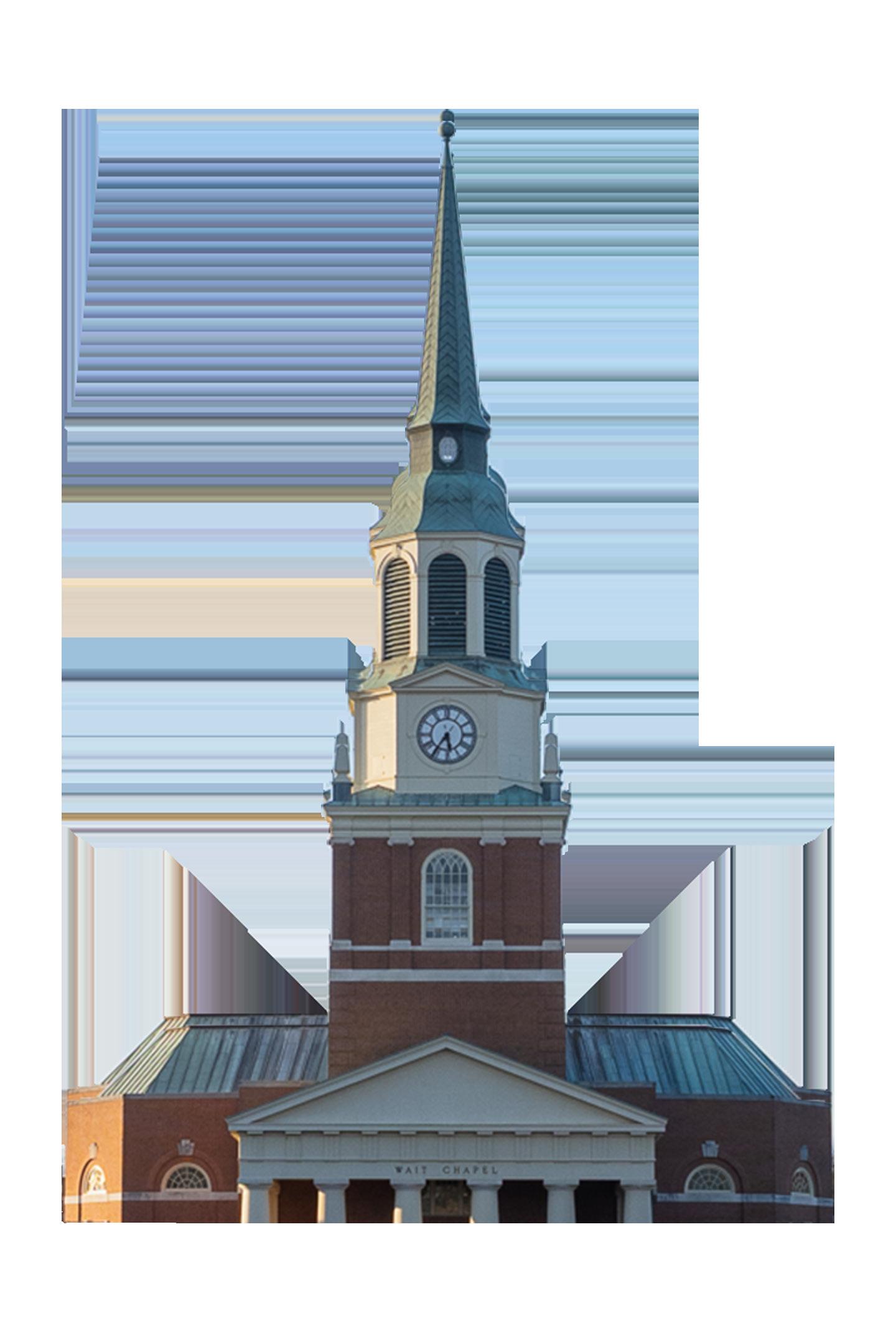
The section upholds that community members speak on behalf of themselves, not the university.
The document also outlines a commitment to an inclusive collegiate community.
According to the draft statement, “Wake Forest may restrict expression that directly affect the University’s core function,” the draft statement said.
In tandem, the university posted a preamble, which outlines the context and university history behind the draft statement. Included are six ‘notes’ sections, which give reasoning behind the main points outlined in the draft statement.
Timeline of the drafting process
From September to October, the drafting team met with several campus leadership groups, including the Provost’s Student Leadership Advisory Group, Staff Advisory Council, Faculty Senate Executive Committee, Student Government and the Deans Council. These meetings included early feedback and a review of
According to the university, from Febry to March, the drafting process will go through ‘campus conversations’.
“[The university] will host discussions draft statement to share ideas and then report feedback,” the university said. “Some of these conversations will take place in existing groups, while others will bring together Wake Forest community members from an array of backgrounds in the spirit of the valuable civil discourse that the free expression statement is meant to encourage and protect.”
On Founders Day, Feb. 20., Dean of the Law School Andrew Klein will speak about freedom of expression and academ-
“We need a starting place for community conversation about what free expression and academic freedom mean at Wake Forest,” the university said.
Editor's note: At the time of publication, Matthew Clifford spoke on behalf of the eight faculty and staff members on the drafting committee. This is a developing story.
JILL YODER Staff Writer
Saturday, Feb. 1 marked the start of Black History Month around the world. As global communities celebrate throughout the month, Wake Forest embarks on four weeks of community events, reflection and celebration honoring the Black experience.
Assistant Director of the Wake Forest Intercultural Center Jalen Shell shared that celebrating Black History Month on campus is vital to a student experience that values diversity and inclusion.
“In the Intercultural Center we value the lived experiences that make up the fiber of campus including our faculty, staff and students,” Shell said. “Dating back to the origins of the Reynolda Campus, [Wake Forest] connects back to black people. Wake Forest has made it a point to honor those that have built what we see around us today through the memorialization efforts.”
Black History Month was first celebrated as Negro History Week in 1926, and gained an overwhelming response. 50 years later, the week was transformed into Black History Month in 1976. February is now an annual celebration of the accomplishments and contributions of African Americans in American society, as well as in other countries worldwide. Wake Forest celebrates Black History Month through an array of student-organized events.
Many organizations come together to host these events, including the Intercultural Center, the Black Student Alliance (BSA) and the African and Caribbean Student Association (AfriCasa). While some events are a collaborative effort between organizations and others are unique to one group, a joint committee comes together in December to begin planning the month of student-facing activities.
Chase Clark, president of the BSA, shared that the goal when planning events is to find ideas that engage and excite the student body.
“The sky was the limit as far as creativity goes,” Clark said. “We thought about what kind of things our members usually come to and enjoy, as well as the message or story that we would like to tell through our events. It's kind of been down to the wire ever since then with getting [events] planned, [spaces] reserved and funding for everything.”
This column represents the views of the deputy editor of the Old Gold & Black, Skyler Villamar-Jones
The First Amendment is vital to every newspaper. It not only protects journalists who share their opinions but also upholds the ability of Americans to speak up against those in power. Without freedom of speech and the press, there is no check on our government.
Free speech can be dangerous. Take COVID-19: despite evidence to the contrary, the myth that the COVID-19 vaccine causes autism made many parents hesitate to give their children the vaccine. Robert F. Kennedy Jr., the current nominee for the Secretary of Health and Human Services, has denied the effectiveness of the vaccine — but as of today, over 1 million people in the U.S. have
died from complications from COVID-19.
The polarization of our nation doesn’t help. Media echo chambers prevent readers from seeing differing perspectives. Instead, they only see things that align with their current beliefs, and become distrusting of any opposing views. The news has become a zero-sum game, where people want to make ‘the other side’ look bad, no matter the cost.
Because of this, the news is frustrating. It’s disheartening, and it’s neverending. Yet, it’s vital to our democracy.
Yes, there are consequences for free speech. But the consequences of limited speech are worse.
As President Donald Trump enters his second term in the White House, alongside Republican majorities in Congress and the Supreme Court, it’s scary to consider his ability to challenge the separation of powers. Worse, it’s scary to imagine a world where nobody feels safe to speak against his actions. If there are limits on free speech, who would check those in power?
The truth is that Democrats and Republicans alike need the ability to criticize their government, and deserve to freely share their opinions. While they will never agree on every issue, no compromise can be made without hearing out this ‘other side’.
Freedom of speech is vital to upholding democracy. You certainly
THE STUDENT NEWSPAPER OF WAKE FOREST UNIVERSITY SINCE 1916
ELLA KLEIN EDITOR-IN-CHIEF kleiek22@wfu.edu
ANDREW BRAUN MANAGING EDITOR brauar23@wfu.edu
>> NEWS
Maria Silveira, silvmt23@wfu.edu
Caroline Khalaf, khalca23@wfu.edu
>> CITY & STATE
Nick Costantino, costnp24@wfu.edu
>> FEATURES
Alexandra Meier, meieam22@wfu.edu
Miriam Fabrycky, fabrml24@wfu.edu
>> ENVIRONMENT
Mia Springer, spriml21@wfu.edu
Beza Zelalem, zelam22@wfu.edu
>> OPINION
Mattie Stillerman, stilmk23@wfu.edu
>> SPORTS
Blake Robinson, robiba24@wfu.edu
Sean Kennedy, kennsm21@wfu.edu
>> ARTS & CULTURE
Lydia Derris, derrlf23@wfu.edu
Grace Schuringa, schugh24@wfu.edu
SKYLER VILLAMAR-JONES DEPUTY EDITOR villsc22@wfu.edu
>> PHOTO Piper Saunders, saunpg23@wfu.edu
>> VIDEO
Jack Perez, perejw22@wfu.edu
>> SOCIAL MEDIA
Sophie Chan, chansr23@wfu.edu
>> COPY CHIEF
Alex Keating, keatam23@wfu.edu
>> WEBMASTER
Audrey Howley, howlam23@wfu.edu
>> DESIGN CHIEF
Oliver Hale, haleop21@wfu.edu
>> ADVERTISING DIRECTOR Jordan Rill, rillje22@wfu.edu
>> ADVISER
Phoebe Zerwick, zerwicp@wfu.edu
Want to write for us? Email wfuogb@gmail.com
“
If there are limits on free speech, who would check those in power?
don’t have to agree with every news story you read, and you should choose reliable sources that you trust to provide the most fair and accurate coverage possible. It’s important to remember that free speech is the best way to ensure our government does not overstep its power and that we as citizens have the power to share our democracy.
WILL KUNISAKI MULTIMEDIA DIRECTOR kuniwx23@wfu.edu
>> POLICIES
RYDER SOLBERG BUSINESS MANAGER solbrs23@wfu.edu
Our job as a newspaper is to be a platform for all voices, not just the ones we agree with. However, we reserve the right to reject advertisements that are vulgar, inaccurate, obscene or violate Wake Forest’s policies on nondiscrimination, diversity, equity, and inclusion as they pertain to student organizations. We will also reject any advertisements that promote illegal activities according to the state of North Carolina.
Not only do we hold our newspaper and its contents to a high standard, but we also expect that those who choose to use us as an outlet for their ideas, opinions and skill hold themselves and their content to a high ethical standard.
The Old Gold & Black is published Thursdays during the school year, except during examinations, summer and holiday periods, by Triangle Web Printing of Durham. The views expressed in all opinion pieces and advertisements contained within this publication do not necessarily reflect the opinions of the Old Gold & Black. As part of our commitment to reporting news fairly and accurately, we will not remove any previously published content online unless it is retracted. If an error in either our online or print content is brought to our attention, we will revise the originally published article with an appended correction. In order to facilitate thoughtful and appropriate debate, profane, vulgar, or inflammatory comments on our website are not allowed and will be deleted. Comments which incite violence, target individuals in a form of cyber bullying, or which promote ideas which vilify marginalized communities will be deleted, and proper authorities may be notified and involved.
>> SUBMISSIONS
The OGB welcomes submissions in the form of story tips, columns and letters to the editor. Letters to the editor should be fewer than 350 words, and columns should be around 500 words. Send yours via e-mail to kleiek22@wfu.edu the Monday before publication. We reserve the right to edit all letters for length and clarity. No anonymous letters will be printed.
>> ONLINE MEDIA
Website: wfuogb.com
Facebook: facebook.com/ogb1916
X (Twitter): @wfuogb
Instagram: @wfuogb
TikTok: @wfuogb
Sports X (Twitter): @wfuogbsports
Continued from Page 1
The value of the month is expansive. It is both a time to celebrate Black culture and a call to action in the ongoing fight against racial injustice. These four weeks can prompt personal learning and reflection on our place in the ongoing story of race in America.
This month, the BSA partnered with the Intercultural Center in the First Friday cultural lunch on Feb. 7. The annual Black Professionals Forum was held in Farrell Hall on Feb. 8. AfriCasa and the BSA came together to host a Super Bowl Watch Party in

Supporting underrepresented communities on our campus does not always mean springing into action, often the most desired support is a listening ear.
the BSA lounge on Feb. 9. On Feb. 13, the BSA hosted an Educational Movie Night in their lounge, showing the movie “Love Don’t Cost a Thing.” Finally, on Feb. 24 the BSA will host “Lift Every Voice & Sing: A Musical Game Night” in their lounge.
Clark expressed the importance of students showing up to celebrate and support Wake Forest’s Black community during this month and throughout the year. Supporting underrepresented communities on our campus does not always mean springing into action – often the most desired support is a listening ear.
“In this time that is very politically divided, it’s more important than ever to put actions behind the words we are saying,” Clark said. “I think that looks like showing up and maybe not always being the loudest in the room but showing up to say ‘I see you, I support you and I see the work that you’re doing,’ whether that be work in the classroom, professionally or just the additional labor of walking around in a very homogenous space as someone that is different.”
This year’s global Black History Month theme is “African Americans and Labor,” which highlights the ways that work of all kinds intersects with the Black experience
and has profound impacts on the world. While Wake Forest organizations did not base their student events around this year’s theme, it could serve as a point of reflection for students as they engage in a wide array of activities.
On a college campus that is driven by academic and career success, Clark said that to honor work as students, we must also honor rest.
“I think that so often as students, we’re put in this place of doing labor, whether that be student labor or just the labor of walking through Wake Forest as a Black student,” Clark said. “So a lot of the events that we have here are just spaces where students can engage in rest, socialize and be themselves, which isn’t a luxury that we get all the time.”
Shell echoed Clark’s statements and stressed the importance of honoring the daily and historical labor of the Black community.
“Systemically Black people have to work harder to achieve equity,” Shell said. “There is a labor to being Black and that is worth celebrating and highlighting annually and February is a specific dedication to it.”
Contact Jill Yoder at yodejs24@wfu.edu
JANE COHEN Contributing Writer
“F**k grades. No, really.” This is what students read in the syllabus of “Gaming in the Ancient World” taught by classics professor T.H.M. Gellar-Goad.
A committee of Wake Forest faculty gathered last Tuesday with students to discuss the grading process and academic pressures around GPA at Wake Forest. The Faculty Learning Community (FLC), called “Rethinking Grading at Wake Forest,” was founded by Gellar-Goad and is composed of 12 faculty members of all units, disciplines and rankings.
The committee will study the impact of grades on students and faculty throughout the semester and hold meetings every three weeks that explore the benefits and drawbacks of traditional grading, like the motivation versus stress that grades bring. Through considering the perspectives of students and faculty, FLC is working towards a white paper and website to express their concerns, as well as productive critical conversations about grades on campus.
Referred to by members of the FLC as their “fearless leader,” Gellar-Goad is known on campus for his unique grading
process called “ungrading.” Ungrading encourages self-reflection by minimizing the use of points or letter grades in the course.
By denying traditional conventions of grading, students are emboldened to take responsibility for their learning and collaborate with their professors on their final grades.
Wake Forest junior Grace Bauer has taken several classes that utilize the ungrading system, including two with Gellar-Goad.
“It alleviates so much of the crushing pressure on students that we have come to accept as not only normal but unavoidable in college,” Bauer said. “The grades are genuine. I earn what I deserve; I am never surprised by the outcome, and without the stress, I digest the content better than ever.”
Are grades good for students?
Some students see grades as a means of motivation. Especially in divisional classes that are seen as mere requirements for students to fulfill, some feel little incentive to learn the content on their own.
“If you don’t have a grade, then what are you working towards?” freshman Emily Gregg asked.
Proponents of the traditional grading system also argue that students are incentivized to participate and excel in class to receive
positive quantitative feedback throughout and at the end of the semester.
However, the stress often consumes students and doesn’t inherently ensure success.
“At the basic level, the presence of grades generates a reward structure that removes the intrinsic motivation,” Gellar-Goad shared at the forum. “The system creates perverse incentives because you only do the work that you are graded for, rather than work that is meaningful to you.”
Gellar-Goad reflects this in his syllabus, stating, “I care about your learning and your effort, not grades. If you have come here to earn a grade, then you are wasting your time. But if you have come here because your learning is bound up with mine, then let us work together.”
The pressure of grades, tests and GPAs can also consume students to the point where their work and the professor-student relationships are compromised.
“I do feel like that result that’s going to generate a specific outcome does divide me and my students from having a fruitful experience together,” Professor Kyle Deniger shared at the forum. “The whole relationship between the faculty member and the student feels like it’s based on who has the power. When I teach, often it’s hard to feel
like those relationships are authentic.”
Many of the FLC members claim that grades anger both students and teachers since they do not allow students to make mistakes and force faculty to emotionally coddle their students rather than teach them. For this reason, members of the FLC employ alternative grading systems similar to ungrading, that permit students and professors to prioritize learning in the classroom.
“This [ungrading] system is based on mutual respect,” Bauer said. “There is no grading system in which I feel more like a respected, adult member of an advanced university.”
While the committee is critiquing the current grading system, the goal of the FLC isn’t necessarily to eliminate grades. FLC member and professor in theater and dance, Kevin Frazier, expresses that their goals in the classroom simply aren’t centered around grades.
“I want you to see the world with even half the wonder I accidentally see it with,” Frazier said in reference to their students. “And if a numerical grade is a byproduct of that, it doesn’t matter much to me.”
Contact Jane Cohen at cohejl23@wfu.edu
• An individual lost a change purse near Johnson Residence Hall and when it was recovered a fake drivers license was found. The fake ID was confiscated. This report was filed at 10:44 p.m. on Feb. 10.
• An underage individual consumed alcohol and was found unresponsive near Johnson Residence Hall. They were transported to Baptist hospital by EMS. This report was filed at 2:15 a.m. on Feb. 14.
• Winston Salem Police Department found individuals smoking marijuana in a vehicle near Lot Z2. No citations were issued. This report was filed at 12:26 a.m. on Feb. 16.
• An underage individual consumed alcohol and was found unresponsive near Johnson Residence Hall. They were transported to Baptist hospital by EMS. This report was filed at 2:37 a.m. on Feb. 16.
• An underage individual consumed alcohol and was found unresponsive near Angelou Residence Hall. They were allowed to stay in their room. This report was filed at 3:42 a.m. on Feb. 16.
JILL YODER Staff Writer
Mental health has become increasingly normalized in the world and on college campuses but remains one that can produce shame when discussed in unhealthy environments.
In a time when students are planning their futures while navigating academic and social stress, mental health is an area of well-being that should be approached with care and patience.
Student Government hosted its ninth annual Mental Health Week from Feb. 10 to Feb. 14. This year’s theme was “Mindful Masterpieces,” which focused on the message that struggling with mental health does not make you broken, it makes you a masterpiece.
The week fostered open discussions about mental health across the student body and provided students with spaces to interact with a variety of campus resources connected to student well-being.
Mental Health Week consisted of events that targeted the nine dimensions of wellness, including a Department Fair and Wakerspace art event on relaxation. These events tied into the week’s theme that being a ‘masterpiece’ involves focusing on all parts of holistic well-being.
“The main goal of [Mental Health Week] is to help break down the stigma,” Carter McDonald, co-chair of the Student Government campus life committee, said. “At the end of the day, it’s just to show people that we’re the same when it comes down to dealing with mental health. Everybody struggles with it, some people less so, some people more so, but it’s something that is going to be a part of your life forever.”
Programming was organized by the Student Government Campus Life Committee, led by Sophomore Carter McDonald and Junior Amaya Williams. Planning began in August with meetings with the University Counseling Center, the Office of Wellbeing, the Care Center, and Deacon Health, to create a theme and brainstorm events that would send the desired messages out to the student body.
The conversations between Student Government and
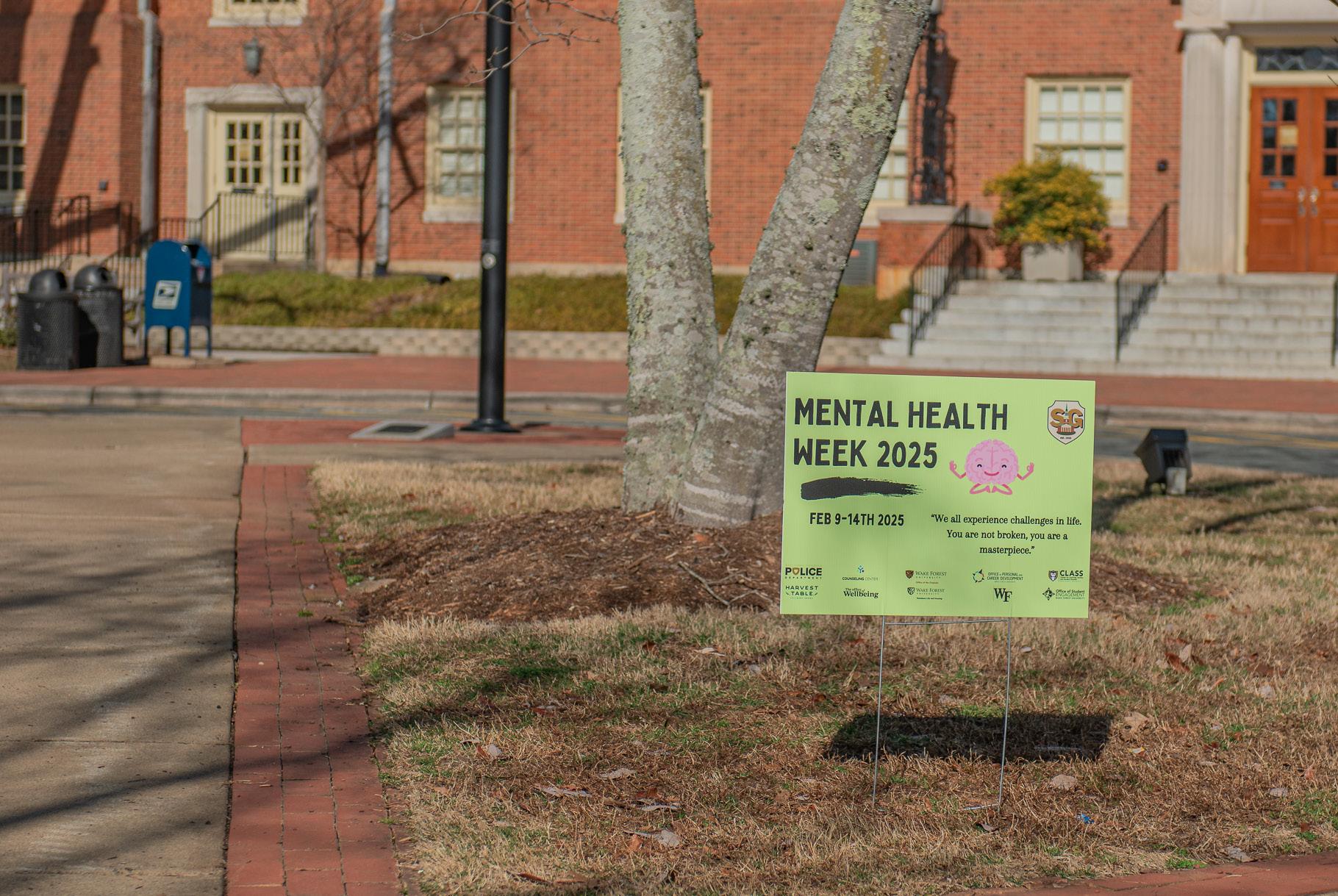
campus administrators aimed to break down the stigma around seeking help on a college campus.
“[Students] are often scared to actually access the resources available,” Williams said, “so we really wanted to focus on the fact that there is a stigma, but you’re not broken if you are talking about your mental health and seeking help for these things”
Junior Toni Wade shared that her knowledge of mental health grew when she came to Wake Forest.
“I feel like my understanding was increased when I came to campus,” said Wade. “I tried to go to every mental health event that was hosted and I think that these events help college students get more information about mental health.”
Wednesday Feb. 12 was physical health day with Campus Recreation who hosted cycle, cardio-dance, and mind/body classes in the Sutton Center. The events demonstrated to students that physical wellbeing can be engaged in a variety of ways unique to each individual. Physical health day ended with the Wake Forest basketball game against Florida State University, which was sponsored by Student Government.
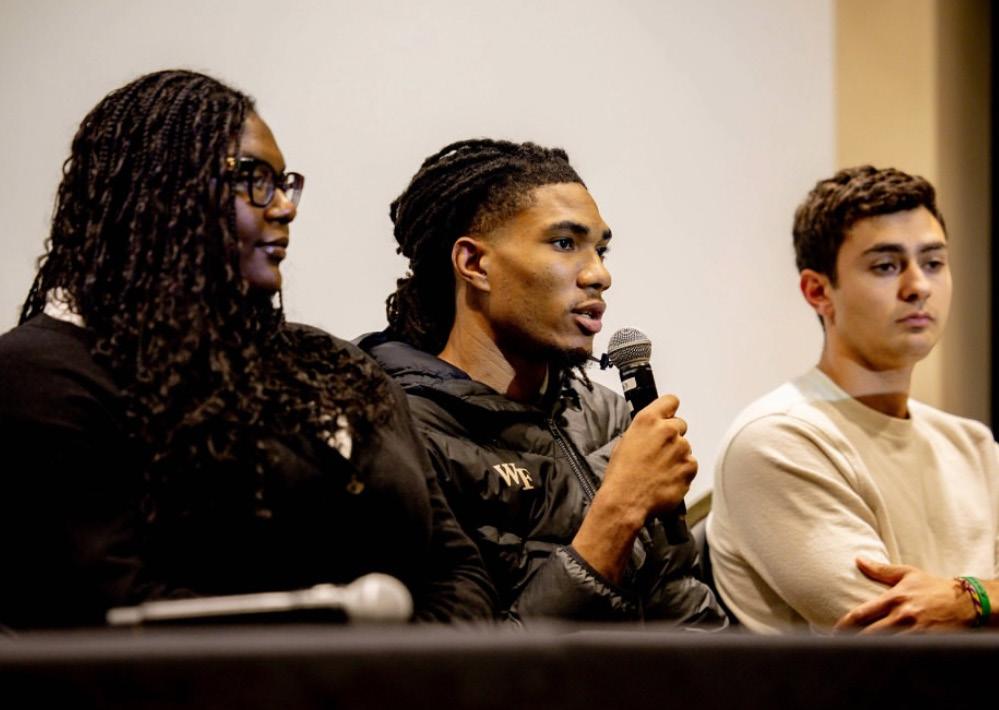
Another highlight of the week was the Mental Health Week student panel held in Pugh Auditorium on the evening of Feb. 13. Leaders engaged in a discussion, led by Matt Clifford, assistant vice president of campus life, about their personal experiences with mental health in college. The conversation touched on ways to best support peers, as well as realistic strategies for managing academic and social stress.
“We want to bring in people like student athletes and the student body president,” McDonald said. “People who have prominent leadership positions on campus who we see all the time and think ‘they must be killing it if they are able to balance school and all their responsibilities.’ It’s helpful to hear from them straight up that some days it’s a lot worse than others and some days just showing up is enough.”
Sophomore Nicholas Ashman attended the student panel and appreciated the transparency of the student leaders in sharing their own experiences.
“Everyone has stuff they’re dealing with,” said Ashman. “I think using your resources and reaching out is something that is really important. I know I have always kind of hesitated to do that, but it is acceptable and normal, and it’s good to just kind of get rid of that stigma.”
Beyond Mental Health Week, Student Government plans to continue their focus on student mental health and work with campus administrators to put more initiatives in place that aim to make every student feel seen and supported in their life on campus.
OLD GOLD & BLACK
Nick Costantino, costnp24@wfu.edu
North Carolina’s senior senator is under pressure from the GOP, facing potential primary challenges
HARSHIL JANI Staff Writer
North Carolina’s Republican Senator Thom Tillis has a hazy path to re-election in 2026 — Tillis faces strife within the Republican caucus and resulting primary challenges.
His positions on key issues and indications of unfavorability toward several of President Trump’s cabinet nominees have drawn criticism from the party’s right-wing, who wish to replace Tillis with a more hardline candidate.
One point of contention is Tillis’ approach to confirming Trump’s cabinet nominees. Though he backed Pete Hegseth for defense secretary, he expressed concerns over allegations against Hegseth. Tillis changed his stance after a 24-hour blitz from Trump, Vice President JD Vance, and John Thune, Senate majority leader.
Tillis also conveyed concern over the aggressive tactics used to push through Trump’s nominees, saying, “If anything, they could create a structural problem for future nominees if they overreach,” This disconnect has not been well received by
the GOP’s conservative base, which is freshly energized due to Trump’s re-election.
Tillis has faced backlash from North Carolina Republicans in the past. In June 2023, the party censured him for supporting legislation on gun control and same-sex marriage. This demonstrates cracks in party unity and highlights growing frustration among conservative activists. The base clarified that many in the party view him as insufficiently aligned with their priorities.
In response to the North Carolina Republican Party’s censure over his bipartisan efforts, Senator Thom Tillis remained undeterred, stating, “It was a good weekend, in my opinion.” This nonchalant reaction underscores his commitment to his legislative approach, even amid intra-party disagreements.
As a result, challengers have emerged for the 2026 Senate primary. Andy Nilsson, a businessman and former candidate for lieutenant governor, declared his candidacy and is running from Tillis’ right. Nilsson’s campaign website says he is “unapologetically MAGA,” and will “drain the swamp of career politicians, including Thom Tillis.” On the periphery, there is speculation
that Lara Trump, the daughter-in-law of the President, could be a potential contender. Her ties to Trump would make her a favorable primary opponent.
If Tillis loses the primary, the shift would undoubtedly reshape North Carolina’s representation in the Senate. A more conservative candidate would further Trump’s initiatives and serve as a crucial ally in a tightly held GOP majority. However, such a change would alienate moderate Republicans and independents critical to North Carolina’s status as a swing state. A far-right nominee will face difficulties in the general election, giving Democrats an opportunity to flip the seat.
Beyond current electoral implications, replacing Tillis would mean losing a senior senator with relationships, committee assignments, and familiarity in Washington. His ability to negotiate across the aisle and influence legislative matters would be difficult to replace with a new senator. Essentially, a change of this nature would reduce North Carolina’s leverage in national policy discussions.
If Tillis survives the primary challenges, he will need to appeal to the broader elec-
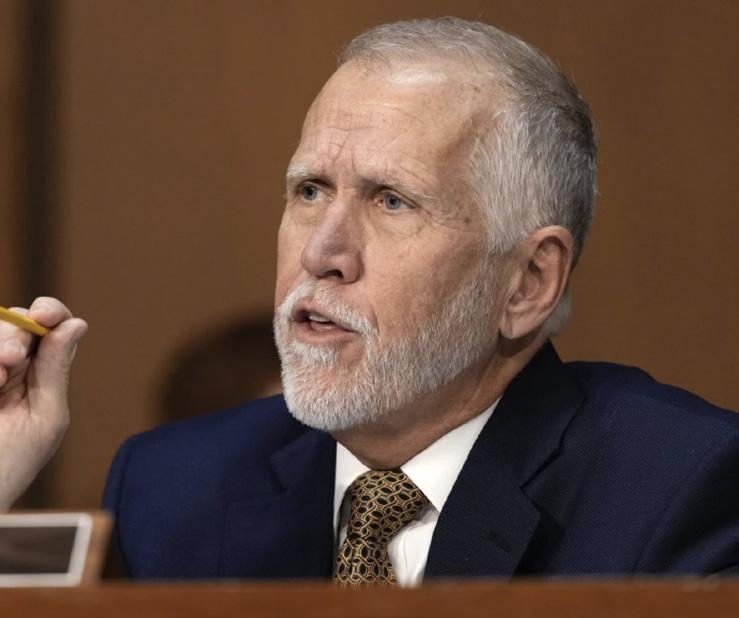
torate in what is to be a competitive general election. His path to a third term is anything but certain, and the coming months will reveal whether he can navigate the ideological divisions within the Republican Party to secure re-election.
Contact Harshil Jani at janih23@wfu.edu
Construction will start in 2027, with an estimated cost of $2-3 billion
ALYSSA ALLEY
Contributing Writer
In a historic partnership, the University of North Carolina Health and Duke University Health formally announced plans to build North Carolina’s first standalone children’s hospital on Jan. 28.
The new facility, called North Carolina Children’s, will be located in the Triangle area and is expected to transform pediatric care in the state. However, the final location of N.C. Children’s has yet to be determined, though officials expect to finalize the site selection by summer 2025.
North Carolina Gov. Josh Stein said, “There isn’t a freestanding children’s hospital between Atlanta and Washington, D.C., making this project critical for our region.”
The hospital will include 500 beds, an outpatient care center and a dedicated behavioral health facility. Construction is scheduled to begin in 2027, with completion projected in the early 2030s. The estimated cost ranges between $2 billion and $3 billion, with funding
from a combination of state investment and private donations.
Currently, UNC Children’s Hospital, which opened in 2001, has 150 inpatient beds, and Duke’s Children’s Hospital holds 202 inpatient beds. While these facilities have served the state’s pediatric needs for over two decades, their capacity is insufficient to meet the demands of North Carolina’s rapidly growing population. With its significantly larger capacity, the planned N.C. Children’s Hospital will address the urgent need for expanded resources and facilities.
North Carolina is currently the most populous state in the U.S. without a standalone children’s hospital. Existing pediatric facilities are at capacity, leading to long wait times and the need for families to travel out of state for specialized care.
“North Carolina’s current children’s hospitals do not have the ability to build broad-based, highly-specialized pediatric care,” Dr. Wesley Burks, CEO of UNC Health, said in an announcement. “This means that sick kids often have to transfer between hospitals, or worse, and often,
have to leave North Carolina for treatment.”
Standalone children’s hospitals play a crucial role in pediatric healthcare by offering highly specialized treatments in a child-centered environment. Unlike general hospitals with pediatric wings, standalone facilities ensure that children receive care unique to their medical and emotional needs. These hospitals foster collaboration among pediatric specialists, support cutting-edge research and provide an environment designed specifically for young patients and their families.
This facility will also include 70 inpatient behavioral health beds and 70 emergency department bays, addressing a significant gap in pediatric mental health services in the state. North Carolina's Child Health Report Card recently awarded the state an F grade for mental health, highlighting the urgent need for improved care in the area.
“This is truly a remarkable step to tell the nation we recognize that children are different. And we’re doing something about it,” Rep. Donny Lambeth said.
The facility is also expected to have a
significant economic impact, creating over 8,400 jobs and generating an estimated $26.8 billion in gross domestic product for North Carolina over two decades. It is projected to attract more than $120 million annually in research funding from the National Institutes of Health. Additionally, it will be a top teaching facility supported by both Duke and UNC Schools of Medicine.
The project has received bipartisan support in the state legislature, with an initial $320 million investment already approved. Lawmakers say they will review additional funding requests as construction begins.
“Picture this, a campus that just exudes hope, health and healing — just for kids and their families,” said Dr. Craig Albanese, CEO of the Duke University Health System. With the support of the state, medical leaders and families across North Carolina, N.C. Children’s will become a beacon of hope for pediatric healthcare in the state.
Contact Alyssa Alley at alleal23@wfu.edu
MALCOLM BROWN Staff Writer
In late September 2024, Hurricane Helene struck the southeastern United States, with North Carolina suffering some of the worst effects. The storm resulted in over 100 confirmed deaths and relocated millions of people from their homes. Following the wreckage in the western part of the state, the Office of Budget and State Management released a report on Dec. 13, 2024, estimating the damages to exceed $59.6 billion.
According to the report, after the hurricane’s destruction, FEMA allocated $850 million to the devastated areas impacted by Hurricane Helene. Former Gov. of North Carolina Roy Cooper requested $3.9 billion in funding from the North Carolina General Assembly (NCGA) in late October. Additionally, former President Biden requested $98.6 billion in federal funding from Congress to support recovery efforts in communities across the Southeast in mid-November.
However, even with this aid, North Carolina officials who were tasked with leading recovery efforts in the region recently urged state lawmakers for more funding.
Many North Carolina departments and agencies are involved in the recovery effort. One priority in the relief efforts was to get resources to communities who could not get them themselves. As a result, the state, local and federal governments working with nonprofits and volunteers used aerial delivery for water, food and medicine.
Another priority was the North Carolina National Guard and State Highway Patrol. According to the official website of the State of North Carolina, more than 3,150 soldiers and airmen have been working in Western North Carolina in the aftermath of the storm.
However, even with these efforts, there is still so much more to be enacted for western North Carolina to make a full recovery from the hurricane that devastated the region.
The advisor for the Governor’s Recovery Office for Western North Carolina outlined a gap of around $10 billion between what North Carolina asked from the federal government and what they received.
North Carolina Governor Josh Stein is hoping that any future funding bill that is directed toward the Los Angeles wildfires will have money set aside for Western
North Carolina. Stein is particularly worried about business in the state.
“If we do not act, some businesses will not be here in the summer, and we will miss an entire building season before the winter weather comes again,” Stein warned, calling the funds a “high priority.”
Stein has also urged the N.C. General Assembly for $1 billion in Helene storm recovery funding for this spring to help Western North Carolina, instead of waiting for the two-year budget in June.
Republicans appear receptive to Stein’s request for additional aid to western North Carolina, where they control both houses of the legislature. State Republican representative Jake Johnson, who served on the bipartisan Helene advisory committee, appeared optimistic about Stein’s proposal:
“We will start reviewing the governor’s proposed budget and figuring out how we can get these dollars to people who need them the most right now,” Johnson said during a news conference on Feb. 3.
Despite funding gaps, recovery efforts in Western North Carolina continue, with leaders pushing for swift aid. Bipartisan support is growing, raising hopes that relief funds will arrive in time to help
businesses survive, restore homes and rebuild communities after Hurricane Helene.

browmd24@wfu.edu
MIRIAM FABRYCKY Features Editor
The Trump administration is preparing an executive order to reduce or abolish the Department of Education. While this may overhaul national educational policy, K-12 and post-secondary students in North Carolina will experience few direct repercussions.
The department faces perennial criticism from Republican politicians, who argue that it introduces needless bureaucracy to educational systems. Still, bipartisan backing for the programs it administers, including Title I grants and the Individuals with Disabilities Education Act, has sustained the controversial department through eight presidential administrations since its founding. This streak may end with Trump’s return to the Oval Office.
Contrary to popular belief, the Department of Education has little power to shape curriculum; states set their educational standards. The department’s primary responsibilities include collecting financial and academic achievement information from educational institutions, protecting students from discrimination and overseeing student aid programs such as the Free Application for Federal Student Aid (FAFSA), Pell Grants and Federal Work-Studies. 9% of Wake Forest students receive Pell Grants, which are federal funds earmarked for low-income students, while 16% receive federal loans. Delivery of this aid may be delayed if the Depart-
ment of Education undergoes significant change, a situation that echoes the well-publicized glitches that impeded the rollout of the updated FAFSA last year.
In addition, Historically Black Colleges and Universities (HBCUs), which are already undergoing organizational shifts as a result of the Trump administration’s campaign against DEI programs, tend to draw more federal funding than Predominantly White Institutions (PWIs).
HBCUs may subsequently be affected more substantially by delays or terminations of federal funding.
Winston-Salem State University, for instance, received $35.6 million from the federal government over the past 12 months, of which $28.43 million came directly from the Department of Education. Wake Forest University, in comparison, received $6.1 million. The Department of Health and Human Services was the primary allocator of grants to Wake Forest, which applied the vast majority of these funds to the School of Medicine.
Another common misconception is that public school districts rely primarily on federal funding. While the Department of Education did award Winston-Salem/Forsyth County Schools
$4.4 million this past year, such backing constitutes only a fraction of the district’s total budget, which measured around $582 million in the 2020-2021 school year. The state of North Carolina provides about 62% of this money, with Forsyth County supplying another
27%. School districts around the state and country operate under similar funding schemes.
More common is direct federal funding through Title I of the Every Student Succeeds Act, which supplies additional financial support to schools that enroll 40% or more of their students from low-income backgrounds. 55 of the 81 schools in Winston-Salem and Forsyth County are Title I institutions.
The new administration has also taken steps to eliminate diversity, equity, and inclusion (DEI) informed programs and end support for transgender students in favor of “patriotic” education. Trump recently stated that he asked Linda McMahon, his nominee for education secretary, to “put herself out of a job.”
The newly created Department of Government Efficiency (DOGE) is spearheading efforts to dissolve the Education Department, which is congressionally funded. DOGE is a government organization, not an executive department like the Department of Education and, thus, Congress does not oversee it. However, DOGE’s exact aims and intended methods for doing so remain unclear.
A man who said he was a federal employee but who was not identified by name barred Democratic House members from accessing the Education Department building on Feb. 8. When criticized online by the lawmakers, Elon Musk, leader of DOGE and close ally to Trump, stated that “no such [education] department exists in the federal government.”
Trump’s recent series of executive orders has also affected educational initiatives beyond the reach of the Department of Education. Head Start, a comprehensive intervention program for low-income children that is administered by the Department of Health and Human Services, was unable to access grants during the short-lived freeze on federal spending. Many Head Start centers that relied on weekly federal payments laid off employees or shuttered completely. The freeze also disrupted the flow of discretionary grants to researchers at universities across the country.
The Education Department cannot legally be dismantled without congressional action. However, Trump may seek to slash programs not required by law and reassign mandatory initiatives to other departments. Dozens of workers at the Education Department, which employs around 4,000 people in total, have already been placed on leave or had their contracts terminated.
It is unlikely that changes to the Department of Education will directly impact Wake Forest students. However, especially when considering low-income families involved with Head Start, Title I and similar programs, it is clear that Winston-Salem will not be immune to upheaval in Washington.
Contact Miriam Fabrycky at fabrml24@wfu.edu
Alexandra Meier, meieam22@wfu.edu
Miriam Fabrycky, fabrml24@wfu.edu
7
THURSDAY, FEBRUARY 20, 2025
VIRGINIA NOONE Senior Writer
Wake Forest University prides itself on admitting a wide variety of students from across the globe. With a unique application process and emphasis on a liberal arts education, the university attracts students with a variety of interests.
However, as a predominantly white institution (PWI) and one of the most expensive colleges in the U.S., the university has not always attracted a diverse student body. Notably, there was a lack of first-generation students despite their qualifications and merits.
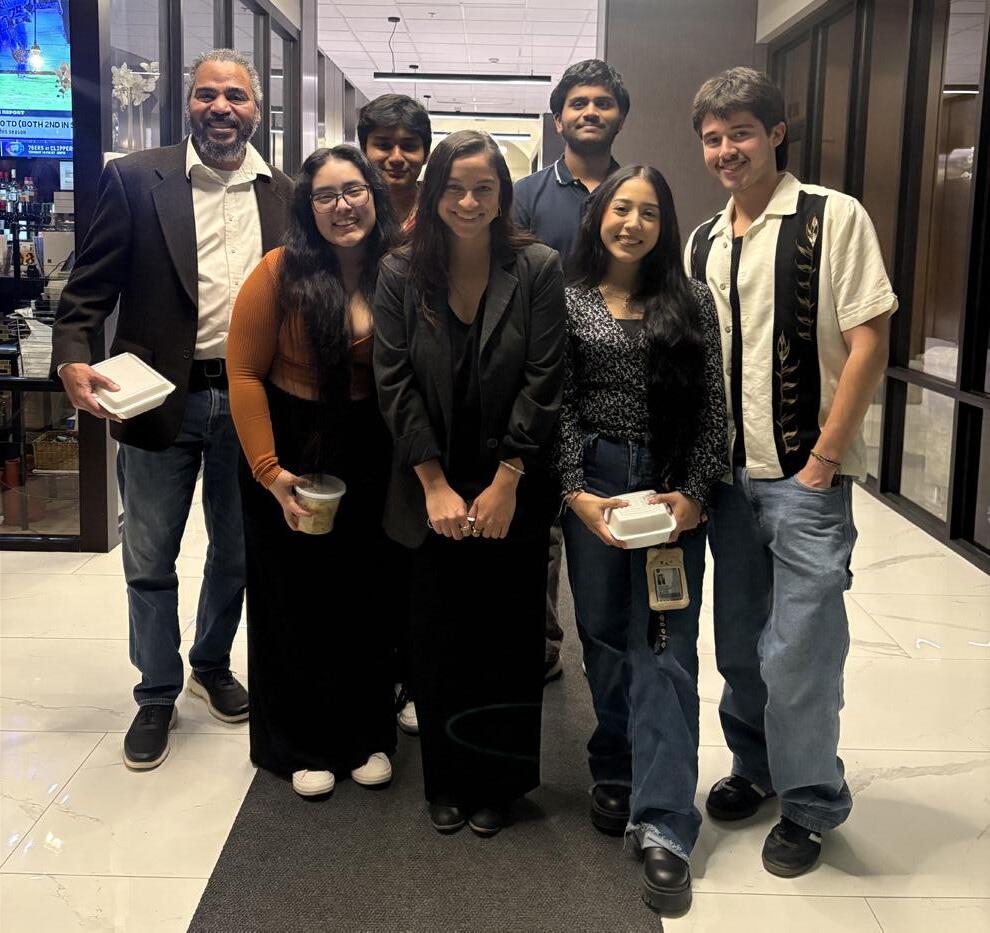
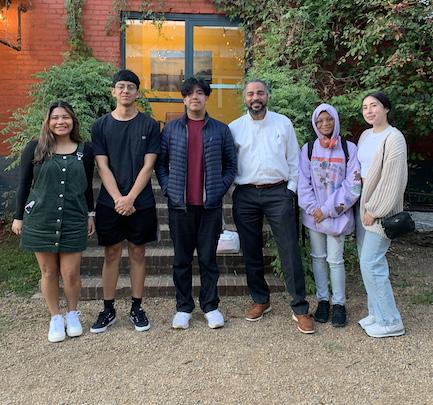
In 2009, former Provost Jill Tiefenthaler recognized this disparity and wanted to encourage firstgeneration students to attend the university and feel supported on campus. Dr. Mark Scott, a first-generation student whose son attended Wake Forest, donated $1 million to begin the program, which provides financial support, mentoring, and academic enrichment opportunities to 30 domestic first-generation students, known as Magnolia Scholars.
Nathan French led the creation of this program. 15 years later, he still leads the First in the Forest, which proudly supports 157 first-generation students in the incoming class of 2029 alone. French is uniquely suited for the role as a Wake Forest alumni who has worked for the admissions and financial aid departments.
“You don’t usually get to build things at a university,” French said. “You usually go to a program, and you inherit it. But the program didn’t exist, and they were trying to support first-generation students… it was an amazing opportunity.”
French said that for many Wake Forest students, attending college was guaranteed — and that their parents could advise and support their children using their own collegiate experiences.
“[College] is a space where you look back and ask your mom or dad for help with life — whether it’s about Greek life, studying abroad or career services,” Dr. French says. “The program is going to answer questions that [first-generation students] don’t even
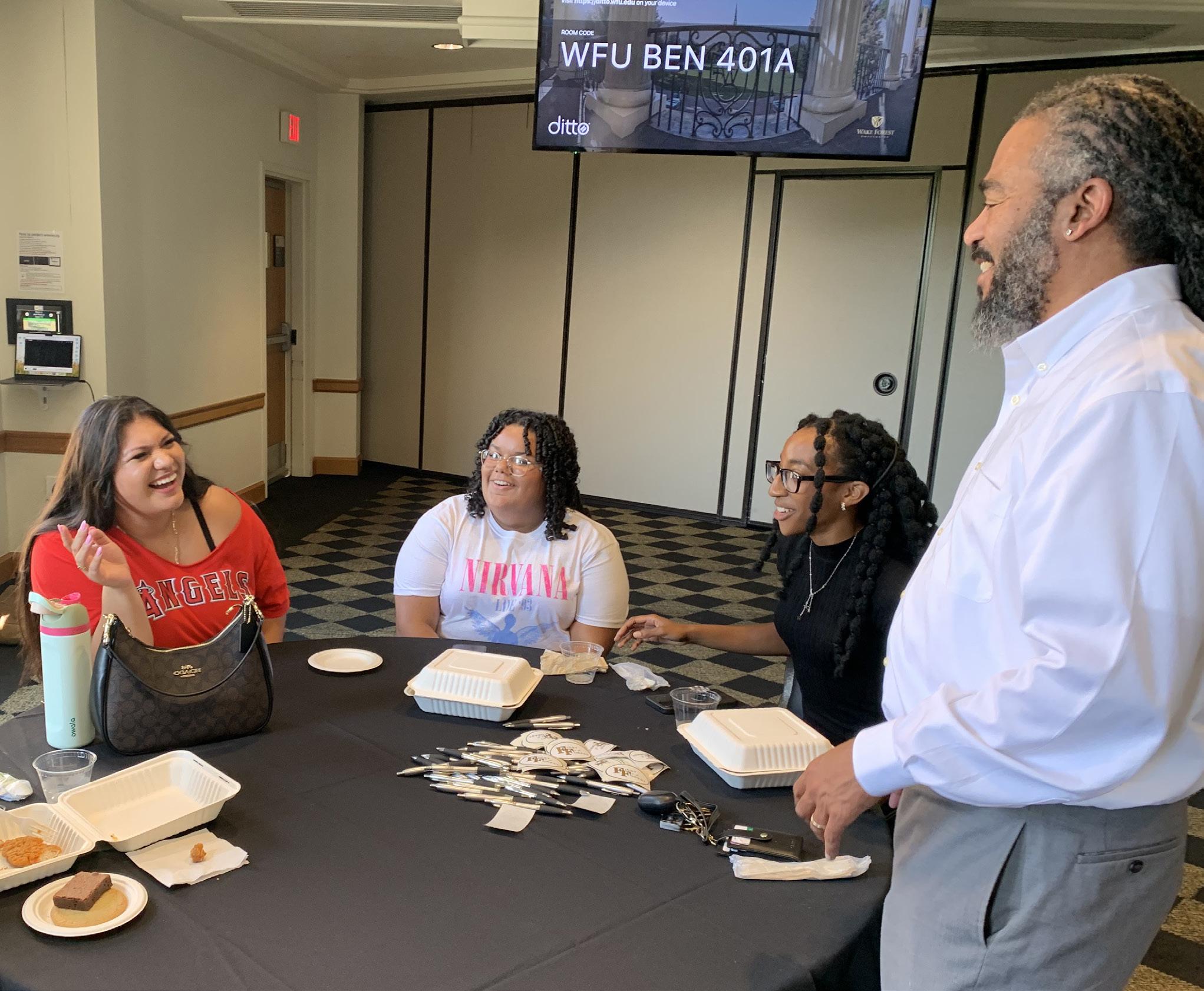
know that they have yet, and then try to encourage them and their parents to take advantage of what Wake Forest has to offer.”
Eric Maguire, vice president for enrollment in the admissions office and one of many faculty members who was a first-generation student, sees Wake Forest as a place where all students can thrive. He emphasized the importance of supporting first-generation students financially, academically and socially by holding monthly events, offering one-on-one mentoring and providing scholarships.
Magnolia Scholar Ernsley Francois has found support and advisers through First in the Forest. As he studies engineering with a concentration in electrical and computer engineering, he reflects on the resources the program has provided.
“There is a lot I have had to figure out on my own,” Francois said. “I have completed all financial aid and scholarship applications by myself. Whether it’s finding job opportunities or networking, there is no set blueprint. Instead, I have sought out the right people who are willing to help and follow their guidance.”
Sophomore Lauren Brown is another student in First in the Forest. Despite her academic success, she did not begin looking at universities until her senior year of high school. With the encouragement of her school’s college counselor and her father, she applied to Wake Forest and committed, despite being a ‘homebody’.
“My father has laid the foundation for me and my sisters to blossom into educated women. As a single parent, he works as an electrician in Philly’s Local 98 from 4:30 a.m. to 4:00 p.m. in dangerous conditions,” Brown said. “Despite all that he has sacrificed for us to pursue our dream education, his biggest and only wish is for us to be happy. His selflessness is my main motivator when it comes to excelling in higher education.”
Brown says she has found a family within the program and looks forward to pursuing degrees in psychology and sociology — and eventually, a master’s and PhD.
“I am connected to thousands of people across the world just from having the title of first-generation. We share similar journeys and hardships, successes and failures,” Brown says. “Our foundation lays upon the narrative of a first-gen [student], and that alone can get us as far as we ever imagined.”
Contact Virginia Noone at noonvc21@wfu.edu
Free six-week program on Wake Forest campus provides empowering and enriching opportunities
JT TAYLOR Contributing Writer
Students gathered in Annenberg Forum in Carswell Hall to listen to a guest speaker, discuss readings in Tribble classrooms and chat over lunch in the Pit.
This could describe any ordinary day at Wake Forest, but these aren’t your typical college students. They’re elementary-aged children who have come to campus on a hot summer day to participate in Freedom School.
Wake Forest hosts this free six-week program each summer to encourage a love for reading among the youngest students in Winston-Salem. Executive Director Dani Parker-Moore and her colleagues founded the program in 2017.
“When I was in graduate school, I was a servant leader intern at the Freedom School at Duke University,” Parker-Moore said. “We went through a very transformative experience in national training… you work with the kids for six weeks over the summer. We were on the campus of Duke University… I had a group of second and third-graders.”
“Whether it was through Harambe, [reading] time, or STEM activities, we were able to come together and activate our minds and bodies through out the day.
Contemporary Freedom School programs are inspired by the Mississippi Freedom Summer Project of 1964, which aimed to counteract the unsatisfactory education Black children received in segregated schools by teaching about Black history and political activism. Today, Freedom Schools offer high-quality literacy opportunities and remediate summer learning loss for disadvantaged students. Ultimately, the program seeks to shape students into independent thinkers, problem solvers, and agents of change in their community
Freedom School’s primary theme is, “I can make a difference.” Each week, the school breaks down this concept into smaller elements. In turn, students learn about making a difference in themselves, their communities and the world.
The Wake Forest site, which is part of a larger network of Freedom Schools around Winston-Salem, can host up to 50 children at a time and maintains a waitlist. Freedom School is offered at no cost to families due to grants provided by nonprofits, including the Children’s Defense Fund and AmeriCorps Vista, along with contributions from Project Pumpkin and other Wake Forest initiatives. The school employs six or seven college students each year who serve as tutors and mentors.
Senior Ashleigh Hampson served as a student mentor for the Freedom School in 2023. As a Servant Leader Intern (SLI), she assisted a teacher in leading a class of 10 children throughout the summer.
“They were all really special kids,” Hampson said. “It was very rewarding to see their confidence and skills develop over the course of the summer.”
One University partner is Campus Kitchen, which supplied the Freedom School with food. The Office of Civic and Community Engagement also partnered with the Freedom School to provide school supplies and potential students to serve as mentors.
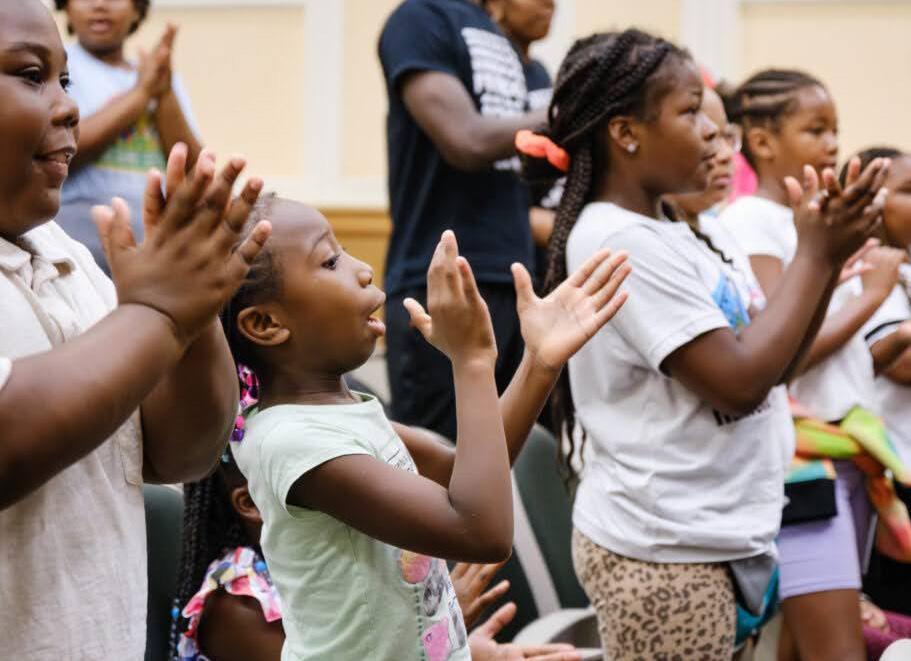
Children engage in a Freedom School activity at Wake: a free six-week summer literacy program for rising third through fifth-grade students to promote a love of reading.
Wake Forest’s Freedom School uses an integrated reading curriculum that focuses on five components: high-quality academic enrichment, parent and family development, civil engagement and social action, intergenerational servant leadership development, and nutritional and mental health.
A typical day at Freedom School begins in Annenberg Forum in Carswell Hall, where participants sing together during “Harambe,” a reference to the Swahili word for “uniting” or “pulling together.”
Harambe helps to set the tone for the school’s mantra: “We believe in ourselves and what we can do.”
Next, a guest reader from the community encourages scholars to be changemakers. Lucy Flynn, a 2024 servant leader, said that students united to engage with local issues.
“This year, [students from] the Winston-Salem sites marched on Wake Forest’s campus against book banning and students came together and made signs and posters,” said Flynn.
Next, students progress to instruction time, typically held in Tribble Hall. The school emphasizes literacy skills, and students are exposed to academically enriching and culturally diverse books with inspiring protagonists who can serve as role models for civic action. Students are encouraged to take books home to start their personal libraries.
“It is a well-rounded program, but the integrated reading curriculum is at the core,” Parker-Moore said. “It helps encourage a love of literacy and reading, and then a love and a commitment for how you can make your community better.”
After classes and instructional reading time, students eat lunch at the Pit and participate in STEM, musical, and athletic afternoon activities.
Once a week, students take field trips and visit different attractions across Winston-Salem, including the Kaleideum Museum, water parks, and bowling alleys.
“I loved the field trips because I loved being able to connect with the kids outside of the classroom,” Hampson said. “The program did a really great job of making the learning fun and breaking up lessons with activity.”
“We went through a very transformative experience in national training... you work with the kids for six weeks over the summer. We were on the campus of Duke University... I had a group of second and third graders.
To maintain their child’s eligibility for the Freedom School, a parent or guardian must attend a weekly meeting, which allows the organization to engage closely with families.
“Parent meetings range from themes of financial literacy to parenting, mental health, and social/emotional learning,” Parker-Moore said.
Freedom School is a unique summer experience that not only grows the minds of participating children but also builds community among the parents and servant leaders working with the new generation.
“Freedom School showed me and the scholars the ways in which school can be fun and engaging,” Flynn said. “Whether it was through Harambe, [reading] time, or STEM activities, we were able to come together and activate our minds and bodies throughout the day.”
Contact Jt Taylor at taylja23@wfu.edu
How Katharine and Kate Reynolds used their wealth and knowledge to pursue progress
BIANCA REZNIC Staff Writer
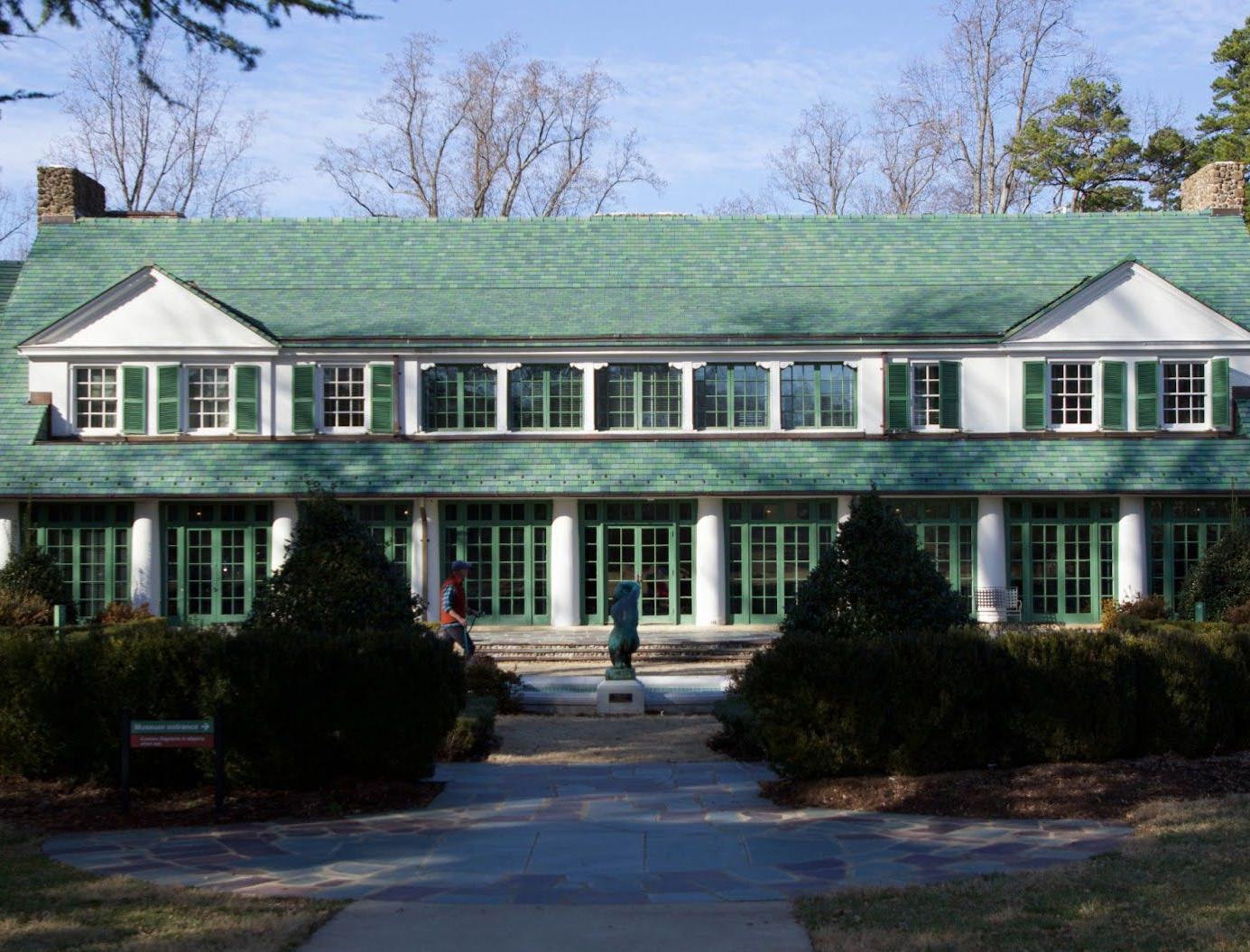
The history of Reynolda Village, the Reynolda House Museum and Wake Forest itself are linked to the history of the Reynolds family.
Their story begins with a fortune made in the tobacco industry. Richard Joshua (RJ) Reynolds was a key player in the industrialization of the new South. Beginning in 1887, he grew his business steadily through the introduction of new tobacco blends and advertising.
“
Katharine and Kate were ahead of their time, acting as catalysts for positive change. However, their fortune and influence was tainted by the estate’s racist history.
Katharine Reynolds, RJ’s wife, took on numerous civic and social responsibilities in her time. She played a large role in educating and supporting the development of farming and agriculture in the region.
Provost Michele Gillespie discusses the legacy of Katharine Reynolds in her book, “Katharine and R.J. Reynolds: Partners of Fortune in the Making of the New South.”
“While Katharine masked almost all her actions in ladylike,” Gillespie said, “feminine trappings, she was a shrewd businesswoman at heart, more capable than most men of managing a hundred employees and making a killing on Wall Street.”
In December 1912, Katharine dedicated herself to
the farm as acting superintendent. Serving as an early agricultural extension office, she tested new methods of crop rotation, soil analysis and animal husbandry. She also enacted her beliefs about social progress, planning churches, schools and modern housing for farmworkers and the Reynolda staff.
“The region saw Reynolda as an experiment station where local farmers came to learn about the latest techniques and agriculture,” Bari Helmes, director of Archives and Library at Reynolda House, said. “Katharine took an education role, teaching better ways of growing plants to help farmers diversify their agriculture.”
Katharine’s interests in the community varied from agriculture to education and health, which is reflected in the design of the estate. Given her college education and her own experiences with illness, battling with rheumatic fever for most of her life, Katharine stayed current on all things scientific. She was a member of the first generation to understand and accept germ theory.
During the planning of Reynolda farm and dairy, historians speculate that she frequently referenced “The Story of Germ Life” by Herbert William Conn, published in 1912. She knew that clean air, clean water and clean streets were essential in creating a germ-free, healthy environment. This knowledge is reflected in the design of her home.
“[Katharine] was an early advocate of germ theory,” Helmes said. “Reynolda, just the way the house was built, she was very much thinking of preventing illness.”
Katharine Reynolds became dedicated to expanding education initiatives in Forsyth County after the death of her husband. She believed that thriving communities began with access to quality education for all children.
“When RJ died in 1918, her interest in the farm seemed to die off and she turned to education,” Helmes
said. “She essentially started a public school system at Reynolda.”
The success of the Reynolds company opened doors to economic development in the region and began a legacy of charity that continues to this day. Katharine was not the only Reynolds woman of her time to initiate positive change in the community. Her sisterin-law, Kate Bitting Reynolds, was also an influential member of the community, using her wealth to support the local community. Her area of concentration was healthcare.
“Kate and her husband Will invested in the first hospital for Black residents in Winston-Salem, which became known as Katie-B hospital,” Noral Ferrel, director of communications at Kate B. Reynolds Charitable Trust, said. “From what we understand, Kate and Katharine were wealthy women who tried to invest in the community.”
Katharine and Kate were ahead of their time, acting as catalysts for positive change. However, their fortune and influence were tainted by the estate’s racist history. Kate’s initial bequest of $5 million to establish the trust was inherited from the sale and labor of enslaved Black people.
“
For us, interpreting her mission on today’s terms means that we’re working for thriving communities, thriving residents, equitable health outcomes, and equitable acccess to healthcare.
“We also know that Kate and Katharine Reynolds, both of them, were very generous women during their time, but they were also women of their time,” Ferrel said. “They belonged to the Daughters of the Confederacy, so we know that Kate’s family-owned people who were enslaved and that was part of where her wealth came from.”
The Trust was established in 1947 to improve the lives of people with low incomes in Forsyth County. Inspired by Kate B. Reynolds’ dedication to healthcare equity, their vision is to create thriving communities by producing equitable health outcomes for all North Carolinians. Kate B. Reynolds Trust distributes more than $20 million in grants annually to improve the health and quality of life of residents of North Carolina.
According to Ferrel, the central mission of the Kate B. Reynolds Charitable Trust is interpreting the legacy of the Reynolds women in today’s context.
“For us, interpreting her mission on today’s terms means that we’re working for thriving communities, thriving residents, equitable health outcomes, and equitable access to healthcare,” Ferrel said.
The organization’s efforts to change systems that have historically held people back produce positive outcomes for residents of Forsyth County and North Carolina. In June 2023, the Trust awarded the Wake Forest School of Medicine a $1.5 million grant to address racial disparities in infant and maternal mortality rates across Forsyth County.
Katharine and Kate began legacies that have outlived them and can still be seen today. For Kate, the majority of her legacy is reflected in her trust. For Katharine, her legacy lies in her children and the story of her estate.
THURSDAY, FEBRUARY 20, 2025
Mia Springer, spriml21@wfu.edu
Beza Zelalem, zelam22@wfu.edu
ZELALEM Environment Editor
A natural gas pipeline that is set to run through North Carolina threatens to exacerbate the climate crisis and harm vulnerable communities.
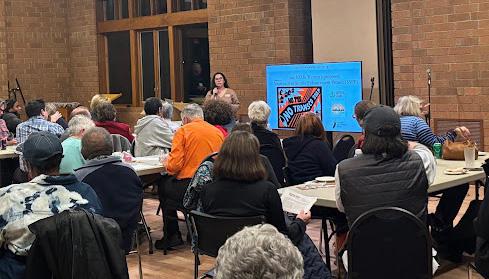
Last Thursday evening, local community members and environmental advocacy organizations gathered at Parkway United Church of Christ to discuss concern for the looming threat of the Transco Southeast Supply Enhancement Project (SSEP). The meeting aimed to inform the public about the dangers of the proposed pipeline expansion and mobilize action against the project.
What is SSEP and who is behind the project?
Williams Companies, an energy corporation based in Tulsa, Oklahoma, operates the Transcontinental (Transco) pipeline, which stretches across 10,000 miles, transporting methane gas from Texas through the Southeast to New York City. The proposed SSEP is part of a massive expansion of the Transco system that would carry an additional 1.6 billion cubic feet of methane gas daily.
The SSEP project, if approved, would extend across Virginia, North Carolina, South Carolina, Georgia, and Alabama, including approximately 28 miles of 42 inch-wide pipeline in North Carolina. The pipeline would run alongside existing pipelines in counties such as Rockingham, Guilford, Forsyth, and Davidson. Williams is projected to begin SSEP construction in Spring 2026 and make the pipeline operational by late 2027. However, the proposed expansion has raised significant concerns for safety risks posed by methane, a colorless and odorless gas that can cause deadly explosions without warning.
Corrosion, the leading cause of pipeline failures, occurs when liquid exposure weakens pipes, leading to leaks. Improper installation can also result in explosions as pipes loosen over time. Regular inspections and maintenance are crucial for safety.
Beyond explosions, methane leaks occur throughout production, transport and distribution. Such leaks contribute to climate change, water contamination and ecosystem disruption. Continued reliance on fossil fuels has long-term consequences for public health and the environment.
Transco’s troubling safety
Transco’s safety record is alarming—over the past decade, its pipelines and compressor stations have exploded or caught fire ten times, causing six deaths and 103 injuries, along with property damage and methane emissions. Many incidents were attributed to preventable operational failures.
Several environmental groups, including the Sierra Club, Power Up NC, 7 Directions of Service, and the Piedmont Environmental Alliance (PEA), spoke out against the project at the meeting. PEA’s Events and Partnership Manager Jessica Rowe emphasized the urgency of stopping the SSEP.
“Williams is in the early stages of the project. There is still time to slow it down or even stop it altogether,” Rowe said. “The change we want to see won’t come from the national level. It’s at the local level—county and state representatives must be made aware of the potential consequences of this project.”
Rowe highlighted the lack of local benefits that would
come from the SSEP, particularly for residents along the Transco corridor.
“Transco claims the project will bring substantial economic benefits, but our analysis shows otherwise. Most of the jobs created will be short-term, often given to out-of-state contractors, and typically offer poor working conditions,” she said. “Instead we should be focused on creating long-term, sustainable jobs for local communities.”
The economic benefits tout- ed by Transco, including tax revenue, have been called into question. Studies indicate that the anticipated tax benefits from pipeline projects are often less substantial than projected, and large corporations, including those in the pipeline industry, may use loopholes to minimize payments.
An analysis of the Keystone Pipeline found that property taxes during construction amounted to just $4 million across seven counties. A report by the Center on Budget and Policy Priorities highlights how energy companies reduce tax obligations through profit shifting and other strategies which can significantly diminish the expected tax revenue for local communities.
In its filings, Transco has acknowledged that those most directly affected by the SSEP would not experience its benefits. The company’s own documents state, “the benefits of the project are not realized by those who are impacted.”
The push for renewable energy alternatives
Locals and environmental advocates argue that financial investments should shift to renewable energy sources like solar and wind, which are cleaner, more sustainable, and less volatile than fossil fuels.
“These energy projects are unnecessary,” Rowe said. “We can—and should—shift to renewable energy to build the energy future we need.”
This need for renewable investment is further underscored by the role of Duke Energy, a key proponent of the SSEP.
A Sierra Club “Add Up” campaign urges Duke Energy, a SSEP project proponent, to prioritize clean energy. A 2023 Sierra Club report gave Duke a “D” grade for its clean energy transition, citing limited progress under the Inflation Reduction Act. The report criticizes Duke’s continued reliance on methane gas infrastructure, which harms the environment and increases consumer costs.
Local health risks further compound the dangers of fossil fuel dependence. Duke Energy plans to build two 1,360 MW gas turbines in Person County, North Carolina, just three miles from Woodland Elementary School, raising additional health concerns.
Lessons from past victories and next steps
Despite these challenges, opponents find hope in past victories. In May 2024, communities in New York successfully defeated Transco’s Northeast Supply Enhancement Project, proving that grassroots efforts can stop harmful infrastructure projects.
Meeting attendees were encouraged to sign the “NO SSEP” petition and participate in future public hearings and town halls to voice their opposition.
PAGE 12
THURSDAY, FEBRUARY 20, 2025
Mattie Stillerman, stilmk23@wfu.edu
The views expressed in all opinion columns represent those of the article’s author, not the opinions of the Old Gold & Black Editorial Board
MIRIAM FABRYCKY Features Editor
My mom is no doomsday prepper, but the prospect of sending her oldest across an ocean unlocked an impressive capacity for catastrophizing. I’ll admit I laughed at her apocalyptic advice before I left for my first semester at Wake Forest, especially the suggestion that I print out directions to relatives’ houses “just in case.” As if, in the wake of some undefined disaster, I should whip out a three-ring binder and set off on a 700-mile trek to extended family in upstate New York.
I’m still unconvinced of the utility of this specific idea, but after last Monday’s campus-wide power outage, I’m less dismissive of creating contingency plans in case of digital failure.
A normal weeknight was transformed into a calculus of how long I could use my half-charged laptop as a power bank. Basements became no man’s land and the glow of red emergency lights provided hallways with horror-movie ambience.
A brave Babcock soul hoisted a speaker to their window, and through unknown electrical means, hosted a block party as the sun set. Students either celebrated or mourned the forced disconnect from Canvas — Wi-Fi was down, and many were unable to access cellular service. Some of my friends were locked out of their suites. A university email urged students to preserve the precious heat our residence halls retained.
Thankfully, the outage caused only mild distress for most. However, the few hours our campus endured without electricity unveiled our profound reliance on vulnerable technologies and demonstrated the continued relevance of analog backups.
The Cloud is not in the sky
In high school, I occasionally drove through Loudoun County, VA, home to hundreds of data centers that process 70% of the world’s internet traffic. My local friend would shake her head at each of those gargantuan, windowless buildings. One well-placed nuclear strike, she once remarked, could do untold damage to so many systems propping up our society.
The Cloud is not in the sky, and the idea that digital products are less fragile or exploitative than their analog counterparts is a convenient myth.
Smartphones don’t spontaneously materialize in Cupertino labs; Congolese children risk their lives extracting cobalt for batteries. Conversations with ChatGPT are anything but ethereal, as the AI requires 16 ounces of water for cooling afterward. A severed ocean cable once marooned the entire country of Mauritania from the Internet. The same fires and floods that destroyed ancient libraries wreaked havoc on essential infrastructure in Western North Carolina during Hurricane Helene.
The susceptibility of online spaces isn’t limited to physical risks, either — the internet is defined by impermanence. Just this past month, influencers panicked when the short-lived TikTok ban undermined their livelihoods, while researchers raced to preserve health equity data as federal workers scrubbed mentions of race and gender from official websites.

Mattie Stillerman / Old Gold & Black While the technological world is an amazing resource, you never know if you will lose connectivity at 11:58 p.m. Therefore, it is wise to have a backup plan.
As students discovered when we flipped light switches in vain, the current provision does not equal any promises for the future. I left Spotify after Joni Mitchell did, and I can’t say I won’t choose to migrate music platforms again. A glitch, a favorite artist’s fall from grace, a jacked-up monthly fee and those carefully collected playlists might all disappear. My memories of sitting on my best friend’s floor, enraptured by our favorite boygenius records, though, exist in an entirely different dimension. They’re anchored, embodied and real.
Consider the emotional power of physical media. I attended a dilapidated middle school in Berlin, Germany, that my parents said felt like a time capsule from their own childhoods. Forget sleek smart boards; our “computer lab” had an original Mac. I doubt our librarians’ annual instructions on how to navigate a card catalog will ever prove useful again.
Still, something was charming about the bowls of water teachers kept on their desks to sponge off chalkboards, the minuscule ink cartridge seals my friends and I collected, the mid-class manicure potential in bottles of Wite-Out. It’s an academic warmth that my younger brother, who spent kindergarten staring at an
iPad while his teacher attempted to explain the alphabet over Zoom, may never experience.
We should diversify our investments
Contemporary systems eliminate friction from reality. With enough resources, it’s quite possible to stay in bed indefinitely, using apps to socialize, hold office jobs and even order strangers to deliver food. Of course, we’ve played these games before. Online life is convenient, yes, but it is also utterly exhausting. Why else would so many reach for digitally irreplaceable hobbies — like sourdough or gardening — to escape the slog of quarantine?
I’m rarely in Farrell Hall, but even this humanities nerd knows how important it is to diversify investments. For our own sakes, let’s spread risk across digital and analog realms. Use a notes app and keep a journal. Know what you’ll do if you lose connectivity at 11:58 p.m. (I’m totally not speaking from experience) or spill coffee on a notebook. Enjoy having the lights back on, but remember where you put your flashlight, just in case.
Contact Miriam Fabrycky at fabrml24@wfu.edu
However, America does have a serious issue with news illiteracy
VIRGINIA NOONE Senior Writer
The days after the election, I met two of my friends for lunch. It was like a poorly written joke: “A Harris voter, a Trump voter and a non-voter walk into the dining hall…”
We all started cautiously discussing the results of the election and which specific political issues informed our decisions. The sad punchline was this: we couldn’t even agree on the facts surrounding the issues.
The journalist student in me came out as I probed them on where they read the information that supported their arguments and whether they had read the same pieces that concerned me. Relenting, they politely confessed that they did not have the time to read and vet stories while balancing their intense STEM and business majors, and often only had time to read headlines or brief clips.
This I can understand and empathize with, as there is an overwhelming and exhaustive amount of news alerts on our phones every hour, ranging from horrific global tragedies to the best recipe for winter soups. What struck me more was how they frequently found these news snippets on their phones to be heavily biased.
They took out their phones and showed me an example of such. It was a headline for a New York Times opinion article that was sent out through Apple News. I explained how they correctly identified the article as biased because it was an opinion piece from a columnist and not straight news, which they had originally thought.
“Ok, but how are we supposed to know that after just glancing at an alert on our phones quickly?” they asked. “Why are they even blasting anything that isn’t straight, unbiased news?”
This is a valid point, as the separate sections of newspapers are not as evident as they used to be.
Before smartphones and tablets existed, Americans read newspapers. The news section, opinion section and every other section were separated by page numbers and were easily understood for their specific content. News, opinion, sports, features and obituaries informed readers cohesively on their respective subjects.
With these distinctions unclear in the contemporary world of technology and social media, it has become difficult for intelligent people — including my two highly intelligent friends who attend a top university –– to understand the structure of news outlets. Wake Forest students not being able to read the news comprehensively is completely unacceptable and entirely unavoidable.
Most Americans are not news literate, and it is not their fault.
A lack of news literacy in the digital age has only perpetuated the false narrative that most “legacy” news organizations are either heavily biased, conspiring against the good of the public or simply lying. This falsity disenfranchises the free press, whose primary job is to hold people in power accountable, and it damages our democracy.
This is not to say that all news outlets are unbiased or altruistic in their reporting; however, lumping all news outlets together as corrupt is inaccurate. News literacy is essential to help readers distinguish credible news pieces and identify potential bias in pieces.
Justin Catanoso is the former director of the journalism program at Wake Forest, with decades of experi-
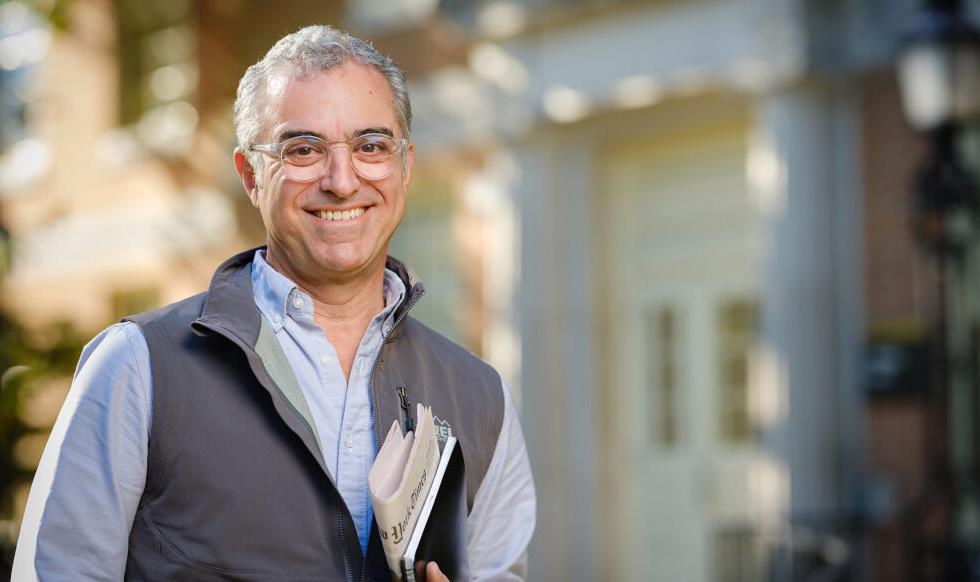
ence working as an editor and journalist. Catanoso has taught news literacy classes to journalism students at Wake Forest University for many years.
“People who become news literate understand that real news must contain information with multiple credible sources and verified facts,” Catanoso said. “It must be independent of its sources and its ownership. And it must be transparent in its reporting and accountable for its errors. This takes ignoring social media, reading full stories not just headlines and alerts and seeking out information that challenges one's beliefs, not merely confirms one's biases.”
It’s a fundamental part of being an informed citizen and is mandatory for all journalism students at the university — so why aren’t we teaching it at a foundational age if it is this important?
As American values and needs have shifted throughout history, so has the curriculum. Cursive handwriting, basic computer skills and home economics have become antiqued and nearly extinct as our society’s educational needs have changed.
Receiving and interpreting news has become increasingly complicated since the age of local newspapers being thrown onto the doorsteps of homes each morning has mostly passed. Teaching children and young adults how to decipher and digest information is vital to fostering a more informed and engaged nation.
“Those who take a little extra time to become informed and seek an objective truth in real media are rewarded with trustworthy knowledge to make important decisions about their lives and their votes,” Catanoso says.
Furthermore, as Generative AI enters the media sphere, and even more advanced AI is insidiously looming, our education systems need to get ahead of the threat.
The solution to ignorance and deception has always been education. Learning how to be news literate is an incredible asset and of the utmost importance now more than ever before. Instead of placing blame on the individual for not educating themselves or simply giving up on trusting any news outlet, there needs to be a serious reevaluation of how we’re discussing and incorporating news literacy into curriculums.
CAROLINE GOTTSMAN Staff Writer
It’s a crisp Saturday morning in January. The birds were singing outside the Lawrence Joel Veterans Memorial Coliseum, and the sun had barely crested over Winston-Salem. Yet, at 8 a.m., a crowd of students was already waiting outside the basketball arena, desperate for prime seats in the stadium. It should go without saying that the game that people lined up for so early was the greatly anticipated Wake Forest vs. Duke game — everyone wanted a front-row seat.
The growing line so early in the morning should have been a warning sign for the security at the Joel. Unfortunately, it was a warning sign they didn’t heed.
As the time for the game drew nearer, more and more students arrived at the stadium, joining the ever-growing mass of people waiting behind the two skinny metal detectors that served as the only entrances inside. The lack of clear line management caused people to pack closely together. My friends and I found ourselves squished into the backs of others, arms pinned to our sides as the crowd behind us grew impatient with the unopened doors.
This uncomfortable proximity quickly turned dangerous.
At first, the worst thing about the situation was the fact that my chin was resting on a stranger’s shoulder and I could feel the breath of another on the back of my neck. But then, the security made the mistake of opening the two tiny doorways. One by one, people passed through one of the two metal detectors as the crowd behind them pushed forward with desperate and reckless anticipation.
With nowhere to go, the people at the front of the line were packed even closer together. Now, I could
feel someone’s elbow poking harshly into my side as I inhaled another person’s hair. The line went from awkward proximity to unbreathable nearness.
With each person that entered, the crowd moved forward in an uncontrollable wave. My friends and I linked arms after the first wave in an attempt to stay together. However, once the people behind us began to shove forward, my friend was pushed against a brick column and her arm slipped out of mine. Security shouted at us unhelpfully to stay back, but for the people in the front, that wasn’t an option.
The pressure on my sides became nearly unbearable, and I tried to turn my head to find my friends but found instead someone’s shoulder pressed against my face. I looked at the people around me and found that all the shorter people had their faces up to the sky, trying to gulp down fresh air in the chaos.
The girl next to me began panting and called 911. There were shouts all around, from both the panicked crowd and the idle security. Security kept barking at the crowd to back up, not realizing that the momentum was coming from the back of the line. The back of the line didn’t know about the compression at the front of the line — they just wanted to get in the stadium.
One of my other friends was pressed so tightly between the people around her that her feet no longer found purchase on the ground, and she was instead held upright by the packed masses. I watched someone dragged around the metal detector to be let in because security noticed that she was being crushed. Every time someone stumbled through the metal detector, the crowd surged forward again, crushing us together even tighter.
Word spread quickly that someone had passed out, and the panic in the crowd elevated further still. People began to shout back at the security’s useless
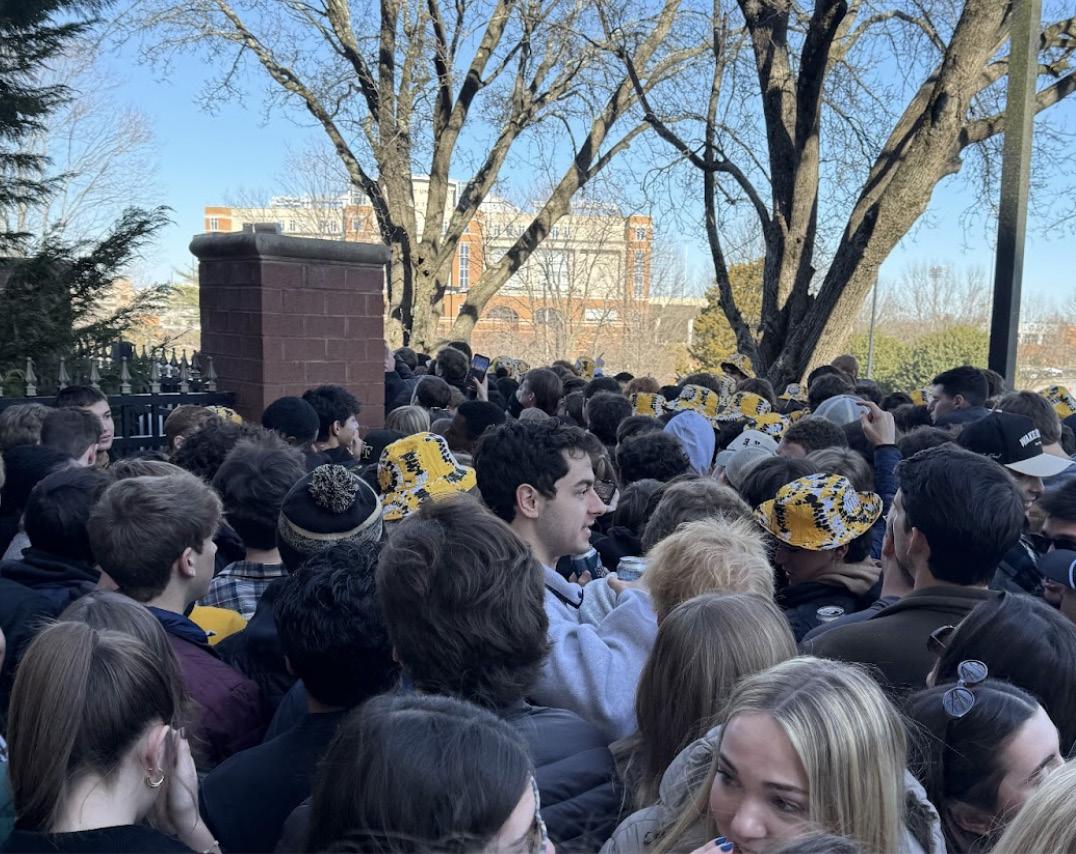
instructions to “back up.”
What was supposed to be a line for a college basketball game felt like it was quickly turning into something very different.
Just as I crossed the threshold of the metal detector, the security opened more doors at the back of the line. The very people causing the compaction problem entered the stadium, while the pressed mob near the front still struggled for air and space. Students who had just arrived at the game were given access to lower bowl seats, while the others who had waited in the tortuous line were left to fend for themselves, completely defeating the point of arriving early.
“Every time someone stumbled through the metal detector, the crowd surged forward again, crushing us even tighter.
Luckily for me, my friends that I had been separated from had managed to fight their way into the stadium already and had saved me a lower bowl seat. As I took my seat, I found myself overwhelmed not with excitement for the game, but with relief at being out of the dangerously tight crowd.
I thought to myself, this is not what a basketball game should feel like.
Unfortunately, what should have been an exciting game, full of fight songs, tie-dye and three-pointers, was marred by incredibly poor crowd management. While chaos can be expected on a big game day, danger shouldn’t be. The level of panic outside the Joel stadium on the day of the Wake Forest vs. Duke game is unacceptable, and Wake Forest needs to ensure it never happens again.
First off, the rampant lack of line management must be remedied. The current setup of only two metal detectors is laughably insufficient for the crowds of Wake Forest students. More entrances need to be added to accommodate the large crowds that are expected for such popular games. The lack of infrastructure to organize the line and keep students safe made this situation an accident waiting to happen. An addition of barriers, clear demarcations for the start of the line and staff direction for the line would make a world of difference in the student experience.
Secondly, the treatment of the security of the students needs to be improved. In my view, while people were being crushed together, security did nothing more to remedy the situation than yell at the people being compacted. Instead of proactively trying to fix the problem, the security lashed out at the masses. When I saw people try to explain the issues of lack of fresh air and space to the security, they were met with either stony silence or hostile, dismissive responses. Security needs to treat the students with respect and handle stressful situations in a calm, organized manner. Student safety should be a matter taken seriously.
During high-traffic events such as those like the Wake Forest vs. Duke basketball game, Wake Forest needs to do more than just hope for the best. They need to plan ahead.
What happened before the Duke basketball game was a wake-up call. Such popular events cannot be managed so poorly as they were that day, or there is a risk of serious injury to the students. Our safety cannot be treated as an afterthought. There are steps that Wake Forest must take for events like these to be fun, well-organized and free from danger.
Blake Robinson, robiba24@wfu.edu
Sean Kennedy, kennsm21@wfu.edu
PAGE 15 THURSDAY, FEBRUARY 20, 2025
SEAN KENNEDY Sports Editor
After last week’s loss to Florida State, Wake Forest Men’s Basketball needed to bounce back quickly to keep up NCAA Tournament hopes — and they did, traveling to Dallas and beating the Southern Methodist University (SMU) Mustangs, 77-66.
The game was hyped up throughout the week, as both Wake Forest and SMU found themselves in contention for NCAA Tournament bids.
Both teams also found themselves without key pieces due to injury. SMU played without former Wake Forest guard Kevin “Boopie” Miller, who sat due to a bruised foot. Wake Forest’s Cameron Hildreth was deemed a gametime decision with a foot contusion and did not suit up for the game.
In Hildreth’s absence came the emergence of guard Parker Friedrichsen. The sophomore had an uncharacteristically slow start throughout the year, struggling from behind the 3-point line throughout the season.
However, on Saturday, Friedrichsen broke out, scoring a season-high 18 points and shooting 5-7 from deep when Wake Forest needed it most.
The Demon Deacons also found scoring through star guard Hunter Sallis (20 PTS, 9 REB, 6 AST), who notched his 13th game of the season where he scored

over 20 points.
One of the most important aspects of the game was Wake Forest’s defense in the second half, which allowed the Demon Deacons to go on a 19-5 run and gain 17 points.
“There was a point in the game, maybe around the 12:15 mark to about the 3:14 mark [in the second half], where they didn’t make a field goal,” Forbes said. “We were playing a lot more zone at that point and that changed the game a lot.”
SMU’s Chuck Harris (15 PTS, 6 AST), Kario Oquendo (13 PTS, 9 REB) and Matt Cross (11 PTS, 9 REB) each contributed to the Mustangs’ attempt to come back, but it proved too late, as the Demon Deacons prevailed 77-66.
After a tough home loss against Florida State, the Demon Deacons battled adversity and won on the road, something Forbes’ squad did well, earning their sixth road win in conference play.
“We had some adversity on Wednesday where we didn’t finish, and I thought that our team really bounced back with great resiliency today,” Forbes said.
Wake Forest has a bye during the midweek before they head to Tobacco Road rival NC State in Raleigh next Saturday. Tip-off is set for 2 p.m. and will be broadcast on The CW.
Contact Sean Kennedy at kennsm21@wfu.edu
With all eyes on his court, Dostanic wins clutch third set to lift trophy
SEAN KENNEDY Sports Editor
Wake Forest has yet another trophy — this time, Men’s Tennis won their first ITA Men’s National Team Indoor Championship since 2017.
Wake Forest’s long streak of winning the doubles point continued, as the deciding court came down to Franco Capalbo/Ioannis Xilas against the Horned Frogs’ Duncan Chan/Albert Pedrico Kravtsov. The Demon Deacon pair came up clutch late in the set, breaking serve and winning the final game to clinch the doubles point.
“We’ve had some tough ones, we’ve had some battles, and we’ve won in different ways,” Wake Forest Head Coach Tony Bresky said after the match. “The only thing we haven’t lost is [the] doubles [points].”
Wake Forest would win another singles point quickly, as Luca Pow defeated Pedrico Kravtsov in straight sets, 6-2, 6-3. TCU would bounce back, however. The Horned Frogs’ No. 9 Lui Maxted defeated freshman No. 98 Charlie Rob-
ertson, 7-5. 6-3. Just minutes later, they gained another court point back as well, as No. 6 Pedro Vives defeated No. 7 DK Suresh.
The Demon Deacons and Horned Frogs stood neck-and-neck on the next two courts as well, as No. 100 Xilas defeated No. 92 Chan on a long second-set tie-break, winning 6-2, 7-6 (11-9). Within a handful of minutes, however, TCU’s Cooper Woestendick defeated Luciano Tacchi on court six.
That meant that it all came down to No. 17 Stefan Dostanic against TCU’s No. 18 Jack Pinnington on court one. After both players split the first two sets, all eyes laid upon them for the final set of the championship.
After a string of won points against Pinnington in the third set, Dostanic served for match point. After getting the Horned Frog out of position with a crosscourt forehand, Dostanic powered a ball down the right side of the net, clinching the 2025 ITA Men’s National Team Indoor Championship.
“It came down to one set between two of the best players in college tennis, and it

was incredibly high-level tennis,” Meanwhile, the USC graduate transfer now wins his first trophy as a Demon Deacon.
“I’m super thrilled,” Dostanic said.
“When I came here in January, I didn’t know a ton of the guys, but they embraced me. I just wanted to win so badly for them.”
The Demon Deacons now have a trophy to add to its case — and will seek more, as the 2025 campaign returns against UNC-Wilmington on Feb. 25th.
Contact Sean Kennedy at kennsm21@wfu.edu
Demon Deacons have lost 11 of last 12 games, run risk of missing ACC Tournament
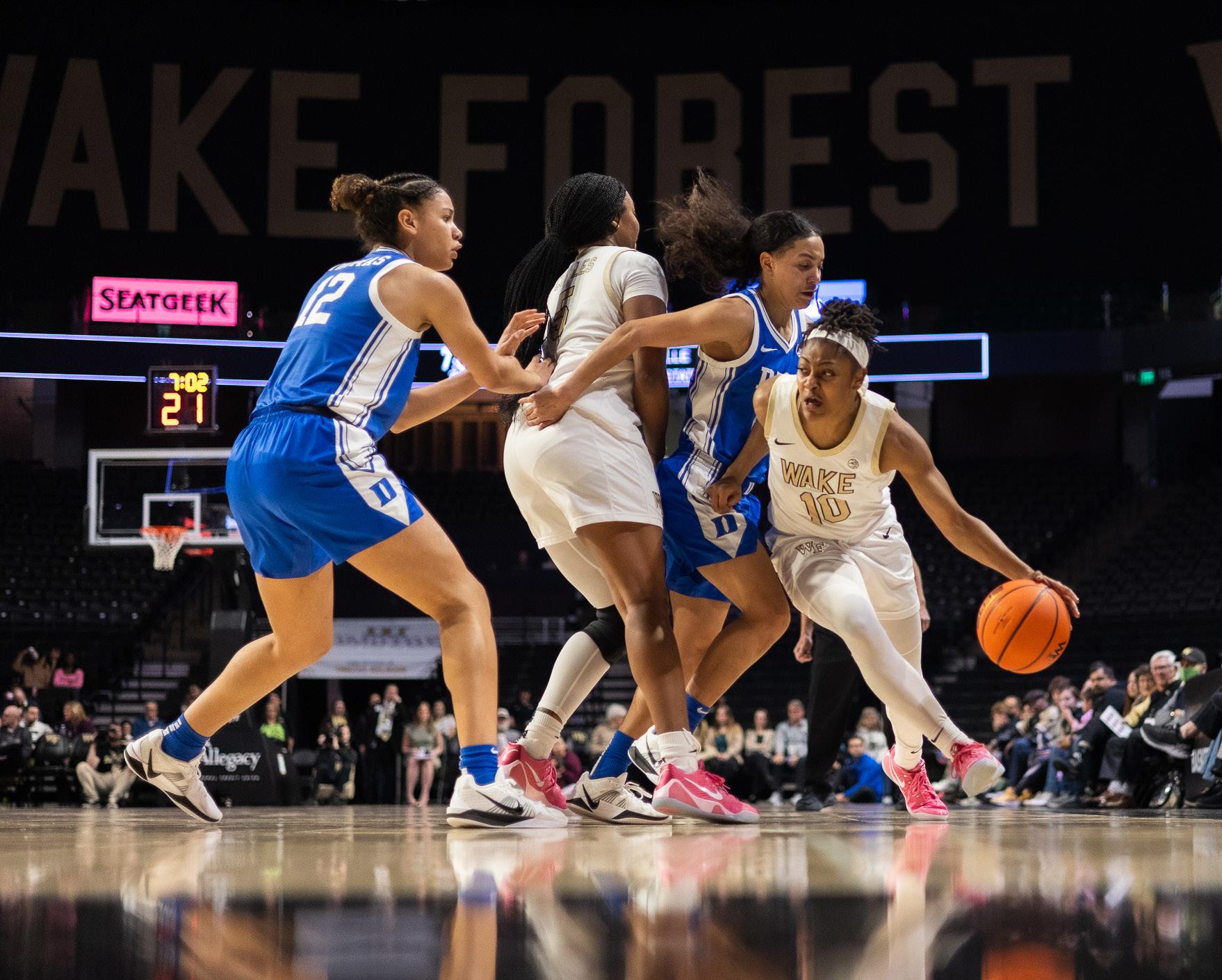
ROBISON Assistant Sports Editor
The Wake Forest Demon Deacons (816, 1-12 ACC) were unable to corral the No. 13 Duke Blue Devils (20-5, 11-2 ACC), falling 72-47.
The Demon Deacons saw some defensive improvements, while Duke had their fifth-most turnovers of the season (19). Additionally, Wake Forest posted their sixth-consecutive game, shooting 40.0% or better from the field, and their tenth time converting over 80.0% from the foul line. Despite these marks, Head Coach Megan Gebbia’s squad turned the ball over 33 times, a season-worst.
“We turned the ball over way too much and didn’t do a good enough job of sharing or moving the basketball on that end,” Gebbia said in a postgame statement. “We need to do a better job of getting open off the ball. If we didn’t turn the ball over the way we did, this is a much different game.”
Despite their eight first-quarter turnovers, Wake Forest held Duke to 11 points, finishing the quarter up a point, at 12-11. However, things then began to
unravel, as the Blue Devils outscored the Demon Deacons 61-35 in the following three frames of play.
“Our individual defense took a step forward tonight but we needed it more consistently throughout the entire 40 minutes,” Gebbia said. “We did a good job with scout defense.”
Elise Williams (8 PTS, 9 REB) posted a near-double-double performance, while the other redshirt senior, Demeara Hinds, put up nine points of her own. Additionally, Rylie Theuerkauf scored 11 points on the night. The sophomore has reached double figures in seven consecutive contests, and she leads the team in points per game with 11.1.
“A game like this shows us what we need to still work out as we push for postseason play,” said Coach Gebbia.
The Demon Deacons are on the backstretch of the season, with just four contests left in the season. They currently place dead last in the conference, looking to become a top-15 team to make the ACC Tournament.
Contact Blake Robison at robiba24@wfu.edu
NAT WIEGMANN Contributing Columnist
This article represents the view of Nat Wiegmann, not the Old Gold & Black.
Saying Wake Forest Men’s Basketball’s 72-69 loss to Florida State was frustrating would be an understatement- but it did not come as a surprise.
Time and time again, the program’s hopes of making the NCAA Tournament have come crashing down in the most infuriating way: losing games they had every reason to win just as the path to March Madness became clear.
Last year was a prime example. After a massive home win over No. 8 Duke and a strong regular season up to that point, it felt like the Demon Deacons had finally turned a corner. Yet, instead of capitalizing on their momentum, they fell apart, losing three straight games and watching their tournament hopes disappear.
This year, it’s the same story. Just as ESPN’s Joe Lunardi moved Wake Forest into the “Last Four In” for the NCAA Tournament, they suffered a crushing home loss to the Seminoles—a game where they were not only heavy favorites but were also up by 14 at halftime. It wasn’t just that they lost; it was how they lost that made it unbearable. With 24 seconds left and a two-point lead, all Wake Forest had to do was avoid giving up a three. Instead, they did precisely that, leaving Florida State’s Taylor Bol wide open for a three-pointer that put the Seminoles up by one. Then, to make matters worse, Demon Deacons point guard Ty-Laur Johnson inexplicably launched a desperation three from near midcourt with 13 seconds still left on the clock.
This kind of execution down the stretch is inexcusable, especially at such a pivotal time of the season. With the ACC experiencing another down year (projecting to send four or five teams to the NCAA Tournament), the Demon Deacons have little margin for error. Fans entered this season with high expectations, and yet again, it looks like those hopes will be crushed.
However, the frustration with this team extends far beyond one loss to Florida State. This is one of the most talented rosters Steve Forbes has had in his six seasons at Wake Forest, yet they have underperformed in ways people did not expect. For a team with tournament aspirations, ranking 348th in the country in three-point percentage (29.2%) is a joke.
It’s not just the lack of shooting, either. A routine inability to execute in crunch time has been a consistent theme under Forbes, and that is just as much a coaching issue as much as a player issue. When the game is on the line, Wake Forest doesn’t look like a team that knows how to win. They hesitate, force bad shots and make inexplicable decisions — just like they did against Florida State.
This isn’t just a one-off issue. Under Forbes, Wake Forest has consistently struggled in must-win games. They’ve yet to make an NCAA Tournament appearance, and in critical late-season moments, they seem to crumble under pressure rather than rise to the occasion. Forbes has undoubtedly risen the program from the depths of the Danny Manning era, but when do the excuses run out? Wake Forest has not made the NCAA Tournament since 2017 and has not won a tournament game since 2010. The season isn’t technically over, but the road to the tournament will be even
more challenging. The Demon Deacons likely need to win out (other than at No. 2 Duke) and make a deep ACC Tournament run to have any shot at hearing their name called on Selection Sunday.
This was supposed to be the year — the year Wake Forest Men’s Basketball finally broke through. Instead, it looks like another season ending in disappointment. The frustration is stacking for a fan base
that has waited over a decade to see their team return to relevance. Unless something changes fast, Wake Forest Men’s Basketball will remain stuck in the same cycle of constant heartbreak, and the Steve Forbes era may end sooner rather than later.
Contact Nat Wiegmann at wiegnh23@wfu.edu
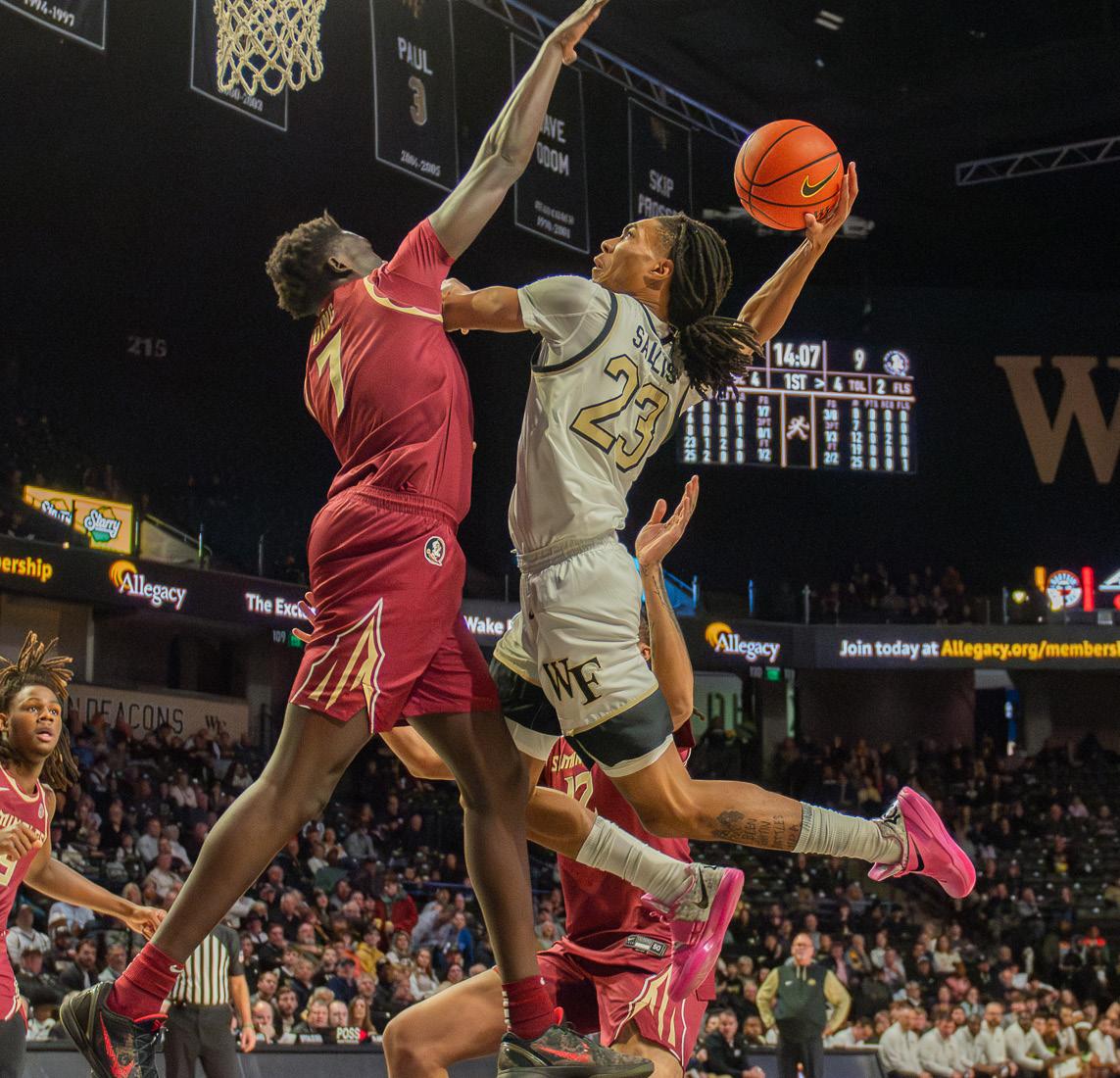
Houston earns multiple Player of the Week honors; pitching staff stellar over four game stretch
SEAN KENNEDY Sports Editor
Wake Forest Baseball is off to a hot start, sweeping their first weekend of the season in style with wins against the Long Island University Sharks and Marist Red Foxes.
Star shortstop Marek Houston not only lived up to preseason expectations but exceeded them, earning ACC Player of the Week honors for his performance over the three-day, four-game weekend. Houston now leads the conference in six batting categories, including hits (10), home runs (3), and RBIs (13).
Not only is Houston off to a historic start, but the entire team is — the Demon Deacons have earned 11+ runs in each of the first four games for the first time in program history. Head Coach Tom Walter’s lineup also leads the country in runs (63), doubles (19), extra-base hits (28) and RBI (60).
On opening day, the Demon Deacons battled against the LIU Sharks as starter and Missouri transfer Logan Lunceford took the mound to open up Team 111’s season.
Lunceford started his Demon Deacon career strong, pitching four scoreless frames with seven strikeouts and only allowing three Long Island batters on base. Meanwhile, the batting lineup showed out quickly, with all 14 runs coming in the first four innings of play. The Demon Deacons got four runs on the board in the first inning after junior Jack Winnay singled, bringing in runners Houston and Marist transfer Ethan Conrad.
Houston would continue his success later on in the game, launching the Demon Deacons’ first home run of the season: a bases-loaded, two-out grand slam to up the score to 14-0.
Lunceford would pass pitching duties over to relievers Griffin Green, Rhys Bowie and Nate Brittain, who would run-rule the Sharks into their first win of the season, winning 14-2.
On the back half of a doubleheader, the Demon Deacons kept up their output on both sides of the diamond to defeat the Marist Red Foxes.
Pitchers Joe Ariola, Matt Bedford, Will Ray, Luke Schmolke and Luke Billings combined for 15 strikeouts and only allowed two earned runs. They were also backed up by fantastic defensive performances, especially from the corners of the diamond.
“Defensively in game two, I was really happy,” Walter said. “Kade Lewis made two great plays at first base, Dalton Wentz with a nice diving play at third [base].”
Offensively, Houston continued his hot start, hitting a home run in the fifth inning and finishing the game with two hits and two RBIs. Conrad added two doubles and three RBIs.
The Demon Deacons went on to win the game 11-4, in the only game that lasted nine innings all weekend.
“Anytime you get two wins in one day, it’s a good day,” Walter said.
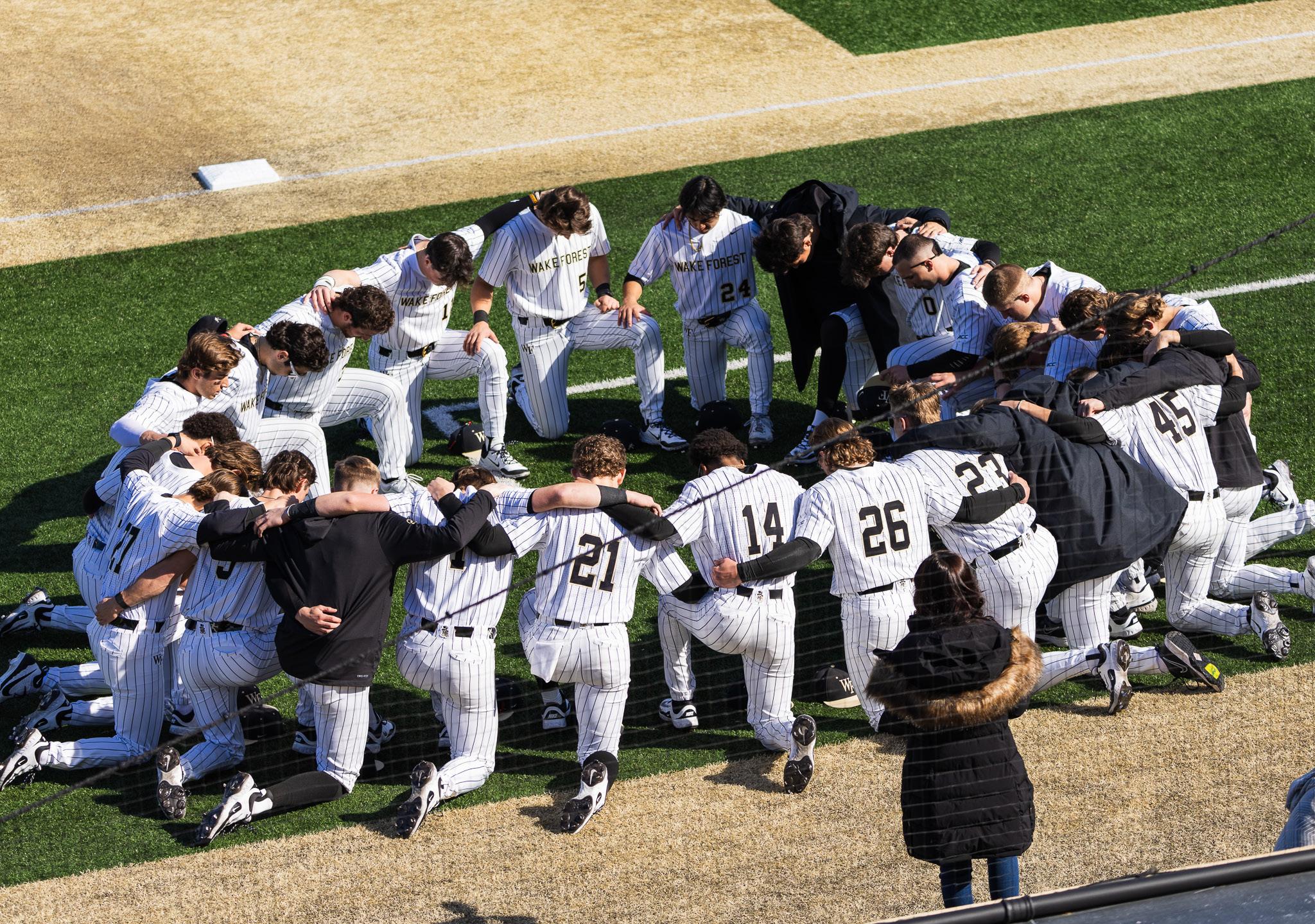
The Demon Deacons took the Sharks on yet again Saturday night, battling through tough, wet weather conditions to run-rule Long Island in seven innings, 14-0.
Despite the tough conditions throughout his first start, Tennessee transfer Matthew Dallas dealt throughout most of his 4.1 innings of work, finishing with nine strikeouts and a scoreless outing in his Demon Deacon debut.
On the offensive end, most of Wake Forest’s production came from their first three batters in the lineup: Houston, Conrad and Princeton transfer Matt Scannell. Each player batted for a combined seven hits, seven runs and nine RBI.
Sophomore designated hitter Ryan Preisano would also record his first collegiate hit in style, knocking a ball over the left-center field wall to bring the Demon Deacons up 3-0 in the bottom of the second inning. Conrad then brought in two runners on a double, putting the Demon Deacons up early.
At the plate, Walter’s lineup would also produce in the bottom of the fifth inning, knocking in five runs overall. Scannell powered a ball to left-center field to bring in runners Javar Williams and Antonio Morales.
On the hill, the Demon Deacons remained impeccable, as relievers Josh Gunther and Dylan Zucker only needed a combined 40 pitches to seal their scoreless 2.2 combined innings and seal a 14-0 win for the Demon Deacons.
The fourth game of the weekend brought tons of offense for the Demon Deacons, taking down the Red Foxes, 24-6.
Sunday starter Blake Morningstar had a strong beginning of the season, striking out two of the first three batters he faced in the first inning. The sophomore would allow some momentum to the Red Foxes in the fourth inning, finishing his day with a line of four innings pitched and two earned runs.
Meanwhile, the offense got started early and scored often. Already up 5-0 in the bottom of the second inning, Winnay launched a bases-loaded bomb to leftcenter field, blowing the game open and allowing the Demon Deacons to take a momentous 9-0 lead.
Winnay wouldn’t be the only batter to send a ball over the wall, either. Austin Hawke, Chris Katz and Conrad each homered in the fifth and sixth innings, with Katz’s home run putting the Demon Deacons up 20-3.
High-quality relief appearances from Troy Dressler, Zach Johnston and Will Ray would settle the final game into a run-rule, 24-6.
The Demon Deacons now look to continue their momentum when they return to David F. Couch Ballpark to face the St. John’s Red Storm in a three-game homestand next weekend.
Contact Sean Kennedy at kennsm21@wfu.edu
WBB leading scorer Rylie Theuerkauf's scoring average. 13 +1 .412 11.1
Amount of games that Hunter Sallis has scored 20+ points in this season. Score for Women's Golf at the Moon Invitational- good for second overall.
Batting Average for the Baseball team- good for third nationally.
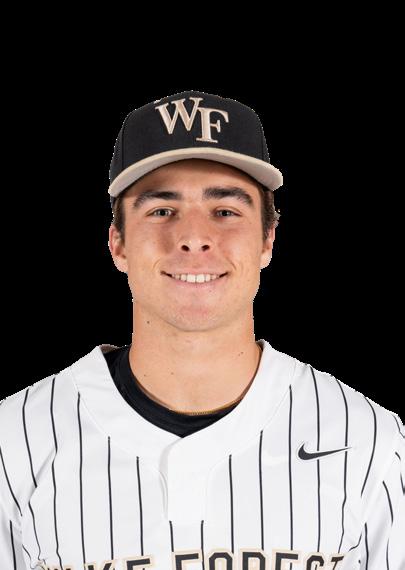
Houston garnered ACC, Golden Spikes, and Perfect Game Player of the Week honors for his fantastic opening weekend against the Marist Red Foxes and Long Island Sharks. Houston went 10-14 (.714 BA) from the plate across the weekend.
Houston also leads the nation in runs (10) and ranks second nationally in both hits (10) and RBIs (13). Houston hit the first Demon Deacon home run of the season, too- powering a 368-foot grand slam in the opener against LIU.
I feel really good about our position players and our bullpen right now. I’m happy with our club.”

PAGE 18
THURSDAY, FEBRUARY 20, 2025
Lydia Derris, derrlf23@wfu.edu
Grace Schuringa, schugh24@wfu.edu
Is what's in our phone more important than what's right in front of us?
GRACE SCHURINGA Arts & Culture Editor
Dead Man’s Cell Phone, directed by Sarah Ruhl, was brought to the Ring Theater in Scale Fine Arts Center, on Friday, Feb. 12. The play premiered in 2007, just before the technological heist of social interaction by the internet. It serves as a prescient warning of the shift in interpersonal connection, and disconnect, in a world ruled by technology.
The show, which has been in the works since December, opened to numerous overlapping phone call conversations, where seated center stage are the two principal characters: Gene and Gordon.
The central story develops when Gene, played by Ellie Howell, discovers that Gordon, played by Joe Bruno, is — spoiler alert — dead.
As his phone continues to ring in the silent café, she takes the prerogative to answer his calls. At this moment, Gene recognizes Gordon’s phone as his last lifeline to the living world. In taking his calls, she bridges the gap between his story and her own.
Seeing it as her job to keep his legacy alive, Gene keeps the phone, continuing to take calls that will entangle her in a series of nuanced situations. In doing so, she realizes just how little she knows about the stranger who it belonged to.
A second narrative unfolds as Gene becomes entranced with Gordon’s neglected younger brother Dwight, played by Patrick Fenlon.
Fenlon, a Computer Science major, began acting his freshman year at Wake Forest and has since premiered in 10 main stage performances. He describes his discovery of a love of theater
as something “[he] just kept getting drawn to –having somewhere to express [himself].”
“This is some of the work that I’m most proud of,” Fenlon said. “I feel that I was able to give the role my own touch. I had a lot of fun with it – bringing Dwight to life.”
Gene and Dwight’s relationship in real life brought their chemistry to the production. Fenlon said, “I had a really fun time on this play, and I got to work with my best friend [Howell].”
Howell has never been in a Wake performance without Fenlon.
“He digs into his characters in a way that I have not experienced, before Wake or in general. I know that in the scene I have a strong actor to rely on, and when we’re out of the scene it’s just [us] again. It’s very special to work with someone I'm so close with because theater is all about community and collaboration,” Howell said.
The central theme of the show is the everevolving dependence on electronics in our society.
At one point, Gene is faced with the choice between a deepening connection with Dwight and answering his brothers’ phone, depicting the fundamental dependency we have on technology. Embedded even deeper in the narrative is the obstacle our phones pose in our pursuits to form genuine connections.
Director Brooke Davis states the central question of the production in the program: “Can our phones bring us together while also bringing us apart? How well do we know someone when we only know them virtually? Do we cease to exist when our phone stops ringing?
To further this theme, the ensemble – or sonders, as they chose to call themselves –
worked to carefully develop their characters and contribute their monologues to the opening scene. The name sonders was selected to epitomize the sensation of numerous lives –– completely separate from one's own — unfolding at once. The term ensemble, as Assistant Director Hannah Reynolds explained, “didn’t encapsulate all that they did for the production.”
Reynolds, a presidential scholar for theater, noted the differences between her previous role as an actor and her debut as assistant director.
“Directing is completely different from acting,” Reynolds said. “It’s a step back — a chance to watch everything happening, and help put it together.”
Her position was heavily centered around directing the sonders, whose story development she speaks to with much pride, and said she “loves the collaboration we did to create these enriched characters who filled out the world of the show.”
The monologues, spoken in English, Mandarin and Italian, all revolve around different presentations of love. Each of the sonders worked to form complex inner narratives, ranging from the owner of the café, an intern at a large corporation, a dad away from home and a woman working through a breakup.
Mati Romagnoli, a native Italian student, explained that her character’s story hit close to home.
“In the show, I am a student studying abroad, which is basically what I am.” The theme of her phone call was in relation to nostalgia and homesickness,” She explained, “When I’m away, it feels difficult that everyone else's life keeps going, even when I’m not there.”
“It was a challenge.” Janiyah Lewis, the heartbroken sonder, speaks to the obstacles she faced in developing her character: “At first, I didn’t know where I fit into the larger arc of the play. My monologue was completely out of character for me. But with the help from the other performers, I think that I was able to really bring her to life.”
Beyond the incredible evolution of the play's ensemble, the cast did an excellent job of transforming a heavy narrative into a cleverly amusing performance. While darkly humorous, the play is a masterful presentation of such a prevalent universal issue. In each scene, you can look beyond the witty dialogue and uncover a compelling commentary on how every aspect of our society is shaped to accommodate technology. The central love story between Gene and Dwight helps to restore the viewer's belief in fate, but in the end, the audience is left to consider the role technology plays in shaping their own destinies.
With their graduation approaching, Fenlon and Howell left it all on the stage as they departed from the Wake Forest community to pursue careers in acting. Ellie reflects on her last appearance on this stage;
“I find that every show I'm in, I take a little bit of the character with me in the end,” Howell said. “Being able to connect with her and thinking, ‘I'm just going to live my life,’ was a special ideology to walk away with. I'm glad that Gene was my last role on campus. It’s nice to know that I’m going out with a bang.”
Contact Grace Schuringa at schugh24@wfu.edu
Owens’ lecture at WFU blended performance, activism, and reflection in exploration of Black identity and art
BEZA
ZELALEM Environment Editor
Acclaimed writer, curator and performance artist Clifford Owens stood at the front of the auditorium in his usual all-black attire. With a calm demeanor, he opened his performance by inviting the audience to join him in a moment of silence, paying tribute to his dear artist friends who had recently passed away.
“The power of silence. The politics of silence. When we are silent, we hear each other breathing. We know that we are alive, and our heads are connected to our bodies,” Owens said, as the packed room, once buzzing with excitement, fell quiet.
Owens’ visit was more than a lecture — it was a living performance that blended the roles of teacher, performer, and activist. His appearance coincided with his displayed work in the “Young Gifted & Black” exhibition at Hanes Gallery alongside other influential Black artists shaping contemporary art.
For Owens, art is always in motion — constantly evolving, never static. His philosophy challenges audiences to engage with Black art not as a finished object, but as a dynamic, living process. Through his work, Owens demonstrates that Blackness, like art, is an ever-evolving force.
During his lecture, Owens spoke of a piece he acquired from the collection of David Hammons, an influential artist best known for his
works during the 1970s and 1980s. It consisted of small strands of African American hair strung together on a wire with price tags attached titled, “Dollar Sale.”
“What is the value of art? My representation? My body? Black hair?” Owens posed, urging the audience to confront the commodification of the Black identity and its physical markers.
Beyond his art, Owens considers himself an ambassador for performance art, especially to young people. He travels to various college campuses to engage students with the power of performance, ensuring Black narratives continue to be told.
“I’m keeping performance art alive. I don’t want certain stories to be forgotten,” Owens explained.
The discussion also emphasized the notion of Black labor in the art world. After the lecture, Owens explained to a small group of students that he didn’t realize his talk was being recorded.
“I said, ‘No, we have to get rid of that,’ because the value of my labor is such that you are not taking my lecture and putting it in the archive of a school built on slaves,” he said.
This stark reminder of the historical foundations of many universities underlined the ongoing struggle for recognition and respect for Black labor in the arts. “I know the value of my labor,” Owens said.
He emphasized that performance art’s im-

Hammons installing his wire-and-hair works on Venice Beach in 1977, the aridity and stark whiteness of the stand contrasts the dark hair.
pact can’t be replicated. This belief in live art reflects his view that it is shaped by its audience and moment in time.
“You had to be there. You didn’t feel how the room felt. You cannot replicate that,” Owens said. “The physical and psychic toll of this kind of art cannot be understood unless you’re part of it.”
The dynamic exchange between Owens and the audience became central to the experience, illustrating the importance of audience engagement in his work.
Acknowledging the cultural context of his Southern audience, Owens smiled and said, “I know I’m in the South when I’m lecturing and
people are actively going ‘mhmmm’ in response to what I’m saying.”
Freshman Cate Goldman commented “Owens’ talk was extremely authentic as he encouraged the audience to question the boundaries of art in society.”
This interaction – where the audience and the artist are co-creators in the experience – is what makes performance art so vital for Owens. It’s not just about showing a piece of art; it’s about creating a living, breathing moment together.
Contact Beza Zelalem at zelam22@wfu.edu
Kendrick definitely didn't keep it vegan at the Super Bowl, it was all beef
LYDIA DERRIS Arts & Culture Editor
“Tryna strike a chord and it's probably A minorrrrrrr.”
These were the lyrics that rang across the country.
This was the universal topic of every Super Bowl party and pre-game — whether or not Kendrick Lamar, the Super Bowl LIX headliner, was going to perform his diss track against international rap star Drake, “Not Like Us.” The song rocked the pop culture scene for months, and this past week, became the first diss track to ever win a Grammy.
“Not Like Us” bolstered Kendrick’s current role in popular hip-hop culture. In light of the defamation suit, Drake has been rendered the whiny baby that can’t face the music in the eyes of the public.
Kendrick, armed with that knowledge, gave no f**ks — naturally, he played the song. The performance was near the end of the set, effectively building anticipation from the crowd and viewers at home. He played the intro of the song a couple of times, and even claimed he wasn’t going to play it, stating, “I want to play their favorite song, but you know they like to sue.”
The stage was configured as a video game controller, and at the set’s close, the stands read in white lights “Game Over.”
And boy oh boy, did Kendrick win.
Fully entranced, I watched Kendrick perform “Not Like Us.” Dude was seriously having a blast; Kendrick ascended beyond mere criticism in his lyricism.
Kendrick rapped the infamous lines, “Say, Drake I like ‘em young,” and looked directly into the camera while patting an imaginary child. “Not Like Us” alleges that Drake is a pedophile
"[Kendrick] handled his beef with Drake as a necessary task to preserve his role as a respected and admired rap legend."
among other nefarious things, suggesting that the performance of the song was a premeditated decision.
As such, compromises were made to make the song more palatable — something Black artists have had to do historically to please audiences. Kendrick replaced the word “pedophile” with a pre-recorded scream, and the camera panned away from him as he continued to rap.
This was the true genius of Kendrick’s performance — unifying the creative narrative of the performance with the ongoing metanarrative. He directly challenged the controversy of whether he should perform a song that is tied up in a defamation lawsuit. His set was a commentary on a larger issue: whether a Black performer could perform a set at the Super Bowl on live television that may be pegged as “too vulgar” or obscene by viewers.
Kendrick drew attention to the point of always having to mitigate his verbiage, lyrics and persona via his personal bard, Samuel L. Jackson, who was decked out as the ultimate patriotic figure: Uncle Sam. Jackson was a bit of a provocateur throughout the set, stoking the flames.
A skilled orator of the rap tradition, Kendrick delivers tongue-twisting double entendres and praises rhyme scheme, treating his career and reputation with an air of traditional austerity. He handled his beef with Drake as a necessary task to preserve his role as a respected and admired rap legend, and he clearly has not wavered on this stance.
His performance of “Not Like Us” on the Super Bowl stage, at the Caesars Dome in New Orleans, confirmed this: it’s all business — but who said you couldn’t mix business with pleasure?
Kendrick was fitted up in staples of Americana, most notably his perfectly silhouetted bell-bottom jeans.
Following SZA’s appearance, Jackson stated “That’s what America wants — nice, calm. You’re almost there — don't mess this up…”
In response, Kendrick began playing “Not Like Us,” in direct rebellion to the ideological push for Black artists to make their art digestible to crowds.
Holistically, the set was centered around “Not Like Us,” and as a polish to the crown jewel, the rest of Kendrick’s performance was relatively ordinary. His bigger hits failed to make it on stage — no “Bitch, Don’t Kill My Vibe,” or “Alright.” He pulled from a more contemporary repertoire from his recent LP, “GNX.”
Following “Squabble Up,” Jackson appeared and posited the inflammatory inquiry to Kendrick: “Too loud, too reckless, too ghetto — Mr. Lamar, do you really know how to play the game?”
This worked to both taunt Kendrick and satirize the performance and the American cultural motif as a whole. Kendrick then began performing “HUMBLE.,” and his dance entourage wearing red, white and blue tracksuits assumed the formation of the American flag.
At the set’s inception, Kendrick decreed, “The revolution ‘bout to be televised – you picked the right time, but the wrong guy.” On one of the world’s biggest stages, Kendrick addressed contemporary struggles, but most importantly — certainly most entertainingly — he made sure to air out his personal beef. To that, I say, well done Mr. Lamar, I would too.
Contact Lydia Derris at derrlf23@wfu.edu
This bakery proves vegan treats can taste just as good as non-vegan options
COLLYN BALLENTINE Staff Writer
Winston-Salem’s Ardmore neighborhood just got a little sweeter.
Gingerbread Man Bakery, the city’s latest vegan-friendly dessert shop, opened its doors in early October. Since then, it’s been serving up delightful vegan treats that are winning over the locals — vegans and non-vegans alike.
The bakery is located next to Ardmore Coffee, in the historic Ardmore neighborhood.
The bakery’s name is a nod to owner Wade Lyndsay’s red hair and love for cinnamon and ginger spices, which are staples in their creations. Lyndsay’s passion for baking started young and was fueled by family traditions.
“My brother and I used to do a lot of potlucks with our friend groups, and
I’d bake with my mom,” he said. “She got sick as I got older, and I guess I was kind of filling the void she left. But I realized I enjoyed doing it a lot. I’ve always had a sweet tooth, and I love being creative, coming up with my recipes and practicing.”
His love for baking turned into a fulltime career, leading to the creation of Gingerbread Man Bakery. The shop offers an impressive variety of cupcakes, cookies, brownies, cinnamon rolls and biscuits.
The best part? Every item is completely plant-based.
“I’ve been vegan for nine years, and I feel like the stuff we make is just as good as anything else,” Lyndsay said.
“There’s not a lot of vegan options, and we’re able to fill a void of desserts for people that will never be able to have them anywhere else.”
I visited Gingerbread Man Bakery on Sunday, Jan. 19, with my friend. While
I am dairy-free, she is not. We both walked away impressed. I opted for a birthday cake cupcake, while my friend chose a pumpkin cupcake. Both cupcakes were generously sized, and their flavors did not disappoint.
The birthday cake cupcake had a light, cakey texture that’s hard to come by in vegan baked goods. However, the pumpkin cupcake, moist and richly spiced, stole the show. The “cream cheese” icing on the pumpkin perfectly complemented the cake’s base.
The bakery itself is as inviting as its desserts. The cozy space features inviting decor, indoor and outdoor seating and an enticing aroma of freshly baked treats.
“It’s really nice to have a space for people of all kinds to be able to eat desserts,” Lyndsay said.
Gingerbread Man Bakery is more than a hidden gem; it is a celebration of creativity, flavor, and inclusivity in Winston-Salem’s food scene. Whether you’re vegan, dairy-free, or just someone who loves a good cupcake, this bakery is worth a visit.
EVAN LIPETZ Staff Cruciverbalist

Contact Evan Lipetz at lipeek22@wfu.edu
Down
1. Place for crops and livestock
2. “Land” in Hawaiian
3. Body-revealing scan
4. Text communication device for the
deaf
5. Be in debt
6. Currency
7. Campus courtyard
8. Vessel for ashes
9. Martini garnish
10. Smuggled items
11. Furthermore
12. e.g. Kissing in public
22. Old, informally
24. To pester
26. Snake-like fish
28. After you have been tagged (3 words)
29. Application like Chrome or Firefox
30. Equilibrium
31. Sadness
33. Good luck charm
35. West African nation
36. To observe
37. To listen
39. Desired outcome
41. Thick milk
43. Robin Hood’s weapon
53. Female deer
55. Beer barrel
57. Old cloth
59. Knight’s protective wear
61. Under no circumstances
62. Pakistani language
63. Affirmation at the end of prayer
65. October birthstone
66. Company emblem
67. To let fall
68. Tree juice
70. “Gold” in Spanish
72. German grandmother
73. Exclamation of wonder
Across
1. Office machine for sending copies
4. Jerry’s feline pursuer
7. The established order
10. Upper limit
13. What we breathe
14. Twins, for example
15. Web address
16. Vintage
17. Genetic material
18. Currency of Japan
19. Tropical American bird
20. US spy agency
21. Sandwich spread, for short 23. Cessation
25. To deny
27. Gaddafi’s former country
30. Ale or lager
31. Common start to a letter
32. Morning talk show, commonly
34. Back muscle, for short
36. Female pronoun
38. To be/look better, slang
40. Online education platform abbr.
42. Short hairstyle
44. Squeak
45. ___ Jima
46. Glass container
47. Antecedent
48. Auditory organ
49. Airport security
50. Sole
51. Currently
52. Stop sign color
54. Animal with big antlers
56. Poker playing medium
58. Fly high
60. Bowel cleansing
62. One who utilizes
63. Years lived
64. AU on the periodic table
68. ___ Lanka
69. Mother, informally
71. To promise
74. “For” in Spanish
75. Shakespeare “Much ___ About Nothing”
76. Unrefined metal
77. Someone who is edgy
78. Same as 47-across
79. Play on words
80. Weasley of Harry Potter
81. Uncooked 82. To sever off
From NASCAR legends to neighborhood horsepower, Winston-Salem’s car scene has it all!
SAM JENKINS Contributing Writer
If you think Winston-Salem is only home to family-friendly SUVs, you’d be wrong.
Seemingly, all we see on campus are the seemingly endless supply of Toyota 4Runners and Jeeps that all coincidentally have a unique collection of rubber ducks squatting on the dashboard. “Bland” seems to define the city's taste in cars in every imaginable way.
To our collective good fortune, however, Winston-Salem is not all about getting from point A to point B in an inconspicuous fashion. There is a vibrant cult of car lovers hidden in the labyrinth roads that comprise WinstonSalem; people who see cars as not just a tool, but an expression of the self.
This was the major point emphasized at the “Cars + Coffee” event, hosted by NASCAR at The Nash Museum, on Feb. 2. The event consisted of a car meet-up to celebrate the Bowman Gray Cookout Clash.
“This event was crazy for Winston-Salem,” Mark Hedrick, a seasoned car meet vet, said. “Usually, we get around 100-150 people in Winston car meets, but we got here early and there were already 300 people, and more and more people kept showing up.”
I have been to a few car meets in WinstonSalem. Some were very informal and saw their beginnings in a group chat, some were hosted by Cars + Coffee. This event topped every last one of them — in every way possible.
Parking was harder to find than a room in the basement of Tribble, as most of the streets next to the museum were closed off for the event. This meant most attendees had to park two streets down. Luckily, eye-catching cars dotted the streets to the museum like polished gems, and as a staunch car enthusiast, it was well worth the walk.
After finally getting through one of the most entrancing car parks ever, the main event more than exceeded expectations. To begin, there was a live DJ on stage, multiple vendors peddling all sorts of incredible car merch and even a racing simulation challenge created by “Race Mode,” a race simulation company located in Winston-Salem.
Someone even brought a low-rider RC car that could adjust its ride height, which was something most people couldn’t help but grin at. The organizers also created a competition for the cars involved; each car got a QR code sticker that attendees could scan to vote on their favorite car.
Each car on the main strip was handpicked from a set of entries and invitees to create one of the most diverse arrays of cars Winston-Salem has ever seen. There were even real NASCAR cars, but those were merely warmups for what was to come.
Predictably, there were many modified cars, but these weren’t just standard changes to make them go faster, these were real statement pieces. Among the fan favorites in the modified class was the 1997 Honda Odyssey,
which was given the engine of a Honda Civic, on turbocharged steroids. It was also lowered and was lovingly renamed: “The Radyssey.”
There was also a beautiful family of BMWs who had simply lowered the ride height of their cars. They added some good-looking tires and window-shaking exhausts, creating a simplistic but beautiful build. The BMW crew even contained a 90s series 8, with the coveted pop-up headlights!
The overall popularity winner of the event, was a 2013 Mustang monikered: “the Hulk” with a “Hulk” inspired paint job — and a performance to back it up its name. Massive rear wheels, enough engine modifications to write a thesis on and an exhaust that rang so loud, fog horns would feel inadequate.
These types of cars, while amazing, were standard for Winston-Salem’s car meets, but the organizers made sure to bring out the unique side of Winston-Salem, as well. One of the crown jewels on display was a Ferrari Mondial (it's real I swear), that had everyone's attention because nobody had heard of it.
Everyone was crowded around this forgotten child of the Ferrari line, a sporty car with a good engine that was eventually overshadowed by its big brothers.
Many classic cars were also in attendance with 1965 Mustangs, old Corvettes and even a 1950s Studebaker with the same owner who bought it when it was released. He and many of the other cars had amazing stories to tell.
Attendees were just as varied. Some young,
some middle-aged with kids — and some “old looking” individuals that say their mental age is far younger!
Needless to say, this event seemed to put a smile on everyone's faces. But make no mistake, this event came with its drawbacks.
“The more people that come to these events, the more chances that someone does something stupid,” Damian Peters, a local car enthusiast, said.
Many drivers left the event at high speeds, though I cannot confirm whether they were breaking the law. Some even did what's called a burnout, where the car doesn’t move, but the back tires spin, resulting in lots of smoke and frowns from attendees.
Now I know, some are reading this going, “Isn’t that what those cars are for?” and while you are not entirely wrong, there is a time and place for passionate driving. Many attendees were worried that the event would be shut down for reckless driving, as had been done in Charlotte two years ago.
However, the good in this event vastly outweighs the bad. This event brought together so many parts of Winston-Salem’s car culture to appreciate it holistically rather than in fragmentation. It was amazing to see people from all walks of life and taste in cars, come together and talk about all the things we can’t talk about to non-car enthusiasts.
Contact Sam Jenkins at jenksc22@wfu.edu