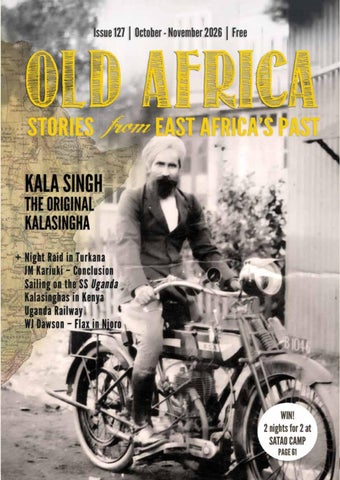
OLD AFRICA
ISSUE No.127 October-November 2026
i
, c i t n e h t u A , Wild e l b a t t e g r o f n U
Rediscover safari’s romance at Satao Camp canvas comforts, star-filled nights, and daily elephant parades at our waterhole.
www.sataocamp.com sales@sataocamp.com ii ISSUE No.127 October-November 2026
+254 (0)720 600 200 OLD AFRICA
CONTENTS NIGHT RAID SENDS FAMILY FROM TURKANA TO KENYA
8
WJ DAWSON: A KENYA LIFE – PART 7
16
JM KARIUKI: POPULIST MP MURDERED PART 13
22
SAILING ON THE SS UGANDA FROM MOMBASA TO LONDON
32
SIKHS IN KENYA – 125 YEARS
40
THE HISTORY AND CONSTRUCTION OF THE UGANDA RAILWAY
46
Pastor Peter Amundui remembers how a deadly night raid in Turkana scattered his family and led them to move to ‘Kenya.’
In the early years after World War I WJ Dawson farms in Bahati and then in Njoro, becoming a major flax producer.
In this concluding segment of the JM Kariuki saga we see the family’s quest for justice and the legacy of the popular politician.
A colonial policeman and his family take one final leave to the UK, travelling on the SS Uganda.
A sweeping look at the impact of the Kalasinghas of East Africa and how they came to acquire that name.
An engineer who worked for years on the railway shares his comprehensive story about the building of the Uganda Railway – starting with the geopolitical influences and then the early surveys and finally the construction.
DEPARTMENTS Editorial Sauti Zenu – Your Letters Only in Africa Book Review History Quiz History Mystery Contest Warden’s Diary Old Africa Photo Album Historic Photo Contest Mwishowe
2 5 30 58 61 62 64 66 68 69
Cover photo: Kala Singh on his motorcycle with his trademark turban and long beard. The Maasai began calling all Sikhs Kalasinghas because of this Kala with whom they first interacted.
OLD AFRICA
ISSUE No.127 October-November 2026
1
EDITORIAL
MK’S GROWING UP IN EAST AFRICA
I
was born in Tanganyika Territory and then grew up in Kenya. I was an MK, the term used to describe us ‘missionary kids.’ My parents came to East Africa in 1946 with a large wave of other American missionaries, having a passion to share their faith in Jesus Christ and to establish churches. In the wake of this wave came us MKs. Some came as young children. Others, like me, were born in Africa in mission hospitals. We MKs then ended up getting our education in various schools, mostly boarding schools, established to care for MKs as their parents carried on their ministry. My older brothers boarded at Victoria Academy on the shores of Lake Victoria, and later took the steamer and train to board at Rift Valley Academy (RVA) in Kijabe, Kenya. By the time I started school in 1962, my parents had moved to Kijabe, so I attended RVA as a day student. Our experience growing up as white kids in Africa affected all of us in different ways. One common complaint from MKs is that they had no choice in the matter of where they grew up. They were born and/or grew up in Africa just because their parents were there for their mission work. Transitioning back to our parents’ home country or our ‘passport’ country caused a fair amount of life-shaking experiences for all us as MKs. Since I’m an MK, I relate closely to the two books we are reviewing in this issue of Old Africa. The first is called Drawn to Africa, by Paul Bolstad and his three siblings who were MKs growing up in the Usambara Mountains of Tanganyika. Their African childhood was disrupted after a trip to the USA when they were told they couldn’t return to Africa because of their father’s heart condition. I had a lot to do with the second book, Mau Mau Viewed from RVA, having done all the editing and shaping after receiving the manuscript from Willie Danielson, who graduated from my MK school 19 years before I did. Both books add to the body of literature about MKs growing up in Africa and are worth reading. We also feature a rather lengthy article on the building of the Uganda Railway, written in the 1940s by Allan Johnston. As an engineer who worked for years on the railway, he adds extra bits to the story like the mechanics of how the funicular railway lowered railway cars and supplies down the steep Rift Valley escarpment. He also tells about the original survey trips and the political history leading up the decision to build the railway through Kenya – a decision that built a country.
--Shel Arensen, Editor OLD AFRICA MAGAZINE
P.O. Box 2338 Naivasha, Kenya 20117 www.oldafricamagazine.com Editor: Shel Arensen 0736-896294 or 0717-636659 Design and Layout: Mike Adkins, Blake Arensen Proofreader: Janet Adkins Printers: English Press, Enterprise Road, Nairobi, Kenya
Old Africa magazine is published bimonthly. It publishes stories and photos from East Africa’s past. Subscriptions: Subscriptions are available. In Kenya the cost is Ksh. 3000/- for a one-year subscription (six issues) mailed to your postal address. You can pay by cheque or postal money order made out in favour of: Kifaru Educational and Editorial. Send your subscription order and payment to: Old Africa, Box 2338 Naivasha 20117 Kenya. For outside of Kenya subscriptions see our advert in this magazine. Advertising: To advertise in Old Africa, contact the editor at editorial@oldafricamagazine.com for a rate sheet or visit the website: www.oldafricamagazine.com Contributions: Old Africa magazine welcomes articles on East Africa’s past. See our writer’s guidelines on the web at: www.oldafricamagazine.com or write to: Old Africa magazine, Box 2338, Naivasha 20117 Email Address: editorial@oldafricamagazine.com. After reading our guidelines and editing your work, send it to us for review either by post or email. (To ensure return of your manuscript, send it with a self-addressed envelope and stamps to cover return postage) Copyright © 2026 by Kifaru Educational and Editorial All rights reserved. No part of this publication may be reproduced or distributed in any form or by any means, or stored in a database or retrieval system, without prior written permission of the publisher.
2 ISSUE No.127 October-November 2026
OLD AFRICA
SINCE 1994
WWW.DRYASSOCIATES.COM LICENSED BY THE CAPITAL MARKETS AUTHORITY
OLD AFRICA
ISSUE No.127 October-November 2026
3
SPECIAL RESIDENTS RATES AT
Porini Camps
Experience an Authentic Safari this Holiday Season at Porini Camps, set in exclusive wildlife locations. Non-residents traveling with residents can enjoy special resident rates for an unforgettable safari adventure. CAMP
1 JUNE – 31 OCT 2026
01 NOV – 19 DEC 2026
20 DEC – 02 JAN 2027
PACKAGE
Porini Giraffe Camp
Kes 25,000
Kes 19,500
Kes 37,500
Ground Package
Porini Amboseli, Porini Mara, Porini Cheetah & Porini Lion Camp
Kes 41,250
Kes 26,950
Kes 37,500
Ground Package
Kes 34,650
Kes 21,450
Kes 31,500
Full Board
Kes 41,250
Kes 26,950
Kes 37,500
Ground Package
Rhino River Camp (Forest Tent)
Kes 25,300
Kes 18,260
Kes 23,000
Rhino River Camp (River Tent)
Kes 34,650
Kes 19,500
Kes 31,500
Rhino River Camp (Forest Tent)
Kes 34,650
Kes 23,760
Kes 31,500
Rhino River Camp (River Tent)
Kes 41,250
Kes 26,950
Kes 37,500
Porini Ol Kinyei Safari Cottages
Kes 41,250
Kes 26,950
Kes 37,500
SUPPLEMENTS:
Single supplement Kes 4,000
Single supplement Kes 4,000
Single supplement Kes 4,000
SPECIAL OFFER - BED AND BREAKFAST
1 JUNE – 31 OCT 2026
01 NOV – 19 DEC 2026
20 DEC – 02 JAN 2027
Nairobi Tented Camp
Kes 11,800
Kes 11,800
Kes 14,160
Kes 4,900
Kes 4,900
Kes 4,900
Single Supplement
Kes 3,500
Kes 3,500
Kes 3,500
Half Board Supplement
Kes 7,000
Kes 7,000
Kes 7,000
Full Board Supplement
Porini Rhino Camp
SUPPLEMENTS:
Full Board Ground Package Ground Package
PORINI CAMPS GROUND PACKAGE INCLUSIONS Full board accommodation I Free drinks such as mineral water, soft drinks, house wines, beer, and Gin and Tonic I Guests will enjoy sundowners from scenic viewpoints and guided nature walks I The package also features shared day and night game drives in open 4×4 vehicles with an experienced driver-guide and spotter I At Porini Rhino Camp, guests will have the opportunity to visit the chimpanzee sanctuary in the Ol Pejeta Conservancy I Those at Porini Amboseli Camp can experience a Maasai village visit I For guests flying in, local airstrip transfers to the camps are included. *Please note, the above rates are excluding park and conservancy fees.
4 ISSUE No.127 October-November 2026 BOOK NOW
OLD AFRICA
+254 (0) 722 509 200 I +254 (0) 726 982 701
book@gamewatchers.co.ke I www.porinisafariscamps.com
LETTERS Sauti Zenu ~ Your Voices Dear Editor, Thank you for another interesting issue of Old Africa. Having at last finished reading it, here are my answers to History Quiz No 90. I hope Shel’s health is continuing to improve. Please give him my best wishes. Lorraine Cruickshank, Scotland
Dear Editor, I greatly appreciated Judy Aldrick’s article in issue 125 on Matthew Wellington who was on Livingstone’s team. Viewing history through the lens of lesser-known figures is a difficult skill. Resources are scarcer and more difficult to collate than is the case with better-known characters. Judy Aldrick has done this masterfully; in her meticulously researched article about a relatively obscure figure in the Livingstone narrative there is much to ponder besides the central figure. For example, for reasons it is hard to discern, the extent of slavery on Africa’s eastern littoral is often underplayed in comparison to the Atlantic trade, and I had not really given much consideration to the fact that slavery was only finally abolished in the coastal regions in 1907. The efforts of Livingstone (and the Royal Navy ) were obviously significant in bringing this about, but I think it is hugely important to acknowledge, as she does, the contribution to his expeditions and legacy of people like Matthew Wellington. The manner in
OLD AFRICA
which she has managed to gather the fine detail of his life is amazing. Jim Dawson, UK
Dear Editor, What an awesome read Issue 125 is! The articles are riveting but the lead article on Mathew Wellington is simply out of this Africa! Judy Aldrick researched on this freed slave from the 1840s and brought to life Dr David Livingstone and other pioneers in a fresh perspective you cannot find in bland history books. Judy outdid herself and I’m heading right to Old Africa book section to order books by this author. Once again thank you for your magnificent magazine. Kiptanui arap Cheruiyot, Nakuru
Dear Editor, I hope this email finds you well. I read about your set-back and need to get the ‘voicebox’ adjusted. I really hope this worked and that you are able to communicate better using your voice. Your written words are a joy to many who love the Old Africa Magazine! Miranda McGovern, Mtwapa
Dear Editor, We wonder how many readers of Old Africa recall the names and the work of Geoffrey and Esmé Timms, both of whom gave many years of service to Kenya. Geoffrey originally went to Kenya in 1936 to work in the Colonial
Medical Service. In 1939 he was appointed Assistant Pathologist in the Laboratory Division of the Kenya Medical Department, later becoming Senior Pathologist and in 1953 Assistant Director of Laboratory Services. He was Secretary of the East African Medical Research Council between 1960 and 1964 and from 1984 Consultant Pathologist to Nairobi Hospital. Nowadays it is fashionable to talk about “One Health” which, amongst other things, promotes closer liaison between the medical and veterinary professions. Like so many others working in the tropics, Geoffrey collaborated regularly with veterinary officers, especially on infectious diseases such as rabies that can be transmitted to humans from warmblooded animals. it was therefore not surprising that we should come into contact with Geoffrey soon after our arrival in Kenya, in early 1970. My husband John came to serve as a Veterinary Research Officer at Kabete. Geoffrey often visited the Veterinary Research Laboratory (“Vet Lab”) and was happy to do so; he always got a warm welcome there. Being new to Kenya, John was keen to consult him about zoonoses, particularly rabies. Amongst other duties John was responsible for performing the safety and potency tests for Kabete’s low-egg passage (LEP) rabies vaccine for dogs and John soon became aware
ISSUE No.127 October-November 2026
5
that many staff who worked with rabies had not been immunised. John’s diaries recount how on a number of occasions Geoffrey came up to Kabete with doses of human vaccine. He and John spent the morning vaccinating staff and discussing matters of medical/veterinary interest. Staff (of all races) were encouraged to be protected against rabies. Those working with the virus or with live or dead animals were given priority. Others were offered vaccination on the grounds that they might encounter the disease when they went home or travelled. Rabies in dogs was a particular problem at the Coast and in Machakos District in those days but it could appear anywhere. The staff were divided into two groups. Geoffrey vaccinated one half and John vaccinated the other. At the end Geoffrey gave John a booster dose and he reciprocated by injecting Geoffrey. Geoffrey had married Esmé Mary Miller Logan in 1966, following the death of his first wife in 1958. We left Kenya in December 1973. The Timms attended our farewell party at Kabete and are amongst the signatories in our visitors’ book In the 1980s our contact with the Timms was predominantly through Esmé. She was chairman of the KSPCA (Kenya Society for the Protection and Care of Animals) and was pursuing a number of new ventures with
characteristic energy and diplomacy. She consulted us (primarily John) about proposals for a proper animalholding facility at Nairobi Airport (JKIA) and when we and our family visited Kenya in 1981-1982, we met her and gave advice. This was in collaboration with our longterm friend and veterinary colleague Paul Sayer, who featured in earlier issues of Old Africa. Exchanges with Esmé continued by correspondence (blue aerogrammes – there was no email in those days!). The KSPCA was very close to Esmé’s heart; when she died in 2002, she asked that donations, in lieu of flowers, should be sent to the Society. In the 1990s, we learned that the Timms had left Kenya and moved to Britain where they were now living with their daughter in South Pembrokeshire, Wales. We went to see them in the early 2000s and enjoyed much “Kenya talk.” Amongst topics we discussed was Geoffrey’s career as a medical officer/ pathologist in Kenya. He had been involved in many exciting and intriguing cases. The best known of these was, perhaps, the role he played in the investigation of the death of Josslyn Victor Hay, 22nd Earl of Erroll, who was found dead in his car at a crossroads on the Nairobi to Ngong road on 24th January 1941. Sir Henry John (“Jock”) Delves Broughton was accused of the murder and stood trial from 26th May. He was acquitted
on 1st July and he committed suicide a year later, in Britain. Numerous books and articles have been written about this murder – see, for example, White Mischief (Fox, 1988) and The Life and Death of Lord Erroll (Trzebinski, 2000). Geoffrey Timms, then Government Pathologist, lived in Karen in 1941. On 24th January he was on his usual journey to work in Nairobi when he saw the car and cadaver. He carried out an initial examination of Lord Erroll. Knowing of our joint interest in forensic medicine, Geoffrey had told John in the 1970s about his examination of Lord Erroll’s body and ruefully admitted that he had learnt an important lesson from the case – viz. that a bullet hole can be missed if a victim’s body is not cleaned of blood and the head shaved. The account of Geoffrey’s role given in White Mischief (Fox, 1988) does not accord with Geoffrey’s own recollections. Margaret recalls listening to Geoffrey talking about this when we visited the Timms in South Wales and regrets that it would have been impolite to take notes of the conversation! We were saddened to learn, sometime later, of the Timms’s deaths, Esmé on 2nd February 2002 and Geoffrey on 18th August in the same year. We feel honoured to have known them. Tutawakumbuka. John and Margaret Cooper, Worthing, Sussex
Geoffrey and Esmé Timms’s signature in the Coopers’ guest book in Kabete from November 1973.
6 ISSUE No.127 October-November 2026
OLD AFRICA
BEAUTY TREATMENT & MASSAGE Discover our new spa and signature treatments. OUR SERVICES Deep Tissue Massage Aromatherapy Massage Hot Stone Massage Facial treatment Swedish Massage Foot Massage
EXTRA FUN AWAITS FOR RESERVATION
OLD AFRICA
0729407160/0735 705 008 front.office@riftvalley-resort.co.ke ISSUE No.127 October-November 2026
7
NIGHT RAID SENDS FAMILY FROM TURKANA TO KENYA by Peter Amundui
About 1974
At the age of seven I missed death by a whisker. More than 200 cattle-rustling warriors attacked our village at Lomelo location in Turkana County in the dark of the night at about 1 am. The attackers, suspected to be from neighbouring tribes, carried sophisticated guns as well as spears and arrows. I woke up to the sound of gunshots. My Mom, my elder brother, and my younger sister woke up as well. We could see the vivid red muzzle flash of the guns as bullets whizzed through the air from all corners. Our manyatta village erupted in chaos. My heart raced as we all fled in different directions through the darkness seeking safety in the shelter of bushes and the nearby hills. I was born and raised in the Northern part of Kenya in the late 1960s. The Turkana people border three countries in the northwestern part of Kenya territory; they are Uganda, South Sudan, and Ethiopia. Turkana is a very remote
and dry place. Living is harsh and it’s a struggle to survive. The area only gets a handful of rains each year. The vegetation cover is thorny acacia trees and shrubs on hilly, rocky places with sand dunes in other areas. The climate is too hostile for agricultural activities. In addition to chronic drought conditions, there is food insecurity and persistent conflicts with neighbouring tribes. Diseases continue to affect vulnerable people and many children die at early ages as a result of starvation, and many of those who survive have swollen bellies because of malnutrition. Most Turkana follow a semi-nomadic pastoral lifestyle with goats and cattle, while some have settled around Lake Turkana, the desert lake, and earn a living from fishing. Quite a good number of Turkana people have lost their lives because of the menace of frequent cattle-rustling from the neighbouring tribes/communities. Due to the harsh climatic conditions and the war-torn relations with other communities,
A young Turkana boy in the harsh desert of northern Kenya. Pastor Peter Amundui’s boyhood years took place in the same area.
8 ISSUE No.127 October-November 2026
OLD AFRICA
A Turkana woman passes up water from a well in the 1960s. Searching for water is a major part of the day for people living in Turkana. (Photo by Ed Arensen)
the Turkana people do not believe the Kenya government thinks they even exist. As a boy my family did not think we belonged to Kenya. Anytime well-dressed people would visit us, we would be excited that some people from ‘Kenya’ had visited us. The extent of hunger, conflict among the neighbouring tribes, and diseases made us believe that such conditions were normal. We often saw dead people. If we would go a few months without war, we would wonder what had happened. The mortality rate was alarming. We would hardly go a week without a funeral, either from a mother while delivering a baby, people being shot, a baby or children dying from hunger. No schools could be established or operate in such an unfriendly atmosphere. Boys and girls stayed at home or looked after their parents’ animals and fetched water for the family. Because of these conditions, many Turkana people have migrated from their respective cradle lands to the southern part of Kenya in search of shelter, security, and food. The Turkana community is largely unschooled and remains the poorest and most underdeveloped county in Kenya. But though I did not attend school, I learned other things. By the age of seven years I had been trained to shoot a gun. This was to encourage us boys to take our place within
OLD AFRICA
the defence force in their villages. I wanted to become a warrior like my father. Like other trained boys, I wanted to fight for the liberation of my people from the hands of our tormentors. Our village had a population of about 250 people and our houses were scattered over an area about five square kilometres. Each family had a handful of cows, goats, and sheep for their livelihood. We had about 80 fighting warriors in our village, owning about 60 rifles, as well as bows and arrow, and spears. We lived together in a manyatta to enhance security and give us a better chance to fighting our common enemies as a team in case of any invasion. But this nighttime attack caught our village unprepared. My family and the other villagers could only scramble for safety. Anticipating this, our attackers had already positioned themselves to ensure nobody escaped alive. As we ran dazed and confused, we found our exit paths had been literally blocked. I broke away from my family members looking for a way out. Some of my neighbours were still trapped inside the manyatta. I could hear horrifying cries. I fought back my tears as I sped off. I stepped over something. In the faint glow of the moonlight, I could see dead people and lifeless livestock on the ground. I glanced back but I could not see my family anywhere. I found myself alone. I joined the rising dust ISSUE No.127 October-November 2026
9
from the herd of cattle and a flock of goats that had found an evacuation route. I came to know later that my mother and brother and sister managed to escape miraculously unhurt, though a quarter of my village was wiped out that night. Others were taken hostage. I will forever be grateful to God that my dad was not present the night we were attacked. He would have resisted and would probably have been killed. However, he had travelled far away on a business trip and was on his way back home when he heard that our village had been invaded at night and many people had lost their lives. My Dad was in deep agony, broken-hearted. He had no way of knowing whether we were alive or dead. He searched through the horrific scene at our devastated village. He found vultures feeding on human bodies. In fear he continued looking for our bodies, but he didn’t identify any of us there. He gathered his courage again and he walked
for more than 20 miles, desperately trying to trace our whereabouts. After I escaped from the village that night I ran and ran until I found an empty cave. I sheltered there. It seemed it might be used as a den for wild animals. I wondered if hyenas or cheetahs were inside. My newly found home was warm but scary as well. It was dark inside and I was not sure who else I was sharing it with. But I had nowhere else to run so I stayed there for the rest of my night, quiet and shaken. I woke up to the early rays of the sun filtering into the edge of the cave. I waited for my family to find me. As I sat there, I heard the mooing of cows and baying of goats. I left the cave and followed the sound of the animals and found a homestead plastered with mud and a few thatched huts. I could see from a distance the animals were kept in an enclosed pen surrounded by heaps of thorn branches I felt very hungry and thirsty, so I thought I
A Turkana woman wearing traditional jewellery in the 1960s, the time when Pastor Peter was a boy growing up in the area. (Photo by Ed Arensen)
10 ISSUE No.127 October-November 2026
OLD AFRICA
Rev Peter Amundui serves a church in Ndabibi. (Photo by Old Africa)
could get some water and food there. When I approached the homestead, I found two young ladies milking the cows for breakfast. I cleared my hoarse voice and shouted for attention. Both girls looked at me curiously! With a commanding tone, one of them asked me, “What is your name? Why are you here so early in the morning?” I told them my story and they couldn’t believe I had survived such a horrible scene. They led me to one of their mother’s huts, where I was offered a stone to sit on. This village was not aware our manyatta had been attacked. They offered me a cup of raw milk, which I drank quickly. I asked them for more, which they gladly offered me. After three cups I felt ‘warmth in my stomach,’ as we say it in the Turkana language. The kind girls introduced me to their parents, who had still been asleep in an open hut without a door. I was asked to repeat my story, which I did. The man of the house nodded his head bitterly with pain. He paused a bit and then he took hold of his machine gun. I thought he was getting ready to fight a battle. Instead, he asked me myriads of questions: What was my father’s name? My clan? The name of my village? He was amazed at the way I answered those questions boldly, even though I was only a small lad! My eyes
OLD AFRICA
overflowed with rivers of tears as I answered his questions. I wondered if I would ever see my family again. The father handed me some cold boiled meat from a pot beside him, which I gladly accepted because of my hunger. The father invited me to stay with them until they found the rest of my family or others from our village. I quickly accepted the offer. They gave me an old dried cowhide to sleep on without a blanket. Exhausted, I fell asleep. I was glad to have found safety, but I was lost from my family for three days. My Dad, tortured by thoughts of our death and hungry and exhausted had gone to various homes and manyattas in search of me and my mother and sister and brother. After three days my father traced me to this place called Moru Akiring, which means in Turkana language, ‘a mountain of flesh.’ My father was overjoyed to find me and he was thankful to this kind family for rescuing me. After saying our farewell, Dad held my hand, and we walked on searching for my siblings and mother. My father seemed to forget that I was only a boy and I had to run to keep up with his long strides. I was thirsty and hungry again. There were no places to buy food, or drinks, so we moved on. My dad was exhausted and hungry, too; he had not taken anything for three days and nights. We foraged for wild fruits and roots in the forest to survive. We walked most of the day before finding another homestead where we sought drinking water. My father seemed to know the head of this family. Both of them were involved in a lengthy discussion. I got tired, and I took a nap on bare and hot ground. I didn’t worry about scorpion bites. My dad woke me up later, and we set off to another village nearby. My dad had heard my mother and siblings were being hosted there. At a distance my mother saw us and she came running. We all embraced and cried together. Dad was very happy to find us all alive. He prayed and thanked God for His protection. Though we had lost all of our livestock, my father remarked, “We cannot compare our animals with the lives of human beings.” Our remarkable journey to ‘Kenya’ We were left destitute. Our life in Turkana had been hard, but we had livestock. Now we had lost everything. My Dad decided to take us ‘upcountry’ to avoid the possibility of ISSUE No.127 October-November 2026
11
being killed in another attack. We walked for three days until we got to a small centre called Baragoi. Dad talked to a lorry driver who was ferrying beef cows to Nairobi. After hearing our desperate story, he offered us a lift. They hurled us into the back of lorry with the cows. We drove and bounced on the rough road until we reached a place called Maralal. It was the first time in my life to see small and big cars and tall buildings. I remember thinking that the small cars would eventually grow to be big lorries, just like animals grow. The lorry driver stopped for lunch. However, we were still inside the back of the lorry with the cows. We set out again and the journey seemed endless and the cows stomped on our feet. After some time, we arrived at Rumuruti very late in the evening. Electric lights lit up the town. When the driver opened the back for us to get out, my family was afraid to step down from the lorry because we were not used to the brightness and noise of moving cars. The driver talked to a middleaged man. Eventually, he urged us to alight and join this man. We were afraid, but we had no choice. To our surprise, the driver paid for our supper and accommodation for one night. I’d never read the Bible, but now I know he was a true Good Samaritan. He drove off, leaving us with this man. As little children, we had been told stunning stories that Kenyan people are ‘Man-eaters!’ So, I watched every move of the people around us, hoping no one would eat me. I honestly thought this man was waiting to take us to a slaughterhouse. However, my father did not seem worried, so I trusted my father. The young man ushered us into a restaurant where we were served with ‘strange food’ that we had never eaten in our lifetime. Ugali, kale, chapati, and cooked beans were set on the table. We knew ugali, our staple food which we took with fresh milk. But how were we to eat these other food items? Our dad motioned us with his hand to eat just the ugali. We left the rest of the food on the table. The owner of the restaurant kept his eyes on us. I’m sure he wondered why we avoided some foods? Our bodies were stinking, because we had not taken any bath for almost two weeks. And we had absorbed the sour odour from the cows urinating on us in the back of the lorry. We realized we smelled badly after sitting down in the restaurant and people moved away from our table. We thought at first the onlookers 12 ISSUE No.127 October-November 2026
were interested in our unique dress codes. We were half naked, only wearing goats’ skins, and my mother was wearing a couple of beads surrounding her neck. After eating the ugali, the man led us to a small single room where he expected all of us to spend the night. As a nomadic clan, we were used to spending the night out in the open. This clean room with a roof seemed good and warm for us. However, the night was very long as we could hear the frequent fights and noises from drunkards in nearby rooms. Very early in the morning, the same man came to our room and urged us to follow him to the same restaurant. One of the waiters came to ask us what we wanted to eat. We all demanded the same meal; milk and ugali for breakfast. That gave a good start to the day, but we missed roasted and salted meat! After finishing breakfast, a huge grey-haired man joined our table. He said hello to us and introduced himself casually to us in Kiswahili language. We didn’t know how to respond because we only spoke our native language,
From Turkana boy to ordained minister, Rev Peter Amundui. (Photo from Rev Peter Amundui)
OLD AFRICA
Turkana. Another man was invited to join our conversation, who turned out to be a Turkana. He gladly offered to translate for us what this man wanted to say. His name was Mr Kariuki and he wanted to hire my dad as a herdsman to look after his animals. He had been told the Turkana people are known for their cattletending skills and for their fearless vigour. My Dad accepted the job offer hurriedly since we had no place to call our home. We were taken to Mr Kariuki’s homestead, where we were warmly welcomed by the rest of his family. We were given hot tea with plenty of milk plus ugali. My father was shown a big house and given food, water, and warm clothes. Dad was supposed to start his new job the following morning. He was offered a salary earning less than five dollars a month. Even in the mid1970s this was not very much money. But my dad had no other options. Our lifestyle changed a lot, and on my dad’s salary we could only afford one meal a day. We struggled to survive. There were primary schools nearby, but we couldn’t attend like
Rev Peter Amundui preaching.
OLD AFRICA
other kids because our dad couldn’t afford to raise the school fees for the three of us. I wanted to attend school, but my father wanted me and my elder brother to help him to look after Mr Kariuki’s flock. Then one day Mr Kariuki ordered my father to take us to school or risk losing his job. He said the government wanted all children to attend school regardless of their economic capabilities. My dad had no choice; he was forced to take us to school the next day without proper school uniforms. Mr Kariuki offered to buy both of us school uniforms on the condition that Dad would repay him over time through salary deductions! I was 12 years old when I attended primary school for the first time. We looked very smart in our new uniforms, but struggled to learn Kiswahili and English, both compulsory subjects taught in schools for all the learners. Then my dad lost his job. He was forced to look for other employment elsewhere. It became very difficult for us, moving from one place to another as my father searched for work. We weren’t able to stay in school continuously, but miraculously, both my brother and I finished our primary school education. We were supposed to join high school, but my parents couldn’t afford to raise the huge amount for both of us, so we stayed at home to look after the animals. Later I opted to repeat 8th grade, hoping to get another chance at high school. My elder brother decided to stop pursuing his education. I did my final exams at KCPE, and I passed very well again but there was no hope to join national schools. This time I joined the nearby local secondary school through some community interventions. Eventually, I dropped out again in the third term due to a lack of school fees. Then I met a visiting missionary to our church who sympathized with my situation. He agreed to sponsor me for the rest of my three academic years in high school. I completed my O level and managed to secure good enough grades to get me to the college level. Our high school was a faith-based institution. Occasionally, local pastors visited and preached. In Form Three I accepted Jesus Christ as my saviour and Lord of my soul. I was baptized in the same year after undergoing intensive catechism classes for six months at AIC Salama, Nyahururu DCC. After finishing high school, I became an evangelist, assisting my local church pastor. ISSUE No.127 October-November 2026
13
He appointed me to be on the local church planting evangelistic ministry team, which I did for a year. Then in 1993 I received my call to become a pastor. I wanted to reach my unreached fellow Turkanas with the good news I had discovered about Jesus. I joined Moffat Bible College in 1994 and studied there for four years, graduating in 1998 with a Higher Diploma in Theology and Biblical Studies. After Bible college I secured a job in the Nakuru Region, where I served as a full-time pastor in charge of four churches for five years. I later got another job at CURE Disabled Children’s Orthopaedic Hospital at Kijabe from 2003 to 2015 as a social worker and counsellor. When I was in Bible college, I wanted to get married but it was hard. I wanted an educated girl from our tribe but in those years it was hard to find a mature and educated lady. Most girls went off for early marriage at the tender age of 13-15 years. I was getting older, which posed some concerns to my parents. All my agemates and schoolmates had gotten married. My parents didn’t encourage me to marry from another tribe because of the language barrier. The worst came when I proposed to a Kikuyu lady for marriage in my third year of college! Her name was Kellen Wangari Gitundu and she was in her final year of studies as a community health registered nurse. She gladly accepted me, though she was also afraid of her parents’ consent if this news ever got to them! After all, I was a poor village boy from Turkanaland, training to become a church minister, a low paid job and not a valued profession by most parents with a daughter of marriageable age! Our courtship went on successfully for two years. Then came the time when my fiancée broke the news to her parents that she was engaged to a Turkana man. She was summoned for an arbitration meeting by her nuclear family and relatives. They asked her if she was mentally stable and sound. How could such an educated lady marry such an unschooled Turkana man from a remote corner of Kenya? And what kind of job will he get with a Diploma from Moffat Bible College? Some even wondered where the Turkana tribe was located in Kenya. My girl didn’t change her mindset. She stood by me all the time. Finally, her parents and the family accepted me to marry their beautiful daughter. They allowed us to do the church wedding. Our wedding 14 ISSUE No.127 October-November 2026
ceremony was well attended because most villagers were curious to witness a wedding between a Turkana man and a Kikuyu lady. I have become a cherished son-in-law in that family. I love my wife because she stood by me in all seasons. We have been blessed with three awesome children: Brenda, Brian, and Blessing. As a Licensed and Ordained Minister with Africa Inland Church Kenya, I continue to follow my call to serve the unfortunate and vulnerable children, especially those from my Turkana community. My community plays a big role in everything I do. The needs of my community lie close to my heart and I know very well the power of encouragement and empowerment. One way I have helped has been by finding clothes and sending them to people in Turkana who lack even basic clothing. And close to home, my wife and I also adopted a boy named Stephen in 2003. He was abandoned by his mother at Kirinyaga District hospital at birth because he was born with a deformity called bilateral club feet. She had never seen such a deformity and thought he would never walk. She decided she could not stay with such a child, fearing he would bring a curse to the family. The hospital nurses took good care of him until they found his grandma, who took care of him until the age of eleven when I first met him at Embu Provincial Hospital with doctors from Cure Hospital. I helped Stephen get corrective surgeries on both his feet and he is still part of our family. It is still hard to comprehend how a night raid that destroyed my village in Turkana led to my becoming a respected man in ‘Kenya.’ I have gone from hearing, “You cannot amount to anything,” to being a Bible College graduate, an ordained minister, the father of four children, and husband to a Community Registered Nurse. I count myself a privileged Turkana boy! Although men from my Turkana tribe do not cry, I cannot keep tears from flowing down my cheeks as I recall this story of how I went from being a nomadic Turkana boy to an ordained Minister.
OLD AFRICA
Serene camping and accomodation on the shores of Lake Naivasha www.campcarnellys.com
OLD AFRICA
ISSUE No.127 October-November 2026
15
by Jim Dawson
WJ Dawson’s flax mill and store at Linten Leas in 1922. (Photo from Jim Dawson)
WJ DAWSON: A KENYA LIFE PART 7 THE EARLY POST-WAR YEARS It would be reasonable to expect that after the end of the First World War, the East African Protectorate would have enjoyed a boom based in reconstruction, but this failed to materialize. In Permanent Way MF Hill noted that 1918 was a drought year, which was followed in 1919 by floods which caused significant damage to the Protectorate’s main artery, the Uganda Railway. The Spanish flu would continue to wreak havoc on local populations and the global economy through into the early twenties. Recovery was slow, and returning servicemen found in many cases that their properties had reverted almost to wilderness. More blows were to fall. The replacement of the Indian Rupee with a Sterlinglinked shilling had the effect of devaluing the holdings of many settlers as well as affecting many Asian traders. Transporting produce became more expensive as the railway battled for profitability and, although the war years’ export embargo on certain crops had been lifted, some Kenyan agricultural products were subjected, rather arbitrarily,
to surcharges. According to Hill, sisal, a crop already of some importance, was subject to a surcharge while flax, probably because it had not yet been seriously cultivated, was left off. This, together with rocketing postwar prices, made flax a crop of considerable interest to settlers, including WJ, as we shall see, but many would live to regret it when the price crashed in the following years. Other things happened after the war which would significantly shape the agricultural environment, among them the Soldier Settlement Scheme and the introduction of more new crops.
WJ Dawson emerged from the War having been an officer in the East African Veterinary Corps. During the war he would have camped, messed and mixed with officers and men from all over the Protectorate, and combined with the knowledge gained at the Government farms at Kabete and Naivasha, he would have been developing a good mental picture of which crops were likely to thrive, and where. It’s probable that he had been allowed to depart from the Veterinary Corps on the arrival of veterinary sections of the South African forces which, as I noted previously,
WJ Dawson with his gun waiting in a hide to eliminate a problem leopard on his farm at Bahati. (Photo from Jim Dawson)
16 ISSUE No.127 October-November 2026
OLD AFRICA
were superior in numbers and equipment to anything which could be raised in East Africa at the time. Although an officer in the EAVC, with seven or so years’ experience at the Government Farm, WJ had no formal veterinary training, and was almost certainly one of those released from service in an effort to improve farming output. What is certain is that he was in the Solai/Njoro area late in 1915, in time for the founding of the Solai Maize Growers’ Association (later the Kenya Farmers’ Association), before the start of the post-war wave of settlement in the area. Early settlers in the Njoro area had included Lord Delamere, the two South African Baillie brothers and Charles Clutterbuck, with his daughter Beryl, who would later find fame as Beryl Markham. From the photograph albums and other sources (I am again indebted to Europeans in East Africa. co.uk) we can deduce that WJ, having left Hope Farm in Limuru, had acquired land north of Nakuru at Bahati, presumably while the war was still on. It appears too, that during this period, he was either co-opted or elected onto the Legislative Council for British East Africa, as there is a newspaper cutting in one album showing him as MLC for the Rift Valley constituency. In the superimposed photograph he appears fairly young, and I would place this during the period between 1917 and 1921. There is a gap in the Protectorate’s Hansard for
OLD AFRICA
WJ Dawson standing on a platform of Farming and Politics. He was a member of LegCo sometime between 1917 and 1921.
those years so I can’t confirm this, but he was probably there as a placeholder for the indisposed Lord Delamere. Hansard shows Delamere as being elected unopposed for the Rift Valley constituency in 1921, having recovered from illness. At some point, probably 1921, WJ left Bahati. He had established it as a flax farm, but it was from the land and not the crop that he made his money. Soaring flax prices had in turn inflated prices for suitable land, and he sold Bahati “at what then seemed to everyone a fabulous price” according to Elspeth Huxley. Following this he
acquired a farm at Njoro which had belonged to the Jenkins brothers, Huntley and Osborne (the latter having served with WJ in the Veterinary Corps), when they returned to Australia. The farm was called Linten Leas, and WJ remained in Njoro for the rest of his life. The size of his new flax operation there is indicative of the price he’d received at Bahati. His obituary in the Weekly News includes the remarkable claim that that he was at that time the largest single grower of flax in the world. Having already paid for the infrastructure illustrated in the
ISSUE No.127 October-November 2026
17
WJ Dawson (centre) with his bride-to-be Catherine Williamson (right) and Ina Spiers at Njoro in early 1921. (Photo from Jim Dawson)
accompanying photographs, he was in a position to ride out the subsequent price slump which ruined many farmers, and despite many experiments and setbacks with various crops in the interim, he was still producing flax at the outbreak of World War II. It was at Linten Leas that his life took a significant turn - he married my grandmother. Catherine Williamson was the daughter of Captain Alexander Williamson, master of the SS Clan MacArthur of Glasgow’s Clan Line which ran regular services down the East coast of Africa. Family legend has it that he lost his command after the ship ran aground in Port Said (which I have been unable to confirm) and nothing much more was heard of him. Later I discovered that he’d deserted his wife in Scotland and remarried in Durban. Naturally, my grandmother, a prim Scotswomen, never breathed a word of this to the family. Whether he had any
more family, I don’t know it is intriguing to think that I might have cousins in the city where I spent much of my life! I have found references to wills proven by a Scottishborn Williamson, and later his (possibly bigamous) wife, in archival records for Natal, but it would take a trip to the archives to determine with certainty that this was my great grandfather. In an odd coincidence, his Clan MacArthur (by then renamed the Berwickshire) and a new
18 ISSUE No.127 October-November 2026
Clan MacArthur were both sunk off Durban in World War II. The future Mrs Dawson arrived in Kenya in 1921. The family story was that she had arrived in Kenya to marry someone she had met in Scotland, who then jilted her shortly afterwards. Fortunately, before she could get a passage back home, she met WJ and the rest, as they say, is history. An amusing bit of gossip reported in the usually reliable Europeans in East Africa was that WJ fainted while signing the register, on discovering that she was 20 years his senior, but this is nonsense; it would have made her 115 when she died! She was in fact eight years his junior. The earliest photo of the couple is taken at Spiers’ place, Njoro, in the company of Ina Spiers. The caption to the photo is “Ina Spiers, WJD, CGCD” where she had crossed out the “D” and adding “at that time Williamson.” The Ina Spiers in the photo was probably Georgina Spiers, first wife of Len Spiers MC, who took up
Catherine Williamson on a horse at the Spiers’s farm at Njoro in 1921. (Photo from Jim Dawson)
OLD AFRICA
land near Njoro under the Soldier Settlement Scheme. The Spiers marriage did not follow the same happy path as the Dawson’s; the following year, the East Africa Gazette contained a formal notice from Spiers, to the effect that they were living apart and that he would no longer be responsible for his wife’s debts, a common precursor to divorce in those days. Len, an irascible ex-military man, was effectively ruined by the flax slump, but he recovered to become prominent in local government, sporting, horse racing and club circles, and later became chairman of the KFA. His second wife was a prominent horsewoman and trainer, rivalling Beryl Markham in later years. That brings us to the social environment of Kenya in the dozen or so years following the war. We have already mentioned the soldier-settler schemes. Although aimed at men of the “officer class,” it included many different types. Land was allocated and surveys were done on maps made in Whitehall and
This photo was labelled Polo Club 1921. WJ Dawson and his wife Catherine are on the front steps while Len and Ina Spiers are seated behind them. (Photo from Jim Dawson)
it was a lottery in more ways than one. Some farms were viable, some less so. Some applicants knew a little about farming. Others knew nothing but were prepared to learn. Some suffered ill fortune from weather and pests. Others were simply not of the cloth from which an African farmer is cut. Naturally there was a great deal of shakeout. Some went home. Some took to hunting and tourism. Others drifted to the burgeoning
WJ and Catherine Dawson’s home at the Njoro farm called Linten Leas in 1921. (Photo from Jim Dawson)
OLD AFRICA
towns, plying trades, starting businesses, or simply finding positions in trade, commerce or government. From the British government’s side there had always been an imperative to make its East African dependencies selfsupporting and to attain this, new settlement, infrastructure, and forms of government were felt to be necessary. Kenya was declared a colony in 1920, severing it from Uganda which remained a protectorate, and Tanganyika which was to be governed under a League of Nations mandate. It was then that the name and boundaries of what would become the Republic of Kenya were settled. The newly named colony began to develop and prosper. By mid-decade, Nairobi had its first tarmac road. Ford Model Ts were coughing their way along the streets, and JJ Hughes, originally a flax dealer, was laying the foundation
ISSUE No.127 October-November 2026
19
for a motor car business which has lasted a century. Abraham Block (a lifelong friend of WJ’s) had a business in town and was shortly to launch a legend with the purchase of his first hotel, the storied Norfolk. Famous businesses like Gailey & Roberts, and Dalgetys were well established. In Nakuru, Karimbux was helping shape the business environment. WJ knew them all. In Nairobi, all sorts of new buildings, including the Theatre Royal, were completed, the Charleston was being danced at the Muthaiga Club, and the new colony was looking abroad to attract trade, industry and people, and to sell its produce. To this end an East Africa pavilion was planned for the great Empire Exhibition at Wembley and
a guidebook duly prepared. I’m not sure if the priorities of the new colony were well-reflected, but sections on “Sport in Kenya” and the “Social Life in Kenya” took precedence over more mundane agricultural topics. Nevertheless comprehensive chapters on the bright prospects for maize, wheat, sisal, flax, livestock and many other products followed. WJ Dawson, despite his youth, was entrusted with the chapter on “Equatorial Flax,” in which he optimistically opined that: “Europe looks to Africa as the continent of the twentieth Century.” As always, the advertisements are revealing. Unlike earlier publications, more than twice as many Kenyan products and services than British were
Newlyweds WJ and Catherine Dawson on the front steps of their home at Linten Leas in Njoro in 1921. (Photo from Jim Dawson)
20 ISSUE No.127 October-November 2026
advertised and many of the UK contributors were advertising their services as representatives for East African products. Kenya was on the map and open for business. If the intention was to attract settlers it worked, and the incoming population, European and Asian, continued to grow, along with that of the indigenous peoples. For whatever reason, Kenya became a favourite among sections of the upper class in Britain. The narrative of ferocious wild animals, tropical disease and lethal sunshine was replaced by one of a healthy climate, especially at high altitudes, sporting attractions and a social whirl. Remittance men, titled aristocrats, and assorted European minor
Machinery for deseeding flax at Linton Leas in 1922. (Photo from Jim Dawson)
OLD AFRICA
The Dawson home at Linten Lea in 1923 with a more mature garden and eucalyptus trees planted. (Photo from Jim Dawson)
nobility arrived in the two decades following the war, not always to the benefit of the new colony or its reputation. It’s not my intention to revisit the scandals of the era, but in the 1920s the “White Mischief” cast was gathering, and would leave an indelible mark in Kenya’s social history. Most of the farming settlers and hard-working business people despised the idleness, promiscuity and abuses of what would become known as the “Happy Valley Set,” but for many this was the
image of Kenya presented in the scandal-fuelled society pages of the British press, caricatured in the question, “Are you married or do you live in Kenya?” Most settlers viewed this with resentment. For some, though, that was part of the attraction. A few of the idle rich did at least make a play at business, government service or farming, “veranda farmers” as James Fox put it, but the life of the farmer-settlers eking a living from their land could not have been more
different to that of Lady Idina Gordon or Josslyn Hay, for example. The ordinary settlers, the entrepreneurs, the farmers, and the businessmen worked hard, producing as far as was possible what was necessary to feed, clothe and equip the colony. Cereal crops were of prime importance, but experimentation on other more exotic, exportorientated crops continued apace. Lord Delamere had for years been planting and harvesting acreages of grain in the Njoro area, and by the 1920s not only was serious work being done on plant breeding and selection, but new and different crops were being tried. WJ, probably because of his experience at Kabete, was at the forefront, and we will document some of his efforts in respect of sugar, sisal, pyrethrum and essential oils in later chapters. To be continued…
The East Africa Pavilion at the Empire Exhibition at Wembley in 1924. WJ Dawson wrote a section in the guidebook about growing flax in Kenya. (Photo from Jim Dawson)
OLD AFRICA
ISSUE No.127 October-November 2026
21
JM KARIUKI: POPULIST MP MURDERED PART 13 byTiras Waiyaki This serialised story gives the life of JM Kariuki and how he became a prominent politician in Kenya in the 1960s. But by the 1970s he found himself in a struggle against President Kenyatta’s supporters. In 1974 he received active death threats and in 1975 he was called in for questioning and killed. The killers tried to dispose of his body and created a cover story. Once his body was discovered and identified, there was public outcry. After JM’s burial a Parliamentary committee was set up to investigate the popular MP’s death. The day the report was to be presented in Parliament, the committee was summoned to State House. Later some on the committee lost their positions while others were imprisoned. The story concludes: The period just after JM’s assassination was one shrouded in fear. Not even the Vice President, Moi, who doubled as Home Affairs Minister, was safe. The police, GSU and Special Branch, which were all under him, were transferred to the Ministry of State, leaving him with only prisons and immigration under his watch. G.G. Kariuki told Moi’s biographer Andrew Morton that quite a number of people felt it was only a matter of time before Moi was murdered. According to John Keen only Moi’s tolerance and sober attitude won him the day. Many in his position would have resigned. Indeed, Moi had reason to fear for his life. As happened after the Mboya Assassination, another oath was administered, this one known as (Muma wa Mai Chania na Mai Mahiu the path of loyalty being that the presidential motorcade should never cross River Chania and Mai Mahiu). The Mai Mahiu aspect of the oath simply implied that the presidency should never go to Kabarnet (Moi). Mzee Kenyatta summoned Nyachae and asked him to talk Moi out of resigning. Moi had already told Kenyatta that he could not take more pressure from very powerful politicians agitating for a change in constitution in 1976 to bar the vice president from automatically succeeding the president in case of the president’s death or incapacitation. Nyachae asked Moi to stand up to the 22 ISSUE No.127 October-November 2026
challenge which he did and became president a couple of years later changing the course of Kenya’s history forever. Vocal backbenchers who had voted in favour of the JM Probe Committee report like Sharrif Nassir, who also attended JM’s funeral, lived in fear. “There was a real mood of repression in those days. After the murder of Kariuki I was very much in fear of (sic) my life.” Nassir told Moi’s biographer, Andrew Morton. However, not all the MPs in the JM Probe Committee suffered in the end. Elijah Mwangale and Burudi Nabwera rose to become powerful cabinet ministers during the Moi era before losing their parliamentary seats in 1992. The same repression spread to ordinary Kenyans especially in Nakuru and Central Kenya where the Murang’a and Nyeri Gikuyu distanced themselves from their Kiambu ‘siblings.’ They nicknamed Kenyatta Karathing’a (the bearded Singh) owing to his goatee, others called him Kamaliza (the terminator). In Nyeri, two men were reportedly arrested while drinking for speculating that Kenyatta was behind JM’s assassination. A bystander reported the two to local police and they were arrested. Another man was arrested for smashing and burning a hanging photo of Kenyatta in a pub in Ruringu, Nyeri. In Pangani, Nairobi five men were arrested for publishing and distributing seditious literature that would “bring hatred” and
A young JM Kariuki flashes his trademark smile.
OLD AFRICA
“excite disaffection against the president or government of Kenya.” And then a few weeks after JM Kariuki was killed, Dagoretti MP Johnstone Muthiora died in dubious circumstances. He had been to India on an official trip for which he was vaccinated at City Hall as per international health requirements. Muthiora cut short his trip due to sudden illness, returning home where he was admitted at the Nairobi Hospital, but he died on April 19, 1975. The rumour mill had it that someone had arranged for him to be ‘vaccinated’ with a lethal substance. In October 1974 students had come out to enthusiastically campaign for Muthiora, previously a lecturer of political science at the University of Nairobi, against Dr Njoroge Mungai, Kenyatta’s relative, potential successor to the presidency and a favourite of one side of the ruling circle. Muthiora’s sudden death prompted university students to take to the streets. They pelted vehicles with stones and the riot police plus GSU were called in to contain them. Nine students were arrested and charged but Kenyatta later exercised his powers of clemency and they were all pardoned but the university remained closed for some time. There are those however, who feel that JM’s assassination really affected Kenyatta. He became disillusioned, forgetful and seemed to age quickly. This increasingly gave an opportunity to those around him to misuse his name for their own corrupt benefit. Duncan Ndegwa writes, “JM’s death devastated Mzee that he was never the same person after that.” Mai ni maruru (The water is bitter). As things heated up in politics, the music scene produced songs of protest against government, JM’s killers and in solidarity with the bereaved. The Swahili song Kifo cha J.M. Kariuki, (The death of J.M. Kariuki), whose video was fairly recently produced on YouTube by Fredrick Mutooni of Safari Authority, became a big hit: “We Kenyans are shocked by JM Kariuki’s assassination, we pray for JM Kariuki’s family and pray that God rests JM Kariuki in a peaceful place. Amen! JM Kariuki go well, we who have been left behind are in trouble. We all know that death is normal but your death is not natural. JM Kariuki go well, we who have been left behind are in trouble. We all know that death is normal but your death, comrade, is not natural.”
OLD AFRICA
JM Kariuki drives across a point.
Dholuo benga maestro D.O. Misiani also released a Swahili song mourning JM entitled simply: JM Kariuki. It asked what sin JM had committed and pointed out that Mr Kariuki’s big sin was that he loved the ordinary people. Joseph Kamaru, who had for many years been a darling of the Kenyatta administration and one of Mzee’s favourite Gikuyu musicians and whose half-brother, Mwangi wa Thayu had been detained with JM during the Emergency, broke ranks with the regime. He composed and sang the Gikuyu song J.M. Kariuki, which became an instant hit. Without naming anybody, it took on those who killed JM and cursed them, eliciting much support from Kamaru’s fan base. That marked the end of his friendship with Kenyatta although in 1976, he performed as the main entertainer at Kenyatta’s nephew Ngengi Muigai’s wedding, a ceremony attended by the old man. “As the band played, one of the drummer’s sticks landed on the president’s back. Luckily, when the bodyguards rushed to find out who had thrown the stick they found the president’s son, Uhuru, experimenting with the drums. That saved me from a lot of trouble,” Kamaru said in a television interview. The Gikuyu masses were not left behind. They sang a gospel song, Mai ni maruru (the water is bitter) which took the form of protest. It became a metaphor for what they deeply felt by passing on the message that they were bitter with the government whom they held responsible for their ‘saviour’s’ death. The well (read government) from which they drank their water, had turned against them. A translation of the lyrics follows: The crowd ISSUE No.127 October-November 2026
23
JM Kariuki was always a classy dresser.
said to Musa the water is bitter what shall we drink? Up till now the water is still bitter in families and at work, from children to adults the water is bitter, what shall we drink? When Moses prayed, God said to him place your walking stick in the water for it to give taste to the water, when he put his walking stick in the water, the water’s taste was restored. When the crowd drank the water their thirst was quenched. Up till now the water is still bitter in families and at work, from children to adults the water is still bitter, what shall we drink? A wife and her husband fall out over small things, they tell each other you are not the type I wanted because the water is bitter. Up till now the water is still bitter in families and at work, from children to adults the water is still bitter, what shall we drink? When you go to an office in search of help, even before you enter the boss says, ‘I am busy,’ because the water is bitter. Up till now the water is still bitter in families and at work, from children to adults the water is still bitter, what shall we drink? Promiscuity is increasing, murder, theft and mugging all in search of bodily pleasure because the water is bitter. Up till now the water is still bitter in families and at work, from children to adults the water is still bitter, what shall we drink? Just as Moses was instructed by God, if we call on Jesus he will heal us where we need healing and the water will be drinkable. Up till now the water is still bitter in 24 ISSUE No.127 October-November 2026
families and at work, from children to adults the water is still bitter, what shall we drink? This song was interpreted to mean that the water that the Gikuyu were drinking - supporting Kenyatta’s government - has become bitter. It was deemed a song of protest and rebellion against Kenyatta and his regime. Disturbed, Central Kenya Provincial Commissioner Simeon Nyachae approached Kenyatta and briefed him. He was very, very upset. The song was banned. Sometime later in the presence of Rift Valley Provincial Commissioner Isaiah Mathenge, Kenyatta complimented Nyachae, “Huyu ni mwanaume!” (Nyachae is a man!). That was a rare compliment to anyone from the old man. Kenyatta simply admired Nyachae for telling him the truth irrespective of whether this would hurt or offend him in any way, unlike most people who feared him. Such songs continue to be rolled out. The late John De’ Mathew in his song Kunyaniai mbaki (share tobacco with each other) sang that JM was agitating for huge landholdings to be divided for the landless to get land and if this had happened we would not be looking for the Ndung’u Report which looked into the illegal and irregular allocation of public land since independence. In 1978, when Kenyatta died, writes Koigi, the words from Kamaru’s song in honour of JM, “The one who cut his body parts, the one who took him to the wild must roll like a beehive down a hill with all the masses of Kenyans looking on,” played themselves out. Koigi reckons that people thought the words of this song had come true especially when the carriage carrying Kenyatta’s coffin moved down the hill from State House Avenue onto Valley Road. This resonates with what Nowrojee said on KTN News, “By 1975 the country had rejected him (Kenyatta) totally. He made no pretence that he was president of the whole of Kenya. That is why in 1978 when Moi comes in, there is visible relief.” Quest for Justice In the year 2000 JM’s family made an effort in Miscellaneous Criminal Application No.44 for an inquest to be held into the circumstances and the cause of death of their loved one with or in addition to the investigation being held by the police, but the Chief Magistrate did not give such an order. In 2012 the family moved to court under
OLD AFRICA
Article 35 of the constitution demanding that the state discloses the investigation file, statements and documents relating to the death. According to The Star newspaper, police filed two conflicting affidavits which suggest that the files cannot be availed to the family. The newspaper indicated that the first affidavit signed by the Kenya Police legal officer Titi Ayiera on December 19, 2012 says the investigation file was destroyed pursuant to Chapter 41 of the police standing orders, reportedly indicating the affidavit produced in Civil Application case No. 1450 of 2012. According to the story the police remain “open and ready” to receive new information on the murder. The other affidavit reportedly signed by John Kariuki, the officer who at the time was incharge of Special Crimes Unit at the CID (now DCI) headquarters, indicated that a search for the file in the police archives did not bear any fruits. The newspaper wrote that this was after a judicial order by Justice David Majanja that police ought to produce proof of destruction if indeed they destroyed the file. The family’s lawyer Julie Soweto, told The Star that they believe Kenya Police standing orders state that unresolved murder-related files are permanent and can never be destroyed. Understandably, some of JM’s family members have been traumatized by the decades of anguish following his brutal murder and have sought medical attention and treatment owing to depression and hypertension which
JM Kariuki, the common man’s voice.
OLD AFRICA
has cost the family huge sums of money in treatment and counselling. In their recommendations to Kenya’s Truth, Justice and Reconciliation Commission, whose report is unfortunately gathering dust on some shelf, JM’s family proposed that the government be compelled to give a public apology via print media on the way they have handled the investigation of the late JM Kariuki’s murder and the state’s involvement in the numerous cover ups. They asked for the eviction of squatters from the family’s Olkalou and Gilgil farms and its restoration to the family. They gave the government an alternative of buying the lands from the family at prevailing market rates and resettle the squatters there. In the end, they donated 75 acres of their land in Nyandarua to a group of 160 squatters who have occupied it since 1992. Each of them got a quarter of an acre. The handing over ceremony was presided over by JM’s son, Mark Kariuki. They also proposed for payment of JM’s salaries due as a Member of Parliament from 1974 to when parliament was dissolved in 1979 and refund for all expenses incurred from treatment and counselling as a result of illnesses related to JM’s death. They prayed for 20 acres of land in Ngong’ to be given to the family to build schools and other institutions in memory of JM and appealed for a street or monument in his name. “The public attributed his assassination to fear on the part of rivals that his growing popularity might spell danger,” wrote Joseph Karimi and Philip Ochieng’. “The manner in which some authorities in the government behaved during Kariuki’s ‘disappearance’ and the findings of the Parliamentary Select Committee which investigated the circumstances leading to his murder near Ngong’ Hills - these things did not destroy the belief by the general populace that J.M.’s assassination was the work of the central power group surrounding Kenyatta,” they added. Sadly, no one has ever been charged in court for the murder of JM. There has been no follow up to ascertain or question the contents of the Parliamentary Select Committee into JM’s disappearance and murder. The Truth, Justice and Reconciliation Commission recommended independent investigations into JM’s death, but so far nothing has been done. Zambia’s former Foreign Minister Mwanga remained shocked by the whole saga as he ISSUE No.127 October-November 2026
25
told KTN News Untold Story, “JM’s death took place under highly suspicious circumstances. I have not been able to come up with a credible story as to how he met his death and I find this to be very strange for someone who was as prominent as he was. That is very strange.” It is equally strange that Musaite ole Tunta, who stumbled upon JM’s lifeless body in Ngong’ Forest, had to move house with his family after constant state harassment. Ole Tunta died on 19 December 2022 at 109 years. His son Julius Tunta told NTV, “It really troubled him, his life was changed from that time and this is when after some tortures (sic), he decided to leave the place where there was access to road to avoid those treatment (sic) from the government of the day and that is when we came to this point where there was not any access.” JM’s daughter Jane eulogised ole Tunta at his funeral, “He was a man who not only assisted us as a family in finding the body of our late father. If it wasn’t for him, history would be a different story today.” Julius grieved, “The history is buried with him. Unfortunately, all the information he has given since the day he found the body, has never been used for the benefit of JM’s family or even our family.” JM’s family and that of ole Tunta will embark on building amenities in the Olosho Oibor area to benefit the local community. This will also honour JM and ole Tunta. JM’s Children John Sekou Kariuki, the family’s first born, was a young teenager when his father was killed and remains deeply traumatized by this event. Rosemary Kariuki-Machua was only 11 years old when her father died and did not know him much except for a few memories like recalling how he gave his children a lot of work around the home, then rewarded them with trips to see wildlife. She was in boarding school in Loreto Convent, Eldoret when she read a newspaper with the story of her father’s disappearance. A few days later she was informed by her head teacher of his death. Her younger sister, in the same school, was also informed. After her studies in America, Rosemary, whom JM fondly referred to as ‘mummy’ because she was named after his mum as per Gikuyu custom, returned to Kenya. Together with human rights activist Ndungi Githuku, she produced a documentary film on JM’s 26 ISSUE No.127 October-November 2026
life entitled In Search of my Father. She also wrote a book, I am my Father’s Daughter. She is the most well-known of JM’s children after following in his footsteps in politics. Rosemary is a former Director of Membership Services Department in the Raila Odinga-led Orange Democratic Movement. She was appointed to head the Hustlers and Business Opportunities docket in Nairobi County by Governor Johnson Sakaja in 2022. Her husband Hon. John Machua Waithaka was elected Kiambu Town MP in 2022. Gordon Njee is the third born with his first wife and he is followed by Anne Mumbi Muiruri. Anthony Muchiri, the last born from the first wife was better known as ‘TJ.’ TJ was a six-year-old at Hospital Hill Primary School, when their driver came to pick him and one of his sisters, earlier than usual. The family lived up the valley from Nairobi’s City Mortuary. Standing atop the valley and facing
JM Kariuki dancing with his second wife Esther Mwikali at a function.
OLD AFRICA
JM Kariuki with some of his family members.
in the mortuary’s direction he remembered someone under whose care he was in on that eventful day noticing an unusual crowd down the valley. Earlier at just over three years he somewhat prophetically shocked those around him when, according to his uncle Kanyi, he said, “I don’t want my father to die because if he dies, who shall we be left with?” Three years later, JM was cruelly assassinated. TJ, quite well known in Nairobi social circles and in the diaspora, having lived for 19 years in the United States of America, passed on in November 2020. His death exposed an enduring family relationship with the Kenyattas as TJ’s hospital bill at Mater Hospital and entire funeral expenses, according to his brother-inlaw John Machua, were met by Tony’s friends who Machua suspected were sent by the ‘Big boss’ (read President Uhuru Kenyatta). Tony’s first cousin Njee Muturi was the then president’s (Uhuru) Deputy Chief of Staff at State House and was present at the church service. Jane Wangari Kariuki, who is JM’s daughter with his second wife Esther Mwikali, has lived in America for many years but often comes home. JM’s other children are Anniemarie Wanjiku (Ciku Kariuki), daughter to JM’s third wife Terry Wanjiru and a son, Mark. JM loved his children dearly and would go down on hands and knees pretending to be a horse, then ask the kids to ride on his back. In the early days of independence, Mzee’s and JM’s families were very close. JM’s children attended birthday parties of Mzee’s brood at
OLD AFRICA
State House. “As kids we would hear dad say Mzee, Mzee, Mzee,” Rosemary told KTN News Casefiles. “One time dad came home and we were quickly put in a car and taken to this house that had big white walls. I did not know that was State House, it happened to be a birthday party of one of Mzee’s children. When Kenyatta walked in and because of hearing about Mzee, Mzee, Mzee all the time, his presence was overwhelming. As a child, I couldn’t even look at him. He was so powerful and had this aura around him. I didn’t even know that he was the President of Kenya. Mzee must have had a good relationship with my dad if we could go to State House and the Kenyatta’s, vice versa, could also come over to our house.” Family Court Case Regrettably, the ‘curse’ of many a propertied family did not evade JM’s household. In 1985 in what turned out to be an endless court battle, Succession Cause 26 of 1985 began. It proved difficult to identify exactly what JM owned because the will he left behind was allegedly destroyed. His family lawyer at the time of his death was Lee Muthoga. The Standard reported that Dorcas, JM’s first wife, claimed in a 1992 interview that Muthoga destroyed the said will. Muthoga has since vehemently denied this. He pointed out that he always met all JM’s wives together and none of them ever raised this issue. He said that the widows had disagreed on how to share the property and the law was changed from covering just the widows but to ISSUE No.127 October-November 2026 27
also include children as beneficiaries. Muthoga says he referred the matter to the public trustee. In addition to the legal family dispute in court as the three widows sought determination on how the property would be shared between them, they have also tried mediation. The Kariuki family have also had a legal tussle with Twendane Farmers Company Limited. In 1983 JM’s family sought a court order and stopped the Twendane Farmers group from occupying their land. Then the Twendane group went to court in 2011and claimed that they ought to be declared the rightful owners of the farm since they had occupied the land for 12 years. Justice LN Waithaka ruled in favour of JM’s family because the initial court orders against the Twendane group had not been lifted. According to court documents, JM’s family farms in Gilgil, Ol Kalau and Nairobi were valued in 2008 by a private firm at about 156 million shillings. In addition JM had owned shares in various companies like Kenya Breweries and Kedong Ranch. Media reports estimate JM’s properties as worth billions of shillings. At least some of JM’s undisclosed assets were reportedly taken over by the government. In May 2019, the Unclaimed Financial Assets Authority reportedly took over an undisclosed number of shares that the former legislator held in a tobacco company. In 2017, the same agency reportedly took more than 522 shares JM held at a top food processing company after, according to the Daily Nation, the family failed to transfer the shares of the patriarch. JM’s untraceable wealth has not made life easy for the family. Land, shares and property like an airplane that he allegedly co-owned with others have been lost as the co-ownership has been denied by his former business partners. Legacy JM would be incredibly proud to know that Nyandarua County, in which his former constituency falls, often leads the country in matters of agriculture. In his honour, the Nyandarua County Hospital had its name changed to JM Kariuki Memorial Hospital which serves as Nyandarua’s County Referral hospital. It was officially launched by former Prime Minister Raila Odinga on 2 August 2012. The family and area residents still had to push hard for this recognition. It started its 28 ISSUE No.127 October-November 2026
operations in 1966 as a small facility through JM’s efforts. He also started two homes and a school for people with disabilities. JM was also able to provide his constituents with piped water before his death. Then there is a J.M. Kariuki Memorial Secondary School in Bahati, Nakuru County whose school motto is aptly phrased, “BE A SHINING EXAMPLE.” His family has also started the JM Kariuki Memorial Foundation. There is a road named after him in Nyeri. Furthermore, there have been calls for the site where his body was found be gazetted as a national monument by the state. “Embracing truth, justice and reconciliation is the way forward. Now is the time to accord JM Kariuki his due achievements. Now is the time to read him in the history of this nation. Now is the time to wash away the stains of injustice. Now is the time to live a free life. Now is the time for justice,” emphasizes his daughter Rosemary. JM’s first cousin Kanyi told KTN News Casefiles, “He was not a good politician. A politician should know when to say some things and when he can get results. JM was just a natural leader. He had a vision for Kenya, he did not see that waiting another two years would probably change things but he was bitter because he suffered during the fight for independence. A good politician would have survived but not him!” Duncan Ndegwa noted that JM and his
A cheerful JM Kariuki (left) at a ribbon-cutting ceremony with Mzee Kenyatta.
OLD AFRICA
JM Kariuki speaking at a presidential function three years after Kenya’s independence.
brother-in-law Harun Muturi, represented the wing that clung to the ideas of Dedan Kimathi, the original Mau Mau liberation ideology “either it happens or nothing else does.” Herman Manyora was quoted by the BBC as saying that, “JM is remembered as one of a few courageous men who stood up to Kenyatta.” No doubt JM’s family has suffered immense mental anguish from his detention days, during the years preceding and during his disappearance and since his murder. While admiring his daughter Rosemary’s recollection of her dad that he treated his children in such a way that they felt they were the best, looking back, it is easy to say that JM impacted legions of others exactly the same way. Unfortunately, a powerful few felt differently and they did something unforgivable. Hope persists that even if it takes 100 years, JM, his family and Kenya will be served justice for his grotesque demise so that closure on this grave matter may be found. Njonjo did not sound optimistic when Jeff Koinange asked on K24 if one day the truth will come out. He looked away from Jeff and stared at the ground while lowering his voice, “One day, I hope we will have, one day!” According to Buke, one of JM’s assassins was overheard in a Buruburu estate bar drunkenly saying that JM pleaded to be spared so that he could educate his children. Through much struggle, they attained an education. JM’s children were eternally affected by their father’s assassination. He was their hero, mentor, protector and provider. Their lives have been full of enormous challenges. Educated amidst
OLD AFRICA
huge challenges, they have struggled to get jobs especially with government entities. Some preferred to live and work abroad where the association with JM Kariuki does not matter. They have been victims of what the family calls the ‘second assassination’ of JM. JM may not have imagined his words would apply to his own children when he said, “We fought for independence with sweat, blood and our lives. Many of us suffered for inordinate days - directly and indirectly. Many of us are orphans, widows and children as a result of the struggle. We must ask: What did we suffer for, and were we justified in that suffering?” Nowrojee reflected on JM’s greatness stating that he had been to detention, then dined with the mighty but still never forgot his ideals, unbearable hardships of detention and kept on fighting for the marginalized. Indeed, the struggle for a Kenya of economic equality desperately persists, albeit increasingly in vain. According to Oxfam International, less than 0.1% of the population (8,300) people own more wealth than the bottom 99.9% (more than 44 million people). JM was right, “It takes more than a national anthem, however stirring, and a national coat of arms, however distinctive, a national flag, however appropriate, a national flower, however beautiful, to make a nation.” Critical source for this 13-part series - Mau Mau Detainee by JM Kariuki
ISSUE No.127 October-November 2026
29
ONLY IN AFRICA...
Lions on the Beach Chatting with an old friend recently, he reminded me of long-ago incident which involved my sister Jennifer Johnson. We were on holiday in Malindi and Jennifer and three boys, all of them teenagers, set off for a long beach walk heading north towards the Sabaki River. On the way back the two in front, Mike Tetley and Guy Catchpole, noticed that the other two, Tony Catchpole and my sister, were no longer in view. Thinking nothing of it, they continued walking. Later when Tony and Jennifer caught up with them they heard the story. Two lions had wandered onto the beach in front of them! They didn’t think it wise to call out and decided the best plan was to wade into the surf and make their way through the sea until they were well away from the lions. This is what they did, making a wide detour to avoid the lions on the beach. After they had gotten far enough away to feel safe, they had come out of the water and hurried down the beach to catch up with the other two and tell them of their close call. The four young people on the beach that day have all now passed on. Mike Tetley, who recounted this story to me recently, was blinded during the Emergency. However, he went on to have a very successful
career as a physiotherapist. He had recently celebrated his 95th birthday, but he sadly passed away before I got this story written and published. Guy Catchpole had a career in the Church, while his brother Tony Catchpole became a white hunter, but he was killed by a buffalo. My sister Jennifer married an Australian John Johnson and lived in Sydney for many years. She died in 2019. Christine Hart, UK
The Four Day Flight The propellers whirred and water sprayed past the window as we headed out into the lake, rose gently into the sky and circled round to view the impressive wake the aircraft had created. As an introduction to flying (for an eleven-year-old) it could not have been more thrilling. Our Flying Boat journey started at Port Bell, just south of Kampala, in an aircraft called a “Solent” operated by Imperial Airways which had recently evolved into B.O.A.C. As a method of transport, Flying Boats offered an unbeatable combination of speed and comfort. Four days flying and three nights in proper hotel beds, transported travellers from the middle of Africa to England with a glimpse of the countries and cultures in between. Another
30 ISSUE No.127 October-November 2026
bonus was the grandstand view of the topography of the land which modern aircraft, flying at enormous heights and speeds, often above thick cloud cover, simply cannot match. Cruising at speeds infinitely more sedate than modern jet airliners, Africa was displayed in breathtaking relief. The lush green of Uganda gradually petered out into the parched colours of the Sudan as we followed the course of the Nile to Khartoum and a night’s stopover at the Grand Hotel. The heat and humidity were of sauna intensity as we emerged from the aircraft and the slowly revolving ceiling fans in the hotel did little to stir the thick atmosphere. The only relief was a gentle breeze from the river as we sat out on the veranda after dinner, watching the bobbing lanterns of the river craft and listening to the strange soft calls of the boatmen. Early morning, another thrilling, whooshing takeoff and the second leg of the journey began across the Sahara to Alexandria and the Nile delta. As the aircraft droned over the desert, the river was clearly visible below, a shiny ribbon, looping its way across the sands. At times clusters of whitewashed dwellings appeared close to the banks and a green flush marked areas of irrigated cultivation. We
OLD AFRICA
even saw a line of camels and their minders, Bedouins maybe or tribesmen from Chad or Niger plodding towards some remote destination, fulfilling in colourful reality the dry text of school geography books. We landed on the Mediterranean late in the day and were bussed to our hotel through the honking crowded streets of Alexandria. Our hotel was pure Arabian nights. Potted palms in the inner courtyard waved a languid greeting and through the open square above a sliver of moon and a sprinkling of stars were framed against a navy blue sky. A steward in white robes and a tall red fez offered a dish of fresh dates and green grapes smothered in crushed ice. As I reached out for one of these treats my mother smacked my hand away smartly. “We don’t know if the water for the ice was BOILED!” she hissed. Having once been seriously ill with typhoid, my mother was super aware of the perils of unboiled water in strange places! The following day our odyssey continued. This time our destination was Augusta in Sicily and instead of the desert, the deep blue Mediterranean sparkled beneath us, occasionally ruffled by white surf or the wake of a ship. Warm Sicilian hospitality greeted us to Europe. Mount Etna smoked peacefully behind the hotel and, rather disappointingly, behaved itself during our brief stay. The next day the geography lesson continued as France, occasionally obscured by clouds, unfolded beneath us. We first flew over Corsica, rimmed with turquoise sea, crossed over the mainland near Marseille and gazed down at the French countryside. A
OLD AFRICA
shifting parade of hills and valleys, villages and towns rolled by until we reached the English Channel and our final destination, Southampton. At the start of this journey my father had taken me to Jinja to see the Rippon Falls, source of the Nile and soon to be submerged by the construction of the Owen Falls dam. During the forthcoming journey we would thus see the source and the delta of this great river, and follow its course across the continent. Many years later I lived in Jinja, not far from where the Rippon Falls had once been and that long ago day was often evoked. Christine Hart, UK
Lion Attack I rest against the walls of the place where hay is kept and first the lion and then you, Beru, pass me going to the open field, and a thought comes to me that a lion and a young girl are strange company so I follow. I see that you are running and the lion is running behind you. I scream for everybody to come fast… but the large lion is faster… and jumps on your back and I see you scream but I hear no scream. I begin to run with everybody, and this includes Bwana Elkington, who is saying a great many words I do not know and is carrying a long kiboko whip…which is meant for beating the large lion…He is waving the long kiboko so that it whistles over all of our heads like a very sharp wind… The lion is standing with the front of himself on your back, Beru, and you are bleeding in three or five places and he is roaring…He was looking like he did not want to be disturbed by a kiboko, or the Bwana, or
the syces, or Bishon Singh, and he was saying so in a very large voice. I believe that Bwana Elkington understood this voice…and that it would be the best thing not to beat the lion just then, but the Bwana when he runs very fast is like the trunk of a great baobab tree rolling down a slope, and it seems that because of this it was not possible for him to explain the thought of his mind to the soles of his feet in a sufficient quickness of time to prevent him from rushing much closer to the lion than in his heart he wished to be. And it was this circumstance, as I am telling it, which in my considered opinion made it possible for you to be alive, Beru…The lion rushed at Bwana Elkington. The lion deserted you for the Bwana… who in his turn rushed from the lion…[he dropped his kiboko leaving him] free to ascend a very fortunate tree, which he did…I was happy with the duty of carrying you back to this very bed, Beru, and of advising your father…that you had been moderately eaten by a large lion. Bishon Singh’s telling of the time young Beryl Markham was attacked by Jim Elkington’s pet lion Paddy. Taken from West with the Night by Beryl Markham
?
Do you have a short, funny or quirky story about something that happened in Africa? Send your contributions marked Only in Africa to editorial@ oldafricamagazine.com, or by post to Old Africa, Box 2338, and Naivasha - 20117 Kenya. Please limit stories for Only in Africa to 350 words or less. Include your name and address in case your story is published. We pay KSH 1000/- for each published story. Sorry, we cannot return submissions to our Only in Africa column.
ISSUE No.127 October-November 2026
31
The SS Uganda underway. (Photo taken from author’s Father’s postcard of the ship)
by Conrad Thorpe OBE
SAILING ON THE SS UGANDA FROM MOMBASA TO LONDON 1966
This is a story about my family’s journey by passenger liner in 1966 from Mombasa, Kenya to London, England. It has been recreated from the personal diary of our Mother Susie Thorpe née Yarinakis, and the clippings, cuttings and postcards in her scrapbook. Our Father, Tom Thorpe, added notes to Mum’s diary, which have allowed me to bring out his voice and add rich detail to the story. The government of the United Kingdom had decided the SS Uganda would make one final passage to the United Kingdom, to allow employees of the British Crown an opportunity to sail to London in a bit of luxury. It was a gesture of thanks to the police, civil servants, military and medical personnel in The Colony and Protectorate of Kenya for their years of dedication and service. As my Father’s career in Kenya had commenced in 1953 and my Mother’s in 1959, they seized the opportunity to have one last ‘jaunt’ to England.
Kenya Diary 1966 These words are extracted from my Mother’s handwritten diary, which were later drafted and added to by my Father. Saturday September 17th, This morning was a mad rush round to the bank and of course last minute shopping. We sold the Volvo for GBP100 to the erstwhile rally driver Mr. Joginder Singh. My wife Susie and I were extremely glad to get to bed. Sunday September 18th,
We caught the train from Nairobi to Mombasa carrying everything but the kitchen sink. It was the first time that the children had been on a train. They were fascinated. The train ran all night from Nairobi at 6,000ft in altitude dropping down to sea level as we entered the old, but grand, Mombasa railway station. An old Arab that I knew well, picked us up at the railway station in Mombasa and looked after us until we left the hotel and boarded or ship. He had a sound,
The Volvo 122, registration KHA 517, which the Thorpes sold to Joginder Singh, the ace Safari Rally driver. (Photo from Conrad Thorpe)
32 ISSUE No.127 October-November 2026
OLD AFRICA
working, 1956 Peugeot 203, a short-wheel-based ‘estate’. But it sufficed. We arrived in Mombasa and stayed at The Manor Hotel. They charged us, shillings 145/- for one day, full board, as a family of five. This was for my family including me, Susie, Kim, Kieran and Conrad. That evening Tom and Jenny, who are an Irish couple, resident in Mombasa came to dinner at The Manor Hotel. The food here is exceptionally good, surprisingly, as it is not what I would expect. Kieran and Conrad ate like horses. It is extremely hot and humid in downtown Mombasa. We go to bed and sleep early, for our passage on Voyage 103 from Mombasa to London aboard the Steam Ship (SS), the SS UGANDA sails promptly tomorrow, from Berth 1 at Kilindini port. The children are palpably excited and secretly, so are we. Monday September 19th, We were up early and managed to get a little food and some tea before moving to Mombasa port by the local taxi with my Arab driver and acquaintance. The car was full of five of us and all our bags. The children were terribly excited. Our driver drove us into the port and we were processed by security first and then the driver dropped us right next to the gangway, to the Steam Ship, the SS UGANDA. She looked amazing, clean, freshly painted and beautifully maintained. She had arrived two days earlier on 17th September 1966, from her last string of African ports calling on Durban, Lourenco Marques, Beira, Dar es Salaam
OLD AFRICA
In Mombasa the Thorpe family rode in a 1956 Peugeot 203, similar to the one in this photo. (Photo from Conrad Thorpe)
and Tanga. The SS UGANDA was secured and alongside at Berth No.1, Kilindini harbour, Mombasa Port. Berth No.1, had been officially opened by Sir Robert Cornydon KCMG the Governor and Commander-in-Chief, Colony and Protectorate of Kenya on September 2nd, 1923. The Block and the inscription are still there in Kilindini harbour, Mombasa over a hundred years later. We all board the vessel up the gangway, as our luggage follows us. The view from the main deck of the SS UGANDA is stunning. With the elevation from the ship, the whole port of Mombasa is visible and beyond her to the south is Kwale and north and east is the city of Mombasa, clean, with buildings painted and whitewashed bright, fresh and white to rebuff the bright sun and its tropical heat. It had a distinctive feel of old Africa, after all the port of Mombasa is over 1,000 years old. It is Kenya’s and east Africa’s oldest city. I love Mombasa for its history, her restaurants, her character, charm and her madafu. There is no city in all East and Central Africa with her history.
After the initial and mandatory lifeboat drills, I take the children swimming and Kim was swimming very well, she was so pleased with herself. Conrad loved it and Kieran drank about a gallon of water in the huge waves, caused by the heavy swell on the high seas. After this we went back and changed, I put the children to bed and leaving them under Kim’s guardianship. Each cabin had a port hole with views of the sea, sky and spray. Susie and I went off to watch the film, Von Ryan’s Express in the evening. It was a full house for the film. We had two cabins aboard the vessel on the starboard side. This had nothing to do with the Port Out, Starboard Home adage, or POSH. In our case it was just the luck of the draw. So lucky it was; for the heat offshore Mombasa and in the Western Indian Ocean was consistently oppressive for the next ten days, so the wind helped a bit. Going up onto the deck helped. (Please note that there was no air conditioning in 1966). We did not sail until 2335 hours last night and Kim came up to see the ship slip from Kilindini harbour,
ISSUE No.127 October-November 2026
33
Mombasa port. We had a brief panic whilst slipping from Mombasa when my wife Susie discovered that Kim’s suitcase was missing. Fortunately, it turned up next door with the only other passenger, with the initial ‘T’ in their last name. This was important as Susie’s ‘jewels’ were in it! Afterwards we retired and we all slept in; we were all so tired from our overland travel from the Kenya Highlands to the coast… The bows of our pale ship came about to the Port aspect from No.1 Berth. She is steered and assisted by two tugs so that she is facing almost due East. The SS UGANDA is now next to Ras Kilindini (Kilindini
Head) and even in daylight the Captain of the ship steers her carefully. In the early 1960s the operations and command of this vessel are entirely manual and orders are issued through the Chief Officer under the Captain’s command. We slip past Leven Reef on the northern aspect of the natural harbour entrance and she steers north, northeast. As the bows are brought about, she slowly turns to port. So, we left Mombasa and headed North northeast up into the vast Somali basin. The warm south-eastern Trade winds were blowing. The sea was covered in white-horses
This stone was laid on 2nd September, 1923, by Sir Robert Cornydon KCMG, Governor and Commander-in-Chief, Colony and Protectorate of Kenya. (Photo by Conrad Thorpe).
34 ISSUE No.127 October-November 2026
and the agile, decorative, pretty, silvery flying fish leapt with great alacrity and form, skimming across the waves and troughs. Just occasionally their tails would drop into the water and they would, by flicking them with great precision, gain speed and lift on their adaptive, laterally positioned fins. Once again, they would be propelled forwards like the silveryairborne missiles of the latter years. We recall the dolphins jumping and playing off to our starboard aspect as we steamed north, north-east. The next day dawned and we were on the high seas. It was Wednesday September 21st, 1966. It was our first full day at sea. Today we are guests on the Chief Officer’s table for dinner. We are with John and Majorie Pritchard. He too was a serving Police officer. He was then based in the capital, Nairobi, with The Police and the Signals division. Allan and Betty Simitar were also aboard. They were all lively and lovely couples that night, which was not difficult. We were at sea, away from work and amongst new people. We made new friends too and laughed, ate three meals a day and had precious time with our families Later we are all mustered in the ‘card room’ practising lifeboat drills. The Card Room was on the promenade deck and people played cards, bridge, chess or draughts here. Our daughter Kim has been seasick and Susie and I feel a bit queasy, as there is a big swell in the Western Indian Ocean today. The boys, Kieran and Conrad, are unaffected and are eating like horses.
OLD AFRICA
One of my Father’s and Mother’s invitations from the Captain. (Image from Conrad Thorpe)
Mum writing: Afterwards we retired and we all slept in with the kids. Tom had Kieran and Conrad, and Kim shared my cabin. September 23rd and 24th, We are on the High Seas. We are sailing north, northeast off and up the coast offshore Somalia. I recall the flying fish offshore Somalia; they would leap and fly or glide on-the-wing and the wind, using their hugely extended pectoral and pelvic fins. The children delighted in watching them. It was, after all, their first experience of fish ‘that fly.’ Later we slipped through the Socotra gap with Ras Alula, the most easterly point of The Land of Punt or Puntland as it is known today. The most easterly point of the continent of Africa was visible off to our port side. To starboard and east of our ship, is Socotra Island, (part of Aden) where the ship steered to port and entered the Gulf of Aden, formerly known as the Gulf of Berbera. The Steam Ship UGANDA sailed on and headed west-northwest, for The Aden Protectorate, which was still a British Protectorate in 1966. It took slightly over 24 hours for the ship to cover the 387 nautical miles where we steamed out of the Socotra gap leaving Africa and entering Asia. We eased into the harbour of Aden itself, which was the largest port in the country of Aden. It was now the early hours of the morning. The sun rose as an orange orb in the sky and it was soon fiercely hot. There was no wind and there was no air conditioning on the SS Uganda in 1966.
OLD AFRICA
Soon enough, many small boats selling trinkets of all natures surrounded the SS Uganda. The entire ship’s crew and passengers came on to the deck in the bright sunshine. Women in gaily coloured dresses, men in cotton shirts and shorts. Many wore hats, Panama, safari, straw and fedora. I went ashore with a few shillings as there was plenty of duty free available. I bought a Kenwood (cake) mixer for seventeen shillings and a radio for nine shillings. Later the local Arab bumboats appeared and Susie and I haggled for hours to purchase some local Turkish-stylepoofs. (‘Bumboats’ was the term used to describe the small Arab merchant boats that set a roaring trade in and around the harbour of Aden. From the Dutch word ‘Burm,’ meaning working boat.) It was a floating marketplace with goods of all natures and types. The haggling and the chatter, the noise and the heat went on and on. With over three hundred passengers aboard the SS UGANDA, there was plenty of trade to be done.
The port of Aden was hot and sticky and it was in a poor state of repair. It was an unpleasant environment and not at all what I expected. We slipped at noon and sailed west and onwards with increasing heat and humidity. Northwards through the most westerly aspect of the Gulf of Aden and then our ship passed through the Gates of Tears or the Bab el Mandeb, which is less than three nautical miles wide, separating Asia from Africa. Here we steamed into the Red Sea between British Somaliland and French Somaliland to our West and Ethiopia to our Northwest and with Aden and Saudi Arabia to our East. The heat was supremely oppressive. Night fell and we retreated to the even greater heat of our cabins. Monday and Tuesday the 26th and 27th of September, At sea. Steaming north, northeast towards our next port call - al Suarez or ‘Suez,’ Egypt. Northwards through the heat of the Sahara desert to our west. The heat was exacerbated by the greatest
ISSUE No.127 October-November 2026
35
desert on earth’s winds, the Harmattan, the Khamsin and the Sharq and the corresponding and choppy seas. (These winds blow in the Sahara desert. Sharq in Arabic means east and in Kiswahili it is Mashariki – east. Khamsin is Arabic for five (5) in Kiswahili hamsini is fifty (50). The Harmattan word comes from the Twi or Fante languages of Ghana. It evolved from the Ghanaian phrase Aherramantah or apply oil to skin.) We swam and drank well. In the evening, we had a race meeting and I was clerk of the course. Susie rode one ‘horse’ and finished second. Ann Collins won and we bought her in for GBP7 in the last run but she lost! A particularly good night. Kieran won in the swimming, five and under, and Kim lost in hers. September 27th, A super day which ended with Susie and I being guests at the Ship’s Captain’s table. He is Captain John D. Hamilton. It was lovely, we dressed well and the wine flowed. We were in particularly good company and the talk went on into the night, once again. How lucky we were. September 29th, We had arrived in Suez the previous evening. We are stuck here all day due to a ship being aground in the canal. And so, we spent most of the day haggling for poofs and trinkets with more bumboats alongside and shouting for trade and shillings. But the sellers would not drop below 30 shillings for the poofs, so I refused to buy. Susie insisted she wanted them and so I said
The logo on some of the ship’s stationery. ‘BI’ is the abbreviation for the British Indian Steam Navigation company. (Image from Conrad Thorpe)
let us wait until we get to Port Said. Some of the passengers disembarked on this day and went to the west of Cairo to see the ancient Sphinx and Pyramids. They will be sizzling. Later Kieran saw the ship’s doctor. He is well. My Father is writing: Egypt, is a place the locals called Misri. It is somewhere I know well for I had served here, with the British Army in 1950 and 1951 during the first Suez Confrontation or War. 21.35hrs. The day slipped by and I am now going to bed. Susie was insistent and the whole point was that she wanted to buy her ‘poofs’ at Port Said. We were successful and we got two and a camel stool for eighty shillings. I was glad to be away from Port Said. The children wore fancy dress at the fancy-dress party. Kim went as a Gypsy. Kieran now recovered from bronchitis, went as a baboon and Conrad as a pirate. This is voyage Number 103. Kim of course acted as usual and went head under hand, with Maggie and they were all rewarded with presents. We all went to bed early.
36 ISSUE No.127 October-November 2026
October 1st, Through Port Said and into the calm waters of the Mediterranean. For the first time on this voyage, I laid in the sun, passing the Greek island of Crete to the north, this was after Susie insisted that I iron my own shirts. Later in the day was the come-toMummy-race. Little boys and little girls of the age of two and three years, mustered in a long line abreast on the upper deck ready to race. Well Conrad won the come-toMummy-race. It made Susie and I so thrilled to see him win. That evening, we were invited onto The Bridge in the company of the Captain again. Today is my deceased Father’s birthday. Albert is his name. October 2nd, We are at sea headed in a nor’westerly direction.The distance from Port Suez to Marseilles is over 1,600 nautical miles or 3,000 kms. This is a vast distance. October 3rd, At sea.
OLD AFRICA
October 4th, We arrived in Marseilles in the early hours and went ashore with R and A. I saw the doctor who said, ‘take it easy’ as I had a bursitis of my left elbow. October 5th, We arrived in Barcelona, Spain early in the morning, to heavy rain, but Susie, in high spirits, dragged me out in it, wearing her sheepskin coat. However, it was soon too warm for coats and her first purchase was an umbrella. I note that there are some lovely leather goods here and it is very much nicer than Marseilles, France. In the afternoon, the pouring rain eased and I took Kieran to see Columbus’ ship ‘Santa Maria’ Not the original of course. This one was constructed for a film some years ago. Kieran thought that it was a pirate ship. We went out again in the evening and the streets were thronged. Narrow, little streets were nigh impassable. Then on our way back to the ship with Margo and purchases, we got a taxi to take us to J. Young’s recommended café Les Caracoles. It was nearby and the taxis are unbelievably cheap. On the way there we collected Maggie and we had a wonderful time. Susie had the great dish, Paella (seafood) for 695 pesetas. A chap took our photos, doubt if we will ever see them? A group danced and sang afterwards and we had the mad idea of going to the fair and Mervyn had a super time. He has never been abroad from Kenya before. We had more wine and then had to walk ‘home’ (to the ship) as all the taxis had finished running…
OLD AFRICA
The ship sails tomorrow at 3-ish (3pm) as the dockers would not work in the rain. October 6th, We sailed from Barcelona at 4.30 pm after another shopping spree followed by a Gala night. We were all glad to put to sea. But the Gala night fancy dress presented problems. Mum (Susie) wore baby-doll pyjamas, which were big pink cotton shorts and matching top. All the adults attended in fancy dress, except the children who were confined to cabins
with oversight provided by ship’s crew. After dinner, I carried her on my shoulders and kept putting her down as we passed through or went through ship’s gangways and doorways. Mrs. Teale won and a group from Mary Poppins were exceptionally good. The champagne flowed freely and Mr. J. Putchard folded early, as he had nine gins to help his drunken sailor’s rig. Susie was tiddly afterwards. October 7th, A fine hot day. Swimming pool filled with hot water.
Restaurante Los Caracoles is the oldest restaurant in Barcelona and is still trading today. My Mother’s manuscript date of ‘Sept ’67’ (see right lower in red pen), is incorrect, as it was recorded in her diary on October 5th, 1967. The restaurant owner signed this restaurant postcard. (Image from Conrad Thorpe)
ISSUE No.127 October-November 2026
37
That afternoon a very northern, chill-wind blew. Conrad continued to be very happy in the pool. My elbow continued to be very swollen and sore. A quiz this evening and we got 50% of them right, but lost many of them due to arguing and crossing out, etc. We stayed up with Rod and Ann to see ‘The Rock’ of Gibraltar with Peter Kemp and his other Peter (stayout). Not a very warm evening. Susie had a nice letter from ‘Grandma,’ her Mum – Minne Biltcliffe.
Saturday October 8th, It has been and still is very rough and very cold. The storm blows hard and frigid. No one has done much except try to keep warm today. Kim is now asleep having had some tea. She feels seasick. Susie and I have taken ‘Kwells’ (sea sickness tablets). The ship’s heading is into the wind and the rough sea is against her, so the motion through it is not too good. The vessel heaves and rises as the rollers strike her. Conrad keeps clutching
his tummy and even Kieran’s vast appetite is blunted. We take to bed early tonight. My arm is still very sore but somewhat better. Sunday October 9th, An uneventful and much calmer day, along the Algarve-coast of Portugal. Sunny and cold. We are now in the eastern reaches of the North Atlantic Ocean. It has a reputation for rough-sea conditions. We watched ‘Masquerade’ after dinner,
The SS Uganda was built in Glasgow SS Uganda at sea. (Image courtesy by Barclay Curle and Co and launched in of The Friends of the SS Uganda) 1952. She was one of the newest batch of steam ships post-World War II and finished in white paint and with two distinctive black bands on the funnel. She followed her sister ship the SS Kenya, launched in 1950, to provide passenger and cargo services off the coasts of eastern and southern Africa. The SS Uganda served as a passenger and cargo liner for the British-India Steam Navigation Company (B&I). She could carry 167 first class and 133 tourist class passengers, along with 388,250 cubic feet of cargo and a crew of 287. With two swimming pools, drawing and writing rooms, a large library and card room, passengers travelled very comfortably on the route to and from Britain and East Africa. There was nothing particularly unique about the SS Uganda’s design, however her future would turn out to be far more varied than originally planned. By the 1960s the increase in air travel led to a decline in demand for the slower, ocean-going, passenger liners such as the SS Uganda. The B&I company decided that the best way for the firm to survive would be to diversify their services, turning several of their ships into educational cruise ships. The SS Uganda was the last of their ships to undergo this transformation, with an over GBP 2 million refit at the Port of Hamburg in 1967. The refit increased the passenger capacity four-times to 1,226, providing classrooms, dormitories, a sports hall, music room and assembly hall with cinema. In the 1980s SS Uganda achieved considerable fame serving as a hospital ship in the Falklands War, her white livery being seen on many newsreels at the time. Distance of the Journey Distances covered by the SS Uganda from Kilindini Harbour, Mombasa Port, Kenya to Tilbury Docks, Port of London, England, via the eight ports that she called at: • 1,615 nautical miles (Mombasa Port to Aden) • 1,043 nautical miles (Aden to Port Said & Port Suez) • 1,609 nautical miles (Port Suez to Marseilles) • 189 nautical miles (Marseilles to Barcelona) • 465 nautical miles (Barcelona to Gibraltar) • 1,460 nautical miles (Gibraltar to Tilbury Docks, London) The total distance covered at sea on this passage was 8,764 nautical miles or 16,231 kilometres. In other words, the distance between Mombasa Port and Tilbury Docks, represents 40% of the earth’s total circumference at the equator.
38 ISSUE No.127 October-November 2026
OLD AFRICA
quite good. We continue our passage through the most southerly and the largest of the British Shipping Forecast sea areas; that of Fitzroy. I can tell that our course is northeasterly as we steam through the Bay of Biscay and the sea area, which is also known as ‘Biscay.’ Monday October 10th, Father writes: Through a very calm Bay of Biscay. As we enter The English Channel off Ouessant as the French call it or Ushant, as the AngloSaxons call it, about 45 kms west of Finisterre (Latin for ‘end of land’). It is rolling a bit. Cold and sunny. My arm is still sore and useless, but the doctor gave me triprolidine this morning as an oral treatment. Susie and the little ‘dears’ are below decks in ‘Tourist,’ where Kim is in a Play. Sue has just returned with Conrad and says that Kim did participate and that she was ‘very good.’ We are now in the Plymouth sea area as described by the Shipping Forecast, the wind and commensurately, the swell has increased…Every evening on this passage we went up to the upper deck for drinks before dinner. We were all dressed up and everyone looks very smart. Tuesday October 11th, We are now steaming and making good headway through the local shipping areas, known to all mariners from the world-famous British Shipping forecast. The sea areas of Portland, Wight, Dover and finally Thames. As The Channel narrows in the West, we can see to port the White Cliffs of
OLD AFRICA
Dover and to our starboard the headlands of northern France, Cap Gris Nez (Cape Grey Nose) and Cap Blanc Nez (Cape White Nose). There are ships everywhere it seems. Ships steaming east and ships steaming west. The Channel is full off ships; it is the busiest shipping channel in the world. After Note The total time for this sea-passage was 24 days (including the overnight train passage from Nairobi to Mombasa) or three-anda-half weeks. It took a long time to travel between the City of Nairobi and the City of London. Today the journey takes approximately nine hours in a Kenya Airways or British Airways jetliner on a non-stop flight. Our family flew back to Kenya in a BOAC VC10. When I asked my Mum in 2026 if she enjoyed the passage aboard the SS Uganda, she replied, “Whilst the journey was long and there was much time at sea, so we had an incredible passage together as a couple with our children and as a family. In the 1960s we had more time; this would never happen today. Imagine doing this today, placing 250 policemen, military personnel and civil servants onto a ship for a passage to UK, followed by their leave?” She continued, “It just is not cost effective, neither is it good time management. However, it was so much fun. You children slept so well at night and one had time to make friends, watch new films and simply enjoy being a family. It was very special.”
This story was written by pulling together the documents found in my Mum’s scrapbook and photographs from my Father’s photograph album. Many of the words were taken from my Father’s personal entries in my Mother’s diary, with some interpretative licence by me, the author. This year 2026, it is sixty years since the SS Uganda sailed from Mombasa to London with my family onboard. Later that year Tom and Susie Thorpe chose to return to Africa and my family and I returned to Nairobi by a BOAC VC10 jet aircraft in late 1966. The flight took 12 hours as it routed to Nairobi’s Embakasi airport via Entebbe airport in Uganda. The photographs, clippings, invitations, postcards and memories were carefully saved by my Mother and compiled with her help, to recreate the story of this lovely passage by sea.
ISSUE No.127 October-November 2026
39
SIKHS IN KENYA-125 YEARS by Khalsa Lakhvir-Singh
Sikhs were among the Indian labourers who came to East Africa to build the Uganda Railway.
From an article on the Facebook page kenyankalasingha and theKLS.substack.com
T
he Sikhs are a distinct faith, founded by Guru Nanak in Punjab. As a people they are warrior-saints in nature, identified by the mandatory and sacred turbans that preserve their long, uncut hair – as guided by only by Guru Granth Sahib. Hailing originally from Punjab, the Sikhs are now spread out across all continents, including Kenya.
Guru Nanak founded the Sikh faith in the Punjab in about 1469.
40 ISSUE No.127 October-November 2026
Upon the lapse of the Sikh Empire in 1849, the British recognised the martial and spiritual attributes of the Sikhs and deployed them in opening up Africa and were trooped in their hundreds into British Central Africa via the ancient port of Mombasa from as early as 1891 to be stationed in the noncommissioned naval and military armed forces to man their territorial interests. Sikhs were soon also brought to East Africa to build the historic Uganda Railway as part of their ambitions to grow British influence there. The man after whom the Sikhs of East Africa, the Kalasinghas, are named - Kala Singh – was a daring and adventurous trader who came to East Africa in 1894, even before the British colonialists started building their Uganda Railway (1895-1901). He befriended the Maasai tribesmen through his personal charm, influence and identity. The local Maasai tribe there asked him who he was, and he responded with ‘Kala Singh.’ They mistook his name for his tribe - after which the Kenyans began to refer every Sikh in his image with a turban and flowing beard as
OLD AFRICA
Kala Singh on his motorcycle with his trademark turban and long beard. The Maasai began calling all Sikhs Kalasinghas because of this Kala with whom they first interacted.
Gurdwara Ramgarhia Railway Landies (est. 1901) – the oldest Sikh Gurdwara in Kenya and the second oldest still in Nairobi.
Many Sikhs stayed in Kenya like Kartar Singh, whose business on River Road in Nairobi included cabinetmaking and building contracting.
OLD AFRICA
Kalasingha. This is not a term of insult, but a title of immense pride for the Sikhs of East Africa. Brought in by dhows in their thousands from 1895 to 1901, the Sikhs came as indentured labourers for building the railway across what was then the British East Africa Protectorate. Together with Hindus, Muslims and Goans, they laid the almost 1,000 kilometres of railway tracks with their bare hands from the coast in Mombasa to the lake in Kisumu. Of the 37,733 recruited within the six years; 2,493 died because of disease, injury, wild animals (eaten alive by the maneaters of Tsavo) or natural calamities; 16,312 returned to India; and 6,724 stayed on as immigrants. All-in-all, four died per mile and about 6,454 were invalided home. About 75 per cent of the 32,000 Indian workers returned to their homeland at the end of the building of the Uganda Railway while the rest – almost 8,000 - made the East Africa Protectorate their new homeland. As time went on, thousands more migrated to join them in East Africa. They came not as settlers but as genuine migrants who saw the beauty of East Africa in all forms - people, weather, culture, landscape, wildlife and vast open skies. They wanted to prosper in business, live together with the black and white people already there and to grow the country as one united people. As the Sikhs began to settle in British East Africa (which later came to be known as Kenya Colony), they brought their faith along with them and established Gurdwaras to serve their social and spiritual needs in tandem with selflessly serving humanity as part of their impassioned and deeprooted traditional principles. The steady and growth of Gurdwaras in Kenya (which once numbered over 30) was a sign of flourishing faith activities in community gatherings, and was for decades the most vibrant Sikh community outside of India. Though Sikhs and other Indians had to work within the confines of colonial policies, they walked a fine balance to establish their foothold in the new Kenya Colony (carved out of British East Africa Protectorate in 1920) and also to remain loyal and in support of the African cause. In a volatile time, Kenya Colony went through World War II, being called to provide manpower for the Allied cause. ISSUE No.127 October-November 2026
41
Captain Avtar Singh Sohal (b. 1938) leading his Kenya team at the first Hockey World Cup in Barcelona, Spain in 1971. Between 1956 and 1988, 32 Sikh players (and 18 Sikh officials) have represented Kenya in hockey at the Olympic Games.
This was followed by the Kenyan Emergency to deal with the Mau Mau insurgency, as Africans proved they were willing to fight for independence from Britain. Kenya became a much-sought-after land and the white settlers did not want to let go of what they had built. The struggle continued and Sikhs, as with the rest of the Asian populace, remained committed to their African home.
India was enduring the same colonial challenges as East Africa. India gained its own freedom from Britain in 1948, resulting in the partition of their land into two nations - India and Pakistan. The Sikhs and other Indians in Kenya and other East African nations joined hands with the Africans to help liberate their shared homeland. It was a Sikh, Makhan Singh, who made the first and loudest public calls for complete independence of not just Kenya but for Uganda and Tanganyika as well. This led to a flurry of concerted efforts by Africans and Asians alike to unite and fight for the end of British rule in East Africa. By the early 1960s Kenya, Uganda and Tanganyika had all won Uhuru. Even through Kenya’s colonial era, Sikhs served in various capacities in which they foresaw their continued role to build the country that would eventually be independent - and spread out in diverse fields like medicine, politics, industry, farming, education, civil service, faith, journalism, arts and broadcasting. Despite their support for independence of their African lands from Britain, the Mau Mau
Sikhs like Makhan Singh supported Jomo Kenyatta in his push for Kenya’s independence from Britain.
42 ISSUE No.127 October-November 2026
OLD AFRICA
uprising in the 1950s had shown that Indians could be targets as well as the European settlers. The Sikhs and other Indians feared for their safety and began to move out of East Africa in their thousands. This didn’t abate after independence when the new governments sponsored the Africanisation process. The traumatic expulsion of Asians from Uganda in 1972 and the political and economic uncertainties triggered during electoral periods, caused others to leave East Africa. However, the Sikhs have always befriended every African government for the progressive wellbeing of Kenya and maintained cordial relations with leaders in various economic capacities to help grow the country and serve Kenyans. With little political ambition themselves, their unwavering loyalty to the country’s administration has rarely been questioned. While preserving their traditions and customs, Sikhs and other Asians have always made sincere and concerted efforts to be a part of the colourful and vibrant African heritage through acceptance, trust and
The Sikhs befriended political leaders like Raila Odinga, always hoping to build a better Kenya.
tolerance of each other without imposing their values on others or being coerced or obligated to imbibe those of others - all in the cause of collective national cohesion. After Kalasinghas laid the railway line, they helped build cities and economies; served in keeping law and order; fought for the rights of Africans; represented the country on the world stage in sports; developed farming; and continue to pray for, and run charities across the country. The Sikhs asked nothing
In 1972 Idi Amin expelled all Asians from Uganda, including thousands of Sikhs.
OLD AFRICA
ISSUE No.127 October-November 2026
43
back in return but remain grateful for being as much Kenyan as the others who live here - black, brown and white alike. Despite the challenges faced by all Kenyans, but encouraged and inspired by the past, Sikhs continue to remain headstrong and loyal, and though many have had to move on to other countries for economic reasons, Kenya never leaves their hearts. The Kalasinghas stay active in sports, business, entertainment, media, education, industry and society initiatives as they hope and pray for the nation’s continued wellbeing and prosperity.
The author of this article, Khalsa Lakhvir-Singh, who designed and curated the exhibition of Sikh history in Kenya across various Gurdwaras in Kenya. He has also made the same presentation at the University of Nairobi.
A few of the countless Sikhs pioneers, many of whom migrated to Kenya and others were born, raised and lived there.
44 ISSUE No.127 October-November 2026
OLD AFRICA
Advert
OLD AFRICA
ISSUE No.127 October-November 2026
45
The Nairobi Railway Station in 1900, a year before the rail lines reached Kisumu in December 1901. But Johnston states that construction was not considered complete until after various diversions were cleared and tunnelling completed. The Railway Committee turned the Railway over to the Protectorate Government in 1903. (Photo from Old Africa)
THE HISTORY & CONSTRUCTION OF UGANDA RAILWAY By Allan Johnston, M.I.C.E. A Paper read to the East African Association of Engineers in April 1945. To attempt a paper on the History and Construction of the Kenya and Uganda Railways and Harbours would take more time than that at my disposal. Alternatively, it would have to be very sketchy in character. I have, therefore, confined myself to a description of the Construction of the original Mombasa— Victoria line, known as the Uganda Railway, together with a fairly detailed account of the history of events which led to that Construction; and I hope that some of my colleagues, civil and mechanical, will take up the story where I have left off, and, at a future session, give a paper on the railway’s subsequent development. The history of the railway is interwoven with that of the Colony. For a true appreciation of the one a knowledge of the other, is desirable.
In the Middle Ages the great highway between the East and West lay across the Isthmus of Suez. Thence goods were shipped to the Mediterranean ports, of which Venice was probably the most important. Towards the end of the 15th Century the Turks spread westward and occupied Constantinople. Vasco da Gama sailed round the Cape of Good Hope and made his way to India, calling at Mombasa and Malindi, on both of which towns he left his mark. These two events completely altered the trans-continental highways. The spices, silks and precious cargoes of the East could be landed at Lisbon by the all-sea route at one fifth of their landed cost at Venice by the Isthmus route with its transhipment difficulties. The result was that the great Mediterranean ports lost prestige, and in an endeavour to regain it, proposals were even then made to cut a canal
46 ISSUE No.127 October-November 2026
across the Isthmus. A canal had existed between the Nile and Red Sea in ancient Egyptian days but had silted up in the intervening ages. The towns on the eastern
The Journal of East African Engineers from 1949, where this article first appeared. Allan Johnston first presented the paper as a speech to the Association of East African Engineers in 1945. Johnston came to Kenya in 1926 to work for the railways. (Image from Christine Hart, Allan Johnston’s daughter. She scanned all the pages of the article for Old Africa)
OLD AFRICA
A crew laying the tracks for the Uganda Railway through the Taru Desert. The engine has the designation UR1, the first engine for the Uganda Railway. (Photo from Old Africa)
coast of Africa now became ports of call by ships plying between Europe and the East and among them were Lamu, Malindi, Mombasa and Zanzibar. The first record of an English ship calling at Mombasa was in 1591 when on its way to India. This visit led to the foundation of the East India Company. By the end of the 18th Century England was the world’s leading maritime nation and Napoleon decided to attempt to break her power by constructing a canal at Suez. He landed in Egypt and his engineers carried out a series of investigations and came to the erroneous conclusion that a canal was impracticable because of a difference in level of the two seas of 29 feet. Further investigation was brought to an end by Nelson who defeated the French fleet at the Battle of the Nile in 1798. Modern Egypt was born seven years later when the Albanian Mohamed Ali came to the throne and reigned for 44 years.
OLD AFRICA
In the 1820s two British ships, H.M.S. Leven and H.M.S. Barracouta, left Woolwich to make a hydrographic survey of the east coast of Africa. They were abroad for about four years and an account of their voyaging was published in 1833 by W. F. W. Owen, Captain of the Leven. He describes the horrors of the slave trade and mentions that at one port alone, Kilwa, in what is now Southern Tanganyika, from 11 to 14 slave vessels called annually from Rio de Janeiro and took a cargo of between 400 and 500 slaves apiece. One mission authority has stated that at this period and for a good many years later the annual export of slaves from the east coast alone was 100,000. These two ships carried out a survey of Mombasa and its surroundings and at the request of the Island’s inhabitants established a British Protectorate. Their action was, however, not upheld by the British
Government. During the brief occupation Lieutenant Reitz of the Leven was appointed Governor of the Island and the house he built still gives its name to an area of the Old Port. Unfortunately, all that remains of it today is the covered way between the house and the landing stage. Reitz died on the Island but his name has been perpetuated as has that of Midshipman Tudor, another member of the survey party. Some years later, and possibly as a result of Owen’s disclosures, a British Naval Squadron of two ships was assigned to East African waters in an endeavour to suppress the slave trade. It was maintained for over half a Century and at an annual cost to the British Exchequer of over £100,000. It can be fairly said that Livingstone opened up the unknown interior of Africa. It was he who called the attention of the world to the ravages of the slave trade. His explorations began in 1849 and ended with his death 24 years later. A few years before Livingstone set out on his epoch-making discoveries, two German missionaries, Krapf and Rebmann, members of the Church Missionary Society, landed at Mombasa and penetrated inwards as far as Kilimanjaro. They established a mission at Rabai, not far from Mombasa, and lived there for many years among the natives, preaching Christianity. Krapf’s wife and infant child died there and were buried near English Point. In the late fifties of last century, Speke discovered Lake Victoria and in 1862 accompanied by Grant
ISSUE No.127 October-November 2026
47
discovered the source of the Nile. He pushed northward and met Samuel Baker proceeding south, the latter going on to discover Lake Albert. One of Livingstone’s lieutenants was John Kirk, a Scottish surgeon who had been through the Crimea, afterwards joining Livingstone’s second expedition in 1858. He was invalided home, but in 1866 was appointed to Zanzibar as surgeon and later became Consul. He had immense influence with the Sultan and in fact was virtual ruler of the Island. Baker, the explorer of the Upper Nile, was made Governor of the Equatorial Provinces by the Khedive, for at that time Sudan was an integral part of Egypt. He made valiant but fruitless attempts to suppress the slave trade. Meanwhile Britain and France were closely concerned in events in Egypt. The British Peninsular and Orient line had regular sailings to Alexandria where goods were offloaded and transported to Suez. Stephenson, the English railway engineer, had long ago advocated a railway across the Isthmus but the French favoured a canal and 1869 saw the opening of Ferdinand de Lesseps’ great project. Baker was succeeded as Governor of the Equatorial Provinces by Gordon, then a Colonel in the Royal Engineers. The Khedive’s instructions to Gordon were to suppress the slave trade and to add the Great Lakes to the Egyptian Empire. The Khedive was anxious for the sake of Egyptian irrigation to secure the headwaters of the Nile. Gordon selected an international staff, among
whom were Chaille Long, an American, Edouard Schnitzer, a German doctor who later adopted the Islamic faith and took the name of Emin Pasha, and an Italian named Gessi. His intention was to establish a number of stations along the Nile with his small steamers. He knew there were rapids but thought that they could be negotiated. But at Dufile he realised he could penetrate no farther by steamship. He decided that the best way to annex the Lakes was from the East Coast. He despatched Chaille Long with an armed Egyptian force by sea. This force landed at Kismayu and raised the Egyptian flag in October 1875. But Sir John Kirk got to hear of the landing and as a result of a protest from the Sultan the British Government compelled the force to withdraw. Under the influence of Sir John Kirk British interests were predominant in East Africa. The British Indian Steamship Company, with Sir William Mackinnon as Chairman, had established regular sailings between Bombay, Aden, Zanzibar and Portuguese East Africa in 1872. A mission station for freed slaves was founded on the north mainland at Mombasa by Sir Bartle Frere in 1874. Trade was extensive and increasing, and was mainly in the hands of British Indian merchants who had settled along the coastline north and south of Mombasa. Gordon had established stations as far up the Nile as Mruli on the opposite bank to what is now Masindi Port. Shortly after his unsuccessful East African expedition he gave up his post and returned to England. Like his predecessor
48 ISSUE No.127 October-November 2026
Baker, he found that the Provincial Governments were corrupt and battening on the slave trade. He returned in 1877 as Governor General of the Sudan, a post which he held for three years. Stanley’s explorations led to the Partition of Africa in the last two decades of the 19th Century. He returned to London in 1873 after finding Livingstone, and fired by that great man’s enthusiasm, set out again for the equatorial regions. He went up the Congo, reached the south end of Lake Victoria and sailed along the western shores to Uganda. He was impressed by the civilisation he found there and wrote home suggesting that here was a field ripe for Christianity. The Church Missionary Society accepted the invitation and a party was sent out from England in 1876 followed two years later by a French Roman Catholic party of White Fathers. The two predominating influences in Africa were British and French, but with the defeat of France in the War of 1870-1871, Germany too wanted a place in the sun. Early in the 1880s German agents, of whom Dr. Carl Peters was the best known, made a number of treaties with native chiefs. The Sultan of Zanzibar was not at all happy about these overtures and invited the British Government, through Sir John, Kirk, to establish a Protectorate over his dominions. But Lord Granville, the British Foreign Secretary, did not take German activities seriously. Also, he was anxious not to antagonise Germany. In 1882 Britain had militarily occupied Egypt to the intense annoyance of the
OLD AFRICA
French who until then had shared equal rights in Egypt with Britain. A year later the Sudan was aflame. Mohamed Ahmed, the religious fanatic, better known as the Mahdi, had routed an Egyptian army of 10,000 men under a British Officer. The British Foreign Secretary had his hands full. Until 1883 no white man had reached Lake Victoria from Mombasa. The usual route was through Tanganyika to the south end of Lake Victoria and then by canoe. The reason for this was an exaggerated fear of the Masai and also lack of food supplies enroute. But in this year Dr. Fischer, a German naturalist, reached Lake Naivasha before being turned back by the Masai, while Joseph Thomson reached the Lake, giving his name to the falls he discovered, and that of the President of the Royal Geographical Society to the Aberdare range. In the Sudan, Gordon, who had been sent out from England to evacuate the garrisons of the Equatorial Provinces, was cut off and assassinated at Khartoum in January 1885. The British Government
decided to withdraw from the Sudan altogether and hold Egypt only, where Sir Evelyn Baring, later Lord Cromer, was Administrator. German incursions into East Africa continued. Bismarck intended taking full advantage of Britain’s dilemma. A factor assisting German colonisation was the lack of any clear boundary defining the Sultan’s territories. Arab traders had penetrated as far west as Lake Victoria and beyond, but his claim to include those distant regions within his domain could hardly be substantiated. For this purpose a Delimitation Commission was formed consisting of representatives of Britain, France and Germany. The British representative was Major Kitchener. This Commission, besides defining the Sultan’s territories, fixed spheres of influence as well. The Sultan was given a strip of land 10 sea miles in width measured from high water mark, together with Zanzibar, Pemba and some other islands. The German sphere of influence was what is now Tanganyika, while the British was what is now Kenya
A platelaying gang shifting camp as the railway moves deeper into Kenya. (Photo from Old Africa)
OLD AFRICA
Colony as far north as the Tana River. French interests in Madagascar were recognised. In 1887 a private company was formed under the chairmanship of Sir William Mackinnon to administer the British sphere, and the Sultan leased his land partly to the British Company and partly to a similar German Company. The British Company was known as the East African Association. A year later, in 1888, it was granted a charter and became the Imperial British East Africa Company. The abandonment of the Sudan meant that Emin Pasha, the Governor of the Equatorial Provinces, was cut off from Egypt, while religious wars in Uganda severed his connection with the East. Stanley volunteered to rescue him and, travelling by way of the Congo, arrived in the Equatorial Province in the latter half of 1889 and persuaded Emin Pasha, who apparently did not want to be rescued, to accompany him to Zanzibar. It is recorded that Stanley told Colonel Euan Smith, British Consul at Zanzibar, how necessary was the immediate construction of a railway to Victoria. Jackson, later Sir Frederick Jackson, an employee of the Imperial British East Africa Company, followed Thomson and established a trading station at Machakos and went on to Uganda. He was followed by Lugard, now Lord Lugard, who established a whole series of stations as far as Dagoretti. It had always been the intention of the Company to construct a railway, and Lugard advised that a suitable route would be to follow the Sabaki Valley. His view was
ISSUE No.127 October-November 2026
49
The first passenger train to leave Mombasa for Voi in 1898. (Photo from Old Africa)
that the terminus should be at Malindi with a coastal line connecting the two ports. The Company had already constructed a telegraph line between Mombasa and Malindi. It had been made clear to Sir William Mackinnon by the Foreign Office that the Imperial British East Africa Company was expected to look after British interests both in East Africa and Uganda. The Company, while accepting these conditions, presumed that it would receive some financial support from the British Government; and in anticipation of this had imported some 60 miles of light 2-foot gauge track. Eight miles were actually constructed and another 50 miles, laid out, but owing to Government hesitation in the matter of financial help nothing further was done. The line commenced on the mainland opposite Shimanzi and was laid towards Mazeras. Trouble was brewing in the Lamu district. The Delimitation Commission of 1866 had not definitely allocated this hinterland and Germany intended annexing it. The Company had, however,
regarded this area as within its sphere and appealed to the Foreign Office. There was a German settlement in Lamu and a B.I. Captain has passed on some interesting trade statistics. The chief imports of Lamu were, he said, Pilsener beer and soft soap. While the chief exports were empty Pilsener beer bottles. When Stanley arrived home from the Emin Pasha expedition he aroused the attention of the people to the slave trade. His agitation had its effect. The Marquis of Salisbury suggested to the King of the Belgians that he should take the initiative in inviting a Conference of Powers at Brussels for “the gradual suppression of the slave trade on the Continent of Africa and the immediate closing of all external markets which it still supplies.” The Conference assembled at Brussels in November 1889, and continued its sittings till July 1890. It was constituted a Slave Trade Treaty and Article 1 said inter alia that the most effective means of countering the slave trade in the interior of Africa was by the construction of roads and in particular of railways and the establishment
50 ISSUE No.127 October-November 2026
of steamboats on the inland navigable water and on the Lakes. At this Conference Germany agreed to abandon her activities in the Lamu. region and recognised British interests as predominant in Uganda. In return Britain ceded Heligoland. Britain also established a protectorate over Zanzibar. The Company now felt that the Government was committed to the construction of a railway and asked Sir Guildford Molesworth and Sir John Fowler, two noted engineers of the day, for advice on the preliminary steps to be taken for opening railway communications between Mombasa and Lake Victoria. Fowler’s report laid great stress on the importance of the survey. “In such a country as we have to deal with,” he said, “the greatest and most difficult of all is the survey, because on that depends both the selection of the route and the economy of construction. As the late Mr. Brassey constantly remarked, the level is the cheapest excavator.” Neither engineer had much information at his disposal concerning the country, but Molesworth studied all that there was and by interrogating travellers, got a very fair idea of its nature. East Africa between Mombasa and Lake Victoria has been described as wide flat arch with the springings at different levels and in which the keystone has sunk. Molesworth noted that the floor of the Rift Valley rose from 2,000 ft. above sea level at Lake Magadi to over 6,000 ft. and fell away to 1,200 ft. at Lake Rudolf. He studied the elevation of both east and west scarps. He decided that
OLD AFRICA
the descent of the eastern scarp should take place in the direction of the rising floor and that advantage should be taken of a fall in the western scarp by ascending towards that fall. He advised the directors that a reconnaissance survey should be made from Mombasa towards Kibwezi; thence in the direction of the Ngong Hills; across the Rift Valley, then climbing over the western escarpment into the valley of the Nyando River, and so to Lake Victoria. The directors voted £20,000 for the survey after Government had refused to meet the cost, and the services of Captain Macdonald, a Royal Engineer with considerable survey experience in India, were lent to carry it out. Macdonald arrived in Mombasa in December 1891. Two routes had to be investigated, that through the Taru desert advocated by Molesworth, and that along the Sabaki Valley; advocated by Lugard. The survey party divided into two. One under Captain Pringle took the Taru route, the other under Macdonald the Sabaki. They met at the Tsavo stockade, divided again - one going through Kibwezi and Emali, and the other followed the Athi to Machakos. They reached the Kikuyu country in March 1892, and carried on to Naivasha as one party. Dividing again, one party reached the Lake through Sotik, while the second followed what is today the Uasin Gishu route of the railway as far as Lugari, then followed the Nzoia River to the Lake. The survey, an outstanding piece of work, and a copy of which I have here by courtesy of the Chief Engineer, K.U.R. &
OLD AFRICA
H., was carried out as follows. I quote from a report. “The daily route was traversed with compass, aneroid barometer and pedometer and the plan plotted in the field. The general slopes of the country at right angles to the traverse were observed by Abney level. By a combination of these cross sections with barometric observations, the plans were approximately contoured at vertical intervals of 100 feet; a section was at the same time prepared from the barometric readings, corrected as far as possible for the daily wave, which is very important in the tropics, and for atmospheric changes. These field plans were re-plotted in camp, linked together by triangulation where feasible and otherwise by astronomical observation, and amplified by sketching in the surrounding country by means of plane tables set up on commanding points.” Notes were made during each day’s march of the number and position of all waterways, high flood marks, nature of soil and of the general physical and geological features.
The party consisted of 7 Europeans, 41 Indians and 411 Swahili porters with 60 mules. It marched 4,280 miles and surveyed 2,724 miles. The cost was just under £20,000, or £30 per mile of approved line. Macdonald’s report was wholly favourable. The line selected was 657 miles in length and was the route followed by the Uasin Gishu party. The gauge recommended was 3’ 6”, the ruling grade 1 in 40 or 2-12%, and the estimated cost £1-1/4 millions or £3,400 per mile. To convert the line into one fitted for heavy traffic would cost £3-2/3 millions or £5,600 per mile. It was suggested in the report that security for the cost of railway and steamers might be obtained by appropriating blocks of land adjoining the line and harbour, which in time would be very valuable. Before the survey was completed the Government of Salisbury was defeated and Gladstone returned to power. When the report was presented to Parliament,
Celebration day on the railway near Mombasa, possibly to mark the first passenger train from Mombasa to Voi in 1898. Note the turbaned cameraman on the right side of the photo. (Photo from Old Africa
ISSUE No.127 October-November 2026
51
Government decided to take no action. While Macdonald was making his survey, Lugard, who was representing the Imperial British East Africa Company in Uganda, was having a difficult time. Open warfare had broken out between the two religious parties - Protestant and Roman Catholic. A secular element existed in this conflict for the Roman Catholic party was French while the Protestant was C.M.S. and English. Feeling still ran high between the two nations. Because of lack of support from the British Government, the Company decided to withdraw from Uganda altogether and retain Dagoretti as the extreme point of its occupation of the interior. The public announcement of this caused a sensation at Home. The Times in a leader said a withdrawal would be a calamity. After persuasion the Company agreed to continue in Uganda until the end of 1892. Meanwhile Government instructed Sir Gerald Portal, Resident at Zanzibar, to proceed to Uganda and report on the best way of governing it. Among Portal’s recommendations was the construction of a railway. Direct Foreign Office control in Uganda was assumed in April 1893, and the Uganda Protectorate was proclaimed in 1894. Lord Rosebery was Foreign Secretary in Gladstone’s 1892 Government. He was approached by the British and Foreign Anti-Slavery Society who pressed for a railway between Mombasa and Lake Victoria. Rosebery was cautious. He could not
British railway men with a mule cart. (Photo from Old Africa)
pledge Government to pursue a given policy. He had to think of those who thought the Anti-Slavery movement was a mere cloak for annexationist ambitions. He discussed the problem with Morley and Asquith and had a long talk with Gladstone in the garden of Downing Street. Gladstone resigned in 1894 and was succeeded as Prime Minister by Lord Rosebery. The new Premier’s position was difficult. Harcourt and Morley were against any further overseas enterprises. They thought the British Empire was big enough. Rosebery had won the Derby in 1894 [with his racehorse Ladas] and was not too popular with his nonconformist supporters. They disliked the thought of a Liberal Prime Minister winning the Derby. But Rosebery pointed out that it was absurd to overlook the possession of a few bad horses and to object to one good one. He was a supporter of the Uganda Railway but his influential colleagues were not. July 1895 saw Salisbury back in power and in that month the Charter of the Imperial British East Africa Company was revoked and
52 ISSUE No.127 October-November 2026
the British Government took over the administration of East Africa. The decision to build a railway was taken and a Committee, called the Uganda Railway Committee, was formed under Sir Percy Anderson of the Foreign Office as Chairman. Although several contractors applied for the work the Committee voted for departmental construction. Mr. George Whitehouse, an engineer with considerable experience in various parts of the world, was appointed Chief Engineer and he arrived in Mombasa in December 1895, with his staff. The track was to be metre gauge. Rails were to be 50 lb. per yard with 70 lb. steel sleepers. Ruling grade was 2% and curves 10°. Regarding the gauge, I quote from the Final Report of the Uganda Railway Committee. “The selection of the metre gauge was largely determined with reference to its use on nearly half of the Indian Railways, and the consequent facilities for procuring rolling stock in emergencies and also because it was then understood that the Sudan Railway was to be that gauge.” Subsequently Lord Cromer allowed a 3’ 6”
OLD AFRICA
gauge to be adopted for the Sudan line and inadvertently failed at the time to advise the Foreign Office of the change. His Lordship, however, again brought the question up in June 1897, informing the Foreign Office that the, 3’ 6” gauge had been adopted “everywhere south of Luxor.” But the Uganda Railway Construction was well under way and the Foreign Secretary decided that the metre gauge should be adhered to. The Chief Engineer was instructed to push the railway with all speed. Where heavy work was encountered, he was to make diversions using sharp curves and steep grades to enable the main construction to proceed. Arrangements were made with the Government of India to supply coolie labour since it was not expected that local labour would come forward in any great numbers. His first duty on arrival at Mombasa was the preparation of his base. No supplies were available in the country and the construction involved an
organization equal to that required for maintaining an army of about 20,000 men. The beach at Kilindini was shelving and, pending the erection of jetties, all stores were landed from lighters. The procedure was to dump them at high water and recover when the tide receded. In the case of small stores, like fishbolts, they often lay for days, and by the time they reached the platelaying parties were well rusted up and caused many pious comments. Store sheds were built and a line, still known as Beach line, was laid from the beach to the depot station at Kilindini. A condensing plant capable of producing 12,000 gallons of water per day was erected and later was supplemented by an 80 foot well. There had been a good deal of land speculation on the Island and the Committee found that it had to purchase what was uninhabited jungle land for £22,500, a fabulous price in those days. Throughout 1896 things went well. A timber trestle
bridge across the Macupa Straits was commenced in April and finished in 91 working days. It was 1,732 feet in length and enabled platelaying to start on the mainland. This bridge was in use for 2 years 11 months, pending the construction of the Salisbury bridge, and gave excellent service, although cost of upkeep was high due to the attentions of the teredo. A similar trestle bridge was built near Mazeras 400 feet long. It took 25 days to erect. The first survey party left the Island in January 1896 and worked forward towards Mazeras and the Taru Desert. A second party left in August for Kibwezi and worked back towards the first. While in October a third party moved to Kikuyu and examined possible routes into the Rift Valley. These parties got much useful information from people like Jackson, Smith and Wilson, former employees of the Company and now Protectorate officials. They had conducted many caravans into the interior and knew
A collection of transport carts pulled by mules. By 1897 disease from tsetse flies killed many of the mules and this system of transport was replaced by traction engines. (Photo from Old Africa)
OLD AFRICA
ISSUE No.127 October-November 2026
53
the country and its governing points well. Captain Sclater, R.E., had only recently finished his road from Kibwezi to the Lake and that too proved a great boon. By the close of 1896 railhead had reached Mile 22, near Mariakani. At Home the British Government determined to reconquer the Sudan. The Mahdi had held sway since the assassination of Gordon 11 years before, and Kitchener was given the command which made him famous. The Sudan railway was begun. 1897 was a difficult year for the Uganda Railway. Progress was hampered during April and May by exceptionally heavy rains, 40 inches fell during the two months. There was much sickness among both Europeans and Indians. Besides malaria, jiggers abounded. These caused ulcers and occasionally resulted in amputations. The tsetse fly played havoc with the transport animals. Camels, mules, bullocks and donkeys died by the score. Traction engines were imported to replace them but this took time. The locomotives at the construction’s disposal were secondhand ones from India and much too light for
the heavy grades and sharp curves on the numerous diversions, and the water available was bad for engine boilers. Replacements were difficult due to an engineers’ strike in England. In fact, the construction had 11 engines only at its disposal - and orders had to be placed in America for more. During this year the track was passing through waterless country. Special trains had to be run in the dry season to supply 6,000 labourers. Engine loads were restricted because they had to supplement their tender supply with a heavy water tank. Railhead had now reached Ndi, just beyond Voi. A proclamation was made acquiring a zone of land 2 miles in width – one on either side of the track - from the limit of the Sultan’s territories to Lake Victoria. This land was taken up in two categories, that necessary for the railway and ancillary services, such as stations, quarries and water supply reserves, and the balance as a capital asset. But some years later the proclamation was annulled and the rents, royalties, etc. from the zone passed into the coffers of the Protectorate. The decision to re-occupy
A wreck on the railway during construction. (Photo from Old Africa)
54 ISSUE No.127 October-November 2026
the Sudan displeased the French. Their ambition was to own a stretch of territory from the Sahara to the Red Sea, thereby controlling the Nile headwaters. Aware of this the British Government deputed a survey party under Macdonald, who had made the original railway reconnaissance, to demarcate British territory, but he got involved in the Sudanese rebellion in Uganda and his mission was considerably delayed. These Sudanese were the remnants of Emin Pasha’s force whom Lugard had found west of Uganda in 1891 and had brought into Uganda. They numbered about 8,000. They had sided with the Mohammedans in the war of 1893, but on the restoration of peace had been used to garrison forts in East Africa. They had some legitimate grievances and after smouldering they broke out in open rebellion. The partially constructed Uganda Railway was used to transport the troops imported to quell the outbreak. The first Government Railway Inspector was Mr. C. W. Hodson who opened the line for public traffic up to Voi early in 1898. Labour strength was now over 10,000 and locomotive strength 24, and railhead was at Mile 246, near Sultan Hamud Station. Staking out had reached Nairobi and the Kikuyu survey party, working backward, linked up with the Plains party, so that by the end of 1898 staking out was completed for 140 miles ahead of construction. One of the advance survey parties, under a surveyor named Blackett, working on the western side of the Rift
OLD AFRICA
As an engineer, Allan Johnston gave details of the construction of trestle bridges like this one on the railway line. (Photo from Old Africa)
Valley, discovered a suitable alignment along the Nyando Valley, the route originally suggested by Sir Guildford Molesworth. The Chief Engineer made a safari to the Lake, and working back along the valley, satisfied himself that Blackett’s line was feasible. The decision was taken to adopt this alignment in preference to Macdonald’s. Far behind railhead, construction on the permanent formation proceeded, eliminating one by one the various diversions. One such construction party was engaged on the Tsavo Bridge and was having an exciting time with marauding lions. This construction was brought to a complete standstill for 3 weeks in December 1898, and no fewer than 28 coolies lost their lives. The details of these hectic weeks can be read, in Patterson’s Maneaters of Tsavo. 1898 too saw the final overthrow of the Mahdi at the battle of Omdurman - a battle in which Mr. Winston Churchill took part. It had been apparent that
OLD AFRICA
the works on the eastern escarpment, including 8 steel viaducts, would take some time to complete, and so as not to hold up progress beyond, Whitehouse hit on the idea of constructing an incline down the face from Escarpment Station to the Kedong Valley below. A temporary track could then be laid along the floor of the valley to link up with the permanent alignment near Longonot saddle. The incline had four gradients two of which averaged about 1 in 2 and two about 1 in 7 above and below the steeper inclines. The total descent of the four was 1,500 feet in a length of 6,000 feet. This incline enabled railhead to advance 100 miles farther than would have been possible by the permanent line. The 1 in 7 grades were metre gauge and worked by gravity, the weight of the loaded wagon descending brought up the empties by means of a winding drum. The steeper grades had 80 lb. rails with a gauge of 5’ 6”. Special carriers were used on this section. The
locomotive or wagon was run on to the carrier and clamped down, and a stationary steam engine supplied the power to return the carriers. Unfortunately, the outbreak of the South African war in 1899 delayed delivery of the incline mechanism. Nevertheless, it did good service, during its 18 months’ life. The year 1899 saw the opening of the Salisbury Bridge across the Macupa Straits. It contained 21 spans of 60 feet and 5 spans of 12 feet and was supported on screw piles, and with its opening the timber trestle bridge was dismantled. Railhead reached Nairobi and headquarters were transferred from Mombasa in July. Erection of workshops began shortly after. Thus was founded the Capital of Kenya Colony on a flat stretch of black cotton soil. By the end of the year spirit levelling had been established on Lake Victoria and a marine survey of the shores was undertaken by Commander Whitehouse, R.N. Incidentally the level used and still used is the mean low water level at Kilindini, not mean sea level as used by the Ordinance Survey in England. A datum was established from observations taken when construction headquarters were in Mombasa. This datum was adjusted as a result of further readings taken during the construction of the deepwater berths at Kilindini. The year 1900 was one of slow progress. The South African war hampered the arrival of materials from England and delays were frequent. The steelwork for the Kikuyu viaducts was 6 months behind schedule in arriving. The Nandi and Lumbwa
ISSUE No.127 October-November 2026
55
tribes were giving trouble by attacking the working parties as the Wakamba and Kikuyu had done during the previous, year. Sir Guildford Molesworth, who had been the second inspecting officer and whose instructions from |the Committee indicated that they were far from happy at the rate of progress, had been soothing in his report. But Colonel Gracey who visited the Construction at the end of 1900 was highly critical. He considered that a better alignment could have been got between Mazeras and Voi. He said the inclines were quite unnecessary and could have been avoided if the Committee had imported stock sizes of viaduct members. He seems to have gone through the railway location at Nairobi like a whirlwind stringently condemning the fleas and jiggers that he saw there. He recommended the institution of Housing Committees and Standing Sanitary Committees, and criticised the method of running the hospitals. He said
that wood fuel should be used in the locomotives instead of the coal being imported from England. He was satisfied that between Mazeras and Voi sufficient water for the needs of the line would not be found and suggested the investigation of a supply 8 miles from Voi and the provision of a pipeline which could command the whole line from Voi to Mazeras. He was not in favour of the tunnel now in hand at Mile 526 and said it should have been open cut. Finally, he recommended the construction of deepwater berths at Kilindini. His criticisms were met in the matter of the tunnel by Sir Guildford Molesworth and in the matter of the Kikuyu viaducts by the Consulting Engineers, Sir A. Rendel and Company, who pointed out that it was not justifiable to import large quantities of steelwork on the strength of a preliminary survey only. October 1901 saw the completion of the Kikuyu viaducts and the inclines went out of action. These viaducts
The funicular railway on the escarpment of the Rift Valley was only in use for 18 months. (Photo from Old Africa).
56 ISSUE No.127 October-November 2026
are 8 in number and contain 50 spans of 40 feet and 47 spans of 20 feet. The track is supported on transverse steel troughing, the rails being spiked to timber sleepers laid in the troughs. Total weight of steel in these viaducts is 1,200 tons. The same year erection was begun on the Mau viaducts. These number 27, 9 ascending and 18 descending; Their length aggregates 11,845 feet and they are spread over 73 miles of line. The longest is 881 feet and the shortest 156 feet and their heights varying from 37 feet to 111 feet. Their total weight is 5,740 tons and cost erected £135,000 or £23-1/2 per ton. The Kikuyu viaducts were fabricated by an English firm and erected departmentally. The Mau viaducts were fabricated and erected by an American firm. They were erected telescopically by means of a specially designed travelling crane. On December 20th 1901 the first train reached the shores of Lake Victoria, 585 miles from Mombasa, just five years after the arrival of the Chief Engineer and his party at Kilindini. But there were still diversions to be cleared away and the 600 feet tunnel to be finished; and it was not until 1.10.03 that the Committee finally handed over to the Protectorate Government. Earthworks over the entire line amount to over 10,000,000 cubic yards, including nearly 1,000,000 cubic yards of rock, and are equivalent to an embankment 4-1/2 feet high along the whole length. Cost was £1-1/4 millions. Minor bridges, culverts and drains are equivalent to 6 linear feet
OLD AFRICA
per mile. Major bridges have a total length of 6,260 feet with 14,762 feet of viaducts. There are 45 spans of 20 feet; 78 of 40 feet; 37 of 60 feet, and 2 of 100 feet. The latter two being Athi River and Morendat bridges. 92 locomotives were used altogether, 22 second hand from India and 70 new; 34 of these were of English make and 36 American. Diversions amounted to 100 miles. Over 300,000 tons of stores were shipped west of Suez at a cost of nearly £2-1/2 millions. 57 vessels were chartered for the conveyance of these stores. From India 41,000 tons were shipped - mainly food for labourers - at a cost of £150,000. Labour conditions were difficult throughout the Construction. Indigenous labour at no time exceeded 2,600 and averaged 2,000, whereas total labour strength varied from 6,000 in the first year to nearly 19,000 in the 5th year. The bulk of labourers were Indian coolies. Their contract was a 3 year one, with rations, housing and free medical attention. Fares were paid to and from India and wages were 15 rupees per month. It became apparent early in the Construction that the £3,000,000 voted would be totally inadequate and additional grants were applied for at intervals, and by the time the Committee handed over, cost amounted to £5,317,000 or £9,504 per mile. But as Major Pringle, the final inspecting officer, had said, the railway dealt the death blow to the slave trade in East Africa. In his book The East
OLD AFRICA
Allan Johnston described in detail how the funicular railway operated. (Photo from Old Africa)
African Protectorate, Sir Charles Eliot has some caustic remarks to make about it. “The Construction,” he said, “was supervised by a Committee sitting in the Foreign Office and composed of distinguished gentlemen of wide experience but in most cases this experience did not embrace railway work.” In his opinion the railway should have cost no more than £4,000,000. The cost of the line and the time it took to construct were severely criticised at home, and it certainly compared unfavourably with progress on the contemporaneous Sudan Railway. But that was a military railway built to assist in the reconquest of the Sudan and it is fair to assume that it received priority in the matter of stores and equipment. Moreover, earthworks and bridges were very much lighter than on the Uganda Railway. I conclude with a further quotation from Sir Charles Eliot. “It is not an uncommon thing for a line to open up a country but this line literally created a country.” Makindu,
Nairobi, Nakuru and Kisumu are all the creation of the railway. I think I am correct in saying that there was no organised police force or medical service before construction began. There were Administration posts formed by former employees of the Imperial British East Africa Company at isolated places like Machakos, Fort Smith and Ravine, but both the Colony’s Police and Medical Services spring from the organisation created to deal with the army of labourers employed on the construction. The Uganda Railway which I have described forms little more than one third of the K.U.R.&H. system today, and 131 miles of its length have been relegated to the inferior status of branch line. As I said at the beginning of this paper, I hope that someone will follow on with a paper on the many interesting engineering developments that have made the railway what it is today.
ISSUE No.127 October-November 2026
57
BOOK REVIEWS Drawn to Africa: A Memoir of Discovery, Resilience, and Belonging by Paul Bolstad Reviewed by Old Africa
The author, Paul Bolstad, was born in the USA in 1943, but at the age of three his parents went to Tanganyika as missionaries where he spent the next ten years. Those childhood years in Africa left a lasting imprint on him. Later Paul came back to East Africa in 1966 as a volunteer with the US Peace Corps, serving nearly four years in Tanzania and Kenya. In 1974 he and his wife Shirley came as Lutheran missionaries to Tanzania, serving there for over eight years. Bolstad has drawn on his early memories and those of his older sister Rosanne Pankonin, and his younger siblings, Marilyn Shay and Dan Bolstad, both born in Bumbuli Mission Hospital in the Usambara Mountains. Paul started writing this memoir during the COVID pandemic. He soon realized he should consult his siblings, who were very much part of his story. They wrote down their favourite memories, which Paul then worked into his text. Then his sister Rosanne suggested she write her own version of the memories. The book became a family project and resolving conflicts in their collective memories was part of the process! The book begins with the family background of their parents, Ray and Mildred Bolstad, both children of Norwegian immigrants with deep faith in God, who homesteaded in the Dakotas. As World War II ends, Ray, a printer in Minnesota, is challenged to go to Tanganyika. The Augustana Synod of the Lutheran Church had agreed to find Americans to staff former German mission stations in Tanganyika. At the
The Bolstad family’s passport photo for their first trip to Tanganyika in 1946.
58 ISSUE No.127 October-November 2026
outbreak of World War II in 1939 all male German civilians, including missionaries, were rounded up by the British and placed in internment camps. And after World War II ended the British authorities in Tanganyika said no Germans would be allowed back in the country. When Ray heard they desperately needed a missionary printer to take over the Vuga Mission Press, he and his wife Mildred answered the call. Ray had been disqualified from service in the United States armed forces during the war because of a heart condition. But he volunteered to go to Africa and they were accepted. In 1946 Ray and Mildred Bolstad, together with their first two children Rosanne and Paul, sailed from New York on a former US naval ship called the Marine Carp, recently converted to carry passengers. About 100 missionaries boarded the ship, headed for Africa after World War II. The ship also carried Jewish survivors of the war bound for the Holy Land. Once in the Middle East, the Bolstads had to wait in Cairo for several weeks trying to find transport. Finally, they got seats on a converted B-17 ‘Flying Fortress’ bomber, arriving in Nairobi in 1946. Settling in at Vuga, situated high in the Usambara Mountains, Ray threw himself into the work at the press, reviving equipment and training Africans as they produced Christian literature for the growing church. The book records adventures like the time their father tried to take a photo by the Umba River Falls and he slipped in. By bracing his legs and arms on both sides of the crevice, he stopped himself less than two feet from the brink where the river plummeted over 50 feet into a whirlpool. Fellow missionary Margaret Wall reached down to grab him, but she was pulled into the rushing stream of water as well. It was up to Mildred to pull them both out. Other memories are of the muddy roads in the Usambara mountains and being home schooled and their friends, both Africans and other missionary kids. After a one-year furlough in South Dakota in 1951, Paul and Rosanne went off as boarding students to Augustana School in Kiomboi from 1953-1956. Their younger sister Marilyn joined them from 1955-1956. Paul still remembers his first trip to the school, when his parents drove them. A
OLD AFRICA
semi-tame vervet monkey at Kinampanda Mission bit him in the arm. After that, Rosanne and Paul usually travelled to school by chartered bus with other students. The journey was always an adventure and they remember being stuck in the mud, once for 18 hours and another time for 22 hours. At school, besides their studies, they remember building forts
The Vuga mission station in the Usambara Mountains.
Everyone tugs and pushes and digs to get a car out of the ditch on the muddy roads of the Usambaras.
Rosanne and Paul Bolstad (centre) setting off for boarding school for the first time with two school friends.
The bus trip to school often meant being stuck in the mud for hours.
OLD AFRICA
in trees and dugouts in the ground. Other memories include family vacations and enjoying the beach at a mission guest house in Tanga, and men digging deep holes at night around Vuga, searching for buried treasure it was rumoured had been buried by the Germans before being interned in 1939. Another time a fellow missionary collided with a rhino near Mkomazi Game Reserve. He hitchhiked back to Vuga, arriving at 3 am, waking up Paul’s dad to come tow the disabled car back to the mission station. The Africa section of the book ends in 1957 with the family packing up to return to the USA. Their father’s heart condition had deteriorated and they feared they might not be allowed to return. As they told the workers at the mission printing press and the church members at Vuga that they may not come back to Tanganyika, the congregation gave the Bolstad family a coil of handwoven rope. They said it was a symbol to pull them back to Africa. The family sailed on the African Star from Tanga in 1957. Their father failed his medical physical and their mission said they could not return to Africa. The children, carrying the soil of Tanganyika on their feet and with Africa in their hearts, had to learn how to live in the US. The book shows how each of the family members transitioned back to America. But they all carry a love for Africa and return on many trips in various capacities. The rope the church members gave them pulled them back to Africa. But that part is not covered in detail in this book. Paul and his siblings are planning to put that together as a sequel – which they plan to call Drawn to Africa Again. For anyone interested in the history of missions in East Africa, this personal memory is a great read, showing the motivation and dedication of the many families who moved out of America to follow their call to share the Good News of Jesus to the world. Drawn to Africa is available as a paperback from Amazon.com for US$27.90 or from Amazon.co.uk for £29.65. It is also available as a Kindle version on Amazon.com for US$11.
Paul Bolstad as a 12-yearold, on the crumpled front end of the CarryAll that ran into a rhino.
ISSUE No.127 October-November 2026
59
BOOK REVIEWS NEW FROM OLD AFRICA BOOKS! Mau Mau Viewed from RVA: Kijabe Experiences Colonial Kenya’s Emergency by Wilfred Danielson Reviewed by Old Africa
The author of this participatory memoir, Willie Danielson, attended Rift Valley Academy (RVA) during the height of Kenya’s freedom struggle, as Mau Mau freedom fighters took to the forests and staged raids on isolated white settler farms and on Christian Kikuyu villages who refused to take part in the oathing ceremonies. As a missionary kid whose parents worked in Tanganyika, he and the other students at the school wondered at the fighting and tension erupting around their school. And yet, the author was more concerned about his athletic ability. He writes, “And one of my vivid memories from my sophomore year, less than a year after the Emergency started, was not about our school being surrounded by Mau Mau with the possibility of an attack. Instead, my best memory is about scoring 100 points for a school Field Day. That was like a perfect score and my performance was posted on the Kiambogo porch bulletin board. This came at a time when my academic performance and social standing needed a boost. In the midst of political turmoil and a bloody war for Kenya’s independence, we were just a group of students living out our high school years at RVA.” However, the students weren’t unaware of the conflict in Kenya. The Lari massacre took place just over the ridge from the school and the students could see the glow of the fire as the houses in Chief Luka’s compound went up in flames. Older students joined some of the missionaries on patrol.The school was surrounded by a barbed wire fence and Askaris with a British officer moved into the basement of the school. Once the school had to be closed for several weeks and the students sent home. The author doesn’t remember being afraid. He felt badly that his bike had been left at the school in the rush to go home. The book shows how one staff member, Roy 60 ISSUE No.127 October-November 2026
Shaffer, helped them understand the context of the freedom struggle and even took them on several field trips to some of the detention camps and the home guard fortifications. The book shares RVA’s most famous Mau Mau story about the school being protected from a Mau Mau raid by a band of shining warriors and sheds light on the origin and truth of this oft-told tale. The author includes some of his own photos taken as a student, including one showing bombs being dropped on Mt Longonot as RAF planes attacked a fleeing Mau Mau gang. And the book goes beyond just the author’s days at RVA in the 1950s. In recent years school reunions looked back at their time at RVA and the author hosted several sessions talking about Mau Mau and this pulled out quite a bit of comment from other classmates on their own feelings and fears during the Emergency. The author has compiled these, together with a Facebook string on the topic, quoting RVA students who lived through the Emergency, as well as students who attended the school in later years. The book also has a detailed timeline of events from 1846-2024, putting the school’s history into the context of Kenya’s wider history. After the memoir part of the book, there are a number of detailed appendices, one of which supplies the reader with the late Jon Moris’s, Mau Mau Papers, including “Surviving Mau Mau at RVA” and “Explaining Mau Mau.” An RVA graduate who lived through the Emergency and went on to be a university professor, Moris studied the Kenya independence movement in detail and this collection of his writings is well worth reading to gain a deeper understanding of the events. Though much has been written on the Mau Mau and Kenya’s Emergency period, this book gives a personal and fresh perspective from missionary kid students whose only reason for being at RVA on Kijabe Mission station was for their education, while their parents worked in Africa as missionaries. Mau Mau Viewed from RVA is published by Old Africa books and is available directly from Amazon.com for US$16.99
OLD AFRICA
HISTORY QUIZ #91 Old Africa reader Jeremy Ng’ang’a from Nairobi is the winner of our History Quiz 90, which appeared in Old Africa issue 126 (August-September 2026). By the contest deadline we received eight entries. All eight names were put into the Old Africa pith helmet and swirled around. Jeremy’s name was chosen out of the hat and he wins two nights for two at Satao Camp. If you didn’t 1. List the three names by which the small volcano overlooking Lake Elementeita is known. win this time, have a go at Quiz 91, which 2. What was the name of the Swahili song about follows below. This month’s History Quiz the death of JM Kariuki that became popular in Contest is sponsored once again by Satao the aftermath of his assassination? Camp and Old Africa is thankful for their support and willingness to sponsor this page. 3. Who was the Government Pathologist who carried out the initial examination of Lord Erroll’s body? (Hint: The answer is in the letters History Quiz Competition #91! page!) Win two nights for two at Satao Camp! How closely did you read this issue of Old 4. What mountain was bombed by RAF planes as they chased a Mau Mau gang? Africa? Answer the ten questions in our history quiz below and you have a chance to win a 5. What was the nickname for the converted vacation at Satao Camp. All the answers are ambulance that Dick and Diane Hedges drove found in this issue of Old Africa. You don’t from the UK to Kenya? have to cut up your magazine. Just write the 6. Morogoro is found at the base of what mountains correct answers on a separate sheet of paper in Tanzania? and send your entry along with your name 7. Who was attacked by Jim Elkington’s pet lion and address and phone number to: History Paddy? Quiz, Old Africa, PO Box 2338, Naivasha, 8. Who did the Thorpes sell their Volvo to in 1966? Kenya 20117. Or you can email your list of answers to editorial@oldafricamagazine.com 9. How many Sikh players have represented Kenya in hockey at the Olympic Games? The winner will be randomly chosen from all the correct entries received by the contest 10. In what country (which is no longer called by that name) was the Old Africa editor born? deadline, which is 10th November 2026.
Discover the heart of Tsavo Wake up to the sight of elephants at our waterhole, unwind in spacious tents, and immerse yourself in the beauty of Tsavo East National Park. Located in one of Kenya’s largest and most iconic parks, Satao Camp offers: Unbeatable Wildlife Viewing: Spot elephants, impala, lions, and more right from your veranda or observe from the camp watchtower. Authentic Tented Comfort: Relax in beautifully designed en-suite tents that blend comfort with the charm of the wild. Stunning Landscapes: Explore vast savannahs with iconic amber sands and the untouched beauty of Tsavo East.
OLD AFRICA
Book your adventure today
ISSUE No.127 October-November 2026
sales@sataocamp.com
61
+254 720 600 200
HISTORY MYSTERY CONTEST
Win a Ksh 3000/- gift certificate from Text Book Centre by identifying the location of this historic seafront view, taken in the 1970s. The building with the tower on the right has an interesting history. Do you know its name? Have you ever visited this building? Win a Ksh 3000/- gift certificate from Text Book Centre by telling us where this seafront is located and the name of any of the buildings. If you know our mystery location or have ever visited this town, send in your answer and any personal stories about this place to Old Africa for a chance to win our History Mystery Contest.
Contest Deadline: For this prize we have to receive your entry by 10 November 2026. Send your answer to this History Mystery Contest along with any information, history, memories or stories about this signpost to: History Mystery Contest, Old Africa Magazine, PO Box 2338, Naivasha, Kenya 20117. Or email your answer to: editorial@oldafricamagazine.com. Editors will choose the winning entry. The answer to our mystery contest will be announced in our next issue along with the name of the winner and his or her story about our mystery location. Family members of Old Africa staff members are ineligible to enter this contest.
Our History Mystery Contest is sponsored by Text Book Centre. …much more than a Bookshop! 62 ISSUE No.127 October-November 2026
OLD AFRICA
HISTORY MYSTERY ANSWER SLEEPING WARRIOR OR LORD DELAMERE’S NOSE We had seven correct entries for our History Mystery Contest in issue 126. Janet Manuel has been chosen as the winner. Here is her entry. The photo shows a hill on Soysambu overlooking Lake Elementeita. The hill is known by three names - The Sleeping Warrior, The Lord’s Nose and Split Hill. The first two names describe the shape of the hill. The ‘Nose’ affectionately refers to that of Lord Delamere! Here is a story I was told many years ago! The Legend of Split Hill, Soysambu. According to Maasai folklore, hundreds of years ago a wealthy Maasai chief once owned thousands of cattle. When lions attacked the herd, the terrified animals stampeded over the hill. The enormous herd thundered across the ground in such numbers that their passage wore a great cleft into the hillside, creating the
feature that became known as Split Hill. Several other entries added their personal experiences. Ken Doig wrote: The Volcanic Hill is on Soysambu on Lake Elementeita. It was climbed many times by myself and the late Hugh Delamere when I was a farm Manager on the estate. I flew an aeroplane and many times flew through the gap. It was also known by the locals as Bwana Lordy as it looks like a man sleeping on his back, hence the name Sleeping Warrior. Neil Outram wrote: This is ‘Delamere’s Nose’ located on his ranch Soysambu, just next to Lake Elementaita. I have fond memories of this area from my childhood, visiting here with my parents and my Aunt Nancy Johanson, who farmed on the Kinankop. More recently, great memories of times I stayed with my very good friends Annie and Marcus Dunn. Isabel Nanton remembered: When my parents lived on the Elementeita plains in the mid1970s, I used to visit them from working in Nairobi. I often took our Black Lab Thumper to walk in these hills, which we called Lord Delamere’s Nose. Jon Steury added: I remember the Sleeping Warrior hill as a dominant landmark as I travelled from Nakuru to Kijabe as a boy on the way to boarding school at Rift Valley Academy.
OLD AFRICA
ISSUE No.127 October-November 2026
63
A WARDEN’S DIARY PART 14 by Ken de P Beaton The Nairobi National Park began in 1946. Ken de P Beaton, the first warden, published a weekly diary in the East African Standard newspaper in 1949, later published as two books. Ken’s son Ron recently shared those books with Old Africa. His diary entries give a flavour of what the park was like in its early days. April 23 I have been taken to task in a letter to the East African Standard of April 8, headed ‘King’s English.’ The writer complains of the loose way in which I have used the word ‘lion’ for these animals when writing of them collectively. He states that a term such as this would never have been used by the great Selous, or by Colonel Patterson of Tsavo fame and that it is condemned by Chambers’ dictionary. Although I had the honour of knowing both the gentlemen he mentions, I cannot in any way claim to be on an equal footing with them in regard to either their hunting powers or literary ability. I must apologise if I have annoyed a purist and a lover of the English language. When I have used the word ‘lion’ I have been referring to a pride of lion, or is it a pride of lions? I am sorry if I have jarred, and I can only plead that I was hunting lion at the age when I should have been paying more attention
to my books. I have learnt a lot about lions and little of the English language, which is a foreign language to me, being a Scot from the Hebrides. ‘May I crave indulgence.’ Prides of lions have again been on view to visitors this week in the forest, on White Grass ridge, and in the Sosian valley. I watched a pride hunting at dusk one evening. The technique they employ is always the same. They will be lying about to all appearances half asleep, but those yellow eyes miss nothing. Suddenly a lioness will get to her feet and stare intently in one direction. The others watch her. She will then move stealthily forward taking advantage of every scrap of cover, a few paces at a time, stopping frequently, one forepaw uplifted very like a pointer at work when hot on the scent of a bird. Forward she will go till the last bit of cover is reached and then, sinking to the ground, remains immobile. Meanwhile her companions will fan out to right and left and take up similar positions fifty to a hundred yards apart. They pay special attention to the wind, taking care never to risk even a cross wind. If the pride is accompanied by cubs the little fellows pack down close together and never a movement is seen. The big lion do not appear to take an active part if there are sufficient lionesses. They are
The lion will allow jackals to run in and steal a morsel now and then.
64 ISSUE No.127 October-November 2026
OLD AFRICA
usually seen some distance back watching proceedings from a vantage point. When all are in position, and not before, one of the flanking lionesses will move in a wide detour coming up to windward of the quarry. At once ears are pricked and the herd will start moving off stopping every now and then to stare back at the driving lioness. Their pace will quicken and then they will break into a trot straight into the line of waiting death. A short rush at incredible speed, and a cloud of dust drifting away on the wind. As the dust clears a lioness will be seen sniffing round the fallen beast, which still kicks spasmodically, deciding where to start the feast. The rest of the pride close in quickly and the air is filled with the low, rumbling, growling purr of feeding lions. When lions are hunting singly or in pairs they rely entirely on stalking. They will hunt game in country which lends itself to a close approach or lie in wait, hiding close to some water hole or game trail. In the park their main food is either wildebeest or zebra, but they will kill anything that offers and I have found kills by lion of almost all the antelope in the area. A careless francolin or guinea-fowl does not live to tell the tale and one morning a lioness
was seen carrying a jackal in her mouth, obviously taking it back for her cubs to eat. After having fed, lions will go to water to drink and it is then, their thirst quenched, that they often give vent to their satisfaction in that marvellous roar. The Africans say if you listen to a lion roaring you can hear what he says, “He-e-e nchi ya nani? Yangu. Yangu. Yangu.” (Whose country is this? Mine. Mine. Mine). When lion are feeding, hyaena and jackal will usually be found circling round. The lion do not seem to mind the jackal much and will even allow them to run in and steal a morsel now and then, but they hate the hyaena. When these brutes approach too near, I have often seen a lion rush at them striking right and left and growling with rage. It is then that the hyaena, having galloped away, will utter its gibbering chuckle. Where hyaena are numerous the lions tend to hunt and feed in large prides. If they hunt alone and the hyaena are many, the hyaena annoy the single lion till he gives chase, then others run in and steal the meat. If numbers of hyaena are seen hanging round some patch of cover, it is fairly certain that lion are lying up within.
OLD AFRICA BACK ISSUES
Has someone “borrowed” some of your back issues? Or do you know someone who would enjoy reading back issues of Old Africa? Years 1 & 2 (Issues 1-12) are now sold out! To Kenyan address All Other Years (6 issues) Ksh. 1000/-
Overseas address Ksh. 1800/-
Please make cheques or money orders out to Kifaru Educational & Editorial and mail to PO BOX 2338 NAIVASHA, KENYA 20117. Mpesa payments can also be made to: MPESA BUY GOODS #89867. Please make sure to follow up with a text or email stating what the payment is for and shipping address if applicable If you are overseas you can pay with a credit card at https://oldafricamagazine.com/donate
OLD AFRICA
ISSUE No.127 October-November 2026
65
Old Africa PHOTO ALBUM We are continuing to work through the amazing vintage photos, which Sue Deverell of Tigoni shared with Old Africa. They come from archives from her grandfather, Alfred Gerald Wright Anderson and his business partner Rudolf Meyer who bought the Standard newspaper from AM Jeevanjee in August 1905 and changed the name to the East African Standard. These photos are all from a series of postcards showing scenes from German East Africa, as the cards are all marked Ostafrika.
1
2
1. The port of Dar es Salaam in the early 1900s. 2. Sisal being processed into fibres for making string and rope. 3. The marketplace in Mwanza.
3
66
ISSUE No. 127 October-November 2026
OLD AFRICA
4. Morogoro in the Uluguru Mountains.
4
5. Goats and cattle in the farmlands of the Unyamwezi. 6. A borassus palm. 7. Euphorbia candelabra.
5
6
OLD AFRICA
7
ISSUE No. 127 October-November 2026
67
HISTORIC PHOTO CONTEST
The SS Grant on Lake Kioga, Uganda sometime in the 1930s. We have delved into our Old Africa archive for our Historic Photo this issue. The photo was taken from an old collection of photos donated to Old Africa a few years ago. The photo shows the SS Grant of the Kenya and Uganda Railways and Harbours (as the organization was called from 1926 to 1949). The SS Grant operated in Uganda from about 1926 to 1962. It was a paddle steamer, constructed to navigate the shallow waters of the Nile River and Lake Kioga.
Enter our Historic Photo Contest
Old family albums hold many treasures. Enter one of your photos in our Historic Photo Contest and win a free book from Old Africa! And have the pleasure of sharing your photo with Old Africa readers around the world. If your photo is chosen as a winner in our Historic Photo Contest, you will win a free book from Old Africa. The best way to send a photo to Old Africa is to have it scanned as a jpeg file of 300 dpi resolution and email it to us at: editorial@oldafricamagazine.com Note on your email that you want this photo entered in our Historic Photo Contest. If you don’t have access to a scanner or to email, you can mail your photo or photos to us at: Old Africa, PO Box 2338, Naivasha, Kenya 20117.
68 ISSUE No.127 October-November 2026
OLD AFRICA
MWISHOWE
DICK HEDGES 1929-2016
by Bruce Purvis Richard ‘Dick’ Hedges, the inspiration for the legendary Turkana Bus safaris, died in 2016 and this short memoir has been compiled by his nephew Bruce Purvis to remember the tenth anniversary of his passing. When the annals of Kenya’s recent history are compiled, the role of Dick Hedges in shaping the young country’s identity will be acknowledged to be of key importance. Perhaps it was the annuals – Young England and others – given to him by Granny Spiers each Christmas that fired Dick’s imagination to explore the continent, not dark, but full of promise. But as Mirella Ricciardi relates, Dick and Diana “were lured to Africa by a slide show of ‘such intoxicating beauty’ that they were transfixed to the screen;” there and then “they cast their die and have never looked back.” Substance was given to Richard and his
young wife Diana’s dream in the form of a converted ex-army Austin K2/Y ambulance. In this vehicle, nicknamed ‘Kitty,’ the couple drove through France and Spain, into Morocco and onwards to Algiers in the autumn of 1960, arriving at Tamanrasset, deep in Algeria. Thence they continued through Nigeria, French Central Africa, the Democratic Republic of Congo and Uganda, finally arriving in Kenya. Once there, ever enterprising, Dick noticed that the carvings to be seen, highly priced in top-end interior decorators and furnishing stores in the developed world, could be had on the streets of Nairobi for a few shillings here and there. Dick was convinced there was a good living to be made from buying the carvings at source and exporting them to England. And so came to pass the Curious World (Africa) Company.
A portrait of Richard and Diana Hedges from Mirella Ricciardi’s book African Visions: The Diary of an African Photographer. (Photo from Bruce Purvis)
OLD AFRICA
ISSUE No.127 October-November 2026
69
Dick and Diana Hedges with their converted ex-army Austin K2/Y ambulance, which they nicknamed ‘Kitty.’ Dick is on the right in the hat. The man on the left might be Diana’s brother Richard Lockwood. Dick and Diana drove Kitty from England to Kenya, a journey that inspired Dick’s legendary Turkana Bus safaris of the 1980s. (Photo from Old Africa archive)
The 1960s witnessed a style now known as mid-century modern, combining clean lines and quality timbers such as teak and iroko, maple and ebony. The spare yet naturalistic qualities of Kenyan carvings gracefully complemented the emerging fashions in interior design. Sadly, the CW(A) Company was short-lived, hobbled by transport costs and trading duties. While Diana continued to run the business, Dick signed up for a tour of duty on the SS
Southern Baobab, a tramp steamer plying from Mombasa into the Indian Ocean. On hearing that Dick had been appointed the ship’s electrical officer, my mother jokingly remarked that to her certain knowledge Dick could wire a three-pin plug. Back in Nairobi Dick secured the post of general manager for the Rootes Group, a car dealership for East Africa, covering such marques as Hillman, Singer and Sunbeam.
The Turkana Bus in the 1980s. (Photo by Martin Dunn, from website extraordinary-africa.com)
70 ISSUE No.127 October-November 2026
OLD AFRICA
The convoy of vehicles with the Turkana Bus take a break on the road to the Jade Sea. (Photo by Martin Dunn, from website extraordinary-africa.com)
From a young age Richard had been a keen enthusiast for all things mechanical, graduating from a motorcycle to a Jowett Jupiter. The car Dick sold for £1000 to finance his first transAfrican expedition was allegedly an AlfaRomeo P2. My mother once recalled that while competing in the RAC Round-Britain Rally in its first post-war revival in 1951, Dick and his co-driver found themselves on the runway at Filton, Bristol, and face-to-face with the mighty Bristol Brabazon, an eight-engined behemoth designed for the transatlantic airline route. Dick’s rallying enthusiasm continued in Kenya, with his participation in the East African Safari Rally, while still in office with Rootes. Where once he rubbed shoulders with Stirling Moss, now his rallying companions included Jaswant and Joginder Singh, the latter known as The Flying Sikh. Dick’s career progressed with his appointment as the Spares Manager for Toyota – a rapidly growing presence in East Africa. In their spare time Dick, Diana and their young family Adam and Emma would load up a Toyota Land Cruiser with tents and head off to the countryside to admire the wildlife. From these adventures came the idea for Safari-Camp Services. The firm was subcontracted to Kuoni, but they offered a far more grounded – and hence authentic – experience of life on safari. Truly, as with the sculptures, Dick Hedges brought Africa to the world, and the world to Africa. His business extended to what his son Adam rightly described as ‘the legendary Turkana Bus’ a weekly service in a truck to Lake Turkana, passing through Kenya’s rugged Northern Frontier District. Adam subsequently built up a business overflying his passengers
OLD AFRICA
to see the magnificent wildlife of Botswana, while Emma led safari expeditions on camel trains, under the name of Desert Rose. Emma also revived Dick’s Turkana Bus for a period in 2015. In his spare time and retirement Dick actively pursued diverse interests. Major highlights were the son et lumière production African Night (1968), performed before HE President Jomo Kenyatta, and the subsequent film, Origins of Love, tracing the history of human habitation in the Turkana region. Dick wrote three novels, Tilda’s Angel, revised as Tilda, a fictionalised version of his own life and times, Jade Sea, B.C., a romantasy, and The Laura Landing, a work of science fiction. The three were published as the Turkana Trilogy. Dick was also a regular contributor to the Guardian Weekly, whose editor once dubbed him ‘the irrepressible Dick Hedges.’ Dick is survived by Adam and four grandchildren; his daughter Emma died in July 2022.
ISSUE No.127 October-November 2026
71
We hope you enjoyed this edition of Old Africa. Please consider a donation to help us keep the stories coming. www.oldafricamagazine.com/donate
72 ISSUE No.127 October-November 2026
OLD AFRICA