Medicaid Teach-in: Members prepare for NYS fight
Work We Do: Brooklyn nursing home members
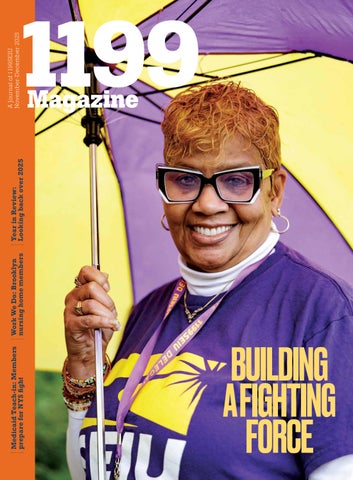
BUILDING A FIGHTING FORCE
Year in Review: Looking back over 2025
A Journal of 1199SEIU November-December 2025
CONTENTS 13
4
3 Member Editorial Gabe Fenigsohn, 1199 Delegate and Sleep Technologist at the New York Eye and Ear Infirmary in Manhattan says Union activism requires a leap of faith. 4 Medicaid Teach-In New York members come together to mobilize resistance to the greatest threat to healthcare in living memory.
16 Cover: Ida Davis, an 1199 Delegate and Clerical Specialist at the University of Maryland Capital Region Medical Center in Prince George’s County, MD, taking part in the recent Listening Tour.
@1199seiu www.1199seiu.org 2
November-December 2025
5 The President’s Column Fightback 2026: Protecting the future of healthcare.
6 Around the Regions Listening Tour continues; Westchester Members Ratify First Contract; Hudson Valley Members Unite; Millions Turn Out for No Kings Protests; 1199ers to Bring Jamaica Relief. 9 The Work We Do MJHS Menorah members in talk about the value of their Union benefits. 13 The Year in Review Economic headwinds did not stop 1199 members from achieving significant contract wins and adding new members.
16 The Next Generation Members describe what the Child Care Fund means to their families. 18 Our Delegates: Ida Davis As a passionate advocate for both members’ rights and quality patient care, Davis believes political action is crucial. 20 Safety at Work 1199 Nurses help push through a workplace violence bill in Massachusetts. 22 Our History 1199ers long, hard struggle for affordable housing in New York City.
1199 Magazine NovemberDecember 2025 Vol. 43 No.6 ISSN 2474-7009 Published by 1199SEIU, United Healthcare Workers East 498 Seventh Ave, New York, NY 10018 (212) 582-1890 www.1199seiu.org
Let’s Talk to Each Other Gabe Fenigsohn is a Delegate at the New York Eye and Ear Infirmary of Mount Sinai, a hospital founded in 1820— the nation’s first specialty hospital.
president
Yvonne Armstrong secretary treasurer
Veronica Turner-Biggs
Fenigsohn taking part in a solidarity rally with striking Starbucks workers in York, Pennsylvania.
“Can we … unionize?” my coworker and I asked, cautiously looking over our shoulders as we sat across from an 1199 new member organizer in a top-secret meeting at a Manhattan coffee shop one night in August 2018. It was our first encounter with a union. We worked for a largely non-union hospital in New York City, and were motivated by broken promises from human resources, fear of layoffs, and a vague awareness of the union difference. I peppered the organizer with questions, her voice low to keep things under the radar, and mine thrilled to be part of a covert operation. Then a man a few tables down, overhearing my enthusiasm leaned over on his way out to say, “Good luck with your union drive!” I left that meeting with the intimidating assignment of connecting with workers I’d never met, across job titles located far from the small sleep lab where I worked as a technologist. Meanwhile, the skilled maintenance staff, disillusioned after receiving backpacks instead of raises, began organizing in their own department. Together, after months of planning and despite the upheaval
of Covid, we held elections, voted for the union, and won a contract in September 2020. What followed is a story many of us know well: managerial obstruction, blatant contract violations, wage theft, and the constant challenge of convincing our coworkers that yes, getting involved in the union requires a leap of faith—but the dignity and rewards that come from standing up for what’s right are worth the risk of the boss’s retaliation. A contract means nothing without member enforcement. There really is no substitute for shop-floor participation.
mayoral race by openly and unapologetically calling for reinvestment in public services. His campaign challenged the assumption that scarcity is the only way forward. That electoral message succeeded using something deeply familiar to those who have organized a workplace: building trust, one conversation at a time. I joined some of those conversations knocking on doors in Jackson Heights, Queens, and many of my fellow union members spent countless hours working on the campaign, driven by a positive vision of the future rather than fear.
Since unionizing, we have had No matter where you live, we can both victories and setbacks. We colbuild our 1199 chapters in much the lectively won back nearly 3,000 vasame way. Start small: Try connecting cation hours, over $170,000 in unpaid with your coworkers and creating a night shift differentials, departmental WhatsApp and restored wrongfully group. Then, you can “Getting cut long-term disability inbegin to gather the ininvolved in surance. We earned back formation that empowers shortchanged Covid hazyou. Do you and others the union ard pay, and just recently in your title have a copy requires a leap reformed system-wide of your job description of faith—but Paid Family Leave policies and your contract? Do the dignity impacting thousands of you know when your and rewards workers. At the same time, next Union meeting is? that come we’re still lagging on mulDo you have copies of from standing tiple fronts, and we need the 1199 “Unsafe Staffing much deeper rank and file Form” so you and your up for what’s involvement to achieve our coworkers can track right are full power. concrete examples of worth the risk This feels especially dangerous levels of of the boss’s urgent now. More than $1 understaffing? Do you retaliation.” trillion is slated to be cut know the contact information of your area’s from healthcare funding political organizer? If over the next decade. not: ask. Push. If you hit a wall, go up Many 1199ers are already facing job the chain. losses, SNAP cuts, and a dark road I’ve seen the wall move before. ahead. We are staring down a genuinely unprecedented threat to AmerI saw it in that coffee shop in 2018. ican healthcare. Does that mean I saw it in our contract win in 2020. austerity is inevitable, and there’s no And this fall, my city saw it again. point in fighting back? I know that if every 1199 member Defying the odds, Zohran Mamup and down the East Coast moves dani won the 2025 New York City together, we can scale that wall.
senior executive vice presidents
Charles Nystrom Nadine Williamson executive vice presidents
Jacqueline Alleyne Michael Ashby Lisa Brown Andy Cassagnol Roger Cumberbatch Adekemi Gray Todd Hobler Leigh Howard Benson Mathew Cari Medina Brian Morse Roxey Nelson Rona Shapiro Greg Speller Daine Williams editor
Sarah Wilson art direction and design
Maiarelli Studio director of photography
Kim Wessels contributors
Leyla Adali Aaron Blye April Ezzell Regina Heimbruch JJ Johnson Anna Oman Taina Teravainen 1199 Magazine is published six times a year—January/ February, March/ April, May/June, July/ August, September/ October, November/ December—for $15.00 per year by 1199SEIU, United Healthcare Workers East 498 Seventh Ave, New York, NY 10018 Periodicals postage paid at New York, NY, and at additional mailing offices. POSTMASTER: Send address changes to 1199 Magazine, 498 Seventh Ave, New York, NY 10018
1199 Magazine
3
OUR UNION
“My daughter had to have a lot of surgeries, and I don’t know if she would have lived if it hadn’t been for Medicaid.” – Toni Whyte, an 1199 Community Health Worker at an outpatient facility of the Montefiore Mount Vernon Hospital
Blanca Graniela at the December 1 Medicaid Teach-In.
to housing, transportation and food. “Many people here are living in low quality housing infested with rats and mold. Asthma is very common,” said Whyte.
Medicaid Teach-In New York members came together to mobilize resistance to the greatest threat to healthcare in living memory.
Members from Downstate New York came together on December 1 in Manhattan to advocate, organize and strategize for the Medicaid funding fightback they are about to wage in Albany. Following the drastic cuts to Medicaid the Republican extremists in Washington DC plan to impose to pay for tax cuts for the billionaire class, 1199ers recognize that they have a battle on their hands. In order to stabilize the industry and shield New Yorkers from the harms imposed by Washington, member will need to press state leaders to allocate $2 billion to replace missing Federal funding in financial year 2026-27. That means engaging at least 20 percent of the 4
November-December 2025
New York membership in the campaign. “Working as a Medical Assistant in pediatrics, almost all of the children I see rely on Medicaid for their healthcare,” said Shatenyaer Pitt, an 1199er who works at Advanced Care Physicians in Queens. “My supervisor said if all the planned federal cuts come in, we will all be out of a job. We have already seen soft layoffs with people who work on the front desk not being replaced when they leave.” Toni Whyte, an 1199 Community Health Worker at an outpatient facility of the Montefiore Mount Vernon Hospital in the Bronx, agreed that almost all of her patients rely on Medicaid. She helps identify their non-medical concrete needs related
She has been a Union member for the past 10 years, but before that she relied on Medicaid when her daughter was born prematurely at 30 weeks. “She had to have a lot of surgeries, and I don’t know if she would have lived if it hadn’t been for Medicaid. Now she is 15 years old and doing fine.” Whyte is very committed to the campaign to press decision-makers in the state capital to replace federal Medicaid funds and plans to get the 1199 bus up to Albany for the first lobby visit on January 12. Another Bronx member is Blanca Graniela, who is a home care worker with Best Care and also a Hospice Aide. She took part in the 2022 fight to convince NYS to fund a $3 an hour wage increase for home care workers, which amounted to a 20 per cent boost. “I am ready to lobby Albany lawmakers once again. So many of us who work in this field are women of color. I am a proud Puerto Rican woman, and I deserve fair pay and benefits and I will continue to fight so that my granddaughters can have a better life too.” Scan here to sign up for January 12 mobilization in Albany.
Fightback 2026 Members are on the front lines, protecting the future of healthcare.
The President’s Column Yvonne Armstrong
As we prepare to enter a new year, we do so with the acknowledgment that 2026 will set the stage for the future of healthcare for generations to come. Our collective fight to defend Medicaid, the nation’s most important healthcare program which sustains life-saving care for 70 million Americans, is our overarching priority. Why? Because the stability of the Medicaid system underpins everything we are fighting for: our ability to deliver quality care, to secure fair wage increases, to protect and improve our benefits, to prevent layoffs and fix the staffing crisis in our institutions, and to win real healthcare equity in this country. If 2025 was about getting our own house in order—recentering our Union around principles of trust, transparency, and empowering members to lead— 2026 is when we will unleash the full force of our collective strength as an organization. Through our unionwide listening tours this fall, SecretaryTreasurer Veronica TurnerBiggs and I have traveled to every corner of 1199, met with thousands of elected delegates, visited worksites, and gathered your input about how we grow as a union. The ideas, insights, and priorities shared by members are being transformed into a comprehensive plan of work that will be discussed and voted on by delegates at our unionwide convention early next year. This incredible work that members are undertaking to build our union from within coincides with the major strides we are making to grow political power. 1199 members delivered resounding victories in the November 4 election: electing Zohran Mamdani as our next mayor of
NYC, securing a blowout victory for Mikie Sherrill as New Jersey governor, winning important mayoral races in Boston, Buffalo, Rochester, Syracuse, and Albany, and winning numerous downballot races in the Orlando City Council in Florida, in the NY legislature (where 22 of 24 of our candidates won), in county races in the Hudson Valley and Long Island, and beyond. A very special shoutout goes to two 1199 members at Guthrie Corning Hospital in upstate New York who were themselves elected to office: Lauren Gaige, RN, won a seat on the Corning Town Council and Justin Eberlin, Surgical Tech was elected Steuben County Legislator. This is the type of 1199 member leadership that will transform our nation! But in Washington DC, Trump and Republican leaders have cut $1 trillion from Medicaid and are about to let Affordable Care Act (ACA) subsidies expire causing premiums to skyrocket for millions of people, making healthcare the defining political issue as we head into 2026. We need to make our individual states bulwarks against these federal cuts and call on our state leaders to enact budgets that fill in the gaps. Our states have so-called “rainy day funds” meant specifically for times of crisis—and it is certainly the time to draw on these resources. Everywhere, we must call attention to the fact that protecting access to healthcare is not a partisan issue: it is supported by overwhelming majorities of Democratic and Republican voters alike. We must let politicians know that voting to cut Medicaid or the ACA, or refusing to spend vital dollars needed to safeguard care, will spell the end of their political careers in the next
Everywhere, we must call attention to the fact that protecting access to healthcare is not a partisan issue: it is supported by overwhelming majorities of Democratic and Republican voters alike. election. We will be in our state capitals, week after week, starting in January, with an unrelenting message that healthcare must be protected! As we celebrate the holiday season, clear-eyed about the heavy challenges ahead but also with deep resolve, commitment, and love for our families, communities, and co-workers, let’s carry forward the spirit of unity that defined our movement this past year. Let’s recharge our batteries and prepare ourselves to expand the boundaries of what is possible when healthcare workers stand together. I wish you and your family a beautiful holiday and I look forward to marching alongside you in 2026.
1199 Magazine
5
Around the Regions
Member Democracy in Action “With the alarming behavior of the current US President, it is more important than ever to build one voice to fight back.” – Cynthia Medavarapu, RN, at University of Maryland Capital Region Medical Center in Laurel, Maryland
6
November-December 2025
When a new 1199SEIU leadership took office last June, they pledged to usher in a new era marked by transparency, accountability and member power. With that in mind, President Yvonne Armstrong and Secretary-Treasurer Veronica Turner-Biggs have been traveling to all the Union’s regions on a Listening Tour to speak with members face to face and hear their concerns and ideas firsthand. Members in Florida, Upstate, Massachusetts, Downstate and Long Island met with the new leaders over the summer and in October it was the turn of the Hudson Valley, Capital region. In the first week of December, President Armstrong and Secretary-Treasurer Turner-Biggs traveled down to Maryland and Washington DC. Cynthia Medavarapu, RN, at University of Maryland Capital
Members from Hudson Valley, Capital region taking part in their Listening Tour in October.
Region Medical Center in Laurel, Maryland said of the visit: “I would like to commend the Executive leadership for their face-to-face introduction to Delegates in their home base. The crowd was tough, but they handled the questions well, which spoke volumes to me. “If Maryland 1199 membership is over seven thousand, then we have more work to do to increase the number of delegates here. With the alarming behavior of the current US President, it is more important than ever to build one voice to fight back.” Still to come is a visit to New Jersey and meetings with Home Care members and retirees. The insights gathered on the road will shape a unionwide plan of work, a roadmap for the next chapter of our Union that Delegates will vote to ratify early next year.
Florida Maryland Massachusetts New Jersey New York Washington, D.C.
NEW YORK
Westchester Members Ratify First Contract On the eve of a planned strike, members at Rockland Pulmonary and Medical Associates agreed their first contract Westchester Medical Center, winning 12 percent raises over the life of the three-year deal. Since voting to form a union with 1199SEIU more than a year ago, members have been fighting hard to establish minimum rates across all job classification and secure across the board wage increases. The contract also includes an additional $1,000 ratification bonus for eligible members. The agreement was reached after more than a year of organizing, solidarity, and tough negotiations by 1199SEIU members, including a one-day strike following unfair labor practice charges, alleging among
other things that WMC threatened to close the practice to “make an example” of workers after they voted to form a union. Newly organized Nurse Practitioners at Good Samaritan and Bon Secours Hospital, also part of WMC network, linked their struggle to their fellow members
at Rockland Pulmonary. The solidarity across one of the region’s largest healthcare networks paid off in the end. The NPs won an on call differential for the first time as well as wage increases of more than 20 percent over the life of the contract after a three-day strike was narrowly averted.
Rockland Pulmonary members taking action. Members rally at Vassar Brothers Medical Center.
UPSTATE NEW YORK
Hudson Valley Members Unite More than 1,000 members at Vassar Brothers Medical Center in Poughkeepsie and Putnam Hospital in Carmel Hamlet, New York won new minimum wages, improved shift differentials as well as across the board wage increases and protection from layoffs. The settlement was reached after a coordinated day of action in which members were supported by local elected leaders and allies. 1199s covered by the agreement include RNs, aides, radiology and other techs, housekeeping and food service. These hospitals were recently acquired by Northwell Health and provide critical care to their communities every day. 1199 Magazine
7
Around the Regions
Millions Turn Out for No Kings Protests On October 18, members from the Canadian border to the tip of Florida joined millions of fellow Americans to demand the federal government put families before billionaires and stop the deadly cuts to healthcare in the nationwide No Kings protests. In New York City, 82-year-old Connie McKinnon, a retired 1199 EEG technician, who used to work at Mt Sinai in the Upper East Side, said: “I remember being there when Nelson Mandela drove by the hospital. I’m here protesting today with my Union because we want fairness and justice for all Americans.” Kia Cherry, a Neuro Technician at NewYork Presbyterian, also in Manhattan said: “I woke up this morning and my heart was heavy. I came out here to fight for what should be our birthright: for healthcare, education and even food. It’s a sad day. But I know it’s important to
fight with my Union.” Maura Lopez, a newlyunionized home care member with the White Glove agency said she came out in solidarity with the Latinx community. She said: “No pueda permitir que nos quitan el trabajo. (We cannot allow them to take our jobs away.)”
Florida members taking part in No Kings rally. Petagay O’Connor shares Jamaica solidarity with New York Governor Kathy Hochul.
UPSTATE NEW YORK
1199ers to Bring Jamaica Relief When Hurricane Melissa tore through Jamaica in late October, 1199ers immediately began making plans to help those affected. “We are a proud Union of immigrants” said Petagay O’Connor, a Physician Assistant at Montefiore Health System’s Mose campus for the past 17 years. “Tens of thousands of the 1199 family are part of the Jamaican diaspora with deep personal ties to the island just like me. Immigrants are NYC’s essential workers. Monte and hospitals around NY could not function without us.” O’Connor was speaking at an event organized by Afya Foundation, which brings unused medical supplies to places where they are needed most. She was joined by New York Governor, Kathy Hochul and representatives from Montefiore Einstein and the Greater New York Hospital Association who are helping to fund a delegation of 1199ers, including O’Connor who are traveling to the island to deliver much needed supplies.” 8
September-October 2025
The Work We Do: Menorah Nursing Home Brooklyn Members who work at the MJHS Menorah Center for Rehabilitation and Nursing Care on the southern tip of Brooklyn, generally stay there for many years. With a contract negotiated with the League of Voluntary Hospitals and Homes, 1199ers have the benefit of labor management collaboration and fair wages and conditions.
1. “I enjoy working in the kitchen because I come from a cooking family,” says Kitchen Porter Ross Thompson, “My mother cooked for the Queen of England in 1963 when she came to Trinidad and then later my father learned Chinese cooking and prepared meals for LL Cool J and Heavy D. Now my daughter is a chef. So, it runs in the family.” Now a Union Delegate, Thompson first started working at Menorah in 1996 and stayed for ten years before moving to Georgia. “But my family missed NY so much that they came back in 2016 and we’ve been here ever since. I’m a New Yorker at heart,” he says. He’s served on both the bargaining and labor management committees, because that is “where management listens to us. I like to fight for the voiceless.” “I like working with the elderly,” he adds, “One of the residents here is also from Trinidad and for her birthday, I brought her a traditional Indian flatbread called roti that we eat back home, and she was so happy. “There’s one lady who always used to blow me kisses. You get attached, and when they expire, it leaves a hole in your heart.”
1
As a not-for-profit institution supported by a charitable foundation, members acknowledge Menorah has done a good job of improving staffing levels since the pandemic. 1199 Magazine caught up with several members at Menorah to learn more.
1199 Magazine
9
The Work We Do: Menorah Nursing Home and Rehab
2
2. “I used to be a restaurant manager next door and most of the staff would come in for lunch,” says Maria McKenzie, “I used to admire their uniforms, so about eight years ago I did the course to become a CNA.” She now works in the rehab department getting patients ready for their physical therapy. “They need to be showered and dressed and finished breakfast by 8.30am, so I start at 6am,” she says. “People request me because I go above and beyond. For instance, I will shower patients even if it is more often than the twice a week they are allocated,” says McKenzie, “One of the patients just came from hospital but did not want to use a bedpan. I helped her out of bed and into the rest room. Most people think they are stronger than they are.” McKenzie has two sons, aged 23 and 36 and a ten-year-old grandson all still living at home. She appreciates the cleanliness at Menorah is clean and well stocked. “We have all the tools, like linens and lifts. We are not short of anything,” she says. 3. “The team takes a lot of pride in keeping the facility clean and hygienic,” says Jose Vasquez, who started 10
November-December 2025
3
13 years ago and worked his way up to Lead Porter, “We have a seven-step process that involves taking on each area step by step and making sure that no section is missed.” Vasquez enjoys interacting with the residents. “There is one who is a ‘ladies’ man’ who I like to joke around with,” he says, “There was another woman who had dementia, but always remembered my name. It hit hard when she passed. It is great when you can make them crack a smile and bring some light into their lives.” He grew up nearby and is really grateful for the benefits. His girlfriend recently had to take their kids to a medical appointment and was worried about the cost. He told her she had nothing to worry about. “I always put my best foot forward here and recognize that nothing gets done alone,” says Vasquez, “If we all come together everything falls into place.” 4. Now that she has more free time because the kids are growing up, LPN Pettrina Clarke decided to become a Delegate two months ago. “I send out a newsletter after each chapter meeting because I want to make sure members know what’s going on and explain the Union’s history.”
4
We always try to provide care with dignity and respect and make people feel like this is their home.” – Toma Rimkunaite
5
6
Working in the rehab section, where patients generally stay for about two weeks and tend to be very alert, says Clarke: “We encourage people to take that one extra step. You’re not going to leave here unless you make an effort we tell them. We have patients as young as 62, all the way up to 96. We once had someone who was 103.” Having someone to talk to and vent with is so important. “As a former educator, I don’t mind spending the extra five minutes to chat with a resident,” says Clarke, who has been at Menorah for 11 years. “This is a beautiful place, which smells clean. I wouldn’t want to work in a place that was not inviting. It is a very demanding job, which takes a lot of patience,” says Clarke, “You’re not just a nurse, you’re also a dietician, social worker and therapist – we wear many hats.” 5. “It was always my dream to become a nurse, but I didn’t have the confidence to push myself until I came to the US and had my children,” says Toma Rimkunaite who earned her RN qualification at Kingsborough Community College, right next door to the facility. A former business administrator in Lithuania, she came to the US 13 years ago and now has an 11-year-old girl and five-year-old boy. For the past year she’s been working in the long-term care section of Menorah with residents who have dementia. “I assess them to see whether they need hospital treatment and provide wound care. The majority are wheelchair bound,” says Rimkunaite, “Many of the residents are Russian speaking, a language that I understand because we were taught it in school [in Lithuania]. “We always try to provide care with dignity and respect and make people feel like this is their home. About half the residents have family members who come to visit. For those who don’t, we try to compensate and spend more time talking with them.” Rimkunaite earned her nursing degree before joining the union. “But I’m hoping to use the 1199 training fund to get my master’s degree,” she says.
6. Having grown up in the neighborhood, Venecia Golding started as a CNA 18 years ago. “When I heard that the union sent members back to school, I studied to become an LPN,” said long term Delegate Golding. She attended Medger Evers College – CUNY and eventually earned the qualifications to become an RN. “I am currently working on my Masters, which I will finish next summer. I am very grateful to 1199 for helping me to progress and reach my full potential. I plan to become a Nurse Practitioner specializing in Mental Health,” says Golding. “Working as a CNA laid the groundwork for me to be the nurse that I am today. I can relate to the work that the CNAs do, and I can better visualize what they are reporting to me about the residents. Being in the Union gives us a sense of security and alleviates the worry of wondering whether our jobs are safe,” she adds. Many of the former agency staff have converted to full-time since the pandemic. “I always explain to agency nurses that they should not just consider the money they are earning in isolation. The Union benefits and paid vacations are worth a lot,” says Golding, adding, “Many people don’t recognize the struggle it took to win these benefits.” Being part of the League means that 1199 members at Menorah have some of the best benefits available, including guaranteed monthly retirement income and no cost health care. Another RN who used to work here, went to a non-1199 institution and later regretted it. “For members who are not actively involved, they think that the Union is just about the leaders. But everybody needs to play their part and inform themselves,” says Golding, “People look down on nursing homes, but if we live long enough, we will all be here. We work very hard to take care of other people’s grandparents, uncles and aunts and make them feel like it is their home and not a prison. The residents used to be independent, and it is a tough adjustment. We make sure they are as comfortable as possible.”
1199 Magazine
11
Year in Review The year began with the Republican Party taking control of the Federal government after winning the presidency and both chambers of Congress. They had campaigned on a promise of cutting grocery prices and creating jobs. One year after taking office, the opposite has come to pass, with grocery prices rising and job growth sinking, compared with 2024. These economic headwinds did not stop 1199 members from achieving significant contract wins and adding to the Union’s overall numbers. In May, in the first contested election in 40 years, members elected a new leadership team, who immediately launched a Listening Tour in every division and region to learn firsthand members’ priorities for the years ahead.
12
November-December 2025
Contract wins After a long haul, in late January more than 750 Hudson Valley members agreed to a four-year contract with Columbia Memorial Hospital that includes a 22.25 percent across-the-board raise over the life of the agreement. Just two hours before the strike authorization vote was set to begin in August, 8,000 hospital workers at Kaleida Health, Western New York’s largest private sector employer, reached a tentative agreement. The agreement includes a 10 percent across-the-board wage increase and an additional 3 percent wage step increase at the 25th year of service. In October, following a class action grievance filed by 1199, more than 1,100 union members at Strong Memorial Hospital in Rochester NY received a one-time Scheduling
Incentive Payment (SIP) ranging from $32 to $16,483. The arbitrator upheld the members’ claim because their contract stipulates that workers should be paid a bonus if job vacancies in any department reach more than 20 percent. The SIP program applies to the period of November 2021 through October 2024, which was during the COVID pandemic. Schoellkopf Health Center in Niagara Falls was the first of 25 facilities in Western New York to reach a contract settlement in October—part of a landmark agreement including average wage increases of up to 28 percent over three years, setting the standard for the remaining institutions to drive at the bargaining table. More than 1,300 members at Morton Hospital and St. Anne’s Hospital (Brown
Opposite page: Strong Memorial members celebrate win. 1199ers at Kaleida Health after contract victory. Columbia Memorial members rally for raises.
wage scales that move up each year of the agreement. In Baltimore, Maryland, the 1,900 members at Johns Hopkins Hospital ratified a new contract, rejecting management’s proposals to eliminate pensions for newly hired employees and requiring employees to work “weekend only” or “split-weekend” schedules. Members also won a half percent increase in the steps they receive for every five years of service.
Political Action
University Health) in southeast Massachusetts ratified a 20-month contract in November. The settlement includes a minimum of 10 percent wage increases for most members, while roughly 400 members will get up to 20 percent more following wage scale corrections based on experience. In Florida, Delegates launched Labor-Management Committees in several HCA
hospitals. A strong contract was also ratified at HSA hospitals and a positive “interest-based” relationship is being built along the same lines as the collaborative rapport with UHealth Tower. And at four Tenet-owned hospitals in South Florida, a new contract was negotiated removing caps for all three years of the contract, providing the highest raises in 25 years, and for the first time ever, including “real”
Frontline healthcare workers who experience the staffing crisis every day know that they must remain vigilant to ensure that staffing laws are enforced. Thus, in late February, together with other unions, 1199SEIU submitted complaints detailing over 23,000 separate violations of hospitals’ clinical staffing plans to the NYS Department of Health. Hospital, nursing home, clinic and home care members from every 1199 region boarded buses to Washington DC in February and March to explain firsthand to Congressional representatives why cutting federal Medicaid funding would be disastrous. By sharing
their frontline experiences with both Republican and Democratic elected officials very publicly in the nation’s capital, 1199ers laid the groundwork for the battle for control of US Congress in next year’s midterm elections. Overturning plans to cut trillions from essential healthcare funding in order to pay for tax cuts for the rich is set to become a crucial wedge issue in 2026. Further north, 1199 led a series of town halls with Raise Up Massachusetts, as part of the fight back against the impending federal cuts to health care, education, and food assistance. The coalition urged legislators to protect health care and stop the cuts by tapping the state’s $8 billion rainy day fund and making billionaire global corporations pay their fair share in state taxes. On October 18, hundreds of members took to the streets in every 1199 region, joining an estimated seven million Americans in 50 states at peaceful No Kings marches, which protested rising authoritarianism. Throughout the fall, members turned out to canvass for Zohran Mamdani, who was elected to be New York City’s next mayor and Mikie Sherrill, who was elected to be governor of New Jersey.
1199 Magazine
13
NYC members march in No Kings rally. Optum Health workers join 1199SEIU. Members from every 1199 region traveled to Washington DC in March to protest plans to cut Medicaid.
New Organizing In July, more than 3,000 Consumer Directed Care (CDC) workers in Massachusetts voted to join 1199SEIU. Meanwhile, in New York, the Union’s goal is to organize 200,000 Consumer Directed Personal Assistants (CDPAP) workers in 2026. The CDPAP program enables people with disabilities to remain in their homes and be cared for by people that they choose and train. In 2025, members laid the groundwork for a worker-led organizing program aimed at achieving sector-wide strength that will uplift caregivers and consumers for generations to come. In August, nearly 100 workers across seven Planned Parenthood clinics in the Baltimore region voted to join 1199SEIU. This victory came at a moment of intense national pressure on reproductive healthcare following the overturning of Roe v. Wade 14
November-December 2025
and the devastating Medicaid cuts set to be imposed by the federal government. Workers at 11 different Hudson Valley Optum Health primary care offices (formerly known as Crystal Run Healthcare) voted overwhelmingly to become 1199 members on February 25. This group of workers joined the nearly 650 workers who are already represented by 1199, bringing the total number of union members to 1,700. Optum Inc. has acquired almost all of the primary care practices in the Mid-Hudson Valley and has significantly altered working conditions and patient care practices as part of its drive for profits. In March, 200 EMS workers at Citywide and in May, another group of workers at Assist Mobile Response voted to join 1199SEIU. Many of these workers chose 1199 because they were frustrated by the employers’ empty promises and so-called “unions” that were tied to management.
In Memoriam Union Mourns Loss of Three Heroes
1199 lost three of its heroes in September this year. In March, we lost Almetra Dixon, former MD/DC Vice President. Then in September, Katherine Abelson, former EVP of the RN Division, and Angela Doyle, former EVP of the Bronx Independents, passed away. Both of these former rank-and-file members joined the leadership team in 1986 when the reformist Save Our Union (SOU) slate swept to victory over the incumbent leadership. That victory put an end to bitter internal battles, which had severely crippled the Union’s ability to function. Katherine Abelson
Angela Doyle
Armeta Dixon
“Kathy was someone I considered an ideal leader. I always looked up to her for her fairness, patience and willingness to take the time to teach and guide RNs.” – Nina Howes, a retired Beth Israel Hospital RN
Katherine Abelson Ableson died September 21 in New York City, aged 80. She had been battling cancer for the last two years. Her colleagues praised her commitment to quality health care for all and the importance of wall-towall organizing within each institution to achieve that goal. Before coming on staff, Abelson worked in labor and delivery at Brooklyn’s Brookdale and Manhattan’s Beth Israel hospitals. Abelson volunteered for political campaigns and championed immigrant rights. “I gave her credit for hiring me, trusting that my organizing experience in the Philippines would make me an effective organizer,” says Maria Castaneda, former 1199 Secretary Treasurer. “She made sure that immigrant nurses enjoyed the same labor rights and union contracts as US workers. And she pushed our Union to lobby for the passage of the Nursing Relief Act that grants permanent resident status to foreign nurses.” Castaneda says that during Abelson’s tenure, the Union took steps to address the nursing shortage by winning substantial wage increases as well as wage differentials for experience. The Union also established scholarships and provided career ladders for healthcare workers who wanted to become RNs. “Kathy was someone I considered an ideal leader,” says Nina Howes, a retired Beth Israel Hospital RN. “I always looked up to her for her fairness, patience and willingness to take the time to teach and guide RNs. She was never bossy, and with her you never felt left out. On the contrary, you always felt included.” Abelson’s work and commitment did not wane after she retired from 1199. She continued her education and became the
nurse-midwife director of the Brooklyn Birthing Center. She also traveled to New Mexico and Texas to care for pregnant women along the Mexican border. Abelson was a passionate advocate of a woman’s right to choose. The primary beneficiary of her will is Planned Parenthood Federation of America. Angela Doyle Angela Doyle died in Westchester County on September 29, following more than three years battling various medical complications. She was 76. Doyle was noted for her outspokenness and political savvy. She was one of several 1199 leaders who honed their organizing skills in the Albert Einstein College of Medicine (AECOM). The late pioneers Bernie Minter and Joseph James were also leaders at that Bronx Institution from the 1960s into the 1980s. In the mid-1980s, Doyle joined the Save Our Union (SOU) movement and was elected to a VP post. She is quoted extensively in “Upheaval in the Quiet Zone,” Leon Fink and Brian Greenberg’s excellent history of 1199. In the book, Doyle explains in graphic terms the obstacles the SOU leadership faced during contract negotiations with the League of Voluntary Hospitals and Homes in 1986. Doyle also held the post of EVP for the Bronx Independents. She and her husband, Angelo Alicea—also a retired 1199 leader who held various positions—were widely viewed as important political players in the Bronx. Armeta Dixon Armeta Dixon was not just a labor leader; she was a champion for social justice. “Armeta was unapologetically Black, before that was popular,” says Lisa Brown, EVP of Maryland/DC. She resisted the status quo and fought for social change throughout her life “She had a strength and honesty, a way of explaining an issue that showed her compassion, and made people listen. She was funny and warm, and often the center of a chuckling crowd. She is missed!” adds Brown. At the March delegates assembly in MDDC, 1199ers shared stories of Dixon, remembering her as frank, honest, and always willing to lend an ear. Her wisdom and her contributions to 1199 and the broader labor movement will be deeply missed.
1199 Magazine
15
OUR UNION
The Next
Generation
Members and their families outline what child care benefits mean to them. For Bronx Science High School senior, Jakub Jankowski, the chance to take part in the 1199SEIU Child Care Fund (CCF) youth mentoring program last summer was the deciding factor in convincing him to pursue a career in healthcare. “I saw people at their most vulnerable, and I learned that care isn’t always about fixing things or offering a direct solution,
16
November-December 2025
sometimes it’s just about showing up with empathy. My presence mattered,” he said of his stint as a patient rounding assistant at Montefiore Einstein Hospital in the Bronx. His mother Anna, an 1199 Pharmacy Specialist at the same hospital, said the family has benefited from the CCF throughout much of his life. Her son received a subsidy for
Jakub Jankowski speaking at the annual 1199SEIU Child Care Fund gala in New York.
pre-K when he was 4 years old and later took part in summer camp in Upstate New York. But it was recent stint working in a hospital that solidified Jakub’s desire to pursue a career in medicine. “My time at Montefiore has opened my eyes to something far beyond that of medical charts or diagnoses – it’s the humanity
“School is so expensive. My daughter receiving the Joseph Tauber scholarship from the benefit fund lifted a great burden off us.” – Nadine Augustin, an 1199 Medical Social Worker at NewYork-Presbyterian Brooklyn Methodist Hospital
helped pay for Park Slope Day Camp during the summer months, saving us thousands of dollars.” Gabrielle also took part in the CCF’s WorkForce 2000 program at New York University before going to college. There, they helped her with her college applications and with filling out the Free Application for Federal Student Aid (FAFSA) to see what financial aid she could access. For Shante Hutchinson, an 1199 Administrative Coordinator at Montefiore’s Fordham campus offsite facility, said: “Working in the healthcare field you try to do your best as a single mother, but something has to suffer. Working in a hospital you can’t always answer the phone during the day.”
in healthcare,” he said. “Whether you’re a nurse, physician, or surgeon, your role is not only to treat a patient, but to care for a person. Even the most advanced and successful treatment can feel incomplete without empathy.” Having applied to colleges ranging from Princeton University to SUNY Binghampton, Jankowski is hoping to pursue pre-med. Another CCF benefit recipient, Gabrielle Augustin-Orcel, is already a college senior at SUNY
(Top L-R) Nadine Augustin, Gabrielle Augustin-Orcel. (Bottom) Shante Hutchinson stands proudly with her four children.
College of Environmental Science and Forestry in Syracuse. Her mother, Nadine Augustin, is an 1199 Medical Social Worker at NewYork-Presbyterian Brooklyn Methodist Hospital. “School is so expensive. My daughter receiving the Joseph Tauber scholarship from the benefit fund lifted a great burden off us,” said Augustin. “It helped with the cost of books, meal plan, and traveling back and forth from Syracuse. When Gabrielle was younger, the Child Care Fund also
But knowing that her children were being looked after at the 1199SEIU/Employer Child Care Corporation-run Future of America Learning Center (FALC) day care was a huge weight off her mind. She added: “I have a 13-year-old who went there and a three-year-old and a two-year-old who are currently there. If it were not for FALC, I would not have been able to afford to send both to an educational setting. I would have had to send one to the local babysitter.” For her older children, including her 23-year-old, it was also a game-changer. “The fund has provided opportunities that I never had. Coming from the Bronx, I never learned how to swim. But my children got to go to sleepaway camps.”
1199 Magazine
17
Our Delegates: Ida Davis As a passionate advocate for both members’ rights and quality patient care, Davis believes political action is crucial.
18
November-December 2025
“No one can prepare you 100 percent for being a Delegate: you’ve got to go out there and do the work,” says Ida Davis, “The more you do, the more you get involved—if you don’t go to the meetings, and you don’t participate, you’ll never learn. It’s like on-the-job training.” Davis, a Clerical Specialist at the University of Maryland Capital Region, has served as a 1199 Delegate for close to 15 years. When her organizer first asked her to consider running, she was intrigued because she believed that both she and her coworkers could benefit from learning more about “the different things that the union had to offer them.” At that time, she says, there was a gap in understanding between workers and the hospital because management did not understand the nuances of the contract either. Davis quickly got to work, taking meetings every day to connect with her coworkers, helping them understand how 1199SEIU could help them with their concerns. She hasn’t taken this role lightly: because her fellow members pay dues, she says, she owes it to them to be knowledgeable and available. In 2024, Davis made the jump from Delegate to member political organizer (MPO) after years of feeling “intrigued by politics” and meticulously keeping up with the news. Mirroring her desire to offer support to coworkers as a Delegate, she was excited at the prospect of educating fellow members about politics and encouraging them to make their voices heard at the polls. “A lot of people are engaged and do want to know about things that affect them, they just need the right tools. I consider myself as being a tool to the community, letting them know things they probably weren’t aware of,” Davis explains. As the only member political organizer from Prince George’s County when Angela Alsobrooks was county executive, Davis helped persuade her 1199 coworkers to enthusiastically support her run for U.S. Senator in a long-shot primary against billionaire David
D E L E G AT E P R O F I L E
Trone in 2024. Davis played an important role in getting members to sign up for Weekend Warriors canvassing events and to start making Political Action Committee contributions. She said: “Because I knew so much about Angela from living here in Prince George’s County, I was able to bring that to Baltimore, and we were successful in getting her elected. I love being a part of change.” Last May, Davis gave a passionate speech at a rally organized by Senator Alsobrooks in Washington D.C. calling on Robert F. Kennedy Jr. to resign as Secretary of Health and Human Services following his 40 percent budget cuts to the National Institutes of Health. “RFK Jr. knows that he is wrong. He is going against everything that his father and his uncle and everything that the Kennedy family stands for. His father cared so deeply about child poverty and for our country’s working poor,” said Davis, adding: “Instead, he’s spreading false information, trying to make it harder for people to access and keep health care. I don’t know how he sleeps at night. I real-
IDA DAVIS
Clerical Specialist at the University of Maryland Capital Region
ly don’t. We can stop him though. Him and Trump. If we come together. Seeing you all here today I am so energized to keep working toward a better future for all of us.” Davis also enjoys connecting with politicians to help them understand healthcare workers’ priorities. Recently, she led Prince George’s current county executive, Aisha Braveboy, and her staff on a tour through University of Maryland Capital Region Medical Center, where Braveboy heard directly from staffers about the implications of short staffing on their ability to deliver quality care. Through her work as a Delegate and MPO, Davis has become a confident public speaker and an advocate for member involvement in 1199’s political action program. “I’ve got my family involved; my cousin came down every day when I came to MPO events. If you want to be a part of change, if you don’t like what’s going on, if you want your great-grandchildren to have a future, if you don’t want to go back, then you’ve got to get involved with politics.”
“A lot of people are engaged and do want to know about things that affect them, they just need the right tools.” – Ida Davis, Clerical Specialist at the University of Maryland Capital Region
Members Agnes Evans (left) and Katrina Johnson (right) sharing a moment with Ida Davis. 1199 Magazine
19
OUR UNION
Safety at Work 1199 Nurses help push through a workplace violence bill in Massachusetts.
20
November-December 2025
Healthcare workers are trained in specialized skills to help during times of crisis. They attend schooling for years and work residencies and programs to ensure whatever the health issue, that they can meet the challenge and provide quality care. One thing they aren’t taught is how to prepare or handle being physically attacked on the job. “We’re not taught to worry about being assaulted at work. There’s danger everywhere in every profession, but we are in the top five most dangerous jobs. You wouldn’t think if it that way, but it’s true,” says Shannan Bush,
RNs at Boston Medical Center take a moment outside the ER to meet 1199 President Yvonne Armstrong (second from right).
an 1199 Delegate and ER nurse at Boston Medical Center (BMC). Healthcare workers are facing increasingly dangerous and violent situations in hospitals. In recent months, there have been incidents of attacks across the country, including in New York and Florida – the latter of which left the worker hospitalized for months. At BMC, there has been increases in workplace violence because of where it’s located. The nearby area has seen more drug trafficking and encampments of unhoused people and BMC is a trauma and academic medical
center, meaning those with a high level of trauma often come there first. “The community we serve is one of the most poverty-stricken in the city. Our patients are refugees, immigrants and the abused, neglected and addicted of society,” says Carrie-Ann White, 1199 Delegate and RN. This high-volume mix leads to overcrowding – which can lead to violence. Overall, in Massachusetts, every 36 minutes a hospital worker is subject to an act of violence or threat. “As nurses here, we are assaulted three times more often than any other hospital in Boston,” says White. Healthcare workers experience violent incidents at least five times more often than the average private sector worker. “I was assaulted in 2010 and I realized [after]
that horrible experience, there was nothing available for people when they got assaulted. I got involved because I wanted to help someone through that process after not having someone to help me,” added Bush. She banded together with other nurses and staff creating peer support that became a resiliency team and pushed for more safety on the job. Recently, a coalition formed with 1199SEIU Massachusetts, the Massachusetts Health & Hospital Association (MHA) and the Massachusetts Nurses Association (MNA) to develop legislation that directly addresses workplace violence and help curb the growing crisis. The law included requiring all hospitals to complete facility-specific risk assessments, engage frontline staff in developing assessments and
prevention plans, and strengthen enforcement through licensing requirements, regular reporting, and provide enhanced job protections including additional paid leave for employees who are assaulted. The legislation recently passed with a unanimous vote of 158-0 in the Massachusetts House of Representatives and at time of press was advancing to the State Senate for consideration. Similar legislation has already passed in NY state. It is an important step forward in keeping healthcare workers safe. “Bringing attention and having this legislation will change working conditions,” says Bush, “It will raise awareness of this issue, that there are consequences for this, and reinforce that assault is not okay and not a part of our jobs.”
There’s danger everywhere in every profession, but we are in the top five most dangerous jobs.” – Shannan Bush, an 1199 Delegate and ER nurse at Boston Medical Center
(left) CarrieAnn White (right) Shannan Bush
1199 Magazine
21
OUR HISTORY
FIGHTING FOR
AFFORDABLE HOUSING Housing for people, not profit.
The election of Zohran Mamdani as mayor of New York has brought the issue of affordability to the fore across the nation. Among the city residents’ chief concerns is the skyrocketing cost of rent and the price of homes. From its earliest days, 1199 joined the fight for safe, comfortable and affordable housing for all. During the Great Depression of the 1930s and early 1940s, 1199ers could be found among the activists who rushed to the sidewalks to return the furniture belonging to tenants who landlords were attempting to evict. The Union also supported progressive NYC Mayor Fiorello LaGuardia, who established the New York City Housing Authority (NYCHA) in the 1930s as a means to replace dilapidated and unsafe tenements. Although flawed, particularly in its selection process, NYCHA was nevertheless viewed as a benchmark for the nation. The Union’s emphasis on adequate housing for its members and poor workers was stepped up in the late 1950s when 1199 launched its organization of poor voluntary hospital workers. Even seasoned organizers were surprised at the abysmal housing conditions of many of the workers. During 1199’s historic 1959 strike, Julia Davis, a former social worker and the wife of the late 1199SEIU President headed the Union’s welfare committee. That committee handled issues such as food and family problems, including rent and evictions. Mrs. Davis helped some 600 workers apply for emergency public assistance. The majority of the workers who assisted Davis were women. She noted that because of the division of labor at home and in society at large, women traditionally took the lead on housing issues. In the 1960s and 1970s, 1199 worked with housing activists and elected officials to strengthen the housing laws in the city and state. Many 1199ers joined the Metropolitan Council on Housing, a NYC tenants’ rights organization formed in 1959. Met Council continues its work today. Its motto is “housing for 22
November-December 2025
people, not profit.” One 1199er who joined Met Council was Carole Shreefter, a retired ultrasound technologist from St. Luke’s Hospital in Manhattan. During the economic crisis of the 1970s, Shreefter and thousands of other New Yorkers lived in buildings that were being abandoned by landlords. The most flagrant examples of that abandonment were the 80 percent of apartment buildings in the South Bronx that were torched so that landlords could collect
Cover of the February 1972 edition of 1199 News featuring a model of 1199 Plaza. 1199 Magazine
22
“The [mortgage] help I received was amazing.” –Khadijat Adeyi, an LPN at Montefiore Health Center who worked with the 1199SEIU Funds Homebuyer Education Program
the insurance money while tenants were left homeless. “At the time the landlord was milking the building while leaving it in disrepair,” says Shreefter. “And there was no legal mechanism for the tenants to take over the building.” After years of rent strikes, organizing and lobbying, city laws were passed to make it possible for the tenants to purchase their buildings. Shreefter and her neighbors bought their Washington Heights building and managed it themselves. Today there is a long waiting list of New Yorkers who have applied for apartments in the building. Meanwhile, in the midst of the financial crisis, 1199 Plaza, a 12-acre low-and moderate-income housing cooperative in East Harlem, was formally dedicated by NYC Mayor Abraham Beame on Nov. 1, 1974. Again, women played an outsize role in its development. Mayor Beame, joined at the dedication by federal, state and city elected officials and labor leaders, described the project as a “great plus for New York.” The complex also earned high praise from architects and planners across the city. “Providing housing like this improves people’s lives; it puts people together,” said 1199 Pres. Leon
(top) The opening ceremony at 1199 Plaza with former 1199 President Leon Davis (center) and Labertha Watkins, an Nursing Assistant at Manhattan’s Gracie Square Hospital to his right. (bottom) Julia Davis, former social worker with her husband, Leon Davis.
Davis at the dedication. “And that is what a union is all about.” Labertha Watkins, a Nursing Assistant at Manhattan’s Gracie Square Hospital, could attest to Davis’s statement. She and her five children were the first residents to move into the complex. Their unit included four bedrooms and a balcony. To help meet the need for sustainable housing in the New York Metropolitan region, the Union through its Benefit Funds, launched a home mortgage program for members. That program has blossomed into a Financial and Wellness Homebuyer Education Program that assists members in purchasing a home, repairing credit, paying down debt and learning how to make sound financial decisions. The program offers workshops, fairs, forums, homebuyer education courses and individual meetings for prospective homebuyers or 1199 members interested in learning more about the homebuying process. It also connects prospective lenders with programs run by New York City’s Department of Housing Preservation and Development and other partners in non-profit agencies and organizations offering homebuying assistance. Khadijat Adeyi, an LPN at Montefiore Health Center clinic, moved into her new home in September. A single mother with three children, Adeyi praises the assistance she received from the program. “Oh my God” she says, “Ms. Claire Harvey, who helped me went above and beyond. She simplified a difficult process. And she let me know what I qualified for. The help I received was amazing. When I got rattled, she just said, ‘You got this.’” Come January when Mayor Mamdani is sworn in, 1199ers will be holding him to account on his promise to make housing more affordable for working families, so that the recent trend of people of color being forced to move to other nearby states can be reversed. 1199 Magazine
23
Venicia Golding, used the 1199SEIU Training and Upgrading Fund to study to become an RN after starting as a CNA at the MJHS Menorah Center for Rehabilitation and Nursing Care 18 years ago. See page 9.