Build, Grow, Thrive
3 Opinion David Saucedo an 1199 Environmental Services Delegate at the Levindale Hebrew and Geriatric Center outside Baltimore, MD, describes how he builds community among the membership.
4 Sharing Wisdom Retirees helped build the foundation of the Union. The Retiree Caucus makes sure that they’re able to continue their activism and pass on knowledge long after they leave their institutions.
5 The President’s Column Embarking on our next chapter as a powerhouse union.
6 Around the Regions Standing up for Haitian migrants; Nantucket Nursing Home Win; Bronx Contract Win; International Women’s Day; Boston Contract Win; Planned Parenthood wins strong contract; New Jersey Progressive wins Special Election; No Kings Protests.
9 The Next Chapter Four committed leaders describe the strategies they're already using to Build and Grow the Union, and create conditions where everyone can Thrive.
12 Work We Do Members at Champlain Valley Physicians Hospital in Plattsburgh, NY, near the Canadian border tell their stories.
16 Jesse Jackson Was One of Our Greatest Allies Former 1199SEIU President Dennis Rivera recalls Union battles he fought alongside the legendary civil rights activist.

18 Making our Voices Heard With affordable health care under assault from the extremist Republican administration’s billionaire tax cuts, 1199ers are fighting back and calling on their state governments to plug the funding gap.
20 Securing Our Jobs The impacts of federal Medicaid cuts have been already felt in some institutions. But Union protections mean that new placements can be found for many members who face layoffs.
22 Our History Voting Rights Matter: the ongoing struggle to protect working people’s access to democracy.
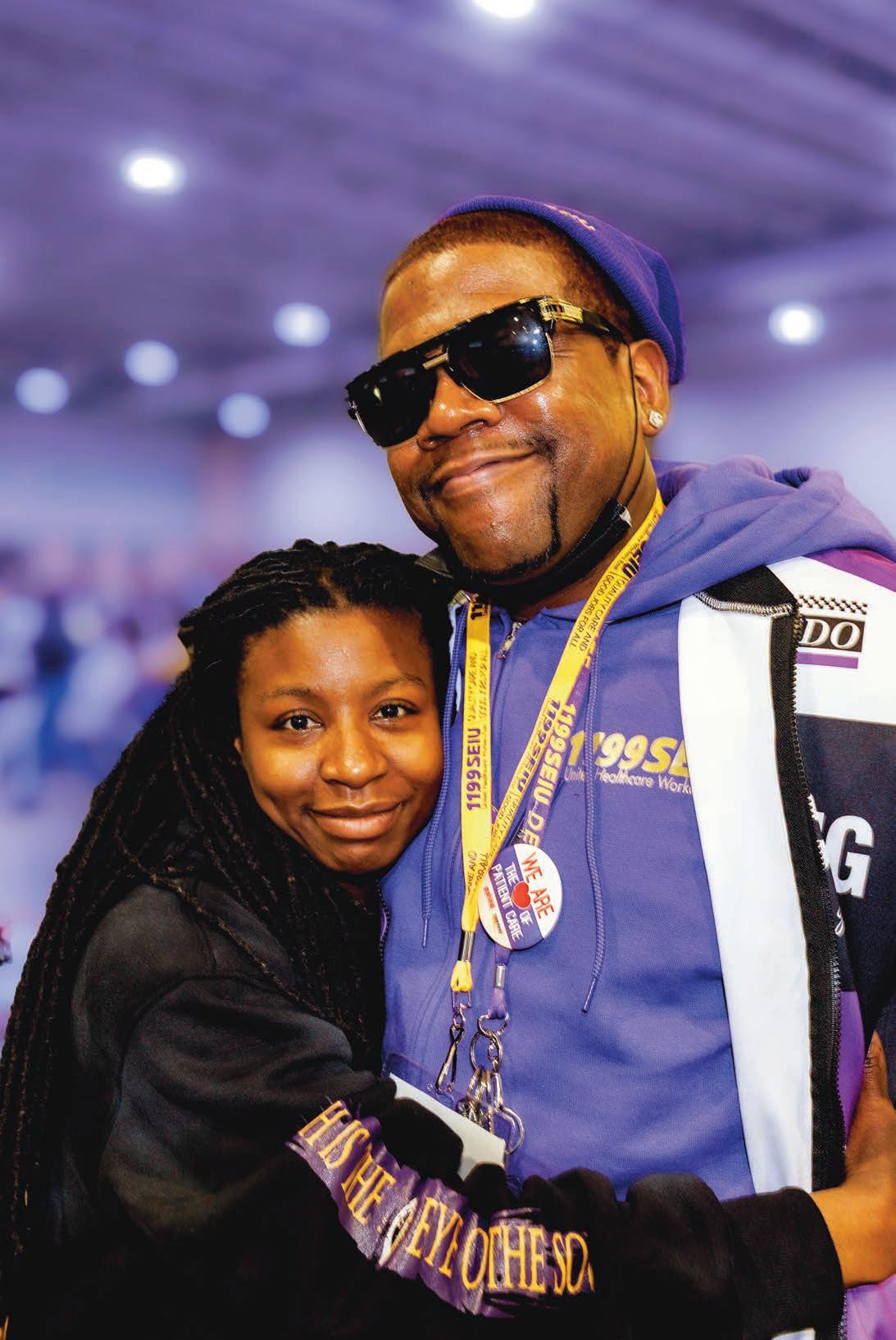
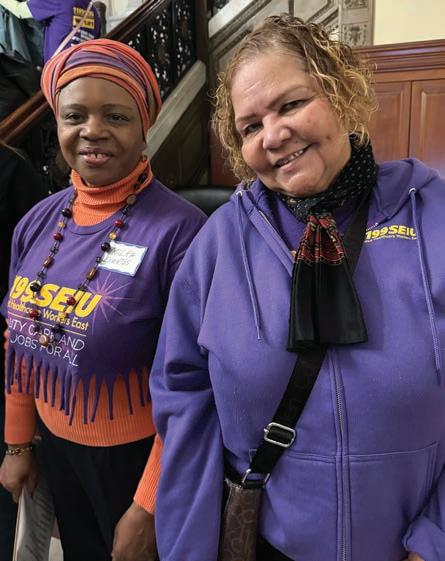
Cover: Delegates Crystal DeShields, an 1199 Central Attendant at NYU Langone Health (left) and Michael Pacheco, an 1199 Patient Service Associate at Brookdale Hospital sharing a moment at the Leadership Summit in Atlantic City earlier this month.
Opinion: David Saucedo
An 1199 Environmental Services Delegate at the Levindale Hebrew and Geriatric Center on the outskirts of Baltimore, MD describes how he builds community among the membership.
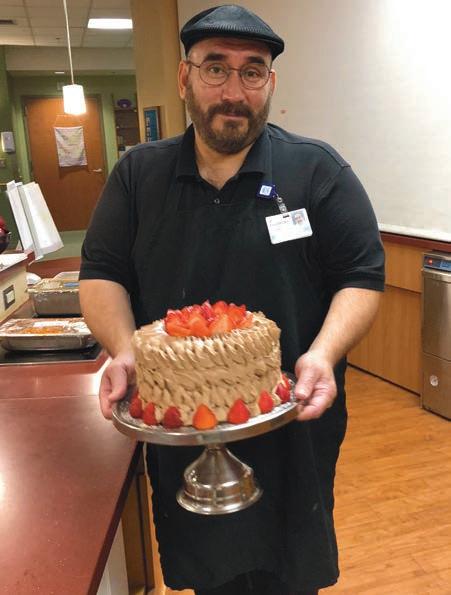
During my six and a half years as a hospital cook, I felt proud knowing that taking time to make a special cake for a resident’s birthday would make them feel more at home.
During Passover, the kitchen would receive cream cheese, and I made cheesecake for everyone. We only had individual packages of graham crackers, and I must have opened 50 to make the base, but I was happy to do it to demonstrate that my coworkers and I truly care.
I started working in hospitals because I love to connect with people. I know the same is true for my colleagues in other departments whom I talk to because of my role as an 1199 Delegate. I know that I can cultivate a better relationship between myself and my union siblings, and between the union and management, if we are able to find common ground.
Although I have worked in Environmental Services for three years now, I still organize events like a “Day of Cakes” and Cookie Wars where employees can bring in desserts for a special competition. It is a great way to connect union and non-union workers who might not otherwise meet. I am often able to resolve workers’ issues before they even reach HR because management knows me and understands that being a Delegate does not make me their enemy.
I also try to learn about what my union siblings are experiencing outside of work so I can more effectively fight for them. I am a Hispanic, disabled veteran of the United States Navy, and a part of the LGBTQIA+ community. I have always felt like people were looking at me closely, so I can empathize
“When I join political actions, I always invite people to come with me so they can learn more about what 1199 is about.”
with struggling and feeling out of place. I often help our Spanishspeaking workers with English translation, and vice versa, to bridge those gaps between people and help them, literally or figuratively, to understand each other. I believe sharing is actually caring. My heart is with the patients and the people. When society has given up on some people, I believe we should give each other a helping hand.
One young woman in our bargaining unit was going to be terminated for time and attendance issues. After speaking with her, I discovered the reason she was late: she was homeless. I pushed management to understand that the women’s shelter was 15 miles from work. We negotiated for her to resign and reapply, so she now works “pro re nata,” meaning that she is called in on an as-needed basis.
Most importantly, she still has her job, and she was accepted into a Baltimore City program that will help her save and get her own apartment. Once she is housed, we hope she can return as a full-time employee and rejoin 1199.
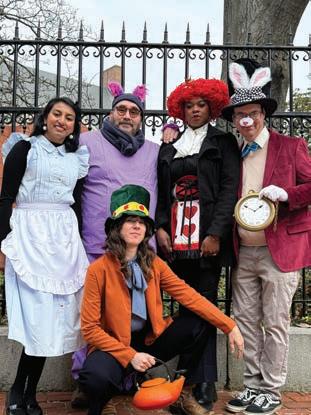
I have also enjoyed the opportunity to bring healthcare workers’ concerns to our political leaders. Most recently, I joined 1199’s "Down the Rabbit Hole of the Hospital Staffing Crisis” action in Annapolis as the Cheshire Cat, advocating for a bill that will create safe staffing committees in each Maryland hospital. When I join political actions, I always invite people to come with me so they can learn more about what 1199 is about.
1199 Magazine
March-April-May
2026
Vol. 44 No.2
ISSN 2474-7009
Published by 1199SEIU, United Healthcare
Workers East
498 Seventh Ave, New York, NY 10018
(212) 582-1890
www.1199seiu.org
president
Yvonne Armstrong
secretary treasurer
Veronica
Turner-Biggs
senior executive
vice presidents
Charles Nystrom
Nadine Williamson
executive vice
presidents
Jacqueline Alleyne
Michael Ashby
Lisa Brown
Andy Cassagnol
Roger Cumberbatch
Adekemi Gray
Todd Hobler
Leigh Howard
Benson Mathew
Cari Medina
Brian Morse
Roxey Nelson
Rona Shapiro
Greg Speller
Daine Williams
editor
Sarah Wilson
art direction and design
Maiarelli Studio
director of photography
Kim Wessels
contributors
Leyla Adali
Jenna Jackson
JJ Johnson
1199 Magazine is published four times a year—MarchApril-May/June-July, August/SeptemberOctober-November/
December-JanuaryFebruary—for $15.00 per year by 1199SEIU, United Healthcare Workers East 498 Seventh Ave, New York, NY 10018
David Saucedo holding one of his signature cakes.
There was an EVS supervisor position open at another local hospital, but I turned it down because I didn’t want to be in a non-union position. For a lot of people, the union is about power, and that is an important aspect of our mission. But for me, it is about the opportunity to lend a hand. I have never been in such a position to help people the way I can now, and so I try to do my very best.
Periodicals postage paid at New York, NY, and at additional mailing offices.
POSTMASTER: Send address changes to 1199 Magazine, 498 Seventh Ave, New York, NY 10018
1199SEIU
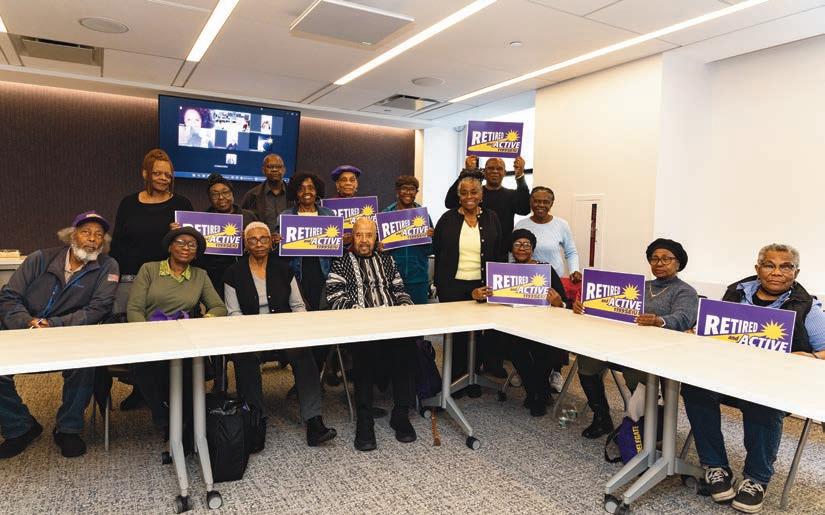
President Yvonne Armstrong (center, wearing black cardigan) surrounded by retiree leaders.
Sharing Wisdom
Retirees helped build the foundation of the Union. The Retiree Caucus makes sure that they’re able to continue their activism and pass on knowledge long after they leave their institutions.
1199 retirees have long played a vital role in the Union’s collective bargaining, organizing and political campaigns.
“There is no other union that keeps retirees involved like 1199. We always give our best support even though we are not working in the institutions anymore.”
– Eustene-Hazel Corbin, co-chair of the Brooklyn chapter
As such, the Retirees Division is the fastest-growing division of the Union, with well over 100,000 members and counting. There are 10 chapters in New York – in all five boroughs of New York City, as well as Long Island, the Hudson Valley and another 11 chapters in Florida. There are chapters in Puerto Rico, U.S. Virgin Islands, as well as Maryland, Delaware, Ohio, Texas, Tennessee, New Jersey, Virginia, Pennsylvania, North Carolina, South Carolina, Oregon, California, Nevada, Washington (state), Hawaii, Alabama and Georgia.
During the recent retiree Listening Tour, retired members expressed eagerness to meet regularly with Union leadership to make sure they are kept up-to-date
with the 1199’s priorities and can provide their veteran insight and perspective.
On April 6, President Armstrong attended the Retiree Executive Committee Meeting at Union headquarters in New York City along with Dell Smitherman, the New York State Political and Campaigns Director, to do just that.
President Armstrong said, “We don’t just plant our feet on the ground and keep going. We are continuing in the footsteps of those who went before.
“How many organizations keep retirees involved and allow their voices to continue to be heard? The Union appreciates that people who spent many years at 1199 institutions are still willing to give time [and money] to on-going campaigns.”
Howard Hall, who retired from his job as an 1199 Supervisor in Material Management at Beth
Israel Medical Center in lower Manhattan said, “I have been an active member for 52 years.” He was working at the hospital for 38 years and stayed engaged during the decades since he's retired.
Hall, who now chairs the Bronx chapter of the Retirees Division, was one of 30,000 workers to take part in a citywide strike at the major New York City hospitals—including Beth Israel – in 1976.
“We are the ones who built this Union. We need to continue to show up and show the younger Delegates how it is done. Staying at home isn’t going to change anything.”
Eustene-Hazel Corbin, who is the co-chair of the Brooklyn chapter, agrees. She worked as an 1199 Nurse Assistant at the Mary Immaculate Hospital in Queens until she retired in 2004.
“There is no other union that keeps retirees involved like 1199. We always give our best support even though we are not working in the institutions anymore. We can still play an important role,” she said. Many of the most active retirees were Delegates in the shops and have a great deal of hard-won wisdom to pass on to the next generation.
“As retirees, we should not be on the back burner. We helped build the foundation of our Union. Also, we have more time,” added Corbin. There are negotiations planned as the League of Voluntary Hospitals and Homes contract expires on September 30. “Current members can only join informational pickets during their break times. Retirees can attend at any time,” said Corbin.
The country is facing a critical moment with the current federal administration cutting billions of dollars out of healthcare funding to pay for tax breaks for billionaires. It’s important that younger members learn to think long term and less about the money today. Corbin worked hard for the retiree benefits she lives on now and is prepared to do her part to defend them.

Scan the QR code to sign up for more information about the Retiree Caucus. Or you can email retirees@1199.org
Ready to Build, Ready to Grow, Ready to Thrive!
Defining our next chapter as a powerhouse Union
One year ago, 1199ers voted in historic numbers to usher in a new chapter of our Union, focused on elevating member leadership and decision-making at every level. Together, we embarked on a journey touching every corner of 1199—every region, every division, every department—listening to members’ needs and priorities, gathering input on how we strengthen our chapters, and laying the groundwork for a unionwide plan of work that will guide us through the years ahead.
In the many conversations that took place in breakrooms, at Delegate Assemblies, and during the Listening Tours, we mapped the threats and the opportunities facing 1199 members. These threats include the impact of the Republican’s “Big Ugly Bill,” which diverted $1 trillion in Medicaid funding to fund tax cuts for billionaires and expand ICE actions in our communities— resources that should be spent improving healthcare jobs and staffing in our institutions.
At the same time, we identified key opportunities: how we can organize hundreds of thousands of healthcare workers into 1199, tap into voter discontent and win back the House and Senate in this year’s mid-term elections. These opportunities will lay the groundwork to build our Union’s power in an incredible way and win the policy fights that will shape the future of health care.
After months of gathering input from members, our leadership team put together a comprehensive plan of work built on three main pillars: Build, Grow, and Thrive. This structure emerged as
a clear way to align members’ vision, current challenges, and longterm ambitions into three essential domains.
First, Build. We know that a union is only as strong as us, the members. So, we need vibrant, member-led chapters with a solid internal foundation. Members need access to union education, leadership development, and the tools to organize their coworkers and lead with confidence. This pillar is about growing our bench of delegates and activists, strengthening chapters and departments, and investing in systems that help us communicate and work together more effectively.
Second, Grow. The bigger we are—the more healthcare workers we bring into our Union family— the more we can exercise power and raise standards across the healthcare industry. This pillar is about expanding the size of our membership, both in our current institutions and by organizing non-union workers into the 1199. This pillar encompasses our 2026 Membership Growth Drive, with a mission to sign up 20,000 of our co-workers who haven’t yet signed their Union cards.
Third, Thrive. This is where it all comes together: creating the conditions for a future where healthcare workers and our families are not merely surviving, but truly thriving. This means centering member voices to define what thriving looks like to them, and then organizing our Union’s power to win it. This pillar is a recognition that what we do at 1199 isn’t just limited to negotiating contracts and handling grievances with employers, but also, fighting for social and economic justice in the broadest sense.
I am so excited to see how far we have come over the past twelve months and the incredible memberled work that is being accomplished. Together, we are ready to build, grow, and thrive—and ready to win the future that 1199 members and our families deserve.
In May, some two thousand rank-and-file leaders from every division gathered for a 3-day Leadership Summit to discuss and launch this plan of work. It was an extraordinary showing of how 1199 is operating as the energized, five-state powerhouse we truly are. The next step is launching a Thrive survey. We want to hear exactly what thriving would look like for you and your family—at work, at home, and in your community. Your answers will help us define a new vision for healthcare workers and zero in on the inspiring, big picture, transformative fights we can uplift across our regions.
I am so excited to see how far we have come over the past twelve months and the incredible member-led work that is being accomplished. Together, we are ready to build, grow, and thrive—and ready to win the future that 1199 members and our families deserve.

The President’s Column
Yvonne Armstrong
Around the Regions
Nantucket
Nursing Home Win
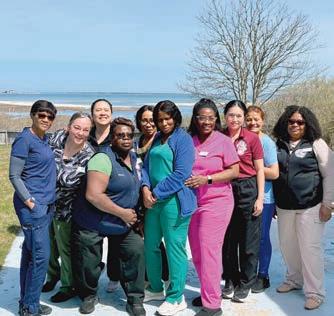
On May 4, the island town of Nantucket in Massachusetts voted by 959-321 to support funding that will allow the only nursing home on the island to remain open. Thanks to an 1199-member mobilization, the town agreed to a $137 million capital project to move Our Island Home to a new building at Sherburne Commons – reversing a previous decision defeating the plan last year.
The largest capital project to ever go before the Nantucket Town Meeting, the
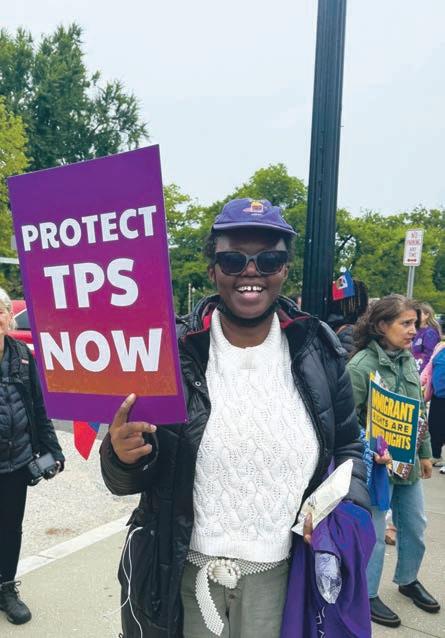
Standing up for Haitian migrants
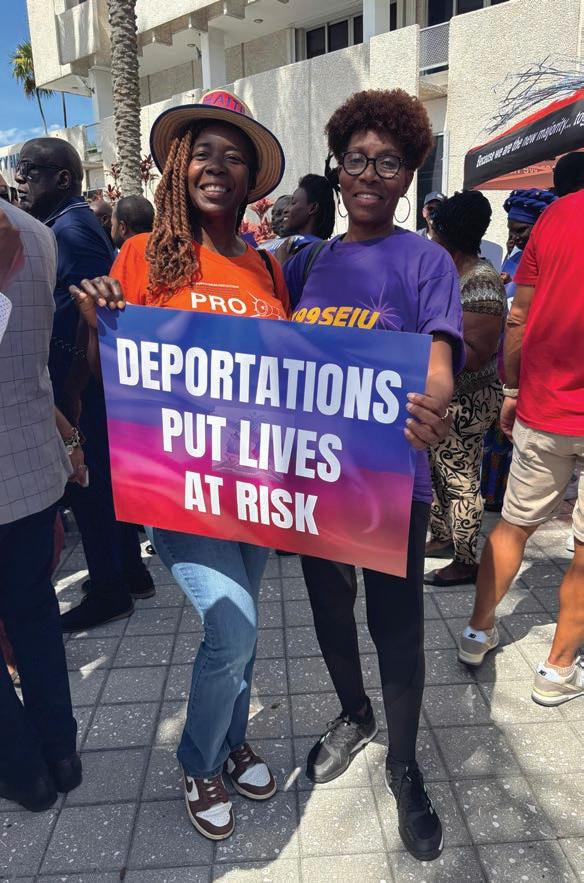
Members joined a rally outside the Supreme Court in Washington DC on April 29 as justices deliberated on whether to overrule the Trump administration’s plans to remove more than 350,000 Haitians and 6,000 Syrians who are currently entitled to remain in the country under Temporary Protected Status (TPS). Nativita Paul, a Home Care member from Queens, New York, who works with the Accent Care and FEGS agencies, said outside the court: “I have been with 1199 for thirty years. I came to Washington because of TPS. They are talking about sending Haitian people back home. We come here because we know that America has honey and we want a little taste. We are not bad people. We do our best to take care of the patients we work for. It is a lot of work. If somebody comes from another
Florida 1199ers attending rally in support of TPS holders.
new Our Island Home is slated to keep the state’s only municipally owned skilled nursing facility open for the foreseeable future.
Paulett Brown, an 1199 CNA at the facility rallied to support the plan because: “Our Island Home is a friendly place where people visit and can spend a lot of time with their family because they are living on the island.” Otherwise, family members have to contend with infrequent ferry schedules to visit their loved ones.
country to take care of patients here, I think it is a good thing. We all have to live and have kids to take care of. Right now, there are six people in my family and I’m the only person who is working. It’s not easy.”
The day before the DC rally, members in North Miami took part in a demonstration of their own. Florida has the largest population of Haitian TPS holders in the country.
Earlier in the month, the House of Representatives voted to extend TPS for Haitian migrants through 2029. Massachusetts Representative Ayanna Pressley, a close ally of 1199, led the effort.
TPS allows individuals to legally stay and work in the US when their home country is too dangerous to return to due to armed conflict or natural disasters.
Members from Nantucket in Massachusetts rallying to support the plan to save the island's sole nursing home.
WASHINGTON DC/FLORIDA
Bronx Contract Win
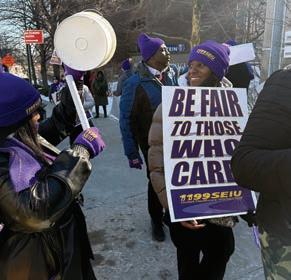
Members at the Albert Einstein College of Medicine (AICOM) in the Bronx ratified a strong contract on February 25 with 12 per cent pay increases over the life of the contract, plus a $1,500 lump sum market adjustment.
The agreement also includes preceptor pay and a bilingual service differential as well as an increased severance package.
Camille Cullen, an 1199 Delegate and Admin Assistant at AICOM, said during a frigid informational picket during negotiations: “It’s about time that we get a fair wage increase. Going to the grocery store, I get sticker shock every time. We just need to be able to support our families.”
Mahamudun Bhuiyan, a Leukemia Researcher at AICOM, agreed that members had gone without pay increases for too long.
Members mount and informational picket during the contract campaign.
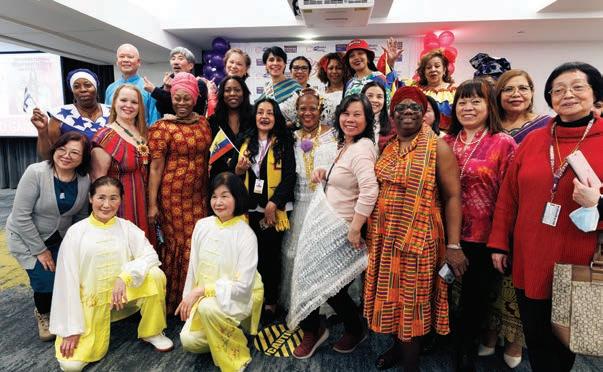
The women of 1199 coming together at Union headquarters to celebrate International Women's Day.
Members at Boston Medical Center celebrating their contract win.
International Women’s Day
Members dressed in traditional attire from their countries of origin came together in the 1199SEIU headquarters in Manhattan for an evening of solidarity on March 6 to celebrate International Women’s Day. Maria Calle, a Home Care member with the Sunnyside agency in Queens has been with the Union for 23 years. She came to the event to honor her Ecuadorian heritage, dressed in the characteristic garb of the rural “Chola Cuencana” women who are known for farming and selling agricultural products.
“I feel happy to be here cele-
brating all the women of the world and also to show solidarity for the women who have suffered domestic violence,” said Calle.
A retired Home Care member from Trinidad, who now lives in Brooklyn, Erica Charles, said: “It is important to celebrate, honor and respect women who often do most of the hard work. We need to remember that every day of the year.”
Nona Robinson, who also works in Home Care in Brooklyn, came over from Belize with her whole family in 2009. “Back in the day, it was all about men. Now it is time for the women to shine.”
“Back in the day, it was all about men. Now it is time for the women to shine.”
–Nona Robinson
Boston Contract Win
On April 29 Boston Medical Center South and Brighton averted a strike that had been scheduled for May 1, when they reached a tentative agreement with management. The agreement at the two BMC locations will lift wages for 1,400 members in Brighton and Brockton, protect the 1199 Training Fund, limit changes to health
insurance, and more. The facilities were previously owned by private-equity backed Steward Healthcare, which went bankrupt in 2024, leaving many caregivers unsure of the future.
It took several months of negotiations, numerous actions, and a strike vote, but members are finally celebrating victory.
Around the Regions
NEW YORK
Planned Parenthood wins strong contract
Planned Parenthood Foundation of America (PPFA) members in New York City unanimously ratified their second contract on April 1. The agreement raises the starting salary to $60,000, which is a $5,000 increase on the floor established at the first contract.
Members also won a sliding scale for employee health insurance contributions so that the lowest paid employees will pay less. The agreement includes an additional month of parental leave, office closure for winter holidays and eligibility for sabbatical after ten years.
Bargaining committee member Peyton Humphreville said: “We had a ton of member
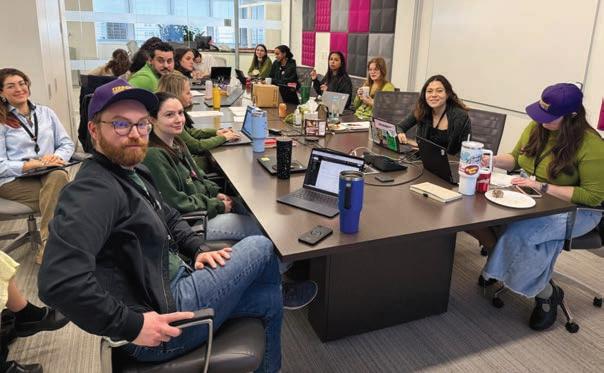
engagement throughout the bargaining process. While our non-economic gains were more significant than our economic ones, I think we learned important lessons. We’re now better situated to assert our collective power outside of bargaining.”
New Jersey Progressive wins Special Election
Analilia Mejia won a special election on April 16 to take over New Jersey’s 11 Congressional district seat vacated by Mikie Sherrill when she became Governor.
Mejia, a longtime organizer and labor leader, was endorsed by 1199SEIU. She played a major
role in winning the fight for a $15 minimum wage in New Jersey and has spent her career organizing working people and marginalized communities. She was also endorsed by Vermont Senator Bernie Sanders and supported by a broad coalition of labor and progressive organizations.
No Kings Protests
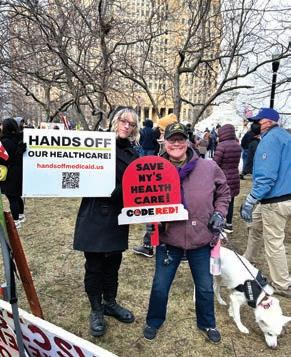
On March 28, members from as far north as Buffalo, Syracuse and Rochester, New York, all the way down to Tampa and Hollywood, Florida took part in the largest-ever public protest against the current US president. It was the third No Kings protest since he was re-elected and organizers say that eight million people took part nationwide in 3,000 individual protests. As well as Upstate New York and Florida, 1199ers turned out in force in New York City and Boston, Massachusetts carrying signs saying: “Our Families Come First, Not Billionaires” and “We Deserve a Government that Cares, not a Government that Cuts.”
“We’re now better situated to assert our collective power outside of bargaining.”
Planned Parenthood members during negotiations.
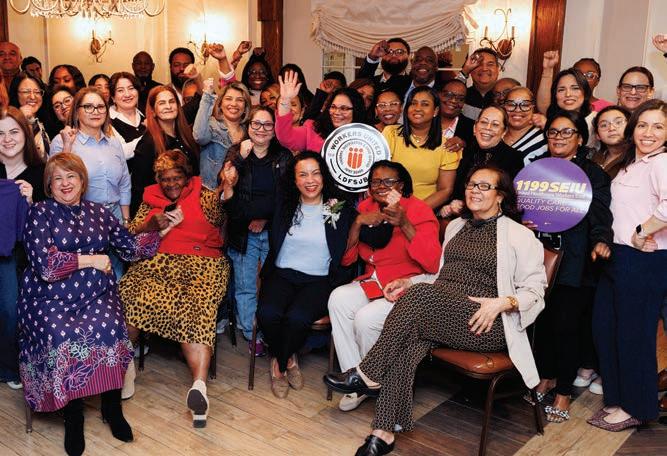
1199ers and their allies gather to support Analilia Mejia in New Jersey..
Members keeping the focus on healthcare at the No Kings rally in Buffalo, NY.
–Peyton Humphreville
The Next Chapter
From May 3-5 the Union’s most committed delegates and leaders came together in Atlantic City, New Jersey, to discuss and ratify the plan of work that the whole membership collectively participated in creating—through the listening tours, area-wide and departmental conversations, delegate meetings, and member polling. How 1199 will Build, how it will Grow, and how every member can work together to create the conditions for everyone to be able to Thrive—these are the three pillars that will take the Union forward. 1199 is only as strong as its chapters and its chapters are only as strong as its leaders.
Four member leaders who work in different regions—with a variety of job titles—caught up with 1199 Magazine ahead of the summit to describe how they build community within their chapters and what strategies they use to promote member engagement.
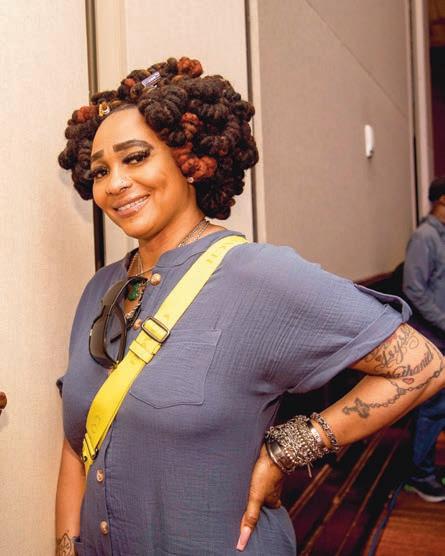
Debra Best, is an 1199 Delegate and Senior EKG Technician at Brookdale Medical Center in Brooklyn, New York, had a different experience. “I interact with both Union and non-Union members and talk about what the 1199 does for us. The Union funds [in NYC] provide healthcare, childcare and training funds, but more importantly we stand for and with you, we’ll fight for you, if you get into a problem, the union and members come and defend you,” says Best, who also encourages members to get involved early and often. “I tell them don’t just become a union member but get involved with the PAC [Political Action Contribution Fund] program, get on the bus when we go to Albany because we’re fighting for equality and more money. I encourage them to come out and see what we do, that we’re here not just for them, but to help everyone.”
“I
interact with both Union and non-Union members and talk about what the 1199 does for us.”
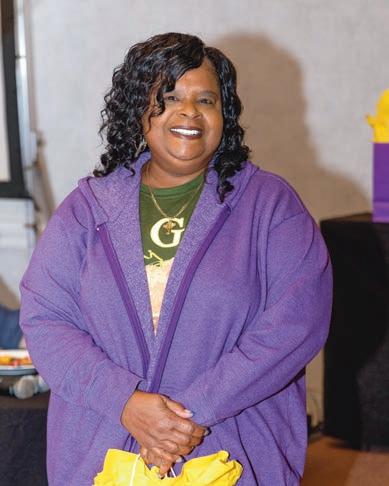
For Debra Williams, an 1199 Delegate and Dietary Aide at the Tamarac Rehabilitation and Health Center near Fort Lauderdale, Florida, developing leaders and growing a community started with empathy. “When I first started, I had to learn what a union was about and what the union did. I was never a part of a union before.
“We didn’t have a lot of members and [my organizer] would have me go to certain people, she would give me 4-5 people to go and sit with and have a conversation with them, find out why they’re not members or what’s stopping them from becoming a member. I would get all these different stories from them,” says Williams who’s been with the Union for ten years now.
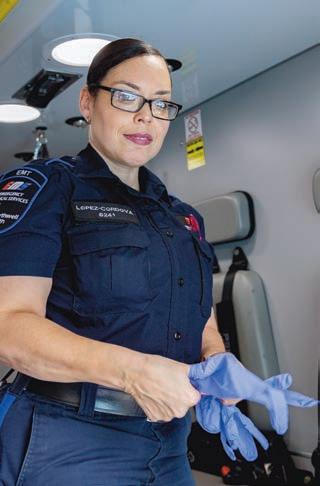
Getting to members early and often and leading with education is also how Lisa Lopez-Cordova, an 1199 Delegate and EMT, Lenox Hill Hospital in Manhattan keeps member engagement high, too. She’s been a member for 19 years and was elected as a Delegate five years ago. “My organizers threw me into everything,” she says with a laugh. “You name a group and I got thrown into it; I got exposed to a lot. I’ve lobbied in Long Island and am a Team Captain with that and went to Albany with 1199. When you’re doing something you really enjoy, you find the time.” Lopez-Cordova even took part in the new organizing drive with Assist EMS workers: “I was giving out my number and talking to potential new members.”
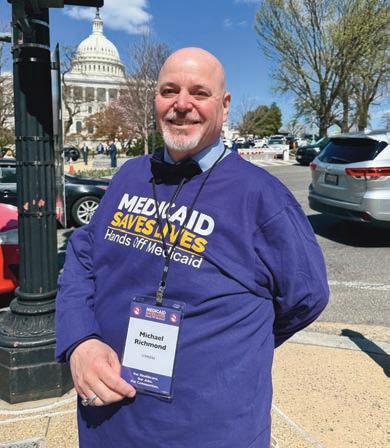
Mike Richmond is an RN in the vascular access department at Auburn Community Hospital, located in Upstate, NY, between Syracuse and Rochester. He has advanced training to enable him to place special types of IV tubes, but he is new to being an 1199 Delegate – having been elected last summer.
“I have been in the labor movement for decades. I was in UAW before coming to 1199, but I’m a baby delegate,” he says.
Living where he does: “We have a lot of members who are Republicans and conservative. I start by asking them what’s common to us all? We all want to come to safe workplace; we want dignity and respect. People will stay in bad work environments if they’re respected.” He’s also seen
“When
I came on board I had someone sit down and explain things to me, so now I try to go through all the paperwork about things – what are union dues, what is PAC, the benefits, why we go to rallies, how it all works.”
She realizes how important it is to make sure members are educated not just about their contract, but how everything works together in the union. “Sometimes 1199 members don’t turn out for events because they don’t know about them or have no idea what things are. It shouldn’t be like that. When I came on board I had someone sit down and explain things to me, so now I try to go through all the paperwork about things – what are union dues, what is PAC, [protections under the Family and Medical Leave Act (FMLA)], the benefits, why we go to rallies, how it all works. I tell them from the beginning that this is important, so when I say ‘c’mon let’s go’ when it’s time to do an action, they come and join me.”
how providing space for disagreement is also key in forming community, especially as his unit is going into contract negotiations and forming their bargaining committee.
“I’ve got this amazing LPN that is extremely conservative and she’s very intelligent, articulate, and her skills are what we want to model leadership after. She’s nervous about being active in the union and in bargaining because there’s so much propaganda that people spread that separate us. But I’m like, ‘if you’re at the table and coming forward, even if you disagree with me, I will make sure you have the space and right to disagree. It’s through that disagreement and discussion that brings up alternatives and solutions to issues.”
How to talk to disengaged members
How to handle disagreements The importance of communication
How to talk about Union dues
“Most people now just want to go to work and go straight home and not get involved in activities,” says Best, “I tell them you can come to the meeting and see if you like it, see how we’re helping people, and see how if something happened to you, you would want to be helped as well. I tell members they can take baby steps, you don’t have to say ‘yes’ to everything right away, you gotta crawl before you walk.”
It’s also about knowing that there’s a cost if you’re not there. “If you don’t show up to the meeting, you lose out. You don’t receive the same info and messages if you get it from others instead of going to hear it yourself—you have to get the pieces to put the puzzle together. You can make it a priority—just like the oath you take to help people, you can make it a priority to show up and give it your best shot so you can know what’s going on. Just like you show up for work, you can show up for this too,” adds Best.
“Some don’t want to get involved because they don’t like dues, they’ve been told the union would take $40-$50 out of their check, so I have to correct them,” says Williams, “Dues are only 2 percent of what you make and then I would have to break it down for them. I would tell them that the union is their job security because if you’re not a member of the Union, management can do what they want to do with you, they can bounce you off the walls. The doors are already revolving doors, if you’re on the schedule, they can just say ‘we don’t need you’ and bring their own people in. That’s why we have the union, so they can’t just do that.”
Conflicts are natural when you’re building community, especially with people of different backgrounds.
“It’s about inclusion and meeting people where they are. There are people with certain backgrounds and educations that are different than others; we tend to hang out with people who are more like ourselves,” says Richmond, “When people have a different background, education, or understanding of things, you help them and meet them where they are. Often, the core values of most healthcare workers are service oriented, they are offering service to someone in need, they want to help people, so you connect with them on that level, those driving internal motivators.”
When Williams talks to members who are unhappy about their contract, she is honest with them: “We got eight people out of 82 fighting for the contract for everyone in the building. If you’re not happy with it—you should be there fighting for it, you could’ve been there, but you decided not to.
“You have to let them know, there’s no ‘I’ in team, you can’t be a team of one, we all have to work together and stand together. Management loves nothing more than to see two coworkers go at it, especially if they’re members of 1199.”
Lopez-Cordova says: “I had an issue where members were at odds with each other. I managed to separate them and handle it in house and not tell management. I told them: ‘How would that look if management finds out or if you fight in front of the camera, all of you would be suspended.’ I let them cool off and spoke to both of them and let them know as Union members we can’t do this, we’re not going to stand for that as members, we all got bills to pay and our main goal is our patients. As a delegate I told them to come to me with their frustrations and not each other, which they did.”
“Delegates have to keep repeating themselves. I’d rather sound like a broken record than have a member tell me that they didn’t know about something. If you’re continuing to spread the word [about an event, meeting, action, etc.], there’s no reason that a member shouldn’t know about it,” says Lopez-Cordova.
“I will compliment someone like, ‘Oooh your hair looks so nice! Where did you get your hair done?’ You’d be surprised how one thing can turn into something else, it’s all about communication,” adds Williams, “You gotta have that listening ear, you start by asking about their hair and they may want to vent about something, so listen to them. I sympathize and have empathy for them, I say ‘I understand where you’re coming from, we’re in here together and you’re not alone.’ It’s all about the communication.”
It’s important to frame your conversations as discussions rather than debates, says Richmond. “If we’re debating, someone must win, someone must lose, but if we’re discussing, we’re sharing thoughts and perspectives and motivators, and there doesn’t have to be a win or a loss, but we’re learning about each other.”
“Many members don’t understand what dues actually cover,”says Lopez-Cordova, "that’s why it’s so important from the beginning to explain what dues are and what PAC is. [Our contract includes] free healthcare and I’m getting ready to go to school and 1199 will reimburse [tuition]. I’m not going to complain, if anything I’m grateful and spoiled and have really good benefits. We get a lot in return for $25.”
"I'm okay with the dues. That is what gives us representation," said Williams, who works in Florida where it is much harder to negotiate strong contracts because of regressive Republican legislation designed to weaken unions.
She says: "I don’t have a problem paying $15-$20 in dues. Some of us blow that easy in a week or two. If you are a soda drinker, a big liter of soda is more than $10/week. If you drink coffee like me, I drink decaf coffee—I’m paying almost $23 for decaf coffee! So, I don’t mind paying my dues.
“For people who say, ‘the Union don’t do nothing for me,’ I say to them first, the Union is not a building—the Union is us! The Union is you! What are you doing? So, if you feel like the Union isn’t doing anything, then what are you doing?”
THE WORK WE DO Champlain Valley Physicians Hospital
Union density and the power that comes with it is something that 1199ers living in cities sometimes take for granted. That’s not possible in some of the northernmost parts of Upstate New York where members at Champlain Valley Physicians Hospital (CVPH) work. Located in Plattsburgh, just 18 miles from the Canadian border, they are more than 300 miles from New York City. They’re deep in the Adirondacks—the largest protected area in the continental US, famous for hiking trails, skiing and birding festivals.
The hospital is by far the largest employer in the area and one of the few where workers have been able to form and maintain a strong wall-to-wall Union presence. 1199 Magazine recently caught up with some of the outstanding Delegates who are responsible for negotiating and enforcing their contract.
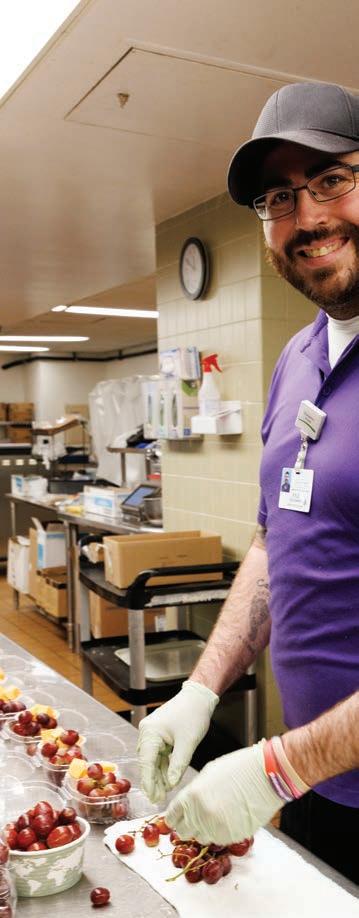
1. “Patients first is our motto,” says Kyle Baker, who has been at the hospital for 21 years and is now a Nutrition Service Lead responsible for liaising between management and staff. It’s Baker’s job to change employee assignments to improve productivity. He’s not a Delegate because some of the work he does could lead to discipline. But he is an active member.
The hospital had to join the University of Vermont network in order to survive during COVID, but that decision has led to a 20 percent loss of full-time jobs in the building. “When we lose staff, it means that the cafeteria suffers and there are fewer food options,” says Baker.
“People working 12-hour shifts and want a good meal sometimes find that there are not many choices. You have one call-out, and there will be a domino effect for
the rest of the day.”
Baker’s wife works in radiology and the couple live in Chazy, 15 minutes further north with their two children, aged 12 and 15.
“At home I cook. Here I do prep work. I often make 300 yogurt parfaits. That’s a hot seller. Also popular is overnight oats – oatmeal, yogurt and milk, soaked overnight. It’s a healthy option, as long as you don’t put chocolate chips in it.”
Baker appreciates being away from the hustle and bustle of the city. “The kids can play outside, and you don’t worry,” he says.
He also appreciates the security of annual raises and health insurance that being an 1199 member gives him. “The only choice for employment around here is the prison [Dannemora] or the hospital. The pay might not be quite as good here, but your life is not in jeopardy.”
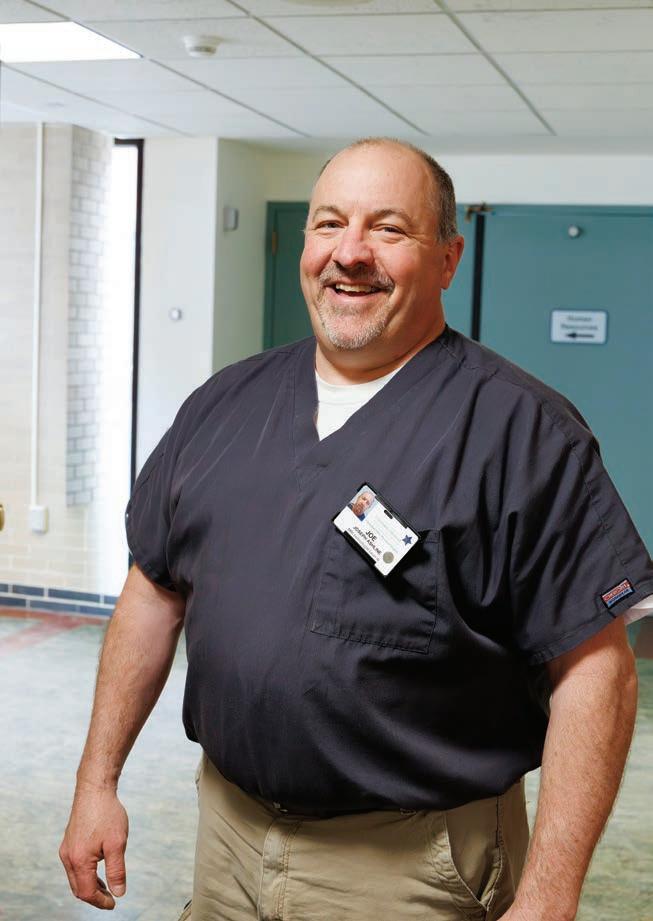
2. As one of the longest serving Chief Delegates, Joseph Ashline has worked at CVPH for 32 years. He started out in radiology and worked his way up to the most challenging job of MRI Technician.
“I like working on the cutting edge of medical technology.
MRI is the newest diagnostic tool developed in the late 1980s, and it is still evolving and growing,” said Ashline.
“The diagnosing part of my job is super interesting. We are able to catch brain tumors, and liver and kidney problems at a stage when they are still treatable.
“If an abnormality is found, the MRI provides precise imaging. For instance, we can landmark a patient’s brain which makes it quicker and safer to perform brain surgery.”
Ashline also enjoys working with people and helping put them
at ease when they are undergoing a procedure, which many find stressful. Roughly a quarter of patients require a sedative.
“I became a Delegate 20 years ago when there were some issues in the department. I wanted to be part of the solution and represent employees who were in a tough spot.”
During COVID, Ashline stepped up and took over organizing, so that members never suffered.
“We recognize that NYC life is very different. We live more simply up here and it’s a friendly atmosphere. But we can be forgotten—out of sight, out of mind. I don’t believe it is intentional,” he adds, “We handle everything ourselves up here. Whatever comes up, we take care of it.”
“I care about unions and I know that the benefits we have were fought for and worked for by 1199 members. It’s not something you can take for granted either. Like a good engine, it requires maintenance.”
– James Jolley
THE WORK WE DO
3. James Jolley was born on the other side of the Adirondacks on the western edge of North Country, in the small town of Carthage. He moved to Plattsburgh to be near his brother and his family.
When he started working in Environmental Services (EVS) five years ago, he immediately became a Delegate and before long was elected Chief Delegate, overseeing 27 others who cover the logistics, patient transport, materials and nutrition departments between them. “It’s like eating a whale, one bite at a time,” says Jolley.
“I still deal with grievances in EVS but also offer guidance and support to other Delegates. The hierarchy we have here enables us to manage the workload and be more responsive to issues as they develop. He adds, “Someone is always available to attend union meetings after hours.”
People may think that underfunding of rural hospitals only happens in red states. But the cost of supplies and equipment has boomed at CVPH, while Medicaid reimbursement rates have been stagnant in the North Country for years—and they were already 30-40 percent less than downstate.
“One in five people here depend on Medicaid,” says Jolley, “We have an aging demographic that needs more medical care. At the same time, it can be tough to recruit the staff we need. So, we have increasing demand and a decreasing supply [of employees and resources] which creates a deadly cycle.”
CVPH recently lost a trauma surgeon who has not been replaced.
“This means there’s a reduction in services. We have to load some patients onto an ambulance and transport them by ferry to Burlington in Vermont,” he says.
CVPH also receives patients from the Clinton Correctional Center in Dannemora about 20 minutes away. But prisoners cannot go across state lines, so if they need trauma surgery, they must be transported to Albany, two and a half hours away.
“And if a woman goes into labor in Malone, for instance, it is a 45-minute drive to reach our hospital. Healthcare outcomes are worse in rural areas. Covid revealed a lot of the cracks. People in smaller communities get left behind. It’s not equitable,” says Jolley.
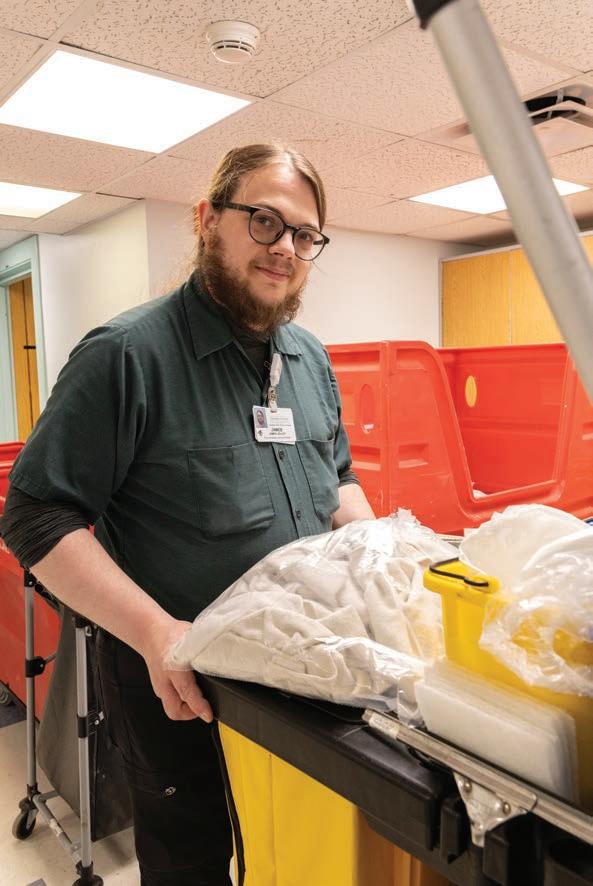
“In adult psychiatry where I work, we see a number of people who are sleeping rough. Everyone is trying their best, but it doesn’t go far enough,” he adds.
The hospital is located within the congressional district of Elise Stefanik, a former close ally of President Donald Trump before they had a falling out. She represents an enormous geographic area covering much of the northernmost areas in the state. Clinton County, where CVPH is located, is rural and Republican, with the exception of Plattsburgh. The district is almost 88 per cent white.
“We had a Medicaid rally in Plattsburgh last summer to demand that Rep. Stefanik vote no on the federal cuts. This tends to be a poor area. The prison and the hospital are the only major employers.”
Jolley has been an 1199 Member Political Organizer in an area where many members are skeptical about getting involved in politics. He reminds them of the value of affordable healthcare and
the fact that most Americans agree on the need for it.
Democrat Paul Tonko, who represents the neighboring district, which includes Albany, invited Congresswoman Alexandria Ocasio-Cortez (D-Bronx/Queens) to Plattsburgh for a town hall meeting last July. Democrats hope to seize Rep Stefanik’s seat in the midterm elections.
“I’m a big believer that to be politically engaged you have to be active. I remind members that who we elect effects what our taxes pay for, and it is crucial to preserving our rights. Democracy dies if we take our hands off the wheel.”
Jolley believes that unions have a crucial role to play, too. “By any metric, my life being in a union is better—better wages, conditions on the job and security. I care about unions and I know that the benefits we have were fought for and worked for by 1199 members.
“It’s not something you can take for granted either. Like a good engine, it requires maintenance.”
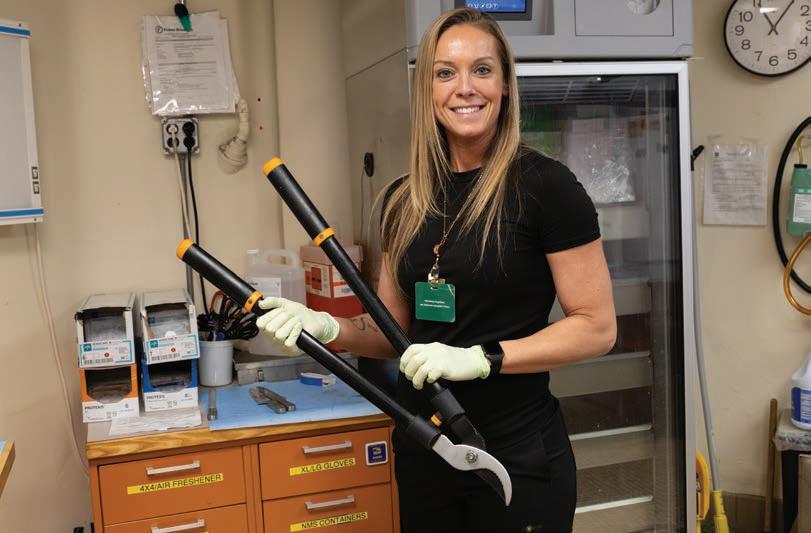
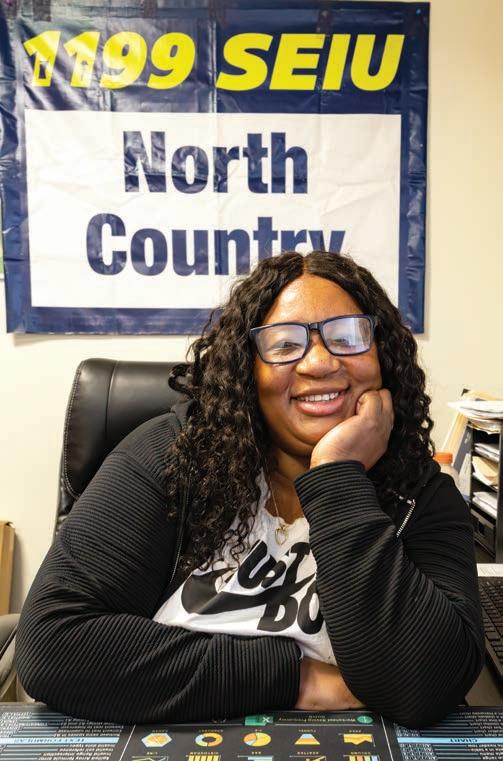
4. Nicole Poitras was just 17-yearsold when she started working at the CVPH switchboard two decades ago. From there she moved to Patient Registration for four years before settling into her current role as a Laboratory Prep Technician. It was in the lab that she was recognized for her skill in dissection. Her facility with recovering corneas for the eye bank led to her working as a Diener—a morgue assistant who is responsible for handling, moving and cleaning corpses. Recently Poitras has begun performing forensic autopsies under the direction of a pathologist.
As a certified phlebotomist, Poitras also works at the hospital’s Fitzpatrick Cancer Center. “People who undergo chemotherapy here usually have good outcomes. The patients don’t come in sad, and they are not looking for pity. It is a positive atmosphere,” says Poitras, adding: “People with iron deficiencies also need blood transfusions every couple of months and need someone skilled to draw their blood.”
Poitras became a Delegate five years ago and soon became a Chief Delegate overseeing Labor and Delivery, Pharmacy, OR Prep, Peri Op, Sterile Processing and, of course, the Laboratory.
4. After working as a Clinical Assistant providing bedside care for nine years, Charlene Chandler decided to take a month-long vacation in 2022 to visit relatives in the United Kingdom. She had not seen them for 20 years.
“When I came back, I wanted a change,” said Chandler. “Bedside
care is very physically demanding and I’m not getting any younger.”
Since returning from that vacation, Chandler has been a Resource Specialist, making sure any gaps in the day-to-day schedule are covered. If someone calls out, it is her job to find a suitable replacement who can come in at short notice.
“I became a Delegate one year after joining the hospital. I wanted to know the rules and protect myself. I’m from Jamaica and where I come from, we’re direct and to the point,” says Chandler,
“My culture and how I approach people is different from some people around here and I don’t want to be misunderstood. Coming from Jamaica, being in a union is a way of life.
“My mother was in the Bustamante Industrial Trade Union in Jamaica where she worked in a banana processing plant. I brought her here to live with me in Plattsburgh last year. My son graduated from college here and then joined the Air Force. He currently lives on a base in Idaho.”
Chandler originally came to New York City when she emigrated to the US. “But I’m a country girl, so I like it here in Plattsburgh. The city of Plattsburg is as diverse as it gets around here. I came up to visit my good friends who live here and I never left. I like to hear the birds and touch the grass. In the summer I like to hike. A Jamaican nurse is my hiking buddy.
“I do drive down to NYC sometimes to get oxtail and goat. Everything is more expensive there, though. I don’t think I would have been able to achieve what I have as a single mother if I’d stayed in NYC.”
As a Delegate, Chandler finds that most grievances are about time and attendance. “People have a lot going on in their lives. They may be involved in a custody battle or have health issues. I try to negotiate with management and educate members about how to avoid discipline. Some people live 90 minutes away and have transportation issues,” she says.
Chandler is also active politically. “I always go with the Union when they have rallies in Albany protesting Medicaid cuts. We need Medicaid dollars in this hospital. We’re facing a reduction in staff. It is our main revenue stream.”
JESSE JACKSON WAS ONE OF OUR GREATEST ALLIES
He helped our union heal its wounds.
By Dennis Rivera 1199 President,
1989-2007
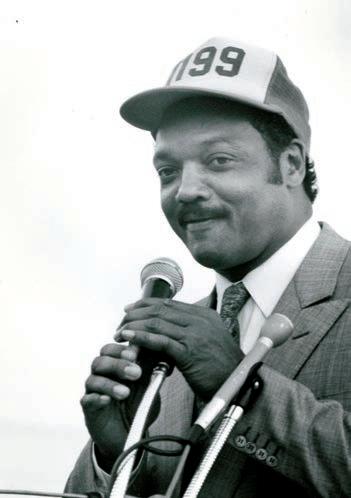
I first met the Rev. Jesse Louis Jackson Sr. when I volunteered for his 1984 campaign for the Democratic presidential nomination. That was only a short time after I heard him speak at a rally called to end the U.S. Navy’s decades-long practice of bombing and destroying the Puerto Rican island of Vieques. As Jesse addressed the crowd I was struck by his stage presence, his oratory and his grasp of the issues.
When I learned of his passing in February, the news struck me like a thunderbolt, although I knew that he had been gravely ill. His death reminded me how important he was in my life as well as the life of our Union.
Shortly after our Save Our Union slate won the Union leadership, we asked Jesse to join the campaign to raise the dreadful standards for our recently organized homecare workers. Cardinal John Joseph O’Connor, the Archbishop of New York, agreed to meet with Jesse and to join our crusade.
The Cardinal’s and Jesse’s involvement in our campaign, “Invisible No More,” helped these workers, primarily women of color, move out of the shadows and into the daylight. That involvement helped build public and political support and embolden the
members.
As a result of the campaign, members were able to more than double their wages, and win healthcare benefits, a small pension, vacation pay and other benefits for the first time.
In 1988, Jesse asked 1199 to use our headquarters for his second run for the presidency. He asked me to take charge of the Latino outreach in the state.
Massachusetts Gov. Michael Dukakis won the state primary, but Jesse won New York City. His campaign galvanized the city’s progressive movement and set the stage for the 1989 mayoral campaign. Many of the “Run, Jesse Run” leaders and activists formed the backbone of David Dinkins’ mayoral coalition. The city’s first Black mayor acknowledged that his victory would not have been possible without the 1988 Jackson campaign. Later, former President Barack Obama would credit Jesse with paving the path for his 2008 ascension to the highest office in the land.
That same year, 1989, was also my first year as president of our union. Our greatest challenge was negotiations with the NY League of Voluntary Hospitals and Homes. Our leadership determined
that we had to hurry to reconstitute our delegate body. In 1984, the former leadership had called out members on a disastrous 47-day strike, and that defeat was fresh in members’ minds.
We decided we had to proceed with caution and set in motion an ambitious plan to reconstitute our delegate body and elect contract captains.
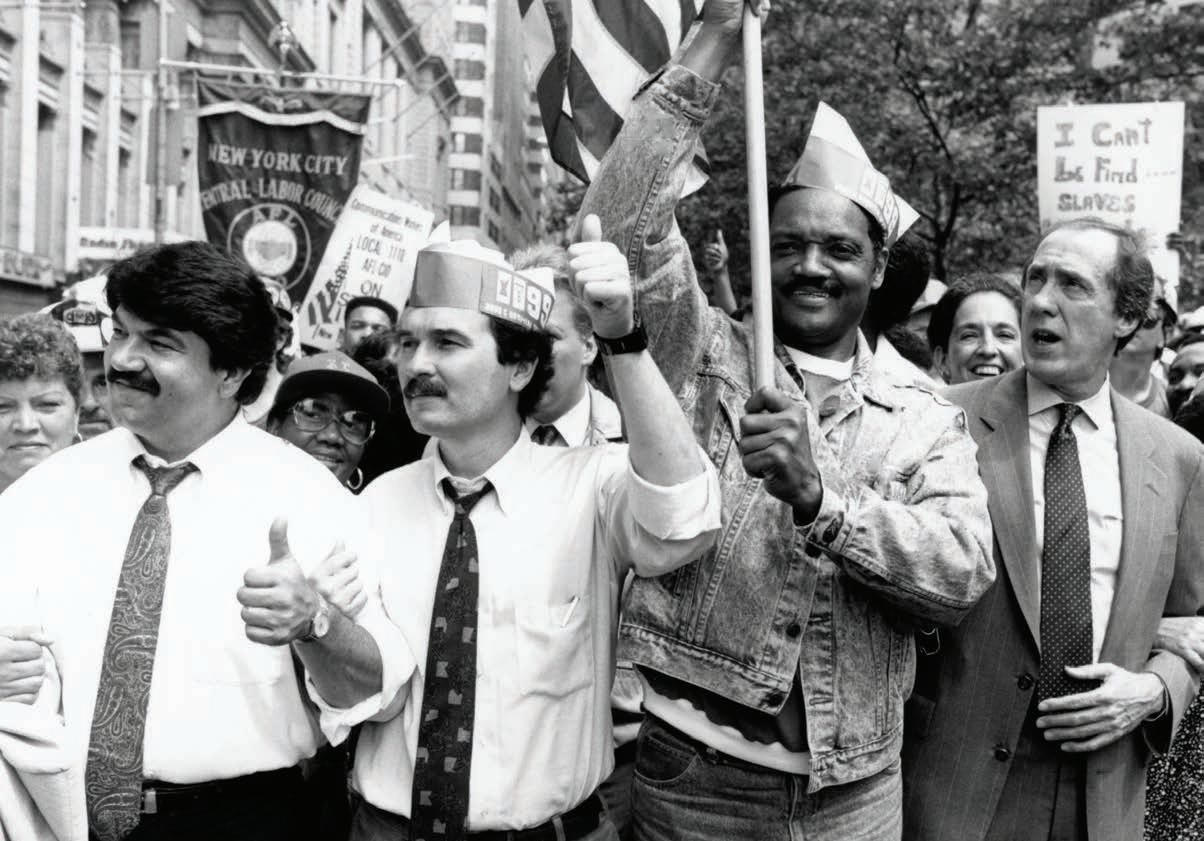
A central component of our contract campaign was a series of one-day strikes. The response was overwhelming. Each action brought tens of thousands of people into the streets. And marching with us was Jesse. He inspired members with chants of “I Am Somebody” and “Keep Hope Alive.”
In the end, this campaign won historic contracts. Key to the victory was Cardinal O’Connor’s early agreement to all of our contract demands. An Oct. 8 New York Times headline read, “Local 1199 is Back. The Hospital Workers Are the Envy of Labor Now.”
I was honored the next year when Jesse asked me to accompany him to South Africa as one of the few Americans to greet Nelson Mandela, the leader of the anti-apartheid movement, after his 27-year imprisonment.
As a result of the ‘Invisible No More’ campaign, home care members were able to more than double their wages, and win health care benefits, a small pension, vacation pay and other benefits for the first time.”
Shortly after that trip, Jesse asked me to become the chair of his Rainbow Coalition, a human and civil rights organization he founded years earlier. In that capacity, I spoke with Jesse regularly, usually at six in the morning, to discuss national and international issues.
Just as he helped David Dinkins become the city’s first Black mayor, Jesse worked with us to help Nydia Velazquez, a Brooklyn Democrat, become the first Puerto Rican women to take a seat in Congress.
Similar to our work with Dr. Martin Luther King on social justice and peace issues, we did much of the same with Jesse. He was a foremost spokesperson for labor rights and workers’ issues.
I accompanied Jesse to more meetings with clergy – especially Black ministers – than I’m able to count. I also joined him on farm workers’ campaigns and other social justice struggles. We were arrested together at some of those actions.
Jesse also helped us reclaim our status as champions of peace and solidarity. He and I met with Fidel Castro in Cuba to discuss improving
the relationship between the two countries. At the request of Luiz Ignacio Luis da Silva, a labor leader who rose to the presidency of his nation, I accompanied Jesse to Brazil to campaign for Lula throughout the country.
Jesse was not able to join me and other leaders who were arrested in 2001 for protesting the Navy bombing of Vieques. Jacqueline Jackson, Jesse’s wife, joined us at the protest, and spent 10 days in jail on a trespassing charge.
I spent so many hours with Jesse, Jacqueline and their children that I consider them part of my extended family.
It is difficult to measure all that I learned from our discussions and just by watching Jesse. How to talk to news people and effectively use the media are just two examples.
Jesse was an extraordinary man. Like us all, he was not perfect, but his virtues far outweighed his flaws.
My memories of him will always be filled with admiration and love.
Our union owes the Rev. Jesse Louis Jackson S. an enormous debt of gratitude.
(Left-right) Labor leaders Richard Trumka, the late President of the AFL-CIO, Dennis Rivera, former 1199SEIU President and the Rev Jesse Jackson marching side by side in NYC in 1989.
With affordable health care under assault from the extremist Republican administration’s billionaire tax cuts, 1199ers are fighting back and calling on their state governments to plug the funding gap.
Making our Voices Heard
Ever since Congress passed the Trump administration’s Big Ugly bill last summer, 1199 members have been raising the alarm about the potentially devastating impacts to their families, patients and communities across all 1199SEIU regions. In order to pay for massive tax giveaways for the ultra-rich— and dramatically increase funding for ICE enforcement— the federal legislation is set to rip away roughly $1 trillion in Medicaid dollars. That is money on which most 1199ers jobs depend and that secures the care for the most vulnerable in society.
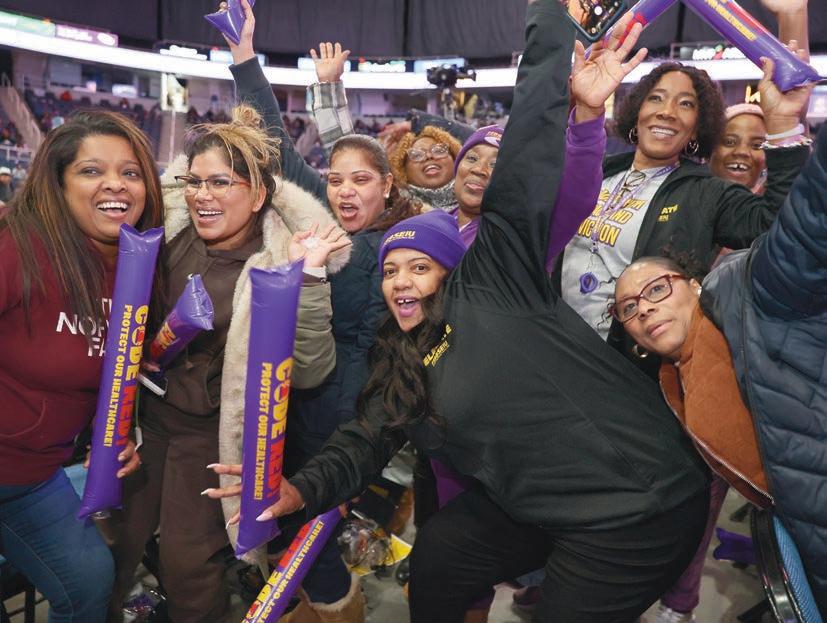
In New York, thousands of members took their protest to the MVP Arena in Albany on March 18, staging a “Code Red for Healthcare” rally to demand a state budget that invests $2 billion to ease the hardship of the Trump Medicaid cuts. This was the first such 1199 rally where the Governor, Assembly Speaker, and Majority Leader all attended at once—a trifecta of the state’s most powerful political leaders— demonstrating the Union’s strong and growing political clout. At press time, Governor Kathy Hochul had put significant investments in healthcare on the table and pledged a “Pied a Terre” tax on people with second homes in New York City worth more than $5 million. This tax is set to bring in more than half a billion dollars of revenue.
For 1199 Home Care members, this money is desperately needed to shore up the Medicaid funding that pays for their care of seniors and disabled New Yorkers.
Blanca Graniela, an 1199 Delegate who works as a Hospice Aide with the Best Care agency in the Bronx told her fellow members in the arena: “I work with your grandfather, your grandmother, your mothers and fathers. I am the last hand who feeds them; who gives them pride, energy, medication, food and makes sure they can stand on their own two feet. If they cannot stand, talk or eat, I am their hands, their ears and their eyes.”
Another Delegate, Gracie Kavanah, who is an RN at Planned Parenthood, added: “We have a mission to provide health care for anyone who needs our care, regardless of their ability to pay. But right now, that care is under attack and we are facing cuts to Medicaid that would rip health care away from so many people who need it.”
Stephanie Ezak, a Physical Therapist and 1199 Delegate at Schofield Residence in Buffalo, NY, spoke at a Code Red rally in her city with her NYS Assembly representative, Jon Rivera. “If the state fails to address the federal cuts, inadequate staffing, wages, benefits and difficult working conditions in nursing homes, things will only continue to get worse.”
1199ers also rallied in Carthage, NY, near the Canadian border, and in Rochester, where Dana Allison, a PCT Delegate at Strong Memorial Hospital said: “When funding is cut, services may become limited, wait times increase, and fewer healthcare professionals are available to provide the care our community needs. This can lead to delayed treatment, worsening chronic conditions, and increased hospitalizations—ultimately increasing healthcare costs in the long run.”
In Maryland, members successfully campaigned for the Safe Staffing Act of 2026, which Governor Wes Moore signed with 1199ers present.
Houda Ait-Rais, an EVS Delegate at Johns Hopkins Hospital in Baltimore testified in the MD General Assembly in favor of the bill, saying: “We may not be considered clinical staff, but nothing in a hospital can function if the facility isn’t clean. And truthfully, every other department in the hospital is short-staffed, too. We are all overworked and exhausted, which hurts patient care.
“This bill is not just a policy, it is protection. It is respect. It is a chance for workers like me to do our jobs safely and for patients to receive the care they deserve.”
A little further north, in New Jersey, the 1199 budget
“Right
now, in Boston and beyond, our community is in crisis. Families are choosing between medicine and food. We owe our elders respect and dignity.”
ask included a direct care wage passthrough of $1 an hour to fund wage increases for CNAs, LPNs, and other workers, including accountability measures to ensure that every dollar reaches workers, not administrative profit. Members are also preparing to launch a statewide campaign to demand better enforcement of NJ’s CNA staffing ratio law that members fought hard over many years to win, but remains ignored by too many employers.
In Massachusetts, hundreds of personal care attendants (PCA), elders, people with disabilities and other allies united at the Massachusetts State House on March 19 to call out Governor Maura Healey administration’s attempt to cut $100 million to the PCA program in this year’s budget.
Milka Exantus, an MA Delegate and PCA, called on Governor Healey to restore the threatened cuts, saying: “You must see our struggle not as a statistic, but as real life. We come to you not only as citizens, but as neighbors, caregivers, and community members who are sounding the
alarm. Right now, in Boston and beyond, our community is in crisis. Families are choosing between medicine and food. We owe our elders respect and dignity.”
In Florida, healthcare workers helped stop Tallahassee’s big ugly bill 2.0—legislation that could have worsened the staffing, care, and retention crisis in Florida hospitals and nursing homes. Healthcare workers and all Floridians are breathing a temporary sigh of relief since HB 693 did not advance out of committee during the 2026 legislative session. Dubbed the Big Beautiful Healthcare Frontier Act— modeled after Trump’s Big Ugly Bill— it called for restricting health care, SNAP eligibility, and eliminating a certificate of need for nursing homes which would have put facilities and care at risk. Another bill, SB 1758, which included onerous work requirements for Medicaid recipients, died in the Senate. But the battle may not be over yet, because at press time the legislature was expected to reconvene to finalize and approve the state budget and address property taxes and congressional redistricting.
Amy Runkle, a CNA at Bay Breeze Health & Rehabilitation in Venice, Florida, said: “It’s a shame so many politicians in Tallahassee and Washington work only to benefit their billionaire friends, but we can put our communities and families first if we speak up, stay united, and fight.”
– Milka Exantus, MA Delegate and PCA
Massachusetts Delegates and home care workers Milka Exantus (left), and Maria Martinez (right) at the Boston state house.
Thousands of members gather in Albany to press the NYS Governor to shore up Medicaid funding.
Securing Union Jobs
The impacts of federal Medicaid cuts are already being felt in our institutions, a grim reminder that “elections have consequences.” But Union protections mean that new placements can be found for many members who face layoffs, especially in areas with high union density.
When 1199 member Ambica Valz received a letter telling her that her job was being eliminated at the Orzac Center for Rehabilitation in Valley Stream, Long Island, it came as a shock. She was already working two jobs—a Rehabilitation Aide at the nursing home by day and staffing the currency exchange at John F Kennedy airport in Queens, by night.
“But I didn’t have to worry for long,” said Valz, “My Union Delegate got in touch very soon after I received the letter and really held it down. She made sure I got a new placement, and I never missed a paycheck during the transition.”
Valz is one of 45 Union members at Orzac who were facing layoffs in April. She emigrated from Guyana in 2019 and “being a single girl in NYC, I definitely need a paycheck to pay my rent.”
Her Delegate, Maxine Campbell a fellow Rehab Aide for the past 34 years worked from the early hours until late at night to make sure every member was placed in a new position within six weeks of receiving their notice. Together with human resources, Campbell managed to place all 45 members in new and often better roles.
Valz interviewed for and won a new position as an Admitting Representative at Long Island Jewish Valley Stream Hospital, which is part of the same network as Orzac. She is working full time and earning $2 per hour more and studying to be a Surgery Technician. And now, instead of working nights at JFK she
can work on logging Surgery Technician hours to pass her boards.
Her co-worker, Eduard-Noel Kabigting, was a Unit Secretary at Orzac when he received the same letter about layoffs. In discussing a new placement with Campbell, he shared that he was having trouble reaching the facility because public transportation options were limited. He was having to pay an average of $60 round trip, five days a week, for a rideshare.
So, Campbell identified a Patient Transportation job at Forest Hills Hospital, which was closer to Kabigting’s home and accessible by bus. The official start date for his new job was April 14, and his Orzac role was supposed to end on April 1. But the Union negotiated to allow him to remain until his new job started, so he didn’t lose any pay. With the savings in rideshare costs, he will have more money in his pocket.
“I appreciate everyone for making the transition so seamless and taking away all the stress,” said Kabigting, adding: “My brother is getting married in the Philippines in July and I had booked a month off for the trip. They are even going to allow me to take that vacation in my new job.”
Campbell, who has been a Delegate for 20 years, was handling layoffs for the first time. “Every day for six weeks I worked hard to make sure that everyone felt comfortable. We preserved everyone’s seniority and pension and made sure there
“The Union came to the cafeteria and interviewed each one of us. They let us know that our jobs were safe and asked us what part of the hospital we wanted to go to.”
– Sharon Calliste, Nurse Technician at NewYork Presbyterian Brooklyn Methodist Hospital
were no gaps in pay.”
At Garnet Health Medical Center in Middletown, NY, it was a similar story. When Yadira Soriano, who was working as a Secretary Tech, first got the news, she had not been expecting her position to be at risk. “I was initially worried that I would not be able to find a full-time replacement.”
But the Union identified a job as a Nursing Assistant in the Operating Room and “it all worked out for the best. I never thought I would end up in the OR. You see a wider variety of different procedures being done and I’m learning a lot,” said Soriano.
“With the Union, you have people that can back you up. They are fighting for you behind the scenes. The Union gives you options.”
Soriano previously worked in home care, without a union. “If this situation had happened in my last job, they would have just let me go.”
In some parts of the country, especially rural areas, with less Union density and fewer institutions, finding placements can be more challenging. So many of the planned layoffs are fueled by Medicaid cuts. That is why members in every 1199 region have been fighting hard to ensure that their state leaders plug the gaps to Medicaid funding that federal tax breaks for billionaires have opened up.
Roughly a year ago, Sharon Calliste was told that the
floor where she worked as a Nurse Technician at New York Presbyterian Brooklyn Methodist Hospital was being shut down.
“The Union came to the cafeteria and interviewed each one of us. They let us know that our jobs were safe and asked us what part of the hospital we wanted to go to.”
She drives to Brooklyn from
Staten Island and initially was placed on the day shift in the Emergency Room. But finding space to park at the time was proving difficult. So, in February Calliste moved to the evening shift in the Neurology Department.
“It is stress free now. I arrive at 3.30pm and work until 12am and it is working out beautifully. I’m always learning in this department.
For instance, how to make someone comfortable if they’re having a stroke. Sometimes a patient cannot move their arm and they are in pain.”
Calliste, who emigrated from Jamaica and worked with the 1199SEIU Citizenship program to become naturalized in 2013, added: “I never felt scared because I know I have a strong union.”
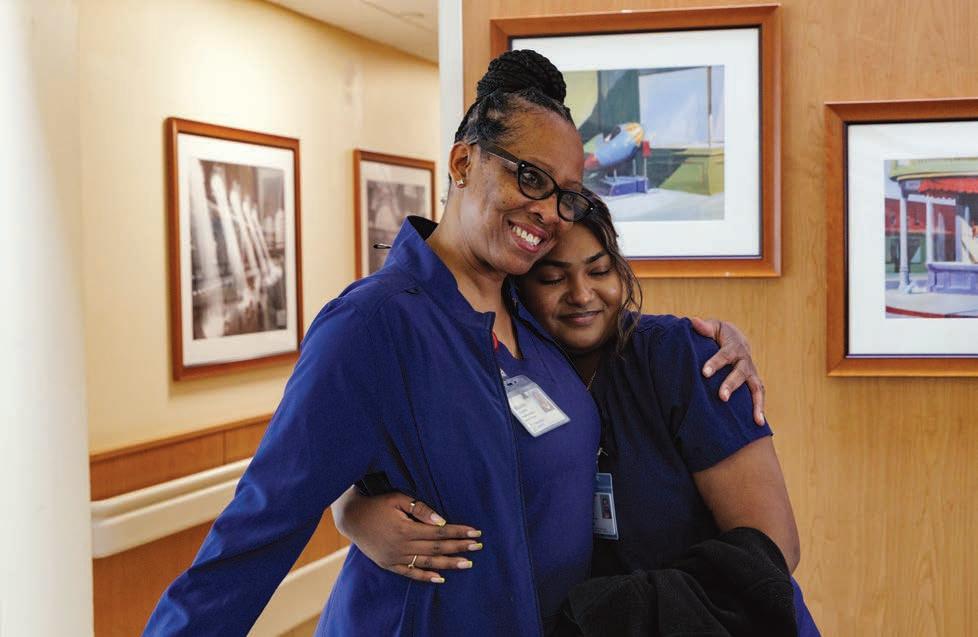
1199 Delegate Maxine Campbell (left) sharing a moment with former Rehab Aide Ambica Valz, celebrating her new position.
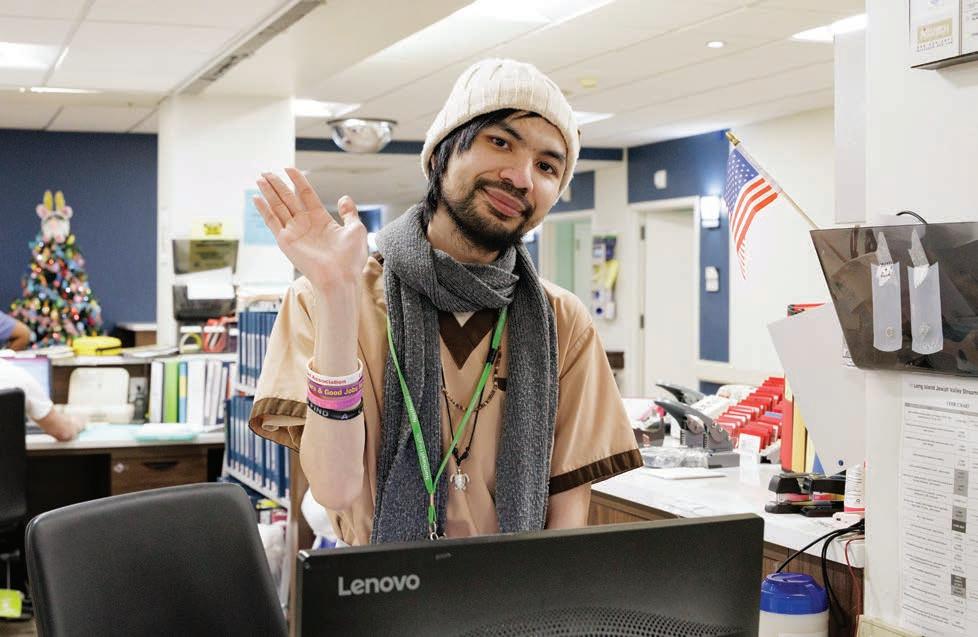
Eduard-Noel Kabigting at his Unit Secretary desk just before his planned transfer.
VOTING RIGHTS
MATTER
The ongoing struggle to protect working people’s access to democracy.
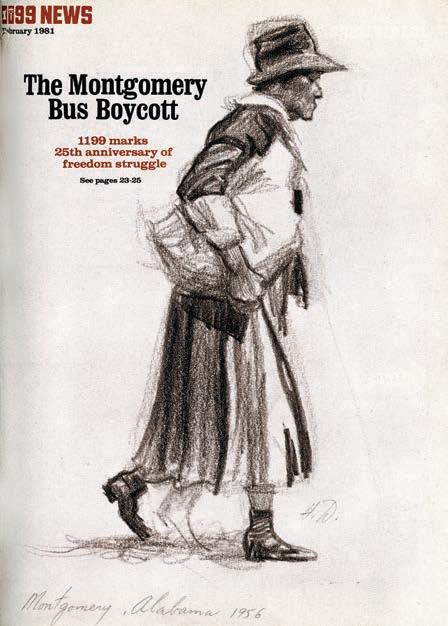
1199 News cover from 1981, marking 25 years of struggle.
The Supreme Court ruling on April 29 in the Louisiana v. Callais case gutted the one of the central achievements of our American civil rights movement: the Voting Rights Act. The decision represents a grave threat to the hard-won political power of Black and other minority communities.
It will permit states to use partisan gerrymandering as a wholesale excuse to deny Black voters their voice in government.
Sadly, this is nothing new. After the passage of Reconstruction-era amendments that granted citizenship and voting rights to formerly enslaved men, southern states quickly enacted laws to prevent them from exercising those rights.
But 1199 members have also been fighting back against these assaults on their rights for three-quarters of a century—ever since they reached into their pockets and purses in 1955 to contribute to the bus boycott in Montgomery, Alabama.
The successful campaign to integrate public transportation in Montgomery set the stage for the movement to expand voting rights – which remain the foundation of democracy. As voting rights campaigns gathered steam during the 1960s, so did 1199’s involvement. Close to 1,000 members attended the historic 1963 March on Washington for Jobs and Freedom. The Union also supported other actions that were vital to the passage of the Voting Rights Act (VRA), including the 1964 Freedom Summer project in Mississippi and the three Selma to Montgomery marches in 1963.
Protecting democracy was not just confined to the southern states where Jim Crow laws designed to disenfranchise black citizens and maintain white supremacy were the most blatant. For example, in 1968, just three years after the VRA was signed into law to outlaw discriminatory voting practices, voter registration among Latino voters in the city was so low that Manhattan, the Bronx and Brooklyn were covered jurisdictions under the federal VRA’s Section 5. This required designated states and localities to obtain federal approval, or pre-clearance, before any voting
change could go into effect.
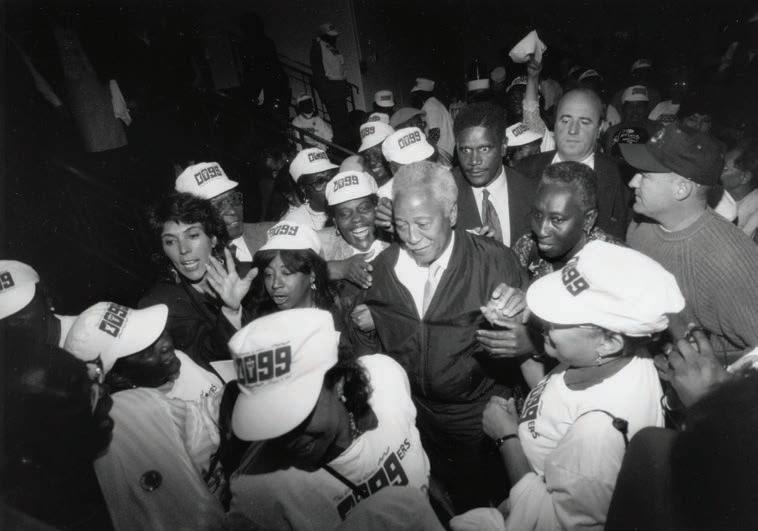
In 1986, the victory of the reformist Save Our Union leadership at 1199 jump-started political activity once more. As well as a dramatic increase in member Political Action Committee contributions, some 2,000 members took to the streets in 1989 to get out the vote for David Dinkins, the city’s first Black mayor. Three years later, a Union voter registration campaign added 102,000 New Yorkers to the voting rolls in just six weeks.
Members also worked hard to usher in the era of former President Barack Obama. His first victory in 2008 triggered a right-wing backlash that targeted voting rights. In response, 1199 and its allies rallied some 25,000 people at a December 2011 rally in NYC to protest bills in 38 states that sought to restrict access to the ballot. Rally speakers stressed that those bills disproportionately affected the poor, people of color, seniors and students.
The fight for ballot access remains an ongoing battle. In 2013, the Supreme Court struck down the preclearance provision of the Voting Rights Act. Preclearance required any jurisdiction with a history of discrimination to obtain federal approval before making any changes in voting policies. The ruling opened the floodgates. Since then, dozens of states have passed scores of laws restricting voter access.
Today the drive against ballot access is led by a
“Give Us the Ballot”
–Dr Martin Luther King
president who declares that he wants “to take over the elections.”
Last year, in a further attempt to suppress the vote, the Safeguard American Voter Eligibility (SAVE) Act was passed in the House of Representatives. SAVE failed to make it out of the Senate. In February, the Republicancontrolled House passed an updated version of the legislation. The act initiates broad voter roll purges and then requires voters to show birth certificates or passports to register or simply update their registration information. It could disenfranchise millions of Americans, including tens of millions of women who do not have a passport or a birth certificate matching their married name. At press time, the legislation remained in limbo in the upper chamber.
In 1957, six years before his “I Have a Dream” speech, Dr. Martin Luther King Jr. delivered another stirring declaration, also at the Lincoln Memorial. His urgent demand was entitled “Give Us The Ballot.”
The ability to elect representatives at the national, state and local level that protect and expand the rights of working people is crucial to the Union’s future.
Members understand that the bulk of funding for their workplaces comes from Medicare and Medicaid funds – the amount of which is determined by these representatives.
Any attack on the right of 1199ers to vote is an attack on their ability to protect the healthcare funding that is vital to ensuring their job survival. That’s why our union is working with local and national coalitions to protect the fundamental tenets of democracy: our vote and our right to elect our representatives.
1989 campaign.
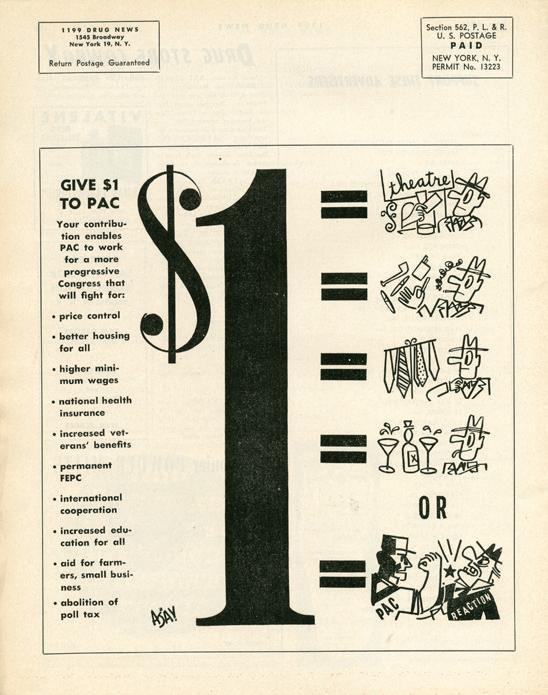
An early PAC contributions flyer from the 1960s.
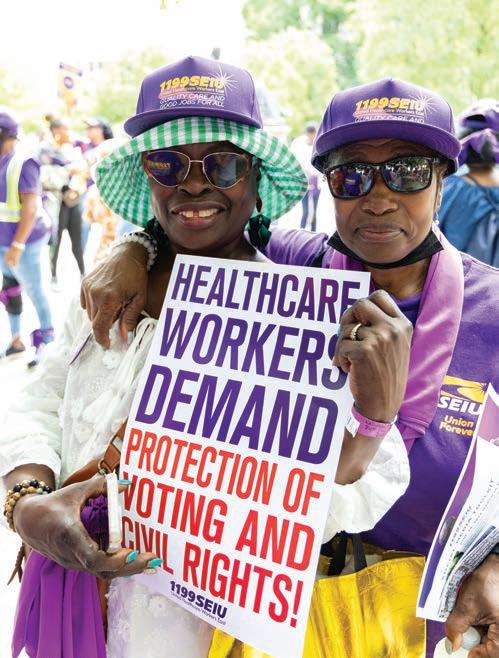
1199ers attend massive rally in Washington DC in 2024 in support of voting rights.
Former NYC Mayor David Dinkins surrounded by 1199ers during his
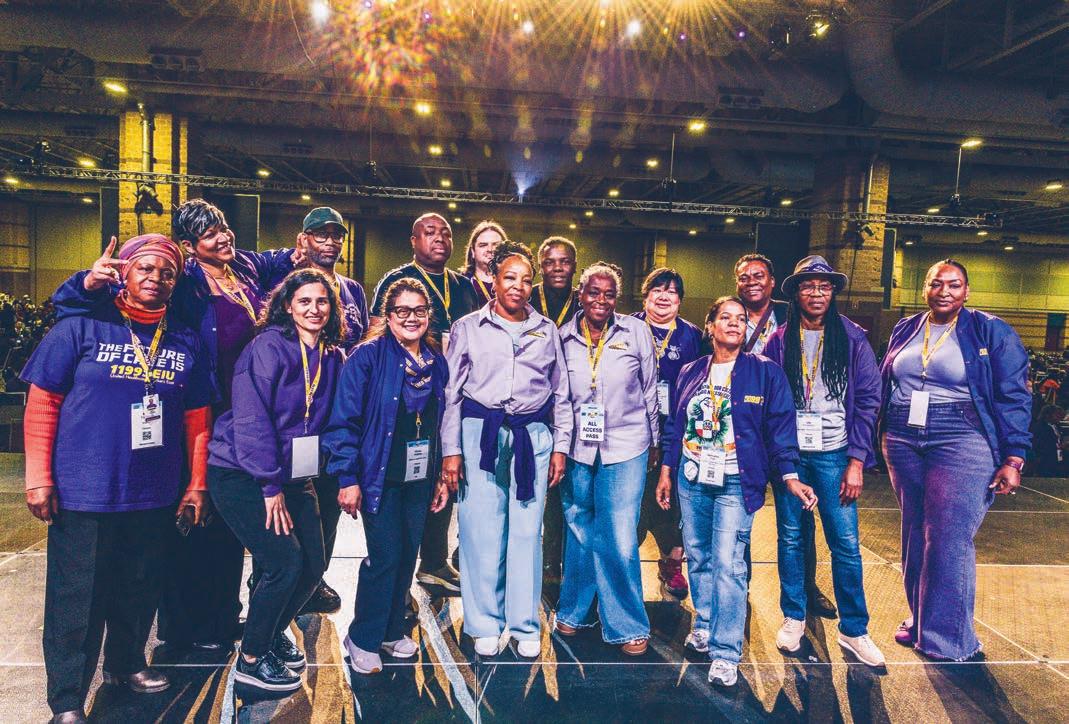
Member Emcee Committee for the 1199 Leadership Summit from May 3-5 surrounding 1199SEIU
Secretary Treasurer Veronica Biggs (left wearing lavender) and 1199SEIU President Yvonne Armstrong (to her
right, also in lavender)
Members from every 1199 region attended the event in Atlantic City, New Jersey, designed to recognize collective victories and shape the future of the union together. See page 13.