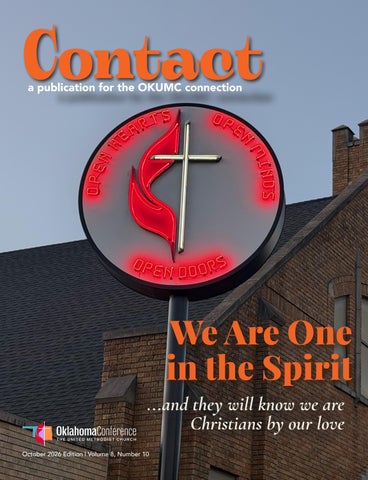
a publication for the OKUMC connection
We Are One in the Spirit ...and they will know we are Christians by our love October 2026 Edition | Volume 8, Number 10
Calendar Oct
10
Oct
17
Nov
7
The OU Wesley Foundation is facing off against Texas Wesley in the Red River Sharedown, a friendly fundraising rivalry that culminates on October 10. Donate to support campus ministry scholarships, free community meals and student programs...and help bring home the trophy! Learn more.
Nov
12-14
Join the SCJ Conference Lay Leaders for “Being a Welcoming Congregation,” a webinar on how to energetically and intentionally offer hospitality. The Zoom meeting is from 9:30–11 a.m. Register here.
Called to Connect is from 9 a.m. to 3:30 p.m. at Boston Avenue UMC. It brings Oklahoma UMCs together with mission partners through a keynote, panel discussion, and small-group conversations. Register here.
Jan
1
Jan
15-16
OKUMC members can attend the “Do No Harm” virtual conference free! This trauma-informed care and sexual harm prevention will feature keynote speakers Ashley Judd and Rachael Denhollander. Learn more.
Registration for the United Methodist Pilgrimage On The Camino De Santiago closes. The trip is scheduled for May 1-7, 2027. Learn more.
Candidacy Summit will be held at Church of the Servant. This is a time of discerning and certified candidates to explore their call together. Learn more.
COMMUNICATIONS MINISTRY STAFF Rev. Carlos Ramirez
Andrew Himes
Director of Communications & Strategy
Multimedia and Web Ministry
If you have story ideas or events, send them to editor@okumc.org.
Cover photo: Stroud United Methodist Church on Bishop Merrill’s Route 66 tour. Photo courtesy of Carlos Ramirez.
The Contact, a publication of the OKUMC Connection (USPS 954-500) is published monthly by The Oklahoma Conference of The United Methodist Church, 1501 NW 24th St., Oklahoma City, OK 73106. Periodical postage paid at Oklahoma City, OK. POSTMASTER: Send address changes to “The Contact OKUMC”, 1501 NW 24th St., Oklahoma City, OK 73106.
OKUMC CONTACT | 1
from the editor The hymn, “We Are One in the Spirit” reminds us that unity is not about agreeing on everything. It is about something deeper – a shared commitment to love one another, to treat each other with dignity and to let that love be the thing the world recognizes us by.
Being ONE in Christ is about choosing to stay together in spite of and because of those differences.
That felt a message we needed to be reminded of right now.
Sharri Hiller hears this as music. An orchestra does not make beautiful music by everyone playing the same note. It makes beautiful music because each instrument plays its part, in its own range, in service of something larger than itself. That is what we are called to be.
This issue arrives in October, just weeks before a midterm election that will test all of us. The writers in this issue remind us that unity is not a political position. It is a spiritual practice.
Rev. Stephen Lashley sat around a table with leaders representing 800,000 people of faith across 10 traditions. What he found there was hope – the invisible network of mutuality becoming visible.
Alan Herzberger writes about a conversation on a patio that kept him up at night — the moment a friend told him he simply cannot see the good in the “other” side. Alan refuses to accept that. The people on the other side of the aisle, the other side of the fence, the other side of the dinner table are, as Alan puts it, people God loves dearly. That means something.
And Rev. Charla Gwartney held a journal from 1939 in her hands and wondered what Judge Wilcox would think of where we are today – a man who stayed at the table through decades of denominational difficulty because he believed leadership in the church mattered.
Carlos Ramirez offers something equally important – a reminder that unity does not mean sameness. We are not all the same. We come from different places, different bodies, different stories. And that is not a problem to be solved. It is a gift to be honored.
We are one in the Spirit. Not because we agree. Not because we are the same. But because we have chosen — again and again — to love. And they will know we are Christians by that love. Jenny Herzberger Interim Editor
what if
It Begins With Us. Follow Us on Social
whatiflove.net @whatiflove.movement
whatiflove.movement
2 | OCTOBER EDITION
Organizing, Advocacy, and the Single Garment of Destiny Reflections on Gathering with Judicatory and Faith Leaders By Rev. Stephen Lashley, Senior Pastor of Wesley UMC in OKC Rev. Dr. Martin Luther King Jr. wrote, “We are caught in an inescapable network of mutuality, tied in a single garment of destiny. Whatever affects one directly, affects all indirectly.” When I first came across that quote in my seminary formation, the words struck me as a neat, sentimental thought. It was a theological assertion I appreciated in a general sense, but I struggled to assign my own experiential frame of reference to it. After living through the experience of a global pandemic, however, my eyes were opened not only to its figurative but also its literal truth. In that case, the direct experience of a few ended up affecting the global population. We literally are caught up in an inescapable network of mutuality. Whatever affects one directly affects all indirectly.
But not just any community. More specifically, community that seeks to visibly incarnate and strengthen the invisible network of mutuality to which we are bound. Communities that become outward and visible signs, engaging in the inward and invisible mending of the frays in the single garment of destiny.
The local church is called to reflect the eternal reality of Christ’s Church in this way. It is my primary calling. But I have also been reminded that the grace of Christ knows no boundaries between secular and When I gained an experiential frame of reference for sacred. As John Wesley acutely pointed out, there is that truth, it jarringly renewed my mind. It awakened no holiness but social holiness. me to the interconnected nature of reality. I have Lately, I have found that my pastoral work has been trying to live my life and faith from that frame of reference ever since. Which implicitly means I can brought me into relationships with leaders in civic engagement through the organizations Voice OKC never minimize or ignore the suffering of any single and Action Tulsa. person or group of people ever again. At the same time, I cannot take all of that suffering onto my shoulders as some kind of lone-ranger savior. There have been times when I have fallen into the trap of an individualistic savior mentality, which can lead to either burnout or dreadful incapacitation. It also makes the mistake of overlooking the good work already being accomplished within the inescapable network of mutuality. So if I cannot ignore, escape, or individually take on the suffering of the world, what am I to do? I have come to understand that the answer is to move steadily toward community.
These are two nonpartisan sister organizations actively working to build relational trust between community organizations to advocate for issues that affect some neighbors directly, but all indirectly. I have found that Voice and Action are two more outward and visible signs of people mending the frays in our single garment of destiny. Most recently, the work has focused on issues that affect immigrants. I have been personally enriched by these relationships, but I have also appreciated the
OKUMC CONTACT | 3
substantive work of building mutual networks between communities and organizations. These relationships have reminded me that organizing is itself an expression of mutuality. It is the work of bringing people into relationship with one another so that we can recognize what connects us, listen to one another, and discover what we might accomplish together. Weeks ago, I found myself sitting around a table with religious and organizational leaders at the Catholic Archdiocese of Oklahoma City. The gathering was brought together by these two groups, Voice OKC and Action Tulsa. I was privileged to represent the Oklahoma Conference of the UMC on behalf of Bishop Laura Merrill, who had prior commitments but lent support to the work. As a side note, I have been encouraged by Bishop Merrill and Director of Connectional Ministries Rev. Dr. Derrek Belase’s recognition of the importance of this work. Both expressed excitement and acted to support this work. I want to express my appreciation for their willingness and response. And as I found myself around the table, I sensed a similar excitement and willingness to respond from the other leaders sitting around the table. I recalled a distinct moment when I recognized that the people with whom I was sitting represented the leadership of over 800,000 people of faith from Oklahoma across 10 faith traditions. All of us sitting around a table asking the question: How can we work together to substantively care for our neighbors? My first impression was how inspired I felt to be in a room with so many institutional leaders genuinely interested in working together toward collective advocacy. That there are genuine people in positions of significant institutional authority who care and can come together to work on issues that affect some directly, but all indirectly. The occasion felt rare, significant, and encouraging. The agenda included meaningful storytelling, as well as a good deal of missional outlining and conversation about the particular ways our traditions and institutions might work together. I appreciated the willingness in the room to listen
Leaders representing more than 800,000 people of faith across 10 traditions gather at the Catholic Archdiocese of Oklahoma City, to ask: how can we work together to care for our neighbors?
across denominational and institutional lines and to imagine what might be possible through greater collaboration. But my lasting impression was hope. I found myself hopeful that there is a real opportunity for our leaders to form relationships and move toward meaningful collective action. Hope in witnessing the invisible network of mutuality become visible around that table. Hope in moving toward a better vision of that garment of destiny. Perhaps that is what organizing can make possible. It can make visible what is often invisible. It can reveal the relationships that already exist between us and create new ones where they do not. It can remind us that none of us exists in isolation and that none of us is solely responsible for repairing the whole garment. We are each called to take up a thread. Looking forward, I find myself encouraged to keep walking toward community. To keep moving steadily in a positive direction toward a vision of the single garment of destiny. A garment of which we are all threads. And perhaps the work is simply this: to keep finding one another, to keep building trust, to keep mending the frays, and to keep discovering what becomes possible when we remember that whatever affects one directly affects all indirectly.
4 | OCTOBER EDITION
The copper box discovered in the foundation of the marquee sign on Duck Street in Stillwater — sealed inside were decades of memories honoring Judge W.H. Wilcox. Photo courtesy of Stillwater First UMC.
The Copper Box By Rev. Charla Gwartney, Senior Pastor at Stillwater First UMC Since 1964, a marquee sign has greeted folks traveling up and down Duck Street in Stillwater. Little did we know what treasure was buried in the foundation. This spring, a team removed the name plate telling all that the sign was placed in memory of Judge W.H. Wilcox. Underneath, they found a copper box full of memories honoring this long-time leader and servant.
For me, a particular treasure was the journal from the 1939 Uniting Conference when three denominations reunited after almost 100 years of division. I never thought I would hold such a tangible memory of that moment in my hands. There were also newspaper clippings documenting Judge Wilcox’s participation in the listening team that traveled the country ahead of the 1968 Conference, merging the Evangelical United Brethren and Methodist Churches. For fifty years, Judge Wilcox taught the Service Sunday School Class at Stillwater First Methodist. A Cokesbury hymnal was placed in the copper box by this class. He served on the building committee for our sanctuary. A copy of the contract was found in the copper box.
OKUMC CONTACT | 5
Among the treasures found in the copper box: a newspaper clipping documenting the push to end segregation in the Methodist Church and a news article as Stillwater First UMC pastors prepare the time capsule. Photo courtesy of Stillwater First UMC.
He started Laymen’s Retreats, held at Egan and Canyon each fall. A promotional flyer was found in the copper box. Looking through the collection, I wondered what Judge Wilcox would think about where we are today. He was at the General Conference where jurisdictions were established in 1939. He was a leader in the conversations about whether the Central Jurisdiction should be abolished in the 1960s. Today, conversations about abolishing jurisdictions altogether are being held as we live into regionalization. Judge Wilcox probably couldn’t have imagined a denomination whose majority will soon live outside the United States. He probably couldn’t have imagined a woman
holding the role of senior pastor at Stillwater First United Methodist either. This summer, Rev. Corey Shirey and I preached a sermon series called, “The Copper Box,” to share this history with our congregation. We acknowledged challenges of unity and the strength we find in our connection, concluding with an appreciation for the leadership of Judge Wilcox. In each sermon, I said I’d love to have a cup of coffee with Judge Wilcox. I would ask him what it was like in the room for the 1939 Uniting Conference and what he thought of forming jurisdictions, particularly the Central Jurisdiction. I’d ask him what he thought of women’s ordination. Mostly, I’d love to hear him talk about why leadership matters in the life of the church. He lived it and made the congregation I serve stronger by doing so.
6 | OCTOBER EDITION
What if love wins in November? By Alan Herzberger, Member of Acts 2 UMC in Edmond It started with a conversation with an old friend on the patio. I hope it ends with a victory for love.
We all see this mindset on the news channels and in our politics. We see it on the legislative floors at the federal and state levels. Even worse, we see it in our school boards. Leaders picks sides and fall in line with the talking points.
I was talking with a longtime friend, someone God loves dearly, about the state of the world, our political leaders and the division among us.
Then, pundits do the same.
We were in general agreement on our worldview. In that chat, I said something about how people we know in common who see the world differently are, at their core, good people. They’re our friends. They have good hearts. I see them doing amazing things for other human beings in their own unique ways. They are people God loves dearly. But, dang, they are wrong about this and, well — pretty much everything, right? It seems that way. But they aren’t bad people. After further conversation, my friend made his way back to my comment about those who see the world differently not being ‘bad people.’ He eventually politely said he doesn’t see it that way. They way he sees it, if they can support this public figure or that world view, it’s hard to see the good in them. God might love them, but he can’t. That kept me up that night. I was thinking about that all the next day. Are we, as a society, that far gone? I’ve been known to be an optimist. Some might even whisper that it’s naivety rather than optimism. Regardless, I refuse to believe we have to see each other in such divisive ways. At the same time, I get it.
Then, our uncles and aunts follow suit. Lifelong friends see a post on social media and end a relationship with a brother or sister in Christ. It’s our side against the others, and there is no in-between no matter the cost. I pray we don’t see it infiltrate our UMC churches. I know what it is like in my church. I can sit in an Administrative Council meeting and know that half the people at the table see the world far differently than me. We can see a common goal, share a common vision, and work through differences to come to a path forward that can benefit our congregation and our United Methodist Conference. We can disagree on how to get there but have civil discourse and treat each other as a beloved child of God. I am confident it’s similar in the rest of the United Methodist connection in our conference. I am grateful that our churches can be examples of a new way to have dialogue and love. But it’s not just churches. In healthy corporate cultures, it’s the same. We work toward one goal. One vision. Authentic debate. Unified direction. If we can behave like that in our churches and our work, why can’t it be that way in politics? I pray that we find leaders that can help us find common ground. My pastor, Rev. Dr. Mark Foster of Acts 2 United Methodist Church, is a friend. He, among other pastors in the United Methodist Conference, has had great influence and impact on my life. I look up to
OKUMC CONTACT | 7
them as leaders in our connection.
What if we put down the righteous indignation?
But I do not always agree with them. And I’m pretty sure they don’t always agree with me. But they listen, and I listen. And we know that it is okay to not agree on everything.
What if we eliminated the need to assign blame?
How can we end this?
What if we got curious about why someone thinks or believes the way they do?
I believe it has to start with followers of Christ. And I believe United Methodists are the greatest example of how people can live in unity and with a common goal that is greater than their own needs, desires and quest for victory. These days, it seems like a losing battle, I know. Politics is not won with kindness, generosity and grace. But we must start somewhere, and our churches are the perfect place to start. What if … What if we set aside the goal of winning at all cost?
What if we just talked to each other like we do in a committee meeting?
What if we didn’t need to make an enemy to make our point? That would look like love. I wish there were an easier answer, but following Christ is truly the path to heavenly behavior in the campaign trails and voting booths. What if we were the models to a more dignified and unified future? What if love?
8 | OCTOBER EDITION
Unity of Purpose
By Sharri Hiller, Oklahoma Annual Conference Lay Leader Have you ever been part of a music group? Choir? Orchestra? Bell Choir?
In groups like these the leader (conductor) selects a piece of music for the group to practice then ultimately perform. For a beginner’s group, this music will be simple. All the musicians may be singing or playing the same note, only the melody. Only the notes that carry the story of the music. As the group becomes better musicians, more notes – not just the melody – will be sung or played by the musicians when performing the song. The objective is still the same, perform a piece of music that is pleasant for the listeners, but that is done with more notes – notes that accentuate the melody. When it is an orchestra playing, not only are there several different notes playing, there are several different instruments playing those notes. The orchestra has a unity of purpose: to play a piece of music that will take the listener to a different place and time and to connect with the listener in a way that can penetrate their soul. These musicians in an orchestra do not look alike. They play different instruments and different notes in different octaves. But they are unified in their purpose, making beautiful music.
As we grow in Christ, we learn the nuances of the Bible stories, the context in which they were written, and the application to our lives. We are learning what part God is calling us to be in the body. We are learning what notes we will play with the instrument we are given. As our discipleship increases even more, we look around and see that all Christians are not the same. I recommend you read I Corinthians 12 to be reminded of the full context of the Body of Christ discussion, but in I Corinthians 12:12 (message paraphrase) it says: You can easily enough see how this kind of thing works by looking no further than your own body. Your body has many parts – limbs, organs, cells – but no matter how many parts you can name, you’re still one body. It’s exactly the same with Christ. In I Corinthians 12, we are reminded that in the church, we are all given different gifts to serve God. We are not all the same, but we are unified in our purpose – to glorify God, make Jesus known and love our neighbors as ourselves. As United Methodists there are basic tenets of our faith we agree upon. They are simply summed up: 1) to do no harm; 2) to do good; 3) to attend upon all the ordinances of God, including worship, searching the scripture, personal and family prayer, fasting and the sacraments. These three rules are expanded upon in the UMC Articles of Religion that can be found here. These Articles of Religion are our unified purposed as United Methodists.
As Christians, we are called to move on to perfection, There are many things we do not have to agree to mature as a disciple of Christ. about – like using a drum set in worship on Sunday morning. At the beginning of our journey in Christ, we are learning the melody, keeping it simple – learning the Some find the type of worship music that requires a same stories from the Bible as our peers.
OKUMC CONTACT | 9
drum set to be part of meaningful worship at camp, but not back in their local church. Others desire to worship with that style of music every worship service. Not liking a drum set being used in worship music does not make you a non-Christian, it just might dictate which worship service you go to. There are many ideas and concepts in the middle of our belief systems that can be hard to agree upon. Ideas and beliefs that we have known all our lives but are now being asked to look at in a different way. We may just find that these ideas and beliefs are not as essential to the life Jesus is calling us to live as we once thought. We need to remember we are all making music, using different instruments and playing different notes, but we are unified in our purpose to love God and love others. This is not to say that we all need to be on the same “piece of music.” I do not believe God calls us to
A UMC choir and orchestra lift their voices together in worship – a living illustration of the Body of Christ: different instruments, different notes, unified in purpose.
that. I do believe God calls us to be unified in our purpose, by loving boldly, serving joyfully and leading courageously.
10 | OCTOBER EDITION
One Foot in the Church, One Foot in the world
How a deacon’s call and Oklahoma’s darkest moments aligned in ways only God could have planned Fourth in a series of 6 articles celebrating the 30th anniversary of the Order of Deacons in the UMC
By Rev. Mary Gaudreau Hughes, Executive Director at Crisis Care Ministries I am a United Methodist preacher’s kid and preacher’s great grand-kid who was born during Annual Conference— sometime back in the 1900s. Including my own decades, our direct family lineage has served more than 80 years of appointed ministry in the Oklahoma Conference of the United Methodist Church. I digested church talk with my mashed potatoes and gravy and felt my heart strangely warmed while singing “Into My Heart” in Sunday School. I also remember well the poster on the church literature display that read, “We Think and Let Think” – encouraging words for the girl who also enjoyed science. In my teen years I was surrounded by loving and supportive faith leaders who created space for me to sense a call to a specialized ministry that would connect the gifts and insights of the social sciences with the heart and ancient wisdom of our faith. At the time, however, science and religion enjoyed a polite but unenthusiastic relationship. While our beloved Oklahoma City University gave me an excellent foundation as a religion major and some courses in social sciences, the timing of my call to ministry was a little early. It seems we cannot require God’s timing to comply with the clocks we
try to set. A few years passed while I enjoyed ministry with youth, families, hospice chaplaincy and my own growing family. Eventually, I discovered a new pastoral care and counseling program at Phillips Theological Seminary that would qualify me for mental health licensure in Oklahoma. Around the same time, the United Methodist Church was creating a clergy order designed specifically to connect the church with the world. When the 1996 General Conference established the Order of Deacon, suddenly a new world opened for this preacher’s kid who knew the church well enough to sense I didn’t fit as an elder, diaconal minister, deaconess, local pastor or layperson. This was it! Just In Time Without guaranteed appointments, deacons often live into our call through a series of leaps of faith. Into those leaps we carry our specialized skills and the rich United Methodist theology of hope, healing, and grace. The road is rarely predictable. As I was stepping toward credentialing as a Licensed Professional Counselor, a devastating heartbreak struck Oklahoma in 1995. The skills I was building were immediately needed in response to the Oklahoma City Murrah Building bombing. Then, in 1999 and again in 2003, a series of deadly tornadoes struck Oklahoma. It was not
OKUMC CONTACT | 11
uncommon to encounter Oklahomans who had experienced two or even three of those recent disasters.
Then, in 2018, I established and was appointed to Crisis Care Ministries where work continues today.
The Oklahoma Conference included me in the disaster recovery staff where I was able to apply a growing understanding of trauma and recovery while working with individuals and congregations.
What does it mean for this deacon to build bridges between the church and the world?
In 2003 I was first invited to deploy nationally with the U.S. Disaster Response office of the United Methodist Committee on Relief. Through about the next 10 years we worked through unthinkable loss and destruction from high-profile and low-attention disasters across the United States. We also joined our ecumenical, interfaith, non-profit and governmental partners to address disasterrelated emotional and spiritual care needs that were accumulating across the United States. I was grateful to provide leadership as we developed new shared protocols and ethical agreements in the Emotional and Spiritual Care Committee of National Voluntary Organizations Active in Disaster. A great blessing over the years has been working with many ecumenical and interfaith leaders as well as United Methodist clergy, cabinets and bishops as we crafted their preparedness and response to crises and disasters. Often times we’ve witnessed healing, confirming our confidence in powerful hope. Sometimes we’ve also simply created space for rest where there are no easy answers. After helping dozens of United Methodist conferences establish credentialed disaster emotional and spiritual “Care Teams,” I was blessed to bring that work back home to the Oklahoma Conference of Churches in 2014.
“
One Foot in the Church, One Foot in the World
I certainly didn’t initially expect or plan to work in disaster ministry for three decades or to have been involved in more than a hundred disasters or to have facilitated disaster emotional and spiritual care trainings for thousands and thousands of people. A wise mentor has often reminded me to keep my eye on my call and the rest of the details will work out. I’ve witnessed countless stories of great need where we soon realize that God had already been equipping faithful people to respond. I pray and believe I’ve been responsive to the living, breathing moving of the Holy Spirit. The little preacher’s kid who loved science, had a heart for healing other hearts, who hungered for a solid theological foundation and had experienced the very real presence of Christ, is called, equipped and sent. Rev. Mary Gaudreau Hughes is a retired United Methodist Deacon who continues to work in the mental health and spiritual care ministries in Oklahoma and nationally. You can find more about her work at www.crisiscareministries.net.
A wise mentor has often reminded me to keep my eye on my call and the rest of the details will work out.”
12 | OCTOBER EDITION
Unity Is Not About Sameness By Rev. Carlos Ramirez, Director of Communications & Strategy “There is neither Jew nor Gentile, neither slave nor free, nor is there male and female, for you are all one in Christ Jesus” (Gal. 3:28). I have used this verse many times for sermons and writings. I dare to use it again because I think this verse has been relevant for the last 2000 years. At first glance, this verse seems to be addressing the fact that, in Christ, we are all the same. Yet, this is an oversimplification of the verse (I would dare to say of Paul’s message). As an immigrant with brown skin and formed with a different set of cultural values than that of Oklahoma and the United States, I found the phrase, “we are all the same,” abhorrent. The fact is that we are not the same. We all come in different shapes, sizes, colors and cultural backgrounds. Even if we grow up in the same city and country, I know that our life experiences are different. “I do not see color,” or “we are all the same,” are phrases that probably are said with good intentions but, at closer examination, they erase what makes us, us. Furthermore, if these phrases are said by the dominant culture, this provides the dominant culture the pretext and the escape to never immerse into someone else’s culture or life experience. These phrases, to me, are cheap ways to continue to ignore the complexities of our diversity. You might ask, “What about ‘we are all children of God’ or ‘we are all God’s image’? Carlos, you cannot deny this… can you?”
My answer is that, yes, we are God’s children and created in God’s image; therefore, our gender, our sexual orientation, our skin color, our culture, our experiences are sacred. Thus diversity has been sanctified by the mere fact that we are God’s children and created in God’s image. “There is neither Jew nor Gentile, neither slave nor free, nor is there male and female, for you are all one in Christ Jesus” (Gal. 3:28). What, then, does it mean to me ONE in Christ Jesus? In many ways, it is easy to be in a like-minded group where there are a lot of commonalities uniting us. Especially now, in this era of tribalism, where belonging to any group provides a sense of purpose and security. In this era of tribalism, differences are seen as a threat – an ailment that we need to eradicate. In Paul’s time, the division that existed between Jew and Gentile, slave and free and men and women, were almost unsurpassable. Gentiles, particularly Romans, saw anyone who was not Roman as a barbarian – less than a human. Jewish people, also, did not mix with anyone else. Slaves – even a wealthy or a freed one – existed in a socioeconomic divide that was very much unconquerable. And, Jewish and Roman society were patriarchal. Men ruled every sphere of public life – politics and economics. Women had few rights. Is Paul then ignoring this reality of the Roman Empire? NO! In a culture where there were so many ways to be divided, Paul punched through all those walls. To me the key is this: “you are all ONE in Christ Jesus” (Gal. 3:28). Those who claim to believe in Jesus Christ as Lord, live in a different reality than that of the world. In
OKUMC CONTACT | 13
this reality there are no more separations or walls that clearly delineate in and out. But those in Christ Jesus are ONE regardless of their sociopolitical place in the Roman Empire. Paul is not talking about being the same, but about being ONE amid our differences.
to be – with no shame - and yet we remain ONE in Christ.
I think this is the lesson and the witness we can provide to our world today.
It is not apportionments, it is not a bishop or a district superintendent. It is the fact that we are modeling our choice to be ONE in Christ Jesus. Rural, county seat, suburban, inner city congregations. Micro, small, medium, large congregations – all ONE in Christ Jesus.
The United Methodist Church is composed of diverse people – cultural background, gender, orientation, skin color, politics, theology, socioeconomic background – that chose to be ONE in Christ Jesus. Imagine a community of faith that has nothing in common other than our faith in Jesus Christ. Wouldn’t this community be a powerful witness of God’s presence in our world? A community where diversity is treasured and even encouraged. Where differences are not a threat but opportunities for enrichment. Where we can be who God created us
This is, to me, the cornerstone of our connectional system.
Put in another way: there are no longer rural, county seat, suburban, inner city congregations. There are not micro, small, medium or large congregations. We are all ONE in Christ Jesus. We are different, we are diverse, we celebrate how different we are, yet we rejoice and praise God for the fact that God has given us the strength to remain ONE in Christ Jesus.
HOMELESS PREVENTION, HUNGER REDUCTION, HOPE PROMOTION 2960 CHARLES PAGE BLVD, TULSA, OK 74127 918.582.5766 RESTOREHOPE.ORG
14 | OCTOBER EDITION
YOUR STORY BELONGS HERE Every issue of Contact is built on the stories of faithful people across Oklahoma.
“
We want to hear yours. Please send photos, stories and announcements to editor@okumc.org.
Imagine a community... where we can be who God created us to be – with no shame – and yet, we remain one in Christ. – Carlos Ramirez, Director of Communications & Strategy, OKUMC
FIND MORE AT OKUMC.ORG Employment•Passages Appointments•Events•News
Or follow us on social media: