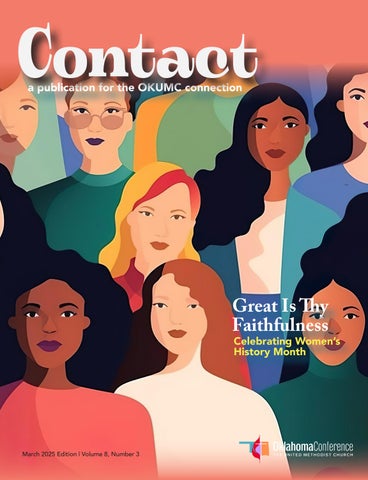
a publication for the OKUMC connection
Great Is Thy Faithfulness
Celebrating Women’s History Month
March 2025 Edition | Volume 8, Number 3
Calendar Mar
15
Mar
19-21
Apr
18
Apr
22
UMCOR Sunday: During this Special Giving Sunday, funds designated for UMCOR will be used for their operational costs. This enables UMCOR to use 100% of any giving through Advance projects, like US Disaster Response, to be used for that project. Learn More.
Healing Ministry Training Retreat at Camp Egan in Tahlequah, OK. The retreat is helpful for prayer teams, pastors who want to strengthen their own healing prayer ministry or want to teach and preach about the power of God who still heals today and for those who seek the spiritual gifts of healing. Register here.
May
7
May
17
The Wesley Foundation’s at the University of Oklahoma’s Centennial Celebration Gathering at 5:30 p.m. Get more information.
Special guest speaker and British Methodist David Worthington will present “Wisdom from the Past, Hope for the Future: A Methodist Heritage Story.” at 6 pm. at Lost Creek’s Oak Park Retreat Center in Perkins, Okla. Learn more.
Skyline’s Bridging the Gaps Luncheon at 11:45 a.m. - 1:00 p.m. at St. Luke’s Methodist Church. Get tickets or sponsorship information here.
Miracle Sunday: a global UMC initiative focused on radical generosity, culminating in a special offering to fund theological education for pastors in Africa, Europe and the Philippines.
Volunteers Needed Criminal Justice and Mercy Ministries (CJAMM) is looking for compassionate and dedicated individuals to serve as volunteers at New Day Camp 2026, a life-giving summer camp for children impacted by parental incarceration. New Day Camp will take place May 31–June 5, 2026, for volunteers and June 1–5, 2026, for campers at Cross Point Camp in Kingston, Oklahoma, located on the beautiful shores of Lake Texoma.
Communications Ministry Staff Carlos Ramirez
Andrew Himes
Director of Communications & Strategy
Multimedia and Web Ministry
If you have story ideas or events, send them to editor@okumc.org.
Cover photo: Adobe Stock The Contact, a publication of the OKUMC Connection (USPS 954-500) is published monthly by The Oklahoma Conference of The United Methodist Church, 1501 NW 24th St., Oklahoma City, OK 73106. Periodical postage paid at Oklahoma City, OK. POSTMASTER: Send address changes to “The Contact OKUMC”, 1501 NW 24th St., Oklahoma City, OK 73106.
OKUMC CONTACT | 1
from the editor Each year, International Women’s Day is a chance to celebrate women’s achievements.
easier for me to believe I, too, could lead and build organizations.
I have been thinking a lot lately about how recent so much of that progress really is.
In many ways, all of us – not just women – are building on foundations we did not lay ourselves. We are standing on the shoulders of those whose persistence expanded what was possible.
I have been fortunate to be a woman who has had the opportunity to lead in several roles over the course of my career - from leading marketing departments to leading companies. I even had the pleasure of coleading the creation of the What If Love campaign for the OKUMC. Recently, I started my own LLC called Koru — something that feels scary, exciting, stretching and deeply meaningful in this season of my life. My work focuses on helping nonprofits and small to medium size businesses with organizational strategy, structure, systems, processes and employee development. I want to help organizations focus on what they are uniquely called to create, lead or change to make the world a better place. When I was a child, my mom also started her own business — a stained glass store. It was the beginning of women’s entrepreneurship in my family. At the time, I did not fully understand what I was witnessing, but looking back, I see what a powerful example she was. She showed me what it looked like for a woman to create something of her own, to take a risk and to build with courage. It is astounding to think about how within my mom’s lifetime, she has seen women not eligible to secure loans without a male relative to co-sign, to now living in a world where women sit in boardrooms, run countries and build businesses entirely on their own terms. So much of the freedom and opportunity women have today can feel normal, but it was built — slowly, courageously and often at great cost — by women who came before us. As a child, I saw a mother running a stained glass store. Now I see a woman stepping into possibility. I see courage and creativity. I see an example that was part of something God was weaving long before I could see it. What she built was actually part of a much bigger story of progress — one that made it
In this issue, you will meet some of those women. Nancy Anthony, a Yale alumna who spent 38 years transforming the Oklahoma City Community Foundation into one of the most consequential philanthropic institutions in the region. You will read the courageous words of Rev. Valerie Steele, who answered God’s call as a single mother of four and never looked back. You will hear from Sharon Cochran, whose theology was forged, not in triumph, but in endurance. You will smile — and probably nod — reading Cindy Matthews and her years in the joys and struggles of ministry. And you will be moved by the story of Rev. Wendi Neal — four degrees, two children, a doctorate, and a stage three cancer diagnosis she met with the calm words, “OK, what do we need to do?” These women inspired me, and I believe they will inspire you too. Reflecting on how much change for women has happened in one lifetime gives me hope for the whole world. It reminds me that while change can feel painfully slow when we are living inside it, progress is possible. Not only for women, but for all people and communities still facing inequity, exclusion and injustice. The arc may not bend on its own, but it does bend when people choose courage, choose persistence and, most importantly, choose love. I am proud to be a part of a denomination that lives this out daily. Over the next few months, I will be helping the OKUMC Communications Team. In doing so, I will be the interim editor of this publication. I would love to hear from you – story ideas, things your churches are doing in your community and anything else you would like to see in the Contact.
Jenny Herzberger
Interim Editor
2 | MARCH EDITION
OKUMC CONTACT | 3
‘Bloom where you’re planted’
How one Yale alum cultivated a culture of giving in Oklahoma City
by Meg Dalton | Yale News
O
n the morning of April 19, 1995, a bomb exploded in a truck parked at the entrance of the Alfred P. Murrah Federal Building in Oklahoma City. Four blocks away, Nancy Anthony ’73 M.A., ’74 M.Phil. felt the ground shake beneath her. In her office, tiles fell from the ceiling, and there was dust everywhere. The bombing — which killed 168 people and injured another 680 — was a total shock not only to her as a longtime resident of the state’s capital and largest city but to the organization she oversaw, the Oklahoma City Community Foundation (OCCF). At the foundation, where she was executive director at the time, Anthony was used to working with donors who wanted to help the Oklahoma City community. But the foundation wasn’t exactly in the business of disaster relief. Within days, that changed. “No, we were not going to go down there and dig through the rubble,” she remembered recently. “We weren’t going to sit at the Red Cross and hold people’s hands. But we could try to coordinate the services that were going to be necessary for these people after those first few weeks.” In the aftermath of the bombing, the foundation
Nancy Anthony, Yale alumna and longtime executive director of the Oklahoma City Community Foundation. Photo courtesy of Yale News
became critical to Oklahoma City’s recovery. As donations poured into the foundation from around the world, it was tasked with assisting the mayor’s office, and later the governor’s office, in managing those donations to support the victims with immediate medical needs, counseling, housing, and funeral expenses.
4 | MARCH EDITION
“Our role was not to compensate people,” she said. “Our goal was to try to help people recover and move forward.” Within the first year after the bombing, the foundation received nearly $12 million from donors nationwide to help victims’ families and survivors. Under Anthony’s leadership, the foundation was able to help more than 1,200 people impacted by death or critical injury related to the bombing. That period marked a new path for the foundation — and for Anthony. Over the course of 38 years, she transformed OCCF into one of the most consequential philanthropic institutions in the region. From Yale to Oklahoma Growing up in Elizabethtown, Kentucky, a small city in the center of that state, Nancy Anthony learned the importance of community early on in life. As a teenager, she was accepted at Vanderbilt University, in neighboring Tennessee, where she developed an interest in mathematics.
Oklahoma City Community Foundation trustees William Johnstone, left, and Nancy Anthony during a trustee meeting in 1998. Photo courtesy of Oklahoma City Community Foundation
Anthony eventually learned about OCCF, which had become a hub for charitable giving and impact in the city since its founding in 1969. Community foundations are grantmaking public charities dedicated to improving the lives of people in a specific geographic area. The foundation had been started by John Kirkpatrick, an oilman and philanthropist who wanted to provide a way for people in his community to make life better for their neighbors. In 1985, Anthony became its executive director. With her years of experience serving on the library commission and other volunteer boards, she was already well-suited for the role.
That eventually led her to pursue a graduate degree in statistics at Yale, where in the early 1970s she was one of only a handful of female students within the statistics department. Anthony spent a lot of time looking at large data sets to understand the relationships between the variables using computers — then a relatively new area of study. In fact, she used those skills to At the time, she didn’t know much about help the undergraduate admissions office analyze endowments or fundraising. But her experience incoming classes. at Yale and in academia equipped her with computer science skills that helped her revamp Soon after completing her M.Phil, Anthony and the nonprofit public charity’s databases, one of her husband, Robert, moved to Oklahoma City her first accomplishments as executive director. in his home state. For 10 years, she focused on raising her four children and embedded herself “I was only there [at Yale] for two years,” she within the community as a volunteer with the said. “But it made me realize how important very city’s Metropolitan Library Commission. But she high-quality academic work was and the impact started itching to get back to work. it can have, and I was able to bring that back to Oklahoma City.”
OKUMC CONTACT | 5
Helping people heal
and public spaces, literacy, and wellness.
Under Anthony’s leadership, OCCF became a leader among community foundations nationwide. When she began her tenure, the foundation had $19 million in assets and just one other full-time employee. By the time she retired in 2022, its staff included 47 full-time employees, and it distributed an average of $46 million annually to charitable organizations across Oklahoma City.
“We felt like we could work with donors and let them determine what needs in the community they wanted to support, and we would try to help them be as effective as possible,” she said.
Bob Blackburn first met Anthony in 1988 as he was climbing the leadership ladder at the Oklahoma Historical Society, an organization dedicated to collecting, preserving, and sharing Oklahoma history. Together, the two While at OCCF, Anthony was able to create collaborated on strategies to blend privately and grow its endowed funds. More than 400 donated funds with state-appropriated funds organizations now participate in the foundation’s for both short-term needs and long-term Nonprofit Endowment Program, making it sustainability. Anthony also helped create an among the largest of its kind in the United States. endowment for the organization that has since The foundation also launched and expanded grown to more than $12 million. a wide range of other initiatives, including “She channeled good intentions into lasting scholarship programs, grantmaking, and outcomes, served as a voice for those who community efforts focused on issues like parks cont’d. on page 4
Nancy Anthony, third from left, with OCCF staff members involved in support efforts following the 1995 Oklahoma City bombing. Photo courtesy of Oklahoma City Community Foundation
6 | MARCH EDITION
needed help, and shaped public opinion about priorities to deal with challenges and seize opportunities,” said Blackburn, now retired director of the historical society. “Nancy earned people’s trust, and in return, she never shirked her responsibility to serve the greater good without demanding the spotlight or seeking public recognition.” The Oklahoma Historical Society was one of the countless organizations Anthony supported through the foundation. During her 38 years as executive director, the foundation disbursed more than $640 million to worthy charitable organizations across the state of Oklahoma, including after the bombing. “The Oklahoma City Community Foundation was essential in the aftermath of the 1995 bombing, in that it was the only local institution with the capacity, reputation, and leadership to manage the many donations that poured in from around the world to support the victims’ immediate medical needs as well as their longterm expenses,” said Nancy Coats-Ashley, a retired district court judge and former trustee of the foundation. “OCCF’s reputation for integrity and trustworthiness under Nancy Anthony’s leadership provided people the assurance that the funds would be properly applied to their intended purpose, to meet the extensive needs of the victims, even if doing so required many years of active stewardship.” Six years after that tragedy, Anthony drew on that experience to help families and survivors of another one: the Sept. 11 attacks. For two years, she consulted charitable organizations in New York City on how to best use funds to serve people in the aftermath. “That was a very important experience for me, to work with those people and to bring what we had done in Oklahoma City,” she said.
Nancy Anthony, left, with OCCF staff member Laura Moon, during a “Musical Swings” event celebrating the foundation’s 50th anniversary in 2018. Photo courtesy of Oklahoma City Community Foundation
She added: “You’re dealing with families where something awful had happened to them, and you had to help them begin to rebuild their lives. This is not about just handing out money. This is really about trying to do the things that help people move on with their lives.” Anthony retired from OCCF three years ago but keeps active in the Oklahoma City community, having now served on the library commission for more than 40 years. Over the years, Anthony served on other volunteer boards as well as coached several softball teams for her four daughters. As both an executive leader and longtime volunteer, Anthony helped nurture a culture of giving in the community that will benefit Oklahoma City for years to come. “There’s an old expression about blooming where you’re planted,” she said. “That’s what I was able to do here.”
This article was originally published by Yale News on January 30, 2026, and is republished here with permission. All photos provided courtesy of Oklahoma City Community Foundation.
OKUMC CONTACT | 7
Shaped by the Journey By Rev. Valerie Steele, District Superintendent of the North Central District. “If you were able to go back in time and make different life decisions, would you?” This is a question I ponder on occasion. When I was in my 20s and 30s, I would have answered that question with an all caps in bold, “YES!” In my 40s, with my previous answer being partially rescinded, there would be parts of my life I would definitely edit. Now in my 50s, that answer is, “No.” The decisions I have made (good, bad, or otherwise) over the course of my life have shaped who I am today. Learning from those decisions has also been beneficial in my ministry journey. Passing on to others where the “potholes” may be on this journey is something I find necessary because people have done that for me. One word that was part of many conversations between my parents and me from my childhood was this word: COMMITMENT. Idioms such as — your word is your bond, stick to your guns, go the extra mile — reverberated throughout my childhood home. Of course, Jesus was firm about one’s commitment to following him in Luke 9:62, “Once you put your hand to the plow and look back, you are not fit for the kingdom of God.” Raised in a Christian home, the lessons of commitment to God and to the blessed tasks you put your hand to have sustained me personally and professionally. When I finally acknowledged God had called me to ordained ministry, I knew responding
to this call in the affirmative meant my total commitment. As a single mom of four children, this change in vocation took a level of trust in God I had never fathomed. God showed up in ways I absolutely did not see coming. From my family and loved ones who were present for my children and me to financial resources from various places that kept us afloat while I was in seminary – God confirmed that call. It strengthened my faith and gave me a holy boldness to wholeheartedly live into the call God has on my life. At each Annual Conference when I see the candidates being commissioned and ordained, I am filled with an exuberant hope. Hope for the Church. Hope for a world in need of Christ’s message of love, forgiveness, acceptance, joy, peace and so much more. At the same time, I find myself so grateful to God for calling me into ordained ministry to serve God’s people, God’s creation. To sum up my journey thus far, as the hymn writer penned in Great Is Thy Faithfulness, “Blessings all mine, with ten thousand beside.” God’s faithfulness towards me is indeed great!
8 | MARCH EDITION
Rev. Wendi Neal, Senior Associate Pastor, serving communion at McFarlin United Methodist Church in Norman, Okla.
What Strength Looks Like By Carlos Ramirez, Director of Communications & Strategy at OKUMC
M
arch is Women’s History Month. Furthermore, we are celebrating 70 years of women’s ordination in the United Methodist Church. I happened to be married to a clergy woman. What I am about to write regarding Wendi Neal, it is not just spouse pleasantries. I am writing about an impressive woman. I think you will see what I mean. When I met Wendi in 2003, she was starting her theological education at Perkins School of
Theology. She had been a Spanish teacher for a couple of years in Connecticut. Now, she was answering God’s calling. In 2006, as part of Perkins’ school requirements, she was appointed to a congregation in Little Rock, Ark. in order to reach out to the Hispanic/Latino Community. Every day, she would commute from Heavener, OK to Little Rock, AR – about 45 minutes drive. There, she planted a faith community among the Spanish speaking community. At her graduation, she received an award for the most creative
OKUMC CONTACT | 9
and innovative ministry of her graduating class. In 2007, after she pastored two congregations in McAlester, OK, we were appointed to Elk City UMC. During our tenure at Elk City UMC, she gave birth twice and was ordained as an elder. In 2012, she was appointed to a cross-cultural appointment: “Fuente de Vida UMC.” For three years, she shepherded this congregation. During her ministry, the congregation experienced growth, partnerships with other United Methodist congregations and the change of locations.
Wendi Neal and husband, Carlos Ramirez.
In 2015, she was appointed to Mayfair Heights UMC and soon after to McFarlin UMC, where she has served until now. In McFarlin, she has the title of Sr. Associate Pastor. Now, working toward ordination, being a pastor and raising two children would have been an accomplishment within itself. Yet, before arriving at McFarlin UMC, she earned a master’s degree in business. A year ago, she graduated from the Doctorate program at Candler School of Theology. To make a summary so far, Wendi has earned an undergraduate degree, two master’s degrees and a doctorate degree. She is fluent in Spanish, has raised two children, all while serving full time in the local church. While these credentials alone are impressive, perhaps the most impressive feat was in full display during 2023. In that spring, Wendi was diagnosed with stage three colon cancer. A routine procedure became a seminal moment in our lives.
Maybe this scene captures how strong Wendi is: When the doctor told us that she had spotted cancer, I was shocked...speechless. I felt as if a bubble was placed on my head that muffled all sound, and reality slowed down almost to a halt. I did not know what to say. I just sat there. What did Wendi do in that moment? She, like me, was quiet for a moment, then she said in a very calm and matter of fact way: “OK, what do we need to do? What are the next steps?” Throughout her treatment that lasted the better part of 2023, she was nothing but strong. It was not an easy time for her and for us as family. Yet, her calm and resolute spirit never left her. In November of 2023, she got to ring the bell, signaling the end of her treatment. I am proud and thankful to God to say that she has been healed and continues to be cancer free. I think you can see by now why Wendi is an impressive person. She is a strong woman, a faithful, thoughtful, effective minister, a loving and caring mother, and my best friend. I give thanks to God for the life of Wendi Neal.
10 | MARCH EDITION
How a Woman Becomes Herself By Sharon Cochran, Tishomingo UMC Pastor
I
did not come to ministry by a straight road. I didn’t even come by a paved one. My life has been more like the backroads of western Oklahoma – winding, unmarked, sometimes washed out, sometimes holy in ways you only notice if you’ve learned to pay attention.
that women who refuse to shrink are always seen as a problem.
By the time I found myself in ministry, I already knew how to stand my ground. I already I didn’t grow up dreaming of pulpits or knew how to walk parsonages. I grew up learning how to survive, how to read a room, how to tell the truth without away from what was killing me. getting swallowed by it. Before the church ever taught me anything about God, the world taught I already knew that survival is not shameful – it is sacred. And, me about power – who has it, who abuses it and who gets crushed under the weight of other I already knew that God was not fragile, and neither was I. people’s certainty. I learned early that some people mistake cruelty for strength. I learned that silence can be a weapon or a refuge. I learned that women are expected to absorb more than they should ever have to carry. And I learned that if you want to stay alive – spiritually, emotionally, sometimes literally – you have to develop a kind of internal clarity that no one can take from you. Those lessons shaped me long before I ever preached a sermon. What the world taught me before the church did and what breaking and rebuilding did to my theology The world taught me that people will tell you who you are long before they ever bother to learn your name. It taught me that being underestimated can be a kind of strange blessing – it gives you room to grow without being watched. It taught me that the people who talk the loudest about righteousness are often the ones most afraid of the truth. And it taught me
There are seasons of my life I survived by grit alone. Seasons that hardened me in ways I didn’t recognize until much later. Seasons that softened me in ways I didn’t expect. Seasons that taught me that God is not found in the explanations people offer but in the breath you still have after the worst has happened. Surviving changed my theology. Not in the sense of doctrine, but in the sense of what I believe about God’s character. I stopped believing in a God who tests people like lab rats. I stopped believing in a God who rewards the strong and punishes the weak. I stopped believing in a God who needs me to pretend. Instead, I came to believe in a God who sits with people in the waiting room. A God who does not rush grief. A God who honors boundaries. A God who does not romanticize suffering but also does not abandon people in the middle of it. A God who whispers, “You’re still here,” and means it as both comfort and commissioning.
OKUMC CONTACT | 11
My theology is not built on triumph. It is built on ministry. I am angry about the gatekeeping that masquerades as discernment. I am angry endurance – the quiet miracle of still choosing about the way suffering is romanticized when joy, still choosing truth, still choosing life. it happens to women but pathologized when it How lived experience shapes the way I pastor happens to men. I am angry about the way the I pastor the way I do because I know what it feels church sometimes protects its own comfort more like to be dismissed, silenced, underestimated, than it protects its people. or used. I know what it feels like to be told you’re But that anger is not bitterness. It is fuel. It is too much or not enough. I know what it feels like the fire that keeps me honest. It is the fire that to be treated as a problem instead of a person. keeps me preaching. It is the fire that keeps me And I know what it feels like to rebuild your life advocating for the people who have been told from the inside out. they don’t belong. It is the fire that reminds me So I pastor with dignity at the center. I pastor that ministry is not about being liked – it is with boundaries that are not up for negotiation. about being faithful. I pastor with a deep respect for the stories people How a woman becomes who she is carry – especially the ones they don’t tell out loud. I pastor with the conviction that the church I did not become who I am because life was easy. I became who I am because life demanded should be the safest place in town, not the most performative. I pastor with tenderness because I that I learn how to tell the truth, how to set know how much it costs people to walk through boundaries, how to survive, how to rebuild, how to trust joy again, and how to listen for God in the door. And, I pastor with clarity because I the places no one expects. know how much damage is done when leaders refuse to tell the truth. I fight for people because I became who I am because I stopped I know what it’s like to need someone to fight for auditioning for belonging. I became who I am you. because I learned that holiness is not found in What people misunderstand about strength
People think strength looks like certainty. They think it looks like confidence, or volume or the ability to keep going without flinching. But real strength is quieter than that. Real strength is the ability to stay soft in a world that rewards hardness. Real strength is telling the truth even when it costs you something. Real strength is setting boundaries without apology. Real strength is refusing to perform for people who have not earned access to your story. Strength is not the absence of wounds. Strength is the refusal to let those wounds turn you cruel. What still makes me angry – in a good way I am still angry – in a holy, clarifying way – about the ways women are dismissed in
perfection but in presence. I became who I am because I refused to let other people’s fear define my calling. And I became who I am because somewhere along the way, I realized that God was not asking me to be impressive – God was asking me to be awake.
This is not a redemption arc. It is not a tidy story. It is simply the truth of how a woman becomes herself — through clarity, through endurance, through joy, through boundaries, through the quiet courage of showing up again and again, even when the road is not straight. And if that is ministry, then so be it. If that is calling, then let it be called. But I think it is something deeper: a life lived honestly, a witness shaped by survival, and a woman who refuses to shrink.
12 | MARCH EDITION
Ministry is Tough...and Amazing! By Cindy Matthews, Director of Youth Ministries at First UMC Muskogee
F
or those of you reading this: Ministry is tough! Ask any pastor or their family, and they will concur. Family time has been interrupted by an emergency hospital visit. A vacation has been put on hold for a phone call that couldn’t wait. A meeting has been rescheduled to your day off.
As society has sped up, so have the demands for ministry. With our cell phones constantly with us, there is a perception we should be reachable at all times. What people do not understand is how draining this is for those providing the ministry. When I began ministry almost 25 years ago, people would have to call or send an e-mail to inform me about an event or something important. Now, we receive text messages several times a day and feel that a response needs to be sooner rather than later. If that first part sounded a little jaded, let me continue with this … what a gift it is to minister to those around us. I LOVE the fact that our current youth kids (and former youth kids) send messages relaying their
accomplishments to our adult leaders and to myself. The community of love and relationships that have been built is one of the greatest gifts we have been given. We have a front row seat to so many wonderful lives, and it does not end after they are finished with youth group. Our youth ministry at FUMC Muskogee is an anomaly. Over the past 43 years, we have only had two youth directors. This is something that is completely unheard of in a lot of ministry fields. The average employment for a youth director/pastor at a church is 18 months. How do you even know what you are doing in the first 18 months of your youth journey? I was “recruited” into youth ministry by Sandi Rosson, and I still have the twisted arm x-rays to prove it. But, oh my goodness, she bestowed to me an amazing opportunity to walk beside these wonderful humans. Is it exhausting? Absolutely! Do I lose my temper with them? YES! Would I want to do anything else? Some days! The love we have for these kids is not only evident when they are in the building, but also when we support them at their plays, choir concerts and sporting events. I cannot express how important the congregation and staff are for the ministry of the church to thrive. These are the people who know the family dynamics, the people who give their time and talents, the people who will always be there during the good times and bad. I have been so thankful for the people who checked on me when a youth family lost their mom
OKUMC CONTACT | 13
unexpectedly, when a youth kid was injured in a skiing accident or when I was generally overwhelmed with life. Have I mentioned that ministry is tough? Have I also mentioned that it is amazing? Being a female in ministry has had its challenges. I have been excluded from community meetings regarding youth events. I have been told that I should not be in a leadership position. I have been told to consult with the men in my church before making a decision. I’ll be honest … those comments were hurtful. I truly feel God works through all of us, and everyone has gifts to strengthen the kingdom. So what did I do about those comments? I cried about it. I prayed about it. And I have outlasted them in the youth ministry underworld.
Remember the first line – Ministry is tough! Pray for the staff in your church. Pray for the committee members making the tough decisions. Pray for your pastor and his or her family. Pray for the volunteers who clean the flowerbeds. Pray for the people who prepare communion. Ministry is tough, and it takes all of us working together. John 15:5 says, “I am the vine; you are the branches. If you remain in me and I in you, you will bear much fruit; apart from me you can do nothing.” Ministry is not limited to the paid staff; we are all called to make disciples for the transformation of the world.
14 | MARCH EDITION
Call to Action Do you have news you’d like to share with the conference? Send photos and stories to editor@ okumc.org. Looking for something? Click below for: Employment Passages Appointments Events News
Share your event or job opportunity in OKUMC publications. For consideration, email your listing to editor@okumc.org.